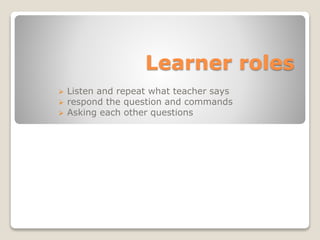
Learner roles
 Listen and repeat what teacher says
 respond the question and commands
 Asking each other questions
Teacher Roles
 Serves as a model
 becomes more like the skillful
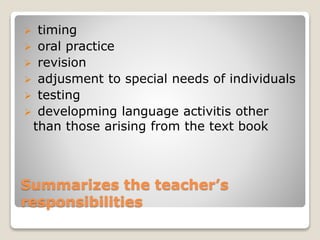
Summarizes the teacher’s
responsibilities
 timing
 oral practice
 revision
 adjusment to special needs of individuals
 testing
 developming language activitis other
than those arising from the text book
The role instructional materials
 text book
 visual aids
Procedure
 pronunciation
 revision
 presentation of new structure or
vocubulary
 oral practice
 reading of material on the new structure
or written exercises
Conclusion
 The essential features of SLT are seen in the “P-P-P” lesson model that
thousands of teachers who studied for the RSA/Cambridge Certificate in
TEFL were required to master in the 1980s and early 1990s, with a lesson
having three phases: presentation (introduction of a new teaching item in
context), Practice (controlled practice of the item), and Production (a freer
practice phase) (Willis and Willis 1996). In the mid-1960s, however, the
view of language, language learning, and language teaching underlying
Situstionsl Language Teaching was called into question. We discuss this
reaction and how it led to Communicative Language Teaching in Chapter
14. But because the principles of Situation Language Teaching, with its
strong emphasis on oral practice, grammar, and sentence patterns,
conform to the intuitions of many language teachers and offer a practical
methodology suted to countries where national EFL/ESL syllabuses

Adam presentation

  • 1.
    Learner roles  Listenand repeat what teacher says  respond the question and commands  Asking each other questions
  • 2.
    Teacher Roles  Servesas a model  becomes more like the skillful
  • 3.
    Summarizes the teacher’s responsibilities timing  oral practice  revision  adjusment to special needs of individuals  testing  developming language activitis other than those arising from the text book
  • 4.
    The role instructionalmaterials  text book  visual aids
  • 5.
    Procedure  pronunciation  revision presentation of new structure or vocubulary  oral practice  reading of material on the new structure or written exercises
  • 6.
    Conclusion  The essentialfeatures of SLT are seen in the “P-P-P” lesson model that thousands of teachers who studied for the RSA/Cambridge Certificate in TEFL were required to master in the 1980s and early 1990s, with a lesson having three phases: presentation (introduction of a new teaching item in context), Practice (controlled practice of the item), and Production (a freer practice phase) (Willis and Willis 1996). In the mid-1960s, however, the view of language, language learning, and language teaching underlying Situstionsl Language Teaching was called into question. We discuss this reaction and how it led to Communicative Language Teaching in Chapter 14. But because the principles of Situation Language Teaching, with its strong emphasis on oral practice, grammar, and sentence patterns, conform to the intuitions of many language teachers and offer a practical methodology suted to countries where national EFL/ESL syllabuses