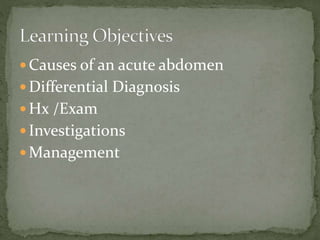
 Causes of an acute abdomen
 Differential Diagnosis
 Hx /Exam
 Investigations
 Management
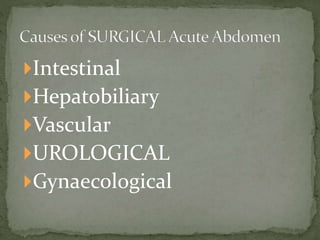
Intestinal
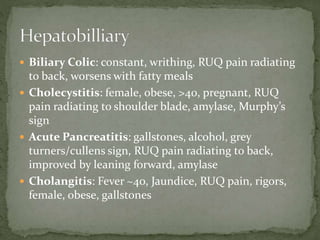
Hepatobiliary
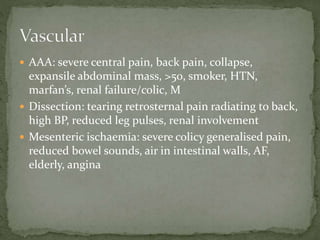
Vascular
UROLOGICAL
Gynaecological
• Liver (hepatitis)
• Gall bladder (gallstones)
• Stomach (peptic ulcer, gastritis)
• Hepatic flexure colon (cancer)
• Lung (pneumonia)
• Ascending colon (cancer,)
• Kidney (stone,
hydronephrosis, UTI)
• Appendix (Appendicitis)
• Caecum (tumour, volvulus,
closed loop obstruction)
• Terminal ileum (crohns, mekels)
• Ovaries/fallopian tube (ectopic,
cyst, PID)
• Ureter (renal colic)
• Liver (hepatitis)
• Gall bladder (gallstones)
• Stomach (peptic ulcer, gastritis)
• Transverse colon (cancer)
• Pancreas (pancreatitis)
• Heart (MI)
• Spleen (rupture)
• Pancreas (pancreatitis)
• Stomach (peptic ulcer)
• Splenic flexure colon (cancer)
• Lung (pneumonia)
• Descending colon (cancer)
• Kidney (stone,
hydronephrosis, UTI)
• Sigmoid colon (diverticulitis,
colitis, cancer)
• Ovaries/fallopian tube
(ectopic, cyst, PID)
• Ureter (renal colic)
• Uterus (fibroid, cancer)
• Bladder (UTI, stone)
• Sigmoid colon
(diverticulitis)
• Small bowel
(obstruction/ischaemia)
• Aorta (leaking AAA)
 Appendicitis: RIF pain, Mc Burney’s point tenderness,
peritonitic
 Diverticulitis: LIF pain, PR bleed, Elderly, common
 Colorectal Ca: Fe deficient anaemia, Wt loss, altered
bowel habit, PR bleed, fatigue, mass palpable, obstructed
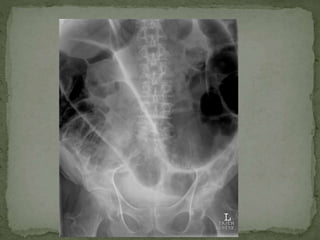
 Large bowel obstruction: Distension, colicky pain,
absolute constipation, N+V (faeculent), tinkling BS
 Small bowel obstruction: early billious vomiting, late
obstruction,chrohns
 Perforation: shock, rigid abdomen, severe tenderness,
pyrexia, air under diaphragm, Rigler’s sign
 Biliary Colic: constant, writhing, RUQ pain radiating
to back, worsens with fatty meals
 Cholecystitis: female, obese, >40, pregnant, RUQ
pain radiating to shoulder blade, amylase, Murphy’s
sign
 Acute Pancreatitis: gallstones, alcohol, grey
turners/cullens sign, RUQ pain radiating to back,
improved by leaning forward, amylase
 Cholangitis: Fever ~40, Jaundice, RUQ pain, rigors,
female, obese, gallstones
 AAA: severe central pain, back pain, collapse,
expansile abdominal mass, >50, smoker, HTN,
marfan’s, renal failure/colic, M
 Dissection: tearing retrosternal pain radiating to back,
high BP, reduced leg pulses, renal involvement
 Mesenteric ischaemia: severe colicy generalised pain,
reduced bowel sounds, air in intestinal walls, AF,
elderly, angina
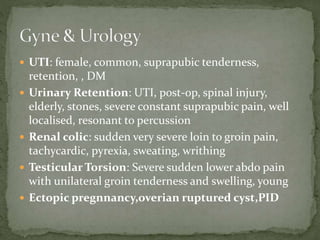
 UTI: female, common, suprapubic tenderness,
retention, , DM
 Urinary Retention: UTI, post-op, spinal injury,
elderly, stones, severe constant suprapubic pain, well
localised, resonant to percussion
 Renal colic: sudden very severe loin to groin pain,
tachycardic, pyrexia, sweating, writhing
 Testicular Torsion: Severe sudden lower abdo pain
with unilateral groin tenderness and swelling, young
 Ectopic pregnnancy,overian ruptured cyst,PID
TMANAGMENT
OF
ACUTE ABDOMIN
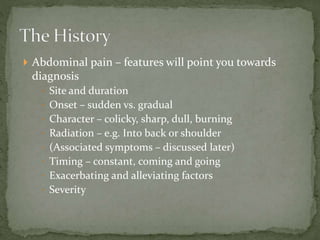
 Abdominal pain – features will point you towards
diagnosis
 Site and duration
 Onset – sudden vs. gradual
 Character – colicky, sharp, dull, burning
 Radiation – e.g. Into back or shoulder
 (Associated symptoms – discussed later)
 Timing – constant, coming and going
 Exacerbating and alleviating factors
 Severity
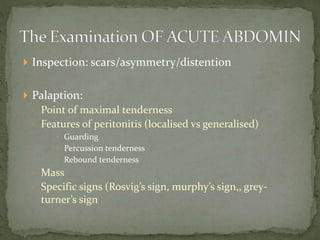
 Inspection: scars/asymmetry/distention
 Palaption:
◦ Point of maximal tenderness
◦ Features of peritonitis (localised vs generalised)
 Guarding
 Percussion tenderness
 Rebound tenderness
◦ Mass
◦ Specific signs (Rosvig’s sign, murphy’s sign,, grey-
turner’s sign
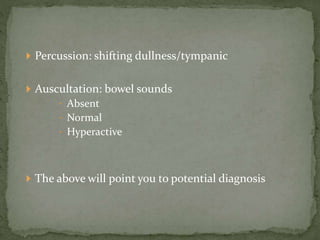
 Percussion: shifting dullness/tympanic
 Auscultation: bowel sounds
 Absent
 Normal
 Hyperactive
 The above will point you to potential diagnosis
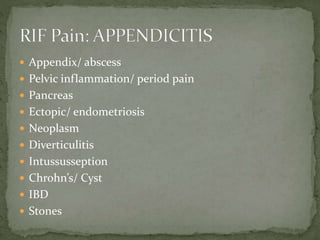
 Appendix/ abscess
 Pelvic inflammation/ period pain
 Pancreas
 Ectopic/ endometriosis
 Neoplasm
 Diverticulitis
 Intussusseption
 Chrohn’s/ Cyst
 IBD
 Stones
 Sigmoid diverticuli, volvulous
 Ureteric colic
 Pelvic inflammation/ period pain
 Ectopic/ endometriosis
 Rectal Haematoma
 Colon cancer
 Left lower pneumonia
 Ovarian cyst
 Torsion
 Stones
 Simple Investigations:
 Bloods tests (FBC, U&E, LFT, amylase, clotting, CRP, G&S/
ABG)
 Urine dipstick
 Pregnancy test (all women of child bearing age with lower
abdominal pain)
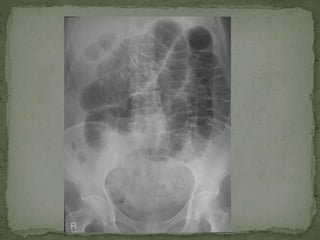
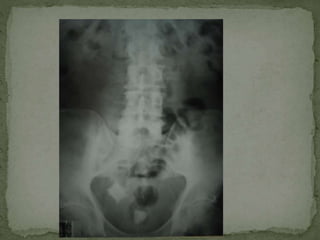
 CXR CHEST/ ABDOMIN
 ECG
 More ADVANCE investigations:
 Contrast studies
 Endoscopy (OGD/colonoscopy/ERCP)
 CT
 MRI
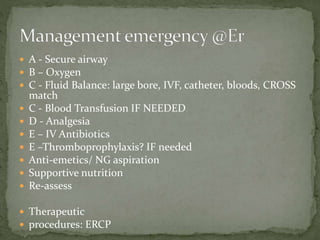
 A - Secure airway
 B – Oxygen
 C - Fluid Balance: large bore, IVF, catheter, bloods, CROSS
match
 C - Blood Transfusion IF NEEDED
 D - Analgesia
 E – IV Antibiotics
 E –Thromboprophylaxis? IF needed
 Anti-emetics/ NG aspiration
 Supportive nutrition
 Re-assess
 Therapeutic
 procedures: ERCP
 Urgent surgery should not be delayed for time
consuming tests when an indication for surgery is
clear
 The following three categories of general surgical
problems will require emergency surgery
 Generalised peritonitis on examination (regardless of cause –
except acute pancreatitis, hence all patients get amylase)
 Perforation (air under diaphragm on E-CXR)
 Irreducible and tender hernia (risk of strangulation)
Thanks
ACUTE ABDOMIN /REVISION/BASIC KNOWLEDGE

ACUTE ABDOMIN /REVISION/BASIC KNOWLEDGE

  • 2.
     Causes ofan acute abdomen  Differential Diagnosis  Hx /Exam  Investigations  Management
  • 3.
  • 4.
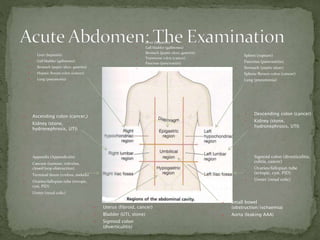
    • Liver (hepatitis) •Gall bladder (gallstones) • Stomach (peptic ulcer, gastritis) • Hepatic flexure colon (cancer) • Lung (pneumonia) • Ascending colon (cancer,) • Kidney (stone, hydronephrosis, UTI) • Appendix (Appendicitis) • Caecum (tumour, volvulus, closed loop obstruction) • Terminal ileum (crohns, mekels) • Ovaries/fallopian tube (ectopic, cyst, PID) • Ureter (renal colic) • Liver (hepatitis) • Gall bladder (gallstones) • Stomach (peptic ulcer, gastritis) • Transverse colon (cancer) • Pancreas (pancreatitis) • Heart (MI) • Spleen (rupture) • Pancreas (pancreatitis) • Stomach (peptic ulcer) • Splenic flexure colon (cancer) • Lung (pneumonia) • Descending colon (cancer) • Kidney (stone, hydronephrosis, UTI) • Sigmoid colon (diverticulitis, colitis, cancer) • Ovaries/fallopian tube (ectopic, cyst, PID) • Ureter (renal colic) • Uterus (fibroid, cancer) • Bladder (UTI, stone) • Sigmoid colon (diverticulitis) • Small bowel (obstruction/ischaemia) • Aorta (leaking AAA)
  • 5.
     Appendicitis: RIFpain, Mc Burney’s point tenderness, peritonitic  Diverticulitis: LIF pain, PR bleed, Elderly, common  Colorectal Ca: Fe deficient anaemia, Wt loss, altered bowel habit, PR bleed, fatigue, mass palpable, obstructed  Large bowel obstruction: Distension, colicky pain, absolute constipation, N+V (faeculent), tinkling BS  Small bowel obstruction: early billious vomiting, late obstruction,chrohns  Perforation: shock, rigid abdomen, severe tenderness, pyrexia, air under diaphragm, Rigler’s sign
  • 6.
     Biliary Colic:constant, writhing, RUQ pain radiating to back, worsens with fatty meals  Cholecystitis: female, obese, >40, pregnant, RUQ pain radiating to shoulder blade, amylase, Murphy’s sign  Acute Pancreatitis: gallstones, alcohol, grey turners/cullens sign, RUQ pain radiating to back, improved by leaning forward, amylase  Cholangitis: Fever ~40, Jaundice, RUQ pain, rigors, female, obese, gallstones
  • 7.
     AAA: severecentral pain, back pain, collapse, expansile abdominal mass, >50, smoker, HTN, marfan’s, renal failure/colic, M  Dissection: tearing retrosternal pain radiating to back, high BP, reduced leg pulses, renal involvement  Mesenteric ischaemia: severe colicy generalised pain, reduced bowel sounds, air in intestinal walls, AF, elderly, angina
  • 8.
     UTI: female,common, suprapubic tenderness, retention, , DM  Urinary Retention: UTI, post-op, spinal injury, elderly, stones, severe constant suprapubic pain, well localised, resonant to percussion  Renal colic: sudden very severe loin to groin pain, tachycardic, pyrexia, sweating, writhing  Testicular Torsion: Severe sudden lower abdo pain with unilateral groin tenderness and swelling, young  Ectopic pregnnancy,overian ruptured cyst,PID
  • 9.
  • 10.
     Abdominal pain– features will point you towards diagnosis  Site and duration  Onset – sudden vs. gradual  Character – colicky, sharp, dull, burning  Radiation – e.g. Into back or shoulder  (Associated symptoms – discussed later)  Timing – constant, coming and going  Exacerbating and alleviating factors  Severity
  • 11.
     Inspection: scars/asymmetry/distention Palaption: ◦ Point of maximal tenderness ◦ Features of peritonitis (localised vs generalised)  Guarding  Percussion tenderness  Rebound tenderness ◦ Mass ◦ Specific signs (Rosvig’s sign, murphy’s sign,, grey- turner’s sign
  • 12.
     Percussion: shiftingdullness/tympanic  Auscultation: bowel sounds  Absent  Normal  Hyperactive  The above will point you to potential diagnosis
  • 13.
     Appendix/ abscess Pelvic inflammation/ period pain  Pancreas  Ectopic/ endometriosis  Neoplasm  Diverticulitis  Intussusseption  Chrohn’s/ Cyst  IBD  Stones
  • 14.
     Sigmoid diverticuli,volvulous  Ureteric colic  Pelvic inflammation/ period pain  Ectopic/ endometriosis  Rectal Haematoma  Colon cancer  Left lower pneumonia  Ovarian cyst  Torsion  Stones
  • 15.
     Simple Investigations: Bloods tests (FBC, U&E, LFT, amylase, clotting, CRP, G&S/ ABG)  Urine dipstick  Pregnancy test (all women of child bearing age with lower abdominal pain)  CXR CHEST/ ABDOMIN  ECG  More ADVANCE investigations:  Contrast studies  Endoscopy (OGD/colonoscopy/ERCP)  CT  MRI
  • 19.
     A -Secure airway  B – Oxygen  C - Fluid Balance: large bore, IVF, catheter, bloods, CROSS match  C - Blood Transfusion IF NEEDED  D - Analgesia  E – IV Antibiotics  E –Thromboprophylaxis? IF needed  Anti-emetics/ NG aspiration  Supportive nutrition  Re-assess  Therapeutic  procedures: ERCP
  • 20.
     Urgent surgeryshould not be delayed for time consuming tests when an indication for surgery is clear  The following three categories of general surgical problems will require emergency surgery  Generalised peritonitis on examination (regardless of cause – except acute pancreatitis, hence all patients get amylase)  Perforation (air under diaphragm on E-CXR)  Irreducible and tender hernia (risk of strangulation)
  • 21.