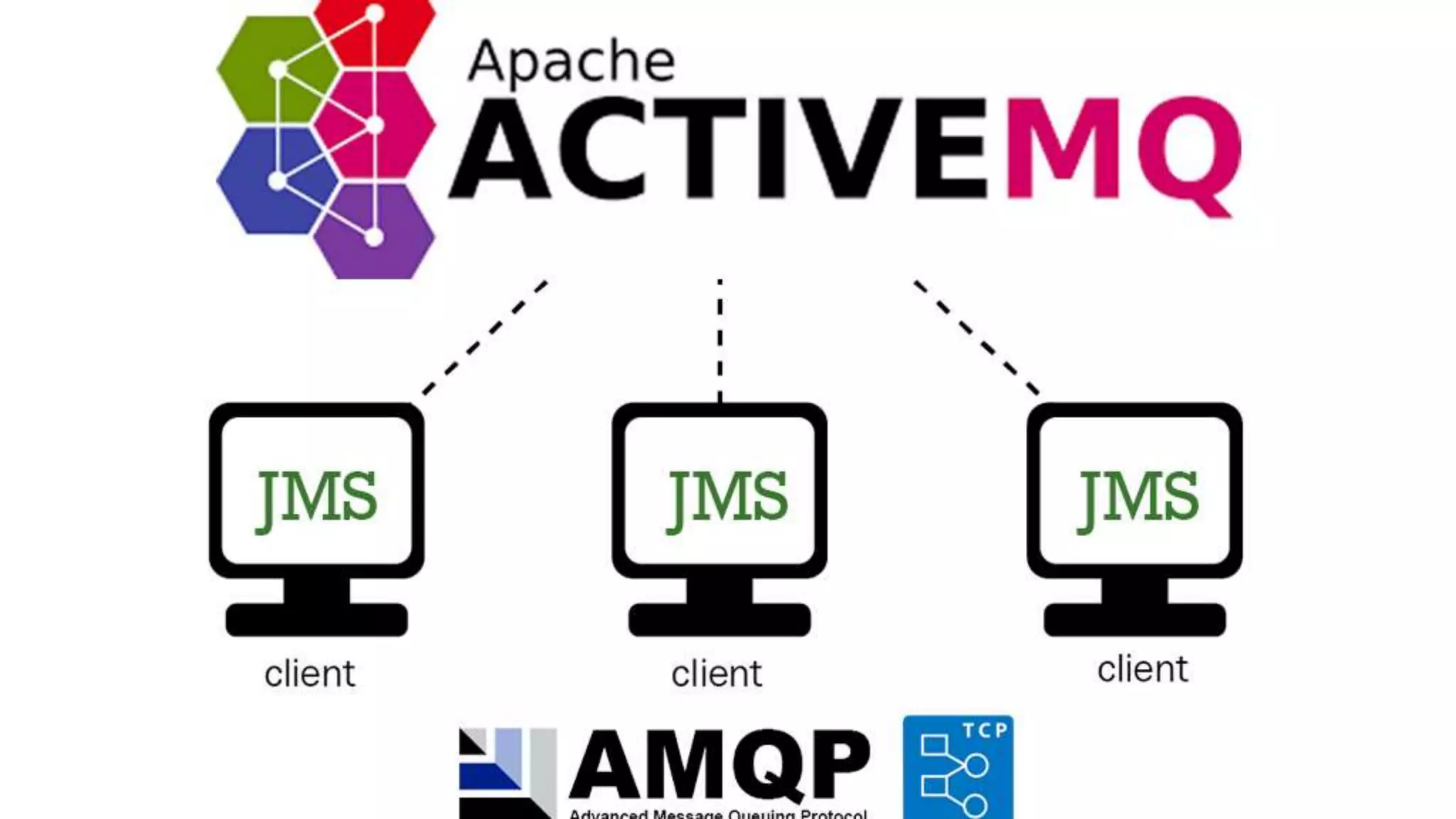
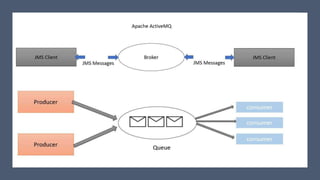
What is ActiveMQ?
ActiveMQ is an open-source message broker that is basically
written using Java programming language. It is mainly written using
the Java Message Service (JMS). The benefit of such an open-
source – messaging broker is that it provides some executive
features to enterprises, which implies that a particular
communication can be promoted from one client to another.
What is use of ActiveMQ instead of other options like database?
Activemq is used to reliably communicate between two distributed
processes. It can store messages in a database to communicate
between to processes, but as soon as the message is received you'd
have to delete the message. That means a row insert and delete for
each message. When you try to scale that up communicating
thousands of messages per second, databases tend to fall over.
Message oriented middleware like ActiveMQ on the other hand are
build to handle those use cases. They asume that messages in a
healthy system will be deleted very quickly and can do optimizations to
avoid the overhead. It can also push messages to consumers instead
of a consumer having to poll for new message by doing a SQL query.
This further reduces the latency involved in processing new messages
being sent into the system.
What is JMS?
Java Message Service (JMS) is an application program interface (API) from Sun Microsy
that supports the formal communication known as messaging between computers in
a network. Sun's JMS provides a common interface to standard messaging protocols
and also to special messaging services in support of Java programs. ActiveMQ is based
What is KahaDB?
KahaDB is a file based persistence database that is local to the message broker that is u
It has been optimized for fast persistence. It is the the default storage mechanism since
ActiveMQ 5.4. KahaDB uses less file descriptors and provides faster recovery than
its predecessor, the AMQ Message Store.
What is LevelDB?
LevelDB is a slightly faster index than KahaDB and can provide somewhat better perform
numbers. In later releases of ActiveMQ the LevelDB store also supports replication.
Features of Apache ActiveMQ?
•Supports a variety of Cross Language Clients and Protocols from Java, C, C++,
PHP.
•Supports many advanced features such as Message Groups, Virtual
Composite Destinations.
•Can be used as an in memory JMS provider, ideal for unit testing JMS.
•Supports pluggable transport protocols such as in-VM, TCP, SSL, NIO, UDP,
transports.
•Supports very fast persistence using JDBC along with a high performance
How Does Activemq Compare To Fuse Message Broker?
Fuse Message Broker is a certified distribution of Apache ActiveMQ provided by
does all of its development and bug fixes as part of the Apache ActiveMQ
functional differences between the two. FuseSource may do more frequent
possible to get bug fixes from a Fuse Message Broker release sooner than from
ActiveMQ release. with other checks like automated code quality tests, syntax
Difference between ActiveMQ or RabbitMQ?
•ActiveMQ is an open-source message broker is scripted in Java which is
Service client.
•RabbitMQ is implemented on Advanced Message Queueing protocol.
What are clusters in Apache ActiveMQ?
•ActiveMQ supports reliable high performance load balancing of messages on
consumers. In enterprise integration, this scenario is known as the competing
•The load is distributed in a very dynamic fashion. Additional consumers
attached to the queue in high load periods, without modifying any
consumer would behave as just another competing consumer. Better
load balancer. Load balancers usually rely on a monitorization system to find
unavailable. With competing consumers, a failed consumer will not be
therefore messages not be delivered to it even without monitorization.
How Does Activemq Compare To Amqp?
Advanced Message Queue Protocol acts as a specification for how the
will interoperate, it is also a wire level protocol for client to message broker
AMQP is not a messaging system such as ActiveMQ, it can be a message
AMQP supports open wire protocols such as:
OpenWire, a fast binary format.
Stomp, a simple and easily implemented text based-protocol.
MQTT, a compact binary format for limited devices on an unreliable
What is topic in ActiveMQ?
Virtual Topics are the combination of Topics and Queues, the messages to
that will consume messages from the queues.
ActiveMQ helps in copying and duplicating every message to the actual
topic.
Which open wire protocols ActiveMQ supports?
OpenWire
Stomp
MQTT
They are the Open Wire Protocols supported by ActiveMQ.
Differentiate between ActiveMQ and Mule
ActiveMQ is a messaging service that has extensive features to support both the broker and the client.
While on the other hand, Mule is an ESB that has the capabilities to provide executive features to only
the broker by exchanging messages among different software components.
What can one do to monitor the connection between a client and a broker?
In order to monitor the connection between the broker and the client, one needs to monitor the state of
the connection using the “addTransportListener()” method.
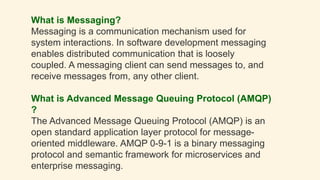
What is Messaging?
Messaging is a communication mechanism used for
system interactions. In software development messaging
enables distributed communication that is loosely
coupled. A messaging client can send messages to, and
receive messages from, any other client.
What is Advanced Message Queuing Protocol (AMQP)
?
The Advanced Message Queuing Protocol (AMQP) is an
open standard application layer protocol for message-
oriented middleware. AMQP 0-9-1 is a binary messaging
protocol and semantic framework for microservices and
enterprise messaging.
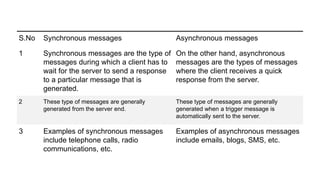
S.No Synchronous messages Asynchronous messages
1 Synchronous messages are the type of
messages during which a client has to
wait for the server to send a response
to a particular message that is
generated.
On the other hand, asynchronous
messages are the types of messages
where the client receives a quick
response from the server.
2 These type of messages are generally
generated from the server end.
These type of messages are generally
generated when a trigger message is
automatically sent to the server.
3 Examples of synchronous messages
include telephone calls, radio
communications, etc.
Examples of asynchronous messages
include emails, blogs, SMS, etc.
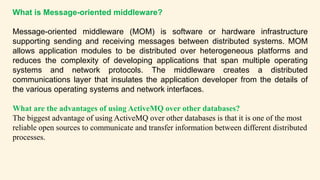
What is Message-oriented middleware?
Message-oriented middleware (MOM) is software or hardware infrastructure
supporting sending and receiving messages between distributed systems. MOM
allows application modules to be distributed over heterogeneous platforms and
reduces the complexity of developing applications that span multiple operating
systems and network protocols. The middleware creates a distributed
communications layer that insulates the application developer from the details of
the various operating systems and network interfaces.
What are the advantages of using ActiveMQ over other databases?
The biggest advantage of using ActiveMQ over other databases is that it is one of the most
reliable open sources to communicate and transfer information between different distributed
processes.
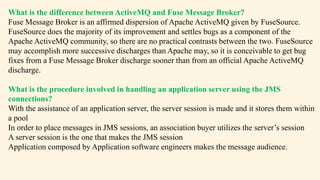
What is the difference between ActiveMQ and Fuse Message Broker?
Fuse Message Broker is an affirmed dispersion of Apache ActiveMQ given by FuseSource.
FuseSource does the majority of its improvement and settles bugs as a component of the
Apache ActiveMQ community, so there are no practical contrasts between the two. FuseSource
may accomplish more successive discharges than Apache may, so it is conceivable to get bug
fixes from a Fuse Message Broker discharge sooner than from an official Apache ActiveMQ
discharge.
What is the procedure involved in handling an application server using the JMS
connections?
With the assistance of an application server, the server session is made and it stores them within
a pool
In order to place messages in JMS sessions, an association buyer utilizes the server’s session
A server session is the one that makes the JMS session
Application composed by Application software engineers makes the message audience.
Explain the working of JMS in association with J2EE
The customer using the application such as the JavaBeans firstly
parts and segments the web in order to be able to send or receive
JMS message synchronously. In addition to that, the customer using
the application can also likewise get message non – concurrently.
With the assistance of message-driven beans, JMS supplier can
alternatively execute the preparation of messages. The message-
driven beans are a kind of big business bean that empowers the
offbeat utilization of various kinds of messages. The task of sending
and accepting message is completed and is in conveyed, which then
permits JMS tasks and database to get inside a solitary exchange.
What can one do to monitor the connection between a client and a broker?
In order to monitor the connection between the broker and the client, one needs
to monitor the state of the connection using the “addTransportListener()”
method.
Mention Few Features Of Activemq ?
JMS compliance : ActiveMQ is an implementation of JMS ,so have all blessings that JMS
have.
Persistent : ActiveMQ has inbuilt KahaDB and it is able to be plugged to outside DB as
properly.
Security : ActiveMQ provides authentication and authorization.
Cluster : Many ActiveMQ dealer can make cluster to work together.
Client API : ActiveMQ presents patron API for lots languages.
What are ActiveMQ's biggest drawbacks?
It's a complicated mechanism that only allows one thread per
connection.
What is the process for dealing with an application
server using JMS connections?
The server session is created with the help of an application
server, which then stores them in a pool. An association buyer
uses the server's session to place messages in JMS sessions.
The JMS session is created by a server session. The messaging
audience is created by an application produced by application
software engineers.
THANK YOU
Like the Video and Subscribe the Channel

ActiveMQ interview Questions and Answers

  • 2.
    What is ActiveMQ? ActiveMQis an open-source message broker that is basically written using Java programming language. It is mainly written using the Java Message Service (JMS). The benefit of such an open- source – messaging broker is that it provides some executive features to enterprises, which implies that a particular communication can be promoted from one client to another.
  • 4.
    What is useof ActiveMQ instead of other options like database? Activemq is used to reliably communicate between two distributed processes. It can store messages in a database to communicate between to processes, but as soon as the message is received you'd have to delete the message. That means a row insert and delete for each message. When you try to scale that up communicating thousands of messages per second, databases tend to fall over. Message oriented middleware like ActiveMQ on the other hand are build to handle those use cases. They asume that messages in a healthy system will be deleted very quickly and can do optimizations to avoid the overhead. It can also push messages to consumers instead of a consumer having to poll for new message by doing a SQL query. This further reduces the latency involved in processing new messages being sent into the system.
  • 5.
    What is JMS? JavaMessage Service (JMS) is an application program interface (API) from Sun Microsy that supports the formal communication known as messaging between computers in a network. Sun's JMS provides a common interface to standard messaging protocols and also to special messaging services in support of Java programs. ActiveMQ is based What is KahaDB? KahaDB is a file based persistence database that is local to the message broker that is u It has been optimized for fast persistence. It is the the default storage mechanism since ActiveMQ 5.4. KahaDB uses less file descriptors and provides faster recovery than its predecessor, the AMQ Message Store. What is LevelDB? LevelDB is a slightly faster index than KahaDB and can provide somewhat better perform numbers. In later releases of ActiveMQ the LevelDB store also supports replication.
  • 6.
    Features of ApacheActiveMQ? •Supports a variety of Cross Language Clients and Protocols from Java, C, C++, PHP. •Supports many advanced features such as Message Groups, Virtual Composite Destinations. •Can be used as an in memory JMS provider, ideal for unit testing JMS. •Supports pluggable transport protocols such as in-VM, TCP, SSL, NIO, UDP, transports. •Supports very fast persistence using JDBC along with a high performance How Does Activemq Compare To Fuse Message Broker? Fuse Message Broker is a certified distribution of Apache ActiveMQ provided by does all of its development and bug fixes as part of the Apache ActiveMQ functional differences between the two. FuseSource may do more frequent possible to get bug fixes from a Fuse Message Broker release sooner than from ActiveMQ release. with other checks like automated code quality tests, syntax
  • 7.
    Difference between ActiveMQor RabbitMQ? •ActiveMQ is an open-source message broker is scripted in Java which is Service client. •RabbitMQ is implemented on Advanced Message Queueing protocol. What are clusters in Apache ActiveMQ? •ActiveMQ supports reliable high performance load balancing of messages on consumers. In enterprise integration, this scenario is known as the competing •The load is distributed in a very dynamic fashion. Additional consumers attached to the queue in high load periods, without modifying any consumer would behave as just another competing consumer. Better load balancer. Load balancers usually rely on a monitorization system to find unavailable. With competing consumers, a failed consumer will not be therefore messages not be delivered to it even without monitorization.
  • 8.
    How Does ActivemqCompare To Amqp? Advanced Message Queue Protocol acts as a specification for how the will interoperate, it is also a wire level protocol for client to message broker AMQP is not a messaging system such as ActiveMQ, it can be a message AMQP supports open wire protocols such as: OpenWire, a fast binary format. Stomp, a simple and easily implemented text based-protocol. MQTT, a compact binary format for limited devices on an unreliable What is topic in ActiveMQ? Virtual Topics are the combination of Topics and Queues, the messages to that will consume messages from the queues. ActiveMQ helps in copying and duplicating every message to the actual topic.
  • 9.
    Which open wireprotocols ActiveMQ supports? OpenWire Stomp MQTT They are the Open Wire Protocols supported by ActiveMQ. Differentiate between ActiveMQ and Mule ActiveMQ is a messaging service that has extensive features to support both the broker and the client. While on the other hand, Mule is an ESB that has the capabilities to provide executive features to only the broker by exchanging messages among different software components. What can one do to monitor the connection between a client and a broker? In order to monitor the connection between the broker and the client, one needs to monitor the state of the connection using the “addTransportListener()” method.
  • 10.
    What is Messaging? Messagingis a communication mechanism used for system interactions. In software development messaging enables distributed communication that is loosely coupled. A messaging client can send messages to, and receive messages from, any other client. What is Advanced Message Queuing Protocol (AMQP) ? The Advanced Message Queuing Protocol (AMQP) is an open standard application layer protocol for message- oriented middleware. AMQP 0-9-1 is a binary messaging protocol and semantic framework for microservices and enterprise messaging.
  • 11.
    S.No Synchronous messagesAsynchronous messages 1 Synchronous messages are the type of messages during which a client has to wait for the server to send a response to a particular message that is generated. On the other hand, asynchronous messages are the types of messages where the client receives a quick response from the server. 2 These type of messages are generally generated from the server end. These type of messages are generally generated when a trigger message is automatically sent to the server. 3 Examples of synchronous messages include telephone calls, radio communications, etc. Examples of asynchronous messages include emails, blogs, SMS, etc.
  • 12.
    What is Message-orientedmiddleware? Message-oriented middleware (MOM) is software or hardware infrastructure supporting sending and receiving messages between distributed systems. MOM allows application modules to be distributed over heterogeneous platforms and reduces the complexity of developing applications that span multiple operating systems and network protocols. The middleware creates a distributed communications layer that insulates the application developer from the details of the various operating systems and network interfaces. What are the advantages of using ActiveMQ over other databases? The biggest advantage of using ActiveMQ over other databases is that it is one of the most reliable open sources to communicate and transfer information between different distributed processes.
  • 13.
    What is thedifference between ActiveMQ and Fuse Message Broker? Fuse Message Broker is an affirmed dispersion of Apache ActiveMQ given by FuseSource. FuseSource does the majority of its improvement and settles bugs as a component of the Apache ActiveMQ community, so there are no practical contrasts between the two. FuseSource may accomplish more successive discharges than Apache may, so it is conceivable to get bug fixes from a Fuse Message Broker discharge sooner than from an official Apache ActiveMQ discharge. What is the procedure involved in handling an application server using the JMS connections? With the assistance of an application server, the server session is made and it stores them within a pool In order to place messages in JMS sessions, an association buyer utilizes the server’s session A server session is the one that makes the JMS session Application composed by Application software engineers makes the message audience.
  • 14.
    Explain the workingof JMS in association with J2EE The customer using the application such as the JavaBeans firstly parts and segments the web in order to be able to send or receive JMS message synchronously. In addition to that, the customer using the application can also likewise get message non – concurrently. With the assistance of message-driven beans, JMS supplier can alternatively execute the preparation of messages. The message- driven beans are a kind of big business bean that empowers the offbeat utilization of various kinds of messages. The task of sending and accepting message is completed and is in conveyed, which then permits JMS tasks and database to get inside a solitary exchange.
  • 15.
    What can onedo to monitor the connection between a client and a broker? In order to monitor the connection between the broker and the client, one needs to monitor the state of the connection using the “addTransportListener()” method. Mention Few Features Of Activemq ? JMS compliance : ActiveMQ is an implementation of JMS ,so have all blessings that JMS have. Persistent : ActiveMQ has inbuilt KahaDB and it is able to be plugged to outside DB as properly. Security : ActiveMQ provides authentication and authorization. Cluster : Many ActiveMQ dealer can make cluster to work together. Client API : ActiveMQ presents patron API for lots languages.
  • 16.
    What are ActiveMQ'sbiggest drawbacks? It's a complicated mechanism that only allows one thread per connection. What is the process for dealing with an application server using JMS connections? The server session is created with the help of an application server, which then stores them in a pool. An association buyer uses the server's session to place messages in JMS sessions. The JMS session is created by a server session. The messaging audience is created by an application produced by application software engineers.
  • 17.
    THANK YOU Like theVideo and Subscribe the Channel