Active Directory Cookbook Fourth Edition Brian Svidergol Robbie Allen
Active Directory Cookbook Fourth Edition Brian Svidergol Robbie Allen
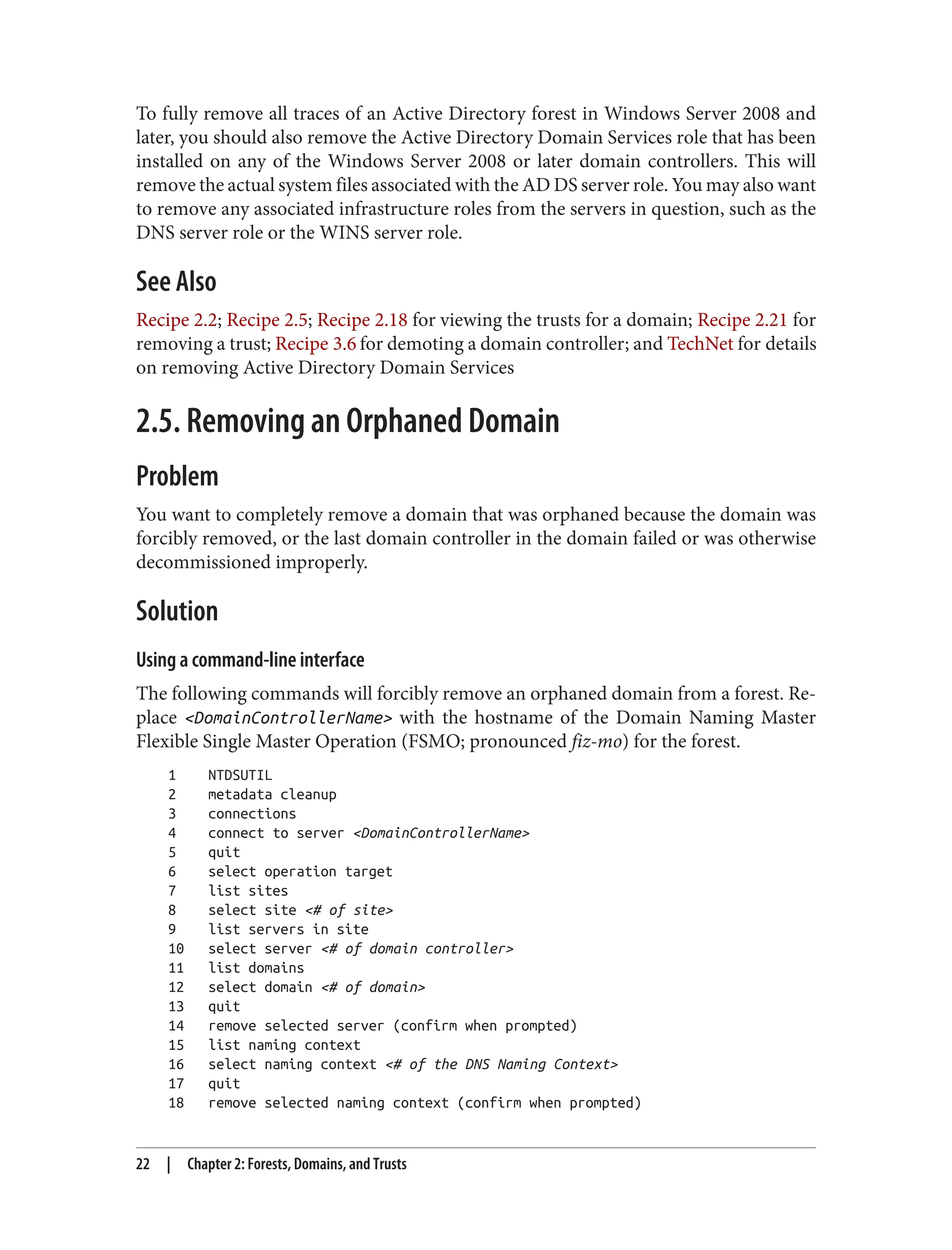
Active Directory Cookbook Fourth Edition Brian Svidergol Robbie Allen
Active Directory Cookbook Fourth Edition Brian Svidergol Robbie Allen
Active Directory Cookbook Fourth Edition Brian Svidergol Robbie Allen
1.
Active Directory CookbookFourth Edition Brian
Svidergol Robbie Allen download
https://ebookbell.com/product/active-directory-cookbook-fourth-
edition-brian-svidergol-robbie-allen-4417630
Explore and download more ebooks at ebookbell.com
2.
Here are somerecommended products that we believe you will be
interested in. You can click the link to download.
Active Directory Cookbook 3rd Edition 3rd Edition Laura E Hunter
https://ebookbell.com/product/active-directory-cookbook-3rd-
edition-3rd-edition-laura-e-hunter-2472128
Active Directory Cookbook For Windows Server 2003 And Windows 2000
Robbie Allen
https://ebookbell.com/product/active-directory-cookbook-for-windows-
server-2003-and-windows-2000-robbie-allen-1564576
Active Directory Cookbook 2nd Ed Robbie Allen Laura E Hunter
https://ebookbell.com/product/active-directory-cookbook-2nd-ed-robbie-
allen-laura-e-hunter-916940
Active Directory Cookbook Laura E Hunter Robbie Allen Hunter
https://ebookbell.com/product/active-directory-cookbook-laura-e-
hunter-robbie-allen-hunter-11510632
3.
Active Directory AdministrationCookbook Sander Berkouwer
https://ebookbell.com/product/active-directory-administration-
cookbook-sander-berkouwer-28915218
Active Directory Administration Cookbook Proven Solutions To Everyday
Identity And Authentication Challenges 2nd Edition 2nd Sander
Berkouwer
https://ebookbell.com/product/active-directory-administration-
cookbook-proven-solutions-to-everyday-identity-and-authentication-
challenges-2nd-edition-2nd-sander-berkouwer-43943194
Microsoft Windows Identity Foundation Cookbook Over 30 Recipes To
Master Claimsbased Identity And Access Control In Net Applications
Using Windows Identity Foundation Active Directory Federation Services
And Azure Acces Control Services Sandeep Chanda
https://ebookbell.com/product/microsoft-windows-identity-foundation-
cookbook-over-30-recipes-to-master-claimsbased-identity-and-access-
control-in-net-applications-using-windows-identity-foundation-active-
directory-federation-services-and-azure-acces-control-services-
sandeep-chanda-4104586
Active Directory And Powershell For Jobseekers Learn How To Create
Manage And Secure User Accounts Mariusz Wrbel
https://ebookbell.com/product/active-directory-and-powershell-for-
jobseekers-learn-how-to-create-manage-and-secure-user-accounts-
mariusz-wrbel-56050472
Active Directory Domain Services 2008 How To
https://ebookbell.com/product/active-directory-domain-
services-2008-how-to-2285064
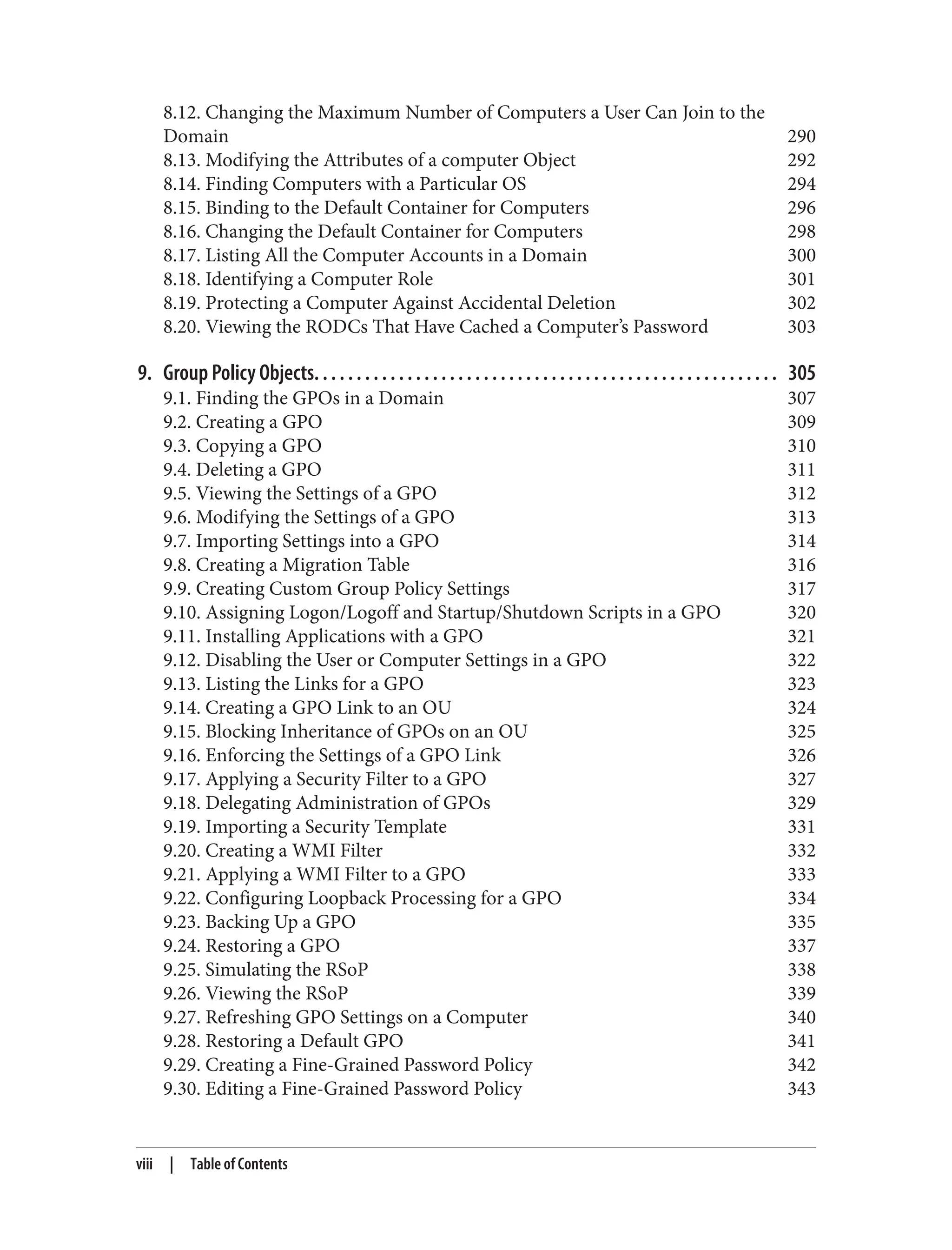
Table of Contents
Preface.. . . . . . . . . . . . . . . . . . . . . . . . . . . . . . . . . . . . . . . . . . . . . . . . . . . . . . . . . . . . . . . . . . . . . xvii
1. Getting Started. . . . . . . . . . . . . . . . . . . . . . . . . . . . . . . . . . . . . . . . . . . . . . . . . . . . . . . . . . . . . 1
1.1. Approach to the Book 1
1.2. Where to Find the Tools 3
1.3. Getting Familiar with LDIF 4
1.4. Replaceable Text 6
1.5. Where to Find More Information 6
2. Forests, Domains, and Trusts. . . . . . . . . . . . . . . . . . . . . . . . . . . . . . . . . . . . . . . . . . . . . . . . . 11
2.1. Creating a Forest 15
2.2. Removing a Forest 18
2.3. Creating a Domain 19
2.4. Removing a Domain 20
2.5. Removing an Orphaned Domain 22
2.6. Finding the Domains in a Forest 23
2.7. Finding the NetBIOS Name of a Domain 24
2.8. Renaming a Domain 25
2.9. Raising the Domain Functional Level to Windows Server 2012 27
2.10. Raising the Functional Level of a Windows Server 2008 or 2008 R2
Forest 28
2.11. Using AdPrep to Prepare a Domain or Forest for Windows Server 2012 30
2.12. Determining Whether AdPrep Has Completed 31
2.13. Checking Whether a Windows Domain Controller Can Be Upgraded to
Windows Server 2003 or 2008 34
2.14. Creating an External Trust 35
2.15. Creating a Transitive Trust Between Two AD Forests 37
2.16. Creating a Shortcut Trust Between Two AD Domains 38
2.17. Creating a Trust to a Kerberos Realm 40
iii
10.
2.18. Viewing theTrusts for a Domain 41
2.19. Verifying a Trust 43
2.20. Resetting a Trust 45
2.21. Removing a Trust 45
2.22. Enabling SID Filtering for a Trust 47
2.23. Enabling Quarantine for a Trust 48
2.24. Managing Selective Authentication for a Trust 49
2.25. Finding Duplicate SIDs in a Domain 51
2.26. Adding Additional Fields to Active Directory Users and Computers 52
3. Domain Controllers, Global Catalogs, and FSMOs. . . . . . . . . . . . . . . . . . . . . . . . . . . . . . . . 55
3.1. Promoting a Server to a Domain Controller 58
3.2. Promoting a Server to a Read-Only Domain Controller 59
3.3. Performing a Two-Stage RODC Installation 61
3.4. Modifying the Password Replication Policy 62
3.5. Promoting a Server to a Windows Server 2012 Domain Controller from
Media 64
3.6. Demoting a Domain Controller 66
3.7. Automating the Promotion or Demotion of a Domain Controller 67
3.8. Troubleshooting Domain Controller Promotion or Demotion Problems 68
3.9. Verifying the Promotion of a Domain Controller 70
3.10. Removing an Unsuccessfully Demoted Domain Controller 71
3.11. Renaming a Domain Controller 73
3.12. Finding the Domain Controllers for a Domain 74
3.13. Finding the Closest Domain Controller 75
3.14. Finding a Domain Controller’s Site 76
3.15. Moving a Domain Controller to a Different Site 77
3.16. Finding the Services a Domain Controller Is Advertising 79
3.17. Restoring a Deleted Domain Controller in Windows Server 2012 80
3.18. Resetting the TCP/IP Stack on a Domain Controller 82
3.19. Configuring a Domain Controller to Use an External Time Source 83
3.20. Finding the Number of Logon Attempts Made Against a Domain
Controller 85
3.21. Enabling the /3GB Switch to Increase the LSASS Cache 86
3.22. Enabling and Disabling the Global Catalog 86
3.23. Determining Whether Global Catalog Promotion Is Complete 89
3.24. Finding the Global Catalog Servers in a Forest 90
3.25. Finding the Domain Controllers or Global Catalog Servers in a Site 91
3.26. Finding Domain Controllers and Global Catalogs via DNS 92
3.27. Changing the Preference for a Domain Controller 93
3.28. Disabling the Global Catalog Requirement for User Logon 95
3.29. Finding the FSMO Role Holders 95
iv | Table of Contents
11.
3.30. Transferring aFSMO Role 97
3.31. Seizing a FSMO Role 99
3.32. Finding the PDC Emulator FSMO Role Owner via DNS 100
4. Searching and Manipulating Objects. . . . . . . . . . . . . . . . . . . . . . . . . . . . . . . . . . . . . . . . . 103
4.1. Viewing the RootDSE 104
4.2. Viewing the Attributes of an Object 106
4.3. Counting Objects in Active Directory 110
4.4. Using LDAP Controls 112
4.5. Using a Fast or Concurrent Bind 114
4.6. Connecting to an Object GUID 116
4.7. Connecting to a Well-Known GUID 117
4.8. Searching for Objects in a Domain 120
4.9. Searching the Global Catalog 122
4.10. Searching for a Large Number of Objects 124
4.11. Searching with an Attribute-Scoped Query 126
4.12. Searching with a Bitwise Filter 128
4.13. Creating an Object 131
4.14. Modifying an Object 134
4.15. Modifying a Bit-Flag Attribute 136
4.16. Dynamically Linking an Auxiliary Class 139
4.17. Creating a Dynamic Object 140
4.18. Refreshing a Dynamic Object 142
4.19. Modifying the Default TTL Settings for Dynamic Objects 144
4.20. Moving an Object to a Different OU or Container 145
4.21. Moving an Object to a Different Domain 147
4.22. Referencing an External Domain 149
4.23. Renaming an Object 150
4.24. Deleting an Object 153
4.25. Deleting a Container That Has Child Objects 155
4.26. Viewing the Created and Last-Modified Timestamp of an Object 156
4.27. Modifying the Default LDAP Query Policy 157
4.28. Exporting Objects to an LDIF File 159
4.29. Importing Objects Using an LDIF File 160
4.30. Exporting Objects to a CSV File 161
4.31. Importing Objects Using PowerShell and a CSV File 162
5. Organizational Units. . . . . . . . . . . . . . . . . . . . . . . . . . . . . . . . . . . . . . . . . . . . . . . . . . . . . . . 165
5.1. Creating an OU 166
5.2. Enumerating the OUs in a Domain 168
5.3. Finding an OU 169
5.4. Enumerating the Objects in an OU 170
Table of Contents | v
12.
5.5. Deleting theObjects in an OU 172
5.6. Deleting an OU 173
5.7. Moving the Objects in an OU to a Different OU 175
5.8. Moving an OU 177
5.9. Renaming an OU 178
5.10. Modifying an OU 179
5.11. Determining Approximately How Many Child Objects an OU Has 181
5.12. Delegating Control of an OU 182
5.13. Assigning or Removing a Manager for an OU 183
5.14. Linking a GPO to an OU 185
5.15. Protecting an OU Against Accidental Deletion 186
6. Users. . . . . . . . . . . . . . . . . . . . . . . . . . . . . . . . . . . . . . . . . . . . . . . . . . . . . . . . . . . . . . . . . . . . 189
6.1. Modifying the Default Display Name Used When Creating Users in
ADUC or ADAC 191
6.2. Creating a User 192
6.3. Creating a Large Number of Users 194
6.4. Creating an inetOrgPerson User 196
6.5. Converting a user Object to an inetOrgPerson Object (or Vice Versa) 198
6.6. Modifying an Attribute for Several Users at Once 200
6.7. Deleting a User 201
6.8. Setting a User’s Profile Attributes 202
6.9. Moving a User 203
6.10. Redirecting Users to an Alternative OU 205
6.11. Renaming a User 206
6.12. Copying a User 208
6.13. Finding Locked-Out Users 209
6.14. Unlocking a User 210
6.15. Troubleshooting Account Lockout Problems 211
6.16. Viewing the Domain-Wide Account Lockout and Password Policies 213
6.17. Applying a Fine-Grained Password Policy to a User Object 216
6.18. Viewing the Fine-Grained Password Policy That Is in Effect for a User
Account 217
6.19. Enabling and Disabling a User 218
6.20. Finding Disabled Users 219
6.21. Viewing a User’s Group Membership 221
6.22. Removing All Group Memberships from a User 222
6.23. Changing a User’s Primary Group 223
6.24. Copying a User’s Group Membership to Another User 225
6.25. Setting a User’s Password 226
6.26. Preventing a User from Changing a Password 228
6.27. Requiring a User to Change a Password at Next Logon 229
vi | Table of Contents
13.
6.28. Preventing aUser’s Password from Expiring 230
6.29. Finding Users Whose Passwords Are About to Expire 231
6.30. Viewing the RODCs That Have Cached a User’s Password 232
6.31. Setting a User’s Account Options (userAccountControl) 233
6.32. Setting a User’s Account to Expire 236
6.33. Determining a User’s Last Logon Time 237
6.34. Finding Users Who Have Not Logged On Recently 238
6.35. Viewing and Modifying a User’s Permitted Logon Hours 240
6.36. Viewing a User’s Managed Objects 242
6.37. Creating a UPN Suffix for a Forest 243
6.38. Restoring a Deleted User 244
6.39. Protecting a User Against Accidental Deletion 245
7. Groups. . . . . . . . . . . . . . . . . . . . . . . . . . . . . . . . . . . . . . . . . . . . . . . . . . . . . . . . . . . . . . . . . . . 247
7.1. Creating a Group 249
7.2. Viewing the Permissions of a Group 251
7.3. Viewing the Direct Members of a Group 252
7.4. Viewing the Nested Members of a Group 253
7.5. Adding and Removing Members of a Group 254
7.6. Moving a Group Within a Domain 256
7.7. Moving a Group to Another Domain 257
7.8. Changing the Scope or Type of a Group 259
7.9. Modifying Group Attributes 260
7.10. Delegating Control for Managing Membership of a Group 263
7.11. Resolving a Primary Group ID 264
7.12. Enabling Universal Group Membership Caching 266
7.13. Restoring a Deleted Group 268
7.14. Protecting a Group Against Accidental Deletion 269
7.15. Applying a Fine-Grained Password Policy to a Group Object 270
8. Computer Objects. . . . . . . . . . . . . . . . . . . . . . . . . . . . . . . . . . . . . . . . . . . . . . . . . . . . . . . . . 273
8.1. Creating a Computer 274
8.2. Creating a Computer for a Specific User or Group 276
8.3. Deleting a Computer 278
8.4. Joining a Computer to a Domain 278
8.5. Moving a Computer Within the Same Domain 280
8.6. Moving a Computer to a New Domain 281
8.7. Renaming a Computer 283
8.8. Adding or Removing a Computer Account from a Group 285
8.9. Testing the Secure Channel for a Computer 286
8.10. Resetting a Computer Account 287
8.11. Finding Inactive or Unused Computers 289
Table of Contents | vii
14.
8.12. Changing theMaximum Number of Computers a User Can Join to the
Domain 290
8.13. Modifying the Attributes of a computer Object 292
8.14. Finding Computers with a Particular OS 294
8.15. Binding to the Default Container for Computers 296
8.16. Changing the Default Container for Computers 298
8.17. Listing All the Computer Accounts in a Domain 300
8.18. Identifying a Computer Role 301
8.19. Protecting a Computer Against Accidental Deletion 302
8.20. Viewing the RODCs That Have Cached a Computer’s Password 303
9. Group Policy Objects. . . . . . . . . . . . . . . . . . . . . . . . . . . . . . . . . . . . . . . . . . . . . . . . . . . . . . . 305
9.1. Finding the GPOs in a Domain 307
9.2. Creating a GPO 309
9.3. Copying a GPO 310
9.4. Deleting a GPO 311
9.5. Viewing the Settings of a GPO 312
9.6. Modifying the Settings of a GPO 313
9.7. Importing Settings into a GPO 314
9.8. Creating a Migration Table 316
9.9. Creating Custom Group Policy Settings 317
9.10. Assigning Logon/Logoff and Startup/Shutdown Scripts in a GPO 320
9.11. Installing Applications with a GPO 321
9.12. Disabling the User or Computer Settings in a GPO 322
9.13. Listing the Links for a GPO 323
9.14. Creating a GPO Link to an OU 324
9.15. Blocking Inheritance of GPOs on an OU 325
9.16. Enforcing the Settings of a GPO Link 326
9.17. Applying a Security Filter to a GPO 327
9.18. Delegating Administration of GPOs 329
9.19. Importing a Security Template 331
9.20. Creating a WMI Filter 332
9.21. Applying a WMI Filter to a GPO 333
9.22. Configuring Loopback Processing for a GPO 334
9.23. Backing Up a GPO 335
9.24. Restoring a GPO 337
9.25. Simulating the RSoP 338
9.26. Viewing the RSoP 339
9.27. Refreshing GPO Settings on a Computer 340
9.28. Restoring a Default GPO 341
9.29. Creating a Fine-Grained Password Policy 342
9.30. Editing a Fine-Grained Password Policy 343
viii | Table of Contents
15.
9.31. Viewing theEffective PSO for a User 345
10. Schema. . . . . . . . . . . . . . . . . . . . . . . . . . . . . . . . . . . . . . . . . . . . . . . . . . . . . . . . . . . . . . . . . . 347
10.1. Registering the Active Directory Schema MMC Snap-in 349
10.2. Generating an OID to Use for a New Class or Attribute 350
10.3. Extending the Schema 351
10.4. Preparing the Schema for an Active Directory Upgrade 352
10.5. Documenting Schema Extensions 353
10.6. Adding a New Attribute 354
10.7. Viewing an Attribute 358
10.8. Adding a New Class 360
10.9. Viewing a Class 362
10.10. Indexing an Attribute 363
10.11. Modifying the Attributes That Are Copied When Duplicating a User 365
10.12. Modifying the Attributes Included with ANR 367
10.13. Modifying the Set of Attributes Stored on a Global Catalog 369
10.14. Finding Nonreplicated and Constructed Attributes 371
10.15. Finding the Linked Attributes 373
10.16. Finding the Structural, Auxiliary, Abstract, and 88 Classes 375
10.17. Finding the Mandatory and Optional Attributes of a Class 377
10.18. Modifying the Default Security of a Class 378
10.19. Managing the Confidentiality Bit 379
10.20. Adding an Attribute to the Read-Only Filtered Attribute Set (RO-FAS) 381
10.21. Deactivating Classes and Attributes 382
10.22. Redefining Classes and Attributes 383
10.23. Reloading the Schema Cache 384
10.24. Managing the Schema Master FSMO 386
11. Site Topology. . . . . . . . . . . . . . . . . . . . . . . . . . . . . . . . . . . . . . . . . . . . . . . . . . . . . . . . . . . . . 389
11.1. Creating a Site 393
11.2. Listing Sites in a Domain 395
11.3. Renaming a Site 396
11.4. Deleting a Site 397
11.5. Delegating Control of a Site 398
11.6. Configuring Universal Group Caching for a Site 399
11.7. Creating a Subnet 401
11.8. Listing the Subnets 402
11.9. Finding Missing Subnets 403
11.10. Deleting a Subnet 405
11.11. Changing a Subnet’s Site Assignment 406
11.12. Creating a Site Link 407
11.13. Finding the Site Links for a Site 409
Table of Contents | ix
16.
11.14. Modifying theSites That Are Part of a Site Link 410
11.15. Modifying the Cost for a Site Link 411
11.16. Enabling Change Notification for a Site Link 412
11.17. Modifying Replication Schedules 413
11.18. Disabling Site Link Transitivity or Site Link Schedules 415
11.19. Creating a Site Link Bridge 416
11.20. Finding the Bridgehead Servers for a Site 418
11.21. Setting a Preferred Bridgehead Server for a Site 419
11.22. Listing the Servers 421
11.23. Moving a Domain Controller to a Different Site 422
11.24. Configuring a Domain Controller to Cover Multiple Sites 423
11.25. Viewing the Site Coverage for a Domain Controller 424
11.26. Disabling Automatic Site Coverage for a Domain Controller 425
11.27. Finding the Site for a Client 426
11.28. Forcing a Host into a Particular Site 427
11.29. Creating a connection Object 428
11.30. Listing the connection Objects for a Server 429
11.31. Finding the ISTG for a Site 429
11.32. Transferring the ISTG to Another Server 431
11.33. Triggering the KCC 432
11.34. Determining Whether the KCC Is Completing Successfully 433
11.35. Disabling the KCC for a Site 434
11.36. Changing the Interval at Which the KCC Runs 436
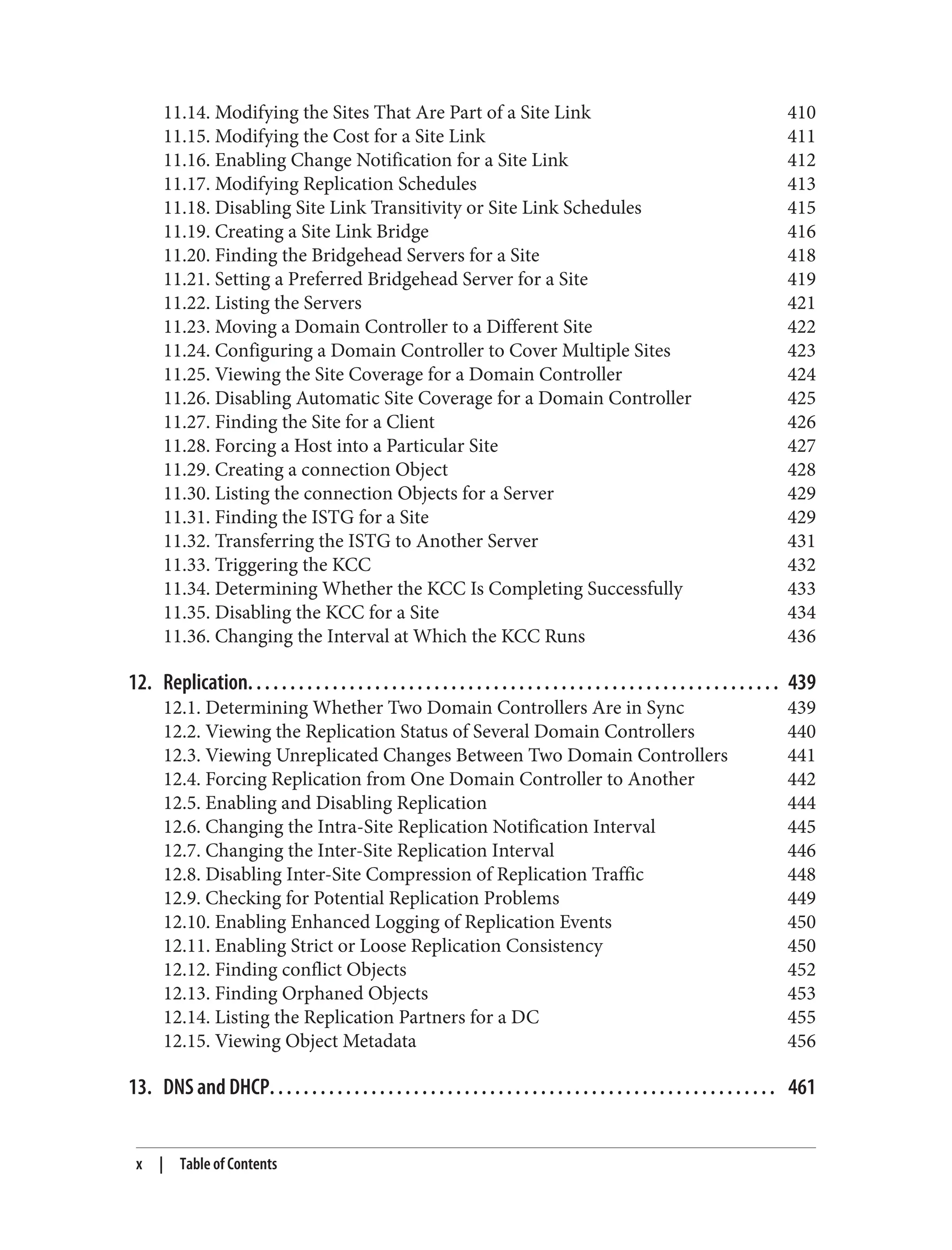
12. Replication. . . . . . . . . . . . . . . . . . . . . . . . . . . . . . . . . . . . . . . . . . . . . . . . . . . . . . . . . . . . . . . 439
12.1. Determining Whether Two Domain Controllers Are in Sync 439
12.2. Viewing the Replication Status of Several Domain Controllers 440
12.3. Viewing Unreplicated Changes Between Two Domain Controllers 441
12.4. Forcing Replication from One Domain Controller to Another 442
12.5. Enabling and Disabling Replication 444
12.6. Changing the Intra-Site Replication Notification Interval 445
12.7. Changing the Inter-Site Replication Interval 446
12.8. Disabling Inter-Site Compression of Replication Traffic 448
12.9. Checking for Potential Replication Problems 449
12.10. Enabling Enhanced Logging of Replication Events 450
12.11. Enabling Strict or Loose Replication Consistency 450
12.12. Finding conflict Objects 452
12.13. Finding Orphaned Objects 453
12.14. Listing the Replication Partners for a DC 455
12.15. Viewing Object Metadata 456
13. DNS and DHCP. . . . . . . . . . . . . . . . . . . . . . . . . . . . . . . . . . . . . . . . . . . . . . . . . . . . . . . . . . . . 461
x | Table of Contents
17.
13.1. Creating aForward Lookup Zone 463
13.2. Creating a Reverse Lookup Zone 464
13.3. Viewing a Server’s Zones 466
13.4. Converting a Zone to an AD Integrated Zone 468
13.5. Moving AD Integrated Zones into an Application Partition 469
13.6. Configuring Zone Transfers 470
13.7. Configuring Forwarding 471
13.8. Configuring Conditional Forwarding 473
13.9. Delegating Control of an Active Directory Integrated Zone 474
13.10. Creating and Deleting Resource Records 475
13.11. Querying Resource Records 478
13.12. Modifying the DNS Server Configuration 479
13.13. Scavenging Old Resource Records 480
13.14. Clearing the DNS Cache 482
13.15. Verifying That a Domain Controller Can Register Its Resource Records 484
13.16. Enabling DNS Server Debug Logging 485
13.17. Registering a Domain Controller’s Resource Records 488
13.18. Deregistering a Domain Controller’s Resource Records 488
13.19. Preventing a Domain Controller from Dynamically Registering All
Resource Records 489
13.20. Preventing a Domain Controller from Dynamically Registering Certain
Resource Records 490
13.21. Allowing Computers to Use a Domain Suffix That Is Different from
Their AD Domain 493
13.22. Authorizing a DHCP Server 495
13.23. Restricting DHCP Administrators 497
14. Security and Authentication. . . . . . . . . . . . . . . . . . . . . . . . . . . . . . . . . . . . . . . . . . . . . . . . 501
14.1. Enabling SSL/TLS 502
14.2. Securing LDAP Traffic with SSL, TLS, or Signing 503
14.3. Disabling LDAP Signing 504
14.4. Enabling Anonymous LDAP Access 505
14.5. Using the Delegation of Control Wizard 507
14.6. Customizing the Delegation of Control Wizard 509
14.7. Revoking Delegated Permissions 512
14.8. Viewing the ACL for an Object 513
14.9. Customizing the ACL Editor 514
14.10. Viewing the Effective Permissions on an Object 515
14.11. Configuring Permission Inheritance 516
14.12. Changing the ACL of an Object 518
14.13. Changing the Default ACL for an Object Class in the Schema 519
14.14. Comparing the ACL of an Object to the Default Defined in the Schema 520
Table of Contents | xi
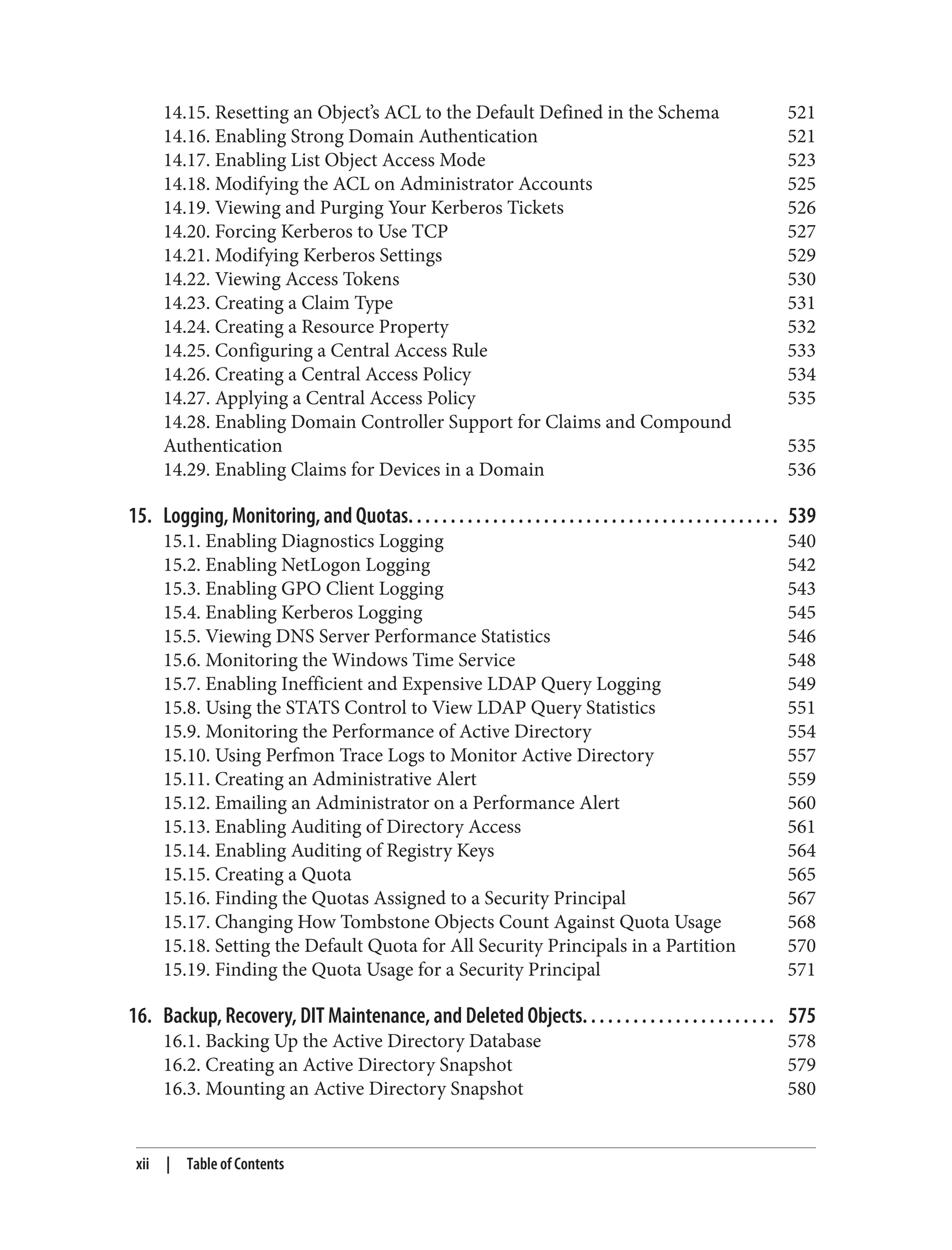
18.
14.15. Resetting anObject’s ACL to the Default Defined in the Schema 521
14.16. Enabling Strong Domain Authentication 521
14.17. Enabling List Object Access Mode 523
14.18. Modifying the ACL on Administrator Accounts 525
14.19. Viewing and Purging Your Kerberos Tickets 526
14.20. Forcing Kerberos to Use TCP 527
14.21. Modifying Kerberos Settings 529
14.22. Viewing Access Tokens 530
14.23. Creating a Claim Type 531
14.24. Creating a Resource Property 532
14.25. Configuring a Central Access Rule 533
14.26. Creating a Central Access Policy 534
14.27. Applying a Central Access Policy 535
14.28. Enabling Domain Controller Support for Claims and Compound
Authentication 535
14.29. Enabling Claims for Devices in a Domain 536
15. Logging, Monitoring, and Quotas. . . . . . . . . . . . . . . . . . . . . . . . . . . . . . . . . . . . . . . . . . . . 539
15.1. Enabling Diagnostics Logging 540
15.2. Enabling NetLogon Logging 542
15.3. Enabling GPO Client Logging 543
15.4. Enabling Kerberos Logging 545
15.5. Viewing DNS Server Performance Statistics 546
15.6. Monitoring the Windows Time Service 548
15.7. Enabling Inefficient and Expensive LDAP Query Logging 549
15.8. Using the STATS Control to View LDAP Query Statistics 551
15.9. Monitoring the Performance of Active Directory 554
15.10. Using Perfmon Trace Logs to Monitor Active Directory 557
15.11. Creating an Administrative Alert 559
15.12. Emailing an Administrator on a Performance Alert 560
15.13. Enabling Auditing of Directory Access 561
15.14. Enabling Auditing of Registry Keys 564
15.15. Creating a Quota 565
15.16. Finding the Quotas Assigned to a Security Principal 567
15.17. Changing How Tombstone Objects Count Against Quota Usage 568
15.18. Setting the Default Quota for All Security Principals in a Partition 570
15.19. Finding the Quota Usage for a Security Principal 571
16. Backup, Recovery, DIT Maintenance, and Deleted Objects. . . . . . . . . . . . . . . . . . . . . . . 575
16.1. Backing Up the Active Directory Database 578
16.2. Creating an Active Directory Snapshot 579
16.3. Mounting an Active Directory Snapshot 580
xii | Table of Contents
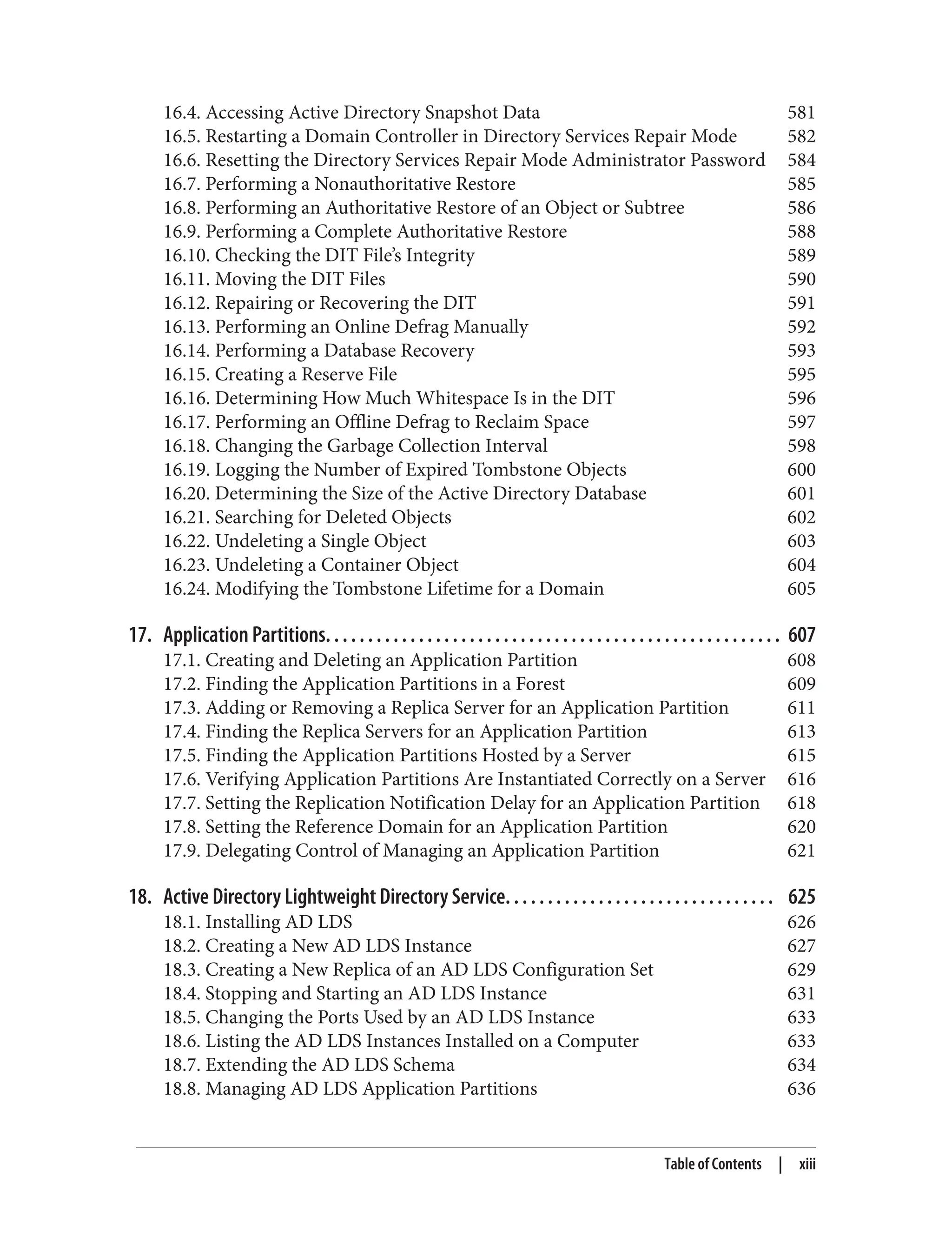
19.
16.4. Accessing ActiveDirectory Snapshot Data 581
16.5. Restarting a Domain Controller in Directory Services Repair Mode 582
16.6. Resetting the Directory Services Repair Mode Administrator Password 584
16.7. Performing a Nonauthoritative Restore 585
16.8. Performing an Authoritative Restore of an Object or Subtree 586
16.9. Performing a Complete Authoritative Restore 588
16.10. Checking the DIT File’s Integrity 589
16.11. Moving the DIT Files 590
16.12. Repairing or Recovering the DIT 591
16.13. Performing an Online Defrag Manually 592
16.14. Performing a Database Recovery 593
16.15. Creating a Reserve File 595
16.16. Determining How Much Whitespace Is in the DIT 596
16.17. Performing an Offline Defrag to Reclaim Space 597
16.18. Changing the Garbage Collection Interval 598
16.19. Logging the Number of Expired Tombstone Objects 600
16.20. Determining the Size of the Active Directory Database 601
16.21. Searching for Deleted Objects 602
16.22. Undeleting a Single Object 603
16.23. Undeleting a Container Object 604
16.24. Modifying the Tombstone Lifetime for a Domain 605
17. Application Partitions. . . . . . . . . . . . . . . . . . . . . . . . . . . . . . . . . . . . . . . . . . . . . . . . . . . . . . 607
17.1. Creating and Deleting an Application Partition 608
17.2. Finding the Application Partitions in a Forest 609
17.3. Adding or Removing a Replica Server for an Application Partition 611
17.4. Finding the Replica Servers for an Application Partition 613
17.5. Finding the Application Partitions Hosted by a Server 615
17.6. Verifying Application Partitions Are Instantiated Correctly on a Server 616
17.7. Setting the Replication Notification Delay for an Application Partition 618
17.8. Setting the Reference Domain for an Application Partition 620
17.9. Delegating Control of Managing an Application Partition 621
18. Active Directory Lightweight Directory Service. . . . . . . . . . . . . . . . . . . . . . . . . . . . . . . . 625
18.1. Installing AD LDS 626
18.2. Creating a New AD LDS Instance 627
18.3. Creating a New Replica of an AD LDS Configuration Set 629
18.4. Stopping and Starting an AD LDS Instance 631
18.5. Changing the Ports Used by an AD LDS Instance 633
18.6. Listing the AD LDS Instances Installed on a Computer 633
18.7. Extending the AD LDS Schema 634
18.8. Managing AD LDS Application Partitions 636
Table of Contents | xiii
20.
18.9. Managing ADLDS Organizational Units 637
18.10. Managing AD LDS Users 639
18.11. Changing the Password for an AD LDS User 640
18.12. Enabling and Disabling an AD LDS User 641
18.13. Creating AD LDS Groups 643
18.14. Managing AD LDS Group Memberships 644
18.15. Viewing and Modifying AD LDS Object Attributes 645
18.16. Importing Data into an AD LDS Instance 647
18.17. Configuring Intra-Site Replication 648
18.18. Forcing AD LDS Replication 649
18.19. Managing AD LDS Replication Authentication 650
18.20. Managing AD LDS Permissions 652
18.21. Enabling Auditing of AD LDS Access 654
19. Active Directory Federation Services. . . . . . . . . . . . . . . . . . . . . . . . . . . . . . . . . . . . . . . . . 657
19.1. Installing AD FS Prerequisites 658
19.2. Installing the AD FS Federation Service 660
19.3. Configuring an LDAP Attribute Store 661
19.4. Configuring a Microsoft SQL Server Attribute Store 662
19.5. Creating Claim Descriptions 663
19.6. Creating a Relying Party Trust 664
19.7. Configuring a Claims Provider Trust 665
19.8. Configuring an Alternate UPN Suffix 666
19.9. Configuring AD FS 2.x and AD FS 1.x Interoperability 668
19.10. Configuring Logging for AD FS 671
20. Microsoft Exchange Server 2013. . . . . . . . . . . . . . . . . . . . . . . . . . . . . . . . . . . . . . . . . . . . . 673
20.1. Exchange Server and Active Directory 673
20.2. Exchange Server 2013 Architecture 674
20.3. Finding Exchange Server Cmdlets 675
20.4. Preparing Active Directory for Exchange 676
20.5. Installing the First Exchange Server 2013 Server in an Organization 679
20.6. Creating Unattended Installation Files for Exchange Server 682
20.7. Installing Exchange Management Tools 683
20.8. Stopping and Starting Exchange Server 684
20.9. Mail-Enabling a User 687
20.10. Mail-Disabling a User 688
20.11. Mailbox-Enabling a User 689
20.12. Deleting a User’s Mailbox 691
20.13. Moving a Mailbox 693
20.14. Viewing Mailbox Sizes and Message Counts 695
20.15. Configuring Mailbox Limits 698
xiv | Table of Contents
21.
20.16. Creating anAddress List 700
20.17. Creating a Database Availability Group 701
20.18. Creating a Mailbox Database 703
20.19. Enabling or Disabling Anti-Malware Scanning 704
20.20. Enabling Message Tracking 705
21. Microsoft Forefront Identity Manager. . . . . . . . . . . . . . . . . . . . . . . . . . . . . . . . . . . . . . . . 707
21.1. Creating a SQL Server Management Agent 722
21.2. Creating an Active Directory Management Agent 724
21.3. Setting Up a Metaverse Object Deletion Rule 726
21.4. Setting Up a Simple Import Attribute Flow 727
21.5. Setting Up a Simple Export Attribute Flow to Active Directory 729
21.6. Defining an Advanced Import Attribute Flow 731
21.7. Implementing an Advanced Attribute Flow Rules Extension 733
21.8. Setting Up Advanced Export Attribute Flow in Active Directory 736
21.9. Configuring a Run Profile to Do an Initial Load of Data from a SQL
Server Management Agent 737
21.10. Loading Initial SQL Server Database Data into FIM 2010 R2 Using a
Run Profile 739
21.11. Configuring a Run Profile to Load the Container Structure from Active
Directory 740
21.12. Loading the Initial Active Directory Container Structure into FIM 2010
R2 Using a Run Profile 742
21.13. Setting Up a SQL Server Management Agent to Project Objects to the
Metaverse 743
21.14. Writing a Rules Extension to Provision User Objects 744
21.15. Creating a Run Profile for Provisioning 747
21.16. Executing the Provisioning Rule 749
21.17. Creating a Run Profile to Export Objects from the AD MA to Active
Directory 750
21.18. Exporting Objects to Active Directory Using an Export Run Profile 752
21.19. Creating a Run Profile Script 753
21.20. Creating a Controlling Script 755
21.21. Enabling Directory Synchronization from Active Directory to the HR
Database 761
21.22. Configuring a Run Profile to Load the telephoneNumber from Active
Directory 762
21.23. Loading telephoneNumber Changes from AD into FIM Using a Delta
Import/Delta Sync Run Profile 765
21.24. Exporting telephoneNumber Data to a SQL Server Database 767
21.25. Using a SQL Server MA Export Run Profile to Export the
telephoneNumber to a SQL Server Database 768
Table of Contents | xv
22.
21.26. Searching Datain the Connector Space 769
21.27. Searching Data in the Metaverse 771
21.28. Deleting Data in the Connector Space and Metaverse 772
21.29. Extending Object Types to Include a New Attribute 773
21.30. Previewing Changes to the FIM Configuration 774
21.31. Committing Changes to Individual Identities Using the Commit
Preview Feature 777
21.32. Passing Data Between Rules Extensions Using Transaction Properties 778
21.33. Using a Single Rules Extension to Affect Multiple Attribute Flows 779
21.34. Flowing a Null Value to a Data Source 780
21.35. Importing and Decoding the accountExpires Attribute 782
21.36. Exporting and Encoding the accountExpires Attribute 784
Index. . . . . . . . . . . . . . . . . . . . . . . . . . . . . . . . . . . . . . . . . . . . . . . . . . . . . . . . . . . . . . . . . . . . . . . 787
xvi | Table of Contents
23.
Preface
In 1998, whenRobbie first became involved with the Microsoft Windows 2000 Joint
Development Program (JDP), very little data was available on Active Directory (AD).
In the following months, and even after the initial release of Windows 2000, there were
very few books or white papers to help early adopters of Active Directory get started.
And some of the information that had been published was often inaccurate or mislead‐
ing.Manyearlyadoptershadtolearnbytrialanderror.Astimepassed,agreaternumber
of informative books were published, which helped fill the information gap.
By the end of the second year of its release, there was an explosion of information on
Active Directory. Not only were there more than 50 books published, but Microsoft also
cleaned up its documentation on MSDN and its AD website. Now those sites have
numerous white papers, many of which could serve as mini booklets. Other websites
have popped up as well that contain a great deal of information on Active Directory.
With Windows Server 2008, Windows Server 2008 R2, and Windows Server 2012,
Microsoft has taken its level of documentation a step further. Extensive information on
Active Directory is available directly from any Windows Server 2008 or 2012 computer
in the form of the built-in help information. So, with all this data available on Active
Directory in the form of published books, white papers, websites, and even from within
the operating system, why would you want to purchase this book?
In the summer of 2002, Robbie was thumbing through Tom Christiansen and Nathan
Torkington’s Perl Cookbook (O’Reilly), looking for help with an automation script that
he was writing for Active Directory. It just so happened that there was a recipe that
addressed the specific task he was trying to perform. In Cookbook parlance, a recipe
providesinstructionsonhowtosolveaparticularproblem.WethoughtthatsinceActive
Directory is such a task-oriented environment, the Cookbook approach might be a very
good format. After a little research, Robbie found there were books (often several) on
nearly every facet of Active Directory, including introductory books, design guides,
books that focused on migration, programming books, and reference books. The one
type of book that he didn’t see was a task-oriented “how to” book, which is exactly what
xvii
24.
the Cookbook formatprovides. With this was born the first edition of Active Directory
Cookbook, covering Active Directory tasks in Windows 2000 and Windows Server 2003
Active Directory.
In 2005 and again in 2008, Laura E. Hunter revised the already popular Active Directory
Cookbook to include an updated range of automation options, including the use of
command-line tools and scripts that had been created by active members of the Direc‐
tory Services community in the years since AD was first introduced.
Based on our experience, hours of research, and nearly a decade of hanging out on
Active Directory newsgroups and mailing lists, we’ve compiled more than 500 recipes
that should answer the majority of “How do I do X?” questions one could pose about
Active Directory. And just as in the Perl community, where the Perl Cookbook was a
great addition, we believe Active Directory Cookbook, Fourth Edition, will also be a great
addition to any Active Directory library.
Who Should Read This Book?
As with many of the books in the Cookbook series, Active Directory Cookbook, Fourth
Edition, can be useful to anyone who wants to deploy, administer, or automate Active
Directory. This book can serve as a great reference for those who have to work with
Active Directory on a day-to-day basis. For those without much programming back‐
ground, the command-line and PowerShell solutions are straightforward and provide
an easy way to automate repetitive administrative tasks for any administrator.
The companion to this book, Active Directory, Fifth Edition, by Brian Desmond et al.
(O’Reilly),isagreatchoiceforthosewantingathoroughdescriptionofthecoreconcepts
behind Active Directory, how to design an Active Directory infrastructure, and how to
automate that infrastructure using Active Directory Service Interfaces (ADSI) and
Windows Management Instrumentation (WMI). Active Directory, Fifth Edition, does
not necessarily detail the steps needed to accomplish every possible task within Active
Directory; that is more the intended purpose of this book. These two books, along with
the supplemental information referenced within each, should be sufficient to answer
most questions you have about Active Directory.
What’s in This Book?
This book consists of 21 chapters. Here is a brief overview of each chapter:
Chapter 1, Getting Started
Sets the stage for the book by covering where you can find the tools used in the
book, PowerShell issues to consider, and where to find additional information.
xviii | Preface
25.
Chapter 2, Forests,Domains, and Trusts
Covers how to create and remove forests and domains, update the domain mode
or functional levels, create different types of trusts, and perform other administra‐
tive trust tasks.
Chapter 3, Domain Controllers, Global Catalogs, and FSMOs
Covers promoting and demoting domain controllers, finding domain controllers,
enabling the global catalog, and finding and managing Flexible Single Master Op‐
eration (FSMO) roles.
Chapter 4, Searching and Manipulating Objects
Covers the basics of searching Active Directory: creating, modifying, and deleting
objects; using LDAP controls; and importing and exporting data using LDAP Data
Interchange Format (LDIF) and comma-separated value (CSV) files.
Chapter 5, Organizational Units
Covers creating, moving, and deleting organizational units (OUs), and managing
the objects contained within them.
Chapter 6, Users
Covers all aspects of managing user objects, including creating, renaming, and
moving user objects, resetting passwords, unlocking and modifying the profile at‐
tributes, and locating users that have certain criteria (e.g., password is about to
expire).
Chapter 7, Groups
Covers how to create groups, modify group scope and type, and manage
membership.
Chapter 8, Computer Objects
Covers creating computers, joining computers to a domain, resetting computers,
and locating computers that match certain criteria (e.g., have been inactive for a
number of weeks).
Chapter 9, Group Policy Objects
Covers how to create, modify, link, copy, import, back up, restore, and delete GPOs
using the Group Policy Management snap-in and scripting interface.
Chapter 10, Schema
Covers basic schema administration tasks, such as generating object identifiers
(OIDs) and schemaIDGUIDs, how to use LDIF to extend the schema, and how to
locate attributes or classes that match certain criteria (e.g., all attributes that are
indexed).
Chapter 11, Site Topology
Covers how to manage sites, subnets, site links, and connection objects.
Preface | xix
26.
Chapter 12, Replication
Covershow to trigger and disable the Knowledge Consistency Checker (KCC), and
how to query metadata, force replication, and determine which changes have yet
to replicate between domain controllers.
Chapter 13, DNS and DHCP
Covershowtocreatezonesandresourcerecords,modifyDNSserverconfiguration,
query DNS, and customize the resource records a domain controller dynamically
registers.
Chapter 14, Security and Authentication
Covers how to delegate control, view and modify permissions, view effective per‐
missions, and manage Kerberos tickets.
Chapter 15, Logging, Monitoring, and Quotas
Covers how to enable auditing, diagnostics, DNS, NetLogon, and Kerberos and
GPO logging; obtain LDAP query statistics; and manage quotas.
Chapter 16, Backup, Recovery, DIT Maintenance, and Deleted Objects
Covers how to back up Active Directory, perform authoritative and nonauthorita‐
tiverestores,checkDITfileintegrity,performonlineandofflinedefrags,andsearch
for deleted objects.
Chapter 17, Application Partitions
Covers how to create and manage application partitions.
Chapter 18, Active Directory Lightweight Directory Service
Covers application partitions including Active Directory Lightweight Directory
Services (AD LDS).
Chapter 19, Active Directory Federation Services
Covers Active Directory Federation Services (AD FS) that are included with
Windows Server 2012.
Chapter 20, Microsoft Exchange Server 2013
Covers common administrative tasks for Exchange Server 2013.
Chapter 21, Microsoft Forefront Identity Manager
ProvidesanintroductiontoMicrosoft’sForefrontIdentityManager(FIM),aservice
that can be used to synchronize multiple directories, enforce data integrity within
a single or multiple stores, and provide self-service password reset for end users.
xx | Preface
27.
Conventions Used inThis Book
The following typographical conventions are used in this book:
Constant width
Indicates classes, attributes, cmdlets, methods, objects, command-line elements,
computer output, and code examples
Constant width italic
Indicates placeholders (for which you substitute an actual name) in examples and
in registry keys
Constant width bold
Indicates user input
Italic
Introduces new terms and example URLs, commands, file extensions, filenames,
directory or folder names, and UNC pathnames
This icon indicates a tip, suggestion, or general note. For example, we’ll
tell you if you need to use a particular version or if an operation requires
certain privileges.
This icon indicates a warning or caution. For example, we’ll tell you if
Active Directory does not behave as you’d expect or if a particular op‐
eration has a negative impact on performance.
Using Code Examples
This book is here to help you get your job done. In general, if this book includes code
examples, you may use the code in this book in your programs and documentation. You
do not need to contact us for permission unless you’re reproducing a significant portion
of the code. For example, writing a program that uses several chunks of code from this
book does not require permission. Selling or distributing a CD-ROM of examples from
O’Reilly books does require permission. Answering a question by citing this book and
quoting example code does not require permission. Incorporating a significant amount
of example code from this book into your product’s documentation does require per‐
mission.
We appreciate, but do not require, attribution. An attribution usually includes the title,
author, publisher, and ISBN. For example: Active Directory Cookbook, Fourth Edition,
by Brian Svidergol and Robbie Allen. Copyright 2013 O’Reilly Media, Inc.,
978-1-449-36142-6.
Preface | xxi
28.
If you feelyour use of code examples falls outside fair use or the permission given here,
feel free to contact us at permissions@oreilly.com.
Safari® Books Online
Safari Books Online (www.safaribooksonline.com) is an on-demand
digital library that delivers expert content in both book and video
form from the world’s leading authors in technology and business.
Technology professionals, software developers, web designers, and business and crea‐
tive professionals use Safari Books Online as their primary resource for research, prob‐
lem solving, learning, and certification training.
Safari Books Online offers a range of product mixes and pricing programs for organi‐
zations, government agencies, and individuals. Subscribers have access to thousands of
books, training videos, and prepublication manuscripts in one fully searchable database
from publishers like O’Reilly Media, Prentice Hall Professional, Addison-Wesley Pro‐
fessional, Microsoft Press, Sams, Que, Peachpit Press, Focal Press, Cisco Press, John
Wiley & Sons, Syngress, Morgan Kaufmann, IBM Redbooks, Packt, Adobe Press, FT
Press, Apress, Manning, New Riders, McGraw-Hill, Jones & Bartlett, Course Technol‐
ogy, and dozens more. For more information about Safari Books Online, please visit us
online.
How to Contact Us
Please address comments and questions concerning this book to the publisher:
O’Reilly Media, Inc.
1005 Gravenstein Highway North
Sebastopol, CA 95472
800-998-9938 (in the United States or Canada)
707-829-0515 (international or local)
707-829-0104 (fax)
We have a web page for this book, where we list errata, examples, and any additional
information. You can access this page at http://oreil.ly/active_directory_cb_4.
To comment or ask technical questions about this book, send email to bookques
tions@oreilly.com.
For more information about our books, courses, conferences, and news, see our website
at http://www.oreilly.com.
Find us on Facebook: http://facebook.com/oreilly
Follow us on Twitter: http://twitter.com/oreillymedia
xxii | Preface
29.
Watch us onYouTube: http://www.youtube.com/oreillymedia
Acknowledgments
First, let me thank the authors of the original editions—Robbie and Laura—as without
you guys, my job of updating the book for the Fourth Edition would not have been
possible! Thankfully, I was able to start with a fantastic and well-regarded book!
Everybody from O’Reilly has been great. Special thanks go to Rachel Roumeliotis and
Maria Gulick for being easy to work with and helping to move this project along. They
were able to recruit some fantastic technical reviewers. Mike Kline (Directory Services
MVP)providedgreatpracticalfeedbacktobringreal-worldthinkingintoeverychapter.
I really appreciated his way of looking at the solutions from an administrator’s perspec‐
tive because it helped to ensure that the solutions were real-world and that the solutions
involved the tools that the typical administrator uses. While I hadn’t worked with Mike
before, I was familiar with his extensive work in the community. The other reviewer
was Marcin Policht (Directory Services MVP). I’ve worked with Marcin on quite a few
projects in the past and knew that he would be a valuable addition to the team. His
technical depth and his attention to detail are really incredible, and it showed in his
chapter reviews. Thanks, Mike and Marcin—without you guys, the overall quality of
this edition wouldn’t have been possible!
Other people contributed in other ways. To Ken Jones, thanks for the party invite;
without it, this project never would’ve come to fruition! By the way, Ken, I still often
think back to our first meeting. There were eight SMEs in the room; you were running
the show for the first time. The room was loud and everybody was shouting out in‐
structions like backseat drivers. You showed incredible poise in that situation! Charles
Pluta was my number-one resource when I needed anything. Charles, keep doing what
you are doing and you will go far! Thanks to Elias Mereb—Elias gave me extra moti‐
vation a few years ago and that has helped to fuel me ever since. Evan Hanna—if there
was something strange or unknown, he was always the man to go to. Jonathan Hopp
was there for me even when he didn’t want to be! Of course, I also have to thank my
wife, Lindsay, and my son, Jack, for putting up with me working seven days and seven
nightsaweekjugglingmultipleprojects.Wecannowgetbacktoourregularlyscheduled
programming!
Preface | xxiii
31.
CHAPTER 1
Getting Started
1.1.Approach to the Book
If you are familiar with the O’Reilly Cookbook format, which can be seen in other
popular books such as the Perl Cookbook, Java Cookbook, and DNS and BIND Cook‐
book, then the layout of this book will be familiar to you. The book is composed of 21
chapters, each containing 10 to 30 recipes for performing a specific Active Directory
task.Withineachrecipearethreesections:“Problem,”“Solution,”and“Discussion.”The
“Problem” section briefly describes the task that the recipe focuses on. The “Solution”
section contains step-by-step instructions on how to accomplish the task. The “Dis‐
cussion” section contains detailed information about the problem or solution. A fourth
section, “See Also,” is included in most recipes and contains references to additional
sourcesofinformationthatcanbeusefulifyoustillneedmoreinformationafterreading
the discussion. The “See Also” section may reference other recipes, MS Knowledge
Base articles or documentation from the Microsoft Developer Network (MSDN).
At Least Three Ways to Do It!
When we first began developing the content for the book, we struggled with how to
capture the fact that you can do things in multiple ways with Active Directory. You may
be familiar with the famous computer science motto: TIMTOWTDI, or There Is More
Than One Way To Do It. With Active Directory, there are often At Least Three Ways To
Do It! You can perform a task with a graphical user interface (GUI), such as ADSI Edit,
LDP, Active Directory Administrative Center, or the Active Directory Users and Com‐
puters snap-in; you can use a command-line interface (CLI), such as the ds utilities (i.e.,
dsadd, dsmod, dsrm, dsquery, and dsget), nltest, netdom, or ldifde, or freeware tools such
as adfind and admod from joeware; and finally, you can perform the same task using a
scripting language, such as VBScript, Perl, or PowerShell. Since people prefer different
methods, and no single method is necessarily better than another, we decided to write
solutionstotherecipesusingoneofeach.Thismeansthatinsteadofjustasinglesolution
1
32.
per recipe, weinclude up to three solutions using GUI, CLI, and programmatic exam‐
ples; in some cases you’ll find more than one option for a given solution, as in the case
where there is more than one command-line utility to perform a particular task. How‐
ever, in cases where one of the methods cannot be used or would be too difficult to use
to accomplish a given recipe, only the applicable methods are covered.
A special note regarding PowerShell coverage in this text: PowerShell is a command-
line and scripting language introduced by Microsoft. PowerShell’s claim to fame is its
useofapredictableVerb-Nounsyntaxthatcanbeleveragedregardlessofthetechnology
that it is managing: Get-Object, Get-ChildItem, Get-Mailbox, and so on. This pre‐
dictable syntax is driven by the use of cmdlets (pronounced “command-lets”) that can
be created by individuals and software vendors alike. The first Microsoft product to rely
on PowerShell was Exchange 2007, which includes a rich set of cmdlets to perform
Exchange management tasks. In fact, there are certain tasks in Exchange 2007 that can
only be performed using PowerShell! Since Exchange 2007, virtually every major prod‐
uct released by Microsoft includes a PowerShell module for management.
The challenge that Active Directory administrators faced with PowerShell, prior to the
release of Windows Server 2008 R2, was that a set of PowerShell cmdlets had not yet
beenproducedbyMicrosofttosupportActiveDirectoryadministrationtasks.However,
thatissuewasfixedwiththeintroductionofthePowerShellmoduleforActiveDirectory.
Microsoft initially released 76 cmdlets specific to Active Directory administration.
Then, with the release of Windows Server 2012, additional cmdlets were introduced. In
total, there are now 145 cmdlets for Active Directory administration! PowerShell has
come a long way since the previous version of this book. As such, all of the Quest
PowerShell cmdlets that were used in the previous version have been replaced with
native cmdlets. Most of the VBScript solutions have also been replaced with simpler
PowerShell solutions.
Readers who are looking for more in-depth programming coverage of these topics
should consult The .NET Developer’s Guide to Directory Services Programming refer‐
enced in the Recipe 1.5 section at the end of this chapter.
Windows Server 2008, Windows Server 2008 R2,
and Windows Server 2012
Another challenge with writing this book is that there are now multiple versions of
Active Directory deployed on most corporate networks. The initial version released
with Windows 2000 was followed by Windows Server 2003 and an incremental update
to Windows Server 2003 R2, and then Microsoft released Windows Server 2008 and
Windows Server 2008 R2, which provided a lot of updates and new features. With the
release of Windows Server 2012, administration has changed and new functionality has
been introduced again. We’ve decided to go with the approach of making everything
work under the most recent version of Active Directory first, and earlier versions of
2 | Chapter 1: Getting Started
33.
Windows second. Infact, the majority of the GUI solutions will work unchanged all the
way back to Windows 2000. The PowerShell solutions will work out of the box with
Windows Server 2008 R2 or newer domain controllers. By using the Active Directory
Management Gateway Service, the PowerShell solutions will work with domain con‐
trollers running Windows Server 2003 SP2 or Windows Server 2008. For the recipes or
solutions that are specific to a particular version, we include a note mentioning the
version it is targeted for. In particular, because so much has changed since the intro‐
duction of Windows Server 2008 R2, the majority of our focus will be on Windows
Server 2008 R2 and later.
1.2. Where to Find the Tools
You’ll find a number of references to third-party command-line tools such as adfind,
admod, oldcmp, findexpacc, and memberof. These tools were developed by Microsoft
DirectoryServicesMVPjoeRichards,andhehasmadethemavailableforfreedownload
from his website. While these tools are not native to the Windows operating system,
they have become an invaluable addition to many Active Directory system adminis‐
trators’ toolkits, and we include them here to showcase their capabilities.
Once you have the tools at your disposal, there are a couple of other issues to be aware
of while trying to apply the solutions in your environment, which we’ll describe in the
following sections.
Running Tools with Alternate Credentials
A best practice for managing Active Directory is to create separate administrator ac‐
counts to which you grant elevated privileges, instead of letting administrators utilize
the user account to access other Network Operating System (NOS) resources. This is
beneficial because an administrator who wants to use elevated privileges has to log on
with his administrative account explicitly instead of having the rights implicitly, which
couldleadtoaccidentalchangesinActiveDirectory.Assumingyouemploythismethod,
you must provide alternate credentials when using tools to administer Active Directory
unless you log on to a machine, such as a domain controller, with the administrative
credentials.
There are several options for specifying alternate credentials. Many GUI and CLI tools
have an option to specify a user and password with which to authenticate. If the tool
you want to use does not have that option, you can use the runas command instead.
The following command will run the enumprop command under the credentials of the
administrator account in the adatum.com domain:
> runas /user:administrator@adatum.com
/netonly "enumprop "LDAP://dc1/dc=adatum,dc=com""
1.2. Where to Find the Tools | 3
34.
You can alsoopen a Windows command prompt using alternate credentials, which will
allow you to run commands using these elevated credentials until you close the com‐
mand prompt window. To open a command prompt using the runas command, simply
type runas /user:administrator@adatum.com cmd.
To run a Microsoft Management Console (MMC) with alternate credentials, simply use
mmc as the command to run from runas:
> runas /user:administrator@adatum.com /netonly "mmc"
This will create an empty MMC from which you can add consoles for any snap-ins that
have been installed on the local computer.
The /netonly switch is necessary if the user with which you are au‐
thenticatingdoesnothavelocallogonrightsonthemachinefromwhich
you are running the command, such as a user ID from a nontrusted
domain.
There is another option for running MMC snap-ins with alternate credentials. In Win‐
dows Explorer, hold down the Shift key and then right-click on the tool you want to
open. If you select Run As Different User, you will be prompted to enter credentials
under which to run the tool.
Targeting Specific Domain Controllers
Another issue to be aware of when following the instructions in the recipes is whether
youneedtotargetaspecificdomaincontroller.Inthesolutionsinthisbook,wetypically
do not target a specific domain controller. When you don’t specify a domain controller,
you are using a serverless bind, and there is no guarantee as to precisely which server
you will be hitting. Depending on your environment and the task you need to do, you
may want to target a specific domain controller so that you know where the query or
change will be taking place. Also, serverless binding can work only if the DNS for the
Active Directory forest is configured properly and your client can query it. If you have
a standalone Active Directory environment that has no ties to your corporate DNS, you
may need to target a specific domain controller for the tools to work.
1.3. Getting Familiar with LDIF
Native support for modifying data within Active Directory using a command-line tool
is relatively weak. The dsmod tool can modify attributes on a limited set of object classes.
One reason for the lack of native command-line tools to do this is that the command
line is not well suited for manipulating numerous attributes of an object simultaneously.
If you want to specify more than just one or two values that need to be modified, a single
4 | Chapter 1: Getting Started
35.
command could getquite long. It would be easier to use a GUI editor, such as ADSI
Edit, to do the task instead.
The LDAP Data Interchange Format (LDIF) was designed to address this issue. Defined
in RFC 2849, LDIF allows you to represent directory additions, modifications, and
deletions in a text-based file, which you can import into a directory using an LDIF-
capable tool.
The ldifde utility has been available since Windows 2000, and it allows you to import
and export Active Directory content in LDIF format. LDIF files are composed of blocks
of entries. An entry can add, modify, or delete an object. The first line of an entry is the
distinguished name. The second line contains a changetype, which can be add, modify,
or delete. If it is an object addition, the rest of the entry contains the attributes that
should be initially set on the object (one per line). For object deletions, you do not need
to specify any other attributes. And for object modifications, you need to specify at least
three more lines. The first should contain the type of modification you want to perform
on the object. This can be add (to set a previously unset attribute or to add a new value
to a multivalued attribute), replace (to replace an existing value), or delete (to remove
a value). The modification type should be followed by a colon and the attribute you
want to modify. The next line should contain the name of the attribute followed by a
colon and the value for the attribute. For example, to replace the last name attribute
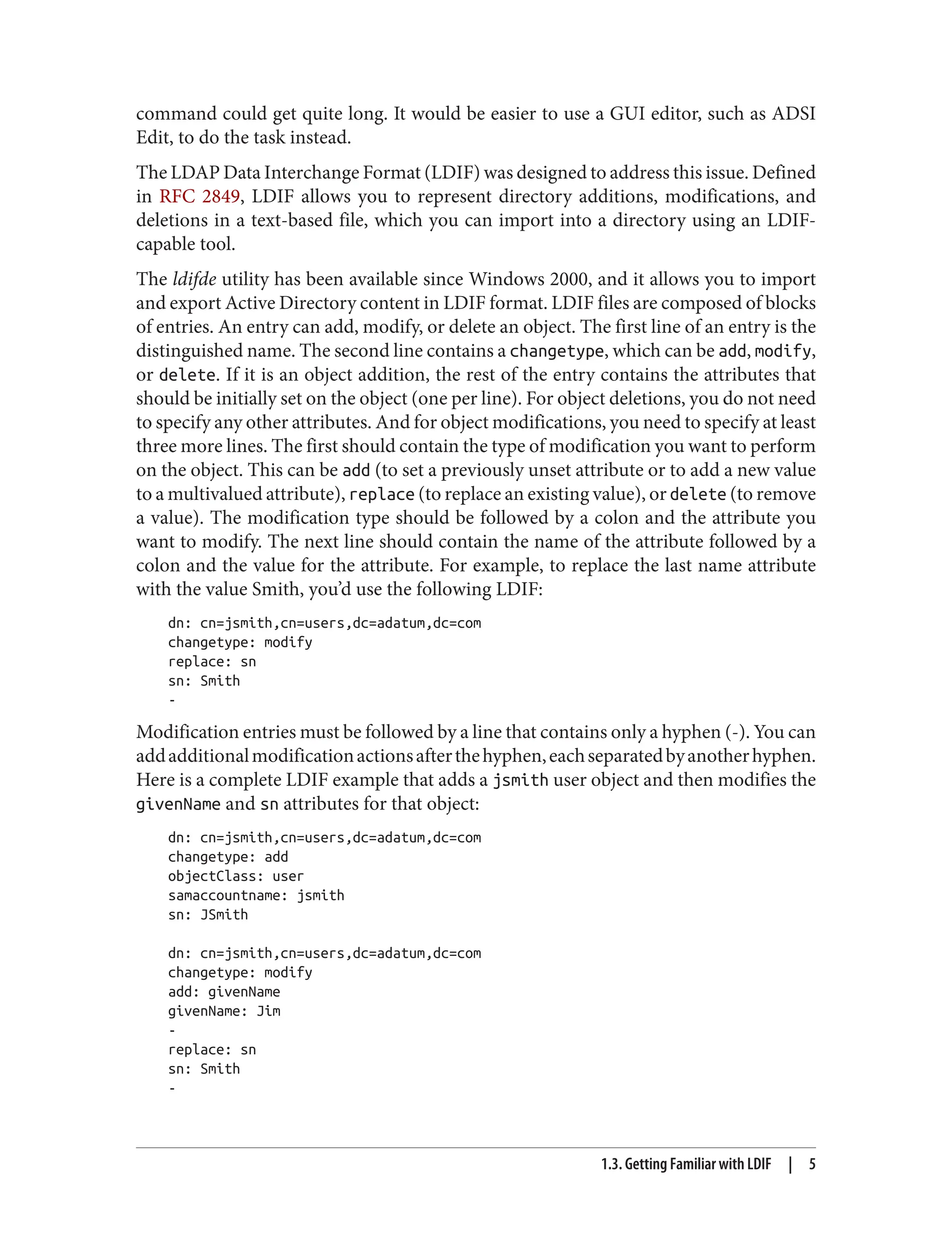
with the value Smith, you’d use the following LDIF:
dn: cn=jsmith,cn=users,dc=adatum,dc=com
changetype: modify
replace: sn
sn: Smith
-
Modification entries must be followed by a line that contains only a hyphen (-). You can
addadditionalmodificationactionsafterthehyphen,eachseparatedbyanotherhyphen.
Here is a complete LDIF example that adds a jsmith user object and then modifies the
givenName and sn attributes for that object:
dn: cn=jsmith,cn=users,dc=adatum,dc=com
changetype: add
objectClass: user
samaccountname: jsmith
sn: JSmith
dn: cn=jsmith,cn=users,dc=adatum,dc=com
changetype: modify
add: givenName
givenName: Jim
-
replace: sn
sn: Smith
-
1.3. Getting Familiar with LDIF | 5
36.
See Recipes 4.28and 4.29 for more details on how to use the ldifde utility to import and
export LDIF files.
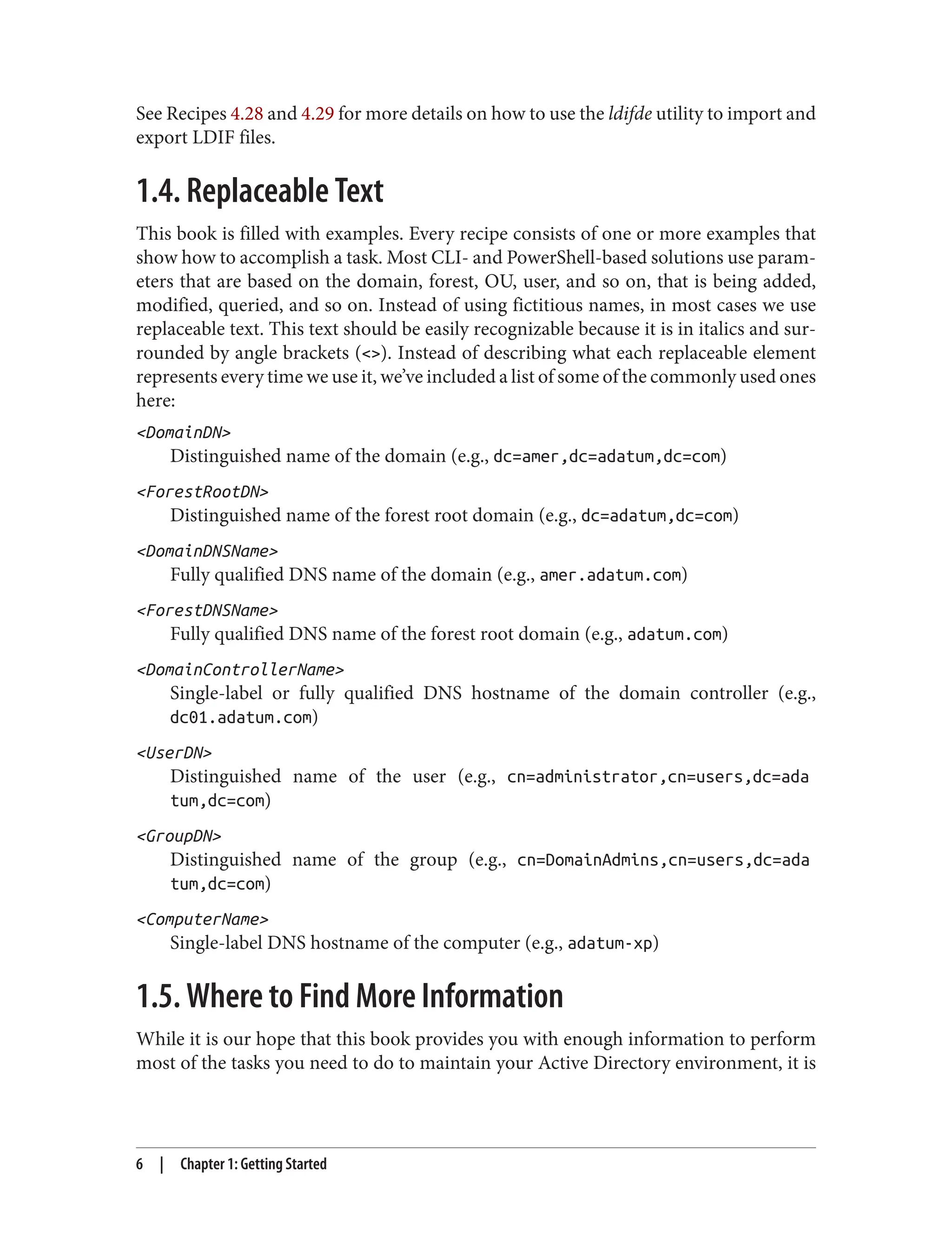
1.4. Replaceable Text
This book is filled with examples. Every recipe consists of one or more examples that
show how to accomplish a task. Most CLI- and PowerShell-based solutions use param‐
eters that are based on the domain, forest, OU, user, and so on, that is being added,
modified, queried, and so on. Instead of using fictitious names, in most cases we use
replaceable text. This text should be easily recognizable because it is in italics and sur‐
rounded by angle brackets (<>). Instead of describing what each replaceable element
represents every time we use it, we’ve included a list of some of the commonly used ones
here:
<DomainDN>
Distinguished name of the domain (e.g., dc=amer,dc=adatum,dc=com)
<ForestRootDN>
Distinguished name of the forest root domain (e.g., dc=adatum,dc=com)
<DomainDNSName>
Fully qualified DNS name of the domain (e.g., amer.adatum.com)
<ForestDNSName>
Fully qualified DNS name of the forest root domain (e.g., adatum.com)
<DomainControllerName>
Single-label or fully qualified DNS hostname of the domain controller (e.g.,
dc01.adatum.com)
<UserDN>
Distinguished name of the user (e.g., cn=administrator,cn=users,dc=ada
tum,dc=com)
<GroupDN>
Distinguished name of the group (e.g., cn=DomainAdmins,cn=users,dc=ada
tum,dc=com)
<ComputerName>
Single-label DNS hostname of the computer (e.g., adatum-xp)
1.5. Where to Find More Information
While it is our hope that this book provides you with enough information to perform
most of the tasks you need to do to maintain your Active Directory environment, it is
6 | Chapter 1: Getting Started
37.
not realistic tothink that we have covered every possible task. In fact, working on this
book has made us realize just how much Active Directory administrators need to know.
Now that Active Directory has been around for a number of years, a significant user
base has been built, which has led to other great resources of information. This section
contains some of the valuable sources of information that we use on a regular basis.
Command-Line Tools
If you have any questions about the complete syntax or usage information for any of
the command-line tools we use, you should first take a look at the help information for
the tools. The vast majority of CLI tools provide syntax information by simply pass‐
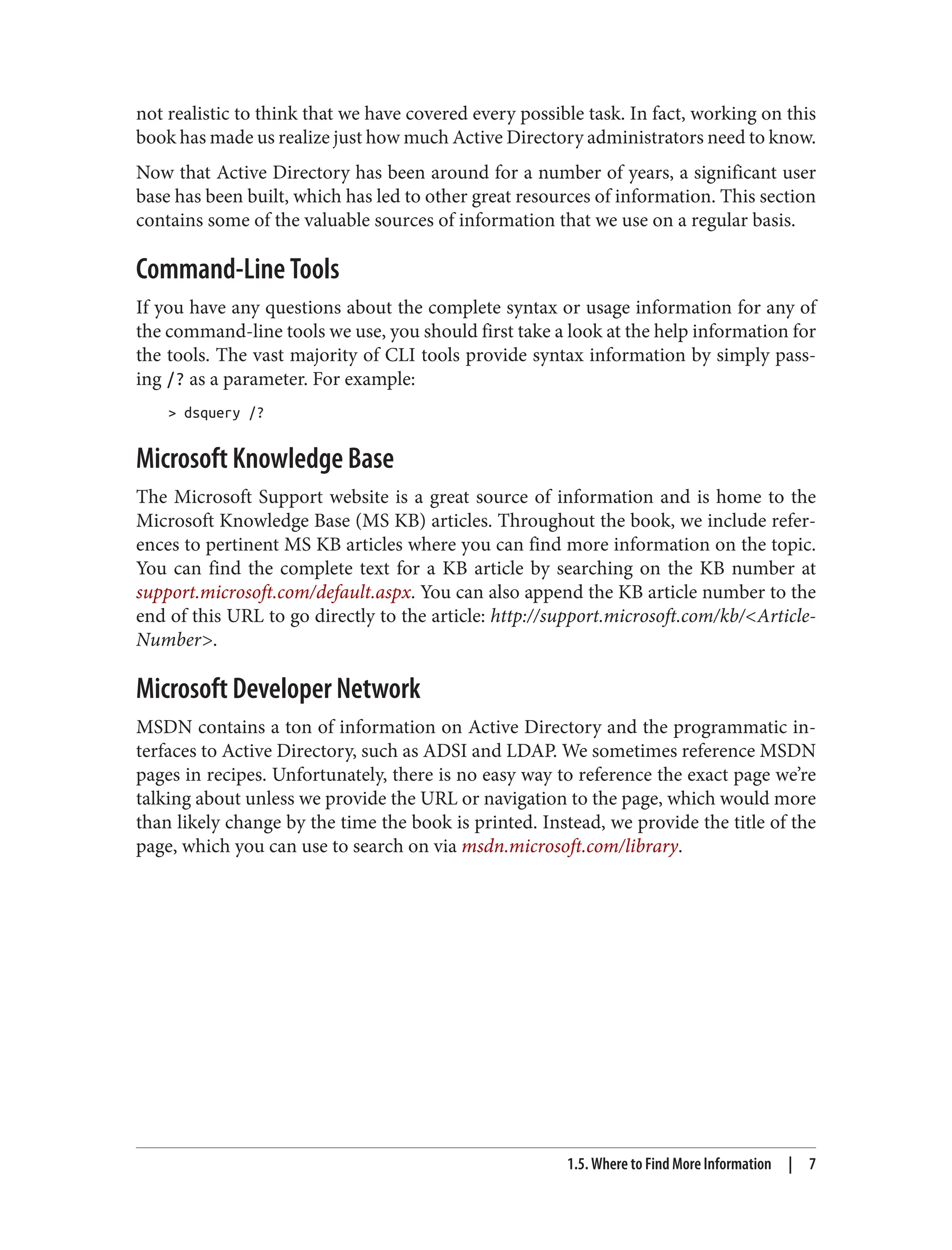
ing /? as a parameter. For example:
> dsquery /?
Microsoft Knowledge Base
The Microsoft Support website is a great source of information and is home to the
Microsoft Knowledge Base (MS KB) articles. Throughout the book, we include refer‐
ences to pertinent MS KB articles where you can find more information on the topic.
You can find the complete text for a KB article by searching on the KB number at
support.microsoft.com/default.aspx. You can also append the KB article number to the
end of this URL to go directly to the article: http://support.microsoft.com/kb/<Article‐
Number>.
Microsoft Developer Network
MSDN contains a ton of information on Active Directory and the programmatic in‐
terfaces to Active Directory, such as ADSI and LDAP. We sometimes reference MSDN
pages in recipes. Unfortunately, there is no easy way to reference the exact page we’re
talking about unless we provide the URL or navigation to the page, which would more
than likely change by the time the book is printed. Instead, we provide the title of the
page, which you can use to search on via msdn.microsoft.com/library.
1.5. Where to Find More Information | 7
38.
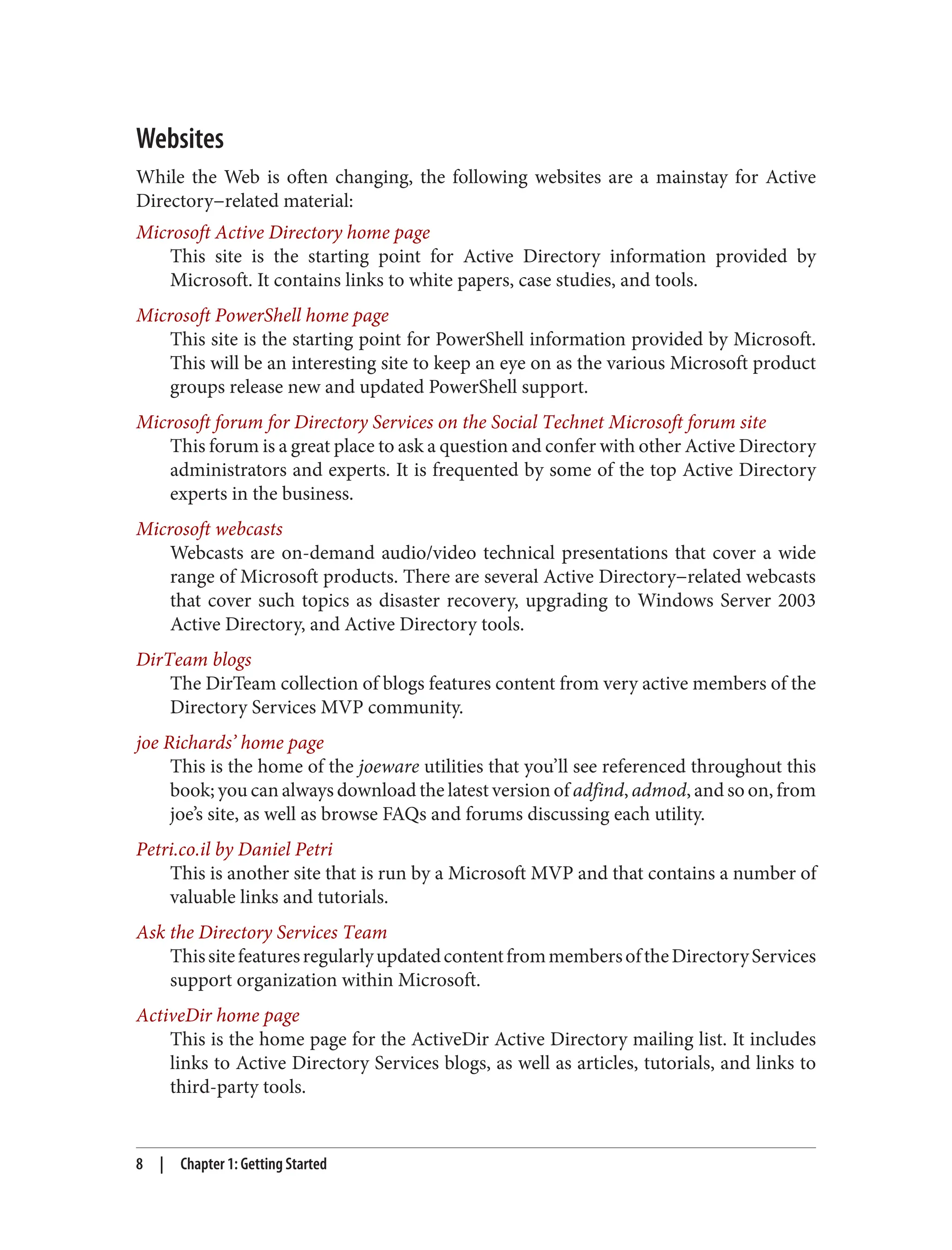
Websites
While the Webis often changing, the following websites are a mainstay for Active
Directory−related material:
Microsoft Active Directory home page
This site is the starting point for Active Directory information provided by
Microsoft. It contains links to white papers, case studies, and tools.
Microsoft PowerShell home page
This site is the starting point for PowerShell information provided by Microsoft.
This will be an interesting site to keep an eye on as the various Microsoft product
groups release new and updated PowerShell support.
Microsoft forum for Directory Services on the Social Technet Microsoft forum site
This forum is a great place to ask a question and confer with other Active Directory
administrators and experts. It is frequented by some of the top Active Directory
experts in the business.
Microsoft webcasts
Webcasts are on-demand audio/video technical presentations that cover a wide
range of Microsoft products. There are several Active Directory−related webcasts
that cover such topics as disaster recovery, upgrading to Windows Server 2003
Active Directory, and Active Directory tools.
DirTeam blogs
The DirTeam collection of blogs features content from very active members of the
Directory Services MVP community.
joe Richards’ home page
This is the home of the joeware utilities that you’ll see referenced throughout this
book; you can always download the latest version of adfind, admod, and so on, from
joe’s site, as well as browse FAQs and forums discussing each utility.
Petri.co.il by Daniel Petri
This is another site that is run by a Microsoft MVP and that contains a number of
valuable links and tutorials.
Ask the Directory Services Team
ThissitefeaturesregularlyupdatedcontentfrommembersoftheDirectoryServices
support organization within Microsoft.
ActiveDir home page
This is the home page for the ActiveDir Active Directory mailing list. It includes
links to Active Directory Services blogs, as well as articles, tutorials, and links to
third-party tools.
8 | Chapter 1: Getting Started
39.
Directory Programming
Just asthe ActiveDir list is crucial for AD administrators, this site is extremely
valuable for AD developers. It also includes user forums where participants can
post questions about AD programming topics.
Mailing List
ActiveDir
The ActiveDir mailing list is where the most advanced Active Directory questions
can get answered. The list owner, Tony Murray, does an excellent job of not allowing
topics to get out of hand (as can sometimes happen on large mailing lists). The list
is very active, and it is rare for a question to go unanswered. Some of Microsoft’s
Active Directory program managers and developers also participate on the list and
are very helpful with the toughest questions. Keeping track of this list is crucial for
any serious Active Directory administrator.
Additional Resources
In addition to the Resource Kit books, the following are good sources of information:
Active Directory, Fifth Edition, by Brian Desmond et al. (O’Reilly)
This is a good all-purpose book on Active Directory. A few of the topics the Fifth
Edition covers are new Windows Server 2012 features, designing Active Directory,
upgrading from Windows 2000, Active Directory Lightweight Directory Services
(AD LDS), Exchange 2013, and Active Directory automation.
The .NET Developer’s Guide to Directory Services Programming by Joe Kaplan and
Ryan Dunn (Addison-Wesley)
Written by two notables in the Directory Services programming community, this
book is a practical introduction to programming directory services, using both
versions 1.1 and 2.0 of the .NET Framework.
Windows IT Pro
Thisisageneral-purposemonthlymagazineforsystemadministratorswhosupport
Microsoft products. The magazine isn’t devoted to Active Directory, but generally,
related topics are covered every month.
1.5. Where to Find More Information | 9
41.
CHAPTER 2
Forests, Domains,and Trusts
2.0. Introduction
Tothelayperson,thetitleofthischaptermayseemlikeahodgepodgeofunrelatedterms.
For the seasoned Active Directory administrator, however, these terms represent the
most fundamental and, perhaps, most important concepts within Active Directory. In
simple terms, a forest is a collection of data partitions and domains; a domain is a hi‐
erarchy of objects in a data partition that is replicated between one or more domain
controllers; and a trust is an agreement between two domains or forests to allow security
principals (i.e., users, groups, and computers) from one domain or forest to access
resources in the other domain or forest.
Active Directory domains are named using the Domain Name System (DNS) name‐
space. You can group domains that are part of the same contiguous DNS namespace
within the same domain tree. For example, the marketing.adatum.com, sales.ada‐
tum.com, and adatum.com domains are part of the adatum.com domain tree. A single
domain tree is sufficient for most implementations, but one example in which multiple
domain trees might be necessary is with large conglomerate corporations. Conglom‐
erates are made up of multiple individual companies in which each company typically
wants to maintain its own identity and, therefore, its own namespace. If you need to
support noncontiguous namespaces within a single forest, you will need to create mul‐
tiple domain trees. For example, adatum.com and treyresearch.com can form two sep‐
arate domain trees within the same forest.
Assuming that each company within the conglomerate wants its Active Directory do‐
main name to be based on its company name, you have two choices for setting up this
type of environment. You could either make each company’s domain(s) a domain tree
within a single forest, or you could implement multiple forests. One of the biggest dif‐
ferences between the two options is that all the domains within the forest trust each
other, whereas separate forests, by default, do not have any trust relationships set up
11
42.
between them. Withouttrust relationships, users from one forest cannot access resour‐
ces located in the other forest. In our conglomerate scenario, if you want users in each
company to be able to access resources within their own domain, as well as the domains
belonging to other companies in the organization, using separate domain trees can
create an easier approach than separate forests. However, it’s important to keep in mind
when designing your network that forests form the security boundary for Active Di‐
rectory, as we’ll cover in the next section. This is because transitive trusts are established
between the root domains of each domain tree within a forest. As a result, every domain
within a forest, regardless of which domain tree it is in, is trusted by every other domain.
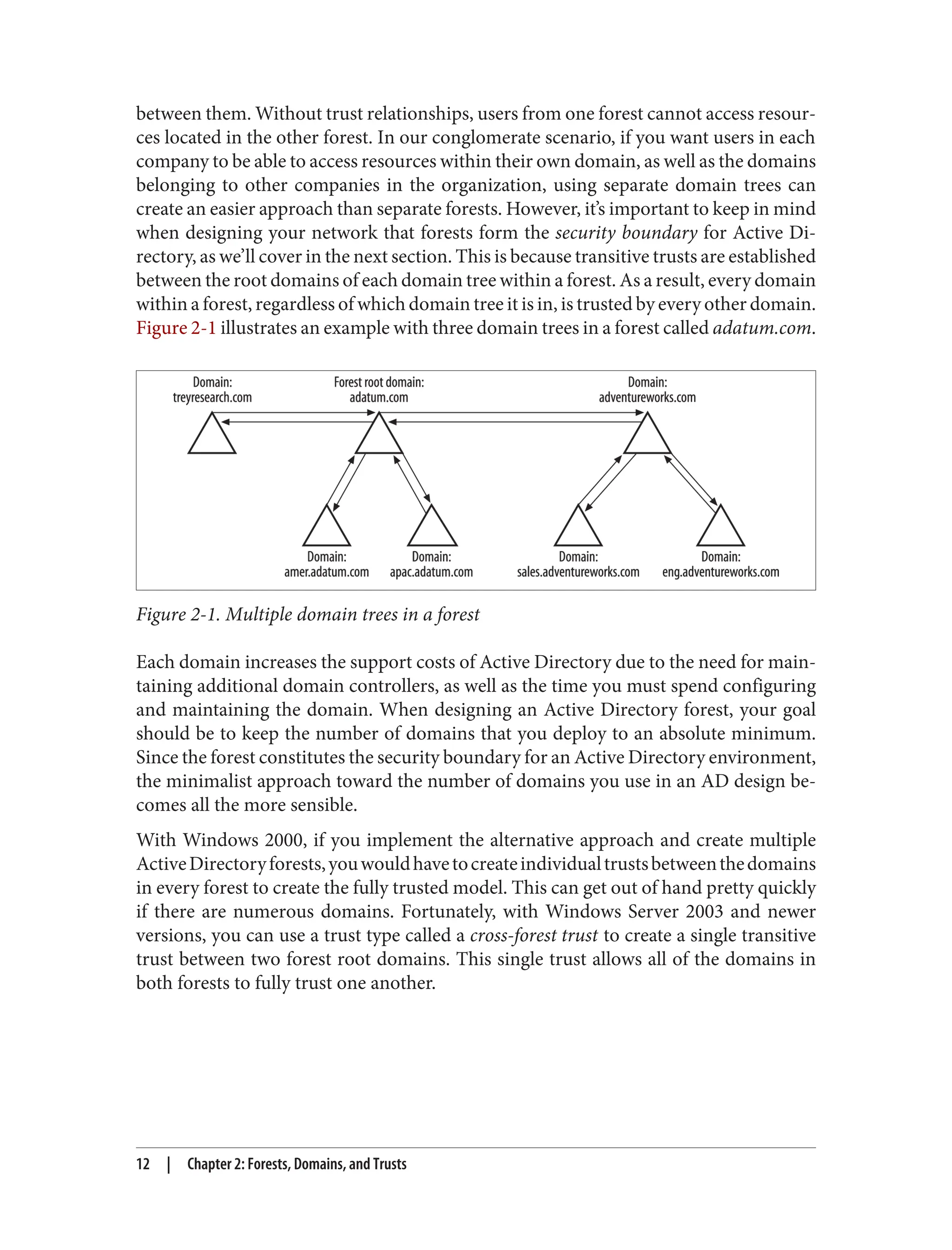
Figure 2-1 illustrates an example with three domain trees in a forest called adatum.com.
Figure 2-1. Multiple domain trees in a forest
Each domain increases the support costs of Active Directory due to the need for main‐
taining additional domain controllers, as well as the time you must spend configuring
and maintaining the domain. When designing an Active Directory forest, your goal
should be to keep the number of domains that you deploy to an absolute minimum.
Since the forest constitutes the security boundary for an Active Directory environment,
the minimalist approach toward the number of domains you use in an AD design be‐
comes all the more sensible.
With Windows 2000, if you implement the alternative approach and create multiple
ActiveDirectoryforests,youwouldhavetocreateindividualtrustsbetweenthedomains
in every forest to create the fully trusted model. This can get out of hand pretty quickly
if there are numerous domains. Fortunately, with Windows Server 2003 and newer
versions, you can use a trust type called a cross-forest trust to create a single transitive
trust between two forest root domains. This single trust allows all of the domains in
both forests to fully trust one another.
12 | Chapter 2: Forests, Domains, and Trusts
43.
There are manymore issues to consider when deciding how many
forests, domains, and domain trees to implement. For a thorough ex‐
planation of Active Directory design considerations, we recommend
reading Active Directory, Fifth Edition, by Brian Desmond et al.
(O’Reilly).
In this chapter, we cover the most common tasks that you would need to do with forests,
domains, and trusts. First, we’re going to review how each item is represented within
Active Directory.
The Anatomy of a Forest
A forest is a logical structure that is a collection of one or more interconnected domains,
plustheconfigurationandschemanamingcontexts,aswellasanyapplicationpartitions
that have been configured. This means that all domains in a forest share a common
configuration and schema between them. Forests are considered the security boundary
in Active Directory; by this we mean that if you need to definitively restrict access to a
resource within a particular domain so that administrators from other domains do not
have any access to it whatsoever, you need to implement a separate forest instead of
using an additional domain within the current forest. This security concern is due to
the transitive trust relationship that exists between all domains in a forest, the writable
naming contexts (NCs) that exist on all domain controllers in a forest, and the extensive
rights and permissions that are granted to members of the Administrators group. In the
earliest days of Windows 2000 Active Directory, Microsoft advocated an “empty forest
root” design with the intention of protecting the enterprise-wide security principals in
the forest root domain from being accessible by domain administrators in the child
domains. However, subsequent discoveries have indicated that it is in fact the forest,
not the domain, that truly provides security separation between distinct groups of re‐
sources and administrators.
Active Directory relies on naming contexts to divide the AD database into separate
partitions, each of which contains information that is replicated together as a logical
unit. At a minimum, an Active Directory forest consists of three naming contexts: the
Domain NC for the forest root domain, the Configuration NC, and the Schema NC.
Here is a description of the types of partitions that can be part of a forest:
Configuration NC
This contains data that is applicable across all domains in a forest, and thus is re‐
plicated to all domain controllers in the forest. Some of this data includes the site
topology, list of partitions, published services, display specifiers, and extended
rights.
2.0. Introduction | 13
44.
Schema NC
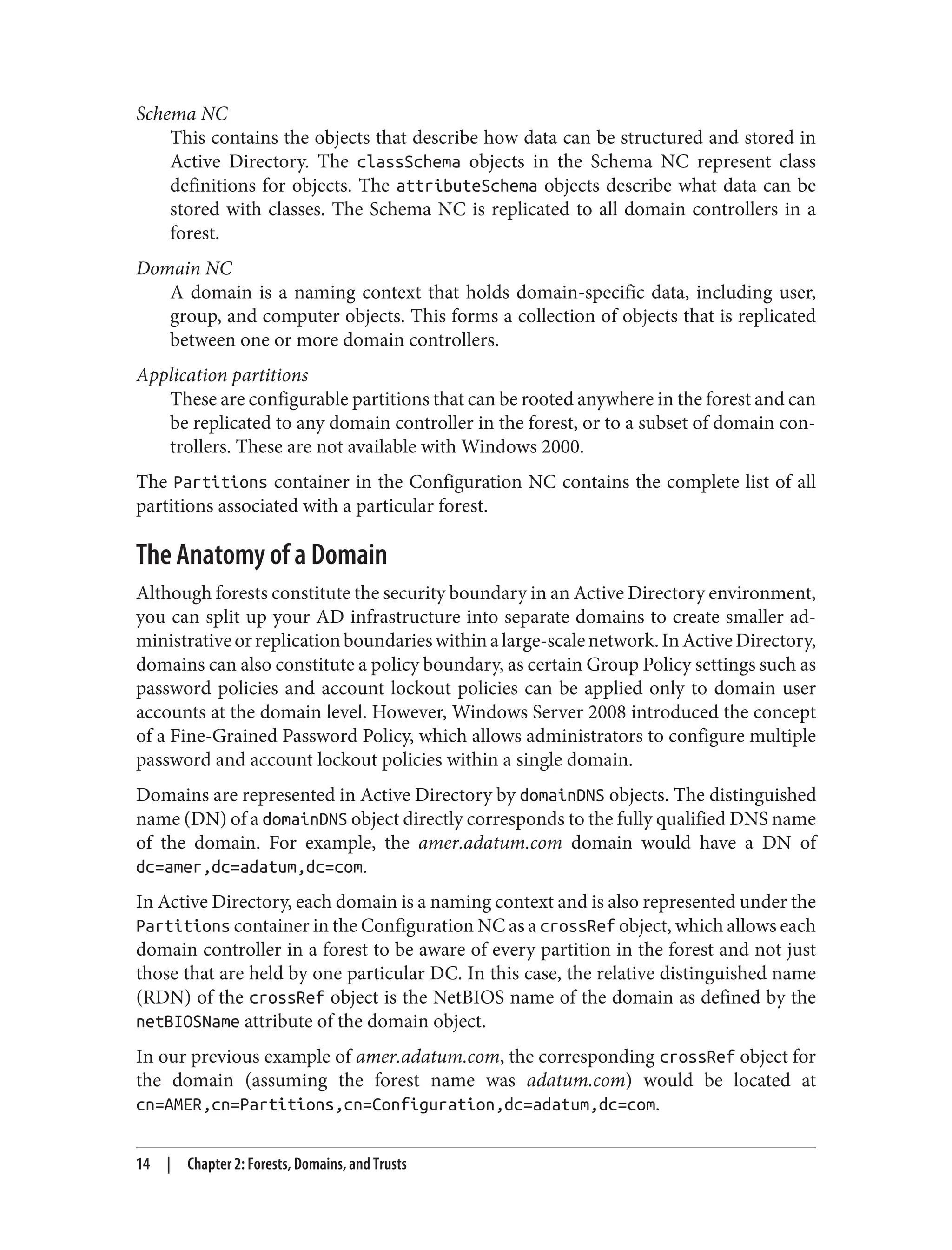
This containsthe objects that describe how data can be structured and stored in
Active Directory. The classSchema objects in the Schema NC represent class
definitions for objects. The attributeSchema objects describe what data can be
stored with classes. The Schema NC is replicated to all domain controllers in a
forest.
Domain NC
A domain is a naming context that holds domain-specific data, including user,
group, and computer objects. This forms a collection of objects that is replicated
between one or more domain controllers.
Application partitions
These are configurable partitions that can be rooted anywhere in the forest and can
be replicated to any domain controller in the forest, or to a subset of domain con‐
trollers. These are not available with Windows 2000.
The Partitions container in the Configuration NC contains the complete list of all
partitions associated with a particular forest.
The Anatomy of a Domain
Although forests constitute the security boundary in an Active Directory environment,
you can split up your AD infrastructure into separate domains to create smaller ad‐
ministrativeorreplicationboundarieswithinalarge-scalenetwork.InActiveDirectory,
domains can also constitute a policy boundary, as certain Group Policy settings such as
password policies and account lockout policies can be applied only to domain user
accounts at the domain level. However, Windows Server 2008 introduced the concept
of a Fine-Grained Password Policy, which allows administrators to configure multiple
password and account lockout policies within a single domain.
Domains are represented in Active Directory by domainDNS objects. The distinguished
name (DN) of a domainDNS object directly corresponds to the fully qualified DNS name
of the domain. For example, the amer.adatum.com domain would have a DN of
dc=amer,dc=adatum,dc=com.
In Active Directory, each domain is a naming context and is also represented under the
Partitions container in the Configuration NC as a crossRef object, which allows each
domain controller in a forest to be aware of every partition in the forest and not just
those that are held by one particular DC. In this case, the relative distinguished name
(RDN) of the crossRef object is the NetBIOS name of the domain as defined by the
netBIOSName attribute of the domain object.
In our previous example of amer.adatum.com, the corresponding crossRef object for
the domain (assuming the forest name was adatum.com) would be located at
cn=AMER,cn=Partitions,cn=Configuration,dc=adatum,dc=com.
14 | Chapter 2: Forests, Domains, and Trusts
45.
The Anatomy ofa Trust
Microsoft has relied on trust relationships to provide resource access across domain
boundaries since the early days of Windows NT. Before Active Directory, all trust re‐
lationships were one-way and nontransitive in nature. A one-way trust relationship, as
the name suggests, enables resource access only in a single direction: a single trust
relationship will enable resource access only from DomainA to DomainB, but a separate
trust would need to be created to enable access in the other direction. A nontransitive
trust relationship means that if you create a trust from DomainA to DomainB and a
second one from DomainB to DomainC, DomainA does not trust DomainC by default.
This one-way nontransitive trust relationship was the only type that was available in
Windows NT. Active Directory improved on this by automatically creating two-way
transitive trust relationships between every parent and child domain in a domain tree,
and between the root domains of all trees in every forest. Thus, all of the domains in a
forest effectively trust all of the other domains in the forest.
Trusts are stored as trustedDomain objects within the System container of a domain.
Table 2-1 lists some of the important attributes of trustedDomain objects.
Table 2-1. Attributes of trustedDomain objects
Attribute Description
cn Relativedistinguishednameofthetrust.Thisisthenameofthetarget
domain that is trusted. For Windows NT domains, it is the NetBIOS
name. For Active Directory domains, it is the DNS name.
trustDirection Flagthatindicateswhetherthetrustisdisabled,inbound,outbound,
or both inbound and outbound.
See Recipes 2.18 and 2.19 for more information.
trustType Flag that indicates if the trust is to a down-level (NT4), up-level
(Windows 2000 or later), or Kerberos (e.g., MIT) domain. See
Recipe 2.18 for more information.
trustAttributes Containmiscellaneouspropertiesthatcanbeenabledforatrust.See
Recipe 2.18 for more information.
trustPartner Thenameofthetrustpartner.SeeRecipe2.18formoreinformation.
A trust also has a corresponding user object in the Users container of a domain. This
is where the trust password is stored. The RDN of this user object is the same as the cn
attribute for the corresponding trustedDomain object with a $ appended.
2.1. Creating a Forest
Problem
You want to create a new forest by creating a new forest root domain.
2.1. Creating a Forest | 15
46.
Solution
Using a graphicaluser interface
On a Windows Server 2008 R2 computer:
1. Open the Server Manager utility. In the lefthand pane, click Roles.
2. In the righthand pane, click Add Roles.
3. Click Next. Place a checkmark next to Active Directory Domain Services.
4. Click Next, click Add Required Features if applicable, click Next twice, and then
click Install.
5. Click Close and then click the Active Directory Domain Services link in the left
pane.
6. In the righthand pane, click the “Run the Active Directory Domain Services
Installation Wizard (dcpromo.exe)” link.
7. Click Next twice to continue. Click the “Create a new domain in a new forest” radio
button and click Next.
8. Follow the rest of the configuration steps to complete the wizard.
On a Windows Server 2012 computer:
1. Add the Active Directory Domain Services role. After the role installation, a noti‐
fication will appear within Server Manager.
2. Click Notifications, and then click “Promote this server to a domain controller.”
3. The Active Directory Domain Services Configuration Wizard will appear.
4. Click “Add a new forest.”
5. Enter the root domain name and then click Next.
6. Select the forest and domain functional levels or leave the defaults of Windows
Server 2012.
7. ConfirmtheoptionstoinstallaDNSserverandaglobalcatalogserver(notoptional
for a new forest and a new forest root domain).
8. Enter the Directory Services Restore Mode (DSRM) password and then click Next.
9. Specify the DNS delegation creation, if necessary, and then click Next.
10. Verify the NetBIOS domain name and then click Next.
11. Specify the location of the database, or accept the defaults, and then click Next.
16 | Chapter 2: Forests, Domains, and Trusts
47.
12. Review theselections given while using the wizard. Optionally, click “View script”
to see the PowerShell command and then click Next.
13. After the prerequisites have been successfully validated, click Install to begin the
process. After promotion, the server will automatically reboot.
Using PowerShell
TheInstall-ADDSForestcmdletisusedtocreateanewforest,asshowninthefollowing
examples. The first example installs a new forest, a new forest root domain, and DNS.
> Install-ADDSForest -DomainName <DomainName> -InstallDNS
The following example installs a new forest, installs a new forest root domain, sets the
file locations, sets the domain and forest functional levels, and installs DNS.
> Install-ADDSForest -DatabasePath "D:ADDSDB" -DomainMode "Win2012"↵
-DomainName <DomainName> -DomainNetBIOSName <NetBIOSName> -ForestMode↵
"Win2012" -InstallDNS:$true -LogPath "E:ADDSlogs" -SYSVOLPath↵
"F:ADDSSYSVOL" -Force:$true
Discussion
The act of creating a forest consists of creating a forest root domain. To do this, you
need to promote a Windows Server 2008 R2 or Windows Server 2012 server to be a
domain controller for a new domain. When using the GUI method, the promotion
process has a wizard interface that requires you to answer several questions about the
forest and domain into which you want to promote the server. After it finishes, you will
be asked to reboot the computer to complete the promotion process. When using the
PowerShell method, the only information needed after running the PowerShell com‐
mand is the desired Directory Services Restore Mode (DSRM) password.
As you have probably noticed since Windows Server 2008, Microsoft has changed the
nomenclature surrounding Active Directory. What used to simply be called “Active
Directory” is now “Active Directory Domain Services,” as a number of other server
services have been rebranded under the Active Directory umbrella, including Active
Directory Certificate Services, Active Directory Rights Management Services, Active
Directory Federated Services, and Active Directory Lightweight Directory Services.
See Also
“Install a New Windows Server 2012 Active Directory Forest (Level 200)”; Recipe 3.7
for automating the promotion of a domain controller; MS KB 238369 (How to Promote
and Demote Domain Controllers in Windows 2000); MS KB 324753 (How to Create
an Active Directory Server in Windows Server 2003)
2.1. Creating a Forest | 17
48.
2.2. Removing aForest
Problem
You want to tear down a forest and decommission any domains contained within it
because you no longer need it.
Solution
To remove a forest, you need to demote all the domain controllers in the forest. When
you demote an existing domain controller, you will be given the option to demote the
machine to a member server (unless the domain controller is the last domain controller
in the domain, in which case the server will become part of a workgroup instead). After
that is completed, and depending on how your environment is configured, you may
needtoremoveWINSandDNSentriesthatwereassociatedwiththedomaincontrollers
and domains, unless they were automatically removed via WINS deregistration and
dynamic DNS (DDNS) during demotion. The following commands can help determine
if all entries have been removed:
> netsh wins server <WINSServerName> show name <DomainNetBiosName> 1b
> netsh wins server <WINSServerName> show name <DomainNetBiosName> 1c
> nslookup <DomainControllerDNSName>
> nslookup -type=SRV _ldap._tcp.dc._msdcs.<ForestDNSName>
> nslookup <ForestDNSName>
You should run the first two commands for every domain in the forest
if the forest contained more than one. The preceding list is not meant
to be exhaustive, so be sure to check DNS across all domains and watch
for entries for RODCs, if the domain controller that was demoted was
an RODC.
Discussion
The method described in this solution is the graceful way to tear down a forest. You can
also use a brute-force method to remove a forest by simply reinstalling the operating
system on all domain controllers in the forest. This method is not recommended except
in lab or test environments. You’ll also need to make sure any DNS resource records for
the domain controllers are removed from your DNS servers since the domain control‐
lers will not dynamically remove them like they do during the demotion process.
You will also want to remove any trusts that have been established for the forest (see
Recipe 2.21 for more details). For more information on how to demote a domain con‐
troller, see Recipe 3.6.
18 | Chapter 2: Forests, Domains, and Trusts
49.
To fully removeall traces of an Active Directory forest in Windows
Server 2008 and later, you should also remove the Active Directory
Domain Services role that has been installed on any of the domain con‐
trollers. This will remove the actual system files associated with the AD
DS server role. You may also want to remove any associated infrastruc‐
ture roles from the servers in question, such as the DNS server role or
the WINS server role. If you need to forcibly remove a single domain
from an AD forest, you can also use the ntdsutil command-line utility;
see Recipe 2.4 for more information.
See Also
Recipe 2.18 for viewing the trusts for a domain; Recipe 2.21 for removing a trust;
Recipe 3.6 for demoting a domain controller
2.3. Creating a Domain
Problem
You want to create a new domain that may be part of an existing domain tree or the root
of a new domain tree.
Solution
Using a graphical user interface
On Windows Server 2008 R2, add the Active Directory Domain Services role and then
run dcpromo from a command line. Place a checkmark next to “Use advanced mode
installation.” You can then select one of the following:
• Existing forest
— Create a new domain in an existing forest
— Create a new domain tree root instead of a new child domain
• Create a new domain in a new forest
On Windows Server 2012, add the Active Directory Domain Services role. After the
role installation completes, a notification will appear within Server Manager. Click
Notifications and then click “Promote this server to a domain controller.” The Active
Directory Domain Services Configuration Wizard appears. Select the desired deploy‐
ment operation (“Add a domain controller to an existing domain,” “Add a new domain
to an existing forest,” or “Add a new forest”). Then, configure the remaining options in
the wizard to complete the process.
2.3. Creating a Domain | 19
50.
Using PowerShell
TheInstall-ADDSDomaincmdletisusedtocreateanewdomain.Thefollowingexample
installs anew child domain in an existing forest and installs DNS:
> Install-ADDSDomain -NewDomainName <newdomainname> -ParentDomainName↵
contoso.com; -DomainMode Win2012 -DomainType ChildDomain -InstallDNS:$true↵
-NewDomainNetBiosName <newNetBIOSname>
Note that the Install-ADDSDomain cmdlet is available only if the Active Directory Do‐
main Services role has been installed on the server where the cmdlet will be run.
Discussion
The options to create a new domain allow you a great deal of flexibility in creating an
Active Directory infrastructure that maps to your organization’s business requirements.
You can add a new domain to an existing domain tree, or else create a new domain tree
entirely. If you want to create a new domain that is a child domain of a parent
domain (for example, contained within the same contiguous namespace), then you are
creating a domain in an existing domain tree. If you are creating the first domain in a
forest or a domain that is outside the namespace of the forest root, then you are creating
a domain in a new domain tree. For example, if you have already created the treyre‐
search.com domain and then you install the first DC in the amer.treyresearch.com do‐
main, then amer.treyresearch.corp is a child domain. Conversely, if you want to create a
domain that is part of the treyresearch.com forest but uses an entirely different naming
convention (such as treyresearchasia.com), then you are creating a new domain tree
within an existing forest.
See Also
Recipe 3.1 for promoting a domain controller; Recipe 3.7 for automating the promotion
or demotion of a domain controller
2.4. Removing a Domain
Problem
You want to remove a domain from a forest. You may need to remove a domain during
test scenarios or if you are collapsing or reducing the number of domains in a forest.
Solution
Removing a domain consists of demoting each domain controller in the domain, which
can be accomplished by running the Remove Roles and Features Wizard on the domain
controllers and following the steps to demote the domain controllers. For the last
20 | Chapter 2: Forests, Domains, and Trusts
51.
domain controller inthe domain, be sure to select the “Last domain controller in the
domain” option in the wizard so that the objects associated with the domain get re‐
moved. If you do not select this option for the last domain controller in the domain,
take a look at Recipe 2.5 for how to remove an orphaned domain.
If the domain you want to remove has child domains, you must remove
the child domains before proceeding.
You can also demote domain controllers by using PowerShell, as shown in the following
example:
> Uninstall-ADDSDomainController -LastDomainControllerInDomain↵
-RemoveApplicationPartitions
In the preceding example, two optional parameters have been specified. The
-LastDomainControllerInDomain parameter is used when demoting the last domain
controller, while the -RemoveApplicationPartitions parameter should be specified to
delete all data associated with any application partitions in the domain.
After all domain controllers have been demoted, depending on how your environment
is configured you may need to remove any WINS and DNS entries that were associated
with the domain controllers and domain that were automatically removed via WINS
deregistration and DDNS during the demotion process. The following commands can
help determine if all entries have been removed:
> netsh wins server <WINSServerName> show name <DomainNetBiosName> 1b
> netsh wins server <WINSServerName> show name <DomainNetBiosName> 1c
> nslookup <DomainControllerName>
> nslookup -type=SRV _ldap._tcp.dc._msdcs.<DomainDNSName>
> nslookup <DomainDNSName>
You will also want to remove any trusts that have been established for the domain (see
Recipe 2.21 for more details). For more information on how to demote a domain con‐
troller, see Recipe 3.6.
Discussion
The brute-force method for removing a forest, as described in the discussion for
Recipe 2.2, is not a good method for removing a domain. Doing so will leave all of the
domain controller and server objects, along with the domain object and associated
domain naming context, hanging around in the forest. If you used that approach, you
wouldeventuallyseenumerousreplicationandfilereplicationserviceerrorsintheevent
log caused by failed replication events from the nonexistent domain. You would need
to remove the metadata associated with the removed domain using ntdsutil to correct
these errors.
2.4. Removing a Domain | 21
52.
To fully removeall traces of an Active Directory forest in Windows Server 2008 and
later, you should also remove the Active Directory Domain Services role that has been
installed on any of the Windows Server 2008 or later domain controllers. This will
remove the actual system files associated with the AD DS server role. You may also want
to remove any associated infrastructure roles from the servers in question, such as the
DNS server role or the WINS server role.
See Also
Recipe 2.2; Recipe 2.5; Recipe 2.18 for viewing the trusts for a domain; Recipe 2.21 for
removing a trust; Recipe 3.6 for demoting a domain controller; and TechNet for details
on removing Active Directory Domain Services
2.5. Removing an Orphaned Domain
Problem
You want to completely remove a domain that was orphaned because the domain was
forcibly removed, or the last domain controller in the domain failed or was otherwise
decommissioned improperly.
Solution
Using a command-line interface
The following commands will forcibly remove an orphaned domain from a forest. Re‐
place <DomainControllerName> with the hostname of the Domain Naming Master
Flexible Single Master Operation (FSMO; pronounced fiz-mo) for the forest.
1 NTDSUTIL
2 metadata cleanup
3 connections
4 connect to server <DomainControllerName>
5 quit
6 select operation target
7 list sites
8 select site <# of site>
9 list servers in site
10 select server <# of domain controller>
11 list domains
12 select domain <# of domain>
13 quit
14 remove selected server (confirm when prompted)
15 list naming context
16 select naming context <# of the DNS Naming Context>
17 quit
18 remove selected naming context (confirm when prompted)
22 | Chapter 2: Forests, Domains, and Trusts
53.
19 select operationtarget
20 list naming context
21 select naming context <# of the domain DN>
22 quit
23 remove selected naming context (confirm when prompted)
Discussion
Removing an orphaned domain consists of removing the domain object for the domain
(e.g., dc=emea,dc=adatum,dc=com), all of its child objects, and the associated cross
Ref object in the Partitions container. You need to target the Domain Naming FSMO
when using ntdsutil because that server is responsible for creation and removal of
domains.
Before you can use ntdsutil to remove an orphaned domain, you must first forcibly
remove any domain controllers in that domain that were not gracefully demoted. (For‐
cibly removing individual domain controllers will be discussed in Chapter 3.) You must
also remove the DomainDNSZones application partition associated with the orphaned
domain, if this was not gracefully removed. (Forcibly removing the DomainDNSZones
application partition will be discussed in Chapters 13 and 17.)
See Also
Recipe 3.10 for removing an unsuccessfully demoted domain controller; MS KB 230306
(How to Remove Orphaned Domains from Active Directory); MS KB 251307 (How to
Remove Orphaned Domains from Active Directory Without Demoting the Domain
Controllers); MS KB 255229 (Dcpromo Demotion of Last Domain Controller in Child
Domain Does Not Succeed); Chapter 3 for information on performing a metadata
cleanup of individual domain controllers; Chapters 13 and 17 for information on man‐
ually removing the DomainDNSZones application partition
2.6. Finding the Domains in a Forest
Problem
You want a list of all domains in an Active Directory forest.
Solution
Using a graphical user interface
Open the Active Directory Domains and Trusts snap-in (domain.msc). The list of the
domains in the default forest can be browsed in the left pane.
2.6. Finding the Domains in a Forest | 23
54.
Using PowerShell
You canretrieve this information using the Get-ADForest command, as shown here:
> Get-ADForest | Select Domains
Discussion
Using a graphical user interface
If you want to view the domains for a forest other than the one you are logged in to,
right-click on Active Directory Domains and Trusts in the left pane and select Change
Forest. Enter the forest root domain name in which you want to browse. In the left pane,
expand the forest root domain to see any subdomains.
Using PowerShell
In the PowerShell solution, we are relying on the Active Directory module. The Get-
ADForest cmdlet has been available since Windows Server 2008 R2 and the usage
remains identical in Windows Server 2012.
See Also
Recipe 3.12 for finding the domain controllers for a domain
2.7. Finding the NetBIOS Name of a Domain
Problem
You want to find the NetBIOS name of a domain. Although Windows primarily uses
DNS for name resolution, the NetBIOS name of a domain is still important. Some users
still rely on the NetBIOS name to log on to a domain or to applications by using the
down-level logon name. The down-level logon name uses the <domainname><user
name> format.
Solution
Using a graphical user interface
1. Open the Active Directory Users and Computers snap-in.
2. Right-click the domain you want to view in the left pane and select Properties.
The NetBIOS name will be shown in the “Domain name (pre-Windows 2000)” field.
24 | Chapter 2: Forests, Domains, and Trusts
“But why?” Idemanded. “I’ve never met the woman before,
to my knowledge.”
“But you’re a good-looking Johnnie, my dear Dick,” my
friend declared, laughing; “and she’s certainly not the first
woman who has fallen over head and ears in love with you.”
“You’re devilish complimentary, old chap,” I answered; “but
if she is, as you think, really attracted towards me, then
she’ll have a cruel awakening when she finds that I’m
actually the husband of her cousin Feo.”
“That’s just what I’ve been thinking,” he replied, with a
serious expression on his face. “Your position is an
exceedingly difficult one, and the inquiries must be made
with the utmost tact and care. At all hazards you must
humour her ladyship, and retain her as your friend. Indeed
if, as you say, your wife is not aware that you are actually
her husband, then it might not be a bad plan to flatter her
ladyship by making violent love to her.”
“I can’t, Bob,” I declared. “In this matter I must at least act
straightforwardly. Feo has fallen a victim, just as I myself
have—that’s evident.”
“You were entrapped, it’s true; but I take it that you really
admire this mysterious Feo?”
“Admire her!” I cried with enthusiasm. “That’s the most
curious feature of the whole affair. I freely confess to you,
my dear fellow, that not only do I admire her, but I’m madly
in love with her! She’s the most graceful and beautiful
woman I’ve ever beheld.”
“Well, Dick,” he observed after a pause, during which time
he puffed vigorously at his big briar, “you are about the last
man I should have suspected of having a romance. Every
57.
detail of itis, however, bewildering. It’s a perfect maze of
mystery—a mystery absolutely incredible!”
58.
Chapter Ten.
The Major.
Onthe following day I was seized by a burning desire to
again see the woman whom I had so strangely grown to
love. Time after time I discussed the matter with Bob, and
he was full of my opinion that I might, by watching my
wife’s movements, discover some fact which might give me
a clue.
I proposed to Bob that I should go straight to her and make
a full explanation, but he urged patience and diplomacy.
“Go down to Whitton and watch her at a distance, if you
like,” he answered. “But be very careful that you are not
recognised. No man cares to be spied upon. In this matter
you must exercise the greatest discretion, if you really
intend to get to the bottom of this puzzling affair.”
“I do intend to solve the enigma,” I declared. “If I’m ten
years over it, I mean to claim Feo as my wife.”
“You can’t do that until you’ve obtained absolute proof.”
“And, in the meantime, Wynd and his accomplice may make
another attempt upon her life,” I observed dubiously.
“Forewarned is forearmed,” he answered. “It seems your
duty to act in secret as her protector.”
“Exactly. That’s my object in going down to Whitton.
Somehow I feel sure that her life is insecure, for the facts
plainly show that Wynd’s motive was to get rid of her.”
59.
“Without a doubt.Go down to Hounslow to-morrow and
discover what you can regarding these friends of hers, the
Chetwodes, and their associates. In inquiries of this sort
you must carefully work back.”
Now, I had for years rather prided myself upon my
shrewdness. I had often set myself the task of clearing up
those little unimportant mysteries of life which occur to
every man; and more than once, while at the hospital, I
had rendered service to the police in their inquiries.
That same afternoon, while Bob was out visiting his
patients, I chanced to put my hand in the ticket-pocket of
my frock-coat, and felt something there. The coat was the
one I had worn when called out to become the husband of
Feo Ashwicke, and from the pocket I drew a half-smoked
cigarette.
I am not in the habit of placing cigarette ends in my
pockets, and could not, at first, account for its presence
there; but, on examination, I saw that it was the remains of
one of an unusual brand, for upon the paper were tiny
letters in Greek printed in blue ink. A second’s reflection,
however, decided me: it was the cigarette which the Major
had given me. It had gone out while I had been speaking,
and with it in my hand I had rushed upstairs to my wife’s
room, and instead of casting it away had, I suppose, thrust
it into my pocket, where it had remained unheeded until
that moment.
I examined it with the utmost care and great interest. Then
I descended to Bob’s little dispensary, at the back of the
house, and, finding a microscope, took out some of the
tobacco and placed it beneath the lens. Tiny but distinct
crystals were revealed clinging to the finely-cut tobacco,
60.
crystals of somesubtle poison which, dissolved by the saliva
while in the act of smoking, entered the system.
The cigarette had narrowly proved fatal to me.
At once I lit the spirit-lamp, cleaned and dried some test-
tubes, and set busily to work to make solutions with the
object of discovering the drug. But although I worked
diligently the whole afternoon, and Bob, on returning,
assisted me, we were unable to determine exactly what it
was.
The remainder of the cigarette, including the paper bearing
the mark of manufacture, I carefully preserved, and on the
following morning went down to Hounslow to ascertain what
I could regarding my unconscious wife. Bob remained at
Rowan Road to look after his patients, but declared his
intention of relieving me if any watching were required.
Therefore, I went forth eager to ascertain some fact that
would lead me to a knowledge of the truth.
Hounslow, although but a dozen miles from Charing Cross,
was, I found, a dull, struggling place, the dismal quiet of
which was only relieved by a few boisterous militiamen in
its long street.
I took up my quarters at the historic Red Lion, and over a
whisky-and-soda made inquiries of the plethoric landlord as
to the whereabouts of Whitton. It lay beyond the town, half-
way towards Twickenham, he told me.
“There’s a Whitton Park, isn’t there?” I inquired.
“Yes; Colonel Chetwode’s place. That’s just before you get
to Whitton Church.”
“It’s a large house, I suppose?”
61.
“Oh, yes; he’sthe squire there, and magistrate, and all
that.”
“I’ve heard his name,” I said, “but I’ve never seen him.
What sort of a man is he?”
“Oh, a bit stand-offish, tall, thin, and grey-haired. We hotel-
keepers don’t like ’im, because he’s always down on us on
the licensing-days over at Brentford,” the man replied,
chewing his cheap cigar.
“He’s married, isn’t he?”
“Yes; he married ’is second wife about three years ago.
She’s a good-looking woman with reddish hair. They say she
don’t get on very well with the Colonel’s grown-up son.”
“Oh,” I remarked, at once interested. “How old is the son?”
“About twenty-five. He’s a jolly fellow ’e is. He’s a lieutenant
in the 7th Hussars, and they’re stationed here just now. He
often comes in and gets a drink when e’ passes.”
“And he doesn’t hit it off well with his stepmother?”
“No; I’ve heard some queer stories about their quarrels
from the servants,” he answered. He was a gossip, like all
landlords of inns, and seemed extremely communicative
because I had asked him to drink with me. The effect of a
shilling spent upon drink is ofttimes amazing.
“Stepmothers are generally intruders,” I laughed. “Well,
things came to such a pass down at the Park, a month or
two ago, that Mrs Chetwode demanded that the Colonel
should turn young Mr Cyril out of the house, and threatened
that if he did not she would leave. The Colonel, so it’s said,
grew furious, stormed down the place, and in the end Mrs
62.
Chetwode packed hertrunks and went with Sherman, her
maid, to Switzerland. About three weeks ago the Colonel
followed her and brought her back, so I suppose they’ve
made it up again.”
“Do they entertain many friends?”
“Oh yes, there’s always visitors there; it’s so near to
London, you see.”
“Do you know the names of any of the visitors?” I inquired.
Adding, “I think a friend of mine comes down to see them
sometimes—a Sir Pierrepoint-Lane.”
“Oh yes,” he said; “I’ve seen both Sir Henry and his wife
driving. They’ve got a place somewhere in Wiltshire, I’ve
heard. They’re great friends of Mrs Chetwode’s.”
“And there’s a Miss Ashwicke who comes with them,” I said
eagerly. “Do you know her?”
“I may know her by sight,” the man replied, “but I don’t
know her by name.”
“She’s tall, blue-eyed, with golden-brown hair. Very pretty,
and always very smartly dressed.”
“Yes; she wears a big black hat, and very often a drab-
coloured dress. When she smiles she shows her teeth very
prettily,” he said.
“That’s her, no doubt.”
“Well,” he said, “her description is exact. She’s Mr Cyril’s
young lady.”
“What?” I cried, starting up in surprise.
63.
“When she’s downhere she’s always about with the
Colonel’s son, and everybody says they’re engaged,” he
went on. “The servants have told me that they’re a most
devoted couple.”
“But is that lady the same one that I mean?” I inquired
dubiously.
“I don’t know her surname, but her Christian name is Miss
Beryl.”
“Beryl?” I gasped. Could this be the actual truth, that she
was engaged to young Chetwode?
Beryl! Then she was evidently known here by the name in
which she had married me—Beryl Wynd.
“Is she often here?” I asked at last, when I found voice
again. I was so upset by this statement, that with difficulty
I remained calm.
“Oh yes, very often; especially now that Mr Cyril is at the
barracks. They ride out together every morning, and are
very often about in the town in the afternoon. You’ll no
doubt see them.”
“Ah,” I said, with the object of misleading my garrulous
informant, “it can’t be the lady I mean, as her name is not
Beryl.”
“The description is very much like her,” he observed,
knocking the ash from his cigar.
“Is there any talk of young Chetwode marrying?” I inquired.
“Well, yes, there are rumours of course,” he answered.
“Some say that the Colonel is against it, while others say
64.
that Mrs Chetwodeis jealous of her stepson, so one doesn’t
know exactly what to believe.”
“I suppose you hear a lot of gossip about them, eh?”
“Oh, a lot. Much, too, that ain’t true,” he laughed. “Why,
somebody said once that Miss Beryl was the daughter of an
officer who got sent to penal servitude.”
“Who said that?” I said, at once pricking up my ears. Was it
not Major Tattersett who had accompanied her to the
registry at Doctors’ Commons, and who had given me that
cigarette?
“Oh, it was a story that got about.”
“Did they say who the officer was? or what was his
offence?”
“He was a major in the Guards, they said.”
“You didn’t hear his name?”
“No, I’ve never heard her name. Everybody here knows her
as Miss Beryl. But it would be easy enough to find out.”
And, rising, he leant forward into the tap-room, where a
rural postman was sitting, hot and dusty, drinking ale from
a pewter, and shouted, “I say, Allen, what’s the name of Mr
Chetwode’s young lady?”
“The young lady that’s so often at the Park? Why, Miss Beryl
Wynd.”
I sat motionless for some moments. The truth seemed plain
—that she had allowed herself to be introduced to me at
Gloucester Square under an alias. For what reason, I
wondered?
65.
She was undoubtedlyin love with this young lieutenant of
Hussars. If so, then she would seek to preserve the secret
of her marriage, and even repudiate it if necessary. The
rumours of her being the daughter of a disgraced officer
was another curious feature. It almost appeared as if there
were some truth underlying it.
“You hear what the postman says, sir,” observed the
landlord, turning again to me. “He knows, because he
delivers the letters at the Park. Her name is Wynd—funny
name, isn’t it?”
“Yes,” I answered mechanically, for the discovery that this
young Chetwode was the accepted suitor of my love was a
staggering blow. What could I do? How should I act?
She was my wife by law—mine.
I rose, announcing that I was going for a stroll, and, walked
unsteadily out into the long, deserted street. I wandered
down the Hanworth Road, past rows of cottages with
gardens filled with flowers, to the station, and, crossing the
bridge, soon found myself before the old-fashioned lodge at
the entrance to Whitton Park.
I was curious to investigate the place, and, noticing that the
lodge-keeper’s house was shut, while one of the smaller of
the great ornamental iron gates stood open, I strolled in,
continuing up the avenue for a quarter of a mile or so, when
suddenly the drive swept round past a pretty lake, and I
came in full view of the house.
It was a splendid old Elizabethan mansion. Before it was a
pretty, old-world garden with an ancient sundial in the
centre, while to the right was a well-kept modern tennis-
court where people were playing, while afternoon tea was
being served to the remainder of the house-party.
66.
There were fullya dozen people there, the men in flannels
and the women in cool muslins with bright sunshades. Risks
of detection, however, prevented me from approaching
close enough to clearly distinguish the faces of the hostess
and her guests; therefore I stood hidden by the bushes,
watching the game, and trying in vain to catch a glimpse of
the countenances of the chattering circle of tea-drinkers.
Suddenly a figure in pale yellow rose and crossed to the
side of a foppishly-dressed young man who, sitting
somewhat apart, was smoking and intently watching the
game. The smartness of the figure, the narrow waist, wide
hips, and swinging gait were familiar.
Although I could not distinguish her features, I knew that it
was my wife—the woman who was ignorant of her
marriage, and whom I loved with such a fond, mad passion.
The man rose, pulled a chair forward for her, and then both
sat down together to chat. He fetched her some tea, and
then sat hugging his knees, apparently engrossed in
conversation. She seemed to hold him beneath the spell of
her marvellous beauty, just as she held me.
Could it be that that man, whose face I could not see
clearly, was Cyril Chetwode, her lover?
I was standing there, my eyes riveted upon the pair, when
the sound of a footstep on the gravel caused me to turn
quickly. Some one was approaching. I at once drew back
behind the trunk of a great elm near which I was standing,
for my discovery there as an intruder might upset all my
plans.
The figure came forward slowly, for I could hear that they
were deliberate footsteps, as though of a person waiting
and pacing up and down. I peeped out to ascertain who it
67.
was, and asI did so the figure of a man in a soft felt hat
and a suit of grey tweed came cautiously into view.
My heart leapt up in quick surprise.
It was the man who, by giving me that cigarette, had made
the dastardly attempt upon my life that had been so nearly
successful—the man of whom I had been in active search—
Major Tattersett.
His single eyeglass was still in his eye, and his hat was set
upon his head as jauntily as on the day when we had first
met, but, for the eagerness of his countenance as he gazed
forward to where my wife sat, I saw that he was not one of
the house-party, and felt confident that his presence there
was with secret and evil intent.
68.
Chapter Eleven.
Voices ofthe Night.
From my place of concealment I was able to watch the
Major closely without risk of detection.
His presence there boded no good. He had crept slowly up
the avenue until within sight of the house, and was intently
scanning the gay party assembled on the lawn. Was it
possible that he had walked behind me and watched me
enter there?
He was scarcely as smart in appearance as on the day when
he led my bride up the aisle of the church, and had
afterwards handed me the cigarette; but, nevertheless, he
retained the distinctly foppish air of the man-about-town.
For a few moments only he remained there eagerly
scanning the distant group, and then, as though reassured,
he turned on his heel and retraced his steps towards the
lodge.
Determined to watch his movements, I followed him until
he gained Hounslow Station, and there I saw him turn into
a low-built, old-fashioned inn, where I afterwards
discovered he had been staying for a couple of days.
That some conspiracy was being formed, I could not doubt,
therefore I set myself to keep strict watch upon him—no
easy matter, for from hour to hour I feared that he might
recognise me. It was he who had petitioned the Archbishop
for the special licence for our marriage; he who had, with
some mysterious motive, posed as the father of the woman
I now loved. Surely she must have known that he was not
69.
her father, and,if so, she herself had taken a part in a plot
which had so nearly cost her her life.
But was she not dead when I found her lying there? The
puzzle was bewildering.
The Major’s movements might possibly give me some clue.
It was fortunate that we had met.
At a cheap clothier’s I had purchased a rough secondhand
suit and a bowler hat, much the worse for wear, and these I
had assumed in order to alter my appearance as much as
possible. About nine o’clock that same night, while I stood
idling about the station with my eye ever upon the inn
opposite, my vigilance was suddenly rewarded, for the
Major emerged leisurely, carefully lit a cigar, and then
strolled across the railway bridge and down the road
towards Whitton. Darkness had not quite set in, therefore I
hesitated to follow him; but, fortunately, I had explored the
neighbourhood thoroughly during the past few hours, and
knew that by crossing to the opposite platform of the
station, I could gain a footpath which led through fields and
market-gardens, emerging into the high-road almost
opposite the gates of the park.
This byway I took, and, hurrying down it, arrived at the
point near the lodge fully five minutes before he appeared
along the road. The gates were, however, closed.
Would he ring and demand admittance? I wondered.
When about two hundred yards from the gates he suddenly
halted, glanced up and down the road as though to make
certain that no one was watching, and then, bending down,
squeezed himself through a hole in the wooden fencing and
disappeared. He evidently knew that the gates were locked,
70.
and had alreadydiscovered that mode of entry, if indeed he
had not broken away the palings himself earlier in the day.
Without hesitation I hurried forward over the grass by the
roadside, so that he might not hear my footsteps, and,
discovering the hole in the paling, entered after him. I
found myself in the midst of hawthorn bushes and thick
undergrowth, but, pausing and listening intently, I soon
detected which direction he had taken by the noise of
breaking twigs. For some ten minutes I remained there,
fearing to move lest the noise might alarm him; but when
at last he was out of hearing I crept forward, breaking my
way through in the direction of the avenue. The night was
hot and so still that each sound seemed to awaken the
echoes.
With the greatest caution I crept on, walking noiselessly
over the grass in the direction of the house.
As soon as the old mansion came into view I saw that lights
burned in many of the windows, and from the drawing-
rooms, where the open doors led on to the lawn, came the
living strains of dance music.
From where I stood I could see the high lamps with their
shades of yellow silk, and now and then bright dresses
flashed past the long windows. A couple of figures were
strolling up and down before the house. I could see their
white shirt-fronts in the darkness, and knew that they were
men smoking and enjoying the night air.
The two men at last tossed away their cigar ends and
entered the house: thus I became encouraged to approach
closer, cross the lawn, and peep through one of the side
windows of the drawing-room. Fully a dozen people were
there, but as I gazed around I was disappointed not to see
71.
my love. Ihad risked discovery and detection to obtain
sight of her, but she was not present, neither was her
cousin Nora. Most of the guests seemed smart people,
judging from the women’s toilettes, and all were lolling
about with the air of laziness which overcomes one after a
good dinner. Dancing had ended, and, as I watched, a
young dark-haired girl approached the piano and
commenced to sing a song by which I knew that she was
French.
I peered in through those windows eager for a glimpse of
Beryl. Surely she was not like those others? No, I
recollected her calm dignity and sweet grace when I had
spoken to her. She, at least, was high-minded and womanly.
I was glad she was not there to hear that song.
The singer sat down, having finished, amid roars of
applause, and then the conversation was resumed; but at
that instant I became conscious of some one passing near
me, and had only just time to draw back into the shadow
and thus escape observation. It was one of the guests, a
man who lounged slowly along, the glowing end of his cigar
shining in the darkness, alone; he was apparently full of
recollections, for he passed slowly and mechanically onward
without noticing me. Unable to see his face, I could only
detect that he was rather above the average height, and, by
his silhouette, I saw that he stooped slightly.
The encounter, however, caused me to recede from the
house, for I had no desire to be detected there and
compelled to give an account of myself. I was in shabby
clothes, and if found in the vicinity might be suspected of an
intention to commit a theft.
Where was the Major? He had certainly entered there, but
had escaped my vigilance by passing through the thicket. I
72.
had been therenearly half an hour, yet had not been able to
re-discover him. The lawn on one side was bounded by a
light iron fencing, beyond which was a thick wood, and upon
this fencing I mounted, and sat to rest in full view of the
house and the long window of the drawing-room. In the
deep shadow of the trees I waited there, safe from
detection, listening to the music, which had recommenced,
and wondering what had become of the man whom I had
tried to follow. He seemed to have avoided the house and
gone to the opposite side of the park.
Although I could actually see into the circle of assembled
guests, yet I was so far off that I could only distinguish the
women by the colour of their gowns. Had Beryl returned to
join them? I wondered. I was longing for a single glance at
her dear face—that face sweeter than any other in the
world.
A woman in a cream dress, cut low at the neck, came
suddenly to the doorway and peered forth into the night as
though in search of some one, but a moment later had
disappeared; and again the piano broke forth with the
pretty minuet from Manon.
I had, I felt certain, been there almost, if not quite, an
hour; therefore I was resolved to make a tour of the park in
an endeavour to find the man whose suspicious movements
had so interested me earlier in the evening. With that
object in view I leaped down upon the lawn, crossed it until
I reached the edge of the lake, which I skirted until I gained
a rustic bridge which crossed the tiny brook that rippled
over the stones and fell into the pool.
Of a sudden I heard a sound. It was quite distinct, like a
half-suppressed cough. I halted in surprise, but no other
sound reached my ear. Could I have been mistaken? The
73.
noise seemed veryhuman, yet I knew that in the darkness
of night the most usual sound becomes exaggerated and
distorted. Therefore reassured I continued my way by the
narrow, unfrequented path, which, leaving the lakeside,
struck across the park and led me across a stile into a dark
belt of wood.
Scarcely had I entered it, however, when I heard human
voices distinctly. I halted and listened. An owl hooted
weirdly, and there was a dead silence.
I wondered whether the persons I had surprised had
detected my presence. I stood upon the narrow path
holding my breath so that I could catch every sound.
A couple of minutes passed. To me they seemed as hours.
Then, again, the voices sounded away to the left,
apparently on the edge of the wood. Noiselessly I retraced
my steps to the stile, and then found that from it there ran
a path beside the iron railing, whither I knew not. But
somewhere down that path two persons were in
consultation.
Treading carefully, so that my footsteps should not be
overheard, I crept down the path until, of a sudden, I
caught sight of a woman’s white dress in the gloom. Then,
sufficiently close to overhear, I halted with strained ears.
I was hidden behind a high hazel bush, but could just
distinguish against that reddish glare which shines in the
sky of the outskirts of London on a summer’s night, two
silhouettes, those of a man and a woman. The former had
halted, and was leaning against the railing, while the latter,
with a shawl twisted about her shoulders, stood facing him.
“If you had wished you could certainly have met me before
this,” the man was grumbling. “I’ve waited at the stile there
74.
a solid hour.Besides, it was a risky business with so many
people about.”
“I told you not to come here,” she answered; and in an
instant I recognised the voice. They were the sweet,
musical tones of the woman who was my wife.
“Of course,” laughed her companion sardonically. “But, you
see, I prefer the risk.” And I knew by the deep note that the
man who stood by her was the Major.
“Why?” she inquired. “The risk is surely mine in coming out
to meet you?”
“Bah! women can always make excuses,” he laughed. “I
should not have made this appointment if it were not
imperative that we should meet.”
“Well?” she sighed. “What do you want of me now?”
“I want to talk to you seriously.”
“With the usual request to follow,” she observed wearily.
“You want money—eh?”
“Money? Oh no,” he said, with bitter sarcasm. “I can do
without it. I can live on air, you know.”
“That’s better than prison fare, I should have thought,” she
answered grimly.
“Ah, now, my dear, you’re sarcastic,” he said, with a touch
of irony. “That doesn’t become you.”
“Well, tell me quickly what you want, and let me get back,
or they will miss me.”
75.
“You mean thatyour young lover will want to know with
whom you’ve been flirting, eh? Well, you can mislead him
again, as you’ve done many times before. What a fine thing
it is to be an accomplished liar. I always envy people who
can lie well, for they get through life so easily.” He spoke in
a familiar tone, as though he held her beneath an influence
that was irresistible.
“I am no liar,” she protested quickly. “The lies I have been
compelled to tell have been at your own instigation.”
“And to save yourself,” he added, with a dry, harsh laugh.
“But I didn’t bring you here for an exchange of
compliments.”
76.
Chapter Twelve.
The MorningAfter.
“Then why have you compelled me to meet you again?” she
demanded fiercely, in a tone which showed her abhorrence
of him. “The last time we met you told me that you were
going abroad. Why haven’t you gone?”
“I’ve been and come back again.”
“Where?”
“That’s my business,” he answered very calmly. “Your
welcome home is not a very warm one, to say the least.”
“I have no welcome for my enemies.”
“Oh! I’m an enemy—eh? Well,” he added, “I have always
considered myself your friend.”
“Friend!” she echoed. “You show your friendliness in a
rather curious manner. You conceive these dastardly plots,
and then compel me to do your bidding—to act as your
decoy!”
“Come, come,” he laughed, his temper quite unruffled by
her accusation, “you know that in all my actions I am
guided by your interests as well as my own.”
“I was certainly not aware of it,” she responded. “It cannot
be to my interest that you compel me to meet you here like
this, at the risk of discovery. Would it not have been better
if our meeting had taken place in London, as before?”
77.
“Necessity has drivenme to make this appointment,” he
responded. “To write to you is dangerous, and I wanted to
give you warning so that you can place yourself in a
position of security.”
“A warning!—of what?” she asked breathlessly.
“La Gioia is here.”
“La Gioia!” she gasped. “Here? Impossible!” La Gioia! It was
the name I had found written upon the piece of paper
beneath her pillow.
“Unfortunately, it is the truth,” he responded in an earnest
voice. “The contretemps is serious.”
“Serious!” she cried in alarm. “Yes, it is serious; and
through you I am thus placed in peril!”
“How do you intend to act?”
“I have no idea,” she responded, in a hoarse tone. “I am
tired of it all, and driven to despair—I am sick to death of
this eternal scheming, this perpetual fear lest the terrible
truth should become known. God knows how I have
suffered during this past year. Ah, how a woman can suffer
and still live! I tell you,” she cried, with sudden desperation,
“this dread that haunts me continually will drive me to take
my life!”
“Rubbish!” he laughed. “Keep up your pluck. With a little
ingenuity a woman can deceive the very devil himself.”
“I tell you,” she said. “I am tired of life—of you—of
everything. I have nothing to live for—nothing to gain by
living!”
78.
Her voice wasthe voice of a woman driven to desperation
by the fear that her secret should become known.
“Well,” he laughed brutally, “you’ve certainly nothing to gain
by dying, my dear.”
“You taunt me!” she cried in anger. “You who hold me
irrevocably in this bond of guilt—you who compel me to act
as your accomplice in these vile schemes! I hate you!”
“Without a doubt,” he responded, with a short laugh. “And
yet I have done nothing to arouse this feeling of
antagonism.”
“Nothing! Do you then think so lightly of all the past?”
“My dear girl,” he said, “one should never think of what has
gone by. It’s a bad habit. Look to your own safety, and to
the future.”
“La Gioia is here!” she repeated in a low voice, as though
unable to fully realise all that the terrible announcement
meant. “Well, how do you intend to act?”
“My actions will be guided by circumstances,” he replied.
“And you?”
She was silent. The stillness of the night was broken only by
the dismal cry of a night-bird down near the lake.
“I think it is best that I should die and end it all,” she
replied, in a hard, strained voice.
“Don’t talk such nonsense!” he said impatiently. “You are
young, graceful, smart, with one of the prettiest faces in
London. And you would commit suicide. The thing is utterly
absurd!”
79.
“What have Ito gain by living?” she inquired again, that
question being apparently uppermost in her mind.
“You love young Chetwode. You may yet marry him.”
“No,” she answered with a sigh; “I fear that can never be.
Happiness can never be mine—never.”
“Does he love you?” inquired the Major, with a note of
sympathy in his voice.
“Love me? Why, of course he does.”
“You have never doubted him?”
“Never.”
“And he has asked you to marry him?”
“Yes, a dozen times.”
“When was the last occasion?”
“To-night—an hour ago.”
“And you, of course, refused?”
“Of course.”
“Why?”
“Because of the barrier which prevents my marriage with
him.”
“And you will allow that to stand in the way of your safety?”
“My safety!” she echoed. “I don’t understand.”
80.
“Cannot you seethat if you married Cyril Chetwode at once,
La Gioia would be powerless?”
“Ah!” she exclaimed suddenly, impressed by the suggestion.
“I had never thought of that?”
“Well,” he went on, “if you take my advice, you’ll lose no
time in becoming Chetwode’s wife. Then you can defy your
enemies, and snap your fingers at La Gioia.”
A deep silence fell. The woman who was my wife was
reflecting.
“You say that by marriage I could defy my enemies; but
that is incorrect. I could not cut myself free of all of them.”
“Why? Whom would you fear?”
“You yourself,” she answered bluntly.
“You have no confidence in me,” he protested with a
dissatisfied air.
“I can have no confidence in one who holds me enslaved as
you do.”
“And yet I have come here at considerable risk and personal
inconvenience to give you warning.”
“Because you fear discovery yourself.”
“No,” he laughed; “I’m quite safe. I merely came here to
make two suggestions to you. One I have already made,
namely, that you should marry Chetwode without delay. And
the other—”
He paused, as though to accurately gauge the extent of his
power over her.
81.
“Well? Go on.I am all attention.”
“The other is that you should, as before, render me a trifling
assistance in a little matter I have in hand which, if
successfully carried out, will place both of us for ever
beyond the reach of La Gioia’s vengeance.”
“Another scheme?” she cried wearily. “Well, what is it?
Some further dastardly plot or other, no doubt. Explain it.”
“No; you are under a misapprehension,” he responded
quickly. “The affair is no dastardly plot, but merely a little
piece of ingenuity by which we may outwit La Gioia.”
“Outwit her!” she cried. “The very devil himself could not
outwit La Gioia.”
“Ah!” he laughed; “you women are always so ready to jump
to ill-formed conclusions. She has one weak point.”
“And you have discovered it?”
“Yes; I have discovered it.”
“How?”
“That is my affair. It is sufficient to be aware that she, the
invincible, is nevertheless vulnerable.”
There was another pause; but at last the woman I loved
responded in a firm, determined tone—
“Then, if that is true, I leave it to you. You declare you are
my friend, therefore I can, at least, rely on you for
protection, especially as we have so many interests in
common.”
“But you must assist me,” he observed.
82.
Welcome to ourwebsite – the perfect destination for book lovers and
knowledge seekers. We believe that every book holds a new world,
offering opportunities for learning, discovery, and personal growth.
That’s why we are dedicated to bringing you a diverse collection of
books, ranging from classic literature and specialized publications to
self-development guides and children's books.
More than just a book-buying platform, we strive to be a bridge
connecting you with timeless cultural and intellectual values. With an
elegant, user-friendly interface and a smart search system, you can
quickly find the books that best suit your interests. Additionally,
our special promotions and home delivery services help you save time
and fully enjoy the joy of reading.
Join us on a journey of knowledge exploration, passion nurturing, and
personal growth every day!
ebookbell.com


![Active Directory Cookbook, Fourth Edition
by Brian Svidergol and Robbie Allen
Copyright © 2013 Brian Svidergol and Robbie Allen. All rights reserved.
Printed in the United States of America.
Published by O’Reilly Media, Inc., 1005 Gravenstein Highway North, Sebastopol, CA 95472.
O’Reilly books may be purchased for educational, business, or sales promotional use. Online editions are
alsoavailableformosttitles(http://my.safaribooksonline.com).Formoreinformation,contactourcorporate/
institutional sales department: 800-998-9938 or corporate@oreilly.com.
Editors: Maria Gulick and Rachel Roumeliotis
Production Editor: Melanie Yarbrough
Copyeditor: Audrey Doyle
Proofreader: BIM Publishing Services
Indexer: Ellen Troutman-Zaig
Cover Designer: Randy Comer
Interior Designer: David Futato
Illustrator: Rebecca Demarest
June 2013: Fourth Edition
Revision History for the Fourth Edition:
2013-05-24: First release
See http://oreilly.com/catalog/errata.csp?isbn=9781449361426 for release details.
Nutshell Handbook, the Nutshell Handbook logo, and the O’Reilly logo are registered trademarks of O’Reilly
Media, Inc. Active Directory Cookbook, Fourth Edition, the image of a bluefin tuna, and related trade dress
are trademarks of O’Reilly Media, Inc.
Many of the designations used by manufacturers and sellers to distinguish their products are claimed as
trademarks. Where those designations appear in this book, and O’Reilly Media, Inc., was aware of a trade‐
mark claim, the designations have been printed in caps or initial caps.
While every precaution has been taken in the preparation of this book, the publisher and author assume no
responsibility for errors or omissions, or for damages resulting from the use of the information contained
herein.
ISBN: 978-1-449-36142-6
[LSI]](https://image.slidesharecdn.com/2208815-250605183309-076dcf8c/75/Active-Directory-Cookbook-Fourth-Edition-Brian-Svidergol-Robbie-Allen-8-2048.jpg)