ACTINOVATE
Features of a new biofungicide undergoing
EU Registration
Carolina Fernández1, Ángela Sarro1, José Manuel Lara1 & Matthew Kowalski2
6th Annual Biocontrol Industry Meeting (ABIM) Lucerne, Switzerland 
October 24‐26, 2011
1 2
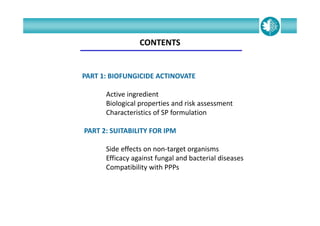
CONTENTS
PART 1: BIOFUNGICIDE ACTINOVATE
Active ingredient
Biological properties and risk assessment
Characteristics of SP formulation
PART 2: SUITABILITY FOR IPM
Side effects on non‐target organisms
Efficacy against fungal and bacterial diseases
Compatibility with PPPs
HISTORY: Streptomyces lydicus WYEC 108 (ACTINOVATE®)
Discovery: 1991
Isolation from rhizosphere from linseed plant roots (Crawford et al., 1993)
Screening of new actinomycetes to control damping‐off (Phytium ultimum)
Selection of WYEC 108: Stable prolific sporulator (15‐35 ºC / pH 4.0‐8.0)
Patenting & Licensing
1992: IRF (University of Idaho): plant growth / yield enhancer
1995: US patent of WYEC 108 to control plant pathogens
1998: worldwide licensing to Natural Industries (US)
Registration
2004: USA (EPA 73314‐1) 
2007: Canada (PMRA PRD2007‐10)
2005‐2011: Turkey, Vietnam, Ecuador, Trinidad (in progress: Australia, Taiwan, Thailand, Costa Rica)
2010: EU (RMS: The Netherlands)
2011: Completeness Check Decision 2011/253/EU of 26 April 2011
PART I – BIOFUNGICIDE ACTINOVATE
ACTIVE INGREDIENT
Taxonomy Streptomyces lydicus strain WYEC 108
Family: Noctuoidea; Orden: Actinomycetales; Class: Actinobacteria; 
Phylla: Actinobacteria Kingdom: Bacteria
Origin Rhizosphere linseed plant (South Downs, UK)
Distribution Widely distributed in most agricultural soils worldwide 
Deposited ATCC 55445
Target Root damping‐off and foliar fungal pathogens
Growing Te Typical mesophylic specie (15‐35ºC; optimum 30ºC)
Growing pH 4.0 – 8.0
PART I – BIOFUNGICIDE ACTINOVATE
MODE OF ACTION
Competition For the space and nutrients. 
Mycoparasitism The bacteria breaks down the cell walls of pathogenic fungus 
mycelium by excreting lytic enzymes (chitinases, glucanases, 
peroxidases)
Antibiosis Production and release of antimicrobial secondary metabolites
PART I – BIOFUNGICIDE ACTINOVATE
WYEC 108
Fusarium
Fusarium
High siderophore production: 
Improve mineral & nutrient uptake:
a) Promotes plant growth even in the absence of pathogen
b) Plant more vigorous /able to survive stressful conditions
Bactericide:
Firelight (Erwinia amylovora),                                                                                              
Citrus Canker (Xanthamonas axonopodis),                                                                                             
Walnut Blight (Xanthomonas arboricola),                                                                                
Rice Leaf Blight (Xanthomonas oryzae),                                                                    
Bacterial spot (Xanthamonas perforans)
ADDITIONAL BENEFITS
PART I – BIOFUNGICIDE ACTINOVATE
ErwiniaXanthomonas
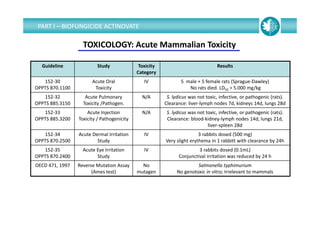
TOXICOLOGY: Acute Mammalian Toxicity 
Guideline Study Toxicity 
Category
Results
152‐30
OPPTS 870.1100
Acute Oral 
Toxicity
IV 5  male + 5 female rats (Sprague‐Dawley)
No rats died. LD50 > 5.000 mg/kg
152‐32
OPPTS 885.3150
Acute Pulmonary
Toxicity /Pathogen.
N/A S. lydicus was not toxic, infective, or pathogenic (rats). 
Clearance: liver‐lymph nodes 7d, kidneys 14d, lungs 28d
152‐33
OPPTS 885.3200
Acute Injection
Toxicity / Pathogenicity
N/A S. lydicus was not toxic, infective, or pathogenic (rats). 
Clearance: blood‐kidney‐lymph nodes 14d, lungs 21d, 
liver‐spleen 28d
152‐34
OPPTS 870.2500
Acute Dermal Irritation 
Study
IV 3 rabbits dosed (500 mg)
Very slight erythema in 1 rabbitt with clearance by 24h
152‐35
OPPTS 870.2400
Acute Eye Irritation 
Study
IV 3 rabbits dosed (0.1mL)
Conjunctival irritation was reduced by 24 h
OECD 471, 1997 Reverse Mutation Assay
(Ames test)
No 
mutagen
Salmonella typhimurium 
No genotoxic in vitro; Irrelevant to mammals
PART I – BIOFUNGICIDE ACTINOVATE
Active Ingredient Streptomyces lydicus strain WYEC 108
Concentration 1x10⁷ cfu/g (0.0371% TGAI)
Physical State Solid powder (SP)
Colour White pale
pH (CIPAC MT 75) 6.65 (1% p/v)
Stability (Tª) 1 year (35ºC)
FORMULATION CHARACTERISTICS
PART I – BIOFUNGICIDE ACTINOVATE
1,00E+00
1,00E+01
1,00E+02
1,00E+03
1,00E+04
1,00E+05
1,00E+06
1,00E+07
1,00E+08
1,00E+09
0 50 100 150 200 250 300 350
DAYS
VIABILITY (CFU/mL)
4ºC RT
SOIL DISEASE FOLIAR DISEASE
Fusarium Laveillula
Pythium Spahaeroteca
Rhizoctonia Erisiphe
Phytophthora Oidium
Sclerotinia Venturia
Armillaria Botrytis
Alternaria
TARGET PATHOGENS
Fusarium          Fusarium +
ACTINOVATE
Rhizoctonia Rhizoctonia +
ACTINOVATE
Phytoph.        Phytoph. +
ACTINOVATE
PART I – BIOFUNGICIDE ACTINOVATE
Pythium          Pythium +
ACTINOVATE
Guideline Group Target Test Remarks
OPPTS 
885.4380
Terrestrian 
Organisms
Invertebrate:
Honey  bees 
Apis mellifera
Dietary effect No risk
NOEC > 17980 µg/mL (≈ x20 
commercial dose)
OPPTS 
885.4050
Vertebrate:
Nothern Bobwhite
Colinus virginatus
Avian Oral  Pathog./
Toxicity Test 
No risk
(1.25x10⁸ cfu/kg body for 5d)
OPPTS 
885.4300
Non‐Target Plants ‐ Efficacy trials 
‐ Databases 
‐ Background levels
Absence of adversed effects
OPPTS 
850.1300 y 
885.4240
Acuatic
Organisms
Invertebrate: 
Daphnia magna
Chronic Toxicity
(21‐d static renewal 
test)
NOEC (survival) = 3.1x10³cfu/mL
NOEC (reprod.) = 1.6x10³cfu/mL
OPPTS 
850.1075
Vertebrate:
Rainbow Trout
Oncorhynchus myskiss
Acute Toxicity Test
(96‐h static test)
No risk
LC50 > 1x10⁶ cfu/mL
NOEC > 1x10⁶ cfu/mL
PART II – SUITABILITY FOR IPM
EFFECT ON NON‐TARGET ORGANISMS
‐ Potential Ecological Risk               Minimal 
PART II – SUITABILITY FOR IPM
DIRECTION FOR USE
Crop Soil Foliar
Vegetables 300 ‐ 500 g/Ha 250 ‐ 700 g / Ha 
Seed coating
200 – 500 g / 300 ‐ 1200 mL
(per 50 g seeds)
Turf
3 kg/Ha (initially)
1 kg/Ha (every 6‐8 wks)
Cut flowers, 
bulbs and pot 
plants
100‐200 g/500 L
500 g/250 L (woody plants)
200‐300 g/50 kg bulbs
250 ‐ 700 g / Ha 
Petunia and Geranium (Reddy, 2007, Alabama, US)
PART II – SUITABILITY FOR IPM
EFFICACY TRIAL: Phytium and Rhizoctonia
Geranium ‐ Rhizoctonia
‐Root‐rot severity was reduced by ACTINOVATE ≈  same level than Chemical Standard
‐Vigor was increased by ACTINOVATE (PGPR)
Petunia ‐ Pythium
0
0,5
1
1,5
2
2,5
3
3,5
4
4,5
5
Vigor Root‐rot Severity
Scale 0‐5
Untreated Control
Pathogen Control
ACTINOVATE
Chemical Standard
0
0,5
1
1,5
2
2,5
3
3,5
4
4,5
5
Vigor Root‐rot Severity
Scale 0‐5
Untreated Cont
Pathogen Cont
ACTINOVATE
Chemical Stand
‐ Preventive teatment 7 days before transplant and inoculation with pathogen
‐ Damping‐off was evaluated 45 days after transplanting.
Potato crop (Chapingo, México)
EFFICACY TRIAL: Rhizoctonia solani
PART II – SUITABILITY FOR IPM
‐Dose‐response effect               high dose = best results
0
10
20
30
40
50
60
70
80
90
100
36 DAT  71 DAT  110 DAT
Pathogen Control
ACTINOVATE  (1 kg/Ha)
ACTINOVATE (1.5 kg/Ha)
ACTINOVATE  (2 kg/Ha)
67%
77%
82%
65%
76%
80%
61%
75%
79%
Disease Incidence (%)
0
5
10
15
20
25
30
35
40
45
50
36 DAT  71 DAT  110 DAT
Contr
ACTIN
ACTIN
ACTIN
76%
81%
85%
72%
80%
82%
79%
70%
81%
Disease Severity (%)
‐ ACTINOVATE preventively  applied to potato seeds
Turf vr. Raleigh (Schlesselman & Bruno, 2006, Wharton, Texas, US)
PART II – SUITABILITY FOR IPM
EFFICACY TRIAL: Rhizoctonia solani
0
5
10
15
20
25
30
35
40
45
CONTROL Chemical 1 ACTINOVATE Chemical 2 Chemical 3
‐ ACTINOVATE efficacy was similar than efficacy showed by chemical standards
Disease Incidence (%)
‐ Two spray applications
PART II – SUITABILITY FOR IPM
EFFICACY TRIAL: Fusarium oxysporium fsp cyclaminis (FOC)
*Published: Crop Protection 
0
20
40
60
80
100
120
AUDPC Dry Weight %VD
FOC
T (1DAT) + ACT (7DAT) + FOC (14 DAT)
F (1DAT) + ACT (7DAT) + FOC (14 DAT)
‐ Applying ACTINOVATE after a preventive fungicide showed promise supression of FOC
Trial I
AUDPC: Area Under the Disease Progressive Curve ;  %VD: % Vascular Discoloration
T: Thiophanate methyl; F: Fludioxonil; 
Cyclamen (*Elmer & McGovern, 2004, Gainesville, Florida US)
PART II – SUITABILITY FOR IPM
EFFICACY TRIAL: Fusarium oxysporium fsp cyclaminis (FOC)
*Published: Crop Protection 
Trial II
‐ACTINOVATE rotated with a chemical fungicide showed a better suppresion of FOC than the chemical alone
AUDPC: Area Under the Disease Progressive Curve ;  %VD: % Vascular Discoloration
F: Fludioxonil; Az: Azoxystrobin
Cyclamen (*Elmer & McGovern, 2004, Gainesville, Florida US)
0
20
40
60
80
100
120
AUDPC Dry Weight %VD
FOC
FOC (1 DAT) + AZ‐ACT (7DAT) + ACT (14 DAT)
FOC (1 DAT) + AZ  (7DAT) + AZ (14 DAT)
FOC (1 DAT) + F ‐ ACT (7DAT) + ACT (14 DAT)
FOC (1 DAT) + F (7DAT) + F (14 DAT)
Trial II
COMPATIBILITY WITH PPPs
PART II – SUITABILITY FOR IPM
0
10
20
30
40
50
60
70
80
90
100
Triadimenol
25%
Copper
oxychloride 
Miclobutanil
24%
Ciproconazol
Methyl
Tiofanate
Procimidone
50%
Citrus
extract 40%
potassium
phosphite
Copper
oxychloride
Cymoxanile
60%
COMPATIBILITY (%)
0
10
20
30
40
50
60
70
80
90
100
Bupirimate
2,5%
Kasugamycin
Dimethomorph
15% 
Wettable
Sulphur
Thiram 80%
COMPATIBILITY (%)
Fungicide FungicideFungicide‐Bactericide Fungicide‐Bactericide
COMPATIBLE with ACTINOVATE NON‐COMPATIBLE with ACTINOVATE
‐Ten of them affected less than 80% the viability of ACTINOVATE spores.
CLOSING REMARKS
ACTINOVATE (Streptomyces lydicus strain WYEC 108)
• Efficient broad range biofungicide (bactericide)
• Plant Growth Promoter even in the absence of pathogen
• IPM tool (low risk substance compatible with other PPPs)
Thank you
www.futurecobioscience.com

Actinovate