Acidity and Alkalinity
Definitions
Alkalinity Measurement
----------- Task -----------
Acidity Measurement
Importance
What are Acidity and Alkalinity
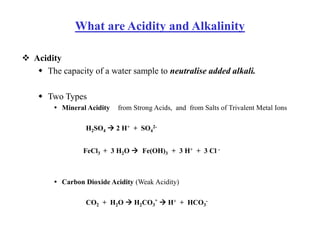
 Acidity
 The capacity of a water sample to neutralise added alkali.
 Two Types
 Mineral Acidity from Strong Acids, and from Salts of Trivalent Metal Ions
H2SO4  2 H+ + SO4
2-
FeCl3 + 3 H2O  Fe(OH)3 + 3 H+ + 3 Cl -
 Carbon Dioxide Acidity (Weak Acidity)
CO2 + H2O  H2CO3
*  H+ + HCO3
-
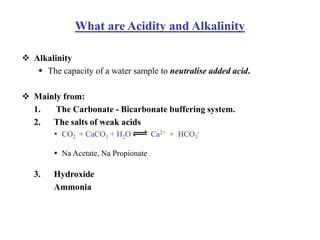
 Alkalinity
 The capacity of a water sample to neutralise added acid.
 Mainly from:
1. The Carbonate - Bicarbonate buffering system.
2. The salts of weak acids
 CO2 + CaCO3 + H2O Ca2+ + HCO3
-
 Na Acetate, Na Propionate
3. Hydroxide
Ammonia
What are Acidity and Alkalinity
Equilibrium of CO2 , HCO3
- , CO3
2-
CO2 (aq) + H2O H2CO3 H+ + HCO3
- 2H+ + CO3
2-
CO2 (g)
pH 4 4.5 5 6 7 8 8.3 9 10
pKa = 6.3 pKa = 10.3
350ppm
10-5M
pH = pKa + log ([A-] / [AH])
When  reaction is 99% to the left then
pH = 6.3 + log (1/100)
= 6.3 - 2
pH = 4.3

air
water
How is Acidity Determined
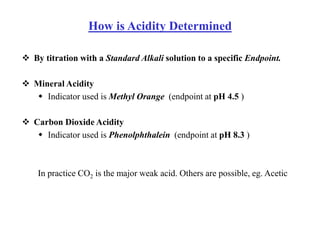
 By titration with a Standard Alkali solution to a specific Endpoint.
 Mineral Acidity
 Indicator used is Methyl Orange (endpoint at pH 4.5 )
 Carbon Dioxide Acidity
 Indicator used is Phenolphthalein (endpoint at pH 8.3 )
In practice CO2 is the major weak acid. Others are possible, eg. Acetic
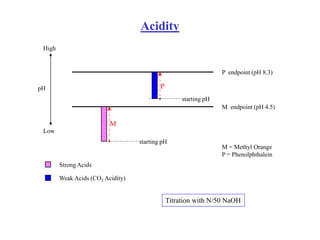
Acidity
Strong Acids
Weak Acids (CO2 Acidity)
P endpoint (pH 8.3)
M endpoint (pH 4.5)
P
M
M = Methyl Orange
P = Phenolphthalein
Titration with N/50 NaOH
pH
High
Low
starting pH
starting pH
How is the Acidity Calculated and Reported
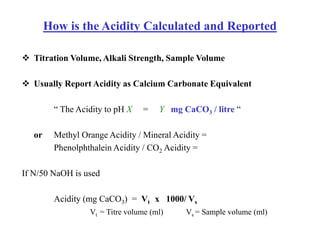
 Titration Volume, Alkali Strength, Sample Volume
 Usually Report Acidity as Calcium Carbonate Equivalent
“ The Acidity to pH X = Y mg CaCO3 / litre “
or Methyl Orange Acidity / Mineral Acidity =
Phenolphthalein Acidity / CO2 Acidity =
If N/50 NaOH is used
Acidity (mg CaCO3) = Vt x 1000/ Vs
Vt = Titre volume (ml) Vs = Sample volume (ml)
How is Alkalinity Determined
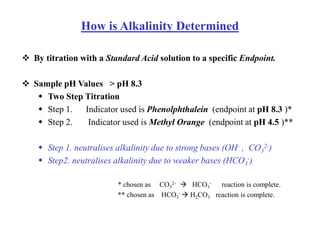
 By titration with a Standard Acid solution to a specific Endpoint.
 Sample pH Values > pH 8.3
 Two Step Titration
 Step 1. Indicator used is Phenolphthalein (endpoint at pH 8.3 )*
 Step 2. Indicator used is Methyl Orange (endpoint at pH 4.5 )**
 Step 1. neutralises alkalinity due to strong bases (OH- , CO3
2-)
 Step2. neutralises alkalinity due to weaker bases (HCO3
-)
* chosen as CO3
2-  HCO3
- reaction is complete.
** chosen as HCO3
-  H2CO3 reaction is complete.
How is Alkalinity Determined
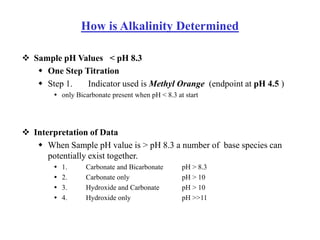
 Sample pH Values < pH 8.3
 One Step Titration
 Step 1. Indicator used is Methyl Orange (endpoint at pH 4.5 )
 only Bicarbonate present when pH < 8.3 at start
 Interpretation of Data
 When Sample pH value is > pH 8.3 a number of base species can
potentially exist together.
 1. Carbonate and Bicarbonate pH > 8.3
 2. Carbonate only pH > 10
 3. Hydroxide and Carbonate pH > 10
 4. Hydroxide only pH >>11
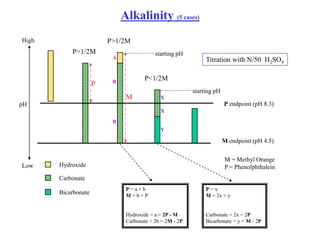
Alkalinity (5 cases)
Hydroxide
Carbonate
Bicarbonate
P endpoint (pH 8.3)
M endpoint (pH 4.5)
P
M
A
B
B
X
Y
X
M = Methyl Orange
P = Phenolphthalein
P = a + b
M = b + P
Hydroxide = a = 2P - M
Carbonate = 2b = 2M - 2P
P = x
M = 2x + y
Carbonate = 2x = 2P
Bicarbonate = y = M - 2P
Titration with N/50 H2SO4
P=1/2M
P>1/2M
P<1/2M
pH
High
Low
starting pH
starting pH
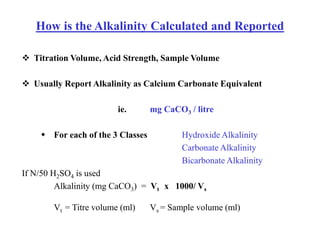
How is the Alkalinity Calculated and Reported
 Titration Volume, Acid Strength, Sample Volume
 Usually Report Alkalinity as Calcium Carbonate Equivalent
ie. mg CaCO3 / litre
 For each of the 3 Classes Hydroxide Alkalinity
Carbonate Alkalinity
Bicarbonate Alkalinity
If N/50 H2SO4 is used
Alkalinity (mg CaCO3) = Vt x 1000/ Vs
Vt = Titre volume (ml) Vs = Sample volume (ml)
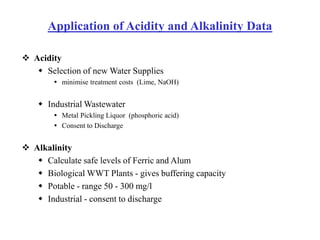
Application of Acidity and Alkalinity Data
 Acidity
 Selection of new Water Supplies
 minimise treatment costs (Lime, NaOH)
 Industrial Wastewater
 Metal Pickling Liquor (phosphoric acid)
 Consent to Discharge
 Alkalinity
 Calculate safe levels of Ferric and Alum
 Biological WWT Plants - gives buffering capacity
 Potable - range 50 - 300 mg/l
 Industrial - consent to discharge

acidityalkalinity of water sample

  • 1.
    Acidity and Alkalinity Definitions AlkalinityMeasurement ----------- Task ----------- Acidity Measurement Importance
  • 2.
    What are Acidityand Alkalinity  Acidity  The capacity of a water sample to neutralise added alkali.  Two Types  Mineral Acidity from Strong Acids, and from Salts of Trivalent Metal Ions H2SO4  2 H+ + SO4 2- FeCl3 + 3 H2O  Fe(OH)3 + 3 H+ + 3 Cl -  Carbon Dioxide Acidity (Weak Acidity) CO2 + H2O  H2CO3 *  H+ + HCO3 -
  • 3.
     Alkalinity  Thecapacity of a water sample to neutralise added acid.  Mainly from: 1. The Carbonate - Bicarbonate buffering system. 2. The salts of weak acids  CO2 + CaCO3 + H2O Ca2+ + HCO3 -  Na Acetate, Na Propionate 3. Hydroxide Ammonia What are Acidity and Alkalinity
  • 4.
    Equilibrium of CO2, HCO3 - , CO3 2- CO2 (aq) + H2O H2CO3 H+ + HCO3 - 2H+ + CO3 2- CO2 (g) pH 4 4.5 5 6 7 8 8.3 9 10 pKa = 6.3 pKa = 10.3 350ppm 10-5M pH = pKa + log ([A-] / [AH]) When  reaction is 99% to the left then pH = 6.3 + log (1/100) = 6.3 - 2 pH = 4.3  air water
  • 5.
    How is AcidityDetermined  By titration with a Standard Alkali solution to a specific Endpoint.  Mineral Acidity  Indicator used is Methyl Orange (endpoint at pH 4.5 )  Carbon Dioxide Acidity  Indicator used is Phenolphthalein (endpoint at pH 8.3 ) In practice CO2 is the major weak acid. Others are possible, eg. Acetic
  • 6.
    Acidity Strong Acids Weak Acids(CO2 Acidity) P endpoint (pH 8.3) M endpoint (pH 4.5) P M M = Methyl Orange P = Phenolphthalein Titration with N/50 NaOH pH High Low starting pH starting pH
  • 7.
    How is theAcidity Calculated and Reported  Titration Volume, Alkali Strength, Sample Volume  Usually Report Acidity as Calcium Carbonate Equivalent “ The Acidity to pH X = Y mg CaCO3 / litre “ or Methyl Orange Acidity / Mineral Acidity = Phenolphthalein Acidity / CO2 Acidity = If N/50 NaOH is used Acidity (mg CaCO3) = Vt x 1000/ Vs Vt = Titre volume (ml) Vs = Sample volume (ml)
  • 8.
    How is AlkalinityDetermined  By titration with a Standard Acid solution to a specific Endpoint.  Sample pH Values > pH 8.3  Two Step Titration  Step 1. Indicator used is Phenolphthalein (endpoint at pH 8.3 )*  Step 2. Indicator used is Methyl Orange (endpoint at pH 4.5 )**  Step 1. neutralises alkalinity due to strong bases (OH- , CO3 2-)  Step2. neutralises alkalinity due to weaker bases (HCO3 -) * chosen as CO3 2-  HCO3 - reaction is complete. ** chosen as HCO3 -  H2CO3 reaction is complete.
  • 9.
    How is AlkalinityDetermined  Sample pH Values < pH 8.3  One Step Titration  Step 1. Indicator used is Methyl Orange (endpoint at pH 4.5 )  only Bicarbonate present when pH < 8.3 at start  Interpretation of Data  When Sample pH value is > pH 8.3 a number of base species can potentially exist together.  1. Carbonate and Bicarbonate pH > 8.3  2. Carbonate only pH > 10  3. Hydroxide and Carbonate pH > 10  4. Hydroxide only pH >>11
  • 10.
    Alkalinity (5 cases) Hydroxide Carbonate Bicarbonate Pendpoint (pH 8.3) M endpoint (pH 4.5) P M A B B X Y X M = Methyl Orange P = Phenolphthalein P = a + b M = b + P Hydroxide = a = 2P - M Carbonate = 2b = 2M - 2P P = x M = 2x + y Carbonate = 2x = 2P Bicarbonate = y = M - 2P Titration with N/50 H2SO4 P=1/2M P>1/2M P<1/2M pH High Low starting pH starting pH
  • 11.
    How is theAlkalinity Calculated and Reported  Titration Volume, Acid Strength, Sample Volume  Usually Report Alkalinity as Calcium Carbonate Equivalent ie. mg CaCO3 / litre  For each of the 3 Classes Hydroxide Alkalinity Carbonate Alkalinity Bicarbonate Alkalinity If N/50 H2SO4 is used Alkalinity (mg CaCO3) = Vt x 1000/ Vs Vt = Titre volume (ml) Vs = Sample volume (ml)
  • 12.
    Application of Acidityand Alkalinity Data  Acidity  Selection of new Water Supplies  minimise treatment costs (Lime, NaOH)  Industrial Wastewater  Metal Pickling Liquor (phosphoric acid)  Consent to Discharge  Alkalinity  Calculate safe levels of Ferric and Alum  Biological WWT Plants - gives buffering capacity  Potable - range 50 - 300 mg/l  Industrial - consent to discharge