Physiology of Acid Secretion
• Stomach consists of 3 anatomic and 2 functional areas .
• The anatomic areas are
Fundus
Body
Antrum
• The functional areas are
Oxyntic Gland
Pyloric Gland
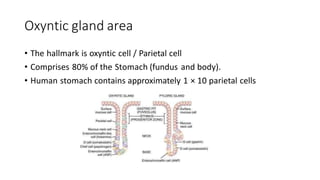
Oxyntic gland area
• The hallmark is oxyntic cell / Parietal cell
• Comprises 80% of the Stomach (fundus and body).
• Human stomach contains approximately 1 × 10 parietal cells
Pyloric gland area
• The hallmark is the G or gastrin cell
• Comprises 20% of the Stomach(antrum)
• Human stomach contains approximately 9 × 10⁶ gastrin cells.
REGULATION OF GASTRIC ACID SECRETION
• Parietal cells secrete hydrochloric acid at a concentration of
approximately 160 mM
• Acid facilitates the digestion of protein and absorption of non-heme
iron, calcium, and vitamin B12, as well as prevents bacterial
overgrowth, enteric infection, and possibly SBP
• Gastric acid must be precisely regulated and produced according to
need
• Coordinated interaction among a number of neural, hormonal, and
paracrine pathways
• The principal stimulants of acid secretion are
ACh, released from gastric enteric neurons (neurocrine)
Gastrin, released from antral G cells (hormonal)
Histamine, released from oxyntic ECL cells (paracrine)
• The main inhibitor of acid secretion is
somatostatin, from oxyntic and antral D cells (paracrine)
PHASES OF ACID SECRETION
• The physiologic stimulation of acid secretion has classically been
divided into three interrelated phases:
Cephalic
Gastric
Intestinal
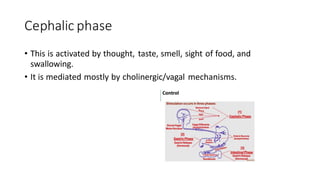
Cephalic phase
• This is activated by thought, taste, smell, sight of food, and
swallowing.
• It is mediated mostly by cholinergic/vagal mechanisms.
Gastric phase
This is due to the chemical effects of food and distension of the
stomach.
Gastrin is the major mediator
Intestinal phase
This accounts for only a small proportion of the acid secretory response
to a meal
SECRETION OF ACID
• Gastric acid secretion from parietal cells is regulated by overlapping
pathways, which include
Endocrine (gastrin)
Paracrine (locally delivered histamine and somatostatin)
Neural (acetylcholine)
Autocrine (transforming growth factor-alpha)
Parietal cell
• In the resting state, they are filled with secretory vesicles
• With stimulation vesicles coalesce to form channels (canaliculi)
• These channels drain into the apical lumen.
• The secretory membrane lining these structures contains the
hydrogen-potassium-ATPase acid-secreting pump.
• With stimulation, pathway for potassium-chloride cotransport
becomes active, allowing hydrogen-potassium exchange to occur.
• Parietal cell activation involves an increase in cytoplasmic calcium or
generation of cyclic AMP, followed by activation of a cAMP-
dependent protein kinase cascade that triggers translocation of
proton pump containing membranes to the apical surface.
• The cessation of acid secretion is associated with the re-
internalization of the hydrogen-potassium-ATPase pump.
Gastrin
• Gastrin is the major endocrine regulator.
• It is released from gastrin-expressing cells (G cells) localized to the
antrum.
• Gastrin enhances gastric acid secretion from parietal cells primarily by
stimulating the synthesis and release of histamine from
enterochromaffin-like (ECL) cells.
• Gastrin also has direct actions on parietal cells.
• A potent inhibitor of both gastrin and histamine synthesis and
release, and, therefore, of gastric acid secretion is Somatostatin.
Histamine
• Histamine is the major paracrine stimulator of acid secretion.
• It is localized both in mucosal mast cells and in endocrine cells aka
ECL
• The ECL cells are localized in body of the stomach and in direct
proximity to the parietal cell.
• Gastrin is the primary stimulus to histamine release from ECL cells .
• ECL cells are also directly stimulated by pituitary adenylate cyclase-
activating polypeptide (PACAP) and vasoactive intestinal peptide (VIP)
• The effects of histamine are largely mediated by the H2 receptors,
which explain the efficacy of H2 receptor blockers in the treatment of
acid-peptic disease
• Histamine may also act at H3 receptors to increase acid secretion via
inhibition of somatostatin release
Ghrelin
• Ghrelin is a 28-amino acid peptide
• Present mainly in the oxyntic mucosa of the stomach.
• Ghrelin increases food intake
• Stimulate acid secretion via release of histamine from ECL cells
Somatostatin
• Somatostatinis a potent inhibitor of acid secretion .
• It is released from D cells, which are present throughout the gastric
mucosa.
• Although somatostatin has some effects on parietal cells, its major effects
are exerted on the inhibition of histamine release and to a lesser extent on
gastrin release .
• The secretion of somatostatin is increased by gastric acid and by gastrin
itself, suggesting that a major function of somatostatin is to modulate the
feedback inhibition of the acid secretory response to gastrin .
• Somatostatin secretion is also affectedby neural inputs. It is suppressed by
cholinergic activation and increased by vasoactive intestinal peptide
activation
Neural control
• Neural input may serve as an important integrator of secretory function.
• Acetylcholine is the major stimulatory mediator .
• The major effects of muscarinic receptoractivation are to
Increase gastrin release
Stimulate parietal cells
Inhibit somatostatinsecretion
• Bombesin release also stimulatesacid secretion
• Vasoactive intestinal peptide release has a dual effect: a weak transient increase
in acid secretion, possibly due to direct effects on ECL cells; and a sustained
reduction due to enhanced release of somatostatin
• Orexin, nitric oxide, and galanin may also contribute to the neural regulation of
acid secretion
Other secretory regulators
• Transforming growth factor-alpha (TGF-alpha)
It is an autocrine factor
Present in parietal cells
Inhibits gastric acid secretion
• Peptide YY (PYY)
It is released postprandially from cells in the ileum and colon
It inhibits the cephalic and gastric phases of acid secretion
Bind to receptors on ECL cells and inhibits gastrin-stimulated
histamine release

ACID SECRETION (1).pptx

  • 1.
  • 2.
    • Stomach consistsof 3 anatomic and 2 functional areas . • The anatomic areas are Fundus Body Antrum • The functional areas are Oxyntic Gland Pyloric Gland
  • 3.
    Oxyntic gland area •The hallmark is oxyntic cell / Parietal cell • Comprises 80% of the Stomach (fundus and body). • Human stomach contains approximately 1 × 10 parietal cells
  • 4.
    Pyloric gland area •The hallmark is the G or gastrin cell • Comprises 20% of the Stomach(antrum) • Human stomach contains approximately 9 × 10⁶ gastrin cells.
  • 5.
    REGULATION OF GASTRICACID SECRETION • Parietal cells secrete hydrochloric acid at a concentration of approximately 160 mM • Acid facilitates the digestion of protein and absorption of non-heme iron, calcium, and vitamin B12, as well as prevents bacterial overgrowth, enteric infection, and possibly SBP
  • 6.
    • Gastric acidmust be precisely regulated and produced according to need • Coordinated interaction among a number of neural, hormonal, and paracrine pathways
  • 7.
    • The principalstimulants of acid secretion are ACh, released from gastric enteric neurons (neurocrine) Gastrin, released from antral G cells (hormonal) Histamine, released from oxyntic ECL cells (paracrine) • The main inhibitor of acid secretion is somatostatin, from oxyntic and antral D cells (paracrine)
  • 8.
    PHASES OF ACIDSECRETION • The physiologic stimulation of acid secretion has classically been divided into three interrelated phases: Cephalic Gastric Intestinal
  • 9.
    Cephalic phase • Thisis activated by thought, taste, smell, sight of food, and swallowing. • It is mediated mostly by cholinergic/vagal mechanisms.
  • 10.
    Gastric phase This isdue to the chemical effects of food and distension of the stomach. Gastrin is the major mediator
  • 11.
    Intestinal phase This accountsfor only a small proportion of the acid secretory response to a meal
  • 12.
    SECRETION OF ACID •Gastric acid secretion from parietal cells is regulated by overlapping pathways, which include Endocrine (gastrin) Paracrine (locally delivered histamine and somatostatin) Neural (acetylcholine) Autocrine (transforming growth factor-alpha)
  • 13.
    Parietal cell • Inthe resting state, they are filled with secretory vesicles • With stimulation vesicles coalesce to form channels (canaliculi) • These channels drain into the apical lumen. • The secretory membrane lining these structures contains the hydrogen-potassium-ATPase acid-secreting pump. • With stimulation, pathway for potassium-chloride cotransport becomes active, allowing hydrogen-potassium exchange to occur.
  • 14.
    • Parietal cellactivation involves an increase in cytoplasmic calcium or generation of cyclic AMP, followed by activation of a cAMP- dependent protein kinase cascade that triggers translocation of proton pump containing membranes to the apical surface. • The cessation of acid secretion is associated with the re- internalization of the hydrogen-potassium-ATPase pump.
  • 15.
    Gastrin • Gastrin isthe major endocrine regulator. • It is released from gastrin-expressing cells (G cells) localized to the antrum. • Gastrin enhances gastric acid secretion from parietal cells primarily by stimulating the synthesis and release of histamine from enterochromaffin-like (ECL) cells. • Gastrin also has direct actions on parietal cells. • A potent inhibitor of both gastrin and histamine synthesis and release, and, therefore, of gastric acid secretion is Somatostatin.
  • 17.
    Histamine • Histamine isthe major paracrine stimulator of acid secretion. • It is localized both in mucosal mast cells and in endocrine cells aka ECL • The ECL cells are localized in body of the stomach and in direct proximity to the parietal cell. • Gastrin is the primary stimulus to histamine release from ECL cells . • ECL cells are also directly stimulated by pituitary adenylate cyclase- activating polypeptide (PACAP) and vasoactive intestinal peptide (VIP)
  • 18.
    • The effectsof histamine are largely mediated by the H2 receptors, which explain the efficacy of H2 receptor blockers in the treatment of acid-peptic disease • Histamine may also act at H3 receptors to increase acid secretion via inhibition of somatostatin release
  • 19.
    Ghrelin • Ghrelin isa 28-amino acid peptide • Present mainly in the oxyntic mucosa of the stomach. • Ghrelin increases food intake • Stimulate acid secretion via release of histamine from ECL cells
  • 20.
    Somatostatin • Somatostatinis apotent inhibitor of acid secretion . • It is released from D cells, which are present throughout the gastric mucosa. • Although somatostatin has some effects on parietal cells, its major effects are exerted on the inhibition of histamine release and to a lesser extent on gastrin release . • The secretion of somatostatin is increased by gastric acid and by gastrin itself, suggesting that a major function of somatostatin is to modulate the feedback inhibition of the acid secretory response to gastrin . • Somatostatin secretion is also affectedby neural inputs. It is suppressed by cholinergic activation and increased by vasoactive intestinal peptide activation
  • 22.
    Neural control • Neuralinput may serve as an important integrator of secretory function. • Acetylcholine is the major stimulatory mediator . • The major effects of muscarinic receptoractivation are to Increase gastrin release Stimulate parietal cells Inhibit somatostatinsecretion • Bombesin release also stimulatesacid secretion • Vasoactive intestinal peptide release has a dual effect: a weak transient increase in acid secretion, possibly due to direct effects on ECL cells; and a sustained reduction due to enhanced release of somatostatin • Orexin, nitric oxide, and galanin may also contribute to the neural regulation of acid secretion
  • 23.
    Other secretory regulators •Transforming growth factor-alpha (TGF-alpha) It is an autocrine factor Present in parietal cells Inhibits gastric acid secretion • Peptide YY (PYY) It is released postprandially from cells in the ileum and colon It inhibits the cephalic and gastric phases of acid secretion Bind to receptors on ECL cells and inhibits gastrin-stimulated histamine release