In
By:
Aregawi Gebru(MA)
FUNDAMENTAL ACCT I
(ACFN2012)
CHAPTER 5: ACCT FOR MERCHANDISE
OPERATIONS
2
By: Aregawi Gebru
Tell: 0909919122
5.1. Nature of Inventory
 Merchandising Sector Organization:
 are engaged in purchasing(buys) from suppliers and
awaiting for reselling of merchandises/finished goods to
customers.
 Merchandising entity (generally a retailer or wholesaler)
has a single inventory purchased for resale in the normal
course of business called merchandise inventories.
 Merchandise on hand (not sold) at the end of an
accounting period is called merchandise inventory.
 Merchandise inventory is reported as a current asset on
the balance sheet.
3
By: Aregawi Gebru, MA, 2011
E.C
(Instructor)
Tell: 0909919122
5.1. Merchandise Inventory
4
By: Aregawi Gebru, MA, 2011
E.C
(Instructor)
Tell: 0909919122
5.1. Merchandise Inventory
 Have only one inventory as of merchandise inventory
because without changing the tangible products sell to other
companies.
2. Example 1: Merchandising Sector Organization:
 amazon.com (internet books, music, video),
Supermarkets, boutiques, garment and shoe shops, drug
stores, stationary shops, auto spare parts, importers,
exporters etc.
5
By: Aregawi Gebru, MA, 2011
E.C
(Instructor)
Tell: 0909919122
Copyright © 2006, The McGraw-Hill Companies, Inc.
McGraw-Hill/Irwin
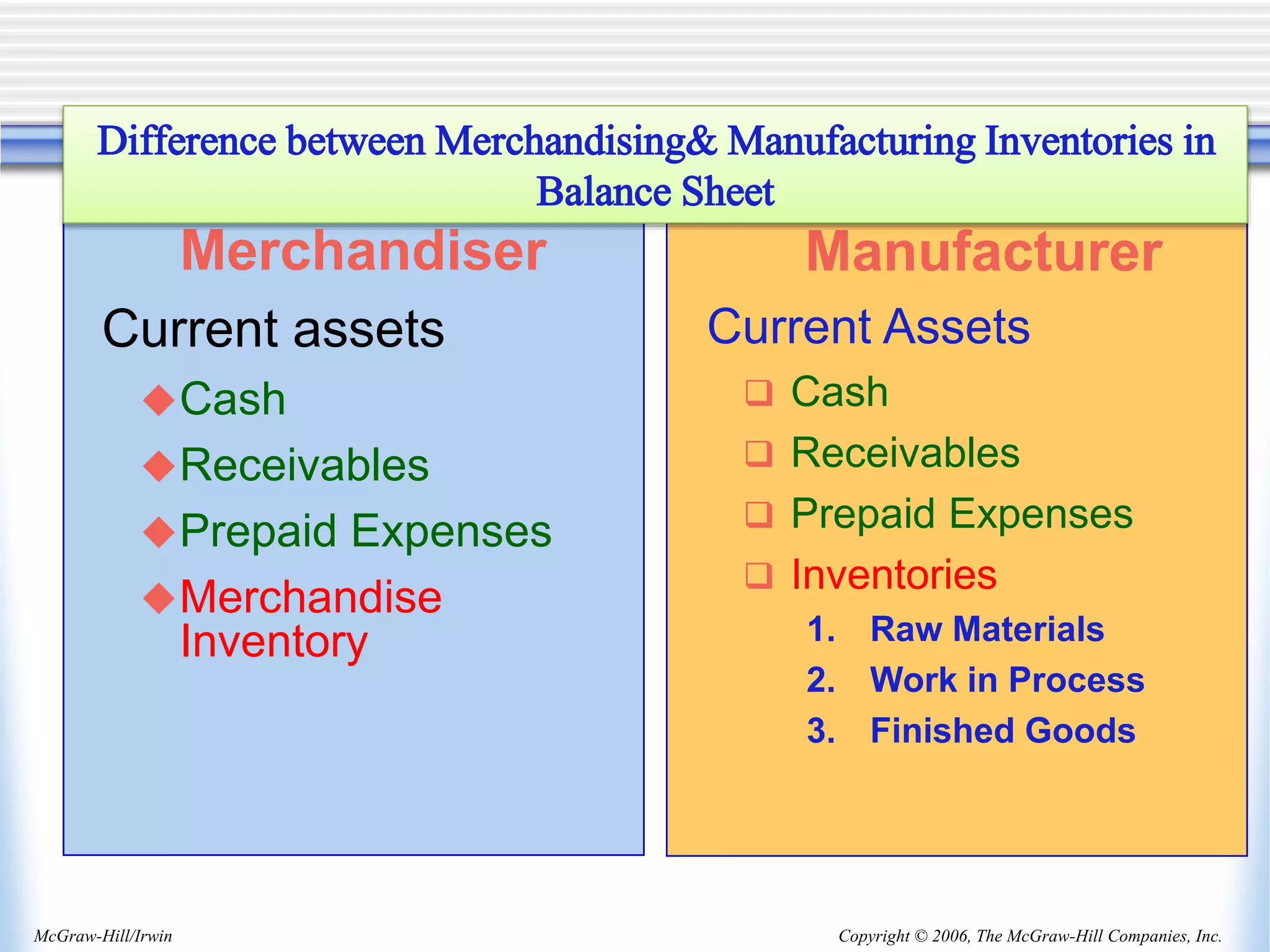
Merchandiser
Current assets
Cash
Receivables
Prepaid Expenses
Merchandise
Inventory
Manufacturer
Current Assets
 Cash
 Receivables
 Prepaid Expenses
 Inventories
1. Raw Materials
2. Work in Process
3. Finished Goods
Difference between Merchandising& Manufacturing Inventories in
Balance Sheet
Copyright © 2006, The McGraw-Hill Companies, Inc.
McGraw-Hill/Irwin
SUMMARY OF THE INVENTORY
Merchandiser
Current assets
Cash
Receivables
Prepaid Expenses
Merchandise
Inventory
Manufacturer
Current Assets
 Cash
 Receivables
 Prepaid Expenses
 Inventories
Raw Materials
Work in Process
Finished Goods
Partially complete
products – some
material, labor, or
overhead has been
added.
Completed products
awaiting sale.
Materials waiting to
be processed.
Difference between Merchandising& Manufacturing Inventories in
Balance Sheet
5.2. Merchandise Inventory
8
By: Aregawi Gebru, MA, 2011
E.C
(Instructor)
Tell: 0909919122
By: Aregawi
Gebru(MA)
(Instructor)
Tell: 0909919122
By: Aregawi Gebru(MA PFM) 9
Formula 5.1 Cost of Goods
Sold
Merchandise Co.
Cost of Goods Sold
Begging Merchandise inventory XXX
+ Purchase of inventory XXX
= Goods Available For Sale XXX
- Ending Merchandise inventory (XXX)
= Cost of Goods Sold XXX
By: Aregawi
Gebru(MA)
(Instructor)
Tell: 0909919122
By: Aregawi Gebru(MA PFM) 10
Merchandising Company
Description Amount
Sales XXX
Beginning Merchandise Inventory XXX
+ Inventory Purchases XXX
= Goods Available For Sale XXX
- Ending Merchandise Inventory (XXX)
= Cost of Goods Sold XXX
= Gross Margin(Sales - CGS) XXX
- Operating Expenses: XXX
Selling Expenses (XXX)
Administrative Expenses (XXX)
= Net Income XXX
Formula 5.2 For Net Income In
Merchandising Co.
By: Aregawi
Gebru(MA)
(Instructor)
Tell: 0909919122
By: Aregawi Gebru(MA PFM) 11
R.
No. Description
Beginning
Balance
End Balance
Manufacturing
Co.
Merchandising
Co.
1 Sales 1,500,000 1,000,000
2 Direct Raw Materials Inventory 60,000 50,000
3 WIP Inventory 90,000 60,000
4 Finished Goods Inventory 125,000 175,000
5 Merchandising Inventory 200,000 150,000
6 Cost of Goods Manufactured 850,000
7 Purchase of Merchandise
Inventory
550,000
8 Selling Expenses 250,000 100,000
9 Administrative Expenses 300,000 200,000
Example 1: Assume the annual reports
reveal the following information
concerning Merchandising operations.
By: Aregawi
Gebru(MA)
(Instructor)
Tell: 0909919122
By: Aregawi Gebru(MA PFM) 12
Example 5.3. Formula For Net
CGS In Merchandising
Co.
Merchandise Co.
Cost of Goods Sold
Begging Merchandise inventory 200,000
+ Purchase of inventory 550,000
= Goods Available For Sale 750,000
- Ending Merchandise inventory 150,000
= Cost of Goods Sold 600,000
By:
Aregawi Gebru,
MA(Instructor)
0909919122
By: Aregawi Gebru(MA PFM) 13
Merchandising Company Co.
Income Statement
Sales 1,000,000
Beginning Merchandising Inventory 200,000
+ Purchases 550,000
= Goods Available For Sale 750,000
- Ending Merchandising Inventory (150,000)
= Cost of Goods Sold: (600,000)
= Gross Margin(Sales - CGS ) 400,000
- Operating Expenses:
Selling Expenses (100,000 )
Administrative Expenses (200,000) (300,000)
= Net Operating Income 100,000
Example 5.4. Determining Net Income
In Merchandising Co.
14
By:
Aregawi Gebru, MA(Instructor)
0909919122
5.3. Inventory System
1.4. Inventory System
15
By:
Aregawi Gebru, MA(Instructor)
0909919122
 Companies use one of two types of systems for
maintaining accurate inventory records By:
 Periodic Inventory System.
 Perpetual Inventory System.
 The essential difference between these two systems
from an accounting point of view is the frequency with
which the physical flows are assigned a value.
1.4.1. Periodic Inventory System
16
By:
Aregawi Gebru, MA(Instructor)
0909919122
 Under this system there is no continuous
record of merchandise inventory account.
 The inventory balance remains the same
through out the accounting period, i.e.
the beginning inventory balance.
 This is because when goods are
purchased, they are debited to the
purchases account rather than
merchandise inventory account.
 The revenue from sales is recorded each time a
sale is made.
17
By:
Aregawi Gebru, MA(Instructor)
0909919122
I. Periodic inventory Systems
 No entry is made for the cost of goods sold.
 So, physical inventory must be taken
periodically to determine the cost of inventory
on hand and goods sold.
 Less costly to maintain than the perpetual
inventory system, but it gives management less
information about the current status of
merchandise.
 Used by retail enterprises that sell many kinds of
low unit cost merchandise such as groceries,
drugstores, hardware etc.
1.4.1. Periodic Inventory System
18
By:
Aregawi Gebru, MA(Instructor)
0909919122
I. Features of Periodic inventory Systems
 Records inventory purchase or sale in "Purchases"
account.
 "Inventory Purchases" account is updated continuously on
a periodic basis, at the end of each accounting period (e.g.,
monthly, quarterly)
 Inventory subsidiary ledger is not updated after each
purchase or sale of inventory.
 Inventory quantities are not updated continuously.
 Inventory quantities are updated on a periodic basis.
 When financial statements are prepared, the company
takes a physical count of inventory by counting quantities
of merchandise on hand.
1.4.1. Periodic Inventory System
1.4. Inventory System
19
By:
Aregawi Gebru, MA(Instructor)
0909919122
I. Features of Periodic inventory Systems
 Cost of Goods Sold in a Periodic Inventory
System
 No entry is recorded for Cost of Goods Sold at
the time of the sale under a Periodic System.
 The inventory account in a periodic inventory
system keeps its beginning balance until the
end of period adjustment to the physical
inventory count.
 Therefore, a separate cost of goods sold
calculation is necessary.
20
By:
Aregawi Gebru, MA(Instructor)
0909919122
 Cost of Goods Sold calculation is necessary.
Example 1.4.1.
Description Amount
Beginning Inventory XXX
+ Net Purchases XXX
= Goods Available for Sale XXX
- Ending Inventory (XXX)
= Cost of Goods Sold XXX
1.4.1. Periodic Inventory System
21
By:
Aregawi Gebru, MA(Instructor)
0909919122
 Purchase Returns and Allowances and Purchase Discounts
 "Purchases": has a normal debit balance since it replaces the
debit to "Inventory".
 It has two contra accounts known as "Purchase Discounts"
(Purchase Discount) and "Purchase Returns and Allowances"
(Purchase R&A) that reduce it to determine "Net Purchases".
 The balance of these two contra accounts is a credit because
"Purchases" is a debit.
 Sales Returns and Allowances and Sales Discounts
 Sales have two contra accounts known as "Sales Discounts" and
"Sales Returns and Allowances" (Sales R&A) that reduce it.
 The normal balance for these two contra accounts is a debit.
1.4.1. Periodic Inventory System
22
By: Aregawi Gebru, MA(Instructor) ,0909919122
R.N
Description Dr Cr
1 To record the inventory purchase at the time of purchase of
merchandise at Cost፡
Purchases at cost XX
Accounts payable or cash XX
2 To record the sales at the time of sale of merchandise at Retail
Price:
Accounts receivable or cash at retail price XX
Sales XX
3 To record purchase returns and allowance:
Accounts payable or cash XX
Purchase returns and allowance XX
4 To record adjusting entry or closing entry for merchandise
inventory:
Income Summary XX
Merchandise inventory (Beginning) XX
5 To Close Beginning Inventory
Merchandise inventory (Ending) XX
Income summary XX
1.4.1. Periodic Inventory System
1.4.2. Perpetual Inventory System
23
By:
Aregawi Gebru, MA(Instructor)
0909919122
 Accounting Record Continuously Disclose the
Amount of Inventory.
 So, the Inventory Balance will not remain the same
in the accounting period.
 All increases are debited to merchandise inventory
account and all decreases are credited to the same
account.
 There are no purchases and purchase returns and
allowances accounts in this system.
 At the time of sale, the cost of goods sold is recorded
in addition to Journal entry for the sale.
1.4.2. Perpetual Inventory System
24
By:
Aregawi Gebru, MA(Instructor)
0909919122
So, we can determine the cost of inventory as well as
goods sold from the accounting record.
No need of physical counting to determine their costs.
Updates inventory accounts after each purchase or
sale.
Inventory quantities are updated continuously.
Inventory subsidiary ledger is updated after each
transaction.
Companies that sell items of high unit value, such as
appliances or automobiles, tended to use the perpetual
inventory system.
1.4.2. Perpetual Inventory System
25
By:
Aregawi Gebru, MA(Instructor)
0909919122
 Accounting Features of a Perpetual Inventory System
1) Purchases of merchandise for resale or raw materials for
production are debited to Inventory rather than to Purchases.
2) Freight-in, purchase returns and allowances, and purchase
discounts are recorded in Inventory rather than in separate
accounts.
3) Cost of goods sold is recognized for each sale by debiting the
account, Cost of Goods Sold, and crediting Inventory.
4) Inventory is a control account that is supported by a subsidiary
ledger of individual inventory records.
5) The subsidiary records show the quantity and cost of each type
of inventory on hand.
26
1.4.2. Perpetual Inventory System
27
Example 1.4.2. Journal Entry For
Periodic& Perpetual Inventory System
By: Aregawi Gebru,
MA(Instructor)
0909919122
28
By: Aregawi Gebru,
MA(Instructor)
0909919122
29
Beginning inventory on Jan 1, 2002, NINI Company had 120 units of
merchandise that cost Br. 8 Per unit.
The following transactions were completed during 2002.
February 5 Purchased on credit 150 units of merchandise at Br. 10 per unit.
February 9 Returned 20 detective units from February 5 purchases to the
supplier.
 June 15 Purchased for cash 230 units of merchandise at Br 9 per unit.
September 6 Sold 220 units of merchandise for cash at a price of Br. 15 per
unit. These goods are: 120 units from the beginning inventory and 100 units for
February Purchases.
December 31 260 units are left on hand, 30 units from February 5 purchases.
Example 1.4.3.
By: Aregawi Gebru, MA(Instructor), 0909919122
30
Required:
Prepare General Journal Entries for NINI
Company to record the above transactions and
adjusting or closing entry for merchandise
inventory on December 31,
a)Periodic inventory system
b)Perpetual inventory system
By: Aregawi Gebru, MA(Instructor), 0909919122
Example 1.4.3.
31
a) Journal entries for Periodic Inventory Systems are:
By: Aregawi Gebru, MA(Instructor), 0909919122
Solutions
32
By: Aregawi Gebru, MA(Instructor), 0909919122
Solutions
Difference b/n periodic&
perpetual Inventory System
33 By: Aregawi Gebru, MA(Instructor), 0909919122
34
 A periodic inventory system determines cost of merchandise
sold and inventory at the end of the period.
 We must record cost of merchandise sold and reductions in
inventory as sales occur using a perpetual inventory system.
How we assign these costs to inventory and cost of
merchandise sold affects the reported amounts for both
systems.
2.1. DETERMINING THE COST OF INVENTORY
By: Aregawi Gebru, MA(Instructor), 0909919122
35
 There are four Inventory Costing Methods under
Periodic Inventory Systems commonly used in
assigning costs to inventory and cost of merchandise sold.
These are:
1. Specific Identification Methods
2. First In First Out (FIFO) Methods
3. Last In First Out (LIFO) Methods
4. Weighted Average Methods
2.1. DETERMINING THE COST OF INVENTORY
By: Aregawi Gebru, MA(Instructor), 0909919122
36 By: Aregawi Gebru, MA(Instructor), 0909919122
 Concerned with each individual units of inventory
is specifically marked, tagged, coded or identified
by number.
 is appropriate when the variety of merchandise carried
in stock is small and the volume of sales is relatively
small.
 It does not depend on a cost flow assumption.
 so that the actual (specific) unit cost of each item sold
and remaining on hand can be identified at any time
easily.
2.1. Specific Identification Method(SIM)
37 By: Aregawi Gebru, MA(Instructor), 0909919122
This method tracks the actual physical flow of
the goods.
Used to handled for large or expensive
Items or only small quantities.
Used to identify at any time & at date of sale
the specific unit cost of each item sold and
each item remaining in inventory.
2.1. Specific Identification Method(SIM)
38 By: Aregawi Gebru, MA(Instructor), 0909919122
Example: 2.1.
 That southland music company purchases
three 46-inch television sets at cost of birr
7,000, birr 7,500 and birr 8,000
respectively.
 During the year, two sets are sold at birr 11,
200 each.
 According to the above Data Determines the
company determines the Inventory still on
hand Using Specific Identification Method
for December 31.
2.1. Specific Identification Method(SIM)
39
By:
Aregawi Gebru, MA(Instructor)
0909919122
Solution: According to the above Data
December 31, the company determines that the
birr 7,500 set is still on hand.
M. Sign Description Amount
Beginning Inventory (7000+7500+8000) 22,500
+ Net Purchases 0.000
= Goods Available for Sale 22,500
- Ending Inventory (7,500)
= Cost of Goods Sold 15,500
1.5.1. Specific identification Method
40 By: Aregawi Gebru, MA(Instructor), 0909919122
2.2. FIFO Method
 Concerned units purchased first are sold first.
 Goods sold are valued at the oldest unit costs,
and goods remaining in inventory are valued at
the most recent unit cost amounts.
 First purchased goods are first goods to be sold.
 Used to control spoiled materials
 Concerned with Earliest goods purchased are the first
to be sold.
 The costs of the most recent goods purchased are
recognized as the ending inventory.
41 By: Aregawi Gebru, MA(Instructor), 0909919122
2.3. LIFO Method
 The most recently purchased merchandise costs
is assumed to be sold first.
 Inventory costing based on the most recent merchandise
costs should be charged against revenue.
 The remaining inventory is assumed to consist
of the earliest purchases.
42 By: Aregawi Gebru, MA(Instructor), 0909919122
2.3. LIFO Method
 The most recently purchased goods are sold first,
because current costs are incurred to make current sales
and to maintain adequate inventories on hand.
 The latest goods purchased are the first to be sold and
that the earliest goods purchased remain in ending
inventory.
 Goods purchased last are assumed to have been sold
first.
 The ending inventory comprises purchases made earlier
in a year.
43 By: Aregawi Gebru, MA(Instructor), 0909919122
2.4. Average Cost Method
 The inventories are valued on the basis of average
prices paid for the goods, weighted according to the
quantity purchased at each price.
 The cost allocation of goods available for sale is made on
the basis of the weighted average unit cost incurred.
 Applied to the units sold to determine the cost of goods
sold and to the units on hand to determine the ending
inventory.
 Also called the weighted average method.
44 By: Aregawi Gebru, MA(Instructor), 0909919122
2.4. Average Cost Method
 Companies use the average cost method to account nearly
identical (homogenous) and is carried in large quantities, like
lumber, nails, nuts and bolts or gasoline.
 No assumption is made about the sale of specific units.
Rather, all sales are assumed to be of the “average” unit at the
average cost per unit.
 Weighed-average is a periodic inventory costing method
where ending inventory and COGS are priced at a single
weighted-average cost of all items available for sale.
45 By: Aregawi Gebru, MA(Instructor), 0909919122
2.4. Average Cost Method
 Applied both to ending inventory and beginning inventory.
 The goods available for sale are homogeneous.
 The allocation of the cost of goods sold available for sale is
made on the basis of the weighted average unit cost area;
 Cost of Goods Available for Sale = Weighted Average Unit Cost
Total Units Available for Sale
46 By: Aregawi Gebru, MA(Instructor), 0909919122
Example: 2.4.1 Determining the Cost of Inventory
 Abebe Company began the year and purchased merchandise as follows:
1. Jan. 01 Beginning inventory 80 units@ Br. 60 = Br. 4,800
2. Feb. 16 Purchase 400 units@ 56 = 22,400
3. Sep.02 Purchase 160 units @ 50 = 8,000
4. Nov. 26 Purchase 320 units@ 46 = 14,720
5. Dec. 04 Purchase 240 units@ 40 = 9,600
6. Total Cost of Goods Available for Sale 1200 units ∑ = Br.59, 520
 The Ending Inventory consists of 300 units, 100 units from each of the last
three purchases.
47 By: Aregawi Gebru, MA(Instructor), 0909919122
Required :
 According to the above Data Determine Cost
of Goods Sold Based on the following
inventory Costing Methods:
1. Specific Identification Methods
2. First In First Out (FIFO) Methods
3. Last In First Out (LIFO) Methods
4. Weighted Average Methods
48 By: Aregawi Gebru, MA(Instructor), 0909919122
 It does not depend on a cost flow assumption.
 Instead it requires that each item of inventory is
marked, tagged, or coded so that the actual
(specific) unit cost of each item sold and
remaining on hand can be identified at any time
easily.
 From the above illustration, the ending inventory
consists of 300 units, 100 units from each of the
last purchases. So, the items on hand are
specifically known from which purchases they
are
Solution For Question 1.
Determination of CGS/Cost of Inventory using Specific
Identification Method(SIM)
49 By: Aregawi Gebru, MA(Instructor), 0909919122
Solution For Question 1.
Date Explanation of
EIC
Unit
Cost
X Quantity
in Units
= Total
Cost
Dec. 04 Purchase 40 X 100 = 4000
Nov. 26 Purchase 46 X 100 = 4600
Sep.02 Purchase 50 X 100 = 5,000
Ending Inventory Cost 300 units 13,600
= Br. 59,520 – Br. 13,600
= Br. 45,920
Determination of CGS/Cost of Inventory using Specific
Identification Method(SIM)
50 By: Aregawi Gebru, MA(Instructor), 0909919122
 First In First Out (FIFO)
 This method assumes that goods are sold in the order in
which they are purchased.
 The goods that were bought first (first-in) are the first
goods to be sold (first-out), and the goods that remain on
hand (ending inventory) are assumed to be made up of
the latest costs.
 For example, easily spoiled goods such as fruits, vegetables
etc., must be sold near the time of their acquisition. So, the
inventory on hand will be from the recent purchases.
Solution For Question 2.
Determination of CGS/Cost of Inventory using FIFO Method
51 By: Aregawi Gebru, MA(Instructor), 0909919122
Determination of CGS/Cost of Inventory using FIFO Method
Solution For Question 2.
Date Explanation of
EIC
Unit
Cost
X Quantity
in Units
= Total
Cost
Jan. 01 Beg inventory 60 X 80 = 4,800
Feb. 16 Purchase 56 X 220 = 12,320
Ending Inventory Cost 300 units 17,120
= Br. 59,520 – Br. 17,120
= Br. 42,400
52 By: Aregawi Gebru, MA(Instructor), 0909919122
 Last In First Out (LIFO)
 The LIFO method of inventory measurement assumes
that the most recently purchased items are to be the first
ones sold and that the remaining inventory will consist of
the earliest items purchased.
Solution For Question 3.
Determination of CGS/Cost of Inventory using LIFO Method
53 By: Aregawi Gebru, MA(Instructor), 0909919122
Determination of CGS/Cost of Inventory using LIFO Method
Solution For Question 3.
Date Explanation of EIC Unit
Cost
X Quantity
in Units
= Total
Cost
Dec. 04 Most recent purchase 40 X 240 = 9,600
Nov. 26 Next most recent
purchase
46 X 60 = 2,760
Ending Inventory Cost 300 units 12,360
= Br. 59,520 – Br. 12,360
= Br. 47,160
54 By: Aregawi Gebru, MA(Instructor), 0909919122
Determination of the CGS/Cost of Inventory using WAM
 Weighted Average Method(WAM)
 Average cost per unit = Cost of goods available for sale
Total units available for sale
 Then the weighted average unit cost is multiplied by units
on hand at the end of the period to calculate the cost of
ending inventory.
 Also, the same average unit cost is applied in the
computation of cost of goods sold.
Solution For Question 4.
55 By: Aregawi Gebru, MA(Instructor), 0909919122
 Weighted Average Unit Cost = Br. 59,520/1,200
= Br. 49.60

 = Br. 49.60x 300
= Br. 14,880

 = Br. 59,520 - Br. 14,880
= Br. 44,640
Solution For Question 4.
Determination of the CGS/Cost of Inventory using WAM
56 By: Aregawi Gebru, MA(Instructor), 0909919122
2.5. Comparison of Inventory Costing Method
 If the cost of units and prices at which they are sold
remains stable, all the four methods yield/produces
the same results.
 But if prices change, the three methods usually
yield/produces different amounts for:
- Ending inventory
- Cost of merchandise sold
- Gross profit or net income
57 By: Aregawi Gebru, MA(Instructor), 0909919122
2.5. Comparison of Inventory Costing Method
A. In periods of rising (increasing) prices: (or if there is
inflationary trend):
 FIFO yields/produces
 higher ending inventory
 Lower cost of merchandise sold
 Higher gross profit (net income)
 LIFO yields/produces
 Lower ending inventory
 Higher cost of merchandise sold
 Lower gross profit (net income)
 Weighted average yields the results between the two.
58 By: Aregawi Gebru, MA(Instructor), 0909919122
2.5. Comparison of Inventory Costing Method
B. In periods of declining (decreasing) prices:
 FIFO yields/produces
 Lower ending inventory
 Higher cost of merchandise sold
 Lower gross profit or net income
 LIFO yields/produces
 higher ending inventory
 Lower cost of merchandise sold
 Higher gross profit or net income
 Weighted average- between the two
59 By: Aregawi Gebru, MA(Instructor), 0909919122
2.5. Comparison of Inventory Costing Method
 Advantage of the FIFO method
 Appropriate for protecting inflation, the costs allocated
to ending inventory will approximate their current cost.
 Tends to be consistent with the actual flow of costs,
since merchandisers attempt to sell their old stock
first.(perishable items and high fashion items are
examples).
 No manipulation of income is possible because the
cost attached to units sold is always the oldest cost
 FIFO best approximates the current replacement value of
ending inventory in the balance sheet.
60 By: Aregawi Gebru, MA(Instructor), 0909919122
2.5. Comparison of Inventory Costing Method
 Disadvantage of the FIFO method
 For income determination, earlier costs are matched
with current revenue resulting poor matching in the
income statement.
61 By: Aregawi Gebru, MA(Instructor), 0909919122
2.5. Comparison of Inventory Costing Method
 Advantage of the LIFO method
 the most recent costs against the current
revenue, thereby keeping earnings from being
greatly distorted by any fluctuating increases
or decreases in prices.
 Tends to excludes inventory/paper profit.
62 By: Aregawi Gebru, MA(Instructor), 0909919122
2.5. Comparison of Inventory Costing Method
 Disadvantage of the LIFO method
 Does not approximate the physical flow of goods except in special
situations such as for items to be sold out of a stockpile. eg
packages of nails or screws
 The oldest purchase costs are assigned to inventory, which may
result in inventory becoming grossly understated in terms of current
replacement costs.
 Income manipulation is possible. This may cause poor buying habits
 In the period of inflation, the costs allocated to ending inventory may
be significantly understated in terms of current cost.
 Some argue that the use of LIFO in a period of inflation enables the
company to avoid reporting paper or phantom profit as economic
gain.
 Both inventory methods make higher the balance sheet and income
statement when FIFO is used in a period of inflation.
63 By: Aregawi Gebru, MA(Instructor), 0909919122
2.5. Comparison of Inventory Costing Method
 Advantages of the Weighted Average method
 Relatively simple to implement
 Real based and as paralleling the physical flow of goods,
particularly where there is an intermingling of identical
inventory units(e.g gasoline)
 Disadvantage of the Weighted Average method
 Inventory values may lag significantly behind current prices
in periods of rapidly rising or falling prices.
uestion
&
nswer
By: Aregawi Gebru, MA, 2011 E.C
(Instructor)
Tell: 0909919122

ACCT1 C5 ACCT FOR MERCHANDISE INVENTORY.ppt

  • 1.
  • 2.
    FUNDAMENTAL ACCT I (ACFN2012) CHAPTER5: ACCT FOR MERCHANDISE OPERATIONS 2 By: Aregawi Gebru Tell: 0909919122
  • 3.
    5.1. Nature ofInventory  Merchandising Sector Organization:  are engaged in purchasing(buys) from suppliers and awaiting for reselling of merchandises/finished goods to customers.  Merchandising entity (generally a retailer or wholesaler) has a single inventory purchased for resale in the normal course of business called merchandise inventories.  Merchandise on hand (not sold) at the end of an accounting period is called merchandise inventory.  Merchandise inventory is reported as a current asset on the balance sheet. 3 By: Aregawi Gebru, MA, 2011 E.C (Instructor) Tell: 0909919122
  • 4.
    5.1. Merchandise Inventory 4 By:Aregawi Gebru, MA, 2011 E.C (Instructor) Tell: 0909919122
  • 5.
    5.1. Merchandise Inventory Have only one inventory as of merchandise inventory because without changing the tangible products sell to other companies. 2. Example 1: Merchandising Sector Organization:  amazon.com (internet books, music, video), Supermarkets, boutiques, garment and shoe shops, drug stores, stationary shops, auto spare parts, importers, exporters etc. 5 By: Aregawi Gebru, MA, 2011 E.C (Instructor) Tell: 0909919122
  • 6.
    Copyright © 2006,The McGraw-Hill Companies, Inc. McGraw-Hill/Irwin Merchandiser Current assets Cash Receivables Prepaid Expenses Merchandise Inventory Manufacturer Current Assets  Cash  Receivables  Prepaid Expenses  Inventories 1. Raw Materials 2. Work in Process 3. Finished Goods Difference between Merchandising& Manufacturing Inventories in Balance Sheet
  • 7.
    Copyright © 2006,The McGraw-Hill Companies, Inc. McGraw-Hill/Irwin SUMMARY OF THE INVENTORY Merchandiser Current assets Cash Receivables Prepaid Expenses Merchandise Inventory Manufacturer Current Assets  Cash  Receivables  Prepaid Expenses  Inventories Raw Materials Work in Process Finished Goods Partially complete products – some material, labor, or overhead has been added. Completed products awaiting sale. Materials waiting to be processed. Difference between Merchandising& Manufacturing Inventories in Balance Sheet
  • 8.
    5.2. Merchandise Inventory 8 By:Aregawi Gebru, MA, 2011 E.C (Instructor) Tell: 0909919122
  • 9.
    By: Aregawi Gebru(MA) (Instructor) Tell: 0909919122 By:Aregawi Gebru(MA PFM) 9 Formula 5.1 Cost of Goods Sold Merchandise Co. Cost of Goods Sold Begging Merchandise inventory XXX + Purchase of inventory XXX = Goods Available For Sale XXX - Ending Merchandise inventory (XXX) = Cost of Goods Sold XXX
  • 10.
    By: Aregawi Gebru(MA) (Instructor) Tell: 0909919122 By:Aregawi Gebru(MA PFM) 10 Merchandising Company Description Amount Sales XXX Beginning Merchandise Inventory XXX + Inventory Purchases XXX = Goods Available For Sale XXX - Ending Merchandise Inventory (XXX) = Cost of Goods Sold XXX = Gross Margin(Sales - CGS) XXX - Operating Expenses: XXX Selling Expenses (XXX) Administrative Expenses (XXX) = Net Income XXX Formula 5.2 For Net Income In Merchandising Co.
  • 11.
    By: Aregawi Gebru(MA) (Instructor) Tell: 0909919122 By:Aregawi Gebru(MA PFM) 11 R. No. Description Beginning Balance End Balance Manufacturing Co. Merchandising Co. 1 Sales 1,500,000 1,000,000 2 Direct Raw Materials Inventory 60,000 50,000 3 WIP Inventory 90,000 60,000 4 Finished Goods Inventory 125,000 175,000 5 Merchandising Inventory 200,000 150,000 6 Cost of Goods Manufactured 850,000 7 Purchase of Merchandise Inventory 550,000 8 Selling Expenses 250,000 100,000 9 Administrative Expenses 300,000 200,000 Example 1: Assume the annual reports reveal the following information concerning Merchandising operations.
  • 12.
    By: Aregawi Gebru(MA) (Instructor) Tell: 0909919122 By:Aregawi Gebru(MA PFM) 12 Example 5.3. Formula For Net CGS In Merchandising Co. Merchandise Co. Cost of Goods Sold Begging Merchandise inventory 200,000 + Purchase of inventory 550,000 = Goods Available For Sale 750,000 - Ending Merchandise inventory 150,000 = Cost of Goods Sold 600,000
  • 13.
    By: Aregawi Gebru, MA(Instructor) 0909919122 By: AregawiGebru(MA PFM) 13 Merchandising Company Co. Income Statement Sales 1,000,000 Beginning Merchandising Inventory 200,000 + Purchases 550,000 = Goods Available For Sale 750,000 - Ending Merchandising Inventory (150,000) = Cost of Goods Sold: (600,000) = Gross Margin(Sales - CGS ) 400,000 - Operating Expenses: Selling Expenses (100,000 ) Administrative Expenses (200,000) (300,000) = Net Operating Income 100,000 Example 5.4. Determining Net Income In Merchandising Co.
  • 14.
  • 15.
    1.4. Inventory System 15 By: AregawiGebru, MA(Instructor) 0909919122  Companies use one of two types of systems for maintaining accurate inventory records By:  Periodic Inventory System.  Perpetual Inventory System.  The essential difference between these two systems from an accounting point of view is the frequency with which the physical flows are assigned a value.
  • 16.
    1.4.1. Periodic InventorySystem 16 By: Aregawi Gebru, MA(Instructor) 0909919122  Under this system there is no continuous record of merchandise inventory account.  The inventory balance remains the same through out the accounting period, i.e. the beginning inventory balance.  This is because when goods are purchased, they are debited to the purchases account rather than merchandise inventory account.  The revenue from sales is recorded each time a sale is made.
  • 17.
    17 By: Aregawi Gebru, MA(Instructor) 0909919122 I.Periodic inventory Systems  No entry is made for the cost of goods sold.  So, physical inventory must be taken periodically to determine the cost of inventory on hand and goods sold.  Less costly to maintain than the perpetual inventory system, but it gives management less information about the current status of merchandise.  Used by retail enterprises that sell many kinds of low unit cost merchandise such as groceries, drugstores, hardware etc. 1.4.1. Periodic Inventory System
  • 18.
    18 By: Aregawi Gebru, MA(Instructor) 0909919122 I.Features of Periodic inventory Systems  Records inventory purchase or sale in "Purchases" account.  "Inventory Purchases" account is updated continuously on a periodic basis, at the end of each accounting period (e.g., monthly, quarterly)  Inventory subsidiary ledger is not updated after each purchase or sale of inventory.  Inventory quantities are not updated continuously.  Inventory quantities are updated on a periodic basis.  When financial statements are prepared, the company takes a physical count of inventory by counting quantities of merchandise on hand. 1.4.1. Periodic Inventory System
  • 19.
    1.4. Inventory System 19 By: AregawiGebru, MA(Instructor) 0909919122 I. Features of Periodic inventory Systems  Cost of Goods Sold in a Periodic Inventory System  No entry is recorded for Cost of Goods Sold at the time of the sale under a Periodic System.  The inventory account in a periodic inventory system keeps its beginning balance until the end of period adjustment to the physical inventory count.  Therefore, a separate cost of goods sold calculation is necessary.
  • 20.
    20 By: Aregawi Gebru, MA(Instructor) 0909919122 Cost of Goods Sold calculation is necessary. Example 1.4.1. Description Amount Beginning Inventory XXX + Net Purchases XXX = Goods Available for Sale XXX - Ending Inventory (XXX) = Cost of Goods Sold XXX 1.4.1. Periodic Inventory System
  • 21.
    21 By: Aregawi Gebru, MA(Instructor) 0909919122 Purchase Returns and Allowances and Purchase Discounts  "Purchases": has a normal debit balance since it replaces the debit to "Inventory".  It has two contra accounts known as "Purchase Discounts" (Purchase Discount) and "Purchase Returns and Allowances" (Purchase R&A) that reduce it to determine "Net Purchases".  The balance of these two contra accounts is a credit because "Purchases" is a debit.  Sales Returns and Allowances and Sales Discounts  Sales have two contra accounts known as "Sales Discounts" and "Sales Returns and Allowances" (Sales R&A) that reduce it.  The normal balance for these two contra accounts is a debit. 1.4.1. Periodic Inventory System
  • 22.
    22 By: Aregawi Gebru,MA(Instructor) ,0909919122 R.N Description Dr Cr 1 To record the inventory purchase at the time of purchase of merchandise at Cost፡ Purchases at cost XX Accounts payable or cash XX 2 To record the sales at the time of sale of merchandise at Retail Price: Accounts receivable or cash at retail price XX Sales XX 3 To record purchase returns and allowance: Accounts payable or cash XX Purchase returns and allowance XX 4 To record adjusting entry or closing entry for merchandise inventory: Income Summary XX Merchandise inventory (Beginning) XX 5 To Close Beginning Inventory Merchandise inventory (Ending) XX Income summary XX 1.4.1. Periodic Inventory System
  • 23.
    1.4.2. Perpetual InventorySystem 23 By: Aregawi Gebru, MA(Instructor) 0909919122  Accounting Record Continuously Disclose the Amount of Inventory.  So, the Inventory Balance will not remain the same in the accounting period.  All increases are debited to merchandise inventory account and all decreases are credited to the same account.  There are no purchases and purchase returns and allowances accounts in this system.  At the time of sale, the cost of goods sold is recorded in addition to Journal entry for the sale.
  • 24.
    1.4.2. Perpetual InventorySystem 24 By: Aregawi Gebru, MA(Instructor) 0909919122 So, we can determine the cost of inventory as well as goods sold from the accounting record. No need of physical counting to determine their costs. Updates inventory accounts after each purchase or sale. Inventory quantities are updated continuously. Inventory subsidiary ledger is updated after each transaction. Companies that sell items of high unit value, such as appliances or automobiles, tended to use the perpetual inventory system.
  • 25.
    1.4.2. Perpetual InventorySystem 25 By: Aregawi Gebru, MA(Instructor) 0909919122  Accounting Features of a Perpetual Inventory System 1) Purchases of merchandise for resale or raw materials for production are debited to Inventory rather than to Purchases. 2) Freight-in, purchase returns and allowances, and purchase discounts are recorded in Inventory rather than in separate accounts. 3) Cost of goods sold is recognized for each sale by debiting the account, Cost of Goods Sold, and crediting Inventory. 4) Inventory is a control account that is supported by a subsidiary ledger of individual inventory records. 5) The subsidiary records show the quantity and cost of each type of inventory on hand.
  • 26.
  • 27.
    27 Example 1.4.2. JournalEntry For Periodic& Perpetual Inventory System By: Aregawi Gebru, MA(Instructor) 0909919122
  • 28.
  • 29.
    29 Beginning inventory onJan 1, 2002, NINI Company had 120 units of merchandise that cost Br. 8 Per unit. The following transactions were completed during 2002. February 5 Purchased on credit 150 units of merchandise at Br. 10 per unit. February 9 Returned 20 detective units from February 5 purchases to the supplier.  June 15 Purchased for cash 230 units of merchandise at Br 9 per unit. September 6 Sold 220 units of merchandise for cash at a price of Br. 15 per unit. These goods are: 120 units from the beginning inventory and 100 units for February Purchases. December 31 260 units are left on hand, 30 units from February 5 purchases. Example 1.4.3. By: Aregawi Gebru, MA(Instructor), 0909919122
  • 30.
    30 Required: Prepare General JournalEntries for NINI Company to record the above transactions and adjusting or closing entry for merchandise inventory on December 31, a)Periodic inventory system b)Perpetual inventory system By: Aregawi Gebru, MA(Instructor), 0909919122 Example 1.4.3.
  • 31.
    31 a) Journal entriesfor Periodic Inventory Systems are: By: Aregawi Gebru, MA(Instructor), 0909919122 Solutions
  • 32.
    32 By: Aregawi Gebru,MA(Instructor), 0909919122 Solutions
  • 33.
    Difference b/n periodic& perpetualInventory System 33 By: Aregawi Gebru, MA(Instructor), 0909919122
  • 34.
    34  A periodicinventory system determines cost of merchandise sold and inventory at the end of the period.  We must record cost of merchandise sold and reductions in inventory as sales occur using a perpetual inventory system. How we assign these costs to inventory and cost of merchandise sold affects the reported amounts for both systems. 2.1. DETERMINING THE COST OF INVENTORY By: Aregawi Gebru, MA(Instructor), 0909919122
  • 35.
    35  There arefour Inventory Costing Methods under Periodic Inventory Systems commonly used in assigning costs to inventory and cost of merchandise sold. These are: 1. Specific Identification Methods 2. First In First Out (FIFO) Methods 3. Last In First Out (LIFO) Methods 4. Weighted Average Methods 2.1. DETERMINING THE COST OF INVENTORY By: Aregawi Gebru, MA(Instructor), 0909919122
  • 36.
    36 By: AregawiGebru, MA(Instructor), 0909919122  Concerned with each individual units of inventory is specifically marked, tagged, coded or identified by number.  is appropriate when the variety of merchandise carried in stock is small and the volume of sales is relatively small.  It does not depend on a cost flow assumption.  so that the actual (specific) unit cost of each item sold and remaining on hand can be identified at any time easily. 2.1. Specific Identification Method(SIM)
  • 37.
    37 By: AregawiGebru, MA(Instructor), 0909919122 This method tracks the actual physical flow of the goods. Used to handled for large or expensive Items or only small quantities. Used to identify at any time & at date of sale the specific unit cost of each item sold and each item remaining in inventory. 2.1. Specific Identification Method(SIM)
  • 38.
    38 By: AregawiGebru, MA(Instructor), 0909919122 Example: 2.1.  That southland music company purchases three 46-inch television sets at cost of birr 7,000, birr 7,500 and birr 8,000 respectively.  During the year, two sets are sold at birr 11, 200 each.  According to the above Data Determines the company determines the Inventory still on hand Using Specific Identification Method for December 31. 2.1. Specific Identification Method(SIM)
  • 39.
    39 By: Aregawi Gebru, MA(Instructor) 0909919122 Solution:According to the above Data December 31, the company determines that the birr 7,500 set is still on hand. M. Sign Description Amount Beginning Inventory (7000+7500+8000) 22,500 + Net Purchases 0.000 = Goods Available for Sale 22,500 - Ending Inventory (7,500) = Cost of Goods Sold 15,500 1.5.1. Specific identification Method
  • 40.
    40 By: AregawiGebru, MA(Instructor), 0909919122 2.2. FIFO Method  Concerned units purchased first are sold first.  Goods sold are valued at the oldest unit costs, and goods remaining in inventory are valued at the most recent unit cost amounts.  First purchased goods are first goods to be sold.  Used to control spoiled materials  Concerned with Earliest goods purchased are the first to be sold.  The costs of the most recent goods purchased are recognized as the ending inventory.
  • 41.
    41 By: AregawiGebru, MA(Instructor), 0909919122 2.3. LIFO Method  The most recently purchased merchandise costs is assumed to be sold first.  Inventory costing based on the most recent merchandise costs should be charged against revenue.  The remaining inventory is assumed to consist of the earliest purchases.
  • 42.
    42 By: AregawiGebru, MA(Instructor), 0909919122 2.3. LIFO Method  The most recently purchased goods are sold first, because current costs are incurred to make current sales and to maintain adequate inventories on hand.  The latest goods purchased are the first to be sold and that the earliest goods purchased remain in ending inventory.  Goods purchased last are assumed to have been sold first.  The ending inventory comprises purchases made earlier in a year.
  • 43.
    43 By: AregawiGebru, MA(Instructor), 0909919122 2.4. Average Cost Method  The inventories are valued on the basis of average prices paid for the goods, weighted according to the quantity purchased at each price.  The cost allocation of goods available for sale is made on the basis of the weighted average unit cost incurred.  Applied to the units sold to determine the cost of goods sold and to the units on hand to determine the ending inventory.  Also called the weighted average method.
  • 44.
    44 By: AregawiGebru, MA(Instructor), 0909919122 2.4. Average Cost Method  Companies use the average cost method to account nearly identical (homogenous) and is carried in large quantities, like lumber, nails, nuts and bolts or gasoline.  No assumption is made about the sale of specific units. Rather, all sales are assumed to be of the “average” unit at the average cost per unit.  Weighed-average is a periodic inventory costing method where ending inventory and COGS are priced at a single weighted-average cost of all items available for sale.
  • 45.
    45 By: AregawiGebru, MA(Instructor), 0909919122 2.4. Average Cost Method  Applied both to ending inventory and beginning inventory.  The goods available for sale are homogeneous.  The allocation of the cost of goods sold available for sale is made on the basis of the weighted average unit cost area;  Cost of Goods Available for Sale = Weighted Average Unit Cost Total Units Available for Sale
  • 46.
    46 By: AregawiGebru, MA(Instructor), 0909919122 Example: 2.4.1 Determining the Cost of Inventory  Abebe Company began the year and purchased merchandise as follows: 1. Jan. 01 Beginning inventory 80 units@ Br. 60 = Br. 4,800 2. Feb. 16 Purchase 400 units@ 56 = 22,400 3. Sep.02 Purchase 160 units @ 50 = 8,000 4. Nov. 26 Purchase 320 units@ 46 = 14,720 5. Dec. 04 Purchase 240 units@ 40 = 9,600 6. Total Cost of Goods Available for Sale 1200 units ∑ = Br.59, 520  The Ending Inventory consists of 300 units, 100 units from each of the last three purchases.
  • 47.
    47 By: AregawiGebru, MA(Instructor), 0909919122 Required :  According to the above Data Determine Cost of Goods Sold Based on the following inventory Costing Methods: 1. Specific Identification Methods 2. First In First Out (FIFO) Methods 3. Last In First Out (LIFO) Methods 4. Weighted Average Methods
  • 48.
    48 By: AregawiGebru, MA(Instructor), 0909919122  It does not depend on a cost flow assumption.  Instead it requires that each item of inventory is marked, tagged, or coded so that the actual (specific) unit cost of each item sold and remaining on hand can be identified at any time easily.  From the above illustration, the ending inventory consists of 300 units, 100 units from each of the last purchases. So, the items on hand are specifically known from which purchases they are Solution For Question 1. Determination of CGS/Cost of Inventory using Specific Identification Method(SIM)
  • 49.
    49 By: AregawiGebru, MA(Instructor), 0909919122 Solution For Question 1. Date Explanation of EIC Unit Cost X Quantity in Units = Total Cost Dec. 04 Purchase 40 X 100 = 4000 Nov. 26 Purchase 46 X 100 = 4600 Sep.02 Purchase 50 X 100 = 5,000 Ending Inventory Cost 300 units 13,600 = Br. 59,520 – Br. 13,600 = Br. 45,920 Determination of CGS/Cost of Inventory using Specific Identification Method(SIM)
  • 50.
    50 By: AregawiGebru, MA(Instructor), 0909919122  First In First Out (FIFO)  This method assumes that goods are sold in the order in which they are purchased.  The goods that were bought first (first-in) are the first goods to be sold (first-out), and the goods that remain on hand (ending inventory) are assumed to be made up of the latest costs.  For example, easily spoiled goods such as fruits, vegetables etc., must be sold near the time of their acquisition. So, the inventory on hand will be from the recent purchases. Solution For Question 2. Determination of CGS/Cost of Inventory using FIFO Method
  • 51.
    51 By: AregawiGebru, MA(Instructor), 0909919122 Determination of CGS/Cost of Inventory using FIFO Method Solution For Question 2. Date Explanation of EIC Unit Cost X Quantity in Units = Total Cost Jan. 01 Beg inventory 60 X 80 = 4,800 Feb. 16 Purchase 56 X 220 = 12,320 Ending Inventory Cost 300 units 17,120 = Br. 59,520 – Br. 17,120 = Br. 42,400
  • 52.
    52 By: AregawiGebru, MA(Instructor), 0909919122  Last In First Out (LIFO)  The LIFO method of inventory measurement assumes that the most recently purchased items are to be the first ones sold and that the remaining inventory will consist of the earliest items purchased. Solution For Question 3. Determination of CGS/Cost of Inventory using LIFO Method
  • 53.
    53 By: AregawiGebru, MA(Instructor), 0909919122 Determination of CGS/Cost of Inventory using LIFO Method Solution For Question 3. Date Explanation of EIC Unit Cost X Quantity in Units = Total Cost Dec. 04 Most recent purchase 40 X 240 = 9,600 Nov. 26 Next most recent purchase 46 X 60 = 2,760 Ending Inventory Cost 300 units 12,360 = Br. 59,520 – Br. 12,360 = Br. 47,160
  • 54.
    54 By: AregawiGebru, MA(Instructor), 0909919122 Determination of the CGS/Cost of Inventory using WAM  Weighted Average Method(WAM)  Average cost per unit = Cost of goods available for sale Total units available for sale  Then the weighted average unit cost is multiplied by units on hand at the end of the period to calculate the cost of ending inventory.  Also, the same average unit cost is applied in the computation of cost of goods sold. Solution For Question 4.
  • 55.
    55 By: AregawiGebru, MA(Instructor), 0909919122  Weighted Average Unit Cost = Br. 59,520/1,200 = Br. 49.60   = Br. 49.60x 300 = Br. 14,880   = Br. 59,520 - Br. 14,880 = Br. 44,640 Solution For Question 4. Determination of the CGS/Cost of Inventory using WAM
  • 56.
    56 By: AregawiGebru, MA(Instructor), 0909919122 2.5. Comparison of Inventory Costing Method  If the cost of units and prices at which they are sold remains stable, all the four methods yield/produces the same results.  But if prices change, the three methods usually yield/produces different amounts for: - Ending inventory - Cost of merchandise sold - Gross profit or net income
  • 57.
    57 By: AregawiGebru, MA(Instructor), 0909919122 2.5. Comparison of Inventory Costing Method A. In periods of rising (increasing) prices: (or if there is inflationary trend):  FIFO yields/produces  higher ending inventory  Lower cost of merchandise sold  Higher gross profit (net income)  LIFO yields/produces  Lower ending inventory  Higher cost of merchandise sold  Lower gross profit (net income)  Weighted average yields the results between the two.
  • 58.
    58 By: AregawiGebru, MA(Instructor), 0909919122 2.5. Comparison of Inventory Costing Method B. In periods of declining (decreasing) prices:  FIFO yields/produces  Lower ending inventory  Higher cost of merchandise sold  Lower gross profit or net income  LIFO yields/produces  higher ending inventory  Lower cost of merchandise sold  Higher gross profit or net income  Weighted average- between the two
  • 59.
    59 By: AregawiGebru, MA(Instructor), 0909919122 2.5. Comparison of Inventory Costing Method  Advantage of the FIFO method  Appropriate for protecting inflation, the costs allocated to ending inventory will approximate their current cost.  Tends to be consistent with the actual flow of costs, since merchandisers attempt to sell their old stock first.(perishable items and high fashion items are examples).  No manipulation of income is possible because the cost attached to units sold is always the oldest cost  FIFO best approximates the current replacement value of ending inventory in the balance sheet.
  • 60.
    60 By: AregawiGebru, MA(Instructor), 0909919122 2.5. Comparison of Inventory Costing Method  Disadvantage of the FIFO method  For income determination, earlier costs are matched with current revenue resulting poor matching in the income statement.
  • 61.
    61 By: AregawiGebru, MA(Instructor), 0909919122 2.5. Comparison of Inventory Costing Method  Advantage of the LIFO method  the most recent costs against the current revenue, thereby keeping earnings from being greatly distorted by any fluctuating increases or decreases in prices.  Tends to excludes inventory/paper profit.
  • 62.
    62 By: AregawiGebru, MA(Instructor), 0909919122 2.5. Comparison of Inventory Costing Method  Disadvantage of the LIFO method  Does not approximate the physical flow of goods except in special situations such as for items to be sold out of a stockpile. eg packages of nails or screws  The oldest purchase costs are assigned to inventory, which may result in inventory becoming grossly understated in terms of current replacement costs.  Income manipulation is possible. This may cause poor buying habits  In the period of inflation, the costs allocated to ending inventory may be significantly understated in terms of current cost.  Some argue that the use of LIFO in a period of inflation enables the company to avoid reporting paper or phantom profit as economic gain.  Both inventory methods make higher the balance sheet and income statement when FIFO is used in a period of inflation.
  • 63.
    63 By: AregawiGebru, MA(Instructor), 0909919122 2.5. Comparison of Inventory Costing Method  Advantages of the Weighted Average method  Relatively simple to implement  Real based and as paralleling the physical flow of goods, particularly where there is an intermingling of identical inventory units(e.g gasoline)  Disadvantage of the Weighted Average method  Inventory values may lag significantly behind current prices in periods of rapidly rising or falling prices.
  • 64.
    uestion & nswer By: Aregawi Gebru,MA, 2011 E.C (Instructor) Tell: 0909919122