5-2
5
Learning Objectives
After studyingthis chapter, you should be able to:
[1] Identify the differences between a service and merchandising companies.
[2] Explain the recording of purchases under a perpetual inventory system.
[3] Explain the recording of sales revenues under a perpetual inventory
system.
[4] Explain the steps in the accounting cycle for a merchandising company.
[5] Distinguish between a multiple-step and a single-step income statement.
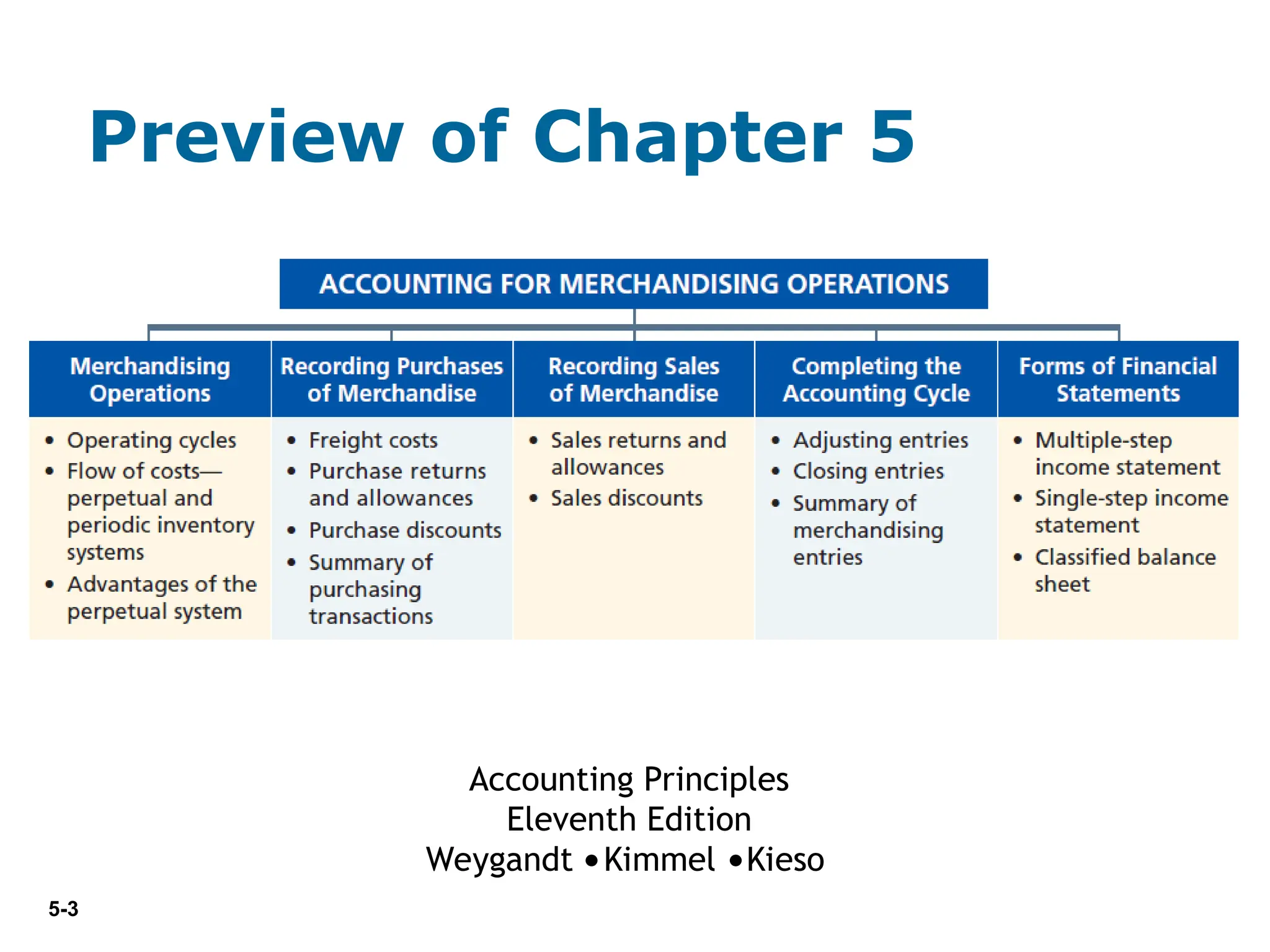
Accounting for
Merchandising Operations
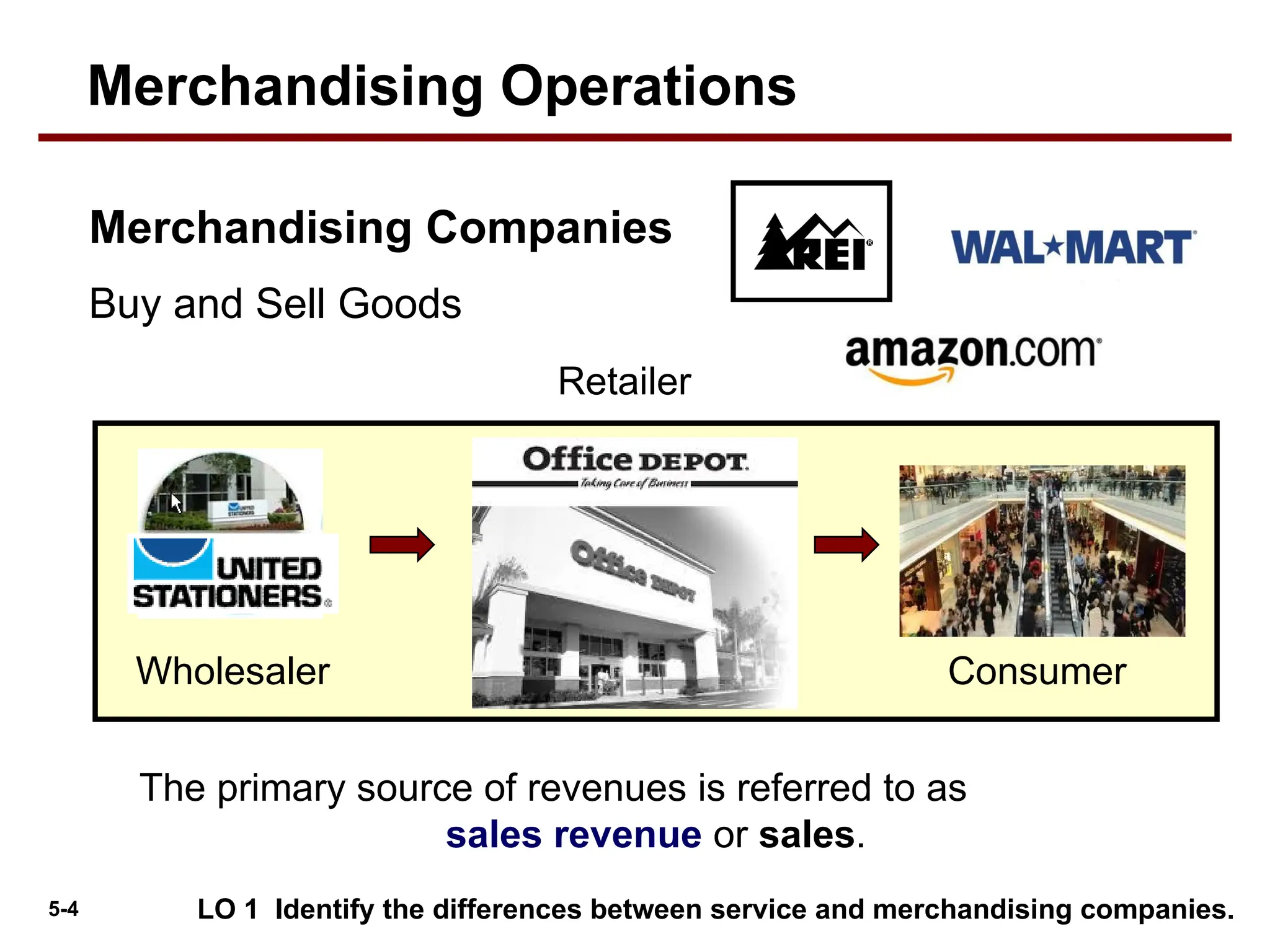
5-4 LO 1Identify the differences between service and merchandising companies.
Merchandising Companies
Buy and Sell Goods
Wholesaler Consumer
The primary source of revenues is referred to as
sales revenue or sales.
Retailer
Merchandising Operations
5.
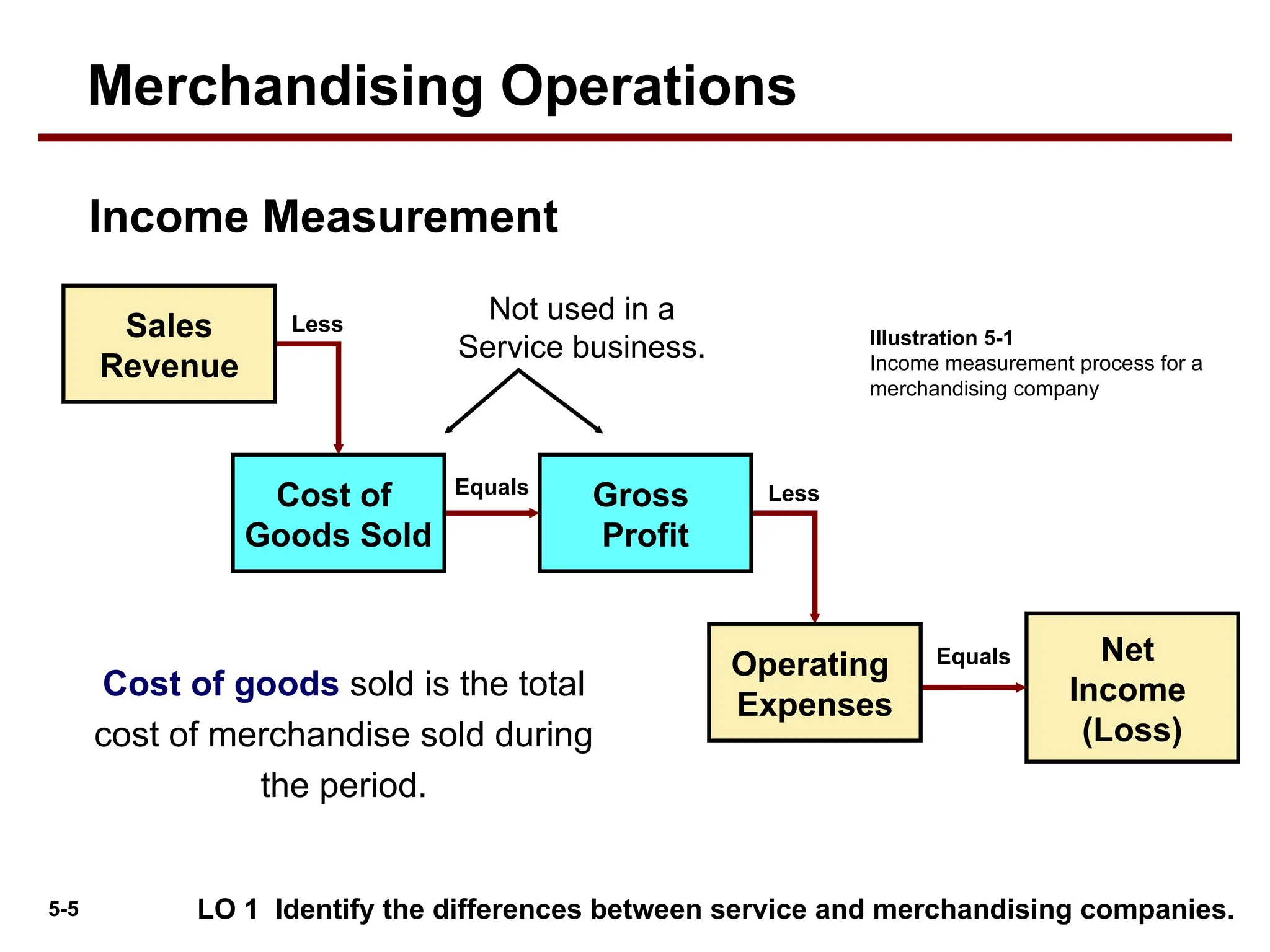
5-5 LO 1Identify the differences between service and merchandising companies.
Income Measurement
Cost of goods sold is the total
cost of merchandise sold during
the period.
Not used in a
Service business.
Net
Income
(Loss)
Less
Less
Equals
Equals
Sales
Revenue
Cost of
Goods Sold
Gross
Profit
Operating
Expenses
Illustration 5-1
Income measurement process for a
merchandising company
Merchandising Operations
6.
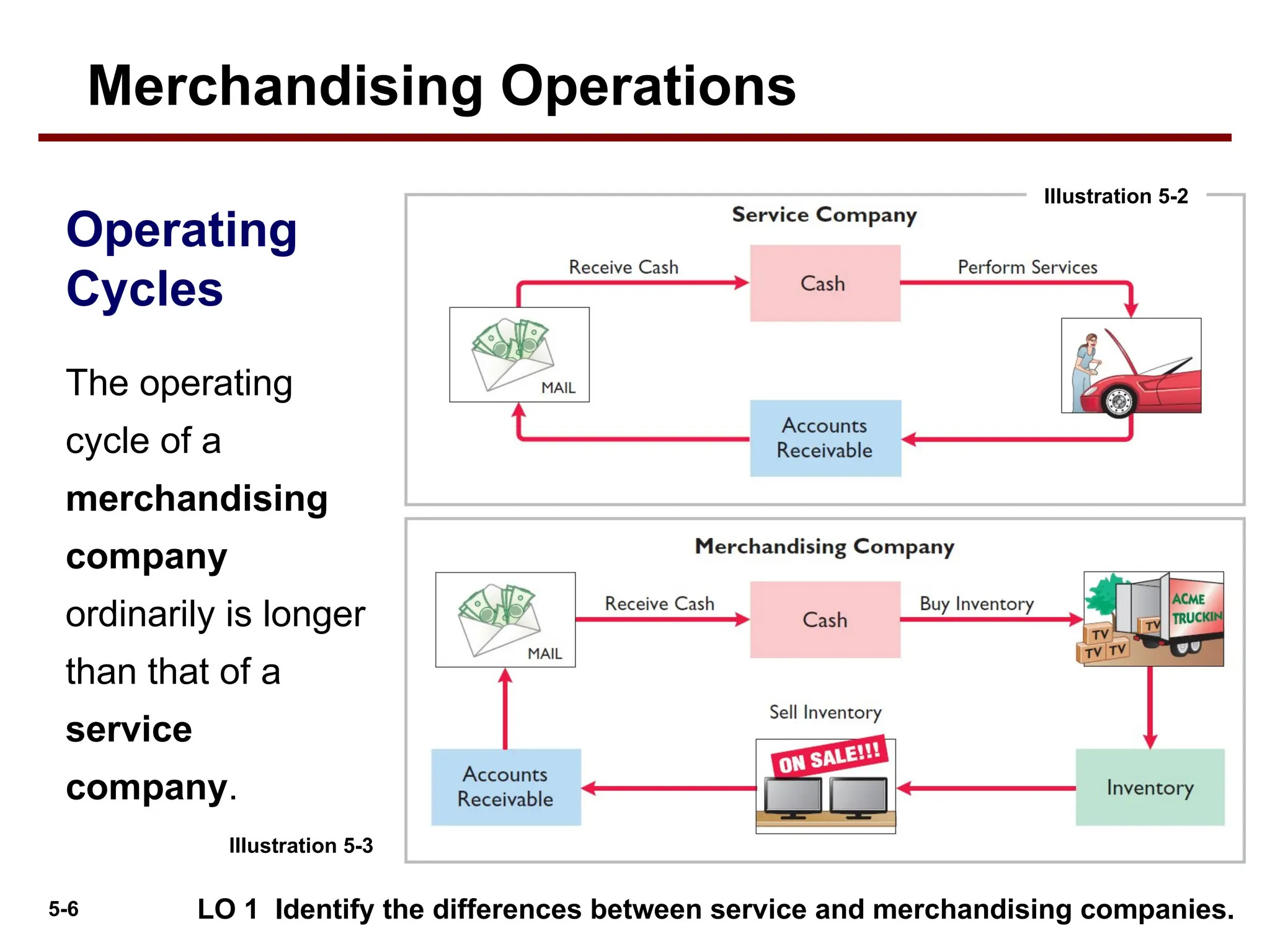
5-6
The operating
cycle ofa
merchandising
company
ordinarily is longer
than that of a
service
company.
Illustration 5-2
LO 1 Identify the differences between service and merchandising companies.
Operating
Cycles
Merchandising Operations
Illustration 5-3
7.
5-7
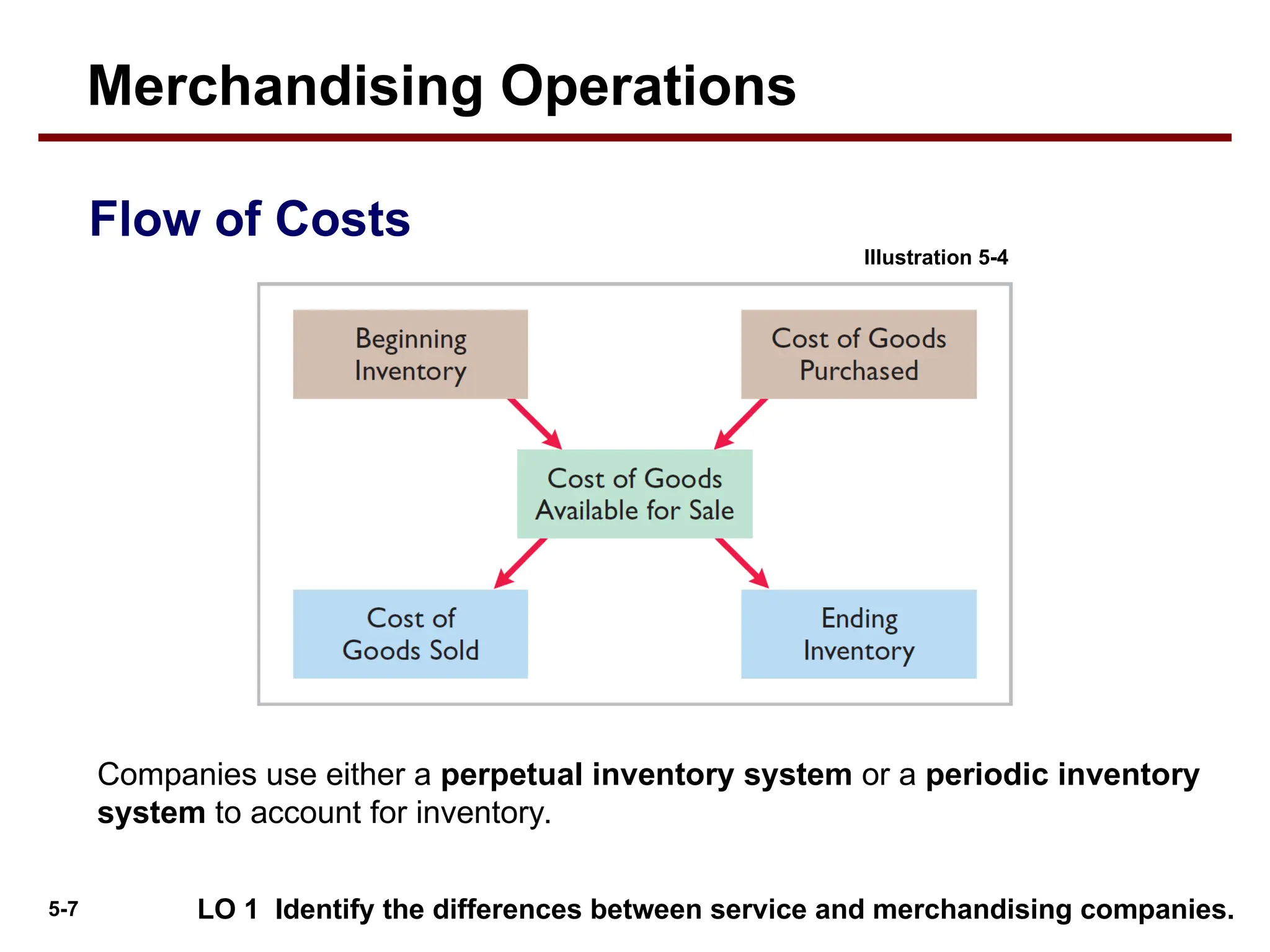
Flow of Costs
Companiesuse either a perpetual inventory system or a periodic inventory
system to account for inventory.
LO 1 Identify the differences between service and merchandising companies.
Illustration 5-4
Merchandising Operations
8.
5-8
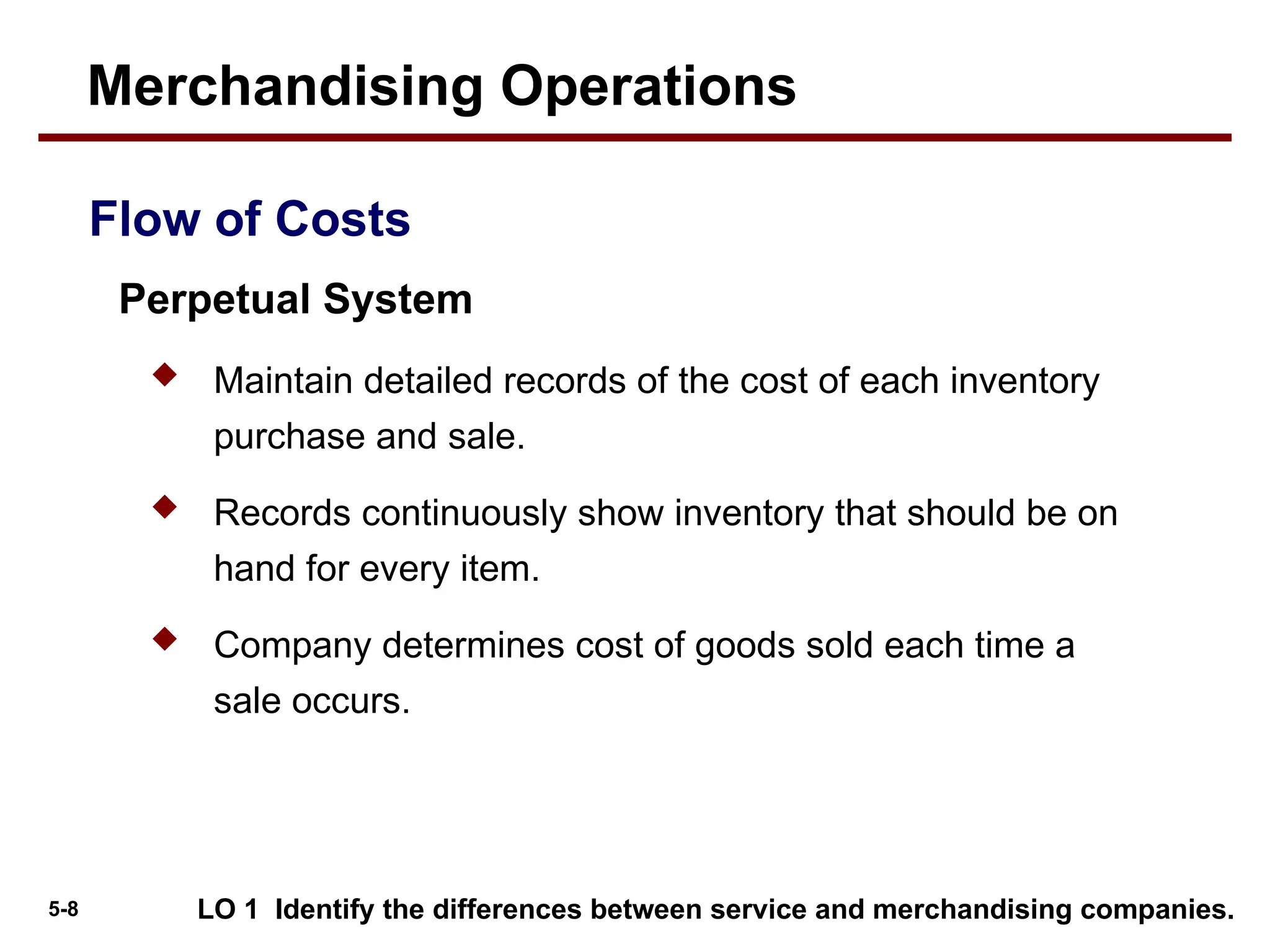
Perpetual System
LO 1Identify the differences between service and merchandising companies.
Maintain detailed records of the cost of each inventory
purchase and sale.
Records continuously show inventory that should be on
hand for every item.
Company determines cost of goods sold each time a
sale occurs.
Flow of Costs
Merchandising Operations
9.
5-9
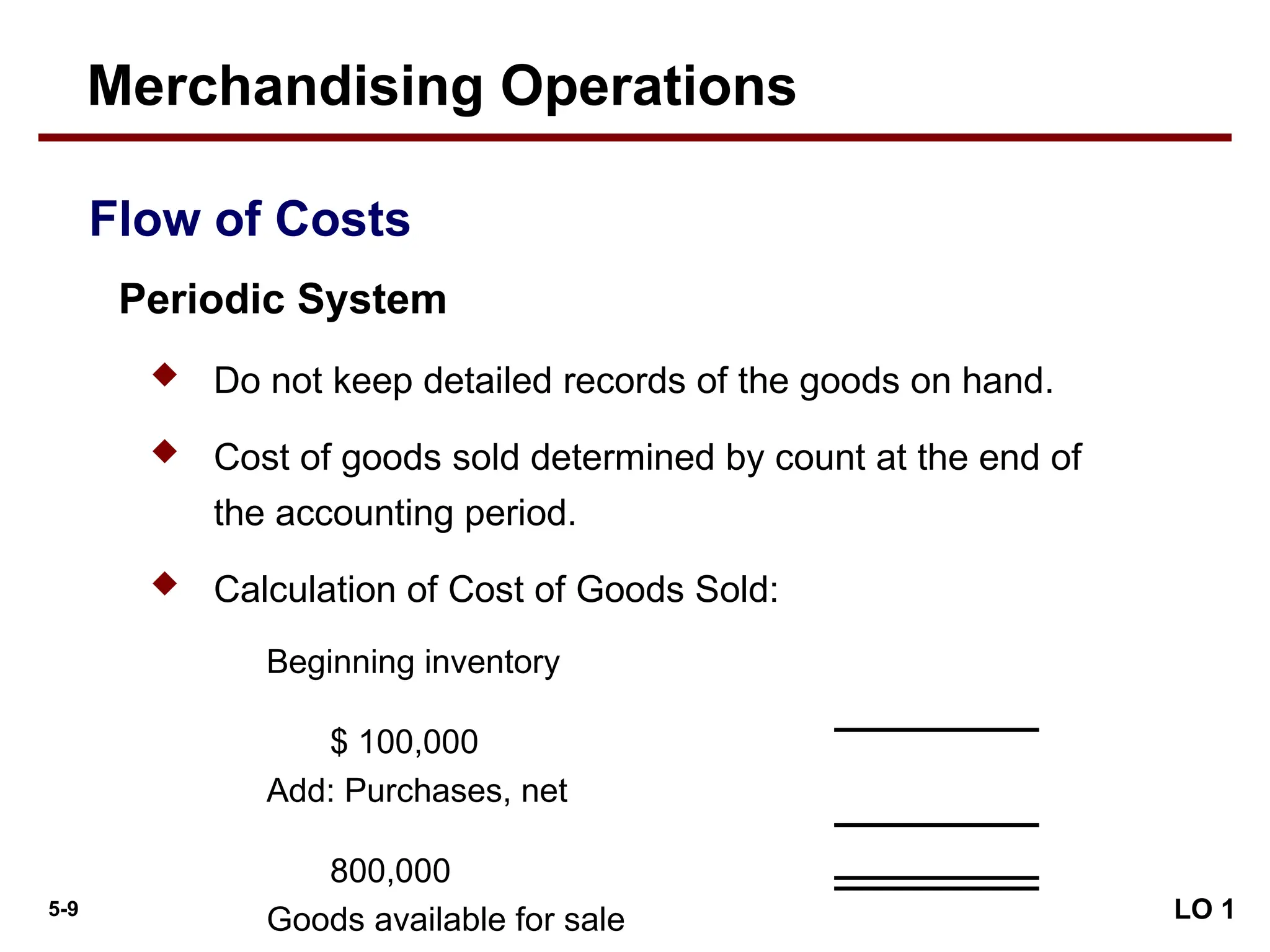
Do notkeep detailed records of the goods on hand.
Cost of goods sold determined by count at the end of
the accounting period.
Calculation of Cost of Goods Sold:
Beginning inventory
$ 100,000
Add: Purchases, net
800,000
Goods available for sale LO 1
Merchandising Operations
Periodic System
Flow of Costs
10.
5-10
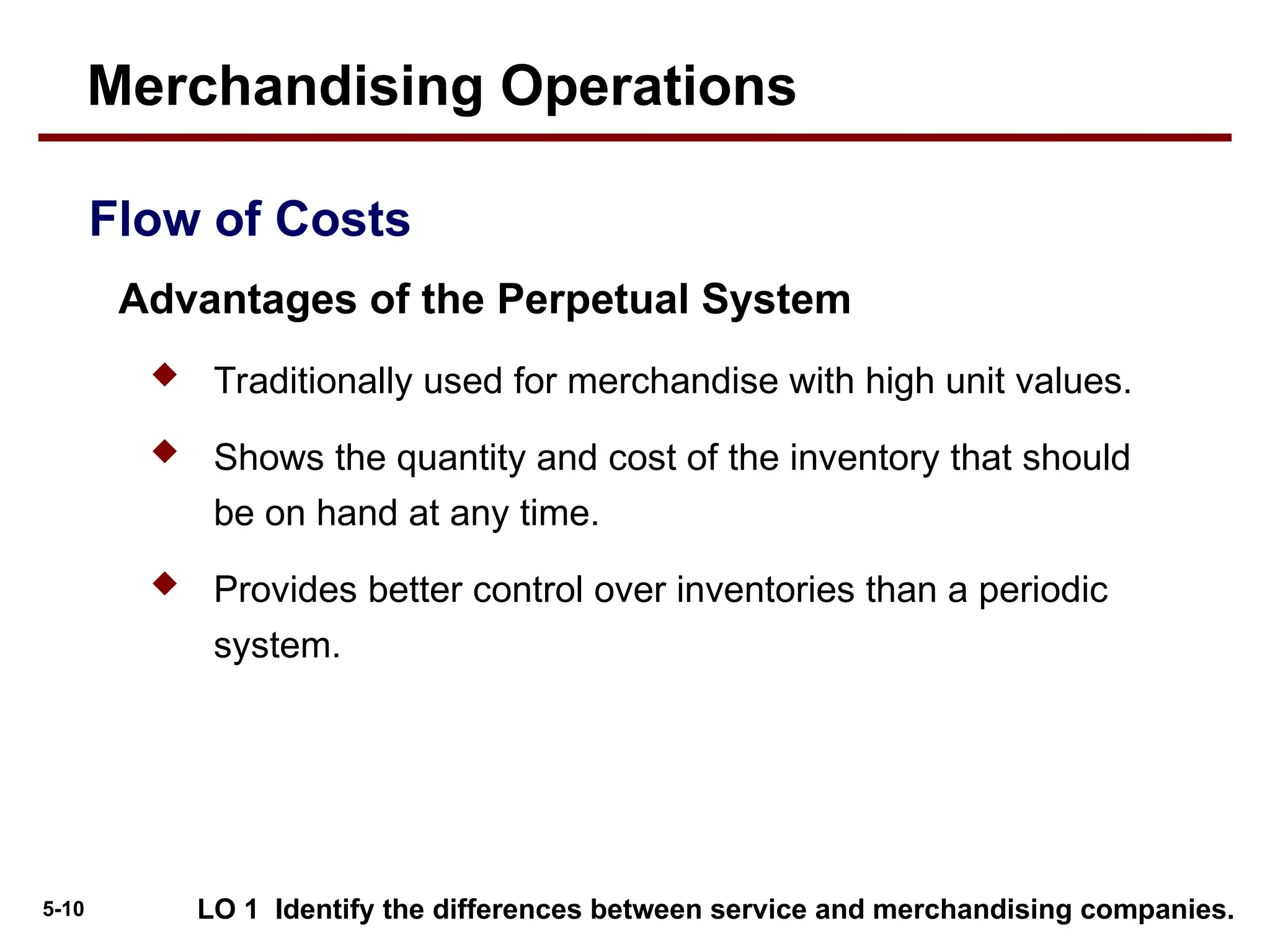
Traditionally usedfor merchandise with high unit values.
Shows the quantity and cost of the inventory that should
be on hand at any time.
Provides better control over inventories than a periodic
system.
LO 1 Identify the differences between service and merchandising companies.
Flow of Costs
Advantages of the Perpetual System
Merchandising Operations
5-12
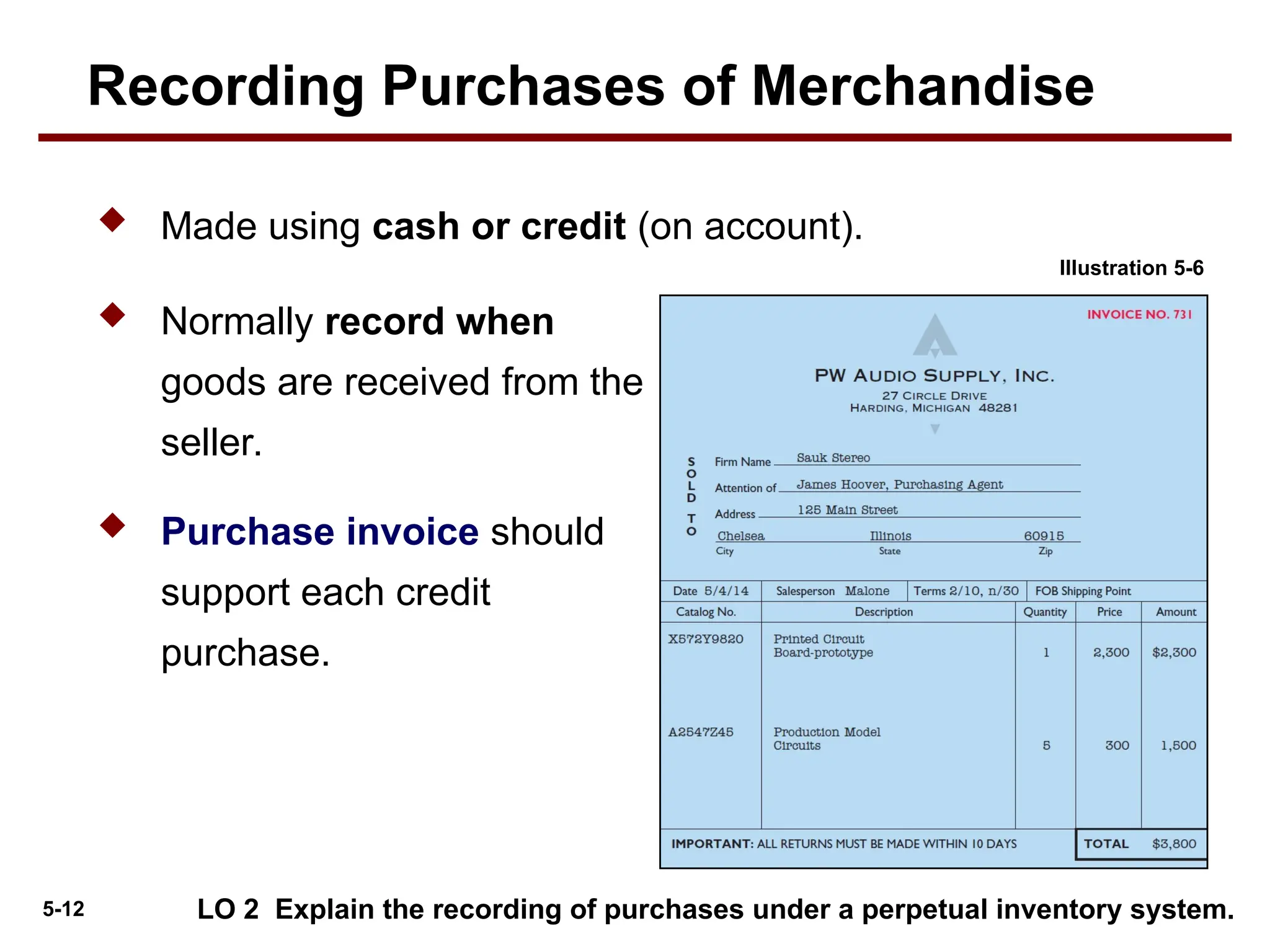
Made usingcash or credit (on account).
LO 2 Explain the recording of purchases under a perpetual inventory system.
Normally record when
goods are received from the
seller.
Purchase invoice should
support each credit
purchase.
Illustration 5-6
Recording Purchases of Merchandise
13.
5-13
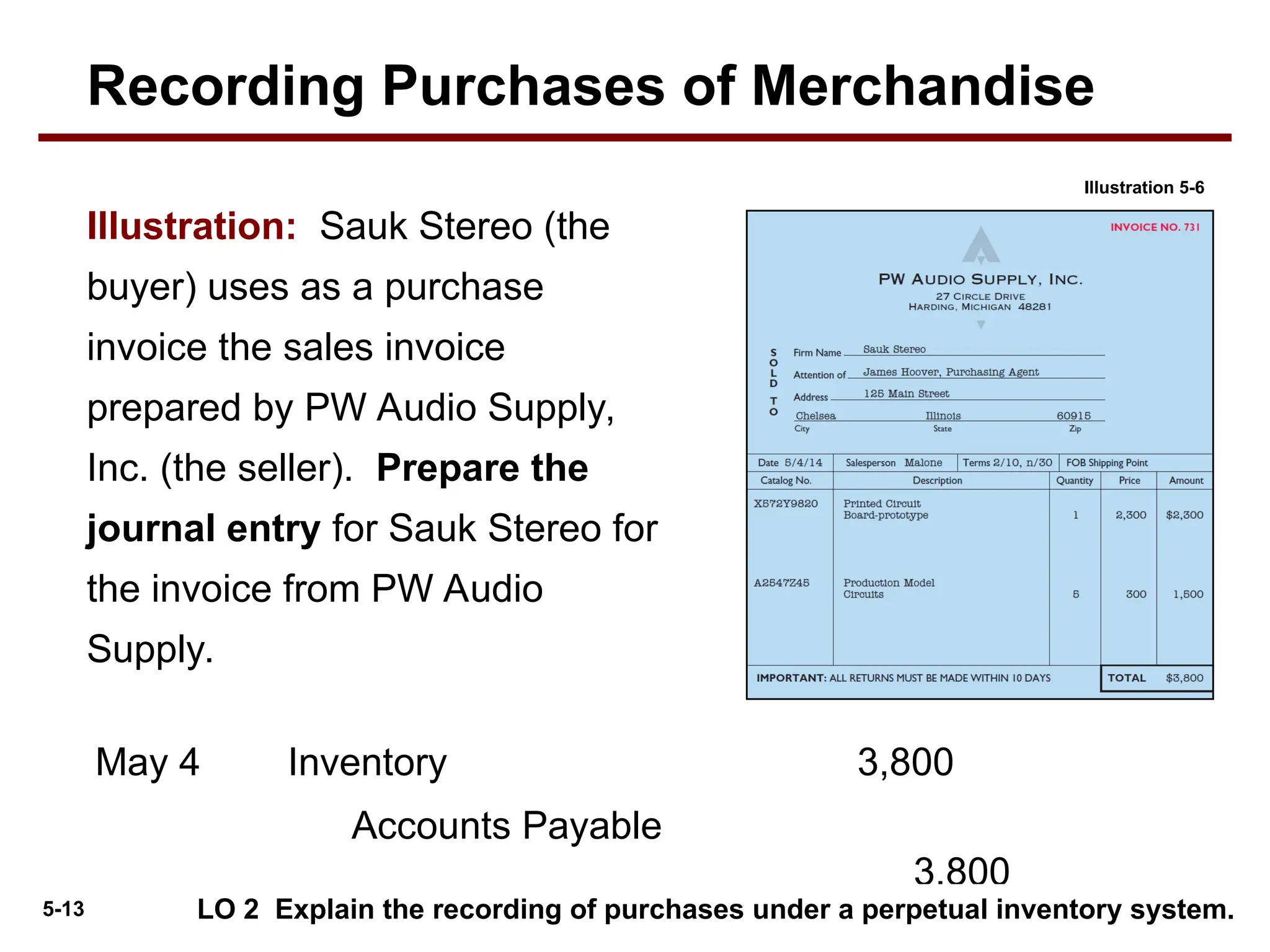
Illustration: Sauk Stereo(the
buyer) uses as a purchase
invoice the sales invoice
prepared by PW Audio Supply,
Inc. (the seller). Prepare the
journal entry for Sauk Stereo for
the invoice from PW Audio
Supply.
Inventory 3,800
May 4
Accounts Payable
3,800
LO 2 Explain the recording of purchases under a perpetual inventory system.
Illustration 5-6
Recording Purchases of Merchandise
14.
5-14
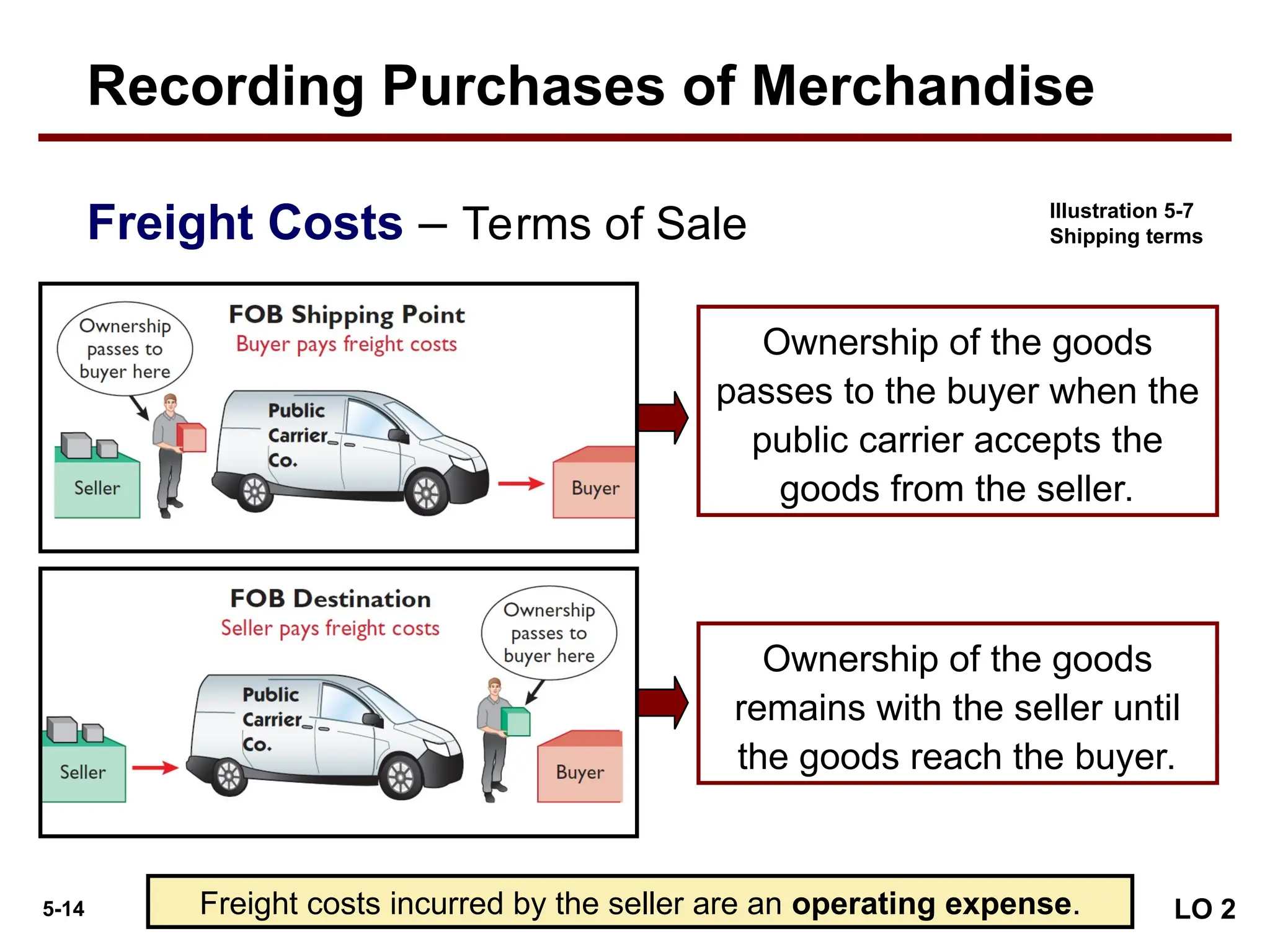
Illustration 5-7
Shipping terms
Ownershipof the goods
passes to the buyer when the
public carrier accepts the
goods from the seller.
Ownership of the goods
remains with the seller until
the goods reach the buyer.
Freight Costs – Terms of Sale
Freight costs incurred by the seller are an operating expense. LO 2
Recording Purchases of Merchandise
15.
5-15
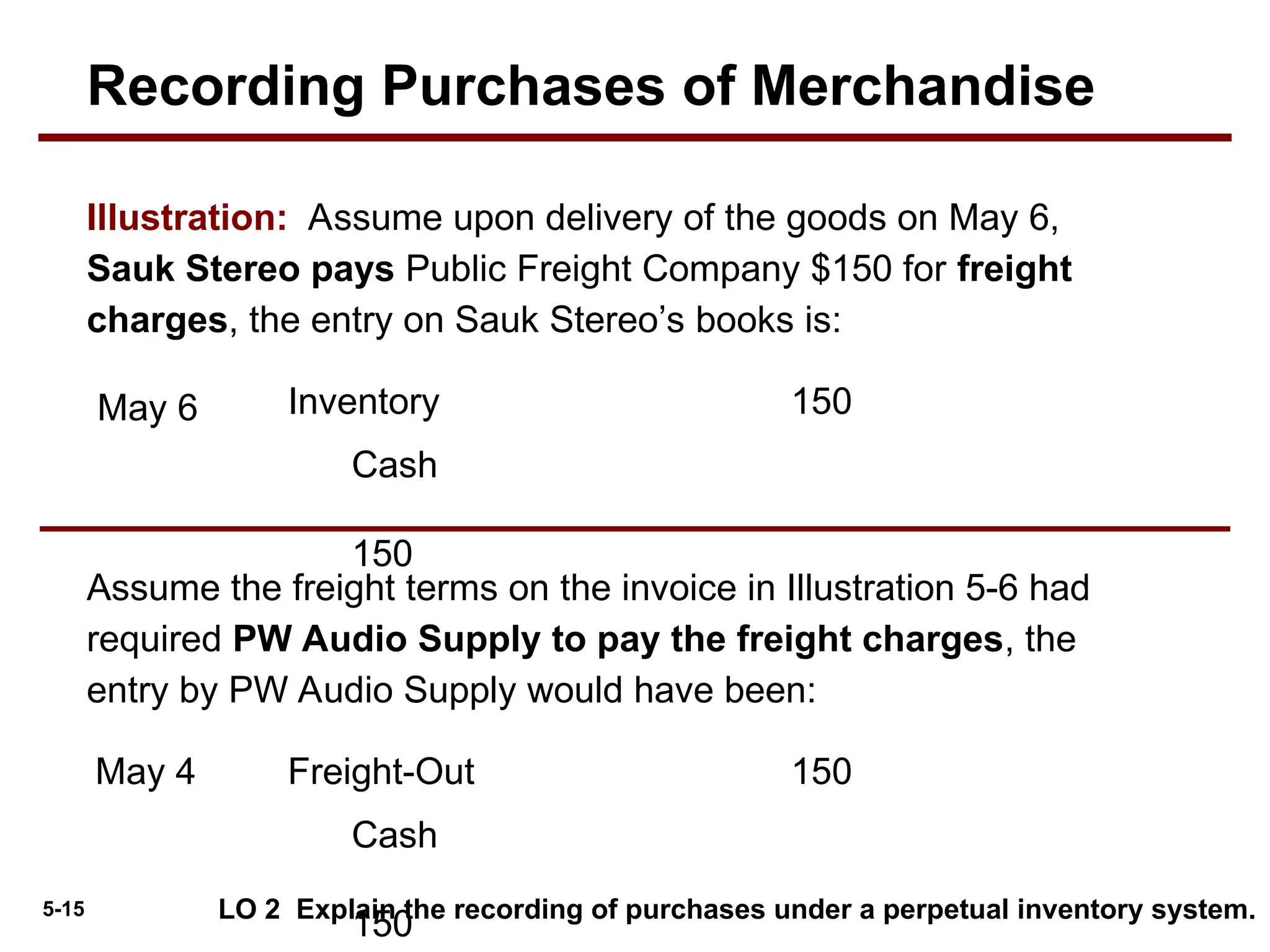
Illustration: Assume upondelivery of the goods on May 6,
Sauk Stereo pays Public Freight Company $150 for freight
charges, the entry on Sauk Stereo’s books is:
Inventory 150
May 6
Cash
150
LO 2 Explain the recording of purchases under a perpetual inventory system.
Assume the freight terms on the invoice in Illustration 5-6 had
required PW Audio Supply to pay the freight charges, the
entry by PW Audio Supply would have been:
Freight-Out 150
May 4
Cash
150
Recording Purchases of Merchandise
16.
5-16
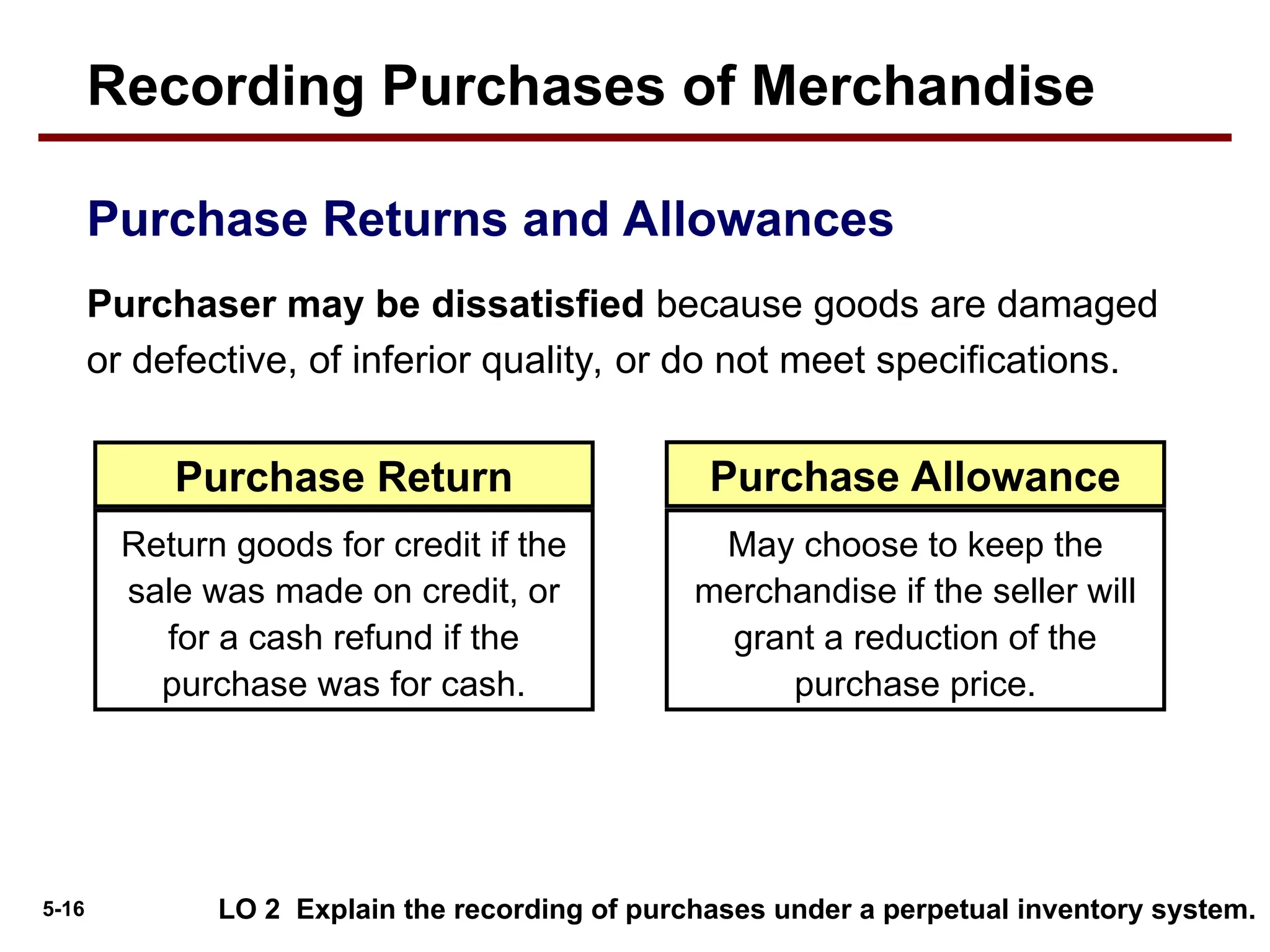
Purchaser may bedissatisfied because goods are damaged
or defective, of inferior quality, or do not meet specifications.
Purchase Returns and Allowances
Return goods for credit if the
sale was made on credit, or
for a cash refund if the
purchase was for cash.
May choose to keep the
merchandise if the seller will
grant a reduction of the
purchase price.
Purchase Return Purchase Allowance
LO 2 Explain the recording of purchases under a perpetual inventory system.
Recording Purchases of Merchandise
17.
5-17 LO 2Explain the recording of purchases under a perpetual inventory system.
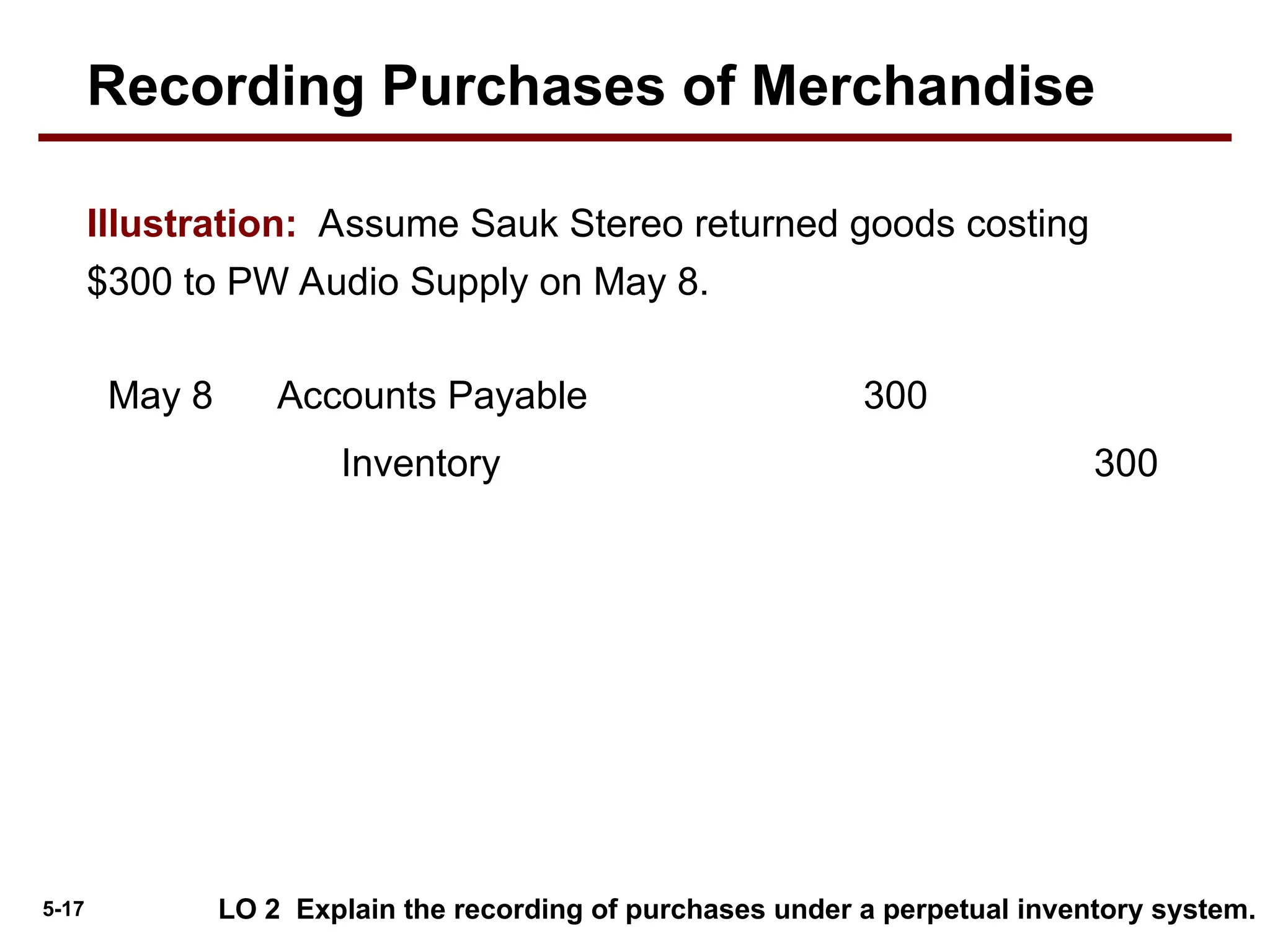
Illustration: Assume Sauk Stereo returned goods costing
$300 to PW Audio Supply on May 8.
Accounts Payable 300
May 8
Inventory 300
Recording Purchases of Merchandise
18.
5-18
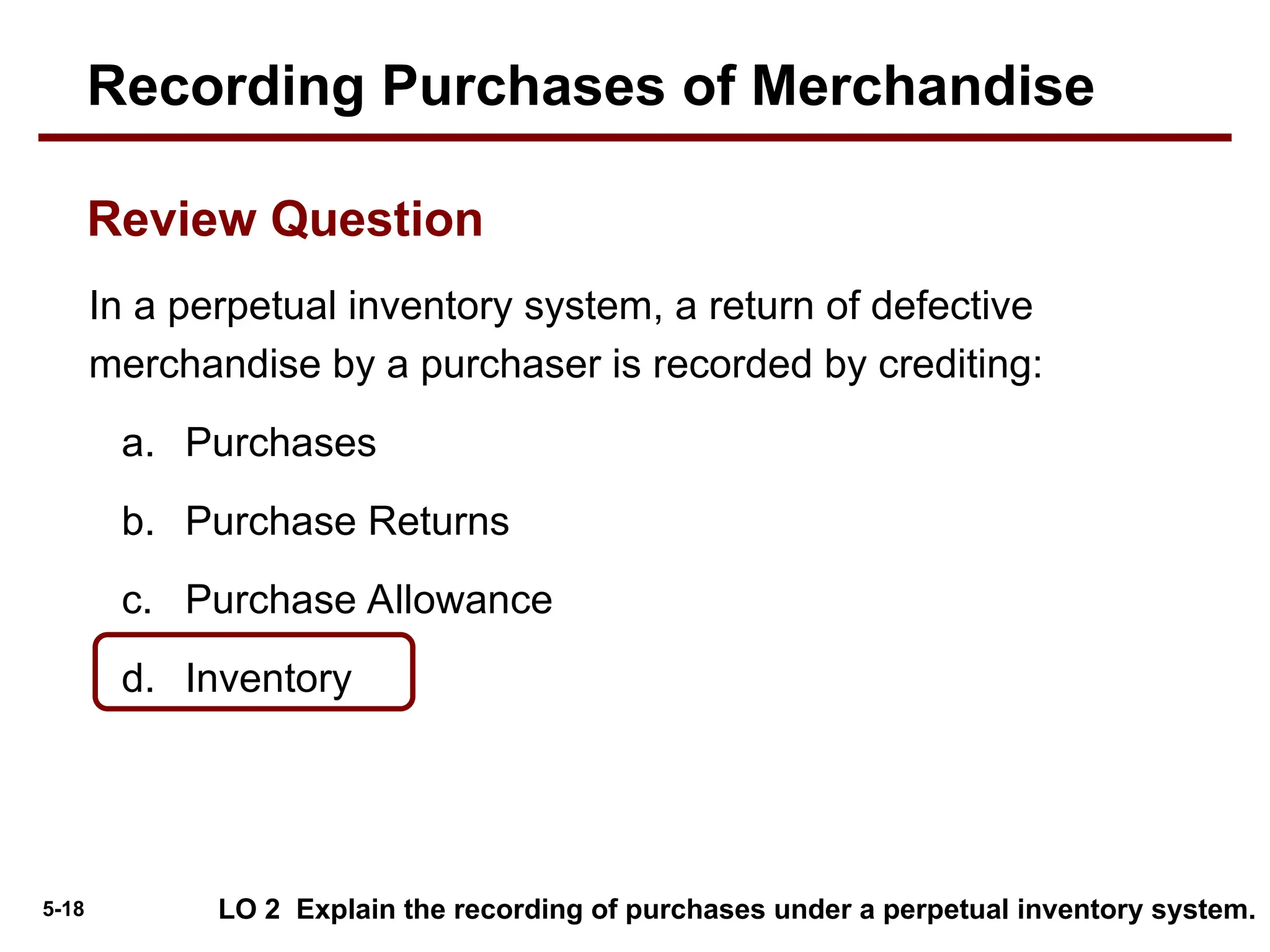
In a perpetualinventory system, a return of defective
merchandise by a purchaser is recorded by crediting:
a. Purchases
b. Purchase Returns
c. Purchase Allowance
d. Inventory
LO 2 Explain the recording of purchases under a perpetual inventory system.
Review Question
Recording Purchases of Merchandise
19.
5-19
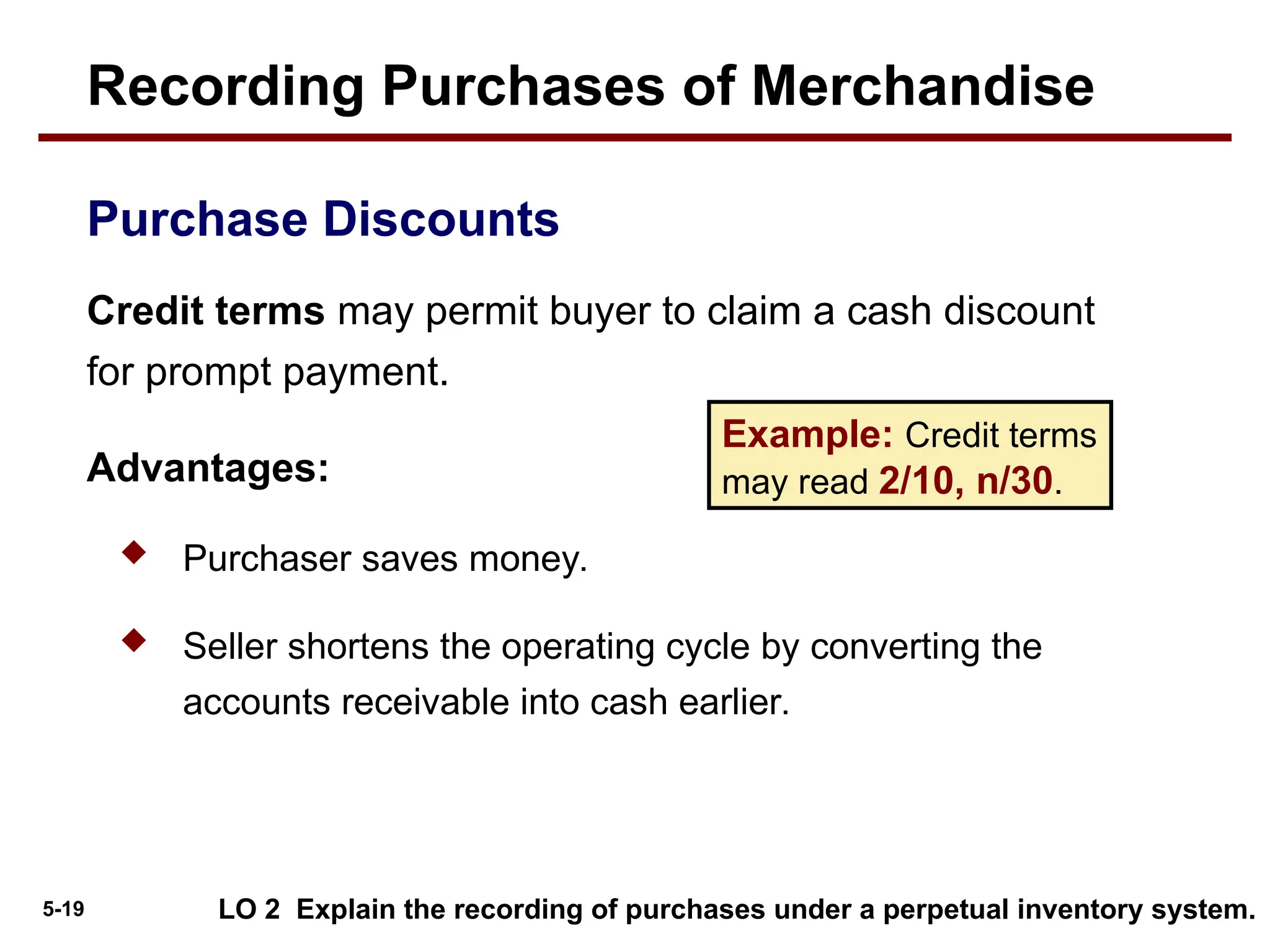
Credit terms maypermit buyer to claim a cash discount
for prompt payment.
Advantages:
Purchaser saves money.
Seller shortens the operating cycle by converting the
accounts receivable into cash earlier.
Purchase Discounts
Example: Credit terms
may read 2/10, n/30.
LO 2 Explain the recording of purchases under a perpetual inventory system.
Recording Purchases of Merchandise
20.
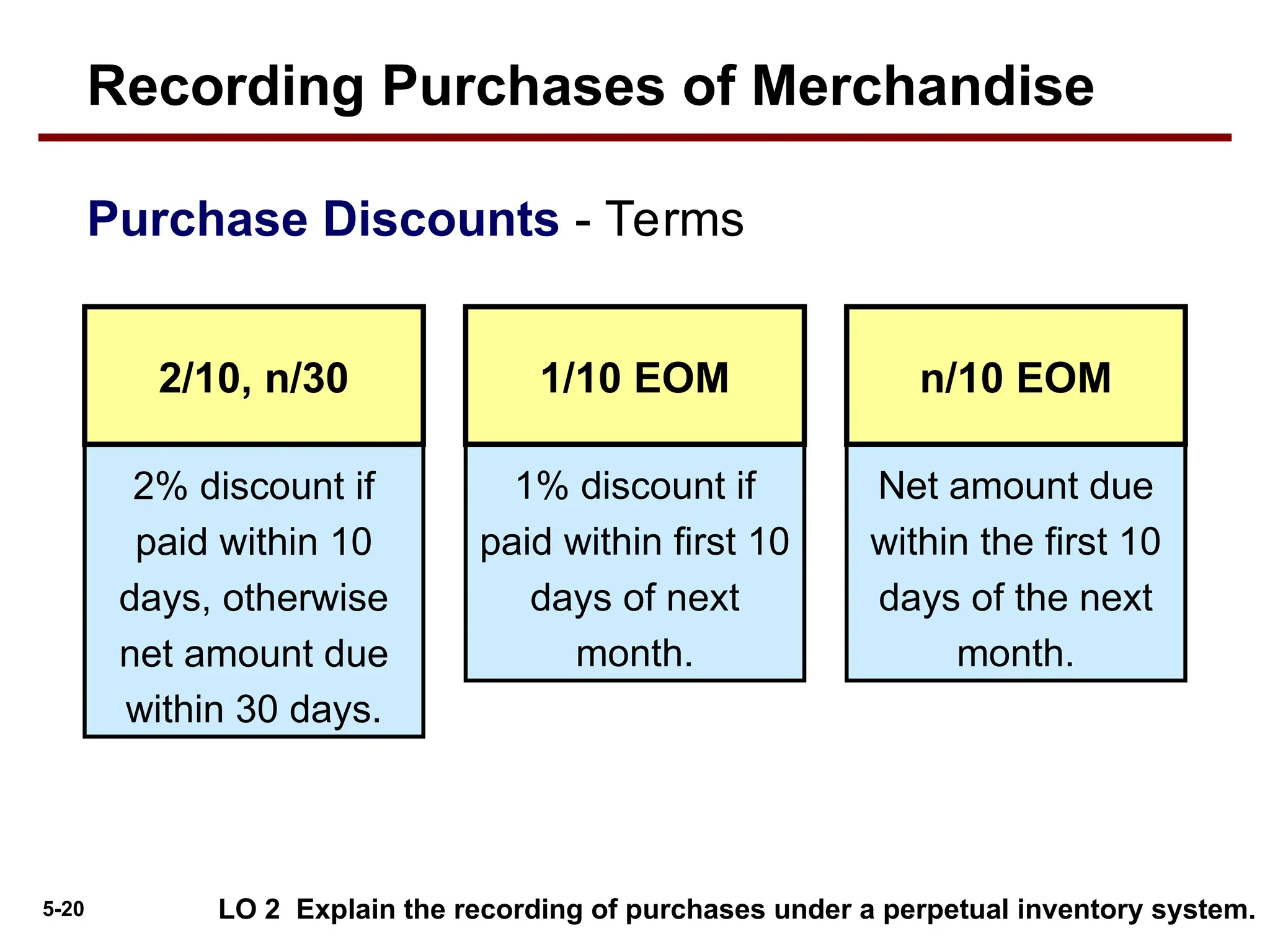
5-20
2% discount if
paidwithin 10
days, otherwise
net amount due
within 30 days.
1% discount if
paid within first 10
days of next
month.
2/10, n/30 1/10 EOM
Net amount due
within the first 10
days of the next
month.
n/10 EOM
LO 2 Explain the recording of purchases under a perpetual inventory system.
Purchase Discounts - Terms
Recording Purchases of Merchandise
21.
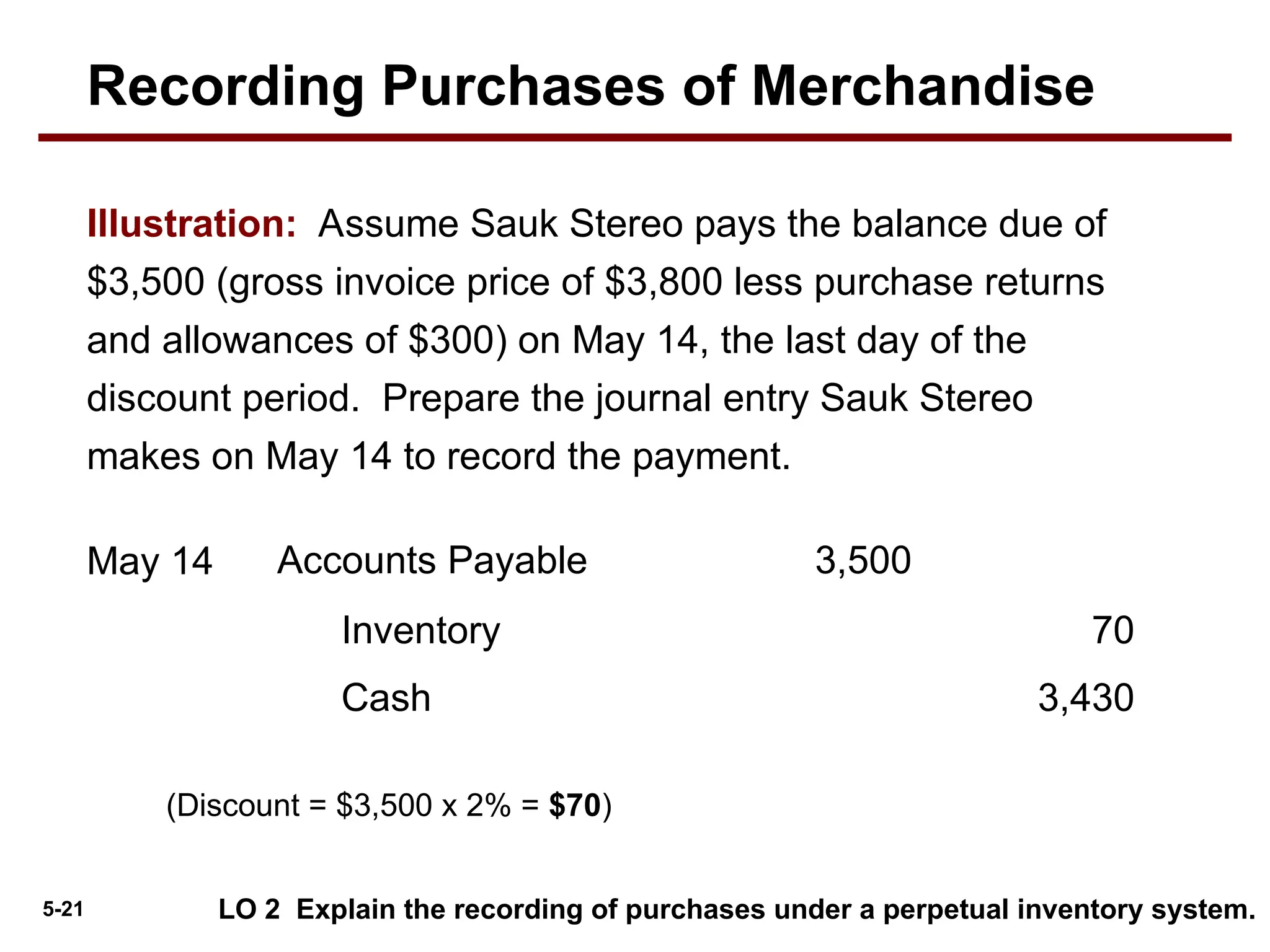
5-21
Accounts Payable 3,500
May14
Cash 3,430
Inventory 70
(Discount = $3,500 x 2% = $70)
LO 2 Explain the recording of purchases under a perpetual inventory system.
Illustration: Assume Sauk Stereo pays the balance due of
$3,500 (gross invoice price of $3,800 less purchase returns
and allowances of $300) on May 14, the last day of the
discount period. Prepare the journal entry Sauk Stereo
makes on May 14 to record the payment.
Recording Purchases of Merchandise
22.
5-22
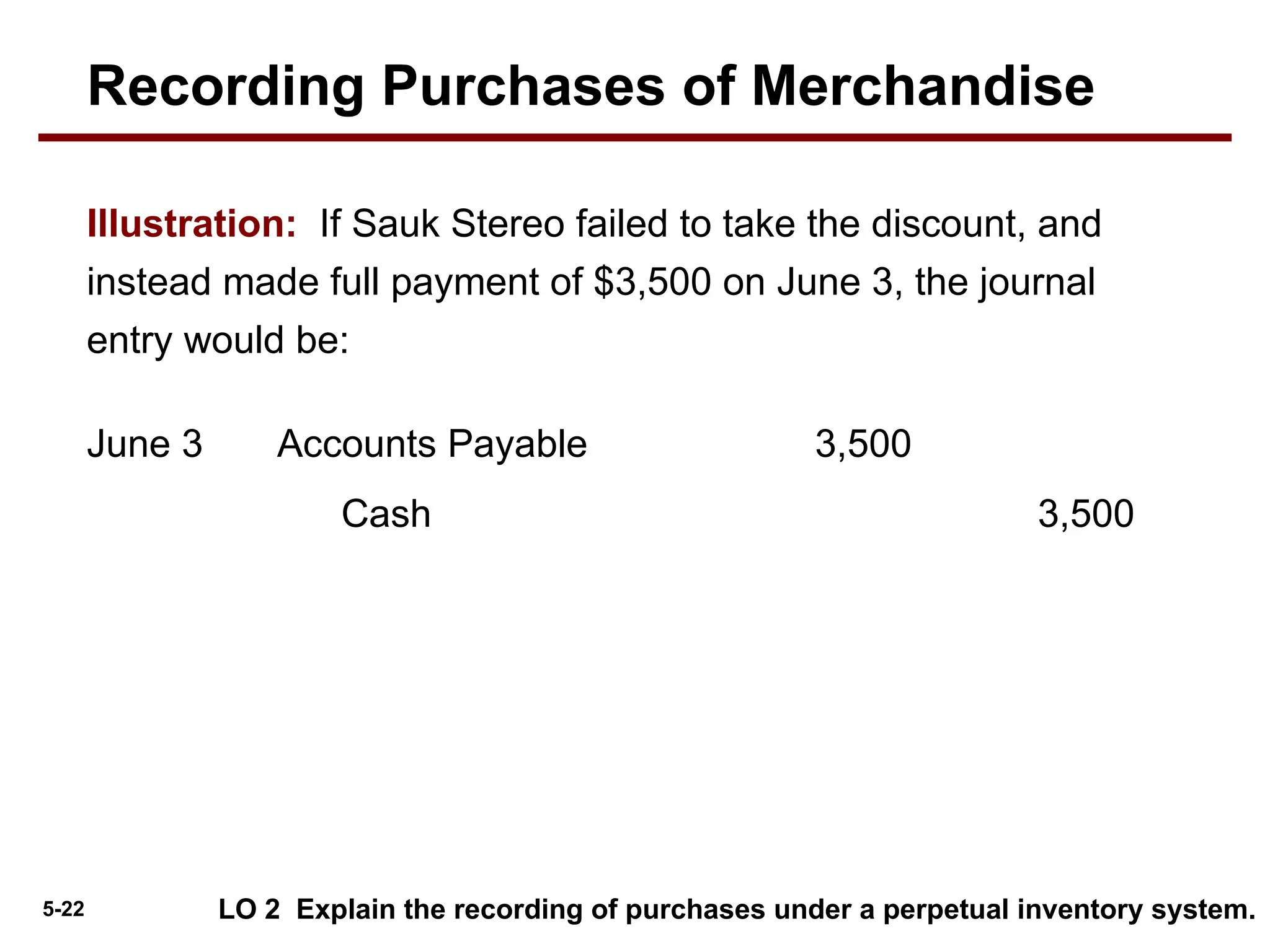
Accounts Payable 3,500
June3
Cash 3,500
LO 2 Explain the recording of purchases under a perpetual inventory system.
Illustration: If Sauk Stereo failed to take the discount, and
instead made full payment of $3,500 on June 3, the journal
entry would be:
Recording Purchases of Merchandise
23.
5-23
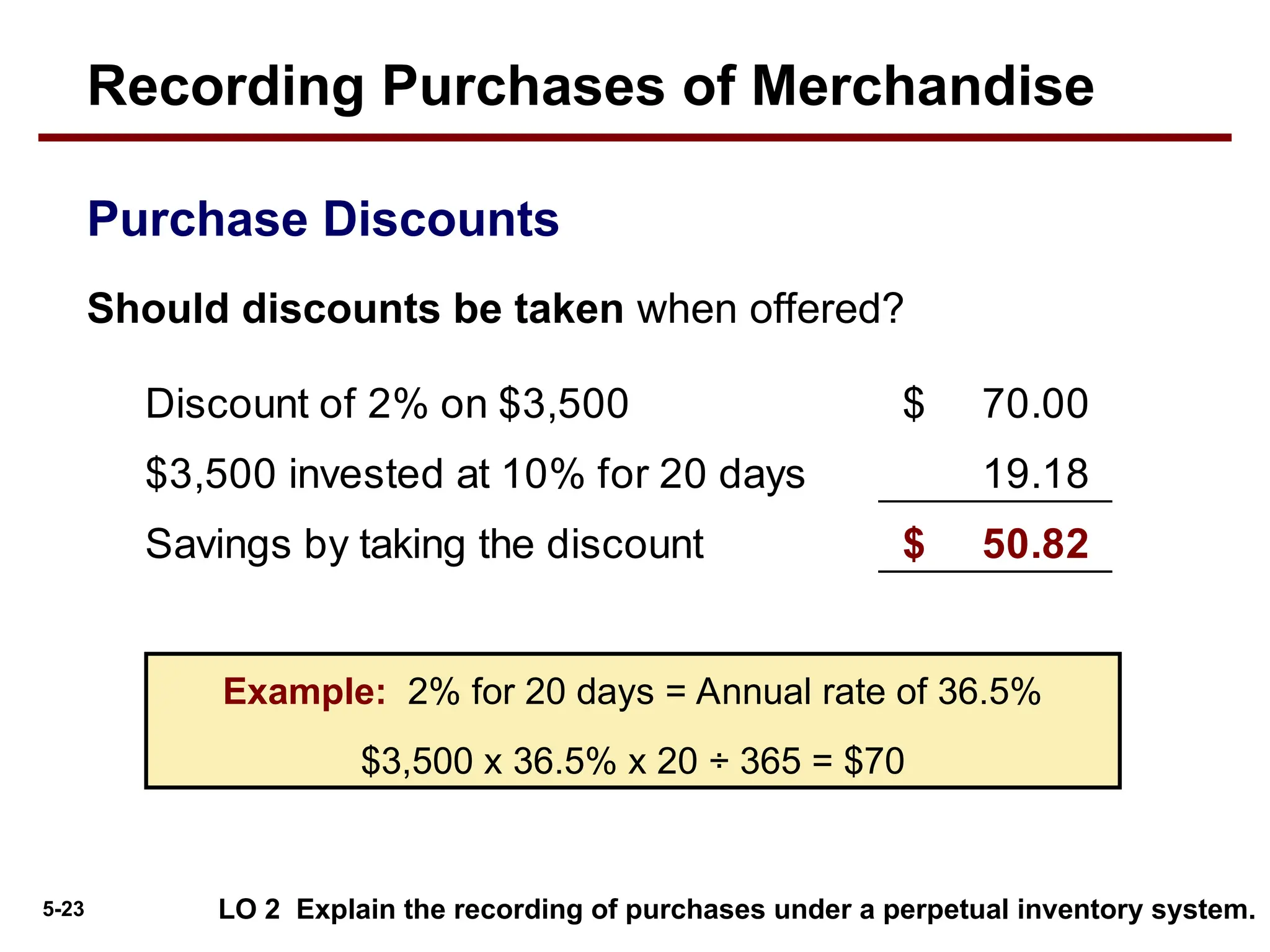
Should discounts betaken when offered?
Purchase Discounts
Discount of 2% on $3,500 70.00
$
$3,500 invested at 10% for 20 days 19.18
Savings by taking the discount 50.82
$
Example: 2% for 20 days = Annual rate of 36.5%
$3,500 x 36.5% x 20 ÷ 365 = $70
LO 2 Explain the recording of purchases under a perpetual inventory system.
Recording Purchases of Merchandise
24.
5-24
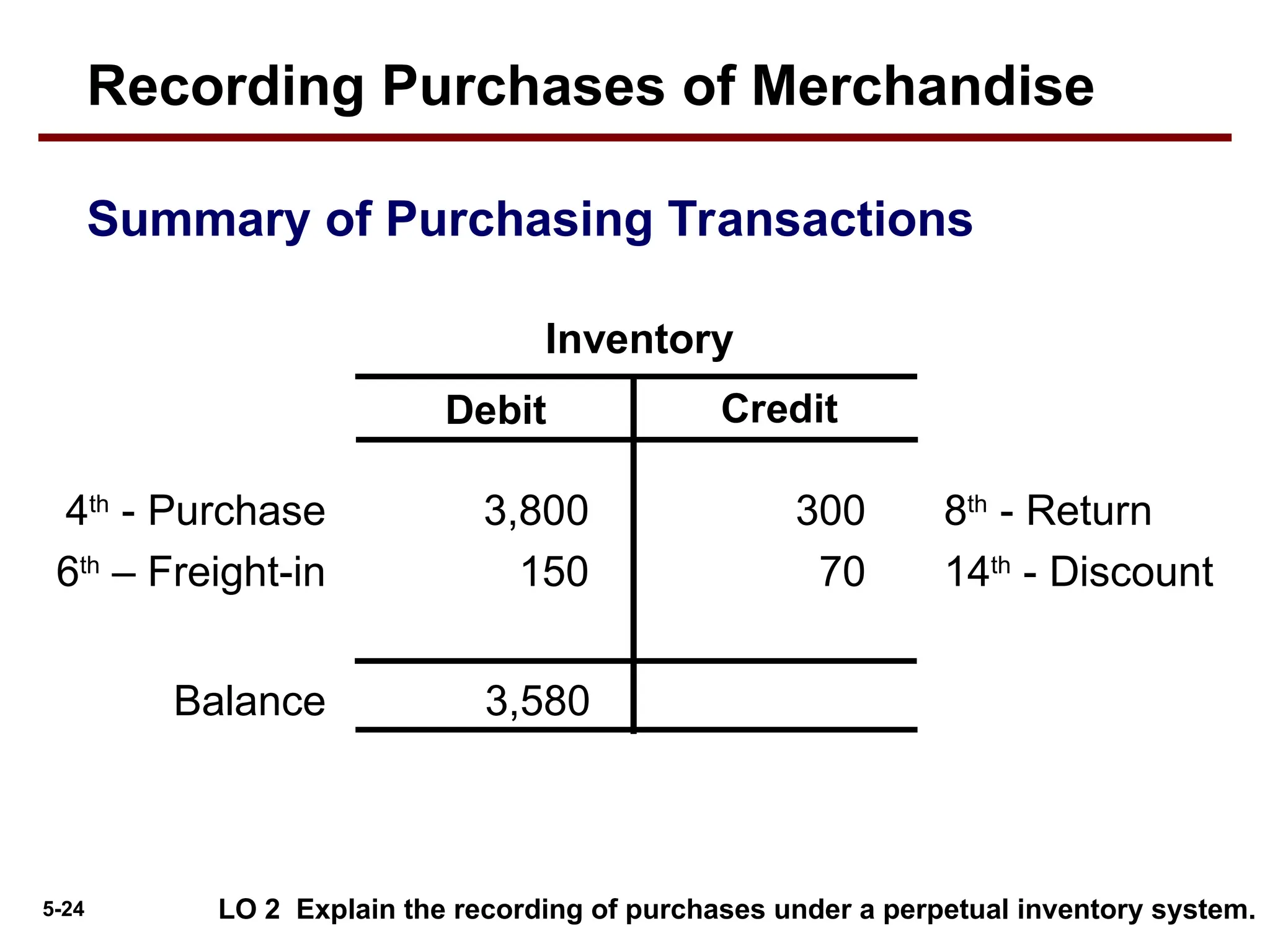
Inventory
Debit Credit
3,800 8th
-Return
300
Balance
4th
- Purchase
3,580
70 14th
- Discount
Summary of Purchasing Transactions
150
6th
– Freight-in
LO 2 Explain the recording of purchases under a perpetual inventory system.
Recording Purchases of Merchandise
25.
5-25
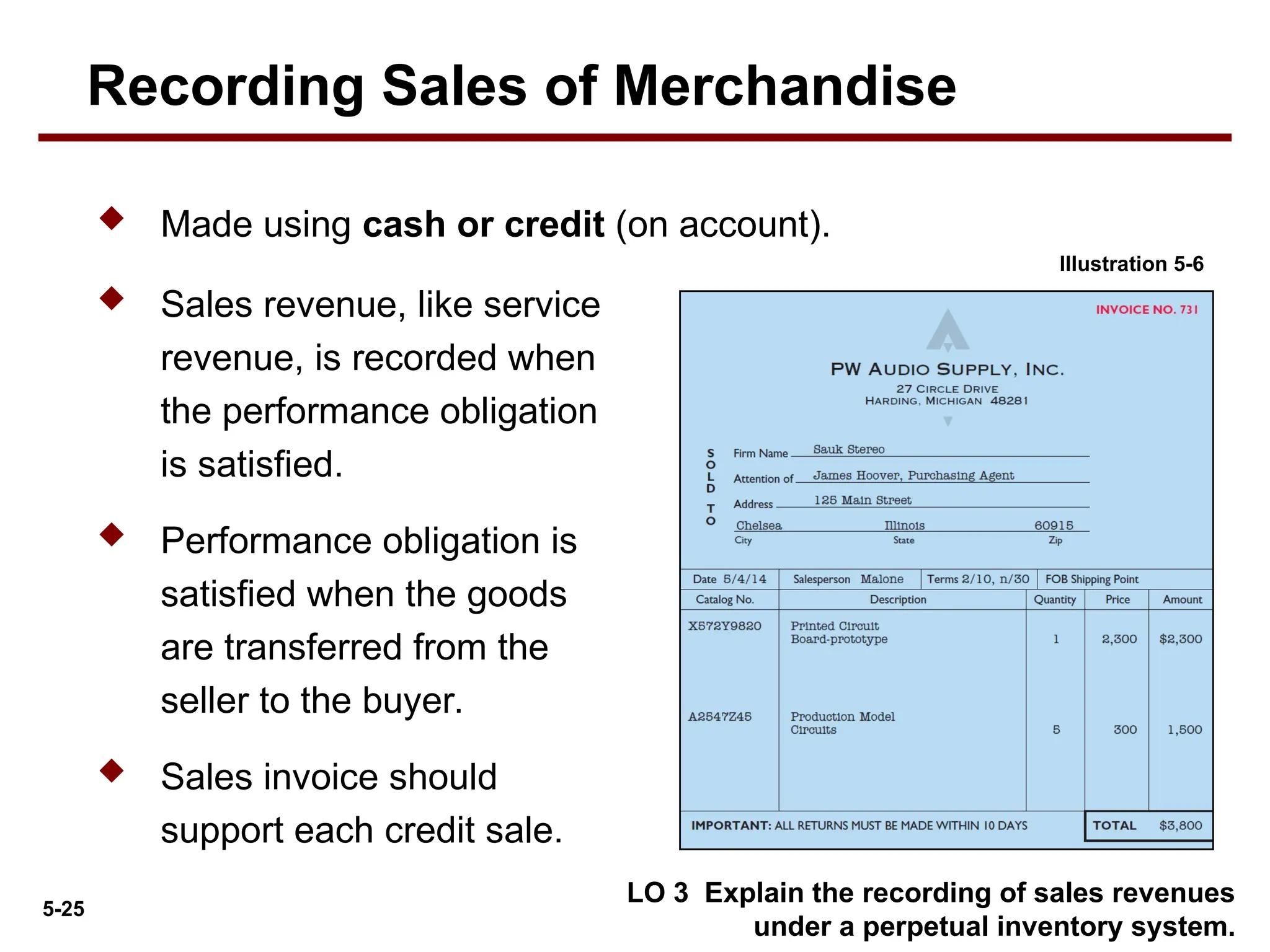
Made usingcash or credit (on account).
Sales revenue, like service
revenue, is recorded when
the performance obligation
is satisfied.
Performance obligation is
satisfied when the goods
are transferred from the
seller to the buyer.
Sales invoice should
support each credit sale.
LO 3 Explain the recording of sales revenues
under a perpetual inventory system.
Illustration 5-6
Recording Sales of Merchandise
26.
5-26
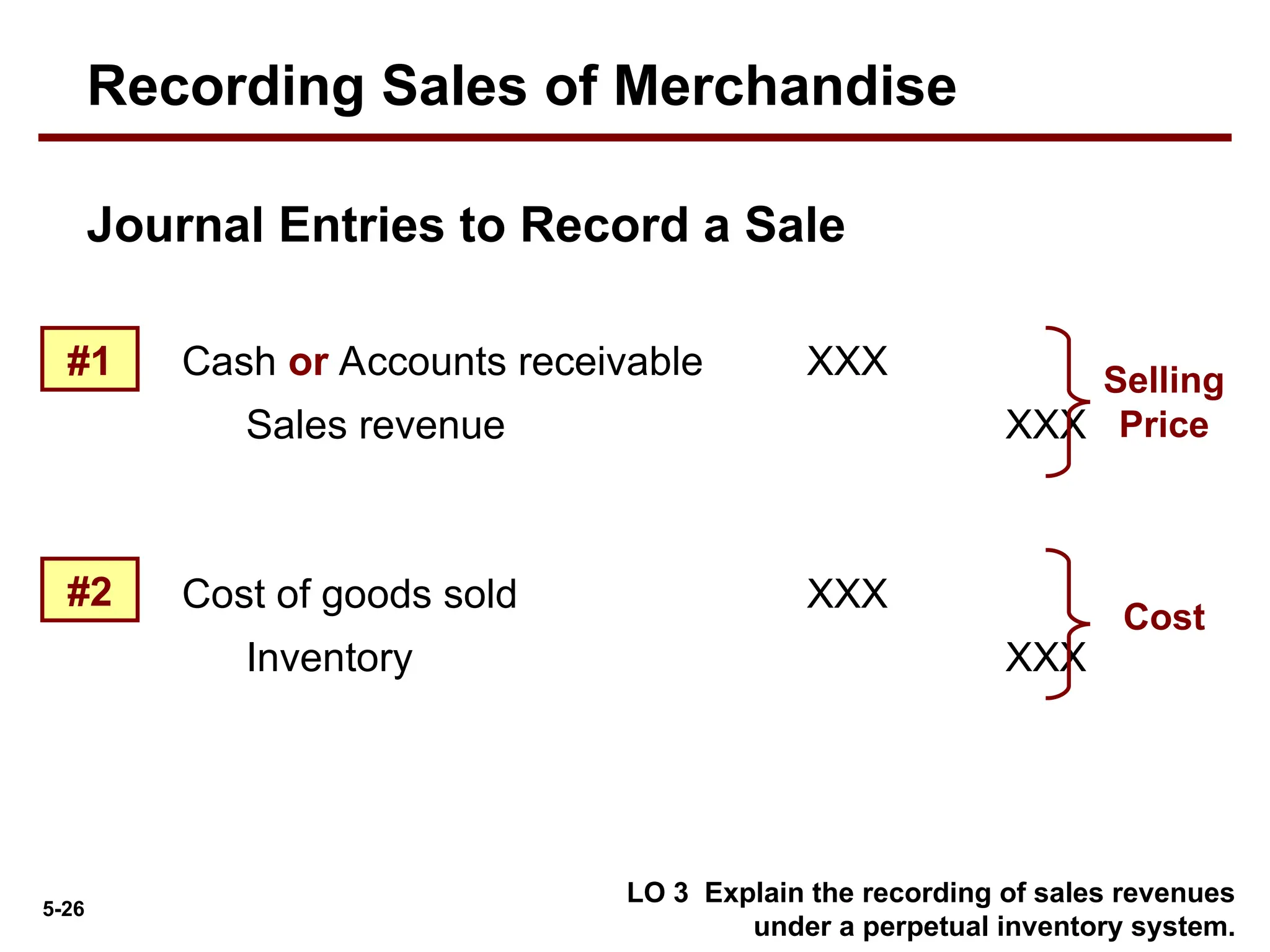
Journal Entries toRecord a Sale
Cash or Accounts receivable XXX
Sales revenue XXX
LO 3 Explain the recording of sales revenues
under a perpetual inventory system.
#1
Cost of goods sold XXX
Inventory XXX
#2
Selling
Price
Cost
Recording Sales of Merchandise
27.
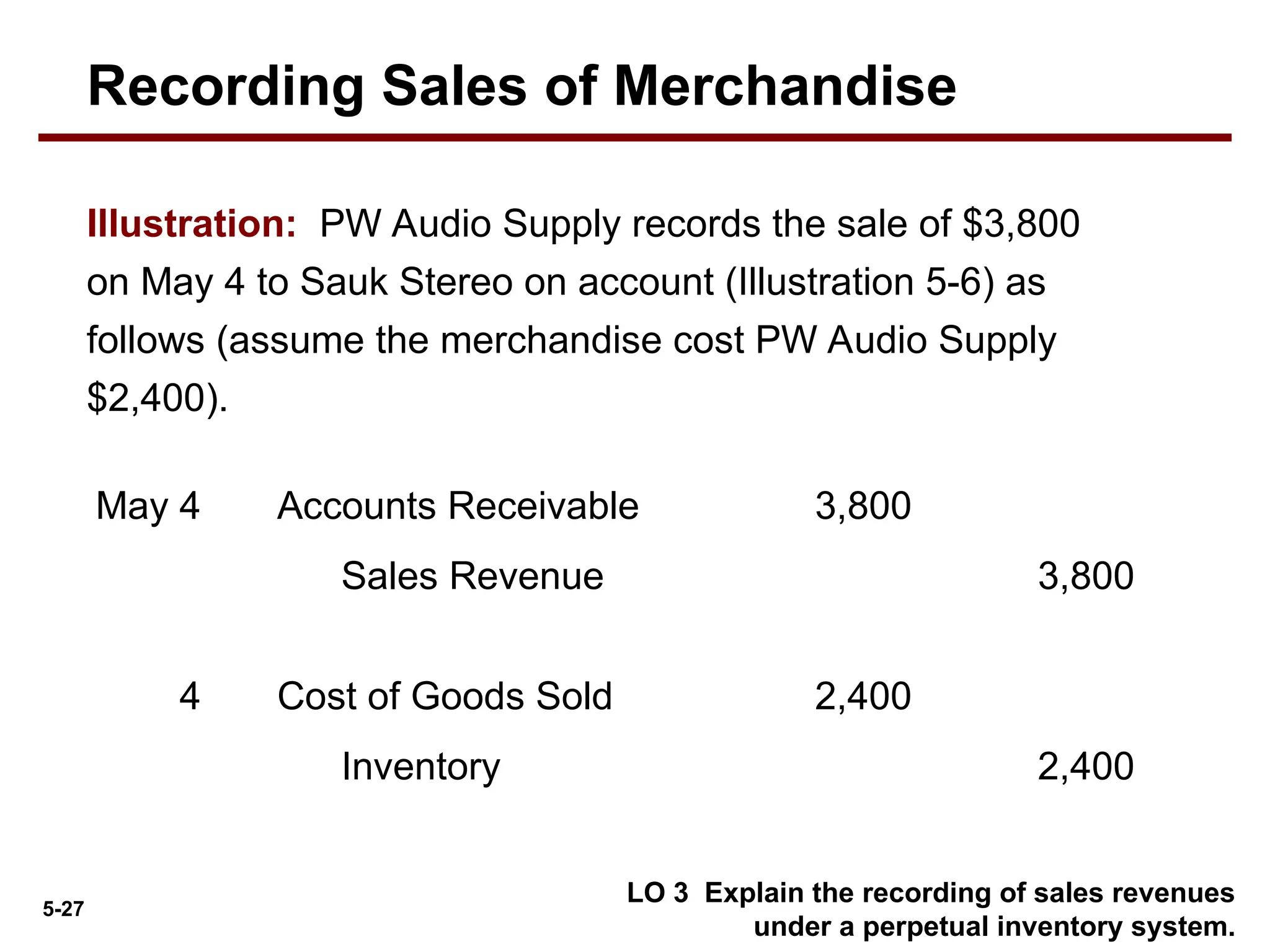
5-27
LO 3 Explainthe recording of sales revenues
under a perpetual inventory system.
Accounts Receivable 3,800
May 4
Sales Revenue 3,800
Illustration: PW Audio Supply records the sale of $3,800
on May 4 to Sauk Stereo on account (Illustration 5-6) as
follows (assume the merchandise cost PW Audio Supply
$2,400).
Cost of Goods Sold 2,400
4
Inventory 2,400
Recording Sales of Merchandise
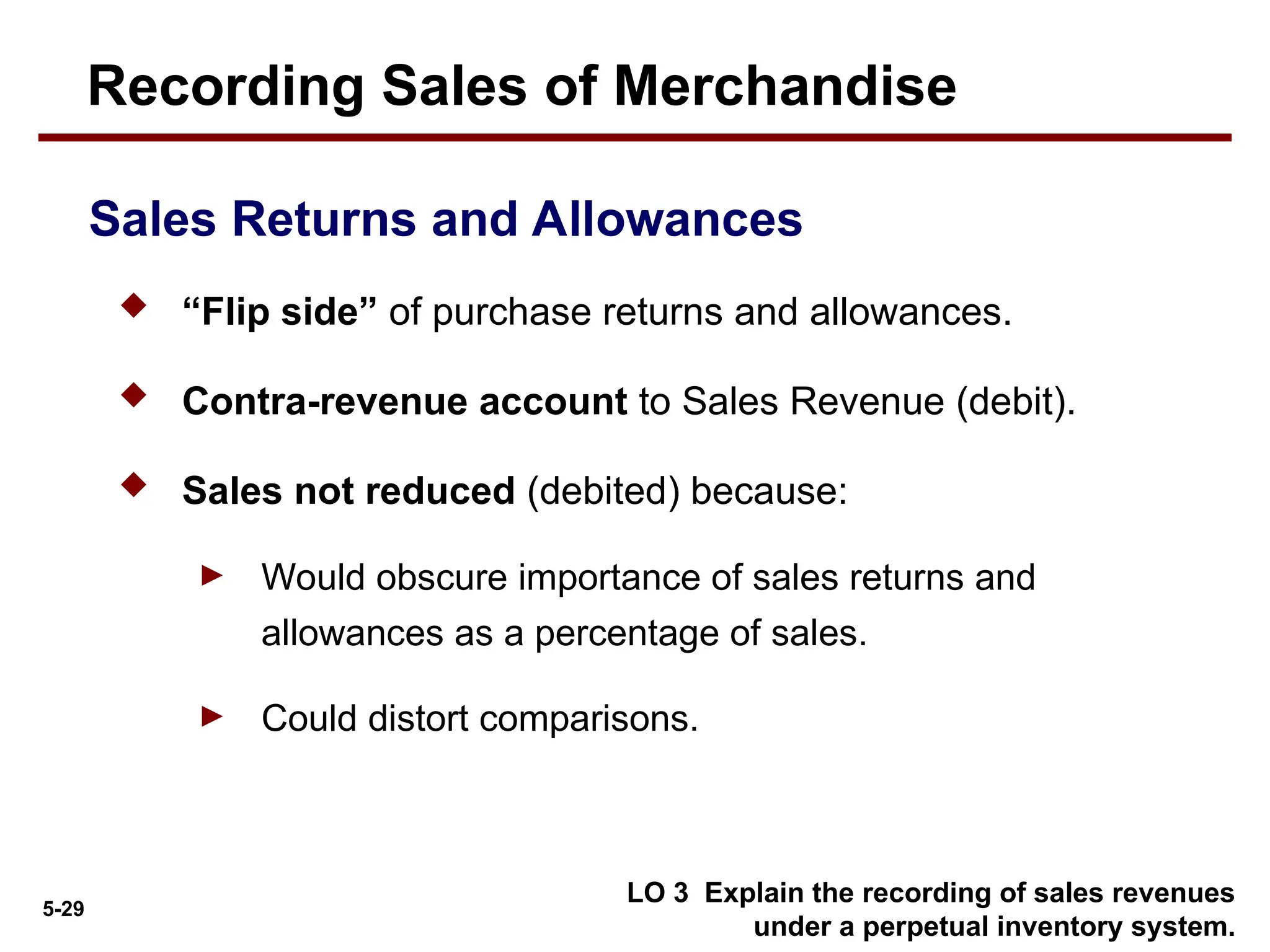
5-29
“Flip side”of purchase returns and allowances.
Contra-revenue account to Sales Revenue (debit).
Sales not reduced (debited) because:
► Would obscure importance of sales returns and
allowances as a percentage of sales.
► Could distort comparisons.
Sales Returns and Allowances
LO 3 Explain the recording of sales revenues
under a perpetual inventory system.
Recording Sales of Merchandise
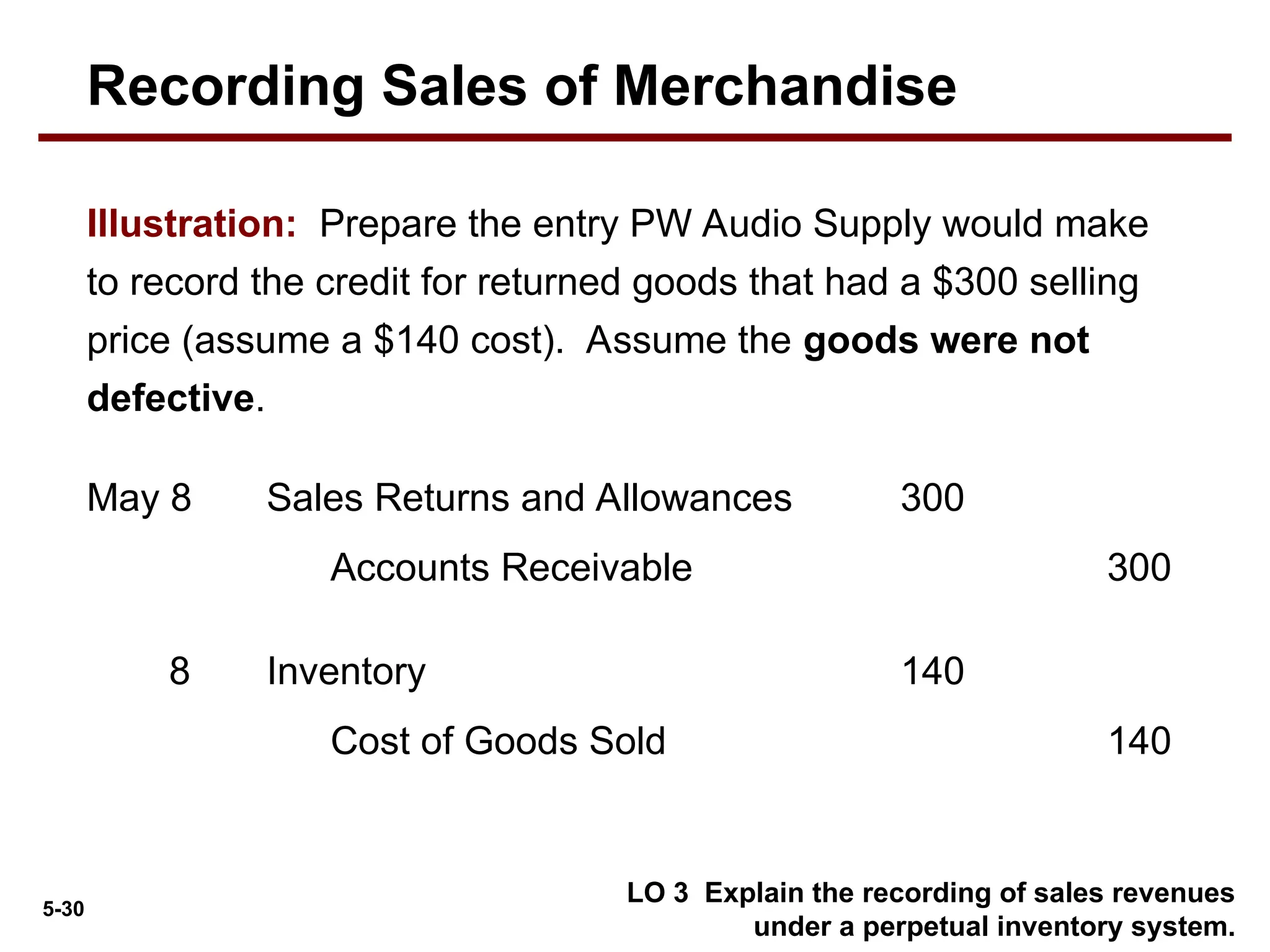
30.
5-30
Illustration: Prepare theentry PW Audio Supply would make
to record the credit for returned goods that had a $300 selling
price (assume a $140 cost). Assume the goods were not
defective.
LO 3 Explain the recording of sales revenues
under a perpetual inventory system.
Sales Returns and Allowances 300
May 8
Accounts Receivable 300
Inventory 140
8
Cost of Goods Sold 140
Recording Sales of Merchandise
31.
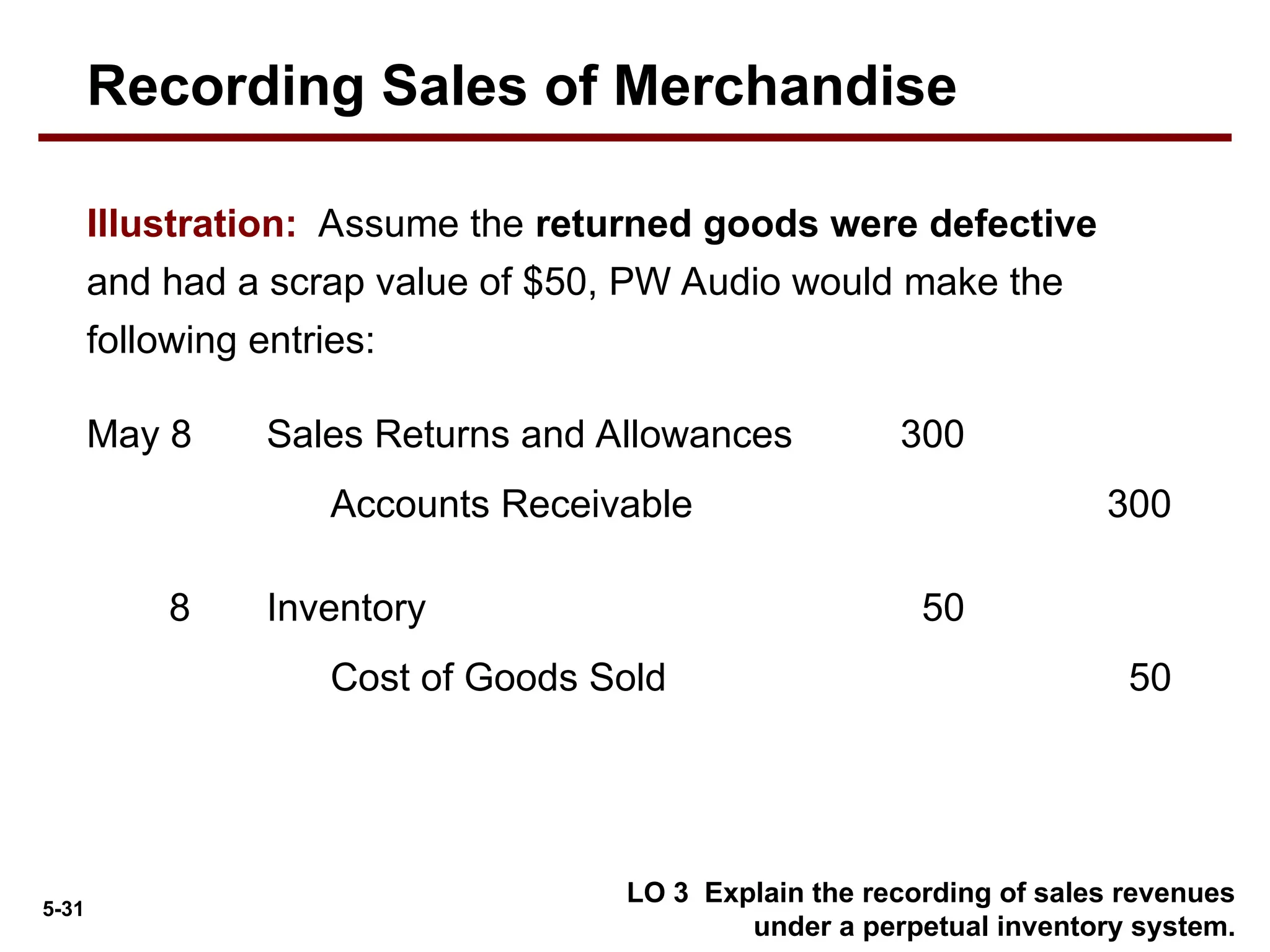
5-31
LO 3 Explainthe recording of sales revenues
under a perpetual inventory system.
Sales Returns and Allowances 300
Accounts Receivable 300
Inventory 50
Cost of Goods Sold 50
Illustration: Assume the returned goods were defective
and had a scrap value of $50, PW Audio would make the
following entries:
May 8
8
Recording Sales of Merchandise
32.
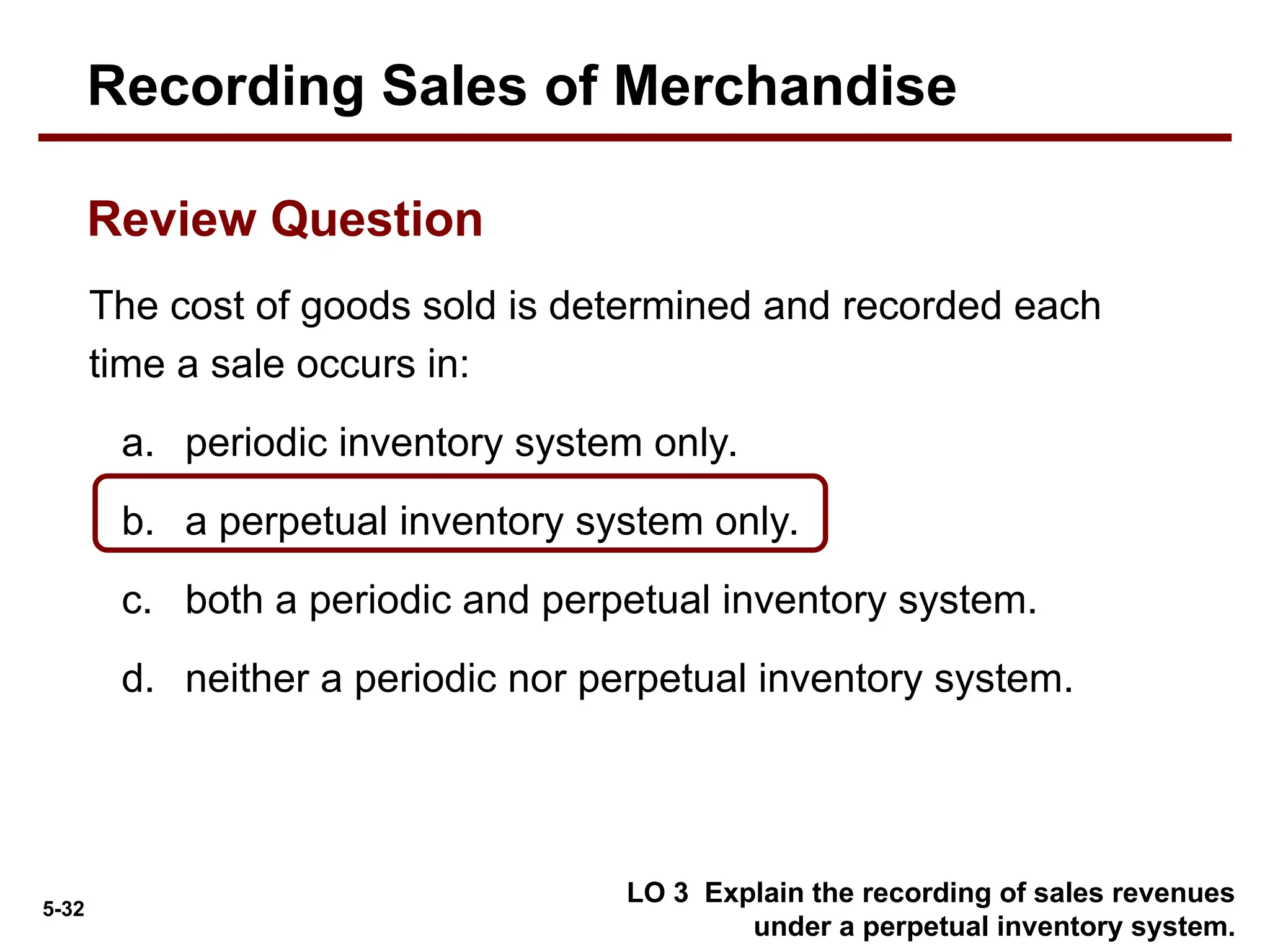
5-32
LO 3 Explainthe recording of sales revenues
under a perpetual inventory system.
The cost of goods sold is determined and recorded each
time a sale occurs in:
a. periodic inventory system only.
b. a perpetual inventory system only.
c. both a periodic and perpetual inventory system.
d. neither a periodic nor perpetual inventory system.
Review Question
Recording Sales of Merchandise
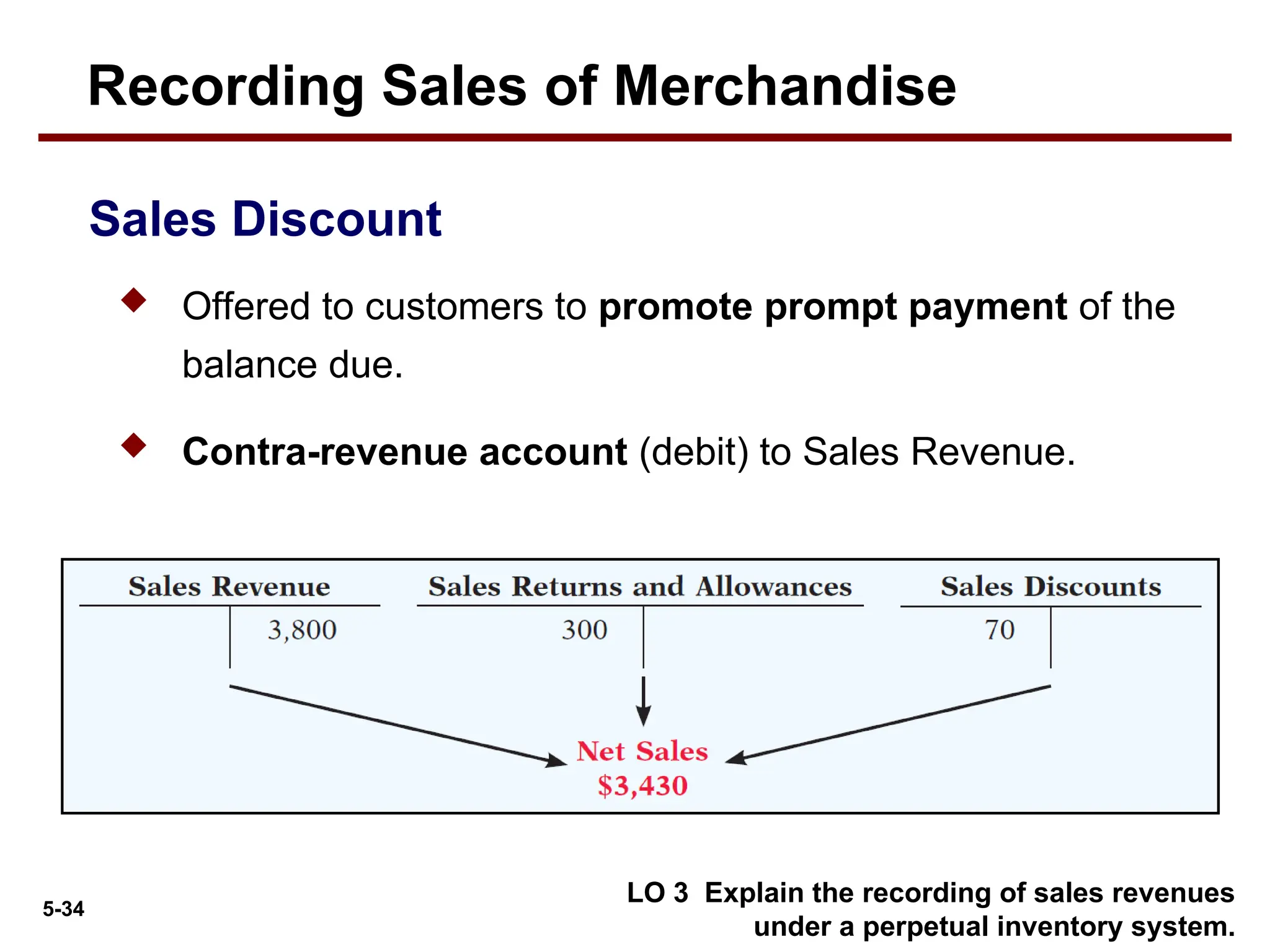
5-34
Offered tocustomers to promote prompt payment of the
balance due.
Contra-revenue account (debit) to Sales Revenue.
Sales Discount
LO 3 Explain the recording of sales revenues
under a perpetual inventory system.
Recording Sales of Merchandise
35.
5-35
LO 3 Explainthe recording of sales revenues
under a perpetual inventory system.
Cash 3,430
May 14
Accounts Receivable 3,500
Sales Discounts 70
* [($3,800 – $300) X 2%]
*
Illustration: Assume Sauk Stereo pays the balance due of
$3,500 (gross invoice price of $3,800 less purchase returns
and allowances of $300) on May 14, the last day of the
discount period. Prepare the journal entry PW Audio Supply
makes to record the receipt on May 14.
Recording Sales of Merchandise
36.
5-36
Generally thesame as a service company.
One additional adjustment to make the records agree with
the actual inventory on hand.
Involves adjusting Inventory and Cost of Goods Sold.
LO 4 Explain the steps in the accounting cycle for a merchandising company.
Completing the Accounting Cycle
Adjusting Entries
37.
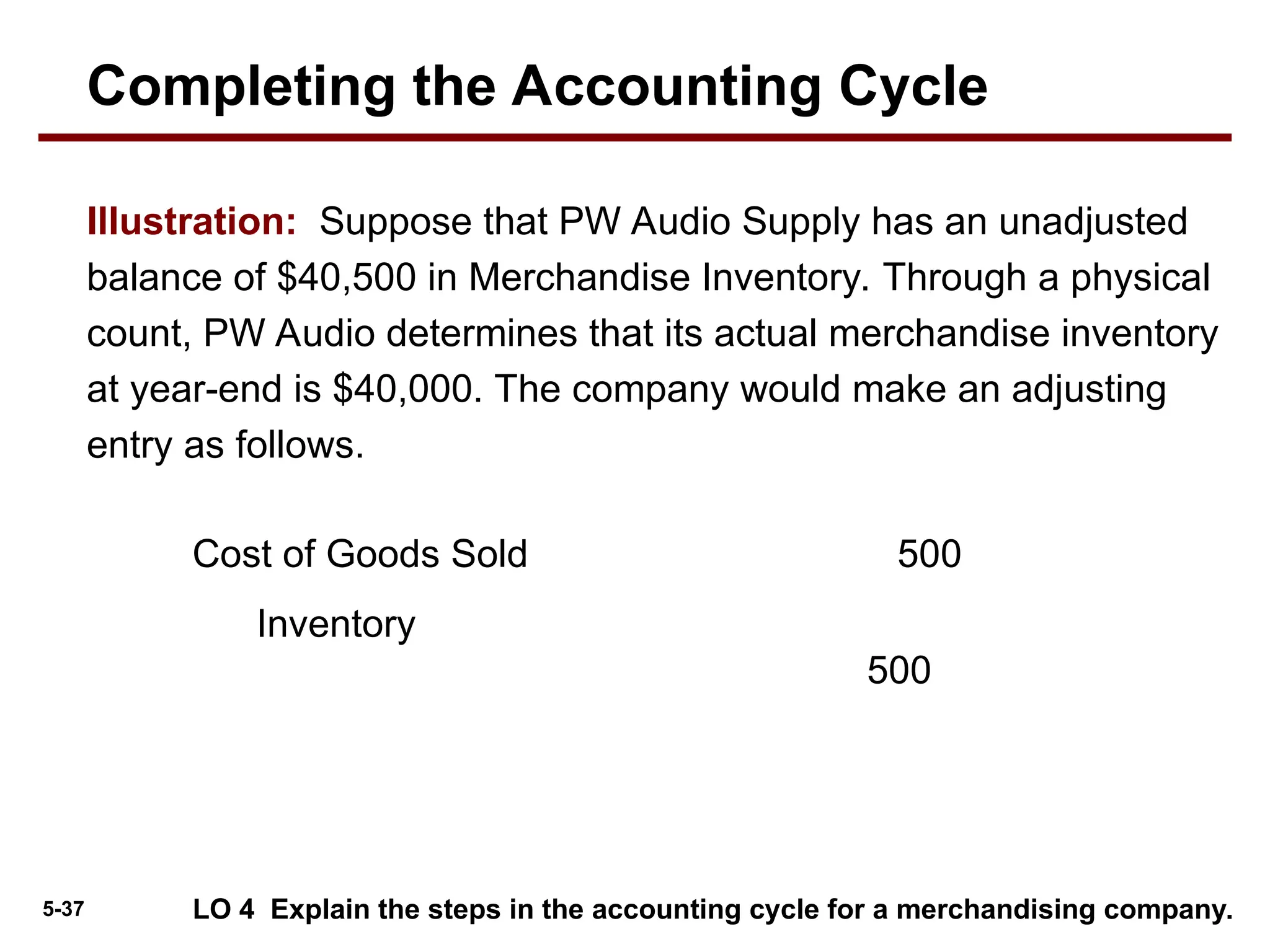
5-37 LO 4Explain the steps in the accounting cycle for a merchandising company.
Illustration: Suppose that PW Audio Supply has an unadjusted
balance of $40,500 in Merchandise Inventory. Through a physical
count, PW Audio determines that its actual merchandise inventory
at year-end is $40,000. The company would make an adjusting
entry as follows.
Cost of Goods Sold 500
Inventory
500
Completing the Accounting Cycle
38.
5-38
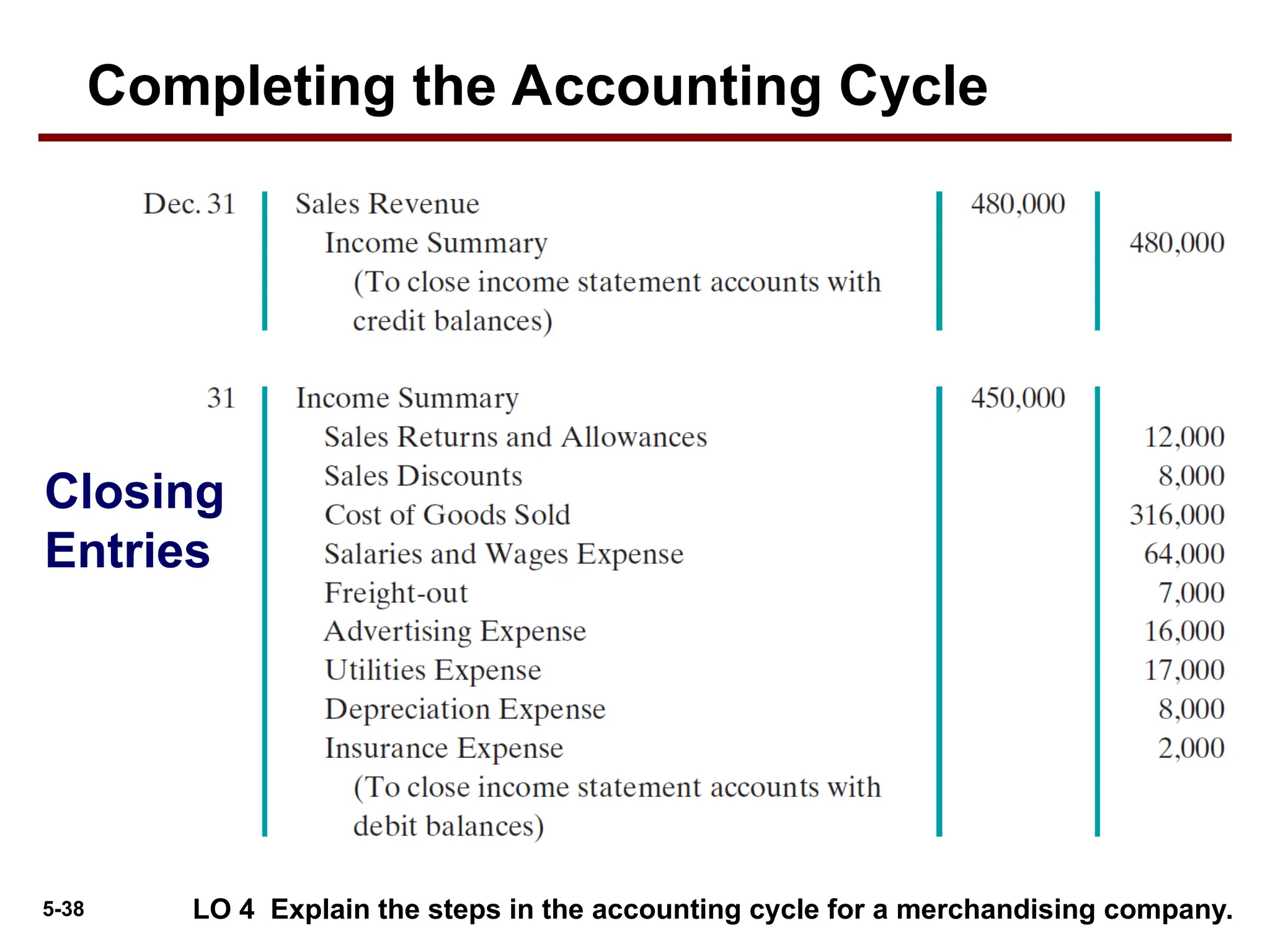
Completing the AccountingCycle
Closing
Entries
LO 4 Explain the steps in the accounting cycle for a merchandising company.
39.
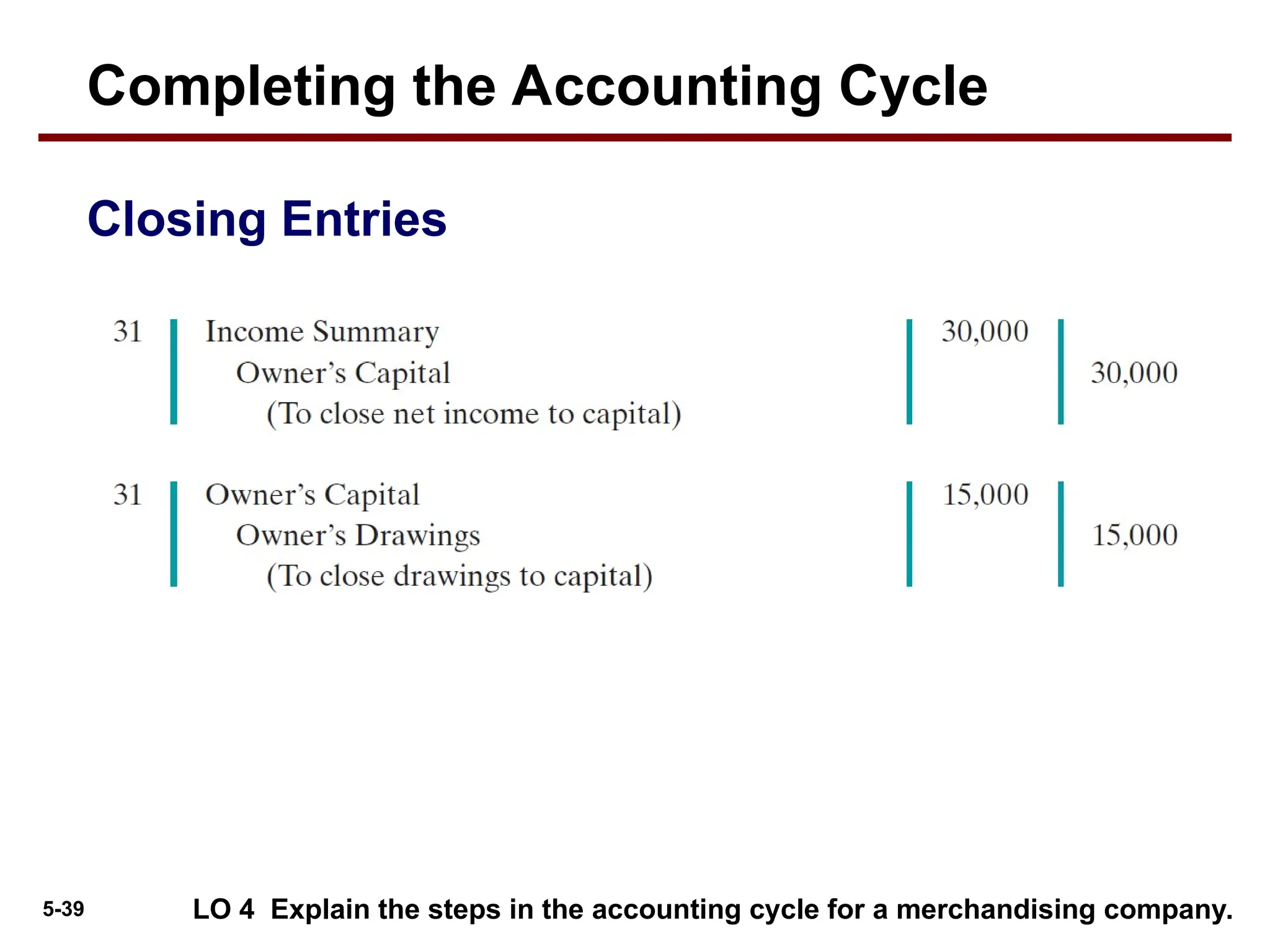
5-39
Completing the AccountingCycle
Closing Entries
LO 4 Explain the steps in the accounting cycle for a merchandising company.
40.
5-40
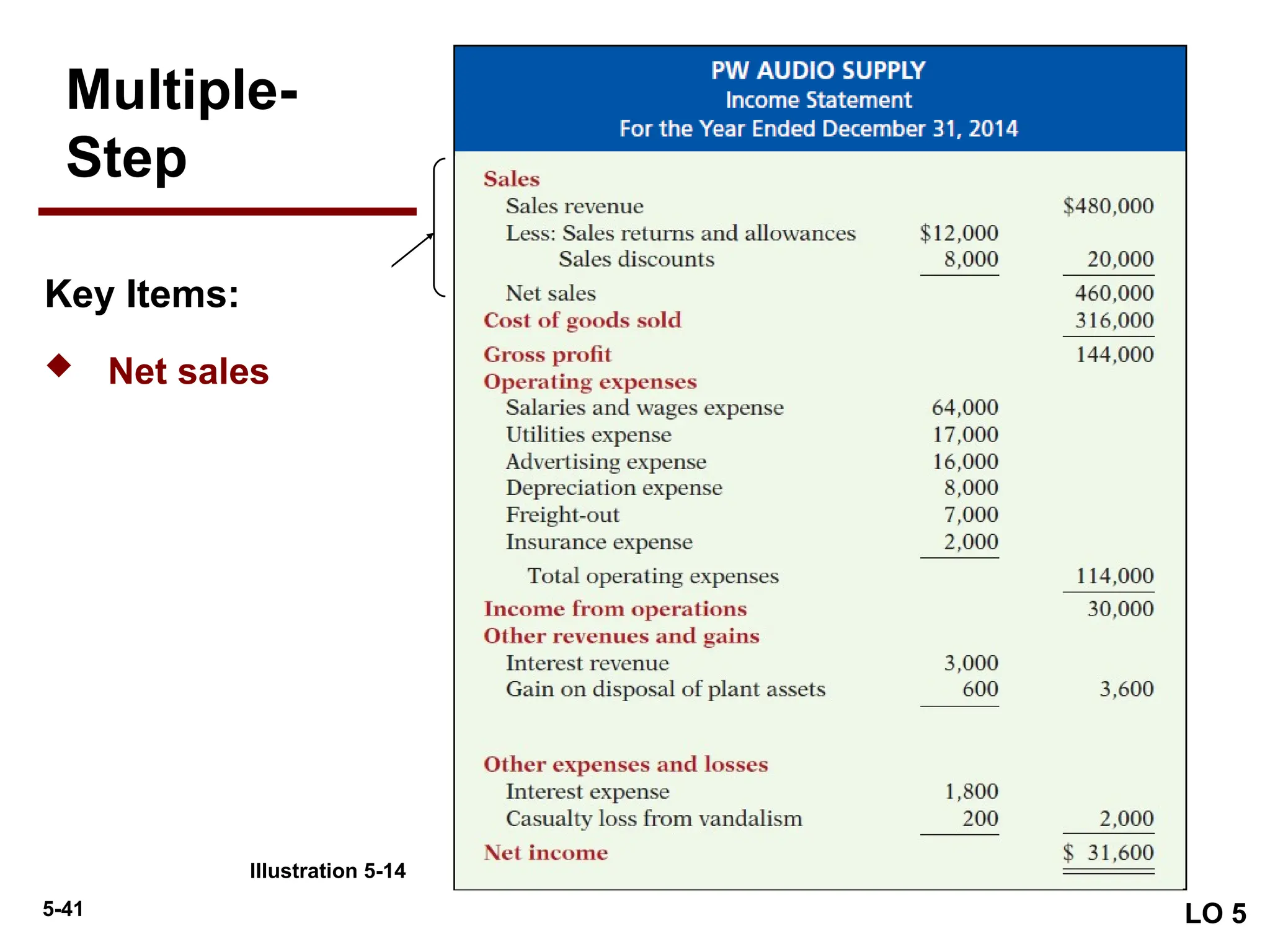
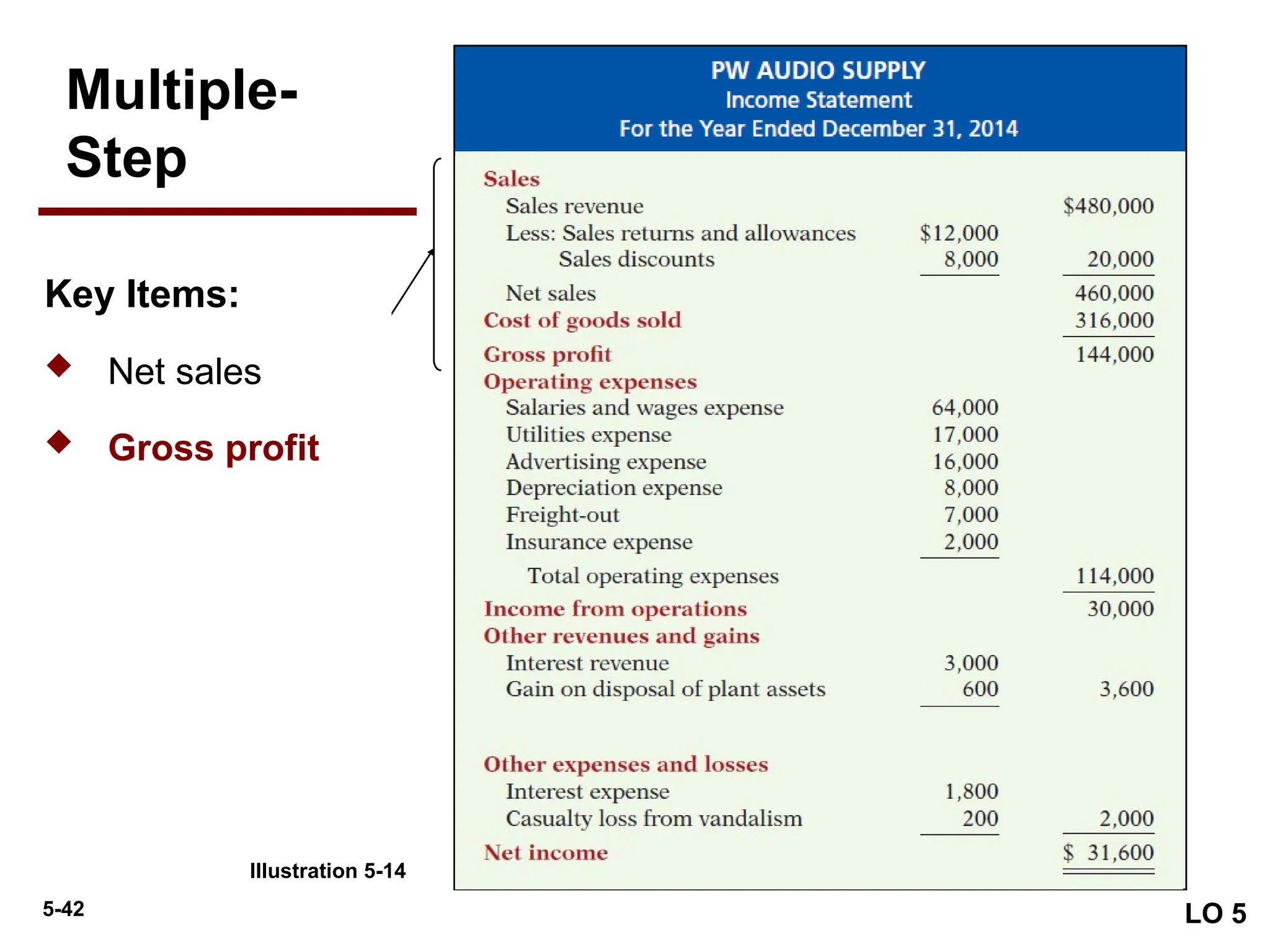
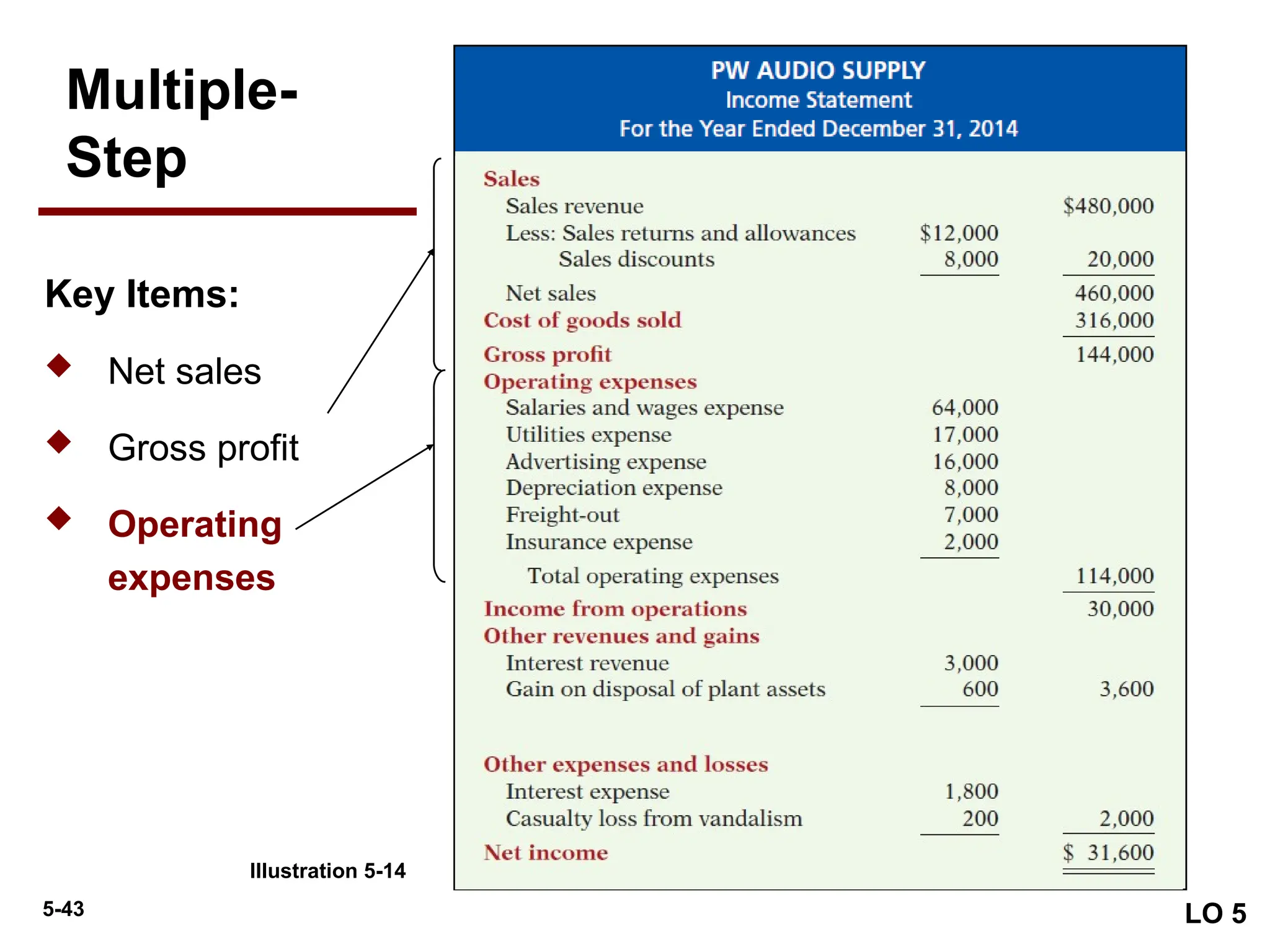
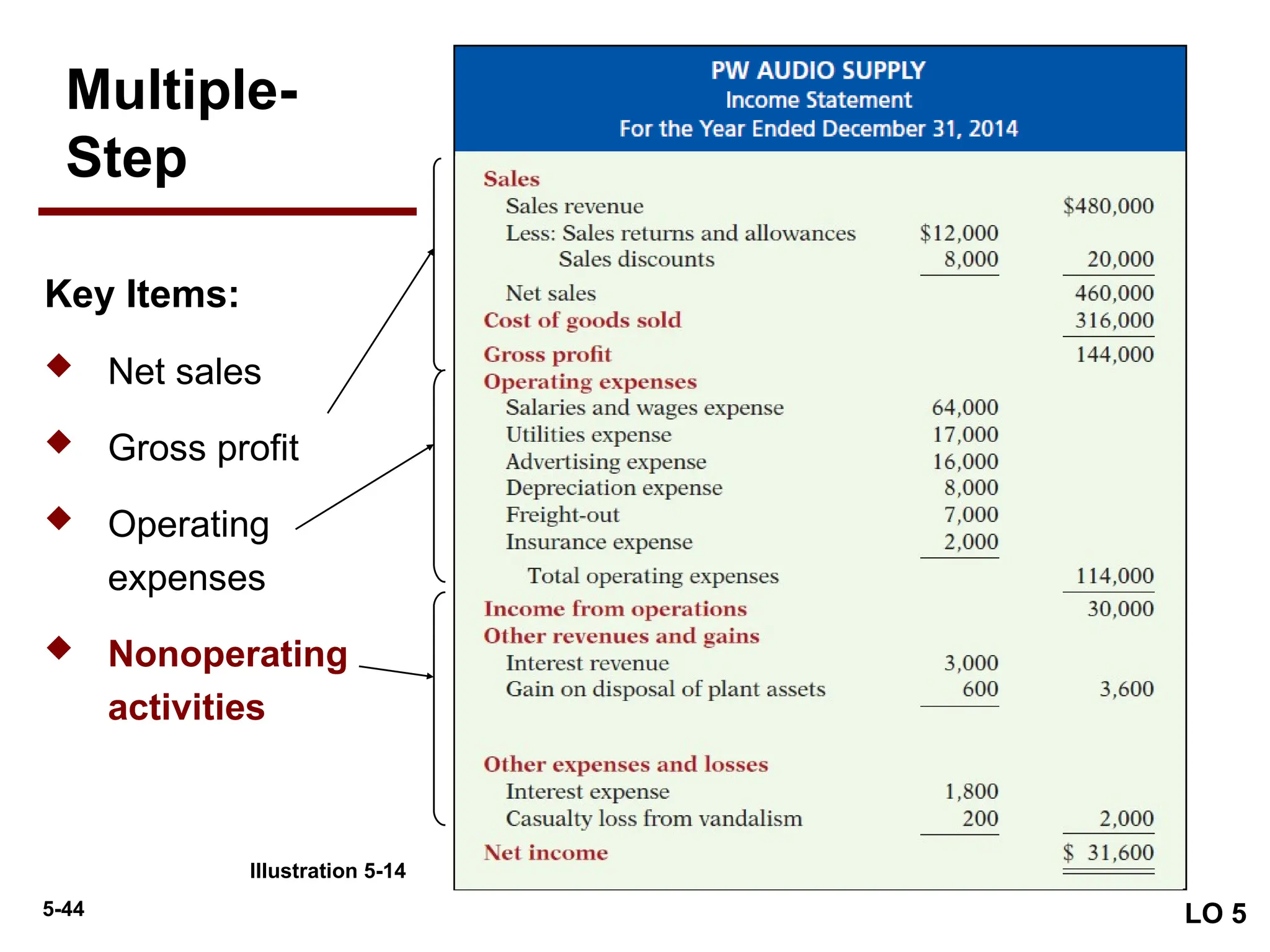
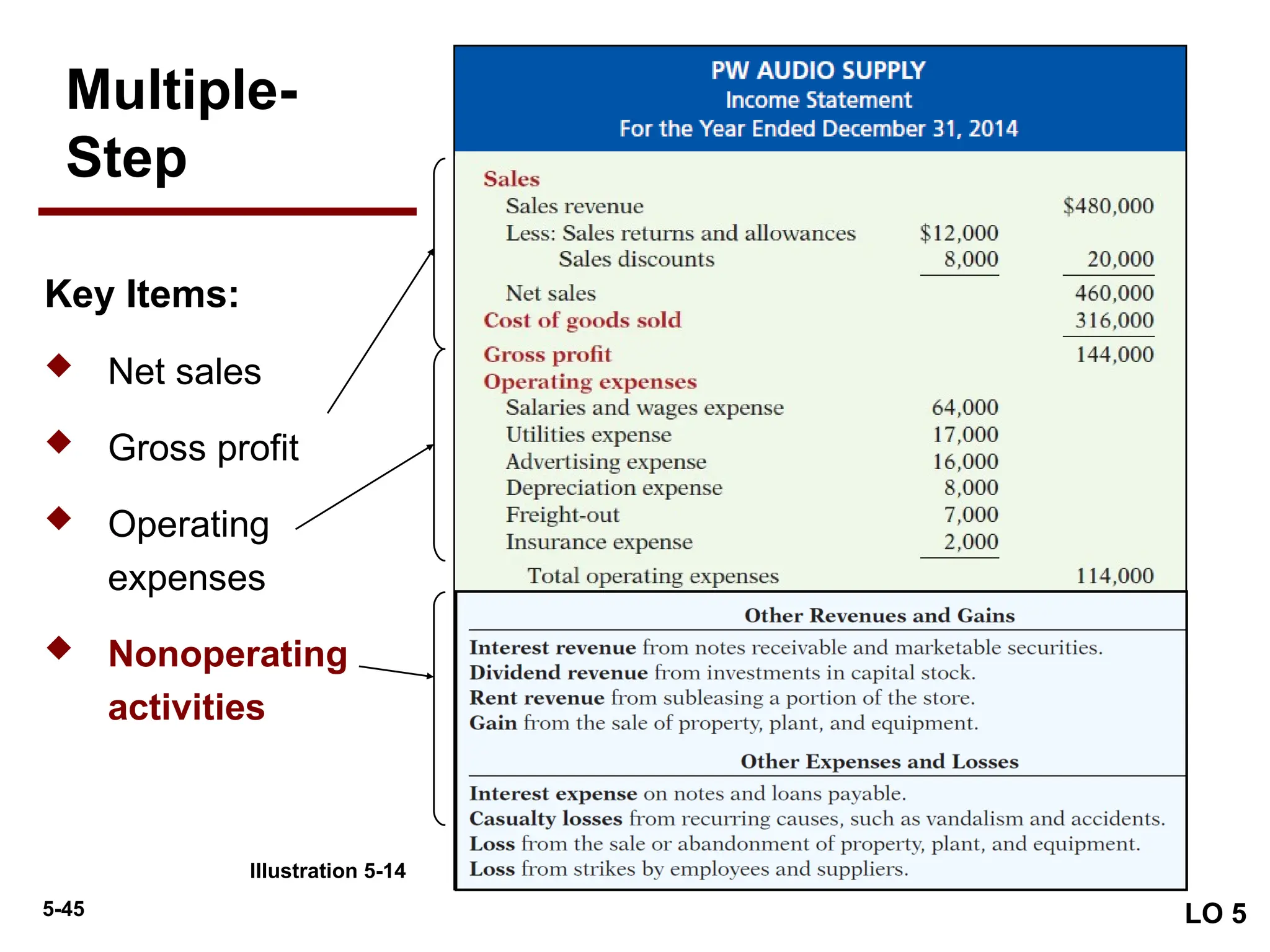
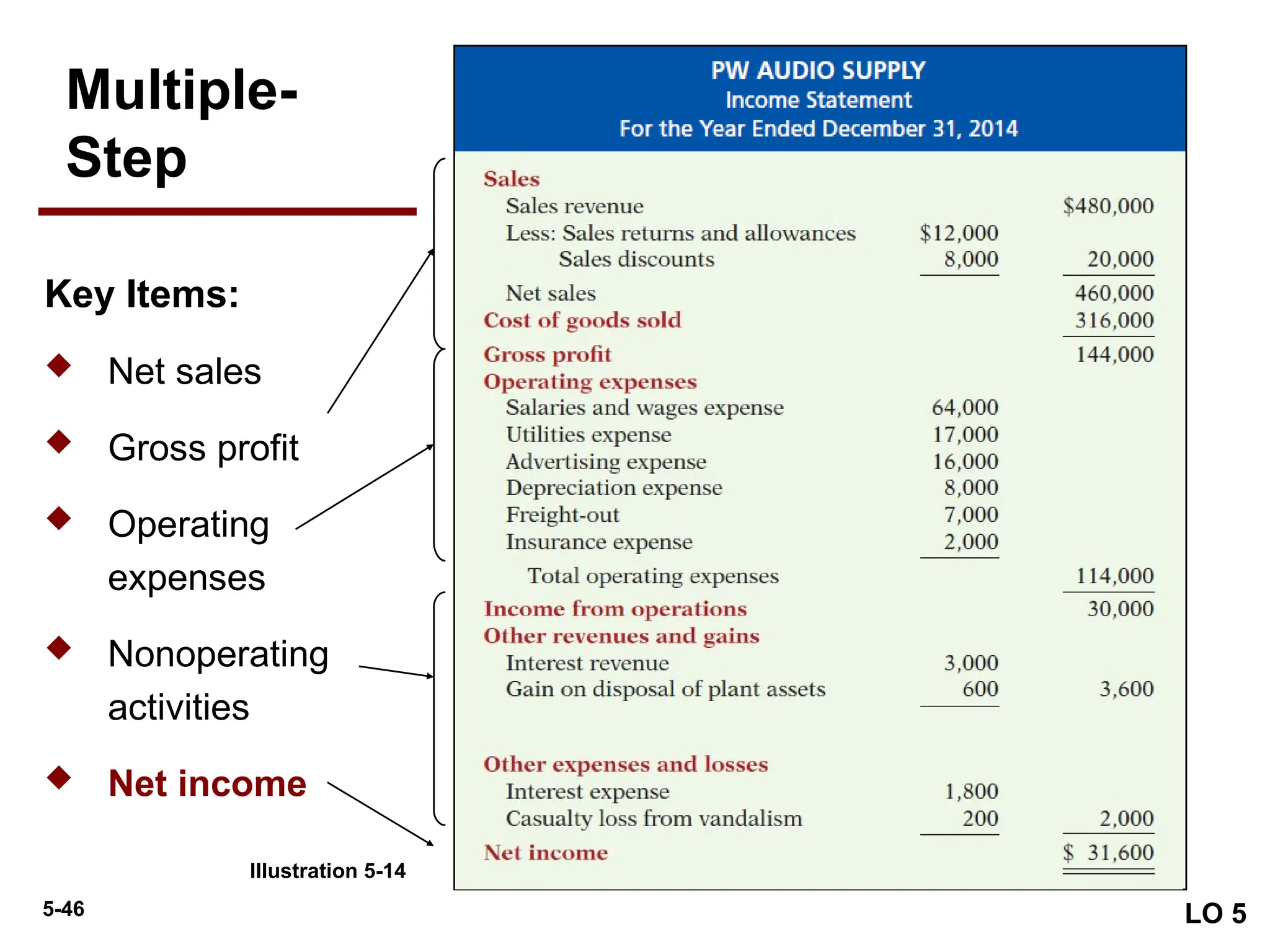
Multiple-Step Income Statement
Formsof Financial Statements
Shows several steps in determining net income.
Two steps relate to principal operating activities.
Distinguishes between operating and non-operating
activities.
LO 5 Distinguish between a multiple-step and a single-step income statement.
5-47
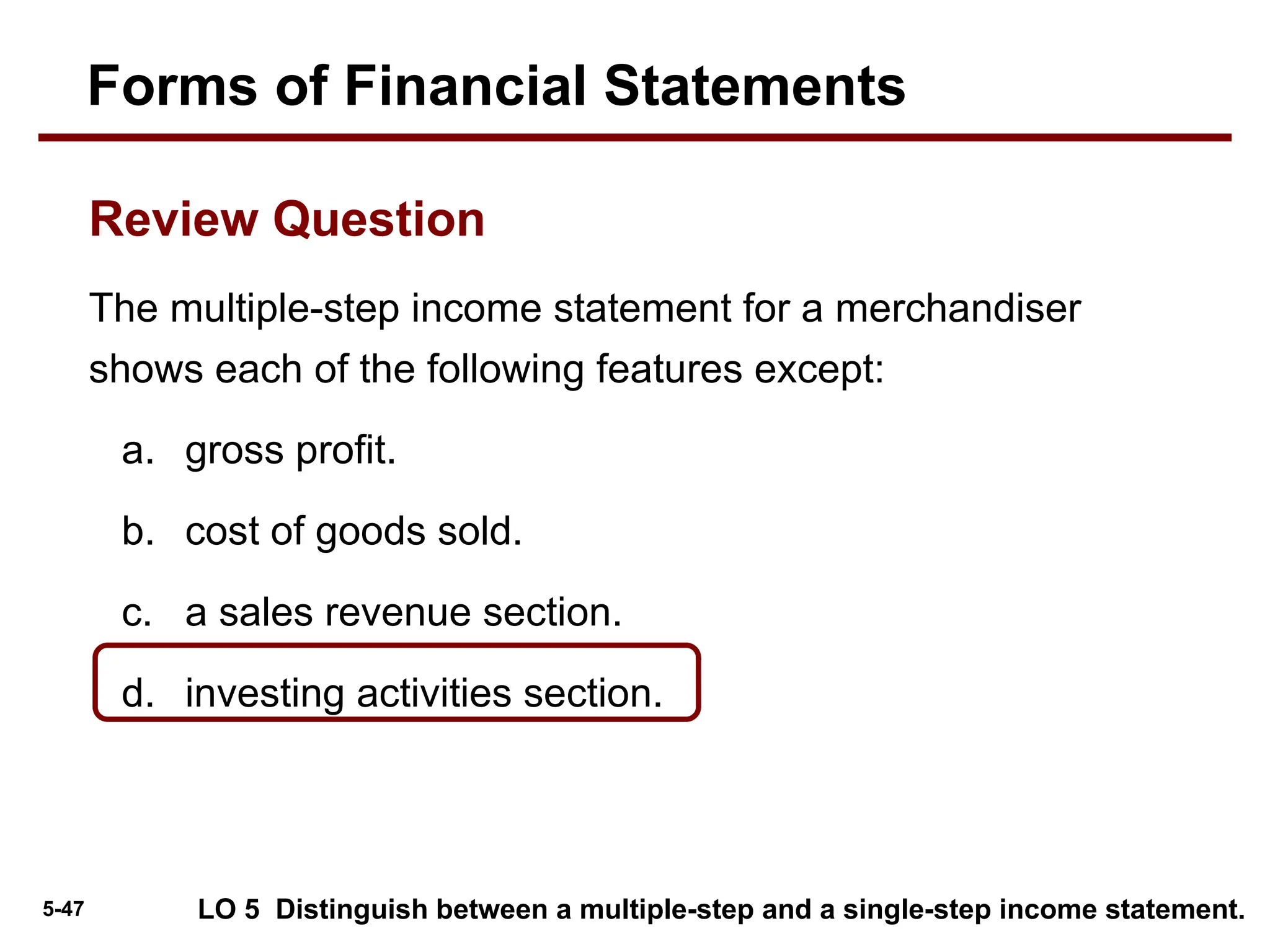
The multiple-step incomestatement for a merchandiser
shows each of the following features except:
a. gross profit.
b. cost of goods sold.
c. a sales revenue section.
d. investing activities section.
Review Question
Forms of Financial Statements
LO 5 Distinguish between a multiple-step and a single-step income statement.
5-49
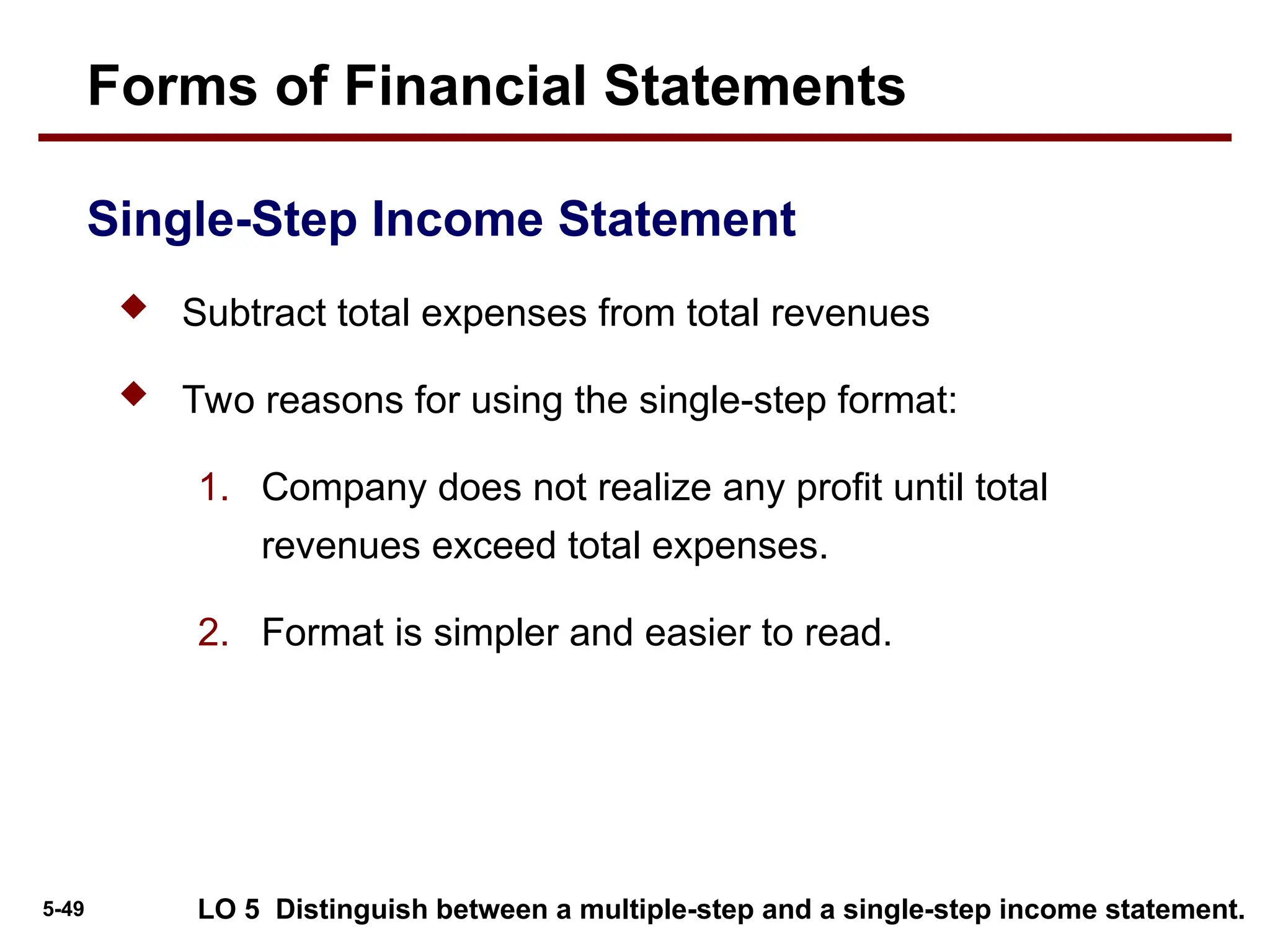
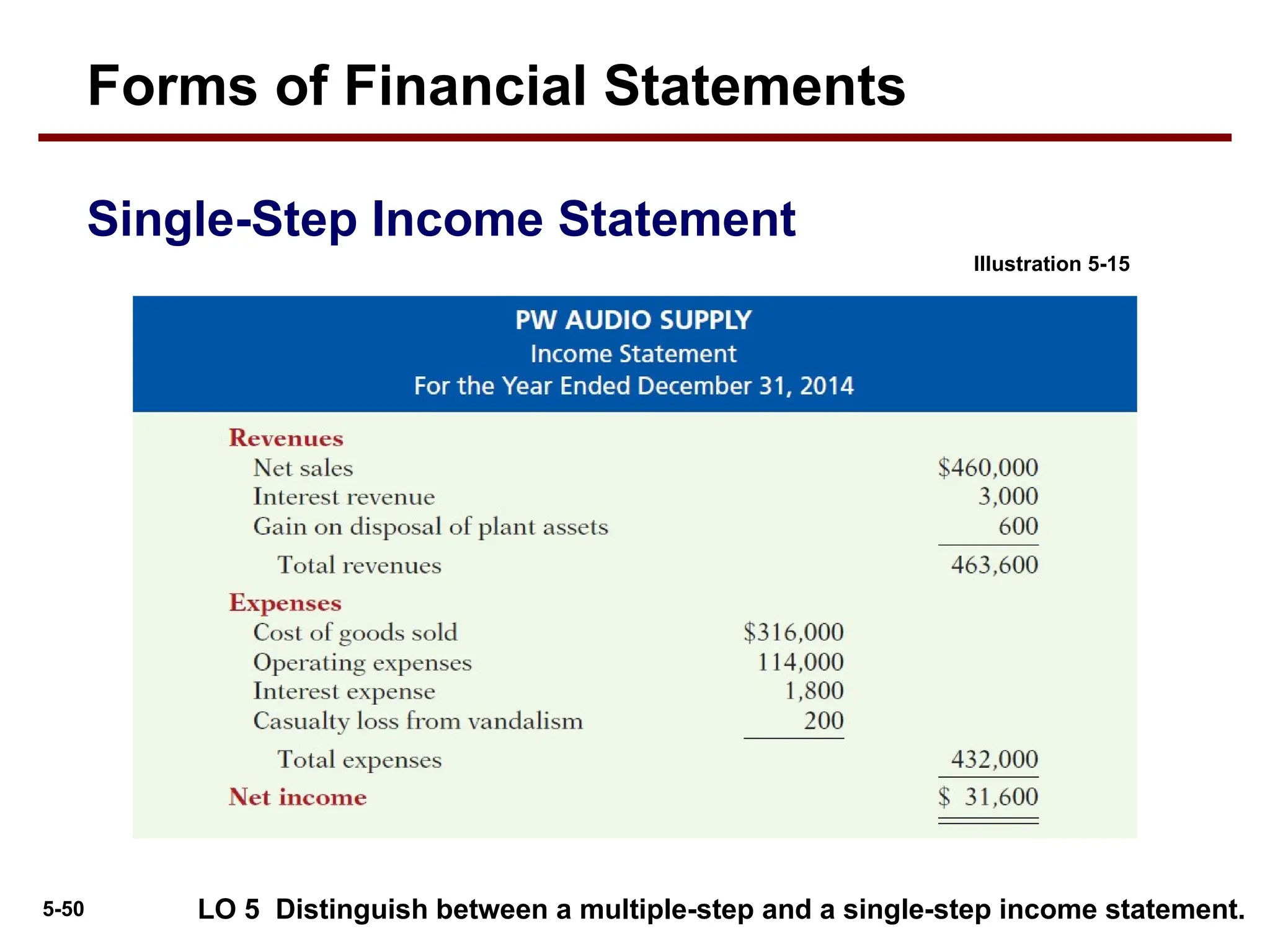
Subtract totalexpenses from total revenues
Two reasons for using the single-step format:
1. Company does not realize any profit until total
revenues exceed total expenses.
2. Format is simpler and easier to read.
Single-Step Income Statement
Forms of Financial Statements
LO 5 Distinguish between a multiple-step and a single-step income statement.
5-52
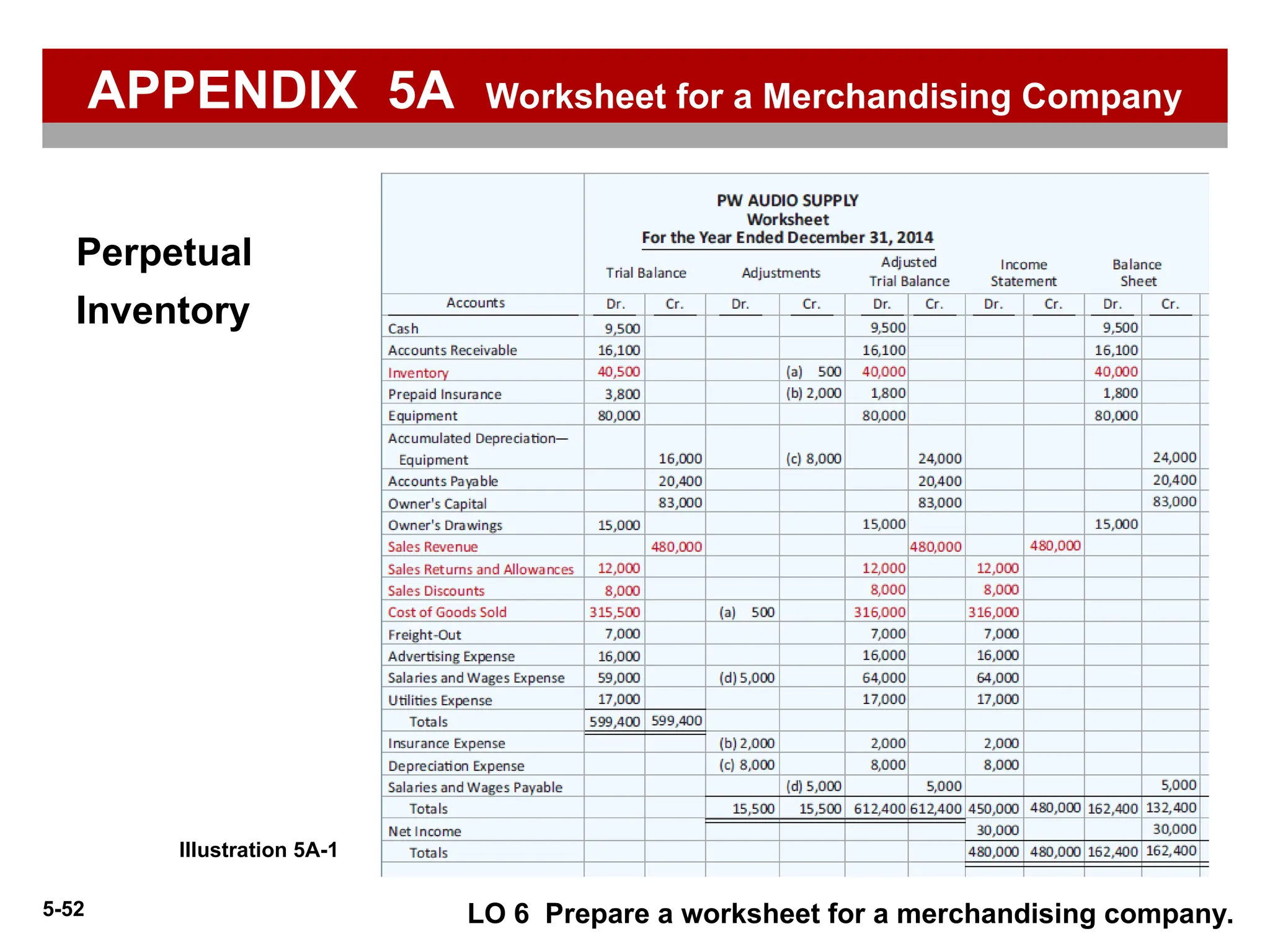
Illustration 5A-1
LO 6Prepare a worksheet for a merchandising company.
Perpetual
Inventory
APPENDIX 5A Worksheet for a Merchandising Company
53.
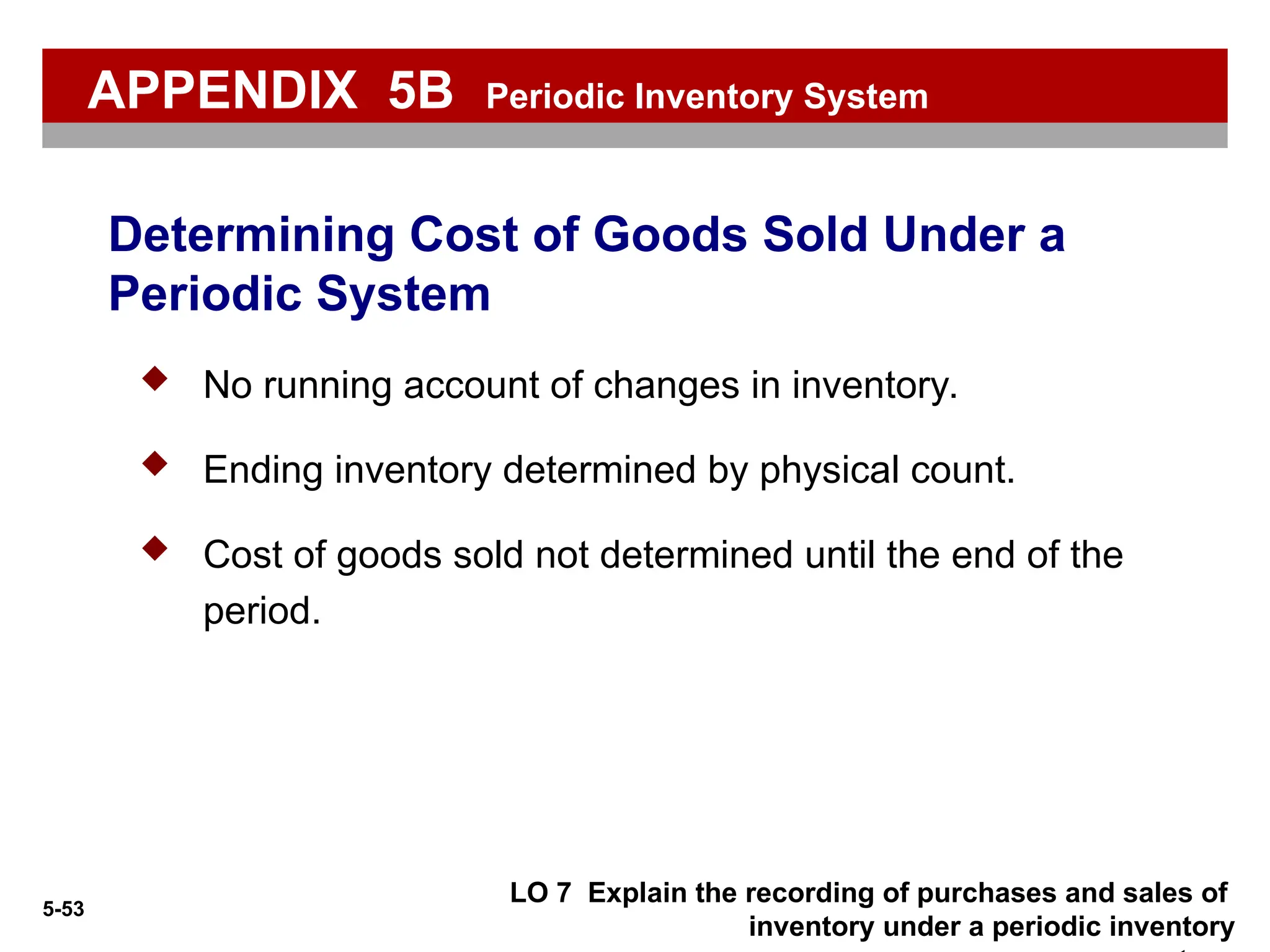
5-53
No runningaccount of changes in inventory.
Ending inventory determined by physical count.
Cost of goods sold not determined until the end of the
period.
Determining Cost of Goods Sold Under a
Periodic System
APPENDIX 5B Periodic Inventory System
LO 7 Explain the recording of purchases and sales of
inventory under a periodic inventory
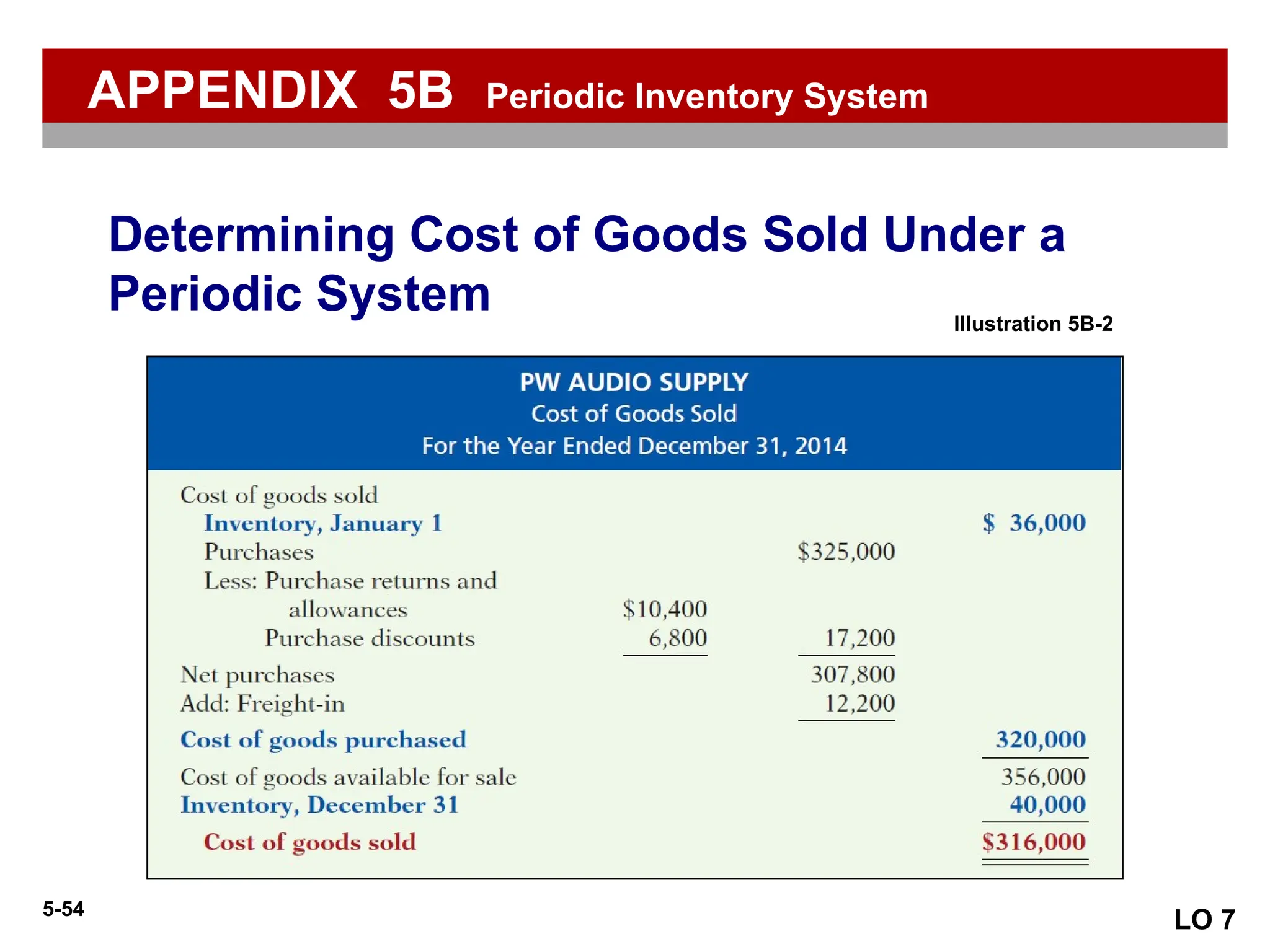
54.
5-54
Determining Cost ofGoods Sold Under a
Periodic System
LO 7
Illustration 5B-2
APPENDIX 5B Periodic Inventory System
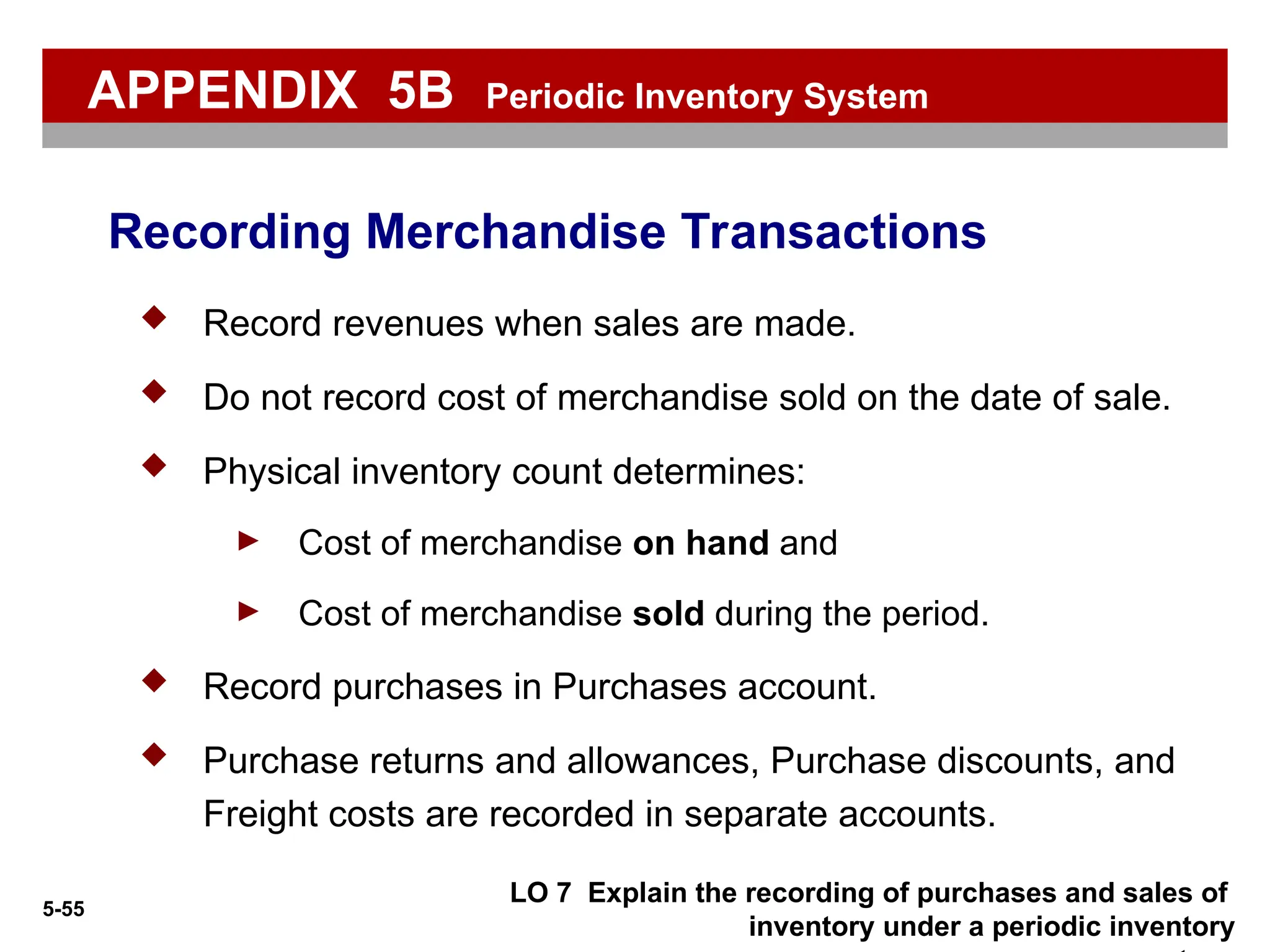
55.
5-55
LO 7 Explainthe recording of purchases and sales of
inventory under a periodic inventory
Record revenues when sales are made.
Do not record cost of merchandise sold on the date of sale.
Physical inventory count determines:
► Cost of merchandise on hand and
► Cost of merchandise sold during the period.
Record purchases in Purchases account.
Purchase returns and allowances, Purchase discounts, and
Freight costs are recorded in separate accounts.
Recording Merchandise Transactions
APPENDIX 5B Periodic Inventory System
56.
5-56
LO 7 Explainthe recording of purchases and sales of
inventory under a periodic inventory
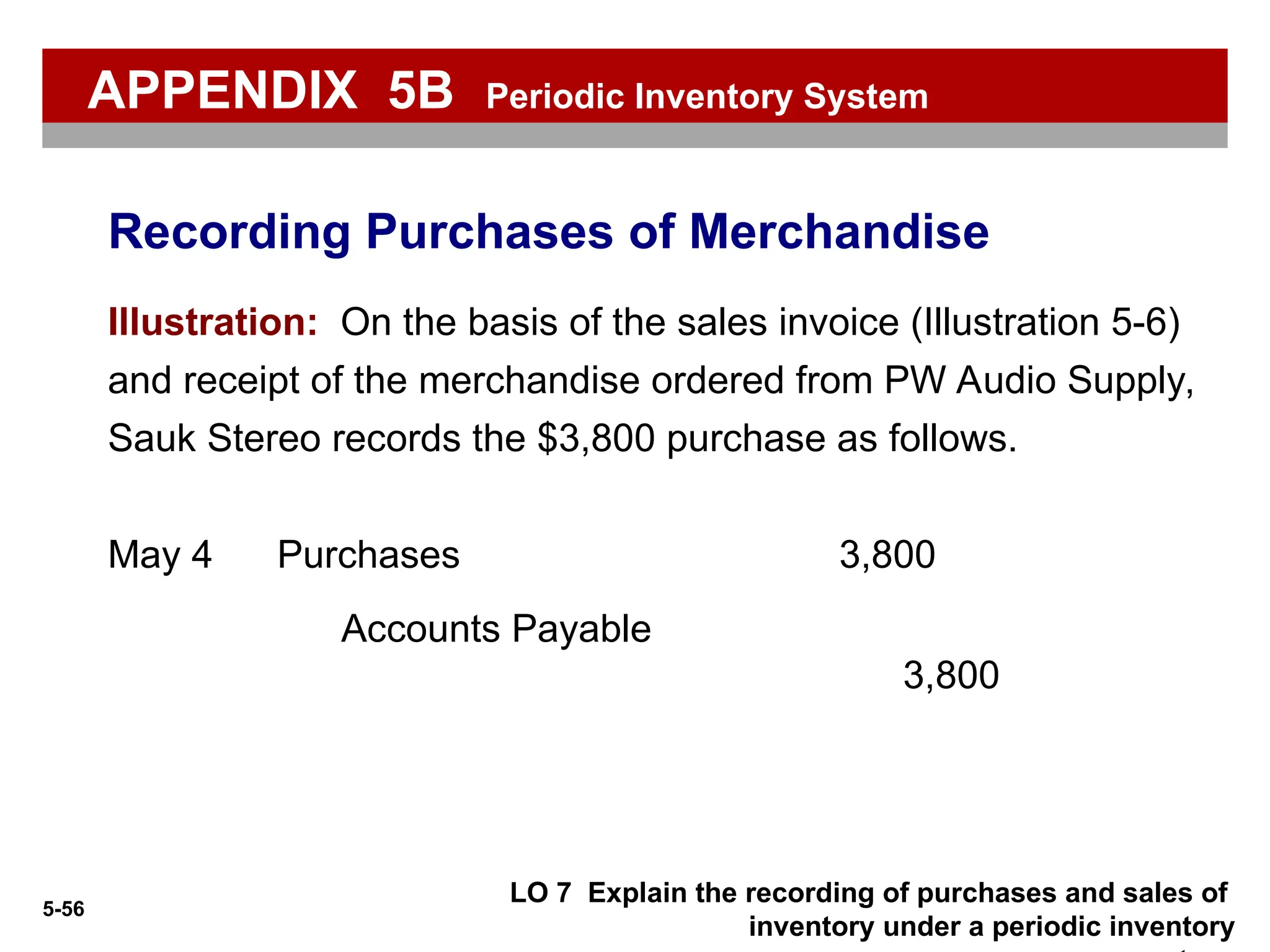
Illustration: On the basis of the sales invoice (Illustration 5-6)
and receipt of the merchandise ordered from PW Audio Supply,
Sauk Stereo records the $3,800 purchase as follows.
Purchases 3,800
May 4
Accounts Payable
3,800
Recording Purchases of Merchandise
APPENDIX 5B Periodic Inventory System
57.
5-57
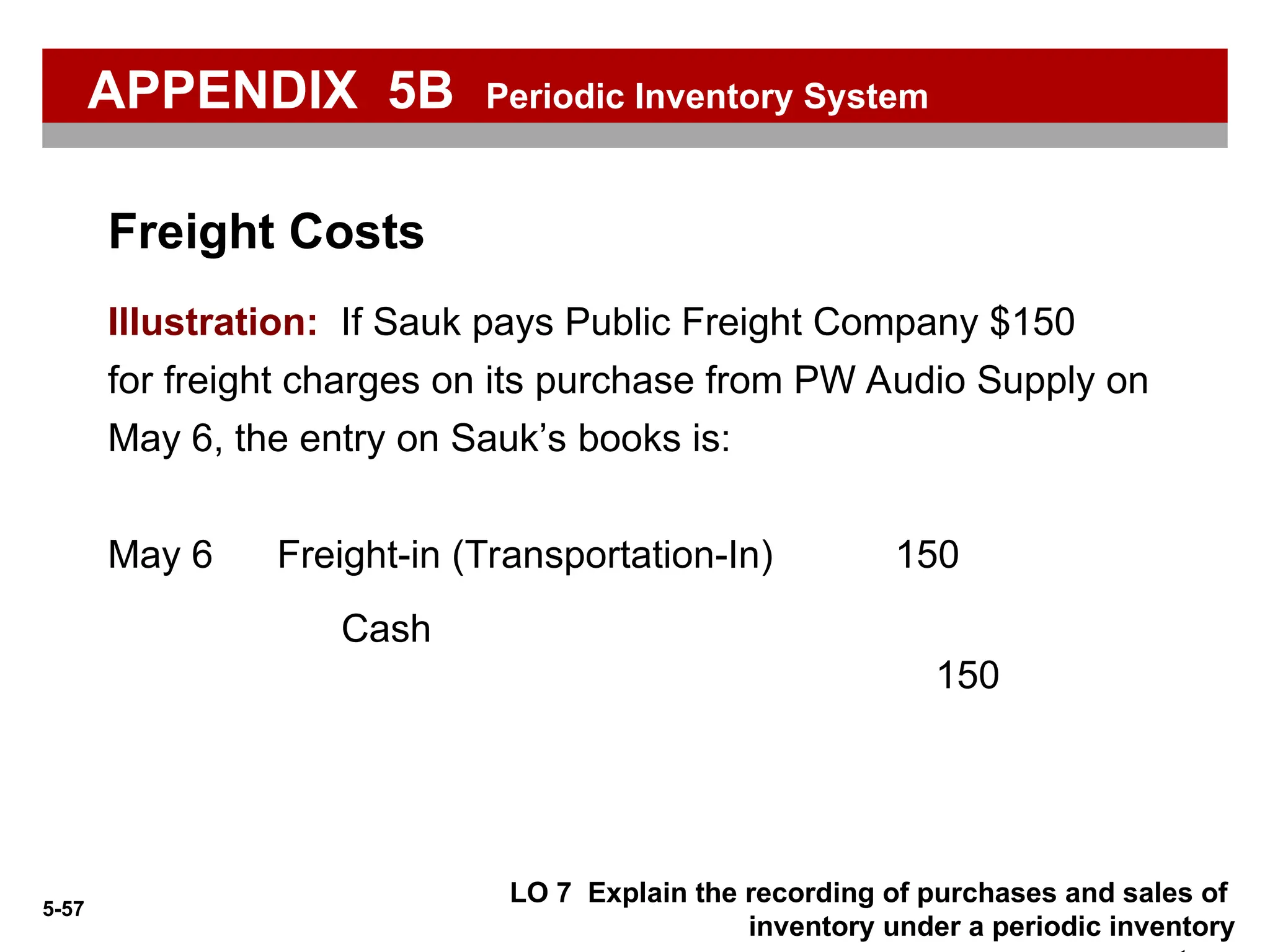
Illustration: If Saukpays Public Freight Company $150
for freight charges on its purchase from PW Audio Supply on
May 6, the entry on Sauk’s books is:
Freight-in (Transportation-In) 150
May 6
Cash
150
LO 7 Explain the recording of purchases and sales of
inventory under a periodic inventory
Freight Costs
APPENDIX 5B Periodic Inventory System
58.
5-58
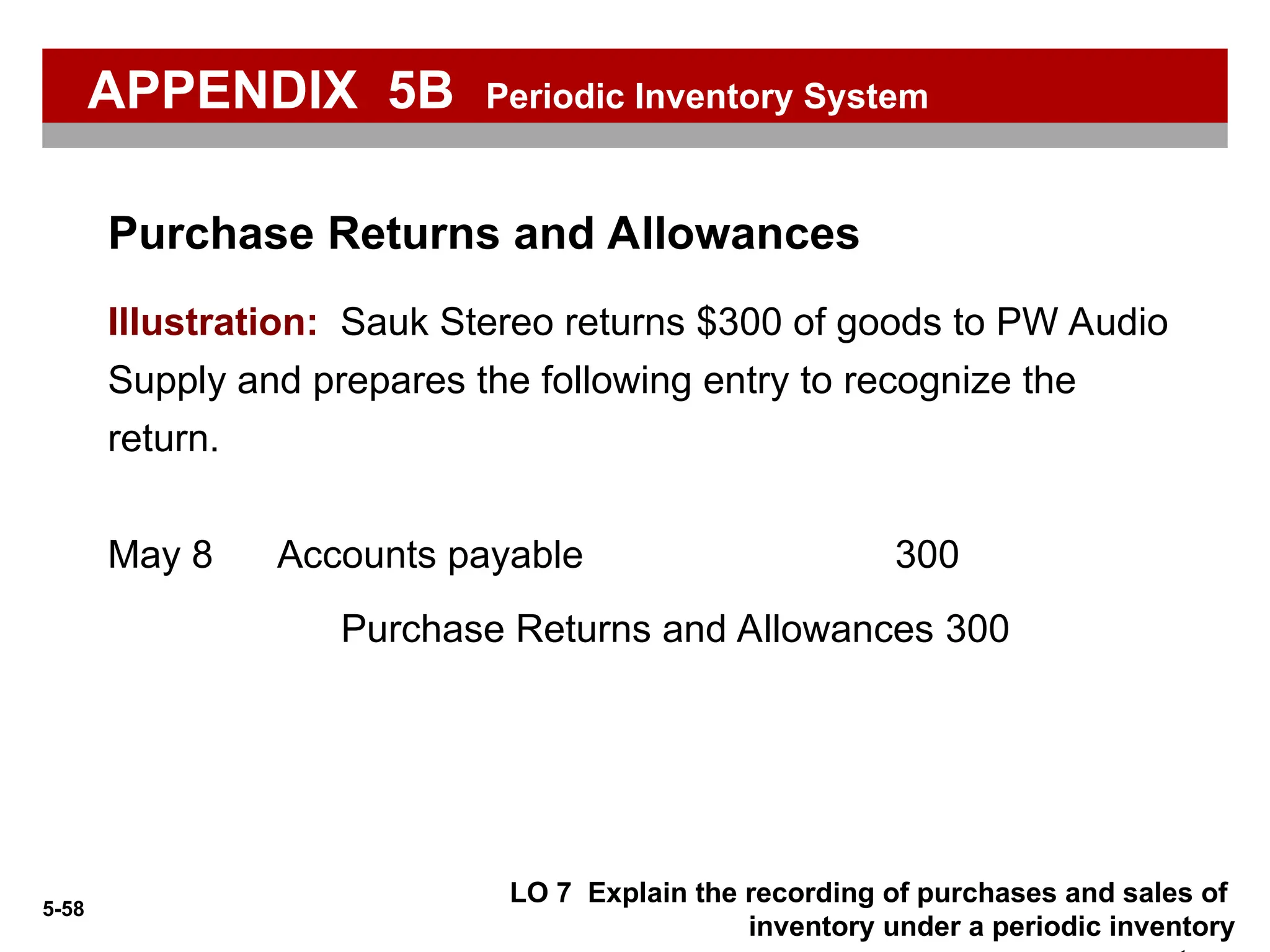
Accounts payable 300
May8
Purchase Returns and Allowances 300
Purchase Returns and Allowances
LO 7 Explain the recording of purchases and sales of
inventory under a periodic inventory
Illustration: Sauk Stereo returns $300 of goods to PW Audio
Supply and prepares the following entry to recognize the
return.
APPENDIX 5B Periodic Inventory System
59.
5-59
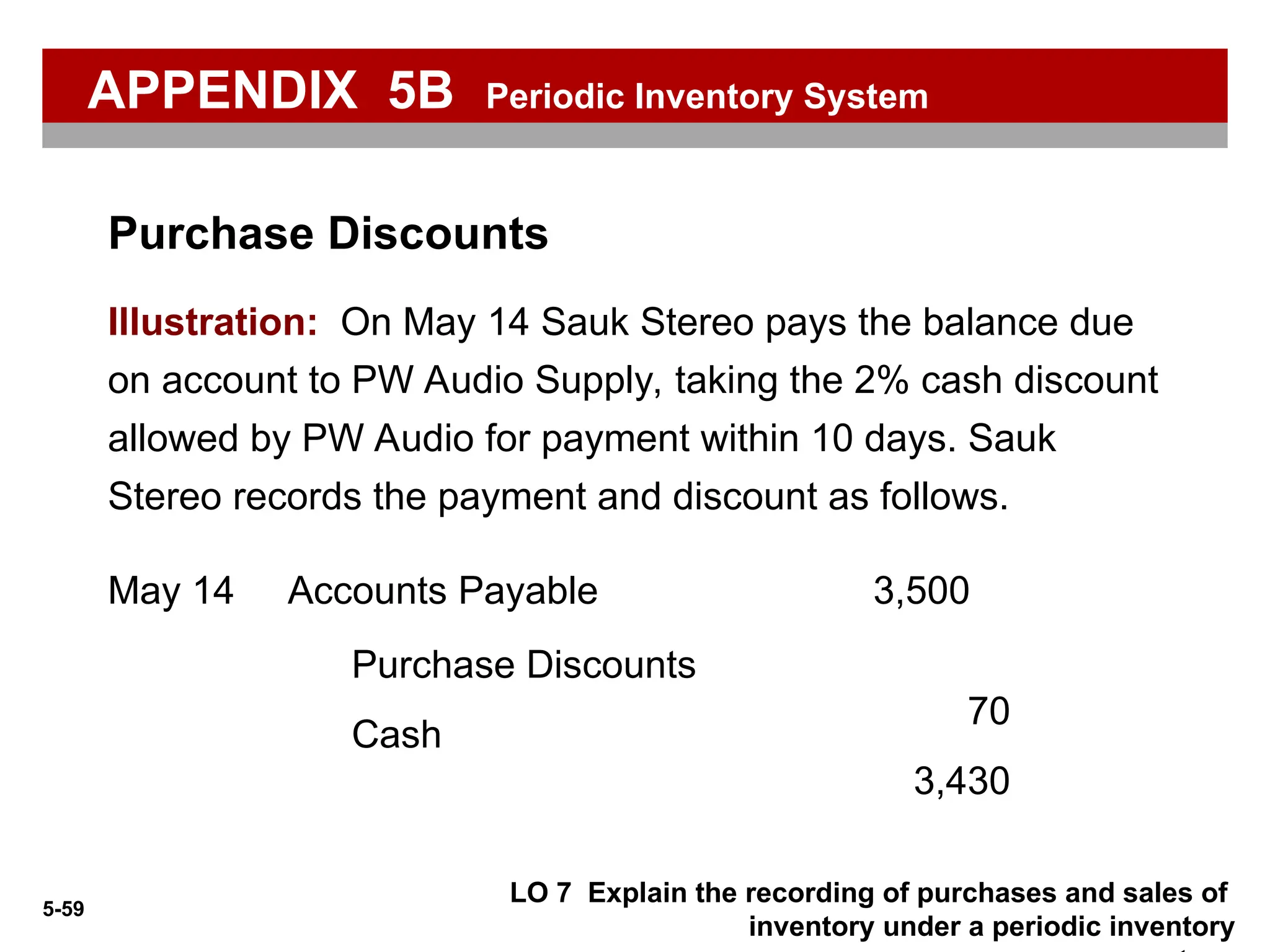
Accounts Payable 3,500
May14
Purchase Discounts
70
Purchase Discounts
Cash
3,430
LO 7 Explain the recording of purchases and sales of
inventory under a periodic inventory
Illustration: On May 14 Sauk Stereo pays the balance due
on account to PW Audio Supply, taking the 2% cash discount
allowed by PW Audio for payment within 10 days. Sauk
Stereo records the payment and discount as follows.
APPENDIX 5B Periodic Inventory System
60.
5-60
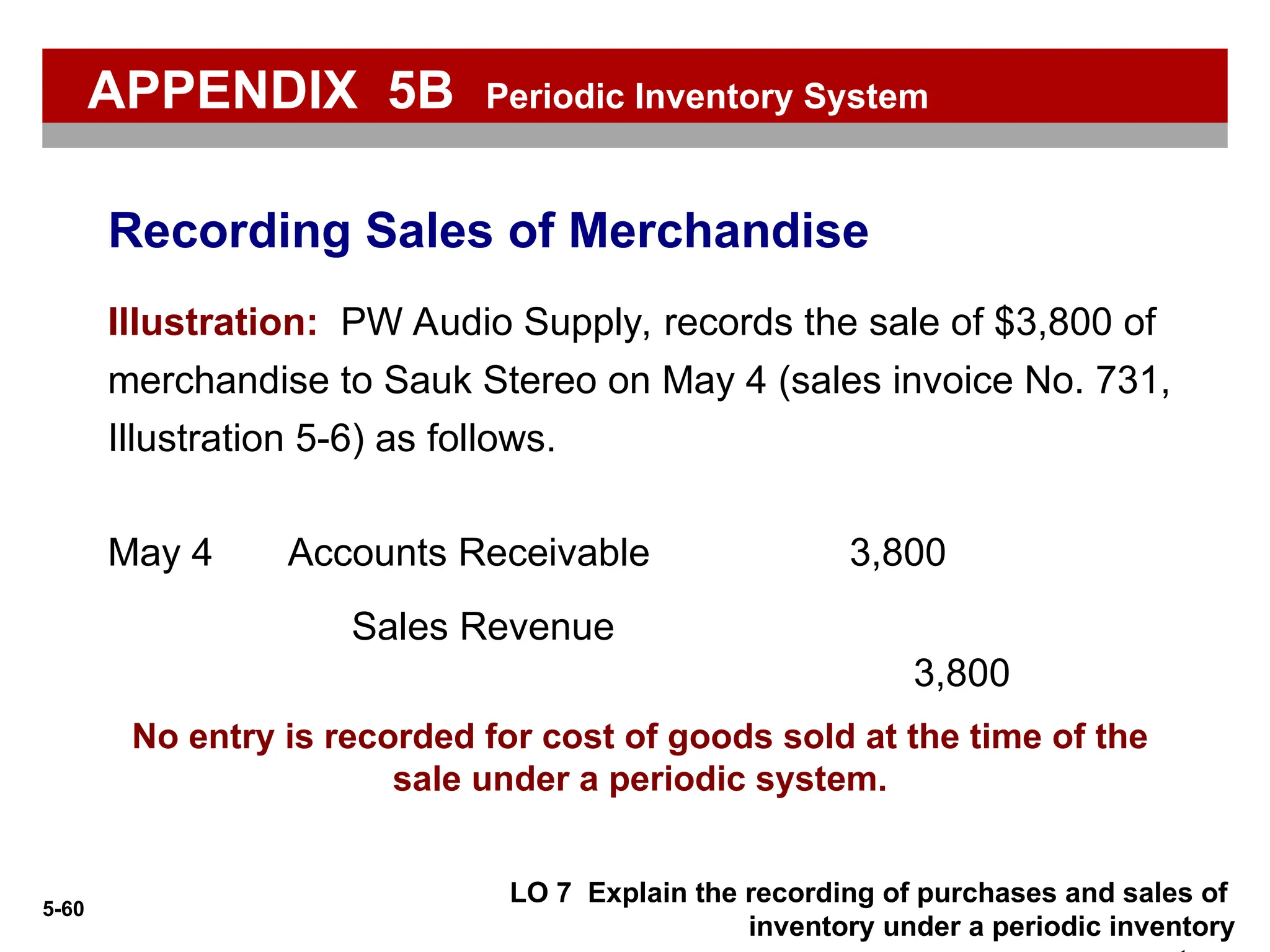
No entry isrecorded for cost of goods sold at the time of the
sale under a periodic system.
Illustration: PW Audio Supply, records the sale of $3,800 of
merchandise to Sauk Stereo on May 4 (sales invoice No. 731,
Illustration 5-6) as follows.
Accounts Receivable 3,800
May 4
Sales Revenue
3,800
LO 7 Explain the recording of purchases and sales of
inventory under a periodic inventory
Recording Sales of Merchandise
APPENDIX 5B Periodic Inventory System
61.
5-61
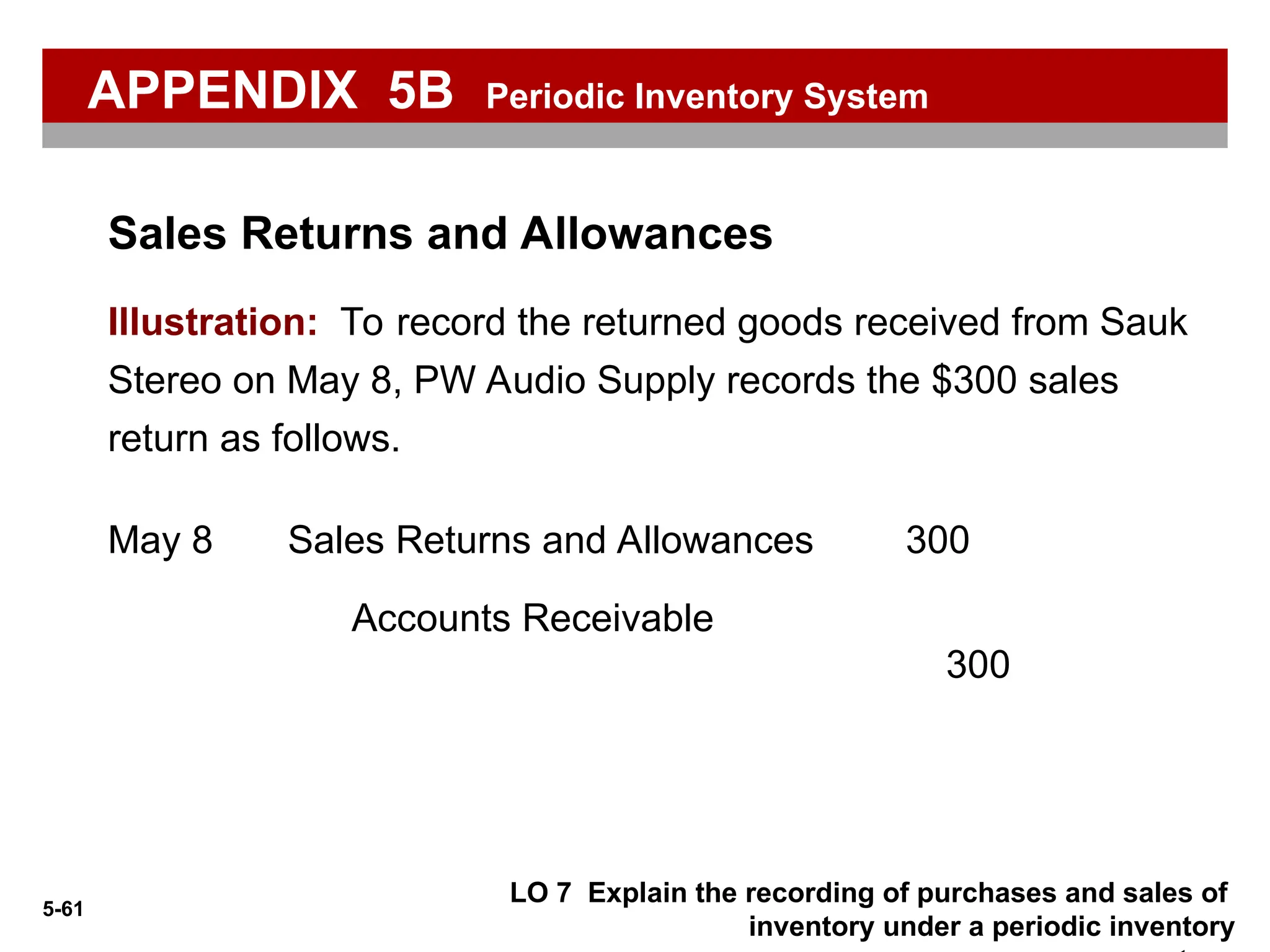
Illustration: To recordthe returned goods received from Sauk
Stereo on May 8, PW Audio Supply records the $300 sales
return as follows.
Sales Returns and Allowances 300
May 8
Accounts Receivable
300
Sales Returns and Allowances
LO 7 Explain the recording of purchases and sales of
inventory under a periodic inventory
APPENDIX 5B Periodic Inventory System
62.
5-62
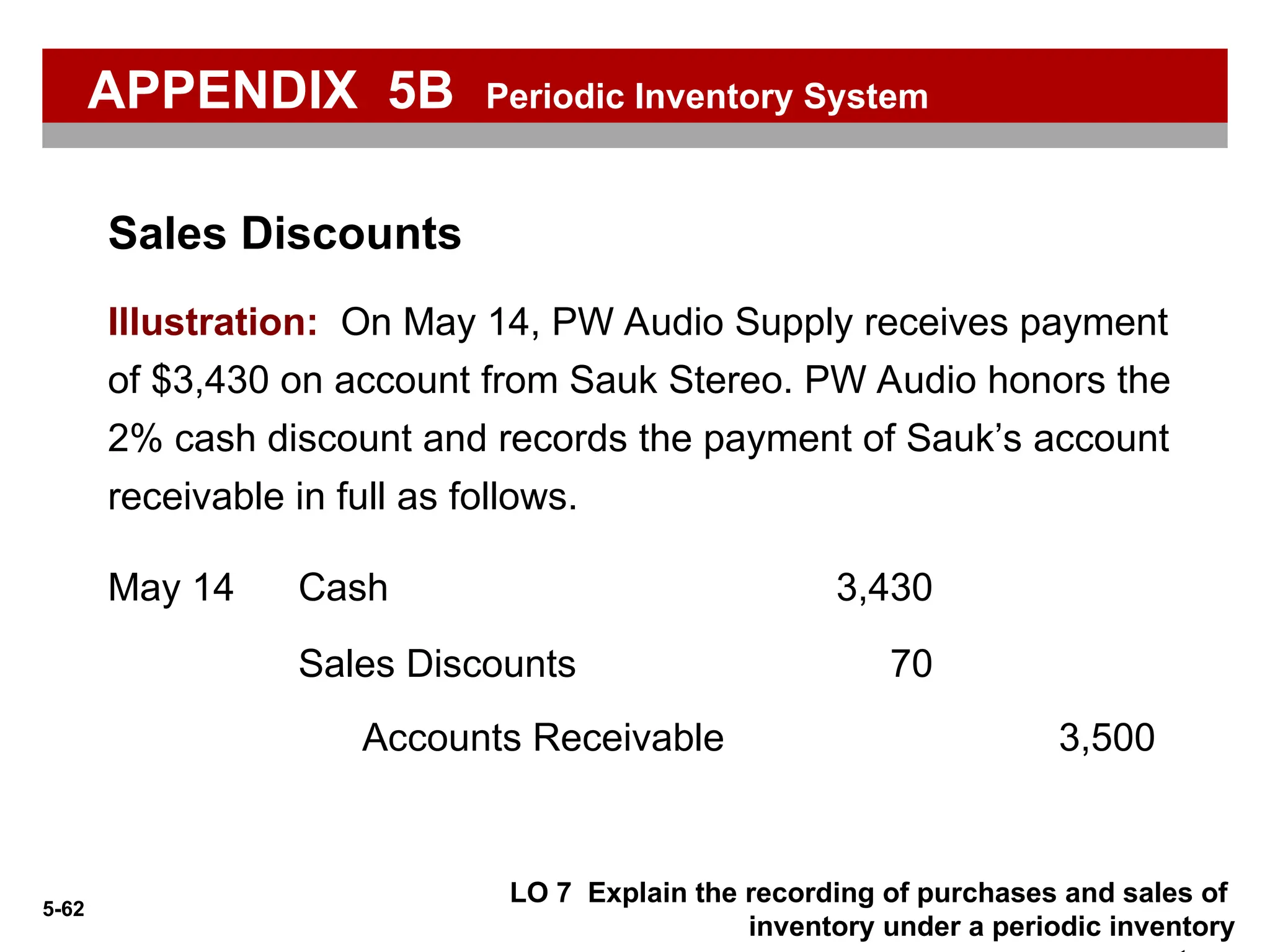
Cash 3,430
May 14
AccountsReceivable 3,500
Sales Discounts 70
LO 7 Explain the recording of purchases and sales of
inventory under a periodic inventory
Sales Discounts
Illustration: On May 14, PW Audio Supply receives payment
of $3,430 on account from Sauk Stereo. PW Audio honors the
2% cash discount and records the payment of Sauk’s account
receivable in full as follows.
APPENDIX 5B Periodic Inventory System
63.
5-63
LO 7 Explainthe recording of purchases and sales of
inventory under a periodic inventory
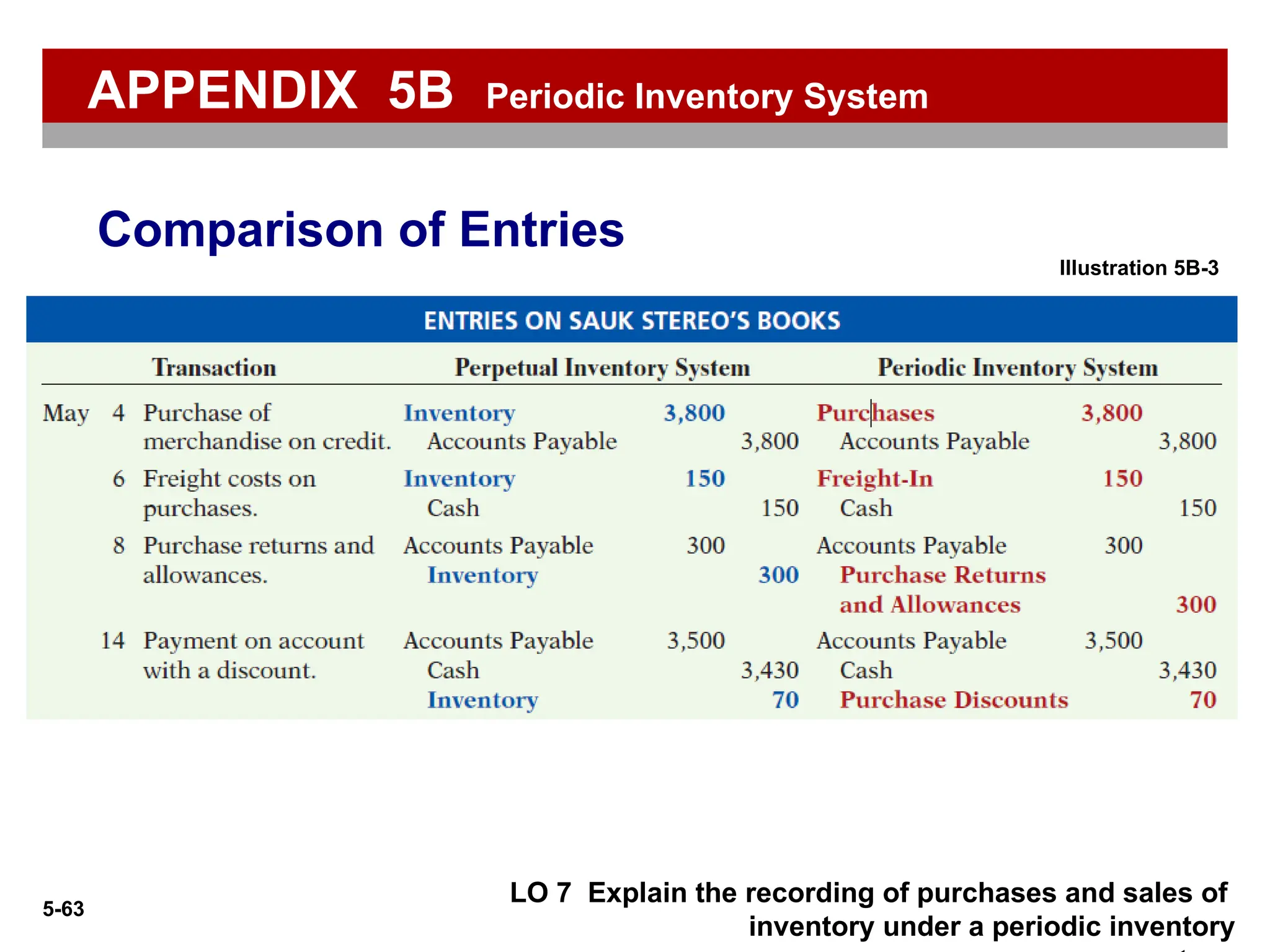
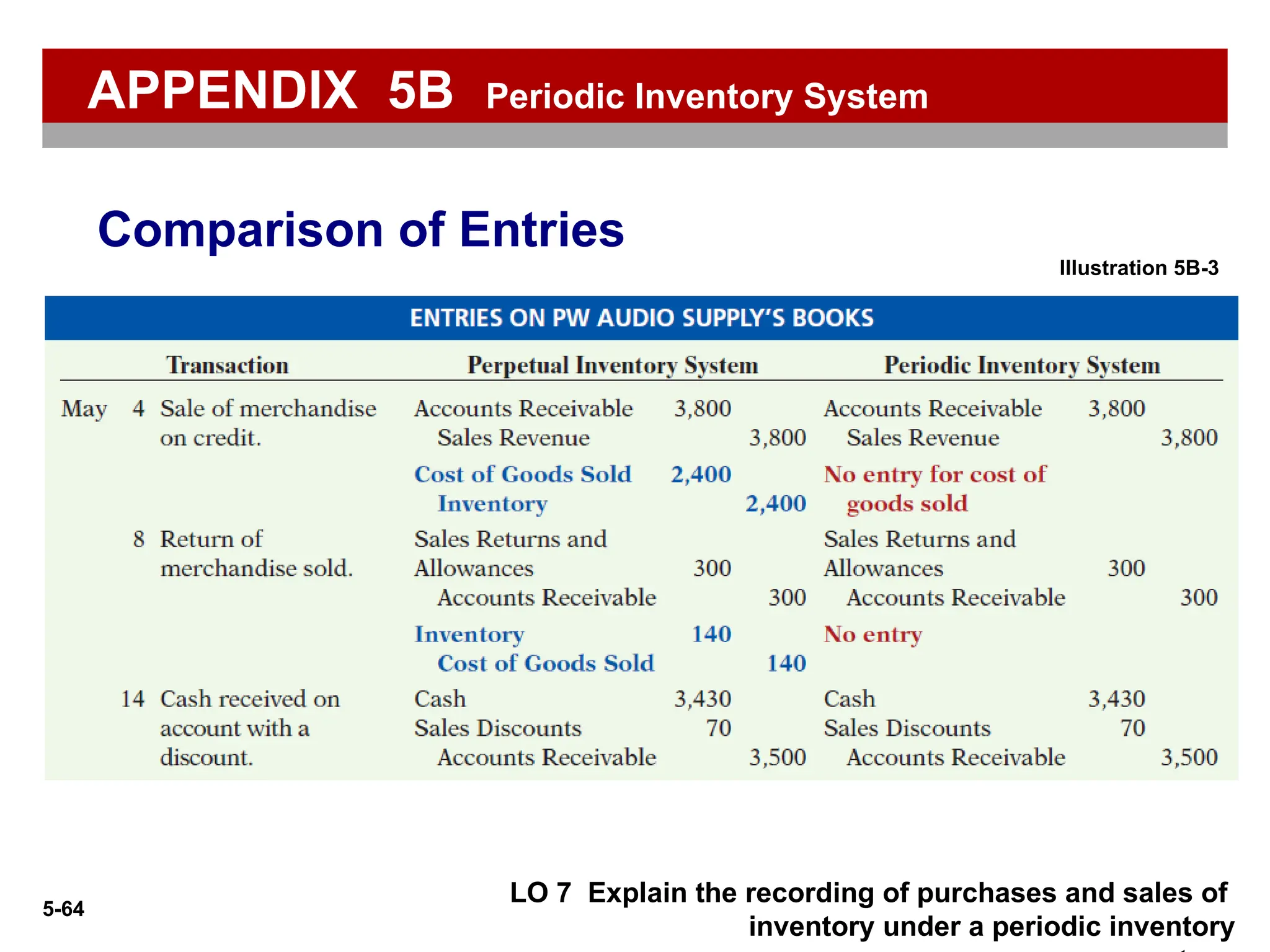
Comparison of Entries
APPENDIX 5B Periodic Inventory System
Illustration 5B-3
64.
5-64
LO 7 Explainthe recording of purchases and sales of
inventory under a periodic inventory
Comparison of Entries
APPENDIX 5B Periodic Inventory System
Illustration 5B-3
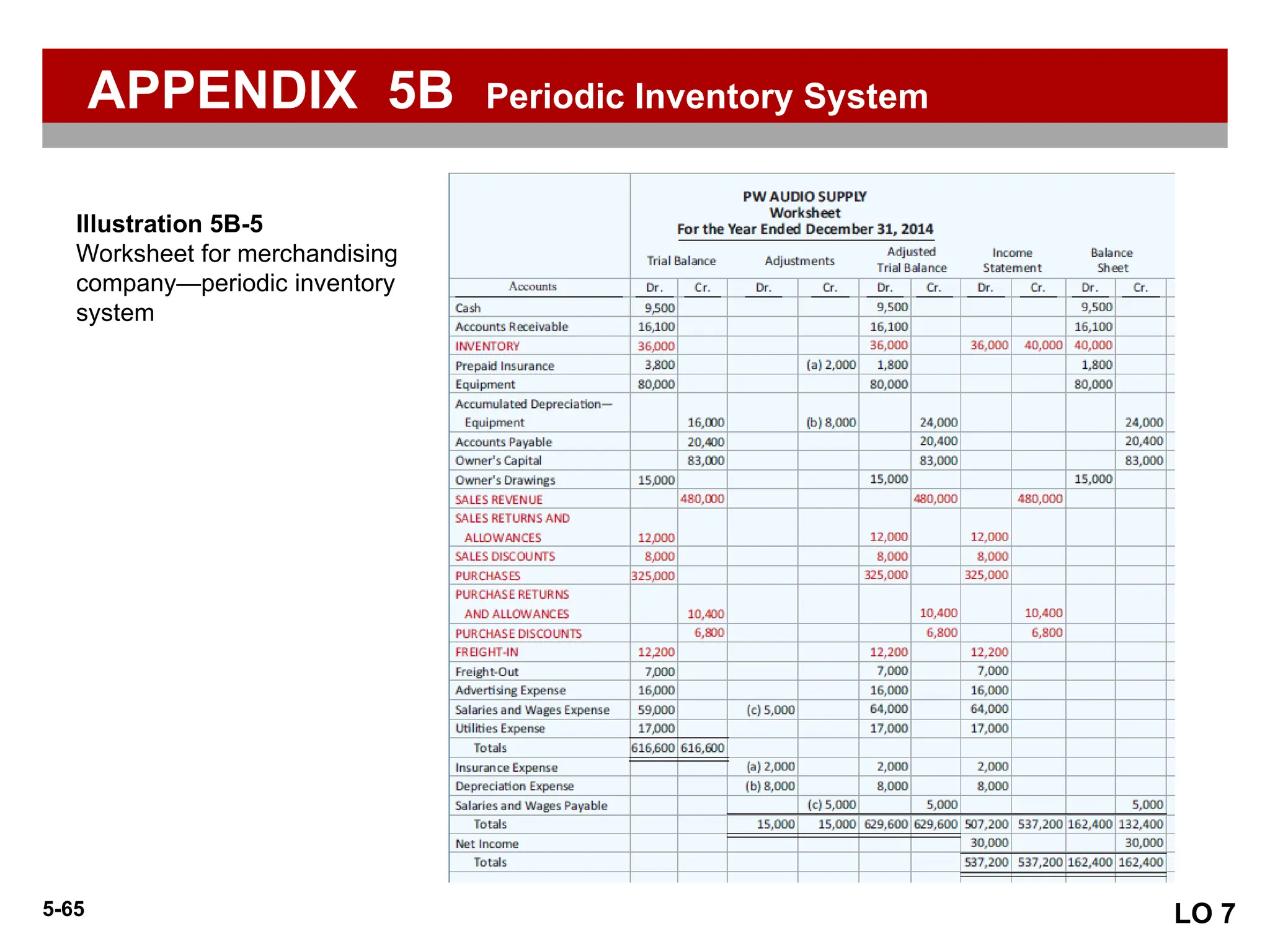
65.
5-65 LO 7
Illustration5B-5
Worksheet for merchandising
company—periodic inventory
system
APPENDIX 5B Periodic Inventory System
66.
5-66
Key Points
A Lookat IFRS
LO 8 Compare the accounting procedures for
merchandising under GAAP and IFRS.
Under both GAAP and IFRS, a company can choose to use
either a perpetual or a periodic system.
Inventories are defined by IFRS as held-for-sale in the ordinary
course of business, in the process of production for such sale, or
in the form of materials or supplies to be consumed in the
production process or in the providing of services.
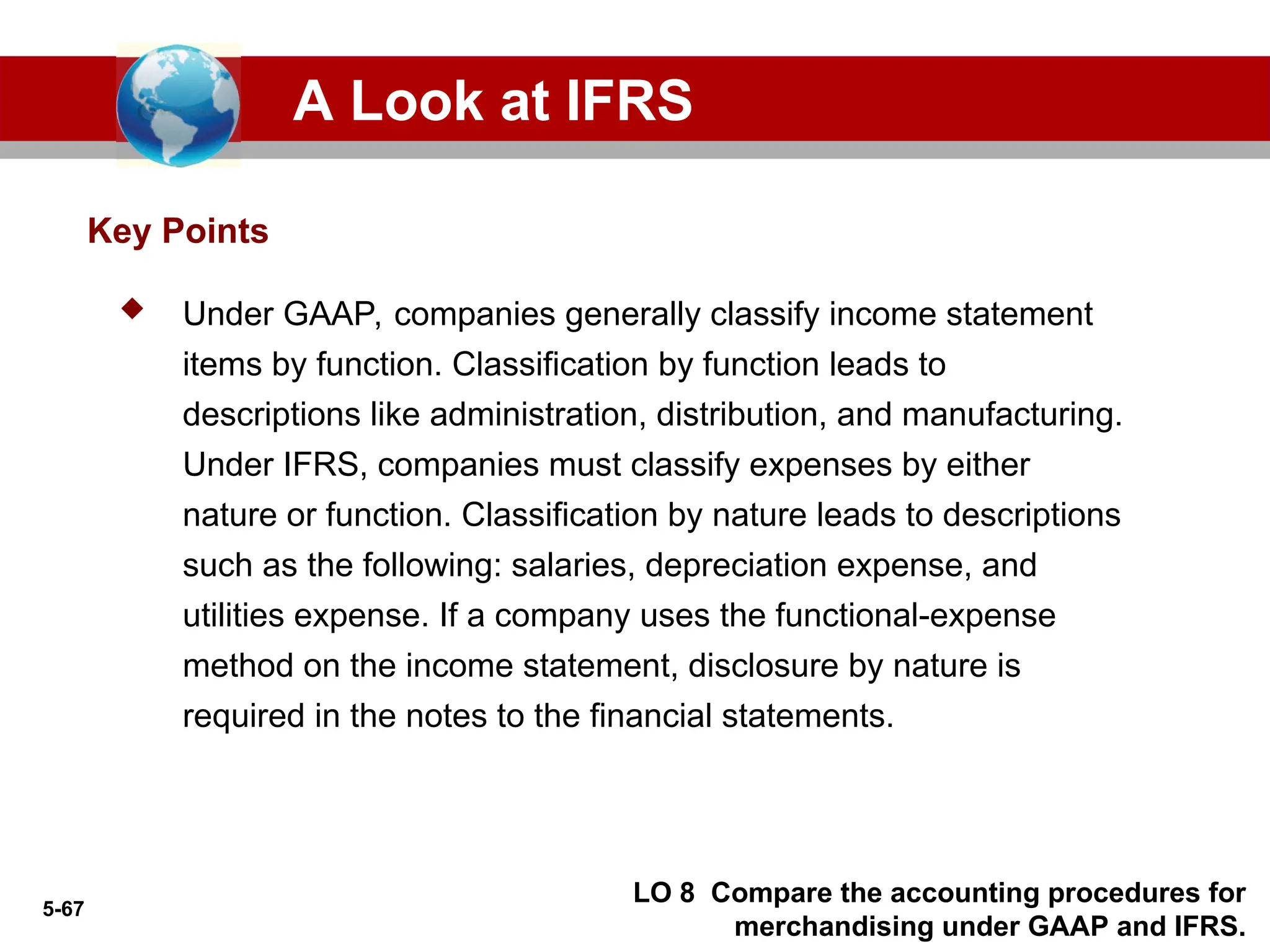
67.
5-67
Under GAAP,companies generally classify income statement
items by function. Classification by function leads to
descriptions like administration, distribution, and manufacturing.
Under IFRS, companies must classify expenses by either
nature or function. Classification by nature leads to descriptions
such as the following: salaries, depreciation expense, and
utilities expense. If a company uses the functional-expense
method on the income statement, disclosure by nature is
required in the notes to the financial statements.
Key Points
A Look at IFRS
LO 8 Compare the accounting procedures for
merchandising under GAAP and IFRS.
68.
5-68
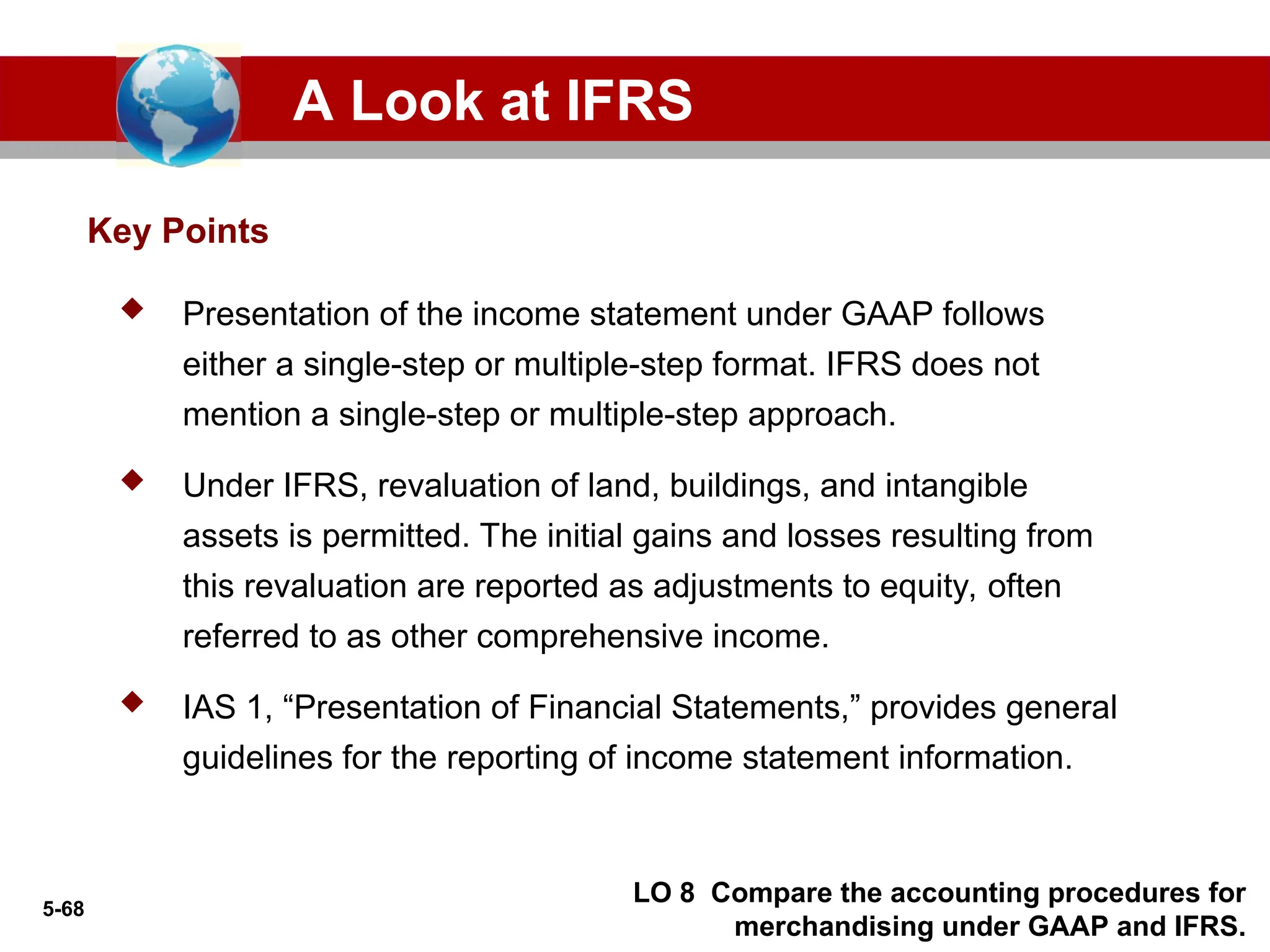
Presentation ofthe income statement under GAAP follows
either a single-step or multiple-step format. IFRS does not
mention a single-step or multiple-step approach.
Under IFRS, revaluation of land, buildings, and intangible
assets is permitted. The initial gains and losses resulting from
this revaluation are reported as adjustments to equity, often
referred to as other comprehensive income.
IAS 1, “Presentation of Financial Statements,” provides general
guidelines for the reporting of income statement information.
Key Points
A Look at IFRS
LO 8 Compare the accounting procedures for
merchandising under GAAP and IFRS.
69.
5-69
Key Points
A Lookat IFRS
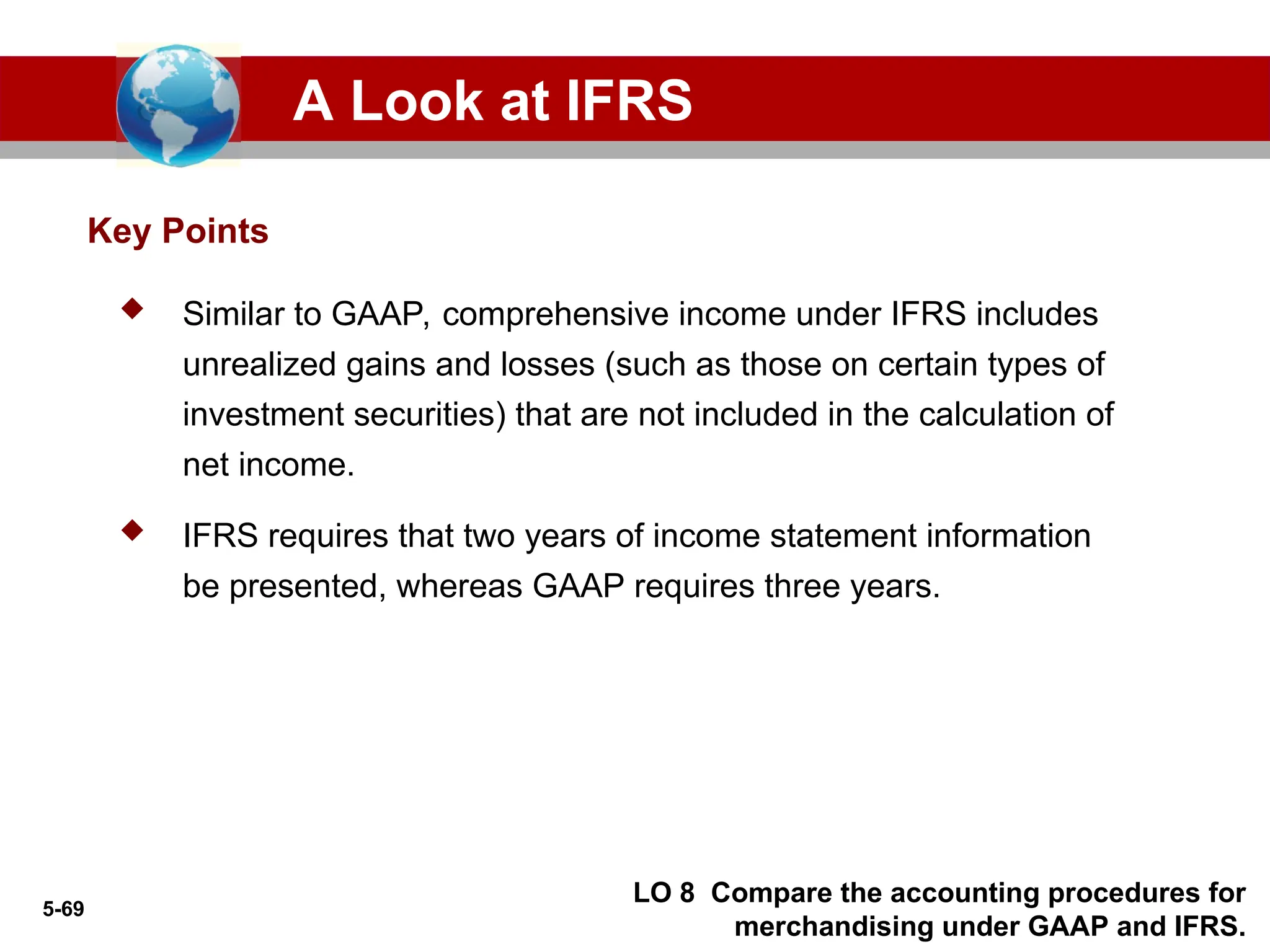
Similar to GAAP, comprehensive income under IFRS includes
unrealized gains and losses (such as those on certain types of
investment securities) that are not included in the calculation of
net income.
IFRS requires that two years of income statement information
be presented, whereas GAAP requires three years.
LO 8 Compare the accounting procedures for
merchandising under GAAP and IFRS.
70.
5-70
Looking to theFuture
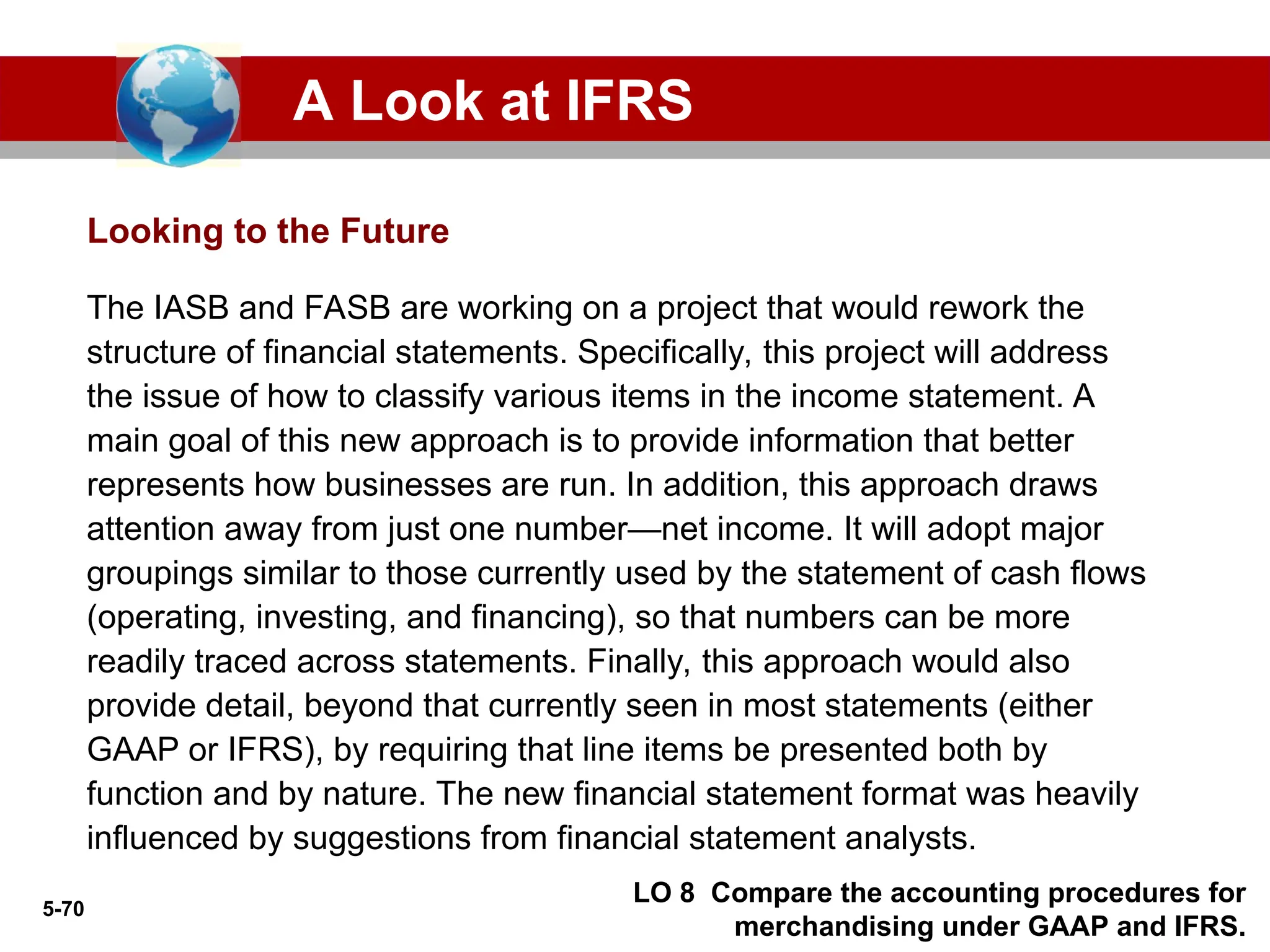
The IASB and FASB are working on a project that would rework the
structure of financial statements. Specifically, this project will address
the issue of how to classify various items in the income statement. A
main goal of this new approach is to provide information that better
represents how businesses are run. In addition, this approach draws
attention away from just one number—net income. It will adopt major
groupings similar to those currently used by the statement of cash flows
(operating, investing, and financing), so that numbers can be more
readily traced across statements. Finally, this approach would also
provide detail, beyond that currently seen in most statements (either
GAAP or IFRS), by requiring that line items be presented both by
function and by nature. The new financial statement format was heavily
influenced by suggestions from financial statement analysts.
A Look at IFRS
LO 8 Compare the accounting procedures for
merchandising under GAAP and IFRS.
71.
5-71
IFRS Self-Test Questions
ALook at IFRS
LO 8 Compare the accounting procedures for
merchandising under GAAP and IFRS.
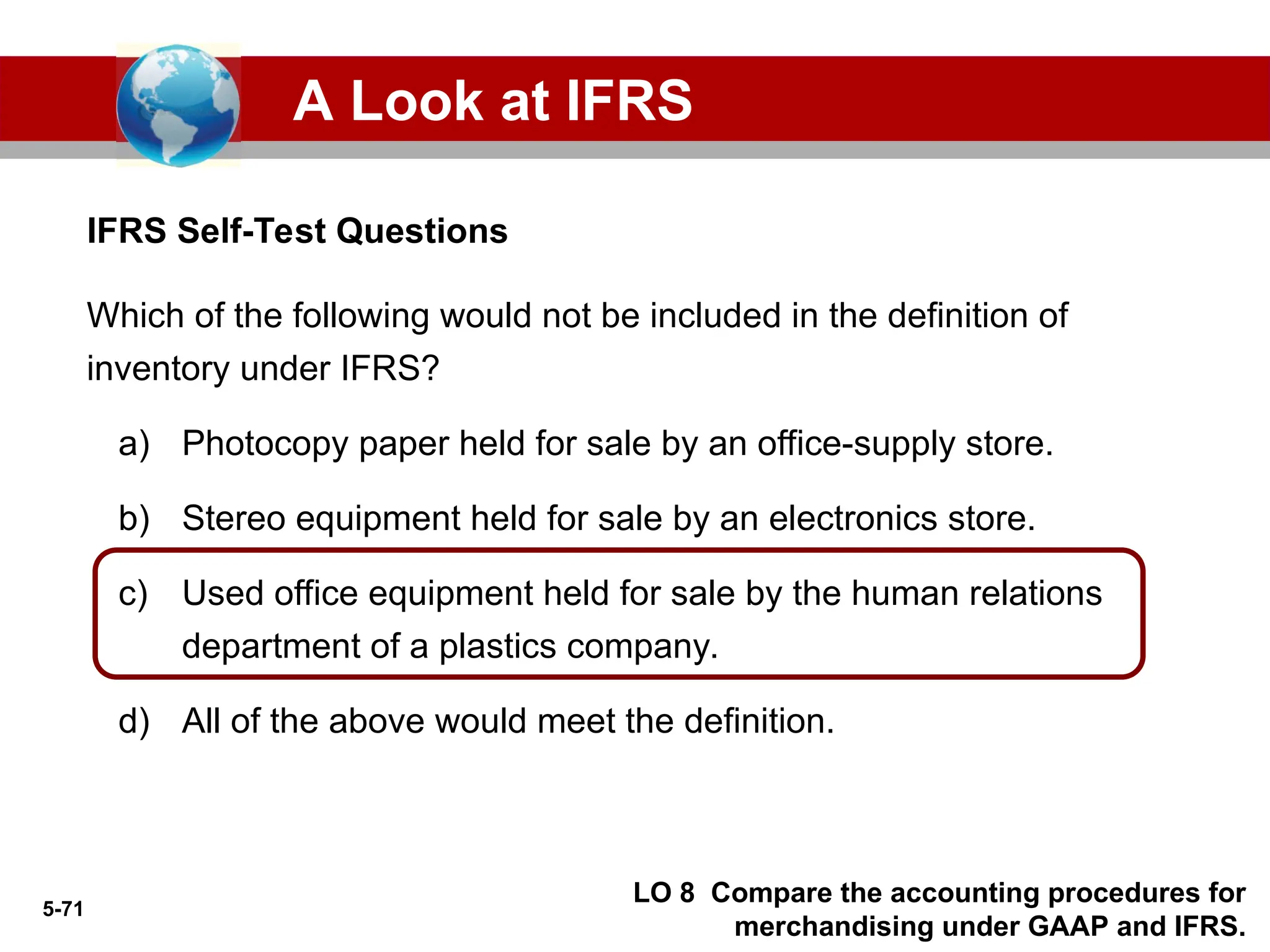
Which of the following would not be included in the definition of
inventory under IFRS?
a) Photocopy paper held for sale by an office-supply store.
b) Stereo equipment held for sale by an electronics store.
c) Used office equipment held for sale by the human relations
department of a plastics company.
d) All of the above would meet the definition.
72.
5-72
IFRS Self-Test Questions
ALook at IFRS
LO 8 Compare the accounting procedures for
merchandising under GAAP and IFRS.
Which of the following would not be a line item of a company
reporting costs by nature?
a) Depreciation expense.
b) Salaries expense.
c) Interest expense.
d) Manufacturing expense.
73.
5-73
IFRS Self-Test Questions
ALook at IFRS
LO 8 Compare the accounting procedures for
merchandising under GAAP and IFRS.
Which of the following would not be a line item of a company
reporting costs by function?
a) Administration.
b) Manufacturing.
c) Utilities expense.
d) Distribution.

![5-2
5
Learning Objectives
After studying this chapter, you should be able to:
[1] Identify the differences between a service and merchandising companies.
[2] Explain the recording of purchases under a perpetual inventory system.
[3] Explain the recording of sales revenues under a perpetual inventory
system.
[4] Explain the steps in the accounting cycle for a merchandising company.
[5] Distinguish between a multiple-step and a single-step income statement.
Accounting for
Merchandising Operations](https://image.slidesharecdn.com/ch05-250511210759-f059c586/75/Accounting-Keiso-Balance-Sheet-Analydis-ch05-ppt-2-2048.jpg)
![5-35
LO 3 Explain the recording of sales revenues
under a perpetual inventory system.
Cash 3,430
May 14
Accounts Receivable 3,500
Sales Discounts 70
* [($3,800 – $300) X 2%]
*
Illustration: Assume Sauk Stereo pays the balance due of
$3,500 (gross invoice price of $3,800 less purchase returns
and allowances of $300) on May 14, the last day of the
discount period. Prepare the journal entry PW Audio Supply
makes to record the receipt on May 14.
Recording Sales of Merchandise](https://image.slidesharecdn.com/ch05-250511210759-f059c586/75/Accounting-Keiso-Balance-Sheet-Analydis-ch05-ppt-35-2048.jpg)