Strategic Planning Human Resources Management


       HRM
Accountability System
    Development
       Guide


  United States   Office of Merit
  Office of       Systems                   HRM Acountability
  Personnel       Oversight and             Committee Print
  Management      Effectiveness             (12/1998)
Acknowledgments
This Guide is the product of an Interagency Task Force made up of members from the
Interagency Advisory Group Committee on Human Resources Management Accountability. We
would like to thank the following agencies for participating in this process and sharing “the
agency” perspective on accountability:

Department of Agriculture                            Department of Justice
Department of Commerce                               Department of Labor
Department of Defense                                Department of Navy
Department of Education                              Office of Personnel Management
Department of Energy                                 Small Business Administration
Department of Health and Human Services              Department of State
Department of Housing and Urban                      Department of Treasury
       Development                                   Department of Transportation
U.S. Department of Interior


There are many people who have contributed their time, talents, and ideas to this document. We
would like to extend our appreciation for their special efforts and continued dedication. They are:


Jim Gallo                          Lee Hall                            Paul Thompson
Curt Dahlke                        Bill Reynolds                       Laura Shugrue
Art Buck                           Robert Stokes                       Craig Pettibone
Virginia Novak                     Janet Cope                          Phil Sagal
Betty Sullivan                     Micheal Sena                        Kamaron Kellum
Jacqueline Taylor                  Margaret Foskey                     Lisa Roth
Mike Urquhart                      Roberta Peters                      Don Jansen
D. Everett                         Mario Caviglia                      Tony Ryan
Irene Gray


If you have any questions, comments, or suggestions regarding this Guide, please contact the U.S.
Office of Personnel Management Office of Merit Systems Effectiveness at (202) 606-2820.
Table of Contents


Executive Overview . . . . . . . . . . . . . . . . . . . . . . . . . . . . . . . . . . . . . . . . . . . . . . . . . . . . . . . . . . i

Introduction: Why HRM Accountability? . . . . . . . . . . . . . . . . . . . . . . . . . . . . . . . . . . . . . . . . . 1

Accountability Roles and Responsibilities . . . . . . . . . . . . . . . . . . . . . . . . . . . . . . . . . . . . . . . . . . 3

The HRM Accountability System . . . . . . . . . . . . . . . . . . . . . . . . . . . . . . . . . . . . . . . . . . . . . . . . 7

HRM Goals . . . . . . . . . . . . . . . . . . . . . . . . . . . . . . . . . . . . . . . . . . . . . . . . . . . . . . . . . . . . . . . . 9

HRM Measures . . . . . . . . . . . . . . . . . . . . . . . . . . . . . . . . . . . . . . . . . . . . . . . . . . . . . . . . . . . . 13
     Merit System Principles Framework . . . . . . . . . . . . . . . . . . . . . . . . . . . . . . . . . . . . . . . 16

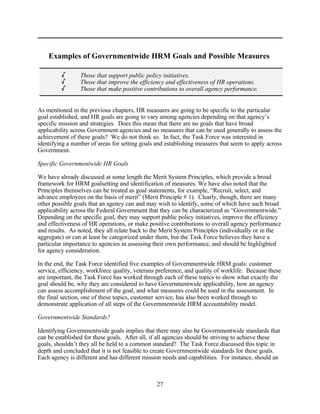
Examples of Governmentwide HRM Goals and Possible Measures . . . . . . . . . . . . . . . . . . . . .                                   27
      Customer Service . . . . . . . . . . . . . . . . . . . . . . . . . . . . . . . . . . . . . . . . . . . . . . . . . . . . .       29
      Efficiency of HRM Programs . . . . . . . . . . . . . . . . . . . . . . . . . . . . . . . . . . . . . . . . . . . .               31
      Workforce Quality . . . . . . . . . . . . . . . . . . . . . . . . . . . . . . . . . . . . . . . . . . . . . . . . . . . .        33
      Veterans Preference . . . . . . . . . . . . . . . . . . . . . . . . . . . . . . . . . . . . . . . . . . . . . . . . . . .        35
      Quality of Worklife Initiatives . . . . . . . . . . . . . . . . . . . . . . . . . . . . . . . . . . . . . . . . . . .            36

Applying the HRM Accountability System Model . . . . . . . . . . . . . . . . . . . . . . . . . . . . . . . . . . 37

Appendix A - Merit System Principles and
      Prohibited Personnel Practices . . . . . . . . . . . . . . . . . . . . . . . . . . . . . . . . . . . . . . . . . . A-1
Executive Overview
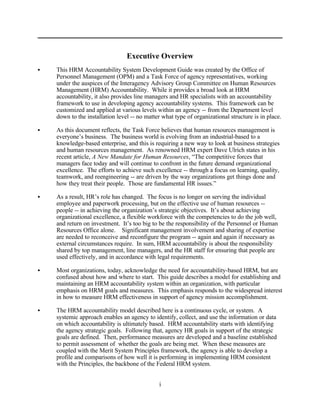
C   This HRM Accountability System Development Guide was created by the Office of
    Personnel Management (OPM) and a Task Force of agency representatives, working
    under the auspices of the Interagency Advisory Group Committee on Human Resources
    Management (HRM) Accountability. While it provides a broad look at HRM
    accountability, it also provides line managers and HR specialists with an accountability
    framework to use in developing agency accountability systems. This framework can be
    customized and applied at various levels within an agency -- from the Department level
    down to the installation level -- no matter what type of organizational structure is in place.

C   As this document reflects, the Task Force believes that human resources management is
    everyone’s business. The business world is evolving from an industrial-based to a
    knowledge-based enterprise, and this is requiring a new way to look at business strategies
    and human resources management. As renowned HRM expert Dave Ulrich states in his
    recent article, A New Mandate for Human Resources, “The competitive forces that
    managers face today and will continue to confront in the future demand organizational
    excellence. The efforts to achieve such excellence -- through a focus on learning, quality,
    teamwork, and reengineering -- are driven by the way organizations get things done and
    how they treat their people. Those are fundamental HR issues.”
C   As a result, HR’s role has changed. The focus is no longer on serving the individual
    employee and paperwork processing, but on the effective use of human resources --
    people -- in achieving the organization’s strategic objectives. It’s about achieving
    organizational excellence, a flexible workforce with the competencies to do the job well,
    and return on investment. It’s too big to be the responsibility of the Personnel or Human
    Resources Office alone. Significant management involvement and sharing of expertise
    are needed to reconceive and reconfigure the program -- again and again if necessary as
    external circumstances require. In sum, HRM accountability is about the responsibility
    shared by top management, line managers, and the HR staff for ensuring that people are
    used effectively, and in accordance with legal requirements.

C   Most organizations, today, acknowledge the need for accountability-based HRM, but are
    confused about how and where to start. This guide describes a model for establishing and
    maintaining an HRM accountability system within an organization, with particular
    emphasis on HRM goals and measures. This emphasis responds to the widespread interest
    in how to measure HRM effectiveness in support of agency mission accomplishment.

C   The HRM accountability model described here is a continuous cycle, or system. A
    systemic approach enables an agency to identify, collect, and use the information or data
    on which accountability is ultimately based. HRM accountability starts with identifying
    the agency strategic goals. Following that, agency HR goals in support of the strategic
    goals are defined. Then, performance measures are developed and a baseline established
    to permit assessment of whether the goals are being met. When these measures are
    coupled with the Merit System Principles framework, the agency is able to develop a
    profile and comparisons of how well it is performing in implementing HRM consistent
    with the Principles, the backbone of the Federal HRM system.


                                              i
C   In order to further the establishment of HRM accountability systems Governmentwide,
    OPM plans to follow this overview document with examples, best practices, and more
    detailed guidance on all aspects of HRM accountability system development. OPM has
    begun to compile a clearinghouse of accountability practices, but it is by no means
    exhaustive. Therefore, we set forth this challenge to agencies: to share with OPM your
    best practices regarding HRM accountability so that we may share them with the Federal
    community and learn together from your successes.


                                           ii
Introduction: Why HRM Accountability?

         /       To let managers manage.
         /       To support the mission within the framework of laws, rules, and regulations.


This Human Resources Management (HRM) Accountability System Development Guide has been
developed by OPM to help achieve the goal of sound, manager-based people management in the
Federal Government. It is based on the following simple premise: Human resources
management does not exist as an end in itself but for the purpose of supporting organizational
mission accomplishment.

The Federal manager is not a free agent
when it comes to managing people.                            Merit System Principles
HRM activities are carried out within the
framework of established public policies,      The nine Merit System Principles constitute the
                                               framework that shapes the whole structure of Federal
such as Veterans Preference, and the           HRM as it strives to support agency mission
values of openness, fairness, and equity       accomplishment. The Principles are commonly and
expressed in the Merit System Principles.      correctly identified as supporting fairness for
On the other hand, HR systems and              employees and adherence to HR laws and regulations
processes cannot take on a life of their       that enforce the concept of merit. Yet, they support
own independent from broad                     equally the need for efficiency and effectiveness, and
organizational goals. They must instead        for not allowing rules to become an end in themselves.
be judged by how well they, and the            Thus, the Merit Principles as a totality provide an
functional experts who administer them,        excellent set of HRM values to live by for the Federal
support those who work each day to             manager. The Prohibited Personnel Practices are
carry out the agency’s programs.               specific practices to be avoided in upholding the Merit
                                               Principles. See Appendix A for the full text of the
                                               Principles and Practices.
This is not a new premise, and it may
seem to be no more than common sense.
“Let managers manage,” as the saying
goes, and let that include managing people. Yet in many agencies, it represents a real change
from the traditional model of HRM. Authority to make many HRM decisions has historically
been held in the HR or Personnel Office (for example, classification of positions to title, series and
grade). Managers obviously participated in these decisions, but the HR Office often retained final
authority. The primary concern was for compliance with HR laws and regulations, not how well
the HR system supported mission accomplishment. The new model does not abandon compliance
concern but rather represents a major shift in balance toward outcomes and results.

The new, though still evolving, Federal HRM model places the direct responsibility for human
resources management on those whose immediate task is mission accomplishment -- line
managers. These managers, supported by the human resources staff, must be given authority to
manage human resources and then be held accountable for the results or outcomes of their
decisions.

This makes good business sense. Those with authority and responsibility for accomplishing the
agency mission should also have authority and responsibility over HRM. Those who run an

                                                  1
agency’s business should know best what kind of employees are needed and how they should be
deployed.

In the Executive Branch, this responsibility is
also a legal mandate. OPM can and does                         Accountability Legal Authorities
delegate HRM authorities to heads of agencies
and holds agencies accountable for reviewing           Under title 5 of the U.S. Code, OPM may delegate
                                                       (and in fact has done so extensively) any function
the efficiency and effectiveness of their human        vested in the OPM Director to the heads of
resource management programs. Failure by an            agencies (5 U.S.C. 1104), who in turn may delegate
agency to carry out this responsibility is a           to “subordinate officials the authority...to take final
violation of the law. Just as important, it will       action on matters pertaining to the employment,
also probably lead to less than fully effective        direction, and general administration of personnel
use of human resources, which in most Federal          under his agency...” (5 U.S.C. 302). These
agencies constitute by far the greatest budget         authorities carry with them accountability, not only
expense.                                               for legal compliance but also for program
                                                       effectiveness. Each agency is responsible for
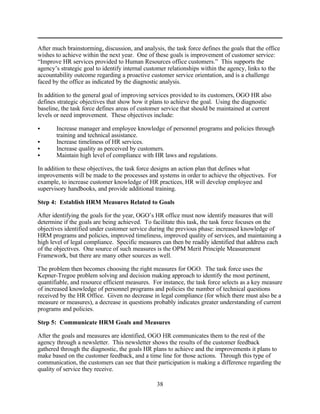
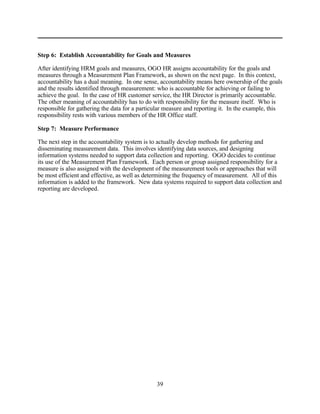
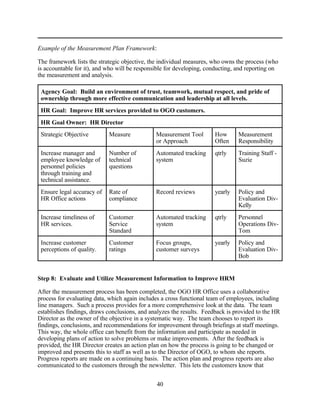
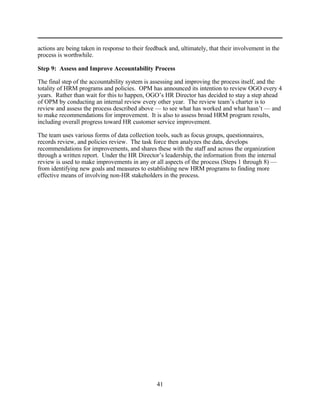
The Government Performance and Results Act             preventing prohibited personnel practices from
(GPRA) provides another legal mandate with             occurring and complying with applicable civil
                                                       service laws (5 U.S.C. 2302), as well as for
implications for HRM accountability.                   reviewing the efficiency and effectiveness of its
Application of GPRA will push agencies in the          human resource management programs (5 U.S.C.
direction of aligning all their activities,            305).
including HRM, toward achieving agency
strategic goals and measuring progress toward
those goals. For GPRA to have the desired
effect, a clear and conscious link between GPRA results and human resource inputs and goals
must be established at every agency. In the context of HRM accountability, managers gain more
discretion, but within a tight frame of mission definition and performance monitoring.

This document is specifically intended to enable agencies to fulfill their HRM accountability and
GPRA responsibilities. We believe it will be a useful tool for getting agencies -- with the HR
Office as the catalyst -- to establish viable HRM accountability systems, and to help their
managers understand and embrace their responsibility and accountability for effective HRM. It is
no cure-all; other initiatives and tools will no doubt be needed. Ultimately, each agency must find
its own path to realizing these objectives.


                                                   2
Accountability Roles and Responsibilities:
                                  Who is Accountable?

           /        Generally, the manager is directly accountable for the program impact of the
                    HRM decision, while the HR Staff is directly accountable for the regulatory
                    compliance of the action.
           /        However, “shared accountability” means that both HR staff and managers are
                    ultimately accountable for effective, legally compliant HRM.
           /        Top management is accountable for committing the organization to shared
                     accountability.


Now that we have identified the “why” of accountability, it is important to identify the “who.”
Who is accountable for HR decisions and what responsibilities do they hold? The National
Performance Review (NPR) mandate for decentralization of HRM authorities combined with the
requirement of GPRA to assess program accomplishments against performance goals has had a
profound effect on the manner in which HRM decisions are made and the level of accountability
for those decisions. In order to meet the challenges presented by NPR, many agencies have
pursued the strategy of delegating key HRM authorities to managers and following a more
collaborative approach between managers and the human resources staff in the decision-making
process for those HRM authorities retained by the HR Staff.1

This chapter is designed to assist managers and HR Staffs to better understand their roles and
responsibilities in the HRM accountability process.

As noted above, HRM authorities have been delegated to agency heads by the Director of OPM.
Agency heads typically delegate these authorities to the HR Office, which in turn may or may not
delegate them further to line managers. Therefore, from the top down, no single official or
organization is unilaterally accountable for HRM decisions regardless of whether HRM authorities
are delegated to the operating unit level or remain with the HR Staff. And delegated authorities
within the agency are a shared responsibility between the manager and the HR Staff. All HRM
decisions must adhere to the Merit System Principles, the foundation of the Civil Service; not be
proscribed by a Prohibited Personnel Practice; and comply with established laws and regulations.

Where there is a union present, authority is also exercised within the framework of negotiated
agreements. In the last few years, agencies have entered into labor-management partnership
agreements that give employee representatives additional opportunity to participate in agency
decisionmaking. For example, in one agency the union has worked with upper management to
help establish agency goals. In this situation, the union can be said to have taken on a kind of
shared accountability for the achievement of those HRM goals.


       1
           HR Staff refers to the HR service provider, whether providing consulting and/or processing services.

                                                       3
Guidelines for Shared HRM Accountability

Every agency is likely to have                                      Shared Accountability
its own unique approach. But,
to point the way while raising                                Manager

important issues for agency
consideration, the Task Force                                 HR Staff
has developed the following
guidelines for describing and
sharing HRM accountability.
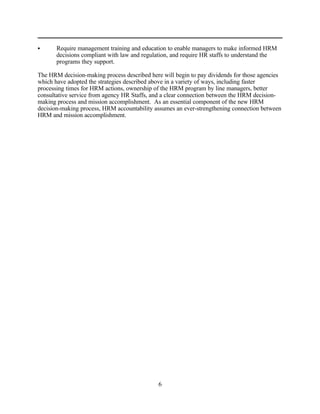
Where HRM authority has               If Compliant                        If Not Compliant
been delegated to a manager
but the HR Staff has
                                    Finalize Action                      HR and Manager Consult
responsibility for processing
the action, the HR Staff is
                                                                                                    Non-Compliant
accountable for ensuring that                    Alternative Action            No Action
                                                                                                        Action
the proposed action meets
regulatory compliance and is
                                                                                                HR Seeks Resolution with
consistent with the Merit                                                                       Agency Top Management
System Principles. If the
proposed action fails to meet
regulatory compliance, the HR Staff consults with the manager to offer other options that enable
the manager to achieve the desired goal but comply with regulations. In this situation, the
manager and HR Staff have shared accountability. Though the manager has the final
discretionary authority, the HR Staff has the final regulatory authority. Therefore, the manager is
accountable for the program impact of the HRM decision while the HR Staff is accountable for
the regulatory compliance of the action at the time it is effected. In this case, if the manager
cannot select an option that meets regulatory compliance, the HR Staff should not process the
action. If the manager continues to try to effect the action, the HR Staff should go through
appropriate channels to notify higher level management.

Automation has strongly affected roles and responsibilities for HRM accountability. With
operating units often having direct access to personnel/payroll databases and “expert systems,”
managers can exercise their delegated HRM authorities independently without the assistance of
the HR Staff. Where this occurs, HRM actions can be effected without input or review from the
HR Staff. If the HR Staff has no review or approval role in the processing of the HRM action,
the manager is directly accountable for the program impact AND regulatory compliance of the
HRM action.

However, even where the HRM authority is delegated to the operating unit, the HR Staff has
oversight (indirect) accountability for regulatory compliance. This obligation is met when the
HR Staff, which may partner with the Inspector General or other internal audit staff, conducts
periodic reviews of manager-effected HRM actions. If the HR Staff finds that an action has been
taken which does not meet regulatory compliance, it must ensure that corrective action is taken.
Failure of the operating unit to continually meet regulatory compliance should result in
adjustments in the delegation of HRM authorities to ensure future compliance.

The HR Staff also has oversight accountability for managing human resources effectively, even
where the authority is delegated to the operating unit. Where actions taken by the manager meet

                                                           4
regulatory compliance but are not good management practices, the HR Staff should consult with
the manager regarding options for future actions.

Even with the NPR emphasis on the delegation of HRM authorities to the lowest decision-making
level possible, many of the most sensitive HRM authorities will not be delegated to the operating
unit level due to legal and technical complexities of HRM and staffing resource considerations.
Regulatory interpretations regarding many HRM programs and actions of a complex nature will
continue to be made by dedicated HR staff, often in consultation with the legal office. Therefore,
roles and responsibilities in the HRM process must emphasize the collaborative approach between
managers and HR Staffs.

Where the HRM authority has been delegated to the operating unit level, the manager may make
all HRM decisions within his/her delegated authority which are not contrary to the Merit System
Principles and Prohibited Personnel Practices or in violation of laws and regulations. However,
where the authority remains with the HR Staff, the HR Staff is responsible for advising the
manager regarding the degree of discretion available (the legal options) and recommending the
best course of action from the standpoint of HRM effectiveness. In this situation, the HR Staff is
directly accountable for regulatory compliance. But, both the HR Staff and managers are
accountable for program results -- with the managers directly responsible for the decisions they
make and the HR Staff more broadly responsible for program effectiveness.

Transitioning to Shared HRM Accountability

To facilitate a successful transition to this more collaborative approach, HR Staffs, managers, and
top management need to redirect their efforts in several different areas.

HR Staffs must:
C     Focus more on creating value than running programs.
C     Become actively involved in the development of HRM goals and strategies in support of
      mission accomplishment and the effective communication of those policies to managers.
C     Act as consultants to managers on HRM issues, helping and encouraging them to consider
      the people aspect of their business decisions.
C     Simplify, streamline, or automate existing HRM processes such as staffing and
      classification.
C     Provide managers with accessible on-line HRM information.

Managers must:
C     Increase their knowledge of Merit System Principles, Prohibited Personnel Practices, and
      HRM laws and regulations.
C     Develop a clear understanding of how HRM decisions affect mission accomplishment and
      how business decisions impact people.
C     Ensure the proper exercise of HRM authorities.

Agency top management must:
C     Recognize and communicate that people in an organization are the single most valuable
      and irreplaceable resource.
C     Demonstrate a strong commitment to HRM accountability and the shared roles between
      managers and HR Staffs.


                                                 5
C      Require management training and education to enable managers to make informed HRM
       decisions compliant with law and regulation, and require HR staffs to understand the
       programs they support.

The HRM decision-making process described here will begin to pay dividends for those agencies
which have adopted the strategies described above in a variety of ways, including faster
processing times for HRM actions, ownership of the HRM program by line managers, better
consultative service from agency HR Staffs, and a clear connection between the HRM decision-
making process and mission accomplishment. As an essential component of the new HRM
decision-making process, HRM accountability assumes an ever-strengthening connection between
HRM and mission accomplishment.


                                              6
The HRM Accountability System

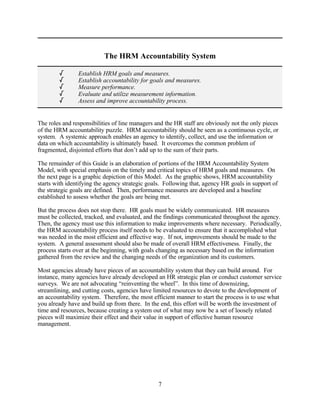
        /       Establish HRM goals and measures.
        /       Establish accountability for goals and measures.
        /       Measure performance.
        /       Evaluate and utilize measurement information.
        /       Assess and improve accountability process.


The roles and responsibilities of line managers and the HR staff are obviously not the only pieces
of the HRM accountability puzzle. HRM accountability should be seen as a continuous cycle, or
system. A systemic approach enables an agency to identify, collect, and use the information or
data on which accountability is ultimately based. It overcomes the common problem of
fragmented, disjointed efforts that don’t add up to the sum of their parts.

The remainder of this Guide is an elaboration of portions of the HRM Accountability System
Model, with special emphasis on the timely and critical topics of HRM goals and measures. On
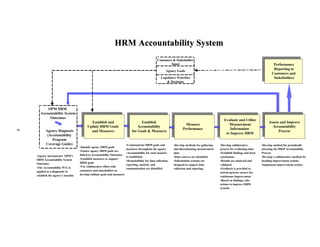
the next page is a graphic depiction of this Model. As the graphic shows, HRM accountability
starts with identifying the agency strategic goals. Following that, agency HR goals in support of
the strategic goals are defined. Then, performance measures are developed and a baseline
established to assess whether the goals are being met.

But the process does not stop there. HR goals must be widely communicated. HR measures
must be collected, tracked, and evaluated, and the findings communicated throughout the agency.
Then, the agency must use this information to make improvements where necessary. Periodically,
the HRM accountability process itself needs to be evaluated to ensure that it accomplished what
was needed in the most efficient and effective way. If not, improvements should be made to the
system. A general assessment should also be made of overall HRM effectiveness. Finally, the
process starts over at the beginning, with goals changing as necessary based on the information
gathered from the review and the changing needs of the organization and its customers.

Most agencies already have pieces of an accountability system that they can build around. For
instance, many agencies have already developed an HR strategic plan or conduct customer service
surveys. We are not advocating “reinventing the wheel”. In this time of downsizing,
streamlining, and cutting costs, agencies have limited resources to devote to the development of
an accountability system. Therefore, the most efficient manner to start the process is to use what
you already have and build up from there. In the end, this effort will be worth the investment of
time and resources, because creating a system out of what may now be a set of loosely related
pieces will maximize their effect and their value in support of effective human resource
management.


                                                 7
HRM Accountability System
                                                                                                      Customers & Stakeholder
                                                                                                               Input                                                                        Performance
                                                                                                                                                                                            Reporting to
                                                                                                             Agency Goals
                                                                                                                                                                                           Customers and
                                                                                                         Legislative Priorities                                                             Stakeholders
                                                                                                             & Decisions


           OPM HRM
       Accountability System
            Outcomes
                                                                                                                                                       Evaluate and Utilize
                                              Establish and                            Establish                                                                                        Assess and Improve
                                                                                                                           Measure                        Measurement
                                            Update HRM Goals                         Accountability                                                                                       Accountability
                                                                                                                         Performance                       Information
8


           Agency Diagnosis                   and Measures                       for Goals & Measures                                                                                         Process
                                                                                                                                                        to Improve HRM
            (Accountability
               Program
           Coverage Guide)                                                  •Communicate HRM goals and             •Develop methods for gathering   •Develop collaborative         •Develop method for periodically
                                      •Identify agency HRM goals
                                                                            measures throughout the agency         and disseminating measurement    process for evaluating data    assessing the HRM Accountability
                                      •Ensure agency HRM goals are
                                                                            •Accountability for each measure       data                             •Establish findings and draw   Process
    •Agency incorporates OPM’s        linked to Accountability Outcomes
                                                                            is established                         •Data sources are identified     conclusions                    •Develop a collaborative method for
    HRM Accountability System         •Establish measures to support
                                                                            •Responsibility for data collection,   •Information systems are         •Results are analyzed and      deciding improvement actions
    Outcomes                          HRM goals
                                                                            reporting, analysis, and               designed to support data         validated                      •Implement improvement actions
    •The Accountability PCG is        •Use collaborative effort with
                                                                            communication are identified           collection and reporting         •Feedback is provided to
    applied as a diagnostic to        customers and stakeholders to
                                                                                                                                                    activity/process owners for
    establish the agency’s baseline   develop/validate goals and measures
                                                                                                                                                    continuous improvement
                                                                                                                                                    •Based on findings, take
                                                                                                                                                    actions to improve HRM
                                                                                                                                                    systems
HRM Goals:
                              What We’re Accountable For

          /      HRM goals define what is important to the viability and success of the
                 organization.
          /      To define the goals, collaborate with stakeholders, tie HR goals to agency
                 strategic goals, and make goals specific and measurable.


So far, we have discussed why accountability is important and who should be held accountable.
We have also introduced an Accountability System model that describes a continuous process for
ensuring HRM accountability. We now need to zero in on perhaps the most critical box in the
model: “Establish and Update HRM Goals and Measures.” Identifying goals and measures is how
an agency says what it is willing to hold itself accountable for as far as human resources
management is concerned, and how it will determine whether it is meeting these goals.

The Government Performance and Results Act is a driving force behind the current emphasis on
identifying goals and measures. Application of GPRA is pushing agencies in the direction of
aligning all their activities, including HRM, toward achieving agency strategic goals and
measuring progress toward those goals, in an effort to improve the confidence of the American
people in the Federal Government. This process has many benefits. It can help an organization
clarify future direction, establish priorities, initiate program performance improvement, increase
effectiveness and accountability, help managers improve service delivery, and improve decision-
making and internal management.

As we have seen, HRM is an essential element of management, and the Task Force believes
strongly that there is an important place for specific HRM goals in the GPRA process. The need
for HRM accountability is inherent in the delegations that Department Heads receive from the
President to hire staff, compensate them, and to use this resource in accomplishing the
organization’s statutory mission. These delegated authorities are critical and potent, requiring
judicious and informed use. They also must be tied in to agency mission-related goals.

Agencies establishing goals for using their human resources management authority in the Federal
sector should be driven by the pursuit of excellence in our human resources programs and
systems, along with respect for American cultural and political practices and traditions. These
goals will have their greatest impact when they are clearly connected to our society’s basic values
as well as to sound management practice. Fortunately, Federal HRM has a set of guiding
Principles that meet both of these criteria.

The Merit System Principles

From among the several conceptual frameworks that have been developed for identifying HRM
goals and measures, OPM has chosen the Merit System Principles as the preferred method for
organizing Federal HRM goals and measures. These Principles express the values that govern the
Civil Service and set appropriate parameters for the exercise of HRM authority. They are also
fully in keeping with the special requirements imposed on the Federal Government as an employer


                                                 9
and as manager of its human resources. They provide a uniquely appropriate framework for
identifying HRM goals and measures in the Federal Government.

The Merit System Principles express the values of the Federal HRM system and are set forth in
law. As described by managers, themselves, the Principles are sound management practices based
on common sense that ensure Federal employees are treated fairly and equitably and that the
Federal HRM system is based on merit. They cover key Federal HRM management goals,
including diversity, open competition, efficiency and effectiveness, performance, and responsibility
to the taxpayer (see Appendix A for full listing of the Principles). As such, they can provide a
framework for evaluating the effectiveness of a Federal agency’s HRM system.

In an August 1992 report, Federal Workforce Quality: Measurement and Improvement, a joint
OPM and Merit Systems Protection Board Advisory Committee on Federal Workforce Quality
Assessment, recommended using a model such as the “Assessment Model for Measuring Merit
System Accountability.” HRM measures are organized by Merit System Principle and assessed in
an outcomes-focused model that:

C      Provides a framework for evaluation
C      Looks beyond traditional input/output measures
C      Links agency planning to mission accomplishment
C      Focuses attention on improved outcomes and results

Applying HRM data measures by Merit System Principle develops a profile of how well an agency
is performing in implementing HRM consistent with the Principles. OPM has developed a model
that can take data indicators for the agency, sort them by Merit Principle, and compare them to
Governmentwide data. This comparison can help an agency identify key issues and trends that
need attention.

Of course, the Merit Principles are no cure-all. They serve as an organizing framework and point
the way toward meaningful and appropriate HR goals for an agency, but it is still necessary for the
agency to identify specifically its goals and related measures, taking into account its own
particular situation. In some cases, agency goals will not readily fall under a specific Principle, but
could be said instead to derive from a composite of the separate Principles, for example, the goal
of effective customer service from the HR Office. Other goals, such as compliance with veterans
preference law and regulations, may not be inherent in a particular Principle itself but still relate to
it topically. In the case of veterans preference it clearly relates directly to the whole range of
staffing-related goals and measures that could be described under the first Merit Principle. So, as
an organizing framework, the Merit Principles can encompass the entire gamut of HRM goals and
measures.

There are of course other frameworks for organizing goals and measures, and they can be of
interest, too, in that they provide a different perspective on HR goals. We have found that they
can be particularly useful for identifying crosscutting goals -- those not tied to a specific Merit
Principle -- and attendant measures. Examples of these other approaches include the balanced


                                                  10
scorecard2 and the Baldrige quality criteria, to name just a couple of the better known ones, and
both have been applied successfully by Federal agencies. Another example of a simple, intuitively
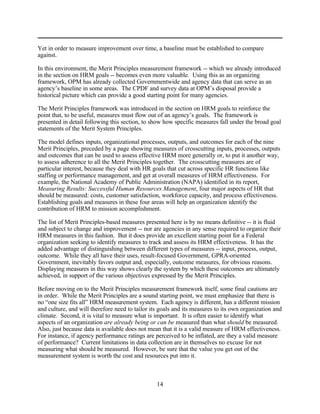
appealing approach to goals and measures is the Hierarchy of Accountability. This approach was
suggested by the Task Force itself, as an original idea, and is described briefly in the inset. Each
of these frameworks has its strengths and weaknesses, its particular advantages and
disadvantages, but like the Merit Principles all attempt to provide some kind of system and order
to the bewildering, seemingly chaotic world of goals and measures.

The Goal-Setting Process
                                                             Hierarchy of Accountability
You will note that to this point we
have been very careful to talk            Understanding the hierarchy of accountability can be useful to
about goals and measures in the           identifying agency HRM goals. The hierarchy of accountability
same breath, for the reason that it       builds from the most basic level of ensuring compliance with Civil
is a very common mistake in               Service laws and regulations. All agencies must set and achieve
                                          goals that relate to this basic need for legality or face severe
strategic planning to jump right          sanction. Once basic compliance has been met, efficiency is the
into measures and measurement,            next level at which goals can be set. Efficiency has two meanings
without the focus provided by             in the accountability hierarchy. One meaning refers to the degree of
well-chosen goals. Goals define           efficiency of HRM service delivery. The other refers to efficiency
the purposes of the organization’s        of the utilization of human resources at the operating unit level to
programs and the results the              meet mission goals. Setting and achieving meaningful goals at this
organization hopes to achieve.            level is more difficult, but is necessary in order to ensure good use
They give direction. Without a            of budget dollars. The ultimate level of accountability is for
good, clear vision of where the           effective HRM — HRM goals and measures that demonstrate a
organization wants to go,                 positive contribution to achieving agency mission goals and the
measurement becomes an exercise           strategic vision for how people should be managed.
in itself. How can an organization
measure its success if it does not
know what it wants to achieve?
                                                                     Alignment
Goal setting starts with defining                             with Strategic
what is truly important to the                                 Goals of the
viability and success of the                                   Organization

organization. This should be done                       Effective HRM Programs
collaboratively with all those
involved in the mission of the                           Efficient HR Processes
organization, including customers
and stakeholders. Goals convey                              Legal Compliance
program objectives and intended
results, should be specific and
detailed enough to be useful in
developing measures and
strategies, and should be expressed in a manner that allows a future assessment of whether they
are being achieved. After goals have been determined, the organization must develop strategies


        2
         For more information on the balanced scorecard, a good place to start would be Robert S. Kaplan
and David P. Norton’s article, The Balanced Scorecard - Measures That Drive Performance, in the
January/February 1992 issue of the Harvard Business Review.

                                                    11
to achieve these goals, including identifying any changes in resources that will be required to
achieve the goals and establishing who is accountable for achieving each goal.

Under GPRA, goals can be set at several levels. First are the overall agency goals. Then, each
organization within the agency determines its own goals and how they support the agency
strategic goals. Ultimately, this goal-setting process can, and should, trickle all the way down to
individual performance standards, always being tied back to the overall agency goals.

Because each agency has its own challenges in the area of managing human resources to
effectively achieve mission accomplishment, each agency will have its own HRM goals. These
can vary from reorganizing its organizational components to educating its workforce to creating
an environment of teamwork. These are going to be different for each agency depending on the
agency’s specific needs.

However, there are also common themes in Federal HRM, so that agencies can learn about
possible goals from each other or from OPM. Certainly, the Merit System Principles framework
is a potential source of goals. In addition, the Task Force identified examples of common or
overarching goals that all agencies should consider addressing as they develop an HRM
accountability system. These examples are discussed in some detail beginning on page 25.


                                                 12
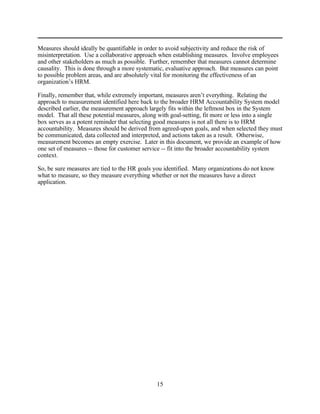
HRM Measures:
                           How Are We Held Accountable?

         /      Performance measures reflect the effectiveness of HR and promote
                accountability for HR decisions.
         /      There is no one size fits all measurement model, but the Merit System
                Principles can be your guide.
         /      Measure what’s important.
         /      USE the information.


So far, we have covered the why, who, and what of HRM accountability, and introduced the
HRM Accountability System Model. The next step is determining how effective HRM is, which
is the most meaningful way to hold people accountable for HR decisions. Performance
measurement is an essential tool for this purpose, especially since GPRA already requires agencies
to establish performance indicators to be used in measuring or assessing the relevant outputs,
service levels, and outcomes of each program activity. But there are many advantages to
measurement outside of the mandate by GPRA, including the area of Human Resources
Management.

The payoffs from HRM measures are well articulated by Jack Phillips in his book Accountability
in Human Resource Management. Some of his top reasons for measuring the HR function are:

C      To identify HRM’s contribution to organizational effectiveness
C      To determine whether HRM is accomplishing its objectives
C      To identify the strengths and weaknesses of HRM processes
C      To calculate the return on investment in an HRM program
C      To determine if an HRM program or policy justifies investment of resources
C      To establish a database that can assist management in making decisions about HRM

Measurement is a topic that HR offices are struggling with. As the MSPB found in its report
Federal Personnel Offices: Time for a Change?, HR offices have historically been evaluated on
their compliance with laws, rules, and regulations, not on service delivery and contribution to
organizational effectiveness. Now, with the implementation of GPRA and the move toward
downsizing, HR has had to look toward measurement to prove its contribution to agency mission
accomplishment.

Performance measurement has grown into a booming industry, and there are numerous
measurement models circulating around the Federal Government. But downsizing has made it
difficult for HR offices to spend tremendous amounts of time and money on this issue. Therefore,
they are looking for the model, the half dozen measures that will tell them all they need to know.

Unfortunately, it’s not that easy. This Guide does not provide a short list of definitive measures
of HRM effectiveness that can be applied Governmentwide and it is doubtful that such a list exists
anywhere. In addition, many agencies have not established any kind of baseline for data
comparison. They have not collected data in the past, and therefore have no documented history.


                                               13
Yet in order to measure improvement over time, a baseline must be established to compare
against.

In this environment, the Merit Principles measurement framework -- which we already introduced
in the section on HRM goals -- becomes even more valuable. Using this as an organizing
framework, OPM has already collected Governmentwide and agency data that can serve as an
agency’s baseline in some areas. The CPDF and survey data at OPM’s disposal provide a
historical picture which can provide a good starting point for many agencies.

The Merit Principles framework was introduced in the section on HRM goals to reinforce the
point that, to be useful, measures must flow out of an agency’s goals. The framework is
presented in detail following this section, to show how specific measures fall under the broad goal
statements of the Merit System Principles.

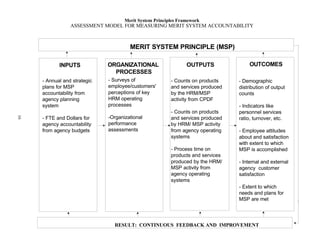
The model defines inputs, organizational processes, outputs, and outcomes for each of the nine
Merit Principles, preceded by a page showing measures of crosscutting inputs, processes, outputs
and outcomes that can be used to assess effective HRM more generally or, to put it another way,
to assess adherence to all the Merit Principles together. The crosscutting measures are of
particular interest, because they deal with HR goals that cut across specific HR functions like
staffing or performance management, and get at overall measures of HRM effectiveness. For
example, the National Academy of Public Administration (NAPA) identified in its report,
Measuring Results: Successful Human Resources Management, four major aspects of HR that
should be measured: costs, customer satisfaction, workforce capacity, and process effectiveness.
Establishing goals and measures in these four areas will help an organization identify the
contribution of HRM to mission accomplishment.

The list of Merit Principles-based measures presented here is by no means definitive -- it is fluid
and subject to change and improvement -- nor are agencies in any sense required to organize their
HRM measures in this fashion. But it does provide an excellent starting point for a Federal
organization seeking to identify measures to track and assess its HRM effectiveness. It has the
added advantage of distinguishing between different types of measures -- input, process, output,
outcome. While they all have their uses, result-focused Government, GPRA-oriented
Government, inevitably favors output and, especially, outcome measures, for obvious reasons.
Displaying measures in this way shows clearly the system by which these outcomes are ultimately
achieved, in support of the various objectives expressed by the Merit Principles.

Before moving on to the Merit Principles measurement framework itself, some final cautions are
in order. While the Merit Principles are a sound starting point, we must emphasize that there is
no “one size fits all” HRM measurement system. Each agency is different, has a different mission
and culture, and will therefore need to tailor its goals and its measures to its own organization and
climate. Second, it is vital to measure what is important. It is often easier to identify what
aspects of an organization are already being or can be measured than what should be measured.
Also, just because data is available does not mean that it is a valid measure of HRM effectiveness.
For instance, if agency performance ratings are perceived to be inflated, are they a valid measure
of performance? Current limitations in data collection are in themselves no excuse for not
measuring what should be measured. However, be sure that the value you get out of the
measurement system is worth the cost and resources put into it.


                                                 14
Measures should ideally be quantifiable in order to avoid subjectivity and reduce the risk of
misinterpretation. Use a collaborative approach when establishing measures. Involve employees
and other stakeholders as much as possible. Further, remember that measures cannot determine
causality. This is done through a more systematic, evaluative approach. But measures can point
to possible problem areas, and are absolutely vital for monitoring the effectiveness of an
organization’s HRM.

Finally, remember that, while extremely important, measures aren’t everything. Relating the
approach to measurement identified here back to the broader HRM Accountability System model
described earlier, the measurement approach largely fits within the leftmost box in the System
model. That all these potential measures, along with goal-setting, fit more or less into a single
box serves as a potent reminder that selecting good measures is not all there is to HRM
accountability. Measures should be derived from agreed-upon goals, and when selected they must
be communicated, data collected and interpreted, and actions taken as a result. Otherwise,
measurement becomes an empty exercise. Later in this document, we provide an example of how
one set of measures -- those for customer service -- fit into the broader accountability system
context.

So, be sure measures are tied to the HR goals you identified. Many organizations do not know
what to measure, so they measure everything whether or not the measures have a direct
application.


                                               15
Merit System Principles Framework
                 ASSESSMENT MODEL FOR MEASURING MERIT SYSTEM ACCOUNTABILITY


                                       MERIT SYSTEM PRINCIPLE (MSP)

            INPUTS            ORGANIZATIONAL                    OUTPUTS               OUTCOMES
                                PROCESSES
     - Annual and strategic   - Surveys of               - Counts on products    - Demographic
     plans for MSP            employee/customers'        and services produced   distribution of output
     accountability from      perceptions of key         by the HRM/MSP          counts
     agency planning          HRM operating              activity from CPDF
     system                   processes                                          - Indicators like
                                                         - Counts on products    personnel services
16


     - FTE and Dollars for    -Organizational            and services produced   ratio, turnover, etc.
     agency accountability    performance                by HRM/ MSP activity
     from agency budgets      assessments                from agency operating   - Employee attitudes
                                                         systems                 about and satisfaction
                                                                                 with extent to which
                                                         - Process time on       MSP is accomplished
                                                         products and services
                                                         produced by the HRM/    - Internal and external
                                                         MSP activity from       agency customer
                                                         agency operating        satisfaction
                                                         systems
                                                                                 - Extent to which
                                                                                 needs and plans for
                                                                                 MSP are met


                                RESULT: CONTINUOUS FEEDBACK AND IMPROVEMENT
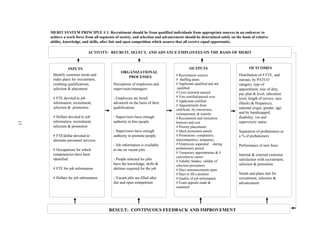
MERIT SYSTEM PRINCIPLE # 1: Recruitment should be from qualified individuals from appropriate sources in an endeavor to
     achieve a work force from all segments of society, and selection and advancement should be determined solely on the basis of relative
     ability, knowledge, and skills, after fair and open competition which assures that all receive equal opportunity.

                             ACTIVITY: RECRUIT, SELECT, AND ADVANCE EMPLOYEES ON THE BASIS OF MERIT


                INPUTS                                                                   OUTPUTS                               OUTCOMES
                                                ORGANIZATIONAL
      Identify customer needs and                                                # Recruitment sources                  Distribution of # FTE, and
                                                   PROCESSES
      make plans for recruitment,                                                # Staffing plans                       outouts, by PATCO
      crediting qualifications,            Perceptions of employees and          # Applicants qualified and not         category, type of
      selection & placement                supervisors/managers:                  qualified                             appointment, tour of duty,
                                                                                 # Certs returned unused                pay plan & level, education
      # FTE devoted to job                 - Employees are hired/                # Vets certified/passed over
                                                                                                                        level, length of service, race
                                                                                 # Applicants certified
      information, recruitment,            advanced on the basis of their                                               (blacks & Hispanics),
                                                                                 # Appointments from
      selection & promotion                qualifications                                                               national origin, gender, age;
                                                                                 certificate, by conversion,
                                                                                 reinstatement, & transfer              and by handicapped,
      # Dollars devoted to job             - Supervisors have enough             # Recruitment and relocation           disability, vet and
      information, recruitment,            authority to hire people                                                     supervisory status
17


                                                                                 bonuses and cost
      selection & promotion                                                      # Priority placements
                                           - Supervisors have enough             # Merit promotion panels               Separation of probationers as
      # FTE/dollar devoted to              authority to promote people           # Promotions: competitive,             a % of probationers
      alternate personnel services                                               noncompetitive, temporary
                                           - Job information is available        # Employees separated during           Performance of new hires
      # Occupations for which              to me on vacant jobs                  probationary period
                                                                                 # Temporary appointments & #
      competencies have been                                                                                            Internal & external customer
                                                                                 converted to career
      identified                           - People selected for jobs                                                   satisfaction with recruitment,
                                                                                 # Validity Studies; validity of
                                           have the knowledge, skills &          selection procedures                   selection & promotion
      # FTE for job information            abilities required for the job        # Days announcements open
                                                                                 # Days to fill a position              Needs and plans met for
      # Dollars for job information        - Vacant jobs are filled after        # Quality of job information           recruitment, selection &
                                           fair and open competition             # Exam appeals made &                  advancement
                                                                                 sustained


                                        RESULT: CONTINUOUS FEEDBACK AND IMPROVEMENT
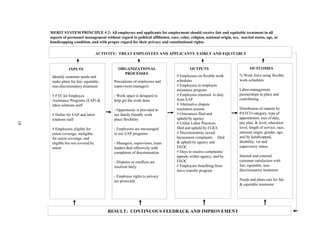
MERIT SYSTEM PRINCIPLE # 2: All employees and applicants for employment should receive fair and equitable treatment in all
     aspects of personnel management without regard to political affiliation, race, color, religion, national origin, sex, marital status, age, or
     handicapping condition, and with proper regard for their privacy and constitutional rights.

                                    ACTIVITY: TREAT EMPLOYEES AND APPLICANTS FAIRLY AND EQUITABLY


                INPUTS                         ORGANIZATIONAL                              OUTPUTS                               OUTCOMES
                                                 PROCESSES                                                                % Work force using flexible
      Identify customer needs and                                                  # Employees on flexible work
      make plans for fair, equitable,       Perceptions of employees and           schedules                              work schedules
      non-discriminatory treatment          supervisors/managers:                  # Employees in employee
                                                                                   assistance program                     Labor-management
      # FTE for Employee                    - Work space is designed to            # Employees returned to duty           partnerships in place and
      Assistance Programs (EAP) &           help get the work done                 from EAP                               contributing
      labor relations staff                                                        # Alternative dispute
                                            - Opportunity is provided to           resolution actions                     Distribution of outputs by
      # Dollar for EAP and labor            use family friendly work               # Grievances filed and                 PATCO category, type of
      relations staff                       place flexibility                      upheld by agency                       appointment, tour of duty,
18


                                                                                   # Unfair Labor Practices               pay plan, & level, education
      # Employees eligible for              - Employees are encouraged             filed and upheld by FLRA               level, length of service, race,
      union coverage, ineligible            to use EAP programs                    # Discrimination, sexual               national origin, gender, age;
      for union coverage, and                                                      harassment complaints filed            and by handicapped,
      eligible but not covered by           - Managers, supervisors, team          & upheld by agency and                 disability, vet and
      union                                 leaders deal effectively with          EEOC                                   supervisory status
                                            complaints of discrimination           # Days to resolve complaints/
                                                                                   appeals within agency, and by          Internal and external
                                            - Disputes or conflicts are            EEOC                                   customer satisfaction with
                                            resolved fairly                        # Employees benefiting from            fair, equitable, non-
                                                                                   leave transfer program                 discriminatory treatment
                                            - Employee rights to privacy
                                            are protected                                                                 Needs and plans met for fair
                                                                                                                          & equitable treatment


                                        RESULT: CONTINUOUS FEEDBACK AND IMPROVEMENT
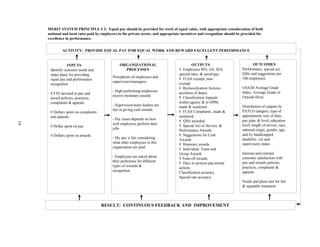
MERIT SYSTEM PRINCIPLE # 3: Equal pay should be provided for work of equal value, with appropriate consideration of both
     national and local rates paid by employers in the private sector, and appropriate incentives and recognition should be provided for
     excellence in performance.


             ACTIVITY: PROVIDE EQUAL PAY FOR EQUAL WORK AND REWARD EXCELLENT PERFORMANCE


                 INPUTS                         ORGANIZATIONAL                               OUTPUTS                             OUTCOMES
      Identify customer needs and                 PROCESSES                         # Employees WG, GS, SES,               Performance, special act,
      make plans for providing                                                      special rates, & saved pay             QSIs and suggestions per
                                            Perceptions of employees and            # FLSA exempt; non-                    100 employees
      equal pay and performance
                                            supervisors/managers:                   exempt
      recognition
                                                                                    # Reclassification Actions,            GS/GM Average Grade
                                            - High performing employees             accretion of duties                    Index; Average Grade of
      # FTE devoted to pay and
                                            receive monetary awards                 # Classification Appeals               Outside Hires
      award policies, practices,
      complaints & appeals                                                          within agency & to OPM,
                                            - Supervisors/team leaders are          made & sustained                       Distribution of outputs by
                                            fair in giving cash awards              # FLSA Complaints, made &              PATCO category, type of
      # Dollars spent on complaints
      and appeals                                                                   sustained                              appointment, tour of duty,
                                            - Pay raises depends on how             # QSIs awarded                         pay plan, & level, education
19


                                            well employees perform their            # Special Act or Service, &            level, length of service, race,
      # Dollar spent on pay
                                            jobs                                    Performance Awards                     national origin, gender, age;
      # Dollars spent on awards                                                     # Suggestions for Cash                 and by handicapped,
                                            - My pay is fair considering            Awards                                 disability, vet and
                                            what other employees in this            # Honorary awards                      supervisory status
                                            organization are paid                   # Individual, Team and
                                                                                    Group Awards                           Internal and external
                                            - Employees are asked about             # Time-off awards                      customer satisfaction with
                                            their preference for different          # Days to process pay/award            pay and awards policies,
                                            types of rewards &                      actions                                practices, complaints &
                                            recognition                             Classification accuracy                appeals
                                                                                    Special rate accuracy
                                                                                                                           Needs and plans met for fair
                                                                                                                           & equitable treatment


                                      RESULT: CONTINUOUS FEEDBACK AND IMPROVEMENT
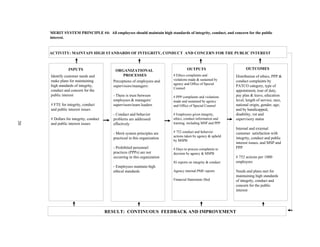
MERIT SYSTEM PRINCIPLE #4: All employees should maintain high standards of integrity, conduct, and concern for the public
     interest.


     ACTIVITY: MAINTAIN HIGH STANDARDS OF INTEGRITY, CONDUCT AND CONCERN FOR THE PUBLIC INTEREST


                INPUTS                     ORGANIZATIONAL                           OUTPUTS                          OUTCOMES
     Identify customer needs and                PROCESSES                  # Ethics complaints and             Distribution of ethics, PPP &
     make plans for maintaining           Perceptions of employees and     violations made & sustained by      conduct complaints by
                                                                           agency and Office of Special
     high standards of integrity,         supervisors/managers:                                                PATCO category, type of
                                                                           Counsel
     conduct and concern for the                                                                               appointment, tour of duty,
     public interest                      - There is trust between         # PPP complaints and violations     pay plan & leave, education
                                          employees & managers/            made and sustained by agency        level, length of service, race,
     # FTE for integrity, conduct         supervisors/team leaders         and Office of Special Counsel       national origin, gender, age;
     and public interest issues                                                                                and by handicapped,
                                          - Conduct and behavior           # Employees given integrity,        disability, vet and
     # Dollars for integrity, conduct     problems are addressed           ethics, conduct information and     supervisory status
20


     and public interest issues           effectively                      training, including MSP and PPP
                                                                                                               Internal and external
                                          - Merit system principles are    # 752 conduct and behavior          customer satisfaction with
                                                                           actions taken by agency & upheld
                                          practiced in this organization                                       integrity, conduct and public
                                                                           by MSPB
                                                                                                               interest issues, and MSP and
                                          - Prohibited personnel           # Days to process complaints to     PPP
                                          practices (PPPs) are not         decision by agency & MSPB
                                          occurring in this organization                                       # 752 actions per 1000
                                                                           IG reports on integrity & conduct   employees
                                          - Employees maintain high
                                          ethical standards                Agency internal PME reports         Needs and plans met for
                                                                                                               maintaining high standards
                                                                           Financial Statements filed          of integrity, conduct and
                                                                                                               concern for the public
                                                                                                               interest


                                        RESULT: CONTINUOUS FEEDBACK AND IMPROVEMENT
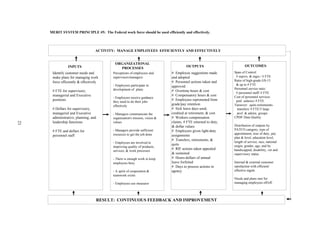
MERIT SYSTEM PRINCIPLE #5: The Federal work force should be used efficiently and effectively.


                                  ACTIVITY: MANAGE EMPLOYEES EFFICIENTLY AND EFFECTIVELY


                                             ORGANIZATIONAL
                INPUTS                                                                  OUTPUTS                         OUTCOMES
                                               PROCESSES
      Identify customer needs and           Perceptions of employees and       # Employee suggestions made       Span of Control:
      make plans for managing work          supervisors/managers:              and adopted                        # supvrs. & mgrs./ # FTE
      force efficiently & effectively                                          # Personnel actions taken and     Ratio of high-grade GS-13
                                            - Employees participate in                                            & up to # FTE
                                                                               approved
                                            development of plans                                                 Personnel service ratio:
      # FTE for supervisory,                                                   # Overtime hours & cost
                                                                                                                  # personnel staff/ # FTE
      managerial and Executive                                                 # Compensatory hours & cost       Cost of personnel services:
                                            - Employees receive guidance
      positions                                                                # Employees repromoted from        psnl. salaries/ # FTE
                                            they need to do their jobs
                                            effectively                        grade/pay retention               Turnover: quits-retirements-
      # Dollars for supervisory,                                               # Sick leave days used,             transfers/ # FTE/5 large
      managerial and Executive              - Managers communicate the         credited at retirement, & cost      prof. & admin. groups
      administrative, planning, and         organization's mission, vision &   # Workers compensation            CPDF Data Quality
      leadership functions                                                     claims, # FTE returned to duty,
21


                                            values
                                                                               & dollar values                   Distribution of outputs by
      # FTE and dollars for                 - Managers provide sufficient      # Employees given light-duty      PATCO category, type of
                                            resources to get the job done                                        appointment, tour of duty, pay
      personnel staff                                                          assignments
                                                                                                                 plan & level, education level,
                                                                               # Transfers, retirements, &
                                            - Employees are involved in                                          length of service, race, national
                                                                               quits                             origin, gender, age; and by
                                            improving quality of products,
                                                                               # RIF actions taken appealed      handicapped, disability, vet and
                                            services, & work processes
                                                                               & sustained                       supervisory status
                                            - There is enough work to keep     # Hours-dollars of annual
                                            employees busy                     leave forfeited                   Internal & external customer
                                                                               # Days to process actions in      satisfaction with efficient/
                                            - A spirit of cooperation &        agency                            effective mgmt.
                                            teamwork exists
                                                                                                                 Needs and plans met for
                                            - Employees use measures                                             managing employees eff/eff.


                                      RESULT: CONTINUOUS FEEDBACK AND IMPROVEMENT
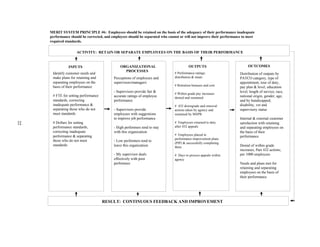
MERIT SYSTEM PRINCIPLE #6: Employees should be retained on the basis of the adequacy of their performance inadequate
     performance should be corrected, and employees should be separated who cannot or will not improve their performance to meet
     required standards.

                     ACTIVITY: RETAIN OR SEPARATE EMPLOYEES ON THE BASIS OF THEIR PERFORMANCE


                INPUTS                         ORGANIZATIONAL                           OUTPUTS                             OUTCOMES
                                                 PROCESSES
      Identify customer needs and                                              # Performance ratings:                  Distribution of outputs by
      make plans for retaining and         Perceptions of employees and        distribution & mean                     PATCO category, type of
      separating employees on the          supervisors/managers:                                                       appointment, tour of duty,
      basis of their performance                                               # Retention bonuses and cost
                                                                                                                       pay plan & level, education
                                           - Supervisors provide fair &                                                level, length of service, race,
                                                                               # Within grade pay increases
      # FTE for setting performance        accurate ratings of employee                                                national origin, gender, age;
                                                                               denied and sustained
      standards, correcting                performance                                                                 and by handicapped,
      inadequate performance &                                                 # 432 downgrade and removal             disability, vet and
      separating those who do not          - Supervisors provide               actions taken by agency and             supervisory status
      meet standards                       employees with suggestions          sustained by MSPB
                                           to improve job performance                                                  Internal & external customer
22


      # Dollars for setting                                                    # Employees returned to duty            satisfaction with retaining
      performance standards,               - High performers tend to stay      after 432 appeals                       and separating employees on
      correcting inadequate                with this organization                                                      the basis of their
      performance & separating                                                 # Employees placed in
                                                                                                                       performance
                                                                               performance improvement plans
      those who do not meet                - Low performers tend to
                                                                               (PIP) & successfully completing
      standards                            leave this organization                                                     Denial of within grade
                                                                               them
                                                                                                                       increases, Part 432 actions,
                                           - My supervisor deals               # Days to process appeals within        per 1000 employees
                                           effectively with poor               agency
                                           performers                                                                  Needs and plans met for
                                                                                                                       retaining and separating
                                                                                                                       employees on the basis of
                                                                                                                       their performance


                                      RESULT: CONTINUOUS FEEDBACK AND IMPROVEMENT
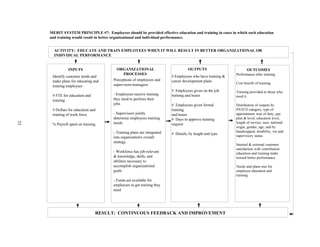
MERIT SYSTEM PRINCIPLE #7: Employees should be provided effective education and training in cases in which such education
     and training would result in better organizational and individual performance.


       ACTIVITY: EDUCATE AND TRAIN EMPLOYEES WHEN IT WILL RESULT IN BETTER ORGANIZATIONAL OR
       INDIVIDUAL PERFORMANCE


               INPUTS                    ORGANIZATIONAL                            OUTPUTS                        OUTCOMES
                                             PROCESSES                                                     Performance after training
      Identify customer needs and                                        # Employees who have training &
      make plans for educating and     Perceptions of employees and      career development plans
                                       supervisors/managers:                                               Cost benefit of training
      training employees
                                                                         # Employees given on the job      Training provided to those who
      # FTE for education and          - Employees receive training      training and hours                need it.
      training                         they need to perform their
                                       jobs                              # Employees given formal          Distribution of outputs by
      # Dollars for education and                                        training                          PATCO category, type of
      training of work force           - Supervisors jointly             and hours                         appointment, tour of duty, pay
                                       determine employees training      # Days to approve training        plan & level, education level,
23


      % Payroll spent on training      needs                             request                           length of service, race, national
                                                                                                           origin, gender, age; and by
                                       - Training plans are integrated                                     handicapped, disability, vet and
                                                                         # Details, by length and type     supervisory status
                                       into organization's overall
                                       strategy
                                                                                                           Internal & external customer
                                                                                                           satisfaction with contribution
                                       - Workforce has job-relevant                                        education and training make
                                       & knowledge, skills, and                                            toward better performance
                                       abilities necessary to
                                       accomplish organizational                                           Needs and plans met for
                                       goals                                                               employee education and
                                                                                                           training
                                       - Funds are available for
                                       employees to get training they
                                       need


                                RESULT: CONTINUOUS FEEDBACK AND IMPROVEMENT
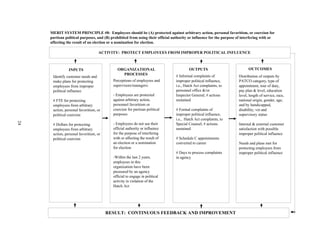
MERIT SYSTEM PRINCIPLE #8: Employees should be (A) protected against arbitrary action, personal favoritism, or coercion for
     partisan political purposes, and (B) prohibited from using their official authority or influence for the purpose of interfering with or
     affecting the result of an election or a nomination for election.

                                    ACTIVITY: PROTECT EMPLOYEES FROM IMPROPER POLITICAL INFLUENCE


                INPUTS                       ORGANIZATIONAL                             OUTPUTS                             OUTCOMES
                                               PROCESSES                        # Informal complaints of
      Identify customer needs and                                                                                     Distribution of outputs by
      make plans for protecting           Perceptions of employees and          improper political influence,         PATCO category, type of
      employees from improper             supervisors/managers:                 i.e., Hatch Act complaints, to        appointment, tour of duty,
      political influence                                                       personnel office &/or                 pay plan & level, education
                                          - Employees are protected             Inspector General; # actions          level, length of service, race,
      # FTE for protecting                against arbitrary action,             sustained                             national origin, gender, age;
      employees from arbitrary            personnel favoritism or                                                     and by handicapped,
      action, personal favoritism, or     coercion for partisan political       # Formal complaints of                disability, vet and
      political coercion                  purposes                              improper political influence,         supervisory status
                                                                                i.e., Hatch Act complaints, to
24


      # Dollars for protecting            - Employees do not use their          Special Counsel; # actions            Internal & external customer
      employees from arbitrary            official authority or influence       sustained                             satisfaction with possible
      action, personal favoritism, or     for the purpose of interfering                                              improper political influence
      political coercion                  with or affecting the result of       # Schedule C appointments
                                          an election or a nomination           converted to career                   Needs and plans met for
                                          for election                                                                protecting employees from
                                                                                # Days to process complaints          improper political influence
                                          -Within the last 2 years,             in agency
                                          employees in this
                                          organization have been
                                          pressured by an agency
                                          official to engage in political
                                          activity in violation of the
                                          Hatch Act


                                        RESULT: CONTINUOUS FEEDBACK AND IMPROVEMENT
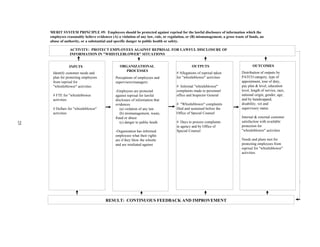
MERIT SYSTEM PRINCIPLE #9: Employees should be protected against reprisal for the lawful disclosure of information which the
     employees reasonably believe evidences (A) a violation of any law, rule, or regulation, or (B) mismanagement, a gross waste of funds, an
     abuse of authority, or a substantial and specific danger to public health or safety.

                 ACTIVITY: PROTECT EMPLOYEES AGAINST REPRISAL FOR LAWFUL DISCLOSURE OF
                 INFORMATION IN "WHISTLEBLOWER" SITUATIONS


                 INPUTS                          ORGANIZATIONAL                                OUTPUTS                                OUTCOMES
                                                   PROCESSES                                                                   Distribution of outputs by
      Identify customer needs and                                                    # Allegations of reprisal taken
      plan for protecting employees           Perceptions of employees and           for "whistleblower" activities            PATCO category, type of
      from reprisal for                       supervisors/managers:                                                            appointment, tour of duty,
      "whistleblower" activities                                                     # Informal "whistleblower"                pay plan & level, education
                                              -Employees are protected               complaints made to personnel              level, length of service, race,
      # FTE for "whistleblower                against reprisal for lawful            office and Inspector General              national origin, gender, age;
      activities                              disclosure of information that                                                   and by handicapped,
                                              evidences                              # "Whistleblower" complaints              disability, vet and
      # Dollars for "whistleblower"              (a) violation of any law            filed and sustained before the            supervisory status
      activities                                 (b) mismanagement, waste,           Office of Special Counsel
                                              fraud or abuse                                                                   Internal & external customer
                                                                                     # Days to process complaints              satisfaction with available
25


                                                 (c) danger to public heath
                                                                                     in agency and by Office of                protection for
                                              -Organization has informed             Special Counsel                           "whistleblower" activities
                                              employees what their rights
                                              are if they blow the whistle                                                     Needs and plans met for
                                              and are retaliated against                                                       protecting employees from
                                                                                                                               reprisal for "whistleblower"
                                                                                                                               activities


                                        RESULT: CONTINUOUS FEEDBACK AND IMPROVEMENT
THIS PAGE INTENTIONALLY BLANK
Examples of Governmentwide HRM Goals and Possible Measures

         /       Those that support public policy initiatives.
         /       Those that improve the efficiency and effectiveness of HR operations.
         /       Those that make positive contributions to overall agency performance.


As mentioned in the previous chapters, HR measures are going to be specific to the particular
goal established, and HR goals are going to vary among agencies depending on that agency’s
specific mission and strategies. Does this mean that there are no goals that have broad
applicability across Government agencies and no measures that can be used generally to assess the
achievement of these goals? We do not think so. In fact, the Task Force was interested in
identifying a number of areas for setting goals and establishing measures that seem to apply across
Government.

Specific Governmentwide HR Goals

We have already discussed at some length the Merit System Principles, which provide a broad
framework for HRM goalsetting and identification of measures. We have also noted that the
Principles themselves can be treated as goal statements, for example, “Recruit, select, and
advance employees on the basis of merit” (Merit Principle # 1). Clearly, though, there are many
other possible goals that an agency can and may wish to identify, some of which have such broad
applicability across the Federal Government that they can be characterized as “Governmentwide.”
Depending on the specific goal, they may support public policy initiatives, improve the efficiency
and effectiveness of HR operations, or make positive contributions to overall agency performance
and results. As noted, they all relate back to the Merit System Principles (individually or in the
aggregate) or can at least be categorized under them, but the Task Force believes they have a
particular importance to agencies in assessing their own performance, and should be highlighted
for agency consideration.

In the end, the Task Force identified five examples of Governmentwide HRM goals: customer
service, efficiency, workforce quality, veterans preference, and quality of worklife. Because these
are important, the Task Force has worked through each of these topics to show what exactly the
goal should be, why they are considered to have Governmentwide applicability, how an agency
can assess accomplishment of the goal, and what measures could be used in the assessment. In
the final section, one of these topics, customer service, has also been worked through to
demonstrate application of all steps of the Governmentwide HRM accountability model.

Governmentwide Standards?

Identifying Governmentwide goals implies that there may also be Governmentwide standards that
can be established for these goals. After all, if all agencies should be striving to achieve these
goals, shouldn’t they all be held to a common standard? The Task Force discussed this topic in
depth and concluded that it is not feasible to create Governmentwide standards for these goals.
Each agency is different and has different mission needs and capabilities. For instance, should an


                                                27
agency with 2,000 employees be expected to provide the same quality of worklife programs as an
agency with 200,000 employees?

Standards can only have relevance if the variables present from all reporting organizations are
identical, which is an impossibility. Agencies, however, can and should benchmark their
performance against like organizations to gauge how they are doing in specific areas. These
comparisons can also be very meaningful if the selection of comparable organizations is credible.
Comparisons can also be made against Governmentwide data. Much of this Governmentwide
data is available through the Central Personnel Data File (CPDF), and significant deviations from
Governmentwide norms may indicate a need for serious self-examination. Finally, agencies
always have the option of setting internal standards for performance based on these goals and
holding themselves accountable for meeting those standards.


                                               28
Customer Service

What is the goal?

High quality, cost-effective HR services are provided to agency managers, employees, and job
applicants.

Why is this a Governmentwide goal?

Spurred by recognition of increased global competition in the industrial sector, customer service
has undergone a significant resurgence as a business strategy since the early 1980s. The
preeminence of customer service as a fundamental management principle found its way into the
mainstream through the works of Tom Peters (In Search of Excellence and Thriving on Chaos)
and other management gurus. Finally, the NPR adopted these principles in an effort to restructure
and/or reinvent the Federal Government. Consequently, customer service has become one of the
cornerstones of management accountability in the Federal sector, and is an important aspect of
many HRM accountability programs.

How can we assess accomplishment of this goal?

Federal organizations have taken a traditional approach to the assessment of customer service,
relying on a variety of feedback mechanisms, both internal and external. This distinction between
internal and external customers is important, as it can impact the delivery of final goods and
services. With respect to HRM Accountability, the challenge is to achieve an equitable balance
between our internal customers (managers and employees) and our external customers (applicants
and the general public). Through such vehicles as customer service surveys, comment/suggestion
programs, appeals and grievances, entry or exit interviews, focus groups, and complaint
processing, it is possible to identify perceptions of strengths and weaknesses in customer service.

From such information, customer service standards may be established (e.g., timeliness or speed,
courtesy, accuracy, professional competence, etc) in such a way that performance against them
can be measured. Recognizing that increased efficiency is largely the result of discrete
improvements over time, it is necessary to define standards in “measurable” terms. For instance,
minimal timeliness measures can be established for individual HR processes (e.g., staffing - 45
days, classification - 30 days, awards - 20 days, action processing - 10 days, etc.). These
measures will be different for each agency depending on the program emphasis and complexity.

Through consistent application of such instruments and analysis of the information they provide, a
comprehensive picture of the customer service environment can be created. However, when it
comes to customer service assessment, the greatest program in the world can end up being
perceived by the customers as an abject failure if they are not engaged in the process. That means
that every effort to communicate customer service standards and improvements must be made,
customer feedback mechanisms continually strengthened.


                                                29
Keys to successfully measuring customer service must include:

C      Frequent evaluation: Customer service is constantly evolving. In order to really
       understand how effective it is in your organization it must be evaluated frequently.
C      Varied formats: From formal survey questions to open ended discussions at all levels and
       functions, data sources may involve many formats. Experts advise that you vary the
       format to combine several different feedback mechanisms.
C      Quantifiable measures: Specificity minimizes multiple interpretations and makes the
       measure objective.
C      Ingenuity of design: Continual, systematic listening from as broad a range as possible is a
       must, but try to move beyond the obvious measures to the more difficult-to-articulate
       (e.g., quality of service, integrity, professional expertise, courtesy).
C      Involvement: Include all functions and all levels of seniority within the HR Staff as well as
       outside customers.
C      Inclusiveness: It is crucial to obtain data from all customers (direct and indirect). Just
       know who is in which group and understand the difference.
C      Communication: Everyone in the organization should see the key customer measures.

Where can we go for data?

Data must be collected from the customers, internal and external. Do not assume you know what
the customer wants.

There are many tools for data collection that have already been designed and utilized by many
agencies. OPM’s Merit System Principles Questionnaire (MSPQ) is but one example of a survey
that can be adapted for use in agency HRM accountability programs and the historical data can
provide a benchmark against which to measure improvement. Agencies can either modify or
develop their own customer service surveys to make them fit with their customer service priorities
and overall mission objectives.

Getting started

C      HRM components need to identify their customer base. From there it is a matter of
       reaching out to those groups to identify overall customer service perceptions.
C      Establish a baseline. Once you understand customer perceptions, you can set about
       developing specific customer service standards. These standards should be distributed as
       widely as possible.
C      Now that you have customer service standards, you are in a position to measure
       effectiveness. Remember to define your measures in quantifiable terms, even the
       intangibles. Be careful, though, to avoid excessive use of averages in reporting results:
       they do not get to the root of a problem. Instead, gear your measures to focus on what is
       worst, to help you identify the areas of greatest vulnerability.
C      Remember that improving customer service is a process. The point of designing a
       quantifiable measure is to help you identify discrete improvements, and the measures
       themselves can be improved over time.


                                                30
Efficiency of HRM Programs

What is the goal?

HRM programs are efficient.

Why is this a Governmentwide goal?

Efficiency is a common sense management principle in that it reduces costs and increases
productivity. It has always been an important aspect of Federal management, but has become
increasingly important in the recent years of downsizing and budget cuts. With fewer resources
available to HR offices, it is critical to increase the efficiency of programs and processes to
effectively meet customer needs. Efficiency is also mandated by 5 U.S.C. 305, the Merit System
Principles, the Government Performance and Results Act, and the National Performance Review.
How can we assess accomplishment of this goal?

The efficiency of HRM programs is actually a subset of an effectiveness analysis of HRM
programs. An effectiveness analysis addresses the degree to which the HRM program contributes
to the achievement of performance goals of the organization, public policy goals associated with
HRM programs, and customer satisfaction. The actual costs of achieving that degree of
effectiveness are then factored in to make the overall effectiveness determination. For the
purposes of this Guide, the efficiency measures for HRM can be established at both the human
resources office and operating unit levels as follows:

       a. HR Staff Measures: Measures which show the costs and timeliness of the HRM
       services provided by the HR Staff to the serviced organization, and

       b. Organizational Measures: Measures which depict human resources costs at the
       operating unit level.

The following are examples of possible efficiency measures for HR Staffs:

C      Servicing ratio
C      HR costs per employee
C      HR costs per new hire
C      Average cost and/or time spent to process personnel/payroll action
C      Average cost and/or time spent per classification action
C      Percentage of employees receiving required performance appraisal for last fiscal year
C      Accretion of duties promotions as a percentage of total promotions
C      Effective use of automated systems
C      Percentage of positions covered by automated position description system
C      Percentage of recruitment actions filled through an automated staffing tool
C      Percentage of personnel/payroll actions requiring corrections


                                               31
The following are possible measures of efficient use of human resources by the operating
manager. These organizational measures should also be applied to the HR Staff:

C      Supervisory ratio
C      Average grade by organization/core occupation/one grade and two grade interval
       positions
C      Number of GS-14 and above positions over time
C      Number of employees by organization over time
C      Attrition rates by organization/occupation
C      Awards

Where can I go for data?

The data for most of the above measures is available from the CPDF or the payroll/personnel
automated system of the organization, which may have slightly more recent data.

Getting started

You need to clearly define the variables for each measure and develop a method to factor in
customer service. You also need to develop valid comparisons with other agencies. For example,
the benchmarks for a Federal regulatory commission should probably come from other regulatory
commissions. Benchmarks can be as specific as for research and scientific organizations,
administrative organizations, general counsels, etc. Valid cross-agency comparisons can then be
made for both the efficiency of the organization and the servicing HR Staff.


                                               32
Workforce Quality

What is the goal?

Maintain a high quality agency workforce.

Why is this a Governmentwide goal?

The quality of an organization’s workforce contributes directly to an organization’s productivity
and mission accomplishment. Without a workforce that is educated and trained, capable of
performing the work, and motivated to do it, even the most efficient organization with the best
strategic planning cannot accomplish its mission.

How can we assess accomplishment of this goal?

The quality of the workforce can be measured using a variety of demographic and process
measures, along with those that focus on broader systems. Demographic or transactional
measures of workforce quality include:

C      Education level of the workforce
C      Employee length of service
C      Age of the workforce
C      Performance awards
C      Number of incentive awards
C      Diversity of workforce
C      Rates of employees receiving disciplinary/adverse actions
C      Union activity, employee grievances, and equal employment opportunity
C      Employee absenteeism

More systemic measures of workforce quality include:

C      Employee competencies, training, and retraining: review of current developmental and
       leadership programs and worker competencies, and establishing new employee
       developmental and leadership programs

C      Technology changes: retraining of employees to implement and maintain new technology
       and organizational restructuring

C      Recruitment and attrition: targeted recruitment efforts to avoid skill shortages; review of
       career programs and career paths (possible updating of job analysis); workforce shaping
       through the use of incentive programs to encourage early retirement and attrition

C      Workplace quality: safety of employees, employee wellness programs, worker’s
       compensation cost reduction reviews, employee satisfaction

C      Policy issues: Executive initiatives and mandates, Family Friendly policies, identification
       of inherently non-governmental activities for possible contracting out


                                                33
Where can I go for data?

Depending on the measures you are using, there are a variety of sources. Most of the
transactional data can be obtained from the CPDF or the agency personnel/payroll system. Other
sources of information are agency grievance and EEO files, review of current agency policies, and
skills assessments. When using measures regarding employee satisfaction or other perceptual
issues, attitude surveys and focus groups may be helpful. For example, OPM’s Merit Systems
Principles Questionnaire data would prove helpful in this regard.


                                               34
Veterans Preference

What is the goal?

Appropriate employment preference is provided to qualified veterans.

Why is this a Governmentwide goal?

Through veterans preference, the Federal Government recognizes the sacrifices veterans of the
United States military have made in order to serve and protect their country. The first law
regarding the preference of veterans was passed by Congress in 1865 when it gave preference to
veterans with service-incurred disabilities. Since then, the national policy has evolved and been
strengthened by law, Executive Order, and regulation. In 1944, the various statutes, Presidential
directives, and Federal regulations were unified into a single law, known as the Veterans
Preference Act. Other laws have added provisions regarding veterans preference, including the
Veterans Education and Employment Assistance Act of 1976 and the Civil Service Reform Act of
1978. Legal requirements for veterans preference include 5 U.S.C. 1302, 5 U.S.C. 2108, and 5
CFR 211.

How can we assess the accomplishment of this goal?

Veterans preference is law and must be adhered to by all agencies. To ensure that this is done,
agencies should identify the most important systemic AND transactional measures of compliance
or non-compliance with requirements. For each of these measures, agencies should then identify
key measures of success, the method to be used for measurement, and the level of compliance that
will be considered acceptable.

An example of an assessment method is to conduct audits of examining processes to determine
whether the organization is performing at what the agency defines as an acceptable level. If
everything looks good, document and finish the review. If problems appear to exist, perform root
cause analysis; identify appropriate corrective action; implement the corrective action; and follow
up to ensure that the action was taken, and the desired results achieved.

Examples of systemic measures might be percentage of veteran representation in the workforce,
percentage of veteran representation by grade level in General Schedule positions, percentage of
veteran representation by grade level in FWS positions, and percentage of veteran representation
by geographic region.

Examples of transactional measures that can be applied through a delegated examining audit
might include: number of veterans on certificates of eligibles versus number of veterans selected
from these certificates, number of valid veteran passovers for selection, number of invalid veteran
passovers for selection, number of complaints associated with veterans hiring, and the rate of
veterans preference compliance in random review.

Where can I go for data?

The HR Staff should be able to obtain the majority of needed data through agency HR data
systems and/or the CPDF.


                                                35
Quality of Worklife Initiatives

What is the goal?

Employees are able to balance the needs of work and family.

Why is this a Governmentwide goal?

Improving the quality of work life for employees enables them to balance the needs of work and
family (social goals) and is an important benefit to assist in attracting and maintaining a quality
workforce (HRM goal). There has been an ongoing emphasis on expanding these programs for
the last decade or more. Some initiatives designed to achieve this goal include flexible work
schedules, job sharing, working at home or telecommuting centers, using sick leave for adoption
purposes or to care for family members, voluntary leave sharing programs and health promotion
programs.

The effectiveness of the programs should be evaluated in regard to their impact on HRM goals. It
is not enough simply to have the programs, they must be high quality programs that satisfy
employees’ needs. A day care center that is too expensive for employees to use will probably not
have a positive impact on job decisions or family life.

How can we assess accomplishment of this goal?

An agency can measure how many programs it has enacted and roughly how many employees are
participating in the programs. However, those measures do not indicate the quality of these
programs or whether the agency is meeting the goal of attracting and maintaining a quality
workforce as a result of the programs. It is hard to measure the impact of the programs (or their
absence) given the many factors that influence employee job decisions. The most qualitative
measure is employee input as to what effect the programs have on their decision to stay (or not
stay) with the agency. This can be done through entry or exit interviews, focus groups, individual
interviews, and/or surveys such as the MSPQ, which has baseline data on this topic.

Where can we go for data?

The HR Office should be able to provide the hard data on turnover rates since the implementation
of the programs, types of programs implemented, and number of employees covered.

The employee input must come directly from employees who both have and do not have access to
the programs. Managers can also provide information on the quality of new hires, which together
with other data may indicate whether the programs are attracting a high quality workforce.


                                                 36
Applying the HRM Accountability System Model:
                                           An Example

The U.S. Office of Government Operations (OGO), a Federal agency, has decided to design and
implement an HRM accountability system. This is a brief example of how the agency goes about
doing this, using examples of how it defines its goals, objectives, and measurement systems. The
example follows the HRM Accountability System Model step-by-step. It happens to focus on the
goal of customer service, but could just as well be applied to other agency HRM goals.

Step 1: Agency Diagnosis

The first step OGO takes in establishing its accountability system is to conduct a diagnostic of its
existing accountability components. It chooses to make use of the Accountability Program
Coverage Guide, which is available through the Office of Personnel Management and was
developed by OPM and the Interagency Accountability Working Group. In this way, it is able to
establish a baseline and determine if the accountability outcomes identified by the Guide -- both
accountability processes and HRM programs results -- are currently being achieved in the agency.

The agency finds that it is currently meeting some of the outcomes, but was able to identify areas
that can be improved. For instance, the diagnostic indicates that HR customers do not believe
that the HR office has a proactive customer service orientation.

Step 2: Establish Agency Strategic Goals

As part of implementing the Government Performance and Results Act (GPRA), OGO has
already developed a strategic plan with the strategic goals it plans to accomplish within the next
five years, so there is no need to develop them from scratch. Agency strategic goal number five
reads, “Build an environment of trust, teamwork, mutual respect, and pride of ownership through
more effective communication and leadership at all levels.” Strategies to accomplish this goal
include identifying internal customer relationships within the agency, expanding the use of teams,
and improving work environments in all offices to maximize operational effectiveness and the
quality of employee worklife.

Step 3: Establish HRM Goals that Support Agency Strategic Goals

The next step OGO takes in establishing its accountability system is to define HRM goals that
align with agency strategic goals. This is done in collaboration with employees, customers, and
stakeholders. OGO’s HR office begins the process by establishing a strategic planning task force.
The task force is made up of staff (both management and employees) from each HR function, and
agency managers are consulted frequently throughout the strategic planning process. The task
force begins by defining the HR office’s mission, vision, and values. These define what is
important to the office. In doing so, the task force finds it useful to refer to OPM’s framework of
goals and measures based on the Merit System Principles, as a way of rooting itself in overarching
Civil Service values and practices. It looks at the agency strategic plan to determine how the HR
office can support agency goals. Finally, it looks at the accountability diagnostic analysis to see
where the office’s strengths lie and what has been pinpointed as needing improvement.


                                                 37
After much brainstorming, discussion, and analysis, the task force defines the goals that the office
wishes to achieve within the next year. One of these goals is improvement of customer service:
“Improve HR services provided to Human Resources office customers.” This supports the
agency’s strategic goal to identify internal customer relationships within the agency, links to the
accountability outcome regarding a proactive customer service orientation, and is a challenge
faced by the office as indicated by the diagnostic analysis.

In addition to the general goal of improving services provided to its customers, OGO HR also
defines strategic objectives that show how it plans to achieve the goal. Using the diagnostic
baseline, the task force defines areas of customer service that should be maintained at current
levels or need improvement. These objectives include:

C      Increase manager and employee knowledge of personnel programs and policies through
       training and technical assistance.
C      Increase timeliness of HR services.
C      Increase quality as perceived by customers.
C      Maintain high level of compliance with HR laws and regulations.

In addition to these objectives, the task force designs an action plan that defines what
improvements will be made to the processes and systems in order to achieve the objectives. For
example, to increase customer knowledge of HR practices, HR will develop employee and
supervisory handbooks, and provide additional training.

Step 4: Establish HRM Measures Related to Goals

After identifying the goals for the year, OGO’s HR office must now identify measures that will
determine if the goals are being achieved. To facilitate this task, the task force focuses on the
objectives identified under customer service during the previous phase: increased knowledge of
HRM programs and policies, improved timeliness, improved quality of services, and maintaining a
high level of legal compliance. Specific measures can then be readily identified that address each
of the objectives. One source of such measures is the OPM Merit Principle Measurement
Framework, but there are many other sources as well.

The problem then becomes choosing the right measures for OGO. The task force uses the
Kepner-Tregoe problem solving and decision making approach to identify the most pertinent,
quantifiable, and resource efficient measures. For instance, the task force selects as a key measure
of increased knowledge of personnel programs and policies the number of technical questions
received by the HR Office. Given no decrease in legal compliance (for which there must also be a
measure or measures), a decrease in questions probably indicates greater understanding of current
programs and policies.

Step 5: Communicate HRM Goals and Measures

After the goals and measures are identified, OGO HR communicates them to the rest of the
agency through a newsletter. This newsletter shows the results of the customer feedback
gathered through the diagnostic, the goals HR plans to achieve and the improvements it plans to
make based on the customer feedback, and a time line for those actions. Through this type of
communication, the customers can see that their participation is making a difference regarding the
quality of service they receive.

                                                 38
Step 6: Establish Accountability for Goals and Measures

After identifying HRM goals and measures, OGO HR assigns accountability for the goals and
measures through a Measurement Plan Framework, as shown on the next page. In this context,
accountability has a dual meaning. In one sense, accountability means here ownership of the goals
and the results identified through measurement: who is accountable for achieving or failing to
achieve the goal. In the case of HR customer service, the HR Director is primarily accountable.
The other meaning of accountability has to do with responsibility for the measure itself. Who is
responsible for gathering the data for a particular measure and reporting it. In the example, this
responsibility rests with various members of the HR Office staff.

Step 7: Measure Performance

The next step in the accountability system is to actually develop methods for gathering and
disseminating measurement data. This involves identifying data sources, and designing
information systems needed to support data collection and reporting. OGO decides to continue
its use of the Measurement Plan Framework. Each person or group assigned responsibility for a
measure is also assigned with the development of the measurement tools or approaches that will
be most efficient and effective, as well as determining the frequency of measurement. All of this
information is added to the framework. New data systems required to support data collection and
reporting are developed.


                                               39
Example of the Measurement Plan Framework:

The framework lists the strategic objective, the individual measures, who owns the process (who
is accountable for it), and who will be responsible for developing, conducting, and reporting on
the measurement and analysis.

 Agency Goal: Build an environment of trust, teamwork, mutual respect, and pride of
 ownership through more effective communication and leadership at all levels.
 HR Goal: Improve HR services provided to OGO customers.
 HR Goal Owner: HR Director
 Strategic Objective        Measure            Measurement Tool       How       Measurement
                                               or Approach            Often     Responsibility
 Increase manager and       Number of          Automated tracking     qtrly     Training Staff -
 employee knowledge of      technical          system                           Suzie
 personnel policies         questions
 through training and
 technical assistance.
 Ensure legal accuracy of   Rate of            Record reviews         yearly    Policy and
 HR Office actions          compliance                                          Evaluation Div-
                                                                                Kelly
 Increase timeliness of     Customer           Automated tracking     qtrly     Personnel
 HR services.               Service            system                           Operations Div-
                            Standard                                            Tom
 Increase customer          Customer           Focus groups,          yearly    Policy and
 perceptions of quality.    ratings            customer surveys                 Evaluation Div-
                                                                                Bob


Step 8: Evaluate and Utilize Measurement Information to Improve HRM

After the measurement process has been completed, the OGO HR Office uses a collaborative
process for evaluating data, which again includes a cross functional team of employees, including
line managers. Such a process provides for a more comprehensive look at the data. The team
establishes findings, draws conclusions, and analyzes the results. Feedback is provided to the HR
Director as the owner of the objective in a systematic way. The team chooses to report its
findings, conclusions, and recommendations for improvement through briefings at staff meetings.
This way, the whole office can benefit from the information and participate as needed in
developing plans of action to solve problems or make improvements. After the feedback is
provided, the HR Director creates an action plan on how the process is going to be changed or
improved and presents this to staff as well as to the Director of OGO, to whom she reports.
Progress reports are made on a continuing basis. The action plan and progress reports are also
communicated to the customers through the newsletter. This lets the customers know that


                                               40
actions are being taken in response to their feedback and, ultimately, that their involvement in the
process is worthwhile.

Step 9: Assess and Improve Accountability Process

The final step of the accountability system is assessing and improving the process itself, and the
totality of HRM programs and policies. OPM has announced its intention to review OGO every 4
years. Rather than wait for this to happen, OGO’s HR Director has decided to stay a step ahead
of OPM by conducting an internal review every other year. The review team’s charter is to
review and assess the process described above — to see what has worked and what hasn’t — and
to make recommendations for improvement. It is also to assess broad HRM program results,
including overall progress toward HR customer service improvement.

The team uses various forms of data collection tools, such as focus groups, questionnaires,
records review, and policies review. The task force then analyzes the data, develops
recommendations for improvements, and shares these with the staff and across the organization
through a written report. Under the HR Director’s leadership, the information from the internal
review is used to make improvements in any or all aspects of the process (Steps 1 through 8) —
from identifying new goals and measures to establishing new HRM programs to finding more
effective means of involving non-HR stakeholders in the process.


                                                 41
THIS PAGE INTENTIONALLY BLANK
Appendix A
                               MERIT SYSTEM PRINCIPLES

As stated in Section 2301(b) of title 5, United States Code:

        (b) Federal personnel management should be implemented consistent with the following
merit system principles:

                (1) Recruitment should be from qualified individuals from appropriate sources in
       an endeavor to achieve a work force from all segments of society, and selection and
       advancements should be determined solely on the basis of relative ability, knowledge, and
       skills, after fair and open competition which assures that all receive equal opportunity.

               (2) All employees and applicants for employment should receive fair and equitable
       treatment in all aspects of personnel management without regard to political affiliation,
       race, color, religion, national origin, sex, marital status, age, or handicapping condition,
       and with proper regard for their privacy and constitutional rights.

              (3) Equal pay should be provided for work of equal value, with appropriate
       consideration of both national and local rates paid by employers in the private sector, and
       appropriate incentives and recognition should be provided for excellence in performance.

              (4) All employees should maintain high standards of integrity, conduct, and
       concern for the public interest.

               (5) The Federal work force should be used efficiently and effectively.

              (6) Employees should be retained on the basis of the adequacy of their
       performance, inadequate performance should be corrected, and employees should be
       separated who cannot or will not improve their performance to meet required standards.

              (7) Employees should be provided effective education and training in cases in
       which such education and training would result in better organizational and individual
       performance.

               (8) Employees should be -
                       (A) protected against arbitrary action, personal favoritism, or coercion for
               partisan political purposes, and
                       (B) prohibited from using their official authority or influence for the
               purpose of interfering with or affecting the result of an election or a nomination for
               election

              (9) Employees should be protected against reprisal for the lawful disclosure of
       information which the employees reasonably believe evidences -
                     (A) a violation of any law, rule, or regulation, or
                     (B) mismanagement, a gross waste of funds, an abuse of authority or a
              substantial and specific danger to public health or safety

                                                A-1
PROHIBITED PERSONNEL PRACTICES

As stated in Section 2302 (b) of title 5, United States Code:

       (b) Any employee who has authority to take, direct others to take, recommend, or
approve any personnel action, shall not, with respect to such authority -

               (1) discriminate for or against any employee or applicant for employment -
                       (A) on the basis of race, color, religion, sex, or national origin, as
               prohibited under section 717 of the Civil Rights Act of 1964 (42 U.S.C. 2000e-
               12);
                       (B) on the basis of age, as prohibited under section 12 and 15 of the Age
               Discrimination in Employment Act of 1967 (29 U.S.C. 631, 633 a);
                       (C) on the basis of sex, as prohibited under section 6(d) of the Fair Labor
               Standards Act of 1938 (29 U.S.C. 206(d) );
                       (D) on the basis of handicapping condition, as prohibited under section
               501 of the Rehabilitation Act of 1973 (29 U.S.C. 791); or
                       (E) on the basis of marital status or political affiliation, as prohibited under
               any law, rule, or regulation;

               (2) solicit or consider any recommendation or statement, oral or written, with
       respect to any individual who requests or is under consideration for any personnel action
       except as provided under section 3303(f);

               (3) coerce the political activity of any person (including the providing of any
       political contribution or service), or take any action against any employee or applicant for
       employment as a reprisal for the refusal of any person to engage in such political activity;

             (4) deceive or willfully obstruct any person with respect to such person's right to
       compete for employment;

              (5) influence any person to withdraw from competition for any position for the
       purpose of improving or injuring the prospects of any other person for employment;

               (6) grant any preference or advantage not authorized by law, rule, or regulation to
       any employee or applicant for employment (including defining the scope or manner of
       competition or the requirements for any position) for the purpose of improving or injuring
       the prospects of any particular person for employment;

                (7) appoint, employ, promote, advance, or advocate for appointment,
       employment, promotion, or advancement, in or to a civilian position any individual who is
       a relative (as defined in section 3110(a)(3) of this title) of such employee if such position
       is in the agency in which such employee is serving as a public official (as defined in section
       3110(a)(2) of this title) or over which such employee exercises jurisdiction or control as
       such an official;


                                                 A-2
(8) take or fail to take, or threaten to take or fail to take, a personnel action with
respect to any employee or applicant for employment because of -
                (A) any disclosure of information by an employee or applicant which the
        employee or applicant reasonably believes evidences -
                        (i) a violation of any law, rule, or regulation, or
                        (ii) gross mismanagement, a gross waste of funds, an abuse of
                authority, or a substantial and specific danger to public health or safety
        if such a disclosure is not specifically prohibited by law and if such information is
        not specifically required by Executive order to be kept secret in the interest of
        national defense or the conduct of foreign affairs; or
                (B) any disclosure to the Special Counsel, or to the Inspector General of
        an agency or another employee designated by the head of the agency to receive
        such disclosures, of information which the employee or applicant reasonably
        believes evidences -
                        (i) a violation of any law, rule, or regulation, or
                        (ii) gross mismanagement, a gross waste of funds, an abuse of
                authority, or a substantial and specific danger to public health or safety;

        (9) take or fail to take, or threaten to take or fail to take, any personnel action
against any employee or applicant for employment because of -
                (A) the exercise of any appeal, complaint, or grievance right granted by
        any law, rule, or regulation;
                (B) testifying for or otherwise lawfully assisting any individual in the
        exercise of any right referred to in subparagraph (A);
                (C) cooperating with or disclosing information to the Inspector General of
        an agency, or the Special Counsel, in accordance with applicable provisions of law;
        or
                (D) for refusing to obey an order that would require the individual to
        violate a law;

        (10) discriminate for or against any employee or applicant for employment on the
basis of conduct which does not adversely affect the performance of the employee or
applicant or the performance of others; except that nothing in this paragraph shall prohibit
an agency from taking into account in determining suitability or fitness any conviction of
the employee or applicant for any crime under the laws of any State, of the District of
Columbia, or of the Untied States; or

        (11) take or fail to take any other personnel action if the taking of or failure to
take such action violates any law, rule, or regulation implementing, or directly concerning,
the merit system principles contained in section 2301 of this title.

       (12) knowingly take or fail to take a personnel action if that action or failure to
act would violate a statutory or regulatory veterans’ preference requirement.


                                          A-3
THIS PAGE INTENTIONALLY BLANK
Credits and References
Information and insights used in the creation of this system development guide were drawn in part
from the following material:

Federal Personnel Publications, Federal Personnel Guide

GPRA Slides Toolkit, http://www.financenet.gov

Merit Systems Protection Board, Federal Personnel Offices: Time for a Change?, August 1993

National Academy of Public Administration, Measuring Results: Successful Human Resources
Management, September 1997

Phillips, Jack, Accountability in Human Resource Management, Gulf Publishing, 1996

Ulrich, Dave, A New Mandate for Human Resources, Harvard Business Review, January-
February 1998

U.S. Department of Agriculture Graduate School, Strategic Planning for a Customer-Focused
Government

U.S. General Accounting Office, Management Reform: Agencies’ Initial Efforts to Restructure
Personnel Operations, July 1998

U.S. Office of Personnel Management/Merit Systems Protection Board, Federal Workforce
Quality: Measurement and Improvement, August 1992

 Zagarow, Herbert, Performance Measures For Your Government Agencies: How to Determine
and Measure What Really Counts

Accountsbility,responsible

  • 1.
    Strategic Planning HumanResources Management HRM Accountability System Development Guide United States Office of Merit Office of Systems HRM Acountability Personnel Oversight and Committee Print Management Effectiveness (12/1998)
  • 2.
    Acknowledgments This Guide isthe product of an Interagency Task Force made up of members from the Interagency Advisory Group Committee on Human Resources Management Accountability. We would like to thank the following agencies for participating in this process and sharing “the agency” perspective on accountability: Department of Agriculture Department of Justice Department of Commerce Department of Labor Department of Defense Department of Navy Department of Education Office of Personnel Management Department of Energy Small Business Administration Department of Health and Human Services Department of State Department of Housing and Urban Department of Treasury Development Department of Transportation U.S. Department of Interior There are many people who have contributed their time, talents, and ideas to this document. We would like to extend our appreciation for their special efforts and continued dedication. They are: Jim Gallo Lee Hall Paul Thompson Curt Dahlke Bill Reynolds Laura Shugrue Art Buck Robert Stokes Craig Pettibone Virginia Novak Janet Cope Phil Sagal Betty Sullivan Micheal Sena Kamaron Kellum Jacqueline Taylor Margaret Foskey Lisa Roth Mike Urquhart Roberta Peters Don Jansen D. Everett Mario Caviglia Tony Ryan Irene Gray If you have any questions, comments, or suggestions regarding this Guide, please contact the U.S. Office of Personnel Management Office of Merit Systems Effectiveness at (202) 606-2820.
  • 3.
    Table of Contents ExecutiveOverview . . . . . . . . . . . . . . . . . . . . . . . . . . . . . . . . . . . . . . . . . . . . . . . . . . . . . . . . . . i Introduction: Why HRM Accountability? . . . . . . . . . . . . . . . . . . . . . . . . . . . . . . . . . . . . . . . . . 1 Accountability Roles and Responsibilities . . . . . . . . . . . . . . . . . . . . . . . . . . . . . . . . . . . . . . . . . . 3 The HRM Accountability System . . . . . . . . . . . . . . . . . . . . . . . . . . . . . . . . . . . . . . . . . . . . . . . . 7 HRM Goals . . . . . . . . . . . . . . . . . . . . . . . . . . . . . . . . . . . . . . . . . . . . . . . . . . . . . . . . . . . . . . . . 9 HRM Measures . . . . . . . . . . . . . . . . . . . . . . . . . . . . . . . . . . . . . . . . . . . . . . . . . . . . . . . . . . . . 13 Merit System Principles Framework . . . . . . . . . . . . . . . . . . . . . . . . . . . . . . . . . . . . . . . 16 Examples of Governmentwide HRM Goals and Possible Measures . . . . . . . . . . . . . . . . . . . . . 27 Customer Service . . . . . . . . . . . . . . . . . . . . . . . . . . . . . . . . . . . . . . . . . . . . . . . . . . . . . 29 Efficiency of HRM Programs . . . . . . . . . . . . . . . . . . . . . . . . . . . . . . . . . . . . . . . . . . . . 31 Workforce Quality . . . . . . . . . . . . . . . . . . . . . . . . . . . . . . . . . . . . . . . . . . . . . . . . . . . . 33 Veterans Preference . . . . . . . . . . . . . . . . . . . . . . . . . . . . . . . . . . . . . . . . . . . . . . . . . . . 35 Quality of Worklife Initiatives . . . . . . . . . . . . . . . . . . . . . . . . . . . . . . . . . . . . . . . . . . . 36 Applying the HRM Accountability System Model . . . . . . . . . . . . . . . . . . . . . . . . . . . . . . . . . . 37 Appendix A - Merit System Principles and Prohibited Personnel Practices . . . . . . . . . . . . . . . . . . . . . . . . . . . . . . . . . . . . . . . . . . A-1
  • 4.
    Executive Overview C This HRM Accountability System Development Guide was created by the Office of Personnel Management (OPM) and a Task Force of agency representatives, working under the auspices of the Interagency Advisory Group Committee on Human Resources Management (HRM) Accountability. While it provides a broad look at HRM accountability, it also provides line managers and HR specialists with an accountability framework to use in developing agency accountability systems. This framework can be customized and applied at various levels within an agency -- from the Department level down to the installation level -- no matter what type of organizational structure is in place. C As this document reflects, the Task Force believes that human resources management is everyone’s business. The business world is evolving from an industrial-based to a knowledge-based enterprise, and this is requiring a new way to look at business strategies and human resources management. As renowned HRM expert Dave Ulrich states in his recent article, A New Mandate for Human Resources, “The competitive forces that managers face today and will continue to confront in the future demand organizational excellence. The efforts to achieve such excellence -- through a focus on learning, quality, teamwork, and reengineering -- are driven by the way organizations get things done and how they treat their people. Those are fundamental HR issues.” C As a result, HR’s role has changed. The focus is no longer on serving the individual employee and paperwork processing, but on the effective use of human resources -- people -- in achieving the organization’s strategic objectives. It’s about achieving organizational excellence, a flexible workforce with the competencies to do the job well, and return on investment. It’s too big to be the responsibility of the Personnel or Human Resources Office alone. Significant management involvement and sharing of expertise are needed to reconceive and reconfigure the program -- again and again if necessary as external circumstances require. In sum, HRM accountability is about the responsibility shared by top management, line managers, and the HR staff for ensuring that people are used effectively, and in accordance with legal requirements. C Most organizations, today, acknowledge the need for accountability-based HRM, but are confused about how and where to start. This guide describes a model for establishing and maintaining an HRM accountability system within an organization, with particular emphasis on HRM goals and measures. This emphasis responds to the widespread interest in how to measure HRM effectiveness in support of agency mission accomplishment. C The HRM accountability model described here is a continuous cycle, or system. A systemic approach enables an agency to identify, collect, and use the information or data on which accountability is ultimately based. HRM accountability starts with identifying the agency strategic goals. Following that, agency HR goals in support of the strategic goals are defined. Then, performance measures are developed and a baseline established to permit assessment of whether the goals are being met. When these measures are coupled with the Merit System Principles framework, the agency is able to develop a profile and comparisons of how well it is performing in implementing HRM consistent with the Principles, the backbone of the Federal HRM system. i
  • 5.
    C In order to further the establishment of HRM accountability systems Governmentwide, OPM plans to follow this overview document with examples, best practices, and more detailed guidance on all aspects of HRM accountability system development. OPM has begun to compile a clearinghouse of accountability practices, but it is by no means exhaustive. Therefore, we set forth this challenge to agencies: to share with OPM your best practices regarding HRM accountability so that we may share them with the Federal community and learn together from your successes. ii
  • 6.
    Introduction: Why HRMAccountability? / To let managers manage. / To support the mission within the framework of laws, rules, and regulations. This Human Resources Management (HRM) Accountability System Development Guide has been developed by OPM to help achieve the goal of sound, manager-based people management in the Federal Government. It is based on the following simple premise: Human resources management does not exist as an end in itself but for the purpose of supporting organizational mission accomplishment. The Federal manager is not a free agent when it comes to managing people. Merit System Principles HRM activities are carried out within the framework of established public policies, The nine Merit System Principles constitute the framework that shapes the whole structure of Federal such as Veterans Preference, and the HRM as it strives to support agency mission values of openness, fairness, and equity accomplishment. The Principles are commonly and expressed in the Merit System Principles. correctly identified as supporting fairness for On the other hand, HR systems and employees and adherence to HR laws and regulations processes cannot take on a life of their that enforce the concept of merit. Yet, they support own independent from broad equally the need for efficiency and effectiveness, and organizational goals. They must instead for not allowing rules to become an end in themselves. be judged by how well they, and the Thus, the Merit Principles as a totality provide an functional experts who administer them, excellent set of HRM values to live by for the Federal support those who work each day to manager. The Prohibited Personnel Practices are carry out the agency’s programs. specific practices to be avoided in upholding the Merit Principles. See Appendix A for the full text of the Principles and Practices. This is not a new premise, and it may seem to be no more than common sense. “Let managers manage,” as the saying goes, and let that include managing people. Yet in many agencies, it represents a real change from the traditional model of HRM. Authority to make many HRM decisions has historically been held in the HR or Personnel Office (for example, classification of positions to title, series and grade). Managers obviously participated in these decisions, but the HR Office often retained final authority. The primary concern was for compliance with HR laws and regulations, not how well the HR system supported mission accomplishment. The new model does not abandon compliance concern but rather represents a major shift in balance toward outcomes and results. The new, though still evolving, Federal HRM model places the direct responsibility for human resources management on those whose immediate task is mission accomplishment -- line managers. These managers, supported by the human resources staff, must be given authority to manage human resources and then be held accountable for the results or outcomes of their decisions. This makes good business sense. Those with authority and responsibility for accomplishing the agency mission should also have authority and responsibility over HRM. Those who run an 1
  • 7.
    agency’s business shouldknow best what kind of employees are needed and how they should be deployed. In the Executive Branch, this responsibility is also a legal mandate. OPM can and does Accountability Legal Authorities delegate HRM authorities to heads of agencies and holds agencies accountable for reviewing Under title 5 of the U.S. Code, OPM may delegate (and in fact has done so extensively) any function the efficiency and effectiveness of their human vested in the OPM Director to the heads of resource management programs. Failure by an agencies (5 U.S.C. 1104), who in turn may delegate agency to carry out this responsibility is a to “subordinate officials the authority...to take final violation of the law. Just as important, it will action on matters pertaining to the employment, also probably lead to less than fully effective direction, and general administration of personnel use of human resources, which in most Federal under his agency...” (5 U.S.C. 302). These agencies constitute by far the greatest budget authorities carry with them accountability, not only expense. for legal compliance but also for program effectiveness. Each agency is responsible for The Government Performance and Results Act preventing prohibited personnel practices from (GPRA) provides another legal mandate with occurring and complying with applicable civil service laws (5 U.S.C. 2302), as well as for implications for HRM accountability. reviewing the efficiency and effectiveness of its Application of GPRA will push agencies in the human resource management programs (5 U.S.C. direction of aligning all their activities, 305). including HRM, toward achieving agency strategic goals and measuring progress toward those goals. For GPRA to have the desired effect, a clear and conscious link between GPRA results and human resource inputs and goals must be established at every agency. In the context of HRM accountability, managers gain more discretion, but within a tight frame of mission definition and performance monitoring. This document is specifically intended to enable agencies to fulfill their HRM accountability and GPRA responsibilities. We believe it will be a useful tool for getting agencies -- with the HR Office as the catalyst -- to establish viable HRM accountability systems, and to help their managers understand and embrace their responsibility and accountability for effective HRM. It is no cure-all; other initiatives and tools will no doubt be needed. Ultimately, each agency must find its own path to realizing these objectives. 2
  • 8.
    Accountability Roles andResponsibilities: Who is Accountable? / Generally, the manager is directly accountable for the program impact of the HRM decision, while the HR Staff is directly accountable for the regulatory compliance of the action. / However, “shared accountability” means that both HR staff and managers are ultimately accountable for effective, legally compliant HRM. / Top management is accountable for committing the organization to shared accountability. Now that we have identified the “why” of accountability, it is important to identify the “who.” Who is accountable for HR decisions and what responsibilities do they hold? The National Performance Review (NPR) mandate for decentralization of HRM authorities combined with the requirement of GPRA to assess program accomplishments against performance goals has had a profound effect on the manner in which HRM decisions are made and the level of accountability for those decisions. In order to meet the challenges presented by NPR, many agencies have pursued the strategy of delegating key HRM authorities to managers and following a more collaborative approach between managers and the human resources staff in the decision-making process for those HRM authorities retained by the HR Staff.1 This chapter is designed to assist managers and HR Staffs to better understand their roles and responsibilities in the HRM accountability process. As noted above, HRM authorities have been delegated to agency heads by the Director of OPM. Agency heads typically delegate these authorities to the HR Office, which in turn may or may not delegate them further to line managers. Therefore, from the top down, no single official or organization is unilaterally accountable for HRM decisions regardless of whether HRM authorities are delegated to the operating unit level or remain with the HR Staff. And delegated authorities within the agency are a shared responsibility between the manager and the HR Staff. All HRM decisions must adhere to the Merit System Principles, the foundation of the Civil Service; not be proscribed by a Prohibited Personnel Practice; and comply with established laws and regulations. Where there is a union present, authority is also exercised within the framework of negotiated agreements. In the last few years, agencies have entered into labor-management partnership agreements that give employee representatives additional opportunity to participate in agency decisionmaking. For example, in one agency the union has worked with upper management to help establish agency goals. In this situation, the union can be said to have taken on a kind of shared accountability for the achievement of those HRM goals. 1 HR Staff refers to the HR service provider, whether providing consulting and/or processing services. 3
  • 9.
    Guidelines for SharedHRM Accountability Every agency is likely to have Shared Accountability its own unique approach. But, to point the way while raising Manager important issues for agency consideration, the Task Force HR Staff has developed the following guidelines for describing and sharing HRM accountability. Where HRM authority has If Compliant If Not Compliant been delegated to a manager but the HR Staff has Finalize Action HR and Manager Consult responsibility for processing the action, the HR Staff is Non-Compliant accountable for ensuring that Alternative Action No Action Action the proposed action meets regulatory compliance and is HR Seeks Resolution with consistent with the Merit Agency Top Management System Principles. If the proposed action fails to meet regulatory compliance, the HR Staff consults with the manager to offer other options that enable the manager to achieve the desired goal but comply with regulations. In this situation, the manager and HR Staff have shared accountability. Though the manager has the final discretionary authority, the HR Staff has the final regulatory authority. Therefore, the manager is accountable for the program impact of the HRM decision while the HR Staff is accountable for the regulatory compliance of the action at the time it is effected. In this case, if the manager cannot select an option that meets regulatory compliance, the HR Staff should not process the action. If the manager continues to try to effect the action, the HR Staff should go through appropriate channels to notify higher level management. Automation has strongly affected roles and responsibilities for HRM accountability. With operating units often having direct access to personnel/payroll databases and “expert systems,” managers can exercise their delegated HRM authorities independently without the assistance of the HR Staff. Where this occurs, HRM actions can be effected without input or review from the HR Staff. If the HR Staff has no review or approval role in the processing of the HRM action, the manager is directly accountable for the program impact AND regulatory compliance of the HRM action. However, even where the HRM authority is delegated to the operating unit, the HR Staff has oversight (indirect) accountability for regulatory compliance. This obligation is met when the HR Staff, which may partner with the Inspector General or other internal audit staff, conducts periodic reviews of manager-effected HRM actions. If the HR Staff finds that an action has been taken which does not meet regulatory compliance, it must ensure that corrective action is taken. Failure of the operating unit to continually meet regulatory compliance should result in adjustments in the delegation of HRM authorities to ensure future compliance. The HR Staff also has oversight accountability for managing human resources effectively, even where the authority is delegated to the operating unit. Where actions taken by the manager meet 4
  • 10.
    regulatory compliance butare not good management practices, the HR Staff should consult with the manager regarding options for future actions. Even with the NPR emphasis on the delegation of HRM authorities to the lowest decision-making level possible, many of the most sensitive HRM authorities will not be delegated to the operating unit level due to legal and technical complexities of HRM and staffing resource considerations. Regulatory interpretations regarding many HRM programs and actions of a complex nature will continue to be made by dedicated HR staff, often in consultation with the legal office. Therefore, roles and responsibilities in the HRM process must emphasize the collaborative approach between managers and HR Staffs. Where the HRM authority has been delegated to the operating unit level, the manager may make all HRM decisions within his/her delegated authority which are not contrary to the Merit System Principles and Prohibited Personnel Practices or in violation of laws and regulations. However, where the authority remains with the HR Staff, the HR Staff is responsible for advising the manager regarding the degree of discretion available (the legal options) and recommending the best course of action from the standpoint of HRM effectiveness. In this situation, the HR Staff is directly accountable for regulatory compliance. But, both the HR Staff and managers are accountable for program results -- with the managers directly responsible for the decisions they make and the HR Staff more broadly responsible for program effectiveness. Transitioning to Shared HRM Accountability To facilitate a successful transition to this more collaborative approach, HR Staffs, managers, and top management need to redirect their efforts in several different areas. HR Staffs must: C Focus more on creating value than running programs. C Become actively involved in the development of HRM goals and strategies in support of mission accomplishment and the effective communication of those policies to managers. C Act as consultants to managers on HRM issues, helping and encouraging them to consider the people aspect of their business decisions. C Simplify, streamline, or automate existing HRM processes such as staffing and classification. C Provide managers with accessible on-line HRM information. Managers must: C Increase their knowledge of Merit System Principles, Prohibited Personnel Practices, and HRM laws and regulations. C Develop a clear understanding of how HRM decisions affect mission accomplishment and how business decisions impact people. C Ensure the proper exercise of HRM authorities. Agency top management must: C Recognize and communicate that people in an organization are the single most valuable and irreplaceable resource. C Demonstrate a strong commitment to HRM accountability and the shared roles between managers and HR Staffs. 5
  • 11.
    C Require management training and education to enable managers to make informed HRM decisions compliant with law and regulation, and require HR staffs to understand the programs they support. The HRM decision-making process described here will begin to pay dividends for those agencies which have adopted the strategies described above in a variety of ways, including faster processing times for HRM actions, ownership of the HRM program by line managers, better consultative service from agency HR Staffs, and a clear connection between the HRM decision- making process and mission accomplishment. As an essential component of the new HRM decision-making process, HRM accountability assumes an ever-strengthening connection between HRM and mission accomplishment. 6
  • 12.
    The HRM AccountabilitySystem / Establish HRM goals and measures. / Establish accountability for goals and measures. / Measure performance. / Evaluate and utilize measurement information. / Assess and improve accountability process. The roles and responsibilities of line managers and the HR staff are obviously not the only pieces of the HRM accountability puzzle. HRM accountability should be seen as a continuous cycle, or system. A systemic approach enables an agency to identify, collect, and use the information or data on which accountability is ultimately based. It overcomes the common problem of fragmented, disjointed efforts that don’t add up to the sum of their parts. The remainder of this Guide is an elaboration of portions of the HRM Accountability System Model, with special emphasis on the timely and critical topics of HRM goals and measures. On the next page is a graphic depiction of this Model. As the graphic shows, HRM accountability starts with identifying the agency strategic goals. Following that, agency HR goals in support of the strategic goals are defined. Then, performance measures are developed and a baseline established to assess whether the goals are being met. But the process does not stop there. HR goals must be widely communicated. HR measures must be collected, tracked, and evaluated, and the findings communicated throughout the agency. Then, the agency must use this information to make improvements where necessary. Periodically, the HRM accountability process itself needs to be evaluated to ensure that it accomplished what was needed in the most efficient and effective way. If not, improvements should be made to the system. A general assessment should also be made of overall HRM effectiveness. Finally, the process starts over at the beginning, with goals changing as necessary based on the information gathered from the review and the changing needs of the organization and its customers. Most agencies already have pieces of an accountability system that they can build around. For instance, many agencies have already developed an HR strategic plan or conduct customer service surveys. We are not advocating “reinventing the wheel”. In this time of downsizing, streamlining, and cutting costs, agencies have limited resources to devote to the development of an accountability system. Therefore, the most efficient manner to start the process is to use what you already have and build up from there. In the end, this effort will be worth the investment of time and resources, because creating a system out of what may now be a set of loosely related pieces will maximize their effect and their value in support of effective human resource management. 7
  • 13.
    HRM Accountability System Customers & Stakeholder Input Performance Reporting to Agency Goals Customers and Legislative Priorities Stakeholders & Decisions OPM HRM Accountability System Outcomes Evaluate and Utilize Establish and Establish Assess and Improve Measure Measurement Update HRM Goals Accountability Accountability Performance Information 8 Agency Diagnosis and Measures for Goals & Measures Process to Improve HRM (Accountability Program Coverage Guide) •Communicate HRM goals and •Develop methods for gathering •Develop collaborative •Develop method for periodically •Identify agency HRM goals measures throughout the agency and disseminating measurement process for evaluating data assessing the HRM Accountability •Ensure agency HRM goals are •Accountability for each measure data •Establish findings and draw Process •Agency incorporates OPM’s linked to Accountability Outcomes is established •Data sources are identified conclusions •Develop a collaborative method for HRM Accountability System •Establish measures to support •Responsibility for data collection, •Information systems are •Results are analyzed and deciding improvement actions Outcomes HRM goals reporting, analysis, and designed to support data validated •Implement improvement actions •The Accountability PCG is •Use collaborative effort with communication are identified collection and reporting •Feedback is provided to applied as a diagnostic to customers and stakeholders to activity/process owners for establish the agency’s baseline develop/validate goals and measures continuous improvement •Based on findings, take actions to improve HRM systems
  • 14.
    HRM Goals: What We’re Accountable For / HRM goals define what is important to the viability and success of the organization. / To define the goals, collaborate with stakeholders, tie HR goals to agency strategic goals, and make goals specific and measurable. So far, we have discussed why accountability is important and who should be held accountable. We have also introduced an Accountability System model that describes a continuous process for ensuring HRM accountability. We now need to zero in on perhaps the most critical box in the model: “Establish and Update HRM Goals and Measures.” Identifying goals and measures is how an agency says what it is willing to hold itself accountable for as far as human resources management is concerned, and how it will determine whether it is meeting these goals. The Government Performance and Results Act is a driving force behind the current emphasis on identifying goals and measures. Application of GPRA is pushing agencies in the direction of aligning all their activities, including HRM, toward achieving agency strategic goals and measuring progress toward those goals, in an effort to improve the confidence of the American people in the Federal Government. This process has many benefits. It can help an organization clarify future direction, establish priorities, initiate program performance improvement, increase effectiveness and accountability, help managers improve service delivery, and improve decision- making and internal management. As we have seen, HRM is an essential element of management, and the Task Force believes strongly that there is an important place for specific HRM goals in the GPRA process. The need for HRM accountability is inherent in the delegations that Department Heads receive from the President to hire staff, compensate them, and to use this resource in accomplishing the organization’s statutory mission. These delegated authorities are critical and potent, requiring judicious and informed use. They also must be tied in to agency mission-related goals. Agencies establishing goals for using their human resources management authority in the Federal sector should be driven by the pursuit of excellence in our human resources programs and systems, along with respect for American cultural and political practices and traditions. These goals will have their greatest impact when they are clearly connected to our society’s basic values as well as to sound management practice. Fortunately, Federal HRM has a set of guiding Principles that meet both of these criteria. The Merit System Principles From among the several conceptual frameworks that have been developed for identifying HRM goals and measures, OPM has chosen the Merit System Principles as the preferred method for organizing Federal HRM goals and measures. These Principles express the values that govern the Civil Service and set appropriate parameters for the exercise of HRM authority. They are also fully in keeping with the special requirements imposed on the Federal Government as an employer 9
  • 15.
    and as managerof its human resources. They provide a uniquely appropriate framework for identifying HRM goals and measures in the Federal Government. The Merit System Principles express the values of the Federal HRM system and are set forth in law. As described by managers, themselves, the Principles are sound management practices based on common sense that ensure Federal employees are treated fairly and equitably and that the Federal HRM system is based on merit. They cover key Federal HRM management goals, including diversity, open competition, efficiency and effectiveness, performance, and responsibility to the taxpayer (see Appendix A for full listing of the Principles). As such, they can provide a framework for evaluating the effectiveness of a Federal agency’s HRM system. In an August 1992 report, Federal Workforce Quality: Measurement and Improvement, a joint OPM and Merit Systems Protection Board Advisory Committee on Federal Workforce Quality Assessment, recommended using a model such as the “Assessment Model for Measuring Merit System Accountability.” HRM measures are organized by Merit System Principle and assessed in an outcomes-focused model that: C Provides a framework for evaluation C Looks beyond traditional input/output measures C Links agency planning to mission accomplishment C Focuses attention on improved outcomes and results Applying HRM data measures by Merit System Principle develops a profile of how well an agency is performing in implementing HRM consistent with the Principles. OPM has developed a model that can take data indicators for the agency, sort them by Merit Principle, and compare them to Governmentwide data. This comparison can help an agency identify key issues and trends that need attention. Of course, the Merit Principles are no cure-all. They serve as an organizing framework and point the way toward meaningful and appropriate HR goals for an agency, but it is still necessary for the agency to identify specifically its goals and related measures, taking into account its own particular situation. In some cases, agency goals will not readily fall under a specific Principle, but could be said instead to derive from a composite of the separate Principles, for example, the goal of effective customer service from the HR Office. Other goals, such as compliance with veterans preference law and regulations, may not be inherent in a particular Principle itself but still relate to it topically. In the case of veterans preference it clearly relates directly to the whole range of staffing-related goals and measures that could be described under the first Merit Principle. So, as an organizing framework, the Merit Principles can encompass the entire gamut of HRM goals and measures. There are of course other frameworks for organizing goals and measures, and they can be of interest, too, in that they provide a different perspective on HR goals. We have found that they can be particularly useful for identifying crosscutting goals -- those not tied to a specific Merit Principle -- and attendant measures. Examples of these other approaches include the balanced 10
  • 16.
    scorecard2 and theBaldrige quality criteria, to name just a couple of the better known ones, and both have been applied successfully by Federal agencies. Another example of a simple, intuitively appealing approach to goals and measures is the Hierarchy of Accountability. This approach was suggested by the Task Force itself, as an original idea, and is described briefly in the inset. Each of these frameworks has its strengths and weaknesses, its particular advantages and disadvantages, but like the Merit Principles all attempt to provide some kind of system and order to the bewildering, seemingly chaotic world of goals and measures. The Goal-Setting Process Hierarchy of Accountability You will note that to this point we have been very careful to talk Understanding the hierarchy of accountability can be useful to about goals and measures in the identifying agency HRM goals. The hierarchy of accountability same breath, for the reason that it builds from the most basic level of ensuring compliance with Civil is a very common mistake in Service laws and regulations. All agencies must set and achieve goals that relate to this basic need for legality or face severe strategic planning to jump right sanction. Once basic compliance has been met, efficiency is the into measures and measurement, next level at which goals can be set. Efficiency has two meanings without the focus provided by in the accountability hierarchy. One meaning refers to the degree of well-chosen goals. Goals define efficiency of HRM service delivery. The other refers to efficiency the purposes of the organization’s of the utilization of human resources at the operating unit level to programs and the results the meet mission goals. Setting and achieving meaningful goals at this organization hopes to achieve. level is more difficult, but is necessary in order to ensure good use They give direction. Without a of budget dollars. The ultimate level of accountability is for good, clear vision of where the effective HRM — HRM goals and measures that demonstrate a organization wants to go, positive contribution to achieving agency mission goals and the measurement becomes an exercise strategic vision for how people should be managed. in itself. How can an organization measure its success if it does not know what it wants to achieve? Alignment Goal setting starts with defining with Strategic what is truly important to the Goals of the viability and success of the Organization organization. This should be done Effective HRM Programs collaboratively with all those involved in the mission of the Efficient HR Processes organization, including customers and stakeholders. Goals convey Legal Compliance program objectives and intended results, should be specific and detailed enough to be useful in developing measures and strategies, and should be expressed in a manner that allows a future assessment of whether they are being achieved. After goals have been determined, the organization must develop strategies 2 For more information on the balanced scorecard, a good place to start would be Robert S. Kaplan and David P. Norton’s article, The Balanced Scorecard - Measures That Drive Performance, in the January/February 1992 issue of the Harvard Business Review. 11
  • 17.
    to achieve thesegoals, including identifying any changes in resources that will be required to achieve the goals and establishing who is accountable for achieving each goal. Under GPRA, goals can be set at several levels. First are the overall agency goals. Then, each organization within the agency determines its own goals and how they support the agency strategic goals. Ultimately, this goal-setting process can, and should, trickle all the way down to individual performance standards, always being tied back to the overall agency goals. Because each agency has its own challenges in the area of managing human resources to effectively achieve mission accomplishment, each agency will have its own HRM goals. These can vary from reorganizing its organizational components to educating its workforce to creating an environment of teamwork. These are going to be different for each agency depending on the agency’s specific needs. However, there are also common themes in Federal HRM, so that agencies can learn about possible goals from each other or from OPM. Certainly, the Merit System Principles framework is a potential source of goals. In addition, the Task Force identified examples of common or overarching goals that all agencies should consider addressing as they develop an HRM accountability system. These examples are discussed in some detail beginning on page 25. 12
  • 18.
    HRM Measures: How Are We Held Accountable? / Performance measures reflect the effectiveness of HR and promote accountability for HR decisions. / There is no one size fits all measurement model, but the Merit System Principles can be your guide. / Measure what’s important. / USE the information. So far, we have covered the why, who, and what of HRM accountability, and introduced the HRM Accountability System Model. The next step is determining how effective HRM is, which is the most meaningful way to hold people accountable for HR decisions. Performance measurement is an essential tool for this purpose, especially since GPRA already requires agencies to establish performance indicators to be used in measuring or assessing the relevant outputs, service levels, and outcomes of each program activity. But there are many advantages to measurement outside of the mandate by GPRA, including the area of Human Resources Management. The payoffs from HRM measures are well articulated by Jack Phillips in his book Accountability in Human Resource Management. Some of his top reasons for measuring the HR function are: C To identify HRM’s contribution to organizational effectiveness C To determine whether HRM is accomplishing its objectives C To identify the strengths and weaknesses of HRM processes C To calculate the return on investment in an HRM program C To determine if an HRM program or policy justifies investment of resources C To establish a database that can assist management in making decisions about HRM Measurement is a topic that HR offices are struggling with. As the MSPB found in its report Federal Personnel Offices: Time for a Change?, HR offices have historically been evaluated on their compliance with laws, rules, and regulations, not on service delivery and contribution to organizational effectiveness. Now, with the implementation of GPRA and the move toward downsizing, HR has had to look toward measurement to prove its contribution to agency mission accomplishment. Performance measurement has grown into a booming industry, and there are numerous measurement models circulating around the Federal Government. But downsizing has made it difficult for HR offices to spend tremendous amounts of time and money on this issue. Therefore, they are looking for the model, the half dozen measures that will tell them all they need to know. Unfortunately, it’s not that easy. This Guide does not provide a short list of definitive measures of HRM effectiveness that can be applied Governmentwide and it is doubtful that such a list exists anywhere. In addition, many agencies have not established any kind of baseline for data comparison. They have not collected data in the past, and therefore have no documented history. 13
  • 19.
    Yet in orderto measure improvement over time, a baseline must be established to compare against. In this environment, the Merit Principles measurement framework -- which we already introduced in the section on HRM goals -- becomes even more valuable. Using this as an organizing framework, OPM has already collected Governmentwide and agency data that can serve as an agency’s baseline in some areas. The CPDF and survey data at OPM’s disposal provide a historical picture which can provide a good starting point for many agencies. The Merit Principles framework was introduced in the section on HRM goals to reinforce the point that, to be useful, measures must flow out of an agency’s goals. The framework is presented in detail following this section, to show how specific measures fall under the broad goal statements of the Merit System Principles. The model defines inputs, organizational processes, outputs, and outcomes for each of the nine Merit Principles, preceded by a page showing measures of crosscutting inputs, processes, outputs and outcomes that can be used to assess effective HRM more generally or, to put it another way, to assess adherence to all the Merit Principles together. The crosscutting measures are of particular interest, because they deal with HR goals that cut across specific HR functions like staffing or performance management, and get at overall measures of HRM effectiveness. For example, the National Academy of Public Administration (NAPA) identified in its report, Measuring Results: Successful Human Resources Management, four major aspects of HR that should be measured: costs, customer satisfaction, workforce capacity, and process effectiveness. Establishing goals and measures in these four areas will help an organization identify the contribution of HRM to mission accomplishment. The list of Merit Principles-based measures presented here is by no means definitive -- it is fluid and subject to change and improvement -- nor are agencies in any sense required to organize their HRM measures in this fashion. But it does provide an excellent starting point for a Federal organization seeking to identify measures to track and assess its HRM effectiveness. It has the added advantage of distinguishing between different types of measures -- input, process, output, outcome. While they all have their uses, result-focused Government, GPRA-oriented Government, inevitably favors output and, especially, outcome measures, for obvious reasons. Displaying measures in this way shows clearly the system by which these outcomes are ultimately achieved, in support of the various objectives expressed by the Merit Principles. Before moving on to the Merit Principles measurement framework itself, some final cautions are in order. While the Merit Principles are a sound starting point, we must emphasize that there is no “one size fits all” HRM measurement system. Each agency is different, has a different mission and culture, and will therefore need to tailor its goals and its measures to its own organization and climate. Second, it is vital to measure what is important. It is often easier to identify what aspects of an organization are already being or can be measured than what should be measured. Also, just because data is available does not mean that it is a valid measure of HRM effectiveness. For instance, if agency performance ratings are perceived to be inflated, are they a valid measure of performance? Current limitations in data collection are in themselves no excuse for not measuring what should be measured. However, be sure that the value you get out of the measurement system is worth the cost and resources put into it. 14
  • 20.
    Measures should ideallybe quantifiable in order to avoid subjectivity and reduce the risk of misinterpretation. Use a collaborative approach when establishing measures. Involve employees and other stakeholders as much as possible. Further, remember that measures cannot determine causality. This is done through a more systematic, evaluative approach. But measures can point to possible problem areas, and are absolutely vital for monitoring the effectiveness of an organization’s HRM. Finally, remember that, while extremely important, measures aren’t everything. Relating the approach to measurement identified here back to the broader HRM Accountability System model described earlier, the measurement approach largely fits within the leftmost box in the System model. That all these potential measures, along with goal-setting, fit more or less into a single box serves as a potent reminder that selecting good measures is not all there is to HRM accountability. Measures should be derived from agreed-upon goals, and when selected they must be communicated, data collected and interpreted, and actions taken as a result. Otherwise, measurement becomes an empty exercise. Later in this document, we provide an example of how one set of measures -- those for customer service -- fit into the broader accountability system context. So, be sure measures are tied to the HR goals you identified. Many organizations do not know what to measure, so they measure everything whether or not the measures have a direct application. 15
  • 21.
    Merit System PrinciplesFramework ASSESSMENT MODEL FOR MEASURING MERIT SYSTEM ACCOUNTABILITY MERIT SYSTEM PRINCIPLE (MSP) INPUTS ORGANIZATIONAL OUTPUTS OUTCOMES PROCESSES - Annual and strategic - Surveys of - Counts on products - Demographic plans for MSP employee/customers' and services produced distribution of output accountability from perceptions of key by the HRM/MSP counts agency planning HRM operating activity from CPDF system processes - Indicators like - Counts on products personnel services 16 - FTE and Dollars for -Organizational and services produced ratio, turnover, etc. agency accountability performance by HRM/ MSP activity from agency budgets assessments from agency operating - Employee attitudes systems about and satisfaction with extent to which - Process time on MSP is accomplished products and services produced by the HRM/ - Internal and external MSP activity from agency customer agency operating satisfaction systems - Extent to which needs and plans for MSP are met RESULT: CONTINUOUS FEEDBACK AND IMPROVEMENT
  • 22.
    MERIT SYSTEM PRINCIPLE# 1: Recruitment should be from qualified individuals from appropriate sources in an endeavor to achieve a work force from all segments of society, and selection and advancement should be determined solely on the basis of relative ability, knowledge, and skills, after fair and open competition which assures that all receive equal opportunity. ACTIVITY: RECRUIT, SELECT, AND ADVANCE EMPLOYEES ON THE BASIS OF MERIT INPUTS OUTPUTS OUTCOMES ORGANIZATIONAL Identify customer needs and # Recruitment sources Distribution of # FTE, and PROCESSES make plans for recruitment, # Staffing plans outouts, by PATCO crediting qualifications, Perceptions of employees and # Applicants qualified and not category, type of selection & placement supervisors/managers: qualified appointment, tour of duty, # Certs returned unused pay plan & level, education # FTE devoted to job - Employees are hired/ # Vets certified/passed over level, length of service, race # Applicants certified information, recruitment, advanced on the basis of their (blacks & Hispanics), # Appointments from selection & promotion qualifications national origin, gender, age; certificate, by conversion, reinstatement, & transfer and by handicapped, # Dollars devoted to job - Supervisors have enough # Recruitment and relocation disability, vet and information, recruitment, authority to hire people supervisory status 17 bonuses and cost selection & promotion # Priority placements - Supervisors have enough # Merit promotion panels Separation of probationers as # FTE/dollar devoted to authority to promote people # Promotions: competitive, a % of probationers alternate personnel services noncompetitive, temporary - Job information is available # Employees separated during Performance of new hires # Occupations for which to me on vacant jobs probationary period # Temporary appointments & # competencies have been Internal & external customer converted to career identified - People selected for jobs satisfaction with recruitment, # Validity Studies; validity of have the knowledge, skills & selection procedures selection & promotion # FTE for job information abilities required for the job # Days announcements open # Days to fill a position Needs and plans met for # Dollars for job information - Vacant jobs are filled after # Quality of job information recruitment, selection & fair and open competition # Exam appeals made & advancement sustained RESULT: CONTINUOUS FEEDBACK AND IMPROVEMENT
  • 23.
    MERIT SYSTEM PRINCIPLE# 2: All employees and applicants for employment should receive fair and equitable treatment in all aspects of personnel management without regard to political affiliation, race, color, religion, national origin, sex, marital status, age, or handicapping condition, and with proper regard for their privacy and constitutional rights. ACTIVITY: TREAT EMPLOYEES AND APPLICANTS FAIRLY AND EQUITABLY INPUTS ORGANIZATIONAL OUTPUTS OUTCOMES PROCESSES % Work force using flexible Identify customer needs and # Employees on flexible work make plans for fair, equitable, Perceptions of employees and schedules work schedules non-discriminatory treatment supervisors/managers: # Employees in employee assistance program Labor-management # FTE for Employee - Work space is designed to # Employees returned to duty partnerships in place and Assistance Programs (EAP) & help get the work done from EAP contributing labor relations staff # Alternative dispute - Opportunity is provided to resolution actions Distribution of outputs by # Dollar for EAP and labor use family friendly work # Grievances filed and PATCO category, type of relations staff place flexibility upheld by agency appointment, tour of duty, 18 # Unfair Labor Practices pay plan, & level, education # Employees eligible for - Employees are encouraged filed and upheld by FLRA level, length of service, race, union coverage, ineligible to use EAP programs # Discrimination, sexual national origin, gender, age; for union coverage, and harassment complaints filed and by handicapped, eligible but not covered by - Managers, supervisors, team & upheld by agency and disability, vet and union leaders deal effectively with EEOC supervisory status complaints of discrimination # Days to resolve complaints/ appeals within agency, and by Internal and external - Disputes or conflicts are EEOC customer satisfaction with resolved fairly # Employees benefiting from fair, equitable, non- leave transfer program discriminatory treatment - Employee rights to privacy are protected Needs and plans met for fair & equitable treatment RESULT: CONTINUOUS FEEDBACK AND IMPROVEMENT
  • 24.
    MERIT SYSTEM PRINCIPLE# 3: Equal pay should be provided for work of equal value, with appropriate consideration of both national and local rates paid by employers in the private sector, and appropriate incentives and recognition should be provided for excellence in performance. ACTIVITY: PROVIDE EQUAL PAY FOR EQUAL WORK AND REWARD EXCELLENT PERFORMANCE INPUTS ORGANIZATIONAL OUTPUTS OUTCOMES Identify customer needs and PROCESSES # Employees WG, GS, SES, Performance, special act, make plans for providing special rates, & saved pay QSIs and suggestions per Perceptions of employees and # FLSA exempt; non- 100 employees equal pay and performance supervisors/managers: exempt recognition # Reclassification Actions, GS/GM Average Grade - High performing employees accretion of duties Index; Average Grade of # FTE devoted to pay and receive monetary awards # Classification Appeals Outside Hires award policies, practices, complaints & appeals within agency & to OPM, - Supervisors/team leaders are made & sustained Distribution of outputs by fair in giving cash awards # FLSA Complaints, made & PATCO category, type of # Dollars spent on complaints and appeals sustained appointment, tour of duty, - Pay raises depends on how # QSIs awarded pay plan, & level, education 19 well employees perform their # Special Act or Service, & level, length of service, race, # Dollar spent on pay jobs Performance Awards national origin, gender, age; # Dollars spent on awards # Suggestions for Cash and by handicapped, - My pay is fair considering Awards disability, vet and what other employees in this # Honorary awards supervisory status organization are paid # Individual, Team and Group Awards Internal and external - Employees are asked about # Time-off awards customer satisfaction with their preference for different # Days to process pay/award pay and awards policies, types of rewards & actions practices, complaints & recognition Classification accuracy appeals Special rate accuracy Needs and plans met for fair & equitable treatment RESULT: CONTINUOUS FEEDBACK AND IMPROVEMENT
  • 25.
    MERIT SYSTEM PRINCIPLE#4: All employees should maintain high standards of integrity, conduct, and concern for the public interest. ACTIVITY: MAINTAIN HIGH STANDARDS OF INTEGRITY, CONDUCT AND CONCERN FOR THE PUBLIC INTEREST INPUTS ORGANIZATIONAL OUTPUTS OUTCOMES Identify customer needs and PROCESSES # Ethics complaints and Distribution of ethics, PPP & make plans for maintaining Perceptions of employees and violations made & sustained by conduct complaints by agency and Office of Special high standards of integrity, supervisors/managers: PATCO category, type of Counsel conduct and concern for the appointment, tour of duty, public interest - There is trust between # PPP complaints and violations pay plan & leave, education employees & managers/ made and sustained by agency level, length of service, race, # FTE for integrity, conduct supervisors/team leaders and Office of Special Counsel national origin, gender, age; and public interest issues and by handicapped, - Conduct and behavior # Employees given integrity, disability, vet and # Dollars for integrity, conduct problems are addressed ethics, conduct information and supervisory status 20 and public interest issues effectively training, including MSP and PPP Internal and external - Merit system principles are # 752 conduct and behavior customer satisfaction with actions taken by agency & upheld practiced in this organization integrity, conduct and public by MSPB interest issues, and MSP and - Prohibited personnel # Days to process complaints to PPP practices (PPPs) are not decision by agency & MSPB occurring in this organization # 752 actions per 1000 IG reports on integrity & conduct employees - Employees maintain high ethical standards Agency internal PME reports Needs and plans met for maintaining high standards Financial Statements filed of integrity, conduct and concern for the public interest RESULT: CONTINUOUS FEEDBACK AND IMPROVEMENT
  • 26.
    MERIT SYSTEM PRINCIPLE#5: The Federal work force should be used efficiently and effectively. ACTIVITY: MANAGE EMPLOYEES EFFICIENTLY AND EFFECTIVELY ORGANIZATIONAL INPUTS OUTPUTS OUTCOMES PROCESSES Identify customer needs and Perceptions of employees and # Employee suggestions made Span of Control: make plans for managing work supervisors/managers: and adopted # supvrs. & mgrs./ # FTE force efficiently & effectively # Personnel actions taken and Ratio of high-grade GS-13 - Employees participate in & up to # FTE approved development of plans Personnel service ratio: # FTE for supervisory, # Overtime hours & cost # personnel staff/ # FTE managerial and Executive # Compensatory hours & cost Cost of personnel services: - Employees receive guidance positions # Employees repromoted from psnl. salaries/ # FTE they need to do their jobs effectively grade/pay retention Turnover: quits-retirements- # Dollars for supervisory, # Sick leave days used, transfers/ # FTE/5 large managerial and Executive - Managers communicate the credited at retirement, & cost prof. & admin. groups administrative, planning, and organization's mission, vision & # Workers compensation CPDF Data Quality leadership functions claims, # FTE returned to duty, 21 values & dollar values Distribution of outputs by # FTE and dollars for - Managers provide sufficient # Employees given light-duty PATCO category, type of resources to get the job done appointment, tour of duty, pay personnel staff assignments plan & level, education level, # Transfers, retirements, & - Employees are involved in length of service, race, national quits origin, gender, age; and by improving quality of products, # RIF actions taken appealed handicapped, disability, vet and services, & work processes & sustained supervisory status - There is enough work to keep # Hours-dollars of annual employees busy leave forfeited Internal & external customer # Days to process actions in satisfaction with efficient/ - A spirit of cooperation & agency effective mgmt. teamwork exists Needs and plans met for - Employees use measures managing employees eff/eff. RESULT: CONTINUOUS FEEDBACK AND IMPROVEMENT
  • 27.
    MERIT SYSTEM PRINCIPLE#6: Employees should be retained on the basis of the adequacy of their performance inadequate performance should be corrected, and employees should be separated who cannot or will not improve their performance to meet required standards. ACTIVITY: RETAIN OR SEPARATE EMPLOYEES ON THE BASIS OF THEIR PERFORMANCE INPUTS ORGANIZATIONAL OUTPUTS OUTCOMES PROCESSES Identify customer needs and # Performance ratings: Distribution of outputs by make plans for retaining and Perceptions of employees and distribution & mean PATCO category, type of separating employees on the supervisors/managers: appointment, tour of duty, basis of their performance # Retention bonuses and cost pay plan & level, education - Supervisors provide fair & level, length of service, race, # Within grade pay increases # FTE for setting performance accurate ratings of employee national origin, gender, age; denied and sustained standards, correcting performance and by handicapped, inadequate performance & # 432 downgrade and removal disability, vet and separating those who do not - Supervisors provide actions taken by agency and supervisory status meet standards employees with suggestions sustained by MSPB to improve job performance Internal & external customer 22 # Dollars for setting # Employees returned to duty satisfaction with retaining performance standards, - High performers tend to stay after 432 appeals and separating employees on correcting inadequate with this organization the basis of their performance & separating # Employees placed in performance performance improvement plans those who do not meet - Low performers tend to (PIP) & successfully completing standards leave this organization Denial of within grade them increases, Part 432 actions, - My supervisor deals # Days to process appeals within per 1000 employees effectively with poor agency performers Needs and plans met for retaining and separating employees on the basis of their performance RESULT: CONTINUOUS FEEDBACK AND IMPROVEMENT
  • 28.
    MERIT SYSTEM PRINCIPLE#7: Employees should be provided effective education and training in cases in which such education and training would result in better organizational and individual performance. ACTIVITY: EDUCATE AND TRAIN EMPLOYEES WHEN IT WILL RESULT IN BETTER ORGANIZATIONAL OR INDIVIDUAL PERFORMANCE INPUTS ORGANIZATIONAL OUTPUTS OUTCOMES PROCESSES Performance after training Identify customer needs and # Employees who have training & make plans for educating and Perceptions of employees and career development plans supervisors/managers: Cost benefit of training training employees # Employees given on the job Training provided to those who # FTE for education and - Employees receive training training and hours need it. training they need to perform their jobs # Employees given formal Distribution of outputs by # Dollars for education and training PATCO category, type of training of work force - Supervisors jointly and hours appointment, tour of duty, pay determine employees training # Days to approve training plan & level, education level, 23 % Payroll spent on training needs request length of service, race, national origin, gender, age; and by - Training plans are integrated handicapped, disability, vet and # Details, by length and type supervisory status into organization's overall strategy Internal & external customer satisfaction with contribution - Workforce has job-relevant education and training make & knowledge, skills, and toward better performance abilities necessary to accomplish organizational Needs and plans met for goals employee education and training - Funds are available for employees to get training they need RESULT: CONTINUOUS FEEDBACK AND IMPROVEMENT
  • 29.
    MERIT SYSTEM PRINCIPLE#8: Employees should be (A) protected against arbitrary action, personal favoritism, or coercion for partisan political purposes, and (B) prohibited from using their official authority or influence for the purpose of interfering with or affecting the result of an election or a nomination for election. ACTIVITY: PROTECT EMPLOYEES FROM IMPROPER POLITICAL INFLUENCE INPUTS ORGANIZATIONAL OUTPUTS OUTCOMES PROCESSES # Informal complaints of Identify customer needs and Distribution of outputs by make plans for protecting Perceptions of employees and improper political influence, PATCO category, type of employees from improper supervisors/managers: i.e., Hatch Act complaints, to appointment, tour of duty, political influence personnel office &/or pay plan & level, education - Employees are protected Inspector General; # actions level, length of service, race, # FTE for protecting against arbitrary action, sustained national origin, gender, age; employees from arbitrary personnel favoritism or and by handicapped, action, personal favoritism, or coercion for partisan political # Formal complaints of disability, vet and political coercion purposes improper political influence, supervisory status i.e., Hatch Act complaints, to 24 # Dollars for protecting - Employees do not use their Special Counsel; # actions Internal & external customer employees from arbitrary official authority or influence sustained satisfaction with possible action, personal favoritism, or for the purpose of interfering improper political influence political coercion with or affecting the result of # Schedule C appointments an election or a nomination converted to career Needs and plans met for for election protecting employees from # Days to process complaints improper political influence -Within the last 2 years, in agency employees in this organization have been pressured by an agency official to engage in political activity in violation of the Hatch Act RESULT: CONTINUOUS FEEDBACK AND IMPROVEMENT
  • 30.
    MERIT SYSTEM PRINCIPLE#9: Employees should be protected against reprisal for the lawful disclosure of information which the employees reasonably believe evidences (A) a violation of any law, rule, or regulation, or (B) mismanagement, a gross waste of funds, an abuse of authority, or a substantial and specific danger to public health or safety. ACTIVITY: PROTECT EMPLOYEES AGAINST REPRISAL FOR LAWFUL DISCLOSURE OF INFORMATION IN "WHISTLEBLOWER" SITUATIONS INPUTS ORGANIZATIONAL OUTPUTS OUTCOMES PROCESSES Distribution of outputs by Identify customer needs and # Allegations of reprisal taken plan for protecting employees Perceptions of employees and for "whistleblower" activities PATCO category, type of from reprisal for supervisors/managers: appointment, tour of duty, "whistleblower" activities # Informal "whistleblower" pay plan & level, education -Employees are protected complaints made to personnel level, length of service, race, # FTE for "whistleblower against reprisal for lawful office and Inspector General national origin, gender, age; activities disclosure of information that and by handicapped, evidences # "Whistleblower" complaints disability, vet and # Dollars for "whistleblower" (a) violation of any law filed and sustained before the supervisory status activities (b) mismanagement, waste, Office of Special Counsel fraud or abuse Internal & external customer # Days to process complaints satisfaction with available 25 (c) danger to public heath in agency and by Office of protection for -Organization has informed Special Counsel "whistleblower" activities employees what their rights are if they blow the whistle Needs and plans met for and are retaliated against protecting employees from reprisal for "whistleblower" activities RESULT: CONTINUOUS FEEDBACK AND IMPROVEMENT
  • 31.
  • 32.
    Examples of GovernmentwideHRM Goals and Possible Measures / Those that support public policy initiatives. / Those that improve the efficiency and effectiveness of HR operations. / Those that make positive contributions to overall agency performance. As mentioned in the previous chapters, HR measures are going to be specific to the particular goal established, and HR goals are going to vary among agencies depending on that agency’s specific mission and strategies. Does this mean that there are no goals that have broad applicability across Government agencies and no measures that can be used generally to assess the achievement of these goals? We do not think so. In fact, the Task Force was interested in identifying a number of areas for setting goals and establishing measures that seem to apply across Government. Specific Governmentwide HR Goals We have already discussed at some length the Merit System Principles, which provide a broad framework for HRM goalsetting and identification of measures. We have also noted that the Principles themselves can be treated as goal statements, for example, “Recruit, select, and advance employees on the basis of merit” (Merit Principle # 1). Clearly, though, there are many other possible goals that an agency can and may wish to identify, some of which have such broad applicability across the Federal Government that they can be characterized as “Governmentwide.” Depending on the specific goal, they may support public policy initiatives, improve the efficiency and effectiveness of HR operations, or make positive contributions to overall agency performance and results. As noted, they all relate back to the Merit System Principles (individually or in the aggregate) or can at least be categorized under them, but the Task Force believes they have a particular importance to agencies in assessing their own performance, and should be highlighted for agency consideration. In the end, the Task Force identified five examples of Governmentwide HRM goals: customer service, efficiency, workforce quality, veterans preference, and quality of worklife. Because these are important, the Task Force has worked through each of these topics to show what exactly the goal should be, why they are considered to have Governmentwide applicability, how an agency can assess accomplishment of the goal, and what measures could be used in the assessment. In the final section, one of these topics, customer service, has also been worked through to demonstrate application of all steps of the Governmentwide HRM accountability model. Governmentwide Standards? Identifying Governmentwide goals implies that there may also be Governmentwide standards that can be established for these goals. After all, if all agencies should be striving to achieve these goals, shouldn’t they all be held to a common standard? The Task Force discussed this topic in depth and concluded that it is not feasible to create Governmentwide standards for these goals. Each agency is different and has different mission needs and capabilities. For instance, should an 27
  • 33.
    agency with 2,000employees be expected to provide the same quality of worklife programs as an agency with 200,000 employees? Standards can only have relevance if the variables present from all reporting organizations are identical, which is an impossibility. Agencies, however, can and should benchmark their performance against like organizations to gauge how they are doing in specific areas. These comparisons can also be very meaningful if the selection of comparable organizations is credible. Comparisons can also be made against Governmentwide data. Much of this Governmentwide data is available through the Central Personnel Data File (CPDF), and significant deviations from Governmentwide norms may indicate a need for serious self-examination. Finally, agencies always have the option of setting internal standards for performance based on these goals and holding themselves accountable for meeting those standards. 28
  • 34.
    Customer Service What isthe goal? High quality, cost-effective HR services are provided to agency managers, employees, and job applicants. Why is this a Governmentwide goal? Spurred by recognition of increased global competition in the industrial sector, customer service has undergone a significant resurgence as a business strategy since the early 1980s. The preeminence of customer service as a fundamental management principle found its way into the mainstream through the works of Tom Peters (In Search of Excellence and Thriving on Chaos) and other management gurus. Finally, the NPR adopted these principles in an effort to restructure and/or reinvent the Federal Government. Consequently, customer service has become one of the cornerstones of management accountability in the Federal sector, and is an important aspect of many HRM accountability programs. How can we assess accomplishment of this goal? Federal organizations have taken a traditional approach to the assessment of customer service, relying on a variety of feedback mechanisms, both internal and external. This distinction between internal and external customers is important, as it can impact the delivery of final goods and services. With respect to HRM Accountability, the challenge is to achieve an equitable balance between our internal customers (managers and employees) and our external customers (applicants and the general public). Through such vehicles as customer service surveys, comment/suggestion programs, appeals and grievances, entry or exit interviews, focus groups, and complaint processing, it is possible to identify perceptions of strengths and weaknesses in customer service. From such information, customer service standards may be established (e.g., timeliness or speed, courtesy, accuracy, professional competence, etc) in such a way that performance against them can be measured. Recognizing that increased efficiency is largely the result of discrete improvements over time, it is necessary to define standards in “measurable” terms. For instance, minimal timeliness measures can be established for individual HR processes (e.g., staffing - 45 days, classification - 30 days, awards - 20 days, action processing - 10 days, etc.). These measures will be different for each agency depending on the program emphasis and complexity. Through consistent application of such instruments and analysis of the information they provide, a comprehensive picture of the customer service environment can be created. However, when it comes to customer service assessment, the greatest program in the world can end up being perceived by the customers as an abject failure if they are not engaged in the process. That means that every effort to communicate customer service standards and improvements must be made, customer feedback mechanisms continually strengthened. 29
  • 35.
    Keys to successfullymeasuring customer service must include: C Frequent evaluation: Customer service is constantly evolving. In order to really understand how effective it is in your organization it must be evaluated frequently. C Varied formats: From formal survey questions to open ended discussions at all levels and functions, data sources may involve many formats. Experts advise that you vary the format to combine several different feedback mechanisms. C Quantifiable measures: Specificity minimizes multiple interpretations and makes the measure objective. C Ingenuity of design: Continual, systematic listening from as broad a range as possible is a must, but try to move beyond the obvious measures to the more difficult-to-articulate (e.g., quality of service, integrity, professional expertise, courtesy). C Involvement: Include all functions and all levels of seniority within the HR Staff as well as outside customers. C Inclusiveness: It is crucial to obtain data from all customers (direct and indirect). Just know who is in which group and understand the difference. C Communication: Everyone in the organization should see the key customer measures. Where can we go for data? Data must be collected from the customers, internal and external. Do not assume you know what the customer wants. There are many tools for data collection that have already been designed and utilized by many agencies. OPM’s Merit System Principles Questionnaire (MSPQ) is but one example of a survey that can be adapted for use in agency HRM accountability programs and the historical data can provide a benchmark against which to measure improvement. Agencies can either modify or develop their own customer service surveys to make them fit with their customer service priorities and overall mission objectives. Getting started C HRM components need to identify their customer base. From there it is a matter of reaching out to those groups to identify overall customer service perceptions. C Establish a baseline. Once you understand customer perceptions, you can set about developing specific customer service standards. These standards should be distributed as widely as possible. C Now that you have customer service standards, you are in a position to measure effectiveness. Remember to define your measures in quantifiable terms, even the intangibles. Be careful, though, to avoid excessive use of averages in reporting results: they do not get to the root of a problem. Instead, gear your measures to focus on what is worst, to help you identify the areas of greatest vulnerability. C Remember that improving customer service is a process. The point of designing a quantifiable measure is to help you identify discrete improvements, and the measures themselves can be improved over time. 30
  • 36.
    Efficiency of HRMPrograms What is the goal? HRM programs are efficient. Why is this a Governmentwide goal? Efficiency is a common sense management principle in that it reduces costs and increases productivity. It has always been an important aspect of Federal management, but has become increasingly important in the recent years of downsizing and budget cuts. With fewer resources available to HR offices, it is critical to increase the efficiency of programs and processes to effectively meet customer needs. Efficiency is also mandated by 5 U.S.C. 305, the Merit System Principles, the Government Performance and Results Act, and the National Performance Review. How can we assess accomplishment of this goal? The efficiency of HRM programs is actually a subset of an effectiveness analysis of HRM programs. An effectiveness analysis addresses the degree to which the HRM program contributes to the achievement of performance goals of the organization, public policy goals associated with HRM programs, and customer satisfaction. The actual costs of achieving that degree of effectiveness are then factored in to make the overall effectiveness determination. For the purposes of this Guide, the efficiency measures for HRM can be established at both the human resources office and operating unit levels as follows: a. HR Staff Measures: Measures which show the costs and timeliness of the HRM services provided by the HR Staff to the serviced organization, and b. Organizational Measures: Measures which depict human resources costs at the operating unit level. The following are examples of possible efficiency measures for HR Staffs: C Servicing ratio C HR costs per employee C HR costs per new hire C Average cost and/or time spent to process personnel/payroll action C Average cost and/or time spent per classification action C Percentage of employees receiving required performance appraisal for last fiscal year C Accretion of duties promotions as a percentage of total promotions C Effective use of automated systems C Percentage of positions covered by automated position description system C Percentage of recruitment actions filled through an automated staffing tool C Percentage of personnel/payroll actions requiring corrections 31
  • 37.
    The following arepossible measures of efficient use of human resources by the operating manager. These organizational measures should also be applied to the HR Staff: C Supervisory ratio C Average grade by organization/core occupation/one grade and two grade interval positions C Number of GS-14 and above positions over time C Number of employees by organization over time C Attrition rates by organization/occupation C Awards Where can I go for data? The data for most of the above measures is available from the CPDF or the payroll/personnel automated system of the organization, which may have slightly more recent data. Getting started You need to clearly define the variables for each measure and develop a method to factor in customer service. You also need to develop valid comparisons with other agencies. For example, the benchmarks for a Federal regulatory commission should probably come from other regulatory commissions. Benchmarks can be as specific as for research and scientific organizations, administrative organizations, general counsels, etc. Valid cross-agency comparisons can then be made for both the efficiency of the organization and the servicing HR Staff. 32
  • 38.
    Workforce Quality What isthe goal? Maintain a high quality agency workforce. Why is this a Governmentwide goal? The quality of an organization’s workforce contributes directly to an organization’s productivity and mission accomplishment. Without a workforce that is educated and trained, capable of performing the work, and motivated to do it, even the most efficient organization with the best strategic planning cannot accomplish its mission. How can we assess accomplishment of this goal? The quality of the workforce can be measured using a variety of demographic and process measures, along with those that focus on broader systems. Demographic or transactional measures of workforce quality include: C Education level of the workforce C Employee length of service C Age of the workforce C Performance awards C Number of incentive awards C Diversity of workforce C Rates of employees receiving disciplinary/adverse actions C Union activity, employee grievances, and equal employment opportunity C Employee absenteeism More systemic measures of workforce quality include: C Employee competencies, training, and retraining: review of current developmental and leadership programs and worker competencies, and establishing new employee developmental and leadership programs C Technology changes: retraining of employees to implement and maintain new technology and organizational restructuring C Recruitment and attrition: targeted recruitment efforts to avoid skill shortages; review of career programs and career paths (possible updating of job analysis); workforce shaping through the use of incentive programs to encourage early retirement and attrition C Workplace quality: safety of employees, employee wellness programs, worker’s compensation cost reduction reviews, employee satisfaction C Policy issues: Executive initiatives and mandates, Family Friendly policies, identification of inherently non-governmental activities for possible contracting out 33
  • 39.
    Where can Igo for data? Depending on the measures you are using, there are a variety of sources. Most of the transactional data can be obtained from the CPDF or the agency personnel/payroll system. Other sources of information are agency grievance and EEO files, review of current agency policies, and skills assessments. When using measures regarding employee satisfaction or other perceptual issues, attitude surveys and focus groups may be helpful. For example, OPM’s Merit Systems Principles Questionnaire data would prove helpful in this regard. 34
  • 40.
    Veterans Preference What isthe goal? Appropriate employment preference is provided to qualified veterans. Why is this a Governmentwide goal? Through veterans preference, the Federal Government recognizes the sacrifices veterans of the United States military have made in order to serve and protect their country. The first law regarding the preference of veterans was passed by Congress in 1865 when it gave preference to veterans with service-incurred disabilities. Since then, the national policy has evolved and been strengthened by law, Executive Order, and regulation. In 1944, the various statutes, Presidential directives, and Federal regulations were unified into a single law, known as the Veterans Preference Act. Other laws have added provisions regarding veterans preference, including the Veterans Education and Employment Assistance Act of 1976 and the Civil Service Reform Act of 1978. Legal requirements for veterans preference include 5 U.S.C. 1302, 5 U.S.C. 2108, and 5 CFR 211. How can we assess the accomplishment of this goal? Veterans preference is law and must be adhered to by all agencies. To ensure that this is done, agencies should identify the most important systemic AND transactional measures of compliance or non-compliance with requirements. For each of these measures, agencies should then identify key measures of success, the method to be used for measurement, and the level of compliance that will be considered acceptable. An example of an assessment method is to conduct audits of examining processes to determine whether the organization is performing at what the agency defines as an acceptable level. If everything looks good, document and finish the review. If problems appear to exist, perform root cause analysis; identify appropriate corrective action; implement the corrective action; and follow up to ensure that the action was taken, and the desired results achieved. Examples of systemic measures might be percentage of veteran representation in the workforce, percentage of veteran representation by grade level in General Schedule positions, percentage of veteran representation by grade level in FWS positions, and percentage of veteran representation by geographic region. Examples of transactional measures that can be applied through a delegated examining audit might include: number of veterans on certificates of eligibles versus number of veterans selected from these certificates, number of valid veteran passovers for selection, number of invalid veteran passovers for selection, number of complaints associated with veterans hiring, and the rate of veterans preference compliance in random review. Where can I go for data? The HR Staff should be able to obtain the majority of needed data through agency HR data systems and/or the CPDF. 35
  • 41.
    Quality of WorklifeInitiatives What is the goal? Employees are able to balance the needs of work and family. Why is this a Governmentwide goal? Improving the quality of work life for employees enables them to balance the needs of work and family (social goals) and is an important benefit to assist in attracting and maintaining a quality workforce (HRM goal). There has been an ongoing emphasis on expanding these programs for the last decade or more. Some initiatives designed to achieve this goal include flexible work schedules, job sharing, working at home or telecommuting centers, using sick leave for adoption purposes or to care for family members, voluntary leave sharing programs and health promotion programs. The effectiveness of the programs should be evaluated in regard to their impact on HRM goals. It is not enough simply to have the programs, they must be high quality programs that satisfy employees’ needs. A day care center that is too expensive for employees to use will probably not have a positive impact on job decisions or family life. How can we assess accomplishment of this goal? An agency can measure how many programs it has enacted and roughly how many employees are participating in the programs. However, those measures do not indicate the quality of these programs or whether the agency is meeting the goal of attracting and maintaining a quality workforce as a result of the programs. It is hard to measure the impact of the programs (or their absence) given the many factors that influence employee job decisions. The most qualitative measure is employee input as to what effect the programs have on their decision to stay (or not stay) with the agency. This can be done through entry or exit interviews, focus groups, individual interviews, and/or surveys such as the MSPQ, which has baseline data on this topic. Where can we go for data? The HR Office should be able to provide the hard data on turnover rates since the implementation of the programs, types of programs implemented, and number of employees covered. The employee input must come directly from employees who both have and do not have access to the programs. Managers can also provide information on the quality of new hires, which together with other data may indicate whether the programs are attracting a high quality workforce. 36
  • 42.
    Applying the HRMAccountability System Model: An Example The U.S. Office of Government Operations (OGO), a Federal agency, has decided to design and implement an HRM accountability system. This is a brief example of how the agency goes about doing this, using examples of how it defines its goals, objectives, and measurement systems. The example follows the HRM Accountability System Model step-by-step. It happens to focus on the goal of customer service, but could just as well be applied to other agency HRM goals. Step 1: Agency Diagnosis The first step OGO takes in establishing its accountability system is to conduct a diagnostic of its existing accountability components. It chooses to make use of the Accountability Program Coverage Guide, which is available through the Office of Personnel Management and was developed by OPM and the Interagency Accountability Working Group. In this way, it is able to establish a baseline and determine if the accountability outcomes identified by the Guide -- both accountability processes and HRM programs results -- are currently being achieved in the agency. The agency finds that it is currently meeting some of the outcomes, but was able to identify areas that can be improved. For instance, the diagnostic indicates that HR customers do not believe that the HR office has a proactive customer service orientation. Step 2: Establish Agency Strategic Goals As part of implementing the Government Performance and Results Act (GPRA), OGO has already developed a strategic plan with the strategic goals it plans to accomplish within the next five years, so there is no need to develop them from scratch. Agency strategic goal number five reads, “Build an environment of trust, teamwork, mutual respect, and pride of ownership through more effective communication and leadership at all levels.” Strategies to accomplish this goal include identifying internal customer relationships within the agency, expanding the use of teams, and improving work environments in all offices to maximize operational effectiveness and the quality of employee worklife. Step 3: Establish HRM Goals that Support Agency Strategic Goals The next step OGO takes in establishing its accountability system is to define HRM goals that align with agency strategic goals. This is done in collaboration with employees, customers, and stakeholders. OGO’s HR office begins the process by establishing a strategic planning task force. The task force is made up of staff (both management and employees) from each HR function, and agency managers are consulted frequently throughout the strategic planning process. The task force begins by defining the HR office’s mission, vision, and values. These define what is important to the office. In doing so, the task force finds it useful to refer to OPM’s framework of goals and measures based on the Merit System Principles, as a way of rooting itself in overarching Civil Service values and practices. It looks at the agency strategic plan to determine how the HR office can support agency goals. Finally, it looks at the accountability diagnostic analysis to see where the office’s strengths lie and what has been pinpointed as needing improvement. 37
  • 43.
    After much brainstorming,discussion, and analysis, the task force defines the goals that the office wishes to achieve within the next year. One of these goals is improvement of customer service: “Improve HR services provided to Human Resources office customers.” This supports the agency’s strategic goal to identify internal customer relationships within the agency, links to the accountability outcome regarding a proactive customer service orientation, and is a challenge faced by the office as indicated by the diagnostic analysis. In addition to the general goal of improving services provided to its customers, OGO HR also defines strategic objectives that show how it plans to achieve the goal. Using the diagnostic baseline, the task force defines areas of customer service that should be maintained at current levels or need improvement. These objectives include: C Increase manager and employee knowledge of personnel programs and policies through training and technical assistance. C Increase timeliness of HR services. C Increase quality as perceived by customers. C Maintain high level of compliance with HR laws and regulations. In addition to these objectives, the task force designs an action plan that defines what improvements will be made to the processes and systems in order to achieve the objectives. For example, to increase customer knowledge of HR practices, HR will develop employee and supervisory handbooks, and provide additional training. Step 4: Establish HRM Measures Related to Goals After identifying the goals for the year, OGO’s HR office must now identify measures that will determine if the goals are being achieved. To facilitate this task, the task force focuses on the objectives identified under customer service during the previous phase: increased knowledge of HRM programs and policies, improved timeliness, improved quality of services, and maintaining a high level of legal compliance. Specific measures can then be readily identified that address each of the objectives. One source of such measures is the OPM Merit Principle Measurement Framework, but there are many other sources as well. The problem then becomes choosing the right measures for OGO. The task force uses the Kepner-Tregoe problem solving and decision making approach to identify the most pertinent, quantifiable, and resource efficient measures. For instance, the task force selects as a key measure of increased knowledge of personnel programs and policies the number of technical questions received by the HR Office. Given no decrease in legal compliance (for which there must also be a measure or measures), a decrease in questions probably indicates greater understanding of current programs and policies. Step 5: Communicate HRM Goals and Measures After the goals and measures are identified, OGO HR communicates them to the rest of the agency through a newsletter. This newsletter shows the results of the customer feedback gathered through the diagnostic, the goals HR plans to achieve and the improvements it plans to make based on the customer feedback, and a time line for those actions. Through this type of communication, the customers can see that their participation is making a difference regarding the quality of service they receive. 38
  • 44.
    Step 6: EstablishAccountability for Goals and Measures After identifying HRM goals and measures, OGO HR assigns accountability for the goals and measures through a Measurement Plan Framework, as shown on the next page. In this context, accountability has a dual meaning. In one sense, accountability means here ownership of the goals and the results identified through measurement: who is accountable for achieving or failing to achieve the goal. In the case of HR customer service, the HR Director is primarily accountable. The other meaning of accountability has to do with responsibility for the measure itself. Who is responsible for gathering the data for a particular measure and reporting it. In the example, this responsibility rests with various members of the HR Office staff. Step 7: Measure Performance The next step in the accountability system is to actually develop methods for gathering and disseminating measurement data. This involves identifying data sources, and designing information systems needed to support data collection and reporting. OGO decides to continue its use of the Measurement Plan Framework. Each person or group assigned responsibility for a measure is also assigned with the development of the measurement tools or approaches that will be most efficient and effective, as well as determining the frequency of measurement. All of this information is added to the framework. New data systems required to support data collection and reporting are developed. 39
  • 45.
    Example of theMeasurement Plan Framework: The framework lists the strategic objective, the individual measures, who owns the process (who is accountable for it), and who will be responsible for developing, conducting, and reporting on the measurement and analysis. Agency Goal: Build an environment of trust, teamwork, mutual respect, and pride of ownership through more effective communication and leadership at all levels. HR Goal: Improve HR services provided to OGO customers. HR Goal Owner: HR Director Strategic Objective Measure Measurement Tool How Measurement or Approach Often Responsibility Increase manager and Number of Automated tracking qtrly Training Staff - employee knowledge of technical system Suzie personnel policies questions through training and technical assistance. Ensure legal accuracy of Rate of Record reviews yearly Policy and HR Office actions compliance Evaluation Div- Kelly Increase timeliness of Customer Automated tracking qtrly Personnel HR services. Service system Operations Div- Standard Tom Increase customer Customer Focus groups, yearly Policy and perceptions of quality. ratings customer surveys Evaluation Div- Bob Step 8: Evaluate and Utilize Measurement Information to Improve HRM After the measurement process has been completed, the OGO HR Office uses a collaborative process for evaluating data, which again includes a cross functional team of employees, including line managers. Such a process provides for a more comprehensive look at the data. The team establishes findings, draws conclusions, and analyzes the results. Feedback is provided to the HR Director as the owner of the objective in a systematic way. The team chooses to report its findings, conclusions, and recommendations for improvement through briefings at staff meetings. This way, the whole office can benefit from the information and participate as needed in developing plans of action to solve problems or make improvements. After the feedback is provided, the HR Director creates an action plan on how the process is going to be changed or improved and presents this to staff as well as to the Director of OGO, to whom she reports. Progress reports are made on a continuing basis. The action plan and progress reports are also communicated to the customers through the newsletter. This lets the customers know that 40
  • 46.
    actions are beingtaken in response to their feedback and, ultimately, that their involvement in the process is worthwhile. Step 9: Assess and Improve Accountability Process The final step of the accountability system is assessing and improving the process itself, and the totality of HRM programs and policies. OPM has announced its intention to review OGO every 4 years. Rather than wait for this to happen, OGO’s HR Director has decided to stay a step ahead of OPM by conducting an internal review every other year. The review team’s charter is to review and assess the process described above — to see what has worked and what hasn’t — and to make recommendations for improvement. It is also to assess broad HRM program results, including overall progress toward HR customer service improvement. The team uses various forms of data collection tools, such as focus groups, questionnaires, records review, and policies review. The task force then analyzes the data, develops recommendations for improvements, and shares these with the staff and across the organization through a written report. Under the HR Director’s leadership, the information from the internal review is used to make improvements in any or all aspects of the process (Steps 1 through 8) — from identifying new goals and measures to establishing new HRM programs to finding more effective means of involving non-HR stakeholders in the process. 41
  • 47.
  • 48.
    Appendix A MERIT SYSTEM PRINCIPLES As stated in Section 2301(b) of title 5, United States Code: (b) Federal personnel management should be implemented consistent with the following merit system principles: (1) Recruitment should be from qualified individuals from appropriate sources in an endeavor to achieve a work force from all segments of society, and selection and advancements should be determined solely on the basis of relative ability, knowledge, and skills, after fair and open competition which assures that all receive equal opportunity. (2) All employees and applicants for employment should receive fair and equitable treatment in all aspects of personnel management without regard to political affiliation, race, color, religion, national origin, sex, marital status, age, or handicapping condition, and with proper regard for their privacy and constitutional rights. (3) Equal pay should be provided for work of equal value, with appropriate consideration of both national and local rates paid by employers in the private sector, and appropriate incentives and recognition should be provided for excellence in performance. (4) All employees should maintain high standards of integrity, conduct, and concern for the public interest. (5) The Federal work force should be used efficiently and effectively. (6) Employees should be retained on the basis of the adequacy of their performance, inadequate performance should be corrected, and employees should be separated who cannot or will not improve their performance to meet required standards. (7) Employees should be provided effective education and training in cases in which such education and training would result in better organizational and individual performance. (8) Employees should be - (A) protected against arbitrary action, personal favoritism, or coercion for partisan political purposes, and (B) prohibited from using their official authority or influence for the purpose of interfering with or affecting the result of an election or a nomination for election (9) Employees should be protected against reprisal for the lawful disclosure of information which the employees reasonably believe evidences - (A) a violation of any law, rule, or regulation, or (B) mismanagement, a gross waste of funds, an abuse of authority or a substantial and specific danger to public health or safety A-1
  • 49.
    PROHIBITED PERSONNEL PRACTICES Asstated in Section 2302 (b) of title 5, United States Code: (b) Any employee who has authority to take, direct others to take, recommend, or approve any personnel action, shall not, with respect to such authority - (1) discriminate for or against any employee or applicant for employment - (A) on the basis of race, color, religion, sex, or national origin, as prohibited under section 717 of the Civil Rights Act of 1964 (42 U.S.C. 2000e- 12); (B) on the basis of age, as prohibited under section 12 and 15 of the Age Discrimination in Employment Act of 1967 (29 U.S.C. 631, 633 a); (C) on the basis of sex, as prohibited under section 6(d) of the Fair Labor Standards Act of 1938 (29 U.S.C. 206(d) ); (D) on the basis of handicapping condition, as prohibited under section 501 of the Rehabilitation Act of 1973 (29 U.S.C. 791); or (E) on the basis of marital status or political affiliation, as prohibited under any law, rule, or regulation; (2) solicit or consider any recommendation or statement, oral or written, with respect to any individual who requests or is under consideration for any personnel action except as provided under section 3303(f); (3) coerce the political activity of any person (including the providing of any political contribution or service), or take any action against any employee or applicant for employment as a reprisal for the refusal of any person to engage in such political activity; (4) deceive or willfully obstruct any person with respect to such person's right to compete for employment; (5) influence any person to withdraw from competition for any position for the purpose of improving or injuring the prospects of any other person for employment; (6) grant any preference or advantage not authorized by law, rule, or regulation to any employee or applicant for employment (including defining the scope or manner of competition or the requirements for any position) for the purpose of improving or injuring the prospects of any particular person for employment; (7) appoint, employ, promote, advance, or advocate for appointment, employment, promotion, or advancement, in or to a civilian position any individual who is a relative (as defined in section 3110(a)(3) of this title) of such employee if such position is in the agency in which such employee is serving as a public official (as defined in section 3110(a)(2) of this title) or over which such employee exercises jurisdiction or control as such an official; A-2
  • 50.
    (8) take orfail to take, or threaten to take or fail to take, a personnel action with respect to any employee or applicant for employment because of - (A) any disclosure of information by an employee or applicant which the employee or applicant reasonably believes evidences - (i) a violation of any law, rule, or regulation, or (ii) gross mismanagement, a gross waste of funds, an abuse of authority, or a substantial and specific danger to public health or safety if such a disclosure is not specifically prohibited by law and if such information is not specifically required by Executive order to be kept secret in the interest of national defense or the conduct of foreign affairs; or (B) any disclosure to the Special Counsel, or to the Inspector General of an agency or another employee designated by the head of the agency to receive such disclosures, of information which the employee or applicant reasonably believes evidences - (i) a violation of any law, rule, or regulation, or (ii) gross mismanagement, a gross waste of funds, an abuse of authority, or a substantial and specific danger to public health or safety; (9) take or fail to take, or threaten to take or fail to take, any personnel action against any employee or applicant for employment because of - (A) the exercise of any appeal, complaint, or grievance right granted by any law, rule, or regulation; (B) testifying for or otherwise lawfully assisting any individual in the exercise of any right referred to in subparagraph (A); (C) cooperating with or disclosing information to the Inspector General of an agency, or the Special Counsel, in accordance with applicable provisions of law; or (D) for refusing to obey an order that would require the individual to violate a law; (10) discriminate for or against any employee or applicant for employment on the basis of conduct which does not adversely affect the performance of the employee or applicant or the performance of others; except that nothing in this paragraph shall prohibit an agency from taking into account in determining suitability or fitness any conviction of the employee or applicant for any crime under the laws of any State, of the District of Columbia, or of the Untied States; or (11) take or fail to take any other personnel action if the taking of or failure to take such action violates any law, rule, or regulation implementing, or directly concerning, the merit system principles contained in section 2301 of this title. (12) knowingly take or fail to take a personnel action if that action or failure to act would violate a statutory or regulatory veterans’ preference requirement. A-3
  • 51.
  • 52.
    Credits and References Informationand insights used in the creation of this system development guide were drawn in part from the following material: Federal Personnel Publications, Federal Personnel Guide GPRA Slides Toolkit, http://www.financenet.gov Merit Systems Protection Board, Federal Personnel Offices: Time for a Change?, August 1993 National Academy of Public Administration, Measuring Results: Successful Human Resources Management, September 1997 Phillips, Jack, Accountability in Human Resource Management, Gulf Publishing, 1996 Ulrich, Dave, A New Mandate for Human Resources, Harvard Business Review, January- February 1998 U.S. Department of Agriculture Graduate School, Strategic Planning for a Customer-Focused Government U.S. General Accounting Office, Management Reform: Agencies’ Initial Efforts to Restructure Personnel Operations, July 1998 U.S. Office of Personnel Management/Merit Systems Protection Board, Federal Workforce Quality: Measurement and Improvement, August 1992 Zagarow, Herbert, Performance Measures For Your Government Agencies: How to Determine and Measure What Really Counts