Accountancy
History
Definition
Accounting is defined by the American Institute
 of Certified Public Accountants (AICPA) as "the
 art of recording, classifying, and summarizing in
 a significant manner and in terms of money,
 transactions and events which are, in part at
 least, of financial character, and interpreting the
 results thereof."
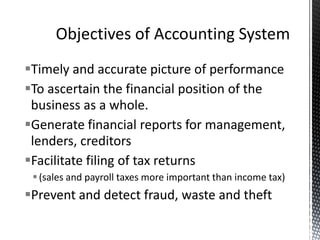
Timely and accurate picture of performance
To ascertain the financial position of the
 business as a whole.
Generate financial reports for management,
 lenders, creditors
Facilitate filing of tax returns
  (sales and payroll taxes more important than income tax)
Prevent and detect fraud, waste and theft
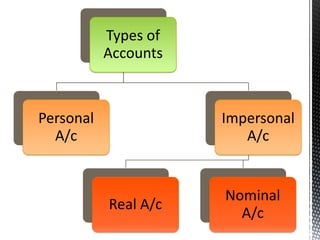
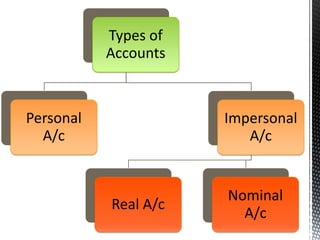
Types of
           Accounts


Personal              Impersonal
  A/c                    A/c


                      Nominal
           Real A/c
                        A/c
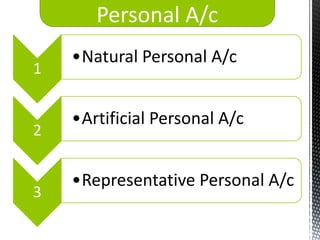
Personal A/c
    •Natural Personal A/c
1

    •Artificial Personal A/c
2

    •Representative Personal A/c
3
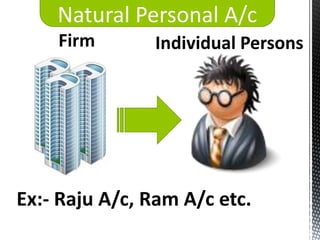
Natural Personal A/c
    Firm       Individual Persons


Ex:- Raju A/c, Ram A/c etc.
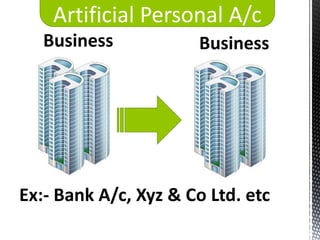
Artificial Personal A/c
   Business           Business


Ex:- Bank A/c, Xyz & Co Ltd. etc
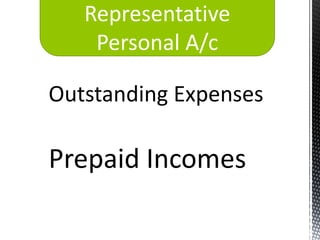
Representative
    Personal A/c

Outstanding Expenses

Prepaid Incomes
Rules for Personal A/c
Debit the Receiver


                                              Credit the Giver
Types of
           Accounts


Personal              Impersonal
  A/c                    A/c


                      Nominal
           Real A/c
                        A/c
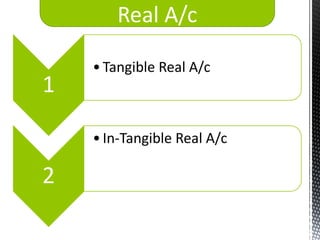
Real A/c

    • Tangible Real A/c
1

    • In-Tangible Real A/c

2
Tangible Real A/c
           Properties

Buildings a/c     Machinery a/c
In-Tangible Real A/c

Patents         Copy Rights
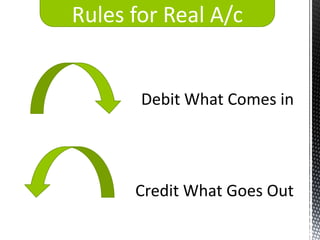
Rules for Real A/c


       Debit What Comes in


      Credit What Goes Out
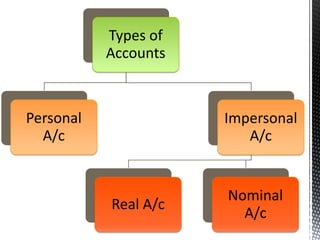
Types of
           Accounts


Personal              Impersonal
  A/c                    A/c


                      Nominal
           Real A/c
                        A/c
Nominal A/c

Debit all Losses and Expences


Credit all Incomes and gains
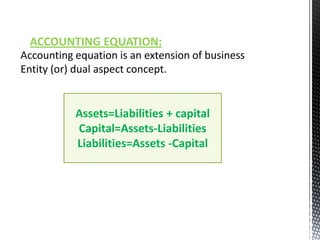
ACCOUNTING EQUATION:
Accounting equation is an extension of business
Entity (or) dual aspect concept.


           Assets=Liabilities + capital
           Capital=Assets-Liabilities
           Liabilities=Assets -Capital
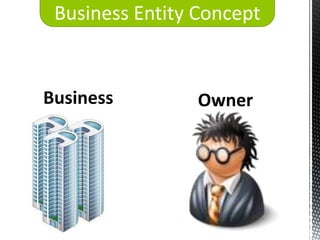
   Business entity concept: It means of
    separation of owner and business



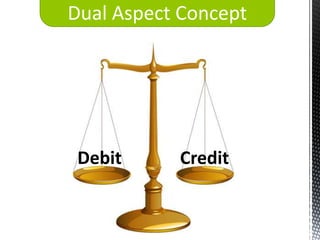
    Dual aspect concept: It means two, any
    transaction will have two aspects
    Accounting period concept: The period
    of checking the books of accounts from
    the beginning to end of the financial
                                                   ACCOUNTING
    year.
   Going concern concept: It means
    continuously any person start a business
    new and should go on. To start a
    business with an intension to of earning
    more profits
                                                   CONCEPTS:
   Cost concept: The total amount of
    expenditure which is incurred in a
    financial year.
   Money measurement concept: it means
    the value of every transaction should
    measure in terms of money
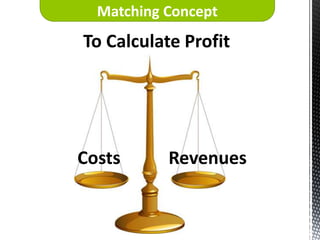
   Matching concept: To measure the
    profits for a particular period is essential
    to match accurately that cost associated
    with revenues.
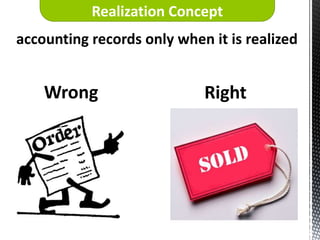
   Realization concept: imaginary value
    should be anticipated but not a security
    have a greater value.
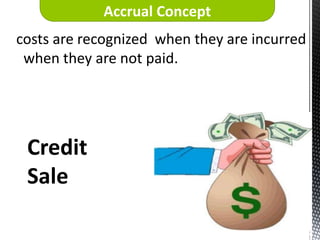
   Accrual concept: costs are recognized
    when they are incurred when they are
    not paid.
   Rupee value concept: it assumes that
    the value of a rupee constant.
 Business entity concept: It means of separation of owner and
  business
 Dual aspect concept: It means two, any transaction will have two
  aspects
 Accounting period concept: The period of checking the books of
  accounts from the beginning to end of the financial year.
 Going concern concept: It means continuously any person start a
  business new and should go on. To start a business with an
  intension to of earning more profits
 Cost concept: The total amount of expenditure which is incurred in
  a financial year.
 Money measurement concept: it means the value of every
  transaction should measure in terms of money
 Matching concept: To measure the profits for a particular period is
  essential to match accurately that cost associated with revenues.
 Realization concept: imaginary value should be anticipated but not
  a security have a greater value.
 Accrual concept: costs are recognized when they are incurred
  when they are not paid.
 Rupee value concept: it assumes that the value of a rupee constant.
Business Entity Concept


Business         Owner
Dual Aspect Concept


 Debit     Credit
Accounting Period Concept
All the transactions are recorded in the books of
accounts on the assumption
 that profits on these transactions are to be
    ascertained for a specified period.
 This is known as accounting period concept. Thus,
    this concept requires
 that a balance sheet and profit and loss account
    should be prepared at regular
 intervals. This is necessary for different purposes
    like, calculation of profit,
 ascertaining financial position, tax computation
    etc.
Going Concern Concept


 Depreciation      Investors
 Future Profit
 Estimation
Cost Concept
      Cost of the Machine
Before 1 Month    Before 1 Month
100000            80000
Money Measurement Concept
This concept assumes that all business
transactions must be in terms of
Money. It should not record the transactions
with is not related to money.
Matching Concept
To Calculate Profit


Costs      Revenues
Realization Concept
accounting records only when it is realized


    Wrong                   Right
Accrual Concept
costs are recognized when they are incurred
 when they are not paid.


 Credit
 Sale
Rupee Value Concept


It assumes that the value of a
       Rupee Constant.
ACCOUNTING
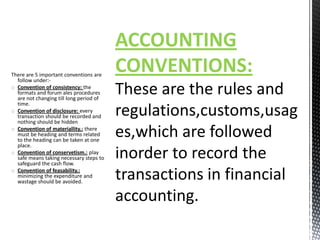
There are 5 important conventions are
  follow under:-
                                         CONVENTIONS:
o Convention of consistency: the
  formats and forum ales procedures
  are not changing till long period of
  time.
o Convention of disclosure: every
  transaction should be recorded and
  nothing should be hidden
o Convention of materiallity.: there
  must be heading and terms related
  to the heading can be taken at one
  place.
o Convention of conservetism.: play
  safe means taking necessary steps to
  safeguard the cash flow.
o Convention of feasability.:
  minimizing the expenditure and
  wastage should be avoided.
There are 5 important conventions are follow under:-
oConvention of consistency: the formats and forum ales
 procedures are not changing till long period of time.
oConvention of disclosure: every transaction should be
 recorded and nothing should be hidden
oConvention of materiallity.: there must be heading and
 terms related to the heading can be taken at one place.
oConvention of conservetism.: play safe means taking
 necessary steps to safeguard the cash flow.
oConvention of feasability.: minimizing the expenditure
 and wastage should be avoided.
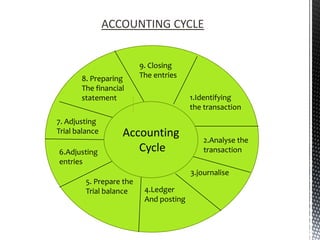
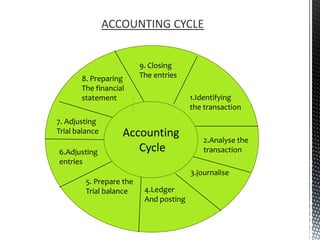
ACCOUNTING CYCLE


                          9. Closing
       8. Preparing       The entries
       The financial
       statement                         1.Identifying
                                         the transaction
7. Adjusting
Trial balance      Accounting
                    AAAomiomi                2.Analyse the
6.Adjusting           Cycle                  transaction
entries
                                         3.journalise
         5. Prepare the
         Trial balance     4.Ledger
                           And posting
1.Identifying
the
transaction
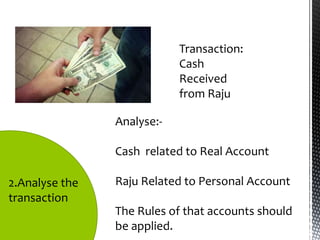
Transaction:
                            Cash
                            Received
                            from Raju

                Analyse:-

                Cash related to Real Account

2.Analyse the   Raju Related to Personal Account
transaction
                The Rules of that accounts should
                be applied.
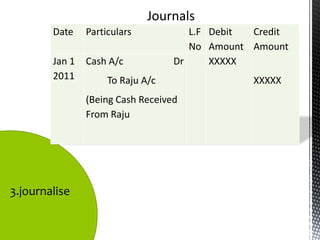
Journals
        Date    Particulars           L.F Debit Credit
                                      No Amount Amount
        Jan 1   Cash A/c           Dr     XXXXX
        2011         To Raju A/c                XXXXX
                (Being Cash Received
                From Raju


3.journalise
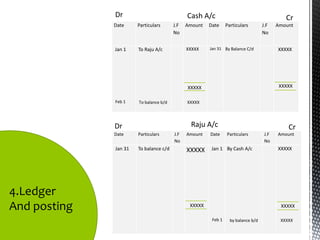
Dr                              Cash A/c                                       Cr
              Date     Particulars      J.F   Amount   Date     Particulars        J.F    Amount
                                        No                                         No


              Jan 1    To Raju A/c            XXXXX    Jan 31 By Balance C/d              XXXXX


                                              XXXXX                                        XXXXX

              Feb 1    To balance b/d         XXXXX


              Dr                               Raju A/c                                       Cr
              Date     Particulars      J.F   Amount   Date     Particulars         J.F   Amount
                                        No                                          No
              Jan 31   To balance c/d         XXXXX     Jan 1 By Cash A/c                 XXXXX


4.Ledger
And posting                                    XXXXX                                       XXXXX

                                                        Feb 1     by balance b/d           XXXXX
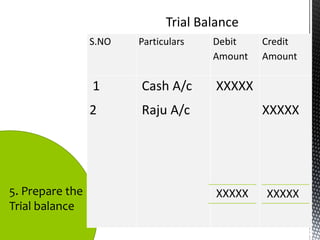
Trial Balance
                 S.NO   Particulars   Debit    Credit
                                      Amount   Amount

                 1      Cash A/c      XXXXX
                 2      Raju A/c               XXXXX


5. Prepare the                        XXXXX    XXXXX
Trial balance
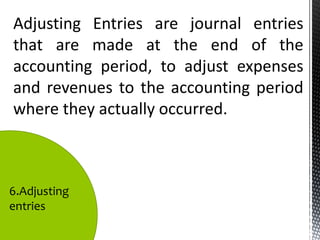
Adjusting Entries are journal entries
that are made at the end of the
accounting period, to adjust expenses
and revenues to the accounting period
where they actually occurred.


6.Adjusting
entries
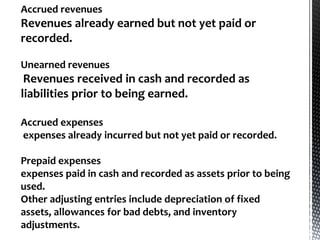
Accrued revenues
Revenues already earned but not yet paid or
recorded.

Unearned revenues
 Revenues received in cash and recorded as
liabilities prior to being earned.

Accrued expenses
expenses already incurred but not yet paid or recorded.

Prepaid expenses
expenses paid in cash and recorded as assets prior to being
used.
Other adjusting entries include depreciation of fixed
assets, allowances for bad debts, and inventory
adjustments.
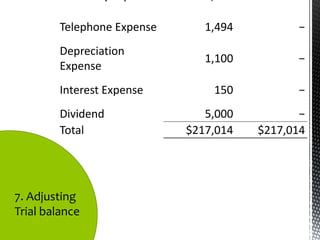
Telephone Expense      1,494         −
         Depreciation
                                1,100         −
         Expense
         Interest Expense        150          −
         Dividend               5,000          −
         Total               $217,014   $217,014


7. Adjusting
Trial balance
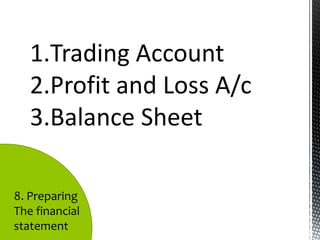
1.Trading Account
   2.Profit and Loss A/c
   3.Balance Sheet

8. Preparing
The financial
statement
ACCOUNTING CYCLE


                          9. Closing
       8. Preparing       The entries
       The financial
       statement                         1.Identifying
                                         the transaction
7. Adjusting
Trial balance      Accounting
                    AAAomiomi                2.Analyse the
6.Adjusting           Cycle                  transaction
entries
                                         3.journalise
         5. Prepare the
         Trial balance     4.Ledger
                           And posting
Accounting Basics

Accounting Basics

  • 1.
  • 2.
  • 3.
    Definition Accounting is definedby the American Institute of Certified Public Accountants (AICPA) as "the art of recording, classifying, and summarizing in a significant manner and in terms of money, transactions and events which are, in part at least, of financial character, and interpreting the results thereof."
  • 4.
    Timely and accuratepicture of performance To ascertain the financial position of the business as a whole. Generate financial reports for management, lenders, creditors Facilitate filing of tax returns  (sales and payroll taxes more important than income tax) Prevent and detect fraud, waste and theft
  • 5.
    Types of Accounts Personal Impersonal A/c A/c Nominal Real A/c A/c
  • 6.
    Personal A/c •Natural Personal A/c 1 •Artificial Personal A/c 2 •Representative Personal A/c 3
  • 7.
    Natural Personal A/c Firm Individual Persons Ex:- Raju A/c, Ram A/c etc.
  • 8.
    Artificial Personal A/c Business Business Ex:- Bank A/c, Xyz & Co Ltd. etc
  • 9.
    Representative Personal A/c Outstanding Expenses Prepaid Incomes
  • 10.
    Rules for PersonalA/c Debit the Receiver Credit the Giver
  • 11.
    Types of Accounts Personal Impersonal A/c A/c Nominal Real A/c A/c
  • 12.
    Real A/c • Tangible Real A/c 1 • In-Tangible Real A/c 2
  • 13.
    Tangible Real A/c Properties Buildings a/c Machinery a/c
  • 14.
  • 15.
    Rules for RealA/c Debit What Comes in Credit What Goes Out
  • 16.
    Types of Accounts Personal Impersonal A/c A/c Nominal Real A/c A/c
  • 17.
    Nominal A/c Debit allLosses and Expences Credit all Incomes and gains
  • 18.
    ACCOUNTING EQUATION: Accounting equationis an extension of business Entity (or) dual aspect concept. Assets=Liabilities + capital Capital=Assets-Liabilities Liabilities=Assets -Capital
  • 19.
    Business entity concept: It means of separation of owner and business   Dual aspect concept: It means two, any transaction will have two aspects Accounting period concept: The period of checking the books of accounts from the beginning to end of the financial ACCOUNTING year.  Going concern concept: It means continuously any person start a business new and should go on. To start a business with an intension to of earning more profits CONCEPTS:  Cost concept: The total amount of expenditure which is incurred in a financial year.  Money measurement concept: it means the value of every transaction should measure in terms of money  Matching concept: To measure the profits for a particular period is essential to match accurately that cost associated with revenues.  Realization concept: imaginary value should be anticipated but not a security have a greater value.  Accrual concept: costs are recognized when they are incurred when they are not paid.  Rupee value concept: it assumes that the value of a rupee constant.
  • 20.
     Business entityconcept: It means of separation of owner and business  Dual aspect concept: It means two, any transaction will have two aspects  Accounting period concept: The period of checking the books of accounts from the beginning to end of the financial year.  Going concern concept: It means continuously any person start a business new and should go on. To start a business with an intension to of earning more profits  Cost concept: The total amount of expenditure which is incurred in a financial year.  Money measurement concept: it means the value of every transaction should measure in terms of money  Matching concept: To measure the profits for a particular period is essential to match accurately that cost associated with revenues.  Realization concept: imaginary value should be anticipated but not a security have a greater value.  Accrual concept: costs are recognized when they are incurred when they are not paid.  Rupee value concept: it assumes that the value of a rupee constant.
  • 21.
  • 22.
  • 23.
    Accounting Period Concept Allthe transactions are recorded in the books of accounts on the assumption  that profits on these transactions are to be ascertained for a specified period.  This is known as accounting period concept. Thus, this concept requires  that a balance sheet and profit and loss account should be prepared at regular  intervals. This is necessary for different purposes like, calculation of profit,  ascertaining financial position, tax computation etc.
  • 24.
    Going Concern Concept Depreciation Investors  Future Profit  Estimation
  • 25.
    Cost Concept Cost of the Machine Before 1 Month Before 1 Month 100000 80000
  • 26.
    Money Measurement Concept Thisconcept assumes that all business transactions must be in terms of Money. It should not record the transactions with is not related to money.
  • 27.
    Matching Concept To CalculateProfit Costs Revenues
  • 28.
    Realization Concept accounting recordsonly when it is realized Wrong Right
  • 29.
    Accrual Concept costs arerecognized when they are incurred when they are not paid. Credit Sale
  • 30.
    Rupee Value Concept Itassumes that the value of a Rupee Constant.
  • 31.
    ACCOUNTING There are 5important conventions are follow under:- CONVENTIONS: o Convention of consistency: the formats and forum ales procedures are not changing till long period of time. o Convention of disclosure: every transaction should be recorded and nothing should be hidden o Convention of materiallity.: there must be heading and terms related to the heading can be taken at one place. o Convention of conservetism.: play safe means taking necessary steps to safeguard the cash flow. o Convention of feasability.: minimizing the expenditure and wastage should be avoided.
  • 32.
    There are 5important conventions are follow under:- oConvention of consistency: the formats and forum ales procedures are not changing till long period of time. oConvention of disclosure: every transaction should be recorded and nothing should be hidden oConvention of materiallity.: there must be heading and terms related to the heading can be taken at one place. oConvention of conservetism.: play safe means taking necessary steps to safeguard the cash flow. oConvention of feasability.: minimizing the expenditure and wastage should be avoided.
  • 33.
    ACCOUNTING CYCLE 9. Closing 8. Preparing The entries The financial statement 1.Identifying the transaction 7. Adjusting Trial balance Accounting AAAomiomi 2.Analyse the 6.Adjusting Cycle transaction entries 3.journalise 5. Prepare the Trial balance 4.Ledger And posting
  • 34.
  • 35.
    Transaction: Cash Received from Raju Analyse:- Cash related to Real Account 2.Analyse the Raju Related to Personal Account transaction The Rules of that accounts should be applied.
  • 36.
    Journals Date Particulars L.F Debit Credit No Amount Amount Jan 1 Cash A/c Dr XXXXX 2011 To Raju A/c XXXXX (Being Cash Received From Raju 3.journalise
  • 37.
    Dr Cash A/c Cr Date Particulars J.F Amount Date Particulars J.F Amount No No Jan 1 To Raju A/c XXXXX Jan 31 By Balance C/d XXXXX XXXXX XXXXX Feb 1 To balance b/d XXXXX Dr Raju A/c Cr Date Particulars J.F Amount Date Particulars J.F Amount No No Jan 31 To balance c/d XXXXX Jan 1 By Cash A/c XXXXX 4.Ledger And posting XXXXX XXXXX Feb 1 by balance b/d XXXXX
  • 38.
    Trial Balance S.NO Particulars Debit Credit Amount Amount 1 Cash A/c XXXXX 2 Raju A/c XXXXX 5. Prepare the XXXXX XXXXX Trial balance
  • 39.
    Adjusting Entries arejournal entries that are made at the end of the accounting period, to adjust expenses and revenues to the accounting period where they actually occurred. 6.Adjusting entries
  • 40.
    Accrued revenues Revenues alreadyearned but not yet paid or recorded. Unearned revenues Revenues received in cash and recorded as liabilities prior to being earned. Accrued expenses expenses already incurred but not yet paid or recorded. Prepaid expenses expenses paid in cash and recorded as assets prior to being used. Other adjusting entries include depreciation of fixed assets, allowances for bad debts, and inventory adjustments.
  • 41.
    Telephone Expense 1,494 − Depreciation 1,100 − Expense Interest Expense 150 − Dividend 5,000 − Total $217,014 $217,014 7. Adjusting Trial balance
  • 42.
    1.Trading Account 2.Profit and Loss A/c 3.Balance Sheet 8. Preparing The financial statement
  • 43.
    ACCOUNTING CYCLE 9. Closing 8. Preparing The entries The financial statement 1.Identifying the transaction 7. Adjusting Trial balance Accounting AAAomiomi 2.Analyse the 6.Adjusting Cycle transaction entries 3.journalise 5. Prepare the Trial balance 4.Ledger And posting