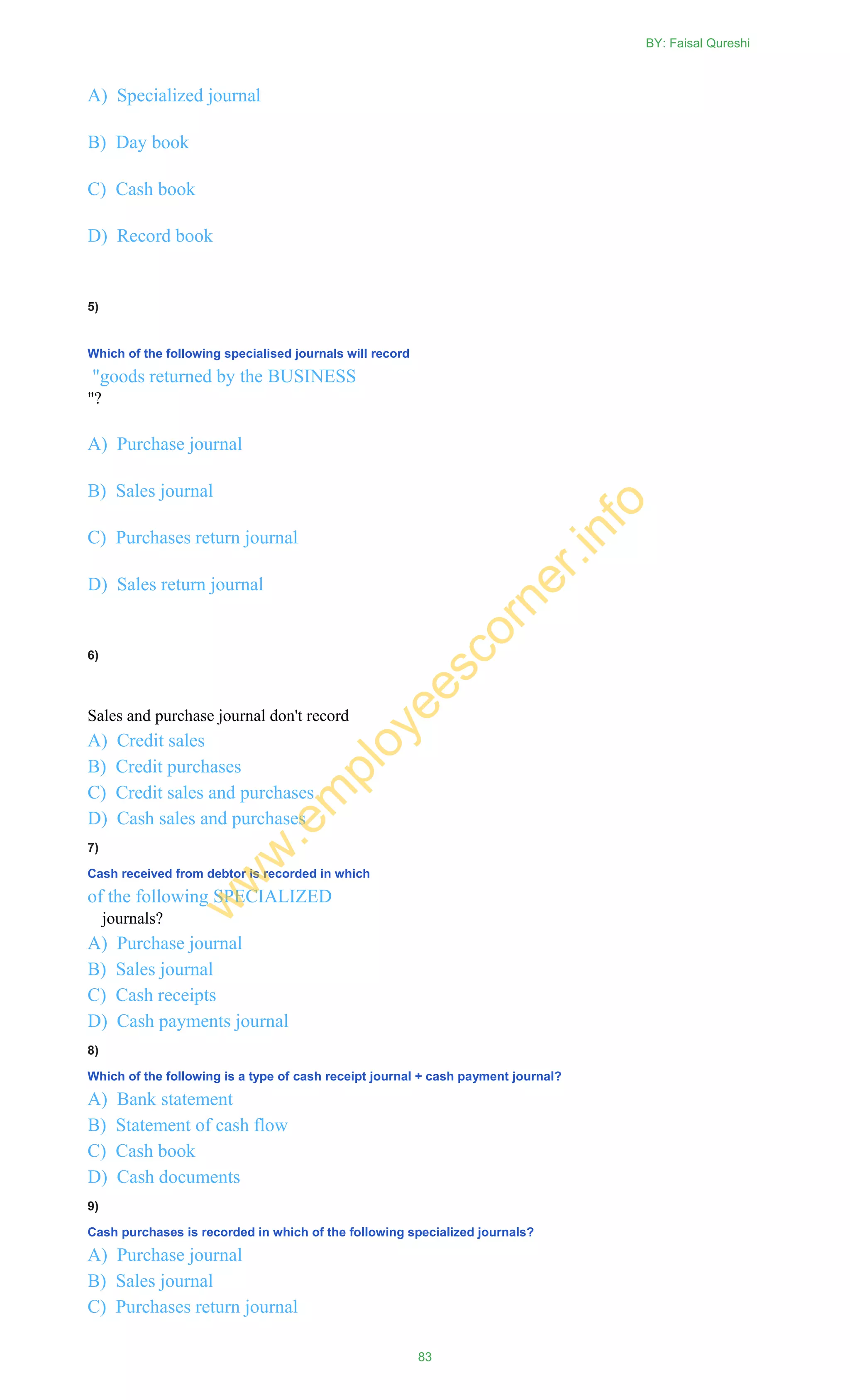
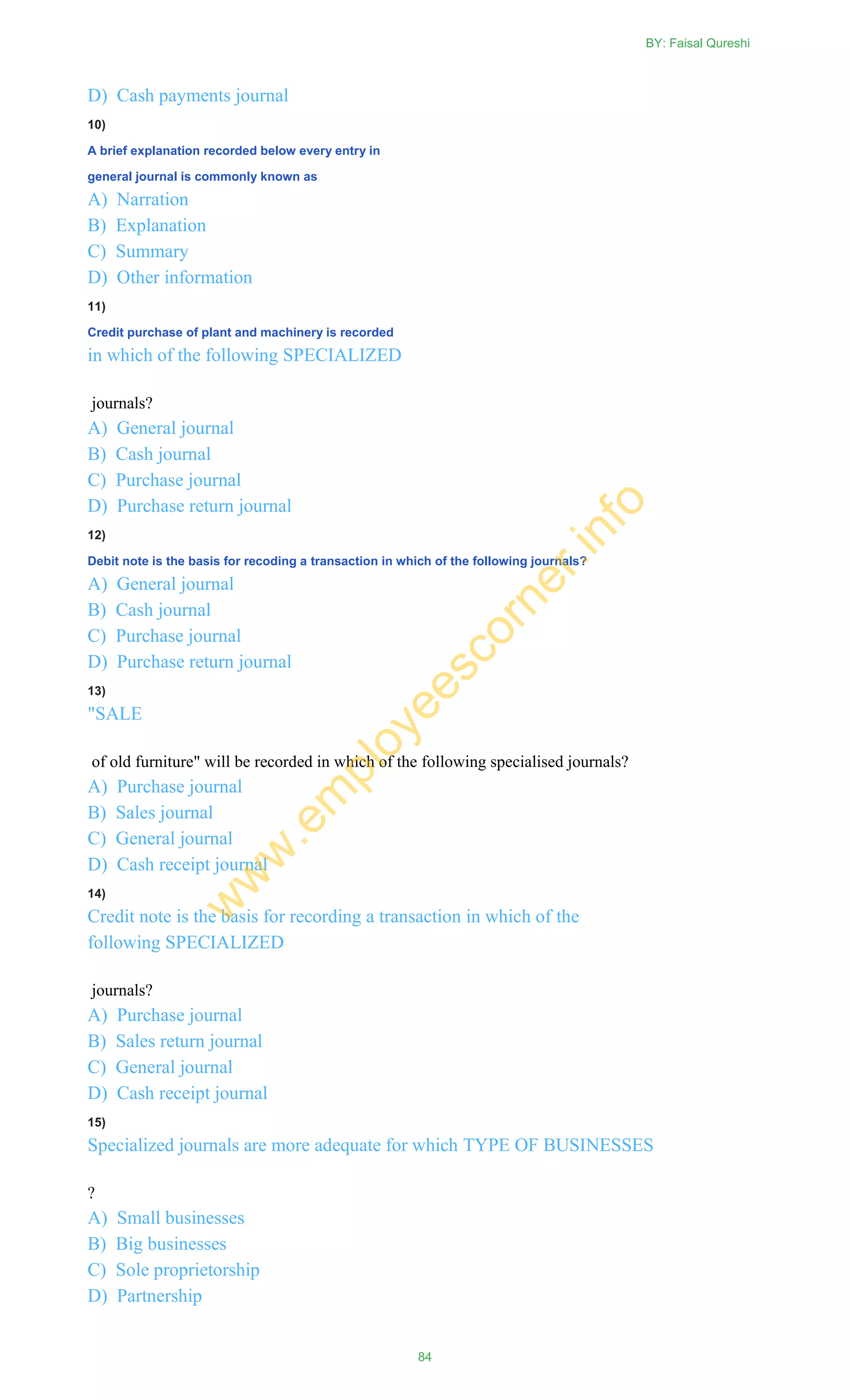
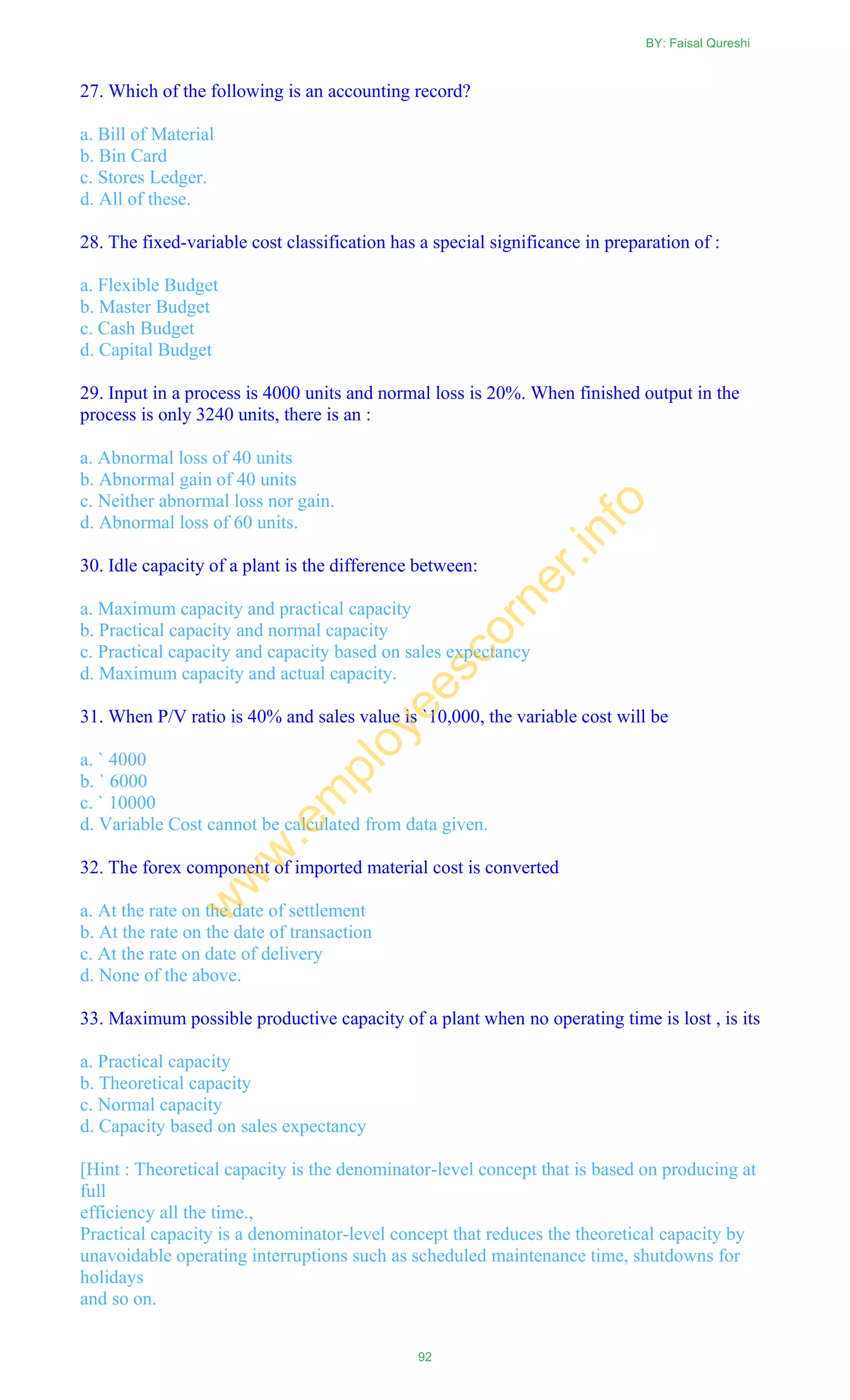
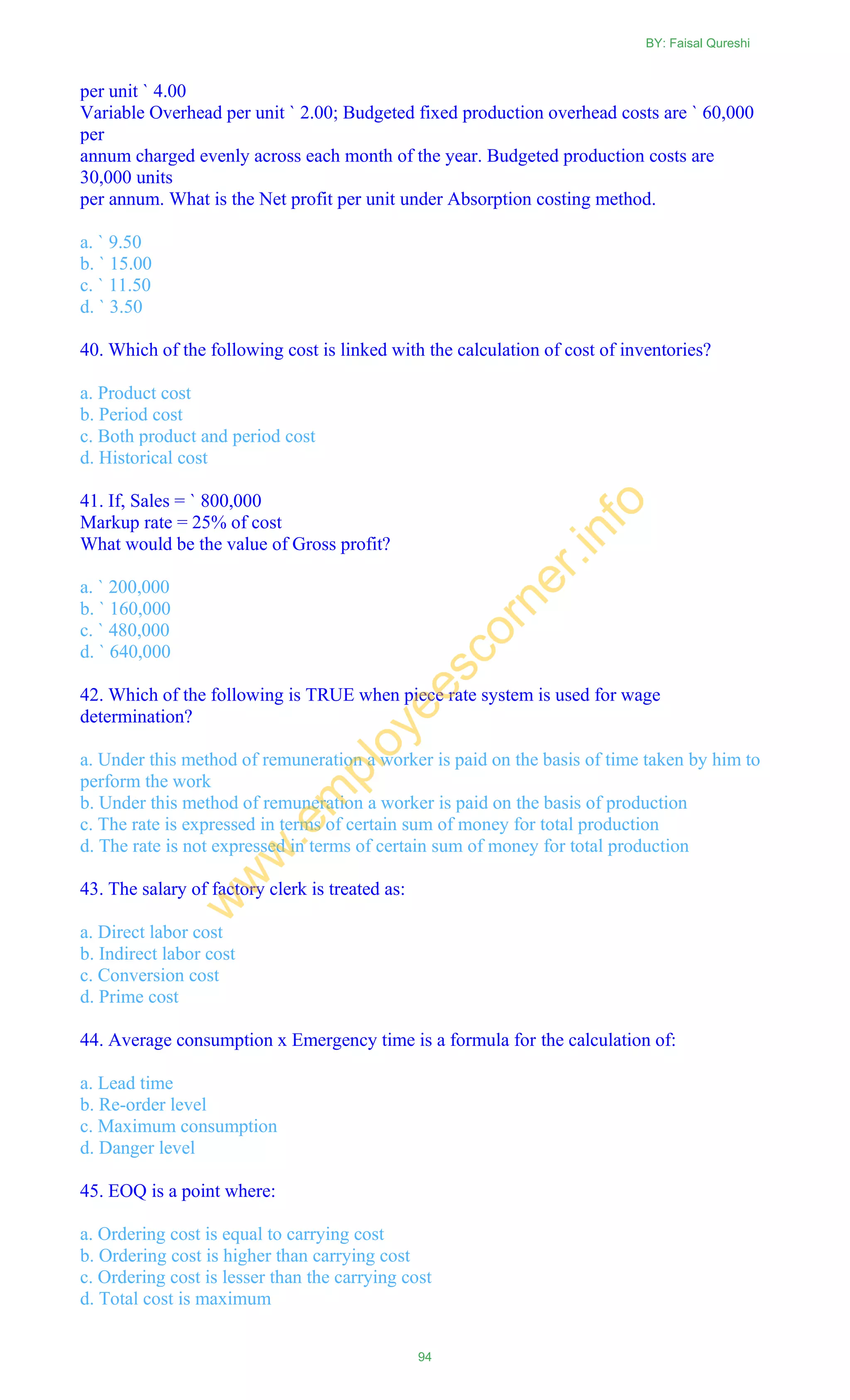
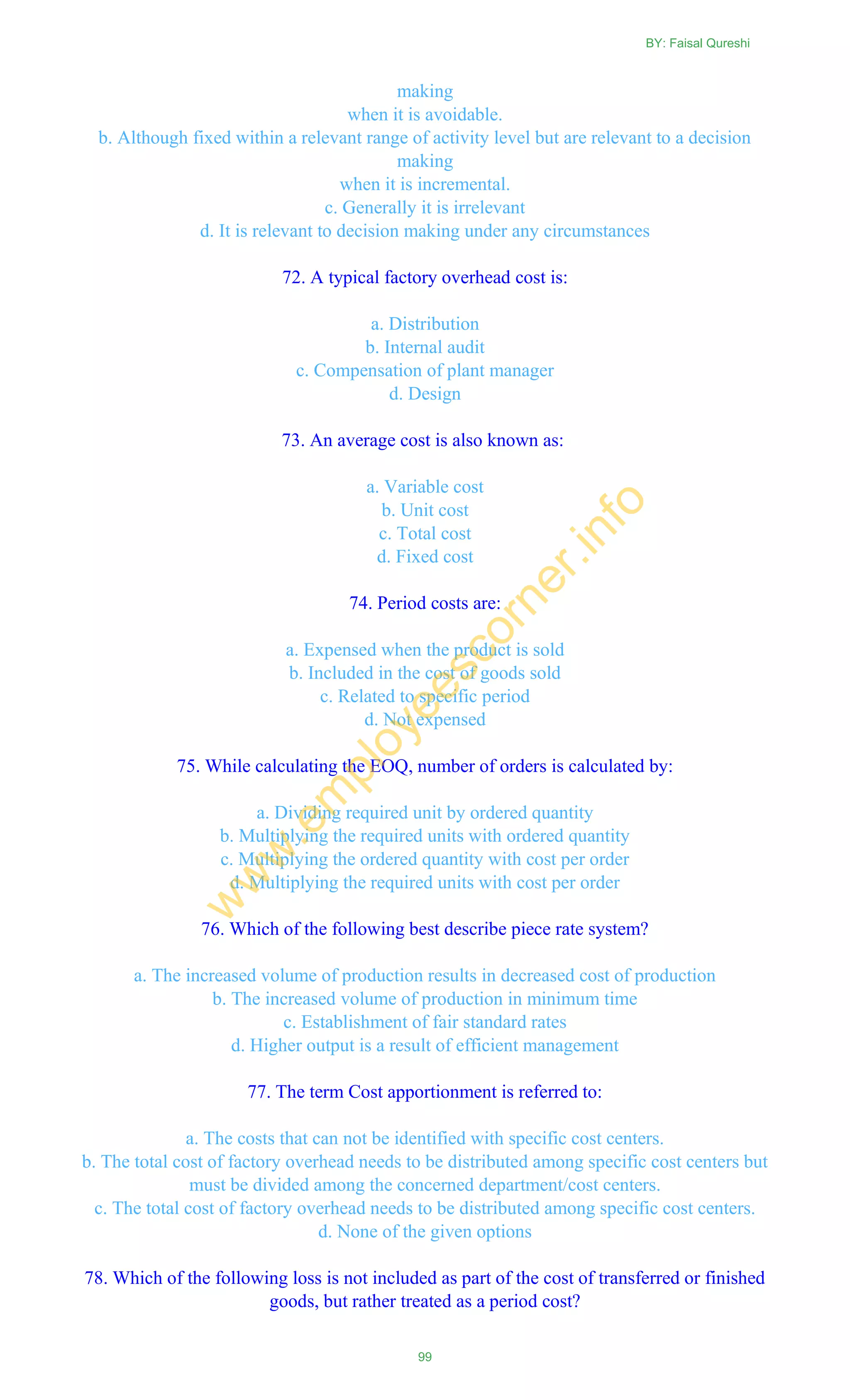
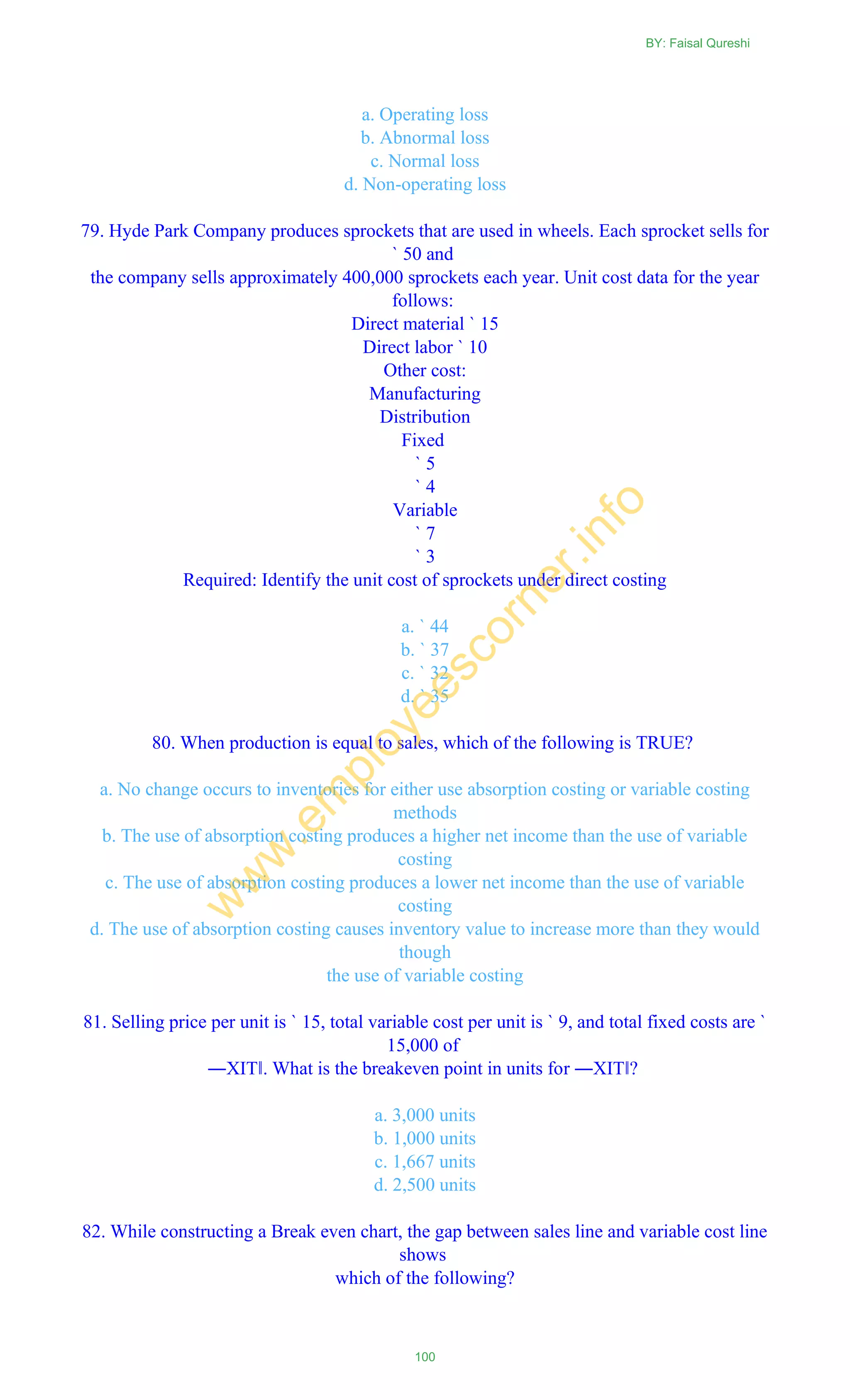
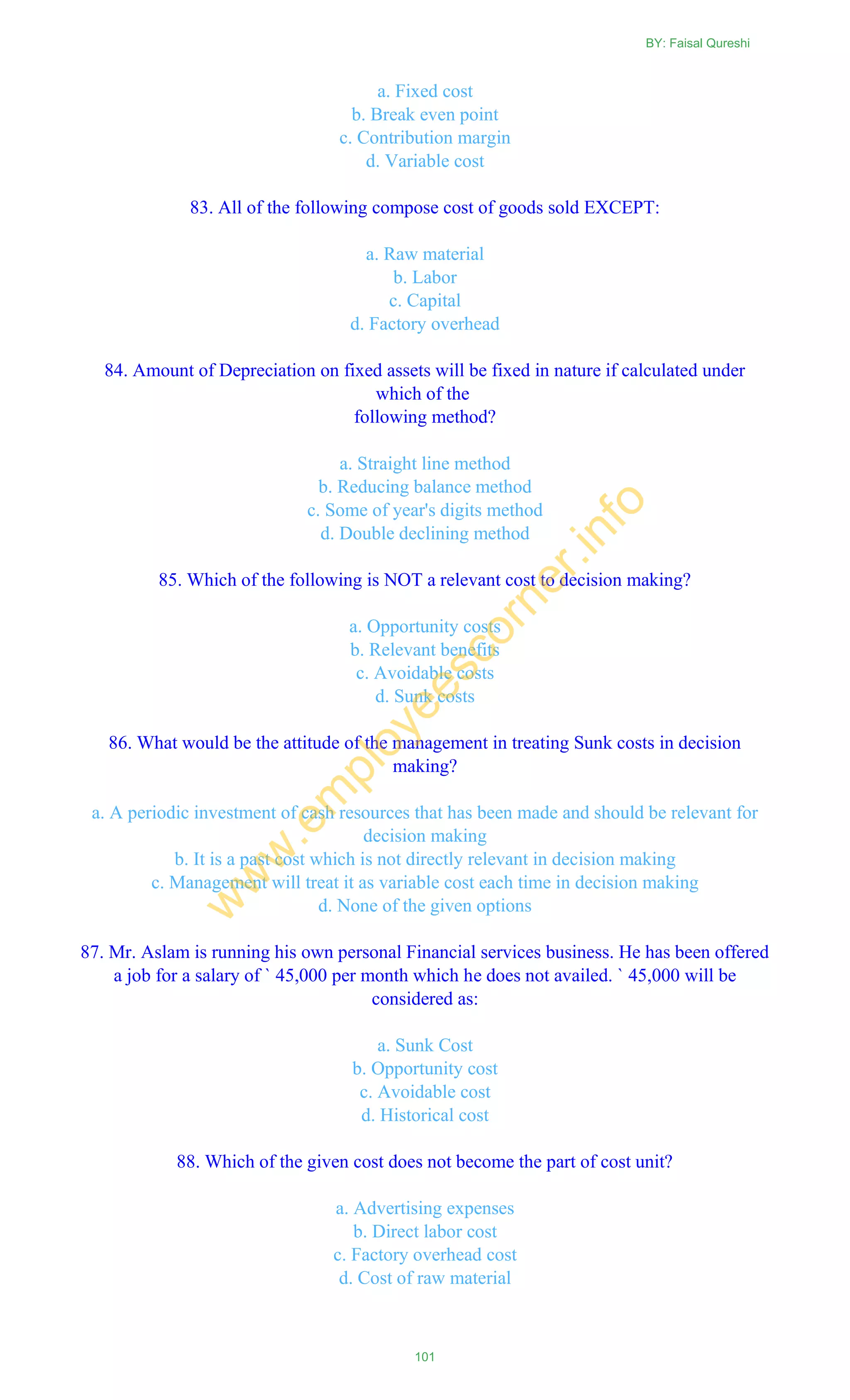
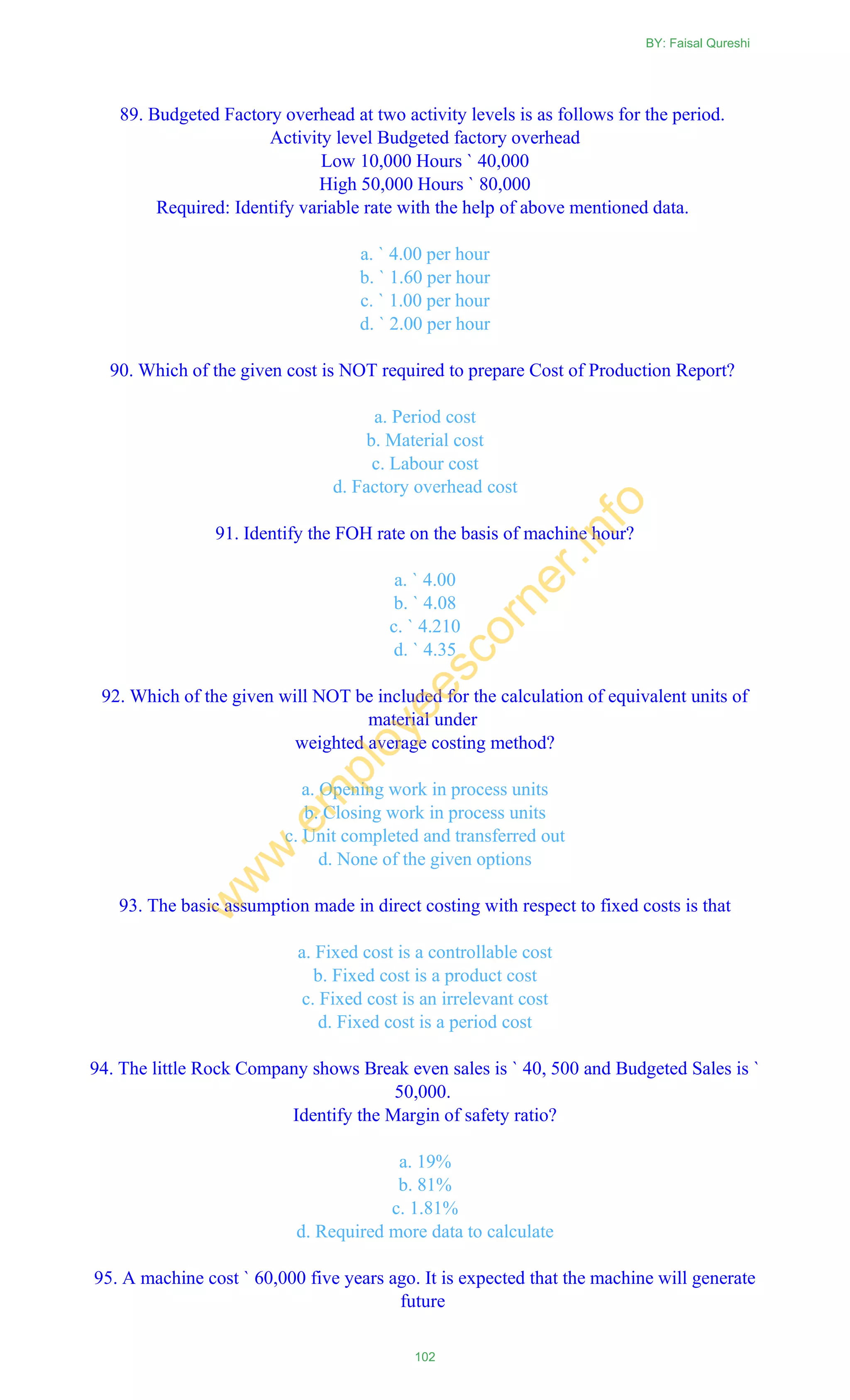
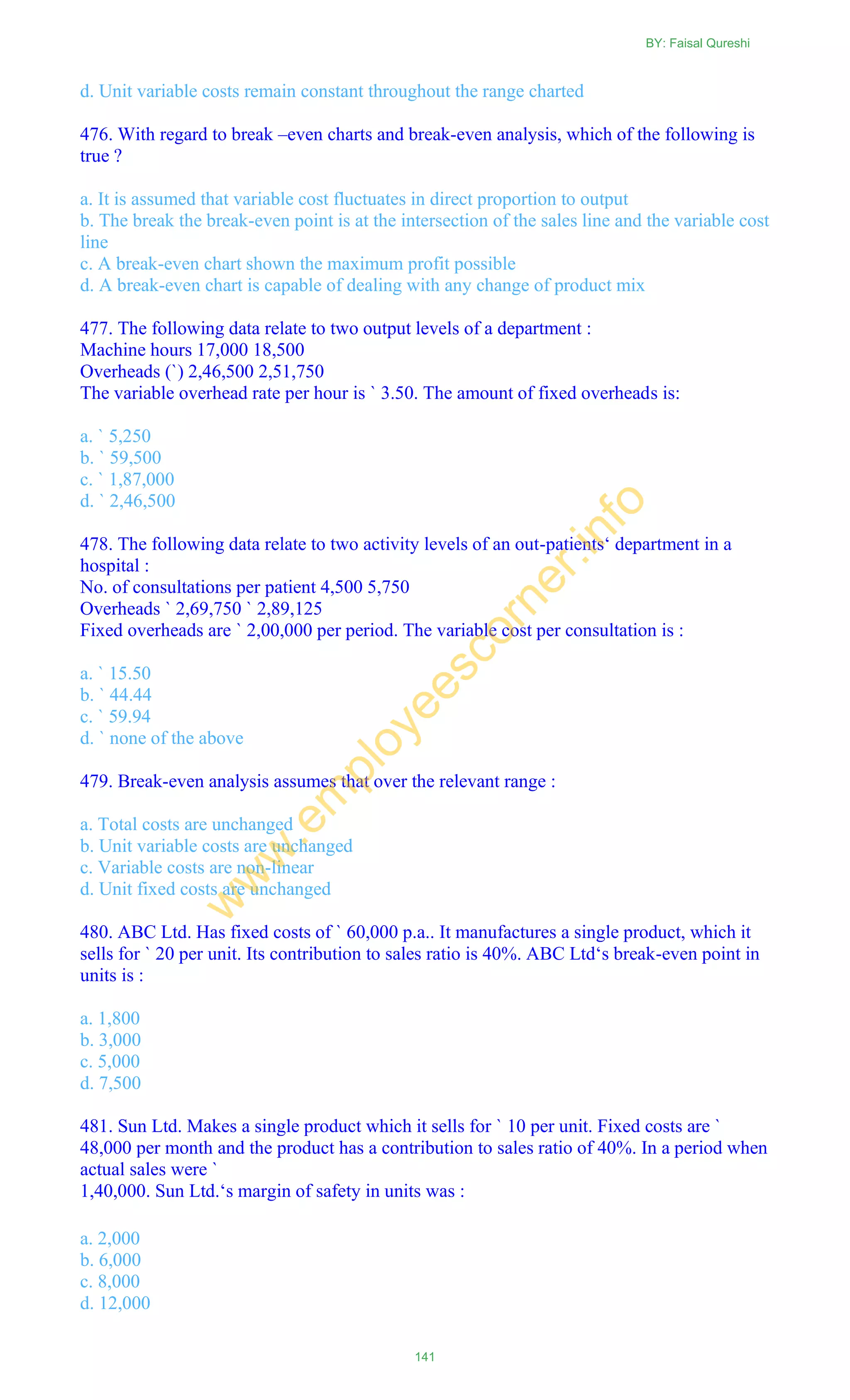
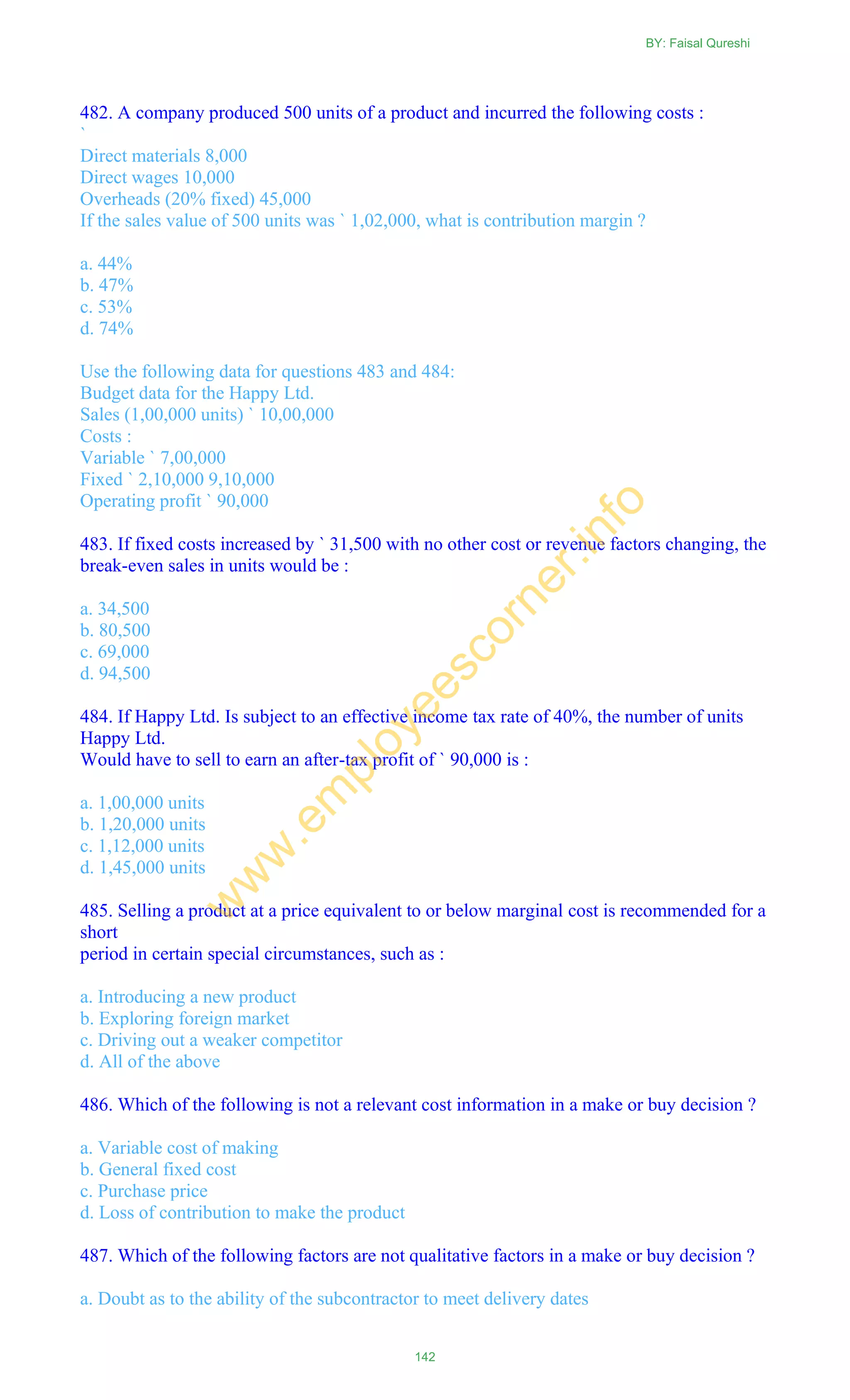
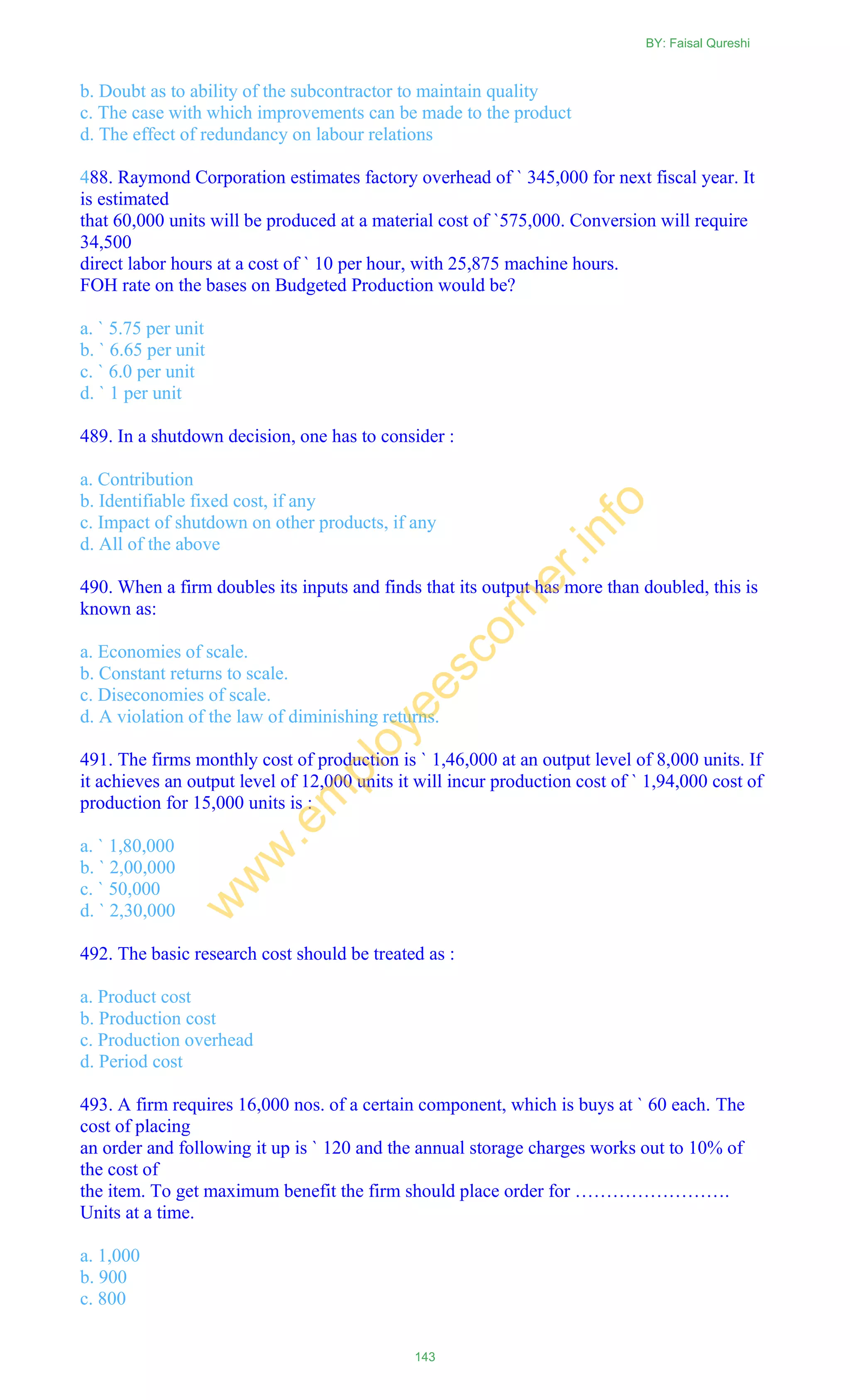
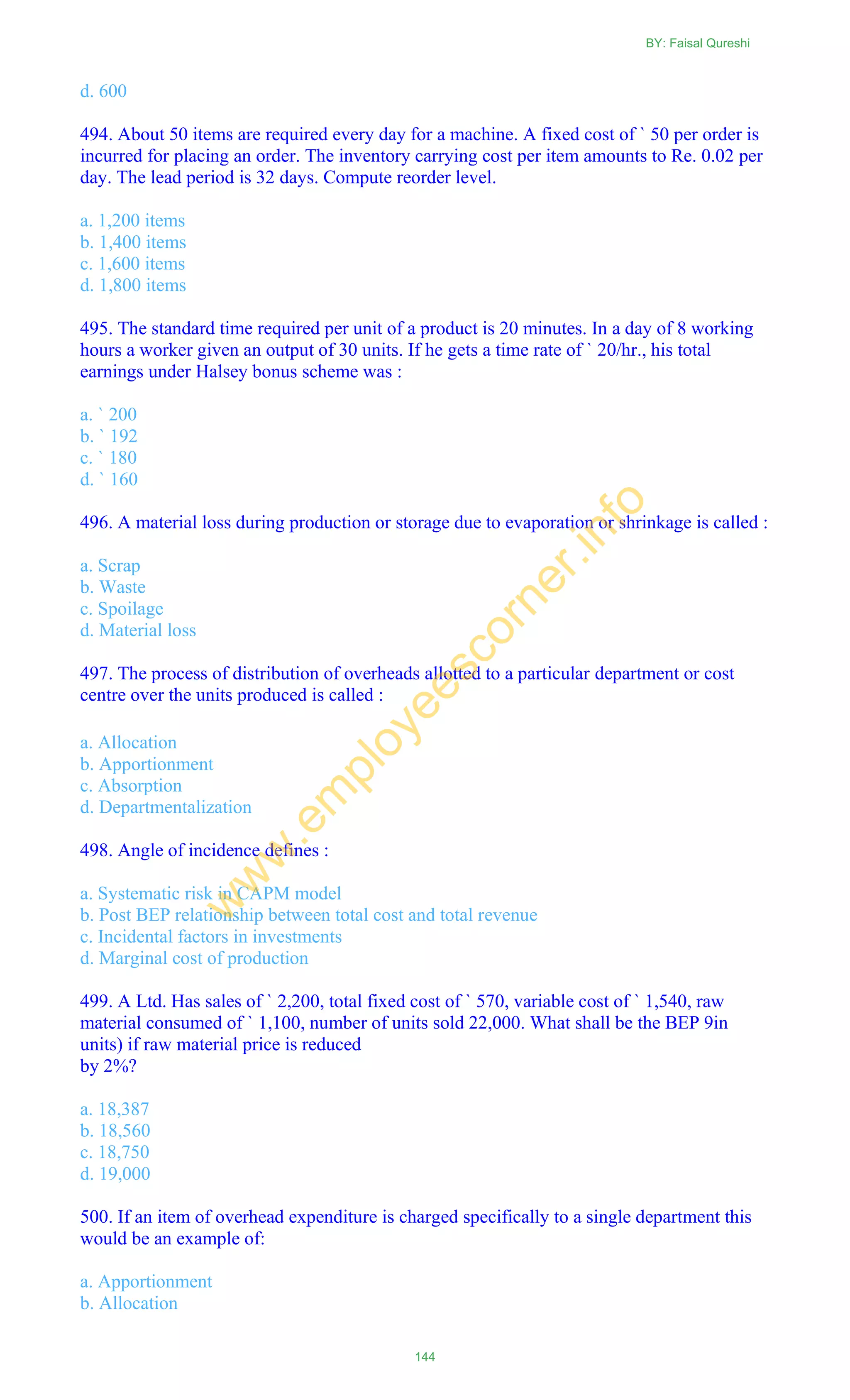
Introduction
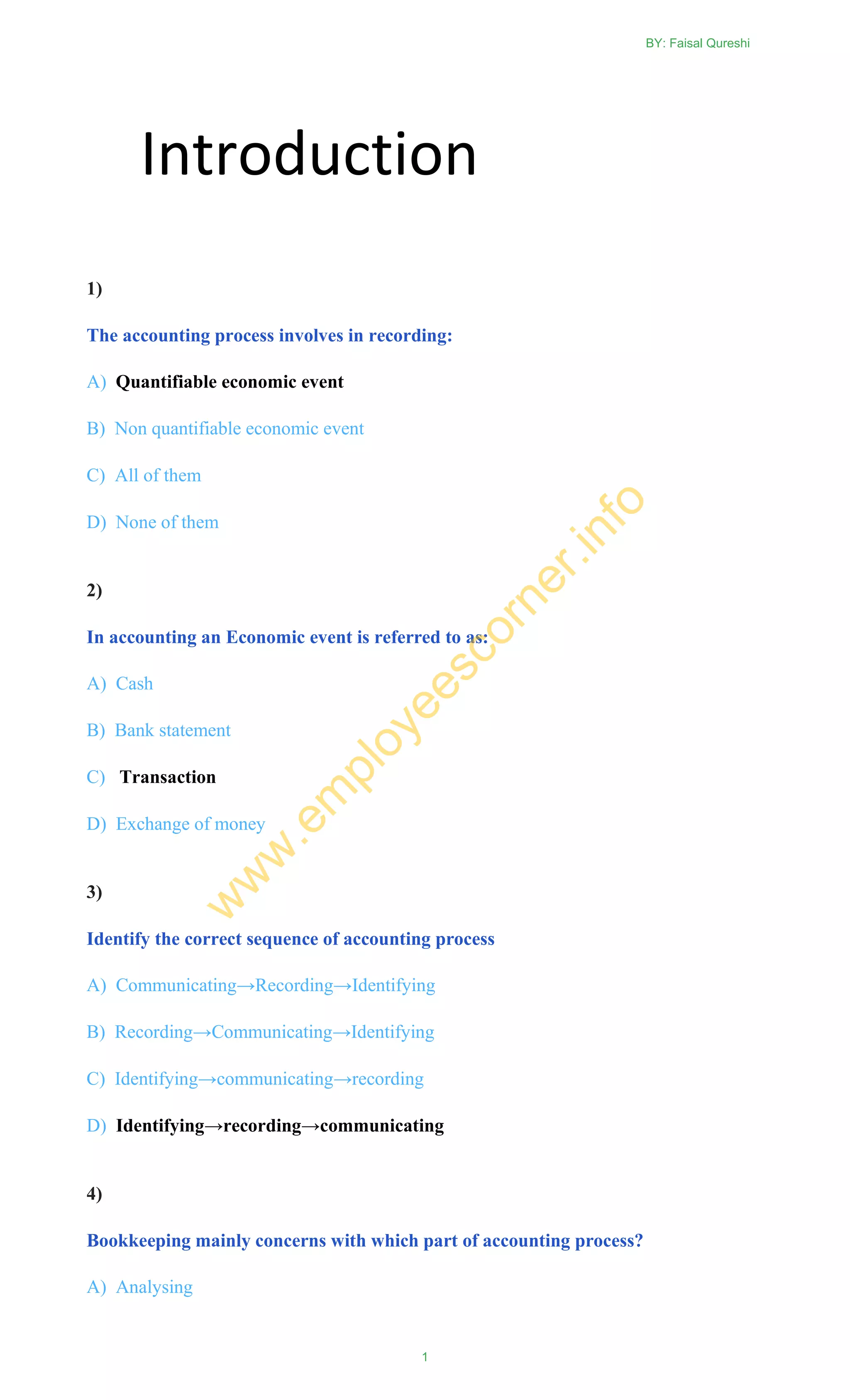
1)
The accounting process involves in recording:
A) Quantifiable economic event
B) Non quantifiable economic event
C) All of them
D) None of them
2)
In accounting an Economic event is referred to as:
A) Cash
B) Bank statement
C) Transaction
D) Exchange of money
3)
Identify the correct sequence of accounting process
A) Communicating→Recording→Identifying
B) Recording→Communicating→Identifying
C) Identifying→communicating→recording
D) Identifying→recording→communicating
4)
Bookkeeping mainly concerns with which part of accounting process?
A) Analysing
BY: Faisal Qureshi
1
w
w
w
.em
ployeescorner.info
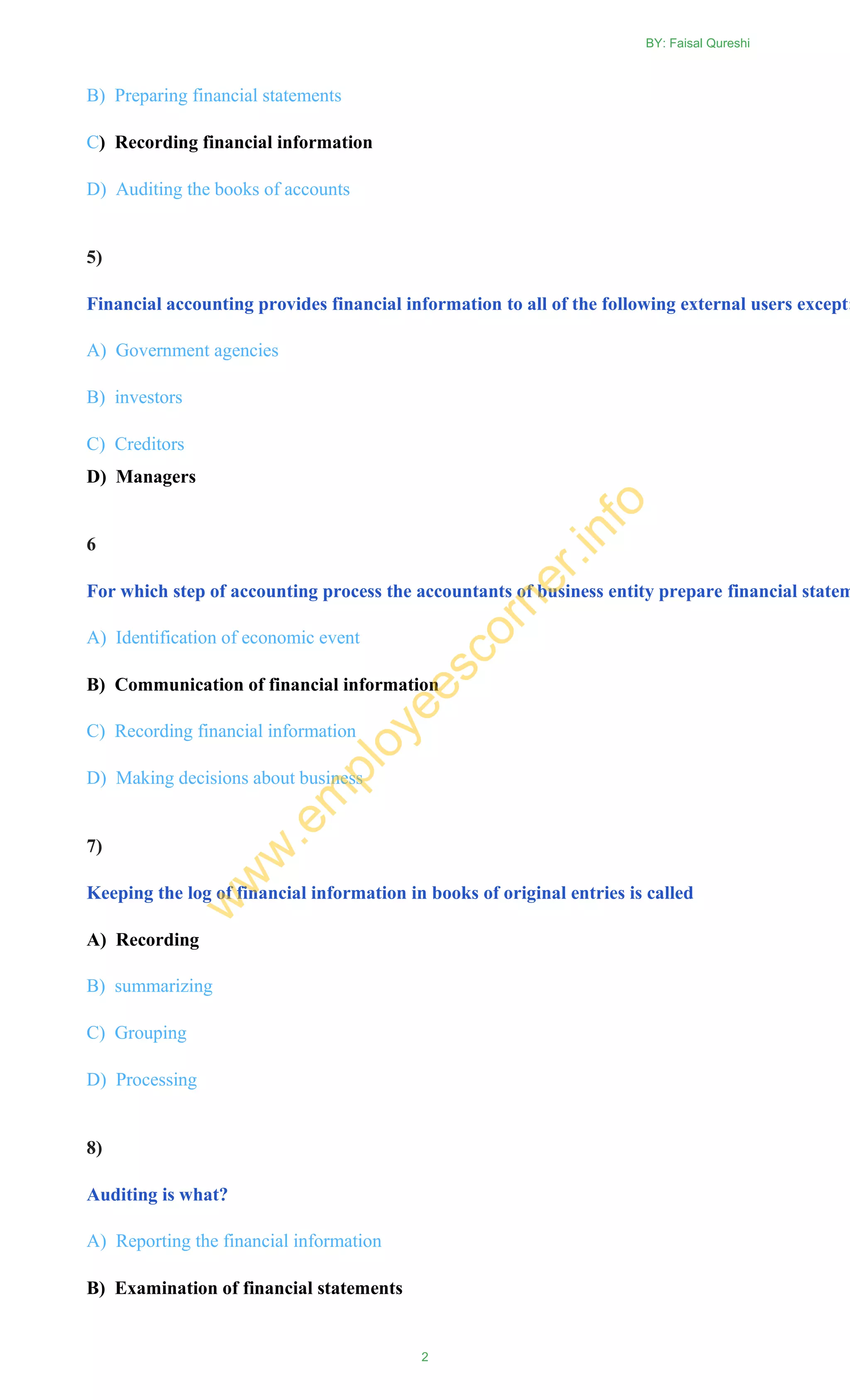
B) Preparing financial statements
C) Recording financial information
D) Auditing the books of accounts
5)
Financial accounting provides financial information to all of the following external users except:
A) Government agencies
B) investors
C) Creditors
D) Managers
6
For which step of accounting process the accountants of business entity prepare financial statem
A) Identification of economic event
B) Communication of financial information
C) Recording financial information
D) Making decisions about business
7)
Keeping the log of financial information in books of original entries is called
A) Recording
B) summarizing
C) Grouping
D) Processing
8)
Auditing is what?
A) Reporting the financial information
B) Examination of financial statements
BY: Faisal Qureshi
2
w
w
w
.em
ployeescorner.info
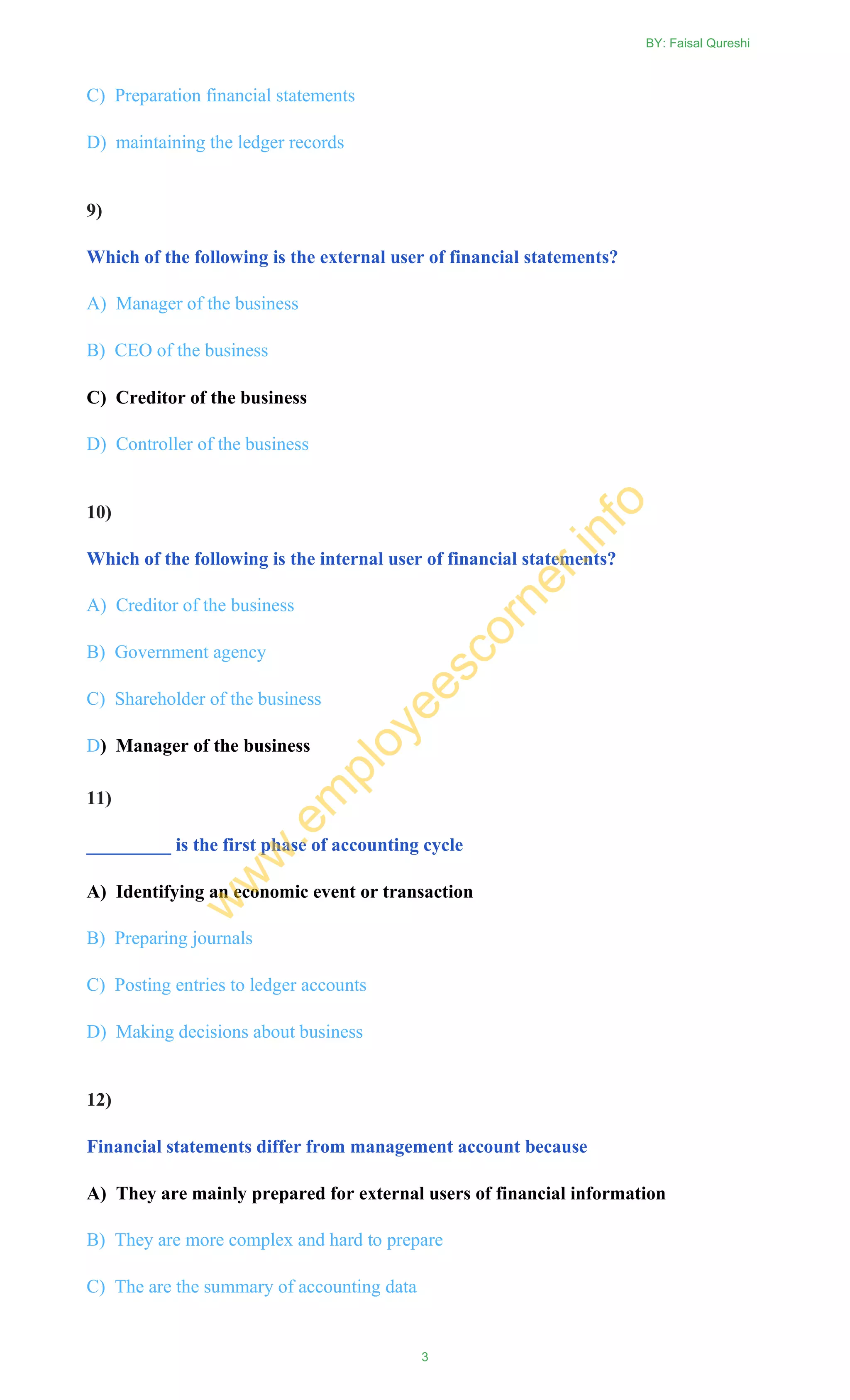
C) Preparation financial statements
D) maintaining the ledger records
9)
Which of the following is the external user of financial statements?
A) Manager of the business
B) CEO of the business
C) Creditor of the business
D) Controller of the business
10)
Which of the following is the internal user of financial statements?
A) Creditor of the business
B) Government agency
C) Shareholder of the business
D) Manager of the business
11)
_________ is the first phase of accounting cycle
A) Identifying an economic event or transaction
B) Preparing journals
C) Posting entries to ledger accounts
D) Making decisions about business
12)
Financial statements differ from management account because
A) They are mainly prepared for external users of financial information
B) They are more complex and hard to prepare
C) The are the summary of accounting data
BY: Faisal Qureshi
3
w
w
w
.em
ployeescorner.info
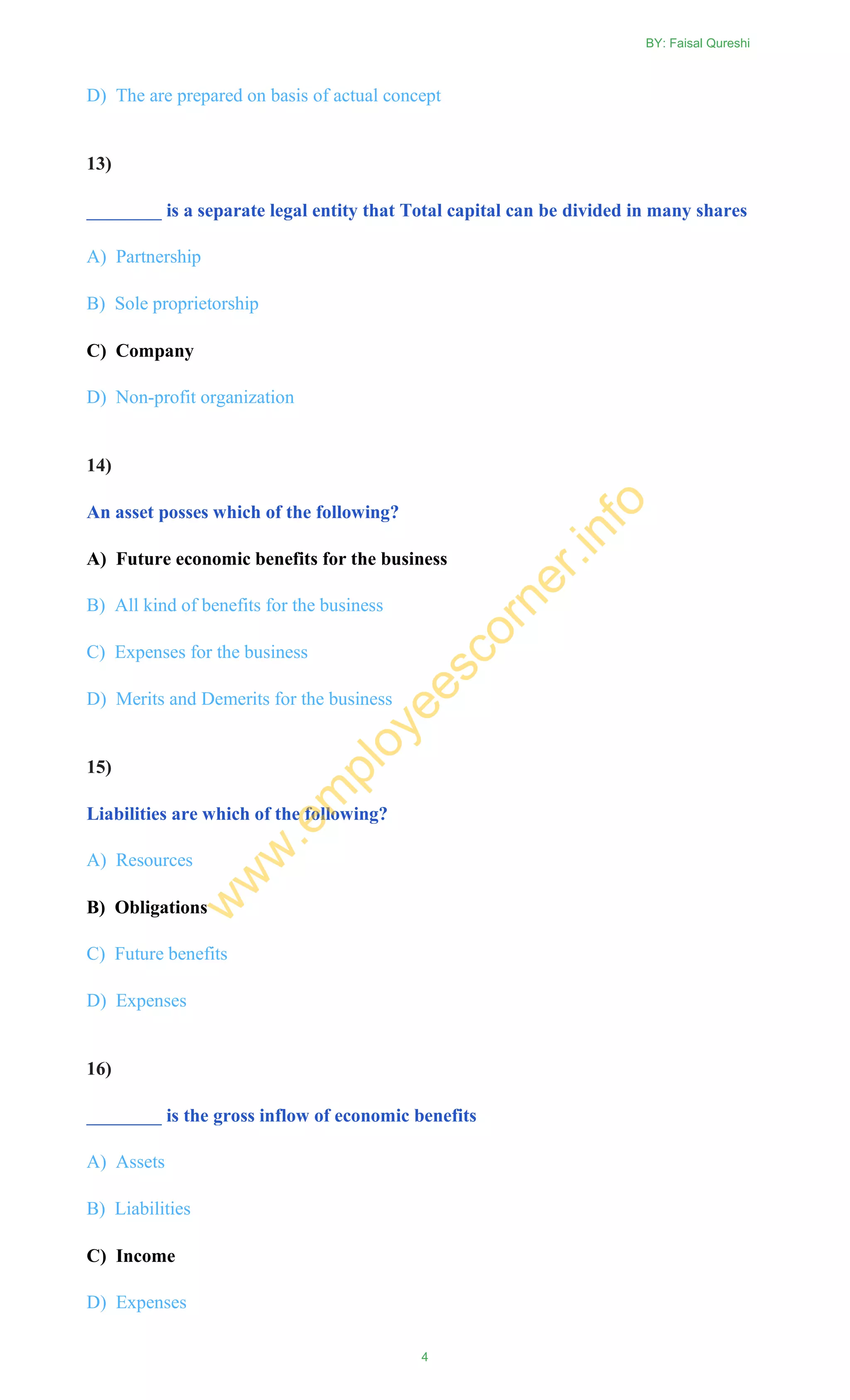
D) The are prepared on basis of actual concept
13)
________ is a separate legal entity that Total capital can be divided in many shares
A) Partnership
B) Sole proprietorship
C) Company
D) Non-profit organization
14)
An asset posses which of the following?
A) Future economic benefits for the business
B) All kind of benefits for the business
C) Expenses for the business
D) Merits and Demerits for the business
15)
Liabilities are which of the following?
A) Resources
B) Obligations
C) Future benefits
D) Expenses
16)
________ is the gross inflow of economic benefits
A) Assets
B) Liabilities
C) Income
D) Expenses
BY: Faisal Qureshi
4
w
w
w
.em
ployeescorner.info
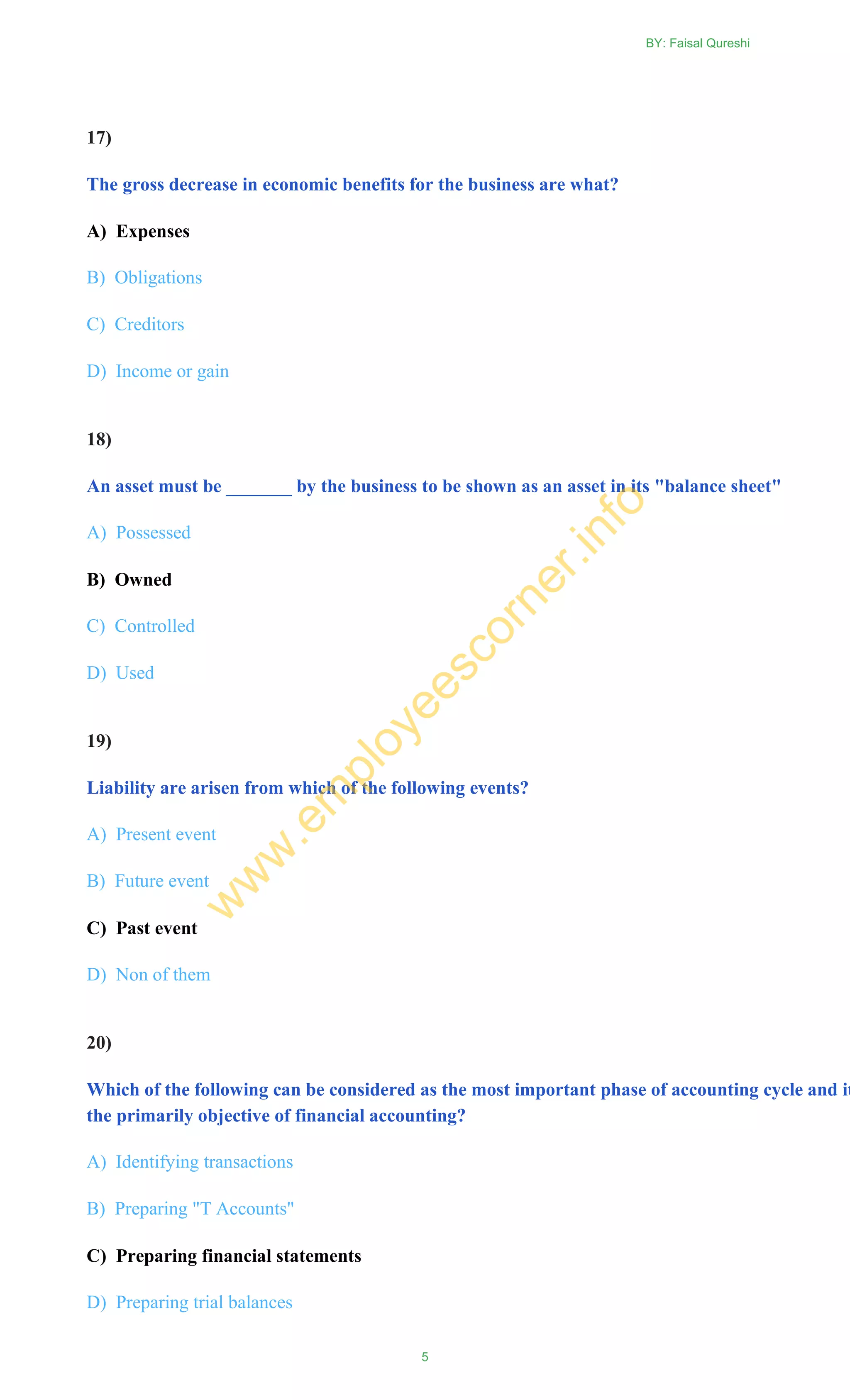
17)
The gross decrease in economic benefits for the business are what?
A) Expenses
B) Obligations
C) Creditors
D) Income or gain
18)
An asset must be _______ by the business to be shown as an asset in its "balance sheet"
A) Possessed
B) Owned
C) Controlled
D) Used
19)
Liability are arisen from which of the following events?
A) Present event
B) Future event
C) Past event
D) Non of them
20)
Which of the following can be considered as the most important phase of accounting cycle and it
the primarily objective of financial accounting?
A) Identifying transactions
B) Preparing "T Accounts"
C) Preparing financial statements
D) Preparing trial balances
BY: Faisal Qureshi
5
w
w
w
.em
ployeescorner.info
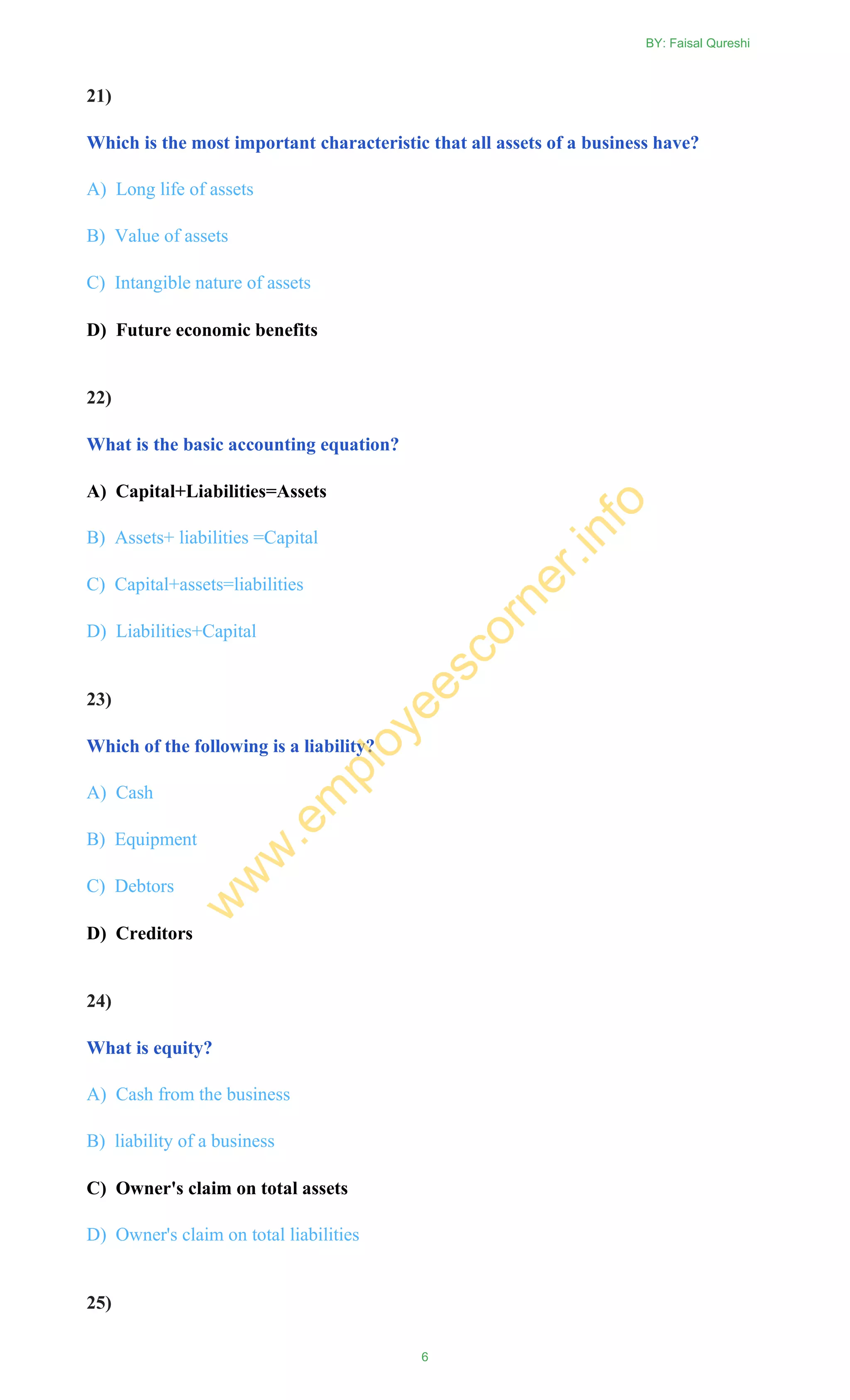
21)
Which is the most important characteristic that all assets of a business have?
A) Long life of assets
B) Value of assets
C) Intangible nature of assets
D) Future economic benefits
22)
What is the basic accounting equation?
A) Capital+Liabilities=Assets
B) Assets+ liabilities =Capital
C) Capital+assets=liabilities
D) Liabilities+Capital
23)
Which of the following is a liability?
A) Cash
B) Equipment
C) Debtors
D) Creditors
24)
What is equity?
A) Cash from the business
B) liability of a business
C) Owner's claim on total assets
D) Owner's claim on total liabilities
25)
BY: Faisal Qureshi
6
w
w
w
.em
ployeescorner.info
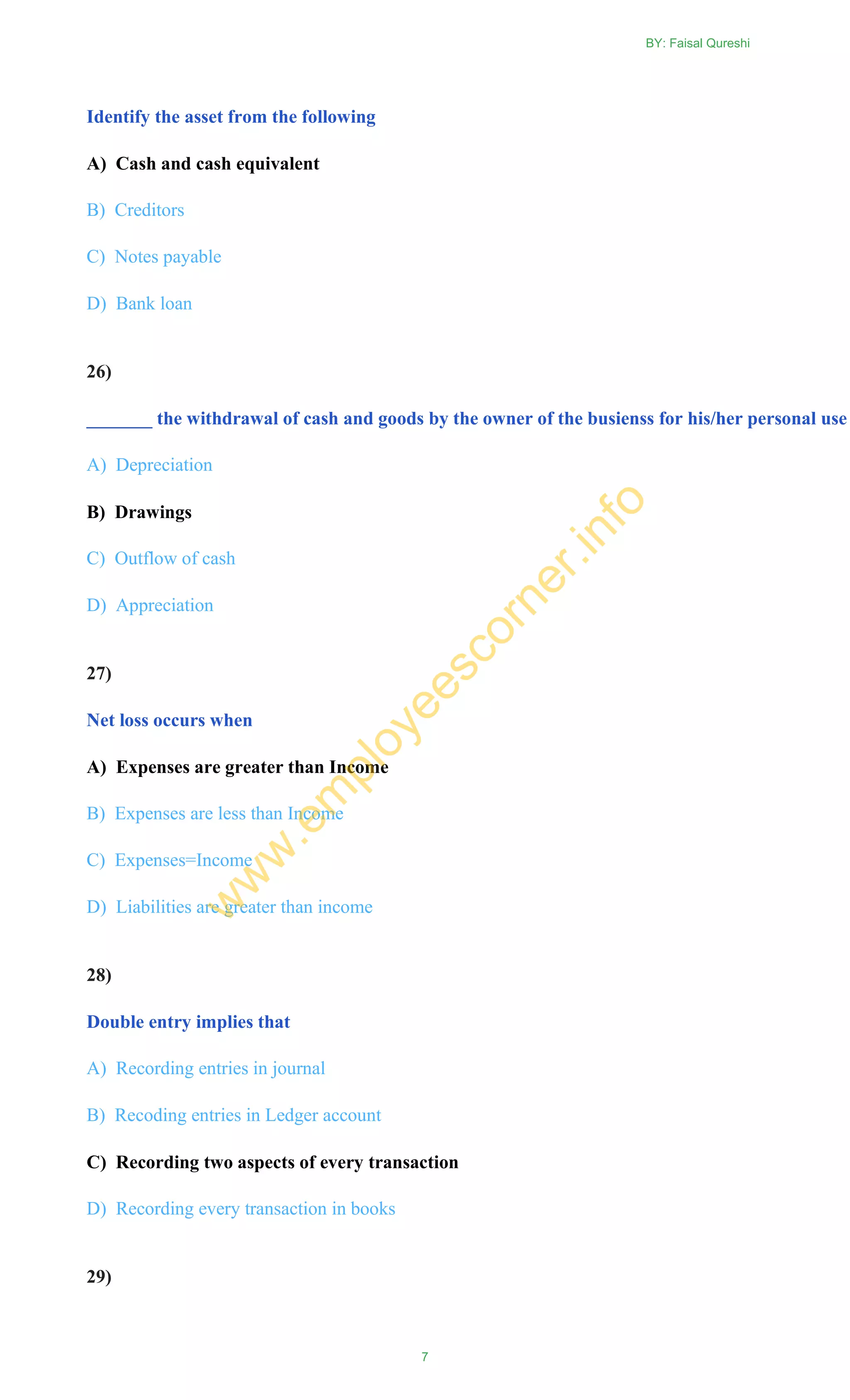
Identify the asset from the following
A) Cash and cash equivalent
B) Creditors
C) Notes payable
D) Bank loan
26)
_______ the withdrawal of cash and goods by the owner of the busienss for his/her personal use
A) Depreciation
B) Drawings
C) Outflow of cash
D) Appreciation
27)
Net loss occurs when
A) Expenses are greater than Income
B) Expenses are less than Income
C) Expenses=Income
D) Liabilities are greater than income
28)
Double entry implies that
A) Recording entries in journal
B) Recoding entries in Ledger account
C) Recording two aspects of every transaction
D) Recording every transaction in books
29)
BY: Faisal Qureshi
7
w
w
w
.em
ployeescorner.info
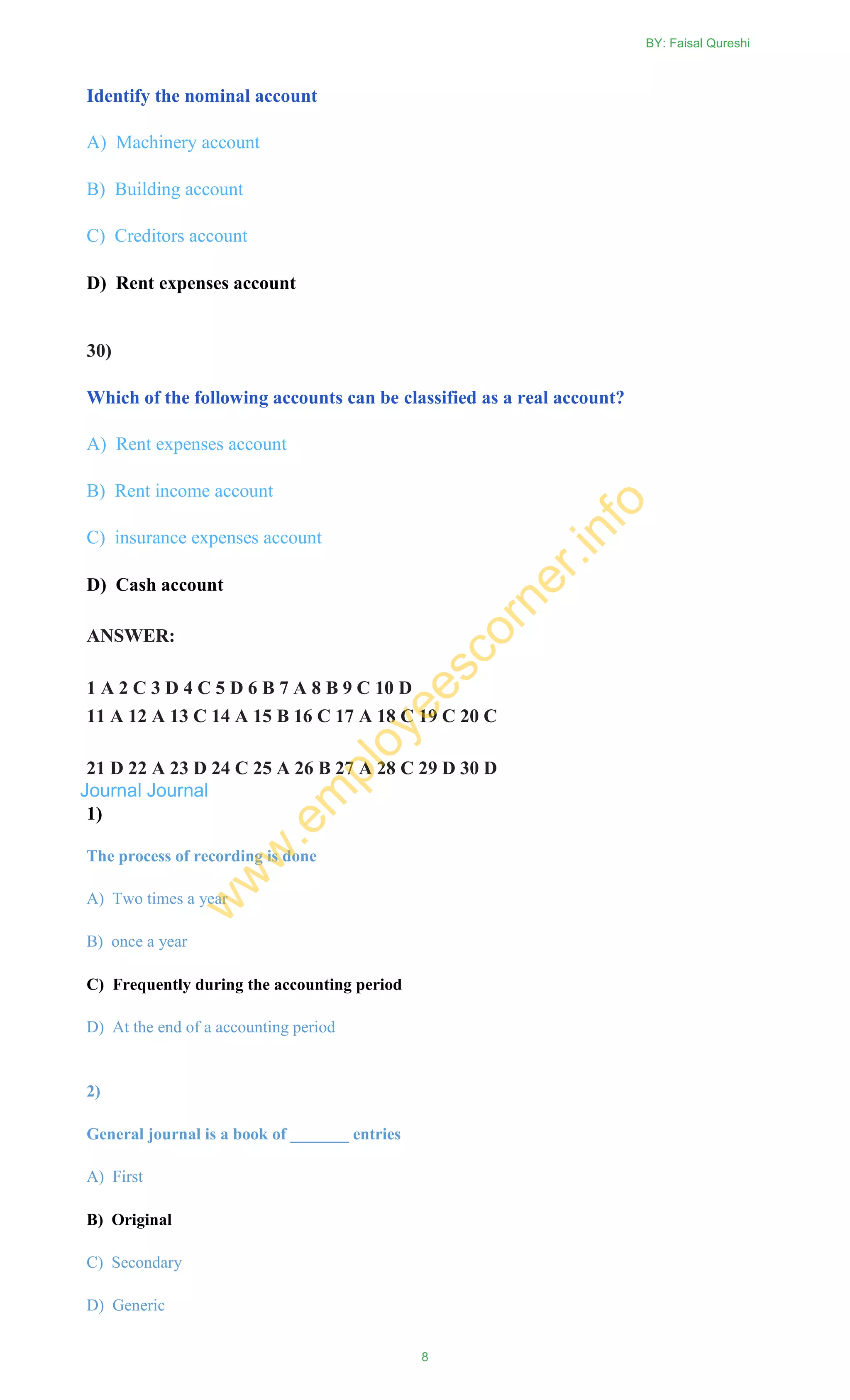
Identify the nominal account
A) Machinery account
B) Building account
C) Creditors account
D) Rent expenses account
30)
Which of the following accounts can be classified as a real account?
A) Rent expenses account
B) Rent income account
C) insurance expenses account
D) Cash account
ANSWER:
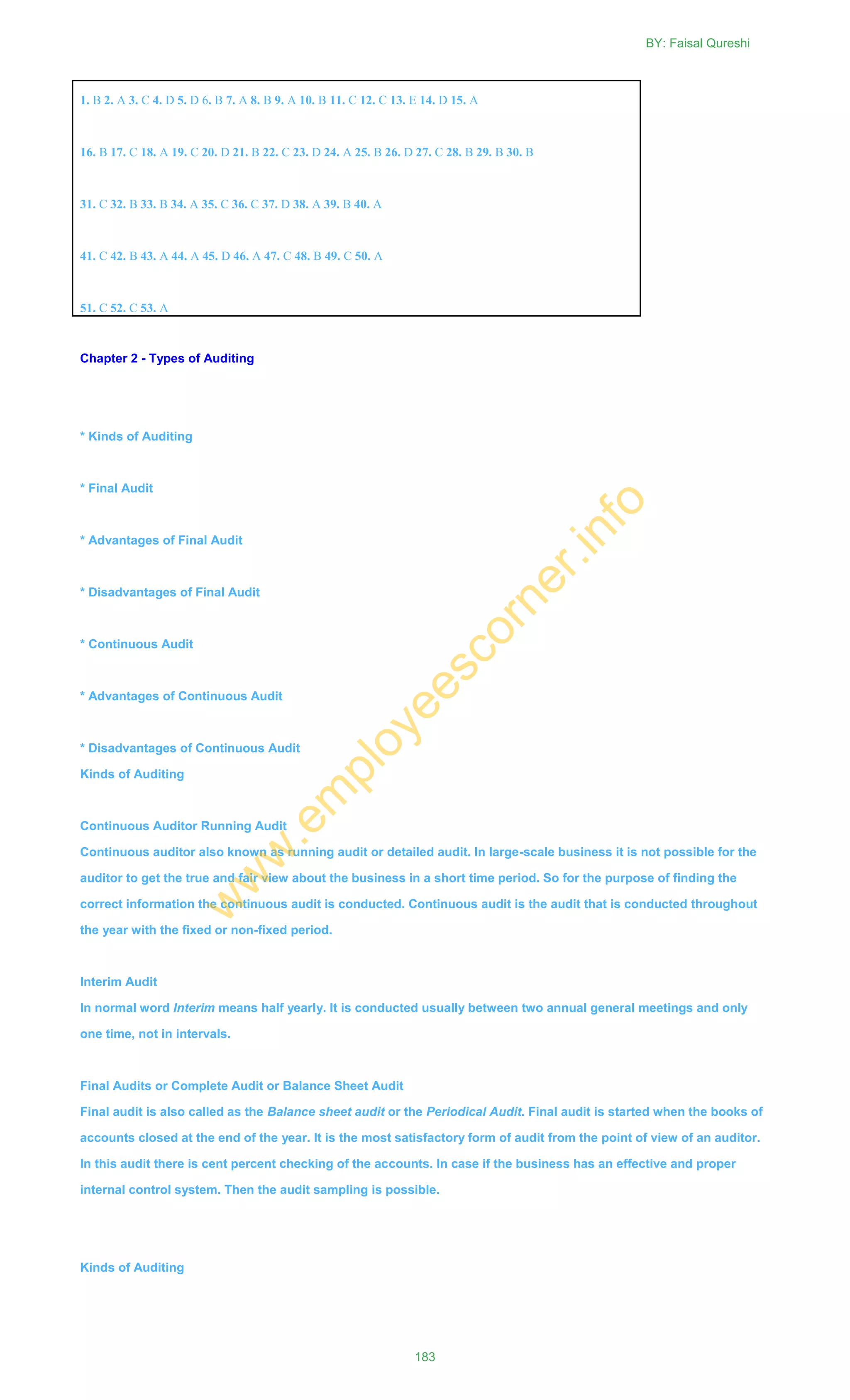
1 A 2 C 3 D 4 C 5 D 6 B 7 A 8 B 9 C 10 D
11 A 12 A 13 C 14 A 15 B 16 C 17 A 18 C 19 C 20 C
21 D 22 A 23 D 24 C 25 A 26 B 27 A 28 C 29 D 30 D
Journal Journal
1)
The process of recording is done
A) Two times a year
B) once a year
C) Frequently during the accounting period
D) At the end of a accounting period
2)
General journal is a book of _______ entries
A) First
B) Original
C) Secondary
D) Generic
BY: Faisal Qureshi
8
w
w
w
.em
ployeescorner.info
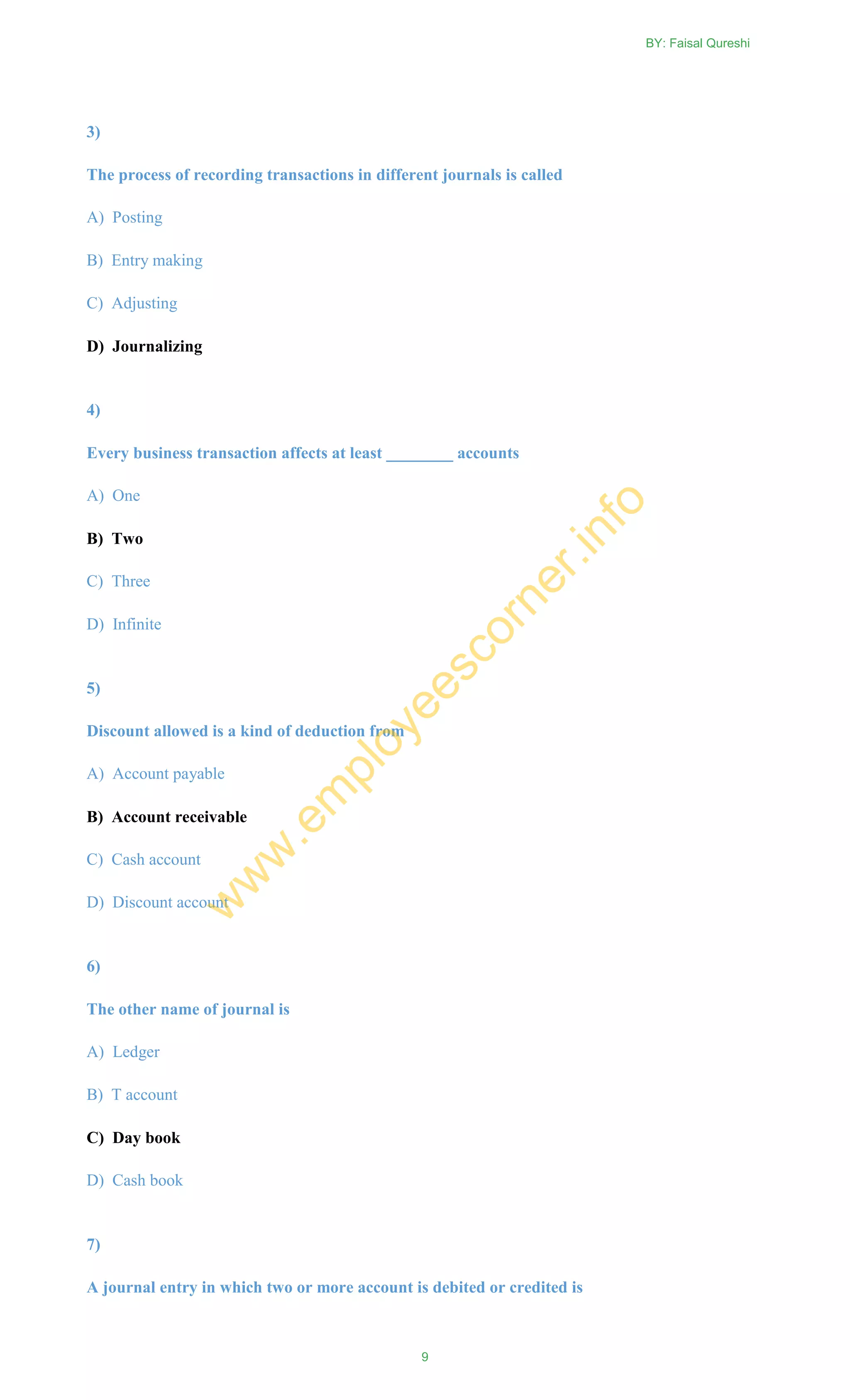
3)
The process of recording transactions in different journals is called
A) Posting
B) Entry making
C) Adjusting
D) Journalizing
4)
Every business transaction affects at least ________ accounts
A) One
B) Two
C) Three
D) Infinite
5)
Discount allowed is a kind of deduction from
A) Account payable
B) Account receivable
C) Cash account
D) Discount account
6)
The other name of journal is
A) Ledger
B) T account
C) Day book
D) Cash book
7)
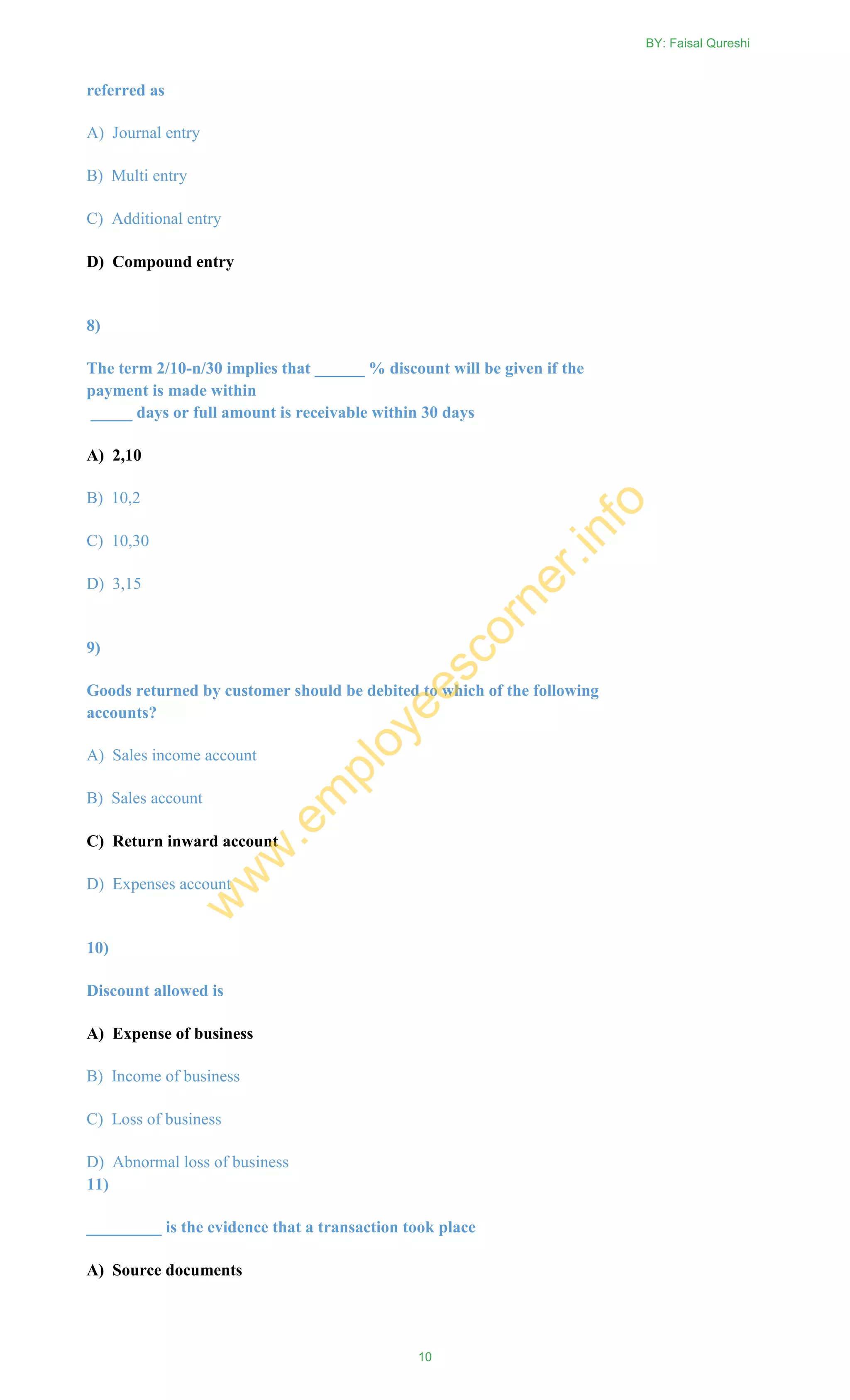
A journal entry in which two or more account is debited or credited is
BY: Faisal Qureshi
9
w
w
w
.em
ployeescorner.info
referred as
A) Journal entry
B) Multi entry
C) Additional entry
D) Compound entry
8)
The term 2/10-n/30 implies that ______ % discount will be given if the
payment is made within
_____ days or full amount is receivable within 30 days
A) 2,10
B) 10,2
C) 10,30
D) 3,15
9)
Goods returned by customer should be debited to which of the following
accounts?
A) Sales income account
B) Sales account
C) Return inward account
D) Expenses account
10)
Discount allowed is
A) Expense of business
B) Income of business
C) Loss of business
D) Abnormal loss of business
11)
_________ is the evidence that a transaction took place
A) Source documents
BY: Faisal Qureshi
10
w
w
w
.em
ployeescorner.info
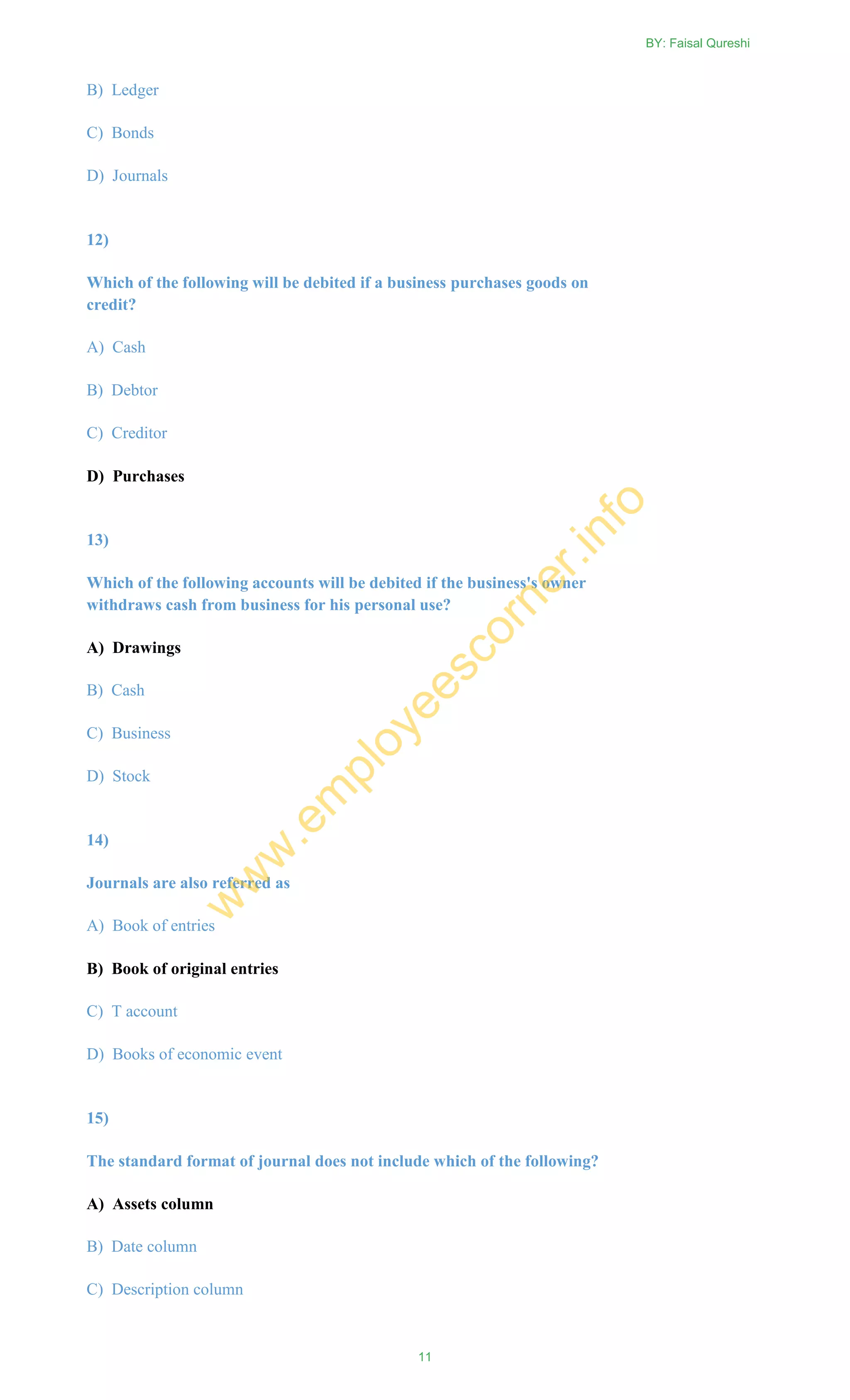
B) Ledger
C) Bonds
D) Journals
12)
Which of the following will be debited if a business purchases goods on
credit?
A) Cash
B) Debtor
C) Creditor
D) Purchases
13)
Which of the following accounts will be debited if the business's owner
withdraws cash from business for his personal use?
A) Drawings
B) Cash
C) Business
D) Stock
14)
Journals are also referred as
A) Book of entries
B) Book of original entries
C) T account
D) Books of economic event
15)
The standard format of journal does not include which of the following?
A) Assets column
B) Date column
C) Description column
BY: Faisal Qureshi
11
w
w
w
.em
ployeescorner.info
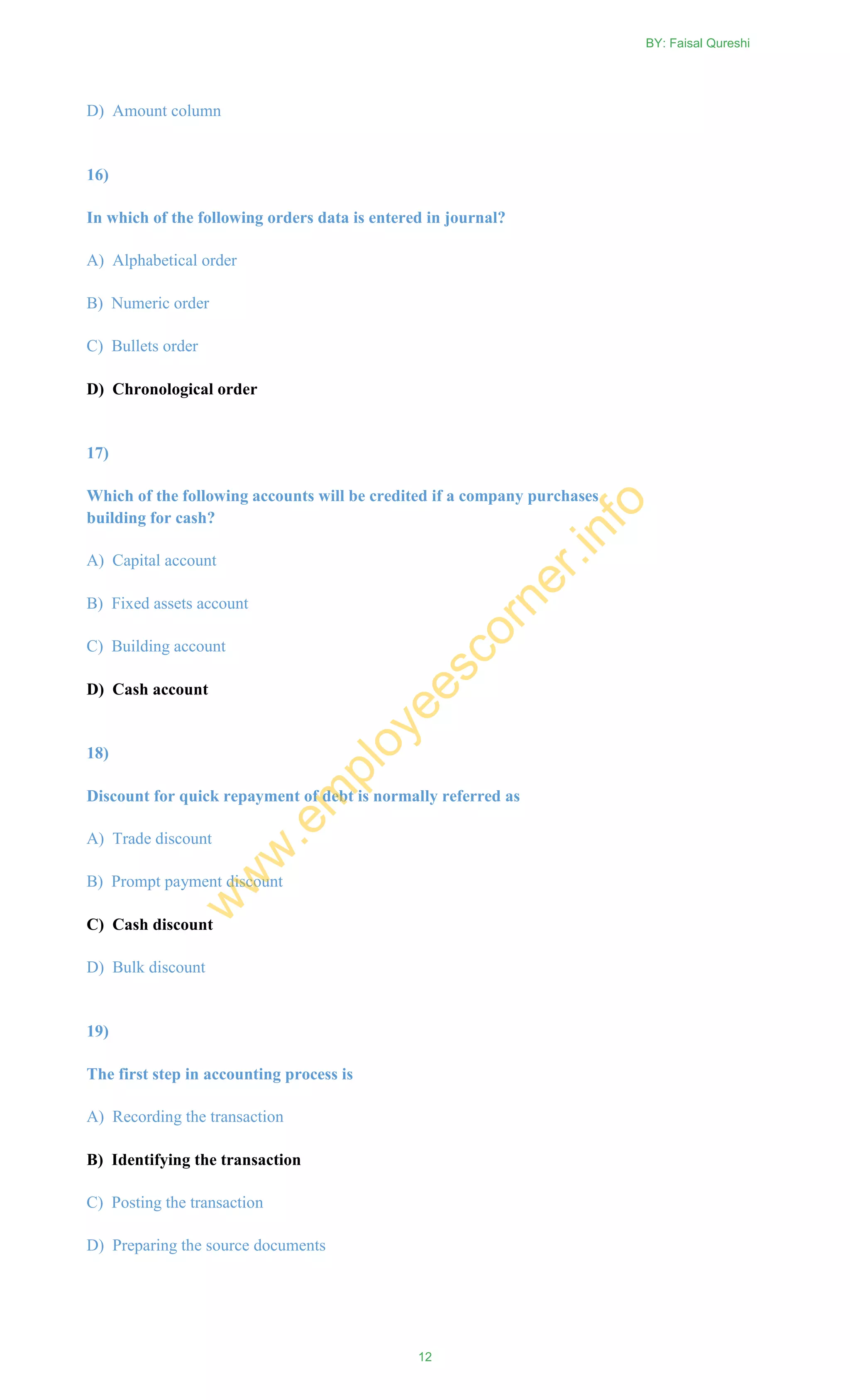
D) Amount column
16)
In which of the following orders data is entered in journal?
A) Alphabetical order
B) Numeric order
C) Bullets order
D) Chronological order
17)
Which of the following accounts will be credited if a company purchases
building for cash?
A) Capital account
B) Fixed assets account
C) Building account
D) Cash account
18)
Discount for quick repayment of debt is normally referred as
A) Trade discount
B) Prompt payment discount
C) Cash discount
D) Bulk discount
19)
The first step in accounting process is
A) Recording the transaction
B) Identifying the transaction
C) Posting the transaction
D) Preparing the source documents
BY: Faisal Qureshi
12
w
w
w
.em
ployeescorner.info
20)
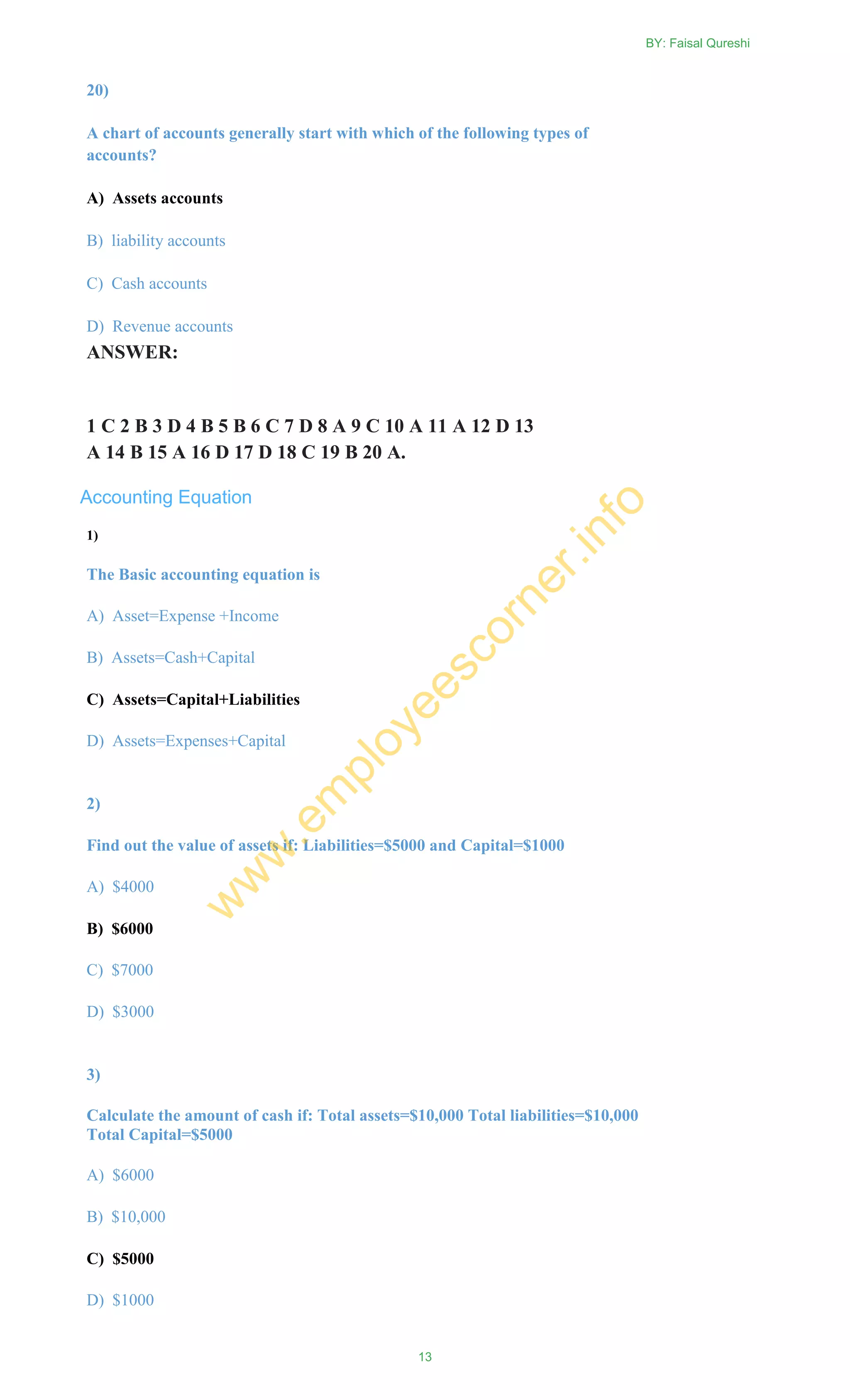
A chart of accounts generally start with which of the following types of
accounts?
A) Assets accounts
B) liability accounts
C) Cash accounts
D) Revenue accounts
ANSWER:
1 C 2 B 3 D 4 B 5 B 6 C 7 D 8 A 9 C 10 A 11 A 12 D 13
A 14 B 15 A 16 D 17 D 18 C 19 B 20 A.
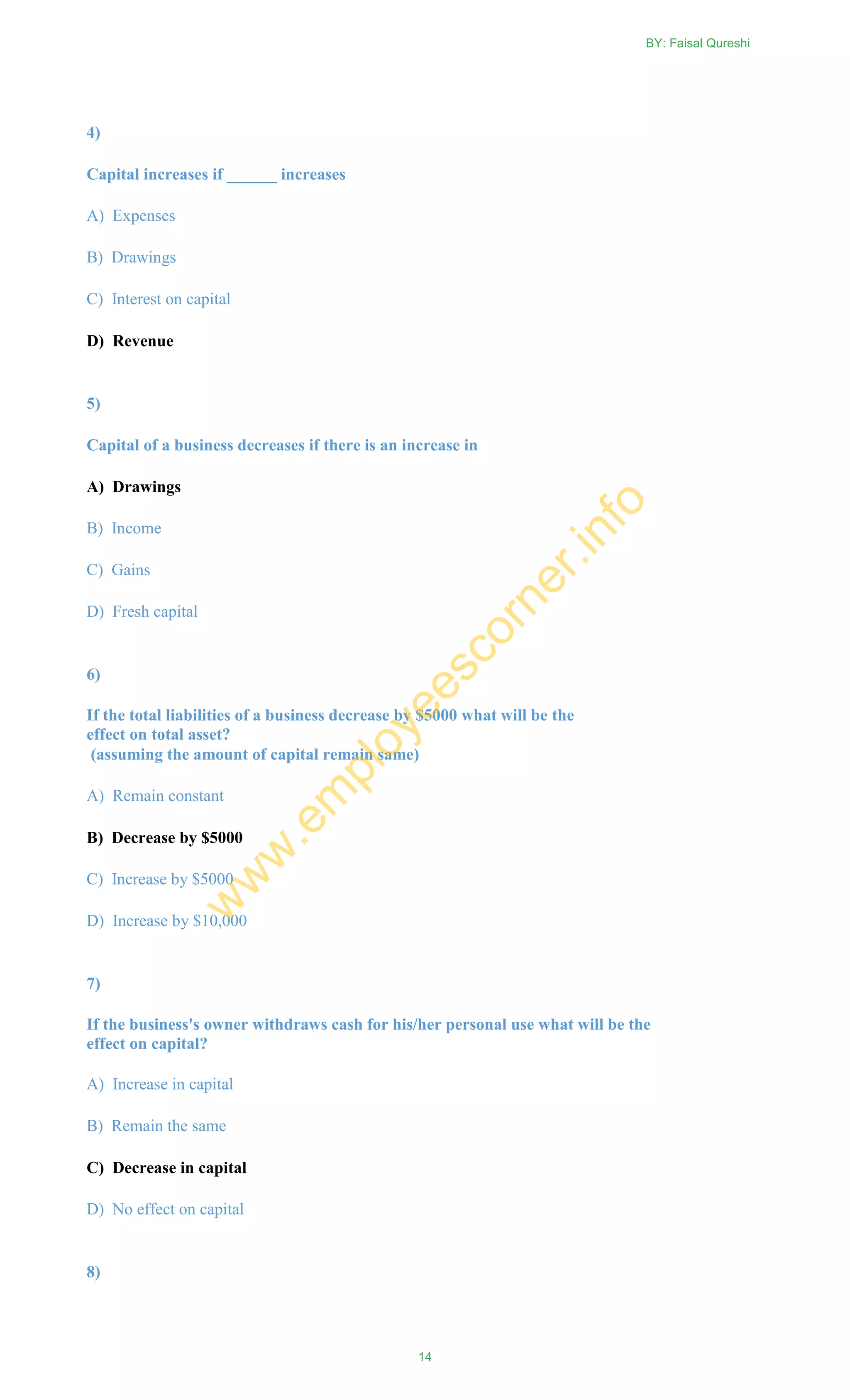
Accounting Equation
1)
The Basic accounting equation is
A) Asset=Expense +Income
B) Assets=Cash+Capital
C) Assets=Capital+Liabilities
D) Assets=Expenses+Capital
2)
Find out the value of assets if: Liabilities=$5000 and Capital=$1000
A) $4000
B) $6000
C) $7000
D) $3000
3)
Calculate the amount of cash if: Total assets=$10,000 Total liabilities=$10,000
Total Capital=$5000
A) $6000
B) $10,000
C) $5000
D) $1000
BY: Faisal Qureshi
13
w
w
w
.em
ployeescorner.info
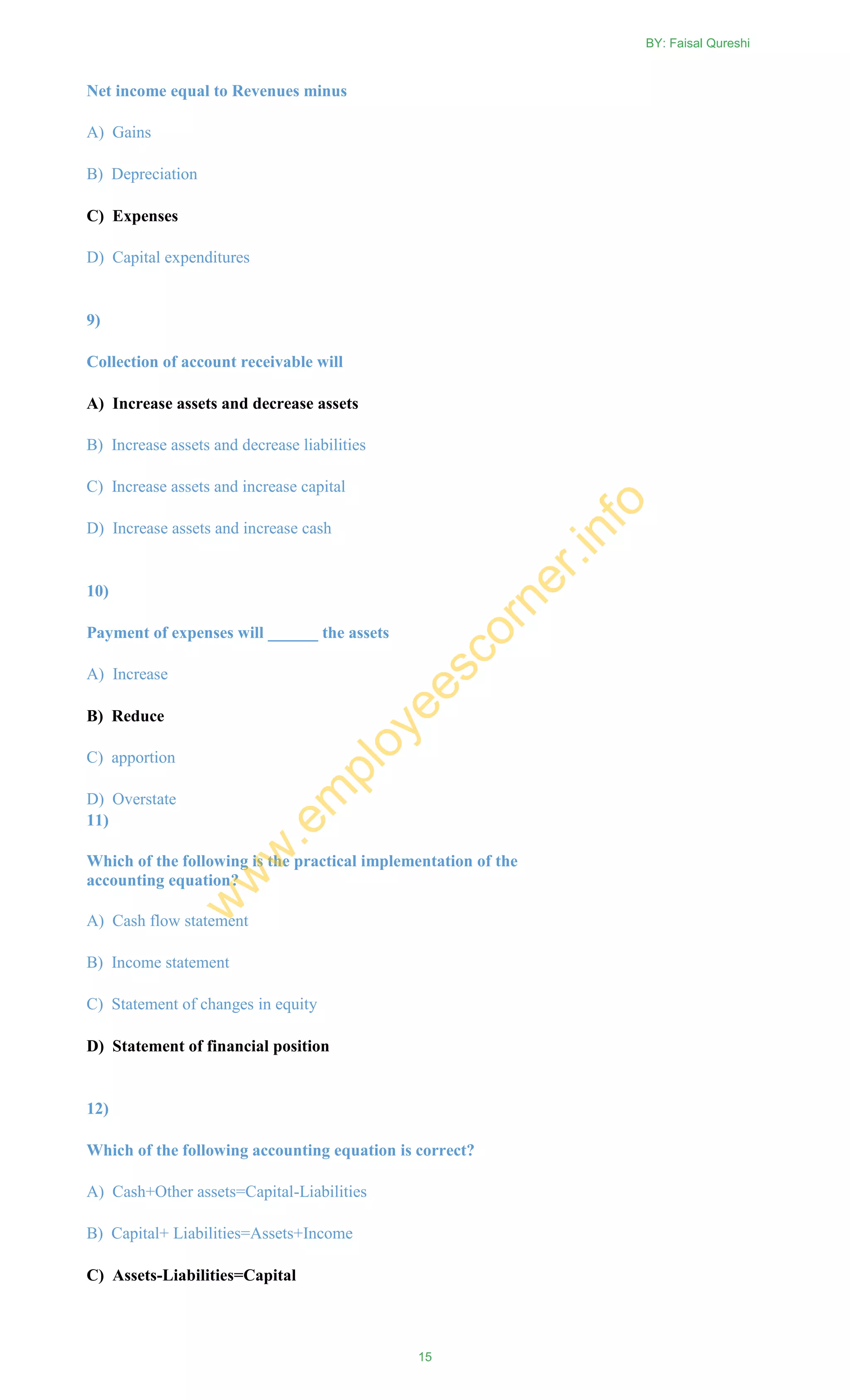
4)
Capital increases if ______ increases
A) Expenses
B) Drawings
C) Interest on capital
D) Revenue
5)
Capital of a business decreases if there is an increase in
A) Drawings
B) Income
C) Gains
D) Fresh capital
6)
If the total liabilities of a business decrease by $5000 what will be the
effect on total asset?
(assuming the amount of capital remain same)
A) Remain constant
B) Decrease by $5000
C) Increase by $5000
D) Increase by $10,000
7)
If the business's owner withdraws cash for his/her personal use what will be the
effect on capital?
A) Increase in capital
B) Remain the same
C) Decrease in capital
D) No effect on capital
8)
BY: Faisal Qureshi
14
w
w
w
.em
ployeescorner.info
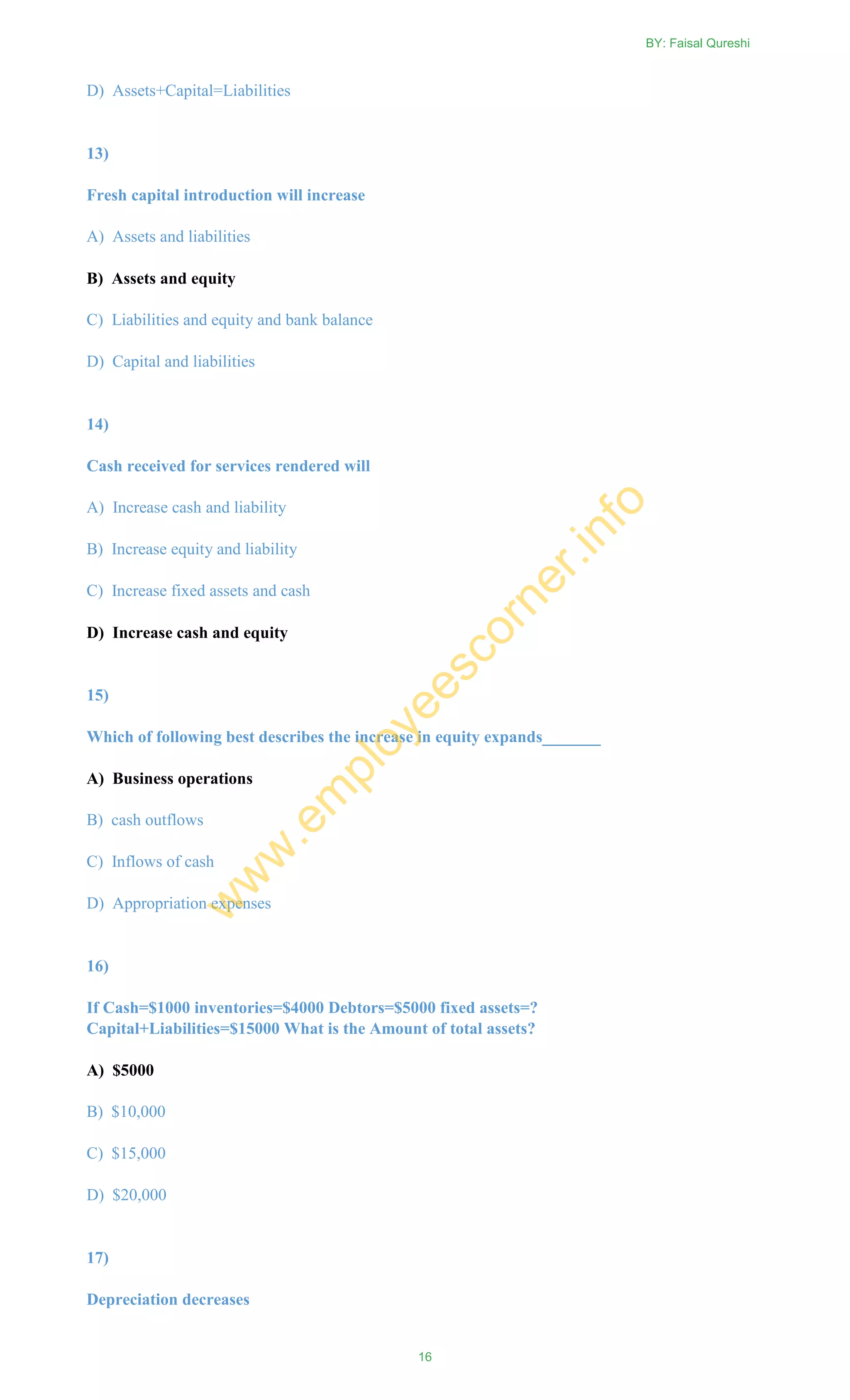
Net income equal to Revenues minus
A) Gains
B) Depreciation
C) Expenses
D) Capital expenditures
9)
Collection of account receivable will
A) Increase assets and decrease assets
B) Increase assets and decrease liabilities
C) Increase assets and increase capital
D) Increase assets and increase cash
10)
Payment of expenses will ______ the assets
A) Increase
B) Reduce
C) apportion
D) Overstate
11)
Which of the following is the practical implementation of the
accounting equation?
A) Cash flow statement
B) Income statement
C) Statement of changes in equity
D) Statement of financial position
12)
Which of the following accounting equation is correct?
A) Cash+Other assets=Capital-Liabilities
B) Capital+ Liabilities=Assets+Income
C) Assets-Liabilities=Capital
BY: Faisal Qureshi
15
w
w
w
.em
ployeescorner.info
D) Assets+Capital=Liabilities
13)
Fresh capital introduction will increase
A) Assets and liabilities
B) Assets and equity
C) Liabilities and equity and bank balance
D) Capital and liabilities
14)
Cash received for services rendered will
A) Increase cash and liability
B) Increase equity and liability
C) Increase fixed assets and cash
D) Increase cash and equity
15)
Which of following best describes the increase in equity expands_______
A) Business operations
B) cash outflows
C) Inflows of cash
D) Appropriation expenses
16)
If Cash=$1000 inventories=$4000 Debtors=$5000 fixed assets=?
Capital+Liabilities=$15000 What is the Amount of total assets?
A) $5000
B) $10,000
C) $15,000
D) $20,000
17)
Depreciation decreases
BY: Faisal Qureshi
16
w
w
w
.em
ployeescorner.info
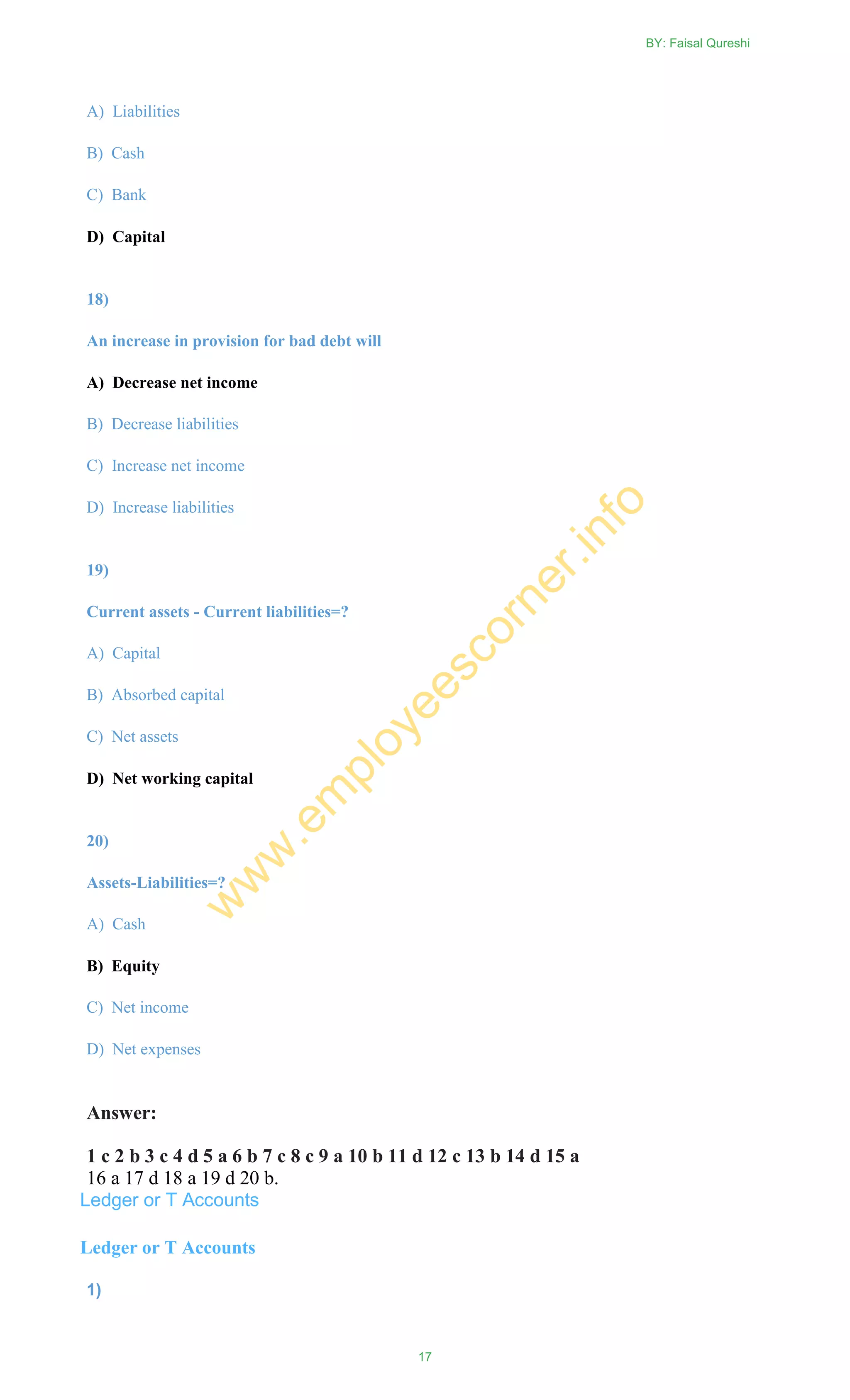
A) Liabilities
B) Cash
C) Bank
D) Capital
18)
An increase in provision for bad debt will
A) Decrease net income
B) Decrease liabilities
C) Increase net income
D) Increase liabilities
19)
Current assets - Current liabilities=?
A) Capital
B) Absorbed capital
C) Net assets
D) Net working capital
20)
Assets-Liabilities=?
A) Cash
B) Equity
C) Net income
D) Net expenses
Answer:
1 c 2 b 3 c 4 d 5 a 6 b 7 c 8 c 9 a 10 b 11 d 12 c 13 b 14 d 15 a
16 a 17 d 18 a 19 d 20 b.
Ledger or T Accounts
1)
BY: Faisal Qureshi
17
w
w
w
.em
ployeescorner.info
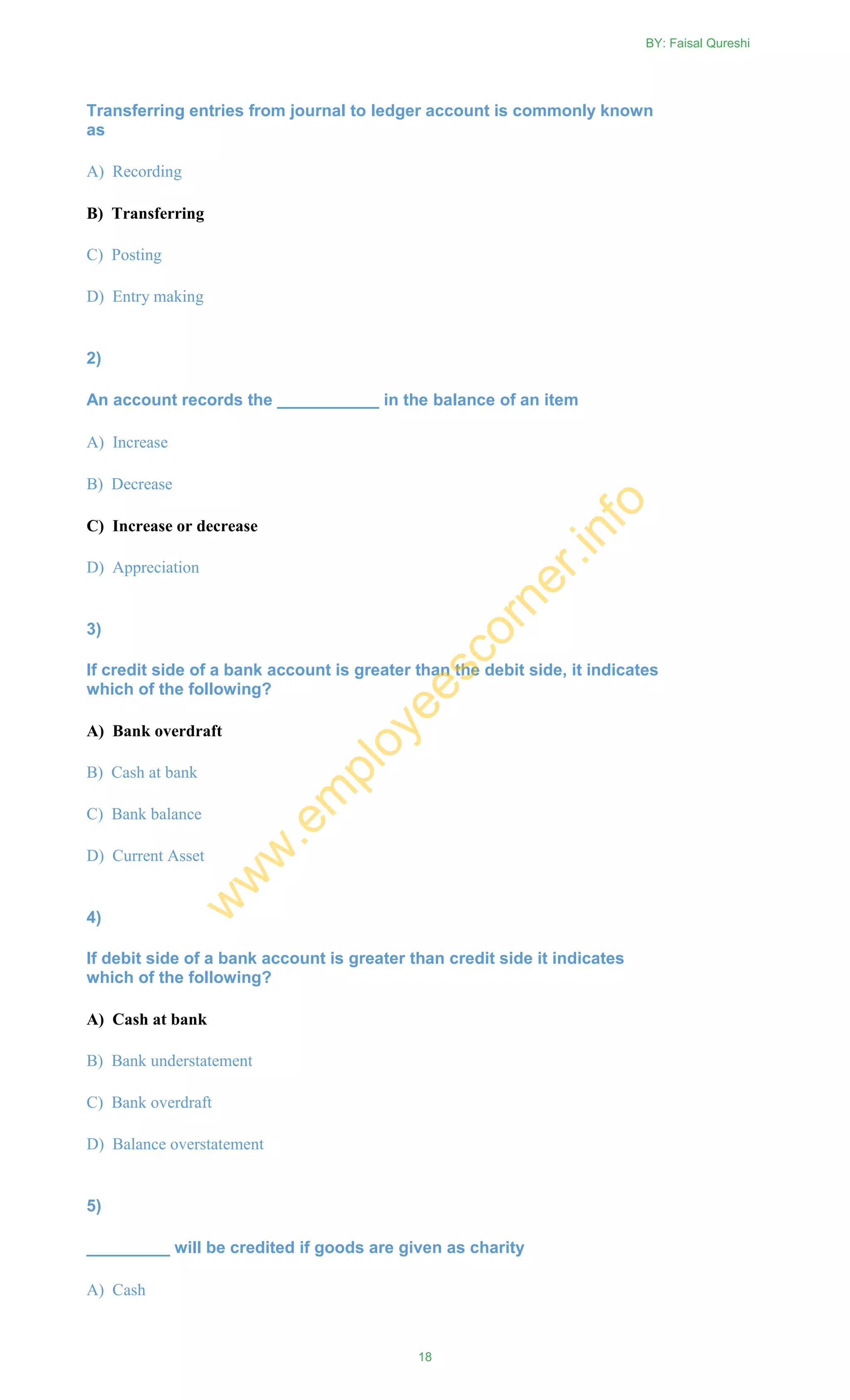
Transferring entries from journal to ledger account is commonly known
as
A) Recording
B) Transferring
C) Posting
D) Entry making
2)
An account records the ___________ in the balance of an item
A) Increase
B) Decrease
C) Increase or decrease
D) Appreciation
3)
If credit side of a bank account is greater than the debit side, it indicates
which of the following?
A) Bank overdraft
B) Cash at bank
C) Bank balance
D) Current Asset
4)
If debit side of a bank account is greater than credit side it indicates
which of the following?
A) Cash at bank
B) Bank understatement
C) Bank overdraft
D) Balance overstatement
5)
_________ will be credited if goods are given as charity
A) Cash
BY: Faisal Qureshi
18
w
w
w
.em
ployeescorner.info
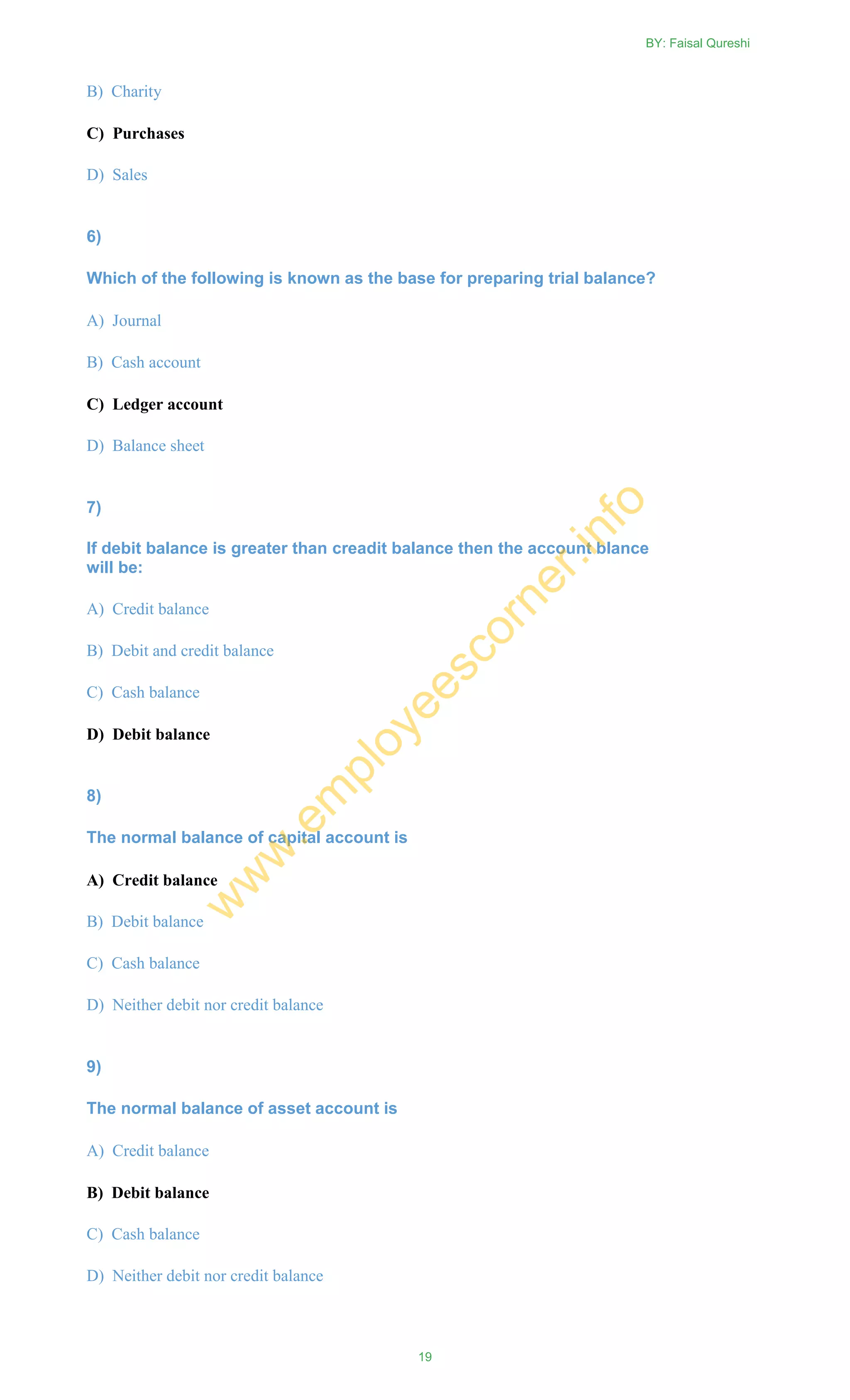
B) Charity
C) Purchases
D) Sales
6)
Which of the following is known as the base for preparing trial balance?
A) Journal
B) Cash account
C) Ledger account
D) Balance sheet
7)
If debit balance is greater than creadit balance then the account blance
will be:
A) Credit balance
B) Debit and credit balance
C) Cash balance
D) Debit balance
8)
The normal balance of capital account is
A) Credit balance
B) Debit balance
C) Cash balance
D) Neither debit nor credit balance
9)
The normal balance of asset account is
A) Credit balance
B) Debit balance
C) Cash balance
D) Neither debit nor credit balance
BY: Faisal Qureshi
19
w
w
w
.em
ployeescorner.info
10)
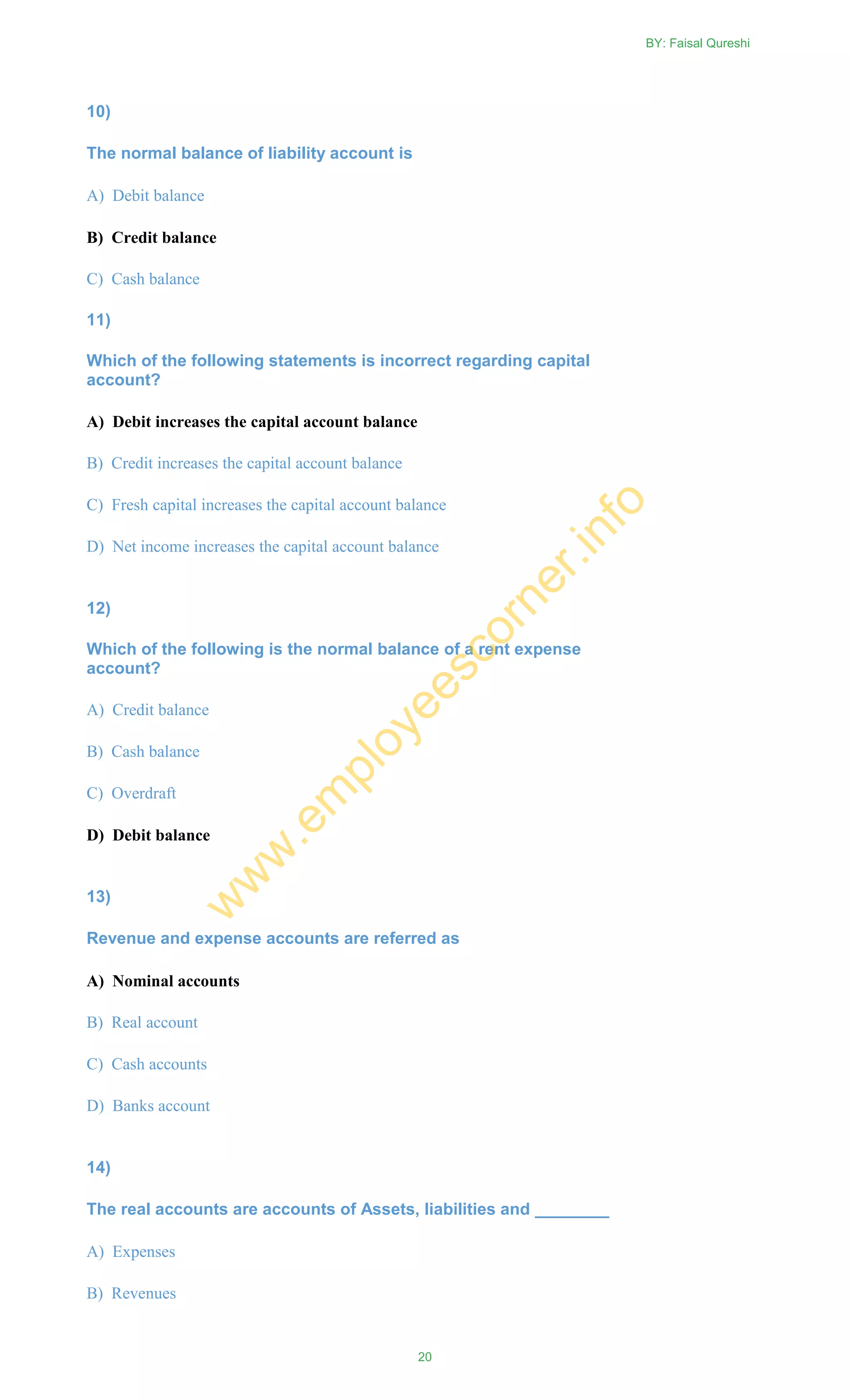
The normal balance of liability account is
A) Debit balance
B) Credit balance
C) Cash balance
11)
Which of the following statements is incorrect regarding capital
account?
A) Debit increases the capital account balance
B) Credit increases the capital account balance
C) Fresh capital increases the capital account balance
D) Net income increases the capital account balance
12)
Which of the following is the normal balance of a rent expense
account?
A) Credit balance
B) Cash balance
C) Overdraft
D) Debit balance
13)
Revenue and expense accounts are referred as
A) Nominal accounts
B) Real account
C) Cash accounts
D) Banks account
14)
The real accounts are accounts of Assets, liabilities and ________
A) Expenses
B) Revenues
BY: Faisal Qureshi
20
w
w
w
.em
ployeescorner.info
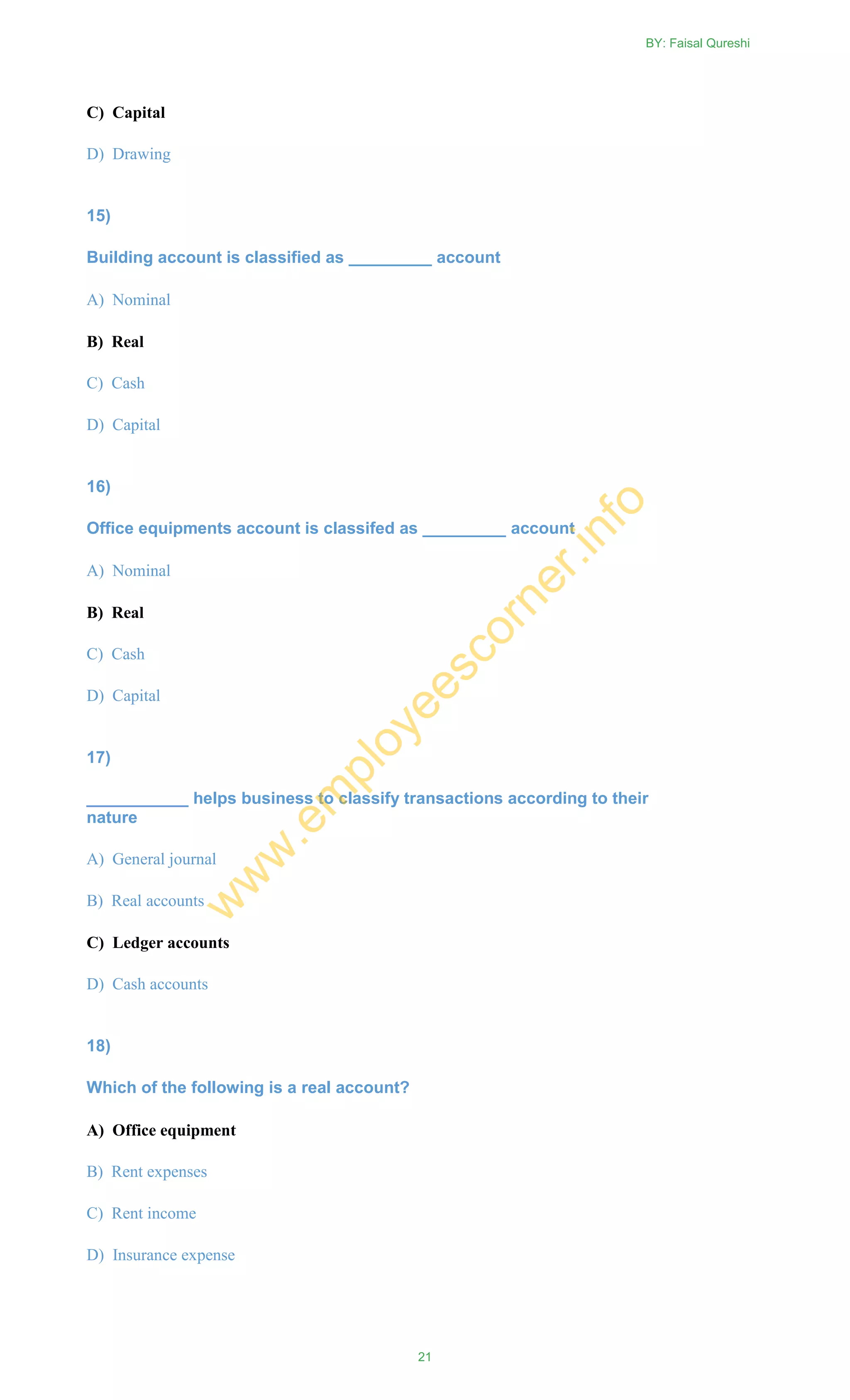
C) Capital
D) Drawing
15)
Building account is classified as _________ account
A) Nominal
B) Real
C) Cash
D) Capital
16)
Office equipments account is classifed as _________ account
A) Nominal
B) Real
C) Cash
D) Capital
17)
___________ helps business to classify transactions according to their
nature
A) General journal
B) Real accounts
C) Ledger accounts
D) Cash accounts
18)
Which of the following is a real account?
A) Office equipment
B) Rent expenses
C) Rent income
D) Insurance expense
BY: Faisal Qureshi
21
w
w
w
.em
ployeescorner.info
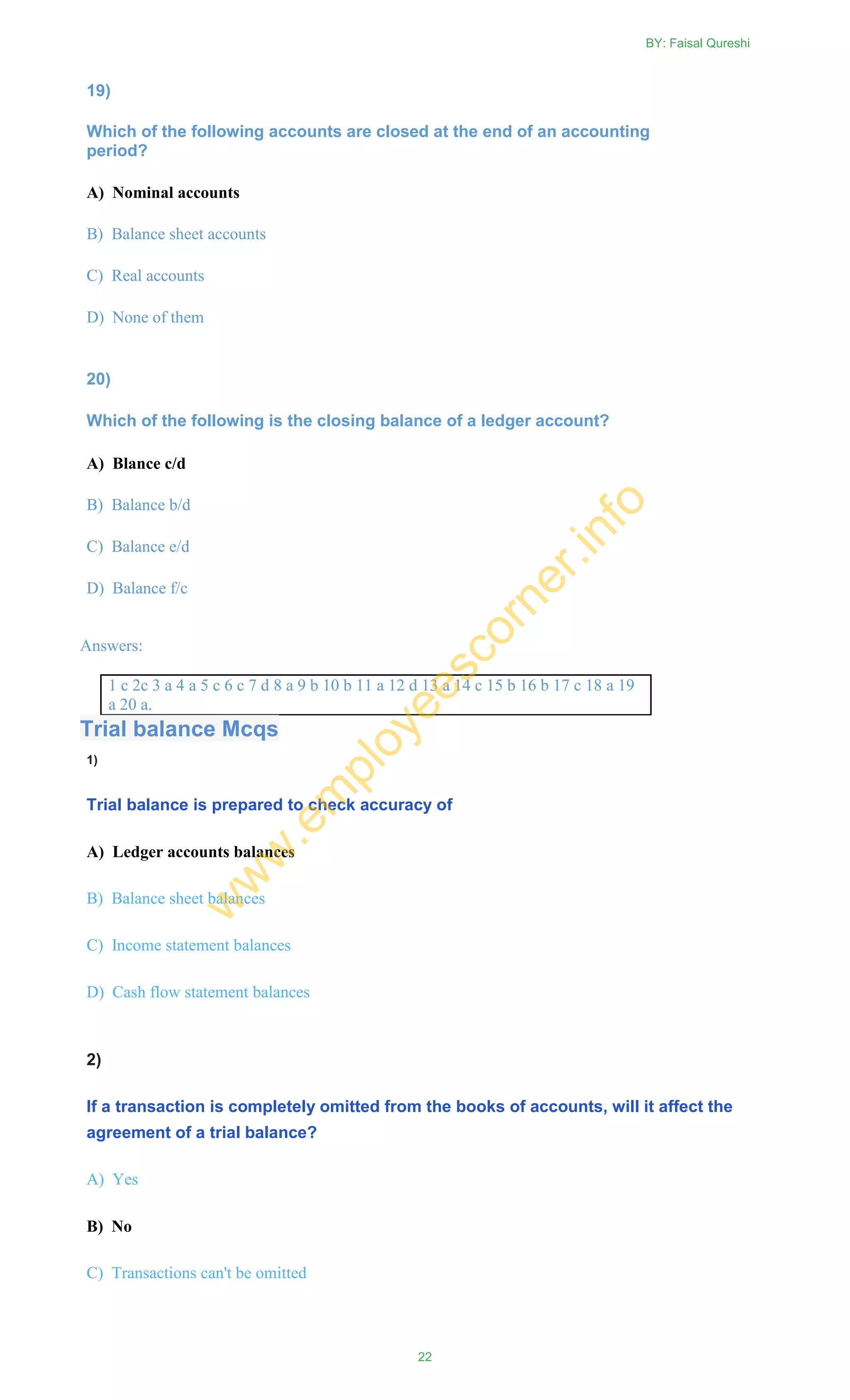
19)
Which of the following accounts are closed at the end of an accounting
period?
A) Nominal accounts
B) Balance sheet accounts
C) Real accounts
D) None of them
20)
Which of the following is the closing balance of a ledger account?
A) Blance c/d
B) Balance b/d
C) Balance e/d
D) Balance f/c
Answers:
1 c 2c 3 a 4 a 5 c 6 c 7 d 8 a 9 b 10 b 11 a 12 d 13 a 14 c 15 b 16 b 17 c 18 a 19
a 20 a.
Trial balance Mcqs
1)
Trial balance is prepared to check accuracy of
A) Ledger accounts balances
B) Balance sheet balances
C) Income statement balances
D) Cash flow statement balances
2)
If a transaction is completely omitted from the books of accounts, will it affect the
agreement of a trial balance?
A) Yes
B) No
C) Transactions can't be omitted
BY: Faisal Qureshi
22
w
w
w
.em
ployeescorner.info
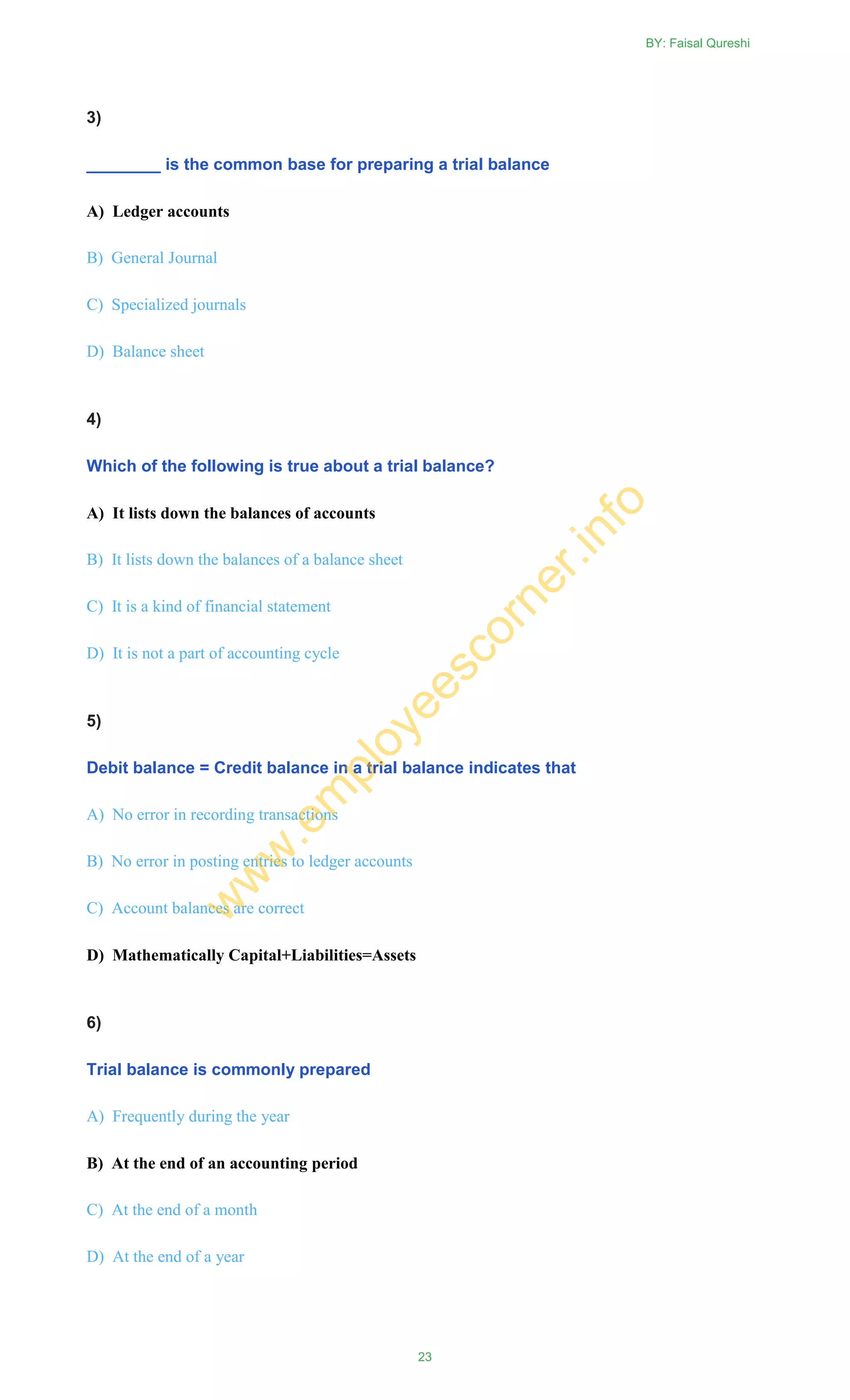
3)
________ is the common base for preparing a trial balance
A) Ledger accounts
B) General Journal
C) Specialized journals
D) Balance sheet
4)
Which of the following is true about a trial balance?
A) It lists down the balances of accounts
B) It lists down the balances of a balance sheet
C) It is a kind of financial statement
D) It is not a part of accounting cycle
5)
Debit balance = Credit balance in a trial balance indicates that
A) No error in recording transactions
B) No error in posting entries to ledger accounts
C) Account balances are correct
D) Mathematically Capital+Liabilities=Assets
6)
Trial balance is commonly prepared
A) Frequently during the year
B) At the end of an accounting period
C) At the end of a month
D) At the end of a year
BY: Faisal Qureshi
23
w
w
w
.em
ployeescorner.info
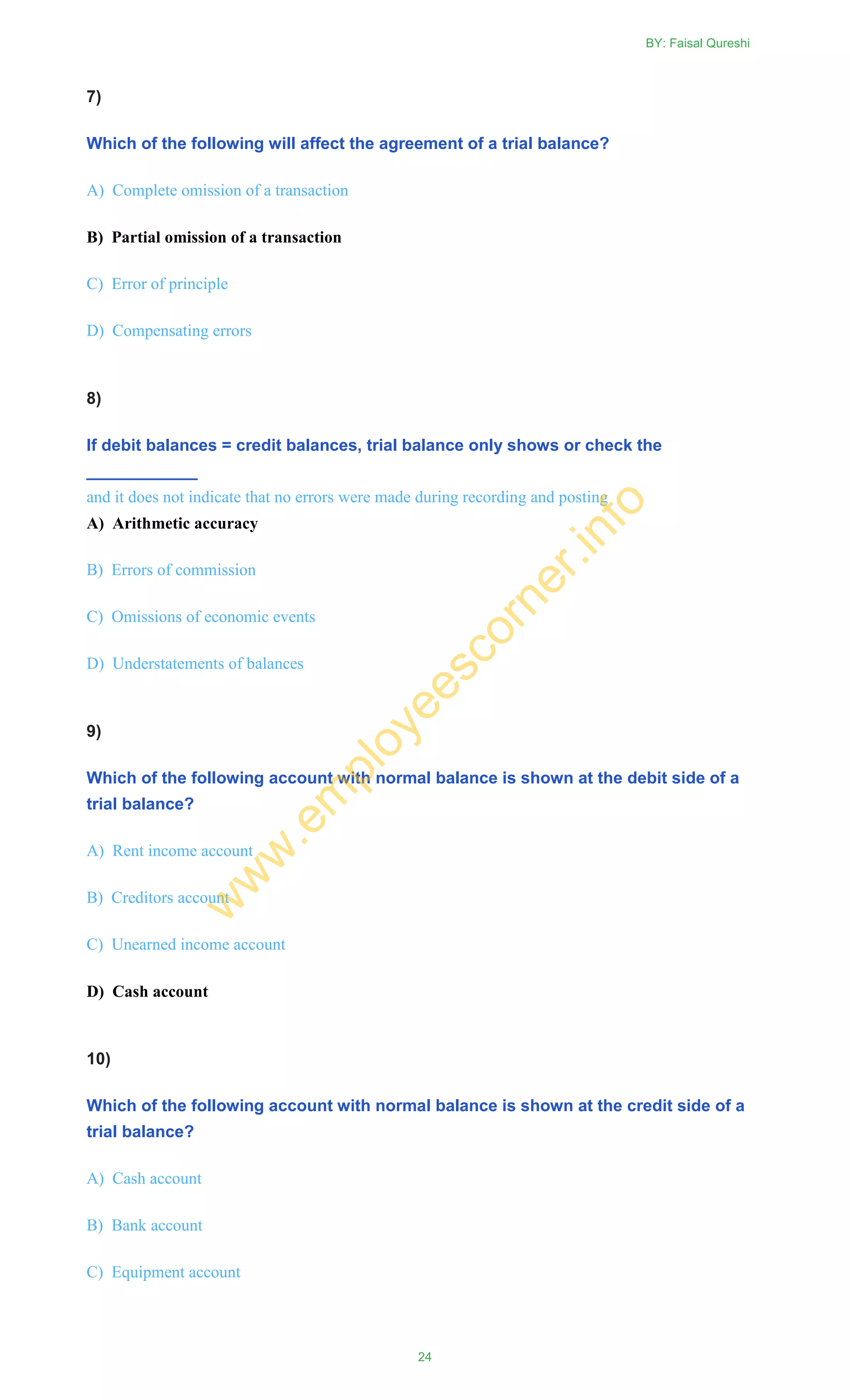
7)
Which of the following will affect the agreement of a trial balance?
A) Complete omission of a transaction
B) Partial omission of a transaction
C) Error of principle
D) Compensating errors
8)
If debit balances = credit balances, trial balance only shows or check the
____________
and it does not indicate that no errors were made during recording and posting
A) Arithmetic accuracy
B) Errors of commission
C) Omissions of economic events
D) Understatements of balances
9)
Which of the following account with normal balance is shown at the debit side of a
trial balance?
A) Rent income account
B) Creditors account
C) Unearned income account
D) Cash account
10)
Which of the following account with normal balance is shown at the credit side of a
trial balance?
A) Cash account
B) Bank account
C) Equipment account
BY: Faisal Qureshi
24
w
w
w
.em
ployeescorner.info
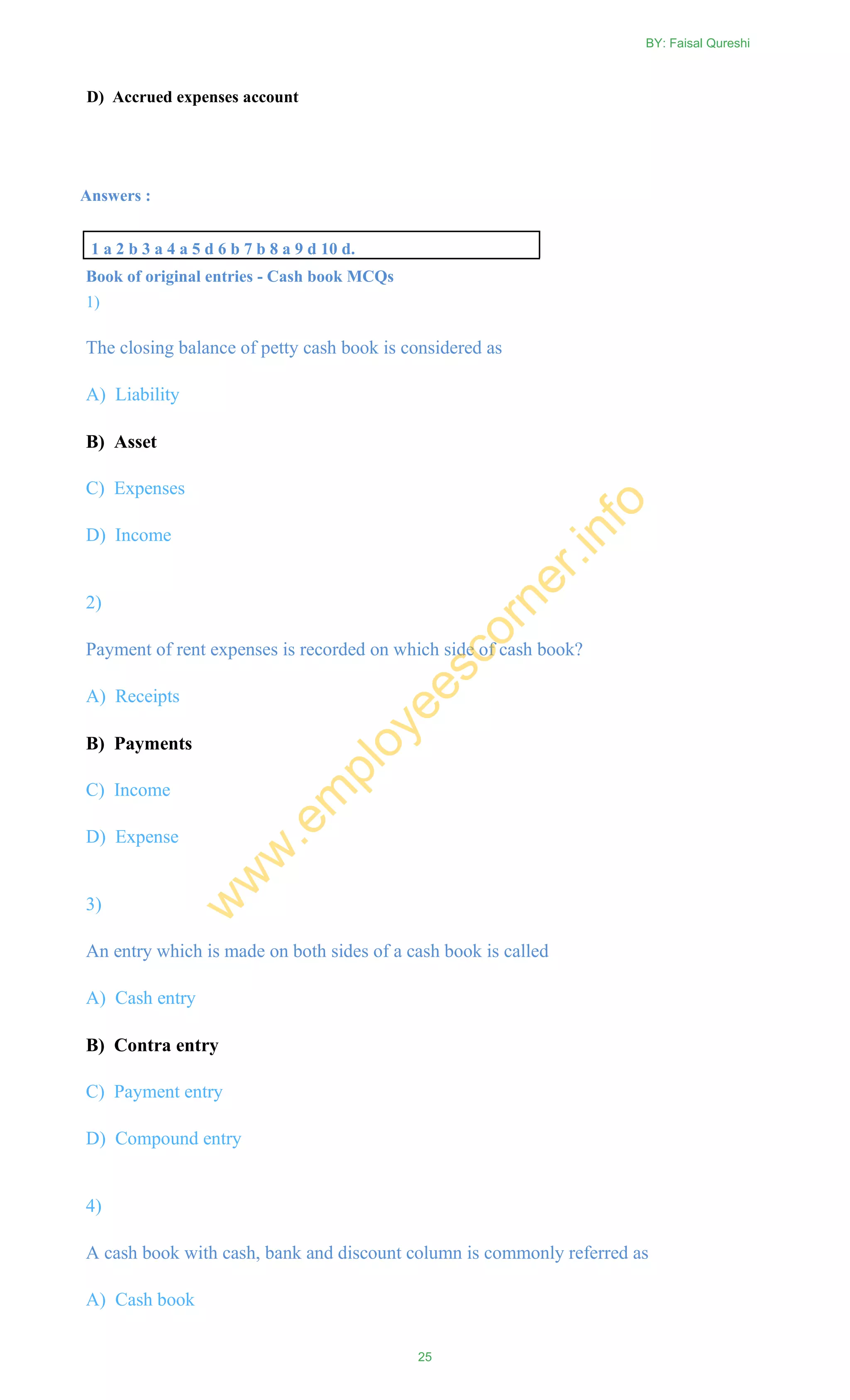
D) Accrued expenses account
Answers :
1 a 2 b 3 a 4 a 5 d 6 b 7 b 8 a 9 d 10 d.
Book of original entries - Cash book MCQs
1)
The closing balance of petty cash book is considered as
A) Liability
B) Asset
C) Expenses
D) Income
2)
Payment of rent expenses is recorded on which side of cash book?
A) Receipts
B) Payments
C) Income
D) Expense
3)
An entry which is made on both sides of a cash book is called
A) Cash entry
B) Contra entry
C) Payment entry
D) Compound entry
4)
A cash book with cash, bank and discount column is commonly referred as
A) Cash book
BY: Faisal Qureshi
25
w
w
w
.em
ployeescorner.info
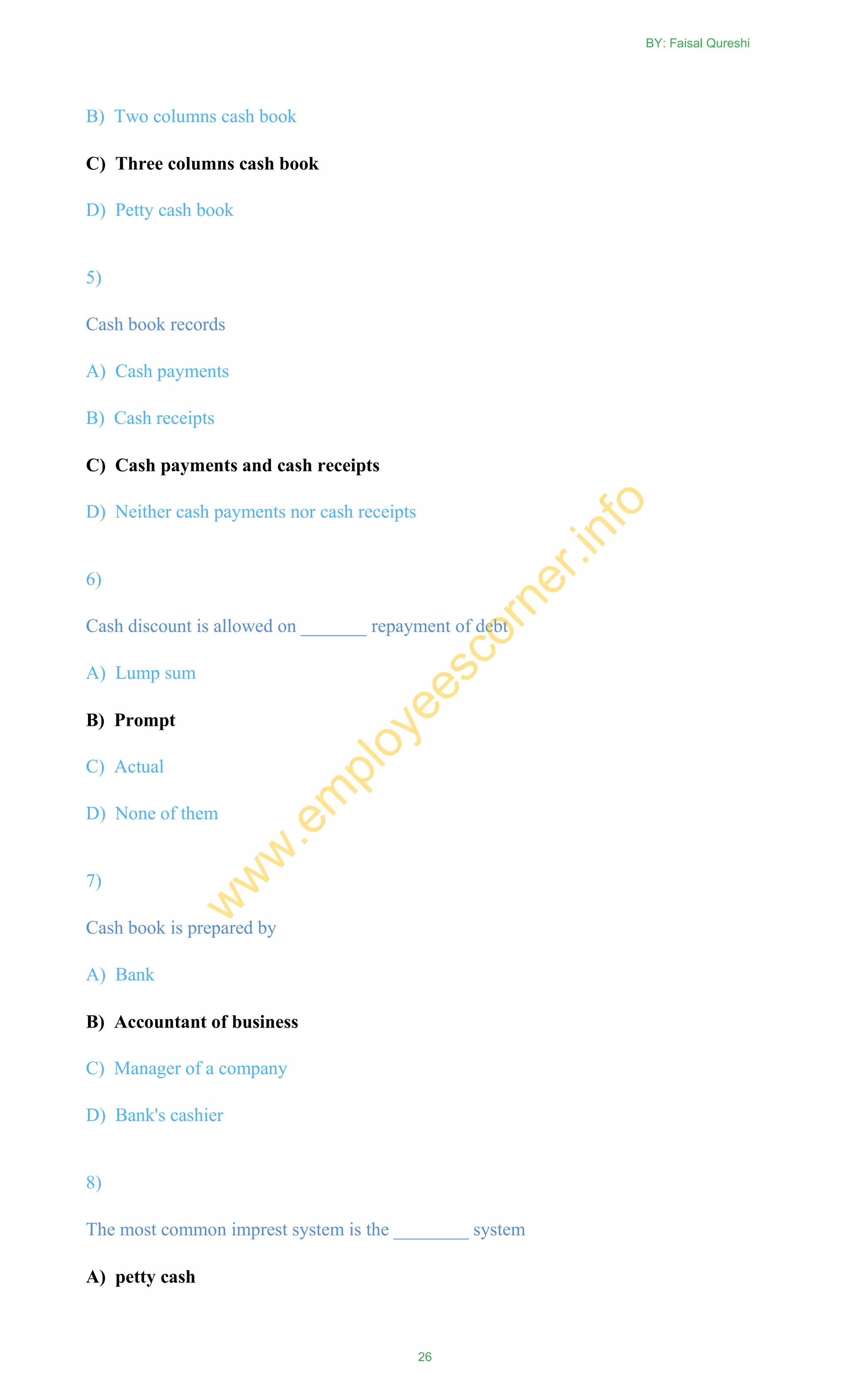
B) Two columns cash book
C) Three columns cash book
D) Petty cash book
5)
Cash book records
A) Cash payments
B) Cash receipts
C) Cash payments and cash receipts
D) Neither cash payments nor cash receipts
6)
Cash discount is allowed on _______ repayment of debt
A) Lump sum
B) Prompt
C) Actual
D) None of them
7)
Cash book is prepared by
A) Bank
B) Accountant of business
C) Manager of a company
D) Bank's cashier
8)
The most common imprest system is the ________ system
A) petty cash
BY: Faisal Qureshi
26
w
w
w
.em
ployeescorner.info
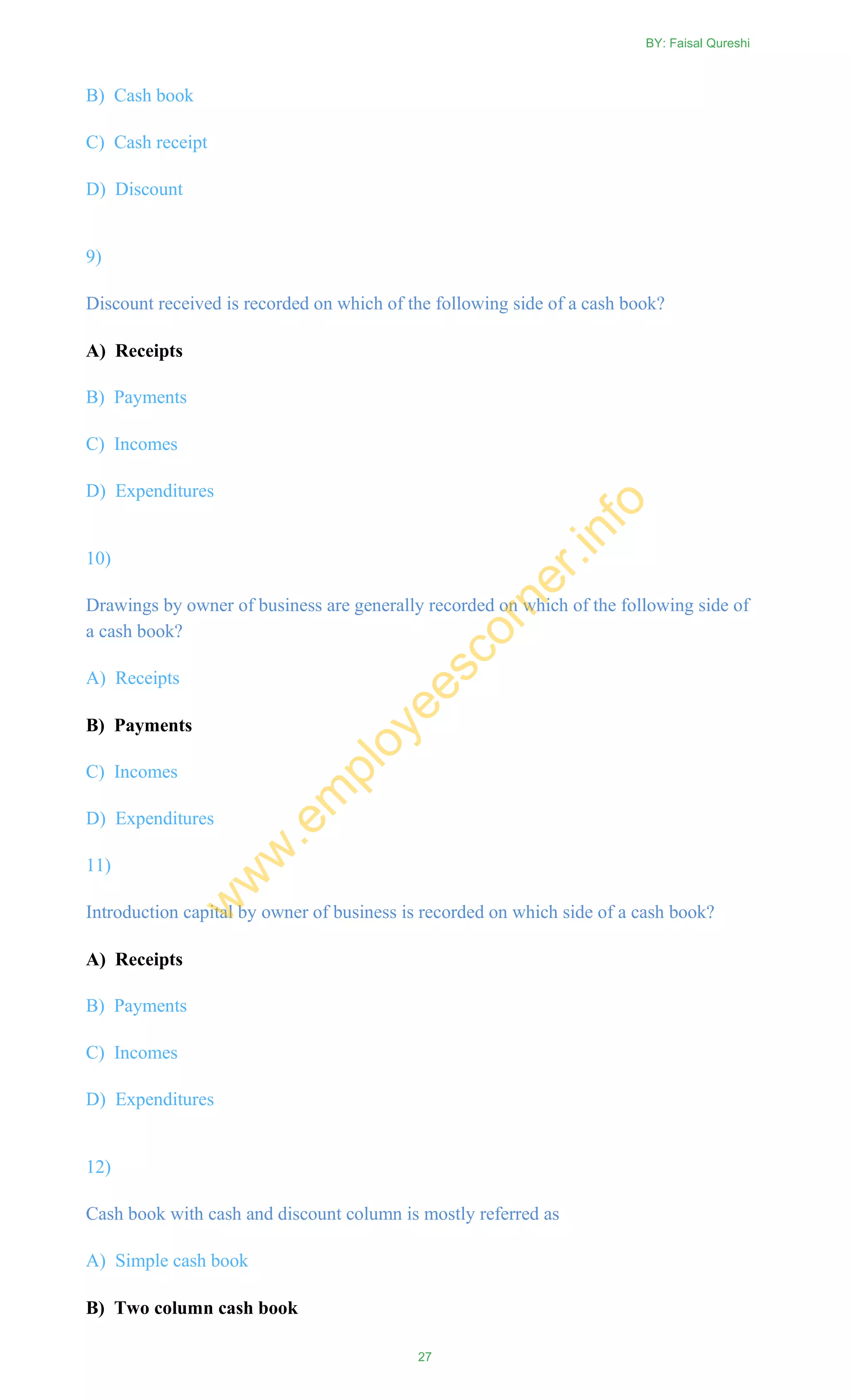
B) Cash book
C) Cash receipt
D) Discount
9)
Discount received is recorded on which of the following side of a cash book?
A) Receipts
B) Payments
C) Incomes
D) Expenditures
10)
Drawings by owner of business are generally recorded on which of the following side of
a cash book?
A) Receipts
B) Payments
C) Incomes
D) Expenditures
11)
Introduction capital by owner of business is recorded on which side of a cash book?
A) Receipts
B) Payments
C) Incomes
D) Expenditures
12)
Cash book with cash and discount column is mostly referred as
A) Simple cash book
B) Two column cash book
BY: Faisal Qureshi
27
w
w
w
.em
ployeescorner.info
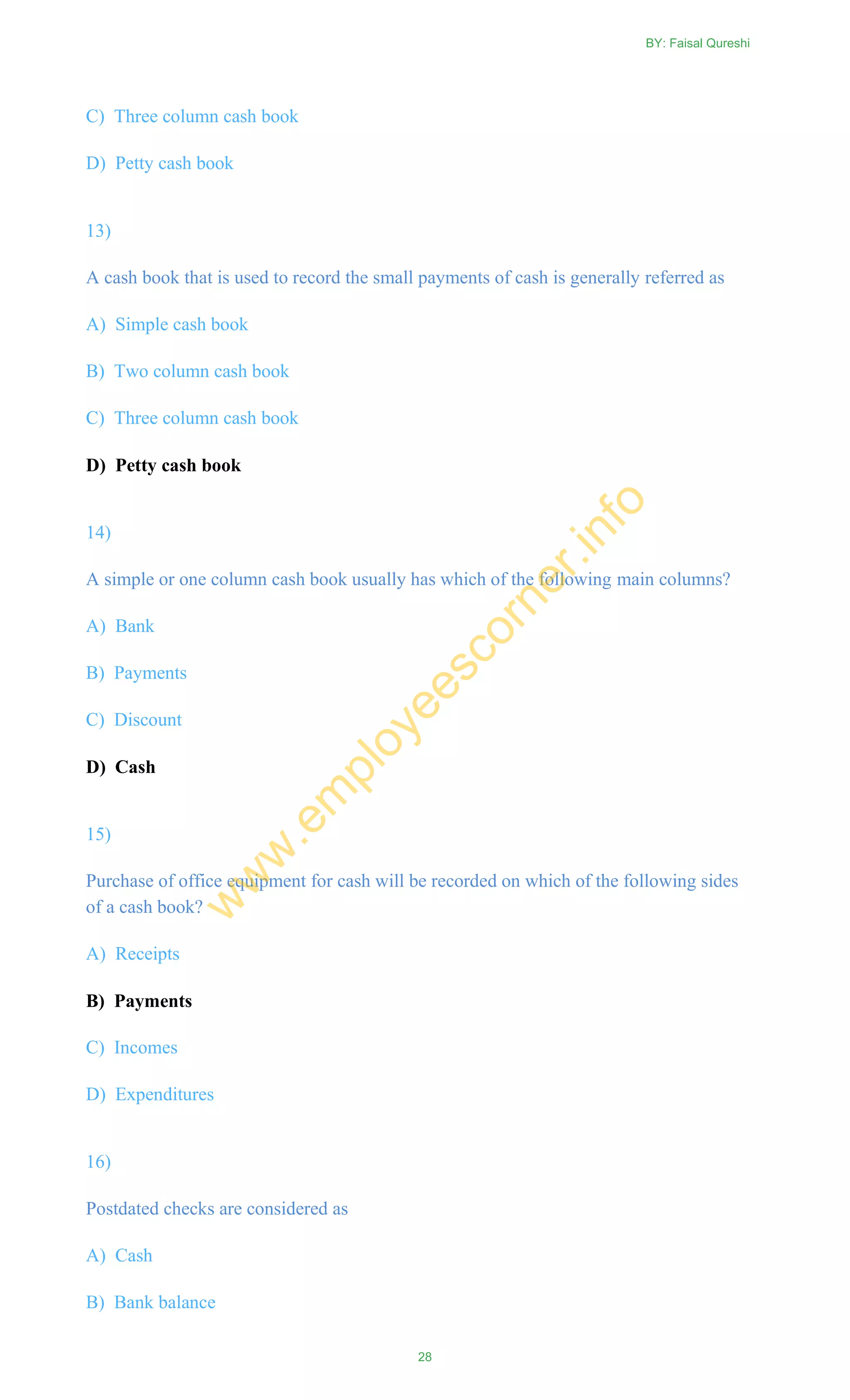
C) Three column cash book
D) Petty cash book
13)
A cash book that is used to record the small payments of cash is generally referred as
A) Simple cash book
B) Two column cash book
C) Three column cash book
D) Petty cash book
14)
A simple or one column cash book usually has which of the following main columns?
A) Bank
B) Payments
C) Discount
D) Cash
15)
Purchase of office equipment for cash will be recorded on which of the following sides
of a cash book?
A) Receipts
B) Payments
C) Incomes
D) Expenditures
16)
Postdated checks are considered as
A) Cash
B) Bank balance
BY: Faisal Qureshi
28
w
w
w
.em
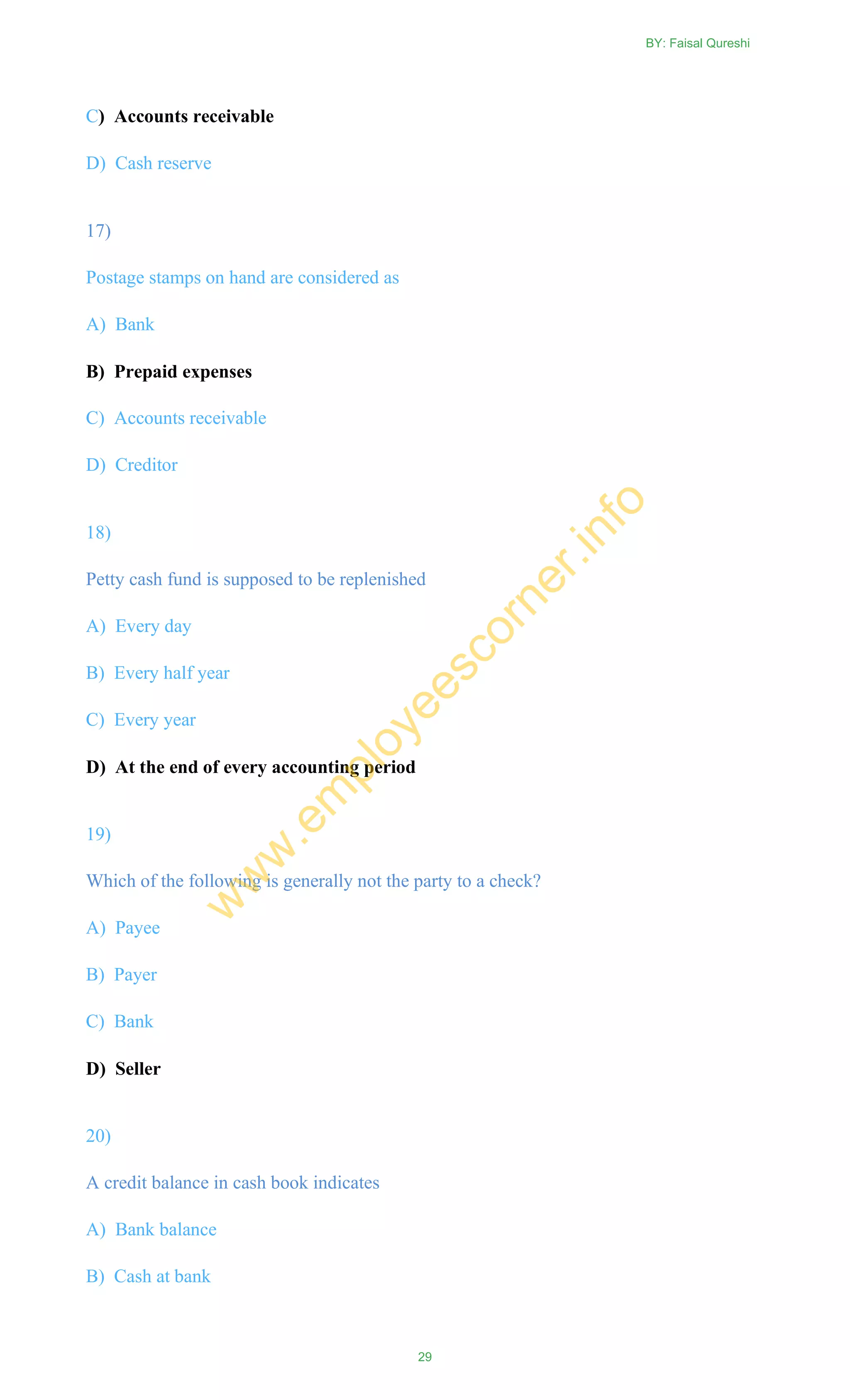
ployeescorner.info
C) Accounts receivable
D) Cash reserve
17)
Postage stamps on hand are considered as
A) Bank
B) Prepaid expenses
C) Accounts receivable
D) Creditor
18)
Petty cash fund is supposed to be replenished
A) Every day
B) Every half year
C) Every year
D) At the end of every accounting period
19)
Which of the following is generally not the party to a check?
A) Payee
B) Payer
C) Bank
D) Seller
20)
A credit balance in cash book indicates
A) Bank balance
B) Cash at bank
BY: Faisal Qureshi
29
w
w
w
.em
ployeescorner.info
C) Bank overdraft
D) Bank underdraft
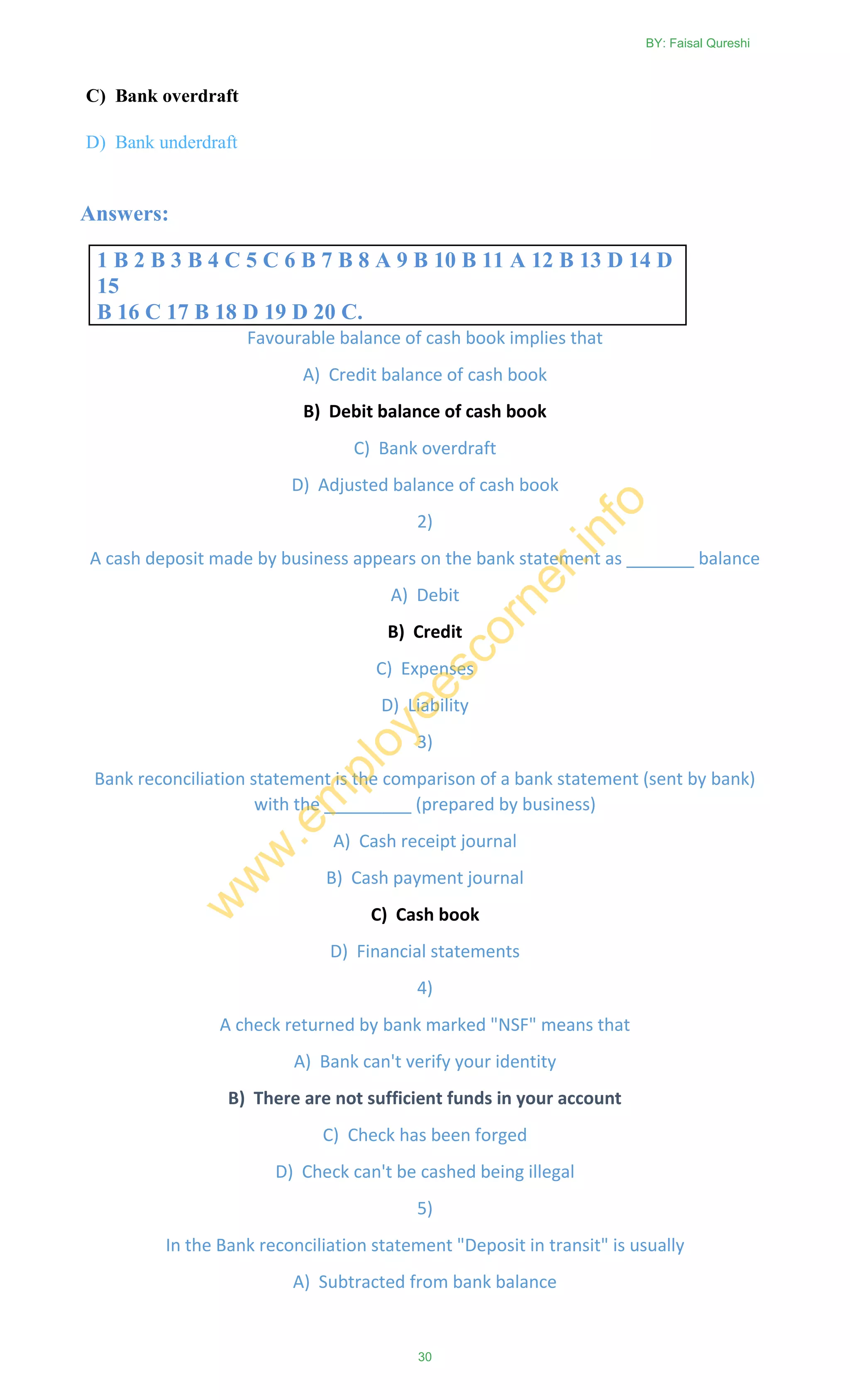
Answers:
1 B 2 B 3 B 4 C 5 C 6 B 7 B 8 A 9 B 10 B 11 A 12 B 13 D 14 D
15
B 16 C 17 B 18 D 19 D 20 C.
Favourable balance of cash book implies that
A) Credit balance of cash book
B) Debit balance of cash book
C) Bank overdraft
D) Adjusted balance of cash book
2)
A cash deposit made by business appears on the bank statement as _______ balance
A) Debit
B) Credit
C) Expenses
D) Liability
3)
Bank reconciliation statement is the comparison of a bank statement (sent by bank)
with the _________ (prepared by business)
A) Cash receipt journal
B) Cash payment journal
C) Cash book
D) Financial statements
4)
A check returned by bank marked "NSF" means that
A) Bank can't verify your identity
B) There are not sufficient funds in your account
C) Check has been forged
D) Check can't be cashed being illegal
5)
In the Bank reconciliation statement "Deposit in transit" is usually
A) Subtracted from bank balance
BY: Faisal Qureshi
30
w
w
w
.em
ployeescorner.info
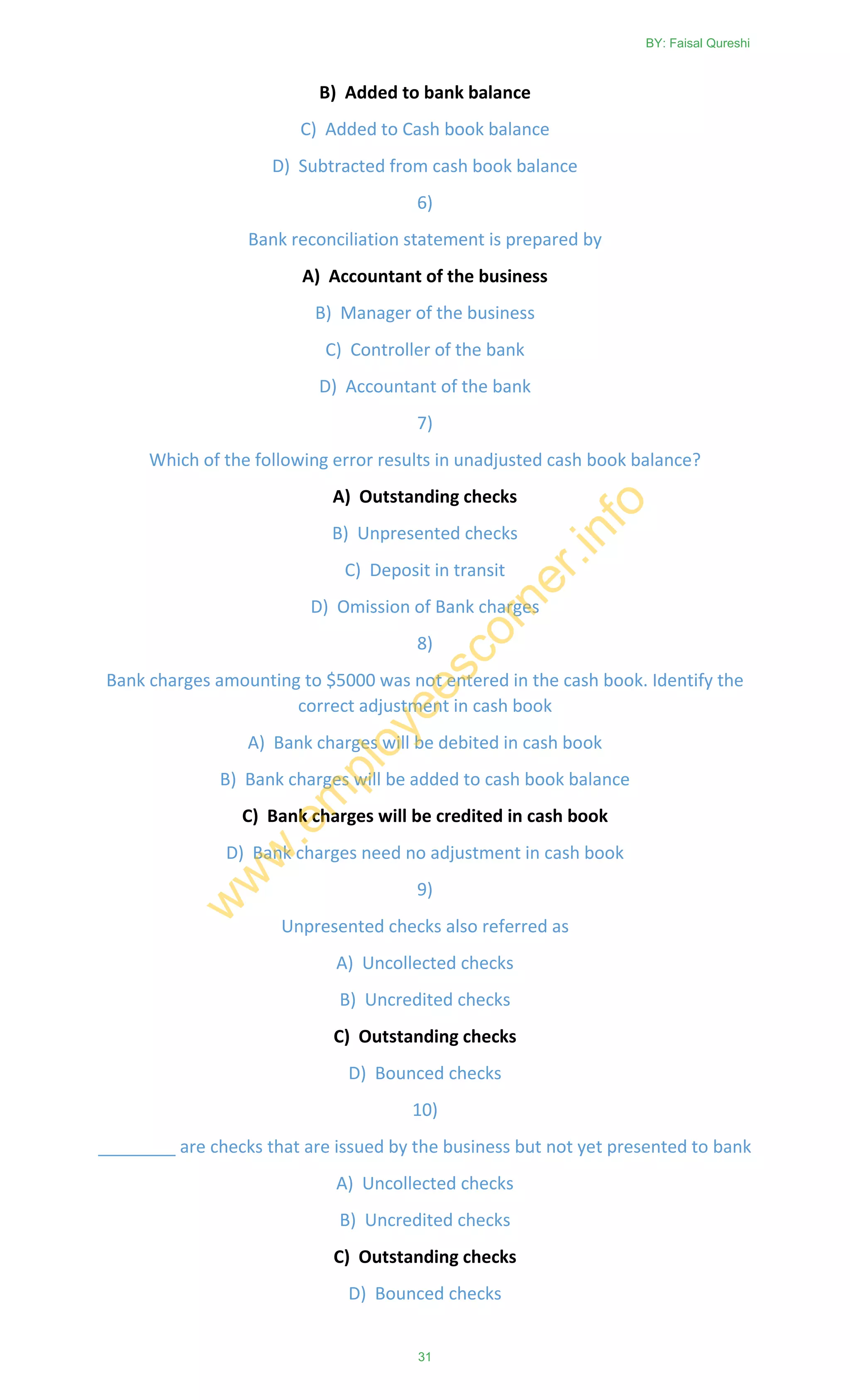
B) Added to bank balance
C) Added to Cash book balance
D) Subtracted from cash book balance
6)
Bank reconciliation statement is prepared by
A) Accountant of the business
B) Manager of the business
C) Controller of the bank
D) Accountant of the bank
7)
Which of the following error results in unadjusted cash book balance?
A) Outstanding checks
B) Unpresented checks
C) Deposit in transit
D) Omission of Bank charges
8)
Bank charges amounting to $5000 was not entered in the cash book. Identify the
correct adjustment in cash book
A) Bank charges will be debited in cash book
B) Bank charges will be added to cash book balance
C) Bank charges will be credited in cash book
D) Bank charges need no adjustment in cash book
9)
Unpresented checks also referred as
A) Uncollected checks
B) Uncredited checks
C) Outstanding checks
D) Bounced checks
10)
________ are checks that are issued by the business but not yet presented to bank
A) Uncollected checks
B) Uncredited checks
C) Outstanding checks
D) Bounced checks
BY: Faisal Qureshi
31
w
w
w
.em
ployeescorner.info
11)
_________ Checks that are presented to bank but not yet credited by the bank
A) Unpresented checks
B) Uncredited checks
C) Outstanding checks
D) Bounced checks
12)
Uncollected checks also referred as
A) Unpresented checks
B) Uncredited checks
C) Outstanding checks
D) Bounced checks
13)
Favourable balance of bank statement implies that
A) Credit balance
B) Debit balance
C) Bank overdraft
D) Adjusted balance
14)
Standing orders are ________
A) Credited in the cash book
B) Debited in the cash book
C) Entered in the bank statement
D) Entered in the petty cash balance
15)
A company was entered in hire purchase agreement and had to pay $1000 per
month.Three payments were made via bank account but no entry was found in cash
book. Identify the correct adjustment in cash book
A) $1000 will be added to cash book balance
B) $2000 will be deducted from cash book balance
C) $3000 will be added to cash book balance
D) $3000 will be subtracted from cash book balance
16)
$5000 deposited in bank account was entered twice in the cash book. Identify the
correct adjustment in cash book
BY: Faisal Qureshi
32
w
w
w
.em
ployeescorner.info
A) $5000 will be credited
B) $5000 will be debited
C) $10,000 will be credited
D) $10,000 will be debited
17)
Bank sent debit advice of $500 to company being interest on overdraft. It wasn't
entered in cash book. Identify the correct adjustment in cash book
A) $500 will be debited
B) $500 will be credited
C) Non-adjustable
D) $1000 will be subtracted
18)
In bank reconciliation statement the amount of outstanding checks is added to
________ balance of cash book
A) Adjusted
B) Unadjusted
C) Understated
D) Overstated
19)
Balance as per cash book(adjusted)=$1000, Unpresented checks=$2000, Uncredited
checks=$500, Deposit in transit=$500. Compute the balance as per bank statement
A) $2000
B) Zero
C) $3000
D) $2500
20)
A discount of $2000 was given to a supplier on his prompt repayment of debt but the
cashier entered the gross amount in cash book. What should be the adjustment in cash
to work out the correct balance of cash book?
A) $2000 will be debited in cash book
B) $2000 will be credited in cash book
C) $4000 will be debited in cash book
D) $4000 will be credited in the cash book
ANSWERS.
BY: Faisal Qureshi
33
w
w
w
.em
ployeescorner.info
1 B
2 B
3 C
4 B
5 B
6 A
7 A
8 C
9 C
10 C
11 B
12 B
13 A
14 A
15 D
16 A
17 B
18 A
19 A
20 B
FINANCIAL ACCOUNTING MCQS SET 1
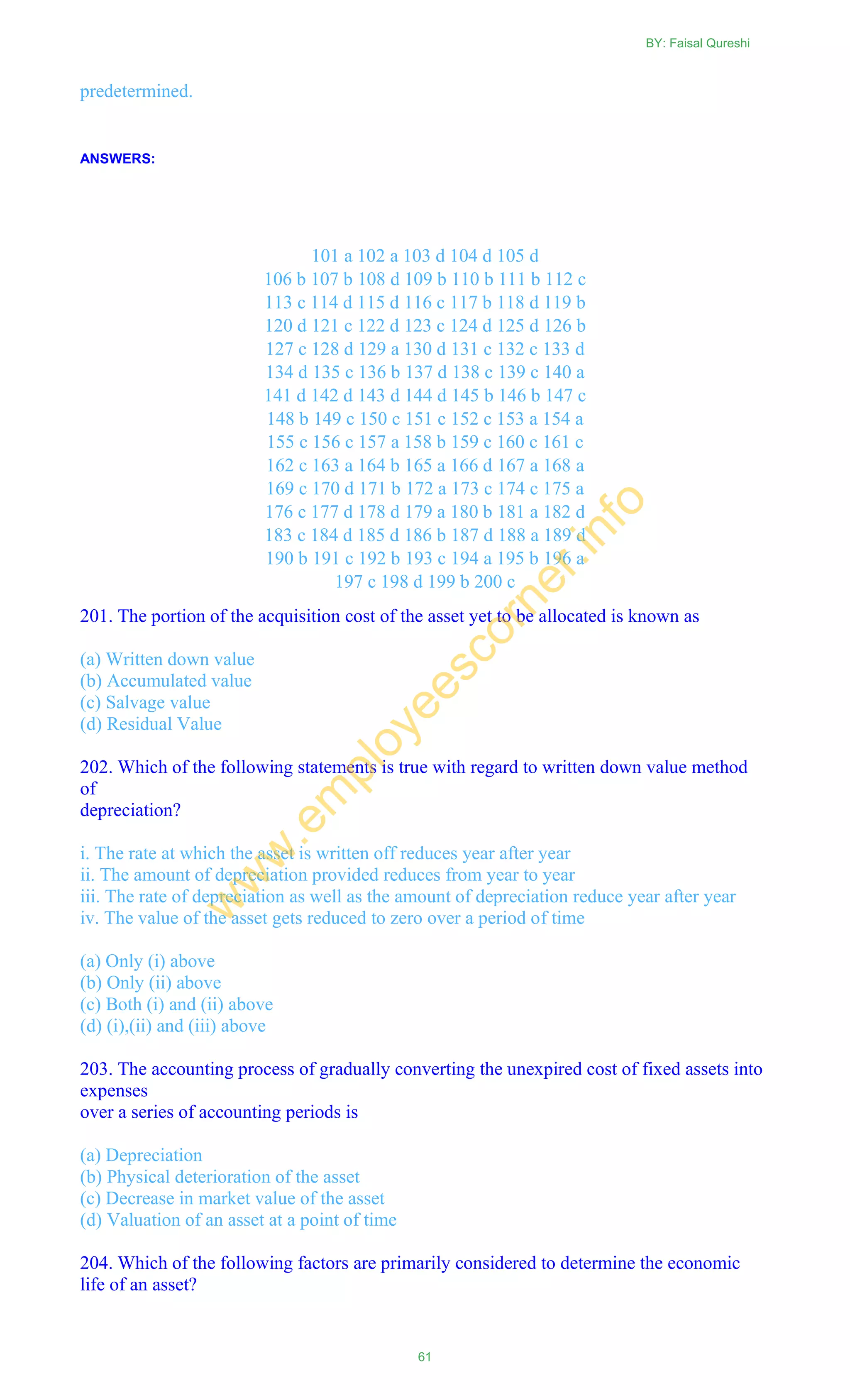
MCQ FOR FINANCIAL ACCOUNTING
1. Which English alphabet is similar to the shape of an account?
(a) I
(b) T
(c) H
(d) None
2. Gross Profit is the difference between
(a) Net Sales and Cost of goods sold
BY: Faisal Qureshi
34
w
w
w
.em
ployeescorner.info
(b) PAT and Dividends
(c) Net Sales and Cost of production
(d) Net Sales and Direct costs of productions
[Hints: (a) Trading account is prepared to find out the Gross Profit due to the operations of
a
business. It is the difference between the Net Sales (i.e., Sales less sales return) and the
Cost of
goods sold. Cost of goods sold= Opening Stock+ Net Purchases – Closing Stock + Direct
expenses.
Hence option (a) is the right option. Option (c) is incorrect because cost of production does
not
consider the opening stock and closing stock adjustment. Similarly option (d) ignores stock
balance adjustment.]
3. Recording of Capital contributed by the owner as liability ensures the adherence of principle of
(a) Double Entry
(b) Going Concern
(c) Separate Entry
(d) Materiality
[Hints: (c) Recording of capital contributed by the owner as liability ensures the adherence
of
principle of the ―Separate entity or Business entity concept‖. The concept requires the
business to
be treated as distinct from the persons who own it; then it becomes possible to record
transactions
of the business with the proprietor also. Without such a distinction, the affairs of the firm
will be
mixed up with the private affairs of the proprietor and the true picture of the firm will not
be
available.
Under the Going Concern Concept, it is assumed that the business will exit for a long time
and
transactions are recorded from this point of view. It is this that necessitates distinction
between
expenditure that will render benefit over a long period and that whose benefit will be
exhausted
quickly.
Under Double-entry or Dual aspect concept, each transaction has two aspects, if a business
has
acquired an asset, it must have resulted in one of the following:
 Some other asset has been given up.
 The obligation to pay for it has arisen.
 There has been a profit, leading to an increase in the amount that the business owes to the
proprietor.
 The proprietor has contributed money for the acquisition of the asset.
 The concept of Materiality requires all the material items to be recorded and disclosed
separately.]
4. The basic concepts related to Balance Sheet are
(a) Cost Concept
(b) Business Entity Concept
BY: Faisal Qureshi
35
w
w
w
.em
ployeescorner.info
(c) Accounting Period Concept
(d) Both (a) and (b) above
[Hints: (d) Cost concept requires the transactions to be recorded in the books of accounts at
the
amounts actually involved. Suppose a firm purchases a piece of land for ` 1,50,000 but
considers its
worth ` 3,00,000. The purchase will be recorded at ` 1,50,000. Business entity concept
requires the
business to be treated as distinct from the persons who own it; then it becomes possible to
record
transactions of the business with the proprietor also. Without such a distinction, the affairs
of the firm
will be mixed up with the private affairs of the proprietor and the true picture of the firm
will not be
available. Accounting period concept is applicable to the Profit & Loss Account which is
prepared
for the year ending and cannot be applied to Balance Sheet as it is a statement prepared as
on a
particular date. Therefore, cost and entity concepts are related to Balance Sheet.]
5. The basic concepts related to P & L Account are
(a) Realization Concept
(b) Matching Concept
(c) Cost Concept
(d) Both (a) and (b) above
[Hints: (d) Under Realization concept, accounting is a historical record of transactions and
unless
money has been realized – either cash has been received or a legal obligation to pay has
been
assumed by the customer- no sale can be said to have taken place and no profit can be said
to
have arisen. Matching concept requires that all the revenues must be matched with the
expenses.
Therefore, the above concepts are related to the Profit & Loss Account.]
6. Which of the following is (are) characteristic(s) of Bad Debt?
(a) It is a definite loss to the business
(b) It must be shown in Profit & loss account
(c) No provision is necessary for it
(d) All of the given options
7. Only the significant events which affect the business must be recorded as per the principle of
(a) Separate Entity
(b) Accrual
(c) Materiality
(d) Going Concern
[Hints: (c) The concept of materiality requires that only the significant events that affect the
BY: Faisal Qureshi
36
w
w
w
.em
ployeescorner.info
business must be recorded.]
8. P & L Account is prepared for a period of one year by following
(a) Consistency Concept
(b) Conservatism Concept
(c) Accounting Period Concept
(d) Cost Concept
[Hints: (c) P&L A/C is prepared for a period of one year by following the concept of
Accounting
Period.]
9. If the Going Concern concept is no longer valid, which of the following is true?
(a) All prepaid assets would be completely written-off immediately
(b) Total contributed Capital and Retained Earnings would remain unchanged
(c) Intangible Assets would continue to be carried at net Amortized historical cost
(d) Land held as an Investment would be valued at its realizable value
[Hints: (d) Under the Going Concern Concept, it is assumed that the business will exit for a
long
time and transactions are recorded from this point of view. It is this that necessitates
distinction
between expenditure that will render benefit over a long period and that whose benefit will
be
10. Under which of the following concepts are shareholders treated as creditors for the amount they
paid on the shares they subscribed to?
(a) Cost Concept
(b) Duality Concept
(c) Business Entity Concept
(d) Since the shareholders own the business, they are not treated as creditors
[Hints: (c) Under business entity concept, the shareholders are treated as creditors of the
company.
It is also known as separate entity concept.]
Answers:
1 b 2 a 3 c 4 d 5 d 6 d 7 c 8 c 9 d 10 c
11. The underlying accounting principle(s) necessitating amortization of intangible asset(s) is/are
BY: Faisal Qureshi
37
w
w
w
.em
ployeescorner.info
(a) Cost Concept
(b) Realization Concept
(c) Matching Concept
(d) Both (a) and (c) above
[Hints: (c) The matching concept requires that all the revenues must be matched with the
expenses incurred during the accounting period. The expenses relating to intangible assets
are
amortized over the periods in which the benefit from intangible assets accrue and therefore
the
underlying principle is the matching concept.]
12. Which of the following practices is not in consonance with the convention of conservatism?
(a) Creating Provision for Bad debts
(b) Creating Provision for Discount on Creditors
(c) Creating Provision for Discount on Debtors
(d) Creating Provision for tax
[Hints: (b) The principle of conservatism seeks provisions for all the probable losses.
Creating
provision for discount on creditors tantamount to recognition of probable gain in the form
of
discount and hence it is not in consonance with conservatism.]
13. The accounting measurement that is not consistent with the Going Concern concept is
(a) Historical Cost
(b) Realization
(c) The Transaction Approach
(d) Liquidation Value
[Hints: (d) Liquidation value is the value of the business when the business is wound up
and is under
liquidation whereas the going concern concept assumes that the business will continue over
a
long time and therefore the accounting measurement ―Liquidation Value‖ is inconsistent
with
going concern concept.]
14. Recording of Fixed Assets at cost ensures adherence of
(a) Conservatism Concept
(b) Going Concern Concept
(c) Cost Concept
(d) Both (a) and (b) above
[Hints: (c) Cost concept requires the transactions to be recorded in the books of accounts at
the
amounts actually involved. Suppose a firm purchases a piece of land for ` 1,50,000 but
considers its
worth ` 3,00,000. The purchase will be recorded at ` 1,50,000. Therefore, recording of fixed
assets at
cost ensures the adherence of cost concept.]
BY: Faisal Qureshi
38
w
w
w
.em
ployeescorner.info
15. Omission of paise and showing the round figures in financial statements is based on
(a) Conservatism Concept
(b) Consistency Concept
(c) Materiality Concept
(d) Realization Concept
[Hints: (c) Omission of paise and showing the round figure in financial statements is based
on the
concept of materiality.]
16. X Ltd., purchased goods for ` 5 lakh and sold 9/10th of the value of goods for ` 6 lakh. Net
expenses
during the year were ` 25, 000. The company reported its net profit as ` 75,000. Which of the
following concept is violated by the company?
(a) Realization
(b) Conservation
(c) Matching
(d) Accrual
[Hints: (c) Matching concept requires the expenses must relate to the goods and services
sold
during that period to arrive at the net profits of the enterprise. Hence matching concept
requires
the recognition of revenue and expenses on a comparable basis. In the above question that
amount of ` 75,000 as net profit was arrived at by deducting ` 5,00,000 ( being cost of
purchases )
+ ` 25,000 expenses from the sale proceeds of ` 6,00,000. This does not follow matching
concept
since the cost of goods sold is to be deducted and not the cost of purchases, since some
purchases have been left in stock. So the net profit using matching concept is ` 6,00,000
less cost
of goods ` 4,50,000 (i.e. ` 5,00,000 x 9/10) less expenses of ` 25,000 = ` 1,25,000.]
17. Accounting does not record non- financial transactions because of
(a) Entity Concept
(b) Accrual Concept
(c) Cost Concept
(d) Money Measurement Concept
[Hints: (d) The money measurement concept: Accounting records only those transactions
which
are expressed in monetary value, though quantitative records are kept. Hence, accounting
does
not record non – financial transactions.]
BY: Faisal Qureshi
39
w
w
w
.em
ployeescorner.info
18. Mr. Rohit, owner of Rohit Furniture Ltd., owns a personal residence that cost ` 6,00,000, but has a
market value of ` 9,00,000. During preparation of the financial statement for the business, the entire
value of property was ignored and was not shown in the financial statements. The principle that
was followed was
(a) The concept of the Business Entity
(b) The concept of the Cost Principle
(c) The concept of Going Concern Principle
(d) The concept of Duality Principle
[Hints: (a) Business entity concept requires the business to be treated as a separate entity.]
19. Provision for bad debt is made as per the
(a) Entity Concept
(b) Conservatism Concept
(c) Cost Concept
(d) Going Concern Concept
[Hints: (b) Provision for bad debts is made as per the concept of conservatism.]
20. Fixed Assets and Current Assets are categorized as per concept of
(a) Separate Entity
(b) Going Concern
(c) Consistency
(d) Time
Answers:
11 c 12 b 13 d 14 c 15 c 16 c 17 d 18 a 19 b 20
Total depreciation of an asset cannot exceed its:
(a) Scrap value
(b) Residual value
(c) Market value
(d) Depreciable value
102. Amount paid to Gagan posted to the credit side of his account would affect
(a) Gagan's account
(b) Cash account
(c) Cash account and Gagan's account
(d) None of these
103. Which of the following statements is/are true ?
(a) A sale of an asset is recorded in the Sales Book
(b) Total of Return Outward Book is debited to Return Outward Account
BY: Faisal Qureshi
40
w
w
w
.em
ployeescorner.info
(c) The balance of Petty Cash Book is a liability
(d) Cash Book is a subsidiary book as well as a ledger
[Hints: (d) The sale of an asset is recorded in the Asset Account and not in the Sales book
(which
pertains to sale of goods). Statement (a) is false.
Total of Return Outwards book (being purchase return) has a credit balance. The total is
transferred
at the end of the period to the credit of the Purchase Account and not debited to Return
Outwards Account. Statement (b) is false.
The balance of Petty Cash book is not a liability, it is an asset as it is the balance of cash
left with
the petty cashier. Statement (c) is incorrect.
Cash Book is both a subsidiary book or book of original entry where all cash transactions
are
directly recorded and a ledger, it plays the role as a Cash Account (a ledger). Hence
statement
(d) is true.
104. Which of the following is true regarding closing entries?
(a) They must be followed by reversing entries
(b) They transfer the balances in all of the Nominal Accounts to the Trading and Profit and
Loss
Account
(c) They must be made after the reversing entries but before the adjusting entries
(d) They must be made after the adjusting entries but before the reversing entries
[Hints: (d) Closing entries are required to transfer the nominal accounts to the Profit & Loss
Account
and the Trading account. Real accounts and personal account are not closed to Profit &
Loss
Account or Trading Account. Their balance is carried in the Balance Sheet and appears as
opening Balance in the next accounting period.]
105. Closing stock is generally valued at
(a) Cost Price
(b) Market Price
(c) Cost price or Market price whichever is higher
(d) Cost price or Market price whichever is lower
[Hints: (d) Para 5, of AS-2 states that inventories should be valued at the lower of cost and
net
realizable value.]
106. Which of the following assets is/are to be valued at the lower of cost and net realizable
value?
(a) Goodwill
(b) Inventories
(c) Investments
(d) Both (b) and (c) above.
[Hints: (b) Inventories (b) are to be valued at the lower of cost and net realizable value. All
the
other assets stated in other alternatives are valued as per the cost concept. Goodwill (a) is a
fixed
BY: Faisal Qureshi
41
w
w
w
.em
ployeescorner.info
intangible asset and is shown at the cost of its acquisition. Investments (c) are valued at cost
or
market value whichever is less. The combination of (b) and (c) is incorrect because a
correct
answer with incorrect answer is an incorrect answer. Thus, the correct answer is (b).
107. A few errors committed in Ahhiwalia's books of account are given below. State which
errors would affect the Trial Balance.
(a) Sales of `950 to Ram completely omitted from books of account
(b) Purchases of `720 from Shyam entered in the purchases journal as `700
(c) Purchases Journal is overcast by `1,000
(d) Sales returns journal is undercast by `200
(e) Amount paid to Agarwal wrongly posted to the debit to Mittal's account
(f) Bank overdraft shown under debit column in the Trial Balance
(g) Sales of `500 to Sadiq entered in sales journal as sales to Mushtaq
(h) Wages paid for installation of machinery debited to wages account
(a) a, c and g
(b) c, d and f
(c) c, d, e and h
(d) c, d, f and h
108. Which of the following methods is not a practical way of realizing revenue?
(a) Delivery method
(b) Percentage-of-completion method
(c) Production method
(d) Moving average method
[Hints: (d) The following methods are the practical ways of realizing revenue applying the
conservatism concept and realization concept and the (a) Delivery method in case of sale of
goods, (b) Percentage-of-completion method in case of rendering of services and (c)
Production
method in case of agriculture produce. Thus, these are the various ways of recognizing
revenue
and the methods adopted to recognize revenue. Moving average method (d) is the method
of
valuing inventory and it is not the method adopted to recognize revenue. Thus, (d) is the
correct
answer.]
109. The amount payable to a person as consideration for the use of rights vested in him is
(a) Dividend
(b) Royalty
(c) Purchase consideration
(d) Installment
[Hints: (b) The amount paid to the landlord for use of rights vested in him is the royalty.
Dividend is
the amount paid for the investment made in an enterprise and is not the correct answer.
Purchase
consideration is the price paid for receiving a title of a property moveable and immoveable
and is
not the correct answer. Installment is the payment of amount in stages and is not the
amount paid
for using the rights vested in the landlord and is not the correct answer.]
BY: Faisal Qureshi
42
w
w
w
.em
ployeescorner.info
110. Buildings account is debited with an amount towards repairs. This is an example of
(a) Error of commission
(b) Error of principle
(c) Error of omission
(d) Compensating error
[Hints: (b) Buildings account debited with an amount towards repairs is an error of
principle. Error of principle is a wrong classification of expenditure or receipt.]
111. The concept of conservatism will have the effect of
(a) Overstatement of Assets
(b) Understatement of Assets
(c) Overstatement of Liabilities
(d) Understatement of Liabilities
[Hints: (b) The concept of conservatism will have the effect of understatement of assets
since the
financial statements are usually drawn up on rather a conservative basis. Window-dressing
i.e.,
showing a position better than what it is, is not permitted.
112. During the year 2011-2012, the value of closing inventory was overstated by ` 25,000.
Which of the following is true?
(a) The cost of goods sold was overstated during 2011-2012 and income will be understated
during
2012-2013
(b) The income was overstated during 2011-12 and closing inventory will be overstated
during
2012-2013
(c) The retained earnings was overstated during 2011-2012 and retained earnings will be
understated during 2012-2013
(d) The cost of goods sold was understated during 2011-2012 but retained earnings will not
be
affected during 2012-2013
[Hints: (c) Closing Stock‗s overstatement increases the profit of the current period and
results in the
increase of retained earnings relating to the current accounting period. It decreases the
profit and
thereby retained earnings of the next accounting period since the closing stock of the
current
accounting period becomes the opening stock of the next accounting period, the
overstatement
of which has the effect of decreasing the profits and retained earnings.]
113. Which of the following errors is an error of omission?
(a) Sale of ` 100 was recorded in the Purchases Journal
(b) Wages paid to Mohan have been debited to his account
(c) The total of the sales journal has not been posted to the Sales Account
(d) Repairs to buildings have been debited to buildings account
[Hints: (c) Error of omission occurs when a transaction is entirely omitted from record in
the original
books partially omitted while posting. Therefore, omission of posting of the sales journal to
BY: Faisal Qureshi
43
w
w
w
.em
ployeescorner.info
the Sales
Account is an error of omission.]
114. Which of the following statements is /are true?
(a) Entering wrong amount in the subsidiary book affects the agreement of the Trial
Balance
(b) Undercasting or overcastting of a subsidiary book is an example or error of commission
(c) Errors of principle do not affect the agreement of Trial Balance
(d) Both (b) and (c) above
[Hints: (d) Entering wrong amount in the subsidiary book does not affect the agreement of
the Trial
Balance as the same amount is posted in both the accounts affected. Undercasting or
overcastting of a subsidiary book is an error of commission. Errors of principle do not
affect the
agreement of the Trial Balance. Hence both (b) and (c ) options are true.]
115. Which of the following is true?
(a) Error of casting affects personal accounts
(b) Omission of a transaction from a subsidiary record affects only one account
(c) Error of carry forward affects two accounts
(d) Error of principle involves an incorrect allocation of expenditure or receipt between
capital
and revenue
[Hints: (d) Errors of casting can appear in any account and not personal accounts alone.
Hence
statements (a) is false. Omission of a transaction from subsidiary affects two accounts are
subsidiary
books are books of original entry hence posting in two accounts is omitted. Statement (b) is
false.
Error of carry forward affects only one account i.e., the account in whose an error has been
made.
Statement (c) is false. Errors of principle involve incorrect allocation of an item between
capital
and revenue. Hence statement (d) is true.]
116. Journal proper is meant for recording
(a) Credit purchase of fixed assets
(b) Return of goods
(c) All such transactions for which no special journal has been kept by the business
(d) None of these
117. Closing stock in the Trial Balance implies that
(a) It is already adjusted in the opening stock
(b) It is adjusted in the Purchase A/c
(c) It is adjusted in the Cost of Sale A/c
(d) It is adjusted in the Profit &Loss A/c
[Hints: (b) Closing Stock appearing in the Trial Balance implies that it has already been
adjusted in
the Purchases Account and hence appears as an asset in the Balance Sheet.]
BY: Faisal Qureshi
44
w
w
w
.em
ployeescorner.info
118. Which of the following statements is true?
(a) If a Trial Balance tallies, it always means that none of the transactions has been
completely
omitted
(b) A Trial Balance will not tally if a transaction is omitted
(c) A customer to whom goods have been sold on credit cannot avail himself of a cash
discount
(d) A credit balance in the Pass Book indicates excess of deposits over withdrawals
[Hints: (d) A credit balance in the Pass Book implies a favourable balance indicates excess
of
deposits over withdrawals and a debit balance in the Pass Book implies unfavorable
balance i.e., a
overdraft. Hence statement (d) is the true statement.]
119. The adjustment to be made for income received in advance is:
(a) Add income received in advance to respective income and show it as a liability
(b) Deduct income received in advance from respective income and show it as a liability
(c) Add income received in advance to respective income and show it as asset
(d) Deduct income received in advance from respective income and show it as an asset in
the
Balance Sheet
[Hints: (b) Income received in advance given as an adjustment requires a deduction of the
same
from the income amount and disclosure of the same as a liability in the Balance Sheet]
120. Which of the following statements is correct?
(a) The Trial Balance is prepared after preparing the Profit and Loss Account
(b) The Trial Balance shows only balances of Assets and Liabilities
(c) The Trial Balance shows only nominal account balances
(d) The Trial Balance has no statutory importance from the point of view of law
[Hints: (d) A Trial Balance is a summary of all General Ledger Balances outstanding as on
a
particular date. All the debit balances from the ledger are shown on one side and all the
credit
balances are shown on the other side. A Trial Balance is prepared before Final Accounts
are
prepared. From the point of view of law, a Trial Balance has no statutory importance.]
121. While finalizing the current year‗s accounts, the company realized that an error was
made in the
calculation of closing stock of the previous year. In the previous year, closing stock was
valued
more by ` 50,000. As a result
(a) Previous year‗s profit is overstated and current year‗s profit is also overstated.
(b) Previous year‗s profit is understated and current year‗s profit is overstated.
(c) Previous year‗s profit is overstated and current year‗s profit is understated.
(d) There will be no impact on the profit of either the previous year or the current year.
[Hints: (c) Closing stock overstatement and opening stock understatement increases the
profits
and vice versa is also equally true.]
BY: Faisal Qureshi
45
w
w
w
.em
ployeescorner.info
122. Which of the following is not correct?
(a) Errors which affect one account can be errors of posting
(b) Errors of omission arise when any transaction is left to be recorded
(c) Errors of carry forward from one year to another year affect both Personal and Real A/c
(d) Errors of commission arise when any transaction is recorded in a fundamentally
incorrect
manner
[Hints: (d) Error of Commission arises because of wrong recording, wrong casting, wrong
carry
forward, wrong posting, wrong balancing etc.]
123. Which of the following errors is an error of omission?
(a) Purchase of ` 2,000 has been recorded in the Sales Return Book
(b) Repairs to machinery has been debited to Machinery Accounts
(c) The total of purchase journal has not been posted to the Purchase Account
(d) Legal charges paid to Mr. Lawyer have been debited to his account
[Hints: (c) Error of complete omission arises when a particular transaction is completely or
partially
omitted to be recorded in the books of accounts.]
124. If goods worth ` 1,750 returned to a supplier is wrongly entered in sales return book as
` 1,570 , then
(a) Net Profit will decrease by ` 3,140
(b) Gross Profit will increase by ` 3,320
(c) Gross Profit will decrease by ` 3,500
(d) Gross Profit will decrease by ` 3,320
125. For the past 3 years, DK Ltd. has failed to accrue unpaid wages earned by workers
during the last
week of the year. The amounts omitted, which were considered material, were as follows:
March 31,2010 - ` 56,000
March 31, 2011 - ` 51,000
March 31, 2012 - ` 64,000
The entry on March 31, 2012 to rectify these omissions would include a
(a) Credit to wage expense for ` 64,000
(b) Debit to wage expense for ` 64,000
(c) Debit to wage expense for ` 51,000
(d) Debit to wage expense for ` 13,000
126. Purchase journal is kept to record
(a) All purchases of goods
(b) All credit purchases of goods
(c) All credit purchases
(d) None of these
127. The beginnings inventory of the current year is overstated by ` 5,000 and closing
inventory is
overstated by ` 12,000.
These errors will cause the net income for the current year by
BY: Faisal Qureshi
46
w
w
w
.em
ployeescorner.info
(a) ` 17,000 (overstated)
(b) ` 12,000 (understated)
(c) ` 7,000 (overstated)
(d) ` 7,000 (understated)
[Hints: (c) Overstatement of closing stock results in overstatement of profit and
overstatement of
opening stock results in understatement of profit. In the instant case, there will be
overstatement of
profit by ` 12,000 - ` 5,000= ` 7,000.]
128. The accountant of Leo Ltd. recorded a payment by cheque to a creditor for supply of
materials as `
1,340.56. The bank recorded the cheque at its correct amount of ` 3,140.56. The Company
has not
passed any rectification entries and the error is not detected through the bank reconciliation.
The
impact of this error is
(a) The Trial Balance will not agree
(b) The balance of creditors is understated
(c) The purchases are understated
(d) The favorable bank balance as per Pass Book is less than the Bank balance as per Cash
book
[Hints: (d) The favourable bank balance as per Pass Book will be less than the bank balance
as per
Cash Book, since the debit in the bank account is more than the debit in the Cash Book (d).
As
debit and credit are for equal amount there is no disagreement of the Trial Balance;
Creditors
balance is overstated but not understated: The favourable bank balance as per Pass Book
will be
less than the Bank balance as per Cash Book, since the debit in the Bank Account is more
than the
debit in the Cash book. Purchases are not affected, as it is a payment to the creditor. Thus,
the
correct answer is (d).]
129. Which of the following errors affects the agreement of a Trial Balance?
(a) Mistake in balancing an account
(b) Omitting to record a transaction entirely in the subsidiary books
(c) Recording of a wrong entry in the subsidiary books
(d) Posting an entry on the correct side but in the wrong account
[Hints: (a) The mistake in balancing an account affects the agreement of a Trial Balance (a)
is the
correct answer. The other mistakes do not affect the agreement of Trial Balance. The
omission to
record a transaction entirely in the subsidiary books (b) will not affect the agreement of a
Trial
Balance because both the aspects of a transaction are omitted to be recorded. Recording of
a
wrong entry in the subsidiary books (c ) will not cause disagreement of a Trial Balance
because,
the wrong entry so recorded has the effect of posting the transaction in the manner it is
BY: Faisal Qureshi
47
w
w
w
.em
ployeescorner.info
recorded.
Posting an entry on the correct side in the wrong account (d) does not affect the tallying of
a Trial
Balance because the aspect of the transaction is posted to the correct side of an account.
Thus
(a) is the correct answer.]
130. Which of the following statements is/are true?
(i) An error in casting the subsidiary books is an error of commission
(ii) An error in wrong casting of the sales day book will not affect the personal accounts of
debtors
(iii) Mistake in transferring the balance of an account to the Trial Balance will not affect
the
agreement of the Trial Balance
(iv) The mistake of treating a liability as an income or vice versa will not affect the
agreement of a
Trial Balance
(a) Only (i) above
(b) Only (ii) above
(c) Both (i) and (ii) above
(d) (i),(ii) and (iv) above
[Hints: (d) An error in casting the subsidiary books is an error of commissions (i), an error
in wrong
casting of the sales day book will not affect the personal accounts of debtors (ii) and the
mistake
of treating a liability as an income or vice versa will not affect the agreement of a Trial
Balance (iv)
are the true statements and the combination of these statements alternatives (d) is the
correct
answer. The other alternatives are incurrence because (a) states only the statement in (i); (b)
states
only the statement (ii) and the alternative (c) is the combination of (i) and (ii) which is
incomplete.
Thus, the correct answer is (d).]
131. Which of the following should not be treated as revenue expenditure?
(a) Interest on loans and debentures
(b) Annual fire insurance premiums on Plant and Equipment
(c) Sales tax paid in connection with the purchase of office equipment
(d) Small expenditures on long- lived assets, such as ` 20 for a paper weight.
[Hints: (c) A revenue expenditure is an expenditure whose benefit expires within the
current
accounting period and is in the nature of recurring and is therefore written off to P&L A/c.
Sales tax
paid in connection with the purchase of office equipment is a non-recurring expenditure
whose
benefit is going to last for more than one accounting period and hence not a revenue
expenditure.
132. Capital expenditure is an expenditure which
(a) Benefits the current accounting period
BY: Faisal Qureshi
48
w
w
w
.em
ployeescorner.info
(b) Will benefit the next accounting period
(c) Results in the acquisition of a permanent asset
(d) Results in the acquisition of a current asset
[Hints: (c) A capital expenditure is a non- recurring expenditure whose benefit lasts for
more than
one accounting period. Example is the acquisition of a fixed or permanent assets.]
133. Which of the following is not a deferred revenue expenditure?
(a) Expenses in connection with issue of equity shares
(b) Preoperative expenses
(c) Heavy advertising expenses to introduce a new product
(d) Legal expenses incurred in defending a suit for breach of contract to supply goods
[Hints: (d) Deferred revenue expenditure is a revenue expenditure whose benefit lasts for
more
than one accounting periods and is therefore written off during the periods over which the
benefit
lasts(However, AS 26 requires that Deferred revenue expenditure is expensed wholly in the
year of
incurrence). Legal expenses incurred in defending a suit for breach of contract for supply of
goods
does not satisfy the prerequisites of a deferred revenue expenditure.]
134. Any donation received for a specific purpose is a
(a) Liability
(b) Assets
(c) Revenue receipts
(d) Capital receipts
135. Which of the following is an item of capital expenditure?
(a) Research and development costs during the year
(b) Interest on borrowed fund utilized for acquisition of Office Furniture
(c) Installation charges paid in conjunction with the purchase of Office Equipment
(d) Monthly rent of a machinery used in the business
[Hints: (c) A capital expenditure is a non- recurring expenditure whose benefit lasts for
more than
one accounting period. Installation charges paid in conjunction with the purchase of office
equipment is an one-time expenditure whose benefit lasts for more than one accounting
period.]
136. Which of the following statements is true?
(a) Provision for doubtful debts represents the amount that cannot be collected
(b) The distinction between capital and revenue items is important because it is of
fundamental
importance to the determination of profits
(c) Goods lost by fire need not be accounted for since they are not sales
(d) Free samples received are business gains
137. The balance of which of the following accounts do not disappear, once they are
debited/credited
to Trading Account.
BY: Faisal Qureshi
49
w
w
w
.em
ployeescorner.info
(a) Sales
(b) Purchases
(c) Inward returns
(d) Closing stock
[Hints: (d) The closing stock (d) is the value of goods which remain unsold at the end of the
period
whose balance appears once in Trading Account and once in Balance Sheet of the business.
All
other accounts sales (a), purchases (b) and Inward Returns (c) are closed once they are
absorbed
by the Trading Account. Thus (d) is the correct answer.]
138. Which one of the following should be considered a revenue expenditure?
(a) `1000 paid for the execution of a new plant
(b) Loss of `10,000 incurred in increasing the sitting accommodation of a hotel
(c) Damage paid on account of breach of a contract to supply certain goods
(d) Repair to machinery purchased, second hand.
139. Which of the following statements are / is true? ―Events after Balance Sheet‖ are
(a) All the significant events after the Balance Sheet date
(b) The events after Balance Sheet date but before submitting it to the Registrar of
Companies
(c) The events after Balance Sheet date but before its approval by the board
(d) All changes after Balance Sheet date before its approval
[Hints: (c) Events occurring after the Balance Sheet date are those significant events, both
favourable and unfavourable, that occur between the Balance Sheet date and the date on
which
the financial statements are approved by the Board of Directors in the case of a company,
and by
the corresponding approving authority in the case of any other entity.]
140. Which one of the following is a capital expenditure?
(a) Compensation paid to Directors on termination of their services
(b) Expenditure incurred in connection with the renewal of a Trade Mark.
(c) Gratuities paid to Directors on termination of their services.
(d) Royalty paid in installments for the purchase of rights to manufacture and sell patient
medicines.
141. Which of the following enhances the earning capacity of an asset?
(a) Increase in working capacity of an asset
(b) Reduction in operating costs
(c) Replacing damaged parts of an asset
(d) Both (a) and (c) above
[Hints: (d) Enhancement of earning capacity can be by way of replacement of worn out or
damaged parts which retarded the earning capacity and increase in the working capacity
increases the earning capacity of the asset.]
142. Which of the following items should not be capitalized relating to fixed assets?
BY: Faisal Qureshi
50
w
w
w
.em
ployeescorner.info
(a) Interest payable on loans or deferred credits taken for the acquisition or construction of
fixed
assets before they are ready for use
(b) Stand by equipment and servicing equipment
(c) Expenditure incurred on test runs and experimental production
(d) Administration and general expenses
[Hints: (d) Only those expenses which relate to and specifically attributable to the asset are
capitalized. Administration and general expenses cannot be specifically attributable to the
asset
and hence cannot be capitalized.]
143. Which of these errors affect only one account
(a) Errors of casting
(b) Errors of carry forward
(c) Errors of posting
(d) All the three
144. Which of these errors affect two or more accounts
(a) Errors of complete omission
(b) Errors of principle
(c) Errors of posting to wrong account
(d) All the three
145. Which of the following error is an error of principle
(a) ` 5,000 received from Sham credited to Ram A/c
(b) ` 5,000 incurred on installation of new plant debited to travelling expenses A/c
(c) ` 500 paid for wages debited to salary A/c
(d) ` 500 being purchase of raw material debited to purchase A/c ` 50
146. Which of the following is an one sided error
(a) ` 500 purchase of old equipment not recorded in the books of A/c at all
(b) ` 500 being expense on travelling expense credited to travelling expenses
(c) Both
(d) None
147. Any gain on the sale of non-current assets should be _________ from the net profit
and the loss
must be _________to the net profit in determining fund from operation
(a) Added, Reduced
(b) Added, Added
(c) Deducted, Added
(d) Deducted, Deducted
148. Cash book records—
(a) Only cash sales
(b) All types of cash receipts and payments
(c) Only revenue receipts
(d) Only capital receipts
BY: Faisal Qureshi
51
w
w
w
.em
ployeescorner.info
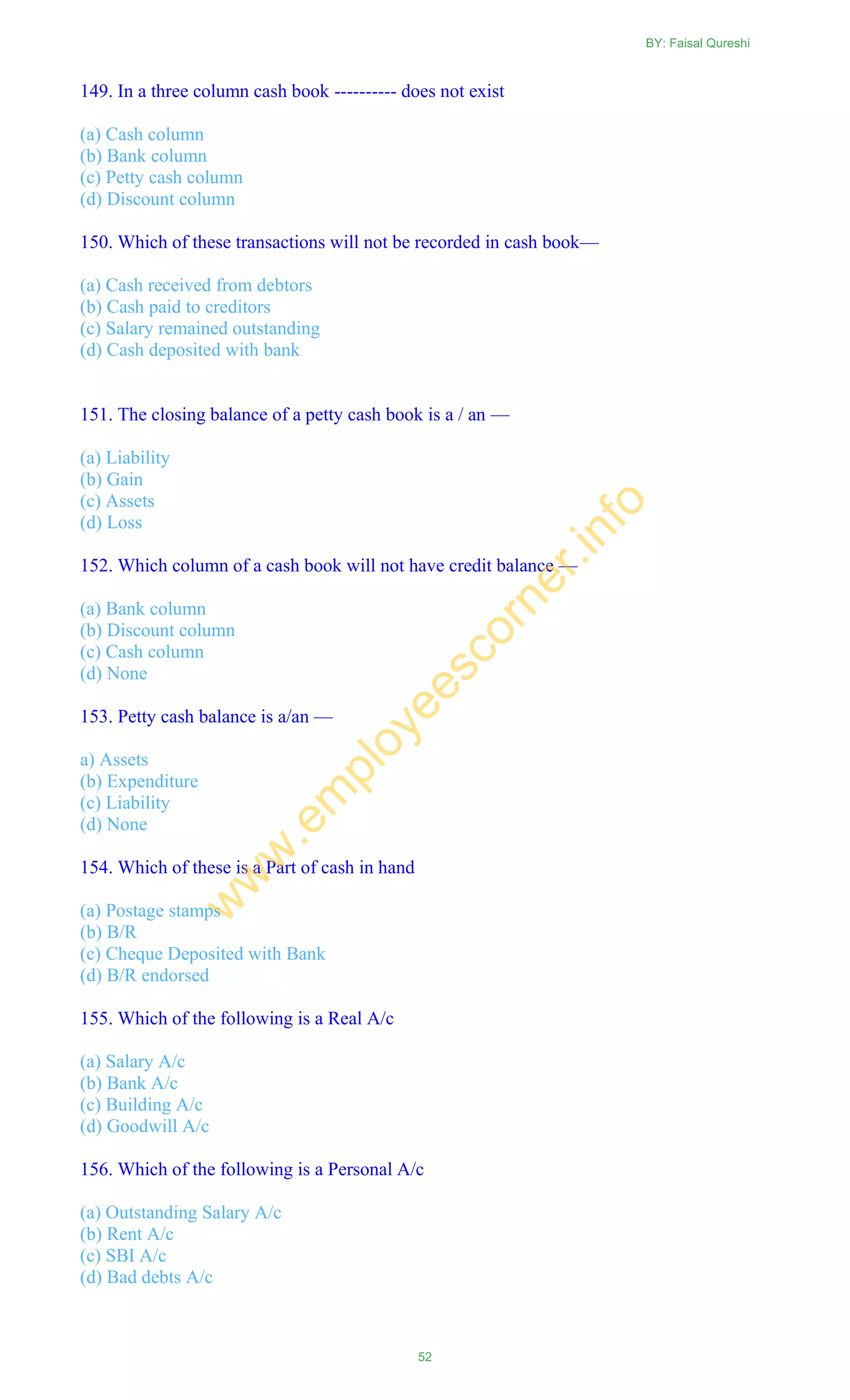
149. In a three column cash book ---------- does not exist
(a) Cash column
(b) Bank column
(c) Petty cash column
(d) Discount column
150. Which of these transactions will not be recorded in cash book—
(a) Cash received from debtors
(b) Cash paid to creditors
(c) Salary remained outstanding
(d) Cash deposited with bank
151. The closing balance of a petty cash book is a / an —
(a) Liability
(b) Gain
(c) Assets
(d) Loss
152. Which column of a cash book will not have credit balance —
(a) Bank column
(b) Discount column
(c) Cash column
(d) None
153. Petty cash balance is a/an —
a) Assets
(b) Expenditure
(c) Liability
(d) None
154. Which of these is a Part of cash in hand
(a) Postage stamps
(b) B/R
(c) Cheque Deposited with Bank
(d) B/R endorsed
155. Which of the following is a Real A/c
(a) Salary A/c
(b) Bank A/c
(c) Building A/c
(d) Goodwill A/c
156. Which of the following is a Personal A/c
(a) Outstanding Salary A/c
(b) Rent A/c
(c) SBI A/c
(d) Bad debts A/c
BY: Faisal Qureshi
52
w
w
w
.em
ployeescorner.info
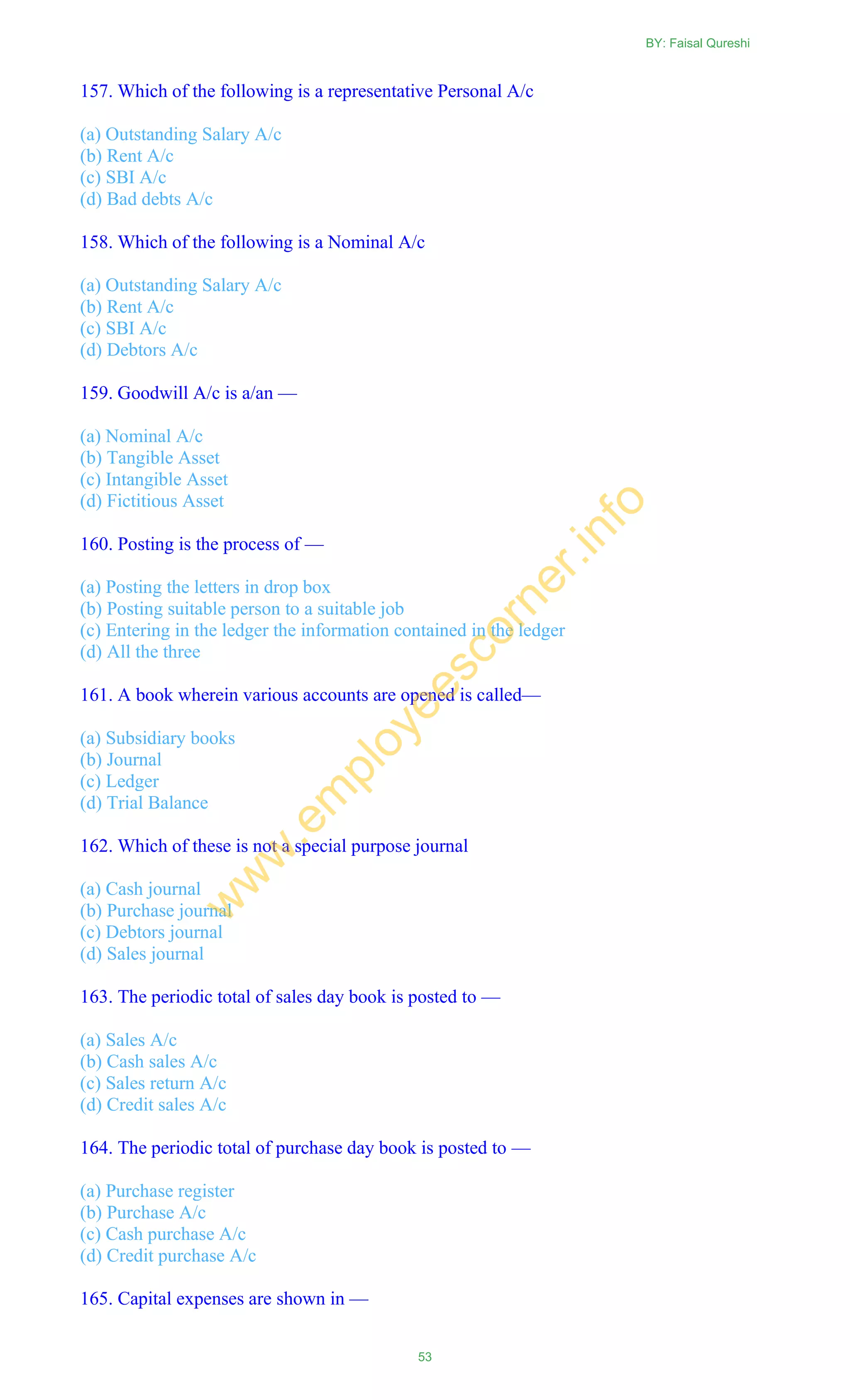
157. Which of the following is a representative Personal A/c
(a) Outstanding Salary A/c
(b) Rent A/c
(c) SBI A/c
(d) Bad debts A/c
158. Which of the following is a Nominal A/c
(a) Outstanding Salary A/c
(b) Rent A/c
(c) SBI A/c
(d) Debtors A/c
159. Goodwill A/c is a/an —
(a) Nominal A/c
(b) Tangible Asset
(c) Intangible Asset
(d) Fictitious Asset
160. Posting is the process of —
(a) Posting the letters in drop box
(b) Posting suitable person to a suitable job
(c) Entering in the ledger the information contained in the ledger
(d) All the three
161. A book wherein various accounts are opened is called—
(a) Subsidiary books
(b) Journal
(c) Ledger
(d) Trial Balance
162. Which of these is not a special purpose journal
(a) Cash journal
(b) Purchase journal
(c) Debtors journal
(d) Sales journal
163. The periodic total of sales day book is posted to —
(a) Sales A/c
(b) Cash sales A/c
(c) Sales return A/c
(d) Credit sales A/c
164. The periodic total of purchase day book is posted to —
(a) Purchase register
(b) Purchase A/c
(c) Cash purchase A/c
(d) Credit purchase A/c
165. Capital expenses are shown in —
BY: Faisal Qureshi
53
w
w
w
.em
ployeescorner.info
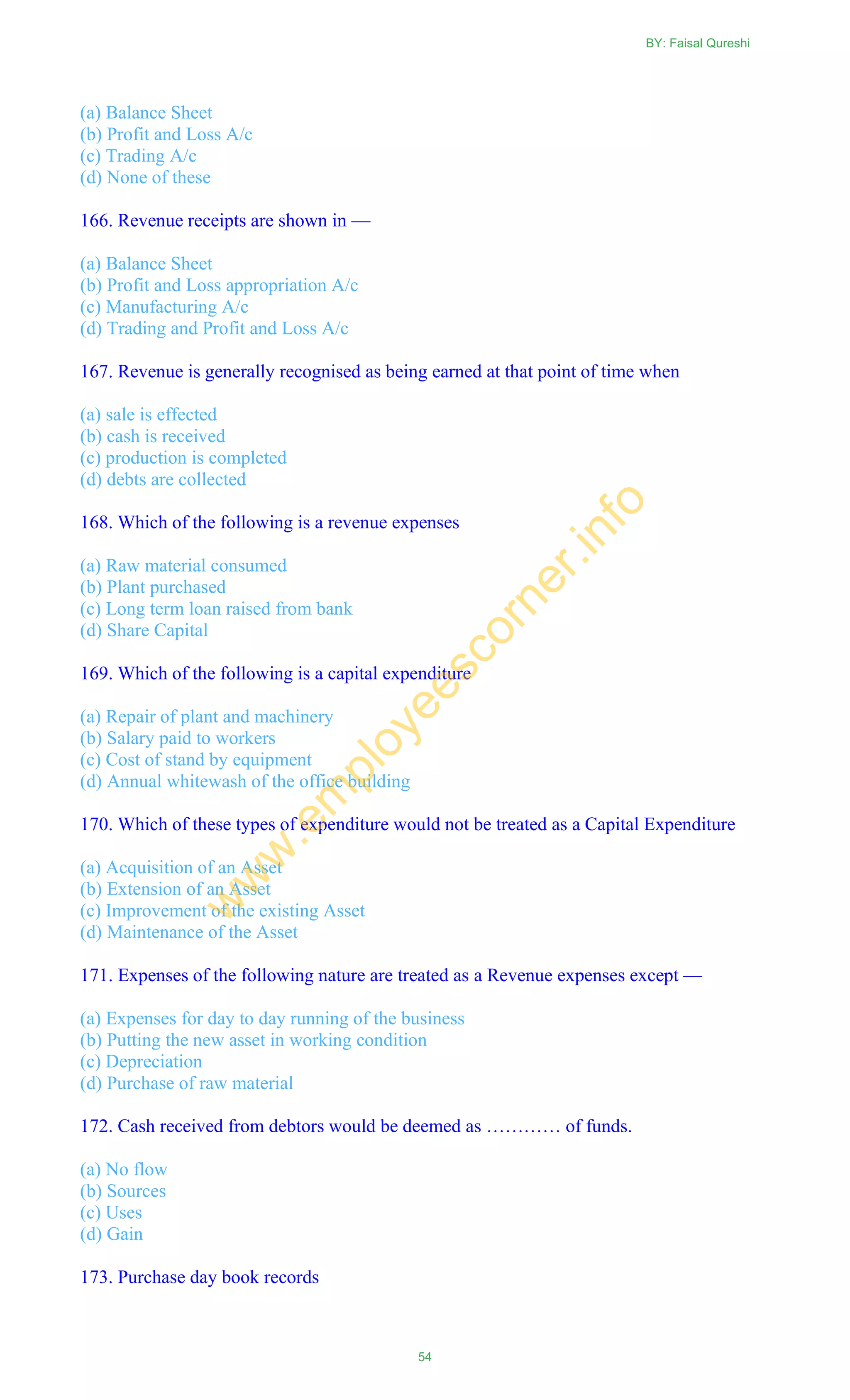
(a) Balance Sheet
(b) Profit and Loss A/c
(c) Trading A/c
(d) None of these
166. Revenue receipts are shown in —
(a) Balance Sheet
(b) Profit and Loss appropriation A/c
(c) Manufacturing A/c
(d) Trading and Profit and Loss A/c
167. Revenue is generally recognised as being earned at that point of time when
(a) sale is effected
(b) cash is received
(c) production is completed
(d) debts are collected
168. Which of the following is a revenue expenses
(a) Raw material consumed
(b) Plant purchased
(c) Long term loan raised from bank
(d) Share Capital
169. Which of the following is a capital expenditure
(a) Repair of plant and machinery
(b) Salary paid to workers
(c) Cost of stand by equipment
(d) Annual whitewash of the office building
170. Which of these types of expenditure would not be treated as a Capital Expenditure
(a) Acquisition of an Asset
(b) Extension of an Asset
(c) Improvement of the existing Asset
(d) Maintenance of the Asset
171. Expenses of the following nature are treated as a Revenue expenses except —
(a) Expenses for day to day running of the business
(b) Putting the new asset in working condition
(c) Depreciation
(d) Purchase of raw material
172. Cash received from debtors would be deemed as ………… of funds.
(a) No flow
(b) Sources
(c) Uses
(d) Gain
173. Purchase day book records
BY: Faisal Qureshi
54
w
w
w
.em
ployeescorner.info
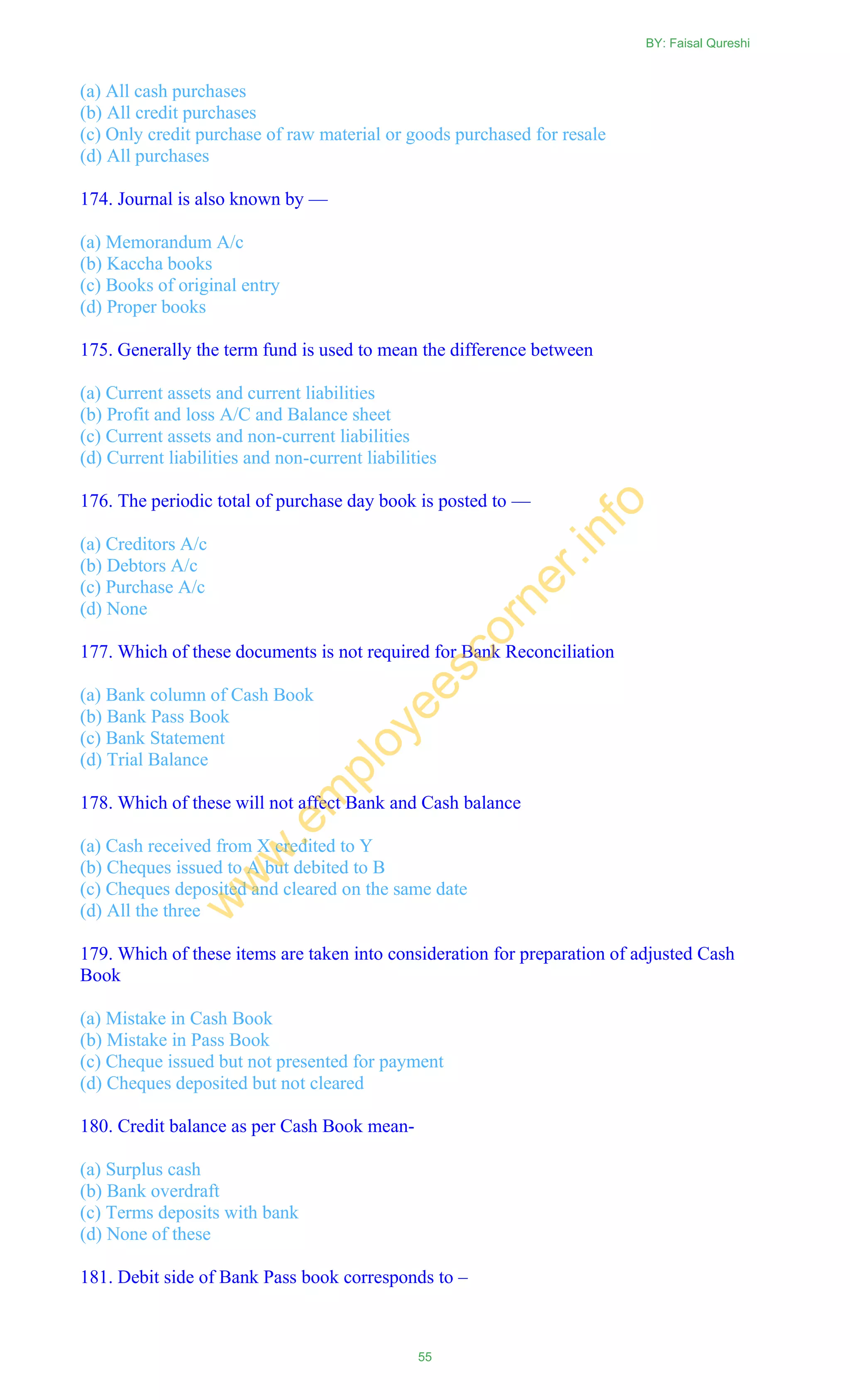
(a) All cash purchases
(b) All credit purchases
(c) Only credit purchase of raw material or goods purchased for resale
(d) All purchases
174. Journal is also known by —
(a) Memorandum A/c
(b) Kaccha books
(c) Books of original entry
(d) Proper books
175. Generally the term fund is used to mean the difference between
(a) Current assets and current liabilities
(b) Profit and loss A/C and Balance sheet
(c) Current assets and non-current liabilities
(d) Current liabilities and non-current liabilities
176. The periodic total of purchase day book is posted to —
(a) Creditors A/c
(b) Debtors A/c
(c) Purchase A/c
(d) None
177. Which of these documents is not required for Bank Reconciliation
(a) Bank column of Cash Book
(b) Bank Pass Book
(c) Bank Statement
(d) Trial Balance
178. Which of these will not affect Bank and Cash balance
(a) Cash received from X credited to Y
(b) Cheques issued to A but debited to B
(c) Cheques deposited and cleared on the same date
(d) All the three
179. Which of these items are taken into consideration for preparation of adjusted Cash
Book
(a) Mistake in Cash Book
(b) Mistake in Pass Book
(c) Cheque issued but not presented for payment
(d) Cheques deposited but not cleared
180. Credit balance as per Cash Book mean-
(a) Surplus cash
(b) Bank overdraft
(c) Terms deposits with bank
(d) None of these
181. Debit side of Bank Pass book corresponds to –
BY: Faisal Qureshi
55
w
w
w
.em
ployeescorner.info
(a) Credit side of Cash Book
(b) Debit side of Cash Book
(c) Debit side of Trial Balance
(d) Credit side of Balance Sheet
182. Difference in Bank Balance as per Pass Book and Cash Book may arise on account of
(a) Cheque issued but not presented
(b) Cheque issued but dishonoured
(c) Cheque deposited and credited by bank
(d) All of (a) and (b) above
[Hints: (d) Differences in Bank Balance as per Bank Pass Book and Cash Book arise due to
many
reasons. Few of them are Cheques issued (a credit entry in Cash Book made) but not
presented for
payment (so no corresponding entry in Pass Book).
Cheques issued (a credit entry in Cash Book made) but dishonoured (so no corresponding
entry
made in Pass Book).
In case of cheques deposited and credited by bank, entries in both Cash Book and the Bank
Pass
book are made, hence no difference arises.
Hence option (d) is the right option. Only in situations (a) and (b) result in difference.]
183. Which of the following statements is/are true?
(a) When there are cheques deposited but not collected by the banker, overdraft balance as
per
Pass Book will be less than that as per Cash Book
(b) When the payment side of the Cash Book is undercast, overdraft balance as per Cash
Book
will be more than overdraft balance as per Pass Book
(c) When reconciliation is to be done with the extracts of the Cash Book and Pass Book
relating to
the same period, the transactions which do not figure in one of the extracts are to be noted
(d) Bank interest debited in the Pass Book is to be added to Overdraft Balance as per Pass
Book to
arrive at the Overdraft balance as per Cash Book
[Hints: (c) Statement (a) is false, since when cheques are deposited at bank, the existing
overdraft
balance as per Cash Book decreases whereas when the cheques have not been collected the
overdraft balance as per Pass book is more that of Cash book.
Statement (b) is false, when the payments side of the Cash Book is undercast results in
undercasting of overdraft balance, hence the overdraft balance as per Cash Book will be
less,
than the overdraft balance as per Pass Book.
Statement (c) is true, since when extracts of Cash Book and extracts of the Pass Book
relating to
same period are taken and compared, the entries which do not figure in both the extracts
imply
that these entries create the difference in the balances, hence are to be noted for the
preparation of reconciliation statement.
Statement (d) is false, since Bank interest debited in the Pass Book increases the overdraft
balance
hence to arrive at the balance as per cash, since the above corresponding entry is not made
BY: Faisal Qureshi
56
w
w
w
.em
ployeescorner.info
in
the Cash Book, the interest amount is to be deducted from the overdraft balance as per
Bank Pass
Book.
Hence only option (c) is true, all other options are false.]
184. The Bank Reconciliation Statement is prepared
(a) To rectify the mistakes in the Cash Book
(b) To arrive at the Bank Balance
(c) To arrive at the Cash Balance
(d) To bring out the reasons for the difference between the Balance as per Cash Book and
the
Balance as per Bank Statement
[Hints: (d) The basic objective of the preparation of the Bank Reconciliation Statement is to
locate
the reasons for differences between the balance as per Cash book and the balance as per
Bank
Statement. The ancillary benefits during this process of preparation can be said to be
rectification
of mistakes in cash book, rectification of mistake in bank statement etc. Hence option (d) is
the
right choice.]
185. Which of the following statements is false?
(a) When the bank column of a Cash Book shows a credit balance, it means an amount is
due to
the bank
(b) When Pass Book shows a debit balance, it means overdraft as per Pass Book
(c) While preparing Bank Reconciliation Statement, cheques paid into bank but not yet
cleared
are deducted from the Debit balance as per Cash Book to arrive at the balance as per Pass
Book
(d) A Bank Reconciliation Statement is a part of Pass Book
[Hints: (d) A credit balance in the Cash Book(bank column) denotes an overdraft balance.
It
implies that the business is due to the bank respect of that amount it has overdrawn. Hence
option
(a) is true.
A credit balance in the Pass book refers to favourable balance and a debit balance in the
pass
book refers to Unfavorable balance or overdraft. Hence option (b) is true.
When preparing a BRS, where there is a debit balance or favourable balance in the Cash
book
(bank column), cheques paid into bank but not yet cleared are deducted from the cash book
(bank column) balance to arrive at the balance in the bank Pass book. Hence statement (c )
is
true.
A Bank Reconciliation Statement does not form part of pass book. It is prepared by the
business to
reconcile the balances as per Pass Book or Bank Statement and the Cash Book (bank
column).
Hence statement (d) is false.]
BY: Faisal Qureshi
57
w
w
w
.em
ployeescorner.info
186. Which of the following statements is true?
(a) Bank charges increase debit balance shown as per Bank Column of the Cash Book.
(b) Bank charges increase debit balance as per Bank pass book.
(c) A cash sale of a non-trading asset is recorded in the journal proper.
(d) Cash discount allowed by the business will appear on the debit side of the debtor‗s
account.
[Hints: (b) Bank charges increase debit balance as per Bank Pass Book (b) is the correct
answer.
The debit balance as per Bank Pass Book indicates the overdraft balance and the bank
charges
being the expenditure increase the debit balance. The alternative (a) is incorrect because the
bank charges decrease the debit balance shown as per Bank column of the Cash Book and
do
not increase the debit balance as per Cash Book signifies the favourable balance. A cash
sale of a
non-trading asset is recorded in the Journal Proper is incorrect (c) because all in
transactions
involving cash receipts and payments are recorded in the Cash book cash discount allowed
by
the business will appear on the debit side of the debtor‗s account (d) is incorrect because,
the
cash discount allowed is a reduction in the balance of a debtor‗s account which appears on
the
credit side. Thus (b) is the correct answer.]
187. Bank reconciliation is a statement prepared to reconcile—
(a) Trial balance
(b) Cash book
(c) Bank A/c
(d) Cash as per cash book with bank balance as per bank pass book
188. Bank reconciliation statement is a part of —
(a) Cash book
(b) Trial balance
(c) Auditors report
(d) None of these
189. Benefits of preparing Bank Reconciliation Statement includes —
(a) It bring out any errors committed in preparation of Cash book / Bank Pass Book
(b) Highlights under delay in clearance of cheques deposited but not credited
(c) Help know actual bank balance
(d) All the three
190. Debit balance as per bank pass book mean —
(a) Surplus cash
(b) Bank Overdraft
(c) Terms deposits with bank
(d) None of these
191. Which of the following is not a cause of difference in balance as per cash book and
balance as
BY: Faisal Qureshi
58
w
w
w
.em
ployeescorner.info
per bank pass book—
(a) Errors in cash book
(b) Errors in pass book
(c) Cheques deposited and cleared
(d) Cheques issued but not presented for payment
192. Provision is created for —
(a) Unknown Liabilities
(b) Known Liabilities
(c) Creation of Secret Reserves
(d) All the Three
193. Which of the following is not a method of charging depreciation
(a) Straight line Method
(b) Written down value Method
(c) Discounted present value Method
(d) Sum of digits Method
194. A second hand car is purchased for ` 2,00,000 and sold at ` 1,40,000 after two years.
If
depreciation is charged @ 10% on SLM method, find the profit or loss on sale of the car.
(a) ` 20,000 Loss
(b) ` 20,000 Profit
(c) ` 10,000 Loss
(d) ` 10,000 Profit
195. In the above question if the depreciation is charged @10% on written down value
method, find the profit or loss on sale of the Second hand car.
(a) Loss of ` 20,000
(b) Loss of ` 22,000
(c) Loss of ` 11,000
(d) Profit of ` 11,000
196. The term ― Reserve‖ has been defined in ------ of the Companies Act, 1956
(a) Part III Schedule VI
(b) Part III Schedule V
(c) Part II Schedule VI
(d) Part I Schedule I
197. Which of the following is true with respect to providing depreciation under
diminishing balance
method?
(a) The amount of depreciation keeps increasing every year while the rate of depreciation
keeps
decreasing
(b) The amount of depreciation and the rate of depreciation decrease every year
(c) The amount of depreciation decreases while the rate of depreciation remains the same
(d) The amount of depreciation and the rate of depreciation increases every year
[Hints: (c) Under the written down value method of depreciation, the rate of percentage of
BY: Faisal Qureshi
59
w
w
w
.em
ployeescorner.info
depreciation is fixed, but it applies to the value of the asset at which the asset stands in the
books
in the beginning of the year. Therefore, the amount of depreciation decreases as the fixed
rate of
depreciation is charged on written down values of the asset.]
198. Which of the following statements best describes the purpose of depreciation?
(a) Regular reduction of asset value to correspond to changes in market value as the asset
ages
(b) A process of correlating the market value of an asset with its gradual decline in physical
efficiency
(c) Allocation of cost in a manner that will ensure that Plant and Equipment items are not
carried
on the Balance Sheet in excess of net realizable value
(d) Allocation of the cost of an asset to the periods in which services are received from the
asset
[Hints: (d) AS-6 defines depreciation as a measure of the wearing out, consumption or
other loss of
value of a depreciable asset arising from use, effluxion of time or obsolescence through
technology and market changes. Depreciation is allocated so as to change a fair proportion
of
the depreciable amount in each accounting period during the expected useful life of the
asset.
Depreciation includes amortization of assets whose useful life is predetermined.
The ultimate outcome of accounting for depreciation is cash available to replace the asset;
however this cannot be the purpose of depreciation.]
199. The main objective of providing depreciation is to
(a) Calculate the true profit
(b) Show the true financial position in the Balance Sheet
(c) Provide funds for replacement of fixed assets
(d) Both (a) and (b) above
[Hints: (d) The main objective of providing depreciation is to find out the true Net Profit or
Loss for
an accounting period and to present a true and fair view of the state of affairs of the
business.
Providing funds for replacement is only an ancillary objective and not the main objective.]
200. Depreciation is a process of
(a) Valuation
(b) Valuation and allocation
(c) Allocation
(d) Appropriation
[Hints: (c) AS-6 on depreciation accounting defines ‗depreciation‗ as the measure of
wearing out,
consumption or other loss of a value of a depreciable asset arising from use, effluxion of
time or
obsolescence through technology and market changes. Depreciation is allocated so as to
charge
a fair proportion of the depreciable amount in each accounting period during the expected
useful life of the asset. Depreciation includes amortization of assets whose useful life is
BY: Faisal Qureshi
60
w
w
w
.em
ployeescorner.info
predetermined.
ANSWERS:
101 a 102 a 103 d 104 d 105 d
106 b 107 b 108 d 109 b 110 b 111 b 112 c
113 c 114 d 115 d 116 c 117 b 118 d 119 b
120 d 121 c 122 d 123 c 124 d 125 d 126 b
127 c 128 d 129 a 130 d 131 c 132 c 133 d
134 d 135 c 136 b 137 d 138 c 139 c 140 a
141 d 142 d 143 d 144 d 145 b 146 b 147 c
148 b 149 c 150 c 151 c 152 c 153 a 154 a
155 c 156 c 157 a 158 b 159 c 160 c 161 c
162 c 163 a 164 b 165 a 166 d 167 a 168 a
169 c 170 d 171 b 172 a 173 c 174 c 175 a
176 c 177 d 178 d 179 a 180 b 181 a 182 d
183 c 184 d 185 d 186 b 187 d 188 a 189 d
190 b 191 c 192 b 193 c 194 a 195 b 196 a
197 c 198 d 199 b 200 c
201. The portion of the acquisition cost of the asset yet to be allocated is known as
(a) Written down value
(b) Accumulated value
(c) Salvage value
(d) Residual Value
202. Which of the following statements is true with regard to written down value method
of
depreciation?
i. The rate at which the asset is written off reduces year after year
ii. The amount of depreciation provided reduces from year to year
iii. The rate of depreciation as well as the amount of depreciation reduce year after year
iv. The value of the asset gets reduced to zero over a period of time
(a) Only (i) above
(b) Only (ii) above
(c) Both (i) and (ii) above
(d) (i),(ii) and (iii) above
203. The accounting process of gradually converting the unexpired cost of fixed assets into
expenses
over a series of accounting periods is
(a) Depreciation
(b) Physical deterioration of the asset
(c) Decrease in market value of the asset
(d) Valuation of an asset at a point of time
204. Which of the following factors are primarily considered to determine the economic
life of an asset?
BY: Faisal Qureshi
61
w
w
w
.em
ployeescorner.info
(a) Passage of time, asset usage, and obsolescence
(b) Tax regulations and SEBI guidelines
(c) Tax regulations and asset usage
(d) SEBI guidelines and Asset usage
205. In which of the following methods, the cost of the asset is spread over in equal
proportion during its useful economic life?
(a) Straight-line method
(b) Written down value method
(c) Units-of-production method
(d) Sum-of-the years‗-digits method
206. Which of the following statements is correct?
(a) Depreciation cannot be provided in case of loss in a financial year
(b) Depreciation is a charge against profit
(c) Depreciation is provided in the books only when there is profit
(d) Depreciation is an appropriation of profit
[Hints: (b) Depreciation is provided as a charge against profits. It is not an appropriation of
profit. It
is provided irrespective of whether the business is making a loss or a profit. Hence
statement (b) is a
true statement.]
207. Depreciation is calculated on the
(a) Cost price of asset
(b) Market price
(c) Cost+ Transport+ Installation expenses
(d) Cost or market values whichever is less
208. Which of the following is an external cause of depreciation
(a) Routine repair and maintenance
(b) Misuse
(c) Obsolescence
(d) Wear and tear
209. Depreciation is a process of —
(a) Valuation of fixed assets
(b) Allocation of cost over the useful life of assets
(c) Generating funds replacements of the assets
(d) Avoidance of tax
210. Which of the following is not depreciated
(a) Building
(b) Land
(c) Plant and Machinery
(d) Office equipment
211. Schedule XIV of the Companies Act specifies —————— as minimum rate of
depreciation (WDV) on ship fishing vessels
BY: Faisal Qureshi
62
w
w
w
.em
ployeescorner.info
(a) 27%
(b) 33%
(c) 10%
(d) 15%
212. —————— is also known as Appraisal system of depreciation
(a) Inventory system
(b) Survey system
(c) Annuity system
(d) Insurance
213. Bad debts recovered account will be transferred to
(a) Debtor‗s Account
(b) Profit and Loss Account
(c) Provision for Doubtful Debt Account
(d) Either (b )or (c) above
[Hints: (d) When Bad debts are recovered the entry is
Cash A/c ……………………………………………………Dr.
To Bad debts recovered A/c
This A/c can either be transferred to P& L A/c or Provisions for Doubtful Debts A/c.]
214. The entry for creating a Provision for bad debts is
(a) Debit Provision for Bad Debts A/c and credit Debtors A/c
(b) Debit Debtors A/c and credit Provision for Bad Debts A/c
(c) Debit Provision for Bad Debts A/c and credit Profit & Loss A/c
(d) Debit Profit and Loss A/c and credit Provision for Bad Debts A/c.
[Hints: (d) Provision for bad debt is a charge against profit and therefore, the entry for
creating
provision for bad debts is done by debiting P&L A/c and crediting provision for bad debts
account.]
215. When a person purchasing goods on credit he becomes a………….. in the books of
the seller-
(a) Debtor
(b) Creditor
(c) Defaulter
(d) Offender
216. Which of these is not a Business expense-
(a) Fire Insurance of other building
(b) LIC Premium of proprietor
(c) Interest on Capital
(d) Commission on sales
217. Cost of goods sold excludes-
(a) Opening Stock
(b) Carriage inward
(c) Wages & Salary
(d) Postage & Stamps
BY: Faisal Qureshi
63
w
w
w
.em
ployeescorner.info
218. Tax deducted at source A/c appears in-
(a) Assets side
(b) Liability side
(c) Profit & Loss A/c
(d) Debited to Capital A/c
219. Investment in own share A/c appears in –
(a) Asset side
(b) Liability side
(c) Netted from Capital
(d) Profit & Loss A/c
220. Payments received in advance from a customer for a contract can be
(a) Shown as a deduction from contract work-in-progress on asset side
(b) Shown as a liability
(c) Credited to P&L A/c
(d) Either (a) or (b) above
221. If a company has contingent liabilities, they appear in the
(a) Balance Sheet
(b) Directors‗ report
(c) Notes on account to Balance Sheet
(d) Chairman‗s report
[Hints: (c) Contingent liabilities are disclosed in the notes to Balance Sheet.]
222. Recent developments have made much of a company‗s inventory obsolete. This
obsolete
inventory should be
(a) Written down to zero or its scrap value
(b) Shown in the Balance Sheet at its replacement cost
(c) Shown in the Balance Sheet at cost, but classified as a non-current asset
(d) Carried in the accounting records at cost until it is sold
223. Which of the following is not classified as inventory in the financial statements?
(a) Finished goods
(b) Work-in-process
(c) Stores and spares
(d) Advance payments made to suppliers for raw materials
224. Which of the following statements is true?
(a) Inventory valuation affects only the income statement
(b) Undercasting or overcastting of subsidiary book is an example of error of commission
(c) Capital expenditure wrongly treated as revenue is an example of error of commission
(d) Inventories should be valued at lower of historical cost and current replacement cost
225. Which of the following statements is / are not correct?
(a) Provision for bad debts appears as a liability on the Balance Sheet
(b) The provision for bad debts is owed to the proprietor
BY: Faisal Qureshi
64
w
w
w
.em
ployeescorner.info
(c) Bad debts could be less than the provision for bad debts
(d) Bad debts could exceed the provision for bad debts
[Hints: (b) Provision for bad debts is created to adjust the loss of future bad debts. This
account is
created by a debit to the Profit & Loss Account i.e., a charge against profits. This account
shows a
credit balance and appears on the liabilities side of the Balance Sheet. Actual bad debts for
a
particular period may exceed the provision provided or may be less than the provision
made.]
226. If actual bad debts are more than the provision for bad debts, then there will be a
(a) Credit balance of Provision for Bad Debts Account
(b) Debit balance of Provision for Bad Debts Account
(c) Debit balance of Bad Debts Account
(d) Debit balance of Discount on Debtors Account
[Hints: (b) Provision for Bad Debts Account is created for writing off bad debts. Since the
provision
for bad debts is a credit balance account, If the actual bad debts exceed the provision
created
then there will be debit balance of provision for bad debts account.]
227. The creation of provision for doubtful debts given as an adjustment requires
(a) Debit Profit and Loss Account and deduct the provision from debtors
(b) Credit Profit & Loss Account and deduct the provision from debtors
(c) Credit Profit and Loss Account and add the provision to debtors
(d) Debit Profit & Loss Account and add the provision to debtors
[Hints: (a) The adjustment for provision for bad debts account given in the adjustments is to
debit
P&L A/c and deduct from Sundry Debtors, the amount of provision for bad debts.
Provision for bad
debts is created against Sundry Debtors and therefore deducted from Sundry Debtors and
Debited
to P&L A/c as it is a charge against P&L A/c.]
228. Under the direct write-off method of recognizing a bad debt expense. Which of the
following
statements is/are true?
(a) The bad debt expense is not matched with the related sales
(b) Revenue is overstated in the year of sales
(c) It violates the matching principle of accounting
(d) All of the above
[Hints: (d) Under the direct write off method of recognizing a bad debt expense, the
alternative (d)
is the correct answer which the combination of the following statements (a) The bad debt
expense
is not matched with the related sales because the expense is written off in the year of
occurrence
and it is not matching with the related sales. (b) Revenue is overstated in the year of Sales
as a
BY: Faisal Qureshi
65
w
w
w
.em
ployeescorner.info
result not making any provision for possible loss on account of non- recoverable account.
(c) It
violates the matching principle of accounting as the expense of bad debt is not matched for
the
same period of income. Thus, (d) is the correct answer.
229. At the time of preparation of financial accounts, bad debt recovered account will be
transferred to
(a) Debtors A/c
(b) Profit & Loss A/c
(c) Profit & Loss Adjustment A/c
(d) Profit & Loss Appropriation A/c
[Hints: (b) Bad debt recovered is a windfall gain and it is transferred to Profit & Loss
Account at the
time of preparation of Final Accounts. If provisions account is there in the books it will be
transferred
to Provision A/c and the balance if any in the provision account will be transferred to Profit
& Loss
Account. It is recovery of bad debt written off and hence it is not transferred to Debtors
Account. It
is not transferred to Profit & Loss Adjustment Account. It is not an appropriation to be
transferred to
Profit & Loss Appropriation Account. Thus, the answer is (b).]
230. The balance of Revaluation Reserve pertaining to an asset that has been disposed off
or retired can be transferred to
(a) General Reserve A/c
(b) Profit & Loss A/c
(c) Asset A/c
(d) Capital Reserve A/c
[Hints: (d) According to AS-10 on disposal of a previously revalued item of fixed asset, the
difference between net disposal proceeds and the net book value should be charged or
credited
to the Profit & Loss Statement except that to the extent that such a loss is related to an
increase
which was previously recorded as a credit to revaluation reserve and which has not been
subsequently reversed or utilized, it may be charged directly to that account.
This balance (no longer needed) being of capital nature should be transferred to Capital
Reserve
Account.]
231. Property, Plant and Equipment are conventionally presented in the Balance Sheet at
(a) Replacement cost – Accumulated Depreciation
(b) Historical cost – Salvage Value
(c) Historical cost – Depreciation portion thereof
(d) Original cost adjusted for general price-level changes
[Hints: (c) As per AS-10 on fixed assets, property plant equipment should be presented in
the
Balance Sheet at historical cost (gross book value) less depreciation = net book value.]
232. Outstanding salaries is shown as
BY: Faisal Qureshi
66
w
w
w
.em
ployeescorner.info
(a) An Asset in the Balance Sheet
(b) A Liability
(c) By adjusting it in the P & L A/c
(d) Both (b) and (c) above
[Hints: (d) Outstanding salaries is the expense relating to the current accounting period but
has not
been paid yet and therefore, it is a current liability.]
233. Insurance prepaid is shown as
(a) Current Asset
(b) Current Liability
(c) Fixed Asset
(d) Income
[Hints: (a) Prepaid insurance is the expense relating to the next accounting period but has
been
paid in the current accounting period and hence it is a current asset. The adjustment would
be to
deduct it from the respective expense account in the P&L A/c and show it as a current asset
in the
Balance Sheet.]
234. Depreciation appearing in the Trial Balance should be
(a) Debited to P&L A/c
(b) Shown as liability in Balance Sheet
(c) Reduced from related asset in Balance Sheet
(d) Both (a) and (c) above
[Hints: (a) Any item appearing in the Trial Balance will have one effect i.e., depreciation
appearing
in the Trial Balance will be debited to the Profit & Loss Account. However, if depreciation
is given in
the adjustments, it will have double effect i.e., it should be debited to P&L A/c and
deducted from
the gross fixed asset block in the Balance Sheet also.]
235. A club paid subscription fees of `1,400. Out of which ` 200 is prepaid. In such case
(a) P&L A/C is debited with ` 1,400
(b) P&L A/C is debited with ` 1,200
(c) ` 200 is shown as current asset
(d) Both (b) and (c) above
[Hints: (d) Adjustments for prepaid subscription fees:
P& L A/c Extract
Total subscription fees paid 1,400
Less: Subscription fees prepaid
Relating to next A/c period 200
Subscription fees 1200
The prepaid subscription fees of ` 200 will be shown as a current asset in the Balance Sheet
as it is
an expense relating to the next accounting period but has been paid in the current
accounting
BY: Faisal Qureshi
67
w
w
w
.em
ployeescorner.info
period.]
236. Bad debts recovered is
(a) Credited to P&L A/c
(b) Debited to P&L A/c
(c) Reduced from debtors in Balance Sheet
(d) Added to debtors in Balance Sheet
[Hints: (a) Bad debts earlier written–off and later recovered is a profit to the firm and hence
they
are transferred to Profit & loss Account.]
237. The adjustment to be made for prepaid expenses is
(a) Add prepaid expenses to respective expenses and show it as an asset
(b) Deduct prepaid expenses from respective expenses and show it as an asset
(c) Add prepaid expenses to respective expenses and show it as a liability
(d) Deduct prepaid expenses from respective expenses and show it as a liability
[Hints: (b) Prepaid expense is an expense relating to the next accounting period but has
been paid
in the current accounting period and hence it is a current asset. The adjustment would be to
deduct it from the respective expense account in the P&L A/c and show it as a current asset
in the
Balance Sheet.]
238. On scrutiny of a firm‗s books of accounts, it was observed that the following errors
have occurred in
the previous years but have not yet been rectified.
i. Depreciation for 2011-2012- ` 7,000 understated
ii. Accrued expenses as at March 31, 2013 - ` 10,000 understated
The impact of this on the reported net income for the year ending March 31, 2013 is
(a) ` 7,000 Overstated
(b) ` 10,000 Overstated
(c) ` 17,000 Understated
(d) ` 17,000 Overstated
[Hints: (b) Net income will be overstated by ` 10,000 because the accrued expense are
understated. Under/ Overstatement of depreciation of the year 2011-2012 does not affect
the net
income of current year i.e., 2012-13.]
239. Which of the following entries is correct in respect of reserve for discounts on
accounts payable?
(a) Debit P&L A/c and Credit Reserve for Discount on Accounts Payable A/c
(b) Debit Accounts Payable A/c and Credit P&L A/c
(c) Debit Reserve for Discount on Accounts Payable A/c and Credit P&L A/c
(d) Debit Reserve for Discount on Accounts Payable A/c and credit Accounts Payable A/c
[Hints: (c) The entry will be as follows:
Reserve for Discount on Creditors A/c……………………………………………… Dr.
To Profit & Loss A/c
It will be shown on the credit side as a separate item and will be shown on the Liabilities
side by
way of deduction from the Sundry Creditors.]
BY: Faisal Qureshi
68
w
w
w
.em
ployeescorner.info
240. Sundry debtors as per Trial Balance is ` 43,000 which includes ` 2,200 due from ‗H‗
in respect of goods sent to him on approval basis, the cost price of which is ` 1,800.
Rectification would involve:
(a) Adding ` 2,200 to closing stock
(b) Deducting ` 1,800 from closing stock and deducting ` 2,200 each from debtors and sales
(c) Adding ` 1,800 to closing stock and deducting ` 2,200 each from debtors and sales
(d) Deducting ` 1,800 from debtors
241. Goods in stock worth ` 800 are destroyed by fire and the Insurance Co. is accepted the
claim for
600. Adjustment would involve:
(a) Debit of ` 800 to Trading Account and credit of ` 600 and ` 200 to insurance company
and
Profit and Loss Account respectively
(b) Deduct the ` 800 from closing stock in the Trading Account
(c) Credit insurance company for ` 600
(d) Debit of ` 600 and ` 200 to insurance company and Profit and Loss Account
respectively and
credit of ` 800 to Trading Account
242. Prepaid expenses are valued on the Balance Sheet at
(a) Replacement cost
(b) Current cost
(c) Cost to acquire less accumulated amortization
(d) Cost less expired portion
[Hints: (d) Prepaid expenses are the expenses which relate to the unexpired portion of the
benefit
of the expense. Hence, these are valued on the Balance Sheet at the cost less expired
portion.]
243. Which of the following relationships is/are false?
(a) Net Profit = Gross Profit – Administration and Other expenses
(b) Net Profit = Gross Profit + Administration expenses and Other expenses
(c) Opening Stock + Purchases – Closing Stock = Cost of Sales
(d) Both (b) and (c) above
[Hints: (d) Net Profit= Gross Profit- Administration and other expenses. Hence option (b) is
false.
Opening stock+ Purchases-Closing stock= Cost of material consumed not cost of sales.
Option (c ) is false.]
244. Gross Profit is equal to
(a) Sales – Cost of goods sold
(b) Sales – Closing Stock + Purchases
(c) Opening Stock + Purchases – Closing Stock
(d) None of the above
245. Which of the following shall not be deducted from net profit while calculating
managerial
BY: Faisal Qureshi
69
w
w
w
.em
ployeescorner.info
remuneration?
(a) Loss on sale of undertaking
(b) Debts considered bad and written off
(c) Liability arising from a breach of contract
(d) Director‗s remuneration
[Hints: (d) Director‗s remuneration shall not be deducted from net profit while calculating
managerial remuneration.]
246. Which of the following equations is correct?
(a) Gross Profit+ Sales+ Direct expenses+ Purchases+ Closing stock = Opening stock
(b) Gross Profit+ Sales+ Direct expenses+ Purchases- Closing stock = Opening Stock
(c) Gross Profit + Opening Stock + Direct expenses + Purchases- Closing stock = Sales
(d) Gross Profit – Opening Stock + Direct expenses + Purchases +Closing stock = Sales
247. Which of the following is not true with regard to preparation of Profit & Loss
Account?
(a) Profit & Loss Account is prepared for a certain period and hence it is an interim
statement
(b) Profit & Loss Account does not disclose the effect of non-financial items
(c) Net Profits are ascertained on the basis of current costs
(d) Net Profits as disclosed by P&L Account is not absolute
248. The Profit and Loss Account shows the
(a) Financial results of the concern for a period
(b) Financial position of the concern on a particular date
(c) Financial results of the concern on a particular date
(d) Cost of goods sold during the period
[Hints: (a) A profit and Loss Account is prepared for the period ending which shows the
financial or
operating results of the concern for a period.]
249. Which of the following statements is true?
(a) Provision for doubtful debts represents the amount that cannot be collected
(b) Cash balance on hand shows whether the business has earned Profit or Loss
(c) Free samples received are business gains
(d) The WDV of an asset depreciated on the reducing balance method can never become
zero
250. Cash Profit is
(a) Net profit – Non-trading Profit – Depreciation and provision
(b) Gross Profit – Non-trading Profit + Depreciation and provision
(c) Net Profit + Depreciation and provision
(d) Gross Profit – Operational expenses
[Hints: (c) Cash Profit is the Net Profit + Depreciation and Provision. Depreciation is a
non- cash
outflow which is deducted from the profit and therefore, it is added back to the net profit to
arrive
at the net cash profit.]
BY: Faisal Qureshi
70
w
w
w
.em
ployeescorner.info
251. Which of the following statements is false?
(a) Provision for discount on debtors can be estimated only after computing the provision
for
doubtful debts
(b) All pre-received incomes under the cash system of accounting are current gains
(c) Cash balance on hand shows whether the business has earned Profit or Loss
(d) Capital expenditure should be shown in the books by debiting asset account and
crediting
supplier or cash account
252. Which of the following will not appear in Profit and Loss Account of a business?
(a) Drawings
(b) Bad debts
(c) Accrued expenses
(d) Reserve for discount on Sundry Creditors
[Hints: (a) Profit and Loss Account is an income statement which depicts all incomes/gains
and
expenses/losses during an accounting period. Drawings are neither an income nor an
expense to
be recorded in Profit and Loss Account. Thus (a) is the correct answer. The items in other
alternatives are either expenses or accrued expenses or probable income of discount on
sundry
creditors. The depreciation, bad debts and provision for doubtful debts and accrued
expenses
appear in the Profit and Loss Account and provision for income i.e., provision for discount
on sundry
creditors. Hence (a) is the correct answer.]
253. Which of the following is not a financial statement?
(a) Profit and Loss Account
(b) Balance Sheet
(c) Funds Flow Statement
(d) Trial Balance
[Hints: (d) Trial Balance (d) is not a financial statement. It is a list of all accounts showing
outstanding balances at the end of the accounting period. It helps in the preparation of
financial
statements. The Profit and Loss Account (a); Balance Sheet (b) and Funds Flow statement
(c) are
the financial statements prepared by a business entity. Funds flow statement though
categorized
as one of the financial statements, its preparation is not mandatory. Thus (d) is the correct
answer.]
254. If unexpired insurance appears in the Trial Balance, it should be
(a) Credited to the Profit & Loss Account
(b) Debited to the Profit & Loss Account
(c) Shown on the liabilities side of the Balance Sheet
(d) Shown on the assets side of the Balance Sheet
[Hints: (d) Unexpired insurance or prepaid insurance must be shown on the assets side of
BY: Faisal Qureshi
71
w
w
w
.em
ployeescorner.info
the
Balance Sheet, because it is an asset. It cannot be shown on the liabilities side of the
Balance
Sheet. It cannot be debited to Profit & Loss A/c. Also it cannot be credited to Profit & Loss
A/c.
Hence (d) is true.]
255. Which of the following are/is not a fixed asset?
(a) Stock
(b) Vehicle
(c) Fixed deposit in bank
(d) Both (a) and (c) above
256. Which of the following are/is a current asset?
(a) Sundry Debtors
(b) Stock
(c) Prepaid insurance
(d) All of (a), (b) and (c) above
257. Tax deducted at source appears in the Balance Sheet
(a) On the assets side under current assets
(b) On the assets side under loans and advances
(c) On the liabilities side under current liabilities
(d) On the liabilities side under provisions
258. Which of the following statements is false?
(a) Balance Sheet discloses financial position of the business
(b) A person who owes to the business is called Debtor
(c) Decrease in the value of the asset could decrease the value of a liability
(d) Assets are to be shown in the Balance Sheet at the realizable value
[Hints: (d) AS-10 on Accounting for Fixed Assets states that fixed assets are to be shown in
the
Balance Sheet at their actual cost.]
259. Which of the following statements is true?
(a) The balance of the goods account shows the value of stock in hand
(b) Balancing of all accounts must be done at the end of each day
(c) Assets which are to remain in business for continuous use and not meant for conversion
into
cash are fixed assets
(d) Balance Sheet discloses income position of the business
260. The Balance Sheet gives information regarding the
(a) Results of operations for a particular period
(b) Financial position during a particular period
(c) Profit earning capacity for a particular period
(d) Financial position as on a particular date
261. Which of the following accounts appear(s) in the Balance Sheet of a business?
BY: Faisal Qureshi
72
w
w
w
.em
ployeescorner.info
i. Stock at the end of the financial year
ii. Stock at the beginning of the financial year
iii. Drawings
iv. Prepaid Rent
v. Interest received but not yet earned
(a) Only (i) above
(b) Only (iii) above
(c) Both (i)and (iii) above
(d) (i), (iii), (iv) and (v) above
[Hints: (d) Stock at the end of the financial year is the closing stock, drawings are the
amounts
withdrawn by the owner of the business for personal use; and prepaid rent is the amount of
rent
which is paid in advance of the current financial year and interest received but not yet
earned is
the amount of interest received which does not pertain to the current year are the items that
appear in the Balance Sheet of a business. Stock at the beginning of the financial year is the
opening stock that appears in Trading Account of a business and not in the Balance Sheet.
Thus
(d), the combination of all the accounts in alternatives (i), (iii), (iv) and (v) is the correct
answer.]
262. Computers taken on hire by a business for a period of twelve months should be
classified as
(a) Current assets
(b) Intangible assets
(c) Deferred revenue expenditure
(d) Not an asset
[Hints: (d) Computers taken on hire by a business for a period of twelve months is not an
asset
because it is not owned by the business to be classified as asset. Thus, the correct answer is
(d).
Since it is not an asset it cannot be classified as any asset and other alternatives are not the
correct
answers.]
263. Which of the following is not an intangible asset?
(a) Trade mark
(b) Franchise
(c) Accounts Receivable
(d) Secret Profit
[Hints: (c) An accounts receivable is not an intangible asset. It is the amount that the
business has
to receive from its debtors. The other assets mentioned in alternatives a, b, and d-
trademark,
franchises and secret processes are intangible assets. Hence, the correct answer is (c).]
264. Which of the following is a current liability?
(a) Prepaid expenses
(b) Trademark
(c) Discount on issue of shares
BY: Faisal Qureshi
73
w
w
w
.em
ployeescorner.info
(d) Outstanding Salaries
[Hints: (d) Outstanding salaries are short term obligations expected to be paid off during
the short
period of time. So, it is a current liability. Prepaid expenses, trademark and discount on
issue of
shares are assets. Hence, (d) is correct answer.]
265. Based on which of the following concepts, is Share Capital Account shown on the
liabilities side of a Balance Sheet?
(a) Business entity concept
(b) Money measurement concept
(c) Going concern concept
(d) Matching concept
[Hints: (a) Share capital is the contribution made by the owner(s) and is regarded as a
liability to
the business in the nature of owner‗s equity. The underlying feature for this treatment is the
distinction between the owner(s) and that of the business owned by them. According to
business
entry concept whenever an owner brings capital into the business, the business in turn is
deemed
to owe the capital to the owner. As such the share capital account is treated as a liability to
the
business and shown under liabilities. The other concepts are not correct because,
(b) Money measurement concept explains that in financial accountancy, a record is made
only of
information that can be expressed in monetary terms and ignores other events, however
significant
they may be. It is silent about the treatment of share capital account.
(c) Going concern concept explains that the resources of the concern would continue to be
used
for the purposes for which they are meant to be used. The very categorization of assets into
fixed
and current presupposes the going concern concept. It does not deal about the treatment of
share capital account.
(d) Conservatism concept: The theme behind this principle is that recognition of revenue
requires
better evidence than recognition of expenses. It deals with revenues and expenses and not
the
share capital account.]
266. Which of the following is not a contingent liability?
(a) Debts included in Sundry Debtors which are doubtful in nature
(b) Uncalled liability on partly paid shares
(c) Claims against the company not acknowledged as debts
(d) Arrears of fixed cumulative dividend
[Hints: (a) A contingent liability is the loss which will be known or determined only on the
occurrence or non- occurrence of one or more future uncertain events. Debts of debtors is
not an
uncertain event but only the realization of a part of the debt in doubtful for which provision
must
be provided and hence it is not a contingent liability. Items in other alternatives uncalled
BY: Faisal Qureshi
74
w
w
w
.em
ployeescorner.info
liability on
partly paid shares (b) may be called up in the event of necessity, claims against the
company not
acknowledged as debts (c ) they may or may not turn out to be debts in future. Arrears of
cumulative fixed dividend (d) are contingent liabilities.]
267. Which of the following are current assets of a business?
i. Income received in advance
ii. Stock
iii. Debtors
iv. Pre-paid expenses
v. Accrued income
(a) Both (i) and (iv) above
(b) Both (ii) and (iii) above
(c) (i),(ii) and (iii) above
(d) (ii),(iii),(iv) and (v) above
268. Which of the following statements is true?
(a) Bad Debts Recovered Account is transferred to Sundry Debtors Account
(b) Bill of exchange is drawn by the purchaser
(c) Trial Balance establishes the arithmetical accuracy of the accounting records
(d) A well maintained asset need not be depreciated
[Hints: (c) Bad debts recovery amount will be transferred to Profit & Loss Account and not
to Sundry
Debtors Account. Hence (a) is not correct. Bill of exchange is drawn by the drawer i.e., the
seller
and not the purchaser. According to Companies Act, all assets must be depreciated. Hence
(a),
(b) and (d) are not true. By tallying Trial Balance always proves the arithmetical accuracy
of the
accounting records. Hence (c) is correct.]
269. Closing entries are generally passed —
(a) At the time of opening new books of account
(b) At the time of closing the accounts
(c) During the course of accounting period any time
(d) After certification of accounts
270. Closing stock appearing in the Trial Balance is shown in –
(a) Trading A/c and Balance Sheet
(b) Profit and Loss A/c
(c) Balance Sheet only
(d) Trading A/c only
271. Depreciation Account appearing in the Trial Balance is shown in —
(a) Profit and Loss A/c
(b) Trading A/c
(c) Deducted from the concerned assets A/c
(d) Shown on the liability side
BY: Faisal Qureshi
75
w
w
w
.em
ployeescorner.info
272. Profit on sale of old plant is shown –
(a) In Trading A/c
(b) In Profit and Loss Appropriation A/c
(c) Profit and Loss A/c
(d) Being a non operating item ignored
273. Carriage on goods purchased is shown in —
(a) Profit and Loss A/c
(b) Capitalized with work in progress
(c) Trading A/c
(d) Shown in Balance Sheet
274. Which of these is not an operating income
(a) Income from sale of trading goods
(b) Bad debts recovered
(c) Interest on FDs
(d) None
275. ABC holds an average inventory of ` 36,000(CP) with an inventory turnover of 5
times. If the firm makes a gross profit of 25% on sales, find the total sales of the company
(a) ` 2,40,000
(b) ` 2,10,000
(c) ` 2,00,000
(d) ` 1,80,000
276. From the following details what will be the partners‗ commission?
Net profit before charging partners‗ commission `65,000. Partners‗ commission @ 11%
after
charging such commission
(a) 6441
(b) 5431
(c) 7654
(d) 9876
277. From the following details what will be the partners‗ commission?
Net profit before charging partners‗ commission `65,000. Partners‗ commission 11%
before
charging such commission
(a) 6441
(b) 5431
(c) 7150
(d) 5876
278. Arrangement of Balance Sheet in a logical order is known as —
(a) Dressing Balance Sheet
(b) Marshalling Balance Sheet
(c) Formatting Balance Sheet
(d) Make up of Balance Sheet
279. Improper valuation of inventory effects—
BY: Faisal Qureshi
76
w
w
w
.em
ployeescorner.info
(a) Profitability
(b) Financial position
(c) Both
(d) Cash inflows
280. Find the cost of goods sold if goods are sold for ` 2,000 at 25% profit on cost
(a) ` 1,600
(b) ` 1,500
(c) ` 1,000
(d) ` 1,800
281. Find the value of opening stock from the following data.
Purchases ` 1,50,000, Closing stock ` 30,000 , Sales `2,20,000, Gross profit ` 40,000.
(a) ` 50,000
(b) ` 55,000
(c) ` 60,000
(d) ` 65,000
282. A Bill of Exchange is drawn on 1st April, 2012 payable after 3 months. The due date
of the bill is
(a) 30th June,2012
(b) 1 st July,2012
(c) 4 th July,2012
(d) 4 th August,2012
[Hints: (d) Bill drawn on 1st April, 2012 payable after 3 months. The due date is 1st April,
2012 + 3
months + 3 days of grace = 4th July, 2012.]
283. Which of the following statements is/are true?
(a) Noting charges are paid by the holder of the bill on the date of default
(b) A bill can be endorsed only thrice
(c) On renewal of bill the old bill is canceled
(d) Both (a) and (c) above
[Hints: (d) Noting charges are paid by the holder of the bill to get the bill noted for
dishonour on the
date of its dishonour. Statement (a) is true.
A bill can be endorsed any number of times, there is no limit to the number of
endorsements.
Statement (b) is false.
Renewal of bill takes place when the acceptor requests the drawer to cancel the old bill and
draw
a new bill. Hence statement (c ) is true.
Hence option (d) stating that statement (a) and (c) are the right choice.]
284. When bill discounted with the bank is dishonoured?
(a) Acceptor‗s Account is debited in the books of drawer
(b) Bills Receivable Account is credited in the books of drawer
(c) Bank Account is debited in the books of drawer
BY: Faisal Qureshi
77
w
w
w
.em
ployeescorner.info
(d) Bills Payable Account is debited in the books of drawer
[Hints: (a) When a bill discounted with bank has been dishonoured, the drawer debits the
Acceptors Account (restores the acceptor status a debtor for the amount due) and credits the
Bank Account or Cash Account (the amount he pays to bank).
The acceptor debits the Bills Payable Account, the noting charges and credits the Drawer‗s
Account (Restores the status quo of the creditor to whom he is due to pay).
Hence option (a) is correct. All other options are incorrect.]
285. Which of the following statements is/are false?
(a) Accommodation bills are drawn for the benefit of drawer only
(b) Bills sent for collection is an asset
(c) Bills of exchange cannot be drawn on a banker
(d) Both (a) and (c) above
[Hints: (d) Accommodation bills are drawn for the benefit of both the parties to the bill.
Hence
statement (a) is false.
Bills sent for collection in the books of the drawer is an asset replacing the Bills Receivable
(asset).
A cheque is a bill of exchange which is drawn on a banker, payable at sight. Hence option
(c ) is
false.
Hence option (d) the statements (a) and (c ) are false, is the right choice.]
286. In the books of the drawer, the accounting treatment involved on receipt of a bill of
exchange duly accepted by the drawee is
i. Debit Bills Receivable Account
ii. Debit Drawee‗s Account
iii. Credit Drawee‗s Account
iv. Credit Sales Account
(a) Only (i) above
(b) Both (ii) and (iv) above
(c) Both (i) and (iii) above
(d) Both (i) and (iv) above
[Hints: (c) In the books of the drawer, the accounting treatment involved on receipt of a bill
of
exchange duly accepted by the drawee is debit Bills Receivable Account and credit
Drawee‗s
Account .i.e., the combination of statements in (i) and (iii) alternative (c) is the correct
answer. The
other alternatives are incorrect because the combination of one correct answer with the
statement of incorrect answer. Drawee‗s Account is debited (ii) as soon as a sale is made or
any
advances is made and Drawee‗s Account is not debited when the bill of exchange is
accepted
and sales is credited (iv) when the sale is made and not at the time of acceptance of bill of
exchange. Thus, the alternatives (a), statement (i) (b), combination of (ii) and (iv) (d)
combination
of (i) and (iv) are incorrect.]
287. The noting charges levied on dishonour of an endorsed bill by the Notary Public are to
be borne by
BY: Faisal Qureshi
78
w
w
w
.em
ployeescorner.info
(a) The drawer of the bill
(b) The person responsible for dishonour
(c) The holder of the bill
(d) The endorser of the bill
[Hints: (b) The noting charges are the charges paid to Notary Public for presenting a bill for
payment and to note the fact of dishonour. The charges are to be borne by the person
responsible
for dishonour who is none other than the drawee. Thus, the correct answer is (b).
The drawer of the bill (a) is incorrect answer because the drawer may pay the charges
initially but
ultimately they are to be borne by the drawee. The holder of the (c) is entitled to receive the
payment of the bill and to bear the noting charges on the bill. The endorser (d) may be the
drawer
of the bill in which case he will recover the noting charges from the drawee of the bill.
Thus (b) is
the correct answer.]
288. The drawer of a trade bill passes relevant entries with regard to the transaction
involved in it. But, in
case of an accommodation bill, he passes an entry in addition to the usual entries. The
additional
entry so passed is with respect to
(a) Discounting of the bill with the bank
(b) Payment of the bill on due date
(c) Remitting or receiving the amount
(d) Sending the bill to bank for collection
[Hints: (c ) In case of accommodation bills, the additional entry that is to be passed other
than the
usual entries passed with regard to trade bills in the books of the drawer is in respect of (c )
remitting or receiving the amount at the time of discounting the bill and honouring the bill
at
maturity. The entries passed are the same in case of discounting the bill with the bank (a)
and no
additional entry is passed except for sending the share of proceeds to the drawee. On
payment of
the bill on due date (b) no additional entry is passed in the books of the drawer. If the bill is
sent to
the bank for collection, (d) the purpose behind the accommodation bill is defeated.
However, no
additional entry is required to be passed at the time of sending the bill to the bank for
collection
(d). Thus, (c) is the correct answer.]
289. Under which of the following situations, is journal entry not passed in the books of the
drawer?
(a) When a discounted bill is honoured by the drawee on the due date
(b) When a bill is sent to the bank for collection
(c) When a bill is renewed at the request of the drawee
(d) When a debtor accepts a bill drawn by the drawer
[Hints: (a) When a discounted bill is honoured by the drawee on the due date, (a) no journal
entry
BY: Faisal Qureshi
79
w
w
w
.em
ployeescorner.info
is passed in the books of the drawer. The entry is passed at the time of discounting of the
bill itself
and no entry is required if the discounted bill is honoured on due date. Hence, (a) is the
correct
answer. The other alternatives are incorrect because, when a bill is sent to the bank for
collection
(b) a journal entry debiting bills sent to bank for collection and crediting Bills Receivable is
passed.
When a bill is renewed at the request of the drawee (c) a journal entry is passed canceling
the old
bill and raising a new bill with interest. When a debtor accepts a bill drawn by the drawer
(d) when
a debtor is converted to bills receivable and debtors balance is reduced and Bills Receivable
account is increased to extent of the amount passing a journal entry to that effect. Thus, (a)
is the
correct answer.]
290. Which of the following is not a feature of a promissory note?
(a) It must be in writing
(b) It contains an unconditional promise to pay
(c) It is payable to the bearer
(d) It must be signed by the maker
[Hints: (c) According to the Negotiable Instrument Act, promissory note is not payable to
the
bearer. It must contain an order to pay. So this is not the characteristic of promissory note.
Other
options are the characteristics of promissory note.]
281 c 282 c 283 d 284 a 285 d 286 c 287 b
288 c 289 a 290 c
291. How many parties are generally found in a Bill of Exchange
(a) 4
(b) 2
(c) 3
(d) 5
292. X draws a Bill of Exchange on Y for ` 10,000 on 1-1-2013 for 3 months. The due date
of the bill will be —
(a) 4-4-2013
(b) 3-4-2013
(c) 1-4-2013
(d) 31-3-2013
293. When a B/R is endorsed by the Drawer what entry is passed by the Drawee—
(a) B/R A/c Dr. to Drawer A/c Cr.
(b) B/P A/c Dr. to Drawer A/c Cr.
(c) 3
rd Party‗s A/c Dr. to B/P A/c Cr.
(d) No entry at all
294. When a B/R is discounted, what entry is passed by the Drawee—
BY: Faisal Qureshi
80
w
w
w
.em
ployeescorner.info
(a) Bank A/c Dr. to B/R Cr.
(b) Drawer A/c Dr. to B/R A/c Cr.
(c) B/R A/c Dr. to B/P A/c Cr.
(d) No entry
295. Noting charges are ultimately borne by—
(a) Drawee
(b) Drawer
(c) Payee
(d) None
296. Negotiable Instrument Act was enacted in—
(a) 1981
(b) 1881
(c) 1871
(d) 2001
297. Which of these is not an essential feature of a bill of exchange
(a) Unconditional
(b) Certainty of amount
(c) In writing
(d) Amount to be paid in foreign currency
298. A foreign bill of exchange is generally drawn up in —
(a) Triplicate
(b) Duplicate
(c) Single
(d) Quadruplicate
299. Which of these are not required in a promissory note
(a) Acceptance
(b) Unconditional promise to pay
(c) Properly stamped
(d) Payment to be made legal currency
300. Accommodation bills are generally for —
(a) Genuine trade reasons
(b) For mutual financial accommodation
(c) To help augment money supply
(d) All the three
ANSWERS:
201 a 202 b 203 a
204 a 205 a 206 b 207 c 208 c 209 b 210 b
211 a 212 a 213 d 214 d 215 a 216 b 217 d
218 a 219 a 220 d 221 c 222 a 223 d 224 b
225 b 226 b 227 a 228 d 229 b 230 d 231 c
232 d 233 a 234 a 235 d 236 a 237 b 238 b
239 c 240 c 241 d 242 d 243 d 244 a 245 d
BY: Faisal Qureshi
81
w
w
w
.em
ployeescorner.info
246 c 247 a 248 a 249 d 250 c 251 c 252 a
253 d 254 d 255 d 256 d 257 c 258 d 259 c
260 d 261 d 262 d 263 c 264 d 265 a 266 a
267 d 268 c 269 b 270 c 271 a 272 c 273 c
274 c 275 a 276 a 277 c 278 b 279 c 280 a
281 c 282 c 283 d 284 a 285 d 286 c 287 b
288 c 289 a 290 c 291 c 292 a 293 d 294 d
295 a 296 b 297 d 298 a 299 a 300 b 301 b
A) Purchase journal
B) Sales journal
C) Purchases return journal
D) Sales return journal
2)
SALES
on credit is recorded in which of the following journal?
A) Purchase journal
B) Sales journal
C) Purchases return journal
D) Sales return journal
3)
Transactions that a BUSINESS
doesn't record in any
specialised journal are recorded in which of the following journals or day books?
A) Cash payments journal
B) Cash receipts journal
C) Purchases return journal
D) General journal
4)
Another name of journal is
BY: Faisal Qureshi
82
w
w
w
.em
ployeescorner.info
A) Specialized journal
B) Day book
C) Cash book
D) Record book
5)
Which of the following specialised journals will record
"goods returned by the BUSINESS
"?
A) Purchase journal
B) Sales journal
C) Purchases return journal
D) Sales return journal
6)
Sales and purchase journal don't record
A) Credit sales
B) Credit purchases
C) Credit sales and purchases
D) Cash sales and purchases
7)
Cash received from debtor is recorded in which
of the following SPECIALIZED
journals?
A) Purchase journal
B) Sales journal
C) Cash receipts
D) Cash payments journal
8)
Which of the following is a type of cash receipt journal + cash payment journal?
A) Bank statement
B) Statement of cash flow
C) Cash book
D) Cash documents
9)
Cash purchases is recorded in which of the following specialized journals?
A) Purchase journal
B) Sales journal
C) Purchases return journal
BY: Faisal Qureshi
83
w
w
w
.em
ployeescorner.info
D) Cash payments journal
10)
A brief explanation recorded below every entry in
general journal is commonly known as
A) Narration
B) Explanation
C) Summary
D) Other information
11)
Credit purchase of plant and machinery is recorded
in which of the following SPECIALIZED
journals?
A) General journal
B) Cash journal
C) Purchase journal
D) Purchase return journal
12)
Debit note is the basis for recoding a transaction in which of the following journals?
A) General journal
B) Cash journal
C) Purchase journal
D) Purchase return journal
13)
"SALE
of old furniture" will be recorded in which of the following specialised journals?
A) Purchase journal
B) Sales journal
C) General journal
D) Cash receipt journal
14)
Credit note is the basis for recording a transaction in which of the
following SPECIALIZED
journals?
A) Purchase journal
B) Sales return journal
C) General journal
D) Cash receipt journal
15)
Specialized journals are more adequate for which TYPE OF BUSINESSES
?
A) Small businesses
B) Big businesses
C) Sole proprietorship
D) Partnership
BY: Faisal Qureshi
84
w
w
w
.em
ployeescorner.info
16)
Which of the following is known as an evidence that a transaction took place?
A) Cash receipts journal
B) General journal
C) Source document
D) Cash book
17)
BUSINESS paid rent amounting to $100" which of the following specialized journals records
this transaction?
A) Cash receipts journal
B) Cash payments journal
C) Sales journal
D) Purchase journal
18)
Credit memo or credit note No. is entered in which of the following journal?
A) General journal
B) Cash journal
C) Purchase journal
D) Sales return day book
ANSWER:
1 D 2 B 3 D 4 B 5 C 6 D 7 C 8 C 9 D 10 A
11 A 12 A 13 C 14 B 15 B 16 C 17 B 18 A.
Costs that change in response to alternative courses of action are called:
a. Relevant costs
b. Differential costs
c. Target costs
d. Sunk costs
2. The cost data pertaining to Product ―X‖ of XL Ltd. are as follows :
Maximum capacity 30,000 units
Normal capacity 15,000 units
Increase in inventory 1,880 units
Variable cost per unit ` 12
Selling price per unit ` 50
Fixed manufacturing overhead costs ` 3,60,000
If the profit under Absorption costing method is ` 1,01,000, the profit under Marginal
costing method
would be
a. ` 1,46,120
b. ` 1,23,560
c. ` 55,880
d. ` 73,340
[Hint : Fixed cost per unit = ` 3,60,000 / 15,000 units = ` 24
Profit under absorption costing = ` 1,01,000
Adjustment of fixed manufacturing overhead costs of increased inventory = 1,880 units x `
24 = `
45,120
Profit under marginal costing = ` 1,01,000 – ` 45,120 = ` 55,880]
BY: Faisal Qureshi
85
w
w
w
.em
ployeescorner.info
3. The total cost incurred in the operation of a business undertaking other than the cost of
manufacturing and production is known as
a. Direct cost
b. Variable cost
c. Commercial cost
d. Conversion cost
4. Consider the following data for a company during the month of June 2012
Budgeted hours 4,000
Standard hours for actual production 4,400
Maximum possible hours in the budget period 4,800
Actual hours 3,800
The activity ratio of the company during the month is
a. 111%
b. 120%
c. 95%
d. 117%
[Hint : Activity ratio = Standard hours for actual production x 100
Budgeted hours
= 4,440 hours x 100 = 111%]
4,000 hours
5. Total unit costs are
a.Independent of the cost system, used to generate them
b.Needed for determining product contribution
c.Irrelevant in marginal analysis
d.Relevant for cost-volume-profit analysis
6. Which of the following bases is not appropriate for apportionment of Transport
department‗s cost ?
a. Crane hours
b. Crane value
c. Truck Mileage
d. Truck value
7. The cost of obsolete inventory acquired several years ago, to be considered in a keep vs.
disposal
decision is an example of :
a.Uncontrollable cost
b.Sunk cost
c.Avoidable cost
d.Opportunity cost
[Hint : Costs of obsolete inventory represent the sunk cost because the costs have already
been
incurred.]
8. Budgeted sales for the next year is 5,00,000 units. Desired ending finished goods
inventory is
1,50,000 units and equivalent units in ending W-I-P inventory is 60,000 units. The opening
BY: Faisal Qureshi
86
w
w
w
.em
ployeescorner.info
finished
goods inventory for the next year is 80,000 units, with 50,000 equivalent units in beginning
W-I-P
inventory How many equivalent units should be produced?
a. 5,80,000
b. 5,50,000
c. 5,00,000
d. 5,75,000
[Hint : Using production related budgets, units to produce equals budgeted sales + desired
ending
finished goods inventory + desired equivalent units in ending W-I-P inventory – beginning
finished
goods inventory – equivalent units in beginning W-I-P inventory. Therefore, in this case,
units to
produce is equal to 5,00,000 + 1,50,000 + 60,000 – 80,000 – 50,000 = 5,80,000.
9. If the asset turnover and profit margin of a company are 1.85 and 0.35 respectively, the
return on
investment is
a. 0.65
b. 0.35
c. 1.50
d. 5.29
[Hint : Return on investment = Asset turnover x Profit margin = 1.85 x 0.35 = 0.65]
10. A company is currently operating at 80% capacity level. The production under normal
capacity
level is 1,50,000 units. The variable cost per unit is ` 14 and the total fixed costs are `
8,00,000. If the
company wants to earn a profit of ` 4,00,000, then the price of the product per unit should
be
a. ` 37.50
b. ` 38.25
c. ` 24.00
d. ` 35.00
[Hint : Total fixed cost - ` 8,00,000
Expected profit - ` 4,00,000
Variable cost at 80% level
(80% x 1,50,000 units x ` 14) - ` 16,80,000
Total price - ` 28,80,000
Per unit price at 80% level = (` 28,80,000 / 1,20,000 units) = ` 24.00.]
11. Consider the following data pertaining to the production of a company for a particular
month :
Opening stock of raw material ` 11,570
Closing stock of raw material ` 10,380
Purchase of raw material during the month ` 1,28,450
Total manufacturing cost charged to product ` 3,39,165
Factory overheads are applied at the rate of 45% of direct labour cost.
The amount of factory overheads applied to production is
a. ` 65,025
BY: Faisal Qureshi
87
w
w
w
.em
ployeescorner.info
b. ` 94,287
c. ` 95,020
d. ` 1,52,624
[Hint : Raw material used= Op. Stock + Purchases – Cl. Stock
= ` 11,570 + ` 1,28,450 – ` 10,380 = ` 1,29,640
Manufacturing cost = Raw material used + Direct labour + Factory overhead
` 3,39,165 = ` 1,29,640 + Direct labour + 45% of Direct labour
1.45 Direct labour = ` 2,09,525
Direct labour = ` 1,44,500
The amount of factory overhead= 45% of ` 1,44,500 = ` 65,025.]
12. The budgeted annual sales of a firm is ` 80 lakhs and 25% of the same is cash sales. If
the average
amount of debtors of the firm is ` 5 lakhs, the average collection period of credit sales
months.
a. 1.50
b. 1.00
c. 0.50
d. 1.75
[Hint : Total annual sales = ` 80 lakhs
Total cash sales = 25 % of 80 lakhs. = 20 lakhs.
Total credit sales = 75% of 80 lakhs = 60 lakhs
Average amount of debtors = 5 lakhs = 1 months average credit sales.
Therefore, average collection period is 1 month.]
13. If the minimum stock level and average stock level of raw material ―A‖ are 4,000 and
9,000 units respectively, find out its reorder quantity.
a. 8,000 units
b. 11,000 units
c. 10,000 units
d. 9,000 units
[Hint : Average stock level = Minimum stock level + ½ Reorder quantity
9,000 units = 4,000 units + ½ Reorder quantity
½ Reorder quantity = 9,000 units – 4,000 units
Reorder level = 5, 000 units / 0.5 = 10,000 units]
14. A worker has a time rate of ` 15/hr. He makes 720 units of component (standard time :
5 minutes/
unit) in a week of 48 hours. His total wages including Rowan bonus for the week is
a. ` 792
b. ` 820
c. ` 840
d. ` 864
[Hint : Standard time = 5 times x 720 units = 60 hours
60 minutes
Time taken = 48 hrs.
Time saved = 12 hrs.
Total earning of a worker under Rowan plan
= (48 hrs. x ` 15) + ( 12 hrs. x 48 hrs. x ` 15)
60 hrs.
= ` 720 + ` 144 = ` 864
BY: Faisal Qureshi
88
w
w
w
.em
ployeescorner.info
15. A company maintains a margin of safety of 25% on its current sales and earns a profit
of ` 30 lakhs per annum. If the company has a profit volume (P/V) ratio of 40%, its current
sales amount to
a. ` 200 lakhs
b. ` 300 lakhs
c. ` 325 lakhs
d. None of the above
[Hint : Margin of safety = Profit/ P/V Ratio
= 30/0.40 = ` 75 lakhs
0.25 of sales = ` 75 lakhs
Hence, Sales = 75/0.25 = ` 300 lakhs]
16. Sale for two consecutive months, of a company are ` 3,80,000 and ` 4,20,000. The
company‗s net
profits for these months amounted to ` 24,000 and ` 40,000 respectively. There is no change
in
contribution/sales ratio or fixed costs. The contribution/sales ratio of the company is
a. 1/3
b. 2/5
c. ¼
d. None of the above
[Hint : Contribution / sales = Increase in profit / Increase in sales
= (40,000 – 24,000) / (4,20,000 – 3,80,000)
= 16,000/40,000 = 2/5]
17. A Limited has fixed costs of ` 6,00,000 per annum. It manufactures a single product
which it sells for 200 per unit. Its contribution to sales ratio is 40%. A Limited‗s break-even
in units is
a. 7,500
b. 8,000
c. 3,000
d. 1,500
[Hint : Break-even units = Fixed cost / contribution per unit
= ` 6,00,000/ 40% of ` 200
= 7,500]
18. The current liabilities of Akash Ltd. is ` 30,000. If its current ratio is 3:1 and Quick
ratio is 1:1, the value of stock-in-trade will be
a. ` 20,000
b. ` 30,000
c. ` 60,000
d. Insufficient information
[Hint : Current Ratio = Current Assets = 3:1
Current Liabilities
Current Assets = ` 30,000 x 3 = ` 90,000
Quick Ratio = Quick Assets = 1:1
Quick Liabilities
BY: Faisal Qureshi
89
w
w
w
.em
ployeescorner.info
Liquid assets = ` 30,000 x 1 = ` 30,000
Hence, value of stock-in-trade : CA – LA = ` (90,000 – 30,000)
= ` 60,000]
19. If the capacity usage ratio of a production department is 90% and activity ratio is 99%
then the
efficiency ratio of the department is
1. 100%
2. 120%
3. 110%
4. 105%
[Hint : Efficiency ratio (ER) = Std. hr. of production ÷ Actual hrs.
Activity ratio (AR) = Std. hrs. for production ÷ Budgeted hrs.
Capacity ratio (CR) = Actual hrs. ÷ Budgeted hrs.
Hence, ER = AR / CR = 99% / 90% = 110%]
20. In two consecutive periods, sales and profit were ` 1,60,000 and ` 8,000 respectively in
the first
period and ` 1,80,000 and ` 14,000 respectively during the second period. If there is no
change in
fixed cost between the two periods then P-V ratio must be
1. 20%
2. 25%
3. 30%
4. 40%
[Hint : Change in profit = P/V Ratio
Change in sales
= 14,000 – 8,000
1,80,000 – 160,000
= 6,000
20,000
= 0.30 or 30%]
21. Horizon Ltd. Manufactures product BM for last 5 years. The company maintains a
margin of safety of 37.5% with overall contribution to sales ratio of 40%. If the fixed cost
is ` 5 lakh, the profit of the company is
a. ` 24.00 laks
b. ` 12.50 lakh
c. ` 3.00 lakh
d. None of A, B, C
[Hint : Break even sales = ` 5 lakhs ÷ 0.40 = ` 12.50 lakhs
Total sales = 12.50 . = ` 20.00 lakhs
(1 – 0.375)
Hence the profit of the company : ` 20 lakh x 0.375 x 0.40 = ` 3.00 lakhs]
22. The cost-volume-profit relationship of a company is described by the equation y = `
8,00,000 +
0.60x, in which x represents sales revenue and y is the total cost at the sales volume
represented
by x. If the company desires to earn a profit of 20% on sales, the required sales will be.
BY: Faisal Qureshi
90
w
w
w
.em
ployeescorner.info
a. ` 40,00,000
b. ` 35,50,000
c. ` 24,00,000
d. ` 20,00,000
[Hint : Variable cost = 60% , therefore, contribution to sales ratio = 40% (P/V ratio)
Company‗s target profit 20% in sales, therefore, revised contribution which covers only
fixed cost =
40% - 20% = 20%.
Required sales = fixed cost / revised contribution = ` 8,00,000/ 20% = ` 40,00,000.]
23. ABC Ltd. is having 400 workers at the beginning of the year and 500 workers at the
end of the year. During the year 20 workers were discharged and 15 workers left the
organization. During the year
the company has recruited 65 workers. Of these, 18 workers were recruited in the vacancies
of
those leaving, while the rest were engaged for an expansion scheme. The labour turnover
rate
under separation method is :
a. 22.20%
b. 7.78%
c. 4.00%
d. 14.40%
[Hint : Average number of workers = (400 + 500)/2 = 450
Separation method
= No. of separations during the period x 100
Average number of workers during the period
= 20 + 15 x 100
450
= 7.78%
24. One of the most important tools in cost planning is:
a. Direct cost
b. Cost Sheet
c. Budget
d. Marginal Costing.
25. Economies and diseconomies of scale explain why the:
a. Short-run average fixed cost curve declines so long as output increases.
b. Marginal cost curve must intersect the minimum point of the firm's average total cost
curve.
c. Long-run average total cost curve is typically U-shaped.
d. Short-run average variable cost curve is U-shaped.
26. Which of the following is not a relevant cost?
a. Replacement cost
b. Sunk cost
c. Marginal cost
d. Standard cost.
BY: Faisal Qureshi
91
w
w
w
.em
ployeescorner.info
27. Which of the following is an accounting record?
a. Bill of Material
b. Bin Card
c. Stores Ledger.
d. All of these.
28. The fixed-variable cost classification has a special significance in preparation of :
a. Flexible Budget
b. Master Budget
c. Cash Budget
d. Capital Budget
29. Input in a process is 4000 units and normal loss is 20%. When finished output in the
process is only 3240 units, there is an :
a. Abnormal loss of 40 units
b. Abnormal gain of 40 units
c. Neither abnormal loss nor gain.
d. Abnormal loss of 60 units.
30. Idle capacity of a plant is the difference between:
a. Maximum capacity and practical capacity
b. Practical capacity and normal capacity
c. Practical capacity and capacity based on sales expectancy
d. Maximum capacity and actual capacity.
31. When P/V ratio is 40% and sales value is `10,000, the variable cost will be
a. ` 4000
b. ` 6000
c. ` 10000
d. Variable Cost cannot be calculated from data given.
32. The forex component of imported material cost is converted
a. At the rate on the date of settlement
b. At the rate on the date of transaction
c. At the rate on date of delivery
d. None of the above.
33. Maximum possible productive capacity of a plant when no operating time is lost , is its
a. Practical capacity
b. Theoretical capacity
c. Normal capacity
d. Capacity based on sales expectancy
[Hint : Theoretical capacity is the denominator-level concept that is based on producing at
full
efficiency all the time.,
Practical capacity is a denominator-level concept that reduces the theoretical capacity by
unavoidable operating interruptions such as scheduled maintenance time, shutdowns for
holidays
and so on.
BY: Faisal Qureshi
92
w
w
w
.em
ployeescorner.info
Normal capacity measures the denominator level in terms of demand for the output of the
plant.
Normal capacity utilization is a concept based on the level of capacity utilization that
specifies the
average customer demand over a time period, that includes seasonal, cyclical and trend
factors.]
34. When production is below standard specification or quality and cannot be rectified by
incurring
additional cost, it is called
a. Defective
b. Spoilage
c. Waste
d. Scrap
[Hint : (1) Spoiled goods-goods that do not meet production standards and are either sold
for their
salvage value or discarded; (2) Defective units-goods that do not meet standards and are
sold at
a reduced price or reworked and sold at the regular or a reduced price; (3) Waste-material
that is
lost in the manufacturing process by shrinkage, evaporation, etc.; and (4) Scrap-by-product
of the
manufacturing process that has a minor market value.]
35. CAS 8 requires each type of utility to be treated as
a. Separate cost object
b. Not part of cost as not include in material
c. Not part of cost as they do not form part of product
d. Treated as administrative overheads.
36. Selling and distribution overhead does not include:
a. Cost of warehousing
b. Repacking cost
c. Transportation cost
d. Demurrage charges.
37. When overtime is required for meeting urgent orders, overtime premium should be
a. Charged to Costing Profit and Loss A/c
b. Charged to overhead costs
c. Charged to respective jobs
d. None of the above.
[Hint : When cost is incurred for specified job, the cost should be charged to that job only.]
38. Exchange losses or gains after purchase transaction is complete is treated as
a. Product cost.
b. Overhead cost.
c. Purchase cost.
d. Finance cost
39. Selling price per unit ` 15.00; Direct Materials cost per unit ` 3.50; Direct Labour cost
BY: Faisal Qureshi
93
w
w
w
.em
ployeescorner.info
per unit ` 4.00
Variable Overhead per unit ` 2.00; Budgeted fixed production overhead costs are ` 60,000
per
annum charged evenly across each month of the year. Budgeted production costs are
30,000 units
per annum. What is the Net profit per unit under Absorption costing method.
a. ` 9.50
b. ` 15.00
c. ` 11.50
d. ` 3.50
40. Which of the following cost is linked with the calculation of cost of inventories?
a. Product cost
b. Period cost
c. Both product and period cost
d. Historical cost
41. If, Sales = ` 800,000
Markup rate = 25% of cost
What would be the value of Gross profit?
a. ` 200,000
b. ` 160,000
c. ` 480,000
d. ` 640,000
42. Which of the following is TRUE when piece rate system is used for wage
determination?
a. Under this method of remuneration a worker is paid on the basis of time taken by him to
perform the work
b. Under this method of remuneration a worker is paid on the basis of production
c. The rate is expressed in terms of certain sum of money for total production
d. The rate is not expressed in terms of certain sum of money for total production
43. The salary of factory clerk is treated as:
a. Direct labor cost
b. Indirect labor cost
c. Conversion cost
d. Prime cost
44. Average consumption x Emergency time is a formula for the calculation of:
a. Lead time
b. Re-order level
c. Maximum consumption
d. Danger level
45. EOQ is a point where:
a. Ordering cost is equal to carrying cost
b. Ordering cost is higher than carrying cost
c. Ordering cost is lesser than the carrying cost
d. Total cost is maximum
BY: Faisal Qureshi
94
w
w
w
.em
ployeescorner.info
46. A worker is paid ` 0.50 per unit and he produces 18 units in 7 hours. Keeping in view
the piece rate system, the total wages of the worker would be:
a. 18 x 0.50 = ` 9
b. 18 x 7 = ` 126
c. 7 x 0.5 = ` 3.5
d. 18 x 7 x 0.50 = ` 63
47. When closing stock is over valuate, what would its effect on profit?
a. Cannot determined with given statement
b. It will Increase the profit
c. It will decrease the profit
d. No effect on profit
48. A firm sells bags for ` 14 each. The variable cost for each unit is ` 8. What is the
contribution margin per unit?
a. ` 6
b. ` 12
c. ` 14
d. ` 8
49. Which of the following is NOT true? A small company's breakeven point:
a. Occurs where its revenue equals its expenses
b. Shows entrepreneurs‗ minimum level of activity required to keep the company in
operation
c. Is the point at which a company neither earns a profit nor incurs a loss
d. Total contribution margin equals total variable expenses
50. Keller Co. sells a single product for ` 28 per unit. If variable costs are 65% of sales and
fixed costs total ` 9,800, the break-even point will be:
a. 15,077 units
b. 18,200 units
c. 539 units
d. 1,000 units
51. If B Limited shows required production of 120 cases of product for the month, direct
labor per case is 3 hours at ` 12 per hour. Budgeted labor costs for the month should be:
a. ` 1,360
b. ` 1,440
c. ` 4,320
d. ` 5,346
52. Which of the following is a process by which managers analyze options available to set
courses of action by the organization?
a. Heuristics method
b. Decision making
BY: Faisal Qureshi
95
w
w
w
.em
ployeescorner.info
c. The Delphi technique
d. Systematic error
53. Which of the following is not true about differential costs?
a. It is a broader concept than variable cost as it takes into account additional fixed costs
caused by management decisions
b. With the passage of time and change in situation, differential costs will vary
c. The difference in cost between buying them from outside or make them in the company
is
differential cost, irrelevant for decisions
d. They are extra or incremental costs caused by a particular decision
54. Which one of the following is the Traditional approach for costing?
a. Contribution approach
b. Absorption costing approach
c. Decision making approach
d. Marginal costing approach
55. What would be the margin of safety ratio based on the following information?
Sales price = ` 100 per unit
Variable cost = ` 25 per unit
Fixed cost = ` 50 per unit
a. 25%
b. 33.333%
c. 66.666%
d. 75%
56. If:
Cost of opening finished goods ` 2,000
Cost of goods to be produced ` 6,000
Operating expenses ` 1,000.
Which of the following is the cost of goods available for sale?
a. ` 8,000
b. ` 4,000
c. ` 7,000
d. ` 9,000
57. Ahmed Corporation has sales of ` 500,000 for the period. The selling expenses are
estimated as
12% of sales. The gross profit for the period is amounting to ` 150,000.
Calculate the amount of selling expenses for the period?
a. ` 60,000
b. ` 45,000
c. ` 90,000
d. ` 210,000
58. Which of the following would be considered to be an investment centre?
BY: Faisal Qureshi
96
w
w
w
.em
ployeescorner.info
a. Managers have control over marketing
b. Managers have a sales team
c. Managers have a sales team and are given a credit control function
d. Managers can purchase capital assets and are given a credit control function
59. Which of the following would NOT lead to an increase in net cash flow?
a. Larger sales volume
b. Higher selling price
c. Reduced material cost
d. Charging of lower depreciation
60. All of the following are features of a relevant cost EXCEPT:
a. They affect the future cost
b. They cause an increment in cost
c. Relevant cost is a sunk cost
d. They affect the future cash flows
61. Which of the following statement is TRUE about the relevant cost?
a. It is a sunk cost
b. It is an opportunity cost
c. It do not affect the decision making process
d. All costs are relevant
62. In decision making all costs already incurred in past should always be:
a. Ignored
b. Considered
c. Partially ignored
d. Partially considered
63. Which of the following statement is TRUE about historical cost?
a. It is always relevant to decision making
b. It is always irrelevant to decision making
c. It is always an opportunity cost
d. It is always realizable value
64. In cost accounting, unavoidable loss is charged to which of the following?
a. Factory over head control account
b. Work in process control account
c. Marketing overhead control account
d. Administration overhead control account
65. Merrick Differential Piece Rate Plan based on _____________piece rates is fixed.
a. Two
b. Three
c. Four
d. Five
BY: Faisal Qureshi
97
w
w
w
.em
ployeescorner.info
66. Which of the given is (are) the method(s) of measurement of Labor Turnover?
a. Separation method
b. Flux method
c. Replacement method
d. All of the given options
67. What will be the impact of normal loss on the overall per unit cost ?
a. Per unit cost will increase
b. Per unit cost will decrease
c. Per unit cost remain unchanged
d. Normal loss has no relation to unit cost
68. Which of the given units can never become part of first department of Cost of
Production Report?
a. Units received from preceding department
b. Units transferred to subsequent department
c. Lost units
d. Units still in process
69. Details of the process for the last period are as follows:
Put into process 5,000 kg
Materials ` 2,500
Labor `700
Production overheads 200% of labor
Normal losses are 10% of input in the process. The output for the period was 4,200 Kg
from the
process. There was no opening and closing Work- in- process. What were the units of
abnormal
loss?
a. 500 units
b. 300 units
c. 200 units
d. 100 units
70. ABC Company makes a single product which it sells for ` 20 per unit. Fixed costs are `
75,000 per
month and product has a profit/volume ratio of 40%. In that period actual sales were `
225,000.
Required: Calculate ABC Company Break Even point in `
a. `187, 500
b. `562, 500
c. ` 1,500,000
d. None of the given options
71. All of the following are the features of fixed costs EXCEPT:
a. Although fixed within a relevant range of activity level but are relevant to a decision
BY: Faisal Qureshi
98
w
w
w
.em
ployeescorner.info
making
when it is avoidable.
b. Although fixed within a relevant range of activity level but are relevant to a decision
making
when it is incremental.
c. Generally it is irrelevant
d. It is relevant to decision making under any circumstances
72. A typical factory overhead cost is:
a. Distribution
b. Internal audit
c. Compensation of plant manager
d. Design
73. An average cost is also known as:
a. Variable cost
b. Unit cost
c. Total cost
d. Fixed cost
74. Period costs are:
a. Expensed when the product is sold
b. Included in the cost of goods sold
c. Related to specific period
d. Not expensed
75. While calculating the EOQ, number of orders is calculated by:
a. Dividing required unit by ordered quantity
b. Multiplying the required units with ordered quantity
c. Multiplying the ordered quantity with cost per order
d. Multiplying the required units with cost per order
76. Which of the following best describe piece rate system?
a. The increased volume of production results in decreased cost of production
b. The increased volume of production in minimum time
c. Establishment of fair standard rates
d. Higher output is a result of efficient management
77. The term Cost apportionment is referred to:
a. The costs that can not be identified with specific cost centers.
b. The total cost of factory overhead needs to be distributed among specific cost centers but
must be divided among the concerned department/cost centers.
c. The total cost of factory overhead needs to be distributed among specific cost centers.
d. None of the given options
78. Which of the following loss is not included as part of the cost of transferred or finished
goods, but rather treated as a period cost?
BY: Faisal Qureshi
99
w
w
w
.em
ployeescorner.info
a. Operating loss
b. Abnormal loss
c. Normal loss
d. Non-operating loss
79. Hyde Park Company produces sprockets that are used in wheels. Each sprocket sells for
` 50 and
the company sells approximately 400,000 sprockets each year. Unit cost data for the year
follows:
Direct material ` 15
Direct labor ` 10
Other cost:
Manufacturing
Distribution
Fixed
` 5
` 4
Variable
` 7
` 3
Required: Identify the unit cost of sprockets under direct costing
a. ` 44
b. ` 37
c. ` 32
d. ` 35
80. When production is equal to sales, which of the following is TRUE?
a. No change occurs to inventories for either use absorption costing or variable costing
methods
b. The use of absorption costing produces a higher net income than the use of variable
costing
c. The use of absorption costing produces a lower net income than the use of variable
costing
d. The use of absorption costing causes inventory value to increase more than they would
though
the use of variable costing
81. Selling price per unit is ` 15, total variable cost per unit is ` 9, and total fixed costs are `
15,000 of
―XIT‖. What is the breakeven point in units for ―XIT‖?
a. 3,000 units
b. 1,000 units
c. 1,667 units
d. 2,500 units
82. While constructing a Break even chart, the gap between sales line and variable cost line
shows
which of the following?
BY: Faisal Qureshi
100
w
w
w
.em
ployeescorner.info
a. Fixed cost
b. Break even point
c. Contribution margin
d. Variable cost
83. All of the following compose cost of goods sold EXCEPT:
a. Raw material
b. Labor
c. Capital
d. Factory overhead
84. Amount of Depreciation on fixed assets will be fixed in nature if calculated under
which of the
following method?
a. Straight line method
b. Reducing balance method
c. Some of year's digits method
d. Double declining method
85. Which of the following is NOT a relevant cost to decision making?
a. Opportunity costs
b. Relevant benefits
c. Avoidable costs
d. Sunk costs
86. What would be the attitude of the management in treating Sunk costs in decision
making?
a. A periodic investment of cash resources that has been made and should be relevant for
decision making
b. It is a past cost which is not directly relevant in decision making
c. Management will treat it as variable cost each time in decision making
d. None of the given options
87. Mr. Aslam is running his own personal Financial services business. He has been offered
a job for a salary of ` 45,000 per month which he does not availed. ` 45,000 will be
considered as:
a. Sunk Cost
b. Opportunity cost
c. Avoidable cost
d. Historical cost
88. Which of the given cost does not become the part of cost unit?
a. Advertising expenses
b. Direct labor cost
c. Factory overhead cost
d. Cost of raw material
BY: Faisal Qureshi
101
w
w
w
.em
ployeescorner.info
89. Budgeted Factory overhead at two activity levels is as follows for the period.
Activity level Budgeted factory overhead
Low 10,000 Hours ` 40,000
High 50,000 Hours ` 80,000
Required: Identify variable rate with the help of above mentioned data.
a. ` 4.00 per hour
b. ` 1.60 per hour
c. ` 1.00 per hour
d. ` 2.00 per hour
90. Which of the given cost is NOT required to prepare Cost of Production Report?
a. Period cost
b. Material cost
c. Labour cost
d. Factory overhead cost
91. Identify the FOH rate on the basis of machine hour?
a. ` 4.00
b. ` 4.08
c. ` 4.210
d. ` 4.35
92. Which of the given will NOT be included for the calculation of equivalent units of
material under
weighted average costing method?
a. Opening work in process units
b. Closing work in process units
c. Unit completed and transferred out
d. None of the given options
93. The basic assumption made in direct costing with respect to fixed costs is that
a. Fixed cost is a controllable cost
b. Fixed cost is a product cost
c. Fixed cost is an irrelevant cost
d. Fixed cost is a period cost
94. The little Rock Company shows Break even sales is ` 40, 500 and Budgeted Sales is `
50,000.
Identify the Margin of safety ratio?
a. 19%
b. 81%
c. 1.81%
d. Required more data to calculate
95. A machine cost ` 60,000 five years ago. It is expected that the machine will generate
future
BY: Faisal Qureshi
102
w
w
w
.em
ployeescorner.info
revenue of 40,000. Alternatively, the machine could be scrapped for ` 35,000. An
equivalent
machine in the same condition cost 38,000 to buy now.
Required: Identify the realizable value with the help of given data.
a. ` 60,000
b. ` 40,000
c. ` 35, 000
d. ` 38,000
Budgeted production overheads `2,80,000
Actual machine hours 70,000 hours
Actual production overheads `2,95,000
96. Cost of finished goods inventory is calculated by:
a. Deducting total cost from finished goods inventory
b. Multiplying units of finished goods inventory with the cost per unit
c. Dividing units of finished goods inventory with the cost per unit
d. Multiplying total cost with finished goods inventory
97. Assuming no returns outwards or carriage inwards, the cost of goods sold will be equal
to:
a. Opening stock Less purchases plus closing stock
b. Closing stock plus purchases plus opening stock
c. Sales less gross profit
d. Purchases plus closing stock plus opening stock plus direct labor
98. All of the following are essential requirements of a good wage system EXCEPT:
a. Reduced labor and overhead costs
b. Reduced per unit variable costs
c. Increased production
d. Increased operating costs
99. Profit under absorption costing will be higher than under marginal costing if :
a. Produced units > Units sold
b. Produced units < Units sold
c. Produced units = Units sold
d. Profit cannot be determined with given statement
100. Good Job Plc makes one product which sells for ` 80 per unit. Fixed costs are ` 28,000
per month and marginal costs are ` 42 per unit. What sales level in units will provide a
profit of ` 10,000?
a. 350 units
b. 667 units
c. 1,000 units
d. 1,350 units
Answers:
BY: Faisal Qureshi
103
w
w
w
.em
ployeescorner.info
1 b 2 c 3 c 4 a 5 c 6 b 7 b
8 a 9 a 10 c 11 a 12 b 13 c 14 d
15 b 16 b 17 a 18 c 19 3 20 3 21 c
22 a 23 b 24 c 25 c 26 b 27 c 28 a
29 b 30 d 31 b 32 b 33 c 34 b 35 a
36 d 37 c 38 d 39 d 40 a 41 b 42 b
43 b 44 d 45 a 46 a 47 b 48 a 49 d
50 d 51 c 52 b 53 c 54 b 55 b 56 a
57 a 58 d 59 d 60 c 61 b 62 a 63 b
64 a 65 b 66 d 67 a 68 a 69 b 70 d
71 d 72 c 73 b 74 c 75 a 76 b 77 c
78 b 79 d 80 a 81 d 82 c 83 c 84 a
85 d 86 b 87 b 88 a 89 c 90 a 91 a
92 d 93 d 94 a 95 c 96 b 97 c 98 d
99 a 100 c
A store ledger card is similar to the ________ .
a. Stock ledger
b. Bin card
c. Material card
d. Purchase requisition card
202. Which of the following element must be taken into account while calculating total
earnings of a
worker under different incentive wage schemes?
a. Rate per unit
b. Units of production
c. Extra time taken by employee to complete the production
d. Number of workers employed
203. The journal entry of purchase of stock under periodic inventory system would be?
a. Inventory to Cash
b. Cash to Purchases
c. Purchases to Inventory
d. None of the given options
204. Closing work in process Inventory of last year:
a. Is treated as Opening inventory for current year
b. Is not carried forward to next year
c. Become expense in the next year
d. Charge to Profit & Loss account
205. Sales are ` 4,50,000. Beginning finished goods were ` 23,000. Ending finished goods
are ` 30,000. The cost of goods sold is ` 3,00,000. What is the cost of goods manufactured?
a. ` 323,000
b. ` 330,000
c. ` 293,000
BY: Faisal Qureshi
104
w
w
w
.em
ployeescorner.info
d. None of the given options
206. While transporting petrol, a little quantity will be evaporated; such kind of loss is
termed as:
a. Normal Loss
b. Abnormal Loss
c. It is incremental loss
d. It cannot be abnormal loss
207. The cost of electricity bill of the factory is treated as:
a. Fixed cost
b. Variable cost
c. Step cost
d. Semi variable cost
[Hint : Semi Variable Cost : It is also known as mixed cost. It is the cost which is part fixed
and par
variable. It is in fact the mixture of both behaviors.
Examples include: Utility bills – there is a fixed line rent plus charges for units consumed.
Salesman‗s salary – there is a fixed monthly salary plus commission per units sold.]
208. A cost centre is :
a. A unit of product or service in relation to which costs are ascertained
b. An amount of expenditure attributable to an activity
c. A production or service location, function, activity or item of equipment for which costs
are
accumulated
d. A centre for which an individual budget is drawn up
209. Cost accounting department prepares ___________ that helps them in preparing final
accounts.
a. Cost sheets
b. Cost of goods sold statement
c. Cost of production Report
d. Material requisition form
210. When FOH is under applied and charged to Net Profit , the treatment would be:
a. Under applied Add net profit
b. Under applied Less net profit
c. Under applied Less operating expense
d. None of the given options
211. Weighted average cost per unit is calculated by which of the following formula?
a. Cost of goods issued/number of units issued
b. Total Cost/Total Units
c. Cost of goods manufactured/closing units
d. Cost of goods sold/total units
212. Buyer produced 20,000 units and their total factory cost was ` 450,000, other cost like
property tax on factory building was ` 10,000 included in that cost till year ended the cost
of per unit would be:
BY: Faisal Qureshi
105
w
w
w
.em
ployeescorner.info
a. ` 22.5
b. ` 23.5
c. `.24.5
d. ` 26.5
[Hint : Cost per unit = Cost of goods manufactured / Number of units manufactured]
213. A standard rate is paid to the employee when he completed his job:
a. In time less than the standard
b. In standard time
c. In time more than standard
d. Both in standard time and more than the standard time
214. Store incharge after receiving the material as per the goods received note, places the
material at
its location and makes an entry in_______ .
a. Bin Card
b. Store Ledger Card
c. Stock Ledger
d. None of the given options
215. If opening inventory of material is ` 20,000 and closing inventory is ` 40,000.the
Average inventory amount will be:
a. ` 40,000
b. ` 30,000
c. ` 20,000
d. ` 10,000
[Hint : Average Inventory= Opening Inventory + Closing Inventory/2]
216. PVC Company has ordering quantity 10,000 units. They have storage capacity 20,000
units, the
average inventory would be:
a. 20,000
b. 5,000
c. 10,000
d. 25,000
[Hint : Average ordering quantity= Ordering Quantity/2]
217. All Indirect cost is charged/record in the head of
a. Prime cost
b. FOH cost
c. Direct labor cost
d. None of the given options
218. Under/Over applied FOH cost can be adjusted in which of the following:
a. Entire Production
b. Cost of Goods Sold
BY: Faisal Qureshi
106
w
w
w
.em
ployeescorner.info
c. Net Profit
d. All of given options
219. The danger Level can be calculated?
a. Average consumption x Lead time to get urgent supplies
b. Normal consumption x Lead time to get urgent supplies
c. Maximum consumption x Lead time to get urgent supplies
d. Minimum consumption x Lead time to get urgent supplies
[Hint: Danger Level = Average consumption x Emergency time]
220. Nelson Company has following FOH detail.
Budgeted (`) Actual (`)
Production Fixed overheads 36,000 39,000
Production Variable overheads 9,000 12,000
Direct labor hours 18,000 20,000
a. Under applied by `1,000
b. Over applied by ` 1,000
c. Under applied by ` 11,000
d. Over applied by ` 38,000
221. Factory Over head cost includes :
a. Factory Rent
b. Property Tax
c. Salaries of Factory Clerk
d. All of the given
222. Which of the following cannot be used as a base for the determination of overhead
absorption
rate?
a. Number of units produced
b. Prime cost
c. Conversion cost
d. Discount Allowed
223. Cost of goods sold ` 30,000, opening Inventory ` 9,000, Closing inventory `
7,800.What was the
inventory turnover ratio?
a. 3.57 times
b. 3.67 times
c. 3.85 times
d. 5.36 times
[Hint : Inventory turnover ratio = Cost of goods sold/Average inventory]
224. FOH applied rate of Rs. 5.60 per machine hour. During the year the FOH to Rs.
275,000 and 48,000 machine hours were used. Which one of following statement is
correct?
a. Overhead was under-applied by Rs.6,200
b. Overhead was over-applied by Rs.6,200
c. Overhead was under-applied by Rs.7,200
BY: Faisal Qureshi
107
w
w
w
.em
ployeescorner.info
d. Overhead was over-applied by Rs.7,200
225. Cost accounting concepts include all of the following EXCEPT:
a. Planning
b. Controlling
c. Sharing
d. Costing
226. __ are future costs that effect the current management decision.
a. Sunk Cost
b. Standard Cost
c. Relevant Cost
d. Irrelevant Cost
[Hint : Relevant cost is which changes with a change in decision. These are future costs that
effect
the current management decision.
227. Which of the following costs is part of the prime cost for manufacturing company?
a. Cost of transporting raw materials from the suppliers premises
b. Wages of factory workers engaged in machine maintenance
c. Depreciation of truck used for deliveries to customers
d. Cost of indirect production materials
228. Direct material opening inventory add net purchases is called
a. Material consumed
b. Material available for use
c. Total material purchased
d. Material ending inventory
229. Which of the following is to be called product cost ?
a. Material cost
b. Labor cost
c. FOH cost
d. All of the given options
230. A Blanket Rate is:
a. A single rate which used throughout the organization departments
b. A double rates which used throughout the organization departments
c. A single rates which used in different departments of the organization
d. None of the given options
[Hint : A blanket absorption rate is a single rate of absorption used throughout an
organization‗s
production facility and based upon its total production costs and activity.]
231. All of the following are characteristics of Group Bonus Scheme EXCEPT:
a. A standard time is set for the completion of a job
b. If the time taken is greater than the time allowed, the workers in the group receive time
wages
BY: Faisal Qureshi
108
w
w
w
.em
ployeescorner.info
c. If the time taken is less than the time allowed, the group receives a bonus on time saved
d. If the time taken is greater than the time allowed, the workers in the group receive time
deductions for extra hours
232. Which of the following best describes the manufacturing costs?
a. Direct materials, direct labor and factory overhead
b. Direct materials and direct labor
c. Direct materials, direct labor, factory overhead, and administrative overhead
d. Direct labor and factory overhead
233. High labor turnover is NOT desirable because:
a. It denotes the instability of the labor force
b. It is an indication of high labor cost
c. It shows frequent changes in the labor force
d. All of the given options
234. Manufacturing entities classified the inventory in which of three kinds?
a. Material inventory, WIP inventory, Finished goods inventory
b. Material inventory, purchased good inventory, WIP inventory
c. Material inventory, purchased good inventory, Finished goods inventory
d. WIP inventory, Finished goods inventory, purchased good inventory
235. Which of the following is correct for maximum level?
a. Reorder level – (Minimum consumption x Lead time) + EOQ
b. (Maximum consumption x Lead time) – (Minimum consumption x Lead time) + EOQ
c. [(Maximum consumption - Minimum consumption) Lead time]+ EOQ
d. All of the given options
236. Inventory turnover ratio can be calculated as follow?
a. Cost of goods sold/Average inventory
b. Gross profit/Average inventory
c. Cost of goods sold/sale
d. Cost of goods sold/Gross profit
237. The component of Factory overhead are as follow
a. Direct material + Indirect material + Direct expenses
b. Indirect material + Indirect labor + Others indirect cost
c. Direct material + Indirect expenses + Indirect labor
d. Direct labor + Indirect labor + Indirect expenses
238. Overtime that is necessary in order to fulfill customer orders is called:
a. Avoidable overtime
b. Unavoidable overtime
c. Premium Overtime
d. Flex time
239. The Process of cost apportionment is carried out so that:
a. Cost may be controlled
b. Cost unit gather overheads as they pass through cost centers
BY: Faisal Qureshi
109
w
w
w
.em
ployeescorner.info
c. Whole items of cost can be charged to cost centers
d. Common costs are shared among cost centers
240. Taylor's Differential Piece Rate Plan uses-----------piece rates.
a. Three
b. Two
c. Four
d. Five
241. Under Halsey premium plan, if the employee completes his job in less than the
standard time fixed for the job, he is given:
a. Only wages for the actual hours taken
b. Wages for the actual hours taken plus bonus equal to one half of the wage of the time
saved
c. Wages for the actual hours taken plus bonus equal to one third of the wage of the time
saved
d. Only the bonus equal to one half of the time saved
242. Increase in material Inventory means:
a. The ending inventory is greater than opening inventory
b. The ending inventory is less than opening inventory
c. Both ending and opening inventories are equal
d. Cannot be determined
243. Working hours of labor can be calculated with the help of all except:
a. Smart card
b. Time sheet
c. Clock card
d. Store card
244. Amount of net purchase can be calculated as follow
a. Purchase of direct material add trade discount less purchase return add carriage inward
less
other material handling cost
b. Purchase of direct material less trade discount l add purchase return add carriage inward
less
other material handling cost
c. Purchase of direct material less trade discount less purchase return less carriage inward
add
other material handling cost
d. Purchase of direct material less trade discount less purchase return add carriage inward
add
other material handling cost
245. All of the following are terms used to denote Factory Overheads EXCEPT:
a. Factory burden
b. Factory expenses
c. Manufacturing overhead
d. Conversion costs
BY: Faisal Qureshi
110
w
w
w
.em
ployeescorner.info
246. Reduction of labor turnover, accidents, spoilage, waste and absenteeism are the results
of which of the following wage plan?
a. Piece rate plan
b. Time rate plan
c. Differential plan
d. Group bonus system
247. Costs which are constant for a relevant range of activity and rise to new constant level
once that
range exceeded is called:
a. A fixed cost
b. A variable cost
c. A mixed cost
d. A step cost
248. Cost of goods sold can be calculated as follow
a. Cost of goods manufactured Add Opening finished goods inventory Less Closing
finished
goods inventory
b. Cost of goods manufactured Less Opening finished goods inventory Less Closing
finished
goods inventory
c. Cost of goods manufactured Less Opening finished goods inventory Add Closing
finished
goods inventory
d. Cost of goods manufactured Add Opening finished goods inventory Add Closing
finished
goods inventory
249. If, COGS = ` 70,000 GP Margin = 30% of sales What will be the value of Sales?
a. ` 200,000
b. ` 66,667
c. ` 100,000
d. ` 62,500
[Hint : Sales =30000 *100% / 30% = ` 100,000]
250. Annual requirement is 7800 units; consumption per week is 150 units. Unit price ` 5,
order cost ` 10 per order. Carrying cost ` 1 per unit and lead time is 3 week, The Economic
order quantity would
be.
a. 395 units
b. 300 units
c. 250 units
d. 150 units
251. What will be the impact of normal loss on the overall per unit cost ?
a. Per unit cost will increase
b. Per unit cost will decrease
BY: Faisal Qureshi
111
w
w
w
.em
ployeescorner.info
c. Per unit cost remain unchanged
d. Normal loss has no relation to unit cost
252. Alpha company purchased a machine worth Rs 200,000 in the last year. Now that
machine can be use in a new project which company has received this year. Now the cost
of that machine is to be
called
a. Project cost
b. Sunk cost
c. Opportunity cost
d. Relevant cost
253. FOH absorption rate is calculated by the way of :
a. Estimated FOH Cost/Direct labor hours
b. Estimated FOH Cost/No of units produced
c. Estimated FOH Cost/Prime Cost
d. All of the given options
254. Which of the following is/are not associated with ordering costs?
a. Interest
b. Insurance
c. Opportunity costs
d. All of the given options
255. Under perpetual Inventory system at the end of the year:
a. No closing entry passed
b. Closing entry passed
c. Closing value find through closing entry only
d. None of the above.
256. The Hino Corporation has a breakeven point when sales are ` 160,000 and variable
costs at that
level of sales are ` 100,000. How much would contribution margin increase or decrease, if
variable
expenses dropped by ` 20,000?
a. 37.5%.
b. 60%.
c. 12.5%.
d. 26%
[Hint : Sales=160,000; VC=100,000; CM=60,000
Contribution to sales ratio (C/S ratio) =Contribution Margin in `/Sales in `
60,000/160,000=0.375
0.375*100=37%
New VC=80,000,
Sales=160,000
CM=80,000
Contribution to sales ratio (C/S ratio) =Contribution Margin in `/Sales in `
80,000/160,000=0.5=50%
Rise in CM=(37.5-50)=12.5]
BY: Faisal Qureshi
112
w
w
w
.em
ployeescorner.info
257. The short run is a time period in which:
a. All resources are fixed.
b. The level of output is fixed.
c. The size of the production plant is variable.
d. Some resources are fixed and others are variable
258. Opportunity cost is the best example of:
a. Sunk Cost
b. Standard Cost
c. Relevant Cost
d. Irrelevant Cost
259. The components of factory overhead are as follows:
a. Direct material + Indirect material + Direct expenses
b. Indirect material + Indirect labor + Others indirect cost
c. Direct material + Indirect expenses + Indirect labor
d. Direct labor + Indirect labor + Indirect expenses
260. The term Maximum level represents:
a. The maximum stock level indicates the maximum quantity of an item of material which
can be
held in stock at any time.
b. The maximum stock level indicates the maximum quantity of an item of material which
cannot
be held in stock at any time.
c. The average stock level indicates the maximum quantity of an item of material which can
be
held in stock at any time.
d. The available stock level indicates the maximum quantity of an item of material which
can be
held in stock at any time.
261. The FIFO inventory costing method (when using a perpetual inventory system)
assumes that the
cost of the earliest units purchased is allocated in which of the following ways?
a. First to be allocated to the ending inventory
b. Last to be allocated to the cost of goods sold
c. Last to be allocated to the ending inventory
d. First to be allocated to the cost of good sold
262. A firm Uses its own capital or Uses its owner's time and/or financial resources both
are examples of
a. Implicit Cost
b. Explicit Cost
c. Sunk Cost
d. Relevant Cost
[Hint : A cost that is represented by lost opportunity in the use of a company's own
resources,
excluding cash
These are intangible costs that are not easily accounted for. For example, the time and
BY: Faisal Qureshi
113
w
w
w
.em
ployeescorner.info
effort that
an owner puts into the maintenance of the company rather than working on expansion]
263. If Direct Material = 12,000; Direct Labor = 8000 and other Direct Cost = 2000 then
what will be the Prime Cost?
a. 12000
b. 14000
c. 20000
d. 22000
264. Wage, Rent & Materials are examples of :
a. Implicit Cost
b. Explicit Cost
c. Direct Cost
d. Manufacturing Cost
[Hint : A business expense that is easily identified and accounted for. Explicit costs
represent clear,
obvious cash outflows from a business that reduce its bottom-line profitability. This
contrasts with
less-tangible expenses such as goodwill amortization, which are not as clear cut regarding
their
effects on a business's bottom-line value
Good examples of explicit costs would be items such as wage expense, rent or lease costs,
and
the cost of materials that go into the production of goods. With these expenses, it is easy to
see the
source of the cash outflow and the business activities to which the expense is attributed]
265. An investor invests in stock exchange he foregoes the opportunity to invest further in
his hotel. The profit which the investor will be getting from the hotel is
_________________.
a. Opportunity cost
b. Period Cost
c. Product Cost
d. Historical Cost
[Hint : 1. The cost of an alternative that must be forgone in order to pursue a certain action.
Put
another way, the benefits you could have received by taking an alternative action.
2. The difference in return between a chosen investment and one that is necessarily passed
up.
Say you invest in a stock and it returns a paltry 2% over the year. In placing your money in
the
stock, you gave up the opportunity of another investment - say, a risk-free government
bond
yielding 6%. In this situation, your opportunity costs are 4% (6% - 2%)]
266. It is possible for an item of overhead expenditure to be shared amongst many
departments. It is
also possible that this same item may relate to just one specific department.
If the item was not charged specifically to a single department this would be an example
BY: Faisal Qureshi
114
w
w
w
.em
ployeescorner.info
of:
a. Apportionment
b. Allocation
c. Re-apportionment
d. Absorption
267. Generally, the danger level of stock is fixed ________ the minimum level
a. Below
b. Above
c. Equal
d. Danger level has no relation to minimum level
268. Which of the following is / are time based incentive wage plan?
a. Hasley Premium Plan
b. Hasley Weir Premium Plan
c. Rowan Premium Plan
d. All of the given options
269. Which of the following is/are reported in production cost report?
a. The costs charged to the department
b. How the costs were assigned to the output?
c. The equivalent units of production by the department
d. All of the given options
270. Direct materials cost is ` 80,000. Direct labor cost is ` 60,000. Factory overhead is `
90,000.
Beginning goods in process were ` 15,000. The cost of goods manufactured is ` 245,000.
What is the
cost assigned to the ending goods in process?
a. ` 45,000
b. ` 15,000
c. ` 30,000
d. There will be no ending Inventory
[Hint : Direct Material ---- 80,000 (Given)
Direct labor ------- 60,000 (Given)
FOH -------------- 90,000 (Given)
Open WIP------- 15,000
Total 245000 (cost of goods manufactured is also 245000 so balance is zero)]
271. Sales are ` 450,000. Beginning finished goods were ` 23,000. Ending finished goods
are ` 30,000. The cost of goods sold is ` 300,000. What is the cost of goods manufactured?
a. ` 323,000
b. ` 330,000
c. ` 293,000
d. None of the given options
272. Under Periodic Inventory system Purchase of inventory is treated as:
a. Assets
BY: Faisal Qureshi
115
w
w
w
.em
ployeescorner.info
b. Expense
c. Income
d. Liability
273. When prices are rising over time, which of the following inventory costing methods
will result in the lowest gross margin/profits?
a. FIFO
b. LIFO
c. Weighted Average
d. Cannot be determined
274. The main difference between the profit center and investment center is:
a. Decision making
b. Revenue generation
c. Cost incurrence
d. Investment
275. The Inventory Turnover ratio is 5 times and numbers of days in a year is
365.Inventory holding
period in days would be
a. 100 days
b. 73 days
c. 50 days
d. 10 days
276. Over applied FOH will always result when a predetermined FOH rate is applied and:
a. Production is greater than defined capacity
b. Actual overhead costs are less than budgeted overhead
c. Budgeted capacity is less than normal capacity
d. Actual overhead incurred is less than applied Overhead
277. The flux method of labor turnover denotes:
a. Workers appointed against the vacancy caused due to discharge or quitting of the
organization
b. Workers appointed in replacement of existing employees
c. Workers employed under the expansion schemes of the company
d. The total change in the composition of labor force
[Hint : The flux method of labor turnover denotes the total change in the composition of
labor
force. While replacement method takes into account only workers appointed against the
vacancy
caused due to discharge or quitting of the organisation.]
278. Which of the following statement is TRUE about FOH applied rates?
a. They are used to control overhead costs
b. They are based on actual data for each period
c. They are predetermined in advance for each period
d. None of the given
BY: Faisal Qureshi
116
w
w
w
.em
ployeescorner.info
279. Cost of Goods Manufactured can be calculated as follow
a. Total factory Cost Add Opening Work in process inventory Less Closing Work in
process
inventory
b. Total factory Cost Less Opening Work in process inventory Add Closing Work in
process
inventory
c. Total factory Cost Less Opening Work in process inventory Less Closing Work in
process
inventory
d. Total factory Cost Add Opening Work in process inventory Add Closing Work in
process
inventory
280. __________ is the time worked over and above the employee's basic working week.
a. Flex time
b. Overtime
c. Shift allowance
d. Commission
281. In furniture manufacturing use of nail, pins, glue, and polish which use to increase its
esteem
value that cost is treated as:
a. Direct material cost
b. Indirect material cost
c. FOH cost
d. Prime cost
282. If labor is satisfied with high wages it may ultimately lead to:
a. Increased production and productivity
b. Increased efficiency
c. Reduced labor and overhead costs
d. All of the given options
283. Which of the following is a mechanical device to record the exact time of the workers?
a. Clock Card
b. Store Card
c. Token System
d. Attendance Register
284. Which of the following is / are element / s of production payroll?
a. Direct labor force wages
b. Administrative wages
c. Selling wages
d. All of the given options
285. If a predetermined FOH rate is not applied and the volume of production is reduced
from the
planned capacity level, the cost per unit expected to:
BY: Faisal Qureshi
117
w
w
w
.em
ployeescorner.info
a. Remain unchanged for fixed cost and increase for variable cost
b. Increase for fixed cost and remain unchanged for variable cost
c. Increase for fixed cost and decrease for variable cost
d. Decrease for both fixed and variable costs
286. Which of the following is NOT an assumption of the basic economic-order quantity
model?
a. Annual demand is known
b. Ordering cost is known
c. Carrying cost is known
d. Quantity discounts are available
287. In order to ensure efficient functioning of the stores department and steady flow of
materials to the production departments, the restocking of stores is duty of:
a. Managers
b. Storekeeper
c. Production In charge
d. Sales supervisor
288. In cost Accounting, abnormal loss is charged to:
a. Factory overhead control account
b. Work in process account
c. Income Statement
d. Entire production
289. A high inventory turnover may indicate:
a. An efficient use of the investment in inventory
b. A high risk of stock-outs
c. Stock position of store room
d. All of the given options
290. Which of the following cost is used in the calculation of cost per unit?
a. Total production cost
b. Cost of goods available for sales
c. Cost of goods manufactured
d. Cost of goods Sold
291. If, COGS = ` 50,000 GP Margin = 25% of sales What will be the value of Sales?
a. ` 200,000
b. ` 66,667
c. ` 62,500
d. None of the given options
292. When a manufacturing Company has highly automated manufacturing plant producing
many
different products, the most appropriate basis for applying FOH cost to work in process is:
BY: Faisal Qureshi
118
w
w
w
.em
ployeescorner.info
a. Direct labor hours
b. Direct labor costs
c. Machine hours
d. Cost of material used
293. All of the following are cases of labor turnover EXCEPT:
a. Workers appointed against the vacancy caused due to discharge or quitting of the
organization
b. Workers employed under the expansion schemes of the company
c. The total change in the composition of labor force
d. Workers retrenched
294. The Term Minimum Level Represents.
a. The quantity below which the stock of any item should not be allowed to fall
b. The quantity below which the stock of any item should be allowed to fall
c. The estimated time period in number of days or in weeks or in months.
d. The Lead time period in number of days or in weeks or in months.
295. Which of the following would be considered a major aim of a job order costing
system?
a. To determine the costs of producing each job or lot
b. To compute the cost per unit
c. To include separate records for each job to track the costs
d. All of the given option.
296. The Economic order quantity can be calculated by
a. Formula Method
b. Table Method
c. Graph Method
d. All of the given
297. A chemical process has normal wastage of 10% of input. In a period, 2,500 Kg of
material were
input and there was abnormal loss of 75 Kg. What quantity of good production was
achieved?
a. 2,175 kg
b. 2,250 kg
c. 2,425 kg
d. 2,500 kg
298. Which of the following is likely to be classified as a direct material cost of a motor car
wheel?
a. The metal used to manufacture it.
b. The metal used to manufacture one of the tools used in the car wheel factory.
c. The cost of operating the raw material stores in the factory.
d. The cost of the quality operation on the finished car wheels.
[Hint : (b) is part of the cost of either a fixed asset or an indirect cost depending upon the
BY: Faisal Qureshi
119
w
w
w
.em
ployeescorner.info
amount
involved; (c) and (d) are factory indirect costs.]
299. The first in, first out method of pricing raw material issues, exhibits which one of the
following
features?
a. The issue price is recalculated each time new deliveries are made into stock.
b. The issue price is always at the latest price.
c. The goods are always issued strictly in the physical order in which they are received.
d. The issue price is always at the earliest price.
[Hint : (a) refers to the continuous weighted average price method. (b) this method is
known as the
last in, first out method. Under (c) it will rarely be possible to issue goods to correspond
with the
physical order of receipt unless there is a stock control system dealing with, for example
perishable
items.]
300. Which of the following is not a method of pricing raw material issues from stock?
a. Standard costing.
b. Unit cost.
c. Marginal cost.
d. Continuous weighted average.
Answers:
201 b 202 b 203 d 204 a 205 d 206 a 207 d 208 a 209 b 210 a
211 b 212 a 213 b 214 a 215 b 216 b 217 b 218 d 219 a 220 a 221 d 222 d 223 a 224 b
225 c 226 c 227 a 228 b 229 d 230 a 231 d 232 a 233 d 234 c 235 a 236 a 237 b 238 b
239 d 240 b 241 b 242 a 243 d 244 a 245 a 246 d 247 d 248 a 249 c 250 a 251 a 252 d
253 d 254 d 255 a 256 c 257 d 258 c 259 b 260 a 261 d 262 a 263 d 264 b 265 a 266 a
267 b 268 d 269 d 270 d 271 d 272 b 273 b 274 a 275 b 276 d 277 d 278 c 279 a 280 b
281 b 282 d 283 a 284 d 285 b 286 d 287 b 288 b 289 a 290 c 291 b 292 b 293 d 294 a
295 d 296 d 297 a 298 a 299 d 300 c
Which of the following is not a method of pricing raw material issues from stock?
a. Standard costing.
b. Unit cost.
c. Marginal cost.
d. Continuous weighted average.
BY: Faisal Qureshi
120
w
w
w
.em
ployeescorner.info
301. Which of the following is a direct labour cost?
a. Supervisors‗ salaries in the factory.
b. Costs of the payroll accounting section.
c. A bonus paid to the storeman.
d. The wages of an operative paid on the basis of output achieved.
302. Production overheads are absorbed into production units by the use of an overhead
absorption
rate. Which one of the following best describes how the absorption rate is calculated?
a. Total number of units produced divided by the total cost centre overheads.
b. Total number of units produced multiplied by the unit overhead cost.
c. Total cost centre overheads divided by the cost centre activity level.
d. Total indirect costs for the business divided by the total number of units produced.
[Hint : (d) would produce an overhead absorption rate, but it would be far too generalised
to be of
any practical use to the business ]
303. Sales commissions are classified as
a. Prime costs
b. Period costs
c. Product costs
d. Indirect labour
304. XYZ Ltd has the following data relating to its assembly plant in the year ended 31
December 2012:
`‘000
Direct material costs 500
Direct labour cost 250
Assembly plant indirect costs 100
In addition, the stores department has total costs of ` 30,000 and spends 50% of its time
servicing
the assembly plant. There were 50,000 labour hours worked and 25,000 machine hours run
in the
assembly plant in 2012.
The overhead cost per direct labour hour was:
a. ` 2.0
b. ` 4.0
c. ` 2.3
d. ` 4.6
[Hint : The overhead cost per labour hour is ` 1,00,000 plus 50% of the stores costs
`15,000, =
`1,15,000 divided by 50,000 hours.
305. If a company uses predetermined overhead recovery rates and at the end of a period
finds that
there has been an under-recovery of overhead, which of the following best explains how
the
under-recovery has occurred?
a. Actual overhead cost has exceeded the amount used as a basis for the establishment of
the
BY: Faisal Qureshi
121
w
w
w
.em
ployeescorner.info
predetermined rate.
b. Actual overhead cost has been less than the amount used as a basis for the establishment
of
the predetermined rate.
c. Actual activity levels were higher than planned due to an increase in demand.
d. An expected price increase in the overhead costs which was built into the overhead
recovery rate did not take place.
[Hint : (b), (c) and (d) would lead to over-recovery of overheads.]
306. If there has been an over recovery of overheads, at the end of the accounting period
the amount
concerned should be?
a. Debited to the company profit and loss account.
b. Credited to the company profit and loss account.
c. Carried forward to the next accounting period as a cost saving.
d. Used to reduce next period‗s overhead recovery rate.
[Hint : Variances should always be dealt with in the profit and loss account for the period
they
relate to.]
307. A variable cost is?
a. One which varies in proportion to the level of fixed cost incurred.
b. One which tends to vary with the level of activity.
c. One which changes over time.
d. One which cannot be estimated with any great degree of accuracy.
308. The term ‗contribution‗ refers to?
a. The actual amount of profit made per unit.
b. The budgeted profit per unit.
c. The amount of profit which goes towards meeting the overheads of the business.
d. The difference between sales revenue and variable costs per unit.
[Hint : Contribution only becomes profit when fixed costs have been covered in full.]
309. The break-even point is that at which:
a. The level of activity at which the business operates most economically.
b. The level of activity at which the business makes neither a profit nor a loss.
c. The fixed costs are lowest.
d. The variable cost per unit is minimized.
310. When a business is faced with a limiting factor (one which limits the activity of an
entity) and
there
is a choice to be made between options to follow, which of the following statements
describes the
optimal course of action?
a. Choose the option which gives the highest unit profit.
b. Choose the option which gives the highest unit contribution.
c. Aim to achieve a balance of activities covering all of the options.
d. Choose the option which gives highest contribution per unit of limiting factor.
BY: Faisal Qureshi
122
w
w
w
.em
ployeescorner.info
[Hint : (d) would give the optimal course of action in financial terms. Sometimes, where
resource
constraints operate in ‗not for profit organizations‗, other non-financial factors may mean
that a
sub-optimal course of action is followed.]
311. XYZ Ltd has the following alternative planned activity levels:
Level A Level B Level C
Total costs ` 1,00,000 ` 1,50,000 ` 2,00,000
Number of units produced 5,000 10,000 15,000
(Fixed overhead remains constant over the activity range shown.)
The fixed overhead cost per unit is:
a. ` 20.00
b. `15.00
c. `13.33
d. `10.00
[Hint : The total cost increased by ` 1,00,000 in moving from Level A to Level C, therefore
if fixed
overheads are constant, variable costs are ` 1,00,000 for 10,000 units, which = `10/unit. At
Level A,
total cost is ` 20/unit so fixed overheads absorbed on a unit basis are `10.]
312. Which of the following statements regarding marginal costing is incorrect?
a. It is a useful long-term planning technique.
b. It assumes that fixed costs remain fixed over relevant activity ranges.
c. It assumes that other costs vary in proportion to activity.
d. It assumes that costs can be classified as variable or fixed.
[Hint : (b), (c) and (d) are characteristics of the marginal costing approach which render it
less
than useful as a long-term decision-making technique, hence (a) is correct.]
313. Which phrase best describes the current role of the managerial accountant?
a. Managerial accountants prepare the financial statements for an organization.
b. Managerial accountants facilitate the decision-making process within an organization.
c. Managerial accountants make the key decisions within an organization.
d. Managerial accountants are primarily information collectors.
314. LG has incurred cost of ` 60,000 for material. Further it incurred ` 35,000 for labor and
` 70,000 for
factory overhead. There was no beginning and ending work in process. 7,500 units were
completed and transferred out. What would be the unit cost for material?
a. ` 22
b. ` 16
c. ` 14
d. ` 8
315. Manufacturing costs typically consist of
a. Direct materials, direct labor, and manufacturing overhead.
b. Production and shipping costs.
c. Production and marketing costs.
BY: Faisal Qureshi
123
w
w
w
.em
ployeescorner.info
d. Direct materials, direct labor, marketing and administrative costs.
316. In comparison to the traditional manufacturing environment, overhead costs in a JIT
environment
all the following are true except:
a. Are more easily tracked to products.
b. Are frequently direct in nature.
c. Include rent, insurance and utilities.
d. Most of the costs are likely to be indirect in nature.
317. As production increases within the relevant range
a. Variable costs will vary on a per unit basis.
b. Variable costs will vary in total.
c. Fixed costs will vary in total.
d. Fixed and variable cost stay the same in total.
318. You are given the cost and volume information below:
Volume Cost
1 unit ` 15
10 units `150
100 units `1500
What type of a cost is given?
a. Fixed cost
b. Variable cost
c. Step cost
d. Mixed cost
319. Which of the following statements regarding graphs of fixed and variable costs is
true?
a. Variable costs can be represented by a straight line where costs are the same for each
data
point.
b. Fixed costs can be represented by a straight line starting at the origin and continuing
through
each data point.
c. Fixed costs are zero when production is equal to zero.
d. Variable costs are zero when production is equal to zero.
320. ABC Ltd. has three product lines - A, B, and C.
A B C Total
Total Sales `10,000 9,000 12,000 31,000
Variable costs 4,500 7,000 6,000 17,500
Contribution Margin 5,500 2,000 6,000 13,500
Fixed costs 3,500 6,000 3,000 12,500
Net income 2,000 (4,000) 3,000 1,000
Product line B appears unprofitable, and management is considering discontinuing the line.
How
would the discontinuation of Product line B affect net income?
a. Increase by $4,000
b. Decrease by $4,000
c. Increase by $2,000
d. Decrease by $2,000
BY: Faisal Qureshi
124
w
w
w
.em
ployeescorner.info
321. Coed Novelties manufactures key chains for college bookstores. During 2012, the
company had the following costs:
Direct materials used ` 31,000; Direct labor ` 18,000; Factory rent ` 12,000; Equipment
deprecation –
factory ` 2,000; Equipment depreciation – office ` 750; Marketing expense ` 2,500;
Administrative
expenses ` 40,000
35,000 units produced were in 2003.
What is the product cost per unit?
a. Approximately `1.24
b. `1.80
c. Approximately ` 3.04
d. `1.40
322. The Cape Cod Cotton Candy Company had the following information available
regarding last
year's operations:
Sales (100,000 units) ` 2,00,000 ; Variable costs ` 1,00,000; Contribution margin `
1,00,000; Fixed
costs ` 50,000; Net Income ` 50,000
If sales were to increase by 200 units, what would be the effect on net income?
a. `400 increase
b. `200 increase
c. `150 increase
d. ` 200 loss
323. If B Limited shows required production of 120 cases of product for the month, direct
labor per case is 3 hours at Rs. 12 per hour. Budgeted labor costs for the month should be:
a. ` 360
b. ` 1,440
c. ` 4,320
d. ` 5,346
324. A firm, which makes yachts, has fixed costs of ` 260,000 per month. The product sells
for ` 35,000
per boat, and the variable costs of production are ` 15,000 per boat. The boatyard can
manufacture 20 boats each month. What is the firms‗ margin of safety at the moment?
a. 20%
b. 35%
c. 54%
d. 57%
325. Janet sells a product for ` 6.25. The variable costs are ` 3.75. Janet's break-even units
are 35,000. What is the amount of fixed costs?
a. ` 87,500
b. ` 35,000
c. ` 131,250
d. ` 104,750
326. Good Job Plc makes one product which sells for ` 80 per unit. Fixed costs are ` 28,000
per month and marginal costs are ` 42 a unit. What sales level in units will provide a profit
BY: Faisal Qureshi
125
w
w
w
.em
ployeescorner.info
of ` 10,000?
a. 350 units
b. 667 units
c. 1,000 units
d. 1,350 units
327. If computational and record-keeping costs are about the same under both FIFO and
weighted
average, which of the following method will generally be preferred?
a. Weighted Average
b. FIFO
c. They offer the same degree of information
d. Cannot be determined with so little information
328. A business always absorbs its overheads on labor hours. In the 8th period, 18,000
hours were
worked, actual overheads were ` 279,000 and there was ` 36,000 over-absorption. The
overhead
absorption rate per hours was:
a. ` 15.50
b. ` 17.50
c. ` 18.00
d. ` 13.50
329. Bharat Ltd estimated that during the year 75,000 machine hours would be used and it
has been
using an overhead absorption rate of ` 6.40 per machine hour in its machining department.
During
the year the overhead expenditure amounted to ` 472,560 and 72,600 machine hours were
used.
Which one of the following statements is correct?
a. Overhead was under-absorbed by ` 7,440
b. Overhead was under-absorbed by ` 7,920
c. Overhead was over-absorbed by ` 7,440
d. Overhead was over-absorbed by ` 7,920
330. Inventory of ` 96,000 was purchased during the year. The cost of goods sold was `
90,000 and the ending inventory was ` 18,000. What was the inventory turnover ratio for
the year?
a. 5.0
b. 5.3
c. 6.0
d. 6.4
331. The FIFO inventory costing method (when using under perpetual inventory system)
assumes that the cost of the earliest units purchased is allocated in which of the following
ways?
a. First to be allocated to the ending inventory
BY: Faisal Qureshi
126
w
w
w
.em
ployeescorner.info
b. Last to be allocated to the cost of goods sold
c. Last to be allocated to the ending inventory
d. First to be allocated to the cost of good sold
332. High Class Interiors had beginning merchandise inventory of ` 75,000. It made
purchases of
`160,000 and recorded sales of ` 220,000 during January. Its estimated gross profit on sales
was
30%. On January 31, the store was destroyed by fire. What was the value of the
merchandise
inventory loss?
a. ` 154,000
b. ` 160,000
c. `. 235,000
d. ` 81,000
333. Where there is mass production of homogeneous units or where few products are
produced in
batches, which of the following cost driver would be regarded as best base for the
determination of
Factory overhead absorption rate?
a. Number of units produced
b. Labor hours
c. Prime cost
d. Machine hours
334. Which of the following is a factor that should be taken into account for fixing re-order
level?
a. Average consumption
b. Economic Order Quantity
c. Emergency lead time
d. Danger level
335. The contribution margin increases when sales volume and price remain the same and:
a. Variable cost per unit decreases
b. Variable cost per unit increases
c. Fixed costs per unit increase
d. All of the given options
336. Opening work in process inventory can be calculated under which of the following
method?
a. FIFO and Average costing
b. LIFO and Average costing
c. FIFO and LIFO costing
d. None of given options
337. _____________________ is a part of cost of production report that explains the cost
incurred during the process.
a. Quantity schedule
b. Cost accounted for as follow
c. Cost charged to the department
BY: Faisal Qureshi
127
w
w
w
.em
ployeescorner.info
d. None of the given options
338. A company makes one product, which has variable manufacturing costs of ` 3.25 per
unit and
variable selling and administrative costs of ` 1.17 per unit. Fixed manufacturing costs are `
42,300
per month and fixed selling and administrative costs are ` 29,900 per month. The company
wants
to earn an average monthly profit of ` 15,000 and they expect to produce and sell an
average of
40,000 units of the product per month. What is the minimum selling price management can
be
expected to set to meet their profitability goals?
a. ` 4.69
b. ` 4.42
c. ` 6.60
d. ` 6.23
339. A cost that remains unchanged across the relevant range of units produced is what
kind of cost?
a. Fixed cost
b. Product cost
c. Mixed cost
d. Period cost
340. A company has the following cost data for the month:
Conversion cost: `. 78,900; Prime Cost: ` 115,700; Beginning Work in Process Inventory: `
4,700;
Ending Work in Process Inventory: ` 2,800; Beginning Finished Goods Inventory: ` 27,600;
Ending
Finished Goods Inventory: ` 29,200; Manufacturing Overhead Costs: ` 14,500.
What is the Cost of Goods Sold for the month?
a. ` 132,100
b. ` 116,000
c. ` 130,200
d. ` 130,500
341. Material cost = ` 4.00 per unit; Labor cost = Re. 0.60 per unit; Factory overhead cost =
` 1.00 per unit; Administrative cost = ` 1.20 per unit; Selling cost = 15% of sales; Profit = `
1.02 per unit.
What will be the sales price per unit?
a. 6.0
b. 9.2
c. 7.0
d. None of the given option
342. ABC & Company has maintained the following data of inventory control Under the
periodic
inventory system:
Date Units Total
Jan 01 100 @ ` 10 ` 1000
Jan 05 100 @ ` 11 ` 1100
Jan 10 150 @ ` 12 ` 1600
BY: Faisal Qureshi
128
w
w
w
.em
ployeescorner.info
During the period 300 units were sold.
Calculate the cost of ending inventory under FIFO method.
a. 600
b. 500
c. 400
d. 300
343. National chains of tyre fitters stock a popular tyre for which the following information
is available:
Average usage = 140 tyres per day
Minimum usage = 90 tyres per day
Maximum usage = 175 tyres per day
Lead time = 10 to 16 days
Re-order quantity = 3000 tyres
Based on the above data calculate the maximum level of stock possible:
a. 2800
b. 3000
c. 4900
d. 5800
344. The total labor cost incurred by a manufacturing entity includes which one of the
following
elements:
a. Direct labor cost
b. Indirect labor cost
c. Abnormal labor cost
d. All of the given options
345. If, Opening stock 1,000 units; Material Purchase 7,000 units; Closing Stock 500 units;
Material
consumed ` 7,500.
What will be the inventory turnover ratio?
a. 10 Times
b. 12 times
c. 14.5 times
d. 9.5 times PAPER 2:
346. If Units sold = 10,000; Closing finished goods = 2,000; Opening finished goods =
1,500;
What will be the value of units manufactured?
a. 9,500
b. 10,500
c. 13,500
d. 6,500
347. Calculate the amount of direct labor if:
Direct material = 15,000; Direct labor = 70% of prime cost
a. 6,429
b. 30,000
c. 10,500
d. 35,000
BY: Faisal Qureshi
129
w
w
w
.em
ployeescorner.info
348. In increasing production volume situation, the behavior of Fixed cost & Variable cost
will be:
a. Increases, constant
b. Constant, increases
c. Increases, decreases
d. Decreases, increases
349. While calculating the finished goods ending inventory, what would be the formula to
calculate per unit cost?
a. Cost of goods sold / number of units sold
b. Cost of goods to be manufactured/ number of units manufactured
c. Cost of goods manufactured / number of units manufactured
d. Total manufacturing cost / number of units manufactured
350. If the direct labor is Rs. 42,000 and FOH is 40% of conversion cost. What will be the
amount of FOH?
a. 63,000
b. 30,000
c. 28,000
d. 16,800
351. Which one of the following centers is responsible to earn sales revenue?
a. Cost center
b. Investment center
c. Revenue center
d. Profit center
352. While preparing the Cost of Goods Sold and Income Statement, the over applied FOH
is;
a. Add back, subtracted
b. Subtracted, add back
c. Add back, add back
d. Subtracted, subtracted
353. Which of the following ratios expressed that how many times the inventory is turning
over towards the cost of goods sold?
a. Net profit ratio
b. Gross profit ratio
c. Inventory turnover ratio
d. Inventory holding period
MCQ # 354, 355, 356 and 357 are based on the following data:
The following is the Income Statement of a Company for last month:
Particulars `
Sales 4,000,000
Less: variable expenses 1,800,000
Contribution margin 2,200,000
Less: fixed expenses 720,000
Net income 1480,000
The company has no beginning or ending inventories. A total of 80,000 units were
produced and
BY: Faisal Qureshi
130
w
w
w
.em
ployeescorner.info
sold last month.
354. What is the company's contribution margin ratio?
a. 30%
b. 50%
c. 150%
d. None of given options
355. What is the company's break-even in units?
a. 48,000 units
b. 72,000 units
c. 80,000 units
d. None of the given options
356. How many units would the company have to sell to attain target profits of ` 600,000?
a. 48,000 units
b. 88,000 units
c. 106,668 units
d. None of given options
357. What is the company's margin of safety in `?
a. ` 1,600,000
b. ` 2,400,000
c. ` 25,60,000
d. None of the given options
358. The margin of safety can be defined as:
a. The excess of budgeted or actual sales over budgeted or actual variable expenses
b. The excess of budgeted or actual sales over budgeted or actual fixed expenses
c. The excess of budgeted sales over the break-even volume of sales
d. The excess of budgeted net income over actual net income
359. The contribution margin ratio is calculated by using which one of the given formula?
a. (Sales - Fixed Expenses)/Sales
b. (Sales - Variable Expenses)/Sales
c. (Sales - Total Expenses)/Sales
d. None of the given options
360. Data of a company XYZ is given below
Particulars `
Sales 15,00,000
Variable cost 9,00,000
Fixed Cost 4,00,000
Break Even Sales in `__________
a. ` 1, 00,000
b. `. 2, 00,000
c. `13, 00,000
d. None of the given options
361. The break-even point is the point where:
BY: Faisal Qureshi
131
w
w
w
.em
ployeescorner.info
a. Total sales revenue equals total expenses (variable and fixed)
b. Total contribution margin equals total fixed expenses
c. Total sales revenue equals to variable expenses only
d. Both a & b
362. The break-even point in units is calculated using_______
a. Fixed expenses and the contribution margin ratio
b. Variable expenses and the contribution margin ratio
c. Fixed expenses and the unit contribution margin
d. Variable expenses and the unit contribution margin
363. Marginal costing is also known as:
a. Indirect costing
b. Direct costing
c. Variable costing
d. Both (b) and (c)
364. The difference between total revenues and total variable costs is known as:
a. Contribution margin
b. Gross margin
c. Operating income
d. Fixed costs
365. Percentage of Margin of Safety can be calculated in which one of the following ways?
a. Based on budgeted Sales
b. Using budget profit
c. Using profit & Contribution ratio
d. All of the given options
366. Which of the following represents a CVP equation?
a. Sales = Contribution margin (Rs.) + Fixed expenses + Profits
b. Sales = Contribution margin ratio + Fixed expenses + Profits
c. Sales = Variable expenses + Fixed expenses + profits
d. Sales = Variable expenses –Fixed expenses + profits
367. If 120 units produced, 100 units were sold @ ` 200 per unit. Variable cost related to
production &
selling is ` 150 per unit and fixed cost is ` 5,000. If the management wants to decrease sales
price
by 10%, what will be the effect of decreasing unit sales price on profitability of company?
a. Remains constant
b. Profits will increased
c. Company will have to face losses
d. None of the given options
368. A disadvantage of an hourly wage plan is that it:
a. Provides no incentive for employees to achieve and maintain a high level of production.
b. Is hardly ever used and is difficult to apply.
c. Establishes a definite rate per hour for each employee.
BY: Faisal Qureshi
132
w
w
w
.em
ployeescorner.info
d. Encourages employees to sacrifice quality in order to maximize earnings.
369. The cost expended in the past that cannot be retrieved on product or service
a. Relevant Cost
b. Sunk Cost
c. Product Cost
d. Irrelevant Cost
370. When a manufacturing process requires mostly human labor and there are widely
varying wage
rates among workers, what is probably the most appropriate basis of applying factory costs
to work
in process?
a.Machine hours
b. Cost of materials used
c. Direct labor hours
d. Direct labor dollars
371. The main purpose of cost accounting is to:
a. Maximize profits.
b. Help in inventory valuation
c. Provide information to management for decision making
d. Aid in the fixation of selling price
372. The combination of direct material and direct labor is
a. Total production Cost
b. Prime Cost
c. Conversion Cost
d. Total manufacturing Cost
373. ______________ method assumes that the goods received most recently in the stores
or produced
recently are the first ones to be delivered to the requisitioning department.
a. FIFO
b. Weighted average method
c. Most recent price method
d. LIFO
374. Fixed cost per unit decreases when:
a. Production volume increases.
b. Production volume decreases.
c. Variable cost per unit decreases.
d. Variable cost per unit increases.
375. Prime cost + Factory overhead cost is:
a. Conversion cost.
b. Production cost.
c. Total cost.
d. None of given option.
BY: Faisal Qureshi
133
w
w
w
.em
ployeescorner.info
376. Find the value of purchases if Raw material consumed ` 90,000; Opening and closing
stock of raw material is ` 50,000 and 30,000 respectively.
a. ` 10,000
b. ` 20,000
c. ` 70,000
d. ` 1,60,000
377. If Cost of goods sold = ` 40,000; GP Margin = 20% of sales
Calculate the Gross profit margin.
a. ` 32,000
b. ` 48,000
c. ` 8,000
d. `10,000
378. Annual requirement is 7800 units; consumption per week is 150 units. Unit price ` 5,
order cost ` 10
per order. Carrying cost ` 1 per unit and lead time is 3 week, The Economic order quantity
would
be:
a. 395 units
b. 300 units
c. 250 units
d. 150 units
382. The distinction between direct and indirect labour helps to :
a. Measure efficiency of performance
b. Determine product cost more accurately
c. Ensure better cost analysis for decisions and control
d. All of the above
383. Which would be an implicit cost for a firm? The cost:
a. Of worker wages and salaries for the firm.
b. Paid for leasing a building for the firm.
c. Paid for production supplies for the firm.
d. Of wages foregone by the owner of the firm.
384. The difference between gate time and time booked for jobs in respect of a worker in
due to the
following reasons except :
a. Change-over time
b. Illness
c. Waiting for materials, instructions, etc.
d. Breakdown of machine
385. The period of time for which a work station is available for production but is not
utilized due to
shortage of tooling, materials, operators, etc. is known as :
a. Down time
b. Operation time
BY: Faisal Qureshi
134
w
w
w
.em
ployeescorner.info
c. Idle time
d. Set-up time
386. The objective of work study are :
a. Material conservation
b. Time saving
c. Quality improvement and cost reduction
d. All of the above
387. Time study serves the following purposes except :
a. Standardizing jobs, operation etc.
b. Assessing labour time
c. Fixation of factory overhead rate
d. Fixation of wage rates and introduction of incentive schemes
388. The methods of job evaluation include :
a. Grading
b. Ranking
c. Points value
d. All of the above
389. Merit rating helps the following except :
a. Determining right worker for the right job/work
b. Delinking rewards with merits
c. Simplifying wage structure
d. Improving labour relations and reducing labour turnover
390. The factors to be taken into consideration in formulating incentive schemes include :
a. Quantity and quality of output
b. Incidence of overhead, and effect upon workers
c. Simplicity and legal provisions
d. All of the above
391. Contribution margin contributes to meet which one of the following options ?
a. Variable cost
b. Fixed cost
c. Operating cost
d. Net profit
392. Favourable conditions for the operation of piece rates include :
a. Homogeneous products
b. Long, uninterrupted run of production
c. Inspection
d. High proportion of indirect labour
393. If time allowed for a job is 10 hours, time taken for the job is 8 hours and rate of pay is
` 2 per hour, he bonus to the worker is :
a. ` 1.20
BY: Faisal Qureshi
135
w
w
w
.em
ployeescorner.info
b. ` 2.00
c. ` 3.20
d. None of the above
394. Group bonus schemes are generally suitable where :
a. Output depends on individual efforts
b. Output of individual workers can be measured easily
c. It is necessary to create a collective interest in the work
d. Normal loss rate is high
395. In a profit sharing scheme the available surplus is shared by the following except :
a. Government
b. Shareholders
c. Employees
d. Firm
396. Non-monetary incentives may include the following except :
a. Health and safety
b. Housing facilities
c. Education and training
d. Dearness allowance
397. The purposes served by preparation of payroll or wages sheet include :
a. Spreading the volume of work to be done
b. Computation of labour rate for each department
c. Comparing actual wages with budgeted wages for control
d. All of the above
398. The authorized heads of deduction from wages payable include the following except :
a. Car allowance
b. Income tax
c. Provident fund
d. Employees‗ state insurance
399. Wages analysis include :
a. Gross wages per product
b. Gross wages per operation or department
c. Gross wages per labour classification
d. Analysis of constituent of gross wages – direct/ lost time
400. In account ting for labour cost :
a. A. direct labour cost and indirect labour cost are charged to prime cost
b. Direct labour cost and indirect labour cost are charged to overheads
c. Direct labour cost is charged to prime cost and indirect labour cost is charged to
overheads
d. All of the above
ANSWERS:
BY: Faisal Qureshi
136
w
w
w
.em
ployeescorner.info
1 d 302 c 303 b 304 c 305 a 306 b 307 b 308 d
309 b 310 d 311 d 312 a 313 b 314 d 315 a
316 d 317 b 318 b 319 d 320 d 321 b 322 b
323 c 324 b 325 a 326 c 327 b 328 b 329 a
330 c 331 d 332 d 333 a 334 b 335 a 336 a
337 c 338 c 339 a 340 d 341 b 342 a 343 c
344 d 345 a 346 b 347 d 348 b 349 c 350 c
351 c 352 b 353 c 354 b 355 d 356 a 357 c
358 c 359 b 360 d 361 d 362 c 363 d 364 a
365 d 366 c 367 c 368 a 369 b 370 c 371 c
372 b 373 d 374 a 375 b 376 c 377 d 378 b
379 a 380 c 381 a 382 d 383 d 384 b 385 b
386 d 387 c 388 d 389 b 390 d 391 b 392 b
393 c 394 c 395 a 396 d 397 d 398 a 399 a
400 c
Which of the following is not a production cause of idle capacity ?
a. Set-up and change-over time
b. Lack of supervision and instruction
c. Lack of materials and tools
d. Strike
451. Functionally, administration expenses may comprise expenses of the following
activities :
a. Secretarial and board of directors
b. Accounting, financing, tax and legal
c. Audit and personnel
d. All of these
452. Which of the following is not a possible method of accounting for administration
overheads ?
a. Include as part of production overheads
b. Apportion to production, selling and distribution functions
c. Treat administration as a separate entity and treat the costs as such
d. Transfer to costing profit and loss account
453. Which of the following is not used as a base for apportionment of administration
overheads ?
BY: Faisal Qureshi
137
w
w
w
.em
ployeescorner.info
a. Direct wages
b. Works cost
c. Conversion cost
d. Sales value
454. Which of the following is/are the basic object/s of job analysis?
a. Determination of wage rates
b. Ascertain the relative worth of each job
c. Breaking up job into its basic elements
d. All of the given options
455. Analysis of selling and distribution overheads is done by :
a. Nature of expenses and functions
b. Areas, products and salesmen
c. Types of customers and channels of distribution
d. All of the above
456. For exercising control over selling and distribution overheads, the following
techniques may be
used :
a. Comparison with past results
b. Budgetary control
c. Standard costing
d. All of the above
457. Depreciation is a :
a. Measure of consumption of assets
b. Process of allocation and not of valuation
c. Wear and tear due to use and/or lapse of time
d. All of the above
458. Which of the following does not influence the useful life of an asset ?
a. Expected physical wear and tear
b. Cost of the asset
c. Obsolescence
d. Legal or other limits on the use of the asset
459. For computing depreciation of an asset, the factors that are taken into consideration
include the
following except :
a. Historical cost
b. Expected useful life
c. Insurance premium
d. Estimated residual value
460. Depreciation on plant and machinery is :
a. Not a cash cost, so is ignored in the cost accounts
b. Part of manufacturing overheads
c. Part of prime cost
BY: Faisal Qureshi
138
w
w
w
.em
ployeescorner.info
d. Always calculated using the straight-line method
461. Which of the following methods of depreciation results in fixed per unit cost of
depreciation ?
a. Straight line
b. Reducing balance
c. Sinking fund
d. Production unit
462. Types of maintenance include the following except :
a. Routine
b. Overhaul
c. Emergency
d. Periodic
463. Which of the following is not included in the objectives of maintenance of plant and
machinery ?
a. Reducing idle time
b. Reducing breakdown
c. Maintaining efficiency
d. Increasing life
464. Regular maintenance expenses are :
a. Capitalized
b. Part of manufacturing overheads
c. Written-off to costing profit and loss account
d. Part of prime cost
465. Obsolescence is the measure of the loss of value of an asset due to :
a. Technological innovation
b. Changes in market conditions
c. Both (a) and (b) above
d. None of the above
466. Interest on own capital is a:
a. Cash cost
b. Notional cost
c. Sunk cost
d. Part of prime cost
467. Objectives of research and development costs include :
a. Maintaining present competitive position
b. Improving enterprise‗s competitive position
c. Exploring now market/products
d. All of the above
468. Normal stores losses are :
a. Part of prime cost
b. Part of production overheads
BY: Faisal Qureshi
139
w
w
w
.em
ployeescorner.info
c. Part of selling and distribution overheads
d. Written-off to costing and profit and loss account
469. Secondary packing expenses are :
a. Part of prime cost
b. Part of production overheads
c. Part of distribution overheads
d. Written-off to costing profit and loss account
470. If you know that with 8 units of output, average fixed cost is `12.50 and average
variable cost is 81.25, then total cost at this output level is:
a. ` 93.75.
b. ` 97.78.
c. ` 750.
d. ` 880.
471. The methods of treating cost of small tools in cost accounts include :
a. Charging to expense
b. Charging to stores
c. Capitalizing in a small tools account
d. All of the above
472. Under marginal costing :
a. All costs are classified into two groups – variable and fixed
b. Variable costs form part of the product cost and inventory valuation
c. Fixed costs are treated as period costs
d. All of the above
473. Which of the following definitions describe marginal cost ?
a. The variable cost of one unit of product or service
b. A principle whereby variable costs are charged to cost units and the fixed costs
attributable to
the relevant period are written-off in full against the contribution for that period
c. Costs appropriate to aiding the making of specific management decisions
d. The price at which material identical to that which is used up could be replaced on the
date
of usage
474. According to Rowan premium plan, which of the following formula is used to
calculate the bonus rate?
a. (Time saved/time allowed) x 100
b. (Time allowed/time saved) x 100
c. (Actual time taken/time allowed) x 100
d. (Time allowed/actual time taken) x 100
475. Which of the following is not an assumption underlying the accountant‗s break-even
chart ?
a. Fixed costs remain fixed throughout the range charted
b. Selling prices do not change
c. Variable costs fluctuate inversely with volume
BY: Faisal Qureshi
140
w
w
w
.em
ployeescorner.info
d. Unit variable costs remain constant throughout the range charted
476. With regard to break –even charts and break-even analysis, which of the following is
true ?
a. It is assumed that variable cost fluctuates in direct proportion to output
b. The break the break-even point is at the intersection of the sales line and the variable cost
line
c. A break-even chart shown the maximum profit possible
d. A break-even chart is capable of dealing with any change of product mix
477. The following data relate to two output levels of a department :
Machine hours 17,000 18,500
Overheads (`) 2,46,500 2,51,750
The variable overhead rate per hour is ` 3.50. The amount of fixed overheads is:
a. ` 5,250
b. ` 59,500
c. ` 1,87,000
d. ` 2,46,500
478. The following data relate to two activity levels of an out-patients‗ department in a
hospital :
No. of consultations per patient 4,500 5,750
Overheads ` 2,69,750 ` 2,89,125
Fixed overheads are ` 2,00,000 per period. The variable cost per consultation is :
a. ` 15.50
b. ` 44.44
c. ` 59.94
d. ` none of the above
479. Break-even analysis assumes that over the relevant range :
a. Total costs are unchanged
b. Unit variable costs are unchanged
c. Variable costs are non-linear
d. Unit fixed costs are unchanged
480. ABC Ltd. Has fixed costs of ` 60,000 p.a.. It manufactures a single product, which it
sells for ` 20 per unit. Its contribution to sales ratio is 40%. ABC Ltd‗s break-even point in
units is :
a. 1,800
b. 3,000
c. 5,000
d. 7,500
481. Sun Ltd. Makes a single product which it sells for ` 10 per unit. Fixed costs are `
48,000 per month and the product has a contribution to sales ratio of 40%. In a period when
actual sales were `
1,40,000. Sun Ltd.‗s margin of safety in units was :
a. 2,000
b. 6,000
c. 8,000
d. 12,000
BY: Faisal Qureshi
141
w
w
w
.em
ployeescorner.info
482. A company produced 500 units of a product and incurred the following costs :
`
Direct materials 8,000
Direct wages 10,000
Overheads (20% fixed) 45,000
If the sales value of 500 units was ` 1,02,000, what is contribution margin ?
a. 44%
b. 47%
c. 53%
d. 74%
Use the following data for questions 483 and 484:
Budget data for the Happy Ltd.
Sales (1,00,000 units) ` 10,00,000
Costs :
Variable ` 7,00,000
Fixed ` 2,10,000 9,10,000
Operating profit ` 90,000
483. If fixed costs increased by ` 31,500 with no other cost or revenue factors changing, the
break-even sales in units would be :
a. 34,500
b. 80,500
c. 69,000
d. 94,500
484. If Happy Ltd. Is subject to an effective income tax rate of 40%, the number of units
Happy Ltd.
Would have to sell to earn an after-tax profit of ` 90,000 is :
a. 1,00,000 units
b. 1,20,000 units
c. 1,12,000 units
d. 1,45,000 units
485. Selling a product at a price equivalent to or below marginal cost is recommended for a
short
period in certain special circumstances, such as :
a. Introducing a new product
b. Exploring foreign market
c. Driving out a weaker competitor
d. All of the above
486. Which of the following is not a relevant cost information in a make or buy decision ?
a. Variable cost of making
b. General fixed cost
c. Purchase price
d. Loss of contribution to make the product
487. Which of the following factors are not qualitative factors in a make or buy decision ?
a. Doubt as to the ability of the subcontractor to meet delivery dates
BY: Faisal Qureshi
142
w
w
w
.em
ployeescorner.info
b. Doubt as to ability of the subcontractor to maintain quality
c. The case with which improvements can be made to the product
d. The effect of redundancy on labour relations
488. Raymond Corporation estimates factory overhead of ` 345,000 for next fiscal year. It
is estimated
that 60,000 units will be produced at a material cost of `575,000. Conversion will require
34,500
direct labor hours at a cost of ` 10 per hour, with 25,875 machine hours.
FOH rate on the bases on Budgeted Production would be?
a. ` 5.75 per unit
b. ` 6.65 per unit
c. ` 6.0 per unit
d. ` 1 per unit
489. In a shutdown decision, one has to consider :
a. Contribution
b. Identifiable fixed cost, if any
c. Impact of shutdown on other products, if any
d. All of the above
490. When a firm doubles its inputs and finds that its output has more than doubled, this is
known as:
a. Economies of scale.
b. Constant returns to scale.
c. Diseconomies of scale.
d. A violation of the law of diminishing returns.
491. The firms monthly cost of production is ` 1,46,000 at an output level of 8,000 units. If
it achieves an output level of 12,000 units it will incur production cost of ` 1,94,000 cost of
production for 15,000 units is :
a. ` 1,80,000
b. ` 2,00,000
c. ` 50,000
d. ` 2,30,000
492. The basic research cost should be treated as :
a. Product cost
b. Production cost
c. Production overhead
d. Period cost
493. A firm requires 16,000 nos. of a certain component, which is buys at ` 60 each. The
cost of placing
an order and following it up is ` 120 and the annual storage charges works out to 10% of
the cost of
the item. To get maximum benefit the firm should place order for …………………….
Units at a time.
a. 1,000
b. 900
c. 800
BY: Faisal Qureshi
143
w
w
w
.em
ployeescorner.info
d. 600
494. About 50 items are required every day for a machine. A fixed cost of ` 50 per order is
incurred for placing an order. The inventory carrying cost per item amounts to Re. 0.02 per
day. The lead period is 32 days. Compute reorder level.
a. 1,200 items
b. 1,400 items
c. 1,600 items
d. 1,800 items
495. The standard time required per unit of a product is 20 minutes. In a day of 8 working
hours a worker given an output of 30 units. If he gets a time rate of ` 20/hr., his total
earnings under Halsey bonus scheme was :
a. ` 200
b. ` 192
c. ` 180
d. ` 160
496. A material loss during production or storage due to evaporation or shrinkage is called :
a. Scrap
b. Waste
c. Spoilage
d. Material loss
497. The process of distribution of overheads allotted to a particular department or cost
centre over the units produced is called :
a. Allocation
b. Apportionment
c. Absorption
d. Departmentalization
498. Angle of incidence defines :
a. Systematic risk in CAPM model
b. Post BEP relationship between total cost and total revenue
c. Incidental factors in investments
d. Marginal cost of production
499. A Ltd. Has sales of ` 2,200, total fixed cost of ` 570, variable cost of ` 1,540, raw
material consumed of ` 1,100, number of units sold 22,000. What shall be the BEP 9in
units) if raw material price is reduced
by 2%?
a. 18,387
b. 18,560
c. 18,750
d. 19,000
500. If an item of overhead expenditure is charged specifically to a single department this
would be an example of:
a. Apportionment
b. Allocation
BY: Faisal Qureshi
144
w
w
w
.em
ployeescorner.info
c. Re-apportionment
d. Absorption
ANSWERS:
451 d 452 a 453 a 454 b 455 d
456 d 457 d 458 b 459 c 460 b 461 d 462 b
463 d 464 b 465 c 466 b 467 d 468 b 469 c
470 c 471 d 472 d 473 a 474 a 475 c 476 a
477 c 478 a 479 b 480 d 481 a 482 b 483 b
484 b 485 d 486 b 487 d 488 a 489 d 490 a
491 d 492 c 493 c 494 c 495 c 496 b 497 c
498 b 499 a 500 bTHE MAIN OBJECT OF AN AUDIT IS ___
A) EXPRESSION OF OPINION
B) DETECTION AND PREVENTION OF FRAUD AND ERROR
C) BOTH (A) AND (B)
D) DEPENDS ON THE TYPE OF AUDIT.
2. THE TITLE OF AAS2 ISSUED BY COUNCIL OF ICAI IS.
A) OBJECTIVE AND SCOPE OF THE FINANCIAL STATEMENTS
B) OBJECTIVE AND SCOPE OF THE AUDIT OF FINANCIAL STATEMENTS
C) OBJECTIVE AND SCOPE OF BUSINESS OF AN ENTITY
D) OBJECTIVE AND SCOPE OF FINANCIAL STATEMENTS AUDIT
3. WHICH OF THE FOLLOWING IS NOT TRUE ABOUT OPINION ON FINANCIAL STATEMENTS?
A) THE AUDITOR SHOULD EXPRESS AN OPINION ON FINANCIAL STATEMENTS.
B) HIS OPINION IS NO GUARANTEE TO FUTURE VIABILITY OF BUSINESS
C) HE IS RESPONSIBLE FOR DETECTION AND PREVENTION OF FRAUDS AND ERRORS IN FINANCIAL STATEMENTS
D) HE SHOULD EXAMINE WHETHER RECOGNIZED ACCOUNTING PRINCIPLE HAVE BEEN CONSISTENTLY
4. A SALE OF RS. 50.000 TO A WAS ENTERED AS A SALE TO B. THIS IS AN EXAMPLE OF
A) ERROR OF OMISSION
B) ERROR OF COMMISSION
C) COMPENSATING ERROR
D) ERROR OF PRINCIPLE
5. ‗GOODS SENT ON APPROVAL BASIS‘ HAVE BEEN RECORDED AS ‗CREDIT SALES‘. THIS IS AN EXAMPLE
OF
A) ERROR OF PRINCIPLE
B) ERROR OF COMMISSION
BY: Faisal Qureshi
145
w
w
w
.em
ployeescorner.info
C) ERROR OF OMISSION
D) ERROR OF DUPLICATION
6. WHICH OF THE FOLLOWING STATEMENTS IS NOT TRUE?
A) MANAGEMENT FRAUD IS MORE DIFFICULT TO DETECT THAN EMPLOYEE FRAUD
B) INTERNAL CONTROL SYSTEM REDUCES THE POSSIBILITY OF OCCURRENCE OF EMPLOYEE FRAUD AND
MANAGEMENT FRAUD
C) THE AUDITOR‘S RESPONSIBILITY FOR DETECTION AND PREVENTION OF ERRORS AND FRAUDS IS SIMILAR.
D) ALL STATEMENTS ARE CORRECT.
7. AS PER AAS4 IF AUDITOR DETECTS AN ERROR
THEN
A) HE SHOULD INFORM THE MANAGEMENT.
B) HE SHOULD COMMUNICATE IT TO THE MANAGEMENT IF IT IS MATERIAL
C) THE AUDITOR SHOULD ENSURE FINANCIAL STATEMENTS ARE ADJUSTED FOR DETECTED ERRORS.
D) BOTH (B) AND (C)
8. WHICH OF THE FOLLOWING IS NOT A LIMITATION OF AUDIT AS PER AAS4?
A) OBJECTIVITY OF AUDITOR‘S JUDGMENT
B) SELECTIVE TESTING
C) PERSUASIVENESS OF EVIDENCE
D) LIMITATIONS OF INTERNAL CONTROL SYSTEM.
9. HOW MANY PRINCIPLES ARE LISTED IN AAS1, WHICH GOVERN AUDITOR‘S PROFESSIONAL
OBLIGATION?
A) NINE
B) FOURTEEN
C) SEVEN
D) EIGHT
10. BOTH AUDITING AND ACCOUNTING ARE CONCERNED WITH FINANCIAL STATEMENTS. WHICH OF
THE FOLLOWING
A) AUDITING USES THE THEORY OF EVIDENCE TO VERIFY THE FINANCIAL INFORMATION MADE AVAILABLE BY
ACCOUNTANCY
B) AUDITING LENDS CREDIBILITY DIMENSION AND QUALITY DIMENSION TO THE FINANCIAL STATEMENTS
PREPARED BY THE ACCOUNTANT.
C) AUDITOR SHOULD HAVE THROUGH KNOWLEDGE OF ACCOUNTING CONCEPTS AND CONVENTION TO
ENABLE HIM TO EXPRESS AN OPINION ON FINANCIAL STATEMENTS
D) ALL OF THE ABOVE.
11. THE RISK OF MANAGEMENT FRAUD INCREASES IN THE PRESENCE OF:
A) FREQUENT CHANGES IN SUPPLIES
B) IMPROVED INTERNAL CONTROL SYSTEM
C) SUBSTANTIAL INCREASES IN SALES
BY: Faisal Qureshi
146
w
w
w
.em
ployeescorner.info
D) MANAGEMENT INCENTIVE SYSTEM BASED ON SALES DONE IN A QUARTER
12. AUDITING STANDARDS DIFFER FROM AUDIT PROCEDURES IN THAT PROCEDURES RELATE TO
A) AUDIT ASSUMPTIONS
B) ACTS TO BE PERFORMED
C) QUALITY CRITERION
D) METHODS OF WORK
13. WHICH OF THE FOLLOWING FACTORS LIKELY TO BE IDENTIFIED AS A FRAUD FACTOR BY THE
AUDITOR?
A) THE COMPANY IS PLANNING AN INITIAL PUBLIC OFFER OF QUALITY SHARES TO RAISE ADDITIONAL CAPITAL
FOR EXPANSION.
B) BANK RECONCILIATION STATEMENT INCLUDES DEPOSITSINTRANSIT.
C) PLANT AND MACHINERY IS SOLD AT A LOSS.
D) THE COMPANY HAS MADE POLITICAL CONTRIBUTIONS.
14. THE MOST DIFFICULT TYPE OF MISSTATEMENT TO DETECT FRAUD IS BASED ON:
A) RELATED PARTY PURCHASES B) RELATED PARTY SALES
C) THE RESTATEMENT OF SALES D) OMISSION OF A SALES TRANSACTION FROM BEING RECORDED.
15. WHICH OF THE FOLLOWING STATEMENTS IS CORRECT CONCERNING THE REQUIRED
DOCUMENTATION IN?
WORKING PAPERS OF FRAUD RISK ASSESSMENT UNDERTAKEN BY THE AUDITOR.
A) AL RISK FACTORS AS MENTIONED IN AAS4, SHOULD BE CONSIDERED AND DOCUMENTED ALONG WITH
RESPONSE TO THEM.
B) DOCUMENT THE IDENTIFICATION OF FRAUD RISK FACTORS ALONG WITH RESPONSE TO THEM.
C) DOCUMENT MATERIAL FRAUD, RISK FACTORS AND RESPONSE TO THEM.
D) NO DOCUMENTATION IN REQUIRED.
16. WHICH OF THE FOLLOWING IS THE MOST APPROPRIATE POTENTIAL REACTION OF THE AUDITOR TO
HIS?
ASSESSMENT THAT THE RISK OF MATERIAL MISSTATEMENT DUE TO FRAUD IS HIGH IN RELATION TO
EXISTENCE OF INVENTORY?
A) VISIT LOCATION ON SURPRISE BASIS TO OBSERVE TEST COUNTS
B) REQUEST INVENTORY COUNT AT A DATE CLOSE TO YEAREND
C) VOUCH GOODS SENT ON APPROVAL VERY CAREFUL Y
D) PERFORM ANALYTICAL PROCEDURES.
17. WHICH OF THE FOLLOWING IS NOT LIKELY TO BE A FRAUD RISK FACTOR RELATING TO
MANAGEMENT‘S? CHARACTERISTICS
A) TAX EVASION B) FAILURE TO CORRECT KNOWN WEAKNESS IN INTERNAL CONTROL SYSTEM
BY: Faisal Qureshi
147
w
w
w
.em
ployeescorner.info
C) ADOPTION OF CONSERVATIVE ACCOUNTING PRINCIPLES
D) HIGH MANAGEMENT TURNOVER
18. PROFESSIONAL SKEPTICISM REQUIRES THAT THE AUDITOR ASSUME THAT MANAGEMENT IS
A) REASONABLY HONEST
B) NEITHER HONEST NOR DISHONEST
C) NOT NECESSARILY HONEST
D) DISHONEST UNLESS PROVED OTHERWISE
19. WHICH OF THE FOLLOWING INFORMATION SHOULD A SUCCESSOR AUDITOR OBTAIN DURING THE
INQUIRY OF?
THE PREDECESSOR AUDITOR BEFORE ACCEPTING ENGAGEMENT?
I) INFORMATION ABOUT INTEGRITY OF MANAGEMENT
II) DISAGREEMENT WITH MANAGEMENT CONCERNING AUDITING PROCEDURES
II) REVIEW OF INTERNAL CONTROL SYSTEM.
IV) ORGANIZATION STRUCTURE
A) (I) AND (I) B) (I) AND (I I) C) (I), (I) AND (I I) D) I) AND (I I)
20. THE AUDIT ENGAGEMENT LETTER, GENERAL Y, SHOULD INCLUDE A REFERENCE TO EACH OF THE
FOLLOWING EXCEPT
A) LIMITATIONS OF AUDITING
B) RESPONSIBILITIES OF MANAGEMENT WITH RESPECT TO AUDIT WORK
C) EXPECTATION OF RECEIVING A WRITTEN MANAGEMENT REPRESENTATION LETTER.
D) A DESCRIPTION OF THE AUDITOR‘S METHOD OF SAMPLE SELECTION.
21. THE USE OF AN AUDIT ENGAGEMENT LETTER IS THE BEST METHOD OF ASSURING THE AUDITOR
WILL HAVE WHICH OF THE FOLLOWING?
A) AUDITOR WILL OBTAIN SUFFICIENT APPROPRIATE AUDIT EVIDENCE.
B) MANAGEMENT REPRESENTATION LETTER
C) ACCESS TO ALL BOOKS, ACCOUNTS AND VOUCHERS REQUIRED FOR AUDIT PURPOSE
D) COOPERATION FROM OTHER AUDITORS
22. THE USE OF AN AUDIT ENGAGEMENT LETTER IS THE BEST METHOD OF DOCUMENTING
I) THE REQUIRED COMMUNICATION OF SIGNIFICANT DEFICIENCIES IN INTERNAL CONTROL
II) SIGNIFICANTLY HIGHER CONTROL RISK THAN THAT ASSESSED IN PRIOR AUDIT.
II) OBJECTIVE AND SCOPE OF AUDITOR‘S WORK
IV) NOTIFICATION OF ANY CHANGES IN THE ORIGINAL ARRANGEMENTS OF THE AUDIT.
A) (I) AND (I) B) (I) AND (II) C) I AND (IV) D) (I I AND (IV)
23. AN AUDITOR WHO ACCEPTS AN AUDIT BUT DOES NOT POSSESS THE INDUSTRY EXPERTISE OF THE
BUSINESS ENTITY SHOULD
BY: Faisal Qureshi
148
w
w
w
.em
ployeescorner.info
A) ENGAGE EXPERTS
B) OBTAIN KNOWLEDGE OF MATTERS THAT RELATE TO THE NATURE OF ENTITY‘S BUSINESS
C) INFORM MANAGEMENT ABOUT IT
D) TAKE HELP OF OTHER AUDITORS
24. THE LEAST IMPORTANT ELEMENT IN THE EVALUATION OF AN AUDIT FIRM‘S SYSTEM OF QUALITY
CONTROL WOULD RELATE TO
A) ASSIGNMENT OF AUDIT ASSISTANTS
B) SYSTEM OF DETERMINING AUDIT FEES
C) CONSULTATION WITH EXPERTS
D) CONFIDENTIALITY OF CLIENT‘S INFORMATION
25. THE PRIMARY PURPOSE OF ESTABLISHING QUALITY CONTROL POLICIES AND PROCEDURES FOR
DECIDING ON CLIENT EVALUATION IS TO
A) ENSURE ADHERENCE TO GENERAL Y ACCEPTED AUDITING STANDARDS
B) ACCEPTANCE OR RETENTION OF CLIENTS WHOSE MANAGEMENT DOES NOT LACK INTEGRITY
C) ENSURE AUDIT FEES IS CHARGED ACCORDING TO THE TYPE OF AUDIT WORK ASSIGNED
D) ALL OF THE ABOVE
26. WHICH OF THE FOLLOWING IS NOT A QUALITY CONTROL CONSIDERATION ON ACCEPTING A NEW
CLIENT?
A) AVAILABILITY OF AUDIT ASSISTANTS WITH NECESSARY SKILL AND COMPETENCE.
B) PROVISION OF OTHER SERVICES TO THE CLIENT WHICH MAY IMPAIR INDEPENDENCE
C) PREDECESSOR AUDITOR‘S ADVICE AS TO WHETHER AUDIT FEES WERE PAID PROMPTLY
D) REVIEW OF AUDIT WORK DONE BY ONE PARTNER BY THE OTHER
27. AN AUDITOR OBTAINS KNOWLEDGE ABOUT A NEW CLIENT‘S BUSINESS AND ITS INDUSTRY
TO
A) MAKE CONSTRUCTIVE SUGGESTIONS CONCERNING IMPROVEMENTS TO THE CLIENT‘S INTERNAL CONTROL
SYSTEM
B) EVALUATE THE APPROPRIATENESS OF AUDIT EVIDENCE OBTAINED
C) UNDERSTAND THE EVENTS AND TRANSACTIONS THAT MAY HAVE AN EFFECT ON CLIENT‘S FINANCIAL
STATEMENTS.
D) ALL OF THE ABOVE
INTRODUCTION TO AUDITING
1. D 2. B 3. C 4. B 5. A 6. B 7. D 8. A 9. A 10. B 11. D 12. B 13. A 14. D 15. b
16. A 17. C 18. B 19. A 20. D 21. C 22. D 23. B 24. B 25. B 26. C 27. c
CONCEPTS OF AUDITING
BY: Faisal Qureshi
149
w
w
w
.em
ployeescorner.info
1. Audit of banks is an example
of
a) Statutory audit
b) Balance sheet audit
c) Concurrent audit
d) Both (a) and (b)
e) All of the above
2. Concurrent audit is a part
of
a) Internal check system
b) Continuous audit
c) Internal audit system
d) None
3. In Pakistan, balance sheet audit is synonymous
to
a) Annual audit
b) Continuous audit
c) Detailed audit
d) Statutory audit
4. Audit in depth is
synonymous for
a) Complete audit
b) Completed audit
c) Final audit
d) Detailed audit
5. Balance sheet audit includes verification of_
a) Assets
b) Liabilities
c) Income and expense accounts where appropriate
d) All of the above
6. Which of the following statements is not true about continuous audit?
a) It is conducted at regular interval
b) It may be carried out on daily basis
c) It is needed when the organization has a good internal control system
d) It is expensive
7. Which of the following is not a fact of EPA?
a) Economic audit
BY: Faisal Qureshi
150
w
w
w
.em
ployeescorner.info
b) Efficiency audit
c) Expenditure audit
d) Effectiveness audit
8. The Delhi Government had constructed six bungalows for its ministers. They are lying
unoccupied for last three years. This would be a matter of concern
for
a) Propriety Auditor
b) Performance Auditor
c) Financial Auditor
d) None of the above
9. Financial auditor is not concerned with propriety of business transactions. However, the
exceptions to this rule are contained for audit of limited companies in_
a) Section 227 (IA) of the Companies Act, 1956
b) Section 227 (IA) and section 227(4A) of the Act
c) CARO, 2003
d) Section 227 (IA) and CARO, 2003
10. Balance Sheet does not include ---
a) Verification of assets and liabilities
b) Vouching of income and expense accounts related to assets and liabilities
c) Examination of adjusting and closing entries
d) Routine checks
11. Which of the following statements is not correct about materiality?
a) Materiality is a relative concept
b) Materiality judgments involve both quantitative and qualitative judgments
c) Auditor‘s consideration of materiality is influenced by the auditor‘s perception of the needs
of an informed decision maker who will rely on the financial statements
d) At the planning state, the auditor considers materiality at the financial statement level
only
12.…...the audit risk, the materiality and …the audit effort
a) Lower, Higher, Lower
b) Lower, Lower, Higher
c) Higher, Lower, Lower
d) Lower, Higher, Higher
13. When issuing unqualified opinion, the auditor who evaluates the audit findings should
be
satisfied that the
a) Amount of known misstatement is documented in working papers
b) Estimates of the total likely misstatement is less than materiality level
BY: Faisal Qureshi
151
w
w
w
.em
ployeescorner.info
c) Estimate of the total likely misstatement is more than material y level
d) Estimates of the total likely misstatement cannot be made
14. In determining the level of materiality for an audit, what should not be considered?
a) Prior year‘s errors
b) The auditor‘s remuneration
c) Adjusted interim financial statements
d) Prior year‘s financial statements
15. Analytical procedures issued in the planning stage of an audit, general y
a) helps to determine the nature, timing and extent of other audit procedures
b) directs attention to potential risk areas
c) indicates important aspects of business
d) All of the above
16. Which of the following statements is most closely associated with analytical procedure?
Applied at substantive stage?
a) It helps to study relationship among balance sheet accounts
b) It helps to discover material misstatements in the financial statements
c) It helps to identify possible oversights
d) It helps to accumulate evidence supporting the validity of a specific account balance
17. For al audits of financial statements made in accordance with AAS14, the use of
analytical
procedures are at the discretion of the auditor in which stage?
a) Substantive testing
b) Planning stage
c) Overall review stage
d) All of the above
18. The basic assumption underlying the use of analytical procedures is:
a) It helps the auditor to study relationship among elements of financial information
b) Relationship among data exist and continue in the absence of known condition to the
contrary
c) Analytical procedures will not be able to detect unusual relationships
d) None of the above.
19. What are analytical procedures?
a) Substantive tests designed to assess control risk
b) Substantive tests designed to evaluate the validity of management‘s representation letter
c) Substantive tests designed to study relationships between financial and nonfinancial
BY: Faisal Qureshi
152
w
w
w
.em
ployeescorner.info
d) All of the above
20. Which of the following is not an analytical procedure?
a) Tracing of purchases recurred in the purchase book to purchase invoices.
b) Comparing aggregate wages paid to number of employees
c) Comparing the actual costs with standard costs
d) All of them are analytical procedure
21. When applying analytical procedures, an auditor could develop independent estimate of
an
account balance to compare it to
a) client‘s unedited account balance
b) client‘s unedited account balance adjusted for trends in the industry
c) Prior year audited balance
d) Prior year audited balance adjusted for trends in the industry
22. What is the primary objective of analytical procedures used in the overall review stage
of an
Audit?
a) To help to corroborate the conclusions drawn from individual components of financial
statements
b) To reduce specific detection risk
c) To direct attention to potential risk areas
d) To satisfy doubts when questions arise about a client‘s ability to continue
CONCEPTS OF AUDITING
1. E 2. C 3. A 4. D 5. D 6. C 7. C 8. D 9. D 10. d
11. D 12. A 13. B 14. B 15. D 16. D 17. A 18. B 19. C 20. A 21. D 22. A
AUDIT OF CASH TRANSACTION
1. WHICH OF THE FOLLOWING DOCUMENTS IS NOT RELEVANT FOR
VOUCHING CASH SALES?
A) DAILY CASH SALES SUMMARY
B) SALESMEN‘S SUMMARY
C) MONTHLY STATEMENTS SENT TO CUSTOMERS
D) BANK STATEMENT
BY: Faisal Qureshi
153
w
w
w
.em
ployeescorner.info
2. THE AUDITOR SHOULD EXAMINE SUBSEQUENT REALIZATION OF
REVENUE SUCH AS DIVIDENDS, INTEREST, COMMISSION, ETC TO
A) IDENTIFY CASES OF UNRECORDED REVENUE
B) ENSURE PROPER DISCLOSURE IN THE BALANCE SHEET
C) RECOMPUTE ACCRUED INCOME ON THE DATA OF BALANCE SHEET
D) ANY OF THESE
3. TO TEST WHETHER SALES HAVE BEEN RECORDED, THE AUDITOR SHOULD
DRAW A SAMPLE FROM A FILE OF
A) PURCHASE ORDERS
B) SALES ORDERS
C) SALES INVOICES
D) BILL OF LOADING
4. FOR VOUCHING OF WHICH ITEM, THE AUDITOR IS MOST LIKELY TO
EXAMINE COST RECORDS?
A) COMMISSION EARNED
B) BAD DEBTS RECORDED
C) CREDIT SALES
D) SALE OF SCRAP
5. THE ―GUIDANCE NOTE ON REVENUE‖ ISSUED BY THE ICAI DOES NOT
DEAL WITH
A) SALES REVENUE
B) REVENUE RENDERING SERVICE
C) REVENUE FROM SALE OF FIXED ASSETS
D) INCOME FROM INTEREST, DIVIDEND
6. AN AUDITOR CONDUCTS A SURPRISE CHECK ON THE PAY DAY (I.E) THE
DAY WAGES AND SALARIES ARE PAID. THE PRIMARY PURPOSE OF THIS
AUDIT PROCEDURES IS
A) TO ENSURE THAT THERE ARE NO GHOST WORKERS
B) TO ENSURE THE CASUAL WORKERS EMPLOYED ARE AUTHORIZED BY THE SUPERVISOR
C) TO TEST PROCEDURES FOR DISTRIBUTING PAY CHEQUES
D) TO OBTAIN UNDERSTANDING OF INTERNAL CONTROL SYSTEM
7. WHICH OF THE FOLLOWING WOULD PREVENT DOUBLE PAYMENT OF THE
SAME VOUCHER?
A) THE PERSON SIGNING THE CHEQUE SHOULD CANCEL THE SUPPORTING DOCUMENTS
B) CHEQUES SHOULD BE SIGNED BY AT BEST TWO PERSONS
C) THE DATA OF PAYMENT OF VOUCHERS OF SIMILAR NATURE SHOULD BE THE SAME OR CLOSE TO
EACH
BY: Faisal Qureshi
154
w
w
w
.em
ployeescorner.info
OTHER
D) ALL OF THE ABOVE
8. IN CASE OF UNCLAIMED WAGES, THE AUDITOR SHOULD EXAMINE
WHETHER
A)THE AMOUNT HAS BEEN DEPOSITED IN A SEPARATE BANK ACCOUNT
B) DEPOSITED WITH THE CASHIER
C) HELD IN A SAFE DEPOSIT BOX
D) ALL OF THESE
9. WHILE VOUCHING WAGES, AUDITOR SHOULD EXAMINE WHETHER THERE
IS PROPER SEGREGATION OF DUTIES. WHICH OF THE FOLLOWING
ACTIVITIES SHOULD NOT BE DONE BY SAME DEPARTMENT?
A) MAINTAINING PERSONNEL RECORDS AND APPROVING CHANGING IN WAGES RATES
B) PROPOSING PAY ROLL SUMMARY AND DISBURSEMENT OF WAGES
C) MAKING SALARY STATEMENTS AND FILING TAX RETURNS
D) COMPARING TIME CLOCK RECORDS WITH TIME REPORTS PREPARED BY SUPERVISORS AND
PREPARING
LIST OF WORKERS EMPLOYED ALONG WITH THE UNITS OF PRODUCTION FOR EACH ONE OF THEM
10. IN ORDER TO VOUCH, WHICH OF THE EXPENSES, THE AUDITOR WILL
EXAMINE BILL OF ENTRY?
A) CUSTOM
B) EXCISE DUTIES
C) SALES TAX
D) INCOME TAX
11.WHILE VOUCHING, HOW WILL THE AUDITOR ENSURE HIMSELF THAT ALL
CREDIT SALES TRANSACTIONS HAVE BEEN RECORDED BY THE ENTITY?
A) EXAMINING CUTOFF POINTS
B) MATCHING ENTRIES IN THE SALES BOOK AGAINST RENUMBERED SALES INVOICES AND GOODS
OUTWARD NOTES
C) COUNTING THE NUMBER OF INVOICES AND MATCHING THE NUMBER WITH ENTRIES ON SALES
BOOK
D) BOTH (A) AND (B)
12.IN CASE OF SALES RETURN, THE AUDITOR SHOULD EXAMINE WHICH
DOCUMENTS?
A) CREDIT NOTES, ADVICE NOTES AND INWARD RETURN NOTES
B) DEBIT NOTES, ADVICE NOTES AND INWARD RETURN NOTES
C) PURCHASE INVOICES, ADVICE NOTES AND INWARD RETURN NOTES
D) CREDIT NOTES, INSPECTION REPORT AND INWARD RETURN NOTES
BY: Faisal Qureshi
155
w
w
w
.em
ployeescorner.info
13.AN INTERNAL AUDITOR DISCOVERED THAT FICTITIOUS PURCHASES
HAVE BEEN RECORDED BY THE PURCHASE CLERK. THIS INDICATES
ABSENCE OF WHICH CONTROL?
A) PURCHASE INVOICES ARE INDEPENDENTLY MATCHED WITH PURCHASE ORDERS AND GOODS
RECEIVED
NOTES
B) GOODS RECEIVED NOTES REQUIRES THE SIGNATURE OF INDIVIDUAL WHO AUTHORIZED THE
PURCHASE
C) ROUTINE CHECKS ARE PERFORMED BY INTERNAL AUDITOR FORTNIGHTLY.
D) PURCHASE FUNCTION AND PRODUCTION FUNCTION ARE CLUBBED IN ONE DEPARTMENT
14.WHICH OF THE FOLLOWING IS MOST CRUCIAL TO A PURCHASE
DEPARTMENT?
A) REDUCING THE COST OF ACQUISITION
B) SELECTING SUPPLIES
C) AUTHORIZING THE ACQUISITION OF GOODS
D) ASSURING THE QUALITY OF GOODS
15.THE AUDITOR IS MOST LIKELY TO EXAMINE RELATED PARTY
TRANSACTIONS VERY CAREFULLY WHILE VOUCHING
A) CREDIT SALES
B) SALES RETURNS
C) CREDIT PURCHASES
D) CASH PURCHASES
16.IN ORDER TO VOUCH BOUGHT LEDGER, THE AUDITOR OBTAIN
CONFIRMATIONS FROM CREDITORS. THE PRINCIPAL REASON FOR THE
AUDITOR TO EXAMINE SUPPLIERS STATEMENTS AT BALANCE SHEET DATE
IS TO OBTAIN EVIDENCE THAT
A) THE SUPPLIER EXIST
B) THERE ARE NO UNRECORDED LIABILITIES
C) RECORDED PURCHASES ACTUALLY OCCURRED
D) TO LINK CREDITORS WITH CASH BOOK ENTRIES
17.THE CREDITORS ACCOUNTS, GENERALLY, HAVE CREDIT BALANCE. DEBIT
BALANCE MAY BE DUE TO
A)ADVANCE PAID AGAINST AN ORDER
B) GOODS RETURNED
C) WRONG DEBIT TO SUPPLIER ACCOUNT
D) ANY OF THESE
18.IN CASE OF VOUCHING, THE AUDITOR IS LEAST LIKELY TO EXAMINE
AUTHORIZATION BY APPROPRIATE AUTHORITY IN CASE OF –
BY: Faisal Qureshi
156
w
w
w
.em
ployeescorner.info
A) BAD BADS WRITTEN OFF
B) SALES RETURN
C) PURCHASE RETURN
D) DISCOUNT ALLOWED TO CUSTOMERS AS PER ORGANIZATIONAL POLICY
19.VENDORS SHOULD BE APPROVED BY MANAGEMENT BEFORE PURCHASE
DEPARTMENT EXECUTES AN ORDER. IF THIS IS NOT DONE, THEN WHICH OF
THE FOLLOWING SITUATIONS MAY ARISE
A)PURCHASES COULD BE MADE FROM VENDORS WHOSE PRODUCT QUALITY MAY NOT BE GOOD
B) PURCHASES MAY BE MADE FROM RELATED PARTIES WITHOUT MANAGEMENT‘S KNOWLEDGE
C) PURCHASES COULD BE MADE FROM VENDORS WHO MAY HAVE OFFERED PRICE TO VICE-PRESIDENT
PURCHASES
D) ANY OF THESE
AUDIT OF CASHTRANSACTION
VERIFICATION & VALUATION OF ASSETS
1. WHICH OF THE FOLLOWING IS NOT TRUE WITH REGARD TO VERIFICATION
OF ASSETS?
A) IT INVOICES SUBSTANTIATION OF OCCURRENCE OF TRANSACTIONS
B) ITS OBJECTIVE IS TO ESTABLISH EXISTENCE, OWNERSHIP, POSSESSION, VALUATION AND DISCLOSURE OF
ASSETS
C) THE AUDITOR HAS TO FORM AN OPINION ON DIFFERENT ASPECTS
D) ALL ARE TRUE
2. WHICH OF THE FOLLOWING STATEMENTS IS NOT TRUE ?
A) VALUATION OF ASSETS IS THE RESPONSIBILITY OF MANAGEMENT
B) THE AUDITOR CAN RELY ON A CERTIFICATE ISSUED BY AN AUTHORIZED VALUATIONER AS TO THE
VALUATION OF ASSETS IN THE BALANCE SHEET
C) THE AUDITOR SHOULD VALUE THE ASSET AS PER GENERALLY ACCEPTED ACCOUNTING PRINCIPLE
D) VALUATION IS NO PART OF AUDITOR’S DUTY
3. AN AUDITOR IS VERIFYING VALUATION OF BUILDING WHICH HAS BEEN
SELF CONSTRUCTED
BY THE CLIENT. WHICH OF THE FOLLOWING DOCUMENTS IS LEAST
RELEVANT TO THE AUDITOR FOR VERIFICATION PURPOSES
A) BILLS OF CONTRACTOR
B) MINUTES OF MEETING OF BOARD OF DIRECTORS
C) CERTIFICATES OF ENGINEER AND ARCHITECT
D) LOAN AGREEMENT
1. C 2. A 3. C 4. D 5. C 6. C 7. A 8. A 9. B 10. A 11. D 12. D 13. 14. C 15. C 16. B 17. D 18. D 19. D
BY: Faisal Qureshi
157
w
w
w
.em
ployeescorner.info
4. WHICH OF THE FOLLOWING ASSETS IS LEAST LIKELY TO BE SUBJECTED
TO LIEN?
A) FREEHOLD LAND
B) PLANT AND MACHINERY
C) LEASEHOLD PROPERTY
D) MOTOR VEHICLES
5. AN ANALYSIS OF FIXED ASSETS ACCOUNT HAS REVEALED POSSIBILITY
OF UNRECORDED SALE OF PLANT AND MACHINERY. WHICH OF THE
FOLLOWING AUDIT PROCEDURES MAY BE ADOPTED TO DISCOVER IT?
A) EXAMINATION OF PROPERTY TAX FILES
B) INQUIRY OF PLANT MANAGER
C) EXAMINATION OF DEBITS TO ACCUMULATED DEPRECIATION
D) ALL OF THE ABOVE
6. THE AUDITOR HAS NOTICED EXISTENCE OF RECURRING LOSSES SALE OF
FIXED ASSETS THIS INDICATES
A) DEPRECIATION CHARGES ARE INSUFFICIENT
B) POLICY OF SALE OR DISPOSAL OF FIXED ASSETS NEEDS TO BE REVIEWED
C) THE SALE OF ASSETS HAVE NOT BEEN PROPERLY AUTHORIZED
D) ACCOUNTING ERRORS
7. WHICH OF THE FOLLOWING FINANCIAL STATEMENTS ASSERTIONS ARE
ADDRESSED BY TESTING THE CUT OFF FOR PLANT ASSET ADDITION
A) EXISTENCE AND OWNERSHIP
B) VALUATION AND DISCLOSURE
C) POSSESSION AND OWNERSHIP
D) COMPLETENESS AND VALUATION
8. THE AUDITOR WHILE VERIFYING PREPAID INSURANCE HAS CONCLUDED
THAT THERE IS INADEQUATE INSURANCE OF BUILDING HE SHOULD__
A) MODIFY HIS AUDIT REPORT
B) INSIST IT SHOULD BE DISCLOSED IN THE NOTES TO FINANCIAL STATEMENTS
C) WRITE IT IN LETTER OF WEAKNESS
D) BOTH (B) AND (C)
9. WHILE VERIFYING INTANGIBLE ASSETS, AN AUDITOR WOULD
RECOMPUTE AMORTIZATION CHARGES AND DETERMINE WHETHER
AMORTIZATION PERIOD IS REASONABLE. THE AUDITOR TRIES TO
ESTABLISH ….BY DOING IT
A) VALUATION
B) EXISTENCE
C) DISCLOSURE
D) POSSESSION
10.WHEN AUDITING PREPAID INSURANCE, AN AUDITOR DISCOVERS THAT
THE INSURANCE POLICY BOND ON BUILDING IS NOT AVAILABLE FOR
INSPECTION. THIS MAY INDICATE__
A) NO INSURANCE HAS BEEN UNDERTAKEN FOR BUILDING
B) LIEN ON BUILDING
C) INSURANCE PREMIUM HAS NOT BEEN PAID
D) INSURANCE PREMIUM PAID BUT NOT RECORDED
11.EQUITY SHARES OF XY LTD. HELD BY ABC LTD. ARE IN THE CUSTODY OF
STOCK HOLDING CORPORATION OF INDIA LIMITED. THE AUDITOR MANY
VERIFY THIS INVESTMENT BY A)
A) REVIEWING LAST YEAR‘S WORKING PAPERS.
BY: Faisal Qureshi
158
w
w
w
.em
ployeescorner.info
B) OBTAINING A CERTIFICATE FROM A RESPONSIBLE OFFICIAL OF THE ABC LTD.
C) OBTAINING A CERTIFICATE FROM SHCIL
D) OBTAINING A CERTIFICATE FROM XY LTD.
12.WHICH OF THE FOLLOWING CONTROLS WOULD ENSURE THAT
SECURITIES ARE NOT LOST, STOLEN OR DIVERTED?
A) ESTABLISH PHYSICAL BARRIERS OVER INVESTMENT SECURITIES
B) MAINTAIN FILES OF AUTHORIZED SIGNATURES
C) SEGREGATE INVESTMENT APPROVAL FORM ACCOUNTING AND FROM CUSTODY OF SECURITIES
D) ALL OF THE ABOVE
13.WHICH OF THE FOLLOWING IS NOT A PROPER THIRD PARTY TO HOLD
INVESTMENTS ON BEHALF OF THE CLIENT?
A) REGIONAL LEVEL CUSTODIAN
B) NATIONAL LEVEL CUSTODIAN
C) INDIA TRILLS – NATIONAL LEVEL STOCK BROKING FIRM
D) AEZ SECURITIES LTD. A STOCK BROKING FIRM
A) SENDING DEBTOR‘S CONFIRMATION LETTERS
B) REVIEWING SUBSEQUENT COLLECTION
C) VERIFY DEBTORS AGAINST SALES DOCUMENT
D) BOTH (A) AND (B)
15.ANALYTICAL PROCEDURES ARE LEAST LIKELY TO BE USE IN THE AUDIT
OF –
A) CASH BALANCE
B) INVESTMENTS
C) BILLS RECEIVABLES
D) DEBTORS
16.WHICH OF THE FOLLOWING STATEMENTS IS NOT TRUE WITH REGARD TO
TEEMING AND LADING ?
A) IT RESULTS IN THE DELIBERATE MISAPPROPRIATION OF CASH RECEIPTS
B) IT IS ASSOCIATED WITH CASH RECEIPTS
C) IF SAME INDIVIDUAL MAINTAINS CASH RECEIPTS AND CASH PAYMENTS TEEMING AND LADING IS
LIKELY
TO EXIST
D) TO CONCEAL THE SHORTAGE, THE DEFRAUD, USUALLY, TRIES TO KEEP BANK AND BOOK AMOUNTS
IN
DAILY AGREEMENT SO THAT A BANK RECONCILIATION WILL NOT DETECT THE IRREGULARITY.
17.THE BALANCE OF CASH IN OFTEN BETWEEN ONE TO FIVE PERCENT OF
TOTAL ASSETS. TICK THE MOST APPROPRIATE STATEMENT WITH REGARD
TO VERIFICATION OF CASH IN CONTEXT OF THIS
A) CASH IN ALWAYS MATERIAL AS MATERIALITY IS QUALITATIVE CONCEPT
B) NO AUDIT OF CASH IS NEEDED WHEN, IN AUDITOR‘S OPINION, CASH IS IMMATERIAL. MATERIALITY
IS A
RELATIVE CONCEPT
C) THE CASH BALANCE NEED ONLY BE AUDITED IF THE BALANCE IS IN OVERDRAFT
D) CASH IS TO BE VERIFIED IF CONTROL RISK IS ASSESSED AS HIGH
18.WHEN COUNTING CASH ON HAND THE AUDITOR SHOULD ___
A) ENSURE PRESENCE OF SOMEBODY FROM MANAGEMENT
B) OBTAIN A RECEIPT FROM CUSTODIAN AS TO ITS RETURN
C) ENSURE POSTAGE AND REVENUE STAMPS ARE NOT COUNTED IN PHYSICAL COUNT
D) TEMPORARY ADVANCES TO EMPLOYEES ARE COUNTED TO CALCULATE BALANCE OF CASH IN
HAND
19.WHICH OF THE FOLLOWING STATEMENT IS NOT TRUE REGARD TO
AUDITOR‘S ATTENDANCE AT STOCK TAKING?
BY: Faisal Qureshi
159
w
w
w
.em
ployeescorner.info
A) AUDITOR SHOULD ATTEND PHYSICAL STOCK TAKING ONLY IF INVENTORY IS MATERIAL
B) AUDITOR MAY NOT ATTEND PHYSICAL VERIFICATION OF STOCK BY MANAGEMENT, IF HE DOES NOT
FIND IT
APPROPRIATE TO RELY ON IT
C) IF INVENTORY IS MATERIAL, EVEN WHEN THE AUDITOR IS NOT PLACING RELIANCE ON THE
PHYSICAL
VERIFICATION BY THE MANAGEMENT, HE SHOULD ATTEND IT
D) THE PRIMARY OBJECTIVE OF AN AUDITOR‘S OBSERVATION OF AN ENTITY‘S OBSERVATION OF AN
ENTITY‘S
STOCK TAKE IS TO OBTAIN DIRECT KNOWLEDGE THAT THE STOCK AND HAS BEEN PROPERTY
COUNTED
20.WHILE OBSERVING A CLIENT‘S ANNUAL PHYSICAL INVENTORY, AN
AUDITOR CONDUCTED TEST COUNTS FOR CERTAIN TEST COUNTS WERE
HIGHER THAN THE RECORDED QUANTITIES IN THE CLIENT‘S PERPETUAL
RECORDS. THIS SITUATION COULD BE THE RESULT OF THE CLIENT‘S
FAILURE TO RECORD –
A) PURCHASE RETURNS
B) SALES RETURNS
C) GOODS WITH CONSIGNOR
D) PURCHASE DISCOUNTS
21.INSPECTION REPORT/RECEIVING REPORT SUPPORTS ENTRIES IN
A) SALES BOOK AND SALES RETURN BOOK
B) PURCHASE BOOK AND SALES RETURN BOOK
C) CASH BOOK AND PURCHASE BOOK
D) SALES BOOK AND PURCHASE RETURN BOOK
VERIFICATION AND VALUATION OF ASSETS
1. A 2. C 3. B 4. C 5. D 6. A 7. D 8. D 9. A 10. B 11. C 12. D 13. C 14. D 15. A
16. C 17. A 18. C 19. C 20. B 21. B
AUDIT PREPARATION
1. WHICH OF THE FOLLOWING AUDITING ASSURANCE STANDARD DEALS
WITH AUDIT PLANNING?
A) AAS7 B) AAS8 C) AAS9 D) AAS3
2. AUDIT PROGRAMME IS PREPARED BY
A) THE AUDITOR
B) THE CLIENT
C) THE AUDIT ASSISTANTS
D) THE AUDITOR AND HIS AUDIT ASSISTANTS
3. THE WORKING PAPERS WHICH AUDITOR PREPARES FOR FINANCIAL
STATEMENTS AUDIT ARE _
A) EVIDENCE FOR AUDIT CONCLUSIONS
B) OWNED BY THE CLIENT
C) OWNED BY THE AUDITOR
BY: Faisal Qureshi
160
w
w
w
.em
ployeescorner.info
D) RETAINED IN AUDITOR‘S OFFICE UNTIL A CHANGE IN AUDITORS
4. THE QUANTITY OF AUDIT WORKING PAPERS COMPLIED ON ENGAGEMENT WOULD MOST BE
AFFECTED BY
A) MANAGEMENT‘S INTEGRITY
B) AUDITOR‘S EXPERIENCE AND PROFESSIONAL JUDGMENT
C) AUDITOR‘S QUALIFICATION
D) CONTROL RISK
5. WHICH OF THE FOLLOWING BEST DESCRIBES THE PRIMARY PURPOSE OF
AUDIT PROGRAMME PREPARATION?
A) TO DETECT ERRORS OR FRAUD.
B) TO COMPLY WITH GAAP
C) TO GATHER SUFFICIENT APPROPRIATE EVIDENCE
D) TO ASSESS AUDIT RISK
6. WHICH OF THE FOLLOWING IS NOT AN ADVANTAGE OF THE
PREPARATION OF WORKING PAPER?
A) TO PROVIDE A BASIS FOR REVIEW OF AUDIT WORK
B) TO PROVIDE A BASIS FOR SUBSEQUENT AUDITS
C) TO ENSURE AUDIT WORK IS BEING CARRIED OUT AS PER PROGRAMME
D) TO PROVIDE A GUIDE FOR ADVISING ANOTHER CLIENT ON SIMILAR ISSUES
6. WHICH OF THE FOLLOWING IS NOT AN ADVANTAGE OF THE
PREPARATION OF WORKING PAPER?
A) TO PROVIDE A BASIS FOR REVIEW OF AUDIT WORK
B) TO PROVIDE A BASIS FOR SUBSEQUENT AUDITS
C) TO ENSURE AUDIT WORK IS BEING CARRIED OUT AS PER PROGRAMME
D) TO PROVIDE A GUIDE FOR ADVISING ANOTHER CLIENT ON SIMILAR ISSUES
8. FOR WHAT MINIMUM PERIOD SHOULD AUDIT WORKING PAPERS BE
RETAINED BY AUDIT FIRM?
A) FOR THE TIME PERIOD THE ENTITY REMAINS A CLIENT OF THE AUDIT FIRM. B) FOR A PERIOD OF TEN
YEARS
C) FOR A PERIOD AUDITOR OPINES THEM TO BE USEFUL IN SERVICING THE CLIENT
D) FOR THE PERIOD THE AUDIT FIRM IS IN EXISTENCE.
9. WHICH OF THE FOLLOWING FACTORS WOULD LEAST LIKELY AFFECT THE
QUANTITY AND CONTENT OF AN AUDITOR‘S WORKING PAPERS
A) THE ASSESSED LEVEL OF CONTROL RISK
B) THE POSSIBILITY OF PEER REVIEW
C) THE NATURE OF AUDITOR‘S REPORT
D) THE CONTENT OF MANAGEMENT REPRESENTATION LETTER
10. WHICH OF THE FOLLOWING STATEMENT IS TRUE REGARDING AN
AUDITOR‘S WORKING PAPERS?
BY: Faisal Qureshi
161
w
w
w
.em
ployeescorner.info
A) THEY DOCUMENT THE LEVEL OF INDEPENDENCE MAINTAINED BY THE AUDITOR
B) THEY SHOULD BE CONSIDERED AS THE PRINCIPLE SUPPORT FOR THE AUDITOR‘S REPORT
C) THEY SHOULD NOT CONTAIN DETAILS REGARDING WEAKNESSES IN THE INTERNAL CONTROL
SYSTEM
D) THEY HELP THE AUDITOR TO MONITOR THE EFFECTIVENESS OF THE AUDIT FIRM‘S QUALITY
CONTROL
11. WHICH OF THE FOLLOWING STATEMENT BEST DESCRIBES THE
UNDERSTANDING WITH RESPECT TO?
OWNERSHIP AND CUSTODY OF WORKING PAPERS PREPARED BY AN AUDITOR?
A) THE WORKING PAPERS MAY BE OBTAINED BY THIRD PARTIES WHEN THEY APPEAR TO BE
RELEVANT TO
ISSUES RAISED IN LITIGATION
B) THE SAFE CUSTODY OF WORKING PAPERS IS THE RESPONSIBILITY OF CLIENT, IF KEPT AT HIS
PREMISES
C) THE WORKING PAPERS MUST BE RETAINED BY AN AUDIT FIRM FOR A PERIOD OF 10 YEARS
D) SUCCESSOR AUDITORS MAY HAVE ACCESS TO WORKING PAPERS OF THE PREDECESSOR AUDITORS.
THE
APPROVAL OF CLIENT IS NOT REQUIRED.
12. THE CURRENT FILE OF THE AUDITOR‘S WORKING PAPERS, GENERAL Y,
SHOULD INCLUDE
A) A FLOWCHART OF THE INTERNAL CONTROLS
B) ORGANIZATION CHARTS
C) A COPY OF FINANCIAL STATEMENTS
D) COPIES OF BOND AND DEBENTURES
13. KNOWLEDGE OF THE ENTITY‘S BUSINESS DOES NOT HELP THE AUDITOR
TO
A) REDUCE INHERENT RISK
B) IDENTIFY PROBLEM AREAS
C) EVALUATE REASONABLENESS OF ESTIMATES
D) EVALUATE APPROPRIATES OF GAAP.
14. THE MAIN ADVANTAGE OF USING STATISTICAL SAMPLING TECHNIQUES
IS THAT SUCH TECHNIQUES:
A) MATHEMATICALLY MEASURE RISK
B) ELIMINATE THE NEED FOR JUDGMENTAL SAMPLING
C) DEFINES THE VALUES OF TOLERABLE ERROR
D) ALL OF THE THEM.
15. WHICH OF THE FOLLOWING METHODS OF SAMPLE SELECTION IS LEAST
SUITABLE FOR EXTRAPOLATING RESULTS TO THE POPULATION?
A) SYSTEMATIC SAMPLING
B) RANDOM SAMPLING
C) HAPHAZARD SAMPLING
BY: Faisal Qureshi
162
w
w
w
.em
ployeescorner.info
D) NONE
16. WHICH OF THE FOLLOWING STATEMENTS IS CORRECT?
A) LOWER THE SAMPLING RISK GREATER THE SAMPLE SIZE
B) SMALLER THE TOLERABLE ERROR, GREATER THE SAMPLE SIZE
C) LOWER THE EXPECTED ERROR, SMALLER THE SAMPLE SIZE D) ALL ARE CORRECT
17. WHICH OF THE FOLLOWING FEATURES IS MOST IMPORTANT FOR
RANDOM BASED SELECTION?
A) SAMPLE SHOULD BE DRAWN FROM POPULATION
B) EVERY STRATA OF POPULATION SHOULD BE REPRESENTED IN THE SAMPLE
C) EVERY ITEM IN THE POPULATION HAS AN EQUAL CHANCE OF BEING SELECTED IN THE SAMPLE
D) ITEMS SHOULD BE SELECTED AT ‗N‘ THE INTERVAL
18. RISK OF UNDER RELIANCE IS THE RISK THAT THE SAMPLE SELECTED TO
TEST CONTROLS___
A) DOES NOT SUPPORT THE AUDITOR‘S PLANNED ASSESSED LEVEL OF CONTROL RISK WHEN THE TRUE
OPERATING EFFECTIVENESS OF THE CONTROL STRUCTURE JUSTIFIES SUCH AN ASSESSMENT
B) SUPPORTS THE AUDITOR‘S PLANNED ASSESSED LEVEL OF CONTROL RISK WHEN THE ACTUAL
POSITION
DOES NOT WARRANT SUCH RELIANCE
C) IS NOT SUPPORTED BY ADEQUATE DOCUMENTS
D) BOTH (A) & (C)
19. WHICH OF THE FOLLOWING FACTORS IS (ARE) CONSIDERED IN
DETERMINING THE SAMPLE SIZE FOR TESTS OF CONTROL?
A) PROJECTED ERROR
B) TOLERABLE ERROR
C) EXPECTED ERROR
D BOTH (B) AND (C)
20.TOLERABLE ERROR, IS THE MAXIMUM MONETARY ERROR THAT THE
AUDITOR IS PREPARED TO ACCEPT IN THE POPULATION AND STILL
CONCLUDE THAT AUDIT OBJECTIVE HAS BEEN ACHIEVED, IS DIRECTLY
RELATED TO
A) SAMPLE SIZE B) AUDIT RISK C) MATERIALITY D) EXPECTED ERROR
BY: Faisal Qureshi
163
w
w
w
.em
ployeescorner.info
AUDIT PREPARATION
1. B 2. D 3. C 4. B 5. C 6. D 7. A 8. C 9. D 10. B
11. A 12. C 13. A 14. A 15. C 16. D 17. C 18. A 19. D 20. C
CAPTIAL AND REVENUE EXPENDITURE
1. WHICH OF THE FOLLOWING EXPENSES SHOULD NOT BE TREATED AS
CAPITAL EXPENDITURE?
A) EXPENSES PAID ON INSTALLATION OF A PLANT.
B) COST OF DISMANTLING A BUILDING IN CASE A NEW BUILDING IS TO BE CONSTRUCTED ON THE
LAND
C) LEGAL EXPENSES INCURRED TO DEFEND A SUIT RELATED TO TITLE OF PATENT. THE SUIT HAS BEEN
LOST
D) THE FEES PAID TO ENGINEER WHO CONSTRUCTED THE PLANT.
2. WHICH OF THE FOLLOWING IS NOT A REVENUE EXPENSE?
A) COST OF RAISING A LOAN
B) COST OF ACCESSORIES OF MOTOR VEHICLES SPENT AT THE TIME OF PURCHASE
C) EXPENSES INCURRED FOR LYING OF SEWERS ON LAND PURCHASED
D) INSURANCE PREMIUM PAID AT THE TIME OF REGISTRATION OF THE SHIP
3. DEPRECIATION DOES NOT ARISE FORM _______
A) EFFLUX ION OF TIME
B) USE
C) OBSOLESCENCE THROUGH TECHNOLOGY BE MARKET CHANGES
D) REMARKET EXPECTATION
4. WHICH OF THE FOLLOWING SCHEDULE OF THE COMPANIES ACT, 1956
DEALS WITH DEPRECIATIONS?
A) SCHEDULE XIV
B) SCHEDULE V
C) SCHEDULE XIII
D) SCHEDULE X
5. SCHEDULE XIV HAS PRESCRIBED RATES OF DEPRECIATION FOR DOUBLE
SHIFT AND TRIPLE SHIFT WORKING FOR WHICH ONE OF THE FOLLOWING
ASSETS?
A) BUILDING
B) PLANT AND MACHINERY
C) FURNITURE AND FITTINGS
D) SHIPS
6. IF THE BOOK VALUE OF AN ASSET STANDS AT ……..PER CENT OF THE
ORIGINAL COST, A COMPANY NEED NOT PROVIDE DEPRECIATION ON IT.
A) TWO
B) FIFTEEN
C) FIVE
D) TEN
7. A COMPANY HAS BOUGHT PATENTS. WHICH OF THE FOLLOWING
METHODS IS MOST SUITABLE FOR PROVIDING DEPRECIATION ON THEM?
A) SLM
B) WDV
C) SUM OF YEAR DIGITS
D) ANY OF THE ABOVE
BY: Faisal Qureshi
164
w
w
w
.em
ployeescorner.info
8. WHICH OF THE FOLLOWING IS A REVENUE RESERVE?
A) CAPITAL REDEMPTION RESERVE
B) SECURITY PREMIUM ACCOUNT
C) DEBENTURE REDEMPTION RESERVE
D) CAPITAL RESERVE
9. WHICH OF THE FOLLOWING WILL NOT LEAD TO CREATION OF SECRET
RESERVE?
A) UNDERVALUATION OF CLOSING STOCK B) CHARGING CAPITAL EXPENDITURE TO REVENUE
C) GOODS SENT ON CONSIGNMENT BEING SHOWN AS ACTUAL SALES
D) CHARGING HIGHER RATES OF DEPRECIATION ON FIXED ASSETS THAN ACTUAL Y REQUIRED
CAPTIAL AND REVENUE EXPENDITURE
1. B 2. D 3. C 4. B 5. C 6. D 7. A 8. C 9. D 10. B
EDP AUDIT
EDP AUDIT
1. WHICH OF THE FOLLOWING STATEMENT IS NOT DISTINGUISHING FEATURE FOR COMPUTER BASED
PROCESSING
AND MANUAL PROCESSING?
A) ERRORS IN A CIS ENVIRONMENT ARE LESS SYSTEMIC AS COMPARED TO ERRORS IN MANUAL
PROCESSING
B) THE POTENTIAL FOR HUMAN ERROR IN THE CIS ENVIRONMENT IS GREATER AS COMPARED TO
MANUAL
SYSTEM
C) IN A COMPUTER BASED ACCOUNTING SYSTEM, AUDIT TRAIL IS IN ELECTRONIC FORM
D) COMPUTER PROCESSING OFFERS MANAGEMENT A VARIETY OF ANALYTICAL TOOLS.
2. TO AVOID INVALID DATA INPUT, A BANK ADDED AN EXTRA NUMBER AT THE END OF EACH
ACCOUNT NUMBER AND SUBJECTED THE NEW NUMBER TO AN ALGORITHAM. THIS TECHNIQUES IS
KNOWN AS
A) DUAL READ
B) TEST FOR REASONABLENESS
C) CHECK DIGIT
D) OCCURRENCE CORRECTION
3. WHEN COMPUTER PROGRAMME OR FILES CAN BE ACCESSED FROM TERMINALS, ACCESS CAN BE
LIMITED TO AUTHORIZED INDIVIDUALS BY__
A) APPOINTING A LIBRARIAN
B) CONTROLLING PASSWORDS
BY: Faisal Qureshi
165
w
w
w
.em
ployeescorner.info
C) APPOINTING EDP AUDITOR
D) BOTH (A) AND (B)
4. ERRONEOUS DATA HAS BEEN DETECTED BY COMPUTER PROGRAM CONTROLS. IT HAS BEEN
EXCLUDED FROM PROCESSING AND PRINTED SEPARATELY ―ERROR REPORT‖. WHO SHOULD MOST
PROBABILITY BY REVIEW AND FOLLOW UP ON THIS REPORT?
A) SYSTEM, ANALYST
B) DATA CONTROL GROUP
C) PROGRAMMER
D) COMPUTER OPERATOR
5. GENERAL CONTROLS WILL BE INEFFECTIVE WHEN EDP DEPARTMENT
A) PARTICIPATES IN COMPUTER SOFTWARE ACQUISITION DECISIONS
B) DESIGN DOCUMENTATION FOR COMPUTERIZED OPERATIONS.
C) ORIGINATE CHANGES IN MASTER FILES.
D) PROVIDE PHYSICAL SECURITY FOR PROGRAMME FILES.
6. WHICH OF THE FOLLOWING ACTIVITIES WOULD MOST LIKELY BE PERFORMED BY EDP
DEPARTMENT?
A) AUTHORIZING TRANSACTIONS
B) PARITY CHECKS
C) DISTRIBUTING OUTPUT
D) CORRECTION OF TRANSACTIONAL ERRORS
7. THE COMPLETENESS OF ―WAGES‖ FIGURE CAN BE TESTED BY COMPARING THE NUMBER OF TIME
CARDS TO BE PROCESSED WITH TRANSACTION ON WAGES SHEET. THIS TYPE OF CONTROL TECHNIQUE
IS CALLED
A) CHECK TOTAL
B) CONTROL TOTAL
C) OCCURRENCE CORRECTION
D) CHECK DIGIT
8. WHICH OF FOLLOWING WILL NOT AFFECT AUDIT IN A CIS ENVIRONMENT?
A) THE OBJECTIVE OF EXPRESSION OF OPINION ON FINANCIAL STATEMENTS
B) COMPLIANCE PROCEDURES ADOPTED BY THE AUDITOR
C) PERFORMANCE OF SUBSTANTIVE PROCEDURES
D) EVALUATION OF INHERENT RISK AND CONTROL RISK
9. WHICH OF THE FOLLOWING STATEMENTS IS NOT TRUE OF THE TEST DATA APPROACH IN A TEST OF
COMPUTERIZED ACCOUNTING SYSTEM?
A) TEST DATA TESTS ONLY THOSE CONTROLS WHICH THE AUDITOR WISHES TO RELY
BY: Faisal Qureshi
166
w
w
w
.em
ployeescorner.info
B) TEST DATA SHOULD CONSIST OF DATA RELATED TO ALL CONTROLS PREVALENT IN THE
ORGANIZATION
C) THE RESULT OF TEST DATA INDICATES THAT ALL THE APPLICATION AND GENERAL CONTROLS ARE
FUNCTIONING PROPERLY
D) TEST DATA PROCESSED BY THE CLIENT‘S COMPUTER PROGRAMME UNDER THE AUDITOR‘S
CONTROL
10.WHICH OF THE FOLLOWING CAATS ALLOW FICTITIOUS TRANSACTIONS PLANTED BY THE AUDITOR
TO BE PROCESSED ALONG WITH REAL ONES ON CLIENT‘S SYSTEM?
A) INTEGRATED TEST FACILITY
B) TEST DATA APPROACH
C) GENERALIZED AUDIT SOFTWARE
D) PARALLEL SIMULATION
11.AN AUDITOR IS LEAST LIKELY TO USE COMPUTER SOFTWARE TO
A) ACCESS CLIENT DATA FILES
B) ASSESS CONTROL RISK
C) PERFORMING ANALYTICAL PRODUCERS
D) NONE OF THE ABOVE
EDP AUDIT
1. A 2. C 3. D 4. A 5. C 6. C 7. D 8. A 9. B 10. A 11. D
GOVERNMENT AUDIT
GOVERNMENT AUDIT
1. AS PER C & AG ACT, 1971 THE TENURE OF THE COMPTROLLER AND
AUDITOR GENERAL IS …….YEARS
A) FOUR
B) FIVE
C) SIX
D) SEVEN
2. THE PART OF GOVERNMENT AUDIT, WHICH IS CONCERNED WITH
EXAMINING WHETHER THE MONEY HAS BEEN SPENT FOR THE PURPOSE
SPECIFIED IN APPROPRIATION ACT, IS CALLED.
A) AUDIT OF SANCTIONS
B) AUDIT OF PROVISION OF FUNDS
C) AUDIT OF RULES AND ORDERS
D) AUDIT OF FINANCIAL PROPRIETY
3. AUDIT OF TRANSACTION DOES NOT INCLUDE –
A) PROPRIETY AUDIT
B) EFFICIENCY –CUM PERFORMANCE AUDIT
C) AUDIT OF RECEIPTS
BY: Faisal Qureshi
167
w
w
w
.em
ployeescorner.info
D) AUDIT OF EXPENDITURE
4. THE INCOME TAX DEPARTMENT HAS SENT MR. X DOUBLE REFUND OF
ADVANCE TAX. THE GOVERNMENT AUDITOR DETECTED THIS WHILE
CONDUCTING
A) AUDIT OF EXPENDITURE
B) PERFORMANCE AUDIT
C) AUDIT OF STORES AND STOCK
D) AUDIT OF RECEIPTS
5. AUDIT OF DEBT, DEPOSITS AND REMITTANCES DOES NOT COVER
A) AUDIT OF BORROWINGS
B) AUDIT OF AMORTIZATION OF DEBT
C) AUDIT OF SANCTIONS
D) REMITTANCE AUDIT
6. A STATE GOVERNMENT SPENT RUPEES FIFTY LAKHS ON RENOVATION OF
RAJ BHAVAN‘ FOR ITS GOVERNOR. IN THE C & AG‘S OPINION, THIS
EXPENDITURE WAS MORE THAN WHAT OCCASION DEMANDED? IT IS AN
EXAMPLED OF –
A) PROPRIETY AUDIT
B) PERFORMANCE AUDIT
C) AUDIT AGAINST PROVISION OF FUNDS
D) NONE OF THE ABOVE
7. AUDIT REPORTS ON PSU ARE
A) SUBMITTED TO THE PRESIDENT/GOVERNOR FOR BEING LAID BEFORE THE PARLIAMENT
B) SENT TO CONCERNED MINISTRIES/DEPARTMENTS
C) SUBMITTED TO BOD OF CONCERNED PSU
D) ANY OF THE ABOVE
8. THE C & AG, SOME YEARS AGO, GAVE ADVERSE COMMENTS ON
EXPENDITURE INCURRED ON BUYING COFFINS FOR SOLDIERS KILLED IN A
WAR. IN HIS OPINION, THE COFFINS CASES IMPORTED COULD HAVE BEEN
REPLACE WITH LESS EXPENSIVE, DOMESTICALLY PRODUCED ONES. THIS IS
AN ASPECT OF –
A) AUDIT OF SANCTIONS
B) AUDIT OF STORES AND STOCKS
C) PROPRIETY AUDIT
D) BOTH (B) AND (C)
9. WHO AMONG THE FOLLOWING IS ELIGIBLE TO BE APPOINTED AS AN
AUDIT OF GOVERNMENT COMPANY?
A) A CHARTERED ACCOUNTANT IN PRACTICE
B) A CHARTERED ACCOUNTANT WHETHER IN PRACTICE OR NOT
C) AN AUDITOR APPOINTED BY THE C & AG
D) ANY OF THE ABOVE
10.THE STATUTORY AUDITOR OF A GOVERNMENT COMPANY SUBMITS HIS
REPORT TO_
A) THE BODS OF THE COMPANY
B) THE C & AG
C) THE LEGISLATURE
D) THE COMPANY SECRETARY
BY: Faisal Qureshi
168
w
w
w
.em
ployeescorner.info
GOVERNMENT AUDIT
1. C 2. B 3. B 4. D 5. C 6. A 7. B 8. D 9. A 10.B
INTERNAL CONTROL
INTERNAL CONTROL
1. Tests of control are not concerned with_
a) Existence of controls
b) Effectiveness of controls
c) Continuity of controls
d) Designing of controls
2. The sequence of steps in the auditor‘s consideration of internal control is as follows –
a) Obtain an understanding, design substantive test, perform tests of control, make a
preliminary assessment of control risk
b) Design substantive tests, obtain an understanding, perform tests of control, make a
preliminary assessment of control risk
c) Obtain an understanding, make a preliminary assessment of control risk, perform tests of
control, design substantive procedures.
d) Perform tests of control, obtain and understanding, make a preliminary assessment of
control risk, design
3. Which of the following is not an inherent limitation of internal control system?
a) Management override
b) Collusion among employees
c) Inefficiency of internal auditor
d) Abuse of authority
4. An auditor should study and evaluate internal controls to
a) determine whether assets are safeguarded
b) Suggest improvements in internal control
c) Plan audit procedures
d) express and opinion
5. XYZ Ltd. Conducts quarterly review of operations. It discovers that unrest in a south
east
Asian country may affect the supply of raw materials to it the next quarter. This is an
example of :
BY: Faisal Qureshi
169
w
w
w
.em
ployeescorner.info
a) risk assessment
b) control procedure
c) supervision
d) control environment
6. The primary purpose of performing tests of control is to provide reasonable assurance
that_
a) there are no material misstatements due to fraud or error in financial statement
b) accounting system is well documented
c) Written evidence is there to support transactions
d) if internal control is effective
7. If the auditor assesses control risk as high….
a) Document the conclusions
b) documents the reasons along with conclusions
c) perform tests of control
d) perform walk through tests
8. The overall attitude and awareness of an entity‘s board of directors concerning the
importance of internal control is reflected in
a) accounting controls
b) control environment
c) control procedures
d) supervision
9. Which of the following are included in test of control?
a) Performance and observation
b) Inquiry and analytical procedures
c) Comparison and conformation
d) Inspection and verification
10.Control risk is assessed at
a) Overall financial statements level
b) Fraud risk factor level
c) Financial statement assertion level
d) Control environment level
11.Which of the following is not an example of a circumstance, in which additional tests of
control will not be performed after obtaining an understanding to plan the audit?
a) Controls are known to be cost ineffective
b) Controls are effective but auditor opines that performing tests of control and reduced
BY: Faisal Qureshi
170
w
w
w
.em
ployeescorner.info
substantive tests would not be cost effective
c) Controls are effective and evidence already obtained is adequate to support a planned
assessed level of control risk which is less than high
d) Performing extensive substantive testing would not lead to efficiency
12.An auditor assesses control risk because ita)
affects the audit risk
b) affects the level of detection risk that auditor may accept
c) helps him to fix materiality level for each financial assertion
d) is directly related to inherent risk
13.A flow chart, made by the auditor, of an entity‘s internal control system is a graphic
representation that depicts the auditor‘s.
a) understanding of the system
b) understanding of fraud risk factors
c) documentation of assessment of control risk
d) Both (a) and (c)
14.The performance of tests of control is documented in
a) audit programme
b) flow charts
c) working papers
d) any of the above
15.Which of the following statements is not correct?
a) Intern risk and control risk cannot be controlled by the management i.e are
uncontrollable
b) Detection risk is related directly to they effectiveness of the auditor prosecutor
c) Detection risk related inversely to control risk
d) Internet risk and control risk are highly interrelated
16.The independence of an internal auditor will most likely be assured if he reports to the
a) President Finance
b) President System
c) Managing Director
d) CEO
17. In comparison to the independent auditor, an internal auditor is more likely to be
concerned with
a) cost accounting system
b) internal control system
c) legal compliance
BY: Faisal Qureshi
171
w
w
w
.em
ployeescorner.info
d) accounting system
18.When an independent auditor decides that the work performed by internal auditors may
have bearing on the nature, timing and extent of planned audit procedures, the independent
auditor should evaluate objectivity of the internal auditor. The most important factor
influencing it would be
a) organizational level to which he reports
b) qualification of internal auditor
c) system of quality control of his work
d) all of the above
19.When an independent auditor relies on the work of an internal auditor, he or she should
a) examine the scope of internal auditor‘s work
b) examine the system of supervising review and documentation of internal auditor‘s work
c) adequacy of related audit programme
d) all of the above
20. Proper segregation of duties reduces the opportunities in which a person would both
a) establish controls and executes them
b) records cash receipts and cash payments
c) perpetuate errors and frauds and conceals them
d) record the transaction in journal and ledger.
INTERNAL CONTROL
1. D 2. C 3. C 4. C 5. A 6. D 7. A 8. B 9. A 10. C 11. C 12. B 13. A 14. C 15. A
16. C 17. B 18. A 19. D 20. C
COMPANY AUDITOR
COMPANY AUDITOR
1. WHO IS RESPONSIBLE FOR THE APPOINTMENT OF STATUTORY AUDITOR
OF A LIMITED COMPANY?
A) DIRECTORS OF THE COMPANY
BY: Faisal Qureshi
172
w
w
w
.em
ployeescorner.info
B) MEMBERS OF THE COMPANY
C) THE CENTRAL GOVERNMENT
D) ALL OF THE ABOVE
2. WHICH OF THE FOLLOWING SECTIONS DEAL WITH QUALIFICATIONS OF
THE AUDITOR ?
A) SECTION 226 (1) AND SECTION 226(2)
B) SECTION 224 (1) AND SECTION 224 (2)
C) SECTION 226 (3) AND SECTION 226(4)
D) SECTION 224(3) & SEC.224
3. WHICH OF THE FOLLOWING STATEMENT IS NOT TRUE?
A) A PARTNERSHIP FIRM CAN BE APPOINTED AS A STATUTORY AUDITOR OF LIMITED COMPANY
B) APPOINTMENT CAN BE MADE IN THE NAME OF THE FIRM
C) MAJORITY OF THE PARTNERS SHOULD BE PRACTICING IN INDIA
D) ALL PARTNERS SHOULD BE CHARTERED ACCOUNTANTS
4. AS PER THE REQUIREMENTS OF SECTION 226(3) AND 226(4) A PERSON IS
DISQUALIFIED FROM BEING
APPOINTED AS A STATUTORY AUDITOR IF HE HOLDS
A) EQUITY SHARES OR DEBENTURES OF THE COMPANY
B) EQUITY SHARES CARRYING VOTING OF THE COMPANY
C) SHARES CARRYING VOTING RIGHTS OF THE COMPANY
D) SECURITY CARRYING VOTING RIGHTS OF THE COMPANY
5. THE BOARD OF DIRECTORS SHALL APPOINT FIRST AUDITOR OF A
COMPANY
A) WITH IN ONE MONTH OF COMPLETION OF CAPITAL SUBSCRIPTION STATE OF THE COMPANY
B) WITH IN ONE MONTH OF THE PROMOTION OF THE COMPANY
C) WITH IN ONE MONTH OF THE COMMENCEMENT OF THE BUSINESS OF THE COMPANY
D) WITH IN ONE MONTH OF INCORPORATION OF THE COMPANY
6. THE TERM OF THE AUDITOR SHIP OF FIRST AUDITOR WOULD BE FROM
THE DATE OF APPOINTMENT TIL __
A) THE CONCLUSION OF STATUTORY MEETING
B) THE CONCLUSION OF FIRST ANNUAL GENERAL MEETING
C) THE CONCLUSION OF NEXT ANNUAL GENERAL MEETING
D) THE DATE OF REMOVAL
7. IN CASE THE DIRECTIONS FAIL TO APPOINT FIRST AUDITOR (S), THE
SHAREHOLDERS SHALL APPOINT THEM
AT…..BY PASSING A RESOLUTION
BY: Faisal Qureshi
173
w
w
w
.em
ployeescorner.info
A) A GENERAL MEETING
B) FIRST ANNUAL GENERAL MEETING
C) STATUTORY MEETING
D) ANNUAL GENERAL MEETING
8. LIFE INSURANCE CORPORATION OF INDIA HOLDS TWENTY FIVE PERCENT
OF SUBSCRIBED CAPITAL OF XYZ
LTD. THE APPOINTMENT OF STATUTORY AUDITOR IN XYZ LTD. WOULD BE BY__
A) ORDINARY RESOLUTION
B) SPECIAL RESOLUTION
C) (A) OR (B)
D) NONE OF THE ABOVE
9. ICICI PRUDENTIAL, A LIFE INSURANCE COMPANY, HOLDS THIRTY-TWO
PERCENT OF SUBSCRIBED SHARE CAPITAL OF DELTA LTD. THE STATUTORY
AUDITOR OF DELTA LTD. WOULD BE APPOINTED BY__
A) ORDINARY RESOLUTION
B) SPECIAL RESOLUTION
C) EITHER OF THE ABOVE
D) NONE
10.WHICH OF THE FOLLOWING STATEMENT IS NOT TRUE REGARDING
APPOINTMENT OF STATUTORY AUDITOR BY THE CENTRAL GOVERNMENT?
A) SUCH POWERS HAVE BEEN CONFERRED UPON IT BY SECTION 224(3)
B) IF A COMPANY FAILS TO APPOINT AN AUDITOR AT A GENERAL MEETING
C) IF AN AUDITOR REFUSES TO ACCEPT APPOINTMENT, THE POWERS OF THE CENTRAL GOVERNMENT
CAN BE
EXERCISED.
D) NONE OF THE ABOVE
11.IF A CASUAL VACANCY IN THE OFFICE OF AUDITOR ARISES BY HIS
RESIGNATION IT SHOULD ONLY BE FIL ED BY
THE COMPANY IN A……..
A) BOARD MEETING
B) EXTRAORDINARY GENERAL MEETING
C) GENERAL MEETING
D) ANNUAL GENERAL MEETING
12.FOR THE PURPOSES OF SECTION 224(IB) THE NUMBER OF PARTNERS OF A
FIRM WHICH SHALL BE TAKEN INTO ACCOUNT WOULD BE AS ON THE DATE
OF _
BY: Faisal Qureshi
174
w
w
w
.em
ployeescorner.info
A) COMPLETION OF AUDIT
B) AUDITOR‘S REPORT
C) ACCEPTANCE OF AUDIT
D) STARTING OF AUDIT WORK
13.WHICH OF THE FOLLOWING IS COUNTED FOR THE PURPOSES OF SECTION
224(IB) THE NUMBER OF PARTNERS OF A FIRM WHICH SHALL BE TAKEN
INTO ACCOUNT WOULD BE AS ON THE DATA OF ___
A) JOINT AUDIT
B) AUDIT TO NONPROFIT COMPANIES
C) AUDIT OF UNLIMITED COMPANIES
D) ALL OF THE ABOVE E) (A) AND (B) ONLY
14. MR. NARAYAN, A CHARTED ACCOUNTANT, HAS NINETEEN AUDITS, OUT
OF FOL OWING AUDITS WHICH AUDITS SHOULD HE ACCEPT TO ENSURE HE DOESN‘T
VIOLATE PROVISIONS OF SECTION 224(IB) __
A) AUDIT OF ZEBA LTD. A PRIVATE COMPANY
B) AUDIT OF BRANCH OF POINTEC LTD. A FOREIGN COMPANY
C) AUDIT OF TWO BRANCHES OF VIRTUE LTD. AN INDIAN COMPANY
D) ALL OF THEM
15. WHICH AUDIT OUT OF THE FOLLOWING WOULD NOT BE REGARDED AS
ONE AUDIT FOR THE PURPOSES OF SECTION 224(IB)?
A) AUDIT OF ONE BRANCH EACH OF TWO DIFFERENT COMPANIES
B) JOINT AUDIT
C) AUDIT HEAD OFFICE & BRANCHES
D) AUDIT OF ONE OR MORE BRANCHES OF A COMPANY
16. THE AUDITOR OF A GOVERNMENT COMPANY IS APPOINTED BY THE C &
AG. HIS REMUNERATION ISFIXED BY
A) THE C & AG
B) THE SHAREHOLDERS
C) THE SHAREHOLDERS AT AN ANNUAL GENERAL MEETING
D) THE BOARD OF DIRECTORS
17. THE SECTION, WHICH CONTAINS PROVISIONS REGARDING
REMUNERATION OF THE AUDITOR IS_
A) SECTION 224(9)
B) SECTION224 (7)
C) SECTION224 (8)
D) SECTION224 (6)
BY: Faisal Qureshi
175
w
w
w
.em
ployeescorner.info
18. THE AUTHORITY TO REMOVE THE FIRST AUDITOR BEFORE THE EXPIRY
OF TERM IS WITH_
A) THE SHAREHOLDERS IN A GENERAL MEETING
B) THE SHAREHOLDERS IN THE FIRST ANNUAL GENERAL MEETING
C) THE BOARD OF DIRECTORS
D) THE CENTRAL GOVERNMENT
19. WHICH OF THE FOLLOWING STATEMENTS IS NOT CORRECT REGARDING
REMOVAL OF FIRST AUDITOR BEFORE EXPIRY OF THE TERM?
A) HE IS REMOVED AT A GENERAL MEETING
B) THE SHAREHOLDERS ARE AUTHORIZED TO DO SO
C) THE APPROVAL OF THE CENTRAL GOVERNMENT IS REQUIRED FOR SUCH REMOVAL
D) THE PROVISIONS FOR SUCH REMOVAL ARE CONTAINED IN SECTION 224(7)
20. THE RETIRING AUDITOR DOES NOT HAVE A RIGHT TO___
A) MAKE WRITTEN REPRESENTATIONS
B) GET HIS REPRESENTATIONS CIRCULATED.
C) BE HEARD AT THE MEETING
D) SPEAK AS A MEMBER OF THE COMPANY
21. WHO OUT OF THE FOLLOWING CANNOT BE APPOINTED AS A STATUTORY
AUDITOR OF THE COMPANY?
A) ERSTWHILE DIRECTOR
B) INTERNAL AUDITOR
C) RELATIVE OF A DIRECTOR
D) ONLY (B) AND (C)
22.A STATUTORY AUDITOR HAS A RIGHT OF ACCESS AT ALL TIMES TO
A) BOOKS AND ACCOUNTS OF A COMPANY B) BOOKS, ACCOUNTS AND DOCUMENTS OF THE COMPANY
C) BOOKS, ACCOUNTS AND VOUCHERS OF THE COMPANY
D) NOTICES AND DOCUMENTS OF THE COMPANY
23. THE AUDITOR HAS A RIGHT TO
A) OBTAIN INFORMATION AND EXPLANATION
B) OBTAIN INFORMATION AND EXPLANATION FROM THE EMPLOYEES AND OFFICERS
C) OBTAIN INFORMATION AND EXPLANATION NECESSARY FOR THE PURPOSE OF AUDIT
D) BOTH (B) AND (C
24. THE PRINCIPAL AUDITOR, AS PER CLARIFICATION ISSUED BY THE ICAI,
DOES NOT HAVE ANY RIGHT TO
A) INSPECT WORKING PAPERS OF THE BRANCH AUDITOR
B) VISIT BRANCHES
BY: Faisal Qureshi
176
w
w
w
.em
ployeescorner.info
C) SEEK INFORMATION NECESSARY FOR AUDIT PURPOSES
D) INCORPORATE THE BRANCH AUDIT REPORT IN HIS AUDIT REPORT
25.UNDER WHICH OF THE FOLLOWING SECTION AUDITOR HAS A DUTY TO
ENQUIRE INTO SIX SPECIFIED MATTERS AND REPORT BY EXCEPTION?
A) SECTION 227(4A)
B) SECTION 227 (IA)
C) SECTION 227 (2)
D) SECTION 227(3)
6.THE AUDITOR HAS TO ENQUIRE, UNDER SECTION 227 (IA) INTO DIFFERENT
ASPECTS, RELATED TO SHARES ALLOTTED FOR CASH FOR THE PURPOSE OF AUDITOR
INCLUDE
A) SHARES AGAINST WHOSE ALLOTMENT CASH HAS ACTUALLY BEEN RECEIVED
B) SHARES ALLOTTED FOR CONSIDERATION OTHER THAN CASH
C) SHARES ALLOTTED AGAINST A DEBT PAYABLE
D) ALL OF THEM
27.RIGHT TO VISIT BRANCHES HAS BEEN GIVEN TO THE AUDITOR UNDER
WHICH SECTION?
A) SECTION 222(3)
B) SECTION 228(2)
C) SECTION 228(4)
D) SECTION 228(3)
28.WHICH OF THE FOLLOWING STATEMENTS WITH REGARD TO RULES
REGARDING EXEMPTION FROM BRANCH AUDIT IS NOT TRUE?
A) A BRANCH OFFICE OF A COMPANY CAN BE GRANTED EXEMPTION ON THE BASIS OF QUANTUM OF
ACTIVITY CRITERION
B) IF A SATISFACTORY ARRANGEMENT OF SCRUTINY CHECK OF THE BOOKS OF ACCOUNT OF A
BRANCH OFFICE
OF A MANUFACTURING COMPANY HAS BEEN MADE, IT CAN BE EXEMPTED FORM BRANCH AUDIT
C) COST CONSIDERATION SHOULD BE CONSIDERED AS AN IMPORTANT FACTOR/GROUND FOR
EXEMPTION
FROM BRANCH AUDIT
D) THE AUDITOR SHOULD STATE IN HIS AUDIT REPORT THAT BRANCH OFFICE IS EXEMPTED BY VIRTUE
OF
QUANTUM OF ACTIVITY OR ANY OTHER BASIS
29.THE BRANCH AUDITOR IS APPOINTED BY –
A) SHAREHOLDERS IN AN ANNUAL GENERAL MEETING
B) SHAREHOLDERS IN GENERAL MEETING
BY: Faisal Qureshi
177
w
w
w
.em
ployeescorner.info
C) BOARD OF DIRECTORS IN BOARD MEETING
D) ANY OF THE ABOVE
30.AUDITOR OF A ……COMPANY DOES NOT HAVE RIGHT TO VISIT FOREIGN
BRANCHES OF THE COMPANY
A) UNLIMITED LIABILITY
B) MANUFACTURING
C) BANKING
D) NONPROFIT MAKING
31.SPECIAL AUDIT IS CONDUCTED AT THE ORDER OF THE CENTRAL
GOVERNMENT. WHICH SECTION GIVES SUCH POWERS?
A) SECTION 233(A)
B) SECTION 233A
C) SECTION 242(A)
D) SECTION 242A
32.WHO AMONG THE FOL OWING CAN BE APPOINTED AS SPECIAL AUDITOR
BY THE CENTRAL GOVERNMENT?
A) THE STATUTORY AUDITOR
B) CHARTERED ACCOUNTANT IN PRACTICE
C) ANY CHARTERED ACCOUNTED WHO IS NOT IN PRACTICE
D) BOTH (A) AND (B)
33.THE SCOPE OF THE AUDIT INCLUDING REFERENCE TO THE
PRONOUNCEMENTS OF THE ICAI, WHICH THE
AUDITOR ADHERES TO, GENERAL Y IS COMMUNICATED TO THE CLIENT IN THE
I) AUDITOR‘S REPORT
II) ENGAGEMENT LETTER II ) REPRESENTATION LETTER
A) I) ONLY B) BOTH (I) AND (II) C) BOTH (I) AND (I I) D) ALL THE ABOVE
34.IF ANY DIRECTOR IS DISQUALIFIED FROM BEING APPOINTED UNDER
SECTION 274(1) (G), THE AUDITOR
SHOULD MENTION THIS FACT IN HIS AUDIT REPORT. FOR THIS PURPOSE,
HOW DOES HE DETERMINE THEIR
ELIGIBILITY :
A) HE OBTAINS A REPRESENTATION FROM EACH DIRECTOR
B) HE OBTAINS A MANAGEMENT REPRESENTATION
C) HE ENQUIRIES FROM REGISTRAR OF COMPANIES D) ANY ONE OF THE ABOVE
35.AS PER THE ‗STATEMENT ON QUALIFICATION IN AUDITOR‘S REPORT‘S
ISSUED BY THE ICAI, THE AUDITOR, UNDER SECTION 227(3) HAS TO GAVE A
STATEMENT OF FACT ON_
BY: Faisal Qureshi
178
w
w
w
.em
ployeescorner.info
A) PROPER BOOKS OF ACCOUNT
B) ACCOUNTING STANDARDS
C) CESS PAYABLE UNDER SECTION 441A
D) NONE OF THE ABOVE
36.THE DATE ON AUDITOR‘S REPORT SHOULD NOT BE__
A) THE DATA OF AGM
B) LATER THAN THE DATE ON WHICH THE ACCOUNTS ARE APPROVED IN BOARD‘S MEETING
C) EARLIER THAN THE DATE ON WHICH THE ACCOUNTS ARE APPROVED BY THE MANAGEMENT
D) BOTH (A) AND (B)
37.SECTION 227(2) OF THE COMPANIES ACT, REQUIRES THE AUDITOR TO
GIVE HIS REPORT TO THE MEMBERS OF THE COMPANY ON CERTAIN
MATTERS. WHICH OF THE FOL OWING IS NOT INCLUDED IN THE ABOVE?
A) ACCOUNTS EXAMINED BY HIM
B) EVERY BALANCE SHEET AND PROFIT AND LOSS ACCOUNT LAID BEFORE A GENERAL MEETING
DURING HIS
TENURE
C) EVERY DOCUMENT THAT IS A PART OF OR ‗ANNEXED TO‘ THE BALANCE SHEET
D) EVERY DOCUMENT WHICH IS ATTACHED TO THE PROFIT AND LOSS ACCOUNT
38.WHEN RESTRICTIONS THAT SIGNIFICANTLY AFFECT THE SCOPE OF THE
AUDIT ARE IMPOSED BY THE CLIENT,
THE AUDITOR GENERALLY SHOULD ISSUE WHICH OF THE FOLLOWING OPINION?
A) QUALIFIED OPINION
B) DISCLAIMER OF OPINION
C) ADVERSE OPINION
D) UNQUALIFIED REPORT WITH ‗AN EMPHASIS OF MATTER‘ PARAGRAPH;
39.WHICH OF THE FOLLOWING REPORT NOT RESULT IN QUALIFICATION OF
THE AUDITOR‘S OPINION DUE TO A SCOPE LIMITATION?
A) RESTRICTIONS THE CLIENT IMPOSED
B) RELIANCE ON THE REPORT OF OTHER AUDITOR
C) INABILITY TO OBTAIN SUFFICIENT APPROPRIATE EVIDENTIAL MATTER
D) INADEQUACY OF ACCOUNTING RECORDS
40.THE INVENTORY CONSISTS OF ABOUT ONE PER CENT OF AL ASSETS. THE
CLIENT HAS IMPOSED RESTRICTION ON AUDITOR TO PROHIBIT
OBSERVATION OF STOCK TAKE. THE AUDITOR CANNOT APPLY ALTERNATE
AUDIT PROCEDURES.
A) UNQUALIFIED OPINION
B) QUALIFIED OPINION
BY: Faisal Qureshi
179
w
w
w
.em
ployeescorner.info
C) DISCLAIMER OF OPINION
D) ADVERSE OPINION
41.IF IN THE ABOVE QUESTION, THE INVENTORY CONSISTED OF ABOUT TEN
PER CENT OF TOTAL ASSETS, OTHER CONDITIONS REMAINING SAME, THE
AUDITOR SHOULD ISSUE __
A) UNQUALIFIED OPINION
B) QUALIFIED OPINION
C) DISCLAIMER OF OPINION
D) ADVERSE OPINION
42. THE AUDITOR HAS SERIOUS CONCERN ABOUT THE GOING CONCERN OF
THE COMPANY. IT IS DEPENDENT ON COMPANY‘S OBTAINING A WORKING
CAPITAL LOAN FROM A BANK WHICH HAS BEEN APPLIED FOR. THE
MANAGEMENT OF THE COMPANY HAS MADE FULL DISCLOSURE OF THESE
FACTS IN THE NOTES TO THE BALANCE SHEET. THE AUDITOR IS SATISFIED
WITH THE LEVEL OF DISCLOSURE. HE SHOULD ISSUE_
A) UNQUALIFIED OPINION
B) UNQUALIFIED OPINION WITH REFERENCE TO NOTES TO THE ACCOUNTS
C) QUALIFIED OPINION
D) DISCLAIMER OF OPINION
43.WHICH OF THE FOLLOWING IS TRUE ABOUT EXPLANATORY NOTES?
A) THESE ARE GIVEN BY THE DIRECTORS OF THE COMPANY
B) THESE ARE GIVEN TO ADHERE TO REQUIREMENTS OF SECTION 211.
C) THESE ARE GIVEN BY AUDITORS OF THE COMPANY IN AUDITOR‘S REPORT
D) ALL OF THE ABOVE
44.THE CLIENT CHANGED METHOD OF DEPRECIATION FROM STRAIGHT LINE
TO WRITTEN DOWN VALUE METHOD. THIS HAS BEEN DISCLOSED AS A NOTE
TO THE FINANCIAL STATEMENTS. IT HAS AN IMMATERIAL EFFECT ON THE
CURRENT FINANCIAL STATEMENTS. IT IS EXPECTED, HOWEVER, THAT THE
CHANGE WIL HAVE A SIGNIFICANT EFFECT ON FUTURE PERIODS. WHICH OF
THE FOL OWING OPTION SHOULD THE AUDITOR EXPRESS?
A) UNQUALIFIED OPINION
B) QUALIFIED OPINION
C) DISCLAIMER OF OPINION
D) ADVERSE OPINION
45.WHICH OF THE FOL OWING IS NOT TRUE REGARDING REQUIREMENTS
UNDER SECTION 227(3) (F) OF THE COMPANIES ACT, 1956?
BY: Faisal Qureshi
180
w
w
w
.em
ployeescorner.info
A) THE AUDITOR HAS TO SATISFY HIMSELF WHETHER ANY OF THE DIRECTORS OF THE COMPANY,
WHETHER
PUBLIC OR PRIVATE, ARE DISQUALIFIED FROM BEING APPOINTED AS DIRECTORS AS PER SECTION
274(1) (G).
B) SECTION 274(1) (G) IS APPLICABLE TO APPOINTMENT OF DIRECTORS BOTH IN PUBLIC AND PRIVATE
COMPANIES BUT REPORTING IS LIMITED TO ONLY THOSE DIRECTORS OF A COMPANY WHO ARE ALSO
DIRECTORS OF A PUBLIC COMPANY
C) THE AUDITOR REQUIRES EVERY DIRECTOR TO SUBMIT A WRITTEN REPRESENTATION IN RESPECT OF
EACH
PUBLIC COMPANY, OF WHICH THE IS A DIRECTOR, AS TO WHETHER SUCH COMPANY HAS DEFAULTED
IN
TERMS OF PROVISIONS OF SECTIONS 274(1) (G)
D) THE DISQUALIFICATION SHOULD BE CONSIDERED ON THE DATE OF AUDIT REPORT.
46.THE MANAGEMENT OF A COMPANY, TO WHICH AS3. IS NOT APPLICABLE,
DOES NOT INCLUDE STATEMENT OF CASH FLOWS IN ITS ANNUAL REPORT.
THE AUDITOR SHOULD EXPRESS
A) UNQUALIFIED OPINION
B) QUALIFIED OPINION
C) ADVERSE OPINION
D) ANY OF THESE DEPENDING UPON MATERIALITY AND PERVASIVENESS AND ADEQUACY OF
DISCLOSURE
47.IN CASE THE AUDITOR GIVES A DISCLAIMER OF OPINION IN THE AUDIT
REPORT WHICH OF THE FOLLOWING PARAGRAPH(S) OF A STANDARD
UNQUALIFIED AUDIT REPORT ARE MODIFIED?
A) SCOPE PARAGRAPH
B) OPINION PARAGRAPH
C) SCOPE AND OPINION PARAGRAPHS
D) INTRODUCTORY, SCOPE AND OPINION PARAGRAPH
48.A DEPARTURE FROM RECOGNIZED ACCOUNTING PRINCIPLE IS
DISCLOSED IN A NOTE TO THE FINANCIAL STATEMENTS. THE AUDITOR
SHOULD
A) ISSUE A STANDARD UNQUALIFIED AUDIT REPORT
B) ISSUE A QUALIFIED REPORT
C) ISSUE AN UNQUALIFIED REPORT WITH ‗EMPHASIS OF MATTER‘ PARAGRAPH
D) DISCLAIM OPINION
49.AB & CO, CHARTERED ACCOUNTANT, HAVE BEEN REQUESTED BY THEIR
CLIENT XYZ LTD. NOT TO CONFIRM ACCOUNTS RECEIVABLES BECAUSE OF
CONCERNS ABOUT CREASING CONFLICTS WITH CUSTOMERS OVER
AMOUNTS OWED. THE AUDITORS WERE SATISFIED CONCERNING
BY: Faisal Qureshi
181
w
w
w
.em
ployeescorner.info
RECEIVABLES AFTER APPLYING ALTERNATIVE AUDIT PROCEDURES AB &
CO.‘S AUDITORS REPORT LIKELY CONTAINED
A) QUALIFIED OPINION
B) DISCLAIMER OF OPINION
C) UNQUALIFIED I OPINION WITH AN EXPLANATORY PARAGRAPH
D) UNQUALIFIED OPINION
50.THE AUDITOR SHOULD STATE THE REASONS FOR HIS RESERVATIONS IN
AUDIT REPORT AND SHOULD TRY TO QUANTIFY THE EFFECT ON THEM. THIS
SHOULD BE DONE IN CASE HE HAS EXPRESSED _
I) A QUALIFIED OPINION II) AN UNQUALIFIED OPINION WITH EMPHASIS OF MATTER PARAGRAPH
III) AN ADVERSE OPINION IV) A DISCLAIMER OF OPINION
A) I) ONLY B) I) AND (IV) ONLY C) I), III) AND (IV) ONLY D) ALL OF THE ABOVE
51.COMPANIES EXEMPTED FROM APPLICATION OF CARO, 2003 DOES NOT
INCLUDE_
A) A BANKING COMPANY
B) AN INSURANCE COMPANY
C) A PRIVATE LIMITED COMPANY WITH PAID UP CAPITAL AND RESERVES NOT MORE THAN FIFTY FIVE
LAKH
D) A LICENSED COMPANY
52.UNDER CARO, 2003, THE AUDITOR‘S REPORT SHOULD INCLUDE REPORT
ABOUT MAINTENANCE OF PROPER RECORDING RELATING TO____
A) FIXED ASSETS AND COST
B) FIXED ASSETS, COST AND INVESTMENTS
C) FIXED ASSETS , COST INVESTMENTS AND INVENTORIES
D) FIXED ASSETS, COST AND INVENTORY
53.UNDER CARO, 2003 THE AUDITOR IS REQUIRED TO REPORT ON
A) ARREARS OF CUMULATIVE PREFERENCE DIVIDENDS
B) PREFERENTIAL ALLOTMENT OF SHARES TO RELATED PARTY
C) DISPOSAL OF FIXED ASSETS AND ITS EFFECT ON GOING CONCERN.
D) UNSECURED LOANS GRANTED TO RELATED PARTY.
COMPANY AUDITOR
BY: Faisal Qureshi
182
w
w
w
.em
ployeescorner.info
Chapter 2 - Types of Auditing
* Kinds of Auditing
* Final Audit
* Advantages of Final Audit
* Disadvantages of Final Audit
* Continuous Audit
* Advantages of Continuous Audit
* Disadvantages of Continuous Audit
Kinds of Auditing
Continuous Auditor Running Audit
Continuous auditor also known as running audit or detailed audit. In large-scale business it is not possible for the
auditor to get the true and fair view about the business in a short time period. So for the purpose of finding the
correct information the continuous audit is conducted. Continuous audit is the audit that is conducted throughout
the year with the fixed or non-fixed period.
Interim Audit
In normal word Interim means half yearly. It is conducted usually between two annual general meetings and only
one time, not in intervals.
Final Audits or Complete Audit or Balance Sheet Audit
Final audit is also called as the Balance sheet audit or the Periodical Audit. Final audit is started when the books of
accounts closed at the end of the year. It is the most satisfactory form of audit from the point of view of an auditor.
In this audit there is cent percent checking of the accounts. In case if the business has an effective and proper
internal control system. Then the audit sampling is possible.
Kinds of Auditing
1. B 2. A 3. C 4. D 5. D 6. B 7. A 8. B 9. A 10. B 11. C 12. C 13. E 14. D 15. A
16. B 17. C 18. A 19. C 20. D 21. B 22. C 23. D 24. A 25. B 26. D 27. C 28. B 29. B 30. B
31. C 32. B 33. B 34. A 35. C 36. C 37. D 38. A 39. B 40. A
41. C 42. B 43. A 44. A 45. D 46. A 47. C 48. B 49. C 50. A
51. C 52. C 53. A
BY: Faisal Qureshi
183
w
w
w
.em
ployeescorner.info
Continuous Auditor Running Audit
Continuous auditor also known as running audit or detailed audit. In large-scale business it is not possible for the
auditor to get the true and fair view about the business in a short time period. So for the purpose of finding the
correct information the continuous audit is conducted. Continuous audit is the audit that is conducted throughout
the year with the fixed or non-fixed period.
Interim Audit
In normal word Interim means half yearly. It is conducted usually between two annual general meetings and only
one time, not in intervals.
Final Audits or Complete Audit or Balance Sheet Audit
Final audit is also called as the Balance sheet audit or the Periodical Audit. Final audit is started when the books of
accounts closed at the end of the year. It is the most satisfactory form of audit from the point of view of an auditor.
In this audit there is cent percent checking of the accounts. In case if the business has an effective and proper
internal control system. Then the audit sampling is possible.
Final Audit
Final audit is also called as the "Balance sheet audit" or the "Periodical audit". Final audit is started when the books
of accounts closed at the end of the year. It is the most satisfactory form of audit from the point of view of an
auditor. In this audit there is cent percent checking of the accounts. In case if the business has an effective and
proper internal control system. Then the audit sampling is possible.
Characteristics
The following are the main essentials or features or characteristics of the final audit.
 In one session an auditor make only one visit.
 This type of audit can be conducted on both the large and small type of business.
 It is conducted when the accounting period ended.
 In this audit the auditor can do test checking.
 Auditor report is a prerequisite.
 It is conducted to report to shareholders.
 The audit is completed on a short period.
Advantages of Final Audit
1. Alteration Chances Limited
In the other types of audit the alteration is possible in the audit. But in the final audit the alteration of any type is not
possible after the audit.
2. Checking of Complete Record
In the final audit there is complete checking of the books of accounting. He can decide either to check cent percent
or by sampling.
3. Advantage for the Shareholders
Final audit serves the shareholders by giving them the most reliable financial information for the investment
purpose.
4. Advantage for the Owner
Sometimes the business is so large that even one owner doesn't know the real position about the business. So final
audit throws light on the business position and provides him satisfaction.
BY: Faisal Qureshi
184
w
w
w
.em
ployeescorner.info
5. Convenient or Suitable
Final audit is very suitable for the auditor and client staff. It saves both the parties from continuous disturbance.
6. Saving of Time
In the continuous audit the work of audit is continuous through out the year. It takes a lot of time. But as compare
to it final audit takes a very short time. So, in the final audit the time is saved.
7. Legal Demand
Final audit is also helpful in checking either the management has fulfilled the legal requirements or not. The
management is bound to fulfill the legal requirement.
8. Economical
Final audit is beneficial for the client. It is not a regular burden on him, because it is conducted only once in a year
at the end of the accounting period. So, it gives the maximum benefit with minimum cost.
9. Improves the Efficiency
In this audit the performance of the staff improves due to finding out the weak points of the employees by the
auditor by overcome these weakness the staff can improve his efficiency.
10. Submission of Report
About the fairness and correctness of accounts final report is very important for the good will of the company.
11. Staff Duties
In final audit there is no clash of duties between the audit and accounting staff. They performed their work
accordingly. The accounting staff remains busy throughout the year in his work and the audit staff his work when
the accounting staff ends his work.
12. Convenient for Management
The benefit of final audit is that it is convenient for management as well as for audit staff. The auditor can start and
complete the audit at one session. The queries can be cleared on the same day.
13. Minimum Time Period
The time required for final audit is less as compared to continuous audit. The auditors can start and complete many
audits. They can raise their income by means of new audit work.
@import "/extensions/GoogleAdSense/GoogleAdSense.css";
14. Planned Work
The final audit has minimum time. So, the work of audit is completed under planning. An audit programme is
maintained which provides the schedule of the working of the audit staff and the principal auditor can control the
audit work.
15. Work Continuity
In the final audit the work of audit go through without any break and same way the auditor can be satisfied for the
doubt, which raise from his work on the same time.
16. Small Business
The final audit is useful for small-scale business units. The fee charged by auditor is less as compared to
BY: Faisal Qureshi
185
w
w
w
.em
ployeescorner.info
continuous work. The small income of business can afford small audit fee.
17. No Relations
The merit of final audit is that it provides no chance to audit staff to develop friendly relation with accounting staff.
The accounting staff is not in a position to get undue benefit from audit staff.
18. Full Information
The final audit is useful as it provides full information about business matters. The auditor can take decision on the
spot for completion of audit work and submission of audit report.
19. Income of Auditor
This type of audit is also helpful for the auditor. Because this audit saves the time of the auditor and he can conduct
many other audit of other business.
20. Information of Client
Final audit serves the shareholder by giving them the most reliable financial information for the investment
purpose.
21. Technical Knowledge
According to the law all the companies are bound that a qualified and experienced person who must be a chartered
accountant can conduct the audit. He is a qualified person and there are no chances of fraud or errors.
22. Element of Friendship
In final audit there is a short time for the auditor staff. So, in the auditor staff or accountant staff no friendship or
soft corners created because their understanding is up to some limits. So there are no chances of fraud created by
the both staffs.
23. Beneficial for Client's Staff
As final audit is conducted at the close of the books of Accounts. The client's staff is not distributed as in
continuous audit. They can easily complete their work and the records are provided at the proper place.
24. Protection
In any business the directors can change the figures according to their interest but the final audit protect the rights
of the shareholders by providing them correct information.
25. Guidance
The auditor not only provides the true and fair information but also guide the management how can they improve
their accounting systems.
26. Thread of Work
In the final audit there is no interval in the work of auditor and it is carried on till its completion. So the audit staff
cannot loose the thread of the work, which is performed by them.
27. Moral Check
In the final audit there is moral check of the person who performed the work. The signatures are specified on that
work.
BY: Faisal Qureshi
186
w
w
w
.em
ployeescorner.info
Disadvantages of Final Audit
1. Shortage of Time
The auditor has many clients and their financial year ends on the same date. So it becomes very difficult for the
auditor to finish the work in time. It is a disadvantages of final audit.
2. Delay in Report
The decisions of the business are made on the basis of the audit report. But this report is made one or two months
late. So there is also delay in the making of important decisions.
3. Complete Checking Not Possible
It is very difficult for the auditor to check the each and every entry made in the books of account. He applies only
test to save the time. So many mistakes remain untouched.
4. May Misrepresent
There may be also a chance that audit report may not represent the correctness of accounts because each and
every transaction is not checked.
5. No Moral Influence
In this audit there is less pressure on the accounting staff. The audit staff comes once in the year. So the
employees are not altering in their work.
6. Late Corrections
In this audit the errors are locate at the end of the accounting period. Some way, the corrections of errors are also
late. And the entire producer takes more time.
7. Audit Report
The demerit of final audit is that report is not presented in time. It may be submitted one or two months late. The
decisions are to be made on the basis of audited accounts.
8. Planned Frauds
In this type of audit, the management has a whole year to think and decide how to make the frauds. So they commit
BY: Faisal Qureshi
187
w
w
w
.em
ployeescorner.info
a planned fraud, which is very difficult to find by the auditor.
9. Previous Year Data
Past data is provided to the auditor for audit in this type of business. The errors and frauds are also previous they
have no concern with present or future.
10. Thorough Checking
In the final audit there may not be thorough checking. The auditor may select the sampling. In this way the errors
and frauds are not located and the purpose of audit dies.
11. Planning for Future
In the final audit the future planning is not prepared in time because audit work start when the accounting work
ends. The audit work is completed late and the projected financial statements are also completed late.
12. Delay in Accounting
For the accounting staff it is not possible to prepare the financial accounts just at the end of the year. Due to audit
there is delay in finalizing the accounting matters.
13. Monthly Report
If in a business monthly or quarterly report are required. In this type of business the final audit cannot be
conducted.
14. Proper Attention
The auditor cannot pay the proper attention towards the audit because he is bound by the fixed time.
15. Proper Decision
As he is bound by the time period he cannot judge the weakness of the business properly and cannot give the
proper decisions to workers.
16. Interim Dividend
The business, which conducts the final audit, it is very difficult for him to declare the interim dividend.
BY: Faisal Qureshi
188
w
w
w
.em
ployeescorner.info
Continuous Audit
The audit that remains continue throughout the financial year is called continuous audit.
Characteristics of Continuous Audit
* The auditor visits the business regularly.
* It is conducted in the large business concern.
* It is conducted through the year.
* Throughout checking is possible.
* It is an expensive audit.
* Audit report is not prerequisite.
* It is used to cover the deficiencies of the business.
* Surprise visits are also possible by the auditor.
* The manager can fix the time.
Advantages of Continuous Audit
1. Early Location of Errors and Frauds
In the Continuous Audit, the audit visit the clients after a short period. So, he is in a position to check the
information completely in detail. It is helpful in checking the errors and frauds easily. If the audit is conducted after
the year ended. It is not possible to find the errors or frauds easily.
BY: Faisal Qureshi
189
w
w
w
.em
ployeescorner.info
2. Check on Frauds
In the Continuous Audit the errors are located earlier. So it is also helpful in the early correction of errors and
frauds because it is located at the time when it can be corrected earlier.
3. Quick Rectification
Due to Continuous Audit errors are located easily and rectified at an early stage.
4. Special Attention
Before the finalization of accounts an auditor has a sufficient time to pay proper attention to the checking of
account and detection of frauds and errors.
5. Guidance to Client
The auditor remains in touch with the business details, so he also indicates about the mistakes and gives valuable
suggestions to the client to keep the accounts in proper manner.
6. Useful for Declaration of Dividend
The continuous audit is also helpful for the declaration of the dividend. As the accounts are checked throughout the
year, so the audit accounts are ready for the declaration of dividend.
7. Upto Date Accounts
Accounts of the business are kept up to date by the staff because they know that auditor may visit and check the
accounts at any time.
8. Chance of Over Looking Reduces
Auditor has a close contact with the details of the accounts and he has also sufficient time to check the records. So
the chances of over looking are reduced in this type of audit.
9. Quick Presentation of Accounts
Continuous audit is very useful because accounts are maintained regularly. So as the financial years end final
audited accounts are presented before the shareholders.
BY: Faisal Qureshi
190
w
w
w
.em
ployeescorner.info
10. Accounts Completion
Another audit benefit is the early completion of the accounts checking. The results of audit can be found out just at
the end of the accounting period.
11. Moral Check
In the continuous audit the auditor make the surprise visit in the business. The clerks are not aware about the visit.
So they are alert and efficient in their work. There is less chances of frauds in this type of business.
12. Convenient for Auditors
In this audit, the several visits paid by the auditor to the client's office in enable his work to proceed easily and
smoothly. It also increases his confidence in his capacity to do his work efficiently and effectively.
13. Regular Staff
The regular visits performed by the auditor, make the clerks alert to maintain the accounts up to date and accurate
for fear that the auditor may land up in the office any time.
14. Sufficient Time
Continuous audit provides sufficient time to the audit staff. The important and ambiguous matters may require
more time to draw conclusion. There is ample time for such matters.
15. No Missing Entries
Continuous audit is also helpful in keeping the full record. In the record there is no missing entries.
16. Early Correction of Errors
The continuous audit is helpful for early correction of errors. The auditor can point out
17. Prompt Filing of Returns
The continuous audit is also helpful for the prompt filing of returns. The management can submit audited account
to the registrar as soon as the end of the year.
BY: Faisal Qureshi
191
w
w
w
.em
ployeescorner.info
18. Early Meetings
This audit is helpful for the early meeting of the shareholders. The accounts are presented for the distribution of
profit.
19. Surprise Visits
The continuous audit provided chances of surprise visit to audit staff. The accounting staff becomes alert due to
surprise visit. It is essential for eliminating the chances of error and frauds.
20. Upto Date Record
The continuous audit is useful for keeping the up to date record. Such record is needed by management for
borrowing funds, settlement of tax and dealing with labour union.
21. Even Work Load
Due to even workload, the audit staff feels the satisfaction. The books of accounts are maintained as the routine
matters. And there is less chances of errors and frauds.
22. Auditor Advice
In the continuous audit the auditor can find the weakness of the business during the year and he can make the
suggestion for the improvement of the business.
23. Close and Extensive Check
As the auditor visits the client's office after a month or so, but at regular intervals, a detailed close and exhaustive
cheek can be possible. If the audit is to be under taken after the end of the year, such detailed checking will be
difficult.
24. Technical Detail
In a continuous audit, the auditor is more in touch with the technical details and business affairs. So, the auditor
can help his clients by giving him the valuable suggestions to improve business.
25. Distribution of Work
Continuous audit is also helpful in distribution of load of work on the staff. The work of audit continues the whole
year. The audit staff can easily make the audit programme according the time required.
BY: Faisal Qureshi
192
w
w
w
.em
ployeescorner.info
Disadvantages of Continuous Audit
1. Alteration of Figures
The records and figures in the books of accounts, which have already been checked by the auditor, may be altered
after the audit is over. A dishonest clerk can do it do defraud the accounts.
2. Expensive
Continuous audit is more expensive as compared to other kinds of audit, because the auditor has to devote more
time to this audit.
3. Inconvenience
In this audit, the auditor visits the client's office at regular intervals to check the accounts and records these
frequent visits made by the auditor may dislocate the work of his client and cause convenient to him.
4. Mechanical Work
The work of audit becomes too mechanical because it remains continue throughout the year.
5. Queries Problem
If the auditor's two visits interval is long then so many queries remains outstanding.
6. Small Business
Continuous audit is not fit for small business concerns. A small business has few transactions so there is no need
of audit for whole one year. The owner as manager can know facts behind books as details audit is burden.
7. Client Work
The demerit of continuous audit is that the work of the client suffers due to clash of duties and the client staff
remaining busy for the whole years. When the audit work is started work of accounting staff as books are not spare.
8. Staff Initimacy
The accounting staff and audit staff work side by side for the whole year. Friendship among the employees and
auditors may lead to error and frauds. The sympathetic view of audit staff may fail to show true and fair view.
BY: Faisal Qureshi
193
w
w
w
.em
ployeescorner.info
9. Missing Link
In the audit the auditor has to come at regular interval to check the accounts and hence the link between the past
and present work cannot be maintained. Consequently the thread of work is very likely to be lost.
10. Low Income
The continuous audit keeps the staff busy for one year. They are not able to start and complete many audits at the
same time. The given to one business is much higher as compared to final audit. So it is not suitable for audit staff
from financial point of view.
11. Spoon Feeding
Frequent visits by the auditor may induce the client's staff to depend upon him even for minor things.
12. Expensive
A continuous audit is an expensive form of audit in that the more frequent visits by the auditor means the higher
fees of auditor.
13. Wastage of Time
This type of audit is not helpful for the auditor because in this time period they cannot conduct any other audit. So
this is low-income audit for the auditor.
14. Words of Client
Another disadvantage of the audit is that the works of the client staff suffer due to the work of both positive. The
books of the accounts are not free for the other party to do.
15. Type of Business Concern
This is not fir for the small type of business concern. In the small business concern, there are only few
transactions. So there is no need for this concern.
16. Mechanical Work
In this type of audit, the auditor has to repeat all the products as bookkeeper does where as audit work by nature
should not be under thinking and boring.
BY: Faisal Qureshi
194
w
w
w
.em
ployeescorner.info
17. Extensive Notes Taking
In this type of audit possible alteration after audit can be avoided by taking note on diary regarding audit of internal
control. So the continuous audit requires the compilation of bundle of notes.
18. Chances of Collusion
Frequent visits of auditor may establish some unhealthy relationship between the client's staff and auditor's staff.
Thus there are chances of moral check. Upon them and there may be collusion between them.
Chapter 3 - Internal Control
* Internal Audit
* Internal Control
* Internal Check
* Various Types of Internal Control
* Principles of Internal Control
* Objects of Internal Control
* Limitations of Internal Control
* Principles of Internal Check
Internal Audit
Internal audit is an evaluation and analysis of the business operation conducted by the internal audit staff. (who are
employee of the business)It is the part of over all system of internal control established in an organization. "Internal
audit is the independent appraisal of activity with in an organization for the review of accouting, financial and other
business practices as a protective and constructive arms of management. It is a type of control which functions by
measuring and evaluating the effectiveness of other type of controls." Professor Walter B Meigs define internal
audit
Internal auditing consist of a continuous, critical review of financial and operating activities by a staff of auditors
functioning a full time salaried employees.
BY: Faisal Qureshi
195
w
w
w
.em
ployeescorner.info
Internal Control
The concept of internal control has evolved gradually over the years, with the greatest development occurring at
the beginning of 1940. Not only the complexities of modern business techniques but also the increased size of
business units have encouraged the adoption of methods which, while increasing the efficiency of the business,
also act as a safeguards against errors and frauds. Furthermore, the regulation of business activities under an
efficient system of internal control may obviate the necessity of protracted detailed work by an independent auditor
with beneficial results to all parties concerned. Thus the inpetus for development of internal control has come from
both management and auditor. The effect on auditing has been to reduce the need of routine mechanical
verification of book-keeping, accuracy, permitting substitution of a less time-consuming approach that involves
reasoning and judgment and stress on such activities as review, analysis, evaluation and statistical sampling.
Internal Check
Internal check is an arrangement of duties allocated in such a way that the work of one employee is automatically
checked by another. These are no separate staff engaged to carry out the system of internal check. It, in fact,
represents only the arrangements of duties of the staff in a way. The system of internal check is devised in such a
way that the possibilities of errors, frauds and irregularities are minimized.
Following matters are included in the internal check
 Matters relating to allocation of power.
 Division of work.
 Methods of recording transactions
Internal Check
Internal check is an arrangement of duties allocated in such a way that the work of one employee is automatically
checked by another. These are no separate staff engaged to carry out the system of internal check. It, in fact,
represents only the arrangements of duties of the staff in a way. The system of internal check is devised in such a
way that the possibilities of errors, frauds and irregularities are minimized.
Following matters are included in the internal check
 Matters relating to allocation of power.
 Division of work.
 Methods of recording transactions
Types of Internal Control
1. Organization
Organization is concerned with placement of workers on their jobs. Authority and responsibility go together. The
workers are responsible for their activities. The head of department is responsible for looking after the worker of his
own department.
2. Segregation of Duties
The segregation of duties is necessary. There are many employees. All aspects of a transaction are not complete by
one person. The recording of transaction by many persons can reduce the risk of errors and frauds. The division of
duties can improve the working of workers.
3. Physical
The physical internal control is desirable to safeguard assets. The access to assets must be limited. The authorized
persons can be allowed to examine the assets. The persons may visit the warehouse or they may release the assets
through requisition slips. The assets require lockers, iron safe possession of keys and use of passes of warehouse.
BY: Faisal Qureshi
196
w
w
w
.em
ployeescorner.info
4. Approval
All transaction in any business requires proper approval of responsible person. The limit for approval may be fixed.
The creditor recovery officer can approve credit sales. The foreman can approve overtime wages. Purchase officer
can approve the purchase of goods.
5. Accounting
The accounting control is concerned with approval of transactions, accurately processing and correctly recording.
The control of total, preparation of trail balance reconciliation's and control accounts is necessary. There is
examination of vouchers that every aspect is not over looked so far this type of control is concerned.
6. Management
The top-level management can apply certain controls beyond the routine working of business. The management
control, include internal audit review of management accounts comparing actual result with budgets, supervisory
control and many other review procedure of business functions.
Principles of Internal Control
1. Simple Record and Books
The principal of the internal control is also the simple records such as the record of employees, plant register list of
shareholders etc are kept in usual simple manner books should be kept up to date and at regular internals these
should be balanced. He different persons should make handling of cash transactions. For instance the cashier
should not be allowed to record the cash in the accounts book. He should have no concern with written ledgers.
2. Independent Checking
Another person should independently and automatically check work performed by one person.
3. Principle Relating to Staff
It is also the part of the internal control. The employees are placed on the business according to their ability. The
employees are bound for the duties for which they are assigned. Duties of each staff member should be clear and
there should be no confusion and doubt in this regard. In case of any staff member absence duties arrangements
should be made in advance.
4. Changing
It is also an important principle that no one should handle the transaction from beginning to end, because in this
situation there is a chance of fraud. Generally most of the frauds are committed due to this reason.
5. Proper Supervision
It is also a principal of the internal control. All the senior officers have a right to supervise the activities of their
juniors. It is necessary for the benefit of the business.
6. Clear Rules
All those rules relating to cash stock receipts and issuance of goods should be very clear and well defined. It
should be also checked that the employees should follow their rules properly.
7. Instructions in Writing
All the instructions should be in written form according to the best internal control system.
8. Qualified and Competent Staff
For the better internal control system the qualified staff is necessary. And it should also necessary that the stuff is
BY: Faisal Qureshi
197
w
w
w
.em
ployeescorner.info
placed at a proper place.
9. Double System of Accounting
For the internal control the double accounting system is very helpful. No doubt, it is an expensive system but it
helps a lot for the internal control.
10. Incentive for Honest Worker
Honest and hardworking person must be encouraged. He should be given some reward in the shape of promotion
and cash. This principle is also very effective in improving the internal control.
11. Use of Machines
It is also the principal of the internal control how to use the machines. He has to check either the proper machines
have been installed and if it does so the work can be completed in time.
12. Performance of Duties Record
For the best internal control it is necessary that the performance of all the employees must be recorded.
@import "/extensions/GoogleAdSense/GoogleAdSense.css";
13. Record of Goods and Assets
All the companies assets and property record should be maintained properly. There should be also the security
measures for the property.
14. Surety Bonds
To protect the company from fraud and to make the internal control more effective surety bonds can be taken from
the employees.
15. Division of Duties
Division of duties is a part of internal control. The employees can be placed on jobs according to their abilities. The
duties are assigned to which they are accountable.
16. Rotation of Duties
Rotation of duties is a principle of internal control. An employee must be from one seat another. It is necessary for
increasing the efficiency and avoiding the chances of errors and fraud.
17. Division of Work
Division of work is a principle of internal control. The total amount of work is determined. It is divided among the
department's branches and sections. It has become possible due to specialization and division of labour.
18. Subsidiary Record
Subsidiary record is a principle of internal control. The detail every account is maintained. Stock of goods may
consist of many items. As a whole it is called stock account or stock control account and every group of items can
be stated in subsidiary record.
19. Confirmation From Outsiders
The confirmation from outsiders from outsiders is a principle of internal control. The letters may be written to
debtors to confirm their accounts balances. There may be positive or negative approach in collecting information
from sundry debtors.
BY: Faisal Qureshi
198
w
w
w
.em
ployeescorner.info
20. Checking Physical Existence
The auditor can check the physical existence. He can see the asset in the possession of a responsible officer. He
can touch, court and check the items at business premise.
21. Dependent Work
Dependent work is a principle of internal control. One person cannot be allowed to do every aspects of a
transaction. The work depends upon many persons. Every person is dependent upon others to perform his duties.
22. Supervision
Supervision is a principle of internal control. The officer, foreman or supervision has the right to look after activities
of junior workers. The supervisory control is essential to make the business effective.
23. Internal Audit
Internal audit is a part of internal control. The management can ask expert employees to examine the accounts of
the business. It helps the concern to check and frauds. The progress of the entity is disclosed through it.
24. Fidelity Bond
It is an agreement between the issuance of company and the employee. In case of loss the insurance company can
pay compensation for loss of cash or goods. The cashier can get insurance from the insurance company.
25. Control Accounts
Control accounts are proposed to check the accuracy of the accounting books and other record. The total debtors
accounts and total creditors accounts or sales ledger adjustments and purchase ledger adjustments accounts are
prepared
Objects of Internal Control in Detail
1. Assets Protection
The assets are the backbone of any business. These assets are in the custody of some specific officers of the
business. The internal control system checks the valuation and protect the assets of the business.
2. Accurate Record
The main object of the internal control is to maintain all records and transactions of the business according to the
generally accepted accounting principal.
3. Follow Policies
The purpose of internal control is follow policies of management. The policies are guidelines for obtaining the
business objectives. All employees try their best to follow the rules of the game.
4. Prevention of Error
The purpose of internal control is to prevent errors. There may be unintentional mistake due to overwork or
carelessness. There is normal load work with every person. Others check the work of one person.
5. Prevention of Frauds
The purpose of internal control is to prevent fraud. It is an intentional misrepresentation of financial information by
one or more individuals among management, employees or their parties.
BY: Faisal Qureshi
199
w
w
w
.em
ployeescorner.info
6. Best Use of Resources
The purpose of internal control is the best use of resources. There is a need of optimum combination of resources
for maximizing profits. Internal control can point out weakness, which can be removed.
7. Nature of Audit Test
The purpose of internal control is to determine nature and extent of audit test. When there is effective internal
control there will be few audit test other wise there is need of through checking.
8. Reliable Record
The purpose of audit is to maintain reliable accounting record. The equal distribution of work among the employees
provides complete and reliable record, as it is free from error and fraud.
9. Reduces Work Load
The purpose of internal control is the reduction of workload. The effective internal control can be useful for
auditors. They can check few items and remaining items will be treated as checking by the auditor.
10. Location of Errors
The purpose of internal control is the location of errors. There are many types of error, which may be found in the
accounting record. The internal control procedures are useful to locate the error in accounting.
11. Detection of Fraud
Detection of fraud is the purpose of internal control. The compliance procedure and substantive procedures can be
applied to detect the fraud. Basically it is a management responsibility.
12. Record of Business
Internal control system is also required for the maintainers of the reliable accounting record. Due to the internal
control the records are without the errors and frauds.
13. Record of Expenditures
Same way the internal control system keeps the records of all the expenditure of the business and there are fewer
chances of errors and frauds.
14. Recording of Transaction
Due to the internal control system all the transactions are recorded properly in the correct account in the proper
period.
15. Actual Comparison
The assets and the other records, which are recorded, can be easily compared with the actual existed information.
16. Preparation of Statement
Another object of the internal control is to ensure about the preparation of the financial statement at the proper time
as the balance sheet or profit and loss.
17. Management Objectives
The objectives of the system of internal control are to ensure the achieving of the other important management
control
BY: Faisal Qureshi
200
w
w
w
.em
ployeescorner.info
Limitations of Internal Control
1. Cost
The management thinks that cost of a control procedures must not be in excess of potential loss due to error or
frauds.
2. Transactions
The internal control tends to be directed a anticipated types of transactions and not at unusual transactions.
3. Error
There is possibility of human error due to carelessness distraction, mistake of judgement or the misunderstanding
of instructions.
4. Circumstances
There may be collusion with parties outside the entity employees of the entity. Due to such collusion there is
possibility of circumvention of control.
5. Responsibility
There is chance that a person responsible for exercising control could abuse that responsibility, for example, a
member of management overriding a control.
6. Conditions
There is possibility that procedure may become inadequate due to changes in conditional and compliance with
procedure may deteriorate.
BY: Faisal Qureshi
201
w
w
w
.em
ployeescorner.info
Principles of Internal Check
1. Sufficient Staff
The principle of internal check is sufficient staff. The employees can be appointed according to the workload. The
management can determine the amount of work, which is distributes among the departments. The persons are
hired to perform their duties. The overloading can creates trouble for management.
2. Division of Work
Division of work is a principle of internal check. The management can determine the total amount of work. The
whole work is divided among departments. The heads of such department are responsible for completion of work
according to timetable.
3. Co-Ordination
Coordination is a principle of internal check. All departmental managers are bound to coordinates with other in
order to achieve organization objectives. When there is fault in one department, the work of other department
suffers. The objectives cannot be achieved. Internal check determines the degree of coordination among the
managers.
4. Rotation of Duties
Rotation of duties is a principle of internal check. The workers feel bore by doing the same work from year to year.
There is a need of rotation of duties. It is in the interest of concern as well as employees. The efficiency is improved
due to changes is duties.
5. Recreation Leave
The recreation leave is a principle of internal check. The employee can check recreation leave. It is necessary for
mental health. He can commit fraud as the new employee in his place can disclosed teh matter. The internal check
system can work in the interest of business. The weakness is of one person is disclosed due to leave.
6. Responsibility
The responsibility is a principle of internal check. The employee can enjoy recreation leave. It is necessary for
mental health. He can enjoy recreation leave. It is necessary for mental health. He cannot commit fraud as the new
employee in his place can disclose the matter. There internal check system can work in the interest of business.
The weakness in of one person is disclosed due to leave.
BY: Faisal Qureshi
202
w
w
w
.em
ployeescorner.info
7. Automatic Machines
The principles of internal check is that machines must be used to do accounting work if permissible. The machines
can do a lot work without delay. The changes of fraud and error are reduced to a minimum. The working of
machines improves efficiency of accounting staff.
8. Checking
The principle of internal check is to check the work of other employees. Many persons perform the work. The
officers can put his signatures to verify the work done by his subordinate. In this way one work passes many
hands. The changes of error and fraud are minimized due to checking and counter checking.
9. Simple
The principle of internal check is simples in working the employees can understand the working of internal check
system. A person can work under the supervision of other employees. The line of authority moves from top to
bottom level. All workers can understand their duties in the organization.
10. Documents Classification
The classification of documents is the principles of internal check. The business documents are prepared,
collected, recorded and placed in proper files. The index is prepared to compile the data. The filing system is useful
to place the latter. In case of need the documents are traced at once.
11. Dependent Work
Dependent work is a principle of internal check. The work of one employee is dependent upon others. One work
passes in the hand of two or three persons till it is complete. Another person checks the passes done by one
person. No person is all in all to start and complete the transactions.
12. Harmony
The principles of internal check are harmony among the employees and departments. The understanding is
essential for business goals. The management is to achieve other social and national objectives. The harmony is
basis for successful internal check.
Chapter 4 - Vouching
* Vouching
* Principles of Vouching
* Techniques of Vouching
BY: Faisal Qureshi
203
w
w
w
.em
ployeescorner.info
* Objectives of Vouching
* Procedures of Vouching
Introduction
It means to test the truth of items appearing in the books of original entry. It is an important part of an auditor's duty
to certify as correct the transactions recorded in the looks of accounts. The Accountant of a business is
responsible for passing entries in the books of prime entry. The question arises how and on what basis such
entries have been passed. The auditor's primary duty is to check these entries and only then certify the accounts as
correct and free from any error or fraud.
Definition
A careful examination of all original evidence such as invoice receipt of correspondence minutes, contracts etc.
Vouching is very useful in proving the accuracy of the entries in the books of accounts. It also indicates about that
transaction, which is omitted from the books of account.
Importance
Vouching is called the essence of auditing. So audit is not possible without vouching. The object of vouching is to
find out the accuracy of the entries appearing in the books of accounts and detect that no entry has been omitted
from the books of account.
Principles of Vouching
1. Arranged Voucher
In the books of accounts the vouchers are based an entry. A voucher is helpful to support any transaction, which
may be cash memo fill, voucher, ticket or others.
2. Checking of Date
The voucher date can also be checked; it must be related to the current year. The date of the last or future year
must not be adopted.
BY: Faisal Qureshi
204
w
w
w
.em
ployeescorner.info
3. Checking of Authority
The vouchers are considers correct only when the proper authority signs on them. For the approval of the dealing
the owner or the management must put the signatures for the approval of dealing if the vouchers are without the
signatures of the proper authority. They are not considers the true.
4. Cutting or Change
There should be no changes in the vouchers. Any person for making the fraud can change the time, date, amount
and name of concern. So, these changes cannot be acceptable till the approval authority has made the signature.
5. Compare the Words and Figures
The auditor should satisfy himself amount written on the vouchers, it figures and words are same or not.
6. Transaction Must Relate to Business
For the correctness of the vouchers it is necessary that it relate with the business. Concern, the vouchers must be
in the name of the business and also the manager. If it does not the vouchers are not acceptable and doubtful.
7. Case of Personal Vouchers
The auditor should not accept the voucher in personal name. There is a chance than an officer of the company has
purchased any item in his personal capacity.
8. Checking of Account Head
Auditor must be satisfied about the head of account in which cash is deposited and drawn. He should examine the
documentary evidence in these regards.
9. Revenue Stamps
For the stamps, the stamps act 1899 is applicable while fixing the revenue stamps. The stamps are required
according to the valuation of the amount or cash memo. There is no need of vouchers if amount is less than twenty
rupees.
10. Case of Cancelled Voucher
The auditor should not accept the cancelled vouchers because it has already served the purpose of payment. There
will be a danger of double payments, if it is accepted.
11. Important Notes
For finding the correct decision, the auditor can also take help from the working papers of the previous year and
others paper or note related to business and available with the management.
12. Minutes Book
BY: Faisal Qureshi
205
w
w
w
.em
ployeescorner.info
When the meeting of shareholders is held. All the resolutions and decisions of the directors and shareholders are
recorded in the minute's book. This minutes book must be examine by the auditor. He has to check that these
decisions have been implemented in the books of accounts or not.
13. By Laws
In case of company the article of association and memorandum are basically the rules and regulations. But on the
other hand in the societies and clubs the by laws are used to determine the powers of management. The auditor
goes through these rules and regulations to find the true and fair view.
14. Agreements
The auditor must examine all the related papers of the business such as the agreement, correspondence and
others. The basic information can be received to the auditor by such papers.
15. Deed of Mortgage
Some times, you are the sale or purchase of any assets, the management can enter into the agreement is prepare in
this case. If the agreement is prepare in this case. If the agreement is made for a loan against the immovable
property then the mortgage deed is signed. It is compulsory for the auditor to study the content of the deed.
Techniques of Vouching
1. Correct Accounts
The auditor can check the accounts debited and credited are correct in all respects. The rules of debit and credit
can be followed for dividing the transactions into accounts.
2. Agreements
The auditor must examine the agreements, correspondence and other papers relating to business activities. Such
agreement provides basic information to the auditor. He can vouch the transactions based on such agreements.
3. By-Laws
The memorandum and articles of association are rules and regulations in case to company. The by-laws of
societies and clubs and used to determine management power. The auditor has the right to go through these rules
and regulation.
4. Mortgage Deeds
The management may enter into agreement with any party for the purpose and sale of assets. The deed or
agreement is prepared. In case of loan against immoavable property mortgage deed is signed. The content of deed
must be situated.
BY: Faisal Qureshi
206
w
w
w
.em
ployeescorner.info
5. Minutes Book
The auditor should examine the minute's book. The resolution and decision of directors and shareholder are
recorded there. He can see that such decision have been implemented in the books of accounts.
Objectives of Vouching
1. Proper Evidence
The purpose vouching is to note that proper evidence is available for every entry. The signatures, initials and
rubber stamp are evidence that document has been authorized and checked.
2. Proper Authority
The purpose of vouching is to note that there is proper authority behind every transaction. In the absence of any
signature of manager the transaction are not acceptable at all.
3. Right Period
The purpose of vouching is to check that date of the vouchers relate to accounting period. The adjustments in
books are made on the basis of current year record of transactions.
4. Correct Amount
The purpose of vouching is to check that correct amounts have been recorded in the entry. The vouching is useful
to record only correct amounts in the books of accounts.
5. Capitals and Revenue Analysis
BY: Faisal Qureshi
207
w
w
w
.em
ployeescorner.info
The purpose of vouching is to examine the analysis of transaction into capital and revenue. The expense relating to
one year is treated as revenue other wise it is called capital.
6. Purchase for Business
The purpose of vouching is to check that purchase relate to the nature of business. The private purchase cannot be
recorded as business due to vouching.
7. Arithmetical Accuracy
The purpose of vouching is to see the arithmetical accuracy of books of accounts. The auditor to confirm that
books are accurate can check the total subtotals, casting and posting.
8. Postings
The postings of total from journal to the ledger can be voucher by the auditor. He can see through vouchers that
posting are complete and correct.
9. No Error
The purpose of total vouching is to check that there are no errors in the books of accounts. The errors are the result
of carelessness or over work. But audit staff is not over loaded so they can locate error.
10. No Fraud
The purpose of vouching is to examine that no fraudulent payments are made. The fraud can be committed due to
matching of minds of employees and customer. The auditor can vouch the entries top disclosed such frauds.
11. Castings
The purpose of vouching is to check castings or loads. The auditor can calculate all total by himself. He can
compare the totals with books to maintain accuracy.
12. Cast at Bank
The purpose of vouching is to determine true cash at bank. He can vouch receipt and payments. The result is that
he can check whether cashbook is correct or not.
BY: Faisal Qureshi
208
w
w
w
.em
ployeescorner.info
13. Cash Balance
The purpose of vouching is to check that cash in hand figures are facts. The cash can be counted. He can compare
it with cashbook. He can apply test checking to determine accuracy.
14. Reporting
The purpose of vouching is to form an opinion for the purpose of reporting. In case of true and fair view there is
good report. In the absence of such result there may be qualified report.
Procedures of Vouching
1. Reading Out
The vouching is a task of the auditor. The junior audit can read out the contents of the vouchers. He can inform the
senior auditor about the data name of organization, number of voucher and amount of vouchers.
2. Comparison
The senior can head the contents called out by junior auditor. He tally each and every item stated in the voucher
with entries in the books of accounts. Thus comparison is a part of vouching procedure.
3. Ticking
The senior auditor can use various ticks or symbols to clear the items checked. The ticks may be an abbreviation of
words. Such ticks or symbols may differ from auditor to auditor because these are code words.
4. Stamping
The senior auditor instead of signature or initials he can use stamps for checking the vouchers can use the rubber
stamps. The rubber stamp may have the wording checking and cancelled on it.
BY: Faisal Qureshi
209
w
w
w
.em
ployeescorner.info
5. Signatures
The senior auditor can vouch the entries with the help of vouchers. He can put his signature or initials on every
voucher for safety measures. The signed vouchers cannot be presented again for another entry.
6. Query
The voucher may be missing. The entries may be doubtful due to over writing and erasing. The audit staff can make
the word "Q" against such entry. This entry is recorded in working papers.
7. Management
The audit staff can be giving sometime to the management for clearing the objections. The doubtful entries are
handed over in written form. The management can examine the record in detail.
8. Reply
The management may reply after one or two days about the doubtful entries. The auditor can examine the reply of
the managers. The auditor can judge whether the reply is right or wrong.
9. Clearance
The audit staff can clear the query for which proper answer is made available. The auditor may not be satisfied with
the answer of objections. He can inform the management about this query.
10. No Satisfactory
The auditor may reject the unsatisfactory reply. He has skill, training and experience. He can use all available
means to test the truth. He can note down poor clarification in working papers.
11. Objections
The objection stated in the working papers can be discussed with the management at the end of audit. He can form
an opinion on the basis of such objections. He can submit his report either clear or qualifie
* Liabilities of an Auditor
Liabilities of an Auditor
(A) Civil Liabilities
BY: Faisal Qureshi
210
w
w
w
.em
ployeescorner.info
Civil liabilities arise when there are dispute between two parties for a loss caused to one due to the act of another.
In this case, the auditor is called upon to pay damages as decided by the court. These may be of the following types
1. Liability of Negligence
Negligence means acting carelessly or failing to perform a duty enjoyed upon a person. An auditor is expected to
perform his duties as an agent of the shareholders by exercising care and diligence in the implementation of
statutory requirements for the maintenance and presentation of the financial statement. Auditor must be kept
himself up to date with the information if he commits some negligence the purpose of audit is failed.
2. Liability of Liable
In the report the auditor may criticize any person. If it is based on the fact there is no liability of the auditor. On the
other hand the auditor is liable in order to avoid this liability the auditor should take care that the report is based on
facts and is prepare with good intention.
3. Liability of the Third Party
The auditor is expert in finding out the errors and frauds and is aware how to check the books of accounts. Many
third parties as the shareholders, investors, tax authorities, creditors and government rely upon his reports. So if he
makes any type of error or fraud, he is liable to pay the damages.
4. Misstatement in Prospectus
According to section 59 The civil liability of an auditor arises due to misstatement in prospectus. Where a
prospectus invites person to subscribe for shares or debentures of a company, the auditor shall be liable to pay
compensation to every person who subscribe for a purchase any shares or debentures on the faith of the
prospectus for any loss or damage be may reason of any untrue statements.
5. Breach of Contract
If the auditor fails to fulfill the term of the contract the civil liability arises of an audited. In case if he omits the all or
some conditions of contract, if he cannot make the secrecy, if fails to provide the true and fair view to the owner, he
is liable to pay to the owner if sustain any finacial loss.
(B) Criminal Liabilities
Since for certain purpose of the companies Act, and auditor is deemed to be an officer of the company, he is a
liable for such. Act of omission or commission constituting offence under the Act.
BY: Faisal Qureshi
211
w
w
w
.em
ployeescorner.info
6. Misstatement in Prospectus (Sec-63)
Here a prospectus containing any untrue or misstatement is issued with the consent of auditor who shall be
punished the with imprisonment which may extend up to two years or with fine which may extend up to Rs. 5,000/-
or both.
7. Requirements of Reports (Sec-225)
Here the auditor does not confirm to the requirement of reports as per sec-229 he shall be punished with fine, which
may extend up to Rs. 1,000.
8. Assistant to Investigate (Sec-240).
Auditor has statutory duty to assist any investigator appointed by the central Government in collecting any
information of the company otherwise he shall be punished with imprisonment which may extend up to six month
or with a fine up to Rs. 2,000/- or both for continuous default Rs. 200/- per day may also be charged.
9. Assistance to Prospectus (Sec-242)
On the basis of report of an inspector control Government may prosecute any officer. Auditor is to assist in such
prosecution otherwise he is to be punished for contempt of court.
10. Return Books, Papers Property etc. (Sec-477)
At the time of winding up of a company, court may ask the auditor to return any property books or papers of the
company otherwise he can be arrested.
11. Public Examination (Sec-478)
On the report of official liquidation, the audition of the companies to the publicly examined. Notes of such
examination shall be used as evidence in any civil or criminal proceeding against the auditor.
12. Falsification of Books of Accounts (Sec-539)
Where the auditor is guilty of destruction, multilation, alteration, falsification of any books papers securities, he
shall be imprisoned which may extend up to 7 years and shall also be liable to fine.
13. Prosecution of Auditor (Sec-545)
Where auditor is found be guilty of any criminal offence by the liquidator of the company, he shall be prosecuted.
BY: Faisal Qureshi
212
w
w
w
.em
ployeescorner.info
14. False Statement In Any Return
Where the auditor makes any false statements in any material respect in any return report, certification, balance
sheet etc, he shall be imprisoned which may extend up to 2 year and shall also be liable to fine.
15. Disqualified Auditor (Sec-254(6))
The company ordinance has clearly stated the persons who are not qualified as auditor, but if an unqualified auditor
may act as auditor of the company. He is liable to fine up to Rs. 5,000/- rupees.
16. Non-Compliance (Sec-260)
In case when the auditor makes any report or signed against the legal requirement and the report may be not true
the auditor is liable to fine for Rupees 2,000/- if it is willful fault.
17. Auditor Report
If the auditor make the report with the extent to profit himself and the third party for any loss for a material
consideration it is a criminal liablity. He may be punished for six months and fine upto 2,000/- rupees.
18. Assist Inspector (Sec-268)
The auditor has to give all the necessary assistance in connection with investigation to the inspector. Some times
the auditor may fail to give it. In this case he shall be punishable up to one year and fixed up to ten thousand
rupees.
19. Auditor Account (Sec-384(4))
The auditor is liable to submit his report after or within he two months at the end of the period to which account
relates. If he fails there is a fine up to rupees 5,000/-
20. False Evidence (Sec-419)
If any person provides false evidence he is punishable up to two years and liable for fine also. The evidence may be
affidavit oath or some affirmation etc.
21. Winding (Sec-420)
The criminal liability of company officers including auditor may be composed may year before or during liquidation
BY: Faisal Qureshi
213
w
w
w
.em
ployeescorner.info
of company of criminal offences like concealing or removing property, concealing or falsifying document and
papers. The liquidation can go to the court of law for proving the breach of duty.
22. False Statement (Sec-492)
Whoever makes a statement false or incorrect or omits any material fact shall be punishable with imprisonment for
a term, which may extend to three year and shall be liable to a fine not exceeding twenty thousand rupees.
23. Pakistan Penal Code (Sec-197)
Whoever makes a statement false or incorrect or omits any material fact shall be punishable with imprisonment for
a term, which may extend to three year and shall be liable to a fine not exceeding twenty thousand rupees.
24. Professional Misconduct
If the auditor fails to follow the rules of their own profession he is liable for the criminal liability. For this default the
council can with draw the certificate of practice. The council can also go to the court of law for prosecuting the
concerned auditor. The auditor can suffer the jail or fine or both.
(C) Other Liabilities
25. Honorary Audit
The auditor on the honorary basis may also accept an audit work. After the completion of the audit work he is
bound to submit his report.
26. Joint Audit
When the two auditors carried out the work of audit it is called as the joint audit. It is possible by the two
independent auditors under the agreement. Sometimes, a business concern may have two or more than two
business places in different cities or countries conduct the audit by one auditor. So this audit is conduct the
responsibilities lies on the head of every auditor who had done the work of audit. It is also stated in the audit report.
Chapter 6 - Audit Working & Audit Note Book * Definition of Audit Note Book * Advantages of Audit Note Book *
Definition of Test Checking * Essentials of Test Checking * Advantages of Test Checking * Disadvantages of Test
Checking * Routine Checking * Essentials of Routine Checking * Advantages of Routine Checking * Disadvantages
of Routine Checking
Definition of Audit Note Book
Audit notebook is a diary on which auditor scribble down all important inquiries to avoid the possibility of
unquestioned material facts.
BY: Faisal Qureshi
214
w
w
w
.em
ployeescorner.info
Importance
Justice William throws light on the importance of audit notebook in the following words,
The audit notebook that contained detailed information proved to be very helpful to the auditor in every critical
moment.
For preparing the audit report it is very useful for that auditor.
In case of negligence charge against the auditor, but note book good evidence can be presented. It may be also
used for future guidance and reference. It also enables to auditor to know that what work his assistant at each audit
has done.
Advantages of Audit Note Book
1. Audit Report
The audit notebook is helpful to prepare audit report. The auditor can record the weakness of accounting records.
The queries not properly answered are started in the audit report when the auditor is satisfied he can submit a clear
report.
2. Staff Honesty
The audit notebook is used to determine the integrity and honesty of audit clerks. The moral and ethical value can
be examined through audit work. When a person completes his work in time. Time period auditor can appreciate
him. If there is pending work after the expiry of time period, he can be held responsible for it. The audit staff must
be honest in his work.
3. Helpful For Memory
The audit notebook is help to keep things fresh in memory. The auditor can read the book on daily basis. He can
note the weakness on fingertips. The auditor can retain the data in his memory for a longer period of time. He can
ask the management to clear the doubtful points before preparing audit report.
BY: Faisal Qureshi
215
w
w
w
.em
ployeescorner.info
4. Reference
The audit notebook is useful for reference. In future it can provide information to the audit staff. The past data gives
an insight into business matters. The auditor can note the changes. He can form an opinion about the changes in
the nature and size of the business.
5. New Auditor
The audit notebook is useful for new auditor. They can see the weakness of previous years. The old weak points
may not be repeated this year.
6. Court Cases
The audit notebook is helpful to defend an auditor in court cases. The people can go to court of law in order to fix
liability for negligence of duty. The audit notebook is a written proof of work performed by an auditor.
Definition of Test Checking
According to Professor Meigs,
"Test Checking means to select or examine a representative sample from a large number of similar items."
It is clear that test checking is sample checking. The whole data must cannot be examined. The audit staffs can
statistical technique to check the facts and figures. A certain percentage of transaction can be selected for through
examination. The remaining transactions are supposed as checked.
Essentials of Test Checking
1. Sample
The sample items selected from whole data must be representative. The selection can be made by any method. The
entire data must be presented in the form of sample.
2. Last Month
The last month of the accounting year is most important. The items appearing in the last month must be given
maximum importance at the time of selecting the sample.
3. First Month
The first month of accounting year provides essentials information. The transactions recorded in the first month
must be assigned high weight age in order to select the sample.
4. Surprise Testing
The auditors include the element of surprise in selection of test. The accounting staff must be unaware of test
checking so that he should not make arrangement for test checking.
5. Checking Method
The auditor can change his method of selecting the sample. At one time he can one use alternate method. The
selection method must be charged in time to time.
6. Every Type of Transaction
The auditor must select every type of transaction in test checking. There is a need to include each type of dealing in
the sample.
BY: Faisal Qureshi
216
w
w
w
.em
ployeescorner.info
7. Every Employee
The auditor can select the work of every employee. The test checking can be used to examine the work of all
employees in the organization.
8. Through Out The Year
The test checking can be applied to all items appearing in the books through out the year. The recurring items are
most suitable for test checking.
9. Cash Book
The cash book entries must not be used for test checking. There is a need of cent percent checking of all cash
items appearing in cashbook. The control over cash is essential for efficient business working.
Advantages of Test Checking
1. Time Saving
The benefit of test checking is available in the shape of time saving. A simple of items is checked and remaining
items are treated as checked. In this way there is saving in time.
2. Less Labour
The test checking is useful for saving in labour. A lot of work requires many clerks for completing the audit. But test
checking is used to test few items so there is less labour work.
3. Accurate Books
The test checking is useful to note the accuracy of accounting books and other record. There is a demand of error
free books. The test checking is a step in the right direction to prove accuracy.
4. Staff Efficiency
The efficiency of accounting staff improves due to test checking. The weakness of employee is reported to
management. The employees try to improve their work by overcoming their deficiencies.
5. Timely Report
The benefit of test checking is that timely report can be submitted to the management. The large number of figures
can be checked in short period of time so there is no delay.
6. Many Audits
Test Checking is useful to complete many audits in one year. It saves sufficient time, which can be used to check
the books of new clients. The auditor is able to raise more income.
7. Special Attention
The auditor can pay special attention to important matters. Test Checking reduces the labour work on the part of
audit staff. There is sufficient time period to settle the important matters.
Disadvantages of Test Checking
1. Errors
The demerit of test checking is that errors are not disclosed by it. In the presence of error true and fair view is not
possible. No doubt the location of errors is the duty of management but it effects the audit work.
2. Frauds
BY: Faisal Qureshi
217
w
w
w
.em
ployeescorner.info
The demerit of test checking is that planned frauds may not be disclosed. The fraud discovers is the responsibility
of management. The audited accounts cannot show true and fair view when fraud exists in books.
3. Responsibility
The demerit of test checking is that auditor cannot shift his responsibility of management. The errors of fraud can
be discovered through cent percent checking. So auditor is responsible for test checking.
4. Report
The auditor report may fail to disclose true and fair view of business matters. After test the auditor signs checking
the auditor report. The auditor is responsible for audit report based on test checking.
Routine Checking
The auditors check the arithmetic accuracy of journals and ledgers. It is called routine checking. The purpose is
detected the error and fraud of simples nature. The audit staff can check the balance appearing in journal and
ledgers. The sub-total and total are examined. The differences are calculated. These balance are transfered from
one page to another. The amounts carries forward should be the same. The checking is useful for determine the
accuracy of the books of accounts. The accounting staff cannot chance the figures after routine checking. The
ledger posting is also tested by means of routine checking. The errors may be locked and frauds may be disclosed
by it. The auditor is able to give his opinion about the fairness of the financial statements. The auditor can fix the
responsibility of the accounting staff for negligence of dut
Essentials of Routine Checking
1. Sub-Cast
Sub-Cast is a part of routine checking. Sub-total is possible in accounts matters. The sub-cast must be correct.
2. Casts
Cast is part of routing checking. Total in journal and ledger accounts should be examined for accurate results.
3. Carry Forward
Carry forward is a part of routing checking. The balance of one page can be transfered to the next page.
4. Posting
Posting is a part of routing checking. The entries are posted in to the ledger accounts. Posting must be properly
examined.
5. Balancing
Balancing is a part of routing checking. Taking the difference of debit and credit in the accounts is called balancing.
6. Carry Down
The amounts in an account can be transferred to next page. The carry down is a part of routing checking.
7. Transfer
Transfer is part of routing checking. The amount is one accounts can be transferred to another account.
dvantages of Routine Checking
1. Accuracy
The benefit of routine checking is that there is accuracy of accounting books and records. The sub-total, casts and
carry forward posting, balancing and transfer are stated as correct.
2. Frauds
BY: Faisal Qureshi
218
w
w
w
.em
ployeescorner.info
Routine checking is useful to checking fraud in the books of accounts. The responsibility lies on the head of
management for location of fraud. The management can use this tool to meet its duty.
3. Positive Verification
Routine checking helps to verify positive made in the ledger. The correct posting can provide true and fair view of
financial statements. The management can verify posting through it.
4. No Change in Figures
Routine checking is useful to eliminate the alternation of figures. The management can meet its obligation with the
help of routine checking. The employees cannot alter figures.
5. Final Checking
The benefit of routine checking is that final checking work is reduced. The final checking become early as major
work has already been completed through routine checking.
Disadvantages of Routine Checking
1. No Care
The work of routine checking is given to junior employee. They do not consider it as important matter. Therefore the
expected result cannot be produced for audit purpose.
2. Fraud
The demerit of routine checking is that planned frauds are not disclosed. The responsibility of fraud lies on head of
management. The audited accounts may fail to provide true and fair view.
3. Error
The demerit of routine checking is that errors of principle are not disclosed. The responsibility or error can be
placed on the head of management. The audited accounts may fail to provide true and fair view.
4. Monotony
The work is routine checking is boring and time consuming. The clerks go on checking the totals and sub-totals
and balances. It does not improve the performance of employee rather it bring monotary.
Chapter 7 - Verification
BY: Faisal Qureshi
219
w
w
w
.em
ployeescorner.info
* Verification
* Advantages of Verification
* Objects of Verification
* Techniques of Verification
Verification
It means to prove the fact and confirmation about the both sides of the balance sheet as the assets and liabilities.
The auditor not only checks the accuracy of the accounts in the arithmetic way but also check the existence of the
actual items and their actual possession.Advantages of Verification
1. Use of Assets
The merit of the verification is to check that management had used the assets of the business properly. Through
verification the auditor can find out if the management has misused the assets. By the verification the efficiency of
the business is improve because it is used properly for the business purpose only.
2. True and Fair View
By the verification the auditor can show the facts of the business. For the report the auditor has to depend upon the
verification technique as well as on the other techniques.
3. Protection of Lenders
For the lender also it is beneficial, because the auditor has to check the ownership, existence and the possession
and valuation of the business assets. So the tender can rely upon this report.
4. Risk for Creditors
As the auditor accounts provide the true and fair view about the affair of business so it is also the protection for the
creditors. The creditors are those who provide the goods and services to the business. And for them the risk of loss
is eliminated.
5. Location of Assets
Through the verification the correct view about the assets of the business can be find out. The auditor can visit the
assets personally. He can cheek that the assets are not stolen or destroyed. So the auditor beings the fair view
about the assets.
6. Performance of Management
The verification is also very useful for the owners, because by the verification the auditor can check the
performance of the management. So the management can improve the efficiency of his work.
7. Loan Arranged
The verification is also helpful for the protection of the life of the business. Through verification the assets are
physically examined and these assets are used to take the loan from the financial institution, which save the life of
the business.
BY: Faisal Qureshi
220
w
w
w
.em
ployeescorner.info
8. Manipulation of Accounts
The verification is also very useful to check that there is no manipulation of accounts and the figure are not altered.
It is the moral check on the management, which shows the true position of the business.
9. Embezzlement
The merit of the verification is also that there is no embezzlement. The management cannot misuse the stocks or
cash or any other asset and cannot use them for their personal use. So, the fair view of the statement can disclose.
10. Recording of Assets
The assets are recorded in a proper way and manners. For the writing of all the information of the sale, purchase
and depreciation and other records. The GAAP (general accounting accepted principals) are used. The auditor has
to check that the rules are followed.
11. Valuation of Assets
The verification is also helpful for the valuation of the assets properly. The assets may be fixed or floating. So the
valuations of these are also made in different ways. The auditor can check the valuation of the assets through the
accounting principals.
12. Stability of Business
Another benefit of the verification is that it is also helpful in the disclosure of the true position of the assets and
liabilities. In the balance sheet the fictitious assets and liabilities are usually recorded. The business is considered
stable when the real assets are in excess over the real liabilities. On the other hand it is not stable. So the
verification discloses the facts.
13. Liabilities Valuation
The verification is also helpful for the owner by the verification they can come to know about the business. Which
must be valued under the accounting rules.
14. Proper Disclosure
It is also useful for the public. The true valuation and the position of the assets and liabilities are disclosed and the
public can come to know the proper position of the business.
15. Business Resources
There are many powers, which have a vital role in the running of the business as the man, machine material and
also money. In fact it is the deriving forces of the business. So, the reasonable rate of return puts on them. In this
way also the verification is helpful to determine the true value of profit.
Objects of Verification
The object of verification of assets is the satisfaction by the auditor as to its existence, proper disclosure, proper
valuation and correct ownership on the balance sheet. The following are the main objects of the verification.
1. Certify the Ownership
The object of verification is to certify the ownership. The document deeds, vouchers and agreements etc can obtain
the real ownership.
BY: Faisal Qureshi
221
w
w
w
.em
ployeescorner.info
2. Position of Assets
The audit by the verification of the assets in the business the assets may be mortgaged or pledged for borrowing
money. The auditor has to check that the same has been written in the balance sheet in the proper way.
3. Existence of Assets
The object of the verification is to ascertain the existence of the assets. The existence of assets is stated in the
proper but there may be the assets be sold, stolen or destroyed. In this case the auditor has to check the assets
physically.
4. Detect Fraud
Another purpose of verification is to find out the frauds if conducted. In come cases the assets may be stole or
misused. The auditor can verify the real position of assets. The responsibilities of fraud are to be the management.
5. Verify Possesssion
The purpose of verification is to check the possession of the assets. The assets should be safeguarded the assets
of the business is used for the business only. The possessions of the assets are in the management.
6. True and Fair View
Another object of the verification is to determine the true and fair view about the business financial statements.
After the verification it is confirmed that the financial statements are according to the requirements and is fact.
7. Depreciation Plans
Another purpose of the verification is the examination of the depreciation of assets of the business. The auditor has
to check that the proper state the depreciation is charge on the assets according to the accounting principal. As the
life of each assets is different, so the depreciation is charged as per rule.
8. Valuation of Assets
The object of the verification is also to check the assets valuation. Which does the management value. The auditor
has to fine that the valuation is true and according to the accounting principal.
9. Valuation of Liabilities
The management determines the valuations of the liability. The object of verification is to check that the valuation is
the true and according to the accounting principals.
10. Evaluation Methods
The object of the verification is to the check the methods of evaluation. To evaluate the recorded items the
compliance and substantive test are applied. According to the business requirements the auditor can rely upon
anyone method from above.
11. Recording Methods
The object of the verification is to determine the method of recording of the both sides of the balance sheet as the
assets and liabilities. The auditor has check that all types of assets recorded separately and the depreciation is
deducted and the value of asset is charged according to the rule.
12. Internal Control
To evaluate the internal control is also the object of the verification. The business management is efficient if the
BY: Faisal Qureshi
222
w
w
w
.em
ployeescorner.info
internal control is effective. And if the internal control is not effective the assets cannot be used properly.
13. Arithmetic Accuracy
Another object of the verification is to note down the arithmetical accuracy of the balance sheet. All the recording of
the transactions, their posting of totals, sub-totals, addition and depreciation must required the calculation. The
auditor has to require the accuracy of the figure work.
14. Treatment of Items
The object of the verification is to check that the different items have been treated correctly as the treatment of the
taxes and discount etc.
15. Current Period
The object of verification is to check that the transactions of the business are related to the current year for which
the audit work is being done.
Techniques of Verification
In the process verification following techniques are used
1. Physical Existence of Assets
Verification techniques of an asset are to check the physical existence of the asset. The auditor can count, measure
and also the inspect of the various assets.
2. Proper Disclosure
It is also the techniques of the verification that the auditor has satisfied himself that the management has disclosed
all the assets and the liabilities as required by law.
3. Ownership of Assets
Another technique of the verification is to determine the ownership of business. The assets must be held in the
name of the business.
4. Assets in Possession
In the technique of the verification the auditor has to check the possession of the assets, which are in the custody
of the management. It is in the possession of the cashier and the stock in trade is in the fold of the store officer. The
auditor has to check the custody of different employees.
5. Proper Valuation of Assets
The technique is also to check the valuation of an asset. The assets may be fixed or circulating. The auditor can
check the valuation of assets, which are determined by the management. In this case the arithmetical accuracy can
be examined.
6. Valuation of Liabilities
Auditors should also satisfy themselves about the liabilities that these are properly valued, which are shown on the
balance sheet, overstated or understated liabilities do not give a true picture about the financial position.
7. Correct Valuation
Auditor should pay special attention to this point, because profit and loss account also depends upon the accuracy
of valuation of assets and liabilities. Valuation main object is that balance sheet should show a true and correct
BY: Faisal Qureshi
223
w
w
w
.em
ployeescorner.info
view about the financial position of a client firm.
8. Purchase By Proper Authority
Another technique of the verification is that The Auditor satisfied himself that there is a proper authorization for any
acquisition or disposal or any other form of movement for the assets and liabilities which is stated in the articles
and memorandum of association.
9. Business Motive
Keeping in mind the business motive, the auditor has to be satisfied himself that all the assets, which are
purchased are for the business motive only and not for the use of personal requirements.
10. Charge Free
The technique of verification is the examination of charge on assets. In case of lend the loan the assets are
transfered in the name of the lender the auditor has to check that the assets are free.
BY: Faisal Qureshi
224
w
w
w
.em
ployeescorner.info

Accounting &amp; auditing solved mc qs

  • 1.
    Introduction 1) The accounting processinvolves in recording: A) Quantifiable economic event B) Non quantifiable economic event C) All of them D) None of them 2) In accounting an Economic event is referred to as: A) Cash B) Bank statement C) Transaction D) Exchange of money 3) Identify the correct sequence of accounting process A) Communicating→Recording→Identifying B) Recording→Communicating→Identifying C) Identifying→communicating→recording D) Identifying→recording→communicating 4) Bookkeeping mainly concerns with which part of accounting process? A) Analysing BY: Faisal Qureshi 1 w w w .em ployeescorner.info
  • 2.
    B) Preparing financialstatements C) Recording financial information D) Auditing the books of accounts 5) Financial accounting provides financial information to all of the following external users except: A) Government agencies B) investors C) Creditors D) Managers 6 For which step of accounting process the accountants of business entity prepare financial statem A) Identification of economic event B) Communication of financial information C) Recording financial information D) Making decisions about business 7) Keeping the log of financial information in books of original entries is called A) Recording B) summarizing C) Grouping D) Processing 8) Auditing is what? A) Reporting the financial information B) Examination of financial statements BY: Faisal Qureshi 2 w w w .em ployeescorner.info
  • 3.
    C) Preparation financialstatements D) maintaining the ledger records 9) Which of the following is the external user of financial statements? A) Manager of the business B) CEO of the business C) Creditor of the business D) Controller of the business 10) Which of the following is the internal user of financial statements? A) Creditor of the business B) Government agency C) Shareholder of the business D) Manager of the business 11) _________ is the first phase of accounting cycle A) Identifying an economic event or transaction B) Preparing journals C) Posting entries to ledger accounts D) Making decisions about business 12) Financial statements differ from management account because A) They are mainly prepared for external users of financial information B) They are more complex and hard to prepare C) The are the summary of accounting data BY: Faisal Qureshi 3 w w w .em ployeescorner.info
  • 4.
    D) The areprepared on basis of actual concept 13) ________ is a separate legal entity that Total capital can be divided in many shares A) Partnership B) Sole proprietorship C) Company D) Non-profit organization 14) An asset posses which of the following? A) Future economic benefits for the business B) All kind of benefits for the business C) Expenses for the business D) Merits and Demerits for the business 15) Liabilities are which of the following? A) Resources B) Obligations C) Future benefits D) Expenses 16) ________ is the gross inflow of economic benefits A) Assets B) Liabilities C) Income D) Expenses BY: Faisal Qureshi 4 w w w .em ployeescorner.info
  • 5.
    17) The gross decreasein economic benefits for the business are what? A) Expenses B) Obligations C) Creditors D) Income or gain 18) An asset must be _______ by the business to be shown as an asset in its "balance sheet" A) Possessed B) Owned C) Controlled D) Used 19) Liability are arisen from which of the following events? A) Present event B) Future event C) Past event D) Non of them 20) Which of the following can be considered as the most important phase of accounting cycle and it the primarily objective of financial accounting? A) Identifying transactions B) Preparing "T Accounts" C) Preparing financial statements D) Preparing trial balances BY: Faisal Qureshi 5 w w w .em ployeescorner.info
  • 6.
    21) Which is themost important characteristic that all assets of a business have? A) Long life of assets B) Value of assets C) Intangible nature of assets D) Future economic benefits 22) What is the basic accounting equation? A) Capital+Liabilities=Assets B) Assets+ liabilities =Capital C) Capital+assets=liabilities D) Liabilities+Capital 23) Which of the following is a liability? A) Cash B) Equipment C) Debtors D) Creditors 24) What is equity? A) Cash from the business B) liability of a business C) Owner's claim on total assets D) Owner's claim on total liabilities 25) BY: Faisal Qureshi 6 w w w .em ployeescorner.info
  • 7.
    Identify the assetfrom the following A) Cash and cash equivalent B) Creditors C) Notes payable D) Bank loan 26) _______ the withdrawal of cash and goods by the owner of the busienss for his/her personal use A) Depreciation B) Drawings C) Outflow of cash D) Appreciation 27) Net loss occurs when A) Expenses are greater than Income B) Expenses are less than Income C) Expenses=Income D) Liabilities are greater than income 28) Double entry implies that A) Recording entries in journal B) Recoding entries in Ledger account C) Recording two aspects of every transaction D) Recording every transaction in books 29) BY: Faisal Qureshi 7 w w w .em ployeescorner.info
  • 8.
    Identify the nominalaccount A) Machinery account B) Building account C) Creditors account D) Rent expenses account 30) Which of the following accounts can be classified as a real account? A) Rent expenses account B) Rent income account C) insurance expenses account D) Cash account ANSWER: 1 A 2 C 3 D 4 C 5 D 6 B 7 A 8 B 9 C 10 D 11 A 12 A 13 C 14 A 15 B 16 C 17 A 18 C 19 C 20 C 21 D 22 A 23 D 24 C 25 A 26 B 27 A 28 C 29 D 30 D Journal Journal 1) The process of recording is done A) Two times a year B) once a year C) Frequently during the accounting period D) At the end of a accounting period 2) General journal is a book of _______ entries A) First B) Original C) Secondary D) Generic BY: Faisal Qureshi 8 w w w .em ployeescorner.info
  • 9.
    3) The process ofrecording transactions in different journals is called A) Posting B) Entry making C) Adjusting D) Journalizing 4) Every business transaction affects at least ________ accounts A) One B) Two C) Three D) Infinite 5) Discount allowed is a kind of deduction from A) Account payable B) Account receivable C) Cash account D) Discount account 6) The other name of journal is A) Ledger B) T account C) Day book D) Cash book 7) A journal entry in which two or more account is debited or credited is BY: Faisal Qureshi 9 w w w .em ployeescorner.info
  • 10.
    referred as A) Journalentry B) Multi entry C) Additional entry D) Compound entry 8) The term 2/10-n/30 implies that ______ % discount will be given if the payment is made within _____ days or full amount is receivable within 30 days A) 2,10 B) 10,2 C) 10,30 D) 3,15 9) Goods returned by customer should be debited to which of the following accounts? A) Sales income account B) Sales account C) Return inward account D) Expenses account 10) Discount allowed is A) Expense of business B) Income of business C) Loss of business D) Abnormal loss of business 11) _________ is the evidence that a transaction took place A) Source documents BY: Faisal Qureshi 10 w w w .em ployeescorner.info
  • 11.
    B) Ledger C) Bonds D)Journals 12) Which of the following will be debited if a business purchases goods on credit? A) Cash B) Debtor C) Creditor D) Purchases 13) Which of the following accounts will be debited if the business's owner withdraws cash from business for his personal use? A) Drawings B) Cash C) Business D) Stock 14) Journals are also referred as A) Book of entries B) Book of original entries C) T account D) Books of economic event 15) The standard format of journal does not include which of the following? A) Assets column B) Date column C) Description column BY: Faisal Qureshi 11 w w w .em ployeescorner.info
  • 12.
    D) Amount column 16) Inwhich of the following orders data is entered in journal? A) Alphabetical order B) Numeric order C) Bullets order D) Chronological order 17) Which of the following accounts will be credited if a company purchases building for cash? A) Capital account B) Fixed assets account C) Building account D) Cash account 18) Discount for quick repayment of debt is normally referred as A) Trade discount B) Prompt payment discount C) Cash discount D) Bulk discount 19) The first step in accounting process is A) Recording the transaction B) Identifying the transaction C) Posting the transaction D) Preparing the source documents BY: Faisal Qureshi 12 w w w .em ployeescorner.info
  • 13.
    20) A chart ofaccounts generally start with which of the following types of accounts? A) Assets accounts B) liability accounts C) Cash accounts D) Revenue accounts ANSWER: 1 C 2 B 3 D 4 B 5 B 6 C 7 D 8 A 9 C 10 A 11 A 12 D 13 A 14 B 15 A 16 D 17 D 18 C 19 B 20 A. Accounting Equation 1) The Basic accounting equation is A) Asset=Expense +Income B) Assets=Cash+Capital C) Assets=Capital+Liabilities D) Assets=Expenses+Capital 2) Find out the value of assets if: Liabilities=$5000 and Capital=$1000 A) $4000 B) $6000 C) $7000 D) $3000 3) Calculate the amount of cash if: Total assets=$10,000 Total liabilities=$10,000 Total Capital=$5000 A) $6000 B) $10,000 C) $5000 D) $1000 BY: Faisal Qureshi 13 w w w .em ployeescorner.info
  • 14.
    4) Capital increases if______ increases A) Expenses B) Drawings C) Interest on capital D) Revenue 5) Capital of a business decreases if there is an increase in A) Drawings B) Income C) Gains D) Fresh capital 6) If the total liabilities of a business decrease by $5000 what will be the effect on total asset? (assuming the amount of capital remain same) A) Remain constant B) Decrease by $5000 C) Increase by $5000 D) Increase by $10,000 7) If the business's owner withdraws cash for his/her personal use what will be the effect on capital? A) Increase in capital B) Remain the same C) Decrease in capital D) No effect on capital 8) BY: Faisal Qureshi 14 w w w .em ployeescorner.info
  • 15.
    Net income equalto Revenues minus A) Gains B) Depreciation C) Expenses D) Capital expenditures 9) Collection of account receivable will A) Increase assets and decrease assets B) Increase assets and decrease liabilities C) Increase assets and increase capital D) Increase assets and increase cash 10) Payment of expenses will ______ the assets A) Increase B) Reduce C) apportion D) Overstate 11) Which of the following is the practical implementation of the accounting equation? A) Cash flow statement B) Income statement C) Statement of changes in equity D) Statement of financial position 12) Which of the following accounting equation is correct? A) Cash+Other assets=Capital-Liabilities B) Capital+ Liabilities=Assets+Income C) Assets-Liabilities=Capital BY: Faisal Qureshi 15 w w w .em ployeescorner.info
  • 16.
    D) Assets+Capital=Liabilities 13) Fresh capitalintroduction will increase A) Assets and liabilities B) Assets and equity C) Liabilities and equity and bank balance D) Capital and liabilities 14) Cash received for services rendered will A) Increase cash and liability B) Increase equity and liability C) Increase fixed assets and cash D) Increase cash and equity 15) Which of following best describes the increase in equity expands_______ A) Business operations B) cash outflows C) Inflows of cash D) Appropriation expenses 16) If Cash=$1000 inventories=$4000 Debtors=$5000 fixed assets=? Capital+Liabilities=$15000 What is the Amount of total assets? A) $5000 B) $10,000 C) $15,000 D) $20,000 17) Depreciation decreases BY: Faisal Qureshi 16 w w w .em ployeescorner.info
  • 17.
    A) Liabilities B) Cash C)Bank D) Capital 18) An increase in provision for bad debt will A) Decrease net income B) Decrease liabilities C) Increase net income D) Increase liabilities 19) Current assets - Current liabilities=? A) Capital B) Absorbed capital C) Net assets D) Net working capital 20) Assets-Liabilities=? A) Cash B) Equity C) Net income D) Net expenses Answer: 1 c 2 b 3 c 4 d 5 a 6 b 7 c 8 c 9 a 10 b 11 d 12 c 13 b 14 d 15 a 16 a 17 d 18 a 19 d 20 b. Ledger or T Accounts Ledger or T Accounts 1) BY: Faisal Qureshi 17 w w w .em ployeescorner.info
  • 18.
    Transferring entries fromjournal to ledger account is commonly known as A) Recording B) Transferring C) Posting D) Entry making 2) An account records the ___________ in the balance of an item A) Increase B) Decrease C) Increase or decrease D) Appreciation 3) If credit side of a bank account is greater than the debit side, it indicates which of the following? A) Bank overdraft B) Cash at bank C) Bank balance D) Current Asset 4) If debit side of a bank account is greater than credit side it indicates which of the following? A) Cash at bank B) Bank understatement C) Bank overdraft D) Balance overstatement 5) _________ will be credited if goods are given as charity A) Cash BY: Faisal Qureshi 18 w w w .em ployeescorner.info
  • 19.
    B) Charity C) Purchases D)Sales 6) Which of the following is known as the base for preparing trial balance? A) Journal B) Cash account C) Ledger account D) Balance sheet 7) If debit balance is greater than creadit balance then the account blance will be: A) Credit balance B) Debit and credit balance C) Cash balance D) Debit balance 8) The normal balance of capital account is A) Credit balance B) Debit balance C) Cash balance D) Neither debit nor credit balance 9) The normal balance of asset account is A) Credit balance B) Debit balance C) Cash balance D) Neither debit nor credit balance BY: Faisal Qureshi 19 w w w .em ployeescorner.info
  • 20.
    10) The normal balanceof liability account is A) Debit balance B) Credit balance C) Cash balance 11) Which of the following statements is incorrect regarding capital account? A) Debit increases the capital account balance B) Credit increases the capital account balance C) Fresh capital increases the capital account balance D) Net income increases the capital account balance 12) Which of the following is the normal balance of a rent expense account? A) Credit balance B) Cash balance C) Overdraft D) Debit balance 13) Revenue and expense accounts are referred as A) Nominal accounts B) Real account C) Cash accounts D) Banks account 14) The real accounts are accounts of Assets, liabilities and ________ A) Expenses B) Revenues BY: Faisal Qureshi 20 w w w .em ployeescorner.info
  • 21.
    C) Capital D) Drawing 15) Buildingaccount is classified as _________ account A) Nominal B) Real C) Cash D) Capital 16) Office equipments account is classifed as _________ account A) Nominal B) Real C) Cash D) Capital 17) ___________ helps business to classify transactions according to their nature A) General journal B) Real accounts C) Ledger accounts D) Cash accounts 18) Which of the following is a real account? A) Office equipment B) Rent expenses C) Rent income D) Insurance expense BY: Faisal Qureshi 21 w w w .em ployeescorner.info
  • 22.
    19) Which of thefollowing accounts are closed at the end of an accounting period? A) Nominal accounts B) Balance sheet accounts C) Real accounts D) None of them 20) Which of the following is the closing balance of a ledger account? A) Blance c/d B) Balance b/d C) Balance e/d D) Balance f/c Answers: 1 c 2c 3 a 4 a 5 c 6 c 7 d 8 a 9 b 10 b 11 a 12 d 13 a 14 c 15 b 16 b 17 c 18 a 19 a 20 a. Trial balance Mcqs 1) Trial balance is prepared to check accuracy of A) Ledger accounts balances B) Balance sheet balances C) Income statement balances D) Cash flow statement balances 2) If a transaction is completely omitted from the books of accounts, will it affect the agreement of a trial balance? A) Yes B) No C) Transactions can't be omitted BY: Faisal Qureshi 22 w w w .em ployeescorner.info
  • 23.
    3) ________ is thecommon base for preparing a trial balance A) Ledger accounts B) General Journal C) Specialized journals D) Balance sheet 4) Which of the following is true about a trial balance? A) It lists down the balances of accounts B) It lists down the balances of a balance sheet C) It is a kind of financial statement D) It is not a part of accounting cycle 5) Debit balance = Credit balance in a trial balance indicates that A) No error in recording transactions B) No error in posting entries to ledger accounts C) Account balances are correct D) Mathematically Capital+Liabilities=Assets 6) Trial balance is commonly prepared A) Frequently during the year B) At the end of an accounting period C) At the end of a month D) At the end of a year BY: Faisal Qureshi 23 w w w .em ployeescorner.info
  • 24.
    7) Which of thefollowing will affect the agreement of a trial balance? A) Complete omission of a transaction B) Partial omission of a transaction C) Error of principle D) Compensating errors 8) If debit balances = credit balances, trial balance only shows or check the ____________ and it does not indicate that no errors were made during recording and posting A) Arithmetic accuracy B) Errors of commission C) Omissions of economic events D) Understatements of balances 9) Which of the following account with normal balance is shown at the debit side of a trial balance? A) Rent income account B) Creditors account C) Unearned income account D) Cash account 10) Which of the following account with normal balance is shown at the credit side of a trial balance? A) Cash account B) Bank account C) Equipment account BY: Faisal Qureshi 24 w w w .em ployeescorner.info
  • 25.
    D) Accrued expensesaccount Answers : 1 a 2 b 3 a 4 a 5 d 6 b 7 b 8 a 9 d 10 d. Book of original entries - Cash book MCQs 1) The closing balance of petty cash book is considered as A) Liability B) Asset C) Expenses D) Income 2) Payment of rent expenses is recorded on which side of cash book? A) Receipts B) Payments C) Income D) Expense 3) An entry which is made on both sides of a cash book is called A) Cash entry B) Contra entry C) Payment entry D) Compound entry 4) A cash book with cash, bank and discount column is commonly referred as A) Cash book BY: Faisal Qureshi 25 w w w .em ployeescorner.info
  • 26.
    B) Two columnscash book C) Three columns cash book D) Petty cash book 5) Cash book records A) Cash payments B) Cash receipts C) Cash payments and cash receipts D) Neither cash payments nor cash receipts 6) Cash discount is allowed on _______ repayment of debt A) Lump sum B) Prompt C) Actual D) None of them 7) Cash book is prepared by A) Bank B) Accountant of business C) Manager of a company D) Bank's cashier 8) The most common imprest system is the ________ system A) petty cash BY: Faisal Qureshi 26 w w w .em ployeescorner.info
  • 27.
    B) Cash book C)Cash receipt D) Discount 9) Discount received is recorded on which of the following side of a cash book? A) Receipts B) Payments C) Incomes D) Expenditures 10) Drawings by owner of business are generally recorded on which of the following side of a cash book? A) Receipts B) Payments C) Incomes D) Expenditures 11) Introduction capital by owner of business is recorded on which side of a cash book? A) Receipts B) Payments C) Incomes D) Expenditures 12) Cash book with cash and discount column is mostly referred as A) Simple cash book B) Two column cash book BY: Faisal Qureshi 27 w w w .em ployeescorner.info
  • 28.
    C) Three columncash book D) Petty cash book 13) A cash book that is used to record the small payments of cash is generally referred as A) Simple cash book B) Two column cash book C) Three column cash book D) Petty cash book 14) A simple or one column cash book usually has which of the following main columns? A) Bank B) Payments C) Discount D) Cash 15) Purchase of office equipment for cash will be recorded on which of the following sides of a cash book? A) Receipts B) Payments C) Incomes D) Expenditures 16) Postdated checks are considered as A) Cash B) Bank balance BY: Faisal Qureshi 28 w w w .em ployeescorner.info
  • 29.
    C) Accounts receivable D)Cash reserve 17) Postage stamps on hand are considered as A) Bank B) Prepaid expenses C) Accounts receivable D) Creditor 18) Petty cash fund is supposed to be replenished A) Every day B) Every half year C) Every year D) At the end of every accounting period 19) Which of the following is generally not the party to a check? A) Payee B) Payer C) Bank D) Seller 20) A credit balance in cash book indicates A) Bank balance B) Cash at bank BY: Faisal Qureshi 29 w w w .em ployeescorner.info
  • 30.
    C) Bank overdraft D)Bank underdraft Answers: 1 B 2 B 3 B 4 C 5 C 6 B 7 B 8 A 9 B 10 B 11 A 12 B 13 D 14 D 15 B 16 C 17 B 18 D 19 D 20 C. Favourable balance of cash book implies that A) Credit balance of cash book B) Debit balance of cash book C) Bank overdraft D) Adjusted balance of cash book 2) A cash deposit made by business appears on the bank statement as _______ balance A) Debit B) Credit C) Expenses D) Liability 3) Bank reconciliation statement is the comparison of a bank statement (sent by bank) with the _________ (prepared by business) A) Cash receipt journal B) Cash payment journal C) Cash book D) Financial statements 4) A check returned by bank marked "NSF" means that A) Bank can't verify your identity B) There are not sufficient funds in your account C) Check has been forged D) Check can't be cashed being illegal 5) In the Bank reconciliation statement "Deposit in transit" is usually A) Subtracted from bank balance BY: Faisal Qureshi 30 w w w .em ployeescorner.info
  • 31.
    B) Added tobank balance C) Added to Cash book balance D) Subtracted from cash book balance 6) Bank reconciliation statement is prepared by A) Accountant of the business B) Manager of the business C) Controller of the bank D) Accountant of the bank 7) Which of the following error results in unadjusted cash book balance? A) Outstanding checks B) Unpresented checks C) Deposit in transit D) Omission of Bank charges 8) Bank charges amounting to $5000 was not entered in the cash book. Identify the correct adjustment in cash book A) Bank charges will be debited in cash book B) Bank charges will be added to cash book balance C) Bank charges will be credited in cash book D) Bank charges need no adjustment in cash book 9) Unpresented checks also referred as A) Uncollected checks B) Uncredited checks C) Outstanding checks D) Bounced checks 10) ________ are checks that are issued by the business but not yet presented to bank A) Uncollected checks B) Uncredited checks C) Outstanding checks D) Bounced checks BY: Faisal Qureshi 31 w w w .em ployeescorner.info
  • 32.
    11) _________ Checks thatare presented to bank but not yet credited by the bank A) Unpresented checks B) Uncredited checks C) Outstanding checks D) Bounced checks 12) Uncollected checks also referred as A) Unpresented checks B) Uncredited checks C) Outstanding checks D) Bounced checks 13) Favourable balance of bank statement implies that A) Credit balance B) Debit balance C) Bank overdraft D) Adjusted balance 14) Standing orders are ________ A) Credited in the cash book B) Debited in the cash book C) Entered in the bank statement D) Entered in the petty cash balance 15) A company was entered in hire purchase agreement and had to pay $1000 per month.Three payments were made via bank account but no entry was found in cash book. Identify the correct adjustment in cash book A) $1000 will be added to cash book balance B) $2000 will be deducted from cash book balance C) $3000 will be added to cash book balance D) $3000 will be subtracted from cash book balance 16) $5000 deposited in bank account was entered twice in the cash book. Identify the correct adjustment in cash book BY: Faisal Qureshi 32 w w w .em ployeescorner.info
  • 33.
    A) $5000 willbe credited B) $5000 will be debited C) $10,000 will be credited D) $10,000 will be debited 17) Bank sent debit advice of $500 to company being interest on overdraft. It wasn't entered in cash book. Identify the correct adjustment in cash book A) $500 will be debited B) $500 will be credited C) Non-adjustable D) $1000 will be subtracted 18) In bank reconciliation statement the amount of outstanding checks is added to ________ balance of cash book A) Adjusted B) Unadjusted C) Understated D) Overstated 19) Balance as per cash book(adjusted)=$1000, Unpresented checks=$2000, Uncredited checks=$500, Deposit in transit=$500. Compute the balance as per bank statement A) $2000 B) Zero C) $3000 D) $2500 20) A discount of $2000 was given to a supplier on his prompt repayment of debt but the cashier entered the gross amount in cash book. What should be the adjustment in cash to work out the correct balance of cash book? A) $2000 will be debited in cash book B) $2000 will be credited in cash book C) $4000 will be debited in cash book D) $4000 will be credited in the cash book ANSWERS. BY: Faisal Qureshi 33 w w w .em ployeescorner.info
  • 34.
    1 B 2 B 3C 4 B 5 B 6 A 7 A 8 C 9 C 10 C 11 B 12 B 13 A 14 A 15 D 16 A 17 B 18 A 19 A 20 B FINANCIAL ACCOUNTING MCQS SET 1 MCQ FOR FINANCIAL ACCOUNTING 1. Which English alphabet is similar to the shape of an account? (a) I (b) T (c) H (d) None 2. Gross Profit is the difference between (a) Net Sales and Cost of goods sold BY: Faisal Qureshi 34 w w w .em ployeescorner.info
  • 35.
    (b) PAT andDividends (c) Net Sales and Cost of production (d) Net Sales and Direct costs of productions [Hints: (a) Trading account is prepared to find out the Gross Profit due to the operations of a business. It is the difference between the Net Sales (i.e., Sales less sales return) and the Cost of goods sold. Cost of goods sold= Opening Stock+ Net Purchases – Closing Stock + Direct expenses. Hence option (a) is the right option. Option (c) is incorrect because cost of production does not consider the opening stock and closing stock adjustment. Similarly option (d) ignores stock balance adjustment.] 3. Recording of Capital contributed by the owner as liability ensures the adherence of principle of (a) Double Entry (b) Going Concern (c) Separate Entry (d) Materiality [Hints: (c) Recording of capital contributed by the owner as liability ensures the adherence of principle of the ―Separate entity or Business entity concept‖. The concept requires the business to be treated as distinct from the persons who own it; then it becomes possible to record transactions of the business with the proprietor also. Without such a distinction, the affairs of the firm will be mixed up with the private affairs of the proprietor and the true picture of the firm will not be available. Under the Going Concern Concept, it is assumed that the business will exit for a long time and transactions are recorded from this point of view. It is this that necessitates distinction between expenditure that will render benefit over a long period and that whose benefit will be exhausted quickly. Under Double-entry or Dual aspect concept, each transaction has two aspects, if a business has acquired an asset, it must have resulted in one of the following:  Some other asset has been given up.  The obligation to pay for it has arisen.  There has been a profit, leading to an increase in the amount that the business owes to the proprietor.  The proprietor has contributed money for the acquisition of the asset.  The concept of Materiality requires all the material items to be recorded and disclosed separately.] 4. The basic concepts related to Balance Sheet are (a) Cost Concept (b) Business Entity Concept BY: Faisal Qureshi 35 w w w .em ployeescorner.info
  • 36.
    (c) Accounting PeriodConcept (d) Both (a) and (b) above [Hints: (d) Cost concept requires the transactions to be recorded in the books of accounts at the amounts actually involved. Suppose a firm purchases a piece of land for ` 1,50,000 but considers its worth ` 3,00,000. The purchase will be recorded at ` 1,50,000. Business entity concept requires the business to be treated as distinct from the persons who own it; then it becomes possible to record transactions of the business with the proprietor also. Without such a distinction, the affairs of the firm will be mixed up with the private affairs of the proprietor and the true picture of the firm will not be available. Accounting period concept is applicable to the Profit & Loss Account which is prepared for the year ending and cannot be applied to Balance Sheet as it is a statement prepared as on a particular date. Therefore, cost and entity concepts are related to Balance Sheet.] 5. The basic concepts related to P & L Account are (a) Realization Concept (b) Matching Concept (c) Cost Concept (d) Both (a) and (b) above [Hints: (d) Under Realization concept, accounting is a historical record of transactions and unless money has been realized – either cash has been received or a legal obligation to pay has been assumed by the customer- no sale can be said to have taken place and no profit can be said to have arisen. Matching concept requires that all the revenues must be matched with the expenses. Therefore, the above concepts are related to the Profit & Loss Account.] 6. Which of the following is (are) characteristic(s) of Bad Debt? (a) It is a definite loss to the business (b) It must be shown in Profit & loss account (c) No provision is necessary for it (d) All of the given options 7. Only the significant events which affect the business must be recorded as per the principle of (a) Separate Entity (b) Accrual (c) Materiality (d) Going Concern [Hints: (c) The concept of materiality requires that only the significant events that affect the BY: Faisal Qureshi 36 w w w .em ployeescorner.info
  • 37.
    business must berecorded.] 8. P & L Account is prepared for a period of one year by following (a) Consistency Concept (b) Conservatism Concept (c) Accounting Period Concept (d) Cost Concept [Hints: (c) P&L A/C is prepared for a period of one year by following the concept of Accounting Period.] 9. If the Going Concern concept is no longer valid, which of the following is true? (a) All prepaid assets would be completely written-off immediately (b) Total contributed Capital and Retained Earnings would remain unchanged (c) Intangible Assets would continue to be carried at net Amortized historical cost (d) Land held as an Investment would be valued at its realizable value [Hints: (d) Under the Going Concern Concept, it is assumed that the business will exit for a long time and transactions are recorded from this point of view. It is this that necessitates distinction between expenditure that will render benefit over a long period and that whose benefit will be 10. Under which of the following concepts are shareholders treated as creditors for the amount they paid on the shares they subscribed to? (a) Cost Concept (b) Duality Concept (c) Business Entity Concept (d) Since the shareholders own the business, they are not treated as creditors [Hints: (c) Under business entity concept, the shareholders are treated as creditors of the company. It is also known as separate entity concept.] Answers: 1 b 2 a 3 c 4 d 5 d 6 d 7 c 8 c 9 d 10 c 11. The underlying accounting principle(s) necessitating amortization of intangible asset(s) is/are BY: Faisal Qureshi 37 w w w .em ployeescorner.info
  • 38.
    (a) Cost Concept (b)Realization Concept (c) Matching Concept (d) Both (a) and (c) above [Hints: (c) The matching concept requires that all the revenues must be matched with the expenses incurred during the accounting period. The expenses relating to intangible assets are amortized over the periods in which the benefit from intangible assets accrue and therefore the underlying principle is the matching concept.] 12. Which of the following practices is not in consonance with the convention of conservatism? (a) Creating Provision for Bad debts (b) Creating Provision for Discount on Creditors (c) Creating Provision for Discount on Debtors (d) Creating Provision for tax [Hints: (b) The principle of conservatism seeks provisions for all the probable losses. Creating provision for discount on creditors tantamount to recognition of probable gain in the form of discount and hence it is not in consonance with conservatism.] 13. The accounting measurement that is not consistent with the Going Concern concept is (a) Historical Cost (b) Realization (c) The Transaction Approach (d) Liquidation Value [Hints: (d) Liquidation value is the value of the business when the business is wound up and is under liquidation whereas the going concern concept assumes that the business will continue over a long time and therefore the accounting measurement ―Liquidation Value‖ is inconsistent with going concern concept.] 14. Recording of Fixed Assets at cost ensures adherence of (a) Conservatism Concept (b) Going Concern Concept (c) Cost Concept (d) Both (a) and (b) above [Hints: (c) Cost concept requires the transactions to be recorded in the books of accounts at the amounts actually involved. Suppose a firm purchases a piece of land for ` 1,50,000 but considers its worth ` 3,00,000. The purchase will be recorded at ` 1,50,000. Therefore, recording of fixed assets at cost ensures the adherence of cost concept.] BY: Faisal Qureshi 38 w w w .em ployeescorner.info
  • 39.
    15. Omission ofpaise and showing the round figures in financial statements is based on (a) Conservatism Concept (b) Consistency Concept (c) Materiality Concept (d) Realization Concept [Hints: (c) Omission of paise and showing the round figure in financial statements is based on the concept of materiality.] 16. X Ltd., purchased goods for ` 5 lakh and sold 9/10th of the value of goods for ` 6 lakh. Net expenses during the year were ` 25, 000. The company reported its net profit as ` 75,000. Which of the following concept is violated by the company? (a) Realization (b) Conservation (c) Matching (d) Accrual [Hints: (c) Matching concept requires the expenses must relate to the goods and services sold during that period to arrive at the net profits of the enterprise. Hence matching concept requires the recognition of revenue and expenses on a comparable basis. In the above question that amount of ` 75,000 as net profit was arrived at by deducting ` 5,00,000 ( being cost of purchases ) + ` 25,000 expenses from the sale proceeds of ` 6,00,000. This does not follow matching concept since the cost of goods sold is to be deducted and not the cost of purchases, since some purchases have been left in stock. So the net profit using matching concept is ` 6,00,000 less cost of goods ` 4,50,000 (i.e. ` 5,00,000 x 9/10) less expenses of ` 25,000 = ` 1,25,000.] 17. Accounting does not record non- financial transactions because of (a) Entity Concept (b) Accrual Concept (c) Cost Concept (d) Money Measurement Concept [Hints: (d) The money measurement concept: Accounting records only those transactions which are expressed in monetary value, though quantitative records are kept. Hence, accounting does not record non – financial transactions.] BY: Faisal Qureshi 39 w w w .em ployeescorner.info
  • 40.
    18. Mr. Rohit,owner of Rohit Furniture Ltd., owns a personal residence that cost ` 6,00,000, but has a market value of ` 9,00,000. During preparation of the financial statement for the business, the entire value of property was ignored and was not shown in the financial statements. The principle that was followed was (a) The concept of the Business Entity (b) The concept of the Cost Principle (c) The concept of Going Concern Principle (d) The concept of Duality Principle [Hints: (a) Business entity concept requires the business to be treated as a separate entity.] 19. Provision for bad debt is made as per the (a) Entity Concept (b) Conservatism Concept (c) Cost Concept (d) Going Concern Concept [Hints: (b) Provision for bad debts is made as per the concept of conservatism.] 20. Fixed Assets and Current Assets are categorized as per concept of (a) Separate Entity (b) Going Concern (c) Consistency (d) Time Answers: 11 c 12 b 13 d 14 c 15 c 16 c 17 d 18 a 19 b 20 Total depreciation of an asset cannot exceed its: (a) Scrap value (b) Residual value (c) Market value (d) Depreciable value 102. Amount paid to Gagan posted to the credit side of his account would affect (a) Gagan's account (b) Cash account (c) Cash account and Gagan's account (d) None of these 103. Which of the following statements is/are true ? (a) A sale of an asset is recorded in the Sales Book (b) Total of Return Outward Book is debited to Return Outward Account BY: Faisal Qureshi 40 w w w .em ployeescorner.info
  • 41.
    (c) The balanceof Petty Cash Book is a liability (d) Cash Book is a subsidiary book as well as a ledger [Hints: (d) The sale of an asset is recorded in the Asset Account and not in the Sales book (which pertains to sale of goods). Statement (a) is false. Total of Return Outwards book (being purchase return) has a credit balance. The total is transferred at the end of the period to the credit of the Purchase Account and not debited to Return Outwards Account. Statement (b) is false. The balance of Petty Cash book is not a liability, it is an asset as it is the balance of cash left with the petty cashier. Statement (c) is incorrect. Cash Book is both a subsidiary book or book of original entry where all cash transactions are directly recorded and a ledger, it plays the role as a Cash Account (a ledger). Hence statement (d) is true. 104. Which of the following is true regarding closing entries? (a) They must be followed by reversing entries (b) They transfer the balances in all of the Nominal Accounts to the Trading and Profit and Loss Account (c) They must be made after the reversing entries but before the adjusting entries (d) They must be made after the adjusting entries but before the reversing entries [Hints: (d) Closing entries are required to transfer the nominal accounts to the Profit & Loss Account and the Trading account. Real accounts and personal account are not closed to Profit & Loss Account or Trading Account. Their balance is carried in the Balance Sheet and appears as opening Balance in the next accounting period.] 105. Closing stock is generally valued at (a) Cost Price (b) Market Price (c) Cost price or Market price whichever is higher (d) Cost price or Market price whichever is lower [Hints: (d) Para 5, of AS-2 states that inventories should be valued at the lower of cost and net realizable value.] 106. Which of the following assets is/are to be valued at the lower of cost and net realizable value? (a) Goodwill (b) Inventories (c) Investments (d) Both (b) and (c) above. [Hints: (b) Inventories (b) are to be valued at the lower of cost and net realizable value. All the other assets stated in other alternatives are valued as per the cost concept. Goodwill (a) is a fixed BY: Faisal Qureshi 41 w w w .em ployeescorner.info
  • 42.
    intangible asset andis shown at the cost of its acquisition. Investments (c) are valued at cost or market value whichever is less. The combination of (b) and (c) is incorrect because a correct answer with incorrect answer is an incorrect answer. Thus, the correct answer is (b). 107. A few errors committed in Ahhiwalia's books of account are given below. State which errors would affect the Trial Balance. (a) Sales of `950 to Ram completely omitted from books of account (b) Purchases of `720 from Shyam entered in the purchases journal as `700 (c) Purchases Journal is overcast by `1,000 (d) Sales returns journal is undercast by `200 (e) Amount paid to Agarwal wrongly posted to the debit to Mittal's account (f) Bank overdraft shown under debit column in the Trial Balance (g) Sales of `500 to Sadiq entered in sales journal as sales to Mushtaq (h) Wages paid for installation of machinery debited to wages account (a) a, c and g (b) c, d and f (c) c, d, e and h (d) c, d, f and h 108. Which of the following methods is not a practical way of realizing revenue? (a) Delivery method (b) Percentage-of-completion method (c) Production method (d) Moving average method [Hints: (d) The following methods are the practical ways of realizing revenue applying the conservatism concept and realization concept and the (a) Delivery method in case of sale of goods, (b) Percentage-of-completion method in case of rendering of services and (c) Production method in case of agriculture produce. Thus, these are the various ways of recognizing revenue and the methods adopted to recognize revenue. Moving average method (d) is the method of valuing inventory and it is not the method adopted to recognize revenue. Thus, (d) is the correct answer.] 109. The amount payable to a person as consideration for the use of rights vested in him is (a) Dividend (b) Royalty (c) Purchase consideration (d) Installment [Hints: (b) The amount paid to the landlord for use of rights vested in him is the royalty. Dividend is the amount paid for the investment made in an enterprise and is not the correct answer. Purchase consideration is the price paid for receiving a title of a property moveable and immoveable and is not the correct answer. Installment is the payment of amount in stages and is not the amount paid for using the rights vested in the landlord and is not the correct answer.] BY: Faisal Qureshi 42 w w w .em ployeescorner.info
  • 43.
    110. Buildings accountis debited with an amount towards repairs. This is an example of (a) Error of commission (b) Error of principle (c) Error of omission (d) Compensating error [Hints: (b) Buildings account debited with an amount towards repairs is an error of principle. Error of principle is a wrong classification of expenditure or receipt.] 111. The concept of conservatism will have the effect of (a) Overstatement of Assets (b) Understatement of Assets (c) Overstatement of Liabilities (d) Understatement of Liabilities [Hints: (b) The concept of conservatism will have the effect of understatement of assets since the financial statements are usually drawn up on rather a conservative basis. Window-dressing i.e., showing a position better than what it is, is not permitted. 112. During the year 2011-2012, the value of closing inventory was overstated by ` 25,000. Which of the following is true? (a) The cost of goods sold was overstated during 2011-2012 and income will be understated during 2012-2013 (b) The income was overstated during 2011-12 and closing inventory will be overstated during 2012-2013 (c) The retained earnings was overstated during 2011-2012 and retained earnings will be understated during 2012-2013 (d) The cost of goods sold was understated during 2011-2012 but retained earnings will not be affected during 2012-2013 [Hints: (c) Closing Stock‗s overstatement increases the profit of the current period and results in the increase of retained earnings relating to the current accounting period. It decreases the profit and thereby retained earnings of the next accounting period since the closing stock of the current accounting period becomes the opening stock of the next accounting period, the overstatement of which has the effect of decreasing the profits and retained earnings.] 113. Which of the following errors is an error of omission? (a) Sale of ` 100 was recorded in the Purchases Journal (b) Wages paid to Mohan have been debited to his account (c) The total of the sales journal has not been posted to the Sales Account (d) Repairs to buildings have been debited to buildings account [Hints: (c) Error of omission occurs when a transaction is entirely omitted from record in the original books partially omitted while posting. Therefore, omission of posting of the sales journal to BY: Faisal Qureshi 43 w w w .em ployeescorner.info
  • 44.
    the Sales Account isan error of omission.] 114. Which of the following statements is /are true? (a) Entering wrong amount in the subsidiary book affects the agreement of the Trial Balance (b) Undercasting or overcastting of a subsidiary book is an example or error of commission (c) Errors of principle do not affect the agreement of Trial Balance (d) Both (b) and (c) above [Hints: (d) Entering wrong amount in the subsidiary book does not affect the agreement of the Trial Balance as the same amount is posted in both the accounts affected. Undercasting or overcastting of a subsidiary book is an error of commission. Errors of principle do not affect the agreement of the Trial Balance. Hence both (b) and (c ) options are true.] 115. Which of the following is true? (a) Error of casting affects personal accounts (b) Omission of a transaction from a subsidiary record affects only one account (c) Error of carry forward affects two accounts (d) Error of principle involves an incorrect allocation of expenditure or receipt between capital and revenue [Hints: (d) Errors of casting can appear in any account and not personal accounts alone. Hence statements (a) is false. Omission of a transaction from subsidiary affects two accounts are subsidiary books are books of original entry hence posting in two accounts is omitted. Statement (b) is false. Error of carry forward affects only one account i.e., the account in whose an error has been made. Statement (c) is false. Errors of principle involve incorrect allocation of an item between capital and revenue. Hence statement (d) is true.] 116. Journal proper is meant for recording (a) Credit purchase of fixed assets (b) Return of goods (c) All such transactions for which no special journal has been kept by the business (d) None of these 117. Closing stock in the Trial Balance implies that (a) It is already adjusted in the opening stock (b) It is adjusted in the Purchase A/c (c) It is adjusted in the Cost of Sale A/c (d) It is adjusted in the Profit &Loss A/c [Hints: (b) Closing Stock appearing in the Trial Balance implies that it has already been adjusted in the Purchases Account and hence appears as an asset in the Balance Sheet.] BY: Faisal Qureshi 44 w w w .em ployeescorner.info
  • 45.
    118. Which ofthe following statements is true? (a) If a Trial Balance tallies, it always means that none of the transactions has been completely omitted (b) A Trial Balance will not tally if a transaction is omitted (c) A customer to whom goods have been sold on credit cannot avail himself of a cash discount (d) A credit balance in the Pass Book indicates excess of deposits over withdrawals [Hints: (d) A credit balance in the Pass Book implies a favourable balance indicates excess of deposits over withdrawals and a debit balance in the Pass Book implies unfavorable balance i.e., a overdraft. Hence statement (d) is the true statement.] 119. The adjustment to be made for income received in advance is: (a) Add income received in advance to respective income and show it as a liability (b) Deduct income received in advance from respective income and show it as a liability (c) Add income received in advance to respective income and show it as asset (d) Deduct income received in advance from respective income and show it as an asset in the Balance Sheet [Hints: (b) Income received in advance given as an adjustment requires a deduction of the same from the income amount and disclosure of the same as a liability in the Balance Sheet] 120. Which of the following statements is correct? (a) The Trial Balance is prepared after preparing the Profit and Loss Account (b) The Trial Balance shows only balances of Assets and Liabilities (c) The Trial Balance shows only nominal account balances (d) The Trial Balance has no statutory importance from the point of view of law [Hints: (d) A Trial Balance is a summary of all General Ledger Balances outstanding as on a particular date. All the debit balances from the ledger are shown on one side and all the credit balances are shown on the other side. A Trial Balance is prepared before Final Accounts are prepared. From the point of view of law, a Trial Balance has no statutory importance.] 121. While finalizing the current year‗s accounts, the company realized that an error was made in the calculation of closing stock of the previous year. In the previous year, closing stock was valued more by ` 50,000. As a result (a) Previous year‗s profit is overstated and current year‗s profit is also overstated. (b) Previous year‗s profit is understated and current year‗s profit is overstated. (c) Previous year‗s profit is overstated and current year‗s profit is understated. (d) There will be no impact on the profit of either the previous year or the current year. [Hints: (c) Closing stock overstatement and opening stock understatement increases the profits and vice versa is also equally true.] BY: Faisal Qureshi 45 w w w .em ployeescorner.info
  • 46.
    122. Which ofthe following is not correct? (a) Errors which affect one account can be errors of posting (b) Errors of omission arise when any transaction is left to be recorded (c) Errors of carry forward from one year to another year affect both Personal and Real A/c (d) Errors of commission arise when any transaction is recorded in a fundamentally incorrect manner [Hints: (d) Error of Commission arises because of wrong recording, wrong casting, wrong carry forward, wrong posting, wrong balancing etc.] 123. Which of the following errors is an error of omission? (a) Purchase of ` 2,000 has been recorded in the Sales Return Book (b) Repairs to machinery has been debited to Machinery Accounts (c) The total of purchase journal has not been posted to the Purchase Account (d) Legal charges paid to Mr. Lawyer have been debited to his account [Hints: (c) Error of complete omission arises when a particular transaction is completely or partially omitted to be recorded in the books of accounts.] 124. If goods worth ` 1,750 returned to a supplier is wrongly entered in sales return book as ` 1,570 , then (a) Net Profit will decrease by ` 3,140 (b) Gross Profit will increase by ` 3,320 (c) Gross Profit will decrease by ` 3,500 (d) Gross Profit will decrease by ` 3,320 125. For the past 3 years, DK Ltd. has failed to accrue unpaid wages earned by workers during the last week of the year. The amounts omitted, which were considered material, were as follows: March 31,2010 - ` 56,000 March 31, 2011 - ` 51,000 March 31, 2012 - ` 64,000 The entry on March 31, 2012 to rectify these omissions would include a (a) Credit to wage expense for ` 64,000 (b) Debit to wage expense for ` 64,000 (c) Debit to wage expense for ` 51,000 (d) Debit to wage expense for ` 13,000 126. Purchase journal is kept to record (a) All purchases of goods (b) All credit purchases of goods (c) All credit purchases (d) None of these 127. The beginnings inventory of the current year is overstated by ` 5,000 and closing inventory is overstated by ` 12,000. These errors will cause the net income for the current year by BY: Faisal Qureshi 46 w w w .em ployeescorner.info
  • 47.
    (a) ` 17,000(overstated) (b) ` 12,000 (understated) (c) ` 7,000 (overstated) (d) ` 7,000 (understated) [Hints: (c) Overstatement of closing stock results in overstatement of profit and overstatement of opening stock results in understatement of profit. In the instant case, there will be overstatement of profit by ` 12,000 - ` 5,000= ` 7,000.] 128. The accountant of Leo Ltd. recorded a payment by cheque to a creditor for supply of materials as ` 1,340.56. The bank recorded the cheque at its correct amount of ` 3,140.56. The Company has not passed any rectification entries and the error is not detected through the bank reconciliation. The impact of this error is (a) The Trial Balance will not agree (b) The balance of creditors is understated (c) The purchases are understated (d) The favorable bank balance as per Pass Book is less than the Bank balance as per Cash book [Hints: (d) The favourable bank balance as per Pass Book will be less than the bank balance as per Cash Book, since the debit in the bank account is more than the debit in the Cash Book (d). As debit and credit are for equal amount there is no disagreement of the Trial Balance; Creditors balance is overstated but not understated: The favourable bank balance as per Pass Book will be less than the Bank balance as per Cash Book, since the debit in the Bank Account is more than the debit in the Cash book. Purchases are not affected, as it is a payment to the creditor. Thus, the correct answer is (d).] 129. Which of the following errors affects the agreement of a Trial Balance? (a) Mistake in balancing an account (b) Omitting to record a transaction entirely in the subsidiary books (c) Recording of a wrong entry in the subsidiary books (d) Posting an entry on the correct side but in the wrong account [Hints: (a) The mistake in balancing an account affects the agreement of a Trial Balance (a) is the correct answer. The other mistakes do not affect the agreement of Trial Balance. The omission to record a transaction entirely in the subsidiary books (b) will not affect the agreement of a Trial Balance because both the aspects of a transaction are omitted to be recorded. Recording of a wrong entry in the subsidiary books (c ) will not cause disagreement of a Trial Balance because, the wrong entry so recorded has the effect of posting the transaction in the manner it is BY: Faisal Qureshi 47 w w w .em ployeescorner.info
  • 48.
    recorded. Posting an entryon the correct side in the wrong account (d) does not affect the tallying of a Trial Balance because the aspect of the transaction is posted to the correct side of an account. Thus (a) is the correct answer.] 130. Which of the following statements is/are true? (i) An error in casting the subsidiary books is an error of commission (ii) An error in wrong casting of the sales day book will not affect the personal accounts of debtors (iii) Mistake in transferring the balance of an account to the Trial Balance will not affect the agreement of the Trial Balance (iv) The mistake of treating a liability as an income or vice versa will not affect the agreement of a Trial Balance (a) Only (i) above (b) Only (ii) above (c) Both (i) and (ii) above (d) (i),(ii) and (iv) above [Hints: (d) An error in casting the subsidiary books is an error of commissions (i), an error in wrong casting of the sales day book will not affect the personal accounts of debtors (ii) and the mistake of treating a liability as an income or vice versa will not affect the agreement of a Trial Balance (iv) are the true statements and the combination of these statements alternatives (d) is the correct answer. The other alternatives are incurrence because (a) states only the statement in (i); (b) states only the statement (ii) and the alternative (c) is the combination of (i) and (ii) which is incomplete. Thus, the correct answer is (d).] 131. Which of the following should not be treated as revenue expenditure? (a) Interest on loans and debentures (b) Annual fire insurance premiums on Plant and Equipment (c) Sales tax paid in connection with the purchase of office equipment (d) Small expenditures on long- lived assets, such as ` 20 for a paper weight. [Hints: (c) A revenue expenditure is an expenditure whose benefit expires within the current accounting period and is in the nature of recurring and is therefore written off to P&L A/c. Sales tax paid in connection with the purchase of office equipment is a non-recurring expenditure whose benefit is going to last for more than one accounting period and hence not a revenue expenditure. 132. Capital expenditure is an expenditure which (a) Benefits the current accounting period BY: Faisal Qureshi 48 w w w .em ployeescorner.info
  • 49.
    (b) Will benefitthe next accounting period (c) Results in the acquisition of a permanent asset (d) Results in the acquisition of a current asset [Hints: (c) A capital expenditure is a non- recurring expenditure whose benefit lasts for more than one accounting period. Example is the acquisition of a fixed or permanent assets.] 133. Which of the following is not a deferred revenue expenditure? (a) Expenses in connection with issue of equity shares (b) Preoperative expenses (c) Heavy advertising expenses to introduce a new product (d) Legal expenses incurred in defending a suit for breach of contract to supply goods [Hints: (d) Deferred revenue expenditure is a revenue expenditure whose benefit lasts for more than one accounting periods and is therefore written off during the periods over which the benefit lasts(However, AS 26 requires that Deferred revenue expenditure is expensed wholly in the year of incurrence). Legal expenses incurred in defending a suit for breach of contract for supply of goods does not satisfy the prerequisites of a deferred revenue expenditure.] 134. Any donation received for a specific purpose is a (a) Liability (b) Assets (c) Revenue receipts (d) Capital receipts 135. Which of the following is an item of capital expenditure? (a) Research and development costs during the year (b) Interest on borrowed fund utilized for acquisition of Office Furniture (c) Installation charges paid in conjunction with the purchase of Office Equipment (d) Monthly rent of a machinery used in the business [Hints: (c) A capital expenditure is a non- recurring expenditure whose benefit lasts for more than one accounting period. Installation charges paid in conjunction with the purchase of office equipment is an one-time expenditure whose benefit lasts for more than one accounting period.] 136. Which of the following statements is true? (a) Provision for doubtful debts represents the amount that cannot be collected (b) The distinction between capital and revenue items is important because it is of fundamental importance to the determination of profits (c) Goods lost by fire need not be accounted for since they are not sales (d) Free samples received are business gains 137. The balance of which of the following accounts do not disappear, once they are debited/credited to Trading Account. BY: Faisal Qureshi 49 w w w .em ployeescorner.info
  • 50.
    (a) Sales (b) Purchases (c)Inward returns (d) Closing stock [Hints: (d) The closing stock (d) is the value of goods which remain unsold at the end of the period whose balance appears once in Trading Account and once in Balance Sheet of the business. All other accounts sales (a), purchases (b) and Inward Returns (c) are closed once they are absorbed by the Trading Account. Thus (d) is the correct answer.] 138. Which one of the following should be considered a revenue expenditure? (a) `1000 paid for the execution of a new plant (b) Loss of `10,000 incurred in increasing the sitting accommodation of a hotel (c) Damage paid on account of breach of a contract to supply certain goods (d) Repair to machinery purchased, second hand. 139. Which of the following statements are / is true? ―Events after Balance Sheet‖ are (a) All the significant events after the Balance Sheet date (b) The events after Balance Sheet date but before submitting it to the Registrar of Companies (c) The events after Balance Sheet date but before its approval by the board (d) All changes after Balance Sheet date before its approval [Hints: (c) Events occurring after the Balance Sheet date are those significant events, both favourable and unfavourable, that occur between the Balance Sheet date and the date on which the financial statements are approved by the Board of Directors in the case of a company, and by the corresponding approving authority in the case of any other entity.] 140. Which one of the following is a capital expenditure? (a) Compensation paid to Directors on termination of their services (b) Expenditure incurred in connection with the renewal of a Trade Mark. (c) Gratuities paid to Directors on termination of their services. (d) Royalty paid in installments for the purchase of rights to manufacture and sell patient medicines. 141. Which of the following enhances the earning capacity of an asset? (a) Increase in working capacity of an asset (b) Reduction in operating costs (c) Replacing damaged parts of an asset (d) Both (a) and (c) above [Hints: (d) Enhancement of earning capacity can be by way of replacement of worn out or damaged parts which retarded the earning capacity and increase in the working capacity increases the earning capacity of the asset.] 142. Which of the following items should not be capitalized relating to fixed assets? BY: Faisal Qureshi 50 w w w .em ployeescorner.info
  • 51.
    (a) Interest payableon loans or deferred credits taken for the acquisition or construction of fixed assets before they are ready for use (b) Stand by equipment and servicing equipment (c) Expenditure incurred on test runs and experimental production (d) Administration and general expenses [Hints: (d) Only those expenses which relate to and specifically attributable to the asset are capitalized. Administration and general expenses cannot be specifically attributable to the asset and hence cannot be capitalized.] 143. Which of these errors affect only one account (a) Errors of casting (b) Errors of carry forward (c) Errors of posting (d) All the three 144. Which of these errors affect two or more accounts (a) Errors of complete omission (b) Errors of principle (c) Errors of posting to wrong account (d) All the three 145. Which of the following error is an error of principle (a) ` 5,000 received from Sham credited to Ram A/c (b) ` 5,000 incurred on installation of new plant debited to travelling expenses A/c (c) ` 500 paid for wages debited to salary A/c (d) ` 500 being purchase of raw material debited to purchase A/c ` 50 146. Which of the following is an one sided error (a) ` 500 purchase of old equipment not recorded in the books of A/c at all (b) ` 500 being expense on travelling expense credited to travelling expenses (c) Both (d) None 147. Any gain on the sale of non-current assets should be _________ from the net profit and the loss must be _________to the net profit in determining fund from operation (a) Added, Reduced (b) Added, Added (c) Deducted, Added (d) Deducted, Deducted 148. Cash book records— (a) Only cash sales (b) All types of cash receipts and payments (c) Only revenue receipts (d) Only capital receipts BY: Faisal Qureshi 51 w w w .em ployeescorner.info
  • 52.
    149. In athree column cash book ---------- does not exist (a) Cash column (b) Bank column (c) Petty cash column (d) Discount column 150. Which of these transactions will not be recorded in cash book— (a) Cash received from debtors (b) Cash paid to creditors (c) Salary remained outstanding (d) Cash deposited with bank 151. The closing balance of a petty cash book is a / an — (a) Liability (b) Gain (c) Assets (d) Loss 152. Which column of a cash book will not have credit balance — (a) Bank column (b) Discount column (c) Cash column (d) None 153. Petty cash balance is a/an — a) Assets (b) Expenditure (c) Liability (d) None 154. Which of these is a Part of cash in hand (a) Postage stamps (b) B/R (c) Cheque Deposited with Bank (d) B/R endorsed 155. Which of the following is a Real A/c (a) Salary A/c (b) Bank A/c (c) Building A/c (d) Goodwill A/c 156. Which of the following is a Personal A/c (a) Outstanding Salary A/c (b) Rent A/c (c) SBI A/c (d) Bad debts A/c BY: Faisal Qureshi 52 w w w .em ployeescorner.info
  • 53.
    157. Which ofthe following is a representative Personal A/c (a) Outstanding Salary A/c (b) Rent A/c (c) SBI A/c (d) Bad debts A/c 158. Which of the following is a Nominal A/c (a) Outstanding Salary A/c (b) Rent A/c (c) SBI A/c (d) Debtors A/c 159. Goodwill A/c is a/an — (a) Nominal A/c (b) Tangible Asset (c) Intangible Asset (d) Fictitious Asset 160. Posting is the process of — (a) Posting the letters in drop box (b) Posting suitable person to a suitable job (c) Entering in the ledger the information contained in the ledger (d) All the three 161. A book wherein various accounts are opened is called— (a) Subsidiary books (b) Journal (c) Ledger (d) Trial Balance 162. Which of these is not a special purpose journal (a) Cash journal (b) Purchase journal (c) Debtors journal (d) Sales journal 163. The periodic total of sales day book is posted to — (a) Sales A/c (b) Cash sales A/c (c) Sales return A/c (d) Credit sales A/c 164. The periodic total of purchase day book is posted to — (a) Purchase register (b) Purchase A/c (c) Cash purchase A/c (d) Credit purchase A/c 165. Capital expenses are shown in — BY: Faisal Qureshi 53 w w w .em ployeescorner.info
  • 54.
    (a) Balance Sheet (b)Profit and Loss A/c (c) Trading A/c (d) None of these 166. Revenue receipts are shown in — (a) Balance Sheet (b) Profit and Loss appropriation A/c (c) Manufacturing A/c (d) Trading and Profit and Loss A/c 167. Revenue is generally recognised as being earned at that point of time when (a) sale is effected (b) cash is received (c) production is completed (d) debts are collected 168. Which of the following is a revenue expenses (a) Raw material consumed (b) Plant purchased (c) Long term loan raised from bank (d) Share Capital 169. Which of the following is a capital expenditure (a) Repair of plant and machinery (b) Salary paid to workers (c) Cost of stand by equipment (d) Annual whitewash of the office building 170. Which of these types of expenditure would not be treated as a Capital Expenditure (a) Acquisition of an Asset (b) Extension of an Asset (c) Improvement of the existing Asset (d) Maintenance of the Asset 171. Expenses of the following nature are treated as a Revenue expenses except — (a) Expenses for day to day running of the business (b) Putting the new asset in working condition (c) Depreciation (d) Purchase of raw material 172. Cash received from debtors would be deemed as ………… of funds. (a) No flow (b) Sources (c) Uses (d) Gain 173. Purchase day book records BY: Faisal Qureshi 54 w w w .em ployeescorner.info
  • 55.
    (a) All cashpurchases (b) All credit purchases (c) Only credit purchase of raw material or goods purchased for resale (d) All purchases 174. Journal is also known by — (a) Memorandum A/c (b) Kaccha books (c) Books of original entry (d) Proper books 175. Generally the term fund is used to mean the difference between (a) Current assets and current liabilities (b) Profit and loss A/C and Balance sheet (c) Current assets and non-current liabilities (d) Current liabilities and non-current liabilities 176. The periodic total of purchase day book is posted to — (a) Creditors A/c (b) Debtors A/c (c) Purchase A/c (d) None 177. Which of these documents is not required for Bank Reconciliation (a) Bank column of Cash Book (b) Bank Pass Book (c) Bank Statement (d) Trial Balance 178. Which of these will not affect Bank and Cash balance (a) Cash received from X credited to Y (b) Cheques issued to A but debited to B (c) Cheques deposited and cleared on the same date (d) All the three 179. Which of these items are taken into consideration for preparation of adjusted Cash Book (a) Mistake in Cash Book (b) Mistake in Pass Book (c) Cheque issued but not presented for payment (d) Cheques deposited but not cleared 180. Credit balance as per Cash Book mean- (a) Surplus cash (b) Bank overdraft (c) Terms deposits with bank (d) None of these 181. Debit side of Bank Pass book corresponds to – BY: Faisal Qureshi 55 w w w .em ployeescorner.info
  • 56.
    (a) Credit sideof Cash Book (b) Debit side of Cash Book (c) Debit side of Trial Balance (d) Credit side of Balance Sheet 182. Difference in Bank Balance as per Pass Book and Cash Book may arise on account of (a) Cheque issued but not presented (b) Cheque issued but dishonoured (c) Cheque deposited and credited by bank (d) All of (a) and (b) above [Hints: (d) Differences in Bank Balance as per Bank Pass Book and Cash Book arise due to many reasons. Few of them are Cheques issued (a credit entry in Cash Book made) but not presented for payment (so no corresponding entry in Pass Book). Cheques issued (a credit entry in Cash Book made) but dishonoured (so no corresponding entry made in Pass Book). In case of cheques deposited and credited by bank, entries in both Cash Book and the Bank Pass book are made, hence no difference arises. Hence option (d) is the right option. Only in situations (a) and (b) result in difference.] 183. Which of the following statements is/are true? (a) When there are cheques deposited but not collected by the banker, overdraft balance as per Pass Book will be less than that as per Cash Book (b) When the payment side of the Cash Book is undercast, overdraft balance as per Cash Book will be more than overdraft balance as per Pass Book (c) When reconciliation is to be done with the extracts of the Cash Book and Pass Book relating to the same period, the transactions which do not figure in one of the extracts are to be noted (d) Bank interest debited in the Pass Book is to be added to Overdraft Balance as per Pass Book to arrive at the Overdraft balance as per Cash Book [Hints: (c) Statement (a) is false, since when cheques are deposited at bank, the existing overdraft balance as per Cash Book decreases whereas when the cheques have not been collected the overdraft balance as per Pass book is more that of Cash book. Statement (b) is false, when the payments side of the Cash Book is undercast results in undercasting of overdraft balance, hence the overdraft balance as per Cash Book will be less, than the overdraft balance as per Pass Book. Statement (c) is true, since when extracts of Cash Book and extracts of the Pass Book relating to same period are taken and compared, the entries which do not figure in both the extracts imply that these entries create the difference in the balances, hence are to be noted for the preparation of reconciliation statement. Statement (d) is false, since Bank interest debited in the Pass Book increases the overdraft balance hence to arrive at the balance as per cash, since the above corresponding entry is not made BY: Faisal Qureshi 56 w w w .em ployeescorner.info
  • 57.
    in the Cash Book,the interest amount is to be deducted from the overdraft balance as per Bank Pass Book. Hence only option (c) is true, all other options are false.] 184. The Bank Reconciliation Statement is prepared (a) To rectify the mistakes in the Cash Book (b) To arrive at the Bank Balance (c) To arrive at the Cash Balance (d) To bring out the reasons for the difference between the Balance as per Cash Book and the Balance as per Bank Statement [Hints: (d) The basic objective of the preparation of the Bank Reconciliation Statement is to locate the reasons for differences between the balance as per Cash book and the balance as per Bank Statement. The ancillary benefits during this process of preparation can be said to be rectification of mistakes in cash book, rectification of mistake in bank statement etc. Hence option (d) is the right choice.] 185. Which of the following statements is false? (a) When the bank column of a Cash Book shows a credit balance, it means an amount is due to the bank (b) When Pass Book shows a debit balance, it means overdraft as per Pass Book (c) While preparing Bank Reconciliation Statement, cheques paid into bank but not yet cleared are deducted from the Debit balance as per Cash Book to arrive at the balance as per Pass Book (d) A Bank Reconciliation Statement is a part of Pass Book [Hints: (d) A credit balance in the Cash Book(bank column) denotes an overdraft balance. It implies that the business is due to the bank respect of that amount it has overdrawn. Hence option (a) is true. A credit balance in the Pass book refers to favourable balance and a debit balance in the pass book refers to Unfavorable balance or overdraft. Hence option (b) is true. When preparing a BRS, where there is a debit balance or favourable balance in the Cash book (bank column), cheques paid into bank but not yet cleared are deducted from the cash book (bank column) balance to arrive at the balance in the bank Pass book. Hence statement (c ) is true. A Bank Reconciliation Statement does not form part of pass book. It is prepared by the business to reconcile the balances as per Pass Book or Bank Statement and the Cash Book (bank column). Hence statement (d) is false.] BY: Faisal Qureshi 57 w w w .em ployeescorner.info
  • 58.
    186. Which ofthe following statements is true? (a) Bank charges increase debit balance shown as per Bank Column of the Cash Book. (b) Bank charges increase debit balance as per Bank pass book. (c) A cash sale of a non-trading asset is recorded in the journal proper. (d) Cash discount allowed by the business will appear on the debit side of the debtor‗s account. [Hints: (b) Bank charges increase debit balance as per Bank Pass Book (b) is the correct answer. The debit balance as per Bank Pass Book indicates the overdraft balance and the bank charges being the expenditure increase the debit balance. The alternative (a) is incorrect because the bank charges decrease the debit balance shown as per Bank column of the Cash Book and do not increase the debit balance as per Cash Book signifies the favourable balance. A cash sale of a non-trading asset is recorded in the Journal Proper is incorrect (c) because all in transactions involving cash receipts and payments are recorded in the Cash book cash discount allowed by the business will appear on the debit side of the debtor‗s account (d) is incorrect because, the cash discount allowed is a reduction in the balance of a debtor‗s account which appears on the credit side. Thus (b) is the correct answer.] 187. Bank reconciliation is a statement prepared to reconcile— (a) Trial balance (b) Cash book (c) Bank A/c (d) Cash as per cash book with bank balance as per bank pass book 188. Bank reconciliation statement is a part of — (a) Cash book (b) Trial balance (c) Auditors report (d) None of these 189. Benefits of preparing Bank Reconciliation Statement includes — (a) It bring out any errors committed in preparation of Cash book / Bank Pass Book (b) Highlights under delay in clearance of cheques deposited but not credited (c) Help know actual bank balance (d) All the three 190. Debit balance as per bank pass book mean — (a) Surplus cash (b) Bank Overdraft (c) Terms deposits with bank (d) None of these 191. Which of the following is not a cause of difference in balance as per cash book and balance as BY: Faisal Qureshi 58 w w w .em ployeescorner.info
  • 59.
    per bank passbook— (a) Errors in cash book (b) Errors in pass book (c) Cheques deposited and cleared (d) Cheques issued but not presented for payment 192. Provision is created for — (a) Unknown Liabilities (b) Known Liabilities (c) Creation of Secret Reserves (d) All the Three 193. Which of the following is not a method of charging depreciation (a) Straight line Method (b) Written down value Method (c) Discounted present value Method (d) Sum of digits Method 194. A second hand car is purchased for ` 2,00,000 and sold at ` 1,40,000 after two years. If depreciation is charged @ 10% on SLM method, find the profit or loss on sale of the car. (a) ` 20,000 Loss (b) ` 20,000 Profit (c) ` 10,000 Loss (d) ` 10,000 Profit 195. In the above question if the depreciation is charged @10% on written down value method, find the profit or loss on sale of the Second hand car. (a) Loss of ` 20,000 (b) Loss of ` 22,000 (c) Loss of ` 11,000 (d) Profit of ` 11,000 196. The term ― Reserve‖ has been defined in ------ of the Companies Act, 1956 (a) Part III Schedule VI (b) Part III Schedule V (c) Part II Schedule VI (d) Part I Schedule I 197. Which of the following is true with respect to providing depreciation under diminishing balance method? (a) The amount of depreciation keeps increasing every year while the rate of depreciation keeps decreasing (b) The amount of depreciation and the rate of depreciation decrease every year (c) The amount of depreciation decreases while the rate of depreciation remains the same (d) The amount of depreciation and the rate of depreciation increases every year [Hints: (c) Under the written down value method of depreciation, the rate of percentage of BY: Faisal Qureshi 59 w w w .em ployeescorner.info
  • 60.
    depreciation is fixed,but it applies to the value of the asset at which the asset stands in the books in the beginning of the year. Therefore, the amount of depreciation decreases as the fixed rate of depreciation is charged on written down values of the asset.] 198. Which of the following statements best describes the purpose of depreciation? (a) Regular reduction of asset value to correspond to changes in market value as the asset ages (b) A process of correlating the market value of an asset with its gradual decline in physical efficiency (c) Allocation of cost in a manner that will ensure that Plant and Equipment items are not carried on the Balance Sheet in excess of net realizable value (d) Allocation of the cost of an asset to the periods in which services are received from the asset [Hints: (d) AS-6 defines depreciation as a measure of the wearing out, consumption or other loss of value of a depreciable asset arising from use, effluxion of time or obsolescence through technology and market changes. Depreciation is allocated so as to change a fair proportion of the depreciable amount in each accounting period during the expected useful life of the asset. Depreciation includes amortization of assets whose useful life is predetermined. The ultimate outcome of accounting for depreciation is cash available to replace the asset; however this cannot be the purpose of depreciation.] 199. The main objective of providing depreciation is to (a) Calculate the true profit (b) Show the true financial position in the Balance Sheet (c) Provide funds for replacement of fixed assets (d) Both (a) and (b) above [Hints: (d) The main objective of providing depreciation is to find out the true Net Profit or Loss for an accounting period and to present a true and fair view of the state of affairs of the business. Providing funds for replacement is only an ancillary objective and not the main objective.] 200. Depreciation is a process of (a) Valuation (b) Valuation and allocation (c) Allocation (d) Appropriation [Hints: (c) AS-6 on depreciation accounting defines ‗depreciation‗ as the measure of wearing out, consumption or other loss of a value of a depreciable asset arising from use, effluxion of time or obsolescence through technology and market changes. Depreciation is allocated so as to charge a fair proportion of the depreciable amount in each accounting period during the expected useful life of the asset. Depreciation includes amortization of assets whose useful life is BY: Faisal Qureshi 60 w w w .em ployeescorner.info
  • 61.
    predetermined. ANSWERS: 101 a 102a 103 d 104 d 105 d 106 b 107 b 108 d 109 b 110 b 111 b 112 c 113 c 114 d 115 d 116 c 117 b 118 d 119 b 120 d 121 c 122 d 123 c 124 d 125 d 126 b 127 c 128 d 129 a 130 d 131 c 132 c 133 d 134 d 135 c 136 b 137 d 138 c 139 c 140 a 141 d 142 d 143 d 144 d 145 b 146 b 147 c 148 b 149 c 150 c 151 c 152 c 153 a 154 a 155 c 156 c 157 a 158 b 159 c 160 c 161 c 162 c 163 a 164 b 165 a 166 d 167 a 168 a 169 c 170 d 171 b 172 a 173 c 174 c 175 a 176 c 177 d 178 d 179 a 180 b 181 a 182 d 183 c 184 d 185 d 186 b 187 d 188 a 189 d 190 b 191 c 192 b 193 c 194 a 195 b 196 a 197 c 198 d 199 b 200 c 201. The portion of the acquisition cost of the asset yet to be allocated is known as (a) Written down value (b) Accumulated value (c) Salvage value (d) Residual Value 202. Which of the following statements is true with regard to written down value method of depreciation? i. The rate at which the asset is written off reduces year after year ii. The amount of depreciation provided reduces from year to year iii. The rate of depreciation as well as the amount of depreciation reduce year after year iv. The value of the asset gets reduced to zero over a period of time (a) Only (i) above (b) Only (ii) above (c) Both (i) and (ii) above (d) (i),(ii) and (iii) above 203. The accounting process of gradually converting the unexpired cost of fixed assets into expenses over a series of accounting periods is (a) Depreciation (b) Physical deterioration of the asset (c) Decrease in market value of the asset (d) Valuation of an asset at a point of time 204. Which of the following factors are primarily considered to determine the economic life of an asset? BY: Faisal Qureshi 61 w w w .em ployeescorner.info
  • 62.
    (a) Passage oftime, asset usage, and obsolescence (b) Tax regulations and SEBI guidelines (c) Tax regulations and asset usage (d) SEBI guidelines and Asset usage 205. In which of the following methods, the cost of the asset is spread over in equal proportion during its useful economic life? (a) Straight-line method (b) Written down value method (c) Units-of-production method (d) Sum-of-the years‗-digits method 206. Which of the following statements is correct? (a) Depreciation cannot be provided in case of loss in a financial year (b) Depreciation is a charge against profit (c) Depreciation is provided in the books only when there is profit (d) Depreciation is an appropriation of profit [Hints: (b) Depreciation is provided as a charge against profits. It is not an appropriation of profit. It is provided irrespective of whether the business is making a loss or a profit. Hence statement (b) is a true statement.] 207. Depreciation is calculated on the (a) Cost price of asset (b) Market price (c) Cost+ Transport+ Installation expenses (d) Cost or market values whichever is less 208. Which of the following is an external cause of depreciation (a) Routine repair and maintenance (b) Misuse (c) Obsolescence (d) Wear and tear 209. Depreciation is a process of — (a) Valuation of fixed assets (b) Allocation of cost over the useful life of assets (c) Generating funds replacements of the assets (d) Avoidance of tax 210. Which of the following is not depreciated (a) Building (b) Land (c) Plant and Machinery (d) Office equipment 211. Schedule XIV of the Companies Act specifies —————— as minimum rate of depreciation (WDV) on ship fishing vessels BY: Faisal Qureshi 62 w w w .em ployeescorner.info
  • 63.
    (a) 27% (b) 33% (c)10% (d) 15% 212. —————— is also known as Appraisal system of depreciation (a) Inventory system (b) Survey system (c) Annuity system (d) Insurance 213. Bad debts recovered account will be transferred to (a) Debtor‗s Account (b) Profit and Loss Account (c) Provision for Doubtful Debt Account (d) Either (b )or (c) above [Hints: (d) When Bad debts are recovered the entry is Cash A/c ……………………………………………………Dr. To Bad debts recovered A/c This A/c can either be transferred to P& L A/c or Provisions for Doubtful Debts A/c.] 214. The entry for creating a Provision for bad debts is (a) Debit Provision for Bad Debts A/c and credit Debtors A/c (b) Debit Debtors A/c and credit Provision for Bad Debts A/c (c) Debit Provision for Bad Debts A/c and credit Profit & Loss A/c (d) Debit Profit and Loss A/c and credit Provision for Bad Debts A/c. [Hints: (d) Provision for bad debt is a charge against profit and therefore, the entry for creating provision for bad debts is done by debiting P&L A/c and crediting provision for bad debts account.] 215. When a person purchasing goods on credit he becomes a………….. in the books of the seller- (a) Debtor (b) Creditor (c) Defaulter (d) Offender 216. Which of these is not a Business expense- (a) Fire Insurance of other building (b) LIC Premium of proprietor (c) Interest on Capital (d) Commission on sales 217. Cost of goods sold excludes- (a) Opening Stock (b) Carriage inward (c) Wages & Salary (d) Postage & Stamps BY: Faisal Qureshi 63 w w w .em ployeescorner.info
  • 64.
    218. Tax deductedat source A/c appears in- (a) Assets side (b) Liability side (c) Profit & Loss A/c (d) Debited to Capital A/c 219. Investment in own share A/c appears in – (a) Asset side (b) Liability side (c) Netted from Capital (d) Profit & Loss A/c 220. Payments received in advance from a customer for a contract can be (a) Shown as a deduction from contract work-in-progress on asset side (b) Shown as a liability (c) Credited to P&L A/c (d) Either (a) or (b) above 221. If a company has contingent liabilities, they appear in the (a) Balance Sheet (b) Directors‗ report (c) Notes on account to Balance Sheet (d) Chairman‗s report [Hints: (c) Contingent liabilities are disclosed in the notes to Balance Sheet.] 222. Recent developments have made much of a company‗s inventory obsolete. This obsolete inventory should be (a) Written down to zero or its scrap value (b) Shown in the Balance Sheet at its replacement cost (c) Shown in the Balance Sheet at cost, but classified as a non-current asset (d) Carried in the accounting records at cost until it is sold 223. Which of the following is not classified as inventory in the financial statements? (a) Finished goods (b) Work-in-process (c) Stores and spares (d) Advance payments made to suppliers for raw materials 224. Which of the following statements is true? (a) Inventory valuation affects only the income statement (b) Undercasting or overcastting of subsidiary book is an example of error of commission (c) Capital expenditure wrongly treated as revenue is an example of error of commission (d) Inventories should be valued at lower of historical cost and current replacement cost 225. Which of the following statements is / are not correct? (a) Provision for bad debts appears as a liability on the Balance Sheet (b) The provision for bad debts is owed to the proprietor BY: Faisal Qureshi 64 w w w .em ployeescorner.info
  • 65.
    (c) Bad debtscould be less than the provision for bad debts (d) Bad debts could exceed the provision for bad debts [Hints: (b) Provision for bad debts is created to adjust the loss of future bad debts. This account is created by a debit to the Profit & Loss Account i.e., a charge against profits. This account shows a credit balance and appears on the liabilities side of the Balance Sheet. Actual bad debts for a particular period may exceed the provision provided or may be less than the provision made.] 226. If actual bad debts are more than the provision for bad debts, then there will be a (a) Credit balance of Provision for Bad Debts Account (b) Debit balance of Provision for Bad Debts Account (c) Debit balance of Bad Debts Account (d) Debit balance of Discount on Debtors Account [Hints: (b) Provision for Bad Debts Account is created for writing off bad debts. Since the provision for bad debts is a credit balance account, If the actual bad debts exceed the provision created then there will be debit balance of provision for bad debts account.] 227. The creation of provision for doubtful debts given as an adjustment requires (a) Debit Profit and Loss Account and deduct the provision from debtors (b) Credit Profit & Loss Account and deduct the provision from debtors (c) Credit Profit and Loss Account and add the provision to debtors (d) Debit Profit & Loss Account and add the provision to debtors [Hints: (a) The adjustment for provision for bad debts account given in the adjustments is to debit P&L A/c and deduct from Sundry Debtors, the amount of provision for bad debts. Provision for bad debts is created against Sundry Debtors and therefore deducted from Sundry Debtors and Debited to P&L A/c as it is a charge against P&L A/c.] 228. Under the direct write-off method of recognizing a bad debt expense. Which of the following statements is/are true? (a) The bad debt expense is not matched with the related sales (b) Revenue is overstated in the year of sales (c) It violates the matching principle of accounting (d) All of the above [Hints: (d) Under the direct write off method of recognizing a bad debt expense, the alternative (d) is the correct answer which the combination of the following statements (a) The bad debt expense is not matched with the related sales because the expense is written off in the year of occurrence and it is not matching with the related sales. (b) Revenue is overstated in the year of Sales as a BY: Faisal Qureshi 65 w w w .em ployeescorner.info
  • 66.
    result not makingany provision for possible loss on account of non- recoverable account. (c) It violates the matching principle of accounting as the expense of bad debt is not matched for the same period of income. Thus, (d) is the correct answer. 229. At the time of preparation of financial accounts, bad debt recovered account will be transferred to (a) Debtors A/c (b) Profit & Loss A/c (c) Profit & Loss Adjustment A/c (d) Profit & Loss Appropriation A/c [Hints: (b) Bad debt recovered is a windfall gain and it is transferred to Profit & Loss Account at the time of preparation of Final Accounts. If provisions account is there in the books it will be transferred to Provision A/c and the balance if any in the provision account will be transferred to Profit & Loss Account. It is recovery of bad debt written off and hence it is not transferred to Debtors Account. It is not transferred to Profit & Loss Adjustment Account. It is not an appropriation to be transferred to Profit & Loss Appropriation Account. Thus, the answer is (b).] 230. The balance of Revaluation Reserve pertaining to an asset that has been disposed off or retired can be transferred to (a) General Reserve A/c (b) Profit & Loss A/c (c) Asset A/c (d) Capital Reserve A/c [Hints: (d) According to AS-10 on disposal of a previously revalued item of fixed asset, the difference between net disposal proceeds and the net book value should be charged or credited to the Profit & Loss Statement except that to the extent that such a loss is related to an increase which was previously recorded as a credit to revaluation reserve and which has not been subsequently reversed or utilized, it may be charged directly to that account. This balance (no longer needed) being of capital nature should be transferred to Capital Reserve Account.] 231. Property, Plant and Equipment are conventionally presented in the Balance Sheet at (a) Replacement cost – Accumulated Depreciation (b) Historical cost – Salvage Value (c) Historical cost – Depreciation portion thereof (d) Original cost adjusted for general price-level changes [Hints: (c) As per AS-10 on fixed assets, property plant equipment should be presented in the Balance Sheet at historical cost (gross book value) less depreciation = net book value.] 232. Outstanding salaries is shown as BY: Faisal Qureshi 66 w w w .em ployeescorner.info
  • 67.
    (a) An Assetin the Balance Sheet (b) A Liability (c) By adjusting it in the P & L A/c (d) Both (b) and (c) above [Hints: (d) Outstanding salaries is the expense relating to the current accounting period but has not been paid yet and therefore, it is a current liability.] 233. Insurance prepaid is shown as (a) Current Asset (b) Current Liability (c) Fixed Asset (d) Income [Hints: (a) Prepaid insurance is the expense relating to the next accounting period but has been paid in the current accounting period and hence it is a current asset. The adjustment would be to deduct it from the respective expense account in the P&L A/c and show it as a current asset in the Balance Sheet.] 234. Depreciation appearing in the Trial Balance should be (a) Debited to P&L A/c (b) Shown as liability in Balance Sheet (c) Reduced from related asset in Balance Sheet (d) Both (a) and (c) above [Hints: (a) Any item appearing in the Trial Balance will have one effect i.e., depreciation appearing in the Trial Balance will be debited to the Profit & Loss Account. However, if depreciation is given in the adjustments, it will have double effect i.e., it should be debited to P&L A/c and deducted from the gross fixed asset block in the Balance Sheet also.] 235. A club paid subscription fees of `1,400. Out of which ` 200 is prepaid. In such case (a) P&L A/C is debited with ` 1,400 (b) P&L A/C is debited with ` 1,200 (c) ` 200 is shown as current asset (d) Both (b) and (c) above [Hints: (d) Adjustments for prepaid subscription fees: P& L A/c Extract Total subscription fees paid 1,400 Less: Subscription fees prepaid Relating to next A/c period 200 Subscription fees 1200 The prepaid subscription fees of ` 200 will be shown as a current asset in the Balance Sheet as it is an expense relating to the next accounting period but has been paid in the current accounting BY: Faisal Qureshi 67 w w w .em ployeescorner.info
  • 68.
    period.] 236. Bad debtsrecovered is (a) Credited to P&L A/c (b) Debited to P&L A/c (c) Reduced from debtors in Balance Sheet (d) Added to debtors in Balance Sheet [Hints: (a) Bad debts earlier written–off and later recovered is a profit to the firm and hence they are transferred to Profit & loss Account.] 237. The adjustment to be made for prepaid expenses is (a) Add prepaid expenses to respective expenses and show it as an asset (b) Deduct prepaid expenses from respective expenses and show it as an asset (c) Add prepaid expenses to respective expenses and show it as a liability (d) Deduct prepaid expenses from respective expenses and show it as a liability [Hints: (b) Prepaid expense is an expense relating to the next accounting period but has been paid in the current accounting period and hence it is a current asset. The adjustment would be to deduct it from the respective expense account in the P&L A/c and show it as a current asset in the Balance Sheet.] 238. On scrutiny of a firm‗s books of accounts, it was observed that the following errors have occurred in the previous years but have not yet been rectified. i. Depreciation for 2011-2012- ` 7,000 understated ii. Accrued expenses as at March 31, 2013 - ` 10,000 understated The impact of this on the reported net income for the year ending March 31, 2013 is (a) ` 7,000 Overstated (b) ` 10,000 Overstated (c) ` 17,000 Understated (d) ` 17,000 Overstated [Hints: (b) Net income will be overstated by ` 10,000 because the accrued expense are understated. Under/ Overstatement of depreciation of the year 2011-2012 does not affect the net income of current year i.e., 2012-13.] 239. Which of the following entries is correct in respect of reserve for discounts on accounts payable? (a) Debit P&L A/c and Credit Reserve for Discount on Accounts Payable A/c (b) Debit Accounts Payable A/c and Credit P&L A/c (c) Debit Reserve for Discount on Accounts Payable A/c and Credit P&L A/c (d) Debit Reserve for Discount on Accounts Payable A/c and credit Accounts Payable A/c [Hints: (c) The entry will be as follows: Reserve for Discount on Creditors A/c……………………………………………… Dr. To Profit & Loss A/c It will be shown on the credit side as a separate item and will be shown on the Liabilities side by way of deduction from the Sundry Creditors.] BY: Faisal Qureshi 68 w w w .em ployeescorner.info
  • 69.
    240. Sundry debtorsas per Trial Balance is ` 43,000 which includes ` 2,200 due from ‗H‗ in respect of goods sent to him on approval basis, the cost price of which is ` 1,800. Rectification would involve: (a) Adding ` 2,200 to closing stock (b) Deducting ` 1,800 from closing stock and deducting ` 2,200 each from debtors and sales (c) Adding ` 1,800 to closing stock and deducting ` 2,200 each from debtors and sales (d) Deducting ` 1,800 from debtors 241. Goods in stock worth ` 800 are destroyed by fire and the Insurance Co. is accepted the claim for 600. Adjustment would involve: (a) Debit of ` 800 to Trading Account and credit of ` 600 and ` 200 to insurance company and Profit and Loss Account respectively (b) Deduct the ` 800 from closing stock in the Trading Account (c) Credit insurance company for ` 600 (d) Debit of ` 600 and ` 200 to insurance company and Profit and Loss Account respectively and credit of ` 800 to Trading Account 242. Prepaid expenses are valued on the Balance Sheet at (a) Replacement cost (b) Current cost (c) Cost to acquire less accumulated amortization (d) Cost less expired portion [Hints: (d) Prepaid expenses are the expenses which relate to the unexpired portion of the benefit of the expense. Hence, these are valued on the Balance Sheet at the cost less expired portion.] 243. Which of the following relationships is/are false? (a) Net Profit = Gross Profit – Administration and Other expenses (b) Net Profit = Gross Profit + Administration expenses and Other expenses (c) Opening Stock + Purchases – Closing Stock = Cost of Sales (d) Both (b) and (c) above [Hints: (d) Net Profit= Gross Profit- Administration and other expenses. Hence option (b) is false. Opening stock+ Purchases-Closing stock= Cost of material consumed not cost of sales. Option (c ) is false.] 244. Gross Profit is equal to (a) Sales – Cost of goods sold (b) Sales – Closing Stock + Purchases (c) Opening Stock + Purchases – Closing Stock (d) None of the above 245. Which of the following shall not be deducted from net profit while calculating managerial BY: Faisal Qureshi 69 w w w .em ployeescorner.info
  • 70.
    remuneration? (a) Loss onsale of undertaking (b) Debts considered bad and written off (c) Liability arising from a breach of contract (d) Director‗s remuneration [Hints: (d) Director‗s remuneration shall not be deducted from net profit while calculating managerial remuneration.] 246. Which of the following equations is correct? (a) Gross Profit+ Sales+ Direct expenses+ Purchases+ Closing stock = Opening stock (b) Gross Profit+ Sales+ Direct expenses+ Purchases- Closing stock = Opening Stock (c) Gross Profit + Opening Stock + Direct expenses + Purchases- Closing stock = Sales (d) Gross Profit – Opening Stock + Direct expenses + Purchases +Closing stock = Sales 247. Which of the following is not true with regard to preparation of Profit & Loss Account? (a) Profit & Loss Account is prepared for a certain period and hence it is an interim statement (b) Profit & Loss Account does not disclose the effect of non-financial items (c) Net Profits are ascertained on the basis of current costs (d) Net Profits as disclosed by P&L Account is not absolute 248. The Profit and Loss Account shows the (a) Financial results of the concern for a period (b) Financial position of the concern on a particular date (c) Financial results of the concern on a particular date (d) Cost of goods sold during the period [Hints: (a) A profit and Loss Account is prepared for the period ending which shows the financial or operating results of the concern for a period.] 249. Which of the following statements is true? (a) Provision for doubtful debts represents the amount that cannot be collected (b) Cash balance on hand shows whether the business has earned Profit or Loss (c) Free samples received are business gains (d) The WDV of an asset depreciated on the reducing balance method can never become zero 250. Cash Profit is (a) Net profit – Non-trading Profit – Depreciation and provision (b) Gross Profit – Non-trading Profit + Depreciation and provision (c) Net Profit + Depreciation and provision (d) Gross Profit – Operational expenses [Hints: (c) Cash Profit is the Net Profit + Depreciation and Provision. Depreciation is a non- cash outflow which is deducted from the profit and therefore, it is added back to the net profit to arrive at the net cash profit.] BY: Faisal Qureshi 70 w w w .em ployeescorner.info
  • 71.
    251. Which ofthe following statements is false? (a) Provision for discount on debtors can be estimated only after computing the provision for doubtful debts (b) All pre-received incomes under the cash system of accounting are current gains (c) Cash balance on hand shows whether the business has earned Profit or Loss (d) Capital expenditure should be shown in the books by debiting asset account and crediting supplier or cash account 252. Which of the following will not appear in Profit and Loss Account of a business? (a) Drawings (b) Bad debts (c) Accrued expenses (d) Reserve for discount on Sundry Creditors [Hints: (a) Profit and Loss Account is an income statement which depicts all incomes/gains and expenses/losses during an accounting period. Drawings are neither an income nor an expense to be recorded in Profit and Loss Account. Thus (a) is the correct answer. The items in other alternatives are either expenses or accrued expenses or probable income of discount on sundry creditors. The depreciation, bad debts and provision for doubtful debts and accrued expenses appear in the Profit and Loss Account and provision for income i.e., provision for discount on sundry creditors. Hence (a) is the correct answer.] 253. Which of the following is not a financial statement? (a) Profit and Loss Account (b) Balance Sheet (c) Funds Flow Statement (d) Trial Balance [Hints: (d) Trial Balance (d) is not a financial statement. It is a list of all accounts showing outstanding balances at the end of the accounting period. It helps in the preparation of financial statements. The Profit and Loss Account (a); Balance Sheet (b) and Funds Flow statement (c) are the financial statements prepared by a business entity. Funds flow statement though categorized as one of the financial statements, its preparation is not mandatory. Thus (d) is the correct answer.] 254. If unexpired insurance appears in the Trial Balance, it should be (a) Credited to the Profit & Loss Account (b) Debited to the Profit & Loss Account (c) Shown on the liabilities side of the Balance Sheet (d) Shown on the assets side of the Balance Sheet [Hints: (d) Unexpired insurance or prepaid insurance must be shown on the assets side of BY: Faisal Qureshi 71 w w w .em ployeescorner.info
  • 72.
    the Balance Sheet, becauseit is an asset. It cannot be shown on the liabilities side of the Balance Sheet. It cannot be debited to Profit & Loss A/c. Also it cannot be credited to Profit & Loss A/c. Hence (d) is true.] 255. Which of the following are/is not a fixed asset? (a) Stock (b) Vehicle (c) Fixed deposit in bank (d) Both (a) and (c) above 256. Which of the following are/is a current asset? (a) Sundry Debtors (b) Stock (c) Prepaid insurance (d) All of (a), (b) and (c) above 257. Tax deducted at source appears in the Balance Sheet (a) On the assets side under current assets (b) On the assets side under loans and advances (c) On the liabilities side under current liabilities (d) On the liabilities side under provisions 258. Which of the following statements is false? (a) Balance Sheet discloses financial position of the business (b) A person who owes to the business is called Debtor (c) Decrease in the value of the asset could decrease the value of a liability (d) Assets are to be shown in the Balance Sheet at the realizable value [Hints: (d) AS-10 on Accounting for Fixed Assets states that fixed assets are to be shown in the Balance Sheet at their actual cost.] 259. Which of the following statements is true? (a) The balance of the goods account shows the value of stock in hand (b) Balancing of all accounts must be done at the end of each day (c) Assets which are to remain in business for continuous use and not meant for conversion into cash are fixed assets (d) Balance Sheet discloses income position of the business 260. The Balance Sheet gives information regarding the (a) Results of operations for a particular period (b) Financial position during a particular period (c) Profit earning capacity for a particular period (d) Financial position as on a particular date 261. Which of the following accounts appear(s) in the Balance Sheet of a business? BY: Faisal Qureshi 72 w w w .em ployeescorner.info
  • 73.
    i. Stock atthe end of the financial year ii. Stock at the beginning of the financial year iii. Drawings iv. Prepaid Rent v. Interest received but not yet earned (a) Only (i) above (b) Only (iii) above (c) Both (i)and (iii) above (d) (i), (iii), (iv) and (v) above [Hints: (d) Stock at the end of the financial year is the closing stock, drawings are the amounts withdrawn by the owner of the business for personal use; and prepaid rent is the amount of rent which is paid in advance of the current financial year and interest received but not yet earned is the amount of interest received which does not pertain to the current year are the items that appear in the Balance Sheet of a business. Stock at the beginning of the financial year is the opening stock that appears in Trading Account of a business and not in the Balance Sheet. Thus (d), the combination of all the accounts in alternatives (i), (iii), (iv) and (v) is the correct answer.] 262. Computers taken on hire by a business for a period of twelve months should be classified as (a) Current assets (b) Intangible assets (c) Deferred revenue expenditure (d) Not an asset [Hints: (d) Computers taken on hire by a business for a period of twelve months is not an asset because it is not owned by the business to be classified as asset. Thus, the correct answer is (d). Since it is not an asset it cannot be classified as any asset and other alternatives are not the correct answers.] 263. Which of the following is not an intangible asset? (a) Trade mark (b) Franchise (c) Accounts Receivable (d) Secret Profit [Hints: (c) An accounts receivable is not an intangible asset. It is the amount that the business has to receive from its debtors. The other assets mentioned in alternatives a, b, and d- trademark, franchises and secret processes are intangible assets. Hence, the correct answer is (c).] 264. Which of the following is a current liability? (a) Prepaid expenses (b) Trademark (c) Discount on issue of shares BY: Faisal Qureshi 73 w w w .em ployeescorner.info
  • 74.
    (d) Outstanding Salaries [Hints:(d) Outstanding salaries are short term obligations expected to be paid off during the short period of time. So, it is a current liability. Prepaid expenses, trademark and discount on issue of shares are assets. Hence, (d) is correct answer.] 265. Based on which of the following concepts, is Share Capital Account shown on the liabilities side of a Balance Sheet? (a) Business entity concept (b) Money measurement concept (c) Going concern concept (d) Matching concept [Hints: (a) Share capital is the contribution made by the owner(s) and is regarded as a liability to the business in the nature of owner‗s equity. The underlying feature for this treatment is the distinction between the owner(s) and that of the business owned by them. According to business entry concept whenever an owner brings capital into the business, the business in turn is deemed to owe the capital to the owner. As such the share capital account is treated as a liability to the business and shown under liabilities. The other concepts are not correct because, (b) Money measurement concept explains that in financial accountancy, a record is made only of information that can be expressed in monetary terms and ignores other events, however significant they may be. It is silent about the treatment of share capital account. (c) Going concern concept explains that the resources of the concern would continue to be used for the purposes for which they are meant to be used. The very categorization of assets into fixed and current presupposes the going concern concept. It does not deal about the treatment of share capital account. (d) Conservatism concept: The theme behind this principle is that recognition of revenue requires better evidence than recognition of expenses. It deals with revenues and expenses and not the share capital account.] 266. Which of the following is not a contingent liability? (a) Debts included in Sundry Debtors which are doubtful in nature (b) Uncalled liability on partly paid shares (c) Claims against the company not acknowledged as debts (d) Arrears of fixed cumulative dividend [Hints: (a) A contingent liability is the loss which will be known or determined only on the occurrence or non- occurrence of one or more future uncertain events. Debts of debtors is not an uncertain event but only the realization of a part of the debt in doubtful for which provision must be provided and hence it is not a contingent liability. Items in other alternatives uncalled BY: Faisal Qureshi 74 w w w .em ployeescorner.info
  • 75.
    liability on partly paidshares (b) may be called up in the event of necessity, claims against the company not acknowledged as debts (c ) they may or may not turn out to be debts in future. Arrears of cumulative fixed dividend (d) are contingent liabilities.] 267. Which of the following are current assets of a business? i. Income received in advance ii. Stock iii. Debtors iv. Pre-paid expenses v. Accrued income (a) Both (i) and (iv) above (b) Both (ii) and (iii) above (c) (i),(ii) and (iii) above (d) (ii),(iii),(iv) and (v) above 268. Which of the following statements is true? (a) Bad Debts Recovered Account is transferred to Sundry Debtors Account (b) Bill of exchange is drawn by the purchaser (c) Trial Balance establishes the arithmetical accuracy of the accounting records (d) A well maintained asset need not be depreciated [Hints: (c) Bad debts recovery amount will be transferred to Profit & Loss Account and not to Sundry Debtors Account. Hence (a) is not correct. Bill of exchange is drawn by the drawer i.e., the seller and not the purchaser. According to Companies Act, all assets must be depreciated. Hence (a), (b) and (d) are not true. By tallying Trial Balance always proves the arithmetical accuracy of the accounting records. Hence (c) is correct.] 269. Closing entries are generally passed — (a) At the time of opening new books of account (b) At the time of closing the accounts (c) During the course of accounting period any time (d) After certification of accounts 270. Closing stock appearing in the Trial Balance is shown in – (a) Trading A/c and Balance Sheet (b) Profit and Loss A/c (c) Balance Sheet only (d) Trading A/c only 271. Depreciation Account appearing in the Trial Balance is shown in — (a) Profit and Loss A/c (b) Trading A/c (c) Deducted from the concerned assets A/c (d) Shown on the liability side BY: Faisal Qureshi 75 w w w .em ployeescorner.info
  • 76.
    272. Profit onsale of old plant is shown – (a) In Trading A/c (b) In Profit and Loss Appropriation A/c (c) Profit and Loss A/c (d) Being a non operating item ignored 273. Carriage on goods purchased is shown in — (a) Profit and Loss A/c (b) Capitalized with work in progress (c) Trading A/c (d) Shown in Balance Sheet 274. Which of these is not an operating income (a) Income from sale of trading goods (b) Bad debts recovered (c) Interest on FDs (d) None 275. ABC holds an average inventory of ` 36,000(CP) with an inventory turnover of 5 times. If the firm makes a gross profit of 25% on sales, find the total sales of the company (a) ` 2,40,000 (b) ` 2,10,000 (c) ` 2,00,000 (d) ` 1,80,000 276. From the following details what will be the partners‗ commission? Net profit before charging partners‗ commission `65,000. Partners‗ commission @ 11% after charging such commission (a) 6441 (b) 5431 (c) 7654 (d) 9876 277. From the following details what will be the partners‗ commission? Net profit before charging partners‗ commission `65,000. Partners‗ commission 11% before charging such commission (a) 6441 (b) 5431 (c) 7150 (d) 5876 278. Arrangement of Balance Sheet in a logical order is known as — (a) Dressing Balance Sheet (b) Marshalling Balance Sheet (c) Formatting Balance Sheet (d) Make up of Balance Sheet 279. Improper valuation of inventory effects— BY: Faisal Qureshi 76 w w w .em ployeescorner.info
  • 77.
    (a) Profitability (b) Financialposition (c) Both (d) Cash inflows 280. Find the cost of goods sold if goods are sold for ` 2,000 at 25% profit on cost (a) ` 1,600 (b) ` 1,500 (c) ` 1,000 (d) ` 1,800 281. Find the value of opening stock from the following data. Purchases ` 1,50,000, Closing stock ` 30,000 , Sales `2,20,000, Gross profit ` 40,000. (a) ` 50,000 (b) ` 55,000 (c) ` 60,000 (d) ` 65,000 282. A Bill of Exchange is drawn on 1st April, 2012 payable after 3 months. The due date of the bill is (a) 30th June,2012 (b) 1 st July,2012 (c) 4 th July,2012 (d) 4 th August,2012 [Hints: (d) Bill drawn on 1st April, 2012 payable after 3 months. The due date is 1st April, 2012 + 3 months + 3 days of grace = 4th July, 2012.] 283. Which of the following statements is/are true? (a) Noting charges are paid by the holder of the bill on the date of default (b) A bill can be endorsed only thrice (c) On renewal of bill the old bill is canceled (d) Both (a) and (c) above [Hints: (d) Noting charges are paid by the holder of the bill to get the bill noted for dishonour on the date of its dishonour. Statement (a) is true. A bill can be endorsed any number of times, there is no limit to the number of endorsements. Statement (b) is false. Renewal of bill takes place when the acceptor requests the drawer to cancel the old bill and draw a new bill. Hence statement (c ) is true. Hence option (d) stating that statement (a) and (c) are the right choice.] 284. When bill discounted with the bank is dishonoured? (a) Acceptor‗s Account is debited in the books of drawer (b) Bills Receivable Account is credited in the books of drawer (c) Bank Account is debited in the books of drawer BY: Faisal Qureshi 77 w w w .em ployeescorner.info
  • 78.
    (d) Bills PayableAccount is debited in the books of drawer [Hints: (a) When a bill discounted with bank has been dishonoured, the drawer debits the Acceptors Account (restores the acceptor status a debtor for the amount due) and credits the Bank Account or Cash Account (the amount he pays to bank). The acceptor debits the Bills Payable Account, the noting charges and credits the Drawer‗s Account (Restores the status quo of the creditor to whom he is due to pay). Hence option (a) is correct. All other options are incorrect.] 285. Which of the following statements is/are false? (a) Accommodation bills are drawn for the benefit of drawer only (b) Bills sent for collection is an asset (c) Bills of exchange cannot be drawn on a banker (d) Both (a) and (c) above [Hints: (d) Accommodation bills are drawn for the benefit of both the parties to the bill. Hence statement (a) is false. Bills sent for collection in the books of the drawer is an asset replacing the Bills Receivable (asset). A cheque is a bill of exchange which is drawn on a banker, payable at sight. Hence option (c ) is false. Hence option (d) the statements (a) and (c ) are false, is the right choice.] 286. In the books of the drawer, the accounting treatment involved on receipt of a bill of exchange duly accepted by the drawee is i. Debit Bills Receivable Account ii. Debit Drawee‗s Account iii. Credit Drawee‗s Account iv. Credit Sales Account (a) Only (i) above (b) Both (ii) and (iv) above (c) Both (i) and (iii) above (d) Both (i) and (iv) above [Hints: (c) In the books of the drawer, the accounting treatment involved on receipt of a bill of exchange duly accepted by the drawee is debit Bills Receivable Account and credit Drawee‗s Account .i.e., the combination of statements in (i) and (iii) alternative (c) is the correct answer. The other alternatives are incorrect because the combination of one correct answer with the statement of incorrect answer. Drawee‗s Account is debited (ii) as soon as a sale is made or any advances is made and Drawee‗s Account is not debited when the bill of exchange is accepted and sales is credited (iv) when the sale is made and not at the time of acceptance of bill of exchange. Thus, the alternatives (a), statement (i) (b), combination of (ii) and (iv) (d) combination of (i) and (iv) are incorrect.] 287. The noting charges levied on dishonour of an endorsed bill by the Notary Public are to be borne by BY: Faisal Qureshi 78 w w w .em ployeescorner.info
  • 79.
    (a) The drawerof the bill (b) The person responsible for dishonour (c) The holder of the bill (d) The endorser of the bill [Hints: (b) The noting charges are the charges paid to Notary Public for presenting a bill for payment and to note the fact of dishonour. The charges are to be borne by the person responsible for dishonour who is none other than the drawee. Thus, the correct answer is (b). The drawer of the bill (a) is incorrect answer because the drawer may pay the charges initially but ultimately they are to be borne by the drawee. The holder of the (c) is entitled to receive the payment of the bill and to bear the noting charges on the bill. The endorser (d) may be the drawer of the bill in which case he will recover the noting charges from the drawee of the bill. Thus (b) is the correct answer.] 288. The drawer of a trade bill passes relevant entries with regard to the transaction involved in it. But, in case of an accommodation bill, he passes an entry in addition to the usual entries. The additional entry so passed is with respect to (a) Discounting of the bill with the bank (b) Payment of the bill on due date (c) Remitting or receiving the amount (d) Sending the bill to bank for collection [Hints: (c ) In case of accommodation bills, the additional entry that is to be passed other than the usual entries passed with regard to trade bills in the books of the drawer is in respect of (c ) remitting or receiving the amount at the time of discounting the bill and honouring the bill at maturity. The entries passed are the same in case of discounting the bill with the bank (a) and no additional entry is passed except for sending the share of proceeds to the drawee. On payment of the bill on due date (b) no additional entry is passed in the books of the drawer. If the bill is sent to the bank for collection, (d) the purpose behind the accommodation bill is defeated. However, no additional entry is required to be passed at the time of sending the bill to the bank for collection (d). Thus, (c) is the correct answer.] 289. Under which of the following situations, is journal entry not passed in the books of the drawer? (a) When a discounted bill is honoured by the drawee on the due date (b) When a bill is sent to the bank for collection (c) When a bill is renewed at the request of the drawee (d) When a debtor accepts a bill drawn by the drawer [Hints: (a) When a discounted bill is honoured by the drawee on the due date, (a) no journal entry BY: Faisal Qureshi 79 w w w .em ployeescorner.info
  • 80.
    is passed inthe books of the drawer. The entry is passed at the time of discounting of the bill itself and no entry is required if the discounted bill is honoured on due date. Hence, (a) is the correct answer. The other alternatives are incorrect because, when a bill is sent to the bank for collection (b) a journal entry debiting bills sent to bank for collection and crediting Bills Receivable is passed. When a bill is renewed at the request of the drawee (c) a journal entry is passed canceling the old bill and raising a new bill with interest. When a debtor accepts a bill drawn by the drawer (d) when a debtor is converted to bills receivable and debtors balance is reduced and Bills Receivable account is increased to extent of the amount passing a journal entry to that effect. Thus, (a) is the correct answer.] 290. Which of the following is not a feature of a promissory note? (a) It must be in writing (b) It contains an unconditional promise to pay (c) It is payable to the bearer (d) It must be signed by the maker [Hints: (c) According to the Negotiable Instrument Act, promissory note is not payable to the bearer. It must contain an order to pay. So this is not the characteristic of promissory note. Other options are the characteristics of promissory note.] 281 c 282 c 283 d 284 a 285 d 286 c 287 b 288 c 289 a 290 c 291. How many parties are generally found in a Bill of Exchange (a) 4 (b) 2 (c) 3 (d) 5 292. X draws a Bill of Exchange on Y for ` 10,000 on 1-1-2013 for 3 months. The due date of the bill will be — (a) 4-4-2013 (b) 3-4-2013 (c) 1-4-2013 (d) 31-3-2013 293. When a B/R is endorsed by the Drawer what entry is passed by the Drawee— (a) B/R A/c Dr. to Drawer A/c Cr. (b) B/P A/c Dr. to Drawer A/c Cr. (c) 3 rd Party‗s A/c Dr. to B/P A/c Cr. (d) No entry at all 294. When a B/R is discounted, what entry is passed by the Drawee— BY: Faisal Qureshi 80 w w w .em ployeescorner.info
  • 81.
    (a) Bank A/cDr. to B/R Cr. (b) Drawer A/c Dr. to B/R A/c Cr. (c) B/R A/c Dr. to B/P A/c Cr. (d) No entry 295. Noting charges are ultimately borne by— (a) Drawee (b) Drawer (c) Payee (d) None 296. Negotiable Instrument Act was enacted in— (a) 1981 (b) 1881 (c) 1871 (d) 2001 297. Which of these is not an essential feature of a bill of exchange (a) Unconditional (b) Certainty of amount (c) In writing (d) Amount to be paid in foreign currency 298. A foreign bill of exchange is generally drawn up in — (a) Triplicate (b) Duplicate (c) Single (d) Quadruplicate 299. Which of these are not required in a promissory note (a) Acceptance (b) Unconditional promise to pay (c) Properly stamped (d) Payment to be made legal currency 300. Accommodation bills are generally for — (a) Genuine trade reasons (b) For mutual financial accommodation (c) To help augment money supply (d) All the three ANSWERS: 201 a 202 b 203 a 204 a 205 a 206 b 207 c 208 c 209 b 210 b 211 a 212 a 213 d 214 d 215 a 216 b 217 d 218 a 219 a 220 d 221 c 222 a 223 d 224 b 225 b 226 b 227 a 228 d 229 b 230 d 231 c 232 d 233 a 234 a 235 d 236 a 237 b 238 b 239 c 240 c 241 d 242 d 243 d 244 a 245 d BY: Faisal Qureshi 81 w w w .em ployeescorner.info
  • 82.
    246 c 247a 248 a 249 d 250 c 251 c 252 a 253 d 254 d 255 d 256 d 257 c 258 d 259 c 260 d 261 d 262 d 263 c 264 d 265 a 266 a 267 d 268 c 269 b 270 c 271 a 272 c 273 c 274 c 275 a 276 a 277 c 278 b 279 c 280 a 281 c 282 c 283 d 284 a 285 d 286 c 287 b 288 c 289 a 290 c 291 c 292 a 293 d 294 d 295 a 296 b 297 d 298 a 299 a 300 b 301 b A) Purchase journal B) Sales journal C) Purchases return journal D) Sales return journal 2) SALES on credit is recorded in which of the following journal? A) Purchase journal B) Sales journal C) Purchases return journal D) Sales return journal 3) Transactions that a BUSINESS doesn't record in any specialised journal are recorded in which of the following journals or day books? A) Cash payments journal B) Cash receipts journal C) Purchases return journal D) General journal 4) Another name of journal is BY: Faisal Qureshi 82 w w w .em ployeescorner.info
  • 83.
    A) Specialized journal B)Day book C) Cash book D) Record book 5) Which of the following specialised journals will record "goods returned by the BUSINESS "? A) Purchase journal B) Sales journal C) Purchases return journal D) Sales return journal 6) Sales and purchase journal don't record A) Credit sales B) Credit purchases C) Credit sales and purchases D) Cash sales and purchases 7) Cash received from debtor is recorded in which of the following SPECIALIZED journals? A) Purchase journal B) Sales journal C) Cash receipts D) Cash payments journal 8) Which of the following is a type of cash receipt journal + cash payment journal? A) Bank statement B) Statement of cash flow C) Cash book D) Cash documents 9) Cash purchases is recorded in which of the following specialized journals? A) Purchase journal B) Sales journal C) Purchases return journal BY: Faisal Qureshi 83 w w w .em ployeescorner.info
  • 84.
    D) Cash paymentsjournal 10) A brief explanation recorded below every entry in general journal is commonly known as A) Narration B) Explanation C) Summary D) Other information 11) Credit purchase of plant and machinery is recorded in which of the following SPECIALIZED journals? A) General journal B) Cash journal C) Purchase journal D) Purchase return journal 12) Debit note is the basis for recoding a transaction in which of the following journals? A) General journal B) Cash journal C) Purchase journal D) Purchase return journal 13) "SALE of old furniture" will be recorded in which of the following specialised journals? A) Purchase journal B) Sales journal C) General journal D) Cash receipt journal 14) Credit note is the basis for recording a transaction in which of the following SPECIALIZED journals? A) Purchase journal B) Sales return journal C) General journal D) Cash receipt journal 15) Specialized journals are more adequate for which TYPE OF BUSINESSES ? A) Small businesses B) Big businesses C) Sole proprietorship D) Partnership BY: Faisal Qureshi 84 w w w .em ployeescorner.info
  • 85.
    16) Which of thefollowing is known as an evidence that a transaction took place? A) Cash receipts journal B) General journal C) Source document D) Cash book 17) BUSINESS paid rent amounting to $100" which of the following specialized journals records this transaction? A) Cash receipts journal B) Cash payments journal C) Sales journal D) Purchase journal 18) Credit memo or credit note No. is entered in which of the following journal? A) General journal B) Cash journal C) Purchase journal D) Sales return day book ANSWER: 1 D 2 B 3 D 4 B 5 C 6 D 7 C 8 C 9 D 10 A 11 A 12 A 13 C 14 B 15 B 16 C 17 B 18 A. Costs that change in response to alternative courses of action are called: a. Relevant costs b. Differential costs c. Target costs d. Sunk costs 2. The cost data pertaining to Product ―X‖ of XL Ltd. are as follows : Maximum capacity 30,000 units Normal capacity 15,000 units Increase in inventory 1,880 units Variable cost per unit ` 12 Selling price per unit ` 50 Fixed manufacturing overhead costs ` 3,60,000 If the profit under Absorption costing method is ` 1,01,000, the profit under Marginal costing method would be a. ` 1,46,120 b. ` 1,23,560 c. ` 55,880 d. ` 73,340 [Hint : Fixed cost per unit = ` 3,60,000 / 15,000 units = ` 24 Profit under absorption costing = ` 1,01,000 Adjustment of fixed manufacturing overhead costs of increased inventory = 1,880 units x ` 24 = ` 45,120 Profit under marginal costing = ` 1,01,000 – ` 45,120 = ` 55,880] BY: Faisal Qureshi 85 w w w .em ployeescorner.info
  • 86.
    3. The totalcost incurred in the operation of a business undertaking other than the cost of manufacturing and production is known as a. Direct cost b. Variable cost c. Commercial cost d. Conversion cost 4. Consider the following data for a company during the month of June 2012 Budgeted hours 4,000 Standard hours for actual production 4,400 Maximum possible hours in the budget period 4,800 Actual hours 3,800 The activity ratio of the company during the month is a. 111% b. 120% c. 95% d. 117% [Hint : Activity ratio = Standard hours for actual production x 100 Budgeted hours = 4,440 hours x 100 = 111%] 4,000 hours 5. Total unit costs are a.Independent of the cost system, used to generate them b.Needed for determining product contribution c.Irrelevant in marginal analysis d.Relevant for cost-volume-profit analysis 6. Which of the following bases is not appropriate for apportionment of Transport department‗s cost ? a. Crane hours b. Crane value c. Truck Mileage d. Truck value 7. The cost of obsolete inventory acquired several years ago, to be considered in a keep vs. disposal decision is an example of : a.Uncontrollable cost b.Sunk cost c.Avoidable cost d.Opportunity cost [Hint : Costs of obsolete inventory represent the sunk cost because the costs have already been incurred.] 8. Budgeted sales for the next year is 5,00,000 units. Desired ending finished goods inventory is 1,50,000 units and equivalent units in ending W-I-P inventory is 60,000 units. The opening BY: Faisal Qureshi 86 w w w .em ployeescorner.info
  • 87.
    finished goods inventory forthe next year is 80,000 units, with 50,000 equivalent units in beginning W-I-P inventory How many equivalent units should be produced? a. 5,80,000 b. 5,50,000 c. 5,00,000 d. 5,75,000 [Hint : Using production related budgets, units to produce equals budgeted sales + desired ending finished goods inventory + desired equivalent units in ending W-I-P inventory – beginning finished goods inventory – equivalent units in beginning W-I-P inventory. Therefore, in this case, units to produce is equal to 5,00,000 + 1,50,000 + 60,000 – 80,000 – 50,000 = 5,80,000. 9. If the asset turnover and profit margin of a company are 1.85 and 0.35 respectively, the return on investment is a. 0.65 b. 0.35 c. 1.50 d. 5.29 [Hint : Return on investment = Asset turnover x Profit margin = 1.85 x 0.35 = 0.65] 10. A company is currently operating at 80% capacity level. The production under normal capacity level is 1,50,000 units. The variable cost per unit is ` 14 and the total fixed costs are ` 8,00,000. If the company wants to earn a profit of ` 4,00,000, then the price of the product per unit should be a. ` 37.50 b. ` 38.25 c. ` 24.00 d. ` 35.00 [Hint : Total fixed cost - ` 8,00,000 Expected profit - ` 4,00,000 Variable cost at 80% level (80% x 1,50,000 units x ` 14) - ` 16,80,000 Total price - ` 28,80,000 Per unit price at 80% level = (` 28,80,000 / 1,20,000 units) = ` 24.00.] 11. Consider the following data pertaining to the production of a company for a particular month : Opening stock of raw material ` 11,570 Closing stock of raw material ` 10,380 Purchase of raw material during the month ` 1,28,450 Total manufacturing cost charged to product ` 3,39,165 Factory overheads are applied at the rate of 45% of direct labour cost. The amount of factory overheads applied to production is a. ` 65,025 BY: Faisal Qureshi 87 w w w .em ployeescorner.info
  • 88.
    b. ` 94,287 c.` 95,020 d. ` 1,52,624 [Hint : Raw material used= Op. Stock + Purchases – Cl. Stock = ` 11,570 + ` 1,28,450 – ` 10,380 = ` 1,29,640 Manufacturing cost = Raw material used + Direct labour + Factory overhead ` 3,39,165 = ` 1,29,640 + Direct labour + 45% of Direct labour 1.45 Direct labour = ` 2,09,525 Direct labour = ` 1,44,500 The amount of factory overhead= 45% of ` 1,44,500 = ` 65,025.] 12. The budgeted annual sales of a firm is ` 80 lakhs and 25% of the same is cash sales. If the average amount of debtors of the firm is ` 5 lakhs, the average collection period of credit sales months. a. 1.50 b. 1.00 c. 0.50 d. 1.75 [Hint : Total annual sales = ` 80 lakhs Total cash sales = 25 % of 80 lakhs. = 20 lakhs. Total credit sales = 75% of 80 lakhs = 60 lakhs Average amount of debtors = 5 lakhs = 1 months average credit sales. Therefore, average collection period is 1 month.] 13. If the minimum stock level and average stock level of raw material ―A‖ are 4,000 and 9,000 units respectively, find out its reorder quantity. a. 8,000 units b. 11,000 units c. 10,000 units d. 9,000 units [Hint : Average stock level = Minimum stock level + ½ Reorder quantity 9,000 units = 4,000 units + ½ Reorder quantity ½ Reorder quantity = 9,000 units – 4,000 units Reorder level = 5, 000 units / 0.5 = 10,000 units] 14. A worker has a time rate of ` 15/hr. He makes 720 units of component (standard time : 5 minutes/ unit) in a week of 48 hours. His total wages including Rowan bonus for the week is a. ` 792 b. ` 820 c. ` 840 d. ` 864 [Hint : Standard time = 5 times x 720 units = 60 hours 60 minutes Time taken = 48 hrs. Time saved = 12 hrs. Total earning of a worker under Rowan plan = (48 hrs. x ` 15) + ( 12 hrs. x 48 hrs. x ` 15) 60 hrs. = ` 720 + ` 144 = ` 864 BY: Faisal Qureshi 88 w w w .em ployeescorner.info
  • 89.
    15. A companymaintains a margin of safety of 25% on its current sales and earns a profit of ` 30 lakhs per annum. If the company has a profit volume (P/V) ratio of 40%, its current sales amount to a. ` 200 lakhs b. ` 300 lakhs c. ` 325 lakhs d. None of the above [Hint : Margin of safety = Profit/ P/V Ratio = 30/0.40 = ` 75 lakhs 0.25 of sales = ` 75 lakhs Hence, Sales = 75/0.25 = ` 300 lakhs] 16. Sale for two consecutive months, of a company are ` 3,80,000 and ` 4,20,000. The company‗s net profits for these months amounted to ` 24,000 and ` 40,000 respectively. There is no change in contribution/sales ratio or fixed costs. The contribution/sales ratio of the company is a. 1/3 b. 2/5 c. ¼ d. None of the above [Hint : Contribution / sales = Increase in profit / Increase in sales = (40,000 – 24,000) / (4,20,000 – 3,80,000) = 16,000/40,000 = 2/5] 17. A Limited has fixed costs of ` 6,00,000 per annum. It manufactures a single product which it sells for 200 per unit. Its contribution to sales ratio is 40%. A Limited‗s break-even in units is a. 7,500 b. 8,000 c. 3,000 d. 1,500 [Hint : Break-even units = Fixed cost / contribution per unit = ` 6,00,000/ 40% of ` 200 = 7,500] 18. The current liabilities of Akash Ltd. is ` 30,000. If its current ratio is 3:1 and Quick ratio is 1:1, the value of stock-in-trade will be a. ` 20,000 b. ` 30,000 c. ` 60,000 d. Insufficient information [Hint : Current Ratio = Current Assets = 3:1 Current Liabilities Current Assets = ` 30,000 x 3 = ` 90,000 Quick Ratio = Quick Assets = 1:1 Quick Liabilities BY: Faisal Qureshi 89 w w w .em ployeescorner.info
  • 90.
    Liquid assets =` 30,000 x 1 = ` 30,000 Hence, value of stock-in-trade : CA – LA = ` (90,000 – 30,000) = ` 60,000] 19. If the capacity usage ratio of a production department is 90% and activity ratio is 99% then the efficiency ratio of the department is 1. 100% 2. 120% 3. 110% 4. 105% [Hint : Efficiency ratio (ER) = Std. hr. of production ÷ Actual hrs. Activity ratio (AR) = Std. hrs. for production ÷ Budgeted hrs. Capacity ratio (CR) = Actual hrs. ÷ Budgeted hrs. Hence, ER = AR / CR = 99% / 90% = 110%] 20. In two consecutive periods, sales and profit were ` 1,60,000 and ` 8,000 respectively in the first period and ` 1,80,000 and ` 14,000 respectively during the second period. If there is no change in fixed cost between the two periods then P-V ratio must be 1. 20% 2. 25% 3. 30% 4. 40% [Hint : Change in profit = P/V Ratio Change in sales = 14,000 – 8,000 1,80,000 – 160,000 = 6,000 20,000 = 0.30 or 30%] 21. Horizon Ltd. Manufactures product BM for last 5 years. The company maintains a margin of safety of 37.5% with overall contribution to sales ratio of 40%. If the fixed cost is ` 5 lakh, the profit of the company is a. ` 24.00 laks b. ` 12.50 lakh c. ` 3.00 lakh d. None of A, B, C [Hint : Break even sales = ` 5 lakhs ÷ 0.40 = ` 12.50 lakhs Total sales = 12.50 . = ` 20.00 lakhs (1 – 0.375) Hence the profit of the company : ` 20 lakh x 0.375 x 0.40 = ` 3.00 lakhs] 22. The cost-volume-profit relationship of a company is described by the equation y = ` 8,00,000 + 0.60x, in which x represents sales revenue and y is the total cost at the sales volume represented by x. If the company desires to earn a profit of 20% on sales, the required sales will be. BY: Faisal Qureshi 90 w w w .em ployeescorner.info
  • 91.
    a. ` 40,00,000 b.` 35,50,000 c. ` 24,00,000 d. ` 20,00,000 [Hint : Variable cost = 60% , therefore, contribution to sales ratio = 40% (P/V ratio) Company‗s target profit 20% in sales, therefore, revised contribution which covers only fixed cost = 40% - 20% = 20%. Required sales = fixed cost / revised contribution = ` 8,00,000/ 20% = ` 40,00,000.] 23. ABC Ltd. is having 400 workers at the beginning of the year and 500 workers at the end of the year. During the year 20 workers were discharged and 15 workers left the organization. During the year the company has recruited 65 workers. Of these, 18 workers were recruited in the vacancies of those leaving, while the rest were engaged for an expansion scheme. The labour turnover rate under separation method is : a. 22.20% b. 7.78% c. 4.00% d. 14.40% [Hint : Average number of workers = (400 + 500)/2 = 450 Separation method = No. of separations during the period x 100 Average number of workers during the period = 20 + 15 x 100 450 = 7.78% 24. One of the most important tools in cost planning is: a. Direct cost b. Cost Sheet c. Budget d. Marginal Costing. 25. Economies and diseconomies of scale explain why the: a. Short-run average fixed cost curve declines so long as output increases. b. Marginal cost curve must intersect the minimum point of the firm's average total cost curve. c. Long-run average total cost curve is typically U-shaped. d. Short-run average variable cost curve is U-shaped. 26. Which of the following is not a relevant cost? a. Replacement cost b. Sunk cost c. Marginal cost d. Standard cost. BY: Faisal Qureshi 91 w w w .em ployeescorner.info
  • 92.
    27. Which ofthe following is an accounting record? a. Bill of Material b. Bin Card c. Stores Ledger. d. All of these. 28. The fixed-variable cost classification has a special significance in preparation of : a. Flexible Budget b. Master Budget c. Cash Budget d. Capital Budget 29. Input in a process is 4000 units and normal loss is 20%. When finished output in the process is only 3240 units, there is an : a. Abnormal loss of 40 units b. Abnormal gain of 40 units c. Neither abnormal loss nor gain. d. Abnormal loss of 60 units. 30. Idle capacity of a plant is the difference between: a. Maximum capacity and practical capacity b. Practical capacity and normal capacity c. Practical capacity and capacity based on sales expectancy d. Maximum capacity and actual capacity. 31. When P/V ratio is 40% and sales value is `10,000, the variable cost will be a. ` 4000 b. ` 6000 c. ` 10000 d. Variable Cost cannot be calculated from data given. 32. The forex component of imported material cost is converted a. At the rate on the date of settlement b. At the rate on the date of transaction c. At the rate on date of delivery d. None of the above. 33. Maximum possible productive capacity of a plant when no operating time is lost , is its a. Practical capacity b. Theoretical capacity c. Normal capacity d. Capacity based on sales expectancy [Hint : Theoretical capacity is the denominator-level concept that is based on producing at full efficiency all the time., Practical capacity is a denominator-level concept that reduces the theoretical capacity by unavoidable operating interruptions such as scheduled maintenance time, shutdowns for holidays and so on. BY: Faisal Qureshi 92 w w w .em ployeescorner.info
  • 93.
    Normal capacity measuresthe denominator level in terms of demand for the output of the plant. Normal capacity utilization is a concept based on the level of capacity utilization that specifies the average customer demand over a time period, that includes seasonal, cyclical and trend factors.] 34. When production is below standard specification or quality and cannot be rectified by incurring additional cost, it is called a. Defective b. Spoilage c. Waste d. Scrap [Hint : (1) Spoiled goods-goods that do not meet production standards and are either sold for their salvage value or discarded; (2) Defective units-goods that do not meet standards and are sold at a reduced price or reworked and sold at the regular or a reduced price; (3) Waste-material that is lost in the manufacturing process by shrinkage, evaporation, etc.; and (4) Scrap-by-product of the manufacturing process that has a minor market value.] 35. CAS 8 requires each type of utility to be treated as a. Separate cost object b. Not part of cost as not include in material c. Not part of cost as they do not form part of product d. Treated as administrative overheads. 36. Selling and distribution overhead does not include: a. Cost of warehousing b. Repacking cost c. Transportation cost d. Demurrage charges. 37. When overtime is required for meeting urgent orders, overtime premium should be a. Charged to Costing Profit and Loss A/c b. Charged to overhead costs c. Charged to respective jobs d. None of the above. [Hint : When cost is incurred for specified job, the cost should be charged to that job only.] 38. Exchange losses or gains after purchase transaction is complete is treated as a. Product cost. b. Overhead cost. c. Purchase cost. d. Finance cost 39. Selling price per unit ` 15.00; Direct Materials cost per unit ` 3.50; Direct Labour cost BY: Faisal Qureshi 93 w w w .em ployeescorner.info
  • 94.
    per unit `4.00 Variable Overhead per unit ` 2.00; Budgeted fixed production overhead costs are ` 60,000 per annum charged evenly across each month of the year. Budgeted production costs are 30,000 units per annum. What is the Net profit per unit under Absorption costing method. a. ` 9.50 b. ` 15.00 c. ` 11.50 d. ` 3.50 40. Which of the following cost is linked with the calculation of cost of inventories? a. Product cost b. Period cost c. Both product and period cost d. Historical cost 41. If, Sales = ` 800,000 Markup rate = 25% of cost What would be the value of Gross profit? a. ` 200,000 b. ` 160,000 c. ` 480,000 d. ` 640,000 42. Which of the following is TRUE when piece rate system is used for wage determination? a. Under this method of remuneration a worker is paid on the basis of time taken by him to perform the work b. Under this method of remuneration a worker is paid on the basis of production c. The rate is expressed in terms of certain sum of money for total production d. The rate is not expressed in terms of certain sum of money for total production 43. The salary of factory clerk is treated as: a. Direct labor cost b. Indirect labor cost c. Conversion cost d. Prime cost 44. Average consumption x Emergency time is a formula for the calculation of: a. Lead time b. Re-order level c. Maximum consumption d. Danger level 45. EOQ is a point where: a. Ordering cost is equal to carrying cost b. Ordering cost is higher than carrying cost c. Ordering cost is lesser than the carrying cost d. Total cost is maximum BY: Faisal Qureshi 94 w w w .em ployeescorner.info
  • 95.
    46. A workeris paid ` 0.50 per unit and he produces 18 units in 7 hours. Keeping in view the piece rate system, the total wages of the worker would be: a. 18 x 0.50 = ` 9 b. 18 x 7 = ` 126 c. 7 x 0.5 = ` 3.5 d. 18 x 7 x 0.50 = ` 63 47. When closing stock is over valuate, what would its effect on profit? a. Cannot determined with given statement b. It will Increase the profit c. It will decrease the profit d. No effect on profit 48. A firm sells bags for ` 14 each. The variable cost for each unit is ` 8. What is the contribution margin per unit? a. ` 6 b. ` 12 c. ` 14 d. ` 8 49. Which of the following is NOT true? A small company's breakeven point: a. Occurs where its revenue equals its expenses b. Shows entrepreneurs‗ minimum level of activity required to keep the company in operation c. Is the point at which a company neither earns a profit nor incurs a loss d. Total contribution margin equals total variable expenses 50. Keller Co. sells a single product for ` 28 per unit. If variable costs are 65% of sales and fixed costs total ` 9,800, the break-even point will be: a. 15,077 units b. 18,200 units c. 539 units d. 1,000 units 51. If B Limited shows required production of 120 cases of product for the month, direct labor per case is 3 hours at ` 12 per hour. Budgeted labor costs for the month should be: a. ` 1,360 b. ` 1,440 c. ` 4,320 d. ` 5,346 52. Which of the following is a process by which managers analyze options available to set courses of action by the organization? a. Heuristics method b. Decision making BY: Faisal Qureshi 95 w w w .em ployeescorner.info
  • 96.
    c. The Delphitechnique d. Systematic error 53. Which of the following is not true about differential costs? a. It is a broader concept than variable cost as it takes into account additional fixed costs caused by management decisions b. With the passage of time and change in situation, differential costs will vary c. The difference in cost between buying them from outside or make them in the company is differential cost, irrelevant for decisions d. They are extra or incremental costs caused by a particular decision 54. Which one of the following is the Traditional approach for costing? a. Contribution approach b. Absorption costing approach c. Decision making approach d. Marginal costing approach 55. What would be the margin of safety ratio based on the following information? Sales price = ` 100 per unit Variable cost = ` 25 per unit Fixed cost = ` 50 per unit a. 25% b. 33.333% c. 66.666% d. 75% 56. If: Cost of opening finished goods ` 2,000 Cost of goods to be produced ` 6,000 Operating expenses ` 1,000. Which of the following is the cost of goods available for sale? a. ` 8,000 b. ` 4,000 c. ` 7,000 d. ` 9,000 57. Ahmed Corporation has sales of ` 500,000 for the period. The selling expenses are estimated as 12% of sales. The gross profit for the period is amounting to ` 150,000. Calculate the amount of selling expenses for the period? a. ` 60,000 b. ` 45,000 c. ` 90,000 d. ` 210,000 58. Which of the following would be considered to be an investment centre? BY: Faisal Qureshi 96 w w w .em ployeescorner.info
  • 97.
    a. Managers havecontrol over marketing b. Managers have a sales team c. Managers have a sales team and are given a credit control function d. Managers can purchase capital assets and are given a credit control function 59. Which of the following would NOT lead to an increase in net cash flow? a. Larger sales volume b. Higher selling price c. Reduced material cost d. Charging of lower depreciation 60. All of the following are features of a relevant cost EXCEPT: a. They affect the future cost b. They cause an increment in cost c. Relevant cost is a sunk cost d. They affect the future cash flows 61. Which of the following statement is TRUE about the relevant cost? a. It is a sunk cost b. It is an opportunity cost c. It do not affect the decision making process d. All costs are relevant 62. In decision making all costs already incurred in past should always be: a. Ignored b. Considered c. Partially ignored d. Partially considered 63. Which of the following statement is TRUE about historical cost? a. It is always relevant to decision making b. It is always irrelevant to decision making c. It is always an opportunity cost d. It is always realizable value 64. In cost accounting, unavoidable loss is charged to which of the following? a. Factory over head control account b. Work in process control account c. Marketing overhead control account d. Administration overhead control account 65. Merrick Differential Piece Rate Plan based on _____________piece rates is fixed. a. Two b. Three c. Four d. Five BY: Faisal Qureshi 97 w w w .em ployeescorner.info
  • 98.
    66. Which ofthe given is (are) the method(s) of measurement of Labor Turnover? a. Separation method b. Flux method c. Replacement method d. All of the given options 67. What will be the impact of normal loss on the overall per unit cost ? a. Per unit cost will increase b. Per unit cost will decrease c. Per unit cost remain unchanged d. Normal loss has no relation to unit cost 68. Which of the given units can never become part of first department of Cost of Production Report? a. Units received from preceding department b. Units transferred to subsequent department c. Lost units d. Units still in process 69. Details of the process for the last period are as follows: Put into process 5,000 kg Materials ` 2,500 Labor `700 Production overheads 200% of labor Normal losses are 10% of input in the process. The output for the period was 4,200 Kg from the process. There was no opening and closing Work- in- process. What were the units of abnormal loss? a. 500 units b. 300 units c. 200 units d. 100 units 70. ABC Company makes a single product which it sells for ` 20 per unit. Fixed costs are ` 75,000 per month and product has a profit/volume ratio of 40%. In that period actual sales were ` 225,000. Required: Calculate ABC Company Break Even point in ` a. `187, 500 b. `562, 500 c. ` 1,500,000 d. None of the given options 71. All of the following are the features of fixed costs EXCEPT: a. Although fixed within a relevant range of activity level but are relevant to a decision BY: Faisal Qureshi 98 w w w .em ployeescorner.info
  • 99.
    making when it isavoidable. b. Although fixed within a relevant range of activity level but are relevant to a decision making when it is incremental. c. Generally it is irrelevant d. It is relevant to decision making under any circumstances 72. A typical factory overhead cost is: a. Distribution b. Internal audit c. Compensation of plant manager d. Design 73. An average cost is also known as: a. Variable cost b. Unit cost c. Total cost d. Fixed cost 74. Period costs are: a. Expensed when the product is sold b. Included in the cost of goods sold c. Related to specific period d. Not expensed 75. While calculating the EOQ, number of orders is calculated by: a. Dividing required unit by ordered quantity b. Multiplying the required units with ordered quantity c. Multiplying the ordered quantity with cost per order d. Multiplying the required units with cost per order 76. Which of the following best describe piece rate system? a. The increased volume of production results in decreased cost of production b. The increased volume of production in minimum time c. Establishment of fair standard rates d. Higher output is a result of efficient management 77. The term Cost apportionment is referred to: a. The costs that can not be identified with specific cost centers. b. The total cost of factory overhead needs to be distributed among specific cost centers but must be divided among the concerned department/cost centers. c. The total cost of factory overhead needs to be distributed among specific cost centers. d. None of the given options 78. Which of the following loss is not included as part of the cost of transferred or finished goods, but rather treated as a period cost? BY: Faisal Qureshi 99 w w w .em ployeescorner.info
  • 100.
    a. Operating loss b.Abnormal loss c. Normal loss d. Non-operating loss 79. Hyde Park Company produces sprockets that are used in wheels. Each sprocket sells for ` 50 and the company sells approximately 400,000 sprockets each year. Unit cost data for the year follows: Direct material ` 15 Direct labor ` 10 Other cost: Manufacturing Distribution Fixed ` 5 ` 4 Variable ` 7 ` 3 Required: Identify the unit cost of sprockets under direct costing a. ` 44 b. ` 37 c. ` 32 d. ` 35 80. When production is equal to sales, which of the following is TRUE? a. No change occurs to inventories for either use absorption costing or variable costing methods b. The use of absorption costing produces a higher net income than the use of variable costing c. The use of absorption costing produces a lower net income than the use of variable costing d. The use of absorption costing causes inventory value to increase more than they would though the use of variable costing 81. Selling price per unit is ` 15, total variable cost per unit is ` 9, and total fixed costs are ` 15,000 of ―XIT‖. What is the breakeven point in units for ―XIT‖? a. 3,000 units b. 1,000 units c. 1,667 units d. 2,500 units 82. While constructing a Break even chart, the gap between sales line and variable cost line shows which of the following? BY: Faisal Qureshi 100 w w w .em ployeescorner.info
  • 101.
    a. Fixed cost b.Break even point c. Contribution margin d. Variable cost 83. All of the following compose cost of goods sold EXCEPT: a. Raw material b. Labor c. Capital d. Factory overhead 84. Amount of Depreciation on fixed assets will be fixed in nature if calculated under which of the following method? a. Straight line method b. Reducing balance method c. Some of year's digits method d. Double declining method 85. Which of the following is NOT a relevant cost to decision making? a. Opportunity costs b. Relevant benefits c. Avoidable costs d. Sunk costs 86. What would be the attitude of the management in treating Sunk costs in decision making? a. A periodic investment of cash resources that has been made and should be relevant for decision making b. It is a past cost which is not directly relevant in decision making c. Management will treat it as variable cost each time in decision making d. None of the given options 87. Mr. Aslam is running his own personal Financial services business. He has been offered a job for a salary of ` 45,000 per month which he does not availed. ` 45,000 will be considered as: a. Sunk Cost b. Opportunity cost c. Avoidable cost d. Historical cost 88. Which of the given cost does not become the part of cost unit? a. Advertising expenses b. Direct labor cost c. Factory overhead cost d. Cost of raw material BY: Faisal Qureshi 101 w w w .em ployeescorner.info
  • 102.
    89. Budgeted Factoryoverhead at two activity levels is as follows for the period. Activity level Budgeted factory overhead Low 10,000 Hours ` 40,000 High 50,000 Hours ` 80,000 Required: Identify variable rate with the help of above mentioned data. a. ` 4.00 per hour b. ` 1.60 per hour c. ` 1.00 per hour d. ` 2.00 per hour 90. Which of the given cost is NOT required to prepare Cost of Production Report? a. Period cost b. Material cost c. Labour cost d. Factory overhead cost 91. Identify the FOH rate on the basis of machine hour? a. ` 4.00 b. ` 4.08 c. ` 4.210 d. ` 4.35 92. Which of the given will NOT be included for the calculation of equivalent units of material under weighted average costing method? a. Opening work in process units b. Closing work in process units c. Unit completed and transferred out d. None of the given options 93. The basic assumption made in direct costing with respect to fixed costs is that a. Fixed cost is a controllable cost b. Fixed cost is a product cost c. Fixed cost is an irrelevant cost d. Fixed cost is a period cost 94. The little Rock Company shows Break even sales is ` 40, 500 and Budgeted Sales is ` 50,000. Identify the Margin of safety ratio? a. 19% b. 81% c. 1.81% d. Required more data to calculate 95. A machine cost ` 60,000 five years ago. It is expected that the machine will generate future BY: Faisal Qureshi 102 w w w .em ployeescorner.info
  • 103.
    revenue of 40,000.Alternatively, the machine could be scrapped for ` 35,000. An equivalent machine in the same condition cost 38,000 to buy now. Required: Identify the realizable value with the help of given data. a. ` 60,000 b. ` 40,000 c. ` 35, 000 d. ` 38,000 Budgeted production overheads `2,80,000 Actual machine hours 70,000 hours Actual production overheads `2,95,000 96. Cost of finished goods inventory is calculated by: a. Deducting total cost from finished goods inventory b. Multiplying units of finished goods inventory with the cost per unit c. Dividing units of finished goods inventory with the cost per unit d. Multiplying total cost with finished goods inventory 97. Assuming no returns outwards or carriage inwards, the cost of goods sold will be equal to: a. Opening stock Less purchases plus closing stock b. Closing stock plus purchases plus opening stock c. Sales less gross profit d. Purchases plus closing stock plus opening stock plus direct labor 98. All of the following are essential requirements of a good wage system EXCEPT: a. Reduced labor and overhead costs b. Reduced per unit variable costs c. Increased production d. Increased operating costs 99. Profit under absorption costing will be higher than under marginal costing if : a. Produced units > Units sold b. Produced units < Units sold c. Produced units = Units sold d. Profit cannot be determined with given statement 100. Good Job Plc makes one product which sells for ` 80 per unit. Fixed costs are ` 28,000 per month and marginal costs are ` 42 per unit. What sales level in units will provide a profit of ` 10,000? a. 350 units b. 667 units c. 1,000 units d. 1,350 units Answers: BY: Faisal Qureshi 103 w w w .em ployeescorner.info
  • 104.
    1 b 2c 3 c 4 a 5 c 6 b 7 b 8 a 9 a 10 c 11 a 12 b 13 c 14 d 15 b 16 b 17 a 18 c 19 3 20 3 21 c 22 a 23 b 24 c 25 c 26 b 27 c 28 a 29 b 30 d 31 b 32 b 33 c 34 b 35 a 36 d 37 c 38 d 39 d 40 a 41 b 42 b 43 b 44 d 45 a 46 a 47 b 48 a 49 d 50 d 51 c 52 b 53 c 54 b 55 b 56 a 57 a 58 d 59 d 60 c 61 b 62 a 63 b 64 a 65 b 66 d 67 a 68 a 69 b 70 d 71 d 72 c 73 b 74 c 75 a 76 b 77 c 78 b 79 d 80 a 81 d 82 c 83 c 84 a 85 d 86 b 87 b 88 a 89 c 90 a 91 a 92 d 93 d 94 a 95 c 96 b 97 c 98 d 99 a 100 c A store ledger card is similar to the ________ . a. Stock ledger b. Bin card c. Material card d. Purchase requisition card 202. Which of the following element must be taken into account while calculating total earnings of a worker under different incentive wage schemes? a. Rate per unit b. Units of production c. Extra time taken by employee to complete the production d. Number of workers employed 203. The journal entry of purchase of stock under periodic inventory system would be? a. Inventory to Cash b. Cash to Purchases c. Purchases to Inventory d. None of the given options 204. Closing work in process Inventory of last year: a. Is treated as Opening inventory for current year b. Is not carried forward to next year c. Become expense in the next year d. Charge to Profit & Loss account 205. Sales are ` 4,50,000. Beginning finished goods were ` 23,000. Ending finished goods are ` 30,000. The cost of goods sold is ` 3,00,000. What is the cost of goods manufactured? a. ` 323,000 b. ` 330,000 c. ` 293,000 BY: Faisal Qureshi 104 w w w .em ployeescorner.info
  • 105.
    d. None ofthe given options 206. While transporting petrol, a little quantity will be evaporated; such kind of loss is termed as: a. Normal Loss b. Abnormal Loss c. It is incremental loss d. It cannot be abnormal loss 207. The cost of electricity bill of the factory is treated as: a. Fixed cost b. Variable cost c. Step cost d. Semi variable cost [Hint : Semi Variable Cost : It is also known as mixed cost. It is the cost which is part fixed and par variable. It is in fact the mixture of both behaviors. Examples include: Utility bills – there is a fixed line rent plus charges for units consumed. Salesman‗s salary – there is a fixed monthly salary plus commission per units sold.] 208. A cost centre is : a. A unit of product or service in relation to which costs are ascertained b. An amount of expenditure attributable to an activity c. A production or service location, function, activity or item of equipment for which costs are accumulated d. A centre for which an individual budget is drawn up 209. Cost accounting department prepares ___________ that helps them in preparing final accounts. a. Cost sheets b. Cost of goods sold statement c. Cost of production Report d. Material requisition form 210. When FOH is under applied and charged to Net Profit , the treatment would be: a. Under applied Add net profit b. Under applied Less net profit c. Under applied Less operating expense d. None of the given options 211. Weighted average cost per unit is calculated by which of the following formula? a. Cost of goods issued/number of units issued b. Total Cost/Total Units c. Cost of goods manufactured/closing units d. Cost of goods sold/total units 212. Buyer produced 20,000 units and their total factory cost was ` 450,000, other cost like property tax on factory building was ` 10,000 included in that cost till year ended the cost of per unit would be: BY: Faisal Qureshi 105 w w w .em ployeescorner.info
  • 106.
    a. ` 22.5 b.` 23.5 c. `.24.5 d. ` 26.5 [Hint : Cost per unit = Cost of goods manufactured / Number of units manufactured] 213. A standard rate is paid to the employee when he completed his job: a. In time less than the standard b. In standard time c. In time more than standard d. Both in standard time and more than the standard time 214. Store incharge after receiving the material as per the goods received note, places the material at its location and makes an entry in_______ . a. Bin Card b. Store Ledger Card c. Stock Ledger d. None of the given options 215. If opening inventory of material is ` 20,000 and closing inventory is ` 40,000.the Average inventory amount will be: a. ` 40,000 b. ` 30,000 c. ` 20,000 d. ` 10,000 [Hint : Average Inventory= Opening Inventory + Closing Inventory/2] 216. PVC Company has ordering quantity 10,000 units. They have storage capacity 20,000 units, the average inventory would be: a. 20,000 b. 5,000 c. 10,000 d. 25,000 [Hint : Average ordering quantity= Ordering Quantity/2] 217. All Indirect cost is charged/record in the head of a. Prime cost b. FOH cost c. Direct labor cost d. None of the given options 218. Under/Over applied FOH cost can be adjusted in which of the following: a. Entire Production b. Cost of Goods Sold BY: Faisal Qureshi 106 w w w .em ployeescorner.info
  • 107.
    c. Net Profit d.All of given options 219. The danger Level can be calculated? a. Average consumption x Lead time to get urgent supplies b. Normal consumption x Lead time to get urgent supplies c. Maximum consumption x Lead time to get urgent supplies d. Minimum consumption x Lead time to get urgent supplies [Hint: Danger Level = Average consumption x Emergency time] 220. Nelson Company has following FOH detail. Budgeted (`) Actual (`) Production Fixed overheads 36,000 39,000 Production Variable overheads 9,000 12,000 Direct labor hours 18,000 20,000 a. Under applied by `1,000 b. Over applied by ` 1,000 c. Under applied by ` 11,000 d. Over applied by ` 38,000 221. Factory Over head cost includes : a. Factory Rent b. Property Tax c. Salaries of Factory Clerk d. All of the given 222. Which of the following cannot be used as a base for the determination of overhead absorption rate? a. Number of units produced b. Prime cost c. Conversion cost d. Discount Allowed 223. Cost of goods sold ` 30,000, opening Inventory ` 9,000, Closing inventory ` 7,800.What was the inventory turnover ratio? a. 3.57 times b. 3.67 times c. 3.85 times d. 5.36 times [Hint : Inventory turnover ratio = Cost of goods sold/Average inventory] 224. FOH applied rate of Rs. 5.60 per machine hour. During the year the FOH to Rs. 275,000 and 48,000 machine hours were used. Which one of following statement is correct? a. Overhead was under-applied by Rs.6,200 b. Overhead was over-applied by Rs.6,200 c. Overhead was under-applied by Rs.7,200 BY: Faisal Qureshi 107 w w w .em ployeescorner.info
  • 108.
    d. Overhead wasover-applied by Rs.7,200 225. Cost accounting concepts include all of the following EXCEPT: a. Planning b. Controlling c. Sharing d. Costing 226. __ are future costs that effect the current management decision. a. Sunk Cost b. Standard Cost c. Relevant Cost d. Irrelevant Cost [Hint : Relevant cost is which changes with a change in decision. These are future costs that effect the current management decision. 227. Which of the following costs is part of the prime cost for manufacturing company? a. Cost of transporting raw materials from the suppliers premises b. Wages of factory workers engaged in machine maintenance c. Depreciation of truck used for deliveries to customers d. Cost of indirect production materials 228. Direct material opening inventory add net purchases is called a. Material consumed b. Material available for use c. Total material purchased d. Material ending inventory 229. Which of the following is to be called product cost ? a. Material cost b. Labor cost c. FOH cost d. All of the given options 230. A Blanket Rate is: a. A single rate which used throughout the organization departments b. A double rates which used throughout the organization departments c. A single rates which used in different departments of the organization d. None of the given options [Hint : A blanket absorption rate is a single rate of absorption used throughout an organization‗s production facility and based upon its total production costs and activity.] 231. All of the following are characteristics of Group Bonus Scheme EXCEPT: a. A standard time is set for the completion of a job b. If the time taken is greater than the time allowed, the workers in the group receive time wages BY: Faisal Qureshi 108 w w w .em ployeescorner.info
  • 109.
    c. If thetime taken is less than the time allowed, the group receives a bonus on time saved d. If the time taken is greater than the time allowed, the workers in the group receive time deductions for extra hours 232. Which of the following best describes the manufacturing costs? a. Direct materials, direct labor and factory overhead b. Direct materials and direct labor c. Direct materials, direct labor, factory overhead, and administrative overhead d. Direct labor and factory overhead 233. High labor turnover is NOT desirable because: a. It denotes the instability of the labor force b. It is an indication of high labor cost c. It shows frequent changes in the labor force d. All of the given options 234. Manufacturing entities classified the inventory in which of three kinds? a. Material inventory, WIP inventory, Finished goods inventory b. Material inventory, purchased good inventory, WIP inventory c. Material inventory, purchased good inventory, Finished goods inventory d. WIP inventory, Finished goods inventory, purchased good inventory 235. Which of the following is correct for maximum level? a. Reorder level – (Minimum consumption x Lead time) + EOQ b. (Maximum consumption x Lead time) – (Minimum consumption x Lead time) + EOQ c. [(Maximum consumption - Minimum consumption) Lead time]+ EOQ d. All of the given options 236. Inventory turnover ratio can be calculated as follow? a. Cost of goods sold/Average inventory b. Gross profit/Average inventory c. Cost of goods sold/sale d. Cost of goods sold/Gross profit 237. The component of Factory overhead are as follow a. Direct material + Indirect material + Direct expenses b. Indirect material + Indirect labor + Others indirect cost c. Direct material + Indirect expenses + Indirect labor d. Direct labor + Indirect labor + Indirect expenses 238. Overtime that is necessary in order to fulfill customer orders is called: a. Avoidable overtime b. Unavoidable overtime c. Premium Overtime d. Flex time 239. The Process of cost apportionment is carried out so that: a. Cost may be controlled b. Cost unit gather overheads as they pass through cost centers BY: Faisal Qureshi 109 w w w .em ployeescorner.info
  • 110.
    c. Whole itemsof cost can be charged to cost centers d. Common costs are shared among cost centers 240. Taylor's Differential Piece Rate Plan uses-----------piece rates. a. Three b. Two c. Four d. Five 241. Under Halsey premium plan, if the employee completes his job in less than the standard time fixed for the job, he is given: a. Only wages for the actual hours taken b. Wages for the actual hours taken plus bonus equal to one half of the wage of the time saved c. Wages for the actual hours taken plus bonus equal to one third of the wage of the time saved d. Only the bonus equal to one half of the time saved 242. Increase in material Inventory means: a. The ending inventory is greater than opening inventory b. The ending inventory is less than opening inventory c. Both ending and opening inventories are equal d. Cannot be determined 243. Working hours of labor can be calculated with the help of all except: a. Smart card b. Time sheet c. Clock card d. Store card 244. Amount of net purchase can be calculated as follow a. Purchase of direct material add trade discount less purchase return add carriage inward less other material handling cost b. Purchase of direct material less trade discount l add purchase return add carriage inward less other material handling cost c. Purchase of direct material less trade discount less purchase return less carriage inward add other material handling cost d. Purchase of direct material less trade discount less purchase return add carriage inward add other material handling cost 245. All of the following are terms used to denote Factory Overheads EXCEPT: a. Factory burden b. Factory expenses c. Manufacturing overhead d. Conversion costs BY: Faisal Qureshi 110 w w w .em ployeescorner.info
  • 111.
    246. Reduction oflabor turnover, accidents, spoilage, waste and absenteeism are the results of which of the following wage plan? a. Piece rate plan b. Time rate plan c. Differential plan d. Group bonus system 247. Costs which are constant for a relevant range of activity and rise to new constant level once that range exceeded is called: a. A fixed cost b. A variable cost c. A mixed cost d. A step cost 248. Cost of goods sold can be calculated as follow a. Cost of goods manufactured Add Opening finished goods inventory Less Closing finished goods inventory b. Cost of goods manufactured Less Opening finished goods inventory Less Closing finished goods inventory c. Cost of goods manufactured Less Opening finished goods inventory Add Closing finished goods inventory d. Cost of goods manufactured Add Opening finished goods inventory Add Closing finished goods inventory 249. If, COGS = ` 70,000 GP Margin = 30% of sales What will be the value of Sales? a. ` 200,000 b. ` 66,667 c. ` 100,000 d. ` 62,500 [Hint : Sales =30000 *100% / 30% = ` 100,000] 250. Annual requirement is 7800 units; consumption per week is 150 units. Unit price ` 5, order cost ` 10 per order. Carrying cost ` 1 per unit and lead time is 3 week, The Economic order quantity would be. a. 395 units b. 300 units c. 250 units d. 150 units 251. What will be the impact of normal loss on the overall per unit cost ? a. Per unit cost will increase b. Per unit cost will decrease BY: Faisal Qureshi 111 w w w .em ployeescorner.info
  • 112.
    c. Per unitcost remain unchanged d. Normal loss has no relation to unit cost 252. Alpha company purchased a machine worth Rs 200,000 in the last year. Now that machine can be use in a new project which company has received this year. Now the cost of that machine is to be called a. Project cost b. Sunk cost c. Opportunity cost d. Relevant cost 253. FOH absorption rate is calculated by the way of : a. Estimated FOH Cost/Direct labor hours b. Estimated FOH Cost/No of units produced c. Estimated FOH Cost/Prime Cost d. All of the given options 254. Which of the following is/are not associated with ordering costs? a. Interest b. Insurance c. Opportunity costs d. All of the given options 255. Under perpetual Inventory system at the end of the year: a. No closing entry passed b. Closing entry passed c. Closing value find through closing entry only d. None of the above. 256. The Hino Corporation has a breakeven point when sales are ` 160,000 and variable costs at that level of sales are ` 100,000. How much would contribution margin increase or decrease, if variable expenses dropped by ` 20,000? a. 37.5%. b. 60%. c. 12.5%. d. 26% [Hint : Sales=160,000; VC=100,000; CM=60,000 Contribution to sales ratio (C/S ratio) =Contribution Margin in `/Sales in ` 60,000/160,000=0.375 0.375*100=37% New VC=80,000, Sales=160,000 CM=80,000 Contribution to sales ratio (C/S ratio) =Contribution Margin in `/Sales in ` 80,000/160,000=0.5=50% Rise in CM=(37.5-50)=12.5] BY: Faisal Qureshi 112 w w w .em ployeescorner.info
  • 113.
    257. The shortrun is a time period in which: a. All resources are fixed. b. The level of output is fixed. c. The size of the production plant is variable. d. Some resources are fixed and others are variable 258. Opportunity cost is the best example of: a. Sunk Cost b. Standard Cost c. Relevant Cost d. Irrelevant Cost 259. The components of factory overhead are as follows: a. Direct material + Indirect material + Direct expenses b. Indirect material + Indirect labor + Others indirect cost c. Direct material + Indirect expenses + Indirect labor d. Direct labor + Indirect labor + Indirect expenses 260. The term Maximum level represents: a. The maximum stock level indicates the maximum quantity of an item of material which can be held in stock at any time. b. The maximum stock level indicates the maximum quantity of an item of material which cannot be held in stock at any time. c. The average stock level indicates the maximum quantity of an item of material which can be held in stock at any time. d. The available stock level indicates the maximum quantity of an item of material which can be held in stock at any time. 261. The FIFO inventory costing method (when using a perpetual inventory system) assumes that the cost of the earliest units purchased is allocated in which of the following ways? a. First to be allocated to the ending inventory b. Last to be allocated to the cost of goods sold c. Last to be allocated to the ending inventory d. First to be allocated to the cost of good sold 262. A firm Uses its own capital or Uses its owner's time and/or financial resources both are examples of a. Implicit Cost b. Explicit Cost c. Sunk Cost d. Relevant Cost [Hint : A cost that is represented by lost opportunity in the use of a company's own resources, excluding cash These are intangible costs that are not easily accounted for. For example, the time and BY: Faisal Qureshi 113 w w w .em ployeescorner.info
  • 114.
    effort that an ownerputs into the maintenance of the company rather than working on expansion] 263. If Direct Material = 12,000; Direct Labor = 8000 and other Direct Cost = 2000 then what will be the Prime Cost? a. 12000 b. 14000 c. 20000 d. 22000 264. Wage, Rent & Materials are examples of : a. Implicit Cost b. Explicit Cost c. Direct Cost d. Manufacturing Cost [Hint : A business expense that is easily identified and accounted for. Explicit costs represent clear, obvious cash outflows from a business that reduce its bottom-line profitability. This contrasts with less-tangible expenses such as goodwill amortization, which are not as clear cut regarding their effects on a business's bottom-line value Good examples of explicit costs would be items such as wage expense, rent or lease costs, and the cost of materials that go into the production of goods. With these expenses, it is easy to see the source of the cash outflow and the business activities to which the expense is attributed] 265. An investor invests in stock exchange he foregoes the opportunity to invest further in his hotel. The profit which the investor will be getting from the hotel is _________________. a. Opportunity cost b. Period Cost c. Product Cost d. Historical Cost [Hint : 1. The cost of an alternative that must be forgone in order to pursue a certain action. Put another way, the benefits you could have received by taking an alternative action. 2. The difference in return between a chosen investment and one that is necessarily passed up. Say you invest in a stock and it returns a paltry 2% over the year. In placing your money in the stock, you gave up the opportunity of another investment - say, a risk-free government bond yielding 6%. In this situation, your opportunity costs are 4% (6% - 2%)] 266. It is possible for an item of overhead expenditure to be shared amongst many departments. It is also possible that this same item may relate to just one specific department. If the item was not charged specifically to a single department this would be an example BY: Faisal Qureshi 114 w w w .em ployeescorner.info
  • 115.
    of: a. Apportionment b. Allocation c.Re-apportionment d. Absorption 267. Generally, the danger level of stock is fixed ________ the minimum level a. Below b. Above c. Equal d. Danger level has no relation to minimum level 268. Which of the following is / are time based incentive wage plan? a. Hasley Premium Plan b. Hasley Weir Premium Plan c. Rowan Premium Plan d. All of the given options 269. Which of the following is/are reported in production cost report? a. The costs charged to the department b. How the costs were assigned to the output? c. The equivalent units of production by the department d. All of the given options 270. Direct materials cost is ` 80,000. Direct labor cost is ` 60,000. Factory overhead is ` 90,000. Beginning goods in process were ` 15,000. The cost of goods manufactured is ` 245,000. What is the cost assigned to the ending goods in process? a. ` 45,000 b. ` 15,000 c. ` 30,000 d. There will be no ending Inventory [Hint : Direct Material ---- 80,000 (Given) Direct labor ------- 60,000 (Given) FOH -------------- 90,000 (Given) Open WIP------- 15,000 Total 245000 (cost of goods manufactured is also 245000 so balance is zero)] 271. Sales are ` 450,000. Beginning finished goods were ` 23,000. Ending finished goods are ` 30,000. The cost of goods sold is ` 300,000. What is the cost of goods manufactured? a. ` 323,000 b. ` 330,000 c. ` 293,000 d. None of the given options 272. Under Periodic Inventory system Purchase of inventory is treated as: a. Assets BY: Faisal Qureshi 115 w w w .em ployeescorner.info
  • 116.
    b. Expense c. Income d.Liability 273. When prices are rising over time, which of the following inventory costing methods will result in the lowest gross margin/profits? a. FIFO b. LIFO c. Weighted Average d. Cannot be determined 274. The main difference between the profit center and investment center is: a. Decision making b. Revenue generation c. Cost incurrence d. Investment 275. The Inventory Turnover ratio is 5 times and numbers of days in a year is 365.Inventory holding period in days would be a. 100 days b. 73 days c. 50 days d. 10 days 276. Over applied FOH will always result when a predetermined FOH rate is applied and: a. Production is greater than defined capacity b. Actual overhead costs are less than budgeted overhead c. Budgeted capacity is less than normal capacity d. Actual overhead incurred is less than applied Overhead 277. The flux method of labor turnover denotes: a. Workers appointed against the vacancy caused due to discharge or quitting of the organization b. Workers appointed in replacement of existing employees c. Workers employed under the expansion schemes of the company d. The total change in the composition of labor force [Hint : The flux method of labor turnover denotes the total change in the composition of labor force. While replacement method takes into account only workers appointed against the vacancy caused due to discharge or quitting of the organisation.] 278. Which of the following statement is TRUE about FOH applied rates? a. They are used to control overhead costs b. They are based on actual data for each period c. They are predetermined in advance for each period d. None of the given BY: Faisal Qureshi 116 w w w .em ployeescorner.info
  • 117.
    279. Cost ofGoods Manufactured can be calculated as follow a. Total factory Cost Add Opening Work in process inventory Less Closing Work in process inventory b. Total factory Cost Less Opening Work in process inventory Add Closing Work in process inventory c. Total factory Cost Less Opening Work in process inventory Less Closing Work in process inventory d. Total factory Cost Add Opening Work in process inventory Add Closing Work in process inventory 280. __________ is the time worked over and above the employee's basic working week. a. Flex time b. Overtime c. Shift allowance d. Commission 281. In furniture manufacturing use of nail, pins, glue, and polish which use to increase its esteem value that cost is treated as: a. Direct material cost b. Indirect material cost c. FOH cost d. Prime cost 282. If labor is satisfied with high wages it may ultimately lead to: a. Increased production and productivity b. Increased efficiency c. Reduced labor and overhead costs d. All of the given options 283. Which of the following is a mechanical device to record the exact time of the workers? a. Clock Card b. Store Card c. Token System d. Attendance Register 284. Which of the following is / are element / s of production payroll? a. Direct labor force wages b. Administrative wages c. Selling wages d. All of the given options 285. If a predetermined FOH rate is not applied and the volume of production is reduced from the planned capacity level, the cost per unit expected to: BY: Faisal Qureshi 117 w w w .em ployeescorner.info
  • 118.
    a. Remain unchangedfor fixed cost and increase for variable cost b. Increase for fixed cost and remain unchanged for variable cost c. Increase for fixed cost and decrease for variable cost d. Decrease for both fixed and variable costs 286. Which of the following is NOT an assumption of the basic economic-order quantity model? a. Annual demand is known b. Ordering cost is known c. Carrying cost is known d. Quantity discounts are available 287. In order to ensure efficient functioning of the stores department and steady flow of materials to the production departments, the restocking of stores is duty of: a. Managers b. Storekeeper c. Production In charge d. Sales supervisor 288. In cost Accounting, abnormal loss is charged to: a. Factory overhead control account b. Work in process account c. Income Statement d. Entire production 289. A high inventory turnover may indicate: a. An efficient use of the investment in inventory b. A high risk of stock-outs c. Stock position of store room d. All of the given options 290. Which of the following cost is used in the calculation of cost per unit? a. Total production cost b. Cost of goods available for sales c. Cost of goods manufactured d. Cost of goods Sold 291. If, COGS = ` 50,000 GP Margin = 25% of sales What will be the value of Sales? a. ` 200,000 b. ` 66,667 c. ` 62,500 d. None of the given options 292. When a manufacturing Company has highly automated manufacturing plant producing many different products, the most appropriate basis for applying FOH cost to work in process is: BY: Faisal Qureshi 118 w w w .em ployeescorner.info
  • 119.
    a. Direct laborhours b. Direct labor costs c. Machine hours d. Cost of material used 293. All of the following are cases of labor turnover EXCEPT: a. Workers appointed against the vacancy caused due to discharge or quitting of the organization b. Workers employed under the expansion schemes of the company c. The total change in the composition of labor force d. Workers retrenched 294. The Term Minimum Level Represents. a. The quantity below which the stock of any item should not be allowed to fall b. The quantity below which the stock of any item should be allowed to fall c. The estimated time period in number of days or in weeks or in months. d. The Lead time period in number of days or in weeks or in months. 295. Which of the following would be considered a major aim of a job order costing system? a. To determine the costs of producing each job or lot b. To compute the cost per unit c. To include separate records for each job to track the costs d. All of the given option. 296. The Economic order quantity can be calculated by a. Formula Method b. Table Method c. Graph Method d. All of the given 297. A chemical process has normal wastage of 10% of input. In a period, 2,500 Kg of material were input and there was abnormal loss of 75 Kg. What quantity of good production was achieved? a. 2,175 kg b. 2,250 kg c. 2,425 kg d. 2,500 kg 298. Which of the following is likely to be classified as a direct material cost of a motor car wheel? a. The metal used to manufacture it. b. The metal used to manufacture one of the tools used in the car wheel factory. c. The cost of operating the raw material stores in the factory. d. The cost of the quality operation on the finished car wheels. [Hint : (b) is part of the cost of either a fixed asset or an indirect cost depending upon the BY: Faisal Qureshi 119 w w w .em ployeescorner.info
  • 120.
    amount involved; (c) and(d) are factory indirect costs.] 299. The first in, first out method of pricing raw material issues, exhibits which one of the following features? a. The issue price is recalculated each time new deliveries are made into stock. b. The issue price is always at the latest price. c. The goods are always issued strictly in the physical order in which they are received. d. The issue price is always at the earliest price. [Hint : (a) refers to the continuous weighted average price method. (b) this method is known as the last in, first out method. Under (c) it will rarely be possible to issue goods to correspond with the physical order of receipt unless there is a stock control system dealing with, for example perishable items.] 300. Which of the following is not a method of pricing raw material issues from stock? a. Standard costing. b. Unit cost. c. Marginal cost. d. Continuous weighted average. Answers: 201 b 202 b 203 d 204 a 205 d 206 a 207 d 208 a 209 b 210 a 211 b 212 a 213 b 214 a 215 b 216 b 217 b 218 d 219 a 220 a 221 d 222 d 223 a 224 b 225 c 226 c 227 a 228 b 229 d 230 a 231 d 232 a 233 d 234 c 235 a 236 a 237 b 238 b 239 d 240 b 241 b 242 a 243 d 244 a 245 a 246 d 247 d 248 a 249 c 250 a 251 a 252 d 253 d 254 d 255 a 256 c 257 d 258 c 259 b 260 a 261 d 262 a 263 d 264 b 265 a 266 a 267 b 268 d 269 d 270 d 271 d 272 b 273 b 274 a 275 b 276 d 277 d 278 c 279 a 280 b 281 b 282 d 283 a 284 d 285 b 286 d 287 b 288 b 289 a 290 c 291 b 292 b 293 d 294 a 295 d 296 d 297 a 298 a 299 d 300 c Which of the following is not a method of pricing raw material issues from stock? a. Standard costing. b. Unit cost. c. Marginal cost. d. Continuous weighted average. BY: Faisal Qureshi 120 w w w .em ployeescorner.info
  • 121.
    301. Which ofthe following is a direct labour cost? a. Supervisors‗ salaries in the factory. b. Costs of the payroll accounting section. c. A bonus paid to the storeman. d. The wages of an operative paid on the basis of output achieved. 302. Production overheads are absorbed into production units by the use of an overhead absorption rate. Which one of the following best describes how the absorption rate is calculated? a. Total number of units produced divided by the total cost centre overheads. b. Total number of units produced multiplied by the unit overhead cost. c. Total cost centre overheads divided by the cost centre activity level. d. Total indirect costs for the business divided by the total number of units produced. [Hint : (d) would produce an overhead absorption rate, but it would be far too generalised to be of any practical use to the business ] 303. Sales commissions are classified as a. Prime costs b. Period costs c. Product costs d. Indirect labour 304. XYZ Ltd has the following data relating to its assembly plant in the year ended 31 December 2012: `‘000 Direct material costs 500 Direct labour cost 250 Assembly plant indirect costs 100 In addition, the stores department has total costs of ` 30,000 and spends 50% of its time servicing the assembly plant. There were 50,000 labour hours worked and 25,000 machine hours run in the assembly plant in 2012. The overhead cost per direct labour hour was: a. ` 2.0 b. ` 4.0 c. ` 2.3 d. ` 4.6 [Hint : The overhead cost per labour hour is ` 1,00,000 plus 50% of the stores costs `15,000, = `1,15,000 divided by 50,000 hours. 305. If a company uses predetermined overhead recovery rates and at the end of a period finds that there has been an under-recovery of overhead, which of the following best explains how the under-recovery has occurred? a. Actual overhead cost has exceeded the amount used as a basis for the establishment of the BY: Faisal Qureshi 121 w w w .em ployeescorner.info
  • 122.
    predetermined rate. b. Actualoverhead cost has been less than the amount used as a basis for the establishment of the predetermined rate. c. Actual activity levels were higher than planned due to an increase in demand. d. An expected price increase in the overhead costs which was built into the overhead recovery rate did not take place. [Hint : (b), (c) and (d) would lead to over-recovery of overheads.] 306. If there has been an over recovery of overheads, at the end of the accounting period the amount concerned should be? a. Debited to the company profit and loss account. b. Credited to the company profit and loss account. c. Carried forward to the next accounting period as a cost saving. d. Used to reduce next period‗s overhead recovery rate. [Hint : Variances should always be dealt with in the profit and loss account for the period they relate to.] 307. A variable cost is? a. One which varies in proportion to the level of fixed cost incurred. b. One which tends to vary with the level of activity. c. One which changes over time. d. One which cannot be estimated with any great degree of accuracy. 308. The term ‗contribution‗ refers to? a. The actual amount of profit made per unit. b. The budgeted profit per unit. c. The amount of profit which goes towards meeting the overheads of the business. d. The difference between sales revenue and variable costs per unit. [Hint : Contribution only becomes profit when fixed costs have been covered in full.] 309. The break-even point is that at which: a. The level of activity at which the business operates most economically. b. The level of activity at which the business makes neither a profit nor a loss. c. The fixed costs are lowest. d. The variable cost per unit is minimized. 310. When a business is faced with a limiting factor (one which limits the activity of an entity) and there is a choice to be made between options to follow, which of the following statements describes the optimal course of action? a. Choose the option which gives the highest unit profit. b. Choose the option which gives the highest unit contribution. c. Aim to achieve a balance of activities covering all of the options. d. Choose the option which gives highest contribution per unit of limiting factor. BY: Faisal Qureshi 122 w w w .em ployeescorner.info
  • 123.
    [Hint : (d)would give the optimal course of action in financial terms. Sometimes, where resource constraints operate in ‗not for profit organizations‗, other non-financial factors may mean that a sub-optimal course of action is followed.] 311. XYZ Ltd has the following alternative planned activity levels: Level A Level B Level C Total costs ` 1,00,000 ` 1,50,000 ` 2,00,000 Number of units produced 5,000 10,000 15,000 (Fixed overhead remains constant over the activity range shown.) The fixed overhead cost per unit is: a. ` 20.00 b. `15.00 c. `13.33 d. `10.00 [Hint : The total cost increased by ` 1,00,000 in moving from Level A to Level C, therefore if fixed overheads are constant, variable costs are ` 1,00,000 for 10,000 units, which = `10/unit. At Level A, total cost is ` 20/unit so fixed overheads absorbed on a unit basis are `10.] 312. Which of the following statements regarding marginal costing is incorrect? a. It is a useful long-term planning technique. b. It assumes that fixed costs remain fixed over relevant activity ranges. c. It assumes that other costs vary in proportion to activity. d. It assumes that costs can be classified as variable or fixed. [Hint : (b), (c) and (d) are characteristics of the marginal costing approach which render it less than useful as a long-term decision-making technique, hence (a) is correct.] 313. Which phrase best describes the current role of the managerial accountant? a. Managerial accountants prepare the financial statements for an organization. b. Managerial accountants facilitate the decision-making process within an organization. c. Managerial accountants make the key decisions within an organization. d. Managerial accountants are primarily information collectors. 314. LG has incurred cost of ` 60,000 for material. Further it incurred ` 35,000 for labor and ` 70,000 for factory overhead. There was no beginning and ending work in process. 7,500 units were completed and transferred out. What would be the unit cost for material? a. ` 22 b. ` 16 c. ` 14 d. ` 8 315. Manufacturing costs typically consist of a. Direct materials, direct labor, and manufacturing overhead. b. Production and shipping costs. c. Production and marketing costs. BY: Faisal Qureshi 123 w w w .em ployeescorner.info
  • 124.
    d. Direct materials,direct labor, marketing and administrative costs. 316. In comparison to the traditional manufacturing environment, overhead costs in a JIT environment all the following are true except: a. Are more easily tracked to products. b. Are frequently direct in nature. c. Include rent, insurance and utilities. d. Most of the costs are likely to be indirect in nature. 317. As production increases within the relevant range a. Variable costs will vary on a per unit basis. b. Variable costs will vary in total. c. Fixed costs will vary in total. d. Fixed and variable cost stay the same in total. 318. You are given the cost and volume information below: Volume Cost 1 unit ` 15 10 units `150 100 units `1500 What type of a cost is given? a. Fixed cost b. Variable cost c. Step cost d. Mixed cost 319. Which of the following statements regarding graphs of fixed and variable costs is true? a. Variable costs can be represented by a straight line where costs are the same for each data point. b. Fixed costs can be represented by a straight line starting at the origin and continuing through each data point. c. Fixed costs are zero when production is equal to zero. d. Variable costs are zero when production is equal to zero. 320. ABC Ltd. has three product lines - A, B, and C. A B C Total Total Sales `10,000 9,000 12,000 31,000 Variable costs 4,500 7,000 6,000 17,500 Contribution Margin 5,500 2,000 6,000 13,500 Fixed costs 3,500 6,000 3,000 12,500 Net income 2,000 (4,000) 3,000 1,000 Product line B appears unprofitable, and management is considering discontinuing the line. How would the discontinuation of Product line B affect net income? a. Increase by $4,000 b. Decrease by $4,000 c. Increase by $2,000 d. Decrease by $2,000 BY: Faisal Qureshi 124 w w w .em ployeescorner.info
  • 125.
    321. Coed Noveltiesmanufactures key chains for college bookstores. During 2012, the company had the following costs: Direct materials used ` 31,000; Direct labor ` 18,000; Factory rent ` 12,000; Equipment deprecation – factory ` 2,000; Equipment depreciation – office ` 750; Marketing expense ` 2,500; Administrative expenses ` 40,000 35,000 units produced were in 2003. What is the product cost per unit? a. Approximately `1.24 b. `1.80 c. Approximately ` 3.04 d. `1.40 322. The Cape Cod Cotton Candy Company had the following information available regarding last year's operations: Sales (100,000 units) ` 2,00,000 ; Variable costs ` 1,00,000; Contribution margin ` 1,00,000; Fixed costs ` 50,000; Net Income ` 50,000 If sales were to increase by 200 units, what would be the effect on net income? a. `400 increase b. `200 increase c. `150 increase d. ` 200 loss 323. If B Limited shows required production of 120 cases of product for the month, direct labor per case is 3 hours at Rs. 12 per hour. Budgeted labor costs for the month should be: a. ` 360 b. ` 1,440 c. ` 4,320 d. ` 5,346 324. A firm, which makes yachts, has fixed costs of ` 260,000 per month. The product sells for ` 35,000 per boat, and the variable costs of production are ` 15,000 per boat. The boatyard can manufacture 20 boats each month. What is the firms‗ margin of safety at the moment? a. 20% b. 35% c. 54% d. 57% 325. Janet sells a product for ` 6.25. The variable costs are ` 3.75. Janet's break-even units are 35,000. What is the amount of fixed costs? a. ` 87,500 b. ` 35,000 c. ` 131,250 d. ` 104,750 326. Good Job Plc makes one product which sells for ` 80 per unit. Fixed costs are ` 28,000 per month and marginal costs are ` 42 a unit. What sales level in units will provide a profit BY: Faisal Qureshi 125 w w w .em ployeescorner.info
  • 126.
    of ` 10,000? a.350 units b. 667 units c. 1,000 units d. 1,350 units 327. If computational and record-keeping costs are about the same under both FIFO and weighted average, which of the following method will generally be preferred? a. Weighted Average b. FIFO c. They offer the same degree of information d. Cannot be determined with so little information 328. A business always absorbs its overheads on labor hours. In the 8th period, 18,000 hours were worked, actual overheads were ` 279,000 and there was ` 36,000 over-absorption. The overhead absorption rate per hours was: a. ` 15.50 b. ` 17.50 c. ` 18.00 d. ` 13.50 329. Bharat Ltd estimated that during the year 75,000 machine hours would be used and it has been using an overhead absorption rate of ` 6.40 per machine hour in its machining department. During the year the overhead expenditure amounted to ` 472,560 and 72,600 machine hours were used. Which one of the following statements is correct? a. Overhead was under-absorbed by ` 7,440 b. Overhead was under-absorbed by ` 7,920 c. Overhead was over-absorbed by ` 7,440 d. Overhead was over-absorbed by ` 7,920 330. Inventory of ` 96,000 was purchased during the year. The cost of goods sold was ` 90,000 and the ending inventory was ` 18,000. What was the inventory turnover ratio for the year? a. 5.0 b. 5.3 c. 6.0 d. 6.4 331. The FIFO inventory costing method (when using under perpetual inventory system) assumes that the cost of the earliest units purchased is allocated in which of the following ways? a. First to be allocated to the ending inventory BY: Faisal Qureshi 126 w w w .em ployeescorner.info
  • 127.
    b. Last tobe allocated to the cost of goods sold c. Last to be allocated to the ending inventory d. First to be allocated to the cost of good sold 332. High Class Interiors had beginning merchandise inventory of ` 75,000. It made purchases of `160,000 and recorded sales of ` 220,000 during January. Its estimated gross profit on sales was 30%. On January 31, the store was destroyed by fire. What was the value of the merchandise inventory loss? a. ` 154,000 b. ` 160,000 c. `. 235,000 d. ` 81,000 333. Where there is mass production of homogeneous units or where few products are produced in batches, which of the following cost driver would be regarded as best base for the determination of Factory overhead absorption rate? a. Number of units produced b. Labor hours c. Prime cost d. Machine hours 334. Which of the following is a factor that should be taken into account for fixing re-order level? a. Average consumption b. Economic Order Quantity c. Emergency lead time d. Danger level 335. The contribution margin increases when sales volume and price remain the same and: a. Variable cost per unit decreases b. Variable cost per unit increases c. Fixed costs per unit increase d. All of the given options 336. Opening work in process inventory can be calculated under which of the following method? a. FIFO and Average costing b. LIFO and Average costing c. FIFO and LIFO costing d. None of given options 337. _____________________ is a part of cost of production report that explains the cost incurred during the process. a. Quantity schedule b. Cost accounted for as follow c. Cost charged to the department BY: Faisal Qureshi 127 w w w .em ployeescorner.info
  • 128.
    d. None ofthe given options 338. A company makes one product, which has variable manufacturing costs of ` 3.25 per unit and variable selling and administrative costs of ` 1.17 per unit. Fixed manufacturing costs are ` 42,300 per month and fixed selling and administrative costs are ` 29,900 per month. The company wants to earn an average monthly profit of ` 15,000 and they expect to produce and sell an average of 40,000 units of the product per month. What is the minimum selling price management can be expected to set to meet their profitability goals? a. ` 4.69 b. ` 4.42 c. ` 6.60 d. ` 6.23 339. A cost that remains unchanged across the relevant range of units produced is what kind of cost? a. Fixed cost b. Product cost c. Mixed cost d. Period cost 340. A company has the following cost data for the month: Conversion cost: `. 78,900; Prime Cost: ` 115,700; Beginning Work in Process Inventory: ` 4,700; Ending Work in Process Inventory: ` 2,800; Beginning Finished Goods Inventory: ` 27,600; Ending Finished Goods Inventory: ` 29,200; Manufacturing Overhead Costs: ` 14,500. What is the Cost of Goods Sold for the month? a. ` 132,100 b. ` 116,000 c. ` 130,200 d. ` 130,500 341. Material cost = ` 4.00 per unit; Labor cost = Re. 0.60 per unit; Factory overhead cost = ` 1.00 per unit; Administrative cost = ` 1.20 per unit; Selling cost = 15% of sales; Profit = ` 1.02 per unit. What will be the sales price per unit? a. 6.0 b. 9.2 c. 7.0 d. None of the given option 342. ABC & Company has maintained the following data of inventory control Under the periodic inventory system: Date Units Total Jan 01 100 @ ` 10 ` 1000 Jan 05 100 @ ` 11 ` 1100 Jan 10 150 @ ` 12 ` 1600 BY: Faisal Qureshi 128 w w w .em ployeescorner.info
  • 129.
    During the period300 units were sold. Calculate the cost of ending inventory under FIFO method. a. 600 b. 500 c. 400 d. 300 343. National chains of tyre fitters stock a popular tyre for which the following information is available: Average usage = 140 tyres per day Minimum usage = 90 tyres per day Maximum usage = 175 tyres per day Lead time = 10 to 16 days Re-order quantity = 3000 tyres Based on the above data calculate the maximum level of stock possible: a. 2800 b. 3000 c. 4900 d. 5800 344. The total labor cost incurred by a manufacturing entity includes which one of the following elements: a. Direct labor cost b. Indirect labor cost c. Abnormal labor cost d. All of the given options 345. If, Opening stock 1,000 units; Material Purchase 7,000 units; Closing Stock 500 units; Material consumed ` 7,500. What will be the inventory turnover ratio? a. 10 Times b. 12 times c. 14.5 times d. 9.5 times PAPER 2: 346. If Units sold = 10,000; Closing finished goods = 2,000; Opening finished goods = 1,500; What will be the value of units manufactured? a. 9,500 b. 10,500 c. 13,500 d. 6,500 347. Calculate the amount of direct labor if: Direct material = 15,000; Direct labor = 70% of prime cost a. 6,429 b. 30,000 c. 10,500 d. 35,000 BY: Faisal Qureshi 129 w w w .em ployeescorner.info
  • 130.
    348. In increasingproduction volume situation, the behavior of Fixed cost & Variable cost will be: a. Increases, constant b. Constant, increases c. Increases, decreases d. Decreases, increases 349. While calculating the finished goods ending inventory, what would be the formula to calculate per unit cost? a. Cost of goods sold / number of units sold b. Cost of goods to be manufactured/ number of units manufactured c. Cost of goods manufactured / number of units manufactured d. Total manufacturing cost / number of units manufactured 350. If the direct labor is Rs. 42,000 and FOH is 40% of conversion cost. What will be the amount of FOH? a. 63,000 b. 30,000 c. 28,000 d. 16,800 351. Which one of the following centers is responsible to earn sales revenue? a. Cost center b. Investment center c. Revenue center d. Profit center 352. While preparing the Cost of Goods Sold and Income Statement, the over applied FOH is; a. Add back, subtracted b. Subtracted, add back c. Add back, add back d. Subtracted, subtracted 353. Which of the following ratios expressed that how many times the inventory is turning over towards the cost of goods sold? a. Net profit ratio b. Gross profit ratio c. Inventory turnover ratio d. Inventory holding period MCQ # 354, 355, 356 and 357 are based on the following data: The following is the Income Statement of a Company for last month: Particulars ` Sales 4,000,000 Less: variable expenses 1,800,000 Contribution margin 2,200,000 Less: fixed expenses 720,000 Net income 1480,000 The company has no beginning or ending inventories. A total of 80,000 units were produced and BY: Faisal Qureshi 130 w w w .em ployeescorner.info
  • 131.
    sold last month. 354.What is the company's contribution margin ratio? a. 30% b. 50% c. 150% d. None of given options 355. What is the company's break-even in units? a. 48,000 units b. 72,000 units c. 80,000 units d. None of the given options 356. How many units would the company have to sell to attain target profits of ` 600,000? a. 48,000 units b. 88,000 units c. 106,668 units d. None of given options 357. What is the company's margin of safety in `? a. ` 1,600,000 b. ` 2,400,000 c. ` 25,60,000 d. None of the given options 358. The margin of safety can be defined as: a. The excess of budgeted or actual sales over budgeted or actual variable expenses b. The excess of budgeted or actual sales over budgeted or actual fixed expenses c. The excess of budgeted sales over the break-even volume of sales d. The excess of budgeted net income over actual net income 359. The contribution margin ratio is calculated by using which one of the given formula? a. (Sales - Fixed Expenses)/Sales b. (Sales - Variable Expenses)/Sales c. (Sales - Total Expenses)/Sales d. None of the given options 360. Data of a company XYZ is given below Particulars ` Sales 15,00,000 Variable cost 9,00,000 Fixed Cost 4,00,000 Break Even Sales in `__________ a. ` 1, 00,000 b. `. 2, 00,000 c. `13, 00,000 d. None of the given options 361. The break-even point is the point where: BY: Faisal Qureshi 131 w w w .em ployeescorner.info
  • 132.
    a. Total salesrevenue equals total expenses (variable and fixed) b. Total contribution margin equals total fixed expenses c. Total sales revenue equals to variable expenses only d. Both a & b 362. The break-even point in units is calculated using_______ a. Fixed expenses and the contribution margin ratio b. Variable expenses and the contribution margin ratio c. Fixed expenses and the unit contribution margin d. Variable expenses and the unit contribution margin 363. Marginal costing is also known as: a. Indirect costing b. Direct costing c. Variable costing d. Both (b) and (c) 364. The difference between total revenues and total variable costs is known as: a. Contribution margin b. Gross margin c. Operating income d. Fixed costs 365. Percentage of Margin of Safety can be calculated in which one of the following ways? a. Based on budgeted Sales b. Using budget profit c. Using profit & Contribution ratio d. All of the given options 366. Which of the following represents a CVP equation? a. Sales = Contribution margin (Rs.) + Fixed expenses + Profits b. Sales = Contribution margin ratio + Fixed expenses + Profits c. Sales = Variable expenses + Fixed expenses + profits d. Sales = Variable expenses –Fixed expenses + profits 367. If 120 units produced, 100 units were sold @ ` 200 per unit. Variable cost related to production & selling is ` 150 per unit and fixed cost is ` 5,000. If the management wants to decrease sales price by 10%, what will be the effect of decreasing unit sales price on profitability of company? a. Remains constant b. Profits will increased c. Company will have to face losses d. None of the given options 368. A disadvantage of an hourly wage plan is that it: a. Provides no incentive for employees to achieve and maintain a high level of production. b. Is hardly ever used and is difficult to apply. c. Establishes a definite rate per hour for each employee. BY: Faisal Qureshi 132 w w w .em ployeescorner.info
  • 133.
    d. Encourages employeesto sacrifice quality in order to maximize earnings. 369. The cost expended in the past that cannot be retrieved on product or service a. Relevant Cost b. Sunk Cost c. Product Cost d. Irrelevant Cost 370. When a manufacturing process requires mostly human labor and there are widely varying wage rates among workers, what is probably the most appropriate basis of applying factory costs to work in process? a.Machine hours b. Cost of materials used c. Direct labor hours d. Direct labor dollars 371. The main purpose of cost accounting is to: a. Maximize profits. b. Help in inventory valuation c. Provide information to management for decision making d. Aid in the fixation of selling price 372. The combination of direct material and direct labor is a. Total production Cost b. Prime Cost c. Conversion Cost d. Total manufacturing Cost 373. ______________ method assumes that the goods received most recently in the stores or produced recently are the first ones to be delivered to the requisitioning department. a. FIFO b. Weighted average method c. Most recent price method d. LIFO 374. Fixed cost per unit decreases when: a. Production volume increases. b. Production volume decreases. c. Variable cost per unit decreases. d. Variable cost per unit increases. 375. Prime cost + Factory overhead cost is: a. Conversion cost. b. Production cost. c. Total cost. d. None of given option. BY: Faisal Qureshi 133 w w w .em ployeescorner.info
  • 134.
    376. Find thevalue of purchases if Raw material consumed ` 90,000; Opening and closing stock of raw material is ` 50,000 and 30,000 respectively. a. ` 10,000 b. ` 20,000 c. ` 70,000 d. ` 1,60,000 377. If Cost of goods sold = ` 40,000; GP Margin = 20% of sales Calculate the Gross profit margin. a. ` 32,000 b. ` 48,000 c. ` 8,000 d. `10,000 378. Annual requirement is 7800 units; consumption per week is 150 units. Unit price ` 5, order cost ` 10 per order. Carrying cost ` 1 per unit and lead time is 3 week, The Economic order quantity would be: a. 395 units b. 300 units c. 250 units d. 150 units 382. The distinction between direct and indirect labour helps to : a. Measure efficiency of performance b. Determine product cost more accurately c. Ensure better cost analysis for decisions and control d. All of the above 383. Which would be an implicit cost for a firm? The cost: a. Of worker wages and salaries for the firm. b. Paid for leasing a building for the firm. c. Paid for production supplies for the firm. d. Of wages foregone by the owner of the firm. 384. The difference between gate time and time booked for jobs in respect of a worker in due to the following reasons except : a. Change-over time b. Illness c. Waiting for materials, instructions, etc. d. Breakdown of machine 385. The period of time for which a work station is available for production but is not utilized due to shortage of tooling, materials, operators, etc. is known as : a. Down time b. Operation time BY: Faisal Qureshi 134 w w w .em ployeescorner.info
  • 135.
    c. Idle time d.Set-up time 386. The objective of work study are : a. Material conservation b. Time saving c. Quality improvement and cost reduction d. All of the above 387. Time study serves the following purposes except : a. Standardizing jobs, operation etc. b. Assessing labour time c. Fixation of factory overhead rate d. Fixation of wage rates and introduction of incentive schemes 388. The methods of job evaluation include : a. Grading b. Ranking c. Points value d. All of the above 389. Merit rating helps the following except : a. Determining right worker for the right job/work b. Delinking rewards with merits c. Simplifying wage structure d. Improving labour relations and reducing labour turnover 390. The factors to be taken into consideration in formulating incentive schemes include : a. Quantity and quality of output b. Incidence of overhead, and effect upon workers c. Simplicity and legal provisions d. All of the above 391. Contribution margin contributes to meet which one of the following options ? a. Variable cost b. Fixed cost c. Operating cost d. Net profit 392. Favourable conditions for the operation of piece rates include : a. Homogeneous products b. Long, uninterrupted run of production c. Inspection d. High proportion of indirect labour 393. If time allowed for a job is 10 hours, time taken for the job is 8 hours and rate of pay is ` 2 per hour, he bonus to the worker is : a. ` 1.20 BY: Faisal Qureshi 135 w w w .em ployeescorner.info
  • 136.
    b. ` 2.00 c.` 3.20 d. None of the above 394. Group bonus schemes are generally suitable where : a. Output depends on individual efforts b. Output of individual workers can be measured easily c. It is necessary to create a collective interest in the work d. Normal loss rate is high 395. In a profit sharing scheme the available surplus is shared by the following except : a. Government b. Shareholders c. Employees d. Firm 396. Non-monetary incentives may include the following except : a. Health and safety b. Housing facilities c. Education and training d. Dearness allowance 397. The purposes served by preparation of payroll or wages sheet include : a. Spreading the volume of work to be done b. Computation of labour rate for each department c. Comparing actual wages with budgeted wages for control d. All of the above 398. The authorized heads of deduction from wages payable include the following except : a. Car allowance b. Income tax c. Provident fund d. Employees‗ state insurance 399. Wages analysis include : a. Gross wages per product b. Gross wages per operation or department c. Gross wages per labour classification d. Analysis of constituent of gross wages – direct/ lost time 400. In account ting for labour cost : a. A. direct labour cost and indirect labour cost are charged to prime cost b. Direct labour cost and indirect labour cost are charged to overheads c. Direct labour cost is charged to prime cost and indirect labour cost is charged to overheads d. All of the above ANSWERS: BY: Faisal Qureshi 136 w w w .em ployeescorner.info
  • 137.
    1 d 302c 303 b 304 c 305 a 306 b 307 b 308 d 309 b 310 d 311 d 312 a 313 b 314 d 315 a 316 d 317 b 318 b 319 d 320 d 321 b 322 b 323 c 324 b 325 a 326 c 327 b 328 b 329 a 330 c 331 d 332 d 333 a 334 b 335 a 336 a 337 c 338 c 339 a 340 d 341 b 342 a 343 c 344 d 345 a 346 b 347 d 348 b 349 c 350 c 351 c 352 b 353 c 354 b 355 d 356 a 357 c 358 c 359 b 360 d 361 d 362 c 363 d 364 a 365 d 366 c 367 c 368 a 369 b 370 c 371 c 372 b 373 d 374 a 375 b 376 c 377 d 378 b 379 a 380 c 381 a 382 d 383 d 384 b 385 b 386 d 387 c 388 d 389 b 390 d 391 b 392 b 393 c 394 c 395 a 396 d 397 d 398 a 399 a 400 c Which of the following is not a production cause of idle capacity ? a. Set-up and change-over time b. Lack of supervision and instruction c. Lack of materials and tools d. Strike 451. Functionally, administration expenses may comprise expenses of the following activities : a. Secretarial and board of directors b. Accounting, financing, tax and legal c. Audit and personnel d. All of these 452. Which of the following is not a possible method of accounting for administration overheads ? a. Include as part of production overheads b. Apportion to production, selling and distribution functions c. Treat administration as a separate entity and treat the costs as such d. Transfer to costing profit and loss account 453. Which of the following is not used as a base for apportionment of administration overheads ? BY: Faisal Qureshi 137 w w w .em ployeescorner.info
  • 138.
    a. Direct wages b.Works cost c. Conversion cost d. Sales value 454. Which of the following is/are the basic object/s of job analysis? a. Determination of wage rates b. Ascertain the relative worth of each job c. Breaking up job into its basic elements d. All of the given options 455. Analysis of selling and distribution overheads is done by : a. Nature of expenses and functions b. Areas, products and salesmen c. Types of customers and channels of distribution d. All of the above 456. For exercising control over selling and distribution overheads, the following techniques may be used : a. Comparison with past results b. Budgetary control c. Standard costing d. All of the above 457. Depreciation is a : a. Measure of consumption of assets b. Process of allocation and not of valuation c. Wear and tear due to use and/or lapse of time d. All of the above 458. Which of the following does not influence the useful life of an asset ? a. Expected physical wear and tear b. Cost of the asset c. Obsolescence d. Legal or other limits on the use of the asset 459. For computing depreciation of an asset, the factors that are taken into consideration include the following except : a. Historical cost b. Expected useful life c. Insurance premium d. Estimated residual value 460. Depreciation on plant and machinery is : a. Not a cash cost, so is ignored in the cost accounts b. Part of manufacturing overheads c. Part of prime cost BY: Faisal Qureshi 138 w w w .em ployeescorner.info
  • 139.
    d. Always calculatedusing the straight-line method 461. Which of the following methods of depreciation results in fixed per unit cost of depreciation ? a. Straight line b. Reducing balance c. Sinking fund d. Production unit 462. Types of maintenance include the following except : a. Routine b. Overhaul c. Emergency d. Periodic 463. Which of the following is not included in the objectives of maintenance of plant and machinery ? a. Reducing idle time b. Reducing breakdown c. Maintaining efficiency d. Increasing life 464. Regular maintenance expenses are : a. Capitalized b. Part of manufacturing overheads c. Written-off to costing profit and loss account d. Part of prime cost 465. Obsolescence is the measure of the loss of value of an asset due to : a. Technological innovation b. Changes in market conditions c. Both (a) and (b) above d. None of the above 466. Interest on own capital is a: a. Cash cost b. Notional cost c. Sunk cost d. Part of prime cost 467. Objectives of research and development costs include : a. Maintaining present competitive position b. Improving enterprise‗s competitive position c. Exploring now market/products d. All of the above 468. Normal stores losses are : a. Part of prime cost b. Part of production overheads BY: Faisal Qureshi 139 w w w .em ployeescorner.info
  • 140.
    c. Part ofselling and distribution overheads d. Written-off to costing and profit and loss account 469. Secondary packing expenses are : a. Part of prime cost b. Part of production overheads c. Part of distribution overheads d. Written-off to costing profit and loss account 470. If you know that with 8 units of output, average fixed cost is `12.50 and average variable cost is 81.25, then total cost at this output level is: a. ` 93.75. b. ` 97.78. c. ` 750. d. ` 880. 471. The methods of treating cost of small tools in cost accounts include : a. Charging to expense b. Charging to stores c. Capitalizing in a small tools account d. All of the above 472. Under marginal costing : a. All costs are classified into two groups – variable and fixed b. Variable costs form part of the product cost and inventory valuation c. Fixed costs are treated as period costs d. All of the above 473. Which of the following definitions describe marginal cost ? a. The variable cost of one unit of product or service b. A principle whereby variable costs are charged to cost units and the fixed costs attributable to the relevant period are written-off in full against the contribution for that period c. Costs appropriate to aiding the making of specific management decisions d. The price at which material identical to that which is used up could be replaced on the date of usage 474. According to Rowan premium plan, which of the following formula is used to calculate the bonus rate? a. (Time saved/time allowed) x 100 b. (Time allowed/time saved) x 100 c. (Actual time taken/time allowed) x 100 d. (Time allowed/actual time taken) x 100 475. Which of the following is not an assumption underlying the accountant‗s break-even chart ? a. Fixed costs remain fixed throughout the range charted b. Selling prices do not change c. Variable costs fluctuate inversely with volume BY: Faisal Qureshi 140 w w w .em ployeescorner.info
  • 141.
    d. Unit variablecosts remain constant throughout the range charted 476. With regard to break –even charts and break-even analysis, which of the following is true ? a. It is assumed that variable cost fluctuates in direct proportion to output b. The break the break-even point is at the intersection of the sales line and the variable cost line c. A break-even chart shown the maximum profit possible d. A break-even chart is capable of dealing with any change of product mix 477. The following data relate to two output levels of a department : Machine hours 17,000 18,500 Overheads (`) 2,46,500 2,51,750 The variable overhead rate per hour is ` 3.50. The amount of fixed overheads is: a. ` 5,250 b. ` 59,500 c. ` 1,87,000 d. ` 2,46,500 478. The following data relate to two activity levels of an out-patients‗ department in a hospital : No. of consultations per patient 4,500 5,750 Overheads ` 2,69,750 ` 2,89,125 Fixed overheads are ` 2,00,000 per period. The variable cost per consultation is : a. ` 15.50 b. ` 44.44 c. ` 59.94 d. ` none of the above 479. Break-even analysis assumes that over the relevant range : a. Total costs are unchanged b. Unit variable costs are unchanged c. Variable costs are non-linear d. Unit fixed costs are unchanged 480. ABC Ltd. Has fixed costs of ` 60,000 p.a.. It manufactures a single product, which it sells for ` 20 per unit. Its contribution to sales ratio is 40%. ABC Ltd‗s break-even point in units is : a. 1,800 b. 3,000 c. 5,000 d. 7,500 481. Sun Ltd. Makes a single product which it sells for ` 10 per unit. Fixed costs are ` 48,000 per month and the product has a contribution to sales ratio of 40%. In a period when actual sales were ` 1,40,000. Sun Ltd.‗s margin of safety in units was : a. 2,000 b. 6,000 c. 8,000 d. 12,000 BY: Faisal Qureshi 141 w w w .em ployeescorner.info
  • 142.
    482. A companyproduced 500 units of a product and incurred the following costs : ` Direct materials 8,000 Direct wages 10,000 Overheads (20% fixed) 45,000 If the sales value of 500 units was ` 1,02,000, what is contribution margin ? a. 44% b. 47% c. 53% d. 74% Use the following data for questions 483 and 484: Budget data for the Happy Ltd. Sales (1,00,000 units) ` 10,00,000 Costs : Variable ` 7,00,000 Fixed ` 2,10,000 9,10,000 Operating profit ` 90,000 483. If fixed costs increased by ` 31,500 with no other cost or revenue factors changing, the break-even sales in units would be : a. 34,500 b. 80,500 c. 69,000 d. 94,500 484. If Happy Ltd. Is subject to an effective income tax rate of 40%, the number of units Happy Ltd. Would have to sell to earn an after-tax profit of ` 90,000 is : a. 1,00,000 units b. 1,20,000 units c. 1,12,000 units d. 1,45,000 units 485. Selling a product at a price equivalent to or below marginal cost is recommended for a short period in certain special circumstances, such as : a. Introducing a new product b. Exploring foreign market c. Driving out a weaker competitor d. All of the above 486. Which of the following is not a relevant cost information in a make or buy decision ? a. Variable cost of making b. General fixed cost c. Purchase price d. Loss of contribution to make the product 487. Which of the following factors are not qualitative factors in a make or buy decision ? a. Doubt as to the ability of the subcontractor to meet delivery dates BY: Faisal Qureshi 142 w w w .em ployeescorner.info
  • 143.
    b. Doubt asto ability of the subcontractor to maintain quality c. The case with which improvements can be made to the product d. The effect of redundancy on labour relations 488. Raymond Corporation estimates factory overhead of ` 345,000 for next fiscal year. It is estimated that 60,000 units will be produced at a material cost of `575,000. Conversion will require 34,500 direct labor hours at a cost of ` 10 per hour, with 25,875 machine hours. FOH rate on the bases on Budgeted Production would be? a. ` 5.75 per unit b. ` 6.65 per unit c. ` 6.0 per unit d. ` 1 per unit 489. In a shutdown decision, one has to consider : a. Contribution b. Identifiable fixed cost, if any c. Impact of shutdown on other products, if any d. All of the above 490. When a firm doubles its inputs and finds that its output has more than doubled, this is known as: a. Economies of scale. b. Constant returns to scale. c. Diseconomies of scale. d. A violation of the law of diminishing returns. 491. The firms monthly cost of production is ` 1,46,000 at an output level of 8,000 units. If it achieves an output level of 12,000 units it will incur production cost of ` 1,94,000 cost of production for 15,000 units is : a. ` 1,80,000 b. ` 2,00,000 c. ` 50,000 d. ` 2,30,000 492. The basic research cost should be treated as : a. Product cost b. Production cost c. Production overhead d. Period cost 493. A firm requires 16,000 nos. of a certain component, which is buys at ` 60 each. The cost of placing an order and following it up is ` 120 and the annual storage charges works out to 10% of the cost of the item. To get maximum benefit the firm should place order for ……………………. Units at a time. a. 1,000 b. 900 c. 800 BY: Faisal Qureshi 143 w w w .em ployeescorner.info
  • 144.
    d. 600 494. About50 items are required every day for a machine. A fixed cost of ` 50 per order is incurred for placing an order. The inventory carrying cost per item amounts to Re. 0.02 per day. The lead period is 32 days. Compute reorder level. a. 1,200 items b. 1,400 items c. 1,600 items d. 1,800 items 495. The standard time required per unit of a product is 20 minutes. In a day of 8 working hours a worker given an output of 30 units. If he gets a time rate of ` 20/hr., his total earnings under Halsey bonus scheme was : a. ` 200 b. ` 192 c. ` 180 d. ` 160 496. A material loss during production or storage due to evaporation or shrinkage is called : a. Scrap b. Waste c. Spoilage d. Material loss 497. The process of distribution of overheads allotted to a particular department or cost centre over the units produced is called : a. Allocation b. Apportionment c. Absorption d. Departmentalization 498. Angle of incidence defines : a. Systematic risk in CAPM model b. Post BEP relationship between total cost and total revenue c. Incidental factors in investments d. Marginal cost of production 499. A Ltd. Has sales of ` 2,200, total fixed cost of ` 570, variable cost of ` 1,540, raw material consumed of ` 1,100, number of units sold 22,000. What shall be the BEP 9in units) if raw material price is reduced by 2%? a. 18,387 b. 18,560 c. 18,750 d. 19,000 500. If an item of overhead expenditure is charged specifically to a single department this would be an example of: a. Apportionment b. Allocation BY: Faisal Qureshi 144 w w w .em ployeescorner.info
  • 145.
    c. Re-apportionment d. Absorption ANSWERS: 451d 452 a 453 a 454 b 455 d 456 d 457 d 458 b 459 c 460 b 461 d 462 b 463 d 464 b 465 c 466 b 467 d 468 b 469 c 470 c 471 d 472 d 473 a 474 a 475 c 476 a 477 c 478 a 479 b 480 d 481 a 482 b 483 b 484 b 485 d 486 b 487 d 488 a 489 d 490 a 491 d 492 c 493 c 494 c 495 c 496 b 497 c 498 b 499 a 500 bTHE MAIN OBJECT OF AN AUDIT IS ___ A) EXPRESSION OF OPINION B) DETECTION AND PREVENTION OF FRAUD AND ERROR C) BOTH (A) AND (B) D) DEPENDS ON THE TYPE OF AUDIT. 2. THE TITLE OF AAS2 ISSUED BY COUNCIL OF ICAI IS. A) OBJECTIVE AND SCOPE OF THE FINANCIAL STATEMENTS B) OBJECTIVE AND SCOPE OF THE AUDIT OF FINANCIAL STATEMENTS C) OBJECTIVE AND SCOPE OF BUSINESS OF AN ENTITY D) OBJECTIVE AND SCOPE OF FINANCIAL STATEMENTS AUDIT 3. WHICH OF THE FOLLOWING IS NOT TRUE ABOUT OPINION ON FINANCIAL STATEMENTS? A) THE AUDITOR SHOULD EXPRESS AN OPINION ON FINANCIAL STATEMENTS. B) HIS OPINION IS NO GUARANTEE TO FUTURE VIABILITY OF BUSINESS C) HE IS RESPONSIBLE FOR DETECTION AND PREVENTION OF FRAUDS AND ERRORS IN FINANCIAL STATEMENTS D) HE SHOULD EXAMINE WHETHER RECOGNIZED ACCOUNTING PRINCIPLE HAVE BEEN CONSISTENTLY 4. A SALE OF RS. 50.000 TO A WAS ENTERED AS A SALE TO B. THIS IS AN EXAMPLE OF A) ERROR OF OMISSION B) ERROR OF COMMISSION C) COMPENSATING ERROR D) ERROR OF PRINCIPLE 5. ‗GOODS SENT ON APPROVAL BASIS‘ HAVE BEEN RECORDED AS ‗CREDIT SALES‘. THIS IS AN EXAMPLE OF A) ERROR OF PRINCIPLE B) ERROR OF COMMISSION BY: Faisal Qureshi 145 w w w .em ployeescorner.info
  • 146.
    C) ERROR OFOMISSION D) ERROR OF DUPLICATION 6. WHICH OF THE FOLLOWING STATEMENTS IS NOT TRUE? A) MANAGEMENT FRAUD IS MORE DIFFICULT TO DETECT THAN EMPLOYEE FRAUD B) INTERNAL CONTROL SYSTEM REDUCES THE POSSIBILITY OF OCCURRENCE OF EMPLOYEE FRAUD AND MANAGEMENT FRAUD C) THE AUDITOR‘S RESPONSIBILITY FOR DETECTION AND PREVENTION OF ERRORS AND FRAUDS IS SIMILAR. D) ALL STATEMENTS ARE CORRECT. 7. AS PER AAS4 IF AUDITOR DETECTS AN ERROR THEN A) HE SHOULD INFORM THE MANAGEMENT. B) HE SHOULD COMMUNICATE IT TO THE MANAGEMENT IF IT IS MATERIAL C) THE AUDITOR SHOULD ENSURE FINANCIAL STATEMENTS ARE ADJUSTED FOR DETECTED ERRORS. D) BOTH (B) AND (C) 8. WHICH OF THE FOLLOWING IS NOT A LIMITATION OF AUDIT AS PER AAS4? A) OBJECTIVITY OF AUDITOR‘S JUDGMENT B) SELECTIVE TESTING C) PERSUASIVENESS OF EVIDENCE D) LIMITATIONS OF INTERNAL CONTROL SYSTEM. 9. HOW MANY PRINCIPLES ARE LISTED IN AAS1, WHICH GOVERN AUDITOR‘S PROFESSIONAL OBLIGATION? A) NINE B) FOURTEEN C) SEVEN D) EIGHT 10. BOTH AUDITING AND ACCOUNTING ARE CONCERNED WITH FINANCIAL STATEMENTS. WHICH OF THE FOLLOWING A) AUDITING USES THE THEORY OF EVIDENCE TO VERIFY THE FINANCIAL INFORMATION MADE AVAILABLE BY ACCOUNTANCY B) AUDITING LENDS CREDIBILITY DIMENSION AND QUALITY DIMENSION TO THE FINANCIAL STATEMENTS PREPARED BY THE ACCOUNTANT. C) AUDITOR SHOULD HAVE THROUGH KNOWLEDGE OF ACCOUNTING CONCEPTS AND CONVENTION TO ENABLE HIM TO EXPRESS AN OPINION ON FINANCIAL STATEMENTS D) ALL OF THE ABOVE. 11. THE RISK OF MANAGEMENT FRAUD INCREASES IN THE PRESENCE OF: A) FREQUENT CHANGES IN SUPPLIES B) IMPROVED INTERNAL CONTROL SYSTEM C) SUBSTANTIAL INCREASES IN SALES BY: Faisal Qureshi 146 w w w .em ployeescorner.info
  • 147.
    D) MANAGEMENT INCENTIVESYSTEM BASED ON SALES DONE IN A QUARTER 12. AUDITING STANDARDS DIFFER FROM AUDIT PROCEDURES IN THAT PROCEDURES RELATE TO A) AUDIT ASSUMPTIONS B) ACTS TO BE PERFORMED C) QUALITY CRITERION D) METHODS OF WORK 13. WHICH OF THE FOLLOWING FACTORS LIKELY TO BE IDENTIFIED AS A FRAUD FACTOR BY THE AUDITOR? A) THE COMPANY IS PLANNING AN INITIAL PUBLIC OFFER OF QUALITY SHARES TO RAISE ADDITIONAL CAPITAL FOR EXPANSION. B) BANK RECONCILIATION STATEMENT INCLUDES DEPOSITSINTRANSIT. C) PLANT AND MACHINERY IS SOLD AT A LOSS. D) THE COMPANY HAS MADE POLITICAL CONTRIBUTIONS. 14. THE MOST DIFFICULT TYPE OF MISSTATEMENT TO DETECT FRAUD IS BASED ON: A) RELATED PARTY PURCHASES B) RELATED PARTY SALES C) THE RESTATEMENT OF SALES D) OMISSION OF A SALES TRANSACTION FROM BEING RECORDED. 15. WHICH OF THE FOLLOWING STATEMENTS IS CORRECT CONCERNING THE REQUIRED DOCUMENTATION IN? WORKING PAPERS OF FRAUD RISK ASSESSMENT UNDERTAKEN BY THE AUDITOR. A) AL RISK FACTORS AS MENTIONED IN AAS4, SHOULD BE CONSIDERED AND DOCUMENTED ALONG WITH RESPONSE TO THEM. B) DOCUMENT THE IDENTIFICATION OF FRAUD RISK FACTORS ALONG WITH RESPONSE TO THEM. C) DOCUMENT MATERIAL FRAUD, RISK FACTORS AND RESPONSE TO THEM. D) NO DOCUMENTATION IN REQUIRED. 16. WHICH OF THE FOLLOWING IS THE MOST APPROPRIATE POTENTIAL REACTION OF THE AUDITOR TO HIS? ASSESSMENT THAT THE RISK OF MATERIAL MISSTATEMENT DUE TO FRAUD IS HIGH IN RELATION TO EXISTENCE OF INVENTORY? A) VISIT LOCATION ON SURPRISE BASIS TO OBSERVE TEST COUNTS B) REQUEST INVENTORY COUNT AT A DATE CLOSE TO YEAREND C) VOUCH GOODS SENT ON APPROVAL VERY CAREFUL Y D) PERFORM ANALYTICAL PROCEDURES. 17. WHICH OF THE FOLLOWING IS NOT LIKELY TO BE A FRAUD RISK FACTOR RELATING TO MANAGEMENT‘S? CHARACTERISTICS A) TAX EVASION B) FAILURE TO CORRECT KNOWN WEAKNESS IN INTERNAL CONTROL SYSTEM BY: Faisal Qureshi 147 w w w .em ployeescorner.info
  • 148.
    C) ADOPTION OFCONSERVATIVE ACCOUNTING PRINCIPLES D) HIGH MANAGEMENT TURNOVER 18. PROFESSIONAL SKEPTICISM REQUIRES THAT THE AUDITOR ASSUME THAT MANAGEMENT IS A) REASONABLY HONEST B) NEITHER HONEST NOR DISHONEST C) NOT NECESSARILY HONEST D) DISHONEST UNLESS PROVED OTHERWISE 19. WHICH OF THE FOLLOWING INFORMATION SHOULD A SUCCESSOR AUDITOR OBTAIN DURING THE INQUIRY OF? THE PREDECESSOR AUDITOR BEFORE ACCEPTING ENGAGEMENT? I) INFORMATION ABOUT INTEGRITY OF MANAGEMENT II) DISAGREEMENT WITH MANAGEMENT CONCERNING AUDITING PROCEDURES II) REVIEW OF INTERNAL CONTROL SYSTEM. IV) ORGANIZATION STRUCTURE A) (I) AND (I) B) (I) AND (I I) C) (I), (I) AND (I I) D) I) AND (I I) 20. THE AUDIT ENGAGEMENT LETTER, GENERAL Y, SHOULD INCLUDE A REFERENCE TO EACH OF THE FOLLOWING EXCEPT A) LIMITATIONS OF AUDITING B) RESPONSIBILITIES OF MANAGEMENT WITH RESPECT TO AUDIT WORK C) EXPECTATION OF RECEIVING A WRITTEN MANAGEMENT REPRESENTATION LETTER. D) A DESCRIPTION OF THE AUDITOR‘S METHOD OF SAMPLE SELECTION. 21. THE USE OF AN AUDIT ENGAGEMENT LETTER IS THE BEST METHOD OF ASSURING THE AUDITOR WILL HAVE WHICH OF THE FOLLOWING? A) AUDITOR WILL OBTAIN SUFFICIENT APPROPRIATE AUDIT EVIDENCE. B) MANAGEMENT REPRESENTATION LETTER C) ACCESS TO ALL BOOKS, ACCOUNTS AND VOUCHERS REQUIRED FOR AUDIT PURPOSE D) COOPERATION FROM OTHER AUDITORS 22. THE USE OF AN AUDIT ENGAGEMENT LETTER IS THE BEST METHOD OF DOCUMENTING I) THE REQUIRED COMMUNICATION OF SIGNIFICANT DEFICIENCIES IN INTERNAL CONTROL II) SIGNIFICANTLY HIGHER CONTROL RISK THAN THAT ASSESSED IN PRIOR AUDIT. II) OBJECTIVE AND SCOPE OF AUDITOR‘S WORK IV) NOTIFICATION OF ANY CHANGES IN THE ORIGINAL ARRANGEMENTS OF THE AUDIT. A) (I) AND (I) B) (I) AND (II) C) I AND (IV) D) (I I AND (IV) 23. AN AUDITOR WHO ACCEPTS AN AUDIT BUT DOES NOT POSSESS THE INDUSTRY EXPERTISE OF THE BUSINESS ENTITY SHOULD BY: Faisal Qureshi 148 w w w .em ployeescorner.info
  • 149.
    A) ENGAGE EXPERTS B)OBTAIN KNOWLEDGE OF MATTERS THAT RELATE TO THE NATURE OF ENTITY‘S BUSINESS C) INFORM MANAGEMENT ABOUT IT D) TAKE HELP OF OTHER AUDITORS 24. THE LEAST IMPORTANT ELEMENT IN THE EVALUATION OF AN AUDIT FIRM‘S SYSTEM OF QUALITY CONTROL WOULD RELATE TO A) ASSIGNMENT OF AUDIT ASSISTANTS B) SYSTEM OF DETERMINING AUDIT FEES C) CONSULTATION WITH EXPERTS D) CONFIDENTIALITY OF CLIENT‘S INFORMATION 25. THE PRIMARY PURPOSE OF ESTABLISHING QUALITY CONTROL POLICIES AND PROCEDURES FOR DECIDING ON CLIENT EVALUATION IS TO A) ENSURE ADHERENCE TO GENERAL Y ACCEPTED AUDITING STANDARDS B) ACCEPTANCE OR RETENTION OF CLIENTS WHOSE MANAGEMENT DOES NOT LACK INTEGRITY C) ENSURE AUDIT FEES IS CHARGED ACCORDING TO THE TYPE OF AUDIT WORK ASSIGNED D) ALL OF THE ABOVE 26. WHICH OF THE FOLLOWING IS NOT A QUALITY CONTROL CONSIDERATION ON ACCEPTING A NEW CLIENT? A) AVAILABILITY OF AUDIT ASSISTANTS WITH NECESSARY SKILL AND COMPETENCE. B) PROVISION OF OTHER SERVICES TO THE CLIENT WHICH MAY IMPAIR INDEPENDENCE C) PREDECESSOR AUDITOR‘S ADVICE AS TO WHETHER AUDIT FEES WERE PAID PROMPTLY D) REVIEW OF AUDIT WORK DONE BY ONE PARTNER BY THE OTHER 27. AN AUDITOR OBTAINS KNOWLEDGE ABOUT A NEW CLIENT‘S BUSINESS AND ITS INDUSTRY TO A) MAKE CONSTRUCTIVE SUGGESTIONS CONCERNING IMPROVEMENTS TO THE CLIENT‘S INTERNAL CONTROL SYSTEM B) EVALUATE THE APPROPRIATENESS OF AUDIT EVIDENCE OBTAINED C) UNDERSTAND THE EVENTS AND TRANSACTIONS THAT MAY HAVE AN EFFECT ON CLIENT‘S FINANCIAL STATEMENTS. D) ALL OF THE ABOVE INTRODUCTION TO AUDITING 1. D 2. B 3. C 4. B 5. A 6. B 7. D 8. A 9. A 10. B 11. D 12. B 13. A 14. D 15. b 16. A 17. C 18. B 19. A 20. D 21. C 22. D 23. B 24. B 25. B 26. C 27. c CONCEPTS OF AUDITING BY: Faisal Qureshi 149 w w w .em ployeescorner.info
  • 150.
    1. Audit ofbanks is an example of a) Statutory audit b) Balance sheet audit c) Concurrent audit d) Both (a) and (b) e) All of the above 2. Concurrent audit is a part of a) Internal check system b) Continuous audit c) Internal audit system d) None 3. In Pakistan, balance sheet audit is synonymous to a) Annual audit b) Continuous audit c) Detailed audit d) Statutory audit 4. Audit in depth is synonymous for a) Complete audit b) Completed audit c) Final audit d) Detailed audit 5. Balance sheet audit includes verification of_ a) Assets b) Liabilities c) Income and expense accounts where appropriate d) All of the above 6. Which of the following statements is not true about continuous audit? a) It is conducted at regular interval b) It may be carried out on daily basis c) It is needed when the organization has a good internal control system d) It is expensive 7. Which of the following is not a fact of EPA? a) Economic audit BY: Faisal Qureshi 150 w w w .em ployeescorner.info
  • 151.
    b) Efficiency audit c)Expenditure audit d) Effectiveness audit 8. The Delhi Government had constructed six bungalows for its ministers. They are lying unoccupied for last three years. This would be a matter of concern for a) Propriety Auditor b) Performance Auditor c) Financial Auditor d) None of the above 9. Financial auditor is not concerned with propriety of business transactions. However, the exceptions to this rule are contained for audit of limited companies in_ a) Section 227 (IA) of the Companies Act, 1956 b) Section 227 (IA) and section 227(4A) of the Act c) CARO, 2003 d) Section 227 (IA) and CARO, 2003 10. Balance Sheet does not include --- a) Verification of assets and liabilities b) Vouching of income and expense accounts related to assets and liabilities c) Examination of adjusting and closing entries d) Routine checks 11. Which of the following statements is not correct about materiality? a) Materiality is a relative concept b) Materiality judgments involve both quantitative and qualitative judgments c) Auditor‘s consideration of materiality is influenced by the auditor‘s perception of the needs of an informed decision maker who will rely on the financial statements d) At the planning state, the auditor considers materiality at the financial statement level only 12.…...the audit risk, the materiality and …the audit effort a) Lower, Higher, Lower b) Lower, Lower, Higher c) Higher, Lower, Lower d) Lower, Higher, Higher 13. When issuing unqualified opinion, the auditor who evaluates the audit findings should be satisfied that the a) Amount of known misstatement is documented in working papers b) Estimates of the total likely misstatement is less than materiality level BY: Faisal Qureshi 151 w w w .em ployeescorner.info
  • 152.
    c) Estimate ofthe total likely misstatement is more than material y level d) Estimates of the total likely misstatement cannot be made 14. In determining the level of materiality for an audit, what should not be considered? a) Prior year‘s errors b) The auditor‘s remuneration c) Adjusted interim financial statements d) Prior year‘s financial statements 15. Analytical procedures issued in the planning stage of an audit, general y a) helps to determine the nature, timing and extent of other audit procedures b) directs attention to potential risk areas c) indicates important aspects of business d) All of the above 16. Which of the following statements is most closely associated with analytical procedure? Applied at substantive stage? a) It helps to study relationship among balance sheet accounts b) It helps to discover material misstatements in the financial statements c) It helps to identify possible oversights d) It helps to accumulate evidence supporting the validity of a specific account balance 17. For al audits of financial statements made in accordance with AAS14, the use of analytical procedures are at the discretion of the auditor in which stage? a) Substantive testing b) Planning stage c) Overall review stage d) All of the above 18. The basic assumption underlying the use of analytical procedures is: a) It helps the auditor to study relationship among elements of financial information b) Relationship among data exist and continue in the absence of known condition to the contrary c) Analytical procedures will not be able to detect unusual relationships d) None of the above. 19. What are analytical procedures? a) Substantive tests designed to assess control risk b) Substantive tests designed to evaluate the validity of management‘s representation letter c) Substantive tests designed to study relationships between financial and nonfinancial BY: Faisal Qureshi 152 w w w .em ployeescorner.info
  • 153.
    d) All ofthe above 20. Which of the following is not an analytical procedure? a) Tracing of purchases recurred in the purchase book to purchase invoices. b) Comparing aggregate wages paid to number of employees c) Comparing the actual costs with standard costs d) All of them are analytical procedure 21. When applying analytical procedures, an auditor could develop independent estimate of an account balance to compare it to a) client‘s unedited account balance b) client‘s unedited account balance adjusted for trends in the industry c) Prior year audited balance d) Prior year audited balance adjusted for trends in the industry 22. What is the primary objective of analytical procedures used in the overall review stage of an Audit? a) To help to corroborate the conclusions drawn from individual components of financial statements b) To reduce specific detection risk c) To direct attention to potential risk areas d) To satisfy doubts when questions arise about a client‘s ability to continue CONCEPTS OF AUDITING 1. E 2. C 3. A 4. D 5. D 6. C 7. C 8. D 9. D 10. d 11. D 12. A 13. B 14. B 15. D 16. D 17. A 18. B 19. C 20. A 21. D 22. A AUDIT OF CASH TRANSACTION 1. WHICH OF THE FOLLOWING DOCUMENTS IS NOT RELEVANT FOR VOUCHING CASH SALES? A) DAILY CASH SALES SUMMARY B) SALESMEN‘S SUMMARY C) MONTHLY STATEMENTS SENT TO CUSTOMERS D) BANK STATEMENT BY: Faisal Qureshi 153 w w w .em ployeescorner.info
  • 154.
    2. THE AUDITORSHOULD EXAMINE SUBSEQUENT REALIZATION OF REVENUE SUCH AS DIVIDENDS, INTEREST, COMMISSION, ETC TO A) IDENTIFY CASES OF UNRECORDED REVENUE B) ENSURE PROPER DISCLOSURE IN THE BALANCE SHEET C) RECOMPUTE ACCRUED INCOME ON THE DATA OF BALANCE SHEET D) ANY OF THESE 3. TO TEST WHETHER SALES HAVE BEEN RECORDED, THE AUDITOR SHOULD DRAW A SAMPLE FROM A FILE OF A) PURCHASE ORDERS B) SALES ORDERS C) SALES INVOICES D) BILL OF LOADING 4. FOR VOUCHING OF WHICH ITEM, THE AUDITOR IS MOST LIKELY TO EXAMINE COST RECORDS? A) COMMISSION EARNED B) BAD DEBTS RECORDED C) CREDIT SALES D) SALE OF SCRAP 5. THE ―GUIDANCE NOTE ON REVENUE‖ ISSUED BY THE ICAI DOES NOT DEAL WITH A) SALES REVENUE B) REVENUE RENDERING SERVICE C) REVENUE FROM SALE OF FIXED ASSETS D) INCOME FROM INTEREST, DIVIDEND 6. AN AUDITOR CONDUCTS A SURPRISE CHECK ON THE PAY DAY (I.E) THE DAY WAGES AND SALARIES ARE PAID. THE PRIMARY PURPOSE OF THIS AUDIT PROCEDURES IS A) TO ENSURE THAT THERE ARE NO GHOST WORKERS B) TO ENSURE THE CASUAL WORKERS EMPLOYED ARE AUTHORIZED BY THE SUPERVISOR C) TO TEST PROCEDURES FOR DISTRIBUTING PAY CHEQUES D) TO OBTAIN UNDERSTANDING OF INTERNAL CONTROL SYSTEM 7. WHICH OF THE FOLLOWING WOULD PREVENT DOUBLE PAYMENT OF THE SAME VOUCHER? A) THE PERSON SIGNING THE CHEQUE SHOULD CANCEL THE SUPPORTING DOCUMENTS B) CHEQUES SHOULD BE SIGNED BY AT BEST TWO PERSONS C) THE DATA OF PAYMENT OF VOUCHERS OF SIMILAR NATURE SHOULD BE THE SAME OR CLOSE TO EACH BY: Faisal Qureshi 154 w w w .em ployeescorner.info
  • 155.
    OTHER D) ALL OFTHE ABOVE 8. IN CASE OF UNCLAIMED WAGES, THE AUDITOR SHOULD EXAMINE WHETHER A)THE AMOUNT HAS BEEN DEPOSITED IN A SEPARATE BANK ACCOUNT B) DEPOSITED WITH THE CASHIER C) HELD IN A SAFE DEPOSIT BOX D) ALL OF THESE 9. WHILE VOUCHING WAGES, AUDITOR SHOULD EXAMINE WHETHER THERE IS PROPER SEGREGATION OF DUTIES. WHICH OF THE FOLLOWING ACTIVITIES SHOULD NOT BE DONE BY SAME DEPARTMENT? A) MAINTAINING PERSONNEL RECORDS AND APPROVING CHANGING IN WAGES RATES B) PROPOSING PAY ROLL SUMMARY AND DISBURSEMENT OF WAGES C) MAKING SALARY STATEMENTS AND FILING TAX RETURNS D) COMPARING TIME CLOCK RECORDS WITH TIME REPORTS PREPARED BY SUPERVISORS AND PREPARING LIST OF WORKERS EMPLOYED ALONG WITH THE UNITS OF PRODUCTION FOR EACH ONE OF THEM 10. IN ORDER TO VOUCH, WHICH OF THE EXPENSES, THE AUDITOR WILL EXAMINE BILL OF ENTRY? A) CUSTOM B) EXCISE DUTIES C) SALES TAX D) INCOME TAX 11.WHILE VOUCHING, HOW WILL THE AUDITOR ENSURE HIMSELF THAT ALL CREDIT SALES TRANSACTIONS HAVE BEEN RECORDED BY THE ENTITY? A) EXAMINING CUTOFF POINTS B) MATCHING ENTRIES IN THE SALES BOOK AGAINST RENUMBERED SALES INVOICES AND GOODS OUTWARD NOTES C) COUNTING THE NUMBER OF INVOICES AND MATCHING THE NUMBER WITH ENTRIES ON SALES BOOK D) BOTH (A) AND (B) 12.IN CASE OF SALES RETURN, THE AUDITOR SHOULD EXAMINE WHICH DOCUMENTS? A) CREDIT NOTES, ADVICE NOTES AND INWARD RETURN NOTES B) DEBIT NOTES, ADVICE NOTES AND INWARD RETURN NOTES C) PURCHASE INVOICES, ADVICE NOTES AND INWARD RETURN NOTES D) CREDIT NOTES, INSPECTION REPORT AND INWARD RETURN NOTES BY: Faisal Qureshi 155 w w w .em ployeescorner.info
  • 156.
    13.AN INTERNAL AUDITORDISCOVERED THAT FICTITIOUS PURCHASES HAVE BEEN RECORDED BY THE PURCHASE CLERK. THIS INDICATES ABSENCE OF WHICH CONTROL? A) PURCHASE INVOICES ARE INDEPENDENTLY MATCHED WITH PURCHASE ORDERS AND GOODS RECEIVED NOTES B) GOODS RECEIVED NOTES REQUIRES THE SIGNATURE OF INDIVIDUAL WHO AUTHORIZED THE PURCHASE C) ROUTINE CHECKS ARE PERFORMED BY INTERNAL AUDITOR FORTNIGHTLY. D) PURCHASE FUNCTION AND PRODUCTION FUNCTION ARE CLUBBED IN ONE DEPARTMENT 14.WHICH OF THE FOLLOWING IS MOST CRUCIAL TO A PURCHASE DEPARTMENT? A) REDUCING THE COST OF ACQUISITION B) SELECTING SUPPLIES C) AUTHORIZING THE ACQUISITION OF GOODS D) ASSURING THE QUALITY OF GOODS 15.THE AUDITOR IS MOST LIKELY TO EXAMINE RELATED PARTY TRANSACTIONS VERY CAREFULLY WHILE VOUCHING A) CREDIT SALES B) SALES RETURNS C) CREDIT PURCHASES D) CASH PURCHASES 16.IN ORDER TO VOUCH BOUGHT LEDGER, THE AUDITOR OBTAIN CONFIRMATIONS FROM CREDITORS. THE PRINCIPAL REASON FOR THE AUDITOR TO EXAMINE SUPPLIERS STATEMENTS AT BALANCE SHEET DATE IS TO OBTAIN EVIDENCE THAT A) THE SUPPLIER EXIST B) THERE ARE NO UNRECORDED LIABILITIES C) RECORDED PURCHASES ACTUALLY OCCURRED D) TO LINK CREDITORS WITH CASH BOOK ENTRIES 17.THE CREDITORS ACCOUNTS, GENERALLY, HAVE CREDIT BALANCE. DEBIT BALANCE MAY BE DUE TO A)ADVANCE PAID AGAINST AN ORDER B) GOODS RETURNED C) WRONG DEBIT TO SUPPLIER ACCOUNT D) ANY OF THESE 18.IN CASE OF VOUCHING, THE AUDITOR IS LEAST LIKELY TO EXAMINE AUTHORIZATION BY APPROPRIATE AUTHORITY IN CASE OF – BY: Faisal Qureshi 156 w w w .em ployeescorner.info
  • 157.
    A) BAD BADSWRITTEN OFF B) SALES RETURN C) PURCHASE RETURN D) DISCOUNT ALLOWED TO CUSTOMERS AS PER ORGANIZATIONAL POLICY 19.VENDORS SHOULD BE APPROVED BY MANAGEMENT BEFORE PURCHASE DEPARTMENT EXECUTES AN ORDER. IF THIS IS NOT DONE, THEN WHICH OF THE FOLLOWING SITUATIONS MAY ARISE A)PURCHASES COULD BE MADE FROM VENDORS WHOSE PRODUCT QUALITY MAY NOT BE GOOD B) PURCHASES MAY BE MADE FROM RELATED PARTIES WITHOUT MANAGEMENT‘S KNOWLEDGE C) PURCHASES COULD BE MADE FROM VENDORS WHO MAY HAVE OFFERED PRICE TO VICE-PRESIDENT PURCHASES D) ANY OF THESE AUDIT OF CASHTRANSACTION VERIFICATION & VALUATION OF ASSETS VERIFICATION & VALUATION OF ASSETS 1. WHICH OF THE FOLLOWING IS NOT TRUE WITH REGARD TO VERIFICATION OF ASSETS? A) IT INVOICES SUBSTANTIATION OF OCCURRENCE OF TRANSACTIONS B) ITS OBJECTIVE IS TO ESTABLISH EXISTENCE, OWNERSHIP, POSSESSION, VALUATION AND DISCLOSURE OF ASSETS C) THE AUDITOR HAS TO FORM AN OPINION ON DIFFERENT ASPECTS D) ALL ARE TRUE 2. WHICH OF THE FOLLOWING STATEMENTS IS NOT TRUE ? A) VALUATION OF ASSETS IS THE RESPONSIBILITY OF MANAGEMENT B) THE AUDITOR CAN RELY ON A CERTIFICATE ISSUED BY AN AUTHORIZED VALUATIONER AS TO THE VALUATION OF ASSETS IN THE BALANCE SHEET C) THE AUDITOR SHOULD VALUE THE ASSET AS PER GENERALLY ACCEPTED ACCOUNTING PRINCIPLE D) VALUATION IS NO PART OF AUDITOR’S DUTY 3. AN AUDITOR IS VERIFYING VALUATION OF BUILDING WHICH HAS BEEN SELF CONSTRUCTED BY THE CLIENT. WHICH OF THE FOLLOWING DOCUMENTS IS LEAST RELEVANT TO THE AUDITOR FOR VERIFICATION PURPOSES A) BILLS OF CONTRACTOR B) MINUTES OF MEETING OF BOARD OF DIRECTORS C) CERTIFICATES OF ENGINEER AND ARCHITECT D) LOAN AGREEMENT 1. C 2. A 3. C 4. D 5. C 6. C 7. A 8. A 9. B 10. A 11. D 12. D 13. 14. C 15. C 16. B 17. D 18. D 19. D BY: Faisal Qureshi 157 w w w .em ployeescorner.info
  • 158.
    4. WHICH OFTHE FOLLOWING ASSETS IS LEAST LIKELY TO BE SUBJECTED TO LIEN? A) FREEHOLD LAND B) PLANT AND MACHINERY C) LEASEHOLD PROPERTY D) MOTOR VEHICLES 5. AN ANALYSIS OF FIXED ASSETS ACCOUNT HAS REVEALED POSSIBILITY OF UNRECORDED SALE OF PLANT AND MACHINERY. WHICH OF THE FOLLOWING AUDIT PROCEDURES MAY BE ADOPTED TO DISCOVER IT? A) EXAMINATION OF PROPERTY TAX FILES B) INQUIRY OF PLANT MANAGER C) EXAMINATION OF DEBITS TO ACCUMULATED DEPRECIATION D) ALL OF THE ABOVE 6. THE AUDITOR HAS NOTICED EXISTENCE OF RECURRING LOSSES SALE OF FIXED ASSETS THIS INDICATES A) DEPRECIATION CHARGES ARE INSUFFICIENT B) POLICY OF SALE OR DISPOSAL OF FIXED ASSETS NEEDS TO BE REVIEWED C) THE SALE OF ASSETS HAVE NOT BEEN PROPERLY AUTHORIZED D) ACCOUNTING ERRORS 7. WHICH OF THE FOLLOWING FINANCIAL STATEMENTS ASSERTIONS ARE ADDRESSED BY TESTING THE CUT OFF FOR PLANT ASSET ADDITION A) EXISTENCE AND OWNERSHIP B) VALUATION AND DISCLOSURE C) POSSESSION AND OWNERSHIP D) COMPLETENESS AND VALUATION 8. THE AUDITOR WHILE VERIFYING PREPAID INSURANCE HAS CONCLUDED THAT THERE IS INADEQUATE INSURANCE OF BUILDING HE SHOULD__ A) MODIFY HIS AUDIT REPORT B) INSIST IT SHOULD BE DISCLOSED IN THE NOTES TO FINANCIAL STATEMENTS C) WRITE IT IN LETTER OF WEAKNESS D) BOTH (B) AND (C) 9. WHILE VERIFYING INTANGIBLE ASSETS, AN AUDITOR WOULD RECOMPUTE AMORTIZATION CHARGES AND DETERMINE WHETHER AMORTIZATION PERIOD IS REASONABLE. THE AUDITOR TRIES TO ESTABLISH ….BY DOING IT A) VALUATION B) EXISTENCE C) DISCLOSURE D) POSSESSION 10.WHEN AUDITING PREPAID INSURANCE, AN AUDITOR DISCOVERS THAT THE INSURANCE POLICY BOND ON BUILDING IS NOT AVAILABLE FOR INSPECTION. THIS MAY INDICATE__ A) NO INSURANCE HAS BEEN UNDERTAKEN FOR BUILDING B) LIEN ON BUILDING C) INSURANCE PREMIUM HAS NOT BEEN PAID D) INSURANCE PREMIUM PAID BUT NOT RECORDED 11.EQUITY SHARES OF XY LTD. HELD BY ABC LTD. ARE IN THE CUSTODY OF STOCK HOLDING CORPORATION OF INDIA LIMITED. THE AUDITOR MANY VERIFY THIS INVESTMENT BY A) A) REVIEWING LAST YEAR‘S WORKING PAPERS. BY: Faisal Qureshi 158 w w w .em ployeescorner.info
  • 159.
    B) OBTAINING ACERTIFICATE FROM A RESPONSIBLE OFFICIAL OF THE ABC LTD. C) OBTAINING A CERTIFICATE FROM SHCIL D) OBTAINING A CERTIFICATE FROM XY LTD. 12.WHICH OF THE FOLLOWING CONTROLS WOULD ENSURE THAT SECURITIES ARE NOT LOST, STOLEN OR DIVERTED? A) ESTABLISH PHYSICAL BARRIERS OVER INVESTMENT SECURITIES B) MAINTAIN FILES OF AUTHORIZED SIGNATURES C) SEGREGATE INVESTMENT APPROVAL FORM ACCOUNTING AND FROM CUSTODY OF SECURITIES D) ALL OF THE ABOVE 13.WHICH OF THE FOLLOWING IS NOT A PROPER THIRD PARTY TO HOLD INVESTMENTS ON BEHALF OF THE CLIENT? A) REGIONAL LEVEL CUSTODIAN B) NATIONAL LEVEL CUSTODIAN C) INDIA TRILLS – NATIONAL LEVEL STOCK BROKING FIRM D) AEZ SECURITIES LTD. A STOCK BROKING FIRM A) SENDING DEBTOR‘S CONFIRMATION LETTERS B) REVIEWING SUBSEQUENT COLLECTION C) VERIFY DEBTORS AGAINST SALES DOCUMENT D) BOTH (A) AND (B) 15.ANALYTICAL PROCEDURES ARE LEAST LIKELY TO BE USE IN THE AUDIT OF – A) CASH BALANCE B) INVESTMENTS C) BILLS RECEIVABLES D) DEBTORS 16.WHICH OF THE FOLLOWING STATEMENTS IS NOT TRUE WITH REGARD TO TEEMING AND LADING ? A) IT RESULTS IN THE DELIBERATE MISAPPROPRIATION OF CASH RECEIPTS B) IT IS ASSOCIATED WITH CASH RECEIPTS C) IF SAME INDIVIDUAL MAINTAINS CASH RECEIPTS AND CASH PAYMENTS TEEMING AND LADING IS LIKELY TO EXIST D) TO CONCEAL THE SHORTAGE, THE DEFRAUD, USUALLY, TRIES TO KEEP BANK AND BOOK AMOUNTS IN DAILY AGREEMENT SO THAT A BANK RECONCILIATION WILL NOT DETECT THE IRREGULARITY. 17.THE BALANCE OF CASH IN OFTEN BETWEEN ONE TO FIVE PERCENT OF TOTAL ASSETS. TICK THE MOST APPROPRIATE STATEMENT WITH REGARD TO VERIFICATION OF CASH IN CONTEXT OF THIS A) CASH IN ALWAYS MATERIAL AS MATERIALITY IS QUALITATIVE CONCEPT B) NO AUDIT OF CASH IS NEEDED WHEN, IN AUDITOR‘S OPINION, CASH IS IMMATERIAL. MATERIALITY IS A RELATIVE CONCEPT C) THE CASH BALANCE NEED ONLY BE AUDITED IF THE BALANCE IS IN OVERDRAFT D) CASH IS TO BE VERIFIED IF CONTROL RISK IS ASSESSED AS HIGH 18.WHEN COUNTING CASH ON HAND THE AUDITOR SHOULD ___ A) ENSURE PRESENCE OF SOMEBODY FROM MANAGEMENT B) OBTAIN A RECEIPT FROM CUSTODIAN AS TO ITS RETURN C) ENSURE POSTAGE AND REVENUE STAMPS ARE NOT COUNTED IN PHYSICAL COUNT D) TEMPORARY ADVANCES TO EMPLOYEES ARE COUNTED TO CALCULATE BALANCE OF CASH IN HAND 19.WHICH OF THE FOLLOWING STATEMENT IS NOT TRUE REGARD TO AUDITOR‘S ATTENDANCE AT STOCK TAKING? BY: Faisal Qureshi 159 w w w .em ployeescorner.info
  • 160.
    A) AUDITOR SHOULDATTEND PHYSICAL STOCK TAKING ONLY IF INVENTORY IS MATERIAL B) AUDITOR MAY NOT ATTEND PHYSICAL VERIFICATION OF STOCK BY MANAGEMENT, IF HE DOES NOT FIND IT APPROPRIATE TO RELY ON IT C) IF INVENTORY IS MATERIAL, EVEN WHEN THE AUDITOR IS NOT PLACING RELIANCE ON THE PHYSICAL VERIFICATION BY THE MANAGEMENT, HE SHOULD ATTEND IT D) THE PRIMARY OBJECTIVE OF AN AUDITOR‘S OBSERVATION OF AN ENTITY‘S OBSERVATION OF AN ENTITY‘S STOCK TAKE IS TO OBTAIN DIRECT KNOWLEDGE THAT THE STOCK AND HAS BEEN PROPERTY COUNTED 20.WHILE OBSERVING A CLIENT‘S ANNUAL PHYSICAL INVENTORY, AN AUDITOR CONDUCTED TEST COUNTS FOR CERTAIN TEST COUNTS WERE HIGHER THAN THE RECORDED QUANTITIES IN THE CLIENT‘S PERPETUAL RECORDS. THIS SITUATION COULD BE THE RESULT OF THE CLIENT‘S FAILURE TO RECORD – A) PURCHASE RETURNS B) SALES RETURNS C) GOODS WITH CONSIGNOR D) PURCHASE DISCOUNTS 21.INSPECTION REPORT/RECEIVING REPORT SUPPORTS ENTRIES IN A) SALES BOOK AND SALES RETURN BOOK B) PURCHASE BOOK AND SALES RETURN BOOK C) CASH BOOK AND PURCHASE BOOK D) SALES BOOK AND PURCHASE RETURN BOOK VERIFICATION AND VALUATION OF ASSETS 1. A 2. C 3. B 4. C 5. D 6. A 7. D 8. D 9. A 10. B 11. C 12. D 13. C 14. D 15. A 16. C 17. A 18. C 19. C 20. B 21. B AUDIT PREPARATION 1. WHICH OF THE FOLLOWING AUDITING ASSURANCE STANDARD DEALS WITH AUDIT PLANNING? A) AAS7 B) AAS8 C) AAS9 D) AAS3 2. AUDIT PROGRAMME IS PREPARED BY A) THE AUDITOR B) THE CLIENT C) THE AUDIT ASSISTANTS D) THE AUDITOR AND HIS AUDIT ASSISTANTS 3. THE WORKING PAPERS WHICH AUDITOR PREPARES FOR FINANCIAL STATEMENTS AUDIT ARE _ A) EVIDENCE FOR AUDIT CONCLUSIONS B) OWNED BY THE CLIENT C) OWNED BY THE AUDITOR BY: Faisal Qureshi 160 w w w .em ployeescorner.info
  • 161.
    D) RETAINED INAUDITOR‘S OFFICE UNTIL A CHANGE IN AUDITORS 4. THE QUANTITY OF AUDIT WORKING PAPERS COMPLIED ON ENGAGEMENT WOULD MOST BE AFFECTED BY A) MANAGEMENT‘S INTEGRITY B) AUDITOR‘S EXPERIENCE AND PROFESSIONAL JUDGMENT C) AUDITOR‘S QUALIFICATION D) CONTROL RISK 5. WHICH OF THE FOLLOWING BEST DESCRIBES THE PRIMARY PURPOSE OF AUDIT PROGRAMME PREPARATION? A) TO DETECT ERRORS OR FRAUD. B) TO COMPLY WITH GAAP C) TO GATHER SUFFICIENT APPROPRIATE EVIDENCE D) TO ASSESS AUDIT RISK 6. WHICH OF THE FOLLOWING IS NOT AN ADVANTAGE OF THE PREPARATION OF WORKING PAPER? A) TO PROVIDE A BASIS FOR REVIEW OF AUDIT WORK B) TO PROVIDE A BASIS FOR SUBSEQUENT AUDITS C) TO ENSURE AUDIT WORK IS BEING CARRIED OUT AS PER PROGRAMME D) TO PROVIDE A GUIDE FOR ADVISING ANOTHER CLIENT ON SIMILAR ISSUES 6. WHICH OF THE FOLLOWING IS NOT AN ADVANTAGE OF THE PREPARATION OF WORKING PAPER? A) TO PROVIDE A BASIS FOR REVIEW OF AUDIT WORK B) TO PROVIDE A BASIS FOR SUBSEQUENT AUDITS C) TO ENSURE AUDIT WORK IS BEING CARRIED OUT AS PER PROGRAMME D) TO PROVIDE A GUIDE FOR ADVISING ANOTHER CLIENT ON SIMILAR ISSUES 8. FOR WHAT MINIMUM PERIOD SHOULD AUDIT WORKING PAPERS BE RETAINED BY AUDIT FIRM? A) FOR THE TIME PERIOD THE ENTITY REMAINS A CLIENT OF THE AUDIT FIRM. B) FOR A PERIOD OF TEN YEARS C) FOR A PERIOD AUDITOR OPINES THEM TO BE USEFUL IN SERVICING THE CLIENT D) FOR THE PERIOD THE AUDIT FIRM IS IN EXISTENCE. 9. WHICH OF THE FOLLOWING FACTORS WOULD LEAST LIKELY AFFECT THE QUANTITY AND CONTENT OF AN AUDITOR‘S WORKING PAPERS A) THE ASSESSED LEVEL OF CONTROL RISK B) THE POSSIBILITY OF PEER REVIEW C) THE NATURE OF AUDITOR‘S REPORT D) THE CONTENT OF MANAGEMENT REPRESENTATION LETTER 10. WHICH OF THE FOLLOWING STATEMENT IS TRUE REGARDING AN AUDITOR‘S WORKING PAPERS? BY: Faisal Qureshi 161 w w w .em ployeescorner.info
  • 162.
    A) THEY DOCUMENTTHE LEVEL OF INDEPENDENCE MAINTAINED BY THE AUDITOR B) THEY SHOULD BE CONSIDERED AS THE PRINCIPLE SUPPORT FOR THE AUDITOR‘S REPORT C) THEY SHOULD NOT CONTAIN DETAILS REGARDING WEAKNESSES IN THE INTERNAL CONTROL SYSTEM D) THEY HELP THE AUDITOR TO MONITOR THE EFFECTIVENESS OF THE AUDIT FIRM‘S QUALITY CONTROL 11. WHICH OF THE FOLLOWING STATEMENT BEST DESCRIBES THE UNDERSTANDING WITH RESPECT TO? OWNERSHIP AND CUSTODY OF WORKING PAPERS PREPARED BY AN AUDITOR? A) THE WORKING PAPERS MAY BE OBTAINED BY THIRD PARTIES WHEN THEY APPEAR TO BE RELEVANT TO ISSUES RAISED IN LITIGATION B) THE SAFE CUSTODY OF WORKING PAPERS IS THE RESPONSIBILITY OF CLIENT, IF KEPT AT HIS PREMISES C) THE WORKING PAPERS MUST BE RETAINED BY AN AUDIT FIRM FOR A PERIOD OF 10 YEARS D) SUCCESSOR AUDITORS MAY HAVE ACCESS TO WORKING PAPERS OF THE PREDECESSOR AUDITORS. THE APPROVAL OF CLIENT IS NOT REQUIRED. 12. THE CURRENT FILE OF THE AUDITOR‘S WORKING PAPERS, GENERAL Y, SHOULD INCLUDE A) A FLOWCHART OF THE INTERNAL CONTROLS B) ORGANIZATION CHARTS C) A COPY OF FINANCIAL STATEMENTS D) COPIES OF BOND AND DEBENTURES 13. KNOWLEDGE OF THE ENTITY‘S BUSINESS DOES NOT HELP THE AUDITOR TO A) REDUCE INHERENT RISK B) IDENTIFY PROBLEM AREAS C) EVALUATE REASONABLENESS OF ESTIMATES D) EVALUATE APPROPRIATES OF GAAP. 14. THE MAIN ADVANTAGE OF USING STATISTICAL SAMPLING TECHNIQUES IS THAT SUCH TECHNIQUES: A) MATHEMATICALLY MEASURE RISK B) ELIMINATE THE NEED FOR JUDGMENTAL SAMPLING C) DEFINES THE VALUES OF TOLERABLE ERROR D) ALL OF THE THEM. 15. WHICH OF THE FOLLOWING METHODS OF SAMPLE SELECTION IS LEAST SUITABLE FOR EXTRAPOLATING RESULTS TO THE POPULATION? A) SYSTEMATIC SAMPLING B) RANDOM SAMPLING C) HAPHAZARD SAMPLING BY: Faisal Qureshi 162 w w w .em ployeescorner.info
  • 163.
    D) NONE 16. WHICHOF THE FOLLOWING STATEMENTS IS CORRECT? A) LOWER THE SAMPLING RISK GREATER THE SAMPLE SIZE B) SMALLER THE TOLERABLE ERROR, GREATER THE SAMPLE SIZE C) LOWER THE EXPECTED ERROR, SMALLER THE SAMPLE SIZE D) ALL ARE CORRECT 17. WHICH OF THE FOLLOWING FEATURES IS MOST IMPORTANT FOR RANDOM BASED SELECTION? A) SAMPLE SHOULD BE DRAWN FROM POPULATION B) EVERY STRATA OF POPULATION SHOULD BE REPRESENTED IN THE SAMPLE C) EVERY ITEM IN THE POPULATION HAS AN EQUAL CHANCE OF BEING SELECTED IN THE SAMPLE D) ITEMS SHOULD BE SELECTED AT ‗N‘ THE INTERVAL 18. RISK OF UNDER RELIANCE IS THE RISK THAT THE SAMPLE SELECTED TO TEST CONTROLS___ A) DOES NOT SUPPORT THE AUDITOR‘S PLANNED ASSESSED LEVEL OF CONTROL RISK WHEN THE TRUE OPERATING EFFECTIVENESS OF THE CONTROL STRUCTURE JUSTIFIES SUCH AN ASSESSMENT B) SUPPORTS THE AUDITOR‘S PLANNED ASSESSED LEVEL OF CONTROL RISK WHEN THE ACTUAL POSITION DOES NOT WARRANT SUCH RELIANCE C) IS NOT SUPPORTED BY ADEQUATE DOCUMENTS D) BOTH (A) & (C) 19. WHICH OF THE FOLLOWING FACTORS IS (ARE) CONSIDERED IN DETERMINING THE SAMPLE SIZE FOR TESTS OF CONTROL? A) PROJECTED ERROR B) TOLERABLE ERROR C) EXPECTED ERROR D BOTH (B) AND (C) 20.TOLERABLE ERROR, IS THE MAXIMUM MONETARY ERROR THAT THE AUDITOR IS PREPARED TO ACCEPT IN THE POPULATION AND STILL CONCLUDE THAT AUDIT OBJECTIVE HAS BEEN ACHIEVED, IS DIRECTLY RELATED TO A) SAMPLE SIZE B) AUDIT RISK C) MATERIALITY D) EXPECTED ERROR BY: Faisal Qureshi 163 w w w .em ployeescorner.info
  • 164.
    AUDIT PREPARATION 1. B2. D 3. C 4. B 5. C 6. D 7. A 8. C 9. D 10. B 11. A 12. C 13. A 14. A 15. C 16. D 17. C 18. A 19. D 20. C CAPTIAL AND REVENUE EXPENDITURE CAPTIAL AND REVENUE EXPENDITURE 1. WHICH OF THE FOLLOWING EXPENSES SHOULD NOT BE TREATED AS CAPITAL EXPENDITURE? A) EXPENSES PAID ON INSTALLATION OF A PLANT. B) COST OF DISMANTLING A BUILDING IN CASE A NEW BUILDING IS TO BE CONSTRUCTED ON THE LAND C) LEGAL EXPENSES INCURRED TO DEFEND A SUIT RELATED TO TITLE OF PATENT. THE SUIT HAS BEEN LOST D) THE FEES PAID TO ENGINEER WHO CONSTRUCTED THE PLANT. 2. WHICH OF THE FOLLOWING IS NOT A REVENUE EXPENSE? A) COST OF RAISING A LOAN B) COST OF ACCESSORIES OF MOTOR VEHICLES SPENT AT THE TIME OF PURCHASE C) EXPENSES INCURRED FOR LYING OF SEWERS ON LAND PURCHASED D) INSURANCE PREMIUM PAID AT THE TIME OF REGISTRATION OF THE SHIP 3. DEPRECIATION DOES NOT ARISE FORM _______ A) EFFLUX ION OF TIME B) USE C) OBSOLESCENCE THROUGH TECHNOLOGY BE MARKET CHANGES D) REMARKET EXPECTATION 4. WHICH OF THE FOLLOWING SCHEDULE OF THE COMPANIES ACT, 1956 DEALS WITH DEPRECIATIONS? A) SCHEDULE XIV B) SCHEDULE V C) SCHEDULE XIII D) SCHEDULE X 5. SCHEDULE XIV HAS PRESCRIBED RATES OF DEPRECIATION FOR DOUBLE SHIFT AND TRIPLE SHIFT WORKING FOR WHICH ONE OF THE FOLLOWING ASSETS? A) BUILDING B) PLANT AND MACHINERY C) FURNITURE AND FITTINGS D) SHIPS 6. IF THE BOOK VALUE OF AN ASSET STANDS AT ……..PER CENT OF THE ORIGINAL COST, A COMPANY NEED NOT PROVIDE DEPRECIATION ON IT. A) TWO B) FIFTEEN C) FIVE D) TEN 7. A COMPANY HAS BOUGHT PATENTS. WHICH OF THE FOLLOWING METHODS IS MOST SUITABLE FOR PROVIDING DEPRECIATION ON THEM? A) SLM B) WDV C) SUM OF YEAR DIGITS D) ANY OF THE ABOVE BY: Faisal Qureshi 164 w w w .em ployeescorner.info
  • 165.
    8. WHICH OFTHE FOLLOWING IS A REVENUE RESERVE? A) CAPITAL REDEMPTION RESERVE B) SECURITY PREMIUM ACCOUNT C) DEBENTURE REDEMPTION RESERVE D) CAPITAL RESERVE 9. WHICH OF THE FOLLOWING WILL NOT LEAD TO CREATION OF SECRET RESERVE? A) UNDERVALUATION OF CLOSING STOCK B) CHARGING CAPITAL EXPENDITURE TO REVENUE C) GOODS SENT ON CONSIGNMENT BEING SHOWN AS ACTUAL SALES D) CHARGING HIGHER RATES OF DEPRECIATION ON FIXED ASSETS THAN ACTUAL Y REQUIRED CAPTIAL AND REVENUE EXPENDITURE 1. B 2. D 3. C 4. B 5. C 6. D 7. A 8. C 9. D 10. B EDP AUDIT EDP AUDIT 1. WHICH OF THE FOLLOWING STATEMENT IS NOT DISTINGUISHING FEATURE FOR COMPUTER BASED PROCESSING AND MANUAL PROCESSING? A) ERRORS IN A CIS ENVIRONMENT ARE LESS SYSTEMIC AS COMPARED TO ERRORS IN MANUAL PROCESSING B) THE POTENTIAL FOR HUMAN ERROR IN THE CIS ENVIRONMENT IS GREATER AS COMPARED TO MANUAL SYSTEM C) IN A COMPUTER BASED ACCOUNTING SYSTEM, AUDIT TRAIL IS IN ELECTRONIC FORM D) COMPUTER PROCESSING OFFERS MANAGEMENT A VARIETY OF ANALYTICAL TOOLS. 2. TO AVOID INVALID DATA INPUT, A BANK ADDED AN EXTRA NUMBER AT THE END OF EACH ACCOUNT NUMBER AND SUBJECTED THE NEW NUMBER TO AN ALGORITHAM. THIS TECHNIQUES IS KNOWN AS A) DUAL READ B) TEST FOR REASONABLENESS C) CHECK DIGIT D) OCCURRENCE CORRECTION 3. WHEN COMPUTER PROGRAMME OR FILES CAN BE ACCESSED FROM TERMINALS, ACCESS CAN BE LIMITED TO AUTHORIZED INDIVIDUALS BY__ A) APPOINTING A LIBRARIAN B) CONTROLLING PASSWORDS BY: Faisal Qureshi 165 w w w .em ployeescorner.info
  • 166.
    C) APPOINTING EDPAUDITOR D) BOTH (A) AND (B) 4. ERRONEOUS DATA HAS BEEN DETECTED BY COMPUTER PROGRAM CONTROLS. IT HAS BEEN EXCLUDED FROM PROCESSING AND PRINTED SEPARATELY ―ERROR REPORT‖. WHO SHOULD MOST PROBABILITY BY REVIEW AND FOLLOW UP ON THIS REPORT? A) SYSTEM, ANALYST B) DATA CONTROL GROUP C) PROGRAMMER D) COMPUTER OPERATOR 5. GENERAL CONTROLS WILL BE INEFFECTIVE WHEN EDP DEPARTMENT A) PARTICIPATES IN COMPUTER SOFTWARE ACQUISITION DECISIONS B) DESIGN DOCUMENTATION FOR COMPUTERIZED OPERATIONS. C) ORIGINATE CHANGES IN MASTER FILES. D) PROVIDE PHYSICAL SECURITY FOR PROGRAMME FILES. 6. WHICH OF THE FOLLOWING ACTIVITIES WOULD MOST LIKELY BE PERFORMED BY EDP DEPARTMENT? A) AUTHORIZING TRANSACTIONS B) PARITY CHECKS C) DISTRIBUTING OUTPUT D) CORRECTION OF TRANSACTIONAL ERRORS 7. THE COMPLETENESS OF ―WAGES‖ FIGURE CAN BE TESTED BY COMPARING THE NUMBER OF TIME CARDS TO BE PROCESSED WITH TRANSACTION ON WAGES SHEET. THIS TYPE OF CONTROL TECHNIQUE IS CALLED A) CHECK TOTAL B) CONTROL TOTAL C) OCCURRENCE CORRECTION D) CHECK DIGIT 8. WHICH OF FOLLOWING WILL NOT AFFECT AUDIT IN A CIS ENVIRONMENT? A) THE OBJECTIVE OF EXPRESSION OF OPINION ON FINANCIAL STATEMENTS B) COMPLIANCE PROCEDURES ADOPTED BY THE AUDITOR C) PERFORMANCE OF SUBSTANTIVE PROCEDURES D) EVALUATION OF INHERENT RISK AND CONTROL RISK 9. WHICH OF THE FOLLOWING STATEMENTS IS NOT TRUE OF THE TEST DATA APPROACH IN A TEST OF COMPUTERIZED ACCOUNTING SYSTEM? A) TEST DATA TESTS ONLY THOSE CONTROLS WHICH THE AUDITOR WISHES TO RELY BY: Faisal Qureshi 166 w w w .em ployeescorner.info
  • 167.
    B) TEST DATASHOULD CONSIST OF DATA RELATED TO ALL CONTROLS PREVALENT IN THE ORGANIZATION C) THE RESULT OF TEST DATA INDICATES THAT ALL THE APPLICATION AND GENERAL CONTROLS ARE FUNCTIONING PROPERLY D) TEST DATA PROCESSED BY THE CLIENT‘S COMPUTER PROGRAMME UNDER THE AUDITOR‘S CONTROL 10.WHICH OF THE FOLLOWING CAATS ALLOW FICTITIOUS TRANSACTIONS PLANTED BY THE AUDITOR TO BE PROCESSED ALONG WITH REAL ONES ON CLIENT‘S SYSTEM? A) INTEGRATED TEST FACILITY B) TEST DATA APPROACH C) GENERALIZED AUDIT SOFTWARE D) PARALLEL SIMULATION 11.AN AUDITOR IS LEAST LIKELY TO USE COMPUTER SOFTWARE TO A) ACCESS CLIENT DATA FILES B) ASSESS CONTROL RISK C) PERFORMING ANALYTICAL PRODUCERS D) NONE OF THE ABOVE EDP AUDIT 1. A 2. C 3. D 4. A 5. C 6. C 7. D 8. A 9. B 10. A 11. D GOVERNMENT AUDIT GOVERNMENT AUDIT 1. AS PER C & AG ACT, 1971 THE TENURE OF THE COMPTROLLER AND AUDITOR GENERAL IS …….YEARS A) FOUR B) FIVE C) SIX D) SEVEN 2. THE PART OF GOVERNMENT AUDIT, WHICH IS CONCERNED WITH EXAMINING WHETHER THE MONEY HAS BEEN SPENT FOR THE PURPOSE SPECIFIED IN APPROPRIATION ACT, IS CALLED. A) AUDIT OF SANCTIONS B) AUDIT OF PROVISION OF FUNDS C) AUDIT OF RULES AND ORDERS D) AUDIT OF FINANCIAL PROPRIETY 3. AUDIT OF TRANSACTION DOES NOT INCLUDE – A) PROPRIETY AUDIT B) EFFICIENCY –CUM PERFORMANCE AUDIT C) AUDIT OF RECEIPTS BY: Faisal Qureshi 167 w w w .em ployeescorner.info
  • 168.
    D) AUDIT OFEXPENDITURE 4. THE INCOME TAX DEPARTMENT HAS SENT MR. X DOUBLE REFUND OF ADVANCE TAX. THE GOVERNMENT AUDITOR DETECTED THIS WHILE CONDUCTING A) AUDIT OF EXPENDITURE B) PERFORMANCE AUDIT C) AUDIT OF STORES AND STOCK D) AUDIT OF RECEIPTS 5. AUDIT OF DEBT, DEPOSITS AND REMITTANCES DOES NOT COVER A) AUDIT OF BORROWINGS B) AUDIT OF AMORTIZATION OF DEBT C) AUDIT OF SANCTIONS D) REMITTANCE AUDIT 6. A STATE GOVERNMENT SPENT RUPEES FIFTY LAKHS ON RENOVATION OF RAJ BHAVAN‘ FOR ITS GOVERNOR. IN THE C & AG‘S OPINION, THIS EXPENDITURE WAS MORE THAN WHAT OCCASION DEMANDED? IT IS AN EXAMPLED OF – A) PROPRIETY AUDIT B) PERFORMANCE AUDIT C) AUDIT AGAINST PROVISION OF FUNDS D) NONE OF THE ABOVE 7. AUDIT REPORTS ON PSU ARE A) SUBMITTED TO THE PRESIDENT/GOVERNOR FOR BEING LAID BEFORE THE PARLIAMENT B) SENT TO CONCERNED MINISTRIES/DEPARTMENTS C) SUBMITTED TO BOD OF CONCERNED PSU D) ANY OF THE ABOVE 8. THE C & AG, SOME YEARS AGO, GAVE ADVERSE COMMENTS ON EXPENDITURE INCURRED ON BUYING COFFINS FOR SOLDIERS KILLED IN A WAR. IN HIS OPINION, THE COFFINS CASES IMPORTED COULD HAVE BEEN REPLACE WITH LESS EXPENSIVE, DOMESTICALLY PRODUCED ONES. THIS IS AN ASPECT OF – A) AUDIT OF SANCTIONS B) AUDIT OF STORES AND STOCKS C) PROPRIETY AUDIT D) BOTH (B) AND (C) 9. WHO AMONG THE FOLLOWING IS ELIGIBLE TO BE APPOINTED AS AN AUDIT OF GOVERNMENT COMPANY? A) A CHARTERED ACCOUNTANT IN PRACTICE B) A CHARTERED ACCOUNTANT WHETHER IN PRACTICE OR NOT C) AN AUDITOR APPOINTED BY THE C & AG D) ANY OF THE ABOVE 10.THE STATUTORY AUDITOR OF A GOVERNMENT COMPANY SUBMITS HIS REPORT TO_ A) THE BODS OF THE COMPANY B) THE C & AG C) THE LEGISLATURE D) THE COMPANY SECRETARY BY: Faisal Qureshi 168 w w w .em ployeescorner.info
  • 169.
    GOVERNMENT AUDIT 1. C2. B 3. B 4. D 5. C 6. A 7. B 8. D 9. A 10.B INTERNAL CONTROL INTERNAL CONTROL 1. Tests of control are not concerned with_ a) Existence of controls b) Effectiveness of controls c) Continuity of controls d) Designing of controls 2. The sequence of steps in the auditor‘s consideration of internal control is as follows – a) Obtain an understanding, design substantive test, perform tests of control, make a preliminary assessment of control risk b) Design substantive tests, obtain an understanding, perform tests of control, make a preliminary assessment of control risk c) Obtain an understanding, make a preliminary assessment of control risk, perform tests of control, design substantive procedures. d) Perform tests of control, obtain and understanding, make a preliminary assessment of control risk, design 3. Which of the following is not an inherent limitation of internal control system? a) Management override b) Collusion among employees c) Inefficiency of internal auditor d) Abuse of authority 4. An auditor should study and evaluate internal controls to a) determine whether assets are safeguarded b) Suggest improvements in internal control c) Plan audit procedures d) express and opinion 5. XYZ Ltd. Conducts quarterly review of operations. It discovers that unrest in a south east Asian country may affect the supply of raw materials to it the next quarter. This is an example of : BY: Faisal Qureshi 169 w w w .em ployeescorner.info
  • 170.
    a) risk assessment b)control procedure c) supervision d) control environment 6. The primary purpose of performing tests of control is to provide reasonable assurance that_ a) there are no material misstatements due to fraud or error in financial statement b) accounting system is well documented c) Written evidence is there to support transactions d) if internal control is effective 7. If the auditor assesses control risk as high…. a) Document the conclusions b) documents the reasons along with conclusions c) perform tests of control d) perform walk through tests 8. The overall attitude and awareness of an entity‘s board of directors concerning the importance of internal control is reflected in a) accounting controls b) control environment c) control procedures d) supervision 9. Which of the following are included in test of control? a) Performance and observation b) Inquiry and analytical procedures c) Comparison and conformation d) Inspection and verification 10.Control risk is assessed at a) Overall financial statements level b) Fraud risk factor level c) Financial statement assertion level d) Control environment level 11.Which of the following is not an example of a circumstance, in which additional tests of control will not be performed after obtaining an understanding to plan the audit? a) Controls are known to be cost ineffective b) Controls are effective but auditor opines that performing tests of control and reduced BY: Faisal Qureshi 170 w w w .em ployeescorner.info
  • 171.
    substantive tests wouldnot be cost effective c) Controls are effective and evidence already obtained is adequate to support a planned assessed level of control risk which is less than high d) Performing extensive substantive testing would not lead to efficiency 12.An auditor assesses control risk because ita) affects the audit risk b) affects the level of detection risk that auditor may accept c) helps him to fix materiality level for each financial assertion d) is directly related to inherent risk 13.A flow chart, made by the auditor, of an entity‘s internal control system is a graphic representation that depicts the auditor‘s. a) understanding of the system b) understanding of fraud risk factors c) documentation of assessment of control risk d) Both (a) and (c) 14.The performance of tests of control is documented in a) audit programme b) flow charts c) working papers d) any of the above 15.Which of the following statements is not correct? a) Intern risk and control risk cannot be controlled by the management i.e are uncontrollable b) Detection risk is related directly to they effectiveness of the auditor prosecutor c) Detection risk related inversely to control risk d) Internet risk and control risk are highly interrelated 16.The independence of an internal auditor will most likely be assured if he reports to the a) President Finance b) President System c) Managing Director d) CEO 17. In comparison to the independent auditor, an internal auditor is more likely to be concerned with a) cost accounting system b) internal control system c) legal compliance BY: Faisal Qureshi 171 w w w .em ployeescorner.info
  • 172.
    d) accounting system 18.Whenan independent auditor decides that the work performed by internal auditors may have bearing on the nature, timing and extent of planned audit procedures, the independent auditor should evaluate objectivity of the internal auditor. The most important factor influencing it would be a) organizational level to which he reports b) qualification of internal auditor c) system of quality control of his work d) all of the above 19.When an independent auditor relies on the work of an internal auditor, he or she should a) examine the scope of internal auditor‘s work b) examine the system of supervising review and documentation of internal auditor‘s work c) adequacy of related audit programme d) all of the above 20. Proper segregation of duties reduces the opportunities in which a person would both a) establish controls and executes them b) records cash receipts and cash payments c) perpetuate errors and frauds and conceals them d) record the transaction in journal and ledger. INTERNAL CONTROL 1. D 2. C 3. C 4. C 5. A 6. D 7. A 8. B 9. A 10. C 11. C 12. B 13. A 14. C 15. A 16. C 17. B 18. A 19. D 20. C COMPANY AUDITOR COMPANY AUDITOR 1. WHO IS RESPONSIBLE FOR THE APPOINTMENT OF STATUTORY AUDITOR OF A LIMITED COMPANY? A) DIRECTORS OF THE COMPANY BY: Faisal Qureshi 172 w w w .em ployeescorner.info
  • 173.
    B) MEMBERS OFTHE COMPANY C) THE CENTRAL GOVERNMENT D) ALL OF THE ABOVE 2. WHICH OF THE FOLLOWING SECTIONS DEAL WITH QUALIFICATIONS OF THE AUDITOR ? A) SECTION 226 (1) AND SECTION 226(2) B) SECTION 224 (1) AND SECTION 224 (2) C) SECTION 226 (3) AND SECTION 226(4) D) SECTION 224(3) & SEC.224 3. WHICH OF THE FOLLOWING STATEMENT IS NOT TRUE? A) A PARTNERSHIP FIRM CAN BE APPOINTED AS A STATUTORY AUDITOR OF LIMITED COMPANY B) APPOINTMENT CAN BE MADE IN THE NAME OF THE FIRM C) MAJORITY OF THE PARTNERS SHOULD BE PRACTICING IN INDIA D) ALL PARTNERS SHOULD BE CHARTERED ACCOUNTANTS 4. AS PER THE REQUIREMENTS OF SECTION 226(3) AND 226(4) A PERSON IS DISQUALIFIED FROM BEING APPOINTED AS A STATUTORY AUDITOR IF HE HOLDS A) EQUITY SHARES OR DEBENTURES OF THE COMPANY B) EQUITY SHARES CARRYING VOTING OF THE COMPANY C) SHARES CARRYING VOTING RIGHTS OF THE COMPANY D) SECURITY CARRYING VOTING RIGHTS OF THE COMPANY 5. THE BOARD OF DIRECTORS SHALL APPOINT FIRST AUDITOR OF A COMPANY A) WITH IN ONE MONTH OF COMPLETION OF CAPITAL SUBSCRIPTION STATE OF THE COMPANY B) WITH IN ONE MONTH OF THE PROMOTION OF THE COMPANY C) WITH IN ONE MONTH OF THE COMMENCEMENT OF THE BUSINESS OF THE COMPANY D) WITH IN ONE MONTH OF INCORPORATION OF THE COMPANY 6. THE TERM OF THE AUDITOR SHIP OF FIRST AUDITOR WOULD BE FROM THE DATE OF APPOINTMENT TIL __ A) THE CONCLUSION OF STATUTORY MEETING B) THE CONCLUSION OF FIRST ANNUAL GENERAL MEETING C) THE CONCLUSION OF NEXT ANNUAL GENERAL MEETING D) THE DATE OF REMOVAL 7. IN CASE THE DIRECTIONS FAIL TO APPOINT FIRST AUDITOR (S), THE SHAREHOLDERS SHALL APPOINT THEM AT…..BY PASSING A RESOLUTION BY: Faisal Qureshi 173 w w w .em ployeescorner.info
  • 174.
    A) A GENERALMEETING B) FIRST ANNUAL GENERAL MEETING C) STATUTORY MEETING D) ANNUAL GENERAL MEETING 8. LIFE INSURANCE CORPORATION OF INDIA HOLDS TWENTY FIVE PERCENT OF SUBSCRIBED CAPITAL OF XYZ LTD. THE APPOINTMENT OF STATUTORY AUDITOR IN XYZ LTD. WOULD BE BY__ A) ORDINARY RESOLUTION B) SPECIAL RESOLUTION C) (A) OR (B) D) NONE OF THE ABOVE 9. ICICI PRUDENTIAL, A LIFE INSURANCE COMPANY, HOLDS THIRTY-TWO PERCENT OF SUBSCRIBED SHARE CAPITAL OF DELTA LTD. THE STATUTORY AUDITOR OF DELTA LTD. WOULD BE APPOINTED BY__ A) ORDINARY RESOLUTION B) SPECIAL RESOLUTION C) EITHER OF THE ABOVE D) NONE 10.WHICH OF THE FOLLOWING STATEMENT IS NOT TRUE REGARDING APPOINTMENT OF STATUTORY AUDITOR BY THE CENTRAL GOVERNMENT? A) SUCH POWERS HAVE BEEN CONFERRED UPON IT BY SECTION 224(3) B) IF A COMPANY FAILS TO APPOINT AN AUDITOR AT A GENERAL MEETING C) IF AN AUDITOR REFUSES TO ACCEPT APPOINTMENT, THE POWERS OF THE CENTRAL GOVERNMENT CAN BE EXERCISED. D) NONE OF THE ABOVE 11.IF A CASUAL VACANCY IN THE OFFICE OF AUDITOR ARISES BY HIS RESIGNATION IT SHOULD ONLY BE FIL ED BY THE COMPANY IN A…….. A) BOARD MEETING B) EXTRAORDINARY GENERAL MEETING C) GENERAL MEETING D) ANNUAL GENERAL MEETING 12.FOR THE PURPOSES OF SECTION 224(IB) THE NUMBER OF PARTNERS OF A FIRM WHICH SHALL BE TAKEN INTO ACCOUNT WOULD BE AS ON THE DATE OF _ BY: Faisal Qureshi 174 w w w .em ployeescorner.info
  • 175.
    A) COMPLETION OFAUDIT B) AUDITOR‘S REPORT C) ACCEPTANCE OF AUDIT D) STARTING OF AUDIT WORK 13.WHICH OF THE FOLLOWING IS COUNTED FOR THE PURPOSES OF SECTION 224(IB) THE NUMBER OF PARTNERS OF A FIRM WHICH SHALL BE TAKEN INTO ACCOUNT WOULD BE AS ON THE DATA OF ___ A) JOINT AUDIT B) AUDIT TO NONPROFIT COMPANIES C) AUDIT OF UNLIMITED COMPANIES D) ALL OF THE ABOVE E) (A) AND (B) ONLY 14. MR. NARAYAN, A CHARTED ACCOUNTANT, HAS NINETEEN AUDITS, OUT OF FOL OWING AUDITS WHICH AUDITS SHOULD HE ACCEPT TO ENSURE HE DOESN‘T VIOLATE PROVISIONS OF SECTION 224(IB) __ A) AUDIT OF ZEBA LTD. A PRIVATE COMPANY B) AUDIT OF BRANCH OF POINTEC LTD. A FOREIGN COMPANY C) AUDIT OF TWO BRANCHES OF VIRTUE LTD. AN INDIAN COMPANY D) ALL OF THEM 15. WHICH AUDIT OUT OF THE FOLLOWING WOULD NOT BE REGARDED AS ONE AUDIT FOR THE PURPOSES OF SECTION 224(IB)? A) AUDIT OF ONE BRANCH EACH OF TWO DIFFERENT COMPANIES B) JOINT AUDIT C) AUDIT HEAD OFFICE & BRANCHES D) AUDIT OF ONE OR MORE BRANCHES OF A COMPANY 16. THE AUDITOR OF A GOVERNMENT COMPANY IS APPOINTED BY THE C & AG. HIS REMUNERATION ISFIXED BY A) THE C & AG B) THE SHAREHOLDERS C) THE SHAREHOLDERS AT AN ANNUAL GENERAL MEETING D) THE BOARD OF DIRECTORS 17. THE SECTION, WHICH CONTAINS PROVISIONS REGARDING REMUNERATION OF THE AUDITOR IS_ A) SECTION 224(9) B) SECTION224 (7) C) SECTION224 (8) D) SECTION224 (6) BY: Faisal Qureshi 175 w w w .em ployeescorner.info
  • 176.
    18. THE AUTHORITYTO REMOVE THE FIRST AUDITOR BEFORE THE EXPIRY OF TERM IS WITH_ A) THE SHAREHOLDERS IN A GENERAL MEETING B) THE SHAREHOLDERS IN THE FIRST ANNUAL GENERAL MEETING C) THE BOARD OF DIRECTORS D) THE CENTRAL GOVERNMENT 19. WHICH OF THE FOLLOWING STATEMENTS IS NOT CORRECT REGARDING REMOVAL OF FIRST AUDITOR BEFORE EXPIRY OF THE TERM? A) HE IS REMOVED AT A GENERAL MEETING B) THE SHAREHOLDERS ARE AUTHORIZED TO DO SO C) THE APPROVAL OF THE CENTRAL GOVERNMENT IS REQUIRED FOR SUCH REMOVAL D) THE PROVISIONS FOR SUCH REMOVAL ARE CONTAINED IN SECTION 224(7) 20. THE RETIRING AUDITOR DOES NOT HAVE A RIGHT TO___ A) MAKE WRITTEN REPRESENTATIONS B) GET HIS REPRESENTATIONS CIRCULATED. C) BE HEARD AT THE MEETING D) SPEAK AS A MEMBER OF THE COMPANY 21. WHO OUT OF THE FOLLOWING CANNOT BE APPOINTED AS A STATUTORY AUDITOR OF THE COMPANY? A) ERSTWHILE DIRECTOR B) INTERNAL AUDITOR C) RELATIVE OF A DIRECTOR D) ONLY (B) AND (C) 22.A STATUTORY AUDITOR HAS A RIGHT OF ACCESS AT ALL TIMES TO A) BOOKS AND ACCOUNTS OF A COMPANY B) BOOKS, ACCOUNTS AND DOCUMENTS OF THE COMPANY C) BOOKS, ACCOUNTS AND VOUCHERS OF THE COMPANY D) NOTICES AND DOCUMENTS OF THE COMPANY 23. THE AUDITOR HAS A RIGHT TO A) OBTAIN INFORMATION AND EXPLANATION B) OBTAIN INFORMATION AND EXPLANATION FROM THE EMPLOYEES AND OFFICERS C) OBTAIN INFORMATION AND EXPLANATION NECESSARY FOR THE PURPOSE OF AUDIT D) BOTH (B) AND (C 24. THE PRINCIPAL AUDITOR, AS PER CLARIFICATION ISSUED BY THE ICAI, DOES NOT HAVE ANY RIGHT TO A) INSPECT WORKING PAPERS OF THE BRANCH AUDITOR B) VISIT BRANCHES BY: Faisal Qureshi 176 w w w .em ployeescorner.info
  • 177.
    C) SEEK INFORMATIONNECESSARY FOR AUDIT PURPOSES D) INCORPORATE THE BRANCH AUDIT REPORT IN HIS AUDIT REPORT 25.UNDER WHICH OF THE FOLLOWING SECTION AUDITOR HAS A DUTY TO ENQUIRE INTO SIX SPECIFIED MATTERS AND REPORT BY EXCEPTION? A) SECTION 227(4A) B) SECTION 227 (IA) C) SECTION 227 (2) D) SECTION 227(3) 6.THE AUDITOR HAS TO ENQUIRE, UNDER SECTION 227 (IA) INTO DIFFERENT ASPECTS, RELATED TO SHARES ALLOTTED FOR CASH FOR THE PURPOSE OF AUDITOR INCLUDE A) SHARES AGAINST WHOSE ALLOTMENT CASH HAS ACTUALLY BEEN RECEIVED B) SHARES ALLOTTED FOR CONSIDERATION OTHER THAN CASH C) SHARES ALLOTTED AGAINST A DEBT PAYABLE D) ALL OF THEM 27.RIGHT TO VISIT BRANCHES HAS BEEN GIVEN TO THE AUDITOR UNDER WHICH SECTION? A) SECTION 222(3) B) SECTION 228(2) C) SECTION 228(4) D) SECTION 228(3) 28.WHICH OF THE FOLLOWING STATEMENTS WITH REGARD TO RULES REGARDING EXEMPTION FROM BRANCH AUDIT IS NOT TRUE? A) A BRANCH OFFICE OF A COMPANY CAN BE GRANTED EXEMPTION ON THE BASIS OF QUANTUM OF ACTIVITY CRITERION B) IF A SATISFACTORY ARRANGEMENT OF SCRUTINY CHECK OF THE BOOKS OF ACCOUNT OF A BRANCH OFFICE OF A MANUFACTURING COMPANY HAS BEEN MADE, IT CAN BE EXEMPTED FORM BRANCH AUDIT C) COST CONSIDERATION SHOULD BE CONSIDERED AS AN IMPORTANT FACTOR/GROUND FOR EXEMPTION FROM BRANCH AUDIT D) THE AUDITOR SHOULD STATE IN HIS AUDIT REPORT THAT BRANCH OFFICE IS EXEMPTED BY VIRTUE OF QUANTUM OF ACTIVITY OR ANY OTHER BASIS 29.THE BRANCH AUDITOR IS APPOINTED BY – A) SHAREHOLDERS IN AN ANNUAL GENERAL MEETING B) SHAREHOLDERS IN GENERAL MEETING BY: Faisal Qureshi 177 w w w .em ployeescorner.info
  • 178.
    C) BOARD OFDIRECTORS IN BOARD MEETING D) ANY OF THE ABOVE 30.AUDITOR OF A ……COMPANY DOES NOT HAVE RIGHT TO VISIT FOREIGN BRANCHES OF THE COMPANY A) UNLIMITED LIABILITY B) MANUFACTURING C) BANKING D) NONPROFIT MAKING 31.SPECIAL AUDIT IS CONDUCTED AT THE ORDER OF THE CENTRAL GOVERNMENT. WHICH SECTION GIVES SUCH POWERS? A) SECTION 233(A) B) SECTION 233A C) SECTION 242(A) D) SECTION 242A 32.WHO AMONG THE FOL OWING CAN BE APPOINTED AS SPECIAL AUDITOR BY THE CENTRAL GOVERNMENT? A) THE STATUTORY AUDITOR B) CHARTERED ACCOUNTANT IN PRACTICE C) ANY CHARTERED ACCOUNTED WHO IS NOT IN PRACTICE D) BOTH (A) AND (B) 33.THE SCOPE OF THE AUDIT INCLUDING REFERENCE TO THE PRONOUNCEMENTS OF THE ICAI, WHICH THE AUDITOR ADHERES TO, GENERAL Y IS COMMUNICATED TO THE CLIENT IN THE I) AUDITOR‘S REPORT II) ENGAGEMENT LETTER II ) REPRESENTATION LETTER A) I) ONLY B) BOTH (I) AND (II) C) BOTH (I) AND (I I) D) ALL THE ABOVE 34.IF ANY DIRECTOR IS DISQUALIFIED FROM BEING APPOINTED UNDER SECTION 274(1) (G), THE AUDITOR SHOULD MENTION THIS FACT IN HIS AUDIT REPORT. FOR THIS PURPOSE, HOW DOES HE DETERMINE THEIR ELIGIBILITY : A) HE OBTAINS A REPRESENTATION FROM EACH DIRECTOR B) HE OBTAINS A MANAGEMENT REPRESENTATION C) HE ENQUIRIES FROM REGISTRAR OF COMPANIES D) ANY ONE OF THE ABOVE 35.AS PER THE ‗STATEMENT ON QUALIFICATION IN AUDITOR‘S REPORT‘S ISSUED BY THE ICAI, THE AUDITOR, UNDER SECTION 227(3) HAS TO GAVE A STATEMENT OF FACT ON_ BY: Faisal Qureshi 178 w w w .em ployeescorner.info
  • 179.
    A) PROPER BOOKSOF ACCOUNT B) ACCOUNTING STANDARDS C) CESS PAYABLE UNDER SECTION 441A D) NONE OF THE ABOVE 36.THE DATE ON AUDITOR‘S REPORT SHOULD NOT BE__ A) THE DATA OF AGM B) LATER THAN THE DATE ON WHICH THE ACCOUNTS ARE APPROVED IN BOARD‘S MEETING C) EARLIER THAN THE DATE ON WHICH THE ACCOUNTS ARE APPROVED BY THE MANAGEMENT D) BOTH (A) AND (B) 37.SECTION 227(2) OF THE COMPANIES ACT, REQUIRES THE AUDITOR TO GIVE HIS REPORT TO THE MEMBERS OF THE COMPANY ON CERTAIN MATTERS. WHICH OF THE FOL OWING IS NOT INCLUDED IN THE ABOVE? A) ACCOUNTS EXAMINED BY HIM B) EVERY BALANCE SHEET AND PROFIT AND LOSS ACCOUNT LAID BEFORE A GENERAL MEETING DURING HIS TENURE C) EVERY DOCUMENT THAT IS A PART OF OR ‗ANNEXED TO‘ THE BALANCE SHEET D) EVERY DOCUMENT WHICH IS ATTACHED TO THE PROFIT AND LOSS ACCOUNT 38.WHEN RESTRICTIONS THAT SIGNIFICANTLY AFFECT THE SCOPE OF THE AUDIT ARE IMPOSED BY THE CLIENT, THE AUDITOR GENERALLY SHOULD ISSUE WHICH OF THE FOLLOWING OPINION? A) QUALIFIED OPINION B) DISCLAIMER OF OPINION C) ADVERSE OPINION D) UNQUALIFIED REPORT WITH ‗AN EMPHASIS OF MATTER‘ PARAGRAPH; 39.WHICH OF THE FOLLOWING REPORT NOT RESULT IN QUALIFICATION OF THE AUDITOR‘S OPINION DUE TO A SCOPE LIMITATION? A) RESTRICTIONS THE CLIENT IMPOSED B) RELIANCE ON THE REPORT OF OTHER AUDITOR C) INABILITY TO OBTAIN SUFFICIENT APPROPRIATE EVIDENTIAL MATTER D) INADEQUACY OF ACCOUNTING RECORDS 40.THE INVENTORY CONSISTS OF ABOUT ONE PER CENT OF AL ASSETS. THE CLIENT HAS IMPOSED RESTRICTION ON AUDITOR TO PROHIBIT OBSERVATION OF STOCK TAKE. THE AUDITOR CANNOT APPLY ALTERNATE AUDIT PROCEDURES. A) UNQUALIFIED OPINION B) QUALIFIED OPINION BY: Faisal Qureshi 179 w w w .em ployeescorner.info
  • 180.
    C) DISCLAIMER OFOPINION D) ADVERSE OPINION 41.IF IN THE ABOVE QUESTION, THE INVENTORY CONSISTED OF ABOUT TEN PER CENT OF TOTAL ASSETS, OTHER CONDITIONS REMAINING SAME, THE AUDITOR SHOULD ISSUE __ A) UNQUALIFIED OPINION B) QUALIFIED OPINION C) DISCLAIMER OF OPINION D) ADVERSE OPINION 42. THE AUDITOR HAS SERIOUS CONCERN ABOUT THE GOING CONCERN OF THE COMPANY. IT IS DEPENDENT ON COMPANY‘S OBTAINING A WORKING CAPITAL LOAN FROM A BANK WHICH HAS BEEN APPLIED FOR. THE MANAGEMENT OF THE COMPANY HAS MADE FULL DISCLOSURE OF THESE FACTS IN THE NOTES TO THE BALANCE SHEET. THE AUDITOR IS SATISFIED WITH THE LEVEL OF DISCLOSURE. HE SHOULD ISSUE_ A) UNQUALIFIED OPINION B) UNQUALIFIED OPINION WITH REFERENCE TO NOTES TO THE ACCOUNTS C) QUALIFIED OPINION D) DISCLAIMER OF OPINION 43.WHICH OF THE FOLLOWING IS TRUE ABOUT EXPLANATORY NOTES? A) THESE ARE GIVEN BY THE DIRECTORS OF THE COMPANY B) THESE ARE GIVEN TO ADHERE TO REQUIREMENTS OF SECTION 211. C) THESE ARE GIVEN BY AUDITORS OF THE COMPANY IN AUDITOR‘S REPORT D) ALL OF THE ABOVE 44.THE CLIENT CHANGED METHOD OF DEPRECIATION FROM STRAIGHT LINE TO WRITTEN DOWN VALUE METHOD. THIS HAS BEEN DISCLOSED AS A NOTE TO THE FINANCIAL STATEMENTS. IT HAS AN IMMATERIAL EFFECT ON THE CURRENT FINANCIAL STATEMENTS. IT IS EXPECTED, HOWEVER, THAT THE CHANGE WIL HAVE A SIGNIFICANT EFFECT ON FUTURE PERIODS. WHICH OF THE FOL OWING OPTION SHOULD THE AUDITOR EXPRESS? A) UNQUALIFIED OPINION B) QUALIFIED OPINION C) DISCLAIMER OF OPINION D) ADVERSE OPINION 45.WHICH OF THE FOL OWING IS NOT TRUE REGARDING REQUIREMENTS UNDER SECTION 227(3) (F) OF THE COMPANIES ACT, 1956? BY: Faisal Qureshi 180 w w w .em ployeescorner.info
  • 181.
    A) THE AUDITORHAS TO SATISFY HIMSELF WHETHER ANY OF THE DIRECTORS OF THE COMPANY, WHETHER PUBLIC OR PRIVATE, ARE DISQUALIFIED FROM BEING APPOINTED AS DIRECTORS AS PER SECTION 274(1) (G). B) SECTION 274(1) (G) IS APPLICABLE TO APPOINTMENT OF DIRECTORS BOTH IN PUBLIC AND PRIVATE COMPANIES BUT REPORTING IS LIMITED TO ONLY THOSE DIRECTORS OF A COMPANY WHO ARE ALSO DIRECTORS OF A PUBLIC COMPANY C) THE AUDITOR REQUIRES EVERY DIRECTOR TO SUBMIT A WRITTEN REPRESENTATION IN RESPECT OF EACH PUBLIC COMPANY, OF WHICH THE IS A DIRECTOR, AS TO WHETHER SUCH COMPANY HAS DEFAULTED IN TERMS OF PROVISIONS OF SECTIONS 274(1) (G) D) THE DISQUALIFICATION SHOULD BE CONSIDERED ON THE DATE OF AUDIT REPORT. 46.THE MANAGEMENT OF A COMPANY, TO WHICH AS3. IS NOT APPLICABLE, DOES NOT INCLUDE STATEMENT OF CASH FLOWS IN ITS ANNUAL REPORT. THE AUDITOR SHOULD EXPRESS A) UNQUALIFIED OPINION B) QUALIFIED OPINION C) ADVERSE OPINION D) ANY OF THESE DEPENDING UPON MATERIALITY AND PERVASIVENESS AND ADEQUACY OF DISCLOSURE 47.IN CASE THE AUDITOR GIVES A DISCLAIMER OF OPINION IN THE AUDIT REPORT WHICH OF THE FOLLOWING PARAGRAPH(S) OF A STANDARD UNQUALIFIED AUDIT REPORT ARE MODIFIED? A) SCOPE PARAGRAPH B) OPINION PARAGRAPH C) SCOPE AND OPINION PARAGRAPHS D) INTRODUCTORY, SCOPE AND OPINION PARAGRAPH 48.A DEPARTURE FROM RECOGNIZED ACCOUNTING PRINCIPLE IS DISCLOSED IN A NOTE TO THE FINANCIAL STATEMENTS. THE AUDITOR SHOULD A) ISSUE A STANDARD UNQUALIFIED AUDIT REPORT B) ISSUE A QUALIFIED REPORT C) ISSUE AN UNQUALIFIED REPORT WITH ‗EMPHASIS OF MATTER‘ PARAGRAPH D) DISCLAIM OPINION 49.AB & CO, CHARTERED ACCOUNTANT, HAVE BEEN REQUESTED BY THEIR CLIENT XYZ LTD. NOT TO CONFIRM ACCOUNTS RECEIVABLES BECAUSE OF CONCERNS ABOUT CREASING CONFLICTS WITH CUSTOMERS OVER AMOUNTS OWED. THE AUDITORS WERE SATISFIED CONCERNING BY: Faisal Qureshi 181 w w w .em ployeescorner.info
  • 182.
    RECEIVABLES AFTER APPLYINGALTERNATIVE AUDIT PROCEDURES AB & CO.‘S AUDITORS REPORT LIKELY CONTAINED A) QUALIFIED OPINION B) DISCLAIMER OF OPINION C) UNQUALIFIED I OPINION WITH AN EXPLANATORY PARAGRAPH D) UNQUALIFIED OPINION 50.THE AUDITOR SHOULD STATE THE REASONS FOR HIS RESERVATIONS IN AUDIT REPORT AND SHOULD TRY TO QUANTIFY THE EFFECT ON THEM. THIS SHOULD BE DONE IN CASE HE HAS EXPRESSED _ I) A QUALIFIED OPINION II) AN UNQUALIFIED OPINION WITH EMPHASIS OF MATTER PARAGRAPH III) AN ADVERSE OPINION IV) A DISCLAIMER OF OPINION A) I) ONLY B) I) AND (IV) ONLY C) I), III) AND (IV) ONLY D) ALL OF THE ABOVE 51.COMPANIES EXEMPTED FROM APPLICATION OF CARO, 2003 DOES NOT INCLUDE_ A) A BANKING COMPANY B) AN INSURANCE COMPANY C) A PRIVATE LIMITED COMPANY WITH PAID UP CAPITAL AND RESERVES NOT MORE THAN FIFTY FIVE LAKH D) A LICENSED COMPANY 52.UNDER CARO, 2003, THE AUDITOR‘S REPORT SHOULD INCLUDE REPORT ABOUT MAINTENANCE OF PROPER RECORDING RELATING TO____ A) FIXED ASSETS AND COST B) FIXED ASSETS, COST AND INVESTMENTS C) FIXED ASSETS , COST INVESTMENTS AND INVENTORIES D) FIXED ASSETS, COST AND INVENTORY 53.UNDER CARO, 2003 THE AUDITOR IS REQUIRED TO REPORT ON A) ARREARS OF CUMULATIVE PREFERENCE DIVIDENDS B) PREFERENTIAL ALLOTMENT OF SHARES TO RELATED PARTY C) DISPOSAL OF FIXED ASSETS AND ITS EFFECT ON GOING CONCERN. D) UNSECURED LOANS GRANTED TO RELATED PARTY. COMPANY AUDITOR BY: Faisal Qureshi 182 w w w .em ployeescorner.info
  • 183.
    Chapter 2 -Types of Auditing * Kinds of Auditing * Final Audit * Advantages of Final Audit * Disadvantages of Final Audit * Continuous Audit * Advantages of Continuous Audit * Disadvantages of Continuous Audit Kinds of Auditing Continuous Auditor Running Audit Continuous auditor also known as running audit or detailed audit. In large-scale business it is not possible for the auditor to get the true and fair view about the business in a short time period. So for the purpose of finding the correct information the continuous audit is conducted. Continuous audit is the audit that is conducted throughout the year with the fixed or non-fixed period. Interim Audit In normal word Interim means half yearly. It is conducted usually between two annual general meetings and only one time, not in intervals. Final Audits or Complete Audit or Balance Sheet Audit Final audit is also called as the Balance sheet audit or the Periodical Audit. Final audit is started when the books of accounts closed at the end of the year. It is the most satisfactory form of audit from the point of view of an auditor. In this audit there is cent percent checking of the accounts. In case if the business has an effective and proper internal control system. Then the audit sampling is possible. Kinds of Auditing 1. B 2. A 3. C 4. D 5. D 6. B 7. A 8. B 9. A 10. B 11. C 12. C 13. E 14. D 15. A 16. B 17. C 18. A 19. C 20. D 21. B 22. C 23. D 24. A 25. B 26. D 27. C 28. B 29. B 30. B 31. C 32. B 33. B 34. A 35. C 36. C 37. D 38. A 39. B 40. A 41. C 42. B 43. A 44. A 45. D 46. A 47. C 48. B 49. C 50. A 51. C 52. C 53. A BY: Faisal Qureshi 183 w w w .em ployeescorner.info
  • 184.
    Continuous Auditor RunningAudit Continuous auditor also known as running audit or detailed audit. In large-scale business it is not possible for the auditor to get the true and fair view about the business in a short time period. So for the purpose of finding the correct information the continuous audit is conducted. Continuous audit is the audit that is conducted throughout the year with the fixed or non-fixed period. Interim Audit In normal word Interim means half yearly. It is conducted usually between two annual general meetings and only one time, not in intervals. Final Audits or Complete Audit or Balance Sheet Audit Final audit is also called as the Balance sheet audit or the Periodical Audit. Final audit is started when the books of accounts closed at the end of the year. It is the most satisfactory form of audit from the point of view of an auditor. In this audit there is cent percent checking of the accounts. In case if the business has an effective and proper internal control system. Then the audit sampling is possible. Final Audit Final audit is also called as the "Balance sheet audit" or the "Periodical audit". Final audit is started when the books of accounts closed at the end of the year. It is the most satisfactory form of audit from the point of view of an auditor. In this audit there is cent percent checking of the accounts. In case if the business has an effective and proper internal control system. Then the audit sampling is possible. Characteristics The following are the main essentials or features or characteristics of the final audit.  In one session an auditor make only one visit.  This type of audit can be conducted on both the large and small type of business.  It is conducted when the accounting period ended.  In this audit the auditor can do test checking.  Auditor report is a prerequisite.  It is conducted to report to shareholders.  The audit is completed on a short period. Advantages of Final Audit 1. Alteration Chances Limited In the other types of audit the alteration is possible in the audit. But in the final audit the alteration of any type is not possible after the audit. 2. Checking of Complete Record In the final audit there is complete checking of the books of accounting. He can decide either to check cent percent or by sampling. 3. Advantage for the Shareholders Final audit serves the shareholders by giving them the most reliable financial information for the investment purpose. 4. Advantage for the Owner Sometimes the business is so large that even one owner doesn't know the real position about the business. So final audit throws light on the business position and provides him satisfaction. BY: Faisal Qureshi 184 w w w .em ployeescorner.info
  • 185.
    5. Convenient orSuitable Final audit is very suitable for the auditor and client staff. It saves both the parties from continuous disturbance. 6. Saving of Time In the continuous audit the work of audit is continuous through out the year. It takes a lot of time. But as compare to it final audit takes a very short time. So, in the final audit the time is saved. 7. Legal Demand Final audit is also helpful in checking either the management has fulfilled the legal requirements or not. The management is bound to fulfill the legal requirement. 8. Economical Final audit is beneficial for the client. It is not a regular burden on him, because it is conducted only once in a year at the end of the accounting period. So, it gives the maximum benefit with minimum cost. 9. Improves the Efficiency In this audit the performance of the staff improves due to finding out the weak points of the employees by the auditor by overcome these weakness the staff can improve his efficiency. 10. Submission of Report About the fairness and correctness of accounts final report is very important for the good will of the company. 11. Staff Duties In final audit there is no clash of duties between the audit and accounting staff. They performed their work accordingly. The accounting staff remains busy throughout the year in his work and the audit staff his work when the accounting staff ends his work. 12. Convenient for Management The benefit of final audit is that it is convenient for management as well as for audit staff. The auditor can start and complete the audit at one session. The queries can be cleared on the same day. 13. Minimum Time Period The time required for final audit is less as compared to continuous audit. The auditors can start and complete many audits. They can raise their income by means of new audit work. @import "/extensions/GoogleAdSense/GoogleAdSense.css"; 14. Planned Work The final audit has minimum time. So, the work of audit is completed under planning. An audit programme is maintained which provides the schedule of the working of the audit staff and the principal auditor can control the audit work. 15. Work Continuity In the final audit the work of audit go through without any break and same way the auditor can be satisfied for the doubt, which raise from his work on the same time. 16. Small Business The final audit is useful for small-scale business units. The fee charged by auditor is less as compared to BY: Faisal Qureshi 185 w w w .em ployeescorner.info
  • 186.
    continuous work. Thesmall income of business can afford small audit fee. 17. No Relations The merit of final audit is that it provides no chance to audit staff to develop friendly relation with accounting staff. The accounting staff is not in a position to get undue benefit from audit staff. 18. Full Information The final audit is useful as it provides full information about business matters. The auditor can take decision on the spot for completion of audit work and submission of audit report. 19. Income of Auditor This type of audit is also helpful for the auditor. Because this audit saves the time of the auditor and he can conduct many other audit of other business. 20. Information of Client Final audit serves the shareholder by giving them the most reliable financial information for the investment purpose. 21. Technical Knowledge According to the law all the companies are bound that a qualified and experienced person who must be a chartered accountant can conduct the audit. He is a qualified person and there are no chances of fraud or errors. 22. Element of Friendship In final audit there is a short time for the auditor staff. So, in the auditor staff or accountant staff no friendship or soft corners created because their understanding is up to some limits. So there are no chances of fraud created by the both staffs. 23. Beneficial for Client's Staff As final audit is conducted at the close of the books of Accounts. The client's staff is not distributed as in continuous audit. They can easily complete their work and the records are provided at the proper place. 24. Protection In any business the directors can change the figures according to their interest but the final audit protect the rights of the shareholders by providing them correct information. 25. Guidance The auditor not only provides the true and fair information but also guide the management how can they improve their accounting systems. 26. Thread of Work In the final audit there is no interval in the work of auditor and it is carried on till its completion. So the audit staff cannot loose the thread of the work, which is performed by them. 27. Moral Check In the final audit there is moral check of the person who performed the work. The signatures are specified on that work. BY: Faisal Qureshi 186 w w w .em ployeescorner.info
  • 187.
    Disadvantages of FinalAudit 1. Shortage of Time The auditor has many clients and their financial year ends on the same date. So it becomes very difficult for the auditor to finish the work in time. It is a disadvantages of final audit. 2. Delay in Report The decisions of the business are made on the basis of the audit report. But this report is made one or two months late. So there is also delay in the making of important decisions. 3. Complete Checking Not Possible It is very difficult for the auditor to check the each and every entry made in the books of account. He applies only test to save the time. So many mistakes remain untouched. 4. May Misrepresent There may be also a chance that audit report may not represent the correctness of accounts because each and every transaction is not checked. 5. No Moral Influence In this audit there is less pressure on the accounting staff. The audit staff comes once in the year. So the employees are not altering in their work. 6. Late Corrections In this audit the errors are locate at the end of the accounting period. Some way, the corrections of errors are also late. And the entire producer takes more time. 7. Audit Report The demerit of final audit is that report is not presented in time. It may be submitted one or two months late. The decisions are to be made on the basis of audited accounts. 8. Planned Frauds In this type of audit, the management has a whole year to think and decide how to make the frauds. So they commit BY: Faisal Qureshi 187 w w w .em ployeescorner.info
  • 188.
    a planned fraud,which is very difficult to find by the auditor. 9. Previous Year Data Past data is provided to the auditor for audit in this type of business. The errors and frauds are also previous they have no concern with present or future. 10. Thorough Checking In the final audit there may not be thorough checking. The auditor may select the sampling. In this way the errors and frauds are not located and the purpose of audit dies. 11. Planning for Future In the final audit the future planning is not prepared in time because audit work start when the accounting work ends. The audit work is completed late and the projected financial statements are also completed late. 12. Delay in Accounting For the accounting staff it is not possible to prepare the financial accounts just at the end of the year. Due to audit there is delay in finalizing the accounting matters. 13. Monthly Report If in a business monthly or quarterly report are required. In this type of business the final audit cannot be conducted. 14. Proper Attention The auditor cannot pay the proper attention towards the audit because he is bound by the fixed time. 15. Proper Decision As he is bound by the time period he cannot judge the weakness of the business properly and cannot give the proper decisions to workers. 16. Interim Dividend The business, which conducts the final audit, it is very difficult for him to declare the interim dividend. BY: Faisal Qureshi 188 w w w .em ployeescorner.info
  • 189.
    Continuous Audit The auditthat remains continue throughout the financial year is called continuous audit. Characteristics of Continuous Audit * The auditor visits the business regularly. * It is conducted in the large business concern. * It is conducted through the year. * Throughout checking is possible. * It is an expensive audit. * Audit report is not prerequisite. * It is used to cover the deficiencies of the business. * Surprise visits are also possible by the auditor. * The manager can fix the time. Advantages of Continuous Audit 1. Early Location of Errors and Frauds In the Continuous Audit, the audit visit the clients after a short period. So, he is in a position to check the information completely in detail. It is helpful in checking the errors and frauds easily. If the audit is conducted after the year ended. It is not possible to find the errors or frauds easily. BY: Faisal Qureshi 189 w w w .em ployeescorner.info
  • 190.
    2. Check onFrauds In the Continuous Audit the errors are located earlier. So it is also helpful in the early correction of errors and frauds because it is located at the time when it can be corrected earlier. 3. Quick Rectification Due to Continuous Audit errors are located easily and rectified at an early stage. 4. Special Attention Before the finalization of accounts an auditor has a sufficient time to pay proper attention to the checking of account and detection of frauds and errors. 5. Guidance to Client The auditor remains in touch with the business details, so he also indicates about the mistakes and gives valuable suggestions to the client to keep the accounts in proper manner. 6. Useful for Declaration of Dividend The continuous audit is also helpful for the declaration of the dividend. As the accounts are checked throughout the year, so the audit accounts are ready for the declaration of dividend. 7. Upto Date Accounts Accounts of the business are kept up to date by the staff because they know that auditor may visit and check the accounts at any time. 8. Chance of Over Looking Reduces Auditor has a close contact with the details of the accounts and he has also sufficient time to check the records. So the chances of over looking are reduced in this type of audit. 9. Quick Presentation of Accounts Continuous audit is very useful because accounts are maintained regularly. So as the financial years end final audited accounts are presented before the shareholders. BY: Faisal Qureshi 190 w w w .em ployeescorner.info
  • 191.
    10. Accounts Completion Anotheraudit benefit is the early completion of the accounts checking. The results of audit can be found out just at the end of the accounting period. 11. Moral Check In the continuous audit the auditor make the surprise visit in the business. The clerks are not aware about the visit. So they are alert and efficient in their work. There is less chances of frauds in this type of business. 12. Convenient for Auditors In this audit, the several visits paid by the auditor to the client's office in enable his work to proceed easily and smoothly. It also increases his confidence in his capacity to do his work efficiently and effectively. 13. Regular Staff The regular visits performed by the auditor, make the clerks alert to maintain the accounts up to date and accurate for fear that the auditor may land up in the office any time. 14. Sufficient Time Continuous audit provides sufficient time to the audit staff. The important and ambiguous matters may require more time to draw conclusion. There is ample time for such matters. 15. No Missing Entries Continuous audit is also helpful in keeping the full record. In the record there is no missing entries. 16. Early Correction of Errors The continuous audit is helpful for early correction of errors. The auditor can point out 17. Prompt Filing of Returns The continuous audit is also helpful for the prompt filing of returns. The management can submit audited account to the registrar as soon as the end of the year. BY: Faisal Qureshi 191 w w w .em ployeescorner.info
  • 192.
    18. Early Meetings Thisaudit is helpful for the early meeting of the shareholders. The accounts are presented for the distribution of profit. 19. Surprise Visits The continuous audit provided chances of surprise visit to audit staff. The accounting staff becomes alert due to surprise visit. It is essential for eliminating the chances of error and frauds. 20. Upto Date Record The continuous audit is useful for keeping the up to date record. Such record is needed by management for borrowing funds, settlement of tax and dealing with labour union. 21. Even Work Load Due to even workload, the audit staff feels the satisfaction. The books of accounts are maintained as the routine matters. And there is less chances of errors and frauds. 22. Auditor Advice In the continuous audit the auditor can find the weakness of the business during the year and he can make the suggestion for the improvement of the business. 23. Close and Extensive Check As the auditor visits the client's office after a month or so, but at regular intervals, a detailed close and exhaustive cheek can be possible. If the audit is to be under taken after the end of the year, such detailed checking will be difficult. 24. Technical Detail In a continuous audit, the auditor is more in touch with the technical details and business affairs. So, the auditor can help his clients by giving him the valuable suggestions to improve business. 25. Distribution of Work Continuous audit is also helpful in distribution of load of work on the staff. The work of audit continues the whole year. The audit staff can easily make the audit programme according the time required. BY: Faisal Qureshi 192 w w w .em ployeescorner.info
  • 193.
    Disadvantages of ContinuousAudit 1. Alteration of Figures The records and figures in the books of accounts, which have already been checked by the auditor, may be altered after the audit is over. A dishonest clerk can do it do defraud the accounts. 2. Expensive Continuous audit is more expensive as compared to other kinds of audit, because the auditor has to devote more time to this audit. 3. Inconvenience In this audit, the auditor visits the client's office at regular intervals to check the accounts and records these frequent visits made by the auditor may dislocate the work of his client and cause convenient to him. 4. Mechanical Work The work of audit becomes too mechanical because it remains continue throughout the year. 5. Queries Problem If the auditor's two visits interval is long then so many queries remains outstanding. 6. Small Business Continuous audit is not fit for small business concerns. A small business has few transactions so there is no need of audit for whole one year. The owner as manager can know facts behind books as details audit is burden. 7. Client Work The demerit of continuous audit is that the work of the client suffers due to clash of duties and the client staff remaining busy for the whole years. When the audit work is started work of accounting staff as books are not spare. 8. Staff Initimacy The accounting staff and audit staff work side by side for the whole year. Friendship among the employees and auditors may lead to error and frauds. The sympathetic view of audit staff may fail to show true and fair view. BY: Faisal Qureshi 193 w w w .em ployeescorner.info
  • 194.
    9. Missing Link Inthe audit the auditor has to come at regular interval to check the accounts and hence the link between the past and present work cannot be maintained. Consequently the thread of work is very likely to be lost. 10. Low Income The continuous audit keeps the staff busy for one year. They are not able to start and complete many audits at the same time. The given to one business is much higher as compared to final audit. So it is not suitable for audit staff from financial point of view. 11. Spoon Feeding Frequent visits by the auditor may induce the client's staff to depend upon him even for minor things. 12. Expensive A continuous audit is an expensive form of audit in that the more frequent visits by the auditor means the higher fees of auditor. 13. Wastage of Time This type of audit is not helpful for the auditor because in this time period they cannot conduct any other audit. So this is low-income audit for the auditor. 14. Words of Client Another disadvantage of the audit is that the works of the client staff suffer due to the work of both positive. The books of the accounts are not free for the other party to do. 15. Type of Business Concern This is not fir for the small type of business concern. In the small business concern, there are only few transactions. So there is no need for this concern. 16. Mechanical Work In this type of audit, the auditor has to repeat all the products as bookkeeper does where as audit work by nature should not be under thinking and boring. BY: Faisal Qureshi 194 w w w .em ployeescorner.info
  • 195.
    17. Extensive NotesTaking In this type of audit possible alteration after audit can be avoided by taking note on diary regarding audit of internal control. So the continuous audit requires the compilation of bundle of notes. 18. Chances of Collusion Frequent visits of auditor may establish some unhealthy relationship between the client's staff and auditor's staff. Thus there are chances of moral check. Upon them and there may be collusion between them. Chapter 3 - Internal Control * Internal Audit * Internal Control * Internal Check * Various Types of Internal Control * Principles of Internal Control * Objects of Internal Control * Limitations of Internal Control * Principles of Internal Check Internal Audit Internal audit is an evaluation and analysis of the business operation conducted by the internal audit staff. (who are employee of the business)It is the part of over all system of internal control established in an organization. "Internal audit is the independent appraisal of activity with in an organization for the review of accouting, financial and other business practices as a protective and constructive arms of management. It is a type of control which functions by measuring and evaluating the effectiveness of other type of controls." Professor Walter B Meigs define internal audit Internal auditing consist of a continuous, critical review of financial and operating activities by a staff of auditors functioning a full time salaried employees. BY: Faisal Qureshi 195 w w w .em ployeescorner.info
  • 196.
    Internal Control The conceptof internal control has evolved gradually over the years, with the greatest development occurring at the beginning of 1940. Not only the complexities of modern business techniques but also the increased size of business units have encouraged the adoption of methods which, while increasing the efficiency of the business, also act as a safeguards against errors and frauds. Furthermore, the regulation of business activities under an efficient system of internal control may obviate the necessity of protracted detailed work by an independent auditor with beneficial results to all parties concerned. Thus the inpetus for development of internal control has come from both management and auditor. The effect on auditing has been to reduce the need of routine mechanical verification of book-keeping, accuracy, permitting substitution of a less time-consuming approach that involves reasoning and judgment and stress on such activities as review, analysis, evaluation and statistical sampling. Internal Check Internal check is an arrangement of duties allocated in such a way that the work of one employee is automatically checked by another. These are no separate staff engaged to carry out the system of internal check. It, in fact, represents only the arrangements of duties of the staff in a way. The system of internal check is devised in such a way that the possibilities of errors, frauds and irregularities are minimized. Following matters are included in the internal check  Matters relating to allocation of power.  Division of work.  Methods of recording transactions Internal Check Internal check is an arrangement of duties allocated in such a way that the work of one employee is automatically checked by another. These are no separate staff engaged to carry out the system of internal check. It, in fact, represents only the arrangements of duties of the staff in a way. The system of internal check is devised in such a way that the possibilities of errors, frauds and irregularities are minimized. Following matters are included in the internal check  Matters relating to allocation of power.  Division of work.  Methods of recording transactions Types of Internal Control 1. Organization Organization is concerned with placement of workers on their jobs. Authority and responsibility go together. The workers are responsible for their activities. The head of department is responsible for looking after the worker of his own department. 2. Segregation of Duties The segregation of duties is necessary. There are many employees. All aspects of a transaction are not complete by one person. The recording of transaction by many persons can reduce the risk of errors and frauds. The division of duties can improve the working of workers. 3. Physical The physical internal control is desirable to safeguard assets. The access to assets must be limited. The authorized persons can be allowed to examine the assets. The persons may visit the warehouse or they may release the assets through requisition slips. The assets require lockers, iron safe possession of keys and use of passes of warehouse. BY: Faisal Qureshi 196 w w w .em ployeescorner.info
  • 197.
    4. Approval All transactionin any business requires proper approval of responsible person. The limit for approval may be fixed. The creditor recovery officer can approve credit sales. The foreman can approve overtime wages. Purchase officer can approve the purchase of goods. 5. Accounting The accounting control is concerned with approval of transactions, accurately processing and correctly recording. The control of total, preparation of trail balance reconciliation's and control accounts is necessary. There is examination of vouchers that every aspect is not over looked so far this type of control is concerned. 6. Management The top-level management can apply certain controls beyond the routine working of business. The management control, include internal audit review of management accounts comparing actual result with budgets, supervisory control and many other review procedure of business functions. Principles of Internal Control 1. Simple Record and Books The principal of the internal control is also the simple records such as the record of employees, plant register list of shareholders etc are kept in usual simple manner books should be kept up to date and at regular internals these should be balanced. He different persons should make handling of cash transactions. For instance the cashier should not be allowed to record the cash in the accounts book. He should have no concern with written ledgers. 2. Independent Checking Another person should independently and automatically check work performed by one person. 3. Principle Relating to Staff It is also the part of the internal control. The employees are placed on the business according to their ability. The employees are bound for the duties for which they are assigned. Duties of each staff member should be clear and there should be no confusion and doubt in this regard. In case of any staff member absence duties arrangements should be made in advance. 4. Changing It is also an important principle that no one should handle the transaction from beginning to end, because in this situation there is a chance of fraud. Generally most of the frauds are committed due to this reason. 5. Proper Supervision It is also a principal of the internal control. All the senior officers have a right to supervise the activities of their juniors. It is necessary for the benefit of the business. 6. Clear Rules All those rules relating to cash stock receipts and issuance of goods should be very clear and well defined. It should be also checked that the employees should follow their rules properly. 7. Instructions in Writing All the instructions should be in written form according to the best internal control system. 8. Qualified and Competent Staff For the better internal control system the qualified staff is necessary. And it should also necessary that the stuff is BY: Faisal Qureshi 197 w w w .em ployeescorner.info
  • 198.
    placed at aproper place. 9. Double System of Accounting For the internal control the double accounting system is very helpful. No doubt, it is an expensive system but it helps a lot for the internal control. 10. Incentive for Honest Worker Honest and hardworking person must be encouraged. He should be given some reward in the shape of promotion and cash. This principle is also very effective in improving the internal control. 11. Use of Machines It is also the principal of the internal control how to use the machines. He has to check either the proper machines have been installed and if it does so the work can be completed in time. 12. Performance of Duties Record For the best internal control it is necessary that the performance of all the employees must be recorded. @import "/extensions/GoogleAdSense/GoogleAdSense.css"; 13. Record of Goods and Assets All the companies assets and property record should be maintained properly. There should be also the security measures for the property. 14. Surety Bonds To protect the company from fraud and to make the internal control more effective surety bonds can be taken from the employees. 15. Division of Duties Division of duties is a part of internal control. The employees can be placed on jobs according to their abilities. The duties are assigned to which they are accountable. 16. Rotation of Duties Rotation of duties is a principle of internal control. An employee must be from one seat another. It is necessary for increasing the efficiency and avoiding the chances of errors and fraud. 17. Division of Work Division of work is a principle of internal control. The total amount of work is determined. It is divided among the department's branches and sections. It has become possible due to specialization and division of labour. 18. Subsidiary Record Subsidiary record is a principle of internal control. The detail every account is maintained. Stock of goods may consist of many items. As a whole it is called stock account or stock control account and every group of items can be stated in subsidiary record. 19. Confirmation From Outsiders The confirmation from outsiders from outsiders is a principle of internal control. The letters may be written to debtors to confirm their accounts balances. There may be positive or negative approach in collecting information from sundry debtors. BY: Faisal Qureshi 198 w w w .em ployeescorner.info
  • 199.
    20. Checking PhysicalExistence The auditor can check the physical existence. He can see the asset in the possession of a responsible officer. He can touch, court and check the items at business premise. 21. Dependent Work Dependent work is a principle of internal control. One person cannot be allowed to do every aspects of a transaction. The work depends upon many persons. Every person is dependent upon others to perform his duties. 22. Supervision Supervision is a principle of internal control. The officer, foreman or supervision has the right to look after activities of junior workers. The supervisory control is essential to make the business effective. 23. Internal Audit Internal audit is a part of internal control. The management can ask expert employees to examine the accounts of the business. It helps the concern to check and frauds. The progress of the entity is disclosed through it. 24. Fidelity Bond It is an agreement between the issuance of company and the employee. In case of loss the insurance company can pay compensation for loss of cash or goods. The cashier can get insurance from the insurance company. 25. Control Accounts Control accounts are proposed to check the accuracy of the accounting books and other record. The total debtors accounts and total creditors accounts or sales ledger adjustments and purchase ledger adjustments accounts are prepared Objects of Internal Control in Detail 1. Assets Protection The assets are the backbone of any business. These assets are in the custody of some specific officers of the business. The internal control system checks the valuation and protect the assets of the business. 2. Accurate Record The main object of the internal control is to maintain all records and transactions of the business according to the generally accepted accounting principal. 3. Follow Policies The purpose of internal control is follow policies of management. The policies are guidelines for obtaining the business objectives. All employees try their best to follow the rules of the game. 4. Prevention of Error The purpose of internal control is to prevent errors. There may be unintentional mistake due to overwork or carelessness. There is normal load work with every person. Others check the work of one person. 5. Prevention of Frauds The purpose of internal control is to prevent fraud. It is an intentional misrepresentation of financial information by one or more individuals among management, employees or their parties. BY: Faisal Qureshi 199 w w w .em ployeescorner.info
  • 200.
    6. Best Useof Resources The purpose of internal control is the best use of resources. There is a need of optimum combination of resources for maximizing profits. Internal control can point out weakness, which can be removed. 7. Nature of Audit Test The purpose of internal control is to determine nature and extent of audit test. When there is effective internal control there will be few audit test other wise there is need of through checking. 8. Reliable Record The purpose of audit is to maintain reliable accounting record. The equal distribution of work among the employees provides complete and reliable record, as it is free from error and fraud. 9. Reduces Work Load The purpose of internal control is the reduction of workload. The effective internal control can be useful for auditors. They can check few items and remaining items will be treated as checking by the auditor. 10. Location of Errors The purpose of internal control is the location of errors. There are many types of error, which may be found in the accounting record. The internal control procedures are useful to locate the error in accounting. 11. Detection of Fraud Detection of fraud is the purpose of internal control. The compliance procedure and substantive procedures can be applied to detect the fraud. Basically it is a management responsibility. 12. Record of Business Internal control system is also required for the maintainers of the reliable accounting record. Due to the internal control the records are without the errors and frauds. 13. Record of Expenditures Same way the internal control system keeps the records of all the expenditure of the business and there are fewer chances of errors and frauds. 14. Recording of Transaction Due to the internal control system all the transactions are recorded properly in the correct account in the proper period. 15. Actual Comparison The assets and the other records, which are recorded, can be easily compared with the actual existed information. 16. Preparation of Statement Another object of the internal control is to ensure about the preparation of the financial statement at the proper time as the balance sheet or profit and loss. 17. Management Objectives The objectives of the system of internal control are to ensure the achieving of the other important management control BY: Faisal Qureshi 200 w w w .em ployeescorner.info
  • 201.
    Limitations of InternalControl 1. Cost The management thinks that cost of a control procedures must not be in excess of potential loss due to error or frauds. 2. Transactions The internal control tends to be directed a anticipated types of transactions and not at unusual transactions. 3. Error There is possibility of human error due to carelessness distraction, mistake of judgement or the misunderstanding of instructions. 4. Circumstances There may be collusion with parties outside the entity employees of the entity. Due to such collusion there is possibility of circumvention of control. 5. Responsibility There is chance that a person responsible for exercising control could abuse that responsibility, for example, a member of management overriding a control. 6. Conditions There is possibility that procedure may become inadequate due to changes in conditional and compliance with procedure may deteriorate. BY: Faisal Qureshi 201 w w w .em ployeescorner.info
  • 202.
    Principles of InternalCheck 1. Sufficient Staff The principle of internal check is sufficient staff. The employees can be appointed according to the workload. The management can determine the amount of work, which is distributes among the departments. The persons are hired to perform their duties. The overloading can creates trouble for management. 2. Division of Work Division of work is a principle of internal check. The management can determine the total amount of work. The whole work is divided among departments. The heads of such department are responsible for completion of work according to timetable. 3. Co-Ordination Coordination is a principle of internal check. All departmental managers are bound to coordinates with other in order to achieve organization objectives. When there is fault in one department, the work of other department suffers. The objectives cannot be achieved. Internal check determines the degree of coordination among the managers. 4. Rotation of Duties Rotation of duties is a principle of internal check. The workers feel bore by doing the same work from year to year. There is a need of rotation of duties. It is in the interest of concern as well as employees. The efficiency is improved due to changes is duties. 5. Recreation Leave The recreation leave is a principle of internal check. The employee can check recreation leave. It is necessary for mental health. He can commit fraud as the new employee in his place can disclosed teh matter. The internal check system can work in the interest of business. The weakness is of one person is disclosed due to leave. 6. Responsibility The responsibility is a principle of internal check. The employee can enjoy recreation leave. It is necessary for mental health. He can enjoy recreation leave. It is necessary for mental health. He cannot commit fraud as the new employee in his place can disclose the matter. There internal check system can work in the interest of business. The weakness in of one person is disclosed due to leave. BY: Faisal Qureshi 202 w w w .em ployeescorner.info
  • 203.
    7. Automatic Machines Theprinciples of internal check is that machines must be used to do accounting work if permissible. The machines can do a lot work without delay. The changes of fraud and error are reduced to a minimum. The working of machines improves efficiency of accounting staff. 8. Checking The principle of internal check is to check the work of other employees. Many persons perform the work. The officers can put his signatures to verify the work done by his subordinate. In this way one work passes many hands. The changes of error and fraud are minimized due to checking and counter checking. 9. Simple The principle of internal check is simples in working the employees can understand the working of internal check system. A person can work under the supervision of other employees. The line of authority moves from top to bottom level. All workers can understand their duties in the organization. 10. Documents Classification The classification of documents is the principles of internal check. The business documents are prepared, collected, recorded and placed in proper files. The index is prepared to compile the data. The filing system is useful to place the latter. In case of need the documents are traced at once. 11. Dependent Work Dependent work is a principle of internal check. The work of one employee is dependent upon others. One work passes in the hand of two or three persons till it is complete. Another person checks the passes done by one person. No person is all in all to start and complete the transactions. 12. Harmony The principles of internal check are harmony among the employees and departments. The understanding is essential for business goals. The management is to achieve other social and national objectives. The harmony is basis for successful internal check. Chapter 4 - Vouching * Vouching * Principles of Vouching * Techniques of Vouching BY: Faisal Qureshi 203 w w w .em ployeescorner.info
  • 204.
    * Objectives ofVouching * Procedures of Vouching Introduction It means to test the truth of items appearing in the books of original entry. It is an important part of an auditor's duty to certify as correct the transactions recorded in the looks of accounts. The Accountant of a business is responsible for passing entries in the books of prime entry. The question arises how and on what basis such entries have been passed. The auditor's primary duty is to check these entries and only then certify the accounts as correct and free from any error or fraud. Definition A careful examination of all original evidence such as invoice receipt of correspondence minutes, contracts etc. Vouching is very useful in proving the accuracy of the entries in the books of accounts. It also indicates about that transaction, which is omitted from the books of account. Importance Vouching is called the essence of auditing. So audit is not possible without vouching. The object of vouching is to find out the accuracy of the entries appearing in the books of accounts and detect that no entry has been omitted from the books of account. Principles of Vouching 1. Arranged Voucher In the books of accounts the vouchers are based an entry. A voucher is helpful to support any transaction, which may be cash memo fill, voucher, ticket or others. 2. Checking of Date The voucher date can also be checked; it must be related to the current year. The date of the last or future year must not be adopted. BY: Faisal Qureshi 204 w w w .em ployeescorner.info
  • 205.
    3. Checking ofAuthority The vouchers are considers correct only when the proper authority signs on them. For the approval of the dealing the owner or the management must put the signatures for the approval of dealing if the vouchers are without the signatures of the proper authority. They are not considers the true. 4. Cutting or Change There should be no changes in the vouchers. Any person for making the fraud can change the time, date, amount and name of concern. So, these changes cannot be acceptable till the approval authority has made the signature. 5. Compare the Words and Figures The auditor should satisfy himself amount written on the vouchers, it figures and words are same or not. 6. Transaction Must Relate to Business For the correctness of the vouchers it is necessary that it relate with the business. Concern, the vouchers must be in the name of the business and also the manager. If it does not the vouchers are not acceptable and doubtful. 7. Case of Personal Vouchers The auditor should not accept the voucher in personal name. There is a chance than an officer of the company has purchased any item in his personal capacity. 8. Checking of Account Head Auditor must be satisfied about the head of account in which cash is deposited and drawn. He should examine the documentary evidence in these regards. 9. Revenue Stamps For the stamps, the stamps act 1899 is applicable while fixing the revenue stamps. The stamps are required according to the valuation of the amount or cash memo. There is no need of vouchers if amount is less than twenty rupees. 10. Case of Cancelled Voucher The auditor should not accept the cancelled vouchers because it has already served the purpose of payment. There will be a danger of double payments, if it is accepted. 11. Important Notes For finding the correct decision, the auditor can also take help from the working papers of the previous year and others paper or note related to business and available with the management. 12. Minutes Book BY: Faisal Qureshi 205 w w w .em ployeescorner.info
  • 206.
    When the meetingof shareholders is held. All the resolutions and decisions of the directors and shareholders are recorded in the minute's book. This minutes book must be examine by the auditor. He has to check that these decisions have been implemented in the books of accounts or not. 13. By Laws In case of company the article of association and memorandum are basically the rules and regulations. But on the other hand in the societies and clubs the by laws are used to determine the powers of management. The auditor goes through these rules and regulations to find the true and fair view. 14. Agreements The auditor must examine all the related papers of the business such as the agreement, correspondence and others. The basic information can be received to the auditor by such papers. 15. Deed of Mortgage Some times, you are the sale or purchase of any assets, the management can enter into the agreement is prepare in this case. If the agreement is prepare in this case. If the agreement is made for a loan against the immovable property then the mortgage deed is signed. It is compulsory for the auditor to study the content of the deed. Techniques of Vouching 1. Correct Accounts The auditor can check the accounts debited and credited are correct in all respects. The rules of debit and credit can be followed for dividing the transactions into accounts. 2. Agreements The auditor must examine the agreements, correspondence and other papers relating to business activities. Such agreement provides basic information to the auditor. He can vouch the transactions based on such agreements. 3. By-Laws The memorandum and articles of association are rules and regulations in case to company. The by-laws of societies and clubs and used to determine management power. The auditor has the right to go through these rules and regulation. 4. Mortgage Deeds The management may enter into agreement with any party for the purpose and sale of assets. The deed or agreement is prepared. In case of loan against immoavable property mortgage deed is signed. The content of deed must be situated. BY: Faisal Qureshi 206 w w w .em ployeescorner.info
  • 207.
    5. Minutes Book Theauditor should examine the minute's book. The resolution and decision of directors and shareholder are recorded there. He can see that such decision have been implemented in the books of accounts. Objectives of Vouching 1. Proper Evidence The purpose vouching is to note that proper evidence is available for every entry. The signatures, initials and rubber stamp are evidence that document has been authorized and checked. 2. Proper Authority The purpose of vouching is to note that there is proper authority behind every transaction. In the absence of any signature of manager the transaction are not acceptable at all. 3. Right Period The purpose of vouching is to check that date of the vouchers relate to accounting period. The adjustments in books are made on the basis of current year record of transactions. 4. Correct Amount The purpose of vouching is to check that correct amounts have been recorded in the entry. The vouching is useful to record only correct amounts in the books of accounts. 5. Capitals and Revenue Analysis BY: Faisal Qureshi 207 w w w .em ployeescorner.info
  • 208.
    The purpose ofvouching is to examine the analysis of transaction into capital and revenue. The expense relating to one year is treated as revenue other wise it is called capital. 6. Purchase for Business The purpose of vouching is to check that purchase relate to the nature of business. The private purchase cannot be recorded as business due to vouching. 7. Arithmetical Accuracy The purpose of vouching is to see the arithmetical accuracy of books of accounts. The auditor to confirm that books are accurate can check the total subtotals, casting and posting. 8. Postings The postings of total from journal to the ledger can be voucher by the auditor. He can see through vouchers that posting are complete and correct. 9. No Error The purpose of total vouching is to check that there are no errors in the books of accounts. The errors are the result of carelessness or over work. But audit staff is not over loaded so they can locate error. 10. No Fraud The purpose of vouching is to examine that no fraudulent payments are made. The fraud can be committed due to matching of minds of employees and customer. The auditor can vouch the entries top disclosed such frauds. 11. Castings The purpose of vouching is to check castings or loads. The auditor can calculate all total by himself. He can compare the totals with books to maintain accuracy. 12. Cast at Bank The purpose of vouching is to determine true cash at bank. He can vouch receipt and payments. The result is that he can check whether cashbook is correct or not. BY: Faisal Qureshi 208 w w w .em ployeescorner.info
  • 209.
    13. Cash Balance Thepurpose of vouching is to check that cash in hand figures are facts. The cash can be counted. He can compare it with cashbook. He can apply test checking to determine accuracy. 14. Reporting The purpose of vouching is to form an opinion for the purpose of reporting. In case of true and fair view there is good report. In the absence of such result there may be qualified report. Procedures of Vouching 1. Reading Out The vouching is a task of the auditor. The junior audit can read out the contents of the vouchers. He can inform the senior auditor about the data name of organization, number of voucher and amount of vouchers. 2. Comparison The senior can head the contents called out by junior auditor. He tally each and every item stated in the voucher with entries in the books of accounts. Thus comparison is a part of vouching procedure. 3. Ticking The senior auditor can use various ticks or symbols to clear the items checked. The ticks may be an abbreviation of words. Such ticks or symbols may differ from auditor to auditor because these are code words. 4. Stamping The senior auditor instead of signature or initials he can use stamps for checking the vouchers can use the rubber stamps. The rubber stamp may have the wording checking and cancelled on it. BY: Faisal Qureshi 209 w w w .em ployeescorner.info
  • 210.
    5. Signatures The seniorauditor can vouch the entries with the help of vouchers. He can put his signature or initials on every voucher for safety measures. The signed vouchers cannot be presented again for another entry. 6. Query The voucher may be missing. The entries may be doubtful due to over writing and erasing. The audit staff can make the word "Q" against such entry. This entry is recorded in working papers. 7. Management The audit staff can be giving sometime to the management for clearing the objections. The doubtful entries are handed over in written form. The management can examine the record in detail. 8. Reply The management may reply after one or two days about the doubtful entries. The auditor can examine the reply of the managers. The auditor can judge whether the reply is right or wrong. 9. Clearance The audit staff can clear the query for which proper answer is made available. The auditor may not be satisfied with the answer of objections. He can inform the management about this query. 10. No Satisfactory The auditor may reject the unsatisfactory reply. He has skill, training and experience. He can use all available means to test the truth. He can note down poor clarification in working papers. 11. Objections The objection stated in the working papers can be discussed with the management at the end of audit. He can form an opinion on the basis of such objections. He can submit his report either clear or qualifie * Liabilities of an Auditor Liabilities of an Auditor (A) Civil Liabilities BY: Faisal Qureshi 210 w w w .em ployeescorner.info
  • 211.
    Civil liabilities arisewhen there are dispute between two parties for a loss caused to one due to the act of another. In this case, the auditor is called upon to pay damages as decided by the court. These may be of the following types 1. Liability of Negligence Negligence means acting carelessly or failing to perform a duty enjoyed upon a person. An auditor is expected to perform his duties as an agent of the shareholders by exercising care and diligence in the implementation of statutory requirements for the maintenance and presentation of the financial statement. Auditor must be kept himself up to date with the information if he commits some negligence the purpose of audit is failed. 2. Liability of Liable In the report the auditor may criticize any person. If it is based on the fact there is no liability of the auditor. On the other hand the auditor is liable in order to avoid this liability the auditor should take care that the report is based on facts and is prepare with good intention. 3. Liability of the Third Party The auditor is expert in finding out the errors and frauds and is aware how to check the books of accounts. Many third parties as the shareholders, investors, tax authorities, creditors and government rely upon his reports. So if he makes any type of error or fraud, he is liable to pay the damages. 4. Misstatement in Prospectus According to section 59 The civil liability of an auditor arises due to misstatement in prospectus. Where a prospectus invites person to subscribe for shares or debentures of a company, the auditor shall be liable to pay compensation to every person who subscribe for a purchase any shares or debentures on the faith of the prospectus for any loss or damage be may reason of any untrue statements. 5. Breach of Contract If the auditor fails to fulfill the term of the contract the civil liability arises of an audited. In case if he omits the all or some conditions of contract, if he cannot make the secrecy, if fails to provide the true and fair view to the owner, he is liable to pay to the owner if sustain any finacial loss. (B) Criminal Liabilities Since for certain purpose of the companies Act, and auditor is deemed to be an officer of the company, he is a liable for such. Act of omission or commission constituting offence under the Act. BY: Faisal Qureshi 211 w w w .em ployeescorner.info
  • 212.
    6. Misstatement inProspectus (Sec-63) Here a prospectus containing any untrue or misstatement is issued with the consent of auditor who shall be punished the with imprisonment which may extend up to two years or with fine which may extend up to Rs. 5,000/- or both. 7. Requirements of Reports (Sec-225) Here the auditor does not confirm to the requirement of reports as per sec-229 he shall be punished with fine, which may extend up to Rs. 1,000. 8. Assistant to Investigate (Sec-240). Auditor has statutory duty to assist any investigator appointed by the central Government in collecting any information of the company otherwise he shall be punished with imprisonment which may extend up to six month or with a fine up to Rs. 2,000/- or both for continuous default Rs. 200/- per day may also be charged. 9. Assistance to Prospectus (Sec-242) On the basis of report of an inspector control Government may prosecute any officer. Auditor is to assist in such prosecution otherwise he is to be punished for contempt of court. 10. Return Books, Papers Property etc. (Sec-477) At the time of winding up of a company, court may ask the auditor to return any property books or papers of the company otherwise he can be arrested. 11. Public Examination (Sec-478) On the report of official liquidation, the audition of the companies to the publicly examined. Notes of such examination shall be used as evidence in any civil or criminal proceeding against the auditor. 12. Falsification of Books of Accounts (Sec-539) Where the auditor is guilty of destruction, multilation, alteration, falsification of any books papers securities, he shall be imprisoned which may extend up to 7 years and shall also be liable to fine. 13. Prosecution of Auditor (Sec-545) Where auditor is found be guilty of any criminal offence by the liquidator of the company, he shall be prosecuted. BY: Faisal Qureshi 212 w w w .em ployeescorner.info
  • 213.
    14. False StatementIn Any Return Where the auditor makes any false statements in any material respect in any return report, certification, balance sheet etc, he shall be imprisoned which may extend up to 2 year and shall also be liable to fine. 15. Disqualified Auditor (Sec-254(6)) The company ordinance has clearly stated the persons who are not qualified as auditor, but if an unqualified auditor may act as auditor of the company. He is liable to fine up to Rs. 5,000/- rupees. 16. Non-Compliance (Sec-260) In case when the auditor makes any report or signed against the legal requirement and the report may be not true the auditor is liable to fine for Rupees 2,000/- if it is willful fault. 17. Auditor Report If the auditor make the report with the extent to profit himself and the third party for any loss for a material consideration it is a criminal liablity. He may be punished for six months and fine upto 2,000/- rupees. 18. Assist Inspector (Sec-268) The auditor has to give all the necessary assistance in connection with investigation to the inspector. Some times the auditor may fail to give it. In this case he shall be punishable up to one year and fixed up to ten thousand rupees. 19. Auditor Account (Sec-384(4)) The auditor is liable to submit his report after or within he two months at the end of the period to which account relates. If he fails there is a fine up to rupees 5,000/- 20. False Evidence (Sec-419) If any person provides false evidence he is punishable up to two years and liable for fine also. The evidence may be affidavit oath or some affirmation etc. 21. Winding (Sec-420) The criminal liability of company officers including auditor may be composed may year before or during liquidation BY: Faisal Qureshi 213 w w w .em ployeescorner.info
  • 214.
    of company ofcriminal offences like concealing or removing property, concealing or falsifying document and papers. The liquidation can go to the court of law for proving the breach of duty. 22. False Statement (Sec-492) Whoever makes a statement false or incorrect or omits any material fact shall be punishable with imprisonment for a term, which may extend to three year and shall be liable to a fine not exceeding twenty thousand rupees. 23. Pakistan Penal Code (Sec-197) Whoever makes a statement false or incorrect or omits any material fact shall be punishable with imprisonment for a term, which may extend to three year and shall be liable to a fine not exceeding twenty thousand rupees. 24. Professional Misconduct If the auditor fails to follow the rules of their own profession he is liable for the criminal liability. For this default the council can with draw the certificate of practice. The council can also go to the court of law for prosecuting the concerned auditor. The auditor can suffer the jail or fine or both. (C) Other Liabilities 25. Honorary Audit The auditor on the honorary basis may also accept an audit work. After the completion of the audit work he is bound to submit his report. 26. Joint Audit When the two auditors carried out the work of audit it is called as the joint audit. It is possible by the two independent auditors under the agreement. Sometimes, a business concern may have two or more than two business places in different cities or countries conduct the audit by one auditor. So this audit is conduct the responsibilities lies on the head of every auditor who had done the work of audit. It is also stated in the audit report. Chapter 6 - Audit Working & Audit Note Book * Definition of Audit Note Book * Advantages of Audit Note Book * Definition of Test Checking * Essentials of Test Checking * Advantages of Test Checking * Disadvantages of Test Checking * Routine Checking * Essentials of Routine Checking * Advantages of Routine Checking * Disadvantages of Routine Checking Definition of Audit Note Book Audit notebook is a diary on which auditor scribble down all important inquiries to avoid the possibility of unquestioned material facts. BY: Faisal Qureshi 214 w w w .em ployeescorner.info
  • 215.
    Importance Justice William throwslight on the importance of audit notebook in the following words, The audit notebook that contained detailed information proved to be very helpful to the auditor in every critical moment. For preparing the audit report it is very useful for that auditor. In case of negligence charge against the auditor, but note book good evidence can be presented. It may be also used for future guidance and reference. It also enables to auditor to know that what work his assistant at each audit has done. Advantages of Audit Note Book 1. Audit Report The audit notebook is helpful to prepare audit report. The auditor can record the weakness of accounting records. The queries not properly answered are started in the audit report when the auditor is satisfied he can submit a clear report. 2. Staff Honesty The audit notebook is used to determine the integrity and honesty of audit clerks. The moral and ethical value can be examined through audit work. When a person completes his work in time. Time period auditor can appreciate him. If there is pending work after the expiry of time period, he can be held responsible for it. The audit staff must be honest in his work. 3. Helpful For Memory The audit notebook is help to keep things fresh in memory. The auditor can read the book on daily basis. He can note the weakness on fingertips. The auditor can retain the data in his memory for a longer period of time. He can ask the management to clear the doubtful points before preparing audit report. BY: Faisal Qureshi 215 w w w .em ployeescorner.info
  • 216.
    4. Reference The auditnotebook is useful for reference. In future it can provide information to the audit staff. The past data gives an insight into business matters. The auditor can note the changes. He can form an opinion about the changes in the nature and size of the business. 5. New Auditor The audit notebook is useful for new auditor. They can see the weakness of previous years. The old weak points may not be repeated this year. 6. Court Cases The audit notebook is helpful to defend an auditor in court cases. The people can go to court of law in order to fix liability for negligence of duty. The audit notebook is a written proof of work performed by an auditor. Definition of Test Checking According to Professor Meigs, "Test Checking means to select or examine a representative sample from a large number of similar items." It is clear that test checking is sample checking. The whole data must cannot be examined. The audit staffs can statistical technique to check the facts and figures. A certain percentage of transaction can be selected for through examination. The remaining transactions are supposed as checked. Essentials of Test Checking 1. Sample The sample items selected from whole data must be representative. The selection can be made by any method. The entire data must be presented in the form of sample. 2. Last Month The last month of the accounting year is most important. The items appearing in the last month must be given maximum importance at the time of selecting the sample. 3. First Month The first month of accounting year provides essentials information. The transactions recorded in the first month must be assigned high weight age in order to select the sample. 4. Surprise Testing The auditors include the element of surprise in selection of test. The accounting staff must be unaware of test checking so that he should not make arrangement for test checking. 5. Checking Method The auditor can change his method of selecting the sample. At one time he can one use alternate method. The selection method must be charged in time to time. 6. Every Type of Transaction The auditor must select every type of transaction in test checking. There is a need to include each type of dealing in the sample. BY: Faisal Qureshi 216 w w w .em ployeescorner.info
  • 217.
    7. Every Employee Theauditor can select the work of every employee. The test checking can be used to examine the work of all employees in the organization. 8. Through Out The Year The test checking can be applied to all items appearing in the books through out the year. The recurring items are most suitable for test checking. 9. Cash Book The cash book entries must not be used for test checking. There is a need of cent percent checking of all cash items appearing in cashbook. The control over cash is essential for efficient business working. Advantages of Test Checking 1. Time Saving The benefit of test checking is available in the shape of time saving. A simple of items is checked and remaining items are treated as checked. In this way there is saving in time. 2. Less Labour The test checking is useful for saving in labour. A lot of work requires many clerks for completing the audit. But test checking is used to test few items so there is less labour work. 3. Accurate Books The test checking is useful to note the accuracy of accounting books and other record. There is a demand of error free books. The test checking is a step in the right direction to prove accuracy. 4. Staff Efficiency The efficiency of accounting staff improves due to test checking. The weakness of employee is reported to management. The employees try to improve their work by overcoming their deficiencies. 5. Timely Report The benefit of test checking is that timely report can be submitted to the management. The large number of figures can be checked in short period of time so there is no delay. 6. Many Audits Test Checking is useful to complete many audits in one year. It saves sufficient time, which can be used to check the books of new clients. The auditor is able to raise more income. 7. Special Attention The auditor can pay special attention to important matters. Test Checking reduces the labour work on the part of audit staff. There is sufficient time period to settle the important matters. Disadvantages of Test Checking 1. Errors The demerit of test checking is that errors are not disclosed by it. In the presence of error true and fair view is not possible. No doubt the location of errors is the duty of management but it effects the audit work. 2. Frauds BY: Faisal Qureshi 217 w w w .em ployeescorner.info
  • 218.
    The demerit oftest checking is that planned frauds may not be disclosed. The fraud discovers is the responsibility of management. The audited accounts cannot show true and fair view when fraud exists in books. 3. Responsibility The demerit of test checking is that auditor cannot shift his responsibility of management. The errors of fraud can be discovered through cent percent checking. So auditor is responsible for test checking. 4. Report The auditor report may fail to disclose true and fair view of business matters. After test the auditor signs checking the auditor report. The auditor is responsible for audit report based on test checking. Routine Checking The auditors check the arithmetic accuracy of journals and ledgers. It is called routine checking. The purpose is detected the error and fraud of simples nature. The audit staff can check the balance appearing in journal and ledgers. The sub-total and total are examined. The differences are calculated. These balance are transfered from one page to another. The amounts carries forward should be the same. The checking is useful for determine the accuracy of the books of accounts. The accounting staff cannot chance the figures after routine checking. The ledger posting is also tested by means of routine checking. The errors may be locked and frauds may be disclosed by it. The auditor is able to give his opinion about the fairness of the financial statements. The auditor can fix the responsibility of the accounting staff for negligence of dut Essentials of Routine Checking 1. Sub-Cast Sub-Cast is a part of routine checking. Sub-total is possible in accounts matters. The sub-cast must be correct. 2. Casts Cast is part of routing checking. Total in journal and ledger accounts should be examined for accurate results. 3. Carry Forward Carry forward is a part of routing checking. The balance of one page can be transfered to the next page. 4. Posting Posting is a part of routing checking. The entries are posted in to the ledger accounts. Posting must be properly examined. 5. Balancing Balancing is a part of routing checking. Taking the difference of debit and credit in the accounts is called balancing. 6. Carry Down The amounts in an account can be transferred to next page. The carry down is a part of routing checking. 7. Transfer Transfer is part of routing checking. The amount is one accounts can be transferred to another account. dvantages of Routine Checking 1. Accuracy The benefit of routine checking is that there is accuracy of accounting books and records. The sub-total, casts and carry forward posting, balancing and transfer are stated as correct. 2. Frauds BY: Faisal Qureshi 218 w w w .em ployeescorner.info
  • 219.
    Routine checking isuseful to checking fraud in the books of accounts. The responsibility lies on the head of management for location of fraud. The management can use this tool to meet its duty. 3. Positive Verification Routine checking helps to verify positive made in the ledger. The correct posting can provide true and fair view of financial statements. The management can verify posting through it. 4. No Change in Figures Routine checking is useful to eliminate the alternation of figures. The management can meet its obligation with the help of routine checking. The employees cannot alter figures. 5. Final Checking The benefit of routine checking is that final checking work is reduced. The final checking become early as major work has already been completed through routine checking. Disadvantages of Routine Checking 1. No Care The work of routine checking is given to junior employee. They do not consider it as important matter. Therefore the expected result cannot be produced for audit purpose. 2. Fraud The demerit of routine checking is that planned frauds are not disclosed. The responsibility of fraud lies on head of management. The audited accounts may fail to provide true and fair view. 3. Error The demerit of routine checking is that errors of principle are not disclosed. The responsibility or error can be placed on the head of management. The audited accounts may fail to provide true and fair view. 4. Monotony The work is routine checking is boring and time consuming. The clerks go on checking the totals and sub-totals and balances. It does not improve the performance of employee rather it bring monotary. Chapter 7 - Verification BY: Faisal Qureshi 219 w w w .em ployeescorner.info
  • 220.
    * Verification * Advantagesof Verification * Objects of Verification * Techniques of Verification Verification It means to prove the fact and confirmation about the both sides of the balance sheet as the assets and liabilities. The auditor not only checks the accuracy of the accounts in the arithmetic way but also check the existence of the actual items and their actual possession.Advantages of Verification 1. Use of Assets The merit of the verification is to check that management had used the assets of the business properly. Through verification the auditor can find out if the management has misused the assets. By the verification the efficiency of the business is improve because it is used properly for the business purpose only. 2. True and Fair View By the verification the auditor can show the facts of the business. For the report the auditor has to depend upon the verification technique as well as on the other techniques. 3. Protection of Lenders For the lender also it is beneficial, because the auditor has to check the ownership, existence and the possession and valuation of the business assets. So the tender can rely upon this report. 4. Risk for Creditors As the auditor accounts provide the true and fair view about the affair of business so it is also the protection for the creditors. The creditors are those who provide the goods and services to the business. And for them the risk of loss is eliminated. 5. Location of Assets Through the verification the correct view about the assets of the business can be find out. The auditor can visit the assets personally. He can cheek that the assets are not stolen or destroyed. So the auditor beings the fair view about the assets. 6. Performance of Management The verification is also very useful for the owners, because by the verification the auditor can check the performance of the management. So the management can improve the efficiency of his work. 7. Loan Arranged The verification is also helpful for the protection of the life of the business. Through verification the assets are physically examined and these assets are used to take the loan from the financial institution, which save the life of the business. BY: Faisal Qureshi 220 w w w .em ployeescorner.info
  • 221.
    8. Manipulation ofAccounts The verification is also very useful to check that there is no manipulation of accounts and the figure are not altered. It is the moral check on the management, which shows the true position of the business. 9. Embezzlement The merit of the verification is also that there is no embezzlement. The management cannot misuse the stocks or cash or any other asset and cannot use them for their personal use. So, the fair view of the statement can disclose. 10. Recording of Assets The assets are recorded in a proper way and manners. For the writing of all the information of the sale, purchase and depreciation and other records. The GAAP (general accounting accepted principals) are used. The auditor has to check that the rules are followed. 11. Valuation of Assets The verification is also helpful for the valuation of the assets properly. The assets may be fixed or floating. So the valuations of these are also made in different ways. The auditor can check the valuation of the assets through the accounting principals. 12. Stability of Business Another benefit of the verification is that it is also helpful in the disclosure of the true position of the assets and liabilities. In the balance sheet the fictitious assets and liabilities are usually recorded. The business is considered stable when the real assets are in excess over the real liabilities. On the other hand it is not stable. So the verification discloses the facts. 13. Liabilities Valuation The verification is also helpful for the owner by the verification they can come to know about the business. Which must be valued under the accounting rules. 14. Proper Disclosure It is also useful for the public. The true valuation and the position of the assets and liabilities are disclosed and the public can come to know the proper position of the business. 15. Business Resources There are many powers, which have a vital role in the running of the business as the man, machine material and also money. In fact it is the deriving forces of the business. So, the reasonable rate of return puts on them. In this way also the verification is helpful to determine the true value of profit. Objects of Verification The object of verification of assets is the satisfaction by the auditor as to its existence, proper disclosure, proper valuation and correct ownership on the balance sheet. The following are the main objects of the verification. 1. Certify the Ownership The object of verification is to certify the ownership. The document deeds, vouchers and agreements etc can obtain the real ownership. BY: Faisal Qureshi 221 w w w .em ployeescorner.info
  • 222.
    2. Position ofAssets The audit by the verification of the assets in the business the assets may be mortgaged or pledged for borrowing money. The auditor has to check that the same has been written in the balance sheet in the proper way. 3. Existence of Assets The object of the verification is to ascertain the existence of the assets. The existence of assets is stated in the proper but there may be the assets be sold, stolen or destroyed. In this case the auditor has to check the assets physically. 4. Detect Fraud Another purpose of verification is to find out the frauds if conducted. In come cases the assets may be stole or misused. The auditor can verify the real position of assets. The responsibilities of fraud are to be the management. 5. Verify Possesssion The purpose of verification is to check the possession of the assets. The assets should be safeguarded the assets of the business is used for the business only. The possessions of the assets are in the management. 6. True and Fair View Another object of the verification is to determine the true and fair view about the business financial statements. After the verification it is confirmed that the financial statements are according to the requirements and is fact. 7. Depreciation Plans Another purpose of the verification is the examination of the depreciation of assets of the business. The auditor has to check that the proper state the depreciation is charge on the assets according to the accounting principal. As the life of each assets is different, so the depreciation is charged as per rule. 8. Valuation of Assets The object of the verification is also to check the assets valuation. Which does the management value. The auditor has to fine that the valuation is true and according to the accounting principal. 9. Valuation of Liabilities The management determines the valuations of the liability. The object of verification is to check that the valuation is the true and according to the accounting principals. 10. Evaluation Methods The object of the verification is to the check the methods of evaluation. To evaluate the recorded items the compliance and substantive test are applied. According to the business requirements the auditor can rely upon anyone method from above. 11. Recording Methods The object of the verification is to determine the method of recording of the both sides of the balance sheet as the assets and liabilities. The auditor has check that all types of assets recorded separately and the depreciation is deducted and the value of asset is charged according to the rule. 12. Internal Control To evaluate the internal control is also the object of the verification. The business management is efficient if the BY: Faisal Qureshi 222 w w w .em ployeescorner.info
  • 223.
    internal control iseffective. And if the internal control is not effective the assets cannot be used properly. 13. Arithmetic Accuracy Another object of the verification is to note down the arithmetical accuracy of the balance sheet. All the recording of the transactions, their posting of totals, sub-totals, addition and depreciation must required the calculation. The auditor has to require the accuracy of the figure work. 14. Treatment of Items The object of the verification is to check that the different items have been treated correctly as the treatment of the taxes and discount etc. 15. Current Period The object of verification is to check that the transactions of the business are related to the current year for which the audit work is being done. Techniques of Verification In the process verification following techniques are used 1. Physical Existence of Assets Verification techniques of an asset are to check the physical existence of the asset. The auditor can count, measure and also the inspect of the various assets. 2. Proper Disclosure It is also the techniques of the verification that the auditor has satisfied himself that the management has disclosed all the assets and the liabilities as required by law. 3. Ownership of Assets Another technique of the verification is to determine the ownership of business. The assets must be held in the name of the business. 4. Assets in Possession In the technique of the verification the auditor has to check the possession of the assets, which are in the custody of the management. It is in the possession of the cashier and the stock in trade is in the fold of the store officer. The auditor has to check the custody of different employees. 5. Proper Valuation of Assets The technique is also to check the valuation of an asset. The assets may be fixed or circulating. The auditor can check the valuation of assets, which are determined by the management. In this case the arithmetical accuracy can be examined. 6. Valuation of Liabilities Auditors should also satisfy themselves about the liabilities that these are properly valued, which are shown on the balance sheet, overstated or understated liabilities do not give a true picture about the financial position. 7. Correct Valuation Auditor should pay special attention to this point, because profit and loss account also depends upon the accuracy of valuation of assets and liabilities. Valuation main object is that balance sheet should show a true and correct BY: Faisal Qureshi 223 w w w .em ployeescorner.info
  • 224.
    view about thefinancial position of a client firm. 8. Purchase By Proper Authority Another technique of the verification is that The Auditor satisfied himself that there is a proper authorization for any acquisition or disposal or any other form of movement for the assets and liabilities which is stated in the articles and memorandum of association. 9. Business Motive Keeping in mind the business motive, the auditor has to be satisfied himself that all the assets, which are purchased are for the business motive only and not for the use of personal requirements. 10. Charge Free The technique of verification is the examination of charge on assets. In case of lend the loan the assets are transfered in the name of the lender the auditor has to check that the assets are free. BY: Faisal Qureshi 224 w w w .em ployeescorner.info