Agile Acceptance Tests

bdd, cucumber, cuke4duke, groovy,
       selenium2, webdriver


                         Richard Paul, June 2010
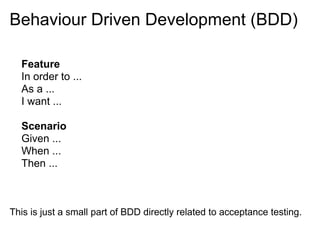
Behaviour Driven Development (BDD)

  Feature
  In order to ...
  As a ...
  I want ...

  Scenario
  Given ...
  When ...
  Then ...


This is just a small part of BDD directly related to acceptance testing.
Cucumber

BDD testing framework written in Ruby


             Cucumber + JRuby + Cuke4Duke

                             =

             BDD testing framework for the JVM


Languages: Groovy, Java, Scala, Javascript, Ioke, Ruby
Frameworks: Spring, Guice, WebDriver, Maven, Ant
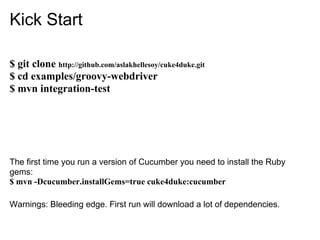
Kick Start

$ git clone http://github.com/aslakhellesoy/cuke4duke.git
$ cd examples/groovy-webdriver
$ mvn integration-test


The first time you run a version of Cucumber you need to install the Ruby
gems:
$ mvn -Dcucumber.installGems=true cuke4duke:cucumber

Warnings: Bleeding edge. First run will download a lot of dependencies.
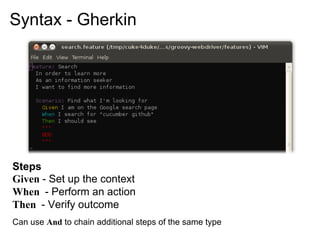
Syntax - Gherkin


Steps
Given - Set up the context
When - Perform an action
Then - Verify outcome
Can use And to chain additional steps of the same type
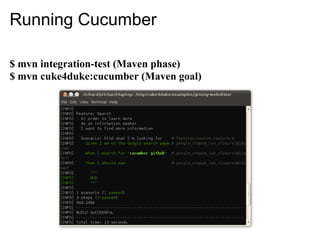
Running Cucumber

$ mvn integration-test (Maven phase)
$ mvn cuke4duke:cucumber (Maven goal)
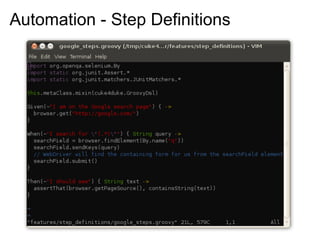
Automation - Step Definitions
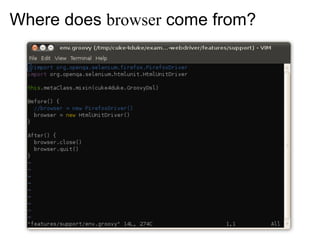
Where does browser come from?
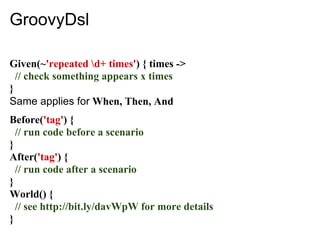
GroovyDsl

Given(~'repeated d+ times') { times ->
  // check something appears x times
}
Same applies for When, Then, And
Before('tag') {
  // run code before a scenario
}
After('tag') {
  // run code after a scenario
}
World() {
  // see http://bit.ly/davWpW for more details
}
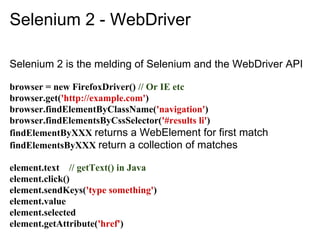
Selenium 2 - WebDriver

Selenium 2 is the melding of Selenium and the WebDriver API

browser = new FirefoxDriver() // Or IE etc
browser.get('http://example.com')
browser.findElementByClassName('navigation')
browser.findElementsByCssSelector('#results li')
findElementByXXX returns a WebElement for first match
findElementsByXXX return a collection of matches

element.text // getText() in Java
element.click()
element.sendKeys('type something')
element.value
element.selected
element.getAttribute('href')
Groovyisms - Collections

<ul>
 <li>1</li>
 <li>2</li>
 <li>3</li>
</ul>

def elements = browser.findElementsByTagName('li')
elements.text
> ['1', '2', '3']

// Check the numbers increase
elements.eachWithIndex { element, i ->
  assertThat(element.text, is(i + ''))
}
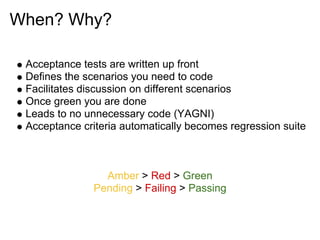
When? Why?

 Acceptance tests are written up front
 Defines the scenarios you need to code
 Facilitates discussion on different scenarios
 Once green you are done
 Leads to no unnecessary code (YAGNI)
 Acceptance criteria automatically becomes regression suite


                 Amber > Red > Green
               Pending > Failing > Passing
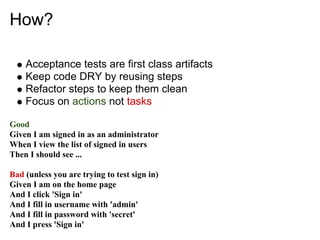
How?

    Acceptance tests are first class artifacts
    Keep code DRY by reusing steps
    Refactor steps to keep them clean
    Focus on actions not tasks

Good
Given I am signed in as an administrator
When I view the list of signed in users
Then I should see ...

Bad (unless you are trying to test sign in)
Given I am on the home page
And I click 'Sign in'
And I fill in username with 'admin'
And I fill in password with 'secret'
And I press 'Sign in'
Links

http://cukes.info/
http://wiki.github.com/aslakhellesoy/cuke4duke/
http://github.com/tpope/vim-cucumber
http://selenium.googlecode.com/svn/trunk/docs/api/java/index.html
http://www.rapaul.com/tag/bdd/

Cucumber photo (creative commons) http://www.flickr.com/photos/vizzzual-dot-
com/2738586453/


                                 Thanks!
Richard Paul
http://rapaul.com
@rapaul

Acceptance tests

  • 1.
    Agile Acceptance Tests bdd,cucumber, cuke4duke, groovy, selenium2, webdriver Richard Paul, June 2010
  • 2.
    Behaviour Driven Development(BDD) Feature In order to ... As a ... I want ... Scenario Given ... When ... Then ... This is just a small part of BDD directly related to acceptance testing.
  • 3.
    Cucumber BDD testing frameworkwritten in Ruby Cucumber + JRuby + Cuke4Duke = BDD testing framework for the JVM Languages: Groovy, Java, Scala, Javascript, Ioke, Ruby Frameworks: Spring, Guice, WebDriver, Maven, Ant
  • 4.
    Kick Start $ gitclone http://github.com/aslakhellesoy/cuke4duke.git $ cd examples/groovy-webdriver $ mvn integration-test The first time you run a version of Cucumber you need to install the Ruby gems: $ mvn -Dcucumber.installGems=true cuke4duke:cucumber Warnings: Bleeding edge. First run will download a lot of dependencies.
  • 5.
    Syntax - Gherkin Steps Given- Set up the context When - Perform an action Then - Verify outcome Can use And to chain additional steps of the same type
  • 6.
    Running Cucumber $ mvnintegration-test (Maven phase) $ mvn cuke4duke:cucumber (Maven goal)
  • 7.
    Automation - StepDefinitions
  • 8.
  • 9.
    GroovyDsl Given(~'repeated d+ times'){ times -> // check something appears x times } Same applies for When, Then, And Before('tag') { // run code before a scenario } After('tag') { // run code after a scenario } World() { // see http://bit.ly/davWpW for more details }
  • 10.
    Selenium 2 -WebDriver Selenium 2 is the melding of Selenium and the WebDriver API browser = new FirefoxDriver() // Or IE etc browser.get('http://example.com') browser.findElementByClassName('navigation') browser.findElementsByCssSelector('#results li') findElementByXXX returns a WebElement for first match findElementsByXXX return a collection of matches element.text // getText() in Java element.click() element.sendKeys('type something') element.value element.selected element.getAttribute('href')
  • 11.
    Groovyisms - Collections <ul> <li>1</li> <li>2</li> <li>3</li> </ul> def elements = browser.findElementsByTagName('li') elements.text > ['1', '2', '3'] // Check the numbers increase elements.eachWithIndex { element, i -> assertThat(element.text, is(i + '')) }
  • 12.
    When? Why? Acceptancetests are written up front Defines the scenarios you need to code Facilitates discussion on different scenarios Once green you are done Leads to no unnecessary code (YAGNI) Acceptance criteria automatically becomes regression suite Amber > Red > Green Pending > Failing > Passing
  • 13.
    How? Acceptance tests are first class artifacts Keep code DRY by reusing steps Refactor steps to keep them clean Focus on actions not tasks Good Given I am signed in as an administrator When I view the list of signed in users Then I should see ... Bad (unless you are trying to test sign in) Given I am on the home page And I click 'Sign in' And I fill in username with 'admin' And I fill in password with 'secret' And I press 'Sign in'
  • 14.