Introduction to Acceptance
Sampling
•What is Acceptance Sampling?
• A quality control process to decide on accepting or
rejecting a lot.
• Useful when inspecting every item is impractical or costly.
• To ensure products meet defined quality
standards.
• Balances inspection costs with quality control.
• Purpose of Acceptance Sampling
4.
Key Concepts
• LotQuality: Quality level of the entire batch.
• Sample Size (n): Number of items inspected.
• Acceptance Number (c): Max allowable defects for
acceptance.
• Operating Characteristic (OC) Curve: Probability of
accepting a lot based on quality.
5.
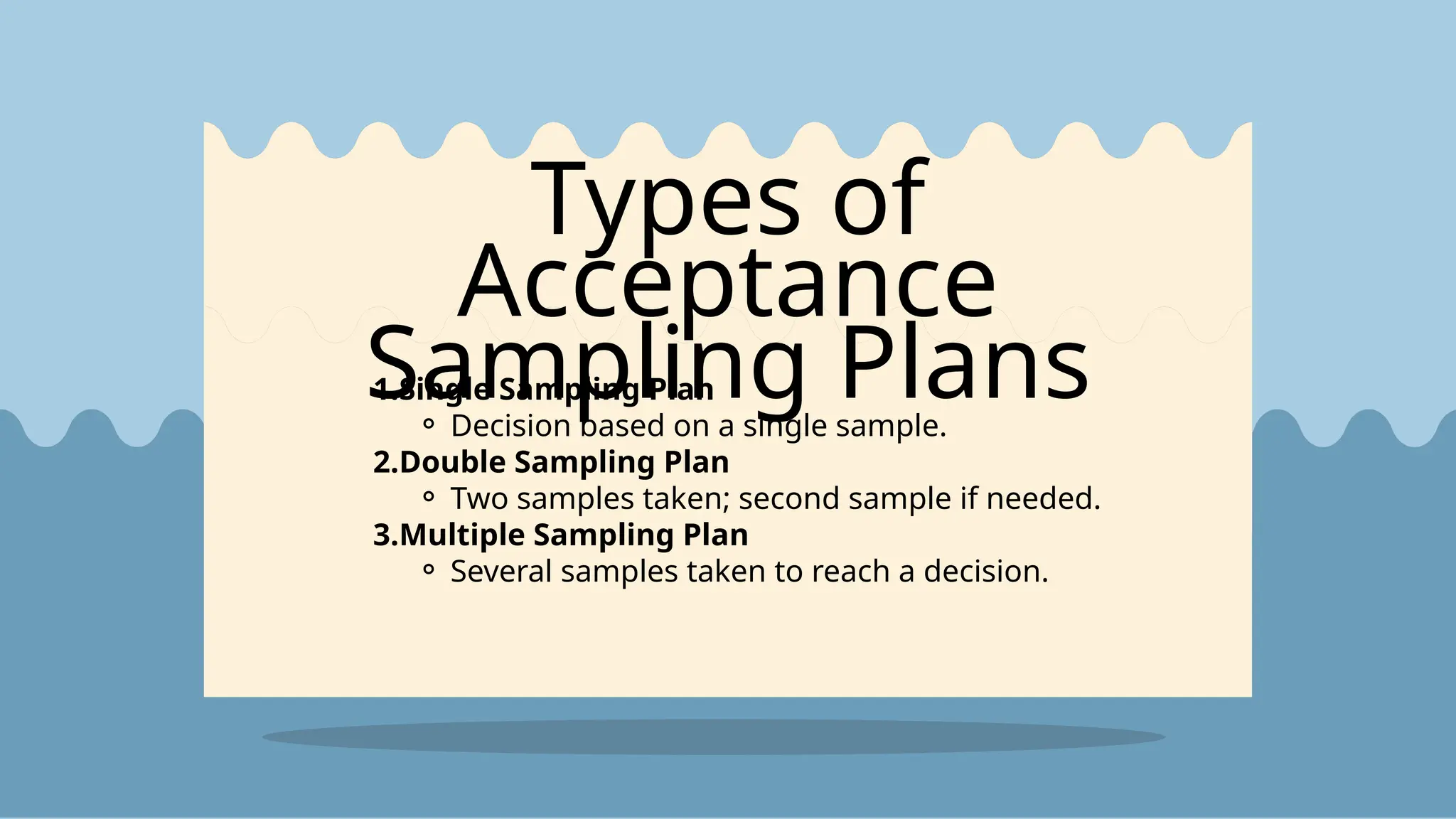
Types of
Acceptance
Sampling Plans
1.SingleSampling Plan
⚬ Decision based on a single sample.
2.Double Sampling Plan
⚬ Two samples taken; second sample if needed.
3.Multiple Sampling Plan
⚬ Several samples taken to reach a decision.
6.
Real-World Example:
Pharmaceutical
Manufacturing
• Context:Pharmaceutical companies must ensure
product quality, as defects can have severe health
impacts.
• Process: For each batch of tablets, a random sample is
tested for defects (like dosage accuracy or
contamination).
• Decision: If defects exceed the acceptable limit, the
entire batch is rejected, ensuring only quality products
reach the market.
7.
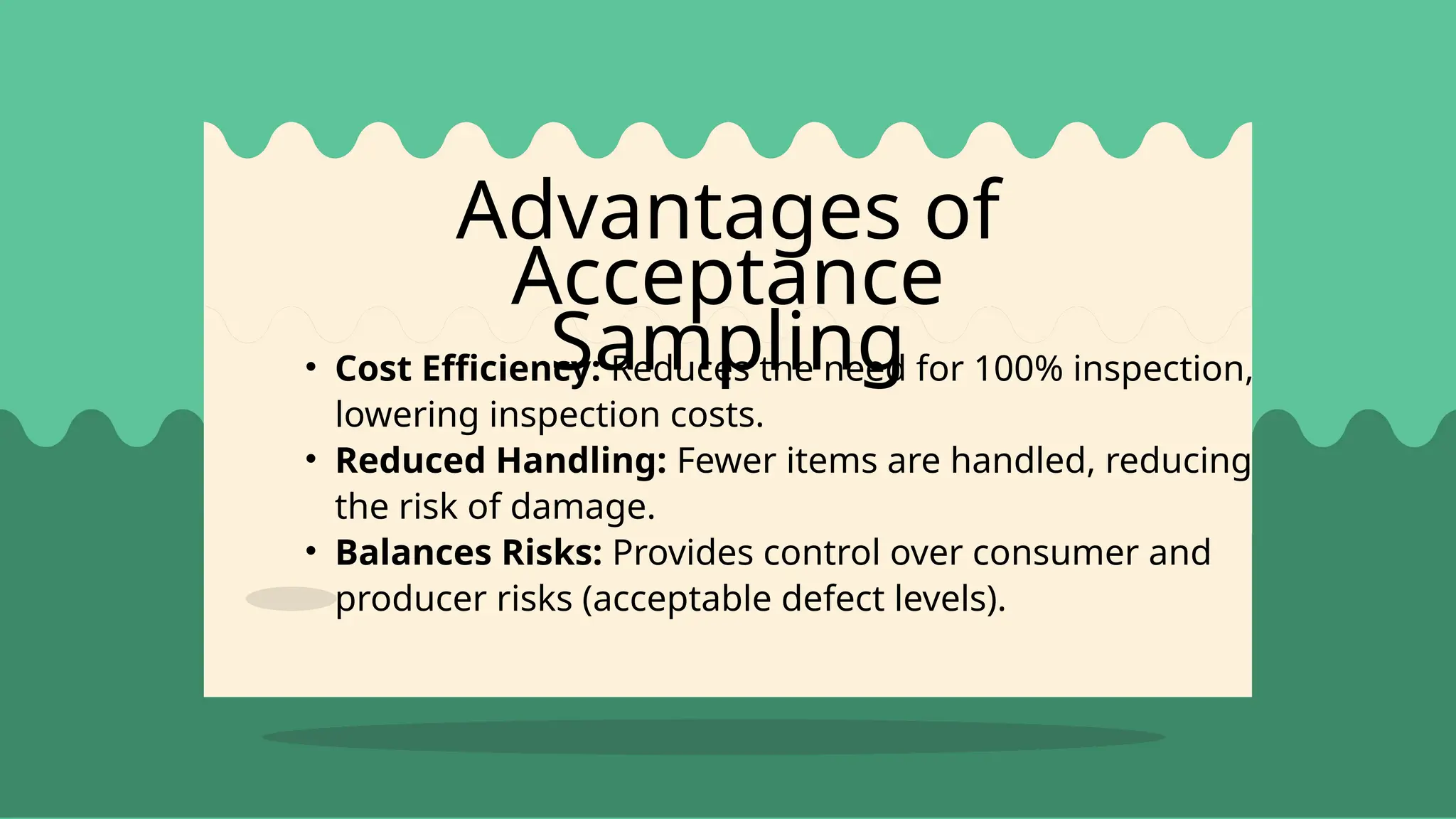
Advantages of
Acceptance
Sampling
• CostEfficiency: Reduces the need for 100% inspection,
lowering inspection costs.
• Reduced Handling: Fewer items are handled, reducing
the risk of damage.
• Balances Risks: Provides control over consumer and
producer risks (acceptable defect levels).
8.
Disadvantages of
Acceptance
Sampling
• Consumer'sRisk: Some defective items may be
accepted.
• Sampling Bias: If the sample isn’t representative,
quality conclusions may be inaccurate.
• Complexity: Requires careful planning to design an
effective sampling plan.
9.
Real-World Example:
Electronics
Manufacturing
• Context:An electronics company producing
microchips uses acceptance sampling to check for
defects.
• Process: Out of every batch of 1,000 chips, a sample of
50 is selected and tested for defects.
• Decision: If 3 or fewer defects are found, the lot is
accepted. Otherwise, the entire batch is rejected or
subjected to further inspection.
• Outcome: Ensures only high-quality components are
used in products like smartphones and computers.
10.
Operating
Characteristic (OC)
Curve
• Explanationof the OC Curve
• A graph showing the likelihood of accepting lots at various quality levels.
• Helps in designing and evaluating sampling plans.
• Usage Example: Quality managers at an automobile company use OC
curves to set acceptable quality levels for tire batches, ensuring
defective rates stay within specified limits.
11.
Applications Across
Industries
Food Industry:Sampling to ensure safety standards (e.g.,
testing for contaminants in a batch of canned foods).
Textile Manufacturing: Checking a sample of clothing items
for defects like stitching or color inconsistencies.
Automotive Industry: Inspecting a sample of vehicle parts to
maintain reliability standards (e.g., sampling airbags for
functionality).
12.
Conclusio
n
• Summary: Acceptancesampling is a cost-effective
way to maintain quality without inspecting every
item.
• Key Takeaway: While there are risks, it is widely
used to ensure products meet safety and quality
standards.
• Final Thought: Well-designed sampling plans are
crucial to balancing inspection costs and product
quality.





![AcceptanceSampling for students uni[1].ppt](https://cdn.slidesharecdn.com/ss_thumbnails/acceptancesampling1-250204230443-7d8ea06b-thumbnail.jpg?width=640&height=640&fit=bounds)


![Acceptance Sampling[1]](https://cdn.slidesharecdn.com/ss_thumbnails/acceptancesampling1-1226960943251212-8-thumbnail.jpg?width=640&height=640&fit=bounds)
![Acceptance Sampling[1]](https://cdn.slidesharecdn.com/ss_thumbnails/acceptancesampling1-1226078569232381-9-thumbnail.jpg?width=640&height=640&fit=bounds)


