Particle Accelerators
Nguyen Hong Quang
Materials Science and Metallurgy Department
Student Number: 2003437007
Email: quang_nh2002@yahoo.com
Oct 18th 2004
Outlines
• How physicists observe and study
fundamental particles
• What is a particle accelerator
• Principle machine components of accelerators
• Types of accelerators
• References
How physicists observe and study
fundamental particles
- Particle accelerators: Speed up particles to very high
energies before smashing them into other particles.
- Particle detectors: allow physicists to observe and
study the collisions.
By accelerating and smashing particles, physicists can identify
their components or create new particles, revealing the nature
of the interactions between them.
Since fundamental particles are extremely tiny, in order to see
and study them physicists need very special tools:
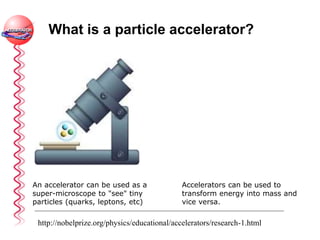
What is a particle accelerator?
Accelerators can be used to
transform energy into mass and
vice versa.
An accelerator can be used as a
super-microscope to "see" tiny
particles (quarks, leptons, etc)
http://nobelprize.org/physics/educational/accelerators/research-1.html
Accelerator as super-microscope
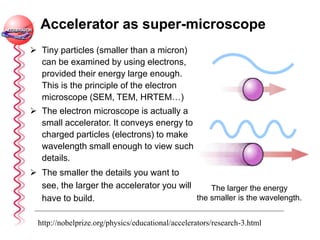
 Tiny particles (smaller than a micron)
can be examined by using electrons,
provided their energy large enough.
This is the principle of the electron
microscope (SEM, TEM, HRTEM…)
 The electron microscope is actually a
small accelerator. It conveys energy to
charged particles (electrons) to make
wavelength small enough to view such
details.
 The smaller the details you want to
see, the larger the accelerator you will
have to build.
The larger the energy
the smaller is the wavelength.
http://nobelprize.org/physics/educational/accelerators/research-3.html
Accelerator as energy transformer
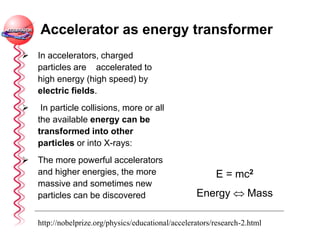
 In accelerators, charged
particles are accelerated to
high energy (high speed) by
electric fields.
 In particle collisions, more or all
the available energy can be
transformed into other
particles or into X-rays:
 The more powerful accelerators
and higher energies, the more
massive and sometimes new
particles can be discovered
E = mc2
Energy  Mass
http://nobelprize.org/physics/educational/accelerators/research-2.html
Principle machine components
of an accelerator
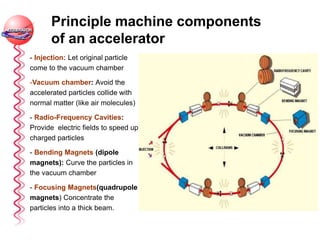
- Injection: Let original particle
come to the vacuum chamber
-Vacuum chamber: Avoid the
accelerated particles collide with
normal matter (like air molecules)
- Radio-Frequency Cavities:
Provide electric fields to speed up
charged particles
- Bending Magnets (dipole
magnets): Curve the particles in
the vacuum chamber
- Focusing Magnets(quadrupole
magnets) Concentrate the
particles into a thick beam.
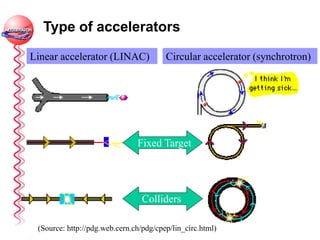
Type of accelerators
Linear accelerator (LINAC)
Fixed Target
Colliders
Circular accelerator (synchrotron)
(Source: http://pdg.web.cern.ch/pdg/cpep/lin_circ.html)
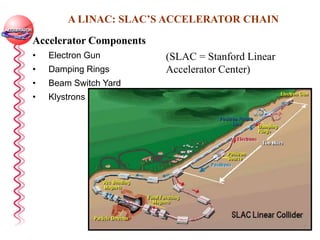
Accelerator Components
• Electron Gun
• Damping Rings
• Beam Switch Yard
• Klystrons
A LINAC: SLAC’S ACCELERATOR CHAIN
(SLAC = Stanford Linear
Accelerator Center)
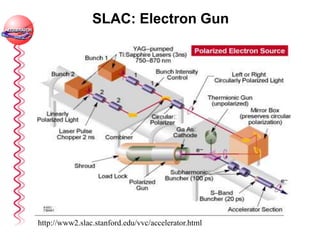
SLAC: Electron Gun
http://www2.slac.stanford.edu/vvc/accelerator.html
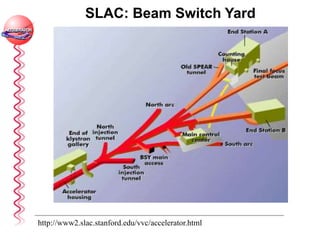
SLAC: Beam Switch Yard
http://www2.slac.stanford.edu/vvc/accelerator.html
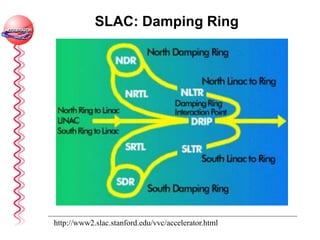
SLAC: Damping Ring
http://www2.slac.stanford.edu/vvc/accelerator.html
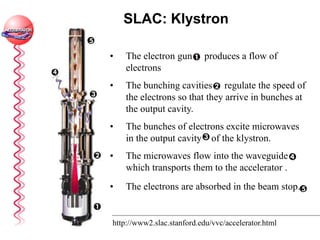
• The electron gun produces a flow of
electrons
• The bunching cavities regulate the speed of
the electrons so that they arrive in bunches at
the output cavity.
• The bunches of electrons excite microwaves
in the output cavity of the klystron.
• The microwaves flow into the waveguide ,
which transports them to the accelerator .
• The electrons are absorbed in the beam stop.
SLAC: Klystron
http://www2.slac.stanford.edu/vvc/accelerator.html
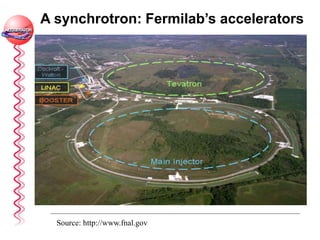
A synchrotron: Fermilab’s accelerators
Source: http://www.fnal.gov
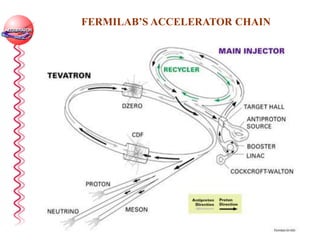
FERMILAB’S ACCELERATOR CHAIN
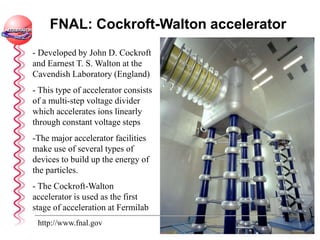
FNAL: Cockroft-Walton accelerator
- Developed by John D. Cockroft
and Earnest T. S. Walton at the
Cavendish Laboratory (England)
- This type of accelerator consists
of a multi-step voltage divider
which accelerates ions linearly
through constant voltage steps
-The major accelerator facilities
make use of several types of
devices to build up the energy of
the particles.
- The Cockroft-Walton
accelerator is used as the first
stage of acceleration at Fermilab
http://www.fnal.gov
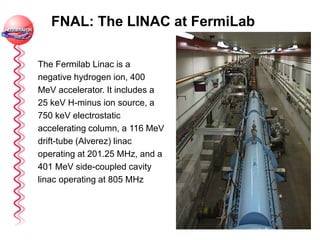
FNAL: The LINAC at FermiLab
The Fermilab Linac is a
negative hydrogen ion, 400
MeV accelerator. It includes a
25 keV H-minus ion source, a
750 keV electrostatic
accelerating column, a 116 MeV
drift-tube (Alverez) linac
operating at 201.25 MHz, and a
401 MeV side-coupled cavity
linac operating at 805 MHz
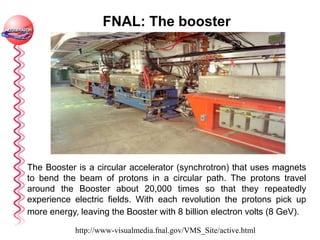
FNAL: The booster
The Booster is a circular accelerator (synchrotron) that uses magnets
to bend the beam of protons in a circular path. The protons travel
around the Booster about 20,000 times so that they repeatedly
experience electric fields. With each revolution the protons pick up
more energy, leaving the Booster with 8 billion electron volts (8 GeV).
http://www-visualmedia.fnal.gov/VMS_Site/active.html
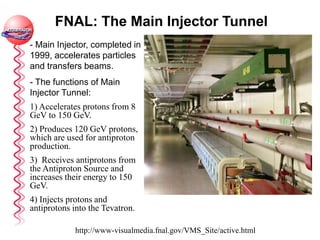
FNAL: The Main Injector Tunnel
- Main Injector, completed in
1999, accelerates particles
and transfers beams.
- The functions of Main
Injector Tunnel:
1) Accelerates protons from 8
GeV to 150 GeV.
2) Produces 120 GeV protons,
which are used for antiproton
production.
3) Receives antiprotons from
the Antiproton Source and
increases their energy to 150
GeV.
4) Injects protons and
antiprotons into the Tevatron.
http://www-visualmedia.fnal.gov/VMS_Site/active.html
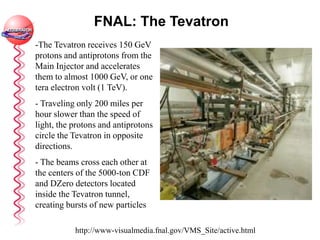
FNAL: The Tevatron
-The Tevatron receives 150 GeV
protons and antiprotons from the
Main Injector and accelerates
them to almost 1000 GeV, or one
tera electron volt (1 TeV).
- Traveling only 200 miles per
hour slower than the speed of
light, the protons and antiprotons
circle the Tevatron in opposite
directions.
- The beams cross each other at
the centers of the 5000-ton CDF
and DZero detectors located
inside the Tevatron tunnel,
creating bursts of new particles
http://www-visualmedia.fnal.gov/VMS_Site/active.html
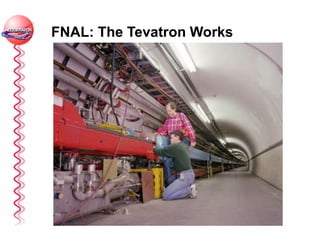
FNAL: The Tevatron Works
References
[1] Introduction to High Energy Physics, 4th Edition, Donald H. Perkin,
University of Oxford, 2000
[2] http://www.fnal.gov
[3] http:// www.cern.ch
[4] http://www.egglescliffe.org.uk/physics/particles/newfolder/acc1.html
[5] http://particleadventure.org/particleadventure/
[6] http://hands-on-cern.physto.se/
[7] http://hyperphysics.phy-astr.gsu.edu/hbase/particles/accel2.html
… and many different websites

Nuclear Accelerator

  • 1.
    Particle Accelerators Nguyen HongQuang Materials Science and Metallurgy Department Student Number: 2003437007 Email: quang_nh2002@yahoo.com Oct 18th 2004
  • 2.
    Outlines • How physicistsobserve and study fundamental particles • What is a particle accelerator • Principle machine components of accelerators • Types of accelerators • References
  • 3.
    How physicists observeand study fundamental particles - Particle accelerators: Speed up particles to very high energies before smashing them into other particles. - Particle detectors: allow physicists to observe and study the collisions. By accelerating and smashing particles, physicists can identify their components or create new particles, revealing the nature of the interactions between them. Since fundamental particles are extremely tiny, in order to see and study them physicists need very special tools:
  • 4.
    What is aparticle accelerator? Accelerators can be used to transform energy into mass and vice versa. An accelerator can be used as a super-microscope to "see" tiny particles (quarks, leptons, etc) http://nobelprize.org/physics/educational/accelerators/research-1.html
  • 5.
    Accelerator as super-microscope Tiny particles (smaller than a micron) can be examined by using electrons, provided their energy large enough. This is the principle of the electron microscope (SEM, TEM, HRTEM…)  The electron microscope is actually a small accelerator. It conveys energy to charged particles (electrons) to make wavelength small enough to view such details.  The smaller the details you want to see, the larger the accelerator you will have to build. The larger the energy the smaller is the wavelength. http://nobelprize.org/physics/educational/accelerators/research-3.html
  • 6.
    Accelerator as energytransformer  In accelerators, charged particles are accelerated to high energy (high speed) by electric fields.  In particle collisions, more or all the available energy can be transformed into other particles or into X-rays:  The more powerful accelerators and higher energies, the more massive and sometimes new particles can be discovered E = mc2 Energy  Mass http://nobelprize.org/physics/educational/accelerators/research-2.html
  • 7.
    Principle machine components ofan accelerator - Injection: Let original particle come to the vacuum chamber -Vacuum chamber: Avoid the accelerated particles collide with normal matter (like air molecules) - Radio-Frequency Cavities: Provide electric fields to speed up charged particles - Bending Magnets (dipole magnets): Curve the particles in the vacuum chamber - Focusing Magnets(quadrupole magnets) Concentrate the particles into a thick beam.
  • 8.
    Type of accelerators Linearaccelerator (LINAC) Fixed Target Colliders Circular accelerator (synchrotron) (Source: http://pdg.web.cern.ch/pdg/cpep/lin_circ.html)
  • 9.
    Accelerator Components • ElectronGun • Damping Rings • Beam Switch Yard • Klystrons A LINAC: SLAC’S ACCELERATOR CHAIN (SLAC = Stanford Linear Accelerator Center)
  • 10.
  • 11.
    SLAC: Beam SwitchYard http://www2.slac.stanford.edu/vvc/accelerator.html
  • 12.
  • 13.
    • The electrongun produces a flow of electrons • The bunching cavities regulate the speed of the electrons so that they arrive in bunches at the output cavity. • The bunches of electrons excite microwaves in the output cavity of the klystron. • The microwaves flow into the waveguide , which transports them to the accelerator . • The electrons are absorbed in the beam stop. SLAC: Klystron http://www2.slac.stanford.edu/vvc/accelerator.html
  • 14.
    A synchrotron: Fermilab’saccelerators Source: http://www.fnal.gov
  • 15.
  • 16.
    FNAL: Cockroft-Walton accelerator -Developed by John D. Cockroft and Earnest T. S. Walton at the Cavendish Laboratory (England) - This type of accelerator consists of a multi-step voltage divider which accelerates ions linearly through constant voltage steps -The major accelerator facilities make use of several types of devices to build up the energy of the particles. - The Cockroft-Walton accelerator is used as the first stage of acceleration at Fermilab http://www.fnal.gov
  • 17.
    FNAL: The LINACat FermiLab The Fermilab Linac is a negative hydrogen ion, 400 MeV accelerator. It includes a 25 keV H-minus ion source, a 750 keV electrostatic accelerating column, a 116 MeV drift-tube (Alverez) linac operating at 201.25 MHz, and a 401 MeV side-coupled cavity linac operating at 805 MHz
  • 18.
    FNAL: The booster TheBooster is a circular accelerator (synchrotron) that uses magnets to bend the beam of protons in a circular path. The protons travel around the Booster about 20,000 times so that they repeatedly experience electric fields. With each revolution the protons pick up more energy, leaving the Booster with 8 billion electron volts (8 GeV). http://www-visualmedia.fnal.gov/VMS_Site/active.html
  • 19.
    FNAL: The MainInjector Tunnel - Main Injector, completed in 1999, accelerates particles and transfers beams. - The functions of Main Injector Tunnel: 1) Accelerates protons from 8 GeV to 150 GeV. 2) Produces 120 GeV protons, which are used for antiproton production. 3) Receives antiprotons from the Antiproton Source and increases their energy to 150 GeV. 4) Injects protons and antiprotons into the Tevatron. http://www-visualmedia.fnal.gov/VMS_Site/active.html
  • 20.
    FNAL: The Tevatron -TheTevatron receives 150 GeV protons and antiprotons from the Main Injector and accelerates them to almost 1000 GeV, or one tera electron volt (1 TeV). - Traveling only 200 miles per hour slower than the speed of light, the protons and antiprotons circle the Tevatron in opposite directions. - The beams cross each other at the centers of the 5000-ton CDF and DZero detectors located inside the Tevatron tunnel, creating bursts of new particles http://www-visualmedia.fnal.gov/VMS_Site/active.html
  • 21.
  • 24.
    References [1] Introduction toHigh Energy Physics, 4th Edition, Donald H. Perkin, University of Oxford, 2000 [2] http://www.fnal.gov [3] http:// www.cern.ch [4] http://www.egglescliffe.org.uk/physics/particles/newfolder/acc1.html [5] http://particleadventure.org/particleadventure/ [6] http://hands-on-cern.physto.se/ [7] http://hyperphysics.phy-astr.gsu.edu/hbase/particles/accel2.html … and many different websites