A low cost wireless TV audio Transceiver
A LOW COST WIRELESS TV AUDIO TRANSCEIVER
Mirugwe Alex, Luweesi Givan
Makerere university, Kampala Uganda
College of Engineering Design Art and Technology
Department of Electrical and Computer Engineering
Abstract — Wireless communication is rapidly
growing, making it possible to design wireless
network systems that can constantly collect,
analyse, evaluate and validate our environment to
get more control of the factors that influence it.
With over a decade of intensive research and
development, wireless sensor network technology
has been emerging as viable solution to many
innovative applications. In this project, we have
developed a wireless TV audio transceiver
(transmitter to multiple receivers) using
microcontroller atmega 328 and nRF24L01
module. The nRF24L01 transceiver module uses
the 2.4 GHz band and it can operate with band rates
from 250 kbps up to 2 Mbps. If used in closed space
and with lower band rate its range can reach up to
100 meters.
Key words
Arduino; nRF24L01 module; LM386N;
IEEE802.15.4; Transceiver.
I. INTRODUCTION
The audio Transceiver system is a low-cost and low
power, which makes it well suitable to many
Ugandans. Unlike wired network designs, wireless
network designs create more flexibility in handling
these environmental issues. For this reason, a
wireless sensor network system that is capable of
handling this situation was implemented.
The transmitter transmits audio signals to the
receivers. The Wireless audio system operates at
Radio Frequency (RF) signals. Specifically, it
utilizes IEEE802.15.4 standard to transmit the
audio signals. The system is designed to transmit
and receive the audio signal about 2.4Ghz
frequencies. The system is powered using a 9Vdc
battery. developed over years.
IEEE standard 802.15.4 offers the fundamental
lower network layers of a Wireless Personal Area
Network (WPAN) and focuses on low-cost, low-
power communication between devices. The
system will be designed to transmit and receive the
audio signal using 2.4Ghz band. [1][3]
The transmitter converts the input analog signal
from the TV audio socket to digital signal using the
microcontroller. The digital signal will then be sent
to the nRF24L01 module which modulates it using
Gaussian Frequency Shift Keying (GFSK)
modulation scheme and transmits it at
2.4GHz.[7][8]
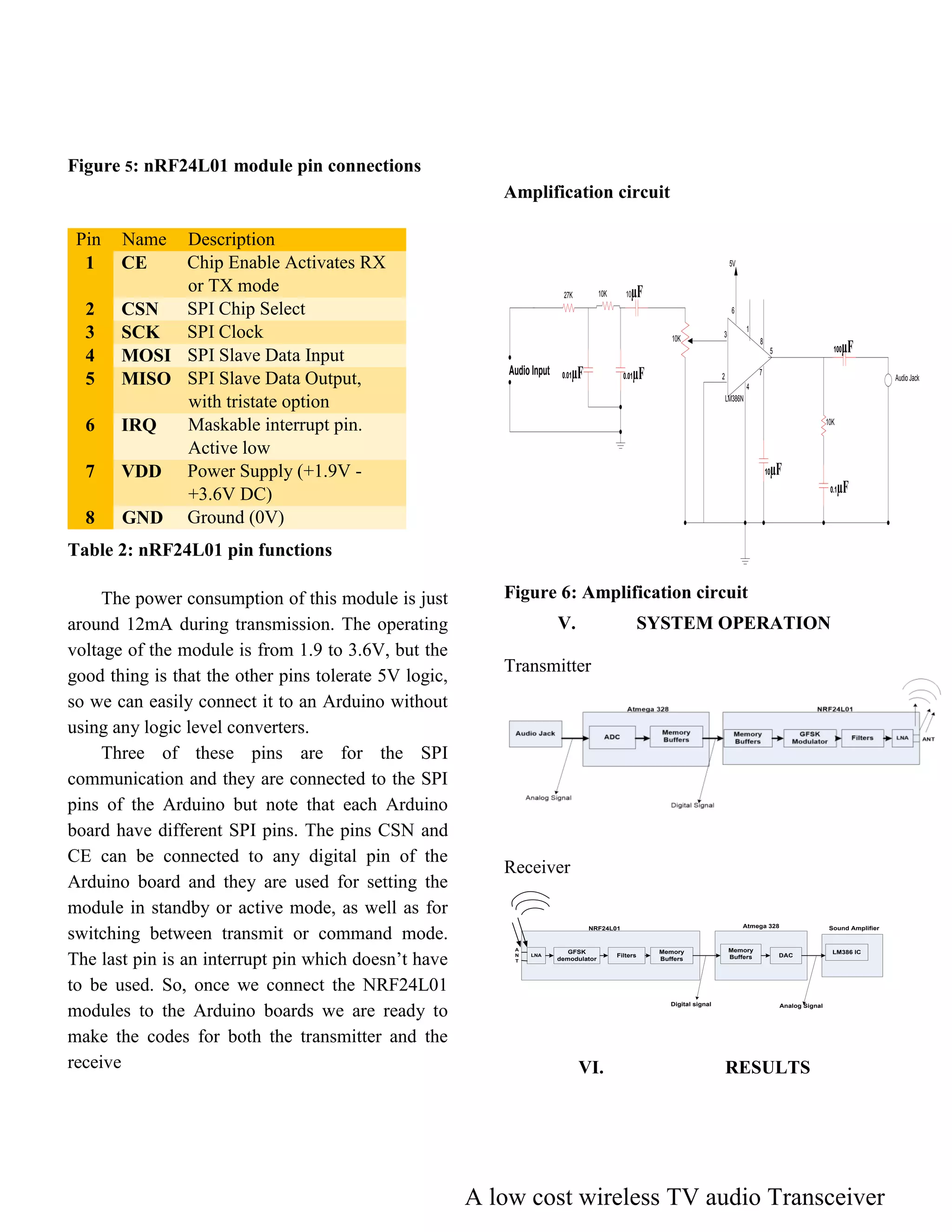
The receivers use GFSK modulation to demodulate
the digital signal received and convert it to an
analog signal using the microcontroller. The analog
signal is amplified by LM386 circuit where users
can individually modulate the volume of sound of
their preferences. LM386 is a low voltage audio
amplifier and frequently used in battery powered
music devices.
A low cost wireless TV audio Transceiver
II. RELATED W ORK
Recently, many developments have been made in
wireless audio transmission over the years. These
systems have been developed by the use of
Bluetooth technology. Bluetooth comes with a
number of drawback;
 Modules implementing Bluetooth
technology (e.g. HC-05, HC-06 Bluetooth
modules) are very expensive making such
system inaccessible by many Ugandans (the
cost range between $35 to $100)
 Also, these kinds of systems only work
with dedicated headphones, where one
cannot use any kind of headphones.
 They support one user at a time.
 Bluetooth shortens battery life, since it
continuously scans for signals looking for
new devices to connect with but using
energy in the process.
We are developing a low-cost audio transceiver
system using IEEE802.15.4 instead of
IEEE802.15.1 being used currently. This project is
designed to solve these problems.
Comparison between IEEE 802.15.4 standard and
Bluetooth IEEE802.15.1 standard [2][3][4]
IEEE802.15.4 IEEE.802.15.1
(BLUETOOTH)
Low power
consumption
drains (20- 50 μA)
Relatively high power
for a short transmission
range. (1mA-60mA)
Nodes take a short time
to synchronize to
network when returning
from sleep mode, which
decreases average
system power.
Nodes take a long time
to synchronize to
network when returning
from sleep mode, which
increases average
system power.
IEEE 802.15.4 addresses
the needs of Low-Rate
Wireless Personal Area
Networks (LR-WPAN).
It’s mainly for High
Rate Wireless Personal
Area Networks
It provides a coverage of
100m
The coverage is <50m
Table 1 Comparison between IEEE 802.15.4
standard and Bluetooth IEEE802.15.1 standard
III. Protocol (IEEE80.15.4) architecture
Devices are conceived to interact with each other
over a conceptually simple wireless network. The
definition of the network layers is based on the
ISO model; although only the lower layers are
defined in the standard, interaction with upper
layers in intended, possibly using an
IEEE802.15.2 logical link control sublayer
accessing the MAC through a convergence
sublayer. Implementations may rely on external
devices or be purely embedded, self-functioning
devices.[2][4][5]
A low cost wireless TV audio Transceiver
Figure 1 IEEE802.15.4 Protocol architecture
IV. SYSTEM IMPLEMENTATION
The audio transceiver system consists of the
transmitter, receivers and amplification circuits.
The transceiver is designed using an nRF24L01
module. The nRF24L01 is capable of acting as a
multi-Ceiver, listening to 6 other devices.[7][9]
Figure 2 nRF24L01 multiple connections
The diagrams below show the block circuits of our
system.
Transmitter block circuit diagram
Oscillator
Voltage
Regulator
SW
LED
NRF24L01
Atmega
328
Microcontroller
5V
3.3V
CSK
MOSI
19
18
17
23
22
MISO
CE
CSN
13
14
22pF
22pF
Audio input
10
9
8
7
GND
10k
1
5V
Voltage
Regulator
1000µF
9V
Figure 3: Transmitter circuit connections
The transmitter’s block diagram is shown in
Figure above consists of a microcontroller (At-
mega 328), nRF24L01, capacitors, resistors, an
oscillator, voltage regulators and audio input pin.
The is plugged into the audio jack of a TV, which
supplies the audio signal that will be modulated
and transmitted. The audio signal is transmitted
wirelessly to the receiver.
The receiver block circuit
Oscillator
Voltage
Regulator
SW
LED
NRF24L01
Atmega
328
Microcontroller
5V
3.3V
CSK
MOSI
19
18
17
MISO
CE
CSN
13
14
22pF
22pF
Audio Output
10
9
8
7
GND
10k
1
5V
Voltage
Regulator
15
16
1000uF
9V
Figure 4: Receiver circuit connections
PIN FUNCTIONS OF nRF MODULE
A low cost wireless TV audio Transceiver
Figure 5: nRF24L01 module pin connections
Pin Name Description
1 CE Chip Enable Activates RX
or TX mode
2 CSN SPI Chip Select
3 SCK SPI Clock
4 MOSI SPI Slave Data Input
5 MISO SPI Slave Data Output,
with tristate option
6 IRQ Maskable interrupt pin.
Active low
7 VDD Power Supply (+1.9V -
+3.6V DC)
8 GND Ground (0V)
Table 2: nRF24L01 pin functions
The power consumption of this module is just
around 12mA during transmission. The operating
voltage of the module is from 1.9 to 3.6V, but the
good thing is that the other pins tolerate 5V logic,
so we can easily connect it to an Arduino without
using any logic level converters.
Three of these pins are for the SPI
communication and they are connected to the SPI
pins of the Arduino but note that each Arduino
board have different SPI pins. The pins CSN and
CE can be connected to any digital pin of the
Arduino board and they are used for setting the
module in standby or active mode, as well as for
switching between transmit or command mode.
The last pin is an interrupt pin which doesn’t have
to be used. So, once we connect the NRF24L01
modules to the Arduino boards we are ready to
make the codes for both the transmitter and the
receive
Amplification circuit
LM386N
5V
6
1
8
72
3
100µF
10K
0.1µF
10µF
10K
10µF10K
0.01µF0.01µF
27K
Audio Jack
4
5
Audio Input
Figure 6: Amplification circuit
V. SYSTEM OPERATION
Transmitter
Receiver
VI. RESULTS
Memory
Buffers
GFSK
demodulator
FiltersLNA
NRF24L01
Memory
Buffers DAC
LM386 IC
Atmega 328 Sound Amplifier
A
N
T
Digital signal Analog Signal
A low cost wireless TV audio Transceiver
Distance of Transmission
Area IEEE802.15.4 IEEE802.1.1
Outdoor
Open-space 150 49m
Indoor
Open-space 90m 31m
Thick-walls 1m 0m
Through
Glasses
40m 19m
IEEE802.15.4 is better than
IEEE802.15.1(Bluetooth) in terms of distance
coverage.
VII. CONCLUSION
In this paper, we study the different issue of
Wireless Audio transmission technologies and
compare different IEEE 802.15 standard and
studied their differences on the basis of their basic
characteristic, application, limitation and use.
REFERENCES
[1] K. a. A. Levesque, Wireless Information
Networks. John Wiley & Sons, 1995.
[2] A. Sable, “Comparative Study on IEEE
Standard of WPAN 802.15.1/ 3/ 4,” Int. J.
Res. Emerg. Sci. Technol., vol. 1, no. 1, pp.
25–28, 2014.
[3] A. P. Patel, “Bluetooth security issues,” Int. J.
Comput. Sci. Informartion Technol., vol. 6,
no. 5295–5299, p. 5, 2015.
[4] A. F. Molisch et al., “IEEE 802.15.4a
Channel Model - Final Report,” Ieee P802,
vol. 15, no. 04, pp. 1–40, 2004.
[5] Digi International, “XBee ® & XBee-PRO ®
ZB Serie2,” p. 2, 2011.
[6] J. M. Tjensvold, “Comparison of the IEEE
802.11, 802.15.1, 802.15.4 and 802.15.6
wireless standards,” J. Antimicrob.
Chemother., no. 1, pp. 1–7, 2007.
[7] P. Specification, G. Description, and Q. R.
Data, “Single chip 2.4 GHz Transceiver,”
Evaluation, no. June, pp. 1–39, 2004.
[8] S. H. Gerez, Implementation of Digital
Signal Processing : Some Background on
GFSK Modulation, vol. 2, no. 1. 2016.
[9] M. Field and A. Bruce, “NRF24L01 +
RADIO AND MICROCONTROLLERS
Submitted by Master of Engineering
Program,” no. May, 2017.

Academic paper

  • 1.
    A low costwireless TV audio Transceiver A LOW COST WIRELESS TV AUDIO TRANSCEIVER Mirugwe Alex, Luweesi Givan Makerere university, Kampala Uganda College of Engineering Design Art and Technology Department of Electrical and Computer Engineering Abstract — Wireless communication is rapidly growing, making it possible to design wireless network systems that can constantly collect, analyse, evaluate and validate our environment to get more control of the factors that influence it. With over a decade of intensive research and development, wireless sensor network technology has been emerging as viable solution to many innovative applications. In this project, we have developed a wireless TV audio transceiver (transmitter to multiple receivers) using microcontroller atmega 328 and nRF24L01 module. The nRF24L01 transceiver module uses the 2.4 GHz band and it can operate with band rates from 250 kbps up to 2 Mbps. If used in closed space and with lower band rate its range can reach up to 100 meters. Key words Arduino; nRF24L01 module; LM386N; IEEE802.15.4; Transceiver. I. INTRODUCTION The audio Transceiver system is a low-cost and low power, which makes it well suitable to many Ugandans. Unlike wired network designs, wireless network designs create more flexibility in handling these environmental issues. For this reason, a wireless sensor network system that is capable of handling this situation was implemented. The transmitter transmits audio signals to the receivers. The Wireless audio system operates at Radio Frequency (RF) signals. Specifically, it utilizes IEEE802.15.4 standard to transmit the audio signals. The system is designed to transmit and receive the audio signal about 2.4Ghz frequencies. The system is powered using a 9Vdc battery. developed over years. IEEE standard 802.15.4 offers the fundamental lower network layers of a Wireless Personal Area Network (WPAN) and focuses on low-cost, low- power communication between devices. The system will be designed to transmit and receive the audio signal using 2.4Ghz band. [1][3] The transmitter converts the input analog signal from the TV audio socket to digital signal using the microcontroller. The digital signal will then be sent to the nRF24L01 module which modulates it using Gaussian Frequency Shift Keying (GFSK) modulation scheme and transmits it at 2.4GHz.[7][8] The receivers use GFSK modulation to demodulate the digital signal received and convert it to an analog signal using the microcontroller. The analog signal is amplified by LM386 circuit where users can individually modulate the volume of sound of their preferences. LM386 is a low voltage audio amplifier and frequently used in battery powered music devices.
  • 2.
    A low costwireless TV audio Transceiver II. RELATED W ORK Recently, many developments have been made in wireless audio transmission over the years. These systems have been developed by the use of Bluetooth technology. Bluetooth comes with a number of drawback;  Modules implementing Bluetooth technology (e.g. HC-05, HC-06 Bluetooth modules) are very expensive making such system inaccessible by many Ugandans (the cost range between $35 to $100)  Also, these kinds of systems only work with dedicated headphones, where one cannot use any kind of headphones.  They support one user at a time.  Bluetooth shortens battery life, since it continuously scans for signals looking for new devices to connect with but using energy in the process. We are developing a low-cost audio transceiver system using IEEE802.15.4 instead of IEEE802.15.1 being used currently. This project is designed to solve these problems. Comparison between IEEE 802.15.4 standard and Bluetooth IEEE802.15.1 standard [2][3][4] IEEE802.15.4 IEEE.802.15.1 (BLUETOOTH) Low power consumption drains (20- 50 μA) Relatively high power for a short transmission range. (1mA-60mA) Nodes take a short time to synchronize to network when returning from sleep mode, which decreases average system power. Nodes take a long time to synchronize to network when returning from sleep mode, which increases average system power. IEEE 802.15.4 addresses the needs of Low-Rate Wireless Personal Area Networks (LR-WPAN). It’s mainly for High Rate Wireless Personal Area Networks It provides a coverage of 100m The coverage is <50m Table 1 Comparison between IEEE 802.15.4 standard and Bluetooth IEEE802.15.1 standard III. Protocol (IEEE80.15.4) architecture Devices are conceived to interact with each other over a conceptually simple wireless network. The definition of the network layers is based on the ISO model; although only the lower layers are defined in the standard, interaction with upper layers in intended, possibly using an IEEE802.15.2 logical link control sublayer accessing the MAC through a convergence sublayer. Implementations may rely on external devices or be purely embedded, self-functioning devices.[2][4][5]
  • 3.
    A low costwireless TV audio Transceiver Figure 1 IEEE802.15.4 Protocol architecture IV. SYSTEM IMPLEMENTATION The audio transceiver system consists of the transmitter, receivers and amplification circuits. The transceiver is designed using an nRF24L01 module. The nRF24L01 is capable of acting as a multi-Ceiver, listening to 6 other devices.[7][9] Figure 2 nRF24L01 multiple connections The diagrams below show the block circuits of our system. Transmitter block circuit diagram Oscillator Voltage Regulator SW LED NRF24L01 Atmega 328 Microcontroller 5V 3.3V CSK MOSI 19 18 17 23 22 MISO CE CSN 13 14 22pF 22pF Audio input 10 9 8 7 GND 10k 1 5V Voltage Regulator 1000µF 9V Figure 3: Transmitter circuit connections The transmitter’s block diagram is shown in Figure above consists of a microcontroller (At- mega 328), nRF24L01, capacitors, resistors, an oscillator, voltage regulators and audio input pin. The is plugged into the audio jack of a TV, which supplies the audio signal that will be modulated and transmitted. The audio signal is transmitted wirelessly to the receiver. The receiver block circuit Oscillator Voltage Regulator SW LED NRF24L01 Atmega 328 Microcontroller 5V 3.3V CSK MOSI 19 18 17 MISO CE CSN 13 14 22pF 22pF Audio Output 10 9 8 7 GND 10k 1 5V Voltage Regulator 15 16 1000uF 9V Figure 4: Receiver circuit connections PIN FUNCTIONS OF nRF MODULE
  • 4.
    A low costwireless TV audio Transceiver Figure 5: nRF24L01 module pin connections Pin Name Description 1 CE Chip Enable Activates RX or TX mode 2 CSN SPI Chip Select 3 SCK SPI Clock 4 MOSI SPI Slave Data Input 5 MISO SPI Slave Data Output, with tristate option 6 IRQ Maskable interrupt pin. Active low 7 VDD Power Supply (+1.9V - +3.6V DC) 8 GND Ground (0V) Table 2: nRF24L01 pin functions The power consumption of this module is just around 12mA during transmission. The operating voltage of the module is from 1.9 to 3.6V, but the good thing is that the other pins tolerate 5V logic, so we can easily connect it to an Arduino without using any logic level converters. Three of these pins are for the SPI communication and they are connected to the SPI pins of the Arduino but note that each Arduino board have different SPI pins. The pins CSN and CE can be connected to any digital pin of the Arduino board and they are used for setting the module in standby or active mode, as well as for switching between transmit or command mode. The last pin is an interrupt pin which doesn’t have to be used. So, once we connect the NRF24L01 modules to the Arduino boards we are ready to make the codes for both the transmitter and the receive Amplification circuit LM386N 5V 6 1 8 72 3 100µF 10K 0.1µF 10µF 10K 10µF10K 0.01µF0.01µF 27K Audio Jack 4 5 Audio Input Figure 6: Amplification circuit V. SYSTEM OPERATION Transmitter Receiver VI. RESULTS Memory Buffers GFSK demodulator FiltersLNA NRF24L01 Memory Buffers DAC LM386 IC Atmega 328 Sound Amplifier A N T Digital signal Analog Signal
  • 5.
    A low costwireless TV audio Transceiver Distance of Transmission Area IEEE802.15.4 IEEE802.1.1 Outdoor Open-space 150 49m Indoor Open-space 90m 31m Thick-walls 1m 0m Through Glasses 40m 19m IEEE802.15.4 is better than IEEE802.15.1(Bluetooth) in terms of distance coverage. VII. CONCLUSION In this paper, we study the different issue of Wireless Audio transmission technologies and compare different IEEE 802.15 standard and studied their differences on the basis of their basic characteristic, application, limitation and use. REFERENCES [1] K. a. A. Levesque, Wireless Information Networks. John Wiley & Sons, 1995. [2] A. Sable, “Comparative Study on IEEE Standard of WPAN 802.15.1/ 3/ 4,” Int. J. Res. Emerg. Sci. Technol., vol. 1, no. 1, pp. 25–28, 2014. [3] A. P. Patel, “Bluetooth security issues,” Int. J. Comput. Sci. Informartion Technol., vol. 6, no. 5295–5299, p. 5, 2015. [4] A. F. Molisch et al., “IEEE 802.15.4a Channel Model - Final Report,” Ieee P802, vol. 15, no. 04, pp. 1–40, 2004. [5] Digi International, “XBee ® & XBee-PRO ® ZB Serie2,” p. 2, 2011. [6] J. M. Tjensvold, “Comparison of the IEEE 802.11, 802.15.1, 802.15.4 and 802.15.6 wireless standards,” J. Antimicrob. Chemother., no. 1, pp. 1–7, 2007. [7] P. Specification, G. Description, and Q. R. Data, “Single chip 2.4 GHz Transceiver,” Evaluation, no. June, pp. 1–39, 2004. [8] S. H. Gerez, Implementation of Digital Signal Processing : Some Background on GFSK Modulation, vol. 2, no. 1. 2016. [9] M. Field and A. Bruce, “NRF24L01 + RADIO AND MICROCONTROLLERS Submitted by Master of Engineering Program,” no. May, 2017.