Health Care Reform January 12, 2009
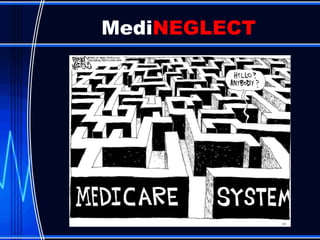
Medi NEGLECT
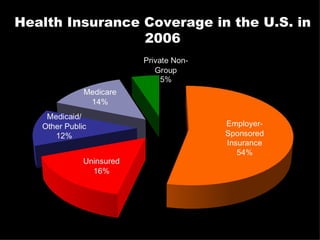
Health Insurance Coverage in the U.S. in 2006
Medicare is a social insurance program that provides health coverage to individuals, without regard to their income or health status 16%  are  under 65  and  permanently disabled What is Medicare?
Fee-for-service (FFS) or private health plans (HMOs, PPOs) Advantage plans generally provide all benefits covered under traditional Medicare, but many plans offer additional benefits How are benefits provided?
Video
 
10.1 million  beneficiaries are now enrolled in a Medicare Advantage plan, up from 5.3 million in 2003 Government pays  113%  more for beneficiaries enrolled in Medicare Advantage than for beneficiaries in traditional Medicare in 2008 Quick Facts on Medicare
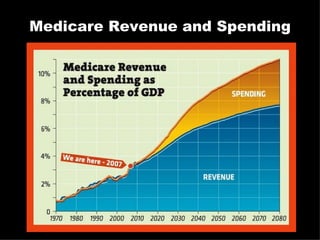
By 2019, there will be insufficient funds in the Medicare Part A (Hospital Insurance) Trust Fund to pay for benefits Current benefit levels cannot be sustained without additional revenue Financing Care for Future Generations
Medicare Revenue and Spending
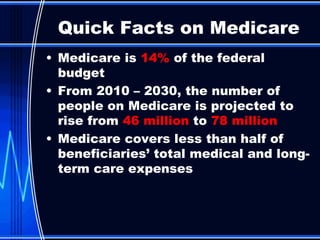
Medicare is  14%  of the federal budget From 2010 – 2030, the number of people on Medicare is projected to rise from  46 million  to  78 million Medicare covers less than half of beneficiaries’ total medical and long-term care expenses Quick Facts on Medicare
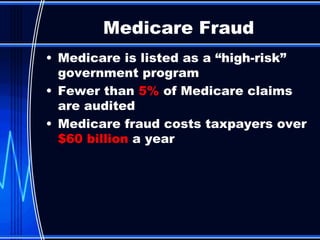
Medicare is listed as a “high-risk” government program Fewer than  5%  of Medicare claims are audited Medicare fraud costs taxpayers over  $60 billion  a year Medicare Fraud
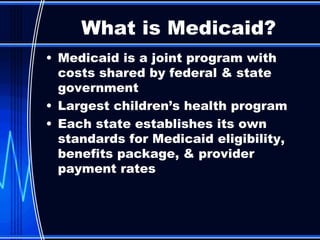
Medicaid is a joint program with costs shared by federal & state government  Largest children’s health program Each state establishes its own standards for Medicaid eligibility, benefits package, & provider payment rates  What is Medicaid?
Medicare is a federal program that covers 43 million senior citizens and retirees over 65 Medicaid is a program designed to provide health coverage for children Medicaid and Medicare share other costs associated with “dual eligibles”- people who qualify for both programs Is Medicaid the same as Medicare?
3  in every  10  American children are enrolled in Medicaid Over  ½  of Medicaid enrollees are  children Medicaid serves over  24 million Each state establishes its own standards for Medicaid eligibility Quick Facts on Medicaid
So what do Medicare and Medicaid cost?
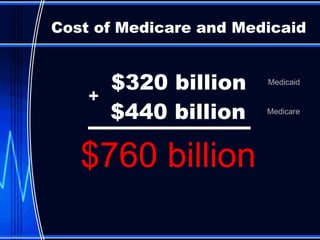
$320 billion Cost of Medicare and Medicaid Medicaid Medicare + $440 billion $760 billion
Video
 
47 Million Americans 1.3 million full-time workers lost  coverage in 2006 37.7 million workers uninsured in 2006 because their businesses did not provide quality coverage Who are the uninsured?
Uninsured are paying “up front” 20% of uninsured say their usual source of care is the emergency room Deaths among uninsured adults 25-64 is 18,000 a year How does being uninsured harm individuals and families?
US spends  $100 billion  per year to provide uninsured residents with health services Hospitals provide  $34 billion  worth of uncompensated care a year An additional  $37 billion  is paid by private and public payers for health services for the uninsured and  $26 billion  is paid out-of-pocket by those who lack coverage How it Affects You
The US has spent  $656.1 billion  on the war in Iraq to date With the money spent on the Iraq war, the US could insure  193,370,980   people with health care for one year How it Affects You (con’t)
So how can we fix the Health Care Crisis?

Health Care Reform

  • 1.
    Health Care ReformJanuary 12, 2009
  • 2.
  • 3.
    Health Insurance Coveragein the U.S. in 2006
  • 4.
    Medicare is asocial insurance program that provides health coverage to individuals, without regard to their income or health status 16% are under 65 and permanently disabled What is Medicare?
  • 5.
    Fee-for-service (FFS) orprivate health plans (HMOs, PPOs) Advantage plans generally provide all benefits covered under traditional Medicare, but many plans offer additional benefits How are benefits provided?
  • 6.
  • 7.
  • 8.
    10.1 million beneficiaries are now enrolled in a Medicare Advantage plan, up from 5.3 million in 2003 Government pays 113% more for beneficiaries enrolled in Medicare Advantage than for beneficiaries in traditional Medicare in 2008 Quick Facts on Medicare
  • 9.
    By 2019, therewill be insufficient funds in the Medicare Part A (Hospital Insurance) Trust Fund to pay for benefits Current benefit levels cannot be sustained without additional revenue Financing Care for Future Generations
  • 10.
  • 11.
    Medicare is 14% of the federal budget From 2010 – 2030, the number of people on Medicare is projected to rise from 46 million to 78 million Medicare covers less than half of beneficiaries’ total medical and long-term care expenses Quick Facts on Medicare
  • 12.
    Medicare is listedas a “high-risk” government program Fewer than 5% of Medicare claims are audited Medicare fraud costs taxpayers over $60 billion a year Medicare Fraud
  • 13.
    Medicaid is ajoint program with costs shared by federal & state government Largest children’s health program Each state establishes its own standards for Medicaid eligibility, benefits package, & provider payment rates What is Medicaid?
  • 14.
    Medicare is afederal program that covers 43 million senior citizens and retirees over 65 Medicaid is a program designed to provide health coverage for children Medicaid and Medicare share other costs associated with “dual eligibles”- people who qualify for both programs Is Medicaid the same as Medicare?
  • 15.
    3 inevery 10 American children are enrolled in Medicaid Over ½ of Medicaid enrollees are children Medicaid serves over 24 million Each state establishes its own standards for Medicaid eligibility Quick Facts on Medicaid
  • 16.
    So what doMedicare and Medicaid cost?
  • 17.
    $320 billion Costof Medicare and Medicaid Medicaid Medicare + $440 billion $760 billion
  • 18.
  • 19.
  • 20.
    47 Million Americans1.3 million full-time workers lost coverage in 2006 37.7 million workers uninsured in 2006 because their businesses did not provide quality coverage Who are the uninsured?
  • 21.
    Uninsured are paying“up front” 20% of uninsured say their usual source of care is the emergency room Deaths among uninsured adults 25-64 is 18,000 a year How does being uninsured harm individuals and families?
  • 22.
    US spends $100 billion per year to provide uninsured residents with health services Hospitals provide $34 billion worth of uncompensated care a year An additional $37 billion is paid by private and public payers for health services for the uninsured and $26 billion is paid out-of-pocket by those who lack coverage How it Affects You
  • 23.
    The US hasspent $656.1 billion on the war in Iraq to date With the money spent on the Iraq war, the US could insure 193,370,980 people with health care for one year How it Affects You (con’t)
  • 24.
    So how canwe fix the Health Care Crisis?