Abstract Data Types&
Algorithm Analysis
A comprehensive guide to fundamental concepts in data structures, object-
oriented programming, and algorithm complexity for computer science students
and early-career software engineers.
2.
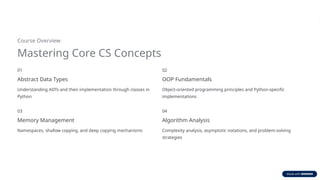
Course Overview
Mastering CoreCS Concepts
01
Abstract Data Types
Understanding ADTs and their implementation through classes in
Python
02
OOP Fundamentals
Object-oriented programming principles and Python-specific
implementations
03
Memory Management
Namespaces, shallow copying, and deep copying mechanisms
04
Algorithm Analysis
Complexity analysis, asymptotic notations, and problem-solving
strategies
3.
Abstract Data Types(ADTs)
An Abstract Data Type is a mathematical model that defines a data type by
its behavior from the user's perspective. ADTs specify what operations can
be performed, not how they are implemented.
Key Characteristics
• Data encapsulation and information hiding
• Interface-focused design separating specification from implementation
• Operations defined through preconditions and postconditions
• Implementation independence allowing flexibility
Common ADT Examples
Lists, stacks, queues, sets, maps, trees, and graphs each define specific
operations while hiding internal representation details.
4.
Implementing ADTs withPython Classes
Python classes provide the perfect mechanism for implementing Abstract Data Types. By defining methods that correspond to ADT operations, we create concrete implementations that maintain
the abstraction principle.
Class Definition
Use class keyword to define the structure and
encapsulate data with attributes
Methods
Implement ADT operations as class methods with clear
interfaces and documentation
Encapsulation
Use naming conventions like _private to hide
implementation details from users
class Stack: def __init__(self): self._items = [] # Hidden implementation def push(self, item): """Add item to top of stack""" self._items.append(item) def pop(self): """Remove and return top
item""" if not self.is_empty(): return self._items.pop() raise IndexError("Pop from empty stack") def is_empty(self): """Check if stack is empty""" return len(self._items) == 0
5.
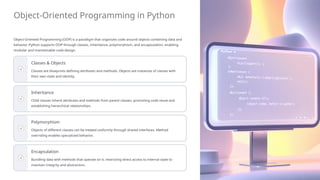
Object-Oriented Programming inPython
Object-Oriented Programming (OOP) is a paradigm that organizes code around objects combining data and
behavior. Python supports OOP through classes, inheritance, polymorphism, and encapsulation, enabling
modular and maintainable code design.
Classes & Objects
Classes are blueprints defining attributes and methods. Objects are instances of classes with
their own state and identity.
Inheritance
Child classes inherit attributes and methods from parent classes, promoting code reuse and
establishing hierarchical relationships.
Polymorphism
Objects of different classes can be treated uniformly through shared interfaces. Method
overriding enables specialized behavior.
Encapsulation
Bundling data with methods that operate on it, restricting direct access to internal state to
maintain integrity and abstraction.
6.
Understanding Namespaces
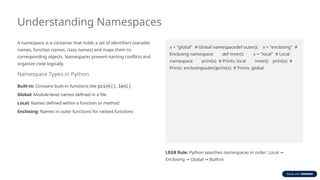
A namespaceis a container that holds a set of identifiers (variable
names, function names, class names) and maps them to
corresponding objects. Namespaces prevent naming conflicts and
organize code logically.
Namespace Types in Python
Built-in: Contains built-in functions like print(), len()
Global: Module-level names defined in a file
Local: Names defined within a function or method
Enclosing: Names in outer functions for nested functions
x = "global" # Global namespacedef outer(): x = "enclosing" #
Enclosing namespace def inner(): x = "local" # Local
namespace print(x) # Prints: local inner() print(x) #
Prints: enclosingouter()print(x) # Prints: global
LEGB Rule: Python searches namespaces in order: Local →
Enclosing Global Built-in
→ →
7.
Shallow vs. DeepCopying
Understanding the difference between shallow and deep copying is crucial for managing mutable objects in Python. Incorrect copying can lead to unintended side effects when
objects share references to nested structures.
Shallow Copy
Creates a new object but inserts references to objects found in the original.
Changes to nested mutable objects affect both copies.
import copyoriginal = [[1, 2], [3, 4]]shallow = copy.copy(original)shallow[0][0] =
99# original is now [[99, 2], [3, 4]]
Deep Copy
Creates a new object and recursively copies all objects found in the original.
Changes to nested objects don't affect the original.
import copyoriginal = [[1, 2], [3, 4]]deep = copy.deepcopy(original)deep[0][0] =
99# original remains [[1, 2], [3, 4]]
8.
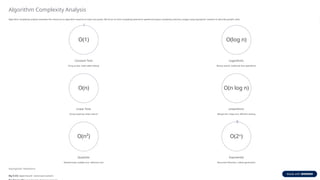
Algorithm Complexity Analysis
Algorithmcomplexity analysis evaluates the resources an algorithm requires as input size grows. We focus on time complexity (execution speed) and space complexity (memory usage) using asymptotic notation to describe growth rates.
O(1)
Constant Time
Array access, hash table lookup
O(log n)
Logarithmic
Binary search, balanced tree operations
O(n)
Linear Time
Array traversal, linear search
O(n log n)
Linearithmic
Merge sort, heap sort, efficient sorting
O(n²)
Quadratic
Nested loops, bubble sort, selection sort
O(2ⁿ)
Exponential
Recursive Fibonacci, subset generation
Asymptotic Notations
Big O (O): Upper bound - worst-case scenario
9.
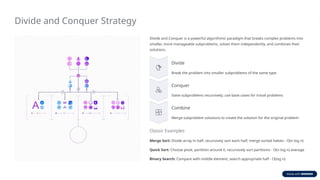
Divide and ConquerStrategy
Divide and Conquer is a powerful algorithmic paradigm that breaks complex problems into
smaller, more manageable subproblems, solves them independently, and combines their
solutions.
Divide
Break the problem into smaller subproblems of the same type
Conquer
Solve subproblems recursively; use base cases for trivial problems
Combine
Merge subproblem solutions to create the solution for the original problem
Classic Examples
Merge Sort: Divide array in half, recursively sort each half, merge sorted halves - O(n log n)
Quick Sort: Choose pivot, partition around it, recursively sort partitions - O(n log n) average
Binary Search: Compare with middle element, search appropriate half - O(log n)
10.
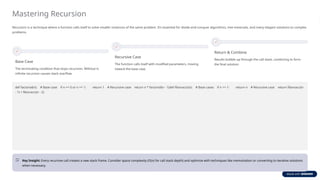
Mastering Recursion
Recursion isa technique where a function calls itself to solve smaller instances of the same problem. It's essential for divide-and-conquer algorithms, tree traversals, and many elegant solutions to complex
problems.
Base Case
The terminating condition that stops recursion. Without it,
infinite recursion causes stack overflow.
Recursive Case
The function calls itself with modified parameters, moving
toward the base case.
Return & Combine
Results bubble up through the call stack, combining to form
the final solution.
def factorial(n): # Base case if n == 0 or n == 1: return 1 # Recursive case return n * factorial(n - 1)def fibonacci(n): # Base cases if n <= 1: return n # Recursive case return fibonacci(n
- 1) + fibonacci(n - 2)
Key Insight: Every recursive call creates a new stack frame. Consider space complexity (O(n) for call stack depth) and optimize with techniques like memoization or converting to iterative solutions
when necessary.
![Implementing ADTs with Python Classes
Python classes provide the perfect mechanism for implementing Abstract Data Types. By defining methods that correspond to ADT operations, we create concrete implementations that maintain
the abstraction principle.
Class Definition
Use class keyword to define the structure and
encapsulate data with attributes
Methods
Implement ADT operations as class methods with clear
interfaces and documentation
Encapsulation
Use naming conventions like _private to hide
implementation details from users
class Stack: def __init__(self): self._items = [] # Hidden implementation def push(self, item): """Add item to top of stack""" self._items.append(item) def pop(self): """Remove and return top
item""" if not self.is_empty(): return self._items.pop() raise IndexError("Pop from empty stack") def is_empty(self): """Check if stack is empty""" return len(self._items) == 0](https://image.slidesharecdn.com/abstract-data-types-and-algorithm-analysis-251122231151-f3f180da/85/Abstract-Data-Types-and-Algorithm-Analysis-pptx-4-320.jpg)
![Shallow vs. Deep Copying
Understanding the difference between shallow and deep copying is crucial for managing mutable objects in Python. Incorrect copying can lead to unintended side effects when
objects share references to nested structures.
Shallow Copy
Creates a new object but inserts references to objects found in the original.
Changes to nested mutable objects affect both copies.
import copyoriginal = [[1, 2], [3, 4]]shallow = copy.copy(original)shallow[0][0] =
99# original is now [[99, 2], [3, 4]]
Deep Copy
Creates a new object and recursively copies all objects found in the original.
Changes to nested objects don't affect the original.
import copyoriginal = [[1, 2], [3, 4]]deep = copy.deepcopy(original)deep[0][0] =
99# original remains [[1, 2], [3, 4]]](https://image.slidesharecdn.com/abstract-data-types-and-algorithm-analysis-251122231151-f3f180da/85/Abstract-Data-Types-and-Algorithm-Analysis-pptx-7-320.jpg)