ICT for Development
Contributing to the
Millennium Development
Goals


        Information for Development Program
Table of Contents

                                                           Preface                                               iii

                                                           Acknowledgments                                       iv

                                                           Section I: infoDev Case Studies                        1

                                                           Section II: Case Study Analysis                       4
                                                              Functional Use of ICT in infoDev Projects          5
                                                              Contribution to the Millennium Development Goals   6
                                                              Projects by Sector                                 7

                                                           Section III: Lessons Learned and Recommendations 8
                                                              Lessons Learned                                     9
                                                              Recommended Guidelines for                         12
                                                              ICT-for-Development Projects

                                                           Conclusion                                            13


© 2003                                                     Annex 1: Case Study Methodology                       14
The World Bank, 1818 H Street NW, Washington, DC
20433, USA

First printed November 2003                                Annex 2: Summary of infoDev Case Studies              15
The World Bank enjoys copyright under protocol 2 of
the Universal Copyright Convention. This material may
nonetheless be copied for research, educational, or
scholarly purposes only in the member countries of the
                                                           Annex 3: Lessons Learned from Other
World Bank. The findings, interpretations, and conclu-
sions expressed in this document are entirely those of
                                                           ICT-for-Development Efforts
the authors and should not be attributed to the World
Bank, its affiliated organizations, or members of its
Board of Executive Directors or the countries they rep-
resent.

This paper is distributed on the understanding that if
legal or other expert assistance is required in any par-
ticular case, readers should not rely entirely on state-
ments made in this paper, but should seek the services
of a competent professional. Neither Gamos Ltd. nor
the World Bank accepts responsibility for the conse-
quences of actions taken by the readers who do not
seek necessary advice from competent professionals on
legal or other matters that require expert advice.

ISBN
ICT for Development
Contributing to the
Millennium Development Goals:
Lessons Learned from Seventeen
infoDev Projects

Principal authors:

Simon Batchelor
Soc Evangelista
Simon Hearn
Malcolm Peirce
Susan Sugden
Mike Webb (Big World)

of Gamos Ltd.


November 2003


                        Information for Development Program
Preface

When infoDev was created, in 1995, few regarded information technologies as a valid tool for development.
Barely five years later, the international community had adopted a set of Millennium Development Goals, within
which this role was explicitly recognized. The development community is now readying itself to meet in Geneva
and Tunis for a “World Summit on the Information Society.”

Yet, analysts and decision makers are still struggling to make sense of the mixed experience of information tech-
nologies in developing countries. Very often, such experiences seem to amount to little more that a heteroge-
neous and unrelated set of anecdotes. However spectacular, successful, moving, or important some of those anec-
dotes may be, they remain a precarious basis for justifying major policy or investment decisions.

The possibility to replicate and scale up successful projects will not fully materialize until the knowledge accumu-
lated from IT-for-development projects (successful and unsuccessful) is widely documented and shared. This
“knowledge dissemination imperative” is at the core of infoDev’s new strategy.

The aim of this paper is to create a publicly available resource that provides concise descriptions of selected
infoDev ICT-for-development projects and their impact on poverty. The paper first presents case studies of a
cross-section of projects funded by the infoDev Core Program, followed by an in-depth analysis of the impact and
limits of those projects.

The main criterion for selecting projects for case study analysis was to be as representative as possible of the vari-
ous environments (political, economic, social, geographic) in which infoDev has been operating since its inception.
An attempt was also made to provide a balanced sample relative to the success rate of the projects. Rather than
selecting the “best projects,” the authors, in consultation with the task managers of the projects, gave priority to
those initiatives likely to offer the best lessons and knowledge about how to use ICT for development purposes.

This paper also makes an attempt to include the experience gathered by other programs involved in ICT-for-devel-
opment. And it makes a specific effort to link the ICT projects to the Millennium Development Goals. It is
infoDev’s hope that by sharing such practical experience in an open and candid fashion, it can stimulate the use
of ICT as a tool to reach the MDGs in a timely, cost-effective, and imaginative fashion.

Mohsen Khalil                               Bruno Lanvin                                Jacqueline Dubow
Director                                    Manager                                     Project Task Manager
Global Information and Communication        infoDev, GITC                               Program Coordinator
Technologies (GITC) Department              The World Bank Group                        infoDev, GITC
The World Bank Group                                                                    The World Bank Group


                                                               Lessons Learned from Seventeen infoDev Projects           iii
Acknowledgments

The authors (Gamos Ltd. and Big World) would first like to gratefully acknowledge the support and assistance pro-
vided by the following organizations in the preparation of these case studies: Abantu Kenya, B2Bpricenow.com,
CDI, Cemina, Conexiones, Fantsuam, FOOD, HealthNet Kenya, Manobi, the Organization of American States,
PEOPlink, Rits/Sampa.org, Satellife, the Siberian Development Net (SibDev), SITA, the Vishnevskaya-Rostroprovich
Foundation (VRF), Viva Rio, and Voxiva.

The authors also gratefully acknowledge the following individuals for their contributions to the infoDev case stud-
ies and case study analysis: Katherine Wagner (Gamos Ltd.), Susan Batchelor (Gamos Ltd.), Waithera Ndung’u
(Abantu Kenya), Peter Kahara (Abantu Kenya), Edgardo Herbosa (B2Bpricenow.com), Ryk Ramos (Land Bank of the
Philippines), Conrado Navarro (Philippine Rural Reconstruction Movement, or PRRM), Irene Fernandez (PRRM),
Gemma Martin (PRRM), Members of the El Gancho Cooperative, Naic, Cavite, Members of the Kooperatibang Likas
ng Neuva Ecija, Leandro Farias (CDI), Luis Claudio (CDI), Dona Ana (CDI), Fernandes Linia Denilson (CDI), CDI
project staff, Thais Corral (Cemina), Claudia Zea (Conexiones), John Dada (Fantsuam Foundation), Ivy Audu
(Bayan Loco Community Learning Center), Norman Didam (Bayan Loco Community Learning Center), Julius Madaki
(Bayan Loco Community Learning Center), Ahmodu Fujuno, Luka Ajiji and Markus Ahmadu (members of the Bayan
Loco CLC committee), Samuel Maichibi (Kagoma Community Learning Center), Loyola Joseph (FOOD), Santosh
Narayanan (FOOD), Shiva Kumar (Inter-city Marketing Network), Tamilshelvi Udyakumar (Korattur Production
Group), Hemalatha Elumalai (Korattur Marketing Group), Rubem Cesar Fernandes (Viva Rio), Maria Helena Alves
(Viva Rio), Marta Ramos (Viva Rio), Carlos Afonso (Rits), Mauricio Falavigna (Sampa.org), Sampa.org Project staff,
Daniel Annerose (Manobi), David Boggio (Manobi), Adama Diop (Sénégalese fisherman), Iba Diouf (Sénégalese
fisherman), Mar Mbaye (Sénégalese fisherman), Diene Ndiaye (Sénégal Ministry of Fisheries), Abdel Kader Mboub
(Sénégal training consultant), Pape Mbaye (Sénégalese fishing union representative), Bassirou Mbaye, Abdoulaye
Diouf (Sénégalese fishing union representative), Abdoulaye Diop (Sénégalese fishing union representative), Susan
Benson (OAS), Dario Soto (OAS), Dan Salcedo (PEOPLink), Surendra Shahi (PEOPLink), Dr. V. Purushothaman
(IFFAD), G. Ramesh (IFFAD), Panneer Selvam (Chitrayalam Trust), Leyoni Adolf (Chitrayalam Trust), Dr. Pavel
Korenev (VRF), Billy Amoss (VRF), Dr. Elena Frolova (VRF), Rebecca Riccio, (Satellife), Eliazer Karan (formerly
HealthNet Kenya), Silas Owiti Mudekhere (formerly HealthNet Kenya), Denis Bagaev (SibDev), Dr. Krishna Sane
(SITA), Brajesh Verma (SITA), Kiran Arora (SITA), Anjali Puri (former SITA trainee), Pamela Johnson (Voxiva), and
Paul Meyer (Voxiva).

The assistance and input of the following infoDev staff members and task managers is also gratefully acknowl-
edged: Jacqueline Dubow, John Garrison, Pamela Street, Rafael Fernandez, Brian Kurey, Daniel Crisafulli, Maria
Vanari, Paul Noumba-Um, Mikhail Bunchuk, Prita Chathoth, and Daniel Cotlear.


                                                             Lessons Learned from Seventeen infoDev Projects          v
infoDev Case Studies
“To promote innovative projects

that use information and communi-

cation technologies for economic

and social development, with a

special emphasis on the needs of

the poor in developing economies.”
Abantu (Kenya)                                             organization’s East African office is based in Kenya and
                                                           currently has four programs: Gender and Poverty,
www.abantu.org                                             Gender and Governance, Gender and Conflict, and
                                                           Gender and Information and Communication
Strengthening the Electronic Communications                Technologies. The specific ICT project, funded mainly
Capacities of Women’s Organizations in Africa              by infoDev, began in 1999 in collaboration with a num-
                                                           ber of other African organizations. Its first efforts were
                                                           concentrated on Kenya.

Abstract                                                   The aim of the Gender and ICT project was to improve
Abantu for Development was established in 1991. In         African women’s access to and use of the Internet. In
1999, it began an Information and Communication            addition, Abantu has been working with policy makers
Technology (ICT) component of its work, funded in part     to try to ensure that gender perspectives are incorpo-
by infoDev. This work has concentrated on Kenya and        rated into all new ICT policies. To accomplish these
has included 1) training various women’s groups in         goals, the project developed a strong, focused core
basic software and Internet skills, and 2) bringing        group of women across Africa to:
together different sectors of the business community
to produce gender-sensitive ICT policy recommenda-            define and guide African priorities on the develop-
tions. infoDev funding also supported ICT conferences         ment and use of electronic communications
in Ghana and Tanzania.                                        establish a cross-sectoral, interdisciplinary African
                                                              women’s information network
While the ICT component was started as a distinct             set up and maintain African list serves (electronic
project (“Gender and ICT”) Abantu found that it need-         discussion groups) and information networks to
ed to incorporate ICT work into all of its program            build information and databases on Africa in Africa
areas. Abantu believes this strategy will have a greater      stimulate dialogue and cross-fertilize ideas among
impact on its other gender-related projects: Poverty,         women in Africa
Governance, and Conflict. By integrating ICT into its         enable women to use the Internet as an advocacy
mainstream work, Abantu strengthened its partners and         and information-sharing tool on international issues
their communication of key gender issues. Abantu will         develop strategies for influencing information and
soon expand its ICT advocacy work to Uganda,                  communication policies from a gender perspective
Tanzania, and Zambia.
                                                           As part of its work, Abantu has strengthened the pres-
Background                                                 ence of African women in cyberspace by developing the
Abantu for Development is an international non-gov-        Abantu web site.
ernmental organization. It focuses on training and pro-
viding information and advice on how to mobilize           The idea for this project arose from a survey on the
resources for sustainable development in Africa. The       needs of women’s groups carried out in 1995. The proj-


2       ICT for Development
ect also responded to demand generated by existing          An internal evaluation of the Gender and ICT program
Abantu ICT training workshops. In 1999, Abantu              was carried out in June and July 2002. At the time,
embarked on a number of ICT training workshops for          the ICT component had already been increasingly inte-
women’s groups, held seminars to raise awareness            grated into the other gender projects of Abantu. The
among policy makers, and developed a project web            evaluation highlighted that ICT was the key to the effi-
site. Today, the ICT project work falls into four cate-     ciency and effectiveness of all Abantu programs and
gories: Training and Capacity Building; Advocacy,           recommended that ICT not be retained as a standalone
Public Awareness, and Networking; Research,                 project, but become part of all of Abantu’s gender work.
Publications, and Information; and the Institutional
Development of Abantu itself. Electronic information is     Impact/Results
regularly exchanged between Abantu’s regional offices          a certain number of financially independent
and their network of NGOs, particularly with respect to        women’s groups (some groups trained by Abantu no
work plan follow-up and requests for information on            longer require support, as they have used their
NGO activism in Africa.                                        newly acquired IT skills to increase their incomes)
                                                               gender-sensitive ICT guides for African women’s
Under the Training and Capacity Building component,            organizations
Abantu has trained organizations in one farming region         critical framework for evaluating government ICT
(Nyeri), one pastoral region (Kajiado), and two infor-         policies
mal settlements of Nairobi. Nyeri is one of the major          women’s groups in farming, pastoral, and slum com-
coffee-producing regions of Kenya. The training there          munities were trained in how to use the Internet
focused on both the Internet and software programs             and basic software programs
for use in the factory. The results of the various train-      lesson learned: ICT supports all gender-related
ings included increased use of the Internet and e-mail         advocacy and program activities, prompting Abantu
(particularly for personal use), although such use was         to integrate ICT into its poverty, governance, and
often constrained by poor infrastructure (power and            conflict projects
telecommunications). Abantu is currently proposing a
small telecenter project for each of the four groups.       Key Issues
                                                            Target groups
Under the Publication, Research, and Information arm        Abantu principally targets poor women and policy mak-
of the project, Abantu produced gender-sensitive ICT        ers. It works with existing women’s organizations in
guides for use by African women’s organizations. These      various communities to improve the ability of women
guides covered such topics as “Making the Most of the       to use and access ICT. Abantu encourages and facili-
World Wide Web” and “Advocacy and the Internet.” In         tates opportunities for people from various sectors of
addition, each quarterly issue of Abantu’s GAP Matters      society and business to attend workshops and semi-
magazine now carries a section on technology that           nars. The results of these seminars are distilled into
informs people about emerging ICT issues.                   policy recommendations for government.

Finally, under the Advocacy, Public Awareness, and          Capacity building
Networking component, Abantu held a number of pub-          Abantu training helped community groups improve
lic seminars. These included a 1999 seminar on forth-       their management and organization, as well as their
coming telecommunication reforms in Kenya. People           income-generating activities. To date, Abantu has
from all social and economic sectors of Kenyan society      trained groups from pastoral, farming, and slum
attended the seminar to express what they wanted in         communities in Kenya.
the new legislation. Abantu then looked at the role
played by gender in the discussion. The results of the      Abantu found that it was important for its own staff
seminar were sent as recommendations to the govern-         to develop a basic working knowledge of ICT.
ment. A more recent seminar produced a framework for        Within Abantu, staff have the opportunity to teach
critiquing future government ICT policies.                  themselves various software packages using CD-ROMs.


                                                              Lessons Learned from Seventeen infoDev Projects          3
This instruction constituted the institutional develop-       tion with Abantu’s other three programs.
ment component of the program. Abantu found self-             Seminars and workshops were the most effective
teaching CD-ROMs to be more cost-effective than send-         tools for advocacy. Kenya is largely an oral society,
ing people to courses. This type of learning created no       so written work is seen as less accessible.
work disruptions, enabled learning at a self-taught
pace, and allowed everyone to learn at different levels.   Challenges
                                                              There is a need to collaborate and partner with like-
Technology                                                    minded organizations in order to increase the
Standard laptops and desktop personal computers               impact of the program. The results of a recent eval-
(PCs). Abantu staff bring three PCs to community train-       uation show that overall, the project achieved its
ings because participants are more familiar and relaxed       objectives, and that its impact was appreciated by
with desktop computers than they are with laptops.            target beneficiaries.
                                                              The national policy development seminar, “Making
Finance                                                       Policies Gender-Sensitive” (December 2001), made
Total Project Cost:                    US$ 500,000            Abantu aware of the need to publicize gender and
infoDev funding:                       US$ 250,000            ICT issues if ICT policies in Kenya were to become
                                                              gender-sensitive.
The remainder of project funding was covered by other         A major project challenge was the current state of
Abantu programs. The infoDev funding has now fin-             technology infrastructure in Kenya. Poor telephone
ished. However, the aims of the project continue, as          communications and unreliable electricity made it
this project now forms an integral part of all Abantu         very difficult for people to access computers. In
activities. With respect to the telecenters project (for      response to this problem, Abantu hopes to create
increasing community income), external funding is cur-        four telecenters in the areas in which it has been
rently being sought.                                          working. A recent reduction of the computer tax in
                                                              Kenya should also help expand the reach of ICT.
Beneficiary Stories                                           There was a significant difference between rural and
In Kajiado, a largely illiterate Masai women’s group          urban project areas. The rural areas had a stable
used the Internet and their software skills to success-       community and the same people continued through
fully secure USAID funding for a bee project. The fund-       several different training sessions. In the urban
ing enabled the project to expand from honey collec-          areas, however, there was often participant discon-
tion to other income-generating activities using both         tinuity between one training session and the next;
wax and honey.                                                it was also difficult to engage the community as
                                                              a whole.
Near Kisumu, a poor semi-literate woman used her              The previous government ICT policy document was
training to enable her to personally communicate              based on a system similar to the national education
bimonthly with her son in America. Previous e-mails to        system. That system places ICT among the sciences,
the woman had been collected by a friend who, it was          an area in which female education is not promoted.
later discovered, kept the money sent to her through          As the school curriculum is changed, it is hoped
Western Union. Today, the woman has the confidence            that the ideas surrounding the “pedagogical loca-
and ability to communicate with her son directly, free-       tion” of ICT will also change.
ing her from the need for an intermediary. She com-
pares e-mail to a phone call.                              Key factors/issues which led to poverty
                                                           reduction outcomes
Issues and Lessons                                            Evaluations from participants at policy seminars in
    The main lesson learned was that best practice calls      Ghana and Kenya demonstrate that the work of
    for incorporating ICT into existing programs, rather      Abantu in making ICT policies gender-sensitive is
    than maintaining it as a separate program. Much of        both timely and relevant. In addition, some organi-
    the project was, therefore, carried out in coordina-      zations that received reports on these activities


4        ICT for Development
have requested to be included in future Abantu              guidance on how to implement this training in
   activities.                                                 the regions.
   The integration of ICT into all aspects of Abantu’s         Abantu hopes to set up four telecenters in Kenya.
   work increased the impact of these activities               At present, they are looking to locate these centers
   on poverty, while fulfilling the aims of this particu-      in areas that are culturally appropriate for women
   lar project.                                                to visit, such as shopping centers.
   The mix of seminars, trainings, and booklets broad-         Abantu is just beginning to mainstream ICT into
   ened the reach and impact of the project with               their gender and advocacy work in Tanzania,
   respect to publicizing gender issues.                       Uganda, and Zambia.
   Lesson learned: an individual does not have to
   be fully literate to utilize ICT. This discovery         Stakeholder consultation
   increased the impact of Abantu’s work with low-             Abantu Grant Agreement with infoDev, June 1999
   income women.                                               Abantu Third Quarter Report 2002 for infoDev
                                                               Abantu web site: www.abantu.org
Future outlook                                                 Interview conducted by Dr. Batchelor with Waithera
   Continued integration of ICT in all areas of Abantu’s       Ndung’u, Information and Communication Program
   work is needed. This objective will be achieved             Officer, Abantu, Kenya, July 2003
   through coordinated improvement of ICT infrastruc-          Additional information received from Peter Kahara,
   ture and capacity building for Abantu staff in all          July–September 2003
   regions. ICT training will be offered to all Abantu         infoDev Task Manager, Pamela Street
   staff and the Abantu Directorate will provide


                                                              Lessons Learned from Seventeen infoDev Projects         5
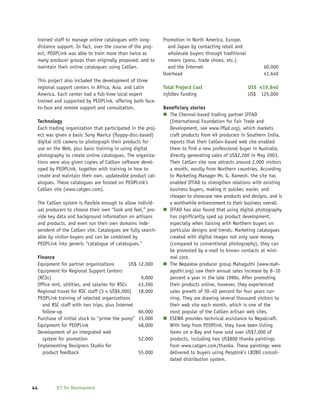
B2BPriceNow.com                                           Funding for training was obtained from infoDev. These
                                                              partnerships enabled B2Bpricenow.com to provide free
    (Philippines)                                             access to the site for cooperatives and other groups.

    www.b2bpricenow.com                                       The project objective is to “enable farmers to harness
                                                              the benefits of information and communications tech-
    E-commerce for Farmers: Hands-on Training                 nologies to promote economic development and social
    Program                                                   well-being.” It is hoped that by providing transparent
                                                              and timely market information to both buyers and sell-
                                                              ers, the project will enhance efficiencies in the agricul-
    Abstract                                                  tural market. In addition, the ability of farmers to tap
    B2Bpricenow.com is an e-marketplace in the                buyers and sellers directly and to obtain competitive
    Philippines that enables farmers, fishermen, and small    prices for inputs and outputs should result in higher
    and medium enterprises to access market prices and        incomes—a direct poverty alleviation impact.
    trade products. The marketplace can be accessed via
    web site or cell phone. The first phase of the project    The rationale behind the project is that farmers in the
    involved obtaining content for the B2B web site from a    Philippines, particularly those in rural areas, have long
    variety of agricultural and fishery cooperatives and      suffered from lack of market price information and poor
    training them to access and post products on the site.    access to buyers and sellers. Consequently, they have
    Because Unisys provides free technical support and        been unable to get the best value for their produce
    hosting, B2Bpricenow.com is able to offer its services    and have usually relied on traders to serve as interme-
    for free. The second phase of the project will focus on   diaries. The interests of the traders, however, often
    getting target groups connected to the Internet and       conflict with those of the farmers—putting into ques-
    conducting actual transactions online.                    tion the reliability of the market price information pro-
                                                              vided by traders and the fairness of the purchase and
    Background                                                sale prices negotiated by them with the farmers.
    This project is the brainchild of Mr. Edgardo Herbosa.
    The idea was to set up an e-commerce web site             In the past, this problem was addressed by cooperatives
    through which Filipino cooperatives and groups could      and government agencies, which collected samples of
    trade their produce. Mr. Herbosa created the site in      prevailing market prices two to three times a week.
    2001 with some of his own funds and received techni-      These prices were then disseminated on demand a day
    cal support from Unisys in exchange for company           or two later. By that time, however, the prices were out
    shares. The project was adopted by a number of gov-       of date. The system was also unable to provide compre-
    ernment agencies, as well as the Land Bank of the         hensive price information throughout the 7,100 islands
    Philippines and the NGO Philippine Rural                  of the Philippines. Moreover, no mechanism existed to
    Reconstruction Movement (PRRM). Both of the latter        allow farmers and cooperatives to market their products
    organizations were then planning similar systems.         and trade directly with distant buyers and sellers.


6           ICT for Development
To address these marketing deficiencies,                       The initial number of trainees registered to attend
B2Bpricenow.com provides a free electronic bulletin            the five PRRM workshops was 248. However, the
board and marketplace designed to bring relevant mar-          workshops attracted more than 2.5 times this num-
ket information directly to farmers, primarily through         ber of participants. Of the people who originally
their cooperatives. As an electronic bulletin board, the       registered, 42 percent were small entrepreneurs and
web site enables users to gain greater negotiating             20 percent were farmers or fishermen.
leverage from awareness of prevailing market prices for        An estimated 1,550 people attended the 31 train-
their products. As an electronic marketplace, the web          ings associated with the road show.
site aims to minimize intermediation (middlemen’s              Seventy percent of the cooperatives of the Land
fees), thereby enabling farmers to reap the gains of           Bank have been informed of B2Bpricenow, and 42
lower costs and broader market reach.                          percent (1,600) have been trained to use it.

Project activities to date include establishment of the     Key Issues
web site, creation of web site content, and a               Partnership
training/information road show presented in over 30            The primary partner institutions are the PRRM and
cities. In addition, five two-day workshops were carried       the Land Bank of the Philippines. Founded in 1952,
out in conjunction with PRRM. The training program             PRRM is the country’s oldest non-governmental
included computer training and online basics. Future           organization. PRRM has 14 field offices nationwide,
trainings will address, among other topics, how to             a workforce of 300 men and women, and programs
negotiate online, how to canvass prices, and how to            dedicated to sustainable local development. PRRM
contact buyers. Currently, project activities are focused      and B2bpricenow.com have been working together
on getting cooperatives connected to the Internet in           for a year, having forged an agreement in 2000
1,500 municipalities through the establishment of              (see the project web site) whereby PRRM
b2bcenters (business centers) on cooperative premises.         committed to inform, educate, and, where
The Land Bank attempted to conduct an initial evalua-          available, provide Internet access to cooperatives
tion of project usage by cooperatives via questionnaire.       from their field offices.
Unfortunately, none of the questionnaires were                 The Land Bank is a government-owned universal
returned. However, B2Bpricenow is still in the forma-          bank with a mandate to promote growth and devel-
tive stage and monitoring of actual transactions should        opment in the countryside. In addition to its finan-
be easier once the online transaction gateway is               cial assistance mandate, the Land Bank also pro-
launched in Fall 2003.                                         vides cooperatives with technical assistance on
                                                               matters such as marketing, trading, and provision of
Impact/Results                                                 information on new technologies.
   Target groups gained access to additional marketing         Through a partnership with the American-based
   windows for their commodities. B2Bpricenow.com              technology company, Unisys, B2Bpricenow.com has
   believes that the Internet is the ultimate playing          been able to reduce its high-cost technical expendi-
   field where farmers and fishermen can sell their            tures, including programming, purchase of e-market-
   commodities at prices that are not controlled by            place software, administration, maintenance, and
   middlemen.                                                  hosting, which are covered by Unisys. As a conse-
   Figures from August 2003 show that                          quence of this arrangement, B2Bpricenow.com can
   B2Bpricenow.com has 1,967 businesses connected              provide the marketplace for free.
   to its web site. These businesses cover numerous
   sectors, including agriculture, manufacturing, civil     Target groups
   society organizations, and government agencies.          B2B mainly targets farmers, but also fishermen and
   There were 1,344 agricultural postings, 92 consumer      small entrepreneurs. Users from these groups tend to
   manufacturing postings, and 104 industrial manu-         belong to cooperatives or people’s organizations,
   facturing postings. No figures are available on the      including advocacy groups. The PRRM partner groups
   number of transactions made to date.                     are mostly rice farmers, rice-based food processors, and


                                                              Lessons Learned from Seventeen infoDev Projects          7
farm workers who are also micro-entrepreneurs. Land        site via cell phone or conduct an online transaction.
    Bank-assisted cooperatives are also mostly agriculture-    Other sources of income include funding from local
    based, but include some small manufacturers and            congressmen, cooperative web sites, and online
    processors. One cooperative in Cavite is fishing-based.    advertisements.

    The Land Bank and PRRM have no statistics on the age       Beneficiary Stories
    and gender of their cooperative members. However,
    they report that most members are between the ages            Ricardo Buenaventura, a rice farmer from Talavera,
    of 35 and 60. Regarding gender, farmer cooperative            Nueva Ecija, describes how access to
    members are usually men, whereas women usually out-           B2Bpricenow.com helped him and his cooperative,
    number men in small entrepreneur cooperatives.                Nagkakaisang Magsasaka: “This trading venue
                                                                  enables us to monitor prices. We no longer have to
    Capacity building                                             travel far, going to a marketplace or trading center
    By accessing information on prices, volumes, and the          to do that.” (From “Electronic Market For Farmers,”
    identities of buyers and sellers, farmers are able to         by Lala Rimando, www.b2bpricenow.com/pr/
    negotiate and attain competitive prices for their prod-       WhatIsB2B.htm.)
    ucts and purchases. B2Bpricenow.com intends to train          Orientation training on B2Bpricenow.com led
    farmers to use information and communications tech-           Maggie Monge of PRRM-CamSur to encourage fellow
    nologies in their day-to-day transactions by the end of       co-op members to participate in the road show
    the project.                                                  training. In addition, she noticed that the web site
                                                                  showed demand for virgin coconut oil, but no pro-
    Technology                                                    ducer. This has prompted her to introduce the pro-
    Desktop computers and telephone connections for 14            duction of virgin coconut oil to the cooperatives.
    cooperative groups. In addition, Internet cafes are cur-      Nine young people from El Gancho Cooperative fam-
    rently being set up with the Land Bank that will use          ilies received B2Bpricenow.com computer training
    wireless technology to link to the Internet. The web          and are now able to use the computer provided to
    site and server have been developed and hosted by             the cooperative. In addition to helping their fami-
    Unisys. Cell phones can be used to access information         lies monitor prices, they use the computers for their
    via the Short Messaging Service (SMS) application.            school work.

    Finance                                                    Issues and Lessons
    Founder’s initial capital                                  Challenges
       (pre-operating expenses)           US$ 40,000              The main challenge was locating funds to cover
    Unisys site design, programming,                              education and technology costs. However, Unisys
       and maintenance                        $360,000            and infoDev eventually provided these funds.
    Ating Alamin Advertising - broadcasting    $40,000            The main technical challenge has been poor-quality
    Land Bank promotion and training                              or non-existent telephone connections. For areas far
       (technical assistance)                 $132,000            from any telephone service, B2Bpricenow is currently
    infoDev training grant                    $118,000            in talks with satellite and wireless technology com-
    Total Project Funding                 US$ 690,000             panies. In contrast to most developing countries,
                                                                  electricity connection rates are also fairly expensive
    For the training events, the Land Bank paid for accom-        in the Philippines. At present, B2Bpricenow plans to
    modations, the Philippine Department for Trade and            expand its work only to areas with both electricity
    Industry paid for food and venues, the Philippine             and telephone connections, which will limit it to
    Department for Agriculture lent the LCD projector, and        municipal centers and large settlement areas.
    the Philippine Department of Science and Technology           Another major challenge is to ensure that coopera-
    covered the airfares. Ongoing costs are met through           tive members who attend the trainings keep up
    commissions paid to B2Bprice when people access the           their skills.


8           ICT for Development
While B2B has focused on the Internet, it has                b2bpricenow.com is now endorsed as the “Official e-
   become obvious that mobile phones offer a greater            marketplace of the Philippines for the Agriculture
   opportunity for relevant and useable service. Mobile         and Fisheries Sector” by COCAFM, a bicameral com-
   or cell phones are now common in the Philippines             mittee composed of the Philippine Senate and
   and text messaging (SMS) is particularly popular.            House of Representatives. It is also endorsed as the
   Co-ops already get price data from local traders by          “Official e-marketplace of APRACA” (Asia Pacific
   phoning them. B2B offers part of its service                 Rural and Agricultural Association, which includes
   through SMS and is likely to expand this service to          the 18 largest agriculture banks in Asia).
   match demand from user cooperatives.                         b2bpricenow.com was even mentioned as a deliver-
                                                                able in the 2003 State of the Nation Address of
Key factors/issues which led to poverty                         Philippine President Gloria Macapagal Arroyo on
reduction outcomes                                              “Modernized Agriculture to Ensure Food Security.”
   This project contributes to poverty reduction in four
   ways: 1) it helps farmers increase their revenues by      Future outlook
   getting competitive prices for their produce, 2) it       B2Bpricenow.com is currently setting up partnerships
   helps farmers lower costs by enabling them to com-        with computer hardware companies, cell phone opera-
   municate electronically with other cooperatives that      tors, and other service providers to expand the project
   have similar purchasing and marketing require-            to more farmer cooperatives. In exchange, the compa-
   ments, 3) price and supply volume information aids        nies will advertise their products on the B2B web site.
   farmers to make better crop and other investment          Other plans include partnerships with the Philippine
   choices, and 4) the site enables farmers to broaden       Trade and Industry Department to market the latter’s
   their customer base and to trade with one another.        services to small enterprises, and with the National
   When conducting training, three participants per          Food Authority (NFA) to harness the NFA’s warehous-
   computer proved more effective than one partici-          ing, trucking, and logistical services.
   pant per computer. This is due to the fact that
   three participants complement one another in the          Stakeholder consultation
   learning process, while one participant tends to get         Development Marketplace 2001, Full Proposal Form
   lost during the lecture and has no one with whom             for B2Bpricenow.com, www.worldbank.org
   to share his or her experience. The ability of partici-      Third Quarter Report 2002 for infoDev
   pants to access the system themselves following the          infoDev Project Details web page, www.infodev.org
   trainings strengthened the long-term benefit of the          B2Bpricenow.com Statistics Report, 7 August 2003
   training modules.                                            E. Herbosa, Final Project Report, 2003
   Lesson learned: It is better to invite younger               Interviews conducted by Soc Evangelista in August
   members from the cooperatives, as they are more              2003 with:
   inclined to continue to use the computer than                 Edgardo Herbosa, founder of B2Bpicenow.com
   older members.                                                Ryk Ramos, Land Bank (Development Assistance
   Project timing and price (free) were key factors in           Department)
   project success. The e-marketplace came into being            Conrado Navarro, PRRM
   at a time when both PRRM and the Land Bank were               Irene Fernandez, PRRM
   thinking of creating similar projects, to which they          Gemma Martin, PRRM
   had already assigned budgets. By linking with the             Members of the El Gancho Cooperative,
   Land Bank, B2Bpricenow is able to use an existing             Naic, Cavite
   banking system for transactions. In return, the Land          Members of the Kooperatibang Likas ng
   Bank increases its client base because all transact-          Neuva Ecija
   ing parties must open an account with the bank.              infoDev Task Manager, Jacqueline Dubow


                                                               Lessons Learned from Seventeen infoDev Projects         9
CDI: Committee for                                         and work pressure in the IT business forced him to give
                                                            up volunteer work. In 1993, he realized that he could
 Democracy in                                               use his IT knowledge and skills to help community
                                                            development and formed CDI. The aim of CDI is to use
 Information Technology                                     the Internet to create a communication channel
 (Brazil)                                                   between young people from different social groups. The
                                                            following year saw the first computer donation cam-
 www.cdi.org.br                                             paign, and in 1995, the first Information Technology
                                                            and Citizens Rights School (ITCRS) was established. The
 Information Technology and Citizens’ Rights                school was seen as a chance to bring technology to
 Schools for Low-income Communities                         underprivileged and socially excluded communities
                                                            while simultaneously using the technology to promote
                                                            active citizenship.
 Abstract
 The Committee for Democracy in Information                 CDI has grown at a phenomenal rate since 1995. In
 Technology (CDI), is a non-profit, non-governmental        2003, more than 200,000 young people will receive
 organization. Since 1995, it has pioneered an initiative   training in 830 schools. As more schools were established
 to promote the social inclusion of disadvantaged com-      around the world, more regional CDI offices were created
 munities by using information and communication            to maintain them. The final objective of each school and
 technology as a tool for citizens’ rights and develop-     regional office is to stand on its own, enabling CDI to
 ment. CDI facilitates the operation of Information         move into a supervisory and ongoing training role.
 Technology and Citizens’ Rights schools by providing
 equipment (hardware and software), training of local       CDI regional offices and ITCRSs are, in effect, social
 educators, and local administrative and technical sup-     franchises. CDI uses local community centers, churches,
 port. The schools are self-managed and self-sustaining,    and other available institutions to create new schools.
 but supported and monitored by regional CDI offices.       Local staff are then trained to run them, with CDI pro-
 The regional offices were initially set up by volunteers   viding hardware, software, and technical support until
 interested in the mission of CDI. Today, they are also     such support is no longer necessary. Educators receive
 self-sustaining and self-managed, with offices located     a five-month initial training; their first class is super-
 in 20 Brazilian states, as well as Colombia, Uruguay,      vised before they are deemed qualified. School staff are
 Chile, Mexico, Guatemala, Honduras, Japan, Angola,         also trained in network support. CDI headquarters in
 South Africa, and Argentina.                               Rio, which supervises regional offices across Brazil and
                                                            abroad, is responsible for program monitoring and eval-
 Background                                                 uation. Each regional office sends detailed monthly
 CDI began as the personal vision of Rodrigo Baggio.        reports to headquarters based on information they
 Rodrigo worked as a community volunteer, but success       receive from individual ITCRSs.


10       ICT for Development
CDI does not expand by seeking partners, but by        existing buildings to establish the ITCRSs and train
awaiting invitations. It then uses an evaluation       community organizations, as well as members of
committee to decide whether an invitee is a suit-      the community itself. This approach eliminates
able partner. Due to its rapid growth and success,     many overhead costs. Partnership with the local
CDI is presently in the process of consolidating its   community is the key to the model’s success. CDI
work and is not seeking to expand further until it     provides the methodology, equipment, and train-
can assure the quality of its current activities.      ing, and the community uses these tools to
                                                       address its specific needs.
In June 2002, infoDev gave CDI a grant in order to
increase the number of ITCRSs in Latin America,        CDI has received funding from an enormous variety
specifically, Uruguay, Colombia, Chile, and Mexico.    of sponsors. Usually, each sponsor contributes a
The grant was also used to strengthen the opera-       specifically defined element or funds a new initia-
tions of CDI regional offices in the region.           tive. Sponsors include BNDES, Microsoft, Fundação
                                                       Avina, Fundação W.K. Kellogg, BID, AMCHAM-SP,
Impact/Results                                         Fundação Vale do Rio Doce, Phillips, Accenture,
   CDI has successfully adapted its methodology        Fundação Telefonica, UBS Financial Services Group,
   to reach a diverse range of disadvantaged           World Bank Group, UNICEF, YMCA, ESSO, Xerox do
   individuals, including socially excluded street     Brasil, Terra Network, and Fundação EDS.
   children, visually impaired youth, indigenous
   peoples, maximum-security prisoners, the            Target groups
   physically and mentally disabled, and psychi-       The majority of CDI target groups are children,
   atric patients.                                     but target groups also include visually impaired
   As a result of the organization’s work, more        youth, indigenous peoples, prisoners, the physi-
   than 483,000 students have attended over 830        cally and mentally disabled, and other disadvan-
   schools, learning to use ICT in community           taged groups.
   development projects designed to promote
   active citizenship. In a recent evaluation car-     In order to gather more detailed information about
   ried out by an external consulting group, 87        the individuals attending its schools, CDI request-
   percent of children attendees said that the         ed the Institute of Social and Economic Research
   schools had a positive effect on their lives.       (ISER)—a consultancy institute with proven
   Among the benefits of the schools are educa-        expertise in evaluating social programs—to pre-
   tion, new friends, keeping children off drugs,      pare an impact evaluation study. The study was
   and helping children return to normal schools.      conducted in 2000 to determine the profile of CDI
   The information technology training provided        students, as well as to measure the impact of the
   by the schools allows youth from low-income         courses offered. It showed that:
   communities to learn to use the Internet as a          65 percent of the students were 10 to 18 years
   basis for professional development, thus               old
   increasing their chances on the job market.            56 percent were women
                                                          65 percent were black or mulattoes
Key Issues                                                77 percent had families of at least four members
Partnership                                               63 percent had no income
In the CDI model, the major partner is the local          29 percent received an income of between one
community. Volunteers, with help from CDI, set up         or two minimum salaries
the regional offices, which in turn create the            87 percent considered that the courses con-
schools in partnership with local community cen-          tributed to a positive change in their lives
ters, neighborhood associations, and religious            90 percent believed that the courses fulfilled
groups, among others. Regional CDI offices use            their expectations


                                                              Lessons Learned from Seventeen infoDev Projects   11
Capacity building                                            These funds help pay for maintenance costs and educa-
 CDI builds capacity in local communities in a number         tor salaries (although some educators are volunteers).
 of ways. First, the regional CDI office provides the local   Students that cannot pay fees help by contributing to
 communities with technical expertise, educational            school chores and taking part in local fundraising
 methodology, educator training, and curriculum devel-        activities. Part of the responsibilities of each regional
 opment for the different social groups involved.             office is to coordinate partnerships with local organiza-
 Second, the non-didactic curricula of the schools foster     tions to set up new schools, as well as to run fundrais-
 community building through debates on topics consid-         ing and computer-donation campaigns.
 ered important to local groups. These topics are then
 researched and discussed by the groups within the            Total Project Cost:*                      US$ 350,000
 wider socio-political context. The schools teach com-        infoDev funding:                          US$ 150,000
 mon computer programs, such as Microsoft and open            *Additional funding provided by CDI and other partners.
 source software, and offer Internet and hardware main-
 tenance training. It is the replication of the model,        Beneficiary Stories
 from CDI headquarters to regional offices to local edu-      Leandro Farias is a former student who is now an “edu-
 cators, that enables the model to grow and impact            cator” at an ITCRS. He was the first student to register
 local communities.                                           for the IT course when it was originally created.
                                                              Another former student, Luis Claudio, is now responsi-
 Technology                                                   ble for the computer network within the Morro dos
 One of the responsibilities of the CDI regional offices is   Macacos ITCRS. In fact, they were both trained in the
 to organize computer donation campaigns. These offices       favela (Brazilian slum). Leandro went on to become
 are able to recycle machines as old as Pentium 486s.         degree-qualified and then returned to work at the
 In Rio de Janeiro, for instance, they have a large,          school because of his love for the work. He is seen as
 loaned warehouse in which large numbers of old com-          a leader by the students. In other cases, educators
 puters, monitors, printers, etc., are stored. A team of      leave to find better jobs and opportunities, which CDI
 locally recruited and trained people then strip and          also considers a success.
 rebuild the machines for distribution to ITCRSs.
                                                              Issues and Lessons
 CDI has developed a Linux-based system which uses            Challenges
 one high-spec machine to service 15 to 20 slave units.          With so many offices, duplication of work has
 The latter units have no hard drives, just a floppy disc,       resulted and the communication of ideas has not
 16 megabtyes of RAM, and video and network cards. A             been maintained.
 bootable floppy disc in each drive runs software direct-        Drug gangs control local areas and can prevent
 ly from the server, providing a remarkably fast user            young people from crossing over a boundary to
 interface. Open source software is used alongside a             attend a school.
 limited number of packages donated by Microsoft.                Keeping up with technology is an ongoing problem,
                                                                 since it is a moving target.
 The goal is to train one person from each ITCRS to              The Brazilian government is beginning to recognize
 maintain and repair their own machines, although due            the importance of access to ICT for education (digi-
 to the simplicity of the system, the reliability rate is        tal inclusion). However, funds to promote this type
 good. All computers are donated to the schools and              of work are not yet readily available.
 most are second-hand, unless funding has been
 received for new computers in a specific case.               Key factors/issues which led to poverty
                                                              reduction outcomes
 Finance                                                         CDI commissioned an external agency with expertise
 The schools are self-sustainable, funded by monthly             in evaluating social programs to prepare an impact
 student fees and donations by partner institutions.             study. This ensured that the program was targeting


12        ICT for Development
the people that it intended to benefit. The            they can help themselves and improve the con-
study confirmed that the CDI schools were              ditions in which they live.
reaching the poor and the marginalized and had
appropriate gender inclusion.                       Future outlook
It was important to link a practical skill that        CDI is currently in a period of consolidation.
potentially enhanced employment prospects              Rather than increasing the number of schools it
with citizenship training. ICT opened an               works with, CDI is currently trying to increase
opportunity for group work and peer-to-peer            the standard of activities in existing schools.
education. The schools undertake a project that        The self-sustainability of each school very much
encompasses local issues as well as technical          depends on the community organization
learning. The project is created using a process       responsible for its administration. CDI encour-
of reflection and action. The non-didactic con-        ages each school to develop activities that will
tent fosters community building through                make self-sustainability possible.
debates on topics such as human rights, sex
education, non-violence, and ecology, using         Stakeholder consultation
digital technology. The evaluation noted that          CDI institutional profile
the benefits included keeping children off drugs.      CDI Grant Proposal to infoDev
One of the keys to the success of the CDI model        CDI Grant Agreement with infoDev
is the network of relationships between CDI            Interviews conducted in August 2003 by
headquarters, regional offices, and the schools.       Malcom Peirce with:
CDI trains the future educators of the schools          Ricardo Schneider, CDI
who, in turn, train others in their communities.        Leandro Farias, CDI Educator
The fact that local staff are heavily involved in       Luis Claudio, CDI Network Manager
the process means that the courses offered by           Dona Ana, Community Center Founder
the schools are tailor-made and relevant to             Fernandes Linia Denilson, CDI Maintenance
community needs. The driving factor is the                 Coordinator
desire to see underprivileged people given the         E-mail communication with CDI, July–Sept 03
tools (i.e., technology and education) by which        infoDev Task Manager, Rafael Hernandez


                                                           Lessons Learned from Seventeen infoDev Projects   13
CEMINA (Brazil)                                             result would be increased capacity of Brazilian commu-
                                                             nity radio, a media that operates on scare resources
 www.cemina.org.br                                           and relies predominantly on volunteers. The main aim
                                                             of CEMINA was to improve education on gender by
 Strengthening Women’s Leadership in                         strengthening the use of community radio by low-
 Community Development through Internet                      income women in Brazil. Cyberella set out to integrate
 Radio in Brazil                                             existing local radio stations across Brazil into a net-
                                                             work that would share content by downloading content
                                                             via broadband Internet links. They would transmit the
                                                             programs over the Internet as well as on normal radio.
 Abstract
 Communication, Education, and Information on Gender         The CEMINA project offers an alternative telecenter
 (CEMINA) is dedicated to strengthening women’s lead-        model. The long-term sustainability and limited out-
 ership in community development through Internet            reach of telecenters have put the latter model into
 radio in Brazil. The CEMINA project was the first initia-   question. Obstacles to the success of dedicated tele-
 tive in Brazil to focus on promoting gender education       centers include cost, language, local relevance of
 by connecting communities to the Internet via the           content, distance, and limited access for poorer resi-
 radio. Radio program content is produced locally and        dents—especially those in remote, rural communities.
 shared with other radio stations via broadband Internet     Community radio, however, can be used to improve
 links (for uploads and downloads). Today, 11 community      the efficiency of telecenter investments by expanding
 radio stations are successfully using information and       outreach and increasing participation and value.
 communication technology (ICT) to produce radio con-
 tent and 1,500 women from all over Brazil have been         One of the objectives of CEMINA is to break the isola-
 trained in radio production.                                tion of women and facilitate their social integration via
                                                             new communication technologies. By connecting the
 Background                                                  Internet to a media that people are familiar with (radio
 CEMINA is a Brazilian NGO founded in 1988. Its mis-         broadcasts), CEMINA expects to overcome some of the
 sion is to promote communication and information on         resistance that new technologies tend to create, espe-
 gender issues through radio broadcasting. Today,            cially among women.
 CEMINA broadcasts to a network of over 400 women’s
 radio programs stations throughout Brazil and is            The main objectives of the project were to:
 nationally and regionally (in Latin America) recognized        create a radio web site that featured profiles of
 as a media focal point for women’s radio networks.             many Women Radio Network (WRN) stations
                                                                provide hardware and train ten WRN stations
 The rationale behind the ICT community radio project           located in sites with good Internet connectivity
 (Network Cyberella) was to use ICT to exchange audio           (essential for the exchange of audio material on
 material and thus improve radio content. The end               the Internet)


14        ICT for Development
provide access, hardware, and training for three          Impact/Results
   WRN stations located in remote areas with no                 A radio web site has been produced (www.radiofala-
   connectivity (these areas depend on satellite                mulher.com). Thirteen community radio stations
   Internet connections)                                        have been enabled to contribute content and down-
                                                                load audio files that are broadcast locally. The pres-
The first 13 WRN stations were selected through a pub-          ent content of the site includes a daily program
lic contest called “Cyberella.” The selection criteria          that is streamed live from 3:00 p.m. to 4:00 p.m.
required stations to:                                           daily. The program is then replicated five times over
    be a member of the WRN                                      the next 24 hours. In between, music and selected
    have access to a broadband Internet connection              programs are provided by Radio Viva Favela, with
    provide a staff member to be the permanent link             which CEMINA has a partnership for the exchange
    with CEMINA                                                 of audio content.
    once a week, to broadcast a radio program down-             Two telecenters have been established. CEMINA is
    loaded from the radiofalamulher.com web site                also working with one community radio station
    provide content to www.radiofalamulher.com                  located in an area known for child labor. In
                                                                response to the needs of this area, a telecenter was
Thirty radio stations submitted proposals. The final            developed to provide ICT training to local youth.
selection took into consideration each station’s region-
al coverage and outreach. One such radio station was         Key Issues
based in a community center that featured a telecenter       Partnership
supported by the NGO SAMPA.org. Many of the CEMINA           One of CEMINA’s strategies is to partner with other
projects feature similar partnerships with other devel-      organizations and networks that can contribute content
opment initiatives.                                          to the web site. In return, CEMINA helps its partners to
                                                             disseminate digital radio content and create a sustain-
Launching the Internet radio project in the first 13         able network upon conclusion of infoDev funding. At
WRN stations constituted a pilot phase that allowed          present, a partnership with Radio Viva Favela and a link
necessary adjustments to be made to the project. The         with two digital radio stations have been created.
three stations without an Internet connection became
the basis for future installations of “Radio-Internet-       Two other major partnerships are currently being put
Telecenters” in communities where no Internet connec-        in place. The first is a partnership with a large net-
tivity exists. Historically, the major towns and cities of   work of health organizations on tobacco prevention.
Brazil—and thus, the communications infrastructure—          The network will provide a weekly program to be
developed along the coast, leaving the interior of the       streamed from Radiofalamulher, which in turn will pro-
country underdeveloped. CEMINA plans to expand its           vide coverage of any events held by the health organi-
initiative to the poorest municipalities of Brazil, espe-    zations in Brazil. This exchange will cover the costs of
cially in the North-Eastern region of the country.           production services and hosting the program. CEMINA
                                                             hopes to develop this partnership into a model that
Interestingly, CEMINA originally viewed community            can be used to cover the fixed operating costs of the
radio as an alternative to telecenters. However, since       radio stations.
the project supplied radio stations with broadband
Internet connections, the stations themselves are            The second major partnership is with “Hip Hop” music
becoming telecenters.                                        youth groups. These groups tend to be independent
                                                             music producers in search of new channels for the dis-
CEMINA monitors its projects internally through monthly      semination of their products. Most are very familiar
reports. These reports are linked to a series of commit-     with ICT and could potentially bring a large audience
ments set out in individual project partnership agree-       to the web site. This partnership could also lead to
ments. The articulation of project goals in partnership      interesting radio programs that CEMINA could promote
agreements was crucial to the pilot phase of the project.    in the area of youth education.


                                                               Lessons Learned from Seventeen infoDev Projects           15
Other CEMINA partners fund the project through finan-         installed on each computer. To cover the costs of
 cial or in-kind contributions and include the software        broadband connectivity, CEMINA will be signing six-
 company Sound Foundry, the Kellogg Foundation, and            month contracts with local providers selected by each
 the United Nations Educational, Scientific, and Cultural      of the 10 stations with landline connections. The three
 Organization (UNESCO).                                        radio stations with no landline Internet connectivity
                                                               will be connected via satellite.
 Target groups
 The main target group of the project is the rural popu-       In conjunction with the installation of this equipment,
 lation of low-income women in Brazil. These women             a training program is planned to improve the ICT skill
 reside in the communities served by the 13 women’s            level and management capacity of the project manager
 radio stations chosen to host the content made avail-         of each radio station. Radio station staff come to
 able through Network Cyberella.                               CEMINA’s office in Rio for a ten-day training program at
                                                               their computer suite, which consists of a dozen high-
 Capacity building                                             specification AMD Athlon computers.
 It is estimated that the 400 existing community radio
 stations are listened to by millions of Brazilian citi-       Finance
 zens. In theory, all of these stations could, in time,        Total Project Cost:                     US$ 425,593
 become part of one network. Theoretically, the Internet       infoDev funding:                        US$ 245,593
 makes it possible to extend the network to any
 Portuguese-speaking country in the world.                     The Kellogg Foundation and UNESCO recently concluded
                                                               funding partnerships with CEMINA that allowed the
     At the start of the project, CEMINA identified four key   NGO to expand the project.
     areas which needed to be addressed:
        hardware                                               Two major factors will contribute to the eventual finan-
        capacity building                                      cial sustainability of the project:
        broadband Internet connection                              commercial advertising (will generate revenue)
        content                                                    shared content (will minimize production costs of
                                                                   original content)
 With respect to hardware, each of the original 13 par-
 ticipating radio stations was provided with a computer,       Future funding is also potentially available from a
 the software necessary to process digital radio pro-          Brazilian government tax on IT companies (one percent
 grams, and staff training. Capacity building was              of profits). However, NGOs are presently finding it diffi-
 addressed through CEMINA training programs. The               cult to access these funds.
 availability of a broadband Internet connection was a
 prerequisite for joining the network. With respect to         Issues and Lessons
 content, CEMINA had been producing the Fala Mulher            Challenges
 (Women Speak Up) radio program for several years. It             Project implementation presented few technical diffi-
 thus created the project web site, www.radiofalamul-             culties. Madalena Guilhon, one of the producers of Fala
 her.com, based on existing program scheduling.                   Mulher, explained that after the first programs were
                                                                  produced and distributed, CEMINA discovered that the
 Technology                                                       format needed to be changed to a number of short
 The thirteen radio stations were each equipped with a            segments instead of one, 60-minute program. The
 Pentium IV-class computer with sufficient memory and             shorter format allows local radio stations to use seg-
 CD-ROM drives to enable editing of sound files. Sound            ments of the entire program in different time slots.
 Foundry provided licenses for professional sound edit-           A major challenge has been the lack of broadband
 ing software. The open source software Open Office was           connectivity in many areas. This reality required a


16           ICT for Development
number of satellite digital connections, which are        configuration needed for the project (i.e., number
   very expensive.                                           of computers and software needed). A technical
   Another challenge is how to provide technical sup-        meeting at Radio Favela’s studio was held to help
   port to partners. For example, working out the best       the CEMINA team learn about Radio Favela’s experi-
   way to support partners when equipment fails or           ence in implementing streaming radio. Among the
   starts to have problems due to viruses. To date,          issues discussed were the lowest possible bandwidth
   such problems have been dealt via e-mail, phone,          required to obtain a good quality stream; streaming
   and sometimes by arranging for local assistance.          compatibility with media players running on all
   Indeed, a key project need is to build local assis-       operating platforms; and obtaining open-source
   tance partnerships.                                       workstations (Linux, etc.).
   In the near future, CEMINA and other ICT-based pro-       As a result of this meeting, CEMINA decided to use
   grams in Brazil may face a funding problem brought        the same server platform as Radio Viva Favela, after
   about by the cessation of government support.             ensuring that the resulting media stream could be
                                                             listened to on any user platform. The technical
Key factors/issues which led to poverty                      compatibility between the two projects will help
reduction outcomes                                           both teams to exchange experience and technical
   Radiofalamulher shares content and presenters with        expertise, leading to greater coverage.
   a number of local radio stations, notably Viva Rio        Funding from the Kellogg Foundation and UNESCO
   and Radio Favela. There has also been a great deal        enabled the project to expand the radio-telecenter
   of crossover between a number of other radio devel-       model. CEMINA has begun selecting 16 new
   opment projects, where each has had something to          “Cyberellas” (community radio stations) and will
   offer the others.                                         organize training sessions in August 2004.
   In two cases, partners were able to set up their own      It is hoped that CEMINA will be able to expand its
   telecenters and are now making the Internet acces-        partnerships and connectivity in the near future. For
   sible to their respective communities. In the spe-        example, there is a possibility of installing a pilot
   cific case of Retirolandia (in the interior of the        project using the SatMex network, which would
   state of Bahia), the telecenter “Cybersolidario” is       eliminate connectivity costs for some local partners.
   offering ICT training to young people aged 15–21
   years old. (This area is known for child labor.)       Stakeholder consultation
   With respect to the policy environment, CEMINA            CEMINA Grant Agreement with infoDev
   has been able to determine its own constitution           infoDev Project information sheet, www.infoDev.org
   and working practices. Community radio is an              CEMINA Second Quarter Report 2003 for infoDev
   accepted part of Brazilian culture that is encour-        CEMINA homepage, www.cemina.org.br
   aged by the government.                                   Interview of Thais Corral by Malcom Peirce,
                                                             August 2003
Future outlook                                               Communication with Thais Corral, July–
   The experience of Radio Viva Favela has been help-        September 2003
   ful in enabling CEMINA to identify the technology         infoDev Task Manager, John Garrison


                                                            Lessons Learned from Seventeen infoDev Projects          17
El Proyecto Conexiones                                      In addition, Conexiones has developed a multi-media
                                                             graphical interface called La PachaMama, which inte-
 (Colombia)                                                  grates productivity tools, information technology utili-
                                                             ties, and educational components. La PachaMama is used
 www.conexiones.eafit.edu.co                                 in the classroom by groups of students to help them
                                                             solve specific problems. As part of the pedagogical and
 Integrating ICT into the School Curriculum                  technical support provided to the schools by Conexiones,
                                                             one final-year university student is attached to each
                                                             school. The project has provided teachers greater
                                                             resources to use when planning classes, including the
 Abstract                                                    means to create interactive programs for children.
 Conexiones began in 1993 as a research project of EAFIT     Opportunities for children to learn about technology
 University and the Pontificia Bolivariana University in     outside of school are provided through technology
 Medellín, Colombia. The project intended to develop new     clubs set up with the support of participating schools
 information and communication technology (ICT)-sup-         and their respective local communities.
 ported learning environments to improve the quality
 and equity of education in Colombia. Since its initial      In order to facilitate the use of ICT in Colombian
 research phase, Conexiones has targeted schools in both     schools, Conexiones began a preliminary program in five
 rural and urban areas, without prejudice to their socio-    elementary schools, based on the work of 15
 economic level. To date, 75 primary and secondary           researchers from different fields. On the basis of their
 schools in the provinces of Antioquia, Santander,           research, a model was created to help schools utilize
 Bolívar, and Valle del Cauca belong to the Conexiones       ICT within the existing school curriculum. Today,
 network, which encompasses more than 1,000 educators        Conexiones introduces its program into schools over an
 and over 6,000 students between 7 and 16 years of age.      18-month period. During this time, the schools follow a
                                                             four-step process of preparation, initiation, appropria-
 Background                                                  tion, and institutionalization. This process includes rais-
 El Proyecto Conexiones sought to create a model by          ing awareness of the program among the educational
 which schools could use information technology to           community, training school principals to manage the
 enhance the learning environment, as well as to             project within their schools, training teachers in the
 improve the quality and accessibility of Colombian edu-     Conexiones model, and assigning a university student to
 cation. To achieve these goals, Conexiones initially cre-   the school as an “educational agent.” Once the training
 ated a dial-up computer network that linked schools         is complete, each school determines the implementa-
 across Medellín to a central node/information center at     tion strategy that it will continue to use for the project
 the EAFIT University. This network is now integrated        in its school. This strategy may include working out
 with the national academic network (CETCOL) and pro-        which students to involve, defining achievement indica-
 vides Internet access to schools.                           tors, and creating an information technology club.


18        ICT for Development
Since the project began, follow-up evaluations have            To date, the “educational agent” component of the
been carried out at each participating institution.            project has involved about 150 university students,
These evaluations were then used to design an evalua-          who provide voluntary service to the educational
tion model for the project as a whole. This model,             community for one calendar year. The educational
designed by researchers from the Educational Computer          agent component has now been extended to 30
Science Area at EAFIT University, examines the                 municipalities of Colombia, 80 percent of which are
achievements of the educational population (both               rural. In addition, this initiative has prompted the
students and teachers), together with impacts at the           creation of several other programs in Colombia that
institutional level.                                           support other national and regional projects.

The most important results of the Conexiones project        Key Issues
to date have been an improved institutional climate         Partnership
within participating schools, changed roles and atti-       EAFIT University directs the project and hosts the cen-
tudes of both teachers and students, the participation      tral network node. The Science and Technology Center
and recognition of all students, and the consequent         provides financial support for the educational agent
improved self-esteem of students and teachers. As the       component. In 1999, some 55 university students were
project team declares in its summary report, “the chil-     placed in schools. In addition, the Antioquia
dren are very sensitive to their cultural surroundings—     Secretariat of Education facilitated the participation of
in [Colombia’s] case, the conditions of poverty, intoler-   four teachers to provide project support. Other partner-
ance, violence, insecurity, and corruption affect them      ships include financial help from the Colombian
very deeply. The conviction that collaborative construc-    Institute for the Development of Science and
tion and sharing of knowledge…are means to face such        Technology (COLCIENCIAS, a government organization)
problems turns ICT into an important opportunity to         and Centro de Ciencia y Tecnologia de Antioquia (a pri-
integrate school, community, and life.”                     vate sector organization). A partnership has also been
                                                            formed with Fundación Corona COMFAMA.
One of the most successful collaborative projects
undertaken by Conexiones is “Constructing an                Target groups
Integrated Ecological Farm.” This project seeks to          School children under 15 years old and their school-
strengthen the ecological, ethical, and cultural values     teachers in the provinces of Antioquia, Santander,
of students. As the project develops, students discover     Bolívar, and Valle del Cauca in Colombia are the target
the importance of land and small farmers in a country       groups of the project. In designing the project,
whose economy has been fundamentally agricultural, as       Conexiones tried to involve all members of the commu-
well as the importance of living harmoniously with          nity, including children and teachers.
nature. As students investigate the workings of an
integrated ecological farm, they develop proposals for      The activities initially proposed by Conexiones were
the design and maintenance of different parts of the        modified during implementation to respond to the
farm. At the end of the project, the students use dia-      needs of user groups. For example, communities
logue and consensus to integrate their proposals to         expressed interest in combining cultural and recre-
design a complete virtual (electronic) farm.                ational activities with technological training activities.
                                                            This ensures that the community takes ownership of
Impact/Results                                              the technology clubs, participates in the entire
   Applying school curricula to everyday life with ICT      process, and generates high levels of motivation
   has improved the institutional climate within            and interest.
   Colombian schools and the self-esteem of teachers
   and students alike.                                      Capacity building
   The integrated ecological farm project has given         Conexiones offers 180 hours of training for teachers in
   students a deep understanding of the importance of       participating schools. Training is offered in four install-
   farming and the land.                                    ments over an 18-month period, with each installment


                                                               Lessons Learned from Seventeen infoDev Projects            19
followed by a period of application in the classroom.        change this situation. It was imperative for me to
     Topics include using ICT tools, working with Conexiones      change my attitude. Now I spend less time deliver-
     learning materials, and teaching in a dynamic, partici-      ing static lessons while I am more helpful, allowing
     patory manner.                                               them to develop many more concepts and knowl-
                                                                  edge by themselves, which they apply immediately
     Technology                                                   to collaborative projects.” —Teacher
     Conexiones provides participating schools with a con-
     nection to its inter-school network and software inter-   Issues and Lessons
     faces that require minimal computer training to use.      Challenges
     At the center of the technology package is LaPacha-          Introducing technology into the classroom affects
     Mama, a graphical interface that integrates Conexiones       the current organization of the school (schedules,
     communication and collaboration tools with education-        class location, furniture, etc.) and can initially
     al software. This interface can be installed on              increase the workload of teachers. Therefore, it was
     intranets, which are established at low cost using           imperative that the project gain the support, com-
     Windows and Linux operating systems. The Conexiones          mitment, and involvement of school managers and
     project does not provide hardware; on the contrary, it       teachers from the start.
     takes advantage of existing technology in each educa-        One challenge has been to design a system that
     tional institution and promotes the management of            can cater to the different needs of various schools.
     hardware and connectivity resources.                         Schools involved in the project include those
                                                                  located in small isolated towns and rural areas,
     Finance                                                      those in middle-class urban areas, as well as
     Staff                            US$        142,708          schools in the poorest neighborhoods of the city
     Travel                                       19,372          of Medellín. An important lesson has been that
     Contractual services                         23,338          quality education requires the participation of all
     Equipment (for management center            635,490          members of the community: students, parents,
       and schools)                                               teachers, and administrators.
     Training                                     77,843
     Miscellaneous                               126,820       Key factors/issues which led to poverty
                                                               reduction outcomes
     Total Project Cost:                 US$ 1,025,571            By improving the quality of education in primary
     infoDev Funding                     US$    250,000           and secondary schools in Colombia, the project
                                                                  enhanced opportunities for poverty reduction.
     Quotes from Users                                            The realization among project participants that
        “There has been a revolution: we have better facili-      improving educational standards requires the
        ties to engage in dialogue and to solve problems          involvement of all members of the local community.
        that emerge in the classroom, and also to create          Conexiones spent a lot of time and effort making
        projects to address our local needs.” —Student            the project applicable to the skills, needs, and
        “The classes were tedious, full of books and note-        expectations of the target group. By meeting a
        books, working individually without integration of        direct need, the project has been able to grow and
        materials. Now we work in groups, everyone values         head towards becoming sustainable.
        the work of all members of the class, there is com-       Raising awareness of the program and training
        munication with companions in other schools, and          administrators and teachers began early. The result
        the teachers are more dynamic. Now the learning           has been a high level of commitment to the project
        activities challenge your own creativity and it is        on the part of participating schools.
        more fun to work in the classroom.” —Student              Long-term backup and follow-up was included in
        “There was a barrier between my central role and          the project framework. Over a two-year period, each
        the passive participation of students in the class-       school is given access to one project staff person
        room, and I never thought of an effective way to          and (after 120 hours of training) one university


20           ICT for Development
student for support and training. Most support serv-      Centers and the capacity-building programs will be
   ices are delivered via e-mail, a system that has          designed to catalyze a firm integration between
   proven flexible and effective.                            the communities and their schools. Training and
   Leadership has been the key to implementing the           services will be tailored to fulfill local needs and
   model. Conexiones promotes leadership within the          to enhance the social and economic profile of
   schools by encouraging the most dedicated and             the community—a key component of broader com-
   interested students to form “ICT Friends’ Clubs” or       munity development.
   CATICIs, as they are known in Spanish. CATICIs            The Autonoma Bucaramanga University began a
   receive guidance and special tutoring from                similar project in eight schools in the Santander
   Conexiones support staff, and work informally to          Region. This project reaches approximately 250 reg-
   promote the program within the school.                    ular users, who receive training and advice on tech-
                                                             nical and pedagogical issues for use in schools.
Future outlook                                               In 2002, Conexiones began implementing additional
   Based on the experience of the Conexiones project,        centers in Antioquia and, in the medium term,
   a pilot center (Conexiones II) and school network         anticipates implementing an ICT center in each
   have been set up. The main goal of Conexiones II/         school that has successfully incorporated the
   Escuela Global is to demonstrate that shared low-         Conexiones model.
   tech ICT facilities can provide a successful model
   for sustainable community development if they          Stakeholder consultation
   incorporate strong community participation and            Proyecto Conexiones Grant Agreement with infoDev
   customized educational modules that fulfill               Project Abstracts, Rafael Hernandez, infoDev,
   assessed community needs. The project will estab-         August 1998
   lish Technology Centers for community development         Final project report for infoDev, www.infodev.org
   within participating schools for use by both schools      Conexiones: Ambiente Tecnologico Escolar, Digital
   and local communities.                                    Dividend, www.digitaldividend.org
   The new project has four axes: local productivity         Communication with Claudia Zea, July–
   enhancement, governance, the relation between cul-        September 2003
   ture and education, and life-long education. The          infoDev Task Manager, Rafael Hernandez


                                                            Lessons Learned from Seventeen infoDev Projects         21
Fantsuam Foundation                                       major factor in establishing a financially sustainable
                                                           telecenter. Fantsuam hopes to become Nigeria’s first
 (Nigeria)                                                 rural ISP and is in the process of establishing a VSAT
                                                           connection with support from the United States.
 www.fantsuam.com
                                                           Background
 Improving Healthcare and Education through                Fantsuam Foundation is a Nigerian NGO located about
 Shared ICT Resources                                      600 miles from Lagos. The foundation was formed in
                                                           1996 by a group of Nigerian professionals who saw that
                                                           rural community development through the empowerment
 Abstract                                                  of women was largely unrealized in Nigeria. Fantsuam
 The Fantsuam Foundation in Kafanchan, Nigeria, is         Foundation was established to facilitate this process.
 working to give local rural communities in Nigeria
 access to health and educational resources via the        The goal of the project is to increase access, particu-
 Internet. In the first phase of the project, Fantsuam     larly for women, to information and communication
 worked with local committees to establish three           technology (ICT) facilities in southern Nigeria. To
 Community Learning Centers (telecenters). One of          achieve this goal, Fantsuam facilitated ICT training and
 these centers, at the Fantsuam office in Bayan Loco, is   equipment upgrades in three Community Learning
 already financially self-supporting. Plans to set up a    Centers (CLCs) and intended to create one Mobile
 mobile community telecenter, which would visit differ-    Community Telecenter, all in rural communities in the
 ent communities and offer e-mail access via satellite,    southern Kaduna area of Nigeria. These facilities were
 were abandoned due to prohibitive cost.                   primarily used by community health workers and nurses
                                                           (most of whom are women), students and staff of
 There is strong local demand for basic computer skills    health-training institutions, and local colleges.
 training, which has generated revenue for the Bayan
 Loco center. However, because the telecenters do not      As part of the project, Fantsuam provided refurbished
 have working landline telephones, they have been          computers and basic computer training. The project
 unable to date to offer e-mail or Internet access, as     hoped to develop culturally relevant health content
 was originally hoped.                                     using a variety of media: the Internet, community
                                                           radio, and reference textbooks in libraries. Alternative
 The project, which began in January 2001 and ends in      power sources (such as solar energy) have been pilot-
 December 2003, arranged for over 225 refurbished mul-     ed, and rural communities are supported to set up their
 timedia personal computers to be shipped to               own Community Learning Centers.
 Kafanchan from the United Kingdom by the charity
 ComputerAid. These computers were sold at cost to         Specific activities undertaken include:
 local NGOs and community groups and have been wide-          Basic IT training for frontline health workers, stu-
 ly appreciated. The low cost of these machines was a         dents, and health trainers. This training has been


22       ICT for Development
designed to enable these different groups to adapt       Key Issues
  and/or translate health information from the             Partnership
  Internet into information that is appropriate for           Fantsuam’s principal partners are the communities
  local communities.                                          which implement the CLCs. Partnerships are based
  Training health workers and rural populations in the        on previously established relationships between
  development of health education programs for radio          Fantsuam and clan women involved in a Fantsuam
  broadcasts (in process).                                    microcredit project. Other partnerships include:
  Development of a pilot database to record births             Fantsuam U.K.: link to schools in Manchester that
  and deaths.                                                  donated text books and PCs
  Purchasing 225 refurbished Pentium II personal com-          U.K. charity ComputerAid: provided 225 refurbished
  puters (PCs) through the U.K. charity ComputerAid,           computers
  which were provided at cost (25,000 naira/US$190             Galilee College Israel: gave a scholarship for one
  each) to local NGOs and community groups.                    staff member to attend a course on NGO develop-
  Provision of reference textbooks, computers, com-            ment and management
  puter spares, and IT training to CLCs.                       Gamos Ltd. and Big World: provided advice on
  Production, distribution, and screening of videotapes.       using video and Video Compact Discs (VCDs) for
  Upgrading of old computers with Linux to create an           training
  intranet through which students can learn Internet           Open Society Initiatives for West Africa, OSIWA:
  skills before being connected to the Internet.               support for setting up a community radio station
                                                               African Development Foundation: grant to expand
Impact/Results                                                 the Fantsuam microcredit project
  The Bayan Loco CLC has trained 155 local men and             West African Open Source Association
  women in basic computer skills (May 2001–July
  2003). Fifty percent of trainees were women.             Target groups
  Training fees were charged at local commercial           The immediate target groups are members of the local
  rates: 3,800 naira (US$30) tuition for three months      community (both men and women), community health
  of training, two hours a day. The Kagora CLC has         workers, nurses, students, and staff of health training
  trained 60 people, charging 5,000 naira (US$38) per      institutions and colleges.
  course. The CLC at Kagoma has suffered political
  difficulties and has not trained anyone to date.         Capacity building
  The Bayan Loco CLC is now financially self-sustain-      Fantsuam developed new partnerships to train rural-
  ing, able to support a full-time trainer and to pur-     based community health extension workers and to help
  chase and maintain equipment.                            produce health education video content in local lan-
  Scholarships were provided to 20 women and 10            guages. In addition, Fantsuam provided health workers
  youths for IT training at the Bayan Loco CLC.            with a three-day workshop (January 17–20, 2002) to
  As part of the project, Fantsuam purchased a             update their computer skills and knowledge.
  Thuraya satellite phone, which is made available to
  local people at a cost of 250 naira (US$2) per           To increase the capacity of Fantsuam staff, Galilee
  minute. Although this cost seems high for a rural        College in Israel provided a full-tuition scholarship for
  community, the satellite phone is one of the only        one staff member to attend a course on NGO develop-
  reliable telephones in the area. Fantsuam covers the     ment and management.
  costs of the phone by charging for its use. The
  foundation estimates that 15 calls are made a week       Technology
  (an average of 30 total minutes). Calls are usually         Van for the mobile community telecenter (aban-
  of an emergency nature (e.g., family bereavement or         doned due to the very high cost of satellite access:
  sickness), with families wishing to contact relatives       US$10 per megabyte of data transferred)
  elsewhere in Nigeria, or in the United Kingdom or           Inmarsat BGAN satellite modem for e-mail access
  United States.                                              Thuraya satellite phone (1), used by local


                                                              Lessons Learned from Seventeen infoDev Projects          23
community members for local emergency calls on            telecenter that would have provided e-mail access
      fee-paying basis                                          to local rural communities. Fantsuam also hoped to
      2 laptop computers                                        use VITA’s low-cost e-mail satellite service via a
      Each CLC was provided with:                               ground station terminal, but this service has been
     - 2 refurbished desktop PCs with CD-ROM                    withdrawn. Attempts to use WorldSpace satellite
     - deep discharge batteries                                 radios for receiving selected Web content were
     - WorldSpace satellite radio (The aim was to make          unsuccessful due to unreliable power supplies (some
       use of the WorldSpace data back channel to down-         areas have power for only two hours a day).
       load useful development content. However, this
       requires the computer to be running over a pro-       Challenges
       longed period, i.e., overnight, which has not been       The region suffered from outbreaks of sectarian
       possible due to unreliable power supplies. The CLC       violence that led to the loss of lives and property.
       PCs are powered by generator and/or solar power.)        Respected community leaders of all interested
     - Microsoft Word 2000                                      community groups have undertaken to make their
     - Linux Mandrake 7.0                                       facilities as inclusive as practicable and to
     - Printer                                                  provide protection for the CLC facility, which is
                                                                communal property.
 The project hoped to use a ground terminal for low-            Theft: Initial experiments with copper telephone
 cost e-mail by satellite, as developed by VITA                 cables did not succeed because they were stolen.
 (Volunteers in Technical Assistance: www.vita.org) of          The satellite phone and laptop computers are kept
 the United States. However, this service has been with-        in secure custody, except when they are in active
 drawn by VITA due to the high cost of calls.                   field service. CLC premises have 24-hour security,
                                                                which is the responsibility of the management com-
 Finance                                                        mittee constituted by the recipient community.
 Personnel                               US$     33,735         Fantsuam first offered small loans from their exist-
 Equipment                                       65,530         ing microcredit initiative to women who wished to
 Consumable materials and supplies               10,590         use the loans to pay for IT training. However, the
 Services and contracts                          19,800         number of women willing to use the loans for this
 Administration                                  14,500         specific purpose was very few; those who were ini-
                                                                tially offered loans had difficulty repaying them.
 Total Project Cost                      US$ 144,155            Fantsuam is developing alternative strategies to
 infoDev funding                         US$ 97,500             encourage local entrepreneurs to set up and man-
                                                                age CLCs.
 Other funding and donations: fees charged to CLC               A computer crash meant that the database of local
 users; Fantsuam Foundation; Friends of Fantsuam                health information was lost. It was re-created from
 Foundation; Galilee College, Israel.                           scratch and is now used to record the details of
                                                                births and deaths in one pilot community.
 Issues and Lessons                                             Political rivalries in the area of the Kagoma CLC
     Fantsuam reports that it overlooked the need to            have left the center unable to function. Although a
     offer financial incentives to rural health workers to      trainer was trained by the Bayan Loco CLC, no
     undertake the additional tasks of health education,        trainees have been trained to date at Kagoma.
     including video and community radio program pro-
     duction. Mechanisms are now being considered to         Key factors/issues which led to poverty
     introduce these incentives.                             reduction outcomes
     Satellite connectivity was prohibitively expensive         Although the project is still ongoing, it has been
     and forced Fantsuam to abandon plans for a mobile          unable to provide e-mail or Internet access to rural


24         ICT for Development
users, so there has been a limited impact on pover-        loan provided by Fantsuam’s existing microfinance
   ty reduction.                                              initiative.
   PC skills training has enabled rural youth and adults
   to find jobs in urban areas.                            Stakeholder consultation
                                                              Fantsuam Grant Proposal to infoDev
Future outlook                                                Fantsuam Grant Agreement with infoDev
   Fantsuam is in discussion with a U.S. donor                infoDev project information sheet, www.infodev.org
   regarding the provision of VSAT Internet access.           Final report to infoDev, February 2003
   This would enable Fantsuam to become the                   Interviews carried out by Mike Webb with:
   first rural ISP in Nigeria, offering both voice             John Dada, Director, Fantsuam Foundation
   and data services to local communities, and                 Ivy Audu, trainee, Bayan Loco CLC
   to provide a backbone for CLCs operated by                  Norman Didam, trainee, Bayan Loco CLC
   local entrepreneurs.                                        Julius Madaki, Training Instructor, Bayan Loco CLC
   Fantsuam is hoping to establish a second wave of            Ahmodu Fujuno, Luka Ajiji, and Markus Ahmadu:
   CLCs run by local entrepreneurs. The PC trainer at          members, Bayan Loco CLC Committee
   the Bayan Loco CLC, Julius Madaki, has already set          Samuel Maichibi, Chairman, CLC, Kagoma
   up his own private training facility, using a small        infoDev Task Manager, Jacqueline Dubow


                                                             Lessons Learned from Seventeen infoDev Projects        25
Foundation of                                              is a 20-year-old non-profit organization based in
                                                            Chennai, India, that conducts research on social
 Occupational                                               development and implements welfare programs in the
                                                            following areas: employment-generation, poverty-
 Development                                                alleviation, cost-effective housing, education, health,
 (FOOD), India                                              water and sanitation, energy conservation, information
                                                            and communication technology (ICT), electronic NGO
 www.xlweb.com/food                                         networking, e-commerce, and capacity building for
                                                            women’s networks.
 Inter-city Marketing Network for Women
 Micro-entrepreneurs                                        The Inter-City Marketing Network for women micro-
                                                            entrepreneurs was initiated by FOOD after its staff
                                                            observed that there was often a surplus of products
                                                            produced by women micro-entrepreneurs in their home
 Abstract                                                   neighborhoods, while in other areas there was a short-
 FOOD, based in Chennai, India, began the Inter-City        age of such products. The network also responded to
 Marketing Network project in April 2001 to help poor       the problem of many low-income women who made
 women in urban areas increase their incomes. FOOD          food and household products at home, but were not
 worked initially with some 100 existing women’s self-      effective at marketing these items. In most cases, the
 help groups representing between 1,000–2,000 women         products were sold at relatively low prices to middlemen.
 and their families. An initial survey of these groups
 indicated that while many women derived a small            The goals of the network were to link women micro-
 income from producing goods at home (food products,        entrepreneurs from different urban areas in order to
 soap, repackaged food items), they were generally weak     exchange goods and develop new markets for their
 at marketing their products and finding customers.         products. The groups trade in over 100 basic products,
 Typically, they sold their products to visiting middle-    including soap, cooking oil, washing powder, rice, pick-
 men and made little profit from their work.                les, spices, and candles. Communication between the
                                                            groups is maintained through mobile phones, which are
 FOOD provided training in marketing and the use of         used to receive and place orders for goods with other
 “social capital,” encouraging the groups to focus on       groups in the network, and to compare prices across
 production, or marketing, or both. It also provided        the region. Each group is responsible for choosing their
 each group with a cell phone to facilitate contact         own mobile network providers, tariffs, etc. In the peri-
 between production and marketing groups, and               od of one year, the project linked 300 women’s groups
 between groups and customers. While the cell phones        across Tamil Nadu.
 were initially provided by the project, today all groups
 buy their own phones and pay for all calling charges.      The project used the existing staff of FOOD, who first
                                                            conducted a survey of locally marketed products to
 Background                                                 identify 26 core products that could be sold in differ-
 The Foundation of Occupational Development (FOOD)          ent areas of Chennai. FOOD then worked directly with

26        ICT for Development
existing women’s self-help groups to build their               start of the project to 0 percent after 12 months),
capacity to market and network (with one another) to           increase their volume of sales, and extend their
increase their household incomes. Groups identified            marketing reach into new urban areas.
themselves as production or marketing groups (or               The project learned that there was a need for
both), and received training in neighborhood market-           face-to-face meetings, as well as mobile phone
ing, basic bookkeeping, and self-evaluation.                   communication.

Marketing in the network is based on the concept of        Key Issues
social capital, whereby individual women are encour-       Partnership
aged to foster good relationships with their friends,      By establishing links with the government of Tamil
family, and neighbors by extending practical support       Nadu, FOOD gained government support for the project.
(e.g., offering childcare, sharing household duties,       The local government now includes information on the
etc.) in order to build a strong personal network of       project in their training programs for government and
loyal customers. Products are distributed via small and    community organizers, in the hope that it can be repli-
large trading meetings or shanties, with distribution of   cated elsewhere.
larger quantities being handled by scooter or motorized
pushcart, paid for by the groups themselves.               One key to the project lies in the way community
                                                           groups partner with each other across areas of Chennai
The project was monitored and evaluated through sec-       to open up new markets and develop new products. The
ondary data collected from group leaders, who were         result of this networking is higher individual incomes
trained to record the marketing and production             for active group members, as well as increased social
process. The project was also evaluated by comparing       mobilization. By facilitating increased contact between
participant stories at the beginning, middle, and end      groups (by mobile phone, market trading meetings, and
of infoDev funding. Finally, infoDev carried out a proj-   training sessions), the women have been able to share
ect evaluation in March 2002.                              ideas and learn from one another’s experiences.

Impact/Results                                             Target groups
   Active network members today typically earn a prof-     Local female artisans and semi-skilled workers who are
   it of between 500–2,000 rupees (US$10–40) per           currently living below the poverty line within Chennai
   month from their part-time work. This income repre-     and its outskirts are the target group. Since the
   sents 10–15 percent of total family income and          infoDev-funded project ended, 100 additional inter-city
   enables many members to pay school fees.                groups have been established through FOOD’s water
   Today, over 300 groups are involved in the growing      and sanitation program.
   network and other organizations are considering
   applying its approach to other areas.                   Capacity building
   The network enabled women in the groups to              FOOD has run a number of training sessions for the
   increase their profit margins (commissions paid to      women’s groups. The training sessions cover such issues
   middlemen decreased from 18–30 percent at the           as self-evaluation, marketing through the use of social


 Group relationships

        Individual women produce
              goods at home                                                               Local customers

                                                   Market meeting
             Producer group                       (shanty) between                        Marketing group
                                               marketers and producers


           Limited local sales                                                         Other groups in Chennai
              by producers                                                           and outside (sale or barter)


                                                               Lessons Learned from Seventeen infoDev Projects       27
capital, and practical implementation of setting up a        Summary of group earnings (in rupees)
 group. In addition, FOOD organizes two monthly meet-
 ings for the groups. The face-to-face contact between                               After      After       After
                                                                            Before   1 month    12 months   24 months
 groups has encouraged better networking and enabled          Production    Rs 500   Rs 1,100   Rs 14,000   Rs 18,700
 an environment whereby the women can exchange expe-          groups
 riences and lessons learned. For example, the marketing
                                                              Marketing     Rs 0     Rs 605     Rs 10,300   Rs 13,050
 groups were able to communicate to the producer              groups
 groups that “toilet soap’” needed to be re-branded as
 “bath soap” because, due to local culture, “toilet soap”
 was assumed to mean soap for cleaning the toilet.            reach of customers and other groups. While the project
                                                              covered the initial cost of the phones, all new groups
 During the course of the project, women in the groups        now pay for their own phones and ongoing operating
 learned to identify and manage costs (e.g., production       costs. By using pre-paid phone cards, groups easily
 costs, distribution costs, cell phone bills, etc.), a task   mange their calls without the danger of overspending
 many were unable to perform at the beginning of the          (many groups use their phones to receive incoming
 project. FOOD’s concept of social capital encouraged         calls only, which are free). Groups typically spend
 the women both to ask for and give credit terms in           300–400 rupees (US$6–8) a month on phone charges.
 order to manage the cash-flow needed to sustain their
 small businesses. Thus, for example, some women were         Finance
 encouraged to buy rice in bulk (10 kg sacks) as a first      The total cost of the twelve-month project was
 step towards a business, rather than buying a 1-kilo-        US$159,600. The majority of funding came from an
 gram bag. By repackaging the rice into ten 1-kilogram        infoDev grant (US$147,900), with the remainder pro-
 bags and taking a 10 percent margin, the women could         vided by FOOD. The following items were identified
 “earn” one bag of rice for their labor. Because they         from the proposal:
 know the women, local traders have provided small            Cost of 100 mobile phones                US$ 25,000
 amounts of credit, which in turn is extended to the          Salaries of the project team                 24,600
 women’s end customers when necessary.                        Travel costs                                   5,000
                                                              Training costs                               25,000
 As FOOD Director Loyola Joseph says, “If you have            Survey costs                                   5,000
 social capital, you don’t need money.” The active mem-       Publicity for community-based organizations 25,000
 bers of the marketing network also learned that it was       Administration                               50,000
 possible to start and run a small business without
 depending on banks or moneylenders for loans. (In            Anecdotes
 fact, the project once wrote to local banks to ask them         Kalaichelvi from VOC Nagar. Kalaichelvi has 5 chil-
 not to give loans to the marketing and production               dren. Her husband works at the race course for a
 groups, since they often spent the loans unwisely and           daily wage. Before joining the inter-city network,
 had difficulty repaying them.)                                  Kalaichelvi produced a few cleaning items, like
                                                                 soap, oil, and phenol, to sell to nearby homes.
 Technology                                                      Since joining the inter-city network, she has devel-
 100 mobile phones, office computers, and peripherals.           oped a production group of women in her area and
                                                                 divided the workload.
 Use of mobile phones enabled the groups to stay in              Pushparaniammal from KK Nagar. Before joining the
 contact with both customers and other groups. Many of           inter-city network, Pushparaniammal worked from
 the artisans are involved in activities that keep them          home, supplementing her familiy’s income by sewing
 away from home all day. For others, cultural reasons or         clothes for people in her area. After joining the
 specific disabilities prohibit them from leaving their          inter-city network, she was able to find new markets
 neighborhoods. In both situations, access to mobile             for her tailoring skills outside of her neighborhood.
 phones appears to have been invaluable in expanding             She also began to procure products from production
 their marketing efforts and keeping them within the             groups outside her area to sell to her local tailoring


28        ICT for Development
customers. She now earns an average of 3000–3500            strained by cultural barriers (such as resistance to
   rupees per month.                                           operating outside of their neighborhoods), or who
                                                               had physical disabilities, to utilize their free time
Issues and Lessons                                             to market products, thereby increasing the income
Challenges                                                     levels of their families.
   A number of groups have been approached by finan-           An additional positive outcome was the rise
   cial institutions interested in providing them micro-       in women’s self-confidence and motivation after
   credit. In a number of groups, this money gave rise         joining the community groups. This self-confidence
   to corruption rather than the intended expansion of         is best illustrated by three women from the
   activities. To address this problem, FOOD wrote to          inter-city network who stood for and won local
   the financial institutions to encourage them not to         council elections.
   lend to the groups.
   Initially, mobile phones were handed out without         Future outlook
   considering whether the groups could afford the             Existing groups are currently self-supporting and
   subsequent phone bills. This resulted in a small per-       new groups must buy and run their own phones.
   centage (3 percent) dropping out of the network             New groups must also provide a corpus of 5,000
   due to debt. In response, FOOD now only provides a          rupees (US$100) with which to buy products or raw
   group with a phone once they can prove that they            materials. Marketing groups give producers 15 days
   are able to pay the phone bills. “Now the women             of credit.
   tell me the cheapest way to run my phone,” says             The women’s groups have agreed to contribute one
   FOOD Director Loyola Joseph.                                percent of turnover to a common fund. The fund
   At first, the concept of social capital was not under-      will be used to meet the administrative costs of the
   stood by many FOOD staff members, who found it              inter-city network and fund future development.
   difficult to understand how they could help women           Groups are planning to introduce common branding
   set up their own businesses without grants or loans.        for food products under the name of “Nala,” which
   Some groups—typically in the early stages—had               is a name associated with high-quality food.
   problems with quality control and/or charging too
   much for their goods. These issues were addressed        Stakeholder consultation
   in regular discussions between the producer and             FOOD Project Proposal for infoDev, March 2000
   marketing groups.                                           FOOD Project Proposal in Brief, March 2000
                                                               FOOD Grant Agreement with infoDev, April 2001
Key factors/issues which led to poverty                        Project web site, www.xlweb.com/intercity
reduction outcomes                                             Inter-city Marketing Network for Women Micro-
   While the rich have financial capital to promote            entrepreneurs using the Cell Phone, End of Project
   their enterprises, this project demonstrated that the       Report, FOOD, May 2002
   poor can use social capital. One of the best ways to        Deepa Narayan, (infoDev) Evaluation of Inter-City
   develop this kind of capital is community network-          Marketing Network of Women Entrepreneurs,
   ing. Building social capital allowed the groups to          March 2002
   eliminate the need for cash credit.                         Interviews conducted with:
   Due to the low level of literacy required to operate         Loyola Joseph, Director, FOOD
   and maintain a mobile phone, the community                   Santosh Narayanan, Technical Director, FOOD
   groups have not needed to undergo extensive train-           Shiva Kumar, Inter-city Marketing Network
   ing or learn a new language to take advantage of             team leader
   this networking tool.                                        Tamilshelvi Udyakumar, group leader, Korattur
   Use of the mobile phones enabled the producer and            production group, North Chennai
   marketing groups to expand their reach into new areas.       Hemalatha Elumalai, member, Korattur marketing
   By building a good communication network, the                group, North Chennai
   inter-city network helped women who were con-               infoDev Task Manager, Brian Kurey


                                                              Lessons Learned from Seventeen infoDev Projects          29
Future Stations (Brazil)                                    up to 25 computers and a staff of attendants and
                                                             instructors, who are mainly recruited from the local
 www.vivario.org.br                                          favelas. Access is either free or affordably priced
                                                             (around US$0.50 per hour), depending on the time of
 Stimulating the Economic Integration of Low-                day, age of the user, and other factors. The vision for
 income Populations through the Internet                     the centers emerged gradually in response to circum-
                                                             stances in the favelas, including violence, public health
                                                             issues, and teenage delinquency.
 Abstract
 The Future Stations project began in March 2002 as          As of September 2003, 13 Future Stations had been
 part of a Rio de Janeiro shanty-town initiative called      established to promote local economic development
 Viva Rio. Viva Rio is a large and highly respected grass-   among low-income communities. Their services include
 roots non-governmental organization that has been           access to information technology and low-interest
 working for over ten years in the favelas (slums) of        credit (Viva Cred).
 Rio. The main mission of Viva Rio is to provide eco-
 nomic alternatives and empowerment to youths (both          Through the creation of an Internet portal
 men and women) between the ages of 14 and 29.               (www.vivafavela.com.br), it has been possible for the
 These young people live in a high-risk social situation;    Future Stations to introduce other support services to
 the work of Viva Rio helps decrease poverty and vio-        community entrepreneurs, such as electronic transaction
 lence within the favelas where they live.                   sales using online catalogues. A development agent for
                                                             this purpose creates purchasing groups and enables
 Future Stations are multifunctional Internet cafes          them to access credit, insurance, and other services.
 that offer training in Internet use and major computer
 software packages. They also act as advice centers          Current services offered by the telecenters include:
 for employment and offer many other community                  Internet access
 services, including evening classes for young people           computer courses (e.g., Windows, Word, Excel,
 who have dropped out of school. Viva Rio has a large           Power Point, web site creation, Internet use, typing,
 web site that features locally generated information           and PC assembly and maintenance)
 and links aimed at young people in the favelas.                job-market orientation (the telecenters run business
 InfoDev directly financed the implementation of                management courses and provide access to the
 several Future Stations.                                       labor market through an online employment data-
                                                                base and a mobile interview system)
 Background                                                     typing, formatting, and printing of documents
 A Future Station is a telecenter with Internet access          and resumes
 that uses a state-of-the-art wireless radio system to          dissemination of information (including enrollment
 provide reliable Internet connections. Each center has         details) on computer classes


30        ICT for Development
Under the Viva Rio “My First Job” program, Future               image of favelas. They use the Future Stations as
Stations are directly linked to employment agencies             both a source of material and an outlet for their
and employers. The stations also act as sales outlets           articles, which are published through the Internet
for “Fair Trade” clothes produced by local seamstresses         portal. Local professional newspapers are already
and provide news items for community newspaper arti-            using these articles as a resource.
cles as part of other Viva Rio projects.
                                                             Key Issues
Process                                                      Partnership
The following ten steps are used to set up each              Each Future Station is owned and operated by the local
Future Station:                                              community in partnership with Viva Rio. The idea
1. Contact associations and community institutions to        behind this partnership is to increase the potential
   present the project proposal.                             sustainability of each telecenter by placing it in the
2. Select the location of Future Station facilities, using   hands of the communities they are intended to serve.
   criteria such as street location, number of people
   passing through the vicinity, and accessibility.          External partners learn from the project and help inte-
3. Construct the Future Station. This activity can           grate its activities into various social and economic
   range from adapting existing facilities to installing     sectors in Rio de Janeiro. Funding partners include the
   computers.                                                Higher Institute of Religion Studies (ISER), Productive
4. Alongside step 3, carry out field research in the         Restructuring and Local Economic Development
   community to identify local demand for products           Laboratory, Federal University Fluminense, Brazilian
   and services.                                             Support Service to Small and Medium Enterprises
5. Develop a business plan, taking into account              (SEBRAE), Globo.com, Microsoft, Cisco, Worker’s
   existing community activities and projects to             Support Center (CAT), Petropolis Tecnopolis, and the
   avoid replication.                                        Electronic Computer Core (UFRJ).
6. Hire staff: generally one manager, two assistants,
   and one trainee.                                          The Committee for Democracy in Technology (CDI,
7. Train new staff.                                          another ICT-based NGO in Brazil), Viva Rio, and
8. Share the project proposal with the community             Cisco Academy work together to produce software for
   for its approval.                                         the Future Stations. Cisco also offers scholarships to
9. Print and distribute invitations to the opening           young people from the favelas, as well as courses for
   of the Future Station.                                    paying students.
10.Open the Future Station for business.
                                                             Viva Rio administers the Future Stations project. It is
Impact/Results                                               supported by the National Bank for Economic and
   The Future Station monitoring system enables man-         Social Development (BNDES), the Inter-American
   agers to make historic comparisons of results in          Development Bank, FININVEST, and the Rio de Janeiro
   order to identify best practices.                         Municipal Labor Secretariat.
   Future Stations average 170 Internet users per day
   and 200 computer students per month. As of                Target groups
   September 2003, Viva Rio has been responsible for         Approximately 28 percent of Future Station users are
   local youth completing over 60,000 elementary and         teenagers between 13 and 20 years of age. Another
   high school diplomas.                                     42 percent are young adults between 21 and 30 years
   The project has generated employment, promoted            of age. Both groups reside in the shanty towns of
   the inclusion of low-income communities in ICT            Rio de Janeiro. A good gender balance exists among
   education, trained business managers, and opened          users (52 percent are male). The largest social group
   up the employment market to community members.            targeted by the Future Stations is, however, young
   Viva Rio now has a full-time team of around 20            females. All these groups recognize that Future
   reporters who write articles aimed at changing the        Stations work as ”development centers” inside a


                                                               Lessons Learned from Seventeen infoDev Projects         31
community. This recognition not only encourages those      Recently, two young men in their early twenties con-
 who directly participate in the stations, but has a mul-   ceived of an idea to develop an integrated Internet,
 tiplier effect in Brazilian society—similar projects are   radio, TV, and newspaper for their favela. They brought
 being developed in other regions and are even being        their idea to Viva Rio not as a vague notion, but as a
 designed at the national level.                            detailed Power Point presentation outlining the entire
                                                            concept. The presentation cited financial institutions
 Capacity building                                          that the two men had already approached, a business
 Future Stations train local people for the staff posi-     plan, budget predictions, and predicted community
 tions of manager, educator, and computer support           usage. These young men had both learned their skills
 technician. The stations are therefore capable of self-    at a Future Station.
 sustainability and replication, a particularly relevant
 fact, given that there is a potential need for hundreds    Issues and Lessons
 of telecenters in Rio de Janeiro. As mentioned above,      Challenges
 each Future Station is owned and operated by the local     The main challenge of the Future Stations is sustain-
 community in partnership with Viva Rio.                    ability. Telecenters must run as businesses and be
                                                            self-funding. Viva Rio considers the telecenters to be
 Viva Rio notes that ICT courses are proving to be the      self-financing. The radio aspect of Viva Rio is indeed
 most important income-generating activity of the           self-financing due to commercial advertising. However,
 Future Stations. Based on demand for ICT courses that      selling advertising requires management, which makes
 equip students with professional skills, future course     staff training a vital element of telecenter develop-
 programs will focus more on this type of course than       ment. Given training requirements, it is hoped that
 those geared towards using computers for personal          each Future Station can become self-sustaining in
 interest (e.g., games).                                    three years.

 Technology                                                 Violence within the communities has also been a major
 Each Future Station has a satellite uplink rather than a   challenge. Future Stations have helped diminish vio-
 broadband landline connection and uses wireless net-       lence by providing alternatives to young people who
 working to connect the computers. The latter are either    are at social risk. These young people have avoided
 Celeron 500 MHz with 64 MB of RAM or Pentium MMX           confrontations, refusing to negotiate with or be influ-
 233 with 32 MB tower units.                                enced by local gangs in any way.

 Finance                                                    Each Future Station has a computerized information
 Maintenance                          US$     118,000       system to monitor its activities and progress. However,
 Personnel                                    171,000       there have been problems in ensuring that monitoring
 Miscellaneous                                 12,000       forms are filled out correctly. Generally, this is because
 Administration                                92,600       the Future Stations are run as businesses and staff
 Internet content                             625,000       view serving clients as their first priority.
 Auditing                                      10,000
                                                            Key factors/issues which led to poverty
 Total Project Cost                   US$ 1,028,600         reduction outcomes
 infoDev funding                      US$    246,500        Statistical analysis is impossible in the absence of
 Viva Rio funding                     US$    782,100        baseline data and in light of the difficulty of separat-
                                                            ing the impact of the Future Stations from other fac-
                                                            tors. Feedback is therefore primarily anecdotal.
 Beneficiary Stories                                        The Campo Grande Future Station is being developed
 One student who attended the business manager course       on the concept of e-learning, or a virtual university, in
 obtained a microcredit loan to start and develop his       partnership with a cluster of public institutions. These
 own business.                                              partners include the Society Center for Superior Tele-


32       ICT for Development
Education (CEDERJ Society), the main goal of which is    low or no rent from local authorities or benefactors,
to expand high-quality free education by the state.      and 2) the flexible fee regime continues to cover costs.
                                                         Current donated satellite technology is unlikely to be
The experience of the project to date highlights the     replicated beyond the existing centers, as these centers
importance of working with local communities. It was     were business-funded promotional offers. Alternative
discovered that the stations have become an integrat-    land-based broadband Internet connections and fund-
ing core in their respective communities. Indeed, the    ing will thus be necessary in the future.
role of the stations as advice centers has exceeded
expectations. One of their strengths is that they make   Stakeholder Consultation
Internet access and computer skills development part        Future Stations Grant Agreement with infoDev,
of a larger package of community services.                  March 2002
                                                            Second and Third Quarter Reports 2002 for infoDev
Future outlook                                              infoDev Future Stations project details, infoDev web
The Future Stations are just one component of Viva          page, www.infoDev.org
Rio activities. The work of Viva Rio involves an            Final Project Report for infoDev, “Future
immense number of people and has numerous expres-           Station—Uniting the Point of Exclusion with
sions. There is a constant stream of new ideas coming       That of Innovation”
online at Viva Rio, built on previous experience and        Communication with Marta Ramos, July–
success. As one aspect of a project becomes estab-          August 2003
lished and effective, new possibilities open up and         Interviews carried out by Malcom Peirce with:
new challenges emerge.                                       Ruben Cesar Fernandes, Viva Rio
                                                             Maria Helena Alves, Viva Rio
The Future Stations provide a sustainable model,             Marta Ramos, Viva Rio
assuming that: 1) premises continue to be provided at       infoDev Task Manager, John Garrison


                                                           Lessons Learned from Seventeen infoDev Projects          33
MANOBI (Sénégal)                                             which is interested in scaling up the project to provide
                                                              nationwide service.
 www.manobi.net                                               The MANOBI project aims to support the livelihoods
 Innovative Internet and Wireless E-services for              and improve the safety of Sénégalese fishermen by giv-
 Strengthening the Livelihoods of Sénégalese                  ing them access to up-to-date market prices, weather
 Fishermen                                                    reports, and other information services via cell phones
                                                              using WAP and SMS. The fishing sector presently repre-
                                                              sents 10 percent of Sénégal’s GDP and employs approxi-
 Abstract                                                     mately 17 percent of its working population. Previous
 This project started in early 2003. It uses Wireless         information projects in the fishing sector tended to
 Access Protocol (WAP) and short messaging service            address the collection of information, rather than its
 (SMS) technology via cell phones to provide fishermen        dissemination to users.
 with up-to-date weather and market price information.
 In addition, fishermen are able to use interactive tech-     MANOBI previously developed a similar scheme for
 nology to input fish stock information for marketing         small Sénégalese farmers growing fruit and vegetables.
 purposes and to log their departures and estimated           This service now has over 300 subscribers and has
 times of return. The latter information enables local        enabled farmers to secure higher prices for their crops.
 fishing unions to be alerted if fishing boats fail to        The positive experience of this first project, coupled
 return on time. At the time this case study was writ-        with the needs of fishermen and the interest expressed
 ten, some 57 individual users had registered for the         by the national government, encouraged MANOBI to
 service (41 buyers and 16 fishermen).                        look at a similar project for Sénégal’s fishing community.

 Background                                                   The project began with an analysis of the needs of the
 This project was initiated in January 2003 by MANOBI,        fishing sector, as well as a financial and technical
 a private telecommunications company, in partnership         study for project design and implementation. On this
 with three local fishing unions, two telecommunica-          basis, the project proceeded, beginning with the exten-
 tions companies (Alcatel and Sonatel), and the               sion of the cellular telephone network to fishing
 Canadian International Development Research Center           regions. Through the MANOBI multi-channel gateway,
 (IDRC). Consultations were carried out with stakehold-       the project was able to produce weather, catch, and
 ers, including representatives of local fishing unions, at   price information in a form readily understandable to
 the beginning of 2003, to determine the information          fishermen. WAP was chosen as the main technology
 needs of local fishermen. These fishermen typically          because it allowed some interactivity and enabled fish-
 earn between 50,000 CFA (US$80) and 100,000 CFA              erman and others to access a central database in real
 (US$160) per month. At the end of 2003, the project          time. Finally, the fishermen were trained to use the
 will be evaluated by a national steering committee,          WAP network to retrieve information.


34        ICT for Development
The project employs two data collectors, who record           When collecting data about local species of fish, it was
market prices for fish in three locations in Dakar and        discovered that the same species was called different
Kayar. The information is collected using a ruggedized        names by different ethnic groups. Finally, it took time
Psion computer and is transmitted by cell phone to a          to develop simple, recognizable graphic icons for the
central database and web site. Market prices are              different fish so that fishermen with low levels of litera-
updated in real time, enabling fishermen to find out          cy could use the service via a cell phone screen display.
the latest prices immediately upon their return from
sea. In some cases, this has enabled them to land on          Impact/Results
a different beach in order to secure a higher price           Although the pilot is still in its early days, the project
from middlemen. By the end of July 2003, some 57              has demonstrated that it can provide fishermen real-
individual users had registered for the service (41           time access to market data for their products. It has
buyers and 16 fishermen).                                     also demonstrated its utility to fishermen safety. One
                                                              of the fishing unions reported that the service enabled
The service requires users to buy a WAP-enabled cell          them to detect and rescue one of their members and
phone (available locally for US$90 plus a US$30 SIM           his eight-man crew, who had not returned on time.
card). Many fishermen, however, already had cell              Finally, the service will potentially enable fishermen to
phones, which they used to contact regular buyers.            improve the quality of their products—by alerting all
MANOBI estimates it takes about two minutes to                potential buyers (middlemen) as soon as they have
access the data services, at an average cost of 180 CFA       landed their catch, fish can be sold while still very
(US$0.29) a minute.                                           fresh. Typically, up to 30 percent of the catch is wast-
                                                              ed while fishermen wait to find a buyer.
One major success of the project to date was persuad-
ing Sonatel to install a cellular base station near the       The project has also directly contributed to the exten-
beach at Kayar in March 2003, which now provides cell         sion of the mobile network in Kayar, a fishing town of
phone coverage up to 14 kilometers from the shore             20,000 people during high season.
(allowing fishermen to access the MANOBI data servic-
es while at sea). In addition, pilot services have            Key Issues
enabled fishermen with cell phones to log their depar-        Partnership
tures and estimated times of return, so that local fish-      The project has partnered with a number of organiza-
ing unions can be alerted via SMS and the extranet            tions from both the corporate and civil sectors. In the
web site if fishing boats fail to return on time.             initial phase, close dialogue was maintained with the
Combined with access to real-time weather reports,            fishing communities and unions in order to design the
this service has improved the safety of fishermen oper-       most appropriate information service. This dialogue
ating from Dakar and the nearby town of Kayar. By             also enabled MANOBI to investigate the willingness of
recording detailed information about daily catches,           future users to pay for the services being developed.
moreover, the database will provide a useful resource         The investigation helped MANOBI design a tariff struc-
for monitoring fish stocks in the immediate area,             ture in line with fishermen’s ability to pay.
which are being over-fished.
                                                              The fishing unions and telecommunication organiza-
When implementing the project, MANOBI experienced a           tions involved in the project will be responsible for
number of delays. The project first had to persuade the       monitoring the project through a steering committee.
government meteorological office to publicly share
weather data. (Previously, weather reports were made          Target groups
available only to people within the administration and        The project target groups are fishing communities
to industrial fishing ships). It also took time for Sonatel   within rural poor areas who use five identified landing
to install the base station at Kayar, without which the       sites. These groups include both the fishermen and the
pilot would have been unable to function in that area.        women involved in fish processing and wholesaling.


                                                                Lessons Learned from Seventeen infoDev Projects             35
Capacity building                                           administration (e.g., convincing the meteorological
 The project has strengthened the capacity of local fish-    office to share weather reports and developing a proce-
 ermen and their unions by giving them access to             dure to do so); initial shortages of pre-paid SIM cards
 weather reports, market data, and other services. The       (supplied by Sonatel); and language barriers among dif-
 project has also helped them present their needs to the     ferent ethnic groups (this was addressed by creating
 government and to share information on fish catches         graphic icons for different species of fish suitable for
 on a transparent basis.                                     use on WAP cell phones).

 Technology                                                  Key factors/issues which led to poverty
 The MANOBI service is accessible via the web and SMS        reduction outcomes
 (using WAP-enabled cell phones). While many fisher-         The project took the time to involve a range of
 men already owned cell phones to contact their buyers,      stakeholders, including government officers, fishing
 some had to upgrade these phones for WAP capability.        unions, and telecommunications companies. The
 ALCATEL has agreed to sell suitable cell phones to fish-    fishing unions (who can access data via a personal
 ermen at a discounted rate and Sonatel has discounted       computer and dial-up modem from their office in
 the price of data calls to US$0.29/minute from the          Kayar) own the project and want to use the fishing
 US$0.37 cents/minute rate charged for voice calls.          catch data to lobby for government policies to prevent
                                                             over-fishing in the region.
 Finance
 MANOBI                                  US $139,920         MANOBI Director Daniel Annerose comments that the
 Sonatel                                     105,580         comprehensive collection of data will help fishermen
 Alcatel                                      88,420         in the future, especially as fish stocks come under
 IDRC                                         31,800         increasing pressure from both local fisherman and large
                                                             commercial fishing vessels from Europe and other
 Total Project Funding                   US$ 565,720         developed countries. The project provides the only
 infoDev funding                         US$ 200,000         detailed, publicly available information on fish catches,
                                                             which can be used to help fishermen and their repre-
 Beneficiary Quotes                                          sentatives present a strong case for protecting the nat-
     Fisherman Adama Diop has used MANOBI data serv-         ural resources on which the fishermen depend. “Our
     ices to support his own small business. “It is a very   platform can make this data available to government
     powerful tool, which is changing the way we are         and the professional organizations that are managing
     working,” he says. The service allows local profes-     this sector,” says Annerose.
     sional organizations to monitor the different boats
     at sea: “If we are one or two hours late returning,     Future outlook
     they can send an alert and try to help us.”             The pilot project is currently preparing the way for a
     Pape Mbaye, who leads a professional federation of      national program through the use of a steering com-
     fishermen, believes the data services have brought      mittee. The committee will evaluate the experience of
     significant benefits to fishermen, improving both       the pilot study in order to develop recommendations
     safety and sales revenue. “It provides real-time        for a nationwide program. Their evaluation will focus
     data about prices on the beach and volumes. It will     on 1) the economic impact of access to market-price
     help us increase our efficiency and the revenue         information (i.e., the impact on the incomes of fisher-
     from this sector.”                                      men and wholesale fish merchants), 2) the degree of
                                                             diffusion and acceptability of ICT equipment among the
 Issues and Lessons                                          local population, and 3) an assessment of the potential
 Challenges                                                  of other services based on the same technology (e.g,
 The project faced a number of challenges at the begin-      health services, e-government, etc.). The evaluation
 ning, which delayed the data services pilot until June      will also identify if there is sufficient fee-based
 2003. These included delays on the part of the local        demand to cover most of the investment cost and all


36         ICT for Development
operating costs of content development. MANOBI            Daniel Annerose, CEO MANOBI
hopes to persuade Sonatel to boost the coverage of the    David Boggio, Business Development, MANOBI
Kayar base station to an expected 70-kilometer radius     Adama Diop, Iba Diouf, and Mar Mbaye:
using Alcatel equipment, significantly widening the       fishermen
area of coverage.                                         Diene Ndiaye, Fisheries Technician, Ministry of
                                                          Fisheries
Stakeholder consultation                                  Abdel Kader Mboub, local consultant who trains
   Manobi web site, www.manobi.net                        the fishermen
   Manobi Proposal for infoDev, January 2002              Pape Mbaye, Bassirou Mbaye, Abdoulaye Diouf,
   Manobi Grant Agreement with infoDev, August 2002       Abdoulaye Diop: representatives of
   Interviews carried out by Mike Webb in August          fishing unions
   2003 with:                                            infoDev Task Manager, Paul Noumbaum


                                                         Lessons Learned from Seventeen infoDev Projects    37
Trust for the Americas,                                     3) the large number of people with disabilities in
                                                             Central America, a result of internal conflicts in the
 Organization of                                             1970s and 1980s. Utilizing the Trust’s volunteer initia-
                                                             tive, Net Corps Americas, the OAS was able to combat
 American States                                             poverty by using information technology training to
 (El Salvador, Guatemala,                                    reduce the obstacles to employment faced by people
                                                             with disabilities.
 Honduras, and Nicaragua)
 www.trustfortheamericas.org                                 The infoDev-funded project, “IT: Employment for People
                                                             with Disabilities,” was implemented for a period of 14
                                                             months between June 2000 and August 2001 in four
 IT: Employment for People with Disabilities
                                                             Central American countries: El Salvador, Guatemala,
                                                             Honduras, and Nicaragua. Two interrelated projects
                                                             sent volunteers with and without disabilities to con-
 Abstract                                                    duct ICT training. First, people with physical disabili-
 This project was conducted in Central America over a        ties from selected organizations were trained in com-
 14-month period, starting in June 2000. It used pro-        puter programs adapted to specific disabilities, as well
 fessional volunteers to train people with disabilities in   as in work-related information technology skills.
 computer programs and work-related information and          Second, an existing network of groups working with
 technology skills. The project also trained organiza-       people with disabilities was connected across coun-
 tions that work with the disabled. A total of 13 volun-     tries, regions, and internationally via the Internet. As a
 teers trained 338 people representing 44 organizations      result of this training, OAS believes that its trainees
 in El Salvador, Guatemala, Honduras, and Nicaragua. A       are able to fight more effectively for access to educa-
 typical impact was that one of the organizations,           tion and for changes to laws and physical barriers.
 Transiciones, a print shop in Guatemala, was able to
 expand its operations as a result of the training. ICT      To implement the project, the Trust deployed high-tech
 training gave people with disabilities a new opportunity    volunteers through its Net Corps Americas program (a
 to enter the workforce and to raise their income levels.    proven model) to previously selected host organizations
                                                             in the field. Each organization was chosen on the basis
 Background                                                  of its desire to use technology, its willingness to share
 The Trust for the Americas is a non-governmental            this resource, and its capacity to continue training pro-
 organization affiliated with the Organization of            grams after volunteers left. Volunteers were identified
 American States (OAS). The Trust decided to embark on       as the most cost-effective mechanism to deliver high-
 a project to train people with disabilities in Central      quality, customized, needs-based training. The majority
 America in response to several factors: 1) the recent       of volunteers were international consultants who donat-
 adoption by the OAS of an Inter-American Convention         ed their time. In many cases, they brought knowledge
 on people with disabilities, 2) recent laws in El           that was new to the region, particularly in the case of
 Salvador and other Central American countries that          adaptive technologies, and were able to customize
 promote employment for people with disabilities; and        training to the needs of specific organizations.

38        ICT for Development
Prior to deployment, volunteers and hosts met via e-mail      Key Issues
to develop a needs assessment and tentative work plan,        Partnership
which was finalized when they met in person. This             Throughout this project, the Trust relied on a variety of
approach meant that volunteers did not deliver a uniform      partner organizations with specific expertise to assist
training curriculum to all organizations, but were able to    it in such areas as volunteer training and advice on
tailor training to the different educational levels of par-   adaptive technologies. Interaction with local partners
ticipants, types of disability, and activities of the host    was one of the key elements in the success of the proj-
organization. The volunteers sponsored by the project         ect, which allowed for the implementation of well
came from Argentina, Venezuela, Holland, Spain, and the       thought-out work plans.
United States. One-third of the volunteers were women.
                                                              Target groups
The project gave particular emphasis to monitoring and        “Approximately five million Central Americans are dis-
evaluation. For this purpose, two members of the OAS          abled…Half are of working age, but most can’t find
team made site visits and held meetings with local            jobs. They are the poorest of the poor.” (New Look at
organizations and the people they had trained, who            the Disabled: Call for Ways to Tap Productive Potential,
were asked to fill out evaluation questionnaires and          IDB America, from Inter-American Development Bank)
surveys with general information. The survey used a
baseline approach in order to measure the impact of           Unemployed people with disabilities were the target
the project. In addition to the project evaluation, reg-      group. These people had been unable to find a job for
ular reporting was made to both infoDev and the               a variety of reasons, including:
Development Marketplace.                                         limited access to education: “Special education
                                                                 services in the region are provided to 3 percent of
Impact/Results                                                   school-age children with a disability.” (Integration
   A total of 13 volunteers were sent to work directly           of Persons with Disabilities into the Productive
   with 10 organizations in Honduras, El Salvador,               Workforce, The Canadian Association for Community
   Guatemala, and Nicaragua. They trained more than              Living, for the Inter-American Development Bank,
   300 people who represented 44 organizations in the            September 1997)
   region. The principal skills taught by the volunteers         inaccessible physical structures: many public build-
   included software training (Microsoft Office [Word,           ings and roads are not modified for people in
   Excel, Power Point], Internet navigators, Microsoft           wheelchairs. Access to public transportation barely
   Front Page, Netscape Composer, e-mail applications,           exists for the disabled, thereby limiting people’s
   database design) and adaptive technologies (among             ability to get to work.
   them JAWS, “Scan and Read” for the blind, and                 negative societal perceptions and discrimination:
   adaptive devices for people with impaired mobility).          even when people endeavor to circumvent architec-
   Adaptive technologies were introduced in four coun-           tural barriers and have the necessary job-related
   tries of Central America. At the beginning of the             skills, societal attitudes often keep them from
   project, almost none of this technology was avail-            being hired.
   able in these countries.
   The project had a direct impact at three different         Capacity building
   levels: 1) introducing adaptive hardware and soft-         Project strategy was based on training of trainers.
   ware, 2) training people with disabilities, and 3)         The strategy aimed to facilitate the direct transfer of
   training disability organizations as trainers.             knowledge and to lend sustainability to the project.
   During the project evaluation, many organizations          Most of the trainers who were trained were permanent
   confirmed that they had improved their ICT skills          staff of local organizations. It was observed that these
   and the quality of their work as a consequence of          local groups increased their efficiency significantly
   the training. They also reported that their use of e-      after project implementation.
   mail had increased.
   A portal has been created to increase the flow of          In essence, the project focused on capacity building
   information about disabilities in the region               and training for local organizations and their beneficiar-
   (http://www.reddiscapacidad.org/)                          ies. By the end of the project, its impact—in terms of

                                                                 Lessons Learned from Seventeen infoDev Projects           39
Graph 1 Level of Knowledge Before
                                                                 Graph 2 Level of Knowledge Before
                                 and After Training—Office Tools and After Training—Internet Tools
                                                                                                                          Use of the                    Web Page
                                            Word        Spreadsheet     Database                                           Internet       E-Mail         Design
                                 100%                                                                              100%
                                                                                                                                                                       None

                                 80%                                                                               80%
      Total People Trained (%)


                                                                                        Total People Trained (%)
                                                                                                                                                                       Low

                                 60%                                                                               60%                                                 Medium 1

                                 40%                                                                               40%                                                 Medium 2

                                 20%                                                                               20%                                                 High


                                  0%                                                                                0%
                                         Before After    Before After   Before After                                      Before After   Before After   Before After


 numbers of people trained—far exceeded expectations:                                                                 Host organizations for this project included Consejo
 13 volunteers trained 338 people from 44 organizations.                                                              Nacional de Atención Integral a la Persona con
 The graphs below demonstrate the increased capacity of                                                               Discapacidad (CONAIPD), El Salvador; Fundación
 trainees to use Microsoft Office and the Internet.                                                                   Hondureña de Rehabilitación e Integración del
                                                                                                                      Limitado (FUHRIL), Honduras; INFRACNOVI, Honduras;
 Technology                                                                                                           and Transiciones of Antigua, Guatemala, which runs a
 At the heart of the project was the conviction that the                                                              graphics print shop.
 Trust, as an external actor, could provide technology
 training as a tool that organizations could appropriate                                                              Beneficiary Stories
 and use for their own development.                                                                                        Jenny is a lady from El Salvador who is in a wheel-
                                                                                                                           chair. Prior to attending training with OAS, she was
     In general, the Trust selected organizations to partici-                                                              unemployed with no training or technical education.
     pate in the project which already had some computers.                                                                 Upon entering the OAS program, she was provided
     Computer ownership was evidence that the organiza-                                                                    with training and eventually became the OAS secre-
     tions already had an interest in ICT and had made an                                                                  tary in El Salvador. In the last year, she also became
     effort to avail themselves of this technology. The Trust                                                              an OAS advisor on disabilities issues.
     also donated some equipment—primarily adaptive                                                                        Transiciones in El Salvador received two volunteers
     technology—to organizations accepted into the pro-                                                                    through the OAS/Trust program. The volunteers
     gram. This equipment would have been almost impos-                                                                    arrived at the launch of Transiciones’ graphic design
     sible for the organizations to acquire by themselves.                                                                 and offset print shop and provided training in small
                                                                                                                           print production. One volunteer provided training in
 Finance                                                                                                                   the Internet and computer programs; the other, a
 Staffing                                                                 US $116,100                                      retired print shop manager, provided technical train-
 Computer equipment                                                            47,000                                      ing. Transiciones still rely on the training materials
 Volunteer supervision                                                          7,000                                      left by the volunteers. Since the training, the print
 Accommodation for volunteers                                                  40,000                                      shop has grown a great deal and has been able to
 Administration and communications                                             37,045                                      add additional equipment and provide a wider range
                                                                                                                           of services to their clients.
 Total Project Cost                                                       US$ 297,145
 infoDev funding                                                          US$ 50,000                                  Issues and Lessons
                                                                                                                           Local counterparts should be involved as far as pos-
 Development Marketplace funding                                          US$ 89,500                                       sible in the project from the beginning.
 Other funding sources                                                    US$ 157,645                                      A clear understanding of the goals of the project


40                                      ICT for Development
and the role of the different partners is crucial for      lation. The number of people trained was 11 times
   good implementation.                                       greater than the target number in the original pro-
   There is a need for a wide range of partner organi-        posal. In addition, the program recruited higher-
   zations. The Trust had support from numerous inter-        quality volunteers than anticipated.
   national and local partner organizations in the            A framework already existed for the project and sev-
   implementation of the project. This reduced the            eral relationships strengthened that framework. For
   costs of the project and leveraged over US$500,000         example, the Trust for the Americas already had an
   of in-kind donations.                                      initiative called ICTD (Information Communication
   The provision of highly educated trainers who were         Technology for Development), which was running
   able to provide customized, needs-based, cost-             many different projects in Central and South
   effective training for people with disabilities and        America. It was under this umbrella that the
   their organizations was crucial to project success.        Technology and Disabilities Training project was
   In order to promote employment for people with             started. The personnel, policies, and vision were
   disabilities, factors beyond ICT training need to be       already present—giving the project a head start.
   considered, including a legal framework to support         Also the previous establishment of Net Corps
   employment of people with disabilities, an aware-          Americas provided a ready link between skilled vol-
   ness campaign to promote the disabled, and provid-         unteers and the disadvantaged.
   ing job-readiness training and a job placement pro-        Established links with organizations like the Inter-
   gram for the disabled.                                     American Institute on Disability and the
                                                              Georgetown University Center for Intercultural
Challenges                                                    Education and Development allowed the project to
   One challenge faced by the project was the February        draw on specialized advisory support.
   2001 earthquake in El Salvador. This natural disaster      The volunteers were a key element of project suc-
   greatly affected the country, altering project work        cess. They were properly trained and served as
   plans. However, the Trust managed to honor its             channels for direct transfer of knowledge and skills.
   commitments to local organizations by sending vol-
   unteers at a later date.                                Future outlook
   Ironically, volunteers—one of the greatest strengths       The model developed by this pilot project has been
   of the project—also posed a challenge. Although            validated and consolidated by an end-of-project
   almost all volunteers successfully completed their         evaluation. The recommendations made by the eval-
   assignments, organizations working with volunteers         uation, such as the addition of job-readiness and
   should be prepared to deal with their varying abili-       job placement components, have been included in a
   ties to adapt to new environments.                         revised model, which is currently being tested on a
   The educational level of the people trained posed a        larger scale in El Salvador with great success. The
   challenge. Many people with disabilities have not          new project includes these additional components.
   had any access to education, nor are they familiar         Requests have already been received from the gov-
   with computers. For many, computers are something          ernments of three countries in the region to imple-
   completely new and they needed time to adjust to           ment similar projects based on this model.
   them. These factors need to be taken into account
   when designing future training and selecting the        Stakeholder consultation
   software applications to be used.                          OAS Grant Proposal for infoDev
                                                              OAS Grant Agreement with infoDev, May 2000
Key factors/issues which led to poverty                       Trust for the Americas web site, www.trustforthe-
reduction outcomes                                            americas.org
   Overall, the project improved the conditions of the        Final Project Report for infoDev, December 2001
   target population because it gave them an addition-        Project Evaluation Report, January 2002
   al tool to gain employment. In addition, the skills        Communication with Susan Benson and Dario Soto,
   of the organizations increased significantly, which        July–August 2003
   directly improved their services to the target popu-       infoDev Task Manager, Rafael Hernandez


                                                             Lessons Learned from Seventeen infoDev Projects          41
PEOPLink (worldwide)                                             Background
                                                                  PEOPLink is a U.S.-based non-profit organization that
 www.catgen.com                                                   trains and equips grassroots artisan organizations all
                                                                  over the world to market handmade craft items using
 Implementing a Global E-commerce Network                         the Internet. From 1996 to 2000, PEOPLink developed
 of Grassroots Producers                                          training modules for on-site workshops and provided
                                                                  online support to 55 trading partners in 22 countries,
                                                                  representing up to 100,000 handicraft artisans. This
                                                                  training allowed the organizations to develop their own
 Abstract                                                         web catalogues of craft products.
 This project supported the development of the first
 version of “Catalogue Generator” (CatGen) software, as           The current project, funded by infoDev, created a sys-
 well as the regional training of some 165 artisan pro-           tem to enable any producer group to create and main-
 ducer groups. The training enabled the artisans to               tain their own web catalogue (see www.catgen.com)
 build, maintain, and update their own web catalogues             using only basic computer skills. The project lasted two
 of craft products for use in business-to-business (B2B)          years and created three regional support centers in
 marketing. While e-commerce is no panacea for artisan            Asia, Africa, and Latin America. Fifty-five producer
 producers, the CatGen system allows users to create              groups were trained and equipped to publish digital
 online catalogues with minimal web and computer                  images and maintain simple web pages to promote
 skills, and has brought significant benefits to produc-          their products. As a result, some 5,000 craft items were
 ers, especially in the areas of collaborative product            made available to buyers online.
 development, liaison with buyers, and simple web- and
 e-mail-based marketing.                                          The software used to generate the web catalogues was
                                                                  developed by a multinational team of programmers
 Although the project is still in its early days, initial sales   working from Ukraine, Siberia, Albania, India, Ecuador,
 data is encouraging. Artisan producers who take the time         and Ireland, coordinated by PEOPLink in the USA. The
 to maintain and update their sites, and who actively             software continues to be developed. It is currently
 integrate web marketing with off-line promotion, are             being enhanced with such features as online tools to
 generating B2B sales and finding new buyers. The most            handle marketing and promotion, payment, shipping,
 popular CatGen artisan web sites are regularly attracting        distribution, and other services.
 between 2,000 and 3,000 visitors a month, generating
 sales of tens of thousands of dollars. Since the majority        Most current users of the CatGen web catalogues are
 of collaborating craft partners are fair trade businesses        craft organizations with established B2B operations,
 that employ low-income artisans at “fair” rates of pay,          primarily within the fair trade sector. PEOPLink has
 sales revenues directly support the livelihoods of poor          thus been able to create a fully searchable “catalogue
 artisans, especially women and their families.                   of catalogues” to enable buyers (importers, whole-


42        ICT for Development
salers, retail buyers, etc.) to find products and produc-      Nepalese artisans made ten such shipments by
er groups. This facility (see www.catgen.com/ifat) was         September 2003.
completed for the International Federation for                 Another set of Nepalese producers, who belong to
Alternative Trade (www.ifat.org), a worldwide network          Third World Craft (www.thirdworldcraft.com), used
of 142 members in 42 countries benefiting 400,000              their CatGen web site to generate $16,609 of sales
artisans. The “catalogue of catalogues” was the culmi-         in 2002.
nation of PEOPLink’s efforts to meet the primary goal          According to CEO Dan Salcedo, the project’s most
of the project described in this case study: “to imple-        dramatic success has come from tourism portals in
ment a global e-commerce network of artisan groups.”           Cambodia, Vietnam, and Laos (see, for example,
                                                               www.angkorhotels.org). By the end of 2003, these
PEOPLink has also launched a mechanism for web-                portals will represent close to 600 hotels and gener-
based review of prototype products by design experts.          ate 800 online bookings a month. “In round num-
This is critical for producers who, due to their isola-        bers, that translates to one million dollars per year
tion, have little or no knowledge of trends and                of online booking, without counting walk-in book-
preferences in their target markets (e.g., Europe and          ings (typically four times of those online) attributa-
the USA). Designer Karen Brown, a craft design                 ble to research that tourists performed on the sites
expert who works with the U.S. Smithsonian Folklife            before embarking on their trips,” says Dan Salcedo.
Festival, has conducted 15 reviews covering color,
price, size, shape, materials, overall appearance,          Key Issues
packing/shipping, salability, use, text, markets,           Partnership
improvements, diversification, and new products. The        The main partnerships in this project are between
system is still being fine-tuned with both e-mail and       PEOPLink and artisan trading organizations. Most of
free message board services for interactive discussion      these groups are members of the International
of design issues.                                           Federation for Alternative Trade (IFAT), which compris-
                                                            es 142 members from 45 countries. PEOPLink has also
Impact/Results                                              developed partnerships with other local bodies to pro-
PEOPLink reports that it is difficult to obtain detailed    vide shipping, payment transfers, and logistical servic-
sales figures from its trading partners, or to determine    es (e.g., the consolidator Esewa in Nepal, www.ese-
what sales have been specifically generated by online       wanepal.org). PEOPLink has also used the online pay-
activities. “However, users who have understood that        ment provider PayPal to facilitate the payment of small
CatGen is a tool, not a magic wand, have achieved           sums generated by pilot business-to-consumer sales.
impressive results,” says PEOPLink founder and CEO
Dan Salcedo. Specific results include:                      Target groups
   A number of PEOPLink producers report that the           PEOPLink’s main target group is grassroots artisan
   CatGen system helped them to find new buyers and         organizations who need help to access overseas mar-
   generated significant actual sales.                      kets, such as Europe and the USA, for their products.
   Ten trading partners in Nepal have set up a small        Many of these fair trade producers target low-income
   artisan portal (www.catgen.com/nepalcraft) that          artisans (e.g., women), and pay “fair” rates of pay.
   achieved online sales of $6,528 in its first six         Thus PEOPLink’s strategy to enhance B2B sales poten-
   months of operation. These partners have also            tially has a direct impact on the livelihoods of tens of
   experimented with direct sales to U.S. consumers,        thousands of low-income artisans and their families in
   using a system of aggregated distribution that           the developing world.
   PEOPLink calls LIBIBO (“little box inside big one”).
   Each individual order is packed by the producer with     Capacity building
   the U.S. customer’s name and address and then            In the past, PEOPLink offered online training modules
   shipped in a larger box to the United States for dis-    to trading organizations. However, development of the
   tribution by PEOPLink. Using this method, the            CatGen system has made it much easier for minimally


                                                              Lessons Learned from Seventeen infoDev Projects           43
trained staff to manage online catalogues with long-         Promotion in North America, Europe,
 distance support. In fact, over the course of the proj-        and Japan by contacting retail and
 ect, PEOPLink was able to train more than twice as             wholesale buyers through traditional
 many producer groups than originally proposed, and to          means (press, trade shows, etc.)
 maintain their online catalogues using CatGen.                 and the Internet                            60,000
                                                              Overhead                                      41,640
 This project also included the development of three
 regional support centers in Africa, Asia, and Latin          Total Project Cost                       US$ 419,840
 America. Each center had a full-time local expert            infoDev funding                          US$ 125,000
 trained and supported by PEOPLink, offering both face-
 to-face and remote support and consultation.                 Beneficiary stories
                                                                The Chennai-based trading partner IFFAD
 Technology                                                     (International Foundation for Fair Trade and
 Each trading organization that participated in the proj-       Development, see www.iffad.org), which markets
 ect was given a basic Sony Mavica (floppy-disc-based)          craft products from 49 producers in Southern India,
 digital still camera to photograph their products for          reports that their CatGen-based web site enabled
 use on the Web, plus basic training in using digital           them to find a new professional buyer in Australia,
 photography to create online catalogues. The organiza-         directly generating sales of US$2,200 in May 2003.
 tions were also given copies of CatGen software devel-         Their CatGen site now attracts around 2,000 visitors
 oped by PEOPLink, together with training in how to             a month, mostly from Northern countries. According
 create and maintain their own, updateable product cat-         to Marketing Manager Mr. G. Ramesh, the site has
 alogues. These catalogues are hosted on PEOPLink’s             enabled IFFAD to strengthen relations with existing
 CatGen site (www.catgen.com).                                  business buyers, making it quicker, easier, and
                                                                cheaper to showcase new products and designs, and is
 The CatGen system is flexible enough to allow individ-         a worthwhile enhancement to their business overall.
 ual producers to choose their own “look and feel,” pro-        IFFAD has also found that using digital photography
 vide key data and background information on artisans           has significantly sped up product development,
 and products, and even run their own domains inde-             especially when liaising with Northern buyers on
 pendent of the CatGen site. Catalogues are fully search-       particular designs and trends. Marketing catalogues
 able by visitor-buyers and can be combined by                  created with digital images not only save money
 PEOPLink into generic “catalogue of catalogues.”               (compared to conventional photography), they can
                                                                be promoted by e-mail to known contacts at mini-
 Finance                                                        mal cost.
 Equipment for partner organizations           US$   12,000     The Nepalese producer group Mahaguthi (www.mah-
 Equipment for Regional Support Centers                         aguthi.org) saw their annual sales increase by 8–10
 (RCSs)                                               9,000     percent a year in the late 1990s. After promoting
 Office rent, utilities, and salaries for RSCs       43,200     their products online, however, they experienced
 Regional travel for RSC staff (3 x US$6,000)        18,000     sales growth of 30–40 percent for four years run-
 PEOPLink training of selected organizations                    ning. They are drawing several thousand visitors to
   and RSC staff with two trips, plus Internet                  their web site each month, which is one of the
   follow-up                                         66,000     most popular of the CatGen artisan web sites.
 Purchase of initial stock to “prime the pump”       15,000     ESEWA provides technical assistance to Nepalcraft.
 Equipment for PEOPLink                              48,000     With help from PEOPlink, they have been listing
 Development of an integrated web                               items on e-Bay and have sold over US$7,000 of
   system for promotion                              52,000     products, including two US$800 thanka paintings
 Implementing Designers Studio for                              from www.catgen.com/thanka. These paintings were
   product feedback                                  55,000     delivered to buyers using Peoplink’s LBIBO consoli-
                                                                dated distribution system.


44        ICT for Development
Issues and Lessons                                              Regional groupings (portals) aggregate products and
Challenges                                                      reduce distribution costs (e.g., Nepalcraft).
   The main challenge of the project is the financial
   sustainability/profitability of CatGen and the broad-     Future outlook
   er operations of PEOPLink as a whole. Many groups            Strong potential for enhancing B2B sales; less
   find the CatGen catalogues a valuable tool for               opportunity for B2C sales. However, if the trading
   enhancing existing B2B relationships and even for            partners select their products carefully, B2C can be
   finding new business customers. However, the                 highly profitable. High-value, low-weight items are
   potential for producers to sell their products directly      more appealing to the B2C market, such as Thangka
   to consumers is limited, mainly due to the nature of         paintings, contemporary paintings, idols, statues,
   handicraft products (which most consumers wish to            carving, and jewelry.
   handle before purchasing) and the high cost of               To address the problem of high shipping costs,
   shipping small quantities internationally. Given this        PEOPLink has experimented successfully with low-
   reality, business-to-business (B2B) and not busi-            level B2C sales from Nepal using their LIBIBO distri-
   ness-to-consumer (B2C) sales are the likely focus of         bution system. They continue to explore this sector
   any push towards sustainability.                             and, once the shipping/logistics model is in place in
   While larger producer groups and craft exporters in          each country, it may help promote the B2C market.
   urban areas have the necessary infrastructure to             Potential for growth, especially in tourism (the pro-
   support CatGen (i.e., reliable power, telephone con-         motion of hotels in Southeast Asia has been one of
   nectivity, and a suitable PC), smaller groups in rural       the most dramatic successes of CatGen).
   areas still face the considerable barriers of unreli-
   able power and poor or non-existent telecommuni-          Stakeholder consultation
   cations infrastructure. However, it is possible to           PEOPLink Proposal for infoDev, September 1997
   operate CatGen from a telecenter or cyber cafe.              Final Project Report for infoDev, February 2000
                                                                E-commerce Options for Third World Craft Producers,
Key factors/issues which led to poverty                         Batchelor and Webb, March 2002, www.big-world.org
reduction outcomes                                              Stockholm Challenge Award Application,
   Increased sales of craft products directly support           February 2001
   the livelihoods of low-income artisans, especially           Communication with Dan Salcedo, Executive
   women.                                                       Director, PEOPLink
   Single point of access to multiple online and offline        Interviews carried out by Mike Webb in August
   wholesale and retail “first world” channels, includ-         2003 with:
   ing wholesalers, e-tailers, retailers, and gift/trade         Surendra Shahi, Trading Partner Liaison, PEOPLink
   shows.                                                        Dr. V. Purushothaman, Director, IFFAD, Chennai
   Easy-to-use software platform that facilitates mar-           G. Ramesh, Marketing Manager, IFFAD
   ket access while remaining under the control the              Panneer Selvam, Managing Trustee, Chitrayalam
   artisans themselves.                                          Trust (producer group), Pondicherry
   Regional training and support to develop essential            Leyoni Adolf, artisan producer, Chitrayalam Trust
   online, marketing, and entrepreneurial skills.               infoDev Task Manager, Daniel Crisafulli


                                                               Lessons Learned from Seventeen infoDev Projects          45
RITS/ Sampa.org                                           (FUST) in Brazil, as well as on local initiatives to
                                                           develop community ICT access. Nearly 6,500
 (Brazil)                                                  individuals subscribe to the information services of
                                                           Rits and the nearly 200 members of the organization
 www.rits.org.br                                           are fairly distributed across the third sector through-
                                                           out Brazil. Rits works closely with several other net-
 Internet Access and Effective Use by Third-               works of third sector organizations that are active in
 Sector Organizations in Brazil                            all regions of Brazil.

                                                           The infoDev-funded project, “Internet Access and
 Abstract                                                  Effective Use by Third-Sector Organizations in Brazil,”
 This project involves using digital information and       officially began in January 2001. Its goal was to for-
 communication technologies to promote Internet            mulate and carry out solutions to democratize access
 access and use by civil society organizations and their   to information and communication technology (ICT) in
 networks in Brazil. Rather than trying to build experi-   Brazil among NGOs, civil society organizations, their
 mental centers from the ground up, the Information        networks, and their constituencies. Rits conducted a
 Network for the Third Sector (Rits) chose to work with    survey of 2,500 third-sector organizations which
 the Sampa.org network of telecenters, which are locat-    showed that Brazil currently does not have sufficient
 ed in low-income communities of São Paulo. Rits pro-      infrastructure in place for third-sector organizations to
 vided the centers with technical help, evaluations, and   create and promote telecenters. The results of the sur-
 financial support. Currently, Sampa has ten telecenters   vey led to a plan to connect 13,000 public high
 with about 2,500 users in São Paulo shantytowns. Most     schools; 50,000 public health units, hospitals, and
 users tend to be women (70 percent), with 60 percent      clinics; plus the majority of public libraries within
 of users between 13 and 17 years of age.                  Brazil, to the Internet.

 Background                                                Initially, Rits tested some of the well-known e-learn-
 The Information Network for the Third Sector (Rits) is    ing packages (both those developed abroad and in
 a non-profit organization founded in 1997. It is dedi-    Brazil) to determine the costs and benefits of deploy-
 cated to empowering third-sector (civil society) organ-   ing these systems in low-cost (preferably open source)
 izations by disseminating digital information and com-    e-learning environments. They also developed training
 munication technologies (DICTs). In addition to host-     programs for two Internet services: a system of elec-
 ing NGO web sites and servers, Rits provides web mail,    tronic conferencing and an intranet system. At the
 electronic conferencing, and knowledge management         same time, agreements were concluded with Brazilian
 services. Rits also provides a newsletter management      NGOs to develop and/or adapt content that could be
 system that disseminates information on the               converted to useful online learning tools for third-
 Telecommunications Services Universalization Fund         sector organizations.


46       ICT for Development
Rits held a number of conferences and seminars in             The effectiveness of Sampa.org telecenters in São
order to ensure that, rather than duplicating efforts         Paulo has influenced local public policy.
already underway in Brazil, it would support and work
with current projects. One key workshop was the            Key Issues
First Digital Inclusion Workshop (Brasilia, May 14–17,     Partnership
2001), which was cosponsored by the Brazilian              The major partner in the project is Sampa.org in São
government. (Rits has also been involved in the            Paulo. Of note, the original chairperson of Sampa.org is
implementation of the Information Society Program,         now the mayor of the city. She has had a dramatic
which is coordinated by the Ministry of Science and        effect on public policy with respect to the need for and
Technology of Brazil.)                                     perceived effectiveness of telecenters. Sampa.org now
                                                           works in partnership with the São Paulo municipal
The Rits project is helping Sampa.org extend its net-      authorities, providing the expertise needed to create
work of community-based telecenters to most neigh-         new telecenters.
borhoods in the city of São Paulo. (Sampa.org has tele-
centers in the districts of Clean Field, Capon Redondo,    Apart from infoDev and Sampa.org, Rits has formed
and Ângela Garden, which offer free access to the          partnerships with institutional funders, sponsors, and
Internet, as well as courses on computer science and       logistical/institutional support agencies. These partners
communication technology.) The expansion of the            include Conselho da Comunidade Solidária; United
Sampa.org network has the full support of the munici-      Nations Educational, Scientific, and Educational
pal authorities of São Paolo.                              Organization (UNESCO) Brazil; the International
                                                           Development Research Center (IDRC); and the Ford
Sampa.org will use its accumulated expertise to            Foundation. Private sector partners include a software
deploy 150 new community-based telecenters through-        and computer components company, Open Text
out the city by the end of 2003. Although Rits is          Corporation, and organizations specializing in technical
based in Rio de Janeiro, the project is intended to be     development (the National Research Network; Net-
national in scope and should have a regional multiplier    Open Ltd.; and Ecoliving Institute, a non-profit
effect over the long term, given the relationships that    telecenter operator).
Rits has cultivated with regional initiatives in Latin
America and the Caribbean such as TELELAC and Red          Target groups
Científica Peruana.                                        Third sector organizations in Brazil, which include
                                                           NGOs and community organizations, are the primary
Finally, Rits has developed a web portal called Portal     target group of the project. Through the institutional
da Cidadania that uses technology developed by a           link with Sampa.org, the project specifically targets the
local software company. The portal is intended to be       local favela (slum) population, with particular empha-
a large reference center that will provide space for       sis on teenagers and youth in their early twenties.
networks and individual non-profit organizations to
disseminate information.                                   Capacity building
                                                           Rits adopted the Teleduc open source e-learning plat-
Impact/Results                                             form developed at the University of Campinas
   Publication of a set of guidelines for including        (Unicamp). In addition, it chose to develop free source
   the poor in ICT policies (digital inclusion) at the     distribution packages for NGOs. Rits has also developed
   federal level.                                          training programs for two of its Internet services: the
   Circulation of a number of model solutions and infor-   electronic conferencing system (Civil Cyberforum) and
   mation components of digital inclusion programs         the intranet system (based on an advanced content
   using the Web and other forms of dissemination. It      management system donated by Open Text
   is hoped that these information dissemination           Corporation). Training is conducted in person
   efforts will encourage replication of the initiative.   and online.


                                                             Lessons Learned from Seventeen infoDev Projects           47
Technology                                                     entirely supported by the community of users, the
 Each Sampa.org telecenter uses one high-specification          project would cost approximately US$160 per user
 server and a network of between 10 and 20 made-to-             per year, or the equivalent of more than two mini-
 order basic computers without hard drives. The                 mum wages. If digital inclusion projects are to
 machines run Open Source software from the server              become permanent, therefore, they must count on
 (the Teleduc open source e-learning system is based on         funding from the state to maintain basic infrastruc-
 Linux-compatible tools and software). The application          ture and associated personnel.
 server system is operated by a small company at the            It is estimated that São Paulo alone needs 1,000
 University of Rio. Internet connections are provided by        telecenters to ensure that the entire population is
 dedicated leased lines or dial-up connections.                 “digitally included.”

 The Rits web portal (Portal da Cidadania) uses a tech-      Key factors/issues which led to poverty
 nology developed by a local software company and is         reduction outcomes
 hosted by a highly secure data center in Rio.                  Locating telecenters in existing local community
                                                                centers and placing their control in the hands of
 Finance                                                        center managers integrates the work of the telecen-
 Coordination                           US$    65,000           ters into broader community work in the favelas.
 Field research                                91,000           Although it is impossible to evaluate the specific
 Experimentation                              117,000           benefits of the telecenters, it is clear from individ-
 Dissemination                                 68,000           ual stories that the centers bring benefits to indi-
 Training                                      66,000           viduals and thus, families, within the favelas.
 Conferences and workshops                     77,000           Rits believes that telecenters can and should be the
 Administration                                48,000           basic community hub for a number of digital inclu-
                                                                sion projects, which could extend the benefits of
 Total Project Cost                     US$ 532,000             the centers far beyond basic computer training and
 Total from infoDev                     US$ 250,000             access to the Internet. The work of Sampa.org
                                                                already positively impacts economic solidarity
 The continued cost of the project will be covered              projects (such as a services clearinghouse), cultural
 through a fund created by the Brazilian government.            initiatives, professional training, and many other
 The fund is created by the donation of one percent of          community initiatives.
 the telephone service bills of every telecommunications        Sampa.org has protected its centers from theft by
 company in the country.                                        explaining their purposes to local gang bosses prior
                                                                to opening, Other local telecenters have not been
 Issues and Lessons                                             so fortunate.
 Challenges
    Violence and crime are major challenges in               Future outlook
    the favelas.                                               While assessing the most effective ways to imple-
    Sampa.org learned a key lesson about sustainability        ment the program, Rits discovered that a number
    during the experimentation phase. Sampa.org has            of decisive initiatives had been launched by the
    gone a long way towards ensuring the sustainability        federal and state governments of Brazil. These ini-
    of its telecenters by using existing community build-      tiatives seek to ensure that all favelas have some
    ings and installing efficient, low-maintenance com-        means of public access to the Internet. These
    puter systems at minimal cost. Staff training then         initiatives should have a tremendous impact on
    builds both institutional capacity and sustainability.     the program.
    However, maintenance of the project at its present         As a result of the field research component of the
    scale costs a minimum of US$400,000 per year, not          project, Rits is seeking to create a “Digital Inclusion
    including the initial investments in equipment,            and Universal Access” project. This project would
    training, planning, materials, etc. If it were to be       monitor the state of universal access in Brazil.


48        ICT for Development
Sampa.org continues to partner with the São Paulo     infoDev web site, www.infoDev.org
   municipal government to create new telecenters        Rits web site, www.rits.org.br
   throughout the city. The political will to push the   R. Lefort, “Striking Media Giants with News
   program forward is now present.                       on the Web,” The Courier (UNESCO),
                                                         May 2001
Stakeholder consultation                                 Communication with Rits, July–August 2003
   Project Proposal for infoDev, July 2000               Interviews with members of Sampa.org by
   Rits Grant Agreement with infoDev, January 2001       Malcom Peirce, August 2003
   Final Report for infoDev, January 2002                infoDev Task Manager, John Garrison


                                                         Lessons Learned from Seventeen infoDev Projects   49
Vishnevskaya-                                             University Children’s Medical Center and the Lombardi
                                                           Cancer Center in Washington, D.C. It has since expand-
 Rostropovich                                              ed its links to medical colleagues in Europe. By creat-
                                                           ing an international professional network, the project
 Foundation (Russia)                                       contributes to the ongoing educational and consulta-
 www.rostropovich.org                                      tive needs of Russian cancer specialists.


 Tele-healthcare Network for Child Cancer Care             Other project aims included:
                                                              Creating a model system that would define the
                                                              technical requirements for cross-cultural transmis-
                                                              sion of medical knowledge.
 Abstract                                                     Building the foundation for marked improvement in
 The Vishnevskaya-Rostropovich Foundation created a           the survival rate of Russian children with leukemia.
 telemedicine healthcare network in the First Municipal       Improving the care of Russian children with cancer,
 Hospital of St. Petersburg in 1999 to meet the needs of      who are currently poorly served by the Russian
 pediatric medical staff. Using the power of digital          health care system.
 technology and the Internet, the Foundation linked
 child cancer specialists in St. Petersburg with col-      The incidence of children with cancer in the St.
 leagues in the USA and Europe. The network has            Petersburg area is considered among the highest in
 enabled Russian staff to send MRI scans and records of    Russia. (This finding is, however, based on incomplete
 their patients to other specialists in order to improve   data.) St. Petersburg is the second-largest city in
 the care management of children living with cancer.       Russia with a population of 5 million, of which approx-
 The network has also improved communication between       imately 800,000 are children. At present, there is no
 primary care physicians and medical specialists within    effective program for screening children with cancer in
 the St. Petersburg area.                                  the area. As a consequence, most children are not
                                                           diagnosed until the disease is at an advanced stage,
 Background                                                which results in long hospitalizations and poor prog-
 The Vishnevskaya-Rostropovich Foundation (VRF) is a       noses. Leukemia and lymphoma constitute well over 50
 publicly supported, non-profit organization whose aim     percent of the cancers, for which the survival rate in
 is to improve the health and future of children in        the USA is about 80 percent. In Russia, however, most
 Russia. The Foundation’s telemedicine healthcare net-     children with these diseases die after lengthy and
 work, partially funded by infoDev, provided Russian       painful illnesses.
 pediatric medical personnel in St. Petersburg with
 technology that allowed them to improve the care of       The oncology unit of First Municipal Children’s Hospital
 children with cancer, especially leukemia. Based at the   in St. Petersburg Children’s Hospital is the center for
 First Municipal Children’s Hospital in St. Petersburg,    treating leukemia in the northwest region of the
 the network links hospital staff to the Georgetown        Russian Federation. Prior to the installation of the


50       ICT for Development
Internet network provided by the project, hospital            have enabled the transfer of knowledge and experience
physicians were isolated from the medical community           to improve the quality of care and speed of diagnosis
beyond the city limits of St. Petersburg. Yet there was       among cancer professionals in Russia.
a real need on the part of hospital doctors for contact
with their colleagues in other parts of Russia and the        Target groups
West. Moreover, patients outside of St. Petersburg had        The main target group is medical staff who treat chil-
no access to hospital specialists except by traveling to      dren living with cancer in Russia. By improving the
the hospital in person. Nor did physicians outside the        care that these children receive, the program hopes
city have a way of consulting the highly trained spe-         to reduce child mortality rates attributable to cancer
cialists at the hospital.                                     in Russia.

The project initially began as a high-tech initiative using   Capacity building
a browser-based electronic medical record (EMR) system        Once the network was established, the ability of consult-
as a vehicle for standardizing medical records for inter-     ants to treat patients rapidly increased. Consultations
national and local medical consultations. Over time, it       between physicians at the St. Petersburg hospital and
evolved into a low-tech system consisting of desktop          their counterparts in Moscow and the West, particularly
computers, a server, Internet access, a digital microscope    in the UK and Germany, now take place on a regular
and monitor, and digital imaging and scanning equip-          basis. Physicians in St. Petersburg also use the network
ment. This technology provides the basis for medical          to provide consultations to Russian physicians in other
consultations via e-mail, with digitized medical images       areas of Russia. Finally, physicians at the St. Petersburg
used as attachments. In addition, the project is creat-       hospital rely heavily on the Internet for information on
ing a universal information system appropriate to the         the latest medical research, which is particularly impor-
Russian context that can be used in partner countries.        tant in the cancer field.

Impact/Results                                                Technology
   Today, consultations between physicians at the St.         Technology provided to the hospital and primary care
   Petersburg hospital and their counterparts in Russia,      centers included a primary server, computers, a network
   the USA, and Europe, take place on a regular basis.        hub and wiring, printers, a digital microscope and spe-
   The system is heavily used by a variety of staff at        cific software for its use. By linking primary care cen-
   the hospital. A number of staff have even purchased        ters to the St. Petersburg hospital, direct contact has
   their own equipment to access the network—                 been established between specialists and primary care
   testimony to its popularity and usefulness.                physicians who currently have limited knowledge of
   Medical staff not only use the new equipment to            diagnostic and treatment protocols.
   access the cancer network, but also to surf the
   Internet for the latest medical research. This has         It is important to note that, owing to the low-tech
   enabled them to stay up-to-date in a research-             nature of the project, maintenance expenses are rela-
   reliant medical specialty.                                 tively low. Total infoDev project funds expended in
   Consultant references to research available on the         2001 amounted to US$9,745, almost all of which went
   Internet attest to the importance of the Internet as       to cover the cost of an additional workstation and
   a source of vital information previously unavailable       software (US$4,406), plus Internet access.
   to the Russian specialists.
                                                              Finance
Key Issues                                                    Personnel and administration          US$      166,350
Partnership                                                   Technical equipment                             34,000
This project is based on a partnership between physi-         Travel and communication                        49,650
cians at the St. Petersburg hospital and their counter-
parts in Europe and America. It also links them to pri-       Total Project Cost                    US$ 3.7 million
mary care workers within Russia. These partnerships           Total infoDev funding                 US$    250,000


                                                                 Lessons Learned from Seventeen infoDev Projects           51
Recently, the project obtained a digital microscope from    Another challenge was the recognition that exchanging
 a private donor and a number of staff have themselves       medical information by e-mail requires standardization.
 paid to extend the network to their workstations.           Even though EMRs intended to become the standard
                                                             means of exchanging medical information, a simplified
 The project hopes to become self-sustainable by pro-        electronic form that contained essential data with a
 viding consultations and distance learning.                 section for comments would make the process of med-
                                                             ical consultations more efficient and professional.
 Beneficiary Stories
     Owing to a consultation with a specialist in the UK,    Key factors/issues which led to poverty
     a 16-year-old boy with ALL (Acute Lymphocytic           reduction outcomes
     Leukemia) avoided having painful and dangerous          As a dedicated health project, Rostropovich did not
     blood transfusions.                                     have a direct impact on poverty reduction. However, by
     In the case of a 12-year-old girl named Maria           improving the care of child cancer patients and
     Trokhalyova, the network enabled a German spe-          enhancing the professional development of cancer spe-
     cialist to confirm the diagnosis made by the            cialists, the project made undeniable contributions to
     Russian physicians, based on medical data sent by       the quality of health care in Russia.
     e-mail. This case is ongoing and the treating
     Russian physicians have sent MRIs and X-rays for        The project discovered that international patient con-
     further consultations.                                  sultations can work well using e-mails with attached
     Being able to access the Internet enabled Dr. Pavel     medical images, a finding that could make such con-
     Korenev to browse a web site on brain tumors.           sultations a possibility for doctors in many developing
     Information on the site enabled him to contact a        countries. However, the efficiency of such consulta-
     doctor in the UK to discuss the case of a 6-year-old    tions relies on an agreement as to the level of data
     girl with brain tumors, including sending MRI scans     provided and on adequate-quality images for diagnos-
     in electronic form.                                     tic purposes.

 Issues and Lessons                                          The low-tech nature of the project not only makes it
 Challenges                                                  replicable, it contributes to the potential long-term
 Rostropovich faced a number of logistical difficulties in   sustainability and user-friendliness of the resulting
 setting up the project, including obtaining a reliable      system. The majority of medical staff in the St.
 landline provider, proper utilization of the technology,    Petersburg hospital are now accessing the Internet
 and a good-quality, high-speed Internet connection. To      and making use of the system to help improve stan-
 address these needs, local authorities are looking into     dards of patient care.
 providing an optic cable connection to the hospital.
                                                             Future outlook
 An ongoing challenge is how to make a tele-healthcare       Local sustainability and expansion of the project are
 network generate enough income to become financially        well underway. The Health Committee of the City of St.
 sustainable.                                                Petersburg is providing funding for daily maintenance
                                                             and is investing in fiber optic cables for improved
 The concept of using electronic browser-based medical       Internet connectivity. More importantly, the committee
 records (EMRs) as the basis for the project was recog-      has decided to create a consultative diagnostic center
 nized as overly ambitious and, ultimately, unnecessary      for pediatrics at the First Municipal Hospital to serve
 to achieve project goals. It appeared to have been unre-    the entire northwest region of Russia, based on the
 alistic to expect Russian physicians to accept EMRs that    tele-healthcare network. The fact that the proposed
 did not mirror paper medical records currently in use in    diagnostic center would cover all pediatric care, and
 Russia. Developing an EMR is an ambitious undertaking       not be restricted to cancer cases, is evidence that the
 in any setting, and Rostropovich now believes that such     tele-healthcare network has broad applicability across
 an undertaking should be a separate project.                medical specialties. Ultimately, local sustainability


52        ICT for Development
depends on general recognition of the usefulness of      Vishnevskaya-Rostropovich Foundation (VRF) web
the tele-healthcare network. To date, there appears to   site, www.rostropovich.org
be broad agreement on this score.                        Interview by Susan Batchelor of Dr. Pavel Korenev,
                                                         Physician and Head of VRF Russia, August 2003
Stakeholder consultation                                 Communication with Billy Amoss and Dr. Elena
   Project Grant Agreement with infoDev, January 1999    Frolova of VRF, July–September 2003
   Final Project Report for infoDev, December 2002       infoDev Task Manager, M. Vanari


                                                         Lessons Learned from Seventeen infoDev Projects      53
Satellife & HealthNet                                      in Eritrea, Ethiopia, Kenya, Tanzania, and Uganda the
                                                            opportunity to attend courses in information technolo-
 Kenya (Kenya)                                              gy (IT) basics and IT training-of-trainers instruction.
                                                            Participants were selected on the basis of their ability
 www.healthnet.org                                          to use the training to assist others in their home insti-
                                                            tutions. During the funding period, a total of 87 peo-
 Regional Information Technology                            ple completed the IT Basics course and 24 people com-
 Training Center                                            pleted the IT Trainers course. Training has continued
                                                            since infoDev funding concluded.

 Abstract                                                   In addition to training, the project also aimed to sen-
 The Regional Information Technology Training Center        sitize policy makers to the potential value of informa-
 was established in Nairobi, Kenya, in 1999 by Satellife,   tion and communication technology (ICT), thereby pro-
 a non-governmental organization, and HealthNet             moting investment in ICT equipment and training. To
 Kenya, a registered Kenyan company. The aim of the         this end, officials were invited to open training ses-
 center was twofold: first, to train medical staff from     sions, with the first session opened by the Permanent
 across East Africa in basic IT skills and technical sup-   Secretary of Health of Kenya.
 port, and second, to sensitize policy makers to the
 potential value of information and communication           Two three-day courses were run repeatedly by the cen-
 technology (ICT) in the workplace.                         ter throughout 1999–2000: Information Technology
                                                            Basics and Information Technology Trainers. The IT
 One hundred people were trained at the center over a       Basics course was an introduction to information
 one-year period. While the foundations of a sustainable    technology and its health applications. The course
 business were created, institutional factors have led to   offered training in the use of various information
 an uncertain future of the project in Kenya. Neverthe-     technology tools, such as electronic mail, electronic
 less, trainees from Uganda, Tanzania, Ethiopia, and        discussion groups, CD-ROMs, the World Wide Web, and
 Eritrea were able to return home and organize ICT          GetWeb, a tool designed by Satellife that enables
 training in their countries, resulting in the ongoing      users to extract text from web sites via e-mail mes-
 training of health professionals throughout East Africa.   sages in ASCII text. Participants were also trained in
                                                            evaluating the cost-effectiveness and relevance of IT
 Background                                                 tools. The second course mainly focused on preparing
 infoDev funding assisted Satellife, a not-for-profit       participants to train colleagues and serve as IT
 health organization, and HealthNet Kenya, a private        resource personnel in their home institutions.
 company, to establish a pilot East African Regional        Participants were introduced to a variety of adult
 Information Technology Training Center (RITTC) in          learning styles, instructed in the use of multiple facili-
 Nairobi, Kenya. The center offers health professionals     tation techniques, and given the opportunity to create


54       ICT for Development
personal action plans (strategies for creating training        such as afronet and edrug, have been expanded with
opportunities within their own institutions).                  growing numbers of Kenyan participants.
                                                               The experience of Satellife and the various East
Training modules used in the workshops are now pub-            African HealthNet organizations in implementing
lished on the Satellife web page (www.healthnet.org/           the project expanded their ability to provide mis-
training.php). Tutorials are available on how to use e-        sion-related services.
mail (Eudora software), CD-ROMs (the Cochrane Library          The project enabled Satellife and HealthNet to
CD-ROM), GetWeb (the Satellife web–to–e-mail tool),            increase their visibility within the international
Satellife electronic discussion groups, and the World          development community, reach new audiences for
Wide Web (using Netscape).                                     their services (including, but not limited to, train-
                                                               ing), and consolidate their roles as key players in
The RITTC is administered by Satellife with assistance         expanding the use of IT for better health in Africa.
of the network management team of HealthNet Kenya
(HNK), which helped plan and implement the project.         Key Issues
Although HNK was intended to be registered as an            Partnership
NGO, it was founded as a limited company in Nairobi—        Principal partners included NEC, which provided equip-
an institutional aspect that has created barriers to the    ment, and Kenyatta National Hospital in Nairobi, which
long-term stability of the project. HNK offices were        provided free space for the RITTC in return for partially
originally located in the Kenyatta National Hospital        subsidized training. Sabre Foundation of the United
Training Center, but have now moved offsite.                States designed the curriculum and materials for IT
                                                            trainers for a nominal fee. It also provided an instruc-
Monitoring and evaluation of the project has included       tor for the IT Trainers course at no cost. The Cochrane
student evaluations of training sessions, which have        Collaboration of Cape Town, South Africa, donated the
been consistently highly enthusiastic.                      Cochrane Library on CD-ROM. Silver Platter Information,
                                                            Ltd., of the United Kingdom donated the MedLine CD-
Impact/Results                                              ROMs used in the IT Basics course.
   There is considerable evidence that the IT courses
   have had a multiplier effect. Recent reports from        HealthNet offices in Kenya, Uganda, Eritrea, and
   RITTC participants indicate that they have been          Ethiopia subsequently integrated training components
   able to significantly increase computer literacy,        into their ongoing operations. The Sabre Foundation
   for example, in the Ministry of Health of Eritrea        has expressed a strong interest in using the RITTC for
   and the Makerere University Medical School in            future training activities in East Africa.
   Kampala, Uganda.
   The link between training courses and policy cannot      Target groups
   be accurately determined. However, the head office       Health professionals from organizations in Eritrea,
   of the Kenyan Ministry of Health had virtually no        Ethiopia, Kenya, Tanzania, and Uganda were the target
   computers at the start of the project, and only the      group. Course representation according to country is
   Director of Medical Services had access to e-mail.       shown in the table below:
   After the training, it was observed by former RITTC
   project manager Eliazer Karan that the “building           First course              Second course
   [was] full of computers.”                                  Kenya: 42(48.3%)          Kenya: 11 (45.8%)
   Following training and sensitization, an ICT center
                                                              Tanzania: 17 (19.5%)      Tanzania: 4 (16.7%)
   was established at the Kenya Medical Training College.
                                                              Eritrea: 6 (6.9%)         Eritrea: 2 (8.3%)
   At some hospitals, training resulted in an ever-
   growing list of staff wanting to be trained, indicat-      Uganda: 8 (9.2%)          Uganda: 2 (8.3%)
   ing growing awareness of the potential of ICT.             Ethiopia: 14 (16.1%)      Ethiopia: 5 (20.8%)
   Electronic discussion groups provided by Satellife,


                                                              Lessons Learned from Seventeen infoDev Projects           55
Participants included physicians, nurses, medical stu-      Beneficiary Story
 dents, and health program managers from various disci-      Shortly after participating in the RITTC Training of
 plines. The project was committed to gender equity          Trainers program, Ceasar Scott of HealthNet Uganda
 and HealthNet Kenya worked very hard to provide             wrote to Satellife about the new training program at
 training opportunities to women.                            the University Medical School of Uganda. As a result of
                                                             his work, HealthNet Uganda has trained nearly 100
 Capacity building                                           medical personnel in basic Internet tools. The training
 The institutional capabilities of Satellife and the         program was created along the lines of the RITTC model
 HealthNet organizations in the five target countries        in Nairobi and uses the Satellife training manuals.
 grew through staff acquisition and/or enhancement of
 the following skills: design and production of instruc-     Issues and Lessons
 tional materials, project management, training, market-        There is tremendous demand for basic IT training
 ing, and entrepreneurship.                                     among health professionals in Africa.
                                                                With very few exceptions, applicants to the RITTC
 At the conclusion of the project, the basis of a sus-          indicated that they would be unable to participate
 tainable business had been established through train-          without full tuition and travel scholarships. While
 ing fees (KSh 7,000 for basic training, KSh 12,000 for         this remained true for the duration of the infoDev
 advanced training, and, in some cases, KSh 2,000 per           grant, awareness of the need for ICT training has
 software application class).                                   grown to the point where health personnel will fund
                                                                their own personal development privately if subsi-
 Technology                                                     dies are not available.
    14 Pentium workstations                                     Having established the RITTC facility, curricula, and
    NEC POWERMATE server                                        training materials, the project partners believe that
    network hub                                                 similar centers can be established by organizations
    printer                                                     whose existing infrastructure, skills, and experience
    liquid crystal display (LCD) projector                      are comparable to those of Satellife, provided that
    projector screen                                            these organizations are adequately funded to sustain
    whiteboard                                                  the program until full cost-recovery is achieved.
    scanner                                                     When launching such a project, it is imperative to
    3.5 KVA power generator                                     hold back reserves from the original grant, or to
                                                                raise funds prior to grant termination, to cover
 The computers were provided at a discounted price by           ongoing operating expenses, business planning
 NEC, which also donated the LCD projector free of charge.      costs (i.e., consultants), and the acquisition cost
                                                                of entrepreneurial skills. Without planning this
 Finance                                                        support in advance, the financial viability of the
 Project staff                           US$    69,477          project can only be guaranteed by launching rev-
 RITTC maintenance/supplies                     40,800          enue-generating activities well in advance of
 Equipment and supplies                         51,836          grant termination.
 Travel and lodging                             82,890
 Administrative expenses                         5,000       Challenges
 Administration                                 37,501       Relatively few operational obstacles arose during the
                                                             course of the project. The following factors required
 Total Project Cost                      US$ 287,504         the original project plan to be adjusted:
 infoDev grant                           US$ 287,504            The departure or relocation of several staff members


56        ICT for Development
resulted in a delay in project implementation.                impact of their new training abilities and personal
   The timeframe for renovating the space in which the           action plans.
   RITTC would be housed was longer than anticipated,            In the IT Basics course, a focus on a basic skill set
   resulting in a delay in project implementation.               appropriate to the current level of IT access avail-
   Overall, project implementation required greater              able to most health professionals in the region. This
   levels of staff effort than the project partners              basic skill set provides a foundation on which par-
   had projected.                                                ticipants can build as their access to higher-band-
   The cost and complex logistics of bringing computer           width IT increases.
   equipment through Kenyan customs greatly exceed-              Highly qualified staff of Satellife and HealthNet, as
   ed expectations. The assistance of the World Bank             well as the long-standing presence and reputations
   office in Kenya was instrumental in overcoming this           of both organizations in the target region.
   problem. It should be noted that Kenya has since              The ability of project partners to leverage previous
   instituted a policy change and computer equipment             work and existing relationships with other institu-
   is now exempt from customs. This change should                tions and organizations.
   ease such problems for future such projects.
   As a result of power rationing in Nairobi, it was          Future outlook
   necessary to purchase a power generator.                      Following the success of the RITTC in Kenya, a similar
   A variety of factors, including war and the cost and          center was set up in Nepal. See www.healthnet.org/
   complexity of travel arrangements, made it difficult          hnnepal.php.
   to recruit participants from Eritrea and Ethiopia. An         The future of HealthNet training in Uganda and
   in-person visit to each country by a HealthNet                Ethiopia is assured by strong local organizations
   Kenya staff member was necessary to increase par-             grounded in appropriate institutions. While an
   ticipation from these target countries.                       appropriate business model was established in
   After overcoming the majority of the challenges over          Kenya, institutional factors have led to an internal
   the life of the project, the future sustainability of         reorganization of HealthNet Kenya.
   the project was severely undermined by institutional
   factors. HealthNet Kenya’s status as an NGO came           Stakeholder consultation
   into question after it became apparent that the               Satellife/HealthNet Grant Agreement with infoDev,
   organization had been registered as a private com-            May 1998
   pany. This institutional problem has affected future          Satellife/HealthNet Final Project Report for infoDev,
   planning. As a result, the organization had to leave          July 2000
   the hospital and its current viability is unclear. Other      Satellife web site, www.healthnet.org
   HealthNet organizations in East Africa have contin-           Information Technology Training Course: message
   ued to offer training to health professionals.                posted to HELINA-L, Health Informatics, Africa
                                                                 Mailing List
Key factors/issues which led to poverty                          Message posted to DIGOPP mailing list by Rebecca
reduction outcomes                                               Riccio, Director of Programs, Satellife
   A commitment to the strategic recruitment of par-             Interviews carried out by Dr. Batchelor in July
   ticipants throughout the five targeted countries to           2003 with:
   ensure the greatest possible regional impact.                  Eliazer Karan, former project manager, RITTC
   The strategic placement of participants in the                 Silas Owiti Mudekhere, former project manager, RITTC
   IT Trainers course to ensure maximum regional                 infoDev Task Manager, Jacqueline Dubow


                                                                Lessons Learned from Seventeen infoDev Projects          57
Siberian Development                                        Small, remote urban centers within Siberia currently
                                                             face economic and social problems due to an erratic
 Net (SibDev)/ Russia                                        economic structure. These problems include high unem-
                                                             ployment, salary payment delays, and gaps in employ-
 www.sibdev.net                                              ment legislation. As a result, many people have created
                                                             their own, independent SMEs. Using the Internet, the
 Attracting Growth and Investment to Siberian                SibDev project aims to increase awareness of opportu-
 SMEs through the Internet                                   nities to invest in these SMEs among national and
                                                             international investors.

 Abstract                                                    SibDev accordingly developed a web site (www.sibdev.
 The overall goal of this project is to increase the capa-   net) that includes basic regional investment information,
 bility of small and medium enterprises (SME) in poor        plus marketing sites in English and Russian. The latter
 areas of Siberia, Russia, to attract investments. The       sites serve as a forum where SMEs can post investment
 project increased the capacity of local SME support         proposals and investors can make known their interest in
 organizations to attract private investments via the        the proposals. To ease content administration and man-
 Internet and developed a web site dedicated to the          agement, the web site contains more then 20 databases,
 marketing of Siberian SMEs. To date, the project has        including dedicated databases for investment proposals
 run a number of training workshops, produced a toolkit      (SIPE), marketing web sites, and exporters (Siberia
 to promote business marketing via the Internet, and         Direct). In addition to web site design and maintenance
 developed a project web site.                               support, SibDev also helps SMEs develop marketing and
                                                             export strategies for the Internet.
 Background
 Started in June 2002 with one year’s funding from           The marketing web sites are produced and maintained by
 infoDev, this project is coordinated by a private compa-    the SMEs themselves. The success of this scheme is cur-
 ny, Cryptos Ltd., through a specially formed entity,        rently demonstrated by the steady rise in the number of
 SibDev. Cryptos specializes in providing business infor-    investment proposals and investment companies added
 mation services in Siberia and worldwide. It has part-      to the Russian-language databases. Several investment
 nerships with Lexis-Nexis and Internet Securities Ltd.,     proposals have already been sent to registered investors
 a Euromoney Institutional Investor company. The expe-       through the “active system” and, as table one shows,
 rience of Cryptos in the investment sector enabled it to    there has been a steady increase in visitors to the
 support a marketing web site for Siberian SMEs. In          SibDev site. Exact figures regarding the number of
 addition to Cryptos, the project also involves a number     resulting successful partnerships are not yet available.
 of private sector organizations at both the regional and
 national levels in Russia. These organizations have         In addition to direct support of SMEs, SibDev also sup-
 been supporting the project in kind.                        ports municipal Local Business Centers (LBCs) by build-


58        ICT for Development
Impact/Results
   Table 1 Monthly Statistics for t                            Twenty (20) databases have been created, including
   Russian Language SibDev Website                             databases for investment proposals, local business
                                                               centers, and marketing web sites
   1800                                      Hits              88 people representing local business centers, SMEs,
   1600                                                        banks, and ICT companies across Siberia attended
   1400                                      Files             the international workshop
   1200
                                                               Two video conference sessions connected sites in
                                                               Kemerovo, Moscow, St. Petersburg, and Washington,
   1000                                      Pages
                                                               DC, during the workshop, enabling participants to dis-
    800                                                        cuss issues related to small business development with
                                             Unknown
    600                                                        specialists from the World Bank, the IFC, infoDev, and
                                                               several Russian business support agencies
    400
                                                               A project toolkit, “Attracting Investments and
    200
                                                               Promoting Products by Using the Internet,” was
      0                                                        produced and disseminated via project events and
          May 03    Jun 03    Jul 03                           the web site
                                                               Training workshops were provided to LBCs in 13
                                                               regional cities, three more than originally planned.
ing their capacity to use the Internet, as well as pro-        More than 30 people responsible for small and
viding them knowledge and a technical platform to              medium enterprises (SME) were trained to provide
conduct Internet marketing. These activities are               ICT support in their areas.
intended to enable the LBCs to become more active in           The project contributed to policy decisions that are
supporting Siberian SMEs, thereby attracting invest-           important for SMEs and ICT development in Siberia.
ment and promoting economic growth in the region.              One regional government, for example, has adopted
                                                               a regional ICT development strategy with particular
Specific project activities included:                          emphasis on SMEs; it also decided to conduct an e-
   web site design and development                             readiness assessment.
   two workshops for representatives of LBCs and
   other SME support service organizations                  Key Issues
   registration of the SibDev web site on                   Partnership
   search engines                                           SibDev has close relations with local governments,
   an international workshop, “Information and              state institutions, non-governmental organizations,
   Communication Technologies for Small and Medium          and businesses that enable it to attract specialist sup-
   Enterprises in Siberia,” for Siberian regional govern-   port for various SMEs. Partnership relations with key
   ments, NGOs, and private companies. The workshop         regional stakeholders helped SibDev to organize the
   was organized in partnership with the Global             workshops with fewer resources and achieve workshop
   Development Learning Network (www.gdln.org), the         goals more efficiently.
   Kemerovo regional administration, and the private
   company Sibirtelecom.                                    In addition, by working with local organizations
   specific support to potential investors in identifying   involved in SME development, SibDev has developed
   suitable partners and liaising with government           communication channels, a series of databases, and
   agencies and regional authorities                        the opportunity to obtain local economic and invest-
                                                            ment information. SibDev makes sure that prospective
The project has been monitored using a number of            investors can access up-to-date information on site
methods, including questionnaires, interviews, onsite       and/or building availability, potential partners, and
visits, and web site statistics.                            labor market conditions.


                                                              Lessons Learned from Seventeen infoDev Projects           59
Target groups
                                                            Table 2: Actual budget (US$)
 Small- and medium-scale entrepreneurs in Siberia are
 the main beneficiary group. It is hoped that by pro-                               Total    infoDev    In kind
 moting investment and enabling marketing opportuni-        Business plan           5,800    4,300      1,500
 ties, beneficiaries will be able to reach the national     Web site development    21,410   18,210     3,200
 and international investment community.                    Database                7,130    6,100      1,030
                                                            Training workshops      18,850   14,330     4,520
 Capacity building                                          and toolkit
 Established contacts with regional universities            Promotion activities,   18,447   16,300     2,147
                                                            incl. workshop
 (Kemerovo State University and the Russian State Trade
                                                            Miscellaneous           10,600   8,400      2,200
 and Economic University) helped SibDev attract new,        (incl. audit)
 young staff to provide ICT expertise. The workshops,
                                                            Total                   82,237   67,640     14,597
 toolkit, and web site support have increased the ability
 of SMEs within Siberia to promote new investment
 opportunities and develop their markets.
                                                            financial resources necessary to buy equipment. In
 Technology                                                 Russia, all banks have different loan terms and they
 The SibDev web site was programmed using a wide            are very suspicious of SMEs, with which they have
 range of software. MySQL server software was used for      never worked. Our company then applied to the State
 data management and processing because of its fast         Business Support Fund. Unfortunately, at that moment,
 and flexible database management system. Linux was         the Fund had a lack of financial resources. . .[s]o our
 chosen as the basic operating system. Web interface        business project document ‘got dusty in the corner.’
 development was developed using an Apache web serv-        After taking part in the training workshop conducted
 er, PHP programming, and HTML document mark-up             by SibDev, our company decided to promote the project
 languages. The usage of Linux, Apache, and PHP was         over the Internet. With help from the State Business
 effective in developing the web site because all three     Support Fund, we prepared our business project docu-
 are powerful, flexible software products with wide-        ment in accordance with the SIPE system requirements.
 spread availability. Two ISDN connections were provided    A week later it was entered into the SIPE system. The
 for videoconferences during the international workshop.    system, in turn, simultaneously transferred our project
                                                            to all regional banks. As a result, we have received
 Finance                                                    several concrete proposals from regional banks and are
 The cost of supporting and developing the SibDev web       in the process of loan negotiations.”
 site is comparable to that of any similar web site. It
 was estimated that the cost would be approximately         Issues and Lessons
 US$9,000 per year (including advertising and promo-        Challenges
 tion, hosting, personnel, and communications costs).          One of the main problems of the project has been
 To become sustainable, it is proposed to generate rev-        the need to rapidly enter investment proposals into
 enue by charging for services, particularly for the           the SME database in order to make the database
 placement of investment proposals, creation of market-        attractive to potential investors. Although SibDev
 ing web sites, and advertising on the SibDev web site.        created a special content management system to
                                                               enable SMEs to independently upload investment
 Beneficiary Story                                             proposals, the pace of gathering proposals through
 Eugene Anikin, Director of KRK Ltd., a furniture pro-         the system remains insufficient.
 duction company, highlights the impact of working             Regional workshops in Novokuznetsk and Kemerovo,
 with SibDev:                                                  as well as consultations with key stakeholders in
                                                               small business development, made SibDev aware that
 “In 1994,we began to work in the Kemerovo regional            a great number of investment proposals submitted
 market. However, we faced a major problem finding the         to Local Business Centers were not being actively


60       ICT for Development
promoted. SibDev reprogrammed its databases and          very uneven and SibDev decided that, upon conclu-
   developed a content management system to enable          sion of the infoDev grant, it will focus on the large
   LBCs to upload information as well. This “active”        regions that have a significant number of SMEs.
   system increased the volume of investment proposals      SibDev believes this strategy will allow it to rapidly
   on the site and enabled LBCs to send investment          generate a number of investment proposals and
   proposals directly to investors via e-mail.              SME marketing web sites. The SibDev web site
   The international promotion of the web site has          should then become sustainable, enabling the
   been slow due to insufficient development of the         project to expand once again to other regions
   English-language databases (fewer high-quality           of Siberia.
   investment proposals are developed in English than       To increase the number of registered users (LBCs,
   in Russian). A database of investment companies is       SMEs, investors, etc.), the web site needs to
   also being developed in English.                         become more effective in achieving its goals, i.e.,
                                                            SibDev needs to increase commercial exploitation
Key factors/issues which led to poverty                     of the site.
reduction outcomes                                          The experience gained at regional workshops
   The development of a unified investment proposals        showed that many NGOs could effectively reach
   database (SIPE) allowed the SibDev team to digitize      local SMEs and promote the project through their
   and classify regional SME investment proposals. This     own channels. In the future, SibDev wll target
   capability is expected to increase SME chances of        these kinds of organizations.
   finding investors and, in turn, create jobs.
   The creation of SME and LBC web sites on the           Stakeholder consultation
   SibDev server are expected to increase revenues and       SibDev Proposal for infoDev, May 2001
   stimulate economic activity in the region.                SibDev Grant Agreement with infoDev, June 2002
                                                             Third Quarter Report 2002 for infoDev
Future outlook                                               Final Project Report for infoDev, July 2003
   The SibDev project has primarily focused on the 13        SibDev web site, www.sibdev.net
   regions that make up the Siberian Federal District.       Communication with Denis Bagaev, August 2003
   However, the distribution of SMEs across Siberia is       infoDev Task Manager, Mikhail Bunchuk


                                                            Lessons Learned from Seventeen infoDev Projects          61
SITA (India)                                               SITA first partnered with an international NGO, the
                                                            Committee of Science and Technology for Developing
 www.kcetu.org/sitaa/                                       Countries (COSTED), based in Chennai. In late 2000,
                                                            logistical considerations prompted SITA to seek a one-
 sitaa.html                                                 year extension from infoDev and permission to replace
                                                            COSTED with Khalsa College of Delhi University. Khalsa
 Computer and Information Technology                        College enabled the project to focus on sustainability
 Training for Low-income Women in India                     by conducting field trials, trainee surveys, and identify-
                                                            ing venues for internships.

 Abstract                                                   The aim of the 18-month project (with an additional
 During 1991–2001, Project SITA (Studies in Information     12-month extension) was to empower low-income
 Technology Applications) trained over 500 low-income       women from Delhi and Haryana by providing them com-
 women from north Delhi in basic computing with the         puter training customized to local business needs. The
 aim of finding them work in local businesses. SITA esti-   average cost of a basic computer course, offered mostly
 mates that as of July 2003, some 70 trainees were          by private companies within India, often makes such
 directly using their computer skills in paid employ-       courses inaccessible to women, especially those with
 ment. However, the project underestimated the signifi-     low incomes.
 cant gender barriers faced by low-income women on
 the job market. This shortcoming was partially             The Indian Department of Electronics had predicted
 addressed by modifying the project to include work         that there would be more then 745,000 vacancies
 placements, thus giving trainees direct experience in      available for computer-trained women by the end of
 local businesses. Although Project SITA has now ended,     2000, and estimated an employee shortfall of
 a number of staff are involved in a new women’s e-         700,000. SITA responded to this need for IT workers.
 cooperative, MitraMandal, which continues to train         Using up to 13 local trainers, the project trained a
 local low-income women and hopes to sell their servic-     total of 589 women in two centers (Delhi and
 es to local businesses on a cooperative basis.             Haryana), with 507 completing courses in basic com-
                                                            puting, keyboard and mouse skills, and MS Word. At
 Background                                                 the end of its first year, SITA was chosen as a finalist
 Studies in Information Technology Applications (SITA)      at the Stockholm Challenge Award 2000 ICT competi-
 first approached infoDev for funding in 1996. The core     tion. After the pilot project ended, SITA intended to
 project idea was to enable low-income women to take        train large numbers of women in IT applications
 advantage of the then current information technology       across India.
 (IT) boom in India. The funding contract was finalized
 in November 1999 and the project was implemented           Training was provided to women free of charge. The cri-
 from July 1999 through December 2000 in three six-         terion for participation was total household income of
 month phases.                                              less than 2,500 rupees (US$60) a month. Approxi-


62       ICT for Development
mately half of the women selected for training were        Impact/Results
widowed or divorced, and half were unmarried single           507 women completed the training course.
women. Some 100 participants were selected by the             Approximately 70 women are currently employed in
Delhi Police Family Welfare Society.                          jobs where they use some of their computer skills
                                                              (e.g., in publishing and design agencies).
SITA developed its own interactive software modules           At the end of the project, a small group of four
for basic keyboard and mouse skills training, together        women (including Head Instructor Kiran Arora) set
with other course content, including a basic introduc-        up their own e-cooperative venture, MitraMandal.
tion to computers and to MS Word, Excel, and Power            An estimated 200 women trainees now provide IT
Point. Each trainee was offered four 12-hour modules          tutoring to students.
of training (a total of 48 hours over two months). The
project emphasized hands-on training, with each            Key Issues
trainee having access to her own dedicated personal        Partnership
computer (PC) during the training. SITA purchased 20       Partnerships played a key role in the project, both in
personal computers (both new and second-hand) and          the crisis it faced and the success it managed to
used different machines for different stages of the        achieve. The project proposal was a combination of the
training. This proved to be very cost-effective. The       ideas of Prita Chathoth and the late Dr. Kamalni Sane.
project determined that it required only a small num-      Dr. Sane had previous personal experience training
ber (5) of higher-specification (Pentium 2) machines,      women in basic computer and desktop publishing
enabling it to buy a greater number of cheaper             skills. It was his intention to bring this experience to
machines (286, 386, and 486 PCs).                          the project, but, unfortunately, he retired from his uni-
                                                           versity post and moved to Delhi before the project
After each course, students were evaluated, given a        contract was finalized.
certificate, and, where possible, placed within an
organization. A resource package of print, audio, video,   SITA first partnered with COSTED to ensure technical
and multimedia materials was also produced and given       capacity. However, the lack of a sufficiently detailed
to each student. For a variety of reasons, including a     Memorandum of Agreement between COSTED and SITA
sharp downturn in the India IT market in 2000, women       almost closed the project due to a misunderstanding
trainees found it difficult to find or retain local work   over finances and the resulting low morale of SITA
which used their new skills. The project underestimated    staff. By contrast, the positive partnership forged
the considerable barriers facing low-income women on       between SITA, Khasal College, and the UN Pacific
the local business market, trusting that job-oriented IT   Center for Technology Transfer (UN APCTT, which col-
training alone would be enough to open the doors to        laborated on the internship program) enabled the proj-
employment. This proved untrue and had a progressive       ect to continue and build the foundations of a future
demoralizing impact on the project, which came close       e-cooperative project.
to collapse in December 2000. In the end, SITA began
to set up internships that provided trainees work expe-    Target groups
rience with local organizations.                           Low-income, socially disadvantaged poor women in the
                                                           vicinity of Kingsway Camp, north Delhi, were the target
As of July 2003, informal estimates indicate that of       group. Over 80 percent of the women trained (411)
the 400 trainees currently known to SITA, approximate-     held a university degree; 96 had no university degree;
ly 200 are currently tutoring secondary school students    54 had completeld O Levels and 42 had completed A
and have included some of their computer training in       Levels at secondary school. These levels of education
these tutorials. About 100 former trainees are doing       appeared rather high when compared with the women’s
more advanced courses in Web usage, graphic design,        low income level (US$2 per day). In his final evalua-
and desktop publishing. An end-of-project evaluation       tion, Professor Molina noted that most of the women’s
was carried out by Professor Alfonso Molina of             degrees were the result of correspondence courses,
Edinburgh University.                                      which did not have much value on the local labor


                                                             Lessons Learned from Seventeen infoDev Projects           63
market. “The social background of the women did not          tion of the project from India’s “Silicon Valley” to
 help either, as most of them do not possess good…            Delhi also contributed to this outcome. New part-
 English and face difficult circumstances at home,”           nerships with Khalsa College and friendly organiza-
 noted Molina.                                                tions such as UN APCTT, which provided internships,
                                                              allowed the project to survive.
 Capacity building                                            Effective IT training alone did not enable women
 Project SITA enhanced the capacity of low-income             from disadvantaged backgrounds to find jobs.
 women in Delhi to find paid work in a number of ways:        Indeed, SITA’s experience showed that providing IT
 by giving them basic training in PC use and a number         training alone may do more harm than good
 of locally marketable software products, and by giving       because it generates frustration when expectations
 them office experience via internships. As a result, a       are not fulfilled. Any future such program needs to
 number of the women trained grew in self-confidence,         include some kind of training in small business
 enabling them to apply for jobs they would not have          skills, income-generating schemes, and English.
 previously considered.                                       Gender and traditional values often prevent women
                                                              from finding immediate employment. The women in
 Technology                                                   this project were generally from the lower economic
    20 PCs (five Pentium 2s, four Pentium 1s, six 486s,       strata of India and from different castes and faiths
    three 386s, two 286s)                                     (e.g., Hindu, Muslim, Sikh, and Christian). Social
    2 dot matrix printers                                     expectations resulted in a number of women being
    3 inkjet printers                                         unable to take jobs due to household needs and an
    1 b/w laser printer                                       unwillingness to accept jobs outside of their neigh-
    1 Epson 1520 printer                                      borhoods.

 Finance                                                   Key factors/issues which led to poverty reduction
 Staffing (15 staff for 78 weeks)       US$    40,000      outcomes
 Travel                                         4,000         The realization that the training program needed
 Technical equipment                           25,000         to facilitate an internship program, thus
 Professional services                         13,000         providing women the experience needed to find
 Miscellaneous                                 38,000         permanent jobs.
                                                              In the second half of the project, a key success
 Total Project Cost                     US$ 220,000           factor was the support received by the partner
 infoDev funding                        US$ 120,000           organizations, which increased SITA’s capacity to
                                                              meet its goal.
 Issues and Lessons                                           “The large majority of SITA trainees clearly had no
 Challenges                                                   difficulty to complete the training course and
    Lack of a written financial agreement and proce-          obtained their certificates. This was the result of a
    dures between COSTED and SITA resulted in a mis-          good combination between the quality of the course
    understanding that almost closed the project. This        and the quality of the trainees.”—Dr. Molina
    development forced SITA to find a new partner with
    which it concluded a clearer understanding at the      Future outlook
    very beginning.                                           As a result of the SITA project, the e-cooperative
    The disruption and disappointment caused by the           MitraMandal is proposing to address the issue of
    financial difficulties in July–December 2000, in          income-generating schemes in partnership with UN
    addition to the inability of women trainees to find       APCTT. As soon as women reach a minimum skill
    jobs quickly, resulted in the gradual disintegration      level, they will be able to join MitraMandal. The
    of the program. The initial lack of support from an       cooperative will have three parts: a management
    institutional umbrella organization and the reloca-       wing, a training wing, and an earning wing.


64       ICT for Development
Stakeholder consultation                                School of Education and Communication, Jonkoping
   Grant Agreement with infoDev, June 1999              University, 2001)
   SITA, Final Report for infoDev, 2002                 Interviews carried out by Mike Webb with:
   A. Molina, “Assessment of Project SITA” (Scotland:    Dr. Krishna Sane, Director of SITA, July 2003
   School of Management, University of Edinburgh,        Brajesh Verma, IT Consultant and SITA Technical
   June 2002)                                            Supervisor, July 2003
   Stockholm Challenge Award Description, 2000,          Kiran Arora, SITA Head Instructor, July 2003
   www.challenge.stockholm.se                            Anjali Puri, former trainee, now employed in a
   U. Emtrervall and M. Lingefelt, SITA: Women empow-    Delhi design agency, July 2003
   erment through information technology (Sweden:       infoDev Task Manager, Prita Chathoth


                                                        Lessons Learned from Seventeen infoDev Projects    65
Voxiva (Peru)                                               health workers on the ground and interaction between
                                                             health workers across countries. Its functions include
 www.voxiva.net                                              accessing reports, current health trends, and emergency
                                                             notifications either by telephone or through the
 A Voice Portal for Health                                   Internet. Peru was chosen to pilot the system due to
                                                             its rural telecom expansion and commitment to public
                                                             health. The Peruvian Ministry of Health also wanted to
                                                             update its present disease surveillance system.
 Abstract
 Voxiva, a private social venture, is committed to           At present, there are 6,000 health centers across Peru,
 extending the benefits of information technology            each of which is required to report cases of certain dis-
 beyond the digital divide. At the request of local          eases (e.g. cholera, dengue, malaria, polio) to the
 health officials in Latin America, the company explored     Ministry of Health, so that the latter may investigate
 ways to use existing telecommunications infrastructure      and take necessary action. However, the country’s cur-
 to strengthen disease and disaster surveillance and         rent system is mainly paper-based, with computers at
 response. Their product, ALERTA, is a disease surveil-      the top end of the health service. It can take up to
 lance application that enables health professionals in      three weeks before information is received by the
 rural areas to use a telephone or the Web to submit         Ministry. Beyond the challenges of reporting disease,
 reports to health care authorities. This information is     the health system also faces the problem of providing
 then entered into a computer system that allows             feedback to remote health workers. More than 90 per-
 national health authorities to keep track of disease        cent of users of the paper system reported that they
 outbreaks nationwide in a timely manner and, based on       receive health reports “never,” “rarely,” or “less than
 this data, generate automatic alerts to health staff.       once a month.”

 In addition, the ALERTA system also enables rural           Voxiva started work in Peru in March 2002 with the
 health professionals to receive information and help        objective of improving the speed and reach of commu-
 through voice mail, again via a local telephone. To date,   nications between health professionals and health
 the product has been piloted in 76 health facilities in     organizations, thereby enabling the country to respond
 two localities of Peru: the Cañete-Yauyos zone (approxi-    faster to health emergencies. There was to be no
 mately 140 kilometers south of Lima) and the Chilca-        investment in new hardware and the reporting and
 Mala zone (approximately 80 kilometers south of Lima).      communication process would be designed to strength-
                                                             en maternal health, immunization, and other health
 Background                                                  programs. Voxiva created the ALERTA platform on the
 Voxiva is an international for-profit organization set up   basis of existing telephone lines and Internet servers.
 in 2001 to provide voice and data solutions to the          The use of the existing telephone network makes the
 public health sector. Its shared application platform,      system far more accessible then one solely reliant on
 ALERTA, enables both the collection of data from            the Internet.


66        ICT for Development
Voxiva trained a number of health personnel to use the          Designated health authorities have received imme-
system, including how to administer user and group              diate notifications of suspected cholera, Bartonello-
accounts, submit reports, and retrieve voice mail. These        sis (a vector-borne disease of the Andean region),
health workers are now able to make free phone calls to         other diseases, and local disasters. Health officials
report disease and share health information. To date,           have been able to quickly learn about cases of dis-
the project has trained 149 users and counterparts in           ease and can respond in a matter of hours and days
76 health facilities across the regions of Canete-Yauyos        instead of weeks. They have also been able to easily
and Chilca-Mala. Local systems administrators in three          send feedback and guidance to health workers in
health offices and one regional office of the Ministry of       remote areas.
Health have also been trained. Voxiva and the Ministry          Voxiva Peru has now extended its services to aid
have been monitoring the project by collecting sugges-          crime reporting by citizens in Lima and to help
tions for improving the system. A team from the                 bank customers access balances and check bill pay-
Economics Faculty of San Marcos University is now               ments by phone.
carrying out an external project evaluation.
                                                             Key Issues
Impact/Results                                               Partnership
   Currently, 76 health facilities have been connected       A key requirement of this project was the partnership
   to the voice portal. These facilities have collectively   between the Peruvian Ministry of Health and local
   submitted 4,269 reports and 28,296 cases.                 health officials. The project worked with them to help
   Results to date indicate that real-time electronic dis-   strengthen the service they provide to rural areas
   ease and disaster reporting is feasible even in com-      through improved information flows, thus gaining their
   munities with access only to a community pay phone.       support and cooperation.
   During a recent Green Alert after flooding, health
   workers were able to submit reports on a daily basis      Target groups
   to the Ministry of Health.                                The main target group was comprised of the health
                                                             facilities (76) and health workers (204 doctors, nurses,
                                                             technicians, and other health personnel) of two geo-
   ALERTA System                                             graphic zones south of Lima. These zones comprise
                                                             over 200,000 habitants and 49 districts.

                                                             Capacity building
                                                             The service is designed to increase the capacity of
                                                             health staff across Peru by providing a speedier proce-
                                                             dure to report to and obtain information from the
                                                             national health service. Technology training proved
                                                             necessary even for applications where previous knowl-
                 Real Time, Two Way                          edge was often taken for granted. Few users, for exam-
                  Data Collection                            ple, had used the Internet or voice mail at the start of
                    Info Sharing                             the project.
                  Communication
                      Hardware                               Technology
                                                             At present, Internet access is very limited outside of
                                                             large urban areas in Peru. The cost of connecting to the
                                                             Internet is, moreover, a significant barrier in a country
                                                             with current per capita GDP of US$2,130. Therefore, the
                                                             project principally used telephone access to the ALERTA
                                                             platform. To use the service, health workers either dial
                                                             a free phone number connected to a secure server, or


                                                               Lessons Learned from Seventeen infoDev Projects           67
enter information over the Internet. After entering a      dinated actions to verify the report to prevent any pos-
 personal account number and password by phone; they        sible dissemination of the disease along the highway
 can choose from the following service options: collect     that connects San Vicente to Chilca-Mala.
 voice mail, send reports and data collection results,
 make simple transactions, retrieve data and reports from   Quotes from users
 a database, access pre-recorded information from a            “The benefit of Voxiva for our healthcare institu-
 library, or connect to an operator.                           tions has been, principally, the possibility to com-
                                                               municate serious cases in a rapid and timely man-
 Reports are submitted in real time, allowing health           ner.” —Leanor Raman Cuya, Health Technician, Mala
 authorities to monitor the national health situation          Health Post
 through workstations connected to the system. This            “The Voxiva system is saving me lots of time for
 facility hosts the ALERTA shared application platform.        improving quality and decreasing the hours spent
 Technology at the offices of Voxiva Peru includes com-        on process…time, which for me, is valuable.”
 puters with Internet access and a telephone. The web,          —Cesar Falconi, ALERTA Administrator, Chilca
 database, and telephony servers are housed at a secure        Mala District
 hosting center of Telefonica del Peru.                        “We can see the information instantaneously. Now
                                                               everyone is informed about a case and the disease
 Finance                                                       and the appropriate measures can be taken. It is
 Voxiva began with a general start-up grant of                 truly an important benefit. It could help eradicate
 US$500,000 from the Markle Foundation of the USA.             diseases.” —Dr. Jaime Levano, Cañete, Peru
 Grants specifically for the Peruvian project included
 US$250,000 from infoDev and in-kind support from           Issues and Lessons
 the Peruvian government and Voxiva. User groups do         Challenges
 not pay to access Voxiva services, as these services          The lack of telephones in some communities
 are considered part of the resources available to             remains a major constraint to the ALERTA system.
 health workers.                                               In a few of these areas, health facilities are using
                                                               radios to transmit data. However, the major telecom
 ALERTA in Action                                              carrier in the country now recognizes that this
 On August 24, 2002, the first suspected case of               non-conventional health “traffic” could become
 measles in 2002 was reported in San Vicente (Cañete-          a sustainable way to support the rural telephony
 Yauyos), via ALERTA as well as the paper-based system         network.
 of the Peruvian Ministry of Health. The ALERTA notifi-        Rather than introduce new technology, the major
 cation instantly reached the Cañete-Yauyos health             challenge has been to design a system that works
 office and a number of health officials’ cell phones.         with the current organizational structure and work
 The paper-based notification reached only one Cañete-         flows of the health system. This proved especially
 Yauyos office. In addition, the electronic message            difficult in light of the high personnel turnover at
 reached the Program Director in the neighboring               all levels of government, which required the project
 Chilca-Mala health center.                                    to seek new “champions” and orient new partici-
 The ALERTA messages were received on cell phones              pants even during the very short project period.
 around 3:30 pm, a time when administrative health
 offices are closed. The message allowed officials to       Key factors/issues which led to poverty
 coordinate actions and encourage personnel to com-         reduction outcomes
 plete an investigation into the suspected case accord-        The project demonstrated the significance of rural
 ing to national procedures of the Ministry of Health,         telecommunications for strengthening disease and
 which include blood sampling. In addition, the                disaster surveillance and response, even in remote
 Program Director of the Chilca-Mala health center coor-       areas such as the Andes. For example, telephone


68       ICT for Development
access resulted in 4,269 reports, with 28,296 cases        Department is using the system to monitor its small
   being submitted electronically from just one general       pox vaccination program for military personnel. The
   area. Using the telephone to both give and obtain          system developed in Peru is also being introduced
   information could also prove beneficial to other sec-      in San Diego County and Washington, D.C., to link
   tors, such as education, justice, and agriculture.         school nurses with local health departments.
   The recognition that it is possible to achieve access
   to accurate, real-time information by combining the      Stakeholder consultation
   Internet and the telephone in a unified application.        “A Voice Portal for Health,” Voxiva Proposal to
   The system also increased accountability and trans-         infoDev, January 2001
   parency within the health service.                          VOXIVA Grant Agreement with infoDev, October 2001
   The project revealed the need for training and a            Voxiva Second and Third Quarter Reports 2002 for
   flexible time frame, even for extremely simple ICT          infoDev
   applications. Initial users were, for example, slow to      Dr. Pamela Johnson and Dr. Juan Rodriguez,
   make use of voice mail, in part because people were         Extending the Reach of the Internet to Support
   not used to the application. Some users were also           Health and Emergency Services (Washington, DC:
   concerned about the security of messages.                   Voxiva, Inc.)
   Another key factor for success was the role of a            Paul Meyer, “VOXIVA Creates New Application for
   strong champion who could guide the project and             Technology Serving Public Health,” Humanitarian
   help articulate its benefits to people who could not        Information Network E-Newsletter, no. 2 (March
   immediately understand the benefits of ICT.                 2003), published online at www.reliefweb.int/
   Policy obstacles were avoided because the project           hin/hin2_more.htm
   partnered with the Ministry of Health of Peru.              K. Kinetz, “Profit? So Much the Better,” The
                                                               International Herald Tribune, June 22, 2002
Future outlook                                                 “Voxiva: The Power of the Internet, the Reach of
   The project has been asked to expand its coverage           the Phone,” video excerpt from University of
   from 76 to 188 additional health facilities in two          Michigan Business School Case Study, “Innovation
   areas: Lurin-Pachacamac-Pucusana and Barranco-              at the Bottom of the Pyramid,” produced by C.
   Chorillos-Surco. The first of these areas is predomi-       Casas and W. Lajoie, Spring 2003
   nantly rural and the second, predominantly urban.           E-mail communication with Pamela Johnson,
   The request is dependent on the results of the              July–August 2003
   external evaluation currently underway, as well as          infoDev Task Manager, D. Cotleard
   the development of a sustainability plan acceptable
   to the Peruvian Ministry of Health. In addition, the
   same technology and approach is now being used
   by doctors in the Peruvian Navy in areas along the
   Amazon. The Navy is planning to expand its deploy-
   ment to all Naval medical facilities in Peru.
   Voxiva is now looking to partner with development
   institutions to expand the deployment of ALERTA to
   other countries for purposes of both health and
   education. Potential countries include Brazil,
   Rwanda, South Africa, and India.
   In the USA, the Food and Drug Administration is
   now testing the same system used in Peru to moni-
   tor the U.S. blood supply, and the Defense


                                                              Lessons Learned from Seventeen infoDev Projects       69
Case Study Analysis
It is important to note that few of the case studies examined in this paper conducted initial baseline surveys,
monitored progress, or evaluated impact. While the project implementers did record details and filed adequate
reports with infoDev, there was an absence of systematic impact assessment. In many of the cases, therefore, it is
difficult to determine whether a change in the target group’s poverty level was attributable to the project or to
external factors.

The lack of systematic monitoring and impact assessment was rectified in late 2002, when these activities were
made standard elements of all infoDev-funded projects. However, the new requirements did not apply to the
majority of the case studies. Another factor that complicated the analysis was that, at the time of writing, a
number of projects had not been in operation for a long period of time—in one case (Manobi), pilot services
had been provided for only three months.

For details on the projects discussed in this section, readers are invited to refer to the full summaries in the
previous section or to consult a two-page synopsis of all 17 case studies found in annex 2.


Functional Use of ICT in infoDev Projects                       Information technology (IT) training and telecen-
                                                                ters: Projects that provided poor individuals the
The rationale behind the use of ICT in the infoDev case         opportunity to learn various computer skills and to
studies mainly arose out of a desire to increase the            access the Internet.
capacity of local communities to find work, improve             Networks and partnerships: Projects that used ICT
educational standards, influence government policy, or          to enhance and/or build networks and partnerships
extend the reach of an existing project. ICT compo-             to improve health care, expand the market reach of
nents or standalone ICT projects were initiated either          small- and medium-size enterprises (SMEs), facili-
through existing structures (e.g., involving local com-         tate the exchange of experiences and information
munities and key stakeholders, word-of-mouth advertis-          among organizations, or develop and share educa-
ing, or training) or by working with local authorities,         tional resources.
communication networks, or business services.                   E-commerce: Projects that enabled users to, among
                                                                other functions, develop online catalogues, create
In most projects, the technology chosen to process              websites, buy or sell produce, and/or solicit funding.
information and/or enhance communication was select-            E-services: Projects that enabled users to gain
ed as the most appropriate intervention for a given sit-        access to market information through ICT (e.g.,
uation. Implementation either proved the technology             weather reports, daily sale and purchase prices,
choice appropriate (e.g., Voxiva, Future Stations, Food,        financial forecasts, investment opportunities) or
Cemina), or caused a change or expansion in the types           to use ICT to exchange information, reports,
of technologies selected (e.g., B2Bpricenow.com,                and messages.
Fantsuam, Rostropovich, SITA).                                  Radio and education: Projects that used ICT to dis-
                                                                tribute educational and news content to radio sta-
The function fulfilled by ICT in the 17 projects under          tions, broadening educational opportunities and
examination fell into the five general categories, with         community awareness among poor villages and/or
some projects qualifying for more than one category:            urban neighborhoods.


                                                               Lessons Learned from Seventeen infoDev Projects           71
Contribution to the Millennium                                   Target 2. Halve, between 1990 and 2015, the proportion
 Development Goals                                                of people who suffer from hunger.

 This subsection considers the case studies in light of           infoDev-funded projects contributed to this MDG by
 the Millennium Development Goals (MDGs) for reducing             enabling target groups to increase either their incomes
 poverty and creating sustainable development that                or their access to work. These results were generally
 were adopted by the member states of the United                  achieved through IT training (Fantsuam, CDI, Rits/
 Nations at the Millennium Summit in September 2000.              Sampa.org, Abantu) or providing target groups access
 Subsequently reaffirmed by the World Summit on                   to ICT-based business development networks
 Sustainable Development in Johannesburg, South                   (B2Bpricenow.com, PEOPlink, Manobi).
 Africa, in 2002, a growing number of multilateral and
 bilateral development agencies have subscribed to                On the whole, the target groups of the 17 surveyed
 these goals.                                                     case studies were poor. It can be assumed that most
                                                                  project clients began their participation in the projects
 Table 1 summarizes the contributions of the infoDev              with incomes of one dollar a day or less. Rits/
 case studies to the individual MDGs. The apparent                Sampa.org, CDI, and Future Stations all focused on the
 impacts and results of the specific case study projects          urban poor, while Fantsuam and Manobi addressed the
 as they relate to the MDGs are discussed below, bear-            rural poor. Two projects that focused on female target
 ing in mind that the analysis was not based on rigor-            groups—FOOD and Abantu—reached the very poor, but
 ous monitoring and evaluation data.                              a third such project (SITA) served marginalized and
                                                                  excluded women without necessarily reaching individu-
 Goal 1. Eradicate extreme poverty and hunger.                    als who subsisted on less than one dollar a day.

 Target 1. Halve, between 1990 and 2015, the proportion           In the case of FOOD, the project shows evidence
 of people whose income is less than one dollar a day.            of improved incomes. The project works with


 Table 1. Contributions of infoDev case study projects to the MDGs
                                Goal 1            Goal 2        Goal 3      Goals4,5,6                  Goal 8
                        Target 1      Target 2                                            Target 12    Target 16   Target 18
     Abantu
     B2Bpricenow.com
     CDI
     Cemina
     Conexiones
     Fantsuam
     FOOD
     Future Stations
     Manobi
     OAS
     PEOPlink
     Rits/ Sampa.org
     Rostropovich
     Satellife
     SibDev
     SITA
     Voxiva

                Key:               — direct contribution
                                   — indirect or interpreted contribution (e.g., increased information access,
                                     change of educational system, social mobilization)


72           ICT for Development
Table 2. MDG 1 — Eradicate extreme poverty and hunger
infoDev Project            Contribution to MDG


Abantu (Kenya)               Increased the incomes of (some) women’s groups


B2Bpricenow.com              Increased the ability of farmers and fishermen to sell their goods at higher prices
(Philippines)                Created new marketing channels for farmers and fishermen

CDI (Brazil)                 Increased marketable skills of teenagers and young adults
                             Provided ICT and citizen’s rights training to slum populations


Cemina (Brazil)              Indirect: distributed information on economic opportunities for women


Conexiones (Colombia)        Increased ICT and collaborative learning skills of schoolchildren


Fantsuam (Nigeria)           Provided training in marketable ICT skills


FOOD (India)                 Enabled women to earn monthly profits of 500–2,000 rupees (US$10–US$40) for
                             part-time work
                              Increased profit margins and sales volumes of women’s marketing and production groups


Future Stations (Brazil)     Generated employment, trained business managers
                             Provided ICT training and community services to slum populations


Manobi (Sénégal)             Enabled fishermen to improve their sales and profit margins
                             Created safer working environment for fishermen


OAS (Latin America)          Increased marketable skills of over 300 people with disabilities
                             Improved efficiency and capacity of NGOs that work with the disabled
                             Introduced adaptive technologies to allow the disabled to use ICTs


PEOPlink (worldwide)         Helped artisan producers increase sales and (in a few cases) find new buyers
                             Generated significant tourist hotel bookings


Rits/ Sampa.org (Brazil)     Increased marketable skills of teenagers and young adults
                             Provided ICT and community services to slum populations


Rostropovich (Russia)        Not applicable, specialized health care project


Satellife (Kenya)            Indirect: improved knowledge of health care professionals


SibDev (Russia)              Potential to generate employment and incomes


SITA (India)                 Provided low-income women with ICT skills training


Voxiva (Peru)                Indirect: lowered the poor’s vulnerability to income shock by improving disease surveillance
                           and response


                                                                  Lessons Learned from Seventeen infoDev Projects           73
approximately 300 groups, representing approximately            problem-solving. Although CDI works only with children
 3,000–6,000 households. The average active member of            of secondary school age, it is possible that the new
 FOOD earned a profit of between US$0.20 to US$1.30              teaching style could gain momentum and spread to the
 per day, a sum that represented 10–15 percent of their          primary sector via teacher workshops and professional
 respective household incomes. In many cases, these              networking. In a different vein, Abantu helped to
 monies enabled clients to pay school fees for their             improve the quality of education in Kenya by challeng-
 children, enhancing the income-earning ability of               ing the linkage of ICT with science, causing the author-
 future generations.                                             ities to reconsider a tradition which creates gender
                                                                 barriers to learning ICT.
 Table 2 reviews the contribution of each infoDev case
 study to the poverty reduction MDG.                             One indicator of the second MDG is to improve the lit-
                                                                 eracy rate of 15–24 year olds. While the MDG principal-
     Goal 2. Achieve universal primary education.                ly seeks to support the primary school system with the
                                                                 aim of improving literacy, the current generation of
     Only one of the infoDev case studies, Conexiones, dealt     15–24 year olds in many developing countries suffers
     directly with primary education, and it focused on          high rates of illiteracy. Although none of the infoDev
     strengthening the pedagogical system. However, the          case studies address literacy as a stated objective,
     main challenge of universal education is not so much a      many of the projects created alternative adult learning
     shortage of schools, but the combined effect of pover-      opportunities, particularly the various telecenters
     ty (reducing the financial ability of households to pay     (Future Stations, CDI, Fantsuam) and training projects
     school expenses and the corresponding need for chil-        (Abantu, Cemina, OAS).
     dren to generate income), culture (gender bias regard-
     ing the sex of children sent to school, as well as situa-   Goal 3. Promote gender equality and empower women.
     tion-specific circumstances of exclusion from education
     and/or employment), and the quality and relevance of        Target 4. Eliminate gender disparity in primary and sec-
     educational services.                                       ondary education, preferably by 2005, and at all levels
                                                                 of education no later than 2015.
 With respect to specific infoDev projects, FOOD reported        Target 10. Ratio of literate females to males of 15- to
 that clients spent the majority of extra income generated       24-year-olds.
 by the project on school fees. A number of projects tar-        Target 11. Ratio of women to men in wage employment
 geted women in order to address gender-specific needs           in the non-agricultural sector
 or, in the case of Abantu, to effect gender-related redis-
 tribution. In the case of SITA, IT training enabled only        A number of the infoDev projects specifically focused
 some of the targeted women clients to secure employ-            on empowering women through ICT. These projects
 ment. It became clear, however, that several participants       ranged from IT training centers in India and Nigeria, to
 planned to teach their children their newly learned IT          a women’s group Internet network across Africa, to
 skills. One participant, lacking the resources to pay           equipping women artisans with cell phones to increase
 school fees, introduced her children to educational com-        their marketing capabilities.
 puter programs available at the training center. While
 there are no direct reports on the impact of the Cemina
 radio project, there is every reason to believe that this       Goal 4. Reduce child mortality.
 gender education project contributed to the broader             Goal 5. Improve maternal health.
 education of its target audience (poor women in Brazil).        Goal 6. Combat HIV/AIDS, malaria, and other diseases.

 With respect to the quality of education, Conexiones            The above goals have been consolidated because they
 and CDI both worked with teachers to upgrade their              all address issues of health. Lack of specific health-
 skills. These projects place particular emphasis on non-        related data for the infoDev projects, however, makes it
 didactic learning methods, such as group projects and           difficult to analyze their contribution to these MDGs.


74            ICT for Development
Table 3. MDG 3 — Promote gender equality and empower women
infoDev project          Contribution to MDG
Abantu (Kenya)             Produced a critical framework for ICT education and its gender ramifications
                           Specifically trained women’s groups
B2Bpricenow.com            Gender neutral — services available to all; potentially helpful to indicator 11
(Philippines)
CDI (Brazil)               Gender neutral — services available to all; potentially helpful to indicators 10 and 11
Cemina (Brazil)            In an area known for child labor, Cemina developed a telecenter for local youth, regardless
                           of gender, to receive ICT training. Nevertheless, the program does have a particular focus on
                           empowering women. To date, some 1,500 women throughout Brazil have been trained in radio
                           production at the telecenters
Conexiones (Colombia)      Links university students to schools to increase the capacity of schools to develop the ICT
                           skills of schoolchildren; potentially helpful to indicators 9, 10, and 11
Fantsuam (Nigeria)         50% of all trainees were women
FOOD (India)               Enabled women to gain access to new markets through a mobile phone network that would
                           have otherwise been closed to them due to social constraints
Future Stations (Brazil)   Gender neutral — services available to all; potentially helpful to indicator 11
Manobi (Sénégal)           Not applicable; fishing is primarily a male domain
OAS (Latin America)        Gender neutral — services available to all; potentially helpful to indicator 11
PEOPlink (worldwide)       Many trade producers target low-income artisans—predominantly women—and will pay “fair”
                           rates of pay, directly affecting the livelihoods of women and that of their families
Rits/ Sampa.org (Brazil)   Gender neutral — services available to all; potentially helpful to indicator 11
Rostropovich (Russia)      not applicable
Satellife (Kenya)          not applicable
SibDev (Russia)            Gender neutral — services available to all; potentially helpful to indicator 11
SITA (India)               Focused on training women in ICT skills in order to increase their ability to find jobs in the
                           commercial sector
Voxiva (Peru)              not applicable


Absence of health data can be attributed to a general         health, and combating pandemics. Satellife HealthNet
lack of understanding of the fact that ICT-related proj-      and Fantsuam focused on training health workers in
ects require monitoring and evaluation, as well as the        ICT-related skills, which can be viewed as strengthening
comparative newness of several projects and the abun-         the capacity of the health care system as a whole.
dance of external factors that affected their impact.         Rostropovich, on the other hand, enhanced the capacity
                                                              of the Russian health system near St. Petersburg to deal
Nevertheless, several infoDev case studies that focused       with children’s cancer cases, and is already being repli-
on health appeared to have positively contributed to          cated for other caregivers in northwestern Russia.
the health-related MDGs. Voxiva, for example, strength-
ened the health system in two districts of Peru through
an improved disease reporting system. The project             Goal 7. Ensure environmental sustainability.
offers a model that can be replicated in other coun-
tries, with the potential to reduce child mortality and       None of the infoDev case studies specifically addressed
improve maternal health. Voxiva specifically enabled a        environmental concerns.
faster response to a measles outbreak in one Peruvian
district, thus reducing the impact of the disease (indi-      Goal 8. Develop a global partnership
cator 15 of goal 4).                                          for development.

Although not directly related to the above MDGs, sever-       Target 12: Develop further an open, rule-based, pre-
al other infoDev projects can be viewed as making indi-       dictable, non-discriminatory trading and financial system.
rect contributions to improved child mortality, maternal      Target 16: In cooperation with developing countries,


                                                                 Lessons Learned from Seventeen infoDev Projects            75
develop and implement strategies for decent and produc-                 the local populace in the southern Kaduna area of
 tive work for youth.                                                    Nigeria on the basis of one satellite phone and com-
 Target 45: Unemployment rate of 15- to 24-year-olds.                    puter in its telecenters. These services were previously
 Target 18: In cooperation with the private sector, make                 unavailable in the area and, while one satellite phone
 available the benefits of new technologies, especially                  would hardly count as significant progress towards the
 information and communications.                                         MDG target 18 of increased phone lines per 1,000 peo-
                                                                         ple, the single phone has clearly made available the
 Target 12: Although this target primarily addresses                     benefits of the new technology to entire communities.
 international trade, local and national discriminatory                  In fact, Fantsuam found that local residents were will-
 trade practices also need to be addressed. A number of                  ing to pay more than US$2 per minute for a satellite
 infoDev projects worked to create a level playing field                 phone call that would help their families, allowing its
 between producers and buyers by creating information                    satellite phone setup to become a sustainable busi-
 networks on the basis of the Internet and mobile                        ness.
 phones (B2Bpricenow.com, Manobi, PEOPlink). For
 B2Bpricenow and Manobi, the goal is to enable produc-                   A recent DFID study prepared by Gamos (McKemey et al
 ers to ascertain the daily going market price, thereby                  20031) shows that even where telephone density and
 increasing their bargaining powers with middlemen and                   frequency of use are low, the actually use of tele-
 other buyers. The PEOPlink project endeavored to link                   phones on an infrequent basis is extraordinarily high in
 businesses and consumers around the world in order to                   several countries of Africa. One impressive statistic
 increase the market reach of craft producers.                           cited by the paper was that 86 percent of people sur-
                                                                         veyed had used a telephone in the previous three
     Targets 16 and 45: By targeting youth through ICT                   months in Ghana, Uganda, and Botswana. This is a
     training in secondary schools and providing schools the             simple yet remarkable statistic because the survey sam-
     resources needed to incorporate ICT into existing cur-              ple was balanced between rural and urban areas and
     ricula, many infoDev projects (CDI, Conexiones, Future              between good, medium, poor, and no coverage zones.
     Stations, Fantsuam, Rits/ Sampa.org, OAS) equipped                  Interviews confirmed that people were prepared to
     youth with the ICT skills in demand in the employment               travel from zones with no telephone coverage to near-
     marketplace today. Projects that enhanced the supply                by covered zones in order to make telephone calls.
     chain (PEOPlink, B2Bpricenow.com, Manobi) can also
     be seen as “implementing strategies for decent and                  What is the principal purpose of such infrequent tele-
     productive work.”                                                   phone use? The study distinguishes between calls to
                                                                         friends and family “to chat” and calls to discuss remit-
     Target 18: This target includes specific goals for tele-            tances. This first purpose constituted the single great-
     phone lines and personal computers per 1,000 people.                est reason for phone use, with calls to discuss remit-
     However, a mismatch appears to exist between the tar-               tances a close second. The use of phones for remit-
     get and the indicators used to measure its achievement,             tances is supported by anecdotal data from the
     given that the target aims to make available the bene-              Fantsuam project. Qualitative data from the study sug-
     fits of new technologies to developing countries, not               gests that the majority of telephone calls made in the
     necessarily the technologies per se. While the indicators           three countries concerned “cash flow,” that is, the tim-
     are easily measurable, they are limited to the technolo-            ing of a remittance.
     gies (in this case, telephone lines and personal comput-
     ers), and therefore mask the way in which new tech-                 The results of the Fantsuam project suggest that, in
     nologies are appropriated in developing nations.                    general, people who make telephone calls receive more
                                                                         money than they would without the ability to place
     Fantsuam, for example, has been able to provide tele-               calls. Given the World Bank calculation that US$71 bil-
     phone and computer access, as well as IT training, to               lion is transferred annually in remittances worldwide—


 1     K. McKemey, N. Scott, D. Souter, T. Afullo, R. Kibombo, and O. Sakyi Dawson, Innovative Demand Models for Telecommunication Services,
 Final Technical Report (London: U.K. Department for International Development, 2003). Available at www.teleafrica.org.


76            ICT for Development
Table 4. MDG 8 – Develop a global partnership for development
infoDev Project            Contribution to MDG
Abantu (Kenya)               Trained a group of coffee factory workers in software and Internet applications for use in
                             the workplace
                             Engaged the government and private sector in dialogue about gender issues
B2Bpricenow.com              Enabled farmers and fishermen to obtain access to real-time prices of produce via the
(Philippines)                Internet and mobile phones, increasing their bargaining and purchasing power
                             Project collaborated with the Philippine Rural Reconstruction Movement (an NGO), the Land
                             Bank of the Philippines, and the technology company Unisys to make the e-service and
                             e-commerce website available to fishermen and farmer cooperatives
CDI (Brazil)                 Received funding from a number of private sector trusts to make Information Technology and
                             Citizens’ Rights Schools available to low-income communities
                             Over 350,000 children have attended over 770 ICT schools since the project began, laying
                             the foundation for professional skills
Cemina (Brazil)              Received funding from a number of private sector trusts to increase the volume of radio
                             programming available for distribution to rural community radio stations
Conexiones (Colombia)        Worked with schools to increase their ability to integrate ICT into existing school curricula,
                             raising the skill base of both teachers and students
                             Facilitated technical support to schools, as well as funding from universities and private
                             sector organizations, to increase the reach and content of the project
Fantsuam (Nigeria)           Received support from a number of institutions (both public and private) from around the
                             world to increase the capacity of the project’s health and education telecenters
FOOD (India)                 Partners within India have provided support for this project
Future Stations (Brazil)     Over 60,000 elementary and high school diplomas have been generated through Viva
                             Rio/Future Stations, increasing the marketable skills of the students
                             Received funding and support from a number of national and international organizations
                             and institutions
Manobi (Sénégal)             Provided fishermen and buyers with access to real-time data on market prices and catch
                             levels, improving their bargaining power
                             Manobi, an international telecommunications company, worked with local fishing unions,
                             international institutions, and local telecommunications companies to provide the e-service
OAS (Latin America)          Worked across four countries in Central America to link mainly regional ICT consultants to
                             local organizations that work with the disabled
PEOPlink (worldwide)         Catgen System enabled local artisans to expand into overseas markets via the Internet; many
                             artisans are members of the International Federation for Alternative Trade
Rits / Sampa.org (Brazil)    Produced recommended guidelines for inclusion of the poor in ICT policies at the federal level
                             Extended the reach of ICTs to low-income communities in partnership with local organizations
                             Monetary support and support in kind provided by a number of national and international
                             organizations and institutions, including the International Development Research Center and
                             the Ford Foundation
Rostropovich (Russia)        Increased the ability of Russian cancer specialists to access the Internet and other technologies
                             to link them to other cancer treatment centers worldwide
                             Linked health professionals from around the world to national staff in order to improve the
                             care of children living with cancer in St. Petersburg
Satellife (Kenya)            Via one participant in the Satellife training course, a training program was begun at the
                             Medical School of the University of Uganda which to date has trained over 100 medical
                             personnel in basic Internet skills
SibDev (Russia)              Contributed to policy decisions important for SMEs and the development of ICT in Siberia
                             Created 20 databases on business development and investment opportunities in Siberia,
                             attempting to narrow the divide between regional and international investors and local SMEs
SITA (India)                 Partnered with a number of local, national, and international institutions to provide ICT
                             training for low-income women
Voxiva (Peru)                Partnered with the Peruvian Ministry of Health, a local telecommunications company
                             (Fundacion Telefonica), and the Markle Foundation to provide a disease surveillance reporting
                             service to local health professionals


                                                                   Lessons Learned from Seventeen infoDev Projects               77
more than the entire official development assistance        Stations, Conexiones), those that targeted adults
 budget of the North for the South—it is possible to         (Fantsuam, Satellife), and those that focused on
 infer that phones are used in developing countries          specific sectors or themes (Satellife, Abantu). Other
 with low telephone densities, even if infrequently, to      projects challenged the status quo in existing edu-
 secure significant financial benefits (remittances) for     cational systems by introducing a non-didactic ped-
 end users.                                                  agogy (CDI) or upgrading teaching skills in schools
                                                             (Conexiones).
 Another significant benefit provided by infoDev ICT
 projects that is not captured by telephone or computer      Social development: In general, most infoDev proj-
 density indicators is the way in which these projects       ects shared a common thread of bringing poor resi-
 broaden the reach and/or utility of existing ICT infra-     dents of developing countries together and helping
 structure. These enhancements are real, despite such        them to find new ways to identify and solve their
 difficulties as poor-quality networks, intermittent elec-   problems. Social mobilization was at the heart of
 tricity, and old equipment. Voxiva, for example, worked     several case studies (Rits/ Sampa.org, FOOD,
 with the national health service of Peru to provide         Cemina, CDI, Conexiones), with ICT forums offering
 healthcare staff with an information and e-service net-     opportunities for new kinds of dialogue. FOOD used
 work, all on the basis of existing phone lines. Although    women’s groups as a launching point for marketing
 the network has been in operation only one-and-a-half       training. CDI used ICT to create discussion groups
 years, the Ministry of Health has already used it to        on citizenship and problem solving. Abantu’s gen-
 avert a disaster following severe flooding. Health pro-     der awareness project resulted in the empowerment
 fessionals have used the network to submit daily            of a Maasai women’s group, which successfully
 reports to the health service, enabling the government      secured USAID funding for a beekeeping project.
 to respond quickly to any threat of widespread disease.
 The benefits of the telephone technology were thus          Enabling environments – policy and regulatory
 significantly enhanced, even if the number of phone         frameworks: Although none of the case studies
 lines remained unchanged.                                   specifically focused on creating enabling environ-
                                                             ments, a few have positively impacted local and
 If the infoDev case studies are examined through the        national policies. Abantu, for example, held work-
 wider lens of the eighth MDG (“Develop a Global             shops and seminars to promote gender awareness
 Partnership for Development”), it is evident that the       and a gender-sensitive approach to ICT. Subsequent
 ICT projects all formed partnerships that helped make       governmental policy reviews in Kenya revealed that
 available the benefits of new technologies, even if         ICT education suffered a gender bias because it was
 these benefits cannot be measured by the indicators         associated with science, a specialty in which educa-
 prescribed by Target 18.                                    tion has a male bias. CDI’s citizenship training is
                                                             expected to have an impact on local community
 Projects by Sector                                          participation in political decision making. And OAS
                                                             made governments more aware of the potential dis-
 A sectoral breakdown offers another way to analyze the      abled workforce.
 infoDev case studies, demonstrating the variety of ways
 in which ICT is applied to poverty reduction interven-      Business development: A number of infoDev proj-
 tions. The projects examined here fall into several         ects focused on private sector development by
 development sectors:                                        building information networks to increase the mar-
                                                             ket reach of SMEs. These networks, based either on
     Education and training: Projects in this area tend-     telephone (FOOD) and/or Internet technology
     ed to focus either on IT training or on telecenters     (B2BPricenow.com, SibDev), enhance the supply
     that offered Internet access and computer instruc-      chain by facilitating the exchange of experience
     tion. These projects can be further disaggregated       and information among producers, and encouraging
     among projects that targeted young people (Future       them to develop and share resources. Certain


78        ICT for Development
projects (SibDev, FOOD, B2Bpricenow.com) attempt-       mation technology to access data, improving their
ed to support SMEs at the investment stage,             ability to communicate both locally and internation-
while others (FOOD, Manobi, PEOPlink, and               ally, and facilitating their professional development.
B2Bpricenow.com) enabled producers to influence
the sale price of their products by judicious use of    Agriculture and rural development: A number of
market information.                                     infoDev projects employed ICT as a way to make
                                                        markets more transparent and effective. Networks
Health care: ICT was used in two case studies to        were created to link producers to markets, exchange
improve health services by facilitating local           producers’ experience and information, and develop
(Voxiva) and international (Rostropovich) networks.     and share educational resources. Similarly, the
In a third case study (Satellife), ICT was used to      Manobi platform in Sénégal enabled fishermen to
expand the access of health workers to relevant         access market information, weather reports, finan-
information. In Peru, Voxiva uses various technolo-     cial forecasts, and investment opportunities.
gies—primarily telephones and a computer
database, with certain Internet and radio links—        Infrastructure development: A number of case
to enable local health professionals to access          studies provided access to ICT (Future Stations,
information, submit reports, and leave messages         Fantsuam, CDI). In most cases, infoDev projects
in a system designed to improve the ability of the      added value to established telecommunications
Peruvian health system to respond quickly to            infrastructure by enhancing it with additional tech-
natural disasters and disease pandemics.                nology. Voxiva added a back-office database, FOOD
                                                        encouraged the use of mobile phones, Future
In Russia, Rostropovich used the Internet to create     Stations added new computers to an existing tele-
an international cancer network, improving patient      center, and Fantsuam piloted satellite phones and
care in St. Petersburg by facilitating exchanges with   computers. Manobi even encouraged the private
cancer specialists worldwide. Rostropovich has gone     sector and government to extend the telecommuni-
on to build a local network to create a support         cations infrastructure by building new cellular base
structure for local health workers.                     stations to connect to boats offshore. One unex-
                                                        pected benefit of this new infrastructure was the
Satellife HealthNet trained health workers in Kenya,    development of a brand-new security system for
Uganda, Tanzania, Ethiopia, and Eritrea to use infor-   fisherman at sea.


                                                        Lessons Learned from Seventeen infoDev Projects          79
Section 3:
                                                                          Lessons Learned and
                                                                          Recommendations
“Give a person a fish, you feed him for
a day. Teach a person to fish, you feed
them until someone comes along with
a better fishing technique, or until
pollution wipes out all the fish, or
until the government changes the
law outlawing fishing or until war
overtakes the family and they become
refugees. Help a person to become a
creative thinker and you feed them
for life.” 2


2    Simon Batchelor, ABCD Programme Cambodia, Annual Report 1993 (Prey
Veng, Cambodia: Christian Outreach Relief and Development, 1993).


                    ICT for Development
Having examined the case studies through several ana-       networks. However, the infoDev case studies show
lytical lenses, the following section attempts to identi-   that there is a strong need for content grounded in
fy some of the key lessons learned and elaborates rec-      local realities.
ommended guidelines for future ICT-for- development
projects. (See annex 3 for lessons learned by other ICT     One of the best ways to generate local content is
projects worldwide.)                                        to have members of local communities create it.
                                                            Building capacity in this area would not only sup-
Lessons Learned                                             port the sustainability of telecenter and training
                                                            projects, it would potentially promote local busi-
Lesson 1: Involve target groups in project design and       nesses and advocacy efforts in the South. If local
monitoring. The design of the FOOD project provides         content is to be generated, however, ICT projects
an example of effective interaction with a target           must incorporate instruction in how to apply cre-
group. In this case, the target group of poor women         ative skills to content development.
worked with NGO facilitators to articulate what they
needed to make a small business successful before the
                                                            Research the right partners for the project. A number
project was designed. FOOD was then able to create a
                                                            of implementing organizations realized that they
viable marketing system in response to their needs.
                                                            needed to work with other groups to increase the
                                                            impact of their projects only after they began opera-
In the Future Stations project, it became clear that
                                                            tions. Finding organizations and projects that truly
teenagers from the shanty towns of Rio de Janeiro
                                                            complement and/or enhance a project can be diffi-
required IT courses to meet professional rather then
                                                            cult. However, most of the case studies demonstrate
entertainment needs. As these courses generated much
                                                            that this kind of partnership increases the reach and
of the income of the telecenters, it was vital that
                                                            impact of project activities. In all cases, the roles
instruction respond to client demand. Viva Rio is now
                                                            and responsibilities of project stakeholders should be
studying their client base in order to develop courses
                                                            outlined in a specific Memorandum of Understanding.
more in line with client preferences.
                                                            Several case studies encountered institutional prob-
                                                            lems that derived from the lack of any Memorandum
Projects also meet the needs of different client groups
                                                            of Understanding, which in turn contributed to lack
more accurately if they involve these groups in the
                                                            of transparency and accountability.
project design phase. The Conexiones education proj-
ect, for example, works with both urban and rural resi-
dents, richer and poorer social groups. Educational con-    Incorporate ongoing monitoring into project opera-
tent for the schools thus had to be designed in such a      tions. The case studies demonstrate that monitoring
way that each school could access content most rele-        enabled projects to adapt and tailor services to
vant to their students.                                     changing demand and circumstances. For SITA, this
                                                            meant creating an internship program half-way
Finally, projects have found that client involvement in     through the life of the project. For the various tele-
project design greatly enhances project sensitivity to      center projects, it often meant changing the types
the social environment, including gender roles and          and frequency of computer courses.
expectations, traditional values, cultural norms, etc.
                                                            Monitoring also requires staff training, as heavy
   ICT projects should empower local communities to         workloads often prevent staff from giving this
   create their own development content. There appears      activity priority. In order to address this problem,
   to be a general development assumption that the          Viva Rio is now providing Future Stations staff with
   supply of information available through ICT global       one-day training on its monitoring system, empha-
   networks is sufficient to enhance the livelihoods of     sizing the importance of monitoring to the smooth
   the poor, provided that the poor can access these        operation of the project.


                                                            Lessons Learned from Seventeen infoDev Projects          81
one high-end server and a network of between 10
 Lesson 2: When choosing the technology for a pover-             to 20 made-to-order basic computers without hard
 ty intervention project, pay particular attention to            drives. This system architecture has considerable
 infrastructure requirements, local availability, train-         potential to greatly reduce the cost per seat in
 ing requirements, and technical challenges. Simpler             telecenters and training institutes.
 technology often produces better results. In many of
 the case studies, lack of reliable infrastructure meant         Open source and commercial software are used in
 that the technology used in a project (e.g., Internet-          many ICT projects. However, neither the compara-
 based discussion groups of Abantu) limited the number           tive benefits of open source software, nor the cost
 of participants. In other cases, technologies were not          of commercial software licenses, are well under-
 sufficiently disbursed in local areas for end-users to          stood by implementers or end-users of ICT projects.
 apply the skills they gained in training. B2Bpricenow.com,      End-users appear to prefer to learn Microsoft appli-
 for example, reoriented its technology platform in the          cations for employment purposes. Yet few of the
 Philippines from an Internet website to include mobile          projects that used such applications appear to have
 phones after it became apparent that farmers did not            considered the lifetime cost of Microsoft licenses
 have reliable access to the Internet, but could access          and the implications this cost would have for small
 mobile phones.                                                  businesses in the South.

 Technical challenges included unreliable electricity and     Lesson 3: Existing technologies—particularly the
 communications infrastructure that rendered communi-         telephone, radio, and television—can often convey
 cations networks unreliable and/or inaccessible, as well     information less expensively, in local languages, and
 as physical deterioration of infrastructure, the need for    to larger numbers of people than can newer technolo-
 skilled IT support, and the necessity of instituting stan-   gies. In some cases, the former can enhance the
 dard procedures. Theft of copper piping that encased         capacity of the latter. Cemina is an excellent example
 the phone lines in Nigeria, for example, reduced the         of a project that used the Internet to support radio
 ability of people to access the Fantsuam health telecen-     technology. By using Internet links to distribute digital
 ters. In Peru, the remoteness of some health centers         radio content, the project expanded the supply and
 meant that Voxiva had to arrange for them to submit          distribution of educational program content to local
 reports and access information via radio.                    community radio stations.

 Technical problems experienced across the network of            Telephones and voice mail systems can add consider-
 Future Stations telecenters forced the project to bring         able value to the communication systems of poor
 in permanent IT support, a cost not anticipated in the          people in the developing world. Most target groups of
 planning stages, while the Rostropovich project was             infoDev projects cannot afford to buy or even access
 compelled to quickly create a standard system for               the technology used in the projects, with the excep-
 information exchange in order for the communications            tion of phones. As noted previously in the discus-
 network to operate efficiently.                                 sion of Millennium Development Goal number 8, the
                                                                 poor are increasingly benefiting from the strategic
     Innovative technology solutions can be used to great        use telephone communication. The cases of Voxiva,
     advantage in development projects when they                 B2Bpricenow.com, FOOD, and Manobi clearly demon-
     respond to user requirements. Few infoDev projects          strate that telephone technology (landline and
     used special technology, although a few piloted             mobile) can be used effectively to answer the com-
     innovative system architecture. Rostropovich, for           munication, information, and business needs of poor
     example, used cutting-edge technology to link               people in developing nations.
     health imaging equipment to the Internet. In
     Russia, however, the majority of computers are              Voxiva, for example, chose to establish a health-
     homemade, which can cause software compatibility            reporting network in Peru on the basis of standard
     and data transfer problems. Rits/ Sampa.org and             phone lines, a choice that both increased the reach
     CDI explored a Linux-based architecture based on            of the project and decreased its initial setup costs.


82        ICT for Development
Because people were already familiar with using                           many developing nations. Nearly 500 million people
    telephones, Voxiva had only to provide training on                        in India already have access to television and this
    telephone menu systems to enable health workers                           is growing rapidly. Of these, at least 150 million
    to use the reporting system with confidence. An                           people may be considered early literate.3 And in
    unexpected benefit of the technology was that the                         nearby Cambodia (one of the poorest nations of
    workers learned to write more concise reports to                          Asia), a recent study has shown that 5 percent of
    relay over the phone, enabling faster analysis of                         households in certain rural areas have televisions
    local health and disaster situations by the Ministry                      (compared to less than 1 percent in 1993).4
    of Health. Here, simplicity of technology led to
    simplicity of the system.                                                 With respect to video, recent changes in technology
                                                                              make it possible for digital video to be filmed by
    Internet technology is not a cost-effective choice for                    local communities and for local NGOs and govern-
    many ICT for development projects. The geographic                         ment agencies to embed the editing process within
    coverage of mobile phone systems is often broader                         their organizations. These changes in technology
    and expanding more rapidly than Internet availability                     hold out the potential to develop local educational
    (particularly in Africa). In addition to the cost of                      content on health, agriculture, and employment. In
    technology needed to access the Internet (e.g.,                           the past, video production has been expensive and
    computers, servers, modems, telephone lines, tele-                        video use was restricted by limited delivery chan-
    phone usage charges), Internet-based projects                             nels. In the last two years, however, digital video
    often require considerable training in computer and                       has made video more accessible in terms of distribu-
    Internet use. Such projects also often require literacy,                  tion (via computer, video player, or television) and
    despite high levels of illiteracy among the poor, as                      cost. This has two key advantages—the cost of video
    well as fluency in English (one of the principal lan-                     production has fallen dramatically and the editorial
    guages of the Internet).                                                  process can be performed by development profes-
                                                                              sionals. Video content could, for instance, be deliv-
    While the case studies suggest that the Internet has                      ered through battery-operated cheap digital players
    a role to play in providing the poor access to global                     carried by health or agricultural extension workers,
    information in Latin America, they also clearly                           as well as on personal players or village televisions.
    demonstrate the problems associated with Internet
    use in Africa (Fantsuam, Satellife HealthNet,                             Recent development projects have used digital
    Abantu). Indeed, recent studies (McKemey et al.,                          video for formal training, adult education (particu-
    2003) show that Internet access in Africa is not                          larly for the semi-literate and illiterate), and advo-
    widely available outside capital cities.                                  cacy purposes. The Christian Industrial Training
                                                                              Institute, an NGO in Kenya, for example, is explor-
    ICT-for-development projects should consider using                        ing the utility of digital video to teach such sub-
    television and digital video technology. None of the                      jects as mechanics and machine-working.5 Kulika in
    infoDev case studies used television or digital video                     Uganda is using the technology for agricultural
    technologies as the technical basis of an ICT proj-                       training and the Health Foundation of Ghana (a
    ect, although these technologies offer the potential                      local NGO) is training local agencies how to make
    to reach far greater numbers of the poor.                                 videos that can be used by health clinics.

    Although its development value is questioned, tele-                   Lesson 4: ICT projects that reach out to rural areas
    vision is a known and accessible technology in                        might contribute more to the MDGs than projects

3    B. Kothari, “Same Language Subtitling: Watch TV and ‘Read,’” Information Technology in Developing Countries (newsletter of the
International Federation and Information Processing, Ahmedabad, India), 2001. See www.iimahd.ernet.in/egov/ifip/aug2001/article2.htm.
4    P. Sakhorn, Survey Data for Prey Veng Cambodia (Prey Veng, Cambodia: Ponleu Ney Kdey Sangkum, 2003).
5    Christian Industrial Training Centre, Digital Bridges for Vocational and Education Training (London: U.K. Department for International
Development, 2003). Unpublished.


                                                                             Lessons Learned from Seventeen infoDev Projects                  83
based in urban areas. Although the majority of                 generation schemes.
 infoDev projects targeted low-income communities,              Even where projects appeared to have suitable mecha-
 most of the 17 case studies were based in urban                nisms in place (CDI, Future Stations, Cemina), project
 areas. Given that the majority of the world’s poor live        reporting on sustainability did not necessarily include
 in rural areas (e.g., 70 percent of the population of          replacement costs for equipment.
 India), a reorientation toward rural projects might reap
 greater benefits.                                                 Use existing physical facilities where possible. Many
                                                                   of the case study projects used existing physical
 Lesson 5: Financial sustainability is a challenge for             infrastructure to implement the ICT component.
 ICT-for-development initiatives. While many projects              Abantu used its existing facilities, Satellife
 include mechanisms for cost-recovery, most find it dif-           HealthNet used a hospital as a teaching base, and
 ficult to generate sufficient income to become finan-             CDI used existing community centers for its
 cially self-sustaining. The projects examined in this             schools. In general, existing facilities appear to be
 paper tended to rely on unproven business models and              a more efficient choice than creating new buildings
 some form of subsidized start-up funding or opera-                (Future Stations).
 tional support. Other projects provided “social goods,”
 the costs of which would be difficult to recoup. In               If a project will entail asset and/or loan repayments,
 general, many ICT projects appear to generate positive            avoid involving participants who do not have a suffi-
 externalities that must be carefully considered when              cient financial base. Consistent with the findings of
 evaluating the social return on donor investments in              microfinance, project activities that involve the very
 such initiatives.                                                 poor (those well below the poverty line) risk having
                                                                   participants use project assets (phones or community
     Most e-commerce projects, for example, included               loans) for purposes of immediate survival.
     potential cost-recovery mechanisms, but these mecha-
     nisms seemed unlikely to generate enough income to            Projects must be careful to screen participants to
     recover start-up costs. PEOPlink sells client subscrip-       avoid indebting the most poor and placing project
     tions, B2Bpricenow.com could potentially generate             survival at risk. Certain small artisan groups in the
     returns through selling advertising space on its web          FOOD project had problems paying for their mobile
     site, and SibDev could generate income by successfully        phone usage, while those with a stronger financial
     linking investors to SMEs. While each project reported        base were able to take better advantage of the new
     some income, analysis indicates that significant lessons      network. Similarly, some groups spent the initial
     remain to be learned about these business models.             Fantsuam community loans on items unrelated to
                                                                   the project, while others were able to pay back the
     FOOD appears to have achieved greater cost recovery           loans in a timely manner.
     due to the relative cost and ease of use of the technol-
     ogy selected for the project: mobile phones. The added        Significant external funding is required to replicate
     value of the phones prompted women’s marketing                most ICT projects. New projects require startup
     groups to later purchase their own phones.                    funds both to cover the cost of community devel-
                                                                   opment work and subsidize initial operations.
 The telecenter (CDI, Fantsuam, Future Stations) and               External funding is primarily needed not because
 training (SITA, OAS) projects could potentially recover           ICT components are unique or particularly expen-
 ongoing costs by charging fees. SITA, however, found              sive, but because the projects as a whole are devel-
 that low-income trainees could not pay the full cost of           opmental interventions that change existing infor-
 training and needed to be directly linked to employ-              mation and communication systems.
 ment opportunities. Other projects—particularly those
 that were oriented towards social services—were simply            All of the case study projects were financed to
 not self-financing. Where ICT was used in schools or              some extent by infoDev. Other funding was often
 within a national health service, for example, it would           provided by organizations working in partnership
 be difficult to introduce viable payment or income-               with the implementing organization, with many


84           ICT for Development
Table 5. Financial sustainability and replication of case study projects
infoDev Project            Do current activities have the potential to           Is the project replicable without a large
                           become financially sustainable?                       start-up grant?
Abantu (Kenya)             Yes. Main lesson learned was to integrate ICT         Yes. Integrating ICT in day-to-day work is a
                           into all gender awareness work. In theory, ICT         “normal” institutional expenditure.
                           project activities are sustainable without
                           large grants.
B2Bpricenow.com            Yes. Cost recovery could be achieved by               Yes, if replicated in strategic
(Philippines)              delivering services that improve the                  partnership with private sector.
                           profit margin of end-users.
CDI (Brazil)               Yes. Schools are purportedly self-sustainable,        No. Set-up costs require benevolent/
                           based on student monthly fees.                        grant partnerships.
Cemina (Brazil)            Yes. Commercial advertising generates revenue         No. Set-up costs require benevolent/
                           and shared content minimizes costs.                   grant partnerships.
Conexiones (Colombia)      Yes. Program has support from government and          No. Set-up costs require benevolent/
                           educational institution budgets.                      grant partnerships.
Fantsuam (Nigeria)         Yes. Certain activities could become                  No. Set-up costs require benevolent/
                           sustainable.                                          grant partnerships.
FOOD (India)               Yes. User groups can sustain use of technology        No. Community development workers needed
                           out of profits.                                       to mobilize women’s groups.
Future Stations (Brazil)   Yes. Activities could become sustainable              No. Set-up costs require benevolent/
                           through fees for service.                             grant partnerships.
Manobi (Sénégal)           Yes. Activities could become sustainable on the       Yes, if replicated in strategic
                           basis of fees for service, if more subscribers        partnership with private sector.
                           are attracted.
OAS (Latin America)        Yes. Activities could become sustainable              No. Set-up costs require benevolent/
                           through training fees.                                grant partnerships.
PEOPlink (worldwide)       Yes. Activities could become sustainable              Yes, if replicated in strategic
                           through fees for service (paid out of                 partnership with private sector.
                           increased profits).
Rits/ Sampa.org (Brazil)   Yes. Activities could become sustainable              No. Set-up costs require benevolent/
                           through fees for services.                            grant partnerships.
Rostropovich (Russia)      No. Public good: health service delivery              No. Set-up costs require benevolent/
                           efficiency gains supported by government              grant partnerships.
                           budgets.
Satellife (Kenya)          Yes. Activities sustainable through training          Yes. Integrating ICT in day-to-day work is a
                           fees, although in Kenya, institutional difficulties   “normal” institutional expenditure.
                           rendered this impossible.
SibDev (Russia)            Yes. Potential cost recovery through delivery         Yes, if replicated in strategic
                           of services that improve users profit margin          partnership with private sector.
                           (unproven).
SITA (India)               Yes. Activities could become sustainable through No. Set-up costs require benevolent/
                           training fees and reduced scope of service.      grant partnerships.
Voxiva (Peru)              No. Public good: efficiency gains in health           Yes, if replicated in strategic partnership
                           service delivery supported by government              with private sector, enabling start-up of
                           budgets. However, the model can be adapted            key back office technology.
                           for commercial use—Voxiva sold a similar
                           system to the American Red Cross to monitor
                           blood supplies nationwide.


                                                                       Lessons Learned from Seventeen infoDev Projects          85
major contributions taking the form of in-kind               nity in deciding what information needs to be com-
        contributions such as technical support, accommo-            municated and the most appropriate technology for
        dations, software, hardware, volunteers, etc. In             doing so. Encourage the communities to make these
        comparison to community initiatives around the               decisions in light of local cultural and social norms.
        world, however, the projects were all fairly large,     3.   Have the local community discuss how the introduc-
        with relatively high external financing.                     tion of technology will affect current power balances
                                                                     in the community. Such discussions should be held
 Where developmental finance appears most needed is                  over the life of the project, not necessarily at the
 for the extension work that mobilizes community                     start, when the community does not understand the
 groups to implement a project. Although FOOD, with                  capabilities of the technology.
 its use of mobile phone technology, appears to offer a         4.   Involve the community in continuous discussions
 solid model for replication, funding would still be                 about how the project is progressing and what
 required to facilitate similar women’s marketing groups.            adaptations are required.
                                                                5.   Develop appropriate and timely content for target
 Similarly, CDI requires core funding to facilitate its tele-        groups.
 center training model. As with many other projects, the        6.   Utilize locally available technology. Don’t be afraid
 program’s equipment costs are small in comparison to                of keeping it simple.
 the overall cost of social mobilization and the initial        7.   Link ICT projects to public and private institutions.
 organization of a telecenter. In fact, the models offered           Assess potential partners in light of project objectives.
 by CDI and Rits/Sampa.org may be more suitable for             8.   Be certain that the infrastructure required by proj-
 local and national governments than for self-sustaining             ect technology is in place, or in the process of
 private voluntary or community organizations.                       being put in place.
                                                                9.   Incorporate plans for monitoring, evaluation, and
 Finally, some projects can reduce the need for substan-             impact assessment into the project.
 tial start-up grants by cementing strategic alliances
 with the private sector, as was the case with
 B2Bpricenow.com, Voxiva, and Manobi.                           Conclusion

 Lesson 6: Projects that focus on ICT training should           This study of infoDev’s experience identified the follow-
 include a job placement component. Any project that            ing practical tasks as potentially useful to project
 provides ICT training must 1) ensure that skills training      designers, executing agencies and organizations, and
 responds to local job market needs, 2) help trainees with      evaluators of ICT-for-development projects.
 job placements, and 3) offer training in pro-active skills
 for finding jobs. Without such components, ICT training
 may raise false expectations among target groups.              Project Design

 Recommended Guidelines for ICT-for-                                 Consider how a proposed project will contribute to
 Development Projects                                                the Millennium Development Goals, with special
                                                                     consideration to the urban/rural bias of the pro-
 On the basis of lessons learned from the infoDev case               ject’s location and services.
 studies, the following guidelines are recommended for               Conduct a needs assessment with the participation
 ICT-for-development projects. As will be apparent,                  of the local target community.
 these guidelines do not differ greatly from those exam-             Research appropriate partners for the project.
 ined in annex 3.                                                    Locate all stakeholders who would have a stake in
                                                                     the project’s success.
     1. View information and communication technology as             Where possible, locate partners with existing physi-
        a tool to enhance current projects, activities, and          cal infrastructure to avoid extensive set-up costs.
        capacities, not as an end in itself.                         Draft a Memorandum of Understanding detailing
     2. At the outset of a project, involve the local commu-         the project goals, roles, and responsibilities of


86           ICT for Development
all stakeholders.                                             Structure the project to include cost-recovery mech-
   Develop a monitoring, evaluation, and impact                  anisms, permitting eventual operational or full
   assessment system with the participation of the               financial self-sufficiency.
   target community. Train project staff and end-users           If a project involves a public good, such as educa-
   in monitoring procedures.                                     tion or healthcare services, define the actions and
   Determine if project growth and/or replication                financial support needed on the part of local,
   depends on new infrastructure, a supportive policy            municipal, and/or national government to ensure
   environment, or government policies. If yes, are              project success.
   advocacy efforts to achieve these goals incorporat-           Once cost-recovery measures have been determined,
   ed into project activities?                                   define criteria for client participation in the project.
                                                                 Would repayment requirements/loans place an undue
Technology Selection                                             burden on the very poor? Do clients need a mini-
                                                                 mum financial base for the project to be successful?
When developing a technical solution for the needs of            Factor the cost of software licenses, software
the local target community, consider whether:                    updates, and hardware maintenance and replace-
   adequate infrastructure exists to support the tech-           ment into plans for sustainability.
   nology selected for the project, including, for               Define the extent, requirements, and cost of initial
   example, the availability, accessibility, affordability,      community development and facilitation work
   and reliability of landline telephones, local power           needed to replicate the project. Can staff or end-
   supply, and mobile phone coverage areas                       user training develop the institutional capacity to
   extensive training would be needed for target com-            replicate the project in the same country? in
   munity members to use the project technology                  other countries?
   the technology is both accessible and affordable to
   community members, once they have completed                Training
   initial training (e.g., whether personal computers
   and phone lines are accessible for Internet access,        If the project contains an ICT training component, or
   a local telephone connection is accessible for a           is solely dedicated to ICT training, ensure that the
   voice-based system)                                        training program:
   the technical solution will require skilled maintenance        responds to local job market needs and requirements
   and troubleshooting. Is the solution technically sus-          responds to the demand of the target community
   tainable? Are spare parts/software updates accessible          has a well-developed job placement capability
   and affordable? Does the project plan to build local           has considered gender, age, and subject matter
   technical capacity to maintain the technology? Are             biases present in the educational system and has
   these costs included in the project budget?                    developed activities to address these biases
   the implications of software selection (commercial
   or open source) are well understood by the imple-          Finally, it should be emphasized that ICT for develop-
   menter and end-users                                       ment projects are subject to the same rules and guide-
   alternative existing technologies (e.g., radio, tele-      lines that govern all development interventions. ICT is
   vision, digital video) could, alone or in combina-         not a special case, it is simply a tool that can be used
   tion with newer technologies, reach greater num-           in the broader, complex process of poverty alleviation.
   bers of end-users and achieve greater impact               Involving participants, creating partnerships, enhanc-
   the technology can be used to build local capacity         ing information and communication through appropri-
   for content creation                                       ate content, focusing on the root causes of poverty—
                                                              these are standard steps in the development process.
Cost Recovery & Financial Sustainability                      In fact, these “rules” are the key to successful poverty
                                                              alleviation. The case studies reinforce the view that if
   Define and distinguish between startup and ongo-           innovative use of ICT is to assist the development
   ing operational costs.                                     community achieve the MDGs, then ICT needs to be


                                                                Lessons Learned from Seventeen infoDev Projects             87
Annexes
questions which formed the basis for e-mail commu-
Annex 1:                                                nication with the various project leaders.
Case Study Methodology
                                                        In addition to electronic communication, field vis-
                                                        its were carried out to 13 of the 17 projects:
The 17 case studies chosen for this study represent     Abantu Kenya, B2Bpricenow.com, CDI, Cemina,
a cross-section of projects funded by the infoDev       Fantsuam, FOOD, Future Stations, HealthNet
Core Program from 1995 through 2003, both in            Kenya/Satellife, Manobi, PEOPlink, Rits/Sampa.org,
terms of geography and the dominant information         SITA, and the Vishnevskaya-Rostroprovich
and communications technology (ICT) used. Each          Foundation. Face-to-face semi-structured inter-
case study was analyzed using a consistent frame-       views were conducted with project staff and bene-
work based on the Millennium Development Goals.         ficiaries during the field visits, based on the infor-
The framework was comprised of five basic compo-        mation needed to complete the case studies. A
nents: an overview, impact review, impact analysis,     series of still photographs and video film footage
lessons learned analysis, and beneficiary feedback.     were taken in order to highlight various aspects of
The objective of the case study analysis was to         the projects (the video footage was later edited at
answer the question, “What can we learn from the        the U.K. offices of Gamos and Big World.)
case studies about what does and doesn’t work in
promoting ICT for development, and why?”                The four projects that did not host field visits
                                                        (Conexiones, the Organization of American States,
The general overview of each case study examines        the Siberian Development Net, and Voxiva) were
the development aims of the project and explores        asked to share still photographs that they consid-
the “‘who,” “what,” “where,” “when,” and “how” of       ered appropriate for the case studies. In addition
project activities. A second section provides a brief   to pictures, the authors also received a recent
outline of the major impact/results of the project,     video snapshot of the Voxiva project in Peru.
followed by a third section which looks at five
issues and how they contributed to these achieve-       Once all project data had been gathered, drafts
ments: partnership, target groups, capacity build-      of the case studies were sent to project leaders
ing, technology, and finance. The fourth section        for review and comments. Amended drafts were
analyzes the various issues and lessons learned         then sent to infoDev task managers for final review
over the course of each project. This section           and comment.
focuses in particular on the challenges faced dur-
ing implementation, key factors and issues that         At the same time the authors were engaged in
helped to reduce poverty, and the future outlook        research on the case studies, they conducted a lit-
of the project. In addition to these four sections,     erature review on ICT-for-development issues. This
a “story box” encapsulates feedback received from       review contributed both to the research framework
case study beneficiaries on how the project             for the present publication and to the analysis of
impacted their lives.                                   the case studies in light of the Millennium
                                                        Development Goals. The literature review focused
Due to the nature of the case studies, research pre-    predominantly on information available in print
dominantly focused on secondary data provided by        and on the Internet, as well as on various ICT e-
the infoDev task manager. Research began with a         mail forums (including Balancing Act, the
desk study involving an initial review of project       Development Gateway, bytes for all, and
documentation, including project proposals, moni-       DigAfrica), ICT case story sites (including www.
toring and evaluation reports, and information          digitalopportunity.org, www.sustainableicts.org,
found on project websites. In addition, Internet        and wwww.iicd.org), and recent papers and/or
searches were conducted to locate additional avail-     research of major development agencies that
able information on the projects, such as that post-    addressed ICT and development, such as the Food
ed on the Stockholm Challenge awards web site. The      and Agriculture Organization paper examined in
desk study of each case then produced a series of       annex 3 of this publication.

                                                               Lessons Learned from Seventeen infoDev Projects   89
Annex 2:
     Summary of i oDev Case Studies
                nf

     Project               Technology              Description
     Abantu (Kenya)        Laptops, personal       Abantu for Development was established to promote gender awareness.
                           computers (PCs),        In 1999, it introduced an ICT component that concentrated on training
                           Internet                various women’s groups in Kenya in basic software and Internet skills. The
                                                   project also brought together the business community to develop gender-
                                                   sensitive ICT policy recommendations. While the ICT component began as
                                                   an individual project (“Gender and ICT”), Abantu subsequently found it
                                                   more effective to incorporate its ICT work into all of its programmatic
                                                   areas—Gender and Conflict, Gender and Governance, Gender and Poverty—
                                                   rather than treat it as a separate program.

     B2Bpricenow.com       PCs, Internet, mobile   B2Bpricenow.com is an e-marketplace in the Philippines that allows farmers,
     (Philippines)         phones                  fishermen, and small and medium enterprises to access current market
                                                   prices and trade products. Access can be achieved via the Internet (the
                                                   project web site) or cell phone.

     CDI (Brazil)          PCs and Internet        CDI, the Committee for Democracy in Information Technology, is a non-
                                                   profit, non-governmental organization that has used information technology
                                                   since 1995 to promote social inclusion via Information Technology and
                                                   Citizens Rights Schools. CDI provides equipment (hardware and software),
                                                   instructor training, and administrative and technical support to the Schools,
                                                   which are self-managed and self-sustainable, but monitored by regional CDI
                                                   offices.

     Cemina (Brazil)       PCs, software for       The primary aim of Cemina (Communication, Education, and Information on
                           digital editing,        Gender) is to strengthen women’s leadership in community development in
                           Internet                Brazil. Cemina promotes gender education by connecting communities
                                                   through a radio Internet link: radio program content is produced locally
                                                   and then shared with other radio stations via Internet broadband links.

     Conexiones            Inter-school network    Conexiones began in 1993 as a research project of EAFIT University and
     (Colombia)            connection for          the Pontificia Bolivariana University in Medellín, Colombia, to develop
                           existing PCs            ICT-supported learning environments. Its goal is to improve the quality and
                                                   equity of education in Colombia. Since its initial research phase, the program
                                                   has targeted schools in both rural and urban areas, without prejudice to
                                                   their socio-economic level. To date, 75 schools in the provinces of Antioquia,
                                                   Santander, Bolívar, and Valle del Cauca belong to the Conexiones network,
                                                   which encompasses more than 1,000 educators and 6,000 students
                                                   between 7 and 16 years of age.

     Fantsuam (Nigeria)    PCs with CD-ROMs,       The Fantsuam Foundation in Kafanchan, Nigeria, is working to give local rural
                           satellite radio         communities access to health and educational resources through the
                                                   Internet. In the first phase of the project, Fantsuam worked with local
                                                   communities to establish three Community Learning Centers (telecenters).
                                                   One of these centers, at the Fantsuam office in Bayan Loco, is already
                                                   financially self-supporting. Plans to set up a mobile community telecenter,
                                                   which would visit different communities and offer e-mail access via satellite,
                                                   were abandoned due to prohibitive cost.


90            ICT for Development
FOOD                  Mobile phones          FOOD, based in Chennai, India, began the Inter-City Marketing Network
                                             project in April 2001 to help poor women in urban areas increase their
                                             incomes. Initially, FOOD worked with some 100 existing women’s self-help
                                             groups representing between 1,000–2,000 women and their families. An
                                             initial survey of these groups indicated that while many women derived a
                                             small income from producing goods at home (food products, soap,
                                             repackaged food items), they were generally weak at marketing their
                                             products and finding customers. Typically, they sold their products to visiting
                                             middlemen and made little profit. FOOD provided them training in marketing
                                             and the use of “social capital,” encouraging the groups to focus on production,
                                             or marketing, or both. FOOD then provided each group with a cell phone to
                                             facilitate contact between production and marketing groups, and between
                                             groups and customers.

Future Stations       PCs & Internet         Future Stations begun in March 2002 as part of the Rio de Janeiro shanty
(Brazil)                                     town project Viva Rio. Viva Rio is a large and highly respected grass-
                                             roots project that has been working in the favelas of Rio for over 10 years.
                                             Viva Rio works to empower women and decrease poverty and violence with
                                             in the favelas. Future Stations are multifunctional Internet Cafes offering
                                             training in the Internet and major computer software applications; they also
                                             function as advice centers for employment and offer many other community
                                             services. The Future Centers run interactive learning evening classes for
                                             young people who have dropped out of school.

Manobi (Sénégal)      Wireless Application   Manobi initiated an Internet and wireless e-services project to strengthen
                      Protocol (WAP)         the livelihood of Sénégalese fisherman in early 2003. This project uses
                      mobile phones,         wireless access protocol (WAP) technology via cell phones to provide
                      Manobi Server          fishermen with up-to-date weather reports and market price information. In
                                             addition, the fishermen are able to use interactive technology to input fish
                                             stock information for marketing purposes, and to log departures and
                                             estimated times of return so that local fishing unions can be alerted if fishing
                                             boats fail to return on time. At the time of writing, some 57 individual users
                                             had registered for the service (41 buyers and 16 fishermen).

OAS (Latin America)   Adapted PCs and        OAS implemented an IT employment program for people with disabilities for
                      peripherals            14 months, beginning in June 2000. The project used professional volunteers
                                             to train both people with disabilities and organizations working with people
                                             with disabilities in computer software and work-related information and
                                             technology skills. A total of 13 volunteers trained 338 people, representing
                                             44 organizations in El Salvador, Guatemala, Honduras, and Nicaragua.

PEOPlink              PCs, digital camera,   This project supported the development of the “Catalogue Generator”
(worldwide)           Catgen software        software (CatGen, first version) and regional training to enable some 55
                                             artisan producer groups to build, maintain, and update their own web
                                             catalogues of craft products for use in business-to-business marketing.
                                             While e-commerce is not a panacea for artisan producers, the CatGen
                                             system allows users to create online catalogues with minimal computer and
                                             web skills. The project has brought significant benefits to producers,
                                             especially in the areas of collaborative product development, finding buyers,
                                             and simple web or email-based marketing.

Rits/ Sampa.org       High-spec server,      This project used digital information and communication technologies
(Brazil)              secure data center,    (DICTs) to increase Internet access and use by civil society organizations
                      PCs and Internet       and their networks in Brazil. Rather than build an experimental center from


                                                                Lessons Learned from Seventeen infoDev Projects                91
the ground up, Rits chose to work with the Sampa.org network of telecenters
                                                      in low-income communities of São Paulo. Sampa currently has 10 telecenters
                                                      with about 2,500 users in São Paulo shantytowns. Rits provides the centers
                                                      with technical support, evaluations, and project sponsorship.

     Rostropovich          Primary server, PCs        The Rostropovich Foundation telemedicine healthcare network began in
     (Russia)              and peripherals, digital   1999 with the goal of increasing the capacity of pediatric cancer specialists
                           microscope, Internet       at the First Municipal Hospital of St. Petersburg, Russia. Through the use of
                                                      the Internet and the power of digital technology, the Foundation has linked
                                                      staff from St. Petersburg with colleagues from the USA and Europe, enabling
                                                      Russian doctors to send MRI scans and records of their patients to other
                                                      specialists to improve the care of children living with cancer. Within the St.
                                                      Petersburg area, the network has also improved communication between
                                                      primary care physicians and cancer specialists.

     Satellife (Kenya)     PCs, server,               The Regional Information Technology Training Center was set up in Nairobi,
                           peripherals, generator     Kenya, in 1999. The aim of the center was twofold: to train medical staff from
                                                      across East Africa in basic IT skills and technical support and to sensitize
                                                      policy makers to the potential value of ICTs in the workplace. Over a one-
                                                      year period, over 100 people were trained. In Kenya, the foundation for a
                                                      sustainable business was laid, but institutional factors have led to an
                                                      uncertain future. Trainees from Uganda, Tanzania, Ethiopia, and Eritrea have
                                                      gone on to organize ICT training in their countries, contributing to the
                                                      ongoing training of health professionals throughout East Africa.

     SibDev (Russia)       PCs and Internet           The overall goal of this project is to increase the capabilities of small and
                                                      medium enterprises (SMEs) in poor areas of Siberia to attract private
                                                      investors through the Internet. To date, the project has run a number of
                                                      training workshops, produced a toolkit to promote business marketing
                                                      through the Internet, and developed a project web site that markets
                                                      Siberian SMEs.

     SITA (India)          PCs and Peripherals        SITA trained over 500 low-income women from north Delhi, India, in basic
                                                      computing in 2000-2001, with the aim of assisting them to find work in
                                                      local businesses. SITA estimated that in July 2003, some 70 trainees
                                                      were directly using their PC skills in paid employment. Overall, however, the
                                                      project underestimated the significant gender barriers faced by low-income
                                                      women. This shortcoming was partially addressed by modifying the course
                                                      to include work placements. Although the SITA project has been completed,
                                                      several staff are involved in a new women’s e-cooperative, Mitra Mandal,
                                                      which continues to train local low-income women and hopes to sell services
                                                      to local businesses on a cooperative basis.

     Voxiva (Peru)         Pay phone, mobile          Voxiva is a private social venture committed to extending the benefits of
                           phones, PCs, Internet,     information technology beyond the digital divide. At the request of local health
                           local radio                officials in Peru, they looked for ways to use existing telecommunications
                           (occasionally)             infrastructure to strengthen disease and disaster surveillance and response.
                                                      Their product, ALERTA, is a disease surveillance application that enables
                                                      health professionals in rural areas to use local telephones to submit reports
                                                      to healthcare authorities. The reports are then entered into a computer
                                                      system, enabling the Ministry of Health to keep track of disease in a timely
                                                      manner nationwide. The system also enables rural health professionals to
                                                      receive information and help through voice mail, again via local telephones.
                                                      The product has been piloted in 76 health facilities located in the Cañete-
                                                      Yauyos and the Chilca-Mala zones.

92            ICT for Development
mation, and the impact an ICT project will have on
Annex 3:                                                       the cultural and social norms of the community.
Lessons Learned from Other                                     Although none of the infoDev case study projects
ICT-for-Development Efforts                                    appears to have initiated specific discussions with
                                                               the local community on the way in which a project
                                                               would affect current social and cultural norms, sev-
This annex seeks to explore lessons learned from other         eral of the projects appear to have met the overall
ICT-for-development projects. While a number of ICT            criteria of this guideline. Manobi, for example,
case studies have been written, relatively few in-depth        developed the PDA interface for its project along-
evaluations have been published on what does and               side the fishermen and buyers who would use it,
doesn’t work in promoting ICT for development. Two             seeking to create a tool that these target partici-
recent papers prove the exception: the Magic Box, pub-         pants would feel confident using. CDI attributes the
lished by the Food and Agriculture Organization of the         success of its IT and Citizens Rights Schools to the
United Nations (FAO) in 2001, and Sustainable                  deep involvement of local communities in develop-
Information and Communication Technology, published            ing the model for the schools. The technology that
by the U.K. Department of International Development            is then chosen for CDI projects is tailor-made to
(DFID) in 2003.                                                meet community needs.

The sections below elucidate the guidelines developed       2. Leave the final decision on the type and location of
in these two papers and apply them to the infoDev              the technology in the hands of the local community.
case studies.                                                  In reaching their decision, make sure that local resi-
                                                               dents discuss how the project and technology could
The Magic Box (FAO)                                            affect power dynamics within the community.
                                                               Several infoDev case studies complied either in part
Michiels, A.I., and L. Van Crowder. 2001. The magic            or in full with this principle. Manobi, for example,
box: Local appropriation of information and communica-         worked with local fishing unions, government
tion technologies. Rome, Italy: FAO.                           departments, and fishermen to choose the location
                                                               for its project and the masts used as communica-
This study looks at local appropriation of ICT in devel-       tions towers. B2Bpricenow.com adapted project
opment projects around the world. Unfortunately, very          technology to local needs and preferences after an
little written information was available on such proj-         initial Internet-based trial revealed that mobile
ects at the time the study was written, and only a lim-        phones had greater utility for the target communi-
ited number of community-driven, locally appropriated,         ty. CDI specifically uses the ICT component in its
ICT initiatives were then in operation. The projects sur-      schools as the springboard for discussing citizen-
veyed by the FAO were, moreover, either in the pilot           ship and power dynamics within local communities.
phase or, if they had concluded, had not conducted             Whereas Abantu did not engage in this type of
any type of monitoring, evaluation, or impact assess-          discussion with its women trainees, it did
ment. Nonetheless, the study developed some guiding            discuss power dynamics at the national level by
principles for ICT projects, which are reviewed below          advocating gender-sensitive government education
using illustrations from the infoDev case studies.             policies on ICT.

FAO Guiding Principles                                      3. Do not introduce technology for its own sake or for
                                                               the sake of the project. Introduce technology solely
1. Enter into dialogue with the target group about what        to meet the information and communication needs
   information they wish to communicate, the most              of the target group.
   appropriate technology for communicating this infor-        infoDev case studies reflected the reality of this


                                                              Lessons Learned from Seventeen infoDev Projects           93
maxim in multiple ways. Abantu, for example, found         all weakness in monitoring and evaluation.
        that it needed to integrate ICT into its existing          However, certain projects greatly benefited from
        projects, rather than maintain an isolated ICT proj-       monitoring and assessments conducted informally
        ect. Manobi and B2Bpricenow.com both specifically          over the life of the projects. Hands-on learning, for
        created communications tools to empower producer           example, in the B2Bpricenow.com project highlight-
        groups, allowing them to obtain a fair price for           ed the need to integrate mobile phones into the
        their products. Voxiva developed its disease surveil-      technical design. Ongoing monitoring allowed
        lance platform to answer the information and com-          Future Stations to determine that computer classes
        munication needs of the health care community              focusing on professional skills development were
        of Peru.                                                   the most popular. The project subsequently modi-
                                                                   fied its offerings to respond to client demand.
        Conexiones introduced its technology with the sole
        purpose of improving educational content and            6. Design holistic projects: incorporate the social, eco-
        teaching techniques in local schools. Educational          nomic, and communication systems already in place
        content developed for the project is designed to           in the target community.
        meet the requirements of school curricula and the          Certain infoDev case studies learned this principle
        needs of the teachers. The Rostropovich project            the hard way, while others applied it in the design
        became successful precisely because the technology         stage. SITA, for instance, realized that focusing
        solution was designed to meet the specific needs of        solely on ICT training was not sustainable and sub-
        cancer doctors (i.e., to send images to and commu-         sequently adopted a more holistic approach that
        nicate with other specialists worldwide).                  included training and internships, laying the
                                                                   groundwork for the employment of its trainees.
 4. When designing an ICT program, it’s necessary to               Voxiva, on the other hand, chose the existing tele-
    understand the different ways in which people learn,           phone network as its technology of choice, which
    communicate, and use information.                              has contributed to the continued success of the
    This principle impacted the infoDev case studies in            project and its forthcoming expansion to new
    different ways. Abantu discovered that seminars                regions of Peru.
    and workshops, not written presentations, were
    more successful advocacy tools due to the oral              7. Create partnerships with public and private
    nature of Kenyan society. Conexiones developed a               institutional infrastructures. Build on existing
    system responsive to the learning patterns and                 formal and non-formal local organizations and
    needs of both rural and urban communities in                   communication networks.
    Colombia. Continued expansion of its model points              All infoDev projects highlighted the need for part-
    to its success in understanding how Colombian tar-             nership, whether to supply funding, provide techni-
    get communities learn and communicate. In the                  cal support, or actually link the technology to proj-
    OAS program, trainers were required first to deter-            ects on the ground (Rits/ Sampa.org). To cite but
    mine the needs of the disabled, then to adapt the              two examples, CDI utilized existing community cen-
    technology they needed to learn in order for them              ters to house their telecenters and trained local
    to use it.                                                     staff to run them; SibDev created a web site and
                                                                   databases in collaboration with both public and pri-
     5. Project design must incorporate monitoring, evalua-        vate institutions.
        tion, and impact assessment components, and ensure
        that these components are implemented.                  8. Provide ICT skills training at all levels, according to
        A number of infoDev case studies gathered no base-         community need. Pay particular attention to youth,
        line statistics, making it difficult to assess their       women, and marginalized groups.
        true impact; the cases continue to display an over-        All infoDev projects included a training element,


94           ICT for Development
with many focusing on building the employable                  tives, health workers), they also did not identify
   skills of young people. Certain projects, such as              target group characteristics that would guarantee
   FOOD, targeted marginalized populations to enable              project success.
   them to increase household incomes and to pro-
   mote empowerment.                                           3. Intermediaries: Many ICT projects appear to
                                                                  illustrate the need for re-intermediation rather
Sustainable Information and                                       than dis-intermediation, particularly with respect
Communication Technology Study (DFID)                             to technical facilitation.
                                                                  A number of infoDev case studies highlighted the
Batchelor, S., and P. Norrish. 2003. Sustainable infor-           need for incorporating middlemen into ICT projects,
mation and communication technology. London: DFID.                due to both social and cultural norms. Manobi didn’t
                                                                  disintermediate beach-based fish buyers, but it did
This study is part of a DFID research program on the              give more power to the sellers to negotiate. Voxiva
sustainability of ICT projects. A more recent publica-            re-intermediated by allowing health workers to
tion than the FAO paper, the paper looks at how organ-            report directly to the database rather than through
izations use ICT to enhance ongoing development                   their local offices. FOOD, however, showed that
activities that have some measure of sustainability. It           removing middlemen (i.e., small businessmen who
concludes that sustainability “involves a combination             rent or sell mobile phone time) increased the
of factors, including, among others, clear objectives,            incomes of the target group.
institutional frameworks, local capacity, and devel-
opment benefits.”                                              4. Policy Environment: Government policies on ICT can
                                                                  affect the day-to-day operation of ICT projects.
Based on the distinct shared patterns of the 12 DFID              Among the infoDev case studies, only Abantu
case studies surveyed by the study, general guidelines            directly addressed the policy environment. Most of
have been distilled for ICT projects. Each guideline is           the projects benefited from a reasonable policy
tied to a standard project component (e.g., objectives,           environment or from partnerships with local gov-
process, capacity) and applied to the experience of the           ernment agencies. Conexiones, for example,
infoDev case studies.                                             worked in cooperation with the educational sys-
                                                                  tem. CDI is presently in discussions with federal
DFID Guiding Principles                                           authorities in Brazil about expanding its IT-based
                                                                  schools, an expansion that could be enhanced by
1. Objectives: Project objectives need to be clear and            new government policies for social mobilization in
   accepted by the majority of stakeholders.                      the slums.
   Interestingly, objectives were not explicitly high-
   lighted by the infoDev case studies. However, the           5. Institutional Arrangements: Sustainability of an
   studies implicitly showed that a “champion” with a             ICT project requires a clear link between the target
   vision of success was often behind the project and             group and the institutional arrangements made for
   kept it on track.                                              the project.
                                                                  Finding the right partners for a project has been
2. Target Groups: Scant information is available about            a theme throughout this paper. Certain infoDev
   those target group features essential for sustainability.      projects, including SITA and Satellife, nearly termi-
   To have an increased impact on the MDGs, ICT proj-             nated due to poor initial institutional arrangements
   ects need to focus on the majority of the poor.                with partners.
   While infoDev case studies demonstrated that a
   wide variety of target groups can benefit from ICT          6. Linkages: Development projects cannot operate in
   (women’s groups, fishing and agricultural coopera-             isolation, they must be linked to local authorities


                                                                  Lessons Learned from Seventeen infoDev Projects         95
and other organizations working in relevant areas.       9. Technology: Use locally available equipment. Be
        Several of the infoDev case studies forged multiple         ready to overcome technical difficulties. Match the
        links with local government agencies and NGOs.              style and quantity of equipment to its usage.
        Conexiones, for example, established links with             Several of the infoDev case studies provide good
        both local schools and educational authorities.             illustrations of this principle. Voxiva used the local
        Voxiva forged links with the Ministry of Health in          telephone network. CDI and Rits/ Sampa.org over-
        Peru. FOOD demonstrated a slightly different lesson:        came technical difficulties by pioneering the use of
        that it can be important to avoid linkages with             mini-networks using Linux. Both projects also
        other development initiatives (in this case, credit         matched equipment (second-hand computers and
        programs) which could undermine project gains.              cheap workstations) to its intended use. Fantsuam,
                                                                    by contrast, overcame a lack of local connectivity
     7. Project Process: Sustainability is closely linked to        by using leading-edge technology in an area with-
        planning and the involvement of the target group.           out infrastructure.
        Feedback from target groups in the infoDev case
        studies often made the projects both more viable         10. Finance: Despite the current emphasis on financial
        and more sustainable. As previously mentioned,               sustainability, it is too early to determine sustain-
        Manobi involved fishermen and buyers in the                  ability criteria for ICT projects. Although many such
        technical design process, and CDI involved local             projects use cost-recovery mechanisms, most do not
        communities in the development of the model for              generate sufficient income for the project to operate
        its schools.                                                 independently or to purchase new equipment.
                                                                     Many infoDev case studies use cost-recovery mech-
     8. Capacity: Sustainability is affected by human capital        anisms, (CDI, Conexiones, Rits/ Sampa.org,
        and technical and organizational capacity. The latter        Manobi), but only Future Stations explicitly stated
        capacity does not need to be present at the start of         that funding would be required to purchase or
        a project, but it must be either developed or found          replace equipment. The Brazilian project concluded
        (by linking with other organizations or groups). An          that cost-recovery from clients would not cover
        identifiable project “champion” is also crucial for          such costs.
        building capacity.
        infoDev case studies show that the presence of a         11. Development Benefits: ICT needs to be used in sup-
        project champion enhances the success of a project           port of other development objectives, where it can
        (FOOD, Manobi, Voxiva, Fantsuam). The cases also             have an immediate and identifiable benefit.
        demonstrate that technical and organization capac-           Illustrations of this principle can be seen in most
        ity can be built over the life of a project. For exam-       infoDev case studies. Voxiva used ICT to build an
        ple, CDI currently employs a network manager and             early warning system for epidemics. FOOD provided
        an educator who were both former students. Abantu,           income support for marginalized women. CDI pro-
        by contrast, enhanced its own capacity as an                 moted social mobilization and Cemina promoted
        implementer by planning self-paced staff training            gender awareness and empowerment.
        using CD-ROMS.


96            ICT for Development
Case studies

Case studies

  • 1.
    ICT for Development Contributingto the Millennium Development Goals Information for Development Program
  • 2.
    Table of Contents Preface iii Acknowledgments iv Section I: infoDev Case Studies 1 Section II: Case Study Analysis 4 Functional Use of ICT in infoDev Projects 5 Contribution to the Millennium Development Goals 6 Projects by Sector 7 Section III: Lessons Learned and Recommendations 8 Lessons Learned 9 Recommended Guidelines for 12 ICT-for-Development Projects Conclusion 13 © 2003 Annex 1: Case Study Methodology 14 The World Bank, 1818 H Street NW, Washington, DC 20433, USA First printed November 2003 Annex 2: Summary of infoDev Case Studies 15 The World Bank enjoys copyright under protocol 2 of the Universal Copyright Convention. This material may nonetheless be copied for research, educational, or scholarly purposes only in the member countries of the Annex 3: Lessons Learned from Other World Bank. The findings, interpretations, and conclu- sions expressed in this document are entirely those of ICT-for-Development Efforts the authors and should not be attributed to the World Bank, its affiliated organizations, or members of its Board of Executive Directors or the countries they rep- resent. This paper is distributed on the understanding that if legal or other expert assistance is required in any par- ticular case, readers should not rely entirely on state- ments made in this paper, but should seek the services of a competent professional. Neither Gamos Ltd. nor the World Bank accepts responsibility for the conse- quences of actions taken by the readers who do not seek necessary advice from competent professionals on legal or other matters that require expert advice. ISBN
  • 3.
    ICT for Development Contributingto the Millennium Development Goals: Lessons Learned from Seventeen infoDev Projects Principal authors: Simon Batchelor Soc Evangelista Simon Hearn Malcolm Peirce Susan Sugden Mike Webb (Big World) of Gamos Ltd. November 2003 Information for Development Program
  • 4.
    Preface When infoDev wascreated, in 1995, few regarded information technologies as a valid tool for development. Barely five years later, the international community had adopted a set of Millennium Development Goals, within which this role was explicitly recognized. The development community is now readying itself to meet in Geneva and Tunis for a “World Summit on the Information Society.” Yet, analysts and decision makers are still struggling to make sense of the mixed experience of information tech- nologies in developing countries. Very often, such experiences seem to amount to little more that a heteroge- neous and unrelated set of anecdotes. However spectacular, successful, moving, or important some of those anec- dotes may be, they remain a precarious basis for justifying major policy or investment decisions. The possibility to replicate and scale up successful projects will not fully materialize until the knowledge accumu- lated from IT-for-development projects (successful and unsuccessful) is widely documented and shared. This “knowledge dissemination imperative” is at the core of infoDev’s new strategy. The aim of this paper is to create a publicly available resource that provides concise descriptions of selected infoDev ICT-for-development projects and their impact on poverty. The paper first presents case studies of a cross-section of projects funded by the infoDev Core Program, followed by an in-depth analysis of the impact and limits of those projects. The main criterion for selecting projects for case study analysis was to be as representative as possible of the vari- ous environments (political, economic, social, geographic) in which infoDev has been operating since its inception. An attempt was also made to provide a balanced sample relative to the success rate of the projects. Rather than selecting the “best projects,” the authors, in consultation with the task managers of the projects, gave priority to those initiatives likely to offer the best lessons and knowledge about how to use ICT for development purposes. This paper also makes an attempt to include the experience gathered by other programs involved in ICT-for-devel- opment. And it makes a specific effort to link the ICT projects to the Millennium Development Goals. It is infoDev’s hope that by sharing such practical experience in an open and candid fashion, it can stimulate the use of ICT as a tool to reach the MDGs in a timely, cost-effective, and imaginative fashion. Mohsen Khalil Bruno Lanvin Jacqueline Dubow Director Manager Project Task Manager Global Information and Communication infoDev, GITC Program Coordinator Technologies (GITC) Department The World Bank Group infoDev, GITC The World Bank Group The World Bank Group Lessons Learned from Seventeen infoDev Projects iii
  • 5.
    Acknowledgments The authors (GamosLtd. and Big World) would first like to gratefully acknowledge the support and assistance pro- vided by the following organizations in the preparation of these case studies: Abantu Kenya, B2Bpricenow.com, CDI, Cemina, Conexiones, Fantsuam, FOOD, HealthNet Kenya, Manobi, the Organization of American States, PEOPlink, Rits/Sampa.org, Satellife, the Siberian Development Net (SibDev), SITA, the Vishnevskaya-Rostroprovich Foundation (VRF), Viva Rio, and Voxiva. The authors also gratefully acknowledge the following individuals for their contributions to the infoDev case stud- ies and case study analysis: Katherine Wagner (Gamos Ltd.), Susan Batchelor (Gamos Ltd.), Waithera Ndung’u (Abantu Kenya), Peter Kahara (Abantu Kenya), Edgardo Herbosa (B2Bpricenow.com), Ryk Ramos (Land Bank of the Philippines), Conrado Navarro (Philippine Rural Reconstruction Movement, or PRRM), Irene Fernandez (PRRM), Gemma Martin (PRRM), Members of the El Gancho Cooperative, Naic, Cavite, Members of the Kooperatibang Likas ng Neuva Ecija, Leandro Farias (CDI), Luis Claudio (CDI), Dona Ana (CDI), Fernandes Linia Denilson (CDI), CDI project staff, Thais Corral (Cemina), Claudia Zea (Conexiones), John Dada (Fantsuam Foundation), Ivy Audu (Bayan Loco Community Learning Center), Norman Didam (Bayan Loco Community Learning Center), Julius Madaki (Bayan Loco Community Learning Center), Ahmodu Fujuno, Luka Ajiji and Markus Ahmadu (members of the Bayan Loco CLC committee), Samuel Maichibi (Kagoma Community Learning Center), Loyola Joseph (FOOD), Santosh Narayanan (FOOD), Shiva Kumar (Inter-city Marketing Network), Tamilshelvi Udyakumar (Korattur Production Group), Hemalatha Elumalai (Korattur Marketing Group), Rubem Cesar Fernandes (Viva Rio), Maria Helena Alves (Viva Rio), Marta Ramos (Viva Rio), Carlos Afonso (Rits), Mauricio Falavigna (Sampa.org), Sampa.org Project staff, Daniel Annerose (Manobi), David Boggio (Manobi), Adama Diop (Sénégalese fisherman), Iba Diouf (Sénégalese fisherman), Mar Mbaye (Sénégalese fisherman), Diene Ndiaye (Sénégal Ministry of Fisheries), Abdel Kader Mboub (Sénégal training consultant), Pape Mbaye (Sénégalese fishing union representative), Bassirou Mbaye, Abdoulaye Diouf (Sénégalese fishing union representative), Abdoulaye Diop (Sénégalese fishing union representative), Susan Benson (OAS), Dario Soto (OAS), Dan Salcedo (PEOPLink), Surendra Shahi (PEOPLink), Dr. V. Purushothaman (IFFAD), G. Ramesh (IFFAD), Panneer Selvam (Chitrayalam Trust), Leyoni Adolf (Chitrayalam Trust), Dr. Pavel Korenev (VRF), Billy Amoss (VRF), Dr. Elena Frolova (VRF), Rebecca Riccio, (Satellife), Eliazer Karan (formerly HealthNet Kenya), Silas Owiti Mudekhere (formerly HealthNet Kenya), Denis Bagaev (SibDev), Dr. Krishna Sane (SITA), Brajesh Verma (SITA), Kiran Arora (SITA), Anjali Puri (former SITA trainee), Pamela Johnson (Voxiva), and Paul Meyer (Voxiva). The assistance and input of the following infoDev staff members and task managers is also gratefully acknowl- edged: Jacqueline Dubow, John Garrison, Pamela Street, Rafael Fernandez, Brian Kurey, Daniel Crisafulli, Maria Vanari, Paul Noumba-Um, Mikhail Bunchuk, Prita Chathoth, and Daniel Cotlear. Lessons Learned from Seventeen infoDev Projects v
  • 7.
    infoDev Case Studies “Topromote innovative projects that use information and communi- cation technologies for economic and social development, with a special emphasis on the needs of the poor in developing economies.”
  • 8.
    Abantu (Kenya) organization’s East African office is based in Kenya and currently has four programs: Gender and Poverty, www.abantu.org Gender and Governance, Gender and Conflict, and Gender and Information and Communication Strengthening the Electronic Communications Technologies. The specific ICT project, funded mainly Capacities of Women’s Organizations in Africa by infoDev, began in 1999 in collaboration with a num- ber of other African organizations. Its first efforts were concentrated on Kenya. Abstract The aim of the Gender and ICT project was to improve Abantu for Development was established in 1991. In African women’s access to and use of the Internet. In 1999, it began an Information and Communication addition, Abantu has been working with policy makers Technology (ICT) component of its work, funded in part to try to ensure that gender perspectives are incorpo- by infoDev. This work has concentrated on Kenya and rated into all new ICT policies. To accomplish these has included 1) training various women’s groups in goals, the project developed a strong, focused core basic software and Internet skills, and 2) bringing group of women across Africa to: together different sectors of the business community to produce gender-sensitive ICT policy recommenda- define and guide African priorities on the develop- tions. infoDev funding also supported ICT conferences ment and use of electronic communications in Ghana and Tanzania. establish a cross-sectoral, interdisciplinary African women’s information network While the ICT component was started as a distinct set up and maintain African list serves (electronic project (“Gender and ICT”) Abantu found that it need- discussion groups) and information networks to ed to incorporate ICT work into all of its program build information and databases on Africa in Africa areas. Abantu believes this strategy will have a greater stimulate dialogue and cross-fertilize ideas among impact on its other gender-related projects: Poverty, women in Africa Governance, and Conflict. By integrating ICT into its enable women to use the Internet as an advocacy mainstream work, Abantu strengthened its partners and and information-sharing tool on international issues their communication of key gender issues. Abantu will develop strategies for influencing information and soon expand its ICT advocacy work to Uganda, communication policies from a gender perspective Tanzania, and Zambia. As part of its work, Abantu has strengthened the pres- Background ence of African women in cyberspace by developing the Abantu for Development is an international non-gov- Abantu web site. ernmental organization. It focuses on training and pro- viding information and advice on how to mobilize The idea for this project arose from a survey on the resources for sustainable development in Africa. The needs of women’s groups carried out in 1995. The proj- 2 ICT for Development
  • 9.
    ect also respondedto demand generated by existing An internal evaluation of the Gender and ICT program Abantu ICT training workshops. In 1999, Abantu was carried out in June and July 2002. At the time, embarked on a number of ICT training workshops for the ICT component had already been increasingly inte- women’s groups, held seminars to raise awareness grated into the other gender projects of Abantu. The among policy makers, and developed a project web evaluation highlighted that ICT was the key to the effi- site. Today, the ICT project work falls into four cate- ciency and effectiveness of all Abantu programs and gories: Training and Capacity Building; Advocacy, recommended that ICT not be retained as a standalone Public Awareness, and Networking; Research, project, but become part of all of Abantu’s gender work. Publications, and Information; and the Institutional Development of Abantu itself. Electronic information is Impact/Results regularly exchanged between Abantu’s regional offices a certain number of financially independent and their network of NGOs, particularly with respect to women’s groups (some groups trained by Abantu no work plan follow-up and requests for information on longer require support, as they have used their NGO activism in Africa. newly acquired IT skills to increase their incomes) gender-sensitive ICT guides for African women’s Under the Training and Capacity Building component, organizations Abantu has trained organizations in one farming region critical framework for evaluating government ICT (Nyeri), one pastoral region (Kajiado), and two infor- policies mal settlements of Nairobi. Nyeri is one of the major women’s groups in farming, pastoral, and slum com- coffee-producing regions of Kenya. The training there munities were trained in how to use the Internet focused on both the Internet and software programs and basic software programs for use in the factory. The results of the various train- lesson learned: ICT supports all gender-related ings included increased use of the Internet and e-mail advocacy and program activities, prompting Abantu (particularly for personal use), although such use was to integrate ICT into its poverty, governance, and often constrained by poor infrastructure (power and conflict projects telecommunications). Abantu is currently proposing a small telecenter project for each of the four groups. Key Issues Target groups Under the Publication, Research, and Information arm Abantu principally targets poor women and policy mak- of the project, Abantu produced gender-sensitive ICT ers. It works with existing women’s organizations in guides for use by African women’s organizations. These various communities to improve the ability of women guides covered such topics as “Making the Most of the to use and access ICT. Abantu encourages and facili- World Wide Web” and “Advocacy and the Internet.” In tates opportunities for people from various sectors of addition, each quarterly issue of Abantu’s GAP Matters society and business to attend workshops and semi- magazine now carries a section on technology that nars. The results of these seminars are distilled into informs people about emerging ICT issues. policy recommendations for government. Finally, under the Advocacy, Public Awareness, and Capacity building Networking component, Abantu held a number of pub- Abantu training helped community groups improve lic seminars. These included a 1999 seminar on forth- their management and organization, as well as their coming telecommunication reforms in Kenya. People income-generating activities. To date, Abantu has from all social and economic sectors of Kenyan society trained groups from pastoral, farming, and slum attended the seminar to express what they wanted in communities in Kenya. the new legislation. Abantu then looked at the role played by gender in the discussion. The results of the Abantu found that it was important for its own staff seminar were sent as recommendations to the govern- to develop a basic working knowledge of ICT. ment. A more recent seminar produced a framework for Within Abantu, staff have the opportunity to teach critiquing future government ICT policies. themselves various software packages using CD-ROMs. Lessons Learned from Seventeen infoDev Projects 3
  • 10.
    This instruction constitutedthe institutional develop- tion with Abantu’s other three programs. ment component of the program. Abantu found self- Seminars and workshops were the most effective teaching CD-ROMs to be more cost-effective than send- tools for advocacy. Kenya is largely an oral society, ing people to courses. This type of learning created no so written work is seen as less accessible. work disruptions, enabled learning at a self-taught pace, and allowed everyone to learn at different levels. Challenges There is a need to collaborate and partner with like- Technology minded organizations in order to increase the Standard laptops and desktop personal computers impact of the program. The results of a recent eval- (PCs). Abantu staff bring three PCs to community train- uation show that overall, the project achieved its ings because participants are more familiar and relaxed objectives, and that its impact was appreciated by with desktop computers than they are with laptops. target beneficiaries. The national policy development seminar, “Making Finance Policies Gender-Sensitive” (December 2001), made Total Project Cost: US$ 500,000 Abantu aware of the need to publicize gender and infoDev funding: US$ 250,000 ICT issues if ICT policies in Kenya were to become gender-sensitive. The remainder of project funding was covered by other A major project challenge was the current state of Abantu programs. The infoDev funding has now fin- technology infrastructure in Kenya. Poor telephone ished. However, the aims of the project continue, as communications and unreliable electricity made it this project now forms an integral part of all Abantu very difficult for people to access computers. In activities. With respect to the telecenters project (for response to this problem, Abantu hopes to create increasing community income), external funding is cur- four telecenters in the areas in which it has been rently being sought. working. A recent reduction of the computer tax in Kenya should also help expand the reach of ICT. Beneficiary Stories There was a significant difference between rural and In Kajiado, a largely illiterate Masai women’s group urban project areas. The rural areas had a stable used the Internet and their software skills to success- community and the same people continued through fully secure USAID funding for a bee project. The fund- several different training sessions. In the urban ing enabled the project to expand from honey collec- areas, however, there was often participant discon- tion to other income-generating activities using both tinuity between one training session and the next; wax and honey. it was also difficult to engage the community as a whole. Near Kisumu, a poor semi-literate woman used her The previous government ICT policy document was training to enable her to personally communicate based on a system similar to the national education bimonthly with her son in America. Previous e-mails to system. That system places ICT among the sciences, the woman had been collected by a friend who, it was an area in which female education is not promoted. later discovered, kept the money sent to her through As the school curriculum is changed, it is hoped Western Union. Today, the woman has the confidence that the ideas surrounding the “pedagogical loca- and ability to communicate with her son directly, free- tion” of ICT will also change. ing her from the need for an intermediary. She com- pares e-mail to a phone call. Key factors/issues which led to poverty reduction outcomes Issues and Lessons Evaluations from participants at policy seminars in The main lesson learned was that best practice calls Ghana and Kenya demonstrate that the work of for incorporating ICT into existing programs, rather Abantu in making ICT policies gender-sensitive is than maintaining it as a separate program. Much of both timely and relevant. In addition, some organi- the project was, therefore, carried out in coordina- zations that received reports on these activities 4 ICT for Development
  • 11.
    have requested tobe included in future Abantu guidance on how to implement this training in activities. the regions. The integration of ICT into all aspects of Abantu’s Abantu hopes to set up four telecenters in Kenya. work increased the impact of these activities At present, they are looking to locate these centers on poverty, while fulfilling the aims of this particu- in areas that are culturally appropriate for women lar project. to visit, such as shopping centers. The mix of seminars, trainings, and booklets broad- Abantu is just beginning to mainstream ICT into ened the reach and impact of the project with their gender and advocacy work in Tanzania, respect to publicizing gender issues. Uganda, and Zambia. Lesson learned: an individual does not have to be fully literate to utilize ICT. This discovery Stakeholder consultation increased the impact of Abantu’s work with low- Abantu Grant Agreement with infoDev, June 1999 income women. Abantu Third Quarter Report 2002 for infoDev Abantu web site: www.abantu.org Future outlook Interview conducted by Dr. Batchelor with Waithera Continued integration of ICT in all areas of Abantu’s Ndung’u, Information and Communication Program work is needed. This objective will be achieved Officer, Abantu, Kenya, July 2003 through coordinated improvement of ICT infrastruc- Additional information received from Peter Kahara, ture and capacity building for Abantu staff in all July–September 2003 regions. ICT training will be offered to all Abantu infoDev Task Manager, Pamela Street staff and the Abantu Directorate will provide Lessons Learned from Seventeen infoDev Projects 5
  • 12.
    B2BPriceNow.com Funding for training was obtained from infoDev. These partnerships enabled B2Bpricenow.com to provide free (Philippines) access to the site for cooperatives and other groups. www.b2bpricenow.com The project objective is to “enable farmers to harness the benefits of information and communications tech- E-commerce for Farmers: Hands-on Training nologies to promote economic development and social Program well-being.” It is hoped that by providing transparent and timely market information to both buyers and sell- ers, the project will enhance efficiencies in the agricul- Abstract tural market. In addition, the ability of farmers to tap B2Bpricenow.com is an e-marketplace in the buyers and sellers directly and to obtain competitive Philippines that enables farmers, fishermen, and small prices for inputs and outputs should result in higher and medium enterprises to access market prices and incomes—a direct poverty alleviation impact. trade products. The marketplace can be accessed via web site or cell phone. The first phase of the project The rationale behind the project is that farmers in the involved obtaining content for the B2B web site from a Philippines, particularly those in rural areas, have long variety of agricultural and fishery cooperatives and suffered from lack of market price information and poor training them to access and post products on the site. access to buyers and sellers. Consequently, they have Because Unisys provides free technical support and been unable to get the best value for their produce hosting, B2Bpricenow.com is able to offer its services and have usually relied on traders to serve as interme- for free. The second phase of the project will focus on diaries. The interests of the traders, however, often getting target groups connected to the Internet and conflict with those of the farmers—putting into ques- conducting actual transactions online. tion the reliability of the market price information pro- vided by traders and the fairness of the purchase and Background sale prices negotiated by them with the farmers. This project is the brainchild of Mr. Edgardo Herbosa. The idea was to set up an e-commerce web site In the past, this problem was addressed by cooperatives through which Filipino cooperatives and groups could and government agencies, which collected samples of trade their produce. Mr. Herbosa created the site in prevailing market prices two to three times a week. 2001 with some of his own funds and received techni- These prices were then disseminated on demand a day cal support from Unisys in exchange for company or two later. By that time, however, the prices were out shares. The project was adopted by a number of gov- of date. The system was also unable to provide compre- ernment agencies, as well as the Land Bank of the hensive price information throughout the 7,100 islands Philippines and the NGO Philippine Rural of the Philippines. Moreover, no mechanism existed to Reconstruction Movement (PRRM). Both of the latter allow farmers and cooperatives to market their products organizations were then planning similar systems. and trade directly with distant buyers and sellers. 6 ICT for Development
  • 13.
    To address thesemarketing deficiencies, The initial number of trainees registered to attend B2Bpricenow.com provides a free electronic bulletin the five PRRM workshops was 248. However, the board and marketplace designed to bring relevant mar- workshops attracted more than 2.5 times this num- ket information directly to farmers, primarily through ber of participants. Of the people who originally their cooperatives. As an electronic bulletin board, the registered, 42 percent were small entrepreneurs and web site enables users to gain greater negotiating 20 percent were farmers or fishermen. leverage from awareness of prevailing market prices for An estimated 1,550 people attended the 31 train- their products. As an electronic marketplace, the web ings associated with the road show. site aims to minimize intermediation (middlemen’s Seventy percent of the cooperatives of the Land fees), thereby enabling farmers to reap the gains of Bank have been informed of B2Bpricenow, and 42 lower costs and broader market reach. percent (1,600) have been trained to use it. Project activities to date include establishment of the Key Issues web site, creation of web site content, and a Partnership training/information road show presented in over 30 The primary partner institutions are the PRRM and cities. In addition, five two-day workshops were carried the Land Bank of the Philippines. Founded in 1952, out in conjunction with PRRM. The training program PRRM is the country’s oldest non-governmental included computer training and online basics. Future organization. PRRM has 14 field offices nationwide, trainings will address, among other topics, how to a workforce of 300 men and women, and programs negotiate online, how to canvass prices, and how to dedicated to sustainable local development. PRRM contact buyers. Currently, project activities are focused and B2bpricenow.com have been working together on getting cooperatives connected to the Internet in for a year, having forged an agreement in 2000 1,500 municipalities through the establishment of (see the project web site) whereby PRRM b2bcenters (business centers) on cooperative premises. committed to inform, educate, and, where The Land Bank attempted to conduct an initial evalua- available, provide Internet access to cooperatives tion of project usage by cooperatives via questionnaire. from their field offices. Unfortunately, none of the questionnaires were The Land Bank is a government-owned universal returned. However, B2Bpricenow is still in the forma- bank with a mandate to promote growth and devel- tive stage and monitoring of actual transactions should opment in the countryside. In addition to its finan- be easier once the online transaction gateway is cial assistance mandate, the Land Bank also pro- launched in Fall 2003. vides cooperatives with technical assistance on matters such as marketing, trading, and provision of Impact/Results information on new technologies. Target groups gained access to additional marketing Through a partnership with the American-based windows for their commodities. B2Bpricenow.com technology company, Unisys, B2Bpricenow.com has believes that the Internet is the ultimate playing been able to reduce its high-cost technical expendi- field where farmers and fishermen can sell their tures, including programming, purchase of e-market- commodities at prices that are not controlled by place software, administration, maintenance, and middlemen. hosting, which are covered by Unisys. As a conse- Figures from August 2003 show that quence of this arrangement, B2Bpricenow.com can B2Bpricenow.com has 1,967 businesses connected provide the marketplace for free. to its web site. These businesses cover numerous sectors, including agriculture, manufacturing, civil Target groups society organizations, and government agencies. B2B mainly targets farmers, but also fishermen and There were 1,344 agricultural postings, 92 consumer small entrepreneurs. Users from these groups tend to manufacturing postings, and 104 industrial manu- belong to cooperatives or people’s organizations, facturing postings. No figures are available on the including advocacy groups. The PRRM partner groups number of transactions made to date. are mostly rice farmers, rice-based food processors, and Lessons Learned from Seventeen infoDev Projects 7
  • 14.
    farm workers whoare also micro-entrepreneurs. Land site via cell phone or conduct an online transaction. Bank-assisted cooperatives are also mostly agriculture- Other sources of income include funding from local based, but include some small manufacturers and congressmen, cooperative web sites, and online processors. One cooperative in Cavite is fishing-based. advertisements. The Land Bank and PRRM have no statistics on the age Beneficiary Stories and gender of their cooperative members. However, they report that most members are between the ages Ricardo Buenaventura, a rice farmer from Talavera, of 35 and 60. Regarding gender, farmer cooperative Nueva Ecija, describes how access to members are usually men, whereas women usually out- B2Bpricenow.com helped him and his cooperative, number men in small entrepreneur cooperatives. Nagkakaisang Magsasaka: “This trading venue enables us to monitor prices. We no longer have to Capacity building travel far, going to a marketplace or trading center By accessing information on prices, volumes, and the to do that.” (From “Electronic Market For Farmers,” identities of buyers and sellers, farmers are able to by Lala Rimando, www.b2bpricenow.com/pr/ negotiate and attain competitive prices for their prod- WhatIsB2B.htm.) ucts and purchases. B2Bpricenow.com intends to train Orientation training on B2Bpricenow.com led farmers to use information and communications tech- Maggie Monge of PRRM-CamSur to encourage fellow nologies in their day-to-day transactions by the end of co-op members to participate in the road show the project. training. In addition, she noticed that the web site showed demand for virgin coconut oil, but no pro- Technology ducer. This has prompted her to introduce the pro- Desktop computers and telephone connections for 14 duction of virgin coconut oil to the cooperatives. cooperative groups. In addition, Internet cafes are cur- Nine young people from El Gancho Cooperative fam- rently being set up with the Land Bank that will use ilies received B2Bpricenow.com computer training wireless technology to link to the Internet. The web and are now able to use the computer provided to site and server have been developed and hosted by the cooperative. In addition to helping their fami- Unisys. Cell phones can be used to access information lies monitor prices, they use the computers for their via the Short Messaging Service (SMS) application. school work. Finance Issues and Lessons Founder’s initial capital Challenges (pre-operating expenses) US$ 40,000 The main challenge was locating funds to cover Unisys site design, programming, education and technology costs. However, Unisys and maintenance $360,000 and infoDev eventually provided these funds. Ating Alamin Advertising - broadcasting $40,000 The main technical challenge has been poor-quality Land Bank promotion and training or non-existent telephone connections. For areas far (technical assistance) $132,000 from any telephone service, B2Bpricenow is currently infoDev training grant $118,000 in talks with satellite and wireless technology com- Total Project Funding US$ 690,000 panies. In contrast to most developing countries, electricity connection rates are also fairly expensive For the training events, the Land Bank paid for accom- in the Philippines. At present, B2Bpricenow plans to modations, the Philippine Department for Trade and expand its work only to areas with both electricity Industry paid for food and venues, the Philippine and telephone connections, which will limit it to Department for Agriculture lent the LCD projector, and municipal centers and large settlement areas. the Philippine Department of Science and Technology Another major challenge is to ensure that coopera- covered the airfares. Ongoing costs are met through tive members who attend the trainings keep up commissions paid to B2Bprice when people access the their skills. 8 ICT for Development
  • 15.
    While B2B hasfocused on the Internet, it has b2bpricenow.com is now endorsed as the “Official e- become obvious that mobile phones offer a greater marketplace of the Philippines for the Agriculture opportunity for relevant and useable service. Mobile and Fisheries Sector” by COCAFM, a bicameral com- or cell phones are now common in the Philippines mittee composed of the Philippine Senate and and text messaging (SMS) is particularly popular. House of Representatives. It is also endorsed as the Co-ops already get price data from local traders by “Official e-marketplace of APRACA” (Asia Pacific phoning them. B2B offers part of its service Rural and Agricultural Association, which includes through SMS and is likely to expand this service to the 18 largest agriculture banks in Asia). match demand from user cooperatives. b2bpricenow.com was even mentioned as a deliver- able in the 2003 State of the Nation Address of Key factors/issues which led to poverty Philippine President Gloria Macapagal Arroyo on reduction outcomes “Modernized Agriculture to Ensure Food Security.” This project contributes to poverty reduction in four ways: 1) it helps farmers increase their revenues by Future outlook getting competitive prices for their produce, 2) it B2Bpricenow.com is currently setting up partnerships helps farmers lower costs by enabling them to com- with computer hardware companies, cell phone opera- municate electronically with other cooperatives that tors, and other service providers to expand the project have similar purchasing and marketing require- to more farmer cooperatives. In exchange, the compa- ments, 3) price and supply volume information aids nies will advertise their products on the B2B web site. farmers to make better crop and other investment Other plans include partnerships with the Philippine choices, and 4) the site enables farmers to broaden Trade and Industry Department to market the latter’s their customer base and to trade with one another. services to small enterprises, and with the National When conducting training, three participants per Food Authority (NFA) to harness the NFA’s warehous- computer proved more effective than one partici- ing, trucking, and logistical services. pant per computer. This is due to the fact that three participants complement one another in the Stakeholder consultation learning process, while one participant tends to get Development Marketplace 2001, Full Proposal Form lost during the lecture and has no one with whom for B2Bpricenow.com, www.worldbank.org to share his or her experience. The ability of partici- Third Quarter Report 2002 for infoDev pants to access the system themselves following the infoDev Project Details web page, www.infodev.org trainings strengthened the long-term benefit of the B2Bpricenow.com Statistics Report, 7 August 2003 training modules. E. Herbosa, Final Project Report, 2003 Lesson learned: It is better to invite younger Interviews conducted by Soc Evangelista in August members from the cooperatives, as they are more 2003 with: inclined to continue to use the computer than Edgardo Herbosa, founder of B2Bpicenow.com older members. Ryk Ramos, Land Bank (Development Assistance Project timing and price (free) were key factors in Department) project success. The e-marketplace came into being Conrado Navarro, PRRM at a time when both PRRM and the Land Bank were Irene Fernandez, PRRM thinking of creating similar projects, to which they Gemma Martin, PRRM had already assigned budgets. By linking with the Members of the El Gancho Cooperative, Land Bank, B2Bpricenow is able to use an existing Naic, Cavite banking system for transactions. In return, the Land Members of the Kooperatibang Likas ng Bank increases its client base because all transact- Neuva Ecija ing parties must open an account with the bank. infoDev Task Manager, Jacqueline Dubow Lessons Learned from Seventeen infoDev Projects 9
  • 16.
    CDI: Committee for and work pressure in the IT business forced him to give up volunteer work. In 1993, he realized that he could Democracy in use his IT knowledge and skills to help community development and formed CDI. The aim of CDI is to use Information Technology the Internet to create a communication channel (Brazil) between young people from different social groups. The following year saw the first computer donation cam- www.cdi.org.br paign, and in 1995, the first Information Technology and Citizens Rights School (ITCRS) was established. The Information Technology and Citizens’ Rights school was seen as a chance to bring technology to Schools for Low-income Communities underprivileged and socially excluded communities while simultaneously using the technology to promote active citizenship. Abstract The Committee for Democracy in Information CDI has grown at a phenomenal rate since 1995. In Technology (CDI), is a non-profit, non-governmental 2003, more than 200,000 young people will receive organization. Since 1995, it has pioneered an initiative training in 830 schools. As more schools were established to promote the social inclusion of disadvantaged com- around the world, more regional CDI offices were created munities by using information and communication to maintain them. The final objective of each school and technology as a tool for citizens’ rights and develop- regional office is to stand on its own, enabling CDI to ment. CDI facilitates the operation of Information move into a supervisory and ongoing training role. Technology and Citizens’ Rights schools by providing equipment (hardware and software), training of local CDI regional offices and ITCRSs are, in effect, social educators, and local administrative and technical sup- franchises. CDI uses local community centers, churches, port. The schools are self-managed and self-sustaining, and other available institutions to create new schools. but supported and monitored by regional CDI offices. Local staff are then trained to run them, with CDI pro- The regional offices were initially set up by volunteers viding hardware, software, and technical support until interested in the mission of CDI. Today, they are also such support is no longer necessary. Educators receive self-sustaining and self-managed, with offices located a five-month initial training; their first class is super- in 20 Brazilian states, as well as Colombia, Uruguay, vised before they are deemed qualified. School staff are Chile, Mexico, Guatemala, Honduras, Japan, Angola, also trained in network support. CDI headquarters in South Africa, and Argentina. Rio, which supervises regional offices across Brazil and abroad, is responsible for program monitoring and eval- Background uation. Each regional office sends detailed monthly CDI began as the personal vision of Rodrigo Baggio. reports to headquarters based on information they Rodrigo worked as a community volunteer, but success receive from individual ITCRSs. 10 ICT for Development
  • 17.
    CDI does notexpand by seeking partners, but by existing buildings to establish the ITCRSs and train awaiting invitations. It then uses an evaluation community organizations, as well as members of committee to decide whether an invitee is a suit- the community itself. This approach eliminates able partner. Due to its rapid growth and success, many overhead costs. Partnership with the local CDI is presently in the process of consolidating its community is the key to the model’s success. CDI work and is not seeking to expand further until it provides the methodology, equipment, and train- can assure the quality of its current activities. ing, and the community uses these tools to address its specific needs. In June 2002, infoDev gave CDI a grant in order to increase the number of ITCRSs in Latin America, CDI has received funding from an enormous variety specifically, Uruguay, Colombia, Chile, and Mexico. of sponsors. Usually, each sponsor contributes a The grant was also used to strengthen the opera- specifically defined element or funds a new initia- tions of CDI regional offices in the region. tive. Sponsors include BNDES, Microsoft, Fundação Avina, Fundação W.K. Kellogg, BID, AMCHAM-SP, Impact/Results Fundação Vale do Rio Doce, Phillips, Accenture, CDI has successfully adapted its methodology Fundação Telefonica, UBS Financial Services Group, to reach a diverse range of disadvantaged World Bank Group, UNICEF, YMCA, ESSO, Xerox do individuals, including socially excluded street Brasil, Terra Network, and Fundação EDS. children, visually impaired youth, indigenous peoples, maximum-security prisoners, the Target groups physically and mentally disabled, and psychi- The majority of CDI target groups are children, atric patients. but target groups also include visually impaired As a result of the organization’s work, more youth, indigenous peoples, prisoners, the physi- than 483,000 students have attended over 830 cally and mentally disabled, and other disadvan- schools, learning to use ICT in community taged groups. development projects designed to promote active citizenship. In a recent evaluation car- In order to gather more detailed information about ried out by an external consulting group, 87 the individuals attending its schools, CDI request- percent of children attendees said that the ed the Institute of Social and Economic Research schools had a positive effect on their lives. (ISER)—a consultancy institute with proven Among the benefits of the schools are educa- expertise in evaluating social programs—to pre- tion, new friends, keeping children off drugs, pare an impact evaluation study. The study was and helping children return to normal schools. conducted in 2000 to determine the profile of CDI The information technology training provided students, as well as to measure the impact of the by the schools allows youth from low-income courses offered. It showed that: communities to learn to use the Internet as a 65 percent of the students were 10 to 18 years basis for professional development, thus old increasing their chances on the job market. 56 percent were women 65 percent were black or mulattoes Key Issues 77 percent had families of at least four members Partnership 63 percent had no income In the CDI model, the major partner is the local 29 percent received an income of between one community. Volunteers, with help from CDI, set up or two minimum salaries the regional offices, which in turn create the 87 percent considered that the courses con- schools in partnership with local community cen- tributed to a positive change in their lives ters, neighborhood associations, and religious 90 percent believed that the courses fulfilled groups, among others. Regional CDI offices use their expectations Lessons Learned from Seventeen infoDev Projects 11
  • 18.
    Capacity building These funds help pay for maintenance costs and educa- CDI builds capacity in local communities in a number tor salaries (although some educators are volunteers). of ways. First, the regional CDI office provides the local Students that cannot pay fees help by contributing to communities with technical expertise, educational school chores and taking part in local fundraising methodology, educator training, and curriculum devel- activities. Part of the responsibilities of each regional opment for the different social groups involved. office is to coordinate partnerships with local organiza- Second, the non-didactic curricula of the schools foster tions to set up new schools, as well as to run fundrais- community building through debates on topics consid- ing and computer-donation campaigns. ered important to local groups. These topics are then researched and discussed by the groups within the Total Project Cost:* US$ 350,000 wider socio-political context. The schools teach com- infoDev funding: US$ 150,000 mon computer programs, such as Microsoft and open *Additional funding provided by CDI and other partners. source software, and offer Internet and hardware main- tenance training. It is the replication of the model, Beneficiary Stories from CDI headquarters to regional offices to local edu- Leandro Farias is a former student who is now an “edu- cators, that enables the model to grow and impact cator” at an ITCRS. He was the first student to register local communities. for the IT course when it was originally created. Another former student, Luis Claudio, is now responsi- Technology ble for the computer network within the Morro dos One of the responsibilities of the CDI regional offices is Macacos ITCRS. In fact, they were both trained in the to organize computer donation campaigns. These offices favela (Brazilian slum). Leandro went on to become are able to recycle machines as old as Pentium 486s. degree-qualified and then returned to work at the In Rio de Janeiro, for instance, they have a large, school because of his love for the work. He is seen as loaned warehouse in which large numbers of old com- a leader by the students. In other cases, educators puters, monitors, printers, etc., are stored. A team of leave to find better jobs and opportunities, which CDI locally recruited and trained people then strip and also considers a success. rebuild the machines for distribution to ITCRSs. Issues and Lessons CDI has developed a Linux-based system which uses Challenges one high-spec machine to service 15 to 20 slave units. With so many offices, duplication of work has The latter units have no hard drives, just a floppy disc, resulted and the communication of ideas has not 16 megabtyes of RAM, and video and network cards. A been maintained. bootable floppy disc in each drive runs software direct- Drug gangs control local areas and can prevent ly from the server, providing a remarkably fast user young people from crossing over a boundary to interface. Open source software is used alongside a attend a school. limited number of packages donated by Microsoft. Keeping up with technology is an ongoing problem, since it is a moving target. The goal is to train one person from each ITCRS to The Brazilian government is beginning to recognize maintain and repair their own machines, although due the importance of access to ICT for education (digi- to the simplicity of the system, the reliability rate is tal inclusion). However, funds to promote this type good. All computers are donated to the schools and of work are not yet readily available. most are second-hand, unless funding has been received for new computers in a specific case. Key factors/issues which led to poverty reduction outcomes Finance CDI commissioned an external agency with expertise The schools are self-sustainable, funded by monthly in evaluating social programs to prepare an impact student fees and donations by partner institutions. study. This ensured that the program was targeting 12 ICT for Development
  • 19.
    the people thatit intended to benefit. The they can help themselves and improve the con- study confirmed that the CDI schools were ditions in which they live. reaching the poor and the marginalized and had appropriate gender inclusion. Future outlook It was important to link a practical skill that CDI is currently in a period of consolidation. potentially enhanced employment prospects Rather than increasing the number of schools it with citizenship training. ICT opened an works with, CDI is currently trying to increase opportunity for group work and peer-to-peer the standard of activities in existing schools. education. The schools undertake a project that The self-sustainability of each school very much encompasses local issues as well as technical depends on the community organization learning. The project is created using a process responsible for its administration. CDI encour- of reflection and action. The non-didactic con- ages each school to develop activities that will tent fosters community building through make self-sustainability possible. debates on topics such as human rights, sex education, non-violence, and ecology, using Stakeholder consultation digital technology. The evaluation noted that CDI institutional profile the benefits included keeping children off drugs. CDI Grant Proposal to infoDev One of the keys to the success of the CDI model CDI Grant Agreement with infoDev is the network of relationships between CDI Interviews conducted in August 2003 by headquarters, regional offices, and the schools. Malcom Peirce with: CDI trains the future educators of the schools Ricardo Schneider, CDI who, in turn, train others in their communities. Leandro Farias, CDI Educator The fact that local staff are heavily involved in Luis Claudio, CDI Network Manager the process means that the courses offered by Dona Ana, Community Center Founder the schools are tailor-made and relevant to Fernandes Linia Denilson, CDI Maintenance community needs. The driving factor is the Coordinator desire to see underprivileged people given the E-mail communication with CDI, July–Sept 03 tools (i.e., technology and education) by which infoDev Task Manager, Rafael Hernandez Lessons Learned from Seventeen infoDev Projects 13
  • 20.
    CEMINA (Brazil) result would be increased capacity of Brazilian commu- nity radio, a media that operates on scare resources www.cemina.org.br and relies predominantly on volunteers. The main aim of CEMINA was to improve education on gender by Strengthening Women’s Leadership in strengthening the use of community radio by low- Community Development through Internet income women in Brazil. Cyberella set out to integrate Radio in Brazil existing local radio stations across Brazil into a net- work that would share content by downloading content via broadband Internet links. They would transmit the programs over the Internet as well as on normal radio. Abstract Communication, Education, and Information on Gender The CEMINA project offers an alternative telecenter (CEMINA) is dedicated to strengthening women’s lead- model. The long-term sustainability and limited out- ership in community development through Internet reach of telecenters have put the latter model into radio in Brazil. The CEMINA project was the first initia- question. Obstacles to the success of dedicated tele- tive in Brazil to focus on promoting gender education centers include cost, language, local relevance of by connecting communities to the Internet via the content, distance, and limited access for poorer resi- radio. Radio program content is produced locally and dents—especially those in remote, rural communities. shared with other radio stations via broadband Internet Community radio, however, can be used to improve links (for uploads and downloads). Today, 11 community the efficiency of telecenter investments by expanding radio stations are successfully using information and outreach and increasing participation and value. communication technology (ICT) to produce radio con- tent and 1,500 women from all over Brazil have been One of the objectives of CEMINA is to break the isola- trained in radio production. tion of women and facilitate their social integration via new communication technologies. By connecting the Background Internet to a media that people are familiar with (radio CEMINA is a Brazilian NGO founded in 1988. Its mis- broadcasts), CEMINA expects to overcome some of the sion is to promote communication and information on resistance that new technologies tend to create, espe- gender issues through radio broadcasting. Today, cially among women. CEMINA broadcasts to a network of over 400 women’s radio programs stations throughout Brazil and is The main objectives of the project were to: nationally and regionally (in Latin America) recognized create a radio web site that featured profiles of as a media focal point for women’s radio networks. many Women Radio Network (WRN) stations provide hardware and train ten WRN stations The rationale behind the ICT community radio project located in sites with good Internet connectivity (Network Cyberella) was to use ICT to exchange audio (essential for the exchange of audio material on material and thus improve radio content. The end the Internet) 14 ICT for Development
  • 21.
    provide access, hardware,and training for three Impact/Results WRN stations located in remote areas with no A radio web site has been produced (www.radiofala- connectivity (these areas depend on satellite mulher.com). Thirteen community radio stations Internet connections) have been enabled to contribute content and down- load audio files that are broadcast locally. The pres- The first 13 WRN stations were selected through a pub- ent content of the site includes a daily program lic contest called “Cyberella.” The selection criteria that is streamed live from 3:00 p.m. to 4:00 p.m. required stations to: daily. The program is then replicated five times over be a member of the WRN the next 24 hours. In between, music and selected have access to a broadband Internet connection programs are provided by Radio Viva Favela, with provide a staff member to be the permanent link which CEMINA has a partnership for the exchange with CEMINA of audio content. once a week, to broadcast a radio program down- Two telecenters have been established. CEMINA is loaded from the radiofalamulher.com web site also working with one community radio station provide content to www.radiofalamulher.com located in an area known for child labor. In response to the needs of this area, a telecenter was Thirty radio stations submitted proposals. The final developed to provide ICT training to local youth. selection took into consideration each station’s region- al coverage and outreach. One such radio station was Key Issues based in a community center that featured a telecenter Partnership supported by the NGO SAMPA.org. Many of the CEMINA One of CEMINA’s strategies is to partner with other projects feature similar partnerships with other devel- organizations and networks that can contribute content opment initiatives. to the web site. In return, CEMINA helps its partners to disseminate digital radio content and create a sustain- Launching the Internet radio project in the first 13 able network upon conclusion of infoDev funding. At WRN stations constituted a pilot phase that allowed present, a partnership with Radio Viva Favela and a link necessary adjustments to be made to the project. The with two digital radio stations have been created. three stations without an Internet connection became the basis for future installations of “Radio-Internet- Two other major partnerships are currently being put Telecenters” in communities where no Internet connec- in place. The first is a partnership with a large net- tivity exists. Historically, the major towns and cities of work of health organizations on tobacco prevention. Brazil—and thus, the communications infrastructure— The network will provide a weekly program to be developed along the coast, leaving the interior of the streamed from Radiofalamulher, which in turn will pro- country underdeveloped. CEMINA plans to expand its vide coverage of any events held by the health organi- initiative to the poorest municipalities of Brazil, espe- zations in Brazil. This exchange will cover the costs of cially in the North-Eastern region of the country. production services and hosting the program. CEMINA hopes to develop this partnership into a model that Interestingly, CEMINA originally viewed community can be used to cover the fixed operating costs of the radio as an alternative to telecenters. However, since radio stations. the project supplied radio stations with broadband Internet connections, the stations themselves are The second major partnership is with “Hip Hop” music becoming telecenters. youth groups. These groups tend to be independent music producers in search of new channels for the dis- CEMINA monitors its projects internally through monthly semination of their products. Most are very familiar reports. These reports are linked to a series of commit- with ICT and could potentially bring a large audience ments set out in individual project partnership agree- to the web site. This partnership could also lead to ments. The articulation of project goals in partnership interesting radio programs that CEMINA could promote agreements was crucial to the pilot phase of the project. in the area of youth education. Lessons Learned from Seventeen infoDev Projects 15
  • 22.
    Other CEMINA partnersfund the project through finan- installed on each computer. To cover the costs of cial or in-kind contributions and include the software broadband connectivity, CEMINA will be signing six- company Sound Foundry, the Kellogg Foundation, and month contracts with local providers selected by each the United Nations Educational, Scientific, and Cultural of the 10 stations with landline connections. The three Organization (UNESCO). radio stations with no landline Internet connectivity will be connected via satellite. Target groups The main target group of the project is the rural popu- In conjunction with the installation of this equipment, lation of low-income women in Brazil. These women a training program is planned to improve the ICT skill reside in the communities served by the 13 women’s level and management capacity of the project manager radio stations chosen to host the content made avail- of each radio station. Radio station staff come to able through Network Cyberella. CEMINA’s office in Rio for a ten-day training program at their computer suite, which consists of a dozen high- Capacity building specification AMD Athlon computers. It is estimated that the 400 existing community radio stations are listened to by millions of Brazilian citi- Finance zens. In theory, all of these stations could, in time, Total Project Cost: US$ 425,593 become part of one network. Theoretically, the Internet infoDev funding: US$ 245,593 makes it possible to extend the network to any Portuguese-speaking country in the world. The Kellogg Foundation and UNESCO recently concluded funding partnerships with CEMINA that allowed the At the start of the project, CEMINA identified four key NGO to expand the project. areas which needed to be addressed: hardware Two major factors will contribute to the eventual finan- capacity building cial sustainability of the project: broadband Internet connection commercial advertising (will generate revenue) content shared content (will minimize production costs of original content) With respect to hardware, each of the original 13 par- ticipating radio stations was provided with a computer, Future funding is also potentially available from a the software necessary to process digital radio pro- Brazilian government tax on IT companies (one percent grams, and staff training. Capacity building was of profits). However, NGOs are presently finding it diffi- addressed through CEMINA training programs. The cult to access these funds. availability of a broadband Internet connection was a prerequisite for joining the network. With respect to Issues and Lessons content, CEMINA had been producing the Fala Mulher Challenges (Women Speak Up) radio program for several years. It Project implementation presented few technical diffi- thus created the project web site, www.radiofalamul- culties. Madalena Guilhon, one of the producers of Fala her.com, based on existing program scheduling. Mulher, explained that after the first programs were produced and distributed, CEMINA discovered that the Technology format needed to be changed to a number of short The thirteen radio stations were each equipped with a segments instead of one, 60-minute program. The Pentium IV-class computer with sufficient memory and shorter format allows local radio stations to use seg- CD-ROM drives to enable editing of sound files. Sound ments of the entire program in different time slots. Foundry provided licenses for professional sound edit- A major challenge has been the lack of broadband ing software. The open source software Open Office was connectivity in many areas. This reality required a 16 ICT for Development
  • 23.
    number of satellitedigital connections, which are configuration needed for the project (i.e., number very expensive. of computers and software needed). A technical Another challenge is how to provide technical sup- meeting at Radio Favela’s studio was held to help port to partners. For example, working out the best the CEMINA team learn about Radio Favela’s experi- way to support partners when equipment fails or ence in implementing streaming radio. Among the starts to have problems due to viruses. To date, issues discussed were the lowest possible bandwidth such problems have been dealt via e-mail, phone, required to obtain a good quality stream; streaming and sometimes by arranging for local assistance. compatibility with media players running on all Indeed, a key project need is to build local assis- operating platforms; and obtaining open-source tance partnerships. workstations (Linux, etc.). In the near future, CEMINA and other ICT-based pro- As a result of this meeting, CEMINA decided to use grams in Brazil may face a funding problem brought the same server platform as Radio Viva Favela, after about by the cessation of government support. ensuring that the resulting media stream could be listened to on any user platform. The technical Key factors/issues which led to poverty compatibility between the two projects will help reduction outcomes both teams to exchange experience and technical Radiofalamulher shares content and presenters with expertise, leading to greater coverage. a number of local radio stations, notably Viva Rio Funding from the Kellogg Foundation and UNESCO and Radio Favela. There has also been a great deal enabled the project to expand the radio-telecenter of crossover between a number of other radio devel- model. CEMINA has begun selecting 16 new opment projects, where each has had something to “Cyberellas” (community radio stations) and will offer the others. organize training sessions in August 2004. In two cases, partners were able to set up their own It is hoped that CEMINA will be able to expand its telecenters and are now making the Internet acces- partnerships and connectivity in the near future. For sible to their respective communities. In the spe- example, there is a possibility of installing a pilot cific case of Retirolandia (in the interior of the project using the SatMex network, which would state of Bahia), the telecenter “Cybersolidario” is eliminate connectivity costs for some local partners. offering ICT training to young people aged 15–21 years old. (This area is known for child labor.) Stakeholder consultation With respect to the policy environment, CEMINA CEMINA Grant Agreement with infoDev has been able to determine its own constitution infoDev Project information sheet, www.infoDev.org and working practices. Community radio is an CEMINA Second Quarter Report 2003 for infoDev accepted part of Brazilian culture that is encour- CEMINA homepage, www.cemina.org.br aged by the government. Interview of Thais Corral by Malcom Peirce, August 2003 Future outlook Communication with Thais Corral, July– The experience of Radio Viva Favela has been help- September 2003 ful in enabling CEMINA to identify the technology infoDev Task Manager, John Garrison Lessons Learned from Seventeen infoDev Projects 17
  • 24.
    El Proyecto Conexiones In addition, Conexiones has developed a multi-media graphical interface called La PachaMama, which inte- (Colombia) grates productivity tools, information technology utili- ties, and educational components. La PachaMama is used www.conexiones.eafit.edu.co in the classroom by groups of students to help them solve specific problems. As part of the pedagogical and Integrating ICT into the School Curriculum technical support provided to the schools by Conexiones, one final-year university student is attached to each school. The project has provided teachers greater resources to use when planning classes, including the Abstract means to create interactive programs for children. Conexiones began in 1993 as a research project of EAFIT Opportunities for children to learn about technology University and the Pontificia Bolivariana University in outside of school are provided through technology Medellín, Colombia. The project intended to develop new clubs set up with the support of participating schools information and communication technology (ICT)-sup- and their respective local communities. ported learning environments to improve the quality and equity of education in Colombia. Since its initial In order to facilitate the use of ICT in Colombian research phase, Conexiones has targeted schools in both schools, Conexiones began a preliminary program in five rural and urban areas, without prejudice to their socio- elementary schools, based on the work of 15 economic level. To date, 75 primary and secondary researchers from different fields. On the basis of their schools in the provinces of Antioquia, Santander, research, a model was created to help schools utilize Bolívar, and Valle del Cauca belong to the Conexiones ICT within the existing school curriculum. Today, network, which encompasses more than 1,000 educators Conexiones introduces its program into schools over an and over 6,000 students between 7 and 16 years of age. 18-month period. During this time, the schools follow a four-step process of preparation, initiation, appropria- Background tion, and institutionalization. This process includes rais- El Proyecto Conexiones sought to create a model by ing awareness of the program among the educational which schools could use information technology to community, training school principals to manage the enhance the learning environment, as well as to project within their schools, training teachers in the improve the quality and accessibility of Colombian edu- Conexiones model, and assigning a university student to cation. To achieve these goals, Conexiones initially cre- the school as an “educational agent.” Once the training ated a dial-up computer network that linked schools is complete, each school determines the implementa- across Medellín to a central node/information center at tion strategy that it will continue to use for the project the EAFIT University. This network is now integrated in its school. This strategy may include working out with the national academic network (CETCOL) and pro- which students to involve, defining achievement indica- vides Internet access to schools. tors, and creating an information technology club. 18 ICT for Development
  • 25.
    Since the projectbegan, follow-up evaluations have To date, the “educational agent” component of the been carried out at each participating institution. project has involved about 150 university students, These evaluations were then used to design an evalua- who provide voluntary service to the educational tion model for the project as a whole. This model, community for one calendar year. The educational designed by researchers from the Educational Computer agent component has now been extended to 30 Science Area at EAFIT University, examines the municipalities of Colombia, 80 percent of which are achievements of the educational population (both rural. In addition, this initiative has prompted the students and teachers), together with impacts at the creation of several other programs in Colombia that institutional level. support other national and regional projects. The most important results of the Conexiones project Key Issues to date have been an improved institutional climate Partnership within participating schools, changed roles and atti- EAFIT University directs the project and hosts the cen- tudes of both teachers and students, the participation tral network node. The Science and Technology Center and recognition of all students, and the consequent provides financial support for the educational agent improved self-esteem of students and teachers. As the component. In 1999, some 55 university students were project team declares in its summary report, “the chil- placed in schools. In addition, the Antioquia dren are very sensitive to their cultural surroundings— Secretariat of Education facilitated the participation of in [Colombia’s] case, the conditions of poverty, intoler- four teachers to provide project support. Other partner- ance, violence, insecurity, and corruption affect them ships include financial help from the Colombian very deeply. The conviction that collaborative construc- Institute for the Development of Science and tion and sharing of knowledge…are means to face such Technology (COLCIENCIAS, a government organization) problems turns ICT into an important opportunity to and Centro de Ciencia y Tecnologia de Antioquia (a pri- integrate school, community, and life.” vate sector organization). A partnership has also been formed with Fundación Corona COMFAMA. One of the most successful collaborative projects undertaken by Conexiones is “Constructing an Target groups Integrated Ecological Farm.” This project seeks to School children under 15 years old and their school- strengthen the ecological, ethical, and cultural values teachers in the provinces of Antioquia, Santander, of students. As the project develops, students discover Bolívar, and Valle del Cauca in Colombia are the target the importance of land and small farmers in a country groups of the project. In designing the project, whose economy has been fundamentally agricultural, as Conexiones tried to involve all members of the commu- well as the importance of living harmoniously with nity, including children and teachers. nature. As students investigate the workings of an integrated ecological farm, they develop proposals for The activities initially proposed by Conexiones were the design and maintenance of different parts of the modified during implementation to respond to the farm. At the end of the project, the students use dia- needs of user groups. For example, communities logue and consensus to integrate their proposals to expressed interest in combining cultural and recre- design a complete virtual (electronic) farm. ational activities with technological training activities. This ensures that the community takes ownership of Impact/Results the technology clubs, participates in the entire Applying school curricula to everyday life with ICT process, and generates high levels of motivation has improved the institutional climate within and interest. Colombian schools and the self-esteem of teachers and students alike. Capacity building The integrated ecological farm project has given Conexiones offers 180 hours of training for teachers in students a deep understanding of the importance of participating schools. Training is offered in four install- farming and the land. ments over an 18-month period, with each installment Lessons Learned from Seventeen infoDev Projects 19
  • 26.
    followed by aperiod of application in the classroom. change this situation. It was imperative for me to Topics include using ICT tools, working with Conexiones change my attitude. Now I spend less time deliver- learning materials, and teaching in a dynamic, partici- ing static lessons while I am more helpful, allowing patory manner. them to develop many more concepts and knowl- edge by themselves, which they apply immediately Technology to collaborative projects.” —Teacher Conexiones provides participating schools with a con- nection to its inter-school network and software inter- Issues and Lessons faces that require minimal computer training to use. Challenges At the center of the technology package is LaPacha- Introducing technology into the classroom affects Mama, a graphical interface that integrates Conexiones the current organization of the school (schedules, communication and collaboration tools with education- class location, furniture, etc.) and can initially al software. This interface can be installed on increase the workload of teachers. Therefore, it was intranets, which are established at low cost using imperative that the project gain the support, com- Windows and Linux operating systems. The Conexiones mitment, and involvement of school managers and project does not provide hardware; on the contrary, it teachers from the start. takes advantage of existing technology in each educa- One challenge has been to design a system that tional institution and promotes the management of can cater to the different needs of various schools. hardware and connectivity resources. Schools involved in the project include those located in small isolated towns and rural areas, Finance those in middle-class urban areas, as well as Staff US$ 142,708 schools in the poorest neighborhoods of the city Travel 19,372 of Medellín. An important lesson has been that Contractual services 23,338 quality education requires the participation of all Equipment (for management center 635,490 members of the community: students, parents, and schools) teachers, and administrators. Training 77,843 Miscellaneous 126,820 Key factors/issues which led to poverty reduction outcomes Total Project Cost: US$ 1,025,571 By improving the quality of education in primary infoDev Funding US$ 250,000 and secondary schools in Colombia, the project enhanced opportunities for poverty reduction. Quotes from Users The realization among project participants that “There has been a revolution: we have better facili- improving educational standards requires the ties to engage in dialogue and to solve problems involvement of all members of the local community. that emerge in the classroom, and also to create Conexiones spent a lot of time and effort making projects to address our local needs.” —Student the project applicable to the skills, needs, and “The classes were tedious, full of books and note- expectations of the target group. By meeting a books, working individually without integration of direct need, the project has been able to grow and materials. Now we work in groups, everyone values head towards becoming sustainable. the work of all members of the class, there is com- Raising awareness of the program and training munication with companions in other schools, and administrators and teachers began early. The result the teachers are more dynamic. Now the learning has been a high level of commitment to the project activities challenge your own creativity and it is on the part of participating schools. more fun to work in the classroom.” —Student Long-term backup and follow-up was included in “There was a barrier between my central role and the project framework. Over a two-year period, each the passive participation of students in the class- school is given access to one project staff person room, and I never thought of an effective way to and (after 120 hours of training) one university 20 ICT for Development
  • 27.
    student for supportand training. Most support serv- Centers and the capacity-building programs will be ices are delivered via e-mail, a system that has designed to catalyze a firm integration between proven flexible and effective. the communities and their schools. Training and Leadership has been the key to implementing the services will be tailored to fulfill local needs and model. Conexiones promotes leadership within the to enhance the social and economic profile of schools by encouraging the most dedicated and the community—a key component of broader com- interested students to form “ICT Friends’ Clubs” or munity development. CATICIs, as they are known in Spanish. CATICIs The Autonoma Bucaramanga University began a receive guidance and special tutoring from similar project in eight schools in the Santander Conexiones support staff, and work informally to Region. This project reaches approximately 250 reg- promote the program within the school. ular users, who receive training and advice on tech- nical and pedagogical issues for use in schools. Future outlook In 2002, Conexiones began implementing additional Based on the experience of the Conexiones project, centers in Antioquia and, in the medium term, a pilot center (Conexiones II) and school network anticipates implementing an ICT center in each have been set up. The main goal of Conexiones II/ school that has successfully incorporated the Escuela Global is to demonstrate that shared low- Conexiones model. tech ICT facilities can provide a successful model for sustainable community development if they Stakeholder consultation incorporate strong community participation and Proyecto Conexiones Grant Agreement with infoDev customized educational modules that fulfill Project Abstracts, Rafael Hernandez, infoDev, assessed community needs. The project will estab- August 1998 lish Technology Centers for community development Final project report for infoDev, www.infodev.org within participating schools for use by both schools Conexiones: Ambiente Tecnologico Escolar, Digital and local communities. Dividend, www.digitaldividend.org The new project has four axes: local productivity Communication with Claudia Zea, July– enhancement, governance, the relation between cul- September 2003 ture and education, and life-long education. The infoDev Task Manager, Rafael Hernandez Lessons Learned from Seventeen infoDev Projects 21
  • 28.
    Fantsuam Foundation major factor in establishing a financially sustainable telecenter. Fantsuam hopes to become Nigeria’s first (Nigeria) rural ISP and is in the process of establishing a VSAT connection with support from the United States. www.fantsuam.com Background Improving Healthcare and Education through Fantsuam Foundation is a Nigerian NGO located about Shared ICT Resources 600 miles from Lagos. The foundation was formed in 1996 by a group of Nigerian professionals who saw that rural community development through the empowerment Abstract of women was largely unrealized in Nigeria. Fantsuam The Fantsuam Foundation in Kafanchan, Nigeria, is Foundation was established to facilitate this process. working to give local rural communities in Nigeria access to health and educational resources via the The goal of the project is to increase access, particu- Internet. In the first phase of the project, Fantsuam larly for women, to information and communication worked with local committees to establish three technology (ICT) facilities in southern Nigeria. To Community Learning Centers (telecenters). One of achieve this goal, Fantsuam facilitated ICT training and these centers, at the Fantsuam office in Bayan Loco, is equipment upgrades in three Community Learning already financially self-supporting. Plans to set up a Centers (CLCs) and intended to create one Mobile mobile community telecenter, which would visit differ- Community Telecenter, all in rural communities in the ent communities and offer e-mail access via satellite, southern Kaduna area of Nigeria. These facilities were were abandoned due to prohibitive cost. primarily used by community health workers and nurses (most of whom are women), students and staff of There is strong local demand for basic computer skills health-training institutions, and local colleges. training, which has generated revenue for the Bayan Loco center. However, because the telecenters do not As part of the project, Fantsuam provided refurbished have working landline telephones, they have been computers and basic computer training. The project unable to date to offer e-mail or Internet access, as hoped to develop culturally relevant health content was originally hoped. using a variety of media: the Internet, community radio, and reference textbooks in libraries. Alternative The project, which began in January 2001 and ends in power sources (such as solar energy) have been pilot- December 2003, arranged for over 225 refurbished mul- ed, and rural communities are supported to set up their timedia personal computers to be shipped to own Community Learning Centers. Kafanchan from the United Kingdom by the charity ComputerAid. These computers were sold at cost to Specific activities undertaken include: local NGOs and community groups and have been wide- Basic IT training for frontline health workers, stu- ly appreciated. The low cost of these machines was a dents, and health trainers. This training has been 22 ICT for Development
  • 29.
    designed to enablethese different groups to adapt Key Issues and/or translate health information from the Partnership Internet into information that is appropriate for Fantsuam’s principal partners are the communities local communities. which implement the CLCs. Partnerships are based Training health workers and rural populations in the on previously established relationships between development of health education programs for radio Fantsuam and clan women involved in a Fantsuam broadcasts (in process). microcredit project. Other partnerships include: Development of a pilot database to record births Fantsuam U.K.: link to schools in Manchester that and deaths. donated text books and PCs Purchasing 225 refurbished Pentium II personal com- U.K. charity ComputerAid: provided 225 refurbished puters (PCs) through the U.K. charity ComputerAid, computers which were provided at cost (25,000 naira/US$190 Galilee College Israel: gave a scholarship for one each) to local NGOs and community groups. staff member to attend a course on NGO develop- Provision of reference textbooks, computers, com- ment and management puter spares, and IT training to CLCs. Gamos Ltd. and Big World: provided advice on Production, distribution, and screening of videotapes. using video and Video Compact Discs (VCDs) for Upgrading of old computers with Linux to create an training intranet through which students can learn Internet Open Society Initiatives for West Africa, OSIWA: skills before being connected to the Internet. support for setting up a community radio station African Development Foundation: grant to expand Impact/Results the Fantsuam microcredit project The Bayan Loco CLC has trained 155 local men and West African Open Source Association women in basic computer skills (May 2001–July 2003). Fifty percent of trainees were women. Target groups Training fees were charged at local commercial The immediate target groups are members of the local rates: 3,800 naira (US$30) tuition for three months community (both men and women), community health of training, two hours a day. The Kagora CLC has workers, nurses, students, and staff of health training trained 60 people, charging 5,000 naira (US$38) per institutions and colleges. course. The CLC at Kagoma has suffered political difficulties and has not trained anyone to date. Capacity building The Bayan Loco CLC is now financially self-sustain- Fantsuam developed new partnerships to train rural- ing, able to support a full-time trainer and to pur- based community health extension workers and to help chase and maintain equipment. produce health education video content in local lan- Scholarships were provided to 20 women and 10 guages. In addition, Fantsuam provided health workers youths for IT training at the Bayan Loco CLC. with a three-day workshop (January 17–20, 2002) to As part of the project, Fantsuam purchased a update their computer skills and knowledge. Thuraya satellite phone, which is made available to local people at a cost of 250 naira (US$2) per To increase the capacity of Fantsuam staff, Galilee minute. Although this cost seems high for a rural College in Israel provided a full-tuition scholarship for community, the satellite phone is one of the only one staff member to attend a course on NGO develop- reliable telephones in the area. Fantsuam covers the ment and management. costs of the phone by charging for its use. The foundation estimates that 15 calls are made a week Technology (an average of 30 total minutes). Calls are usually Van for the mobile community telecenter (aban- of an emergency nature (e.g., family bereavement or doned due to the very high cost of satellite access: sickness), with families wishing to contact relatives US$10 per megabyte of data transferred) elsewhere in Nigeria, or in the United Kingdom or Inmarsat BGAN satellite modem for e-mail access United States. Thuraya satellite phone (1), used by local Lessons Learned from Seventeen infoDev Projects 23
  • 30.
    community members forlocal emergency calls on telecenter that would have provided e-mail access fee-paying basis to local rural communities. Fantsuam also hoped to 2 laptop computers use VITA’s low-cost e-mail satellite service via a Each CLC was provided with: ground station terminal, but this service has been - 2 refurbished desktop PCs with CD-ROM withdrawn. Attempts to use WorldSpace satellite - deep discharge batteries radios for receiving selected Web content were - WorldSpace satellite radio (The aim was to make unsuccessful due to unreliable power supplies (some use of the WorldSpace data back channel to down- areas have power for only two hours a day). load useful development content. However, this requires the computer to be running over a pro- Challenges longed period, i.e., overnight, which has not been The region suffered from outbreaks of sectarian possible due to unreliable power supplies. The CLC violence that led to the loss of lives and property. PCs are powered by generator and/or solar power.) Respected community leaders of all interested - Microsoft Word 2000 community groups have undertaken to make their - Linux Mandrake 7.0 facilities as inclusive as practicable and to - Printer provide protection for the CLC facility, which is communal property. The project hoped to use a ground terminal for low- Theft: Initial experiments with copper telephone cost e-mail by satellite, as developed by VITA cables did not succeed because they were stolen. (Volunteers in Technical Assistance: www.vita.org) of The satellite phone and laptop computers are kept the United States. However, this service has been with- in secure custody, except when they are in active drawn by VITA due to the high cost of calls. field service. CLC premises have 24-hour security, which is the responsibility of the management com- Finance mittee constituted by the recipient community. Personnel US$ 33,735 Fantsuam first offered small loans from their exist- Equipment 65,530 ing microcredit initiative to women who wished to Consumable materials and supplies 10,590 use the loans to pay for IT training. However, the Services and contracts 19,800 number of women willing to use the loans for this Administration 14,500 specific purpose was very few; those who were ini- tially offered loans had difficulty repaying them. Total Project Cost US$ 144,155 Fantsuam is developing alternative strategies to infoDev funding US$ 97,500 encourage local entrepreneurs to set up and man- age CLCs. Other funding and donations: fees charged to CLC A computer crash meant that the database of local users; Fantsuam Foundation; Friends of Fantsuam health information was lost. It was re-created from Foundation; Galilee College, Israel. scratch and is now used to record the details of births and deaths in one pilot community. Issues and Lessons Political rivalries in the area of the Kagoma CLC Fantsuam reports that it overlooked the need to have left the center unable to function. Although a offer financial incentives to rural health workers to trainer was trained by the Bayan Loco CLC, no undertake the additional tasks of health education, trainees have been trained to date at Kagoma. including video and community radio program pro- duction. Mechanisms are now being considered to Key factors/issues which led to poverty introduce these incentives. reduction outcomes Satellite connectivity was prohibitively expensive Although the project is still ongoing, it has been and forced Fantsuam to abandon plans for a mobile unable to provide e-mail or Internet access to rural 24 ICT for Development
  • 31.
    users, so therehas been a limited impact on pover- loan provided by Fantsuam’s existing microfinance ty reduction. initiative. PC skills training has enabled rural youth and adults to find jobs in urban areas. Stakeholder consultation Fantsuam Grant Proposal to infoDev Future outlook Fantsuam Grant Agreement with infoDev Fantsuam is in discussion with a U.S. donor infoDev project information sheet, www.infodev.org regarding the provision of VSAT Internet access. Final report to infoDev, February 2003 This would enable Fantsuam to become the Interviews carried out by Mike Webb with: first rural ISP in Nigeria, offering both voice John Dada, Director, Fantsuam Foundation and data services to local communities, and Ivy Audu, trainee, Bayan Loco CLC to provide a backbone for CLCs operated by Norman Didam, trainee, Bayan Loco CLC local entrepreneurs. Julius Madaki, Training Instructor, Bayan Loco CLC Fantsuam is hoping to establish a second wave of Ahmodu Fujuno, Luka Ajiji, and Markus Ahmadu: CLCs run by local entrepreneurs. The PC trainer at members, Bayan Loco CLC Committee the Bayan Loco CLC, Julius Madaki, has already set Samuel Maichibi, Chairman, CLC, Kagoma up his own private training facility, using a small infoDev Task Manager, Jacqueline Dubow Lessons Learned from Seventeen infoDev Projects 25
  • 32.
    Foundation of is a 20-year-old non-profit organization based in Chennai, India, that conducts research on social Occupational development and implements welfare programs in the following areas: employment-generation, poverty- Development alleviation, cost-effective housing, education, health, (FOOD), India water and sanitation, energy conservation, information and communication technology (ICT), electronic NGO www.xlweb.com/food networking, e-commerce, and capacity building for women’s networks. Inter-city Marketing Network for Women Micro-entrepreneurs The Inter-City Marketing Network for women micro- entrepreneurs was initiated by FOOD after its staff observed that there was often a surplus of products produced by women micro-entrepreneurs in their home Abstract neighborhoods, while in other areas there was a short- FOOD, based in Chennai, India, began the Inter-City age of such products. The network also responded to Marketing Network project in April 2001 to help poor the problem of many low-income women who made women in urban areas increase their incomes. FOOD food and household products at home, but were not worked initially with some 100 existing women’s self- effective at marketing these items. In most cases, the help groups representing between 1,000–2,000 women products were sold at relatively low prices to middlemen. and their families. An initial survey of these groups indicated that while many women derived a small The goals of the network were to link women micro- income from producing goods at home (food products, entrepreneurs from different urban areas in order to soap, repackaged food items), they were generally weak exchange goods and develop new markets for their at marketing their products and finding customers. products. The groups trade in over 100 basic products, Typically, they sold their products to visiting middle- including soap, cooking oil, washing powder, rice, pick- men and made little profit from their work. les, spices, and candles. Communication between the groups is maintained through mobile phones, which are FOOD provided training in marketing and the use of used to receive and place orders for goods with other “social capital,” encouraging the groups to focus on groups in the network, and to compare prices across production, or marketing, or both. It also provided the region. Each group is responsible for choosing their each group with a cell phone to facilitate contact own mobile network providers, tariffs, etc. In the peri- between production and marketing groups, and od of one year, the project linked 300 women’s groups between groups and customers. While the cell phones across Tamil Nadu. were initially provided by the project, today all groups buy their own phones and pay for all calling charges. The project used the existing staff of FOOD, who first conducted a survey of locally marketed products to Background identify 26 core products that could be sold in differ- The Foundation of Occupational Development (FOOD) ent areas of Chennai. FOOD then worked directly with 26 ICT for Development
  • 33.
    existing women’s self-helpgroups to build their start of the project to 0 percent after 12 months), capacity to market and network (with one another) to increase their volume of sales, and extend their increase their household incomes. Groups identified marketing reach into new urban areas. themselves as production or marketing groups (or The project learned that there was a need for both), and received training in neighborhood market- face-to-face meetings, as well as mobile phone ing, basic bookkeeping, and self-evaluation. communication. Marketing in the network is based on the concept of Key Issues social capital, whereby individual women are encour- Partnership aged to foster good relationships with their friends, By establishing links with the government of Tamil family, and neighbors by extending practical support Nadu, FOOD gained government support for the project. (e.g., offering childcare, sharing household duties, The local government now includes information on the etc.) in order to build a strong personal network of project in their training programs for government and loyal customers. Products are distributed via small and community organizers, in the hope that it can be repli- large trading meetings or shanties, with distribution of cated elsewhere. larger quantities being handled by scooter or motorized pushcart, paid for by the groups themselves. One key to the project lies in the way community groups partner with each other across areas of Chennai The project was monitored and evaluated through sec- to open up new markets and develop new products. The ondary data collected from group leaders, who were result of this networking is higher individual incomes trained to record the marketing and production for active group members, as well as increased social process. The project was also evaluated by comparing mobilization. By facilitating increased contact between participant stories at the beginning, middle, and end groups (by mobile phone, market trading meetings, and of infoDev funding. Finally, infoDev carried out a proj- training sessions), the women have been able to share ect evaluation in March 2002. ideas and learn from one another’s experiences. Impact/Results Target groups Active network members today typically earn a prof- Local female artisans and semi-skilled workers who are it of between 500–2,000 rupees (US$10–40) per currently living below the poverty line within Chennai month from their part-time work. This income repre- and its outskirts are the target group. Since the sents 10–15 percent of total family income and infoDev-funded project ended, 100 additional inter-city enables many members to pay school fees. groups have been established through FOOD’s water Today, over 300 groups are involved in the growing and sanitation program. network and other organizations are considering applying its approach to other areas. Capacity building The network enabled women in the groups to FOOD has run a number of training sessions for the increase their profit margins (commissions paid to women’s groups. The training sessions cover such issues middlemen decreased from 18–30 percent at the as self-evaluation, marketing through the use of social Group relationships Individual women produce goods at home Local customers Market meeting Producer group (shanty) between Marketing group marketers and producers Limited local sales Other groups in Chennai by producers and outside (sale or barter) Lessons Learned from Seventeen infoDev Projects 27
  • 34.
    capital, and practicalimplementation of setting up a Summary of group earnings (in rupees) group. In addition, FOOD organizes two monthly meet- ings for the groups. The face-to-face contact between After After After Before 1 month 12 months 24 months groups has encouraged better networking and enabled Production Rs 500 Rs 1,100 Rs 14,000 Rs 18,700 an environment whereby the women can exchange expe- groups riences and lessons learned. For example, the marketing Marketing Rs 0 Rs 605 Rs 10,300 Rs 13,050 groups were able to communicate to the producer groups groups that “toilet soap’” needed to be re-branded as “bath soap” because, due to local culture, “toilet soap” was assumed to mean soap for cleaning the toilet. reach of customers and other groups. While the project covered the initial cost of the phones, all new groups During the course of the project, women in the groups now pay for their own phones and ongoing operating learned to identify and manage costs (e.g., production costs. By using pre-paid phone cards, groups easily costs, distribution costs, cell phone bills, etc.), a task mange their calls without the danger of overspending many were unable to perform at the beginning of the (many groups use their phones to receive incoming project. FOOD’s concept of social capital encouraged calls only, which are free). Groups typically spend the women both to ask for and give credit terms in 300–400 rupees (US$6–8) a month on phone charges. order to manage the cash-flow needed to sustain their small businesses. Thus, for example, some women were Finance encouraged to buy rice in bulk (10 kg sacks) as a first The total cost of the twelve-month project was step towards a business, rather than buying a 1-kilo- US$159,600. The majority of funding came from an gram bag. By repackaging the rice into ten 1-kilogram infoDev grant (US$147,900), with the remainder pro- bags and taking a 10 percent margin, the women could vided by FOOD. The following items were identified “earn” one bag of rice for their labor. Because they from the proposal: know the women, local traders have provided small Cost of 100 mobile phones US$ 25,000 amounts of credit, which in turn is extended to the Salaries of the project team 24,600 women’s end customers when necessary. Travel costs 5,000 Training costs 25,000 As FOOD Director Loyola Joseph says, “If you have Survey costs 5,000 social capital, you don’t need money.” The active mem- Publicity for community-based organizations 25,000 bers of the marketing network also learned that it was Administration 50,000 possible to start and run a small business without depending on banks or moneylenders for loans. (In Anecdotes fact, the project once wrote to local banks to ask them Kalaichelvi from VOC Nagar. Kalaichelvi has 5 chil- not to give loans to the marketing and production dren. Her husband works at the race course for a groups, since they often spent the loans unwisely and daily wage. Before joining the inter-city network, had difficulty repaying them.) Kalaichelvi produced a few cleaning items, like soap, oil, and phenol, to sell to nearby homes. Technology Since joining the inter-city network, she has devel- 100 mobile phones, office computers, and peripherals. oped a production group of women in her area and divided the workload. Use of mobile phones enabled the groups to stay in Pushparaniammal from KK Nagar. Before joining the contact with both customers and other groups. Many of inter-city network, Pushparaniammal worked from the artisans are involved in activities that keep them home, supplementing her familiy’s income by sewing away from home all day. For others, cultural reasons or clothes for people in her area. After joining the specific disabilities prohibit them from leaving their inter-city network, she was able to find new markets neighborhoods. In both situations, access to mobile for her tailoring skills outside of her neighborhood. phones appears to have been invaluable in expanding She also began to procure products from production their marketing efforts and keeping them within the groups outside her area to sell to her local tailoring 28 ICT for Development
  • 35.
    customers. She nowearns an average of 3000–3500 strained by cultural barriers (such as resistance to rupees per month. operating outside of their neighborhoods), or who had physical disabilities, to utilize their free time Issues and Lessons to market products, thereby increasing the income Challenges levels of their families. A number of groups have been approached by finan- An additional positive outcome was the rise cial institutions interested in providing them micro- in women’s self-confidence and motivation after credit. In a number of groups, this money gave rise joining the community groups. This self-confidence to corruption rather than the intended expansion of is best illustrated by three women from the activities. To address this problem, FOOD wrote to inter-city network who stood for and won local the financial institutions to encourage them not to council elections. lend to the groups. Initially, mobile phones were handed out without Future outlook considering whether the groups could afford the Existing groups are currently self-supporting and subsequent phone bills. This resulted in a small per- new groups must buy and run their own phones. centage (3 percent) dropping out of the network New groups must also provide a corpus of 5,000 due to debt. In response, FOOD now only provides a rupees (US$100) with which to buy products or raw group with a phone once they can prove that they materials. Marketing groups give producers 15 days are able to pay the phone bills. “Now the women of credit. tell me the cheapest way to run my phone,” says The women’s groups have agreed to contribute one FOOD Director Loyola Joseph. percent of turnover to a common fund. The fund At first, the concept of social capital was not under- will be used to meet the administrative costs of the stood by many FOOD staff members, who found it inter-city network and fund future development. difficult to understand how they could help women Groups are planning to introduce common branding set up their own businesses without grants or loans. for food products under the name of “Nala,” which Some groups—typically in the early stages—had is a name associated with high-quality food. problems with quality control and/or charging too much for their goods. These issues were addressed Stakeholder consultation in regular discussions between the producer and FOOD Project Proposal for infoDev, March 2000 marketing groups. FOOD Project Proposal in Brief, March 2000 FOOD Grant Agreement with infoDev, April 2001 Key factors/issues which led to poverty Project web site, www.xlweb.com/intercity reduction outcomes Inter-city Marketing Network for Women Micro- While the rich have financial capital to promote entrepreneurs using the Cell Phone, End of Project their enterprises, this project demonstrated that the Report, FOOD, May 2002 poor can use social capital. One of the best ways to Deepa Narayan, (infoDev) Evaluation of Inter-City develop this kind of capital is community network- Marketing Network of Women Entrepreneurs, ing. Building social capital allowed the groups to March 2002 eliminate the need for cash credit. Interviews conducted with: Due to the low level of literacy required to operate Loyola Joseph, Director, FOOD and maintain a mobile phone, the community Santosh Narayanan, Technical Director, FOOD groups have not needed to undergo extensive train- Shiva Kumar, Inter-city Marketing Network ing or learn a new language to take advantage of team leader this networking tool. Tamilshelvi Udyakumar, group leader, Korattur Use of the mobile phones enabled the producer and production group, North Chennai marketing groups to expand their reach into new areas. Hemalatha Elumalai, member, Korattur marketing By building a good communication network, the group, North Chennai inter-city network helped women who were con- infoDev Task Manager, Brian Kurey Lessons Learned from Seventeen infoDev Projects 29
  • 36.
    Future Stations (Brazil) up to 25 computers and a staff of attendants and instructors, who are mainly recruited from the local www.vivario.org.br favelas. Access is either free or affordably priced (around US$0.50 per hour), depending on the time of Stimulating the Economic Integration of Low- day, age of the user, and other factors. The vision for income Populations through the Internet the centers emerged gradually in response to circum- stances in the favelas, including violence, public health issues, and teenage delinquency. Abstract The Future Stations project began in March 2002 as As of September 2003, 13 Future Stations had been part of a Rio de Janeiro shanty-town initiative called established to promote local economic development Viva Rio. Viva Rio is a large and highly respected grass- among low-income communities. Their services include roots non-governmental organization that has been access to information technology and low-interest working for over ten years in the favelas (slums) of credit (Viva Cred). Rio. The main mission of Viva Rio is to provide eco- nomic alternatives and empowerment to youths (both Through the creation of an Internet portal men and women) between the ages of 14 and 29. (www.vivafavela.com.br), it has been possible for the These young people live in a high-risk social situation; Future Stations to introduce other support services to the work of Viva Rio helps decrease poverty and vio- community entrepreneurs, such as electronic transaction lence within the favelas where they live. sales using online catalogues. A development agent for this purpose creates purchasing groups and enables Future Stations are multifunctional Internet cafes them to access credit, insurance, and other services. that offer training in Internet use and major computer software packages. They also act as advice centers Current services offered by the telecenters include: for employment and offer many other community Internet access services, including evening classes for young people computer courses (e.g., Windows, Word, Excel, who have dropped out of school. Viva Rio has a large Power Point, web site creation, Internet use, typing, web site that features locally generated information and PC assembly and maintenance) and links aimed at young people in the favelas. job-market orientation (the telecenters run business InfoDev directly financed the implementation of management courses and provide access to the several Future Stations. labor market through an online employment data- base and a mobile interview system) Background typing, formatting, and printing of documents A Future Station is a telecenter with Internet access and resumes that uses a state-of-the-art wireless radio system to dissemination of information (including enrollment provide reliable Internet connections. Each center has details) on computer classes 30 ICT for Development
  • 37.
    Under the VivaRio “My First Job” program, Future image of favelas. They use the Future Stations as Stations are directly linked to employment agencies both a source of material and an outlet for their and employers. The stations also act as sales outlets articles, which are published through the Internet for “Fair Trade” clothes produced by local seamstresses portal. Local professional newspapers are already and provide news items for community newspaper arti- using these articles as a resource. cles as part of other Viva Rio projects. Key Issues Process Partnership The following ten steps are used to set up each Each Future Station is owned and operated by the local Future Station: community in partnership with Viva Rio. The idea 1. Contact associations and community institutions to behind this partnership is to increase the potential present the project proposal. sustainability of each telecenter by placing it in the 2. Select the location of Future Station facilities, using hands of the communities they are intended to serve. criteria such as street location, number of people passing through the vicinity, and accessibility. External partners learn from the project and help inte- 3. Construct the Future Station. This activity can grate its activities into various social and economic range from adapting existing facilities to installing sectors in Rio de Janeiro. Funding partners include the computers. Higher Institute of Religion Studies (ISER), Productive 4. Alongside step 3, carry out field research in the Restructuring and Local Economic Development community to identify local demand for products Laboratory, Federal University Fluminense, Brazilian and services. Support Service to Small and Medium Enterprises 5. Develop a business plan, taking into account (SEBRAE), Globo.com, Microsoft, Cisco, Worker’s existing community activities and projects to Support Center (CAT), Petropolis Tecnopolis, and the avoid replication. Electronic Computer Core (UFRJ). 6. Hire staff: generally one manager, two assistants, and one trainee. The Committee for Democracy in Technology (CDI, 7. Train new staff. another ICT-based NGO in Brazil), Viva Rio, and 8. Share the project proposal with the community Cisco Academy work together to produce software for for its approval. the Future Stations. Cisco also offers scholarships to 9. Print and distribute invitations to the opening young people from the favelas, as well as courses for of the Future Station. paying students. 10.Open the Future Station for business. Viva Rio administers the Future Stations project. It is Impact/Results supported by the National Bank for Economic and The Future Station monitoring system enables man- Social Development (BNDES), the Inter-American agers to make historic comparisons of results in Development Bank, FININVEST, and the Rio de Janeiro order to identify best practices. Municipal Labor Secretariat. Future Stations average 170 Internet users per day and 200 computer students per month. As of Target groups September 2003, Viva Rio has been responsible for Approximately 28 percent of Future Station users are local youth completing over 60,000 elementary and teenagers between 13 and 20 years of age. Another high school diplomas. 42 percent are young adults between 21 and 30 years The project has generated employment, promoted of age. Both groups reside in the shanty towns of the inclusion of low-income communities in ICT Rio de Janeiro. A good gender balance exists among education, trained business managers, and opened users (52 percent are male). The largest social group up the employment market to community members. targeted by the Future Stations is, however, young Viva Rio now has a full-time team of around 20 females. All these groups recognize that Future reporters who write articles aimed at changing the Stations work as ”development centers” inside a Lessons Learned from Seventeen infoDev Projects 31
  • 38.
    community. This recognitionnot only encourages those Recently, two young men in their early twenties con- who directly participate in the stations, but has a mul- ceived of an idea to develop an integrated Internet, tiplier effect in Brazilian society—similar projects are radio, TV, and newspaper for their favela. They brought being developed in other regions and are even being their idea to Viva Rio not as a vague notion, but as a designed at the national level. detailed Power Point presentation outlining the entire concept. The presentation cited financial institutions Capacity building that the two men had already approached, a business Future Stations train local people for the staff posi- plan, budget predictions, and predicted community tions of manager, educator, and computer support usage. These young men had both learned their skills technician. The stations are therefore capable of self- at a Future Station. sustainability and replication, a particularly relevant fact, given that there is a potential need for hundreds Issues and Lessons of telecenters in Rio de Janeiro. As mentioned above, Challenges each Future Station is owned and operated by the local The main challenge of the Future Stations is sustain- community in partnership with Viva Rio. ability. Telecenters must run as businesses and be self-funding. Viva Rio considers the telecenters to be Viva Rio notes that ICT courses are proving to be the self-financing. The radio aspect of Viva Rio is indeed most important income-generating activity of the self-financing due to commercial advertising. However, Future Stations. Based on demand for ICT courses that selling advertising requires management, which makes equip students with professional skills, future course staff training a vital element of telecenter develop- programs will focus more on this type of course than ment. Given training requirements, it is hoped that those geared towards using computers for personal each Future Station can become self-sustaining in interest (e.g., games). three years. Technology Violence within the communities has also been a major Each Future Station has a satellite uplink rather than a challenge. Future Stations have helped diminish vio- broadband landline connection and uses wireless net- lence by providing alternatives to young people who working to connect the computers. The latter are either are at social risk. These young people have avoided Celeron 500 MHz with 64 MB of RAM or Pentium MMX confrontations, refusing to negotiate with or be influ- 233 with 32 MB tower units. enced by local gangs in any way. Finance Each Future Station has a computerized information Maintenance US$ 118,000 system to monitor its activities and progress. However, Personnel 171,000 there have been problems in ensuring that monitoring Miscellaneous 12,000 forms are filled out correctly. Generally, this is because Administration 92,600 the Future Stations are run as businesses and staff Internet content 625,000 view serving clients as their first priority. Auditing 10,000 Key factors/issues which led to poverty Total Project Cost US$ 1,028,600 reduction outcomes infoDev funding US$ 246,500 Statistical analysis is impossible in the absence of Viva Rio funding US$ 782,100 baseline data and in light of the difficulty of separat- ing the impact of the Future Stations from other fac- tors. Feedback is therefore primarily anecdotal. Beneficiary Stories The Campo Grande Future Station is being developed One student who attended the business manager course on the concept of e-learning, or a virtual university, in obtained a microcredit loan to start and develop his partnership with a cluster of public institutions. These own business. partners include the Society Center for Superior Tele- 32 ICT for Development
  • 39.
    Education (CEDERJ Society),the main goal of which is low or no rent from local authorities or benefactors, to expand high-quality free education by the state. and 2) the flexible fee regime continues to cover costs. Current donated satellite technology is unlikely to be The experience of the project to date highlights the replicated beyond the existing centers, as these centers importance of working with local communities. It was were business-funded promotional offers. Alternative discovered that the stations have become an integrat- land-based broadband Internet connections and fund- ing core in their respective communities. Indeed, the ing will thus be necessary in the future. role of the stations as advice centers has exceeded expectations. One of their strengths is that they make Stakeholder Consultation Internet access and computer skills development part Future Stations Grant Agreement with infoDev, of a larger package of community services. March 2002 Second and Third Quarter Reports 2002 for infoDev Future outlook infoDev Future Stations project details, infoDev web The Future Stations are just one component of Viva page, www.infoDev.org Rio activities. The work of Viva Rio involves an Final Project Report for infoDev, “Future immense number of people and has numerous expres- Station—Uniting the Point of Exclusion with sions. There is a constant stream of new ideas coming That of Innovation” online at Viva Rio, built on previous experience and Communication with Marta Ramos, July– success. As one aspect of a project becomes estab- August 2003 lished and effective, new possibilities open up and Interviews carried out by Malcom Peirce with: new challenges emerge. Ruben Cesar Fernandes, Viva Rio Maria Helena Alves, Viva Rio The Future Stations provide a sustainable model, Marta Ramos, Viva Rio assuming that: 1) premises continue to be provided at infoDev Task Manager, John Garrison Lessons Learned from Seventeen infoDev Projects 33
  • 40.
    MANOBI (Sénégal) which is interested in scaling up the project to provide nationwide service. www.manobi.net The MANOBI project aims to support the livelihoods Innovative Internet and Wireless E-services for and improve the safety of Sénégalese fishermen by giv- Strengthening the Livelihoods of Sénégalese ing them access to up-to-date market prices, weather Fishermen reports, and other information services via cell phones using WAP and SMS. The fishing sector presently repre- sents 10 percent of Sénégal’s GDP and employs approxi- Abstract mately 17 percent of its working population. Previous This project started in early 2003. It uses Wireless information projects in the fishing sector tended to Access Protocol (WAP) and short messaging service address the collection of information, rather than its (SMS) technology via cell phones to provide fishermen dissemination to users. with up-to-date weather and market price information. In addition, fishermen are able to use interactive tech- MANOBI previously developed a similar scheme for nology to input fish stock information for marketing small Sénégalese farmers growing fruit and vegetables. purposes and to log their departures and estimated This service now has over 300 subscribers and has times of return. The latter information enables local enabled farmers to secure higher prices for their crops. fishing unions to be alerted if fishing boats fail to The positive experience of this first project, coupled return on time. At the time this case study was writ- with the needs of fishermen and the interest expressed ten, some 57 individual users had registered for the by the national government, encouraged MANOBI to service (41 buyers and 16 fishermen). look at a similar project for Sénégal’s fishing community. Background The project began with an analysis of the needs of the This project was initiated in January 2003 by MANOBI, fishing sector, as well as a financial and technical a private telecommunications company, in partnership study for project design and implementation. On this with three local fishing unions, two telecommunica- basis, the project proceeded, beginning with the exten- tions companies (Alcatel and Sonatel), and the sion of the cellular telephone network to fishing Canadian International Development Research Center regions. Through the MANOBI multi-channel gateway, (IDRC). Consultations were carried out with stakehold- the project was able to produce weather, catch, and ers, including representatives of local fishing unions, at price information in a form readily understandable to the beginning of 2003, to determine the information fishermen. WAP was chosen as the main technology needs of local fishermen. These fishermen typically because it allowed some interactivity and enabled fish- earn between 50,000 CFA (US$80) and 100,000 CFA erman and others to access a central database in real (US$160) per month. At the end of 2003, the project time. Finally, the fishermen were trained to use the will be evaluated by a national steering committee, WAP network to retrieve information. 34 ICT for Development
  • 41.
    The project employstwo data collectors, who record When collecting data about local species of fish, it was market prices for fish in three locations in Dakar and discovered that the same species was called different Kayar. The information is collected using a ruggedized names by different ethnic groups. Finally, it took time Psion computer and is transmitted by cell phone to a to develop simple, recognizable graphic icons for the central database and web site. Market prices are different fish so that fishermen with low levels of litera- updated in real time, enabling fishermen to find out cy could use the service via a cell phone screen display. the latest prices immediately upon their return from sea. In some cases, this has enabled them to land on Impact/Results a different beach in order to secure a higher price Although the pilot is still in its early days, the project from middlemen. By the end of July 2003, some 57 has demonstrated that it can provide fishermen real- individual users had registered for the service (41 time access to market data for their products. It has buyers and 16 fishermen). also demonstrated its utility to fishermen safety. One of the fishing unions reported that the service enabled The service requires users to buy a WAP-enabled cell them to detect and rescue one of their members and phone (available locally for US$90 plus a US$30 SIM his eight-man crew, who had not returned on time. card). Many fishermen, however, already had cell Finally, the service will potentially enable fishermen to phones, which they used to contact regular buyers. improve the quality of their products—by alerting all MANOBI estimates it takes about two minutes to potential buyers (middlemen) as soon as they have access the data services, at an average cost of 180 CFA landed their catch, fish can be sold while still very (US$0.29) a minute. fresh. Typically, up to 30 percent of the catch is wast- ed while fishermen wait to find a buyer. One major success of the project to date was persuad- ing Sonatel to install a cellular base station near the The project has also directly contributed to the exten- beach at Kayar in March 2003, which now provides cell sion of the mobile network in Kayar, a fishing town of phone coverage up to 14 kilometers from the shore 20,000 people during high season. (allowing fishermen to access the MANOBI data servic- es while at sea). In addition, pilot services have Key Issues enabled fishermen with cell phones to log their depar- Partnership tures and estimated times of return, so that local fish- The project has partnered with a number of organiza- ing unions can be alerted via SMS and the extranet tions from both the corporate and civil sectors. In the web site if fishing boats fail to return on time. initial phase, close dialogue was maintained with the Combined with access to real-time weather reports, fishing communities and unions in order to design the this service has improved the safety of fishermen oper- most appropriate information service. This dialogue ating from Dakar and the nearby town of Kayar. By also enabled MANOBI to investigate the willingness of recording detailed information about daily catches, future users to pay for the services being developed. moreover, the database will provide a useful resource The investigation helped MANOBI design a tariff struc- for monitoring fish stocks in the immediate area, ture in line with fishermen’s ability to pay. which are being over-fished. The fishing unions and telecommunication organiza- When implementing the project, MANOBI experienced a tions involved in the project will be responsible for number of delays. The project first had to persuade the monitoring the project through a steering committee. government meteorological office to publicly share weather data. (Previously, weather reports were made Target groups available only to people within the administration and The project target groups are fishing communities to industrial fishing ships). It also took time for Sonatel within rural poor areas who use five identified landing to install the base station at Kayar, without which the sites. These groups include both the fishermen and the pilot would have been unable to function in that area. women involved in fish processing and wholesaling. Lessons Learned from Seventeen infoDev Projects 35
  • 42.
    Capacity building administration (e.g., convincing the meteorological The project has strengthened the capacity of local fish- office to share weather reports and developing a proce- ermen and their unions by giving them access to dure to do so); initial shortages of pre-paid SIM cards weather reports, market data, and other services. The (supplied by Sonatel); and language barriers among dif- project has also helped them present their needs to the ferent ethnic groups (this was addressed by creating government and to share information on fish catches graphic icons for different species of fish suitable for on a transparent basis. use on WAP cell phones). Technology Key factors/issues which led to poverty The MANOBI service is accessible via the web and SMS reduction outcomes (using WAP-enabled cell phones). While many fisher- The project took the time to involve a range of men already owned cell phones to contact their buyers, stakeholders, including government officers, fishing some had to upgrade these phones for WAP capability. unions, and telecommunications companies. The ALCATEL has agreed to sell suitable cell phones to fish- fishing unions (who can access data via a personal ermen at a discounted rate and Sonatel has discounted computer and dial-up modem from their office in the price of data calls to US$0.29/minute from the Kayar) own the project and want to use the fishing US$0.37 cents/minute rate charged for voice calls. catch data to lobby for government policies to prevent over-fishing in the region. Finance MANOBI US $139,920 MANOBI Director Daniel Annerose comments that the Sonatel 105,580 comprehensive collection of data will help fishermen Alcatel 88,420 in the future, especially as fish stocks come under IDRC 31,800 increasing pressure from both local fisherman and large commercial fishing vessels from Europe and other Total Project Funding US$ 565,720 developed countries. The project provides the only infoDev funding US$ 200,000 detailed, publicly available information on fish catches, which can be used to help fishermen and their repre- Beneficiary Quotes sentatives present a strong case for protecting the nat- Fisherman Adama Diop has used MANOBI data serv- ural resources on which the fishermen depend. “Our ices to support his own small business. “It is a very platform can make this data available to government powerful tool, which is changing the way we are and the professional organizations that are managing working,” he says. The service allows local profes- this sector,” says Annerose. sional organizations to monitor the different boats at sea: “If we are one or two hours late returning, Future outlook they can send an alert and try to help us.” The pilot project is currently preparing the way for a Pape Mbaye, who leads a professional federation of national program through the use of a steering com- fishermen, believes the data services have brought mittee. The committee will evaluate the experience of significant benefits to fishermen, improving both the pilot study in order to develop recommendations safety and sales revenue. “It provides real-time for a nationwide program. Their evaluation will focus data about prices on the beach and volumes. It will on 1) the economic impact of access to market-price help us increase our efficiency and the revenue information (i.e., the impact on the incomes of fisher- from this sector.” men and wholesale fish merchants), 2) the degree of diffusion and acceptability of ICT equipment among the Issues and Lessons local population, and 3) an assessment of the potential Challenges of other services based on the same technology (e.g, The project faced a number of challenges at the begin- health services, e-government, etc.). The evaluation ning, which delayed the data services pilot until June will also identify if there is sufficient fee-based 2003. These included delays on the part of the local demand to cover most of the investment cost and all 36 ICT for Development
  • 43.
    operating costs ofcontent development. MANOBI Daniel Annerose, CEO MANOBI hopes to persuade Sonatel to boost the coverage of the David Boggio, Business Development, MANOBI Kayar base station to an expected 70-kilometer radius Adama Diop, Iba Diouf, and Mar Mbaye: using Alcatel equipment, significantly widening the fishermen area of coverage. Diene Ndiaye, Fisheries Technician, Ministry of Fisheries Stakeholder consultation Abdel Kader Mboub, local consultant who trains Manobi web site, www.manobi.net the fishermen Manobi Proposal for infoDev, January 2002 Pape Mbaye, Bassirou Mbaye, Abdoulaye Diouf, Manobi Grant Agreement with infoDev, August 2002 Abdoulaye Diop: representatives of Interviews carried out by Mike Webb in August fishing unions 2003 with: infoDev Task Manager, Paul Noumbaum Lessons Learned from Seventeen infoDev Projects 37
  • 44.
    Trust for theAmericas, 3) the large number of people with disabilities in Central America, a result of internal conflicts in the Organization of 1970s and 1980s. Utilizing the Trust’s volunteer initia- tive, Net Corps Americas, the OAS was able to combat American States poverty by using information technology training to (El Salvador, Guatemala, reduce the obstacles to employment faced by people with disabilities. Honduras, and Nicaragua) www.trustfortheamericas.org The infoDev-funded project, “IT: Employment for People with Disabilities,” was implemented for a period of 14 months between June 2000 and August 2001 in four IT: Employment for People with Disabilities Central American countries: El Salvador, Guatemala, Honduras, and Nicaragua. Two interrelated projects sent volunteers with and without disabilities to con- Abstract duct ICT training. First, people with physical disabili- This project was conducted in Central America over a ties from selected organizations were trained in com- 14-month period, starting in June 2000. It used pro- puter programs adapted to specific disabilities, as well fessional volunteers to train people with disabilities in as in work-related information technology skills. computer programs and work-related information and Second, an existing network of groups working with technology skills. The project also trained organiza- people with disabilities was connected across coun- tions that work with the disabled. A total of 13 volun- tries, regions, and internationally via the Internet. As a teers trained 338 people representing 44 organizations result of this training, OAS believes that its trainees in El Salvador, Guatemala, Honduras, and Nicaragua. A are able to fight more effectively for access to educa- typical impact was that one of the organizations, tion and for changes to laws and physical barriers. Transiciones, a print shop in Guatemala, was able to expand its operations as a result of the training. ICT To implement the project, the Trust deployed high-tech training gave people with disabilities a new opportunity volunteers through its Net Corps Americas program (a to enter the workforce and to raise their income levels. proven model) to previously selected host organizations in the field. Each organization was chosen on the basis Background of its desire to use technology, its willingness to share The Trust for the Americas is a non-governmental this resource, and its capacity to continue training pro- organization affiliated with the Organization of grams after volunteers left. Volunteers were identified American States (OAS). The Trust decided to embark on as the most cost-effective mechanism to deliver high- a project to train people with disabilities in Central quality, customized, needs-based training. The majority America in response to several factors: 1) the recent of volunteers were international consultants who donat- adoption by the OAS of an Inter-American Convention ed their time. In many cases, they brought knowledge on people with disabilities, 2) recent laws in El that was new to the region, particularly in the case of Salvador and other Central American countries that adaptive technologies, and were able to customize promote employment for people with disabilities; and training to the needs of specific organizations. 38 ICT for Development
  • 45.
    Prior to deployment,volunteers and hosts met via e-mail Key Issues to develop a needs assessment and tentative work plan, Partnership which was finalized when they met in person. This Throughout this project, the Trust relied on a variety of approach meant that volunteers did not deliver a uniform partner organizations with specific expertise to assist training curriculum to all organizations, but were able to it in such areas as volunteer training and advice on tailor training to the different educational levels of par- adaptive technologies. Interaction with local partners ticipants, types of disability, and activities of the host was one of the key elements in the success of the proj- organization. The volunteers sponsored by the project ect, which allowed for the implementation of well came from Argentina, Venezuela, Holland, Spain, and the thought-out work plans. United States. One-third of the volunteers were women. Target groups The project gave particular emphasis to monitoring and “Approximately five million Central Americans are dis- evaluation. For this purpose, two members of the OAS abled…Half are of working age, but most can’t find team made site visits and held meetings with local jobs. They are the poorest of the poor.” (New Look at organizations and the people they had trained, who the Disabled: Call for Ways to Tap Productive Potential, were asked to fill out evaluation questionnaires and IDB America, from Inter-American Development Bank) surveys with general information. The survey used a baseline approach in order to measure the impact of Unemployed people with disabilities were the target the project. In addition to the project evaluation, reg- group. These people had been unable to find a job for ular reporting was made to both infoDev and the a variety of reasons, including: Development Marketplace. limited access to education: “Special education services in the region are provided to 3 percent of Impact/Results school-age children with a disability.” (Integration A total of 13 volunteers were sent to work directly of Persons with Disabilities into the Productive with 10 organizations in Honduras, El Salvador, Workforce, The Canadian Association for Community Guatemala, and Nicaragua. They trained more than Living, for the Inter-American Development Bank, 300 people who represented 44 organizations in the September 1997) region. The principal skills taught by the volunteers inaccessible physical structures: many public build- included software training (Microsoft Office [Word, ings and roads are not modified for people in Excel, Power Point], Internet navigators, Microsoft wheelchairs. Access to public transportation barely Front Page, Netscape Composer, e-mail applications, exists for the disabled, thereby limiting people’s database design) and adaptive technologies (among ability to get to work. them JAWS, “Scan and Read” for the blind, and negative societal perceptions and discrimination: adaptive devices for people with impaired mobility). even when people endeavor to circumvent architec- Adaptive technologies were introduced in four coun- tural barriers and have the necessary job-related tries of Central America. At the beginning of the skills, societal attitudes often keep them from project, almost none of this technology was avail- being hired. able in these countries. The project had a direct impact at three different Capacity building levels: 1) introducing adaptive hardware and soft- Project strategy was based on training of trainers. ware, 2) training people with disabilities, and 3) The strategy aimed to facilitate the direct transfer of training disability organizations as trainers. knowledge and to lend sustainability to the project. During the project evaluation, many organizations Most of the trainers who were trained were permanent confirmed that they had improved their ICT skills staff of local organizations. It was observed that these and the quality of their work as a consequence of local groups increased their efficiency significantly the training. They also reported that their use of e- after project implementation. mail had increased. A portal has been created to increase the flow of In essence, the project focused on capacity building information about disabilities in the region and training for local organizations and their beneficiar- (http://www.reddiscapacidad.org/) ies. By the end of the project, its impact—in terms of Lessons Learned from Seventeen infoDev Projects 39
  • 46.
    Graph 1 Levelof Knowledge Before Graph 2 Level of Knowledge Before and After Training—Office Tools and After Training—Internet Tools Use of the Web Page Word Spreadsheet Database Internet E-Mail Design 100% 100% None 80% 80% Total People Trained (%) Total People Trained (%) Low 60% 60% Medium 1 40% 40% Medium 2 20% 20% High 0% 0% Before After Before After Before After Before After Before After Before After numbers of people trained—far exceeded expectations: Host organizations for this project included Consejo 13 volunteers trained 338 people from 44 organizations. Nacional de Atención Integral a la Persona con The graphs below demonstrate the increased capacity of Discapacidad (CONAIPD), El Salvador; Fundación trainees to use Microsoft Office and the Internet. Hondureña de Rehabilitación e Integración del Limitado (FUHRIL), Honduras; INFRACNOVI, Honduras; Technology and Transiciones of Antigua, Guatemala, which runs a At the heart of the project was the conviction that the graphics print shop. Trust, as an external actor, could provide technology training as a tool that organizations could appropriate Beneficiary Stories and use for their own development. Jenny is a lady from El Salvador who is in a wheel- chair. Prior to attending training with OAS, she was In general, the Trust selected organizations to partici- unemployed with no training or technical education. pate in the project which already had some computers. Upon entering the OAS program, she was provided Computer ownership was evidence that the organiza- with training and eventually became the OAS secre- tions already had an interest in ICT and had made an tary in El Salvador. In the last year, she also became effort to avail themselves of this technology. The Trust an OAS advisor on disabilities issues. also donated some equipment—primarily adaptive Transiciones in El Salvador received two volunteers technology—to organizations accepted into the pro- through the OAS/Trust program. The volunteers gram. This equipment would have been almost impos- arrived at the launch of Transiciones’ graphic design sible for the organizations to acquire by themselves. and offset print shop and provided training in small print production. One volunteer provided training in Finance the Internet and computer programs; the other, a Staffing US $116,100 retired print shop manager, provided technical train- Computer equipment 47,000 ing. Transiciones still rely on the training materials Volunteer supervision 7,000 left by the volunteers. Since the training, the print Accommodation for volunteers 40,000 shop has grown a great deal and has been able to Administration and communications 37,045 add additional equipment and provide a wider range of services to their clients. Total Project Cost US$ 297,145 infoDev funding US$ 50,000 Issues and Lessons Local counterparts should be involved as far as pos- Development Marketplace funding US$ 89,500 sible in the project from the beginning. Other funding sources US$ 157,645 A clear understanding of the goals of the project 40 ICT for Development
  • 47.
    and the roleof the different partners is crucial for lation. The number of people trained was 11 times good implementation. greater than the target number in the original pro- There is a need for a wide range of partner organi- posal. In addition, the program recruited higher- zations. The Trust had support from numerous inter- quality volunteers than anticipated. national and local partner organizations in the A framework already existed for the project and sev- implementation of the project. This reduced the eral relationships strengthened that framework. For costs of the project and leveraged over US$500,000 example, the Trust for the Americas already had an of in-kind donations. initiative called ICTD (Information Communication The provision of highly educated trainers who were Technology for Development), which was running able to provide customized, needs-based, cost- many different projects in Central and South effective training for people with disabilities and America. It was under this umbrella that the their organizations was crucial to project success. Technology and Disabilities Training project was In order to promote employment for people with started. The personnel, policies, and vision were disabilities, factors beyond ICT training need to be already present—giving the project a head start. considered, including a legal framework to support Also the previous establishment of Net Corps employment of people with disabilities, an aware- Americas provided a ready link between skilled vol- ness campaign to promote the disabled, and provid- unteers and the disadvantaged. ing job-readiness training and a job placement pro- Established links with organizations like the Inter- gram for the disabled. American Institute on Disability and the Georgetown University Center for Intercultural Challenges Education and Development allowed the project to One challenge faced by the project was the February draw on specialized advisory support. 2001 earthquake in El Salvador. This natural disaster The volunteers were a key element of project suc- greatly affected the country, altering project work cess. They were properly trained and served as plans. However, the Trust managed to honor its channels for direct transfer of knowledge and skills. commitments to local organizations by sending vol- unteers at a later date. Future outlook Ironically, volunteers—one of the greatest strengths The model developed by this pilot project has been of the project—also posed a challenge. Although validated and consolidated by an end-of-project almost all volunteers successfully completed their evaluation. The recommendations made by the eval- assignments, organizations working with volunteers uation, such as the addition of job-readiness and should be prepared to deal with their varying abili- job placement components, have been included in a ties to adapt to new environments. revised model, which is currently being tested on a The educational level of the people trained posed a larger scale in El Salvador with great success. The challenge. Many people with disabilities have not new project includes these additional components. had any access to education, nor are they familiar Requests have already been received from the gov- with computers. For many, computers are something ernments of three countries in the region to imple- completely new and they needed time to adjust to ment similar projects based on this model. them. These factors need to be taken into account when designing future training and selecting the Stakeholder consultation software applications to be used. OAS Grant Proposal for infoDev OAS Grant Agreement with infoDev, May 2000 Key factors/issues which led to poverty Trust for the Americas web site, www.trustforthe- reduction outcomes americas.org Overall, the project improved the conditions of the Final Project Report for infoDev, December 2001 target population because it gave them an addition- Project Evaluation Report, January 2002 al tool to gain employment. In addition, the skills Communication with Susan Benson and Dario Soto, of the organizations increased significantly, which July–August 2003 directly improved their services to the target popu- infoDev Task Manager, Rafael Hernandez Lessons Learned from Seventeen infoDev Projects 41
  • 48.
    PEOPLink (worldwide) Background PEOPLink is a U.S.-based non-profit organization that www.catgen.com trains and equips grassroots artisan organizations all over the world to market handmade craft items using Implementing a Global E-commerce Network the Internet. From 1996 to 2000, PEOPLink developed of Grassroots Producers training modules for on-site workshops and provided online support to 55 trading partners in 22 countries, representing up to 100,000 handicraft artisans. This training allowed the organizations to develop their own Abstract web catalogues of craft products. This project supported the development of the first version of “Catalogue Generator” (CatGen) software, as The current project, funded by infoDev, created a sys- well as the regional training of some 165 artisan pro- tem to enable any producer group to create and main- ducer groups. The training enabled the artisans to tain their own web catalogue (see www.catgen.com) build, maintain, and update their own web catalogues using only basic computer skills. The project lasted two of craft products for use in business-to-business (B2B) years and created three regional support centers in marketing. While e-commerce is no panacea for artisan Asia, Africa, and Latin America. Fifty-five producer producers, the CatGen system allows users to create groups were trained and equipped to publish digital online catalogues with minimal web and computer images and maintain simple web pages to promote skills, and has brought significant benefits to produc- their products. As a result, some 5,000 craft items were ers, especially in the areas of collaborative product made available to buyers online. development, liaison with buyers, and simple web- and e-mail-based marketing. The software used to generate the web catalogues was developed by a multinational team of programmers Although the project is still in its early days, initial sales working from Ukraine, Siberia, Albania, India, Ecuador, data is encouraging. Artisan producers who take the time and Ireland, coordinated by PEOPLink in the USA. The to maintain and update their sites, and who actively software continues to be developed. It is currently integrate web marketing with off-line promotion, are being enhanced with such features as online tools to generating B2B sales and finding new buyers. The most handle marketing and promotion, payment, shipping, popular CatGen artisan web sites are regularly attracting distribution, and other services. between 2,000 and 3,000 visitors a month, generating sales of tens of thousands of dollars. Since the majority Most current users of the CatGen web catalogues are of collaborating craft partners are fair trade businesses craft organizations with established B2B operations, that employ low-income artisans at “fair” rates of pay, primarily within the fair trade sector. PEOPLink has sales revenues directly support the livelihoods of poor thus been able to create a fully searchable “catalogue artisans, especially women and their families. of catalogues” to enable buyers (importers, whole- 42 ICT for Development
  • 49.
    salers, retail buyers,etc.) to find products and produc- Nepalese artisans made ten such shipments by er groups. This facility (see www.catgen.com/ifat) was September 2003. completed for the International Federation for Another set of Nepalese producers, who belong to Alternative Trade (www.ifat.org), a worldwide network Third World Craft (www.thirdworldcraft.com), used of 142 members in 42 countries benefiting 400,000 their CatGen web site to generate $16,609 of sales artisans. The “catalogue of catalogues” was the culmi- in 2002. nation of PEOPLink’s efforts to meet the primary goal According to CEO Dan Salcedo, the project’s most of the project described in this case study: “to imple- dramatic success has come from tourism portals in ment a global e-commerce network of artisan groups.” Cambodia, Vietnam, and Laos (see, for example, www.angkorhotels.org). By the end of 2003, these PEOPLink has also launched a mechanism for web- portals will represent close to 600 hotels and gener- based review of prototype products by design experts. ate 800 online bookings a month. “In round num- This is critical for producers who, due to their isola- bers, that translates to one million dollars per year tion, have little or no knowledge of trends and of online booking, without counting walk-in book- preferences in their target markets (e.g., Europe and ings (typically four times of those online) attributa- the USA). Designer Karen Brown, a craft design ble to research that tourists performed on the sites expert who works with the U.S. Smithsonian Folklife before embarking on their trips,” says Dan Salcedo. Festival, has conducted 15 reviews covering color, price, size, shape, materials, overall appearance, Key Issues packing/shipping, salability, use, text, markets, Partnership improvements, diversification, and new products. The The main partnerships in this project are between system is still being fine-tuned with both e-mail and PEOPLink and artisan trading organizations. Most of free message board services for interactive discussion these groups are members of the International of design issues. Federation for Alternative Trade (IFAT), which compris- es 142 members from 45 countries. PEOPLink has also Impact/Results developed partnerships with other local bodies to pro- PEOPLink reports that it is difficult to obtain detailed vide shipping, payment transfers, and logistical servic- sales figures from its trading partners, or to determine es (e.g., the consolidator Esewa in Nepal, www.ese- what sales have been specifically generated by online wanepal.org). PEOPLink has also used the online pay- activities. “However, users who have understood that ment provider PayPal to facilitate the payment of small CatGen is a tool, not a magic wand, have achieved sums generated by pilot business-to-consumer sales. impressive results,” says PEOPLink founder and CEO Dan Salcedo. Specific results include: Target groups A number of PEOPLink producers report that the PEOPLink’s main target group is grassroots artisan CatGen system helped them to find new buyers and organizations who need help to access overseas mar- generated significant actual sales. kets, such as Europe and the USA, for their products. Ten trading partners in Nepal have set up a small Many of these fair trade producers target low-income artisan portal (www.catgen.com/nepalcraft) that artisans (e.g., women), and pay “fair” rates of pay. achieved online sales of $6,528 in its first six Thus PEOPLink’s strategy to enhance B2B sales poten- months of operation. These partners have also tially has a direct impact on the livelihoods of tens of experimented with direct sales to U.S. consumers, thousands of low-income artisans and their families in using a system of aggregated distribution that the developing world. PEOPLink calls LIBIBO (“little box inside big one”). Each individual order is packed by the producer with Capacity building the U.S. customer’s name and address and then In the past, PEOPLink offered online training modules shipped in a larger box to the United States for dis- to trading organizations. However, development of the tribution by PEOPLink. Using this method, the CatGen system has made it much easier for minimally Lessons Learned from Seventeen infoDev Projects 43
  • 50.
    trained staff tomanage online catalogues with long- Promotion in North America, Europe, distance support. In fact, over the course of the proj- and Japan by contacting retail and ect, PEOPLink was able to train more than twice as wholesale buyers through traditional many producer groups than originally proposed, and to means (press, trade shows, etc.) maintain their online catalogues using CatGen. and the Internet 60,000 Overhead 41,640 This project also included the development of three regional support centers in Africa, Asia, and Latin Total Project Cost US$ 419,840 America. Each center had a full-time local expert infoDev funding US$ 125,000 trained and supported by PEOPLink, offering both face- to-face and remote support and consultation. Beneficiary stories The Chennai-based trading partner IFFAD Technology (International Foundation for Fair Trade and Each trading organization that participated in the proj- Development, see www.iffad.org), which markets ect was given a basic Sony Mavica (floppy-disc-based) craft products from 49 producers in Southern India, digital still camera to photograph their products for reports that their CatGen-based web site enabled use on the Web, plus basic training in using digital them to find a new professional buyer in Australia, photography to create online catalogues. The organiza- directly generating sales of US$2,200 in May 2003. tions were also given copies of CatGen software devel- Their CatGen site now attracts around 2,000 visitors oped by PEOPLink, together with training in how to a month, mostly from Northern countries. According create and maintain their own, updateable product cat- to Marketing Manager Mr. G. Ramesh, the site has alogues. These catalogues are hosted on PEOPLink’s enabled IFFAD to strengthen relations with existing CatGen site (www.catgen.com). business buyers, making it quicker, easier, and cheaper to showcase new products and designs, and is The CatGen system is flexible enough to allow individ- a worthwhile enhancement to their business overall. ual producers to choose their own “look and feel,” pro- IFFAD has also found that using digital photography vide key data and background information on artisans has significantly sped up product development, and products, and even run their own domains inde- especially when liaising with Northern buyers on pendent of the CatGen site. Catalogues are fully search- particular designs and trends. Marketing catalogues able by visitor-buyers and can be combined by created with digital images not only save money PEOPLink into generic “catalogue of catalogues.” (compared to conventional photography), they can be promoted by e-mail to known contacts at mini- Finance mal cost. Equipment for partner organizations US$ 12,000 The Nepalese producer group Mahaguthi (www.mah- Equipment for Regional Support Centers aguthi.org) saw their annual sales increase by 8–10 (RCSs) 9,000 percent a year in the late 1990s. After promoting Office rent, utilities, and salaries for RSCs 43,200 their products online, however, they experienced Regional travel for RSC staff (3 x US$6,000) 18,000 sales growth of 30–40 percent for four years run- PEOPLink training of selected organizations ning. They are drawing several thousand visitors to and RSC staff with two trips, plus Internet their web site each month, which is one of the follow-up 66,000 most popular of the CatGen artisan web sites. Purchase of initial stock to “prime the pump” 15,000 ESEWA provides technical assistance to Nepalcraft. Equipment for PEOPLink 48,000 With help from PEOPlink, they have been listing Development of an integrated web items on e-Bay and have sold over US$7,000 of system for promotion 52,000 products, including two US$800 thanka paintings Implementing Designers Studio for from www.catgen.com/thanka. These paintings were product feedback 55,000 delivered to buyers using Peoplink’s LBIBO consoli- dated distribution system. 44 ICT for Development
  • 51.
    Issues and Lessons Regional groupings (portals) aggregate products and Challenges reduce distribution costs (e.g., Nepalcraft). The main challenge of the project is the financial sustainability/profitability of CatGen and the broad- Future outlook er operations of PEOPLink as a whole. Many groups Strong potential for enhancing B2B sales; less find the CatGen catalogues a valuable tool for opportunity for B2C sales. However, if the trading enhancing existing B2B relationships and even for partners select their products carefully, B2C can be finding new business customers. However, the highly profitable. High-value, low-weight items are potential for producers to sell their products directly more appealing to the B2C market, such as Thangka to consumers is limited, mainly due to the nature of paintings, contemporary paintings, idols, statues, handicraft products (which most consumers wish to carving, and jewelry. handle before purchasing) and the high cost of To address the problem of high shipping costs, shipping small quantities internationally. Given this PEOPLink has experimented successfully with low- reality, business-to-business (B2B) and not busi- level B2C sales from Nepal using their LIBIBO distri- ness-to-consumer (B2C) sales are the likely focus of bution system. They continue to explore this sector any push towards sustainability. and, once the shipping/logistics model is in place in While larger producer groups and craft exporters in each country, it may help promote the B2C market. urban areas have the necessary infrastructure to Potential for growth, especially in tourism (the pro- support CatGen (i.e., reliable power, telephone con- motion of hotels in Southeast Asia has been one of nectivity, and a suitable PC), smaller groups in rural the most dramatic successes of CatGen). areas still face the considerable barriers of unreli- able power and poor or non-existent telecommuni- Stakeholder consultation cations infrastructure. However, it is possible to PEOPLink Proposal for infoDev, September 1997 operate CatGen from a telecenter or cyber cafe. Final Project Report for infoDev, February 2000 E-commerce Options for Third World Craft Producers, Key factors/issues which led to poverty Batchelor and Webb, March 2002, www.big-world.org reduction outcomes Stockholm Challenge Award Application, Increased sales of craft products directly support February 2001 the livelihoods of low-income artisans, especially Communication with Dan Salcedo, Executive women. Director, PEOPLink Single point of access to multiple online and offline Interviews carried out by Mike Webb in August wholesale and retail “first world” channels, includ- 2003 with: ing wholesalers, e-tailers, retailers, and gift/trade Surendra Shahi, Trading Partner Liaison, PEOPLink shows. Dr. V. Purushothaman, Director, IFFAD, Chennai Easy-to-use software platform that facilitates mar- G. Ramesh, Marketing Manager, IFFAD ket access while remaining under the control the Panneer Selvam, Managing Trustee, Chitrayalam artisans themselves. Trust (producer group), Pondicherry Regional training and support to develop essential Leyoni Adolf, artisan producer, Chitrayalam Trust online, marketing, and entrepreneurial skills. infoDev Task Manager, Daniel Crisafulli Lessons Learned from Seventeen infoDev Projects 45
  • 52.
    RITS/ Sampa.org (FUST) in Brazil, as well as on local initiatives to develop community ICT access. Nearly 6,500 (Brazil) individuals subscribe to the information services of Rits and the nearly 200 members of the organization www.rits.org.br are fairly distributed across the third sector through- out Brazil. Rits works closely with several other net- Internet Access and Effective Use by Third- works of third sector organizations that are active in Sector Organizations in Brazil all regions of Brazil. The infoDev-funded project, “Internet Access and Abstract Effective Use by Third-Sector Organizations in Brazil,” This project involves using digital information and officially began in January 2001. Its goal was to for- communication technologies to promote Internet mulate and carry out solutions to democratize access access and use by civil society organizations and their to information and communication technology (ICT) in networks in Brazil. Rather than trying to build experi- Brazil among NGOs, civil society organizations, their mental centers from the ground up, the Information networks, and their constituencies. Rits conducted a Network for the Third Sector (Rits) chose to work with survey of 2,500 third-sector organizations which the Sampa.org network of telecenters, which are locat- showed that Brazil currently does not have sufficient ed in low-income communities of São Paulo. Rits pro- infrastructure in place for third-sector organizations to vided the centers with technical help, evaluations, and create and promote telecenters. The results of the sur- financial support. Currently, Sampa has ten telecenters vey led to a plan to connect 13,000 public high with about 2,500 users in São Paulo shantytowns. Most schools; 50,000 public health units, hospitals, and users tend to be women (70 percent), with 60 percent clinics; plus the majority of public libraries within of users between 13 and 17 years of age. Brazil, to the Internet. Background Initially, Rits tested some of the well-known e-learn- The Information Network for the Third Sector (Rits) is ing packages (both those developed abroad and in a non-profit organization founded in 1997. It is dedi- Brazil) to determine the costs and benefits of deploy- cated to empowering third-sector (civil society) organ- ing these systems in low-cost (preferably open source) izations by disseminating digital information and com- e-learning environments. They also developed training munication technologies (DICTs). In addition to host- programs for two Internet services: a system of elec- ing NGO web sites and servers, Rits provides web mail, tronic conferencing and an intranet system. At the electronic conferencing, and knowledge management same time, agreements were concluded with Brazilian services. Rits also provides a newsletter management NGOs to develop and/or adapt content that could be system that disseminates information on the converted to useful online learning tools for third- Telecommunications Services Universalization Fund sector organizations. 46 ICT for Development
  • 53.
    Rits held anumber of conferences and seminars in The effectiveness of Sampa.org telecenters in São order to ensure that, rather than duplicating efforts Paulo has influenced local public policy. already underway in Brazil, it would support and work with current projects. One key workshop was the Key Issues First Digital Inclusion Workshop (Brasilia, May 14–17, Partnership 2001), which was cosponsored by the Brazilian The major partner in the project is Sampa.org in São government. (Rits has also been involved in the Paulo. Of note, the original chairperson of Sampa.org is implementation of the Information Society Program, now the mayor of the city. She has had a dramatic which is coordinated by the Ministry of Science and effect on public policy with respect to the need for and Technology of Brazil.) perceived effectiveness of telecenters. Sampa.org now works in partnership with the São Paulo municipal The Rits project is helping Sampa.org extend its net- authorities, providing the expertise needed to create work of community-based telecenters to most neigh- new telecenters. borhoods in the city of São Paulo. (Sampa.org has tele- centers in the districts of Clean Field, Capon Redondo, Apart from infoDev and Sampa.org, Rits has formed and Ângela Garden, which offer free access to the partnerships with institutional funders, sponsors, and Internet, as well as courses on computer science and logistical/institutional support agencies. These partners communication technology.) The expansion of the include Conselho da Comunidade Solidária; United Sampa.org network has the full support of the munici- Nations Educational, Scientific, and Educational pal authorities of São Paolo. Organization (UNESCO) Brazil; the International Development Research Center (IDRC); and the Ford Sampa.org will use its accumulated expertise to Foundation. Private sector partners include a software deploy 150 new community-based telecenters through- and computer components company, Open Text out the city by the end of 2003. Although Rits is Corporation, and organizations specializing in technical based in Rio de Janeiro, the project is intended to be development (the National Research Network; Net- national in scope and should have a regional multiplier Open Ltd.; and Ecoliving Institute, a non-profit effect over the long term, given the relationships that telecenter operator). Rits has cultivated with regional initiatives in Latin America and the Caribbean such as TELELAC and Red Target groups Científica Peruana. Third sector organizations in Brazil, which include NGOs and community organizations, are the primary Finally, Rits has developed a web portal called Portal target group of the project. Through the institutional da Cidadania that uses technology developed by a link with Sampa.org, the project specifically targets the local software company. The portal is intended to be local favela (slum) population, with particular empha- a large reference center that will provide space for sis on teenagers and youth in their early twenties. networks and individual non-profit organizations to disseminate information. Capacity building Rits adopted the Teleduc open source e-learning plat- Impact/Results form developed at the University of Campinas Publication of a set of guidelines for including (Unicamp). In addition, it chose to develop free source the poor in ICT policies (digital inclusion) at the distribution packages for NGOs. Rits has also developed federal level. training programs for two of its Internet services: the Circulation of a number of model solutions and infor- electronic conferencing system (Civil Cyberforum) and mation components of digital inclusion programs the intranet system (based on an advanced content using the Web and other forms of dissemination. It management system donated by Open Text is hoped that these information dissemination Corporation). Training is conducted in person efforts will encourage replication of the initiative. and online. Lessons Learned from Seventeen infoDev Projects 47
  • 54.
    Technology entirely supported by the community of users, the Each Sampa.org telecenter uses one high-specification project would cost approximately US$160 per user server and a network of between 10 and 20 made-to- per year, or the equivalent of more than two mini- order basic computers without hard drives. The mum wages. If digital inclusion projects are to machines run Open Source software from the server become permanent, therefore, they must count on (the Teleduc open source e-learning system is based on funding from the state to maintain basic infrastruc- Linux-compatible tools and software). The application ture and associated personnel. server system is operated by a small company at the It is estimated that São Paulo alone needs 1,000 University of Rio. Internet connections are provided by telecenters to ensure that the entire population is dedicated leased lines or dial-up connections. “digitally included.” The Rits web portal (Portal da Cidadania) uses a tech- Key factors/issues which led to poverty nology developed by a local software company and is reduction outcomes hosted by a highly secure data center in Rio. Locating telecenters in existing local community centers and placing their control in the hands of Finance center managers integrates the work of the telecen- Coordination US$ 65,000 ters into broader community work in the favelas. Field research 91,000 Although it is impossible to evaluate the specific Experimentation 117,000 benefits of the telecenters, it is clear from individ- Dissemination 68,000 ual stories that the centers bring benefits to indi- Training 66,000 viduals and thus, families, within the favelas. Conferences and workshops 77,000 Rits believes that telecenters can and should be the Administration 48,000 basic community hub for a number of digital inclu- sion projects, which could extend the benefits of Total Project Cost US$ 532,000 the centers far beyond basic computer training and Total from infoDev US$ 250,000 access to the Internet. The work of Sampa.org already positively impacts economic solidarity The continued cost of the project will be covered projects (such as a services clearinghouse), cultural through a fund created by the Brazilian government. initiatives, professional training, and many other The fund is created by the donation of one percent of community initiatives. the telephone service bills of every telecommunications Sampa.org has protected its centers from theft by company in the country. explaining their purposes to local gang bosses prior to opening, Other local telecenters have not been Issues and Lessons so fortunate. Challenges Violence and crime are major challenges in Future outlook the favelas. While assessing the most effective ways to imple- Sampa.org learned a key lesson about sustainability ment the program, Rits discovered that a number during the experimentation phase. Sampa.org has of decisive initiatives had been launched by the gone a long way towards ensuring the sustainability federal and state governments of Brazil. These ini- of its telecenters by using existing community build- tiatives seek to ensure that all favelas have some ings and installing efficient, low-maintenance com- means of public access to the Internet. These puter systems at minimal cost. Staff training then initiatives should have a tremendous impact on builds both institutional capacity and sustainability. the program. However, maintenance of the project at its present As a result of the field research component of the scale costs a minimum of US$400,000 per year, not project, Rits is seeking to create a “Digital Inclusion including the initial investments in equipment, and Universal Access” project. This project would training, planning, materials, etc. If it were to be monitor the state of universal access in Brazil. 48 ICT for Development
  • 55.
    Sampa.org continues topartner with the São Paulo infoDev web site, www.infoDev.org municipal government to create new telecenters Rits web site, www.rits.org.br throughout the city. The political will to push the R. Lefort, “Striking Media Giants with News program forward is now present. on the Web,” The Courier (UNESCO), May 2001 Stakeholder consultation Communication with Rits, July–August 2003 Project Proposal for infoDev, July 2000 Interviews with members of Sampa.org by Rits Grant Agreement with infoDev, January 2001 Malcom Peirce, August 2003 Final Report for infoDev, January 2002 infoDev Task Manager, John Garrison Lessons Learned from Seventeen infoDev Projects 49
  • 56.
    Vishnevskaya- University Children’s Medical Center and the Lombardi Cancer Center in Washington, D.C. It has since expand- Rostropovich ed its links to medical colleagues in Europe. By creat- ing an international professional network, the project Foundation (Russia) contributes to the ongoing educational and consulta- www.rostropovich.org tive needs of Russian cancer specialists. Tele-healthcare Network for Child Cancer Care Other project aims included: Creating a model system that would define the technical requirements for cross-cultural transmis- sion of medical knowledge. Abstract Building the foundation for marked improvement in The Vishnevskaya-Rostropovich Foundation created a the survival rate of Russian children with leukemia. telemedicine healthcare network in the First Municipal Improving the care of Russian children with cancer, Hospital of St. Petersburg in 1999 to meet the needs of who are currently poorly served by the Russian pediatric medical staff. Using the power of digital health care system. technology and the Internet, the Foundation linked child cancer specialists in St. Petersburg with col- The incidence of children with cancer in the St. leagues in the USA and Europe. The network has Petersburg area is considered among the highest in enabled Russian staff to send MRI scans and records of Russia. (This finding is, however, based on incomplete their patients to other specialists in order to improve data.) St. Petersburg is the second-largest city in the care management of children living with cancer. Russia with a population of 5 million, of which approx- The network has also improved communication between imately 800,000 are children. At present, there is no primary care physicians and medical specialists within effective program for screening children with cancer in the St. Petersburg area. the area. As a consequence, most children are not diagnosed until the disease is at an advanced stage, Background which results in long hospitalizations and poor prog- The Vishnevskaya-Rostropovich Foundation (VRF) is a noses. Leukemia and lymphoma constitute well over 50 publicly supported, non-profit organization whose aim percent of the cancers, for which the survival rate in is to improve the health and future of children in the USA is about 80 percent. In Russia, however, most Russia. The Foundation’s telemedicine healthcare net- children with these diseases die after lengthy and work, partially funded by infoDev, provided Russian painful illnesses. pediatric medical personnel in St. Petersburg with technology that allowed them to improve the care of The oncology unit of First Municipal Children’s Hospital children with cancer, especially leukemia. Based at the in St. Petersburg Children’s Hospital is the center for First Municipal Children’s Hospital in St. Petersburg, treating leukemia in the northwest region of the the network links hospital staff to the Georgetown Russian Federation. Prior to the installation of the 50 ICT for Development
  • 57.
    Internet network providedby the project, hospital have enabled the transfer of knowledge and experience physicians were isolated from the medical community to improve the quality of care and speed of diagnosis beyond the city limits of St. Petersburg. Yet there was among cancer professionals in Russia. a real need on the part of hospital doctors for contact with their colleagues in other parts of Russia and the Target groups West. Moreover, patients outside of St. Petersburg had The main target group is medical staff who treat chil- no access to hospital specialists except by traveling to dren living with cancer in Russia. By improving the the hospital in person. Nor did physicians outside the care that these children receive, the program hopes city have a way of consulting the highly trained spe- to reduce child mortality rates attributable to cancer cialists at the hospital. in Russia. The project initially began as a high-tech initiative using Capacity building a browser-based electronic medical record (EMR) system Once the network was established, the ability of consult- as a vehicle for standardizing medical records for inter- ants to treat patients rapidly increased. Consultations national and local medical consultations. Over time, it between physicians at the St. Petersburg hospital and evolved into a low-tech system consisting of desktop their counterparts in Moscow and the West, particularly computers, a server, Internet access, a digital microscope in the UK and Germany, now take place on a regular and monitor, and digital imaging and scanning equip- basis. Physicians in St. Petersburg also use the network ment. This technology provides the basis for medical to provide consultations to Russian physicians in other consultations via e-mail, with digitized medical images areas of Russia. Finally, physicians at the St. Petersburg used as attachments. In addition, the project is creat- hospital rely heavily on the Internet for information on ing a universal information system appropriate to the the latest medical research, which is particularly impor- Russian context that can be used in partner countries. tant in the cancer field. Impact/Results Technology Today, consultations between physicians at the St. Technology provided to the hospital and primary care Petersburg hospital and their counterparts in Russia, centers included a primary server, computers, a network the USA, and Europe, take place on a regular basis. hub and wiring, printers, a digital microscope and spe- The system is heavily used by a variety of staff at cific software for its use. By linking primary care cen- the hospital. A number of staff have even purchased ters to the St. Petersburg hospital, direct contact has their own equipment to access the network— been established between specialists and primary care testimony to its popularity and usefulness. physicians who currently have limited knowledge of Medical staff not only use the new equipment to diagnostic and treatment protocols. access the cancer network, but also to surf the Internet for the latest medical research. This has It is important to note that, owing to the low-tech enabled them to stay up-to-date in a research- nature of the project, maintenance expenses are rela- reliant medical specialty. tively low. Total infoDev project funds expended in Consultant references to research available on the 2001 amounted to US$9,745, almost all of which went Internet attest to the importance of the Internet as to cover the cost of an additional workstation and a source of vital information previously unavailable software (US$4,406), plus Internet access. to the Russian specialists. Finance Key Issues Personnel and administration US$ 166,350 Partnership Technical equipment 34,000 This project is based on a partnership between physi- Travel and communication 49,650 cians at the St. Petersburg hospital and their counter- parts in Europe and America. It also links them to pri- Total Project Cost US$ 3.7 million mary care workers within Russia. These partnerships Total infoDev funding US$ 250,000 Lessons Learned from Seventeen infoDev Projects 51
  • 58.
    Recently, the projectobtained a digital microscope from Another challenge was the recognition that exchanging a private donor and a number of staff have themselves medical information by e-mail requires standardization. paid to extend the network to their workstations. Even though EMRs intended to become the standard means of exchanging medical information, a simplified The project hopes to become self-sustainable by pro- electronic form that contained essential data with a viding consultations and distance learning. section for comments would make the process of med- ical consultations more efficient and professional. Beneficiary Stories Owing to a consultation with a specialist in the UK, Key factors/issues which led to poverty a 16-year-old boy with ALL (Acute Lymphocytic reduction outcomes Leukemia) avoided having painful and dangerous As a dedicated health project, Rostropovich did not blood transfusions. have a direct impact on poverty reduction. However, by In the case of a 12-year-old girl named Maria improving the care of child cancer patients and Trokhalyova, the network enabled a German spe- enhancing the professional development of cancer spe- cialist to confirm the diagnosis made by the cialists, the project made undeniable contributions to Russian physicians, based on medical data sent by the quality of health care in Russia. e-mail. This case is ongoing and the treating Russian physicians have sent MRIs and X-rays for The project discovered that international patient con- further consultations. sultations can work well using e-mails with attached Being able to access the Internet enabled Dr. Pavel medical images, a finding that could make such con- Korenev to browse a web site on brain tumors. sultations a possibility for doctors in many developing Information on the site enabled him to contact a countries. However, the efficiency of such consulta- doctor in the UK to discuss the case of a 6-year-old tions relies on an agreement as to the level of data girl with brain tumors, including sending MRI scans provided and on adequate-quality images for diagnos- in electronic form. tic purposes. Issues and Lessons The low-tech nature of the project not only makes it Challenges replicable, it contributes to the potential long-term Rostropovich faced a number of logistical difficulties in sustainability and user-friendliness of the resulting setting up the project, including obtaining a reliable system. The majority of medical staff in the St. landline provider, proper utilization of the technology, Petersburg hospital are now accessing the Internet and a good-quality, high-speed Internet connection. To and making use of the system to help improve stan- address these needs, local authorities are looking into dards of patient care. providing an optic cable connection to the hospital. Future outlook An ongoing challenge is how to make a tele-healthcare Local sustainability and expansion of the project are network generate enough income to become financially well underway. The Health Committee of the City of St. sustainable. Petersburg is providing funding for daily maintenance and is investing in fiber optic cables for improved The concept of using electronic browser-based medical Internet connectivity. More importantly, the committee records (EMRs) as the basis for the project was recog- has decided to create a consultative diagnostic center nized as overly ambitious and, ultimately, unnecessary for pediatrics at the First Municipal Hospital to serve to achieve project goals. It appeared to have been unre- the entire northwest region of Russia, based on the alistic to expect Russian physicians to accept EMRs that tele-healthcare network. The fact that the proposed did not mirror paper medical records currently in use in diagnostic center would cover all pediatric care, and Russia. Developing an EMR is an ambitious undertaking not be restricted to cancer cases, is evidence that the in any setting, and Rostropovich now believes that such tele-healthcare network has broad applicability across an undertaking should be a separate project. medical specialties. Ultimately, local sustainability 52 ICT for Development
  • 59.
    depends on generalrecognition of the usefulness of Vishnevskaya-Rostropovich Foundation (VRF) web the tele-healthcare network. To date, there appears to site, www.rostropovich.org be broad agreement on this score. Interview by Susan Batchelor of Dr. Pavel Korenev, Physician and Head of VRF Russia, August 2003 Stakeholder consultation Communication with Billy Amoss and Dr. Elena Project Grant Agreement with infoDev, January 1999 Frolova of VRF, July–September 2003 Final Project Report for infoDev, December 2002 infoDev Task Manager, M. Vanari Lessons Learned from Seventeen infoDev Projects 53
  • 60.
    Satellife & HealthNet in Eritrea, Ethiopia, Kenya, Tanzania, and Uganda the opportunity to attend courses in information technolo- Kenya (Kenya) gy (IT) basics and IT training-of-trainers instruction. Participants were selected on the basis of their ability www.healthnet.org to use the training to assist others in their home insti- tutions. During the funding period, a total of 87 peo- Regional Information Technology ple completed the IT Basics course and 24 people com- Training Center pleted the IT Trainers course. Training has continued since infoDev funding concluded. Abstract In addition to training, the project also aimed to sen- The Regional Information Technology Training Center sitize policy makers to the potential value of informa- was established in Nairobi, Kenya, in 1999 by Satellife, tion and communication technology (ICT), thereby pro- a non-governmental organization, and HealthNet moting investment in ICT equipment and training. To Kenya, a registered Kenyan company. The aim of the this end, officials were invited to open training ses- center was twofold: first, to train medical staff from sions, with the first session opened by the Permanent across East Africa in basic IT skills and technical sup- Secretary of Health of Kenya. port, and second, to sensitize policy makers to the potential value of information and communication Two three-day courses were run repeatedly by the cen- technology (ICT) in the workplace. ter throughout 1999–2000: Information Technology Basics and Information Technology Trainers. The IT One hundred people were trained at the center over a Basics course was an introduction to information one-year period. While the foundations of a sustainable technology and its health applications. The course business were created, institutional factors have led to offered training in the use of various information an uncertain future of the project in Kenya. Neverthe- technology tools, such as electronic mail, electronic less, trainees from Uganda, Tanzania, Ethiopia, and discussion groups, CD-ROMs, the World Wide Web, and Eritrea were able to return home and organize ICT GetWeb, a tool designed by Satellife that enables training in their countries, resulting in the ongoing users to extract text from web sites via e-mail mes- training of health professionals throughout East Africa. sages in ASCII text. Participants were also trained in evaluating the cost-effectiveness and relevance of IT Background tools. The second course mainly focused on preparing infoDev funding assisted Satellife, a not-for-profit participants to train colleagues and serve as IT health organization, and HealthNet Kenya, a private resource personnel in their home institutions. company, to establish a pilot East African Regional Participants were introduced to a variety of adult Information Technology Training Center (RITTC) in learning styles, instructed in the use of multiple facili- Nairobi, Kenya. The center offers health professionals tation techniques, and given the opportunity to create 54 ICT for Development
  • 61.
    personal action plans(strategies for creating training such as afronet and edrug, have been expanded with opportunities within their own institutions). growing numbers of Kenyan participants. The experience of Satellife and the various East Training modules used in the workshops are now pub- African HealthNet organizations in implementing lished on the Satellife web page (www.healthnet.org/ the project expanded their ability to provide mis- training.php). Tutorials are available on how to use e- sion-related services. mail (Eudora software), CD-ROMs (the Cochrane Library The project enabled Satellife and HealthNet to CD-ROM), GetWeb (the Satellife web–to–e-mail tool), increase their visibility within the international Satellife electronic discussion groups, and the World development community, reach new audiences for Wide Web (using Netscape). their services (including, but not limited to, train- ing), and consolidate their roles as key players in The RITTC is administered by Satellife with assistance expanding the use of IT for better health in Africa. of the network management team of HealthNet Kenya (HNK), which helped plan and implement the project. Key Issues Although HNK was intended to be registered as an Partnership NGO, it was founded as a limited company in Nairobi— Principal partners included NEC, which provided equip- an institutional aspect that has created barriers to the ment, and Kenyatta National Hospital in Nairobi, which long-term stability of the project. HNK offices were provided free space for the RITTC in return for partially originally located in the Kenyatta National Hospital subsidized training. Sabre Foundation of the United Training Center, but have now moved offsite. States designed the curriculum and materials for IT trainers for a nominal fee. It also provided an instruc- Monitoring and evaluation of the project has included tor for the IT Trainers course at no cost. The Cochrane student evaluations of training sessions, which have Collaboration of Cape Town, South Africa, donated the been consistently highly enthusiastic. Cochrane Library on CD-ROM. Silver Platter Information, Ltd., of the United Kingdom donated the MedLine CD- Impact/Results ROMs used in the IT Basics course. There is considerable evidence that the IT courses have had a multiplier effect. Recent reports from HealthNet offices in Kenya, Uganda, Eritrea, and RITTC participants indicate that they have been Ethiopia subsequently integrated training components able to significantly increase computer literacy, into their ongoing operations. The Sabre Foundation for example, in the Ministry of Health of Eritrea has expressed a strong interest in using the RITTC for and the Makerere University Medical School in future training activities in East Africa. Kampala, Uganda. The link between training courses and policy cannot Target groups be accurately determined. However, the head office Health professionals from organizations in Eritrea, of the Kenyan Ministry of Health had virtually no Ethiopia, Kenya, Tanzania, and Uganda were the target computers at the start of the project, and only the group. Course representation according to country is Director of Medical Services had access to e-mail. shown in the table below: After the training, it was observed by former RITTC project manager Eliazer Karan that the “building First course Second course [was] full of computers.” Kenya: 42(48.3%) Kenya: 11 (45.8%) Following training and sensitization, an ICT center Tanzania: 17 (19.5%) Tanzania: 4 (16.7%) was established at the Kenya Medical Training College. Eritrea: 6 (6.9%) Eritrea: 2 (8.3%) At some hospitals, training resulted in an ever- growing list of staff wanting to be trained, indicat- Uganda: 8 (9.2%) Uganda: 2 (8.3%) ing growing awareness of the potential of ICT. Ethiopia: 14 (16.1%) Ethiopia: 5 (20.8%) Electronic discussion groups provided by Satellife, Lessons Learned from Seventeen infoDev Projects 55
  • 62.
    Participants included physicians,nurses, medical stu- Beneficiary Story dents, and health program managers from various disci- Shortly after participating in the RITTC Training of plines. The project was committed to gender equity Trainers program, Ceasar Scott of HealthNet Uganda and HealthNet Kenya worked very hard to provide wrote to Satellife about the new training program at training opportunities to women. the University Medical School of Uganda. As a result of his work, HealthNet Uganda has trained nearly 100 Capacity building medical personnel in basic Internet tools. The training The institutional capabilities of Satellife and the program was created along the lines of the RITTC model HealthNet organizations in the five target countries in Nairobi and uses the Satellife training manuals. grew through staff acquisition and/or enhancement of the following skills: design and production of instruc- Issues and Lessons tional materials, project management, training, market- There is tremendous demand for basic IT training ing, and entrepreneurship. among health professionals in Africa. With very few exceptions, applicants to the RITTC At the conclusion of the project, the basis of a sus- indicated that they would be unable to participate tainable business had been established through train- without full tuition and travel scholarships. While ing fees (KSh 7,000 for basic training, KSh 12,000 for this remained true for the duration of the infoDev advanced training, and, in some cases, KSh 2,000 per grant, awareness of the need for ICT training has software application class). grown to the point where health personnel will fund their own personal development privately if subsi- Technology dies are not available. 14 Pentium workstations Having established the RITTC facility, curricula, and NEC POWERMATE server training materials, the project partners believe that network hub similar centers can be established by organizations printer whose existing infrastructure, skills, and experience liquid crystal display (LCD) projector are comparable to those of Satellife, provided that projector screen these organizations are adequately funded to sustain whiteboard the program until full cost-recovery is achieved. scanner When launching such a project, it is imperative to 3.5 KVA power generator hold back reserves from the original grant, or to raise funds prior to grant termination, to cover The computers were provided at a discounted price by ongoing operating expenses, business planning NEC, which also donated the LCD projector free of charge. costs (i.e., consultants), and the acquisition cost of entrepreneurial skills. Without planning this Finance support in advance, the financial viability of the Project staff US$ 69,477 project can only be guaranteed by launching rev- RITTC maintenance/supplies 40,800 enue-generating activities well in advance of Equipment and supplies 51,836 grant termination. Travel and lodging 82,890 Administrative expenses 5,000 Challenges Administration 37,501 Relatively few operational obstacles arose during the course of the project. The following factors required Total Project Cost US$ 287,504 the original project plan to be adjusted: infoDev grant US$ 287,504 The departure or relocation of several staff members 56 ICT for Development
  • 63.
    resulted in adelay in project implementation. impact of their new training abilities and personal The timeframe for renovating the space in which the action plans. RITTC would be housed was longer than anticipated, In the IT Basics course, a focus on a basic skill set resulting in a delay in project implementation. appropriate to the current level of IT access avail- Overall, project implementation required greater able to most health professionals in the region. This levels of staff effort than the project partners basic skill set provides a foundation on which par- had projected. ticipants can build as their access to higher-band- The cost and complex logistics of bringing computer width IT increases. equipment through Kenyan customs greatly exceed- Highly qualified staff of Satellife and HealthNet, as ed expectations. The assistance of the World Bank well as the long-standing presence and reputations office in Kenya was instrumental in overcoming this of both organizations in the target region. problem. It should be noted that Kenya has since The ability of project partners to leverage previous instituted a policy change and computer equipment work and existing relationships with other institu- is now exempt from customs. This change should tions and organizations. ease such problems for future such projects. As a result of power rationing in Nairobi, it was Future outlook necessary to purchase a power generator. Following the success of the RITTC in Kenya, a similar A variety of factors, including war and the cost and center was set up in Nepal. See www.healthnet.org/ complexity of travel arrangements, made it difficult hnnepal.php. to recruit participants from Eritrea and Ethiopia. An The future of HealthNet training in Uganda and in-person visit to each country by a HealthNet Ethiopia is assured by strong local organizations Kenya staff member was necessary to increase par- grounded in appropriate institutions. While an ticipation from these target countries. appropriate business model was established in After overcoming the majority of the challenges over Kenya, institutional factors have led to an internal the life of the project, the future sustainability of reorganization of HealthNet Kenya. the project was severely undermined by institutional factors. HealthNet Kenya’s status as an NGO came Stakeholder consultation into question after it became apparent that the Satellife/HealthNet Grant Agreement with infoDev, organization had been registered as a private com- May 1998 pany. This institutional problem has affected future Satellife/HealthNet Final Project Report for infoDev, planning. As a result, the organization had to leave July 2000 the hospital and its current viability is unclear. Other Satellife web site, www.healthnet.org HealthNet organizations in East Africa have contin- Information Technology Training Course: message ued to offer training to health professionals. posted to HELINA-L, Health Informatics, Africa Mailing List Key factors/issues which led to poverty Message posted to DIGOPP mailing list by Rebecca reduction outcomes Riccio, Director of Programs, Satellife A commitment to the strategic recruitment of par- Interviews carried out by Dr. Batchelor in July ticipants throughout the five targeted countries to 2003 with: ensure the greatest possible regional impact. Eliazer Karan, former project manager, RITTC The strategic placement of participants in the Silas Owiti Mudekhere, former project manager, RITTC IT Trainers course to ensure maximum regional infoDev Task Manager, Jacqueline Dubow Lessons Learned from Seventeen infoDev Projects 57
  • 64.
    Siberian Development Small, remote urban centers within Siberia currently face economic and social problems due to an erratic Net (SibDev)/ Russia economic structure. These problems include high unem- ployment, salary payment delays, and gaps in employ- www.sibdev.net ment legislation. As a result, many people have created their own, independent SMEs. Using the Internet, the Attracting Growth and Investment to Siberian SibDev project aims to increase awareness of opportu- SMEs through the Internet nities to invest in these SMEs among national and international investors. Abstract SibDev accordingly developed a web site (www.sibdev. The overall goal of this project is to increase the capa- net) that includes basic regional investment information, bility of small and medium enterprises (SME) in poor plus marketing sites in English and Russian. The latter areas of Siberia, Russia, to attract investments. The sites serve as a forum where SMEs can post investment project increased the capacity of local SME support proposals and investors can make known their interest in organizations to attract private investments via the the proposals. To ease content administration and man- Internet and developed a web site dedicated to the agement, the web site contains more then 20 databases, marketing of Siberian SMEs. To date, the project has including dedicated databases for investment proposals run a number of training workshops, produced a toolkit (SIPE), marketing web sites, and exporters (Siberia to promote business marketing via the Internet, and Direct). In addition to web site design and maintenance developed a project web site. support, SibDev also helps SMEs develop marketing and export strategies for the Internet. Background Started in June 2002 with one year’s funding from The marketing web sites are produced and maintained by infoDev, this project is coordinated by a private compa- the SMEs themselves. The success of this scheme is cur- ny, Cryptos Ltd., through a specially formed entity, rently demonstrated by the steady rise in the number of SibDev. Cryptos specializes in providing business infor- investment proposals and investment companies added mation services in Siberia and worldwide. It has part- to the Russian-language databases. Several investment nerships with Lexis-Nexis and Internet Securities Ltd., proposals have already been sent to registered investors a Euromoney Institutional Investor company. The expe- through the “active system” and, as table one shows, rience of Cryptos in the investment sector enabled it to there has been a steady increase in visitors to the support a marketing web site for Siberian SMEs. In SibDev site. Exact figures regarding the number of addition to Cryptos, the project also involves a number resulting successful partnerships are not yet available. of private sector organizations at both the regional and national levels in Russia. These organizations have In addition to direct support of SMEs, SibDev also sup- been supporting the project in kind. ports municipal Local Business Centers (LBCs) by build- 58 ICT for Development
  • 65.
    Impact/Results Table 1 Monthly Statistics for t Twenty (20) databases have been created, including Russian Language SibDev Website databases for investment proposals, local business centers, and marketing web sites 1800 Hits 88 people representing local business centers, SMEs, 1600 banks, and ICT companies across Siberia attended 1400 Files the international workshop 1200 Two video conference sessions connected sites in Kemerovo, Moscow, St. Petersburg, and Washington, 1000 Pages DC, during the workshop, enabling participants to dis- 800 cuss issues related to small business development with Unknown 600 specialists from the World Bank, the IFC, infoDev, and several Russian business support agencies 400 A project toolkit, “Attracting Investments and 200 Promoting Products by Using the Internet,” was 0 produced and disseminated via project events and May 03 Jun 03 Jul 03 the web site Training workshops were provided to LBCs in 13 regional cities, three more than originally planned. ing their capacity to use the Internet, as well as pro- More than 30 people responsible for small and viding them knowledge and a technical platform to medium enterprises (SME) were trained to provide conduct Internet marketing. These activities are ICT support in their areas. intended to enable the LBCs to become more active in The project contributed to policy decisions that are supporting Siberian SMEs, thereby attracting invest- important for SMEs and ICT development in Siberia. ment and promoting economic growth in the region. One regional government, for example, has adopted a regional ICT development strategy with particular Specific project activities included: emphasis on SMEs; it also decided to conduct an e- web site design and development readiness assessment. two workshops for representatives of LBCs and other SME support service organizations Key Issues registration of the SibDev web site on Partnership search engines SibDev has close relations with local governments, an international workshop, “Information and state institutions, non-governmental organizations, Communication Technologies for Small and Medium and businesses that enable it to attract specialist sup- Enterprises in Siberia,” for Siberian regional govern- port for various SMEs. Partnership relations with key ments, NGOs, and private companies. The workshop regional stakeholders helped SibDev to organize the was organized in partnership with the Global workshops with fewer resources and achieve workshop Development Learning Network (www.gdln.org), the goals more efficiently. Kemerovo regional administration, and the private company Sibirtelecom. In addition, by working with local organizations specific support to potential investors in identifying involved in SME development, SibDev has developed suitable partners and liaising with government communication channels, a series of databases, and agencies and regional authorities the opportunity to obtain local economic and invest- ment information. SibDev makes sure that prospective The project has been monitored using a number of investors can access up-to-date information on site methods, including questionnaires, interviews, onsite and/or building availability, potential partners, and visits, and web site statistics. labor market conditions. Lessons Learned from Seventeen infoDev Projects 59
  • 66.
    Target groups Table 2: Actual budget (US$) Small- and medium-scale entrepreneurs in Siberia are the main beneficiary group. It is hoped that by pro- Total infoDev In kind moting investment and enabling marketing opportuni- Business plan 5,800 4,300 1,500 ties, beneficiaries will be able to reach the national Web site development 21,410 18,210 3,200 and international investment community. Database 7,130 6,100 1,030 Training workshops 18,850 14,330 4,520 Capacity building and toolkit Established contacts with regional universities Promotion activities, 18,447 16,300 2,147 incl. workshop (Kemerovo State University and the Russian State Trade Miscellaneous 10,600 8,400 2,200 and Economic University) helped SibDev attract new, (incl. audit) young staff to provide ICT expertise. The workshops, Total 82,237 67,640 14,597 toolkit, and web site support have increased the ability of SMEs within Siberia to promote new investment opportunities and develop their markets. financial resources necessary to buy equipment. In Technology Russia, all banks have different loan terms and they The SibDev web site was programmed using a wide are very suspicious of SMEs, with which they have range of software. MySQL server software was used for never worked. Our company then applied to the State data management and processing because of its fast Business Support Fund. Unfortunately, at that moment, and flexible database management system. Linux was the Fund had a lack of financial resources. . .[s]o our chosen as the basic operating system. Web interface business project document ‘got dusty in the corner.’ development was developed using an Apache web serv- After taking part in the training workshop conducted er, PHP programming, and HTML document mark-up by SibDev, our company decided to promote the project languages. The usage of Linux, Apache, and PHP was over the Internet. With help from the State Business effective in developing the web site because all three Support Fund, we prepared our business project docu- are powerful, flexible software products with wide- ment in accordance with the SIPE system requirements. spread availability. Two ISDN connections were provided A week later it was entered into the SIPE system. The for videoconferences during the international workshop. system, in turn, simultaneously transferred our project to all regional banks. As a result, we have received Finance several concrete proposals from regional banks and are The cost of supporting and developing the SibDev web in the process of loan negotiations.” site is comparable to that of any similar web site. It was estimated that the cost would be approximately Issues and Lessons US$9,000 per year (including advertising and promo- Challenges tion, hosting, personnel, and communications costs). One of the main problems of the project has been To become sustainable, it is proposed to generate rev- the need to rapidly enter investment proposals into enue by charging for services, particularly for the the SME database in order to make the database placement of investment proposals, creation of market- attractive to potential investors. Although SibDev ing web sites, and advertising on the SibDev web site. created a special content management system to enable SMEs to independently upload investment Beneficiary Story proposals, the pace of gathering proposals through Eugene Anikin, Director of KRK Ltd., a furniture pro- the system remains insufficient. duction company, highlights the impact of working Regional workshops in Novokuznetsk and Kemerovo, with SibDev: as well as consultations with key stakeholders in small business development, made SibDev aware that “In 1994,we began to work in the Kemerovo regional a great number of investment proposals submitted market. However, we faced a major problem finding the to Local Business Centers were not being actively 60 ICT for Development
  • 67.
    promoted. SibDev reprogrammedits databases and very uneven and SibDev decided that, upon conclu- developed a content management system to enable sion of the infoDev grant, it will focus on the large LBCs to upload information as well. This “active” regions that have a significant number of SMEs. system increased the volume of investment proposals SibDev believes this strategy will allow it to rapidly on the site and enabled LBCs to send investment generate a number of investment proposals and proposals directly to investors via e-mail. SME marketing web sites. The SibDev web site The international promotion of the web site has should then become sustainable, enabling the been slow due to insufficient development of the project to expand once again to other regions English-language databases (fewer high-quality of Siberia. investment proposals are developed in English than To increase the number of registered users (LBCs, in Russian). A database of investment companies is SMEs, investors, etc.), the web site needs to also being developed in English. become more effective in achieving its goals, i.e., SibDev needs to increase commercial exploitation Key factors/issues which led to poverty of the site. reduction outcomes The experience gained at regional workshops The development of a unified investment proposals showed that many NGOs could effectively reach database (SIPE) allowed the SibDev team to digitize local SMEs and promote the project through their and classify regional SME investment proposals. This own channels. In the future, SibDev wll target capability is expected to increase SME chances of these kinds of organizations. finding investors and, in turn, create jobs. The creation of SME and LBC web sites on the Stakeholder consultation SibDev server are expected to increase revenues and SibDev Proposal for infoDev, May 2001 stimulate economic activity in the region. SibDev Grant Agreement with infoDev, June 2002 Third Quarter Report 2002 for infoDev Future outlook Final Project Report for infoDev, July 2003 The SibDev project has primarily focused on the 13 SibDev web site, www.sibdev.net regions that make up the Siberian Federal District. Communication with Denis Bagaev, August 2003 However, the distribution of SMEs across Siberia is infoDev Task Manager, Mikhail Bunchuk Lessons Learned from Seventeen infoDev Projects 61
  • 68.
    SITA (India) SITA first partnered with an international NGO, the Committee of Science and Technology for Developing www.kcetu.org/sitaa/ Countries (COSTED), based in Chennai. In late 2000, logistical considerations prompted SITA to seek a one- sitaa.html year extension from infoDev and permission to replace COSTED with Khalsa College of Delhi University. Khalsa Computer and Information Technology College enabled the project to focus on sustainability Training for Low-income Women in India by conducting field trials, trainee surveys, and identify- ing venues for internships. Abstract The aim of the 18-month project (with an additional During 1991–2001, Project SITA (Studies in Information 12-month extension) was to empower low-income Technology Applications) trained over 500 low-income women from Delhi and Haryana by providing them com- women from north Delhi in basic computing with the puter training customized to local business needs. The aim of finding them work in local businesses. SITA esti- average cost of a basic computer course, offered mostly mates that as of July 2003, some 70 trainees were by private companies within India, often makes such directly using their computer skills in paid employ- courses inaccessible to women, especially those with ment. However, the project underestimated the signifi- low incomes. cant gender barriers faced by low-income women on the job market. This shortcoming was partially The Indian Department of Electronics had predicted addressed by modifying the project to include work that there would be more then 745,000 vacancies placements, thus giving trainees direct experience in available for computer-trained women by the end of local businesses. Although Project SITA has now ended, 2000, and estimated an employee shortfall of a number of staff are involved in a new women’s e- 700,000. SITA responded to this need for IT workers. cooperative, MitraMandal, which continues to train Using up to 13 local trainers, the project trained a local low-income women and hopes to sell their servic- total of 589 women in two centers (Delhi and es to local businesses on a cooperative basis. Haryana), with 507 completing courses in basic com- puting, keyboard and mouse skills, and MS Word. At Background the end of its first year, SITA was chosen as a finalist Studies in Information Technology Applications (SITA) at the Stockholm Challenge Award 2000 ICT competi- first approached infoDev for funding in 1996. The core tion. After the pilot project ended, SITA intended to project idea was to enable low-income women to take train large numbers of women in IT applications advantage of the then current information technology across India. (IT) boom in India. The funding contract was finalized in November 1999 and the project was implemented Training was provided to women free of charge. The cri- from July 1999 through December 2000 in three six- terion for participation was total household income of month phases. less than 2,500 rupees (US$60) a month. Approxi- 62 ICT for Development
  • 69.
    mately half ofthe women selected for training were Impact/Results widowed or divorced, and half were unmarried single 507 women completed the training course. women. Some 100 participants were selected by the Approximately 70 women are currently employed in Delhi Police Family Welfare Society. jobs where they use some of their computer skills (e.g., in publishing and design agencies). SITA developed its own interactive software modules At the end of the project, a small group of four for basic keyboard and mouse skills training, together women (including Head Instructor Kiran Arora) set with other course content, including a basic introduc- up their own e-cooperative venture, MitraMandal. tion to computers and to MS Word, Excel, and Power An estimated 200 women trainees now provide IT Point. Each trainee was offered four 12-hour modules tutoring to students. of training (a total of 48 hours over two months). The project emphasized hands-on training, with each Key Issues trainee having access to her own dedicated personal Partnership computer (PC) during the training. SITA purchased 20 Partnerships played a key role in the project, both in personal computers (both new and second-hand) and the crisis it faced and the success it managed to used different machines for different stages of the achieve. The project proposal was a combination of the training. This proved to be very cost-effective. The ideas of Prita Chathoth and the late Dr. Kamalni Sane. project determined that it required only a small num- Dr. Sane had previous personal experience training ber (5) of higher-specification (Pentium 2) machines, women in basic computer and desktop publishing enabling it to buy a greater number of cheaper skills. It was his intention to bring this experience to machines (286, 386, and 486 PCs). the project, but, unfortunately, he retired from his uni- versity post and moved to Delhi before the project After each course, students were evaluated, given a contract was finalized. certificate, and, where possible, placed within an organization. A resource package of print, audio, video, SITA first partnered with COSTED to ensure technical and multimedia materials was also produced and given capacity. However, the lack of a sufficiently detailed to each student. For a variety of reasons, including a Memorandum of Agreement between COSTED and SITA sharp downturn in the India IT market in 2000, women almost closed the project due to a misunderstanding trainees found it difficult to find or retain local work over finances and the resulting low morale of SITA which used their new skills. The project underestimated staff. By contrast, the positive partnership forged the considerable barriers facing low-income women on between SITA, Khasal College, and the UN Pacific the local business market, trusting that job-oriented IT Center for Technology Transfer (UN APCTT, which col- training alone would be enough to open the doors to laborated on the internship program) enabled the proj- employment. This proved untrue and had a progressive ect to continue and build the foundations of a future demoralizing impact on the project, which came close e-cooperative project. to collapse in December 2000. In the end, SITA began to set up internships that provided trainees work expe- Target groups rience with local organizations. Low-income, socially disadvantaged poor women in the vicinity of Kingsway Camp, north Delhi, were the target As of July 2003, informal estimates indicate that of group. Over 80 percent of the women trained (411) the 400 trainees currently known to SITA, approximate- held a university degree; 96 had no university degree; ly 200 are currently tutoring secondary school students 54 had completeld O Levels and 42 had completed A and have included some of their computer training in Levels at secondary school. These levels of education these tutorials. About 100 former trainees are doing appeared rather high when compared with the women’s more advanced courses in Web usage, graphic design, low income level (US$2 per day). In his final evalua- and desktop publishing. An end-of-project evaluation tion, Professor Molina noted that most of the women’s was carried out by Professor Alfonso Molina of degrees were the result of correspondence courses, Edinburgh University. which did not have much value on the local labor Lessons Learned from Seventeen infoDev Projects 63
  • 70.
    market. “The socialbackground of the women did not tion of the project from India’s “Silicon Valley” to help either, as most of them do not possess good… Delhi also contributed to this outcome. New part- English and face difficult circumstances at home,” nerships with Khalsa College and friendly organiza- noted Molina. tions such as UN APCTT, which provided internships, allowed the project to survive. Capacity building Effective IT training alone did not enable women Project SITA enhanced the capacity of low-income from disadvantaged backgrounds to find jobs. women in Delhi to find paid work in a number of ways: Indeed, SITA’s experience showed that providing IT by giving them basic training in PC use and a number training alone may do more harm than good of locally marketable software products, and by giving because it generates frustration when expectations them office experience via internships. As a result, a are not fulfilled. Any future such program needs to number of the women trained grew in self-confidence, include some kind of training in small business enabling them to apply for jobs they would not have skills, income-generating schemes, and English. previously considered. Gender and traditional values often prevent women from finding immediate employment. The women in Technology this project were generally from the lower economic 20 PCs (five Pentium 2s, four Pentium 1s, six 486s, strata of India and from different castes and faiths three 386s, two 286s) (e.g., Hindu, Muslim, Sikh, and Christian). Social 2 dot matrix printers expectations resulted in a number of women being 3 inkjet printers unable to take jobs due to household needs and an 1 b/w laser printer unwillingness to accept jobs outside of their neigh- 1 Epson 1520 printer borhoods. Finance Key factors/issues which led to poverty reduction Staffing (15 staff for 78 weeks) US$ 40,000 outcomes Travel 4,000 The realization that the training program needed Technical equipment 25,000 to facilitate an internship program, thus Professional services 13,000 providing women the experience needed to find Miscellaneous 38,000 permanent jobs. In the second half of the project, a key success Total Project Cost US$ 220,000 factor was the support received by the partner infoDev funding US$ 120,000 organizations, which increased SITA’s capacity to meet its goal. Issues and Lessons “The large majority of SITA trainees clearly had no Challenges difficulty to complete the training course and Lack of a written financial agreement and proce- obtained their certificates. This was the result of a dures between COSTED and SITA resulted in a mis- good combination between the quality of the course understanding that almost closed the project. This and the quality of the trainees.”—Dr. Molina development forced SITA to find a new partner with which it concluded a clearer understanding at the Future outlook very beginning. As a result of the SITA project, the e-cooperative The disruption and disappointment caused by the MitraMandal is proposing to address the issue of financial difficulties in July–December 2000, in income-generating schemes in partnership with UN addition to the inability of women trainees to find APCTT. As soon as women reach a minimum skill jobs quickly, resulted in the gradual disintegration level, they will be able to join MitraMandal. The of the program. The initial lack of support from an cooperative will have three parts: a management institutional umbrella organization and the reloca- wing, a training wing, and an earning wing. 64 ICT for Development
  • 71.
    Stakeholder consultation School of Education and Communication, Jonkoping Grant Agreement with infoDev, June 1999 University, 2001) SITA, Final Report for infoDev, 2002 Interviews carried out by Mike Webb with: A. Molina, “Assessment of Project SITA” (Scotland: Dr. Krishna Sane, Director of SITA, July 2003 School of Management, University of Edinburgh, Brajesh Verma, IT Consultant and SITA Technical June 2002) Supervisor, July 2003 Stockholm Challenge Award Description, 2000, Kiran Arora, SITA Head Instructor, July 2003 www.challenge.stockholm.se Anjali Puri, former trainee, now employed in a U. Emtrervall and M. Lingefelt, SITA: Women empow- Delhi design agency, July 2003 erment through information technology (Sweden: infoDev Task Manager, Prita Chathoth Lessons Learned from Seventeen infoDev Projects 65
  • 72.
    Voxiva (Peru) health workers on the ground and interaction between health workers across countries. Its functions include www.voxiva.net accessing reports, current health trends, and emergency notifications either by telephone or through the A Voice Portal for Health Internet. Peru was chosen to pilot the system due to its rural telecom expansion and commitment to public health. The Peruvian Ministry of Health also wanted to update its present disease surveillance system. Abstract Voxiva, a private social venture, is committed to At present, there are 6,000 health centers across Peru, extending the benefits of information technology each of which is required to report cases of certain dis- beyond the digital divide. At the request of local eases (e.g. cholera, dengue, malaria, polio) to the health officials in Latin America, the company explored Ministry of Health, so that the latter may investigate ways to use existing telecommunications infrastructure and take necessary action. However, the country’s cur- to strengthen disease and disaster surveillance and rent system is mainly paper-based, with computers at response. Their product, ALERTA, is a disease surveil- the top end of the health service. It can take up to lance application that enables health professionals in three weeks before information is received by the rural areas to use a telephone or the Web to submit Ministry. Beyond the challenges of reporting disease, reports to health care authorities. This information is the health system also faces the problem of providing then entered into a computer system that allows feedback to remote health workers. More than 90 per- national health authorities to keep track of disease cent of users of the paper system reported that they outbreaks nationwide in a timely manner and, based on receive health reports “never,” “rarely,” or “less than this data, generate automatic alerts to health staff. once a month.” In addition, the ALERTA system also enables rural Voxiva started work in Peru in March 2002 with the health professionals to receive information and help objective of improving the speed and reach of commu- through voice mail, again via a local telephone. To date, nications between health professionals and health the product has been piloted in 76 health facilities in organizations, thereby enabling the country to respond two localities of Peru: the Cañete-Yauyos zone (approxi- faster to health emergencies. There was to be no mately 140 kilometers south of Lima) and the Chilca- investment in new hardware and the reporting and Mala zone (approximately 80 kilometers south of Lima). communication process would be designed to strength- en maternal health, immunization, and other health Background programs. Voxiva created the ALERTA platform on the Voxiva is an international for-profit organization set up basis of existing telephone lines and Internet servers. in 2001 to provide voice and data solutions to the The use of the existing telephone network makes the public health sector. Its shared application platform, system far more accessible then one solely reliant on ALERTA, enables both the collection of data from the Internet. 66 ICT for Development
  • 73.
    Voxiva trained anumber of health personnel to use the Designated health authorities have received imme- system, including how to administer user and group diate notifications of suspected cholera, Bartonello- accounts, submit reports, and retrieve voice mail. These sis (a vector-borne disease of the Andean region), health workers are now able to make free phone calls to other diseases, and local disasters. Health officials report disease and share health information. To date, have been able to quickly learn about cases of dis- the project has trained 149 users and counterparts in ease and can respond in a matter of hours and days 76 health facilities across the regions of Canete-Yauyos instead of weeks. They have also been able to easily and Chilca-Mala. Local systems administrators in three send feedback and guidance to health workers in health offices and one regional office of the Ministry of remote areas. Health have also been trained. Voxiva and the Ministry Voxiva Peru has now extended its services to aid have been monitoring the project by collecting sugges- crime reporting by citizens in Lima and to help tions for improving the system. A team from the bank customers access balances and check bill pay- Economics Faculty of San Marcos University is now ments by phone. carrying out an external project evaluation. Key Issues Impact/Results Partnership Currently, 76 health facilities have been connected A key requirement of this project was the partnership to the voice portal. These facilities have collectively between the Peruvian Ministry of Health and local submitted 4,269 reports and 28,296 cases. health officials. The project worked with them to help Results to date indicate that real-time electronic dis- strengthen the service they provide to rural areas ease and disaster reporting is feasible even in com- through improved information flows, thus gaining their munities with access only to a community pay phone. support and cooperation. During a recent Green Alert after flooding, health workers were able to submit reports on a daily basis Target groups to the Ministry of Health. The main target group was comprised of the health facilities (76) and health workers (204 doctors, nurses, technicians, and other health personnel) of two geo- ALERTA System graphic zones south of Lima. These zones comprise over 200,000 habitants and 49 districts. Capacity building The service is designed to increase the capacity of health staff across Peru by providing a speedier proce- dure to report to and obtain information from the national health service. Technology training proved necessary even for applications where previous knowl- Real Time, Two Way edge was often taken for granted. Few users, for exam- Data Collection ple, had used the Internet or voice mail at the start of Info Sharing the project. Communication Hardware Technology At present, Internet access is very limited outside of large urban areas in Peru. The cost of connecting to the Internet is, moreover, a significant barrier in a country with current per capita GDP of US$2,130. Therefore, the project principally used telephone access to the ALERTA platform. To use the service, health workers either dial a free phone number connected to a secure server, or Lessons Learned from Seventeen infoDev Projects 67
  • 74.
    enter information overthe Internet. After entering a dinated actions to verify the report to prevent any pos- personal account number and password by phone; they sible dissemination of the disease along the highway can choose from the following service options: collect that connects San Vicente to Chilca-Mala. voice mail, send reports and data collection results, make simple transactions, retrieve data and reports from Quotes from users a database, access pre-recorded information from a “The benefit of Voxiva for our healthcare institu- library, or connect to an operator. tions has been, principally, the possibility to com- municate serious cases in a rapid and timely man- Reports are submitted in real time, allowing health ner.” —Leanor Raman Cuya, Health Technician, Mala authorities to monitor the national health situation Health Post through workstations connected to the system. This “The Voxiva system is saving me lots of time for facility hosts the ALERTA shared application platform. improving quality and decreasing the hours spent Technology at the offices of Voxiva Peru includes com- on process…time, which for me, is valuable.” puters with Internet access and a telephone. The web, —Cesar Falconi, ALERTA Administrator, Chilca database, and telephony servers are housed at a secure Mala District hosting center of Telefonica del Peru. “We can see the information instantaneously. Now everyone is informed about a case and the disease Finance and the appropriate measures can be taken. It is Voxiva began with a general start-up grant of truly an important benefit. It could help eradicate US$500,000 from the Markle Foundation of the USA. diseases.” —Dr. Jaime Levano, Cañete, Peru Grants specifically for the Peruvian project included US$250,000 from infoDev and in-kind support from Issues and Lessons the Peruvian government and Voxiva. User groups do Challenges not pay to access Voxiva services, as these services The lack of telephones in some communities are considered part of the resources available to remains a major constraint to the ALERTA system. health workers. In a few of these areas, health facilities are using radios to transmit data. However, the major telecom ALERTA in Action carrier in the country now recognizes that this On August 24, 2002, the first suspected case of non-conventional health “traffic” could become measles in 2002 was reported in San Vicente (Cañete- a sustainable way to support the rural telephony Yauyos), via ALERTA as well as the paper-based system network. of the Peruvian Ministry of Health. The ALERTA notifi- Rather than introduce new technology, the major cation instantly reached the Cañete-Yauyos health challenge has been to design a system that works office and a number of health officials’ cell phones. with the current organizational structure and work The paper-based notification reached only one Cañete- flows of the health system. This proved especially Yauyos office. In addition, the electronic message difficult in light of the high personnel turnover at reached the Program Director in the neighboring all levels of government, which required the project Chilca-Mala health center. to seek new “champions” and orient new partici- The ALERTA messages were received on cell phones pants even during the very short project period. around 3:30 pm, a time when administrative health offices are closed. The message allowed officials to Key factors/issues which led to poverty coordinate actions and encourage personnel to com- reduction outcomes plete an investigation into the suspected case accord- The project demonstrated the significance of rural ing to national procedures of the Ministry of Health, telecommunications for strengthening disease and which include blood sampling. In addition, the disaster surveillance and response, even in remote Program Director of the Chilca-Mala health center coor- areas such as the Andes. For example, telephone 68 ICT for Development
  • 75.
    access resulted in4,269 reports, with 28,296 cases Department is using the system to monitor its small being submitted electronically from just one general pox vaccination program for military personnel. The area. Using the telephone to both give and obtain system developed in Peru is also being introduced information could also prove beneficial to other sec- in San Diego County and Washington, D.C., to link tors, such as education, justice, and agriculture. school nurses with local health departments. The recognition that it is possible to achieve access to accurate, real-time information by combining the Stakeholder consultation Internet and the telephone in a unified application. “A Voice Portal for Health,” Voxiva Proposal to The system also increased accountability and trans- infoDev, January 2001 parency within the health service. VOXIVA Grant Agreement with infoDev, October 2001 The project revealed the need for training and a Voxiva Second and Third Quarter Reports 2002 for flexible time frame, even for extremely simple ICT infoDev applications. Initial users were, for example, slow to Dr. Pamela Johnson and Dr. Juan Rodriguez, make use of voice mail, in part because people were Extending the Reach of the Internet to Support not used to the application. Some users were also Health and Emergency Services (Washington, DC: concerned about the security of messages. Voxiva, Inc.) Another key factor for success was the role of a Paul Meyer, “VOXIVA Creates New Application for strong champion who could guide the project and Technology Serving Public Health,” Humanitarian help articulate its benefits to people who could not Information Network E-Newsletter, no. 2 (March immediately understand the benefits of ICT. 2003), published online at www.reliefweb.int/ Policy obstacles were avoided because the project hin/hin2_more.htm partnered with the Ministry of Health of Peru. K. Kinetz, “Profit? So Much the Better,” The International Herald Tribune, June 22, 2002 Future outlook “Voxiva: The Power of the Internet, the Reach of The project has been asked to expand its coverage the Phone,” video excerpt from University of from 76 to 188 additional health facilities in two Michigan Business School Case Study, “Innovation areas: Lurin-Pachacamac-Pucusana and Barranco- at the Bottom of the Pyramid,” produced by C. Chorillos-Surco. The first of these areas is predomi- Casas and W. Lajoie, Spring 2003 nantly rural and the second, predominantly urban. E-mail communication with Pamela Johnson, The request is dependent on the results of the July–August 2003 external evaluation currently underway, as well as infoDev Task Manager, D. Cotleard the development of a sustainability plan acceptable to the Peruvian Ministry of Health. In addition, the same technology and approach is now being used by doctors in the Peruvian Navy in areas along the Amazon. The Navy is planning to expand its deploy- ment to all Naval medical facilities in Peru. Voxiva is now looking to partner with development institutions to expand the deployment of ALERTA to other countries for purposes of both health and education. Potential countries include Brazil, Rwanda, South Africa, and India. In the USA, the Food and Drug Administration is now testing the same system used in Peru to moni- tor the U.S. blood supply, and the Defense Lessons Learned from Seventeen infoDev Projects 69
  • 76.
  • 77.
    It is importantto note that few of the case studies examined in this paper conducted initial baseline surveys, monitored progress, or evaluated impact. While the project implementers did record details and filed adequate reports with infoDev, there was an absence of systematic impact assessment. In many of the cases, therefore, it is difficult to determine whether a change in the target group’s poverty level was attributable to the project or to external factors. The lack of systematic monitoring and impact assessment was rectified in late 2002, when these activities were made standard elements of all infoDev-funded projects. However, the new requirements did not apply to the majority of the case studies. Another factor that complicated the analysis was that, at the time of writing, a number of projects had not been in operation for a long period of time—in one case (Manobi), pilot services had been provided for only three months. For details on the projects discussed in this section, readers are invited to refer to the full summaries in the previous section or to consult a two-page synopsis of all 17 case studies found in annex 2. Functional Use of ICT in infoDev Projects Information technology (IT) training and telecen- ters: Projects that provided poor individuals the The rationale behind the use of ICT in the infoDev case opportunity to learn various computer skills and to studies mainly arose out of a desire to increase the access the Internet. capacity of local communities to find work, improve Networks and partnerships: Projects that used ICT educational standards, influence government policy, or to enhance and/or build networks and partnerships extend the reach of an existing project. ICT compo- to improve health care, expand the market reach of nents or standalone ICT projects were initiated either small- and medium-size enterprises (SMEs), facili- through existing structures (e.g., involving local com- tate the exchange of experiences and information munities and key stakeholders, word-of-mouth advertis- among organizations, or develop and share educa- ing, or training) or by working with local authorities, tional resources. communication networks, or business services. E-commerce: Projects that enabled users to, among other functions, develop online catalogues, create In most projects, the technology chosen to process websites, buy or sell produce, and/or solicit funding. information and/or enhance communication was select- E-services: Projects that enabled users to gain ed as the most appropriate intervention for a given sit- access to market information through ICT (e.g., uation. Implementation either proved the technology weather reports, daily sale and purchase prices, choice appropriate (e.g., Voxiva, Future Stations, Food, financial forecasts, investment opportunities) or Cemina), or caused a change or expansion in the types to use ICT to exchange information, reports, of technologies selected (e.g., B2Bpricenow.com, and messages. Fantsuam, Rostropovich, SITA). Radio and education: Projects that used ICT to dis- tribute educational and news content to radio sta- The function fulfilled by ICT in the 17 projects under tions, broadening educational opportunities and examination fell into the five general categories, with community awareness among poor villages and/or some projects qualifying for more than one category: urban neighborhoods. Lessons Learned from Seventeen infoDev Projects 71
  • 78.
    Contribution to theMillennium Target 2. Halve, between 1990 and 2015, the proportion Development Goals of people who suffer from hunger. This subsection considers the case studies in light of infoDev-funded projects contributed to this MDG by the Millennium Development Goals (MDGs) for reducing enabling target groups to increase either their incomes poverty and creating sustainable development that or their access to work. These results were generally were adopted by the member states of the United achieved through IT training (Fantsuam, CDI, Rits/ Nations at the Millennium Summit in September 2000. Sampa.org, Abantu) or providing target groups access Subsequently reaffirmed by the World Summit on to ICT-based business development networks Sustainable Development in Johannesburg, South (B2Bpricenow.com, PEOPlink, Manobi). Africa, in 2002, a growing number of multilateral and bilateral development agencies have subscribed to On the whole, the target groups of the 17 surveyed these goals. case studies were poor. It can be assumed that most project clients began their participation in the projects Table 1 summarizes the contributions of the infoDev with incomes of one dollar a day or less. Rits/ case studies to the individual MDGs. The apparent Sampa.org, CDI, and Future Stations all focused on the impacts and results of the specific case study projects urban poor, while Fantsuam and Manobi addressed the as they relate to the MDGs are discussed below, bear- rural poor. Two projects that focused on female target ing in mind that the analysis was not based on rigor- groups—FOOD and Abantu—reached the very poor, but ous monitoring and evaluation data. a third such project (SITA) served marginalized and excluded women without necessarily reaching individu- Goal 1. Eradicate extreme poverty and hunger. als who subsisted on less than one dollar a day. Target 1. Halve, between 1990 and 2015, the proportion In the case of FOOD, the project shows evidence of people whose income is less than one dollar a day. of improved incomes. The project works with Table 1. Contributions of infoDev case study projects to the MDGs Goal 1 Goal 2 Goal 3 Goals4,5,6 Goal 8 Target 1 Target 2 Target 12 Target 16 Target 18 Abantu B2Bpricenow.com CDI Cemina Conexiones Fantsuam FOOD Future Stations Manobi OAS PEOPlink Rits/ Sampa.org Rostropovich Satellife SibDev SITA Voxiva Key: — direct contribution — indirect or interpreted contribution (e.g., increased information access, change of educational system, social mobilization) 72 ICT for Development
  • 79.
    Table 2. MDG1 — Eradicate extreme poverty and hunger infoDev Project Contribution to MDG Abantu (Kenya) Increased the incomes of (some) women’s groups B2Bpricenow.com Increased the ability of farmers and fishermen to sell their goods at higher prices (Philippines) Created new marketing channels for farmers and fishermen CDI (Brazil) Increased marketable skills of teenagers and young adults Provided ICT and citizen’s rights training to slum populations Cemina (Brazil) Indirect: distributed information on economic opportunities for women Conexiones (Colombia) Increased ICT and collaborative learning skills of schoolchildren Fantsuam (Nigeria) Provided training in marketable ICT skills FOOD (India) Enabled women to earn monthly profits of 500–2,000 rupees (US$10–US$40) for part-time work Increased profit margins and sales volumes of women’s marketing and production groups Future Stations (Brazil) Generated employment, trained business managers Provided ICT training and community services to slum populations Manobi (Sénégal) Enabled fishermen to improve their sales and profit margins Created safer working environment for fishermen OAS (Latin America) Increased marketable skills of over 300 people with disabilities Improved efficiency and capacity of NGOs that work with the disabled Introduced adaptive technologies to allow the disabled to use ICTs PEOPlink (worldwide) Helped artisan producers increase sales and (in a few cases) find new buyers Generated significant tourist hotel bookings Rits/ Sampa.org (Brazil) Increased marketable skills of teenagers and young adults Provided ICT and community services to slum populations Rostropovich (Russia) Not applicable, specialized health care project Satellife (Kenya) Indirect: improved knowledge of health care professionals SibDev (Russia) Potential to generate employment and incomes SITA (India) Provided low-income women with ICT skills training Voxiva (Peru) Indirect: lowered the poor’s vulnerability to income shock by improving disease surveillance and response Lessons Learned from Seventeen infoDev Projects 73
  • 80.
    approximately 300 groups,representing approximately problem-solving. Although CDI works only with children 3,000–6,000 households. The average active member of of secondary school age, it is possible that the new FOOD earned a profit of between US$0.20 to US$1.30 teaching style could gain momentum and spread to the per day, a sum that represented 10–15 percent of their primary sector via teacher workshops and professional respective household incomes. In many cases, these networking. In a different vein, Abantu helped to monies enabled clients to pay school fees for their improve the quality of education in Kenya by challeng- children, enhancing the income-earning ability of ing the linkage of ICT with science, causing the author- future generations. ities to reconsider a tradition which creates gender barriers to learning ICT. Table 2 reviews the contribution of each infoDev case study to the poverty reduction MDG. One indicator of the second MDG is to improve the lit- eracy rate of 15–24 year olds. While the MDG principal- Goal 2. Achieve universal primary education. ly seeks to support the primary school system with the aim of improving literacy, the current generation of Only one of the infoDev case studies, Conexiones, dealt 15–24 year olds in many developing countries suffers directly with primary education, and it focused on high rates of illiteracy. Although none of the infoDev strengthening the pedagogical system. However, the case studies address literacy as a stated objective, main challenge of universal education is not so much a many of the projects created alternative adult learning shortage of schools, but the combined effect of pover- opportunities, particularly the various telecenters ty (reducing the financial ability of households to pay (Future Stations, CDI, Fantsuam) and training projects school expenses and the corresponding need for chil- (Abantu, Cemina, OAS). dren to generate income), culture (gender bias regard- ing the sex of children sent to school, as well as situa- Goal 3. Promote gender equality and empower women. tion-specific circumstances of exclusion from education and/or employment), and the quality and relevance of Target 4. Eliminate gender disparity in primary and sec- educational services. ondary education, preferably by 2005, and at all levels of education no later than 2015. With respect to specific infoDev projects, FOOD reported Target 10. Ratio of literate females to males of 15- to that clients spent the majority of extra income generated 24-year-olds. by the project on school fees. A number of projects tar- Target 11. Ratio of women to men in wage employment geted women in order to address gender-specific needs in the non-agricultural sector or, in the case of Abantu, to effect gender-related redis- tribution. In the case of SITA, IT training enabled only A number of the infoDev projects specifically focused some of the targeted women clients to secure employ- on empowering women through ICT. These projects ment. It became clear, however, that several participants ranged from IT training centers in India and Nigeria, to planned to teach their children their newly learned IT a women’s group Internet network across Africa, to skills. One participant, lacking the resources to pay equipping women artisans with cell phones to increase school fees, introduced her children to educational com- their marketing capabilities. puter programs available at the training center. While there are no direct reports on the impact of the Cemina radio project, there is every reason to believe that this Goal 4. Reduce child mortality. gender education project contributed to the broader Goal 5. Improve maternal health. education of its target audience (poor women in Brazil). Goal 6. Combat HIV/AIDS, malaria, and other diseases. With respect to the quality of education, Conexiones The above goals have been consolidated because they and CDI both worked with teachers to upgrade their all address issues of health. Lack of specific health- skills. These projects place particular emphasis on non- related data for the infoDev projects, however, makes it didactic learning methods, such as group projects and difficult to analyze their contribution to these MDGs. 74 ICT for Development
  • 81.
    Table 3. MDG3 — Promote gender equality and empower women infoDev project Contribution to MDG Abantu (Kenya) Produced a critical framework for ICT education and its gender ramifications Specifically trained women’s groups B2Bpricenow.com Gender neutral — services available to all; potentially helpful to indicator 11 (Philippines) CDI (Brazil) Gender neutral — services available to all; potentially helpful to indicators 10 and 11 Cemina (Brazil) In an area known for child labor, Cemina developed a telecenter for local youth, regardless of gender, to receive ICT training. Nevertheless, the program does have a particular focus on empowering women. To date, some 1,500 women throughout Brazil have been trained in radio production at the telecenters Conexiones (Colombia) Links university students to schools to increase the capacity of schools to develop the ICT skills of schoolchildren; potentially helpful to indicators 9, 10, and 11 Fantsuam (Nigeria) 50% of all trainees were women FOOD (India) Enabled women to gain access to new markets through a mobile phone network that would have otherwise been closed to them due to social constraints Future Stations (Brazil) Gender neutral — services available to all; potentially helpful to indicator 11 Manobi (Sénégal) Not applicable; fishing is primarily a male domain OAS (Latin America) Gender neutral — services available to all; potentially helpful to indicator 11 PEOPlink (worldwide) Many trade producers target low-income artisans—predominantly women—and will pay “fair” rates of pay, directly affecting the livelihoods of women and that of their families Rits/ Sampa.org (Brazil) Gender neutral — services available to all; potentially helpful to indicator 11 Rostropovich (Russia) not applicable Satellife (Kenya) not applicable SibDev (Russia) Gender neutral — services available to all; potentially helpful to indicator 11 SITA (India) Focused on training women in ICT skills in order to increase their ability to find jobs in the commercial sector Voxiva (Peru) not applicable Absence of health data can be attributed to a general health, and combating pandemics. Satellife HealthNet lack of understanding of the fact that ICT-related proj- and Fantsuam focused on training health workers in ects require monitoring and evaluation, as well as the ICT-related skills, which can be viewed as strengthening comparative newness of several projects and the abun- the capacity of the health care system as a whole. dance of external factors that affected their impact. Rostropovich, on the other hand, enhanced the capacity of the Russian health system near St. Petersburg to deal Nevertheless, several infoDev case studies that focused with children’s cancer cases, and is already being repli- on health appeared to have positively contributed to cated for other caregivers in northwestern Russia. the health-related MDGs. Voxiva, for example, strength- ened the health system in two districts of Peru through an improved disease reporting system. The project Goal 7. Ensure environmental sustainability. offers a model that can be replicated in other coun- tries, with the potential to reduce child mortality and None of the infoDev case studies specifically addressed improve maternal health. Voxiva specifically enabled a environmental concerns. faster response to a measles outbreak in one Peruvian district, thus reducing the impact of the disease (indi- Goal 8. Develop a global partnership cator 15 of goal 4). for development. Although not directly related to the above MDGs, sever- Target 12: Develop further an open, rule-based, pre- al other infoDev projects can be viewed as making indi- dictable, non-discriminatory trading and financial system. rect contributions to improved child mortality, maternal Target 16: In cooperation with developing countries, Lessons Learned from Seventeen infoDev Projects 75
  • 82.
    develop and implementstrategies for decent and produc- the local populace in the southern Kaduna area of tive work for youth. Nigeria on the basis of one satellite phone and com- Target 45: Unemployment rate of 15- to 24-year-olds. puter in its telecenters. These services were previously Target 18: In cooperation with the private sector, make unavailable in the area and, while one satellite phone available the benefits of new technologies, especially would hardly count as significant progress towards the information and communications. MDG target 18 of increased phone lines per 1,000 peo- ple, the single phone has clearly made available the Target 12: Although this target primarily addresses benefits of the new technology to entire communities. international trade, local and national discriminatory In fact, Fantsuam found that local residents were will- trade practices also need to be addressed. A number of ing to pay more than US$2 per minute for a satellite infoDev projects worked to create a level playing field phone call that would help their families, allowing its between producers and buyers by creating information satellite phone setup to become a sustainable busi- networks on the basis of the Internet and mobile ness. phones (B2Bpricenow.com, Manobi, PEOPlink). For B2Bpricenow and Manobi, the goal is to enable produc- A recent DFID study prepared by Gamos (McKemey et al ers to ascertain the daily going market price, thereby 20031) shows that even where telephone density and increasing their bargaining powers with middlemen and frequency of use are low, the actually use of tele- other buyers. The PEOPlink project endeavored to link phones on an infrequent basis is extraordinarily high in businesses and consumers around the world in order to several countries of Africa. One impressive statistic increase the market reach of craft producers. cited by the paper was that 86 percent of people sur- veyed had used a telephone in the previous three Targets 16 and 45: By targeting youth through ICT months in Ghana, Uganda, and Botswana. This is a training in secondary schools and providing schools the simple yet remarkable statistic because the survey sam- resources needed to incorporate ICT into existing cur- ple was balanced between rural and urban areas and ricula, many infoDev projects (CDI, Conexiones, Future between good, medium, poor, and no coverage zones. Stations, Fantsuam, Rits/ Sampa.org, OAS) equipped Interviews confirmed that people were prepared to youth with the ICT skills in demand in the employment travel from zones with no telephone coverage to near- marketplace today. Projects that enhanced the supply by covered zones in order to make telephone calls. chain (PEOPlink, B2Bpricenow.com, Manobi) can also be seen as “implementing strategies for decent and What is the principal purpose of such infrequent tele- productive work.” phone use? The study distinguishes between calls to friends and family “to chat” and calls to discuss remit- Target 18: This target includes specific goals for tele- tances. This first purpose constituted the single great- phone lines and personal computers per 1,000 people. est reason for phone use, with calls to discuss remit- However, a mismatch appears to exist between the tar- tances a close second. The use of phones for remit- get and the indicators used to measure its achievement, tances is supported by anecdotal data from the given that the target aims to make available the bene- Fantsuam project. Qualitative data from the study sug- fits of new technologies to developing countries, not gests that the majority of telephone calls made in the necessarily the technologies per se. While the indicators three countries concerned “cash flow,” that is, the tim- are easily measurable, they are limited to the technolo- ing of a remittance. gies (in this case, telephone lines and personal comput- ers), and therefore mask the way in which new tech- The results of the Fantsuam project suggest that, in nologies are appropriated in developing nations. general, people who make telephone calls receive more money than they would without the ability to place Fantsuam, for example, has been able to provide tele- calls. Given the World Bank calculation that US$71 bil- phone and computer access, as well as IT training, to lion is transferred annually in remittances worldwide— 1 K. McKemey, N. Scott, D. Souter, T. Afullo, R. Kibombo, and O. Sakyi Dawson, Innovative Demand Models for Telecommunication Services, Final Technical Report (London: U.K. Department for International Development, 2003). Available at www.teleafrica.org. 76 ICT for Development
  • 83.
    Table 4. MDG8 – Develop a global partnership for development infoDev Project Contribution to MDG Abantu (Kenya) Trained a group of coffee factory workers in software and Internet applications for use in the workplace Engaged the government and private sector in dialogue about gender issues B2Bpricenow.com Enabled farmers and fishermen to obtain access to real-time prices of produce via the (Philippines) Internet and mobile phones, increasing their bargaining and purchasing power Project collaborated with the Philippine Rural Reconstruction Movement (an NGO), the Land Bank of the Philippines, and the technology company Unisys to make the e-service and e-commerce website available to fishermen and farmer cooperatives CDI (Brazil) Received funding from a number of private sector trusts to make Information Technology and Citizens’ Rights Schools available to low-income communities Over 350,000 children have attended over 770 ICT schools since the project began, laying the foundation for professional skills Cemina (Brazil) Received funding from a number of private sector trusts to increase the volume of radio programming available for distribution to rural community radio stations Conexiones (Colombia) Worked with schools to increase their ability to integrate ICT into existing school curricula, raising the skill base of both teachers and students Facilitated technical support to schools, as well as funding from universities and private sector organizations, to increase the reach and content of the project Fantsuam (Nigeria) Received support from a number of institutions (both public and private) from around the world to increase the capacity of the project’s health and education telecenters FOOD (India) Partners within India have provided support for this project Future Stations (Brazil) Over 60,000 elementary and high school diplomas have been generated through Viva Rio/Future Stations, increasing the marketable skills of the students Received funding and support from a number of national and international organizations and institutions Manobi (Sénégal) Provided fishermen and buyers with access to real-time data on market prices and catch levels, improving their bargaining power Manobi, an international telecommunications company, worked with local fishing unions, international institutions, and local telecommunications companies to provide the e-service OAS (Latin America) Worked across four countries in Central America to link mainly regional ICT consultants to local organizations that work with the disabled PEOPlink (worldwide) Catgen System enabled local artisans to expand into overseas markets via the Internet; many artisans are members of the International Federation for Alternative Trade Rits / Sampa.org (Brazil) Produced recommended guidelines for inclusion of the poor in ICT policies at the federal level Extended the reach of ICTs to low-income communities in partnership with local organizations Monetary support and support in kind provided by a number of national and international organizations and institutions, including the International Development Research Center and the Ford Foundation Rostropovich (Russia) Increased the ability of Russian cancer specialists to access the Internet and other technologies to link them to other cancer treatment centers worldwide Linked health professionals from around the world to national staff in order to improve the care of children living with cancer in St. Petersburg Satellife (Kenya) Via one participant in the Satellife training course, a training program was begun at the Medical School of the University of Uganda which to date has trained over 100 medical personnel in basic Internet skills SibDev (Russia) Contributed to policy decisions important for SMEs and the development of ICT in Siberia Created 20 databases on business development and investment opportunities in Siberia, attempting to narrow the divide between regional and international investors and local SMEs SITA (India) Partnered with a number of local, national, and international institutions to provide ICT training for low-income women Voxiva (Peru) Partnered with the Peruvian Ministry of Health, a local telecommunications company (Fundacion Telefonica), and the Markle Foundation to provide a disease surveillance reporting service to local health professionals Lessons Learned from Seventeen infoDev Projects 77
  • 84.
    more than theentire official development assistance Stations, Conexiones), those that targeted adults budget of the North for the South—it is possible to (Fantsuam, Satellife), and those that focused on infer that phones are used in developing countries specific sectors or themes (Satellife, Abantu). Other with low telephone densities, even if infrequently, to projects challenged the status quo in existing edu- secure significant financial benefits (remittances) for cational systems by introducing a non-didactic ped- end users. agogy (CDI) or upgrading teaching skills in schools (Conexiones). Another significant benefit provided by infoDev ICT projects that is not captured by telephone or computer Social development: In general, most infoDev proj- density indicators is the way in which these projects ects shared a common thread of bringing poor resi- broaden the reach and/or utility of existing ICT infra- dents of developing countries together and helping structure. These enhancements are real, despite such them to find new ways to identify and solve their difficulties as poor-quality networks, intermittent elec- problems. Social mobilization was at the heart of tricity, and old equipment. Voxiva, for example, worked several case studies (Rits/ Sampa.org, FOOD, with the national health service of Peru to provide Cemina, CDI, Conexiones), with ICT forums offering healthcare staff with an information and e-service net- opportunities for new kinds of dialogue. FOOD used work, all on the basis of existing phone lines. Although women’s groups as a launching point for marketing the network has been in operation only one-and-a-half training. CDI used ICT to create discussion groups years, the Ministry of Health has already used it to on citizenship and problem solving. Abantu’s gen- avert a disaster following severe flooding. Health pro- der awareness project resulted in the empowerment fessionals have used the network to submit daily of a Maasai women’s group, which successfully reports to the health service, enabling the government secured USAID funding for a beekeeping project. to respond quickly to any threat of widespread disease. The benefits of the telephone technology were thus Enabling environments – policy and regulatory significantly enhanced, even if the number of phone frameworks: Although none of the case studies lines remained unchanged. specifically focused on creating enabling environ- ments, a few have positively impacted local and If the infoDev case studies are examined through the national policies. Abantu, for example, held work- wider lens of the eighth MDG (“Develop a Global shops and seminars to promote gender awareness Partnership for Development”), it is evident that the and a gender-sensitive approach to ICT. Subsequent ICT projects all formed partnerships that helped make governmental policy reviews in Kenya revealed that available the benefits of new technologies, even if ICT education suffered a gender bias because it was these benefits cannot be measured by the indicators associated with science, a specialty in which educa- prescribed by Target 18. tion has a male bias. CDI’s citizenship training is expected to have an impact on local community Projects by Sector participation in political decision making. And OAS made governments more aware of the potential dis- A sectoral breakdown offers another way to analyze the abled workforce. infoDev case studies, demonstrating the variety of ways in which ICT is applied to poverty reduction interven- Business development: A number of infoDev proj- tions. The projects examined here fall into several ects focused on private sector development by development sectors: building information networks to increase the mar- ket reach of SMEs. These networks, based either on Education and training: Projects in this area tend- telephone (FOOD) and/or Internet technology ed to focus either on IT training or on telecenters (B2BPricenow.com, SibDev), enhance the supply that offered Internet access and computer instruc- chain by facilitating the exchange of experience tion. These projects can be further disaggregated and information among producers, and encouraging among projects that targeted young people (Future them to develop and share resources. Certain 78 ICT for Development
  • 85.
    projects (SibDev, FOOD,B2Bpricenow.com) attempt- mation technology to access data, improving their ed to support SMEs at the investment stage, ability to communicate both locally and internation- while others (FOOD, Manobi, PEOPlink, and ally, and facilitating their professional development. B2Bpricenow.com) enabled producers to influence the sale price of their products by judicious use of Agriculture and rural development: A number of market information. infoDev projects employed ICT as a way to make markets more transparent and effective. Networks Health care: ICT was used in two case studies to were created to link producers to markets, exchange improve health services by facilitating local producers’ experience and information, and develop (Voxiva) and international (Rostropovich) networks. and share educational resources. Similarly, the In a third case study (Satellife), ICT was used to Manobi platform in Sénégal enabled fishermen to expand the access of health workers to relevant access market information, weather reports, finan- information. In Peru, Voxiva uses various technolo- cial forecasts, and investment opportunities. gies—primarily telephones and a computer database, with certain Internet and radio links— Infrastructure development: A number of case to enable local health professionals to access studies provided access to ICT (Future Stations, information, submit reports, and leave messages Fantsuam, CDI). In most cases, infoDev projects in a system designed to improve the ability of the added value to established telecommunications Peruvian health system to respond quickly to infrastructure by enhancing it with additional tech- natural disasters and disease pandemics. nology. Voxiva added a back-office database, FOOD encouraged the use of mobile phones, Future In Russia, Rostropovich used the Internet to create Stations added new computers to an existing tele- an international cancer network, improving patient center, and Fantsuam piloted satellite phones and care in St. Petersburg by facilitating exchanges with computers. Manobi even encouraged the private cancer specialists worldwide. Rostropovich has gone sector and government to extend the telecommuni- on to build a local network to create a support cations infrastructure by building new cellular base structure for local health workers. stations to connect to boats offshore. One unex- pected benefit of this new infrastructure was the Satellife HealthNet trained health workers in Kenya, development of a brand-new security system for Uganda, Tanzania, Ethiopia, and Eritrea to use infor- fisherman at sea. Lessons Learned from Seventeen infoDev Projects 79
  • 86.
    Section 3: Lessons Learned and Recommendations “Give a person a fish, you feed him for a day. Teach a person to fish, you feed them until someone comes along with a better fishing technique, or until pollution wipes out all the fish, or until the government changes the law outlawing fishing or until war overtakes the family and they become refugees. Help a person to become a creative thinker and you feed them for life.” 2 2 Simon Batchelor, ABCD Programme Cambodia, Annual Report 1993 (Prey Veng, Cambodia: Christian Outreach Relief and Development, 1993). ICT for Development
  • 87.
    Having examined thecase studies through several ana- networks. However, the infoDev case studies show lytical lenses, the following section attempts to identi- that there is a strong need for content grounded in fy some of the key lessons learned and elaborates rec- local realities. ommended guidelines for future ICT-for- development projects. (See annex 3 for lessons learned by other ICT One of the best ways to generate local content is projects worldwide.) to have members of local communities create it. Building capacity in this area would not only sup- Lessons Learned port the sustainability of telecenter and training projects, it would potentially promote local busi- Lesson 1: Involve target groups in project design and nesses and advocacy efforts in the South. If local monitoring. The design of the FOOD project provides content is to be generated, however, ICT projects an example of effective interaction with a target must incorporate instruction in how to apply cre- group. In this case, the target group of poor women ative skills to content development. worked with NGO facilitators to articulate what they needed to make a small business successful before the Research the right partners for the project. A number project was designed. FOOD was then able to create a of implementing organizations realized that they viable marketing system in response to their needs. needed to work with other groups to increase the impact of their projects only after they began opera- In the Future Stations project, it became clear that tions. Finding organizations and projects that truly teenagers from the shanty towns of Rio de Janeiro complement and/or enhance a project can be diffi- required IT courses to meet professional rather then cult. However, most of the case studies demonstrate entertainment needs. As these courses generated much that this kind of partnership increases the reach and of the income of the telecenters, it was vital that impact of project activities. In all cases, the roles instruction respond to client demand. Viva Rio is now and responsibilities of project stakeholders should be studying their client base in order to develop courses outlined in a specific Memorandum of Understanding. more in line with client preferences. Several case studies encountered institutional prob- lems that derived from the lack of any Memorandum Projects also meet the needs of different client groups of Understanding, which in turn contributed to lack more accurately if they involve these groups in the of transparency and accountability. project design phase. The Conexiones education proj- ect, for example, works with both urban and rural resi- dents, richer and poorer social groups. Educational con- Incorporate ongoing monitoring into project opera- tent for the schools thus had to be designed in such a tions. The case studies demonstrate that monitoring way that each school could access content most rele- enabled projects to adapt and tailor services to vant to their students. changing demand and circumstances. For SITA, this meant creating an internship program half-way Finally, projects have found that client involvement in through the life of the project. For the various tele- project design greatly enhances project sensitivity to center projects, it often meant changing the types the social environment, including gender roles and and frequency of computer courses. expectations, traditional values, cultural norms, etc. Monitoring also requires staff training, as heavy ICT projects should empower local communities to workloads often prevent staff from giving this create their own development content. There appears activity priority. In order to address this problem, to be a general development assumption that the Viva Rio is now providing Future Stations staff with supply of information available through ICT global one-day training on its monitoring system, empha- networks is sufficient to enhance the livelihoods of sizing the importance of monitoring to the smooth the poor, provided that the poor can access these operation of the project. Lessons Learned from Seventeen infoDev Projects 81
  • 88.
    one high-end serverand a network of between 10 Lesson 2: When choosing the technology for a pover- to 20 made-to-order basic computers without hard ty intervention project, pay particular attention to drives. This system architecture has considerable infrastructure requirements, local availability, train- potential to greatly reduce the cost per seat in ing requirements, and technical challenges. Simpler telecenters and training institutes. technology often produces better results. In many of the case studies, lack of reliable infrastructure meant Open source and commercial software are used in that the technology used in a project (e.g., Internet- many ICT projects. However, neither the compara- based discussion groups of Abantu) limited the number tive benefits of open source software, nor the cost of participants. In other cases, technologies were not of commercial software licenses, are well under- sufficiently disbursed in local areas for end-users to stood by implementers or end-users of ICT projects. apply the skills they gained in training. B2Bpricenow.com, End-users appear to prefer to learn Microsoft appli- for example, reoriented its technology platform in the cations for employment purposes. Yet few of the Philippines from an Internet website to include mobile projects that used such applications appear to have phones after it became apparent that farmers did not considered the lifetime cost of Microsoft licenses have reliable access to the Internet, but could access and the implications this cost would have for small mobile phones. businesses in the South. Technical challenges included unreliable electricity and Lesson 3: Existing technologies—particularly the communications infrastructure that rendered communi- telephone, radio, and television—can often convey cations networks unreliable and/or inaccessible, as well information less expensively, in local languages, and as physical deterioration of infrastructure, the need for to larger numbers of people than can newer technolo- skilled IT support, and the necessity of instituting stan- gies. In some cases, the former can enhance the dard procedures. Theft of copper piping that encased capacity of the latter. Cemina is an excellent example the phone lines in Nigeria, for example, reduced the of a project that used the Internet to support radio ability of people to access the Fantsuam health telecen- technology. By using Internet links to distribute digital ters. In Peru, the remoteness of some health centers radio content, the project expanded the supply and meant that Voxiva had to arrange for them to submit distribution of educational program content to local reports and access information via radio. community radio stations. Technical problems experienced across the network of Telephones and voice mail systems can add consider- Future Stations telecenters forced the project to bring able value to the communication systems of poor in permanent IT support, a cost not anticipated in the people in the developing world. Most target groups of planning stages, while the Rostropovich project was infoDev projects cannot afford to buy or even access compelled to quickly create a standard system for the technology used in the projects, with the excep- information exchange in order for the communications tion of phones. As noted previously in the discus- network to operate efficiently. sion of Millennium Development Goal number 8, the poor are increasingly benefiting from the strategic Innovative technology solutions can be used to great use telephone communication. The cases of Voxiva, advantage in development projects when they B2Bpricenow.com, FOOD, and Manobi clearly demon- respond to user requirements. Few infoDev projects strate that telephone technology (landline and used special technology, although a few piloted mobile) can be used effectively to answer the com- innovative system architecture. Rostropovich, for munication, information, and business needs of poor example, used cutting-edge technology to link people in developing nations. health imaging equipment to the Internet. In Russia, however, the majority of computers are Voxiva, for example, chose to establish a health- homemade, which can cause software compatibility reporting network in Peru on the basis of standard and data transfer problems. Rits/ Sampa.org and phone lines, a choice that both increased the reach CDI explored a Linux-based architecture based on of the project and decreased its initial setup costs. 82 ICT for Development
  • 89.
    Because people werealready familiar with using many developing nations. Nearly 500 million people telephones, Voxiva had only to provide training on in India already have access to television and this telephone menu systems to enable health workers is growing rapidly. Of these, at least 150 million to use the reporting system with confidence. An people may be considered early literate.3 And in unexpected benefit of the technology was that the nearby Cambodia (one of the poorest nations of workers learned to write more concise reports to Asia), a recent study has shown that 5 percent of relay over the phone, enabling faster analysis of households in certain rural areas have televisions local health and disaster situations by the Ministry (compared to less than 1 percent in 1993).4 of Health. Here, simplicity of technology led to simplicity of the system. With respect to video, recent changes in technology make it possible for digital video to be filmed by Internet technology is not a cost-effective choice for local communities and for local NGOs and govern- many ICT for development projects. The geographic ment agencies to embed the editing process within coverage of mobile phone systems is often broader their organizations. These changes in technology and expanding more rapidly than Internet availability hold out the potential to develop local educational (particularly in Africa). In addition to the cost of content on health, agriculture, and employment. In technology needed to access the Internet (e.g., the past, video production has been expensive and computers, servers, modems, telephone lines, tele- video use was restricted by limited delivery chan- phone usage charges), Internet-based projects nels. In the last two years, however, digital video often require considerable training in computer and has made video more accessible in terms of distribu- Internet use. Such projects also often require literacy, tion (via computer, video player, or television) and despite high levels of illiteracy among the poor, as cost. This has two key advantages—the cost of video well as fluency in English (one of the principal lan- production has fallen dramatically and the editorial guages of the Internet). process can be performed by development profes- sionals. Video content could, for instance, be deliv- While the case studies suggest that the Internet has ered through battery-operated cheap digital players a role to play in providing the poor access to global carried by health or agricultural extension workers, information in Latin America, they also clearly as well as on personal players or village televisions. demonstrate the problems associated with Internet use in Africa (Fantsuam, Satellife HealthNet, Recent development projects have used digital Abantu). Indeed, recent studies (McKemey et al., video for formal training, adult education (particu- 2003) show that Internet access in Africa is not larly for the semi-literate and illiterate), and advo- widely available outside capital cities. cacy purposes. The Christian Industrial Training Institute, an NGO in Kenya, for example, is explor- ICT-for-development projects should consider using ing the utility of digital video to teach such sub- television and digital video technology. None of the jects as mechanics and machine-working.5 Kulika in infoDev case studies used television or digital video Uganda is using the technology for agricultural technologies as the technical basis of an ICT proj- training and the Health Foundation of Ghana (a ect, although these technologies offer the potential local NGO) is training local agencies how to make to reach far greater numbers of the poor. videos that can be used by health clinics. Although its development value is questioned, tele- Lesson 4: ICT projects that reach out to rural areas vision is a known and accessible technology in might contribute more to the MDGs than projects 3 B. Kothari, “Same Language Subtitling: Watch TV and ‘Read,’” Information Technology in Developing Countries (newsletter of the International Federation and Information Processing, Ahmedabad, India), 2001. See www.iimahd.ernet.in/egov/ifip/aug2001/article2.htm. 4 P. Sakhorn, Survey Data for Prey Veng Cambodia (Prey Veng, Cambodia: Ponleu Ney Kdey Sangkum, 2003). 5 Christian Industrial Training Centre, Digital Bridges for Vocational and Education Training (London: U.K. Department for International Development, 2003). Unpublished. Lessons Learned from Seventeen infoDev Projects 83
  • 90.
    based in urbanareas. Although the majority of generation schemes. infoDev projects targeted low-income communities, Even where projects appeared to have suitable mecha- most of the 17 case studies were based in urban nisms in place (CDI, Future Stations, Cemina), project areas. Given that the majority of the world’s poor live reporting on sustainability did not necessarily include in rural areas (e.g., 70 percent of the population of replacement costs for equipment. India), a reorientation toward rural projects might reap greater benefits. Use existing physical facilities where possible. Many of the case study projects used existing physical Lesson 5: Financial sustainability is a challenge for infrastructure to implement the ICT component. ICT-for-development initiatives. While many projects Abantu used its existing facilities, Satellife include mechanisms for cost-recovery, most find it dif- HealthNet used a hospital as a teaching base, and ficult to generate sufficient income to become finan- CDI used existing community centers for its cially self-sustaining. The projects examined in this schools. In general, existing facilities appear to be paper tended to rely on unproven business models and a more efficient choice than creating new buildings some form of subsidized start-up funding or opera- (Future Stations). tional support. Other projects provided “social goods,” the costs of which would be difficult to recoup. In If a project will entail asset and/or loan repayments, general, many ICT projects appear to generate positive avoid involving participants who do not have a suffi- externalities that must be carefully considered when cient financial base. Consistent with the findings of evaluating the social return on donor investments in microfinance, project activities that involve the very such initiatives. poor (those well below the poverty line) risk having participants use project assets (phones or community Most e-commerce projects, for example, included loans) for purposes of immediate survival. potential cost-recovery mechanisms, but these mecha- nisms seemed unlikely to generate enough income to Projects must be careful to screen participants to recover start-up costs. PEOPlink sells client subscrip- avoid indebting the most poor and placing project tions, B2Bpricenow.com could potentially generate survival at risk. Certain small artisan groups in the returns through selling advertising space on its web FOOD project had problems paying for their mobile site, and SibDev could generate income by successfully phone usage, while those with a stronger financial linking investors to SMEs. While each project reported base were able to take better advantage of the new some income, analysis indicates that significant lessons network. Similarly, some groups spent the initial remain to be learned about these business models. Fantsuam community loans on items unrelated to the project, while others were able to pay back the FOOD appears to have achieved greater cost recovery loans in a timely manner. due to the relative cost and ease of use of the technol- ogy selected for the project: mobile phones. The added Significant external funding is required to replicate value of the phones prompted women’s marketing most ICT projects. New projects require startup groups to later purchase their own phones. funds both to cover the cost of community devel- opment work and subsidize initial operations. The telecenter (CDI, Fantsuam, Future Stations) and External funding is primarily needed not because training (SITA, OAS) projects could potentially recover ICT components are unique or particularly expen- ongoing costs by charging fees. SITA, however, found sive, but because the projects as a whole are devel- that low-income trainees could not pay the full cost of opmental interventions that change existing infor- training and needed to be directly linked to employ- mation and communication systems. ment opportunities. Other projects—particularly those that were oriented towards social services—were simply All of the case study projects were financed to not self-financing. Where ICT was used in schools or some extent by infoDev. Other funding was often within a national health service, for example, it would provided by organizations working in partnership be difficult to introduce viable payment or income- with the implementing organization, with many 84 ICT for Development
  • 91.
    Table 5. Financialsustainability and replication of case study projects infoDev Project Do current activities have the potential to Is the project replicable without a large become financially sustainable? start-up grant? Abantu (Kenya) Yes. Main lesson learned was to integrate ICT Yes. Integrating ICT in day-to-day work is a into all gender awareness work. In theory, ICT “normal” institutional expenditure. project activities are sustainable without large grants. B2Bpricenow.com Yes. Cost recovery could be achieved by Yes, if replicated in strategic (Philippines) delivering services that improve the partnership with private sector. profit margin of end-users. CDI (Brazil) Yes. Schools are purportedly self-sustainable, No. Set-up costs require benevolent/ based on student monthly fees. grant partnerships. Cemina (Brazil) Yes. Commercial advertising generates revenue No. Set-up costs require benevolent/ and shared content minimizes costs. grant partnerships. Conexiones (Colombia) Yes. Program has support from government and No. Set-up costs require benevolent/ educational institution budgets. grant partnerships. Fantsuam (Nigeria) Yes. Certain activities could become No. Set-up costs require benevolent/ sustainable. grant partnerships. FOOD (India) Yes. User groups can sustain use of technology No. Community development workers needed out of profits. to mobilize women’s groups. Future Stations (Brazil) Yes. Activities could become sustainable No. Set-up costs require benevolent/ through fees for service. grant partnerships. Manobi (Sénégal) Yes. Activities could become sustainable on the Yes, if replicated in strategic basis of fees for service, if more subscribers partnership with private sector. are attracted. OAS (Latin America) Yes. Activities could become sustainable No. Set-up costs require benevolent/ through training fees. grant partnerships. PEOPlink (worldwide) Yes. Activities could become sustainable Yes, if replicated in strategic through fees for service (paid out of partnership with private sector. increased profits). Rits/ Sampa.org (Brazil) Yes. Activities could become sustainable No. Set-up costs require benevolent/ through fees for services. grant partnerships. Rostropovich (Russia) No. Public good: health service delivery No. Set-up costs require benevolent/ efficiency gains supported by government grant partnerships. budgets. Satellife (Kenya) Yes. Activities sustainable through training Yes. Integrating ICT in day-to-day work is a fees, although in Kenya, institutional difficulties “normal” institutional expenditure. rendered this impossible. SibDev (Russia) Yes. Potential cost recovery through delivery Yes, if replicated in strategic of services that improve users profit margin partnership with private sector. (unproven). SITA (India) Yes. Activities could become sustainable through No. Set-up costs require benevolent/ training fees and reduced scope of service. grant partnerships. Voxiva (Peru) No. Public good: efficiency gains in health Yes, if replicated in strategic partnership service delivery supported by government with private sector, enabling start-up of budgets. However, the model can be adapted key back office technology. for commercial use—Voxiva sold a similar system to the American Red Cross to monitor blood supplies nationwide. Lessons Learned from Seventeen infoDev Projects 85
  • 92.
    major contributions takingthe form of in-kind nity in deciding what information needs to be com- contributions such as technical support, accommo- municated and the most appropriate technology for dations, software, hardware, volunteers, etc. In doing so. Encourage the communities to make these comparison to community initiatives around the decisions in light of local cultural and social norms. world, however, the projects were all fairly large, 3. Have the local community discuss how the introduc- with relatively high external financing. tion of technology will affect current power balances in the community. Such discussions should be held Where developmental finance appears most needed is over the life of the project, not necessarily at the for the extension work that mobilizes community start, when the community does not understand the groups to implement a project. Although FOOD, with capabilities of the technology. its use of mobile phone technology, appears to offer a 4. Involve the community in continuous discussions solid model for replication, funding would still be about how the project is progressing and what required to facilitate similar women’s marketing groups. adaptations are required. 5. Develop appropriate and timely content for target Similarly, CDI requires core funding to facilitate its tele- groups. center training model. As with many other projects, the 6. Utilize locally available technology. Don’t be afraid program’s equipment costs are small in comparison to of keeping it simple. the overall cost of social mobilization and the initial 7. Link ICT projects to public and private institutions. organization of a telecenter. In fact, the models offered Assess potential partners in light of project objectives. by CDI and Rits/Sampa.org may be more suitable for 8. Be certain that the infrastructure required by proj- local and national governments than for self-sustaining ect technology is in place, or in the process of private voluntary or community organizations. being put in place. 9. Incorporate plans for monitoring, evaluation, and Finally, some projects can reduce the need for substan- impact assessment into the project. tial start-up grants by cementing strategic alliances with the private sector, as was the case with B2Bpricenow.com, Voxiva, and Manobi. Conclusion Lesson 6: Projects that focus on ICT training should This study of infoDev’s experience identified the follow- include a job placement component. Any project that ing practical tasks as potentially useful to project provides ICT training must 1) ensure that skills training designers, executing agencies and organizations, and responds to local job market needs, 2) help trainees with evaluators of ICT-for-development projects. job placements, and 3) offer training in pro-active skills for finding jobs. Without such components, ICT training may raise false expectations among target groups. Project Design Recommended Guidelines for ICT-for- Consider how a proposed project will contribute to Development Projects the Millennium Development Goals, with special consideration to the urban/rural bias of the pro- On the basis of lessons learned from the infoDev case ject’s location and services. studies, the following guidelines are recommended for Conduct a needs assessment with the participation ICT-for-development projects. As will be apparent, of the local target community. these guidelines do not differ greatly from those exam- Research appropriate partners for the project. ined in annex 3. Locate all stakeholders who would have a stake in the project’s success. 1. View information and communication technology as Where possible, locate partners with existing physi- a tool to enhance current projects, activities, and cal infrastructure to avoid extensive set-up costs. capacities, not as an end in itself. Draft a Memorandum of Understanding detailing 2. At the outset of a project, involve the local commu- the project goals, roles, and responsibilities of 86 ICT for Development
  • 93.
    all stakeholders. Structure the project to include cost-recovery mech- Develop a monitoring, evaluation, and impact anisms, permitting eventual operational or full assessment system with the participation of the financial self-sufficiency. target community. Train project staff and end-users If a project involves a public good, such as educa- in monitoring procedures. tion or healthcare services, define the actions and Determine if project growth and/or replication financial support needed on the part of local, depends on new infrastructure, a supportive policy municipal, and/or national government to ensure environment, or government policies. If yes, are project success. advocacy efforts to achieve these goals incorporat- Once cost-recovery measures have been determined, ed into project activities? define criteria for client participation in the project. Would repayment requirements/loans place an undue Technology Selection burden on the very poor? Do clients need a mini- mum financial base for the project to be successful? When developing a technical solution for the needs of Factor the cost of software licenses, software the local target community, consider whether: updates, and hardware maintenance and replace- adequate infrastructure exists to support the tech- ment into plans for sustainability. nology selected for the project, including, for Define the extent, requirements, and cost of initial example, the availability, accessibility, affordability, community development and facilitation work and reliability of landline telephones, local power needed to replicate the project. Can staff or end- supply, and mobile phone coverage areas user training develop the institutional capacity to extensive training would be needed for target com- replicate the project in the same country? in munity members to use the project technology other countries? the technology is both accessible and affordable to community members, once they have completed Training initial training (e.g., whether personal computers and phone lines are accessible for Internet access, If the project contains an ICT training component, or a local telephone connection is accessible for a is solely dedicated to ICT training, ensure that the voice-based system) training program: the technical solution will require skilled maintenance responds to local job market needs and requirements and troubleshooting. Is the solution technically sus- responds to the demand of the target community tainable? Are spare parts/software updates accessible has a well-developed job placement capability and affordable? Does the project plan to build local has considered gender, age, and subject matter technical capacity to maintain the technology? Are biases present in the educational system and has these costs included in the project budget? developed activities to address these biases the implications of software selection (commercial or open source) are well understood by the imple- Finally, it should be emphasized that ICT for develop- menter and end-users ment projects are subject to the same rules and guide- alternative existing technologies (e.g., radio, tele- lines that govern all development interventions. ICT is vision, digital video) could, alone or in combina- not a special case, it is simply a tool that can be used tion with newer technologies, reach greater num- in the broader, complex process of poverty alleviation. bers of end-users and achieve greater impact Involving participants, creating partnerships, enhanc- the technology can be used to build local capacity ing information and communication through appropri- for content creation ate content, focusing on the root causes of poverty— these are standard steps in the development process. Cost Recovery & Financial Sustainability In fact, these “rules” are the key to successful poverty alleviation. The case studies reinforce the view that if Define and distinguish between startup and ongo- innovative use of ICT is to assist the development ing operational costs. community achieve the MDGs, then ICT needs to be Lessons Learned from Seventeen infoDev Projects 87
  • 94.
  • 95.
    questions which formedthe basis for e-mail commu- Annex 1: nication with the various project leaders. Case Study Methodology In addition to electronic communication, field vis- its were carried out to 13 of the 17 projects: The 17 case studies chosen for this study represent Abantu Kenya, B2Bpricenow.com, CDI, Cemina, a cross-section of projects funded by the infoDev Fantsuam, FOOD, Future Stations, HealthNet Core Program from 1995 through 2003, both in Kenya/Satellife, Manobi, PEOPlink, Rits/Sampa.org, terms of geography and the dominant information SITA, and the Vishnevskaya-Rostroprovich and communications technology (ICT) used. Each Foundation. Face-to-face semi-structured inter- case study was analyzed using a consistent frame- views were conducted with project staff and bene- work based on the Millennium Development Goals. ficiaries during the field visits, based on the infor- The framework was comprised of five basic compo- mation needed to complete the case studies. A nents: an overview, impact review, impact analysis, series of still photographs and video film footage lessons learned analysis, and beneficiary feedback. were taken in order to highlight various aspects of The objective of the case study analysis was to the projects (the video footage was later edited at answer the question, “What can we learn from the the U.K. offices of Gamos and Big World.) case studies about what does and doesn’t work in promoting ICT for development, and why?” The four projects that did not host field visits (Conexiones, the Organization of American States, The general overview of each case study examines the Siberian Development Net, and Voxiva) were the development aims of the project and explores asked to share still photographs that they consid- the “‘who,” “what,” “where,” “when,” and “how” of ered appropriate for the case studies. In addition project activities. A second section provides a brief to pictures, the authors also received a recent outline of the major impact/results of the project, video snapshot of the Voxiva project in Peru. followed by a third section which looks at five issues and how they contributed to these achieve- Once all project data had been gathered, drafts ments: partnership, target groups, capacity build- of the case studies were sent to project leaders ing, technology, and finance. The fourth section for review and comments. Amended drafts were analyzes the various issues and lessons learned then sent to infoDev task managers for final review over the course of each project. This section and comment. focuses in particular on the challenges faced dur- ing implementation, key factors and issues that At the same time the authors were engaged in helped to reduce poverty, and the future outlook research on the case studies, they conducted a lit- of the project. In addition to these four sections, erature review on ICT-for-development issues. This a “story box” encapsulates feedback received from review contributed both to the research framework case study beneficiaries on how the project for the present publication and to the analysis of impacted their lives. the case studies in light of the Millennium Development Goals. The literature review focused Due to the nature of the case studies, research pre- predominantly on information available in print dominantly focused on secondary data provided by and on the Internet, as well as on various ICT e- the infoDev task manager. Research began with a mail forums (including Balancing Act, the desk study involving an initial review of project Development Gateway, bytes for all, and documentation, including project proposals, moni- DigAfrica), ICT case story sites (including www. toring and evaluation reports, and information digitalopportunity.org, www.sustainableicts.org, found on project websites. In addition, Internet and wwww.iicd.org), and recent papers and/or searches were conducted to locate additional avail- research of major development agencies that able information on the projects, such as that post- addressed ICT and development, such as the Food ed on the Stockholm Challenge awards web site. The and Agriculture Organization paper examined in desk study of each case then produced a series of annex 3 of this publication. Lessons Learned from Seventeen infoDev Projects 89
  • 96.
    Annex 2: Summary of i oDev Case Studies nf Project Technology Description Abantu (Kenya) Laptops, personal Abantu for Development was established to promote gender awareness. computers (PCs), In 1999, it introduced an ICT component that concentrated on training Internet various women’s groups in Kenya in basic software and Internet skills. The project also brought together the business community to develop gender- sensitive ICT policy recommendations. While the ICT component began as an individual project (“Gender and ICT”), Abantu subsequently found it more effective to incorporate its ICT work into all of its programmatic areas—Gender and Conflict, Gender and Governance, Gender and Poverty— rather than treat it as a separate program. B2Bpricenow.com PCs, Internet, mobile B2Bpricenow.com is an e-marketplace in the Philippines that allows farmers, (Philippines) phones fishermen, and small and medium enterprises to access current market prices and trade products. Access can be achieved via the Internet (the project web site) or cell phone. CDI (Brazil) PCs and Internet CDI, the Committee for Democracy in Information Technology, is a non- profit, non-governmental organization that has used information technology since 1995 to promote social inclusion via Information Technology and Citizens Rights Schools. CDI provides equipment (hardware and software), instructor training, and administrative and technical support to the Schools, which are self-managed and self-sustainable, but monitored by regional CDI offices. Cemina (Brazil) PCs, software for The primary aim of Cemina (Communication, Education, and Information on digital editing, Gender) is to strengthen women’s leadership in community development in Internet Brazil. Cemina promotes gender education by connecting communities through a radio Internet link: radio program content is produced locally and then shared with other radio stations via Internet broadband links. Conexiones Inter-school network Conexiones began in 1993 as a research project of EAFIT University and (Colombia) connection for the Pontificia Bolivariana University in Medellín, Colombia, to develop existing PCs ICT-supported learning environments. Its goal is to improve the quality and equity of education in Colombia. Since its initial research phase, the program has targeted schools in both rural and urban areas, without prejudice to their socio-economic level. To date, 75 schools in the provinces of Antioquia, Santander, Bolívar, and Valle del Cauca belong to the Conexiones network, which encompasses more than 1,000 educators and 6,000 students between 7 and 16 years of age. Fantsuam (Nigeria) PCs with CD-ROMs, The Fantsuam Foundation in Kafanchan, Nigeria, is working to give local rural satellite radio communities access to health and educational resources through the Internet. In the first phase of the project, Fantsuam worked with local communities to establish three Community Learning Centers (telecenters). One of these centers, at the Fantsuam office in Bayan Loco, is already financially self-supporting. Plans to set up a mobile community telecenter, which would visit different communities and offer e-mail access via satellite, were abandoned due to prohibitive cost. 90 ICT for Development
  • 97.
    FOOD Mobile phones FOOD, based in Chennai, India, began the Inter-City Marketing Network project in April 2001 to help poor women in urban areas increase their incomes. Initially, FOOD worked with some 100 existing women’s self-help groups representing between 1,000–2,000 women and their families. An initial survey of these groups indicated that while many women derived a small income from producing goods at home (food products, soap, repackaged food items), they were generally weak at marketing their products and finding customers. Typically, they sold their products to visiting middlemen and made little profit. FOOD provided them training in marketing and the use of “social capital,” encouraging the groups to focus on production, or marketing, or both. FOOD then provided each group with a cell phone to facilitate contact between production and marketing groups, and between groups and customers. Future Stations PCs & Internet Future Stations begun in March 2002 as part of the Rio de Janeiro shanty (Brazil) town project Viva Rio. Viva Rio is a large and highly respected grass- roots project that has been working in the favelas of Rio for over 10 years. Viva Rio works to empower women and decrease poverty and violence with in the favelas. Future Stations are multifunctional Internet Cafes offering training in the Internet and major computer software applications; they also function as advice centers for employment and offer many other community services. The Future Centers run interactive learning evening classes for young people who have dropped out of school. Manobi (Sénégal) Wireless Application Manobi initiated an Internet and wireless e-services project to strengthen Protocol (WAP) the livelihood of Sénégalese fisherman in early 2003. This project uses mobile phones, wireless access protocol (WAP) technology via cell phones to provide Manobi Server fishermen with up-to-date weather reports and market price information. In addition, the fishermen are able to use interactive technology to input fish stock information for marketing purposes, and to log departures and estimated times of return so that local fishing unions can be alerted if fishing boats fail to return on time. At the time of writing, some 57 individual users had registered for the service (41 buyers and 16 fishermen). OAS (Latin America) Adapted PCs and OAS implemented an IT employment program for people with disabilities for peripherals 14 months, beginning in June 2000. The project used professional volunteers to train both people with disabilities and organizations working with people with disabilities in computer software and work-related information and technology skills. A total of 13 volunteers trained 338 people, representing 44 organizations in El Salvador, Guatemala, Honduras, and Nicaragua. PEOPlink PCs, digital camera, This project supported the development of the “Catalogue Generator” (worldwide) Catgen software software (CatGen, first version) and regional training to enable some 55 artisan producer groups to build, maintain, and update their own web catalogues of craft products for use in business-to-business marketing. While e-commerce is not a panacea for artisan producers, the CatGen system allows users to create online catalogues with minimal computer and web skills. The project has brought significant benefits to producers, especially in the areas of collaborative product development, finding buyers, and simple web or email-based marketing. Rits/ Sampa.org High-spec server, This project used digital information and communication technologies (Brazil) secure data center, (DICTs) to increase Internet access and use by civil society organizations PCs and Internet and their networks in Brazil. Rather than build an experimental center from Lessons Learned from Seventeen infoDev Projects 91
  • 98.
    the ground up,Rits chose to work with the Sampa.org network of telecenters in low-income communities of São Paulo. Sampa currently has 10 telecenters with about 2,500 users in São Paulo shantytowns. Rits provides the centers with technical support, evaluations, and project sponsorship. Rostropovich Primary server, PCs The Rostropovich Foundation telemedicine healthcare network began in (Russia) and peripherals, digital 1999 with the goal of increasing the capacity of pediatric cancer specialists microscope, Internet at the First Municipal Hospital of St. Petersburg, Russia. Through the use of the Internet and the power of digital technology, the Foundation has linked staff from St. Petersburg with colleagues from the USA and Europe, enabling Russian doctors to send MRI scans and records of their patients to other specialists to improve the care of children living with cancer. Within the St. Petersburg area, the network has also improved communication between primary care physicians and cancer specialists. Satellife (Kenya) PCs, server, The Regional Information Technology Training Center was set up in Nairobi, peripherals, generator Kenya, in 1999. The aim of the center was twofold: to train medical staff from across East Africa in basic IT skills and technical support and to sensitize policy makers to the potential value of ICTs in the workplace. Over a one- year period, over 100 people were trained. In Kenya, the foundation for a sustainable business was laid, but institutional factors have led to an uncertain future. Trainees from Uganda, Tanzania, Ethiopia, and Eritrea have gone on to organize ICT training in their countries, contributing to the ongoing training of health professionals throughout East Africa. SibDev (Russia) PCs and Internet The overall goal of this project is to increase the capabilities of small and medium enterprises (SMEs) in poor areas of Siberia to attract private investors through the Internet. To date, the project has run a number of training workshops, produced a toolkit to promote business marketing through the Internet, and developed a project web site that markets Siberian SMEs. SITA (India) PCs and Peripherals SITA trained over 500 low-income women from north Delhi, India, in basic computing in 2000-2001, with the aim of assisting them to find work in local businesses. SITA estimated that in July 2003, some 70 trainees were directly using their PC skills in paid employment. Overall, however, the project underestimated the significant gender barriers faced by low-income women. This shortcoming was partially addressed by modifying the course to include work placements. Although the SITA project has been completed, several staff are involved in a new women’s e-cooperative, Mitra Mandal, which continues to train local low-income women and hopes to sell services to local businesses on a cooperative basis. Voxiva (Peru) Pay phone, mobile Voxiva is a private social venture committed to extending the benefits of phones, PCs, Internet, information technology beyond the digital divide. At the request of local health local radio officials in Peru, they looked for ways to use existing telecommunications (occasionally) infrastructure to strengthen disease and disaster surveillance and response. Their product, ALERTA, is a disease surveillance application that enables health professionals in rural areas to use local telephones to submit reports to healthcare authorities. The reports are then entered into a computer system, enabling the Ministry of Health to keep track of disease in a timely manner nationwide. The system also enables rural health professionals to receive information and help through voice mail, again via local telephones. The product has been piloted in 76 health facilities located in the Cañete- Yauyos and the Chilca-Mala zones. 92 ICT for Development
  • 99.
    mation, and theimpact an ICT project will have on Annex 3: the cultural and social norms of the community. Lessons Learned from Other Although none of the infoDev case study projects ICT-for-Development Efforts appears to have initiated specific discussions with the local community on the way in which a project would affect current social and cultural norms, sev- This annex seeks to explore lessons learned from other eral of the projects appear to have met the overall ICT-for-development projects. While a number of ICT criteria of this guideline. Manobi, for example, case studies have been written, relatively few in-depth developed the PDA interface for its project along- evaluations have been published on what does and side the fishermen and buyers who would use it, doesn’t work in promoting ICT for development. Two seeking to create a tool that these target partici- recent papers prove the exception: the Magic Box, pub- pants would feel confident using. CDI attributes the lished by the Food and Agriculture Organization of the success of its IT and Citizens Rights Schools to the United Nations (FAO) in 2001, and Sustainable deep involvement of local communities in develop- Information and Communication Technology, published ing the model for the schools. The technology that by the U.K. Department of International Development is then chosen for CDI projects is tailor-made to (DFID) in 2003. meet community needs. The sections below elucidate the guidelines developed 2. Leave the final decision on the type and location of in these two papers and apply them to the infoDev the technology in the hands of the local community. case studies. In reaching their decision, make sure that local resi- dents discuss how the project and technology could The Magic Box (FAO) affect power dynamics within the community. Several infoDev case studies complied either in part Michiels, A.I., and L. Van Crowder. 2001. The magic or in full with this principle. Manobi, for example, box: Local appropriation of information and communica- worked with local fishing unions, government tion technologies. Rome, Italy: FAO. departments, and fishermen to choose the location for its project and the masts used as communica- This study looks at local appropriation of ICT in devel- tions towers. B2Bpricenow.com adapted project opment projects around the world. Unfortunately, very technology to local needs and preferences after an little written information was available on such proj- initial Internet-based trial revealed that mobile ects at the time the study was written, and only a lim- phones had greater utility for the target communi- ited number of community-driven, locally appropriated, ty. CDI specifically uses the ICT component in its ICT initiatives were then in operation. The projects sur- schools as the springboard for discussing citizen- veyed by the FAO were, moreover, either in the pilot ship and power dynamics within local communities. phase or, if they had concluded, had not conducted Whereas Abantu did not engage in this type of any type of monitoring, evaluation, or impact assess- discussion with its women trainees, it did ment. Nonetheless, the study developed some guiding discuss power dynamics at the national level by principles for ICT projects, which are reviewed below advocating gender-sensitive government education using illustrations from the infoDev case studies. policies on ICT. FAO Guiding Principles 3. Do not introduce technology for its own sake or for the sake of the project. Introduce technology solely 1. Enter into dialogue with the target group about what to meet the information and communication needs information they wish to communicate, the most of the target group. appropriate technology for communicating this infor- infoDev case studies reflected the reality of this Lessons Learned from Seventeen infoDev Projects 93
  • 100.
    maxim in multipleways. Abantu, for example, found all weakness in monitoring and evaluation. that it needed to integrate ICT into its existing However, certain projects greatly benefited from projects, rather than maintain an isolated ICT proj- monitoring and assessments conducted informally ect. Manobi and B2Bpricenow.com both specifically over the life of the projects. Hands-on learning, for created communications tools to empower producer example, in the B2Bpricenow.com project highlight- groups, allowing them to obtain a fair price for ed the need to integrate mobile phones into the their products. Voxiva developed its disease surveil- technical design. Ongoing monitoring allowed lance platform to answer the information and com- Future Stations to determine that computer classes munication needs of the health care community focusing on professional skills development were of Peru. the most popular. The project subsequently modi- fied its offerings to respond to client demand. Conexiones introduced its technology with the sole purpose of improving educational content and 6. Design holistic projects: incorporate the social, eco- teaching techniques in local schools. Educational nomic, and communication systems already in place content developed for the project is designed to in the target community. meet the requirements of school curricula and the Certain infoDev case studies learned this principle needs of the teachers. The Rostropovich project the hard way, while others applied it in the design became successful precisely because the technology stage. SITA, for instance, realized that focusing solution was designed to meet the specific needs of solely on ICT training was not sustainable and sub- cancer doctors (i.e., to send images to and commu- sequently adopted a more holistic approach that nicate with other specialists worldwide). included training and internships, laying the groundwork for the employment of its trainees. 4. When designing an ICT program, it’s necessary to Voxiva, on the other hand, chose the existing tele- understand the different ways in which people learn, phone network as its technology of choice, which communicate, and use information. has contributed to the continued success of the This principle impacted the infoDev case studies in project and its forthcoming expansion to new different ways. Abantu discovered that seminars regions of Peru. and workshops, not written presentations, were more successful advocacy tools due to the oral 7. Create partnerships with public and private nature of Kenyan society. Conexiones developed a institutional infrastructures. Build on existing system responsive to the learning patterns and formal and non-formal local organizations and needs of both rural and urban communities in communication networks. Colombia. Continued expansion of its model points All infoDev projects highlighted the need for part- to its success in understanding how Colombian tar- nership, whether to supply funding, provide techni- get communities learn and communicate. In the cal support, or actually link the technology to proj- OAS program, trainers were required first to deter- ects on the ground (Rits/ Sampa.org). To cite but mine the needs of the disabled, then to adapt the two examples, CDI utilized existing community cen- technology they needed to learn in order for them ters to house their telecenters and trained local to use it. staff to run them; SibDev created a web site and databases in collaboration with both public and pri- 5. Project design must incorporate monitoring, evalua- vate institutions. tion, and impact assessment components, and ensure that these components are implemented. 8. Provide ICT skills training at all levels, according to A number of infoDev case studies gathered no base- community need. Pay particular attention to youth, line statistics, making it difficult to assess their women, and marginalized groups. true impact; the cases continue to display an over- All infoDev projects included a training element, 94 ICT for Development
  • 101.
    with many focusingon building the employable tives, health workers), they also did not identify skills of young people. Certain projects, such as target group characteristics that would guarantee FOOD, targeted marginalized populations to enable project success. them to increase household incomes and to pro- mote empowerment. 3. Intermediaries: Many ICT projects appear to illustrate the need for re-intermediation rather Sustainable Information and than dis-intermediation, particularly with respect Communication Technology Study (DFID) to technical facilitation. A number of infoDev case studies highlighted the Batchelor, S., and P. Norrish. 2003. Sustainable infor- need for incorporating middlemen into ICT projects, mation and communication technology. London: DFID. due to both social and cultural norms. Manobi didn’t disintermediate beach-based fish buyers, but it did This study is part of a DFID research program on the give more power to the sellers to negotiate. Voxiva sustainability of ICT projects. A more recent publica- re-intermediated by allowing health workers to tion than the FAO paper, the paper looks at how organ- report directly to the database rather than through izations use ICT to enhance ongoing development their local offices. FOOD, however, showed that activities that have some measure of sustainability. It removing middlemen (i.e., small businessmen who concludes that sustainability “involves a combination rent or sell mobile phone time) increased the of factors, including, among others, clear objectives, incomes of the target group. institutional frameworks, local capacity, and devel- opment benefits.” 4. Policy Environment: Government policies on ICT can affect the day-to-day operation of ICT projects. Based on the distinct shared patterns of the 12 DFID Among the infoDev case studies, only Abantu case studies surveyed by the study, general guidelines directly addressed the policy environment. Most of have been distilled for ICT projects. Each guideline is the projects benefited from a reasonable policy tied to a standard project component (e.g., objectives, environment or from partnerships with local gov- process, capacity) and applied to the experience of the ernment agencies. Conexiones, for example, infoDev case studies. worked in cooperation with the educational sys- tem. CDI is presently in discussions with federal DFID Guiding Principles authorities in Brazil about expanding its IT-based schools, an expansion that could be enhanced by 1. Objectives: Project objectives need to be clear and new government policies for social mobilization in accepted by the majority of stakeholders. the slums. Interestingly, objectives were not explicitly high- lighted by the infoDev case studies. However, the 5. Institutional Arrangements: Sustainability of an studies implicitly showed that a “champion” with a ICT project requires a clear link between the target vision of success was often behind the project and group and the institutional arrangements made for kept it on track. the project. Finding the right partners for a project has been 2. Target Groups: Scant information is available about a theme throughout this paper. Certain infoDev those target group features essential for sustainability. projects, including SITA and Satellife, nearly termi- To have an increased impact on the MDGs, ICT proj- nated due to poor initial institutional arrangements ects need to focus on the majority of the poor. with partners. While infoDev case studies demonstrated that a wide variety of target groups can benefit from ICT 6. Linkages: Development projects cannot operate in (women’s groups, fishing and agricultural coopera- isolation, they must be linked to local authorities Lessons Learned from Seventeen infoDev Projects 95
  • 102.
    and other organizationsworking in relevant areas. 9. Technology: Use locally available equipment. Be Several of the infoDev case studies forged multiple ready to overcome technical difficulties. Match the links with local government agencies and NGOs. style and quantity of equipment to its usage. Conexiones, for example, established links with Several of the infoDev case studies provide good both local schools and educational authorities. illustrations of this principle. Voxiva used the local Voxiva forged links with the Ministry of Health in telephone network. CDI and Rits/ Sampa.org over- Peru. FOOD demonstrated a slightly different lesson: came technical difficulties by pioneering the use of that it can be important to avoid linkages with mini-networks using Linux. Both projects also other development initiatives (in this case, credit matched equipment (second-hand computers and programs) which could undermine project gains. cheap workstations) to its intended use. Fantsuam, by contrast, overcame a lack of local connectivity 7. Project Process: Sustainability is closely linked to by using leading-edge technology in an area with- planning and the involvement of the target group. out infrastructure. Feedback from target groups in the infoDev case studies often made the projects both more viable 10. Finance: Despite the current emphasis on financial and more sustainable. As previously mentioned, sustainability, it is too early to determine sustain- Manobi involved fishermen and buyers in the ability criteria for ICT projects. Although many such technical design process, and CDI involved local projects use cost-recovery mechanisms, most do not communities in the development of the model for generate sufficient income for the project to operate its schools. independently or to purchase new equipment. Many infoDev case studies use cost-recovery mech- 8. Capacity: Sustainability is affected by human capital anisms, (CDI, Conexiones, Rits/ Sampa.org, and technical and organizational capacity. The latter Manobi), but only Future Stations explicitly stated capacity does not need to be present at the start of that funding would be required to purchase or a project, but it must be either developed or found replace equipment. The Brazilian project concluded (by linking with other organizations or groups). An that cost-recovery from clients would not cover identifiable project “champion” is also crucial for such costs. building capacity. infoDev case studies show that the presence of a 11. Development Benefits: ICT needs to be used in sup- project champion enhances the success of a project port of other development objectives, where it can (FOOD, Manobi, Voxiva, Fantsuam). The cases also have an immediate and identifiable benefit. demonstrate that technical and organization capac- Illustrations of this principle can be seen in most ity can be built over the life of a project. For exam- infoDev case studies. Voxiva used ICT to build an ple, CDI currently employs a network manager and early warning system for epidemics. FOOD provided an educator who were both former students. Abantu, income support for marginalized women. CDI pro- by contrast, enhanced its own capacity as an moted social mobilization and Cemina promoted implementer by planning self-paced staff training gender awareness and empowerment. using CD-ROMS. 96 ICT for Development