Abi	
  
By:	
  ABI	
  DODBIBA	


¡  A	
  modelling	
  methodology	


¡  Helps	
  in	
  creating	
  virtual	
  representations	
  of	
  
complex	
  systems	
  dominated	
  by	
  feedbacks	


¡  Systems	
  are	
  complex	
  (non-­‐linear),	
  closed	
  and	
  
change	
  over	
  time	


¡  Most	
  important	
  principle	
  of	
  SD:	
  Structure	
  
generates	
  behaviour!	
  
¡  Actually:	
  from	
  Soap	
  (solid	
  vs.	
  liquid)	
  
¡  Another	
  important	
  example:	
  Cameras	
  
(analog	
  vs.	
  digital)	
  
¡  However:	
  there	
  are	
  differences	
  with	
  the	
  case	
  
of	
  digital	
  distribution	
  of	
  creative	
  work	


¡  The	
  creative	
  industries	
  throughout	
  the	
  world	
  
are	
  claiming	
  that	
  piracy	
  is	
  the	
  cause	
  behind	
  
their	
  loss	
  in	
  profit.	


¡  Technological	
  development:	
  increased	
  access	
  
to	
  the	
  Internet	
  and	
  increased	
  usage	
  of	
  
personal	
  devices	
  	
  
¡  Attitudes	
  towards	
  consumption	
  have	
  
changed	
  	
  
¡  In	
  the	
  meantime,	
  the	
  distributors	
  of	
  content	
  
and	
  legal	
  institutions	
  have	
  not	
  kept	
  up	
  with	
  
the	
  pace	
  of	
  tech	
  innovation	
  
¡  Lack	
  of	
  definition	
  on	
  what	
  piracy	
  –	
  where	
  do	
  
you	
  draw	
  the	
  line	
  of	
  legal	
  vs.	
  illegal	
  
¡  Young	
  adults,	
  mostly	
  students	
  and	
  males	
  
¡  Lower	
  income	
  –	
  could	
  be	
  related	
  to	
  the	
  young	
  age	
  
¡  Usually	
  assign	
  to	
  creative	
  content	
  a	
  lower	
  value	
  
than	
  its	
  retailing	
  price	
  
¡  Risk	
  lovers	
  –regulations	
  seen	
  as	
  a	
  challenge,	
  
rather	
  than	
  an	
  prohibition	
  
¡  Skilled	
  internet	
  users	
  
¡  Tend	
  to	
  apply	
  neutralization	
  techniques	
  -­‐	
  denial	
  of	
  
responsibility,	
  denial	
  of	
  injury,	
  denial	
  of	
  victim,	
  
“everybody	
  else	
  is	
  doing	
  it”,	
  entitlement	
  
¡  Feel	
  low	
  magnitude	
  of	
  consequences	
  
¡  Piracy	
  eliminates	
  the	
  notion	
  of	
  scarcity	
  à	
  
Supply	
  is	
  substantially	
  increased	


¡  Also,	
  supply	
  and	
  demand	
  are	
  not	
  clearly	
  
distinct	
  
¡  3	
  main	
  sections	
  in	
  the	
  model:	


§  Content	
  distribution	
  –	
  how	
  do	
  people	
  acquire	
  
content?	
  
§  Revenues	
  of	
  the	
  creative	
  industries	
  –	
  how	
  does	
  
the	
  industry	
  earn	
  their	
  income	
  
§  Employment	
  –	
  how	
  many	
  are	
  employed	
  in	
  the	
  
sector	
  
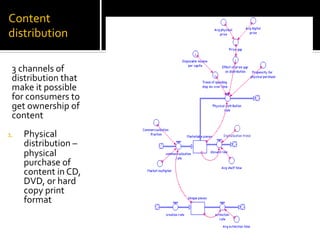
Content	
  
distribution	
  
3	
  channels	
  of	
  
distribution	
  that	
  
make	
  it	
  possible	
  
for	
  consumers	
  to	
  
get	
  ownership	
  of	
  
content	


1.  Physical	
  
distribution	
  –	
  
physical	
  
purchase	
  of	
  
content	
  in	
  CD,	
  
DVD,	
  or	
  hard	
  
copy	
  print	
  
format	
  
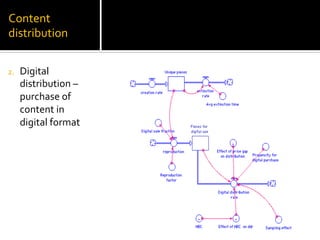
2.  Digital	
  
distribution	
  –	
  
purchase	
  of	
  
content	
  in	
  
digital	
  format	


Content	
  
distribution	
  
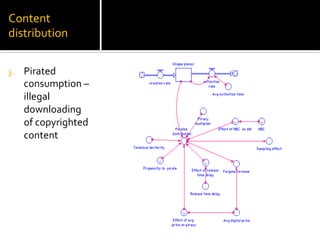
Content	
  
distribution	
  
3.  Pirated	
  
consumption	
  –	
  
illegal	
  
downloading	
  
of	
  copyrighted	
  
content	


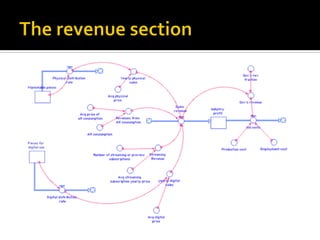
¡  Total	
  Revenue	
  =	
  physical	
  sales	
  +	
  digital	
  sales	
  +	
  
streaming	
  subscriptions	
  +	
  alternative	
  consumption	
  
¡  Streaming	
  subscription	
  –	
  access,	
  but	
  no	
  ownership	
  
¡  Alternative	
  consumption	
  –	
  revenue	
  coming	
  from	
  
purchase	
  of	
  derivative	
  products	
  of	
  creative	
  content,	
  
such	
  as	
  live	
  events	
  and	
  other	
  merchandise	
  
¡  +	
  Sampling	
  effect	
  –	
  purchase	
  in	
  digital	
  format	
  that	
  
comes	
  from	
  piracy:	
  consumers	
  test	
  content	
  before	
  
deciding	
  to	
  purchase	
  
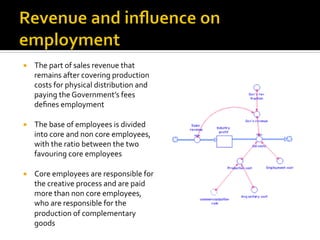
¡  The	
  part	
  of	
  sales	
  revenue	
  that	
  
remains	
  after	
  covering	
  production	
  
costs	
  for	
  physical	
  distribution	
  and	
  
paying	
  the	
  Government’s	
  fees	
  
defines	
  employment	


¡  The	
  base	
  of	
  employees	
  is	
  divided	
  
into	
  core	
  and	
  non	
  core	
  employees,	
  
with	
  the	
  ratio	
  between	
  the	
  two	
  
favouring	
  core	
  employees	
  
¡  Core	
  employees	
  are	
  responsible	
  for	
  
the	
  creative	
  process	
  and	
  are	
  paid	
  
more	
  than	
  non	
  core	
  employees,	
  
who	
  are	
  responsible	
  for	
  the	
  
production	
  of	
  complementary	
  
goods	
  
2:21 AM Sun, Aug 11, 2013
Untitled
Page 1
2007.00 2008.50 2010.00 2011.50 2013.00
Years
1:
1:
1:
0
4e+11
8e+11
1: Industry profit
1
1
1
1
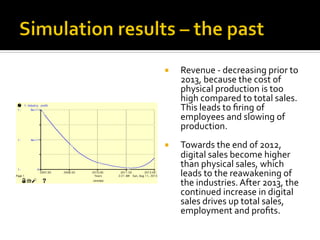
¡  Revenue	
  -­‐	
  decreasing	
  prior	
  to	
  
2013,	
  because	
  the	
  cost	
  of	
  
physical	
  production	
  is	
  too	
  
high	
  compared	
  to	
  total	
  sales.	
  
This	
  leads	
  to	
  firing	
  of	
  
employees	
  and	
  slowing	
  of	
  
production.	
  
¡  Towards	
  the	
  end	
  of	
  2012,	
  
digital	
  sales	
  become	
  higher	
  
than	
  physical	
  sales,	
  which	
  
leads	
  to	
  the	
  reawakening	
  of	
  
the	
  industries.	
  After	
  2013,	
  the	
  
continued	
  increase	
  in	
  digital	
  
sales	
  drives	
  up	
  total	
  sales,	
  
employment	
  and	
  profits.	
  
4:12 AM Sun, Aug 11, 2013
Untitled
Page 1
2007.00 2012.75 2018.50 2024.25 2030.00
Years
1:
1:
1:
0
3e+13
6e+13
1: Industry profit
1 1
1
1
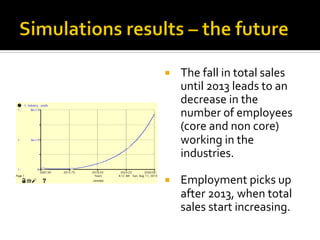
¡  The	
  fall	
  in	
  total	
  sales	
  
until	
  2013	
  leads	
  to	
  an	
  
decrease	
  in	
  the	
  
number	
  of	
  employees	
  
(core	
  and	
  non	
  core)	
  
working	
  in	
  the	
  
industries.	
  	
  
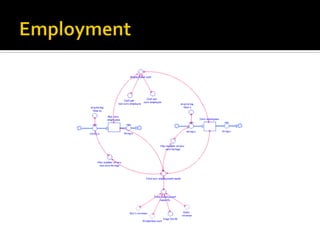
¡  Employment	
  picks	
  up	
  
after	
  2013,	
  when	
  total	
  
sales	
  start	
  increasing.	
  
Unique pieces
Marketable pieces
Pieces for digital use
Creation rate
Core employeesCreative Coefficient
+
+
+
Pirated distribution
+
Market multiplier
Commercialization
rate
+ +
Physical
distribution rate
Yearly physical sales
Yearly digital sales
Number of streaming or
preview subscriptions
Alternative
consumption
Avg physical price
Avg digital price
+
Sales Revenue
+
+
+
+
Avg streaming
subscription yearly
price
Avg price of alt
consumption
Streaming revenue
Revenue from alt
consumption
+
+
+
+
+
+
Industry profit
Industry costs
+
-
-
Digital
distribution rate
+
+
-
Employment cost
Production cost
+
+
Sampling effect
+
+
Discard rate
Extinction rate
-
-
Cost per core employee
Cost per non core
employee
Non core employees
+ ++
Wage worth
Max new number
of hirings
Core hiring
Core firing
Non core hiring non core firing
+
-
+ -
+
+
Gov's revenue
+
Gov's rev fraction
+
Propensity for
physical purchase
+
Effect of price gap
on distribution
-
+
Propensity for
digital purchase
+
Trend of spending
disposable income over
time
-
Avg shelf time
Digitalization trend
Avg extinction time
+
-
-
Reproduction rate
Reproduction factor
+
+
+
+
Piracy multiplier
Technical dexterity
Propensity to pirate
Effect of average
price on piracy
Effect of release
time delay
Forgone revenue
+
+ + +
-
+
Total reach
+
+
+
+
+
<Physical
distribution rate>
+
+
+
Avg unitary cost
+
Effect of HBC
+
<Effect of HBC>+
Total employment
capacity
+
-
<Production cost>
-
-
<Avg digital price>
Total new
employment needs
+
+
-
-
20	
  
¡  Model	
  construction	
  was	
  focused	
  on	
  distribution	
  
¡  The	
  structure	
  for	
  the	
  creative	
  process,	
  employment	
  and	
  cost	
  
are	
  simplistic	
  
¡  It	
  is	
  not	
  possible	
  to	
  distinguish	
  between	
  the	
  various	
  smaller	
  
markets	
  within	
  the	
  model	
  (music,	
  film,	
  book,	
  and	
  software	
  
market	
  respectively)	
  	
  
¡  Prices	
  stay	
  constant	
  even	
  though	
  they	
  can	
  be	
  a	
  mechanisms	
  to	
  
offset	
  the	
  negative	
  impacts	
  of	
  piracy	
  
¡  No	
  capacity	
  limitations,	
  which	
  causes	
  the	
  model	
  to	
  grow	
  
exponentially	
  in	
  the	
  long	
  run	
  
21	
  
¡  Fragmented	
  body	
  of	
  definitions	
  
¡  Difficulty	
  in	
  obtaining	
  data	
  à	
  some	
  had	
  to	
  be	
  
“guesstimated”	
  
¡  Some	
  variables	
  were	
  conceptually	
  derived	
  from	
  the	
  
readings,	
  and	
  their	
  values	
  are	
  based	
  on	
  the	
  reported	
  
trends,	
  but	
  there	
  are	
  no	
  exact	
  estimates,	
  mostly	
  
perceptions	
  of	
  magnitude	
  
¡  Piracy	
  is	
  not	
  confined	
  by	
  national	
  borders	
  à	
  hard	
  to	
  track	
  
pirates	
  down	
  and	
  understand	
  where	
  they	
  operate	
  from	
  
22	
  
6:02 AM Mon, Aug 12, 2013
Untitled
Page 1
2007.00 2012.75 2018.50 2024.25 2030.00
Years
1:
1:
1:
0
1e+14
2e+14
Industry profit: 1 - 2 - 3 -
1 1
1
1
2 2
2
2
3 3
3
3
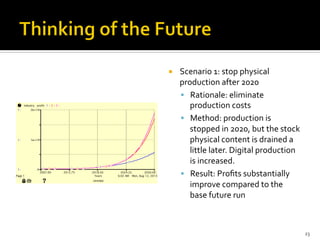
¡  Scenario	
  1:	
  stop	
  physical	
  
production	
  after	
  2020	
  
§  Rationale:	
  eliminate	
  
production	
  costs	
  
§  Method:	
  production	
  is	
  
stopped	
  in	
  2020,	
  but	
  the	
  stock	
  
physical	
  content	
  is	
  drained	
  a	
  
little	
  later.	
  Digital	
  production	
  
is	
  increased.	


§  Result:	
  Profits	
  substantially	
  
improve	
  compared	
  to	
  the	
  
base	
  future	
  run	
  
23	
  
¡  Scenario	
  2:	
  Pirate	
  and	
  legal	
  partnership	
  for	
  
providing	
  dual-­‐valuation	
  copies	
  of	
  creative	
  
content.	
  	
  
§  Rationale:	
  Foster	
  the	
  collaboration	
  of	
  pirates	
  and	
  
legal	
  creators,	
  taking	
  advantage	
  of	
  their	
  best	
  assets	
  
§  Method:	
  using	
  the	
  pirates’	
  platforms	
  for	
  
downloading	
  to	
  sell	
  content	
  legally;	
  offering	
  two	
  
purchasing	
  options	
  with	
  different	
  valuation	
  –	
  a	
  
higher	
  priced	
  and	
  higher	
  quality	
  version	
  of	
  content	
  +	
  
extras,	
  and	
  a	
  lower	
  priced,	
  lower	
  quality	
  copy	


24	
  
¡  Young,	
  tech-­‐savvy	
  consumers	
  with	
  a	
  
tendency	
  to	
  pirate	
  are	
  entering	
  the	
  market,	
  
whereas	
  mature,	
  paying	
  consumers	
  are	
  
exiting	
  it	
  
¡  The	
  goal	
  of	
  pirates	
  is	
  not	
  profit	
  
¡  Need	
  for	
  unified,	
  international	
  legislation	
  
¡  Advertising	
  as	
  a	
  source	
  of	
  revenue	
  since	
  the	
  
advent	
  of	
  free	
  alternatives	
  (such	
  as	
  unpaid	
  
streaming)	


¡  Piracy	
  à	
  not	
  as	
  detrimental	
  to	
  the	
  creative	
  industries	
  as	
  it	
  is	
  
claimed	
  –	
  in	
  fact,	
  it	
  might	
  even	
  be	
  a	
  positive	
  factor	
  in	
  promoting	
  
digital	
  sales	
  (sampling)	
  and	
  alternative	
  consumption,	
  thus	
  
expanding	
  the	
  customers	
  base	
  
¡  Survival	
  in	
  the	
  market	
  is	
  dependent	
  upon	
  the	
  realization	
  that	
  
companies	
  need	
  to	
  embrace	
  the	
  digital	
  aspect	
  of	
  business	
  
¡  Successful	
  business	
  models	
  for	
  the	
  digital	
  world	
  are	
  still	
  in	
  the	
  
making	
  
¡  Companies	
  with	
  higher	
  adaptability	
  to	
  change	
  are	
  better	
  suited	
  to	
  
the	
  new	
  digital	
  environment,	
  therefore	
  start	
  ups	
  and	
  new	
  comers	
  in	
  
the	
  market	
  are	
  more	
  likely	
  to	
  succeed	
  
¡  Incumbent	
  companies	
  need	
  to	
  learn	
  to	
  partner	
  up	
  with	
  new	
  comers	
  
26	


Feel	
  free	
  to	
  ask	
  questions!	
  

Abi Dodbiba - Is digital piracy the root of all evils for the creative industries in Europe? (OSCAL2014)

  • 1.
  • 2.
  • 3.
    ¡  A  modelling  methodology         ¡  Helps  in  creating  virtual  representations  of   complex  systems  dominated  by  feedbacks     ¡  Systems  are  complex  (non-­‐linear),  closed  and   change  over  time     ¡  Most  important  principle  of  SD:  Structure   generates  behaviour!  
  • 4.
    ¡  Actually:  from  Soap  (solid  vs.  liquid)   ¡  Another  important  example:  Cameras   (analog  vs.  digital)   ¡  However:  there  are  differences  with  the  case   of  digital  distribution  of  creative  work  
  • 5.
        ¡  The  creative  industries  throughout  the  world   are  claiming  that  piracy  is  the  cause  behind   their  loss  in  profit.    
  • 7.
    ¡  Technological  development:  increased  access   to  the  Internet  and  increased  usage  of   personal  devices     ¡  Attitudes  towards  consumption  have   changed     ¡  In  the  meantime,  the  distributors  of  content   and  legal  institutions  have  not  kept  up  with   the  pace  of  tech  innovation   ¡  Lack  of  definition  on  what  piracy  –  where  do   you  draw  the  line  of  legal  vs.  illegal  
  • 8.
    ¡  Young  adults,  mostly  students  and  males   ¡  Lower  income  –  could  be  related  to  the  young  age   ¡  Usually  assign  to  creative  content  a  lower  value   than  its  retailing  price   ¡  Risk  lovers  –regulations  seen  as  a  challenge,   rather  than  an  prohibition   ¡  Skilled  internet  users   ¡  Tend  to  apply  neutralization  techniques  -­‐  denial  of   responsibility,  denial  of  injury,  denial  of  victim,   “everybody  else  is  doing  it”,  entitlement   ¡  Feel  low  magnitude  of  consequences  
  • 9.
    ¡  Piracy  eliminates  the  notion  of  scarcity  à   Supply  is  substantially  increased     ¡  Also,  supply  and  demand  are  not  clearly   distinct  
  • 10.
    ¡  3  main  sections  in  the  model:     §  Content  distribution  –  how  do  people  acquire   content?   §  Revenues  of  the  creative  industries  –  how  does   the  industry  earn  their  income   §  Employment  –  how  many  are  employed  in  the   sector  
  • 11.
    Content   distribution   3  channels  of   distribution  that   make  it  possible   for  consumers  to   get  ownership  of   content     1.  Physical   distribution  –   physical   purchase  of   content  in  CD,   DVD,  or  hard   copy  print   format  
  • 12.
    2.  Digital   distribution  –   purchase  of   content  in   digital  format     Content   distribution  
  • 13.
    Content   distribution   3. Pirated   consumption  –   illegal   downloading   of  copyrighted   content    
  • 15.
    ¡  Total  Revenue  =  physical  sales  +  digital  sales  +   streaming  subscriptions  +  alternative  consumption   ¡  Streaming  subscription  –  access,  but  no  ownership   ¡  Alternative  consumption  –  revenue  coming  from   purchase  of  derivative  products  of  creative  content,   such  as  live  events  and  other  merchandise   ¡  +  Sampling  effect  –  purchase  in  digital  format  that   comes  from  piracy:  consumers  test  content  before   deciding  to  purchase  
  • 16.
    ¡  The  part  of  sales  revenue  that   remains  after  covering  production   costs  for  physical  distribution  and   paying  the  Government’s  fees   defines  employment     ¡  The  base  of  employees  is  divided   into  core  and  non  core  employees,   with  the  ratio  between  the  two   favouring  core  employees   ¡  Core  employees  are  responsible  for   the  creative  process  and  are  paid   more  than  non  core  employees,   who  are  responsible  for  the   production  of  complementary   goods  
  • 18.
    2:21 AM Sun,Aug 11, 2013 Untitled Page 1 2007.00 2008.50 2010.00 2011.50 2013.00 Years 1: 1: 1: 0 4e+11 8e+11 1: Industry profit 1 1 1 1 ¡  Revenue  -­‐  decreasing  prior  to   2013,  because  the  cost  of   physical  production  is  too   high  compared  to  total  sales.   This  leads  to  firing  of   employees  and  slowing  of   production.   ¡  Towards  the  end  of  2012,   digital  sales  become  higher   than  physical  sales,  which   leads  to  the  reawakening  of   the  industries.  After  2013,  the   continued  increase  in  digital   sales  drives  up  total  sales,   employment  and  profits.  
  • 19.
    4:12 AM Sun,Aug 11, 2013 Untitled Page 1 2007.00 2012.75 2018.50 2024.25 2030.00 Years 1: 1: 1: 0 3e+13 6e+13 1: Industry profit 1 1 1 1 ¡  The  fall  in  total  sales   until  2013  leads  to  an   decrease  in  the   number  of  employees   (core  and  non  core)   working  in  the   industries.     ¡  Employment  picks  up   after  2013,  when  total   sales  start  increasing.  
  • 20.
    Unique pieces Marketable pieces Piecesfor digital use Creation rate Core employeesCreative Coefficient + + + Pirated distribution + Market multiplier Commercialization rate + + Physical distribution rate Yearly physical sales Yearly digital sales Number of streaming or preview subscriptions Alternative consumption Avg physical price Avg digital price + Sales Revenue + + + + Avg streaming subscription yearly price Avg price of alt consumption Streaming revenue Revenue from alt consumption + + + + + + Industry profit Industry costs + - - Digital distribution rate + + - Employment cost Production cost + + Sampling effect + + Discard rate Extinction rate - - Cost per core employee Cost per non core employee Non core employees + ++ Wage worth Max new number of hirings Core hiring Core firing Non core hiring non core firing + - + - + + Gov's revenue + Gov's rev fraction + Propensity for physical purchase + Effect of price gap on distribution - + Propensity for digital purchase + Trend of spending disposable income over time - Avg shelf time Digitalization trend Avg extinction time + - - Reproduction rate Reproduction factor + + + + Piracy multiplier Technical dexterity Propensity to pirate Effect of average price on piracy Effect of release time delay Forgone revenue + + + + - + Total reach + + + + + <Physical distribution rate> + + + Avg unitary cost + Effect of HBC + <Effect of HBC>+ Total employment capacity + - <Production cost> - - <Avg digital price> Total new employment needs + + - - 20  
  • 21.
    ¡  Model  construction  was  focused  on  distribution   ¡  The  structure  for  the  creative  process,  employment  and  cost   are  simplistic   ¡  It  is  not  possible  to  distinguish  between  the  various  smaller   markets  within  the  model  (music,  film,  book,  and  software   market  respectively)     ¡  Prices  stay  constant  even  though  they  can  be  a  mechanisms  to   offset  the  negative  impacts  of  piracy   ¡  No  capacity  limitations,  which  causes  the  model  to  grow   exponentially  in  the  long  run   21  
  • 22.
    ¡  Fragmented  body  of  definitions   ¡  Difficulty  in  obtaining  data  à  some  had  to  be   “guesstimated”   ¡  Some  variables  were  conceptually  derived  from  the   readings,  and  their  values  are  based  on  the  reported   trends,  but  there  are  no  exact  estimates,  mostly   perceptions  of  magnitude   ¡  Piracy  is  not  confined  by  national  borders  à  hard  to  track   pirates  down  and  understand  where  they  operate  from   22  
  • 23.
    6:02 AM Mon,Aug 12, 2013 Untitled Page 1 2007.00 2012.75 2018.50 2024.25 2030.00 Years 1: 1: 1: 0 1e+14 2e+14 Industry profit: 1 - 2 - 3 - 1 1 1 1 2 2 2 2 3 3 3 3 ¡  Scenario  1:  stop  physical   production  after  2020   §  Rationale:  eliminate   production  costs   §  Method:  production  is   stopped  in  2020,  but  the  stock   physical  content  is  drained  a   little  later.  Digital  production   is  increased.         §  Result:  Profits  substantially   improve  compared  to  the   base  future  run   23  
  • 24.
    ¡  Scenario  2:  Pirate  and  legal  partnership  for   providing  dual-­‐valuation  copies  of  creative   content.     §  Rationale:  Foster  the  collaboration  of  pirates  and   legal  creators,  taking  advantage  of  their  best  assets   §  Method:  using  the  pirates’  platforms  for   downloading  to  sell  content  legally;  offering  two   purchasing  options  with  different  valuation  –  a   higher  priced  and  higher  quality  version  of  content  +   extras,  and  a  lower  priced,  lower  quality  copy       24  
  • 25.
    ¡  Young,  tech-­‐savvy  consumers  with  a   tendency  to  pirate  are  entering  the  market,   whereas  mature,  paying  consumers  are   exiting  it   ¡  The  goal  of  pirates  is  not  profit   ¡  Need  for  unified,  international  legislation   ¡  Advertising  as  a  source  of  revenue  since  the   advent  of  free  alternatives  (such  as  unpaid   streaming)    
  • 26.
    ¡  Piracy  à  not  as  detrimental  to  the  creative  industries  as  it  is   claimed  –  in  fact,  it  might  even  be  a  positive  factor  in  promoting   digital  sales  (sampling)  and  alternative  consumption,  thus   expanding  the  customers  base   ¡  Survival  in  the  market  is  dependent  upon  the  realization  that   companies  need  to  embrace  the  digital  aspect  of  business   ¡  Successful  business  models  for  the  digital  world  are  still  in  the   making   ¡  Companies  with  higher  adaptability  to  change  are  better  suited  to   the  new  digital  environment,  therefore  start  ups  and  new  comers  in   the  market  are  more  likely  to  succeed   ¡  Incumbent  companies  need  to  learn  to  partner  up  with  new  comers   26  
  • 27.
        Feel  free  to  ask  questions!