Aastha Hi-Tech Storage
LLP
Introduction
 Situated in Aravalli District near by
Himmatnagar (Gujarat)
 Well connected with Road.
 Environmental conditions are ideal.
 Having Capacity of 8000 MT
 Bulk & Box Cold Store
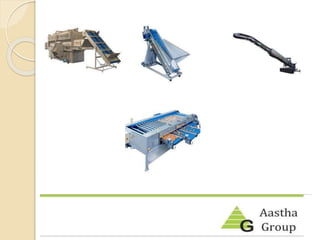
 Machinery from All-round Vegetable
Processing
Box Storage
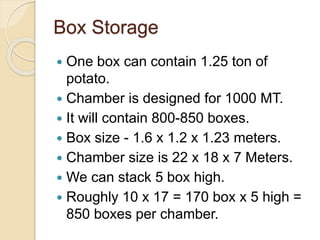
 One box can contain 1.25 ton of
potato.
 Chamber is designed for 1000 MT.
 It will contain 800-850 boxes.
 Box size - 1.6 x 1.2 x 1.23 meters.
 Chamber size is 22 x 18 x 7 Meters.
 We can stack 5 box high.
 Roughly 10 x 17 = 170 box x 5 high =
850 boxes per chamber.
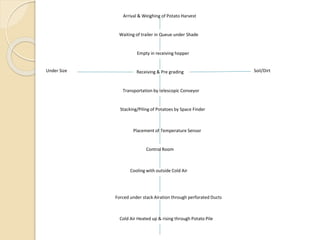
Flow Chart of Functioning
Arrival & Weighing of Potato Harvest
Waiting of trailer in Queue under Shade
Empty in receiving hopper
Receiving & Pre grading
Transportation by telescopic Conveyor
Stacking/Piling of Potatoes by Space Finder
Placement of Temperature Sensor
Control Room
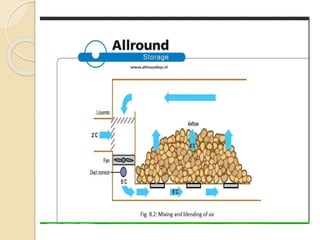
Cooling with outside Cold Air
Forced under stack Airation through perforated Ducts
Cold Air Heated up & rising through Potato Pile
Under Size Soil/Dirt
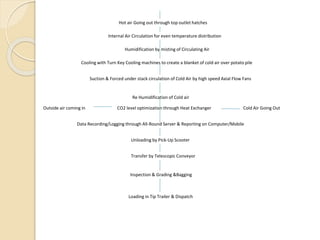
Hot air Going out through top outlet hatches
Internal Air Circulation for even temperature distribution
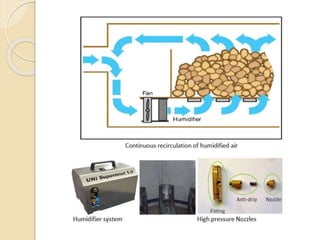
Humidification by misting of Circulating Air
Cooling with Turn Key Cooling machines to create a blanket of cold air over potato pile
Suction & Forced under stack circulation of Cold Air by high speed Axial Flow Fans
Re Humidification of Cold air
CO2 level optimization through Heat ExchangerOutside air coming in Cold Air Going Out
Data Recording/Logging through All-Round Server & Reporting on Computer/Mobile
Unloading by Pick-Up Scooter
Transfer by Telescopic Conveyor
Inspection & Grading &Bagging
Loading in Tip Trailer & Dispatch
Store Features &Practices we
Follow
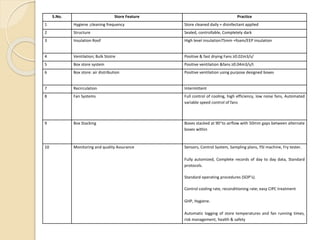
S.No. Store Feature Practice
1 Hygiene ;cleaning frequency Store cleaned daily + disinfectant applied
2 Structure Sealed, controllable, Completely dark
3 Insulation Roof High level insulation75mm +foam/EEP insulation
4 Ventilation; Bulk Stotre Positive & fast drying Fans ≥0.02m3/s/
5 Box store system Positive ventilation &fans ≥0.04m3/s/t
6 Box store: air distribution Positive ventilation using purpose designed boxes
7 Recirculation Intermittent
8 Fan Systems Full control of cooling, high efficiency, low noise fans, Automated
variable speed control of fans
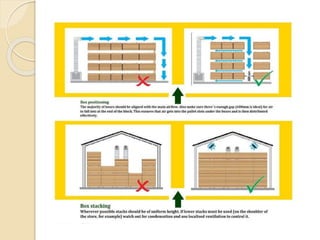
9 Box Stacking Boxes stacked at 90°to airflow with 50mm gaps between alternate
boxes within
10 Monitoring and quality Assurance Sensors, Control System, Sampling plans, YSI machine, Fry tester.
Fully automized, Complete records of day to day data, Standard
protocols.
Standard operating procedures (SOP’s).
Control cooling rate, reconditioning rate; easy CIPC treatment
GHP, Hygiene.
Automatic logging of store temperatures and fan running times,
risk management, health & safety
Processing Fresh Seed
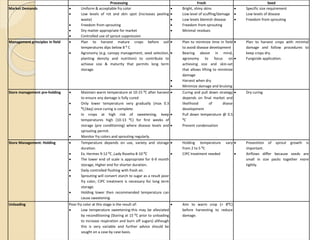
Market Demands  Uniform & acceptable fry color
 Low levels of rot and skin spot (increases peeling
waste)
 Freedom from sprouting
 Dry matter appropriate for market
 Controlled use of sprout suppression
 Bright, shiny skins
 Low level of scuffing/damage
 Low levels blemish disease
 Freedom from sprouting
 Minimal residues
 Specific size requirement
 Low levels of disease
 Freedom from sprouting
Management principles in field  Plan to harvest mature crops before soil
temperatures dips below 8 ⁰ C
 Agronomy (e.g. canopy management, seed selection,
planting density and nutrition) to contribute to
achieve size & maturity that permits long term
storage.
 Plan to minimize time in field
to avoid disease development
 Bearing above in mind,
agronomy to focus on
achieving size and skin-set
that allows lifting to minimize
damage
 Harvest when dry
 Minimize damage and bruising
 Plan to harvest crops with minimal
damage and follow procedures to
keep crops dry.
 Fungicide application.
Store management pre-holding  Maintain warm temperature at 10-15 ⁰C after harvest
to ensure any damage is fully cured
 Only lower temperature very gradually (max 0.3
⁰C/day) once curing is complete.
 In crops at high risk of sweetening, keep
temperatures high (10-13 ⁰C) for first weeks of
storage (pre conditioning) where disease levels and
sprouting permit.
 Monitor fry colors and sprouting regularly.
 Curing and pull down strategy
depends on final market and
likelihood of disese
development
 Pull down temperature @ 0.5
⁰C
 Prevent condensation
 Dry curing
Store Management: Holding  Temperature depends on use, variety and storage
duration.
 Ex. Hermes 9-12 ⁰C ,Lady Rosetta 8-10 ⁰C
 The lower end of scale is appropriate for 6-9 month
storage; Higher end for shorter duration.
 Daily controlled flushing with fresh air.
 Sprouting will convert starch to sugar as a result poor
fry color, CIPC treatment is necessary for long term
storage.
 Holding lower then recommended temperature can
cause sweetening.
 Holding temperature vary
from 2 to 5 ⁰C
 CIPC treatment needed
 Prevention of sprout growth is
important.
 Airflows differ because seeds are
small in size packs together more
tightly.
Unloading Poor fry color at this stage is the result of:
 Low temperature sweetening-this may be alleviated
by reconditioning (Storing at 15 ⁰C prior to unloading
to increase respiration and burn off sugars) although
this is very variable and further advice should be
sought on a case by case basis.
 Aim to warm crop (> 8⁰C)
before harvesting to reduce
damage.
Difference Between bulk and box
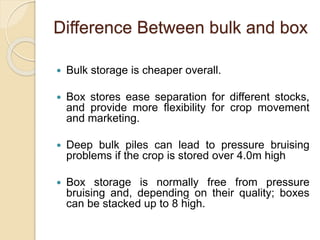
 Bulk storage is cheaper overall.
 Box stores ease separation for different stocks,
and provide more flexibility for crop movement
and marketing.
 Deep bulk piles can lead to pressure bruising
problems if the crop is stored over 4.0m high
 Box storage is normally free from pressure
bruising and, depending on their quality; boxes
can be stacked up to 8 high.
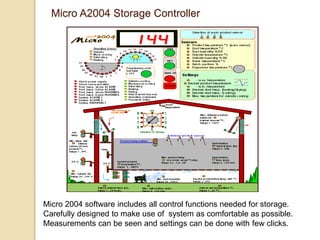
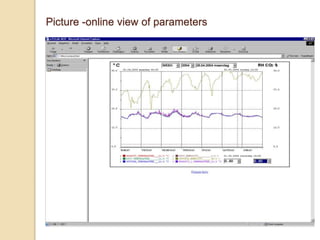
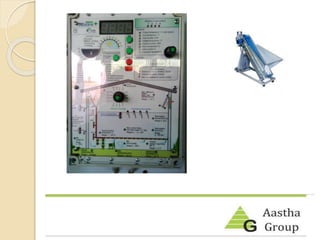
Micro A2004 Storage Controller
Micro 2004 software includes all control functions needed for storage.
Carefully designed to make use of system as comfortable as possible.
Measurements can be seen and settings can be done with few clicks.
Picture -online view of parameters
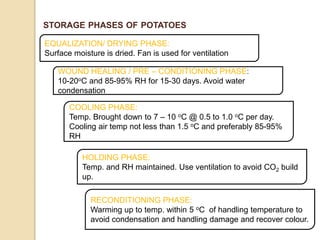
EQUALIZATION/ DRYING PHASE:
Surface moisture is dried. Fan is used for ventilation
WOUND HEALING / PRE – CONDITIONING PHASE:
10-20oC and 85-95% RH for 15-30 days. Avoid water
condensation
COOLING PHASE:
Temp. Brought down to 7 – 10 oC @ 0.5 to 1.0 oC per day.
Cooling air temp not less than 1.5 oC and preferably 85-95%
RH
HOLDING PHASE:
Temp. and RH maintained. Use ventilation to avoid CO2 build
up.
RECONDITIONING PHASE:
Warming up to temp. within 5 oC of handling temperature to
avoid condensation and handling damage and recover colour.
STORAGE PHASES OF POTATOES
POINTS WE KEEP IN WHILE DESIGNING &
RUNNING STORE
 Storage is not just about keeping
potatoes; it is about maintaining their
quality throughout the storage period
so that it is possible to deliver
consistently, in accordance with the
market specification, at an economic
and sustainable cost to earn a
worthwhile return.
1.Respiration
 The greater the respiration rate of the
potatoes, the more likely it is that warm
air will condense on cooler surface
potatoes.
 Positively ventilate potatoes to remove
respiration heat, to prevent surface
condensation.
 Use high ventilation rates to prevent
condensation in heavily respiring early
lifted or immature crops.
2.Evaporation
 Moisture loss from potatoes due to
evaporation will occur if the relative humidity
(RH) of the air surrounding the potatoes is
less than 98%.
 Keep store well sealed to minimize weight
loss.
 Prevent uncontrolled external air ingress, as
this usually has a lower RH than the storage
environment
3.sugar
 Sugars increase, and fry colors will
darken, if potatoes are stored at cold
temperatures.
 Store crops for processing at 7-10°C.
 Monitor cold stored pre pack potatoes for
effects of sugar increase.
 If unsure, check storage requirements
with your customer
4.ventilation
 Automated ventilation systems; Air can only be
used effectively if automation is done.
 Automatic control system.
 Avoid use of manual systems which are prone to
human error and variations in climate which can
quickly and irrevocably jeopardize crop quality.
 Positive ventilation, where the air has to pass
through the potato pile or box, is the best way to
get effective results in storage.
controlled ventilation
 Controlled ventilation allows crop respiration heat to be removed
and the crop to be dried and cooled. Fans are positioned to
create a flow of air through the crop (positive ventilation, bulk or
box) or to form a rolling mass of air that will flow over the stack
of boxes and through their pallet slots (space ventilation).
 Cooling can be achieved using ambient air and/or mechanical
cooling (refrigeration). Internal recirculation of air (without
cooling) can be used to eliminate temperature variation or to
distribute chemicals for sprout suppression or disease control.
 Air flow should be as uniform as possible throughout the store,
to give even drying and stable crop temperatures. A well
designed store will have been balanced to achieve uniformity of
airflow at its typical operating condition. This might include
features such as tapered air ducts or graduated lateral outlets to
deliver similar quantities of air across whole store.
Contact Us
 AASTHA HI-TECH STORAGE LLP (UNIT)
Address :Dhansura Road, Ramos Kampa, At Post Ramos,
Tal.Modasa, Dist. Aravalli, Gujarat
OFFICE:
Opp. Murlidhar Cold storage, Akhol Char Rasta, Deesa
highway At Post: Akhol Moti, Tal. Deesa District:
Banaskantha, Gujarat-385535
Mobile Number :91-9426428502 / 7622099903
Phone :02744-270778
E-mail :info@aastha-group.in
Thank You
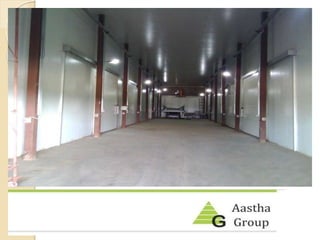
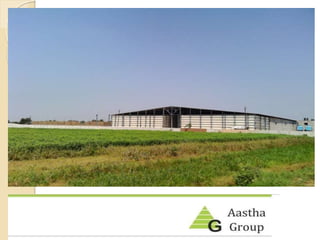
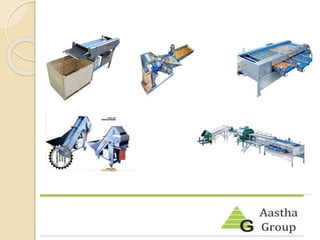
Results we are proud of:
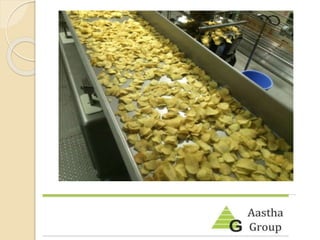
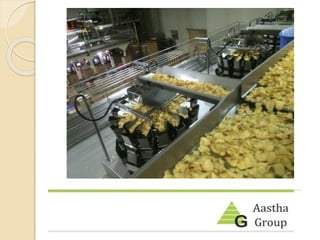
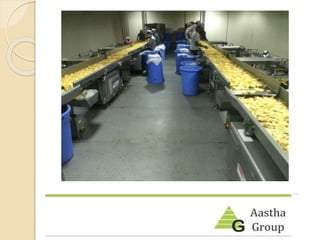
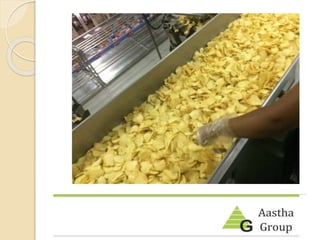
Some snaps from production
line
Aastha Hitech Storage LLP

Aastha Hitech Storage LLP

  • 1.
  • 2.
    Introduction  Situated inAravalli District near by Himmatnagar (Gujarat)  Well connected with Road.  Environmental conditions are ideal.
  • 3.
     Having Capacityof 8000 MT  Bulk & Box Cold Store  Machinery from All-round Vegetable Processing
  • 4.
    Box Storage  Onebox can contain 1.25 ton of potato.  Chamber is designed for 1000 MT.  It will contain 800-850 boxes.  Box size - 1.6 x 1.2 x 1.23 meters.  Chamber size is 22 x 18 x 7 Meters.  We can stack 5 box high.  Roughly 10 x 17 = 170 box x 5 high = 850 boxes per chamber.
  • 5.
    Flow Chart ofFunctioning
  • 6.
    Arrival & Weighingof Potato Harvest Waiting of trailer in Queue under Shade Empty in receiving hopper Receiving & Pre grading Transportation by telescopic Conveyor Stacking/Piling of Potatoes by Space Finder Placement of Temperature Sensor Control Room Cooling with outside Cold Air Forced under stack Airation through perforated Ducts Cold Air Heated up & rising through Potato Pile Under Size Soil/Dirt
  • 7.
    Hot air Goingout through top outlet hatches Internal Air Circulation for even temperature distribution Humidification by misting of Circulating Air Cooling with Turn Key Cooling machines to create a blanket of cold air over potato pile Suction & Forced under stack circulation of Cold Air by high speed Axial Flow Fans Re Humidification of Cold air CO2 level optimization through Heat ExchangerOutside air coming in Cold Air Going Out Data Recording/Logging through All-Round Server & Reporting on Computer/Mobile Unloading by Pick-Up Scooter Transfer by Telescopic Conveyor Inspection & Grading &Bagging Loading in Tip Trailer & Dispatch
  • 8.
  • 9.
    S.No. Store FeaturePractice 1 Hygiene ;cleaning frequency Store cleaned daily + disinfectant applied 2 Structure Sealed, controllable, Completely dark 3 Insulation Roof High level insulation75mm +foam/EEP insulation 4 Ventilation; Bulk Stotre Positive & fast drying Fans ≥0.02m3/s/ 5 Box store system Positive ventilation &fans ≥0.04m3/s/t 6 Box store: air distribution Positive ventilation using purpose designed boxes 7 Recirculation Intermittent 8 Fan Systems Full control of cooling, high efficiency, low noise fans, Automated variable speed control of fans 9 Box Stacking Boxes stacked at 90°to airflow with 50mm gaps between alternate boxes within 10 Monitoring and quality Assurance Sensors, Control System, Sampling plans, YSI machine, Fry tester. Fully automized, Complete records of day to day data, Standard protocols. Standard operating procedures (SOP’s). Control cooling rate, reconditioning rate; easy CIPC treatment GHP, Hygiene. Automatic logging of store temperatures and fan running times, risk management, health & safety
  • 10.
    Processing Fresh Seed MarketDemands  Uniform & acceptable fry color  Low levels of rot and skin spot (increases peeling waste)  Freedom from sprouting  Dry matter appropriate for market  Controlled use of sprout suppression  Bright, shiny skins  Low level of scuffing/damage  Low levels blemish disease  Freedom from sprouting  Minimal residues  Specific size requirement  Low levels of disease  Freedom from sprouting Management principles in field  Plan to harvest mature crops before soil temperatures dips below 8 ⁰ C  Agronomy (e.g. canopy management, seed selection, planting density and nutrition) to contribute to achieve size & maturity that permits long term storage.  Plan to minimize time in field to avoid disease development  Bearing above in mind, agronomy to focus on achieving size and skin-set that allows lifting to minimize damage  Harvest when dry  Minimize damage and bruising  Plan to harvest crops with minimal damage and follow procedures to keep crops dry.  Fungicide application. Store management pre-holding  Maintain warm temperature at 10-15 ⁰C after harvest to ensure any damage is fully cured  Only lower temperature very gradually (max 0.3 ⁰C/day) once curing is complete.  In crops at high risk of sweetening, keep temperatures high (10-13 ⁰C) for first weeks of storage (pre conditioning) where disease levels and sprouting permit.  Monitor fry colors and sprouting regularly.  Curing and pull down strategy depends on final market and likelihood of disese development  Pull down temperature @ 0.5 ⁰C  Prevent condensation  Dry curing Store Management: Holding  Temperature depends on use, variety and storage duration.  Ex. Hermes 9-12 ⁰C ,Lady Rosetta 8-10 ⁰C  The lower end of scale is appropriate for 6-9 month storage; Higher end for shorter duration.  Daily controlled flushing with fresh air.  Sprouting will convert starch to sugar as a result poor fry color, CIPC treatment is necessary for long term storage.  Holding lower then recommended temperature can cause sweetening.  Holding temperature vary from 2 to 5 ⁰C  CIPC treatment needed  Prevention of sprout growth is important.  Airflows differ because seeds are small in size packs together more tightly. Unloading Poor fry color at this stage is the result of:  Low temperature sweetening-this may be alleviated by reconditioning (Storing at 15 ⁰C prior to unloading to increase respiration and burn off sugars) although this is very variable and further advice should be sought on a case by case basis.  Aim to warm crop (> 8⁰C) before harvesting to reduce damage.
  • 11.
    Difference Between bulkand box  Bulk storage is cheaper overall.  Box stores ease separation for different stocks, and provide more flexibility for crop movement and marketing.  Deep bulk piles can lead to pressure bruising problems if the crop is stored over 4.0m high  Box storage is normally free from pressure bruising and, depending on their quality; boxes can be stacked up to 8 high.
  • 15.
    Micro A2004 StorageController Micro 2004 software includes all control functions needed for storage. Carefully designed to make use of system as comfortable as possible. Measurements can be seen and settings can be done with few clicks.
  • 16.
    Picture -online viewof parameters
  • 17.
    EQUALIZATION/ DRYING PHASE: Surfacemoisture is dried. Fan is used for ventilation WOUND HEALING / PRE – CONDITIONING PHASE: 10-20oC and 85-95% RH for 15-30 days. Avoid water condensation COOLING PHASE: Temp. Brought down to 7 – 10 oC @ 0.5 to 1.0 oC per day. Cooling air temp not less than 1.5 oC and preferably 85-95% RH HOLDING PHASE: Temp. and RH maintained. Use ventilation to avoid CO2 build up. RECONDITIONING PHASE: Warming up to temp. within 5 oC of handling temperature to avoid condensation and handling damage and recover colour. STORAGE PHASES OF POTATOES
  • 18.
    POINTS WE KEEPIN WHILE DESIGNING & RUNNING STORE
  • 19.
     Storage isnot just about keeping potatoes; it is about maintaining their quality throughout the storage period so that it is possible to deliver consistently, in accordance with the market specification, at an economic and sustainable cost to earn a worthwhile return.
  • 20.
    1.Respiration  The greaterthe respiration rate of the potatoes, the more likely it is that warm air will condense on cooler surface potatoes.  Positively ventilate potatoes to remove respiration heat, to prevent surface condensation.  Use high ventilation rates to prevent condensation in heavily respiring early lifted or immature crops.
  • 21.
    2.Evaporation  Moisture lossfrom potatoes due to evaporation will occur if the relative humidity (RH) of the air surrounding the potatoes is less than 98%.  Keep store well sealed to minimize weight loss.  Prevent uncontrolled external air ingress, as this usually has a lower RH than the storage environment
  • 22.
    3.sugar  Sugars increase,and fry colors will darken, if potatoes are stored at cold temperatures.  Store crops for processing at 7-10°C.  Monitor cold stored pre pack potatoes for effects of sugar increase.  If unsure, check storage requirements with your customer
  • 23.
    4.ventilation  Automated ventilationsystems; Air can only be used effectively if automation is done.  Automatic control system.  Avoid use of manual systems which are prone to human error and variations in climate which can quickly and irrevocably jeopardize crop quality.  Positive ventilation, where the air has to pass through the potato pile or box, is the best way to get effective results in storage.
  • 24.
    controlled ventilation  Controlledventilation allows crop respiration heat to be removed and the crop to be dried and cooled. Fans are positioned to create a flow of air through the crop (positive ventilation, bulk or box) or to form a rolling mass of air that will flow over the stack of boxes and through their pallet slots (space ventilation).  Cooling can be achieved using ambient air and/or mechanical cooling (refrigeration). Internal recirculation of air (without cooling) can be used to eliminate temperature variation or to distribute chemicals for sprout suppression or disease control.  Air flow should be as uniform as possible throughout the store, to give even drying and stable crop temperatures. A well designed store will have been balanced to achieve uniformity of airflow at its typical operating condition. This might include features such as tapered air ducts or graduated lateral outlets to deliver similar quantities of air across whole store.
  • 25.
    Contact Us  AASTHAHI-TECH STORAGE LLP (UNIT) Address :Dhansura Road, Ramos Kampa, At Post Ramos, Tal.Modasa, Dist. Aravalli, Gujarat OFFICE: Opp. Murlidhar Cold storage, Akhol Char Rasta, Deesa highway At Post: Akhol Moti, Tal. Deesa District: Banaskantha, Gujarat-385535 Mobile Number :91-9426428502 / 7622099903 Phone :02744-270778 E-mail :info@aastha-group.in
  • 26.
  • 32.
    Results we areproud of: Some snaps from production line