A&A 534, A40 (2011)                                                                                                  Astronomy
DOI: 10.1051/0004-6361/201117067                                                                                      &
c ESO 2011                                                                                                           Astrophysics


                              Multiwavelength campaign on Mrk 509
                      V. Chandra -LETGS observation of the ionized absorber
      J. Ebrero1 , G. A. Kriss2,3 , J. S. Kaastra1,4 , R. G. Detmers1,4 , K. C. Steenbrugge5,6 , E. Costantini1 , N. Arav7 ,
    S. Bianchi8 , M. Cappi9 , G. Branduardi-Raymont10 , M. Mehdipour10 , P. O. Petrucci11 , C. Pinto1 , and G. Ponti12

      1
          SRON Netherlands Institute for Space Research, Sorbonnelaan 2, 3584 CA, Utrecht, The Netherlands
          e-mail: J.Ebrero.Carrero@sron.nl
      2
          Space Telescope Science Institute, 3700 San Martin Drive, Baltimore, MD 21218, USA
      3
          Department of Physics and Astronomy, The Johns Hopkins University, Baltimore, MD 21218, USA
      4
          Astronomical Institute, University of Utrecht, Postbus 80000, 3508 TA, Utrecht, The Netherlands
      5
          Instituto de Astronomía, Universidad Católica del Norte, Avenida Angamos 0610, Casilla 1280, Antofagasta, Chile
      6
          Department of Physics, University of Oxford, Keble Road, Oxford OX1 3RH, UK
      7
          Department of Physics, Virginia Tech, Blacksburg, VA 24061, USA
      8
          Dipartimento di Fisica, Università degli Studi Roma Tre, via della Vasca Navale 84, 00146 Roma, Italy
      9
          INAF-IASF Bologna, via Gobetti 101, 40129 Bologna, Italy
     10
          Mullard Space Science Laboratory, University College London, Holmbury St. Mary, Dorking, Surrey, RH5 6NT, UK
     11
          UJF-Grenoble 1/CNRS-INSU, Institut de Planétologie et d’Astrophysique de Grenoble (IPAG) UMR 5274, 38041 Grenoble,
          France
     12
          School of Physics and Astronomy, University of Southampton, Highfield, Southampton, SO17 1BJ, UK

     Received 12 April 2011 / Accepted 1 June 2011
                                                                  ABSTRACT

     Context. We present here the results of a 180 ks Chandra-LETGS observation as part of a large multi-wavelength campaign on
     Mrk 509.
     Aims. We study the warm absorber in Mrk 509 and use the data from a simultaneous HST-COS observation in order to assess whether
     the gas responsible for the UV and X-ray absorption are the same.
     Methods. We analyzed the LETGS X-ray spectrum of Mrk 509 using the SPEX fitting package.
     Results. We detect several absorption features originating in the ionized absorber of the source, along with resolved emission lines
     and radiative recombination continua. The absorption features belong to ions with, at least, three distinct ionization degrees. The
     lowest ionized component is slightly redshifted (Δv = 73 km s−1 ) and is not in pressure equilibrium with the others, and therefore it is
     not likely part of the outflow, possibly belonging to the interstellar medium of the host galaxy. The other components are outflowing at
     velocities of −196 and −455 km s−1 , respectively. The source was observed simultaneously with HST-COS, finding 13 UV kinematic
     components. At least three of them can be kinematically associated with the observed X-ray components. Based on the HST-COS
     results and a previous FUSE observation, we find evidence that the UV absorbing gas might be co-located with the X-ray absorbing
     gas and belong to the same structure.
     Key words. galaxies: active – galaxies: Seyfert – quasars: absorption lines – galaxies: individual: Mrk 509 – X-rays: galaxies


1. Introduction                                                            point to a possible relation between the two phenomena. With
                                                                           the advent of modern medium- and high-resolution spectro-
Active galactic nuclei (AGN) are among the most luminous per-              graphs, the ionization state, kinematic properties and column
sistent extragalactic sources known in the Universe. A signifi-             densities of the absorption features in X-rays could be deter-
cant fraction of their bolometric luminosity is emitted at X-ray           mined with higher accuracy. However, even though the average
wavelengths, and originates in the innermost regions of these              outflow velocity measured in the X-rays is generally consistent
sources, where a supermassive black hole resides. Gravitational            with the velocity shifts measured in the UV, the spectral reso-
accretion of matter onto this black hole is believed to be the             lution in X-rays is insufficient to resolve the many individual
mechanism that powers these objects, and the intense radiation             kinematic components present in the UV.
field thus generated might drive gas outflows from the nucleus.                  Some authors discussed the possibility that at least a fraction
Indeed, more than 50% of the Seyfert 1 galaxies presents evi-              of the UV absorption is produced in the same gas responsible for
dence of a photoionized gas, the so-called warm absorber (WA),             the X-ray absorption (Mathur et al. 1994, 1995, 1999; Crenshaw
in their soft X-ray spectra (e.g. Reynolds 1997; George et al.             & Kraemer 1999; Kriss et al. 2000; Kraemer et al. 2002), but
1998; Crenshaw et al. 2003a). These WA are usually blueshifted             the results were inconclusive and the connection between the
with respect to the systemic velocity of the source with velocities        two absorbing components seems to be very complex. The most
of the order of hundreds of km s−1 (Kaastra et al. 2000; Kaspi             common source of uncertainty came from the lack of correspon-
et al. 2001; Kaastra et al. 2002).                                         dence between the column densities of the species detected in
    Interestingly, sources that present absorption in the UV also          both UV and X-rays. However, more recent high-resolution ob-
show absorption in X-rays (Crenshaw et al. 1999), which may                servations indicate that these values can be reconciled if one
                                           Article published by EDP Sciences                                                   A40, page 1 of 12
A&A 534, A40 (2011)

assumes a velocity-dependent partial covering in the UV (e.g.                        1
Arav et al. 2002, 2003).
     Simultaneous UV/X-ray observations are therefore the key
to draw a global and unbiased picture of the WA in AGN (see                        0.9

e.g. Costantini 2010, for a review). High-resolution UV obser-
vations covering a wide range of ionization states are essen-
                                                                                   0.8
tial to determine whether some of the UV absorbers are indeed


                                                                      Counts s−1
associated with the X-ray warm absorber. Low-ionization ab-
sorbers, such as Mg ii and C ii, are only detected in the UV do-
                                                                                   0.7
main, while high-ionization ions like O viii or Mg xi can only
be detected in X-rays. However, there is a range of ionization
states that may produce ions detected in both bands, namely N v                    0.6
and, particularly, O vi. Therefore, several simultaneous or quasi-
simultaneous X-ray and UV spectroscopic observations have
been carried out on many sources known to host a X-ray WA and                      0.5
UV absorbers, e.g. NGC 3783 (Kaspi et al. 2002; Gabel et al.                             0             105                     2×10⁵                3×10⁵
                                                                                                     Time (s) from first event
2003), NGC 5548 (Crenshaw et al. 2003b; Steenbrugge et al.
2005), Mrk 279 (Arav et al. 2005; Gabel et al. 2005; Costantini       Fig. 1. Lightcurve of the Chandra observations. The solid horizontal
et al. 2007).                                                         lines mark the HST-COS observation intervals.
     Mrk 509 is a Seyfert 1/QSO hybrid and is one of the
best studied local AGN because of its high luminosity (L(1–           Table 1. Chandra-LETGS observation log.
1000 Ryd) 3.2 × 1045 erg s−1 ) and proximity. It is particu-
larly suitable for an extensive multi-wavelength campaign be-                            Obs ID        Date          Exp. time         Count rate
cause of its brightness and confirmed presence of an intrinsic                                     (dd-mm-yyyy)         (ks)            (counts/s)
WA (Pounds et al. 2001; Yaqoob et al. 2003; Smith et al. 2007;                           11387      10-12-2009        131.4               0.94
Detmers et al. 2010) in X-rays, as well as a variety of UV absorp-                       11388      12-12-2009         48.6               1.05
tion lines (Crenshaw et al. 1995, 1999; Savage et al. 1997; Kriss
et al. 2000; Kraemer et al. 2003) and slow variability, which
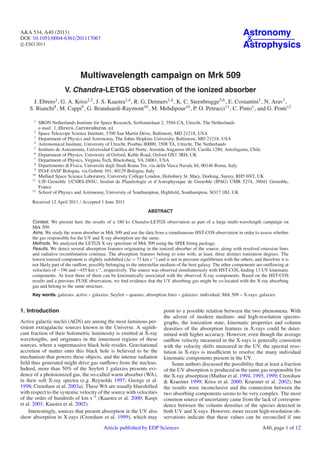
makes it particularly suited to reverberation studies.                    The lightcurve of both observations is shown in Fig. 1, with
     This paper is devoted to the analysis of the Chandra-LETGS       a bin size of one hour (3600 s). We overplot the time intervals
observation of Mrk 509, which is part of an unprecedented multi-      when the HST-COS observations were taken. The lightcurve
wavelength campaign of observations carried out at the end of         shows no episodes of short-time variability (i.e. within a few
2009, aiming at determining the location of the warm absorber         kiloseconds) when we apply a bin size of 100 s. At longer
and the physics of its ionized outflow. The campaign involved          timescales the source flux varies smoothly throughout the whole
five satellites (XMM-Newton, Chandra, INTEGRAL, HST, and               observation. There seems to be a drop in flux, starting shortly
Swift), and two ground-based facilities (WHT and PAIRITEL),           after the beginning of the observation, followed by a recovery at
thus covering more than five orders of magnitude in frequency.         t ∼ 50 ks. The deviation from the average flux was of the or-
An overview of the campaign and its goals can be found in             der of 30% and no significant spectral variations were observed
Kaastra et al. (2011b, hereafter Paper I), and references therein.    between the higher and lower flux states.
     This paper is organised as follows: in Sect. 2 we briefly
present the reduction method applied, in Sect. 3 we describe          3. Spectral analysis
the different models used to fit the spectrum, while in Sect. 4
we discuss our results and compare them with previous X-ray           The combined LETGS spectrum was analysed using the SPEX1
observations as well as with the simultaneous HST-COS obser-          fitting package v2.03.00 (Kaastra et al. 1996). The spectrum has
vation. Finally, our conclusions are summarized in Sect. 5. The       variable bin sizes, depending on the statistics, but is typically
quoted errors refer to 68.3% confidence level (Δχ2 = 1 for one         binned in 0.03 Å bins, which results in ∼30 counts per bin.
parameter of interest) unless otherwise stated.                       Therefore, the fitting method adopted was χ2 statistics. In what
                                                                      follows we describe the different models used to describe the
                                                                      continuum, and the absorption and emission features present in
2. X-ray observations and data reduction                              the spectrum of Mrk 509. The cosmological redshift of Mrk 509
                                                                      is z = 0.034397 (Huchra et al. 1993). For this work, we adopt a
Mrk 509 was observed on two consecutive orbits in December            systemic redshift of z = 0.03448, which is the heliocentric red-
2009 by the Low Energy Transmission Grating Spectrometer              shift of Mrk 509 transferred to the Earth-centered frame of our
(LETGS, Brinkman et al. 2000) coupled to the HRC-S detec-             Chandra data at the time of our observation. Note that the stan-
tor on board of Chandra for a total exposure time of ∼180 ks          dard CIAO software does not take this motion into account. An
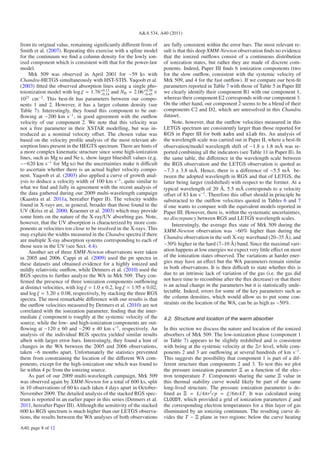
(see Table 1). The LETGS observation was made simultaneously          overall view of the LETGS spectrum of Mrk 509 in the range
with the HST-COS spectrograph observations (Kriss et al. 2011).       where the majority of relevant lines fall is shown in Fig. 2.
    The LETGS data were reduced using the standard pipeline
(CIAO 4.2) until the level 1.5 event files were created. The rest
of the procedure, until the creation of the final level 2 event file,   3.1. Continuum
followed the same steps as the standard pipeline regarding the        The continuum was modelled following two different ap-
wavelength accuracy determination and effective area genera-           proaches. We first used a spline model, that reproduces the shape
tion, but was carried out using an independent procedure first
described in Kaastra et al. (2002).                                   1
                                                                                   http://www.sron.nl/spex

A40, page 2 of 12
25                                                                               J. Ebrero et al.: Multiwavelength campaign on Mrk 509. V.


                                                                                                                                                                                              25
                                                                                           O I (z=0)
                                                                                      O VII r (z=0)


                                                                                                       N VII

                                                                                                               C VI RRC
                                                                       O VIII 1s−2p


                                                                                                                                 N I (z=0)
                                                                                      O VII r
                                                                                      O VI


                                                                                                                          N VI
                                                                                                               C VI


                                                                                                                                             C VI
                              20


                                                                                                                                                         S XII
                                                                                                                                                    CV
                                           Ne X Lyα


                                                                                                                                                                                              20
                                                      Ne IX r
                                   Mg XI
  x10−4 Counts cm−2 s−1 Å−1


                                                                                                                                                                  x10−4 Counts cm−2 s−1 Å−1
                              15


                                                                                                                                                                                              15
                              10


                                                                                                                                                                                              10
                              5


                                      10                        15          20        25                                  30                 35                                                       10             20                   30                 40
                                                                             Wavelength (Å)                                                                                                                         Wavelength (Å)

Fig. 2. Chandra-LETGS spectrum in the 9–38 Å range. The continuum                                                                                                Fig. 3. Unabsorbed continuum plus emission line models. Solid line:
is described with a spline model. The most prominent lines are labeled.                                                                                          spline continuum; dot-dashed line: power-law + modified black body.

Table 2. Best-fit spline continuum parameters.                                                                                                                    Table 3. Best-fit power-law plus modified black body continuum pa-
                                                                                                                                                                 rameters.
                                                                Wavelength (Å)                           Fluxa
                                                                4.00                                       0                                                                                   Model             Γ             Ta                F0.5−2 b
                                                                4.86                                   11.5 ± 8.0                                                                              Power law    2.06 ± 0.03        ...             2.56 ± 0.05
                                                                5.90                                   11.3 ± 0.1                                                                              Black body       ...       0.126 ± 0.005        0.22 ± 0.03
                                                                7.16                                   10.8 ± 0.2
                                                                8.69                                   11.0 ± 0.1                                                Notes. (a) Temperature, in units of keV;                      (b)
                                                                                                                                                                                                                                     0.5–2 keV flux, in units of
                                                                10.55                                  11.1 ± 0.2                                                10−11 erg cm−2 s−1 .
                                                                12.81                                  12.0 ± 0.2
                                                                15.55                                  12.8 ± 0.2
                                                                18.87                                  14.0 ± 0.3
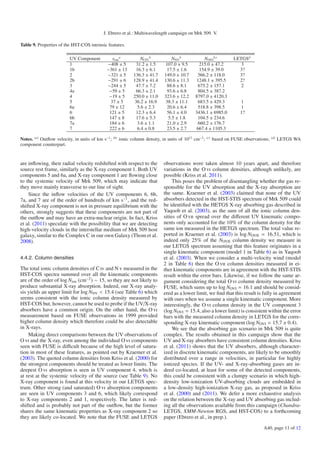
                                                                22.91                                  15.6 ± 0.3                                                are also included. Both models agree well for most part of the
                                                                27.82                                  17.3 ± 0.2                                                fitting range, with average deviations between both models of
                                                                33.78                                  19.3 ± 0.3                                                less than 5% in the 10–36 Å range. The larger deviations oc-
                                                                42.42                                      0
                                                                                                                                                                 cur below 10 Å and above 36 Å (where the maximal deviations
Notes. (a) Unabsorbed flux, in units of 10−4 photons cm−2 s−1 Å−1 .                                                                                               are only ∼7% and ∼9%, respectively), most likely due to the
                                                                                                                                                                 logarithmic sampling of the spline model. Indeed, the power-
                                                                                                                                                                 law model fails to correctly reproduce the continuum at shorter
                                                                                                                                                                 wavelengths, which is best covered by the spline with 4 hinge
of the continuum without any a priori assumptions on its physi-
cal origin. The boundaries of the spline were set between 4 and                                                                                                  points below 10 Å. The poorer sampling of the spline at longer
41 Å. We note that the analysis of the spectrum is nominally                                                                                                     wavelengths with only one hinge point above 30 Å provides a
                                                                                                                                                                 slightly worse description of the continuum than the power-law
carried out in the range 5–40 Å, where the majority of the most
                                                                                                                                                                 plus mbb model. However, these deviations are lower or similar
relevant spectral features fall. The spline boundaries had to be
                                                                                                                                                                 to the statistical uncertainties in the data, which are of the order
extended beyond these limits in order to prevent spurious arti-
                                                                                                                                                                 of 10%, and therefore the continuum models do not critically dif-
facts in the proximity of the boundaries, since the model sets the
                                                                                                                                                                 fer. Since the differences between both models in terms of good-
photon spectrum to zero outside the defined limits. The grid con-
                                                                                                                                                                 ness of fit are better for the spline model by Δχ/Δν = 21/9, this
sisted of 13 points spaced logarithmically in wavelength. This
spacing is wide enough to successfully model the continuum                                                                                                       was the baseline model adopted for the fit in the 5–40 Å range.
without risking to fit any intrinsic absorption features. The best-                                                                                               The extension of the analysis towards longer wavelengths, up to
fit flux at the hinge points of the grid is reported in Table 2.                                                                                                   ∼60 Å, was made using only the power-law baseline model (see
    As an alternative approach, we also modelled the continuum                                                                                                   Sect. 3.4).
using a single power-law in the same range as the spline model.
This yielded an unacceptable fit, both visually and in terms of                                                                                                   3.2. Local absorption
reduced χ2 , due to deviations at soft X-rays. To account for these
deviations we added a modified black body model (mbb model                                                                                                        Before analyzing the spectral features intrinsic to Mrk 509 we
in SPEX). The final fit yielded a comparable reduced χ2 (1742                                                                                                      first account for the foreground absorption of our Galaxy. The
for 1329 d.o.f.) to that of the spline model (1721 for 1320 d.o.f.).                                                                                             local interstellar medium (ISM) presents three different phases:
The best-fit parameters are reported in Table 3. In both cases, the                                                                                               a cold neutral phase, a warm slightly ionized phase, and a hot
continuum was corrected for local foreground absorption (see                                                                                                     highly ionized phase (Pinto et al. 2010). For the neutral phase
Sect. 3.2).                                                                                                                                                      we take NH = 4.44 × 1020 cm−2 (Murphy et al. 1996). The local
    The spline and power-law plus mbb unabsorbed models are                                                                                                      absorption parameters were kept fixed during the spectral fits. A
compared in Fig. 3, where the rest of emission components                                                                                                        detailed analysis of the local ISM absorption in the line of sight
                                                                                                                                                                                                                                               A40, page 3 of 12
A&A 534, A40 (2011)

Table 4. Best-fit emission line parameters.                                 Table 5. Best-fit RRC parameters.

        Line          Wavelengtha      FWHMb          Fluxc                                 Continuum       Ion     EM a       Tb
        O vii (r)       21.602          0.285         <0.43                                                           +8.9       +3.8
        O vii (i)       21.808          0.288      0.52 ± 0.20                              Spline         C vi    7.5−4.5    3.7−2.0
        O vii (f)       22.101          0.292      0.67 ± 0.20                                             N vii      +4.5
                                                                                                                   3.5−2.1       +7.4
                                                                                                                              7.1−3.4
        N vii Lyα       24.781          0.327         <0.42
                                                                                                                      +6.4       +3.2
        O viii Lyα      18.973          0.250         <0.31                                 PL+mbb         C vi    6.2−3.9    3.4−2.1
        C vi Lyα        33.736          0.445      0.67 ± 0.25                                                        +4.2       +7.5
                                                                                                           N vii   4.2−2.4    7.9−3.7
Notes. (a) Rest wavelength in Å (frozen); (b) full width at half maximum
                                                                           Notes. (a) Emission measure ne nion V, in units of 1061 cm−3 ; (b) tempera-
in Å (frozen); (c) in units of 10−4 photons cm−2 s−1 .
                                                                           ture, in units of eV.


                                                                           3.4. Warm absorber
of Mrk 509 will be reported in a forthcoming paper (Pinto et al.,          The majority of the absorption lines seen in the soft X-ray spec-
in prep.).                                                                 trum of Mrk 509 corresponds to the presence of ionized gas at
                                                                           the redshift of the source. Most of them are blueshifted with re-
                                                                           spect to the systemic velocity of Mrk 509.
3.3. Emission lines
                                                                                We first modelled the WA using two slab components to
There are several emission features that can be visually identi-           describe the low- and high-ionization absorption lines, respec-
fied in the LETGS spectrum of Mrk 509. In most of the cases                 tively. The slab model in SPEX calculates the transmission of a
the emission lines are blended with features from the warm ab-             slab of material without any assumptions on the underlying ion-
sorber. They need, however, to be modelled in order to account             ization balance. The free parameters are the ionic column densi-
for the excesses seen on both sides of the absorption line. This           ties, the rms velocity broadening, and the outflow velocity. The
was the case of the C vi Lyα line at ∼34.9 Å and, with less sig-           slab fit showed that the low-ionization ions, i.e. those for which
                                                                           their concentrations peak at log ξ lower than 2.1, appear to be in
nificance, the O viii Lyα and N vii Lyα lines at ∼19.6 Å and
                                                                           a different kinematic regime with respect to the high-ionization
∼25.5 Å, respectively. The O vii region shows also great com-              ions. The ionization parameter is defined as ξ = L/nR2 , where L
plexity, as a number of emission lines are blended with O vi               is the ionizing luminosity in the 1–1000 Ryd range, n is the den-
and O vii absorption lines. Since the lines look broad, we have            sity of the gas, and R is the distance from the ionizing source.
modelled the O vii triplet, as well as the lines mentioned above,          Ions belonging to the first slab component are at the systemic
with Gaussians. The high flux ratio of the O vii intercombination           velocity, whereas those of component 2 are outflowing at sev-
line with respect to the other lines of the O vii triplet suggests         eral hundreds of km s−1 (model 1 in Table 6). This model is,
that the gas has high density, thus pointing towards an origin in          however, not entirely realistic, as it does not allow for a possible
the BLR. This was also found in other Seyfert 1 galaxies (e.g.             multi-velocity structure in the outflow. Different kinematic com-
Longinotti et al. 2008, 2009), and is generally different from the          ponents may, in principle, contribute to the total column den-
results found in Seyfert 2 galaxies, where the lines are likely            sity of a given ion. Therefore, the model was extended and all
produced in the Narrow Line Region (NLR, e.g. Bianchi et al.               the ions were fitted with both velocity components (model 2
2006; Guainazzi & Bianchi 2007). Therefore, the wavelengths                in Table 6). The results show that indeed C v and C vi, as well
were fixed to the rest-frame values and the widths to those of              as O vi, O vii and O viii ions are significantly detected in both
the optical BLR as measured for the Balmer lines with XMM-                 velocity regimes. Moreover, a third component is required in
Newton OM (FWHM            4000 km s−1 , Mehdipour et al. 2011).           order to correctly fit Mg xi and Fe xxi which seem to be out-
The fluxes of the lines are therefore the only free parameters. The         flowing at even larger velocities. Hence, the final fit shows three
O vii forbidden ( f ) and intercombination (i), and the C vi lines         distinct kinematic components: one slightly redshifted and two
are detected at the ∼3σ confidence level, whereas the others are            blueshifed with respect to the systemic velocity of the source
just detected at the 1σ confidence level. The best-fit values are            by ∼200 and ∼600 km s−1 . The best-fit values for models 1 and
summarised in Table 4.                                                     2 are reported in Table 6, along with the ionization parameter
    In addition to these broad lines, there are also hints of radia-       ξ for which the ion fraction peaks for that ion. The values of
tive recombination continua (RRC) present in the spectrum. We              ξ are derived from an ionization balance model and are shown
found a RRC of C vi, seen at ∼26.2 Å, at the >2σ confidence                 for illustrative purposes, as the slab fit is not model-dependent.
level, and a marginal (detected at the 1.65σ confidence level)              These different velocity components of the WA will be used as a
RRC of N vii around 19.1 Å. Other RRC like that of O vii were              starting point for a more physical analysis.
statistically undetectable in our dataset. The features were fitted              We also use an alternative model to describe the WA in
using an ad-hoc model available in SPEX that takes into account            Mrk 509. The xabs model in SPEX calculates the transmission
the characteristic shape of these lines. The best-fit temperature           of a slab of material where all ionic column densities are linked
and emission measure of these features are reported in Table 5.            through a photoionization balance model, which we calculated
The best-fit low temperatures found for these features indicate             using CLOUDY (Ferland et al. 1998) version C08. The spec-
that the dominant mechanism in the gas is photoionization. The             tral energy distribution (SED) provided to CLOUDY as an input
emission line models used in the fit are shown in Fig. 3 for both           was built using the different observations involved in this cam-
the spline and power-law continuum models. It can be seen that             paign (Chandra-LETGS, HST-COS, INTEGRAL, SWIFT), plus
the choice of either continuum modelling does not significantly             archival FUSE data. Details on how the SED was built and plots
affect the detection of the emission lines.                                 are shown in Paper I. The free parameters in the xabs fit are the
A40, page 4 of 12
J. Ebrero et al.: Multiwavelength campaign on Mrk 509. V.

Table 6. Ionic column densities of the most relevant ions.

                                                   Model 1                                    Model 2
                        Component            1               2                  1                2                3
                        σa                108 ± 11         100+63
                                                              −35            85 ± 17          61 ± 15          90 ± 36
                        vout b              3+17
                                             −43         −338+91
                                                               −142          87 ± 36         −208 ± 42       −635 ± 172
                        Ion              log Nion c      log Nion c         log Nion c       log Nion c       log Nion c      log ξ d
                        Cv              16.47 ± 0.17                       16.38 ± 0.19     15.95 ± 0.43                       0.15
                        C vi            16.66 ± 0.19                       16.65 ± 0.18     15.85 ± 0.41                       1.20
                        Nv                 <15.4                              <15.3            <15.4                           0.00
                        N vi            15.57 ± 0.36                       15.60 ± 0.37        <15.3                           0.75
                        N vii           15.89 ± 0.27                       15.99 ± 0.23        <15.5                           1.60
                        O iii           16.16 ± 0.23                       15.96 ± 0.36        <15.6                          −1.50
                        O iv            16.07 ± 0.31                       15.76 ± 0.31        <15.9                          −0.65
                        Ov              16.17 ± 0.22                          <15.6         16.45 ± 0.22                      −0.05
                        O vi            16.19 ± 0.18                       15.99 ± 0.22     15.69 ± 0.39                       0.40
                        O vii           17.10 ± 0.11                       16.76 ± 0.14     16.54 ± 0.22                       1.15
                        O viii          17.43 ± 0.13                       16.76 ± 0.31     17.14 ± 0.18                       1.90
                        Ne viii            <16.0                              <16.0            <15.7                           1.20
                        Ne ix           16.49 ± 0.29                       16.54 ± 0.31        <15.7                           1.75
                        Ne x                           16.64 ± 0.27           <15.8         16.37 ± 0.35     16.16 ± 0.40      2.40
                        Mg xi                          16.77 ± 0.42           <16.1            <16.2         16.90 ± 0.33      2.25
                        Si x            15.62 ± 0.33                       15.40 ± 0.34     15.39 ± 0.38                       1.90
                        Si xi                              <15.2              <15.2            <15.1                           2.10
                        S viii             <15.2                              <15.1            <15.3                           0.80
                        S ix            15.10 ± 0.30                          <15.2         15.17 ± 0.40                       1.35
                        Sx                 <15.0                           14.75 ± 0.30        <14.7                           1.70
                        S xi               <15.3                              <15.5            <14.8                           1.95
                        S xii                              <15.6              <15.3            <15.7                           2.20
                        S xiii                             <14.9              <15.4            <14.8                           2.40
                        S xiv                              <15.7              <15.8            <15.5                           2.60
                        Ar ix              <15.1                              <15.0            <15.3                           0.90
                        Ar x               <15.4                              <15.3            <15.2                           1.35
                        Ar xi              <14.4                              <14.7            <14.8                           1.70
                        Ar xii             <14.5                              <14.5            <14.3                           2.05
                        Ca xiv                         15.53 ± 0.26           <15.2         15.57 ± 0.24                       2.35
                        Fe i               <16.0                              <15.1            <15.4                          −8.50
                        Fe ii              <16.1                              <15.6            <15.6                          −8.50
                        Fe iii             <16.1                           15.69 ± 0.43        <15.5                          −2.10
                        Fe iv              <16.0                              <15.5            <15.8                          −1.40
                        Fe v               <15.3                              <15.0            <15.0                          −0.95
                        Fe vi              <15.2                              <15.2            <15.0                          −0.55
                        Fe vii             <15.3                              <15.0            <15.0                           0.05
                        Fe viii            <15.6                              <15.4            <15.0                           0.85
                        Fe ix           15.44 ± 0.27                       15.41 ± 0.26        <15.0                           1.40
                        Fe x               <15.0                              <14.7            <14.9                           1.65
                        Fe xi              <15.5                              <15.3            <15.1                           1.85
                        Fe xii             <15.2                              <15.2            <15.4                           2.00
                        Fe xiii            <15.3                              <15.2            <15.2                           2.05
                        Fe xiv                             <15.5              <15.5            <15.1                           2.10
                        Fe xv                              <15.3              <15.0            <15.0                           2.15
                        Fe xvi                         15.64 ± 0.22           <15.0         15.67 ± 0.23                       2.20
                        Fe xvii                            <15.3              <14.7            <15.0                           2.30
                        Fe xviii                       15.84 ± 0.17           <15.0         15.76 ± 0.19                       2.50
                        Fe xix                             <15.7              <15.1            <15.6                           2.80
                        Fe xx                          15.68 ± 0.31           <15.1         15.56 ± 0.43                       3.00
                        Fe xxi                         15.80 ± 0.32           <15.6            <15.5         15.81 ± 0.32      3.20
                        Fe xxii                            <15.9           15.92 ± 0.50        <15.3                           3.30
                        Fe xxiii                           <16.2              <16.2            <15.8                           3.40
                        Fe xxiv                            <16.5              <16.5            <16.3                           3.50

Notes. (a) rms velocity broadening, in units of km s−1 ; (b) outflow velocity, in units of km s−1 ; (c) ionic column density, in units of cm−2 ; (d) ionization
parameter at which the concentration of the ions peaks, in units of erg s−1 cm.

                                                                                                                                          A40, page 5 of 12
A&A 534, A40 (2011)

                                                                                  Table 7. Warm absorber best-fit parameters.
                            40


                                                       Comp. 3 (x2)

                                                                                     Continuum Comp.           log ξ a       NH b       σc        vout d
                                                                                     Spline           1      1.06 ± 0.13 1.9 ± 0.5     86+53
                                                                                                                                         −19     73+41
                                                                                                                                                   −59
x10−4 Counts cm−2 s−1 Å−1
                            30


                                                       Comp. 2 (x1.5)
                                                                                                      2      2.26 ± 0.07 5.4 ± 1.6     49+62
                                                                                                                                         −15    −196+87
                                                                                                                                                    −73
                                                                                                                               +5.1
                                                                                                      3      3.15 ± 0.15    5.9−2.6    75+303 −455+103
                                                                                                                                         −58      −235
                            20


                                                                                     PL+mbb           1      1.06 ± 0.14 1.7 ± 0.4 86 ( f )     73 ± 38

                                                              Comp. 1                                 2      2.26 ± 0.07 5.1 ± 1.3 49 ( f )     −202+52
                                                                                                                                                    −64

                                                                                                             3.35 ± 0.27    8.1+12.4   75 ( f ) −445+129
                            10


                                                                                                      3                        −5.6                 −196


                                                                                  Notes. (a) Ionization parameter, in units of erg s−1 cm; (b) column den-
                                                                                  sity, in units of 1020 cm−2 ; (c) rms velocity broadening, in units of
                            0


                                 10    20                    30              40   km s−1 , ( f ) denotes a fixed parameter during the fit; (d) Outflow velocity,
                                      Wavelength (Å)                              in units of km s−1 .
Fig. 4. Model plot showing the contribution to the spectrum of each
of the three WA components. The solid line represents component 1,
while the dashed and dot-dashed lines represent components 2, and 3,
                                                                                  of LETGS up to ∼170 Å. Unfortunately, the high background
respectively. For clarity, components 2 and 3 have been shifted in flux            made only possible to carry out an analysis up to ∼60 Å. The
by a factor of 1.5 and 2, respectively.                                           most relevant ions in this part of the spectrum correspond to
                                                                                  C v, Si xi, Si x, S ix, and S x. Since the bulk of the WA lines
                                                                                  falls below 40 Å, the WA parameters described with xabs are
ionization parameter ξ, the hydrogen column density NH , the line                 tightly constrained. Therefore, an extended fit including the
velocity width σ, and the outflow velocity vout . The abundances                   longer wavelengths provided results fully consistent with those
were set to the proto-Solar values of Lodders & Palme (2009).                     reported in Table 7. A slab fit for these ions provided upper lim-
    A single xabs component yields a χ2 of 1490 for 1310 d.o.f.                   its for the majority of them with the exception of Si x, S ix, and
but it is insufficient to describe the different velocity compo-                     S x (see Table 6), albeit with large error bars.
nents and the range of ionization states found in the slab fit.
A second xabs component was added, further improving the fit
in Δχ2 /Δν = 46/4. These two components with log ξ ∼ 1 and                        4. Discussion
log ξ ∼ 2, respectively, account for the lowly and the major-                     4.1. Comparison with previous X-ray observations
ity of the highly ionized ions. However, a few high-ionization
lines located at shorter wavelengths (namely Ne ix, Fe xx, and                    Prior to this LETGS observation, Mrk 509 has been analyzed
Fe xxi), although weaker, remain unfitted. We therefore added a                    using various high-resolution X-ray spectra. It was observed by
third xabs to our model to fit the fast (vout ∼ −460 km s−1 ) high-                XMM-Newton in October 2000 for ∼30 ks. Pounds et al. (2001)
ionization (log ξ ∼ 3) component in the WA. This component is                     performed an analysis of the RGS spectrum that showed hints of
detected slightly above the 2σ level (the fit improves a further                   intrinsic absorption, mainly Ne ix features possibly blended with
Δχ2 /Δν = 18/4), giving also a visually acceptable fit of these                    Fe xix, as well as marginal emission features in the O vii com-
ions. Adding more xabs components no longer improves the fit,                      plex. An additional ∼30 ks XMM-Newton observation was made
thus we recover three kinematic components in the WA in agree-                    in April 2001. Smith et al. (2007) combined both RGS datasets
ment with the results of the slab fit. A plot with the contribution                in order to increase the signal-to-noise ratio. They found a few
to the spectrum by each xabs component is shown in Fig. 4.                        emission lines (a broad O vii complex and C vi Lyα line, plus
    In summary, we observe in Mrk 509 three WA components                         a narrow O viii Lyα line), and several absorption features that
with distinct ionization degrees (with log ξ = 1.06, 2.26, and                    they attribute to a multi-component WA. They fitted three xabs
3.15, respectively). All three WA phases are somewhat shal-                       components to the combined RGS spectra obtaining ionization
low (with NH a few times 1020 cm−2 ), with the first compo-                        parameters fully in agreement with ours (log ξ = 0.89+0.13 ,  −0.11
nent slightly redshifted with respect to the systemic velocity of                 2.14+0.19, and 3.26+0.18 , respectively). However, there are inter-
                                                                                       −0.12          −0.27
Mrk 509. The second and third components are outflowing at ve-                     esting differences between the Smith et al. (2007) analysis and
locities of ∼200 and ∼460 km s−1 , respectively. The best-fit re-                  ours. First, we find a correlation between the ionization degree
sults are shown in Table 7. The detailed LETGS spectrum along                     and the outflow velocity, i.e. the more ionized is the component,
with the best-fit xabs model is shown in Fig. 5.                                   the faster it flows. Smith et al. (2007) report the opposite, with
    This WA fit was performed with a spline continuum. Since                       their low ionization component having a faster outflow velocity.
the continuum was also modelled following a different approach                     Further, their reported column densities for two of the three com-
(power-law plus modified black body) that yielded a similar                        ponents are almost one order of magnitude higher than ours. It is
goodness of fit (as explained in Sect. 3.1), we repeated the WA                    difficult to ascertain whether these values correspond to intrinsic
analysis using this continuum model for comparison. In this fit,                   variations in the properties of the WA with respect to our obser-
the rms velocity broadening σ was kept fixed to those values ob-                   vation. Some probable explanations of these discrepancies are
tained in the fit using a spline as a continuum. As can be seen in                 discussed in Detmers et al. (2010). Given the fact that the ion-
Table 7, the WA parameters obtained are, as expected, fully con-                  izing luminosity and the ionization parameter in the Smith et al.
sistent with those assuming a spline model for the continuum.                     (2007) analysis are comparable to ours, we speculate that their
    Furthermore, we extended the analysis range towards longer                    higher column densities are due to their extremely low velocity
wavelengths, trying to take advantange of the high effective area                  broadening, which they find close to 0, probably because of the
A40, page 6 of 12
J. Ebrero et al.: Multiwavelength campaign on Mrk 509. V.


                                                                                                                                                                                                                                                                                                                                                                                     O VIII 1s−2p (z=0)
                                                                                                                                                                                                                                                                                                                                                                 O VII 1s−3p (z=0)
                                                                                                                                                           Ne IXr (z=0)


                                                                                                                                                                                                                         25
                                 20


                                                                                                                                           Ne X Lyα


                                                                                                                                                                                                                                                                                                                                                                                                                        O VIII 1s−2p
                                                                                                                                                                                                                                                                                                                                                   O VII 1s−5p

                                                                                                                                                                                                                                                                                                                                                                 O VII 1s−4p


                                                                                                                                                                                                                                                                                                                                                                                                          O VII 1s−3p
                                                                                                                                                                                  Ne IX r
                                                                                                                                           Fe XXI


                                                                                                                                                                                                                                                                                                                             Fe2O3 (z=0)
                                             Mg XI


                                                                                                                                                           Fe XX
                                                                                                       Ne IX


                                                                                                                         Ne IX


                                                                                                                                                                                                                                                                    O VIII 1s−5p
                                                                                                                                                                                                                                                                    O VIII 1s−4p


                                                                                                                                                                                                                                                                                                 O VIII 1s−3p


                                                                                                                                                                                                                                                                                                                                                                                                                                       O VI
     x10−4 Counts cm−2 s−1 Å−1


                                                                                                                                                                                                                         20
                                                                                                                                                                                             x10−4 Counts cm−2 s−1 Å−1


                                                                                                                                                                                                                                                 Fe XVIII


                                                                                                                                                                                                                                                                    Fe XVII
                                                                                                                                                                                                                              Ne VIII
                                                                                                                                                                                                                              Fe XIX
                                 15


                                                                                                                                                                                                                         15
                                 10


                                                                                                                                                                                                                         10
                                 5


                                                                                                                                                                                                                         5
                                      9              10                                 11           12                                               13                                14                                    14                                                     16                                                             18                                                                                 20
                                                                                        Wavelength (Å)                                                                                                                                                                                      Wavelength (Å)


                                                                                                                                                                                                                         25
                                 25


                                                                                                                          O I (z=0)
                                                                   O VII r (z=0)


                                                                                                         O VII f


                                                                                                                                                      Ca XIV
                                                                                                                                                      N VII


                                                                                                                                                                          N VII


                                                                                                                                                                                                                                                                                                                N VI (z=0)
                                                                                                                                                                          N VI


                                                                                                                                                                                                                               C VI RRC
                                                                                                                   OV

                                                                                                                         O IV


                                                                                                                                                                                                                                                                                                                                                                                                           N I (z=0)
                                                                                        O VII r

                                                                                                       O VI


                                                                                                                                                                                                                                                                                                                                            N VI
                                                                                                                                                                                                                                                            C VI
                                                                                                                                                                                                                                                                   C VI


                                                                                                                                                                                                                                                                                   C VI


                                                                                                                                                                                                                                                                                                                               C VI
                                      O VI
                                 20


                                                                                                                                                                                                                         20
     x10−4 Counts cm−2 s−1 Å−1


                                                                                                                                                                                             x10−4 Counts cm−2 s−1 Å−1
                                 15


                                                                                                                                                                                                                         15
                                 10


                                                                                                                                                                                                                         10
                                 5


                                                                                                                                                                                                                         5


                                      20                                           22                                                 24                                                26                                    26                                                     28                                                             30                                                                                 32
                                                                                         Wavelength (Å)                                                                                                                                                                                     Wavelength (Å)
                                                                                                                                                                                                                         20
                                 20


                                                                                                                                                                                                                                                                                                    S XI
                                                                                                                                                                                                                                          Si X


                                                                                                                                                                                                                                                                                                                                           CV
                                                          S XIII

                                                                              C VI


                                                                                                          C VI
                                                                              CV


                                                                                                  CV


                                                                                                                                                                                                                         15
                                                                                                                                                                          S XII
                                                                                                                                       CV
     x10−4 Counts cm−2 s−1 Å−1
                                 15


                                                                                                                                                                                             x10−4 Counts cm−2 s−1 Å−1


                                                                                                                                                                                                                                                                                                                                                                                                                                       SX
                                                                                                                                                                                                                         10
                                 10


                                                                                                                                                                                                                         5
                                 5


                                                                                                                                                                                                                         0


                                      32                                           34                                                 36                                                38                                    38                                                     40                                                             42                                                                                 44
                                                                                         Wavelength (Å)                                                                                                                                                                                     Wavelength (Å)
                                 10


                                                                                                                                                                                                                         10
                                                      Si XI
     x10−4 Counts cm−2 s−1 Å−1


                                                                                                                                                                                             x10−4 Counts cm−2 s−1 Å−1
                                                                                                                                                           S IX


                                                                                                                                                                                                                                                                                          Si X


                                                                                                                                                                                                                                                                                                                                                                           S VIII
                                 5


                                                                                                                                                                                                                         5
                                 0


                                                                                                                                                                                                                         0


                                      44                                           46                                                 48                                                50                                    50                                                     52                                                             54                                                                                 56
                                                                                         Wavelength (Å)                                                                                                                                                                                     Wavelength (Å)

Fig. 5. Chandra-LETGS spectrum of Mrk 509. The solid line represents the best-fit model. The most prominent features are labeled.


low signal-to-noise ratio of their data. In fact, their second WA                                                                                                                                         model of Smith et al. 2007) we have set to zero the velocity
component, for which they report a rms velocity of 70+70 km s−1 ,
                                                         −30                                                                                                                                              broadening of our components 1 and 3 and re-fitted the data. This
is fully consistent with ours.                                                                                                                                                                            renders NH = 2.0+2.7 × 1021 cm−2 for the high-ionization compo-
                                                                                                                                                                                                                            −1.2
    To further test this possibility, already suggested in Detmers                                                                                                                                        nent, which is in agreement with the value of Smith et al. (2007)
et al. (2010), starting from our best-fit values using a power-law                                                                                                                                         at the 1σ confidence level. The column density of the low-
as the continuum model (for consistency with the continuum                                                                                                                                                ionization component, however, does not change substantially

                                                                                                                                                                                                                                                                                                                                                                                            A40, page 7 of 12
A&A 534, A40 (2011)

from its original value, remaining significantly different from of       are fully consistent within the error bars. The most relevant re-
Smith et al. (2007). Repeating this exercise with a spline model       sult is that this deep XMM-Newton observation finds no evidence
for the continuum we find a column density for the lowly ion-           that the ionized outflows consist of a continuous distribution
ized component which is consistent with that for the power-law         of ionization states, but rather they are made of discrete com-
model.                                                                 ponents. Indeed, Paper III finds 6 ionization components (two
    Mrk 509 was observed in April 2001 for ∼59 ks with                 for the slow outflow, consistent with the systemic velocity of
Chandra-HETGS simultaneously with HST-STIS. Yaqoob et al.              Mrk 509, and 4 for the fast outflow). If we compare our best-fit
(2003) fitted the observed absorption lines using a single pho-         parameters reported in Table 7 with those of Table 5 in Paper III
toionization model with log ξ = 1.76+0.13 and NH = 2.06+0.39 ×
                                        −0.14                −0.45     we clearly identify their component B1 with our component 1,
1021 cm−2 . This best-fit has parameters between our compo-             whereas their component E2 corresponds with our component 3.
nents 1 and 2. However, it has a larger column density (see            On the other hand, our component 2 seems to be a blend of their
Table 7). Interestingly, they found this component to be out-          components C2 and D2, which are unresolved in this Chandra
flowing at ∼200 km s−1 , in good agreement with the outflow              dataset.
velocity of our component 2. We note that this velocity was                Note, however, that the outflow velocities measured in this
not a free parameter in their XSTAR modelling, but was in-             LETGS spectrum are consistently larger than those reported for
troduced as a nominal velocity offset. The chosen value was             RGS in Paper III for both xabs and slab fits. An analysis of
based on the velocity profile analysis of the most relevant ab-         the wavelength scale was carried out in Paper II, where a best-fit
sorption lines present in the HEGTS spectrum. There are hints of       observation/model wavelength shift of −1.8 ± 1.8 mÅ was re-
a more complex kinematic structure since some high-ionization          ported combining all the indicators (see Table 11 in Paper II). In
lines, such as Mg xi and Ne x, show larger blueshift values (e.g.      the same table, the difference in the wavelength scale between
∼−620 km s−1 for Mg xi) but the uncertainties make it difficult          the RGS observation and the LETGS observation is quoted as
to ascertain whether there is an actual higher velocity compo-         −7.3 ± 3.8 mÅ. Hence, there is a difference of ∼5.5 mÅ be-
nent. Yaqoob et al. (2003) also applied a curve of growth anal-        tween the adopted wavelength in RGS and that of LETGS, the
ysis to deduce a velocity width of 100 km s−1 , quite similar to       latter being larger (redshifted) with respect to the former. At a
what we find and fully in agreement with the recent analysis of         typical wavelength of 20 Å, 5.5 mÅ corresponds to a velocity
the data gathered during our 2009 multi-wavelength campaign            offset of 83 km s−1 . Therefore this offset should in principle be
(Kaastra et al. 2011a, hereafter Paper II). The velocity widths        substracted to the outflow velocities quoted in Tables 6 and 7
found in X-rays are, in general, broader than those found in the       if one wants to compare with the equivalent models reported in
UV (Kriss et al. 2000; Kraemer et al. 2003) which may provide          Paper III. However, there is, within the systematic uncertainties,
some hints on the nature of the X-ray/UV absorbing gas. Note,          no discrepancy between RGS and LETGS wavelength scales.
however, that the UV absorption is characterized by more com-              Interestingly, the average flux state of Mrk 509 during the
ponents at velocities too close to be resolved in the X-rays. This     XMM-Newton observation was ∼60% higher than during the
may explain the widths measured in the Chandra spectra if there
                                                                       Chandra observation in the soft X-ray waveband (20–35 Å), and
are multiple X-ray absorption systems corresponding to each of
those seen in the UV (see Sect. 4.4).                                  ∼30% higher in the hard (7–10 Å) band. Since the maximal vari-
    Another set of three XMM-Newton observations were taken            ation happens at low energies we expect very little effect on most
in 2005 and 2006. Cappi et al. (2009) used the pn spectra in           of the ionization states observed. The variations at harder ener-
these datasets and obtained evidence for a highly ionized and          gies may have an effect but the WA parameters remain similar
mildly relativistic outflow, while Detmers et al. (2010) used the       in both observations. It is then difficult to state whether this is
RGS spectra to further analyze the WA in Mrk 509. They con-            due to an intrinsic lack of variation of the gas (i.e. the gas did
firmed the presence of three ionization components outflowing            not have time to recombine after the flux decrease) or that there
at distinct velocities, with log ξ = 1.0 ± 0.2, log ξ = 1.95 ± 0.02,   is an actual change in the parameters but it is statistically unde-
and log ξ = 3.20 ± 0.08, respectively, by stacking the three RGS       tectable. Indeed, errors for some of the key parameters such as
spectra. The most remarkable difference with our results is that        the column densities, which would allow us to put some con-
the outflow velocities measured by Detmers et al. (2010) are not        straints on the location of the WA, can be as high as ∼50%.
correlated with the ionization parameter, finding that the inter-
mediate ξ component is roughly at the systemic velocity of the         4.2. Structure and location of the warm absorber
source, while the low- and high-ionization components are out-
flowing at −120 ± 60 and −290 ± 40 km s−1 , respectively. An            In this section we discuss the nature and location of the ionized
analysis of the individual RGS spectra yielded similar results         absorbers of Mrk 509. The low-ionization phase (component 1
albeit with larger error bars. Interestingly, they found a hint of     in Table 7) appears to be slightly redshifted and is consistent
changes in the WA between the 2005 and 2006 observations,              with being at the systemic velocity at the 2σ level, while com-
taken ∼6 months apart. Unfortunately the statistics prevented          ponents 2 and 3 are outflowing at several hundreds of km s−1 .
them from constraining the location of the different WA com-            This suggests the possibility that component 1 is part of a dif-
ponents, except for the high-ionization one which was found to         ferent structure than components 2 and 3. To test this we plot
lie within 4 pc from the ionizing source.                              the pressure ionization parameter Ξ as a function of the elec-
    As part of our 2009 multi-wavelength campaign, Mrk 509             tron temperature T . Components sharing the same Ξ value in
was observed again by XMM-Newton for a total of 600 ks, split          this thermal stability curve would likely be part of the same
in 10 observations of 60 ks each taken 4 days apart in October-        long-lived structure. The pressure ionization parameter is de-
November 2009. The detailed analysis of the stacked RGS spec-          fined as Ξ = L/4πr2 cp = ξ/6πckT . It was calculated using
trum is reported in an earlier paper in this series (Detmers et al.    CLOUDY, which provided a grid of ionization parameters ξ and
2011, hereafter Paper III). Although the sensitivity of the stacked    the corresponding electron temperatures for a thin layer of gas
600 ks RGS spectrum is much higher than our LETGS observa-             illuminated by an ionizing continuum. The resulting curve di-
tions, the results between the WA analyses of both observations        vides the T − Ξ plane in two regions: below the curve heating
A40, page 8 of 12
J. Ebrero et al.: Multiwavelength campaign on Mrk 509. V.

                                                                              Alternatively, assuming that the outflows are likely to be fil-
              −0.5


                                                                          amentary or clumpy, a volume filling factor defined in the same
                                                                          manner as in Blustin et al. (2005) can be characterized so that
                                                       3                  CV < 1. Therefore, if we integrate the density along our line of
              −1


                                                                          sight, we get NH = CV nR, where n is the density at the base
                                                                          of the absorber. Substituting n in the definition of the ionization
                                                                          parameter ξ we obtain
              −1.5
log T (keV)


                                                                               LCV
                                                                          R≤       ·                                                    (1)
                                                                               ξNH
              −2


                                                2
                                                                          We can estimate from our spectral fits the values of ξ, NH , and
                               1                                          the ionizing 1–1000 Ryd luminosity L, whereas the volume fill-
              −2.5


                                                                          ing factor can be estimated following dynamical arguments, as-
                                                                          suming that the momentum of the outflow must be close to the
                                                                          momentum of the absorbed radiation plus the momentum of the
              −3


                                                                          scattered radiation (Blustin et al. 2005):
                     0   0.5                1                1.5
                                    log Ξ                                        (Pabs + Psc )ξ
                                                                                  ˙      ˙
                                                                          CV ∼                  ,                                       (2)
Fig. 6. Pressure ionization parameter as a function of electron temper-          1.23mp Lv2 Ω
ature. The filled squares represent the warm absorber components in
Mrk 509.                                                                           ˙        ˙
                                                                          where Pabs and Psc are the momenta of the absorbed and scat-
                                                                          tered radiations, respectively, mp is the mass of the proton, and
                                                                          Ω is the solid angle subtended by the outflow. We can estimate
dominates cooling, whereas above the curve cooling dominates              both momenta using formulas 20 and 21 in Blustin et al. (2005),
heating (e.g. Reynolds & Fabian 1995; Chakravorty at al. 2008).           and we take Ω = π sr, inferred from the type-1/type-2 ratio in
Therefore, the parts of the curve where dT /dΞ < 0 (where the             nearby Seyfert galaxies of Maiolino & Rieke (1995). Using an
curve turns back) are unstable against isobaric thermal perturba-         ionizing luminosity of L = 3.2 × 1045 erg s−1 derived from the
tions (vertical displacements from the curve), while those with           average SED of Mrk 509, and WA best fit values reported in
positive derivative dT /dΞ are stable.                                    Table 7, we obtain volume filling factors CV of ∼0.01, ∼0.03
    If we overplot the WA components on top of this stability             and ∼0.04 for components 1, 2 and 3 in the WA, respectively.
curve (see Fig. 6) we can see that the three of them fall in sta-         Using now Eq. (1) we find that the outflowing components 2 and
ble areas, which suggests that the absorbing gas belongs to a             3 are located within 300 and 50 pc, respectively, from the cen-
discrete scenario rather than being part of a continuous distribu-        tral ionizing source. Using the relation of Krolik & Kriss (2001)
tion of ionized material. Furthermore, the value of Ξ for com-            the inner edge of the torus is estimated to be at ∼5.5 pc from
ponents 2 and 3 are consistent within the error bars. This would          the ionizing source. With the rather mild limits derived here is
mean that both components nominally share the same pressure               difficult to constrain the location of the WA, but it is consistent
ionization parameter, i.e. they are in pressure equilibrium. On           with the possibility that the outflows are generated in the puta-
the other hand, component 1 has a significantly different Ξ value           tive torus, although an inner location cannot be ruled out. For
which, in addition to the fact that its features are not blueshifted,     component 1, which is probably not part of the outflow, we de-
strongly suggests that it may not coexist as a part of the same           rive a much larger upper limit of R 6 kpc, giving support to
outflow structure as components 2 and 3. This will be further              the idea that this component probably belongs to the ISM of the
discussed in Sect. 4.4.                                                   host galaxy.
    The location of the WA is hard to estimate since the product               In terms of cosmic feedback, we can estimate the mass out-
nR2 is degenerate. The best way to put constraints on the distance        flow rate for components 2 and 3 using Eq. (19) in Blustin et al.
R is therefore by using variability to determine the densities of         (2005):
the WA (e.g. Longinotti et al. 2010; Detmers et al. 2008). As
mentioned in Sect. 4.1, there was a variation in flux of ∼30%              Mv ∼ Pabs + Psc .
                                                                          ˙    ˙      ˙                                                 (3)
between the XMM-Newton 600 ks observation and the Chandra
observation that would help to constrain the distance if changes          In this way we obtain M2 ∼ 1 M yr−1 and M3 ∼ 0.4 M yr−1 .
                                                                                                   ˙                     ˙
in the WA were detectable. For that purpose we compared the               The total kinetic energy carried by the outflow per unit time (the
measured column densities of the different ionization states of            sum of the kinetic luminosity of the blueshifted components),
oxygen, as these ions were the most accurately measured in both           which can be defined as LKE = 1/2 Mout v2 , is of the order of
                                                                                                                  ˙
datasets. At a first glance the ionic column densities measured            4 × 1040 erg s−1 which represents a tiny fraction of the bolomet-
in both cases are consistent within the error bars (see Table 6,          ric luminosity of Mrk 509, approximately LKE /Lbol ∼ 0.001%. It
and Table 4 in Paper III). We statistically tested this by apply-         is then very unlikely that these outflows can affect significantly
ing a two-dimensional Kolmogorov-Smirnov test on both ionic               the local environment of the host galaxy. Indeed, current AGN
column density distributions of oxygen in the same manner as in           feedback models that reproduce the M − σ relation predicts that
Ebrero et al. (2010). The test was performed for components 1             ∼5% of the AGN radiative output is required to be fed back as
and 2 in model 2 of Table 6 and its equivalent in Paper III.              both kinetic and internal motion energy in the form of outflows
The significance of the variation in component 1 between both              in order to significantly affect the immediate surroundings of the
datasets was at the ∼90% confidence level, while for compo-                central engine (e.g. Silk & Rees 1998; Wyithe & Loeb 2003;
nent 2 it was well below the 1σ level. Therefore, there are no            Di Matteo et al. 2005). The velocity widths that we measure are
grounds to estimate the distance of the WA absorber based on              of the order of 100 km s−1 , approximately the same order of
variability.                                                              magnitude as the outflow velocity. The internal motion energy
                                                                                                                           A40, page 9 of 12
A&A 534, A40 (2011)

                                                                                           Table 8. Best-fit parameters of the tentative ultra-fast outflow.


                                                                        Mg XII
                                                          Al XIII
                                         Si XIV
                                  S XV


                                                                                                               vout a     −14 500+560
                                                                                                                                 −410
                             15


                                                                                                               Ion         log Nion b     log ξ c
 x10−4 Counts cm−2 s−1 Å−1


                                                                                                               Mg xii     16.57 ± 0.34     2.75
                                                                                                               Al xiii       <16.7         2.90
                                                                                                               Si xiv     16.71 ± 0.39     3.05
                                                                                                               S xv       17.65 ± 1.20     2.80

                                                                                           Notes. (a) Outflow velocity, in units of km s−1 ; (b) ionic column density,
                             10


                                                                                           in units of cm−2 ; (c) ionization parameter at which the ion fraction peaks
                                                                                           for each ion, in units of erg s−1 cm.


                                                                                           4.4. Connection with the UV
                                    5    6               7          8                 9
                                                  Wavelength (Å)                           Prior to this campaign, Mrk 509 was observed in the UV domain
                                                                                           by FUSE (Kriss et al. 2000) in 1999, and by HST-STIS (Kraemer
Fig. 7. Chandra-LETGS spectrum of Mrk 509 in the ∼5–9 Å region.
The solid line represents the best-fit model. The most prominent fea-                       et al. 2003) in 2001, the latter simultaneously with Chandra-
tures are labeled. Note the shift of the troughs with respect to their                     HETGS (Yaqoob et al. 2003). Their spectra showed the presence
wavelengths at the rest frame of the source (vertical dashed lines).                       of seven and eight different kinematic components, respectively,
                                                                                           with approximately half of them blueshifted and the other half
                                                                                           redshifted with respect to the systemic velocity of the source.
                                                                                               As a part of our multiwavelength campaign, Mrk 509 was
of the gas is hence similar to its bulk kinetic energy but, never-                         observed with HST-COS simultaneously with Chandra-LETGS.
theless, it is still far too low to generate a significant impact even                      The data reduction processes and discussion of the results of
if we consider a less conservative energetic requirements to dis-                          this observation are presented in a companion paper (Kriss et al.
rupt the local ISM of Mrk 509 (Hopkins & Elvis 2010). Unless a                             2011).
higher velocity and mass outflows are present (albeit undetected                                Similarly to previous observations, HST-COS observations
in the LETGS, but see Sect. 4.3), the shallow and relatively slow                          find that the UV absorption lines in Mrk 509 present 13 distinct
outflows detected in Mrk 509 are therefore not powerful enough                              kinematic components, ranging from −408 to +222 km s−1 (the
to play an important role in cosmic feedback.                                              minus sign denotes an outflow). For consistency, we list the UV
                                                                                           components in this paper using the same numbering as in Kriss
4.3. Is there an ultra-fast outflow?                                                        et al. (2011), component 1 being the most blueshifted and com-
                                                                                           ponent 7 the most redshifted. Note that Kriss et al. (2011) num-
The region of the spectrum at shorter wavelengths, between ∼5                              bered the UV components using kinematic criteria, while for the
and 9 Å, shows a noisy continuum although some absorption                                  X-ray components we have adopted a numbering criterion based
troughs could be present. The most prominent ones were those                               on the ionisation state of the gas. In Table 9 we list the main
at ∼4.95 Å and ∼6.1 Å. A tentative identification of these lines                            properties of the intrinsic absorption features in the HST-COS
suggested that they could be S xv and Si xiv, respectively. If this                        spectra, such as the velocity shift with respect to the systemic
was the case that would mean that the gas responsible for these                            velocity and the ionic column densities measured for the C iv,
features is outflowing at ∼14 000 km s−1 . We tested this possi-                            N v and O vi ions, as well as the possible LETGS X-ray coun-
bility by fitting a slab model in which the outflow velocity and                             terparts. Note that the HST-COS observation was taken in the
the ionic column densities of S xv, Si xiv, Al xiii, and Mg xii (the                       1160–1750 Å spectral range. Since the O vi feature falls outside
most prominent lines expected in this range of the spectrum)                               of this range, the data relevant to this ion are those of the previ-
were the free parameters, while the widths of the lines were                               ous FUSE observation of Mrk 509 (Kriss et al. 2000).
kept frozen to 100 km s−1 . The addition of this component im-
proved the overall fit of the spectrum only at the 90% confidence
                                                                                           4.4.1. Kinematics
level and yielded an outflow velocity of −14 500+560 km s−1 (see
                                                    −410
Table 8). The spectrum along with the best-fit model is shown in                            Attending to their kinematic properties, one can see that the gas
Fig. 7.                                                                                    responsible for the UV absorption and the X-ray absorbing gas
     Ponti et al. (2009) also reported the presence of a possible                          share some of the components, suggesting that they might be co-
ultra-fast outflow in Mrk 509 based on the analysis of highly                               located. For instance, the UV components 1 and 1b, outflowing
ionized Fe absorption lines present in the XMM-Newton EPIC                                 at −408 and −361 km s−1 , respectively, may correspond with the
spectra of 2005 and 2006. They obtained an outflow velocity of                              X-ray component 3. We note, however, that the resolution in the
∼−14 500 ± 3600 km s−1 , which would be in agreement with our                              X-ray domain is not comparable with that of the UV, so a one-
marginal detection. They predict, however, that the outflowing                              to-one component identification is not always possible. Indeed,
gas should be highly ionized (log ξ = 5.15), whereas the con-                              some of the X-ray kinematic components may be a blend of
centration of the ions in our detection peaks at values of log ξ in                        velocities and ionization states (see Paper III). Within the er-
the range 2.7–3.1 and would be hardly detectable at much higher                            ror bars, X-ray component 3 may also be partly identified with
ionization states. The Chandra-HETGS spectrum of Mrk 509 re-                               UV component 2. On the other hand, there is a clear correspon-
ported in Yaqoob et al. (2003) does not show significant absorp-                            dence between UV component 3, outflowing at −244 km s−1 ,
tion troughs at these wavelengths and therefore we are unable to                           and possibly UV component 2b at −291 km s−1 , with the in-
confirm the presence of such an ultra-fast outflow.                                          termediate X-ray component 2. The UV components 5, 6 and 7
A40, page 10 of 12
J. Ebrero et al.: Multiwavelength campaign on Mrk 509. V.

Table 9. Properties of the HST-COS intrinsic features.

                         UV Component           vout a              NCIV b          NNV b            NOVI b,c            LETGSd
                         1                   −408 ± 5             31.2 ± 1.5    107.0 ± 9.5        215.0 ± 47.2             3
                         1b                  −361 ± 13            16.3 ± 6.1     17.5 ± 1.6        154.9 ± 39.0            3?
                         2                   −321 ± 5           136.3 ± 41.7    149.0 ± 10.7      566.2 ± 118.0            3?
                         2b                  −291 ± 6           128.9 ± 41.4    130.6 ± 11.3      1248.1 ± 395.5           2?
                         3                   −244 ± 5             47.7 ± 7.2     88.6 ± 8.1       675.2 ± 157.1             2
                         4a                   −59 ± 5             66.3 ± 2.1     93.6 ± 6.8       804.5 ± 387.2
                         4                    −19 ± 5           250.0 ± 11.0    323.6 ± 12.2     8797.0 ± 4120.3
                         5                     37 ± 5            36.2 ± 16.9    38.3 ± 11.1       683.5 ± 429.3             1
                         6a                   79 ± 12             5.6 ± 2.3      20.6 ± 6.4       518.8 ± 398.5             1
                         6                    121 ± 5             12.3 ± 6.4     56.1 ± 4.0      3436.1 ± 6985.0            1?
                         6b                   147 ± 8             17.6 ± 5.3      5.5 ± 1.8       104.5 ± 234.6
                         7a                   184 ± 6             3.6 ± 1.1      21.0 ± 2.9       660.2 ± 176.7
                         7                    222 ± 6             6.4 ± 0.8      23.5 ± 2.7       667.4 ± 1105.3

Notes. (a) Outflow velocity, in units of km s−1 ;   (b)
                                                         ionic column density, in units of 1012 cm−2 ;   (c)
                                                                                                               based on FUSE observations;   (d)
                                                                                                                                                   LETGS WA
component counterpart.


are inflowing, their radial velocity redshifted with respect to the              observations were taken almost 10 years apart, and therefore
source rest frame, similarly as the X-ray component 1. Both UV                  variations in the O vi column densities, although unlikely, are
components 5 and 6a, and X-ray component 1 are flowing close                     possible (Kriss et al. 2011).
to the systemic velocity of Mrk 509, which may indicate that                         This poses the problem of disentangling whether the gas re-
they move mainly transverse to our line of sight.                               sponsible for the UV absorption and the X-ray absorption are
    Since the inflow velocities of the UV components 6, 6b,                      the same. Kraemer et al. (2003) claimed that none of the UV
7a, and 7 are of the order of hundreds of km s−1 , and the red-                 absorbers detected in the HST-STIS spectrum of Mrk 509 could
shifted X-ray component is not in pressure equilibrium with the                 be identified with the HETGS X-ray absorbing gas described in
others, strongly suggests that these components are not part of                 Yaqoob et al. (2003), as the sum of all the ionic column den-
the outflow and may have an extra-nuclear origin. In fact, Kriss                 sities of O vii spread over the different UV kinematic compo-
et al. (2011) speculate with the possibility that we are detecting              nents only accounted for the 10% of the column density for the
high-velocity clouds in the interstellar medium of Mrk 509 host                 same ion measured in the HETGS spectrum. The total value re-
galaxy, similar to the Complex C in our own Galaxy (Thom et al.                 ported in Kraemer et al. (2003) is log NOVII = 16.51, which is
2008).                                                                          indeed only 25% of the NOVII column density we measure in
                                                                                our LETGS spectrum assuming that this feature originates in a
                                                                                single kinematic component (model 1 in Table 6) as in Yaqoob
4.4.2. Column densities                                                         et al. (2003). When we consider a multi-velocity wind (model
                                                                                2 in Table 6) then the O vii column densities measured in ei-
The total ionic column densities of C iv and N v measured in the                ther kinematic components are in agreement with the HST-STIS
HST-COS spectra summed over all the kinematic components                        result within the error bars. Likewise, if we follow the same ar-
are of the order of log Nion (cm−2 ) ∼ 15, so they are not likely to            gument considering the total O vi column density measured by
produce substantial X-ray absorption. Indeed, our X-ray analy-                  FUSE, which sums up to log NOVI = 16.1 and should be consid-
sis yields an upper limit for log NNV < 15.4 (see Table 6) which                ered as a lower limit, we find that this result is fully in agreement
seems consistent with the ionic column density measured by                      with ours when we assume a single kinematic component. More
HST-COS but, however, cannot be used to probe if the UV/X-ray                   interestingly, the O vi column density in the UV component 3
absorbers have a common origin. On the other hand, the O vi                     (log NOVI = 15.4, also a lower limit) is consistent within the error
measurement based on FUSE observations in 1999 provided                         bars with the measured column density in LETGS for the corre-
higher column density which therefore could be also detectable                  sponding X-ray kinematic component (log NOVI = 15.7 ± 0.4).
in X-rays.                                                                           We see that the absorbing gas scenario in Mrk 509 is quite
    Making direct comparisons between the UV observations of                    complex. The results obtained in this campaign show that the
O vi and the X-ray, even among the individual O vi components                   UV and X-ray absorbers have consistent column densities. Kriss
seen with FUSE is difficult because of the high level of satura-                  et al. (2011) shows that the UV absorbers, although character-
tion in most of these features, as pointed out by Kraemer et al.                ized in discrete kinematic components, are likely to be smoothly
(2003). The quoted column densities from Kriss et al. (2000) for                distributed over a range in velocities, in particular for highly
the strongest components should be treated as lower limits. The                 ionized species. If the UV- and X-ray-absorbing gases are in-
deepest O vi absorption is seen in UV component 4, which is                     deed co-located, at least for some of the detected components,
at rest at the systemic velocity of the source (see Table 9). No                this could be consistent with a clumpy scenario in which high-
X-ray component is found at this velocity in our LETGS spec-                    density low-ionization UV-absorbing clouds are embedded in
trum. Other strong (and saturated) O vi absorption components                   a low-density high-ionization X-ray gas, as proposed in Kriss
are seen in UV components 3 and 6, which likely correspond                      et al. (2000) and (2011). We defer a more exhaustive analysis
to X-ray components 2 and 1, respectively. The latter is red-                   on the relation between the X-ray and UV absorbing gas includ-
shifted and is probably not part of the outflow, but the former                  ing all the observations available from this campaign (Chandra-
shares the same kinematic properties as X-ray component 2 so                    LETGS, XMM-Newton RGS, and HST-COS) to a forthcoming
they are likely co-located. We note that the FUSE and LETGS                     paper (Ebrero et al., in prep.).
                                                                                                                                       A40, page 11 of 12
A&A 534, A40 (2011)

5. Conclusions                                                                  Bianchi, S., Guainazzi, M., & Chiaberge, M. 2006, A&A, 448, 499
                                                                                Blustin, A. J., Page, M. J., Fuerst, S. V., et al. 2005, A&A, 431, 111
We have presented here the results from the 180 ks Chandra-                     Brinkman, A. C., Gunsing, C. J. T., Kaastra, J. S., et al. 2000, ApJ, 530, 111
LETGS spectrum of Mrk 509 as part of an extensive multi-                        Cappi, M., Tombesi, F., Bianchi, S., et al. 2009, A&A, 504, 401
wavelength campaign. We found that the ionized absorber                         Chakravorty, S., Kembhavi, A. K., Elvis, M., et al. 2008, MNRAS, 384, L24
                                                                                Costantini, E. 2010, Space Sci. Rev., 157, 265
intrinsic to the source presents three distinct degrees of ion-                 Costantini, E., Kaastra, J. S., Arav, N., et al. 2007, A&A, 461, 121
ization (log ξ = 1.06, 2.26, and 3.15, respectively) and is                     Crenshaw, D. M., & Kraemer, S. B. 1999, ApJ, 521, 572
somewhat shallow (NH = 1.9, 5.4, and 5.9 times 1020 cm−2 ,                      Crenshaw, D. M., Boggess, A., & Wu, C. C. 1995, AJ, 110, 1026
respectively). The low-ionization component is slightly red-                    Crenshaw, D. M., Kraemer, S. B., Boggess, A., et al. 1999, ApJ, 516, 750
shifted (Δv = 73 km s−1 ), whereas the others are blueshifted                   Crenshaw, D. M., Kraemer, S. B., & George, I. M. 2003a, ARA&A, 41, 117
                                                                                Crenshaw, D. M., Kraemer, S. B., Gabel, J. R., et al. 2003b, ApJ, 594, 116
with respect to the systemic velocity of the source (Δv = −196                  Detmers, R. G., Kaastra, J. S., Costantini, E., et al. 2008, A&A, 488, 67
and −455 km s−1 , respectively, see Table 7), and therefore they                Detmers, R. G., Kaastra, J. S., Costantini, E., et al. 2010, A&A, 516, A61
are outflowing. Their outflow velocities are correlated with the                  Detmers, R. G., Kaastra, J. S., Steenbrugge, K. C., et al. 2011, A&A, 534, A38
ionization parameter so that the higher the ionization parameter                   (Paper III)
                                                                                Di Matteo, T., Springel, V., & Hernquist, L. 2005, Nature, 433, 604
the faster is the outflow. The redshifted component is not in pres-              Ebrero, J., Costantini, E., Kaastra, J. S., et al. 2010, A&A, 520, A36
sure equilibrium with the outflowing components, thus indicat-                   Ferland, G. J., Korista, K. T., Verner, D. A., et al. 1998, PASP, 110, 761
ing that it may not form part of the same structure. We put mild                Gabel, J. R., Crenshaw, D. M., Kraemer, S. B., et al. 2003, ApJ, 583, 178
constraints on the location of the outflowing gas, which would                   Gabel, J. R., Arav, N., Kaastra, J. S., et al. 2005, ApJ, 623, 85
                                                                                George, I. M., Turner, T. J., Netzer, H., et al. 1998, ApJS, 114, 73
be consistent with a torus wind origin, although an inner origin                Guainazzi, M., & Bianchi, S. 2007, MNRAS, 374, 1290
cannot be ruled out. The energetics of the outflows indicate that                Hopkins, P. F., & Elvis, M. 2010, MNRAS, 401, 7
they have a negligible effect in the interstellar medium of the                  Huchra, J. P., Latham, D. W., da Costa, L. N., et al. 1993, AJ, 105, 1637
host galaxy.                                                                    Kaastra, J. S., Mewe, R., & Nieuwenhuijzen, H. 1996, 11th Coll. on UV and
    Mrk 509 was also observed in the UV domain with HST-                           X-ray Spectroscopy of Astrophysical and Laboratory Plasmas, 411
                                                                                Kaastra, J. S., Mewe, R., Liedahl, D. A., et al. 2000, A&A, 354, 83
COS simultaneously with Chandra, showing 13 kinematic com-                      Kaastra, J. S., Steenbrugge, K. C., Raasen, A. J. J., et al. 2002, A&A, 386, 427
ponents in the intrinsic UV absorption features. We compared                    Kaastra, J. S., de Vries, C. P., Steenbrugge, K. C., et al. 2011a, A&A, 534, A37
the X-ray and UV absorbers in order to ascertain whether they                      (Paper II)
have a common origin. At least three of the UV components                       Kaastra, J. S., Petrucci, P. O., Cappi, M., et al. 2011b, A&A, 534, A36 (Paper I)
                                                                                Kaspi, S., Brandt, W. N., Netzer, H., et al. 2001, ApJ, 554, 216
could correspond with the X-ray components detected in the                      Kaspi, S., Brandt, W. N., George, I. M., et al. 2002, ApJ, 574, 643
LETGS spectrum based only on the kinematics of the gas, which                   Kraemer, S. B., Crenshaw, D. M., George, I. M., et al. 2002, ApJ, 577, 98
points to a possible co-location of both absorbing gases. The col-              Kraemer, S. B., Crenshaw, D. M., Yaqoob, T., et al. 2003, ApJ, 582, 125
umn density of O vi measured in one of the X-ray components                     Kriss, G. A., Green, R. F., Brotherton, M., et al. 2000, ApJ, 538, L17
is in agreement with that of a previous UV observation with                     Kriss, G. A., Arav, N., Kaastra, J. S., et al. 2011, A&A, 534, A41 (Paper VI)
                                                                                Krolik, J. H., & Kriss, G. A. 2001, ApJ, 561, 684
FUSE for their corresponding kinematic component. Similarly,                    Lodders, K., & Palme, H. 2009, Met. Planet. Sci. Supp., 72, 5154
the upper limits on the column densities of C iv and N v found in               Longinotti, A. L., Nucita, A., Santos-Lleo, M., & Guainazzi, M. 2008, A&A,
X-rays are also consistent with the values obtained by HST-COS.                    484, 311
Therefore, the similar kinematics and column densities indicate                 Longinotti, A. L., Bianchi, S., Ballo, L., et al. 2009, MNRAS, 394, L1
                                                                                Longinotti, A. L., Costantini, E., Petrucci, P. O., et al. 2010, A&A, 510, A92
that the gases responsible for the X-ray and UV absorption share                Maiolino, R., & Rieke, G. H. 1995, ApJ, 454, 95
a common origin.                                                                Mathur, S., Wilkes, B., Elvis, M., & Fiore, F. 1994, ApJ, 434, 493
Acknowledgements. The Space Research Organisation of The Netherlands is         Mathur, S., Elvis, M., & Wilkes, B. 1995, ApJ, 452, 230
supported financially by NWO, The Netherlands Organisation for Scientific         Mathur, S., Elvis, M., & Wilkes, B. 1999, ApJ, 519, 605
Research. G.A.K. and N.A. gratefully acknowledge support from NASA/XMM-         Mehdipour, M., Branduardi-Raymont, G., Kaastra, J. S., et al. 2011, A&A, 534,
Newton Guest Investigator grant NNX09AR01G. Support for HST program                A39 (Paper IV)
number 12022 was provided by NASA through grants from the Space Telescope       Murphy, E. M., Lockman, F. J., Laor, A., & Elvis, M. 1996, ApJS, 105, 369
Science Institute, which is operated by the Association of Universities for     Pinto, C., Kaastra, J. S., Costantini, E., & Verbunt, F. 2010, A&A, 521, A79
Research in Astronomy, Inc., under NASA contract NAS5-26555. K.C.S.             Ponti, G., Cappi, M., Vignali, C., et al. 2009, MNRAS, 394, 1487
acknowledges the support of Comité Mixto ESO-Gobierno de Chile. S.B. ac-        Pounds, K., Reeves, J., O’Brien, P., et al. 2001, ApJ, 559, 181
knowledges financial support from contract ASI-INAF No. I/088/06/0. G.P.         Reynolds, C. S. 1997, MNRAS, 286, 513
acknowledges support via an EU Marie Curie Intra-European Fellowship un-        Reynolds, C. S., & Fabian, A. C. 1995, MNRAS, 273, 1167
der contract No. FP7-PEOPLE-2009-IEF-254279. P.O.P. acknowledges financial       Savage, B. D., Sembach, K. R., & Lu, L. 1997, AJ, 113, 2158
support from CNES and French GDR PCHE. We thank the anonymous referee           Silk, J., & Rees, M. 1998, A&A, 331, L1
for his/her comments and suggestions.                                           Smith, R. A. N., Page, M. J., & Branduardi-Raymont, G. 2007, A&A, 461, 135
                                                                                Steenbrugge, K. C., Kaastra, J. S., Crenshaw, D. M., et al. 2005, A&A, 434,
                                                                                   569
References                                                                      Thom, C., Peek, J. E. G., Putman, M. E., et al. 2008, ApJ, 684, 364
Arav, N., Korista, K. T., & de Kool, M. 2002, ApJ, 566, 699                     Wandel, A. 2002, ApJ, 565, 762
Arav, N., Kaastra, J. S., Steenbrugge, K. C., et al. 2003, ApJ, 590, 174        Wyithe, J. S. B., & Loeb, A. 2003, ApJ, 595, 614
Arav, N., Kaastra, J. S., Kriss, G. A., et al. 2005, ApJ, 620, 665              Yaqoob, T., McKernan, B., Kraemer, S. B., et al. 2003, ApJ, 582, 105


A40, page 12 of 12

Aa17067 11

  • 1.
    A&A 534, A40(2011) Astronomy DOI: 10.1051/0004-6361/201117067 & c ESO 2011 Astrophysics Multiwavelength campaign on Mrk 509 V. Chandra -LETGS observation of the ionized absorber J. Ebrero1 , G. A. Kriss2,3 , J. S. Kaastra1,4 , R. G. Detmers1,4 , K. C. Steenbrugge5,6 , E. Costantini1 , N. Arav7 , S. Bianchi8 , M. Cappi9 , G. Branduardi-Raymont10 , M. Mehdipour10 , P. O. Petrucci11 , C. Pinto1 , and G. Ponti12 1 SRON Netherlands Institute for Space Research, Sorbonnelaan 2, 3584 CA, Utrecht, The Netherlands e-mail: J.Ebrero.Carrero@sron.nl 2 Space Telescope Science Institute, 3700 San Martin Drive, Baltimore, MD 21218, USA 3 Department of Physics and Astronomy, The Johns Hopkins University, Baltimore, MD 21218, USA 4 Astronomical Institute, University of Utrecht, Postbus 80000, 3508 TA, Utrecht, The Netherlands 5 Instituto de Astronomía, Universidad Católica del Norte, Avenida Angamos 0610, Casilla 1280, Antofagasta, Chile 6 Department of Physics, University of Oxford, Keble Road, Oxford OX1 3RH, UK 7 Department of Physics, Virginia Tech, Blacksburg, VA 24061, USA 8 Dipartimento di Fisica, Università degli Studi Roma Tre, via della Vasca Navale 84, 00146 Roma, Italy 9 INAF-IASF Bologna, via Gobetti 101, 40129 Bologna, Italy 10 Mullard Space Science Laboratory, University College London, Holmbury St. Mary, Dorking, Surrey, RH5 6NT, UK 11 UJF-Grenoble 1/CNRS-INSU, Institut de Planétologie et d’Astrophysique de Grenoble (IPAG) UMR 5274, 38041 Grenoble, France 12 School of Physics and Astronomy, University of Southampton, Highfield, Southampton, SO17 1BJ, UK Received 12 April 2011 / Accepted 1 June 2011 ABSTRACT Context. We present here the results of a 180 ks Chandra-LETGS observation as part of a large multi-wavelength campaign on Mrk 509. Aims. We study the warm absorber in Mrk 509 and use the data from a simultaneous HST-COS observation in order to assess whether the gas responsible for the UV and X-ray absorption are the same. Methods. We analyzed the LETGS X-ray spectrum of Mrk 509 using the SPEX fitting package. Results. We detect several absorption features originating in the ionized absorber of the source, along with resolved emission lines and radiative recombination continua. The absorption features belong to ions with, at least, three distinct ionization degrees. The lowest ionized component is slightly redshifted (Δv = 73 km s−1 ) and is not in pressure equilibrium with the others, and therefore it is not likely part of the outflow, possibly belonging to the interstellar medium of the host galaxy. The other components are outflowing at velocities of −196 and −455 km s−1 , respectively. The source was observed simultaneously with HST-COS, finding 13 UV kinematic components. At least three of them can be kinematically associated with the observed X-ray components. Based on the HST-COS results and a previous FUSE observation, we find evidence that the UV absorbing gas might be co-located with the X-ray absorbing gas and belong to the same structure. Key words. galaxies: active – galaxies: Seyfert – quasars: absorption lines – galaxies: individual: Mrk 509 – X-rays: galaxies 1. Introduction point to a possible relation between the two phenomena. With the advent of modern medium- and high-resolution spectro- Active galactic nuclei (AGN) are among the most luminous per- graphs, the ionization state, kinematic properties and column sistent extragalactic sources known in the Universe. A signifi- densities of the absorption features in X-rays could be deter- cant fraction of their bolometric luminosity is emitted at X-ray mined with higher accuracy. However, even though the average wavelengths, and originates in the innermost regions of these outflow velocity measured in the X-rays is generally consistent sources, where a supermassive black hole resides. Gravitational with the velocity shifts measured in the UV, the spectral reso- accretion of matter onto this black hole is believed to be the lution in X-rays is insufficient to resolve the many individual mechanism that powers these objects, and the intense radiation kinematic components present in the UV. field thus generated might drive gas outflows from the nucleus. Some authors discussed the possibility that at least a fraction Indeed, more than 50% of the Seyfert 1 galaxies presents evi- of the UV absorption is produced in the same gas responsible for dence of a photoionized gas, the so-called warm absorber (WA), the X-ray absorption (Mathur et al. 1994, 1995, 1999; Crenshaw in their soft X-ray spectra (e.g. Reynolds 1997; George et al. & Kraemer 1999; Kriss et al. 2000; Kraemer et al. 2002), but 1998; Crenshaw et al. 2003a). These WA are usually blueshifted the results were inconclusive and the connection between the with respect to the systemic velocity of the source with velocities two absorbing components seems to be very complex. The most of the order of hundreds of km s−1 (Kaastra et al. 2000; Kaspi common source of uncertainty came from the lack of correspon- et al. 2001; Kaastra et al. 2002). dence between the column densities of the species detected in Interestingly, sources that present absorption in the UV also both UV and X-rays. However, more recent high-resolution ob- show absorption in X-rays (Crenshaw et al. 1999), which may servations indicate that these values can be reconciled if one Article published by EDP Sciences A40, page 1 of 12
  • 2.
    A&A 534, A40(2011) assumes a velocity-dependent partial covering in the UV (e.g. 1 Arav et al. 2002, 2003). Simultaneous UV/X-ray observations are therefore the key to draw a global and unbiased picture of the WA in AGN (see 0.9 e.g. Costantini 2010, for a review). High-resolution UV obser- vations covering a wide range of ionization states are essen- 0.8 tial to determine whether some of the UV absorbers are indeed Counts s−1 associated with the X-ray warm absorber. Low-ionization ab- sorbers, such as Mg ii and C ii, are only detected in the UV do- 0.7 main, while high-ionization ions like O viii or Mg xi can only be detected in X-rays. However, there is a range of ionization states that may produce ions detected in both bands, namely N v 0.6 and, particularly, O vi. Therefore, several simultaneous or quasi- simultaneous X-ray and UV spectroscopic observations have been carried out on many sources known to host a X-ray WA and 0.5 UV absorbers, e.g. NGC 3783 (Kaspi et al. 2002; Gabel et al. 0 105 2×10⁵ 3×10⁵ Time (s) from first event 2003), NGC 5548 (Crenshaw et al. 2003b; Steenbrugge et al. 2005), Mrk 279 (Arav et al. 2005; Gabel et al. 2005; Costantini Fig. 1. Lightcurve of the Chandra observations. The solid horizontal et al. 2007). lines mark the HST-COS observation intervals. Mrk 509 is a Seyfert 1/QSO hybrid and is one of the best studied local AGN because of its high luminosity (L(1– Table 1. Chandra-LETGS observation log. 1000 Ryd) 3.2 × 1045 erg s−1 ) and proximity. It is particu- larly suitable for an extensive multi-wavelength campaign be- Obs ID Date Exp. time Count rate cause of its brightness and confirmed presence of an intrinsic (dd-mm-yyyy) (ks) (counts/s) WA (Pounds et al. 2001; Yaqoob et al. 2003; Smith et al. 2007; 11387 10-12-2009 131.4 0.94 Detmers et al. 2010) in X-rays, as well as a variety of UV absorp- 11388 12-12-2009 48.6 1.05 tion lines (Crenshaw et al. 1995, 1999; Savage et al. 1997; Kriss et al. 2000; Kraemer et al. 2003) and slow variability, which makes it particularly suited to reverberation studies. The lightcurve of both observations is shown in Fig. 1, with This paper is devoted to the analysis of the Chandra-LETGS a bin size of one hour (3600 s). We overplot the time intervals observation of Mrk 509, which is part of an unprecedented multi- when the HST-COS observations were taken. The lightcurve wavelength campaign of observations carried out at the end of shows no episodes of short-time variability (i.e. within a few 2009, aiming at determining the location of the warm absorber kiloseconds) when we apply a bin size of 100 s. At longer and the physics of its ionized outflow. The campaign involved timescales the source flux varies smoothly throughout the whole five satellites (XMM-Newton, Chandra, INTEGRAL, HST, and observation. There seems to be a drop in flux, starting shortly Swift), and two ground-based facilities (WHT and PAIRITEL), after the beginning of the observation, followed by a recovery at thus covering more than five orders of magnitude in frequency. t ∼ 50 ks. The deviation from the average flux was of the or- An overview of the campaign and its goals can be found in der of 30% and no significant spectral variations were observed Kaastra et al. (2011b, hereafter Paper I), and references therein. between the higher and lower flux states. This paper is organised as follows: in Sect. 2 we briefly present the reduction method applied, in Sect. 3 we describe 3. Spectral analysis the different models used to fit the spectrum, while in Sect. 4 we discuss our results and compare them with previous X-ray The combined LETGS spectrum was analysed using the SPEX1 observations as well as with the simultaneous HST-COS obser- fitting package v2.03.00 (Kaastra et al. 1996). The spectrum has vation. Finally, our conclusions are summarized in Sect. 5. The variable bin sizes, depending on the statistics, but is typically quoted errors refer to 68.3% confidence level (Δχ2 = 1 for one binned in 0.03 Å bins, which results in ∼30 counts per bin. parameter of interest) unless otherwise stated. Therefore, the fitting method adopted was χ2 statistics. In what follows we describe the different models used to describe the continuum, and the absorption and emission features present in 2. X-ray observations and data reduction the spectrum of Mrk 509. The cosmological redshift of Mrk 509 is z = 0.034397 (Huchra et al. 1993). For this work, we adopt a Mrk 509 was observed on two consecutive orbits in December systemic redshift of z = 0.03448, which is the heliocentric red- 2009 by the Low Energy Transmission Grating Spectrometer shift of Mrk 509 transferred to the Earth-centered frame of our (LETGS, Brinkman et al. 2000) coupled to the HRC-S detec- Chandra data at the time of our observation. Note that the stan- tor on board of Chandra for a total exposure time of ∼180 ks dard CIAO software does not take this motion into account. An (see Table 1). The LETGS observation was made simultaneously overall view of the LETGS spectrum of Mrk 509 in the range with the HST-COS spectrograph observations (Kriss et al. 2011). where the majority of relevant lines fall is shown in Fig. 2. The LETGS data were reduced using the standard pipeline (CIAO 4.2) until the level 1.5 event files were created. The rest of the procedure, until the creation of the final level 2 event file, 3.1. Continuum followed the same steps as the standard pipeline regarding the The continuum was modelled following two different ap- wavelength accuracy determination and effective area genera- proaches. We first used a spline model, that reproduces the shape tion, but was carried out using an independent procedure first described in Kaastra et al. (2002). 1 http://www.sron.nl/spex A40, page 2 of 12
  • 3.
    25 J. Ebrero et al.: Multiwavelength campaign on Mrk 509. V. 25 O I (z=0) O VII r (z=0) N VII C VI RRC O VIII 1s−2p N I (z=0) O VII r O VI N VI C VI C VI 20 S XII CV Ne X Lyα 20 Ne IX r Mg XI x10−4 Counts cm−2 s−1 Å−1 x10⁻⁴ Counts cm−2 s−1 Å−1 15 15 10 10 5 10 15 20 25 30 35 10 20 30 40 Wavelength (Å) Wavelength (Å) Fig. 2. Chandra-LETGS spectrum in the 9–38 Å range. The continuum Fig. 3. Unabsorbed continuum plus emission line models. Solid line: is described with a spline model. The most prominent lines are labeled. spline continuum; dot-dashed line: power-law + modified black body. Table 2. Best-fit spline continuum parameters. Table 3. Best-fit power-law plus modified black body continuum pa- rameters. Wavelength (Å) Fluxa 4.00 0 Model Γ Ta F0.5−2 b 4.86 11.5 ± 8.0 Power law 2.06 ± 0.03 ... 2.56 ± 0.05 5.90 11.3 ± 0.1 Black body ... 0.126 ± 0.005 0.22 ± 0.03 7.16 10.8 ± 0.2 8.69 11.0 ± 0.1 Notes. (a) Temperature, in units of keV; (b) 0.5–2 keV flux, in units of 10.55 11.1 ± 0.2 10−11 erg cm−2 s−1 . 12.81 12.0 ± 0.2 15.55 12.8 ± 0.2 18.87 14.0 ± 0.3 22.91 15.6 ± 0.3 are also included. Both models agree well for most part of the 27.82 17.3 ± 0.2 fitting range, with average deviations between both models of 33.78 19.3 ± 0.3 less than 5% in the 10–36 Å range. The larger deviations oc- 42.42 0 cur below 10 Å and above 36 Å (where the maximal deviations Notes. (a) Unabsorbed flux, in units of 10−4 photons cm−2 s−1 Å−1 . are only ∼7% and ∼9%, respectively), most likely due to the logarithmic sampling of the spline model. Indeed, the power- law model fails to correctly reproduce the continuum at shorter wavelengths, which is best covered by the spline with 4 hinge of the continuum without any a priori assumptions on its physi- cal origin. The boundaries of the spline were set between 4 and points below 10 Å. The poorer sampling of the spline at longer 41 Å. We note that the analysis of the spectrum is nominally wavelengths with only one hinge point above 30 Å provides a slightly worse description of the continuum than the power-law carried out in the range 5–40 Å, where the majority of the most plus mbb model. However, these deviations are lower or similar relevant spectral features fall. The spline boundaries had to be to the statistical uncertainties in the data, which are of the order extended beyond these limits in order to prevent spurious arti- of 10%, and therefore the continuum models do not critically dif- facts in the proximity of the boundaries, since the model sets the fer. Since the differences between both models in terms of good- photon spectrum to zero outside the defined limits. The grid con- ness of fit are better for the spline model by Δχ/Δν = 21/9, this sisted of 13 points spaced logarithmically in wavelength. This spacing is wide enough to successfully model the continuum was the baseline model adopted for the fit in the 5–40 Å range. without risking to fit any intrinsic absorption features. The best- The extension of the analysis towards longer wavelengths, up to fit flux at the hinge points of the grid is reported in Table 2. ∼60 Å, was made using only the power-law baseline model (see As an alternative approach, we also modelled the continuum Sect. 3.4). using a single power-law in the same range as the spline model. This yielded an unacceptable fit, both visually and in terms of 3.2. Local absorption reduced χ2 , due to deviations at soft X-rays. To account for these deviations we added a modified black body model (mbb model Before analyzing the spectral features intrinsic to Mrk 509 we in SPEX). The final fit yielded a comparable reduced χ2 (1742 first account for the foreground absorption of our Galaxy. The for 1329 d.o.f.) to that of the spline model (1721 for 1320 d.o.f.). local interstellar medium (ISM) presents three different phases: The best-fit parameters are reported in Table 3. In both cases, the a cold neutral phase, a warm slightly ionized phase, and a hot continuum was corrected for local foreground absorption (see highly ionized phase (Pinto et al. 2010). For the neutral phase Sect. 3.2). we take NH = 4.44 × 1020 cm−2 (Murphy et al. 1996). The local The spline and power-law plus mbb unabsorbed models are absorption parameters were kept fixed during the spectral fits. A compared in Fig. 3, where the rest of emission components detailed analysis of the local ISM absorption in the line of sight A40, page 3 of 12
  • 4.
    A&A 534, A40(2011) Table 4. Best-fit emission line parameters. Table 5. Best-fit RRC parameters. Line Wavelengtha FWHMb Fluxc Continuum Ion EM a Tb O vii (r) 21.602 0.285 <0.43 +8.9 +3.8 O vii (i) 21.808 0.288 0.52 ± 0.20 Spline C vi 7.5−4.5 3.7−2.0 O vii (f) 22.101 0.292 0.67 ± 0.20 N vii +4.5 3.5−2.1 +7.4 7.1−3.4 N vii Lyα 24.781 0.327 <0.42 +6.4 +3.2 O viii Lyα 18.973 0.250 <0.31 PL+mbb C vi 6.2−3.9 3.4−2.1 C vi Lyα 33.736 0.445 0.67 ± 0.25 +4.2 +7.5 N vii 4.2−2.4 7.9−3.7 Notes. (a) Rest wavelength in Å (frozen); (b) full width at half maximum Notes. (a) Emission measure ne nion V, in units of 1061 cm−3 ; (b) tempera- in Å (frozen); (c) in units of 10−4 photons cm−2 s−1 . ture, in units of eV. 3.4. Warm absorber of Mrk 509 will be reported in a forthcoming paper (Pinto et al., The majority of the absorption lines seen in the soft X-ray spec- in prep.). trum of Mrk 509 corresponds to the presence of ionized gas at the redshift of the source. Most of them are blueshifted with re- spect to the systemic velocity of Mrk 509. 3.3. Emission lines We first modelled the WA using two slab components to There are several emission features that can be visually identi- describe the low- and high-ionization absorption lines, respec- fied in the LETGS spectrum of Mrk 509. In most of the cases tively. The slab model in SPEX calculates the transmission of a the emission lines are blended with features from the warm ab- slab of material without any assumptions on the underlying ion- sorber. They need, however, to be modelled in order to account ization balance. The free parameters are the ionic column densi- for the excesses seen on both sides of the absorption line. This ties, the rms velocity broadening, and the outflow velocity. The was the case of the C vi Lyα line at ∼34.9 Å and, with less sig- slab fit showed that the low-ionization ions, i.e. those for which their concentrations peak at log ξ lower than 2.1, appear to be in nificance, the O viii Lyα and N vii Lyα lines at ∼19.6 Å and a different kinematic regime with respect to the high-ionization ∼25.5 Å, respectively. The O vii region shows also great com- ions. The ionization parameter is defined as ξ = L/nR2 , where L plexity, as a number of emission lines are blended with O vi is the ionizing luminosity in the 1–1000 Ryd range, n is the den- and O vii absorption lines. Since the lines look broad, we have sity of the gas, and R is the distance from the ionizing source. modelled the O vii triplet, as well as the lines mentioned above, Ions belonging to the first slab component are at the systemic with Gaussians. The high flux ratio of the O vii intercombination velocity, whereas those of component 2 are outflowing at sev- line with respect to the other lines of the O vii triplet suggests eral hundreds of km s−1 (model 1 in Table 6). This model is, that the gas has high density, thus pointing towards an origin in however, not entirely realistic, as it does not allow for a possible the BLR. This was also found in other Seyfert 1 galaxies (e.g. multi-velocity structure in the outflow. Different kinematic com- Longinotti et al. 2008, 2009), and is generally different from the ponents may, in principle, contribute to the total column den- results found in Seyfert 2 galaxies, where the lines are likely sity of a given ion. Therefore, the model was extended and all produced in the Narrow Line Region (NLR, e.g. Bianchi et al. the ions were fitted with both velocity components (model 2 2006; Guainazzi & Bianchi 2007). Therefore, the wavelengths in Table 6). The results show that indeed C v and C vi, as well were fixed to the rest-frame values and the widths to those of as O vi, O vii and O viii ions are significantly detected in both the optical BLR as measured for the Balmer lines with XMM- velocity regimes. Moreover, a third component is required in Newton OM (FWHM 4000 km s−1 , Mehdipour et al. 2011). order to correctly fit Mg xi and Fe xxi which seem to be out- The fluxes of the lines are therefore the only free parameters. The flowing at even larger velocities. Hence, the final fit shows three O vii forbidden ( f ) and intercombination (i), and the C vi lines distinct kinematic components: one slightly redshifted and two are detected at the ∼3σ confidence level, whereas the others are blueshifed with respect to the systemic velocity of the source just detected at the 1σ confidence level. The best-fit values are by ∼200 and ∼600 km s−1 . The best-fit values for models 1 and summarised in Table 4. 2 are reported in Table 6, along with the ionization parameter In addition to these broad lines, there are also hints of radia- ξ for which the ion fraction peaks for that ion. The values of tive recombination continua (RRC) present in the spectrum. We ξ are derived from an ionization balance model and are shown found a RRC of C vi, seen at ∼26.2 Å, at the >2σ confidence for illustrative purposes, as the slab fit is not model-dependent. level, and a marginal (detected at the 1.65σ confidence level) These different velocity components of the WA will be used as a RRC of N vii around 19.1 Å. Other RRC like that of O vii were starting point for a more physical analysis. statistically undetectable in our dataset. The features were fitted We also use an alternative model to describe the WA in using an ad-hoc model available in SPEX that takes into account Mrk 509. The xabs model in SPEX calculates the transmission the characteristic shape of these lines. The best-fit temperature of a slab of material where all ionic column densities are linked and emission measure of these features are reported in Table 5. through a photoionization balance model, which we calculated The best-fit low temperatures found for these features indicate using CLOUDY (Ferland et al. 1998) version C08. The spec- that the dominant mechanism in the gas is photoionization. The tral energy distribution (SED) provided to CLOUDY as an input emission line models used in the fit are shown in Fig. 3 for both was built using the different observations involved in this cam- the spline and power-law continuum models. It can be seen that paign (Chandra-LETGS, HST-COS, INTEGRAL, SWIFT), plus the choice of either continuum modelling does not significantly archival FUSE data. Details on how the SED was built and plots affect the detection of the emission lines. are shown in Paper I. The free parameters in the xabs fit are the A40, page 4 of 12
  • 5.
    J. Ebrero etal.: Multiwavelength campaign on Mrk 509. V. Table 6. Ionic column densities of the most relevant ions. Model 1 Model 2 Component 1 2 1 2 3 σa 108 ± 11 100+63 −35 85 ± 17 61 ± 15 90 ± 36 vout b 3+17 −43 −338+91 −142 87 ± 36 −208 ± 42 −635 ± 172 Ion log Nion c log Nion c log Nion c log Nion c log Nion c log ξ d Cv 16.47 ± 0.17 16.38 ± 0.19 15.95 ± 0.43 0.15 C vi 16.66 ± 0.19 16.65 ± 0.18 15.85 ± 0.41 1.20 Nv <15.4 <15.3 <15.4 0.00 N vi 15.57 ± 0.36 15.60 ± 0.37 <15.3 0.75 N vii 15.89 ± 0.27 15.99 ± 0.23 <15.5 1.60 O iii 16.16 ± 0.23 15.96 ± 0.36 <15.6 −1.50 O iv 16.07 ± 0.31 15.76 ± 0.31 <15.9 −0.65 Ov 16.17 ± 0.22 <15.6 16.45 ± 0.22 −0.05 O vi 16.19 ± 0.18 15.99 ± 0.22 15.69 ± 0.39 0.40 O vii 17.10 ± 0.11 16.76 ± 0.14 16.54 ± 0.22 1.15 O viii 17.43 ± 0.13 16.76 ± 0.31 17.14 ± 0.18 1.90 Ne viii <16.0 <16.0 <15.7 1.20 Ne ix 16.49 ± 0.29 16.54 ± 0.31 <15.7 1.75 Ne x 16.64 ± 0.27 <15.8 16.37 ± 0.35 16.16 ± 0.40 2.40 Mg xi 16.77 ± 0.42 <16.1 <16.2 16.90 ± 0.33 2.25 Si x 15.62 ± 0.33 15.40 ± 0.34 15.39 ± 0.38 1.90 Si xi <15.2 <15.2 <15.1 2.10 S viii <15.2 <15.1 <15.3 0.80 S ix 15.10 ± 0.30 <15.2 15.17 ± 0.40 1.35 Sx <15.0 14.75 ± 0.30 <14.7 1.70 S xi <15.3 <15.5 <14.8 1.95 S xii <15.6 <15.3 <15.7 2.20 S xiii <14.9 <15.4 <14.8 2.40 S xiv <15.7 <15.8 <15.5 2.60 Ar ix <15.1 <15.0 <15.3 0.90 Ar x <15.4 <15.3 <15.2 1.35 Ar xi <14.4 <14.7 <14.8 1.70 Ar xii <14.5 <14.5 <14.3 2.05 Ca xiv 15.53 ± 0.26 <15.2 15.57 ± 0.24 2.35 Fe i <16.0 <15.1 <15.4 −8.50 Fe ii <16.1 <15.6 <15.6 −8.50 Fe iii <16.1 15.69 ± 0.43 <15.5 −2.10 Fe iv <16.0 <15.5 <15.8 −1.40 Fe v <15.3 <15.0 <15.0 −0.95 Fe vi <15.2 <15.2 <15.0 −0.55 Fe vii <15.3 <15.0 <15.0 0.05 Fe viii <15.6 <15.4 <15.0 0.85 Fe ix 15.44 ± 0.27 15.41 ± 0.26 <15.0 1.40 Fe x <15.0 <14.7 <14.9 1.65 Fe xi <15.5 <15.3 <15.1 1.85 Fe xii <15.2 <15.2 <15.4 2.00 Fe xiii <15.3 <15.2 <15.2 2.05 Fe xiv <15.5 <15.5 <15.1 2.10 Fe xv <15.3 <15.0 <15.0 2.15 Fe xvi 15.64 ± 0.22 <15.0 15.67 ± 0.23 2.20 Fe xvii <15.3 <14.7 <15.0 2.30 Fe xviii 15.84 ± 0.17 <15.0 15.76 ± 0.19 2.50 Fe xix <15.7 <15.1 <15.6 2.80 Fe xx 15.68 ± 0.31 <15.1 15.56 ± 0.43 3.00 Fe xxi 15.80 ± 0.32 <15.6 <15.5 15.81 ± 0.32 3.20 Fe xxii <15.9 15.92 ± 0.50 <15.3 3.30 Fe xxiii <16.2 <16.2 <15.8 3.40 Fe xxiv <16.5 <16.5 <16.3 3.50 Notes. (a) rms velocity broadening, in units of km s−1 ; (b) outflow velocity, in units of km s−1 ; (c) ionic column density, in units of cm−2 ; (d) ionization parameter at which the concentration of the ions peaks, in units of erg s−1 cm. A40, page 5 of 12
  • 6.
    A&A 534, A40(2011) Table 7. Warm absorber best-fit parameters. 40 Comp. 3 (x2) Continuum Comp. log ξ a NH b σc vout d Spline 1 1.06 ± 0.13 1.9 ± 0.5 86+53 −19 73+41 −59 x10−4 Counts cm−2 s−1 Å−1 30 Comp. 2 (x1.5) 2 2.26 ± 0.07 5.4 ± 1.6 49+62 −15 −196+87 −73 +5.1 3 3.15 ± 0.15 5.9−2.6 75+303 −455+103 −58 −235 20 PL+mbb 1 1.06 ± 0.14 1.7 ± 0.4 86 ( f ) 73 ± 38 Comp. 1 2 2.26 ± 0.07 5.1 ± 1.3 49 ( f ) −202+52 −64 3.35 ± 0.27 8.1+12.4 75 ( f ) −445+129 10 3 −5.6 −196 Notes. (a) Ionization parameter, in units of erg s−1 cm; (b) column den- sity, in units of 1020 cm−2 ; (c) rms velocity broadening, in units of 0 10 20 30 40 km s−1 , ( f ) denotes a fixed parameter during the fit; (d) Outflow velocity, Wavelength (Å) in units of km s−1 . Fig. 4. Model plot showing the contribution to the spectrum of each of the three WA components. The solid line represents component 1, while the dashed and dot-dashed lines represent components 2, and 3, of LETGS up to ∼170 Å. Unfortunately, the high background respectively. For clarity, components 2 and 3 have been shifted in flux made only possible to carry out an analysis up to ∼60 Å. The by a factor of 1.5 and 2, respectively. most relevant ions in this part of the spectrum correspond to C v, Si xi, Si x, S ix, and S x. Since the bulk of the WA lines falls below 40 Å, the WA parameters described with xabs are ionization parameter ξ, the hydrogen column density NH , the line tightly constrained. Therefore, an extended fit including the velocity width σ, and the outflow velocity vout . The abundances longer wavelengths provided results fully consistent with those were set to the proto-Solar values of Lodders & Palme (2009). reported in Table 7. A slab fit for these ions provided upper lim- A single xabs component yields a χ2 of 1490 for 1310 d.o.f. its for the majority of them with the exception of Si x, S ix, and but it is insufficient to describe the different velocity compo- S x (see Table 6), albeit with large error bars. nents and the range of ionization states found in the slab fit. A second xabs component was added, further improving the fit in Δχ2 /Δν = 46/4. These two components with log ξ ∼ 1 and 4. Discussion log ξ ∼ 2, respectively, account for the lowly and the major- 4.1. Comparison with previous X-ray observations ity of the highly ionized ions. However, a few high-ionization lines located at shorter wavelengths (namely Ne ix, Fe xx, and Prior to this LETGS observation, Mrk 509 has been analyzed Fe xxi), although weaker, remain unfitted. We therefore added a using various high-resolution X-ray spectra. It was observed by third xabs to our model to fit the fast (vout ∼ −460 km s−1 ) high- XMM-Newton in October 2000 for ∼30 ks. Pounds et al. (2001) ionization (log ξ ∼ 3) component in the WA. This component is performed an analysis of the RGS spectrum that showed hints of detected slightly above the 2σ level (the fit improves a further intrinsic absorption, mainly Ne ix features possibly blended with Δχ2 /Δν = 18/4), giving also a visually acceptable fit of these Fe xix, as well as marginal emission features in the O vii com- ions. Adding more xabs components no longer improves the fit, plex. An additional ∼30 ks XMM-Newton observation was made thus we recover three kinematic components in the WA in agree- in April 2001. Smith et al. (2007) combined both RGS datasets ment with the results of the slab fit. A plot with the contribution in order to increase the signal-to-noise ratio. They found a few to the spectrum by each xabs component is shown in Fig. 4. emission lines (a broad O vii complex and C vi Lyα line, plus In summary, we observe in Mrk 509 three WA components a narrow O viii Lyα line), and several absorption features that with distinct ionization degrees (with log ξ = 1.06, 2.26, and they attribute to a multi-component WA. They fitted three xabs 3.15, respectively). All three WA phases are somewhat shal- components to the combined RGS spectra obtaining ionization low (with NH a few times 1020 cm−2 ), with the first compo- parameters fully in agreement with ours (log ξ = 0.89+0.13 , −0.11 nent slightly redshifted with respect to the systemic velocity of 2.14+0.19, and 3.26+0.18 , respectively). However, there are inter- −0.12 −0.27 Mrk 509. The second and third components are outflowing at ve- esting differences between the Smith et al. (2007) analysis and locities of ∼200 and ∼460 km s−1 , respectively. The best-fit re- ours. First, we find a correlation between the ionization degree sults are shown in Table 7. The detailed LETGS spectrum along and the outflow velocity, i.e. the more ionized is the component, with the best-fit xabs model is shown in Fig. 5. the faster it flows. Smith et al. (2007) report the opposite, with This WA fit was performed with a spline continuum. Since their low ionization component having a faster outflow velocity. the continuum was also modelled following a different approach Further, their reported column densities for two of the three com- (power-law plus modified black body) that yielded a similar ponents are almost one order of magnitude higher than ours. It is goodness of fit (as explained in Sect. 3.1), we repeated the WA difficult to ascertain whether these values correspond to intrinsic analysis using this continuum model for comparison. In this fit, variations in the properties of the WA with respect to our obser- the rms velocity broadening σ was kept fixed to those values ob- vation. Some probable explanations of these discrepancies are tained in the fit using a spline as a continuum. As can be seen in discussed in Detmers et al. (2010). Given the fact that the ion- Table 7, the WA parameters obtained are, as expected, fully con- izing luminosity and the ionization parameter in the Smith et al. sistent with those assuming a spline model for the continuum. (2007) analysis are comparable to ours, we speculate that their Furthermore, we extended the analysis range towards longer higher column densities are due to their extremely low velocity wavelengths, trying to take advantange of the high effective area broadening, which they find close to 0, probably because of the A40, page 6 of 12
  • 7.
    J. Ebrero etal.: Multiwavelength campaign on Mrk 509. V. O VIII 1s−2p (z=0) O VII 1s−3p (z=0) Ne IXr (z=0) 25 20 Ne X Lyα O VIII 1s−2p O VII 1s−5p O VII 1s−4p O VII 1s−3p Ne IX r Fe XXI Fe2O3 (z=0) Mg XI Fe XX Ne IX Ne IX O VIII 1s−5p O VIII 1s−4p O VIII 1s−3p O VI x10−4 Counts cm−2 s−1 Å−1 20 x10−4 Counts cm−2 s−1 Å−1 Fe XVIII Fe XVII Ne VIII Fe XIX 15 15 10 10 5 5 9 10 11 12 13 14 14 16 18 20 Wavelength (Å) Wavelength (Å) 25 25 O I (z=0) O VII r (z=0) O VII f Ca XIV N VII N VII N VI (z=0) N VI C VI RRC OV O IV N I (z=0) O VII r O VI N VI C VI C VI C VI C VI O VI 20 20 x10−4 Counts cm−2 s−1 Å−1 x10⁻⁴ Counts cm−2 s−1 Å−1 15 15 10 10 5 5 20 22 24 26 26 28 30 32 Wavelength (Å) Wavelength (Å) 20 20 S XI Si X CV S XIII C VI C VI CV CV 15 S XII CV x10−4 Counts cm−2 s−1 Å−1 15 x10−4 Counts cm−2 s−1 Å−1 SX 10 10 5 5 0 32 34 36 38 38 40 42 44 Wavelength (Å) Wavelength (Å) 10 10 Si XI x10−4 Counts cm−2 s−1 Å−1 x10⁻⁴ Counts cm−2 s−1 Å−1 S IX Si X S VIII 5 5 0 0 44 46 48 50 50 52 54 56 Wavelength (Å) Wavelength (Å) Fig. 5. Chandra-LETGS spectrum of Mrk 509. The solid line represents the best-fit model. The most prominent features are labeled. low signal-to-noise ratio of their data. In fact, their second WA model of Smith et al. 2007) we have set to zero the velocity component, for which they report a rms velocity of 70+70 km s−1 , −30 broadening of our components 1 and 3 and re-fitted the data. This is fully consistent with ours. renders NH = 2.0+2.7 × 1021 cm−2 for the high-ionization compo- −1.2 To further test this possibility, already suggested in Detmers nent, which is in agreement with the value of Smith et al. (2007) et al. (2010), starting from our best-fit values using a power-law at the 1σ confidence level. The column density of the low- as the continuum model (for consistency with the continuum ionization component, however, does not change substantially A40, page 7 of 12
  • 8.
    A&A 534, A40(2011) from its original value, remaining significantly different from of are fully consistent within the error bars. The most relevant re- Smith et al. (2007). Repeating this exercise with a spline model sult is that this deep XMM-Newton observation finds no evidence for the continuum we find a column density for the lowly ion- that the ionized outflows consist of a continuous distribution ized component which is consistent with that for the power-law of ionization states, but rather they are made of discrete com- model. ponents. Indeed, Paper III finds 6 ionization components (two Mrk 509 was observed in April 2001 for ∼59 ks with for the slow outflow, consistent with the systemic velocity of Chandra-HETGS simultaneously with HST-STIS. Yaqoob et al. Mrk 509, and 4 for the fast outflow). If we compare our best-fit (2003) fitted the observed absorption lines using a single pho- parameters reported in Table 7 with those of Table 5 in Paper III toionization model with log ξ = 1.76+0.13 and NH = 2.06+0.39 × −0.14 −0.45 we clearly identify their component B1 with our component 1, 1021 cm−2 . This best-fit has parameters between our compo- whereas their component E2 corresponds with our component 3. nents 1 and 2. However, it has a larger column density (see On the other hand, our component 2 seems to be a blend of their Table 7). Interestingly, they found this component to be out- components C2 and D2, which are unresolved in this Chandra flowing at ∼200 km s−1 , in good agreement with the outflow dataset. velocity of our component 2. We note that this velocity was Note, however, that the outflow velocities measured in this not a free parameter in their XSTAR modelling, but was in- LETGS spectrum are consistently larger than those reported for troduced as a nominal velocity offset. The chosen value was RGS in Paper III for both xabs and slab fits. An analysis of based on the velocity profile analysis of the most relevant ab- the wavelength scale was carried out in Paper II, where a best-fit sorption lines present in the HEGTS spectrum. There are hints of observation/model wavelength shift of −1.8 ± 1.8 mÅ was re- a more complex kinematic structure since some high-ionization ported combining all the indicators (see Table 11 in Paper II). In lines, such as Mg xi and Ne x, show larger blueshift values (e.g. the same table, the difference in the wavelength scale between ∼−620 km s−1 for Mg xi) but the uncertainties make it difficult the RGS observation and the LETGS observation is quoted as to ascertain whether there is an actual higher velocity compo- −7.3 ± 3.8 mÅ. Hence, there is a difference of ∼5.5 mÅ be- nent. Yaqoob et al. (2003) also applied a curve of growth anal- tween the adopted wavelength in RGS and that of LETGS, the ysis to deduce a velocity width of 100 km s−1 , quite similar to latter being larger (redshifted) with respect to the former. At a what we find and fully in agreement with the recent analysis of typical wavelength of 20 Å, 5.5 mÅ corresponds to a velocity the data gathered during our 2009 multi-wavelength campaign offset of 83 km s−1 . Therefore this offset should in principle be (Kaastra et al. 2011a, hereafter Paper II). The velocity widths substracted to the outflow velocities quoted in Tables 6 and 7 found in X-rays are, in general, broader than those found in the if one wants to compare with the equivalent models reported in UV (Kriss et al. 2000; Kraemer et al. 2003) which may provide Paper III. However, there is, within the systematic uncertainties, some hints on the nature of the X-ray/UV absorbing gas. Note, no discrepancy between RGS and LETGS wavelength scales. however, that the UV absorption is characterized by more com- Interestingly, the average flux state of Mrk 509 during the ponents at velocities too close to be resolved in the X-rays. This XMM-Newton observation was ∼60% higher than during the may explain the widths measured in the Chandra spectra if there Chandra observation in the soft X-ray waveband (20–35 Å), and are multiple X-ray absorption systems corresponding to each of those seen in the UV (see Sect. 4.4). ∼30% higher in the hard (7–10 Å) band. Since the maximal vari- Another set of three XMM-Newton observations were taken ation happens at low energies we expect very little effect on most in 2005 and 2006. Cappi et al. (2009) used the pn spectra in of the ionization states observed. The variations at harder ener- these datasets and obtained evidence for a highly ionized and gies may have an effect but the WA parameters remain similar mildly relativistic outflow, while Detmers et al. (2010) used the in both observations. It is then difficult to state whether this is RGS spectra to further analyze the WA in Mrk 509. They con- due to an intrinsic lack of variation of the gas (i.e. the gas did firmed the presence of three ionization components outflowing not have time to recombine after the flux decrease) or that there at distinct velocities, with log ξ = 1.0 ± 0.2, log ξ = 1.95 ± 0.02, is an actual change in the parameters but it is statistically unde- and log ξ = 3.20 ± 0.08, respectively, by stacking the three RGS tectable. Indeed, errors for some of the key parameters such as spectra. The most remarkable difference with our results is that the column densities, which would allow us to put some con- the outflow velocities measured by Detmers et al. (2010) are not straints on the location of the WA, can be as high as ∼50%. correlated with the ionization parameter, finding that the inter- mediate ξ component is roughly at the systemic velocity of the 4.2. Structure and location of the warm absorber source, while the low- and high-ionization components are out- flowing at −120 ± 60 and −290 ± 40 km s−1 , respectively. An In this section we discuss the nature and location of the ionized analysis of the individual RGS spectra yielded similar results absorbers of Mrk 509. The low-ionization phase (component 1 albeit with larger error bars. Interestingly, they found a hint of in Table 7) appears to be slightly redshifted and is consistent changes in the WA between the 2005 and 2006 observations, with being at the systemic velocity at the 2σ level, while com- taken ∼6 months apart. Unfortunately the statistics prevented ponents 2 and 3 are outflowing at several hundreds of km s−1 . them from constraining the location of the different WA com- This suggests the possibility that component 1 is part of a dif- ponents, except for the high-ionization one which was found to ferent structure than components 2 and 3. To test this we plot lie within 4 pc from the ionizing source. the pressure ionization parameter Ξ as a function of the elec- As part of our 2009 multi-wavelength campaign, Mrk 509 tron temperature T . Components sharing the same Ξ value in was observed again by XMM-Newton for a total of 600 ks, split this thermal stability curve would likely be part of the same in 10 observations of 60 ks each taken 4 days apart in October- long-lived structure. The pressure ionization parameter is de- November 2009. The detailed analysis of the stacked RGS spec- fined as Ξ = L/4πr2 cp = ξ/6πckT . It was calculated using trum is reported in an earlier paper in this series (Detmers et al. CLOUDY, which provided a grid of ionization parameters ξ and 2011, hereafter Paper III). Although the sensitivity of the stacked the corresponding electron temperatures for a thin layer of gas 600 ks RGS spectrum is much higher than our LETGS observa- illuminated by an ionizing continuum. The resulting curve di- tions, the results between the WA analyses of both observations vides the T − Ξ plane in two regions: below the curve heating A40, page 8 of 12
  • 9.
    J. Ebrero etal.: Multiwavelength campaign on Mrk 509. V. Alternatively, assuming that the outflows are likely to be fil- −0.5 amentary or clumpy, a volume filling factor defined in the same manner as in Blustin et al. (2005) can be characterized so that 3 CV < 1. Therefore, if we integrate the density along our line of −1 sight, we get NH = CV nR, where n is the density at the base of the absorber. Substituting n in the definition of the ionization parameter ξ we obtain −1.5 log T (keV) LCV R≤ · (1) ξNH −2 2 We can estimate from our spectral fits the values of ξ, NH , and 1 the ionizing 1–1000 Ryd luminosity L, whereas the volume fill- −2.5 ing factor can be estimated following dynamical arguments, as- suming that the momentum of the outflow must be close to the momentum of the absorbed radiation plus the momentum of the −3 scattered radiation (Blustin et al. 2005): 0 0.5 1 1.5 log Ξ (Pabs + Psc )ξ ˙ ˙ CV ∼ , (2) Fig. 6. Pressure ionization parameter as a function of electron temper- 1.23mp Lv2 Ω ature. The filled squares represent the warm absorber components in Mrk 509. ˙ ˙ where Pabs and Psc are the momenta of the absorbed and scat- tered radiations, respectively, mp is the mass of the proton, and Ω is the solid angle subtended by the outflow. We can estimate dominates cooling, whereas above the curve cooling dominates both momenta using formulas 20 and 21 in Blustin et al. (2005), heating (e.g. Reynolds & Fabian 1995; Chakravorty at al. 2008). and we take Ω = π sr, inferred from the type-1/type-2 ratio in Therefore, the parts of the curve where dT /dΞ < 0 (where the nearby Seyfert galaxies of Maiolino & Rieke (1995). Using an curve turns back) are unstable against isobaric thermal perturba- ionizing luminosity of L = 3.2 × 1045 erg s−1 derived from the tions (vertical displacements from the curve), while those with average SED of Mrk 509, and WA best fit values reported in positive derivative dT /dΞ are stable. Table 7, we obtain volume filling factors CV of ∼0.01, ∼0.03 If we overplot the WA components on top of this stability and ∼0.04 for components 1, 2 and 3 in the WA, respectively. curve (see Fig. 6) we can see that the three of them fall in sta- Using now Eq. (1) we find that the outflowing components 2 and ble areas, which suggests that the absorbing gas belongs to a 3 are located within 300 and 50 pc, respectively, from the cen- discrete scenario rather than being part of a continuous distribu- tral ionizing source. Using the relation of Krolik & Kriss (2001) tion of ionized material. Furthermore, the value of Ξ for com- the inner edge of the torus is estimated to be at ∼5.5 pc from ponents 2 and 3 are consistent within the error bars. This would the ionizing source. With the rather mild limits derived here is mean that both components nominally share the same pressure difficult to constrain the location of the WA, but it is consistent ionization parameter, i.e. they are in pressure equilibrium. On with the possibility that the outflows are generated in the puta- the other hand, component 1 has a significantly different Ξ value tive torus, although an inner location cannot be ruled out. For which, in addition to the fact that its features are not blueshifted, component 1, which is probably not part of the outflow, we de- strongly suggests that it may not coexist as a part of the same rive a much larger upper limit of R 6 kpc, giving support to outflow structure as components 2 and 3. This will be further the idea that this component probably belongs to the ISM of the discussed in Sect. 4.4. host galaxy. The location of the WA is hard to estimate since the product In terms of cosmic feedback, we can estimate the mass out- nR2 is degenerate. The best way to put constraints on the distance flow rate for components 2 and 3 using Eq. (19) in Blustin et al. R is therefore by using variability to determine the densities of (2005): the WA (e.g. Longinotti et al. 2010; Detmers et al. 2008). As mentioned in Sect. 4.1, there was a variation in flux of ∼30% Mv ∼ Pabs + Psc . ˙ ˙ ˙ (3) between the XMM-Newton 600 ks observation and the Chandra observation that would help to constrain the distance if changes In this way we obtain M2 ∼ 1 M yr−1 and M3 ∼ 0.4 M yr−1 . ˙ ˙ in the WA were detectable. For that purpose we compared the The total kinetic energy carried by the outflow per unit time (the measured column densities of the different ionization states of sum of the kinetic luminosity of the blueshifted components), oxygen, as these ions were the most accurately measured in both which can be defined as LKE = 1/2 Mout v2 , is of the order of ˙ datasets. At a first glance the ionic column densities measured 4 × 1040 erg s−1 which represents a tiny fraction of the bolomet- in both cases are consistent within the error bars (see Table 6, ric luminosity of Mrk 509, approximately LKE /Lbol ∼ 0.001%. It and Table 4 in Paper III). We statistically tested this by apply- is then very unlikely that these outflows can affect significantly ing a two-dimensional Kolmogorov-Smirnov test on both ionic the local environment of the host galaxy. Indeed, current AGN column density distributions of oxygen in the same manner as in feedback models that reproduce the M − σ relation predicts that Ebrero et al. (2010). The test was performed for components 1 ∼5% of the AGN radiative output is required to be fed back as and 2 in model 2 of Table 6 and its equivalent in Paper III. both kinetic and internal motion energy in the form of outflows The significance of the variation in component 1 between both in order to significantly affect the immediate surroundings of the datasets was at the ∼90% confidence level, while for compo- central engine (e.g. Silk & Rees 1998; Wyithe & Loeb 2003; nent 2 it was well below the 1σ level. Therefore, there are no Di Matteo et al. 2005). The velocity widths that we measure are grounds to estimate the distance of the WA absorber based on of the order of 100 km s−1 , approximately the same order of variability. magnitude as the outflow velocity. The internal motion energy A40, page 9 of 12
  • 10.
    A&A 534, A40(2011) Table 8. Best-fit parameters of the tentative ultra-fast outflow. Mg XII Al XIII Si XIV S XV vout a −14 500+560 −410 15 Ion log Nion b log ξ c x10−4 Counts cm−2 s−1 Å−1 Mg xii 16.57 ± 0.34 2.75 Al xiii <16.7 2.90 Si xiv 16.71 ± 0.39 3.05 S xv 17.65 ± 1.20 2.80 Notes. (a) Outflow velocity, in units of km s−1 ; (b) ionic column density, 10 in units of cm−2 ; (c) ionization parameter at which the ion fraction peaks for each ion, in units of erg s−1 cm. 4.4. Connection with the UV 5 6 7 8 9 Wavelength (Å) Prior to this campaign, Mrk 509 was observed in the UV domain by FUSE (Kriss et al. 2000) in 1999, and by HST-STIS (Kraemer Fig. 7. Chandra-LETGS spectrum of Mrk 509 in the ∼5–9 Å region. The solid line represents the best-fit model. The most prominent fea- et al. 2003) in 2001, the latter simultaneously with Chandra- tures are labeled. Note the shift of the troughs with respect to their HETGS (Yaqoob et al. 2003). Their spectra showed the presence wavelengths at the rest frame of the source (vertical dashed lines). of seven and eight different kinematic components, respectively, with approximately half of them blueshifted and the other half redshifted with respect to the systemic velocity of the source. As a part of our multiwavelength campaign, Mrk 509 was of the gas is hence similar to its bulk kinetic energy but, never- observed with HST-COS simultaneously with Chandra-LETGS. theless, it is still far too low to generate a significant impact even The data reduction processes and discussion of the results of if we consider a less conservative energetic requirements to dis- this observation are presented in a companion paper (Kriss et al. rupt the local ISM of Mrk 509 (Hopkins & Elvis 2010). Unless a 2011). higher velocity and mass outflows are present (albeit undetected Similarly to previous observations, HST-COS observations in the LETGS, but see Sect. 4.3), the shallow and relatively slow find that the UV absorption lines in Mrk 509 present 13 distinct outflows detected in Mrk 509 are therefore not powerful enough kinematic components, ranging from −408 to +222 km s−1 (the to play an important role in cosmic feedback. minus sign denotes an outflow). For consistency, we list the UV components in this paper using the same numbering as in Kriss 4.3. Is there an ultra-fast outflow? et al. (2011), component 1 being the most blueshifted and com- ponent 7 the most redshifted. Note that Kriss et al. (2011) num- The region of the spectrum at shorter wavelengths, between ∼5 bered the UV components using kinematic criteria, while for the and 9 Å, shows a noisy continuum although some absorption X-ray components we have adopted a numbering criterion based troughs could be present. The most prominent ones were those on the ionisation state of the gas. In Table 9 we list the main at ∼4.95 Å and ∼6.1 Å. A tentative identification of these lines properties of the intrinsic absorption features in the HST-COS suggested that they could be S xv and Si xiv, respectively. If this spectra, such as the velocity shift with respect to the systemic was the case that would mean that the gas responsible for these velocity and the ionic column densities measured for the C iv, features is outflowing at ∼14 000 km s−1 . We tested this possi- N v and O vi ions, as well as the possible LETGS X-ray coun- bility by fitting a slab model in which the outflow velocity and terparts. Note that the HST-COS observation was taken in the the ionic column densities of S xv, Si xiv, Al xiii, and Mg xii (the 1160–1750 Å spectral range. Since the O vi feature falls outside most prominent lines expected in this range of the spectrum) of this range, the data relevant to this ion are those of the previ- were the free parameters, while the widths of the lines were ous FUSE observation of Mrk 509 (Kriss et al. 2000). kept frozen to 100 km s−1 . The addition of this component im- proved the overall fit of the spectrum only at the 90% confidence 4.4.1. Kinematics level and yielded an outflow velocity of −14 500+560 km s−1 (see −410 Table 8). The spectrum along with the best-fit model is shown in Attending to their kinematic properties, one can see that the gas Fig. 7. responsible for the UV absorption and the X-ray absorbing gas Ponti et al. (2009) also reported the presence of a possible share some of the components, suggesting that they might be co- ultra-fast outflow in Mrk 509 based on the analysis of highly located. For instance, the UV components 1 and 1b, outflowing ionized Fe absorption lines present in the XMM-Newton EPIC at −408 and −361 km s−1 , respectively, may correspond with the spectra of 2005 and 2006. They obtained an outflow velocity of X-ray component 3. We note, however, that the resolution in the ∼−14 500 ± 3600 km s−1 , which would be in agreement with our X-ray domain is not comparable with that of the UV, so a one- marginal detection. They predict, however, that the outflowing to-one component identification is not always possible. Indeed, gas should be highly ionized (log ξ = 5.15), whereas the con- some of the X-ray kinematic components may be a blend of centration of the ions in our detection peaks at values of log ξ in velocities and ionization states (see Paper III). Within the er- the range 2.7–3.1 and would be hardly detectable at much higher ror bars, X-ray component 3 may also be partly identified with ionization states. The Chandra-HETGS spectrum of Mrk 509 re- UV component 2. On the other hand, there is a clear correspon- ported in Yaqoob et al. (2003) does not show significant absorp- dence between UV component 3, outflowing at −244 km s−1 , tion troughs at these wavelengths and therefore we are unable to and possibly UV component 2b at −291 km s−1 , with the in- confirm the presence of such an ultra-fast outflow. termediate X-ray component 2. The UV components 5, 6 and 7 A40, page 10 of 12
  • 11.
    J. Ebrero etal.: Multiwavelength campaign on Mrk 509. V. Table 9. Properties of the HST-COS intrinsic features. UV Component vout a NCIV b NNV b NOVI b,c LETGSd 1 −408 ± 5 31.2 ± 1.5 107.0 ± 9.5 215.0 ± 47.2 3 1b −361 ± 13 16.3 ± 6.1 17.5 ± 1.6 154.9 ± 39.0 3? 2 −321 ± 5 136.3 ± 41.7 149.0 ± 10.7 566.2 ± 118.0 3? 2b −291 ± 6 128.9 ± 41.4 130.6 ± 11.3 1248.1 ± 395.5 2? 3 −244 ± 5 47.7 ± 7.2 88.6 ± 8.1 675.2 ± 157.1 2 4a −59 ± 5 66.3 ± 2.1 93.6 ± 6.8 804.5 ± 387.2 4 −19 ± 5 250.0 ± 11.0 323.6 ± 12.2 8797.0 ± 4120.3 5 37 ± 5 36.2 ± 16.9 38.3 ± 11.1 683.5 ± 429.3 1 6a 79 ± 12 5.6 ± 2.3 20.6 ± 6.4 518.8 ± 398.5 1 6 121 ± 5 12.3 ± 6.4 56.1 ± 4.0 3436.1 ± 6985.0 1? 6b 147 ± 8 17.6 ± 5.3 5.5 ± 1.8 104.5 ± 234.6 7a 184 ± 6 3.6 ± 1.1 21.0 ± 2.9 660.2 ± 176.7 7 222 ± 6 6.4 ± 0.8 23.5 ± 2.7 667.4 ± 1105.3 Notes. (a) Outflow velocity, in units of km s−1 ; (b) ionic column density, in units of 1012 cm−2 ; (c) based on FUSE observations; (d) LETGS WA component counterpart. are inflowing, their radial velocity redshifted with respect to the observations were taken almost 10 years apart, and therefore source rest frame, similarly as the X-ray component 1. Both UV variations in the O vi column densities, although unlikely, are components 5 and 6a, and X-ray component 1 are flowing close possible (Kriss et al. 2011). to the systemic velocity of Mrk 509, which may indicate that This poses the problem of disentangling whether the gas re- they move mainly transverse to our line of sight. sponsible for the UV absorption and the X-ray absorption are Since the inflow velocities of the UV components 6, 6b, the same. Kraemer et al. (2003) claimed that none of the UV 7a, and 7 are of the order of hundreds of km s−1 , and the red- absorbers detected in the HST-STIS spectrum of Mrk 509 could shifted X-ray component is not in pressure equilibrium with the be identified with the HETGS X-ray absorbing gas described in others, strongly suggests that these components are not part of Yaqoob et al. (2003), as the sum of all the ionic column den- the outflow and may have an extra-nuclear origin. In fact, Kriss sities of O vii spread over the different UV kinematic compo- et al. (2011) speculate with the possibility that we are detecting nents only accounted for the 10% of the column density for the high-velocity clouds in the interstellar medium of Mrk 509 host same ion measured in the HETGS spectrum. The total value re- galaxy, similar to the Complex C in our own Galaxy (Thom et al. ported in Kraemer et al. (2003) is log NOVII = 16.51, which is 2008). indeed only 25% of the NOVII column density we measure in our LETGS spectrum assuming that this feature originates in a single kinematic component (model 1 in Table 6) as in Yaqoob 4.4.2. Column densities et al. (2003). When we consider a multi-velocity wind (model 2 in Table 6) then the O vii column densities measured in ei- The total ionic column densities of C iv and N v measured in the ther kinematic components are in agreement with the HST-STIS HST-COS spectra summed over all the kinematic components result within the error bars. Likewise, if we follow the same ar- are of the order of log Nion (cm−2 ) ∼ 15, so they are not likely to gument considering the total O vi column density measured by produce substantial X-ray absorption. Indeed, our X-ray analy- FUSE, which sums up to log NOVI = 16.1 and should be consid- sis yields an upper limit for log NNV < 15.4 (see Table 6) which ered as a lower limit, we find that this result is fully in agreement seems consistent with the ionic column density measured by with ours when we assume a single kinematic component. More HST-COS but, however, cannot be used to probe if the UV/X-ray interestingly, the O vi column density in the UV component 3 absorbers have a common origin. On the other hand, the O vi (log NOVI = 15.4, also a lower limit) is consistent within the error measurement based on FUSE observations in 1999 provided bars with the measured column density in LETGS for the corre- higher column density which therefore could be also detectable sponding X-ray kinematic component (log NOVI = 15.7 ± 0.4). in X-rays. We see that the absorbing gas scenario in Mrk 509 is quite Making direct comparisons between the UV observations of complex. The results obtained in this campaign show that the O vi and the X-ray, even among the individual O vi components UV and X-ray absorbers have consistent column densities. Kriss seen with FUSE is difficult because of the high level of satura- et al. (2011) shows that the UV absorbers, although character- tion in most of these features, as pointed out by Kraemer et al. ized in discrete kinematic components, are likely to be smoothly (2003). The quoted column densities from Kriss et al. (2000) for distributed over a range in velocities, in particular for highly the strongest components should be treated as lower limits. The ionized species. If the UV- and X-ray-absorbing gases are in- deepest O vi absorption is seen in UV component 4, which is deed co-located, at least for some of the detected components, at rest at the systemic velocity of the source (see Table 9). No this could be consistent with a clumpy scenario in which high- X-ray component is found at this velocity in our LETGS spec- density low-ionization UV-absorbing clouds are embedded in trum. Other strong (and saturated) O vi absorption components a low-density high-ionization X-ray gas, as proposed in Kriss are seen in UV components 3 and 6, which likely correspond et al. (2000) and (2011). We defer a more exhaustive analysis to X-ray components 2 and 1, respectively. The latter is red- on the relation between the X-ray and UV absorbing gas includ- shifted and is probably not part of the outflow, but the former ing all the observations available from this campaign (Chandra- shares the same kinematic properties as X-ray component 2 so LETGS, XMM-Newton RGS, and HST-COS) to a forthcoming they are likely co-located. We note that the FUSE and LETGS paper (Ebrero et al., in prep.). A40, page 11 of 12
  • 12.
    A&A 534, A40(2011) 5. Conclusions Bianchi, S., Guainazzi, M., & Chiaberge, M. 2006, A&A, 448, 499 Blustin, A. J., Page, M. J., Fuerst, S. V., et al. 2005, A&A, 431, 111 We have presented here the results from the 180 ks Chandra- Brinkman, A. C., Gunsing, C. J. T., Kaastra, J. S., et al. 2000, ApJ, 530, 111 LETGS spectrum of Mrk 509 as part of an extensive multi- Cappi, M., Tombesi, F., Bianchi, S., et al. 2009, A&A, 504, 401 wavelength campaign. We found that the ionized absorber Chakravorty, S., Kembhavi, A. K., Elvis, M., et al. 2008, MNRAS, 384, L24 Costantini, E. 2010, Space Sci. Rev., 157, 265 intrinsic to the source presents three distinct degrees of ion- Costantini, E., Kaastra, J. S., Arav, N., et al. 2007, A&A, 461, 121 ization (log ξ = 1.06, 2.26, and 3.15, respectively) and is Crenshaw, D. M., & Kraemer, S. B. 1999, ApJ, 521, 572 somewhat shallow (NH = 1.9, 5.4, and 5.9 times 1020 cm−2 , Crenshaw, D. M., Boggess, A., & Wu, C. C. 1995, AJ, 110, 1026 respectively). The low-ionization component is slightly red- Crenshaw, D. M., Kraemer, S. B., Boggess, A., et al. 1999, ApJ, 516, 750 shifted (Δv = 73 km s−1 ), whereas the others are blueshifted Crenshaw, D. M., Kraemer, S. B., & George, I. M. 2003a, ARA&A, 41, 117 Crenshaw, D. M., Kraemer, S. B., Gabel, J. R., et al. 2003b, ApJ, 594, 116 with respect to the systemic velocity of the source (Δv = −196 Detmers, R. G., Kaastra, J. S., Costantini, E., et al. 2008, A&A, 488, 67 and −455 km s−1 , respectively, see Table 7), and therefore they Detmers, R. G., Kaastra, J. S., Costantini, E., et al. 2010, A&A, 516, A61 are outflowing. Their outflow velocities are correlated with the Detmers, R. G., Kaastra, J. S., Steenbrugge, K. C., et al. 2011, A&A, 534, A38 ionization parameter so that the higher the ionization parameter (Paper III) Di Matteo, T., Springel, V., & Hernquist, L. 2005, Nature, 433, 604 the faster is the outflow. The redshifted component is not in pres- Ebrero, J., Costantini, E., Kaastra, J. S., et al. 2010, A&A, 520, A36 sure equilibrium with the outflowing components, thus indicat- Ferland, G. J., Korista, K. T., Verner, D. A., et al. 1998, PASP, 110, 761 ing that it may not form part of the same structure. We put mild Gabel, J. R., Crenshaw, D. M., Kraemer, S. B., et al. 2003, ApJ, 583, 178 constraints on the location of the outflowing gas, which would Gabel, J. R., Arav, N., Kaastra, J. S., et al. 2005, ApJ, 623, 85 George, I. M., Turner, T. J., Netzer, H., et al. 1998, ApJS, 114, 73 be consistent with a torus wind origin, although an inner origin Guainazzi, M., & Bianchi, S. 2007, MNRAS, 374, 1290 cannot be ruled out. The energetics of the outflows indicate that Hopkins, P. F., & Elvis, M. 2010, MNRAS, 401, 7 they have a negligible effect in the interstellar medium of the Huchra, J. P., Latham, D. W., da Costa, L. N., et al. 1993, AJ, 105, 1637 host galaxy. Kaastra, J. S., Mewe, R., & Nieuwenhuijzen, H. 1996, 11th Coll. on UV and Mrk 509 was also observed in the UV domain with HST- X-ray Spectroscopy of Astrophysical and Laboratory Plasmas, 411 Kaastra, J. S., Mewe, R., Liedahl, D. A., et al. 2000, A&A, 354, 83 COS simultaneously with Chandra, showing 13 kinematic com- Kaastra, J. S., Steenbrugge, K. C., Raasen, A. J. J., et al. 2002, A&A, 386, 427 ponents in the intrinsic UV absorption features. We compared Kaastra, J. S., de Vries, C. P., Steenbrugge, K. C., et al. 2011a, A&A, 534, A37 the X-ray and UV absorbers in order to ascertain whether they (Paper II) have a common origin. At least three of the UV components Kaastra, J. S., Petrucci, P. O., Cappi, M., et al. 2011b, A&A, 534, A36 (Paper I) Kaspi, S., Brandt, W. N., Netzer, H., et al. 2001, ApJ, 554, 216 could correspond with the X-ray components detected in the Kaspi, S., Brandt, W. N., George, I. M., et al. 2002, ApJ, 574, 643 LETGS spectrum based only on the kinematics of the gas, which Kraemer, S. B., Crenshaw, D. M., George, I. M., et al. 2002, ApJ, 577, 98 points to a possible co-location of both absorbing gases. The col- Kraemer, S. B., Crenshaw, D. M., Yaqoob, T., et al. 2003, ApJ, 582, 125 umn density of O vi measured in one of the X-ray components Kriss, G. A., Green, R. F., Brotherton, M., et al. 2000, ApJ, 538, L17 is in agreement with that of a previous UV observation with Kriss, G. A., Arav, N., Kaastra, J. S., et al. 2011, A&A, 534, A41 (Paper VI) Krolik, J. H., & Kriss, G. A. 2001, ApJ, 561, 684 FUSE for their corresponding kinematic component. Similarly, Lodders, K., & Palme, H. 2009, Met. Planet. Sci. Supp., 72, 5154 the upper limits on the column densities of C iv and N v found in Longinotti, A. L., Nucita, A., Santos-Lleo, M., & Guainazzi, M. 2008, A&A, X-rays are also consistent with the values obtained by HST-COS. 484, 311 Therefore, the similar kinematics and column densities indicate Longinotti, A. L., Bianchi, S., Ballo, L., et al. 2009, MNRAS, 394, L1 Longinotti, A. L., Costantini, E., Petrucci, P. O., et al. 2010, A&A, 510, A92 that the gases responsible for the X-ray and UV absorption share Maiolino, R., & Rieke, G. H. 1995, ApJ, 454, 95 a common origin. Mathur, S., Wilkes, B., Elvis, M., & Fiore, F. 1994, ApJ, 434, 493 Acknowledgements. The Space Research Organisation of The Netherlands is Mathur, S., Elvis, M., & Wilkes, B. 1995, ApJ, 452, 230 supported financially by NWO, The Netherlands Organisation for Scientific Mathur, S., Elvis, M., & Wilkes, B. 1999, ApJ, 519, 605 Research. G.A.K. and N.A. gratefully acknowledge support from NASA/XMM- Mehdipour, M., Branduardi-Raymont, G., Kaastra, J. S., et al. 2011, A&A, 534, Newton Guest Investigator grant NNX09AR01G. Support for HST program A39 (Paper IV) number 12022 was provided by NASA through grants from the Space Telescope Murphy, E. M., Lockman, F. J., Laor, A., & Elvis, M. 1996, ApJS, 105, 369 Science Institute, which is operated by the Association of Universities for Pinto, C., Kaastra, J. S., Costantini, E., & Verbunt, F. 2010, A&A, 521, A79 Research in Astronomy, Inc., under NASA contract NAS5-26555. K.C.S. Ponti, G., Cappi, M., Vignali, C., et al. 2009, MNRAS, 394, 1487 acknowledges the support of Comité Mixto ESO-Gobierno de Chile. S.B. ac- Pounds, K., Reeves, J., O’Brien, P., et al. 2001, ApJ, 559, 181 knowledges financial support from contract ASI-INAF No. I/088/06/0. G.P. Reynolds, C. S. 1997, MNRAS, 286, 513 acknowledges support via an EU Marie Curie Intra-European Fellowship un- Reynolds, C. S., & Fabian, A. C. 1995, MNRAS, 273, 1167 der contract No. FP7-PEOPLE-2009-IEF-254279. P.O.P. acknowledges financial Savage, B. D., Sembach, K. R., & Lu, L. 1997, AJ, 113, 2158 support from CNES and French GDR PCHE. We thank the anonymous referee Silk, J., & Rees, M. 1998, A&A, 331, L1 for his/her comments and suggestions. Smith, R. A. N., Page, M. J., & Branduardi-Raymont, G. 2007, A&A, 461, 135 Steenbrugge, K. C., Kaastra, J. S., Crenshaw, D. M., et al. 2005, A&A, 434, 569 References Thom, C., Peek, J. E. G., Putman, M. E., et al. 2008, ApJ, 684, 364 Arav, N., Korista, K. T., & de Kool, M. 2002, ApJ, 566, 699 Wandel, A. 2002, ApJ, 565, 762 Arav, N., Kaastra, J. S., Steenbrugge, K. C., et al. 2003, ApJ, 590, 174 Wyithe, J. S. B., & Loeb, A. 2003, ApJ, 595, 614 Arav, N., Kaastra, J. S., Kriss, G. A., et al. 2005, ApJ, 620, 665 Yaqoob, T., McKernan, B., Kraemer, S. B., et al. 2003, ApJ, 582, 105 A40, page 12 of 12