Ms. Ashvini Kute et al Int. Journal of Engineering Research and Applications www.ijera.com
ISSN : 2248-9622, Vol. 5, Issue 1( Part 3), January 2015, pp.01-05
www.ijera.com 1 | P a g e
Modern Method for Detecting Web Phishing Using Visual Cryp-
tography (VC) and Quick Response Code (QR code)
Ms. Ashvini Kute1
, Ms. Damini Deokar2
, Ms. Dhanashree Moholkar3
, Ms. Na-
mrata Kadam4
, Prof. Sonali Kadam5
Department of Computer Engineering Bharati Vidyapeeth College of Engineering for women, Pune 411043,
India.
Abstract
Phishing is an attempt by an individual or a group to thieve personal confidential information such as pass-
words, credit card information etc from unsuspecting victims for identity theft, financial gain and other fraudu-
lent activities. Here an image based (QR codes) authentication using Visual Cryptography (VC) is used. The use
of Visual cryptography is explored to convert the QR code into two shares and both these shares can then be
transmitted separately. One Time Passwords (OTP) is passwords which are valid only for a session to validate
the user within a specified amount of time. In this paper we are presenting a new authentication scheme for se-
cure OTP distribution in phishing website detection through VC and QR codes.
Keywords- OTP, Phishing, QR code, Shares, Visual Cryptography.
I. INTRODUCTION
Online transactions are nowadays become very
common and there are various attacks present behind
this. In these types of various attacks, phishing is
identified as a major security threat and new innova-
tive ideas are arising with this in each second so pre-
ventive mechanism should also be so effective. Thus
the security in these cases be very high and should
not be easily tractable with implementation easiness.
Phishing is a major security threat to the online
community. It is a kind of identity theft that makes
use of social engineering skills and technical subter-
fuge to entice the unsuspecting online consumer to
give away their personal information and financial
credentials [1].Today, most applications are only as
secure as their underlying system. Since the design
and technology of middleware has improved steadily,
their detection is a difficult problem. As a result, it is
nearly impossible to be sure whether a computer that
is connected to the internet can be considered trust-
worthy and secure or not. Phishing scams are also
becoming a problem for online banking and e-
commerce users. The question is how to handle ap-
plications that require a high level of security. The
damage caused by phishing ranges from loss of
access to email to substantial financial loss. This style
of identity theft is becoming more popular, because
of the ease with which unsuspecting people often
divulge personal information to phishers, including
credit card numbers, social security numbers, and
mothers’ maiden names. There are also fears that
identity thieves can add such information to the
knowledge they gain simply by accessing public
records. Once this information is acquired, the phish-
ers may use a person’s details to create fake accounts
in a victim’s name, ruin a victim’s credit, or even
prevent victims from accessing their own accounts.
Phishers can deliver specially crafted emails to mil-
lions of legitimate email addresses very quickly and
can fool the recipients utilising well known flaws in
the SMTP. Some of the most common techniques
used by phishers include official looking and sound-
ing emails, copying legitimate corporate emails with
minor URL changes, obfuscation of target URL in-
formation etc. There are DNS-based anti-phishing
approach technique which mainly includes blacklists,
heuristic detection, the page similarity assessment.
But they do have some shortcomings. The life cycle
of phishing websites is too short and the establish-
ment of blacklist has a long lag time, the accuracy of
blacklist is not too high. In Heuristic-based anti-
phishing technique it is easy for the attacker to use
technical means to avoid the heuristic characteristics
detection. So here we introduce a new method which
can be used as a safe way against phishing which is
named as "Modern Method for Detecting Web Phish-
ing Using Visual Cryptography (VC) and Quick Re-
sponse Code (QR code)”As the name describes, in
this approach the fake websites are detected using
VC and QR codes which let the client differentiate
between phishing and legitimate websites.
II. BACKGROUND
QR code (abbreviated from Quick Response
Code) is the trademark for a type of matrix barcode
(or two-dimensional barcode) first designed for the
automotive industry in Japan. A barcode is a ma-
chine-readable optical label that contains information
about the item to which it is attached. A QR code
uses four standardized encoding modes (numeric,
RESEARCH ARTICLE OPEN ACCESS
Ms. Ashvini Kute et al Int. Journal of Engineering Research and Applications www.ijera.com
ISSN : 2248-9622, Vol. 5, Issue 1( Part 3), January 2015, pp.01-05
www.ijera.com 2 | P a g e
alphanumeric, byte / binary, and kanji) to efficiently
store data; extensions may also be used.
Uses :- QR codes can be used to log in into websites:
a QR Code is shown on the login page on a computer
screen, and when a registered user scans it with a
verified smart phone, they will automatically be
logged in on the computer. Authentication is per-
formed by the smart phone which contacts the server.
Google tested such a login method in January 2012.
Visual cryptography is a cryptographic technique
which allows visual information (pictures, text, etc.)
to be encrypted in such a way that decryption be-
comes a mechanical operation that does not require a
computer. One of the best-known techniques has
been credited to Moni Naor and Adi Shamir, who
developed it in 1994. They demonstrated a visual
secret sharing scheme, where an image was broken
up into n shares so that only someone with all n
shares could decrypt the image, while any n − 1
shares revealed no information about the original
image. Each share was printed on a separate transpa-
rency, and decryption was performed by overlaying
the shares. When all n shares were overlaid, the orig-
inal image would appear. Using a similar idea, trans-
parencies can be used to implement a one-time pad
encryption, where one transparency is a shared ran-
dom pad, and another transparency acts as the cipher
text.Example: In this example, the image has been
split into two component images. Each component
image has a pair of pixels for every pixel in the origi-
nal image. These pixel pairs are shaded black or
white according to the following rule: if the original
image pixel was black, the pixel pairs in the compo-
nent images must be complementary; randomly shade
one ■□, and the other □■. When these complementa-
ry pairs are overlapped, they will appear dark gray.
On the other hand, if the original image pixel was
white, the pixel pairs in the component images must
match: both ■□ or both □■. When these matching
pairs are overlapped, they will appear light gray. So,
when the two component images are superimposed,
the original image appears. However, considered by
itself, a component image reveals no information
about the original image; it is indistinguishable from
a random pattern of ■□ / □■ pairs. Moreover, if you
have one component image, you can use the shading
rules above to produce a counterfeit component im-
age that combines with it to produce any image at all.
III. METHOD
3.1 PROPOSED SYSTEM
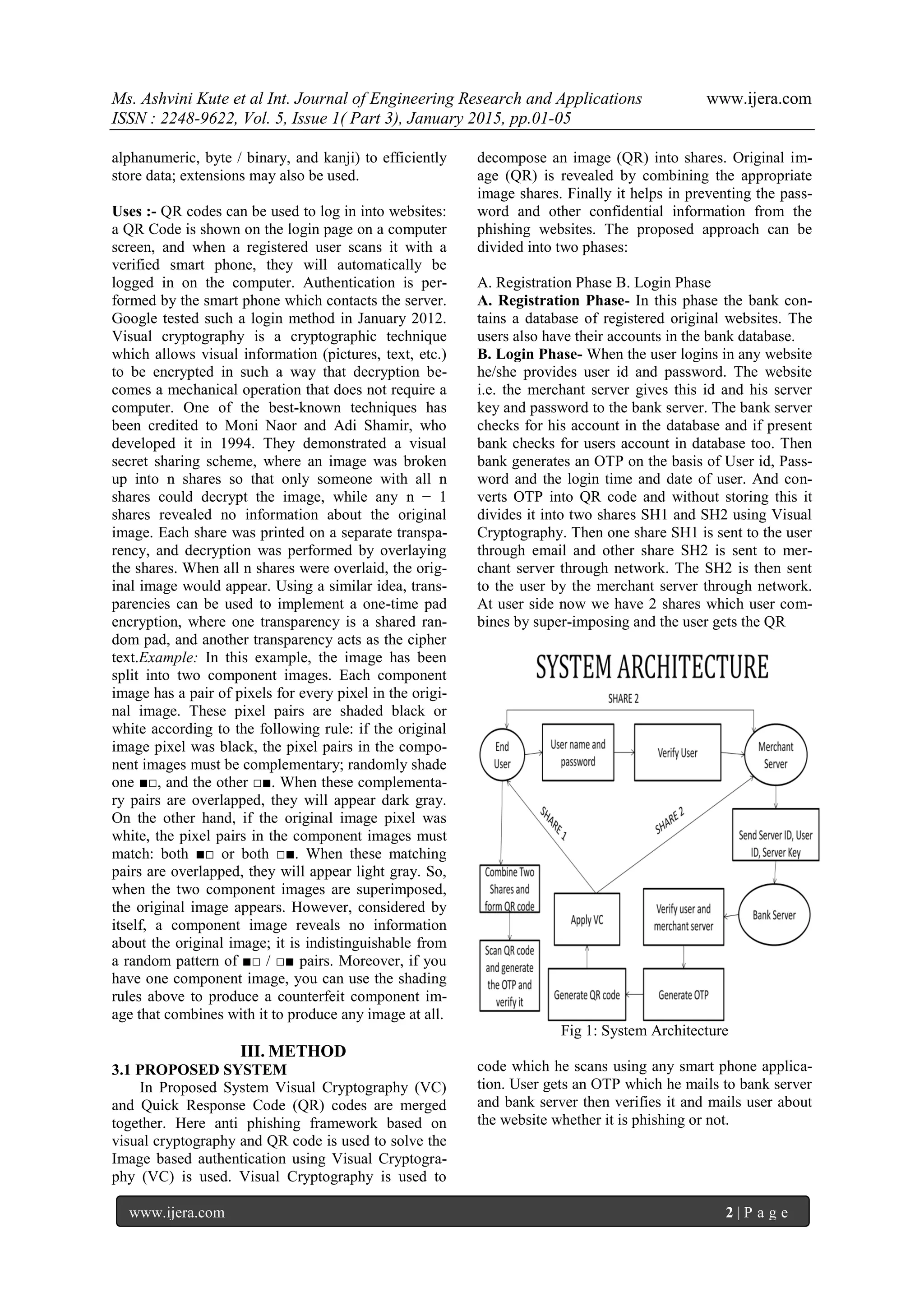
In Proposed System Visual Cryptography (VC)
and Quick Response Code (QR) codes are merged
together. Here anti phishing framework based on
visual cryptography and QR code is used to solve the
Image based authentication using Visual Cryptogra-
phy (VC) is used. Visual Cryptography is used to
decompose an image (QR) into shares. Original im-
age (QR) is revealed by combining the appropriate
image shares. Finally it helps in preventing the pass-
word and other confidential information from the
phishing websites. The proposed approach can be
divided into two phases:
A. Registration Phase B. Login Phase
A. Registration Phase- In this phase the bank con-
tains a database of registered original websites. The
users also have their accounts in the bank database.
B. Login Phase- When the user logins in any website
he/she provides user id and password. The website
i.e. the merchant server gives this id and his server
key and password to the bank server. The bank server
checks for his account in the database and if present
bank checks for users account in database too. Then
bank generates an OTP on the basis of User id, Pass-
word and the login time and date of user. And con-
verts OTP into QR code and without storing this it
divides it into two shares SH1 and SH2 using Visual
Cryptography. Then one share SH1 is sent to the user
through email and other share SH2 is sent to mer-
chant server through network. The SH2 is then sent
to the user by the merchant server through network.
At user side now we have 2 shares which user com-
bines by super-imposing and the user gets the QR
Fig 1: System Architecture
code which he scans using any smart phone applica-
tion. User gets an OTP which he mails to bank server
and bank server then verifies it and mails user about
the website whether it is phishing or not.
Ms. Ashvini Kute et al Int. Journal of Engineering Research and Applications www.ijera.com
ISSN : 2248-9622, Vol. 5, Issue 1( Part 3), January 2015, pp.01-05
www.ijera.com 3 | P a g e
A. Visual Cryptography Algorithm:
i) Encoding Phase: The input is the confidential data
in the form of a black and white Secret image
represented by matrix A of size mxn. The elements of
A are 0’s and 1’s with 0 representing the black pixel
and 1 the white pixel. Initial share sh1 is generated as
a random image of 0’s and 1’s. The Second share,
sh2 is generated by performing bitwise XOR opera-
tion of sh1 with the secret image A as follows.
sh1 = R1 ……..(1)
where, R1 is a random binary matrix of size mxn.
sh2 = sh1 XOR A ……(2)
The two shares generated are random looking shares
and hence appear meaningless. Now from the proper-
ty of XOR operation, it can be seen that,sh1 XOR
sh2= sh1 XOR sh1 XOR A = A………(3). Thus,
combining sh1 and sh2 through XOR reveals A.
Selection of Cover image:
Cover image is a grayscale image of the same
size as that of the secret image. For some special cas-
es the cover image can be the photograph of the own-
er of that confidential data.
Generation of Meaningful shares:
The cover image is customized by mixing a random
noise to Cloud Security Using Visual Cryptography
it so that it is now different in its pixel values from
the original cover image.
Let C be the cover image matrix of size mxn and let
R2 be a random matrix of 0’s and 1’s of the same
size as C. Then get the customized cover image D as,
D = C XOR R2 …….(4)
Since each pixel of the cover image is an 8 bit un-
signed integer, (because the cover image is a grays-
cale image having pixel values ranging from 0 to
255) and since the random matrix R2 is made of only
one bit number representing either black or white (0
or 1), only the LSB of the each byte in the cover im-
age is affected. Therefore the customized cover im-
age looks same as the original cover image. If the
cover image is used directly, then there is a chance
that a hacker, after somehow getting hold of the cov-
er image, may pose a security threat.. So, this step is
provides extra security. Meaningful shares designated
as msh1 and msh2 are generated by XORing the ran-
dom looking shares with the customized cover image
as follows.
msh1 = sh1 XOR D ……(5)
msh2 = sh2 XOR D …….(6)
Here, sh1 and sh2 are binary images and the cus-
tomized cover image D is a gray scale image. Hence
only the LSB of each byte of D affected. Therefore,
the meaningful shares look same as the customized
cover image. For example, if a pixel value of the
cover image is 255 and if a pixel value of the ran-
domly looking share is 1, then XORing these two
pixels results in a pixel value of 254 (11111111 XOR
00000001 is 11111110) which is only about 0.4 %
change.
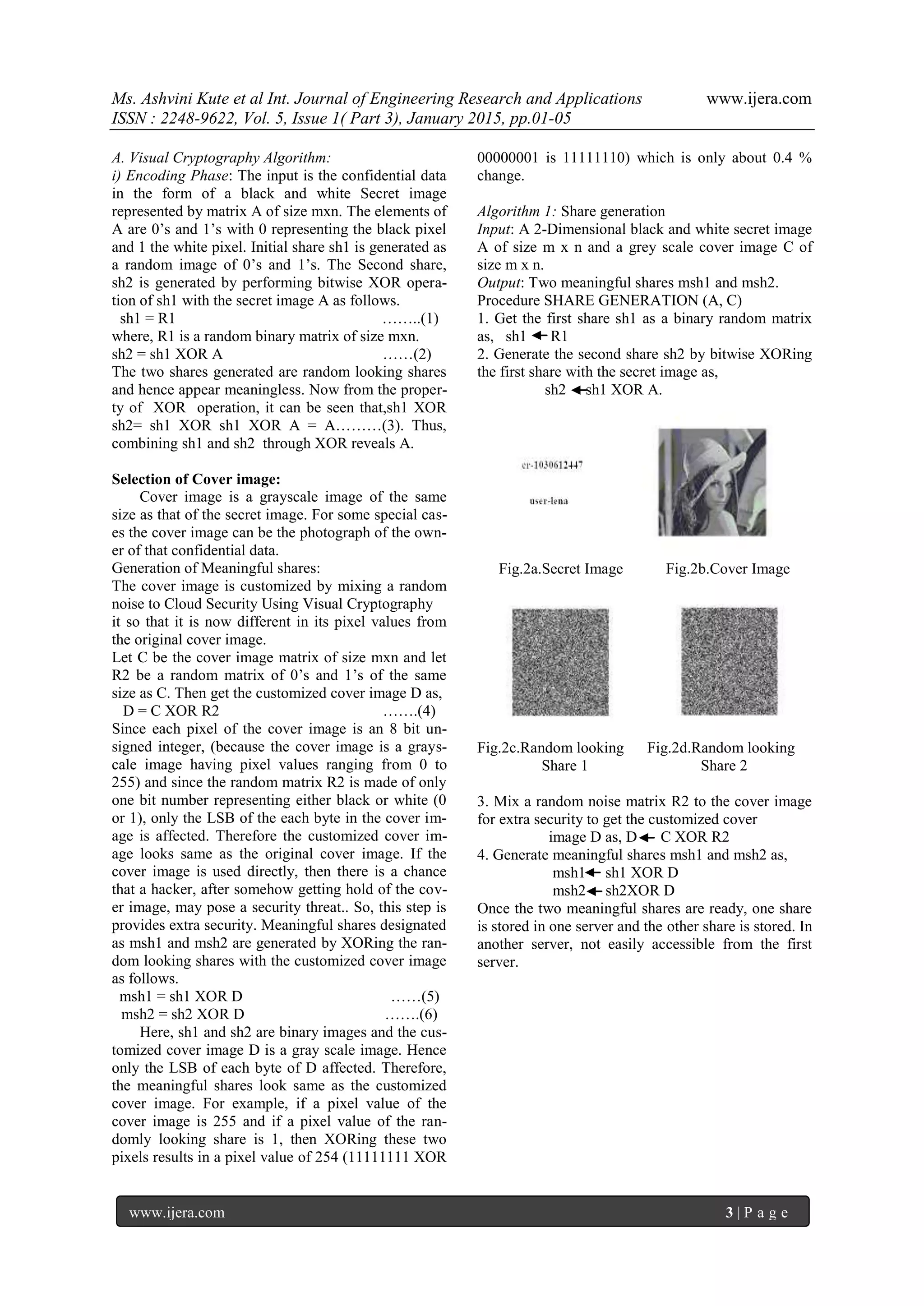
Algorithm 1: Share generation
Input: A 2-Dimensional black and white secret image
A of size m x n and a grey scale cover image C of
size m x n.
Output: Two meaningful shares msh1 and msh2.
Procedure SHARE GENERATION (A, C)
1. Get the first share sh1 as a binary random matrix
as, sh1 R1
2. Generate the second share sh2 by bitwise XORing
the first share with the secret image as,
sh2 sh1 XOR A.
Fig.2a.Secret Image Fig.2b.Cover Image
Fig.2c.Random looking Fig.2d.Random looking
Share 1 Share 2
3. Mix a random noise matrix R2 to the cover image
for extra security to get the customized cover
image D as, D C XOR R2
4. Generate meaningful shares msh1 and msh2 as,
msh1 sh1 XOR D
msh2 sh2XOR D
Once the two meaningful shares are ready, one share
is stored in one server and the other share is stored. In
another server, not easily accessible from the first
server.
Ms. Ashvini Kute et al Int. Journal of Engineering Research and Applications www.ijera.com
ISSN : 2248-9622, Vol. 5, Issue 1( Part 3), January 2015, pp.01-05
www.ijera.com 4 | P a g e
Fig 3: Encoding
ii) Decoding Phase: The decoding phase is performed
by the legitimate user. He accesses the two meaning-
ful shares from the two different servers and decodes
the secret image by XORing the two meaningful
shares.
From (5) and (6),
msh1 XOR msh2 = sh1 XOR D XOR sh2 XOR D =
sh1 XOR sh2……(7)
From Eqs.(7) and(3)
msh1 XOR msh2 = sh1 XOR sh2 = A……(8)
The Decoding phase is given in Algorithm 2.
Algorithm 2: Decoding
Input: Two meaningful shares msh1 and msh2.
Output: Decoded Secret image I.
Procedure DECODE (msh1, msh2)
1. Decode the secret image A as,
A msh1 XOR msh2 The encoding and decoding
phases are depicted in Fig.1.The proposed method
provides data access security to the confidential data
stored at the server site in cloud computing environ-
ment. Since the shares are meaningful, the inside
malicious hackers do not pay any attention to it. Even
if a hacker gets to know one share, the other share is
inaccessible to him because it is located on another
far away secured server. With only one share, the
confidential data cannot be decoded. This scheme
provides good security.
Fig 4: Sample QR codes
B. QR Code algorithm:
Ak = RkQk = Q∗kAk−1Qk, and hence Ak and Ak−1
are unitarily similar. The matrix sequence {Ak} con-
verges (under certain assumptions) towards an upper
triangular matrix [9]. Let us assume that the
Algorithm:
Let A ∈ Cn×n. This algorithm computes an upper
triangular matrix T and a unitary matrix U such that
A = UTU∗ is the Schur decomposition of A.
Set A0 := A and U0 = I.
for k = 1, 2, . . . do
Ak−1 =: QkRk; /* QR factorization */
Ak := RkQk;
Uk := Uk−1Qk; /* Update transformation matrix */
end for Set T := A∞ and U := U∞.
eigenvalues are mutually different in magnitude and
we can therefore number the eigenvalues such that
|λ1| > |λ2| > · · · > |λn|. Then – as we will show in
Chapter 6 – the elements of Ak below the diagonal
converge to zero like |a(k) ij | = O(|λi/λj |k), i > j.
From (3.1) we see that
Ak = Q∗kAk−1Qk = Q∗kQ∗k−1Ak−2Qk−1Qk = · · ·
= Q∗k · · ·Q∗1A0 Q1 · · ·Qk | {z } Uk.
With the same assumption on the eigenvalues, Ak
tends to an upper triangular matrix and Uk converges
to the matrix of Schur vectors.
Fig 5: Decoding
Secret Image
Randomly
looking Share1
Randomly
looking Share 2
Preprocessed
Cover Image
Meaningful share1 Meaningful share2
Server 1 Server 2
Server 1
Server 2
Ms. Ashvini Kute et al Int. Journal of Engineering Research and Applications www.ijera.com
ISSN : 2248-9622, Vol. 5, Issue 1( Part 3), January 2015, pp.01-05
www.ijera.com 5 | P a g e
IV. CONCLUSION AND FUTURE
WORK
In this paper we have proposed a more secured
mechanism through VC and QR code based on OTPs.
In recent years there has been a steep increase in the
number of online users. Hence the proposed system
satisfies the high security requirements of the online
users and protects them against various security at-
tacks. Also the system does not require any technical
pre-requisite and this makes it very user-friendly.
Hence QR code proves to be versatile at the same
time beneficial for both the customers in terms of
security and vendors in terms of increasing their effi-
ciency. In the near future this work may also be en-
hanced by taking action on the detected phishing
websites.
REFERENCES
[1] J. S. Downs, M. B. Holbrook, Decision
strategies and susceptibility to phishing, in:
Proc. the second symposium on usable pri-
vacy and security(SOUPS 2006), pp. 79-90.
[2] Clarke, Dwaine; Gassend, Blaise; Kotwal,
Thomas; Burnside, Matt; van Dijk, Marten:
"The Untrusted Computer Problem and
Camera-Based Authentication". Lecture
Notes in Computer Science, 2002, Volume
2414, Pervasive Computing, Pages 114-124,
Jan.2002.
[3] Denso-wave:http://www.denso-wave.com/
qrcode/index-e.html
[4] Lee, Jaesik; Cho, Chang-Hyun; Jun, Moon-
Seog: "Secure quick response-payment(QR-
Pay) system using mobile device". Advanced
Communication Technology (ICACT), 2011
13th International Conference, Feb. 2011.
[5] I. Bose, A.C.M. Leung, Unveiling the mask
of phishing: threats, preventive measures
and responsibilities Communications of the
Association for Information Systems 19 (24)
(2007) 544-566.
[6] Google Inc, Google safe browsing for Fire-
fox, http://www.google.com/tools/firefox/
safe browsing/
[7] Saurab K Prashar. “Security issues in cloud
computing”, serl .iit.ac.in/cs6600/saurabh.
ppt
[8] M. Naor and A. Shamir, “Visual cryptogra-
phy,” Proceedings of Advances in Cryptol-
ogy: Eurocrypt94, Lecture Notes in Com-
puter Science, Vol. 950, pp. 1 - 12, 1995. H.
Erdogmus, “Cloud Computing: Does Nirva-
na Hide behind the Nebula? ” IEEE Soft-
ware, vol. 26, no.2, pp. 4-6 ,2009.
[9] Y. S. Dai, Y. P. Xiang, G. W. Zhang., “Self-
Healing and Hybrid Diagnosis in Cloud
Computing, ” Lecture Notes of Computer
Science(LNCS), vol. 5931, pp. 45-56,2009.
[10] Amazon Elastic Compute Cloud
[URL].http://aws.amazon.com/ec2, acess on
Oct. 2009.
[11] Felt, Adrienne Porter; Wagner, David:
"Phishing on Mobile Devices". Workshop
on Web 2.0 Security and Privacy (W2SP),
2011.
[12] DeFigueiredo, Dimitri: "The Case for Mo-
bile Two-Factor Authentication". Security
&Privacy, IEEE, Sept.-Oct. 2011.
[13] Kuan-Chieh Liao;Wei-Hsun Lee:"A Novel
User Authentication Scheme Based on QR-
Code". Journal of Networks, Vol 5, No Aug
2010.

Modern Method for Detecting Web Phishing Using Visual Cryp-tography (VC) and Quick Response Code (QR code)

  • 1.
    Ms. Ashvini Kuteet al Int. Journal of Engineering Research and Applications www.ijera.com ISSN : 2248-9622, Vol. 5, Issue 1( Part 3), January 2015, pp.01-05 www.ijera.com 1 | P a g e Modern Method for Detecting Web Phishing Using Visual Cryp- tography (VC) and Quick Response Code (QR code) Ms. Ashvini Kute1 , Ms. Damini Deokar2 , Ms. Dhanashree Moholkar3 , Ms. Na- mrata Kadam4 , Prof. Sonali Kadam5 Department of Computer Engineering Bharati Vidyapeeth College of Engineering for women, Pune 411043, India. Abstract Phishing is an attempt by an individual or a group to thieve personal confidential information such as pass- words, credit card information etc from unsuspecting victims for identity theft, financial gain and other fraudu- lent activities. Here an image based (QR codes) authentication using Visual Cryptography (VC) is used. The use of Visual cryptography is explored to convert the QR code into two shares and both these shares can then be transmitted separately. One Time Passwords (OTP) is passwords which are valid only for a session to validate the user within a specified amount of time. In this paper we are presenting a new authentication scheme for se- cure OTP distribution in phishing website detection through VC and QR codes. Keywords- OTP, Phishing, QR code, Shares, Visual Cryptography. I. INTRODUCTION Online transactions are nowadays become very common and there are various attacks present behind this. In these types of various attacks, phishing is identified as a major security threat and new innova- tive ideas are arising with this in each second so pre- ventive mechanism should also be so effective. Thus the security in these cases be very high and should not be easily tractable with implementation easiness. Phishing is a major security threat to the online community. It is a kind of identity theft that makes use of social engineering skills and technical subter- fuge to entice the unsuspecting online consumer to give away their personal information and financial credentials [1].Today, most applications are only as secure as their underlying system. Since the design and technology of middleware has improved steadily, their detection is a difficult problem. As a result, it is nearly impossible to be sure whether a computer that is connected to the internet can be considered trust- worthy and secure or not. Phishing scams are also becoming a problem for online banking and e- commerce users. The question is how to handle ap- plications that require a high level of security. The damage caused by phishing ranges from loss of access to email to substantial financial loss. This style of identity theft is becoming more popular, because of the ease with which unsuspecting people often divulge personal information to phishers, including credit card numbers, social security numbers, and mothers’ maiden names. There are also fears that identity thieves can add such information to the knowledge they gain simply by accessing public records. Once this information is acquired, the phish- ers may use a person’s details to create fake accounts in a victim’s name, ruin a victim’s credit, or even prevent victims from accessing their own accounts. Phishers can deliver specially crafted emails to mil- lions of legitimate email addresses very quickly and can fool the recipients utilising well known flaws in the SMTP. Some of the most common techniques used by phishers include official looking and sound- ing emails, copying legitimate corporate emails with minor URL changes, obfuscation of target URL in- formation etc. There are DNS-based anti-phishing approach technique which mainly includes blacklists, heuristic detection, the page similarity assessment. But they do have some shortcomings. The life cycle of phishing websites is too short and the establish- ment of blacklist has a long lag time, the accuracy of blacklist is not too high. In Heuristic-based anti- phishing technique it is easy for the attacker to use technical means to avoid the heuristic characteristics detection. So here we introduce a new method which can be used as a safe way against phishing which is named as "Modern Method for Detecting Web Phish- ing Using Visual Cryptography (VC) and Quick Re- sponse Code (QR code)”As the name describes, in this approach the fake websites are detected using VC and QR codes which let the client differentiate between phishing and legitimate websites. II. BACKGROUND QR code (abbreviated from Quick Response Code) is the trademark for a type of matrix barcode (or two-dimensional barcode) first designed for the automotive industry in Japan. A barcode is a ma- chine-readable optical label that contains information about the item to which it is attached. A QR code uses four standardized encoding modes (numeric, RESEARCH ARTICLE OPEN ACCESS
  • 2.
    Ms. Ashvini Kuteet al Int. Journal of Engineering Research and Applications www.ijera.com ISSN : 2248-9622, Vol. 5, Issue 1( Part 3), January 2015, pp.01-05 www.ijera.com 2 | P a g e alphanumeric, byte / binary, and kanji) to efficiently store data; extensions may also be used. Uses :- QR codes can be used to log in into websites: a QR Code is shown on the login page on a computer screen, and when a registered user scans it with a verified smart phone, they will automatically be logged in on the computer. Authentication is per- formed by the smart phone which contacts the server. Google tested such a login method in January 2012. Visual cryptography is a cryptographic technique which allows visual information (pictures, text, etc.) to be encrypted in such a way that decryption be- comes a mechanical operation that does not require a computer. One of the best-known techniques has been credited to Moni Naor and Adi Shamir, who developed it in 1994. They demonstrated a visual secret sharing scheme, where an image was broken up into n shares so that only someone with all n shares could decrypt the image, while any n − 1 shares revealed no information about the original image. Each share was printed on a separate transpa- rency, and decryption was performed by overlaying the shares. When all n shares were overlaid, the orig- inal image would appear. Using a similar idea, trans- parencies can be used to implement a one-time pad encryption, where one transparency is a shared ran- dom pad, and another transparency acts as the cipher text.Example: In this example, the image has been split into two component images. Each component image has a pair of pixels for every pixel in the origi- nal image. These pixel pairs are shaded black or white according to the following rule: if the original image pixel was black, the pixel pairs in the compo- nent images must be complementary; randomly shade one ■□, and the other □■. When these complementa- ry pairs are overlapped, they will appear dark gray. On the other hand, if the original image pixel was white, the pixel pairs in the component images must match: both ■□ or both □■. When these matching pairs are overlapped, they will appear light gray. So, when the two component images are superimposed, the original image appears. However, considered by itself, a component image reveals no information about the original image; it is indistinguishable from a random pattern of ■□ / □■ pairs. Moreover, if you have one component image, you can use the shading rules above to produce a counterfeit component im- age that combines with it to produce any image at all. III. METHOD 3.1 PROPOSED SYSTEM In Proposed System Visual Cryptography (VC) and Quick Response Code (QR) codes are merged together. Here anti phishing framework based on visual cryptography and QR code is used to solve the Image based authentication using Visual Cryptogra- phy (VC) is used. Visual Cryptography is used to decompose an image (QR) into shares. Original im- age (QR) is revealed by combining the appropriate image shares. Finally it helps in preventing the pass- word and other confidential information from the phishing websites. The proposed approach can be divided into two phases: A. Registration Phase B. Login Phase A. Registration Phase- In this phase the bank con- tains a database of registered original websites. The users also have their accounts in the bank database. B. Login Phase- When the user logins in any website he/she provides user id and password. The website i.e. the merchant server gives this id and his server key and password to the bank server. The bank server checks for his account in the database and if present bank checks for users account in database too. Then bank generates an OTP on the basis of User id, Pass- word and the login time and date of user. And con- verts OTP into QR code and without storing this it divides it into two shares SH1 and SH2 using Visual Cryptography. Then one share SH1 is sent to the user through email and other share SH2 is sent to mer- chant server through network. The SH2 is then sent to the user by the merchant server through network. At user side now we have 2 shares which user com- bines by super-imposing and the user gets the QR Fig 1: System Architecture code which he scans using any smart phone applica- tion. User gets an OTP which he mails to bank server and bank server then verifies it and mails user about the website whether it is phishing or not.
  • 3.
    Ms. Ashvini Kuteet al Int. Journal of Engineering Research and Applications www.ijera.com ISSN : 2248-9622, Vol. 5, Issue 1( Part 3), January 2015, pp.01-05 www.ijera.com 3 | P a g e A. Visual Cryptography Algorithm: i) Encoding Phase: The input is the confidential data in the form of a black and white Secret image represented by matrix A of size mxn. The elements of A are 0’s and 1’s with 0 representing the black pixel and 1 the white pixel. Initial share sh1 is generated as a random image of 0’s and 1’s. The Second share, sh2 is generated by performing bitwise XOR opera- tion of sh1 with the secret image A as follows. sh1 = R1 ……..(1) where, R1 is a random binary matrix of size mxn. sh2 = sh1 XOR A ……(2) The two shares generated are random looking shares and hence appear meaningless. Now from the proper- ty of XOR operation, it can be seen that,sh1 XOR sh2= sh1 XOR sh1 XOR A = A………(3). Thus, combining sh1 and sh2 through XOR reveals A. Selection of Cover image: Cover image is a grayscale image of the same size as that of the secret image. For some special cas- es the cover image can be the photograph of the own- er of that confidential data. Generation of Meaningful shares: The cover image is customized by mixing a random noise to Cloud Security Using Visual Cryptography it so that it is now different in its pixel values from the original cover image. Let C be the cover image matrix of size mxn and let R2 be a random matrix of 0’s and 1’s of the same size as C. Then get the customized cover image D as, D = C XOR R2 …….(4) Since each pixel of the cover image is an 8 bit un- signed integer, (because the cover image is a grays- cale image having pixel values ranging from 0 to 255) and since the random matrix R2 is made of only one bit number representing either black or white (0 or 1), only the LSB of the each byte in the cover im- age is affected. Therefore the customized cover im- age looks same as the original cover image. If the cover image is used directly, then there is a chance that a hacker, after somehow getting hold of the cov- er image, may pose a security threat.. So, this step is provides extra security. Meaningful shares designated as msh1 and msh2 are generated by XORing the ran- dom looking shares with the customized cover image as follows. msh1 = sh1 XOR D ……(5) msh2 = sh2 XOR D …….(6) Here, sh1 and sh2 are binary images and the cus- tomized cover image D is a gray scale image. Hence only the LSB of each byte of D affected. Therefore, the meaningful shares look same as the customized cover image. For example, if a pixel value of the cover image is 255 and if a pixel value of the ran- domly looking share is 1, then XORing these two pixels results in a pixel value of 254 (11111111 XOR 00000001 is 11111110) which is only about 0.4 % change. Algorithm 1: Share generation Input: A 2-Dimensional black and white secret image A of size m x n and a grey scale cover image C of size m x n. Output: Two meaningful shares msh1 and msh2. Procedure SHARE GENERATION (A, C) 1. Get the first share sh1 as a binary random matrix as, sh1 R1 2. Generate the second share sh2 by bitwise XORing the first share with the secret image as, sh2 sh1 XOR A. Fig.2a.Secret Image Fig.2b.Cover Image Fig.2c.Random looking Fig.2d.Random looking Share 1 Share 2 3. Mix a random noise matrix R2 to the cover image for extra security to get the customized cover image D as, D C XOR R2 4. Generate meaningful shares msh1 and msh2 as, msh1 sh1 XOR D msh2 sh2XOR D Once the two meaningful shares are ready, one share is stored in one server and the other share is stored. In another server, not easily accessible from the first server.
  • 4.
    Ms. Ashvini Kuteet al Int. Journal of Engineering Research and Applications www.ijera.com ISSN : 2248-9622, Vol. 5, Issue 1( Part 3), January 2015, pp.01-05 www.ijera.com 4 | P a g e Fig 3: Encoding ii) Decoding Phase: The decoding phase is performed by the legitimate user. He accesses the two meaning- ful shares from the two different servers and decodes the secret image by XORing the two meaningful shares. From (5) and (6), msh1 XOR msh2 = sh1 XOR D XOR sh2 XOR D = sh1 XOR sh2……(7) From Eqs.(7) and(3) msh1 XOR msh2 = sh1 XOR sh2 = A……(8) The Decoding phase is given in Algorithm 2. Algorithm 2: Decoding Input: Two meaningful shares msh1 and msh2. Output: Decoded Secret image I. Procedure DECODE (msh1, msh2) 1. Decode the secret image A as, A msh1 XOR msh2 The encoding and decoding phases are depicted in Fig.1.The proposed method provides data access security to the confidential data stored at the server site in cloud computing environ- ment. Since the shares are meaningful, the inside malicious hackers do not pay any attention to it. Even if a hacker gets to know one share, the other share is inaccessible to him because it is located on another far away secured server. With only one share, the confidential data cannot be decoded. This scheme provides good security. Fig 4: Sample QR codes B. QR Code algorithm: Ak = RkQk = Q∗kAk−1Qk, and hence Ak and Ak−1 are unitarily similar. The matrix sequence {Ak} con- verges (under certain assumptions) towards an upper triangular matrix [9]. Let us assume that the Algorithm: Let A ∈ Cn×n. This algorithm computes an upper triangular matrix T and a unitary matrix U such that A = UTU∗ is the Schur decomposition of A. Set A0 := A and U0 = I. for k = 1, 2, . . . do Ak−1 =: QkRk; /* QR factorization */ Ak := RkQk; Uk := Uk−1Qk; /* Update transformation matrix */ end for Set T := A∞ and U := U∞. eigenvalues are mutually different in magnitude and we can therefore number the eigenvalues such that |λ1| > |λ2| > · · · > |λn|. Then – as we will show in Chapter 6 – the elements of Ak below the diagonal converge to zero like |a(k) ij | = O(|λi/λj |k), i > j. From (3.1) we see that Ak = Q∗kAk−1Qk = Q∗kQ∗k−1Ak−2Qk−1Qk = · · · = Q∗k · · ·Q∗1A0 Q1 · · ·Qk | {z } Uk. With the same assumption on the eigenvalues, Ak tends to an upper triangular matrix and Uk converges to the matrix of Schur vectors. Fig 5: Decoding Secret Image Randomly looking Share1 Randomly looking Share 2 Preprocessed Cover Image Meaningful share1 Meaningful share2 Server 1 Server 2 Server 1 Server 2
  • 5.
    Ms. Ashvini Kuteet al Int. Journal of Engineering Research and Applications www.ijera.com ISSN : 2248-9622, Vol. 5, Issue 1( Part 3), January 2015, pp.01-05 www.ijera.com 5 | P a g e IV. CONCLUSION AND FUTURE WORK In this paper we have proposed a more secured mechanism through VC and QR code based on OTPs. In recent years there has been a steep increase in the number of online users. Hence the proposed system satisfies the high security requirements of the online users and protects them against various security at- tacks. Also the system does not require any technical pre-requisite and this makes it very user-friendly. Hence QR code proves to be versatile at the same time beneficial for both the customers in terms of security and vendors in terms of increasing their effi- ciency. In the near future this work may also be en- hanced by taking action on the detected phishing websites. REFERENCES [1] J. S. Downs, M. B. Holbrook, Decision strategies and susceptibility to phishing, in: Proc. the second symposium on usable pri- vacy and security(SOUPS 2006), pp. 79-90. [2] Clarke, Dwaine; Gassend, Blaise; Kotwal, Thomas; Burnside, Matt; van Dijk, Marten: "The Untrusted Computer Problem and Camera-Based Authentication". Lecture Notes in Computer Science, 2002, Volume 2414, Pervasive Computing, Pages 114-124, Jan.2002. [3] Denso-wave:http://www.denso-wave.com/ qrcode/index-e.html [4] Lee, Jaesik; Cho, Chang-Hyun; Jun, Moon- Seog: "Secure quick response-payment(QR- Pay) system using mobile device". Advanced Communication Technology (ICACT), 2011 13th International Conference, Feb. 2011. [5] I. Bose, A.C.M. Leung, Unveiling the mask of phishing: threats, preventive measures and responsibilities Communications of the Association for Information Systems 19 (24) (2007) 544-566. [6] Google Inc, Google safe browsing for Fire- fox, http://www.google.com/tools/firefox/ safe browsing/ [7] Saurab K Prashar. “Security issues in cloud computing”, serl .iit.ac.in/cs6600/saurabh. ppt [8] M. Naor and A. Shamir, “Visual cryptogra- phy,” Proceedings of Advances in Cryptol- ogy: Eurocrypt94, Lecture Notes in Com- puter Science, Vol. 950, pp. 1 - 12, 1995. H. Erdogmus, “Cloud Computing: Does Nirva- na Hide behind the Nebula? ” IEEE Soft- ware, vol. 26, no.2, pp. 4-6 ,2009. [9] Y. S. Dai, Y. P. Xiang, G. W. Zhang., “Self- Healing and Hybrid Diagnosis in Cloud Computing, ” Lecture Notes of Computer Science(LNCS), vol. 5931, pp. 45-56,2009. [10] Amazon Elastic Compute Cloud [URL].http://aws.amazon.com/ec2, acess on Oct. 2009. [11] Felt, Adrienne Porter; Wagner, David: "Phishing on Mobile Devices". Workshop on Web 2.0 Security and Privacy (W2SP), 2011. [12] DeFigueiredo, Dimitri: "The Case for Mo- bile Two-Factor Authentication". Security &Privacy, IEEE, Sept.-Oct. 2011. [13] Kuan-Chieh Liao;Wei-Hsun Lee:"A Novel User Authentication Scheme Based on QR- Code". Journal of Networks, Vol 5, No Aug 2010.