Beginne 2 Lesson 11
Skill: I can talk about what I want to do in the
future.
Scott’s family
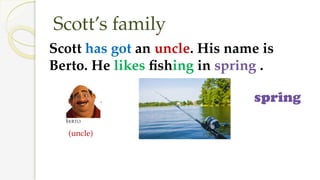
Scott has got an uncle. His name is
Berto. He likes fishing in spring .
spring
(uncle)
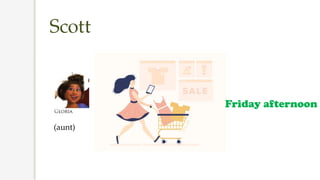
Friday afternoon
(aunt)
Scott
Scott
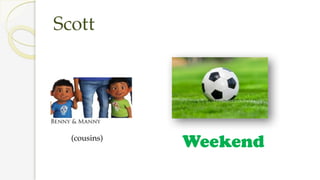
Weekend
(cousins)
Scott
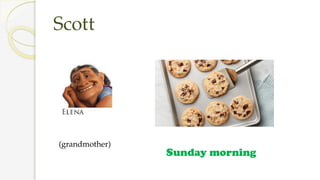
(grandmother)
Sunday morning
Scott
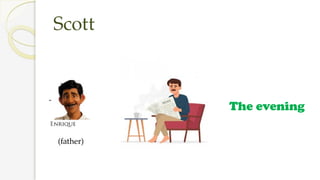
(father)
The evening
Scott
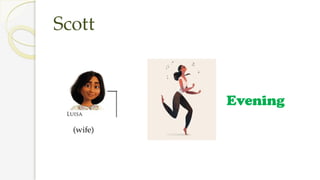
(wife)
Evening
Scott
(nephew)
Summer
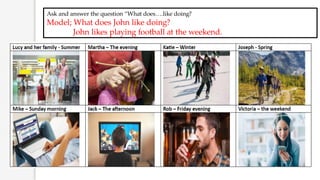
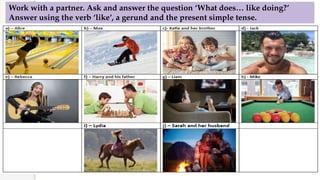
Ask and answer the question “What does….like doing?
Model; What does John like doing?
John likes playing football at the weekend.
Vocabulary
 To go bowling
 To stay at home
 To go horse riding
 To play pool
 To go
snowboarding
 To play chess
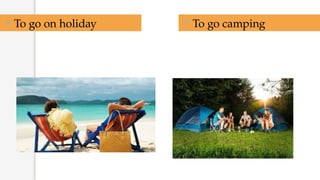
 To go on holiday
 To go camping
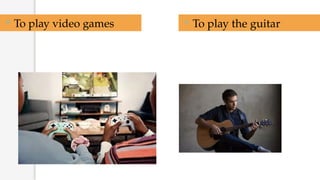
 To play video
games
 To play the guitar
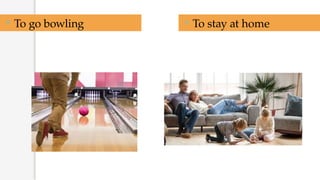
 To go bowling  To stay at home
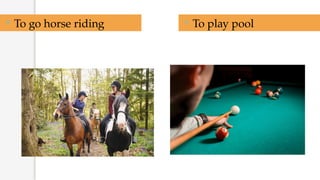
 To go horse riding  To play pool
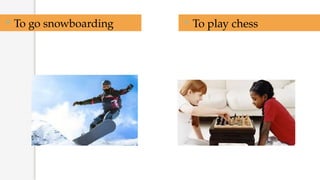
 To go snowboarding  To play chess
 To go on holiday  To go camping
 To play video games  To play the guitar
Work with a partner. Ask and answer the question ‘What does… like doing?’
Answer using the verb ‘like’, a gerund and the present simple tense.
Work with a partner. Ask and answer the question ‘What does… like doing?’
Answer using the verb ‘like’, a gerund and the present simple tense.
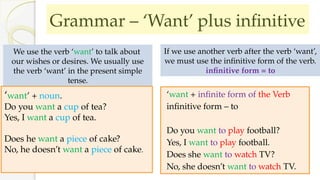
Grammar – ‘Want’ plus infinitive
‘want + infinite form of the Verb
infinitive form – to
Do you want to play football?
Yes, I want to play football.
Does she want to watch TV?
No, she doesn’t want to watch TV.
We use the verb ‘want’ to talk about
our wishes or desires. We usually use
the verb ‘want’ in the present simple
tense.
‘want’ + noun.
Do you want a cup of tea?
Yes, I want a cup of tea.
Does he want a piece of cake?
No, he doesn’t want a piece of cake.
If we use another verb after the verb ‘want’,
we must use the infinitive form of the verb.
infinitive form = to
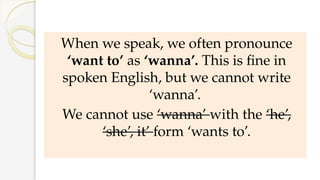
When we speak, we often pronounce
‘want to’ as ‘wanna’. This is fine in
spoken English, but we cannot write
‘wanna’.
We cannot use ‘wanna’ with the ‘he’,
‘she’, it’ form ‘wants to’.
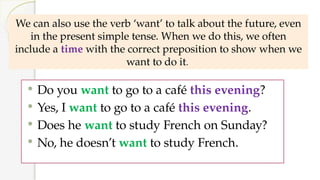
We can also use the verb ‘want’ to talk about the future, even
in the present simple tense. When we do this, we often
include a time with the correct preposition to show when we
want to do it.
 Do you want to go to a café this evening?
 Yes, I want to go to a café this evening.
 Does he want to study French on Sunday?
 No, he doesn’t want to study French.
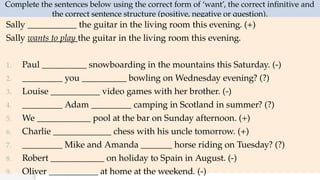
Complete the sentences below using the correct form of ‘want’, the correct infinitive and
the correct sentence structure (positive, negative or question).
Sally ___________ the guitar in the living room this evening. (+)
Sally wants to play the guitar in the living room this evening.
1. Paul __________ snowboarding in the mountains this Saturday. (-)
2. _________ you __________ bowling on Wednesday evening? (?)
3. Louise ___________ video games with her brother. (-)
4. _________ Adam _________ camping in Scotland in summer? (?)
5. We ____________ pool at the bar on Sunday afternoon. (+)
6. Charlie _____________ chess with his uncle tomorrow. (+)
7. _________ Mike and Amanda _______ horse riding on Tuesday? (?)
8. Robert ____________ on holiday to Spain in August. (-)
9. Oliver ___________ at home at the weekend. (-)
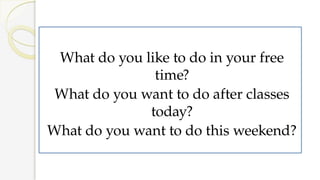
What do you like to do in your free
time?
What do you want to do after classes
today?
What do you want to do this weekend?
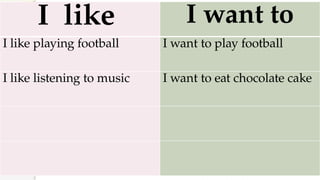
I like I want to
I like playing football I want to play football
I like listening to music I want to eat chocolate cake
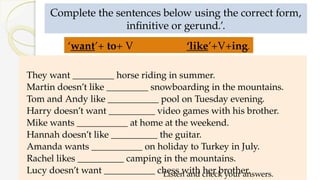
Complete the sentences below using the correct form,
infinitive or gerund.’.
They want _________ horse riding in summer.
Martin doesn’t like _________ snowboarding in the mountains.
Tom and Andy like ___________ pool on Tuesday evening.
Harry doesn’t want __________ video games with his brother.
Mike wants ___________ at home at the weekend.
Hannah doesn’t like __________ the guitar.
Amanda wants ___________ on holiday to Turkey in July.
Rachel likes __________ camping in the mountains.
Lucy doesn’t want ___________ chess with her brother.
Listen and check your answers.
‘want’+ to+ V ‘like’+V+ing.
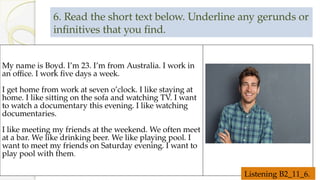
6. Read the short text below. Underline any gerunds or
infinitives that you find.
My name is Boyd. I’m 23. I’m from Australia. I work in
an office. I work five days a week.
I get home from work at seven o’clock. I like staying at
home. I like sitting on the sofa and watching TV. I want
to watch a documentary this evening. I like watching
documentaries.
I like meeting my friends at the weekend. We often meet
at a bar. We like drinking beer. We like playing pool. I
want to meet my friends on Saturday evening. I want to
play pool with them.
Listening B2_11_6.
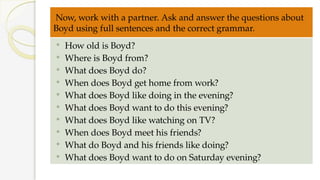
Now, work with a partner. Ask and answer the questions about
Boyd using full sentences and the correct grammar.
 How old is Boyd?
 Where is Boyd from?
 What does Boyd do?
 When does Boyd get home from work?
 What does Boyd like doing in the evening?
 What does Boyd want to do this evening?
 What does Boyd like watching on TV?
 When does Boyd meet his friends?
 What do Boyd and his friends like doing?
 What does Boyd want to do on Saturday evening?
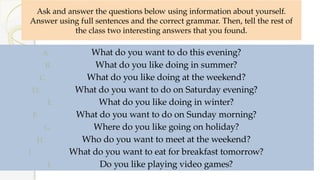
Ask and answer the questions below using information about yourself.
Answer using full sentences and the correct grammar. Then, tell the rest of
the class two interesting answers that you found.
A. What do you want to do this evening?
B. What do you like doing in summer?
C. What do you like doing at the weekend?
D. What do you want to do on Saturday evening?
E. What do you like doing in winter?
F. What do you want to do on Sunday morning?
G. Where do you like going on holiday?
H. Who do you want to meet at the weekend?
I. What do you want to eat for breakfast tomorrow?
J. Do you like playing video games?
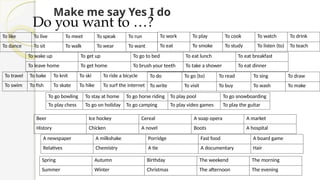
Make me say Yes I do
Do you want to …?
To go bowling To stay at home To go horse riding To play pool To go snowboarding
To play chess To go on holiday To go camping To play video games To play the guitar
To travel To bake To knit To ski To ride a bicycle
To swim To fish To skate To hike To surf the internet
A newspaper A milkshake Porridge Fast food A board game
Relatives Chemistry A tie A documentary Hair
Beer Ice hockey Cereal A soap opera A market
History Chicken A novel Boots A hospital
Spring Autumn Birthday The weekend The morning
Summer Winter Christmas The afternoon The evening
To wake up To get up To go to bed To eat lunch To eat breakfast
To leave home To get home To brush your teeth To take a shower To eat dinner
To like To live To meet To speak To run
To dance To sit To walk To wear To want
To do To go (to) To read To sing To draw
To write To visit To buy To wash To make
To work To play To cook To watch To drink
To eat To smoke To study To listen (to) To teach
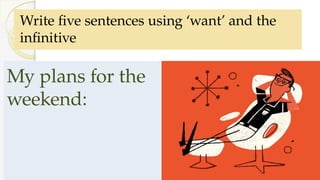
My plans for the
weekend:
Write five sentences using ‘want’ and the
infinitive
I want to visit____ in summer.

beg2 lesson11 want+infinitive forms.pptx

  • 1.
    Beginne 2 Lesson11 Skill: I can talk about what I want to do in the future.
  • 2.
    Scott’s family Scott hasgot an uncle. His name is Berto. He likes fishing in spring . spring (uncle)
  • 3.
  • 4.
  • 5.
  • 6.
  • 7.
  • 8.
  • 9.
    Ask and answerthe question “What does….like doing? Model; What does John like doing? John likes playing football at the weekend.
  • 10.
    Vocabulary  To gobowling  To stay at home  To go horse riding  To play pool  To go snowboarding  To play chess  To go on holiday  To go camping  To play video games  To play the guitar
  • 11.
     To gobowling  To stay at home
  • 12.
     To gohorse riding  To play pool
  • 13.
     To gosnowboarding  To play chess
  • 14.
     To goon holiday  To go camping
  • 15.
     To playvideo games  To play the guitar
  • 17.
    Work with apartner. Ask and answer the question ‘What does… like doing?’ Answer using the verb ‘like’, a gerund and the present simple tense.
  • 18.
    Work with apartner. Ask and answer the question ‘What does… like doing?’ Answer using the verb ‘like’, a gerund and the present simple tense.
  • 19.
    Grammar – ‘Want’plus infinitive ‘want + infinite form of the Verb infinitive form – to Do you want to play football? Yes, I want to play football. Does she want to watch TV? No, she doesn’t want to watch TV. We use the verb ‘want’ to talk about our wishes or desires. We usually use the verb ‘want’ in the present simple tense. ‘want’ + noun. Do you want a cup of tea? Yes, I want a cup of tea. Does he want a piece of cake? No, he doesn’t want a piece of cake. If we use another verb after the verb ‘want’, we must use the infinitive form of the verb. infinitive form = to
  • 20.
    When we speak,we often pronounce ‘want to’ as ‘wanna’. This is fine in spoken English, but we cannot write ‘wanna’. We cannot use ‘wanna’ with the ‘he’, ‘she’, it’ form ‘wants to’.
  • 21.
    We can alsouse the verb ‘want’ to talk about the future, even in the present simple tense. When we do this, we often include a time with the correct preposition to show when we want to do it.  Do you want to go to a café this evening?  Yes, I want to go to a café this evening.  Does he want to study French on Sunday?  No, he doesn’t want to study French.
  • 22.
    Complete the sentencesbelow using the correct form of ‘want’, the correct infinitive and the correct sentence structure (positive, negative or question). Sally ___________ the guitar in the living room this evening. (+) Sally wants to play the guitar in the living room this evening. 1. Paul __________ snowboarding in the mountains this Saturday. (-) 2. _________ you __________ bowling on Wednesday evening? (?) 3. Louise ___________ video games with her brother. (-) 4. _________ Adam _________ camping in Scotland in summer? (?) 5. We ____________ pool at the bar on Sunday afternoon. (+) 6. Charlie _____________ chess with his uncle tomorrow. (+) 7. _________ Mike and Amanda _______ horse riding on Tuesday? (?) 8. Robert ____________ on holiday to Spain in August. (-) 9. Oliver ___________ at home at the weekend. (-)
  • 23.
    What do youlike to do in your free time? What do you want to do after classes today? What do you want to do this weekend?
  • 24.
    I like Iwant to I like playing football I want to play football I like listening to music I want to eat chocolate cake
  • 25.
    Complete the sentencesbelow using the correct form, infinitive or gerund.’. They want _________ horse riding in summer. Martin doesn’t like _________ snowboarding in the mountains. Tom and Andy like ___________ pool on Tuesday evening. Harry doesn’t want __________ video games with his brother. Mike wants ___________ at home at the weekend. Hannah doesn’t like __________ the guitar. Amanda wants ___________ on holiday to Turkey in July. Rachel likes __________ camping in the mountains. Lucy doesn’t want ___________ chess with her brother. Listen and check your answers. ‘want’+ to+ V ‘like’+V+ing.
  • 26.
    6. Read theshort text below. Underline any gerunds or infinitives that you find. My name is Boyd. I’m 23. I’m from Australia. I work in an office. I work five days a week. I get home from work at seven o’clock. I like staying at home. I like sitting on the sofa and watching TV. I want to watch a documentary this evening. I like watching documentaries. I like meeting my friends at the weekend. We often meet at a bar. We like drinking beer. We like playing pool. I want to meet my friends on Saturday evening. I want to play pool with them. Listening B2_11_6.
  • 27.
    Now, work witha partner. Ask and answer the questions about Boyd using full sentences and the correct grammar.  How old is Boyd?  Where is Boyd from?  What does Boyd do?  When does Boyd get home from work?  What does Boyd like doing in the evening?  What does Boyd want to do this evening?  What does Boyd like watching on TV?  When does Boyd meet his friends?  What do Boyd and his friends like doing?  What does Boyd want to do on Saturday evening?
  • 28.
    Ask and answerthe questions below using information about yourself. Answer using full sentences and the correct grammar. Then, tell the rest of the class two interesting answers that you found. A. What do you want to do this evening? B. What do you like doing in summer? C. What do you like doing at the weekend? D. What do you want to do on Saturday evening? E. What do you like doing in winter? F. What do you want to do on Sunday morning? G. Where do you like going on holiday? H. Who do you want to meet at the weekend? I. What do you want to eat for breakfast tomorrow? J. Do you like playing video games?
  • 29.
    Make me sayYes I do Do you want to …? To go bowling To stay at home To go horse riding To play pool To go snowboarding To play chess To go on holiday To go camping To play video games To play the guitar To travel To bake To knit To ski To ride a bicycle To swim To fish To skate To hike To surf the internet A newspaper A milkshake Porridge Fast food A board game Relatives Chemistry A tie A documentary Hair Beer Ice hockey Cereal A soap opera A market History Chicken A novel Boots A hospital Spring Autumn Birthday The weekend The morning Summer Winter Christmas The afternoon The evening To wake up To get up To go to bed To eat lunch To eat breakfast To leave home To get home To brush your teeth To take a shower To eat dinner To like To live To meet To speak To run To dance To sit To walk To wear To want To do To go (to) To read To sing To draw To write To visit To buy To wash To make To work To play To cook To watch To drink To eat To smoke To study To listen (to) To teach
  • 30.
    My plans forthe weekend: Write five sentences using ‘want’ and the infinitive
  • 31.
    I want tovisit____ in summer.