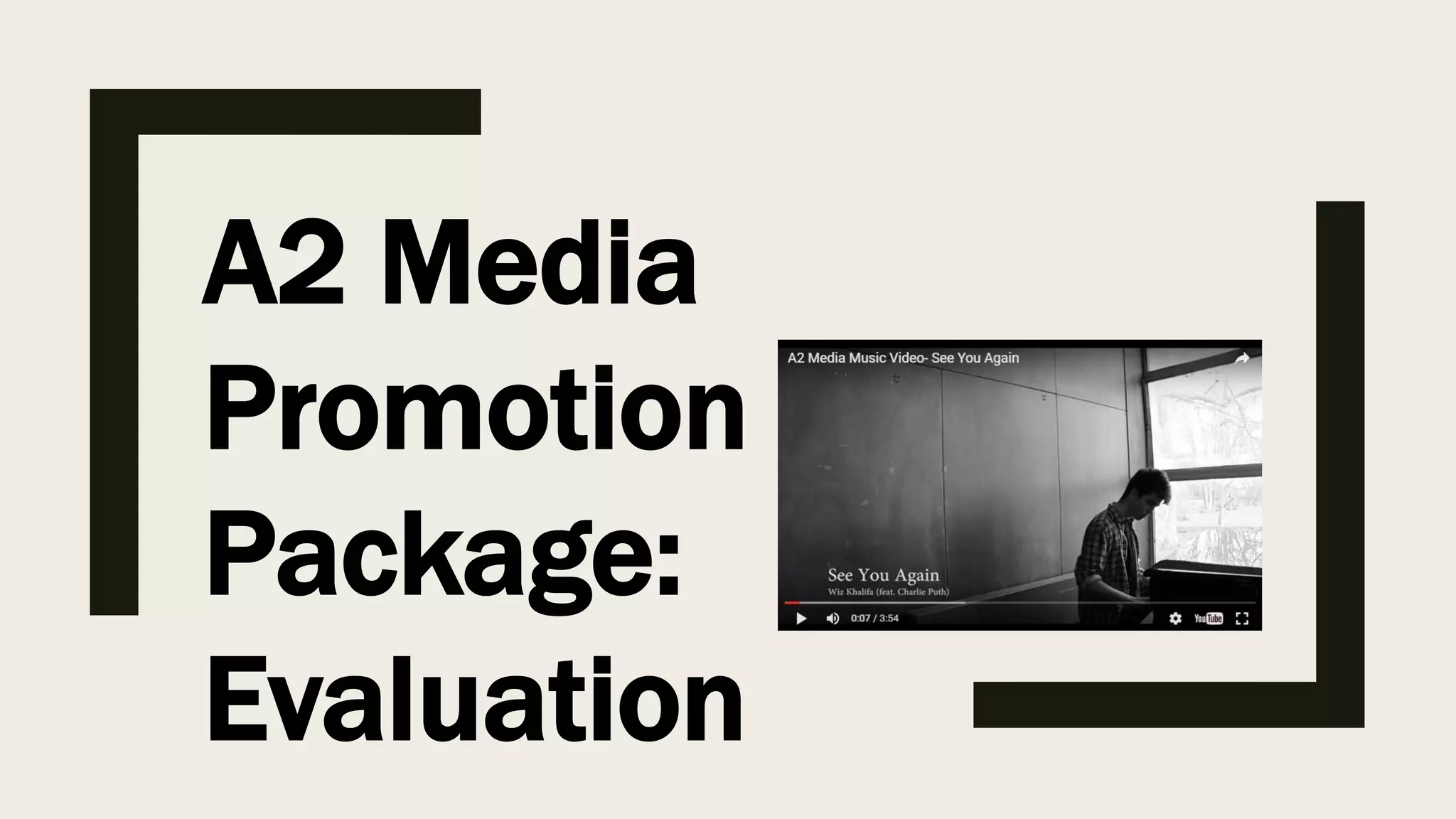
A2 Media
Promotion
Package:
Evaluation
In what ways does your media
product use, develop or
challenge forms and
conventions of real media
products?
POP
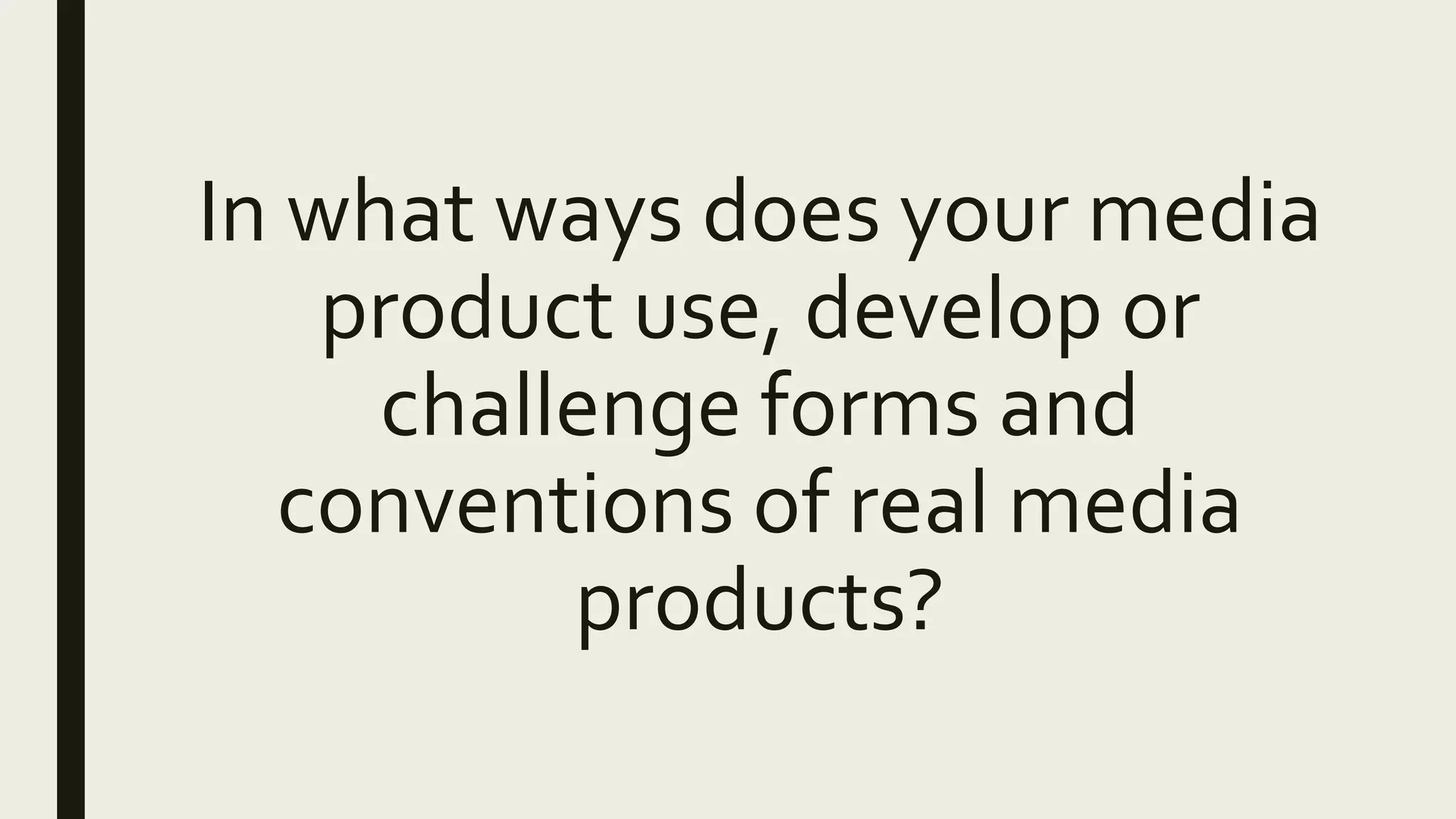
A generic convention of Pop
music is to have a female focus
in the narrative. We challenged
this convention by developing
the lyrics into a story about
memories of a friendship
between two boys which
parted ways.We chose to
develop the convention of
boyband members having
synchronised outfits by having
the rapper and singer both in
casual clothing to show the
unity between the two.The
convention of dance within a
pop video did not work within
our idea and thus we went
against it.We used the
convention of having the singers
in the video as we felt this was a
good method of publication and
therefore we based the narrative
around the singer and rapper.
This also helps with audience
engagement.
RAP
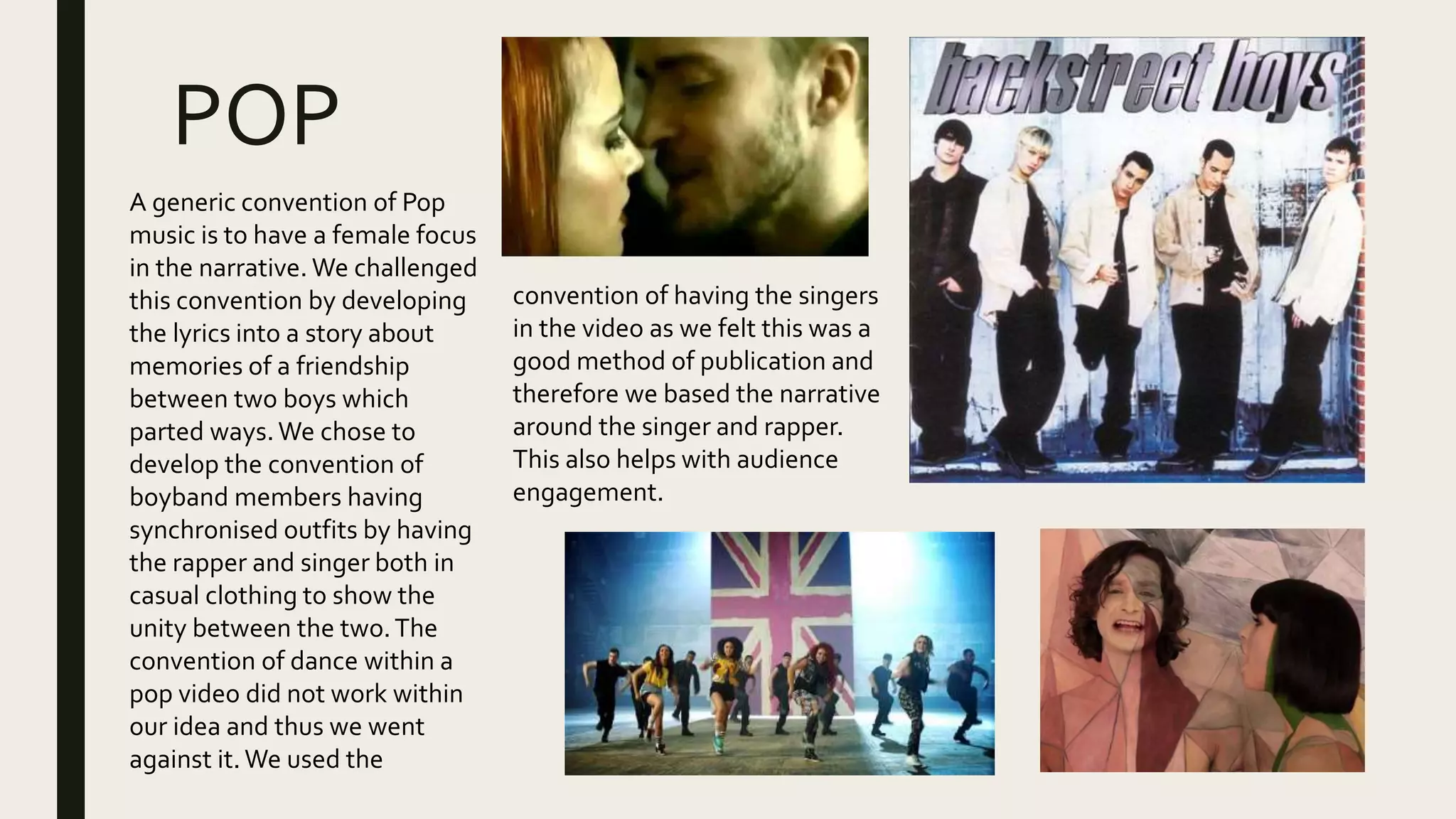
We chose to challenge the
convention of rappers
wearing baggy trousers and
‘bling’ because we felt that it
wouldn’t go with the idea of
having the rapper and singer
as part of the narrative; it
would make him seem out of
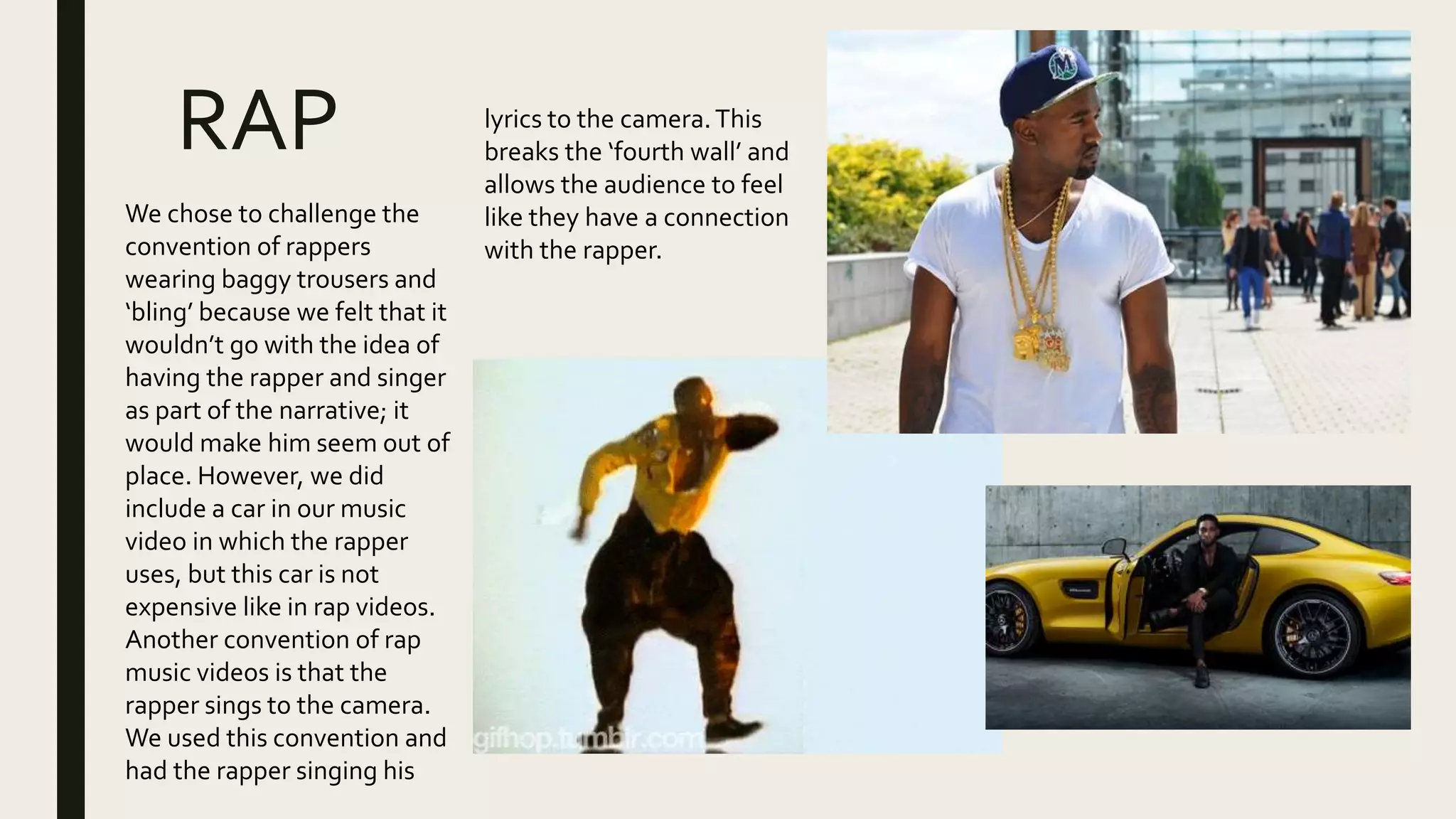
place. However, we did
include a car in our music
video in which the rapper
uses, but this car is not
expensive like in rap videos.
Another convention of rap
music videos is that the
rapper sings to the camera.
We used this convention and
had the rapper singing his
lyrics to the camera.This
breaks the ‘fourth wall’ and
allows the audience to feel
like they have a connection
with the rapper.
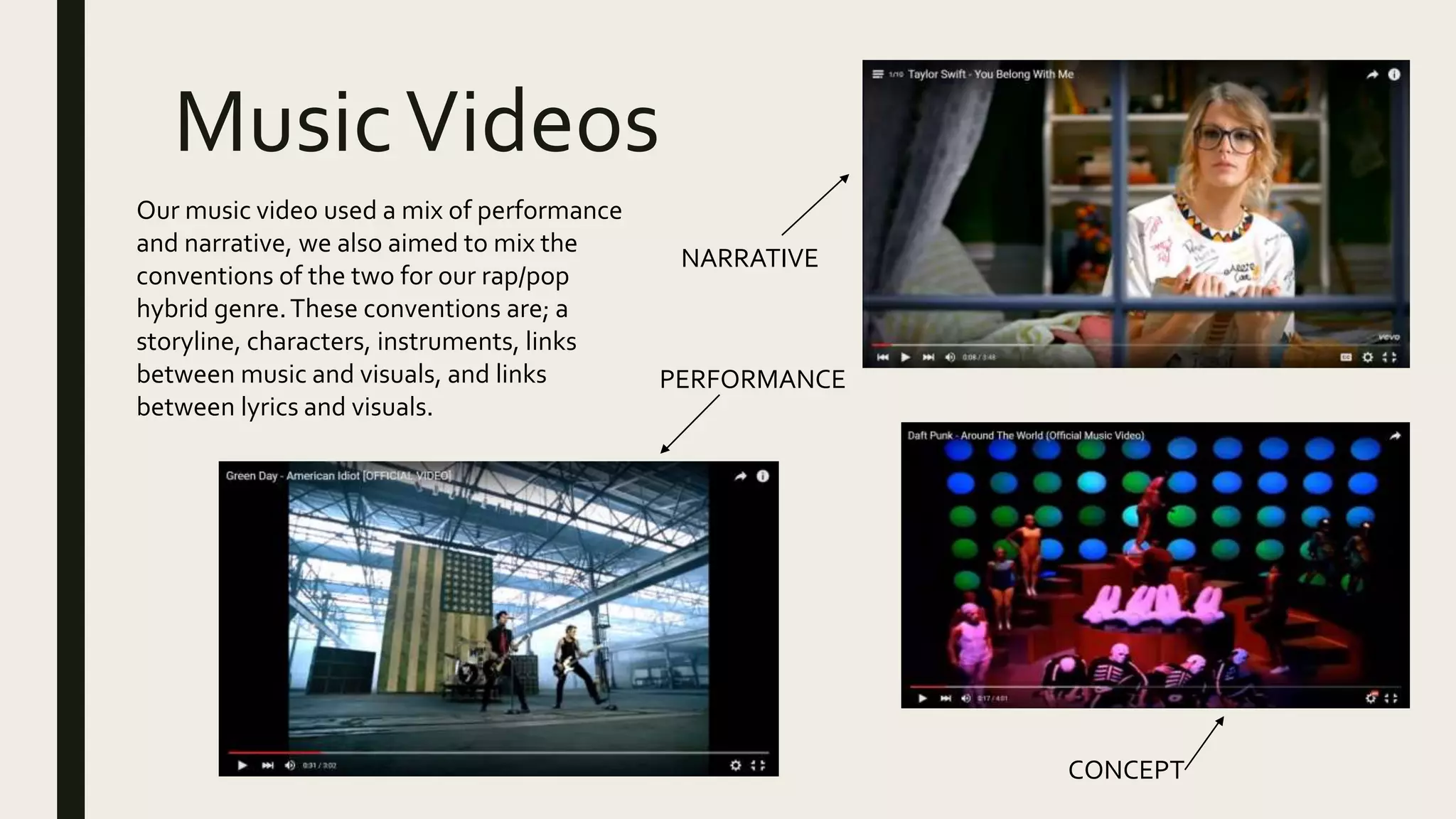
MusicVideos
PERFORMANCE
NARRATIVE
CONCEPT
Our music video used a mix of performance
and narrative, we also aimed to mix the
conventions of the two for our rap/pop
hybrid genre.These conventions are; a
storyline, characters, instruments, links
between music and visuals, and links
between lyrics and visuals.
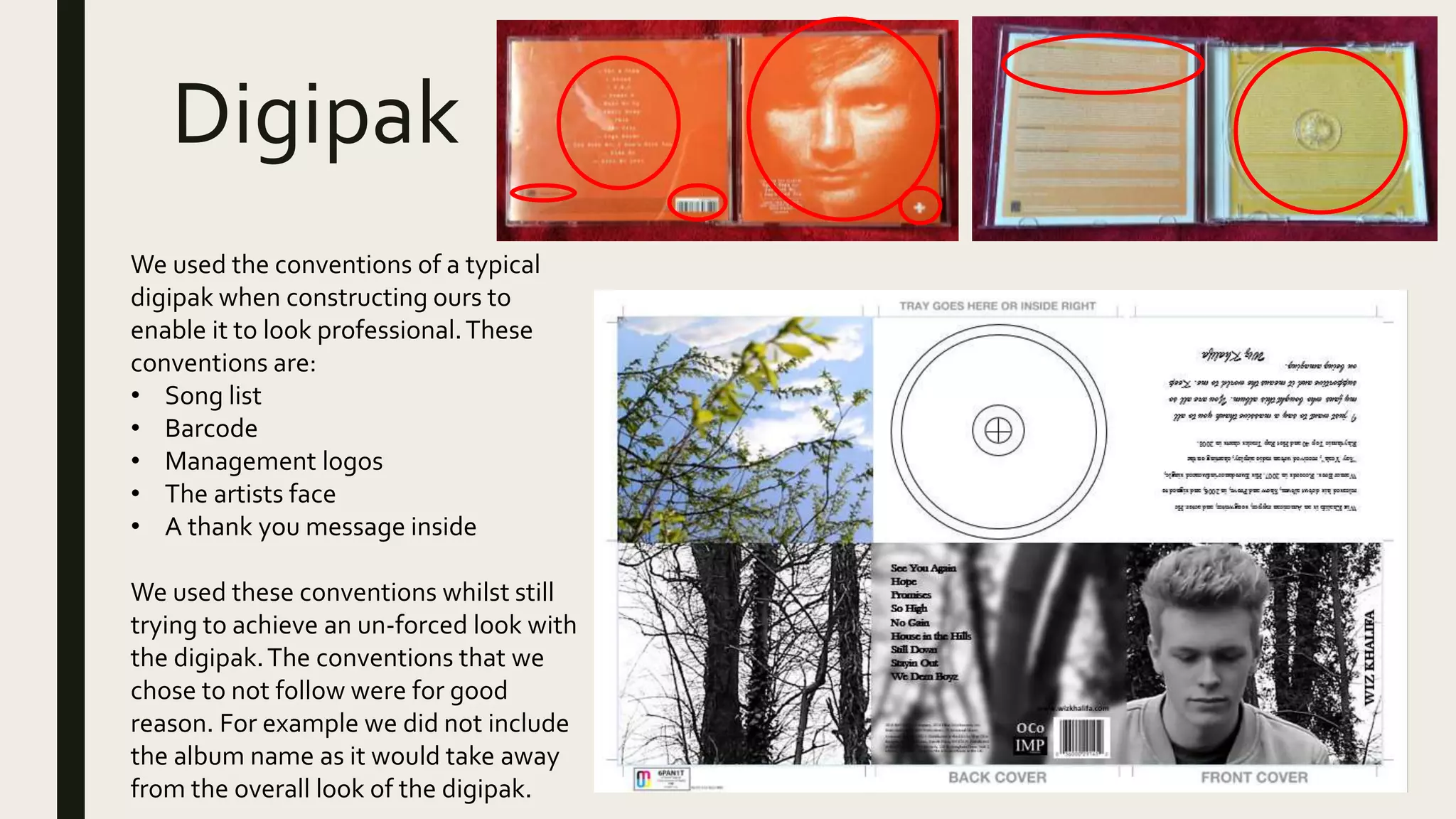
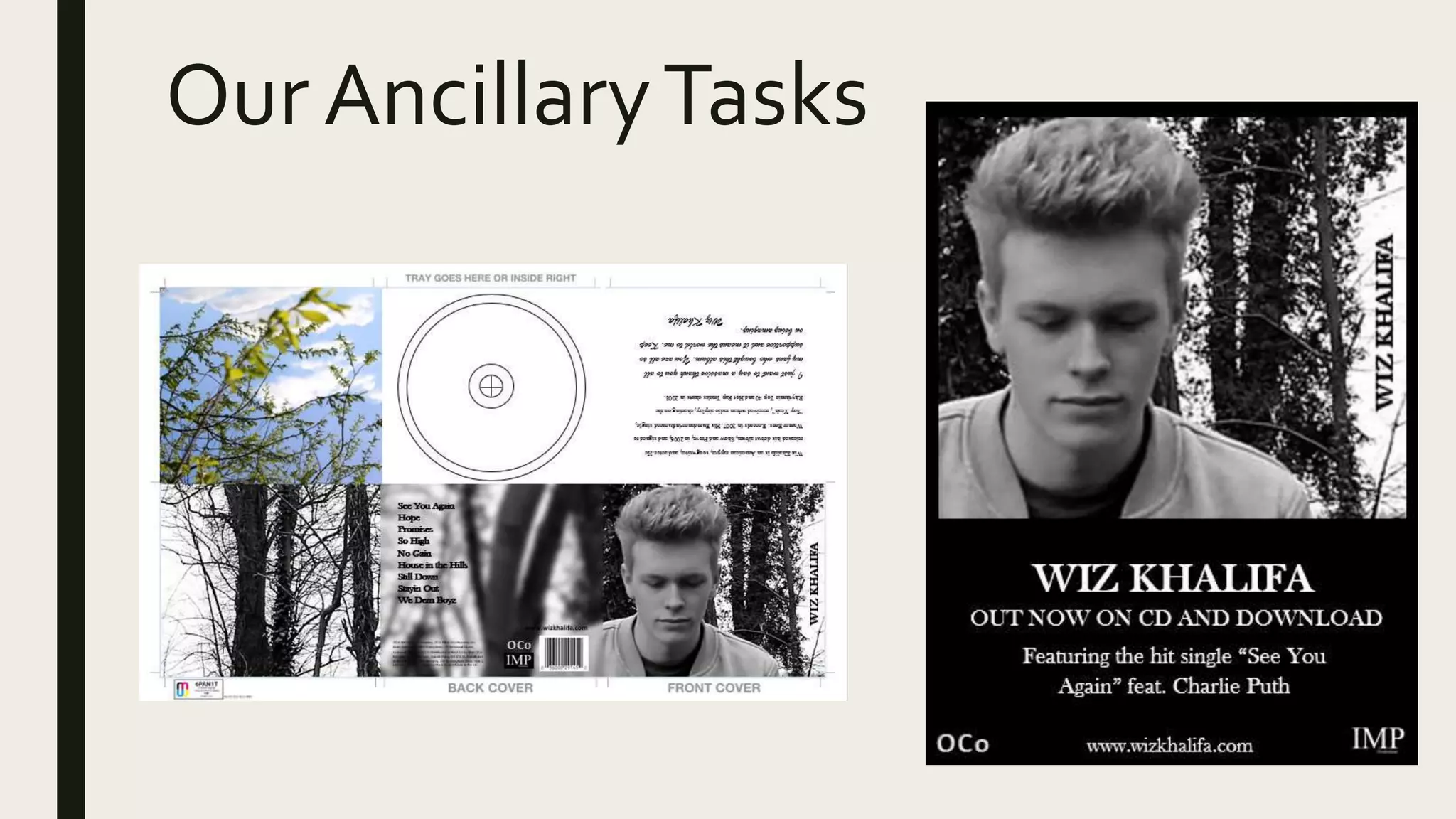
Digipak
We used the conventions of a typical
digipak when constructing ours to
enable it to look professional.These
conventions are:
• Song list
• Barcode
• Management logos
• The artists face
• A thank you message inside
We used these conventions whilst still
trying to achieve an un-forced look with
the digipak.The conventions that we
chose to not follow were for good
reason. For example we did not include
the album name as it would take away
from the overall look of the digipak.
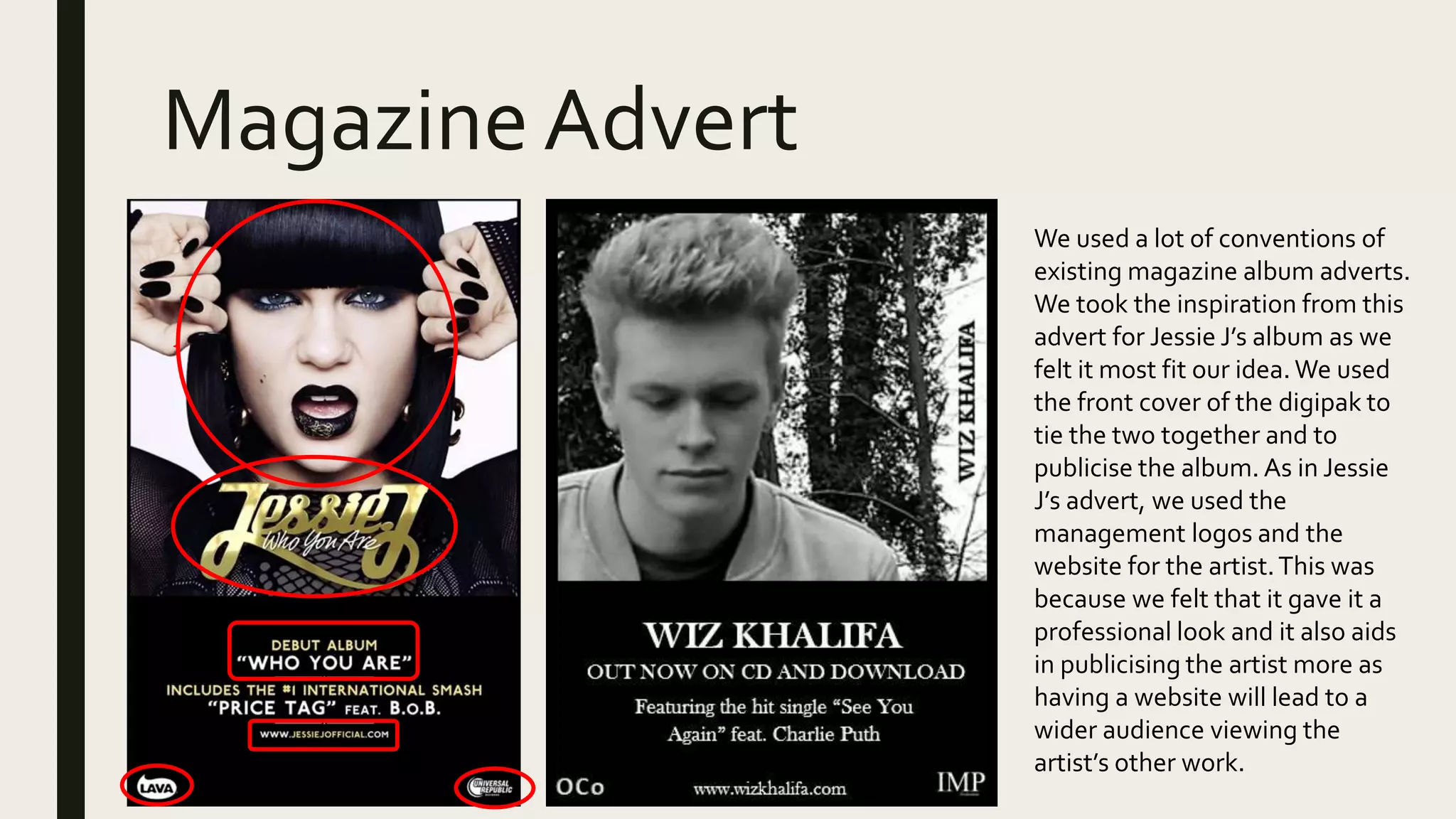
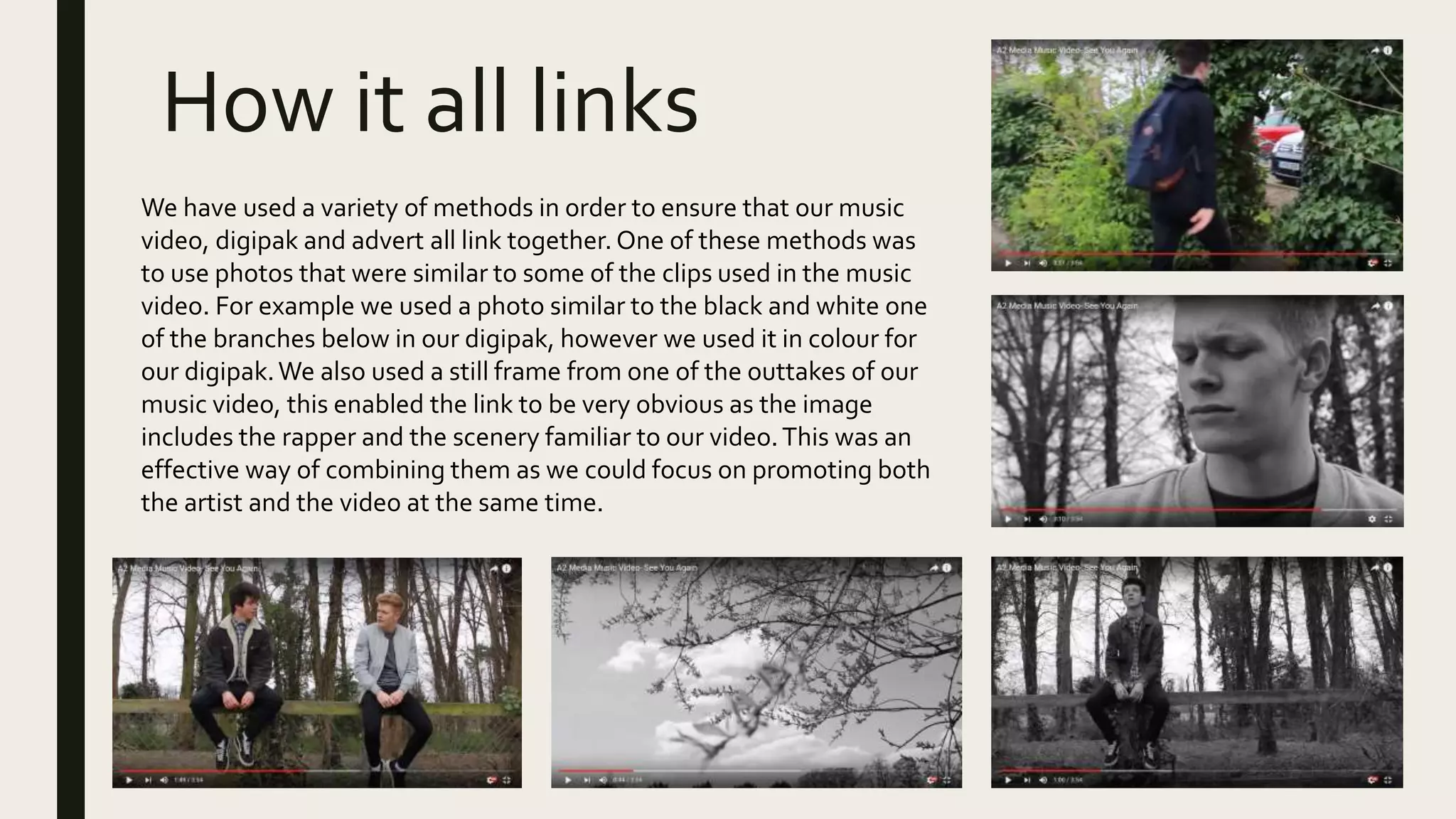
Magazine Advert
We used a lot of conventions of
existing magazine album adverts.
We took the inspiration from this
advert for Jessie J’s album as we
felt it most fit our idea. We used
the front cover of the digipak to
tie the two together and to
publicise the album. As in Jessie
J’s advert, we used the
management logos and the
website for the artist.This was
because we felt that it gave it a
professional look and it also aids
in publicising the artist more as
having a website will lead to a
wider audience viewing the
artist’s other work.
How effective is the
combination of your main
product and ancillary
texts?
Our AncillaryTasks
How it all links
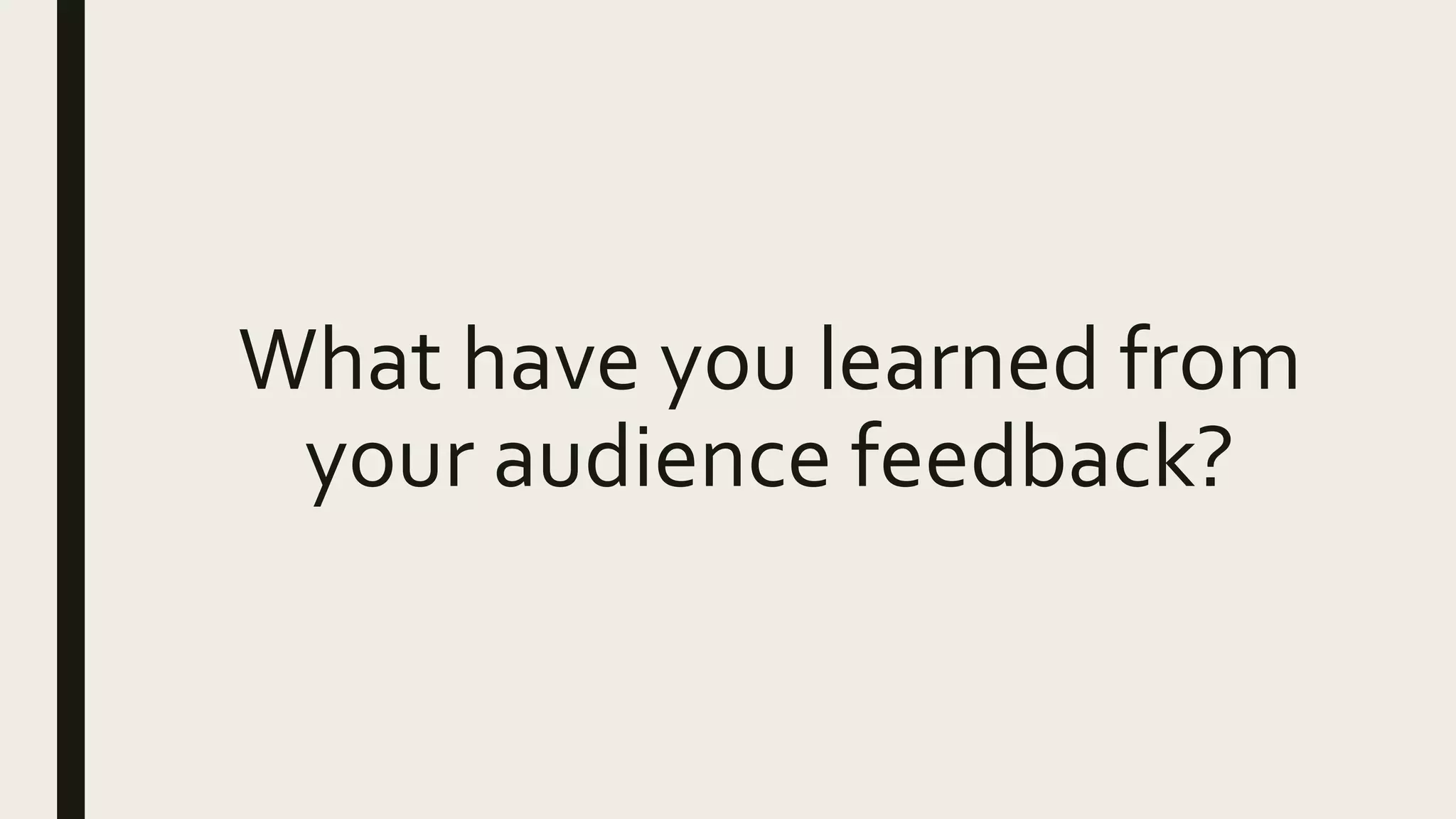
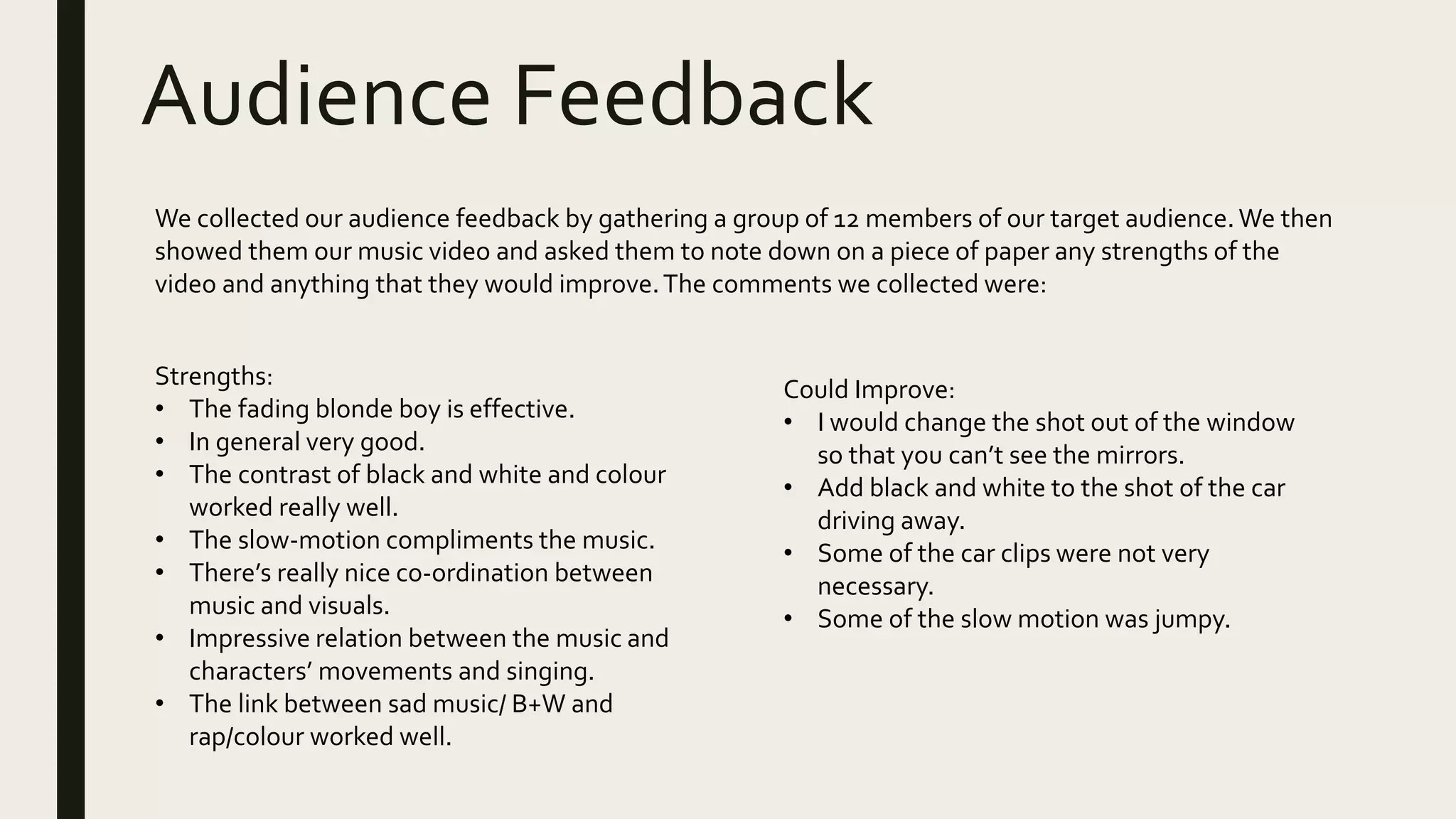
We have used a variety of methods in order to ensure that our music
video, digipak and advert all link together. One of these methods was
to use photos that were similar to some of the clips used in the music
video. For example we used a photo similar to the black and white one
of the branches below in our digipak, however we used it in colour for
our digipak.We also used a still frame from one of the outtakes of our
music video, this enabled the link to be very obvious as the image
includes the rapper and the scenery familiar to our video.This was an
effective way of combining them as we could focus on promoting both
the artist and the video at the same time.
What have you learned from
your audience feedback?
Audience Feedback
We collected our audience feedback by gathering a group of 12 members of our target audience. We then
showed them our music video and asked them to note down on a piece of paper any strengths of the
video and anything that they would improve.The comments we collected were:
Strengths:
• The fading blonde boy is effective.
• In general very good.
• The contrast of black and white and colour
worked really well.
• The slow-motion compliments the music.
• There’s really nice co-ordination between
music and visuals.
• Impressive relation between the music and
characters’ movements and singing.
• The link between sad music/ B+W and
rap/colour worked well.
Could Improve:
• I would change the shot out of the window
so that you can’t see the mirrors.
• Add black and white to the shot of the car
driving away.
• Some of the car clips were not very
necessary.
• Some of the slow motion was jumpy.
Interesting Points
One interesting comment that a male member of our feedback group made was “Before the
end clip of the boy fading, you could have included a shot of a crashed
car so we can see the accident that he was in.” This was interesting for us as our
original idea was not of the boy dying, but of him having to move away.The comment caused us to
consider that each person may interpret our narrative differently. If this is the case then that aids the
repeat viewing aspect of promotion. One of the main aims for a music video is to create it so that the
audience will want to watch it over and over again. Receiving this comment means that our music
video successfully achieved a main concept of videos as people will watch our video and create their
own idea of a narrative.These people will then discuss the video with their friends and families with
their perceptions.This may then influence other people to watch the video and discuss their views,
thus spreading and promoting the video, increasing its popularity.
From carrying out the audience feedback group session we have gained the knowledge of other
people’s view points and perceptions. It was useful to collect ideas from the target audience as it
gave us an outside point of view that was not biased by involvement as we had previously only
gotten feedback from ourselves and the actors in the video.
How did you use new media
technologies in the
construction and research,
planning and evaluation
stages?
Construction
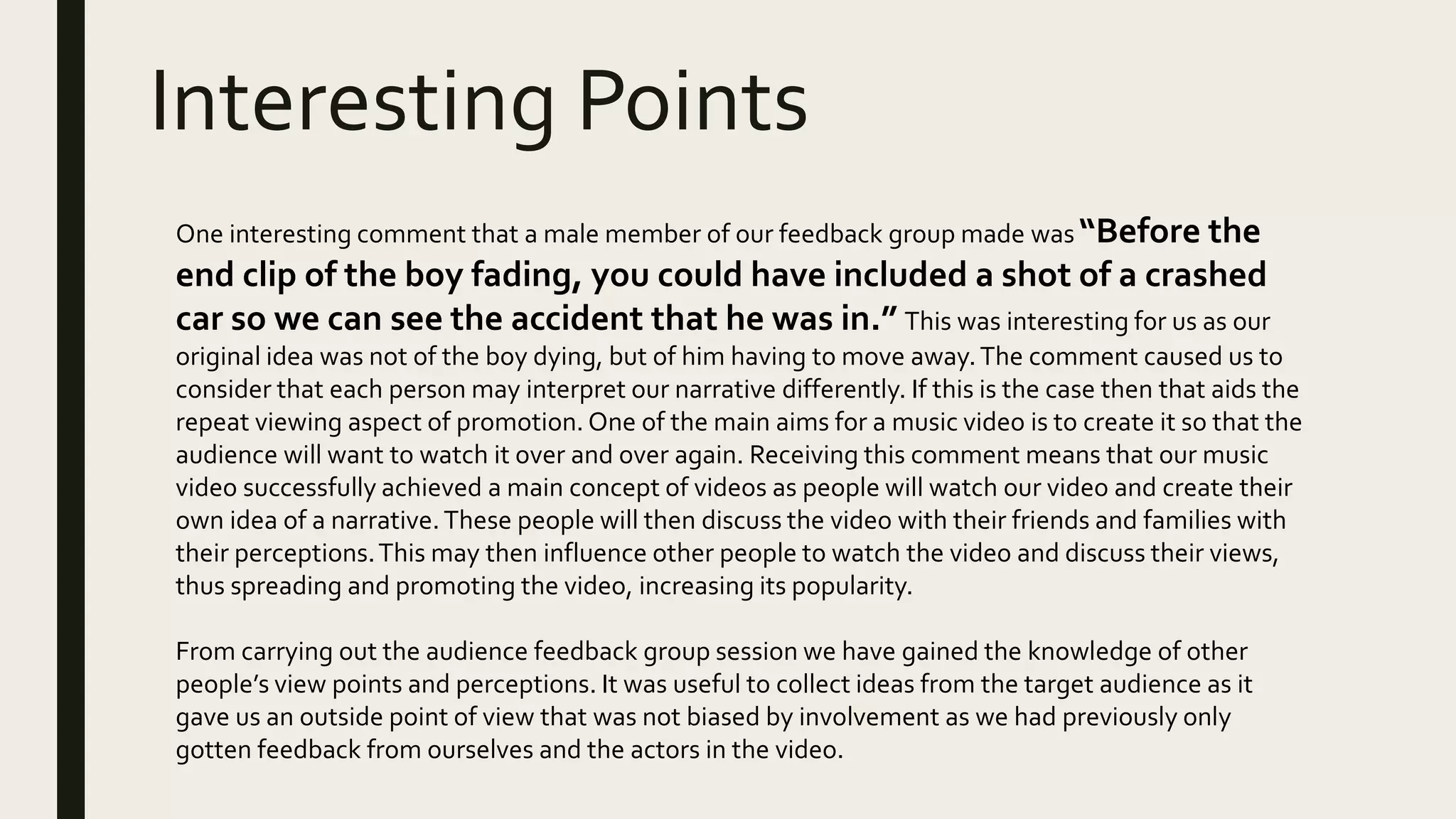
For the construction stage of our music video we used Adobe Premier
Pro CC as the editing software. With this software I carried out a
variety of editing techniques.These include blurring out licence plates
and fading an overlapped clip, for the blurring I used tutorials on
YouTube however to fade the clip I played around with the options and
worked out how to do it on my own. A problem encountered with this
software was that it would freeze when given too many orders at
once.To work around this problem I saved my work frequently and
gave the software time to load and process the changes.
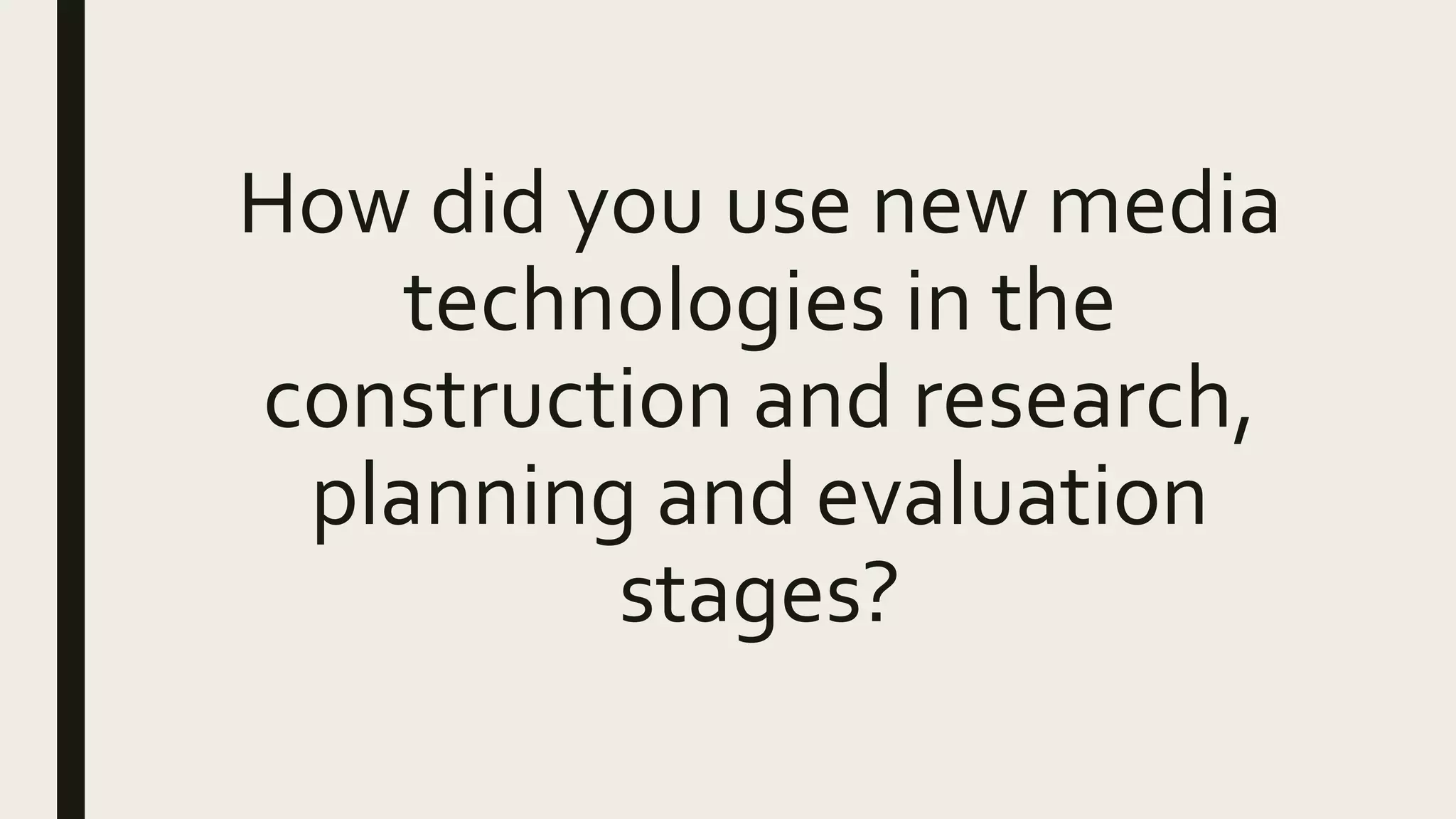
To film our video we used a canon camera, with an SD card to store
the footage.The benefit of using the SD card was that it could be
taken everywhere and all the footage was in one place.A problem
encountered with the camera however was that when the frame rate
was changed, to aid in the editing of slow motion, the frame size also
changed.This problem was solved in the editing stage by adjusting
the zoom of the clip.
To create the digipak and advert I used Microsoft word as I knew how
the main functions of this software worked.This was useful as I did not
have to learn how a new software works.
Research
During the research for our project I used a few different
technologies but mostlyWeb 2.0. I used Google to search for any
information that I felt would be crucial to my research.This
information included my audience research into the demographics
of a target audience and director research. Along with this I used
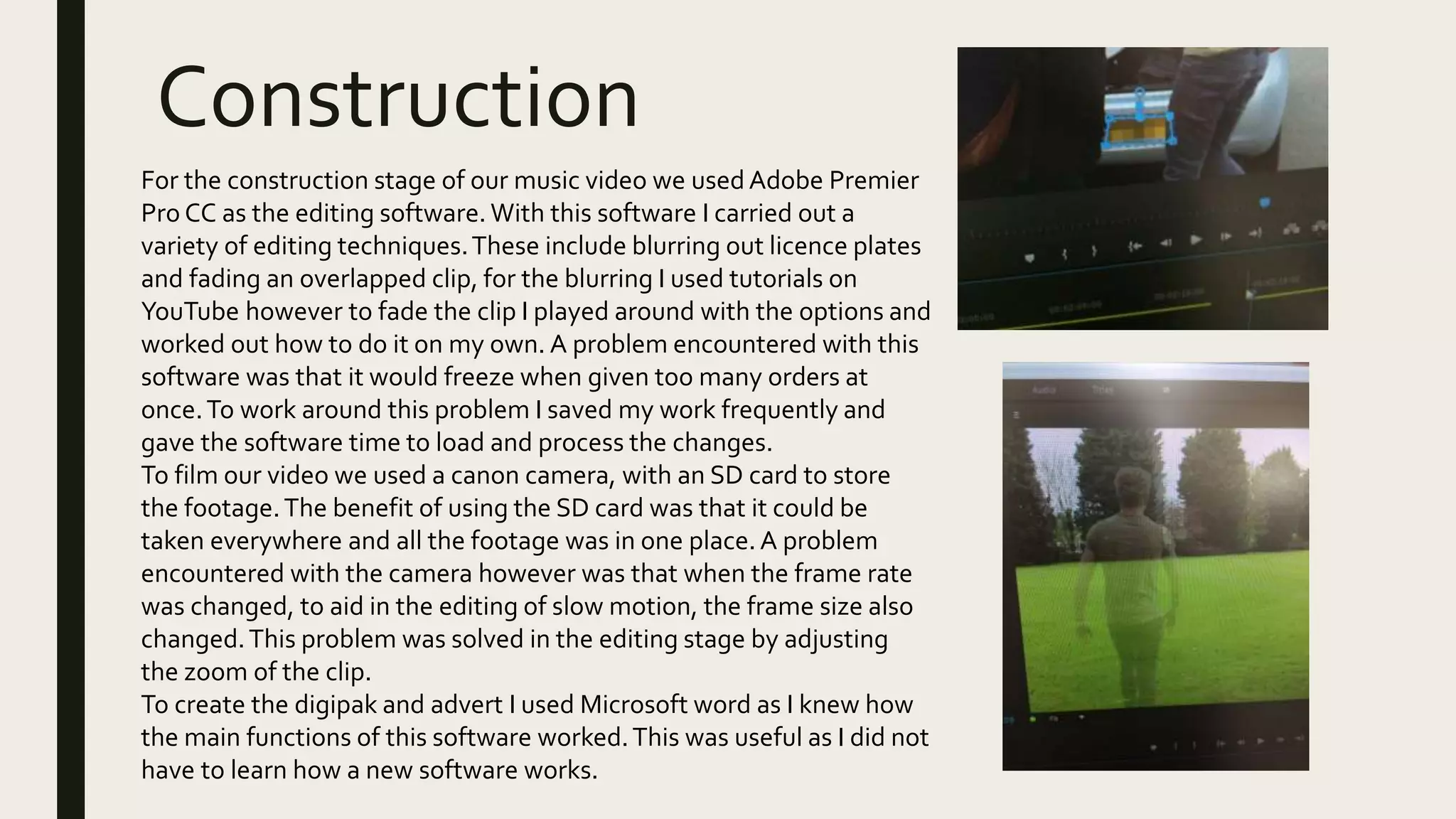
SurveyMonkey to carry out a questionnaire as a way to find out
what the target audience likes to see in a music video. I shared this
survey using an email sent to a large number of 16-19 year olds;
this age is right in the middle of our target audience.
Another main technology that I used wasYouTube to look at
existing music videos, I then carried out my own analyses of these.
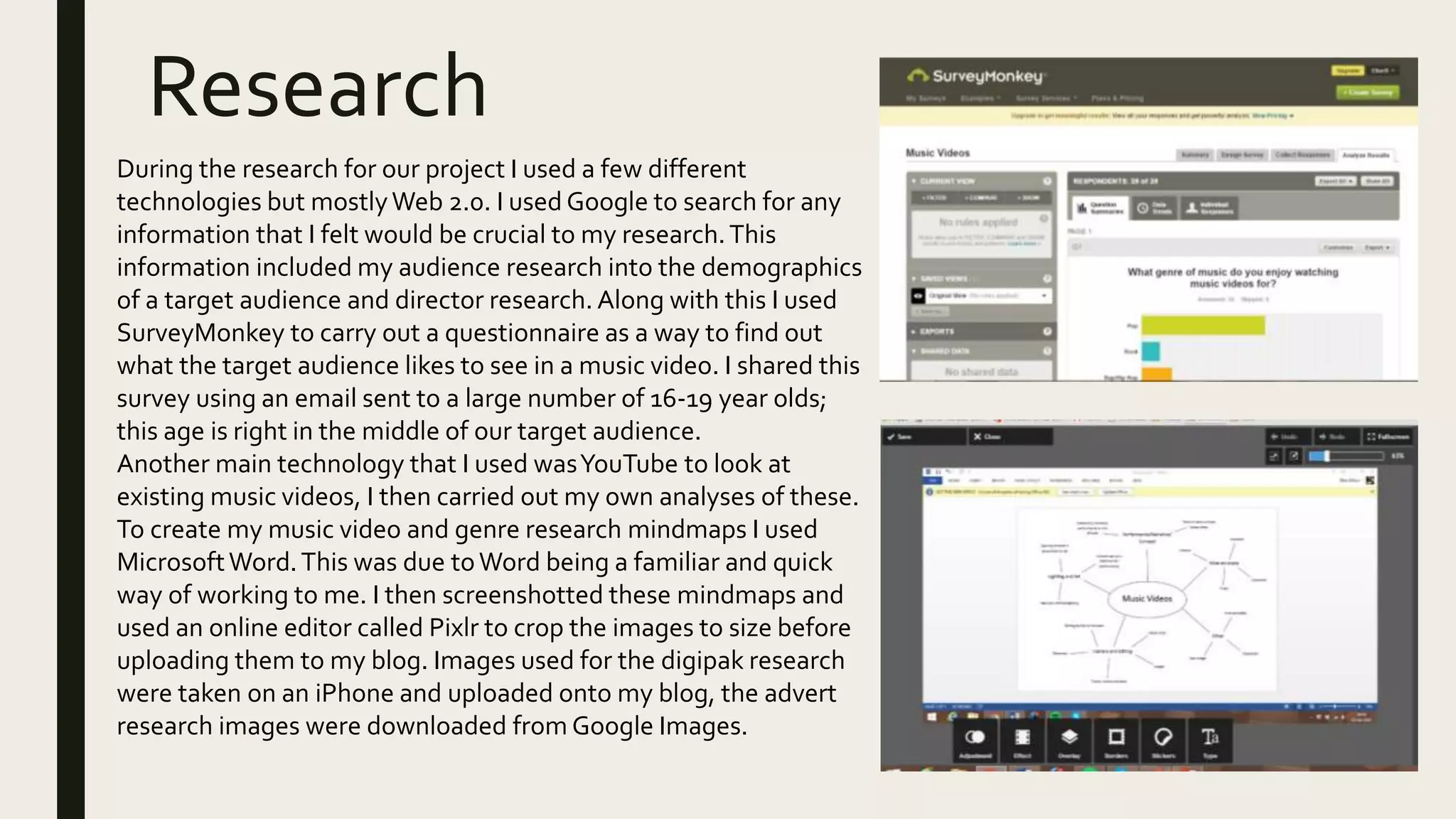
To create my music video and genre research mindmaps I used
MicrosoftWord.This was due toWord being a familiar and quick
way of working to me. I then screenshotted these mindmaps and
used an online editor called Pixlr to crop the images to size before
uploading them to my blog. Images used for the digipak research
were taken on an iPhone and uploaded onto my blog, the advert
research images were downloaded from Google Images.
Planning
For our music video we carried out a lot of handwritten planning.To
upload all this planning onto our blogs we scanned it onto the
computer using the scanner on my printer.This allowed us to save time
rather than recreating the planning using technology.We usedWeb 2.0
to search for the lyrics to the song and also to watch the existing video
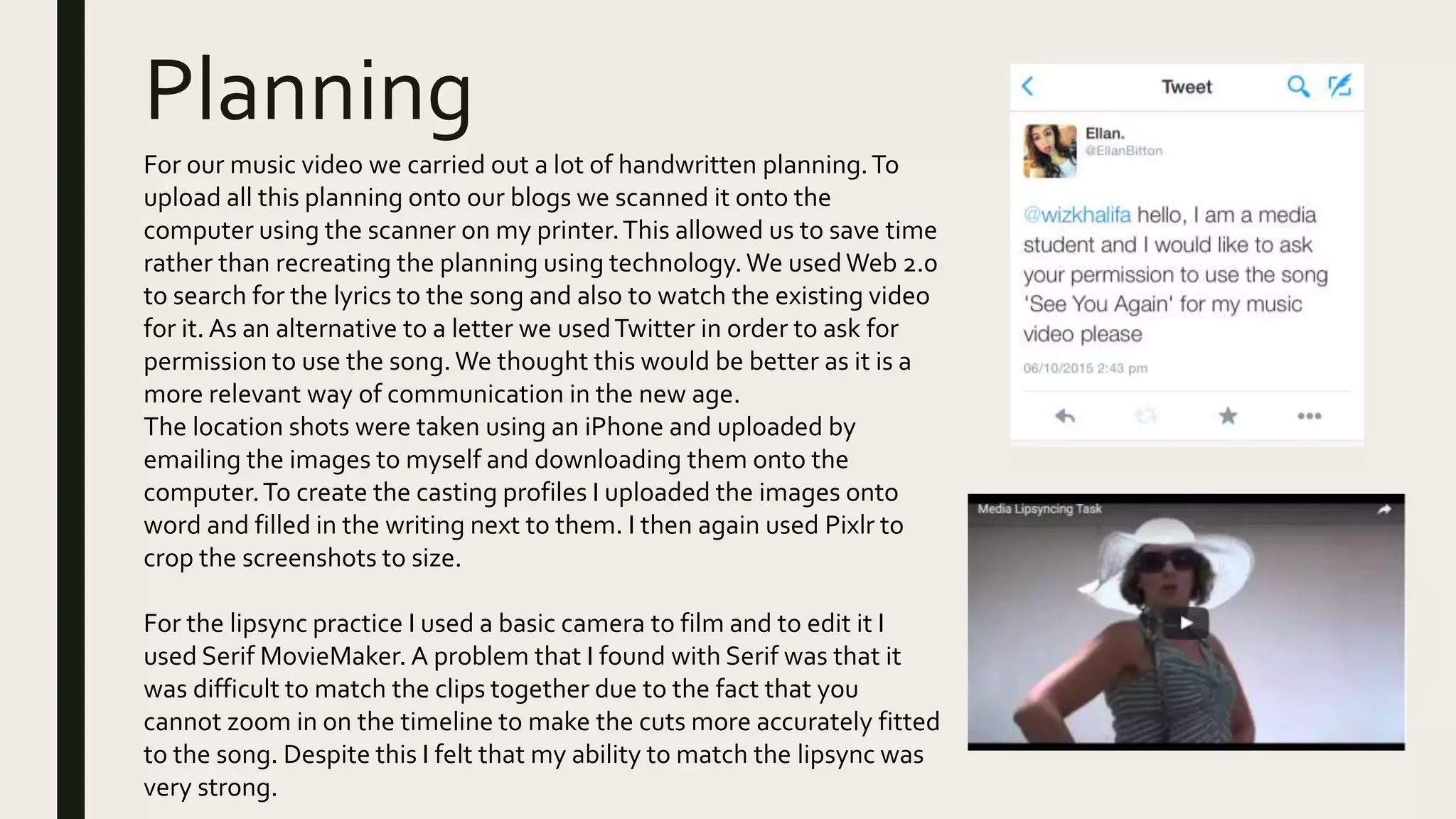
for it. As an alternative to a letter we usedTwitter in order to ask for
permission to use the song.We thought this would be better as it is a
more relevant way of communication in the new age.
The location shots were taken using an iPhone and uploaded by
emailing the images to myself and downloading them onto the
computer.To create the casting profiles I uploaded the images onto
word and filled in the writing next to them. I then again used Pixlr to
crop the screenshots to size.
For the lipsync practice I used a basic camera to film and to edit it I
used Serif MovieMaker. A problem that I found with Serif was that it
was difficult to match the clips together due to the fact that you
cannot zoom in on the timeline to make the cuts more accurately fitted
to the song. Despite this I felt that my ability to match the lipsync was
very strong.
Evaluation
I created my evaluation on Microsoft PowerPoint as I felt confident
with this software.The images used in my evaluation are either from
Web 2.0 or are images that I took myself and uploaded onto my
PowerPoint.
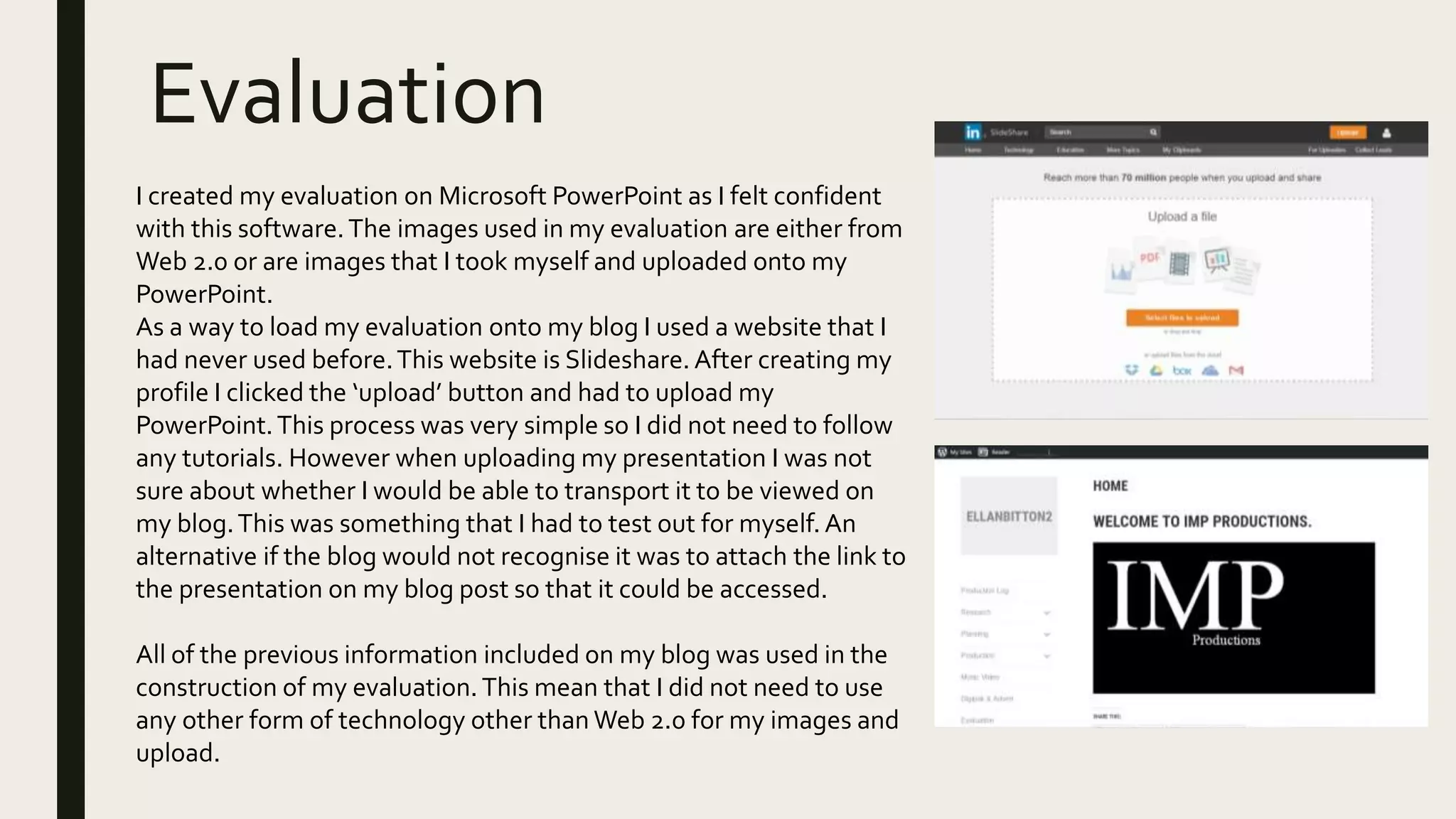
As a way to load my evaluation onto my blog I used a website that I
had never used before.This website is Slideshare.After creating my
profile I clicked the ‘upload’ button and had to upload my
PowerPoint.This process was very simple so I did not need to follow
any tutorials. However when uploading my presentation I was not
sure about whether I would be able to transport it to be viewed on
my blog.This was something that I had to test out for myself.An
alternative if the blog would not recognise it was to attach the link to
the presentation on my blog post so that it could be accessed.
All of the previous information included on my blog was used in the
construction of my evaluation.This mean that I did not need to use
any other form of technology other than Web 2.0 for my images and
upload.

A2 Media Promotion Package Evaluation

  • 1.
  • 2.
    In what waysdoes your media product use, develop or challenge forms and conventions of real media products?
  • 3.
    POP A generic conventionof Pop music is to have a female focus in the narrative. We challenged this convention by developing the lyrics into a story about memories of a friendship between two boys which parted ways.We chose to develop the convention of boyband members having synchronised outfits by having the rapper and singer both in casual clothing to show the unity between the two.The convention of dance within a pop video did not work within our idea and thus we went against it.We used the convention of having the singers in the video as we felt this was a good method of publication and therefore we based the narrative around the singer and rapper. This also helps with audience engagement.
  • 4.
    RAP We chose tochallenge the convention of rappers wearing baggy trousers and ‘bling’ because we felt that it wouldn’t go with the idea of having the rapper and singer as part of the narrative; it would make him seem out of place. However, we did include a car in our music video in which the rapper uses, but this car is not expensive like in rap videos. Another convention of rap music videos is that the rapper sings to the camera. We used this convention and had the rapper singing his lyrics to the camera.This breaks the ‘fourth wall’ and allows the audience to feel like they have a connection with the rapper.
  • 5.
    MusicVideos PERFORMANCE NARRATIVE CONCEPT Our music videoused a mix of performance and narrative, we also aimed to mix the conventions of the two for our rap/pop hybrid genre.These conventions are; a storyline, characters, instruments, links between music and visuals, and links between lyrics and visuals.
  • 6.
    Digipak We used theconventions of a typical digipak when constructing ours to enable it to look professional.These conventions are: • Song list • Barcode • Management logos • The artists face • A thank you message inside We used these conventions whilst still trying to achieve an un-forced look with the digipak.The conventions that we chose to not follow were for good reason. For example we did not include the album name as it would take away from the overall look of the digipak.
  • 7.
    Magazine Advert We useda lot of conventions of existing magazine album adverts. We took the inspiration from this advert for Jessie J’s album as we felt it most fit our idea. We used the front cover of the digipak to tie the two together and to publicise the album. As in Jessie J’s advert, we used the management logos and the website for the artist.This was because we felt that it gave it a professional look and it also aids in publicising the artist more as having a website will lead to a wider audience viewing the artist’s other work.
  • 8.
    How effective isthe combination of your main product and ancillary texts?
  • 9.
  • 10.
    How it alllinks We have used a variety of methods in order to ensure that our music video, digipak and advert all link together. One of these methods was to use photos that were similar to some of the clips used in the music video. For example we used a photo similar to the black and white one of the branches below in our digipak, however we used it in colour for our digipak.We also used a still frame from one of the outtakes of our music video, this enabled the link to be very obvious as the image includes the rapper and the scenery familiar to our video.This was an effective way of combining them as we could focus on promoting both the artist and the video at the same time.
  • 11.
    What have youlearned from your audience feedback?
  • 12.
    Audience Feedback We collectedour audience feedback by gathering a group of 12 members of our target audience. We then showed them our music video and asked them to note down on a piece of paper any strengths of the video and anything that they would improve.The comments we collected were: Strengths: • The fading blonde boy is effective. • In general very good. • The contrast of black and white and colour worked really well. • The slow-motion compliments the music. • There’s really nice co-ordination between music and visuals. • Impressive relation between the music and characters’ movements and singing. • The link between sad music/ B+W and rap/colour worked well. Could Improve: • I would change the shot out of the window so that you can’t see the mirrors. • Add black and white to the shot of the car driving away. • Some of the car clips were not very necessary. • Some of the slow motion was jumpy.
  • 13.
    Interesting Points One interestingcomment that a male member of our feedback group made was “Before the end clip of the boy fading, you could have included a shot of a crashed car so we can see the accident that he was in.” This was interesting for us as our original idea was not of the boy dying, but of him having to move away.The comment caused us to consider that each person may interpret our narrative differently. If this is the case then that aids the repeat viewing aspect of promotion. One of the main aims for a music video is to create it so that the audience will want to watch it over and over again. Receiving this comment means that our music video successfully achieved a main concept of videos as people will watch our video and create their own idea of a narrative.These people will then discuss the video with their friends and families with their perceptions.This may then influence other people to watch the video and discuss their views, thus spreading and promoting the video, increasing its popularity. From carrying out the audience feedback group session we have gained the knowledge of other people’s view points and perceptions. It was useful to collect ideas from the target audience as it gave us an outside point of view that was not biased by involvement as we had previously only gotten feedback from ourselves and the actors in the video.
  • 14.
    How did youuse new media technologies in the construction and research, planning and evaluation stages?
  • 15.
    Construction For the constructionstage of our music video we used Adobe Premier Pro CC as the editing software. With this software I carried out a variety of editing techniques.These include blurring out licence plates and fading an overlapped clip, for the blurring I used tutorials on YouTube however to fade the clip I played around with the options and worked out how to do it on my own. A problem encountered with this software was that it would freeze when given too many orders at once.To work around this problem I saved my work frequently and gave the software time to load and process the changes. To film our video we used a canon camera, with an SD card to store the footage.The benefit of using the SD card was that it could be taken everywhere and all the footage was in one place.A problem encountered with the camera however was that when the frame rate was changed, to aid in the editing of slow motion, the frame size also changed.This problem was solved in the editing stage by adjusting the zoom of the clip. To create the digipak and advert I used Microsoft word as I knew how the main functions of this software worked.This was useful as I did not have to learn how a new software works.
  • 16.
    Research During the researchfor our project I used a few different technologies but mostlyWeb 2.0. I used Google to search for any information that I felt would be crucial to my research.This information included my audience research into the demographics of a target audience and director research. Along with this I used SurveyMonkey to carry out a questionnaire as a way to find out what the target audience likes to see in a music video. I shared this survey using an email sent to a large number of 16-19 year olds; this age is right in the middle of our target audience. Another main technology that I used wasYouTube to look at existing music videos, I then carried out my own analyses of these. To create my music video and genre research mindmaps I used MicrosoftWord.This was due toWord being a familiar and quick way of working to me. I then screenshotted these mindmaps and used an online editor called Pixlr to crop the images to size before uploading them to my blog. Images used for the digipak research were taken on an iPhone and uploaded onto my blog, the advert research images were downloaded from Google Images.
  • 17.
    Planning For our musicvideo we carried out a lot of handwritten planning.To upload all this planning onto our blogs we scanned it onto the computer using the scanner on my printer.This allowed us to save time rather than recreating the planning using technology.We usedWeb 2.0 to search for the lyrics to the song and also to watch the existing video for it. As an alternative to a letter we usedTwitter in order to ask for permission to use the song.We thought this would be better as it is a more relevant way of communication in the new age. The location shots were taken using an iPhone and uploaded by emailing the images to myself and downloading them onto the computer.To create the casting profiles I uploaded the images onto word and filled in the writing next to them. I then again used Pixlr to crop the screenshots to size. For the lipsync practice I used a basic camera to film and to edit it I used Serif MovieMaker. A problem that I found with Serif was that it was difficult to match the clips together due to the fact that you cannot zoom in on the timeline to make the cuts more accurately fitted to the song. Despite this I felt that my ability to match the lipsync was very strong.
  • 18.
    Evaluation I created myevaluation on Microsoft PowerPoint as I felt confident with this software.The images used in my evaluation are either from Web 2.0 or are images that I took myself and uploaded onto my PowerPoint. As a way to load my evaluation onto my blog I used a website that I had never used before.This website is Slideshare.After creating my profile I clicked the ‘upload’ button and had to upload my PowerPoint.This process was very simple so I did not need to follow any tutorials. However when uploading my presentation I was not sure about whether I would be able to transport it to be viewed on my blog.This was something that I had to test out for myself.An alternative if the blog would not recognise it was to attach the link to the presentation on my blog post so that it could be accessed. All of the previous information included on my blog was used in the construction of my evaluation.This mean that I did not need to use any other form of technology other than Web 2.0 for my images and upload.