A Virtual Window using Curtains and Image Projection
Keio University
Naoharu Sawada, Takumi Yamamoto, Yuta Sugiura
APMAR2023
2
Background
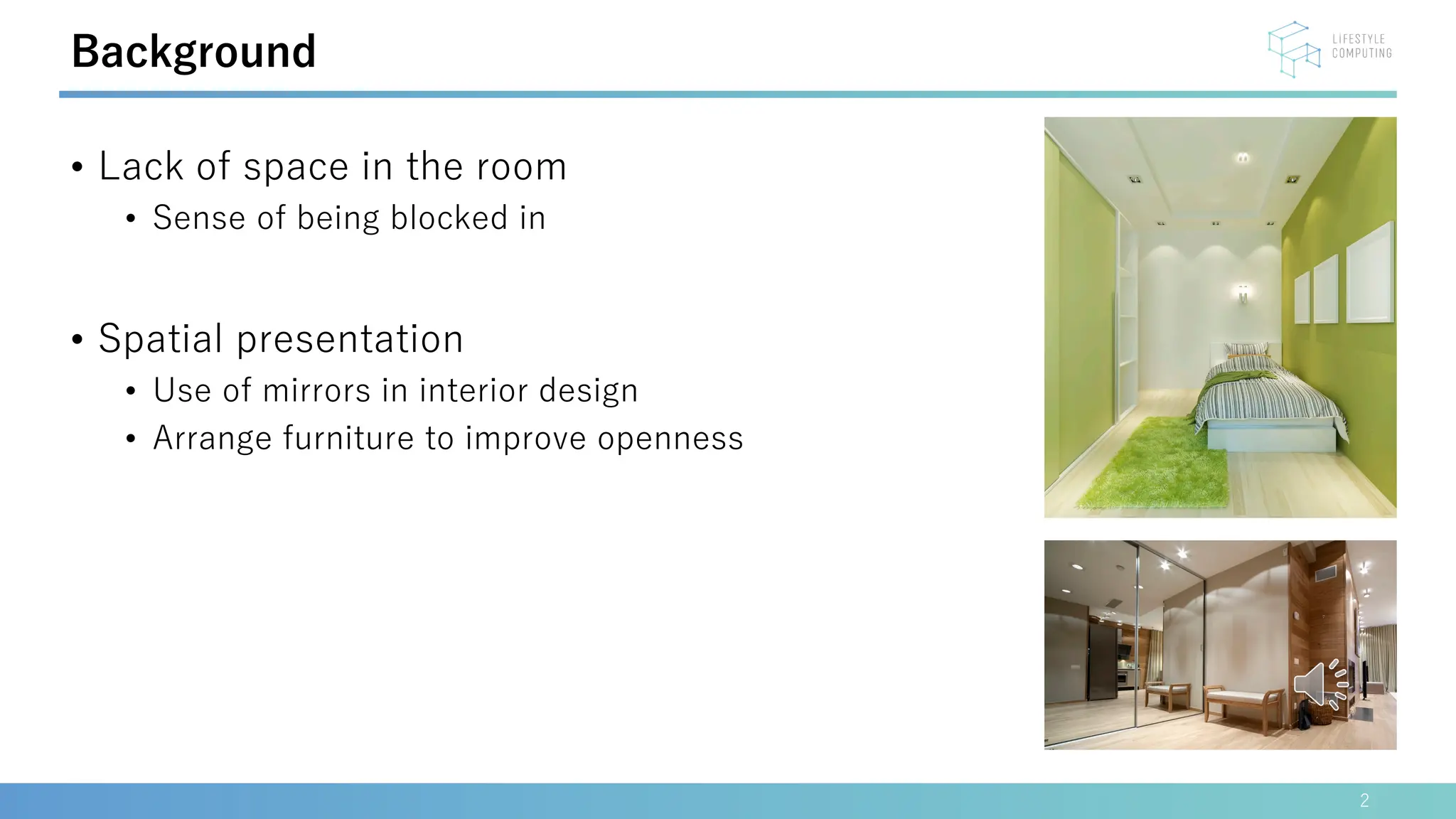
• Lack of space in the room
• Sense of being blocked in
• Spatial presentation
• Use of mirrors in interior design
• Arrange furniture to improve openness
3
Related Work
Expanding window shade
[T. Homma, 2021]
Interactive system using shojis
[Y. Nakahara, 2010]
Methods focused on
the role of curtains
Smart curtain
[T. Takashina, 2015]
Smooth curtain
[T. Handa, 2009]
Presenting information
using everyday items
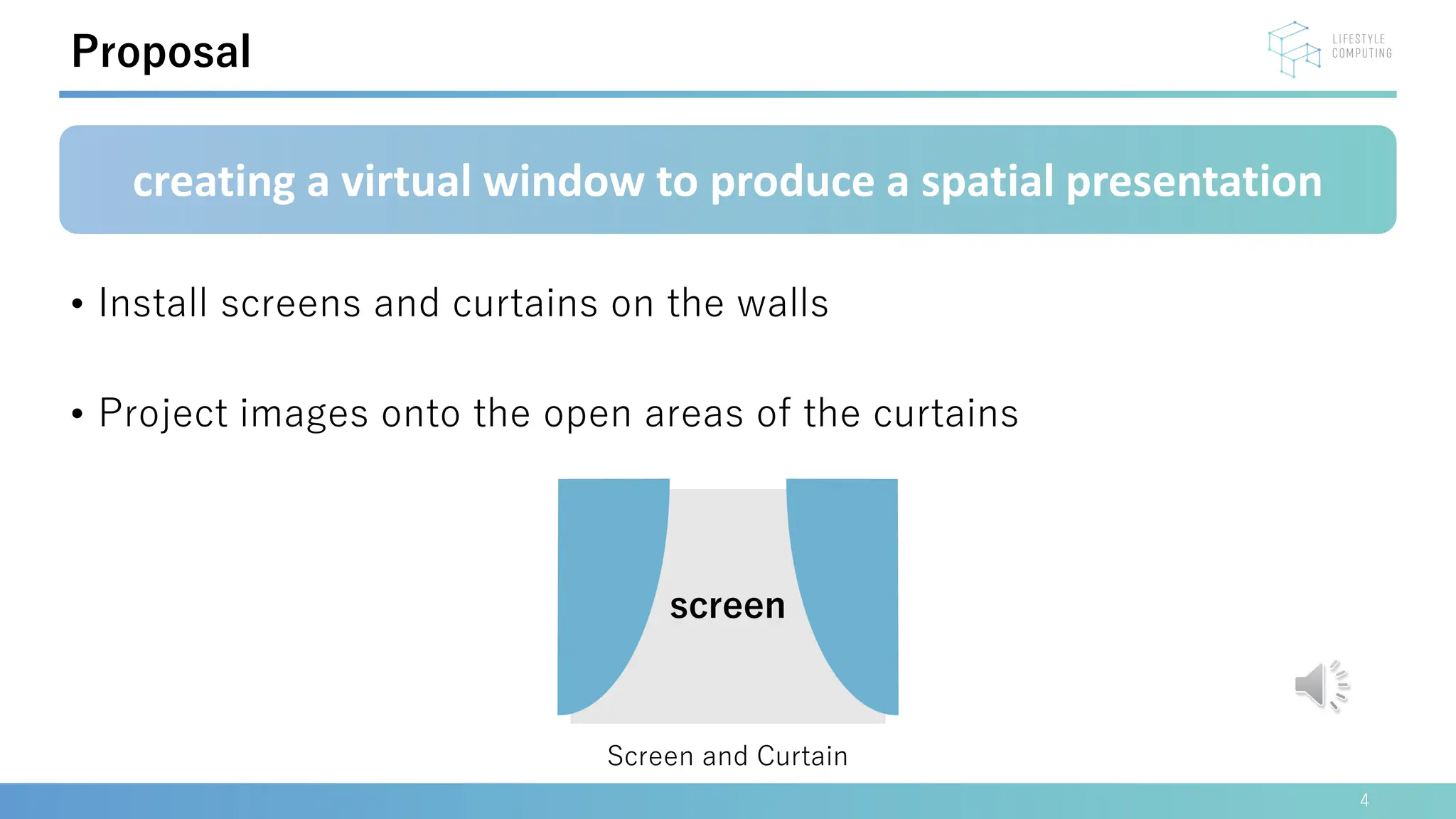
• Install screens and curtains on the walls
• Project images onto the open areas of the curtains
4
Proposal
Screen and Curtain
creating a virtual window to produce a spatial presentation
5
Movie of the virtual window
6
External Window
7
Indoor windows between rooms
8
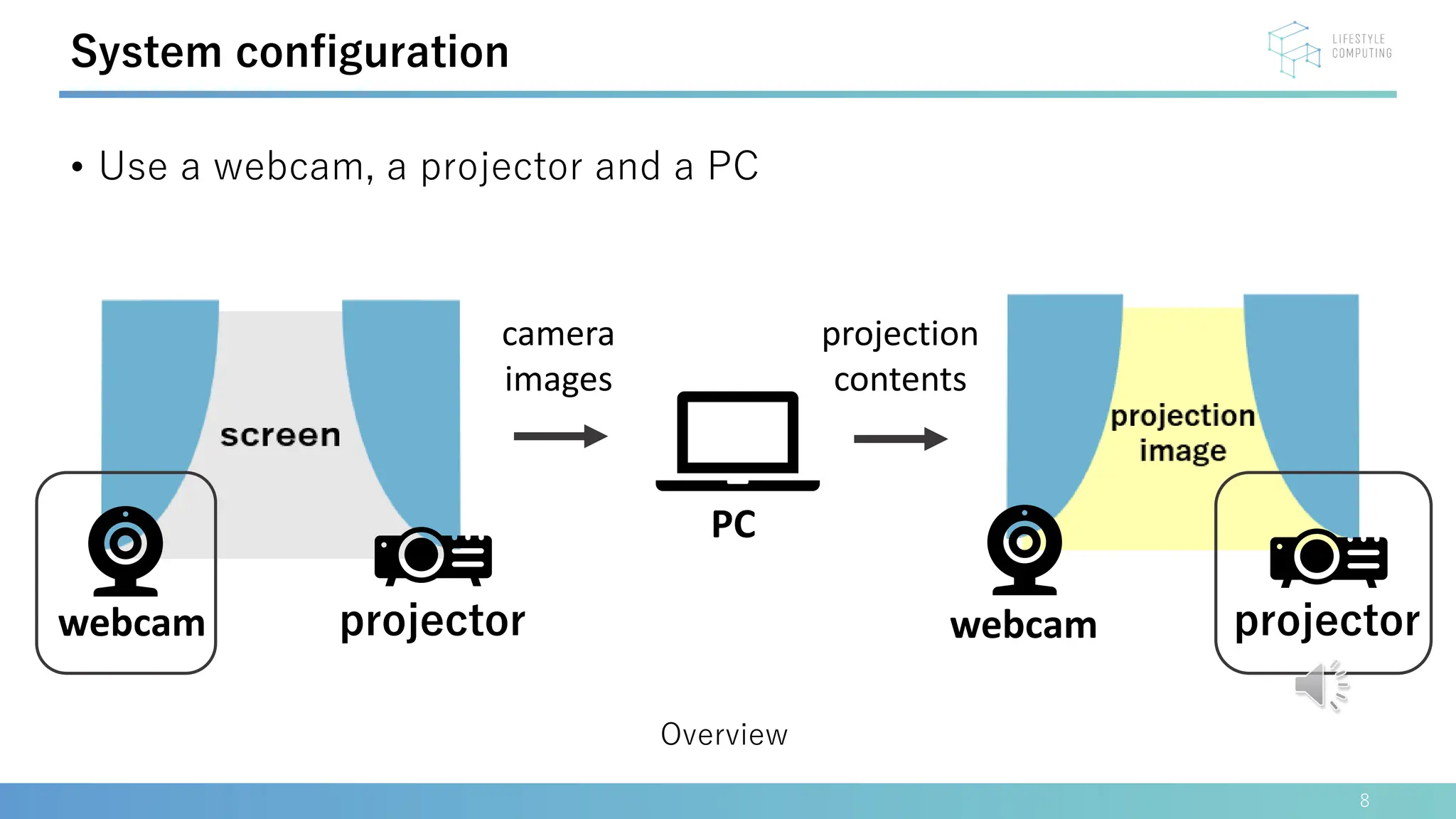
System configuration
Overview
PC
webcam projector
projection
contents
camera
images
webcam projector
• Use a webcam, a projector and a PC
• Calculate the opening area of the curtains
• The background subtraction method
9
Software (1/2)
Background image
Input
Mask image
Window view image
⊝ ⊕
Output
• Allows the camera and projector to be placed in any position
• UI
10
Software (2/2)
Camera image
Projected onto
the screen area
Deicide the projection position
Extract the screen area
Range of the projector
Output is projected only
onto the screen area
• Need difference in the luminance between the screen and the curtain
• The background subtraction method
• Obstacles affect the projected image
11
Limitation and Future Work
12
Summary
Background Lack of space in the room, Spatial presentation
Related Work
Presenting information using everyday items,
Methods focused on the role of curtains
Proposal creating a virtual window to produce a spatial presentation
Application External window, Indoor window between rooms
Implementation
Calculate the opening area of the curtains,
Camera image processing
Limitation Need difference in the luminance between the screen and the curtain
Supplemental Slides
13
• Changeable
• size / position
• Cost
• Quality of an image
• Occlusion
14
Comparison with Display
Changed the size and position
15
[1] T. Homma, M. Oki, K. Tsukada, Proposal and application of information presentation technique by expanding window shade,
volume 62, 2021, pp. 713–726. (in Japanese).
[2] Y. Nakahara, S. Mizuno, Development of an interactive system using shojis, 2017, pp. 771–773. (in Japanese).
[3] T. Handa, Smooth curtain: privacy controlling video communication device, 2009. (in Japanese).
[4] T. Takashina, K. Aoki, A. Maekawa, C. Tsukamoto, H. Kawai, Y. Yamariku, K. Tsuruta, M. Shimokawa, Y. Kokumai, H. Koike, Smart
curtain as interactive display in living space, in: SIGGRAPH Asia 2015 Posters (SA ’15), 32, Association for Computing Machinery, New
York, NY, USA, 2015,y
Reference

A Virtual Window Using Curtains and Image Projection

  • 1.
    A Virtual Windowusing Curtains and Image Projection Keio University Naoharu Sawada, Takumi Yamamoto, Yuta Sugiura APMAR2023
  • 2.
    2 Background • Lack ofspace in the room • Sense of being blocked in • Spatial presentation • Use of mirrors in interior design • Arrange furniture to improve openness
  • 3.
    3 Related Work Expanding windowshade [T. Homma, 2021] Interactive system using shojis [Y. Nakahara, 2010] Methods focused on the role of curtains Smart curtain [T. Takashina, 2015] Smooth curtain [T. Handa, 2009] Presenting information using everyday items
  • 4.
    • Install screensand curtains on the walls • Project images onto the open areas of the curtains 4 Proposal Screen and Curtain creating a virtual window to produce a spatial presentation
  • 5.
    5 Movie of thevirtual window
  • 6.
  • 7.
  • 8.
  • 9.
    • Calculate theopening area of the curtains • The background subtraction method 9 Software (1/2) Background image Input Mask image Window view image ⊝ ⊕ Output
  • 10.
    • Allows thecamera and projector to be placed in any position • UI 10 Software (2/2) Camera image Projected onto the screen area Deicide the projection position Extract the screen area Range of the projector Output is projected only onto the screen area
  • 11.
    • Need differencein the luminance between the screen and the curtain • The background subtraction method • Obstacles affect the projected image 11 Limitation and Future Work
  • 12.
    12 Summary Background Lack ofspace in the room, Spatial presentation Related Work Presenting information using everyday items, Methods focused on the role of curtains Proposal creating a virtual window to produce a spatial presentation Application External window, Indoor window between rooms Implementation Calculate the opening area of the curtains, Camera image processing Limitation Need difference in the luminance between the screen and the curtain
  • 13.
  • 14.
    • Changeable • size/ position • Cost • Quality of an image • Occlusion 14 Comparison with Display Changed the size and position
  • 15.
    15 [1] T. Homma,M. Oki, K. Tsukada, Proposal and application of information presentation technique by expanding window shade, volume 62, 2021, pp. 713–726. (in Japanese). [2] Y. Nakahara, S. Mizuno, Development of an interactive system using shojis, 2017, pp. 771–773. (in Japanese). [3] T. Handa, Smooth curtain: privacy controlling video communication device, 2009. (in Japanese). [4] T. Takashina, K. Aoki, A. Maekawa, C. Tsukamoto, H. Kawai, Y. Yamariku, K. Tsuruta, M. Shimokawa, Y. Kokumai, H. Koike, Smart curtain as interactive display in living space, in: SIGGRAPH Asia 2015 Posters (SA ’15), 32, Association for Computing Machinery, New York, NY, USA, 2015,y Reference