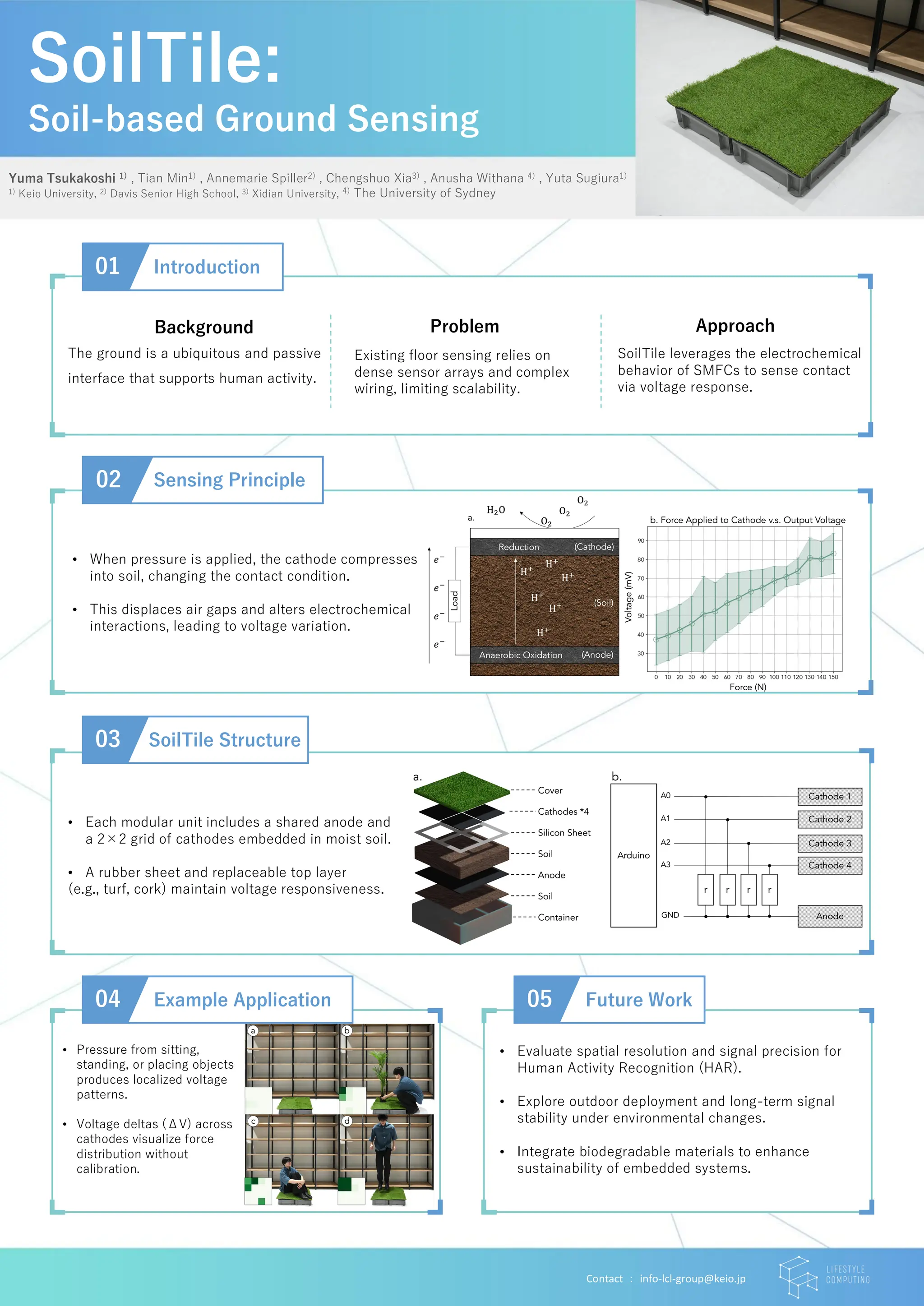
SoilTile:
Soil-based Ground Sensing
01 Introduction
02 Sensing Principle
• When pressure is applied, the cathode compresses
into soil, changing the contact condition.
• This displaces air gaps and alters electrochemical
interactions, leading to voltage variation.
The ground is a ubiquitous and passive
interface that supports human activity.
Background
Existing floor sensing relies on
dense sensor arrays and complex
wiring, limiting scalability.
Problem
SoilTile leverages the electrochemical
behavior of SMFCs to sense contact
via voltage response.
Approach
03
• Each modular unit includes a shared anode and
a 2×2 grid of cathodes embedded in moist soil.
• A rubber sheet and replaceable top layer
(e.g., turf, cork) maintain voltage responsiveness.
04 Example Application
• Pressure from sitting,
standing, or placing objects
produces localized voltage
patterns.
• Voltage deltas (ΔV) across
cathodes visualize force
distribution without
calibration.
05 Future Work
• Evaluate spatial resolution and signal precision for
Human Activity Recognition (HAR).
• Explore outdoor deployment and long-term signal
stability under environmental changes.
• Integrate biodegradable materials to enhance
sustainability of embedded systems.
SoilTile Structure
Contact : info-lcl-group@keio.jp
Yuma Tsukakoshi 1) , Tian Min1) , Annemarie Spiller2) , Chengshuo Xia3) , Anusha Withana 4) , Yuta Sugiura1)
1) Keio University, 2) Davis Senior High School, 3) Xidian University, 4) The University of Sydney

SoilTile: Soil-based Ground Sensing - UIST2025

  • 1.
    SoilTile: Soil-based Ground Sensing 01Introduction 02 Sensing Principle • When pressure is applied, the cathode compresses into soil, changing the contact condition. • This displaces air gaps and alters electrochemical interactions, leading to voltage variation. The ground is a ubiquitous and passive interface that supports human activity. Background Existing floor sensing relies on dense sensor arrays and complex wiring, limiting scalability. Problem SoilTile leverages the electrochemical behavior of SMFCs to sense contact via voltage response. Approach 03 • Each modular unit includes a shared anode and a 2×2 grid of cathodes embedded in moist soil. • A rubber sheet and replaceable top layer (e.g., turf, cork) maintain voltage responsiveness. 04 Example Application • Pressure from sitting, standing, or placing objects produces localized voltage patterns. • Voltage deltas (ΔV) across cathodes visualize force distribution without calibration. 05 Future Work • Evaluate spatial resolution and signal precision for Human Activity Recognition (HAR). • Explore outdoor deployment and long-term signal stability under environmental changes. • Integrate biodegradable materials to enhance sustainability of embedded systems. SoilTile Structure Contact : info-lcl-group@keio.jp Yuma Tsukakoshi 1) , Tian Min1) , Annemarie Spiller2) , Chengshuo Xia3) , Anusha Withana 4) , Yuta Sugiura1) 1) Keio University, 2) Davis Senior High School, 3) Xidian University, 4) The University of Sydney