IFAC PapersOnLine 52-9 (2019) 15–20
ScienceDirect
ScienceDirect
Available online at www.sciencedirect.com
2405-8963 © 2019, IFAC (International Federation of Automatic Control) Hosting by Elsevier Ltd. All rights reserved.
Peer review under responsibility of International Federation of Automatic Control.
10.1016/j.ifacol.2019.08.116
© 2019, IFAC (International Federation of Automatic Control) Hosting by Elsevier Ltd. All rights reserved.
A Virtual Laboratory Environment for Control Design of a Multivariable Process
Javier Sotomayor-Moriano*. Gustavo Pérez-Zúñiga**
Mario Soto***
Engineering Department, Pontifical Catholic University of Peru, PUCP, Lima, Peru.
(e-mail: *jsotom@ pucp.edu.pe, **gustavo.perez@ pucp.pe, *** mario.soto@ pucp.pe).
Abstract: This paper describes the development of a virtual laboratory environment (VLE) that allows
students to perform control design practice in a virtual plant from remote locations through a web
browser. The proposed VLE facilitates to learn concepts; such as, design of controllers and system
identification of multivariable processes using a simulation environment, and an industrial device with a
reliable model of a benchmark plant. Architecture of the VLE is explained and evidence of its use is
showed. The proposed VLE represents an education tool that is user friendly, wide availability, with
graphical interface capabilities and low cost maintenance, that allows to improve student skills by
connecting the theory and practice.
Keywords: Control design, System identification, Virtual environment, Controllers, Multivariable
process.
1. INTRODUCTION
In control education, the use of a virtual environment is an
excellent option to perform control design experimental tasks
using a proper model of a benchmark plant (physical system).
This type of tool can be used for teaching and research
purposes.
Among the requirements that are demanded to the VLE are:
user-friendly, wide availability, appropriate resources in the
interface, validity of the results of the simulation tests, low
cost maintenance, etc.
To make interaction easy with the user, the concepts of
dynamic images and virtual interactive systems are used,
where the change of an active element in the graphic
windows generates an immediate update and a new
presentation of the environment, visualizing the effect of the
performed modifications (Heradio, 2016; Hu, 2014).
It is desirable that, the VLE is programmed with software of
easy access. To achieve the requested requirements, the VLE
should be programmed in a generally purpose programming
language that allows easy implementation and simplified
maintenance and updates (Fabregas, 2013). Here, it is
considered the use of Python, which is a dynamic, object
oriented and multipurpose programming language for
developing both desktop and web applications. Likewise,
Python allows to develop complex scientific and numeric
applications with features that facilitate data analysis and
visualization. In this regard, the IEEE ranked Python as the
#1 programming language in 2018 (Cass, 2018).
In VLE, students use an interface in which a physical system
was replaced with a reliable mathematical model. The VLE
allows a decoupling of the model (which can run on the
server) and the view (which runs on the client) (Heradio,
2016). The interface must be available through Internet.
The validity of experimental results implies that data
obtained from the VLE must be very close to data that
obtained from the physical system. Thus, the mathematical
model of the benchmark plant must comply with operating
conditions (behavior of physical system) when working as
simulation model in the VLE; therefore, the student can
analyze the performance of his/her control design using
reliable data.
Traditional hands-on labs involve high costs, associated with
equipment, space and staff (Gomes, 2009). Thus, reducing
cost maintenance is possible using VLE and Internet
resources instead of hands-on labs. The interactive tools that
are available on Internet represent a great stimulus for the
development of engineering learning (Sotomayor, 2017)
Currently, under the concept of "Internet of Things" (IoT),
the main design idea of VLE is to use a web platform as a
communication structure, and a local host as a user interface
(Jie, 2017).
The proposed VLE with 4 coupled tanks (4CT) system
consists on a web server application (Web Server app) that
links to a desktop application (Desktop app) that is
previously downloaded by each user. In Desktop app, an
interactive 3D simulation runs of the 4CT system that
connects with the Web server app for a permanently
authentication of the user and to load the designs of the
students to be evaluated. The interactive 3D simulation
(included in the Desktop app) allows the student to perform
tests of controller design and system identification tasks. For
this purpose, the user can test his/her design by connecting
the Desktop app with a Matlab script. The user also has the
option of doing the latter with a program developed in
Python. Finally, it is possible to test the implementation of
his/her solution using a structured text routine developed in
12th IFAC Symposium on Advances in Control Education
July 7-9, 2019. Philadelphia, PA, USA
Copyright © 2019 IFAC 15
A Virtual Laboratory Environment for Control Design of a Multivariable Process
Javier Sotomayor-Moriano*. Gustavo Pérez-Zúñiga**
Mario Soto***
Engineering Department, Pontifical Catholic University of Peru, PUCP, Lima, Peru.
(e-mail: *jsotom@ pucp.edu.pe, **gustavo.perez@ pucp.pe, *** mario.soto@ pucp.pe).
Abstract: This paper describes the development of a virtual laboratory environment (VLE) that allows
students to perform control design practice in a virtual plant from remote locations through a web
browser. The proposed VLE facilitates to learn concepts; such as, design of controllers and system
identification of multivariable processes using a simulation environment, and an industrial device with a
reliable model of a benchmark plant. Architecture of the VLE is explained and evidence of its use is
showed. The proposed VLE represents an education tool that is user friendly, wide availability, with
graphical interface capabilities and low cost maintenance, that allows to improve student skills by
connecting the theory and practice.
Keywords: Control design, System identification, Virtual environment, Controllers, Multivariable
process.
1. INTRODUCTION
In control education, the use of a virtual environment is an
excellent option to perform control design experimental tasks
using a proper model of a benchmark plant (physical system).
This type of tool can be used for teaching and research
purposes.
Among the requirements that are demanded to the VLE are:
user-friendly, wide availability, appropriate resources in the
interface, validity of the results of the simulation tests, low
cost maintenance, etc.
To make interaction easy with the user, the concepts of
dynamic images and virtual interactive systems are used,
where the change of an active element in the graphic
windows generates an immediate update and a new
presentation of the environment, visualizing the effect of the
performed modifications (Heradio, 2016; Hu, 2014).
It is desirable that, the VLE is programmed with software of
easy access. To achieve the requested requirements, the VLE
should be programmed in a generally purpose programming
language that allows easy implementation and simplified
maintenance and updates (Fabregas, 2013). Here, it is
considered the use of Python, which is a dynamic, object
oriented and multipurpose programming language for
developing both desktop and web applications. Likewise,
Python allows to develop complex scientific and numeric
applications with features that facilitate data analysis and
visualization. In this regard, the IEEE ranked Python as the
#1 programming language in 2018 (Cass, 2018).
In VLE, students use an interface in which a physical system
was replaced with a reliable mathematical model. The VLE
allows a decoupling of the model (which can run on the
server) and the view (which runs on the client) (Heradio,
2016). The interface must be available through Internet.
The validity of experimental results implies that data
obtained from the VLE must be very close to data that
obtained from the physical system. Thus, the mathematical
model of the benchmark plant must comply with operating
conditions (behavior of physical system) when working as
simulation model in the VLE; therefore, the student can
analyze the performance of his/her control design using
reliable data.
Traditional hands-on labs involve high costs, associated with
equipment, space and staff (Gomes, 2009). Thus, reducing
cost maintenance is possible using VLE and Internet
resources instead of hands-on labs. The interactive tools that
are available on Internet represent a great stimulus for the
development of engineering learning (Sotomayor, 2017)
Currently, under the concept of "Internet of Things" (IoT),
the main design idea of VLE is to use a web platform as a
communication structure, and a local host as a user interface
(Jie, 2017).
The proposed VLE with 4 coupled tanks (4CT) system
consists on a web server application (Web Server app) that
links to a desktop application (Desktop app) that is
previously downloaded by each user. In Desktop app, an
interactive 3D simulation runs of the 4CT system that
connects with the Web server app for a permanently
authentication of the user and to load the designs of the
students to be evaluated. The interactive 3D simulation
(included in the Desktop app) allows the student to perform
tests of controller design and system identification tasks. For
this purpose, the user can test his/her design by connecting
the Desktop app with a Matlab script. The user also has the
option of doing the latter with a program developed in
Python. Finally, it is possible to test the implementation of
his/her solution using a structured text routine developed in
12th IFAC Symposium on Advances in Control Education
July 7-9, 2019. Philadelphia, PA, USA
Copyright © 2019 IFAC 15
A Virtual Laboratory Environment for Control Design of a Multivariable Process
Javier Sotomayor-Moriano*. Gustavo Pérez-Zúñiga**
Mario Soto***
Engineering Department, Pontifical Catholic University of Peru, PUCP, Lima, Peru.
(e-mail: *jsotom@ pucp.edu.pe, **gustavo.perez@ pucp.pe, *** mario.soto@ pucp.pe).
Abstract: This paper describes the development of a virtual laboratory environment (VLE) that allows
students to perform control design practice in a virtual plant from remote locations through a web
browser. The proposed VLE facilitates to learn concepts; such as, design of controllers and system
identification of multivariable processes using a simulation environment, and an industrial device with a
reliable model of a benchmark plant. Architecture of the VLE is explained and evidence of its use is
showed. The proposed VLE represents an education tool that is user friendly, wide availability, with
graphical interface capabilities and low cost maintenance, that allows to improve student skills by
connecting the theory and practice.
Keywords: Control design, System identification, Virtual environment, Controllers, Multivariable
process.
1. INTRODUCTION
In control education, the use of a virtual environment is an
excellent option to perform control design experimental tasks
using a proper model of a benchmark plant (physical system).
This type of tool can be used for teaching and research
purposes.
Among the requirements that are demanded to the VLE are:
user-friendly, wide availability, appropriate resources in the
interface, validity of the results of the simulation tests, low
cost maintenance, etc.
To make interaction easy with the user, the concepts of
dynamic images and virtual interactive systems are used,
where the change of an active element in the graphic
windows generates an immediate update and a new
presentation of the environment, visualizing the effect of the
performed modifications (Heradio, 2016; Hu, 2014).
It is desirable that, the VLE is programmed with software of
easy access. To achieve the requested requirements, the VLE
should be programmed in a generally purpose programming
language that allows easy implementation and simplified
maintenance and updates (Fabregas, 2013). Here, it is
considered the use of Python, which is a dynamic, object
oriented and multipurpose programming language for
developing both desktop and web applications. Likewise,
Python allows to develop complex scientific and numeric
applications with features that facilitate data analysis and
visualization. In this regard, the IEEE ranked Python as the
#1 programming language in 2018 (Cass, 2018).
In VLE, students use an interface in which a physical system
was replaced with a reliable mathematical model. The VLE
allows a decoupling of the model (which can run on the
server) and the view (which runs on the client) (Heradio,
2016). The interface must be available through Internet.
The validity of experimental results implies that data
obtained from the VLE must be very close to data that
obtained from the physical system. Thus, the mathematical
model of the benchmark plant must comply with operating
conditions (behavior of physical system) when working as
simulation model in the VLE; therefore, the student can
analyze the performance of his/her control design using
reliable data.
Traditional hands-on labs involve high costs, associated with
equipment, space and staff (Gomes, 2009). Thus, reducing
cost maintenance is possible using VLE and Internet
resources instead of hands-on labs. The interactive tools that
are available on Internet represent a great stimulus for the
development of engineering learning (Sotomayor, 2017)
Currently, under the concept of "Internet of Things" (IoT),
the main design idea of VLE is to use a web platform as a
communication structure, and a local host as a user interface
(Jie, 2017).
The proposed VLE with 4 coupled tanks (4CT) system
consists on a web server application (Web Server app) that
links to a desktop application (Desktop app) that is
previously downloaded by each user. In Desktop app, an
interactive 3D simulation runs of the 4CT system that
connects with the Web server app for a permanently
authentication of the user and to load the designs of the
students to be evaluated. The interactive 3D simulation
(included in the Desktop app) allows the student to perform
tests of controller design and system identification tasks. For
this purpose, the user can test his/her design by connecting
the Desktop app with a Matlab script. The user also has the
option of doing the latter with a program developed in
Python. Finally, it is possible to test the implementation of
his/her solution using a structured text routine developed in
July 7-9, 2019. Philadelphia, PA, USA
Copyright © 2019 IFAC 15
A Virtual Laboratory Environment for Control Design of a Multivariable Process
Javier Sotomayor-Moriano*. Gustavo Pérez-Zúñiga**
Mario Soto***
Engineering Department, Pontifical Catholic University of Peru, PUCP, Lima, Peru.
(e-mail: *jsotom@ pucp.edu.pe, **gustavo.perez@ pucp.pe, *** mario.soto@ pucp.pe).
Abstract: This paper describes the development of a virtual laboratory environment (VLE) that allows
students to perform control design practice in a virtual plant from remote locations through a web
browser. The proposed VLE facilitates to learn concepts; such as, design of controllers and system
identification of multivariable processes using a simulation environment, and an industrial device with a
reliable model of a benchmark plant. Architecture of the VLE is explained and evidence of its use is
showed. The proposed VLE represents an education tool that is user friendly, wide availability, with
graphical interface capabilities and low cost maintenance, that allows to improve student skills by
connecting the theory and practice.
Keywords: Control design, System identification, Virtual environment, Controllers, Multivariable
process.
1. INTRODUCTION
In control education, the use of a virtual environment is an
excellent option to perform control design experimental tasks
using a proper model of a benchmark plant (physical system).
This type of tool can be used for teaching and research
purposes.
Among the requirements that are demanded to the VLE are:
user-friendly, wide availability, appropriate resources in the
interface, validity of the results of the simulation tests, low
cost maintenance, etc.
To make interaction easy with the user, the concepts of
dynamic images and virtual interactive systems are used,
where the change of an active element in the graphic
windows generates an immediate update and a new
presentation of the environment, visualizing the effect of the
performed modifications (Heradio, 2016; Hu, 2014).
It is desirable that, the VLE is programmed with software of
easy access. To achieve the requested requirements, the VLE
should be programmed in a generally purpose programming
language that allows easy implementation and simplified
maintenance and updates (Fabregas, 2013). Here, it is
considered the use of Python, which is a dynamic, object
oriented and multipurpose programming language for
developing both desktop and web applications. Likewise,
Python allows to develop complex scientific and numeric
applications with features that facilitate data analysis and
visualization. In this regard, the IEEE ranked Python as the
#1 programming language in 2018 (Cass, 2018).
In VLE, students use an interface in which a physical system
was replaced with a reliable mathematical model. The VLE
allows a decoupling of the model (which can run on the
server) and the view (which runs on the client) (Heradio,
2016). The interface must be available through Internet.
The validity of experimental results implies that data
obtained from the VLE must be very close to data that
obtained from the physical system. Thus, the mathematical
model of the benchmark plant must comply with operating
conditions (behavior of physical system) when working as
simulation model in the VLE; therefore, the student can
analyze the performance of his/her control design using
reliable data.
Traditional hands-on labs involve high costs, associated with
equipment, space and staff (Gomes, 2009). Thus, reducing
cost maintenance is possible using VLE and Internet
resources instead of hands-on labs. The interactive tools that
are available on Internet represent a great stimulus for the
development of engineering learning (Sotomayor, 2017)
Currently, under the concept of "Internet of Things" (IoT),
the main design idea of VLE is to use a web platform as a
communication structure, and a local host as a user interface
(Jie, 2017).
The proposed VLE with 4 coupled tanks (4CT) system
consists on a web server application (Web Server app) that
links to a desktop application (Desktop app) that is
previously downloaded by each user. In Desktop app, an
interactive 3D simulation runs of the 4CT system that
connects with the Web server app for a permanently
authentication of the user and to load the designs of the
students to be evaluated. The interactive 3D simulation
(included in the Desktop app) allows the student to perform
tests of controller design and system identification tasks. For
this purpose, the user can test his/her design by connecting
the Desktop app with a Matlab script. The user also has the
option of doing the latter with a program developed in
Python. Finally, it is possible to test the implementation of
his/her solution using a structured text routine developed in
12th IFAC Symposium on Advances in Control Education
July 7-9, 2019. Philadelphia, PA, USA
Copyright © 2019 IFAC 15
A Virtual Laboratory Environment for Control Design of a Multivariable Process
Javier Sotomayor-Moriano*. Gustavo Pérez-Zúñiga**
Mario Soto***
Engineering Department, Pontifical Catholic University of Peru, PUCP, Lima, Peru.
(e-mail: *jsotom@ pucp.edu.pe, **gustavo.perez@ pucp.pe, *** mario.soto@ pucp.pe).
Abstract: This paper describes the development of a virtual laboratory environment (VLE) that allows
students to perform control design practice in a virtual plant from remote locations through a web
browser. The proposed VLE facilitates to learn concepts; such as, design of controllers and system
identification of multivariable processes using a simulation environment, and an industrial device with a
reliable model of a benchmark plant. Architecture of the VLE is explained and evidence of its use is
showed. The proposed VLE represents an education tool that is user friendly, wide availability, with
graphical interface capabilities and low cost maintenance, that allows to improve student skills by
connecting the theory and practice.
Keywords: Control design, System identification, Virtual environment, Controllers, Multivariable
process.
1. INTRODUCTION
In control education, the use of a virtual environment is an
excellent option to perform control design experimental tasks
using a proper model of a benchmark plant (physical system).
This type of tool can be used for teaching and research
purposes.
Among the requirements that are demanded to the VLE are:
user-friendly, wide availability, appropriate resources in the
interface, validity of the results of the simulation tests, low
cost maintenance, etc.
To make interaction easy with the user, the concepts of
dynamic images and virtual interactive systems are used,
where the change of an active element in the graphic
windows generates an immediate update and a new
presentation of the environment, visualizing the effect of the
performed modifications (Heradio, 2016; Hu, 2014).
It is desirable that, the VLE is programmed with software of
easy access. To achieve the requested requirements, the VLE
should be programmed in a generally purpose programming
language that allows easy implementation and simplified
maintenance and updates (Fabregas, 2013). Here, it is
considered the use of Python, which is a dynamic, object
oriented and multipurpose programming language for
developing both desktop and web applications. Likewise,
Python allows to develop complex scientific and numeric
applications with features that facilitate data analysis and
visualization. In this regard, the IEEE ranked Python as the
#1 programming language in 2018 (Cass, 2018).
In VLE, students use an interface in which a physical system
was replaced with a reliable mathematical model. The VLE
allows a decoupling of the model (which can run on the
server) and the view (which runs on the client) (Heradio,
2016). The interface must be available through Internet.
The validity of experimental results implies that data
obtained from the VLE must be very close to data that
obtained from the physical system. Thus, the mathematical
model of the benchmark plant must comply with operating
conditions (behavior of physical system) when working as
simulation model in the VLE; therefore, the student can
analyze the performance of his/her control design using
reliable data.
Traditional hands-on labs involve high costs, associated with
equipment, space and staff (Gomes, 2009). Thus, reducing
cost maintenance is possible using VLE and Internet
resources instead of hands-on labs. The interactive tools that
are available on Internet represent a great stimulus for the
development of engineering learning (Sotomayor, 2017)
Currently, under the concept of "Internet of Things" (IoT),
the main design idea of VLE is to use a web platform as a
communication structure, and a local host as a user interface
(Jie, 2017).
The proposed VLE with 4 coupled tanks (4CT) system
consists on a web server application (Web Server app) that
links to a desktop application (Desktop app) that is
previously downloaded by each user. In Desktop app, an
interactive 3D simulation runs of the 4CT system that
connects with the Web server app for a permanently
authentication of the user and to load the designs of the
students to be evaluated. The interactive 3D simulation
(included in the Desktop app) allows the student to perform
tests of controller design and system identification tasks. For
this purpose, the user can test his/her design by connecting
the Desktop app with a Matlab script. The user also has the
option of doing the latter with a program developed in
Python. Finally, it is possible to test the implementation of
his/her solution using a structured text routine developed in
12th IFAC Symposium on Advances in Control Education
July 7-9, 2019. Philadelphia, PA, USA
Copyright © 2019 IFAC 15
A Virtual Laboratory Environment for Control Design of a Multivariable Process
Javier Sotomayor-Moriano*. Gustavo Pérez-Zúñiga**
Mario Soto***
Engineering Department, Pontifical Catholic University of Peru, PUCP, Lima, Peru.
(e-mail: *jsotom@ pucp.edu.pe, **gustavo.perez@ pucp.pe, *** mario.soto@ pucp.pe).
Abstract: This paper describes the development of a virtual laboratory environment (VLE) that allows
students to perform control design practice in a virtual plant from remote locations through a web
browser. The proposed VLE facilitates to learn concepts; such as, design of controllers and system
identification of multivariable processes using a simulation environment, and an industrial device with a
reliable model of a benchmark plant. Architecture of the VLE is explained and evidence of its use is
showed. The proposed VLE represents an education tool that is user friendly, wide availability, with
graphical interface capabilities and low cost maintenance, that allows to improve student skills by
connecting the theory and practice.
Keywords: Control design, System identification, Virtual environment, Controllers, Multivariable
process.
1. INTRODUCTION
In control education, the use of a virtual environment is an
excellent option to perform control design experimental tasks
using a proper model of a benchmark plant (physical system).
This type of tool can be used for teaching and research
purposes.
Among the requirements that are demanded to the VLE are:
user-friendly, wide availability, appropriate resources in the
interface, validity of the results of the simulation tests, low
cost maintenance, etc.
To make interaction easy with the user, the concepts of
dynamic images and virtual interactive systems are used,
where the change of an active element in the graphic
windows generates an immediate update and a new
presentation of the environment, visualizing the effect of the
performed modifications (Heradio, 2016; Hu, 2014).
It is desirable that, the VLE is programmed with software of
easy access. To achieve the requested requirements, the VLE
should be programmed in a generally purpose programming
language that allows easy implementation and simplified
maintenance and updates (Fabregas, 2013). Here, it is
considered the use of Python, which is a dynamic, object
oriented and multipurpose programming language for
developing both desktop and web applications. Likewise,
Python allows to develop complex scientific and numeric
applications with features that facilitate data analysis and
visualization. In this regard, the IEEE ranked Python as the
#1 programming language in 2018 (Cass, 2018).
In VLE, students use an interface in which a physical system
was replaced with a reliable mathematical model. The VLE
allows a decoupling of the model (which can run on the
server) and the view (which runs on the client) (Heradio,
2016). The interface must be available through Internet.
The validity of experimental results implies that data
obtained from the VLE must be very close to data that
obtained from the physical system. Thus, the mathematical
model of the benchmark plant must comply with operating
conditions (behavior of physical system) when working as
simulation model in the VLE; therefore, the student can
analyze the performance of his/her control design using
reliable data.
Traditional hands-on labs involve high costs, associated with
equipment, space and staff (Gomes, 2009). Thus, reducing
cost maintenance is possible using VLE and Internet
resources instead of hands-on labs. The interactive tools that
are available on Internet represent a great stimulus for the
development of engineering learning (Sotomayor, 2017)
Currently, under the concept of "Internet of Things" (IoT),
the main design idea of VLE is to use a web platform as a
communication structure, and a local host as a user interface
(Jie, 2017).
The proposed VLE with 4 coupled tanks (4CT) system
consists on a web server application (Web Server app) that
links to a desktop application (Desktop app) that is
previously downloaded by each user. In Desktop app, an
interactive 3D simulation runs of the 4CT system that
connects with the Web server app for a permanently
authentication of the user and to load the designs of the
students to be evaluated. The interactive 3D simulation
(included in the Desktop app) allows the student to perform
tests of controller design and system identification tasks. For
this purpose, the user can test his/her design by connecting
the Desktop app with a Matlab script. The user also has the
option of doing the latter with a program developed in
Python. Finally, it is possible to test the implementation of
his/her solution using a structured text routine developed in
12th IFAC Symposium on Advances in Control Education
July 7-9, 2019. Philadelphia, PA, USA
Copyright © 2019 IFAC 15
16 Javier Sotomayor-Moriano et al. / IFAC PapersOnLine 52-9 (2019) 15–20
an industrial device that is a programmable logic controller
(PLC). Therefore, the Desktop app allows a connection with
Matlab, Python and a PLC with TCP / IP communication.
This article is structured as follows: Section 2 describes the
mathematical model and operating conditions of 4CT system.
Section 3 explains the development of the VLE and describes
connectivity of a desktop application with Matlab, Python
and industrial device to check the design of controllers or
perform system identification tasks. Section 4 describes how
the development of skills is achieved by using the proposed
VLE; therefore, an example of checking a design of
controllers for the 4CT system is shown.
2. MODEL OF THE FOUR COUPLED TANKS SYSTEM
The 4CT system is a benchmark plant, which is useful for
teaching and research purposes of multivariable processes
control design. It allows different operating configurations;
also it is possible to represent this system as nonlinear or
linear, exposing students to broader practical issues.
The two most widely used configurations are the known as
basic configuration and as the modified configuration. From
these, with the closing and/or opening of some of the valves
that make up the system, it is possible to obtain other
configurations. The process inputs are 𝑢𝑢1 and 𝑢𝑢2 as input
voltages to the pumps and the outputs are 𝑦𝑦1 and 𝑦𝑦2 as level
measurements of Tanks 1 and 2.
Fig. 1 shows the basic configuration of 4CT system presented
by Johansson (Johansson, 2000; Alvarado, 2006).
Fig. 1. Basic configuration of the four coupled tanks process (Alvarado,
2006).
The flow balance is made for each tank and a non-linear
model is obtained (Johansson, 2000; Alvarado, 2006):
𝑑𝑑ℎ1
𝑑𝑑𝑑𝑑
= −
𝑎𝑎1
𝐴𝐴1
�2𝑔𝑔ℎ1 +
𝑎𝑎3
𝐴𝐴1
�2𝑔𝑔ℎ3 +
𝛾𝛾1𝑘𝑘1
𝐴𝐴1
𝑢𝑢1 (1)
𝑑𝑑ℎ2
𝑑𝑑𝑑𝑑
= −
𝑎𝑎2
𝐴𝐴2
�2𝑔𝑔ℎ2 +
𝑎𝑎4
𝐴𝐴2
�2𝑔𝑔ℎ4 +
𝛾𝛾2𝑘𝑘2
𝐴𝐴2
𝑢𝑢2 (2)
𝑑𝑑ℎ3
𝑑𝑑𝑑𝑑
= −
𝑎𝑎3
𝐴𝐴3
�2𝑔𝑔ℎ3 +
(1−𝛾𝛾2)𝑘𝑘2
𝐴𝐴3
𝑢𝑢2 (3)
𝑑𝑑ℎ4
𝑑𝑑𝑑𝑑
= −
𝑎𝑎4
𝐴𝐴4
�2𝑔𝑔ℎ4 +
(1−𝛾𝛾1)𝑘𝑘1
𝐴𝐴4
𝑢𝑢1 (4)
Where: Ai: Cross section of the tank i (𝑐𝑐𝑐𝑐2
); ai: Cross
section of the tank outlet i (𝑐𝑐𝑐𝑐2
); hi: Water level in the tank
in i (𝑐𝑐𝑐𝑐); 𝑢𝑢𝑖𝑖: voltage applied to Pump i and the
corresponding flow is 𝑘𝑘iui; The flow to Tanks 1 to 4 are:
𝑞𝑞1 = 𝛾𝛾1𝑘𝑘1u1, 𝑞𝑞2 = 𝛾𝛾2𝑘𝑘2u2, 𝑞𝑞3 = (1 − 𝛾𝛾2)𝑘𝑘2u2 and 𝑞𝑞4 =
(1 − 𝛾𝛾1)𝑘𝑘1u1 (𝑐𝑐𝑐𝑐3
/s); g: Acceleration of gravity (𝑐𝑐𝑐𝑐/s2
);
qi: Input flow to the tank (𝑐𝑐𝑐𝑐3
/s); γi: Opening parameter of
the 3-way valve. 𝑘𝑘i: Voltage parameter (𝑐𝑐𝑐𝑐3
/Vs). The
modified configuration is shown in Fig. 2.
Fig. 2. Modified configuration of the four-tank process (Numsomran, 2008).
The respective flow balance leads to a non-linear model,
which is present in Numsomran (Numsomran, 2008).
In the 4CT system model (for each configuration) used in the
proposed VLE has been considered the specifications of
physical 4CT system located in the Advanced Control Lab at
PUCP (Fig. 3), in which:
• Maximum flow delivered by the pumps: 266.7 𝑐𝑐𝑐𝑐3
/s.
• Pipe diameter: 1.27 𝑐𝑐𝑐𝑐.
• Maximum height in tanks: 40 𝑐𝑐𝑐𝑐.
Fig. 3. Four coupled tanks pilot plant. Advanced Control Lab (PUCP)
2019 IFAC ACE
June 1-3, 2016. Bratislava, Slovakia
16
Javier Sotomayor-Moriano et al. / IFAC PapersOnLine 52-9 (2019) 15–20 17
Validation works allowed to verify that the model matched
with physical 4CT system behavior. Likewise, data obtained
when working with the model and the physical system were
very close. On the other hand, some typical disturbances
(added in the Desktop app) could be included in the model
for a greater similarity with real operation of a physical
system.
3. DEVELOPMENT OF THE VIRTUAL LABORATORY
ENVIRONMENT
In the following, the proposed VLE is summarized, as a
novel interactive remote approach in which a virtual world is
combined with a real physical system surrounding.
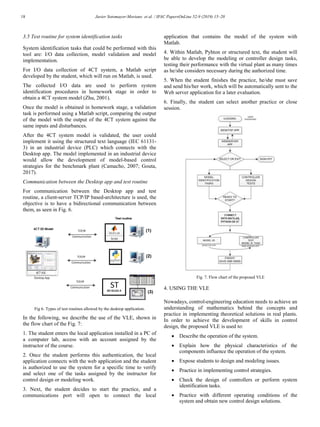
The architecture of the VLE shown in Fig. 4 consists of a
“Web server app” and a local application “Desktop app”.
Fig 4. Web server and Desktop apps architecture.
Description of the main components of the VLE
3.1 Web Server app
The student accesses to Web server app with a username and
password previously assigned according to course
registration. Within this application, the student can
download the desktop application, review the assigned works
and upload his/her results to be graded by the instructor.
3.2 Communication between the Desktop app VLE and the
Web server app
This communication is made using a local network (LAN)
within the campus; the computers with the desktop
application are in a computer lab for simultaneous work of
the students with instructor’s support.
3.3 Desktop app
The Desktop app is an application that contains the model of
the 4CT system as well as the libraries and the necessary
program for communication with Matlab, Python and a PLC.
The Desktop app runs an interactive 3D simulation of the
model of the 4CT system whose dynamics represent
adequately the real behavior of the physical laboratory plant
shown in Fig. 5 based in the mathematical model presented in
Section II.
Using this model, the user will be able to carry out controller
design tests and system identification tasks through a
communication with a test routine in real time. The effect of
control design implementations will be reflected in a 3D
model view, and the interaction with the application will be
in real time. The 3D model is developed in Blender, which is
a free and Open 3D Creation Software based in Python. The
blender game engine mode is used to perform the plant
simulation as a video game. The blender game engine has a
game logic that can be programmed in Python. The 3D model
of the plant can be observed as shown in Fig. 5.
Fig. 5. 3D model View of the Desktop app.
The Web Server app is developed through the integration of
HTML, CSS, Javascript and Python.
3.4 Test routine for checking the controller design
Once the student finished the homework of controller design,
he/she makes the implementation. Controller implementation
is performed first using a script in Matlab. This script (to be
executed in Matlab) represents the controller to be tested with
the 4CT system. In this case, the script can be tested by
connecting Matlab with the Desktop app as many times as
necessary during the time permitted. An optional stage is to
implement the controller using a script in the open source
language Python connecting it with the Desktop app to test it
as many times as necessary. Finally, when the first stage is
successfully fulfilled, the student implements his/her
controller using the structured text language (IEC 61131-3) to
practice in an industrial device (PLC) which connects with
the Desktop app.
2019 IFAC ACE
June 1-3, 2016. Bratislava, Slovakia
17
18 Javier Sotomayor-Moriano et al. / IFAC PapersOnLine 52-9 (2019) 15–20
3.5 Test routine for system identification tasks
System identification tasks that could be performed with this
tool are: I/O data collection, model validation and model
implementation.
For I/O data collection of 4CT system, a Matlab script
developed by the student, which will run on Matlab, is used.
The collected I/O data are used to perform system
identification procedures in homework stage in order to
obtain a 4CT system model (Zhu, 2001).
Once the model is obtained in homework stage, a validation
task is performed using a Matlab script, comparing the output
of the model with the output of the 4CT system against the
same inputs and disturbances.
After the 4CT system model is validated, the user could
implement it using the structured text language (IEC 61131-
3) in an industrial device (PLC) which connects with the
Desktop app. The model implemented in an industrial device
would allow the development of model-based control
strategies for the benchmark plant (Camacho, 2007; Gouta,
2017).
Communication between the Desktop app and test routine
For communication between the Desktop app and test
routine, a client-server TCP/IP based-architecture is used, the
objective is to have a bidirectional communication between
them, as seen in Fig. 6.
Fig 6. Types of test routines allowed by the desktop application.
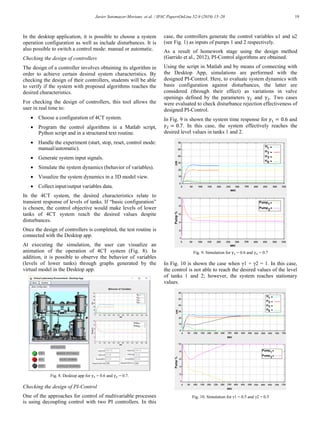
In the following, we describe the use of the VLE, shown in
the flow chart of the Fig. 7:
1. The student enters the local application installed in a PC of
a computer lab, access with an account assigned by the
instructor of the course.
2. Once the student performs this authentication, the local
application connects with the web application and the student
is authorized to use the system for a specific time to verify
and select one of the tasks assigned by the instructor for
control design or modeling work.
3. Next, the student decides to start the practice, and a
communications port will open to connect the local
application that contains the model of the system with
Matlab.
4. Within Matlab, Pyhton or structured text, the student will
be able to develop the modeling or controller design tasks,
testing their performance with the virtual plant as many times
as he/she considers necessary during the authorized time.
5. When the student finishes the practice, he/she must save
and send his/her work, which will be automatically sent to the
Web server application for a later evaluation.
6. Finally, the student can select another practice or close
session.
Fig. 7. Flow chart of the proposed VLE
4. USING THE VLE
Nowadays, control-engineering education needs to achieve an
understanding of mathematics behind the concepts and
practice in implementing theoretical solutions in real plants.
In order to achieve the development of skills in control
design, the proposed VLE is used to:
• Describe the operation of the system.
• Explain how the physical characteristics of the
components influence the operation of the system.
• Expose students to design and modeling issues.
• Practice in implementing control strategies.
• Check the design of controllers or perform system
identification tasks.
• Practice with different operating conditions of the
system and obtain new control design solutions.
2019 IFAC ACE
June 1-3, 2016. Bratislava, Slovakia
18
Javier Sotomayor-Moriano et al. / IFAC PapersOnLine 52-9 (2019) 15–20 19
In the desktop application, it is possible to choose a system
operation configuration as well as include disturbances. It is
also possible to switch a control mode: manual or automatic.
Checking the design of controllers
The design of a controller involves obtaining its algorithm in
order to achieve certain desired system characteristics. By
checking the design of their controllers, students will be able
to verify if the system with proposed algorithms reaches the
desired characteristics.
For checking the design of controllers, this tool allows the
user in real time to:
• Choose a configuration of 4CT system.
• Program the control algorithms in a Matlab script,
Python script and in a structured text routine.
• Handle the experiment (start, stop, reset, control mode:
manual/automatic).
• Generate system input signals.
• Simulate the system dynamics (behavior of variables).
• Visualize the system dynamics in a 3D model view.
• Collect input/output variables data.
In the 4CT system, the desired characteristics relate to
transient response of levels of tanks. If “basic configuration”
is chosen, the control objective would make levels of lower
tanks of 4CT system reach the desired values despite
disturbances.
Once the design of controllers is completed, the test routine is
connected with the Desktop app.
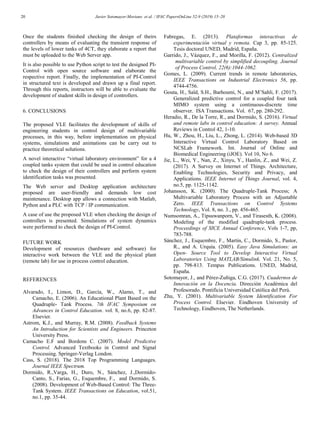
At executing the simulation, the user can visualize an
animation of the operation of 4CT system (Fig. 8). In
addition, it is possible to observe the behavior of variables
(levels of lower tanks) through graphs generated by the
virtual model in the Desktop app.
Fig. 8. Desktop app for γ1 = 0.6 and γ2 = 0.7.
Checking the design of PI-Control
One of the approaches for control of multivariable processes
is using decoupling control with two PI controllers. In this
case, the controllers generate the control variables u1 and u2
(see Fig. 1) as inputs of pumps 1 and 2 respectively.
As a result of homework stage using the design method
(Garrido et al., 2012), PI-Control algorithms are obtained.
Using the script in Matlab and by means of connecting with
the Desktop App, simulations are performed with the
designed PI-Control. Here, to evaluate system dynamics with
basis configuration against disturbances, the latter are
considered (through their effect) as variations in valve
openings defined by the parameters γ1 and γ2. Two cases
were evaluated to check disturbance rejection effectiveness of
designed PI-Control.
In Fig. 9 is shown the system time response for 𝛾𝛾1 = 0.6 and
𝛾𝛾2 = 0.7. In this case, the system effectively reaches the
desired level values in tanks 1 and 2.
Fig. 9. Simulation for γ1 = 0.6 and γ2 = 0.7
In Fig. 10 is shown the case when γ1 + γ2 = 1. In this case,
the control is not able to reach the desired values of the level
of tanks 1 and 2; however, the system reaches stationary
values.
Fig. 10. Simulation for γ1 = 0.5 and γ2 = 0.5
2019 IFAC ACE
June 1-3, 2016. Bratislava, Slovakia
19
20 Javier Sotomayor-Moriano et al. / IFAC PapersOnLine 52-9 (2019) 15–20
Once the students finished checking the design of theirs
controllers by means of evaluating the transient response of
the levels of lower tanks of 4CT, they elaborate a report that
must be uploaded to the Web Server app.
It is also possible to use Python script to test the designed PI-
Control with open source software and elaborate the
respective report. Finally, the implementation of PI-Control
in structured text is developed and drawn up a final report.
Through this reports, instructors will be able to evaluate the
development of student skills in design of controllers.
6. CONCLUSIONS
The proposed VLE facilitates the development of skills of
engineering students in control design of multivariable
processes, in this way, before implementation on physical
systems, simulations and animations can be carry out to
practice theoretical solutions.
A novel interactive “virtual laboratory environment” for a 4
coupled tanks system that could be used in control education
to check the design of their controllers and perform system
identification tasks was presented.
The Web server and Desktop application architecture
proposed are user-friendly and demands low cost
maintenance. Desktop app allows a connection with Matlab,
Python and a PLC with TCP / IP communication.
A case of use the proposed VLE when checking the design of
controllers is presented. Simulations of system dynamics
were performed to check the design of PI-Control.
FUTURE WORK
Development of resources (hardware and software) for
interactive work between the VLE and the physical plant
(remote lab) for use in process control education.
REFERENCES
Alvarado, I., Limon, D., García, W., Alamo, T., and
Camacho, E. (2006). An Educational Plant Based on the
Quadruple- Tank Process. 7th IFAC Symposium on
Advances in Control Education. vol. 8, no.6, pp. 82-87.
Elsevier.
Astrom, K.J., and Murray, R.M. (2008). Feedback Systems
An Introduction for Scientists and Engineers. Princeton
University Press.
Camacho E.F and Bordons C. (2007). Model Predictive
Control. Advanced Textbooks in Control and Signal
Processing. Springer-Verlag London.
Cass, S. (2018). The 2018 Top Programming Languages.
Journal IEEE Spectrum.
Dormido, R.,Varga, H., Duro, N., Sánchez, J.,Dormido-
Canto, S., Farias, G., Esquembre, F., and Dormido, S.
(2008). Development of Web-Based Control: The Three-
Tank System. IEEE Transactions on Education, vol.51,
no.1, pp. 35-44.
Fabregas, E. (2013). Plataformas interactivas de
experimentación virtual y remota. Cap 3, pp. 85-125.
Tesis doctoral UNED, Madrid, España.
Garrido, J., Vázquez, F., and Morilla, F. (2012). Centralized
multivariable control by simplified decoupling. Journal
of Process Control, 22(6):1044-1062.
Gomes, L. (2009). Current trends in remote laboratories,
IEEE Transactions on Industrial Electronics 56, pp.
4744-4756.
Gouta, H., Saïd, S.H., Barhoumi, N., and M’Sahli, F. (2017).
Generalized predictive control for a coupled four tank
MIMO system using a continuous-discrete time
observer. ISA Transactions. Vol. 67, pp. 280-292.
Heradio, R., De la Torre, R., and Dormido, S. (2016). Virtual
and remote labs in control education: A survey. Annual
Reviews in Control 42, 1-10.
Hu, W., Zhou, H., Liu, L., Zhong, L. (2014). Web-based 3D
Interactive Virtual Control Laboratory Based on
NCSLab Framework. Int. Journal of Online and
Biomedical Engineering (iJOE). Vol 10, No 6.
Jie, L., Wei, Y., Nan, Z., Xinyu, Y., Hanlin, Z., and Wei, Z.
(2017). A Survey on Internet of Things. Architecture,
Enabling Technologies, Security and Privacy, and
Applications. IEEE Internet of Things Journal, vol. 4,
no.5, pp. 1125-1142.
Johansson, K. (2000). The Quadruple-Tank Process; A
Multivariable Laboratory Process with an Adjustable
Zero. IEEE Transactions on Control Systems
Technology, Vol. 8, no. 3., pp. 456-465.
Numsomran, A., Tipsuwanporn, V., and Tirasesth, K. (2008).
Modeling of the modified quadruple-tank process.
Proceedings of SICE Annual Conference, Vols 1-7, pp,
783-788.
Sánchez, J., Esquembre, F., Martin, C., Dormido, S., Pastor,
R., and A. Urquía. (2005). Easy Java Simulations: an
Open- Source Tool to Develop Interactive Virtual
Laboratories Using MATLAB/Simulink. Vol. 21, No. 5,
pp. 798-813. Tempus Publications. UNED, Madrid,
España.
Sotomayor, J., and Pérez-Zuñiga, C.G. (2017). Cuadernos de
Innovación en la Docencia. Dirección Académica del
Profesorado. Pontificia Universidad Católica del Perú.
Zhu, Y. (2001). Multivariable System Identification For
Process Control. Elsevier. Eindhoven University of
Technology, Eindhoven, The Netherlands.
2019 IFAC ACE
June 1-3, 2016. Bratislava, Slovakia
20

A Virtual Laboratory Environment for Control Design of a Multivariable Process.pdf

  • 1.
    IFAC PapersOnLine 52-9(2019) 15–20 ScienceDirect ScienceDirect Available online at www.sciencedirect.com 2405-8963 © 2019, IFAC (International Federation of Automatic Control) Hosting by Elsevier Ltd. All rights reserved. Peer review under responsibility of International Federation of Automatic Control. 10.1016/j.ifacol.2019.08.116 © 2019, IFAC (International Federation of Automatic Control) Hosting by Elsevier Ltd. All rights reserved. A Virtual Laboratory Environment for Control Design of a Multivariable Process Javier Sotomayor-Moriano*. Gustavo Pérez-Zúñiga** Mario Soto*** Engineering Department, Pontifical Catholic University of Peru, PUCP, Lima, Peru. (e-mail: *jsotom@ pucp.edu.pe, **gustavo.perez@ pucp.pe, *** mario.soto@ pucp.pe). Abstract: This paper describes the development of a virtual laboratory environment (VLE) that allows students to perform control design practice in a virtual plant from remote locations through a web browser. The proposed VLE facilitates to learn concepts; such as, design of controllers and system identification of multivariable processes using a simulation environment, and an industrial device with a reliable model of a benchmark plant. Architecture of the VLE is explained and evidence of its use is showed. The proposed VLE represents an education tool that is user friendly, wide availability, with graphical interface capabilities and low cost maintenance, that allows to improve student skills by connecting the theory and practice. Keywords: Control design, System identification, Virtual environment, Controllers, Multivariable process. 1. INTRODUCTION In control education, the use of a virtual environment is an excellent option to perform control design experimental tasks using a proper model of a benchmark plant (physical system). This type of tool can be used for teaching and research purposes. Among the requirements that are demanded to the VLE are: user-friendly, wide availability, appropriate resources in the interface, validity of the results of the simulation tests, low cost maintenance, etc. To make interaction easy with the user, the concepts of dynamic images and virtual interactive systems are used, where the change of an active element in the graphic windows generates an immediate update and a new presentation of the environment, visualizing the effect of the performed modifications (Heradio, 2016; Hu, 2014). It is desirable that, the VLE is programmed with software of easy access. To achieve the requested requirements, the VLE should be programmed in a generally purpose programming language that allows easy implementation and simplified maintenance and updates (Fabregas, 2013). Here, it is considered the use of Python, which is a dynamic, object oriented and multipurpose programming language for developing both desktop and web applications. Likewise, Python allows to develop complex scientific and numeric applications with features that facilitate data analysis and visualization. In this regard, the IEEE ranked Python as the #1 programming language in 2018 (Cass, 2018). In VLE, students use an interface in which a physical system was replaced with a reliable mathematical model. The VLE allows a decoupling of the model (which can run on the server) and the view (which runs on the client) (Heradio, 2016). The interface must be available through Internet. The validity of experimental results implies that data obtained from the VLE must be very close to data that obtained from the physical system. Thus, the mathematical model of the benchmark plant must comply with operating conditions (behavior of physical system) when working as simulation model in the VLE; therefore, the student can analyze the performance of his/her control design using reliable data. Traditional hands-on labs involve high costs, associated with equipment, space and staff (Gomes, 2009). Thus, reducing cost maintenance is possible using VLE and Internet resources instead of hands-on labs. The interactive tools that are available on Internet represent a great stimulus for the development of engineering learning (Sotomayor, 2017) Currently, under the concept of "Internet of Things" (IoT), the main design idea of VLE is to use a web platform as a communication structure, and a local host as a user interface (Jie, 2017). The proposed VLE with 4 coupled tanks (4CT) system consists on a web server application (Web Server app) that links to a desktop application (Desktop app) that is previously downloaded by each user. In Desktop app, an interactive 3D simulation runs of the 4CT system that connects with the Web server app for a permanently authentication of the user and to load the designs of the students to be evaluated. The interactive 3D simulation (included in the Desktop app) allows the student to perform tests of controller design and system identification tasks. For this purpose, the user can test his/her design by connecting the Desktop app with a Matlab script. The user also has the option of doing the latter with a program developed in Python. Finally, it is possible to test the implementation of his/her solution using a structured text routine developed in 12th IFAC Symposium on Advances in Control Education July 7-9, 2019. Philadelphia, PA, USA Copyright © 2019 IFAC 15 A Virtual Laboratory Environment for Control Design of a Multivariable Process Javier Sotomayor-Moriano*. Gustavo Pérez-Zúñiga** Mario Soto*** Engineering Department, Pontifical Catholic University of Peru, PUCP, Lima, Peru. (e-mail: *jsotom@ pucp.edu.pe, **gustavo.perez@ pucp.pe, *** mario.soto@ pucp.pe). Abstract: This paper describes the development of a virtual laboratory environment (VLE) that allows students to perform control design practice in a virtual plant from remote locations through a web browser. The proposed VLE facilitates to learn concepts; such as, design of controllers and system identification of multivariable processes using a simulation environment, and an industrial device with a reliable model of a benchmark plant. Architecture of the VLE is explained and evidence of its use is showed. The proposed VLE represents an education tool that is user friendly, wide availability, with graphical interface capabilities and low cost maintenance, that allows to improve student skills by connecting the theory and practice. Keywords: Control design, System identification, Virtual environment, Controllers, Multivariable process. 1. INTRODUCTION In control education, the use of a virtual environment is an excellent option to perform control design experimental tasks using a proper model of a benchmark plant (physical system). This type of tool can be used for teaching and research purposes. Among the requirements that are demanded to the VLE are: user-friendly, wide availability, appropriate resources in the interface, validity of the results of the simulation tests, low cost maintenance, etc. To make interaction easy with the user, the concepts of dynamic images and virtual interactive systems are used, where the change of an active element in the graphic windows generates an immediate update and a new presentation of the environment, visualizing the effect of the performed modifications (Heradio, 2016; Hu, 2014). It is desirable that, the VLE is programmed with software of easy access. To achieve the requested requirements, the VLE should be programmed in a generally purpose programming language that allows easy implementation and simplified maintenance and updates (Fabregas, 2013). Here, it is considered the use of Python, which is a dynamic, object oriented and multipurpose programming language for developing both desktop and web applications. Likewise, Python allows to develop complex scientific and numeric applications with features that facilitate data analysis and visualization. In this regard, the IEEE ranked Python as the #1 programming language in 2018 (Cass, 2018). In VLE, students use an interface in which a physical system was replaced with a reliable mathematical model. The VLE allows a decoupling of the model (which can run on the server) and the view (which runs on the client) (Heradio, 2016). The interface must be available through Internet. The validity of experimental results implies that data obtained from the VLE must be very close to data that obtained from the physical system. Thus, the mathematical model of the benchmark plant must comply with operating conditions (behavior of physical system) when working as simulation model in the VLE; therefore, the student can analyze the performance of his/her control design using reliable data. Traditional hands-on labs involve high costs, associated with equipment, space and staff (Gomes, 2009). Thus, reducing cost maintenance is possible using VLE and Internet resources instead of hands-on labs. The interactive tools that are available on Internet represent a great stimulus for the development of engineering learning (Sotomayor, 2017) Currently, under the concept of "Internet of Things" (IoT), the main design idea of VLE is to use a web platform as a communication structure, and a local host as a user interface (Jie, 2017). The proposed VLE with 4 coupled tanks (4CT) system consists on a web server application (Web Server app) that links to a desktop application (Desktop app) that is previously downloaded by each user. In Desktop app, an interactive 3D simulation runs of the 4CT system that connects with the Web server app for a permanently authentication of the user and to load the designs of the students to be evaluated. The interactive 3D simulation (included in the Desktop app) allows the student to perform tests of controller design and system identification tasks. For this purpose, the user can test his/her design by connecting the Desktop app with a Matlab script. The user also has the option of doing the latter with a program developed in Python. Finally, it is possible to test the implementation of his/her solution using a structured text routine developed in 12th IFAC Symposium on Advances in Control Education July 7-9, 2019. Philadelphia, PA, USA Copyright © 2019 IFAC 15 A Virtual Laboratory Environment for Control Design of a Multivariable Process Javier Sotomayor-Moriano*. Gustavo Pérez-Zúñiga** Mario Soto*** Engineering Department, Pontifical Catholic University of Peru, PUCP, Lima, Peru. (e-mail: *jsotom@ pucp.edu.pe, **gustavo.perez@ pucp.pe, *** mario.soto@ pucp.pe). Abstract: This paper describes the development of a virtual laboratory environment (VLE) that allows students to perform control design practice in a virtual plant from remote locations through a web browser. The proposed VLE facilitates to learn concepts; such as, design of controllers and system identification of multivariable processes using a simulation environment, and an industrial device with a reliable model of a benchmark plant. Architecture of the VLE is explained and evidence of its use is showed. The proposed VLE represents an education tool that is user friendly, wide availability, with graphical interface capabilities and low cost maintenance, that allows to improve student skills by connecting the theory and practice. Keywords: Control design, System identification, Virtual environment, Controllers, Multivariable process. 1. INTRODUCTION In control education, the use of a virtual environment is an excellent option to perform control design experimental tasks using a proper model of a benchmark plant (physical system). This type of tool can be used for teaching and research purposes. Among the requirements that are demanded to the VLE are: user-friendly, wide availability, appropriate resources in the interface, validity of the results of the simulation tests, low cost maintenance, etc. To make interaction easy with the user, the concepts of dynamic images and virtual interactive systems are used, where the change of an active element in the graphic windows generates an immediate update and a new presentation of the environment, visualizing the effect of the performed modifications (Heradio, 2016; Hu, 2014). It is desirable that, the VLE is programmed with software of easy access. To achieve the requested requirements, the VLE should be programmed in a generally purpose programming language that allows easy implementation and simplified maintenance and updates (Fabregas, 2013). Here, it is considered the use of Python, which is a dynamic, object oriented and multipurpose programming language for developing both desktop and web applications. Likewise, Python allows to develop complex scientific and numeric applications with features that facilitate data analysis and visualization. In this regard, the IEEE ranked Python as the #1 programming language in 2018 (Cass, 2018). In VLE, students use an interface in which a physical system was replaced with a reliable mathematical model. The VLE allows a decoupling of the model (which can run on the server) and the view (which runs on the client) (Heradio, 2016). The interface must be available through Internet. The validity of experimental results implies that data obtained from the VLE must be very close to data that obtained from the physical system. Thus, the mathematical model of the benchmark plant must comply with operating conditions (behavior of physical system) when working as simulation model in the VLE; therefore, the student can analyze the performance of his/her control design using reliable data. Traditional hands-on labs involve high costs, associated with equipment, space and staff (Gomes, 2009). Thus, reducing cost maintenance is possible using VLE and Internet resources instead of hands-on labs. The interactive tools that are available on Internet represent a great stimulus for the development of engineering learning (Sotomayor, 2017) Currently, under the concept of "Internet of Things" (IoT), the main design idea of VLE is to use a web platform as a communication structure, and a local host as a user interface (Jie, 2017). The proposed VLE with 4 coupled tanks (4CT) system consists on a web server application (Web Server app) that links to a desktop application (Desktop app) that is previously downloaded by each user. In Desktop app, an interactive 3D simulation runs of the 4CT system that connects with the Web server app for a permanently authentication of the user and to load the designs of the students to be evaluated. The interactive 3D simulation (included in the Desktop app) allows the student to perform tests of controller design and system identification tasks. For this purpose, the user can test his/her design by connecting the Desktop app with a Matlab script. The user also has the option of doing the latter with a program developed in Python. Finally, it is possible to test the implementation of his/her solution using a structured text routine developed in July 7-9, 2019. Philadelphia, PA, USA Copyright © 2019 IFAC 15 A Virtual Laboratory Environment for Control Design of a Multivariable Process Javier Sotomayor-Moriano*. Gustavo Pérez-Zúñiga** Mario Soto*** Engineering Department, Pontifical Catholic University of Peru, PUCP, Lima, Peru. (e-mail: *jsotom@ pucp.edu.pe, **gustavo.perez@ pucp.pe, *** mario.soto@ pucp.pe). Abstract: This paper describes the development of a virtual laboratory environment (VLE) that allows students to perform control design practice in a virtual plant from remote locations through a web browser. The proposed VLE facilitates to learn concepts; such as, design of controllers and system identification of multivariable processes using a simulation environment, and an industrial device with a reliable model of a benchmark plant. Architecture of the VLE is explained and evidence of its use is showed. The proposed VLE represents an education tool that is user friendly, wide availability, with graphical interface capabilities and low cost maintenance, that allows to improve student skills by connecting the theory and practice. Keywords: Control design, System identification, Virtual environment, Controllers, Multivariable process. 1. INTRODUCTION In control education, the use of a virtual environment is an excellent option to perform control design experimental tasks using a proper model of a benchmark plant (physical system). This type of tool can be used for teaching and research purposes. Among the requirements that are demanded to the VLE are: user-friendly, wide availability, appropriate resources in the interface, validity of the results of the simulation tests, low cost maintenance, etc. To make interaction easy with the user, the concepts of dynamic images and virtual interactive systems are used, where the change of an active element in the graphic windows generates an immediate update and a new presentation of the environment, visualizing the effect of the performed modifications (Heradio, 2016; Hu, 2014). It is desirable that, the VLE is programmed with software of easy access. To achieve the requested requirements, the VLE should be programmed in a generally purpose programming language that allows easy implementation and simplified maintenance and updates (Fabregas, 2013). Here, it is considered the use of Python, which is a dynamic, object oriented and multipurpose programming language for developing both desktop and web applications. Likewise, Python allows to develop complex scientific and numeric applications with features that facilitate data analysis and visualization. In this regard, the IEEE ranked Python as the #1 programming language in 2018 (Cass, 2018). In VLE, students use an interface in which a physical system was replaced with a reliable mathematical model. The VLE allows a decoupling of the model (which can run on the server) and the view (which runs on the client) (Heradio, 2016). The interface must be available through Internet. The validity of experimental results implies that data obtained from the VLE must be very close to data that obtained from the physical system. Thus, the mathematical model of the benchmark plant must comply with operating conditions (behavior of physical system) when working as simulation model in the VLE; therefore, the student can analyze the performance of his/her control design using reliable data. Traditional hands-on labs involve high costs, associated with equipment, space and staff (Gomes, 2009). Thus, reducing cost maintenance is possible using VLE and Internet resources instead of hands-on labs. The interactive tools that are available on Internet represent a great stimulus for the development of engineering learning (Sotomayor, 2017) Currently, under the concept of "Internet of Things" (IoT), the main design idea of VLE is to use a web platform as a communication structure, and a local host as a user interface (Jie, 2017). The proposed VLE with 4 coupled tanks (4CT) system consists on a web server application (Web Server app) that links to a desktop application (Desktop app) that is previously downloaded by each user. In Desktop app, an interactive 3D simulation runs of the 4CT system that connects with the Web server app for a permanently authentication of the user and to load the designs of the students to be evaluated. The interactive 3D simulation (included in the Desktop app) allows the student to perform tests of controller design and system identification tasks. For this purpose, the user can test his/her design by connecting the Desktop app with a Matlab script. The user also has the option of doing the latter with a program developed in Python. Finally, it is possible to test the implementation of his/her solution using a structured text routine developed in 12th IFAC Symposium on Advances in Control Education July 7-9, 2019. Philadelphia, PA, USA Copyright © 2019 IFAC 15 A Virtual Laboratory Environment for Control Design of a Multivariable Process Javier Sotomayor-Moriano*. Gustavo Pérez-Zúñiga** Mario Soto*** Engineering Department, Pontifical Catholic University of Peru, PUCP, Lima, Peru. (e-mail: *jsotom@ pucp.edu.pe, **gustavo.perez@ pucp.pe, *** mario.soto@ pucp.pe). Abstract: This paper describes the development of a virtual laboratory environment (VLE) that allows students to perform control design practice in a virtual plant from remote locations through a web browser. The proposed VLE facilitates to learn concepts; such as, design of controllers and system identification of multivariable processes using a simulation environment, and an industrial device with a reliable model of a benchmark plant. Architecture of the VLE is explained and evidence of its use is showed. The proposed VLE represents an education tool that is user friendly, wide availability, with graphical interface capabilities and low cost maintenance, that allows to improve student skills by connecting the theory and practice. Keywords: Control design, System identification, Virtual environment, Controllers, Multivariable process. 1. INTRODUCTION In control education, the use of a virtual environment is an excellent option to perform control design experimental tasks using a proper model of a benchmark plant (physical system). This type of tool can be used for teaching and research purposes. Among the requirements that are demanded to the VLE are: user-friendly, wide availability, appropriate resources in the interface, validity of the results of the simulation tests, low cost maintenance, etc. To make interaction easy with the user, the concepts of dynamic images and virtual interactive systems are used, where the change of an active element in the graphic windows generates an immediate update and a new presentation of the environment, visualizing the effect of the performed modifications (Heradio, 2016; Hu, 2014). It is desirable that, the VLE is programmed with software of easy access. To achieve the requested requirements, the VLE should be programmed in a generally purpose programming language that allows easy implementation and simplified maintenance and updates (Fabregas, 2013). Here, it is considered the use of Python, which is a dynamic, object oriented and multipurpose programming language for developing both desktop and web applications. Likewise, Python allows to develop complex scientific and numeric applications with features that facilitate data analysis and visualization. In this regard, the IEEE ranked Python as the #1 programming language in 2018 (Cass, 2018). In VLE, students use an interface in which a physical system was replaced with a reliable mathematical model. The VLE allows a decoupling of the model (which can run on the server) and the view (which runs on the client) (Heradio, 2016). The interface must be available through Internet. The validity of experimental results implies that data obtained from the VLE must be very close to data that obtained from the physical system. Thus, the mathematical model of the benchmark plant must comply with operating conditions (behavior of physical system) when working as simulation model in the VLE; therefore, the student can analyze the performance of his/her control design using reliable data. Traditional hands-on labs involve high costs, associated with equipment, space and staff (Gomes, 2009). Thus, reducing cost maintenance is possible using VLE and Internet resources instead of hands-on labs. The interactive tools that are available on Internet represent a great stimulus for the development of engineering learning (Sotomayor, 2017) Currently, under the concept of "Internet of Things" (IoT), the main design idea of VLE is to use a web platform as a communication structure, and a local host as a user interface (Jie, 2017). The proposed VLE with 4 coupled tanks (4CT) system consists on a web server application (Web Server app) that links to a desktop application (Desktop app) that is previously downloaded by each user. In Desktop app, an interactive 3D simulation runs of the 4CT system that connects with the Web server app for a permanently authentication of the user and to load the designs of the students to be evaluated. The interactive 3D simulation (included in the Desktop app) allows the student to perform tests of controller design and system identification tasks. For this purpose, the user can test his/her design by connecting the Desktop app with a Matlab script. The user also has the option of doing the latter with a program developed in Python. Finally, it is possible to test the implementation of his/her solution using a structured text routine developed in 12th IFAC Symposium on Advances in Control Education July 7-9, 2019. Philadelphia, PA, USA Copyright © 2019 IFAC 15 A Virtual Laboratory Environment for Control Design of a Multivariable Process Javier Sotomayor-Moriano*. Gustavo Pérez-Zúñiga** Mario Soto*** Engineering Department, Pontifical Catholic University of Peru, PUCP, Lima, Peru. (e-mail: *jsotom@ pucp.edu.pe, **gustavo.perez@ pucp.pe, *** mario.soto@ pucp.pe). Abstract: This paper describes the development of a virtual laboratory environment (VLE) that allows students to perform control design practice in a virtual plant from remote locations through a web browser. The proposed VLE facilitates to learn concepts; such as, design of controllers and system identification of multivariable processes using a simulation environment, and an industrial device with a reliable model of a benchmark plant. Architecture of the VLE is explained and evidence of its use is showed. The proposed VLE represents an education tool that is user friendly, wide availability, with graphical interface capabilities and low cost maintenance, that allows to improve student skills by connecting the theory and practice. Keywords: Control design, System identification, Virtual environment, Controllers, Multivariable process. 1. INTRODUCTION In control education, the use of a virtual environment is an excellent option to perform control design experimental tasks using a proper model of a benchmark plant (physical system). This type of tool can be used for teaching and research purposes. Among the requirements that are demanded to the VLE are: user-friendly, wide availability, appropriate resources in the interface, validity of the results of the simulation tests, low cost maintenance, etc. To make interaction easy with the user, the concepts of dynamic images and virtual interactive systems are used, where the change of an active element in the graphic windows generates an immediate update and a new presentation of the environment, visualizing the effect of the performed modifications (Heradio, 2016; Hu, 2014). It is desirable that, the VLE is programmed with software of easy access. To achieve the requested requirements, the VLE should be programmed in a generally purpose programming language that allows easy implementation and simplified maintenance and updates (Fabregas, 2013). Here, it is considered the use of Python, which is a dynamic, object oriented and multipurpose programming language for developing both desktop and web applications. Likewise, Python allows to develop complex scientific and numeric applications with features that facilitate data analysis and visualization. In this regard, the IEEE ranked Python as the #1 programming language in 2018 (Cass, 2018). In VLE, students use an interface in which a physical system was replaced with a reliable mathematical model. The VLE allows a decoupling of the model (which can run on the server) and the view (which runs on the client) (Heradio, 2016). The interface must be available through Internet. The validity of experimental results implies that data obtained from the VLE must be very close to data that obtained from the physical system. Thus, the mathematical model of the benchmark plant must comply with operating conditions (behavior of physical system) when working as simulation model in the VLE; therefore, the student can analyze the performance of his/her control design using reliable data. Traditional hands-on labs involve high costs, associated with equipment, space and staff (Gomes, 2009). Thus, reducing cost maintenance is possible using VLE and Internet resources instead of hands-on labs. The interactive tools that are available on Internet represent a great stimulus for the development of engineering learning (Sotomayor, 2017) Currently, under the concept of "Internet of Things" (IoT), the main design idea of VLE is to use a web platform as a communication structure, and a local host as a user interface (Jie, 2017). The proposed VLE with 4 coupled tanks (4CT) system consists on a web server application (Web Server app) that links to a desktop application (Desktop app) that is previously downloaded by each user. In Desktop app, an interactive 3D simulation runs of the 4CT system that connects with the Web server app for a permanently authentication of the user and to load the designs of the students to be evaluated. The interactive 3D simulation (included in the Desktop app) allows the student to perform tests of controller design and system identification tasks. For this purpose, the user can test his/her design by connecting the Desktop app with a Matlab script. The user also has the option of doing the latter with a program developed in Python. Finally, it is possible to test the implementation of his/her solution using a structured text routine developed in 12th IFAC Symposium on Advances in Control Education July 7-9, 2019. Philadelphia, PA, USA Copyright © 2019 IFAC 15
  • 2.
    16 Javier Sotomayor-Morianoet al. / IFAC PapersOnLine 52-9 (2019) 15–20 an industrial device that is a programmable logic controller (PLC). Therefore, the Desktop app allows a connection with Matlab, Python and a PLC with TCP / IP communication. This article is structured as follows: Section 2 describes the mathematical model and operating conditions of 4CT system. Section 3 explains the development of the VLE and describes connectivity of a desktop application with Matlab, Python and industrial device to check the design of controllers or perform system identification tasks. Section 4 describes how the development of skills is achieved by using the proposed VLE; therefore, an example of checking a design of controllers for the 4CT system is shown. 2. MODEL OF THE FOUR COUPLED TANKS SYSTEM The 4CT system is a benchmark plant, which is useful for teaching and research purposes of multivariable processes control design. It allows different operating configurations; also it is possible to represent this system as nonlinear or linear, exposing students to broader practical issues. The two most widely used configurations are the known as basic configuration and as the modified configuration. From these, with the closing and/or opening of some of the valves that make up the system, it is possible to obtain other configurations. The process inputs are 𝑢𝑢1 and 𝑢𝑢2 as input voltages to the pumps and the outputs are 𝑦𝑦1 and 𝑦𝑦2 as level measurements of Tanks 1 and 2. Fig. 1 shows the basic configuration of 4CT system presented by Johansson (Johansson, 2000; Alvarado, 2006). Fig. 1. Basic configuration of the four coupled tanks process (Alvarado, 2006). The flow balance is made for each tank and a non-linear model is obtained (Johansson, 2000; Alvarado, 2006): 𝑑𝑑ℎ1 𝑑𝑑𝑑𝑑 = − 𝑎𝑎1 𝐴𝐴1 �2𝑔𝑔ℎ1 + 𝑎𝑎3 𝐴𝐴1 �2𝑔𝑔ℎ3 + 𝛾𝛾1𝑘𝑘1 𝐴𝐴1 𝑢𝑢1 (1) 𝑑𝑑ℎ2 𝑑𝑑𝑑𝑑 = − 𝑎𝑎2 𝐴𝐴2 �2𝑔𝑔ℎ2 + 𝑎𝑎4 𝐴𝐴2 �2𝑔𝑔ℎ4 + 𝛾𝛾2𝑘𝑘2 𝐴𝐴2 𝑢𝑢2 (2) 𝑑𝑑ℎ3 𝑑𝑑𝑑𝑑 = − 𝑎𝑎3 𝐴𝐴3 �2𝑔𝑔ℎ3 + (1−𝛾𝛾2)𝑘𝑘2 𝐴𝐴3 𝑢𝑢2 (3) 𝑑𝑑ℎ4 𝑑𝑑𝑑𝑑 = − 𝑎𝑎4 𝐴𝐴4 �2𝑔𝑔ℎ4 + (1−𝛾𝛾1)𝑘𝑘1 𝐴𝐴4 𝑢𝑢1 (4) Where: Ai: Cross section of the tank i (𝑐𝑐𝑐𝑐2 ); ai: Cross section of the tank outlet i (𝑐𝑐𝑐𝑐2 ); hi: Water level in the tank in i (𝑐𝑐𝑐𝑐); 𝑢𝑢𝑖𝑖: voltage applied to Pump i and the corresponding flow is 𝑘𝑘iui; The flow to Tanks 1 to 4 are: 𝑞𝑞1 = 𝛾𝛾1𝑘𝑘1u1, 𝑞𝑞2 = 𝛾𝛾2𝑘𝑘2u2, 𝑞𝑞3 = (1 − 𝛾𝛾2)𝑘𝑘2u2 and 𝑞𝑞4 = (1 − 𝛾𝛾1)𝑘𝑘1u1 (𝑐𝑐𝑐𝑐3 /s); g: Acceleration of gravity (𝑐𝑐𝑐𝑐/s2 ); qi: Input flow to the tank (𝑐𝑐𝑐𝑐3 /s); γi: Opening parameter of the 3-way valve. 𝑘𝑘i: Voltage parameter (𝑐𝑐𝑐𝑐3 /Vs). The modified configuration is shown in Fig. 2. Fig. 2. Modified configuration of the four-tank process (Numsomran, 2008). The respective flow balance leads to a non-linear model, which is present in Numsomran (Numsomran, 2008). In the 4CT system model (for each configuration) used in the proposed VLE has been considered the specifications of physical 4CT system located in the Advanced Control Lab at PUCP (Fig. 3), in which: • Maximum flow delivered by the pumps: 266.7 𝑐𝑐𝑐𝑐3 /s. • Pipe diameter: 1.27 𝑐𝑐𝑐𝑐. • Maximum height in tanks: 40 𝑐𝑐𝑐𝑐. Fig. 3. Four coupled tanks pilot plant. Advanced Control Lab (PUCP) 2019 IFAC ACE June 1-3, 2016. Bratislava, Slovakia 16
  • 3.
    Javier Sotomayor-Moriano etal. / IFAC PapersOnLine 52-9 (2019) 15–20 17 Validation works allowed to verify that the model matched with physical 4CT system behavior. Likewise, data obtained when working with the model and the physical system were very close. On the other hand, some typical disturbances (added in the Desktop app) could be included in the model for a greater similarity with real operation of a physical system. 3. DEVELOPMENT OF THE VIRTUAL LABORATORY ENVIRONMENT In the following, the proposed VLE is summarized, as a novel interactive remote approach in which a virtual world is combined with a real physical system surrounding. The architecture of the VLE shown in Fig. 4 consists of a “Web server app” and a local application “Desktop app”. Fig 4. Web server and Desktop apps architecture. Description of the main components of the VLE 3.1 Web Server app The student accesses to Web server app with a username and password previously assigned according to course registration. Within this application, the student can download the desktop application, review the assigned works and upload his/her results to be graded by the instructor. 3.2 Communication between the Desktop app VLE and the Web server app This communication is made using a local network (LAN) within the campus; the computers with the desktop application are in a computer lab for simultaneous work of the students with instructor’s support. 3.3 Desktop app The Desktop app is an application that contains the model of the 4CT system as well as the libraries and the necessary program for communication with Matlab, Python and a PLC. The Desktop app runs an interactive 3D simulation of the model of the 4CT system whose dynamics represent adequately the real behavior of the physical laboratory plant shown in Fig. 5 based in the mathematical model presented in Section II. Using this model, the user will be able to carry out controller design tests and system identification tasks through a communication with a test routine in real time. The effect of control design implementations will be reflected in a 3D model view, and the interaction with the application will be in real time. The 3D model is developed in Blender, which is a free and Open 3D Creation Software based in Python. The blender game engine mode is used to perform the plant simulation as a video game. The blender game engine has a game logic that can be programmed in Python. The 3D model of the plant can be observed as shown in Fig. 5. Fig. 5. 3D model View of the Desktop app. The Web Server app is developed through the integration of HTML, CSS, Javascript and Python. 3.4 Test routine for checking the controller design Once the student finished the homework of controller design, he/she makes the implementation. Controller implementation is performed first using a script in Matlab. This script (to be executed in Matlab) represents the controller to be tested with the 4CT system. In this case, the script can be tested by connecting Matlab with the Desktop app as many times as necessary during the time permitted. An optional stage is to implement the controller using a script in the open source language Python connecting it with the Desktop app to test it as many times as necessary. Finally, when the first stage is successfully fulfilled, the student implements his/her controller using the structured text language (IEC 61131-3) to practice in an industrial device (PLC) which connects with the Desktop app. 2019 IFAC ACE June 1-3, 2016. Bratislava, Slovakia 17
  • 4.
    18 Javier Sotomayor-Morianoet al. / IFAC PapersOnLine 52-9 (2019) 15–20 3.5 Test routine for system identification tasks System identification tasks that could be performed with this tool are: I/O data collection, model validation and model implementation. For I/O data collection of 4CT system, a Matlab script developed by the student, which will run on Matlab, is used. The collected I/O data are used to perform system identification procedures in homework stage in order to obtain a 4CT system model (Zhu, 2001). Once the model is obtained in homework stage, a validation task is performed using a Matlab script, comparing the output of the model with the output of the 4CT system against the same inputs and disturbances. After the 4CT system model is validated, the user could implement it using the structured text language (IEC 61131- 3) in an industrial device (PLC) which connects with the Desktop app. The model implemented in an industrial device would allow the development of model-based control strategies for the benchmark plant (Camacho, 2007; Gouta, 2017). Communication between the Desktop app and test routine For communication between the Desktop app and test routine, a client-server TCP/IP based-architecture is used, the objective is to have a bidirectional communication between them, as seen in Fig. 6. Fig 6. Types of test routines allowed by the desktop application. In the following, we describe the use of the VLE, shown in the flow chart of the Fig. 7: 1. The student enters the local application installed in a PC of a computer lab, access with an account assigned by the instructor of the course. 2. Once the student performs this authentication, the local application connects with the web application and the student is authorized to use the system for a specific time to verify and select one of the tasks assigned by the instructor for control design or modeling work. 3. Next, the student decides to start the practice, and a communications port will open to connect the local application that contains the model of the system with Matlab. 4. Within Matlab, Pyhton or structured text, the student will be able to develop the modeling or controller design tasks, testing their performance with the virtual plant as many times as he/she considers necessary during the authorized time. 5. When the student finishes the practice, he/she must save and send his/her work, which will be automatically sent to the Web server application for a later evaluation. 6. Finally, the student can select another practice or close session. Fig. 7. Flow chart of the proposed VLE 4. USING THE VLE Nowadays, control-engineering education needs to achieve an understanding of mathematics behind the concepts and practice in implementing theoretical solutions in real plants. In order to achieve the development of skills in control design, the proposed VLE is used to: • Describe the operation of the system. • Explain how the physical characteristics of the components influence the operation of the system. • Expose students to design and modeling issues. • Practice in implementing control strategies. • Check the design of controllers or perform system identification tasks. • Practice with different operating conditions of the system and obtain new control design solutions. 2019 IFAC ACE June 1-3, 2016. Bratislava, Slovakia 18
  • 5.
    Javier Sotomayor-Moriano etal. / IFAC PapersOnLine 52-9 (2019) 15–20 19 In the desktop application, it is possible to choose a system operation configuration as well as include disturbances. It is also possible to switch a control mode: manual or automatic. Checking the design of controllers The design of a controller involves obtaining its algorithm in order to achieve certain desired system characteristics. By checking the design of their controllers, students will be able to verify if the system with proposed algorithms reaches the desired characteristics. For checking the design of controllers, this tool allows the user in real time to: • Choose a configuration of 4CT system. • Program the control algorithms in a Matlab script, Python script and in a structured text routine. • Handle the experiment (start, stop, reset, control mode: manual/automatic). • Generate system input signals. • Simulate the system dynamics (behavior of variables). • Visualize the system dynamics in a 3D model view. • Collect input/output variables data. In the 4CT system, the desired characteristics relate to transient response of levels of tanks. If “basic configuration” is chosen, the control objective would make levels of lower tanks of 4CT system reach the desired values despite disturbances. Once the design of controllers is completed, the test routine is connected with the Desktop app. At executing the simulation, the user can visualize an animation of the operation of 4CT system (Fig. 8). In addition, it is possible to observe the behavior of variables (levels of lower tanks) through graphs generated by the virtual model in the Desktop app. Fig. 8. Desktop app for γ1 = 0.6 and γ2 = 0.7. Checking the design of PI-Control One of the approaches for control of multivariable processes is using decoupling control with two PI controllers. In this case, the controllers generate the control variables u1 and u2 (see Fig. 1) as inputs of pumps 1 and 2 respectively. As a result of homework stage using the design method (Garrido et al., 2012), PI-Control algorithms are obtained. Using the script in Matlab and by means of connecting with the Desktop App, simulations are performed with the designed PI-Control. Here, to evaluate system dynamics with basis configuration against disturbances, the latter are considered (through their effect) as variations in valve openings defined by the parameters γ1 and γ2. Two cases were evaluated to check disturbance rejection effectiveness of designed PI-Control. In Fig. 9 is shown the system time response for 𝛾𝛾1 = 0.6 and 𝛾𝛾2 = 0.7. In this case, the system effectively reaches the desired level values in tanks 1 and 2. Fig. 9. Simulation for γ1 = 0.6 and γ2 = 0.7 In Fig. 10 is shown the case when γ1 + γ2 = 1. In this case, the control is not able to reach the desired values of the level of tanks 1 and 2; however, the system reaches stationary values. Fig. 10. Simulation for γ1 = 0.5 and γ2 = 0.5 2019 IFAC ACE June 1-3, 2016. Bratislava, Slovakia 19
  • 6.
    20 Javier Sotomayor-Morianoet al. / IFAC PapersOnLine 52-9 (2019) 15–20 Once the students finished checking the design of theirs controllers by means of evaluating the transient response of the levels of lower tanks of 4CT, they elaborate a report that must be uploaded to the Web Server app. It is also possible to use Python script to test the designed PI- Control with open source software and elaborate the respective report. Finally, the implementation of PI-Control in structured text is developed and drawn up a final report. Through this reports, instructors will be able to evaluate the development of student skills in design of controllers. 6. CONCLUSIONS The proposed VLE facilitates the development of skills of engineering students in control design of multivariable processes, in this way, before implementation on physical systems, simulations and animations can be carry out to practice theoretical solutions. A novel interactive “virtual laboratory environment” for a 4 coupled tanks system that could be used in control education to check the design of their controllers and perform system identification tasks was presented. The Web server and Desktop application architecture proposed are user-friendly and demands low cost maintenance. Desktop app allows a connection with Matlab, Python and a PLC with TCP / IP communication. A case of use the proposed VLE when checking the design of controllers is presented. Simulations of system dynamics were performed to check the design of PI-Control. FUTURE WORK Development of resources (hardware and software) for interactive work between the VLE and the physical plant (remote lab) for use in process control education. REFERENCES Alvarado, I., Limon, D., García, W., Alamo, T., and Camacho, E. (2006). An Educational Plant Based on the Quadruple- Tank Process. 7th IFAC Symposium on Advances in Control Education. vol. 8, no.6, pp. 82-87. Elsevier. Astrom, K.J., and Murray, R.M. (2008). Feedback Systems An Introduction for Scientists and Engineers. Princeton University Press. Camacho E.F and Bordons C. (2007). Model Predictive Control. Advanced Textbooks in Control and Signal Processing. Springer-Verlag London. Cass, S. (2018). The 2018 Top Programming Languages. Journal IEEE Spectrum. Dormido, R.,Varga, H., Duro, N., Sánchez, J.,Dormido- Canto, S., Farias, G., Esquembre, F., and Dormido, S. (2008). Development of Web-Based Control: The Three- Tank System. IEEE Transactions on Education, vol.51, no.1, pp. 35-44. Fabregas, E. (2013). Plataformas interactivas de experimentación virtual y remota. Cap 3, pp. 85-125. Tesis doctoral UNED, Madrid, España. Garrido, J., Vázquez, F., and Morilla, F. (2012). Centralized multivariable control by simplified decoupling. Journal of Process Control, 22(6):1044-1062. Gomes, L. (2009). Current trends in remote laboratories, IEEE Transactions on Industrial Electronics 56, pp. 4744-4756. Gouta, H., Saïd, S.H., Barhoumi, N., and M’Sahli, F. (2017). Generalized predictive control for a coupled four tank MIMO system using a continuous-discrete time observer. ISA Transactions. Vol. 67, pp. 280-292. Heradio, R., De la Torre, R., and Dormido, S. (2016). Virtual and remote labs in control education: A survey. Annual Reviews in Control 42, 1-10. Hu, W., Zhou, H., Liu, L., Zhong, L. (2014). Web-based 3D Interactive Virtual Control Laboratory Based on NCSLab Framework. Int. Journal of Online and Biomedical Engineering (iJOE). Vol 10, No 6. Jie, L., Wei, Y., Nan, Z., Xinyu, Y., Hanlin, Z., and Wei, Z. (2017). A Survey on Internet of Things. Architecture, Enabling Technologies, Security and Privacy, and Applications. IEEE Internet of Things Journal, vol. 4, no.5, pp. 1125-1142. Johansson, K. (2000). The Quadruple-Tank Process; A Multivariable Laboratory Process with an Adjustable Zero. IEEE Transactions on Control Systems Technology, Vol. 8, no. 3., pp. 456-465. Numsomran, A., Tipsuwanporn, V., and Tirasesth, K. (2008). Modeling of the modified quadruple-tank process. Proceedings of SICE Annual Conference, Vols 1-7, pp, 783-788. Sánchez, J., Esquembre, F., Martin, C., Dormido, S., Pastor, R., and A. Urquía. (2005). Easy Java Simulations: an Open- Source Tool to Develop Interactive Virtual Laboratories Using MATLAB/Simulink. Vol. 21, No. 5, pp. 798-813. Tempus Publications. UNED, Madrid, España. Sotomayor, J., and Pérez-Zuñiga, C.G. (2017). Cuadernos de Innovación en la Docencia. Dirección Académica del Profesorado. Pontificia Universidad Católica del Perú. Zhu, Y. (2001). Multivariable System Identification For Process Control. Elsevier. Eindhoven University of Technology, Eindhoven, The Netherlands. 2019 IFAC ACE June 1-3, 2016. Bratislava, Slovakia 20