



•	 Cognizant Reports
cognizant reports | June 2014
A Systematic Approach to Optimizing
Collateral
We believe that by eliminating IT silos and creating a centralized
collateral management system, departmental and financial
services firms can achieve sizeable savings and a sustainable
competitive edge.
cognizant reports 2
Executive Summary
As collateral takes center stage in financial
markets, demand is expected to drive up its
cost. Certain scenarios envision an acute supply
crunch in times of prolonged market stress. This
makes the case for building a robust collateral
management/optimization infrastructure all the
more compelling. But creating an efficient infra-
structure is, unquestionably, a hard task. The key
question confronting financial firms is: “Do we
have the ability to post the least-cost collateral
against obligations enter-
prise-wide, and to monitor
and dynamically alter the
posted collateral – its char-
acter and composition –
in step with constantly
shifting market dynamics?”
Our experience suggests
that there are firm-level
structural rigidities that
inhibit large broker dealers,
banks and custodians from
attaining this capability.
Our analysis shows that the
industry can collectively and
sustainably save anywhere
between US$1.0 and US$4.0
billion annually by adopting
the robust optimization pro-
gram we outline here. This
level of incentive can cre-
ate a transformative impact for winning firms and
give them a sustainable competitive edge.
In this paper, the second of three in our series
on collateral management, we discuss the
advantages of developing a robust collateral
management/optimization infrastructure. In the
first paper, we elaborate on factors that drive
collateral demand; in the third, we examine the
impact of new margin requirements on deriva-
tives trades.
The Collateral Demand-Supply
Imbalance
While we do not
subscribe to the
scarcity theory
surrounding high-
quality collateral,
we believe the
demand-supply
imbalance can turn
acute in an unstable
market – spiking
the cost of high-
quality collateral and
disproportionately
affecting market
players.
Advisory Committee’s (TBAC) assessment of
incremental demand for high-quality collateral
pegs it at US$2.6 to US$5.7 trillion under normal
market conditions, and US$4.6 to US$11.2 trillion
under stressed conditions. Growing demand,
coupled with the shrinking AAA sovereign pool
and preclusion of rehypothecation mandated by
new clearing and margining standards, will further
choke supply. TBAC estimates the supply of
high-quality collateral to be in the range of
US$9.2 to US$10.6 trillion under normal market
conditions, and US$4.4 to US$8.8 trillion under
strained conditions. While we do not subscribe
to the scarcity theory, we believe the demand-
supply imbalance can turn acute in an unstable
market – spiking the cost of high-quality collateral
and disproportionately affecting market players.
The Case for Collateral Optimization
As high-quality collateral greases the wheels of
financial markets and demand raises costs, it is
prudent to invest in the necessary capabilities to
optimize collateral usage.
For example, consider total return swaps (TRS),
a credit derivative used for off-balance-sheet
transactions by asset managers and banks.
Simply put, TRS is a bilateral contract to
exchange the return on one or more underlying
assets. “Total return receiver” (typically a hedge
fund) must pay a funding cost (floating rate
plus swap spread) to “total return payer”
(typically a bank or dealer) in exchange for the
total return on an asset. The total return payer
(or the “funding bank”) most often requires an
upfront posting of collateral by the total return
receiver (or “swap counterparty”).
If a hedge fund has to choose among cash,
treasury securities or corporate bonds to post
collateral, then its total economic return depends
on the income generated by the underlying asset
and its capital appreciation – minus the cost of
collateral and the opportunity cost of deploying a
particular asset for collateral.
Total Economic Return = Income + Capital
Appreciation – Cost of Collateral – Opportunity
Cost of Collateral
To optimize collateral usage and make smart
asset selections, the receiver needs to have a
consolidated view of the asset book with its range
of quality of assets.
A combination of regulations – the new liquid-
ity coverage ratio (LCR) provision mandated by
Basel III, increased initial margin requirements
for cleared derivatives and margining needs for
non-cleared derivatives – is expected to spike
demand for high-quality collateral. (For additional
insights, read: “Collateral Conundrum: A US$11
Trillion Opportunity?”). The Treasury Borrowing
cognizant reports 3
Structural Rigidities Impede Optimal
Collateral Use
of firm-wide assets – cutting across product,
business-line and geographical boundaries.
•	 Data: Standardized data that is created,
updated and disseminated on a real-time
basis is a critical prerequisite for breaking
down organizational silos and helping firms
manage exposures and collateral settlement.
Yet standardizing data remains a major chal-
lenge across firms.
•	 Collateral optimization capability: In a
dynamic market environment, firms also must
grapple with the challenges of monitoring
Quick Take
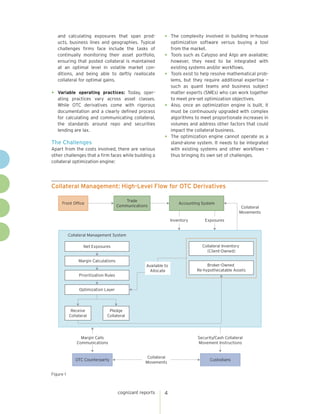
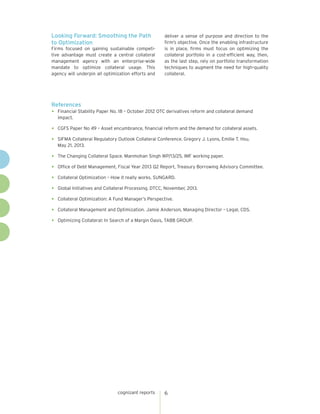
The OTC Derivatives Collateral Management Process
•	 Inventory capture: Front-office personnel will trade in eligible, high-quality collateral assets and
notify the collateral operations team of the available assets that can be used to pledge for margin
calls from counterparties. The collateral management system will receive these assets as collateral
inventory from the firm’s accounting system. Assets in this inventory can include high-quality liquid
instruments like U.S TIPS and U.S. Treasury bills, notes and bonds, depending on the firm’s derivative
contracts and its collateral eligibility.
	 The collateral operations team can use assets from two types of inventory to pledge for margin calls:
the assets that they receive from the front office through the accounting system, and the rehypoth-
ecatable assets that they have received from the counterparties as part of the firm’s margin calls.
•	 Contract details: When two parties enter into a bilateral OTC agreement, they will document the
details of the contract in an ISDA master agreement, which is published by the International Swaps
and Derivatives Association. Credit Support Annex is widely used in most master agreements to
document provisions concerning the collateral that is used by the parties in the derivatives contract.
It could include information like re-hypothecation, threshold and types of collateral that may be used
in the contract.
•	 Margin calls: Parties in the OTC contract may require the other to post an initial margin amount to
cover the credit risk that could arise from trading with that party. This amount is normally pledged
by the required party as a margin amount to trade with the party with a higher credit rating. Per the
documented collateral terms of the derivatives contract, parties will monitor their exposures on the
OTC derivatives trades and will calculate the amount that they will pledge or receive as collateral,
based on which party the exposure favors. This is called the variation margin, since it covers for the
daily mark-to-market variation in the derivatives trade value.
•	 Prioritization rules: Parties can set the prioritization rules for the OTC agreements and define
the order in which they need to pledge different instrument types. For instance, a firm may want to
pledge corporate bonds to a counterparty (if available in inventory) before it can pledge treasury bills
or assets with better liquidity. IBM Algo Collateral Management v5.3 has incorporated a basic optimi-
zation tool that utilizes the prioritization rules to automatically pledge collateral assets to counterpar-
ties through straight-through processing (STP). This is done by taking sequential paths in which the
system will take one margin call at a time and will assign collateral per its prioritization rules.
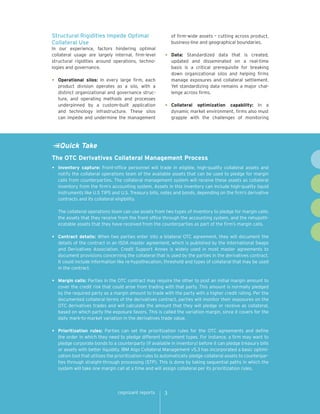
In our experience, factors hindering optimal
collateral usage are largely internal, firm-level
structural rigidities around operations, techno-
logies and governance.
•	 Operational silos: In every large firm, each
product division operates as a silo, with a
distinct organizational and governance struc-
ture, and operating methods and processes
underpinned by a custom-built application
and technology infrastructure. These silos
can impede and undermine the management
cognizant reports 4
and calculating exposures that span prod-
ucts, business lines and geographies. Typical
challenges firms face include the tasks of
continually monitoring their asset portfolio,
ensuring that posted collateral is maintained
at an optimal level in volatile market con-
ditions, and being able to deftly reallocate
collateral for optimal gains.
•	 Variable operating practices: Today, oper-
ating practices vary across asset classes.
While OTC derivatives come with rigorous
documentation and a clearly defined process
for calculating and communicating collateral,
the standards around repo and securities
lending are lax.
The Challenges
Apart from the costs involved, there are various
other challenges that a firm faces while building a
collateral optimization engine:
•	 The complexity involved in building in-house
optimization software versus buying a tool
from the market.
•	 Tools such as Calypso and Algo are available;
however, they need to be integrated with
existing systems and/or workflows.
•	 Tools exist to help resolve mathematical prob-
lems, but they require additional expertise –
such as quant teams and business subject
matter experts (SMEs) who can work together
to meet pre-set optimization objectives.
•	 Also, once an optimization engine is built, it
must be continuously upgraded with complex
algorithms to meet proportionate increases in
volumes and address other factors that could
impact the collateral business.
•	 The optimization engine cannot operate as a
stand-alone system. It needs to be integrated
with existing systems and other workflows –
thus bringing its own set of challenges.
Collateral Management: High-Level Flow for OTC Derivatives
Figure 1
Front Office
OTC Counterparty
Accounting System
Inventory
Margin Calls
Communications
Collateral
Movements
Custodians
Exposures
Collateral Management System
Net Exposures
Margin Calculations
Prioritization Rules
Pledge
Collateral
Optimization Layer
Available to
Allocate
Receive
Collateral
Collateral Inventory
(Client-Owned)
Broker-Owned
Re-hypothecatable Assets
Security/Cash Collateral
Movement Instructions
Collateral
Movements
Trade
Communications
cognizant reports 5
»	 Available inventory and trades and/or lia-
bilities to collateralize – position data, trade
data, reference data, static data, pricing,
rating, etc.
»	 Constraint variables in the form of
concentration limits across securities and
currencies, and asset allocation prefer-
ences – currency, security type, security
volume, define at trade level, define at port-
folio level.
»	 Additional influencing parameters for opti-
mization are margins, haircuts, ATVs based
on different time frames, market capitaliza-
tion, regular business
events and corpo-
rate actions, release
requests and substitu-
tions.
•	 Third, after implementing
a comprehensive optimi-
zation of available col-
lateral inventory against
obligations, firms must
address the collateral
shortfall through time-
tested strategies such as
upgradetrades,securities
lending, margin financing
and secured credit. This
must be the last recourse
to plug the gaps in the
portfolio, since it entails
costs that will be priced by the collateral
demand at that point in time.
Tabulating the Gains
Assuming incremental annual demand for high-quality collateral = US$11 trillion
Efficiency gains through a central collateral management agency = 7% to 10%
Efficiency gains through a robust optimization engine = 5% to 7%
Total efficiency gains = 12% to 17%
Incremental demand met through efficiency gains = US$1.3 to US$1.9 trillion
Assuming the cost of high-quality collateral ranges between 10 bps to 20 bps
Cost saved through collateral optimization = US$1.0 to US$4.0 billion
Quick Take
Establishing An Optimization
Roadmap
Before embarking
on an ambitious
and expensive
transformation
program to address
the collateral
shortfall, firms
must optimize
their collateral
portfolios with smart
analytical tools
and adopt effective
optimization
operating disciplines.
In our view, the following roadmap can help
firms establish a robust optimization program.
Collateral optimization gains of 12% to 17% can
easily save the industry US$1.0 to US$4.0 billion
annually (see sidebar).
We suggest a three-pronged approach to launch-
ing an efficient, effective collateral optimization
program:
•	First, create a central collateral manag-
ment agency – a provision to drive collateral
optimization by eliminating organizational
silos, multiple operational structures with
disparate IT systems and infrastructures that
can have conflicting objectives. By adopting
an enterprise-wide view, firms can improve
their collateral usage efficiency by 7% to 10%.
•	 Second, before embarking on an ambitious and
expensive transformation program to address
the collateral shortfall, firms must optimize
their collateral portfolios with smart analytical
tools and adopt effective optimization oper-
ating disciplines. This is a difficult road but a
cost-efficient one. The collateral optimization
exercise is a complex program that takes into
account the following provisions, which can
add another 5% - 7% to the overall efficiency
of collateral usage:
»	 Contractual agreements that specify the
collateral eligibility criteria agreed upon by
the participants, including contract details
and a subset of preferences within the
contract.
cognizant reports 6
Looking Forward: Smoothing the Path
to Optimization
deliver a sense of purpose and direction to the
firm’s objective. Once the enabling infrastructure
is in place, firms must focus on optimizing the
collateral portfolio in a cost-efficient way, then,
as the last step, rely on portfolio transformation
techniques to augment the need for high-quality
collateral.
References
•	 Financial Stability Paper No. 18 – October 2012 OTC derivatives reform and collateral demand
impact.
•	 CGFS Paper No 49 – Asset encumbrance, financial reform and the demand for collateral assets.
•	 SIFMA Collateral Regulatory Outlook Collateral Conference. Gregory J. Lyons, Emilie T. Hsu.
May 21, 2013.
•	 The Changing Collateral Space. Manmohan Singh WP/13/25, IMF working paper.
•	 Office of Debt Management, Fiscal Year 2013 Q2 Report, Treasury Borrowing Advisory Committee.
•	 Collateral Optimization – How it really works. SUNGARD.
•	 Global Initiatives and Collateral Processing. DTCC, November, 2013.
•	 Collateral Optimization: A Fund Manager’s Perspective.
•	 Collateral Management and Optimization. Jamie Anderson, Managing Director – Legal, CDS.
•	 Optimizing Collateral: In Search of a Margin Oasis, TABB GROUP.
Firms focused on gaining sustainable competi-
tive advantage must create a central collateral
management agency with an enterprise-wide
mandate to optimize collateral usage. This
agency will underpin all optimization efforts and
World Headquarters
500 Frank W. Burr Blvd.
Teaneck, NJ 07666 USA
Phone: +1 201 801 0233
Fax: +1 201 801 0243
Toll Free: +1 888 937 3277
Email: inquiry@cognizant.com
European Headquarters
1 Kingdom Street
Paddington Central
London W2 6BD
Phone: +44 (0) 207 297 7600
Fax: +44 (0) 207 121 0102
Email: infouk@cognizant.com
India Operations Headquarters
#5/535, Old Mahabalipuram Road
Okkiyam Pettai, Thoraipakkam
Chennai, 600 096 India
Phone: +91 (0) 44 4209 6000
Fax: +91 (0) 44 4209 6060
Email: inquiryindia@cognizant.com
­­© Copyright 2014, Cognizant. All rights reserved. No part of this document may be reproduced, stored in a retrieval system, transmitted in any form or by any
means, electronic, mechanical, photocopying, recording, or otherwise, without the express written permission from Cognizant. The information contained herein is
subject to change without notice. All other trademarks mentioned herein are the property of their respective owners.
About Cognizant
Cognizant (NASDAQ: CTSH) is a leading provider of information technology, consulting, and business process
outsourcing services, dedicated to helping the world's leading companies build stronger businesses. Headquartered
in Teaneck, New Jersey (U.S.), Cognizant combines a passion for client satisfaction, technology innovation, deep
industry and business process expertise, and a global, collaborative workforce that embodies the future of work. With
over 75 development and delivery centers worldwide and approximately 178,600 employees as of March 31, 2014,
Cognizant is a member of the NASDAQ-100, the S&P 500, the Forbes Global 2000, and the Fortune 500 and is ranked
among the top performing and fastest growing companies in the world.
Visit us online at www.cognizant.com or follow us on Twitter: Cognizant.
Credits
Author
Anand Chandramouli, Director, Cognizant Research Center
Subject Matter Experts
Prakash Dalvi, Manager, Capital Markets Practice, Cognizant Business Consulting
Arunkumar Sadasivam, Capital Markets Consultant, Cognizant Business Consulting
Design
Harleen Bhatia, Design Team Lead
Suresh Satyavarapu, Designer

A Systematic Approach to Optimizing Collateral

  • 1.
    • Cognizant Reports cognizantreports | June 2014 A Systematic Approach to Optimizing Collateral We believe that by eliminating IT silos and creating a centralized collateral management system, departmental and financial services firms can achieve sizeable savings and a sustainable competitive edge.
  • 2.
    cognizant reports 2 ExecutiveSummary As collateral takes center stage in financial markets, demand is expected to drive up its cost. Certain scenarios envision an acute supply crunch in times of prolonged market stress. This makes the case for building a robust collateral management/optimization infrastructure all the more compelling. But creating an efficient infra- structure is, unquestionably, a hard task. The key question confronting financial firms is: “Do we have the ability to post the least-cost collateral against obligations enter- prise-wide, and to monitor and dynamically alter the posted collateral – its char- acter and composition – in step with constantly shifting market dynamics?” Our experience suggests that there are firm-level structural rigidities that inhibit large broker dealers, banks and custodians from attaining this capability. Our analysis shows that the industry can collectively and sustainably save anywhere between US$1.0 and US$4.0 billion annually by adopting the robust optimization pro- gram we outline here. This level of incentive can cre- ate a transformative impact for winning firms and give them a sustainable competitive edge. In this paper, the second of three in our series on collateral management, we discuss the advantages of developing a robust collateral management/optimization infrastructure. In the first paper, we elaborate on factors that drive collateral demand; in the third, we examine the impact of new margin requirements on deriva- tives trades. The Collateral Demand-Supply Imbalance While we do not subscribe to the scarcity theory surrounding high- quality collateral, we believe the demand-supply imbalance can turn acute in an unstable market – spiking the cost of high- quality collateral and disproportionately affecting market players. Advisory Committee’s (TBAC) assessment of incremental demand for high-quality collateral pegs it at US$2.6 to US$5.7 trillion under normal market conditions, and US$4.6 to US$11.2 trillion under stressed conditions. Growing demand, coupled with the shrinking AAA sovereign pool and preclusion of rehypothecation mandated by new clearing and margining standards, will further choke supply. TBAC estimates the supply of high-quality collateral to be in the range of US$9.2 to US$10.6 trillion under normal market conditions, and US$4.4 to US$8.8 trillion under strained conditions. While we do not subscribe to the scarcity theory, we believe the demand- supply imbalance can turn acute in an unstable market – spiking the cost of high-quality collateral and disproportionately affecting market players. The Case for Collateral Optimization As high-quality collateral greases the wheels of financial markets and demand raises costs, it is prudent to invest in the necessary capabilities to optimize collateral usage. For example, consider total return swaps (TRS), a credit derivative used for off-balance-sheet transactions by asset managers and banks. Simply put, TRS is a bilateral contract to exchange the return on one or more underlying assets. “Total return receiver” (typically a hedge fund) must pay a funding cost (floating rate plus swap spread) to “total return payer” (typically a bank or dealer) in exchange for the total return on an asset. The total return payer (or the “funding bank”) most often requires an upfront posting of collateral by the total return receiver (or “swap counterparty”). If a hedge fund has to choose among cash, treasury securities or corporate bonds to post collateral, then its total economic return depends on the income generated by the underlying asset and its capital appreciation – minus the cost of collateral and the opportunity cost of deploying a particular asset for collateral. Total Economic Return = Income + Capital Appreciation – Cost of Collateral – Opportunity Cost of Collateral To optimize collateral usage and make smart asset selections, the receiver needs to have a consolidated view of the asset book with its range of quality of assets. A combination of regulations – the new liquid- ity coverage ratio (LCR) provision mandated by Basel III, increased initial margin requirements for cleared derivatives and margining needs for non-cleared derivatives – is expected to spike demand for high-quality collateral. (For additional insights, read: “Collateral Conundrum: A US$11 Trillion Opportunity?”). The Treasury Borrowing
  • 3.
    cognizant reports 3 StructuralRigidities Impede Optimal Collateral Use of firm-wide assets – cutting across product, business-line and geographical boundaries. • Data: Standardized data that is created, updated and disseminated on a real-time basis is a critical prerequisite for breaking down organizational silos and helping firms manage exposures and collateral settlement. Yet standardizing data remains a major chal- lenge across firms. • Collateral optimization capability: In a dynamic market environment, firms also must grapple with the challenges of monitoring Quick Take The OTC Derivatives Collateral Management Process • Inventory capture: Front-office personnel will trade in eligible, high-quality collateral assets and notify the collateral operations team of the available assets that can be used to pledge for margin calls from counterparties. The collateral management system will receive these assets as collateral inventory from the firm’s accounting system. Assets in this inventory can include high-quality liquid instruments like U.S TIPS and U.S. Treasury bills, notes and bonds, depending on the firm’s derivative contracts and its collateral eligibility. The collateral operations team can use assets from two types of inventory to pledge for margin calls: the assets that they receive from the front office through the accounting system, and the rehypoth- ecatable assets that they have received from the counterparties as part of the firm’s margin calls. • Contract details: When two parties enter into a bilateral OTC agreement, they will document the details of the contract in an ISDA master agreement, which is published by the International Swaps and Derivatives Association. Credit Support Annex is widely used in most master agreements to document provisions concerning the collateral that is used by the parties in the derivatives contract. It could include information like re-hypothecation, threshold and types of collateral that may be used in the contract. • Margin calls: Parties in the OTC contract may require the other to post an initial margin amount to cover the credit risk that could arise from trading with that party. This amount is normally pledged by the required party as a margin amount to trade with the party with a higher credit rating. Per the documented collateral terms of the derivatives contract, parties will monitor their exposures on the OTC derivatives trades and will calculate the amount that they will pledge or receive as collateral, based on which party the exposure favors. This is called the variation margin, since it covers for the daily mark-to-market variation in the derivatives trade value. • Prioritization rules: Parties can set the prioritization rules for the OTC agreements and define the order in which they need to pledge different instrument types. For instance, a firm may want to pledge corporate bonds to a counterparty (if available in inventory) before it can pledge treasury bills or assets with better liquidity. IBM Algo Collateral Management v5.3 has incorporated a basic optimi- zation tool that utilizes the prioritization rules to automatically pledge collateral assets to counterpar- ties through straight-through processing (STP). This is done by taking sequential paths in which the system will take one margin call at a time and will assign collateral per its prioritization rules. In our experience, factors hindering optimal collateral usage are largely internal, firm-level structural rigidities around operations, techno- logies and governance. • Operational silos: In every large firm, each product division operates as a silo, with a distinct organizational and governance struc- ture, and operating methods and processes underpinned by a custom-built application and technology infrastructure. These silos can impede and undermine the management
  • 4.
    cognizant reports 4 andcalculating exposures that span prod- ucts, business lines and geographies. Typical challenges firms face include the tasks of continually monitoring their asset portfolio, ensuring that posted collateral is maintained at an optimal level in volatile market con- ditions, and being able to deftly reallocate collateral for optimal gains. • Variable operating practices: Today, oper- ating practices vary across asset classes. While OTC derivatives come with rigorous documentation and a clearly defined process for calculating and communicating collateral, the standards around repo and securities lending are lax. The Challenges Apart from the costs involved, there are various other challenges that a firm faces while building a collateral optimization engine: • The complexity involved in building in-house optimization software versus buying a tool from the market. • Tools such as Calypso and Algo are available; however, they need to be integrated with existing systems and/or workflows. • Tools exist to help resolve mathematical prob- lems, but they require additional expertise – such as quant teams and business subject matter experts (SMEs) who can work together to meet pre-set optimization objectives. • Also, once an optimization engine is built, it must be continuously upgraded with complex algorithms to meet proportionate increases in volumes and address other factors that could impact the collateral business. • The optimization engine cannot operate as a stand-alone system. It needs to be integrated with existing systems and other workflows – thus bringing its own set of challenges. Collateral Management: High-Level Flow for OTC Derivatives Figure 1 Front Office OTC Counterparty Accounting System Inventory Margin Calls Communications Collateral Movements Custodians Exposures Collateral Management System Net Exposures Margin Calculations Prioritization Rules Pledge Collateral Optimization Layer Available to Allocate Receive Collateral Collateral Inventory (Client-Owned) Broker-Owned Re-hypothecatable Assets Security/Cash Collateral Movement Instructions Collateral Movements Trade Communications
  • 5.
    cognizant reports 5 » Available inventory and trades and/or lia- bilities to collateralize – position data, trade data, reference data, static data, pricing, rating, etc. » Constraint variables in the form of concentration limits across securities and currencies, and asset allocation prefer- ences – currency, security type, security volume, define at trade level, define at port- folio level. » Additional influencing parameters for opti- mization are margins, haircuts, ATVs based on different time frames, market capitaliza- tion, regular business events and corpo- rate actions, release requests and substitu- tions. • Third, after implementing a comprehensive optimi- zation of available col- lateral inventory against obligations, firms must address the collateral shortfall through time- tested strategies such as upgradetrades,securities lending, margin financing and secured credit. This must be the last recourse to plug the gaps in the portfolio, since it entails costs that will be priced by the collateral demand at that point in time. Tabulating the Gains Assuming incremental annual demand for high-quality collateral = US$11 trillion Efficiency gains through a central collateral management agency = 7% to 10% Efficiency gains through a robust optimization engine = 5% to 7% Total efficiency gains = 12% to 17% Incremental demand met through efficiency gains = US$1.3 to US$1.9 trillion Assuming the cost of high-quality collateral ranges between 10 bps to 20 bps Cost saved through collateral optimization = US$1.0 to US$4.0 billion Quick Take Establishing An Optimization Roadmap Before embarking on an ambitious and expensive transformation program to address the collateral shortfall, firms must optimize their collateral portfolios with smart analytical tools and adopt effective optimization operating disciplines. In our view, the following roadmap can help firms establish a robust optimization program. Collateral optimization gains of 12% to 17% can easily save the industry US$1.0 to US$4.0 billion annually (see sidebar). We suggest a three-pronged approach to launch- ing an efficient, effective collateral optimization program: • First, create a central collateral manag- ment agency – a provision to drive collateral optimization by eliminating organizational silos, multiple operational structures with disparate IT systems and infrastructures that can have conflicting objectives. By adopting an enterprise-wide view, firms can improve their collateral usage efficiency by 7% to 10%. • Second, before embarking on an ambitious and expensive transformation program to address the collateral shortfall, firms must optimize their collateral portfolios with smart analytical tools and adopt effective optimization oper- ating disciplines. This is a difficult road but a cost-efficient one. The collateral optimization exercise is a complex program that takes into account the following provisions, which can add another 5% - 7% to the overall efficiency of collateral usage: » Contractual agreements that specify the collateral eligibility criteria agreed upon by the participants, including contract details and a subset of preferences within the contract.
  • 6.
    cognizant reports 6 LookingForward: Smoothing the Path to Optimization deliver a sense of purpose and direction to the firm’s objective. Once the enabling infrastructure is in place, firms must focus on optimizing the collateral portfolio in a cost-efficient way, then, as the last step, rely on portfolio transformation techniques to augment the need for high-quality collateral. References • Financial Stability Paper No. 18 – October 2012 OTC derivatives reform and collateral demand impact. • CGFS Paper No 49 – Asset encumbrance, financial reform and the demand for collateral assets. • SIFMA Collateral Regulatory Outlook Collateral Conference. Gregory J. Lyons, Emilie T. Hsu. May 21, 2013. • The Changing Collateral Space. Manmohan Singh WP/13/25, IMF working paper. • Office of Debt Management, Fiscal Year 2013 Q2 Report, Treasury Borrowing Advisory Committee. • Collateral Optimization – How it really works. SUNGARD. • Global Initiatives and Collateral Processing. DTCC, November, 2013. • Collateral Optimization: A Fund Manager’s Perspective. • Collateral Management and Optimization. Jamie Anderson, Managing Director – Legal, CDS. • Optimizing Collateral: In Search of a Margin Oasis, TABB GROUP. Firms focused on gaining sustainable competi- tive advantage must create a central collateral management agency with an enterprise-wide mandate to optimize collateral usage. This agency will underpin all optimization efforts and
  • 7.
    World Headquarters 500 FrankW. Burr Blvd. Teaneck, NJ 07666 USA Phone: +1 201 801 0233 Fax: +1 201 801 0243 Toll Free: +1 888 937 3277 Email: inquiry@cognizant.com European Headquarters 1 Kingdom Street Paddington Central London W2 6BD Phone: +44 (0) 207 297 7600 Fax: +44 (0) 207 121 0102 Email: infouk@cognizant.com India Operations Headquarters #5/535, Old Mahabalipuram Road Okkiyam Pettai, Thoraipakkam Chennai, 600 096 India Phone: +91 (0) 44 4209 6000 Fax: +91 (0) 44 4209 6060 Email: inquiryindia@cognizant.com ­­© Copyright 2014, Cognizant. All rights reserved. No part of this document may be reproduced, stored in a retrieval system, transmitted in any form or by any means, electronic, mechanical, photocopying, recording, or otherwise, without the express written permission from Cognizant. The information contained herein is subject to change without notice. All other trademarks mentioned herein are the property of their respective owners. About Cognizant Cognizant (NASDAQ: CTSH) is a leading provider of information technology, consulting, and business process outsourcing services, dedicated to helping the world's leading companies build stronger businesses. Headquartered in Teaneck, New Jersey (U.S.), Cognizant combines a passion for client satisfaction, technology innovation, deep industry and business process expertise, and a global, collaborative workforce that embodies the future of work. With over 75 development and delivery centers worldwide and approximately 178,600 employees as of March 31, 2014, Cognizant is a member of the NASDAQ-100, the S&P 500, the Forbes Global 2000, and the Fortune 500 and is ranked among the top performing and fastest growing companies in the world. Visit us online at www.cognizant.com or follow us on Twitter: Cognizant. Credits Author Anand Chandramouli, Director, Cognizant Research Center Subject Matter Experts Prakash Dalvi, Manager, Capital Markets Practice, Cognizant Business Consulting Arunkumar Sadasivam, Capital Markets Consultant, Cognizant Business Consulting Design Harleen Bhatia, Design Team Lead Suresh Satyavarapu, Designer