A Sustainable Future fuel switching for rural development Atul K. Raturi Presented at   Energy side event, ACP Ministerial Meeting, Port Moresby, 2 June 2006
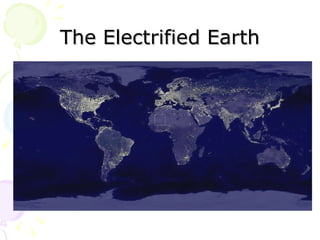
The Electrified Earth
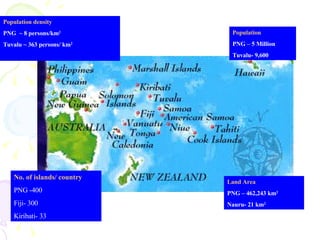
Population density PNG  ~ 8 persons/km 2 Tuvalu ~ 363 persons/ km 2 No. of islands/ country PNG -400 Fiji- 300 Kiribati- 33 Population PNG – 5 Million Tuvalu- 9,600 Land Area PNG – 462,243 km 2 Nauru- 21 km 2
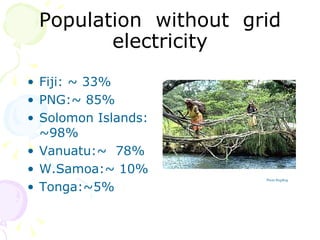
Population  without  grid electricity Fiji: ~ 33% PNG:~ 85% Solomon Islands: ~98% Vanuatu:~  78% W.Samoa:~ 10% Tonga:~5% Photo:BugBog                                             
ELECTRICITY GENERATION PNG 29% Hydro  W.Samoa 32% Hydro Micronesia 11.5% Hydro Others – Mainly Diesel Ratio of Petroleum Imports to Total Exports Marshall Islands, Palau and Tuvalu ~ 400%
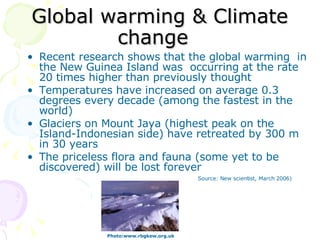
Global warming & Climate change   Recent research shows that the global warming  in the New Guinea Island was  occurring at the rate 20 times higher than previously thought Temperatures have increased on average 0.3 degrees every decade (among the fastest in the world) Glaciers on Mount Jaya (highest peak on the Island-Indonesian side) have retreated by 300 m in 30 years The priceless flora and fauna (some yet to be discovered) will be lost forever Photo:www.rbgkew.org.uk  Source: New scientist, March 2006)
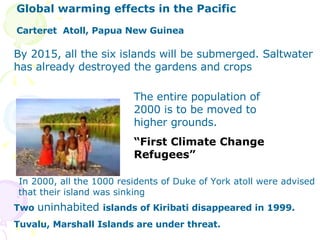
Carteret  Atoll, Papua New Guinea The entire population of  2000 is to be moved to higher grounds.  “ First Climate Change Refugees” By 2015, all the six islands will be submerged. Saltwater has already   destroyed the gardens and crops Two  uninhabited   islands of Kiribati disappeared in 1999. Tuvalu, Marshall Islands are under threat. In 2000, all the 1000 residents of Duke of York atoll were advised that their island was sinking   Global warming effects in the Pacific
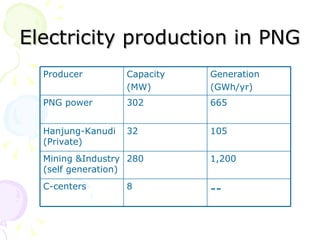
Electricity production in PNG -- 8 C-centers 1,200 280 Mining &Industry (self generation) 105 32 Hanjung-Kanudi (Private) 665 302 PNG power Generation (GWh/yr) Capacity (MW) Producer
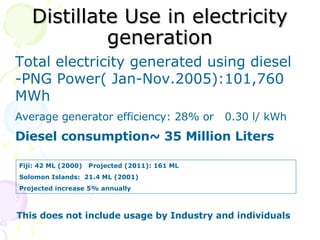
Distillate Use in electricity generation Total electricity generated using diesel -PNG Power( Jan-Nov.2005):101,760 MWh Average generator efficiency: 28% or  0.30 l/ kWh Diesel consumption~ 35 Million Liters Fiji: 42 ML (2000)  Projected (2011): 161 ML Solomon Islands:  21.4 ML (2001)  Projected increase 5% annually This does not include usage by Industry and individuals
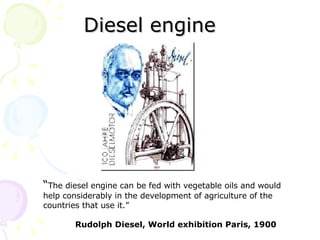
Diesel engine   “ The diesel engine can be fed with vegetable oils and would help considerably in the development of agriculture of the countries that use it.”  Rudolph Diesel, World exhibition Paris, 1900
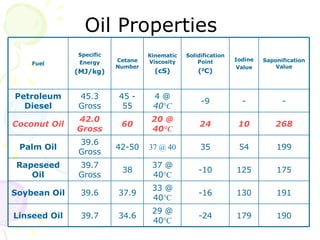
  Oil Properties 190 179 -24 29 @ 40 °C 34.6 39.7 Linseed Oil 191 130 -16 33 @ 40 °C 37.9 39.6 Soybean Oil 175 125 -10 37 @ 40 °C 38 39.7 Gross Rapeseed Oil 199 54 35 37 @ 40 42-50 39.6 Gross Palm Oil 268 10 24 20 @ 40 °C 60 42.0 Gross Coconut Oil - - -9 4 @  40 °C 45 - 55 45.3 Gross Petroleum Diesel Saponification Value Iodine Value Solidification Point ( 0 C) Kinematic Viscosity (cS) Cetane Number Specific Energy (MJ/kg) Fuel
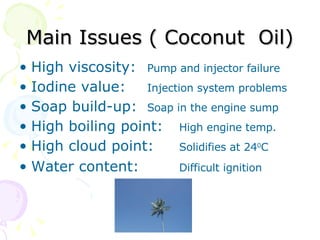
Main Issues ( Coconut  Oil) High viscosity:  Pump and injector failure Iodine value:  Injection system problems  Soap build-up:  Soap in the engine sump High boiling point: High engine temp. High cloud point: Solidifies at 24 0 C Water content: Difficult ignition
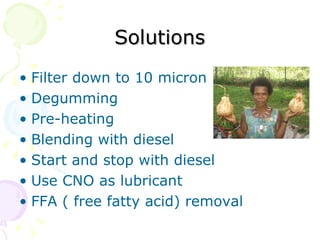
Solutions Filter down to 10 micron Degumming Pre-heating Blending with diesel  Start and stop with diesel Use CNO as lubricant FFA ( free fatty acid) removal
Utilization of CNO in CI engines Option 1: Modify the oil Blending, Transesterification (Bio-diesel) Option 2: Modify the engine Dual fuel, heating systems, injector, pumps, filters modification
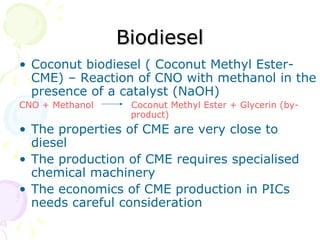
Biodiesel Coconut biodiesel ( Coconut Methyl Ester-CME) – Reaction of CNO with methanol in the presence of a catalyst (NaOH) CNO + Methanol  Coconut Methyl Ester + Glycerin (by-   product) The properties of CME are very close to diesel The production of CME requires specialised  chemical machinery  The economics of CME production in PICs needs careful consideration
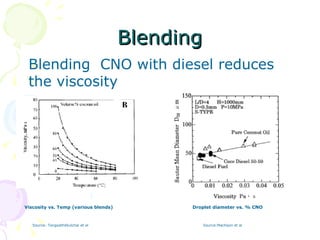
Blending Blending  CNO with diesel reduces the viscosity Source:Machaon et al Source: Tangsathitkulchai et al Viscosity vs. Temp (various blends) Droplet diameter vs. % CNO
Engine Modifications Dual fuel systems Additional heating systems Specially designed filters, pumps and injectors Commercially available conversion systems Deltech Ltd., Elsbett etc.
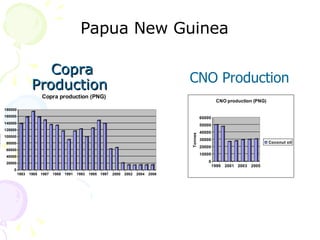
Copra Production   CNO Production Papua New Guinea
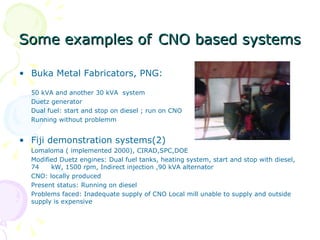
Some examples of   CNO based systems   Buka Metal Fabricators, PNG: 50 kVA and another 30 kVA  system  Duetz generator Dual fuel: start and stop on diesel ; run on CNO Running without problemm Fiji demonstration systems(2) Lomaloma ( implemented 2000), CIRAD,SPC,DOE Modified Duetz engines: Dual fuel tanks, heating system, start and stop with diesel, 74  kW, 1500 rpm, Indirect injection ,90 kVA alternator CNO: locally produced Present status: Running on diesel  Problems faced: Inadequate supply of CNO Local mill unable to supply and outside supply is expensive
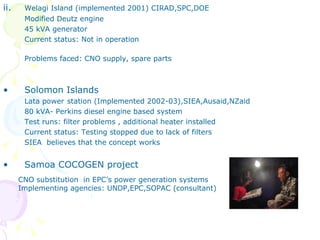
ii. Welagi Island (implemented 2001) CIRAD,SPC,DOE Modified Deutz engine  45 kVA generator Current status: Not in operation  Problems faced: CNO supply, spare parts   Solomon Islands Lata power  station (Implemented 2002-03),SIEA,Ausaid,NZaid 80 kVA- Perkins diesel engine based system Test runs: filter problems , additional heater installed Current status: Testing stopped due to lack of filters SIEA  believes that the concept works  Samoa COCOGEN project CNO substitution  in EPC’s power generation systems Implementing agencies: UNDP,EPC,SOPAC (consultant)
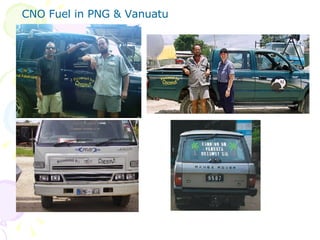
CNO Fuel in PNG & Vanuatu
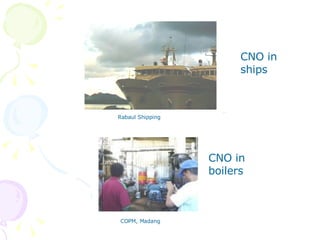
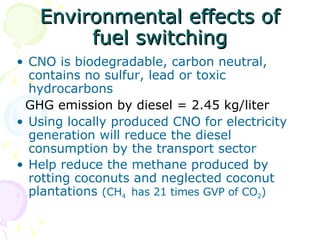
Rabaul Shipping COPM, Madang CNO in boilers CNO in ships
Environmental effects of fuel switching CNO is biodegradable, carbon neutral, contains no sulfur, lead or toxic hydrocarbons GHG emission by diesel = 2.45 kg/liter Using locally produced CNO for electricity generation will reduce the diesel consumption by the transport sector Help reduce the methane produced by rotting coconuts and neglected coconut plantations  (CH 4  has 21 times GVP of CO 2 )
The CNO option: some scenarios Finshafen, PNG (District HQ) Currently uses 600 L of diesel/day CNO required for 100% replacement : 676 L per day  Annual CNO requirement : 246.7 kL Diesel replaced : 219 kL GHG reduction 591 tonne CO 2  equivalent Rotuma Island (Fiji) 240 kW village system ( 4 hours per day) CNO required 122 kL per year ~ 203MT of copra per year Diesel displaced 106 kL GHG reduction: 287 tonne CO 2  equivalent Carbon Trading Potential
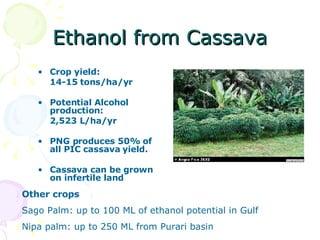
Ethanol from Cassava Crop yield:  14-15 tons/ha/yr  Potential Alcohol production: 2,523 L/ha/yr PNG produces 50% of all PIC cassava yield. Cassava can be grown on infertile land Other crops Sago Palm: up to 100 ML of ethanol potential in Gulf Nipa palm: up to 250 ML from Purari basin
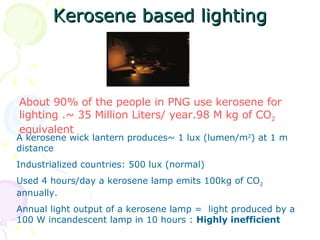
Kerosene based lighting A kerosene wick lantern produces~ 1 lux (lumen/m 2 ) at 1 m distance Industrialized countries: 500 lux (normal) Used 4 hours/day a kerosene lamp emits 100kg of CO 2  annually.  Annual light output of a kerosene lamp =  light produced by a 100 W incandescent lamp in 10 hours :  Highly inefficient About 90% of the people in PNG use kerosene for lighting .~ 35 Million Liters/ year.98 M kg of CO 2  equivalent
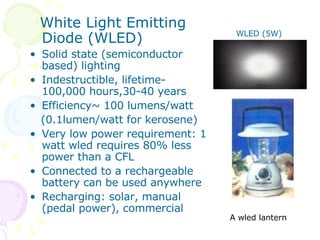
White Light Emitting Diode (WLED) Solid state (semiconductor based) lighting Indestructible, lifetime-100,000 hours,30-40 years Efficiency~ 100 lumens/watt (0.1lumen/watt for kerosene) Very low power requirement: 1 watt wled requires 80% less power than a CFL Connected to a rechargeable battery can be used anywhere Recharging: solar, manual (pedal power), commercial A wled lantern WLED (5W)
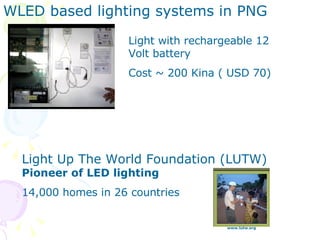
WLED based lighting systems in PNG Light with rechargeable 12 Volt battery Cost ~ 200 Kina ( USD 70) Light Up The World Foundation (LUTW)  Pioneer of LED lighting 14,000 homes in 26 countries www.lutw.org
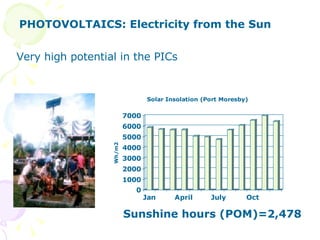
PHOTOVOLTAICS: Electricity from the Sun Very high potential in the PICs Sunshine hours (POM)=2,478
Teachers Solar Lighting Project (PNG) Department of education & the World Bank (GEF) Teachers are  given interest-free loans (through Teachers’ Savings and Loan society) To buy Solar Lighting Kits. Repayable in 5 years Initially 2,500 teachers in rural areas to benefit A revolving fund to be set-up  Grant: USD 992,000 Implementing agency: PNG SEL PV projects in PNG
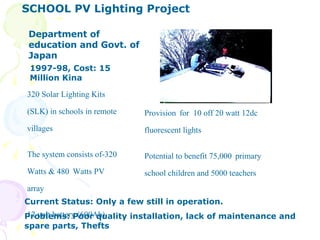
Department of education and Govt. of Japan 320 Solar Lighting Kits (SLK) in schools in remote villages The system consists of-320 Watts & 480   Watts PV array 12 volt battery (600Ah) Provision   for  10 off 20 watt 12dc fluorescent lights Potential to benefit 75,000   primary school children and 5000 teachers  1997-98, Cost: 15 Million Kina Current Status: Only a few still in operation. Problems: Poor quality installation, lack of maintenance and spare parts, Thefts SCHOOL PV Lighting Project
PV projects (TE PNG) More than 1200 solar powered (BP Solar) HF radio systems  Vaccine fridges ( Ministry of energy, Ausaid, Provincial Govt., Red Cross) Water pumping systems (8): WHO, EU projects Lighting systems (Depts. Of forestry, Health, education Solar power supplies for TV transmitters, repeater stations PNG Telecom 173 sites : 5000 solar panels : 200 peak kW
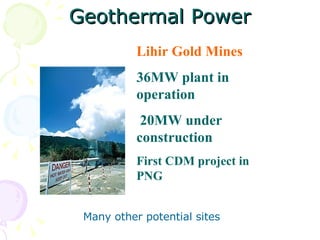
Geothermal Power Lihir Gold Mines 36MW plant in operation  20MW under construction First CDM project in PNG Many other potential sites
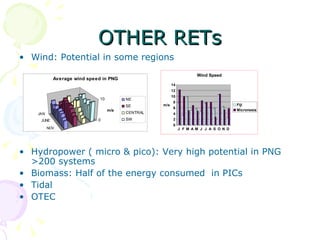
OTHER RETs Wind: Potential in some regions Hydropower ( micro & pico): Very high potential in PNG >200 systems  Biomass: Half of the energy consumed  in PICs Tidal OTEC
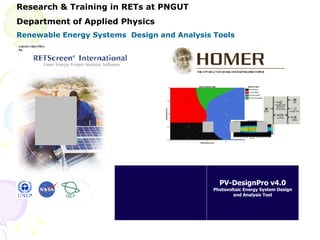
Research & Training in RETs at PNGUT Department of Applied Physics Renewable Energy Systems  Design and Analysis Tools   PV-DesignPro v4.0 Photovoltaic Energy System Design and Analysis Tool                                                                                              
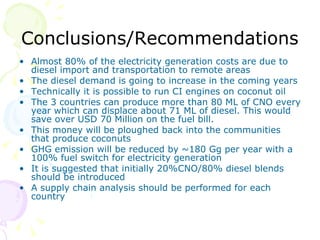
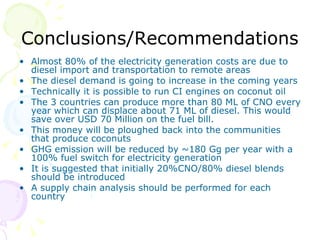
Conclusions/Recommendations Almost 80% of the electricity generation costs are due to diesel import and transportation to remote areas The diesel demand is going to increase in the coming years Technically it is possible to run CI engines on coconut oil The 3 countries can produce more than 80 ML of CNO every year which can displace about 71 ML of diesel. This would save over USD 70 Million on the fuel bill. This money will be ploughed back into the communities that produce coconuts  GHG emission will be reduced by ~180 Gg per year with a 100% fuel switch for electricity generation  It is suggested that initially 20%CNO/80% diesel blends should be introduced A supply chain analysis should be performed for each country
Thank you for your attention Atul K. Raturi    Department of Applied Physics   PNG University of Technology   Lae, PNG email:  [email_address] Phone: 675-4734905,675-6864587(mob) Web:  www.energyforall.blgspot.com

A Sustainable Future

  • 1.
    A Sustainable Futurefuel switching for rural development Atul K. Raturi Presented at Energy side event, ACP Ministerial Meeting, Port Moresby, 2 June 2006
  • 2.
  • 3.
    Population density PNG ~ 8 persons/km 2 Tuvalu ~ 363 persons/ km 2 No. of islands/ country PNG -400 Fiji- 300 Kiribati- 33 Population PNG – 5 Million Tuvalu- 9,600 Land Area PNG – 462,243 km 2 Nauru- 21 km 2
  • 4.
    Population without grid electricity Fiji: ~ 33% PNG:~ 85% Solomon Islands: ~98% Vanuatu:~ 78% W.Samoa:~ 10% Tonga:~5% Photo:BugBog                                             
  • 5.
    ELECTRICITY GENERATION PNG29% Hydro W.Samoa 32% Hydro Micronesia 11.5% Hydro Others – Mainly Diesel Ratio of Petroleum Imports to Total Exports Marshall Islands, Palau and Tuvalu ~ 400%
  • 6.
    Global warming &Climate change Recent research shows that the global warming in the New Guinea Island was occurring at the rate 20 times higher than previously thought Temperatures have increased on average 0.3 degrees every decade (among the fastest in the world) Glaciers on Mount Jaya (highest peak on the Island-Indonesian side) have retreated by 300 m in 30 years The priceless flora and fauna (some yet to be discovered) will be lost forever Photo:www.rbgkew.org.uk Source: New scientist, March 2006)
  • 7.
    Carteret Atoll,Papua New Guinea The entire population of 2000 is to be moved to higher grounds. “ First Climate Change Refugees” By 2015, all the six islands will be submerged. Saltwater has already destroyed the gardens and crops Two uninhabited islands of Kiribati disappeared in 1999. Tuvalu, Marshall Islands are under threat. In 2000, all the 1000 residents of Duke of York atoll were advised that their island was sinking Global warming effects in the Pacific
  • 8.
    Electricity production inPNG -- 8 C-centers 1,200 280 Mining &Industry (self generation) 105 32 Hanjung-Kanudi (Private) 665 302 PNG power Generation (GWh/yr) Capacity (MW) Producer
  • 9.
    Distillate Use inelectricity generation Total electricity generated using diesel -PNG Power( Jan-Nov.2005):101,760 MWh Average generator efficiency: 28% or 0.30 l/ kWh Diesel consumption~ 35 Million Liters Fiji: 42 ML (2000) Projected (2011): 161 ML Solomon Islands: 21.4 ML (2001) Projected increase 5% annually This does not include usage by Industry and individuals
  • 10.
    Diesel engine “ The diesel engine can be fed with vegetable oils and would help considerably in the development of agriculture of the countries that use it.” Rudolph Diesel, World exhibition Paris, 1900
  • 11.
    OilProperties 190 179 -24 29 @ 40 °C 34.6 39.7 Linseed Oil 191 130 -16 33 @ 40 °C 37.9 39.6 Soybean Oil 175 125 -10 37 @ 40 °C 38 39.7 Gross Rapeseed Oil 199 54 35 37 @ 40 42-50 39.6 Gross Palm Oil 268 10 24 20 @ 40 °C 60 42.0 Gross Coconut Oil - - -9 4 @ 40 °C 45 - 55 45.3 Gross Petroleum Diesel Saponification Value Iodine Value Solidification Point ( 0 C) Kinematic Viscosity (cS) Cetane Number Specific Energy (MJ/kg) Fuel
  • 12.
    Main Issues (Coconut Oil) High viscosity: Pump and injector failure Iodine value: Injection system problems Soap build-up: Soap in the engine sump High boiling point: High engine temp. High cloud point: Solidifies at 24 0 C Water content: Difficult ignition
  • 13.
    Solutions Filter downto 10 micron Degumming Pre-heating Blending with diesel Start and stop with diesel Use CNO as lubricant FFA ( free fatty acid) removal
  • 14.
    Utilization of CNOin CI engines Option 1: Modify the oil Blending, Transesterification (Bio-diesel) Option 2: Modify the engine Dual fuel, heating systems, injector, pumps, filters modification
  • 15.
    Biodiesel Coconut biodiesel( Coconut Methyl Ester-CME) – Reaction of CNO with methanol in the presence of a catalyst (NaOH) CNO + Methanol Coconut Methyl Ester + Glycerin (by- product) The properties of CME are very close to diesel The production of CME requires specialised chemical machinery The economics of CME production in PICs needs careful consideration
  • 16.
    Blending Blending CNO with diesel reduces the viscosity Source:Machaon et al Source: Tangsathitkulchai et al Viscosity vs. Temp (various blends) Droplet diameter vs. % CNO
  • 17.
    Engine Modifications Dualfuel systems Additional heating systems Specially designed filters, pumps and injectors Commercially available conversion systems Deltech Ltd., Elsbett etc.
  • 18.
    Copra Production CNO Production Papua New Guinea
  • 19.
    Some examples of CNO based systems Buka Metal Fabricators, PNG: 50 kVA and another 30 kVA system Duetz generator Dual fuel: start and stop on diesel ; run on CNO Running without problemm Fiji demonstration systems(2) Lomaloma ( implemented 2000), CIRAD,SPC,DOE Modified Duetz engines: Dual fuel tanks, heating system, start and stop with diesel, 74 kW, 1500 rpm, Indirect injection ,90 kVA alternator CNO: locally produced Present status: Running on diesel Problems faced: Inadequate supply of CNO Local mill unable to supply and outside supply is expensive
  • 20.
    ii. Welagi Island(implemented 2001) CIRAD,SPC,DOE Modified Deutz engine 45 kVA generator Current status: Not in operation Problems faced: CNO supply, spare parts Solomon Islands Lata power station (Implemented 2002-03),SIEA,Ausaid,NZaid 80 kVA- Perkins diesel engine based system Test runs: filter problems , additional heater installed Current status: Testing stopped due to lack of filters SIEA believes that the concept works Samoa COCOGEN project CNO substitution in EPC’s power generation systems Implementing agencies: UNDP,EPC,SOPAC (consultant)
  • 21.
    CNO Fuel inPNG & Vanuatu
  • 22.
    Rabaul Shipping COPM,Madang CNO in boilers CNO in ships
  • 23.
    Environmental effects offuel switching CNO is biodegradable, carbon neutral, contains no sulfur, lead or toxic hydrocarbons GHG emission by diesel = 2.45 kg/liter Using locally produced CNO for electricity generation will reduce the diesel consumption by the transport sector Help reduce the methane produced by rotting coconuts and neglected coconut plantations (CH 4 has 21 times GVP of CO 2 )
  • 24.
    The CNO option:some scenarios Finshafen, PNG (District HQ) Currently uses 600 L of diesel/day CNO required for 100% replacement : 676 L per day Annual CNO requirement : 246.7 kL Diesel replaced : 219 kL GHG reduction 591 tonne CO 2 equivalent Rotuma Island (Fiji) 240 kW village system ( 4 hours per day) CNO required 122 kL per year ~ 203MT of copra per year Diesel displaced 106 kL GHG reduction: 287 tonne CO 2 equivalent Carbon Trading Potential
  • 25.
    Ethanol from CassavaCrop yield: 14-15 tons/ha/yr Potential Alcohol production: 2,523 L/ha/yr PNG produces 50% of all PIC cassava yield. Cassava can be grown on infertile land Other crops Sago Palm: up to 100 ML of ethanol potential in Gulf Nipa palm: up to 250 ML from Purari basin
  • 26.
    Kerosene based lightingA kerosene wick lantern produces~ 1 lux (lumen/m 2 ) at 1 m distance Industrialized countries: 500 lux (normal) Used 4 hours/day a kerosene lamp emits 100kg of CO 2 annually. Annual light output of a kerosene lamp = light produced by a 100 W incandescent lamp in 10 hours : Highly inefficient About 90% of the people in PNG use kerosene for lighting .~ 35 Million Liters/ year.98 M kg of CO 2 equivalent
  • 27.
    White Light EmittingDiode (WLED) Solid state (semiconductor based) lighting Indestructible, lifetime-100,000 hours,30-40 years Efficiency~ 100 lumens/watt (0.1lumen/watt for kerosene) Very low power requirement: 1 watt wled requires 80% less power than a CFL Connected to a rechargeable battery can be used anywhere Recharging: solar, manual (pedal power), commercial A wled lantern WLED (5W)
  • 28.
    WLED based lightingsystems in PNG Light with rechargeable 12 Volt battery Cost ~ 200 Kina ( USD 70) Light Up The World Foundation (LUTW) Pioneer of LED lighting 14,000 homes in 26 countries www.lutw.org
  • 29.
    PHOTOVOLTAICS: Electricity fromthe Sun Very high potential in the PICs Sunshine hours (POM)=2,478
  • 30.
    Teachers Solar LightingProject (PNG) Department of education & the World Bank (GEF) Teachers are given interest-free loans (through Teachers’ Savings and Loan society) To buy Solar Lighting Kits. Repayable in 5 years Initially 2,500 teachers in rural areas to benefit A revolving fund to be set-up Grant: USD 992,000 Implementing agency: PNG SEL PV projects in PNG
  • 31.
    Department of educationand Govt. of Japan 320 Solar Lighting Kits (SLK) in schools in remote villages The system consists of-320 Watts & 480 Watts PV array 12 volt battery (600Ah) Provision for 10 off 20 watt 12dc fluorescent lights Potential to benefit 75,000 primary school children and 5000 teachers 1997-98, Cost: 15 Million Kina Current Status: Only a few still in operation. Problems: Poor quality installation, lack of maintenance and spare parts, Thefts SCHOOL PV Lighting Project
  • 32.
    PV projects (TEPNG) More than 1200 solar powered (BP Solar) HF radio systems Vaccine fridges ( Ministry of energy, Ausaid, Provincial Govt., Red Cross) Water pumping systems (8): WHO, EU projects Lighting systems (Depts. Of forestry, Health, education Solar power supplies for TV transmitters, repeater stations PNG Telecom 173 sites : 5000 solar panels : 200 peak kW
  • 33.
    Geothermal Power LihirGold Mines 36MW plant in operation 20MW under construction First CDM project in PNG Many other potential sites
  • 34.
    OTHER RETs Wind:Potential in some regions Hydropower ( micro & pico): Very high potential in PNG >200 systems Biomass: Half of the energy consumed in PICs Tidal OTEC
  • 35.
    Research & Trainingin RETs at PNGUT Department of Applied Physics Renewable Energy Systems Design and Analysis Tools   PV-DesignPro v4.0 Photovoltaic Energy System Design and Analysis Tool                                                                                            
  • 36.
    Conclusions/Recommendations Almost 80%of the electricity generation costs are due to diesel import and transportation to remote areas The diesel demand is going to increase in the coming years Technically it is possible to run CI engines on coconut oil The 3 countries can produce more than 80 ML of CNO every year which can displace about 71 ML of diesel. This would save over USD 70 Million on the fuel bill. This money will be ploughed back into the communities that produce coconuts GHG emission will be reduced by ~180 Gg per year with a 100% fuel switch for electricity generation It is suggested that initially 20%CNO/80% diesel blends should be introduced A supply chain analysis should be performed for each country
  • 37.
    Conclusions/Recommendations Almost 80%of the electricity generation costs are due to diesel import and transportation to remote areas The diesel demand is going to increase in the coming years Technically it is possible to run CI engines on coconut oil The 3 countries can produce more than 80 ML of CNO every year which can displace about 71 ML of diesel. This would save over USD 70 Million on the fuel bill. This money will be ploughed back into the communities that produce coconuts GHG emission will be reduced by ~180 Gg per year with a 100% fuel switch for electricity generation It is suggested that initially 20%CNO/80% diesel blends should be introduced A supply chain analysis should be performed for each country
  • 38.
    Thank you foryour attention Atul K. Raturi Department of Applied Physics PNG University of Technology Lae, PNG email: [email_address] Phone: 675-4734905,675-6864587(mob) Web: www.energyforall.blgspot.com

Editor's Notes