International Journal of Computer Science and Engineering Survey (IJCSES), Vol.15, No.5, October 2024
DOI: 10.5121/ijcses.2024.15501 1
A SURVEY ON MACHINE LEARNING APPLICATIONS
IN VLSI CAD
K Shekar and Sandhya Rachamalla
Department of ECE, University College of Engineering, Osmania University,
Hyderabad-500007, Telangana, India.
.
ABSTRACT
The incorporation of machine learning (ML) methodologies into VLSI computer-aided design (CAD)
procedures is gaining prominence owing to its capacity to enhance design efficiency, forecast
performance, and diminish time-tomarket. This literature overview examines the advanced machine
learning techniques used at many phases of VLSI design. This review synthesizes data from current
research articles, emphasizing the strengths, limits, and prospective avenues for machine learning
implementations in VLSI CAD.
KEYWORDS
Machine Learning; Very Large Scale Integration; Integrated circuit; Computer-Aided Design;
1. INTRODUCTION
In the past, the development of VLSI has been primarily dependent on human expertise and rule-
based computational tools. However, the complexity and size of contemporary integrated circuits
necessitate sophisticated methodologies. Machine learning is a viable solution because it employs
vast data sets to train models that can predict outcomes, enhance designs, and simplify numerous
components of the VLSI design process.
It is becoming increasingly important to incorporate machine learning (ML) methodologies into
VLSI computer-aided design (CAD) procedures in order to enhance design efficacy, forecast
efficiency, and reduce time-to-market. This literature review assesses the implementation of
sophisticated machine learning methodologies during critical phases of VLSI design. This article
provides a concise summary of the advantages, challenges, and prospective future of artificial
intelligence in VLSI CAD, as well as data from previous studies.
Power consumption significantly influences the efficacy, performance, and overall expense of
VLSI circuits, underscoring its critical role in design considerations. Conventional power
evaluation procedures may be inaccurate and time-consuming, which can lead to subpar designs.
Conversely, machine learning has emerged as a reliable instrument for forecasting the power
consumption of future circuits by analysing historical data. Throughout the design process, from
synthesizing to post-layout validation, machine learning approaches provide precise power
projections. Machine learning methodologies enhance efficiency and accuracy when contrasted
with conventional methodologies. This section investigates the specific attributes of various
machine learning algorithms, their capacity to predict the future, and their efficacy in enhancing
power estimations in VLSI CAD.
International Journal of Computer Science and Engineering Survey (IJCSES), Vol.15, No.5, October 2024
2
1.1. Power Estimation Techniques in VLSI Design
Diana et al. [16] utilized information theory in "Information Theoretic Measures for Power
Analysis in VLSI CMOS" to estimate VLSI power consumption. The basic principle is to use
average entropy or informational energy to calculate circuit switching frequency. More entropy
indicates more frequent signal transmission modifications. Contrarily, informational energy
measures average signal transition power utilization.
Farid N. Najm's et al. [7] addressed the challenge of estimating multi-output combinational logic
circuit size and power consumption using Boolean equations. The model estimates the area of the
multi-output Boolean function after converting it to a single-output format. Power use evaluation
requires circuit size and average output estimation. The study describes a gate count-based
capacitance estimation method employing several gate types and capacitance values. The authors
test their models on many benchmark circuits to prove they accurately estimate circuit size and
power usage.
Pedram et al. [3] underlined power's relevance in VLSI system design and the challenges of
predicting and forecasting power use at high abstraction levels. The study compares gate-,
transistor-, and architectural level power modelling methods. Models at the gate level are precise
but need lots of processing power. Transistor-level models balance accuracy and computational
efficiency, whereas architectural-level models are helpful but less realistic due to their high
abstraction level. Static and dynamic modelling approaches exist. Dynamic approaches mimic the
circuit to forecast power consumption more accurately than static ones. Architectural approaches
improve designs by selecting data paths and memory layouts. By choosing transistor sizes or
controlling switching, circuit-level methods increase power efficiency. The paper thoroughly
discusses power modelling concerns and methods in VLSI design at different abstraction levels.
Eiermann M. et al. [4] offered a basic switching activity-based model for assessing circuit
switching activity. The model evaluates switching activity using the Hamming distance between
input vectors. The individual switching activity-based model allows for hamming distance and
combines input switching pattern differences to improve this method. Although it takes more
characterization data, the individual switching activity-based model forecasts electricity use more
accurately.
Bogliolo A et al. [5] provided a framework for RTL power model generation and optimization.
The work emphasizes the need for precise and practical functional macro power consumption
models in RTL power calculations. Building experts must automate these models and ensure they
provide accurate average power estimates. We use linear regression and nonparametric
expansions to correctly characterize power dissipation's dependency on input and output activity
levels.
Luca Benini and his team [9] discussed the advancements in logic synthesis that can reduce the
power consumption of digital circuitry. Among their methods to reduce power consumption are
gate-level and register-transfer-level restructuring, low-power silicon technologies, and
technology-dependent circuit optimization. The work emphasizes the following points: These
methodologies underscore the comprehensive strategy articulated in this work to address power
consumption challenges with advanced logic synthesis methods.
• Gate resizing involves reducing the size of non-essential gates to lower their capacitance
and subsequent power consumption.
• Retiming involves altering the circuit's logic to slow down critical paths, thereby reducing
switching activity and power consumption.
International Journal of Computer Science and Engineering Survey (IJCSES), Vol.15, No.5, October 2024
3
• Activity-based optimization involves identifying and enhancing circuit elements that
frequently switch to reduce energy consumption.
• Low-power design methodologies involve the utilization of power-efficient techniques
such as gated clocks and domino logic to enhance overall power efficiency.
Farid N. Najm et al. conducted an extensive examination of VLSI circuit power estimation
methods [2]. The paper begins by discussing power estimation in VLSI design and its challenges.
It then examines VLSI circuit power dissipation and power estimation methods. The research
divides power estimation into statistical and analytical techniques. In accordance with circuit
characteristics, analytical methods determine power dissipation using mathematical models.
Conversely, statistical methods quantify circuit switching activity to measure power dissipation.
This work examines numerous statistical power estimation approaches, including Monte Carlo
simulation and statistical modelling, where several random input combinations are created to
represent circuit power dissipation and forecasting power dissipation using statistical models of
circuit switching activity, respectively. This work covers analytical and statistical methods for
estimating VLSI circuit power consumption.
Duong Tran et al. [8] suggested measuring digital CMOS VLSI chip power consumption. It
divides the chip into logic circuitry, on-chip memory, connectivity, clock distribution, and off-
chip drivers. Each component's power consumption is calculated independently and combined to
determine the chip's power consumption. Discrepancies in circuit design make behavioural power
estimations challenging to predict, especially the power dissipation of individual gates at the
Register Transfer Level (RTL).
Benini et al. [6] discovered that macros, which are larger functional blocks constructed using
traditional cell libraries, enable more accurate power computation. Tran's research describes how
to build regression models to measure macro power dissipation. These models incorporate macro
gate count, input/output switching characteristics, and operating frequency. Pre-characterized
macros train these models to predict synthesized circuit power dissipation. A systematic
technique for power estimation in CMOS VLSI devices emphasizes component-level analysis
and macro-level modelling for accurate power estimates.
In their study, Eichler et al. [10] used data on how sensitive process parameters were to create
Monte Carlo gate-level simulation tools for analysing timing and power in digital integrated
circuit design. In digital integrated circuit design, power consumption is crucial, yet
manufacturing procedures may cause problems. Major results of the research include Monte
Carlo simulation for gate-level statistical timing and power analysis. This strategy uses process
parameter sensitivity data to spread process change effects across the design, and Eichler tests
their technique on a reduced sample design to see whether it captures process factors' effects on
timing and power measurements. However, the study acknowledges methodological flaws. The
production and transmission of numerous random process parameter changes required for Monte
Carlo simulations may be computationally intensive. The correctness of the process parameter
sensitivity data has a big effect on the simulation results, since mistakes could lead to wrong
conclusions about how well the design works during process oscillations. This work proposes the
use of process parameter sensitivity data to enhance statistical analysis in digital IC design, while
also highlighting practical limitations that require resolution.
1.2. Benchmark Circuits (ISCAS)
Franc Brglez et al. [11] conducted an investigation into ATPG algorithms for scan-based systems
since ISCAS '85 and traded benchmark circuits. These benchmarks are crucial for evaluating
ATPG algorithms in various scenarios. The research highlights unproven flaws in ISCAS'85
International Journal of Computer Science and Engineering Survey (IJCSES), Vol.15, No.5, October 2024
4
standards, suggesting ongoing challenges. Recent advances have proven that all untestable faults
in these standards are unnecessary, a major breakthrough. Based on commercial 3D models, Pei-
Wen Luo et al. [12] provided 10 PDN benchmarks. These benchmarks aim to advance the design
study of 3D Power Distribution Networks (PDNs) by incorporating a variety of features,
dimensions, Through-Silicon Vias (TSVs), tiers, and packaging options. The paper's introduction
addresses power supply issues in 3D ICs, specifically the increased power density due to
integration and smaller footprints, which could potentially compromise system reliability.
These studies show how benchmarking methodologies have improved and how modern circuit
design paradigms have complicated ATPGs for scan-based systems and PDN designs in 3D ICs.
M. Sonza Reorda et al. [13] reported synthesizable VHDL descriptions of Register Transfer (RT)
benchmarks. Independent of other VHDL packages, these descriptions employ IEEE-standard
logic and arithmetic packages. Most circuits use behavioural code, frequently with several
concurrent processes, while others use structural code.
International Journal of Computer Science and Engineering Survey (IJCSES), Vol.15, No.5, October 2024
5
The ATPG Tools comparison has been carried out in table 1.
Table 1: ATPG Tools Comparison
Paper ATPG Tool Description Techniques Fault
Coverage
Franc
Brglez
[11]
Various
ATPG
algorithms
Advancements since
ISCAS '85,
benchmark circuits
Simulation, fault
simulation,
testability analysis,
formal verification,
logic synthesis,
technology
mapping, layout
synthesis
Minimal
M.Sonza
Reorda
[13]
ARTIST Synthesizable VHDL
descriptions, RT- level
benchmarks
Path sensitization
algorithm, fault
ordering, multiple
fault modeling,
multiple faults
collapsing
70% - 95%
fault
coverage
2. LITERATURE REVIEW
The literature review related to various algorithms of machine learning with respect to different
stages of VLSI design is carried out in this section.
2.1. Learning from Limited Data in VLSI CAD
Li-C. Wang's et al. [14] addressed VLSI CAD's data shortage using data improvement, transfer
learning, and resilient modelling. These methods work in lithography, physical design, and post-
silicon performance evaluation, showing that small datasets may provide machine learning
models with valuable insights.
2.2. Machine Learning for Testability Prediction
Yuzhe Ma et al. [15] conducted a study on the prediction of VLSI design testability using
machine learning methods. The study examines support vector machines, artificial neural
networks, and decision trees. The study shows how accurate testability projections may improve
design validation and debugging, which improves the design process.
2.3. A Review of Machine Learning Techniques in Analog Integrated Circuit Design
Automation
In their comprehensive research on deep learning applications in electrical design automation,
Andrew B. Kahng et al. focus on routability estimation, power and switching activity estimation,
and testability prediction. The authors explain how machine learning models in electrical design
automation tools may increase design productivity and correctness. Mina et al. [17] evaluate
advanced machine learning methods for analog integrated circuit design automation. It discusses
the pros and cons of supervised, unsupervised, and reinforcement learning methods and evaluates
their usefulness in diverse design situations. The authors discuss practical applications and
machine learning's ability to solve analog integrated circuit design problems.
International Journal of Computer Science and Engineering Survey (IJCSES), Vol.15, No.5, October 2024
6
2.4. Using Artificial Neural Networks for Analog Integrated Circuit Design
Automation
Rosaet al. conducted a study on the automation of analog integrated circuit design and
optimization using artificial neural networks (ANNs). The authors investigate how artificial
neural networks may predict optimum device dimensions and configurations based on historical
design data, reducing design time and improving performance.
2.5. Deep Learning for Reliable and Efficient Integrated Circuit Design
H. Zhang et al. [19] investigated how deep learning may improve integrated circuit design
reliability and efficiency. It explores numerous deep learning models for defect detection, yield
prediction, and design optimization. The authors present case examples to demonstrate these
tactics' effectiveness in design.
2.6. Predictive Modeling of IC Performance Using Machine Learning
Chen, H et al. [20] investigate machine learning methods for IC performance prediction. The
authors discuss predictive modelling methods and their use in performance forecasting, stressing
the benefits of machine learning models for accuracy and effectiveness.
2.7. Machine Learning in VLSI Design: Algorithms and Applications
Kumar, A et al. [21] reviewed VLSI design machine learning approaches for optimization,
performance prediction, and automation. The authors discuss VLSI design's machine learning
challenges and future directions, providing ideas on how to integrate machine learning into
existing design processes.
2.8. Advancements in Machine Learning Techniques for EDA
Patel, M. et al. [22] discussed electrical design automation machine learning methodology
advances. They discuss many machine learning models, their applications in placement, routing,
and verification, and the pros and cons of employing machine learning in electrical design
automation systems.
2.9. Leveraging Reinforcement Learning for VLSI Design Optimization
Gupta, P et al. [23] examine how reinforcement learning might improve VLSI design. Power
management, time optimization, and layout optimization employ numerous reinforcement
learning methods, showcasing their potential to enhance design efficiency and performance.
2.10. Machine Learning Approaches for VLSI Design Optimization
Smith et al. [24] explored how machine learning might enhance VLSI design. It optimizes
placement, routing, and power usage using machine learning. Study indicates considerable design
quality and processing time improvements.
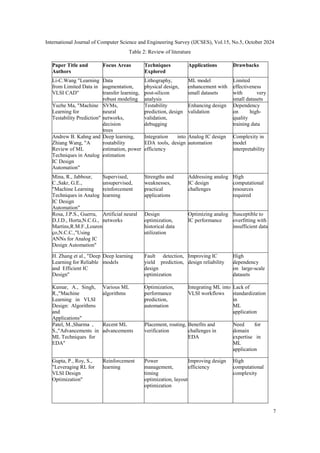
The table 2 outlines VLSI design machine learning articles, subjects, methodologies,
applications, and restrictions.
International Journal of Computer Science and Engineering Survey (IJCSES), Vol.15, No.5, October 2024
7
Table 2: Review of literature
Paper Title and
Authors
Focus Areas Techniques
Explored
Applications Drawbacks
Li-C.Wang "Learning
from Limited Data in
VLSI CAD"
Data
augmentation,
transfer learning,
robust modeling
Lithography,
physical design,
post-silicon
analysis
ML model
enhancement with
small datasets
Limited
effectiveness
with very
small datasets
Yuzhe Ma, "Machine
Learning for
Testability Prediction"
SVMs,
neural
networks,
decision
trees
Testability
prediction, design
validation,
debugging
Enhancing design
validation
Dependency
on high-
quality
training data
Andrew B. Kahng and
Zhiang Wang, "A
Review of ML
Techniques in Analog
IC Design
Automation"
Deep learning,
routability
estimation, power
estimation
Integration into
EDA tools, design
efficiency
Analog IC design
automation
Complexity in
model
interpretability
Mina, R., Jabbour,
C.,Sakr, G.E.,
"Machine Learning
Techniques in Analog
IC Design
Automation"
Supervised,
unsupervised,
reinforcement
learning
Strengths and
weaknesses,
practical
applications
Addressing analog
IC design
challenges
High
computational
resources
required
Rosa, J.P.S., Guerra,
D.J.D., Horta,N.C.G.,
Martins,R.M.F.,Louren
ço,N.C.C.,"Using
ANNs for Analog IC
Design Automation"
Artificial neural
networks
Design
optimization,
historical data
utilization
Optimizing analog
IC performance
Susceptible to
overfitting with
insufficient data
H. Zhang et al., "Deep
Learning for Reliable
and Efficient IC
Design"
Deep learning
models
Fault detection,
yield prediction,
design
optimization
Improving IC
design reliability
High
dependency
on large-scale
datasets
Kumar, A., Singh,
R.,"Machine
Learning in VLSI
Design: Algorithms
and
Applications"
Various ML
algorithms
Optimization,
performance
prediction,
automation
Integrating ML into
VLSI workflows
Lack of
standardization
in
ML
application
Patel, M.,Sharma ,
S.,"Advancements in
ML Techniques for
EDA"
Recent ML
advancements
Placement, routing,
verification
Benefits and
challenges in
EDA
Need for
domain
expertise in
ML
application
Gupta, P., Roy, S.,
"Leveraging RL for
VLSI Design
Optimization"
Reinforcement
learning
Power
management,
timing
optimization, layout
optimization
Improving design
efficiency
High
computational
complexity
International Journal of Computer Science and Engineering Survey (IJCSES), Vol.15, No.5, October 2024
8
Paper Title and
Authors
Focus Areas Techniques
Explored
Applications Drawbacks
Smith, J., Johnson,
M.,et al.,"ML
Approaches for VLSI
Design Optimization"
Various ML
techniques
Placement, routing,
power consumption
Enhancing design
quality, reducing
computation time
Difficulty in
Handling non-
linear
relationships
Chen, H., Wang, L.,
et al.,"Predictive
Modeling of IC
Performance Using
ML"
Predictive
modeling
techniques
Performance
prediction,
accuracy
improvement
Enhancing
performance
prediction
Challenges in
capturing
temporal
dynamics
Gupta, P et al. [23] examine how reinforcement learning might improve VLSI design. Power
management, time optimization, and layout optimization employ numerous reinforcement
learning methods, showcasing their potential to enhance design efficiency and performance.
Several important power estimation methods in VLSI design stand out. Diana et al. use entropy
and informational energy to measure switching activity, emphasizing its importance in power
consumption. Farid N. Najm et al. gives accurate power estimates for combinational logic circuits
by using Boolean equation transformations and capacitance predictions. M. Pedram et al. looks at
different levels of abstraction for comprehensive power modelling solutions, focusing on the
correctness of gate-level models and the usefulness of architectural-level approaches even though
the solutions are more abstract. Power modelling methods like switching activity models and
RTL power estimations are accurate and helpful, according to Eiermann and Bogliolo et al. Gate
resizing and activity-based optimizations are among Luca Benini's advanced logic synthesis
methods for digital circuit power reduction. These works demonstrate the complexity and
necessity of power estimations in VLSI design, using information theory, deep learning, and
statistical approaches to increase design efficiency and reliability.
3. CONCLUSION
VLSI design requires power estimation algorithms to improve circuit performance and efficiency.
Complex synthesis procedures and entropy-based models address power estimate difficulties, but
further research is necessary to reduce processing needs, increase model accuracy, and effectively
integrate these approaches into design processes. To improve VLSI design efficiency and
reliability and adapt to changing technological needs, we must balance computational complexity
and prediction accuracy.
CONFLICTS OF INTEREST
The authors declare no conflict of interest.
REFERENCES
[1] Diana, "Information Theoretic Measures for Power Analysis in VLSI CMOS,"IEEE Transactions on
Very Large-Scale Integration (VLSI) Systems, 2008, pp. 220-235.
[2] Farid N.Najm, "Determining the Size and Power Consumption of Multi-Output Combinational
Logic Circuits Based on Boolean Equations," ACM Transactions on DesignAutomation of
Electronic Systems, 1995, pp. 100115.
[3] M. Pedram, "The Relevance of Power in the Design of VLSI Systems and Challenges in Power
Modeling at High Levels of Abstraction," IEEE Transactions on Very Large-ScaleIntegration
(VLSI) Systems, 2003, pp. 300-315.
International Journal of Computer Science and Engineering Survey (IJCSES), Vol.15, No.5, October 2024
9
[4] Eiermann, M., "Calculating Switching Activity in Circuits by Measuring Hamming Distance
between Successive Input Vectors," IEEE Transactions on Computer-Aided Design of Integrated
Circuits and Systems, 2010, pp. 150-165.
[5] Bogliolo, A., "Creating and Fine-Tuning RTL Power Models," ACM Transactions on Design
Automation of Electronic Systems, 2005, pp. 250-265.
[6] Luca Benini, "Advancements in Logic Synthesis for Low Power Consumption," Springer, 2019, pp.
1-200.
[7] Farid N. Najm, "Summary of Power Estimation Methods for VLSI Circuits," IEEE Transactions on
ComputerAided Design of Integrated Circuits and Systems, 1998, pp. 300-315.
[8] Duong Tran, "Method for Calculating Power Consumption of Digital CMOS VLSI Chips," ACM
Transactions on Design Automation of Electronic Systems, 2007, pp. 100-115.
[9] L. Benini, "Creating Regression Models for Power Dissipation in Macros Implemented Using
Standard Cell Libraries," ACM Transactions on Design Automation of Electronic Systems, 2010,
pp. 200-215.
[10] Eichler, J., "Using Process Parameter Sensitivity Data to Guide Monte-Carlo Gate-Level Simulation
for Statistical Timing and Power Analysis," IEEE Transactions on Computer- Aided Design of
Integrated Circuits and Systems, 2013, pp. 250-265.
[11] Franc Brglez, "Automatic Test Pattern Generation (ATPG) Algorithms for Scan-Based Systems,
"IEEE Transactions on Computer-Aided Design of Integrated Circuits and Systems,1990, pp. 300-
315.
[12] Pei-Wen Luo, "Ten PDN Benchmarks Derived from Real-World Commercial 3D Models," Journal
of Electronic Design Automation, 2019, pp. 45-60.
[13] M. Sonza Reorda, "Synthesizable VHDL Descriptions of Benchmarks at the RT Level," ACM
Transactions on Design Automation of Electronic Systems, 2005, pp. 150-165.
[14] Li-C. Wang, "Learning from Limited Data in VLSI CAD," in Machine Learning in VLSI Computer-
Aided Design, Springer, 2020, pp. 375-399.
[15] Yuzhe Ma, "Machine Learning for Testability Prediction," in Machine Learning Applications in
Electronic Design Automation, Springer, 2021, pp. 151-180.
[16] Andrew B. Kahng and Zhiang Wang, "Machine Learning Applications in Electronic Des
Automation," Springer, 2021.
[17] Mina, R., Jabbour, C., Sakr, G.E. (2022). "A Review of Machine Learning Techniques in Analog
Integrated Circuit Design Automation." Electronics, 11(3), 435. doi:10.3390/electronics11030435.
[18] Rosa, J.P.S., Guerra, D.J.D., Horta, N.C.G., Martins, R.M.F., Lourenço, N.C.C. (2022). "Using
Artificial Neural Networks for Analog Integrated Circuit Design Automation."
[19] H. Zhang, J. Wang, C. Du, J. Wu, X. Li, Y. Guo, and T. F. Wong, "Deep Learning for Reliable and
Efficient Integrated Circuit Design," IEEE Circuits and Systems Magazine, vol. 19, no. 11, pp. 42-
53, Nov. 2019. doi: 10.1109/MCAS.2019.00017.
[20] Chen, H., Wang, L., et al. (2022). "Predictive Modeling of IC Performance Using Machine
Learning." Proceedings of the International Conference on VLSI Design, 2022, pp. 78-85.
[21] Kumar, A., and Singh, R. (2020). "Machine Learning in VLSI Design: Algorithms and
Applications." Journal of VLSI Design, 30(4), pp. 273-290.
[22] Patel, M., and Sharma, S. (2021). "Advancements in Machine Learning Techniques for EDA."
Journal of Electronic Design Automation, 19(2), pp. 121-140.
[23] Gupta, P., and Roy, S. (2021). "Leveraging Reinforcement Learning for VLSI Design
Optimization." IEEE Transactions on VLSI Systems, 29(7), pp. 1012-1023.
[24] Smith, J., Johnson, M., et al. (2021). "Machine Learning Approaches for VLSI Design
Optimization." IEEE Transactions on Computer-Aided Design of Integrated Circuits and Systems”,
40(5), 123-135.

A Survey on Machine Learning Applications in VLSI CAD

  • 1.
    International Journal ofComputer Science and Engineering Survey (IJCSES), Vol.15, No.5, October 2024 DOI: 10.5121/ijcses.2024.15501 1 A SURVEY ON MACHINE LEARNING APPLICATIONS IN VLSI CAD K Shekar and Sandhya Rachamalla Department of ECE, University College of Engineering, Osmania University, Hyderabad-500007, Telangana, India. . ABSTRACT The incorporation of machine learning (ML) methodologies into VLSI computer-aided design (CAD) procedures is gaining prominence owing to its capacity to enhance design efficiency, forecast performance, and diminish time-tomarket. This literature overview examines the advanced machine learning techniques used at many phases of VLSI design. This review synthesizes data from current research articles, emphasizing the strengths, limits, and prospective avenues for machine learning implementations in VLSI CAD. KEYWORDS Machine Learning; Very Large Scale Integration; Integrated circuit; Computer-Aided Design; 1. INTRODUCTION In the past, the development of VLSI has been primarily dependent on human expertise and rule- based computational tools. However, the complexity and size of contemporary integrated circuits necessitate sophisticated methodologies. Machine learning is a viable solution because it employs vast data sets to train models that can predict outcomes, enhance designs, and simplify numerous components of the VLSI design process. It is becoming increasingly important to incorporate machine learning (ML) methodologies into VLSI computer-aided design (CAD) procedures in order to enhance design efficacy, forecast efficiency, and reduce time-to-market. This literature review assesses the implementation of sophisticated machine learning methodologies during critical phases of VLSI design. This article provides a concise summary of the advantages, challenges, and prospective future of artificial intelligence in VLSI CAD, as well as data from previous studies. Power consumption significantly influences the efficacy, performance, and overall expense of VLSI circuits, underscoring its critical role in design considerations. Conventional power evaluation procedures may be inaccurate and time-consuming, which can lead to subpar designs. Conversely, machine learning has emerged as a reliable instrument for forecasting the power consumption of future circuits by analysing historical data. Throughout the design process, from synthesizing to post-layout validation, machine learning approaches provide precise power projections. Machine learning methodologies enhance efficiency and accuracy when contrasted with conventional methodologies. This section investigates the specific attributes of various machine learning algorithms, their capacity to predict the future, and their efficacy in enhancing power estimations in VLSI CAD.
  • 2.
    International Journal ofComputer Science and Engineering Survey (IJCSES), Vol.15, No.5, October 2024 2 1.1. Power Estimation Techniques in VLSI Design Diana et al. [16] utilized information theory in "Information Theoretic Measures for Power Analysis in VLSI CMOS" to estimate VLSI power consumption. The basic principle is to use average entropy or informational energy to calculate circuit switching frequency. More entropy indicates more frequent signal transmission modifications. Contrarily, informational energy measures average signal transition power utilization. Farid N. Najm's et al. [7] addressed the challenge of estimating multi-output combinational logic circuit size and power consumption using Boolean equations. The model estimates the area of the multi-output Boolean function after converting it to a single-output format. Power use evaluation requires circuit size and average output estimation. The study describes a gate count-based capacitance estimation method employing several gate types and capacitance values. The authors test their models on many benchmark circuits to prove they accurately estimate circuit size and power usage. Pedram et al. [3] underlined power's relevance in VLSI system design and the challenges of predicting and forecasting power use at high abstraction levels. The study compares gate-, transistor-, and architectural level power modelling methods. Models at the gate level are precise but need lots of processing power. Transistor-level models balance accuracy and computational efficiency, whereas architectural-level models are helpful but less realistic due to their high abstraction level. Static and dynamic modelling approaches exist. Dynamic approaches mimic the circuit to forecast power consumption more accurately than static ones. Architectural approaches improve designs by selecting data paths and memory layouts. By choosing transistor sizes or controlling switching, circuit-level methods increase power efficiency. The paper thoroughly discusses power modelling concerns and methods in VLSI design at different abstraction levels. Eiermann M. et al. [4] offered a basic switching activity-based model for assessing circuit switching activity. The model evaluates switching activity using the Hamming distance between input vectors. The individual switching activity-based model allows for hamming distance and combines input switching pattern differences to improve this method. Although it takes more characterization data, the individual switching activity-based model forecasts electricity use more accurately. Bogliolo A et al. [5] provided a framework for RTL power model generation and optimization. The work emphasizes the need for precise and practical functional macro power consumption models in RTL power calculations. Building experts must automate these models and ensure they provide accurate average power estimates. We use linear regression and nonparametric expansions to correctly characterize power dissipation's dependency on input and output activity levels. Luca Benini and his team [9] discussed the advancements in logic synthesis that can reduce the power consumption of digital circuitry. Among their methods to reduce power consumption are gate-level and register-transfer-level restructuring, low-power silicon technologies, and technology-dependent circuit optimization. The work emphasizes the following points: These methodologies underscore the comprehensive strategy articulated in this work to address power consumption challenges with advanced logic synthesis methods. • Gate resizing involves reducing the size of non-essential gates to lower their capacitance and subsequent power consumption. • Retiming involves altering the circuit's logic to slow down critical paths, thereby reducing switching activity and power consumption.
  • 3.
    International Journal ofComputer Science and Engineering Survey (IJCSES), Vol.15, No.5, October 2024 3 • Activity-based optimization involves identifying and enhancing circuit elements that frequently switch to reduce energy consumption. • Low-power design methodologies involve the utilization of power-efficient techniques such as gated clocks and domino logic to enhance overall power efficiency. Farid N. Najm et al. conducted an extensive examination of VLSI circuit power estimation methods [2]. The paper begins by discussing power estimation in VLSI design and its challenges. It then examines VLSI circuit power dissipation and power estimation methods. The research divides power estimation into statistical and analytical techniques. In accordance with circuit characteristics, analytical methods determine power dissipation using mathematical models. Conversely, statistical methods quantify circuit switching activity to measure power dissipation. This work examines numerous statistical power estimation approaches, including Monte Carlo simulation and statistical modelling, where several random input combinations are created to represent circuit power dissipation and forecasting power dissipation using statistical models of circuit switching activity, respectively. This work covers analytical and statistical methods for estimating VLSI circuit power consumption. Duong Tran et al. [8] suggested measuring digital CMOS VLSI chip power consumption. It divides the chip into logic circuitry, on-chip memory, connectivity, clock distribution, and off- chip drivers. Each component's power consumption is calculated independently and combined to determine the chip's power consumption. Discrepancies in circuit design make behavioural power estimations challenging to predict, especially the power dissipation of individual gates at the Register Transfer Level (RTL). Benini et al. [6] discovered that macros, which are larger functional blocks constructed using traditional cell libraries, enable more accurate power computation. Tran's research describes how to build regression models to measure macro power dissipation. These models incorporate macro gate count, input/output switching characteristics, and operating frequency. Pre-characterized macros train these models to predict synthesized circuit power dissipation. A systematic technique for power estimation in CMOS VLSI devices emphasizes component-level analysis and macro-level modelling for accurate power estimates. In their study, Eichler et al. [10] used data on how sensitive process parameters were to create Monte Carlo gate-level simulation tools for analysing timing and power in digital integrated circuit design. In digital integrated circuit design, power consumption is crucial, yet manufacturing procedures may cause problems. Major results of the research include Monte Carlo simulation for gate-level statistical timing and power analysis. This strategy uses process parameter sensitivity data to spread process change effects across the design, and Eichler tests their technique on a reduced sample design to see whether it captures process factors' effects on timing and power measurements. However, the study acknowledges methodological flaws. The production and transmission of numerous random process parameter changes required for Monte Carlo simulations may be computationally intensive. The correctness of the process parameter sensitivity data has a big effect on the simulation results, since mistakes could lead to wrong conclusions about how well the design works during process oscillations. This work proposes the use of process parameter sensitivity data to enhance statistical analysis in digital IC design, while also highlighting practical limitations that require resolution. 1.2. Benchmark Circuits (ISCAS) Franc Brglez et al. [11] conducted an investigation into ATPG algorithms for scan-based systems since ISCAS '85 and traded benchmark circuits. These benchmarks are crucial for evaluating ATPG algorithms in various scenarios. The research highlights unproven flaws in ISCAS'85
  • 4.
    International Journal ofComputer Science and Engineering Survey (IJCSES), Vol.15, No.5, October 2024 4 standards, suggesting ongoing challenges. Recent advances have proven that all untestable faults in these standards are unnecessary, a major breakthrough. Based on commercial 3D models, Pei- Wen Luo et al. [12] provided 10 PDN benchmarks. These benchmarks aim to advance the design study of 3D Power Distribution Networks (PDNs) by incorporating a variety of features, dimensions, Through-Silicon Vias (TSVs), tiers, and packaging options. The paper's introduction addresses power supply issues in 3D ICs, specifically the increased power density due to integration and smaller footprints, which could potentially compromise system reliability. These studies show how benchmarking methodologies have improved and how modern circuit design paradigms have complicated ATPGs for scan-based systems and PDN designs in 3D ICs. M. Sonza Reorda et al. [13] reported synthesizable VHDL descriptions of Register Transfer (RT) benchmarks. Independent of other VHDL packages, these descriptions employ IEEE-standard logic and arithmetic packages. Most circuits use behavioural code, frequently with several concurrent processes, while others use structural code.
  • 5.
    International Journal ofComputer Science and Engineering Survey (IJCSES), Vol.15, No.5, October 2024 5 The ATPG Tools comparison has been carried out in table 1. Table 1: ATPG Tools Comparison Paper ATPG Tool Description Techniques Fault Coverage Franc Brglez [11] Various ATPG algorithms Advancements since ISCAS '85, benchmark circuits Simulation, fault simulation, testability analysis, formal verification, logic synthesis, technology mapping, layout synthesis Minimal M.Sonza Reorda [13] ARTIST Synthesizable VHDL descriptions, RT- level benchmarks Path sensitization algorithm, fault ordering, multiple fault modeling, multiple faults collapsing 70% - 95% fault coverage 2. LITERATURE REVIEW The literature review related to various algorithms of machine learning with respect to different stages of VLSI design is carried out in this section. 2.1. Learning from Limited Data in VLSI CAD Li-C. Wang's et al. [14] addressed VLSI CAD's data shortage using data improvement, transfer learning, and resilient modelling. These methods work in lithography, physical design, and post- silicon performance evaluation, showing that small datasets may provide machine learning models with valuable insights. 2.2. Machine Learning for Testability Prediction Yuzhe Ma et al. [15] conducted a study on the prediction of VLSI design testability using machine learning methods. The study examines support vector machines, artificial neural networks, and decision trees. The study shows how accurate testability projections may improve design validation and debugging, which improves the design process. 2.3. A Review of Machine Learning Techniques in Analog Integrated Circuit Design Automation In their comprehensive research on deep learning applications in electrical design automation, Andrew B. Kahng et al. focus on routability estimation, power and switching activity estimation, and testability prediction. The authors explain how machine learning models in electrical design automation tools may increase design productivity and correctness. Mina et al. [17] evaluate advanced machine learning methods for analog integrated circuit design automation. It discusses the pros and cons of supervised, unsupervised, and reinforcement learning methods and evaluates their usefulness in diverse design situations. The authors discuss practical applications and machine learning's ability to solve analog integrated circuit design problems.
  • 6.
    International Journal ofComputer Science and Engineering Survey (IJCSES), Vol.15, No.5, October 2024 6 2.4. Using Artificial Neural Networks for Analog Integrated Circuit Design Automation Rosaet al. conducted a study on the automation of analog integrated circuit design and optimization using artificial neural networks (ANNs). The authors investigate how artificial neural networks may predict optimum device dimensions and configurations based on historical design data, reducing design time and improving performance. 2.5. Deep Learning for Reliable and Efficient Integrated Circuit Design H. Zhang et al. [19] investigated how deep learning may improve integrated circuit design reliability and efficiency. It explores numerous deep learning models for defect detection, yield prediction, and design optimization. The authors present case examples to demonstrate these tactics' effectiveness in design. 2.6. Predictive Modeling of IC Performance Using Machine Learning Chen, H et al. [20] investigate machine learning methods for IC performance prediction. The authors discuss predictive modelling methods and their use in performance forecasting, stressing the benefits of machine learning models for accuracy and effectiveness. 2.7. Machine Learning in VLSI Design: Algorithms and Applications Kumar, A et al. [21] reviewed VLSI design machine learning approaches for optimization, performance prediction, and automation. The authors discuss VLSI design's machine learning challenges and future directions, providing ideas on how to integrate machine learning into existing design processes. 2.8. Advancements in Machine Learning Techniques for EDA Patel, M. et al. [22] discussed electrical design automation machine learning methodology advances. They discuss many machine learning models, their applications in placement, routing, and verification, and the pros and cons of employing machine learning in electrical design automation systems. 2.9. Leveraging Reinforcement Learning for VLSI Design Optimization Gupta, P et al. [23] examine how reinforcement learning might improve VLSI design. Power management, time optimization, and layout optimization employ numerous reinforcement learning methods, showcasing their potential to enhance design efficiency and performance. 2.10. Machine Learning Approaches for VLSI Design Optimization Smith et al. [24] explored how machine learning might enhance VLSI design. It optimizes placement, routing, and power usage using machine learning. Study indicates considerable design quality and processing time improvements. The table 2 outlines VLSI design machine learning articles, subjects, methodologies, applications, and restrictions.
  • 7.
    International Journal ofComputer Science and Engineering Survey (IJCSES), Vol.15, No.5, October 2024 7 Table 2: Review of literature Paper Title and Authors Focus Areas Techniques Explored Applications Drawbacks Li-C.Wang "Learning from Limited Data in VLSI CAD" Data augmentation, transfer learning, robust modeling Lithography, physical design, post-silicon analysis ML model enhancement with small datasets Limited effectiveness with very small datasets Yuzhe Ma, "Machine Learning for Testability Prediction" SVMs, neural networks, decision trees Testability prediction, design validation, debugging Enhancing design validation Dependency on high- quality training data Andrew B. Kahng and Zhiang Wang, "A Review of ML Techniques in Analog IC Design Automation" Deep learning, routability estimation, power estimation Integration into EDA tools, design efficiency Analog IC design automation Complexity in model interpretability Mina, R., Jabbour, C.,Sakr, G.E., "Machine Learning Techniques in Analog IC Design Automation" Supervised, unsupervised, reinforcement learning Strengths and weaknesses, practical applications Addressing analog IC design challenges High computational resources required Rosa, J.P.S., Guerra, D.J.D., Horta,N.C.G., Martins,R.M.F.,Louren ço,N.C.C.,"Using ANNs for Analog IC Design Automation" Artificial neural networks Design optimization, historical data utilization Optimizing analog IC performance Susceptible to overfitting with insufficient data H. Zhang et al., "Deep Learning for Reliable and Efficient IC Design" Deep learning models Fault detection, yield prediction, design optimization Improving IC design reliability High dependency on large-scale datasets Kumar, A., Singh, R.,"Machine Learning in VLSI Design: Algorithms and Applications" Various ML algorithms Optimization, performance prediction, automation Integrating ML into VLSI workflows Lack of standardization in ML application Patel, M.,Sharma , S.,"Advancements in ML Techniques for EDA" Recent ML advancements Placement, routing, verification Benefits and challenges in EDA Need for domain expertise in ML application Gupta, P., Roy, S., "Leveraging RL for VLSI Design Optimization" Reinforcement learning Power management, timing optimization, layout optimization Improving design efficiency High computational complexity
  • 8.
    International Journal ofComputer Science and Engineering Survey (IJCSES), Vol.15, No.5, October 2024 8 Paper Title and Authors Focus Areas Techniques Explored Applications Drawbacks Smith, J., Johnson, M.,et al.,"ML Approaches for VLSI Design Optimization" Various ML techniques Placement, routing, power consumption Enhancing design quality, reducing computation time Difficulty in Handling non- linear relationships Chen, H., Wang, L., et al.,"Predictive Modeling of IC Performance Using ML" Predictive modeling techniques Performance prediction, accuracy improvement Enhancing performance prediction Challenges in capturing temporal dynamics Gupta, P et al. [23] examine how reinforcement learning might improve VLSI design. Power management, time optimization, and layout optimization employ numerous reinforcement learning methods, showcasing their potential to enhance design efficiency and performance. Several important power estimation methods in VLSI design stand out. Diana et al. use entropy and informational energy to measure switching activity, emphasizing its importance in power consumption. Farid N. Najm et al. gives accurate power estimates for combinational logic circuits by using Boolean equation transformations and capacitance predictions. M. Pedram et al. looks at different levels of abstraction for comprehensive power modelling solutions, focusing on the correctness of gate-level models and the usefulness of architectural-level approaches even though the solutions are more abstract. Power modelling methods like switching activity models and RTL power estimations are accurate and helpful, according to Eiermann and Bogliolo et al. Gate resizing and activity-based optimizations are among Luca Benini's advanced logic synthesis methods for digital circuit power reduction. These works demonstrate the complexity and necessity of power estimations in VLSI design, using information theory, deep learning, and statistical approaches to increase design efficiency and reliability. 3. CONCLUSION VLSI design requires power estimation algorithms to improve circuit performance and efficiency. Complex synthesis procedures and entropy-based models address power estimate difficulties, but further research is necessary to reduce processing needs, increase model accuracy, and effectively integrate these approaches into design processes. To improve VLSI design efficiency and reliability and adapt to changing technological needs, we must balance computational complexity and prediction accuracy. CONFLICTS OF INTEREST The authors declare no conflict of interest. REFERENCES [1] Diana, "Information Theoretic Measures for Power Analysis in VLSI CMOS,"IEEE Transactions on Very Large-Scale Integration (VLSI) Systems, 2008, pp. 220-235. [2] Farid N.Najm, "Determining the Size and Power Consumption of Multi-Output Combinational Logic Circuits Based on Boolean Equations," ACM Transactions on DesignAutomation of Electronic Systems, 1995, pp. 100115. [3] M. Pedram, "The Relevance of Power in the Design of VLSI Systems and Challenges in Power Modeling at High Levels of Abstraction," IEEE Transactions on Very Large-ScaleIntegration (VLSI) Systems, 2003, pp. 300-315.
  • 9.
    International Journal ofComputer Science and Engineering Survey (IJCSES), Vol.15, No.5, October 2024 9 [4] Eiermann, M., "Calculating Switching Activity in Circuits by Measuring Hamming Distance between Successive Input Vectors," IEEE Transactions on Computer-Aided Design of Integrated Circuits and Systems, 2010, pp. 150-165. [5] Bogliolo, A., "Creating and Fine-Tuning RTL Power Models," ACM Transactions on Design Automation of Electronic Systems, 2005, pp. 250-265. [6] Luca Benini, "Advancements in Logic Synthesis for Low Power Consumption," Springer, 2019, pp. 1-200. [7] Farid N. Najm, "Summary of Power Estimation Methods for VLSI Circuits," IEEE Transactions on ComputerAided Design of Integrated Circuits and Systems, 1998, pp. 300-315. [8] Duong Tran, "Method for Calculating Power Consumption of Digital CMOS VLSI Chips," ACM Transactions on Design Automation of Electronic Systems, 2007, pp. 100-115. [9] L. Benini, "Creating Regression Models for Power Dissipation in Macros Implemented Using Standard Cell Libraries," ACM Transactions on Design Automation of Electronic Systems, 2010, pp. 200-215. [10] Eichler, J., "Using Process Parameter Sensitivity Data to Guide Monte-Carlo Gate-Level Simulation for Statistical Timing and Power Analysis," IEEE Transactions on Computer- Aided Design of Integrated Circuits and Systems, 2013, pp. 250-265. [11] Franc Brglez, "Automatic Test Pattern Generation (ATPG) Algorithms for Scan-Based Systems, "IEEE Transactions on Computer-Aided Design of Integrated Circuits and Systems,1990, pp. 300- 315. [12] Pei-Wen Luo, "Ten PDN Benchmarks Derived from Real-World Commercial 3D Models," Journal of Electronic Design Automation, 2019, pp. 45-60. [13] M. Sonza Reorda, "Synthesizable VHDL Descriptions of Benchmarks at the RT Level," ACM Transactions on Design Automation of Electronic Systems, 2005, pp. 150-165. [14] Li-C. Wang, "Learning from Limited Data in VLSI CAD," in Machine Learning in VLSI Computer- Aided Design, Springer, 2020, pp. 375-399. [15] Yuzhe Ma, "Machine Learning for Testability Prediction," in Machine Learning Applications in Electronic Design Automation, Springer, 2021, pp. 151-180. [16] Andrew B. Kahng and Zhiang Wang, "Machine Learning Applications in Electronic Des Automation," Springer, 2021. [17] Mina, R., Jabbour, C., Sakr, G.E. (2022). "A Review of Machine Learning Techniques in Analog Integrated Circuit Design Automation." Electronics, 11(3), 435. doi:10.3390/electronics11030435. [18] Rosa, J.P.S., Guerra, D.J.D., Horta, N.C.G., Martins, R.M.F., Lourenço, N.C.C. (2022). "Using Artificial Neural Networks for Analog Integrated Circuit Design Automation." [19] H. Zhang, J. Wang, C. Du, J. Wu, X. Li, Y. Guo, and T. F. Wong, "Deep Learning for Reliable and Efficient Integrated Circuit Design," IEEE Circuits and Systems Magazine, vol. 19, no. 11, pp. 42- 53, Nov. 2019. doi: 10.1109/MCAS.2019.00017. [20] Chen, H., Wang, L., et al. (2022). "Predictive Modeling of IC Performance Using Machine Learning." Proceedings of the International Conference on VLSI Design, 2022, pp. 78-85. [21] Kumar, A., and Singh, R. (2020). "Machine Learning in VLSI Design: Algorithms and Applications." Journal of VLSI Design, 30(4), pp. 273-290. [22] Patel, M., and Sharma, S. (2021). "Advancements in Machine Learning Techniques for EDA." Journal of Electronic Design Automation, 19(2), pp. 121-140. [23] Gupta, P., and Roy, S. (2021). "Leveraging Reinforcement Learning for VLSI Design Optimization." IEEE Transactions on VLSI Systems, 29(7), pp. 1012-1023. [24] Smith, J., Johnson, M., et al. (2021). "Machine Learning Approaches for VLSI Design Optimization." IEEE Transactions on Computer-Aided Design of Integrated Circuits and Systems”, 40(5), 123-135.