BHAVIK AMIN
                                             EXAM NO :05
                                         B PHARM SEMESTER 8
                                               KBIPER


PROJECT GUIDE
MRS. MALLIKA BABU
IN-CHARGE OF DEPARTMENT OF MBA(PHARMA)
KBIPER, KSVV,GANDHINAGAR
FLOW OF PRESENTATION

Introduction to CME program

Review of literature

Objectives of CME program

Research methodology

Data Interpretation and Analysis

Findings

Suggestions

Conclusions

Strengths and Limitations

Bibliography
Introduction about project
           Definition and overview


•   Both the Accreditation Council for Continuing Medical Education (ACCME) and the
    American Medical Association define CME as “educational activities which serve to
    maintain, develop, or increase the knowledge, skills, and professional performance and
    relationships that a physician uses to provide services for patients, the public, or the
    profession”.
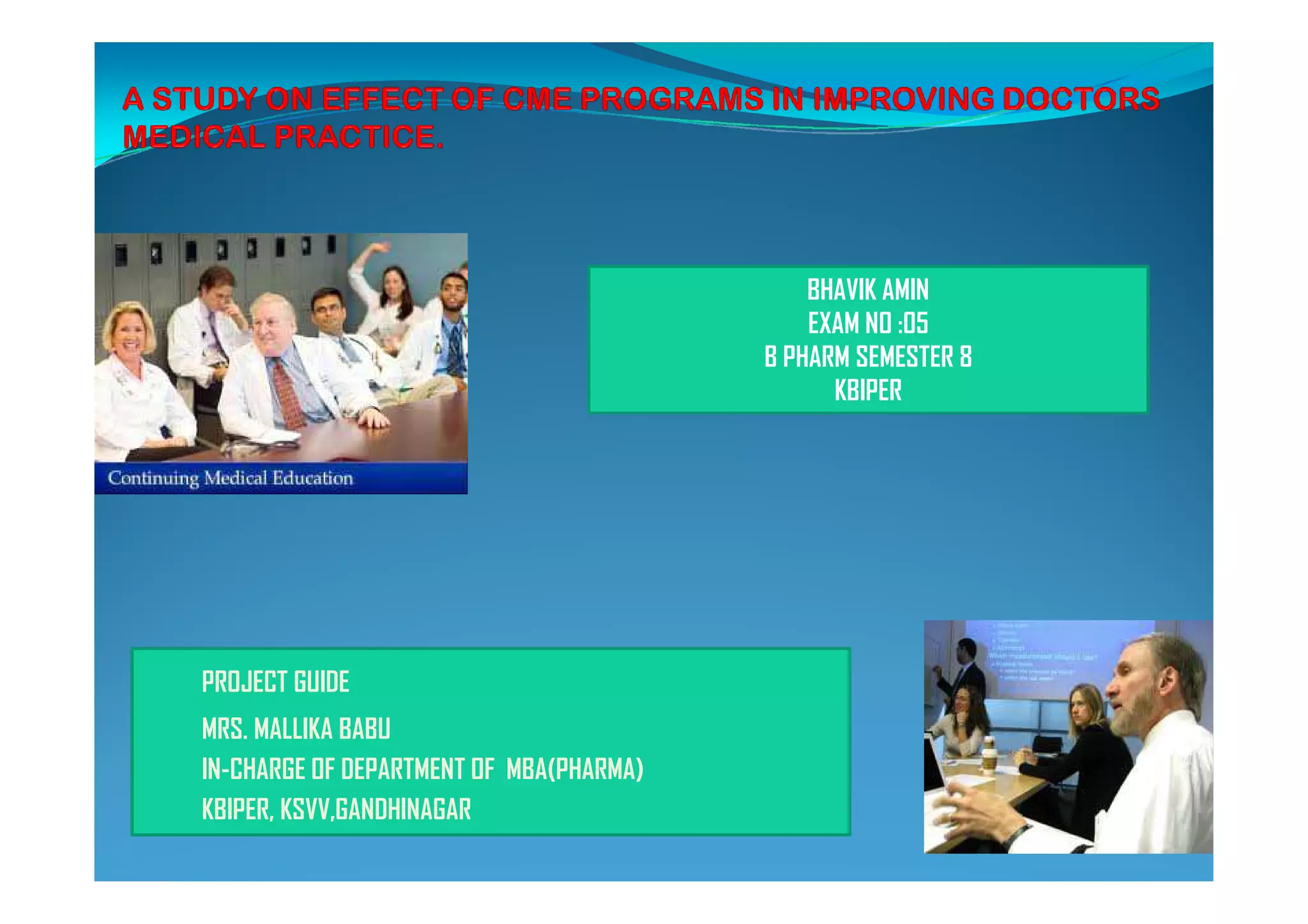
CME represents that body of knowledge and skills generally recognized and accepted by the
profession as within the basic medical sciences, the discipline of clinical medicine, and the
provision of health care to the public.


Continuing medical education (CME) refers to a specific form of continuing education (CE) that
helps those in the medical field maintain competence and learn about new and developing areas of
their field.


These activities may take place as live events, written publications, online programs, audio, video,
or other electronic media.


CME activities are developed and delivered by a variety of organizations, including:


Professional Associations

Medical Education Agencies

Hospitals

Educational institutions, including universities, medical and nursing schools.
Characteristics of CME program


Focus: Physician competence, performance, and patient outcomes.

Format: Variable, emphasis on principles of adult learning
(E.g. interactive, relevant to practice techniques).

Funding: Industry decreasing under influence of AAMC, IOM, Macy
Foundation and Pharma.

Evidence of effectiveness: CME-effective in acquisition of Knowledge, skills,
and performance, but low-quality evidence.

Emergence of performance improvement CME (PI-CME).
Review of literature

CME techniques that are more effective


  Interactive learning.

  Sequenced sessions (CME as a “campaign”, not just one-time only sessions).

  Accurate Needs Assessment (e.g. based upon measured practice gaps

  compared with national guidelines)

  Experiential learning (based upon an individual’s or group’s practice, e.g. PI-

  CME projects).
Meaning of CME: Continuing medical education is that process
within the scope of family medicine which provides information and
activities designed to maintain and improve the ability of the family
physician to provide high quality patient care. This educational process
encompasses all the areas usually encountered by the family physician
necessary to carry out these responsibilities.
The benefits that are gained from a CME course for physician

It makes sure that their personal satisfaction from the job they are doing is
maintained without any interruptions.
With such courses they can get new skills and also these helps the physician to
become more efficient in their work. And they can work better than ever.
Objectives of CME program

To provide educational activities to physicians and other healthcare professionals that
reinforce basic medical knowledge.
To introduce new ideas, skills and technology and spread research findings in order to
improve the quality of healthcare that is delivered by the participants in CME programs.
To provide lifelong learning opportunities to physicians and other health care providers
that aim to increase competence, enhance practice performance, and improve the health
care status of patients.
To suggest ways to make CME more doctor friendly.

To understand the frequency needed for CME program.

To understand the doctor’s expectation from CME program.
Research methodology

DATA COLLECTION SOURCES

PRIMARY DATA


Primary data is gathered from fieldwork (by using questionnaire).
Duration of Study      - 3 months
Target Population      - Doctors
Sample Size            - 36
Sampling Technique     - Convenience sampling
Sampling Unit          - Ahmedabad
SECONDARY DATA


•Secondary data is gathered from internet & books.
•It is valuable source of new ideas that can be explored later through
primary research.


     Research Design: Conclusive Type
Analysis and Data Interpretation
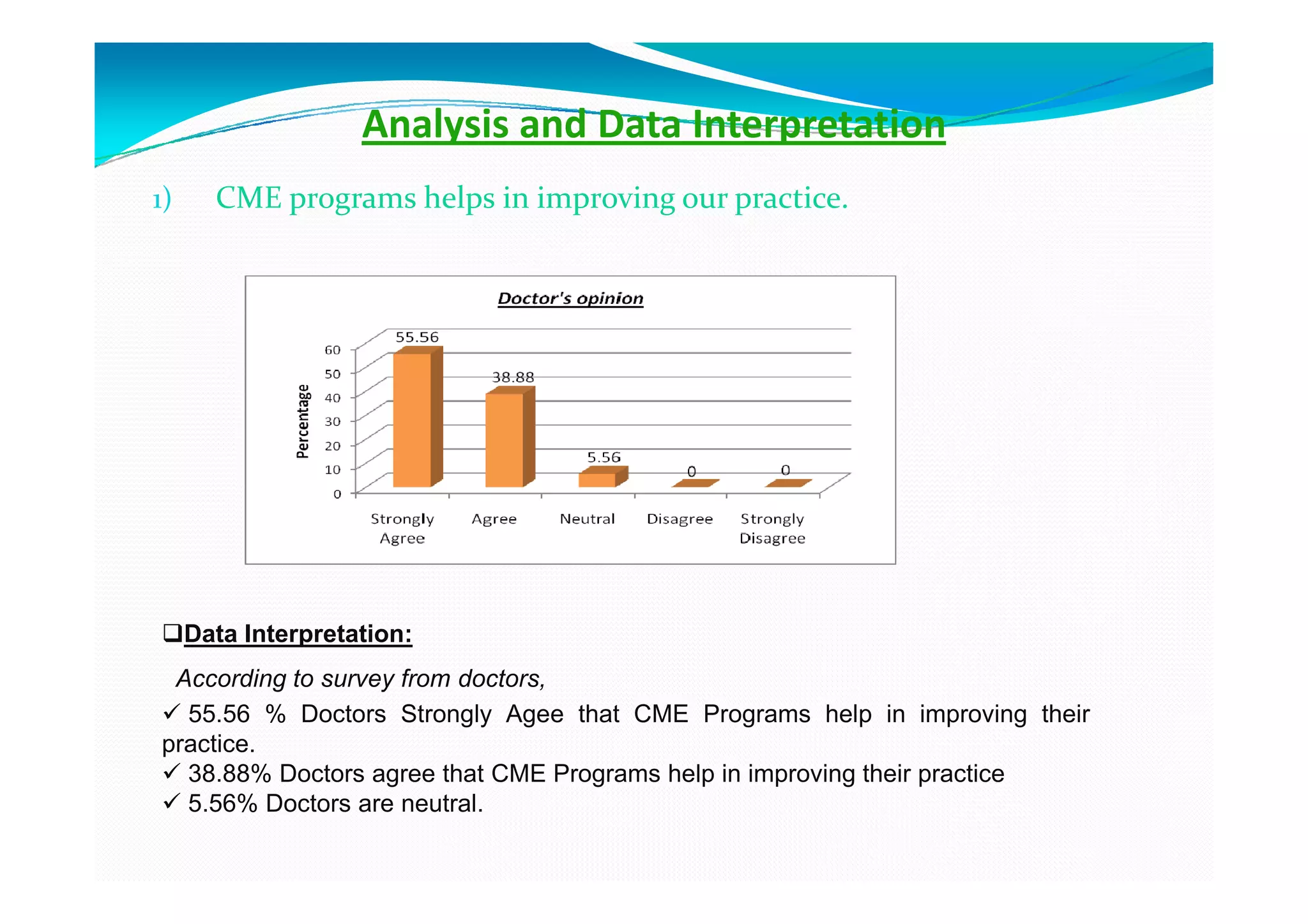
1)     CME programs helps in improving our practice.


     Data Interpretation:
 According to survey from doctors,
  55.56 % Doctors Strongly Agee that CME Programs help in improving their
practice.
  38.88% Doctors agree that CME Programs help in improving their practice
  5.56% Doctors are neutral.
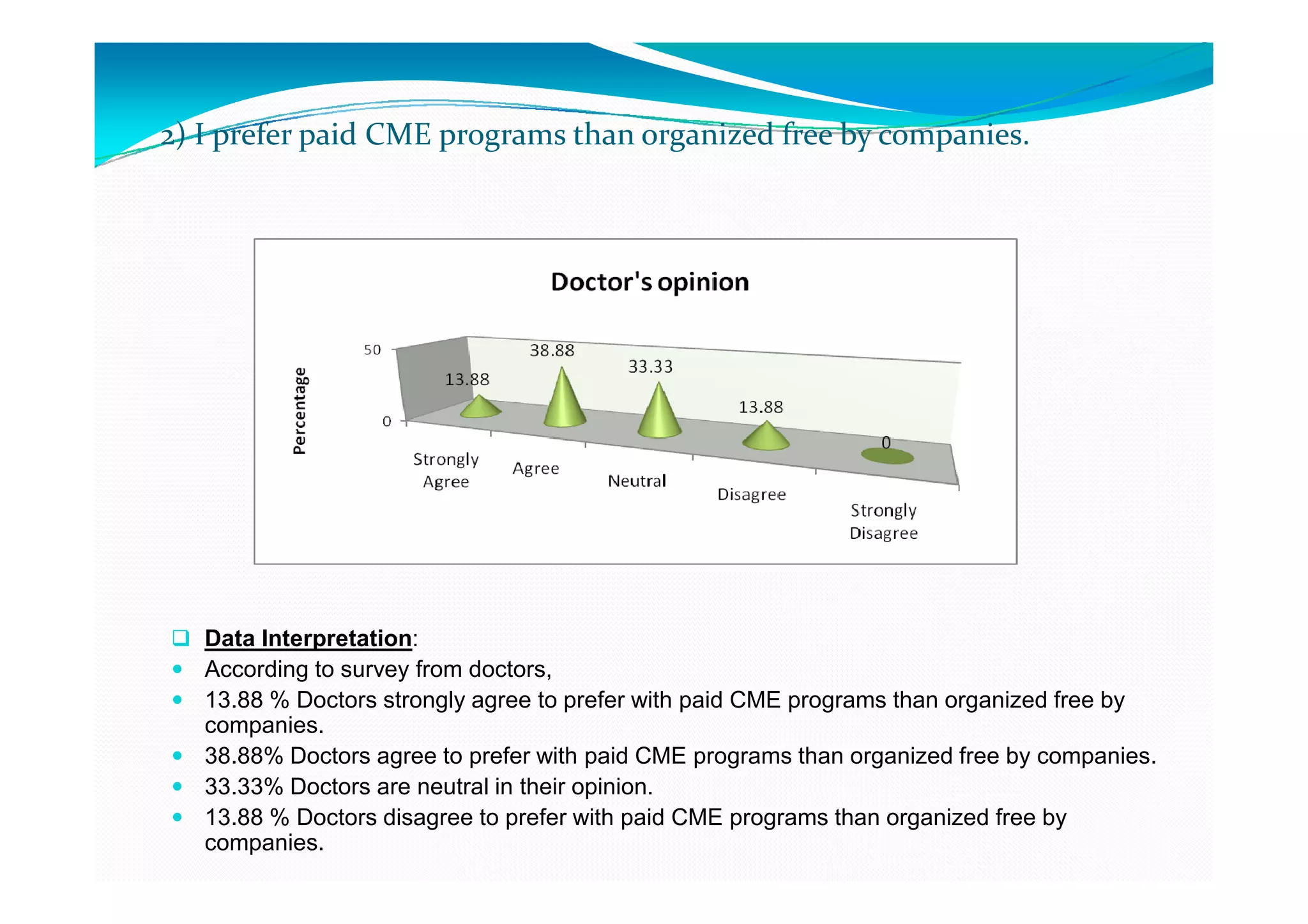
2) I prefer paid CME programs than organized free by companies.


   Data Interpretation:
   According to survey from doctors,
   13.88 % Doctors strongly agree to prefer with paid CME programs than organized free by
   companies.
   38.88% Doctors agree to prefer with paid CME programs than organized free by companies.
   33.33% Doctors are neutral in their opinion.
   13.88 % Doctors disagree to prefer with paid CME programs than organized free by
   companies.
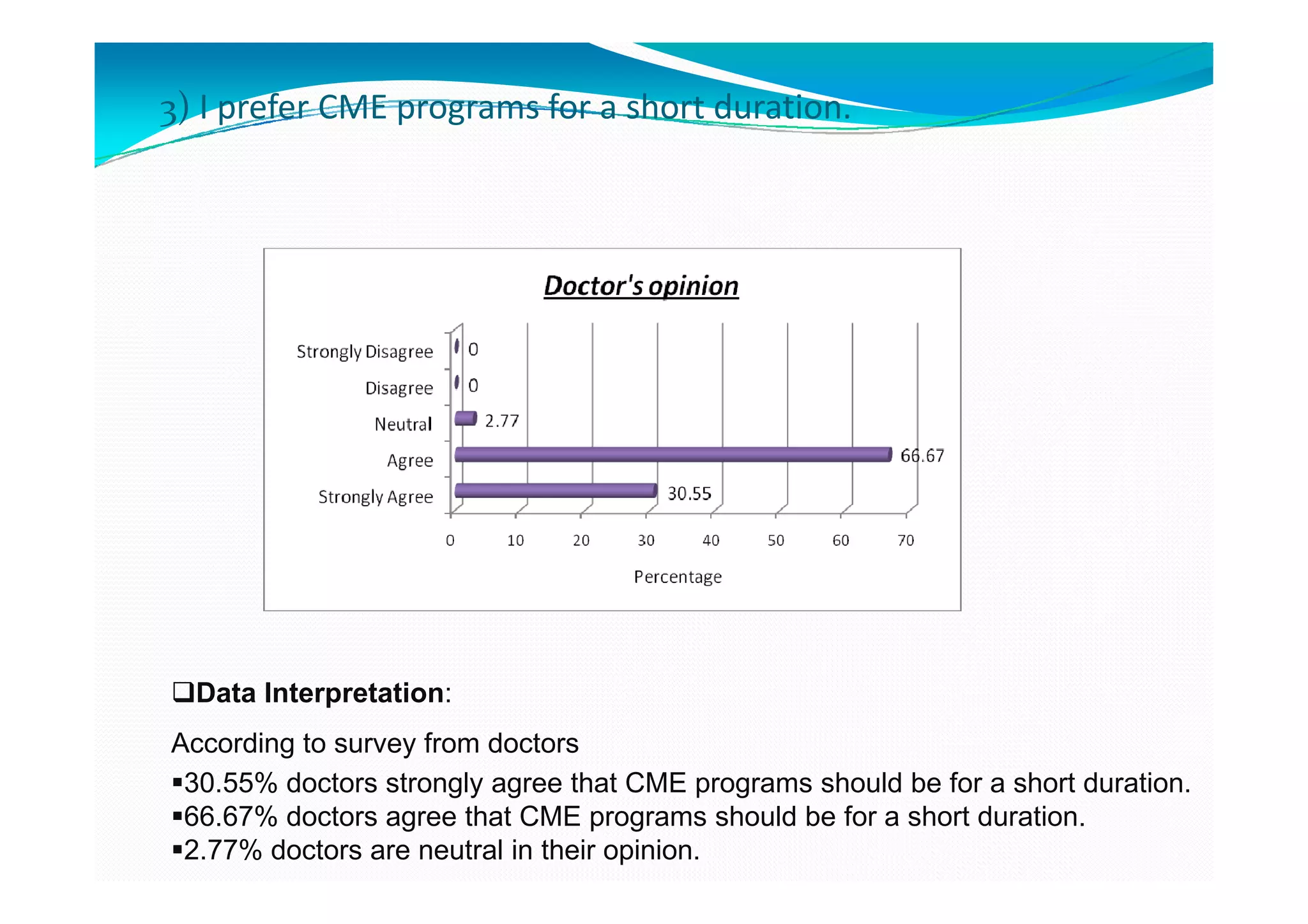
3) I prefer CME programs for a short duration.


  Data Interpretation:
According to survey from doctors
 30.55% doctors strongly agree that CME programs should be for a short duration.
 66.67% doctors agree that CME programs should be for a short duration.
 2.77% doctors are neutral in their opinion.
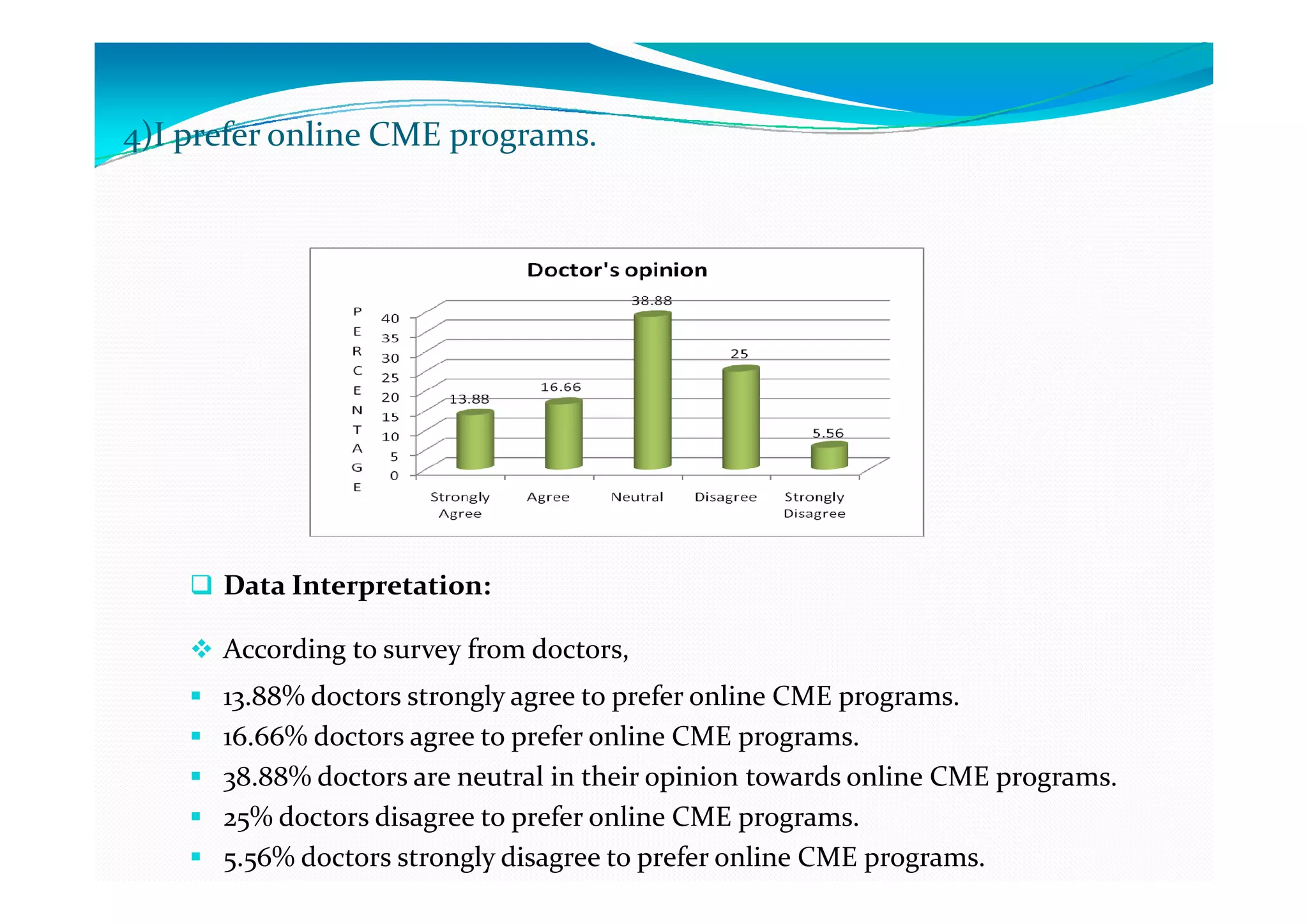
4)I prefer online CME programs.


      Data Interpretation:

      According to survey from doctors,
      13.88% doctors strongly agree to prefer online CME programs.
      16.66% doctors agree to prefer online CME programs.
      38.88% doctors are neutral in their opinion towards online CME programs.
      25% doctors disagree to prefer online CME programs.
      5.56% doctors strongly disagree to prefer online CME programs.
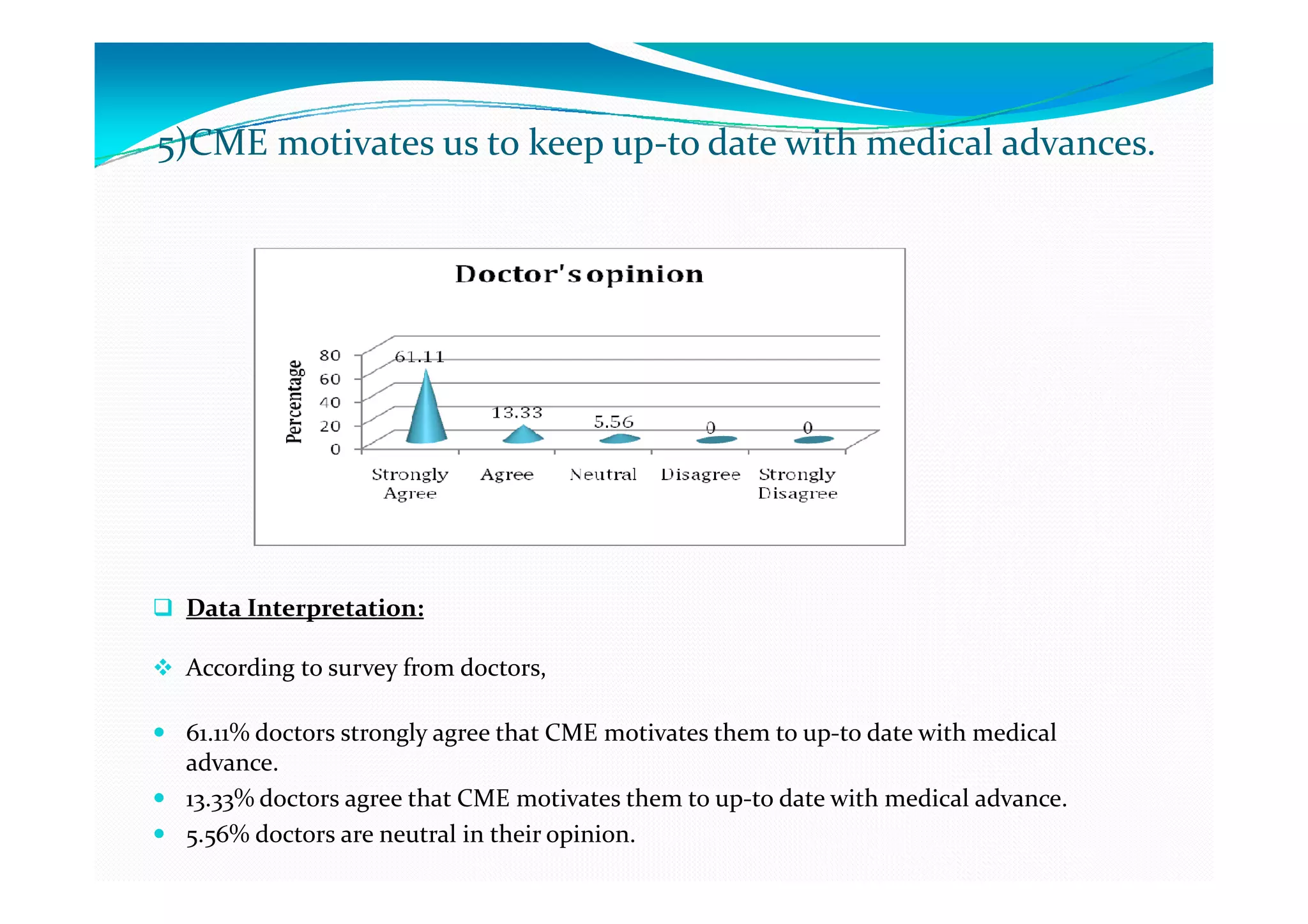
5)CME motivates us to keep up-to date with medical advances.


 Data Interpretation:

 According to survey from doctors,

 61.11% doctors strongly agree that CME motivates them to up-to date with medical
 advance.
 13.33% doctors agree that CME motivates them to up-to date with medical advance.
 5.56% doctors are neutral in their opinion.
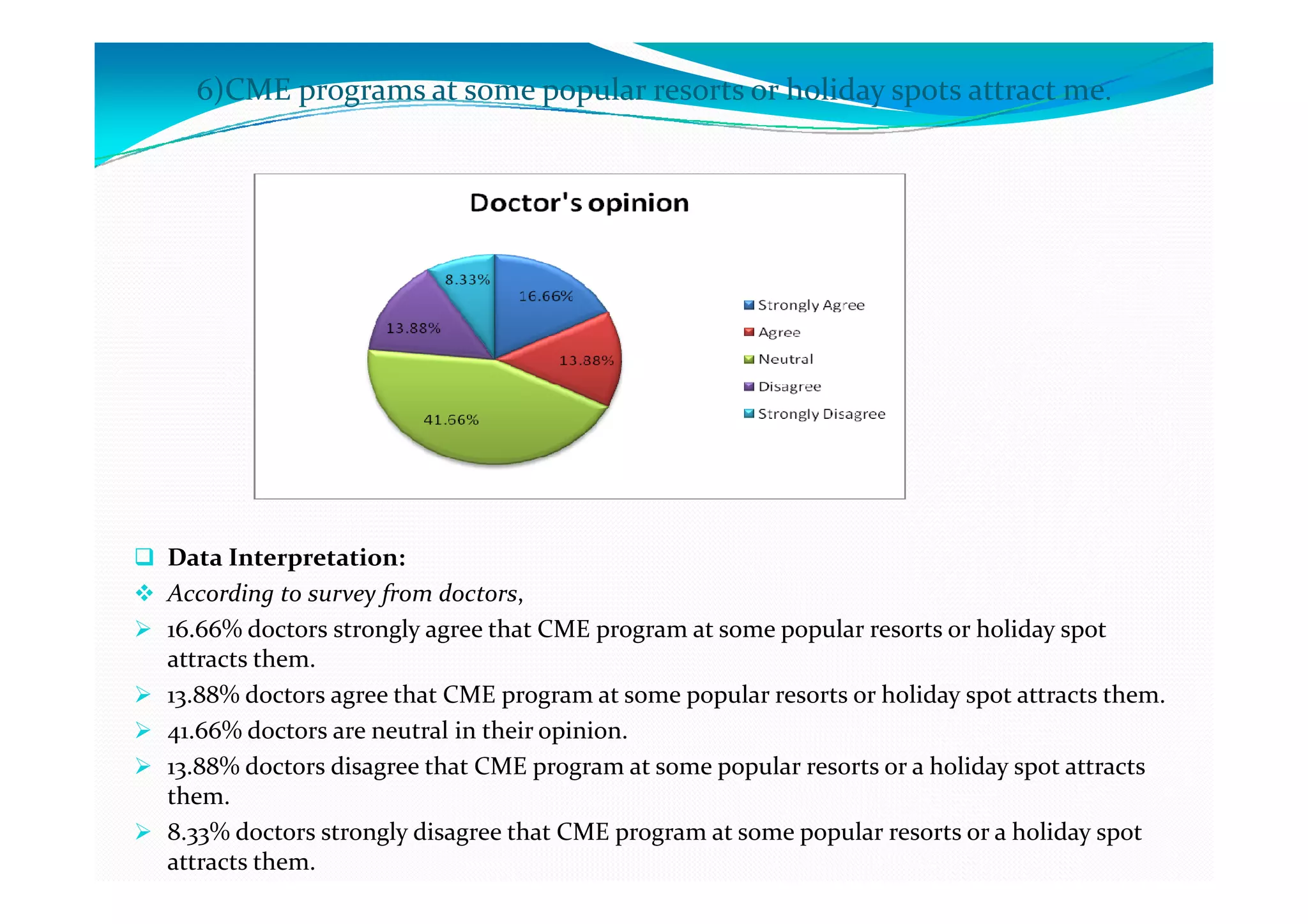
6)CME programs at some popular resorts or holiday spots attract me.


Data Interpretation:
According to survey from doctors,
16.66% doctors strongly agree that CME program at some popular resorts or holiday spot
attracts them.
13.88% doctors agree that CME program at some popular resorts or holiday spot attracts them.
41.66% doctors are neutral in their opinion.
13.88% doctors disagree that CME program at some popular resorts or a holiday spot attracts
them.
8.33% doctors strongly disagree that CME program at some popular resorts or a holiday spot
attracts them.
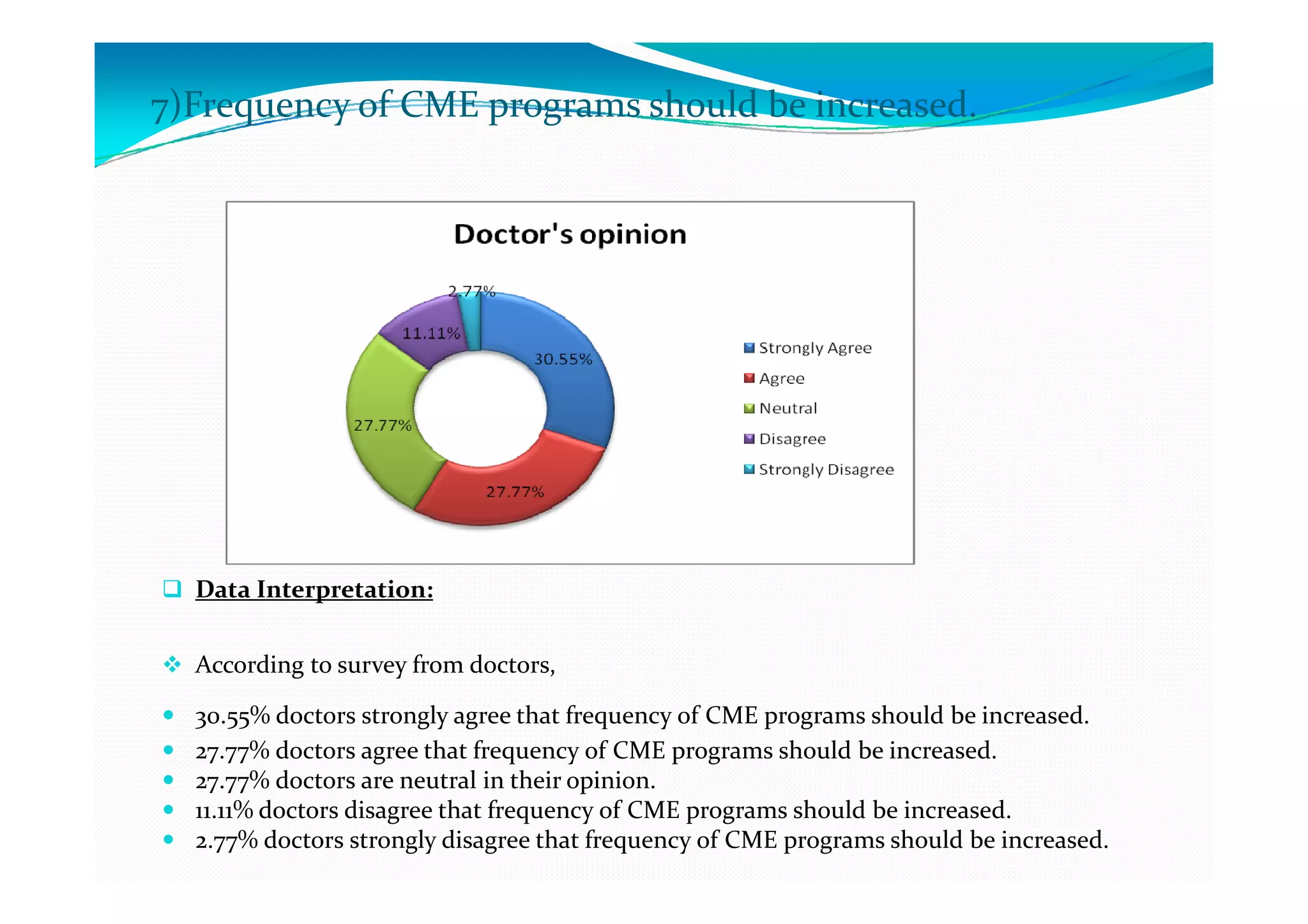
7)Frequency of CME programs should be increased.


  Data Interpretation:


  According to survey from doctors,

  30.55% doctors strongly agree that frequency of CME programs should be increased.
  27.77% doctors agree that frequency of CME programs should be increased.
  27.77% doctors are neutral in their opinion.
  11.11% doctors disagree that frequency of CME programs should be increased.
  2.77% doctors strongly disagree that frequency of CME programs should be increased.
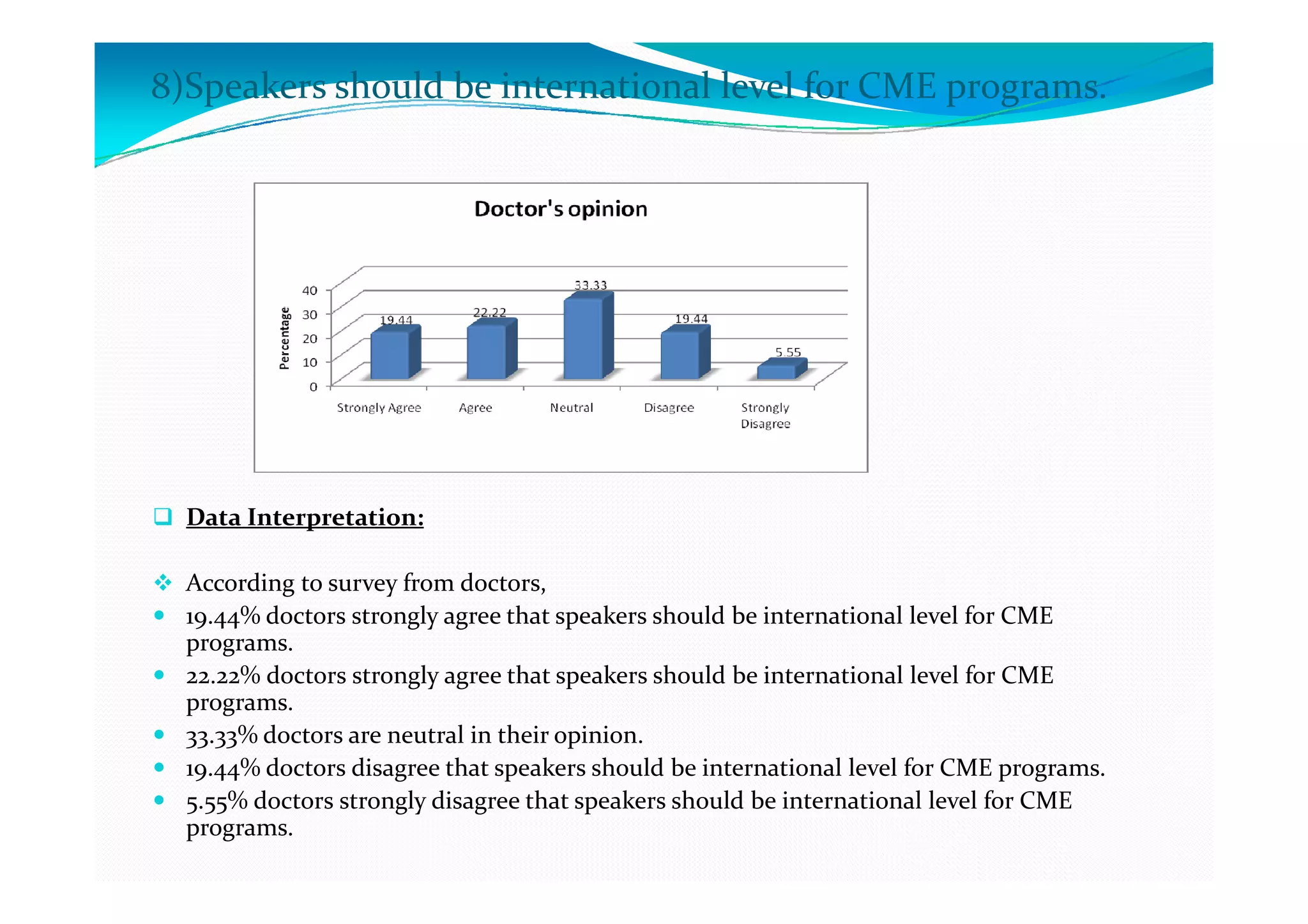
8)Speakers should be international level for CME programs.


  Data Interpretation:

  According to survey from doctors,
  19.44% doctors strongly agree that speakers should be international level for CME
  programs.
  22.22% doctors strongly agree that speakers should be international level for CME
  programs.
  33.33% doctors are neutral in their opinion.
  19.44% doctors disagree that speakers should be international level for CME programs.
  5.55% doctors strongly disagree that speakers should be international level for CME
  programs.
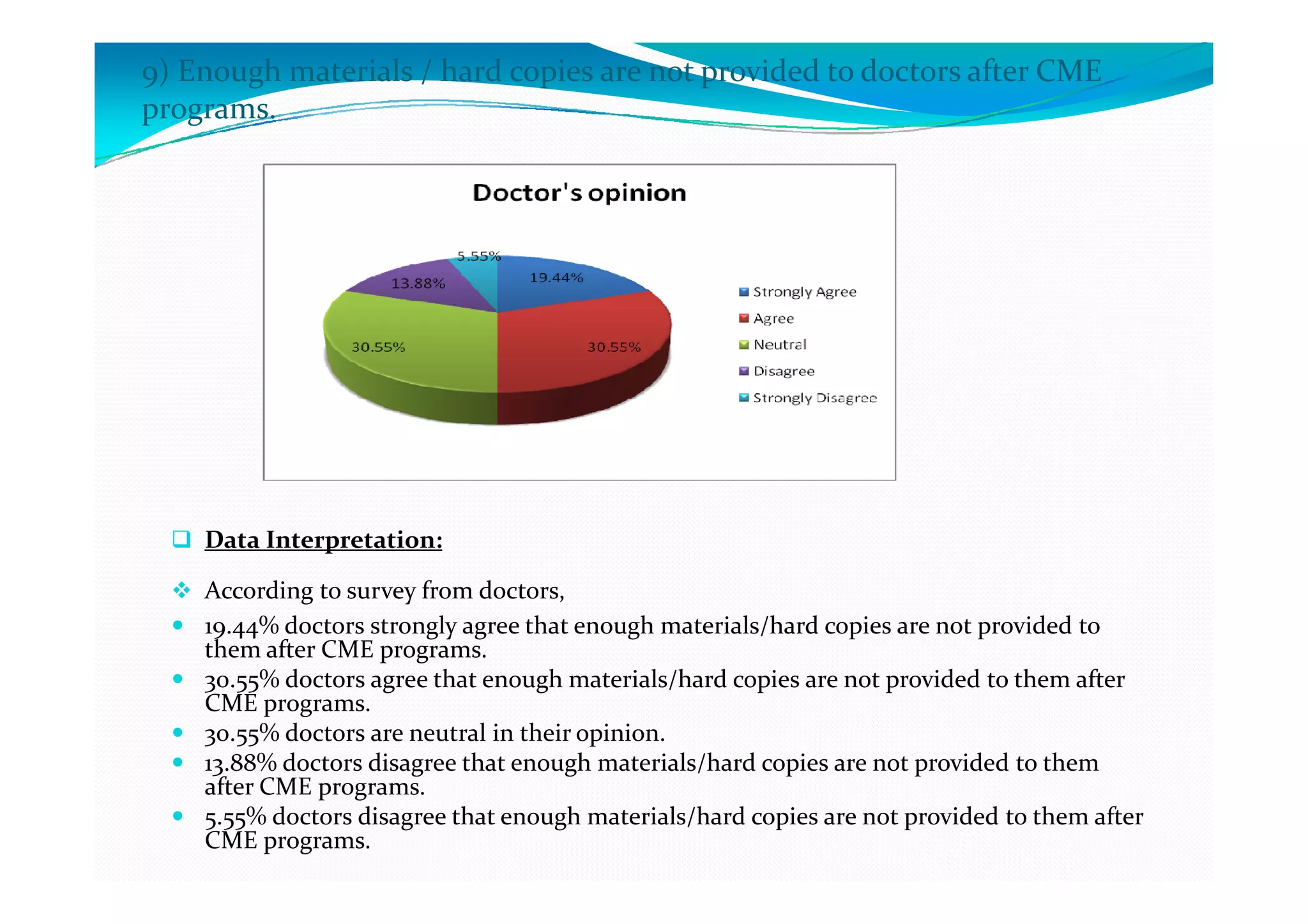
9) Enough materials / hard copies are not provided to doctors after CME
programs.


    Data Interpretation:

    According to survey from doctors,
    19.44% doctors strongly agree that enough materials/hard copies are not provided to
    them after CME programs.
    30.55% doctors agree that enough materials/hard copies are not provided to them after
    CME programs.
    30.55% doctors are neutral in their opinion.
    13.88% doctors disagree that enough materials/hard copies are not provided to them
    after CME programs.
    5.55% doctors disagree that enough materials/hard copies are not provided to them after
    CME programs.
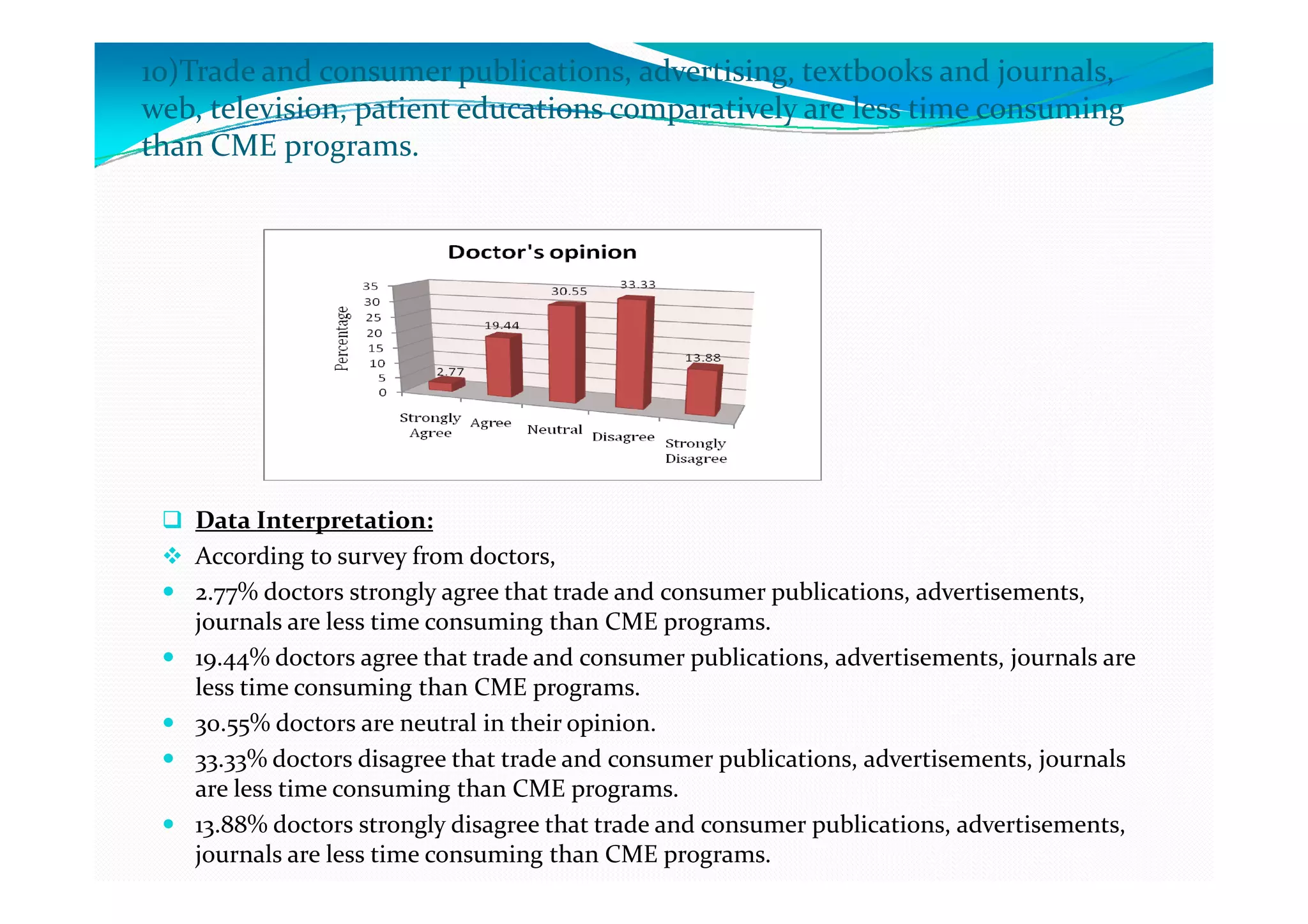
10)Trade and consumer publications, advertising, textbooks and journals,
web, television, patient educations comparatively are less time consuming
than CME programs.


    Data Interpretation:
    According to survey from doctors,
    2.77% doctors strongly agree that trade and consumer publications, advertisements,
    journals are less time consuming than CME programs.
    19.44% doctors agree that trade and consumer publications, advertisements, journals are
    less time consuming than CME programs.
    30.55% doctors are neutral in their opinion.
    33.33% doctors disagree that trade and consumer publications, advertisements, journals
    are less time consuming than CME programs.
    13.88% doctors strongly disagree that trade and consumer publications, advertisements,
    journals are less time consuming than CME programs.
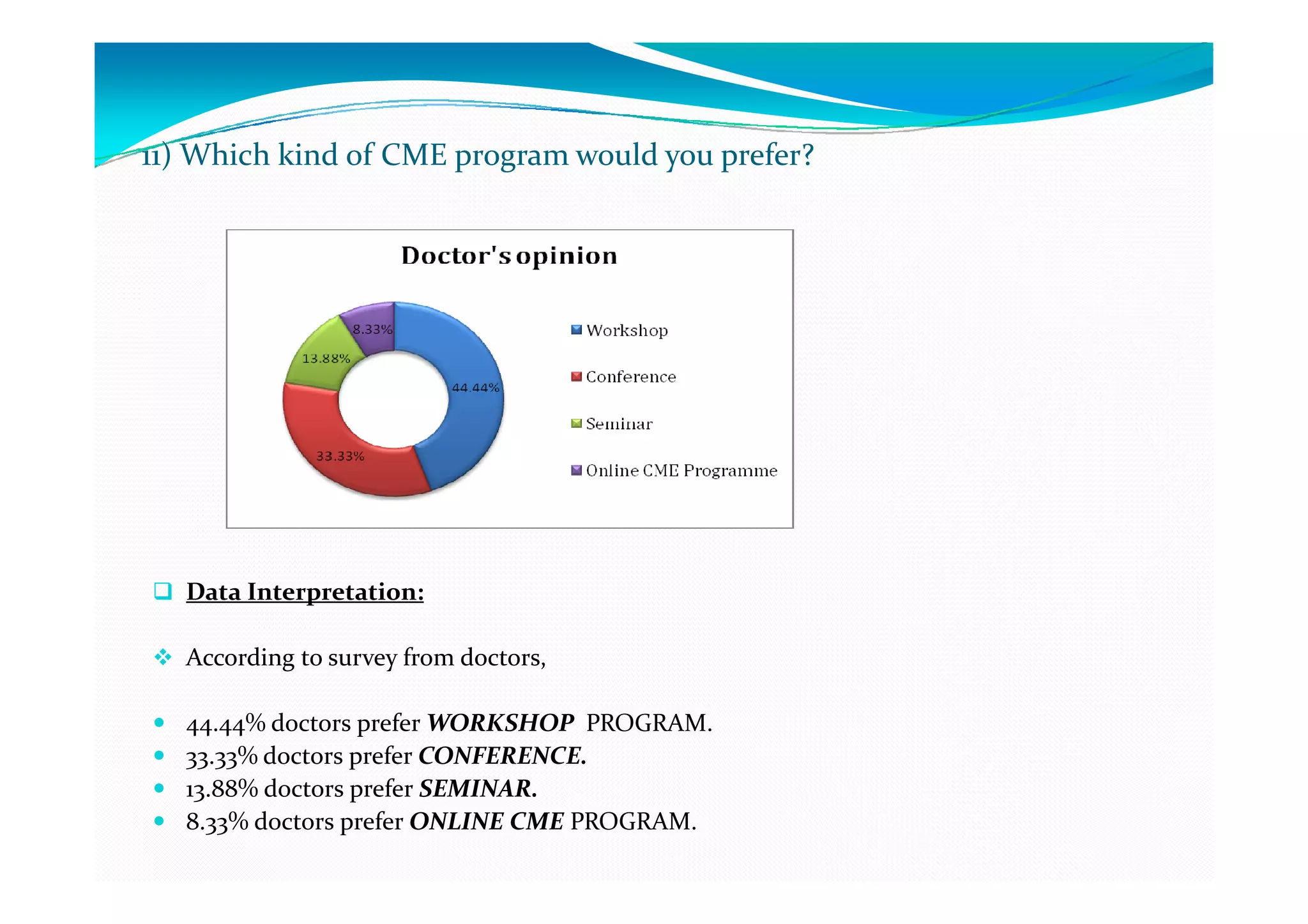
11) Which kind of CME program would you prefer?


   Data Interpretation:

   According to survey from doctors,

   44.44% doctors prefer WORKSHOP PROGRAM.
   33.33% doctors prefer CONFERENCE.
   13.88% doctors prefer SEMINAR.
   8.33% doctors prefer ONLINE CME PROGRAM.
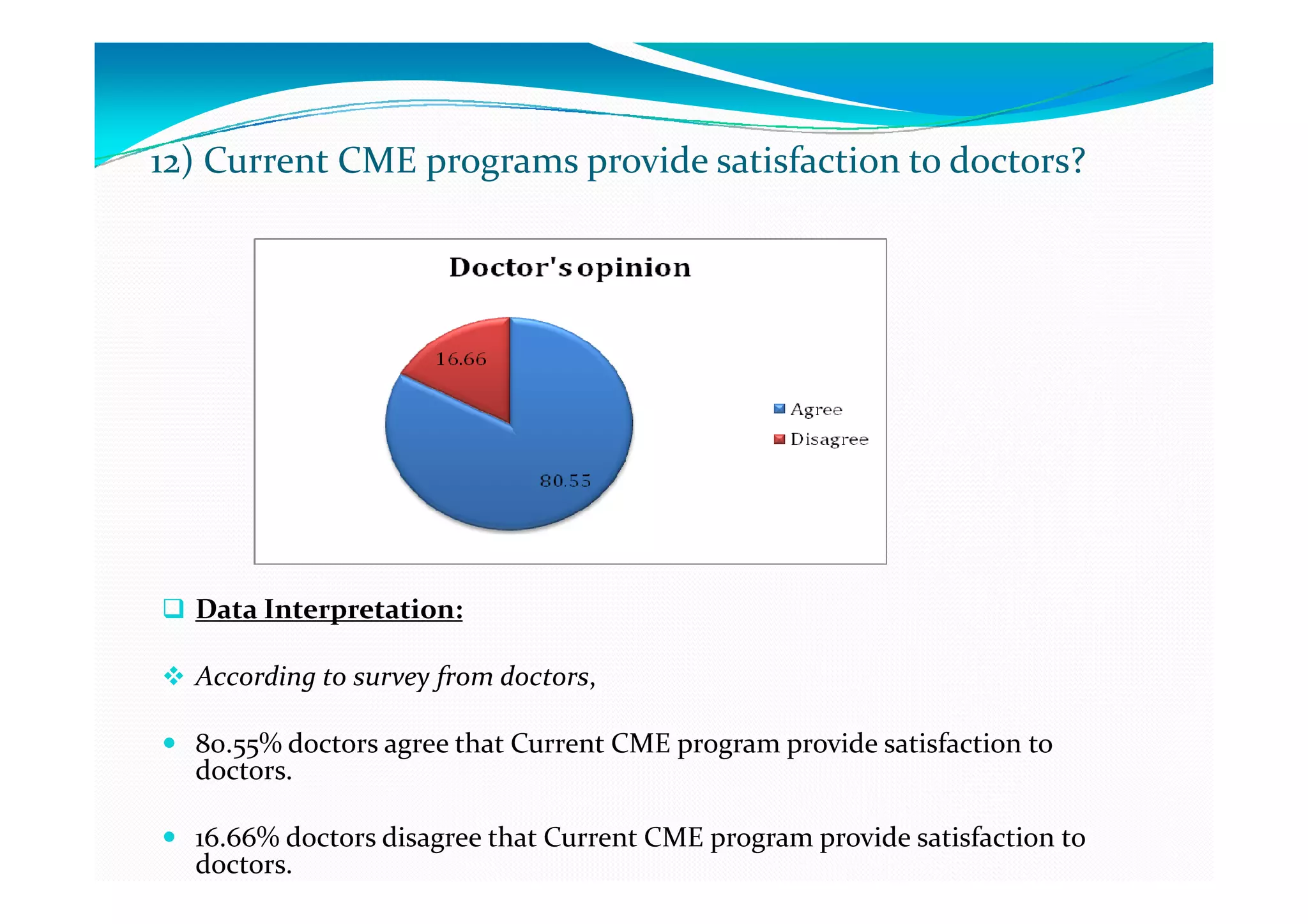
12) Current CME programs provide satisfaction to doctors?


  Data Interpretation:

  According to survey from doctors,

  80.55% doctors agree that Current CME program provide satisfaction to
  doctors.

  16.66% doctors disagree that Current CME program provide satisfaction to
  doctors.
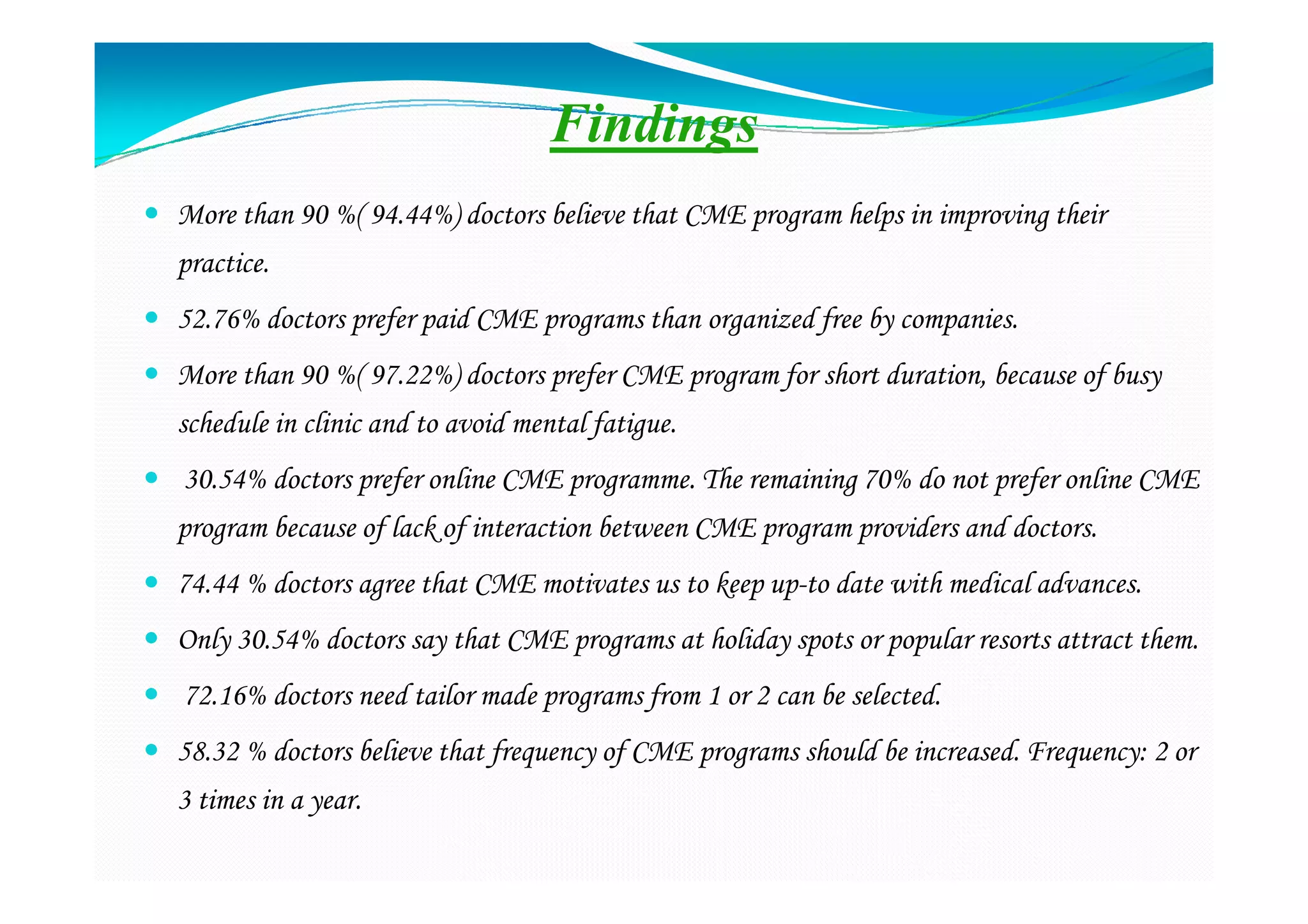
Findings
More than 90 %( 94.44%) doctors believe that CME program helps in improving their
practice.
52.76% doctors prefer paid CME programs than organized free by companies.
More than 90 %( 97.22%) doctors prefer CME program for short duration, because of busy
schedule in clinic and to avoid mental fatigue.
30.54% doctors prefer online CME programme. The remaining 70% do not prefer online CME
program because of lack of interaction between CME program providers and doctors.
74.44 % doctors agree that CME motivates us to keep up-to date with medical advances.
Only 30.54% doctors say that CME programs at holiday spots or popular resorts attract them.
72.16% doctors need tailor made programs from 1 or 2 can be selected.
58.32 % doctors believe that frequency of CME programs should be increased. Frequency: 2 or
3 times in a year.
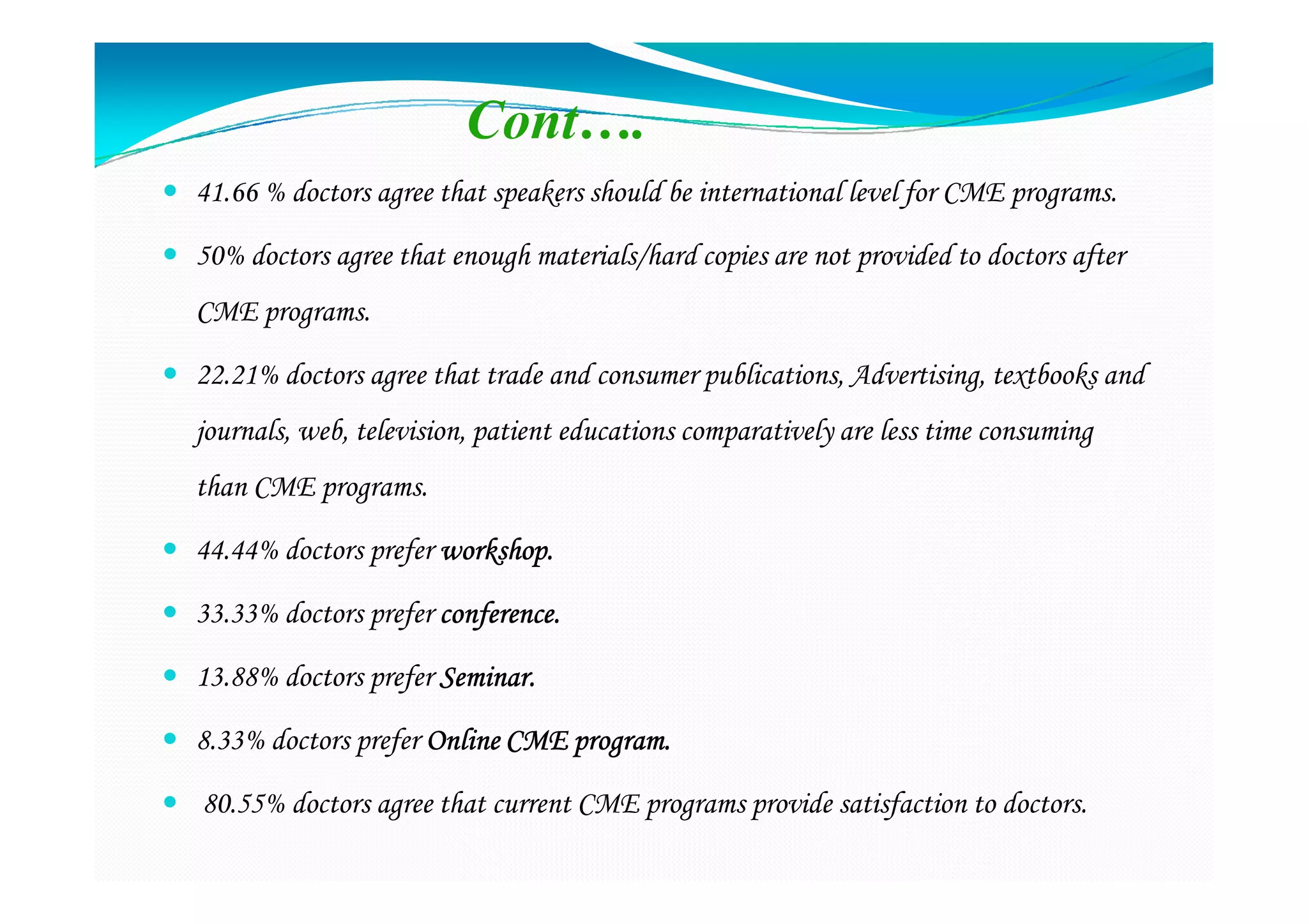
Cont….
41.66 % doctors agree that speakers should be international level for CME programs.

50% doctors agree that enough materials/hard copies are not provided to doctors after
CME programs.

22.21% doctors agree that trade and consumer publications, Advertising, textbooks and
journals, web, television, patient educations comparatively are less time consuming
than CME programs.

44.44% doctors prefer workshop.

33.33% doctors prefer conference.

13.88% doctors prefer Seminar.

8.33% doctors prefer Online CME program.

80.55% doctors agree that current CME programs provide satisfaction to doctors.
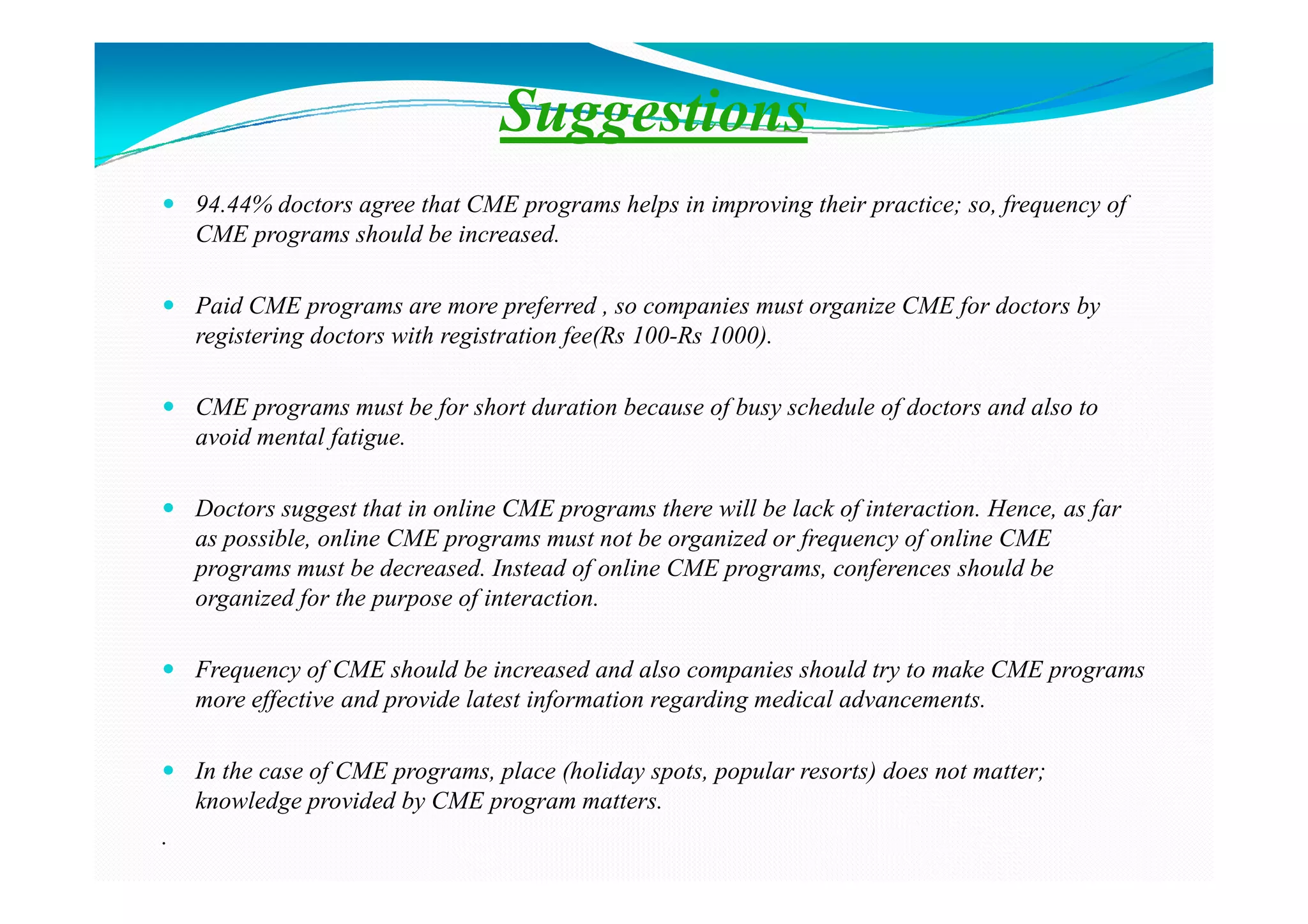
Suggestions
    94.44% doctors agree that CME programs helps in improving their practice; so, frequency of
    CME programs should be increased.

    Paid CME programs are more preferred , so companies must organize CME for doctors by
    registering doctors with registration fee(Rs 100-Rs 1000).

    CME programs must be for short duration because of busy schedule of doctors and also to
    avoid mental fatigue.

    Doctors suggest that in online CME programs there will be lack of interaction. Hence, as far
    as possible, online CME programs must not be organized or frequency of online CME
    programs must be decreased. Instead of online CME programs, conferences should be
    organized for the purpose of interaction.

    Frequency of CME should be increased and also companies should try to make CME programs
    more effective and provide latest information regarding medical advancements.

    In the case of CME programs, place (holiday spots, popular resorts) does not matter;
    knowledge provided by CME program matters.
.
Cont….
     A list of programs, e.g., neuro, and cardiac, renal, hepatic, etc. tailor made CME
     programs can be given to doctors, so as to make their own choice and make CME
     programs more doctors friendly .

     Good speakers are required in CME programs.

     Doctors need regular programs with academic touch.

     CME programs should be more interactive and Brain storming rather than having lecture
     type CME program.

     Companies should also take care of some related services during CME programs. The
     most prominent ones are

a)     Provide quality and hygiene food.

b)     Good hall with best ventilation and lighting.

c)     Minimum financial support.

d)     Good time schedule without disturbing their practice and personal commitments.
Conclusions

It is well-known to all that CME programs play a major role in
pharmaceutical marketing. It takes a dual role in pharmaceutical
marketing. It takes a dual role in creating awareness about the new
molecules and brands and also helps in improving the medical
practice of doctors to a greater extent. It is a tool that doctors
depend on to update their knowledge towards ongoing researches
and developments. So, this project is carried out to understand the
expectations of doctors from pharma companies in organizing
better, efficient CME programs. It is clear through the survey that
every doctor likes to attend CME programs and companies have to
concentrate more on deciding the content and schedule to suit the
practioner’s need.
Strengths of study


Captured feedback from physicians themselves.

Low cost.

Quantifiable Data; not labor intensive.

Rapid results.
Limitations


 Busy schedule of doctors.


 Wrong perception of doctors.


 Rush of patients to the clinic.


 Unwillingness of respondents to answer the asked questions due to boredom or lack
of time. Hence some of them have answered haphazardly or randomly.


 Limited time, region and limited sample size restricts this project to be generalized.
BIBLIOGRAPHY


1) Davis DA, Thomson MA, Oxman AD, Haynes RB. Evidence for the
   effectiveness of CME. A review of 50 randomized controlled trials.
   JAMA. 1992;268(9):1111-1117.

2) Thomson. February, 2002. Thomson Job Impact Study: The Next
   Generation of Corporate Learning.

3) Todesco A. September 1997. From Training Evaluation to Outcome
   Assessment: What Trends and Best Practices Tell Us. The Research
   Center. http://learnet.gc.ca.

4) Davis D, et al. Impact of Formal Continuing Medical Education: Do
   Conferences, Workshops, Rounds, and Other Traditional Continuing
   Education Activities Change Physician Behavior on Health Care
   Outcomes? JAMA.1999;282(9):867-874.
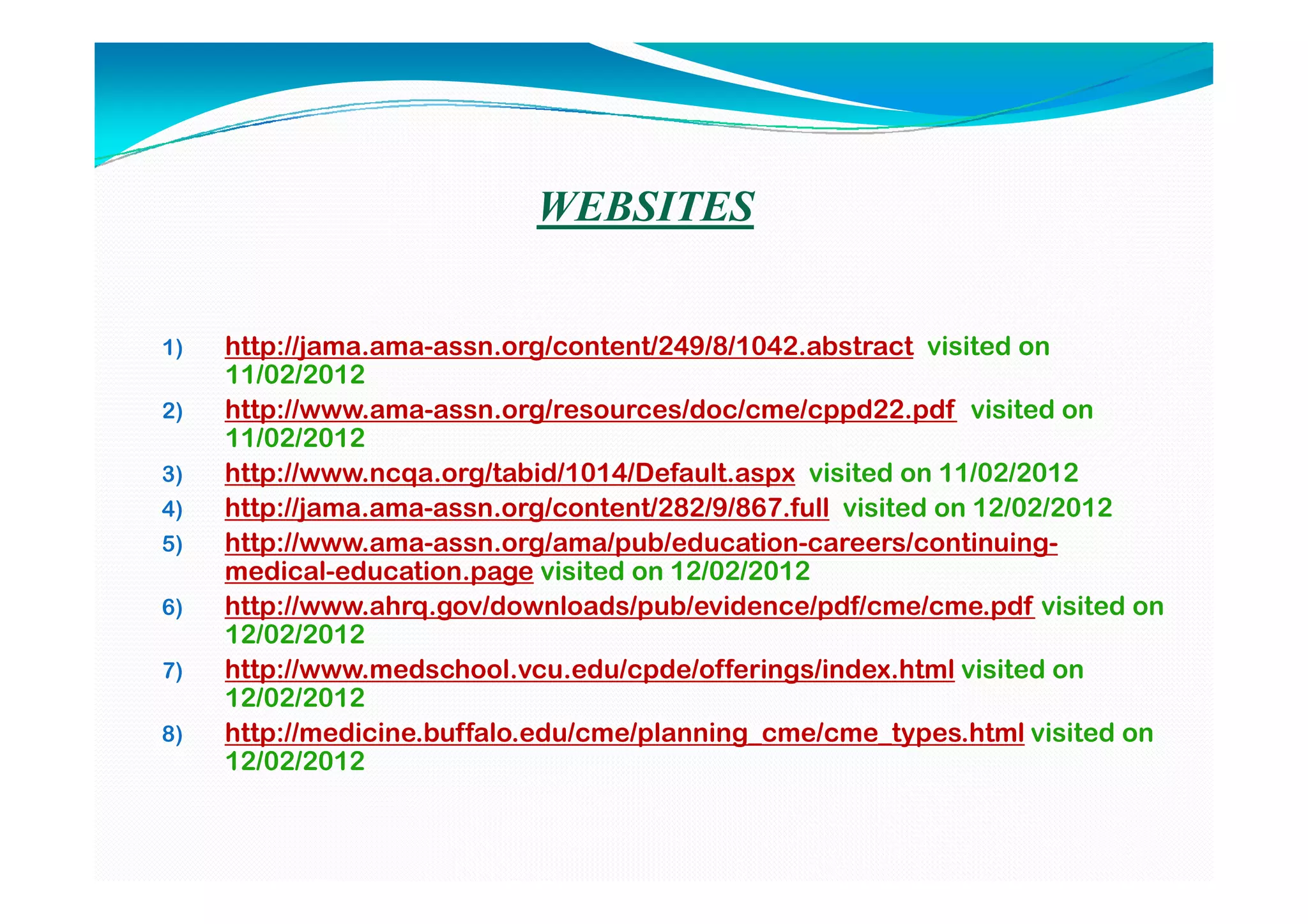
WEBSITES


1)   http://jama.ama-assn.org/content/249/8/1042.abstract visited on
     11/02/2012
2)   http://www.ama-assn.org/resources/doc/cme/cppd22.pdf visited on
     11/02/2012
3)   http://www.ncqa.org/tabid/1014/Default.aspx visited on 11/02/2012
4)   http://jama.ama-assn.org/content/282/9/867.full visited on 12/02/2012
5)   http://www.ama-assn.org/ama/pub/education-careers/continuing-
     medical-education.page visited on 12/02/2012
6)   http://www.ahrq.gov/downloads/pub/evidence/pdf/cme/cme.pdf visited on
     12/02/2012
7)   http://www.medschool.vcu.edu/cpde/offerings/index.html visited on
     12/02/2012
8)   http://medicine.buffalo.edu/cme/planning_cme/cme_types.html visited on
     12/02/2012
A study on_effect_of_cme_programs_in_improving_doctors_medical_practice[1]

A study on_effect_of_cme_programs_in_improving_doctors_medical_practice[1]

  • 1.
    BHAVIK AMIN EXAM NO :05 B PHARM SEMESTER 8 KBIPER PROJECT GUIDE MRS. MALLIKA BABU IN-CHARGE OF DEPARTMENT OF MBA(PHARMA) KBIPER, KSVV,GANDHINAGAR
  • 2.
    FLOW OF PRESENTATION Introductionto CME program Review of literature Objectives of CME program Research methodology Data Interpretation and Analysis Findings Suggestions Conclusions Strengths and Limitations Bibliography
  • 3.
    Introduction about project Definition and overview • Both the Accreditation Council for Continuing Medical Education (ACCME) and the American Medical Association define CME as “educational activities which serve to maintain, develop, or increase the knowledge, skills, and professional performance and relationships that a physician uses to provide services for patients, the public, or the profession”.
  • 4.
    CME represents thatbody of knowledge and skills generally recognized and accepted by the profession as within the basic medical sciences, the discipline of clinical medicine, and the provision of health care to the public. Continuing medical education (CME) refers to a specific form of continuing education (CE) that helps those in the medical field maintain competence and learn about new and developing areas of their field. These activities may take place as live events, written publications, online programs, audio, video, or other electronic media. CME activities are developed and delivered by a variety of organizations, including: Professional Associations Medical Education Agencies Hospitals Educational institutions, including universities, medical and nursing schools.
  • 5.
    Characteristics of CMEprogram Focus: Physician competence, performance, and patient outcomes. Format: Variable, emphasis on principles of adult learning (E.g. interactive, relevant to practice techniques). Funding: Industry decreasing under influence of AAMC, IOM, Macy Foundation and Pharma. Evidence of effectiveness: CME-effective in acquisition of Knowledge, skills, and performance, but low-quality evidence. Emergence of performance improvement CME (PI-CME).
  • 6.
    Review of literature CMEtechniques that are more effective Interactive learning. Sequenced sessions (CME as a “campaign”, not just one-time only sessions). Accurate Needs Assessment (e.g. based upon measured practice gaps compared with national guidelines) Experiential learning (based upon an individual’s or group’s practice, e.g. PI- CME projects).
  • 7.
    Meaning of CME:Continuing medical education is that process within the scope of family medicine which provides information and activities designed to maintain and improve the ability of the family physician to provide high quality patient care. This educational process encompasses all the areas usually encountered by the family physician necessary to carry out these responsibilities. The benefits that are gained from a CME course for physician It makes sure that their personal satisfaction from the job they are doing is maintained without any interruptions. With such courses they can get new skills and also these helps the physician to become more efficient in their work. And they can work better than ever.
  • 8.
    Objectives of CMEprogram To provide educational activities to physicians and other healthcare professionals that reinforce basic medical knowledge. To introduce new ideas, skills and technology and spread research findings in order to improve the quality of healthcare that is delivered by the participants in CME programs. To provide lifelong learning opportunities to physicians and other health care providers that aim to increase competence, enhance practice performance, and improve the health care status of patients. To suggest ways to make CME more doctor friendly. To understand the frequency needed for CME program. To understand the doctor’s expectation from CME program.
  • 9.
    Research methodology DATA COLLECTIONSOURCES PRIMARY DATA Primary data is gathered from fieldwork (by using questionnaire). Duration of Study - 3 months Target Population - Doctors Sample Size - 36 Sampling Technique - Convenience sampling Sampling Unit - Ahmedabad
  • 10.
    SECONDARY DATA •Secondary datais gathered from internet & books. •It is valuable source of new ideas that can be explored later through primary research. Research Design: Conclusive Type
  • 11.
    Analysis and DataInterpretation 1) CME programs helps in improving our practice. Data Interpretation: According to survey from doctors, 55.56 % Doctors Strongly Agee that CME Programs help in improving their practice. 38.88% Doctors agree that CME Programs help in improving their practice 5.56% Doctors are neutral.
  • 12.
    2) I preferpaid CME programs than organized free by companies. Data Interpretation: According to survey from doctors, 13.88 % Doctors strongly agree to prefer with paid CME programs than organized free by companies. 38.88% Doctors agree to prefer with paid CME programs than organized free by companies. 33.33% Doctors are neutral in their opinion. 13.88 % Doctors disagree to prefer with paid CME programs than organized free by companies.
  • 13.
    3) I preferCME programs for a short duration. Data Interpretation: According to survey from doctors 30.55% doctors strongly agree that CME programs should be for a short duration. 66.67% doctors agree that CME programs should be for a short duration. 2.77% doctors are neutral in their opinion.
  • 14.
    4)I prefer onlineCME programs. Data Interpretation: According to survey from doctors, 13.88% doctors strongly agree to prefer online CME programs. 16.66% doctors agree to prefer online CME programs. 38.88% doctors are neutral in their opinion towards online CME programs. 25% doctors disagree to prefer online CME programs. 5.56% doctors strongly disagree to prefer online CME programs.
  • 15.
    5)CME motivates usto keep up-to date with medical advances. Data Interpretation: According to survey from doctors, 61.11% doctors strongly agree that CME motivates them to up-to date with medical advance. 13.33% doctors agree that CME motivates them to up-to date with medical advance. 5.56% doctors are neutral in their opinion.
  • 16.
    6)CME programs atsome popular resorts or holiday spots attract me. Data Interpretation: According to survey from doctors, 16.66% doctors strongly agree that CME program at some popular resorts or holiday spot attracts them. 13.88% doctors agree that CME program at some popular resorts or holiday spot attracts them. 41.66% doctors are neutral in their opinion. 13.88% doctors disagree that CME program at some popular resorts or a holiday spot attracts them. 8.33% doctors strongly disagree that CME program at some popular resorts or a holiday spot attracts them.
  • 17.
    7)Frequency of CMEprograms should be increased. Data Interpretation: According to survey from doctors, 30.55% doctors strongly agree that frequency of CME programs should be increased. 27.77% doctors agree that frequency of CME programs should be increased. 27.77% doctors are neutral in their opinion. 11.11% doctors disagree that frequency of CME programs should be increased. 2.77% doctors strongly disagree that frequency of CME programs should be increased.
  • 18.
    8)Speakers should beinternational level for CME programs. Data Interpretation: According to survey from doctors, 19.44% doctors strongly agree that speakers should be international level for CME programs. 22.22% doctors strongly agree that speakers should be international level for CME programs. 33.33% doctors are neutral in their opinion. 19.44% doctors disagree that speakers should be international level for CME programs. 5.55% doctors strongly disagree that speakers should be international level for CME programs.
  • 19.
    9) Enough materials/ hard copies are not provided to doctors after CME programs. Data Interpretation: According to survey from doctors, 19.44% doctors strongly agree that enough materials/hard copies are not provided to them after CME programs. 30.55% doctors agree that enough materials/hard copies are not provided to them after CME programs. 30.55% doctors are neutral in their opinion. 13.88% doctors disagree that enough materials/hard copies are not provided to them after CME programs. 5.55% doctors disagree that enough materials/hard copies are not provided to them after CME programs.
  • 20.
    10)Trade and consumerpublications, advertising, textbooks and journals, web, television, patient educations comparatively are less time consuming than CME programs. Data Interpretation: According to survey from doctors, 2.77% doctors strongly agree that trade and consumer publications, advertisements, journals are less time consuming than CME programs. 19.44% doctors agree that trade and consumer publications, advertisements, journals are less time consuming than CME programs. 30.55% doctors are neutral in their opinion. 33.33% doctors disagree that trade and consumer publications, advertisements, journals are less time consuming than CME programs. 13.88% doctors strongly disagree that trade and consumer publications, advertisements, journals are less time consuming than CME programs.
  • 21.
    11) Which kindof CME program would you prefer? Data Interpretation: According to survey from doctors, 44.44% doctors prefer WORKSHOP PROGRAM. 33.33% doctors prefer CONFERENCE. 13.88% doctors prefer SEMINAR. 8.33% doctors prefer ONLINE CME PROGRAM.
  • 22.
    12) Current CMEprograms provide satisfaction to doctors? Data Interpretation: According to survey from doctors, 80.55% doctors agree that Current CME program provide satisfaction to doctors. 16.66% doctors disagree that Current CME program provide satisfaction to doctors.
  • 23.
    Findings More than 90%( 94.44%) doctors believe that CME program helps in improving their practice. 52.76% doctors prefer paid CME programs than organized free by companies. More than 90 %( 97.22%) doctors prefer CME program for short duration, because of busy schedule in clinic and to avoid mental fatigue. 30.54% doctors prefer online CME programme. The remaining 70% do not prefer online CME program because of lack of interaction between CME program providers and doctors. 74.44 % doctors agree that CME motivates us to keep up-to date with medical advances. Only 30.54% doctors say that CME programs at holiday spots or popular resorts attract them. 72.16% doctors need tailor made programs from 1 or 2 can be selected. 58.32 % doctors believe that frequency of CME programs should be increased. Frequency: 2 or 3 times in a year.
  • 24.
    Cont…. 41.66 % doctorsagree that speakers should be international level for CME programs. 50% doctors agree that enough materials/hard copies are not provided to doctors after CME programs. 22.21% doctors agree that trade and consumer publications, Advertising, textbooks and journals, web, television, patient educations comparatively are less time consuming than CME programs. 44.44% doctors prefer workshop. 33.33% doctors prefer conference. 13.88% doctors prefer Seminar. 8.33% doctors prefer Online CME program. 80.55% doctors agree that current CME programs provide satisfaction to doctors.
  • 25.
    Suggestions 94.44% doctors agree that CME programs helps in improving their practice; so, frequency of CME programs should be increased. Paid CME programs are more preferred , so companies must organize CME for doctors by registering doctors with registration fee(Rs 100-Rs 1000). CME programs must be for short duration because of busy schedule of doctors and also to avoid mental fatigue. Doctors suggest that in online CME programs there will be lack of interaction. Hence, as far as possible, online CME programs must not be organized or frequency of online CME programs must be decreased. Instead of online CME programs, conferences should be organized for the purpose of interaction. Frequency of CME should be increased and also companies should try to make CME programs more effective and provide latest information regarding medical advancements. In the case of CME programs, place (holiday spots, popular resorts) does not matter; knowledge provided by CME program matters. .
  • 26.
    Cont…. A list of programs, e.g., neuro, and cardiac, renal, hepatic, etc. tailor made CME programs can be given to doctors, so as to make their own choice and make CME programs more doctors friendly . Good speakers are required in CME programs. Doctors need regular programs with academic touch. CME programs should be more interactive and Brain storming rather than having lecture type CME program. Companies should also take care of some related services during CME programs. The most prominent ones are a) Provide quality and hygiene food. b) Good hall with best ventilation and lighting. c) Minimum financial support. d) Good time schedule without disturbing their practice and personal commitments.
  • 27.
    Conclusions It is well-knownto all that CME programs play a major role in pharmaceutical marketing. It takes a dual role in pharmaceutical marketing. It takes a dual role in creating awareness about the new molecules and brands and also helps in improving the medical practice of doctors to a greater extent. It is a tool that doctors depend on to update their knowledge towards ongoing researches and developments. So, this project is carried out to understand the expectations of doctors from pharma companies in organizing better, efficient CME programs. It is clear through the survey that every doctor likes to attend CME programs and companies have to concentrate more on deciding the content and schedule to suit the practioner’s need.
  • 28.
    Strengths of study Capturedfeedback from physicians themselves. Low cost. Quantifiable Data; not labor intensive. Rapid results.
  • 29.
    Limitations Busy scheduleof doctors. Wrong perception of doctors. Rush of patients to the clinic. Unwillingness of respondents to answer the asked questions due to boredom or lack of time. Hence some of them have answered haphazardly or randomly. Limited time, region and limited sample size restricts this project to be generalized.
  • 30.
    BIBLIOGRAPHY 1) Davis DA,Thomson MA, Oxman AD, Haynes RB. Evidence for the effectiveness of CME. A review of 50 randomized controlled trials. JAMA. 1992;268(9):1111-1117. 2) Thomson. February, 2002. Thomson Job Impact Study: The Next Generation of Corporate Learning. 3) Todesco A. September 1997. From Training Evaluation to Outcome Assessment: What Trends and Best Practices Tell Us. The Research Center. http://learnet.gc.ca. 4) Davis D, et al. Impact of Formal Continuing Medical Education: Do Conferences, Workshops, Rounds, and Other Traditional Continuing Education Activities Change Physician Behavior on Health Care Outcomes? JAMA.1999;282(9):867-874.
  • 31.
    WEBSITES 1) http://jama.ama-assn.org/content/249/8/1042.abstract visited on 11/02/2012 2) http://www.ama-assn.org/resources/doc/cme/cppd22.pdf visited on 11/02/2012 3) http://www.ncqa.org/tabid/1014/Default.aspx visited on 11/02/2012 4) http://jama.ama-assn.org/content/282/9/867.full visited on 12/02/2012 5) http://www.ama-assn.org/ama/pub/education-careers/continuing- medical-education.page visited on 12/02/2012 6) http://www.ahrq.gov/downloads/pub/evidence/pdf/cme/cme.pdf visited on 12/02/2012 7) http://www.medschool.vcu.edu/cpde/offerings/index.html visited on 12/02/2012 8) http://medicine.buffalo.edu/cme/planning_cme/cme_types.html visited on 12/02/2012