A Storytelling Model for Educational Games R. Champagnat , G. Delmas, M. Augeraud
Outline L3i background Interactive storytelling and games A software architecture for Interactive Storytelling A structure for Interactive Storytelling Examples septembre 08 STEG 2008
L3i background  (1) ImagIN research team : Digital Interaction and Image Interactive Storytelling (Software Engineering point of view) Model and design Management (control) of player’s behaviour Adapt the unfolding of the activity septembre 08 STEG 2008
L3i background  (2) Fields of interest Interactive Storytelling games G a me for autistic children Projects  RobAutiSTIC, FT Autistic PLUG PAVU septembre 08 STEG 2008 G ame scenarios and interaction
Outline L3i background Interactive storytelling and games A software architecture for Interactive Storytelling A structure for Interactive Storytelling Examples septembre 08 STEG 2008
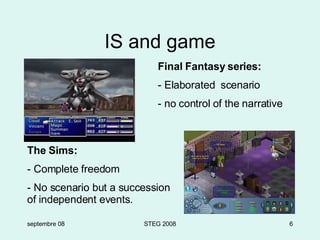
IS and game septembre 08 STEG 2008 Final Fantasy series: - Elaborated  scenario - no control of the narrative The Sims: - Complete freedom - No scenario but a succession of independent events.
Scenario oriented The game is based on a prewritten scenario. The game monitors player’s behaviour and prevents him from breaking storyline. septembre 08 STEG 2008
Emergent narrative No story written, but a game full of autonomous agents (characters). The story emerges from a sequence of interaction between the player and agents. septembre 08 STEG 2008
Outline L3i background Interactive storytelling and games A software architecture for Interactive Storytelling A structure for Interactive Storytelling Examples septembre 08 STEG 2008
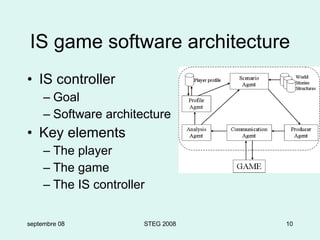
IS game software architecture IS controller Goal Software architecture Key elements The player The game The IS controller septembre 08 STEG 2008
Outline L3i background Interactive storytelling and games A software architecture for Interactive Storytelling A structure for Interactive Storytelling Examples septembre 08 STEG 2008
A structure for IS Difficulty to find a conciliation between interactivity and narration. Role playing game background Key ideas: Do not control the unfolding but its structure Dynamic design of the story Well suited for learning septembre 08 STEG 2008
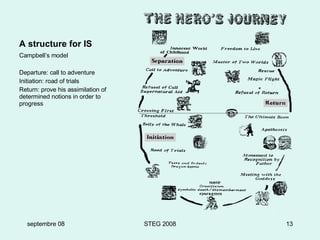
A structure for IS Campbell’s model Departure: call to adventure Initiation: road of trials Return:  prove his assimilation of determined notions in order to progress septembre 08 STEG 2008
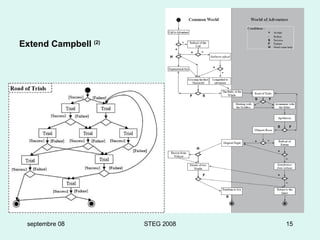
Extend Campbell  (1) Limits of interactivity Campbell structure for IS game Requirements Two worlds Key figures and symbolic Imply the player at every time Enact every act or choice from the player Adapt to player’s abilities septembre 08 STEG 2008
Extend Campbell  (2) septembre 08 STEG 2008
Outline L3i background Interactive storytelling and games A software architecture for Interactive Storytelling A structure for Interactive Storytelling Examples septembre 08 STEG 2008
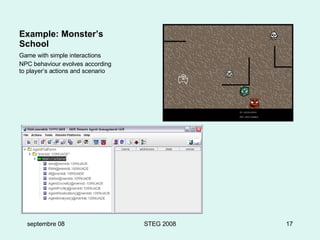
Example: Monster’s School Game with simple interactions NPC behaviour evolves according to player’s actions and scenario septembre 08 STEG 2008
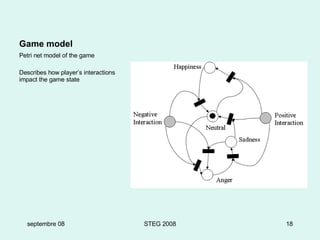
G a me model Petri net model of the game Describes how player’s interactions impact the game state septembre 08 STEG 2008
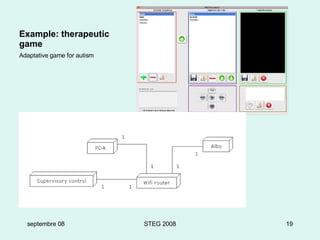
Example: therapeutic game Adaptative game for autism septembre 08 STEG 2008
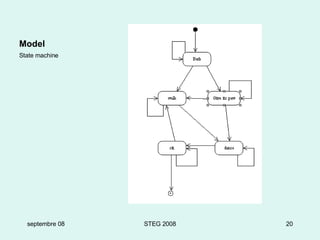
Model State machine septembre 08 STEG 2008
Conclusion IS a research field Extension of Campbell hero journey IS to improve serious games septembre 08 STEG 2008

A storytelling model for educational games

  • 1.
    A Storytelling Modelfor Educational Games R. Champagnat , G. Delmas, M. Augeraud
  • 2.
    Outline L3i backgroundInteractive storytelling and games A software architecture for Interactive Storytelling A structure for Interactive Storytelling Examples septembre 08 STEG 2008
  • 3.
    L3i background (1) ImagIN research team : Digital Interaction and Image Interactive Storytelling (Software Engineering point of view) Model and design Management (control) of player’s behaviour Adapt the unfolding of the activity septembre 08 STEG 2008
  • 4.
    L3i background (2) Fields of interest Interactive Storytelling games G a me for autistic children Projects RobAutiSTIC, FT Autistic PLUG PAVU septembre 08 STEG 2008 G ame scenarios and interaction
  • 5.
    Outline L3i backgroundInteractive storytelling and games A software architecture for Interactive Storytelling A structure for Interactive Storytelling Examples septembre 08 STEG 2008
  • 6.
    IS and gameseptembre 08 STEG 2008 Final Fantasy series: - Elaborated scenario - no control of the narrative The Sims: - Complete freedom - No scenario but a succession of independent events.
  • 7.
    Scenario oriented Thegame is based on a prewritten scenario. The game monitors player’s behaviour and prevents him from breaking storyline. septembre 08 STEG 2008
  • 8.
    Emergent narrative Nostory written, but a game full of autonomous agents (characters). The story emerges from a sequence of interaction between the player and agents. septembre 08 STEG 2008
  • 9.
    Outline L3i backgroundInteractive storytelling and games A software architecture for Interactive Storytelling A structure for Interactive Storytelling Examples septembre 08 STEG 2008
  • 10.
    IS game softwarearchitecture IS controller Goal Software architecture Key elements The player The game The IS controller septembre 08 STEG 2008
  • 11.
    Outline L3i backgroundInteractive storytelling and games A software architecture for Interactive Storytelling A structure for Interactive Storytelling Examples septembre 08 STEG 2008
  • 12.
    A structure forIS Difficulty to find a conciliation between interactivity and narration. Role playing game background Key ideas: Do not control the unfolding but its structure Dynamic design of the story Well suited for learning septembre 08 STEG 2008
  • 13.
    A structure forIS Campbell’s model Departure: call to adventure Initiation: road of trials Return: prove his assimilation of determined notions in order to progress septembre 08 STEG 2008
  • 14.
    Extend Campbell (1) Limits of interactivity Campbell structure for IS game Requirements Two worlds Key figures and symbolic Imply the player at every time Enact every act or choice from the player Adapt to player’s abilities septembre 08 STEG 2008
  • 15.
    Extend Campbell (2) septembre 08 STEG 2008
  • 16.
    Outline L3i backgroundInteractive storytelling and games A software architecture for Interactive Storytelling A structure for Interactive Storytelling Examples septembre 08 STEG 2008
  • 17.
    Example: Monster’s SchoolGame with simple interactions NPC behaviour evolves according to player’s actions and scenario septembre 08 STEG 2008
  • 18.
    G a memodel Petri net model of the game Describes how player’s interactions impact the game state septembre 08 STEG 2008
  • 19.
    Example: therapeutic gameAdaptative game for autism septembre 08 STEG 2008
  • 20.
    Model State machineseptembre 08 STEG 2008
  • 21.
    Conclusion IS aresearch field Extension of Campbell hero journey IS to improve serious games septembre 08 STEG 2008