A STATISTICAL STUDY ON JUVENILE
DELINQUENCY.
By: Rashi Shukla
M.S.W.
Department of Social Work.
Institute of Social Sciences, Agra.
Dr. B.R. Ambedkar University, India.
INTRODUCTION
 The word delinquency is derived from the Latin word
“Delinquere”
 ‘De’ means away and ‘linquere’ means to leave or to
abandon.
 Juvenile can be defined as a child who has not attained a
certain age at which he, like an adult person under the law of
the land, can be held liable for his criminal acts.
 Delinquency is not merely Juvenile Crime, it includes all
deviations from normal youthful behavior.
OBJECTIVES OF STATISTICAL STUDY
ON JUVENILE DELINQUENCY
 To look at certain factors regarding what can cause Juvenile
Delinquency.
 To analyze what can possibly prevent the youth from getting
involved in criminal activities.
Sample Size
N= 22 Respondents.
PROCESS
 Framing Questionnaire:
1. Questionnaire based surveys have a higher statistically
reproducibility value.
2. Pre-defined series of questions.
 Sampling:
1. I have selected a sub-group of a population to answer the survey questions.
2. Survey is commonly used method to collect information about a
population of interest.
CONTINUED…
 Questionnaire Design:
Closed ended questions.
 Survey Administration:
1. Through the mail.
2. Face-to-face.
 Analysis:
I have used MS-Excel to analyze & interpret the data using Charts. A
simple Chart in Excel can say more than a sheet full of data.
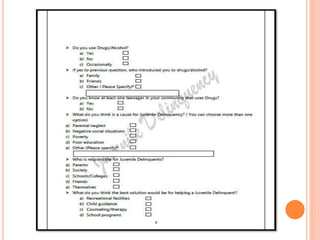
QUESTIONNAIRE
IF THE RESPONDENTS KNEW ABOUT JUVENILE
DELINQUENCY:
0
5
10
15
20
25
Yes No
No.ofRespondents
Yes No
20 2
IF JUVENILE DELINQUENCY IS A PROBLEM IN
TODAY'S SOCIETY:
0
2
4
6
8
10
12
14
16
18
20
Yes
Don't know
Yes Don’t know
20 2
AGE RANGE TO WHICH THE RESPONDENT
BELONGS:
75%
25%
Age Range
17-24
25-30
17-24 25-30
15 5
TYPE OF FAMILY THE RESPONDENT
BELONGS TO:
0
2
4
6
8
10
12
Nuclear Sibling
house hold
Single
Parent
Joint Family
Nuclear 12
Sibling
house hold
2
Single
parent
1
Joint Family 5
IF THEY USE DRUGS/ALCOHOL:
10%
60%
30%
Drugs/alcohol usage
Yes No Occasionally
Yes 2 Respondents
No 12 Respondents
Occasionally 6 Respondents
THE ONES WHO INTRODUCED RESPONDENTS TO
DRUGS:
0
1
2
3
4
5
6
Family
Friends
Other
Family 2
Friends 5
Other 1
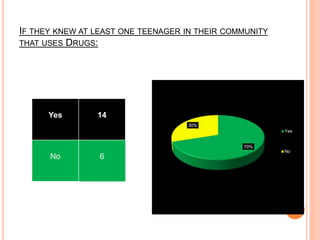
IF THEY KNEW AT LEAST ONE TEENAGER IN THEIR COMMUNITY
THAT USES DRUGS:
70%
30%
Yes
No
Yes 14
No 6
THE CAUSE(S) FOR JUVENILE DELINQUENCY:
(RESPONDENTS WERE ALLOWED TO CHOOSE MORE THAN
ONE OPTION)
0
2
4
6
8
10
12
14
Parental
Neglect
Negative
Social
Situations
Poverty Poor
education
Other
No.ofRespondents
Cause(s) for Juvenile Delinquency
Parental
Neglect
14
Negative
Social
Situations
10
Poverty 10
Poor
Education
7
Other 3
THE ONES HELD RESPONSIBLE FOR JUVENILE
DELINQUENTS:
0
1
2
3
4
5
6
7
Parents 3
Society 5
College 2
Friends 7
Themselves 2
Other 1
THE BEST SOLUTION FOR HELPING A JUVENILE
DELINQUENT:
0
2
4
6
8
10
12
Recreational
Facilities
2
Child
Guidance
5
Counseling/
Therapy
11
School
Programs
1
Other 1
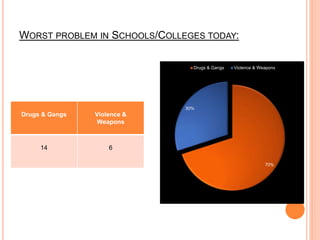
WORST PROBLEM IN SCHOOLS/COLLEGES TODAY:
70%
30%
Drugs & Gangs Violence & Weapons
Drugs & Gangs Violence &
Weapons
14 6
AREA WHICH HAVE HIGHER FREQUENCY OF
COMMITTING CRIMES:
0
2
4
6
8
10
12
14
16
18
Urban Rural
No.ofRespondents
Area
Urban Rural
14 6
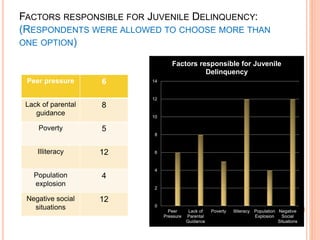
FACTORS RESPONSIBLE FOR JUVENILE DELINQUENCY:
(RESPONDENTS WERE ALLOWED TO CHOOSE MORE THAN
ONE OPTION)
0
2
4
6
8
10
12
14
Peer
Pressure
Lack of
Parental
Guidance
Poverty Illiteracy Population
Explosion
Negative
Social
Situations
Factors responsible for Juvenile
Delinquency
Peer pressure 6
Lack of parental
guidance
8
Poverty 5
Illiteracy 12
Population
explosion
4
Negative social
situations
12
BEHAVIORAL CHARACTERISTICS THAT DEFINE A JUVENILE
DELINQUENT: (RESPONDENTS WERE ALLOWED TO
CHOOSE MORE THAN ONE OPTION)
0
2
4
6
8
10
12
14
Social Rule
Breaking
Irresponsibility Impulsive
behavior
Other
No.ofRespondents
Behavioral Characteristics
Social Rule
Breaking
13
Irresponsibility 12
Impulsive
Behavior
8
Other 3
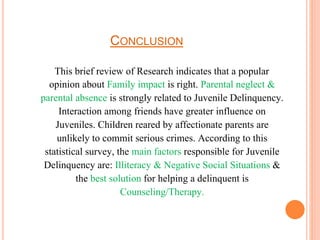
CONCLUSION
This brief review of Research indicates that a popular
opinion about Family impact is right. Parental neglect &
parental absence is strongly related to Juvenile Delinquency.
Interaction among friends have greater influence on
Juveniles. Children reared by affectionate parents are
unlikely to commit serious crimes. According to this
statistical survey, the main factors responsible for Juvenile
Delinquency are: Illiteracy & Negative Social Situations &
the best solution for helping a delinquent is
Counseling/Therapy.
THANK YOU!
Feedback & Suggestions are invited.
Rashi Shukla
E-mail: rashishukla776@gmail.com

A Statistical Study on Juvenile Delinquency

  • 1.
    A STATISTICAL STUDYON JUVENILE DELINQUENCY. By: Rashi Shukla M.S.W. Department of Social Work. Institute of Social Sciences, Agra. Dr. B.R. Ambedkar University, India.
  • 2.
    INTRODUCTION  The worddelinquency is derived from the Latin word “Delinquere”  ‘De’ means away and ‘linquere’ means to leave or to abandon.  Juvenile can be defined as a child who has not attained a certain age at which he, like an adult person under the law of the land, can be held liable for his criminal acts.  Delinquency is not merely Juvenile Crime, it includes all deviations from normal youthful behavior.
  • 3.
    OBJECTIVES OF STATISTICALSTUDY ON JUVENILE DELINQUENCY  To look at certain factors regarding what can cause Juvenile Delinquency.  To analyze what can possibly prevent the youth from getting involved in criminal activities. Sample Size N= 22 Respondents.
  • 4.
    PROCESS  Framing Questionnaire: 1.Questionnaire based surveys have a higher statistically reproducibility value. 2. Pre-defined series of questions.  Sampling: 1. I have selected a sub-group of a population to answer the survey questions. 2. Survey is commonly used method to collect information about a population of interest.
  • 5.
    CONTINUED…  Questionnaire Design: Closedended questions.  Survey Administration: 1. Through the mail. 2. Face-to-face.  Analysis: I have used MS-Excel to analyze & interpret the data using Charts. A simple Chart in Excel can say more than a sheet full of data.
  • 6.
  • 9.
    IF THE RESPONDENTSKNEW ABOUT JUVENILE DELINQUENCY: 0 5 10 15 20 25 Yes No No.ofRespondents Yes No 20 2
  • 10.
    IF JUVENILE DELINQUENCYIS A PROBLEM IN TODAY'S SOCIETY: 0 2 4 6 8 10 12 14 16 18 20 Yes Don't know Yes Don’t know 20 2
  • 11.
    AGE RANGE TOWHICH THE RESPONDENT BELONGS: 75% 25% Age Range 17-24 25-30 17-24 25-30 15 5
  • 12.
    TYPE OF FAMILYTHE RESPONDENT BELONGS TO: 0 2 4 6 8 10 12 Nuclear Sibling house hold Single Parent Joint Family Nuclear 12 Sibling house hold 2 Single parent 1 Joint Family 5
  • 13.
    IF THEY USEDRUGS/ALCOHOL: 10% 60% 30% Drugs/alcohol usage Yes No Occasionally Yes 2 Respondents No 12 Respondents Occasionally 6 Respondents
  • 14.
    THE ONES WHOINTRODUCED RESPONDENTS TO DRUGS: 0 1 2 3 4 5 6 Family Friends Other Family 2 Friends 5 Other 1
  • 15.
    IF THEY KNEWAT LEAST ONE TEENAGER IN THEIR COMMUNITY THAT USES DRUGS: 70% 30% Yes No Yes 14 No 6
  • 16.
    THE CAUSE(S) FORJUVENILE DELINQUENCY: (RESPONDENTS WERE ALLOWED TO CHOOSE MORE THAN ONE OPTION) 0 2 4 6 8 10 12 14 Parental Neglect Negative Social Situations Poverty Poor education Other No.ofRespondents Cause(s) for Juvenile Delinquency Parental Neglect 14 Negative Social Situations 10 Poverty 10 Poor Education 7 Other 3
  • 17.
    THE ONES HELDRESPONSIBLE FOR JUVENILE DELINQUENTS: 0 1 2 3 4 5 6 7 Parents 3 Society 5 College 2 Friends 7 Themselves 2 Other 1
  • 18.
    THE BEST SOLUTIONFOR HELPING A JUVENILE DELINQUENT: 0 2 4 6 8 10 12 Recreational Facilities 2 Child Guidance 5 Counseling/ Therapy 11 School Programs 1 Other 1
  • 19.
    WORST PROBLEM INSCHOOLS/COLLEGES TODAY: 70% 30% Drugs & Gangs Violence & Weapons Drugs & Gangs Violence & Weapons 14 6
  • 20.
    AREA WHICH HAVEHIGHER FREQUENCY OF COMMITTING CRIMES: 0 2 4 6 8 10 12 14 16 18 Urban Rural No.ofRespondents Area Urban Rural 14 6
  • 21.
    FACTORS RESPONSIBLE FORJUVENILE DELINQUENCY: (RESPONDENTS WERE ALLOWED TO CHOOSE MORE THAN ONE OPTION) 0 2 4 6 8 10 12 14 Peer Pressure Lack of Parental Guidance Poverty Illiteracy Population Explosion Negative Social Situations Factors responsible for Juvenile Delinquency Peer pressure 6 Lack of parental guidance 8 Poverty 5 Illiteracy 12 Population explosion 4 Negative social situations 12
  • 22.
    BEHAVIORAL CHARACTERISTICS THATDEFINE A JUVENILE DELINQUENT: (RESPONDENTS WERE ALLOWED TO CHOOSE MORE THAN ONE OPTION) 0 2 4 6 8 10 12 14 Social Rule Breaking Irresponsibility Impulsive behavior Other No.ofRespondents Behavioral Characteristics Social Rule Breaking 13 Irresponsibility 12 Impulsive Behavior 8 Other 3
  • 23.
    CONCLUSION This brief reviewof Research indicates that a popular opinion about Family impact is right. Parental neglect & parental absence is strongly related to Juvenile Delinquency. Interaction among friends have greater influence on Juveniles. Children reared by affectionate parents are unlikely to commit serious crimes. According to this statistical survey, the main factors responsible for Juvenile Delinquency are: Illiteracy & Negative Social Situations & the best solution for helping a delinquent is Counseling/Therapy.
  • 24.
    THANK YOU! Feedback &Suggestions are invited. Rashi Shukla E-mail: rashishukla776@gmail.com