JFP 27, e4, 42 pages, 2017. c Cambridge University Press 2016
doi:10.1017/S0956796816000289
1
A simple library implementation
of binary sessions
LUCA PADOVANI
Dipartimento di Informatica, Universit`a di Torino, Torino, Italy
(e-mails: luca.padovani@di.unito.it)
Abstract
Inspired by the continuation-passing encoding of binary sessions, we describe a simple
approach to embed a hybrid form of session type checking into any programming language
that supports parametric polymorphism. The approach combines static protocol analysis with
dynamic linearity checks. To demonstrate the effectiveness of the technique, we implement a
well-integrated OCaml module for session communications. For free, OCaml provides us with
equirecursive session types, parametric behavioural polymorphism, complete session type
inference, and session subtyping.
1 Introduction
Session type systems (Honda, 1993; Honda et al., 1998) are an established means
for enforcing structured communication protocols through static analysis. Gay and
Vasconcelos (2010) have presented a session type system that integrates smoothly
with an ML-like functional language. Elaborating on previous works, Wadler (2014)
has investigated the theoretical relevance of this type system showing its connections
with axioms and rules of linear logic. From a practical viewpoint, however, the
type system put forward by Gay and Vasconcelos (2010) appears challenging to
adopt in a mainstream programming language, for it requires peculiar features for
(F.1) describing structured protocols as sequences of I/O operations and branching
points, (F.2) checking that the peer endpoints of a session are used according to dual
protocols, and (F.3) ensuring the linear usage of session endpoints.
Successful attempts to encode these features in Haskell have been reported by
Neubauer and Thiemann (2004), Sackman and Eisenbach (2008), Pucella and Tov
(2008), and Imai et al. (2010). These works accomplish (F.1) and (F.2) using Haskell’s
type system and (F.3) by encapsulating endpoints in a suitable monad: Not being
able to name endpoints prevents the programmer from using them non-linearly. As
discussed by Imai et al. (2010), however, these encodings have a price in terms of
expressiveness, usability, or portability: some of them omit or constrain key features
of sessions (e.g. session interleaving or delegation), some require programmers to
write considerable amounts of boilerplate code (e.g. to access nameless channels or to
Supported by ICT COST Action IC1201 BETTY and MIUR Project CINA.
2 L. Padovani
unwind recursions), and most make use of features that are unique to Haskell’s type
system (e.g. functional dependencies or type-level computations) thus hampering
their portability to other languages.
In this paper, we describe another approach to equip a programming language
with session type checking, diverging from the aforementioned ones in two ways.
First, we work with a form of session types inspired by the continuation-passing
encoding of binary sessions (Dardha et al., 2012) that makes it possible to express
session type duality solely in terms of type equality. Second, we do not try to
enforce the linear usage of session endpoints statically, but we rely on a lightweight
mechanism that detects potentially unsafe linearity violations at runtime. Similar
mechanisms have been described by Tov and Pucella (2010) and Hu and Yoshida
(2016). Overall, we find that our approach compares favourably with the previous
ones in terms of features, simplicity of use and implementation, and portability: It
provides direct access to sessions through first-class session endpoints, not imposing
contraints on session interleaving or delegation; it supports recursive session types
and session subtyping by piggybacking on the host type system; it is portable to
any programming language whose type system features parametric polymorphism.
To introduce the key idea behind our approach, we start by recalling the type of
the communication primitives send and receive as given by Gay and Vasconcelos
(2010):
send : t
↓
- !t.T
↓
- T receive : ?t.S ↓- t * S (1)
The application send v a sends a message v of type t on a session endpoint a
of type !t.T and reduces to the same endpoint a with its type changed to T. The
session type T describes the protocol according to which a must be used by the
sender after this communication. The application receive b waits for a message
from the endpoint b and reduces to a pair (w,b) containing the message w and the
endpoint b itself. The endpoint has type ?t.S before the reduction and type S after
the reduction. When a and b are the peer endpoints of the same session, the session
types !t.T and ?t.S (hence T and S) must be dual of each other: Every input in T
must be matched by a corresponding output in S, and vice versa. This ensures that
sender and receiver interact correctly also in the rest of the conversation.
The given semantics and typing of send and receive are not unique. An
alternative semantics for the same primitives emerges from the studies of Kobayashi
(2002), Demangeon and Honda (2011), and Dardha et al. (2012). These works show
that a sequence of communications in a session can be encoded as a sequence of
one-shot communications in a chain of distinct channels, each channel being used
for one communication only. According to this intuition, the effect of send v a
would be to create a fresh channel c (the continuation of a), to send the pair (v,c)
on a, and to return another reference to c. Correspondingly, the effect of receive a
would be to return the pair received from a. This semantics induces the following
alternative typing of the same communication primitives
send : t
↓
- ![t * κ[s]]
↓
- κ[s] receive : ?[t * κ[s]]
↓
- t * κ[s] (2)
A simple library implementation of binary sessions 3
where κ stands for an I/O capability, such as ? or !, and types like κ[s] describe
channels to be used according to capability κ for exchanging one message of
type s. Note that the continuation c created by send is given two different types:
the reference paired with the payload v and sent on a has type κ[s], whereas
the reference returned by send has type κ[s], where κ denotes the dual capability
of κ. Overall, κ[s] and κ[s] in Equation (2) play the same roles as T and S in
Equation (1), but the types of the two versions of send differ for one detail: T
in !t.T describes the behaviour of the sender on the endpoint in the rest of the
interaction, whereas κ[s] in ![t * κ[s]] describes the behaviour of the receiver on
the continuation channel in the rest of the interaction. In particular, we notice that
the structurally complex duality relation between the session types !t.T and ?t.S
of peer endpoints in Equation (1) boils down to a much simpler duality relation
between the types ![t * κ[s]] and ?[t * κ[s]] in Equation (2). These types differ
only for their topmost capability. In fact, we will see that this simplified duality
can be expressed solely in terms of type equality, given a suitable representation of
channel types. In prospect of encoding static protocol analysis into an existing type
system, this is a major advantage of the types in Equation (2) compared to those in
Equation (1), granted that they embed the same amount of information concerning
the described communication protocol.
Of course, we are not willing to pay the overhead resulting from the creation
and exchange of continuations just for the sake of a more palatable typing of the
communication primitives. We observe that it makes sense to consider a third version
of the primitives, whereby send and receive have the semantics given by Gay and
Vasconcelos (2010), but they are typed like in Equation (2) as if they did create
and exchange continuations. This mix-up has a practical justification: Given that
each channel in the continuation-passing encoding of a session is supposed to be
used only once, there is no need for send v a to create a fresh continuation c
for a. Instead, as observed by Dardha et al. (2012), the channel a can be recycled
and sent as its own continuation. We take this optimisation one step further: No
continuation needs to be actually sent, for the recycled channel a is already known
to both communicating parties. In the end, the occurrences of κ[s] in Equation (2)
need not correspond to any actual piece of transmitted data. They are the types of
ghost continuations whose sole – but fundamental – purpose is to relate the future
behaviours of sender and receiver.
We give the details of our approach in the rest of the paper, following this
structure:
• We formalise a core functional language, called FuSe, that combines multi-
threading, session-based communications primitives `a la Gay and Vasconcelos
(2010), and a runtime mechanism that detects endpoint linearity violations
(Section 2).
• We define an ordinary ML-style type language for FuSe and we adapt and
extend the encoding of session types (Dardha et al., 2012) into FuSe types. We
introduce a representation of channel types that allows us to express session
type duality solely in terms of type equality (Section 3).
4 L. Padovani
• We equip FuSe with an ML-style type system and we type FuSe primitives using
encoded (as opposed to built-in) session types. Well-typed FuSe programs are
shown to enjoy all the usual properties of sessions (safety, fidelity, progress)
under the hypothesis that they use session endpoints linearly (Section 4). We
cannot infer these properties directly from the soundness of the encoding given
by Dardha et al. (2012) since FuSe primitives do not exchange continuations.
• We describe an implementation of FuSe primitives in OCaml (Leroy et al.,
2014) that allows us to write and type check programs written in the style
of Gay and Vasconcelos (2010) without the need of a built-in session type
system. The implementation integrates well with OCaml, from which we leverage
equirecursive session types with arbitrary branches, parametric (behavioural)
polymorphism, complete session type inference, and session subtyping as
defined by Gay and Hole (2005) (Section 5).
Section 6 discusses related work further and Section 7 concludes. Proofs and auxiliary
results related to Sections 3 and 4 are in Appendixes A and B. The implementation is
available at http://www.di.unito.it/~padovani/Software/FuSe/FuSe.html. An early
draft of this paper (Padovani, 2015) was uploaded on HAL in October 2015.
2 Syntax and semantics of FuSe
We use infinite sets of variables x, y, . . . and sessions a, b, . . .; an endpoint or channel
is a pair ap
made of a session a and a polarity p, q ∈ {+, -, *}. Polarities + and -
denote valid endpoints that can be used for I/O operations whereas the polarity
* denotes invalid endpoints that are not supposed to be used. We define a partial
involution · on polarities such that + = - and - = + and leave * undefined. We say
that ap
is the peer of ap
when p = *. We let u range over names, which are either
variables or endpoints.
The syntax of expressions and processes is given below:
Expressions e ::= c | x | ap
| λx.e | e1 e2 | let x = e1 in e2
Processes P, Q ::= e | P | Q | new a in P | error
Expressions model threads, that is the sequential parts of programs, and are
mostly conventional. The symbol c ranges over the following constants: The fixpoint
combinator fix, the unitary value (), the usual data constructors pair, inl, and
inr, the corresponding deconstructors fst, snd, and cases, the primitive fork
that spawns new threads, and the session primitives create, close, send, receive,
left, right, and branch whose semantics will be detailed shortly. Endpoints are
not supposed to occur in source programs, they appear as the result of reductions.
Processes model parallel threads communicating via sessions. A process is either
a thread e , or the parallel composition P | Q of two processes P and Q, or a
restriction new a in P modelling a session a with scope P, or a runtime error
resulting from an attempt to use an invalid endpoint. The notions of free and bound
names are standard. We write fn(e) and fn(P), respectively for the sets of free names
of e and P and we identify terms modulo alpha-renaming of bound names.
A simple library implementation of binary sessions 5
Table 1. Reduction of expressions and processes
Reduction of expressions e −→ e
[r-beta] (λx.e) v −→ e{v/x}
[r-let] let x = v in e −→ e{v/x}
[r-fix] fix v −→ v (λx.fix v x)
[r-fst] fst (pair v w) −→ v
[r-snd] snd (pair v w) −→ w
[r-inl] cases (inl w) v1 v2 −→ v1 w
[r-inr] cases (inr w) v1 v2 −→ v2 w
Reduction of processes P −→ Q
[r-error] E[K a*
]
τ
−→ error
[r-fork] E[fork v w]
τ
−→ E[()] | v w
[r-create] E[create()]
τ
−→ new a in E[pair a+
a-
] a fresh
[r-close] E[close ap
] | E [close ap
]
ca
−→ Eca[()] | Eca[()]
[r-comm] E[send ap
v] | E [receive ap
]
map
−→ Emap[ap
] | Emap[pair vmap ap
]
[r-left] E[left ap
] | E [branch ap
]
map
−→ Emap[ap
] | Emap[inl ap
]
[r-right] E[right ap
] | E [branch ap
]
map
−→ Emap[ap
] | Emap[inr ap
]
[r-thread] E[e]
τ
−→ E[e ] e −→ e
[r-par] P | R −→ Q | R P −→ Q
[r-new] new a in P
a
−→ new a in Q P −→ Q
[r-struct] P −→ Q P ≡ P −→ Q ≡ Q
The operational semantics is defined in terms of a reduction relation for expres-
sions, a structural congruence and a labelled reduction relation for processes. We
make use of conventional notions of values and of evaluation contexts, defined thus:
Values v, w ::= c | c1
v | c2
v w | ap
| λx.e
Evaluation Contexts E ::= [ ] | E e | v E | let x = E in e
where c1
ranges over {pair, inl, inr, cases, fork, send} and c2
over {pair, cases}.
In values as in expressions application associates to the left. Therefore, c2
v w reads
as ((c2
v) w). Note that send v w and cases v1 v2 v2 are not values for these
expressions are meant to reduce. We write E[e] for the result of replacing the hole
[ ] in E with e. We also write X{v/u} for the capture-avoiding substitution of v in
place of the free occurrences of u in X, where X ranges over expressions, processes,
and evaluation contexts.
The upper part of Table 1 defines reduction of expressions, which is standard.
The lower part of the table defines a labelled reduction for processes where labels
are either τ, denoting an internal action, or map, denoting a message exchange
from endpoint ap
to endpoint ap
in session a, or ca, indicating that the session a
has been closed. We define ep(τ)
def
= ∅ and ep(map) = ep(ca)
def
= {a+
, a-
}. Labels allow
us to observe the behaviour of processes on the channels they use. This information
6 L. Padovani
is key to show that well-typed processes respect protocols and also to invalidate the
endpoints used in a reduction.
Definition 1 (invalidation)
We let X
def
= X{a*
/ap
}ap∈ep( ).
Intuitively, X invalidates some of the endpoints ap
in X by replacing them with a*
,
after an -labelled reduction. When = τ, no endpoint is invalidated. When = map
or = ca, both a+
and a-
are invalidated. For example, (send cp
a+
)maq = send cp
a*
.
We now describe the reduction rules of processes. Rule [r-fork] spawns a new
thread, represented as a function v that needs an argument w. The thread is
started by applying v to w in parallel with the spawner process. Rule [r-create]
creates a new session a. The expression create () reduces to a pair containing
two valid endpoints of the session with opposite polarities. Rule [r-close] models
the closing of session a. The operation invalidates every occurrence of a+
and
a-
in the program. For simplicity, in the formal development this operation is
synchronous; in the implementation, each endpoint can be closed independently of
the other. Rule [r-comm] models the communication between two threads connected by
a session a. The message v in the sender thread is transferred to the receiving thread.
Following Gay and Vasconcelos (2010), the output operation reduces to the endpoint
ap
used by the sender, whilst the input operation reduces to a pair containing the
received message and the endpoint ap
used by the receiver. All other occurrences
of ap
and ap
, including those in the message v, are invalidated. Rule [r-left] models
the selection of a branch in a structured conversation. It is akin to [r-comm], except
that the endpoint used by the receiver is injected into a disjoint sum with inl
that represents the choice taken. Rule [r-right] is symmetric. Intuitively, in [r-left] and
[r-right], the message being communicated is just a constructor inl or inr. Note that
there is no explicit creation or passing of continuations in [r-comm], [r-left], [r-right]: All
that is transferred from one thread to another is just the payload. Rule [r-error] yields
a runtime error if there is an attempt to “use” an invalid endpoint. The grammar
K ::= close | send v | receive | left | right | branch
characterises the terms K that “use” an endpoint when applied to it. Rule [r-thread]
lifts the reduction of expressions to processes. Rule [r-par] closes reductions under
parallel compositions. The label that decorates the reduction relation is used to
propagate the effects of an invalidation to the entire program. Rule [r-new] closes
reductions under restrictions. We let  a
def
= τ if = map or = ca and  a
def
=
otherwise. Intuitively, the labels map and ca turn into a τ when they cross
the restriction on a, as the session becomes unobservable. Finally, [r-struct] closes
reductions under structural congruence, which is basically the same of the π-calculus
except that the idle process is written () and the scope of a session can be shrunk
or extended only when no valid or invalid endpoint is captured.
Example 1 (mathematical server)
We write examples in a sugared and richer version of FuSe that includes numbers,
booleans, if-then-else, pattern matching, and possibly recursive let-bindings. All
A simple library implementation of binary sessions 7
these features can be easily added or encoded in FuSe and do not affect any of the
results that follow. The examples compile and run using OCaml (Leroy et al., 2014)
and our implementation of the FuSe primitives (Section 5). Below is a simple server
for mathematical operations analogous to that given by Gay and Hole (2005):
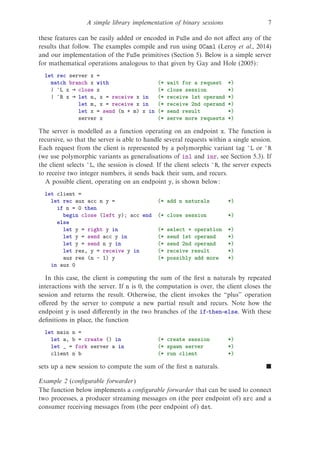
let rec server x =
match branch x with (* wait for a request *)
| `L x
↓
- close x (* close session *)
| `R x
↓
- let n, x = receive x in (* receive 1st operand *)
let m, x = receive x in (* receive 2nd operand *)
let x = send (n + m) x in (* send result *)
server x (* serve more requests *)
The server is modelled as a function operating on an endpoint x. The function is
recursive, so that the server is able to handle several requests within a single session.
Each request from the client is represented by a polymorphic variant tag `L or `R
(we use polymorphic variants as generalisations of inl and inr, see Section 5.3). If
the client selects `L, the session is closed. If the client selects `R, the server expects
to receive two integer numbers, it sends back their sum, and recurs.
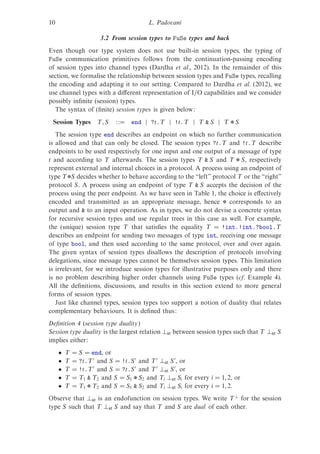
A possible client, operating on an endpoint y, is shown below:
let client =
let rec aux acc n y = (* add n naturals *)
if n = 0 then
begin close (left y); acc end (* close session *)
else
let y = right y in (* select + operation *)
let y = send acc y in (* send 1st operand *)
let y = send n y in (* send 2nd operand *)
let res, y = receive y in (* receive result *)
aux res (n - 1) y (* possibly add more *)
in aux 0
In this case, the client is computing the sum of the first n naturals by repeated
interactions with the server. If n is 0, the computation is over, the client closes the
session and returns the result. Otherwise, the client invokes the “plus” operation
offered by the server to compute a new partial result and recurs. Note how the
endpoint y is used differently in the two branches of the if-then-else. With these
definitions in place, the function
let main n =
let a, b = create () in (* create session *)
let _ = fork server a in (* spawn server *)
client n b (* run client *)
sets up a new session to compute the sum of the first n naturals.
Example 2 (configurable forwarder)
The function below implements a configurable forwarder that can be used to connect
two processes, a producer streaming messages on (the peer endpoint of) src and a
consumer receiving messages from (the peer endpoint of) dst.
8 L. Padovani
let forwarder mode src dst =
if mode then (* check modality *)
let rec aux src dst =
let msg, src = receive src in (* receive from source *)
let dst = send msg dst in (* send to destination *)
aux src dst (* forever *)
in aux src (left dst) (* select forwarding *)
else
close (send src (right dst)) (* select delegation *)
The forwarder is configurable in the sense that it has two operating modalities
determined by the mode argument. When mode is true, the messages streaming from
src are forwarded on dst. When mode is false, the function performs a delegation
whereby dst is sent on src. This way, the consumer receives messages directly from
the producer. Observe that the session endpoint dst is meant to be used in the
same way regardless of the chosen modality. In other words, the producer does not
know if messages are delivered directly to the consumer or if they go through the
forwarder.
3 Types
In this section, we define the types for FuSe, we recall the encoding of Dardha et al.
(2012) and extend it to an isomorphism between session types and a suitable subset
of FuSe types. This gives us the basis for interpreting and understanding the type
of FuSe primitives.
3.1 Types for FuSe
The syntax of type schemes and of (finite) types is given by the grammar
Type Schemes σ ::= t | ∀α.σ
Types t, s ::= • | unit | t
↓
- s | t * s | t + s | <t,s>
where α, β, . . . range over type variables. Type schemes are conventional; we will
often abbreviate ∀α1. · · · ∀αn.t with ∀α1 · · · αn.t. Types include the unitary type unit,
arrows, products, and disjoint sums. In the examples, we occasionally use other base
types such as int and bool. In addition, the type <t,s> denotes a channel that can
be used for receiving messages of type t and sending messages of type s, whilst the
type • is not inhabited and denotes “no message”. In particular, <•,t> denotes a
channel that can only be used for sending messages of type t and <t * <•,s>,•>
denotes a channel for receiving a pair made of a value of type t and another channel
that can be used for sending messages of type s. A channel with type <•,•> cannot
be used for I/O operations.
Instead of introducing concrete syntax for representing recursive types, we consider
as types the possibly infinite, regular trees generated by the type constructors shown
above and keep using the metavariables t and s to range over such trees. Recall that
each regular tree has finitely many distinct subtrees and admits finite representations
as a system of equations or using the familiar μ notation (Courcelle, 1983). We
A simple library implementation of binary sessions 9
define an infinite type t as the (unique) solution of an equation t = s, where s
contains (guarded) occurrences of the metavariable t. For example, the equation
t = int
↓
- t is satisfied by the type int
↓
- int
↓
- · · · of the “ogre” function that eats
infinitely many int arguments. The shape of the equation, with the metavariable t
unguarded on the left-hand side and guarded by a type constructor on the right-
hand side, guarantees existence and uniqueness of the regular tree that satisfies it
(Courcelle, 1983, Theorem 4.3.1). We use infinite types for describing arbitrarily
long communication protocols, like the one implemented by server and client in
Example 1. Note that type equality corresponds to regular tree equality.
Duality relates channels types with complementary capabilities:
Definition 2 (type duality)
Let ⊥ct be the least relation such that <t,s> ⊥ct <s,t>. When t is a channel type, we
write t⊥
for the type s such that t ⊥ct s; otherwise, t⊥
is undefined.
The intuition for type duality is that if a process uses an endpoint according to
some type t, then we expect another process to use the peer endpoint according to
the dual type t⊥
. So for example, <•,int> ⊥ct <int,•> since the dual behaviour of
“send an int” is “receive an int”. On the other hand, we have <•,•> ⊥ct <•,•>,
since “do nothing” is dual of itself. Type duality is a partial involution: It is only
defined on channel types and, when t⊥
is defined, we have t⊥⊥
= t.
Our representation of channel types is slightly unusual. Most type systems
with channel types, from the seminal paper on channel subtyping (Pierce and
Sangiorgi, 1996) to those for the linear π-calculus (Kobayashi et al., 1999) and
binary sessions (Dardha et al., 2012), use types of the form κ[t] or variants of this
where κ ∈ {?, !} represents an input/output capability. We have used this notation
also in Section 1. In these cases, computing the dual of a channel type essentially
means defining a suitable dual operator for capabilities such that, for instance, ? = !.
One shortcoming of this representation is that duality is easily defined only when
capabilities are known. Dealing with unknown capabilities means introducing (pos-
sibly dualised) capability variables and this machinery complicates the type system.
With our representation, we can dualise a channel type by just swapping the content
of its two type parameters, even when we do not know the kind of I/O operations
allowed on the channel. For example, the type t
def
= <α,β> denotes a channel for
which nothing is known. Nonetheless, the dual of t can still be obtained by swapping
α and β, that is t⊥
= <β,α>. At the end of Section 3.2, we will see that the chosen
representation of channel types is key to reduce session type duality to type equality.
To improve readability, sometimes we use the notations ?[t] and ![t] as syntactic
sugar for <t,•> and <•,t>, respectively. In the following, we make extensive use of
channel types with unknown message types, so we reserve some convenient notation
also for them:
Definition 3 (channel type variable)
We let A, B, . . . range over channel type variables, namely types of the form <α,β>,
and we write ∀A.σ instead of ∀αβ.σ when A = <α,β>.
The dual A⊥
of any channel type variable A is always defined.
10 L. Padovani
3.2 From session types to FuSe types and back
Even though our type system does not use built-in session types, the typing of
FuSe communication primitives follows from the continuation-passing encoding
of session types into channel types (Dardha et al., 2012). In the remainder of this
section, we formalise the relationship between session types and FuSe types, recalling
the encoding and adapting it to our setting. Compared to Dardha et al. (2012), we
use channel types with a different representation of I/O capabilities and we consider
possibly infinite (session) types.
The syntax of (finite) session types is given below:
Session Types T, S ::= end | ?t.T | !t.T | T & S | T ⊕ S
The session type end describes an endpoint on which no further communication
is allowed and that can only be closed. The session types ?t.T and !t.T describe
endpoints to be used respectively for one input and one output of a message of type
t and according to T afterwards. The session types T & S and T ⊕ S, respectively
represent external and internal choices in a protocol. A process using an endpoint of
type T ⊕S decides whether to behave according to the “left” protocol T or the “right”
protocol S. A process using an endpoint of type T & S accepts the decision of the
process using the peer endpoint. As we have seen in Table 1, the choice is effectively
encoded and transmitted as an appropriate message, hence ⊕ corresponds to an
output and & to an input operation. As in types, we do not devise a concrete syntax
for recursive session types and use regular trees in this case as well. For example,
the (unique) session type T that satisfies the equality T = !int.!int.?bool.T
describes an endpoint for sending two messages of type int, receiving one message
of type bool, and then used according to the same protocol, over and over again.
The given syntax of session types disallows the description of protocols involving
delegations, since message types cannot be themselves session types. This limitation
is irrelevant, for we introduce session types for illustrative purposes only and there
is no problem describing higher order channels using FuSe types (cf. Example 4).
All the definitions, discussions, and results in this section extend to more general
forms of session types.
Just like channel types, session types too support a notion of duality that relates
complementary behaviours. It is defined thus:
Definition 4 (session type duality)
Session type duality is the largest relation ⊥st between session types such that T ⊥st S
implies either:
• T = S = end, or
• T = ?t.T and S = !t.S and T ⊥st S , or
• T = !t.T and S = ?t.S and T ⊥st S , or
• T = T1 & T2 and S = S1 ⊕ S2 and Ti ⊥st Si for every i = 1, 2, or
• T = T1 ⊕ T2 and S = S1 & S2 and Ti ⊥st Si for every i = 1, 2.
Observe that ⊥st is an endofunction on session types. We write T⊥
for the session
type S such that T ⊥st S and say that T and S are dual of each other.
A simple library implementation of binary sessions 11
Duality relates inputs with outputs carrying the same message type and end
with itself. For example, ?t.!s.end ⊥st !t.?s.end and if T is the session type
such that T = !int.!int.?bool.T, then T⊥
is the session type S such that
S = ?int.?int.!bool.S. Clearly, session type duality is an involution, namely
T⊥⊥
= T for every T.
We now show that session types and their encoding embed the same information,
just written in different ways. To do so, we define an isomorphism between the
set S of session types and a subset P of FuSe types which we call protocol types.
The isomorphism that we define is purely syntactic, but is supported by a semantic
correspondence between processes (Dardha et al., 2012).
Definition 5 (protocol types)
The set of protocol types is the largest subset P of types such that t ∈ P implies
either:
• t = <•,•>, or
• t = <t1 * t2,•> or t = <•,t1 * t2> and t2 ∈ P, or
• t = <t1 + t2,•> or t = <•,t1 + t2> and t1, t2 ∈ P.
The morphism from S to P is given by the encoding described by Dardha
et al. (2012) and rests on the idea that multiple communications on a session
endpoint can be modelled as a sequence of one-shot communications in a chain
of linear channels. The chain is realised by sending, at each communication, a
fresh continuation channel along with the communication payload. For example,
the session type !t.T describes an endpoint used for sending a message of type t
first and according to T afterwards. It is encoded as the channel type <•,t * s>,
where s is the encoding of T⊥
. The reason why the type s of the continuation is the
encoding of T⊥
and not the encoding of T is because the tail T in !t.T describes
the behaviour of the sender of the message of type t after it has sent the message,
whereas in the encoding the type of the continuation describes the behaviour of the
receiver of the message on the continuation. Clearly, the sender will also use the
same continuation, but according to the type s⊥
. In general, we have:
Definition 6 (encoder)
The encoder is the function [[·]] : S → P that satisfies the equations:
[[end]] = <•,•>
[[?t.T]] = ?[t * [[T]]]
[[!t.T]] = ![t * [[T⊥
]]]
[[T & S]] = ?[[[T]] + [[S]]]
[[T ⊕ S]] = ![[[T⊥
]] + [[S⊥
]]]
For example, if we consider again T = !int.!int.?bool.T, then we derive:
[[T]] = ![int * [[?int.!bool.T⊥
]]]
= ![int * ?[int * [[!bool.T⊥
]]]]
= ![int * ?[int * ![bool * [[T⊥⊥
]]]]]
= ![int * ?[int * ![bool * [[T]]]]]
If we consider instead T⊥
, namely the session type S such that S = ?int.?int.
!bool.S, then [[S]] = ?[int * ?[int * ![bool * [[T]]]]].
12 L. Padovani
The morphism from P to S reconstructs a session type T by interpreting the type
of continuation channels as the tail(s) of T:
Definition 7 (decoder)
The decoder is the function · : P → S that satisfies the equations:
<•,•> = end
?[t * s] = ?t. s
![t * s] = !t. s⊥
?[t + s] = t & s
![t + s] = t⊥
⊕ s⊥
The decoder has practical utility to decipher possibly obscure types that have been
automatically inferred. FuSe comes along with a companion tool that
implements · and that is capable of pretty printing OCaml types and whole
OCaml module signatures using the traditional notation of session
types.
It is not immediate to see that · = [[·]]−1
, because the two morphisms use
different notions of duality, for session types and for channel types, respectively.
However, as observed by Dardha et al. (2012) and formally stated in Lemma 1
below, [[·]] commutes with duality and so does · . This is key to show that [[·]] and
· are indeed one the inverse of the other.
Lemma 1 (commuting duality)
We have ⊥ct ◦ [[·]] = [[·]] ◦ ⊥st and ⊥st ◦ · = · ◦ ⊥ct.
The isomorphism between S and P shows that using protocol types instead of
built-in session types results in no loss of expressiveness (there is an encoding for
every session type) and no loss in precision (every session type can be reconstructed
from its encoding).
Theorem 1 (isomorphism)
· = [[·]]−1
.
Finally, the most useful consequence of Lemma 1 in combination with our
representation of channel types is to provide an alternative, simple method for
checking whether T ⊥st S holds. Suppose, for example, that [[T]] = <ti,to> and
[[S]] = <si,so>. By Lemma 1, we deduce
T ⊥st S ⇐⇒ [[T]] ⊥ct [[S]] ⇐⇒ ti = so ∧ to = si
thereby turning the verification of a complex relation T ⊥st S, which involves
matching inputs with outputs across the whole structure of T and S, in two plain
type equalities. This is a strong point in favour of encoded (as opposed to built-in)
session types.
4 Type system
In this section, we present the type system for FuSe and state its properties. The
typing rules are essentially standard for ML-like languages, in particular, they have
no baked-in features specifically targeted to session type checking. Compared to the
type system of Gay and Vasconcelos (2010), the main differences concern the typing
A simple library implementation of binary sessions 13
Table 2. Typing rules for expressions and processes
Expressions Γ e : t
[t-const]
TypeOf(c) t
Γ c : t
[t-name]
σ t
Γ, u : σ u : t
[t-fun]
Γ, x : t e : s
Γ λx.e : t
↓
- s
[t-app]
Γ e1 : t
↓
- s Γ e2 : t
Γ e1e2 : s
[t-let]
Γ e1 : t1 Γ, x : Close(t1, Γ) e2 : t2
Γ let x = e1 in e2 : t2
Processes Γ P
[t-thread]
Γ e : unit
Γ e
[t-par]
Γ P Γ Q
Γ P | Q
[t-new]
Γ, a+
: t, a-
: t⊥
, a*
: ∀A.A P
Γ new a in P
of communication primitives, the fact that the type system is not substructural, and
the handling of invalid endpoints.
We let Γ range over type environments which are finite maps from names to type
schemes written u1 : σ1, . . . , un : σn that keep track of the type of the free names of
expressions and processes. We write ∅ for the empty type environment, dom(Γ) for
the domain of Γ, and Γ, Γ for the union of Γ and Γ when dom(Γ) ∩ dom(Γ ) = ∅.
Table 2 shows the typing rules. The rules for processes derive judgments of the form
Γ P, stating that P is well typed in Γ. Rules [t-thread] and [t-par] are standard.
Rule [t-new] introduces in the type environment three endpoints of a session: Two of
them are valid and typed with dual types (the fact that one of them is typed by t⊥
implicitly means that t is a channel type); the third one is invalid and typed with
∀A.A. This way, distinct occurrences of an invalid endpoint can appear anywhere
an endpoint is expected and they need not be typed in the same way (we will see
why this is necessary in Example 5). As usual, there is no typing rule for error.
The rules for expressions derive judgments of the form Γ e : t and are formulated
using the same notation of Wright and Felleisen (1994). Since the rules are mostly
standard, we just focus on a few details. Rules [t-const] and [t-name], respectively
type constants and names by instantiating their type scheme. The type scheme of
constants is retrieved by a global function TypeOf(·), defined in Table 3, whilst that
of names is obtained from the type environment. Following Wright and Felleisen
(1994), the relation σ t is defined by
t t
σ t
∀α.σ t{s/α}
and instantiates a type scheme into a type. Rule [t-let] generalises the type of
14 L. Padovani
Table 3. Type schemes of FuSe constants
() : unit
fix : ∀αβ.((α
↓
- β)
↓
- α
↓
- β)
↓
- α
↓
- β
pair : ∀αβ.α
↓
- β
↓
- α * β
fst : ∀αβ.α * β
↓
- α
snd : ∀αβ.α * β
↓
- β
inl : ∀αβ.α
↓
- α + β
inr : ∀αβ.β ↓- α + β
cases : ∀αβγ.(α + β)
↓
- (α
↓
- γ)
↓
- (β
↓
- γ)
↓
- γ
fork : ∀α.(α
↓
- unit)
↓
- α
↓
- unit
create : ∀A.unit
↓
- A * A⊥
close : <•,•>
↓
- unit
send : ∀αA.α
↓
- ![α * A]
↓
- A⊥
receive : ∀αA.?[α * A]
↓
- α * A
left : ∀AB.![A + B]
↓
- A⊥
right : ∀AB.![A + B]
↓
- B⊥
branch : ∀AB.?[A + B]
↓
- A + B
let-bound variables by means of the function Close(·), defined as
Close(t, Γ)
def
= ∀α1 · · · αn.t where {α1, . . . , αn} = ftv(t)  ftv(Γ)
and ftv(·) collects the free type variables in types and type environments. Rule [t-let] is
well known for being unsound in impure languages, the best-known counterexample
being that of polymorphic references (Wright and Felleisen, 1994). However, the
counterexample relies crucially on the fact that the same reference is used twice, in
such a way that its type scheme can be instantiated with different (incompatible)
types in different parts of the program. Conversely, [t-let] is sound if we know that x
is used linearly. Since the impure fragment of FuSe concerns only sessions and we
are interested in stating the soundness of FuSe type system under the assumption
that endpoints are indeed used linearly, we can generalise the type of an arbitrary
let-bound expression e1 even if e1 has side effects.
The function TypeOf is given in Table 3 as a set of associations c : TypeOf(c).
The types on the lhs of Table 3 are standard and those of fork and close are
unremarkable. The type of create makes it clear that the primitive returns a pair of
endpoints with dual types. Recall that a channel type variable like A is just syntactic
sugar for a channel type of the form <α,β>. Therefore, the desugared type scheme
of create is ∀αβ.unit
↓
- <α,β> * <β,α>. The ability to express channel types with
unknown message types and capabilities gives create the most general type. The
type of send follows from the encoding of outputs (Definition 6): send takes the
payload of type α, a channel for sending messages of type α * A, and returns a
channel of type A⊥
. According to its type, send should in principle communicate
both the payload and the continuation. In reality, as the operational semantics
illustrates, only the payload is sent. The type A of the ghost continuation is used
to correlate the future behaviours of sender and receiver after this interaction. The
type of receive follows from the encoding of inputs: In this case, the type of the
ghost continuation describes how the channel will be used by the receiver process,
once the message has arrived. The types of left and right are analogous to that
of send, and the type of branch is analogous to that of receive.
Observe that all the types of FuSe primitives can be expressed in any type system
with parametric polymorphism, once channel type variables have been desugared
(Definition 3).
A simple library implementation of binary sessions 15
Example 3
Below we propose again the code of server in Example 1 in which we have indicated
the type si of the (free) occurrence of x on line i:
1 let rec server x =
2 match branch x with (* s2 = ?[s3 + s4] *)
3 | `L x
↓
- close x (* s3 = <•,•> *)
4 | `R x
↓
- let n, x = receive x in (* s4 = ?[int * s5] *)
5 let m, x = receive x in (* s5 = ?[int * s6] *)
6 let x = send (n + m) x in (* s6 = ![int * s⊥
7 ] *)
7 server x (* s7 = s2 *)
The output on line 6 indicates that server sends a payload of type int and a
(ghost) continuation of type s⊥
7 to client. Therefore, s⊥
7 describes the behaviour
of client on the continuation channel, whereas server will use the same channel
according to the type s2 = s7. Overall, we derive server : s
↓
- unit where s =
?[<•,•> + ?[int * ?[int * ![int * s⊥
]]]]. Analogously, it is possible to derive
client : int
↓
- s⊥
↓
- int.
Example 4
The code of the configurable forwarder in Example 2 does not depend on the
nature of the messages being forwarded. Consequently, we can give forwarder a
polymorphic type. To begin with, we define t = ?[α * t] as the protocol type for
receiving an infinite stream of messages of type α. This is the type of the src
argument of forwarder. It is now possible to derive
forwarder : bool
↓
- t
↓
- ![t + ?[t * <•,•>]]
↓
- unit
where α can be generalised. Note the three occurrences of t. The leftmost and
rightmost occurrences are the type of src, which is both an argument of forwarder
and a message sent on dst, whereas the middle occurrence describes the ghost
continuation of dst.
We now investigate the relationship between well-typed programs and the follow-
ing properties: Every message sent in a session has the expected type (communication
safety); the sequence of interactions in a session follows the prescribed protocol
(protocol fidelity); if the interaction in a session stops, there are no pending I/O
operations (progress). The interest is not in these properties per se – they are
standard for session type systems – but in the fact that they are guaranteed (to some
extent) by a type system without built-in support for session types. Obviously, well
typing alone is not enough to guarantee these properties, for two reasons: First, the
FuSe type system does not enforce the linear usage of endpoints, therefore there exist
well-typed programs that either try to use endpoints non-linearly causing runtime
errors or discard endpoints whose use is necessary to prevent deadlocks; second,
deadlocks may occur in well-typed programs even if endpoint linearity is respected.
To take these facts into account, we must strengthen the statements of our results
with additional hypotheses: that endpoints are used linearly, and that no deadlocks
occur. It is worth to recall that avoiding deadlocks through static analysis requires
non-trivial extensions of the type system such as the use of typing rules that prevent
16 L. Padovani
cycles in the network topology (Wadler, 2014) or a richer type structure (Padovani,
2014).
The semantics of our communication primitives allows for a simple definition
of linear endpoint usage. Recall that each communication primitive K using an
endpoint ap
invalidates every other occurrence of ap
before (possibly) returning ap
itself. Therefore, any occurrence of a*
reveals the previous simultaneous existence
of a different occurrence of ap
that has been used. It is not enough to check
endpoint validity at one particular point in time, for instance in the initial program
state, for an endpoint might be duplicated as the program executes. We resort to a
coinductive definition that requires linear endpoint usage to be preserved along all
possible reductions of a process.
Definition 8 (endpoint affine/linear process)
Let A, L be the largest predicates such that
1. if either A(P) or L(P) and P ≡ new a1 · · · an in ( E[K ap
] |Q), then p ∈ {+, -};
2. if L(P) and P ≡ new a in Q and ap
∈ fn(Q) and p ∈ {+, -}, then ap
∈ fn(Q);
3. for every X ∈ {A, L}, if X(P) and P −→ Q, then X(Q).
We say that P is endpoint affine if A(P) holds; that it is endpoint linear if L(P)
holds.
In words: condition 1 states that no process that satisfies A or L ever tries
to use invalid endpoints; condition 2 states that no process in L ever discards a
valid endpoint if its peer does occur; condition 3 closes A and L under process
reductions. Note that L(P) implies A(P) and that L is coarser than the property
enforced by standard substructural type systems. In particular, duplications of an
endpoint are allowed provided that only valid endpoints are actually used. For
example, the expression send (fst (pair a+
a+
)) may occur in a process that
satisfies L even though a+
occurs twice. The same expression would be ill typed in
a substructural type system like that of Gay and Vasconcelos (2010).
The type associated with endpoints may change each time they are used (this is
common in session type systems). To reflect this change in the statement of subject
reduction, we define a suitable reduction relation for type environments mimicking
that of processes.
Definition 9
Let −→ be the least relation between type environments such that
Γ
τ
−→ Γ
Γ, ap
: ![t * s], ap
: ?[t * s]
map
−→ Γ, ap
: s⊥
, ap
: s
Γ, ap
: ![t1 + t2], ap
: ?[t1 + t2]
map
−→ Γ, ap
: t⊥
i , ap
: ti i ∈ {1, 2}
Γ, ap
: <•,•>, ap
: <•,•>
ca
−→ Γ
We write Γ −→ if Γ −→ Γ for some Γ and Γ −→ if not Γ −→.
Observe that Γ
map
−→ implies Γ
map
−→ and Γ
ca
−→. That is, if communication from ap
to ap
is allowed at some point of an interaction in session a, communication in the
A simple library implementation of binary sessions 17
opposite direction is forbidden, as is closing a, at the same point. Similarly, Γ
ca
−→
implies Γ
ma+
−→ and Γ
ma-
−→ (in a closing session a no communication is allowed) and
Γ
ca
−→−→ implies a+
, a-
∈ ep( ) (once session a has been closed, no more interactions
are allowed in it).
The last notion we need to state subject reduction is that of balanced type
environment: Γ balanced if, whenever there is an association for some valid endpoint
ap
in Γ, then there are associations also for its peer ap
and for a*
as well, with the
requirement that peer endpoints have dual types and invalid endpoints have type
∀A.A:
Definition 10 (balanced type environment)
We say that Γ is balanced if:
1. for every ap
∈ dom(Γ) with p ∈ {+, -}, we have ap
, a*
∈ dom(Γ) and Γ(ap
) ⊥ct
Γ(ap
);
2. for every a*
∈ dom(Γ), we have Γ(a*
) = ∀A.A.
The type system guarantees that all type environments used in a typing derivation
are balanced (cf. rule [t-new]). The empty type environment, used for typing closed
programs, is trivially balanced.
Theorem 2 (subject reduction)
If Γ P with Γ balanced and A(P) and P −→ Q, then there exists Γ such that
Γ −→ Γ and Γ Q.
Example 5
To appreciate the importance of condition (2) in Definition 10, let
P
def
= close (send 42 a+
) | close (snd (receive a-
))
| close (send 31 (if true then c+
else a+
))
and consider the environment Γ
def
= a+
: t, c+
: t, a-
: t⊥
, c-
: t⊥
, a*
: ∀A.A, c*
: ∀A.A,
where t
def
= ![int * <•,•>]. Observe that P is well typed in Γ and that A(P) holds
despite P contains two occurrences of a+
, because a+
is never actually used twice.
Now, we have
P
ma+
−→ close a+
| close (snd (pair 42 a-
))
| close (send 31 (if true then c+
else a*
))
where one occurrence of a+
has been invalidated and
Γ
ma+
−→ a+
: <•,•>, a-
: <•,•>, c+
: t, c-
: t⊥
, a*
: ∀A.A, c*
: ∀A.A
def
= Γ
Note that a+
and c+
have the same type in Γ and incompatible types in Γ . If the
type of a*
could not be instantiated with an arbitrary channel type (t in this case),
then the residual process would be ill typed in Γ .
Communication safety is a straightforward consequence of typing. Following Gay
and Hole (2005), we can formulate it thus:
18 L. Padovani
Proposition 1 (type safety)
Let Γ P and A(P). Then,
1. if P ≡ new a1 · · · an in ( E[send v u] | Q), then there exists Γ such that
Γ, Γ v : t and Γ, Γ u : ![t * s];
2. if P ≡ new a1 · · · an in ( E[left u] |Q) or P ≡ new a1 · · · an in ( E[right u] |
Q), then there exists Γ such that Γ, Γ u : ![t + s].
Protocol fidelity follows immediately from Theorem 2 and the observations below
Definition 9: If an -labelled reduction cannot be performed by a type environment
Γ, then it cannot be performed by an endpoint affine process that is well-typed in
Γ. Note that endpoint affinity suffices for proving both communication safety and
protocol fidelity of well-typed programs. Concerning progress, endpoint linearity is
necessary but not sufficient because of deadlocks, for which we provide the following
syntactic characterisation.
Definition 11 (deadlock)
We say that P is deadlocked if
P ≡ new a1 in · · · new an in i∈I Ei[Ki cpi
i ]
where I = ∅ and for every i ∈ I there exists j ∈ I such that c
pi
i ∈ fn(Ej) ∪ fn(Kj).
Intuitively, in a deadlocked process, all threads are blocked on input/output
operations and the peer of the (valid) endpoint in each of such operations occurs
guarded by another blocked operation. A well-typed, endpoint linear process P
enjoys a partial form of progress: If P cannot reduce anymore and is not deadlocked,
then P has no pending I/O operations on open sessions.
Theorem 3 (partial progress)
If ∅ P and L(P), then either there exists Q such that P
τ
−→ Q or P ≡ () or P
is deadlocked.
We now discuss some notable classes of processes that violate either A or L.
Example 6 (affinity and linearity violations)
The condition ¬A(P) indicates that P attempts to use some endpoint more than
once, in a way that disrespects the explicit threading of continuations required by
the communication primitives. We call this event an overlap, of which two instances
can be generated by the code fragments below:
let foo x =
let _ = send 42 x in
let x = send 43 x in
close x
let bar y =
let _ = send 42 y in
let _, y = receive y in
close y
The function foo can be typed giving x type ![int * <•,•>], even though the
second send overlaps with the first. A similar problem occurs in bar, where receive
overlaps with send. However, the overlap in bar is detected by the type system,
because attempting to send and receive a message using the same y requires y to have
A simple library implementation of binary sessions 19
incompatible types (<•,int * <•,•>> for send, <int * <•,•>,•> for receive). All
the overlaps of send and left/right or of receive and branch are also detected
because the * constructor in the types of send and receive is incompatible with
the + constructor in the types of left/right. Overall, the only overlaps that go
undetected are those concerning multiple uses of the same communication primitive
with the same message types. Section 5.2 discusses how these can be detected at
runtime.
The condition A(P) ∧ ¬L(P) indicates that P respects endpoint affinity but
discards valid endpoints that may be necessary to have progress. For example, the
program
let a, b = create () in close (send 42 a)
is well typed but violates L because it discards b and reduces to a stuck configuration
which is not a deadlock. A compiler might give notice of unused value declarations
like b in this example, but it would likely stay quiet if b is replaced by an anonymous
pattern _ (OCaml behaves like this).
5 Implementation
We describe the OCaml module that implements the FuSe primitives for session
communication. We start with a basic version of the module (Section 5.1) which
we then extend with runtime detection of invalid endpoint usage (Section 5.2) and
generalised choices (Section 5.3). In the second half of the section, we discuss whether
and how the implementation scales to a distributed setting (Section 5.4), we show
how to build a simple monadic API on top of FuSe primitives (Section 5.5), and we
develop a microbenchmark to measure the overhead of the runtime checks and of
the monadic API (Section 5.6).
5.1 The basics
The basic version of the OCaml module that implements the FuSe communication
primitives is shown in full in Figure 1. The interface exports the abstract type •
(line 1) and the abstract channel type t (line 2). In OCaml, the channel type <t,s> is
written (t,s) t and we use the polymorphic variant type [`L of t | `R of s] to
represent the sum type t + s. Polymorphic variants (Garrigue, 1998) easily generalise
sums to arbitrary tags and support a form of subtyping that is consistent with
subtyping for session types (Gay and Hole, 2005). We will see these features at work
in Section 5.3.
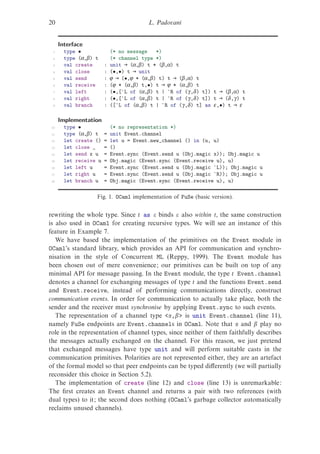
The types of the primitives (lines 3–9) are essentially those shown in Table 3,
so we only make a few remarks. First, all type variables are implicitly quantified.
Second, as in FuSe types, we can switch from one channel type to its dual by flipping
its two type parameters (see e.g. the type of create on line 3). Finally, in the type
of branch (line 9), the type expression “t as ε” denotes the same type as t and
creates an alias ε that stands for t itself. Such construction has several uses: Here,
it is handy to refer to the same variant type in the codomain of branch without
20 L. Padovani
Fig. 1. OCaml implementation of FuSe (basic version).
rewriting the whole type. Since t as ε binds ε also within t, the same construction
is also used in OCaml for creating recursive types. We will see an instance of this
feature in Example 7.
We have based the implementation of the primitives on the Event module in
OCaml’s standard library, which provides an API for communication and synchro-
nisation in the style of Concurrent ML (Reppy, 1999). The Event module has
been chosen out of mere convenience; our primitives can be built on top of any
minimal API for message passing. In the Event module, the type t Event.channel
denotes a channel for exchanging messages of type t and the functions Event.send
and Event.receive, instead of performing communications directly, construct
communication events. In order for communication to actually take place, both the
sender and the receiver must synchronise by applying Event.sync to such events.
The representation of a channel type <α,β> is unit Event.channel (line 11),
namely FuSe endpoints are Event.channels in OCaml. Note that α and β play no
role in the representation of channel types, since neither of them faithfully describes
the messages actually exchanged on the channel. For this reason, we just pretend
that exchanged messages have type unit and will perform suitable casts in the
communication primitives. Polarities are not represented either, they are an artefact
of the formal model so that peer endpoints can be typed differently (we will partially
reconsider this choice in Section 5.2).
The implementation of create (line 12) and close (line 13) is unremarkable:
The first creates an Event channel and returns a pair with two references (with
dual types) to it; the second does nothing (OCaml’s garbage collector automatically
reclaims unused channels).
A simple library implementation of binary sessions 21
Concerning the implementation of send (line 14), we perform an unsafe cast on
the message x using Obj.magic : α
↓
- β so that x appears to the type checker as
having type unit. The cast cannot interfere with the internals of the Event module:
Since the Event.channel type is parametric in the type of messages, we know that
Event functions make no assumptions on their content. The value returned by send
is the same reference u used for the communication, except that its type is cast to
the dual type of the continuation. This latter cast is potentially dangerous, for it
changes the type of an existing endpoint which might be used elsewhere according
to its previous type. From Section 4, we know that this cast is safe provided that
no other reference to u occurs in the program, namely if u is used linearly. In
Section 5.2, we will implement the endpoint invalidation semantics of the formal
model, so that any potentially unsafe linearity violation is at least signalled with a
runtime exception. The trickery in send induces a corresponding implementation of
receive (line 15): OCaml believes that the event created by Event.receive yields
(), whereas an actual payload is received. We explicitly pair the endpoint u (known
to the receiver) to the payload, and we perform another cast so that the pair is
typed correctly.
The implementation of left, right, and branch (lines 16–18) follows the same
lines. In these cases, only a tag `L or `R is communicated, instead of the continuation
channel u injected through one of such tags as the type of left and right suggests.
The injection is performed by the receiver and resorts to one last magic: Since the
internal OCaml representation of `T u – that is channel u injected through the T
tag – is the same as that of the pair (`T, u), we create such a pair and cast its
type to that of the injected channel. This trick spares us one pattern matching on
the received message and scales to arbitrary tag sets without requiring subsequent
patches (see Section 5.4).
Example 7 (session type inference and duality)
Below are the types of server and client from Example 1 automatically inferred
by OCaml:
val server : ([ `R of (int * (int * (•,int * (•,α) t) t,•) t,•) t
| `L of (•,•) t ] as α,•) t
↓
- unit
val client : int
↓
- (•,[ `R of (int * (int * (•,int * (•,α) t) t,•) t,•) t
| `L of (•,•) t ] as α) t
↓
- int
These two types correspond exactly to those we have guessed in Example 3. Since
the channel type in the type of server is dual of the channel type in the type of
client, we deduce that client and server interact safely and the function main
at the end of Example 1 is well typed.
Consider now a variation of client where the initial value for the partial result
acc is 0.0 instead of 0. The effect of this change is to turn acc’s type from int to
float:
let client' =
let rec aux acc n y = ... in aux 0.0
22 L. Padovani
Taken in isolation, client' is well typed and OCaml infers the following type for it:
val client' :
int
↓
- (•,[ `R of (float * (int * (•,float * (•,α) t) t,•) t,•) t
| `L of (•,•) t ] as α) t
↓
- float
However, the channel types of client' and server are no longer dual of
each other (the corresponding message types are not unifiable). OCaml detects this
problem and fails to compile a program that connects client' and server with a
session.
Example 8 (sample errors)
To show the effectiveness of the library in detecting programming errors involving
session endpoints, let us consider once again the forwarder function of Example 2,
which for convenience we report once again with numbered lines.
1 let forwarder mode src dst =
2 if mode then (* check modality *)
3 let rec aux src dst =
4 let msg, src = receive src in (* receive from source *)
5 let dst = send msg dst in (* send to destination *)
6 aux src dst (* forever *)
7 in aux src (left dst) (* select forwarding *)
8 else
9 close (send src (right dst)) (* select delegation *)
We discuss a few non-obvious errors that may be introduced in forwarder:
• Omitting left (line 7) would cause a type error, for dst would be used for
both an output operation (line 5) and a selection (line 9). The omission of
right (line 9) would cause a type error for similar reasons.
• Omitting both left and right would also cause a type error, because dst
would be used repeatedly for output operations in aux (line 5) and would be
closed on line 9.
• Omitting left, right, and also close would not cause a type error, because
the type of the (unused) continuation of dst (line 9) would be unifiable with
that of dst as used in aux. In general, closing unused endpoints explicitly
helps detecting more errors in lack of a substructural type system.
• Swapping msg and dst (line 5) would not cause a type error, although OCaml
would infer for forwarder a weird-looking type. However, this error would
go undetected also in a substructural type system such as the one of Gay and
Vasconcelos (2010).
• Omitting the rebinding of dst (i.e. , replacing the leftmost occurrence of dst
on line 5 with _) would go unnoticed, because the type of dst is invariant at
each recursion of aux. This is an instance of overlap which could be detected
at runtime with the elaboration of the library that we are going to present in
Section 5.2.
Although this list is by no means exhaustive and the notion of “non-obvious
error” is subjective, the experience gained in coding examples (those presented in
the paper and others included in FuSe) suggests that the session typing discipline
A simple library implementation of binary sessions 23
1 exception InvalidEndpoint
2 type • (* no representation *)
3 type (α,β) t = unit Event.channel * Mutex.t
4 let check f = if not (Mutex.try_lock f) then raise InvalidEndpoint
5 let fresh u = (u, Mutex.create ())
6 let create () = let u = Event.new_channel () in (fresh u, fresh u)
7 let close (_, f) = check f
8 let send x (u, f) = check f; ...; Obj.magic (fresh u)
9 let receive (u, f) = check f; Obj.magic (..., fresh u)
10 let left (u, f) = check f; ...; Obj.magic (fresh u)
11 let right (u, f) = check f; ...; Obj.magic (fresh u)
12 let branch (u, f) = check f; Obj.magic (..., fresh u)
Fig. 2. OCaml implementation of FuSe (with invalid endpoint usage detection).
realised by FuSe provides valuable feedback even if the host type system is uncapable
of detecting all affinity and linearity violations at compile time.
5.2 Runtime detection of invalid endpoint usages
Figure 2 extends our module with the endpoint invalidation semantics of FuSe so
that an exception (declared on line 1) is raised whenever an invalid endpoint is used.
Note that invalidation in the formal model is a rather powerful mechanism that acts
atomically on all the occurrences of an endpoint in a possibly distributed program.
The code in Figure 2 implements the invalidation semantics assuming that endpoints
reside in shared memory, as is the case when using the Event module. The idea is to
represent endpoints as pairs consisting of an Event.channel and a mutable flag that
approximates the endpoint polarity and indicates whether the endpoint is valid or
not (line 3). To account for the possibility that the endpoint is accessed concurrently
by multiple threads, we represent the flag as a Mutex from OCaml’s standard library.
Whenever a thread uses an endpoint, we attempt to acquire the mutex with try_lock.
If the operation returns true, then the endpoint is valid and can be used; if try_lock
returns false, then the endpoint has already been used and an exception is raised.
The auxiliary function check (line 4) implements this behaviour.
Ideally, when a communication primitive returns a continuation endpoint, the
mutex associated with the endpoint should be unlocked, but doing so on the existing
mutex might induce other users of the endpoint into thinking that the endpoint they
own is valid, whilst in fact it is not. The idea is that communication primitives
return a fresh pair that contains the same Event.channel in the old pair and a new
(unlocked) mutex. This refreshing is implemented by the auxiliary function fresh
(line 5). In essence, the cost we pay for detecting the usage of invalid endpoints is
the allocation of a new pair and a mutex at each invocation of a communication
primitive. As we will see in Section 5.6, this overhead is reasonable especially in a
functional language, where the runtime system is optimised for the heap allocation
of numerous small objects.
With this setup, the communication primitives can be implemented by prefixing
them with a call to check and wrapping the returned Event.channel(s) with fresh
24 L. Padovani
(lines 7–12). In Figure 2, we have elided with ... the unchanged code fragments
from Figure 1. Observe that check and refresh remain confined within the module,
which exports the same interface it had before, plus the InvalidEndpoint exception.
The choice of mutexes in the above discussion is aimed at describing an im-
plementation of the endpoint invalidation semantics that is correct, simple and
portable at the same time. However, more efficient mechanisms can be considered in
specific settings. For example, one could replace the mutex with a boolean reference
modified through an atomic compare-and-swap operation. As one of the anonymous
reviewers pointed out, in the particular case of OCaml using a compare-and-swap
is not even necessary, provided that no memory allocation intervenes between the
moments the reference is read and written. The current implementation of FuSe
follows this latter strategy.
5.3 Generalised choices
Although binary choices suffice to model protocols with an arbitrary branching
structure, being able to use multiple tags, with possibly meaningful names, is
desirable. The main challenge with generalising choices to arbitrary tags is that
the tags appear explicitly in the types of left, right, and branch, whereas we
would like the interface of our library to be as general as possible. One solution is
to replace left and right with a generic select primitive and revise branch so
that select and branch have these types:
val select : ((α,β) t
↓
- ϕ)
↓
- (•,[>] as ϕ) t
↓
- (β,α) t
val branch : ([>] as ϕ,•) t
↓
- ϕ
The semantics of branch is simply to receive a message of type ϕ. The semantics of
select is similar to that of send, except that send takes a message ready to be sent,
whereas select takes a function of type <α,β>
↓
- ϕ which produces the message,
of type ϕ, when applied to a continuation endpoint of type <α,β>. Typically, such
function will be the η-expansion of a tag
fun x
↓
- `T x
that injects a continuation channel into a polymorphic variant type.
The type expression [>] as ϕ in the types of select and branch indicates
that ϕ can only be instantiated with a polymorphic variant type. This constraint
is crucial for the safety of the library: Leaving ϕ unconstrained would make the
type (α,ϕ) t unifiable with the type (α,ψ * (γ,δ) t) t so that an ordinary
message sent with send could be received with branch as if it were a label, or a
label selected with select could be received with receive as if it were an ordinary
message.
The implementation of select and branch is similar to that of send and receive,
with the difference that select transfers the function over the channel, camouflaging
the function as if it were the message produced by the function:
let select f u = Event.sync (Event.send u (Obj.magic f)); Obj.magic u
let branch u = Obj.magic (Event.sync (Event.receive u)) u
A simple library implementation of binary sessions 25
Example 9
Below is a revised and extended version of Example 1 where the mathematical
server supports three operations identified by the tags `Quit, `Plus, and `Eq and
the client uses select to choose the appropriate ones.
let rec server x =
match branch x with
| `Quit x
↓
- close x
| `Plus x
↓
- let n, x = receive x in
let m, x = receive x in
let x = send (n + m) x in
server x
| `Eq x
↓
- let n, x = receive x in
let m, x = receive x in
let x = send (n = m) x in
server x
let client n y =
let rec aux acc n y =
if n = 0 then begin
let y = select (fun x
↓
- `Quit x) y in
close y; acc
end else
let y = select (fun x
↓
- `Plus x) y in
let y = send acc y in
let y = send n y in
let res, y = receive y in
aux res (n - 1) y
in aux 0 n y
For these two functions, OCaml infers the following types:
val server :
([< `Eq of (β * (β * (•,bool * (•,α) t) t,•) t,•) t
| `Plus of (int * (int * (•,int * (•,α) t) t,•) t,•) t
| `Quit of (•,•) t ] as α,•) t
↓
- unit
val client :
int
↓
- (•,[> `Plus of (int * (int * (•,int * (•,α) t) t,•) t,•) t
| `Quit of (•,•) t ] as α) t
↓
- int
Notice that server is parametric in the type β of the operands of the `Eq
operation, as a consequence of the fact that equality is polymorphic in OCaml. Also,
the type of x is not exactly the dual of the type of y, because the choice in one
type has three tags `Eq, `Plus, and `Quit whilst the other one has only two. The
question then is whether OCaml is able to infer that client and server interact
successfully, despite this mismatch in the types of the endpoints they use. This is
indeed the case, and the reason lies in the < and > symbols that decorate variant
types. The < symbol indicates a closed variant type, one for which the set of tags
constitutes an upper bound: The match in the server body handles three tags `Eq,
`Plus, `Quit, but not others. The > symbol indicates an open variant type, one for
which the set of tags constitutes a lower bound: The `Plus and `Quit tags may
26 L. Padovani
be produced by client, but this variant type is unifiable with others providing a
superset of tags, like the one in the type of x. In conclusion, the rules governing
variant types allow OCaml to infer that client and server interact successfully
because client uses only a subset of the operations provided by server. If client
attempted to use a `Mult operation, OCaml would signal an error at the point where
client and server are connected through a session.
The fact that the revised server interacts correctly with client, despite the type
of x is not exactly dual to that of y, is formally explained in terms of subtyping
for session types (Gay and Hole, 2005): The dual of the type of x is a subtype
of the type of y, meaning that client uses fewer features than those offered by
server. We exploit the encoding of session types (Dardha et al., 2012) to lift
OCaml’s built-in subtyping of variant types at the level of channel (hence session)
types. The implementation of FuSe pushes support for subtyping even further, by
taking advantage of OCaml’s variance annotations for type parameters. In particular,
the abstract channel type is declared thus
type (+α,-β) t
indicating that channel types are covariant in the input type and contravariant in
the output type. These annotations induce, on decoded channel types, the same
subtyping relation for session types described by Gay and Hole (2005).
5.4 Support for distributed communications
From a purely theoretical viewpoint, our approach to session type checking applies
equally well to both local and distributed communications. In practice, however, the
underlying communication API may rely on a specific distribution model and/or
pose restrictions to the data that can be sent in messages. For example, the Event
module relies on shared memory and therefore is unfit to support distributed
communications. In this section, we argue that our approach remains feasible also
in a distributed setting.
First of all, we have to consider that in a distributed system any data that
cannot be serialised in a platform-neutral way might be meaningless if transmitted
in a message. For a higher order language such as OCaml, the typical example is
that of functions, whose representation involves compiled code. In this respect, the
handling of arbitrary tags that we have described in Section 5.3 does not scale well
to a distributed setting, because it is realised by sending functions over channels.
Two alternatives remain feasible though. The functions left, right, and branch
in the basic version of the library (Section 5.1) handle binary choices and branches
by transmitting tags only, and are therefore unproblematic in a distributed setting.
These functions are also easy to generalise to arbitrary – but fixed – tag sets. For
example, given the set L = {T1, . . . , Tn} of tags we can devise the following family of
OCaml functions to handle choices involving the tags taken from L:
let selectL,i u = Event.sync (Event.send u (Obj.magic `Ti)); Obj.magic u
let branchL u = Obj.magic (Event.sync (Event.receive u), u)
A simple library implementation of binary sessions 27
These functions can be given the types:
val selectL,i : (•,tagsL) t
↓
- (βi,αi) t
val branchL : (tagsL,•) t
↓
- tagsL
where tagsL abbreviates occurrences of the polymorphic variant type
[ `T1 of (α1,β1) t | · · · | `Tn of (αn,βn) t ]
In the end, it is easy to define domain-specific versions of select and branch
that involve the transfer of only a tag and that are suitable for distributed
communications.
The mechanism described in Section 5.2 for the runtime detection of linearity
violations is also delicate. Assuming that the underlying communication API allows
endpoints to be sent in messages, the mechanism we have described would require
keeping the flags associated with each endpoint coherent, which is difficult to do
across different locations. We can adapt the mechanism to a distributed setting
by devising dedicated primitives for the communication of endpoints. The idea is
that an endpoint being sent in a message is invalidated in the sender, electing the
receiver as the only owner of a valid reference to the endpoint. As a result, across
the whole distributed system, there is always at most one location containing valid
references to the roaming endpoint, and linearity violations within such location
can be effectively and efficiently detected using the code shown in Figure 2. This
behaviour can be realised by the two functions below:
let send_endpoint (u, f) (v, g) =
check f; check g; Event.sync (Event.send v (Obj.magic u));
Obj.magic (fresh v)
let receive_endpoint (u, f) =
check f; let v = Event.sync (Event.receive u) in
Obj.magic (fresh v, fresh u)
whose types are
val send_endpoint : (γ,δ) t
↓
- (•,(γ,δ) t * (α,β) t) t
↓
- (β,α) t
val receive_endpoint : ((γ,δ) t * (α,β) t,•) t
↓
- (γ,δ) t * (α,β) t
Of course, it is up to the programmer to remember using the dedicated primitives
for delegations, unless the type system has some feature that prevents channels to be
sent as ordinary messages. The use of dedicated primitives for handling delegations
may be motivated by other practical considerations, since the communication of
endpoints in a distributed environment is likely to require some special handling
anyway, and it has been considered in theoretical works on sessions as well (Honda
et al., 1998).
5.5 A monadic interface for FuSe primitives
In this section, we elaborate a monadic API on top of FuSe communication prim-
itives. Following Pucella and Tov (2008), we define an indexed monad (α,β,ϕ) m
that describes computations producing a value of type ϕ whilst using a session
endpoint and turning its type from α to β. The monad encapsulates the session
endpoint and hides it from the programmer, threading computations in such a way
28 L. Padovani
Fig. 3. OCaml implementation of FuSe (monadic version).
that the endpoint is guaranteed to be used linearly, unless an exception is thrown
(affinity is always guaranteed though).
Figure 3 shows the OCaml module realising the monadic API. The interface of the
module comprises the (abstract) monad type and the signatures of the usual monadic
operations return, to create trivial computations not involving communications, and
>>=, to compose computations sequentially. In addition, it is convenient to provide
a specialisation >>> of >>= in which the continuation does not use the result of the
first computation as well as a fixpoint operator m_fix (we will see in a moment why
this is useful). Next, we have the operations for session communications. Primitives
m_send through m_branch correspond exactly to FuSe communication primitives,
modulo the fact that output operations have an explicit unit return type signalling
that they produce no result. The operation m_connect combines the functionality
of create and close. When m_connect is applied to two monadic computations,
corresponding to the “server” and “client” sides of the session, it creates a new
session that connects server and client, spawns a new thread for the server and runs
the client. Once the interaction is over, both endpoints of the session are closed and
the result of the client computation is returned.
A simple library implementation of binary sessions 29
The implementation of the module is shown in the lower part of Figure 3. The
concrete representation of the indexed monad (α,β,ϕ) m is α
↓
- ϕ * β, namely a
function that takes a session endpoint and produces a pair with the result of the
computation and the endpoint with the updated type. This informal description
essentially corresponds to that of the state monad, with the difference that in our
case the state is a session endpoint whose type may change as the session goes on.
Once the representation of the monad is fixed, the implementation of the operations
follows directly. Just note the use of functional composition ◦ in m_connect and the
explicit return of () in the output operations m_send, m_left, and m_right.
Example 10 (monadic mathematical server)
Below we show the monadic version of the mathematical server introduced in
Example 1.
let server =
m_fix (* recursive server *)
(fun server
↓
-
m_branch (* wait for a request *)
(return ()) (* terminate session *)
(m_receive >>= fun n
↓
- (* receive 1st operand *)
m_receive >>= fun m
↓
- (* receive 2nd operand *)
m_send (n + m) >>> (* send result *)
server)) (* serve more requests *)
Note the use of m_fix for creating a recursive server. In this case, it would not be
possible to define server recursively as we have done in Example 1, for the body
of server is not a function (even if it evaluates to a function, as we know from
Figure 3).
The monadic version of the client in Example 1 is shown below:
let client =
let rec aux acc n = (* add n naturals *)
if n = 0 then
m_left >>> return acc (* terminate session *)
else
m_right >>> (* select + operation *)
m_send acc >>> (* send 1st operand *)
m_send n >>> (* send 2nd operand *)
m_receive >>= fun res
↓
- (* receive result *)
aux res (n - 1) (* possibly add more *)
in aux 0
and, with these definitions in place, client and server can be connected thus:
let main n =
m_connect server (client n) (* run session *)
The slightly awkward syntax for binding results of computations on the right-
hand side of >>= is typical of monadic code but can be easily sugared into a more
readable form.
As shown in Example 10, the monadic API can be convenient in simple (but
possibly frequent) cases involving single sessions. Because endpoint affinity is
30 L. Padovani
guaranteed by the monad, the monadic API can be safely built on top of the
basic version of FuSe primitives (Figure 1), thus sparing the overhead due to
runtime checks. In fact, as we will see in Section 5.6, this results in a slightly
more efficient implementation compared to that described in Section 5.2. Also, the
chosen realisation of the m_connect operation is known to guarantee deadlock
freedom, provided that no exceptions interrupt ongoing sessions (Wadler, 2014).
The monadic API has some downsides as well. First and foremost, it disallows the
interleaving of multiple sessions and, in particular, it does not support delegation.
Multiple sessions can be opened and used according to a strictly nested discipline,
pretty much like function calls. As shown by Pucella and Tov (2008), the monad
can be generalised to support multiple sessions at the cost of a more complex
API requiring the programmer to write significant amounts of boilerplate code.
Also, it is difficult to provide a monadic API supporting generalised choices
because not only the typing but also the implementation of m_branch depends
on the set of tags that must be handled. As explained in Section 5.3, how-
ever, it is possible to provide versions of m_branch handling a specific set of
tags.
5.6 Performance comparison
In this section, we report on a series of microbenchmarks aimed at measuring the
performance of different implementations of FuSe communication primitives. The
program we use as benchmark is the one presented in Example 1 (and its monadic
variant in Example 10) in which a client interacts with a mathematical server to
compute the sum of the first n natural numbers. For the benchmarks we fix n
at 1,000 and we measure the message throughput of 1,000 runs, considering that
each execution involves the exchange of 4n + 1 messages. The reason for such a
high number of runs is to contrast the broad variance observed in some execution
times, which is due to uncontrollable factors such as the intervention of OCaml’s
garbage collector and the involvement of concurrent threads using synchronisation
primitives.
Figure 4 shows the results of the microbenchmarks corresponding to four im-
plementations of the FuSe primitives. Each box contains the throughput of 750
runs, the horizontal line being the median and the individual dots stretching
beyond the whiskers being outliers. The “Unchecked” column corresponds to the
basic version of the library (Figure 1) which does not perform runtime checks
to detect linearity violations. This column represents the ideal performance that
could be achieved if OCaml had support for linear/affine types, thus eliminating
the need for runtime checks or other mechanisms (such as the use of the monad)
to enforce endpoint linearity/affinity. The “Mutex” column corresponds to the
implementation shown in Figure 2, which checks for linearity violations using a
mutex from OCaml’s standard library. The graph shows a 10% throughput decrease
due to the overhead of runtime checks and the creation of a new mutex at each
communication. The “Monadic” column corresponds to the implementation shown
in Figure 3 in which the non-monadic primitives are those from Figure 1. The
A simple library implementation of binary sessions 31
100k
110k
120k
130k
140k
150k
160k
170k
Unchecked Mutex Monadic NanoMutex
MacBookAir5,2 i5 1,8 GHz 4 GB
OCaml 4.03.0 (native)
Throughput(messages/sec)
Fig. 4. Performance comparison of different implementations of FuSe primitives.
throughput in this case is almost ideal, despite the fair amount of closures that are
created by this version of the library. Finally, the “NanoMutex” column corresponds
once again to the implementation shown in Figure 2 except that the mutexes
being used are Nano_mutexes taken from Core (Jane Street Developers, 2016),
an alternative to OCaml’s standard library. Nano_mutexes are significantly cheaper
than the OS-level mutexes used in the Mutex module of OCaml’s standard library.
In fact, the throughput achieved by this implementation of the library is almost
ideal. This column shows that a careful handling of the validity flag associated
with session endpoints can virtually eliminate the overhead due to the runtime
checks.
6 Related work
Several Haskell libraries of binary sessions have been proposed (Neubauer and
Thiemann, 2004; Pucella and Tov, 2008; Sackman and Eisenbach, 2008; Imai et al.,
2010). In these works, session types are represented conventionally as sequences
of I/O actions and branching points and duality constraints are expressed either
using multiparameter type classes and functional dependencies (both of which are
Haskell-specific features) or explicit duality proofs (Pucella and Tov, 2008). The
lack of equirecursive types in Haskell calls for an explicit representation also for
recursive session types. To this aim, Pucella and Tov (2008) and Imai et al. (2010)
use De Bruijn indexes and type-level Peano numerals. This representation requires
programmers to write explicit monadic actions for unwinding recursions and induces
an isorecursive treatment of session types.
The standard way of expressing impure computations in Haskell is to embed them
in a monad. All Haskell libraries of binary sessions follow this approach. Besides
being a necessity dictated by the nature of the language, the monad for session
32 L. Padovani
communications guarantees affine access to session endpoints, which are hidden
to the programmer, and tracks the changes in the type of session endpoints auto-
matically without requiring the programmer to write explicit rebindings (compare
the code in Examples 1 and 10). However, the monad has also a cost in terms of
either expressiveness, usability, or portability: The monad defined by Neubauer and
Thiemann (2004) supports communication on a single channel only and is therefore
incapable of expressing session interleaving or delegation. Pucella and Tov (2008)
propose a monad that stores a stack of endpoints (or, better, of their capabilities)
allowing for session interleaving and delegation to some extent. The price for this
generality is that the programmer has to write explicit monadic actions that literally
dig into the stack to reach the channel/capability to be used; also for this reason
delegation is severely limited. Imai et al. (2010) show how to avoid writing such
explicit actions relying on a form of type-level computations that is unique to
Haskell.
Alms (Tov and Pucella, 2011; Tov, 2012) is a general-purpose programming
language equipped with an expressive type system that supports parametric poly-
morphism, abstract and algebraic data types, and affine types as well. Tov (2012)
illustrates how to build a library of binary sessions on top of these features. Because
Alms’ type system is substructural, endpoint affinity is guaranteed statically by
the fact that session types are qualified as affine. As in the works about Haskell,
the representation of session types is conventional and recursive session types
arise from Alms support for equirecursive types. Duality constraints are expressed
using a peculiar feature of Alms called type functions with which the programmer
can define (lazy) type-level computations. In particular, Tov gives a type function
corresponding to Definition 4 that allows the compiler to compute the dual of a
session type. We observe that the mechanism of type functions is currently used in
Alms’ library for this purpose only. By using encoded session types, it would be
possible to obtain a fully fledged library of binary sessions that makes no use of type
functions.
The main source of inspiration for this work is the continuation-passing encoding
of binary sessions given by Dardha et al. (2012) and partially studied by Kobayashi
(2002) and Demangeon and Honda (2011). Dardha et al. (2012) motivate the
encoding as a foundational approach to the study of session type systems and their
properties. We have shown that the very same encoding has also practical relevance:
On the one hand, it permits the integration of session type checking into a wide
class of programming languages; on the other hand, it allows us to benefit from
the features of the host language – parametric polymorphism, equirecursive types,
subtyping, type inference – lifting them at the level of (encoded) session types. From
a technical standpoint, our work differs from that of Dardha et al. (2012) in two
ways. First, we use a new representation of channel types that makes it possible to
reduce type duality to type equality. Second, we consider the standard operational
semantics of session communications (Gay and Vasconcelos, 2010), in which no
continuation channels are explicitly created or exchanged, also taking into account
endpoint invalidation. For these reasons, the soundness results given by Dardha
et al. (2012) cannot be used as arguments for the soundness of our typing discipline.
A simple library implementation of binary sessions 33
Concerning the enforcement of linear/affine usage of session endpoints, our
approach is based on runtime checks (Tov and Pucella, 2010; Hu and Yoshida,
2016). By definition, this approach cannot detect linearity violations statically, but it
allows for greater flexibility when used in conjunction with constructs for non-local
control flow (most notably exceptions and callbacks), which are known sources of
issues for substructural type systems. The proposed runtime mechanism is reasonably
lightweight (Section 5.6) and is independent of the particular representation of
session types and/or the mechanism used for tracking the change in type of session
endpoints, making it is easy to apply in a wide range of programming languages (Hu
and Yoshida, 2016). Besides, the fact that the session type of an endpoint changes
at each usage allows the detection of a fair number of linearity violations even if
the underlying type system is not substructural (Example 6). Our approach can be
seen as a particular instance of the framework of stateful contracts proposed by Tov
and Pucella (2010) in that our representation of session endpoints comprises both
the affine/linear data structure (the session endpoint) and its stateful contract (the
mutex). We note two differences: First, we have to use a mutex (or an equivalent
data type with atomic access) instead of a bare flag to account for multithreading;
second, we use polymorphism to account for the possibility that multiple references
to the same endpoint coexist but require different typings (Example 5). The endpoint
invalidation semantics and the typing of invalid endpoints are original contributions
of the present work.
A different but related technique is the runtime monitoring of sessions (Chen
et al., 2011; Bocchi et al., 2013; Bartoletti et al., 2015; Demangeon et al.,2015).
Runtime monitoring is achieved either by a service (Chen et al., 2011; Bocchi et al.,
2013; Demangeon et al., 2015) or by an active communication middleware (Bartoletti
et al., 2015) that compares the observable behaviour of processes against the declared
contracts/session types and possibly issues notifications when violations are detected.
Like monitoring, our runtime mechanism is meant to ensure communication safety
and protocol fidelity. Unlike monitoring, our mechanism is internal to processes
and only detects linearity violations, which do not necessarily imply corresponding
protocol violations.
There is a long strand of works which follow a top-down methodology for
integrating sessions into programming languages. In these works, the protocol comes
first and is explicitly described either formally or by means of a suitable Domain
Specific Language. From this description, the communication API (sometimes in
the form of a class hierarchy) is generated, possibly with the aid of supporting tools.
A comprehensive survey describing works that follow this methodology is given
by Ancona et al. (2016). A notable omission from the survey that targets Scala and
that is very related to our approach is a recent work by Scalas and Yoshida (2016).
As we do, Scalas and Yoshida use a runtime mechanism to compensate for the lack
of affine/linear types in Scala and work with the encoded representation of session
types given by Dardha et al. (2012). Each (encoded) session type is represented as a
Scala (case) class, which must be either provided by the programmer or generated
from the protocol. Since Scala’s type system is nominal, the subtyping relation
between session types is constrained by the (fixed) subclassing relation between
34 L. Padovani
the classes that represent them. Two more differences are worth noting. First, the
framework of Scalas and Yoshida relies on the explicit creation and exchange of
continuations. Second, it illustrates the sort of subtleties arising when channel types
are represented using fixed capabilities ? and ! (cf. the discussion in Section 3).
For instance, it is possible to write functions with types unit
↓
- ?[α] * ![α] and
unit
↓
- ![α] * ?[α], but not a function with type unit
↓
- A * A⊥
that mentions
completely unknown yet related session types. As we have seen in Section 4, our
representation of channel types is key to express the most general type of the
communication primitives and the functions built on them.
7 Concluding remarks
The implementation of FuSe supports other features not described in this pa-
per, including accept/request primitives to open sessions via shared channels
(Honda et al., 1998; Gay and Vasconcelos, 2010). The use of a single primitive create
to open new sessions is technically simpler and has been inspired by Singularity
OS (Hunt et al., 2005; Bono and Padovani, 2012). The implementation of FuSe
also supports sequential composition and iteration for protocols. Sequential compo-
sition can be used for the enforcement of context-free protocols (Padovani, 2016;
Vasconcelos and Thiemann, 2016) whereas iterative protocols provide alternative
ways of realising arbitrarily long interactions without resorting to (equi)recursive
types. In general, we argue that, by reducing session type duality to type equality,
our approach makes it easy to conceive and implement high-level communication
patterns that require the execution of complementary behaviours.
The choice of synchronous communication in FuSe was solely motivated by conve-
nience. Asynchronous communication can be modelled using queues
(Gay and Vasconcelos, 2010), adjusting the formal semantics so that the peers
of a session are invalidated independently, and basing the implementation on a
suitable asynchronous API.
An intriguing extension concerns multiparty sessions (Honda et al., 2008), those
involving an arbitrary, possibly variable number of participants. The runtime
mechanism to detect linearity violations is applicable without issues to the endpoints
of multiparty sessions. Concerning the representation of the protocol structure, it is
known that (some classes of) multiparty sessions can be encoded in terms of binary
sessions either connecting pairs of participants extended version or connecting
each participant with a medium process (Caires and P´erez, 2016). As it stands,
our approach would be unable to recognise these individual sessions as part of a
single multiparty session. Whether the approach can be extended to model “true”
multiparty sessions remains an open question.
Acknowledgments
The author is grateful to the anonymous reviewers and to Hern´an Melgratti for
having provided detailed and constructive feedback on early versions of this paper.
Hern´an Melgratti also contributed to the development of FuSe.
A simple library implementation of binary sessions 35
References
Ancona, D., Bono, V., Bravetti, M., Campos, J., Castagna, G., Deni´elou, P.-M., Gay, S. J.,
Gesbert, N., Giachino, E., Hu, R., Johnsen, E. B., Martins, F., Mascardi, V., Montesi, F.,
Neykova, R., Ng, N., Padovani, L., Vasconcelos, V. T. & Yoshida, N. (2016) Behavioral
types in programming languages. Found. Trends Program. Lang. 3(2–3), 95–230.
Bartoletti, M., Cimoli, T., Murgia, M., Podda, A.-S. & Pompianu, L. (2015) Compliance and
subtyping in timed session types. In Proceedings of FORTE’15, LNCS, vol. 9039. Springer,
Germany, pp. 161–177.
Bocchi, L., Chen, T.-C., Demangeon, R., Honda, K. & Yoshida, N. (2013) Monitoring networks
through multiparty session types. In Proceedings of FMOODS/FORTE’13, LNCS,
vol. 7892. Springer, Germany, pp. 50–65.
Bono, V. & Padovani, L. (2012) Typing copyless message passing. Logical Methods Comput.
Sci. 8(1:17), 1–50.
Caires, L. & P´erez, J. A. (2016) Multiparty session types within a canonical binary theory, and
beyond. In Proceedings of FORTE’16, LNCS, vol. 9688. Springer, Germany, pp. 74–95.
Chen, T.-C., Bocchi, L., Deni´elou, P.-M., Honda, K. & Yoshida, N. (2011) Asynchronous
distributed monitoring for multiparty session enforcement. In Proceedings of TGC’11,
LNCS, vol. 7173. Springer, Germany, pp. 25–45.
Courcelle, B. (1983) Fundamental properties of infinite trees. Theor. Comput. Sci. 25(2), 95–169.
Dardha, O., Giachino, E. & Sangiorgi, D. (2012) Session types revisited. In Proceedings of
PPDP’12. ACM, USA, pp. 139–150.
Demangeon, R. & Honda, R. (2011) Full abstraction in a subtyped pi-calculus with linear
types. In Proceedings of CONCUR’11, LNCS, vol. 6901. Springer, Germany, pp. 280–296.
Demangeon, R., Honda, K., Hu, R., Neykova, R. & Yoshida, N. (2015) Practical interruptible
conversations: Distributed dynamic verification with multiparty session types and python.
Formal Methods Syst. Des. 46(3), 197–225.
Garrigue, J. (1998) Programming with polymorphic variants. In Informal Proceedings of
ACM SIGPLAN Workshop on ML. Available at https://caml.inria.fr/pub/papers/
garrigue-polymorphic variants-ml98.pdf, last accessed November 2016.
Gay, S. & Hole, M. (2005) Subtyping for session types in the π-calculus. Acta Inform. 42(2–3),
191–225.
Gay, S. J. & Vasconcelos, V. T. (2010) Linear type theory for asynchronous session types.
J. Funct. Program. 20(1), 19–50.
Honda, K. (1993) Types for dyadic interaction. In Proceedings of CONCUR’93, LNCS, vol.
715. Springer, Germany, pp. 509–523.
Honda, K., Vasconcelos, V. T. & Kubo, M. (1998) Language primitives and type disciplines
for structured communication-based programming. In Proceedings of ESOP’98, LNCS, vol.
1381. Springer, Germany, pp. 122–138.
Honda, K., Yoshida, N. & Carbone, M. (2008) Multiparty asynchronous session types. In
Proceedings of POPL’08. ACM, USA, pp. 273–284.
Hu, R. & Yoshida, N. (2016) Hybrid session verification through endpoint API generation.
In Proceedings of FASE’16, LNCS, vol. 9633. Springer, Germany, pp. 401–418.
Hunt, G., Larus, J. R., Abadi, M., Aiken, M., Barham, P., F¨ahndrich, M., Hawblitzel, C.,
Hodson, O., Levi, S., Murphy, N., Steensgaard, B., Tarditi, D., Wobber, T. & Zill, B. (2005)
An Overview of the Singularity Project. Technical Report MSR-TR-2005-135, Microsoft
Research.
Imai, K., Yuen, S. & Agusa, K. (2010) Session type inference in Haskell. In Proceedings of
PLACES’10, EPTCS 69, Open Publishing Association, pp. 74–91.
36 L. Padovani
Jane Street Developers. (August 2016) Core library documentation. Available at https://
ocaml.janestreet.com/ocaml-core/latest/doc/core/. Last accessed in November 2016.
Kobayashi, N. (2002) Type systems for concurrent programs. In Proceedings of the 10th
Anniversary Colloquium of UNU/IIST, LNCS, vol. 2757. Springer, Germany, pp. 439–453.
Extended version available at http://www.kb.ecei.tohoku.ac.jp/ koba/papers/tutorial-type-
extended.pdf.
Kobayashi, N., Pierce, B. C. & Turner, D. N. (1999) Linearity and the pi-calculus. ACM Trans.
Program. Lang. Syst. 21(5), 914–947.
Leroy, X., Doligez, D., Frisch, A., Garrigue, J., R´emy, D. & Vouillon, J. (2014) The Objective
Caml System. Available at http://caml.inria.fr/pub/docs/manual-ocaml/. Last accessed in
November 2016.
Neubauer, M. & Thiemann, P. (2004) An implementation of session types. In Proceedings of
PADL’04, LNCS, vol. 3057. Springer, Germany, pp. 56–70.
Padovani, L. (2014) Deadlock and lock freedom in the linear π-calculus. In Proceedings
of CSL-LICS’14. ACM, USA, pp. 72:1–72:10. Extended version available at http://
hal.archives-ouvertes.fr/hal-00932356v2/.
Padovani, L. (2015) A Simple Library Implementation of Binary Sessions. Technical Report,
Universit`a di Torino, Italy. Available at https://hal.archives-ouvertes.fr/hal-01216310.
Padovani, L. (2016) Context-Free Session Type Inference. Technical Report, Universit`a di
Torino, Italy. Available at https://hal.archives-ouvertes.fr/hal-01385258.
Pierce, B. C. & Sangiorgi, D. (1996) Typing and subtyping for mobile processes. Math. Struct.
Comput. Sci. 6(5), 409–453.
Pucella, R. & Tov, J. A. (2008) Haskell session types with (almost) no class. In Proceedings
of HASKELL’08. ACM, USA, pp. 25–36.
Reppy, J. H. (1999) Concurrent Programming in ML. Cambridge University Press.
Sackman, M. & Eisenbach, S. (2008) Session Types in Haskell: Updating Message Passing for
the 21st Century. Technical report, Imperial College London. Available at http://pubs.doc.
ic.ac.uk/session-types-in-haskell/.
Scalas, A. & Yoshida, N. (2016) Lightweight session programming in scala. In Proceedings of
ECOOP’16, LIPIcs, Germany, vol. 56. Schloss Dagstuhl, pp. 21:1–21:28.
Tov, J. A. (2012) Practical Programming with Substructural Types. PhD thesis, Northeastern
University.
Tov, J. A. & Pucella, R. (2010) Stateful contracts for affine types. In Proceedings of ESOP’10,
LNCS, vol. 6012. Springer, Germany, pp. 550–569.
Tov, J. A. & Pucella, R. (2011) Practical affine types. In Proceedings of POPL’11. ACM, USA,
pp. 447–458.
Vasconcelos, V. T. & Thiemann, P. (2016) Context-free session types. In Proceedings of
ICFP’16. ACM, USA, pp. 462–475.
Wadler, P. (2014) Propositions as sessions. J. Funct. Program. 24(2–3), 384–418.
Wright, A. K. & Felleisen, M. (1994) A syntactic approach to type soundness. Inform. Comput.
115(1), 38–94.
A Supplement to Section 3
Lemma 1
We have ⊥ct ◦ [[·]] = [[·]] ◦ ⊥st and ⊥st ◦ · = · ◦ ⊥ct.
Proof
We only show the first equality. In particular, we show that [[T]]⊥
= [[T⊥
]] by case
analysis on the shape of T.
A simple library implementation of binary sessions 37
T = ?t.S We derive:
[[T]]⊥
= [[?t.S]]⊥
by definition of T
= ?[t * [[S]]]⊥
by definition of [[·]]
= ![t * [[S]]] by definition of duality on channel types
= ![t * [[S⊥⊥
]]] because duality is an involution
= [[!t.S⊥
]] by definition of [[·]]
= [[T⊥
]] by definition of duality on session types
T = T1 ⊕ T2 We derive:
[[T]]⊥
= [[T1 ⊕ T2]]⊥
by definition of T
= ![[[T⊥
1 ]] + [[T⊥
2 ]]]⊥
by definition of [[·]]
= ?[[[T⊥
1 ]] + [[T⊥
2 ]]] by definition of duality on channel types
= [[T⊥
1 & T⊥
2 ]] by definition of [[·]]
= [[T⊥
]] by definition of duality on session types.
The remaining are either similar or trivial.
Theorem 1
· = [[·]]−1
.
Proof
We show that · ◦ [[·]] = idS, where idS is the identity on S. It suffices to show that
R
def
= {( [[T]] , T) | T ∈ S} coincides with idS. We prove the two inclusions R ⊆ idS
and idS ⊆ R in this order.
Concerning the relation R ⊆ idS, take S R T. Then, S = [[T]] . We proceed
reasoning by cases on the shape of T and we consider only the case T = !t.T , the
others being analogous. We have to show that there exists S such that S = !t.S
and S R T . We derive:
S = [[T]] = [[!t.T ]] by definition of T
= ![t * [[T ⊥
]]] by definition of [[·]]
= !t. [[T ⊥
]]⊥
by definition of ·
= !t. [[T ⊥⊥
]] by Lemma 1
= !t. [[T ]] because duality is an involution
and we conclude by taking S
def
= [[T ]] and observing that S R T by definition
of R.
Concerning the relation idS ⊆ R, take (S, T) ∈ idS, meaning S = T. We have to
show that S R T. By definition of R, we have [[T]] R T and from the relation
R ⊆ idS, we deduce [[T]] = T = S. We conclude by definition of R.
B Supplement to Section 4
B.1 Subject reduction for expressions
We just recall the key type preservation result of Wright and Felleisen (1994), whose
proof only requires minor adaptations concerning the set of values in FuSe.
38 L. Padovani
Lemma 2 (subject reduction for expressions)
If Γ e : t and e −→ e , then Γ e : t.
Proof
This is a straightforward adaptation of a known result (Wright and Felleisen, 1994,
Lemma 4.3), where the values include a few more cases.
B.2 Subject reduction for processes
The next proposition establishes key properties of the reduction on type environ-
ments.
Proposition 2
If Γ −→ Γ , then the following properties hold:
1. dom(Γ ) ⊆ dom(Γ);
2. if Γ is balanced, then so is Γ ;
3. Γ (u) = Γ(u) for every u ∈ dom(Γ)  ep( ).
Proof
Straightforward from the definition of type environment reduction.
A reduction may invalidate endpoints occurring in an expression or in a process,
even if there is no redex in such terms. The following result shows that typing is
preserved when invalidations occur. This is a consequence of the fact that the type
∀A.A of invalidated endpoints allows them to be typed with any instance of a
channel type.
Lemma 3 (invalidation)
Let Γ −→ Γ where Γ is balanced. Then, Γ e : t implies Γ e : t, and Γ P
implies Γ P .
Proof
A simple induction on the typing derivation, the only interesting case being that of
e = ap
∈ ep( ).
The following two lemmas allow us to reason on the typing of terms occurring
in the hole of an evaluation context. In the statements of these results, by “sub-
derivation of D”, we mean a sub-tree of D. Note that the replacement lemma differs
from the one of Wright and Felleisen (1994) since the expression e is replaced not
in the original evaluation context E, but in the context E where some endpoints
may have been invalidated.
Lemma 4 (typability of subterms)
If D be a derivation for Γ E[e] : t, then there exists a sub-derivation D of D that
concludes Γ e : s.
Proof
By induction on E, observing that the [ ] of an evaluation context is never found
within the scope of a binder.
A simple library implementation of binary sessions 39
Lemma 5 (replacement)
If
1. Γ −→ Γ where Γ is balanced,
2. D is a derivation concluding Γ E[e] : t,
3. D is a sub-derivation of D concluding Γ e : s,
4. the position of D in D corresponds to that of [ ] in E, and
5. Γ e : s,
then Γ E [e ] : t.
Proof
By induction on E.
The type system is not substructural, so it enjoys a standard form of weakening.
Lemma 6 (weakening)
The following properties hold:
1. If Γ e : t, then Γ, Γ e : t.
2. If Γ P, then Γ, Γ P.
Proof
Standard properties of any non-substructural type system.
Structural congruence alters the basic arrangement of processes without affecting
typing.
Lemma 7 (congruence preserves typing)
If Γ P and P ≡ Q, then Γ Q.
Next is subject reduction of processes (Section 4) with its full proof. The result
is essentially standard, except for the fact that endpoints may be invalidated in the
reduct. The hypothesis A(P) suffices to exclude the possibility that error occurs in
the reduct.
Theorem 2 (subject reduction for processes)
If Γ P and Γ is balanced and A(P) and P −→ Q, then there exist Γ such that
Γ −→ Γ and Γ Q.
Proof
By induction on the derivation of P −→ Q and by cases on the last rule applied.
[r-fork] Then, P = E[fork v w] and Q = E[()] | v w and = τ. From [t-thread],
we deduce Γ E[fork v w] : unit. From Lemma 4 and TypeOf(fork), we deduce
that Γ fork v w : unit and Γ v : t
↓
- unit and Γ w : t. From Lemma 5, we
deduce Γ E[()] : unit. From [t-app], we deduce Γ v w : unit. We conclude with
two applications of [t-thread] and one application of [t-par] by taking Γ = Γ.
[r-create] Then, P = E[create ()] and Q = new a in E[pair a+
a-
] , where
a is fresh and = τ. From [t-thread], we deduce Γ E[create ()] : unit. From
Lemma 4 and TypeOf(create), we deduce Γ create () : t * t⊥
. Since a is fresh,
40 L. Padovani
we have a+
, a-
, a*
∈ dom(Γ). From Lemma 5, we deduce Γ, a+
: t, a-
: t⊥
, a*
: ∀A.A
E[pair a+
a-
] : unit. We conclude with one application of [t-thread] and one of
[t-new] by taking Γ = Γ.
[r-close] Then, P = E[close ap
] | E [close ap
] ] and Q = E [()] | E [()]
and = ca. From [t-par] and [t-thread], we deduce Γ E[close ap
] : unit and
Γ E [close ap
] : unit. From Lemma 4 and TypeOf(close), we deduce Γ(ap
) =
Γ(ap
) = <•,•> and Γ close ap
: unit and Γ close ap
: unit. Therefore,
Γ = Γ , ap
: <•,•>, ap
: <•,•> for some Γ such that Γ −→ Γ . From Lemma 5, we
deduce Γ E [()] : unit and Γ E [()] : unit. We conclude with two applications
of [t-thread] and one of [t-par].
[r-comm] Then, P = E[send ap
v] | E [receive ap
] and Q = E [ap
] |
E [pair v ap
] and = map. From the hypothesis Γ P and rules [t-par] and
[t-thread], we deduce that Γ E[send ap
v] : unit and Γ E [receive ap
] : unit.
From Lemma 4 and TypeOf(send) and the hypothesis that Γ is balanced, we
deduce that there exists Γ such that Γ = Γ , ap
: ![t * s], ap
: ?[t * s] and
Γ send ap
v : s⊥
and Γ v : t. From Lemma 4 and TypeOf(receive), we deduce
that Γ receive ap
: t * s. Let Γ
def
= Γ , ap
: s⊥
, ap
: s and observe that Γ −→ Γ .
From Lemma 5, we derive Γ E [ap
] : unit. From one application of [t-pair] and
Lemma 5, we derive Γ E [pair v ap
] : unit. We conclude with two applications
of [t-thread] and one application of [t-par].
[r-left] Then, P = E[left ap
] | E [branch ap
] and Q = E [ap
] | E [inl ap
]
and = map. From the hypothesis Γ P and rules [t-par] and [t-thread], we deduce
that Γ E[left ap
] : unit and Γ E [branch ap
] : unit. From Lemma 4 and
TypeOf(left) and the hypothesis that Γ is balanced, we deduce that there exists Γ
such that Γ = Γ , ap
: ![t + s], ap
: ?[t + s] and Γ left ap
: t⊥
. From Lemma 4
and TypeOf(branch), we deduce that Γ branch ap
: t + s. Let Γ
def
= Γ , ap
: t⊥
, ap
: t
and observe that Γ −→ Γ . From Lemma 5, we derive Γ E [ap
] : unit. From
TypeOf(inl) using [t-const], [t-app], and Lemma 5, we derive Γ E [inl ap
] : unit.
We conclude with two applications of [t-thread] and one application of [t-par].
[r-right] Analogous to the previous case.
[r-error] Then, P = E[K a*
] and Q = error and = τ. This case is impossible
for it contradicts the hypothesis A(P).
[r-par] Then, P = P | R and P −→ Q and Q = Q | R . From [t-par], we deduce
Γ P and Γ R. By induction hypothesis, we deduce Γ Q for some Γ such that
Γ −→ Γ . From Lemma 3, we deduce that Γ R . We conclude with an application
of [t-par].
[r-new] Then, P = new a in P and P −→ Q and Q = new a in Q and =  a.
From [t-new], we deduce Γ, a+
: t, a-
: t⊥
, a*
: ∀A.A P for some t. Observe that
Γ, a+
: t, a-
: t⊥
, a*
: ∀A.A is balanced if so is Γ. We distinguish three subcases:
A simple library implementation of binary sessions 41
• If ep( ) ∩ {a+
, a-
} = ∅, then by induction hypothesis we deduce Γ , a+
: t, a-
:
t⊥
, a*
: ∀A.A Q for some Γ such that Γ −→ Γ and we conclude with an
application of [t-new].
• If = ca, then by induction hypothesis, we deduce Γ, a*
: ∀A.A Q . By
Lemma 6, we deduce Γ, a+
: t, a-
: t⊥
, a*
: ∀A.A Q and we conclude by
taking Γ = Γ and one application of [t-new].
• If = map, then by induction hypothesis, we deduce that there exists s
such that Γ, a+
: t, a-
: t⊥
, a*
: ∀A.A
map
−→ Γ, a+
: s, a-
: s⊥
, a*
: ∀A.A and
Γ, a+
: s, a-
: s⊥
, a*
: ∀A.A Q . We conclude by taking Γ = Γ and one
application of [t-new].
[r-struct] A simple induction using Lemma 7.
B.3 Partial progress
This section contains the proof of partial progress (Theorem 3). The first auxiliary
result provides a syntactic characterisation of those expressions that are unable
to reduce further. These are not necessarily values, for expressions may contain
instances of the communication primitives that reduce only at the level of processes.
To characterise these expressions, we extend the syntactic category K introduced
previously (Section 2):
¯K ::= fork v | create | K
Lemma 8
We say that Γ is ground when its domain does not contain variables. If Γ is ground
and Γ e : t and e −→, then either e is a value or e = E[ ¯K v] for some E, ¯K, and v.
Proof
If e is a value there is nothing left to prove, so we assume that e is not a value and
proceed by induction on the structure of e and by cases on its shape.
e = x This case is impossible because Γ is ground.
e = let x = e1 in e2 Then, Γ e1 : s for some s and e1 −→. Also, e1 cannot
be a value for otherwise e would reduce. By induction hypothesis, we deduce that
e1 = E [ ¯K v] for some E , ¯K, and v. We conclude by taking E
def
= let x = E in e2.
e = e1 e2 Then, Γ e1 : s
↓
- t and Γ e2 : s for some s and ei −→ for i = 1, 2. We
further distinguish three subcases. If e1 is not a value, then by induction hypothesis,
we deduce that e1 = E [ ¯K v] for some E , ¯K, and v and we conclude by taking
E = E e2. If e1 is a value but e2 is not, then by induction hypothesis we deduce that
e2 = E [ ¯K v] for some E , ¯K, and v and we conclude by taking E = e1 E . If both e1
and e2 are values, we deduce that:
• e1 cannot be an abstraction or fix, for otherwise e would reduce;
• e1 cannot be an endpoint or (), inl v, inr w, pair v w because it has an
arrow type;
42 L. Padovani
• e1 cannot be fork, pair, inl, inr, cases, send, pair v, cases v, or else e
would be a value;
• e1 cannot be fst or snd, for otherwise e2 would be a pair and e would reduce;
• e1 cannot be cases v w, or else v would be an injected value and e would
reduce.
Then, e1 must be one of fork w, create, close, send w, receive, left, right,
branch. We conclude by taking E = [ ], ¯K = e1, and v = e2.
Theorem 3 (partial progress)
If ∅ P and L(P), then either there exists Q such that P
τ
−→ Q or P ≡ () or P
is deadlocked.
Proof
Observe that P −→ implies = τ, because P is typed in an empty environment and
so is a closed process. Suppose that P
τ
−→ and P ≡ () , for otherwise there is
nothing left to prove. Using structural congruence, we can always derive
P ≡ new a1 in · · · new an in i∈I ei
where i∈I ei is a non-empty parallel composition of processes.
From the hypothesis P
τ
−→, we deduce ei −→ for every i ∈ I and from the
hypothesis ∅ P we know that each ei is well typed and has type unit. Hence,
from Lemma 8, we deduce that for every i ∈ I either ei is a value or there exist Ei,
¯Ki, and vi such that ei = Ei[ ¯Ki vi]. Since the only value of type unit is (), we can
assume that none of the ei is (), for such threads could be removed by structural
congruence. From the hypothesis P
τ
−→, we also deduce that none of the ¯Ki is
create or fork v, for otherwise P would be able to reduce according to the rules
in Table 1. In summary, we can derive
P ≡ new a1 in · · · new an in Q where Q = i∈I Ei[Ki vi]
From the hypothesis ∅ P, we deduce that for all i ∈ I there exist ci and pi such
that vi = cpi
i . From the hypothesis P
τ
−→, we also know that pi ∈ {+, -} for every
i ∈ I.
Now, from the hypotheses ∅ P and [t-new], we know that there exists Γ balanced
such that Γ Q. Consider i ∈ I. From the hypothesis L(P), we deduce that c
pi
i
must occur somewhere in P. We reason by cases on Ki, and discuss only one case,
when Ki = send v, the others being analogous. Then, there exist t and s such that
Γ cpi
i : ![t * s] and Γ c
pi
i : ?[t * s]. Suppose that c
pi
i = c
pj
j for some j ∈ I. It
cannot be the case that Kj ∈ {send w, left, right} because these would require c
pj
j
to have a type with output capability. It cannot be the case that Kj = receive, for
otherwise P would be able to reduce. Finally, it cannot be the case Kj = branch,
because the message type in the type of c
pj
j would have a topmost + type constructor,
whereas the message type in the type of cpi
i has a topmost * type constructor. In
conclusion, we deduce that c
pi
i cannot be any of the c
pj
j for j ∈ I. Therefore, it must
be the case that c
pi
i ∈ fn(Ej) ∪ fn(Kj) for some j ∈ I.
Reproduced with permission of the copyright owner. Further reproduction prohibited without
permission.

A simple library implementation of binary sessions

  • 1.
    JFP 27, e4,42 pages, 2017. c Cambridge University Press 2016 doi:10.1017/S0956796816000289 1 A simple library implementation of binary sessions LUCA PADOVANI Dipartimento di Informatica, Universit`a di Torino, Torino, Italy (e-mails: luca.padovani@di.unito.it) Abstract Inspired by the continuation-passing encoding of binary sessions, we describe a simple approach to embed a hybrid form of session type checking into any programming language that supports parametric polymorphism. The approach combines static protocol analysis with dynamic linearity checks. To demonstrate the effectiveness of the technique, we implement a well-integrated OCaml module for session communications. For free, OCaml provides us with equirecursive session types, parametric behavioural polymorphism, complete session type inference, and session subtyping. 1 Introduction Session type systems (Honda, 1993; Honda et al., 1998) are an established means for enforcing structured communication protocols through static analysis. Gay and Vasconcelos (2010) have presented a session type system that integrates smoothly with an ML-like functional language. Elaborating on previous works, Wadler (2014) has investigated the theoretical relevance of this type system showing its connections with axioms and rules of linear logic. From a practical viewpoint, however, the type system put forward by Gay and Vasconcelos (2010) appears challenging to adopt in a mainstream programming language, for it requires peculiar features for (F.1) describing structured protocols as sequences of I/O operations and branching points, (F.2) checking that the peer endpoints of a session are used according to dual protocols, and (F.3) ensuring the linear usage of session endpoints. Successful attempts to encode these features in Haskell have been reported by Neubauer and Thiemann (2004), Sackman and Eisenbach (2008), Pucella and Tov (2008), and Imai et al. (2010). These works accomplish (F.1) and (F.2) using Haskell’s type system and (F.3) by encapsulating endpoints in a suitable monad: Not being able to name endpoints prevents the programmer from using them non-linearly. As discussed by Imai et al. (2010), however, these encodings have a price in terms of expressiveness, usability, or portability: some of them omit or constrain key features of sessions (e.g. session interleaving or delegation), some require programmers to write considerable amounts of boilerplate code (e.g. to access nameless channels or to Supported by ICT COST Action IC1201 BETTY and MIUR Project CINA.
  • 2.
    2 L. Padovani unwindrecursions), and most make use of features that are unique to Haskell’s type system (e.g. functional dependencies or type-level computations) thus hampering their portability to other languages. In this paper, we describe another approach to equip a programming language with session type checking, diverging from the aforementioned ones in two ways. First, we work with a form of session types inspired by the continuation-passing encoding of binary sessions (Dardha et al., 2012) that makes it possible to express session type duality solely in terms of type equality. Second, we do not try to enforce the linear usage of session endpoints statically, but we rely on a lightweight mechanism that detects potentially unsafe linearity violations at runtime. Similar mechanisms have been described by Tov and Pucella (2010) and Hu and Yoshida (2016). Overall, we find that our approach compares favourably with the previous ones in terms of features, simplicity of use and implementation, and portability: It provides direct access to sessions through first-class session endpoints, not imposing contraints on session interleaving or delegation; it supports recursive session types and session subtyping by piggybacking on the host type system; it is portable to any programming language whose type system features parametric polymorphism. To introduce the key idea behind our approach, we start by recalling the type of the communication primitives send and receive as given by Gay and Vasconcelos (2010): send : t ↓ - !t.T ↓ - T receive : ?t.S ↓- t * S (1) The application send v a sends a message v of type t on a session endpoint a of type !t.T and reduces to the same endpoint a with its type changed to T. The session type T describes the protocol according to which a must be used by the sender after this communication. The application receive b waits for a message from the endpoint b and reduces to a pair (w,b) containing the message w and the endpoint b itself. The endpoint has type ?t.S before the reduction and type S after the reduction. When a and b are the peer endpoints of the same session, the session types !t.T and ?t.S (hence T and S) must be dual of each other: Every input in T must be matched by a corresponding output in S, and vice versa. This ensures that sender and receiver interact correctly also in the rest of the conversation. The given semantics and typing of send and receive are not unique. An alternative semantics for the same primitives emerges from the studies of Kobayashi (2002), Demangeon and Honda (2011), and Dardha et al. (2012). These works show that a sequence of communications in a session can be encoded as a sequence of one-shot communications in a chain of distinct channels, each channel being used for one communication only. According to this intuition, the effect of send v a would be to create a fresh channel c (the continuation of a), to send the pair (v,c) on a, and to return another reference to c. Correspondingly, the effect of receive a would be to return the pair received from a. This semantics induces the following alternative typing of the same communication primitives send : t ↓ - ![t * κ[s]] ↓ - κ[s] receive : ?[t * κ[s]] ↓ - t * κ[s] (2)
  • 3.
    A simple libraryimplementation of binary sessions 3 where κ stands for an I/O capability, such as ? or !, and types like κ[s] describe channels to be used according to capability κ for exchanging one message of type s. Note that the continuation c created by send is given two different types: the reference paired with the payload v and sent on a has type κ[s], whereas the reference returned by send has type κ[s], where κ denotes the dual capability of κ. Overall, κ[s] and κ[s] in Equation (2) play the same roles as T and S in Equation (1), but the types of the two versions of send differ for one detail: T in !t.T describes the behaviour of the sender on the endpoint in the rest of the interaction, whereas κ[s] in ![t * κ[s]] describes the behaviour of the receiver on the continuation channel in the rest of the interaction. In particular, we notice that the structurally complex duality relation between the session types !t.T and ?t.S of peer endpoints in Equation (1) boils down to a much simpler duality relation between the types ![t * κ[s]] and ?[t * κ[s]] in Equation (2). These types differ only for their topmost capability. In fact, we will see that this simplified duality can be expressed solely in terms of type equality, given a suitable representation of channel types. In prospect of encoding static protocol analysis into an existing type system, this is a major advantage of the types in Equation (2) compared to those in Equation (1), granted that they embed the same amount of information concerning the described communication protocol. Of course, we are not willing to pay the overhead resulting from the creation and exchange of continuations just for the sake of a more palatable typing of the communication primitives. We observe that it makes sense to consider a third version of the primitives, whereby send and receive have the semantics given by Gay and Vasconcelos (2010), but they are typed like in Equation (2) as if they did create and exchange continuations. This mix-up has a practical justification: Given that each channel in the continuation-passing encoding of a session is supposed to be used only once, there is no need for send v a to create a fresh continuation c for a. Instead, as observed by Dardha et al. (2012), the channel a can be recycled and sent as its own continuation. We take this optimisation one step further: No continuation needs to be actually sent, for the recycled channel a is already known to both communicating parties. In the end, the occurrences of κ[s] in Equation (2) need not correspond to any actual piece of transmitted data. They are the types of ghost continuations whose sole – but fundamental – purpose is to relate the future behaviours of sender and receiver. We give the details of our approach in the rest of the paper, following this structure: • We formalise a core functional language, called FuSe, that combines multi- threading, session-based communications primitives `a la Gay and Vasconcelos (2010), and a runtime mechanism that detects endpoint linearity violations (Section 2). • We define an ordinary ML-style type language for FuSe and we adapt and extend the encoding of session types (Dardha et al., 2012) into FuSe types. We introduce a representation of channel types that allows us to express session type duality solely in terms of type equality (Section 3).
  • 4.
    4 L. Padovani •We equip FuSe with an ML-style type system and we type FuSe primitives using encoded (as opposed to built-in) session types. Well-typed FuSe programs are shown to enjoy all the usual properties of sessions (safety, fidelity, progress) under the hypothesis that they use session endpoints linearly (Section 4). We cannot infer these properties directly from the soundness of the encoding given by Dardha et al. (2012) since FuSe primitives do not exchange continuations. • We describe an implementation of FuSe primitives in OCaml (Leroy et al., 2014) that allows us to write and type check programs written in the style of Gay and Vasconcelos (2010) without the need of a built-in session type system. The implementation integrates well with OCaml, from which we leverage equirecursive session types with arbitrary branches, parametric (behavioural) polymorphism, complete session type inference, and session subtyping as defined by Gay and Hole (2005) (Section 5). Section 6 discusses related work further and Section 7 concludes. Proofs and auxiliary results related to Sections 3 and 4 are in Appendixes A and B. The implementation is available at http://www.di.unito.it/~padovani/Software/FuSe/FuSe.html. An early draft of this paper (Padovani, 2015) was uploaded on HAL in October 2015. 2 Syntax and semantics of FuSe We use infinite sets of variables x, y, . . . and sessions a, b, . . .; an endpoint or channel is a pair ap made of a session a and a polarity p, q ∈ {+, -, *}. Polarities + and - denote valid endpoints that can be used for I/O operations whereas the polarity * denotes invalid endpoints that are not supposed to be used. We define a partial involution · on polarities such that + = - and - = + and leave * undefined. We say that ap is the peer of ap when p = *. We let u range over names, which are either variables or endpoints. The syntax of expressions and processes is given below: Expressions e ::= c | x | ap | λx.e | e1 e2 | let x = e1 in e2 Processes P, Q ::= e | P | Q | new a in P | error Expressions model threads, that is the sequential parts of programs, and are mostly conventional. The symbol c ranges over the following constants: The fixpoint combinator fix, the unitary value (), the usual data constructors pair, inl, and inr, the corresponding deconstructors fst, snd, and cases, the primitive fork that spawns new threads, and the session primitives create, close, send, receive, left, right, and branch whose semantics will be detailed shortly. Endpoints are not supposed to occur in source programs, they appear as the result of reductions. Processes model parallel threads communicating via sessions. A process is either a thread e , or the parallel composition P | Q of two processes P and Q, or a restriction new a in P modelling a session a with scope P, or a runtime error resulting from an attempt to use an invalid endpoint. The notions of free and bound names are standard. We write fn(e) and fn(P), respectively for the sets of free names of e and P and we identify terms modulo alpha-renaming of bound names.
  • 5.
    A simple libraryimplementation of binary sessions 5 Table 1. Reduction of expressions and processes Reduction of expressions e −→ e [r-beta] (λx.e) v −→ e{v/x} [r-let] let x = v in e −→ e{v/x} [r-fix] fix v −→ v (λx.fix v x) [r-fst] fst (pair v w) −→ v [r-snd] snd (pair v w) −→ w [r-inl] cases (inl w) v1 v2 −→ v1 w [r-inr] cases (inr w) v1 v2 −→ v2 w Reduction of processes P −→ Q [r-error] E[K a* ] τ −→ error [r-fork] E[fork v w] τ −→ E[()] | v w [r-create] E[create()] τ −→ new a in E[pair a+ a- ] a fresh [r-close] E[close ap ] | E [close ap ] ca −→ Eca[()] | Eca[()] [r-comm] E[send ap v] | E [receive ap ] map −→ Emap[ap ] | Emap[pair vmap ap ] [r-left] E[left ap ] | E [branch ap ] map −→ Emap[ap ] | Emap[inl ap ] [r-right] E[right ap ] | E [branch ap ] map −→ Emap[ap ] | Emap[inr ap ] [r-thread] E[e] τ −→ E[e ] e −→ e [r-par] P | R −→ Q | R P −→ Q [r-new] new a in P a −→ new a in Q P −→ Q [r-struct] P −→ Q P ≡ P −→ Q ≡ Q The operational semantics is defined in terms of a reduction relation for expres- sions, a structural congruence and a labelled reduction relation for processes. We make use of conventional notions of values and of evaluation contexts, defined thus: Values v, w ::= c | c1 v | c2 v w | ap | λx.e Evaluation Contexts E ::= [ ] | E e | v E | let x = E in e where c1 ranges over {pair, inl, inr, cases, fork, send} and c2 over {pair, cases}. In values as in expressions application associates to the left. Therefore, c2 v w reads as ((c2 v) w). Note that send v w and cases v1 v2 v2 are not values for these expressions are meant to reduce. We write E[e] for the result of replacing the hole [ ] in E with e. We also write X{v/u} for the capture-avoiding substitution of v in place of the free occurrences of u in X, where X ranges over expressions, processes, and evaluation contexts. The upper part of Table 1 defines reduction of expressions, which is standard. The lower part of the table defines a labelled reduction for processes where labels are either τ, denoting an internal action, or map, denoting a message exchange from endpoint ap to endpoint ap in session a, or ca, indicating that the session a has been closed. We define ep(τ) def = ∅ and ep(map) = ep(ca) def = {a+ , a- }. Labels allow us to observe the behaviour of processes on the channels they use. This information
  • 6.
    6 L. Padovani iskey to show that well-typed processes respect protocols and also to invalidate the endpoints used in a reduction. Definition 1 (invalidation) We let X def = X{a* /ap }ap∈ep( ). Intuitively, X invalidates some of the endpoints ap in X by replacing them with a* , after an -labelled reduction. When = τ, no endpoint is invalidated. When = map or = ca, both a+ and a- are invalidated. For example, (send cp a+ )maq = send cp a* . We now describe the reduction rules of processes. Rule [r-fork] spawns a new thread, represented as a function v that needs an argument w. The thread is started by applying v to w in parallel with the spawner process. Rule [r-create] creates a new session a. The expression create () reduces to a pair containing two valid endpoints of the session with opposite polarities. Rule [r-close] models the closing of session a. The operation invalidates every occurrence of a+ and a- in the program. For simplicity, in the formal development this operation is synchronous; in the implementation, each endpoint can be closed independently of the other. Rule [r-comm] models the communication between two threads connected by a session a. The message v in the sender thread is transferred to the receiving thread. Following Gay and Vasconcelos (2010), the output operation reduces to the endpoint ap used by the sender, whilst the input operation reduces to a pair containing the received message and the endpoint ap used by the receiver. All other occurrences of ap and ap , including those in the message v, are invalidated. Rule [r-left] models the selection of a branch in a structured conversation. It is akin to [r-comm], except that the endpoint used by the receiver is injected into a disjoint sum with inl that represents the choice taken. Rule [r-right] is symmetric. Intuitively, in [r-left] and [r-right], the message being communicated is just a constructor inl or inr. Note that there is no explicit creation or passing of continuations in [r-comm], [r-left], [r-right]: All that is transferred from one thread to another is just the payload. Rule [r-error] yields a runtime error if there is an attempt to “use” an invalid endpoint. The grammar K ::= close | send v | receive | left | right | branch characterises the terms K that “use” an endpoint when applied to it. Rule [r-thread] lifts the reduction of expressions to processes. Rule [r-par] closes reductions under parallel compositions. The label that decorates the reduction relation is used to propagate the effects of an invalidation to the entire program. Rule [r-new] closes reductions under restrictions. We let a def = τ if = map or = ca and a def = otherwise. Intuitively, the labels map and ca turn into a τ when they cross the restriction on a, as the session becomes unobservable. Finally, [r-struct] closes reductions under structural congruence, which is basically the same of the π-calculus except that the idle process is written () and the scope of a session can be shrunk or extended only when no valid or invalid endpoint is captured. Example 1 (mathematical server) We write examples in a sugared and richer version of FuSe that includes numbers, booleans, if-then-else, pattern matching, and possibly recursive let-bindings. All
  • 7.
    A simple libraryimplementation of binary sessions 7 these features can be easily added or encoded in FuSe and do not affect any of the results that follow. The examples compile and run using OCaml (Leroy et al., 2014) and our implementation of the FuSe primitives (Section 5). Below is a simple server for mathematical operations analogous to that given by Gay and Hole (2005): let rec server x = match branch x with (* wait for a request *) | `L x ↓ - close x (* close session *) | `R x ↓ - let n, x = receive x in (* receive 1st operand *) let m, x = receive x in (* receive 2nd operand *) let x = send (n + m) x in (* send result *) server x (* serve more requests *) The server is modelled as a function operating on an endpoint x. The function is recursive, so that the server is able to handle several requests within a single session. Each request from the client is represented by a polymorphic variant tag `L or `R (we use polymorphic variants as generalisations of inl and inr, see Section 5.3). If the client selects `L, the session is closed. If the client selects `R, the server expects to receive two integer numbers, it sends back their sum, and recurs. A possible client, operating on an endpoint y, is shown below: let client = let rec aux acc n y = (* add n naturals *) if n = 0 then begin close (left y); acc end (* close session *) else let y = right y in (* select + operation *) let y = send acc y in (* send 1st operand *) let y = send n y in (* send 2nd operand *) let res, y = receive y in (* receive result *) aux res (n - 1) y (* possibly add more *) in aux 0 In this case, the client is computing the sum of the first n naturals by repeated interactions with the server. If n is 0, the computation is over, the client closes the session and returns the result. Otherwise, the client invokes the “plus” operation offered by the server to compute a new partial result and recurs. Note how the endpoint y is used differently in the two branches of the if-then-else. With these definitions in place, the function let main n = let a, b = create () in (* create session *) let _ = fork server a in (* spawn server *) client n b (* run client *) sets up a new session to compute the sum of the first n naturals. Example 2 (configurable forwarder) The function below implements a configurable forwarder that can be used to connect two processes, a producer streaming messages on (the peer endpoint of) src and a consumer receiving messages from (the peer endpoint of) dst.
  • 8.
    8 L. Padovani letforwarder mode src dst = if mode then (* check modality *) let rec aux src dst = let msg, src = receive src in (* receive from source *) let dst = send msg dst in (* send to destination *) aux src dst (* forever *) in aux src (left dst) (* select forwarding *) else close (send src (right dst)) (* select delegation *) The forwarder is configurable in the sense that it has two operating modalities determined by the mode argument. When mode is true, the messages streaming from src are forwarded on dst. When mode is false, the function performs a delegation whereby dst is sent on src. This way, the consumer receives messages directly from the producer. Observe that the session endpoint dst is meant to be used in the same way regardless of the chosen modality. In other words, the producer does not know if messages are delivered directly to the consumer or if they go through the forwarder. 3 Types In this section, we define the types for FuSe, we recall the encoding of Dardha et al. (2012) and extend it to an isomorphism between session types and a suitable subset of FuSe types. This gives us the basis for interpreting and understanding the type of FuSe primitives. 3.1 Types for FuSe The syntax of type schemes and of (finite) types is given by the grammar Type Schemes σ ::= t | ∀α.σ Types t, s ::= • | unit | t ↓ - s | t * s | t + s | <t,s> where α, β, . . . range over type variables. Type schemes are conventional; we will often abbreviate ∀α1. · · · ∀αn.t with ∀α1 · · · αn.t. Types include the unitary type unit, arrows, products, and disjoint sums. In the examples, we occasionally use other base types such as int and bool. In addition, the type <t,s> denotes a channel that can be used for receiving messages of type t and sending messages of type s, whilst the type • is not inhabited and denotes “no message”. In particular, <•,t> denotes a channel that can only be used for sending messages of type t and <t * <•,s>,•> denotes a channel for receiving a pair made of a value of type t and another channel that can be used for sending messages of type s. A channel with type <•,•> cannot be used for I/O operations. Instead of introducing concrete syntax for representing recursive types, we consider as types the possibly infinite, regular trees generated by the type constructors shown above and keep using the metavariables t and s to range over such trees. Recall that each regular tree has finitely many distinct subtrees and admits finite representations as a system of equations or using the familiar μ notation (Courcelle, 1983). We
  • 9.
    A simple libraryimplementation of binary sessions 9 define an infinite type t as the (unique) solution of an equation t = s, where s contains (guarded) occurrences of the metavariable t. For example, the equation t = int ↓ - t is satisfied by the type int ↓ - int ↓ - · · · of the “ogre” function that eats infinitely many int arguments. The shape of the equation, with the metavariable t unguarded on the left-hand side and guarded by a type constructor on the right- hand side, guarantees existence and uniqueness of the regular tree that satisfies it (Courcelle, 1983, Theorem 4.3.1). We use infinite types for describing arbitrarily long communication protocols, like the one implemented by server and client in Example 1. Note that type equality corresponds to regular tree equality. Duality relates channels types with complementary capabilities: Definition 2 (type duality) Let ⊥ct be the least relation such that <t,s> ⊥ct <s,t>. When t is a channel type, we write t⊥ for the type s such that t ⊥ct s; otherwise, t⊥ is undefined. The intuition for type duality is that if a process uses an endpoint according to some type t, then we expect another process to use the peer endpoint according to the dual type t⊥ . So for example, <•,int> ⊥ct <int,•> since the dual behaviour of “send an int” is “receive an int”. On the other hand, we have <•,•> ⊥ct <•,•>, since “do nothing” is dual of itself. Type duality is a partial involution: It is only defined on channel types and, when t⊥ is defined, we have t⊥⊥ = t. Our representation of channel types is slightly unusual. Most type systems with channel types, from the seminal paper on channel subtyping (Pierce and Sangiorgi, 1996) to those for the linear π-calculus (Kobayashi et al., 1999) and binary sessions (Dardha et al., 2012), use types of the form κ[t] or variants of this where κ ∈ {?, !} represents an input/output capability. We have used this notation also in Section 1. In these cases, computing the dual of a channel type essentially means defining a suitable dual operator for capabilities such that, for instance, ? = !. One shortcoming of this representation is that duality is easily defined only when capabilities are known. Dealing with unknown capabilities means introducing (pos- sibly dualised) capability variables and this machinery complicates the type system. With our representation, we can dualise a channel type by just swapping the content of its two type parameters, even when we do not know the kind of I/O operations allowed on the channel. For example, the type t def = <α,β> denotes a channel for which nothing is known. Nonetheless, the dual of t can still be obtained by swapping α and β, that is t⊥ = <β,α>. At the end of Section 3.2, we will see that the chosen representation of channel types is key to reduce session type duality to type equality. To improve readability, sometimes we use the notations ?[t] and ![t] as syntactic sugar for <t,•> and <•,t>, respectively. In the following, we make extensive use of channel types with unknown message types, so we reserve some convenient notation also for them: Definition 3 (channel type variable) We let A, B, . . . range over channel type variables, namely types of the form <α,β>, and we write ∀A.σ instead of ∀αβ.σ when A = <α,β>. The dual A⊥ of any channel type variable A is always defined.
  • 10.
    10 L. Padovani 3.2From session types to FuSe types and back Even though our type system does not use built-in session types, the typing of FuSe communication primitives follows from the continuation-passing encoding of session types into channel types (Dardha et al., 2012). In the remainder of this section, we formalise the relationship between session types and FuSe types, recalling the encoding and adapting it to our setting. Compared to Dardha et al. (2012), we use channel types with a different representation of I/O capabilities and we consider possibly infinite (session) types. The syntax of (finite) session types is given below: Session Types T, S ::= end | ?t.T | !t.T | T & S | T ⊕ S The session type end describes an endpoint on which no further communication is allowed and that can only be closed. The session types ?t.T and !t.T describe endpoints to be used respectively for one input and one output of a message of type t and according to T afterwards. The session types T & S and T ⊕ S, respectively represent external and internal choices in a protocol. A process using an endpoint of type T ⊕S decides whether to behave according to the “left” protocol T or the “right” protocol S. A process using an endpoint of type T & S accepts the decision of the process using the peer endpoint. As we have seen in Table 1, the choice is effectively encoded and transmitted as an appropriate message, hence ⊕ corresponds to an output and & to an input operation. As in types, we do not devise a concrete syntax for recursive session types and use regular trees in this case as well. For example, the (unique) session type T that satisfies the equality T = !int.!int.?bool.T describes an endpoint for sending two messages of type int, receiving one message of type bool, and then used according to the same protocol, over and over again. The given syntax of session types disallows the description of protocols involving delegations, since message types cannot be themselves session types. This limitation is irrelevant, for we introduce session types for illustrative purposes only and there is no problem describing higher order channels using FuSe types (cf. Example 4). All the definitions, discussions, and results in this section extend to more general forms of session types. Just like channel types, session types too support a notion of duality that relates complementary behaviours. It is defined thus: Definition 4 (session type duality) Session type duality is the largest relation ⊥st between session types such that T ⊥st S implies either: • T = S = end, or • T = ?t.T and S = !t.S and T ⊥st S , or • T = !t.T and S = ?t.S and T ⊥st S , or • T = T1 & T2 and S = S1 ⊕ S2 and Ti ⊥st Si for every i = 1, 2, or • T = T1 ⊕ T2 and S = S1 & S2 and Ti ⊥st Si for every i = 1, 2. Observe that ⊥st is an endofunction on session types. We write T⊥ for the session type S such that T ⊥st S and say that T and S are dual of each other.
  • 11.
    A simple libraryimplementation of binary sessions 11 Duality relates inputs with outputs carrying the same message type and end with itself. For example, ?t.!s.end ⊥st !t.?s.end and if T is the session type such that T = !int.!int.?bool.T, then T⊥ is the session type S such that S = ?int.?int.!bool.S. Clearly, session type duality is an involution, namely T⊥⊥ = T for every T. We now show that session types and their encoding embed the same information, just written in different ways. To do so, we define an isomorphism between the set S of session types and a subset P of FuSe types which we call protocol types. The isomorphism that we define is purely syntactic, but is supported by a semantic correspondence between processes (Dardha et al., 2012). Definition 5 (protocol types) The set of protocol types is the largest subset P of types such that t ∈ P implies either: • t = <•,•>, or • t = <t1 * t2,•> or t = <•,t1 * t2> and t2 ∈ P, or • t = <t1 + t2,•> or t = <•,t1 + t2> and t1, t2 ∈ P. The morphism from S to P is given by the encoding described by Dardha et al. (2012) and rests on the idea that multiple communications on a session endpoint can be modelled as a sequence of one-shot communications in a chain of linear channels. The chain is realised by sending, at each communication, a fresh continuation channel along with the communication payload. For example, the session type !t.T describes an endpoint used for sending a message of type t first and according to T afterwards. It is encoded as the channel type <•,t * s>, where s is the encoding of T⊥ . The reason why the type s of the continuation is the encoding of T⊥ and not the encoding of T is because the tail T in !t.T describes the behaviour of the sender of the message of type t after it has sent the message, whereas in the encoding the type of the continuation describes the behaviour of the receiver of the message on the continuation. Clearly, the sender will also use the same continuation, but according to the type s⊥ . In general, we have: Definition 6 (encoder) The encoder is the function [[·]] : S → P that satisfies the equations: [[end]] = <•,•> [[?t.T]] = ?[t * [[T]]] [[!t.T]] = ![t * [[T⊥ ]]] [[T & S]] = ?[[[T]] + [[S]]] [[T ⊕ S]] = ![[[T⊥ ]] + [[S⊥ ]]] For example, if we consider again T = !int.!int.?bool.T, then we derive: [[T]] = ![int * [[?int.!bool.T⊥ ]]] = ![int * ?[int * [[!bool.T⊥ ]]]] = ![int * ?[int * ![bool * [[T⊥⊥ ]]]]] = ![int * ?[int * ![bool * [[T]]]]] If we consider instead T⊥ , namely the session type S such that S = ?int.?int. !bool.S, then [[S]] = ?[int * ?[int * ![bool * [[T]]]]].
  • 12.
    12 L. Padovani Themorphism from P to S reconstructs a session type T by interpreting the type of continuation channels as the tail(s) of T: Definition 7 (decoder) The decoder is the function · : P → S that satisfies the equations: <•,•> = end ?[t * s] = ?t. s ![t * s] = !t. s⊥ ?[t + s] = t & s ![t + s] = t⊥ ⊕ s⊥ The decoder has practical utility to decipher possibly obscure types that have been automatically inferred. FuSe comes along with a companion tool that implements · and that is capable of pretty printing OCaml types and whole OCaml module signatures using the traditional notation of session types. It is not immediate to see that · = [[·]]−1 , because the two morphisms use different notions of duality, for session types and for channel types, respectively. However, as observed by Dardha et al. (2012) and formally stated in Lemma 1 below, [[·]] commutes with duality and so does · . This is key to show that [[·]] and · are indeed one the inverse of the other. Lemma 1 (commuting duality) We have ⊥ct ◦ [[·]] = [[·]] ◦ ⊥st and ⊥st ◦ · = · ◦ ⊥ct. The isomorphism between S and P shows that using protocol types instead of built-in session types results in no loss of expressiveness (there is an encoding for every session type) and no loss in precision (every session type can be reconstructed from its encoding). Theorem 1 (isomorphism) · = [[·]]−1 . Finally, the most useful consequence of Lemma 1 in combination with our representation of channel types is to provide an alternative, simple method for checking whether T ⊥st S holds. Suppose, for example, that [[T]] = <ti,to> and [[S]] = <si,so>. By Lemma 1, we deduce T ⊥st S ⇐⇒ [[T]] ⊥ct [[S]] ⇐⇒ ti = so ∧ to = si thereby turning the verification of a complex relation T ⊥st S, which involves matching inputs with outputs across the whole structure of T and S, in two plain type equalities. This is a strong point in favour of encoded (as opposed to built-in) session types. 4 Type system In this section, we present the type system for FuSe and state its properties. The typing rules are essentially standard for ML-like languages, in particular, they have no baked-in features specifically targeted to session type checking. Compared to the type system of Gay and Vasconcelos (2010), the main differences concern the typing
  • 13.
    A simple libraryimplementation of binary sessions 13 Table 2. Typing rules for expressions and processes Expressions Γ e : t [t-const] TypeOf(c) t Γ c : t [t-name] σ t Γ, u : σ u : t [t-fun] Γ, x : t e : s Γ λx.e : t ↓ - s [t-app] Γ e1 : t ↓ - s Γ e2 : t Γ e1e2 : s [t-let] Γ e1 : t1 Γ, x : Close(t1, Γ) e2 : t2 Γ let x = e1 in e2 : t2 Processes Γ P [t-thread] Γ e : unit Γ e [t-par] Γ P Γ Q Γ P | Q [t-new] Γ, a+ : t, a- : t⊥ , a* : ∀A.A P Γ new a in P of communication primitives, the fact that the type system is not substructural, and the handling of invalid endpoints. We let Γ range over type environments which are finite maps from names to type schemes written u1 : σ1, . . . , un : σn that keep track of the type of the free names of expressions and processes. We write ∅ for the empty type environment, dom(Γ) for the domain of Γ, and Γ, Γ for the union of Γ and Γ when dom(Γ) ∩ dom(Γ ) = ∅. Table 2 shows the typing rules. The rules for processes derive judgments of the form Γ P, stating that P is well typed in Γ. Rules [t-thread] and [t-par] are standard. Rule [t-new] introduces in the type environment three endpoints of a session: Two of them are valid and typed with dual types (the fact that one of them is typed by t⊥ implicitly means that t is a channel type); the third one is invalid and typed with ∀A.A. This way, distinct occurrences of an invalid endpoint can appear anywhere an endpoint is expected and they need not be typed in the same way (we will see why this is necessary in Example 5). As usual, there is no typing rule for error. The rules for expressions derive judgments of the form Γ e : t and are formulated using the same notation of Wright and Felleisen (1994). Since the rules are mostly standard, we just focus on a few details. Rules [t-const] and [t-name], respectively type constants and names by instantiating their type scheme. The type scheme of constants is retrieved by a global function TypeOf(·), defined in Table 3, whilst that of names is obtained from the type environment. Following Wright and Felleisen (1994), the relation σ t is defined by t t σ t ∀α.σ t{s/α} and instantiates a type scheme into a type. Rule [t-let] generalises the type of
  • 14.
    14 L. Padovani Table3. Type schemes of FuSe constants () : unit fix : ∀αβ.((α ↓ - β) ↓ - α ↓ - β) ↓ - α ↓ - β pair : ∀αβ.α ↓ - β ↓ - α * β fst : ∀αβ.α * β ↓ - α snd : ∀αβ.α * β ↓ - β inl : ∀αβ.α ↓ - α + β inr : ∀αβ.β ↓- α + β cases : ∀αβγ.(α + β) ↓ - (α ↓ - γ) ↓ - (β ↓ - γ) ↓ - γ fork : ∀α.(α ↓ - unit) ↓ - α ↓ - unit create : ∀A.unit ↓ - A * A⊥ close : <•,•> ↓ - unit send : ∀αA.α ↓ - ![α * A] ↓ - A⊥ receive : ∀αA.?[α * A] ↓ - α * A left : ∀AB.![A + B] ↓ - A⊥ right : ∀AB.![A + B] ↓ - B⊥ branch : ∀AB.?[A + B] ↓ - A + B let-bound variables by means of the function Close(·), defined as Close(t, Γ) def = ∀α1 · · · αn.t where {α1, . . . , αn} = ftv(t) ftv(Γ) and ftv(·) collects the free type variables in types and type environments. Rule [t-let] is well known for being unsound in impure languages, the best-known counterexample being that of polymorphic references (Wright and Felleisen, 1994). However, the counterexample relies crucially on the fact that the same reference is used twice, in such a way that its type scheme can be instantiated with different (incompatible) types in different parts of the program. Conversely, [t-let] is sound if we know that x is used linearly. Since the impure fragment of FuSe concerns only sessions and we are interested in stating the soundness of FuSe type system under the assumption that endpoints are indeed used linearly, we can generalise the type of an arbitrary let-bound expression e1 even if e1 has side effects. The function TypeOf is given in Table 3 as a set of associations c : TypeOf(c). The types on the lhs of Table 3 are standard and those of fork and close are unremarkable. The type of create makes it clear that the primitive returns a pair of endpoints with dual types. Recall that a channel type variable like A is just syntactic sugar for a channel type of the form <α,β>. Therefore, the desugared type scheme of create is ∀αβ.unit ↓ - <α,β> * <β,α>. The ability to express channel types with unknown message types and capabilities gives create the most general type. The type of send follows from the encoding of outputs (Definition 6): send takes the payload of type α, a channel for sending messages of type α * A, and returns a channel of type A⊥ . According to its type, send should in principle communicate both the payload and the continuation. In reality, as the operational semantics illustrates, only the payload is sent. The type A of the ghost continuation is used to correlate the future behaviours of sender and receiver after this interaction. The type of receive follows from the encoding of inputs: In this case, the type of the ghost continuation describes how the channel will be used by the receiver process, once the message has arrived. The types of left and right are analogous to that of send, and the type of branch is analogous to that of receive. Observe that all the types of FuSe primitives can be expressed in any type system with parametric polymorphism, once channel type variables have been desugared (Definition 3).
  • 15.
    A simple libraryimplementation of binary sessions 15 Example 3 Below we propose again the code of server in Example 1 in which we have indicated the type si of the (free) occurrence of x on line i: 1 let rec server x = 2 match branch x with (* s2 = ?[s3 + s4] *) 3 | `L x ↓ - close x (* s3 = <•,•> *) 4 | `R x ↓ - let n, x = receive x in (* s4 = ?[int * s5] *) 5 let m, x = receive x in (* s5 = ?[int * s6] *) 6 let x = send (n + m) x in (* s6 = ![int * s⊥ 7 ] *) 7 server x (* s7 = s2 *) The output on line 6 indicates that server sends a payload of type int and a (ghost) continuation of type s⊥ 7 to client. Therefore, s⊥ 7 describes the behaviour of client on the continuation channel, whereas server will use the same channel according to the type s2 = s7. Overall, we derive server : s ↓ - unit where s = ?[<•,•> + ?[int * ?[int * ![int * s⊥ ]]]]. Analogously, it is possible to derive client : int ↓ - s⊥ ↓ - int. Example 4 The code of the configurable forwarder in Example 2 does not depend on the nature of the messages being forwarded. Consequently, we can give forwarder a polymorphic type. To begin with, we define t = ?[α * t] as the protocol type for receiving an infinite stream of messages of type α. This is the type of the src argument of forwarder. It is now possible to derive forwarder : bool ↓ - t ↓ - ![t + ?[t * <•,•>]] ↓ - unit where α can be generalised. Note the three occurrences of t. The leftmost and rightmost occurrences are the type of src, which is both an argument of forwarder and a message sent on dst, whereas the middle occurrence describes the ghost continuation of dst. We now investigate the relationship between well-typed programs and the follow- ing properties: Every message sent in a session has the expected type (communication safety); the sequence of interactions in a session follows the prescribed protocol (protocol fidelity); if the interaction in a session stops, there are no pending I/O operations (progress). The interest is not in these properties per se – they are standard for session type systems – but in the fact that they are guaranteed (to some extent) by a type system without built-in support for session types. Obviously, well typing alone is not enough to guarantee these properties, for two reasons: First, the FuSe type system does not enforce the linear usage of endpoints, therefore there exist well-typed programs that either try to use endpoints non-linearly causing runtime errors or discard endpoints whose use is necessary to prevent deadlocks; second, deadlocks may occur in well-typed programs even if endpoint linearity is respected. To take these facts into account, we must strengthen the statements of our results with additional hypotheses: that endpoints are used linearly, and that no deadlocks occur. It is worth to recall that avoiding deadlocks through static analysis requires non-trivial extensions of the type system such as the use of typing rules that prevent
  • 16.
    16 L. Padovani cyclesin the network topology (Wadler, 2014) or a richer type structure (Padovani, 2014). The semantics of our communication primitives allows for a simple definition of linear endpoint usage. Recall that each communication primitive K using an endpoint ap invalidates every other occurrence of ap before (possibly) returning ap itself. Therefore, any occurrence of a* reveals the previous simultaneous existence of a different occurrence of ap that has been used. It is not enough to check endpoint validity at one particular point in time, for instance in the initial program state, for an endpoint might be duplicated as the program executes. We resort to a coinductive definition that requires linear endpoint usage to be preserved along all possible reductions of a process. Definition 8 (endpoint affine/linear process) Let A, L be the largest predicates such that 1. if either A(P) or L(P) and P ≡ new a1 · · · an in ( E[K ap ] |Q), then p ∈ {+, -}; 2. if L(P) and P ≡ new a in Q and ap ∈ fn(Q) and p ∈ {+, -}, then ap ∈ fn(Q); 3. for every X ∈ {A, L}, if X(P) and P −→ Q, then X(Q). We say that P is endpoint affine if A(P) holds; that it is endpoint linear if L(P) holds. In words: condition 1 states that no process that satisfies A or L ever tries to use invalid endpoints; condition 2 states that no process in L ever discards a valid endpoint if its peer does occur; condition 3 closes A and L under process reductions. Note that L(P) implies A(P) and that L is coarser than the property enforced by standard substructural type systems. In particular, duplications of an endpoint are allowed provided that only valid endpoints are actually used. For example, the expression send (fst (pair a+ a+ )) may occur in a process that satisfies L even though a+ occurs twice. The same expression would be ill typed in a substructural type system like that of Gay and Vasconcelos (2010). The type associated with endpoints may change each time they are used (this is common in session type systems). To reflect this change in the statement of subject reduction, we define a suitable reduction relation for type environments mimicking that of processes. Definition 9 Let −→ be the least relation between type environments such that Γ τ −→ Γ Γ, ap : ![t * s], ap : ?[t * s] map −→ Γ, ap : s⊥ , ap : s Γ, ap : ![t1 + t2], ap : ?[t1 + t2] map −→ Γ, ap : t⊥ i , ap : ti i ∈ {1, 2} Γ, ap : <•,•>, ap : <•,•> ca −→ Γ We write Γ −→ if Γ −→ Γ for some Γ and Γ −→ if not Γ −→. Observe that Γ map −→ implies Γ map −→ and Γ ca −→. That is, if communication from ap to ap is allowed at some point of an interaction in session a, communication in the
  • 17.
    A simple libraryimplementation of binary sessions 17 opposite direction is forbidden, as is closing a, at the same point. Similarly, Γ ca −→ implies Γ ma+ −→ and Γ ma- −→ (in a closing session a no communication is allowed) and Γ ca −→−→ implies a+ , a- ∈ ep( ) (once session a has been closed, no more interactions are allowed in it). The last notion we need to state subject reduction is that of balanced type environment: Γ balanced if, whenever there is an association for some valid endpoint ap in Γ, then there are associations also for its peer ap and for a* as well, with the requirement that peer endpoints have dual types and invalid endpoints have type ∀A.A: Definition 10 (balanced type environment) We say that Γ is balanced if: 1. for every ap ∈ dom(Γ) with p ∈ {+, -}, we have ap , a* ∈ dom(Γ) and Γ(ap ) ⊥ct Γ(ap ); 2. for every a* ∈ dom(Γ), we have Γ(a* ) = ∀A.A. The type system guarantees that all type environments used in a typing derivation are balanced (cf. rule [t-new]). The empty type environment, used for typing closed programs, is trivially balanced. Theorem 2 (subject reduction) If Γ P with Γ balanced and A(P) and P −→ Q, then there exists Γ such that Γ −→ Γ and Γ Q. Example 5 To appreciate the importance of condition (2) in Definition 10, let P def = close (send 42 a+ ) | close (snd (receive a- )) | close (send 31 (if true then c+ else a+ )) and consider the environment Γ def = a+ : t, c+ : t, a- : t⊥ , c- : t⊥ , a* : ∀A.A, c* : ∀A.A, where t def = ![int * <•,•>]. Observe that P is well typed in Γ and that A(P) holds despite P contains two occurrences of a+ , because a+ is never actually used twice. Now, we have P ma+ −→ close a+ | close (snd (pair 42 a- )) | close (send 31 (if true then c+ else a* )) where one occurrence of a+ has been invalidated and Γ ma+ −→ a+ : <•,•>, a- : <•,•>, c+ : t, c- : t⊥ , a* : ∀A.A, c* : ∀A.A def = Γ Note that a+ and c+ have the same type in Γ and incompatible types in Γ . If the type of a* could not be instantiated with an arbitrary channel type (t in this case), then the residual process would be ill typed in Γ . Communication safety is a straightforward consequence of typing. Following Gay and Hole (2005), we can formulate it thus:
  • 18.
    18 L. Padovani Proposition1 (type safety) Let Γ P and A(P). Then, 1. if P ≡ new a1 · · · an in ( E[send v u] | Q), then there exists Γ such that Γ, Γ v : t and Γ, Γ u : ![t * s]; 2. if P ≡ new a1 · · · an in ( E[left u] |Q) or P ≡ new a1 · · · an in ( E[right u] | Q), then there exists Γ such that Γ, Γ u : ![t + s]. Protocol fidelity follows immediately from Theorem 2 and the observations below Definition 9: If an -labelled reduction cannot be performed by a type environment Γ, then it cannot be performed by an endpoint affine process that is well-typed in Γ. Note that endpoint affinity suffices for proving both communication safety and protocol fidelity of well-typed programs. Concerning progress, endpoint linearity is necessary but not sufficient because of deadlocks, for which we provide the following syntactic characterisation. Definition 11 (deadlock) We say that P is deadlocked if P ≡ new a1 in · · · new an in i∈I Ei[Ki cpi i ] where I = ∅ and for every i ∈ I there exists j ∈ I such that c pi i ∈ fn(Ej) ∪ fn(Kj). Intuitively, in a deadlocked process, all threads are blocked on input/output operations and the peer of the (valid) endpoint in each of such operations occurs guarded by another blocked operation. A well-typed, endpoint linear process P enjoys a partial form of progress: If P cannot reduce anymore and is not deadlocked, then P has no pending I/O operations on open sessions. Theorem 3 (partial progress) If ∅ P and L(P), then either there exists Q such that P τ −→ Q or P ≡ () or P is deadlocked. We now discuss some notable classes of processes that violate either A or L. Example 6 (affinity and linearity violations) The condition ¬A(P) indicates that P attempts to use some endpoint more than once, in a way that disrespects the explicit threading of continuations required by the communication primitives. We call this event an overlap, of which two instances can be generated by the code fragments below: let foo x = let _ = send 42 x in let x = send 43 x in close x let bar y = let _ = send 42 y in let _, y = receive y in close y The function foo can be typed giving x type ![int * <•,•>], even though the second send overlaps with the first. A similar problem occurs in bar, where receive overlaps with send. However, the overlap in bar is detected by the type system, because attempting to send and receive a message using the same y requires y to have
  • 19.
    A simple libraryimplementation of binary sessions 19 incompatible types (<•,int * <•,•>> for send, <int * <•,•>,•> for receive). All the overlaps of send and left/right or of receive and branch are also detected because the * constructor in the types of send and receive is incompatible with the + constructor in the types of left/right. Overall, the only overlaps that go undetected are those concerning multiple uses of the same communication primitive with the same message types. Section 5.2 discusses how these can be detected at runtime. The condition A(P) ∧ ¬L(P) indicates that P respects endpoint affinity but discards valid endpoints that may be necessary to have progress. For example, the program let a, b = create () in close (send 42 a) is well typed but violates L because it discards b and reduces to a stuck configuration which is not a deadlock. A compiler might give notice of unused value declarations like b in this example, but it would likely stay quiet if b is replaced by an anonymous pattern _ (OCaml behaves like this). 5 Implementation We describe the OCaml module that implements the FuSe primitives for session communication. We start with a basic version of the module (Section 5.1) which we then extend with runtime detection of invalid endpoint usage (Section 5.2) and generalised choices (Section 5.3). In the second half of the section, we discuss whether and how the implementation scales to a distributed setting (Section 5.4), we show how to build a simple monadic API on top of FuSe primitives (Section 5.5), and we develop a microbenchmark to measure the overhead of the runtime checks and of the monadic API (Section 5.6). 5.1 The basics The basic version of the OCaml module that implements the FuSe communication primitives is shown in full in Figure 1. The interface exports the abstract type • (line 1) and the abstract channel type t (line 2). In OCaml, the channel type <t,s> is written (t,s) t and we use the polymorphic variant type [`L of t | `R of s] to represent the sum type t + s. Polymorphic variants (Garrigue, 1998) easily generalise sums to arbitrary tags and support a form of subtyping that is consistent with subtyping for session types (Gay and Hole, 2005). We will see these features at work in Section 5.3. The types of the primitives (lines 3–9) are essentially those shown in Table 3, so we only make a few remarks. First, all type variables are implicitly quantified. Second, as in FuSe types, we can switch from one channel type to its dual by flipping its two type parameters (see e.g. the type of create on line 3). Finally, in the type of branch (line 9), the type expression “t as ε” denotes the same type as t and creates an alias ε that stands for t itself. Such construction has several uses: Here, it is handy to refer to the same variant type in the codomain of branch without
  • 20.
    20 L. Padovani Fig.1. OCaml implementation of FuSe (basic version). rewriting the whole type. Since t as ε binds ε also within t, the same construction is also used in OCaml for creating recursive types. We will see an instance of this feature in Example 7. We have based the implementation of the primitives on the Event module in OCaml’s standard library, which provides an API for communication and synchro- nisation in the style of Concurrent ML (Reppy, 1999). The Event module has been chosen out of mere convenience; our primitives can be built on top of any minimal API for message passing. In the Event module, the type t Event.channel denotes a channel for exchanging messages of type t and the functions Event.send and Event.receive, instead of performing communications directly, construct communication events. In order for communication to actually take place, both the sender and the receiver must synchronise by applying Event.sync to such events. The representation of a channel type <α,β> is unit Event.channel (line 11), namely FuSe endpoints are Event.channels in OCaml. Note that α and β play no role in the representation of channel types, since neither of them faithfully describes the messages actually exchanged on the channel. For this reason, we just pretend that exchanged messages have type unit and will perform suitable casts in the communication primitives. Polarities are not represented either, they are an artefact of the formal model so that peer endpoints can be typed differently (we will partially reconsider this choice in Section 5.2). The implementation of create (line 12) and close (line 13) is unremarkable: The first creates an Event channel and returns a pair with two references (with dual types) to it; the second does nothing (OCaml’s garbage collector automatically reclaims unused channels).
  • 21.
    A simple libraryimplementation of binary sessions 21 Concerning the implementation of send (line 14), we perform an unsafe cast on the message x using Obj.magic : α ↓ - β so that x appears to the type checker as having type unit. The cast cannot interfere with the internals of the Event module: Since the Event.channel type is parametric in the type of messages, we know that Event functions make no assumptions on their content. The value returned by send is the same reference u used for the communication, except that its type is cast to the dual type of the continuation. This latter cast is potentially dangerous, for it changes the type of an existing endpoint which might be used elsewhere according to its previous type. From Section 4, we know that this cast is safe provided that no other reference to u occurs in the program, namely if u is used linearly. In Section 5.2, we will implement the endpoint invalidation semantics of the formal model, so that any potentially unsafe linearity violation is at least signalled with a runtime exception. The trickery in send induces a corresponding implementation of receive (line 15): OCaml believes that the event created by Event.receive yields (), whereas an actual payload is received. We explicitly pair the endpoint u (known to the receiver) to the payload, and we perform another cast so that the pair is typed correctly. The implementation of left, right, and branch (lines 16–18) follows the same lines. In these cases, only a tag `L or `R is communicated, instead of the continuation channel u injected through one of such tags as the type of left and right suggests. The injection is performed by the receiver and resorts to one last magic: Since the internal OCaml representation of `T u – that is channel u injected through the T tag – is the same as that of the pair (`T, u), we create such a pair and cast its type to that of the injected channel. This trick spares us one pattern matching on the received message and scales to arbitrary tag sets without requiring subsequent patches (see Section 5.4). Example 7 (session type inference and duality) Below are the types of server and client from Example 1 automatically inferred by OCaml: val server : ([ `R of (int * (int * (•,int * (•,α) t) t,•) t,•) t | `L of (•,•) t ] as α,•) t ↓ - unit val client : int ↓ - (•,[ `R of (int * (int * (•,int * (•,α) t) t,•) t,•) t | `L of (•,•) t ] as α) t ↓ - int These two types correspond exactly to those we have guessed in Example 3. Since the channel type in the type of server is dual of the channel type in the type of client, we deduce that client and server interact safely and the function main at the end of Example 1 is well typed. Consider now a variation of client where the initial value for the partial result acc is 0.0 instead of 0. The effect of this change is to turn acc’s type from int to float: let client' = let rec aux acc n y = ... in aux 0.0
  • 22.
    22 L. Padovani Takenin isolation, client' is well typed and OCaml infers the following type for it: val client' : int ↓ - (•,[ `R of (float * (int * (•,float * (•,α) t) t,•) t,•) t | `L of (•,•) t ] as α) t ↓ - float However, the channel types of client' and server are no longer dual of each other (the corresponding message types are not unifiable). OCaml detects this problem and fails to compile a program that connects client' and server with a session. Example 8 (sample errors) To show the effectiveness of the library in detecting programming errors involving session endpoints, let us consider once again the forwarder function of Example 2, which for convenience we report once again with numbered lines. 1 let forwarder mode src dst = 2 if mode then (* check modality *) 3 let rec aux src dst = 4 let msg, src = receive src in (* receive from source *) 5 let dst = send msg dst in (* send to destination *) 6 aux src dst (* forever *) 7 in aux src (left dst) (* select forwarding *) 8 else 9 close (send src (right dst)) (* select delegation *) We discuss a few non-obvious errors that may be introduced in forwarder: • Omitting left (line 7) would cause a type error, for dst would be used for both an output operation (line 5) and a selection (line 9). The omission of right (line 9) would cause a type error for similar reasons. • Omitting both left and right would also cause a type error, because dst would be used repeatedly for output operations in aux (line 5) and would be closed on line 9. • Omitting left, right, and also close would not cause a type error, because the type of the (unused) continuation of dst (line 9) would be unifiable with that of dst as used in aux. In general, closing unused endpoints explicitly helps detecting more errors in lack of a substructural type system. • Swapping msg and dst (line 5) would not cause a type error, although OCaml would infer for forwarder a weird-looking type. However, this error would go undetected also in a substructural type system such as the one of Gay and Vasconcelos (2010). • Omitting the rebinding of dst (i.e. , replacing the leftmost occurrence of dst on line 5 with _) would go unnoticed, because the type of dst is invariant at each recursion of aux. This is an instance of overlap which could be detected at runtime with the elaboration of the library that we are going to present in Section 5.2. Although this list is by no means exhaustive and the notion of “non-obvious error” is subjective, the experience gained in coding examples (those presented in the paper and others included in FuSe) suggests that the session typing discipline
  • 23.
    A simple libraryimplementation of binary sessions 23 1 exception InvalidEndpoint 2 type • (* no representation *) 3 type (α,β) t = unit Event.channel * Mutex.t 4 let check f = if not (Mutex.try_lock f) then raise InvalidEndpoint 5 let fresh u = (u, Mutex.create ()) 6 let create () = let u = Event.new_channel () in (fresh u, fresh u) 7 let close (_, f) = check f 8 let send x (u, f) = check f; ...; Obj.magic (fresh u) 9 let receive (u, f) = check f; Obj.magic (..., fresh u) 10 let left (u, f) = check f; ...; Obj.magic (fresh u) 11 let right (u, f) = check f; ...; Obj.magic (fresh u) 12 let branch (u, f) = check f; Obj.magic (..., fresh u) Fig. 2. OCaml implementation of FuSe (with invalid endpoint usage detection). realised by FuSe provides valuable feedback even if the host type system is uncapable of detecting all affinity and linearity violations at compile time. 5.2 Runtime detection of invalid endpoint usages Figure 2 extends our module with the endpoint invalidation semantics of FuSe so that an exception (declared on line 1) is raised whenever an invalid endpoint is used. Note that invalidation in the formal model is a rather powerful mechanism that acts atomically on all the occurrences of an endpoint in a possibly distributed program. The code in Figure 2 implements the invalidation semantics assuming that endpoints reside in shared memory, as is the case when using the Event module. The idea is to represent endpoints as pairs consisting of an Event.channel and a mutable flag that approximates the endpoint polarity and indicates whether the endpoint is valid or not (line 3). To account for the possibility that the endpoint is accessed concurrently by multiple threads, we represent the flag as a Mutex from OCaml’s standard library. Whenever a thread uses an endpoint, we attempt to acquire the mutex with try_lock. If the operation returns true, then the endpoint is valid and can be used; if try_lock returns false, then the endpoint has already been used and an exception is raised. The auxiliary function check (line 4) implements this behaviour. Ideally, when a communication primitive returns a continuation endpoint, the mutex associated with the endpoint should be unlocked, but doing so on the existing mutex might induce other users of the endpoint into thinking that the endpoint they own is valid, whilst in fact it is not. The idea is that communication primitives return a fresh pair that contains the same Event.channel in the old pair and a new (unlocked) mutex. This refreshing is implemented by the auxiliary function fresh (line 5). In essence, the cost we pay for detecting the usage of invalid endpoints is the allocation of a new pair and a mutex at each invocation of a communication primitive. As we will see in Section 5.6, this overhead is reasonable especially in a functional language, where the runtime system is optimised for the heap allocation of numerous small objects. With this setup, the communication primitives can be implemented by prefixing them with a call to check and wrapping the returned Event.channel(s) with fresh
  • 24.
    24 L. Padovani (lines7–12). In Figure 2, we have elided with ... the unchanged code fragments from Figure 1. Observe that check and refresh remain confined within the module, which exports the same interface it had before, plus the InvalidEndpoint exception. The choice of mutexes in the above discussion is aimed at describing an im- plementation of the endpoint invalidation semantics that is correct, simple and portable at the same time. However, more efficient mechanisms can be considered in specific settings. For example, one could replace the mutex with a boolean reference modified through an atomic compare-and-swap operation. As one of the anonymous reviewers pointed out, in the particular case of OCaml using a compare-and-swap is not even necessary, provided that no memory allocation intervenes between the moments the reference is read and written. The current implementation of FuSe follows this latter strategy. 5.3 Generalised choices Although binary choices suffice to model protocols with an arbitrary branching structure, being able to use multiple tags, with possibly meaningful names, is desirable. The main challenge with generalising choices to arbitrary tags is that the tags appear explicitly in the types of left, right, and branch, whereas we would like the interface of our library to be as general as possible. One solution is to replace left and right with a generic select primitive and revise branch so that select and branch have these types: val select : ((α,β) t ↓ - ϕ) ↓ - (•,[>] as ϕ) t ↓ - (β,α) t val branch : ([>] as ϕ,•) t ↓ - ϕ The semantics of branch is simply to receive a message of type ϕ. The semantics of select is similar to that of send, except that send takes a message ready to be sent, whereas select takes a function of type <α,β> ↓ - ϕ which produces the message, of type ϕ, when applied to a continuation endpoint of type <α,β>. Typically, such function will be the η-expansion of a tag fun x ↓ - `T x that injects a continuation channel into a polymorphic variant type. The type expression [>] as ϕ in the types of select and branch indicates that ϕ can only be instantiated with a polymorphic variant type. This constraint is crucial for the safety of the library: Leaving ϕ unconstrained would make the type (α,ϕ) t unifiable with the type (α,ψ * (γ,δ) t) t so that an ordinary message sent with send could be received with branch as if it were a label, or a label selected with select could be received with receive as if it were an ordinary message. The implementation of select and branch is similar to that of send and receive, with the difference that select transfers the function over the channel, camouflaging the function as if it were the message produced by the function: let select f u = Event.sync (Event.send u (Obj.magic f)); Obj.magic u let branch u = Obj.magic (Event.sync (Event.receive u)) u
  • 25.
    A simple libraryimplementation of binary sessions 25 Example 9 Below is a revised and extended version of Example 1 where the mathematical server supports three operations identified by the tags `Quit, `Plus, and `Eq and the client uses select to choose the appropriate ones. let rec server x = match branch x with | `Quit x ↓ - close x | `Plus x ↓ - let n, x = receive x in let m, x = receive x in let x = send (n + m) x in server x | `Eq x ↓ - let n, x = receive x in let m, x = receive x in let x = send (n = m) x in server x let client n y = let rec aux acc n y = if n = 0 then begin let y = select (fun x ↓ - `Quit x) y in close y; acc end else let y = select (fun x ↓ - `Plus x) y in let y = send acc y in let y = send n y in let res, y = receive y in aux res (n - 1) y in aux 0 n y For these two functions, OCaml infers the following types: val server : ([< `Eq of (β * (β * (•,bool * (•,α) t) t,•) t,•) t | `Plus of (int * (int * (•,int * (•,α) t) t,•) t,•) t | `Quit of (•,•) t ] as α,•) t ↓ - unit val client : int ↓ - (•,[> `Plus of (int * (int * (•,int * (•,α) t) t,•) t,•) t | `Quit of (•,•) t ] as α) t ↓ - int Notice that server is parametric in the type β of the operands of the `Eq operation, as a consequence of the fact that equality is polymorphic in OCaml. Also, the type of x is not exactly the dual of the type of y, because the choice in one type has three tags `Eq, `Plus, and `Quit whilst the other one has only two. The question then is whether OCaml is able to infer that client and server interact successfully, despite this mismatch in the types of the endpoints they use. This is indeed the case, and the reason lies in the < and > symbols that decorate variant types. The < symbol indicates a closed variant type, one for which the set of tags constitutes an upper bound: The match in the server body handles three tags `Eq, `Plus, `Quit, but not others. The > symbol indicates an open variant type, one for which the set of tags constitutes a lower bound: The `Plus and `Quit tags may
  • 26.
    26 L. Padovani beproduced by client, but this variant type is unifiable with others providing a superset of tags, like the one in the type of x. In conclusion, the rules governing variant types allow OCaml to infer that client and server interact successfully because client uses only a subset of the operations provided by server. If client attempted to use a `Mult operation, OCaml would signal an error at the point where client and server are connected through a session. The fact that the revised server interacts correctly with client, despite the type of x is not exactly dual to that of y, is formally explained in terms of subtyping for session types (Gay and Hole, 2005): The dual of the type of x is a subtype of the type of y, meaning that client uses fewer features than those offered by server. We exploit the encoding of session types (Dardha et al., 2012) to lift OCaml’s built-in subtyping of variant types at the level of channel (hence session) types. The implementation of FuSe pushes support for subtyping even further, by taking advantage of OCaml’s variance annotations for type parameters. In particular, the abstract channel type is declared thus type (+α,-β) t indicating that channel types are covariant in the input type and contravariant in the output type. These annotations induce, on decoded channel types, the same subtyping relation for session types described by Gay and Hole (2005). 5.4 Support for distributed communications From a purely theoretical viewpoint, our approach to session type checking applies equally well to both local and distributed communications. In practice, however, the underlying communication API may rely on a specific distribution model and/or pose restrictions to the data that can be sent in messages. For example, the Event module relies on shared memory and therefore is unfit to support distributed communications. In this section, we argue that our approach remains feasible also in a distributed setting. First of all, we have to consider that in a distributed system any data that cannot be serialised in a platform-neutral way might be meaningless if transmitted in a message. For a higher order language such as OCaml, the typical example is that of functions, whose representation involves compiled code. In this respect, the handling of arbitrary tags that we have described in Section 5.3 does not scale well to a distributed setting, because it is realised by sending functions over channels. Two alternatives remain feasible though. The functions left, right, and branch in the basic version of the library (Section 5.1) handle binary choices and branches by transmitting tags only, and are therefore unproblematic in a distributed setting. These functions are also easy to generalise to arbitrary – but fixed – tag sets. For example, given the set L = {T1, . . . , Tn} of tags we can devise the following family of OCaml functions to handle choices involving the tags taken from L: let selectL,i u = Event.sync (Event.send u (Obj.magic `Ti)); Obj.magic u let branchL u = Obj.magic (Event.sync (Event.receive u), u)
  • 27.
    A simple libraryimplementation of binary sessions 27 These functions can be given the types: val selectL,i : (•,tagsL) t ↓ - (βi,αi) t val branchL : (tagsL,•) t ↓ - tagsL where tagsL abbreviates occurrences of the polymorphic variant type [ `T1 of (α1,β1) t | · · · | `Tn of (αn,βn) t ] In the end, it is easy to define domain-specific versions of select and branch that involve the transfer of only a tag and that are suitable for distributed communications. The mechanism described in Section 5.2 for the runtime detection of linearity violations is also delicate. Assuming that the underlying communication API allows endpoints to be sent in messages, the mechanism we have described would require keeping the flags associated with each endpoint coherent, which is difficult to do across different locations. We can adapt the mechanism to a distributed setting by devising dedicated primitives for the communication of endpoints. The idea is that an endpoint being sent in a message is invalidated in the sender, electing the receiver as the only owner of a valid reference to the endpoint. As a result, across the whole distributed system, there is always at most one location containing valid references to the roaming endpoint, and linearity violations within such location can be effectively and efficiently detected using the code shown in Figure 2. This behaviour can be realised by the two functions below: let send_endpoint (u, f) (v, g) = check f; check g; Event.sync (Event.send v (Obj.magic u)); Obj.magic (fresh v) let receive_endpoint (u, f) = check f; let v = Event.sync (Event.receive u) in Obj.magic (fresh v, fresh u) whose types are val send_endpoint : (γ,δ) t ↓ - (•,(γ,δ) t * (α,β) t) t ↓ - (β,α) t val receive_endpoint : ((γ,δ) t * (α,β) t,•) t ↓ - (γ,δ) t * (α,β) t Of course, it is up to the programmer to remember using the dedicated primitives for delegations, unless the type system has some feature that prevents channels to be sent as ordinary messages. The use of dedicated primitives for handling delegations may be motivated by other practical considerations, since the communication of endpoints in a distributed environment is likely to require some special handling anyway, and it has been considered in theoretical works on sessions as well (Honda et al., 1998). 5.5 A monadic interface for FuSe primitives In this section, we elaborate a monadic API on top of FuSe communication prim- itives. Following Pucella and Tov (2008), we define an indexed monad (α,β,ϕ) m that describes computations producing a value of type ϕ whilst using a session endpoint and turning its type from α to β. The monad encapsulates the session endpoint and hides it from the programmer, threading computations in such a way
  • 28.
    28 L. Padovani Fig.3. OCaml implementation of FuSe (monadic version). that the endpoint is guaranteed to be used linearly, unless an exception is thrown (affinity is always guaranteed though). Figure 3 shows the OCaml module realising the monadic API. The interface of the module comprises the (abstract) monad type and the signatures of the usual monadic operations return, to create trivial computations not involving communications, and >>=, to compose computations sequentially. In addition, it is convenient to provide a specialisation >>> of >>= in which the continuation does not use the result of the first computation as well as a fixpoint operator m_fix (we will see in a moment why this is useful). Next, we have the operations for session communications. Primitives m_send through m_branch correspond exactly to FuSe communication primitives, modulo the fact that output operations have an explicit unit return type signalling that they produce no result. The operation m_connect combines the functionality of create and close. When m_connect is applied to two monadic computations, corresponding to the “server” and “client” sides of the session, it creates a new session that connects server and client, spawns a new thread for the server and runs the client. Once the interaction is over, both endpoints of the session are closed and the result of the client computation is returned.
  • 29.
    A simple libraryimplementation of binary sessions 29 The implementation of the module is shown in the lower part of Figure 3. The concrete representation of the indexed monad (α,β,ϕ) m is α ↓ - ϕ * β, namely a function that takes a session endpoint and produces a pair with the result of the computation and the endpoint with the updated type. This informal description essentially corresponds to that of the state monad, with the difference that in our case the state is a session endpoint whose type may change as the session goes on. Once the representation of the monad is fixed, the implementation of the operations follows directly. Just note the use of functional composition ◦ in m_connect and the explicit return of () in the output operations m_send, m_left, and m_right. Example 10 (monadic mathematical server) Below we show the monadic version of the mathematical server introduced in Example 1. let server = m_fix (* recursive server *) (fun server ↓ - m_branch (* wait for a request *) (return ()) (* terminate session *) (m_receive >>= fun n ↓ - (* receive 1st operand *) m_receive >>= fun m ↓ - (* receive 2nd operand *) m_send (n + m) >>> (* send result *) server)) (* serve more requests *) Note the use of m_fix for creating a recursive server. In this case, it would not be possible to define server recursively as we have done in Example 1, for the body of server is not a function (even if it evaluates to a function, as we know from Figure 3). The monadic version of the client in Example 1 is shown below: let client = let rec aux acc n = (* add n naturals *) if n = 0 then m_left >>> return acc (* terminate session *) else m_right >>> (* select + operation *) m_send acc >>> (* send 1st operand *) m_send n >>> (* send 2nd operand *) m_receive >>= fun res ↓ - (* receive result *) aux res (n - 1) (* possibly add more *) in aux 0 and, with these definitions in place, client and server can be connected thus: let main n = m_connect server (client n) (* run session *) The slightly awkward syntax for binding results of computations on the right- hand side of >>= is typical of monadic code but can be easily sugared into a more readable form. As shown in Example 10, the monadic API can be convenient in simple (but possibly frequent) cases involving single sessions. Because endpoint affinity is
  • 30.
    30 L. Padovani guaranteedby the monad, the monadic API can be safely built on top of the basic version of FuSe primitives (Figure 1), thus sparing the overhead due to runtime checks. In fact, as we will see in Section 5.6, this results in a slightly more efficient implementation compared to that described in Section 5.2. Also, the chosen realisation of the m_connect operation is known to guarantee deadlock freedom, provided that no exceptions interrupt ongoing sessions (Wadler, 2014). The monadic API has some downsides as well. First and foremost, it disallows the interleaving of multiple sessions and, in particular, it does not support delegation. Multiple sessions can be opened and used according to a strictly nested discipline, pretty much like function calls. As shown by Pucella and Tov (2008), the monad can be generalised to support multiple sessions at the cost of a more complex API requiring the programmer to write significant amounts of boilerplate code. Also, it is difficult to provide a monadic API supporting generalised choices because not only the typing but also the implementation of m_branch depends on the set of tags that must be handled. As explained in Section 5.3, how- ever, it is possible to provide versions of m_branch handling a specific set of tags. 5.6 Performance comparison In this section, we report on a series of microbenchmarks aimed at measuring the performance of different implementations of FuSe communication primitives. The program we use as benchmark is the one presented in Example 1 (and its monadic variant in Example 10) in which a client interacts with a mathematical server to compute the sum of the first n natural numbers. For the benchmarks we fix n at 1,000 and we measure the message throughput of 1,000 runs, considering that each execution involves the exchange of 4n + 1 messages. The reason for such a high number of runs is to contrast the broad variance observed in some execution times, which is due to uncontrollable factors such as the intervention of OCaml’s garbage collector and the involvement of concurrent threads using synchronisation primitives. Figure 4 shows the results of the microbenchmarks corresponding to four im- plementations of the FuSe primitives. Each box contains the throughput of 750 runs, the horizontal line being the median and the individual dots stretching beyond the whiskers being outliers. The “Unchecked” column corresponds to the basic version of the library (Figure 1) which does not perform runtime checks to detect linearity violations. This column represents the ideal performance that could be achieved if OCaml had support for linear/affine types, thus eliminating the need for runtime checks or other mechanisms (such as the use of the monad) to enforce endpoint linearity/affinity. The “Mutex” column corresponds to the implementation shown in Figure 2, which checks for linearity violations using a mutex from OCaml’s standard library. The graph shows a 10% throughput decrease due to the overhead of runtime checks and the creation of a new mutex at each communication. The “Monadic” column corresponds to the implementation shown in Figure 3 in which the non-monadic primitives are those from Figure 1. The
  • 31.
    A simple libraryimplementation of binary sessions 31 100k 110k 120k 130k 140k 150k 160k 170k Unchecked Mutex Monadic NanoMutex MacBookAir5,2 i5 1,8 GHz 4 GB OCaml 4.03.0 (native) Throughput(messages/sec) Fig. 4. Performance comparison of different implementations of FuSe primitives. throughput in this case is almost ideal, despite the fair amount of closures that are created by this version of the library. Finally, the “NanoMutex” column corresponds once again to the implementation shown in Figure 2 except that the mutexes being used are Nano_mutexes taken from Core (Jane Street Developers, 2016), an alternative to OCaml’s standard library. Nano_mutexes are significantly cheaper than the OS-level mutexes used in the Mutex module of OCaml’s standard library. In fact, the throughput achieved by this implementation of the library is almost ideal. This column shows that a careful handling of the validity flag associated with session endpoints can virtually eliminate the overhead due to the runtime checks. 6 Related work Several Haskell libraries of binary sessions have been proposed (Neubauer and Thiemann, 2004; Pucella and Tov, 2008; Sackman and Eisenbach, 2008; Imai et al., 2010). In these works, session types are represented conventionally as sequences of I/O actions and branching points and duality constraints are expressed either using multiparameter type classes and functional dependencies (both of which are Haskell-specific features) or explicit duality proofs (Pucella and Tov, 2008). The lack of equirecursive types in Haskell calls for an explicit representation also for recursive session types. To this aim, Pucella and Tov (2008) and Imai et al. (2010) use De Bruijn indexes and type-level Peano numerals. This representation requires programmers to write explicit monadic actions for unwinding recursions and induces an isorecursive treatment of session types. The standard way of expressing impure computations in Haskell is to embed them in a monad. All Haskell libraries of binary sessions follow this approach. Besides being a necessity dictated by the nature of the language, the monad for session
  • 32.
    32 L. Padovani communicationsguarantees affine access to session endpoints, which are hidden to the programmer, and tracks the changes in the type of session endpoints auto- matically without requiring the programmer to write explicit rebindings (compare the code in Examples 1 and 10). However, the monad has also a cost in terms of either expressiveness, usability, or portability: The monad defined by Neubauer and Thiemann (2004) supports communication on a single channel only and is therefore incapable of expressing session interleaving or delegation. Pucella and Tov (2008) propose a monad that stores a stack of endpoints (or, better, of their capabilities) allowing for session interleaving and delegation to some extent. The price for this generality is that the programmer has to write explicit monadic actions that literally dig into the stack to reach the channel/capability to be used; also for this reason delegation is severely limited. Imai et al. (2010) show how to avoid writing such explicit actions relying on a form of type-level computations that is unique to Haskell. Alms (Tov and Pucella, 2011; Tov, 2012) is a general-purpose programming language equipped with an expressive type system that supports parametric poly- morphism, abstract and algebraic data types, and affine types as well. Tov (2012) illustrates how to build a library of binary sessions on top of these features. Because Alms’ type system is substructural, endpoint affinity is guaranteed statically by the fact that session types are qualified as affine. As in the works about Haskell, the representation of session types is conventional and recursive session types arise from Alms support for equirecursive types. Duality constraints are expressed using a peculiar feature of Alms called type functions with which the programmer can define (lazy) type-level computations. In particular, Tov gives a type function corresponding to Definition 4 that allows the compiler to compute the dual of a session type. We observe that the mechanism of type functions is currently used in Alms’ library for this purpose only. By using encoded session types, it would be possible to obtain a fully fledged library of binary sessions that makes no use of type functions. The main source of inspiration for this work is the continuation-passing encoding of binary sessions given by Dardha et al. (2012) and partially studied by Kobayashi (2002) and Demangeon and Honda (2011). Dardha et al. (2012) motivate the encoding as a foundational approach to the study of session type systems and their properties. We have shown that the very same encoding has also practical relevance: On the one hand, it permits the integration of session type checking into a wide class of programming languages; on the other hand, it allows us to benefit from the features of the host language – parametric polymorphism, equirecursive types, subtyping, type inference – lifting them at the level of (encoded) session types. From a technical standpoint, our work differs from that of Dardha et al. (2012) in two ways. First, we use a new representation of channel types that makes it possible to reduce type duality to type equality. Second, we consider the standard operational semantics of session communications (Gay and Vasconcelos, 2010), in which no continuation channels are explicitly created or exchanged, also taking into account endpoint invalidation. For these reasons, the soundness results given by Dardha et al. (2012) cannot be used as arguments for the soundness of our typing discipline.
  • 33.
    A simple libraryimplementation of binary sessions 33 Concerning the enforcement of linear/affine usage of session endpoints, our approach is based on runtime checks (Tov and Pucella, 2010; Hu and Yoshida, 2016). By definition, this approach cannot detect linearity violations statically, but it allows for greater flexibility when used in conjunction with constructs for non-local control flow (most notably exceptions and callbacks), which are known sources of issues for substructural type systems. The proposed runtime mechanism is reasonably lightweight (Section 5.6) and is independent of the particular representation of session types and/or the mechanism used for tracking the change in type of session endpoints, making it is easy to apply in a wide range of programming languages (Hu and Yoshida, 2016). Besides, the fact that the session type of an endpoint changes at each usage allows the detection of a fair number of linearity violations even if the underlying type system is not substructural (Example 6). Our approach can be seen as a particular instance of the framework of stateful contracts proposed by Tov and Pucella (2010) in that our representation of session endpoints comprises both the affine/linear data structure (the session endpoint) and its stateful contract (the mutex). We note two differences: First, we have to use a mutex (or an equivalent data type with atomic access) instead of a bare flag to account for multithreading; second, we use polymorphism to account for the possibility that multiple references to the same endpoint coexist but require different typings (Example 5). The endpoint invalidation semantics and the typing of invalid endpoints are original contributions of the present work. A different but related technique is the runtime monitoring of sessions (Chen et al., 2011; Bocchi et al., 2013; Bartoletti et al., 2015; Demangeon et al.,2015). Runtime monitoring is achieved either by a service (Chen et al., 2011; Bocchi et al., 2013; Demangeon et al., 2015) or by an active communication middleware (Bartoletti et al., 2015) that compares the observable behaviour of processes against the declared contracts/session types and possibly issues notifications when violations are detected. Like monitoring, our runtime mechanism is meant to ensure communication safety and protocol fidelity. Unlike monitoring, our mechanism is internal to processes and only detects linearity violations, which do not necessarily imply corresponding protocol violations. There is a long strand of works which follow a top-down methodology for integrating sessions into programming languages. In these works, the protocol comes first and is explicitly described either formally or by means of a suitable Domain Specific Language. From this description, the communication API (sometimes in the form of a class hierarchy) is generated, possibly with the aid of supporting tools. A comprehensive survey describing works that follow this methodology is given by Ancona et al. (2016). A notable omission from the survey that targets Scala and that is very related to our approach is a recent work by Scalas and Yoshida (2016). As we do, Scalas and Yoshida use a runtime mechanism to compensate for the lack of affine/linear types in Scala and work with the encoded representation of session types given by Dardha et al. (2012). Each (encoded) session type is represented as a Scala (case) class, which must be either provided by the programmer or generated from the protocol. Since Scala’s type system is nominal, the subtyping relation between session types is constrained by the (fixed) subclassing relation between
  • 34.
    34 L. Padovani theclasses that represent them. Two more differences are worth noting. First, the framework of Scalas and Yoshida relies on the explicit creation and exchange of continuations. Second, it illustrates the sort of subtleties arising when channel types are represented using fixed capabilities ? and ! (cf. the discussion in Section 3). For instance, it is possible to write functions with types unit ↓ - ?[α] * ![α] and unit ↓ - ![α] * ?[α], but not a function with type unit ↓ - A * A⊥ that mentions completely unknown yet related session types. As we have seen in Section 4, our representation of channel types is key to express the most general type of the communication primitives and the functions built on them. 7 Concluding remarks The implementation of FuSe supports other features not described in this pa- per, including accept/request primitives to open sessions via shared channels (Honda et al., 1998; Gay and Vasconcelos, 2010). The use of a single primitive create to open new sessions is technically simpler and has been inspired by Singularity OS (Hunt et al., 2005; Bono and Padovani, 2012). The implementation of FuSe also supports sequential composition and iteration for protocols. Sequential compo- sition can be used for the enforcement of context-free protocols (Padovani, 2016; Vasconcelos and Thiemann, 2016) whereas iterative protocols provide alternative ways of realising arbitrarily long interactions without resorting to (equi)recursive types. In general, we argue that, by reducing session type duality to type equality, our approach makes it easy to conceive and implement high-level communication patterns that require the execution of complementary behaviours. The choice of synchronous communication in FuSe was solely motivated by conve- nience. Asynchronous communication can be modelled using queues (Gay and Vasconcelos, 2010), adjusting the formal semantics so that the peers of a session are invalidated independently, and basing the implementation on a suitable asynchronous API. An intriguing extension concerns multiparty sessions (Honda et al., 2008), those involving an arbitrary, possibly variable number of participants. The runtime mechanism to detect linearity violations is applicable without issues to the endpoints of multiparty sessions. Concerning the representation of the protocol structure, it is known that (some classes of) multiparty sessions can be encoded in terms of binary sessions either connecting pairs of participants extended version or connecting each participant with a medium process (Caires and P´erez, 2016). As it stands, our approach would be unable to recognise these individual sessions as part of a single multiparty session. Whether the approach can be extended to model “true” multiparty sessions remains an open question. Acknowledgments The author is grateful to the anonymous reviewers and to Hern´an Melgratti for having provided detailed and constructive feedback on early versions of this paper. Hern´an Melgratti also contributed to the development of FuSe.
  • 35.
    A simple libraryimplementation of binary sessions 35 References Ancona, D., Bono, V., Bravetti, M., Campos, J., Castagna, G., Deni´elou, P.-M., Gay, S. J., Gesbert, N., Giachino, E., Hu, R., Johnsen, E. B., Martins, F., Mascardi, V., Montesi, F., Neykova, R., Ng, N., Padovani, L., Vasconcelos, V. T. & Yoshida, N. (2016) Behavioral types in programming languages. Found. Trends Program. Lang. 3(2–3), 95–230. Bartoletti, M., Cimoli, T., Murgia, M., Podda, A.-S. & Pompianu, L. (2015) Compliance and subtyping in timed session types. In Proceedings of FORTE’15, LNCS, vol. 9039. Springer, Germany, pp. 161–177. Bocchi, L., Chen, T.-C., Demangeon, R., Honda, K. & Yoshida, N. (2013) Monitoring networks through multiparty session types. In Proceedings of FMOODS/FORTE’13, LNCS, vol. 7892. Springer, Germany, pp. 50–65. Bono, V. & Padovani, L. (2012) Typing copyless message passing. Logical Methods Comput. Sci. 8(1:17), 1–50. Caires, L. & P´erez, J. A. (2016) Multiparty session types within a canonical binary theory, and beyond. In Proceedings of FORTE’16, LNCS, vol. 9688. Springer, Germany, pp. 74–95. Chen, T.-C., Bocchi, L., Deni´elou, P.-M., Honda, K. & Yoshida, N. (2011) Asynchronous distributed monitoring for multiparty session enforcement. In Proceedings of TGC’11, LNCS, vol. 7173. Springer, Germany, pp. 25–45. Courcelle, B. (1983) Fundamental properties of infinite trees. Theor. Comput. Sci. 25(2), 95–169. Dardha, O., Giachino, E. & Sangiorgi, D. (2012) Session types revisited. In Proceedings of PPDP’12. ACM, USA, pp. 139–150. Demangeon, R. & Honda, R. (2011) Full abstraction in a subtyped pi-calculus with linear types. In Proceedings of CONCUR’11, LNCS, vol. 6901. Springer, Germany, pp. 280–296. Demangeon, R., Honda, K., Hu, R., Neykova, R. & Yoshida, N. (2015) Practical interruptible conversations: Distributed dynamic verification with multiparty session types and python. Formal Methods Syst. Des. 46(3), 197–225. Garrigue, J. (1998) Programming with polymorphic variants. In Informal Proceedings of ACM SIGPLAN Workshop on ML. Available at https://caml.inria.fr/pub/papers/ garrigue-polymorphic variants-ml98.pdf, last accessed November 2016. Gay, S. & Hole, M. (2005) Subtyping for session types in the π-calculus. Acta Inform. 42(2–3), 191–225. Gay, S. J. & Vasconcelos, V. T. (2010) Linear type theory for asynchronous session types. J. Funct. Program. 20(1), 19–50. Honda, K. (1993) Types for dyadic interaction. In Proceedings of CONCUR’93, LNCS, vol. 715. Springer, Germany, pp. 509–523. Honda, K., Vasconcelos, V. T. & Kubo, M. (1998) Language primitives and type disciplines for structured communication-based programming. In Proceedings of ESOP’98, LNCS, vol. 1381. Springer, Germany, pp. 122–138. Honda, K., Yoshida, N. & Carbone, M. (2008) Multiparty asynchronous session types. In Proceedings of POPL’08. ACM, USA, pp. 273–284. Hu, R. & Yoshida, N. (2016) Hybrid session verification through endpoint API generation. In Proceedings of FASE’16, LNCS, vol. 9633. Springer, Germany, pp. 401–418. Hunt, G., Larus, J. R., Abadi, M., Aiken, M., Barham, P., F¨ahndrich, M., Hawblitzel, C., Hodson, O., Levi, S., Murphy, N., Steensgaard, B., Tarditi, D., Wobber, T. & Zill, B. (2005) An Overview of the Singularity Project. Technical Report MSR-TR-2005-135, Microsoft Research. Imai, K., Yuen, S. & Agusa, K. (2010) Session type inference in Haskell. In Proceedings of PLACES’10, EPTCS 69, Open Publishing Association, pp. 74–91.
  • 36.
    36 L. Padovani JaneStreet Developers. (August 2016) Core library documentation. Available at https:// ocaml.janestreet.com/ocaml-core/latest/doc/core/. Last accessed in November 2016. Kobayashi, N. (2002) Type systems for concurrent programs. In Proceedings of the 10th Anniversary Colloquium of UNU/IIST, LNCS, vol. 2757. Springer, Germany, pp. 439–453. Extended version available at http://www.kb.ecei.tohoku.ac.jp/ koba/papers/tutorial-type- extended.pdf. Kobayashi, N., Pierce, B. C. & Turner, D. N. (1999) Linearity and the pi-calculus. ACM Trans. Program. Lang. Syst. 21(5), 914–947. Leroy, X., Doligez, D., Frisch, A., Garrigue, J., R´emy, D. & Vouillon, J. (2014) The Objective Caml System. Available at http://caml.inria.fr/pub/docs/manual-ocaml/. Last accessed in November 2016. Neubauer, M. & Thiemann, P. (2004) An implementation of session types. In Proceedings of PADL’04, LNCS, vol. 3057. Springer, Germany, pp. 56–70. Padovani, L. (2014) Deadlock and lock freedom in the linear π-calculus. In Proceedings of CSL-LICS’14. ACM, USA, pp. 72:1–72:10. Extended version available at http:// hal.archives-ouvertes.fr/hal-00932356v2/. Padovani, L. (2015) A Simple Library Implementation of Binary Sessions. Technical Report, Universit`a di Torino, Italy. Available at https://hal.archives-ouvertes.fr/hal-01216310. Padovani, L. (2016) Context-Free Session Type Inference. Technical Report, Universit`a di Torino, Italy. Available at https://hal.archives-ouvertes.fr/hal-01385258. Pierce, B. C. & Sangiorgi, D. (1996) Typing and subtyping for mobile processes. Math. Struct. Comput. Sci. 6(5), 409–453. Pucella, R. & Tov, J. A. (2008) Haskell session types with (almost) no class. In Proceedings of HASKELL’08. ACM, USA, pp. 25–36. Reppy, J. H. (1999) Concurrent Programming in ML. Cambridge University Press. Sackman, M. & Eisenbach, S. (2008) Session Types in Haskell: Updating Message Passing for the 21st Century. Technical report, Imperial College London. Available at http://pubs.doc. ic.ac.uk/session-types-in-haskell/. Scalas, A. & Yoshida, N. (2016) Lightweight session programming in scala. In Proceedings of ECOOP’16, LIPIcs, Germany, vol. 56. Schloss Dagstuhl, pp. 21:1–21:28. Tov, J. A. (2012) Practical Programming with Substructural Types. PhD thesis, Northeastern University. Tov, J. A. & Pucella, R. (2010) Stateful contracts for affine types. In Proceedings of ESOP’10, LNCS, vol. 6012. Springer, Germany, pp. 550–569. Tov, J. A. & Pucella, R. (2011) Practical affine types. In Proceedings of POPL’11. ACM, USA, pp. 447–458. Vasconcelos, V. T. & Thiemann, P. (2016) Context-free session types. In Proceedings of ICFP’16. ACM, USA, pp. 462–475. Wadler, P. (2014) Propositions as sessions. J. Funct. Program. 24(2–3), 384–418. Wright, A. K. & Felleisen, M. (1994) A syntactic approach to type soundness. Inform. Comput. 115(1), 38–94. A Supplement to Section 3 Lemma 1 We have ⊥ct ◦ [[·]] = [[·]] ◦ ⊥st and ⊥st ◦ · = · ◦ ⊥ct. Proof We only show the first equality. In particular, we show that [[T]]⊥ = [[T⊥ ]] by case analysis on the shape of T.
  • 37.
    A simple libraryimplementation of binary sessions 37 T = ?t.S We derive: [[T]]⊥ = [[?t.S]]⊥ by definition of T = ?[t * [[S]]]⊥ by definition of [[·]] = ![t * [[S]]] by definition of duality on channel types = ![t * [[S⊥⊥ ]]] because duality is an involution = [[!t.S⊥ ]] by definition of [[·]] = [[T⊥ ]] by definition of duality on session types T = T1 ⊕ T2 We derive: [[T]]⊥ = [[T1 ⊕ T2]]⊥ by definition of T = ![[[T⊥ 1 ]] + [[T⊥ 2 ]]]⊥ by definition of [[·]] = ?[[[T⊥ 1 ]] + [[T⊥ 2 ]]] by definition of duality on channel types = [[T⊥ 1 & T⊥ 2 ]] by definition of [[·]] = [[T⊥ ]] by definition of duality on session types. The remaining are either similar or trivial. Theorem 1 · = [[·]]−1 . Proof We show that · ◦ [[·]] = idS, where idS is the identity on S. It suffices to show that R def = {( [[T]] , T) | T ∈ S} coincides with idS. We prove the two inclusions R ⊆ idS and idS ⊆ R in this order. Concerning the relation R ⊆ idS, take S R T. Then, S = [[T]] . We proceed reasoning by cases on the shape of T and we consider only the case T = !t.T , the others being analogous. We have to show that there exists S such that S = !t.S and S R T . We derive: S = [[T]] = [[!t.T ]] by definition of T = ![t * [[T ⊥ ]]] by definition of [[·]] = !t. [[T ⊥ ]]⊥ by definition of · = !t. [[T ⊥⊥ ]] by Lemma 1 = !t. [[T ]] because duality is an involution and we conclude by taking S def = [[T ]] and observing that S R T by definition of R. Concerning the relation idS ⊆ R, take (S, T) ∈ idS, meaning S = T. We have to show that S R T. By definition of R, we have [[T]] R T and from the relation R ⊆ idS, we deduce [[T]] = T = S. We conclude by definition of R. B Supplement to Section 4 B.1 Subject reduction for expressions We just recall the key type preservation result of Wright and Felleisen (1994), whose proof only requires minor adaptations concerning the set of values in FuSe.
  • 38.
    38 L. Padovani Lemma2 (subject reduction for expressions) If Γ e : t and e −→ e , then Γ e : t. Proof This is a straightforward adaptation of a known result (Wright and Felleisen, 1994, Lemma 4.3), where the values include a few more cases. B.2 Subject reduction for processes The next proposition establishes key properties of the reduction on type environ- ments. Proposition 2 If Γ −→ Γ , then the following properties hold: 1. dom(Γ ) ⊆ dom(Γ); 2. if Γ is balanced, then so is Γ ; 3. Γ (u) = Γ(u) for every u ∈ dom(Γ) ep( ). Proof Straightforward from the definition of type environment reduction. A reduction may invalidate endpoints occurring in an expression or in a process, even if there is no redex in such terms. The following result shows that typing is preserved when invalidations occur. This is a consequence of the fact that the type ∀A.A of invalidated endpoints allows them to be typed with any instance of a channel type. Lemma 3 (invalidation) Let Γ −→ Γ where Γ is balanced. Then, Γ e : t implies Γ e : t, and Γ P implies Γ P . Proof A simple induction on the typing derivation, the only interesting case being that of e = ap ∈ ep( ). The following two lemmas allow us to reason on the typing of terms occurring in the hole of an evaluation context. In the statements of these results, by “sub- derivation of D”, we mean a sub-tree of D. Note that the replacement lemma differs from the one of Wright and Felleisen (1994) since the expression e is replaced not in the original evaluation context E, but in the context E where some endpoints may have been invalidated. Lemma 4 (typability of subterms) If D be a derivation for Γ E[e] : t, then there exists a sub-derivation D of D that concludes Γ e : s. Proof By induction on E, observing that the [ ] of an evaluation context is never found within the scope of a binder.
  • 39.
    A simple libraryimplementation of binary sessions 39 Lemma 5 (replacement) If 1. Γ −→ Γ where Γ is balanced, 2. D is a derivation concluding Γ E[e] : t, 3. D is a sub-derivation of D concluding Γ e : s, 4. the position of D in D corresponds to that of [ ] in E, and 5. Γ e : s, then Γ E [e ] : t. Proof By induction on E. The type system is not substructural, so it enjoys a standard form of weakening. Lemma 6 (weakening) The following properties hold: 1. If Γ e : t, then Γ, Γ e : t. 2. If Γ P, then Γ, Γ P. Proof Standard properties of any non-substructural type system. Structural congruence alters the basic arrangement of processes without affecting typing. Lemma 7 (congruence preserves typing) If Γ P and P ≡ Q, then Γ Q. Next is subject reduction of processes (Section 4) with its full proof. The result is essentially standard, except for the fact that endpoints may be invalidated in the reduct. The hypothesis A(P) suffices to exclude the possibility that error occurs in the reduct. Theorem 2 (subject reduction for processes) If Γ P and Γ is balanced and A(P) and P −→ Q, then there exist Γ such that Γ −→ Γ and Γ Q. Proof By induction on the derivation of P −→ Q and by cases on the last rule applied. [r-fork] Then, P = E[fork v w] and Q = E[()] | v w and = τ. From [t-thread], we deduce Γ E[fork v w] : unit. From Lemma 4 and TypeOf(fork), we deduce that Γ fork v w : unit and Γ v : t ↓ - unit and Γ w : t. From Lemma 5, we deduce Γ E[()] : unit. From [t-app], we deduce Γ v w : unit. We conclude with two applications of [t-thread] and one application of [t-par] by taking Γ = Γ. [r-create] Then, P = E[create ()] and Q = new a in E[pair a+ a- ] , where a is fresh and = τ. From [t-thread], we deduce Γ E[create ()] : unit. From Lemma 4 and TypeOf(create), we deduce Γ create () : t * t⊥ . Since a is fresh,
  • 40.
    40 L. Padovani wehave a+ , a- , a* ∈ dom(Γ). From Lemma 5, we deduce Γ, a+ : t, a- : t⊥ , a* : ∀A.A E[pair a+ a- ] : unit. We conclude with one application of [t-thread] and one of [t-new] by taking Γ = Γ. [r-close] Then, P = E[close ap ] | E [close ap ] ] and Q = E [()] | E [()] and = ca. From [t-par] and [t-thread], we deduce Γ E[close ap ] : unit and Γ E [close ap ] : unit. From Lemma 4 and TypeOf(close), we deduce Γ(ap ) = Γ(ap ) = <•,•> and Γ close ap : unit and Γ close ap : unit. Therefore, Γ = Γ , ap : <•,•>, ap : <•,•> for some Γ such that Γ −→ Γ . From Lemma 5, we deduce Γ E [()] : unit and Γ E [()] : unit. We conclude with two applications of [t-thread] and one of [t-par]. [r-comm] Then, P = E[send ap v] | E [receive ap ] and Q = E [ap ] | E [pair v ap ] and = map. From the hypothesis Γ P and rules [t-par] and [t-thread], we deduce that Γ E[send ap v] : unit and Γ E [receive ap ] : unit. From Lemma 4 and TypeOf(send) and the hypothesis that Γ is balanced, we deduce that there exists Γ such that Γ = Γ , ap : ![t * s], ap : ?[t * s] and Γ send ap v : s⊥ and Γ v : t. From Lemma 4 and TypeOf(receive), we deduce that Γ receive ap : t * s. Let Γ def = Γ , ap : s⊥ , ap : s and observe that Γ −→ Γ . From Lemma 5, we derive Γ E [ap ] : unit. From one application of [t-pair] and Lemma 5, we derive Γ E [pair v ap ] : unit. We conclude with two applications of [t-thread] and one application of [t-par]. [r-left] Then, P = E[left ap ] | E [branch ap ] and Q = E [ap ] | E [inl ap ] and = map. From the hypothesis Γ P and rules [t-par] and [t-thread], we deduce that Γ E[left ap ] : unit and Γ E [branch ap ] : unit. From Lemma 4 and TypeOf(left) and the hypothesis that Γ is balanced, we deduce that there exists Γ such that Γ = Γ , ap : ![t + s], ap : ?[t + s] and Γ left ap : t⊥ . From Lemma 4 and TypeOf(branch), we deduce that Γ branch ap : t + s. Let Γ def = Γ , ap : t⊥ , ap : t and observe that Γ −→ Γ . From Lemma 5, we derive Γ E [ap ] : unit. From TypeOf(inl) using [t-const], [t-app], and Lemma 5, we derive Γ E [inl ap ] : unit. We conclude with two applications of [t-thread] and one application of [t-par]. [r-right] Analogous to the previous case. [r-error] Then, P = E[K a* ] and Q = error and = τ. This case is impossible for it contradicts the hypothesis A(P). [r-par] Then, P = P | R and P −→ Q and Q = Q | R . From [t-par], we deduce Γ P and Γ R. By induction hypothesis, we deduce Γ Q for some Γ such that Γ −→ Γ . From Lemma 3, we deduce that Γ R . We conclude with an application of [t-par]. [r-new] Then, P = new a in P and P −→ Q and Q = new a in Q and = a. From [t-new], we deduce Γ, a+ : t, a- : t⊥ , a* : ∀A.A P for some t. Observe that Γ, a+ : t, a- : t⊥ , a* : ∀A.A is balanced if so is Γ. We distinguish three subcases:
  • 41.
    A simple libraryimplementation of binary sessions 41 • If ep( ) ∩ {a+ , a- } = ∅, then by induction hypothesis we deduce Γ , a+ : t, a- : t⊥ , a* : ∀A.A Q for some Γ such that Γ −→ Γ and we conclude with an application of [t-new]. • If = ca, then by induction hypothesis, we deduce Γ, a* : ∀A.A Q . By Lemma 6, we deduce Γ, a+ : t, a- : t⊥ , a* : ∀A.A Q and we conclude by taking Γ = Γ and one application of [t-new]. • If = map, then by induction hypothesis, we deduce that there exists s such that Γ, a+ : t, a- : t⊥ , a* : ∀A.A map −→ Γ, a+ : s, a- : s⊥ , a* : ∀A.A and Γ, a+ : s, a- : s⊥ , a* : ∀A.A Q . We conclude by taking Γ = Γ and one application of [t-new]. [r-struct] A simple induction using Lemma 7. B.3 Partial progress This section contains the proof of partial progress (Theorem 3). The first auxiliary result provides a syntactic characterisation of those expressions that are unable to reduce further. These are not necessarily values, for expressions may contain instances of the communication primitives that reduce only at the level of processes. To characterise these expressions, we extend the syntactic category K introduced previously (Section 2): ¯K ::= fork v | create | K Lemma 8 We say that Γ is ground when its domain does not contain variables. If Γ is ground and Γ e : t and e −→, then either e is a value or e = E[ ¯K v] for some E, ¯K, and v. Proof If e is a value there is nothing left to prove, so we assume that e is not a value and proceed by induction on the structure of e and by cases on its shape. e = x This case is impossible because Γ is ground. e = let x = e1 in e2 Then, Γ e1 : s for some s and e1 −→. Also, e1 cannot be a value for otherwise e would reduce. By induction hypothesis, we deduce that e1 = E [ ¯K v] for some E , ¯K, and v. We conclude by taking E def = let x = E in e2. e = e1 e2 Then, Γ e1 : s ↓ - t and Γ e2 : s for some s and ei −→ for i = 1, 2. We further distinguish three subcases. If e1 is not a value, then by induction hypothesis, we deduce that e1 = E [ ¯K v] for some E , ¯K, and v and we conclude by taking E = E e2. If e1 is a value but e2 is not, then by induction hypothesis we deduce that e2 = E [ ¯K v] for some E , ¯K, and v and we conclude by taking E = e1 E . If both e1 and e2 are values, we deduce that: • e1 cannot be an abstraction or fix, for otherwise e would reduce; • e1 cannot be an endpoint or (), inl v, inr w, pair v w because it has an arrow type;
  • 42.
    42 L. Padovani •e1 cannot be fork, pair, inl, inr, cases, send, pair v, cases v, or else e would be a value; • e1 cannot be fst or snd, for otherwise e2 would be a pair and e would reduce; • e1 cannot be cases v w, or else v would be an injected value and e would reduce. Then, e1 must be one of fork w, create, close, send w, receive, left, right, branch. We conclude by taking E = [ ], ¯K = e1, and v = e2. Theorem 3 (partial progress) If ∅ P and L(P), then either there exists Q such that P τ −→ Q or P ≡ () or P is deadlocked. Proof Observe that P −→ implies = τ, because P is typed in an empty environment and so is a closed process. Suppose that P τ −→ and P ≡ () , for otherwise there is nothing left to prove. Using structural congruence, we can always derive P ≡ new a1 in · · · new an in i∈I ei where i∈I ei is a non-empty parallel composition of processes. From the hypothesis P τ −→, we deduce ei −→ for every i ∈ I and from the hypothesis ∅ P we know that each ei is well typed and has type unit. Hence, from Lemma 8, we deduce that for every i ∈ I either ei is a value or there exist Ei, ¯Ki, and vi such that ei = Ei[ ¯Ki vi]. Since the only value of type unit is (), we can assume that none of the ei is (), for such threads could be removed by structural congruence. From the hypothesis P τ −→, we also deduce that none of the ¯Ki is create or fork v, for otherwise P would be able to reduce according to the rules in Table 1. In summary, we can derive P ≡ new a1 in · · · new an in Q where Q = i∈I Ei[Ki vi] From the hypothesis ∅ P, we deduce that for all i ∈ I there exist ci and pi such that vi = cpi i . From the hypothesis P τ −→, we also know that pi ∈ {+, -} for every i ∈ I. Now, from the hypotheses ∅ P and [t-new], we know that there exists Γ balanced such that Γ Q. Consider i ∈ I. From the hypothesis L(P), we deduce that c pi i must occur somewhere in P. We reason by cases on Ki, and discuss only one case, when Ki = send v, the others being analogous. Then, there exist t and s such that Γ cpi i : ![t * s] and Γ c pi i : ?[t * s]. Suppose that c pi i = c pj j for some j ∈ I. It cannot be the case that Kj ∈ {send w, left, right} because these would require c pj j to have a type with output capability. It cannot be the case that Kj = receive, for otherwise P would be able to reduce. Finally, it cannot be the case Kj = branch, because the message type in the type of c pj j would have a topmost + type constructor, whereas the message type in the type of cpi i has a topmost * type constructor. In conclusion, we deduce that c pi i cannot be any of the c pj j for j ∈ I. Therefore, it must be the case that c pi i ∈ fn(Ej) ∪ fn(Kj) for some j ∈ I.
  • 43.
    Reproduced with permissionof the copyright owner. Further reproduction prohibited without permission.