A Research Platform for
Recommendation within
Social Networks
Amit Sharma, Cornell University
www.cs.cornell.edu/~asharma
@amt_shrma
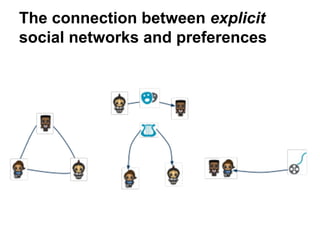
The connection between explicit
social networks and preferences
Algorithmic gains with social data
vary
● Augment collaborative filtering algorithms [e.
g. Konstas et al. 09, Ma et al. 11]
● Use only first-degree connections [e.g. Guy
et al. 09, Kulkarni et al. 13]
● Gains with social data often slight, varies
with domain [Arazy et al. 10, Groh 12,
Sharma and Cosley 13b]
Understanding how preferences
evolve in a social network
● Interactions, not single actors, may be the
key to understanding and predicting
preferences in social contexts.
○ Influence
○ Trust
○ Identity

● Analyzing preferences of single users
situated in a network gives us one part of the
picture. Interactions between users can
give us the other part.
Designing and evaluating networkcentric recommenders requires
more than one user
Two general questions:
● How people evaluate recommendations from
their social network?
● How people share items with each other?
One good way is to test our algorithms and
hypotheses on a network of people.
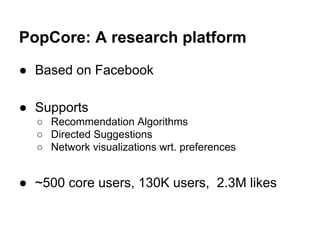
PopCore: A research platform
● Based on Facebook
● Supports
○ Recommendation Algorithms
○ Directed Suggestions
○ Network visualizations wrt. preferences

● ~500 core users, 130K users, 2.3M likes
Conducting experiments on social
recommendation
● Popularity of an item within first-level ego network
more indicative of preference than overall popularity
[Sharma 11]
● Explicit social explanations have only a secondary
effect on people’s preferences, compared to their
own expectation of liking [Sharma 13a]
● For Facebook and Twitter, recommendations from
social connections are nearly as good as those
computed from the whole network [Sharma 13b]
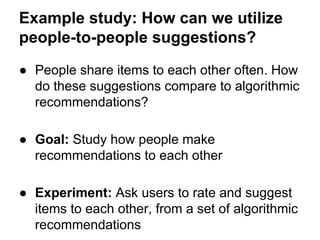
Example study: How can we utilize
people-to-people suggestions?
● People share items to each other often. How
do these suggestions compare to algorithmic
recommendations?
● Goal: Study how people make
recommendations to each other
● Experiment: Ask users to rate and suggest
items to each other, from a set of algorithmic
recommendations
DEMO

http://www.popcore.me
http://labs.popcore.me
Opening up the platform
● Conducting more experiments
○ Collaborating
○ Repeatable experiments
○ Best ways to collaborate?

● Accessing data collected
○ Subject to data privacy restrictions

thank you
Amit Sharma
http://www.cs.cornell.edu/~asharma

@amt_shrma

RSWEB 2013: A research platform for social recommendation

  • 1.
    A Research Platformfor Recommendation within Social Networks Amit Sharma, Cornell University www.cs.cornell.edu/~asharma @amt_shrma
  • 2.
    The connection betweenexplicit social networks and preferences
  • 3.
    Algorithmic gains withsocial data vary ● Augment collaborative filtering algorithms [e. g. Konstas et al. 09, Ma et al. 11] ● Use only first-degree connections [e.g. Guy et al. 09, Kulkarni et al. 13] ● Gains with social data often slight, varies with domain [Arazy et al. 10, Groh 12, Sharma and Cosley 13b]
  • 4.
    Understanding how preferences evolvein a social network ● Interactions, not single actors, may be the key to understanding and predicting preferences in social contexts. ○ Influence ○ Trust ○ Identity ● Analyzing preferences of single users situated in a network gives us one part of the picture. Interactions between users can give us the other part.
  • 5.
    Designing and evaluatingnetworkcentric recommenders requires more than one user Two general questions: ● How people evaluate recommendations from their social network? ● How people share items with each other? One good way is to test our algorithms and hypotheses on a network of people.
  • 6.
    PopCore: A researchplatform ● Based on Facebook ● Supports ○ Recommendation Algorithms ○ Directed Suggestions ○ Network visualizations wrt. preferences ● ~500 core users, 130K users, 2.3M likes
  • 7.
    Conducting experiments onsocial recommendation ● Popularity of an item within first-level ego network more indicative of preference than overall popularity [Sharma 11] ● Explicit social explanations have only a secondary effect on people’s preferences, compared to their own expectation of liking [Sharma 13a] ● For Facebook and Twitter, recommendations from social connections are nearly as good as those computed from the whole network [Sharma 13b]
  • 8.
    Example study: Howcan we utilize people-to-people suggestions? ● People share items to each other often. How do these suggestions compare to algorithmic recommendations? ● Goal: Study how people make recommendations to each other ● Experiment: Ask users to rate and suggest items to each other, from a set of algorithmic recommendations
  • 9.
  • 10.
    Opening up theplatform ● Conducting more experiments ○ Collaborating ○ Repeatable experiments ○ Best ways to collaborate? ● Accessing data collected ○ Subject to data privacy restrictions thank you Amit Sharma http://www.cs.cornell.edu/~asharma @amt_shrma