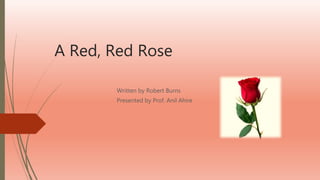
A Red, Red Rose
Written by Robert Burns
Presented by Prof. Anil Ahire
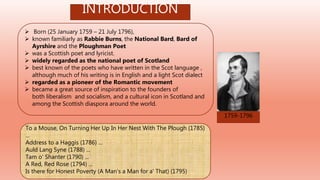
INTRODUCTION
 Born (25 January 1759 – 21 July 1796),
 known familiarly as Rabbie Burns, the National Bard, Bard of
Ayrshire and the Ploughman Poet
 was a Scottish poet and lyricist.
 widely regarded as the national poet of Scotland
 best known of the poets who have written in the Scot language ,
although much of his writing is in English and a light Scot dialect
 regarded as a pioneer of the Romantic movement
 became a great source of inspiration to the founders of
both liberalism and socialism, and a cultural icon in Scotland and
among the Scottish diaspora around the world.
1759-1796
To a Mouse, On Turning Her Up In Her Nest With The Plough (1785)
...
Address to a Haggis (1786) ...
Auld Lang Syne (1788) ...
Tam o' Shanter (1790) ...
A Red, Red Rose (1794) ...
Is there for Honest Poverty (A Man's a Man for a' That) (1795)
About the poem
• love poem and masterpiece in literature
• based it on a folk version of a song he heard on his travels.
• completed the poem in 1794 in an English dialect called Scots
for publication in collections of traditional Scottish ballads.
• Burns clearly states and restates the theme: The speaker loves
the young lady beyond measure.
• Attempts to express his depth of love through four stanzas
• The only way he can express his love for her is through vivid
similes and hyperbolic comparisons.
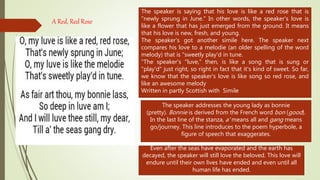
A Red, Red Rose
The speaker is saying that his love is like a red rose that is
"newly sprung in June." In other words, the speaker's love is
like a flower that has just emerged from the ground. It means
that his love is new, fresh, and young.
The speaker's got another simile here. The speaker next
compares his love to a melodie (an older spelling of the word
melody) that is "sweetly play'd in tune.
"The speaker's "luve," then, is like a song that is sung or
"play'd" just right, so right in fact that it's kind of sweet. So far,
we know that the speaker's love is like song so red rose, and
like an awesome melody
Written in partly Scottish with Simile
The speaker addresses the young lady as bonnie
(pretty). Bonnie is derived from the French word bon (good).
In the last line of the stanza, a' means all and gang means
go/journey. This line introduces to the poem hyperbole, a
figure of speech that exaggerates.
Even after the seas have evaporated and the earth has
decayed, the speaker will still love the beloved. This love will
endure until their own lives have ended and even until all
human life has ended.
With a healthy dose of repetition, the speaker tells
us again that he will love his "bonnie lass" until the
seas "gang dry"; he also tells us he will love her until
the "rocks melt wi' the sun."
Like the sea going dry, it is unlikely that rocks are
going to "melt", so the speaker is again emphasizing
the fact that he will love her forever or at least until
long after their lives are over.
The speaker pledges that he will love his lass as he
lives. That's where that "sands o' life shall run"
comes in. It's an interesting phrase. It means,
"while I'm still alive." So the metaphor here is of
an hourglass, or some other device that measures
time with sand. The words, however, make us
think of the "sands o' life" running out; the phrase
"I will luve thee still" makes us think the speaker
wants to say "I will love thee still, even after the
sands o' life shall run out."
Suddenly, it's time to say goodbye. Or in this case,
"fare thee weel." "Weel" is an older form of the
word "well. The phrase "fare thee weel a while"
means something like "farewell, for now" or
"farewell for the time being." But it could also
mean "take care of yourself for now" or "may you
be well." The word "fare" can be a verb that means
do or go. For whatever reason, these two lovebirds
are splitting. But we think they're going to be just
fine at the whole long-distance thing.
The speaker says his final farewell; he tells his Luve
that he will come again, even if he has to walk ten
thousand miles Here's hoping these two crazy
lovers can make it work.
Imagery and Symbolism
 Lines 1-2: The speaker compares his love to a red, red rose. And because he uses the word
"like," this is a simile.
 Lines 7-8: The speaker says he will love his bonnie lass until the seas dry up. The
evaporation of the "seas" appears to be a metaphor for the end of the world or for
something that can't ever really happen.
 So really he's just avowing his undying, eternal, everlasting love for his special friend.
 Lines 9-10: The speaker mentions the seas going dry again, and adds that he will also love
his "bonnie lass" until the "rocks melt w' the sun." Melting rocks are also a metaphor for the
end of the world, or for something that isn't likely to happen.
11-12: The speaker will be all about his lady love, at least while the "sands o'
life shall run." "Sands of life" is a metaphor ; one's time on earth is compared
to something like an hourglass that has sand in it to measure time.
Line 13: The speaker says, "fare thee weel" to his "bonnie lass."
Line 14: The speaker says, "fare thee weel again."
Lines 15-16: The speaker says he will come again, even if he has to walk ten thousand
miles.
Love Lines 1-2: Here it is, the most famous love simile ever. Or it's at least in the top five,
right? The speaker's comparison of his love to a red, red, rose has gone down in history
as pure romance.
Lines 3-4: The speaker says his love is like a "melodie" that's "play'd in tune." Since he
uses the word "like," this comparison is a simile.
Lines 5-6: The speaker says he is as "deep in love" as his "bonnie lass" is "fair." Since the
word "as" occurs in this comparison, this is also a simile.
A red red rose

A red red rose

  • 1.
    A Red, RedRose Written by Robert Burns Presented by Prof. Anil Ahire
  • 2.
    INTRODUCTION  Born (25January 1759 – 21 July 1796),  known familiarly as Rabbie Burns, the National Bard, Bard of Ayrshire and the Ploughman Poet  was a Scottish poet and lyricist.  widely regarded as the national poet of Scotland  best known of the poets who have written in the Scot language , although much of his writing is in English and a light Scot dialect  regarded as a pioneer of the Romantic movement  became a great source of inspiration to the founders of both liberalism and socialism, and a cultural icon in Scotland and among the Scottish diaspora around the world. 1759-1796 To a Mouse, On Turning Her Up In Her Nest With The Plough (1785) ... Address to a Haggis (1786) ... Auld Lang Syne (1788) ... Tam o' Shanter (1790) ... A Red, Red Rose (1794) ... Is there for Honest Poverty (A Man's a Man for a' That) (1795)
  • 3.
    About the poem •love poem and masterpiece in literature • based it on a folk version of a song he heard on his travels. • completed the poem in 1794 in an English dialect called Scots for publication in collections of traditional Scottish ballads. • Burns clearly states and restates the theme: The speaker loves the young lady beyond measure. • Attempts to express his depth of love through four stanzas • The only way he can express his love for her is through vivid similes and hyperbolic comparisons.
  • 5.
    A Red, RedRose The speaker is saying that his love is like a red rose that is "newly sprung in June." In other words, the speaker's love is like a flower that has just emerged from the ground. It means that his love is new, fresh, and young. The speaker's got another simile here. The speaker next compares his love to a melodie (an older spelling of the word melody) that is "sweetly play'd in tune. "The speaker's "luve," then, is like a song that is sung or "play'd" just right, so right in fact that it's kind of sweet. So far, we know that the speaker's love is like song so red rose, and like an awesome melody Written in partly Scottish with Simile The speaker addresses the young lady as bonnie (pretty). Bonnie is derived from the French word bon (good). In the last line of the stanza, a' means all and gang means go/journey. This line introduces to the poem hyperbole, a figure of speech that exaggerates. Even after the seas have evaporated and the earth has decayed, the speaker will still love the beloved. This love will endure until their own lives have ended and even until all human life has ended.
  • 6.
    With a healthydose of repetition, the speaker tells us again that he will love his "bonnie lass" until the seas "gang dry"; he also tells us he will love her until the "rocks melt wi' the sun." Like the sea going dry, it is unlikely that rocks are going to "melt", so the speaker is again emphasizing the fact that he will love her forever or at least until long after their lives are over. The speaker pledges that he will love his lass as he lives. That's where that "sands o' life shall run" comes in. It's an interesting phrase. It means, "while I'm still alive." So the metaphor here is of an hourglass, or some other device that measures time with sand. The words, however, make us think of the "sands o' life" running out; the phrase "I will luve thee still" makes us think the speaker wants to say "I will love thee still, even after the sands o' life shall run out."
  • 7.
    Suddenly, it's timeto say goodbye. Or in this case, "fare thee weel." "Weel" is an older form of the word "well. The phrase "fare thee weel a while" means something like "farewell, for now" or "farewell for the time being." But it could also mean "take care of yourself for now" or "may you be well." The word "fare" can be a verb that means do or go. For whatever reason, these two lovebirds are splitting. But we think they're going to be just fine at the whole long-distance thing. The speaker says his final farewell; he tells his Luve that he will come again, even if he has to walk ten thousand miles Here's hoping these two crazy lovers can make it work.
  • 8.
    Imagery and Symbolism Lines 1-2: The speaker compares his love to a red, red rose. And because he uses the word "like," this is a simile.  Lines 7-8: The speaker says he will love his bonnie lass until the seas dry up. The evaporation of the "seas" appears to be a metaphor for the end of the world or for something that can't ever really happen.  So really he's just avowing his undying, eternal, everlasting love for his special friend.  Lines 9-10: The speaker mentions the seas going dry again, and adds that he will also love his "bonnie lass" until the "rocks melt w' the sun." Melting rocks are also a metaphor for the end of the world, or for something that isn't likely to happen.
  • 9.
    11-12: The speakerwill be all about his lady love, at least while the "sands o' life shall run." "Sands of life" is a metaphor ; one's time on earth is compared to something like an hourglass that has sand in it to measure time. Line 13: The speaker says, "fare thee weel" to his "bonnie lass." Line 14: The speaker says, "fare thee weel again." Lines 15-16: The speaker says he will come again, even if he has to walk ten thousand miles. Love Lines 1-2: Here it is, the most famous love simile ever. Or it's at least in the top five, right? The speaker's comparison of his love to a red, red, rose has gone down in history as pure romance. Lines 3-4: The speaker says his love is like a "melodie" that's "play'd in tune." Since he uses the word "like," this comparison is a simile. Lines 5-6: The speaker says he is as "deep in love" as his "bonnie lass" is "fair." Since the word "as" occurs in this comparison, this is also a simile.