Download to read offline
![IJRET: International Journal of Research in Engineering and Technology eISSN: 2319-1163 | pISSN: 2321-7308
__________________________________________________________________________________________
Volume: 02 Issue: 12 | Dec-2013, Available @ http://www.ijret.org 183
compensate the workpieces elastic deformation through fixture
layout optimization based on High Definition Metrology
(HDM).
In summary, although remarkable process in compensating the
deformation and minimizing the surface dimensional errors
has been made, research on deformation compensation focuses
solely on cutting forces and fixture layout. However, clamping
forces, which will change along with the cutting tool
movement, shouldn’t be ignored in practice. Traditional clamp
with single clamping point only has one clamping force
application point, which is not suitable for dynamic
adjustment for the deflection compensation. In this paper, a
novel dual-point clamper method with deformation
compensation is proposed and development. The two points
share the clamping forces and their values will change
respectively along with the cutting tool movement to resist the
workpieces deflection.
The rest of this paper is organized as follows. Section 2
describes the deflection of end milling constrained by
traditional clamp. Section 3 presents the deflection of end
milling constrained by our novel dual-point clamp. Section 4
gives a simulation study of the proposed method. Section 5
gives a case study of the proposed method. The conclusions
and future work of this research are summarized in section 6.
2. PART MILLING DEFLECTION
CONSTRAINED BY TRADITIONAL CLAMP
Four supports and four clamping points fixture layout is
traditionally utilized for milling rectangle workpieces, where
the supports and the clamping points are vertical alignment
respectively (see Fig. 1(a)). Milling behavior of the workpiece
continuously changes along with the cutting tool moving from
one side to the other. When the cutting tool moves to point N,
cutting force F coupled with clamping forces FA and FB will
bend the workpiece (see Fig. 1 (b)). Since clamping forces FA
and FB have little effect on the workpiece deflection, the
deflection at point N (shown in Fig. 1 (c)) is expressed as,
1Nω =
2
1
( )
=
3
Fd d s
EI
ω
+
(1)
Where, ω denotes the workpiece deflection at point N when
cutting tool cuts at this point, F is the cutting force, s is the
distance between the two supports, d refers to the distance
from the cutting tool to the support P, E is the Modulus of
elasticity, I is the moment of inertia section against the neutral
axis. Direction of cutting force F is upside when spiral mill is
adopted. Here, we utilize letter N refer to the cutting tool
location where scope within the right side of support P.
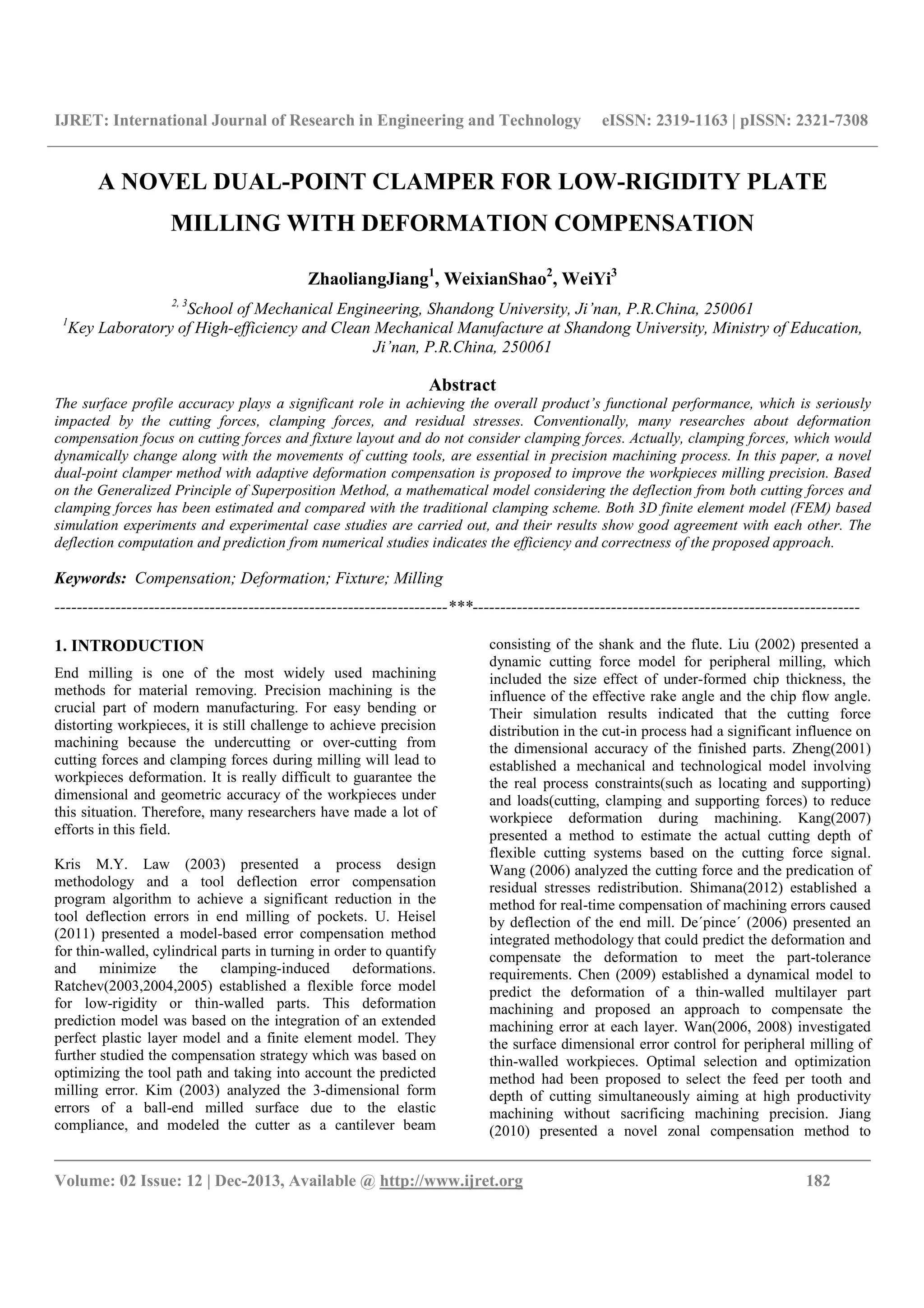
Fig.1. Deflection of end milling constrained by traditional clamp when cutting tool locates at point N
Similarly, when cutting tool moves to point R located between
the two supports as shown in Fig. 2 (a)), the workpiece
deflection at point R caused by the cutting force F shown in
Fig. 2(b) is expressed as,
2 2 2
1 2
( )[ ( ) ]
6
R
Fd s d s s d d
EIs
ω ω
− − − −
= =
(2)
Where, ω denotes the workpiece deflection at point R when
cutting tool cuts at this point.
The actual cutting depth is bigger than the theoretical value
under the impact of the workpieces deflection, which we
called it over-cutting. The bigger the deflection is, the serious
the over-cutting happens, which will lead to the workpieces
deformation.](https://image.slidesharecdn.com/anoveldual-pointclamperforlow-rigidityplate-140807011840-phpapp01/85/A-novel-dual-point-clamper-for-low-rigidity-plate-2-320.jpg)
![IJRET: International Journal of Research in Engineering and Technology eISSN: 2319-1163 | pISSN: 2321-7308
__________________________________________________________________________________________
Volume: 02 Issue: 12 | Dec-2013, Available @ http://www.ijret.org 185
2
1
(3 )
3 6
D D
D
F asd F a d a
EI EI
ω
−
= − −
(4)
Here, we ignore the workpieces deflection impacted by FA and
FB. According to the Generalized Principle of Super position,
workpieces deflection at point N constrained by dual-point
clamp is expressed as
2 1 1 1
22
( )( ) (3 )( )
3 6 3 6
N C D
C D DF a s a s b d F asd F a d aFd d s
EI EIs EI EI
ω ω ω ω= + + =
− + −+
+ − −
(5)
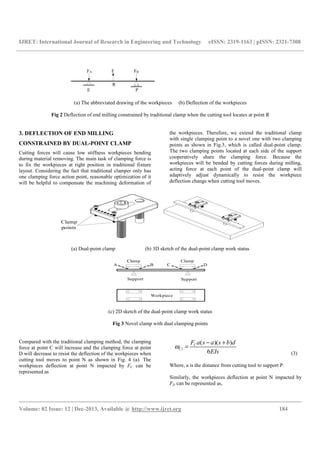
(a) The abbreviated drawing of workpieces constrained by
dual-point clamp
(b) Deflection of workpieces caused by clamping force Fc
(c) Deflection of workpieces caused by clamping force Fd
Fig 4Workpieces deflection with novel dual-point clamping
mode
The workpieces will also be bended when the cutting tool
moves to point R as shown in Fig. 5(a). The workpieces
deflection curve is presented in Fig. 5 (c) to Fig. 5(f). In this
condition, Clamping forces at point A and D will increase and
clamping forces at point B and C will decrease to resist the
workpieces deflection. The deflections at point R impacted by
FA, FB, FC, and FD are presented as follows respectively,
2
( ) [2 ( )]
6
A
A
F a s d d s s d
EIs
ω
− − −
=
3 2 2 3
2
{ [( ) ] ( )( ) ( ) }
6
B
B
s
F b s d a s b s d s d
b
EIs
ω
− − + − − − −
= −
2 2 2
2
( )[ ( ) ]
6
C
C
F a s d s s d a
EIs
ω
− − − −
= −
2 2
2
( )[ ( ) ]
6
D
D
F a s d s s d
EIs
ω
− − −
=
(6)
Therefore, the total deflection at point R is
2 2 2 2 2 2
2 2 2
2
3 2 2 3
2
2 2 2 2 2
2 2
2 ( ) [2 ( )]( )[ ( ) ]
6 6
2 { [( ) ] ( )( ) ( ) }
6
2 ( )[ ( ) ] 2 ( )[ ( ) ]
6 6
R A B C D
A
B
C D
F a s d d s s dFd s d s s d d
EIs EIs
s
F b s d a s b s d s d
b
EIs
F a s d s s d a F a s d s s d
EIs EIs
ω ω ω ω ω ω= + + + +
− − −− − − − −
= +
− − + − − − −
−
− − − − − − −
− +
(7)
Where, ω2 is the workpiece deflection caused by cutting force.
(a)Novel clamp sketch (b) The abbreviated drawing](https://image.slidesharecdn.com/anoveldual-pointclamperforlow-rigidityplate-140807011840-phpapp01/85/A-novel-dual-point-clamper-for-low-rigidity-plate-4-320.jpg)
![IJRET: International Journal of Research in Engineering and Technology eISSN: 2319-1163 | pISSN: 2321-7308
__________________________________________________________________________________________
Volume: 02 Issue: 12 | Dec-2013, Available @ http://www.ijret.org 192
CONCLUSIONS AND FUTURE WORK
Based on our proposed novel dual-point clamp method, a new
approach for milling deformation compensation is proposed in
this paper. The approach utilizes the dynamic clamping force
to resist workpiece deformation during milling. It extends the
clamp from single clamping point to multiple points. Both
simulation and experimental case studies are used to illustrate
the effectiveness of the proposed method. The results
demonstrate that this new proposed approach is feasible and
effective for compensating the workpiece deformation during
milling. The future work of this research is to expand this new
proposed to analyze different materials. It is also interesting to
extend this method for milling deformation compensation
considering clamping force, 3D cutting force and heat transfer
together.
ACKNOWLEDGEMENTS
The authors acknowledge support by the National Natural
Science Foundation of China under Grant Number 51175304,
and the Scientific Research Foundation for the Returned
Overseas Chinese Scholars, State Education Ministry. Thanks
for all the former research contributed to this paper.
REFERENCES
[1] Chen Weifang, Xue Jianbin, et al. 2009, Deformation
prediction and error compensation in multilayer milling
processes for thin-walled parts. International Journal of
Machine Tools & Manufacture 49: 859–864
[2] Jiang ZhaoLiang, Liu Yumei and Shan Yunxiao. 2010,
Zonal Compensation for Work-piece Elastic
Deformation through Fixture Layout Optimization.
Applied Mechanics and Materials 26-28:854-857
[3] Kang Yonggang, Wang Zhongqi, Wu Jianjun, et al.
2007, Fast prediction of static form errors in peripheral
milling ofthin-walled workpieces using real cutting
depth. Journal of Northwestern Polytechnical
University 25(2):251-256
[4] Kenji Shimana, Eiji Kondo, et al. 2012, An approach to
compensation of machining error caused by deflection
of end mill. Procedia CIRP 1: 677 – 678
[5] Kim G M, Kim B H,Chu C N. 2003, Estimation of
cutter deflection and form error in ball- end milling
processes. International Journal of Machine Tools and
Manufacture43:917-924.
[6] Kris M.Y. Law, Geddam A. 2003, Error compensation
in the end milling of pockets: a methodology. Journal
of Materials Processing Technology, 6716: 1-7.
[7] Liu X W,Cheng K,Webb D,et al. 2002, Prediction of
cutting force distribution and its influence on
dimensional accuracy in peripheral milling.
International Journal of Machine Tools and
Manufacture, 42:791-800.
[8] Philippe De´pince´, Jean-Yves Hascoe¨t. 2006, Active
integration of tool deformation effects in end
milling.Part1,prediction of milled surfaces,
International Journal of Machine Tools and
Manufacture 46:937–944.
[9] PhilippeDe´pince´, Jean-YvesHascoe¨t, 2006, Active
integration of tool deformation effects in end
milling.Part2,compensation of tool deformation,
International Journal of Machine Tools and
Manufacture 46:945–956.
[10] SvetanRatchev, Evan Govender, Stan Nikov, et al.,
2003, Force and deformation modeling in milling of
low-rigidity complex parts, Journal of Materials
Processing Technology 143–144:796–801.
[11] S. Ratchev, S. Liu,W. Huang, A.A. Becker, 2004, A
flexible force model for end milling of low-rigidity
parts, Journal of Materials Processing Technology 153–
154:134–138.
[12] S. Ratchev, S. Liu, A.A. Becker, 2005, Error
compensation strategy in milling flexible thin-wall
parts, Journal of Materials Processing Technology 162–
163:673–681.
[13] U. Heisel, C. Kang. 2011, Model-based form error
compensation in the turning of thin-walled cylindrical
parts. Production Engineering 5:151-158
[14] Wan M., W.H. Zhang. 2006, Efficient algorithms for
calculations of static form errors in peripheral milling.
Journal of Materials Processing Technology 171(1):
156-165.
[15] Wan M., W.H. Zhang, G.H. Qin, Z.P. Wang. 2008,
Strategies for error prediction and error control in
peripheral milling of thin-walled workpiece,
International Journal of Machine Tools and
Manufacture 48,(12-13): 1366-1374.
[16] Wang Zengqiang, MengXiaoxian, RenJunxue, et al.
2006, Ascheme for the compensation of deformation
error in NC maching of thin-walled complex parts.
Maching Tool and Hydraulics (4): 61-63.
[17] Zheng Lian-yu, Wang Shu-chun. 2001, Approaches to
improve the process quality of thin-walled workpiece
in NC machine. Acta Aeronautica et Astronautica
Sinica 22(5): 424-428](https://image.slidesharecdn.com/anoveldual-pointclamperforlow-rigidityplate-140807011840-phpapp01/85/A-novel-dual-point-clamper-for-low-rigidity-plate-11-320.jpg)

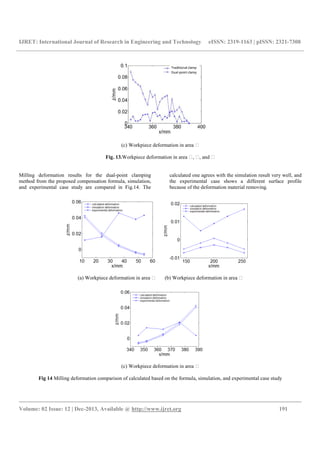
This document presents a novel dual-point clamping method for improving workpiece milling precision when machining low-rigidity plates. Traditional clamping with a single point is not suitable for dynamically adjusting clamping forces to compensate for workpiece deflection under cutting forces. The proposed method uses two adjustable clamping points to share clamping forces. A mathematical model is developed to calculate workpiece deflection under both cutting and varying dual-point clamping forces. Finite element simulations and experimental case studies show that the dual-point method can better resist workpiece deflection compared to traditional single-point clamping.


