








A New Perspective
on Hypocalcemia
Taipei Veterans General Hospital, Hsin-Chu branch
Director of Nephrology
Steve Chen
Ca
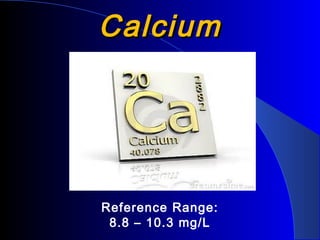
CalciumCalcium
Reference Range:
8.8 – 10.3 mg/L
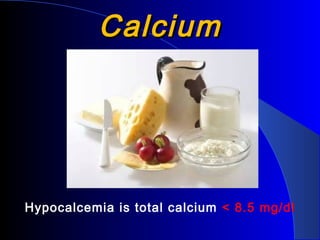
CalciumCalcium
Hypocalcemia is total calcium < 8.5 mg/dl
CalciumCalcium
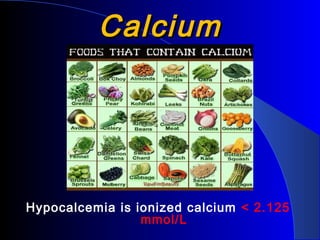
Hypocalcemia is ionized calcium < 2.125
mmol/L
Pseudo-hypocalcemiaPseudo-hypocalcemia
Transfer sample from tubes containing K-
EDTA
Sample stored at RT for extended time
Vasovagal episode
Usually accompanied with
pseudohyperkalemia
Etiology of Hypocalcemia(1)Etiology of Hypocalcemia(1)
– Common CausesCommon Causes
SShockhock
SSepsisepsis
RRenal failureenal failure
PPancreatitisancreatitis
Etiology of Hypocalcemia(2)Etiology of Hypocalcemia(2)
– MalignancyMalignancy
– EndocrineEndocrine
 HypoparathyroidismHypoparathyroidism
 Vitamin D deficiencyVitamin D deficiency
– DrugsDrugs
 Cimetidine, Phosphates, Dilantin, Phenobarbital, Glucagon,
Aminoglycosides, Cisplatin, Heparin, Theophylline,
Protamine, Norepinephrine, Loop diuretics, Glucocorticoids,
Magnesium Sulfate, Nitroprusside
Symptoms & signs ofSymptoms & signs of
HypocalcemiaHypocalcemia
 Clinical Features(1)Clinical Features(1)
– NeurologicalNeurological
 Circumoral & digital paresthesiasCircumoral & digital paresthesias
 TetanyTetany
 Chvostek signChvostek sign
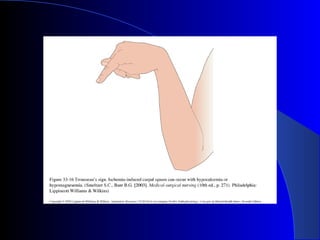
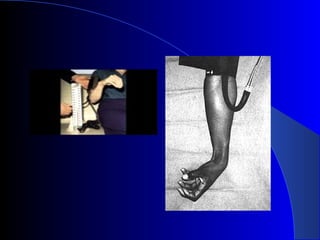
 Trousseau signTrousseau sign
 Impaired memory, confusionImpaired memory, confusion
 HallucinationsHallucinations, dementia, seizures, dementia, seizures
Symptoms & signs ofSymptoms & signs of
HypocalcemiaHypocalcemia
 Clinical Features (3)Clinical Features (3)
-- GI: steatorrheaGI: steatorrhea
– MuscularMuscular
 Spasms, cramps, weaknessSpasms, cramps, weakness
– DermatologicDermatologic
 HyperpigmentationHyperpigmentation
 Coarse, brittle hairCoarse, brittle hair
 Dry, scaly skinDry, scaly skin
Symptoms & signs ofSymptoms & signs of
HypocalcemiaHypocalcemia
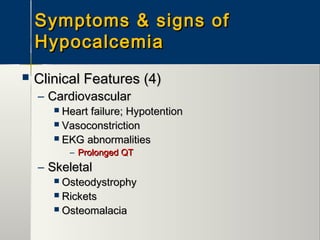
 Clinical Features (4)Clinical Features (4)
– CardiovascularCardiovascular
 Heart failure; HypotentionHeart failure; Hypotention
 VasoconstrictionVasoconstriction
 EKG abnormalitiesEKG abnormalities
– Prolonged QTProlonged QT
– SkeletalSkeletal
 OsteodystrophyOsteodystrophy
 RicketsRickets
 OsteomalaciaOsteomalacia
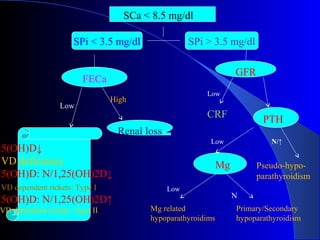
SCa < 8.5 mg/dl
SPi < 3.5 mg/dl SPi > 3.5 mg/dl
FECa
Renal loss
25(OH)D↓
VD deficiency
25(OH)D: N/1,25(OH)2D↓
VD dependent rickets: Type I
25(OH)D: N/1,25(OH)2D↑
VD dependent rickets: Type II
High
Low
GFR
PTH
Mg
Low
Low N/↑
Pseudo-hypo-
parathyroidism
Low
N
Primary/Secondary
hypoparathyroidism
Mg related
hypoparathyroidims
CRF
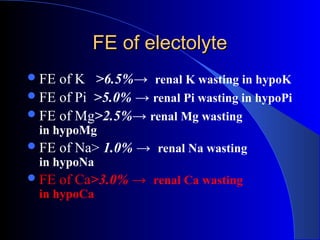
FE of electolyteFE of electolyte
FE of K >6.5%→ renal K wasting in hypoK
FE of Pi >5.0% → renal Pi wasting in hypoPi
FE of Mg>2.5%→ renal Mg wasting
in hypoMg
FE of Na> 1.0% → renal Na wasting
in hypoNa
FE of Ca>3.0% → renal Ca wasting
in hypoCa
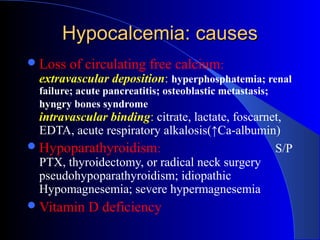
Hypocalcemia: causesHypocalcemia: causes
Loss of circulating free calcium:
extravascular deposition: hyperphosphatemia; renal
failure; acute pancreatitis; osteoblastic metastasis;
hyngry bones syndrome
intravascular binding: citrate, lactate, foscarnet,
EDTA, acute respiratory alkalosis(↑Ca-albumin)
Hypoparathyroidism: S/P
PTX, thyroidectomy, or radical neck surgery
pseudohypoparathyroidism; idiopathic
Hypomagnesemia; severe hypermagnesemia
Vitamin D deficiency
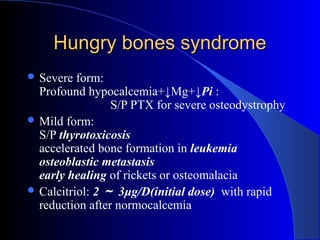
Hungry bones syndromeHungry bones syndrome
 Severe form:
Profound hypocalcemia+↓Mg+↓Pi :
S/P PTX for severe osteodystrophy
 Mild form:
S/P thyrotoxicosis
accelerated bone formation in leukemia
osteoblastic metastasis
early healing of rickets or osteomalacia
 Calcitriol: 2 ~ 3μg/D(initial dose) with rapid
reduction after normocalcemia
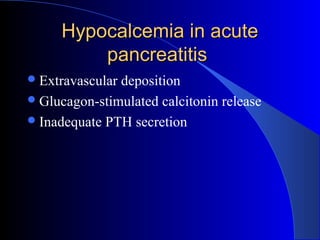
Hypocalcemia in acuteHypocalcemia in acute
pancreatitispancreatitis
Extravascular deposition
Glucagon-stimulated calcitonin release
Inadequate PTH secretion
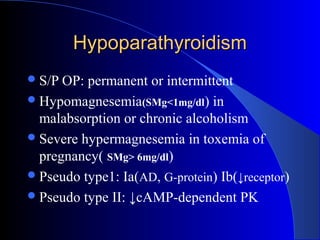
HypoparathyroidismHypoparathyroidism
S/P OP: permanent or intermittent
Hypomagnesemia(SMg<1mg/dl) in
malabsorption or chronic alcoholism
Severe hypermagnesemia in toxemia of
pregnancy( SMg> 6mg/dl)
Pseudo type1: Ia(AD, G-protein) Ib(↓receptor)
Pseudo type II: ↓cAMP-dependent PK
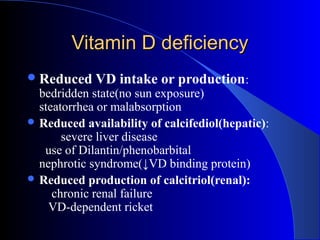
Vitamin D deficiencyVitamin D deficiency
Reduced VD intake or production:
bedridden state(no sun exposure)
steatorrhea or malabsorption
 Reduced availability of calcifediol(hepatic):
severe liver disease
use of Dilantin/phenobarbital
nephrotic syndrome(↓VD binding protein)
 Reduced production of calcitriol(renal):
chronic renal failure
VD-dependent ricket
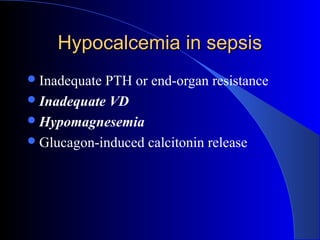
Hypocalcemia in sepsisHypocalcemia in sepsis
Inadequate PTH or end-organ resistance
Inadequate VD
Hypomagnesemia
Glucagon-induced calcitonin release
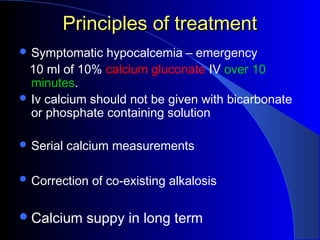
Principles of treatmentPrinciples of treatment
 Symptomatic hypocalcemia – emergency
10 ml of 10% calcium gluconate IV over 10
minutes.
 Iv calcium should not be given with bicarbonate
or phosphate containing solution
 Serial calcium measurements
 Correction of co-existing alkalosis
Calcium suppy in long term
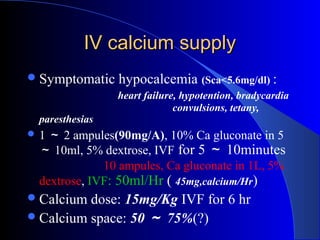
IV calcium supplyIV calcium supply
Symptomatic hypocalcemia (Sca<5.6mg/dl) :
heart failure, hypotention, bradycardia
convulsions, tetany,
paresthesias
 1 ~ 2 ampules(90mg/A), 10% Ca gluconate in 5
~ 10ml, 5% dextrose, IVF for 5 ~ 10minutes
10 ampules, Ca gluconate in 1L, 5%
dextrose, IVF: 50ml/Hr ( 45mg,calcium/Hr)
Calcium dose: 15mg/Kg IVF for 6 hr
Calcium space: 50 ~ 75%(?)
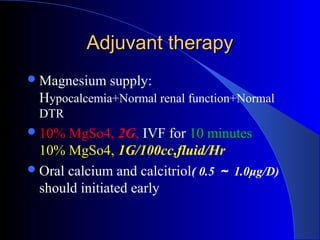
Adjuvant therapyAdjuvant therapy
Magnesium supply:
Hypocalcemia+Normal renal function+Normal
DTR
10% MgSo4, 2G, IVF for 10 minutes
10% MgSo4, 1G/100cc,fluid/Hr
Oral calcium and calcitriol( 0.5 ~ 1.0μg/D)
should initiated early
PO calcium supplyPO calcium supply
Calcium: 2 ~ 4G/D
Vitamin D indicated if insufficient response
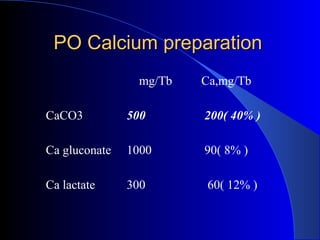
PO Calcium preparationPO Calcium preparation
mg/Tb Ca,mg/Tb
CaCO3 500 200( 40% )
Ca gluconate 1000 90( 8% )
Ca lactate 300 60( 12% )
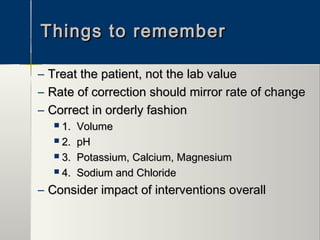
Things to rememberThings to remember
– Treat the patient, not the lab valueTreat the patient, not the lab value
– Rate of correction should mirror rate of changeRate of correction should mirror rate of change
– Correct in orderly fashionCorrect in orderly fashion
 1. Volume1. Volume
 2. pH2. pH
 3. Potassium, Calcium, Magnesium3. Potassium, Calcium, Magnesium
 4. Sodium and Chloride4. Sodium and Chloride
– Consider impact of interventions overallConsider impact of interventions overall
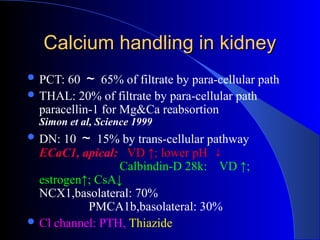
Calcium handling in kidneyCalcium handling in kidney
 PCT: 60 ~ 65% of filtrate by para-cellular path
 THAL: 20% of filtrate by para-cellular path
paracellin-1 for Mg&Ca reabsortion
Simon et al, Science 1999
 DN: 10 ~ 15% by trans-cellular pathway
ECaC1, apical: VD ↑; lower pH ↓
Calbindin-D 28k: VD ↑;
estrogen↑; CsA↓
NCX1,basolateral: 70%
PMCA1b,basolateral: 30%
 Cl channel: PTH, Thiazide
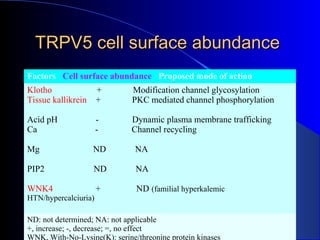
TRPV5 cell surface abundanceTRPV5 cell surface abundance
Factors Cell surface abundance Proposed mode of action
Klotho + Modification channel glycosylation
Tissue kallikrein + PKC mediated channel phosphorylation
Acid pH - Dynamic plasma membrane trafficking
Ca - Channel recycling
Mg ND NA
PIP2 ND NA
WNK4 + ND (familial hyperkalemic
HTN/hypercalciuria)
ND: not determined; NA: not applicable
+, increase; -, decrease; =, no effect
WNK, With-No-Lysine(K): serine/threonine protein kinases
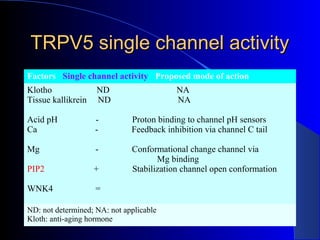
TRPV5 single channel activityTRPV5 single channel activity
Factors Single channel activity Proposed mode of action
Klotho ND NA
Tissue kallikrein ND NA
Acid pH - Proton binding to channel pH sensors
Ca - Feedback inhibition via channel C tail
Mg - Conformational change channel via
Mg binding
PIP2 + Stabilization channel open conformation
WNK4 =
ND: not determined; NA: not applicable
Kloth: anti-aging hormone
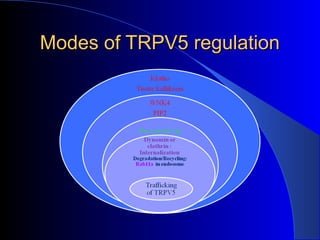
Modes of TRPV5 regulationModes of TRPV5 regulation
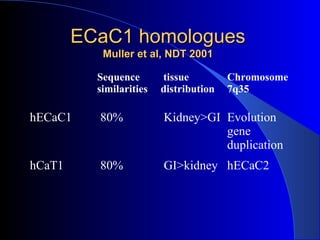
ECaC1 homologuesECaC1 homologues
Muller et al, NDT 2001Muller et al, NDT 2001
Sequence
similarities
tissue
distribution
Chromosome
7q35
hECaC1 80% Kidney>GI Evolution
gene
duplication
hCaT1 80% GI>kidney hECaC2
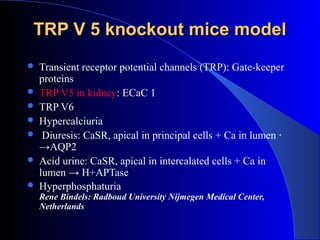
TRP V 5 knockout mice modelTRP V 5 knockout mice model
 Transient receptor potential channels (TRP): Gate-keeper
proteins
 TRP V5 in kidney: ECaC 1
 TRP V6
 Hypercalciuria
 Diuresis: CaSR, apical in principal cells + Ca in lumen ﹡
→AQP2
 Acid urine: CaSR, apical in intercalated cells + Ca in
lumen → H+APTase
 Hyperphosphaturia
Rene Bindels: Radboud University Nijmegen Medical Center,
Netherlands
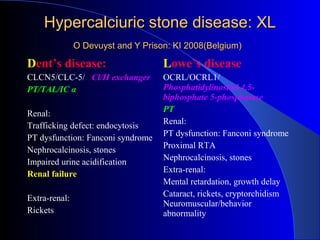
Hypercalciuric stone disease: XLHypercalciuric stone disease: XL
O Devuyst and Y Prison: KI 2008(Belgium)O Devuyst and Y Prison: KI 2008(Belgium)
Dent’s disease:
CLCN5/CLC-5/ Cl/H exchanger
PT/TAL/IC α
Renal:
Trafficking defect: endocytosis
PT dysfunction: Fanconi syndrome
Nephrocalcinosis, stones
Impaired urine acidification
Renal failure
Extra-renal:
Rickets
Lowe’s disease
OCRL/OCRL1/
Phosphatidylinositol 4,5-
biphosphate 5-phosphatase
PT
Renal:
PT dysfunction: Fanconi syndrome
Proximal RTA
Nephrocalcinosis, stones
Extra-renal:
Mental retardation, growth delay
Cataract, rickets, cryptorchidism
Neuromuscular/behavior
abnormality
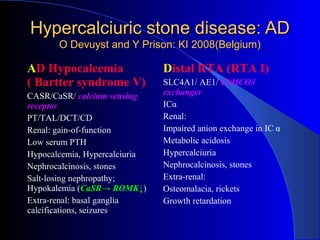
Hypercalciuric stone disease: ADHypercalciuric stone disease: AD
O Devuyst and Y Prison: KI 2008(Belgium)O Devuyst and Y Prison: KI 2008(Belgium)
AD Hypocalcemia
( Bartter syndrome V)
CASR/CaSR/ calcium sensing
receptor
PT/TAL/DCT/CD
Renal: gain-of-function
Low serum PTH
Hypocalcemia, Hypercalciuria
Nephrocalcinosis, stones
Salt-losing nephropathy;
Hypokalemia (CaSR→ ROMK↓)
Extra-renal: basal ganglia
calcifications, seizures
Distal RTA (RTA I)
SLC4A1/ AE1/ Cl/HCO3
exchanger
ICα
Renal:
Impaired anion exchange in IC α
Metabolic acidosis
Hypercalciuria
Nephrocalcinosis, stones
Extra-renal:
Osteomalacia, rickets
Growth retardation
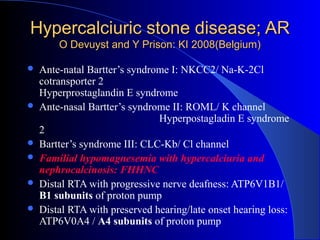
Hypercalciuric stone disease; ARHypercalciuric stone disease; AR
O Devuyst and Y Prison: KI 2008(Belgium)O Devuyst and Y Prison: KI 2008(Belgium)
 Ante-natal Bartter’s syndrome I: NKCC2/ Na-K-2Cl
cotransporter 2
Hyperprostaglandin E syndrome
 Ante-nasal Bartter’s syndrome II: ROML/ K channel
Hyperpostagladin E syndrome
2
 Bartter’s syndrome III: CLC-Kb/ Cl channel
 Familial hypomagnesemia with hypercalciuria and
nephrocalcinosis: FHHNC
 Distal RTA with progressive nerve deafness: ATP6V1B1/
B1 subunits of proton pump
 Distal RTA with preserved hearing/late onset hearing loss:
ATP6V0A4 / A4 subunits of proton pump
FHHNCFHHNC
 CLND 16/ Claudin-16/ paracellin-1 tight junction
protein
 TAL, DCT
 Renal:
Impaired paracellular transport of Ca/Mg:
calcium and magnesium wasting
Nephrocalcinosis, stones
Renal failure
 Extra-renal:
Convulsions, tetany, chondrocalcinosis,
neuro-muscluar manifestations
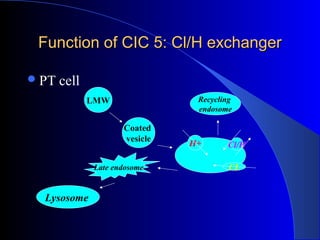
Function of CIC 5: Cl/H exchangerFunction of CIC 5: Cl/H exchanger
PT cell
Coated
vesicle
Recycling
endosome
LMW
H+ Cl/H
CLLate endosome
Lysosome
Functional loss of ClC-5Functional loss of ClC-5
Trafficking defect in PT cells
Generalized PT cell dysfunction-Renal
Fanconi syndrome
LMW proteinuria: DBP-25(OH)D3; PTH
Internalization of NaPi-IIa: phosphaturia
↑1 α hydroxylase: ↑1,25(OH)2D3
Hypercalciuria, nephrocalcinosis, stones
A New Perspective on Hypocalcemia

A New Perspective on Hypocalcemia

  • 1.
    A New Perspective onHypocalcemia Taipei Veterans General Hospital, Hsin-Chu branch Director of Nephrology Steve Chen Ca
  • 2.
  • 3.
  • 4.
  • 5.
    Pseudo-hypocalcemiaPseudo-hypocalcemia Transfer sample fromtubes containing K- EDTA Sample stored at RT for extended time Vasovagal episode Usually accompanied with pseudohyperkalemia
  • 7.
    Etiology of Hypocalcemia(1)Etiologyof Hypocalcemia(1) – Common CausesCommon Causes SShockhock SSepsisepsis RRenal failureenal failure PPancreatitisancreatitis
  • 8.
    Etiology of Hypocalcemia(2)Etiologyof Hypocalcemia(2) – MalignancyMalignancy – EndocrineEndocrine  HypoparathyroidismHypoparathyroidism  Vitamin D deficiencyVitamin D deficiency – DrugsDrugs  Cimetidine, Phosphates, Dilantin, Phenobarbital, Glucagon, Aminoglycosides, Cisplatin, Heparin, Theophylline, Protamine, Norepinephrine, Loop diuretics, Glucocorticoids, Magnesium Sulfate, Nitroprusside
  • 9.
    Symptoms & signsofSymptoms & signs of HypocalcemiaHypocalcemia  Clinical Features(1)Clinical Features(1) – NeurologicalNeurological  Circumoral & digital paresthesiasCircumoral & digital paresthesias  TetanyTetany  Chvostek signChvostek sign  Trousseau signTrousseau sign  Impaired memory, confusionImpaired memory, confusion  HallucinationsHallucinations, dementia, seizures, dementia, seizures
  • 10.
    Symptoms & signsofSymptoms & signs of HypocalcemiaHypocalcemia  Clinical Features (3)Clinical Features (3) -- GI: steatorrheaGI: steatorrhea – MuscularMuscular  Spasms, cramps, weaknessSpasms, cramps, weakness – DermatologicDermatologic  HyperpigmentationHyperpigmentation  Coarse, brittle hairCoarse, brittle hair  Dry, scaly skinDry, scaly skin
  • 13.
    Symptoms & signsofSymptoms & signs of HypocalcemiaHypocalcemia  Clinical Features (4)Clinical Features (4) – CardiovascularCardiovascular  Heart failure; HypotentionHeart failure; Hypotention  VasoconstrictionVasoconstriction  EKG abnormalitiesEKG abnormalities – Prolonged QTProlonged QT – SkeletalSkeletal  OsteodystrophyOsteodystrophy  RicketsRickets  OsteomalaciaOsteomalacia
  • 15.
    SCa < 8.5mg/dl SPi < 3.5 mg/dl SPi > 3.5 mg/dl FECa Renal loss 25(OH)D↓ VD deficiency 25(OH)D: N/1,25(OH)2D↓ VD dependent rickets: Type I 25(OH)D: N/1,25(OH)2D↑ VD dependent rickets: Type II High Low GFR PTH Mg Low Low N/↑ Pseudo-hypo- parathyroidism Low N Primary/Secondary hypoparathyroidism Mg related hypoparathyroidims CRF
  • 16.
    FE of electolyteFEof electolyte FE of K >6.5%→ renal K wasting in hypoK FE of Pi >5.0% → renal Pi wasting in hypoPi FE of Mg>2.5%→ renal Mg wasting in hypoMg FE of Na> 1.0% → renal Na wasting in hypoNa FE of Ca>3.0% → renal Ca wasting in hypoCa
  • 17.
    Hypocalcemia: causesHypocalcemia: causes Lossof circulating free calcium: extravascular deposition: hyperphosphatemia; renal failure; acute pancreatitis; osteoblastic metastasis; hyngry bones syndrome intravascular binding: citrate, lactate, foscarnet, EDTA, acute respiratory alkalosis(↑Ca-albumin) Hypoparathyroidism: S/P PTX, thyroidectomy, or radical neck surgery pseudohypoparathyroidism; idiopathic Hypomagnesemia; severe hypermagnesemia Vitamin D deficiency
  • 19.
    Hungry bones syndromeHungrybones syndrome  Severe form: Profound hypocalcemia+↓Mg+↓Pi : S/P PTX for severe osteodystrophy  Mild form: S/P thyrotoxicosis accelerated bone formation in leukemia osteoblastic metastasis early healing of rickets or osteomalacia  Calcitriol: 2 ~ 3μg/D(initial dose) with rapid reduction after normocalcemia
  • 21.
    Hypocalcemia in acuteHypocalcemiain acute pancreatitispancreatitis Extravascular deposition Glucagon-stimulated calcitonin release Inadequate PTH secretion
  • 23.
    HypoparathyroidismHypoparathyroidism S/P OP: permanentor intermittent Hypomagnesemia(SMg<1mg/dl) in malabsorption or chronic alcoholism Severe hypermagnesemia in toxemia of pregnancy( SMg> 6mg/dl) Pseudo type1: Ia(AD, G-protein) Ib(↓receptor) Pseudo type II: ↓cAMP-dependent PK
  • 25.
    Vitamin D deficiencyVitaminD deficiency Reduced VD intake or production: bedridden state(no sun exposure) steatorrhea or malabsorption  Reduced availability of calcifediol(hepatic): severe liver disease use of Dilantin/phenobarbital nephrotic syndrome(↓VD binding protein)  Reduced production of calcitriol(renal): chronic renal failure VD-dependent ricket
  • 27.
    Hypocalcemia in sepsisHypocalcemiain sepsis Inadequate PTH or end-organ resistance Inadequate VD Hypomagnesemia Glucagon-induced calcitonin release
  • 29.
    Principles of treatmentPrinciplesof treatment  Symptomatic hypocalcemia – emergency 10 ml of 10% calcium gluconate IV over 10 minutes.  Iv calcium should not be given with bicarbonate or phosphate containing solution  Serial calcium measurements  Correction of co-existing alkalosis Calcium suppy in long term
  • 30.
    IV calcium supplyIVcalcium supply Symptomatic hypocalcemia (Sca<5.6mg/dl) : heart failure, hypotention, bradycardia convulsions, tetany, paresthesias  1 ~ 2 ampules(90mg/A), 10% Ca gluconate in 5 ~ 10ml, 5% dextrose, IVF for 5 ~ 10minutes 10 ampules, Ca gluconate in 1L, 5% dextrose, IVF: 50ml/Hr ( 45mg,calcium/Hr) Calcium dose: 15mg/Kg IVF for 6 hr Calcium space: 50 ~ 75%(?)
  • 31.
    Adjuvant therapyAdjuvant therapy Magnesiumsupply: Hypocalcemia+Normal renal function+Normal DTR 10% MgSo4, 2G, IVF for 10 minutes 10% MgSo4, 1G/100cc,fluid/Hr Oral calcium and calcitriol( 0.5 ~ 1.0μg/D) should initiated early
  • 32.
    PO calcium supplyPOcalcium supply Calcium: 2 ~ 4G/D Vitamin D indicated if insufficient response
  • 33.
    PO Calcium preparationPOCalcium preparation mg/Tb Ca,mg/Tb CaCO3 500 200( 40% ) Ca gluconate 1000 90( 8% ) Ca lactate 300 60( 12% )
  • 34.
    Things to rememberThingsto remember – Treat the patient, not the lab valueTreat the patient, not the lab value – Rate of correction should mirror rate of changeRate of correction should mirror rate of change – Correct in orderly fashionCorrect in orderly fashion  1. Volume1. Volume  2. pH2. pH  3. Potassium, Calcium, Magnesium3. Potassium, Calcium, Magnesium  4. Sodium and Chloride4. Sodium and Chloride – Consider impact of interventions overallConsider impact of interventions overall
  • 36.
    Calcium handling inkidneyCalcium handling in kidney  PCT: 60 ~ 65% of filtrate by para-cellular path  THAL: 20% of filtrate by para-cellular path paracellin-1 for Mg&Ca reabsortion Simon et al, Science 1999  DN: 10 ~ 15% by trans-cellular pathway ECaC1, apical: VD ↑; lower pH ↓ Calbindin-D 28k: VD ↑; estrogen↑; CsA↓ NCX1,basolateral: 70% PMCA1b,basolateral: 30%  Cl channel: PTH, Thiazide
  • 38.
    TRPV5 cell surfaceabundanceTRPV5 cell surface abundance Factors Cell surface abundance Proposed mode of action Klotho + Modification channel glycosylation Tissue kallikrein + PKC mediated channel phosphorylation Acid pH - Dynamic plasma membrane trafficking Ca - Channel recycling Mg ND NA PIP2 ND NA WNK4 + ND (familial hyperkalemic HTN/hypercalciuria) ND: not determined; NA: not applicable +, increase; -, decrease; =, no effect WNK, With-No-Lysine(K): serine/threonine protein kinases
  • 39.
    TRPV5 single channelactivityTRPV5 single channel activity Factors Single channel activity Proposed mode of action Klotho ND NA Tissue kallikrein ND NA Acid pH - Proton binding to channel pH sensors Ca - Feedback inhibition via channel C tail Mg - Conformational change channel via Mg binding PIP2 + Stabilization channel open conformation WNK4 = ND: not determined; NA: not applicable Kloth: anti-aging hormone
  • 40.
    Modes of TRPV5regulationModes of TRPV5 regulation
  • 41.
    ECaC1 homologuesECaC1 homologues Mulleret al, NDT 2001Muller et al, NDT 2001 Sequence similarities tissue distribution Chromosome 7q35 hECaC1 80% Kidney>GI Evolution gene duplication hCaT1 80% GI>kidney hECaC2
  • 42.
    TRP V 5knockout mice modelTRP V 5 knockout mice model  Transient receptor potential channels (TRP): Gate-keeper proteins  TRP V5 in kidney: ECaC 1  TRP V6  Hypercalciuria  Diuresis: CaSR, apical in principal cells + Ca in lumen ﹡ →AQP2  Acid urine: CaSR, apical in intercalated cells + Ca in lumen → H+APTase  Hyperphosphaturia Rene Bindels: Radboud University Nijmegen Medical Center, Netherlands
  • 44.
    Hypercalciuric stone disease:XLHypercalciuric stone disease: XL O Devuyst and Y Prison: KI 2008(Belgium)O Devuyst and Y Prison: KI 2008(Belgium) Dent’s disease: CLCN5/CLC-5/ Cl/H exchanger PT/TAL/IC α Renal: Trafficking defect: endocytosis PT dysfunction: Fanconi syndrome Nephrocalcinosis, stones Impaired urine acidification Renal failure Extra-renal: Rickets Lowe’s disease OCRL/OCRL1/ Phosphatidylinositol 4,5- biphosphate 5-phosphatase PT Renal: PT dysfunction: Fanconi syndrome Proximal RTA Nephrocalcinosis, stones Extra-renal: Mental retardation, growth delay Cataract, rickets, cryptorchidism Neuromuscular/behavior abnormality
  • 45.
    Hypercalciuric stone disease:ADHypercalciuric stone disease: AD O Devuyst and Y Prison: KI 2008(Belgium)O Devuyst and Y Prison: KI 2008(Belgium) AD Hypocalcemia ( Bartter syndrome V) CASR/CaSR/ calcium sensing receptor PT/TAL/DCT/CD Renal: gain-of-function Low serum PTH Hypocalcemia, Hypercalciuria Nephrocalcinosis, stones Salt-losing nephropathy; Hypokalemia (CaSR→ ROMK↓) Extra-renal: basal ganglia calcifications, seizures Distal RTA (RTA I) SLC4A1/ AE1/ Cl/HCO3 exchanger ICα Renal: Impaired anion exchange in IC α Metabolic acidosis Hypercalciuria Nephrocalcinosis, stones Extra-renal: Osteomalacia, rickets Growth retardation
  • 46.
    Hypercalciuric stone disease;ARHypercalciuric stone disease; AR O Devuyst and Y Prison: KI 2008(Belgium)O Devuyst and Y Prison: KI 2008(Belgium)  Ante-natal Bartter’s syndrome I: NKCC2/ Na-K-2Cl cotransporter 2 Hyperprostaglandin E syndrome  Ante-nasal Bartter’s syndrome II: ROML/ K channel Hyperpostagladin E syndrome 2  Bartter’s syndrome III: CLC-Kb/ Cl channel  Familial hypomagnesemia with hypercalciuria and nephrocalcinosis: FHHNC  Distal RTA with progressive nerve deafness: ATP6V1B1/ B1 subunits of proton pump  Distal RTA with preserved hearing/late onset hearing loss: ATP6V0A4 / A4 subunits of proton pump
  • 47.
    FHHNCFHHNC  CLND 16/Claudin-16/ paracellin-1 tight junction protein  TAL, DCT  Renal: Impaired paracellular transport of Ca/Mg: calcium and magnesium wasting Nephrocalcinosis, stones Renal failure  Extra-renal: Convulsions, tetany, chondrocalcinosis, neuro-muscluar manifestations
  • 48.
    Function of CIC5: Cl/H exchangerFunction of CIC 5: Cl/H exchanger PT cell Coated vesicle Recycling endosome LMW H+ Cl/H CLLate endosome Lysosome
  • 49.
    Functional loss ofClC-5Functional loss of ClC-5 Trafficking defect in PT cells Generalized PT cell dysfunction-Renal Fanconi syndrome LMW proteinuria: DBP-25(OH)D3; PTH Internalization of NaPi-IIa: phosphaturia ↑1 α hydroxylase: ↑1,25(OH)2D3 Hypercalciuria, nephrocalcinosis, stones

Editor's Notes

  • #9 In presence of albumin, total Ca may be low but ionized Ca remains normal Vit D deficiency Sunlight/dietary deficiency Malabsorption (Gastrectomy)
  • #10 Chvostek – Twitch at corner of mouth when tapped over facial nerve just in front of ear. Trosseau – Carpal spasm produced when BP cuff to upper arm maintains a pressure above systolic for 3 min. Fingers spastically extend at the IP joints and flex at the MCP joints. Wrist flexed, forearm pronated,