A low energy demand pathway for Ireland
Ankita Singh Gaur, Hannah Daly
Energy Policy and Modelling Group, University College Cork
Summer 2021 semi-annual ETSAP meeting
Introduction
• Energy use caused about 59% of the 𝐺𝐻𝐺 emissions in Ireland (SEAI, 2020)
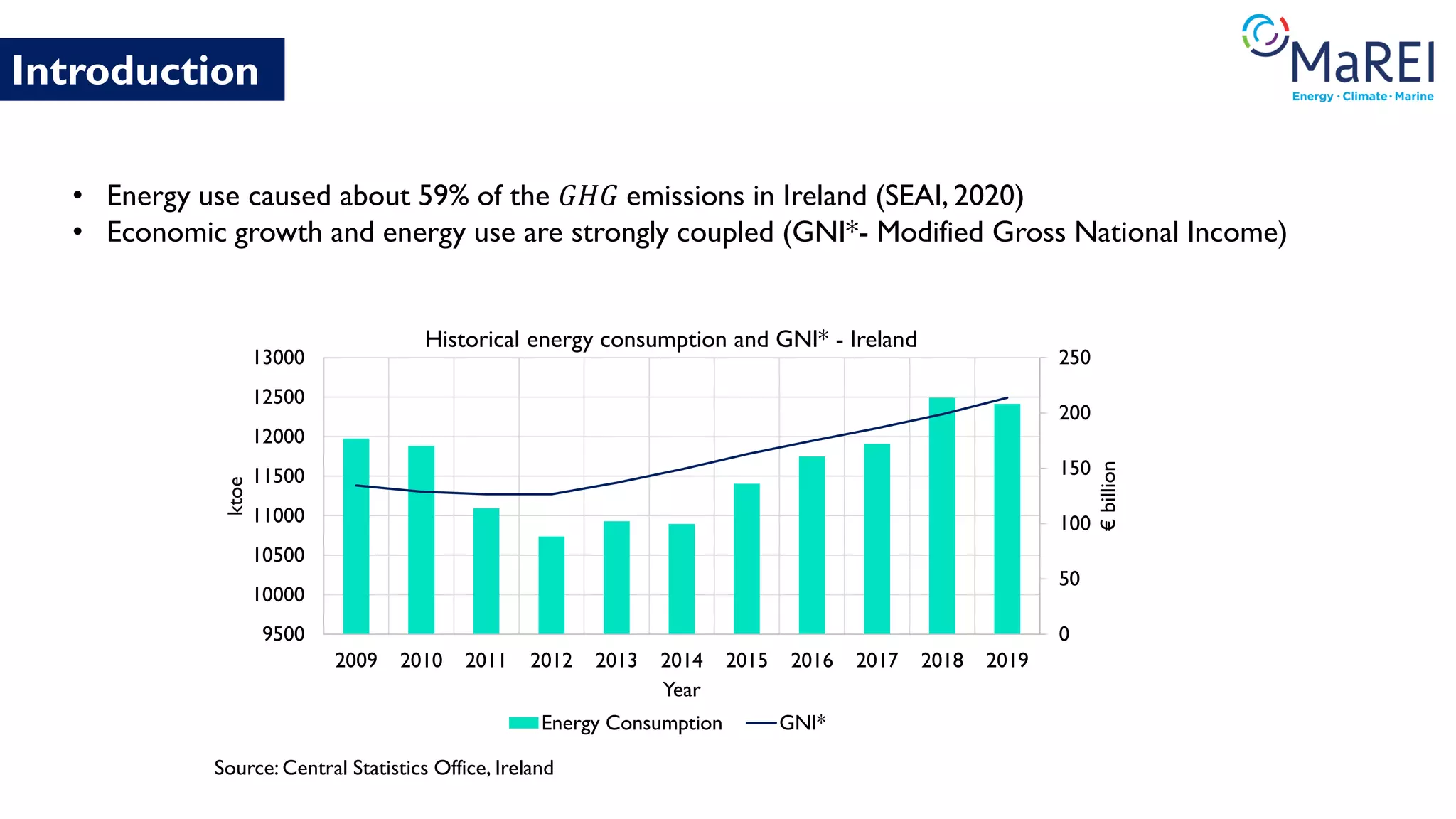
• Economic growth and energy use are strongly coupled (GNI*- Modified Gross National Income)
0
50
100
150
200
250
9500
10000
10500
11000
11500
12000
12500
13000
2009 2010 2011 2012 2013 2014 2015 2016 2017 2018 2019
€
billion
ktoe
Year
Historical energy consumption and GNI* - Ireland
Energy Consumption GNI*
Source: Central Statistics Office, Ireland
Economic
growth
Energy use
Size of energy
system
Decarbonization
efforts
Meeting climate
goals
Introduction
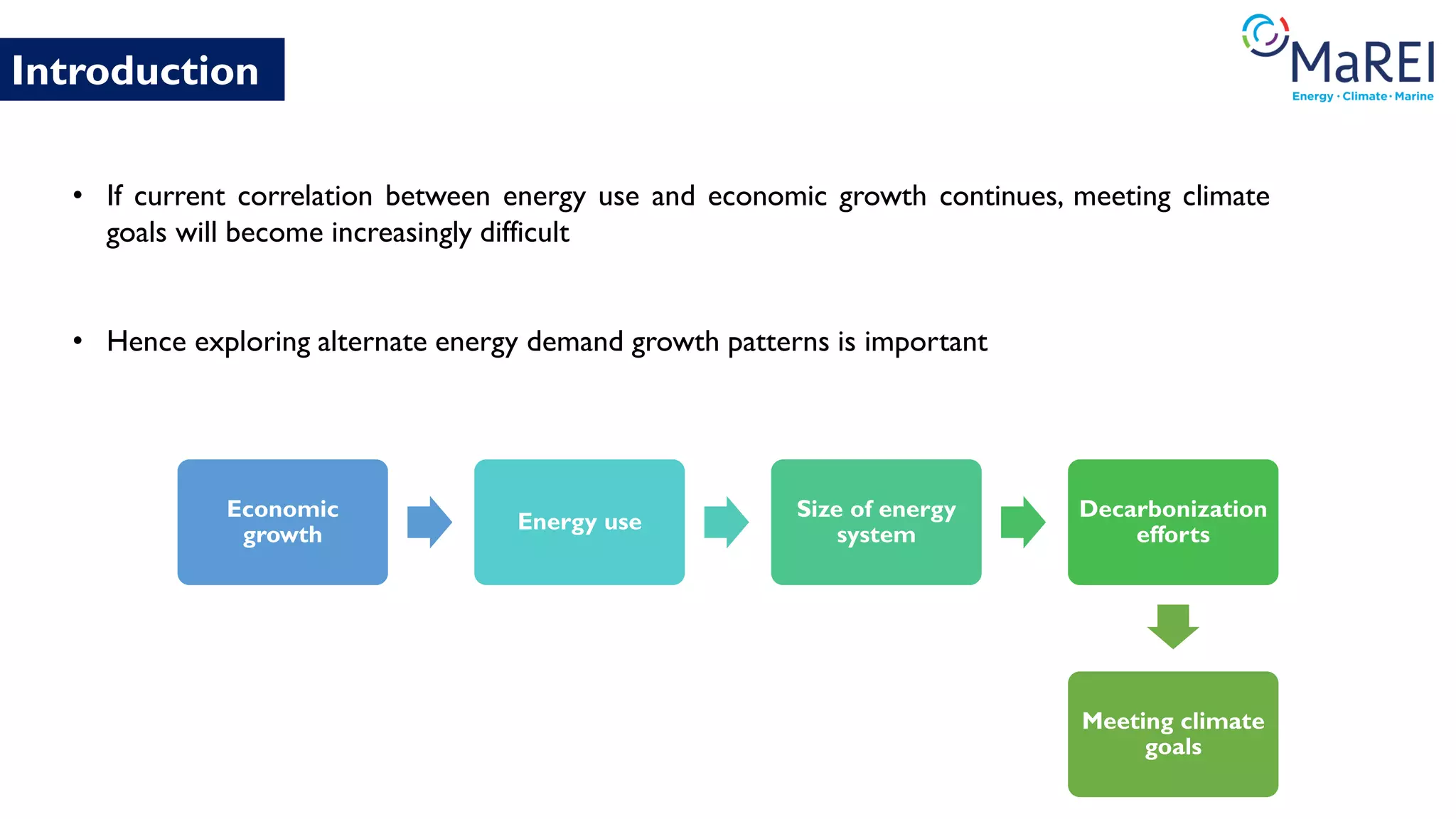
• If current correlation between energy use and economic growth continues, meeting climate
goals will become increasingly difficult
• Hence exploring alternate energy demand growth patterns is important
• Mitigation pathways describe future emissions that keep global warming below specific temperature limits
• Current mitigation scenarios are biased towards growth and technology fixes
• IPCC’s 2018 report highlights:
• Annual Carbon dioxide emissions to reach net zero by 2050
• Use of Carbon Dioxide Removal (CDR)
• Risks of using CDR include:
• adverse impacts on the ecosystem
• feasibility in terms of cost
• land use, availability and competition for food production
• social acceptance and safety
• Mitigation scenarios focus on supply side
• Demand side measures not well-represented in energy system models due to their complex nature
Introduction
Rationale for Low Energy Demand Pathway
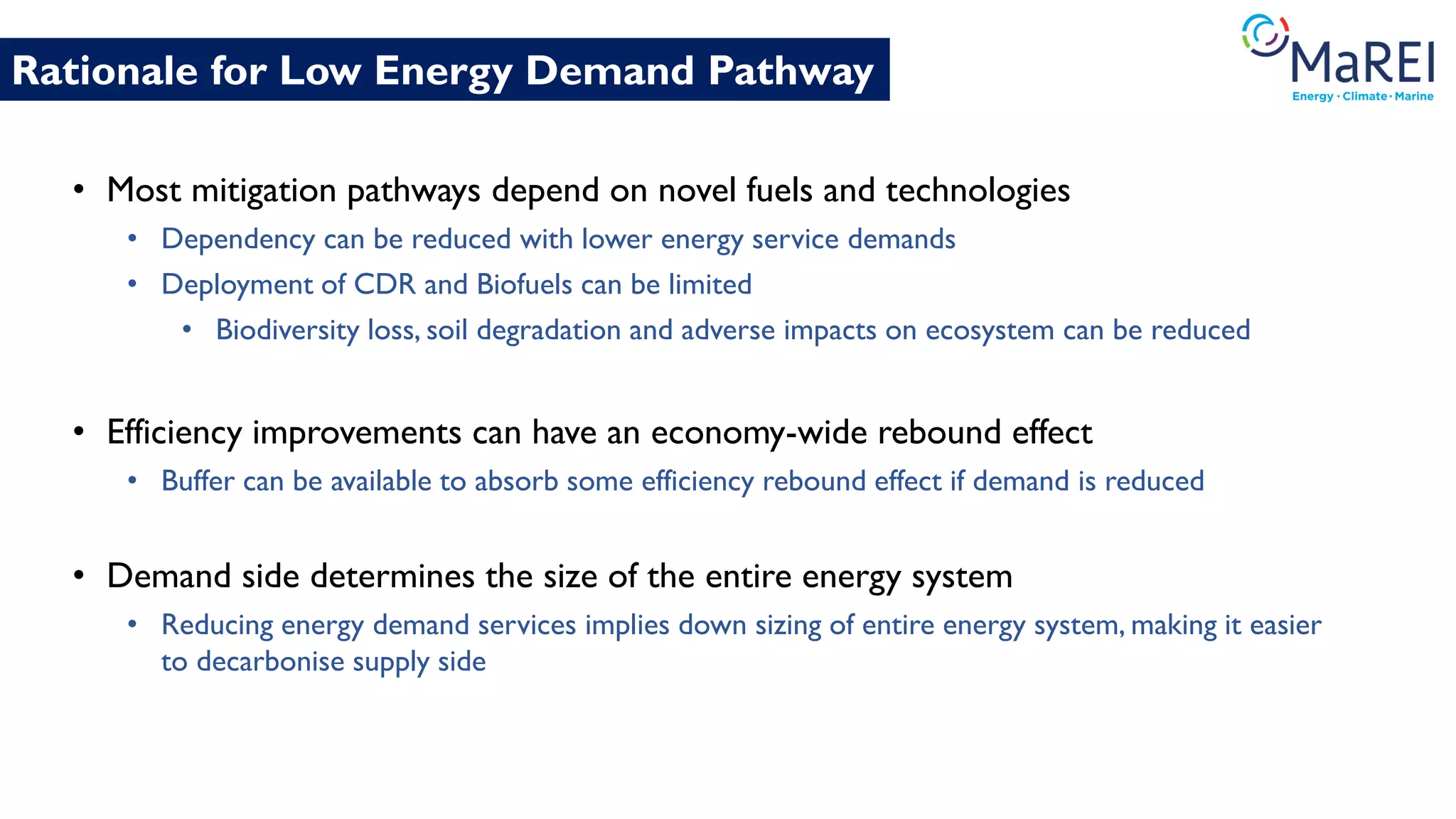
• Most mitigation pathways depend on novel fuels and technologies
• Dependency can be reduced with lower energy service demands
• Deployment of CDR and Biofuels can be limited
• Biodiversity loss, soil degradation and adverse impacts on ecosystem can be reduced
• Efficiency improvements can have an economy-wide rebound effect
• Buffer can be available to absorb some efficiency rebound effect if demand is reduced
• Demand side determines the size of the entire energy system
• Reducing energy demand services implies down sizing of entire energy system, making it easier
to decarbonise supply side
Rationale for Low Energy Demand Pathway
• Ireland has significantly increased its climate mitigation ambition
• Reduce greenhouse-gases by an average of 7% per year till 2030
• “Net-zero" target for 2050
• Ireland faces a number of challenges in meeting these objectives
• Very high share of GHG emissions from agricultural sector
• Transport and heating are heavily dependent on fossil fuels
• Relatively electricity grid make it very challenging to integrate high shares of renewable electricity
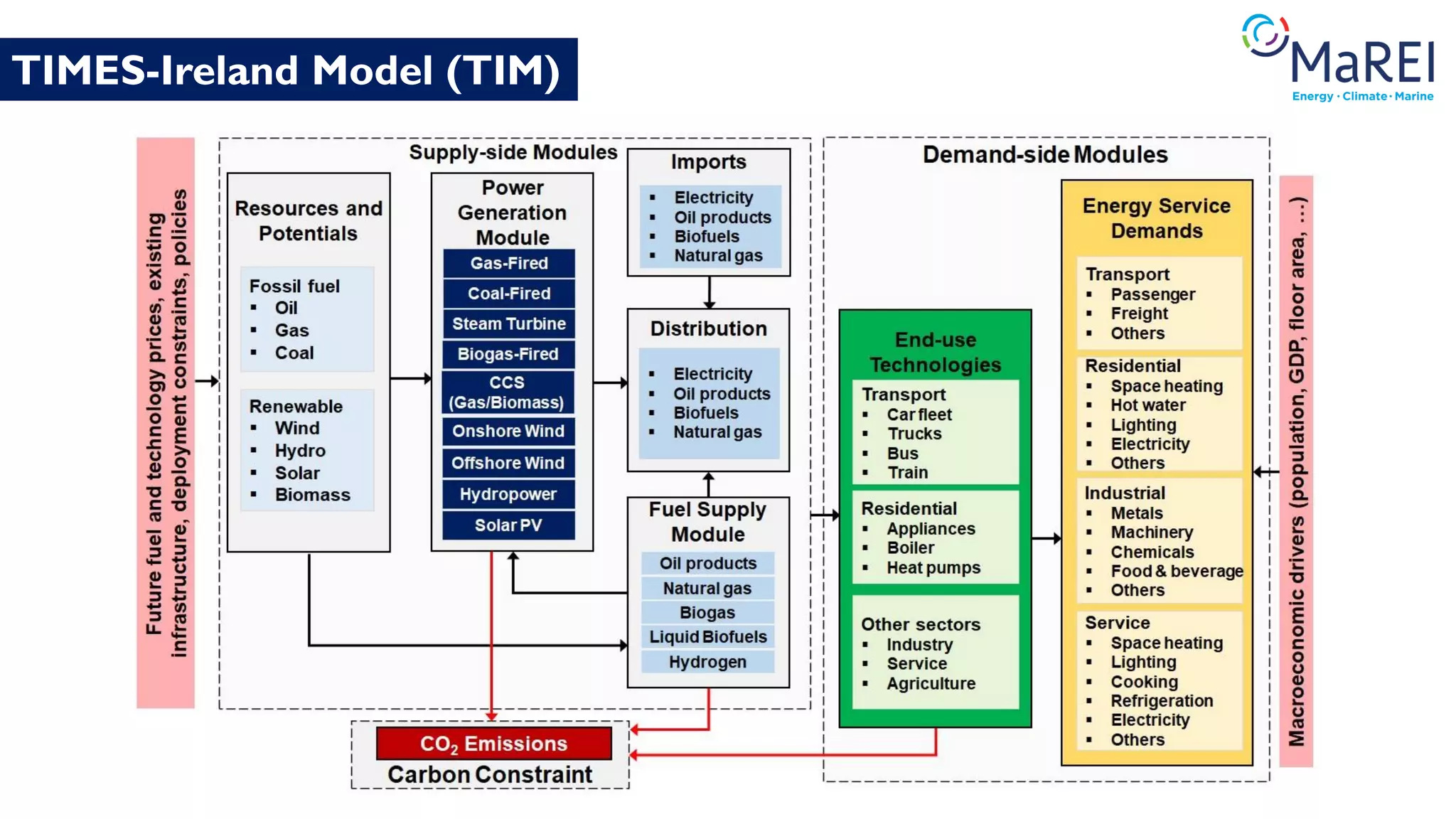
TIMES-Ireland Model (TIM)
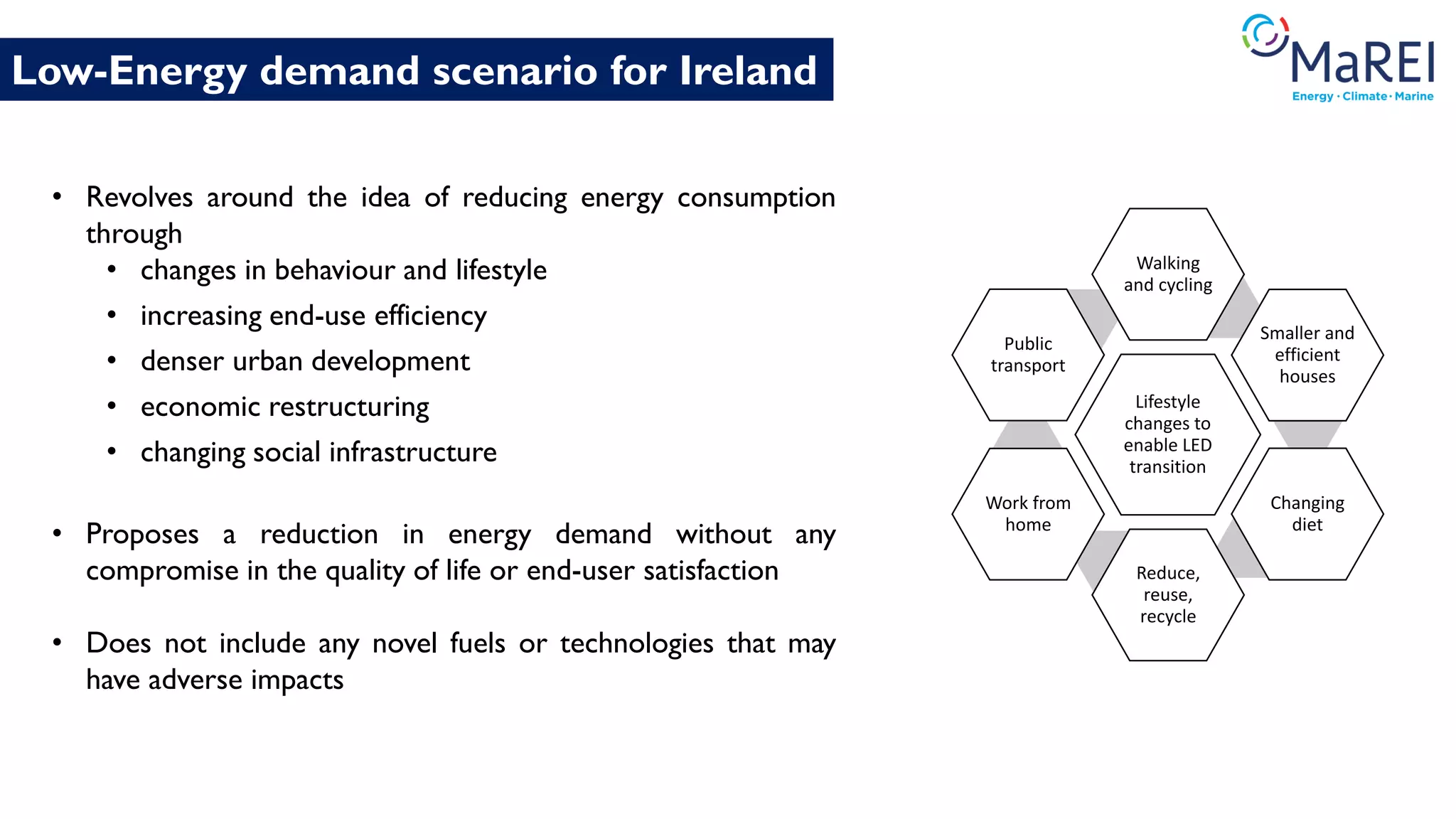
Low-Energy demand scenario for Ireland
• Revolves around the idea of reducing energy consumption
through
• changes in behaviour and lifestyle
• increasing end-use efficiency
• denser urban development
• economic restructuring
• changing social infrastructure
• Proposes a reduction in energy demand without any
compromise in the quality of life or end-user satisfaction
• Does not include any novel fuels or technologies that may
have adverse impacts
Lifestyle
changes to
enable LED
transition
Walking
and cycling
Smaller and
efficient
houses
Changing
diet
Reduce,
reuse,
recycle
Work from
home
Public
transport
Low-Energy demand scenario for Ireland
Transport
• Freight- Activity level to go back to the 1995 level by 2050
• Better logistics and efficiency improvements,
• Reviving local economy
• Taxes on foreign imports
• Passenger kilometres- pkms/capita decrease to 12000 by
2050
• Shorter travel distances and higher occupancy in vehicles
• Work from home
• Modal shift- more public transport, increase in active modes
of travel (walking & cycling)
0
1000
2000
3000
4000
5000
1990 2000 2010 2020 2030 2040 2050
Freight:Tonne-kms/capita
Historical Base projection LED
Mode
(% share)
2018 2050_LED
Private cars 73% 52%
Motorcycles 0% 0%
Small PSVs 2% 2%
Large PSVs 14% 23%
LUAS 0% 2%
Train 3% 5%
Walking 6% 12%
Cycling 1% 4%
Low-Energy demand scenario for Ireland
Residential
• Area per person by 2050- 42.5 sq. metres
• About 70% of the Irish population lives in under occupied
dwellings
• Old housing stock- at least B2 rated (100 kWh/m2)
• Retrofits and renovations
• New housing- at least A2 rated (50 kWh/m2)
Residential demand
(% share)
2018 2050_LED
Space Heating 73% 56%
Water Heating 24% 30%
Lighting 2% 5%
Pumps & Fans 1% 8%
Space cooling 0% 1%
Industry
• 45% decrease in energy intensity by 2050 from current level
• Increasing production efficiency
• Better usage of materials: e.g., recycling, circular economy
• 50% reduction in energy demand from cement industry by
2050
• Replaced by other building materials such as timber 0
50
100
150
2018 2019 2020 2030 2050
PJ
Industry
Base LED
Low-Energy demand scenario for Ireland
Services
• Space constraint: Commercial buildings-5.3 m2/capita; Public buildings-10.7 m2/capita
• Public lighting units are assumed to remain constant at 2040 level
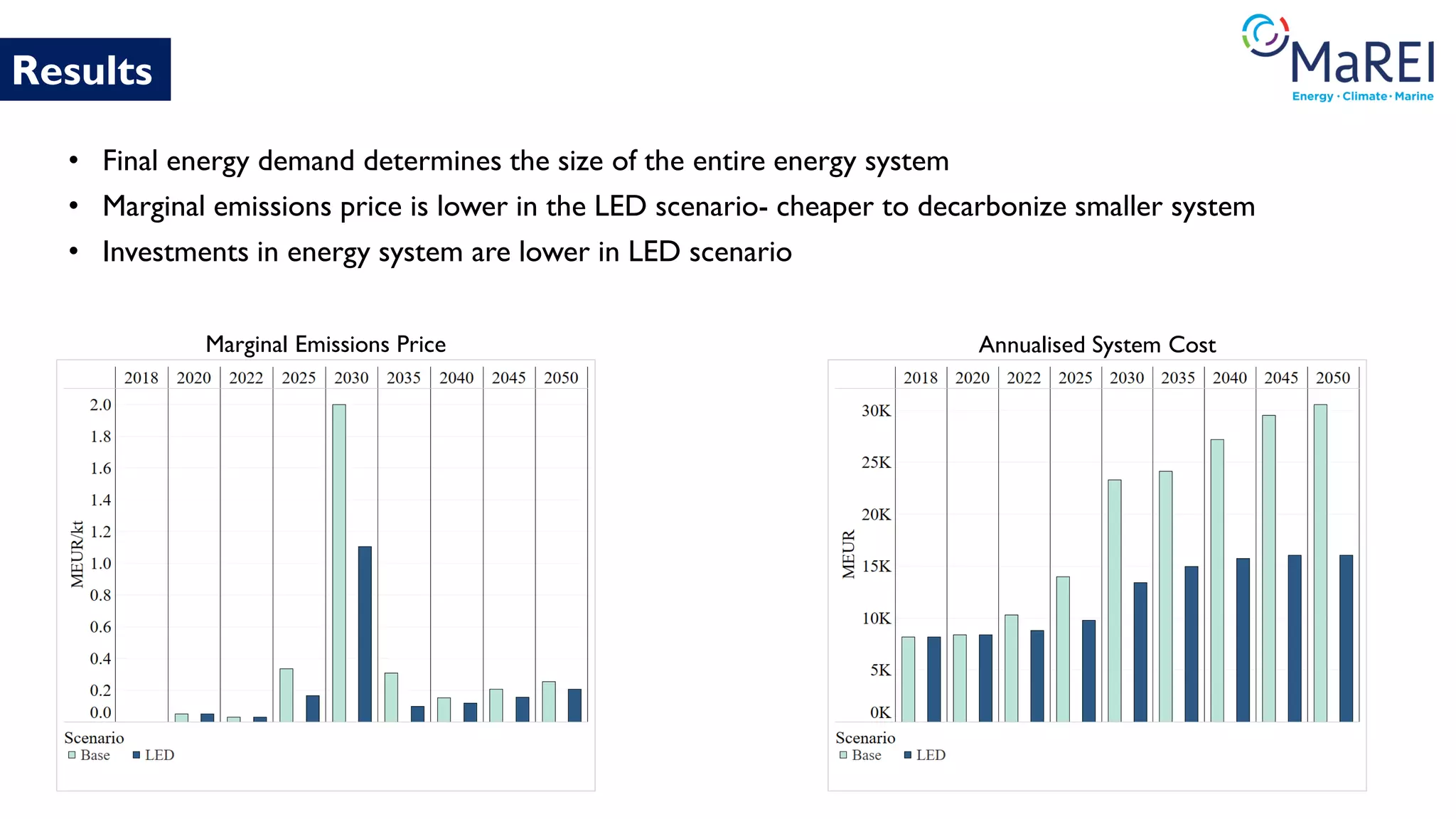
Results
Marginal Emissions Price
• Final energy demand determines the size of the entire energy system
• Marginal emissions price is lower in the LED scenario- cheaper to decarbonize smaller system
• Investments in energy system are lower in LED scenario
Annualised System Cost
Results
• CO2 emissions are lower in the LED scenario
in 2050
• Reliance on negative emission technologies (in
this case BECSS) is also lower in the LED
scenario
Conclusion
• LED pathway explores the possibility of reducing emissions without relying on technological
transformation but by reducing end-use demand for energy
• Lower demand provides opportunities to decarbonize the supply end more effectively
• The transformation to a lower energy demand cannot be achieved only through expected
rational consumer behaviour and needs specific policies for its implementation
• Investments will be needed in order to enable the transition to LED e.g. public infrastructure
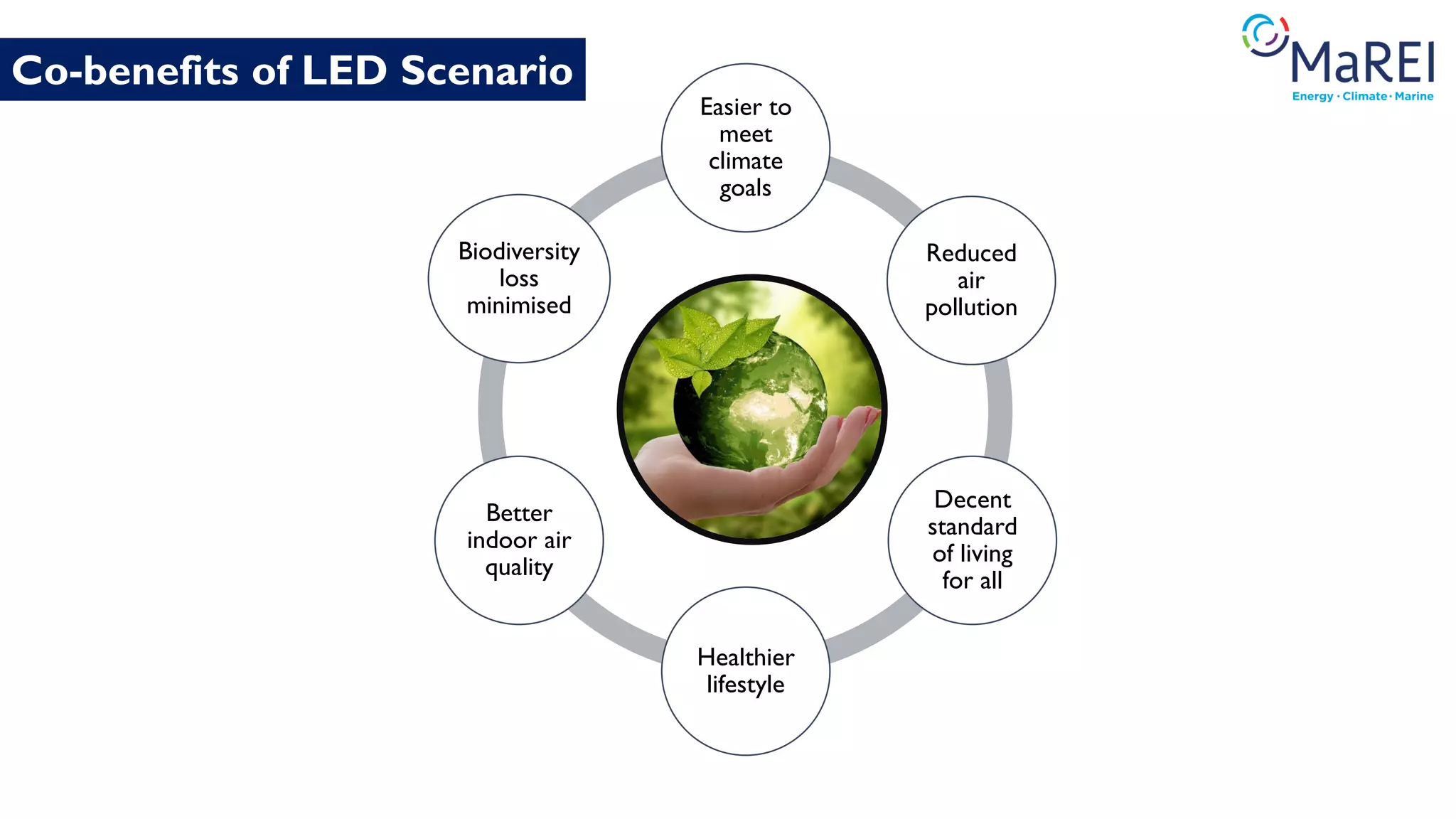
Easier to
meet
climate
goals
Reduced
air
pollution
Decent
standard
of living
for all
Healthier
lifestyle
Better
indoor air
quality
Biodiversity
loss
minimised
Co-benefits of LED Scenario
Thank you
agaur@ucc.ie
@ankita_gaur3

A low energy demand pathway for Ireland

  • 1.
    A low energydemand pathway for Ireland Ankita Singh Gaur, Hannah Daly Energy Policy and Modelling Group, University College Cork Summer 2021 semi-annual ETSAP meeting
  • 2.
    Introduction • Energy usecaused about 59% of the 𝐺𝐻𝐺 emissions in Ireland (SEAI, 2020) • Economic growth and energy use are strongly coupled (GNI*- Modified Gross National Income) 0 50 100 150 200 250 9500 10000 10500 11000 11500 12000 12500 13000 2009 2010 2011 2012 2013 2014 2015 2016 2017 2018 2019 € billion ktoe Year Historical energy consumption and GNI* - Ireland Energy Consumption GNI* Source: Central Statistics Office, Ireland
  • 3.
    Economic growth Energy use Size ofenergy system Decarbonization efforts Meeting climate goals Introduction • If current correlation between energy use and economic growth continues, meeting climate goals will become increasingly difficult • Hence exploring alternate energy demand growth patterns is important
  • 4.
    • Mitigation pathwaysdescribe future emissions that keep global warming below specific temperature limits • Current mitigation scenarios are biased towards growth and technology fixes • IPCC’s 2018 report highlights: • Annual Carbon dioxide emissions to reach net zero by 2050 • Use of Carbon Dioxide Removal (CDR) • Risks of using CDR include: • adverse impacts on the ecosystem • feasibility in terms of cost • land use, availability and competition for food production • social acceptance and safety • Mitigation scenarios focus on supply side • Demand side measures not well-represented in energy system models due to their complex nature Introduction
  • 5.
    Rationale for LowEnergy Demand Pathway • Most mitigation pathways depend on novel fuels and technologies • Dependency can be reduced with lower energy service demands • Deployment of CDR and Biofuels can be limited • Biodiversity loss, soil degradation and adverse impacts on ecosystem can be reduced • Efficiency improvements can have an economy-wide rebound effect • Buffer can be available to absorb some efficiency rebound effect if demand is reduced • Demand side determines the size of the entire energy system • Reducing energy demand services implies down sizing of entire energy system, making it easier to decarbonise supply side
  • 6.
    Rationale for LowEnergy Demand Pathway • Ireland has significantly increased its climate mitigation ambition • Reduce greenhouse-gases by an average of 7% per year till 2030 • “Net-zero" target for 2050 • Ireland faces a number of challenges in meeting these objectives • Very high share of GHG emissions from agricultural sector • Transport and heating are heavily dependent on fossil fuels • Relatively electricity grid make it very challenging to integrate high shares of renewable electricity
  • 7.
  • 8.
    Low-Energy demand scenariofor Ireland • Revolves around the idea of reducing energy consumption through • changes in behaviour and lifestyle • increasing end-use efficiency • denser urban development • economic restructuring • changing social infrastructure • Proposes a reduction in energy demand without any compromise in the quality of life or end-user satisfaction • Does not include any novel fuels or technologies that may have adverse impacts Lifestyle changes to enable LED transition Walking and cycling Smaller and efficient houses Changing diet Reduce, reuse, recycle Work from home Public transport
  • 9.
    Low-Energy demand scenariofor Ireland Transport • Freight- Activity level to go back to the 1995 level by 2050 • Better logistics and efficiency improvements, • Reviving local economy • Taxes on foreign imports • Passenger kilometres- pkms/capita decrease to 12000 by 2050 • Shorter travel distances and higher occupancy in vehicles • Work from home • Modal shift- more public transport, increase in active modes of travel (walking & cycling) 0 1000 2000 3000 4000 5000 1990 2000 2010 2020 2030 2040 2050 Freight:Tonne-kms/capita Historical Base projection LED Mode (% share) 2018 2050_LED Private cars 73% 52% Motorcycles 0% 0% Small PSVs 2% 2% Large PSVs 14% 23% LUAS 0% 2% Train 3% 5% Walking 6% 12% Cycling 1% 4%
  • 10.
    Low-Energy demand scenariofor Ireland Residential • Area per person by 2050- 42.5 sq. metres • About 70% of the Irish population lives in under occupied dwellings • Old housing stock- at least B2 rated (100 kWh/m2) • Retrofits and renovations • New housing- at least A2 rated (50 kWh/m2) Residential demand (% share) 2018 2050_LED Space Heating 73% 56% Water Heating 24% 30% Lighting 2% 5% Pumps & Fans 1% 8% Space cooling 0% 1% Industry • 45% decrease in energy intensity by 2050 from current level • Increasing production efficiency • Better usage of materials: e.g., recycling, circular economy • 50% reduction in energy demand from cement industry by 2050 • Replaced by other building materials such as timber 0 50 100 150 2018 2019 2020 2030 2050 PJ Industry Base LED
  • 11.
    Low-Energy demand scenariofor Ireland Services • Space constraint: Commercial buildings-5.3 m2/capita; Public buildings-10.7 m2/capita • Public lighting units are assumed to remain constant at 2040 level
  • 12.
    Results Marginal Emissions Price •Final energy demand determines the size of the entire energy system • Marginal emissions price is lower in the LED scenario- cheaper to decarbonize smaller system • Investments in energy system are lower in LED scenario Annualised System Cost
  • 13.
    Results • CO2 emissionsare lower in the LED scenario in 2050 • Reliance on negative emission technologies (in this case BECSS) is also lower in the LED scenario
  • 14.
    Conclusion • LED pathwayexplores the possibility of reducing emissions without relying on technological transformation but by reducing end-use demand for energy • Lower demand provides opportunities to decarbonize the supply end more effectively • The transformation to a lower energy demand cannot be achieved only through expected rational consumer behaviour and needs specific policies for its implementation • Investments will be needed in order to enable the transition to LED e.g. public infrastructure
  • 15.
    Easier to meet climate goals Reduced air pollution Decent standard of living forall Healthier lifestyle Better indoor air quality Biodiversity loss minimised Co-benefits of LED Scenario
  • 16.