d
                          Go
                       w
                     ho r to ren.
                   of e d
                 ry each chil
               to t
            g s ool rld’s
         lin
      ril sch e wo
    th
  e lls a e th
Th ca lis
       ge
     an
  ev


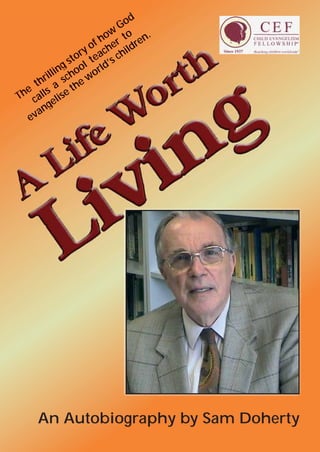
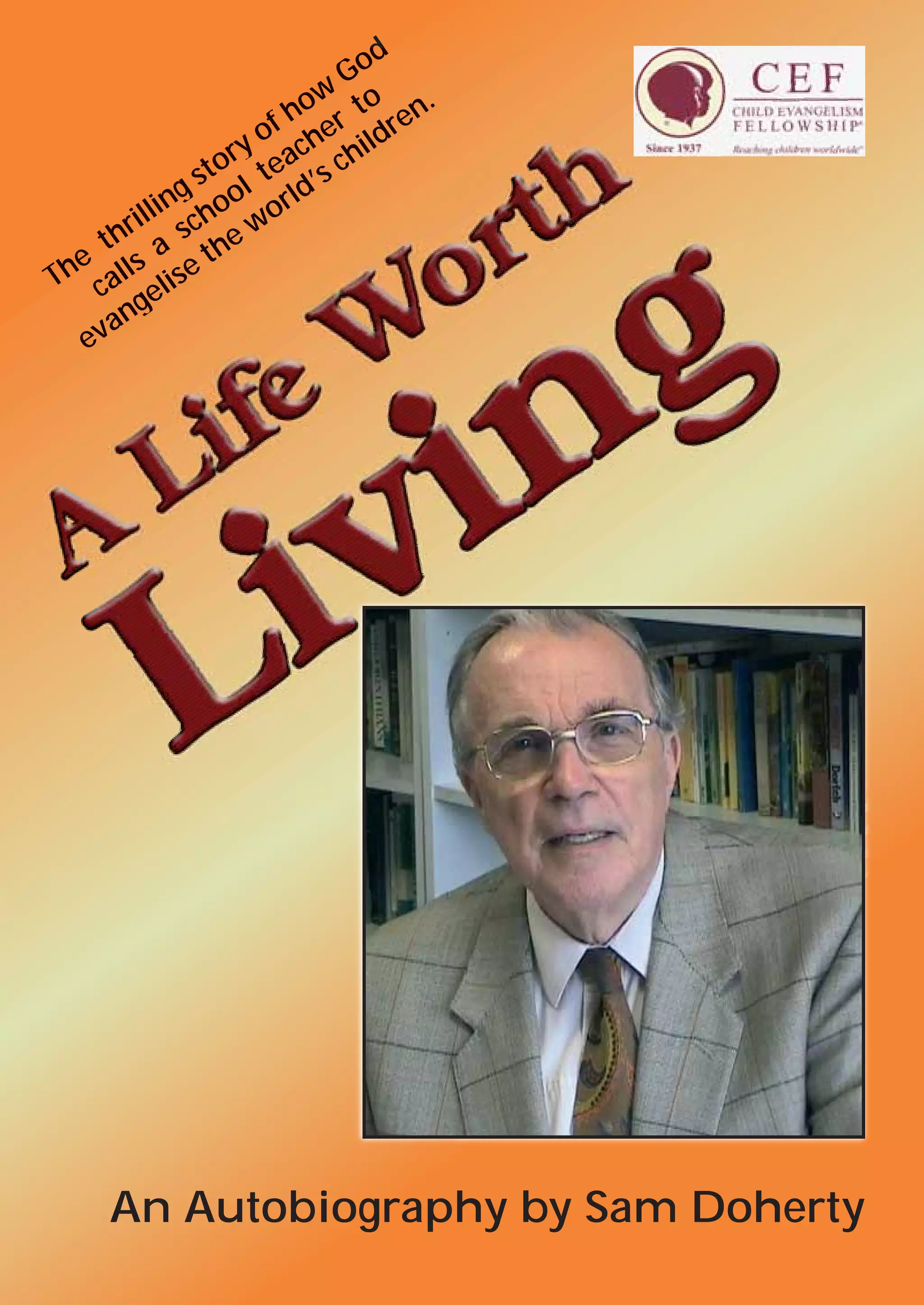
    An Autobiography by Sam Doherty
A
                 WORTH
            LIFE WORTH
                   LIVING


             Dr SAM DOHERTY, BA, EdD


                        Published by
Child Evangelism Fellowship - Specialized Book Ministry
         Assisting Children’s Evangelists Worldwide
    P O Box 308, Lisburn, BT28 2YS, Northern Ireland, UK
             © March 2010 All Rights Reserved
This book is available free of charge
It is my prayer that it will be a blessing to you.

Should you wish to make a donation to help the ongoing
work of the CEF Specialized Book Ministry that would be
much appreciated.
Donations can be sent by cheque payable to
“CEF Specialized Book Ministry” to
P.O. Box 308, Lisburn BT28 2YS
N Ireland, UK
Those living in USA can send to:
CEF SBM account #0762-000
CEF Inc. P.O. Box 348, Warrenton, MO 63383-0348

Or by internet: www.CEFBookMinistry.com/donations
Table of Contents


Introduction    ………………………………….....………………..…………7

Chapter 1: Childhood Days…….………………….………………..…...9

Chapter 2: Teenage Years ……………………………………………...13

Chapter 3: Early Stirrings ………………………….………………...…16

Chapter 4: University, Love And Marriage ………………...……….18

Chapter 5: God Intervenes In Two Lives……………..…….…………20

Chapter 6: Teaching And Ministry in School……………..………....25

Chapter 7: God’s Call To Reach Children………………………...……30

Chapter 8: The Early Exciting Days Of CEF In Ireland……...….. 34

Chapter 9: The Growth Of CEF In Ireland………….…………….…44

Chapter 10: Two Critical And Life Changing Years………………..54

Chapter 11: The Big Step………………..………………………….……61

Chapter 12: Another Big Step……………………………………..……64

Chapter 13: Links Across The Atlantic………………………..…….…72

Chapter 14: When Irish Eyes Are Smiling…………………..…….….74
Chapter 15: Humour In Ireland ……..………………………………..…80

Chapter 16: First Steps In Europe……………………………..…….…83

Chapter 17: The Big Move………………..……….……………………..90

Chapter 18: Early Travels……………………….………….………...…93

Chapter 19: The Church Room In The Mountains……………..…95

Chapter 20: Twenty Six Busy Missionaries……………….………106

Chapter 21: Humour in Kilchzimmer………………………………113

Chapter 22: Building European CEF………………….…………….. 116

Chapter 23: The Reasons For Growth……………….…………..…121

Chapter 24: Behind The Iron Curtain……………………….……...130

Chapter 25: Pioneering in Poland…………………………………..…139

Chapter 26: Adventures (And Some Humour) In The East…149

Chapter 27: European Outreach……………….………………………162

Chapter 28: In Journeyings Often……………….……………………..166

Chapter 29: A Chapter is Closed………………….………………...…170

Chapter 30: A New Chapter……………………….………….…...…..177

Chapter 31: The Ministry Grows………………….………………..…186
Chapter 32: Some Reflections …………………….……………….…199

Chapter 33: My Credo ………………………………..…....…....………203

Chapter 34: God’s Solution To Our Problems……………………..208

Chapter 35: God Answers Prayer ….………………….…...…….……213

Chapter 36: Influences In My life…………………….………………. 216

Chapter 37: Helpers to Me and My Ministry…………………........223

Chapter 38: My New Hobby…………….…………………… ……… 230

Chapter 39: Laugh With Me…………….………………………..……240

Chapter 40: My Favourite Message……………………………...……247

Chapter 41: And Finally ……………………………..…………………255

Appendix ………………………………………….........………….…………267

Centre Pages – Photo Album
I dedicate this book to

    my four grandchildren

Matthew, Sarah, Daniel and Beth
INTRODUCTION
Until 1993 I was involved in a teaching and preaching ministry for 43
years with Child Evangelism Fellowship (14 years in my native Ireland
and 29 in Europe). Then God led me to write and publish training
manuals and visualized doctrinal lessons for children’s workers to
help them teach Biblical truths to children. During the 17 years since
then these materials have been distributed free of charge or at very
low cost in over 50 languages to thousands of children’s workers
around the world.
Recently several people asked me to write an account of God’s
dealings in my life and after praying about it I felt it was the right
thing to do. I have written this book for three reasons:
    Firstly, as a testimony to God’s Grace in my life and ministry. I can
    say with the hymn writer …

                        “Saved by grace alone
                           This is all my plea
                        Jesus died for all mankind
                        And Jesus died for me”

    I don’t know why God saved me and called me into His service,
    because I had no interest in Him and no Gospel background. But
    in due time He spoke to me and I responded to His voice. That was
    the beginning of a life worth living.
    Secondly, to fill in gaps concerning my life and my ministry with
    CEF which were not covered in my other books which had few
    details of my personal life and ministry.
    Thirdly, this book is for my grandchildren – Matthew, Sarah,
    Daniel and Beth, who are very special to me. They have played a
    vital and important part in my life and I would like them to be
    able to read in detail about my life and ministry. I dedicate this
    book to them with the prayer that, as I have, so they too will
    always experience the Grace of God in their lives.
                                   7
I would like to underline four facts concerning this book:
    I never kept diaries, so much of what I write is from memory or
    based on excerpts from prayer letters. I trust that my memory has
    been reasonably clear and correct!
    If you have read my other books, especially “Fifty Years and Still
    Learning”(which looks at my ministry from a different viewpoint),
    you will find several items there which are repeated in this book.
    I have written this book from my heart, recording what God has
    done in my life and work. It is more of a diary than a continuous
    narrative. I thank you for reading it and I trust God will make it a
    blessing to you.
    I have felt very hesitant about writing so much about myself and
    ”my ministry”. But I suppose that this cannot be avoided in an
    autobiography! I want, however, to emphasize and make it
    absolutely clear that my over-riding purpose and goal in writing
    this book is to glorify God and what HE HAS DONE. This is a story
    of how a very extraordinary and very powerful God can work in
    the life and ministry of a very ordinary and very weak human
    being.
    TO HIM BE ALL THE GLORY!


Lastly I would like to thank several members of the Specialized Book
Ministry staff who have been of great help in the writing and
publication of this book. Isobel Metcalfe my secretary for many years
did the original typing of the manuscript. Irene Campbell worked on
editing and making corrections. Many suggestions were made by
Kenneth Martin and Terry Flannigan. Terry also did all the final
preparation for printing. My thanks and appreciation goes to all of
them.


                                   8
Chapter 1:
                     CHILDHOOD DAYS
 I was born in 1927. Those were pre-war years and it was a
wonderful time to grow up. Unlike many children today, who are
stressed and pressurized, I had a very happy, contented childhood.

                         My Memories
   I remember the gas-lit streets on the Lisburn Road in Belfast
   and the lamplighter who lived several doors from us. He went
   out each evening with his long pole to turn on the gas-lights on
   top of tall green lamp posts. His pole was like a magic wand as
   he put it through each aperture and turned on the gas supply.
   This ignited the mantle which dispelled the darkness in the
   street below. The girls would tie ropes onto these lamp-posts
   and swing around them. The boys used them as goal posts for
   their football matches played with a tennis ball!
   I remember the farmer with the horse and cart who traversed
   our streets selling milk. We brought out our container and he
   filled it from a large churn on the back of the cart. Nobody had
   ever heard of pasteurization!
   I remember the bread-man who sold bread from his horse and
   cart and the fish monger who sold herrings every Friday. There
   were no supermarkets in those days and refrigerators were
   unknown in working class houses. Our mothers had to visit the
   shops every morning to buy daily food.
   I remember the shop in our street. Every street had a “corner
   shop” where we could buy almost anything – humbugs,
   gobstoppers, rhubarb rock, Highland toffee, raspberry ruffles,
   liquorice pipes and boot laces, macaroon bars, double sixes and
   lucky bags. The 21st century child knows nothing of these
   confectionary delights!
   I remember the fun we had as boys. We played on the street for
   hours and hours, only coming home to eat and sleep. Under
   compulsion we did our homework! There was no television or
   computer games, but we did have a radio. Every evening at 6.45

                                9
Dick Barton had exciting adventures, and once a week we would
   listen to a variety programme like Hi Gang or Hancock’s Half
   Hour.
   We played endless games in the street. These were really rough
   - like ‘Dunty Bar the Door’, where we tried to stop each other
   hopping on one leg from one side of the street to the other side.
   We played imaginary adventures as cowboys and indians or
   foreign legionnaires.        We enjoyed quiet, but exciting,
   competitive games like “cheezers”, where each one had a
   chestnut with which we tried to smash someone else’s chestnut.
   We played “blowsy”, where we blew cigarette cards onto
   window sills to win more cigarette cards. (The cards were
   enclosed in packs of cigarettes). But our favourite game was
   marbles. We played in all kinds of weather until it became dark;
   then the loud voices of our mothers called us home for bed.
   I remember the books I read. Every week I bought boy’s
   magazines – the Hotspur, the Wizard, the Rover - and read them
   from cover to cover. Once a week I walked 2 miles to the
   nearest public library and borrowed several books - all the “Just
   William” and “Biggles” books. Later in mid-teens I “graduated”
   to Charles Dickens, W.M. Thackeray and Thomas Carlyle’s
   “French Revolution”. I was fascinated by books and they created
   in me a love for reading which was to play a big part in my life.
   I remember Saturday mornings. These were the highlight of the
   week when I and hundreds of other children went to the
   Majestic Cinema for the morning matinee. For 2 hours we were
   transported into the world of Flash Gordon, Cowboys & Indians
   and the French Foreign Legion. We cheered the “good ones”,
   booed the “bad ones”, then shouted and whistled when there
   was anything resembling a love scene. There were many serial
   films which ended each week at an exciting moment, so it was
   difficult to wait until the next week to find out what happened
   next!

                            My Home
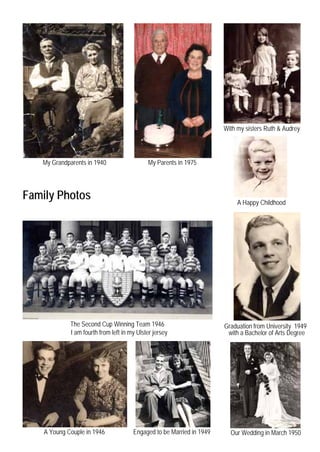
I was born and grew up in 38 Lisburn Avenue, a terrace house in a
working class street in Belfast, Northern Ireland. There were 60
houses in the street with small front gardens and larger ones in the
                                10
rear. One family owned a car and we regarded them with awe! I
had many friends, or chums as we called ourselves, and years later
some of them became Christians and co-workers in CEF. Joe
Kennedy who lived in our street has worked for years with CEF in
the Republic of Ireland. Violet Rainey lived opposite us and later
worked full-time with CEF in South Belfast.
There were four rooms in our house – 2 downstairs and 2 upstairs,
plus a little washroom at the back which was converted to a
bathroom. A small glass-roofed room was built onto the back and
used as a kitchen. We had an outside toilet. The downstairs rooms
were heated by coal fires and the house was lit up by gas lamps.
 “The front room” downstairs was known as “the parlour”. It was
carpeted and had a beautiful chesterfield suite, but was only used
on Sundays for guests, or special occasions when the church
minister visited, or the insurance man came for his weekly
payment.

                            My Family
There were six in our family. My father was a sergeant in the police
force which patrolled the harbour area of Belfast. Like many men
from Northern Ireland, he served in the 1st World War, was
wounded in battle and spent the last 9 months as a prisoner of war.
He was a quiet, honest man who taught his children to be truthful.
One word of rebuke from my father was enough to correct us. He
loved his garden and was famous for his roses, dahlias and
chrysanthemums. He covered the chrysanthemums with plastic to
prevent them being blighted by the smoke from the steam trains
which daily passed the end of our street. On his day off work he
relaxed by cooking fish and chips for our evening meal, followed by
tasty currant squares.
My mother was the opposite of my father. She talked a lot, was
easily excited and not averse to giving us a smack if we needed it.
She was a great cook and made wonderful vegetable broth, Irish
stew, tasty potted herrings and tripe. Every Friday we had champ
for lunch (mashed potatoes with lots of scallions and big knobs of
butter). She was active in her church and in all kinds of social work.
Everybody knew her, and she knew everybody.

                                 11
My father’s full name was Samuel Abernethy Doherty and my
mother’s name was Mary Ann Doherty. We would often joke about
their initials – SAD and MAD!
Ruth was the firstborn; I was next; then Audrey. When they grew
up both girls married men from Scotland - Tom and Ian. Johnston
was the youngest boy and eventually he and his wife Pat emigrated
to USA and became American citizens.
We had only 2 bedrooms, one of which was occupied by our
parents. It was fortunate that my father’s parents lived next door
because Ruth slept in their house and the rest of us slept in the
second bedroom.
Although we were not wealthy yet we were a happy, contented
family and had everything we needed. I owe a lot to my parents
and wish I had expressed my love and appreciation to them more
often when they were alive.
I loved to visit my grandmother next door. She made beautiful
potato bread and when spread with butter it was delicious. Every
Christmas she roasted a goose in front of the coal fire. It was
attached by a rope to the mantelpiece and rotated slowly for hours
over the flames with a pan below catching the juice. The smell was
wonderful!
My grandmother, Elizabeth Doherty, was a beautifully dressed,
quietly spoken lady with a loving personality. She was a devoted
Christian. I remember her softly singing the words of that beautiful
hymn “Shall we Gather at the River”, and I’m sure she often prayed
for me. I had a special relationship with her and we spent much
time together.
My grandfather, Johnston Gill Doherty, was a cobbler or shoe maker
by trade, and later a caretaker at an industrial complex. He was a
loyal Protestant and Orangeman who displayed a big Union Jack
flag outside his house during July when the Orangemen marched
yearly on the 12th day to demonstrate their loyalty to the British
Crown. Every evening at 10 pm, before going to bed, he would wind
up the clock on the sideboard and say “Six o’clock comes early in the
morning”
In the 1890’s my grandmother at the age of 18 sailed in a wooden
vessel to the USA. She was going to look after the children of a
doctor who was settling in America. My grandmother loved
                                 12
America and being engaged to my grandfather in Ireland she wrote
a letter inviting him to join her so they could be married there and
settle down. My grandfather declined to go and asked my
grandmother to return to Ireland, which she did.
My other grandfather, John Napier - my mother’s father - came from
a family where all eight brothers worked as blacksmiths. My
grandfather worked as a blacksmith for the Windsor Bakery. In
those days bread was delivered by horse-drawn “bread vans”. His
job was to shoe all these horses. I loved to visit his smithy and
operate the bellows until the coal became ‘white hot’. It was
fascinating to a young boy.

                         My First School
At the age of five I entered Fane Street Primary school, about 1½
miles from home. There was no transport so I, with other children,
walked to school in all kinds of weather. I remember some of my
teachers - Dozy Graham and Da Daley. In those days the cane was
in frequent use!
Yes, childhood years were certainly happy years. We were without
a care in the world, but what was going to happen during my
teenage years – in school and elsewhere? Would those years be
equally happy?


                         Chapter 2:
                       TEENAGE YEARS
 In September 1939 the United Kingdom declared war on Germany
– known as World War II. I was 12 years old. So most of my teen
years were spent during wartime.

                         A World at War
These wartime years were different from the preceding years -
   There were no street lights and all the house windows had to be
   blacked out because of the danger of air raids.


                                13
Food was scarce so we had ration books. We were only allowed
     a certain amount of all the basic products each week.
     Sweets were rationed, which was a serious problem for
     teenagers like me.
However despite wartime restrictions these were also happy and
contented years.
My mother and we children were evacuated for the first months of
the war to the countryside and for a while I enjoyed being a country
boy. Later in the year we returned home and the fearful air raids
eventually came. Belfast was a major manufacturing city with a
large dockyard for ship building. There was also a large aircraft
factory and many industrial sites. The most serious air raid was on
Easter Tuesday night in 1942 when hundreds of German planes
unloaded their bombs on our city. It was a frightening experience.
We huddled together in a make-shift air-raid shelter as we listened
to the explosions. That night over 1000 people were killed in
Belfast, including a boy I knew in our school.
My father was on police duty at the harbor where the bombs were
falling and when dawn came he did not come home at his usual
time. Eventually he arrived back worn out and completely covered
with dust.

                        Grammar School
Primary school days were ending and a decision had to be made
about my next step. The educational system in those days was
different from today. Further education in grammar or high schools
was for wealthy families who paid for their children’s education.
Children from working class families like ours left primary school at
14 and got a job.
Belfast City Council awarded a very limited number of scholarships
to enable working class children who were successful in an
examination to attend a grammar school, free of charge, for 6 years.
I was the only child in our primary school to get such a scholarship
and entered the Royal Belfast Academical Institution (the best
grammar school at that time in Northern Ireland) in September
1940. I have great memories of those years at ‘Inst’ – as our school
was affectionately called.

                                 14
One year was spent “in exile”. Because of the danger of air-raids,
part of the ‘Inst’ student body was evacuated during the War to the
town of Dungannon, 40 miles from Belfast. We were sent to a
boarding school and I shared a dormitory with 9 boys. It was quite
an experience!
The form in our school was divided into 6 classes labelled A, B, C, D,
E and F. The boys from working class families were segregated
throughout the six years which followed from the 5 classes of
children from wealthier families and labelled the “B class”. But,
despite our ranking, we were the best class in school work, in
examinations and on the sports field and I did well as a student
during those years.

                      Sport and Relaxation
I played Rugby football, the main sport at ‘Inst’ and in my 5th year
became a member of the 1st Fifteen – the No.1 team. I was
honoured to be on that team and it was one of the best teams ‘Inst’
ever had. I played in the N. Ireland School’s Cup Final before 15,000
people, when we won the Cup on St Patrick’s Day 1945. Fifty years
later all the survivors of that team got together to reminisce!
Only 3 of that team, including myself, remained to form the basis of
the next year’s team during my last year at ‘Inst’. I was the vice
captain and with new recruits and lack of experience, we were
regarded as having no chance in the Schools’ Cup that year. But we
won the Schools Cup again before another packed crowd in 1946.
I was also selected for the N. Ireland School’s team for their annual
match against the School’s team from the Republic of Ireland.
I always enjoyed listening to Dixieland jazz and even considered
learning to play the clarinet so that I could join or form a jazz band,
but this never materialized.
Ballroom dancing was one of my pastimes during my later teenage
years and I attended classes and passed examinations to get a
bronze medal. I even dated the secretary of the Principal of ‘Inst’
and went with her to a number of dances!
My time at “Inst” ended in June 1946 and at the age of 19 I had to
decide my next step.


                                  15
Chapter 3:
                      EARLY STIRRINGS
Northern Ireland is an unusual country in many ways. People
around the world read about “The Troubles” - the fighting, murders,
explosions and many faces of terrorism during the 60s, 70s and 80s
which portrayed a sad picture of our land.
But there is another side to our country. Northern Ireland is one of
the most religious countries in the world with over half of the
population Protestant and less than half Roman Catholic. In both
communities many people attend church.
The Protestant community is sub-divided into several denomi-
nations, the two largest being the Church of Ireland (Episcopal
Church) and the Presbyterian Church. Smaller denominations
include Methodists, Baptists, Christian Brethren and Pentecostals.
But there is a deeper twofold division in the Protestant community.
On the one hand there are evangelicals who believe in salvation
through personal faith in Jesus Christ and it is a cause for
thankfulness that there are many of them in our little country.
On the other hand there are liberals who believe in good works,
church attendance, infant baptism and confirmation as a means of
salvation. They also believe that living a good life in accordance
with the Sermon on the Mount will make them Christians and give
them eternal life.

                            My Church
My family attended the Church of Ireland. My father did not go but
my mother was involved in all its activities. All 4 children were
“christened” as babies, and recognized as Christians, or “confirmed”
as teenagers. We went to church Sunday morning, Sunday school in
the afternoon, and sometimes church on Sunday evening. I spent
hours counting the pieces in the lovely stained glass windows!
I can’t remember hearing the Gospel preached in church or Sunday
school. The minister and teachers were lovely people but I never
heard that I needed to personally trust the Lord Jesus as my
Saviour. We were taught that if a person was ‘christened’ as a child,


                                 16
confirmed as a teenager, attended church regularly and lived a good
life, he was a Christian.

                       An Early Experience
But I remember going to children’s meetings in an Evangelical
Presbyterian church near my home when I was young, where I
heard that I was a sinner, that Jesus Christ died for my sin and if I
trusted Him as my Saviour I would be saved. One night I waited
behind and told the speaker I wanted to be saved. He said I should
ask the Lord Jesus to come into my heart and life, and if I did so He
would save me. And I remember clearly doing exactly that. I was
ten years old and for weeks after believed I was a Christian. Later I
forgot about this commitment and returned to being “my old self”.
I often wondered if I was saved at that time or if it was just a
profession. I don’t know, I cannot be sure; however I do believe it
was possible that I was sincere and that I was saved, and that God
kept His hand upon me and when I was twenty-two He brought me
back to Himself and to assurance of salvation.

                   Windsor City Mission Hall
At the bottom of our street there was a City Mission hall and Mr.
Robert Anderson the man in charge of it was someone I avoided. He
was a faithful, hard working missionary who helped many people in
our area. When I was seventeen I was in hospital for several days
and one day Mr. Anderson came to see me. I was embarrassed
when he said he would pray for me and afterwards I was glad to see
him go.
But when I became a Christian several years later he wished me
well and invited me to the mission hall to give my testimony. I
consented and when I came to the hall one Sunday evening it was
full. Mr. Anderson had gone round the neighbourhood telling them I
would be speaking! This was certainly a new experience for me.
And later, when God called me into a ministry to children, Mr
Anderson invited me to take a children’s mission in his hall for 2
weeks. Over 200 children came every evening and a number of
them trusted Jesus Christ as their Saviour.
But that all came later. In the meantime, if anyone had asked me if I
was a Christian I would have said “I think so”. I had done all that my
                                 17
church required of me. But I had no personal knowledge of Jesus
Christ, no assurance of sins forgiven and no clear belief in the truths
of the Bible. I am afraid that my teenage years were spent in
spiritual darkness – and I confess I was happy and content in that
darkness. Like many other teenagers I lived for the present, seeking
only to enjoy myself and to get what I could out of life.
But that was all soon to change.


                     Chapter 4:
           UNIVERSITY, LOVE AND MARRIAGE

I was now almost nineteen years old and ready for the next stage of
my life.

                          University Days
In my final year at ‘Inst’ I decided to train to be a school teacher and
for this I needed a University degree. In those days universities
were restricted to students who could afford the fees and for me
the only means of entrance was by obtaining a scholarship. I was
fortunate in being awarded two scholarships! The first one was
through passing an examination, and the second one I received
because my father was an ex-serviceman who had served in the 1st
World War for four years. Those scholarships covered my
university fees for the next three years.
I studied Geography at Queen’s University, Belfast along with some
subsidiary subjects and graduated with a Bachelor of Arts degree
three years later. I still continued to play rugby. When I left ‘Inst’ I
played as No.8 back-row forward for Instonians (one of the best
rugby clubs in the country), at times against outstanding men like
the legendary Jack Kyle. But it was impossible to combine studying
and training for rugby so, reluctantly, I gave it up.
After graduating I obtained a teaching post in September 1949 at
Lurgan Technical College where I remained for four years.


                                  18
Love at First Sight
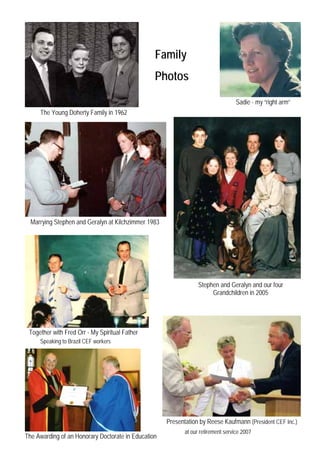
One evening two friends and I were listening to Jazz records in my
home. My sister Audrey came into the room with a friend called
Sadie. Although we lived not far from each other we had never met..
We chatted and that was the beginning of a loving relationship that
resulting in marriage and a united life and love for years to come.
Sadie was almost 17 years old and worked in an office in Belfast. I
was almost 18 years old and in my last year at grammar school. It
was love at first sight and as a result we wanted to spend as much
time together as possible.
Each morning we met and traveled “downtown” together, then
separated to go to office or school. When I started university I had
so much work each evening that I studied next door in my
grandmother’s house because I had peace and quietness there. But
Sadie came and sat with my grandmother and myself most
evenings. I studied and they knitted and talked quietly. We did a lot
of hiking together in the mountains during our holidays, and
although I had little money we enjoyed every moment together.

                  Engagement and Marriage
Sadie was the best looking girl on the Lisburn Road and, strangely
enough, she thought I was the best looking fellow! As soon as my
studies finished at university in the early summer of 1949 we
became engaged, and I started my profession as a school teacher in
September at the Technical College, Lurgan, about 20 miles west of
Belfast. We immediately started to make plans for our marriage
which took place on March 24th 1950. Sadie was 21, I was 22 and
we were very happy.
Our first home was 6 Maureen Terrace, Bleary and about four miles
from the school where I was teaching. Our home was simple and we
traveled everywhere by bicycle. I cycled every morning to school
where I taught geography, plus economics and, believe it or not,
some religious instruction. I really enjoyed teaching and found my
new job a pleasure, although I had many lessons still to learn.
Sadie, like myself, attended the Church of Ireland but had never
heard a clear presentation of the Gospel, even though she attended
regularly all the services. I know that the lack of evangelism and
Gospel presentation was not true of every Church of Ireland church,
                                 19
but it was in our case. Consequently, during the years which
preceded our marriage we had no interest in spiritual things.
But we need to retrace our steps to the latter part of 1949, just after
we were engaged to be married, when everything was going to
change. During those months something revolutionary was to
happen to both of us leading to a complete and exciting change to
our lives and future. But that is for our next chapter.


                      Chapter 5:
             GOD INTERVENES IN TWO LIVES
Sadie had been working in an insurance office in Belfast since she
was 15 years old. During her later teens she did not enjoy good
health although she continued to work there. A girl called Ina
worked in the same office as Sadie and took a great interest in her.

                           Fred and Ina
Ina was a little older than Sadie. She was married and different
from the other girls in the office. She and her husband Fred lived in
a cottage outside Lisburn and sometimes invited Sadie to come and
visit her home. Ina realized Sadie was not well and invited her to
come and live with her and Fred in the countryside to see if that
would help her recover. By that time (1949) Sadie and I had become
engaged to be married, so later on they invited me to come and stay
with them also and I gratefully accepted their invitation. They had
only two bedrooms in their little house – so I slept in the living
room. I had already started my profession as a school teacher so I
travelled by bus from their home each day to Lurgan.
We knew that Fred and Ina Orr were completely different from any
people we had ever met before and we wondered with some
trepidation what was going to happen. It was the first time we had
really come into contact with people who said they were saved!
Saved from what? We didn’t know.


                                  20
Fred and Ina had been Christians for years. Fred had been an
outstanding sportsman and was now in business with his father.
We discovered afterwards that their goal was to become
missionaries. And here we were in their home with no one else to
talk to or listen to except them!

                           My “Attacks”
Perhaps I should explain a little more about myself at this time. I
was now 22 years old, a university graduate, a school teacher and a
fairly regular church attendee. I was at that stage where I thought I
knew everything about everything! I thought I was an intellectual
and believed that, somehow, I was a Christian. I did not believe that
the Bible was completely true. That was what my minister had
taught me; and the chaplain at university had also told me that he
did not believe everything in the Bible was true. In addition I had
studied Geology at university as part of my degree and I believed
from what I had learned that it was not scientifically feasible for the
earth to have been created in six days or for everyone to be
descended from some “mythical people” such as Adam and Eve. I
was a firm believer in evolution. I was also arrogant and loved a
good argument.
So when I discovered that Fred believed the Bible was true, that he
believed the biblical story of creation and did not believe in
evolution, I rejoiced in the opportunity for a good argument. This
was my chance to “attack” him and straighten out this rather old
fashioned relic from a past age. And so I tried to start arguments
with Fred based upon my study of geology and evolution, and upon
the many mistakes and contradictions which I was sure were in the
Bible.

                         Fred’s Response
But Fred refused to argue. He just replied by opening his Bible and
pointing out Bible verses which, strangely enough, answered and
even refuted my argument. It was very frustrating. In his own quiet
but persuasive way he also explained the Gospel and what it meant
to be saved.
At the same time I was very impressed by the lives of Fred and Ina.
They certainly radiated happiness and joy, and did not give me any
                                  21
impression of being “kill joys”. And I was also impressed by the
young people who came to visit them – especially on Saturdays.
Usually about four other young men appeared and the result was an
uproarious football match at the front of the house in which I
joined. I certainly saw in them that being a Christian did not take
away their joy – indeed it seemed to do the opposite.
Then Fred gave me a New Testament and suggested that I read it
for myself to find out what it was saying. So every morning as I
travelled to work and every evening as I returned to their house I
read this little book for myself. It was the first time I had ever read
it right through. I read it through twice and as I did so I became
more and more convinced that it was absolutely and completely
true and that what Fred had been telling us was also true.

                           The First Step
I remember sitting one evening on my own, thinking about the
Bible. I knew in my heart that no one, myself included, could
become a Christian if they didn’t believe the Bible to be true. In a
sense I wanted to believe it was true and yet my whole background
in church and at university told me it wasn’t. I could take you to the
very place where I was sitting at that moment because I remember
it so well. “Is the Bible true, or is it not?” I was asking myself. And
then something happened which I cannot explain, or I can only
explain it by describing it as some kind of intervention by God.
Suddenly into my head came the words, “It is the Word of God – so
it must be true.” I almost looked around to see where the words had
come from!
And that was the solution. I said to myself, “Of course, that’s it, I
don’t have to puzzle over it and try to work out the so called
mistakes and contradictions. The Bible is God’s Word and it is true.”
I had not yet become a Christian but the main problem which had
been holding me back from doing so had been taken away. From
that day until now, many years later, I have had no doubts about the
truth of the Bible as God’s Word. And, interestingly, when I later
went back to the mistakes and contradictions which I had believed
were there, I discovered that there were simple explanations for all
of them.

                                  22
In the meantime Fred and Ina had been inviting us to attend church
with them, and we went along to Castlereagh Mission Hall (now
Castlereagh Baptist Church) in Belfast. We had never heard
preaching like this before. The pastor, Mr Murphy, explained the
Gospel simply and with passion; he spoke about our sin, and our
need for forgiveness, he spoke about Jesus Christ and how He had
died to take the punishment for our sin, and he spoke about how to
receive forgiveness and salvation by trusting Him personally as our
Saviour. This was all so new to us - especially when towards the end
of each Sunday evening service he encouraged and invited his
listeners to trust Jesus Christ. We were quite embarrassed – but
still, in our hearts, impressed. And we had come, more and more, to
believe that what we were hearing was true and that we needed to
do something about it. What we didn’t know was that the pastor
and the members of the church were praying specifically for the
two of us – that we would trust the Lord Jesus.

                              New Life
Their prayers were answered soon afterwards. Several days after
we had attended one of the services, Sadie and I were sitting
chatting in Fred’s home late one evening. We were on our own
because Fred and Ina had already retired for the night. It was
obvious that Sadie wanted to say something to me and she was
finding it difficult. At last she plucked up enough courage and she
told me that she had trusted Jesus Christ as her Saviour. Earlier
that week she and Ina had been talking together and, as a result of
their conversation, Sadie had expressed her desire to ask Jesus
Christ to be her Saviour and had trusted Him.
This was a real problem for me. I was now on my own. Three
against one! And then Sadie encouraged me to do the same. She
said, “Would you not like to trust Jesus Christ?” My response was
“Alright, I will. I have been thinking about it, but not tonight. I tell
you what I will do, we will go to church with Fred and Ina tomorrow
evening and when Mr Murphy asks those who want to trust Jesus
Christ to come to the front (as he did every Sunday evening) I will
go forward. That is a promise.”
But Sadie said, “No, Sam, don’t wait. If you really want to trust Jesus
Christ do so now. Don’t wait until tomorrow.”
                                  23
I thought for a few moments and then I said, “Alright, I’ll do it.” And
I knelt down, just like a child, and asked the Lord Jesus to come into
my life and save me. And He did.
The two of us rushed up to Fred and Ina’s bedroom, knocked on the
door and went in to tell them the good news. They had both been
praying at that very moment that this would happen and they were
delighted. It was interesting that when we went to church the
following evening Mr Murphy for once did not ask those who
wanted to be saved to come forward! I was so glad that I had
trusted Jesus Christ when I did.

                         The Grace of God
God had intervened in our lives. He had called us onto Himself. He
had saved us and given us new and eternal life. As I look back to
that evening on November 30th 1949 I can only praise and thank
God for His grace. Why should He save me? I had had no time for
Him. I had even argued against Him and His salvation and had
ridiculed His Word. But I learned then, and I have since seen this so
much more clearly, that no one deserves salvation – and I certainly
didn’t. I was saved by the grace of God. Salvation is a gift of God’s
love and in His grace He speaks to sinners like me through His
Word and woos us, step by step, to Himself. If you are reading this
book and have never trusted Jesus Christ as your Saviour I urge you
to do so. He died for you and took the punishment for your sin and
now, in grace, He is willing and ready to save you, forgive you and
give you new life. Don’t wait - trust Him now!
I can never thank Him and praise Him enough for that evening and
His intervention in my life.
I could hardly wait until Monday morning. I went to the school
where I taught and when it came time for my religious instruction
class I had something definite to share with my students. I told
them what had happened two nights previously and encouraged
them also to trust the Saviour. It was my first testimony – less than
two days after my conversion. That school was no longer just a
place where I worked - it was now a place of ministry.
And that was the beginning of a new life – A LIFE WORTH LIVING.


                                  24
Chapter 6:
       TEACHING AND MINISTERING IN SCHOOL
I always enjoyed my school teaching even though there were many
lessons I needed to learn. Telling is not teaching – I needed to learn
how to really teach, but in the course of time all I learned in the
classroom was to stand me in good stead in my future ministry.
But my classroom was now not just a place to teach geography but a
place where God had placed me so that I could be of spiritual help
to the many hundreds of young people who would pass through my
hands.
         Teaching (and Evangelizing) in Lurgan Tech
In September 1949 I joined the staff at Lurgan Technical College
where I remained for the next 4 years. My main subject was
geography but I also taught some economics. I also had to teach
Religious Instruction, an obligatory subject for teachers and
students.
Some may think it is a real blessing that Religious Instruction (RI)
should be an essential part of our school system in Northern
Ireland. It would be if the teachers were Christians, but the
majority was not. I believe teaching RI often did more harm than
good because I knew teachers who were critical of spiritual things
and gave a completely wrong impression to the students.
I had only been teaching 2½ months when I became a Christian, so I
really enjoyed the RI classes because I could teach the Word of God
from my heart. I also believed in taking a clear stand before the
students and teachers. It was my conviction that I should not go to
the cinema, so when the students were required to see some film
related to their studies, I asked the Principal if I could refrain from
going and he said ‘yes’. Other students from Christian families who
did not want to go, were allowed to remain in school under my
supervision!
In the RI classes I stated my complete belief in the Bible and the
creation story, telling the students why I disagreed with the theory
of evolution. This led to many good-natured discussions with both
students and teachers who differed from me.
                                  25
Soon after my conversion I started a Scripture Union meeting once
a week after school and a number of young people attended
regularly. Some weeks later a new teacher joined the staff and I saw
him reading the notice board about the Scripture Union meeting. I
introduced myself and, to my joy, discovered he was a Christian. I
invited him to help me in S.U. and he did so willingly. His name was
David McQuilken. From that moment we became the dearest of
friends and later co-workers in the work to which God would later
call us.
In March 1950 Sadie and I were married and set up home three
miles outside Lurgan. We invited David to come and live with us
until his marriage six months later.

     Teaching (and Evangelizing) in Newtownards Tech
I enjoyed my teaching at Lurgan, but had an inner conviction that I
should move, though I still felt God wanted me to be a school
teacher. I replied to an advertisement for a teaching post in
Newtownards Technical College and was successful. Several
months later I began teaching there and remained for 11 years. We
could not find a house near the school, so I travelled daily by train
and bus to Newtownards.
The first day I took this long journey I wondered if I had made a
mistake and was out of God’s will! Then I did something I had never
done before, nor ever did since. I asked God for a specific sign!
While walking past the City Hall in Belfast I stopped and said, “Dear
God, I want to ask You if I have done the right thing or if I have
made a mistake. If I have done the right thing please give me a sign.
Here is the sign. The Scripture Union is meeting today in my old
school and David McQuilken is in charge. You know that for months
no one has been saved. If I have done the right thing in moving
please save someone today.”
When I arrived home that evening I went straight to David’s home
and casually asked him how the meeting had gone that day, then
waited anxiously for his answer. “Sam”, he said, “You’ll never
believe what happened, two of the students trusted Jesus Christ
today.” In my heart I thanked God for giving me the sign I asked for.
God is so gracious - He overlooked my impudence and graciously

                                 26
gave me the assurance that I had made the right decision. But I
never again asked God for a sign!
On the train journey to Belfast I discovered there was a Bible class
in one of the compartments, where 9 men from different
denominations studied the Bible. I joined in, participating every
morning. As a young Christian I was spiritually hungry and greatly
enjoyed the teaching of these mature men.
There were times when someone would come into our
compartment who was not a member of the group. It was
interesting to see his face when we all produced our Bibles.
After one year of travelling God gave us a home close to my new
school and I settled into my job and ministry there. The eleven
years which followed were going to be very special because of the
many ministry opportunities I would have.

             God’s Blessing in Newtownards Tech
I taught geography to all classes and also had the opportunity to
teach Religious Instruction for several hours each week. After
school on Friday afternoon I started a Scripture Union meeting
when 60-80 students attended, mostly boys between ages 13 & 17.
God blessed these meetings and a number trusted Jesus Christ. I
also began regular lunch time prayer meetings and Bible studies for
those students who were already Christians and these were also
well attended.
But still greater opportunities lay ahead. One day the principal
asked me to organize and lead R.I. for the whole school. Five other
Christian teachers and I arranged a Biblically based programme for
over 600 students. Later on he asked me if I would take the whole
school for 30 minutes of religious instruction each afternoon and
gave me freedom to teach what I wanted and how I wanted. What
an opportunity!
As a result a number of students trusted the Lord Jesus as their
Saviour and several have since gone into full-time Christian work:
    David came to me after school one day and said he would like to
    be a Christian. I had the great joy of leading him to the Lord.
    Today he is the Rev. David McIlveen, minister of one of the
    largest Free Presbyterian churches in Northern Ireland and one
    of the leaders of that denomination.
                                27
Vincent came early one morning to see me before classes began
     and I had the joy of leading him to the Saviour. Today Vincent
     Price is the North American Director of the European Christian
     Mission. He writes “Apart from the Lord Jesus Christ, no person
     has impacted my life more than Sam Doherty. It was Sam who led
     me to Christ as a 14-year old boy in a classroom in Northern
     Ireland. He imparted to me his vision, burden and passion for
     souls, and for that I will be eternally grateful. He introduced me
     to the greatest blessing in the world – following Christ and
     faithfully growing in Him.”
     Nancy Gill trusted the Saviour in my classroom and she has
     served the Lord for many years as a missionary in Indonesia.
And there were many others.
I also had the privilege to help a number of the students who were
already Christians to find their feet spiritually and a number of
these like John Keefe, David Coe and Malcolm Hill have been in full-
time Christian ministry for many years.
“Out of the blue” I received recently a letter from one of my
students who wrote as follows: “I have just recently retired. Now
that I have got off the merry-go-round of working, eating, sleeping,
planning, shopping etc. I have the chance to sit and think and
remember things in my childhood. One of my earliest memories was
of a big man who came to where we lived in the summer evenings and
set up a board and easel on the grass. Before long a group of children
gathered and he began to tell stories from the Bible illustrating them
with felt figures which he stuck on the board. Incidentally, when I
reached the age of twelve, I was transferred to the Ards Technical
College and “Big Sam” took us for geography. That was over 50 years
ago and I thought I would write this note to thank you for your help
and guidance when I was growing up. Better late than never.
Warmest regards, Raymond.”
These eleven years were blessed years and I was in many ways sad
when they drew to a close. But God had another step for us to take
and to do so I had to leave Newtownards Tech and the teaching
profession.
The day I left the school was very special. The whole school
assembled in the gymnasium for my farewell. I was given a special
gift and one last opportunity to give my testimony and deliver a
                                  28
brief Gospel message. I praise God for those years and for all that
He did when I was there.

                       Humour in School
Teaching also had its lighter moments:
    I was supervising an exam in Newtownards for one of the
    English teachers. Sitting for 3 hours can be quite boring so I
    decided to complete one of the exam papers myself. I wrote a
    name at the top “Ivor Clue”, then answered all the questions
    giving the wrong answers! I thought the teacher would see it as
    a joke and enjoy my answers. The next day I was supervising
    the same class when the door burst open and this teacher, who
    was a rather flamboyant person, rushed in, marched to the front
    of the classroom and said loudly, “Would Ivor Clue please stand
    up.” Of course no-one moved. He repeated his demand several
    times with no response. Then he stomped out.
   After the exam I went to see him, put my arm around his
   shoulder and said, “John I am Ivor Clue.” He looked at me for a
   moment and then, to my relief, burst out laughing!
    The principal in Lurgan had what we might call “a bee in the
    bonnet”. He loved to set off the fire alarm from time to time.
    When that happened all teachers and students where required
    to leave the school and line up on the pavement of the street
    outside. We teachers dreaded to hear it – because it upset our
    teaching programme so much. One day the fire alarm went off
    yet again and we dutifully lined up outside. Then the principal
    walked alongside the pavement inspecting us. At that moment a
    boy on a bicycle came down the hill and passed so close that the
    principal fell onto the road spread-eagled out before the whole
    school. That was the last time we had a fire alarm!
The 14 years I spent as a school teacher were very enjoyable and
very rewarding.
But throughout all those years I was also doing something else
which took up as much time as that which I was spending at school
teaching. I really had two “jobs”. The next chapter describes my
second “job” which would prove even more important and valuable
than my work as a school teacher.

                                29
Chapter 7:
            GOD’S CALL TO REACH CHILDREN

In this chapter we jump back again to the year 1949, before I had
started my work as a school teacher and before we were married. I
was then 22 years old and Sadie 21.
During the 12 month period between the autumns of 1949 and
1950 five very special experiences occurred in my life.

             Teaching, Conversion and Marriage
The first three experiences I have already dealt with in previous
chapters.
First I started my profession as a school teacher in September 1949
where I taught for over 14 years.
Secondly in late November Sadie and I both trusted the Lord Jesus
as our Saviour and began our new lives with Him.
Thirdly in March 1950 we were married and set up our first home
outside Lurgan where I began teaching.

               A New Church Home and Baptism
Fourthly, we decided to leave the Church of Ireland denomination
because we could not sit under the teaching of a minister who did
not believe that the Bible was true. This was confirmed to us when
one Sunday morning the minister preached on the book of Genesis.
He said the Bible contained myths and legends and could not be
accepted as factually true. He spoke to me afterwards and asked
what I thought of his sermon. When I said I believed the Bible to be
completely true he patted me on the arm and replied, “Well, you’re
alright anyway” and walked away.
We looked for a church where the Bible was really believed and the
Gospel preached. For some months we worshipped with the
Christian Brethren in the Gospel Hall near our home. The preaching
was excellent but when it came to the Breaking of Bread we were
asked to sit in the back seats along with the children. Because we
were not Brethren we could not join in this service, nor were we
were allowed to give an offering. This made us feel uneasy and we
knew this was not the place for us.
                                30
We would have been happy joining Fred and Ina Orr’s church but it
was too far away. Eventually we found a good spiritual home in
Lurgan Baptist Church, where later we were baptized and received
into membership.

                 Our Call to Evangelize Children
The fifth experience during that year took place in Autumn 1950 – a
change which would impact our whole future.
Fred Orr, who with his wife Ina were our spiritual parents and
through whom we had come to the Saviour, had always told me:
“Sam, when God saves you, He has a work for you to do and you
need to ask Him what that work is.”
He even told me this before I trusted Jesus Christ.
And so one of the very first prayers I ever prayed as a Christian was
“Dear Lord, I love You and want to serve You, please show me what
I should do.”
In my mind I could see myself working with and evangelizing
athletes and especially sturdy rugby players like myself. But God
had other plans for me and over a period of time He answered my
prayer by showing me that my ministry should be to children. To
children? Me? Impossible! How could I possibly do that? But I was
to discover that this was God’s will for me.
God had begun immediately to guide me in a number of ways:
    Someone in church would speak about the need of children.
    In my newspaper I would read about the problems faced by
    children.
    In the Bible I kept reading verses about children.
More and more I became convinced that my future ministry should
focus on children and their needs. But I was just saved and had no
theological background or knowledge. I knew very little about the
Bible and had no training. What should I do?

           Our Call to Child Evangelism Fellowship
By this time Fred and Ina were at Bible school in Scotland preparing
for their future as missionaries. So I decided to write to Fred telling
him I believed God wanted me to work with children and ask him
what I should do.

                                  31
The day after Fred received my letter a man called Rev. Art Nickel
came to speak at their Bible College. He was from USA and he
worked with a Mission called Child Evangelism Fellowship. He
spoke to the students about children and their needs challenging
them to reach the children with the Gospel. At lunch he was sitting
beside Fred and when he heard that he came from Ireland he told
Fred that he had been praying that someone would start the work
of Child Evangelism Fellowship in Ireland. He invited Fred to be
that someone, but Fred declined and said that he and his wife were
going to Brazil as missionaries. Then Fred said, “I have just
received this letter yesterday from a young couple who have been
recently saved and who feel God is leading them to work with
children. Why don’t you contact them?” And he did.
Several weeks later he visited our home bringing his flannelgraph,
visuals and Bible. He set up his flannelgraph in our living room,
showed some visuals, spoke about Child Evangelism Fellowship and
how they reached children through Good News Clubs and open-air
meetings.
We listened intently and knew immediately that this was the
Mission and ministry in which God wanted us to work. When he
finished speaking he was surprised when we told him we were
ready to go; then we asked him what we should do. He told us to
start a Good News Club in our home and invite the local children to
come every week for a meeting – to sing, learn Bible verses and
hear a Bible story. He gave us a flannelboard and some lessons, and
then returned to Scotland.

                    Our First Good News Club
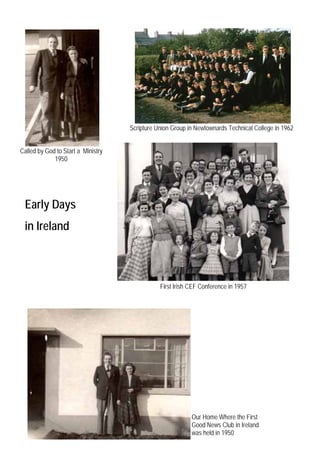
We started that Good News Club in our home in Calvertstown,
outside Lurgan. I probably knew less about the Bible than the
children who came, but I learned as I went along. I knew no
choruses, so each week I went to a girl we knew who taught me one
chorus, which I then taught to the children. In my preparation for
those meetings I learned more about the Bible and singing than I
learned anywhere else. That was my first “Bible school” and God
really blessed that Good News Club.
I just followed the outlines in the lesson book Art had given me.
When it said “Do this” I did it; and when it said, “Do that”, I did it.
                                  32
Then the book said “Tell the children that if any of them would like
to be saved they should wait behind and you would show them
what to do.” The book said it and I did it. Then one evening after
the meeting I saw 5 children waiting to speak to me about how to
be saved. I looked at Sadie and she looked at me. I didn’t know what
to do next for I hadn’t got to that page of the book yet!

                      Our First “Converts”
I sat down with the children, and as best as I knew how, showed
them how to trust the Lord Jesus. Then all of them prayed and
asked the Lord Jesus to save them. It was the first time I had ever
led anyone to the Lord, and it was a very special experience for me.
Two of those children were 6 years old and two were 7. The other
one, Jackson England, was 10. About 10 years later I went back to
that area and found they were all going on with the Lord.
Sometime after that visit I read in my newspaper of a young man
who had been killed on his motorbike in collision with a car – his
name was Jackson England - the 10-year old I led to the Lord in that
first Good News Club. I visited Jackson’s parents and after talking
and praying with them Mr England said, “Sam, there is one thing we
can hold on to; Jackson trusted the Lord Jesus in your Good News
Club and went on trusting Him, so we know where he is to-day.
Thank you for starting that Good News Club.”
As I drove away I was sad because of Jackson’s death, but happy
because he was in Heaven, and he was there because of that first
Good News Club.
That was our first Good News Club in 1950 and the first one in
Ireland. It is still going today sixty years later.
That was just the beginning of a ministry to children which was
going to occupy us for the rest of our lives!


                                33
Chapter 8:
   THE EARLY EXCITING DAYS OF CEF IN IRELAND

As I taught that first Good News Club I became more and more
excited about the ministry into which God had led me, and I wanted
to do what I could to reach more children.

                     More Good News Clubs
As I read CEF literature I saw that my goal should be to start as
many Good News Clubs as possible so I began to look for other
places in and around Lurgan where we could start more of these
clubs.
David McQuilken was very interested in what I was doing and I
asked him if he would teach a Good News Club. When he agreed we
found a hall 2 miles from where I lived, and every week the local
children came and we taught them the Word of God. A number of
these children trusted the Lord Jesus. Then David took over the
meeting and taught it himself.
Evelyn was one of the children who faithfully attended that GNC.
She listened intently but gave no indication that she had trusted the
Lord Jesus. One evening, as David and I were leaving the children to
their homes, we asked Evelyn if she had ever trusted the Lord Jesus.
She told us she would like to but her parents, while allowing her to
come to the meetings, told her she must not trust the Lord Jesus!
We said that while she ought to obey her parents she must, first of
all, obey God, and if she really wanted to trust the Saviour she
should do so. As we stood on that country road, under a full moon,
Evelyn prayed and asked the Lord Jesus to save her.
We advised her at this stage not to tell her parents but first show by
her life that she was a new person in Christ. She took our advice and
it was great to hear the outcome. One day her parents asked the
reason for the change in her life. Nervously she said she had trusted
the Lord Jesus and He had helped her to live for Him. As a result her
parents started to attend the local Baptist church and months later
they too trusted the Saviour!
I wanted to see more Good News Clubs established, so I cycled
around looking for suitable places. Very soon there were eight in
                                 34
the Lurgan area. David and I taught most of them, then found others
who were willing to teach.

                     A New Home in Lurgan
In 1952 we moved house to a housing estate in Lurgan and started
two Good News Clubs in our new home – one for younger children
and one for older children. There were about 30 in each group. God
blessed both clubs in a special way and children were saved.
We transformed one of our bedrooms into a permanent GNC room
with forms for the children to sit on.
I visited the parents in the estate asking if they would allow their
children to come to our GNC. Most of them agreed. But in the house
right opposite ours there were three children whose father was
hostile to the Gospel. I nervously knocked on his door. He opened
it, glared at me and asked gruffly “Well?” I told him about our GNC
and gave him an invitation for the children. He glared at me,
crumpled up the invitation, threw it on the ground and stomped
back into the house without speaking.
“Well, that’s that”, I thought to myself. “At least I tried.”
Can you imagine my surprise when the GNC opened the following
week to see these three children listening eagerly to the gospel.
And they, along with around 60 other children, continued to come
every week.
One Friday afternoon, after the senior GNC was over in our house,
there was a knock at the door. I opened it and there stood the gruff
father of the three children. He barked at me, “My children have
been coming to your meeting; you know I don’t approve of it but I
allow them to come anyway: and now they’re talking about
becoming Christians, or something. They want to talk to you about
it and I’ve told them they can.” Then he stomped away.
The children came back into our home. I had the joy of leading
them to Jesus Christ, and it was a special joy some months later to
hear that their mother, Mrs. Hopwood, had trusted the Saviour and
was attending a local evangelical church. I don’t know what
happened in Mr. Hopwood’s heart, or if he ever trusted Christ
himself, but I was so thankful that God had used our GNC, and my
visits to the homes, to lead these children and their mother to

                                35
Christ. We knew of other children from that GNC who had a
spiritual influence on their parents.
One mother told me she had trusted the Saviour and I expressed my
joy. She said God spoke to her through the choruses her little five
year old daughter had learned in our GNC and which she sang over
and over again in their home.
What a JOY to see God at work – especially in situations which seem
difficult, or even impossible.

             CEF Local Directors for North Armagh
I was thrilled with what was happening and I wrote to Rev. Nickel,
the man from America who was leader of CEF in the United
Kingdom. I gave him a full report of all the work. He responded and
said he was appointing me local director of CEF for North Armagh
incorporating Lurgan, Portadown and the surrounding areas!!!
But my eyes were also on Belfast, the capital city of Northern
Ireland, with a population then of half a million. My vision was to
see the work of CEF started and established there. So I organized a
public meeting in Belfast informing the Christian public about CEF. I
invited a well known pastor to be the speaker, advertised it in the
local press and about 70 people turned up.
We had a good meeting and at the end I asked if anyone had any
suggestions about what we could do to help them reach children.
One man stood up immediately and suggested we start a teacher
training class in Belfast to help children’s workers in their ministry.
I didn’t know how to respond. I thought it was a good idea but I had
no idea who could teach such a class. I certainly couldn’t - I had no
training myself and had never attended a training class of any kind,
although I knew that the training of teachers was, or should be, an
important part of the ministry of CEF.
Before I could say anything, a lady stood up and said that if we
would organize a training class she would be glad to teach it
because she had been trained to do so. We all wholeheartedly
agreed that this would be a good idea and a great step for us to take.
I was especially glad because I myself was a young Christian and
felt my need of training and was looking forward to receiving it at
these classes.

                                  36
I organized the place and the dates. The classes would be held on
Monday evenings for ten weeks. But imagine my dismay when just
a week before the classes were to start I received a letter from the
lady who had volunteered to teach them informing me that her
Mission was sending her away to another area and another
ministry and she could not now teach the classes. She was very
sorry, but not as sorry as I was! What should I do? I could not cancel
or change the classes because they had already been advertised.
There was only one possible solution. I would have to teach the
classes myself!

                     My First Training Class
I spent many hours reading books written by children’s workers,
making reams of notes, then producing a series of outlines to follow
when I was teaching. I still have these outlines in my possession!
The first class commenced and over 30 people attended regularly
each week. I had learned my outlines by heart so I taught the best I
knew how and tried to look and sound as if I really knew what I was
talking about. But one thing I did not allow was questions after-
wards! The classes went well and God blessed in spite of me.
Everyone listened well including myself - I learned so much
listening to myself! The first training class I ever attended was one I
taught. Perhaps that is a record.
One couple who attended that first series of training classes were to
play a major part in the development of CEF in Ireland, and even
today the Specialized Book Ministry which I had the privilege of
founding, owes so much to the continued help, encouragement and
investment of that couple - Jim and Helen Cairns.

            My First Open-air Meeting for Children
Most of what I learned about CEF in those days, and what I should
do, I found in the CEF magazine which I received every month. I had
no other contact with or help from CEF in USA. One day I read in the
magazine that CEF workers (and especially local directors of whom
I was now one) were expected to go out into the open-air work and
share the Gospel with boys and girls. For me that was a step too far.
How could I do this?

                                  37
Then I received a letter from Mr. Nickel to tell me that CEF in Great
Britain were holding a conference in Wales and part of that
conference would be to do open-air work with children. I thought to
myself “That’s my opportunity, I’ll go to Wales and do my first
open-air meetings with children in an area where no one knows me
and none of my acquaintances can laugh at me.” I went to the
conference with this in mind but can you imagine what happened?
It rained solidly for the four days and there was no open-air work!
It was as if God was saying to me, “I want you to start your open-air
work right there in your own area where everyone knows you.” So
that is what happened.
I chose an open space near the center of Lurgan and ventured out one
afternoon with my flannel-board, plus a canvas sheet on which the
children could sit. I was really nervous – I did not know anyone who
had done this before. What if the Principal of my school walked past
when I was conducting the meeting! I spread the canvas sheet on the
ground, set up my flannelboard and invited all the children I could see
to come. Soon over 30 children were sitting down listening to me.
They sang choruses, learned Bible verses and listened to a Bible
lesson. My nervousness disappeared and I enjoyed the thrill of
evangelizing children in the open-air! This was to be repeated many
hundreds of times in the future.

                   My First Children’s Mission
My first venture into the open air was followed soon afterwards by
my first children’s mission. I was invited by the Salvation Army in
Lurgan to conduct a series of evangelistic meetings for children
every evening for one week. And God blessed those meetings in a
special way. Soon after that Mr. Anderson invited me to conduct a
children’s mission for two weeks in Windsor City Mission hall and
God really blessed there with around 200 children present each
evening. Other children’s missions were to follow.
In the years which followed I would lead and conduct many more
children’s missions in towns around our province – Ballymena,
Ballymoney, Newtownards, Lurgan and Belfast.
A most interesting mission was held in a large church in Belfast. The
minister was not an evangelical, but his assistant was, and it was he
who invited me to come for a week’s mission. There were many

                                  38
children in their locality and a team of workers invited them to
come and hundreds came. They were led to the church in a series of
processions. Quite a number of these children trusted the Lord
Jesus.
One evening a man came to the mission and sat in the back seat. He
was the leader of the Sunday School Association for one of the large
denominations in Northern Ireland to which this church belonged.
Previously this man and I had been invited by one of the churches of
that denomination to share in a public discussion on the evangelism
of children, and he had criticized me openly for the work I was
doing. In that discussion he said “I do not know anyone in our
country who is doing more harm to our children than this man” –
and he pointed to me! And here he was in one of my evangelistic
meetings with children!
My lesson that evening was based on the Passover story with the
main theme “When I see the blood, I will pass over you.” I prayed for
God’s help to be faithful to His Word and the Gospel and, despite the
presence of this man, God really helped me. After the meeting a
number of children waited behind to be counseled for salvation –
but the man had already left.
In the next edition of the denominational magazine he wrote a very
critical article against me and my evangelistic work with children!
Actually, the assistant minister of that church, and I became close
friends and he said he would like to do open-air work with children.
Later I took him with me to a large housing estate in Ballyclare and
asked him to stand in the center of the housing estate and play his
melodeon (a musical instrument). Since this was his first time he
was embarrassed. I rounded up the children, he led them in the
singing and then I spoke to them. After that he participated in many
children’s open-air meetings.

                       My First 5-Day Club
Soon after that I read in the CEF magazine about 5-Day clubs. These
were open-air meetings conducted for one week on a daily basis. So
I took my flannelboard and easel over to a housing estate in a
neighbouring town, found a patch of grass, spread out my canvas
sheet and invited the children to come and listen. Every morning
during that holiday week 30 to 40 children came and listened
                                 39
attentively. I presented the Gospel as clearly and as forcefully as I
could and told the children that if any of them would like to be
saved and wanted to talk to me about it I would be glad to help
them after the meeting was over. But nothing happened! And by
the end of the week I was a tired and disappointed children’s
evangelist.
Years later I was back in that same town speaking at the Sunday-
school anniversary services in a local church. One of the leaders
invited me to his home for dinner. He lived in the housing estate
where I had conducted that first 5-Day club over ten years
previously, but I didn’t say anything about it. During lunch he told
me about a young lady in the estate who had just died at the age of
18. She had suffered from leukemia for many years. I asked if she
was a Christian and he said “Yes, she was a fine Christian.” Then he
told me the interesting story of how a number of years ago
someone came to this estate every morning for five days and
conducted meetings for the children. “This little girl was sick and
couldn’t attend the meetings but she asked her mother to open the
window so she could hear what the man was saying and during the
week, as she lay in her bed she trusted the Lord Jesus as her
Saviour. Since that day she grew in the Lord and in her faith.”
“Isn’t that a wonderful story?” he asked.
“You have no idea how wonderful it is”, I replied, “I was that man
and I was so disappointed that nothing had happened that week!”

                 My First Holiday Bible School
My next challenge was when I read about Daily Vacation Bible
Schools or Holiday Bible Schools which were conducted in USA. I
had never heard about such schools in Ireland. They had, I believe,
never been introduced into our land. But it seemed a good and
exciting way to reach children – by bringing them together each
morning during their summer holidays for two and a half hours for
two weeks. So I decided to have our first DVBS in the dock and port
area of Belfast our capital city – at that time the toughest and most
difficult part of the city. We had a staff of 12 volunteer workers,
mostly school teachers.
Around 125 children came each morning, a number of them from
difficult backgrounds and broken homes. On the first morning I saw
                                 40
two boys entering the hall where the DVBS was held. My heart
dropped because I knew they would cause problems – and they did
every morning. They were about 11 years old with short hair
(except for one long tuft at the front), and wore big boots. We would
call them "punks" today. Each morning they fought each other, and
others, and caused more trouble than the rest of the children
together. One morning as they fought I had to separate them– with
one boy under one arm and the second under my other arm, with
four feet and heavy boots flying furiously behind.
They tried to provoke the teachers in every way possible.
“See us”, they would say boastfully, “We go to the pictures (the
cinema) five nights every week”. Two mornings before the end of
the two weeks they came to me laughing loudly and making fun.
“We want to be saved”, they said, “Ha, ha, ha.”
I felt this was another way to provoke us, but I spoke with them
seriously about what salvation meant, told them that I felt they
were not serious and were not ready to trust Christ until they
understood this. I prayed with them and encouraged them to come
back and talk with me if they were really sincere.
The next morning they came back – really quiet and serious - and
told me they did want to be saved. I had the joy of leading both of
them to Christ. They came back to the DVBS each summer in the
years that followed and showed every evidence of spiritual growth.
Incidentally, several weeks after that first DVBS was over, when I
was visiting the homes of the children who had trusted the Lord, I
met those two boys. “Hello, Uncle Sam”, they cried. “See us? Do you
remember we told you that we went to the pictures five nights
every week? We are Christians now and we don’t do that anymore.
Now we just go one night each week!”
I praised the Lord for this simple, if naïve, desire to do something
which they felt would please God. It’s that desire to please God that
we want to see in the children who have trusted Christ – in what-
ever way they express it.

                             A Tribute
Soon after we started to work with CEF, and became local Directors
for North Armagh, I decided to do something rather unusual in an
attempt to find people who would teach Good News Clubs. I put an
                                 41
advertisement in the local newspaper inviting Christians who
wanted to reach children with the Gospel to contact me! Naïve and
inexperienced as I was, I expected an avalanche of replies, but I only
received one. It was a short note, not very well written and with
spelling mistakes, but the writer said he would like to reach
children with the Gospel. I visited the writer, and if the style of his
letter was rather discouraging, he himself was, at first, even more
discouraging. He had a pronounced limp and did not speak too
clearly, but it was obvious that Jimmy Walker had a burden for
children and wanted with all his heart to evangelize them.
So I invited him to come with me and be my assistant at two of the
Good News Clubs. He came and little by little he took part in them.
He also started to go out on the streets of Lurgan with his Wordless
Book to evangelize the children.
Jimmy became a really fruitful children’s evangelist – despite his
“disabilities” and God used him to lead many boys and girls to Jesus
Christ. We have a saying in Ireland which describes him well – “His
heart was in the right place!”
For example, one day he came to one of our Good News Club with a
beautiful selection of flannelgraph backgrounds which he used in
his lesson. I was surprised because I knew he did not have much
money. And after persistent enquiry I learned that he had been
saving up for his annual holiday, but when he thought of the
children and their needs he decided to buy the flannelgraph
backgrounds instead.
Another example of this young man’s simplicity and devotion took
place sometime after he had taken over the teaching of my first
Good News club in Calvertstown. He travelled over three miles on
his bicycle each week to teach that club. One week he had influenza,
and was unable to teach, so he got out of bed, peddled his bicycle
three miles to the club, told the children he was ill and not able to
leave his bed and teach the club and then pedalled three miles back
home and returned to bed!
Jimmy is now with His Lord and has received his well deserved
“Well done, good and faithful servant.”


                                  42
National Directors of Irish CEF
I was really excited by the doors that were opening and the children
who were being reached.           Earlier, when all these exciting
developments were starting to bear fruit, I had written to Mr. Nickel
and told him of what was happening in my local area and also of
new opportunities and what was happening in other parts of the
country. He wrote back and appointed Sadie and myself as National
Directors of CEF for the whole of Ireland and this was to be our
ministry, as national directors of CEF work in Ireland, for the next
13 years.
But try to imagine the situation. I was 24 years old and a very young
Christian with no evangelical background. I had no Bible training,
knew comparatively little about the Bible, and had little experience
in working with children. I had no CEF training nor had I attended
any official training classes. Here we were, Sadie and I, now the
leaders of a mission for the whole of Ireland! But I knew this was
what God wanted me to do and I tried to do it as best I could. And
God blessed us both and our new ministry.

                          Family Update
Sadie and I lived for two years at 6 Maureen Terrace, Calvertstown,
Bleary, in one of six rented houses which were the first to be built
by Calvert Brothers. In the years that followed they became one of
the biggest building firms in the country. All the Calvert children
came to the Good News Club which we started in that house. I was
preaching recently in a church in Lurgan and one of the members
told me he was one of the Calvert children who had trusted the
Lord Jesus in the Good News Club in our home.
We moved into 17 Ardboe Drive, Lurgan in 1952 and lived there for
the next two and a half years. In August 1952 our son Stephen was
born. He is our only child, although we did lose our first child (a
boy) through a miscarriage the year before Stephen was born.
Stephen has been a great joy to us and we have always been a very
close knit family. One year after I began teaching in Newtownards
Technical College we moved to 70 Cumberland Road, Dundonald,
Belfast where we lived for 13 years.
This was a quite large semi-detached house and ideally situated. It
was close to Belfast and to the school where I taught. Later on
                                 43
Stephen started at the local primary school and at the age of 12 he
commenced studies at my old grammar school – Royal Belfast
Academical Institute (R.B.A.I). But he moved with us to Switzerland
three years later and continued his education at the International
School in Geneva. When he finished his education there he returned
to Northern Ireland and graduated from Queens University with an
honours degree in history.
Later Stephen obtained got his Doctorate in history and started to
teach that subject at Victoria College, one of Northern Ireland’s best
grammar schools.        He was appointed head of the history
department in that school and was very highly regarded and
esteemed both personally and as a teacher. But no one esteems him
higher than we his parents! We are very thankful for him and the
close ties we have always enjoyed together.


                    Chapter 9:
            THE GROWTH OF CEF IN IRELAND
I was just over 24 years old. I had founded the work of CEF in
Ireland in 1950, had started 8 Good News clubs in my local North
Armagh area and been appointed Local Director. Then in 1951
Sadie and I were appointed National Directors of CEF for the whole
of Ireland! Everything had moved very quickly. This was to be our
ministry for the 13 years which followed.

                        Two Full-time Jobs
As National Director of Irish CEF my life was going to be
exceptionally busy for those next 13 years. And especially so, –
because I continued in my profession as a school teacher for three
reasons:
    Firstly, I had a ministry in my school which was touching the
    lives of many young people and I wanted to continue with that
    ministry.


                                 44
Secondly, the experience I was gaining all the time in my
    teaching profession was a help to the teaching aspect of my CEF
    work.
    Thirdly my teaching salary paid all my CEF work expenses.
    During those 13 years I was financially self-supporting (even
    though it was extremely difficult at times to make ends meet). I
    never took any money for CEF work or claimed for any
    expenses involved. Any gifts I received were passed on to CEF.
I was really therefore doing two full time jobs. I was teaching 30-35
hours each week in school (plus the preparation time needed for
teaching and the travel time needed to and from school), then I was
spending at least another 35 hours in my CEF ministry. I taught
Good News Clubs and Training Classes. Sometimes I had 7, 8 or 9
meetings each week. There was really no time for much else and I
slept only a few hours each night.
At the same time I felt that the quality of my school teaching should
not suffer or deteriorate. So I endeavoured to prepare and teach as
well as I could, even though there were times when I even had to
walk while teaching, to keep myself alert and awake. At the back of
my classroom there was a wash-hand basin and as I walked past it I
would often put my wrists under the cold water tap to refresh me
and keep me alert and awake.
I could never have carried on such a ministry, nor could I have lived
such a busy life, if it had not been for the support of my wife Sadie.
God had called us both into the ministry and, while I travelled so
much and was engaged so much in CEF work, she looked after our
home as well as me. In many ways the sacrifice was greater for her
and I pay tribute to the major part she played in the ministry.
I would also like to pay tribute to our son Stephen. He is our only
child and was born three years after we were married. He has
given us much joy and pleasure ever since. We are a very happy and
united family. Both Sadie and Steve were willing to accept the
frequent absence of husband and father. But I tried to make up for
my absences and busyness when I was at home and we did enjoy
many good times together.


                                 45
Thirteen Busy Years
The 13 years which followed my appointment as National Director
of Irish CEF were indeed very busy but blessed years, and the work
of CEF in Ireland really grew. Eventually it was to become the
biggest and strongest CEF in the world in proportion to the
population of the country.
Mr Nickel left the development of the work to us and seemed to
have complete trust in us and what we were doing. He only came
over twice from his Headquarters in Great Britain during the years
which followed. But I sent our reports to him. He started a
“competition” to see which part of the United Kingdom had the
fastest growing CEF work – England, Scotland, Wales or Northern
Ireland, and he awarded a special banner to the winning country.
But after Northern Ireland had won it four times in a row he
decided to stop the competition!
I continued to receive most of my help and guidance from the CEF
magazines which I received each month from CEF in USA, and
gleaned many of my ideas concerning the work from those
magazines. I had no other contact with, or help from, CEF in USA,
apart from the flannelgraph material which we received. Our
ministry became a truly indigenous one which would, throughout
the future, stand on its own feet. Looking back on those years, I
certainly appreciated the freedom we were given to develop the
work the way we wanted – although there were mistakes in plenty.
But God overruled the mistakes, blessed the work and gave us
steady and, even at times, spectacular growth.
I introduced the work of CEF to local churches and wrote to many
pastors telling them of our work, but there was little response in
those early days. But I, and others whom God was bringing into the
work, continued teaching GNC’s, children’s missions, and open-air
meetings. We also conducted a number of training classes and
conferences throughout the country.

                   Many Open-air Meetings
The idea of open-air meetings for children in built-up areas was
unknown in Ireland until this time. The Children’s Special Service
Mission (CSSM) had for many years held open-air meetings for
children at seaside locations, but meetings in the open-air for the
                                46
children in our cities, towns, villages and housing estates were
unknown.
We counted it a privilege to pioneer such meetings, and every
summer when I had my 2 months holiday from school teaching, I
was fully occupied with such meetings. I would choose 5 key
locations each summer, then go weekly to each one for those 8
weeks. The areas selected were some of the most populous and, in
some cases, the most difficult housing estates in the country. They
included Highfield and Mount Vernon in the city of Belfast, both
areas with much lawlessness and crime. In addition to Belfast I
conducted open-air meetings in different parts of Northern Ireland
- towns like Holywood, Newtownards, Moygashel, Dungannon and
Bangor.
All these meetings were well attended. In those days children had
fewer alternative attractions and enjoyed coming to our meetings.
The average attendance was between 100 and 120, but in the
Highfield Housing Estate we had over 300 children each week.
We had many adventures and wonderful experiences:
    Highfield was the most difficult location. Tommy (my co-worker)
    and I went there once each week throughout each summer. At first
    no one knew us. We invited the children to come and hundreds
    came. This was completely new for them. They had never attended
    meetings like this. They didn’t understand that they were
    supposed to be quiet and it was weeks before we could get a
    reasonable amount of silence. When one of us was speaking the
    other one patrolled and circled the outside of the group – ready to
    sit with, or to remove, anyone who was causing trouble. But God
    blessed these meetings and a number of children trusted Jesus
    Christ as their Saviour.
        A Baptist church was started in the area as the result of the
        meetings and they developed a good Sunday school.
        One of the girls who attended those meetings trusted Jesus
        Christ as her Saviour and when she grew up she and her
        husband became full-time workers with CEF for that whole
        area.
    The meetings in Holywood attracted over 150 children each week.
    Most of the children listened well. However two boys were a real
    problem and each week they did all they could to upset the
                                  47
meeting (and me). I then hit on an interesting strategy. After one
of the meetings I called the 2 boys over to me and told them I
needed their help. I explained that there were children in the
meeting who were causing trouble (without of course naming
them!) and that I wanted to appoint them to be my assistants and
help me deal with anyone who was a problem.
“Would you help me?” I asked them.
“We would love to”, they replied, standing with their chests puffed
out and their shoulders back.
The next week they appeared, each with a big stick in his hand.
“We will make sure no one upsets you, Uncle Sam,” they shouted,
waving their sticks!
I thought it better to discreetly put their sticks to the one side.
“Boys you don’t need these,” I said.
And for the rest of the summer we had no problem.
The meetings in Bangor were well attended – over 100 children
each week. I went there every summer for several years to a large
housing estate called the White City. Then some of the local people
asked if they could start a Sunday School as a follow-up to the
open-air meetings and I agreed. That Sunday School later be-
came a Baptist church – one of the largest in Northern Ireland.
David McFarland attended my open-air meetings as a child every
week in Moygashel, near Dungannon. He had already trusted the
Lord Jesus as his Saviour and later became the full-time CEF
worker for that area. Later on he became a Baptist pastor.
I went to one housing estate in Dungannon to conduct open-airs
and had a most unusual experience. About 50 children assembled
ready for the meeting to begin. I started to teach some Gospel
songs and then out of the side of my eye I saw a number of adults
approaching the meeting. They said nothing but in 2 minutes they
took all the children away and I was alone. I didn’t know I was in
a Roman Catholic area, and they did not appreciate my presence!
Well, you cannot win them all!
One of the most exciting series of open-air meetings I had was in
the Ards Peninsula. I had no transport at the time, so once a week
a friend took me on the pillion of his motor cycle on a tour of that
area. One day each week we went to a series of towns – Grey-
abbey, Portavogie, Cloughey and Donaghadee, and had open-air
                              48
meetings for children. God really blessed those meetings. One of
     the most regular attenders at one of the venues was a rather non-
     descript dog. As soon as we arrived he came to where we were, lay
     down, and then slept right through the meeting. One day another
     dog arrived and objected to his presence, so the result was a noisy
     fight and I had to separate the two of them!
As I was writing this book I received letters from two senior
citizens concerning those early open-air meetings. One wrote, “I
have often thought of you and give thanks for your coming into my life
over 50 years ago. You used to come to the “green” in front of my
house and taught Bible stories to those who would listen. I was glad
to listen and really enjoyed singing the choruses you led week by week.
I remember, in particular, that you had a tiny book and the pages had
different colours – black was our sin, red the blood Jesus shed for us on
the cross, white was how my heart would be if I received Jesus and
gold represented the streets in heaven. Boy did I ever want to walk
those streets of gold and be free from all my sin. So I followed what
you said ‘Come into my heart Lord Jesus, come in today, come in to
stay, come into my heart Lord Jesus.’ I have often told others about
you coming and how it changed my life. Again I want to thank you for
your commitment, for your enthusiasm, and the love you showed to all
us children, and I want you to know that if I was the only lost sheep
then I am no longer lost but safe in the arms of our Almighty God.
With love, Frances.”

                         Sharing the Vision
But, while I was personally very busy conducting open-air meetings
in the summer, and Good News Clubs and children’s missions in the
winter, I knew I could not do everything myself. So one of my first
goals was to “share the vision” and recruit others with the same
burden that I had to reach children. And it pleased God to call many
volunteer workers into the different ministries of CEF and as a
result the work continued to grow and expand.

                  Steps Taken to Bring Growth
There were a number of definite steps I took to establish the work
all over the country:

                                   49
I felt we needed a national CEF office where we could display and
sell the CEF materials we received from USA. We started by
sharing one room with the Deaf Christian Fellowship, but it was
not an ideal situation. We then rented one little attic room and
used it for some time, but the roof leaked and we had to store the
materials in suitcases and only take them out when visitors came.
At last we found an office in downtown Belfast with two dry
rooms and this was our national office for a number of years.
Sadie started to work in the office each day and this was a great
step forward for the ministry.
Later we moved to larger and better premises in central Belfast
(Upper Church Lane and then Victoria Street).
I formed a national committee each of the members of which was
engaged directly in the work. I greatly appreciated their advice,
guidance and direction.
During the writing of this book I found our financial statement for
one of those early years, which showed the total income for that
year to be £73 (120 dollars) including sale of literature! The
expenditure was the same. I also saw a prayer letter written
several years later with a statement that we needed 20 pounds
(35 dollars) each week to run CEF of Ireland. We didn’t need any
more income than this at the beginning because our workers were
all volunteers and supported themselves completely!
Mr. Herbie Greer was our first secretary/treasurer and, despite
severe health problems, faithfully looked after all our
correspondence and accounts until he went to be with the Lord
several years later.
I divided Northern Ireland into eleven areas and formed a
committee in each area with a local director. All the directors
were voluntary workers. We all had jobs from which we financed
our ministry. This concept of key volunteer workers proved a great
help and blessing during those 13 years. They were following the
same principle and practice as I was –but not working as many
hours in the week as I was.
We were a laymen’s organisation - simple ordinary people with no
Bible school training or CEF Institute training. Indeed it was we
ourselves who trained and helped each other. But God really

                              50
blessed the ministry despite our lack of training and mistakes! (1
Corinthians 1 v26-29).
During those early years many thousands of children were
reached with the Gospel. I was amazed, reading old prayer letters,
at the tremendous volume of work which was done by all these
volunteer workers:
    Over 100 Good News clubs were in progress by the early
    1960s.
    Hundreds of weekly open-air meetings were being held for
    children in many towns and villages all over Northern Ireland
    – often with 100, 200 or 300 children attending. Each summer
    at least 400 Open-air meetings were conducted for children in
    over 40 different locations.
    Holiday Bible clubs (or DVBS) were becoming increasingly
    popular and many were held each summer.
    A Radio Good News Club was broadcast every week for several
    years from Radio Monte Carlo, with many listeners tuning in.
    The two speakers were David McQuilken and Ruth
    Braithwaite - both volunteer workers who gave one evening
    each week to the preparation of the broadcast. In addition we
    had a Radio Good News club choir which sang in each
    programme. This was led by Joe Nabney, a well-known gospel
    singer and soloist. The choir also participated in our annual
    meetings.
    Many children’s missions were held in churches and mission
    halls - at one time 7 “teams” (all volunteers) were conducting
    children’s missions from time to time.
    An extensive training programme was in operation all over
    the country. This included many regular weekly and monthly
    classes. We also organized a 2-week “training school” – 2½
    hours each day for 2 weeks.
    In addition, all over the country, many conferences were held
    for children’s workers.
After a few years we started our first full-time workers:
    Lillian Sharples, a veteran missionary, was our secretary and
    promotional worker.
    She was succeeded by Annie Cross.

                             51
Annie was joined by 2 full-time office workers – Amy Watson
     and Norma Irwin.
     Then we appointed a full-time children’s evangelist – Albert
     Flaherty.
But the vast bulk of the work was still carried on by volunteer
part-time workers.
Early in the development of the work we started an annual Easter
Conference. This was residential lasting 4 days. We invited CEF
workers from other countries and God really honoured those
conferences in a special way and used them to call many into a
ministry to children – some full-time. The evening meetings would
often extend into the early hours of the morning as we waited on
the Lord, praying that God would save the children of our country.
During these prayer meetings many young people experienced the
call of God to service.
For example I remember one such meeting when a young couple
stood up, hand in hand, with tears in their eyes to say that God
had called them to go to Bible School and prepare for full-time
work with CEF. They were John and Joan Nixon. They became the
first CEF missionaries from Northern Ireland to go to the Republic
of Ireland, where they have been engaged in a pioneer ministry for
many years.
We also organized an annual Saturday evening conference in
Belfast, which took place in Templemore Hall on the east side of
the city; the numbers built up each year until they reached 900.
Reports of the work were given and well known speakers closed
the conference with a rousing Bible challenge. God really blessed
that yearly conference.
A significant step forward for the work, and one which would have
a great impact in the future, was the arrival of a CEF missionary
from USA to work in the Republic of Ireland. Her name was Mary
Helen Dougherty (no relative of ours) and for years she worked in
many schools in the south of Ireland. We really enjoyed having
Mary Helen with us as part of the Irish CEF family. She was a real
blessing to us.
But we also remember the way Mary Helen drove her car - it was
frightening! She used the white lines in the middle of the road as a
guideline – with one set of wheels on one side of the white line and
                              52
the other on the other side! I have been with her when she drove
    round traffic circles in the wrong direction, at one time clipping
    another car. Being in Mary Helen’s car was an exciting adventure!
    Ireland is divided into two parts – North and South. We lived in
    the north, comprising 6 counties, which is part of the United
    Kingdom, and has a majority of Protestant people. Irish CEF
    started here. The south (26 counties) was, and still is, an
    independent republic, 90% of the population being Roman
    Catholic.
    Until Mary Helen’s arrival the work of CEF of Ireland had grown
    in the north but there was nothing in the south. Mary Helen’s
    coming laid it upon our hearts that we had a responsibility to
    reach the children in that large part of our island.
As a consequence of all these steps the work of CEF in Northern
Ireland continued to grow. When I read the prayer letters and
reports from those early years I am thrilled and amazed at the
amount of work we were all able to accomplish as volunteers. Many
thousands of children were reached with the Gospel.

                         Visitors from USA
In 1963, 13 years after the work commenced, we had our first
visitors from the CEF Headquarters in USA, This was the first time
we had any real contact with CEF in USA. For all those years we had
basically developed our own work along Irish lines and could
properly be described as indigenous. It was truly a national work -
the workers were Irish and the support came completely from
Ireland.
Mr. Raymond Florence was the Missions Director of CEF in USA and
when he and his wife visited us in 1963 they were surprised and
astounded to see the size of the work of Irish CEF. I don’t think they,
or any of the leaders of CEF in USA, had any knowledge of our work
- most of them did not even know we existed. And they were
thrilled especially because it was a completely indigenous work
receiving no support from outside. They were especially interested
when they visited one of the regular open-air meetings and
discovered it was being conducted by Jim Cairns, the chairman of
the National CEF Committee. “This doesn’t happen in USA”, he told
us.
                                  53
Mr. Florence wrote the following in his autobiography concerning
that visit to Ireland - “God Made My Garden Grow” for which he
asked me to write the foreword:
“An overnight flight took us to Northern Ireland which began the
European portion of our long itinerary. This initial visit was to be in a
way our most memorable one. The programme there had been totally
indigenous from its inception, thirteen years previously. It was a
wonderfully uplifting way to begin a worldwide review of our
overseas progress. In the six months which followed we were never to
experience anything like it. Sam and Sadie Doherty were the directors,
and just being with them was a blessing and created lasting
memories.
Their warm welcome included seeing all the highlights of their very
fine operation that first day. They didn’t miss a thing! Children’s
classes, training sessions, office facilities, radio programme, etc. It was
with obvious joy and enthusiasm we were escorted from place to
place. We were simply amazed at the extent of the work and the large
staff of competent workers. Sam shared with me, ‘I am a full-time
children’s evangelist and I teach high school on the side.’ The teaching
job presumably paid their living expenses. It was revealed to us what
his priorities were.”
But this visit was going to have a great impact on our ministry in
several vital ways.


                   Chapter 10:
      TWO CRITICAL AND LIFE CHANGING YEARS

The period between the Summers of 1962 and 1964 was a time of
tremendous blessing for the work of Irish CEF – but it was also a
time of considerable change for ourselves personally.

                             Bangor 1962
In 1962 Bangor was the largest and best known seaside town in
Northern Ireland and many people (especially families) went there
for their summer holidays. In that year Sadie and I were invited by a
                                    54
group of Christians in Bangor to conduct a campaign for six weeks
in the open air for children.
More than 60 young people joined us over the six weeks and we led
a team of 12 young people each week. We all lived and ate together
in a house specially rented for the occasion, while Sadie and Annie
Cross, one of our full-time workers, cooked all the meals.
Each morning team members met the children for prayer and Bible
study, then games in the local park. For the open-air meetings we
met in a beautiful arena by the seaside and hundreds of children
and adults came every day. On Sunday we usually had an
attendance of 700 to 800. We sang, taught Bible verses, had Bible
quizzes and competitions, object lessons, told missionary stories
and gave a Bible lesson. Each evening we had an open-air service
on the promenade when large adult crowds attended. They were
especially attracted by the young people who participated.
These were weeks of real blessing for children and adults, and a
number were saved and counselled.
This campaign was to play a very significant role in the history of
CEF in Ireland.

                   The Start of a Youth Ministry
Apart from Sadie and myself, all the team members were in their
late teens or early twenties. As the campaign drew to a close I felt
there should be some way to hold on to these young people and
involve them more in a ministry to children. In September 1962 I
started a “CEF Youth Council” which met every month for fellow-
ship and explored how we could reach many more children with the
Gospel. Sixty young people came to the first meeting; eventually
this grew to over 200. We organized Saturday open-air meetings
and weekend evangelistic campaigns. We also went to evangelize
the children in the Isle of Man and France. For two weeks we had an
open-air evangelistic campaign conducted by these young people in
France in the summer of 1963 (along with a number of French
young people) consisting of 14 five-day clubs in the Paris area with
an average of 30 children attending each meeting - most of them
hearing the Gospel for the first time. Fifty-five French and Irish
were involved in these meetings.

                                55
The young people in the “Youth Council” formed their own
committee, and also wrote and published their own monthly
magazine.
I started a weekly Bible class and study group for young people
who felt led into full-time Christian service and about 15 came. A
number of them later went to Bible College to prepare for full-time
work with CEF.
This was the first venture of Irish CEF into a youth ministry aimed
at recruiting and training young people to reach children. Today
CEF of Ireland, and a number of others, have a thriving youth
ministry.
Several of those who helped in the Bangor Campaign became full-
time CEF workers. Roy Harrison, Sally Strain and Jim Archer went
to France. Kenny Martin and Amy Watson started full-time with
CEF of Ireland. Terry Flannigan became a CEF missionary in Italy.
That summer in 1962 was to prove a turning point for CEF of
Ireland and one that laid the foundation for many years of future
growth.

                        Terry and Kenny
I would like to write more about two of the young people I met
during those six weeks in Bangor. Firstly, because they both seemed
unlikely prospects as children’s workers, secondly because they
would both become key workers in CEF down through the years,
and thirdly because, many years later, both would play an
important part in the Specialized Book Ministry.
Terry Flannigan, who was 17 years old at the time, lived in Bangor
where the open-air meetings were held. He came to all the
children’s meetings and also to the house where the team lived.
Terry was unusually shy and found it difficult to communicate.
When I asked him to give his testimony at one of the open-air
meetings he at first refused. Then when he did it lasted all of 30
seconds! Yet he believed God was calling him to minister to
children! When the six week campaign was over I took Terry with
me when I was having children’s meetings and missions, gradually
involving him in the work. God blessed him and helped him to
overcome his extreme shyness. Later he went to Bible College and
full-time work with CEF in Italy and Great Britain. Eventually he
                                56
became leader of the Extension Ministries of European CEF. In his
latter years he has worked with me as Administrator and Business
Manager in the Specialized Book Ministry.
Kenny Martin was in his early twenties when he came to Bangor.
He told me God was leading him into children’s work but he had a
speech impediment and wondered how he could be a children’s
worker and teacher. Nevertheless Kenny was sure God had called
him to children’s work. He came into CEF as a volunteer, then
attended the first European CEF Training Institute in 1966 and
became full-time CEF Director in his home area of North Armagh.
Later he was assistant to the National Director of Irish CEF, then
leader of CEF of Ireland’s missionary and teacher training
programmes. Kenny overcame his stutter and God has wonderfully
blessed and used him, especially speaking to children. He has
helped me greatly in our Book Ministry as a key advisor and
committee member and he is presently a member of our leadership
team.

                 A Dear Brother’s Investment
Shortly before that Summer campaign another event took place
which would prove of great significance to the work of Irish CEF.
My wife Sadie worked in the Irish CEF office in Belfast. A man
passed our office building one day and saw the words “Child
Evangelism Fellowship” printed on the door. He was curious and
entering the office asked Sadie who we were and what we were
doing. His name was David Ferran who was well known because he
walked up and down past cinema queues around Belfast carrying
billboards with Bible texts on them. Many thought he was jobless
and eccentric!
Sadie recognized him as the man who carried the Bible texts and
she spent the rest of the morning telling him about our work and
showing him our visual aids. He was very interested and listened
well, then after some time he left. That evening Sadie told me about
David and how she had spent the whole morning with him.
The next morning a letter came to our office. Inside was a cheque
for 1,000 pounds for the work of Irish CEF from this man David
Ferran. That was 1962. Today the equivalent amount would be
more than 40,000 pounds (80,000 dollars)! Several months later
                                57
another cheque for 1,000 pounds arrived and this was followed by
the gift of two large houses and two mobile homes to Irish CEF.
These houses and mobile homes were to be rented and the rent
invested in the work of CEF. He also bought a vehicle for CEF to use
– the first we ever had.
But Sadie, like most other people, did not know that David Ferran
was one of the wealthiest men in Belfast. From that day, and until
he died, he became one of our greatest friends and supporters,
attending all our meetings. And all because Sadie took time to
explain about our work to someone who, it seemed, could not be of
any help. Is this not a modern day application of James 2 vs 2-4?
The result was that David Ferran set CEF of Ireland on its feet
financially. Since then Irish CEF has been in good financial standing
and God has supplied every need.

                   A Vision Of Other Children
The next thing to happen during those two vital years was to lead to
a big step forward for CEF in Ireland. The work of Irish CEF had
been growing rapidly. In the early 1960’s many Good News Clubs,
open-air meetings, evangelistic campaigns and Holiday Bible
Schools were functioning. We were thrilled at what God was doing.
Then in June 1963 we had that special visit from Mr & Mrs Florence
USA, Overseas Directors of CEF worldwide to which I have already
referred. They were on their way to the European CEF Conference
in Portugal. It was the first time that anyone from the leadership of
CEF in America had come to visit us.
Mr. Florence was thrilled with the work he saw, and thankful to God
for what He was doing in the lives of Irish children through the
ministry of Irish CEF. He sat with me and compiled, step by step, a
report of all that was happening and was really excited by all the
statistics. Then he asked me three questions –
“What about your missionary outreach?”
“How many CEF missionaries have you sent out, or support?”
“How many Good News clubs support missionaries?”
And my answer to all these questions was negative.
“Well, he said, “I think you should all think and pray about how you
can reach other children outside Northern Ireland - you need to
have a missionary outreach.” That was all he said!
                                 58
And the outcome of Mr Florence’s visit was the start of our
missionary outreach
     I formed a Missions Committee to help organize our missionary
     programme.
     We encouraged our Good News Clubs to have World Banks so that
     the children could support CEF missionaries.
     We invited CEF missionaries from other countries to come and
     challenge us concerning the needs of their children.
     We challenged our CEF young people to pray about going to Bible
     school and becoming CEF missionaries in other countries. The
     first to respond were Roy Harrison and his wife Ruth. Later they
     succeeded us as European CEF Directors.
As a result our missionary programme really grew and we were
especially thrilled to see a number of young people leave Northern
Ireland and go as CEF missionaries to the Republic of Ireland, to
England, Scotland, France, Italy, Spain, Norway and Eastern Europe
to reach children with the Gospel. As I write in 2010 CEF has 52
full-time workers and candidates in Northern Ireland and 39 CEF
missionaries in other lands including the Republic of Ireland. Apart
from a few exceptions they have all been supported from Northern
Ireland - a small country of just over 1½ million people!!
We discovered too that the more money Irish CEF invested in those
sent to other countries, the more money God sent for our work in
Ireland. And the more young people we sent as missionaries, the
more young people God sent to work full-time with Irish CEF. Since
the early 1960’s the mission programme of Irish CEF has grown and
become, not only an essential part of our work, but also the key to
the growth of the work in Ireland itself. Through it God has blessed
and strengthened the work in Ireland and in many other countries
through CEF missionaries from Ireland. Also many nationals have
come here to receive training. Northern Ireland has also provided
the first two European Regional Directors and many of the staff at
the European CEF Headquarters in Switzerland.

                  Preparations For A Big Step
But something else was to happen during those two key years
which would affect us personally – and also the work of Irish CEF.

                                 59
When Mr. Florence visited us in June 1963 he said casually to me,
“You know, Sam, I think you should pray about the possibility of
coming to work with CEF full-time because the work in Ireland is
too much for you along with your teaching job.” I could see the logic
of his suggestion but felt I should remain as a school teacher
because I had many opportunities to evangelize and teach the Word
of God to hundreds of teenagers. It also enabled me to be
financially independent.
Mr and Mrs. Florence left for the European CEF Conference in
Portugal. Sadie, Steve and I followed soon after, along with one of
our CEF young people, Roy Harrison. This was our first European
CEF Conference and our second time on the European mainland. All
four of us travelled in a very small car including the baggage that we
needed for the four weeks which were to follow. The journey to
Portugal was over 3,000 miles (almost 5,000 kilometers) and Roy
and I slept in a little tent each night. We reversed the front two
seats in the car each night so that Sadie and Steve could sleep there!
We had two breakdowns (broken springs that had to be repaired).
But eventually, ten days later, we arrived in Portugal and really
enjoyed the Conference.
The work of CEF in Europe had started in the late 1940’s after the
Second World War, and the 45 full-time workers (most of whom
were at the Conference) were mainly missionaries from USA and
Canada. Each country had its leader but there was no leader for
Europe and no European CEF organization as such. We were glad to
represent Ireland and pleased to meet for the first time the other
European workers.
There were two events on that mammoth journey which were to
play an important part in our later decisions:
    Sadie stopped one day to speak with some children in Spain but
    they could not, of course, understand her. They really touched
    her heart and she longed for children like these to hear the
    Gospel.
    Every little village in Spain and Portugal had at least one big
    advertisement for Coca Cola. The children knew about Coca
    Cola but few of them had heard the good news of salvation and
    eternal life from Jesus Christ. That really spoke to my heart.

                                 60
In the months that followed God spoke to us about going into full-
time work with CEF of Ireland. I saw the logic of it and knew it was
impossible for me to continue with two full-time jobs. I hesitated -
but a decision had to be made in the months which followed our
visit to Portugal. What would it be?


                           Chapter 11:
                          THE BIG STEP

That two year period between 1962 and 1964 was a time of great
progress and change for Irish CEF. It was also a time of change for
us personally.

             My Resignation from School Teaching
Ever since Mr Florence had suggested to us in July 1963 that we
should become the full-time Directors of Irish CEF, God had been
speaking to our hearts about my leaving school and taking this step
of faith. But we had been very hesitant to do so.
On the one hand leaving school teaching would mean I could no
longer have those wonderful opportunities to minister to and
evangelize the hundreds of students in the school. On the other
hand I was almost at the top of my salary scale and, in addition,
received an extra allowance because of my special responsibilities
in the school. So it would mean leaving a job with a good salary and
generous pension – a salary which was enough for our own needs
and also financed my CEF work. I was 37 years old, married with a
family and paying a mortgage on our house. A generous salary with
a good pension at the end was difficult to give up. If I came into full-
time CEF work I would be living by faith because there was no
possibility of a salary or financial commitment from CEF.
But I knew I could not continue as I was with two full-time jobs. I
was burning the candle at both ends and before long I would have
burnt out. Also I could see that while I would lose the opportunities
for Christian ministry in the school, I would have more time to

                                  61
reach many Irish children with the Gospel. I also remembered those
children and the Coca Cola signs Sadie and I had seen in Spain.
The more we prayed about it the more we felt led by God towards
full-time work with CEF in Ireland. The final confirmation came
when we spoke with our spiritual father Fred Orr. We shared with
him how God was leading us and our hesitation to respond
positively. Fred, as he often did, assured us with a Bible verse. He
took out his Bible, opened it at Psalm 34 verse 10 and read, “The
young lions do lack and suffer hunger; but they that seek the Lord
shall not want any good thing.” Then he said, “Let me read that
again.” “The young lions do lack and suffer hunger; but the Dohertys
who seek the Lord shall not want any good thing.”
God spoke to us through that verse and on the basis of it we entered
full-time work trusting God for everything. Many years have passed
since that moment in 1964, and we can testify from our hearts
“Never once have we wanted any good thing.”
I resigned from the school after 11 years there. The principal,
teachers and students seemed genuinely sorry as they assembled
for a farewell meeting. I explained why I was leaving and also
testified to what the Lord Jesus had done for us.
I still have the notes I used that day, based on 1 Corinthians 15 v3-5:
     The veracity of the Scriptures.
     The vileness of the sinner.
     The value of the Sacrifice.
     The victory of the Saviour.

                      Our Departure for USA
When Mr Florence suggested that we become full-time National
Directors of Irish CEF, he also invited us to come to USA to attend
the three-month CEF Leadership Training Institute. Although we
had been in CEF work for 14 years (13 of those years leading the
work of Irish CEF) we could still benefit from more training. We did
and enjoyed it very much.
Using our bank savings we paid for our flights to USA and our fees
at the Institute and set off into the unknown. David McQuilken, my
friend and co-worker, agreed to lead and direct Irish CEF until we
got back. David was also a school teacher and financed his CEF work

                                  62
from his salary. But neither he nor we realized that we would not be
back!
We enjoyed seeing New York (especially the World Fair which was
there that year) and Washington. We travelled by Greyhound bus to
St. Louis to the week-long International CEF Conference, then back
to Muskegon, Michigan for our training.
Those were three profitable and blessed months. Much of what I
heard and was taught I already knew, but other material which was
new to me was really profitable. And all the time we were planning
our return to work in Ireland full-time! Throughout the three
months I made notes about what we needed to do to help and
develop the work back in Ireland.
It was good to meet the leaders of CEF and get to know a number of
Americans. We were very impressed with the country and its
people. One week end after Friday classes we drove to Niagara Falls
arriving at midnight. The Falls were breathtakingly beautiful in the
light of a full moon. I parked the car near the Falls. Sadie, Stephen
and I slept in the car, and in the morning when we awakened, we
realized we had been sleeping under a “No Parking” sign!

      An Invitation to Become CEF European Directors
But just half way through the training course we received a
bombshell! Mr. Florence asked about the possibility of us not
resuming our position as National Directors of Irish CEF and asked
us to prayerfully consider an invitation to become leaders of CEF
for the whole of Europe. He had just introduced the concept of
Regional Directors into the work of CEF worldwide, when one
person or couple would become leaders and Directors of CEF for a
whole continent and he wanted us to become the first regional
directors.
Our first reaction was negative; we just wanted to return to our
families and the work we had built up in Ireland. How could we go
to the European mainland and become leaders of 45 full-time
workers (mostly missionaries from USA) who were already there?
We would be “new kids on the block!” It seemed impossible and we
said so to Mr. Florence.


                                 63
But he suggested that we pray about the invitation asking God to
show us His will for us, and for the next few weeks we made it a
matter of earnest prayer.


                         Chapter 12:
                      ANOTHER BIG STEP

I have always believed God guides through His Word - through our
regular daily reading of the Scriptures. So we asked Him to show
us through His Word how we should respond to this invitation.

                    God’s Guidance To Europe
Several days later I was reading my daily devotions in the first
chapter of the book of Joshua and God spoke to me, and then to
Sadie, and revealed what we should do.
Joshua was fulfilling his first responsibility as leader of the children
of Israel in succession to Moses. Two and a half of the twelve tribes
were permitted by Moses to settle on the eastern side of the river
Jordan, provided they would help conquer the land. Joshua was
preparing to cross the river to conquer the main part of the land on
the other side and needed the help of these 2½ tribes – Reuben, Gad
and half the tribe of Manasseh. They were pastoral people rather
than settled farmers and because of that they were tough and
capable fighting men. Actually Joshua saw them as leading his army
- they could go “BEFORE their brothers, armed, all the mighty men of
valor – and HELP them” (Joshua 1 v14b).
So Joshua challenged them to leave their families, cattle and fields
on the east side of the Jordan (Joshua 1 v14a) and lead his army
over the river to conquer the Promised Land. He wanted them to
HELP their brethren. Then Joshua promised that when they had
finished the task and their brothers had come to possess the land,
and enjoy the same rest which they had enjoyed, they could return
to their homeland and enjoy it.
As I read these verses it was all so clear what God was saying to us.
We were like the 2½ tribes. God had blessed our work so much in
Ireland - on our side of the water which lay between Ireland and the
                                  64
mainland of Europe. But our brethren in Europe, on the other side
of the water, needed our help and our leadership. So we believed
God wanted us to leave our work and families and cross the water
to lead and HELP them. And His promise was that one day we
would return to our own land and enjoy it. It was all now so clear.
As we saw this we could only respond to our greater Joshua, the
Lord Jesus, in the way the 2½ tribes responded to their Joshua:
“All that you command us we will do, and wherever you send us we
will go” (Joshua 1 v16).
So we told Mr. Florence we were willing (and glad) to accept his
invitation to become CEF Regional Directors of Europe.

                   New Leaders for Irish CEF
It had pleased God to bless the work in Ireland during the previous
14 years and there had been real growth. In existence were 100
Good News Clubs, an extensive open-air programme, many training
classes and seminars, 11 volunteer local directors, 11 local
committees, a national committee, a good office, many volunteer
workers, 4 full-time workers and a growing missionary outreach.
CEF was also growing in the Republic of Ireland.
It was difficult to leave this growing work, and there were many
things which needed to be done and decisions to be made.
First of all the question of leadership of CEF in Ireland needed to be
dealt with. David McQuilken was looking after the work until my
return from the USA. I had now to inform him that we had been
appointed CEF Regional Directors for Europe and that we would
not be able to continue as Irish national directors. I asked him if he
would pray about the possibility of remaining as National Director
of Irish CEF and suggested he leave his job as a school teacher and
become what I had planned to be - FULL-TIME National Director. I
learned later that David’s reaction was similar to what mine had
been - negative. But after much prayer he and his wife Mollie felt
this was God’s will for them. David was a godly man who lived
within calling distance of his Lord and he responded gladly to his
Lord’s call.


                                 65
Deputation Work in USA
Secondly, we would need a lot of financial support, not just for
living expenses, but especially for the considerable work and
travelling involved in covering all of Europe. CEF had invited us to
become Regional Directors, but when we agreed we did so as a step
of faith - CEF would not pay any salary or work expenses. The
international headquarters of CEF would handle the finance for us
and arrange for our allowance to be sent to us in Europe – provided
there was any to send!
Consequently, Mr. Florence asked me to do deputation work in USA
sharing our missionary vision for Europe and praying that God
would raise up churches and individuals who would pray for us and
become involved in our ministry.
We successfully completed the three months at the Institute. Sadie
and Stephen had to return to Ireland because Stephen was due to
start at ‘Inst’, “his dad’s old grammar school”. This meant
separation for the next seven months which was a difficult
experience for us all. It was really hard for Sadie and Steve to leave
and for me to stay – especially because we knew it would be a long
time before we could be reunited.
I began deputation work immediately. This was daunting for me
because I had never done this kind of work before and I did not
know anyone in USA. But a number of CEF workers in USA invited
me to their areas and arranged speaking engagements in churches,
CEF clubs and children’s meetings.
I bought an old car for 500 dollars from another CEF missionary,
which had already done 100,000 miles! The tyres were worn and
the oil leaked from the gear-box and I had some exciting
experiences! On one occasion the carpet on the floor of the car
went on fire; on another occasion I stopped the car at the top of a
hill to take a photograph, put on the hand brake, got out, but when I
slammed the door the car started moving slowly backwards down
the steep hill! I ran round to the back of the car, put my shoulder
against it and was able to hold it still. But what would I do now? If I
moved away the car would career down the hill. So little by little I
edged backwards down the hill holding the car with my shoulder
until I reached another parked car, eased my car against its bumper,
jumped in and drove off (without my photograph)!
                                  66
During those 7 months I drove 25,000 miles (40,000 km) and
covered most of the eastern two thirds of USA and Ontario, Canada.
After having driven my car in Ireland I was surprised to find
American drivers so courteous and polite. A four way stop would
never work in Ireland or Europe! I drove through ice storms and
sand storms, through unbelievable torrential downpours, over
unsurfaced roads and snowy icy roads – as well as many thousands
of miles on the wonderful freeways or motorways.
I spent some time in Central Ontario, Canada. It was mid-winter and
I had never seen so much snow. My old car had only well worn
summer tyres. While driving to my next meeting the car went into a
skid on the icy road and finished up in a field. As I left the road the
trunk or boot sprang open and all my flannelgraph visuals were
scattered over the road. It took me some time to find Abraham,
Moses, David and all the rest!
My main problem during these long journeys from was staying
awake! Then I found the answer. Before each long journey I bought
a bag of pecan nuts and as I drove I cracked the shells on the
steering wheel and ate the edible portion. It really worked
especially when by mistake I ate the bitter inedible portions!
I preached over 600 times and was impressed with the friendly
hospitality of American Christians who showed interest and
appreciation by their facial expressions. It was so easy to preach to
these dear people. I saw many interesting places – Dodge City, the
Ford Motor Factory and Museum, the prairies “deep in the heart of
Texas”, the Mississippi river, the Dalton Gang Hide Out, the Blue
Ridge Mountains, Williamsburg, cowboys and the Amish people.

                     America – The Beautiful
As I reflect on that 10-month stay in America, and other visits Sadie
and I have made since then, memories flow more quickly than my
pen:
    First of all I see the faces of wonderful American people.
         I remember dear Mr & Mrs Morris in whose home we often
         stayed in Greensboro, North Carolina. He was the ex President
         of Wrangler Jeans and she was one of the famous Cannon
         family. Yet they lived so simply and looked after us so lovingly
         when we were with them.
                                   67
I remember Bob & Betty Tansey who, when they heard that I
    needed a car for 5 months deputation work, wanted me to use
    their new car. It was only after much pressure from me they
    loaned us their old car which did a great job. Other dear
    people in like Frank & Ann Duffy in Memphis also loaned us a
    car when we were doing deputation work.
    I remember Louise Boswell, the godly director of the CEF work
    in Memphis who arranged many meetings for us. She helped
    and supported us, insisting that we stay in her lake-side
    cottage when we were in Memphis.
And there were many more dear people – choice servants of
God.
I remember the wonderful places we visited:
    The magnificent malls where we walked as a break when
    driving long distances.
    The great restaurants - Noah’s Ark in St. Louis, Bookbinders in
    Philadelphia, Chadwick’s in Florida. There were also the
    road-side restaurants, especially in Holiday Inns, where we
    weary travellers stopped for a buffet lunch and which were
    more in line with our finances.
    Our visit to New York where we spent three wonderful days. It
    was late evening when we arrived and Sadie and Stephen
    were tired. But I was so excited I went out and walked and
    walked looking up at the skyscrapers. The next morning the
    manager of the hotel asked me where I had walked and when
    I told him he said, “You should not have been walking there at
    night time!”
    During our visit to New York we took the opportunity to visit
    the World Fair. We then spent a day in Washington to see all
    the special places and monuments in the capital city. We
    covered the city BY FOOT and were really tired at the end of
    that day.
And there have been many humorous occasions also in USA:
    During my first visit I was invited to speak at meetings in
    Texas. I didn’t know Texas was so big, until I discovered that
    to get from a meeting in Austin in the South to Amarillo in the
    North I had to drive all night. And that’s what I did. I seemed
    to be on my own for many of those miles on those straight
                              68
Texas highways until I saw a car approaching from behind.
The light on top started to flash and I realized it was the
police! I pulled over to the side of the road and a Texas State
trooper came over and told me I was driving too fast. I agreed
with him and apologized. He asked for my driving license and
when he saw it said, “What is this, where are you from?” I told
him I was from Ireland. He then asked me what I was doing in
Texas and I told him I was a missionary. He started to laugh
and shouted back to his mate in the police car “You’ll never
guess what we have here – a missionary from Ireland!”He
smiled, told me to go ahead and keep to the speed limit.
We had been invited to speak at a CEF meeting in a city in
Ohio and were given directions to the house where we would
stay as guests. We found the house; the lady met us at the door
and welcomed us warmly. Then she began to show us around
pointing out every room and emphasizing what a good
purchase the house would be. We thought this was strange for
two missionaries on deputation work. Just then the door bell
rang and when the lady went to the door she found a couple
who immediately said, “We have come to look at the house
you have for sale.” The lady thought we were potential
buyers! The house we stayed in was 2 doors away!
The director in North Virginia arranged for me to speak to the
students in Washington Bible College and directed me to the
College. I arrived in good time and introduced myself to the
Principal, who welcomed me rather quizzically. I spoke to the
students and afterwards the Principal asked me where I
thought I was. I thought this strange and said, “Washington
Bible College”. He replied smilingly, “I’m afraid you’re in the
wrong place, this is the Washington Seminary”, and pointed
across the highway to the Washington Bible College. So I was
able to speak in 2 places!
One of the most challenging times of deputation work came
following a motor accident in Switzerland, when my right arm
was badly broken and I needed an operation. During those
months in America I couldn’t use my arm very much and most
of the time it hung limp at my side. I drove the car with one
hand and Sadie set up the display and projector at each
                          69
meeting. I think people thought it rather strange when I shook
hands with my left hand and Sadie helped me put on my
overcoat - they probably thought these were Irish customs!
I had quite an experience in a remote part of Missouri.
Someone wrote to our Headquarters expressing an interest in
the work of CEF in Communist Europe. I replied and they
invited me to come and speak, giving detailed directions for
the journey. Jim Neigh, a co-worker in Eastern Europe, went
with me. We drove for miles into the depths of Eastern
Missouri. The roads were terrible and the countryside really
primitive. Finally we arrived at our destination in a remote
valley or “hollow” away out, as the Americans say, “in the
boondocks”.
The man who had invited us lived, with his family, in a small
house. He informed us that everyone in the area had been
invited to a meal before the meeting. So they came, simple
farming people with their children. When the meal was
finished it was really dark but the man asked the folk to come
outside and sit on the deck in front of the house to hear about
our work. I couldn’t see anyone because of the darkness and I
was surprised when some of them lit cigarettes and pipes. But
they listened to me for an hour and afterwards the man said
their community would be supporting CEF in Eastern Europe.
And they did so, very generously, for a number of years.
We laughed often at the differences between America and
Ireland.
     The differences in words. “Homely” in Ireland is a
     compliment - not in America; a car’s boot in Ireland is a
     trunk in America; a bonnet in Ireland is a hood in
     America.
     The difference in accents. Everyone seemed to like our
     Irish accents even if, at times, they couldn’t understand
     what we were saying.
     I discovered that our way of pronouncing the numeral
     ‘eight’ was different from the American way - we
     pronounce it like ‘ate’.
     Once I was in a store in Kansas City and a lady asked me if
     I could tell her the price of a garment because she couldn’t
                           70
see it clearly. The price was $8.88 and when I said “ate,
atey ate” she looked at me strangely. She must have
thought I was calling her ‘an idiot’!
I was in Denver, Colorado at a CEF Conference when I was
asked to set up a display of our European work. But I had
no map of Europe with me. I went into Woolworths store
and asked the girl at the Enquiry Desk where I could find
A MAP. She directed me and I found myself among
brushes, buckets and cleaning materials. I went back to
the desk and said I couldn’t find A MAP. She asked me
what kind of map I wanted and when I told her it was a
map of Europe she laughed! I then realized that while we
Irish pronounced the word “map” more like “mop”,
Americans pronounce it like “mep”.
I enjoyed my visits with Jerry Purtell, the CEF Director in
Baton Rouge, Louisiana, and Mom Carroll, from his CEF
Committee,
One morning Jerry with his pronounced “Southern accent”
arranged for me to speak at one of the public schools. He
asked if I would take some “flowers” to the school for the
principal. I agreed although I thought it was a strange
request. I was relieved when he gave me a handful of small
sheets of paper or leaflets. The ‘flowers’ were ‘fliers’ to
advertise a special children’s meeting. I had
misunderstood his accent!
The differences in food and eating procedures. In Ireland
we eat with a fork in our left hand and a knife in our right
hand. Americans cut their food with the knife, leave it
aside and eat with the fork. We also found it difficult to
eat a boiled egg because in Ireland we always used “egg
cups”. And we never really got used to “iced tea”. Our tea
in Ireland was always hot and strong.
We found it strange eating “turnip greens”. That part of
the turnip we feed to cattle in Ireland. We eat the part
down below.
We enjoyed American fast food in McDonalds, Burger King
and Kentucky Fried Chicken which were all new to us.

                      71
My Return to Ireland
After seven months the Mission felt that enough people and
churches were going to pray for us and the ministry and gave me
the OK to return to Ireland. In March 1965 I travelled by ship from
New York for the 6-day journey to Ireland. I was so tired when I
boarded ship that I went to bed at noon on Saturday and slept until
Monday morning, just getting up for meals. I arrived in Cork
harbour, Southern Ireland and was met by Sadie and Steve along
with Fred Orr. What a happy reunion!
Our new ministry was now to begin. We were overwhelmed with
the responsibility placed upon us. We had fear of the unknown and
much apprehension about leaving home and families. We felt
unprepared and inexperienced regarding our new ministry. But one
thing we were sure of - God had called us and we would endeavour
to keep our eyes on Him.
There was another problem. I was the first CEF overseas Regional
Director but had no job description because no-one had been in this
position before. Mr Florence, our Missions Director, told me to go
ahead and develop the work in the way I thought best and keep him
informed.
I appreciated his trust and confidence in me and his style of
leadership. I enjoyed the freedom which he gave me. Later chapters
will show if his trust and confidence were justified.


                       Chapter 13:
               LINKS ACROSS THE ATLANTIC
The United States of America is inhabited mostly by people whose
ancestors came from other parts of the world, and they are proud of
their ancestral links with those countries. It is this open door to the
world and the resulting tides of immigration which have helped
make America a great country.
During my visits to America I have studied the links between our
small country of Northern Ireland, with its population of 1½


                                  72
million, and this gigantic land on the other side of the Atlantic
Ocean.
During the 18th century many immigrants to America came from
Northern Ireland.        Many people in Northern Ireland are
descendants of Scottish immigrants who were encouraged in the
17th century by the English government to leave Scotland, come to
Northern Ireland and occupy land previously owned by the native
Irish Roman Catholic population. These Scottish settlers were
Protestant, mainly Presbyterian. The English government hoped
that by “planting” Scottish and English settlers in Ireland they could
solve the problems faced for centuries from a hostile Irish Catholic
population. But these Scottish settlers had problems with the
English government and did not receive the freedom they desired.
So in the 18th century approximately 200,000 emigrated from
Northern Ireland to America and became known as the Scotch-Irish
– Irish because they and their antecedents had lived in Northern
Ireland for many years and Scotch because their ancestors had
originally come from Scotland.
They came into America through ports like Philadelphia and many
settled at first in Pennsylvania. But the Germans were already there
and the Scotch-Irish and Germans did not get along together. So the
Scotch-Irish moved southwards to Virginia and especially the
Shenandoah Valley. Again, because of differences with the earlier
settlers, many of them moved further south into the Piedmont area
of North and South Carolina and took with them their Presbyterian
pastors. Many of the Presbyterian churches built in Virginia and the
Carolinas were first founded by these Scotch-Irish.
But even there they were not completely settled and many of them
pioneered the westward movement over the Appalachians into
Tennessee and the great river valleys of central America. Many
famous names appear among those Scotch-Irish pioneers – men like
Kit Carson, Samuel Houston, Davy Crockett and William Bowie.
When the American War of Independence started in 1764 many
Scotch-Irish joined the Republican armies and were glad to fight the
English!      Many of the officers were Scotch-Irish.          George
Washington said the best soldiers and officers he had were the
Scotch-Irish.

                                 73
After the War of Independence Scotch-Irish immigration almost
stopped. There was more freedom now in Northern Ireland and
less need and incentive to emigrate. However, in the 19 th century,
and especially after 1840, there was another massive immigration
into America from Ireland, but this time the migrants were Catholic.
They came because of the terrible famine conditions in Ireland at
that time. Most of them were poor people and had to start at the
bottom of the ladder and work their way upwards. Many of them
got jobs building the railroads and highways and quite a number
became policemen, especially in New York and Chicago.
Today many people in America can trace their roots to those earlier
Scotch-Irish settlers, and someone has estimated the number at
over 20 million. Sixteen of the Presidents of America have Scotch-
Irish origins as do many businessmen and industrial magnates like
Harry Ferguson and the Mellons of Pittsburgh, Pennsylvania.
The Scotch-Irish did not come to America because of poverty and
economic needs but because they were looking for freedom. They
were tough, strong minded, ambitious and adventurous – the kind
of people America needed at that time.
I count it a privilege to be Scotch-Irish, to have had the joy of coming
from Northern Ireland to America and to be part of the link
between our two countries. The main difference is that I did not
settle permanently in America. But I have always enjoyed my visits
there and the sense of affinity I have with the American people –
many of whom are descendants from migrants who came from our
little country.


                     Chapter 14:
             WHEN IRISH EYES ARE SMILING

I would like to describe, to the glory of God, what happened to the
CEF work in Ireland after I resigned as National Director to begin
my new ministry. But first I would like to quote the following:
   “The value of your work can best be measured by what happens
   after you leave it.”

                                  74
If that statement is true then it is especially interesting for me
   to examine what happened to the work of Irish CEF after I left it
   – a work which, under God, I had commenced and led for 14
   years.

   “No one is indispensable in the work of God”.
   If that statement is true then I would expect God to continue to
   bless the work of CEF in Ireland and show me that its growth
   and blessing came from Him and not from any one person.

                        Helping Irish CEF
When I returned from America in March 1965 I felt my first
responsibility as European CEF Director was to spend some time
working with, and helping, Irish CEF in addition to the beginning of
my work on the European mainland. I did so for over two years for
the following reasons:
    There were lessons I had learned at the Leadership Training
    Institute in America which I wanted to introduce to CEF in
    Ireland.
    David & Mollie McQuilken, who were our successors as National
    Directors, joined the work full-time one year after my return. It
    was necessary for them also to attend the 3 month Training
    Institute in America and fit in some deputation work. During
    their absence we served as Irish National Directors and also
    made many introductory visits to the CEF workers in Europe.
David & Mollie returned from America and settled down into their
new full-time ministry which was to last for 30 years. We left
Ireland in 1967 to reside in Switzerland. David and I kept in close
touch and I was able to keep on helping CEF in Ireland which
continued to grow in a wonderful way on the basis of the
foundation which had been laid in all the preceding years.

                    The Growth of Irish CEF
Today CEF of Ireland, proportionate to its size and population, is
the strongest CEF work in the world. It is completely independent,
working in close fellowship with all the other CEF’s which
constitutes the Child Evangelism Fellowship of Nations.

                                 75
There are now 52 full-time CEF workers and candidates in
Northern Ireland. The country is divided into 12 areas, each with
a full-time local director and committee.
Northern Ireland has down through the years sent out (and
supported) many CEF missionaries to countries like Norway,
Denmark, Italy, Zimbabwe, Austria, Spain, France, Romania, Great
Britain, Albania, Switzerland (Kilchzimmer) and the Republic of
Ireland. In addition, a number of national CEF workers have come
to Northern Ireland from other countries for training, some of
whom also receive support from here.
CEF of Ireland has helped European CEF to grow by sending
missionaries to Europe, providing the first and second European
CEF directors and also providing a major part of the staff at the
European CEF Headquarters.
There is an extensive programme directed towards the
evangelism and edification of thousands of Northern Ireland’s
children – through hundreds of Good News clubs, 5-Day clubs,
many Holiday Bible clubs and children’s missions, as well as an
extensive camping programme. It is calculated that at least one
child in 20 is reached every year!
There is a well organized teacher training programme covering
the whole country, which is a great help to the local churches.
There is an extensive purpose-built national office in the capital
city, Belfast, and 2 large conference/camping centers to reach
and teach children and young people during the summer and at
weekends.
The ministry to young people, known as “Youth Challenge”, has
grown tremendously. There is a Junior Youth Challenge for early
and mid-teens and a Senior Youth Challenge for late teens and
early twenties. Their purpose is to “hold on to” the children when
they become too old for the ministries to children – and also to
train and provide teachers for these ministries. Today several
hundred young people are involved and they have a large choir
which sings at conferences and in churches.
One of the most ambitious programmes took place recently, when
the CEF Wonder Book (1½ million copies costing over 1 million
dollars), was distributed to every home in Ireland, north and
south. This was a 64-page coloured book clearly presenting the
                             76
way of salvation. The money came from Christians in Northern
    Ireland. As a result of this book, many children have enrolled in a
    special correspondence course and a number have written to say
    they have trusted the Lord Jesus.
All this encourages us to praise God for how He has enabled the
work to grow. It is His work – not ours.

            The Reasons for the Growth of Irish CEF
I often asked myself “Why has the work of CEF grown in Ireland
and “Why has God blessed it so wonderfully?” I believe there are
ten reasons:
    The good foundation which was laid during the first 14 years by
    ourselves and many volunteer local directors and workers.
    It took years for CEF to be accepted as it is today, because we had
    to overcome suspicion, indifference and opposition. We had to
    PRAY, PLOD, PUSH and PREPARE the foundations, for a work is
    only as good as its foundations! We have always maintained our
    principles without any compromise:
         That children need to be saved.
         That children can be saved.
         That we need to evangelize them thoroughly, making our-
         selves personally available to counsel those who need help.
         That we should follow-up children who have trusted Christ.
    The stability of the leadership.
    The fact that there have been only three leaders since CEF was
    founded in Ireland in 1950 has been a great help to the work,
    giving it stability and continuity. Also in each case the transition
    in leadership from one to the other was well planned.
    I believe all three of us leaders were well suited to the work -
    myself and Sadie for 14 years, David & Mollie McQuilken for 30
    years, Henry and Madeleine Berry (leaders since 1995).
    I see in David who was my successor the qualities a leader should
    have:
         A man who knew His Bible.
         A man who could preach and teach.
         A man who was spiritual
         A man who was a good organizer.

                                  77
A man who worked ceaselessly (with a wife who encouraged
    him).
    A leader who loved and cared for those he led.
    A leader with a call and vision.
I would like to think that I too displayed some of these qualities.
I praise God for Henry, David’s successor. He is, like David, a
wonderful and exceptionally gifted leader and greatly loved by
everyone. I have always been impressed by his tender heart and
thoughtfulness. When we returned to Ireland in 1993 he and his
wife Madeline, who works with Henry and is a real “mother” to all
the Irish CEF workers, kept in close touch and often asked for
advice and we were so thankful for their prayerful concern when
our son Stephen was so ill. In every way Henry has displayed true
leadership, ability and qualities.
The quality and durability of the full-time and volunteer workers.
God has called into the work fine spiritual people with great
ability. Also many of our full-time workers have been men and this
helps people to see that children’s work is not just for women!
The involvement of committee members.
The local and national committees have been the back bone of
CEF in Ireland. We have rejoiced in the caliber, maturity, strength,
and experience of the committee member – men like Joe Russell
and women like Muriel Finch. Some have also taught Good News
Clubs and open-air meetings, while others have helped in training
teachers. They have also given generous financial support.
The approval of many churches and pastors.
Irish CEF work has a good image and there is wide acceptance
and support from the evangelical churches. Our work is
recognized as “a good work”. Our evangelism is thoroughly
biblical and we don’t pressurise children to “make decisions”.
People also appreciate our commitment to follow-up work; they
like our methods of teacher training and are glad that our
ministry is so closely linked to the local church.
The unity of the work.
Throughout the 60 years of its history there has never been any
division, disunity or splits in the work. This has been a vital factor
in its growth (Psalm 133). There have been differences of

                               78
viewpoint at times but they have always been resolved without
any breakdown in unity.
The missionary outreach.
As CEF of Ireland developed its missionary programme and sent
out workers and finance to other countries, so God brought in
workers and finance to Irish CEF. Almost half of the yearly income
of Irish CEF goes to reach children in other countries, and down
through the years almost half of the full-time CEF workers from
Northern Ireland have been missionaries to other countries. But
the more we gave, the more we received and the more we grew.
For example, when Roy Harrison went to France as our first Irish
CEF missionary, Kenny Martin became the first full-time CEF local
director in Ireland.
At the same time Irish CEF also helped to train and support many
national workers from other lands.
The development of a youth ministry.
The Youth Challenge has played a key role in the growth of the
work. It has “held on” to many of the children from the Good News
Club and recruited many voluntary and full-time CEF workers. It
has also given the work a rather “youthful” image.
The truly interdenominational nature of the work.
From the beginning we welcomed believers from every
denomination who signed our Statement of Faith, agreeing never
to introduce controversial doctrines or practices into their CEF
ministry. None were excluded.
The importance of prayer.
Irish CEF has always had a strong prayer programme. Workers
meet regularly for extended prayer sessions and, in addition, there
are regular weeks of prayer. A CEF couple from Greece came to
Ireland to receive practical experience in the work. They joined
the workers in one of their prayer sessions and afterwards one of
them said, “Now I know why God has blessed Irish CEF, you people
know how to pray”.
A strong financial base
As a consequence of all the factors outlined above CEF of Ireland
has always been in a good financial position. We never incurred
any debts or loans and God has always met every need.

                              79
Above all, the work of Irish CEF has grown because it has
   pleased God to bless it. To Him be all the glory.

“The Lord has done great things for us; whereof we are glad” (Psalm
126 v 3).


                      Chapter 15:
                   HUMOUR IN IRELAND
It is true to say that just about everyone in Northern Ireland has a
sense of humour, and Irish CEF workers were no exception. The
workers, while serious in their ministry always enjoyed laughter
and fun. Several of them, like Jonathan Reid, were “real comedians”.
Dr Warren Wiersbe, the well known Bible teacher and author, after
several visits to the European CEF conferences and many hours of
fellowship with Irish CEF workers, jokingly referred to them as “the
Irish CEF Mafia” having witnessed some of the tricks and jokes they
played on each other.
     Marvin Cooper, who worked with CEF on the American bases in
     Germany, came to Ireland for the first time to attend a CEF
     conference. He brought several bottles of Coca Cola with him
     and put them on the window ledge outside his room to keep
     them cool. A few minutes later a ladder was placed against the
     wall, one of the Irish CEF workers climbed up and the bottles
     disappeared! (He got them back later).
     The leader of the meeting at that same conference asked who
     would be present for the meal that evening and every hand
     went up right away. He then asked “who will not be here?” and
     every hand went up again.
     When Mr & Mrs Florence came to Northern Ireland in 1963 as
     the overseas directors of CEF we arranged a special dinner and
     meeting for them in a local hotel, and around 60 of our
     volunteer workers were there to welcome them.
     After dinner I introduced them and spoke along with others
     about the work in Ireland. Because it was an informal meeting I

                                80
included some humour and everyone roared with laughter. Mr
Florence laughed heartily, but his wife looked puzzled and said
to him, “I don’t understand what they’re saying.” “Neither can I”
responded Mr Florence, “but it’s still funny”, and he continued
to laugh.
But the humour was never malicious, it was always in good
spirit with no offence given or taken.
We played jokes on Kenny Martin because he sang out of tune.
When he started to sing someone would have to ‘jump in’
immediately and get onto the right tune. Kenny and I sang in
the CEF choir during our evangelistic campaign in Paris. The
choir leader said there were five singing parts – tenor, bass,
alto, soprano and Kenny Martin! Kenny not only sang out of
tune but caused all around him (including me) to do the same.
We often joked David McQuilken because he depended so much
on his wife, Mollie. Once when he arrived at Zurich airport on
his way to Kilchzimmer his suitcase was missing. He reported it
and was asked to describe the contents. “I don’t know”, he said,
“My wife packed it.” On one occasion in he was asked how
many spoonfuls of sugar he wanted in his coffee. He said, “I
don’t know Mollie always puts it in.”
Of course I have also been the butt of many jokes. I was invited
to speak at a children’s rally near Carrickfergus in Northern
Ireland. It was an old building and 2 beautiful antique oil lamps
stood on each side of the platform. During my talk to the
children I became so excited that I collided with one of the
lamps and shattered it to pieces! I was teased about it for years.
In one week-end conference I organized a demonstration GNC
in front of the audience. The “children” were to be the members
of our CEF National Committee! The idea was that I would
make a number of mistakes while teaching and those watching
would write them down and see who had found the most
mistakes.
 I thought this was a good idea and it went well until a
catastrophe happened. I had planned with the chairman of the
committee that he would be mischievous and I would make the
greatest mistake by hitting him! I intended a gentle tap but
there was a loud slap as my hand hit his bald head. He told me
                             81
afterwards he didn’t know where he was! It was a long time
before this was forgotten.
But the best example of Northern Irish humour is illustrated in
the following story:
Some years ago CEF of Ireland bought a hotel in a seaside resort
called Kilkeel. This became our conference and camping center,
where groups of children come for one week. On the Friday of
the week there was always a special event called “hunt the
worker”. The workers had to leave the camp and disguise
themselves, remaining publicly somewhere in the town for they
were not allowed to hide themselves. Thirty minutes later the
children would leave the center and try to find them. One Friday
the staff members left as planned and tried to avoid being found
by the children who would be looking for them.
Then one of the staff had a novel idea. He dressed in his best
suit and went down to the owner of a clothes shop in the town.
In the window there were several tailors’ dummies dressed in
suits and clothes that were for sale. He told the owner who he
was and about the camp and explained about the game they
were playing. He said the children would be looking for him
and he asked the owner if he could stand in the window in full
view among the dummies. The owner laughed and was happy
to co-operate. The CEF worker climbed into the window, stood
immobile and looked like a tailor’s dummy.
The children found every other worker except one! They passed
by the window several times but never thought of looking at it.
Just then, the “dummy” in the window saw a young couple
walking down the street hand in hand - it was obvious they
were very much in love. They were looking in all the windows
probably making decisions about what they would buy for their
new home. They stopped in front of the window where the
“dummy” was standing and looked at all the dummies. The
young man looked away, but just at that moment the young lady
looked straight at the “CEF dummy”. He could not resist the
temptation and winked at her. She looked again and he winked
again. She turned to her fiancé and told him what she had seen.
He looked at the “CEF dummy” which, in the meantime, had
“frozen” again. Then they had an argument. She insisted the
                            82
dummy had winked and he said she was imagining things.
   They walked away still arguing! The CEF worker hoped he had
   not upset their wedding plans!


                         Chapter 16:
                  FIRST STEPS IN EUROPE

We stayed in Ireland for two years after my arrival back from USA
and during those years I spent as much time as I could helping the
work of Irish CEF, and leading it in the absence of the McQuilkens in
USA. However my main work was now on the European mainland.

                         Focus on Europe
I was nervous concerning this awesome responsibility. Europe,
with a population of over 700 million people, was another world. It
is divided into many countries speaking many languages, it is a
continent largely unreached with the Gospel. The majority of
Europeans are either completely materialistic, with no thought of
God, or involved in religious systems knowing little or nothing of
the Gospel. One third of the population is children. This was our
mission field.
We were the first overseas regional directors to be appointed to
Europe. I had no job description but I was to keep Mr Florence, our
Missions Director in America, informed of what I was doing. Being
by nature a pioneer I appreciated the opportunity to develop a
ministry “from scratch”.
There were about 45 full-time CEF workers at the time in Europe,
most of whom were missionaries who had come from Canada and
the USA. There were also a handful of European full-time workers.
We were now the rather nervous leaders of this relatively small
group.

                           Many Visits
I had already visited a number of the European countries during
our time in Ireland and met most of the full-time workers. Now I
                                 83
had to get to know them and gain their confidence and acceptance -
I told them God had called me to LISTEN and then to HELP them in
their ministry. I am thankful that we were quickly and readily
accepted and I had the joy of building a really good, lasting
relationship with every CEF leader, worker and committee in
Europe which was to deepen in the years to come.
The following are extracts from prayer letters we sent out during
those first two years when we were still in Ireland:
     June 1965 – Meeting with CEF workers in Holland, Germany and
     England and teaching at a one-week CEF school in Germany.
      July 1965 – Meeting with CEF workers in France and leading a
     two-week open air campaign to reach children in Paris.
     August 1965 – Exploring the possibility of starting CEF work in
     Spain and representing CEF at a radio Conference in Southern
     France. Speaking at a big missionary conference in Ireland.
     September and early October 1965 – Visiting CEF workers in
     England, France, Italy, Greece, Austria, Switzerland, Germany and
     Belgium. An exploratory visit behind the Iron Curtain – in
     Hungary and Yugoslavia.
During those early months in 1965 I travelled 8,000 miles by car on
all kinds of roads. But what should I do next? What should be my
first big step?
I needed to plan a strategy for the years ahead and I came to see
that it would involve at least four activities or aspects (including the
institute programme which I had already started).

            1. The First Leadership Training Institute
I prayed much about this first step and believed it should be to start
a 3 month Leadership Training Institute in Europe. The only
Institute at that time was in America and Europeans like ourselves
who wanted that training had to go there. I shared this with the CEF
workers. Some felt it was a good idea; others thought it was too big
a step to take. But I was convinced it was the right and necessary
one.
I obtained permission to use the European Bible Institute at
Lamorlaye, outside Paris, for 3 summer months in 1966 and
enrolled a teaching staff from our CEF missionaries. Six came, each
for a period of 2 or 3 weeks. Sadie, Stephen and I moved to
                                  84
Lamorlaye for those months. I directed the Institute and taught 260
classes over 12 weeks. Sadie also taught. It was a special and a
blessed experience. Later I continued to direct another 47
European Leadership Training Institutes, plus the one in Poland,
and taught thousands of classes until I finally handed over the
leadership of European CEF to my successors in 1993.
We advertised that first Institute and had 16 students. All classes
were taught in English. Later a number of those 16 students came
into full-time CEF work and several were still working with CEF 40
years later.
These annual Institutes would prove to be the lynch pin to the work
of CEF in Europe. I have always believed that the two foundations of
any work are the training given to its workers and the production
of literature. This has proved to be true in Europe.
This 3-month European Leadership Training Institute (now known
as the Children’s Ministry Leadership Course) has been held in
English every summer since that first institute in 1966. In 1972 an
Autumn Institute was added and both have continued every year
since then. An annual German Institute was started in the Autumn
1971 and a Summer French Institute the same year. Since then
other Institutes have been held periodically in Spanish, Portuguese
and Danish, and more recently, in Polish, Czech, Hungarian,
Romanian, Russian and Estonian.
The early Institutes were held in the borrowed buildings of the
European Bible Institute at Lamorlaye but in 1972, after we had
purchased our own Headquarters at Kilchzimmer, Switzerland, they
were transferred there. Several of the most recent Eastern
European Institutes have been held in the countries concerned.
Thousands of students from Europe and all over the world have
been trained in these Institutes, and many have come into full-time
CEF work.
The three months we spent at Lamorlaye during that first Institute
were very busy. They involved directing the Institute and students,
teaching hundreds of classes, doing the accounts, handling the
literature and at weekends visiting CEF workers in different
countries. The three of us lived in a small circular room in the tower
of the Château at Lamorlaye where the Bible school was held with a
small circular window through which came a stream of mosquitoes.
                                 85
We had no refrigerator or wash hand basin in the room. But they
were blessed months and a wonderful first step and foundation for
the work.

                      2. Visits to Bible Schools
The second major step taken was closely related to the first one.
Two things were obvious. If the Institute was to grow we would
need students, and if CEF in Europe was to expand we would need
more full-time workers. I especially wanted to find European
workers who would be supported by their country or church.
Workers do not come to us; we need to go and find them. It is my
belief that as leaders go out and work hard the ministry will
inevitably grow. And the opposite is also true. There is no easy way
to build a work.
Of course this involves hardship, absence from home and much
travel. It’s not easy, especially if you have a wife and family. I thank
God He gave me a wife who was willing to share the sacrifice and
hardships of long and frequent separations.
So I started a Bible school itinerary. I knew that potential students
and full-time CEF workers were in those European Bible schools
and my plan was to visit as many possible I had four goals in view:
      To present to them the possibility and importance of becoming
      full-time children’s workers.
      To present and promote CEF as an organization in which they
      could work if God led them into a children’s ministry.
      To introduce our three month Leadership Training Institute to
      which they could come for training.
      If the opportunity arose to teach some classes to the students
      on how they could minister to children.
I wrote to the Principals of all the Bible schools I knew asking if I
could come and speak about our Mission and a ministry to children.
I received positive and negative replies, but some did not reply at
all. I understood why - because they had never heard of CEF or me. I
needed to build their trust and confidence.
Ten of the Principals responded positively so I arranged to visit
each one in turn taking whatever opportunities they gave me. One
school for example told me I could have 5 minutes to speak and I
traveled a long way to have those 5 minutes! I had lunch with the
                                  86
Principal, staff and students and then I was given a further 40
minutes!
That was the beginning of a series of annual visits to Bible schools
all over Europe and within three years I was visiting and speaking
regularly at 11 Bible schools in Great Britain and 11 in mainland
Europe. As I became better known the number of visits increased to
around 30 every year.
In one Bible College in Scotland they gave me three full days of
teaching with nine classes each day. All activities were stopped so
that every-one, including teachers, could attend. At a Bible College
in Germany I spent one week-end every year speaking to all the
classes about our work. We also enjoyed a volley ball match
between staff and students when I would play for the staff. I was
also invited to speak at their Sunday services.
I was much encouraged in one of the Bible schools in England when
one student asked me if I remembered him. I had to confess I did
not. He said “When I was seven years old I attended one of your
open-air meetings in N. Ireland. I told you after the meeting that I
wanted to be saved and you led me to the Lord!”
As a result of these visits students came in increasing numbers to
our Institute and a number became full-time CEF workers. Some of
the present National Directors of CEF Europe, as well as a number
of CEF workers were first recruited through these visits. For
example God spoke to Ida Johnston when I taught at the Faith
Mission Bible College in Scotland and led her to CEF work in
Lapland. Jakob Wiebe, Edwin Keimer and Wilhelm von Reitzenstein
studying at Brake Bible College in Germany responded to God and
He led them to be, respectively, National Directors of CEF in Russia,
Austria and Switzerland. Roberta Stevenson at Swansea Bible
College was led to work with CEF in Eastern Europe. God spoke to
Henry Berry at Emmanuel Bible College in England and today he is
the National Director of CEF in Ireland.
I can’t think of any ministry which has proved more fruitful, or
enjoyable than this Bible college ministry. One full-time CEF worker
in Germany wrote to me as follows: “We appreciate your friendship
so much because you brought us into contact with CEF when you
came to Brake Bible College in 1988. From this time on God gave us
the impulse to bring children to the Lord. May God bless you and
                                 87
Sadie and give you rest in retirement. You have been on the run for
the Lord your whole life, now it’s time for you to rest. Thanks for all
you did for us.”
Yes, we are still reaping the results of those visits!

                3. The European CEF Field Council
I have always believed in involving others in the leadership of the
work. In the early years of my ministry as National Director of Irish
CEF I formed a Committee which met monthly to help me in my
leadership of the work, and I certainly appreciated their advice and
direction. I now planned to do the same in Europe.
So I formed a European CEF Field Council consisting of five full-time
CEF workers who were leaders in their respective countries. I
could then benefit from their experience. Also it was important to
have a leader from each region of Europe to represent all the
workers in that region. They had to be selected and approved by
the workers from their region at the European CEF Conference
which was held every two years. Thus every worker in Europe
would be represented on this Council and have a share in the
decision making.
God brought together an experienced group of CEF leaders to assist
in my ministry and help me make a number of important decisions.
The council was not just an advisory body; it was a decision making
body. And this Field Council became the Kilchzimmer Board when
later we purchased our new Headquarters. They also became the
Institute and literature committee! We were diverse in our
nationalities and personalities but together we formed a wonderful
team.
    David McQuilken, leader of CEF in Ireland, was not afraid to ask
    questions. He always wanted to be sure that what we decided was
    practical and could be done.
    Arthur Hofmann was leader of CEF in Switzerland. He was the
    realist in the group, always seeing the other side of every
    possibility. I needed this balance because I was such an optimist.
    Kay Belloni was leader of CEF in France. Kay was a very spiritual
    woman who always had the ability to make decisions from a
    spiritual point of view.

                                  88
Henry Eskelund, leader of CEF in Denmark, was a gentle person
   who could see how some decisions might affect or even hurt
   people. He always helped us to be wise in our decisions. Actually
   Bernard Swanson was the original representative for Northern
   Europe - he was the leader of CEF work in Sweden, but retired
   soon after the Field Council was formed and Henry took his place.
   Violet Lopes was the leader of CEF in Portugal. She brought much
   joy and humour into our meetings. Violet didn’t like to become
   too serious!
We met regularly for a full week once a year and also when we had
our European Conference. We always worked well together with
harmony and unity. I praise God for this group of people who were
such a help to me and the work all over Europe.

                    4. Speaking At Conferences
As European CEF Director I spoke at many CEF Conferences all over
Europe and and also in USA. I was especially pleased to receive an
invitation from CEF in Brazil. It was a joy to meet and minister to
all the workers and their outstanding leader Vassilios
Constantinidis. I was so happy to have Fred Orr, my spiritual father,
interpret for me at the meetings. He was invited down from
Northern Brazil where he had been a missionary for many years. It
was wonderful to renew fellowship with Fred again. Hundreds
attended the conference meetings and were so open to my ministry.
They were lively and enthusiastic with a real concern for the
children.
I was also invited to speak at a number of conferences outside CEF.
For example I preached at two conferences in Brake Bible school in
Germany with over 2000 people present. In Southern Germany I
spoke to over 1,000 young people. I spoke during the first half of
their 4-day Conference then handed over to the other speaker Billy
Graham, the well-known world famous evangelist. I had the
opportunity to meet him and shake his hand!
It was a special joy to speak at several large non CEF Conferences in
Poland and in my homeland of Northern Ireland, including the
Bangor Worldwide Missionary Convention one of the largest in the
United Kingdom.

                                 89
Chapter 17:
                        THE BIG MOVE
The McQuilken’s returned to Ireland in 1967 to be full-time leaders
of Irish CEF. So we were now free to move over to the European
mainland and find a central location.

                   Preparing to Move House
Switzerland seemed to be the most central part of Europe for us to
move to - a stable country with good road, rail and air travel
throughout Europe. We chose Geneva because there was an
international school there which gave tuition in English. This was
ideal for Stephen and he could also prepare for a university
education in Northern Ireland. Also I knew one of the staff teachers,
who had been Best Man at our wedding, and he encouraged us to
send Stephen to this school.
But there were problems:
    The Swiss authorities were very strict and discouraged
    foreigners from living in their country, unless they could
    contribute to the Swiss economy.
    It would be difficult to find a suitable place to live in a very
    expensive city.
    Stephen’s fees would be high at the International school, where
    the students were mostly children of wealthy business people
    and diplomats who lived in Geneva.
We sold our beautiful house in which we had lived in for 11 years.
The amount we received just covered the remaining mortgage
payments so there was little over. I cashed in my school pension
that accrued to me to help furnish our new home in Switzerland.
Consequently we had “burned our bridges behind us”. We had no
home and no pension. However we knew that God would look after
us in the years ahead.
We applied to the Swiss authorities in March 1967 for permission to
live in their country. Our plan was to leave Ireland in late June of
that year and travel to the Leadership Training Institute at


                                 90
Lamorlaye, France. When the Institute finished three months later
we would go by train to Geneva (because we had sold our car).
It was well organized but it didn’t work out the way we had
planned!

                   Our Move to Switzerland
In June we packed our furniture and household furnishings and
shipped them to Geneva. We went by plane to Paris and proceeded
to the Institute at Lamorlaye. Every day we waited for the
postman’s letter bringing the permission we needed to live in
Switzerland. But no letter arrived and the Institute ended. What
should we do? All our belongings were somewhere in Switzerland.
We boarded a train to Geneva with our hand baggage and arrived,
as tourists, in late afternoon with no one to contact, nowhere to
sleep that night, and no permission to live there!
I left Sadie and Stephen in the station and went out to find a hotel
room where we could spend the night. We spent several nights in
that hotel room and then we moved out from the city center to a
cheaper hotel for several weeks. While in Northern Ireland I had
arranged to pick up a car at the Peugeot factory in France, having
traded in my old car against it. So I took the train to France and
arrived back in Geneva with my new Peugeot. I left it outside the
hotel and rushed up to tell Sadie and Stephen I had got it. We were
admiring the car from the hotel window when another car drove
into the back of it! Fortunately the driver paid for the repairs.
But still no permission had come to live in Switzerland.
I looked for a suitable apartment where we could live and found
several. When they asked if we had permission to live in the
country I said “No” and they turned me down. So we moved further
out from the city center into a cheaper hotel.
And all the time, while living in hotel rooms and looking for an
apartment, I was also traveling to other countries, meeting workers
and speaking at meetings.

                         Our New Home
Finally I found a new apartment which was ideally situated and
close to the International school which Stephen was now attending.
We were so thankful he had been given a scholarship at the school
                                91
which was a great help to us. Stephen settled in well and really
enjoyed it.
I went to the rental agents, but when they heard I didn’t have
permission to live in Switzerland they also said “No”. I explained
that I had applied for a residence permit six months earlier and it
was not my fault that I didn’t have it! To my surprise they relented
and rented us the apartment. It was so good to have a home of our
own after spending 4½ months in transit.
The apartment was on the third floor of an apartment block
overlooking the French frontier and, from our kitchen window, we
could see Mount Blanc, the highest mountain in Europe. It was not
too expensive and only a five minute tram journey from Stephen’s
school. However we had no furniture or furnishings.
Our furniture and furnishings had arrived at the Customs in Geneva,
but when I went to collect them they asked for proof that we had
permission to live in Switzerland and when I couldn’t give them
proof they refused to release our belongings. But when I explained
to them as I had to the estate agent that it was not our fault they,
surprisingly, let us have it all immediately.
Both these changed decisions were remarkable and not in keeping
with the well organized and very business-like Swiss temperament.
We can only believe that God intervened on our behalf.
This apartment was to be our European CEF office for the 4 years
we lived in Geneva. We had no workers and no secretary but we set
up our office in one of the bedrooms with a table, a chair, a small
portable typewriter and a filing cabinet.
Geneva is a beautiful city and we enjoyed our stay there. It is also a
very expensive place to live. But God supplied all our needs. It was a
privilege to visit the church where John Calvin had preached for
many years. We ourselves attended a little English speaking Baptist
church in the city.
Geneva was a good base for our ministry and during the following
four years I travelled to different parts of Europe to establish and
build up the work of CEF.
I thank God that He led us to Switzerland. It must be the most
beautiful country in the world. We greatly enjoyed the wonderful
scenery of the land in which we were to live for the next 26 years. I
have visited many countries and only four places in the world have
                                 92
literally taken my breath away – Niagara Falls in Canada, the
Parthenon in Athens, Greece, the monument of Abraham Lincoln in
Washington, DC and the Matterhorn, that beautiful mountain
shaped like a pyramid close to Zermatt in Switzerland. Then there
is Grindelwald (the most beautiful town in the world), Lake
Lucerne, Locarno, Berne and, of course Geneva, situated along the
shores of Lac Leman, with its beautiful buildings and wonderful
shops. And the Jet d’Eau, the high water fountain beside the bridge.
But I could not leave out the beautiful Jura Mountains where, four
years later, we were to find our new Headquarters and home at
Kilchzimmer.


                          Chapter 18:
                        EARLY TRAVELS

Establishing and building up the work of CEF in Europe required
hard work and much travel. For example from April 1965 to
December 1966 the following journeys were undertaken. Norway
(3 visits), Finland (2), Germany (6), Italy (2), Portugal (1), Holland
(2), Austria (2), Poland (1), Scotland (1), Eire (4), Sweden (2),
Denmark (4), France (10), Greece (1), Belgium (5), Switzerland (3),
Spain (1), Wales (2), England (14), and many in Northern Ireland.
These visits ranged upwards from one to two days.
We used different kinds of transport
    By boat - 1,500 miles
    By train – 2,500 miles
    By air – over 30,000 miles
    By car – many thousands of miles
We often had interesting and amusing experiences:
    Crossing the Baltic Sea from Denmark to Finland we faced the
    roughest storm I have ever seen. The dining room was deserted
    but even the roughest sea could not keep me from my food.
    Several nights were spent sleeping in airport buildings, in railway
    stations and in the car.
    Our car was broken into in France but the thief only got a broken
    camera.

                                  93
Crossing the Pyrenees between France and Spain the petrol tank
     registered empty and there were no filling stations for 20 miles.
     We had just reached the crest of the pass through the mountains
     so I switched off the engine and cruised down the gradient. Once
     we stopped the car by braking to ask directions, and then started
     again by lifting the foot of the brake and gliding away to the
     mystification of the man who gave us the directions.
     Before starting on a 4,000 mile journey by car Sadie had “slipped
     a disc” in her back and 2 doctors recommended she should return
     home. But we both felt we should continue the journey after the
     doctors had given her 2 injections. During the following weeks
     and the further we travelled the better Sadie’s back felt.
The years following were similar as we travelled, first from Ireland
to different parts of Europe, and then later from Switzerland. One of
our early prayer letters reminds us that during a sample period of
six months I visited 15 European countries (several more than
once), in addition to leading and teaching at the Institute. I also
spent many hours in our office.
Sometimes the three of us travelled together, at other times just
Sadie and I, but often I travelled alone while Sadie looked after the
office.
What did we do on our travels during those early years?
     We visited all our full-time workers, had fellowship together,
     advising and helping them in their ministry.
     I visited and spoke at Bible schools.
     I spoke at Conferences and meetings arranged by our full-time
     workers.
     I met with local and national CEF committees.
     We introduced new missionaries from USA into their work.
And the more we travelled, the more the work grew.
The pattern of travel, with its good and fruitful results, which was
established during those early years was to be continued right
through to our retirement 29 years later. It would have been easier
to stay at home, make telephone calls and write letters. However
we had learned the importance of personal contacts – with all the
workers and committees; but also with those we wanted to
influence and challenge towards a ministry to children and to work
with us in Child Evangelism Fellowship.
                                 94
Chapter 19:
       THE CHURCH ROOM IN THE MOUNTAINS
The work of CEF in Europe grew so rapidly that by 1970 a proper
center and headquarters was necessary. A bedroom in an
apartment at Geneva was no longer adequate – even though I now
had a full-time secretary, Rachel Watson from Northern Ireland,
who worked and slept in that little bedroom/office.
I wrote to our leadership in USA asking permission to acquire a
suitable building for a headquarters or land on which to build one,
outlining why we needed a headquarters:
    We needed space for offices and administration.
    We needed our own place to conduct our 3 month Training
    Institutes – especially if we had more than one each year.
    We needed a place for short training courses for Christians from
    Western and Eastern Europe.
    We needed a Conference center for our own workers.
    We needed a place where we could print literature and have a
    tape recording studio.
We said we would be responsible for buying the Headquarters, and
they gave us permission to go ahead.

                  Looking for a Headquarters
But there were two problems. We didn’t have any finance to buy or
build such a center and we didn’t have any idea where such a center
should be located.
We started by ruling out Switzerland because property prices and
the cost of living were so high. During 1970 I visited and looked at
13 different properties which we had heard about in other
countries. These included:
    A chateau in France which needed a lot of renovation.
    A hotel in Austria, which had many possibilities but we were not
    convinced it was the right place.
    A large house in the Channel Islands, but it was not central
    enough.


                                95
A Fairy Tale castle in Austria with turrets and a moat. We had a
    real count dressed in Austrian national costume to show us
    around. But heating the place was totally prohibitive!
     A beautiful location in Austria where we could build from scratch.
    But too much work was involved.
Arthur Hofmann, European Field Council member, accompanied me
on most of these visits but we both agreed that, for different
reasons, none suited our purpose.

                      We Find Kilchzimmer
Then one of our Swiss CEF workers told me of an old property in
the North West corner of Switzerland, 900 meters high in the Jura
Mountains and close to the town of Langenbruck. Sadie, my
secretary and I went to see it. It consisted of five buildings with
over 60 rooms. The main part was over 400 years old and all the
buildings were in a state of disrepair. But when we saw it we were
sure in our hearts that this was the place we were looking for; and
when Arthur Hoffman and the other members of the Field Council
saw it they agreed enthusiastically. This property was called
Kilchzimmer.

                 A Brief History of Kilchzimmer
In the local Swiss dialect “Chilch” means “church”. “Zimmer”,
meaning “room”, denotes a place where timber was obtained for
building a monastery in the valley just above what is now the
village of Langenbruck. This monastery was consecrated on March
6th, 1145. It established a number of farms and one was named
“Kilchzimmer”, situated on the spot where the timber for building
the monastery had been felled. The first mention of “Kilchzimmer”
is in a document of 1491, when the farm was let to a tenant named
Uli Moser. According to a date, which could have been read on one
of the beams, the building dated from 1571. In 1525, during the
Peasants’ Revolt in Germany, the tenants stormed the monastery in
the valley below Kilchzimmer and burnt its records. The monks fled
and years later, after the Reformation, some of the farms, including
Kilchzimmer, were sold to the “Burgerspital” - the Citizen’s Hospital
- in Basel. For the next 250 years there is no record of it.

                                  96
The slogan over Europe in the 18th century was “Back to Nature”
and, as a result of this, the Langenbruck valley had begun to swarm
with tourists seeking unspoilt beauty. The once solitary and
peaceful farm of Kilchzimmer now became a lively wayside-inn.
During the 19th century it had several owners but finally became the
property of Herr Sarasin who offered it to the Deaconesses’
Establishment at Riehen in Basel. The house was restored and on
April 26th 1896 the first team of sisters moved in to convert the
wayside inn into a comfortable home for weary nurses and paying
guests. After five years it boasted 50 beds.
Eight years later the leadership was taken over by two sisters. One
of them was renowned for her cookery and also kept hens and pigs.
She also cemented a duck pond with her own hands.
The First World War brought extra work and additional difficulties,
but also led to an improvement. Since soldiers were quartered in
Kilchzimmer during the winter months, it occurred to the sisters
that the house could accommodate guests in winter as well as
summer. It proved an excellent winter resort, especially since a hall
had been built for the “patients” above the enlarged dining-hall.
During the preceding decades one of the resident pastors had
improved the home. An old barn was replaced by pleasant rooms
for sisters, and central heating (of a kind) and a drainage system
were installed together with a pump for the water supply in the
laundry and kitchen.
During the Second Word War up to 130 men were billeted in
Kilchzimmer and political refugees also lodged there. The matron
also organized prayer meetings and Bible studies and provided
individual pastoral care. But eventually the Deaconesses’
Establishment was forced to abandon its work at Kilchzimmer.
The property lay unused and empty for years and in considerable
disrepair until we found it and approached the Deaconesses’
Establishment to ask if they would sell it to us. The deaconesses
decided to sell it to us (despite the fact that we had no money to buy
it) because they wanted the evangelical witness to continue there.
Because the property was in such bad condition, by Swiss standards
the price was very low 240,000 Swiss Francs, (almost 100,000 US
dollars.) Of course for us this was higher than the mountains
around Kilchzimmer!
                                 97
We Buy Kilchzimmer
We talked to the deaconesses, told them we had no money, but we
did want to buy the property. They told us we could have it –
provided we paid a 10% deposit immediately. The rest could be
paid off over the next 12 months. We were so sure that this was
God’s Will that we immediately agreed. Then we began to pray
initially for the 10,000 dollars deposit and for the remaining 90,000
dollars.
We had no wealthy supporters that we could contact, but informed
as many people as possible whom we knew about the situation and
asked them to pray. Almost immediately a letter arrived from a
Swiss believer named Mr Brutsch, a man I did not know, enclosing a
cheque for over 24,000 Francs (almost 10,000 dollars) with a note
saying, “I believe you are interested in buying Kilchzimmer I trust
the enclosed will help.” We took the deposit to the deaconesses,
signed the papers, and became the proud owners of our new
European CEF Headquarters.
Within nine months the further 90,000 dollars needed came from
friends in USA, Switzerland, Germany, Ireland and other European
countries. The complete purchase price was paid 5 weeks before
the year was up and over half of the gifts came from Switzerland
itself. There was no doubt that God was in this step we had taken.
He supplied, and would continue to supply all our need.
Now we had another problem. Who should own the property?
     I had written at the beginning to our Headquarters in USA and
     told them we would like it to be owned by CEF USA; but they said,
     “No” – primarily because of the finance still needed to buy it.
     I offered the ownership to CEF in Switzerland but they also
     declined for the same reason.
     We explored the possibility of putting it in the name of one
     individual but felt this was unwise.
     So we formed a Swiss “Verein” or “Trust”. Under the rules of this
     Trust the property would belong to all the CEF organizations and
     workers in Europe and would be controlled by a Board elected by
     them. This was quite acceptable to the Swiss authorities.

                                 98
We (and Others) Move to Kilchzimmer
We vacated our apartment in Geneva in the summer of 1971 and
moved our belongings into an apartment in the main building of
Kilchzimmer . This now was to be our home for the next 22 years.
But it would be 8 years before all the renovations were completed
and would cost 5 times the original purchase price! But that was all
in the future.
There was one bathroom between five buildings, no proper heating
system and little hot water. Everything was in a decrepit, run
down condition. Even the snow penetrated our little apartment!
Builders in Switzerland were very expensive so we depended upon
volunteer workers. And in a wonderful way skilled workers came
from all over the world – USA, Canada, Germany, Denmark, Ireland,
Austria, Switzerland and other countries – to work at Kilchzimmer
without salaries. We only fed them! They also paid their own travel
expenses. There were usually 20 to 25 workers at one time. Some
came for 1 month, some for 3 or 6 months, some for 1, 2 or 3 years.
They worked from 7.30 am until 5.45 pm Monday to Friday, and did
their work joyfully as unto the Lord. Many were experts in their
jobs and became key people in the renovation work:
    Hans & Margrit Notter were Swiss and came for 4 years. I
    appointed Hans to be in charge of the whole building and
    renovation programme and he did a fine job.
    Gary van Dyke closed up his plumbing business in Michigan, USA,
    and came for 6 months to install a completely new plumbing
    system for us.
    Rick & Diane Meyer came from North Dakota, USA, for 2 years.
    Rick was an expert carpenter and Diane worked as my secretary.
    Harold & Nancy Lyons came from Missouri, USA, for 2 years.
    Harold was also a skilled carpenter.
    Don Kelly came from Texas USA, and took over the leadership of
    the building progamme after Hans completed his 4 years. He
    married Janice Agnew, our cook, from Northern Ireland!
    Leif Larson came from Denmark and did all kinds of work before
    eventually taking over the leadership from Don.

                                99
David Williams from England was with us for many years – an
    RFA man who was ready for anything.
There were also many more and we praise God for every one of
them. They worked hard and faithfully. It was not a job to them but
a ministry by which they could serve the Lord. Without them we
could never have rebuilt Kilchzimmer.
God not only supplied the workers, He also sent in the finance just
at the time we needed it. We never borrowed money nor did we
ever go into debt.

                   Kilchzimmer is Renovated
So, step by step, the building and renovation programme continued.
    All the rooms were renovated.
    A volley-ball court was built.
    Two classrooms were excavated and built under one of the wings
    of the second building.
    The two main buildings were joined by a new entrance building
    and main staircase.
    The building at the back was gutted and rebuilt.
    New bathrooms were built and a new sewage system constructed.
    A modern oil-fired central heating system was installed.
For months and for years everything was dusty and dirty –
especially when it rained outside. However the spirit was good and
everyone enjoyed the part they were playing to build a place which
God would use to help reach millions of children all over the world.
Our plan was to modernize all the buildings but retain their quaint,
old-fashioned appearance. We were thankful for all the wonderful
manual workers whom God sent to help us, and especially thankful
that no accidents took place during these years – even though our
equipment, like the scaffolding, was not always the safest.

                        Kilchzimmer is Used
As soon as possible Kilchzimmer began to be used:
    As a Headquarters for all of European CEF.
    For two 3 month Leadership Training Institutes each year.
    For special training courses and conferences.
    As a place where CEF workers could have their holidays.

                                100
As a place where literature could be produced for all of Europe
    and especially for Eastern Europe.
And just as God supplied the manual workers to renovate and build
the property, He also supplied the staff to run and operate the main
activities and ministries at Kilchzimmer. Eventually we had a staff
of 30 many of whom were self-supported. There are too many
names to be included here but let me give you 2 key examples:
    Bob Spence was a chartered accountant in Illinois, USA. He took
    early retirement and wrote to the CEF headquarters in
    Warrenton, Missouri, to ask if CEF could use him and his wife
    somewhere. The previous day a letter had arrived at Warrenton
    from me telling them of our need for a business manager. As a
    result Bob & Earlene came to Kilchzimmer and became key
    workers – both as business manager and house parents. Everyone
    loved them.
    After many years of faithful service Bob & Earlene returned to
    America and are now both with the Lord.
    One evening before they left I was talking about their retirement.
    I said that the only people I knew who could replace them as
    House Parents were a South African couple who had attended the
    Institute several years previously - Dan du Plessis was a pastor
    and his wife Petro a keen children’s worker. Even as we were
    talking the phone rang - it was Dan ringing from South Africa! He
    asked if we could use them at Kilchzimmer and I gladly said “Yes”.
    They replaced Bob & Earlene as house parents for many years and
    also taught classes at the Institute.
God called many workers to fill positions at Kilchzimmer –
secretaries, cooks, housekeepers, maintenance men, receptionists,
translators, teachers, bookkeepers and gardeners. And during those
years at Kilchzimmer there were never any major relationship
problems among the staff and students. We lived close together but
there was always a basic unity and harmony. At times there were
different views and opinions, but these were resolved in an
amicable spirit.
The Swiss authorities were hesitant about permitting people from
abroad to work at Kilchzimmer. Other Christian organizations had
had their applications turned down and some had to leave the

                                 101
country. But we built up a good relationship with the authorities
and they granted us almost every work permit we asked for.
Kilchzimmer became a very special place for many people. It was
evident to those who lived there and to those who came that “God
was in this place”. A number of our workers testified to spiritual
healing and blessing during their time with us. Many who lived at
Kilchzimmer and who visited there spoke of how they had
experienced God’s blessing and peace.
Some marriages also took place at Kilchzimmer between workers
or students - Don & Janis, Peter & Didi, Leif & Rosie, Kurt & Hanna; I
had the privilege of conducting several of these weddings.
But it was a special privilege and joy for me to conduct the wedding
of our son Stephen and his fiancée Geralyn at Kilchzimmer.

                   A Helpful Group of Workers
We were thankful for all those who came to work at Kilchzimmer
and one group was very special and helpful.
I received a letter from a group in USA called Teen Missions asking
if their group could come and work for 2 weeks at Kilchzimmer the
following summer. The man who wrote the letter then came to see
me at Kilchzimmer and said these teenagers would do whatever
was required of them. All they needed was a place to sleep. Their
leaders would supervise, cook the meals and provide the costs.
When the time came 40 teenagers arrived. The boys slept in the
fellowship room (immediately above our apartment) and the girls
in the nearby village. They worked hard – digging trenches for our
sewage system, building walls and doing landscaping. The leaders
exercised strict discipline and there were no problems whatsoever
- their behaviour was exemplary. They cooked their own meals,
arranged their own programmes and did great work at no cost to
us. Every night the boys in the room above us would shout “good
night” to us, and then there was complete quietness.
It was a wonderful testimony to American teenagers and, as a
result, we invited them back the next year.
Incidentally, one of them came back to Europe a number of years
later as a CEF missionary!


                                 102
Leadership Training Institutes
But the main purpose of Kilchzimmer was so that we could conduct
two 3-month Leadership Training Institutes each year. From 1966-
1972 we had used borrowed facilities in France, but from 1973
onwards we were able to conduct these on our own property.
I knew that the key to reaching children in Europe was training
Europeans, especially those who would be working full-time. So we
made this training our top priority, and it was a joy to see more and
more Europeans, as well as those from other continents, coming to
our Institute. We had for example 87 students at the two Institutes
in 1986 and 89 students in 1989. I felt it was my responsibility as
European CEF director to be the leader and director of all the
Institutes and to teach many of the classes. It was a privilege to
teach and invest in hundreds, and later thousands, who came for
training, and through these students to have a part in the
evangelization of countless boys and girls in Europe and worldwide.
Many names of graduate students come to mind:
    Byang Kato from Nigeria was the first secretary of the African
    Evangelical Fellowship and one of the leading evangelical leaders
    in Africa.
    Johan du Preez from South Africa founded a Leadership Training
    Institute for Africans, an organization which God has used to train
    teachers and reach children in many countries.
    Satie Mita became assistant to the National CEF Director of
    Brazil.
    Stephen Mupata was appointed National Director of CEF in
    Malawi.
    Gerhard & Ingrid Dueck from Germany became CEF National
    Directors in Paraguay.
    Bernd & Lydia Nolte were staff members at Brake Bible College
    and responsible to teach children’s work to the students.
    Janina Gazda became the founder and leader of a mission to
    children in Poland.
    Harry Bryans became the leader of an Internet ministry to
    children in Belgium which has now extended to other countries.
    John Mark Eager became the director of the Mail Box Club with a
    worldwide outreach.
And there were many more key workers.
                                 103
All the workers and leaders of the different European CEF countries
are now graduates of the European Institutes, plus many other
Europeans who now work with other Missions, or with their own
churches.
I enjoyed personal fellowship with the students in the classroom, in
the dining room, in personal conversation and counsel. We also
played volleyball together for one hour every afternoon. I enjoyed
this competitive exercise and getting to know the students in a
different way.
It was a joy to see God work in the lives of the students. For most of
them the months spent at Kilchzimmer was an opportunity to grow
spiritually, as well as learning about how to minister to children.
Of course we had all kinds of experiences during the Institute:
     One couple of students became parents at Kilchzimmer.
     Several students had accidents and needed hospital treatment.
     Several students met and fell in love with other students and,
     later, got married.
     We even had a wedding at the Institute!
     A young engaged couple who were preparing for the mission
     field in Africa came from Canada. During the Institute they
     asked me if they could be married at Kilchzimmer. They told
     me that both sets of parents were of another religion and
     opposed to their marriage. We agreed to their request and
     organized the first and only Institute wedding:
          The students formed a choir for the wedding ceremony.
          One of our female staff loaned the student a wedding dress.
          Our staff planned their wedding reception.
          I performed the marriage ceremony and my assistant acted
          as the bride’s father.
          I booked a holiday apartment for them in the mountains
          where they could have a short honeymoon, and took them
          there at the end of the ceremony.
     And everything went really well.

                    Our Life at Kilchzimmer
We felt that as leaders of the work at Kilchzimmer we should live
there so that we could be fully involved in the work. For example I

                                 104
took charge of the weekly Bible studies for the staff throughout the
year and the Sunday services during the Institutes.
Although we lived on the premises, we had breakfast and lunch
with the Institute students, then our evening meal alone in our
apartment to preserve a little private family life. Living in your
place of work has its advantages, especially when it’s snowing
outside and you only need to go downstairs to your office. But living
in a communal situation for 22 years was not always easy and had
its disadvantages. We were always there, on top of our work and
available to people. We saw this as a natural part of our ministry.
We never complained but I must confess that we did look forward
to the time when we would have our own detached home again.
We loved the natural beauty of the surrounding area. Kilchzimmer
was out on its own on the side of the Jura Mountains. A 15-minute
walk would take you to the top of a nearby hill where you could see
for miles around, even into Germany. The main noise we could hear
was the tinkling of bells around the necks of the cows grazing in the
surrounding pasture land. It was really beautiful in winter and
wonderful to walk, or sleigh-ride under a blue, cloudless sky, and
breathe the clean mountain air.
Of course the snow created problems, and even though the local
community sent the snow-plough up our road twice a day, there
were times we couldn’t get access to our property. We had to put
chains on our car tyres to get up the hill, or leave the car at the
bottom and walk up.
When we left Geneva in 1971 Stephen had begun his studies at
Queens University, Belfast. During his first year at the university
David & Mollie McQuilken were in America, so we stayed in their
home and, in addition to my other responsibilities, directed the CEF
work in their absence. When we returned to Switzerland Stephen
stayed with Sadie’s parents, but joined us at holiday time, and also
helped in the building programme at Kilchzimmer. Eventually he
graduated with 1st class honours in history and later completed his
Doctorate. Since then he has taught in one of the largest and most
prestigious high schools in Northern Ireland. Some years later
Stephen was appointed Head of the History Department.
The greatest difficulty we faced during those years at Kilchzimmer
was the enforced separation from our families and loved ones back
                                105
in Ireland. Stephen was now married and he and Geralyn had four
children. Our parents were still alive but were getting old and in
failing health. We missed them all very much. Stephen and his
family came to Kilchzimmer several times for their holidays and we
tried to get back home at least twice a year.
The Autumn Training Institute ended on the Sunday before
Christmas, and immediately Sadie and I left to drive home to
Northern Ireland for Christmas - approximately 1,000 miles (1,500
kilometres). This also involved 2 boat journeys (France-England
and Scotland-Ireland). I drove day and night arriving home in
around 2 pm on Monday. We always enjoyed being re-united with
our family and being able to spend time with our grandchildren.

                       A New Beginning
I see Kilchzimmer as a great miracle - a wonderful testimony to
God’s power and faithfulness. It was to play a major part in the
growth of CEF all over Europe. It was a big step forward – a “new
beginning” in the work.
It became well known in Christian circles all over Europe. Some
people from America looked for it on the map of Switzerland but
couldn’t find it. Kilchzimmer was neither a town nor a village. The
nearest big town was Liestal and one occasion when a person was
asked “Where is Liestal?” the answer was “Near Kilchzimmer”!


                   Chapter 20:
           TWENTY-SIX BUSY MISSIONARIES

I have always maintained that the two main responsibilities of any
Mission and its leadership is to train its workers well and supply
them with good literature. This is why my first step was to
establish our own European Leadership Training Institute for
training future workers. This would also ensure a large degree of
uniformity in what they would be doing and teaching in a European
situation.
                               106
The Start of Our Literature Ministry
The second step was to ensure that the literature used was the best
and most suited to our European situation; and also that there was
plenty of it. We wanted to use the 26 busy missionaries (from A-Z)
as much as we could.
Consequently we needed to examine the literature to be used in our
training programmes and in our ministry to the children:
     We were thankful for the material from our CEF Headquarters
     in USA, but felt the texts needed to be adapted to our European
     situation and should printed in Europe.
     We saw the need for more training manuals for children’s
     workers. CEF in USA had not produced such manuals, apart
     from those written by Mr Overholtzer in the early days of CEF,
     and these were no longer in use.
     We felt the need to write and print more promotional material
     for European CEF’s to use.
     Then, as doors opened in Communist Europe, we saw the need
     for manuals/lessons for children’s workers in that closed and
     needy part of our continent. This would eventually become a
     major part of our literature ministry.
So in 1973 we decided to start a European CEF printing and
literature department.

          The Appointment of a Literature Director
The next step was to appoint a Literature Director and the obvious
person was Roy Harrison. I first met Roy in 1962 at the 6-week
children’s campaign in Bangor. He was 20 years old and a member
of one of the teams. Eventually Roy was convinced that God wanted
him to become a full-time children’s CEF worker. He attended the
weekly preparation classes I had started and was the first of our
young people to go to Bible school to prepare for full-time CEF
work. He completed his training and, because there was no Institute
in Europe, went to USA, attended the CEF Training Institute and did
deputation work. He and his wife Ruth (also from Northern
Ireland), went to the city of Lyon in France as local directors,
remained for a number of years, and witnessed God’s blessing on
their ministry. In 1973 I invited Roy & Ruth to work at Kilchzimmer
                                107
as “field workers”, helping to develop the work throughout Europe.
In 1974, after much prayer, they joined our ministry at the
European CEF Headquarters and later became my assistants – and
we worked well together for almost 20 years. Roy took over the
Bible School visitation programme which I had started. Then I
asked him to be Literature Director and he was glad to assume this
responsibility also.
Next we needed to buy printing presses, to recruit someone who
could operate them, and to find somewhere to put them.

                        Workers Needed
In 1971 I approached Billy French in Northern Ireland, who had
been voluntarily involved in CEF work for years and was a student
at our first European Institute in 1966. I asked him if he would like
to be our first printer and he agreed, even though he had no
experience! But Billy left the job he was doing and went to work in a
print shop to learn how to operate a printing press.
About the same time I was visiting in USA and speaking in a church
in Amarillo, Texas USA. During my address I mentioned the vision
we had of a printing department and our need of a printer to get it
started. I asked the congregation to pray that God would send us
the person of His choice. Two weeks later I got a telephone call from
a man named Jim Hale. He told me he was a dental surgeon, but God
had spoken to him in that meeting and called him to go to
Kilchzimmer and become the printer we needed. A dental surgeon -
how could he start a printing department? Then Jim told me
printing was his hobby and he had a small press in the basement of
his house which he often used.
So in 1973 Jim & Barbara Hale and their two teenage daughters,
Melanie and Laurie, arrived at Kilchzimmer to begin their printing
ministry with European CEF. They closed their lucrative dental
practice in Amarillo and rented out their house. They occupied two
bedrooms at Kilchzimmer and we obtained a small, old-fashioned
press and installed it in a third bedroom. That was our first print
shop!
Then Billy French arrived and became Jim’s assistant. Jim and
Barbara rented a house in the nearby village of Langenbruck and

                                108
moved there. Then they moved the little printing press into the
garage attached to their house.
It is always thrilling to see how God calls and supplies the right
workers at the right time! The Literature/Printing Department was
established – now we needed a good, well qualified artist.
I was addressing a short-term English speaking school in Germany
about our work, and after the meeting one of the students asked me
if she could be of any help to our work. Her name was Didi Greiner
and she had come to Bible school in Germany from California, USA.
Didi was a gifted, well-qualified artist who had worked with the
world famous Hallmark Company. Their products can be bought in
stores around the world. I told Didi she was an answer to prayer.
She came to Kilchzimmer and worked for a number of years as our
artist. Many of the visuals produced there, and still being produced,
were the result of Didi’s skill – she had a real gift from God.
Then during a summer Leadership Training Institute Didi got to
know one of the students - Peter Hegnauer from Switzerland. They
fell in love and became engaged to be married before the Institute
finished. Then God called them to Belgium, where they have
exercised a wonderful ministry. They are now the National
Directors of Belgium CEF.

                        Facilities Needed
As the work expanded the garage became inadequate and the old
press was continually breaking down. We prayed that the Lord
would supply a suitable building, where we could install bigger and
better equipment. In 1977 we heard that a large, empty factory in
the nearby town of Holderbank was for sale. It had been used for
watch making, for which Switzerland is famous. The factory was
spacious, in good condition, with large windows, three offices, four
extra rooms, a large basement and a good apartment above.
We were sure this was the place God wanted us to have, but again
there was the financial problem. We were determined not to
borrow from the bank or go into debt. We spoke to the directors
who owned the factory about our desire to purchase the factory.
They said the price was 220,000 Swiss Francs (100,000 US dollars).
This was not high by Swiss standards - but we had no money!

                                109
I told them that we felt God wanted us to have the building, and
explained how we had bought Kilchzimmer. I said we were not
business people but we believed God would supply the money. I
asked if we could pay the sale price in eight quarterly installments
without interest. They laughed at our suggestion and said this was
impossible. So we told them we could not buy the factory. When
they saw we were serious they changed their minds and agreed to
my proposal.
God wonderfully provided the finance and we paid the last
instalment three months before the two years had expired!
We organized teams of workers to do the necessary renovations
and the Hales moved into the apartment above the factory.

                       Equipment Needed
Our next requirement was better and bigger equipment. We prayed
for new equipment and once again God supplied our need. One
special answer to prayer was the provision of a big Heidelberg
press. Jim Cairns, a close friend from the early years of CEF in
Ireland, was visiting Kilchzimmer, saw the need for such a press
and bought it for us. God also supplied us with a binder, a good
camera, a scanner and computer.

                        Full Speed Ahead
Now the literature ministry could really get under way:
   We wrote and printed a number of simple training manuals for
   use in our Leadership Training Institutes and training classes.
   These included “The Biblical Basis of Child Evangelism”, “Follow-
   up among Children”, “How to Evanglize Children”, “How to teach a
   Bible Lesson” and “A Local Director’s Guide”.
   We were granted permission by the leadership of CEF to adapt
   most of the flannelgraph texts produced by CEF Inc. for use in
   Europe and to print them at Holderbank.
   We wrote and produced several brochures for use by the
   European CEFs.
   But the main work of the Literature and Printing Department,
   was the production of visual aids and teaching manuals for
   believers in Eastern Europe. In one of my prayer letters at that
   time I wrote that in the previous 2 years we had printed 100
                                110
metric tons of literature in 17 different languages which were sent
   to children’s workers in Communist Europe. The Eastern half of
   Europe lay behind the Iron Curtain. Later chapters will explain
   the CEF ministry in the 9 Communist countries where Christian
   work with children was either discouraged or forbidden. Those
   who ministered to children openly or, in most cases, secretly, had
   no textbooks, training manuals or visual aids.
   We arranged for the texts of CEF lessons and materials to be
   translated in Eastern Europe. These were smuggled out and
   printed in Holderbank . In addition, thousands of sets of flashcards
   were printed – smaller than the usual size - to make it easy to take
   them back into Eastern Europe. The materials were packed into
   banana boxes and shipped to Vienna in Austria. They were then
   taken over the closely guarded Communist borders and
   distributed secretly to children’s workers, who received them with
   much enthusiasm. Operation Mobilization were the experts in
   transporting literature secretly across these borders and they
   brought most of our materials over and delivered them to our
   distribution points.
   It’s impossible to overestimate the value of the teaching materials
   that were sent to believers in Communist Europe. At that time we
   were the only people helping them in this way and they
   appreciated it so much. As a result the literature department at
   Kilchzimmer and Holderbank played a leading role in the
   evangelism of children in Communist Europe.

                               A Tribute
I would like to pay tribute to Billy French the man who was most
involved in printing these materials for Eastern Europe. He was a
unique person whose only interest in life was to serve his Lord and
help children’s workers in Eastern Europe by producing these
teaching materials. He usually worked a 15-hour day. I tried to cut
his work-load but without success! His holidays were spent in one
of the Eastern European countries where he continued to print
literature. He was a “lone wolf” - a bachelor married to his printing
press! Billy had a beautiful voice and often ministered to us in song
at Kilchzimmer. He could go for long periods without eating, but
made up for that when he had the opportunity! He could eat vast
                                 111
amounts of food without putting on weight. Billy worked in the
Printing Department for many years and when it eventually closed
he returned to Northern Ireland and continued to print, this time
for Every Home Crusade, a large literature ministry based in
Northern Ireland. Billy went to be with his Lord in August 2003,
and I had the privilege of preaching at his funeral when I paid
tribute to his ministry.

                               Changes
Jim and Barbara Hale headed up the literature ministry for the first
9 years and then returned to USA. Those were years of hard work
and much productivity. We appreciated so much their contribution
and the way they built up the Printing Department. I was speaking
to a local CEF Committee in Florida and told them of our need for
someone to succeed Jim Hale. God spoke to Jim Woodhead, a
member of the Committee who was a printer by profession and
called him to join us. He, his wife and two boys came in 1981 and
continued as leaders of the Printing Department for a further eight
years, doing a great work.
When the Iron Curtain collapsed in 1990 the countries of Eastern
Europe turned their backs on Communism. There was now no
longer a need to print and smuggle teaching materials into Eastern
Europe from Kilchzimmer - these countries could produce their
own. Actually it became more economic for European CEF to print
their materials in Poland!
The factory at Holderbank was sold. But God had wonderfully used
it to impact on children’s work all over Europe, but especially in the
Communist countries. Those 26 missionaries (from A to Z) had
been used and blessed by God to help children’s workers and lead
many European children to salvation and spiritual growth.
However the European Literature Department continues to operate
and is still producing teaching material and devotional books for
children.


                                 112
Chapter 21:
                HUMOUR IN KILCHZIMMER
Living and working in a confined location was not always easy for
any of us, but two things made every day worthwhile.
    There was the real sense of God’s Presence and blessing. His Hand
    was upon us at Kilchzimmer and that made all the difference.
    There was the sense of humour which enabled us to relax and enjoy
    our work. We laughed a lot!

                   Humour with the Students
There were many times when we as institute teachers and students
could see “the funny side” of our lives and studies.
   In one of the morning classes I said I could always tell if the
   students were listening by watching their eyes. When it came
   to the afternoon class there were no students. Then the door
   opened and they all walked in wearing sunglasses!
   David, a CEF worker from Ireland, had completed his time at the
   Institute. The following year his wife Margaret came to do the
   course leaving David at home, but he returned to Kilchzimmer
   for her graduation.
   That first evening they retired to their room but didn’t know the
   other students had planted a series of alarm clocks in various
   parts of the room – timed to go off at one hour intervals. One of
   them had also put a bell, attached to a cord, outside their
   window which he planned to ring from time to time throughout
   the night.
   David & Margaret came to breakfast the next morning looking
   rather worn out!
    Every Sunday evening during the Institute the students
   conducted the services, singing, testifying and preaching and
   the teachers really enjoyed listening to them. One evening a
   Swiss student was to preach, but when the time came for the
   student who led the meeting to introduce him, the preacher was

                                113
nowhere to be found and the student in charge didn’t know
    what to do.
  “Hans Peter, our speaker, is not here” he said. Just then the door
   opened, Hans Peter walked to the front and started to preach.
   “You were all concerned” he said, “because there was no
   preacher. Think of the millions of people who have the same
   problem – but it’s much worse. How can they hear without a
   preacher”?
   Later Hans Peter was to put into practice what he had
   demonstrated by becoming a missionary on the border of
   Afghanistan.
    The same student was to be the closing speaker at another
    evening service. He was sitting in the front row and (seemingly)
    sound asleep. He had to be “awakened” when it was his time to
    preach. You can imagine what his opening sentences were!
    Meal times were also opportunities for good fellowship and
    humour.
       Some students were “fussy” about what they ate and had
       never tasted good Swiss food. One student, who was
       planning to be a missionary in the Third World, didn’t like
       the vegetables and meat. But when the “chips” were served
       he absorbed enormous quantities of them. We joked him
       about how he would survive in a third-world country!
       A student from Canada said he couldn’t exist without peanut
       butter and wrote home asking his family to send several jars.
       A beautiful dessert topped with whipped cream was served
       one day. Unfortunately one of them was deliberately topped
       with shaving foam - and that caused quite a laugh from
       everyone.
     David McQuilken, or Kenny Martin and I, usually did something
     special at the closing evening of the Institute. We dressed up in
     an extravagant fashion, then sang a duet containing many
     verses relating to the Institute, making fun of students and
     teachers. Everyone enjoyed this.

                       Humour With The Staff
During the early part of the year when the Institute was not in
process we also found opportunities for some humor.
                                114
David Williams was the “resident comedian”. He would dress up
    as a pastor, a farmer, or an old woman, whichever fitted the
    situation, and act the part very skilfully.
     One evening I decided to turn the tables on him. I dressed up
    as a woman and knocked at his door. When he saw me he was
    speechless.
    David was deaf and used a hearing aid. When we had our
    workers’ meetings we knew if he didn’t want to listen, because
    he would turn his hearing aid off and there was a loud whistle!
    Periodically we had conferences and refresher courses for
    European CEF national directors.
    Arthur & Agnes Hoffmann, CEF directors in Switzerland, shared
    a room with bunk beds on the top floor. Gerald & Truus Mostert,
    CEF Holland directors, occupied the next room. During the
    night Gerald went to the bathroom taking a copy of the
    Christian magazine “Herald of His Coming” with him. He
    returned to his room in the dark, opened the door and walked
    in. A voice came from the top bunk “Arthur there’s someone in
    our room”. Arthur replied “Not at all. There’s no one here. Go
    back to sleep”. Gerald froze and remained frozen until both
    were asleep again. He then tip-toed back to his own room
    leaving his magazine on their floor!
    The next morning Agnes wakened, saw the magazine and said
    to Arthur “I told you there was someone in our room”. At
    breakfast Gerald told what happened, and for the rest of the
    course we joked about the ghost who read Christian magazines.
    But it was on the volleyball court that we really had fun. Every
    evening (even in the winter time) we on the staff played
    volleyball and especially enjoyed the games between the Hale
    family from Texas and the rest of us. These games were called
    “Texas versus the rest of the world”, and no quarter was asked
    or given!!
I am thankful that God has given us a sense of humor and that we
can laugh and be joyful in the midst of all circumstances.


                                115
Chapter 22:
                 BUILDING EUROPEAN CEF
Our task as European CEF directors was to build up the work of CEF
all over Europe and in this chapter I outline my activities at various
stages in my 29 years of ministry in Europe.

                           Our First Year
Firstly on the next page I outline, in a prayer letter sent to boys and
girls who prayed for us, our activities in Europe during our first
year. (1965)

                 Activities During an Early Year
Secondly I outline from an 1967 prayer letter a typical example of
my ministry.
    Visited almost every country in Europe - some several times.
   Had fellowship and discussion with many CEF workers.
   Travelled thousands of miles by car, plane, train and boat. New
   countries where new work started during the year were Scotland
   (3 workers), Poland, where we were developing a large literature
   ministry, and Spain, where Paul & Audrey Reid began the work in
   January.
   Full-time workers in Europe increased from 69 to 88, spread over
   9 different countries. This was a real tribute to the faithfulness
   and work of the CEF leaders in each country.
   Seven young people entered Bible school to prepare for CEF work
   and 2 workers left to work with New Zealand CEF.
   P.S. Already this year (1968) another 4 full-time workers have
   come into the work.
   During the first 4 months of this year we continued to look after
   the leadership of CEF-Ireland (including other activities all over
   Europe). This involved conferences, committees, office work,
   Teacher & Missionary Training classes, etc. We were thrilled to
   hear from Ireland that they have now 38 Irish people working
   full-time in Ireland and Europe or preparing for it.


                                 116
117
Our summer 3-month Training Institute had 18 students, of
   whom 15 are now working full-time CEF and two more are
   preparing for it. We were the leaders of it and, in addition, I
   taught 180 classes. The Institutes of 1966-1967 had 34 students,
   23 of whom have entered full-time work.
   In the middle of the year we moved our home and office from
   Ireland to Geneva, Switzerland. God wonderfully met all our
   needs. We got an apartment and were able to import our
   furniture from Ireland. We also changed our old car. We praised
   God for continually providing for all our needs, and thanked
   everyone for their prayers and help with regard to these matters.
   We mentioned that we did not yet have our residence visa for
   Switzerland and asked for prayer.
   Miscellaneous activities during the year included speaking at 7
   Bible schools, 4 CEF Regional conferences, representing CEF at a
   European literature conference, a French radio conference, and
   the German CEF training school. In addition to all this there was
   the ongoing office work.
   Above all else, we had the privilege of seeing children saved,
    which is the most wonderful part of the work!

  A Typical Ten Months of Ministry in a later year (1976)
Thirdly we move forward ten years. We are now living in
Switzerland and have been resident in Kilchzimmer for four years:
April:
   Meetings with CEF workers in Italy, Switzerland and England.
   Speaking at CEF Conferences in Ireland and Germany.
   Writing, checking and preparing new teaching materials for our
   workers in Europe.
   Office and administrative work at our CEF Headquarters in
   Kilchzimmer
May:
   Four-week visit to USA.
   Speaking at a missionary conference in Memphis, Tennessee.
   Visiting prayer partners and supporters.
   Speaking at meetings.
   Speaking, and representing European CEF, at the International
   Children’s Workers Conference in Urbana.
                               118
Meeting for 1 week with CEF leaders around the world to plan the
    future strategy of the work.
    Office and administrative work (sending tapes to Kilchzimmer).
June:
    Leading and teaching a 3-week training school in England for 32
    European full-time workers and local directors.
    Continuing work on teaching materials.
    Office and administrative work (sending tapes to Kilchzimmer).
    Speaking to 2000 at Youth Weekend in Germany..
    Leading a 1-week conference in England for full-time workers
    from Europe. 200 were present.
    Speaking daily at the CEF European conference on “Personal
    Relationships”.
    Meeting and consulting at the CEF European conference with
    workers from Europe.
PRAISE GOD WE NOW HAVE 211 FULL-TIME WORKERS WITH CEF IN
EUROPE (11 YEARS AGO WE HAD 40).
July, August, September (starting the day after the training school
ended):
    Leading and teaching about 200 classes at the 3-month Summer
    Leadership Training Institute with 26 students from 15 countries
    in Europe, Burundi, Iran, Madagascar and Syria.
    Office and administrative work.
    Continuing with the writing and preparation of teaching
    materials.
    One-week training course in Spain.
    Writing a series of scripts for teacher-training cassette tapes
    behind the Iron Curtain.
    Visiting Holland and England to meet with CEF workers.
October, November, and December
    Leading and teaching about 200 classes at the Fall 12-week
    Institute (starting 3 days after the end of the Summer Institute).
    A one-week training course behind the Iron Curtain.
    Teaching for 1 week in a German Bible school.
    Visiting Denmark, Norway, Italy, Greece, Austria, Finland and
    Ireland for meetings with CEF.
    Administrative work.
    Working on teaching material
                                 119
A little later…..
Then fourthly in a prayer letter written in 1980 (4 years later ) I
wrote:
We came into our present work 15 years ago in 1965, as European
Directors of CEF, after 14 blessed years as Directors of Child
Evangelism Fellowship in our native Ireland.
We have seen much of God’s blessing on the work in Europe since then:
    Growth in full-time workers from 40 to 250 (mostly Europeans),
    All countries in Western Europe with full-time CEF workers.
     Six European countries with their own national CEFs, and three
    more on the way,
    Almost 60 local CEF works in cities and areas.
    A new work with 18 full-time workers in Eastern Europe reaching
    the children of Communist lands.
    A new European Headquarters at Kilchzimmer, Switzerland (with
    full-time staff of 28),
    A European CEF Leadership Training Institute commenced and
    developed. Over 800 students have graduated (There were 86
    students in the two 3-month Institutes that year),
    A European CEF Committee formed,
    Much new literature written, especially suited to Europe,
    Much literature printed at Holderbank, Switzerland,
    Almost 30 Bible Schools visited each year by my co-workers and
    myself.
    A new Audio Visual Department started, producing cassettes,
    slides etc.
    A missionary outreach developed with 10 CEF missionaries going
    out to other countries from European CEF’s (Several years later
    this number increased to over 62),
    Many youth challenge programmes started to follow up saved
    children,
    Most important of all, children saved, growing in the Lord and
    getting involved in a local church.

                          And Then ……..
Lastly in 1993 and 13 years after that was written, when we handed
over the leadership of the European work to our successors, we could
                                120
report that the work had grown considerably. There were now 375
full-time workers. And it was encouraging to know that the numbers
of missionaries from North America remained as it was in 1964
(around 40, but the number of full-time European CEF workers had
grown from fewer than 10 in 1964 to 330!! Surely this should be the
hallmark of any Christian work – that most of the workers should be
nationals, working in their own language, reaching their own people
and supported from their own country. And that’s exactly what
happened.
During those 13 years the work at the European Headquarters had
grown, the Leadership Training Institute had multiplied and
increased, the outreach into Communist Europe had really developed,
and much more literature was written and printed, more missionaries
had gone out from European CEF’s to other countries and more
European children had been reached with the Gospel.


                      Chapter 23:
               THE REASONS FOR GROWTH
How did all of this happen? What was the reason for the growth in
the work of European CEF? There is of course only one answer. It
pleased God, the Lord of the harvest, to call labourers into His
harvest field. It was He Who gave this extraordinary growth but
there were 10 factors which contributed towards it:
1. Acquiring our own European Headquarters at Kilchzimmer,
    Switzerland.
2. Being helped and supported by an excellent Headquarters staff.
3. Conducting two three-month Leadership Training Institutes every
    year.
4. Developing our own literature programme and audio visual
    ministry.
5. Visiting Bible schools all over Europe.
6. Having good leadership in each country and the advice and help
    of a Field Council on a Regional level.
7. Reaching into Communist Europe.

                               121
8. Building up a close family spirit and unity.
9. Being supported and helped from USA.
10. Having the whole work undergirded with prayer.

              1) The Importance of Kilchzimmer
Central to the whole European CEF programme was the Regional
Headquarters at Kilchzimmer in Switzerland. We decided to live
there and I served as Kilchzimmer Director, being responsible for
the daily running of the center, and making ourselves available to
those who needed help or counselling. We had a Kilchzimmer
Committee, weekly Bible studies for a staff of 30, and regular prayer
meetings.

             2) An Excellent Staff at Headquarters
One of the main functions of Kilchzimmer was to give guidance, help
and advice to national workers and missionaries all over Europe. I
was grateful for a series of secretaries who came for periods
ranging from 1-4 years. Rachel Watson from Northern Ireland was
my first secretary. She worked for me first in Geneva, then for
several years at Kilchzimmer. Then followed Diane Meyer and
Becky Briggs from USA. In 1979 Isobel Metcalfe came and
remained as my secretary until we handed over the leadership to
our successors in 1993. She played a key part in Kilchzimmer and I
could not have handled the work without her help. I used a
Dictaphone to record all my letters and teaching texts, then Isobel
did the rest!
Years later, when I started the Specialized Book Ministry, I wrote all
the manuscripts by hand and Isobel typed them into the computer.
This involved a considerable amount of work, but Isobel executed
the work with great speed and efficiency.
Many men and women played significant roles in the administrative
work at Kilchzimmer (secretaries, receptionists, book-keepers,
business managers and house parents). God also sent us qualified
workers to do housekeeping, cooking and maintenance, inside and
outside and it was this wonderful staff which enabled Kilchzimmer
to be a help to our workers all over Europe.


                                 122
3) The European CEF Leadership Training Institutes
From 1973 onwards we were able to have our Institutes in
Kilchzimmer and to have two each year with an average of 45
students in each one. In 1980 for example we had two three-month
Institutes – an English and French class in summer and an English
and German class in Autumn. Forty-five students came from
Europe and from other countries – Kenya, Israel, Syria, Lebanon,
South Africa and Hong Kong, 17 of whom planned to work full-time
with CEF.
In Autumn 43 students, including 1 from Singapore and 1 from
Surinam, attended classes in English and German.
We also had extension Institutes, when I travelled to other parts of
Europe, two in Portugal, one in Hungary and one in three one-
month stages in Poland.
I believed that these Institutes were vitally important for the work
of European CEF. So for 20 years I was responsible for the
leadership of all the Institutes and often taught up to 200 classes!
Many young people graduated and went into full-time children’s
work. Some joined CEF and some joined other Missions. The three-
fold purpose of the Institutes was to give INSTRUCTION,
CHALLENGE and RECRUITMENT. All these goals were achieved
time after time. I enjoyed teaching the students and having
fellowship with them. To the students I was known as “Uncle Sam.”
I appreciated the written comments I often received from them:
        “Thank you for your teaching and your book.”
        “You’ll never know how great your influence was on my life
        and how you altered my thoughts about life and the Lord
        Jesus.”
        “What a wonderful opportunity it has been to learn from you.”
        “Thank you, Uncle Sam. You showed me how to have a clear
        picture of God.”
        “I want to take the opportunity to write that you were a big
        help to me. You taught doctrine so clearly. Often I was shaken
        but you helped me to think it through for myself.”
        “I’ll never forget your jokes and stories besides your teaching.
        And I’ll never forget the joy and love you have for the Lord
         and for people.”

                                  123
“Thanks, Uncle Sam, for your great teaching and thanks for
       helping me to know Him.”
       “Dear Uncle Sam, thank you for your kindness and
       thoughtfulness. You have been a great blessing to me. Thank
       you for your encouragement.”
       “Dear Uncle Sam it was such a blessing for me to ‘sit at your
       feet’. I thank you so much for sharing your treasures.”
       “Dear Uncle Sam you are a gifted teacher and I thank God that
       He sent you to us to teach us all these truths. They weren’t new
       to me but finally they dropped deep into my heart. Many
       questions are not questions any more because I am focusing
       on God.”
       “I’ll never forget this very special time in my life. When I think
       about the lessons, the meetings, the preaching and the life
       together I was really touched in my heart. You are a very
       special person in my life, you are my spiritual father and I
       thank you very much for all your help.”
The students at the Hungarian Institute in 1993 wrote:
       “We are really thankful for your devoted teaching and for
       being open to our questions. We really enjoyed the fellowship
       with you.”
The students in the last Institute class I taught in 1995 wrote:
        “Thanks for some wonderful times, enriching thoughts and a
       bunch of warmth that made every moment great. We are so
       glad that we were the lucky ‘last ones’. ”

It was necessary to adapt the programme used in the USA Institute
to our European situation, so we made several changes to their
curriculum. We developed our own notes and textbooks which
agreed with the teaching given by CEF workers in Europe. In this
way the Institute also unified the work so that, when missionaries
came to Europe from other continents like North America, we asked
them to attend the European Institute even though they had
already graduated from the Institute in their own country. In this
way they were able to adapt to our European culture and methods
of teaching and ministry.
We also organized regular “refresher courses” for local CEF
Directors and National Directors from all over Europe.
                                  124
4) The Growth of Our Literature and Audio Visual Ministry
A major use of our headquarters was the development of our
European CEF literature programme, which was to play a key role
in the growth of the ministry. Having our own literature
programme and printing factory at Holderbank was a big step
forward for the work.
 In addition to the textbooks we wrote and produced, we adapted
the flannelgraph and flashcard texts from USA to our European
situation, and also wrote and published a number of excellent
flashcard series and there was also the massive production of
teaching materials for Communist Europe.
Also from 1986 onwards, Terry Flannigan, who had been appointed
as Director of the Extension Ministries of European CEF, launched a
programme to print and supply a series of visualized lessons (5000
copies) to CEF workers in West Africa – free of charge and financed
from Europe.
In 1979 John & Irene Barfoot, full-time workers with CEF Ireland
came to Kilchzimmer and set up an audio-visual ministry
producing, over the years, many excellent Bible based film strips,
slides for promotional work, and overhead transparencies.

                    5) Visits to Bible Schools
Closely linked to the Institute ministry were my visits to Bible
schools in Europe. Consequently a regular programme developed
and I visited about 30 Bible schools each year, challenging the
students to get involved in a ministry to children. I also promoted
CEF as a Mission and the Institute as a good training center.
I really enjoyed my visits to the Bible schools, my ministry to the
students and fellowship with them. In one Bible school in Finland
the students listened attentively and after lectures the young men
invited me to come to a sauna with them. As I sat in the intense heat
they poured more water onto the coals and the temperature got
higher and higher. They watched closely for my reaction but I had
made up my mind not to give in! Then they said the next step was
to run outside and jump into the lake. It was April and the water
was almost freezing but I followed them, jumped in and then back
into the sauna. This was repeated 3 times. I cannot say I enjoyed it,
                                125
but I had the satisfaction of not giving up and I felt that the students
listened to my teaching more intently the next day.
I invited 2 men to assist me as “field workers”. One was Roy
Harrison from Northern Ireland, working with CEF in France. The
other was Edwin Keimer from Switzerland, a graduate of Brake
Bible School in Germany and they both accepted my invitation. Roy
visited the Bible schools in the United Kingdom, France, Belgium,
Holland and Spain. Edwin visited the Bible schools in Germany,
Switzerland and Austria. God blessed their ministry which resulted
in many students coming to train at the Institute and later going
into full-time CEF work.

                6) Good Leadership at All Levels
A work is only as good as its leadership, and I am thankful that God
raised up in each land key leaders who were responsible for the
development of the work in their own countries:
    Men like David McQuilken in Ireland and Edwin Keimer, (my
    former “field worker”), in Austria. Women like Kay Belloni in
    France, Gerda Rinne in Germany and Violet Lopes in Portugal.
    The European CEF Field Council worked well and in complete
    unity with me in the leadership of the work. I needed their input
    and advice, and found there was “strength in numbers”.
    A number of national CEF’s became independent with their own
    leadership and were able to develop their own missionary
    programmes.

         7) Reaching Children in Communist Europe
The following 4 chapters describe the development of our ministry
in Eastern Europe, behind the Iron Curtain, which resulted in
training children’s workers there and evangelizing many children.
It also helped to bind our European CEF workers together, giving
them a common desire and incentive to see this new work grow.

                8) Conferences and Family Unity
I have appreciated being part of a wonderful Mission, and as one of
the leaders my main goal has been to build unity and a family spirit
in European CEF over the 29 years, for which I was the leader. I did
this in a number of ways.
                                126
I organized a one-week conference every 2 years, held in
     different European countries. We had prayer meetings,
     seminars and good Bible teaching from speakers like Dr.
     Warren Wiersbe and Doyle Klassen. But we also set aside time
     for fun and fellowship which included volley ball games. These
     conferences grew from 40 to well over 300.
     We also had in the alternate years Regional Conferences for CEF
     workers in the United Kingdom, Scandinavia, South West
     Europe and the German speaking countries. Refresher Courses
     were also held for national and local directors.
     I visited CEF leaders and workers on a regular basesto give help
     and advice. We talked together for hours and really got to know
     each other.
As a result a real family spirit developed within the ranks of
European CEF, and a very special sense of unity. This is what God
promised in Psalm 133?
An example of this family unity and spirit occurred in September
1969. As a family we had not had a holiday for 5 years. Unknown to
us the CEF workers at our European Conference that year gave us a
gift for a 2-week holiday in the Swiss Alps. We stayed in a hotel in
the beautiful town of Saas Fee, where we enjoyed lovely walks,
great meals and much rest. We really appreciated the
thoughtfulness of our CEF family.

                       9) A Tribute to USA
I thank God for the help that we personally, as well as CEF-Europe,
have received from America. The encouragement of CEF-USA and
the prayers and investment of many individuals and churches in
that land have played a major part in the development of our
ministry in Europe. As Regional Director I visited USA every year to
meet the other leaders of CEF in USA and from around the world. I
also visited churches and individuals who supported our work
prayerfully and financially.
I greatly enjoyed the fellowship with the other leaders in USA. After
serious discussions and important decisions we relaxed (at my
suggestion) in the evening by playing volley ball. At the end of
morning discussions, when we went for lunch, one of us would lead
the singing of a chorus before thanks was given for the meal. One
                                127
day I was asked to lead and I started to sing “When Irish Eyes are
Smiling”. Everyone joined in, and then they realized it was not a
“spiritual chorus”. We stopped singing and started to laugh.
I have always believed that good humour should play an important
part in our lives and ministries!

               10) Prayer – The Best Foundation
But the main reason for the growth of the ministry was the strong
emphasis we placed on prayer from the beginning. The Bible
makes it clear that the work God blesses is in response to the
prayers of His people. At Kilchzimmer for example we all met
regularly for prayer. In addition, many people around the world
prayed for us. God answered those prayers and the result was
much blessing and great growth.

                  Two Very Special Invitations
On two occasions I was invited by the CEF Board of Trustees in USA
to become President and Executive Director of Worldwide CEF.
In 1970 the Board met and the minutes of that meeting included the
following excerpts:
“Our new Executive Director needs to qualify in these three areas in
addition to his spirituality and dedication:
         a. Ability to present to an even broader audience the
            contribution CEF can make to the ‘well being’ of our
            nation and world.
         b. Be able to deal effectively with the organization of CEF.
         c. Be one of the ‘CEF family’ and well known to our people.
It was then stated by the chairman that ‘these considerations have led
me over and over to one man – our European Director Sam Doherty.’
The board agreed unanimously that, without a doubt, we ‘could do no
other’. Sam must be contacted and made aware of our intention.”
Mr. Raymond Florence, CEF Missions Director, had been asked for
an evaluation of myself. He said “Sam can do anything; he would be
good no matter where you put him.” And he added, “How well liked
and respected Sam is at the home office and throughout the CEF
family”!
The following decision was conveyed to me:

                                 128
“It is the unanimous desire of Board members present that Sam
Doherty be contacted to ascertain if he would be willing to serve as
the new Executive Director of CEF.”
The chairman came to see me in Geneva bringing the invitation.
Sadie and I prayed much about it; weeks later I contacted the Board
thanking them for this great privilege but that I was sure it was not
God’s will for me to accept it.
Some years later I was asked to meet with the CEF Board of
Trustees and received the same invitation but again after much
prayer I declined. These two invitations were a great honour and
were very attractive. However we were sure God wanted us to
continue as European CEF Regional Directors.
I was also invited to be European representative of a North
American business and, on another occasion, to consider the
possibility of becoming Principal of one of Europe’s largest Bible
Colleges. But I was still convinced God wanted me to remain as
European CEF Director. This I did for 29 years.

                       Helping Worldwide
Nevertheless, although I continued in this role, I always had a desire
to help CEF worldwide, in which Sadie and I have been involved for
60 years. We have tried to help in several ways:
    We helped develop the concept of national CEF’s coming to the
    place where they could become autonomous. In Europe 8 of
    them became self-governing.
    I was the chairman of the international committee which set up
    CEFON – Child Evangelism Fellowship of Nations in May 1978-
    to which all autonomous CEF’s were invited to join in a
    worldwide fellowship.
    I encouraged the leadership of CEF to set up a committee to
    examine the message of salvation to be taught and the methods
    to be used in evangelism. This committee was convened in
    1981 and I had the privilege to participate.
    The final statement of CEF’s position on both of these subjects
    was approved worldwide and it was a privilege to play some
    part in these decisions.


                                 129
I believe that some of the ministries we helped to develop in
    Ireland and Europe have been a help and encouragement to
    other CEF groups around the world.
            The use of young people in Irish CEF
            The emphasis on men in the ministry of Irish CEF
            The missionary outreach of Irish CEF
            The regional headquarters and Institutes in European
            CEF
            The regional committees (or field council), literature,
            conferences and outreaches in European CEF
    The development of the CEF Specialized Book Ministry to
    supply training materials, devotional books and visualized
    doctrinal lessons to CEF workers worldwide.
It has been a privilege to help the ministry of CEF worldwide in
these ways.


                     Chapter 24:
               BEHIND THE IRON CURTAIN
When we became European CEF Regional Directors in 1964 we
believed our ministry should be directed towards the children of
Western Europe. We never thought of any ministry in Eastern
Europe which was communist controlled.

               The Iron Curtain Divided Europe
Three world-changing events took place in Eastern and Central
Europe during the 20th century:
   1917 - Russia became Communist.
   1947 - At the end of the Second World War Russia absorbed 8
   nations from Central and Eastern Europe into its Communist
   system.
   1989 - The Communist system started to tumble and dissolve in
   Russia and in the 8 other countries, and freedom was restored
   to these lands.


                               130
The problem began in 1916 when there was a revolution in Russia.
The ruling royal family was murdered and a Communist system
established. For 30 years this system was strengthened through
rigid laws, extensive bureaucracy, persecution and whole-scale
murders. One feature of this Communist system was its atheistic
philosophy, resulting in the persecution, imprisonment and death of
many Christians and dissidents. The Communists were especially
sensitive about children, so Sunday-schools or Christian ministry to
children was strictly forbidden.
In 1945, towards the end of the war, the Russian army defeated the
Germans, pushing them back from their positions in Russia. As a
result, the Russians occupied most of the lands of Central and
Eastern Europe (Poland, East Germany, Hungary, Romania,
Czechoslovakia, Bulgaria and Yugoslavia). They were now con-
trolled by Russia, who brought with them their Communist
philosophy which was opposed to Christianity. The degree of
opposition varied from country to country but was present, to some
degree, in all of them. This situation prevailed until 1989.
Russia and her satellite countries accounted for one half of Europe’s
population. There were about 350,000,000 people in Western
Europe and the same number in Eastern Europe. To keep the
people inside Eastern Europe and the Western Europeans outside
Eastern Europe a long and massive line of fortified barbed wire and
walls was erected between the two halves of Europe. This barrier
was known as the Iron Curtain and stretched for hundreds of miles
through the heart of Europe.
Because half of Europe’s children lived behind the Iron Curtain we
felt they were outside our field of service, and believed it was
impossible for CEF to work there. So during the first 2 years we
worked only in Western Europe, but then things began to happen.

        God Sent a CEF Missionary to Eastern Europe
God spoke to Trudy Kuhlman (a CEF missionary from USA who had
been working in Austria for several years) and burdened her heart
for the children of Czechoslovakia. She visited that country several
times and met a number of Christians who were working with the
children. Trudy felt God was calling her to work in Czechoslovakia,
even though it would be impossible for her to live there.
                                131
Trudy came to our Leadership Training Institute in France in 1967,
to talk with me and plan her future ministry in Czechoslovakia. As
she talked with me God also burdened my heart for the children of
Communist Europe.
We developed a two-point plan which was to be the basis of CEF
work throughout Eastern Europe for the next 25 years:
    We decided to explore the possibility of giving the Christians in
    Czechoslovakia training for their ministry to children. This would
    have to be done secretly. We could not reach the children
    ourselves but they could and we could help them to do so.
    We decided to organize the translation and printing of our
    flannelgraph and flashcard lessons in their language. We knew
    they had none of these. We wanted to give them the tools for their
    ministries, even though we didn’t as yet know how we could do it.
Trudy agreed to head up this plan and initiated a new ministry for
European CEF called European Outreach.

        The First Training Course for Eastern Europe
In 1967 there was a short period of comparative freedom in
Czechoslovakia. Trudy took this opportunity to organize a 2- week
training course for Czech and Slovak children’s workers which was
held in Salzerbad, Austria near the Czech frontier. Eighty-five
children’s workers were able to get visas to leave Czechoslovakia I
It was my privilege to lead the course and teach a number of
classes. Trudy and several other CEF workers also participated in
the teaching. This was the first training course for children’s
workers from an Eastern European country.
I will never forget those two weeks. The classes began early in the
morning and continued until bedtime. During prayer times the
Czech and Slovak believers prayed tearfully for their children, and
in every class they were so open to our teaching. One Pastor who
attended wrote “I made a great discovery -a child can be sure his
sins are forgiven. He can be sure the Lord Jesus is with him and he
can have assurance of salvation. What I learned at Salzerbad
opened my eyes for evangelistic work with young people and
adults. It helped me to understand how to bring the Gospel not
only to children but also to adults. When learning to counsel
children I also learned to counsel adults and on the basis of this
                                 132
knowledge and experience I have spoken in many congregations
and churches”.
In the evening I showed coloured slides of the ministry of CEF in
Western Europe and as they looked at the slides of Good News
Clubs they said, “Oh, that’s wonderful but we could not do that in
our land.” And it was the same reaction when I showed slides of
open-air meetings, 5-Day clubs, camps and children’s missions. One
evening I showed slides of our prayer programme and spoke about
prayer bands or prayer cells, where 3 or 4 people gathered to pray
for 15 or 20 minutes for the children. Immediately the atmosphere
was electric and excitement rippled through the room and several
voices cried out, “We can do that!”
I placed a sheet of paper on the desk at the front of the classroom
and asked those, who would like to start a prayer band when they
got home for the children of their country, to write down their
names and addresses. Everyone promised to do so and when they
returned home many of them started more than one. One lady
started 10! A pastor in the group stood up and suggested that they
all, in addition, should pray every Sunday evening at nine o’clock for
the children of our country. When I visited Czechoslovakia six
months later there were over 200 prayer bands in operation. God
really answered their prayers.

      The First Training Course inside Eastern Europe
Before that first course ended a pastor (Stanislav Kaczmarczyk)
asked me if we would consider holding a similar type of training
course inside Czechoslovakia. At that time they were enjoying
comparative freedom. I told him we would be glad to do so.
Stanislav rented the Red Star Hotel in Hruba Woda, situated in the
heart of the country. (It was owned by the local Communist party
and I don’t know how he managed to get it). Then the Russian army
invaded Czechoslovakia and put an end to that period of
comparative freedom. I contacted Stanslav and asked him what we
should do. He said “Come ahead”, so Trudy Kuhlman, Arthur
Hofman, the leader of CEF in Switzerland, and myself travelled to
Czechoslovakia to teach at the course.
It was strange seeing so many Russian soldiers, and when we
arrived the hotel bar was full of them singing and shouting.
                                 133
135 students came for that week of training – children’s workers,
pastors and young people. It was a duplication of Salzerbad – class
after class, people in tears as they prayed for the children and a
wonderful openness to the teaching. Everything was held in one big
room – meals and meetings. As we sang our choruses the Russian
soldiers were singing their drinking songs in the next room. What a
blessed week that was. Several of the students trusted Jesus Christ
for the first time and a number received assurance of salvation. All
of them resolved to reach the children of Czechoslovakia with the
Gospel.
Towards the end of that week Stanislav told me of 85 more
children’s workers who had wanted to come but there was no room
in the hotel for them. He asked if we could stay for a second week so
that when the first group left the second group could come and we
could start all over again. And that’s what we did.
I will never forget those marvelous days of our first training course
behind the Iron Curtain - the openness, the eagerness, the burden,
the tears, the promises to pray for their children and to reach them
with the Gospel. I can never forget the dear men and women to
whom I, and the others, became so closely bonded during those
weeks.
This was the first training course to be held in inside a Communist
country.

                          Early Results
All these dear people – pastors, pastor’s wives, a bishop, leaders of
Sunday Schools and teachers had known it was necessary to teach
the Word of God to boys and girls, but they were surprised when I
spoke about evangelizing children, about leading boys and girls to
trust Christ and be born again when they were still young. This was
new to them and for the first two days they were doubtful – even
skeptical. Then suddenly about the middle of the course their
doubts were gone and they saw from God’s Word that it was indeed
possible for children to be saved. They all went away from the
course convinced and determined to win boys and girls to Jesus
Christ. During the following 6 months Trudy Kuhlmann, who was
still working in Czechoslovakia, received letters from many of those
who attended the course, saying that children had trusted Christ.
                                134
One letter from a pastor’s wife said, “Our whole Sunday school has
been transformed, during the last month we have led many children
to Jesus Christ.” One pastor told me personally that in 3 months he
had led 80 children to Jesus Christ and then he added these words,
“I would never have believed this possible.” Sunday school teachers
and other people wrote in to say that this was wonderful.
Throughout Czechoslovakia hundreds of children came to know
Jesus Christ through the ministry of those students because they
saw that it was possible for a child to be born again.

        Trudy Kuhlman’s Ministry in Czechoslovakia
We promised to help them through further training and providing
literature in their language. Trudy Kuhlman took over the work full
time in Czechoslovakia. She organized the translation of our CEF
texts, which were smuggled over the border; the printing of
textbooks and flashcards at our factory in Kilchzimmer, the
transport of the materials back into Czechoslovakia, where they
were delivered to key people and distributed over the country.
During those years hundreds of children’s workers in
Czechoslovakia were trained, and many children and young people
trusted Jesus Christ through their ministry.
Trudy worked for several years in Czechoslovakia, (while still living
in Vienna Austria) travelling throughout the country and meeting
secretly with believers, and God blessed her ministry in a special
way. I made several visits to Czechoslovakia and enjoyed fellowship
with those who had trained at Salzerbad and Hruba Woda. For
many years, and until today, the proudest claim a children’s worker
in Czechoslovakia could make was – “I was at Salzerbad” or “I was
at Hruba Woda.”

           A Spiritual Awakening in Czechoslovakia
In the late 1960s and early 1970’s, because of the prayers of Czech
and Slovak believers, there was a spiritual awakening in
Czechoslovakia among the children and young people. We received
letters telling of many who had trusted the Lord Jesus. The church
authorities, which were Communist controlled, actually set up a
commission to examine what was happening to the children and
young people of the country. They said “a wave had swept over the
                                135
country”. We knew that this “wave” was the result of the prayers of
God’s people in that country.
But then the Communist authorities became very strict. Stanislav
was expelled from his pastorate and he had to work in a factory as a
floor sweeper. But this did not deter him and he continued
reaching children with the Gospel. Trudy was accused of being a spy
and was forbidden access to the land. But, in spite of this, the work
among the children grew and God continued to bless. The training
courses and conferences continued although no one from the West
could attend. Those we had trained were responsible for them.
Our workers kept in contact with believers in Czechoslovakia
through a weekly radio programme they started from Trans World
Radio/ Monte Carlo. In this way they continued to teach and train
pastors and Sunday-school teachers in the evangelism of their
children.

              Freedom Returns to Czechoslovakia
In 1990 Czechoslovakia was no longer a Communist country. The
Iron Curtain was gone and the ties with Russia broken.
I was in teaching in Southern Poland when Stanislav came to see me
and invited me back again to their land. He was now pasturing a
large church. He invited to speak at a special children’s rally to
celebrate their freedom. The church was packed with many people
listening outside. The programme lasted about 1½ hours before I
spoke to the children. I will never forget their faces as they drank in
every word. After the rally 11 children waited behind to trust the
Lord Jesus. I was especially pleased when several of those who had
attended our training courses 20 years earlier, counselled those
children and led them to Christ.

            The Work Continues in Czechoslovakia
Since then many exciting things have taken place in Czechoslovakia
(now two countries called the Czech Republic and Slovakia.) The
week long training courses were restarted in Olomouc (in a
technical college built by the Communists). I had the privilege to
lead three of these new annual training courses. The first course
was held in 1990 with 160 students; the second in 1991 with 175
students and the third in 1992 with 250 students. The students
                                 136
listened with tremendous interest and hunger. Many were already
involved in children’s work and many more became involved after
the courses.
One student wrote to me afterwards, “I was in Olomouc for one
week. I taught a Bible lesson to the children today and used the
lesson on Jonah which we did during the training course. I taught as
my central truth ‘God wants to save all people’ and gave the
children the possibility to talk with me. One 12-year-old boy
received the Lord Jesus. I thank God and you for showing us the
new way to teach a Bible lesson in our Sunday school.”
During the third training course, 10 of the students trusted Jesus
Christ and during all three courses a number received assurance of
salvation for the first time. Others expressed a desire to work full-
time with children.
I preached and taught 100 times during those 3 weeks and also
spent many hours in personal counseling.
After the third course I was invited to speak at a special evangelistic
children’s rally in Northern Czechoslovakia, when over 300 children
were present plus 400 adults. After the rally I had the joy of leading
3 children to Jesus Christ. For some of these children this was their
first evangelistic meeting.
I also spoke at a conference for children’s workers in Prague, the
capital. 400 attended and when I told them about Salzerbad and
the resolve made there to start prayer bands for the children –
many of them decided to do the same.
Members of the European Outreach team, founded by Trudy
Kuhlman, became fully involved once more with CEF work in
Czechoslovakia and made many visits to the country. Marti
Heidinger from USA led this new ministry and was greatly used
there.
The Czech and Slovak believers now run the work of CEF in their
countries and have a number of full-time national workers. The
national directors in the Czech Republic were until recently Libuska
Pavelkova and her husband Fery. I was thrilled at this development
because Libuska was one of the young people who crossed the
border into Poland during the “dark days” in Czechoslovakia to
attend a number of my training courses. It has been a joy to see her

                                 137
develop into the leadership role which she and her husband
developed in their home country.
Jozef and Lubica Kovac became national directors of CEF in Slovakia
– they were contacts from Trudy Kuhlman’s early days in their land
and were students at a number of our training courses. They had
worked “under-ground” with children and young people during the
Communist years. Jozef had heard me speak about the evangelism
of children at his church in 1968.
But it all started in Salzerbad and Hruba Woda, through the devoted
ministry of dear Trudy Kuhlman.
After that first course in Hruba Woda in 1968 I drove to Northern
Czechoslovakia near the frontier. In the distance I saw mountains
and asked the person with me “Where is that?” He said “That’s
Poland.” At that moment God spoke to me and laid a burden on my
heart for Poland’s children. I knew I needed to do something – but
that is another story and another chapter.

                               A POSTSCRIPT
The following letter came to me recently from my dear brother
Stanislav Kaczmarezyk who is today one of the best known pastors
and Christian leaders in the Czech Republic. What a joy it was for
me to read it!

Mr Sam Doherty, Ireland
Cesky Tesin 27.07.2008
Dear brother
Still again and again we thank heavenly Father for you and your ministry for
salvation of children in Europe, in the world and also in our country, the Czech
Republic.
With huge gratitude we remember our first meeting in Salzerbad in Austria and
then at many assemblies in our country and in Poland. Your love of children and
workers among children has encouraged many others in an evangelization work.
Your devotion to God’s work has always been great, You has become an example of
devoted God’s servant in evangelization work for many men and women.
Personally I thank the Lord for you, because with your clean Biblical doctrine you
brought a light into my confusion and gave Biblical answers to my various
questions. I appreciate your ministry very much and I thank the Lord, that he still
uses you as his blessed instrument.
Books which you write now are a continuation of this blessed work. They have
huge meaning, because they will be a source of inspiration, and good doctrine
showing how to evangelize and then lead young people to spiritual growth. They
                                       138
will Biblical educate the present and another generation. Let the Lord richly bless
every book in all nations, where it goes in, let it bring a lot of fruit.
We also thank the Lord for your dear wife, which supports you in this ministry,
works with you and makes a safe background of your home. Let the Lord preserve
both of you for a long time in a good health, in order your example can inspire a lot
of young workers.
We ask the Lord for his rich blessing, good health and lots of pleasure for you.

Stanislav Kaczmarczyk with his wife and family


                           Chapter 25:
                      PIONEERING IN POLAND

God used that glimpse of the mountains of Southern Poland to show
me that I was to do something to help reach Polish children with the
Gospel. But what, when, how and where? I had no idea. I had never
been there and I knew nothing about the country.

                            My First Visit to Poland
I learned that Poland’s population was over 40 million, the majority
of whom were practicing Catholics. They were proud of the fact
that the last Pope was Polish. It was a Communist country –
materialistic and atheistic, but the Roman Catholic Church was
strong and the authorities could not impose the same strict
restrictions on religious life which existed in the Soviet Union.
There was therefore a small measure of religious freedom.
There were a number of small evangelical churches scattered here
and there throughout the country, but only about one person in
1000 was saved.
I obtained the address of an evangelical pastor in the capital city of
Warsaw and wrote asking if I could visit him. He agreed and we
arranged the day and time. We met at the airport and he took me to
his home. I told him of our work and my desire to help believers in
Poland reach and teach the children. He was very enthusiastic and
                                        139
subsequently arranged for me to come for two weeks to teach in
evangelical churches about children’s work.

                  My First Ministry in Poland
Several weeks later in 1968 I returned to Poland. First of all I met
up with Phil Meunnig, our CEF worker in West Berlin. We travelled
together to Poland in his Volkswagon mini bus and the next two
weeks were wonderful. We covered over 3,000 miles and I spoke at
16 meetings to adults and children. We were warmly received
every-where we went and many expressed a desire to receive
training and help for a ministry to children.
I became known in Poland (and Czechoslovakia) as Uncle Sam, and I
still receive letters addressed “Uncle Sam”. The postman probably
thinks I come from a big, scattered family!
During that first trip to Poland I saw in every town shops with my
name on them and was interested to discover that the word “Sam”
in Poland means “Supermarket”. On a later visit I saw my first
Polish supermarket called “SUPERSAM”. My Polish friends teased
me a lot about that!
Our two goals in Poland were similar to those in Czechoslovakia –to
train children’s workers and supply them with literature and
teaching materials. This second need was emphasized when I was
speaking in a little church in Warsaw during that first visit. I was
showing how to teach the Word of God attractively to children and
demonstrating some visual aids. As I spoke, a lady in the
congregation cried out, “It’s alright for you but we don’t have
anything.” I determined then that we would to provide the
materials they needed.

                           Josef Prower
The most important event of the two memorable weeks was that I
met Josef Prower. Josef Prower was my interpreter for the second
week of those memorable meetings. He was a gifted, godly man
with an excellent grasp of English and one of the best interpreters I
have ever had. When I spoke a long sentence and his interpretation
was short, he explained that what he said was all the listeners
needed. When I spoke a short sentence and his interpretation was
long he said he wanted them to understand it thoroughly!
                                140
At the end of the two weeks I went to Josef’s home in Bielsko Biala.
And he suggested we prayed before my departure and we knelt on
the floor of his living room. After I had prayed, Josef started to pray
for the children of Poland but soon after he began to weep - so did I.
It was a rather strange prayer meeting with two men on their knees
weeping and I don’t know how long it lasted but when we rose to
our feet Josef said, “Sam, God has called me to reach the children of
Poland with the Gospel and I am ready.” That was the beginning of a
wonderful ministry.
First Josef translated all the teaching texts linked to our CEF
flannel-graph lessons and flashcards. Later, through his
denomination, he got permission to print them in Poland and
thousands      were      distributed    throughout      the    country.
Simultaneously we printed the visuals at Kilchzimmer and took
them into Poland and they were distributed with the books. These
were called “Bible Sketches” and every book included several of our
manuals. Many of them are still being used today.

                First Training Course in Poland
Secondly Josef and I saw the need for training. The believers in
Poland who had a burden for children had received very little
training. Once for example when I spoke in an evangelical church
about evangelizing children when they were young because they
could be saved one of the leaders said to me, “We in Poland don’t
believe what you said and taught this evening.” When I asked him
what they believed he said they believed in teaching their children
the Word of God until they were around 16 then they evangelized
them. Apparently this was a common view in Polish evangelical
churches.
Josef suggested we organize a training course for one week in the
Baptist church in Krakow, Southern Poland. Later that year (1968)
I came with two of our CEF teachers to find 30 people had come to
the course from all over the country. The living conditions were
very primitive and teachers and students slept in the church! It was
an unusual situation. I parked my car under trees behind the church
where it could not be seen and we were told that if we went outside
the church we should not be heard speaking English. One evening
we thought someone from the secret police was in the meeting, but
                                 141
it was a false alarm. We were always wary of the Communist
authorities. We really appreciated the willingness of the pastor to
allow us to have the course in his church. It could have put him in a
dangerous situation with the communist authorities.
On Sunday morning the Pastor asked me to speak to the children of
his congregation. At the end of the lesson I said if anyone would like
to trust the Lord Jesus they should wait behind. As the children left
2 boys remained and, through my interpreter, I had the joy of
leading them to the Lord Jesus. One of those boys was the pastor’s
10-year old son and today he is a Baptist pastor in Poland. It
seemed to me that God had rewarded this dear pastor for facing the
danger of having the course in his church by saving his son.

                Czeslaw (and Bogdan) Bassara
One the students at the course was a 20-year old theology student
called Czeslaw Bassara, and this was the beginning of a long and
blessed friendship. Later on I visited his home in Poland many
times and often spoke in the church he pastored in Tychy, Southern
Poland. It was the only evangelical church in that city of 250,000
people. When Josef went to be with the Lord Czeslaw took over the
leadership of the ministry to children which Josef had started and
years later he accepted my invitation to become leader of CEF for
Central and Eastern Europe.
Czeslaw organized training courses in his own area and I spoke at
many of them. One student attended every course and sat in the
front row. His name was Bogdan Bassara, Czeslaw’s son. He was in
his early teens but listened well and wrote voluminous notes.
Today Bogdan and his wife also work full-time with CEF and
Bogdan occupies a key position as director of the European CEF
Literature Programme.

        More Training Courses and Growth in Poland
That course in Krakow was just the beginning. Josef now suggested
a bigger training course in the largest evangelical church in the
capital city Warsaw. So months later I returned to Poland to lead
and teach at this course. About 100 students attended, including
some from Czechoslovakia (at that time their country was closed to
our ministry).
                                 142
This was a wonderful week. Over 50% of the students were under
21. I taught 7 classes each day which started at 8.30 a.m. and
finished 9.15 p.m. In the evening we talked with the leaders about
future plans and what we could do to train and help more teachers.
Henryk Weija, who was a 16-year old student at that course, is now
one of the evangelical leaders in Poland and he attributes much of
his early spiritual development to that course. Another student was
Janina Gazda who believed God was leading her to work full-time
with children. She learned English, came for training to
Kilchzimmer and later started a full-time ministry to Polish
children. This ministry has continued for over 30 years and has
been greatly blessed.
The training courses in Warsaw were repeated yearly until 1976
and the numbers increased to over 120. But not without difficulty.
There were times when the secret police informed the leaders of
the church that I, as a Westerner, could not lead the course. So one
of the pastors led it and I did the teaching!
Incidentally, several years after my first visit to Warsaw, the leader
who had said that in their churches they only evangelized teenagers
told me that they now believed what we had taught in our training
courses and, as a result many of their children had been truly saved.
As a result of these training courses I was invited to speak at a
conference of elders from the Brethren assemblies in Poland on
what the Bible taught on “The Baptism of the Holy Spirit”. They
agreed completely with what I said and this led to more open doors
for my ministry.
Other training courses followed. One of the most challenging
courses was when Josef invited me to speak to over 100 children’s
workers in a Retreat Center in the mountains of Southern Poland.
When I arrived I discovered that they were all priests and nuns
from the Roman Catholic Church! What should I do? I had one hour
to speak. I told them my ministry was to children and, using the
Wordless Book, I taught them the Gospel message which I taught to
children. They listened fascinated and in silence and I believe God
used that message in a number of hearts. This reminded me that we
need to be RFA - ready for anything!


                                 143
A Wonderful New Opening for Training
So far all the training courses had been in small independent
evangelical churches. In Poland the largest Protestant
denomination was the Lutheran Church and there were a good
number of evangelicals in that denomination. So I was thrilled to
receive an invitation from the evangelical group in the Lutheran
church to teach a one-week training course for their children’s
workers and Sunday school teachers in Southern Poland. This was
the first nationwide training course they had ever organized and I
was thrilled to be able to lead it.
The course was held at Dziegielow, South Poland, in a centre run by
evangelical deaconesses. There was a wonderful atmosphere of
love, kindness and hospitality. These dear “sisters”, who treated me
like a king, had maintained a wonderful witness for Jesus Christ and
the Gospel in that part of Poland for many years.
The course was held in mid-winter. The snow lay thick on the
ground and there was a biting wind. I couldn’t imagine many people
coming to this isolated place for one week.
But when I arrived there were 270 in attendance all waiting
expectantly for the course to begin. They had come from all over
Poland by public transport for none of them had cars. They slept in
the homes of believers scattered around the area so, each evening
after classes were finished, they walked several miles home, then
back again the next morning, through the snow and subzero
temperatures. I taught 8 lessons each day and Janina Gazda was my
interpreter. It was a really blessed week.
Remember Poland at this time was still a Communist country! The
procedure was this. Janina was officially the leader of the course
and teacher and she would start each class. Then after two minutes
she would ask me, as a visitor, if I had anything to say. I would then
teach the whole class! The procedure was unusual but it was their
way of “keeping within the law”.
One morning a church leader came into the meeting and asked me
to go into a room at the back of the church. I was told later that
police had come to the church to investigate because they heard
that someone from the West was teaching. The church leaders
spoke with the police and they went away. I came back out and
continued teaching.
                                 144
This course became an annual event and the foundation for a
wonderful ministry to children in future years. At each course there
were those who trusted Christ for the first time. At the beginning of
the course I presented the Gospel simply and clearly, inviting those
who were not saved to trust Christ. For the first time a number of
the students also entered into, and enjoyed, assurance of salvation.

           More Opportunities with the Lutherans
God gave me really good acceptance with the evangelical wing of
the Lutheran Church. Not only was I invited to lead these training
courses I was also invited to speak at a Lutheran evangelical rally
when thousands (including secret police) attended. Later I was the
Bible speaker at their annual 4-day Conference for over 1,000
believers. I appreciated the good reception I had each day to my
teaching of the main doctrinal truths in the Bible.

                     Precious Young People
Much of my ministry in Poland was centered on young people. They
formed the majority at all our training courses. It was a special joy
to work with them and point a number of them to Christ, minister
to them, then watch them grow spiritually and go out to evangelize
the children. I also saw many of them come to the assurance of
salvation for the first time. They kept coming back to the training
courses to learn more about how to evangelize.

        First CEF Training Institute in Eastern Europe
In 1986 I organized the first 3-month CEF Training Institute in
Eastern Europe. It was held in the evangelical Lutheran church.
Since it was impossible for students to come for 3 months, which
was the policy at Kilchzimmer, we spread it over 3 years - 1 month
each year. This was the first Institute to be held in Europe outside
Kilchzimmer. I, with other CEF workers, taught the students and 66
graduated in 1989. The graduation service was held in the same
Lutheran church. This Institute continued each year for three
further years and another 44 students graduated.


                                145
A New Polish Organisation
I felt that the next step was to found an organization in Poland
which would be directed towards the evangelism of children. It was
impossible to start a CEF organization in Poland because of
Communism. But I knew of a Polish Christian Foundation founded
by Dr. Henryk Wieja (a former teenager in one of those early
training courses). I asked Henryk if we could start a Children’s
Mission as part of their Foundation and they said this would be
possible. So I asked 11 young people who had graduated from the
Institute if they would be willing to become full-time workers in
this new organization and they all agreed. Most of them were school
teachers willing to leave their jobs and take a step of faith into full-
time children’s work.          A dedication service for this new
organization took place in October 1990 when over 250 people
attended. It was a very moving service. None of those present had
seen anything like this before. As we dedicated these young people
to full-time ministry the congregation stood and sang in Polish “I
surrender all”. I said to a friend from USA, “This would have thrilled
Mr. Overholtzer’s heart” (He was the Founder of CEF). My friend
replied “This could very well be the most important meeting held in
Poland for years”.
I was greatly impressed by the spiritual caliber, ability and
attitudes of these young people – both the new full-time workers
and the many other young people who had graduated from our
Institute, and their desire to reach children with the Gospel.
When we formed this organization I thought it would be good to set
up a committee to oversee it. This required a chairman (or
chairwoman) who would lead the committee. I thought immediately
of Lydia who had graduated from our Institute. She was the wife of
a Lutheran pastor and highly regarded by everyone. I wrote and
asked her if she would become the chairwoman of the committee.
But Lydia didn’t understand English so she got an English
dictionary to discover the meaning of this word. But she found the
word “charwoman” in the dictionary instead of “chairwoman”, and
read that this was a person who “cleaned up and washed floors”.
She thought this was a strange job Uncle Sam had asked of her, but
she was willing to do it. When Lydia told me she was ready to do
this I explained what it really meant and we had a good laugh! But
                                  146
this attitude of humility and service, especially from a pastor’s wife
with high social standing, was typical of these young Polish people.

              The Mission to Evangelize Children
So Mission to Evangelize Children (MED) was formed. We had to
trust God for the finance, since it was impossible to receive support
from Poland. There were not many believers in Poland and their
incomes were modest. But God raised up supporters in the West
who stood behind these young people. A number of them still send
support.
MED is still in existence twenty years later and a number of the full-
time workers are still there. God has blessed their ministry
throughout Poland training teachers and reaching children. I have
visited them many times, speaking and teaching at their annual
conference with over 200 present from all over Poland and also
teaching at their Summer Training schools which were also well
attended.
In 1992, for example, I taught a 2-week training course when 50%
of the teaching was done by the Polish full-time workers. It was a
special joy to see those whom I had trained now training others. We
had 180 students in 5 classes or levels of 30-40 students. There was
great interest and a strong desire to reach children with the Gospel.
The senior class completed the course and received diplomas at a
graduation service on the last Sunday morning. That brought the
total of those who graduated from the Polish 3 month Training
Institute to 150.
During that course 3 students trusted the Saviour and another
young person became a full-time worker in Lodz, third largest city
in Poland, where no child evangelism work had ever been done.
MED is a completely interdenominational organization,
independent and now separate from the Foundation of which it had
been a part since its inception. Since they began their ministry in
1989 God has supplied the financial need, but they are mainly
supported now from Poland.
One of them wrote in his prayer letter:
“God in His goodness and wisdom gave us wonderful people who
faithfully came to Poland to build us up in our faith and to prepare us
to serve children. Can you imagine that one of them, Samuel Doherty,
                                 147
spent in our ministry a total of over 1,000 days. God gave him a
burden for evangelizing Poland, especially the children. He used the
entire time in Poland to teach, to preach and to invest in Polish
Christians. He helped to establish our Mission 17 years ago.”
One MED worker later started a separate organization with close
links to the Lutheran church and has several full-time workers.
Then in 1989, when freedom came to Poland, I helped Czeslaw
Bassara to start an official Polish CEF. Today they have several full-
time workers and many volunteers.
As a result of all those visits there are now 3 organizations in
Poland reaching children and training teachers. By 1995 the three
organizations were well established with a total of 25 full-time
workers and it was good to know that I was no longer needed. I
have kept in touch with all three groups and I am thrilled to know
that most of the manuals and doctrine lessons I have written are
available in Polish and have been distributed all over the country to
children’s workers.

                 30 Years of Ministry in Poland
I ministered in Poland for approximately 30 years, making over 50
visits, and enjoyed my time there very much despite the difficulties
of working in a communist country. I was especially thrilled by the
quality of the young Christians who were so open to my teaching
and eager to serve the Lord. They possessed a simplicity and
naiveté not often seen among the young people of the West. They
also had a great sense of humour and didn’t need incentives to do
the work. I was “Uncle Sam” to hundreds of them. Teaching and
helping them was one of the greatest privileges and joys of my life.
I hope that the exposure to the West, since Poland abandoned
Communism, does not spoil these precious young people.

                             A Tribute
I was not the only CEF worker to minister in Poland. I want to pay
tribute to other members of the CEF Outreach team - Chris Haaijer,
Barb Pauley, Tuulikki Viitaniemi, Marti Heidinger and others who
spent many days and weeks there leading training classes and God
really blessed their work also. I much appreciated the help of Terry

                                 148
Flannigan in looking after literature during 1989-91, when I served
as leader of the CEF team in Poland.

                            A Testimony
Dr Henryk Wieja, one of the leaders of evangelistic work in Poland,
whom I mentioned earlier, wrote in 1990.
“We are thankful to God for what He has accomplished in Eastern
Europe in the hearts of many boys and girls through the ministry of
CEF.
More than two decades of CEF ministry in Poland and other Eastern
European countries have resulted in hundreds of well trained workers.
I myself am one of them, whom God led later into a youth and student
ministry. The beginning, however, was with CEF – personally in
Poland with Uncle Sam (Doherty). Many Christian workers in Eastern
Europe now involved in different ministries had their beginning with
CEF. So looking back one has to be aware that it is not only children’s
work that was started by CEF in Poland and other countries.”


               Chapter 26:
 ADVENTURES (AND SOME HUMOUR) IN THE EAST
During the 30 years I travelled and worked in Poland (and several
other Eastern European countries from time to time) I had many
interesting, remarkable and sometimes humorous experiences.

              A Miracle in the Middle of Nowhere
During one of my visits to Poland I was invited to visit a children’s
camp site near the Baltic Sea and had a lovely time with the friends
running the camp. The next morning I left the camp site at 4.30 am
to catch the 5.30 train to East Berlin. After that I needed to get an
underground train to West Berlin and another train to Switzerland.
I had been in Poland for 2 weeks and had a large suitcase containing
my clothes, books and teaching materials. I also had a good sized
briefcase. As I left the camp site the handle on my suitcase broke
but my friends taking me to the station helped me carry the case
                                 149
onto the train. But I could already see the problem which lay ahead.
When I get to East Berlin how can I carry a heavy suitcase with no
handle and a brief case, and get from one station to the other?
I waved farewell to my friends then noticed a young lady in my
compartment. She spoke to me and asked where I was from - she
recognized my accent when speaking to my friends. This lady was a
Christian from Northern Ireland, not far from where I had lived, and
had been helping in a campaign to evangelize students in Gdansk,
Poland. She was on her way home and had travelled overnight in
that train.
During conversation she told me that while sleeping overnight on
the train someone had come to her compartment and stolen her
haversack containing all she had. I sympathized with her but she
told me there was nothing of importance or valuable in her
haversack. Coincidentally she was travelling to the same
destination in Berlin as myself. When I told her what had happened
to my suitcase she volunteered to carry the brief case for me, so I
was able to handle my heavy suitcase and I got my connection in
Berlin – where we parted.
How could anyone doubt the truth that our God is sovereign and in
control of every circumstance. “All things work together for good”?
(Romans 8 v28).
Just think of how God brought everything together –
        I was in a train leaving an isolated part of Northern Poland
        at 5.30 in the morning.
        There was a passenger in the same compartment who came
        from the same country as myself.
        The fact that she was a Christian.
        The fact, unfortunate as it was, that she had lost the baggage
        she would have been carrying, and which may have made it
        difficult for her to help me.
        The fact she was getting off the train at the same station and
        was boarding another train at the same station as myself.


                                 150
In the Middle of a Polish Forest

(Copy of a prayer letter which I sent to boys and girls)

                                         In 1968 I and my coworker
                                         Phil Meunnig, went on our
                                         first trip to Poland. We drove
                                         over 3,000 miles speaking in
                                         churches in many towns
                                         challenging and teaching the
                                         believers how to evangelize
                                         the children. After 2 weeks
                                         we began our return journey
                                         on Sunday evening, driving
all night for 350 miles to Berlin. I had to catch the 6am Monday
plane to be England for an important meeting that night.
It was very dark and the roads were deserted. The tank was less
than half full so we started to look for a petrol station and drove for
another 100 miles without finding one! The petrol got so low that
we stopped the car at the roadside and prayed that God would
show us where we could get gas.
Then it happened! On an empty dark road in the middle of dense
woods in Central Poland– we stopped! No gas left and it was one
thirty and we were still 150 miles from Berlin.
We prayed again - we were miles from anywhere – and anybody.

                                       BUT GOD DOES ANSWER
                                       PRAYER!
                                       God did three wonderful
                                       things which seemed to us to
                                       be miracles.
                                       1. As I set off from the car
                                           with an empty gas
                                           container to find my way
                                           to a gas station I heard
                                           foot-steps coming


                                 151
towards me. I stopped
                                          and saw it was a Polish
                                          soldier. I was a little
                                          nervous as this was
                                          Communist Poland. He
                                          spoke to me in Polish but
                                          I couldn’t understand!

 I spoke to him in English but he couldn’t understand! He saw the
car and through sign language understood the position, but he
couldn’t help either. But we know God sent him to help us because
of what happened next.
2. Remember it was 1.30 a.m. in a deserted part of rural Poland.
     We had seen no traffic for a long time. Then suddenly up the
     road we saw the lights of a noisy vehicle – it was a large old
     fashioned coach.
                                       The soldier jumped into the
                                       middle of the road waving his
                                       arms until it stopped. He
                                       spoke to the driver who then
                                       got     out    and   crawled
                                       underneath the bus to
                                       reappear with a small
                                       container of petrol and the
                                       soldier commanded him to
                                       give it to us.
     The soldier saluted us and walked away into the opposite
     direction. We don’t know where the bus, or the soldier, was
     going at that time of the morning but we believe they appeared
     as an answer to prayer.
                                   3. However we had only half a
                                       gallon of petrol in our tank
                                       which would last for 15
                                       miles, and we still had 150
                                       miles to go to Berlin (plus
                                       two frontiers to cross on the
                                       way, with all the delay
                                       involved there).
                                152
We drove on and found a petrol station 5 miles along the road
which was open. We filled the tank and arrived in Berlin a few
minutes after 6 a.m.
God really answers prayer!

                         Lost and Found
Several months later I went alone, by car, to conduct the first
training course for children’s workers in the Baptist church
Krakow, Southern Poland. As I neared Krakow I realized that I
didn’t know where the Church was in a city of almost one million
people.
Poland was still Communist and, for obvious reasons, I didn’t want
to enquire about a Baptist church! I went to the famous square in
the centre of Krakow and ordered a Coca Cola at a side walk café. I
prayed and asked the Lord that Josef Prower, the Polish organizer
of the course whom I knew, would walk past the café. But after
drinking 3 more Coca Colas nothing had happened. I then realized I
needed to do something. So I decided to go into the tourist office in
the square and, as a Western tourist, enquired about churches in
general and the Baptist church in particular. One staff knew where
it was and directed me. I arrived just in time for the course!
God demonstrated His faithfulness again but this time He expected
me to use my initiative and common sense.

                     Interesting Responses
In 1968 I preached in a large evangelical church in Czechoslovakia
on the subject “Can a child trust Christ and be saved?” and was
pleased to see the the pastor making notes. Afterwards the pastor
spoke and, to my surprise, told the congregation that he didn’t
agree with my teaching, and for the next 15 minutes he outlined
from his notes, his criticisms. When he finished speaking he asked
me to respond again, but I put my arm around him and said I had
only presented what the Bible taught and did not want to argue
with him.
He then asked his congregation if they would like to say something.
Immediately an elderly woman stood up and said she would like to
give a word of testimony. She said that at 4 years of age she knew
she was a sinner and when she was 5 she received Christ as her
                                153
Saviour and was born again. She went on to say that it is possible
for a 5-year old child to be born again, and then she sat down. This
lady was a member of the church. Another woman stood up and
said that after she attended a CEF course she began a meeting for
children in her home and her two boys, 6 and 8, received Christ as
their Saviour. She said also that she knew from their lives they had
been born again and she believed it was possible for a child to be
born again.
The pastor didn’t say anything more and closed the service. I do not
criticize the pastor - he was a saved man and felt that what he was
doing was right. But this story illustrates a view which is still held
by many European pastors and leaders. I am also glad that in the
years which followed more and more pastors in Eastern Europe
came to see that children could be saved and needed to be
evangelized.

                        “Doctor” Doherty
In 1968 we had our first training course in Czechoslovakia, held in
the Red Star Hotel in Hruba Voda (owned by the local Communist
party!). The teachers were Arthur Hofmann from Switzerland,
Trudy Kuhlman from USA and myself.
Prior to the course Trudy became ill; then Arthur had a recurrence
of a throat problem and both were confined to bed. So it seemed
that I would have to teach the 135 students myself. I told them
about Arthur’s throat problem and a young Czech lady left the room
and returned with a spoon and a bottle of yellow liquid to help
Arthur. Since I didn’t speak Czech and she didn’t speak English, we
did our best to communicate with our hands!
I returned to Arthur’s room and poured some of the yellow liquid
down Arthur’s throat. Then he seemed to rise from the bed in agony
crying out with his suffering. He clutched his throat and threw
himself from side to side in considerable pain.
I rushed down the stairs and located the lady who had given me the
medicine. Then I found a translator and told her what happened.
She was horrified. “That was not medicine”, she said, “It’s a
disinfectant and inhalant. You should have put a tablespoonful into
a basin of water and let Arthur inhale the fumes. That would have
helped him.”
                                 154
I went back to Arthur’s room wondering if he was still alive!! I
found him sitting on the edge of his bed smiling. He spoke with his
normal voice. “I am fine, my throat is okay, and I’m back to normal
and ready to start teaching.”
From that day, in 1968, Arthur never had a recurrence of his throat
problem! I don’t know what had happened. The liquid must have
burned away whatever was causing the problem!

                      Gracious Hospitality
After the training course in Salzerbad, Austria, Victor Watson, a
member of our European Outreach Team, and myself visited some
of the students in Czechoslovakia.
During one of the days we planned to visit three students – two in
the afternoon and one in the evening. We had a very good time of
fellowship with our first student. During the visit we were invited
to a special meal which had been prepared for us, and we really
enjoyed it. But during our second visit we were welcomed to
another meal especially prepared for us – with much love, care and
hard work. We did not want to offend our hosts by telling them we
had already, eaten. So we “enjoyed” another fine meal.
After we had visited for some time with our third student, she told
us that she and her parents had prepared a meal for us – and she
ushered us into another room where we saw a well laden table. We
thanked our hosts and sat down in the places assigned to us. Victor
looked at me and mouthed the words, “I can’t. It is impossible.” I
kicked him gently under the table and whispered, “You must.”
And so we had our third big meal –and it was a wonderful meal.
I was so glad that we were able to hide the fact that we had already
eaten twice, because I discovered afterwards that the family had
been the proud possessors of two geese, and that they had killed
one of them just for us!
We were greatly touched and moved by the generosity and
hospitality of all three families, and we were so pleased that we had
not, in any way, hurt or offended them by refusing to eat what they
had so lovingly prepared.


                                155
The Domino Effect
In 1968 our first training course took place in Warsaw when about
100 children’s workers attended for one week. I taught 7 classes
each day and emphasized that, if they had not already done so, they
themselves needed to trust Jesus Christ and be saved.
One evening after the class a young person told me that, although
she was saved, she was not living for the Lord. I read Proverbs 3: 5-
6 to her and her face lit up. She knelt beside her chair and heart
committed her life completely to the Lord Jesus.
The next day was a free morning and the group went to see the
sights of Warsaw. As this girl was taking a photograph, two boys
asked if she would take their photograph. She said she would if they
in turn would come to a special children’s rally the next evening.
The boys agreed even, though they had never been in a church, nor
heard the Gospel.
This rally was something new for Warsaw and had been arranged
because I was there. 50 children came and in the front row sat the
two boys. After the meeting several children, including these boys,
waited behind and said they wanted to trust the Lord Jesus. What a
thrill for me and for the girl who had invited them. We could see
how God worked – step by step.

                A Flag With a Hole In the Centre
One of the most difficult Communist countries in Eastern Europe
was Romania. Personal liberties were severely restricted, secret
police were everywhere and the evangelism of children was
forbidden.
Trudy Kuhlman, who first pioneered our work in Czechoslovakia,
started to work in Romania when the door to Czechoslovakia
closed. For years she had a wonderful ministry, training teachers in
secret locations, and bringing in literature. It was a dangerous but
fruitful ministry.
Trudy was back in USA when the Iron Curtain was finally removed
and freedom came to Romania. A special conference was organized
for children’s workers in Romania to celebrate their new freedom
and Trudy was invited to be their honoured guest. She was the only
person invited from the West. Trudy was unwell and in USA and

                                156
couldn’t come, so she asked me to deputize for her and represent
CEF at the rally.
I was privileged to do this and drove from Switzerland to Romania.
When I arrived at the border I saw the red, yellow and blue flags of
Romania fluttering in the breeze, but every flag had a hole in the
center of it. That was where the Communist symbol had been – now
it was cut out.
About 1,000 children’s workers attended the conference and the
place was draped with the colours of the Wordless Book. I was
invited to be the special speaker. Everyone spoke about Trudy, the
work of CEF, and all she had done to help them. One leading pastor
said that a statue of Trudy Kuhlman should be erected in the center
of his city! Our dear Romanian friends told me how glad they were
that I had come, but they would have preferred Trudy!

                        Ready for Anything
A week’s teacher training course was arranged with the evangelical
Lutherans in Southern Poland, when Jim Neigh, my co-worker and
leader of the European Outreach Team at that time, and I were to be
the teachers for the week. We didn’t know what we were to teach
because the course was organized for us. We had to be RFA (ready
for anything).
The leader asked me if I would do the main course “How to Teach a
Bible Lesson” and I agreed. She then asked me if I would also
demonstrate how to do so by teaching a Bible lesson each day to a
large group of children. I agreed again.
Then thirdly she asked me to teach the 6 lessons they would be
teaching their children the following weeks in their Sunday School.
This was a challenge but I agreed again. I then discovered that the
lessons were really difficult. One lesson was on the Lord’s Prayer,
another on the parable of the sower, another on the parable the
Lord Jesus told about all the workers receiving the same wages no
matter how long they worked, another on the woman who asked
the Lord Jesus to heal her daughter and He didn’t answer her at
first. But, most difficult of all, was the lesson on the sin against the
Holy Spirit! I wasn’t sure that I fully understood some of those
lessons myself.

                                  157
Then, to crown it all, the leader asked if I could visualize all these
lessons! Jim was a visual expert; I looked at him and he said “Yes”.
We studied the passages throughout most of Sunday night
understanding them, deciding how to teach them and how to
visualize them. Next day and throughout the week God really
helped and blessed us in the classroom. The lessons came alive
with new meaning and Jim did a great job with the visuals. Some of
the visuals were just finished before the lesson started. On one
occasion Jim completed the visuals as I was teaching and handed
them to me from behind the flannelboard.

                      Crossing The Border
It was always exciting and rather frightening crossing over the Iron
Curtain into Eastern Europe, especially when you were carrying
books and teaching materials in your car or in a suitcase. When I
first went to Poland the believers had no literature to help them in
their ministry to children.
I packed my car with 140 sets of flannelgraph, 30 lesson texts in the
Czech language (which is similar to Polish) and hid them
underneath the clothes in my suitcase. I drove nervously up to the
border in the middle of the night. Everything was illuminated by
searchlights. Armed guards surveyed the area from watch towers
and soldiers were everywhere. Six soldiers concentrated on my car
since I was the only one at the border.
They asked what the literature was for and I said it was for friends
in Poland. They took it out of the car and carefully examined it.
There was one female soldier who asked me to open my suitcase. I
did so and she found the texts! She and the other soldiers got really
excited and went to the guard house.
I waited nervously and after some time they returned, gave me
back all the literature and told me to go on into Poland. I don’t know
why they allowed me continue with all my materials, but I believe
God touched their hearts. Also many people were praying for me.
Crossing the Iron Curtain by train from Vienna to Poland was no
better. The problems were mainly at the borders of Czechoslovakia
which had to be crossed to get to Poland. The train stopped at the
first border crossing point for an hour when soldiers guarded the
platform and so that no one could get on or off the train, and then a
                                 158
succession of soldiers and custom officers went along the train,
compartment by compartment, not just examining passports, visas
and tickets – but going through all the baggage to see what was
being brought into or through the country. I often had some
teaching material but tried to keep them well concealed under the
contents of my suitcase – and they were not found.

                   Humour at Training Courses
Many of the training courses which I conducted in Poland had a
majority of young people at them and they always enjoyed some
humour.
   One time in Poland, through an interpreter, I told the young people an
   Irish joke but there was no response.
   I made another joke out of the situation and said that I heard
   that young people in Poland need time to understand a joke and
   they only laugh 24 hours later. That brought a howl of laughter!
   While I was teaching something very serious the next day the
   young people burst out laughing, and I didn’t know why
   because I hadn’t said anything funny. I asked what they were
   laughing at and they said, “It was that joke you told us
   yesterday, it’s so funny”. I looked at my watch and it was
   exactly 24 hours since I had told the joke!
   We were privileged to welcome the President of CEF, Reese
   Kaufman, to one of our training courses in Poland. The young
   people loved him and on the last day of the course asked if he
   would sing for them. Reese declined because he felt he was not
   a singer. Then they asked him to teach them a chorus in
   English. Reese outlined the words of a chorus, got someone to
   play the music and said, “Let’s all sing this together.” They
   began to sing then suddenly the students stopped and Reese
   sang the solo they wanted to hear.
   He told me afterwards, “The people at home will never believe I
   did that”.
   During that same course Reese and I stayed in the Lutheran
   deaconesses center in Dziegielow. They were extremely kind
   and Reese got to know them very well. He showed them how to
   do “high fives” with their hands and also gave them lots of

                                  159
chewing gum! It was interesting to see these deaconesses
   chewing gum and doing “high fives” with Reese.
   At another course in Czechoslovakia David McQuilken and I
   were invited to a wedding. At the reception the parents of the
   bride insisted that we should sing. David and I knew we had no
   great singing ability but to the great delight of everyone present
   we sang 3 verses of “In Dublin’s Fair City”.

                       Another John Mark
Some years ago I attended the CEF International Conference in
America and met George Eager who founded “The Mailbox Club”.
They print correspondence courses in many languages, which God
has used in the lives of children around the world. George was
interested to see his son John Mark involved in children’s ministry
and asked me if I could meet him and invite him to our 3-month
Training Institute in Kilchzimmer. I met his son and invited him to
Switzerland. He was a keen student and also enthusiastic on the
volleyball court. One afternoon he lunged towards the ball and hit
his head on a nearby wall! When the Institute finished I was going
to a training course in Poland and I invited John Mark to come with
me. I arranged for us to meet in Bratislava and travel to Poland
together. When I saw John Mark I was surprised at his unorthodox
traveling gear! He had a baseball cap on his head, a large pillow
under his arm and a football in his suitcase. When we arrived at the
apartment in Bratislava John Mark later disappeared. I looked out
of the window and saw him throwing the ball to a group of boys he
had gathered around him and to whom he wanted to witness. That
was John Mark – fully committed to his Lord.
John Mark became involved in two ways:-
    He taught several classes to the Polish young people on the
    problems young people face.
    He met someone. I had invited Pastor Randy Faulkner, a pastor
    in one of our supporting churches, to come to the course as the
    Bible teacher. Randy brought his 2 daughters along with him
    and John Mark fell in love with the older girl Connie. Sometime
    later they were married.


                                160
Today John Mark and Connie are the directors of the Mailbox Club. I
am thankful that God allowed me to play a small part in John Mark’s
life and ministry.

                             Robbed
During 29 years of travelling in Europe I was only robbed 3 times!
   The central station in Warsaw, Poland had a bad reputation. I
   had heard reports of money being stolen from unsuspecting
   travellers. Once I and a pastor from USA were travelling by train
   to Southern Poland to speak at a conference. I wore a long
   winter coat and my wallet, which was stored safely (!) in the hip
   pocket of my trousers, contained money for Polish children’s
   workers. The platform was crowded and there was much
   jostling as we got on the train. There were no seats so we stood
   in the corridor. Suddenly the pastor said to me, “Sam, my wallet
   is gone.” I commiserated with him. Then I felt in my hip pocket
   and my wallet was also gone.
   Years later in Warsaw I had a similar experience when boarding
   a tram outside the station but at that time I had only a little
   money in my wallet.
   On another occasion I was travelling overnight by train to
   Northern Germany to teach in a Bible college. I settled in to my
   compartment and fell asleep. When I awoke in the morning my
   wallet was gone!
   A similar type of situation occurred in USA. Sadie and I were in
   USA on deputation work. Late one evening, after a church
   meeting, we went to a mall in Memphis, Tennessee. As we
   crossed the parking lot to our car, a man snatched Sadie’s
   handbag and drove off in a car. There were only a few dollars
   inside but, unfortunately, Sadie had also put her 2 rings in the
   hand-bag. But on our return to Switzerland I received a call
   from the Police Department in Memphis to say they had found
   Sadie’s handbag (her name and address were in it so they were
   able to contact us!). They said the handbag was empty, but
   when I asked them to look again they found the 2 rings which
   were later returned to us. Actually the lady whose name and
   address was also in Sadie’s handbag, and a dear friend of ours,

                                161
had planned to come to Switzerland. So she came and visited us
   and gave the rings to Sadie!

                        Watch Your Back
An American pastor and his wife visited us for 3 days of lovely
fellowship in our headquarters in Switzerland. After their stay they
were going by train to Vienna and I was flying to Warsaw for a
training course. It was early in the morning and I drove them to the
train station at Aarau before going on to the airport. The car park
was full so I put the car half-way on the pavement and left it
unlocked believing that I would be back in a few minutes. Pastor
Hayden had back problems so I took his suitcase into the station
and found the train was 10 minutes late (most unusual in
Switzerland!). When it finally arrived I got on the train, hurried
along the corridor, found their compartment, and was putting the
case on the luggage rack when the train began to move. I rushed to
the door but it was too late. My car was unlocked in a non-parking
place with my baggage, passport inside and I had a plane to catch in
Zurich. I could only wait, pray and trust the Lord that everything
would be alright. This was a good time to prove the reality of my
theology concerning the Sovereignty of God!
Half an hour later the train stopped at Zurich! I rushed out and got
another train going back to Aarau. The car was still there, the police
hadn’t given me a ticket and everything was safe inside. I just about
got the plane for Warsaw!


                       Chapter 27:
                   EUROPEAN OUTREACH
The last two chapters have concentrated on two of the countries of
Communist Europe because they were the ones in which I was most
involved. However there were 7 other Communist countries –
Russia (Soviet Union), East Germany, Hungary, Romania, Bulgaria,
Albania and Yugoslavia still to be evangelized. God burdened a


                                 162
number of CEF workers to go into these seven countries and also
into Poland and Czechoslovakia.

                 The European Outreach Team
In 1966 Trudy Kuhlman pioneered CEF in Communist Europe,
working for years in Czechoslovakia. When that door closed she
went to Romania and later also helped the believers in Bulgaria.
Trudy was joined by other CEF workers like Margaret Bash, who
started the work in Hungary. Together we founded a ministry
known as European Outreach. Workers from the West could not
live in a Communist country, apart from Frances Furnell, a CEF
worker from England, who was allowed to live and work in
Yugoslavia, a more liberal country. A base was then established in
Vienna, close to the Iron Curtain. Trudy was the first leader of this
team and from her office she administered and expanded the work.
After many wonderful years in Eastern Europe Trudy retired and
soon after went to be with her Lord.
The team established three main strategies which would be the
basis of our ministry in Eastern Europe for years to come:
    To train Christians to evangelize the children inside and outside
    their churches. In the years which followed the Outreach team
    conducted hundreds of training courses training many teachers
    in all these countries and reaching many children with the
    Gospel. In Poland for example we were able to train over 2000
    teachers during those Communist years.
    To supply children’s workers with teaching materials in their
    own language. Praise God He enabled the team to print tons of
    literature and ship it to these countries.
    At a later date the team decided on a third strategy - to find,
    train, recruit and use full-time national workers when the
    countries were freed from Communism. For obvious reasons
    they would be more effective in their ministry than
    missionaries from the West.
         They could speak the language.
         They understood the culture.
         They didn’t need to go on furlough.
         They had no problems educating their children.

                                163
They could live on a smaller budget than missionaries from
        the West.
Today we have over 250 full-time CEF workers in the lands which
were formerly Communist, and CEF in Eastern Europe has seen the
quickest growth of any CEF in the world.
It was decided that each member of the European Outreach team
would be responsible for ONE country and, if needed, other
members would help.
It was decided that each team member would live in Vienna and
travel from one to three weeks to the country for which they were
responsible, taking literature and teaching materials with them for
distribution. Our team also developed at a later stage links with
Operation Mobilization who “shipped” our materials across the Iron
Curtain and delivered them to the various distribution points.
Gradually the team grew as workers came from USA, Canada,
Ireland, Finland, Germany and England until there were over 20 in
the team. Jim Neigh had succeeded Trudy as team leader. I as
European director met with them periodically and gave some
general oversight. Also because of my ministry in Poland I felt
myself to be a “part-time” member of the team.
I greatly admired the European Outreach team and their reports
from all these countries where they laboured were amazing. It
wasn’t easy for them to spend one two or three weeks in a
communist country – with no possibility of communication with
home or family. Travel was difficult and accommodation was
primitive. But hundreds of Christians were trained to reach boys
and girls with the Gospel, tons of literature were distributed and
many children trusted the Lord Jesus.
From the inception of the team in 1966 until 1989 – their 23 years
of courageous and difficult ministry during these Communist years
was greatly blessed by God.

                       Northern Outreach
At the same time another branch of CEF work into Eastern Europe
was developing many miles north of Vienna. In 1967 Gus and Ruth
Matero came as CEF missionaries to Finland from USA. Gus had a
Finnish background, but was especially burdened for the children of
the Soviet Union. In the early 1970’s he, with some Finnish helpers,
                                164
started an outreach ministry into the Soviet Union, known as
Northern Outreach. It had the same goals as European Outreach –
training Soviet believers and supplying them with good literature.
During the 20 years which followed Gus made hundreds of trips
into the Soviet Union where he trained teachers, spoke to children
and brought literature. Gus did all this in a country where there
was no freedom to engage in such a work. It was dangerous but Gus
had served in the Marine Corps of the United States and was a
courageous and fearless man. He was God’s man for this pioneer
ministry in Russia.

                            Freedom
We had always thought the Iron Curtain was permanent, but we
didn’t reckon on God’s intervention! 1989 was a year to remember
when, one by one, the countries of Eastern and Central Europe
shook off the chains of Communism. First Poland, then
Czechoslovakia, then others, including the Soviet Union itself.
The doors were now open for the European Outreach team to travel
freely all over Eastern Europe, conducting training courses and
printing literature. The wonderful fact was that we, in CEF, had
already been working in these lands for 25 years. During those
years strong bonds of trust were built between the churches and
CEF. The Eastern European believers would often say, “You helped
us during the difficult years, you are especially welcome - now you
can do what you want.”
CEF organizations were now set up in each country and Leadership
Training Institutes were held in Hungary, Russia, Ukraine, Poland,
the former Czechoslovakia and Romania. National Headquarters
were bought or built in most Eastern European countries and many
believers in these countries became full-time CEF workers. The
greatest growth in European CEF in recent years has been in these
lands which were once Communist, and almost half of the total
numbers of full-time workers in Europe are from Eastern Europe. I
often compared the work of CEF in Europe to a snowball!
    The work in Western Europe was like pushing a snowball
    uphill. The work was growing SLOWLY.
    The work at Kilchzimmer was like trundling a snowball over
    level ground. The work was growing STEADILY.
                               165
The work in Eastern Europe was like running after the snowball
     as it rolled downhill. The work was growing SENSATIONALLY.
When we handed over the leadership of European CEF in 1993 to
our successors there were 32 CEF missionaries from the West
working in Eastern Europe, plus 64 full-time national workers,
either with CEF or linked to us. But much more growth has taken
place in Eastern Europe since we retired from the leadership of
European CEF. This spectacular growth is due to a large extent, to
the diligent work of the European Outreach teams during those
difficult Communist years and the foundation they laid. We
acknowledge their faithful and sacrificial ministry. Special honour
goes to the two pioneers - Trudy Kuhlman, now at home with her
Lord, and Gus Matero, who retired and returned to USA. For the
past several years Gus has continued to visit Russia every summer
to engage in evangelism.


                        Chapter 28:
                    IN JOURNEYS OFTEN
During over 29 years as European CEF Director much time was
spent travelling in Europe, plus frequent visits to USA and Canada. I
travelled thousands of miles by car, train, plane and ship.
This was not easy for me or my family, especially when travelling in
Communist countries, because there was no communication
between myself and my family during those weeks. I praise God for
a wife and son who were willing to share the sacrifice and hardship
of separations that were an essential part of my ministry.

                          Travels By Car
I mainly travelled by car and drove Peugeots because they were
comfortable. This was important when Sadie came with me,
because of her back problem. I also found, from experience that
they were very reliable and ideally suited to my needs.


                                166
The European motorways were a great help for long journeys. On
   the German autobahns there were no speed limits, and I could
   travel around 140 kilometres per hour.
   I remember driving through Naples in the early days. The traffic
   was chaotic. Traffic lights either did not work or were not obeyed.
   I remember driving with my son Stephen through Communist East
   Germany, and when entering the country we were told to drive
   straight through without stopping. But we made a diversion to
   see Dresden which was almost destroyed during World War II.
   Fortunately we had no problems leaving on the other side, even
   though we were a little late.
   On another occasion Stephen who was a keen volley ball player
   and I decided to visit the Olympic Games in Moscow to see the
   volley ball games, and rented a mosquito infected hut on a
   camping site in Moscow for 10 days. It was quite an experience
   but we enjoyed the games. On our return journey we drove from
   Moscow to Switzerland non-stop - a distance of 3,000 kilometres!
   Sometimes I drove through the night to save time. When I finished
   teaching at Brake Bible College I would often drive back through
   the night to Kilchzimmer, arriving early in the morning. However I
   remember one frightening experience when I drove through the
   night in France. I had been very busy during the previous days and
   was very tired. I saw the name of a town on a sign at the side of
   the road. It was 20 kilometres ahead. And then immediately – or
   so it seemed - I saw the same name, but it was 10 kilometres
   behind me! I don’t know what had happened in between! I must
   have been in some kind of trance. My guardian angel must have
   been looking after me! I certainly stayed wide awake the rest of
   that night.

                        Travels By Train
Europe has an excellent rail network and it was often better and
cheaper to travel by train. For example, I found I could get from
Olten (the train station near Kilchzimmer) in the evening and travel
overnight to arrive at most destinations the following morning.
    I could leave Olten in the evening, sleep overnight on the train
    and arrive in Vienna next morning in time to get a tram to the
    CEF office to meet with the European Outreach team. We would
                                167
conduct our business throughout the day and I would get the
    overnight train back to Switzerland that evening.
    It was not always easy to sleep in a “couchette” with five other
    people sleeping there. On one occasion Arthur Hofman, leader of
    Swiss CEF, and I were traveling overnight to Eastern Europe. We
    occupied 2 berths in a 6- berth “couchette.” I was in a middle
    berth on one side of the compartment with Arthur below me. In
    the berth opposite Arthur, the occupant was snoring loudly.
    Arthur reached over and touched him gently, but the man thought
    Arthur was trying to rob him and got very excited.
    Sometimes I preferred just to sit in a regular compartment and
    get a little sleep from time to time.
    Once I was in Sweden, and after visiting our missionaries in
    Gothenburg I got the train to Copenhagen, Denmark. I went for a
    cup of coffee, leaving my coat, luggage and camera in my
    compartment. The guard passed through several times saying
    something in Swedish which I couldn’t understand. When I tried
    to return to my compartment the door of the restaurant car was
    locked. I looked out of the window and discovered I was at the end
    of the train - the other half had vanished with all my belongings! I
    located the guard and asked what had happened. He told me the
    train had been divided at the last station, one half going to
    Copenhagen and the other half going in the opposite direction! I
    was in the wrong half! I explained my problem and he said he
    would put me on another train at the next station one hour away,
    phone Copenhagen and ask them to look for my belongings on
    arrival.
    So I left that train jacketless and boarded another. Hours later I
    arrived in Copenhagen, rushed to the station office to see if they
    had found my belongings. Everything was still there!

                           Travels By Air
The fastest way to travel was, of course, by air and I often did this.
Zurich and Basel airports became very familiar to me and on
several occasions I slept overnight on the seats at Zurich airport to
get an early connection in the morning.
    One day I arrived in Zurich airport to fly with Austrian Airlines to
    Vienna but the girl at the desk said my ticket was for the previous
                                  168
day and she couldn’t change it. She told me to go to the Austrian
    Airline office and see if they could help. The Austrian man looked
    at me and said, “Where are you from?” When I told him I was from
    Ireland he smiled and said his sister was married to an Irishman
    and living in Dublin. “I will do anything for an Irishman” he said,
    and changed my ticket!
    Sometimes I slept overnight in airports to get an early morning
    connection. One night I found a quiet spot in the airport lounge at
    Zurich airport, removed my shoes, made a pillow out of my coat
    and fell asleep. But when I awoke in the morning I was in the
    middle of a busy area with lots of people around my “bed”. I got
    up, put on my shoes and coat and walked quietly away!

                           Travels By Sea
I did not often travel by sea however I remember two eventful sea
voyages.
    Our two new CEF missionaries from USA were coming to start the
    CEF work in Finland. I went to Copenhagen to meet Gus and Ruth
    Matero and their children, and we travelled by ship to Finland
    through the Baltic Sea. There was a terrible storm and everything
    on the ship was moving from side to side. Most of the passengers,
    except Gus and I, were seasick, and we were also able to eat!
    In the years which followed Gus and I had many adventures
    together. Once we attended a conference held in a castle. In the
    evening we went for a walk and when we returned the doors were
    closed and the only way in was through a small circular window
    in one of the towers. I attempted to get in through this window
    but got stuck with my legs flailing behind me. I couldn’t move
    forward or backward. We both laughed and after Gus applied
    considerable pressure and pushed hard I got through.
    The other ship adventure involved Sadie, Stephen and myself. We
    were travelling by car from Switzerland to Greece and drove
    down Italy to “the heel” of the country to get the overnight ship to
    Greece. When we boarded the ship the sea was very stormy and we
    were very apprehensive about the crossing. We settled down in
    our cabin and fell sound asleep. When we awoke next morning we
    remarked to each other what a good crossing it had been. But
    when we got up on deck we discovered we were still in Italy!
                                  169
Travel is Tiring
From an earlier prayer letter I share the following excerpts showing
what travelling involves, in this case over a period of 5 days.
“Thursday was a day of travel by plane from Belfast to London, then
to Vienna. I traveled by bus to Bratislava in Slovakia. On Friday I met
with and spoke to 20 pastors and 25 children’s workers in Bratislava
morning and afternoon on the importance of evangelizing children.
Between the 2 sessions I was interviewed briefly on Slovak television
and had the opportunity to explain the Gospel by using the Wordless
Book. It is estimated there were about 2 million viewers.
That evening I spoke at a special children’s evangelistic rally in
Bratislava when 400 were present, mostly children. After the meeting
we had the joy of leading 10 children to Christ and also counselling a
number concerning assurance of salvation.
Friday night was spent traveling by train to Prague in the Czech
Republic where we had a seminar for children’s workers morning and
afternoon. Around 250 children’s workers were present and I spoke a
number of times. Saturday night was spent traveling by train to
Kosice in Eastern Slovakia near the Russian border.
On Sunday morning I preached in a church. Another seminar for
children’s workers in Eastern Slovakia was held during the afternoon
and evening when 400 attended.
Sunday night I travelled by train back to Bratislava, and then on
Monday by bus to Vienna and lastly by plane to London and Belfast.”


                        Chapter 29:
                    A CHAPTER IS CLOSED

 Our years as European CEF directors were good years, busy years
and blessed years. However they were now coming to an end.

                    I Hand Over the Leadership
In 1992, my  28thyear as director, I told the European Field Council
that I had decided to hand over the leadership of the work to my
successor in one years time. I was 65 years old and felt it would be
                                 170
better for a younger person to take over. I invited Roy and Ruth
Harrison to become the new leaders and they accepted my
invitation. So on July 1st 1993 I handed over the leadership of the
work to Roy and Ruth. Roy and I had worked together for many
years and God had blessed both him and his wife Ruth in their
ministry with CEF in France and later at Kilchzimmer. I knew that
the leadership of European CEF would be in very good hands. The
official “handover” took place at the European Conference that year.
Many nice things were said about us and our ministry. We were
presented with a beautiful painting of Kilchzimmer drawn by Tim
Shirey the Kilchzimmer artist.
During that year I appointed others to take over other duties some
of which I had been responsible for:
     Czeslaw & Helen Bassara, with whom I had worked in Poland
     for many years, became Directors of European Outreach instead
     of me.
     Bernd & Inge Hörmann, who were on our staff from Germany,
     became Kilchzimmer Directors instead of Sadie and myself.
     Dan & Petra du Plessis, who had come from South Africa to the
     Institute as students and who had now returned as staff
     members, became Institute supervisors and house parents.
     Paul & Audrey Reid from Northern Ireland, who had been CEF
     Directors in Spain, were appointed Education Directors.
     Cari Snyder, from USA who had been a member of the European
     Outreach team, was appointed to help Roy who continued as
     Literature Director.

It was a wonderful and blessed experience in 1993 to look back
over the pages of this long chapter of 29 years in the book of our life
and ministry which had now closed. We could see how God had
blessed the work, and given growth in so many areas.

                        Growth in Workers
Full-time workers had risen from 45 to 375, due mainly to the Bible
school visitation programmes, the good Institutes which attracted
students and workers, the good national leadership in each country,
and the good image which CEF had in churches and Bible schools.
The main growth was in the number of national European workers
                                 171
who now numbered 335 instead of the few there had been 29 years
previously.

                  Growth in Children Reached
As a result more Good News Clubs, 5-Day clubs, Holiday Bible
Schools, open-air meetings and camps were started and
maintained. By the end of our ministry almost 200,000 children
were reached yearly through CEF. I believe that during those 29
years many names of European children have been written in the
Lamb’s Book of Life.
Most of our own ministry during those years was directed towards
the recruitment and training of children’s workers so that THEY
would reach the children. But I also had opportunities to evangelize
children in Poland and former Czechoslovakia and see a number of
them trust Jesus Christ.

                 Growth in Independent CEF’s
I encouraged as many national CEF’s in Europe as possible to
become independent – self-governing, self-financing and self-
propagating. This concept of autonomy had been encouraged by
CEF Inc. in USA when they set up CEFON as a fellowship of
independent CEF organizations worldwide.
Eventually we established eight independent national CEF
organizations in Europe – Ireland, Great Britain, Germany,
Switzerland, Denmark, Spain, France and Portugal. Although they
were not now under my control as European leader I had an
excellent relationship with each of them and was always available
to help them. All eight of them continued to look to me for
leadership and to Kilchzimmer as their regional headquarters.

                Growth in Missionary Outreach
The growth of independent CEF’s coincided with the growth of a
European CEF missionary movement. In the early days of CEF-
Europe all the workers were missionaries from USA and Canada;
now the national CEF’s in Europe were sending missionaries to
reach children in other lands and supporting them financially.
    Northern Ireland has sent missionaries to France, Norway,
    Spain, Denmark, Italy, the Republic of Ireland, Eastern Europe.
                                172
Others joined the staff at Kilchzimmer. They have also sent
    missionaries to Zimbabwe and supported a number of national
    workers in other countries.
    Germany has sent missionaries to France, Austria, Greece and
    Eastern Europe.
    Switzerland has sent missionaries to Italy, France, Austria and
    Ivory Coast.
    Great Britain has sent missionaries to Hong Kong, Yugoslavia,
    and the Republic of Ireland.
This outreach played a vital role in the development of CEF in
Europe.
Also under the leadership of Terry Flannigan we sent a large supply
of our teaching materials to help the CEF workers in West Africa.

                 Growth at Our Headquarters
The European CEF Headquarters at Kilchzimmer played a major
part in the ministry of CEF all over Europe from 1971 onwards as
the administrative centre of the work and as a place to conduct
institutes and training courses and produce literature and audio
visuals. When we handed over the leadership in 1993 there were 30
full-time staff members at Kilchzimmer.

                   Growth in Eastern Europe
However the most spectacular growth was the work of CEF behind
the Iron Curtain, with teams of workers conducting training
programmes in Communist Europe and supplying mountains of
teaching materials to children’s workers there. When freedom came
it was wonderful to see how the organized work of CEF grew in
those Communist countries. When we handed over the leadership
to our successors there were 32 CEF missionaries from the West
working in Eastern Europe, plus 64 full-time national workers.
On the basis of the foundations laid by the European Outreach
Team, Eastern Europe has become the fastest growing CEF area in
the world today.

                     Growth in Conferences
The European CEF Conferences had been held every two years, and
the first one I attended was held in Portugal in 1963 with around 40
                                 173
present. In the years which followed the numbers grew. The last
one we led had 350 in attendance. During these conferences we
were challenged by the ministry of well-known Bible teachers such
as Rev. Geoffrey Thomas from Wales, Doyle Klassen, Principal of
Brake Bible College and Dr Warren Wiersbe.

    Growth in a Ministry to Teenagers and Young People
While CEF is a ministry to children, a number of us realized the
importance of follow-up work into teenage years. A ministry to
follow-up those children as they moved into teenage years had been
developed by CEF in Ireland. There are now Junior and Senior
Youth Challenges there which have produced a number of full-time
workers. This programme is now in use in a number of other
European Countries.

           Start of the Levels Training Programme
Martha Wright introduced the Levels Training program to CEF-USA.
I realized the value of this programme and invited her to visit us so
that we could set up a similar programme adapted to our European
culture. In 1992 the first Level 1 Instructor’s of Teachers Course
was held at Kilchzimmer when 37 experienced teachers came from
18 countries. On returning home a number of them translated the
course into their own language. In the following year 7 more
courses were held, and this began a new training programme
covering all of Europe which has proved a blessing to many.

                       Help in Leadership
I pay tribute again to the help I received from the Field Council.
They played a major part in the growth of the work and we worked
together for many years without any discord or division. At the
time of writing four of that Council are with the Lord.

      An Outline of the Close of Our Ministry in Europe
At the close of our ministry in Europe I wrote the following in a
prayer letter:
“During these last 29 years as European Regional Directors God has
blessed the work of CEF in Europe in a special way.

                                174
The number of full-time workers has grown from 45 to 375 (now
   mostly Europeans).
   Our goal has also been to achieve spiritual depth in our ministry
   and God has enabled us to improve our work, our teaching and
   our literature.
   A 3-monthly CEF Training Institute was established and almost
   2,000 students from many countries have been trained at
   Kilchzimmer, and also in other countries, especially Eastern
   Europe.
   A Headquarters at Kilchzimmer, Switzerland was purchased,
   renovated and is fully operational with almost 30 full-time staff.
   A printing factory was purchased and an extensive literature
   ministry established.
   A great work has been built up over 25 years in Eastern Europe to
   train teachers, supply literature and reach children. There are
   now almost 100 full-time CEF workers there, over two-thirds of
   them national workers.
   The work in Poland in which I was personally involved has
   developed tremendously and there are 16 full-time children’s
   workers.
   A very useful “Teaching Children Effectively” programme has been
   started all over Europe.
   A teenage ministry has been started in several countries as a
   follow through of our evangelism of children.
   A video ministry has been built up.
   Eight strong independent national CEF’s have been founded.
   The work in Northern Ireland has grown considerably and is now,
   proportionately, the biggest CEF work in the world.
   A strong missionary programme has been developed reaching out
   to other countries.
   A good and effective European committee was founded to help us
   in the work.
   Many European children have been reached with the Gospel and a
   good number have put their trust in Christ.

 “The Lord had done great things for us; whereof we are glad!
(Psalm 126:3)

                                175
An Outline of Our Burden
I came across a poem I wrote when we started our ministry as
European CEF Directors, which expresses the burden we had for
the children during the years which followed.

               His Hand And Mine (Psalm 139:10)
               He holds my hand; I will not fear the shadows
               We dwell in sweet communion day by day
               He guides me, as I seek to walk beside Him
               My cross to bear, some child to show the way.

               He fills my hand that I may lack for nothing
               He knows my need – He’s gone this way before
               He fails not nor forsakes the one who ventures
               But longs and waits for hands to trust Him more.

               He uses my hand, oh deep oh awesome wonder
               That my Creator wants to work through me
               That He may reach lost boys and girls in Europe
               And use my hands to bring them to His knee.

               Lord, take my hands and use them at Thy bidding
               To pray, to give, to go, to win the lost
               Through me dear Lord, reach out to save the children
               No matter what the sacrifice or cost.

                     The End of A Chapter
So this chapter of our lives and ministry had come to an end and we
could look back with much joy and satisfaction to what God had
done and how He had supplied all our needs. He never failed us
once. As we started our ministry in Europe we were given as a
promise from God, Psalm 34:10:-
“The young lions do lack and suffer hunger; but they that seek the
Lord shall not want any good thing.” – and He wonderfully kept that
promise.
                                176
We also thank the Lord for the good health we enjoyed during those
years, which was also a gift from God. This chapter had ended but a
new chapter was about to begin. What would it contain?

                             A Tribute
I want to emphasize again that I could never carried on the ministry
without the support and background ministry of my wife Sadie. I
could not over emphasize the vital part she played in the ministry.
Indeed the work could not have grown without her. Sadie made
most of the sacrifices - not me. But also God gave Sadie a personal
ministry, caring for the students and workers at Kilchzimmer,
giving hospitality to CEF leaders and all who visited us. She had
personal fellowship with most of them and was of great help to
many.


                         Chapter 30:
                       A NEW CHAPTER
We knew that the step we had taken in handing over the leadership
to our successors was the right one. We were now ready for the
next step and the start of a new chapter.
In July 1993 two things were clear to us:
    Firstly we should continue to work with CEF in a full-time
    capacity. I was 66 years old and in good health. I received
    several suggestions and invitations but I wanted to be sure of
    God’s will for the next step.
    Secondly, at this state of our life, we should return to Ireland.
    When God called us to our ministry as European directors He
    spoke through Joshua 1, v14-15: “Your wives, your little ones and
    your livestock shall remain in the land which Moses gave you on
    this side of the Jordan.” We saw this to be God’s command to us
    to leave our home and family in Ireland – on this side of the
    Irish Sea. “But you shall pass before your brethren armed … and
    help them.” We saw this as a call to our ministry in Europe – on
    the other side of the Irish Sea. “Until the Lord has given your
                                177
brethren rest as He gave you and they also have taken possession
   of the land which the Lord your God is giving them (and we saw
   this as a promise that God would bless the work of CEF in
   Europe as He had blessed it in our home country of Ireland).
   Then you shall return to the land of your possession and enjoy it
   which Moses the Lord’s servant gave you on this side of the
   Jordan” (and we saw this as a promise that we would return to
   our homeland after we had fulfilled our leadership
   responsibilities “on the other side of the water”).

                      Our Return to Ireland
We wanted to live in Lisburn and be near to Stephen and his family.
After many years of “communal living” we prayed for a detached
house where we could be completely on our own. God answered
our prayers in a wonderful way. He provided a home for us close to
our family and provided the needed finance to buy it (primarily
through our savings).
We moved in March 1992 but for the next 15 months I commuted
between Lisburn and Kilchzimmer I continued with my work as
European CEF Director and I continued to visit other parts of
Europe, including Poland. For the next 15 months I operated from
three offices – one at home in Northern Ireland, one at Kilchzimmer
and one rented in Belfast where Isobel continued to work as my
secretary. I explained to someone at that time that I was spending
50% of my time in Switzerland, 50% in Ireland and the other 50%
all over Europe!

                         A Busy Last Year
I see from a prayer letter sent out at that time that my last year as
European Director was very busy. I was involved as follows:
    Five visits to Poland; and six weeks spent there.
        To meet several times with the 15 full-time Polish workers
        (both CEF and MED) to give them advice, encouragement,
        instruction and direction.
        To lead and teach at a one week training course for children’s
        workers in Warsaw with over 80 present.
        To speak at a conference for 70 Sunday school teachers from
        the Brethren Assemblies.
                                 178
To teach at a four day children’s workers conference in
    Southern Poland with almost 200 present.
    To teach for one week at a two week training school for
    around 130 children’s workers in the same area.
    To meet with Czeslaw Bassara, the new leader of our work in
    Eastern Europe to plan the future of CEF in Poland.
I taught at four 3 month Leadership Training Institutes:
    For three weeks at the Hungarian Institute (with 18 students)
    where I taught 59 classes.
    For one week at the Czech Institute (with 26 students).
    For three weeks at the European Summer Institute at
    Kilchzimmer (with 25 students) where I taught 96 classes.
    For 3 weeks at the European Autumn Institute (with 54
    students) where I taught 90 classes..
I had a very full teaching progamme at each Institute teaching 5
or 6 classes each day. It was a privilege to be able to teach and
invest in 123 fine students.
I taught at a one-week training course in Czechoslovakia. This
was the fourth course I had led and taught there since freedom
returned. Almost 200 children’s workers were present.
I met with and ministered to full-time CEF workers in Great
Britain, Austria, Germany and Switzerland, Finland and Estonia.
80 full-time workers were present at the conference for CEF
workers in German speaking Europe. How thrilling it was to see
how the work had developed in this part of Europe. I also met
several times with the British CEF Committee.
I preached at the Dutch CEF annual conference and the French
Swiss annual conference.
I preached and taught at two Bible schools in Germany and
Ireland. One of these Bible schools was Brake Bible school in
Germany. It was my annual visit and I had six opportunities to
speak to the students. Almost 30 of our full-time CEF workers are
graduates of this school – and are the fruit of many years of
annual visits. I also spoke to over 60 children’s workers in
Frankfurt, Germany and preached in two churches there.
I visited USA briefly to attend the meetings of CEF Regional
Directors from around the world and to speak at the International
CEF Conference (with almost 1,000 present).
                            179
I went to Scotland to make some videos for our European CEF
    Levels Training programme.
    I worked on a number of writing projects for European CEF:
        Two sets of materials for the Institute.
        The adaptation of 12 lessons on “The Life of Moses”.
        The final revision of a book “How to Lead a Child to Christ”.
        The revision of a manual used by our full-time workers.
        The first steps in a new book “How to Teach Doctrines to
        Children”.
        A series of five evangelistic lessons.
So it was a very busy last year!
Isobel Metcalfe had been my secretary since 1979. Now that I had
handed over the leadership of European CEF to my successor I told
Isobel she was free to continue working at Kilchzimmer or to go and
work somewhere else. But I was so pleased when she decided also
to return to Ireland and to continue working as my secretary – in
whatever ministry I would get involved with.

                        Seeking Guidance
For some time I still did not see clearly what I should do. The next
year (1994) was a year of transition for me. We were now both
resident in Northern Ireland. I continued teaching many classes at
the two Institutes at Kilchzimmer. I continued with my ministry in
Poland, and I carried out several writing assignments for the
Literature Department at Kilchzimmer, and I spoke at a number of
conferences and special meetings in different parts of Europe. But I
felt that all of these ministries were temporary, and that I needed to
settle down into a more fixed ministry. I continued to pray, and
read God’s Word, looking for guidance. I was convinced that God
still wanted me to HELP children’s workers on the basis of His call
30 years previously which was based on Joshua 1:14 and which He
had now confirmed to us: “Pass before your brethren ….and HELP
them.”

            God’s Guidance Into a Writing Ministry
I read in 2 Peter 1 verses 12 and 13 the words of Peter to those
believers who he had been teaching, “I will not be negligent to
remind you always of those things …… I think it is right, as long as I
                                 180
am in this tent to stir you up by reminding you……” I understood what
Peter was saying, “So long as I am alive I will keep teaching you
these truths; and reminding you of them.” But then Peter goes on in
verse 14 to say that he would soon die (or “put off his tent”) as the
Lord Jesus had told him. But then he writes in verse 15, “I will be
careful to ensure that you always have a reminder of these things
after my decease” (or death). How could he remind them of these
truths and continue to teach them after he had died?
I knew what He meant! He could do this by writing these truths
down so that they could be read – not only by his present readers,
but by millions of other readers during the next 2,000 years. And
the results of Peter’s written ministry have been considerably
greater than those of his relatively short oral ministry.
At that time I saw immediately what God wanted me to do. God had
spoken to me through these verses and had shown me that I should
write down the lessons I had learned, so that I could help children’s
workers in their lives and ministries – especially those who were
younger and just starting their ministry.
I am not comparing my writings with the inspired writing of the
Apostle Peter. But I saw a principle here which applied to me, and
which showed me what my future ministry should be.
I believed that I should write training manuals showing children’s
workers how they could be most effective in their ministry, and
books to help them in their personal lives. And then later I saw the
need to write and produce series of visualized doctrinal lessons to
help children’s workers teach the great truths of the Bible to their
boys and girls. I believed that a writing ministry like this could be
even more effective than a preaching ministry. What is written can
be read and studied over and over again; and what is written can
get into places where the preacher could never go.
It would have been easier – much easier – humanly speaking - not
to take on this new ministry at the age of 67, and it would have been
simpler to do something easier, or even retire. But we were
convinced that we should start it for two reasons:
    We believed it was God’s call and direction at this time and that
    we should obey.
    We wanted to be of help to children’s workers around the world
    – and we felt that this could be our most fruitful ministry yet.
                                181
Confirmation and Advice
I wrote to eight people whom I knew well and whose views I
respected, including the President of CEF. I outlined how I felt God
was leading me, and I asked them for their advice. Seven of them
(including our President) wrote back and encouraged me to go
ahead. I then contacted the leadership of CEF and told them how
God was leading me and they gave me permission to start my new
ministry.
Gene Warr, one of my closest friends and a man whose advice I
always respected, gave me this advice in his letter:
        “It sounds like the undertaking that you’re talking about
        might be a tremendously involved and long one. My dad used
        to say people who go into business go broke, people who grow
        into business do well. The man who buys a few cows and
        borrows his neighbours bull and begins to build his herd is the
        man who will be growing into business and my father felt that
        this man would succeed. That may have some application to
        your book writing plan. The Mexicans have a saying ‘Poco Y
        Poco’. That means in English ‘little by little’. As someone once
        said, ‘Don’t try to eat an elephant in one bite.
        As the plot unfolds, I hope you’ll keep me informed so that I
        can pray intelligently about it.”

Dr. Warren Wiersbe, another close friend wrote:

        “You are at the same juncture in life that I was at in 1989
        when I left ‘Back to the Bible’, facing the same question: ‘What
        must be my priorities for the years that remain?’ I opted for
        writing and for the same reason: after we’re gone, the books
        remain to help people. The printed page is a mighty tool, and
        the Lord puts it into the hands of people in ways we can never
        explain. I’ve had letters from people from many parts of the
        world who read a book or a magazine article that God used to
        change their lives and ministries. I think you are making a
        wise choice.”


                                  182
Our CEF President, Reese Kauffman, wrote to me:

        “I’d like to say that I agree with your concept completely. I
        have always considered you a statesman in our ministry and it
        would be a terrible waste if we did not capture everything
        possible from your experience to help those that follow you. I
        feel very comfortable with your thinking. I especially was
        impressed with the confidence you have that God is leading
        you in this way. So I would encourage you to proceed and also
        would like to offer my help and assistance.”

               A Step of Faith Into a New Ministry
But, at the same time, I felt that God wanted me to distribute these
manuals and lessons FREE OF CHARGE to those who wanted them
and who could really use them – and that He would supply the
finance that was needed. This would mean that no one would be
barred from receiving them because of lack of finance; and it also
meant that we would not need to start a commercial operation.
Basing my new ministry on this principle meant that I needed to
step out in faith. This step which I was prepared to take was a very
big one – trusting God for all the finance needed. I also decided,
right from the start, that we would only produce materials if we had
the finance available – and that we would never go into debt.
I believed that God had laid four basic principles on my heart
concerning our financial policy
    All the books we printed in English would be distributed free of
    charge.
    All the translations and printings in other languages would be
    financed completely by us.
    We would only print books and finance translations if we had the
    finance available or if there was finance committed to do so.
    All the finances which would be sent, or given, for the Book
    Ministry would be used for that purpose. There would be no
    deductions for administration, salaries or office equipment. All the
    team members would either be volunteers or have their own
    personal support.
And God has blessed our ministry on the basis of these principles
and has supplied all the finance we needed.
                                  183
Pioneers Again
God had, always led us into pioneer situations and into the
beginning of new ministries – and this would be no exception. He
had led us to start the work of CEF in Ireland many years ago; and
then he led us into our position as the first CEF Regional Directors
of Europe. In that capacity we were involved in a number of pioneer
situations. We started a 3 month Leadership Training Institute in
Europe, we bought and developed a European CEF Headquarters,
we started a literature ministry for European CEF and we bought
and developed a printing facility at Holderbank, and then we began
and developed, with others, the work of CEF in Eastern Europe,
started the work of CEF in Poland, encouraged the development of
CEF teenage ministries, introduced the Levels Training programme
into Europe, and initiated and developed a detailed examination of
the message, methods and ministry of European CEF. And God, Who
led in all these pioneer steps and ministries, wonderfully and
faithfully supplied all the personnel and finance needed to develop
them. And we were again – just Sadie and myself - in another
pioneer situation– and I knew that God would supply all the
personnel and finance needed. And He has!
And so after this period of transition in 1994 we officially started
our new ministry at the beginning of 1995. Towards the end of
1994 I informed Kilchzimmer that 1995 would be my last year to
teach at the two Institutes, and I told the workers in Poland that
1996 would be my last full year there. After 1996 I felt I should
concentrate full-time on the Book Ministry.
However, 1996 was still a very busy year. I spent a lot of time in
Poland:
    In February to speak (many times) at the annual MED 4-day
    conference.
    In May to lead and speak at a 5-day retreat for MED workers.
    Also in May for a week of training classes and evangelistic
    meetings in NE Poland.
    In July to teach for one week at the MED training school – with
    over 100 present.


                                184
Also in July to be the Bible teacher at the largest Christian
    conference in Poland. Around 1,200 people were present and I
    spoke for 1¼ hours each morning for 8 days.
I also spoke at the annual meeting of Irish CEF and the 25 th
anniversary services at Kilchzimmer and I preached at the funeral
of my dear friend and co-worker, David McQuilken.
We and our ministry were still part of Child Evangelism Fellowship
– and we were given the name CEF Specialized Book Ministry. But
we also called our ministry “Assisting Children’s Evangelists
Worldwide” to show what we wanted to do. I was the writer, Sadie
my helper, and Isobel the secretary. David McQuilken, my friend
and co-worker for many years, was also willing to join us in this
ministry; but God took him home to Heaven before he could get
fully involved. And then Billy French, who had been one of our
printers at Kilchzimmer and was now back in Ireland, offered to
help from time to time with some of the technical matters. In
addition one of our supporters in USA, Kathy Osborn, read in our
prayer letter what we were doing. She was a computer expert and
offered to prepare our books for printing.

                         Our New Offices
Since our return from Switzerland we had not had a permanent
office – but had moved from one place to another. But now that God
had led us to our new ministry we realized that we needed a new
and a permanent office. Jim Cairns, one of our closest friends from
many years ago and who had helped us in the early days of Irish
CEF, heard about what we were planning to do. He invited us to one
of the factories he had established in the Lisburn area; and after
speaking to Ken Cousins, the man who had taken over from him,
and, having got Ken’s agreement and consent, they offered us a
large room in the administrative section of the building as our
office. Jim told me that since the factory had been established,
several years previously, every room in the administrative block
had been occupied and used except this one. It had remained
empty. “Now I know why” he said, “It for you.” I asked him what the
rent would be and he said, “Nothing.” I gladly accepted it, of course,
and when I came back it was carpeted, with office furniture and a
telephone – all free of charge.
                                 185
And so God was putting the pieces of the jig-saw puzzle together
and confirming that this was the way He wanted us to go.
I started off the new ministry by writing the first two books “The
Problems of a Children’s Worker and God’s Solution” and “How to
Lead a Child to Christ” and we sent them out to all the CEF workers
we knew, and to any other children’s workers who we felt could use
them.
And that was the beginning of our new chapter.


                       Chapter 31:
                   THE MINISTRY GROWS
I now found myself for the first time as a full-time sedentary writer.
I had done some writing before – but only as a sideline. I had
traveled, preached and taught previously for 45 years, and now I
was in a new ministry – but one with the same goals – to reach
children with the Gospel and to teach them the Word of God, and
especially to help others to do this.

                         The First Books
Our first two books (“The Problems of a Children’s Workers – and
God’s Solution” and “How to Lead a Child to Christ”) had been
written, published and sent out, free of charge, in late 1995 and in
May 1996 respectively, to several hundreds of children’s workers.
I received many letters with expressions of appreciation with
regard to my first book “The Problems of a Children’s Worker and
God’s Solution”:

       “It was a real delight to receive your book through the post. It
       has been a real blessing to us both. Before the conference we
       had a lot of problems – both big and small. What a joy to be
       reminded to take our eyes off the problems and place them on
       the Lord.”


                                 186
“I have just read your book “The Problems of a Children’s
         Worker - and God’s Solution”. It was like a dose of medicine
         taken in the nick of time. I was on the point of leaving my
         ministry because of the problems I was facing. Your book did
         just what you wrote it for. It took the focus from me to God.”

         “I recently received your book. It is excellent. I have never had
         a book so helpful and fitting for the day we live in. It has met a
         need in my relationship with the Lord. I would like to have 20
         extra copies.”

         And ….

         “Your first book “The Problems of a Children’s Worker - and
         God’s Solution” is ready to print in Portuguese here in Brazil.
         We want to print 2,000 to 3,000 copies. We know that the
         book will be a blessing for your workers and other people who
         work with children.”

  And a CEF Director in USA wrote with regard to our second book:

         “Thank you so much for sending your book “How to Lead a
         Christ to Christ.” We appreciate it very much. It is the best
         book we have read on the subject. We would like to order 10
         copies of the book. We will be teaching a class at a conference
         on leading a child to Christ, and would like to make your book
         available after class.”

And the Missions Director of CEF (to whom I was responsible) wrote
with regard to this second book, “How to Lead a Child to Christ”.

         “It says all that needs to be said in ways that up till now most
         of us have not had the patience to explain in such clear
         systematic and complete detail. Thanks. You did a good job. It
         is one of the best and clearest books on this subject I’ve seen. I
         believe God will use it. I suspect that I would want to promote
         the use of this book to those who are looking for a clear and
         simple book to help the inexperienced child evangelist.”
                                   187
More Workers
As the work expanded and we came into contact with more and
more children’s workers worldwide God caused the team of
workers to grow. Jim and Valerie Archer, who had been CEF
missionaries for years in France, offered to help me, in the early
days of the ministry, and took over the responsibility of packing and
distributing the books. Beth Presho, Edith Boyle, Irene Campbell
and Rosemary Crozier became involved with the growing amount of
secretarial work, computer work and book-keeping needed. Joe and
Kay Gildea used their artistic gifts developed by many years of
teaching art in high schools to produce our coloured flashcards and
Valerie Archer also helped with the art work. Tracy Shortman from
Bristol, England was also involved in producing some of the
artwork. Terry and Wilma Flannigan joined the team as business
manager and administrator in 1998 – and to promote the books and
lessons through a worldwide training ministry. Terry had been one
of the teenagers who had helped in that special children’s campaign
in Bangor in 1962 (see chapter 10).
Our team now numbered 12 full-time and part-time workers plus a
good number of wonderful volunteer helpers.
We also set up a Trust in the United Kingdom which is entitled
“Assisting Children’s Evangelists Worldwide” to enable us to receive
income tax rebates. Then our ministry was given the “official” title
‘Child Evangelism Fellowship Specialized Book Ministry’.

                           More Offices
Then Ken Cousins, the owner of the factory in which we had that
one office and who was a Christian told us in early 1997 that our
office was too small. He said that he was going to build a complete
suite of offices and an extensive storage space for our literature
upstairs in a part of the building which had not been developed.
And that was what he did. And we now had a magnificent suite of
offices – all once again free of charge. He and his wife Liz have been
a great help and encouragement to us and our new ministry in
many ways


                                 188
And since then Ken has given us an even bigger storage space for all
the books and lessons which we have produced and from where we
can organize their distribution.

                           More Books
During the years which followed I wrote 20 more books (in addition
to the two already written) which I thought would be of help to
children’s workers These books fall into two categories – firstly
nine devotional books written to help children’s workers in their
lives and secondly, thirteen training manuals to help them in their
ministry to children. I also saw the need to write simple attractive
visualized doctrinal lessons to help children’s workers teach Bible
truths to children. These were not Bible stories. Eleven series of
lessons were produced. Each series teaches a major Bible doctrine
in 5 or 10 (or more) visualized lessons. The titles and details of
each book and each series of lessons are outlined in an appendix at
the end of this book.
All these books were based on lessons I had learned during the
many years I had worked with CEF, and on the notes which I had
kept of the messages and lectures I had given to many groups of
CEF workers and Institute students during those years.
Many thousands of these books have been printed in English and in
many other languages.
We did not print these books and lessons ourselves. It was cheaper
and easier for us to have all the books and lessons in English,
printed by a good printing firm in nearby Belfast.
The books and lessons in languages apart from English were
printed in the countries where those languages were used – but
these printings were financed for the most part by the Specialized
Book Ministry.

         More Children’s Workers Helped Worldwide
The work really grew. After ten years we were sending out – free of
charge - books and lessons in English to over 6,000 children’s
workers in 140 countries worldwide. At first we sent them out
automatically to each children’s worker whose name we had. But,
later on, as numbers grew, we changed our strategy. We let
everyone on our mailing list know the books and lessons were
                                189
available and invite them to request them and many do – still free
of charge.
God was faithful and He always sent in the funds we needed so that
we could keep to our original principle of distributing the books
and lessons free of charge. We have never gone into debt or
received any loans.

                        More Languages
And still the growth continued. A number of CEFs around the world
and other groups of children’s workers also wanted to have our
books and lessons in their languages. As a result a number of our
books and lessons have been translated and printed in 53 other
languages apart from English. They are translated and printed
inside the countries concerned, but as God supplied the finance
(and He always has) we finance them from our offices here in
Lisburn. These translated materials are being used by an additional
20,000 children’s workers in their own language.
And so the 26 missionaries are hard at work – all over the world.
We are supplying about 25,000 children’s workers with the tools
which will help them with their ministry to children. They are
reaching children – in places we could never go to. And many of
those who receive them are using them to train other teachers to
reach children.
There were also five special projects which we have become
especially involved in during recent years.

                       The China Project
First of all, God gave us a burden for the many millions of children
in Communist China. Over one quarter of the world’s children live
in China – and the vast majority of them are completely unreached
with the Gospel. A number of years ago I was one of the speakers at
a Missionary Conference in Roanoke, Virginia. Another speaker was
from a Mission which had an extensive ministry in Communist
China. They had a number of places in China where they conducted
training courses for Chinese believers, but I learned from this
speaker that they didn’t have any literature or teaching materials
for the children’s workers in their courses. When he saw our
material he immediately said, “That’s exactly what we need.”
                                190
As a result this group translated nine of our manuals and series of
doctrinal lessons and included them in 20,000 CD ROMs which were
produced and taken over into China and distributed all over the
country. Many Chinese Christians have computers and could easily
download our manuals and lessons and then distribute them to
others. As a result we were able to help thousands of children’s
workers in their ministry – and God supplied all the finance needed
for this project. In addition a number of the books and lessons were
printed in Hong Kong for Chinese children’s workers outside
Communist China.

                   The Latin America Project
The second project was to translate and print our books and
lessons in the Spanish and Portuguese languages for distribution all
over the continent of South America (and in Spain and Portugal).
Jorge and Irene Harris in Argentina are leading the Book Ministry in
Latin America. First of all three books were translated and printed
in Spanish; and 12,000 of each distributed; but we were only
touching the surface. And then 10,000 copies of a fourth book “How
to Teach Bible Doctrines to Children” were printed in Portuguese. Six
more titles have now been added in Portuguese and another 10 in
Spanish. This is an on-going project, and we have plans to
eventually put all our books and lessons in the hands of those
Spanish and Portuguese children’s workers.

                       The Indian Project
The third special project was even bigger and more ambitious than
the other two. This time God laid a burden on our hearts for the
children of India. Did you know that there are more children in
India than any other country in the world including China? None of
us could go to India to reach the children but if we could help
national children’s workers in India to reach the children – we
could play a key part in that land.
God opened a wonderful door for us by bringing un into contact
with an indigenous Indian mission called “India Bible Literature”
based in Chennai and with an extensive network throughout India
reaching children. We decided to produce a series of “packs” in
special plastic bags. Each pack would contain a training manual, a
                                191
Wordless book, several series of visualized doctrinal lessons (with
textbooks) and a number of Bible lesson outlines – enough teaching
material for one year of teaching. We also decided to produce these
“packs” in the six main languages of India – Hindi, Telugu, Kannada,
Tamil, Malayalam and English – and to produce a total of 65,000
packs that first year costing us 200,000 dollars (120,000 pounds) to
produce. They would be distributed in India at a very low and
nominal price.
God supplied the finance– mostly from Northern Ireland itself. The
response was astounding, and thousands of packs were distributed
all over India.
We then felt led to repeat the project for a second year with another
65,000 packs with different contents but enough for another year of
teaching. And God supplied the finance again.
God enabled us to produce a complete five year teaching cycle for
India totaling some 225,000 packs and all the finance supplied by
our Heavenly Father’s bountiful hand.

                      The Russian Project
The next project was a very exciting and far reaching one. We
approached CEF in Russia about the possibility of producing 20,000
evangelistic “packs” for distribution all over that land. Each pack
would contain three training manuals and 20 visualized lessons on
salvation (“Salvation – the Gift of God”) with accompanying
textbooks giving all the lesson outlines. A Wordless Book would
also be included and a guidebook to show how to use all the
contents.
The leaders of CEF in Russia gratefully welcomed our proposal and
our willingness to finance it (as God supplied the finance).
These “packs” were distributed all over Russia by CEF workers, by
the largest evangelical denomination in the country and by others –
and are helping many Russians to evangelize their children.
An extra 5,000 “packs” will also be printed in Russian and Ukrainian
for use in the Ukraine and the Baltic States.
Work is progressing, at the time of writing, on the preparation and
translation of a second “pack” – to help Christian children to grow.


                                192
The Philippines Project
The leaders of CEF in the Philippines approached us about using
our visualized doctrine lessons in their elementary school system.
They considered our lessons ideal for their school ministry. They
have a wide open door into most schools in the islands and by using
volunteer teachers are able to reach over 2 million children. So we
decided to print 5,000 sets of “Salvation – The Gift of God” in the
Philippines. These lessons have been a great help to the teachers
and a wonderful blessing to many thousands of children. Once
again God supplied the finance needed. The following year they
requested 5,000 sets of “Growth – The Plan of God” and God made it
possible again for these to be printed. More recently another 3
series of lessons have been supplied.
A CEF worker in the Philippines writes:
“Praise the Lord for the many doors of opportunity He opened to CEF
Philippines this year (2007). Our strongest ministry nowadays is in the
schools using the Specialized Book Ministry lessons. Last year we
were able to reach over 2 million new children with the Good News of
salvation through our various children’s ministries and many received
Jesus Christ as their Saviour”.

                   God has Met All Our Needs
During these years God has over and over again supplied our needs
and sent in all the finance we needed.
We are thrilled to look back over these years and see statistics like
these:
     The number of books and manuals published in English – 22.
     The number of series of visualized doctrinal lessons published in
     English – 11.
     The approximate numbers of children’s workers who have
     received some, or all, of these books and lessons in English –
     6,000.
     The total number of languages in which at least some of our
     books and lessons have been printed – 53.
     The total number of books and lessons series published –
     2.300.000.


                                 193
The approximate number of non-speaking children’s workers
       who receive our books in their own languages well over –
       20,000.
In all these ways God has confirmed that we are doing His will.

             Helping Others to Reach the Children
The best people to reach children in any country are the people who live
there. They know the language, understand the circumstances in which
they live and work, do not come home to do deputation work or to educate
their children. But they need HELP – and we feel that it is the
responsibility of the Specialized Book Ministry, to give them that HELP
by providing them with the tools to help them in their ministry. They can
do a better job than we can, but we can help them do it.
For example, our books and doctrinal lessons are being used all
over the Himalayan country of Nepal, a Hindu/Buddhist land which
was closed to the Gospel for many years. Today sixteen of our
manuals and nine series of lessons have been printed in Nepali –
and thousands of these have been distributed all over Nepal – not
only to children’s workers, but also to pastors - and as a result
children are being saved in that land. I understand that our
materials are the only materials for children’s workers in the Nepali
language.
What a privilege to HELP in this way! We have always seen our
ministry as a HELPING ministry on the bases of Acts 16:19 “Come
over into Macedonia and help us” and it seems that God has led us
to HELP in accordance with Act 1 v 8b – “Ye shall be witnesses unto
me both in Jerusalem, and in all Judaea, and in Samaria and unto the
uttermost parts of the earth.”
He led us to H-E-L-P –
     Here in our native land of Ireland - first of all in our northern
     province (our Jerusalem) and then in the Republic of Ireland
     (our Judaea).
     Europe was then to be our Samaria and God called us to HELP
     there.
     And then came the Literature Production. During these last 14
     years we have been engaged in Literature Production with the
     literature HELPING children’s workers to “the uttermost parts
     of the earth.”
                                  194
We praise Him for all He has done.

     Many Testimonies From CEF Leaders and Workers

From the National Director of CEF in the Philippines:
      “Thank you very much once again for the free great quantities
      of books and visuals you sent us from your Specialized Book
      Ministry project. We were indeed excited upon receiving them.
      Praise the Lord for these answered prayers!
      Many of our workers, CEF Institute graduates benefited a lot
      from reading these books. All the more our personal lives and
      ministries are enriched and enhanced. Our knowledge of God
      became deeper and broader and that made us more appreciate
      Him for Who He is.
      Sir, only eternity knows how great is the impact of your
      powerfully published books on countless lives of CEF workers
      and God’s people in the Christian community. The Lord bless
      you and continue to use you mightily until Christ comes.”

From the National Director of CEF in South Africa:
      “We have used all of the books you have sent us. Could you
      send us 100 more copies of books one and two for our Institute
      training and for our Levels programme? I praise God for you
      and all the staff who make these resources available to us.
      Your books have been taken into many homes in South Africa
      and have already impacted the lives of many children’s
      workers.”

From the National Director of CEF in Romania:
      “Your books continue to be a great blessing in Romania and a
      marvelous benefit to the Mission. We eagerly await more
      publications. Your fourth book “Why Evangelize Children?”
      has been widely distributed throughout Romania. It will
      definitely change the view of churches concerning children’s
      work. It is truly a “book of hope” for Romania’s children. Three
      thousand copies of this book were distributed free of charge to
      leaders and pastors of Romanian churches, along with the
      letters from yourself and from me.”
                                 195
From CEF in Myanmar (Burma)
     The first four books have now been translated and printed.
     Many many books have been distributed all over the country
     and there has been a great response from the teachers, pastors
     and also children. The demand for the books is great.

From the Director of the CEF Institute in India:
      “I have been receiving the books that you have written and
      they have been a great help. I praise God for the experience
      that He has given you in children’s ministry, and for your
      burden to pass on this vision to those desiring to serve the
      Lord by evangelizing children. We are having our 17 th CEF
      Leadership Training Institute for 3 months from mid June
      onwards. Could you please send us 30 copies of each of your
      five books in English for the students? Thank you for your
      help.”
From the National Director of CEF in Macedonia:
      “We have just completed the printing of your book “How to
      Teach Bible Doctrine to Children” You will be interested to
      know that it is the first book on doctrine printed in the
      Macedonian language – for children and adults alike”.


           Testimonies from workers outside of CEF

From Poland:
      “Thank you for your books which are written so clearly and so
      well – even for people who don’t know the Bible very well. I
      am thankful to God that He helps you to write these books
      which I can use as a teacher. I really value your books. Thank
      you for your partnership in making the books available. Many
      teachers have been blessed and many children’s lives will be
      changed and God glorified.”

From Ghana:
      “I write with joy which I cannot describe to inform you of the
      safe arrival of 3 sets of 25 books each. I gave out twelve of the
                                 196
first books to 12 leaders who represented all the regions in
       Ghana, who had come with their 400 delegates to a
       nationwide Teachers’ Conference. Three sets of the books have
       also been given out to some key leaders responsible for
       children’s ministry.
       15 teachers completed our training course spread over three
       months. Each student was given a set of your books. I need to
       emphasize that the opportunity to use your books for our
       training programme is a mighty answer to prayer. The books
       have given a new dimension to our training programme and
       we have included them in our curriculum.”
       “The Trinity Theological College, the most recognized and
       prestigious Bible school in the country, has decided to use
       your books to train its pastors. As a result the first 56 copies
       of each of your first three books were presented to the Dean of
       Christian Education at the college last month.”
       “Before that, the whole facility of Christian Education had
       only one book which had been “photo-copied” for years. The
       lecturers, students and the various scholars are crying out for
       more books. One pastor said, “These are books you cannot
       find anywhere.”

From South Africa:
      “Thank you once again for my free copies. It is God’s free grace
      to me. I sat down with “How to Evangelize Children” one
      Sunday afternoon and read through this outstanding and
      practical handbook. It whet my appetite in a wonderful way
      to better my ministry skills. I will use it constantly to reach
      children in the most effective way. Thank you, Mr. Doherty, for
      sharing your practical knowledge and experience with me and
      other children’s workers in such an inspiring way. We trust
      the Lord for a great harvest that will bring glory and honour
      to our Heavenly Father.”

From Swaziland:
      “I am the coordinator of the entire Sunday school ministry of
      the African Evangelical Church in this country. We are using
      your books in our training courses for our Sunday school
                                 197
teachers. Last week we had our national Sunday school
       committee meeting and everyone was so happy and grateful
       for your books. A big door has been opened for us and we are
       willing to go through it once we are now well equipped with
       your books. Our teachers need so much help and your books
       are in great demand all over our country. Thank you, thank
       you, thank you! Our God knows how much you have helped my
       people.”

From Vietnam:
      “I am a preacher of house churches in Vietnam, and am taking
      care of training Christian workers, and there is a great
      harvest here. I thank the Lord I am introduced to the Sam
      Doherty Ministries, and I am very interested in your books. I
      am very hungry to learn God’s Word so I can reach out to
      more people for Christ. I can’t afford your books. Can you help
      me?”
      “I am a Vietnamese pastor. I read your book in Vietnamese
      ‘How to Teach Bible Doctrines to Children’. I see that this
      book is very useful for us to teach children. I need many books
      for our leaders. I have 11 local churches.”

From Mali:
   “Your first two books have been of great value to my ministry. I
   used the contents of the first one in several seminars for Sunday
   school teachers and when teaching pastors in the Bible school
   here. I have taught the second book (“How to Lead a Child to
   Christ”) to my African co-workers during a children’s
   evangelization in an Islamic unreached area. Thirteen children
   trusted the Lord and a children’s class was started. I also taught
   the students in a Bible school for lay people how to lead a child to
   Christ using your book, and I introduced it to the representatives
   of all the churches and missions of Mali at a Conference.”


                                 198
Chapter 32:
                     SOME REFLECTIONS

     “Thus far has the Lord helped us ……” (1 Samuel 7:12)
I am writing this chapter after our retirement from full-time CEF
ministry on July 1 2007. I am now over 80 years old have handed
over the leadership of the Specialized Book Ministry to my
successors.
Sadie and I have worked with Child Evangelism Fellowship for over
57 years – and almost all of these have been spent in a leadership
capacity.
    One year, briefly, as local directors in North Armagh in Northern
    Ireland.
    13 years as founders and National Directors of Irish CEF
    29 years as Regional Directors of European CEF,
    14 years as founders and leaders of the CEF Specialized Book
    Ministry.
We can truly say:
 ”Thus far has the Lord helped us” (1 Samuel 7:2).
“The Lord has done great things for us and we are glad” (Psalm
126:3.).

                        Four Great Truths
We have especially been helped in our lives and ministry by four
great Biblical truths:
   God is sovereign.
   This is for me the most important truth of all. God is in control.
   Everything that happens is either because either God sends it or
   allows it. There is no other possibility. I don’t know what I
   would have done, or how I could have handled the problems of
   life and ministry, if I had not believed that God was completely
   sovereign.
   God is wise.
   He knows what He is doing. Everything has a purpose and is
   part of His plan. He controls every circumstance in my life – but
   He has a purpose for me in that circumstance – which will help
   me to be the person and servant He wants me to be. How
                                199
wonderful it is to be able to say in the midst of any problem or
    darkness, “God knows what He is doing. I can trust Him
    completely.”
    God is love
   He is my Heavenly Father and He loves me and cares for me.
   This truth has become especially precious in my recent and
   latter years, and I have come more and more to trust Him and
   talk to Him as my Heavenly Father. How terrible it would be to
   have a God Who is sovereign but not a God of love; and how
   equally terrible it would be to have God of love Who was not
   sovereign. But our God is both.
    God is faithful.
    And it is this wonderful truth which ties all the other truths
    together:
    He is faithful to us His people. He never lets us down.
    He is faithful to His promises. He always keeps His Word.
    He is faithful to His programme. No one can hinder or prevent
    Him in what He plans to do.
How can I fear, how can I worry, when I have a God Who is
sovereign, wise, loving and faithful.

                       Three Works Of God
And also as I look back I marvel and wonder at all that God has
done. I have so often felt like a spectator – standing on the sidelines
as God works and accomplishes His plans and purposes.
    We started the work of Child Evangelism Fellowship in Ireland
    in 1950, and were the leaders there for 14 years. And God used
    simple inexperienced people like us – with no training and no
    attendance at Bible School or Seminary – to accomplish His
    purposes in that land in that land.
    We became European Directors of CEF in 1964 during the 29
    years which followed. There is no purely human reason which
    can explain the growth of European CEF during the years which
    followed. It was God – our sovereign God – Who did all of this
    and accomplished His purposes.
    We started the Specialized Book Ministry in 1995. We had no
    special writing ability, no offices or work place, and no workers.
    How could books and lessons be written, printed and
                                 200
distributed worldwide from a little place like Northern Ireland
   – especially at no cost to those who would receive them? But –
   it happened and there is only one explanation – God did it.
TO HIM BE ALL THE GLORY!

                           Many New Leaders
The most important part of any ministry is its leadership. When there is
good and godly leadership a work will grow.
As I look back over these last 57 years of ministry in CEF, I praise God
that He has helped me to find and develop a number of key leaders for a
ministry to children, and I feel that this could well be the most lasting
result of these 57 years:
     Roy Harrison, a 20 year old from Northern Ireland, who
     eventually became my assistant in Europe and took over the
     European Leadership when I stepped down.
     David McQuilken, a young teacher, at the school where I taught,
     who took over from me as Irish CEF Director when we moved
     across to Europe.
     Kenny Martin, in his early twenties and with a speech stoppage,
     who became one of the key leaders in Irish CEF.
     Terry Flannigan, a shy seventeen year old, who later, became
     my assistant in the Specialized Book Ministry and is now the
     administrator of that ministry.
     Edwin Keimer, a Bible school student from Switzerland, who
     became my assistant at Kilchzimmer and has been CEF director
     of Austria since 1982.
     Czeslaw Bassara, a 20 year old at our first training course in
     Poland, who became leader of CEF work in Eastern Europe.
     Bogdan Bassara Czeslaw’s son. He sat in and was a student in
     many of our training courses in Poland from the age of 12
     onwards. Now he is the director of the Literature and Multi
     media ministry of European CEF.
     John Mark Eager, a student at our Institute who became
     director of Mail Box Club and its worldwide ministry.
     David McFarland, a boy in one of my early 5-Day Clubs, who
     later became a CEF full-time local Director and then a pastor.
     Janina Gazda, a student at one of my early training courses in
     Poland. She was young and inexperienced, but God has led her
                                  201
to start two organizations in Poland to reach children and has
   used her in a special way.
   And there were many other men and women who were
   contacted in Bible schools, or elsewhere, in whose lives and
   ministries I was able to play just a small part – Jakob Wiebe
   (Eastern European Director of CEF), Wilhelm von Reitzenstein
   (former Swiss CEF National Director), Henry Berry (Irish CEF
   National Director today), Zbyszek and Nela Klapa (former
   leaders of MED work in Poland), Jozef and Lubica Kovac
   (leaders of CEF work in Slovakia) and many others.

                            Essentials
And yet I see from a human point of view that three things at least
were necessary for all I have outlined to become a reality – and our
sovereign God supplied all of them:
   GOOD HEALTH.
   It would have been difficult to carry on our ministry if Sadie and
   I had not had the health and strength needed to do what God
   wanted us to do. And He gave it to us.
   FINANCIAL SUPPORT.
    A work cannot grow and workers cannot live
   and work without finances. We just stand in wonder at the way
   our sovereign God used many dear friends and churches to
   stand behind us and our ministry financially and how He has
   supplied all the needed finance for so many years.
   INITIATIVE
   One of the main features any leader should possess is initiative
   – the ability to see ahead, and have vision – and then move
   forward on the basis of it, even if it seems difficult or
   impossible, or just something which has never been done
   before.
   And I believe that it pleased God to give me a substantial
   measure of such initiative down through the years – in Ireland,
   in Europe and then in the Worldwide Book Ministry.
   In all of the three areas of ministry God enabled me continually
   to see ways to expand the ministry (some of them new, some of
   them difficult and a few impossible) and He gave me the

                                202
initiative, over and over again, to take new steps forward. It all
   came from Him.
Everything achieved in all those years resulted from God’s power,
wisdom, love and faithfulness.
   TO HIM BE ALL THE GLORY!

            “Then our mouth was filled with laughter,
                  And our tongue with singing.
                Then they said among the nations,
            “The LORD has done great things for them.”
               The LORD has done great things for us,
                 And we are glad.” Psalm 126:2,3


                          CHAPTER 33:
                           MY CREDO
When I was a student at high school I studied Latin for five years.
One of the words I learned was – CREDO – which means “I believe”.
Well what do I believe? What is my “credo”? What have I believed
during all of these many years?

                         My First 22 Years
For the first twenty two years of my life I believed in religion – but
it was on the periphery of my life and was certainly not central. I
was baptized as a baby, went to Sunday school every Sunday. I was
confirmed or accepted into the church as a teenager, and attended
church fairly regularly. I did not read the Bible, nor did I often pray.
I lived a fairly decent life. During my late teens and early twenties I
did not believe the Bible was really true; but if someone had asked
me if I was a Christian I would probably have said “I think so.” I
even “taught” religious instruction when I commenced my work as
a school teacher.


                                  203
My Conversion and the Years Which Followed
And then came November 30th, 1949. Early in the morning of that
day, around 2 am, I put my personal trust in Jesus Christ as my Lord
and Saviour and I asked Him to save me. And He did. That was the
beginning of a completely new life for me. I had been born again. I
now believed that the Bible was the Word of God and completely
true. My knowledge and understanding were very limited but I had
a hunger to know more about God, about Jesus Christ, about the
Bible and I really wanted to grow spiritually and in understanding. I
never thought about attending Bible school or seminary. But I was
greatly helped in my growth and understanding in three ways:
    I was greatly helped by joining and attending a good evangelical
    church. Sadie and I were attracted by the good Bible ministry at
    Lurgan Baptist Church. We also saw our need to be baptized as
    believers by immersion and became members of that church
    and appreciated and benefited from the good systematic Bible
    teaching we received.
    I was greatly helped by many hours of personal study of the
    Bible. Early in my Christian life a dear brother advised me to
    study the great doctrines of the Bible and he gave me a book to
    help me and guide me. It was called “In Understanding be Men”
    by T. C. Hammond. I used this book for years and it was a great
    help to me.
    The source of greatest help of all was probably my preparation
    of Bible lessons and the teaching of those lessons and the truths
    contained in them to children. Many of the Bible passages I
    studied as a basis of the Bible lessons I was to teach were new
    to me. As I prepared my lessons and as I taught them, I came to
    understand the teaching of the Word of God more and more.
    I also, had more and more opportunity to teach teachers and
    speak in churches and at conferences; and the preparation and
    conducting of these talks were also a great help.

                     A Major Turning Point
A major turning point (or change of direction) took place in
November 1976 and it led to a deeper understanding of the Word of
God. I and a co-worker were driving from Kilchzimmer to a Bible
school in Eastern Switzerland to speak to the students there. The
                                204
car which my co-worker was driving went into a bad skid on the icy
road and careered at speed off the road. It hit a heavy wooden fence
and one of the thick wooden beams from the fence smashed
through the window of the car and hit me. Fortunately it did not hit
me on the head or it might have killed me. It hit me on the upper
right arm and smashed it. We went into a nearby house, telephoned
for an ambulance. I asked the driver to take me to the hospital
nearest to Kilchzimmer, but I also asked him if he could stop at
Kilchzimmer on the way to the hospital so that I could tell my wife
Sadie what had happened and also so that I could get something to
read in the hospital! When we arrived at Kilchzimmer I spoke with
Sadie and told her what had happened and then I went quickly into
my office and picked up a book which I had never read. It was one
of a series of books on the epistle to the Romans written by Dr.
Martyn Lloyd Jones.
I was in the hospital for 10 days and during that time I had many
opportunities to read this book. I began to see and understand a
teaching much of which was quite new to me – a teaching which did
not so much change my theology, but it certainly deepened it. Dr.
Martyn Lloyd Jones wrote in his book about the sovereignty of God.
I had always believed in some way that God was sovereign; but now
I began to see that God was completely sovereign in every
circumstance of life. Everything that happens in life has one of two
explanations – either God sent it or God allowed it. There is no third
category.

            The Sovereignty of God and Its Results
Over the month and years which followed I made it my goal to
follow and believe this doctrine in all its ramifications.
    I sought to apply it to my own life. All that happens to believers
    is under God’s control; and all things work together for our
    good – even though we don’t understand how. I could never
    have continued in my ministry if I hadn’t truly believed in the
    sovereignty of God. Indeed I would have found my Christian life
    and ministry very difficult without that belief. I found that this
    belief and assurance took away worry and stress.
    I sought to apply it to my ministry to children. This doctrine
    gave me confidence in my evangelism. I believed and still
                                 205
believe that Jesus Christ died for the sins of the whole world.
But I knew that the results were completely in His hands. There
is no such thing as failure in God’s plans. At the same time this
doctrine gave me a greater desire to reach children for Jesus
Christ because I knew that God wanted to use me in the
salvation of many. Any doctrine which reduces our burden for
the unsaved and our desire to evangelize them is wrong!
However my belief in the sovereignty of God with regard to
salvation did not diminish my belief in the responsibility of
sinners to trust Jesus Christ. Both doctrines are biblical
doctrines and should be held in tandem and in balance. They
seem to contradict each other, but that is because our minds are
limited. I believe that God calls and enables those who are saved
to trust Him and when they get to Heaven they can only say, “I
am here by the grace of God and because He chose me.” But I
also believe that sinners are responsible to trust Jesus Christ
and, if they don’t, when they die and are lost they will only be
able to say, “I brought myself here.” God does not send anyone
to hell; they send themselves there.
Both these truths are taught in the Bible and I believe them
both. When I am in Heaven I will be able to see how they
complement each other.
I believe personally that this two-fold belief results in a
balanced evangelism. Men are responsible; therefore I do all I
can to evangelize them. God is sovereign. Therefore I can safely
leave the results in His hands.
A belief in, and understanding of, the doctrine of God’s
sovereignty is also a comfort when someone we know, perhaps
a family member, to whom we have witnessed, dies. When we
believe in the sovereignty of God you never know what happens
in those closing moments of life. It is possible for a sovereign
God to use the way we have witnessed with our lips and lives to
speak to that dying person and to enable him in his heart to
trust Jesus Christ. This means that we should never despair in a
situation like this. If we have been faithful, we can leave the
results in God’s hands; and one day when we get to Heaven we
may get a surprise when we see that person there.

                            206
But, again, we must never presume on God’s sovereignty. He wants
us to do all we can to win the lost – and leave the results with Him.

                  The Importance of Doctrine
I believe that a Christian’s life and ministry depend upon his Credo
– upon what he believes. Doctrine is the basis of what we are and
what we do. If our beliefs are wrong everything is wrong. That is
why in my ministry I have focused so much on the teaching of
doctrine and Bible truths both to teachers and especially to
children. That is why we have produced so many series of
visualized doctrinal lessons and why I have written a book to show
about how to teach Bible doctrines to children.
When a believer, for example, really truly believes that God is
sovereign and in complete control of every situation and
circumstance he has complete peace. His trust is completely in God
and he knows that God will do what is best. This belief helps him in
his life, when he is praying and when he is ministering to children.
In the midst of all his activity and every circumstance he can lift up
his eyes, as Isaiah did, and see Him “seated upon a throne, high and
lifted up and His train filled the temple” (Isaiah 6 v1).
I often told my students at the Institutes that their first
responsibility was to study the doctrines of God – and to find out
from the Bible what God was really like. I told them, that an
understanding of God’s attributes would have a great influence on
them and their lives:
     An understanding of the SOVEREIGNTY OF GOD would lead to
     WORSHIP.
     An understanding of the WISDOM OF GOD would give PEACE in
     all circumstances.
     An understanding of the MAJESTY OF GOD would encourage
     REVERENCE.
     An understanding of the FAITHFULNESS OF GOD would result
     in TRUST.
     An understanding of the HOLINESS OF GOD would bring
     PURITY to the believer’s life.
     An understanding of the GRACE OF GOD would fill the heart
     with THANKFULNESS.

                                 207
An understanding of doctrine is not enough. It needs to be applied;
and it is that application of doctrine which has enabled me to see
the solution to many problems in my life and ministry, and to have
His peace in the midst of these problems.


                       Chapter 34:
             God’s Solution to Our Problems

There is one thing we all have in common. We all have problems.
There are no exceptions. We all have problems from time to time in
our own lives, in our families, in our work place and in our ministry.
But some of us are better able to handle our problems than others.
Looking back over my life and ministry I can see many problems
which have raised their heads. And one of my main goals in life has
been to try and find out how to handle these problems. I cannot say
that I have been able always to do so; but I believe that I have found
the way to do so! Looking for this solution has been an essential
part of my life and pilgrimage. I could never have continued in my
ministry if I had not discovered what to do when problems arise –
many of them serious. Indeed the very first book I wrote was
entitled “The Problems of a Children’s Worker - and God’s Solution”;
and it was very well received all over the world. If you want to
explore this subject in greater detail, get that book and read it
carefully.
We try to solve our problems in many different ways – but we
usually fail. What we want to do is to find God’s solution to our
problems – not our solution.

                        Our Main Problem
But, first of all, we need to understand and face up to the main
problem which all of us experience and which hinders us from
solving our other problems.
Our main problem is that we, ourselves, are so self-centred and
egotistical. All of us are like this, even after we have trusted Jesus
Christ as our Saviour. We continually look at ourselves, our
                                 208
problems, our difficulties, our work, our health and our future. The
strange thing is that the more we focus upon ourselves and our
problems, the greater these problems seem to become and the
more difficult it is to find a solution to them.
Why? Because our thoughts and attention are focused in the wrong
direction. They are focused upon ourselves rather than God.
I confess that this has been true in my life and ministry for many
years and that this has been the way I have usually reacted to
difficulties and problems – and it never led to the solution of those
problems. But I believe that I have found God’s solution to my
problem, and I have been trying to put it into practice.

              We Need To See God As He Really Is
The first step in the solution of my problems is to see God as He
really is and as He is portrayed in His Word, the Bible.
The main purpose of the Bible is to reveal God to us and tell us what
He is really like.
There are five truths about God which we especially need to see and
understand:
    He is holy and He wants us to be holy (1 Peter 1 v15, 16).
    He is sovereign and in complete control of every circumstance.
    Everything that happens in our world or to us has been sent by
    Him or allowed by Him. There is no third possibility (1
    Chronicles 29 v10-13).
    He loves us very much as our Father and all He does or allows is
    for our good (John 16 v27).
    He is wise, He knows what He is doing and He works in our lives
    according to the plans He has for us (Romans 8 v28).
    He is majestic, far above us, and wants our worship and
    obedience (Psalm 95 v3-6).
If we can see and understand these five great truths we have a
really good foundation to build on as far as the handling and solving
of problems is concerned.

              We Need To Get to Know Him Better
But it is not enough just to see and know what God is really like. The
next step is to make it our goal to get to know Him better – on a
more and more personal basis:
                                 209
This is the purpose of our salvation:
   "And this is eternal life, that they may KNOW YOU, the only true
   God, and Jesus Christ whom You have sent” (John 17 v3).
   This was the goal of the Apostle Paul:
   “Yet indeed I also count all things loss for the excellence of the
   KNOWLEDGE OF CHRIST JESUS MY LORD, for whom I have
   suffered the loss of all things, and count them as rubbish, that I
   may gain Christ” (Philippians 3 v8).
   This was Paul’s prayer for Christians:
   “That the God of our Lord Jesus Christ, the Father of glory, may
   give to you the spirit of wisdom and revelation in the
   KNOWLEDGE OF HIM” (Ephesians 1 v17).
   This is God’s command to us:
   “But grow in the grace and KNOWLEDGE OF OUR LORD JESUS
   CHRIST. To Him be the glory both now and forever. Amen” (2
   Peter 3:18).
   This is, or should be, our greatest aim and desire:
   “‘But let him who glories glory in this, That he understands and
   KNOWS ME, That I am the LORD, exercising loving kindness,
   judgment, and righteousness in the earth. For in these I delight,’
   says the LORD” (Jeremiah 9:24).
   This knowledge will make us strong and help us do God’s work:
   “Those who do wickedly against the covenant he shall corrupt
   with flattery; but the people who KNOW THEIR GOD shall be
   strong, and carry out great exploits” (Daniel 11 v32).
How can we get to know God better?
   By reading about Him in the Bible.
   By hearing other testify concerning Him.
   By meeting with Him regularly in our Quiet Time.
   By spending time with Him.
   By talking to Him in prayer.
   By listening to Him through His Word.
   By fellowshipping with Him.

                   We Need To Focus on Him
When we see and understand God more clearly and as we get to
know Him more and more, we are ready for the third step. We need
to change our whole way of thinking.
                                210
We have seen that our main mistake when we face problems is that
we focus on the problem, we focus on, and blame, other people and,
above all, we focus upon ourselves. We need to reverse our natural
way of thinking and reactions. And we need to learn, right away,
immediately, as soon as a problem comes, to turn our eyes and
thoughts to God and focus on Him.
This change of thinking (and focus) will need much time, patience
and effort. We should be better able to do this if we have learned
more about Him from His Word and if we are becoming more and
more intimate with Him.
So if a problem comes in my life and ministry, my first reaction
should not be to pity myself or to blame someone else for it, or start
talking to other people about it. I should, first of all, lift my focus to
God, to realize that He is in control and that He has allowed it to
happen, and then to tell Him about it – and leave it in His Hands. He
will then do one of two things.
     He will remove the problem.
     More often, He will give us strength to handle it and peace in
     the midst of it.
At first glance this seems paradoxical. The more we think about,
worry about and even pray about our problems, the bigger they
usually become and the less able we are to handle them. But the
less we think about, and the less we focus on, our problems, and the
more we centre and focus our thoughts upon God, the less our
problems become, or we become more able to handle them.
This is God’s solution.
“You will keep him in perfect peace, whose mind is stayed on You,
because he trusts in You. Trust in the LORD forever, For in YAH, the
LORD, is everlasting strength” (Isaiah 26:3, 4).

                     We Need To Worship Him
The fourth and logical step is then to worship the God we have seen,
the God we have come to know and the God on whom we keep
focusing.
Worship is our greatest responsibility:
    God commands us to worship Him:
    “Give unto the LORD the glory due to His name; Worship the LORD
    in the beauty of holiness” (Psalm 29 v2).
                                   211
Jesus Christ teaches us to worship God:
   "God is Spirit, and those who worship Him must worship in spirit
   and truth” (John 4 v24).
   God the Father is looking for worshippers:
   "But the hour is coming, and now is, when the true worshipers will
   worship the Father in spirit and truth; for the Father is seeking
   such to worship Him” (John 4 v23).
   Worship is our natural and normal response to what we have
   learned about God:
   “Therefore David blessed the LORD before all the assembly; and
   David said: "Blessed are You, LORD God of Israel, our Father,
   forever and ever. Yours, O LORD, is the greatness, The power and
   the glory, The victory and the majesty; For all that is in heaven
   and in earth is Yours; Yours is the kingdom, O LORD, And You are
   exalted as head over all. Both riches and honor come from You,
   and You reign over all. In Your hand is power and might; In Your
   hand it is to make great and to give strength to all. Now therefore,
   our God, we thank You And praise Your glorious name” (1
   Chronicles 29 v10-13).
The biblical command is that we worship God is spirit and in truth:
   Worship is based on truth. We see truth about God as outlined
   in the Word of God, and we express those truths to God as we
   worship Him.
   Worship is conducted in spirit, when in our hearts we thank and
   praise and love God for the truths we have learned about Him
   and expressed to Him.

                             Summary
These are the four steps which God wants you to follow in your life
and especially when you face problems:
   See God as He really is.
   Get to know His personally, more and more.
   Focus on Him in every situation – especially when problems
   come.
   Worship Him in Spirit and in truth.
And I believe that God will then either remove your problem or help
you to handle it and have peace in the midst of it.

                                 212
Chapter 35:
                    God Answers Prayer
Since I became a Christian, and during 57 years working with Child
Evangelism Fellowship I have learned the wonderful truth that God
answers prayer – and I have also seen many wonderful answers to
prayer.
The most wonderful answer to prayer which I have seen took place
while I was writing this book.
Our son Stephen has had health problems – serious health
problems for years. Back in 1993 he needed to have two major
operations (lasting eight hours and one after the other) to remove
and rebuild his colon, to rebuild the bile ducts which came from his
liver and in addition to remove his gall bladder. God answered our
prayers and the prayers of thousands of people worldwide and the
two operations were successful. After he recovered, he felt much
better and was enjoying something approaching a normal life.
However from 2003 onwards his liver began to cause problems and
became gradually worse. Two years later it became serious, he had
no energy, could not sleep, and was cold all the time. He had to stop
work and was, more or less, confined to the house for 1½ years. His
doctor told him that the only answer was a liver transplant, and his
name was put down on the list for a transplant. But suitable livers
were scarce, and the demand very high. So Stephen waited
patiently, his suitcase packed and ready to go across from Northern
Ireland to the hospital in London, England that specialized in this
type of surgery, as soon as an organ was available and suitable.
But, after a year of patient waiting, his liver had deteriorated
considerably and he was put on the emergency transplant list. He
was instructed to leave his home in Northern Ireland and come
over to a large hospital in London, to wait for the transplant. And
his wife Geralyn went with him.
Sadie and I went to live in their house in Northern Ireland to look
after the children. We all expected the transplant to take place


                                213
within a few days. But it didn’t. The few days we expected them to
be in London became three months.
You can, I am sure, imagine our feelings. Stephen is our only son and
we love him very much. And during these two years as the situation
became more and more serious we became more and more
concerned – and we prayed for him continually.
`At an early stage in those two years, I was having my regular Quiet
Time one morning and, as usual, I was praying for Stephen and his
recovery. Before I read the Scripture that morning I asked God for a
promise from His Word concerning Stephen. That morning my
regular Bible reading was Psalm 91 and when I came to verse 15
the words of that verse really stood out and, became for me, a
promise from God:
“He will call upon me and I will answer him.”
I thanked God for what I saw to be His personal promise to answer
my call and heal Stephen, and this really brought trust and peace.
And each morning as I prayed I claimed that promise.
However, a week later I began to wonder was this really God’s
promise, and that morning I asked God to confirm His promise in a
more definite way - in a way that I could not doubt or mistake.
My regular Bible reading that morning was Psalm 99. As I read it I
came to verse 6 where I read these words:
“SAMUEL was among those who called on His Name. They called on
the Lord and He answered them.”
When I saw my name, I realized that I couldn’t get any promise
more definite or clear than that. I didn’t know that this verse was in
the Bible!
From that moment on I was sure that God was going to answer our
call and heal Stephen; and I continued to pray on the basis of that
promise.
We are thankful also for many hundreds of dear people all over the
world whom we contacted to let them know about Stephen and his
health problem – and they joined us in faithful prayer – and if you,
the reader, are one of them, we would like to express our
appreciation to you.
Stephen and Geralyn had been in London for 13 weeks – with
Stephen in hospital all that time waiting for his transplant, and his
health was deteriorating. But no liver was suitable for him.
                                 214
And then one morning our telephone rang. Geralyn told us that a
suitable liver had become available and that Stephen was now in
the operating theatre. We all prayed – and hours later the operation
was over. We kept in regular contact over the two weeks which
followed while Stephen recovered. He made a good and quick
recovery, all the tests were good, the new liver was functioning well
– and he was allowed to fly back to Ireland and home. Several
months of recuperation were to follow but everything was fine –
and we all rejoiced.
Stephen was now a different person and starting at long last to live
a normal life. He put on the 35 pounds he had lost, his skin returned
to its normal colour, his energy came back and he was now able to
sleep. And he was able to return to his school teaching.
All of this is further evidence that God keeps His promises and that
He answers prayer. And it was a real encouragement to us in our
lives and ministry.

                            Our Family
Sadie and I celebrated our 60th wedding anniversary this year
(2010), and we thank and praise God for His blessing on us, our
family and our ministry down through those years.
Both of us can echo the words of David in Psalm 37 v25:
“I have been young, and now am old; yet I have not seen the righteous
forsaken, nor his descendants begging bread.”
I would like to emphasize again the vital part my wife Sadie has
played in my life and ministry. My part has been to teach, preach
and organize; but this would have been completely impossible if
Sadie had not devoted her life primarily to looking after me, and
then, secondly, to take care of the details of my ministry which I did
not have time to handle. Sadie’s part has been the more difficult one
and the one which needed and involved much more sacrifice than
mine. We are so thankful to God that He has given us (so far) 60
happy and blessed years of marriage (and ministry) and that we are
as much in love today as we were 60 years ago.
We are so thankful also for all our family.
First of all we are thankful for our son Stephen. As a child and
teenager he went with us everywhere and was always so
supportive of our ministry. We were always very close as a family;
                                 215
and that closeness has continued, and even deepened, through
Stephen’s adult years.
We are thankful, also, for Geralyn, Stephen’s wife. It was a joy and
privilege for me to perform their wedding ceremony at
Kilchzimmer. Geralyn is a very special wife and mother (and
daughter-in-law). She and Stephen are a “wonderful couple”.
And then there are our four very special grandchildren – Matthew,
Sarah, Daniel and Beth with whom we have had a very close
relationship since they were born – and especially since our return
to Ireland. It has been a joy in more recent years to live so close to
them and to be with them so often. For years since our return to
Ireland our grandchildren spent every weekend at our home. We
picked them up on Saturday morning and they then spent the whole
day with us either at home or on a trip to somewhere like the
seaside. They then slept in our house overnight and we left them
home on Sunday morning in time to go to Sunday school. And every
Saturday evening I had a mini Good News Club with them and
taught them a Bible lesson. We enjoyed having them with us each
weekend; I believe that they also enjoyed it; and I know that
Stephen and Geralyn appreciated having that time on their own.
Our grandchildren are older now. Matthew has graduated from
university in 2009 with a first class honours degree in physics, Sara
and Daniel are both at university studying medicine and Beth is still
in High School. They are all doing well with their studies. But we
continue to have good contact and close relationship with all of
them. We love and appreciate all four of them very much.


                       Chapter 36:
                  INFLUENCES IN MY LIFE
God uses people to be a help and blessing to His children. As I look
back over my life I remember people who have influenced me in
many ways and have been a help and blessing to me – and I am
deeply thankful to all of them.


                                 216
In this chapter I would like to pick out a number of such people who
have influenced my life. I do not have the space to name them all.
But I would like to take this opportunity to thank God for every one
of them and for the way He used them to be a help and blessing to
me.

                             My Father
The first person to whom I would like to pay tribute is my father. I
think back to him and my mother with much affection and
appreciation. He had served in the First World War, having joined
up as an under age teenager. He never spoke about his experiences
because, he said, they had been so awful. He was wounded at the
battle of the Somme in July 1916, and then, later, spent the last nine
months of the war in a German prisoner of war camp. After his
return from the war he became a policeman and was one until he
retired. He was always very straight and honest. He taught us to be
the same and his honesty and straightforwardness set me an
example I always tried to follow. When I, or my brother or my two
sisters, did anything wrong he just had to speak to us – and that
was enough. He never at any time “smacked” us; he didn’t need to.
We were a working class family living in a little terraced house with
two bedrooms; but he sacrificed a lot to help me get through high
school and university; and I feel somehow that he was proud of me
and what I accomplished.
He made no profession as a Christian and I never remember him
going to church. Later on, after I had trusted Christ, I was very
concerned about his spiritual condition. I found it difficult – even
impossible – to speak to him about his need of salvation. But at last
I wrote him a long letter from Switzerland in which I explained the
Gospel and the way of salvation. I even suggested that he ask the
Lord Jesus to save him using these words (which I wrote in my
letter):
“Dear Lord Jesus, I am a sinner, and I need to be saved. I want to
trust you just now, and I ask you to come into my life and forgive
my sin – right now. Amen.”
I must confess I felt very nervous about sending the letter – but I
did so. Some time after that I was able to visit my home in Ireland
and when I looked back on that visit I had the impression that my
                                 217
father was trying to say something to me. But in his own quiet way
he couldn’t do so.
Sadie and I went to USA to do deputation work; and one night in a
motel in Louisiana I got a telephone call from my sister to tell me
that my father had died. I was devastated – especially because I did
not know if he was saved. I flew home to arrange the funeral; and
when I was going through my father’s papers I found his diary. I sat
down and read it and there on one of its pages I saw written in his
beautiful writing the little prayer I had suggested he pray. What a
joy to know that he had talked to the Lord Jesus like this and had
asked Him to save him and that he was now with the Lord.
I felt I should speak at my father’s funeral. It was the most difficult
thing I have ever done. I took the opportunity to outline the Gospel
to all those there; and I also outlined how my father had trusted the
Lord Jesus and I read the prayer he had prayed. And I was so
thrilled afterwards when both my mother and my sister told me
that God had spoken to them and that they also had trusted the
Lord Jesus.

                       My Spiritual Father
Fred Orr is my spiritual father. He was the first to share the Gospel
with me. Through him, and his wife Ina, both Sadie and I came to
trust the Lord Jesus Christ. It was Fred who brought me into contact
with Child Evangelism Fellowship and helped me to get involved
with a ministry to children, which became my life’s work. It was
also Fred whom God used to encourage us to come into full-time
CEF work. And down through the years we have kept in contact
with each other – a contact which always brings help and
encouragement to me and my ministry. And when he returns from
time to time to Ireland from his missionary work in Brazil we enjoy
fellowship together.
Fred has always been an example to me in many ways – his strong
stand for God’s Word, his gracious spirit, his ability to witness to
others, and his outstanding gift as a Bible teacher. When he visited
Ireland he was always invited to be the Bible teacher at the CEF
Easter Conferences. Who can forget his wonderful ministry which
God blessed in a special way?

                                 218
One year the Irish CEF Committee invited me to be the Bible teacher
at the Easter Conference. I accepted the invitation even though I felt
a little nervous about it. And imagine my shock when just as I was
starting to speak on the first morning, the door of the church
opened and Fred Orr, the renowned Bible teacher, walked in, and
sat down at the back of the church! I did not even know he was in
the country; I stopped what I was saying and I told the congregation
that I would like to tell them a story:
“One of the most famous nuclear physicists in the world was an
Irishman. He was also a professor at one of our best universities. He
was invited to go to USA for a lecture tour, and he went accompanied
by his chauffeur. They went from one university to another, with the
chauffeur in his uniform driving the car. The lecture in each place was
exactly the same, and eventually the chauffeur said to the professor, ‘I
have heard your lecture so many times – and I now know every word
of it.’ The professor looked at him and then said, ‘I have an idea. When
we go to the next university I will be the chauffeur and you give the
lecture.’ They both laughed and decided to do this.
They arrived at the next university. The professor, in the chauffeur’s
uniform, drove the car; and the chauffeur was welcomed as if he was
the professor. He gave the lecture. It was word perfect and when he
had finished all his listeners applauded. The chairman thanked him
and then said, ‘I notice that we still have some time left. Does anyone
have a question on nuclear physics you would like to ask the
professor?’ Immediately one man stood up and asked a question. The
chauffeur had, of course, no idea how to answer it and he thought
quickly about what to do. And then he knew what he should do. He
looked at the questioner and said, ‘That is really a very easy question.
As a matter of fact it is so easy that my chauffeur could answer it –
and I will ask him.’
And then I told my congregation. “I want you to know that I am the
chauffeur standing here before you, but my professor, Fred Orr, has
just come in. So if you have any question or problems I will ask my
chauffeur.” Everyone laughed and I continued with my message.

                         My Closest Friend
David McQuilken was my closest friend – outside my family of
course. We had been close friends ever since we first met in 1951
                                  219
when he came to teach at the school where I was teaching. We
struck up a friendship at that time which was to last over 45 years.
It is impossible to overvalue or overestimate the value of true
friendship. Someone was asked one time the question, “How can
you manage; how can you survive?” and his simple answer was, “I
have a friend.” David was my friend. We could talk together about
anything; and we could ask each other for, and give, advice at any
time without offence and without hesitation. During all those 45
years of friendship, neither of us ever spoke an angry word to the
other; and we never once had a quarrel or a dispute of any kind.
There were times when we disagreed, but we did so gently and
carefully.
David was my right hand man when I was the Irish CEF National
Director; and he took over the leadership of CEF in Ireland when I
became European CEF Director. We continued to work together and
we continued to fellowship together. I advised and helped David in
his ministry in Ireland and he helped and advised me in my
European ministry.
He was a godly man, a good preacher and an excellent organizer
with a good head for business. We not only helped each other; we
also influenced each other – theologically and in other ways. In the
earlier days I may have influenced him towards an
interdenominational theology; later he influenced me towards a
more reformed theology. But we had the remarkable ability to
agree on almost everything – especially theology.
He retired as Irish CEF Director in 1994 and was planning to join
me in our book ministry. But God had other plans for him. He
became very ill and he knew he would soon be with his Lord. I
visited him often and on one of my last visits he asked me if I
remembered the chorus we used to teach the children:

       Away far beyond Jordan. We’ll meet in that land
       Oh won’t it be grand. Away far beyond Jordan
       We’ll meet in that beautiful land
       If you get there before I do, look out for me for I’m coming too
       Away far beyond Jordan. We’ll meet in that beautiful land.


                                 220
Lying there in bed he sang the words along with me, and he asked
me to preach at his funeral service. Soon afterwards he went to be
with the Lord. What a witness he was. He not only knew how to live,
he knew how to die. I preached at his funeral service, and then
standing around his open grave I and the crowd of men who were
there sang “Away far beyond Jordan.”

                           A Godly Man
Josef Prower was a Christian leader in Poland. During my first visit
to Poland in 1968 he was my interpreter and we traveled together
to many parts of his country to speak in the little churches about
children and a ministry to children. Josef was a converted Jew. He
was a very gifted man. He could speak four languages fluently –
Polish, English, German and Russian. He was a professor of music
and a real genius on the violin. He was a well known preacher, a
poet and a writer of many Polish hymns. He was also an expert
translator; and I felt very privileged to have one of the greatest and
most gifted Christian leaders in Poland as my interpreter and
traveling companion. It was also Josef who in those difficult
Communist days started to organize training courses for children’s
workers in Poland, and who translated and organized the printing
of most of our CEF training material in Communist Poland. He and I
planned a cycle of CEF teaching materials which, when translated
and printed, would cover 9 years. He organized a translation team
and before he went to be with the Lord several years later, all the
translations were finished – and many of them were printed in
books called “Bible Sketches” under the auspices of his
denomination – the United Church of Poland - and using paper “sent
from the West”. Some of them are still being used today.
He was a marked man as far as the Communists were concerned.
They tapped his telephone, examined his correspondence and kept
him under surveillance. He was not allowed to leave the country or
have a passport. He called the secret police his friends. How come?
He said they were never far from his door!
But what impressed me most about Josef and that which influenced
me most was his walk with God. I believe that Josef was the godliest
man I ever met or had the privilege to know. When you were in his
presence you knew that you were with a man of God. He radiated
                                 221
joy at all times. I can remember walking with him in his home city of
Bielsko Biala, and he pointed out to me one of the secret police who
continually watched him. What did he do next? He went over to his
“enemy” and wished him a very good morning, and told him that he
trusted that he and his family were well. And he meant it. The poor
policeman didn’t know what to say.
Josef went to be with the Lord when he was in his late fifties. What a
welcome he must have received!

                      A Wonderful Example
Barbara MacLeod was born in Canada. She came as a missionary to
Germany to be part of the staff at Brake Bible College. She was Dean
of Women there for many years. I met her during my periodic visits
to speak at the College. God laid a burden on her heart for children;
she came as a student to our Training Institute in Kilchzimmer and
became a full-time local director for CEF in the area around Brake.
Several years later I invited her to become a member of our staff at
Kilchzimmer and she worked with us during the rest of her
missionary career. During her time at Kilchzimmer, Barbara became
the spiritual mother and confidante of many students and many of
our staff. She was always available to help and counsel anyone who
needed her. But Barbara had a problem. She had had severe
arthritis for years and it became progressively worse. Getting up
the stairs at Kilchzimmer needed a long time and much effort. But
what impressed and influenced me and many others was Barbara’s
reaction to her illness. She never complained, she was always happy
and content – and she never spoke about her illness. If you asked
her how she was feeling she replied “Fine”. I don’t know anyone
who was a better example of Paul’s words in Philippians 4 v11, “I
have learned in whatsoever state I am therewith to be content.” And
in the midst of all her pain and suffering she continued in her
ministry to others. Even when she had to return to Canada because
of her failing health she continued to do all she could to minister to
children and their spiritual needs – until God called her home.

I look back over the years and praise God for all these dear people
who had such an influence on my life – and I am thankful for each

                                 222
one of them and for many more whose names I have not been able
to include.


                     Chapter 37:
            HELPERS TO ME IN MY MINISTRY

Christian ministry is a team work. No one works – or should work –
on his own. And I am thankful that I have been a member of a team
– and I have had the opportunity to work with many men and
women, who were a great help to the ministry which God had given
me. I am not able to mention all, or even most, of them but I would
like, to mention several who have been of special help to my work
and ministry, and without whom the ministry would not have been
possible – humanly speaking. They also helped me personally.

                        A Helper in Ireland
When I think back to my fourteen years as National Director of Irish
CEF, I praise God for the way He raised up David Ferran to “put
Irish CEF on its feet”. I told his story on page 57. As I think back to
what he did, I can only marvel at his generosity and the way he was
so open to God’s direction. And he always remained in the
background, attended all our meetings, sat in the back row – and no
one else ever knew what he had done. He lived and dressed simply
and did not drive a car. His only desire was to please his Lord, and
to help those whom God wanted him to help. And we were thankful
that he helped us. His gifts enabled us to stock our office and book
room properly, to promote our work more efficiently, to take on
full-time workers, to have our first vehicle – and to expand so that
we could reach more children. The fact that CEF of Ireland is one of
the strongest CEFs in the world today is based to a large extent on
the generous investment of dear David Ferran many years ago.

                 A Helper in Communist Europe
I was sitting in my office in Kilchzimmer in the early 1980s. The
work of CEF was growing all over Europe – but our main challenge
                                 223
and need was the European Outreach work – training teachers and
reaching children in Communist Europe. My telephone rang. A voice
told me that the caller was Gene Warr from Oklahoma City in USA.
He told me that God had laid a burden for children in Communist
Europe on his heart, and that he realized that the future of those
countries lay with the children and not the adults. For some time he
had been looking for a Mission or group of people who reached the
children in Communist Europe with the Gospel – but without
success. And then someone had given him my name. “Do you and
your co-workers reach children in Communist Europe with the
Gospel?” he asked. When I told him we did, he said “God has laid it
upon my heart to help you do so.” And that is exactly what he did.
Sadie and I were planning to visit USA soon after that ‘phone call
and we went to visit Gene and his wife Irma. As we drove along the
motorway in Oklahoma City we saw the name “Warr Acres” several
times on the motorway signs. We thought that this was a strange
coincidence. But when we finally came to his home and met him for
the first time, we asked about the name, and he told us it was his
father’s name. That part of the city had been developed by his
father and had been named after him. We discovered then that
Gene was a very wealthy man, and also a very generous man who
was used by God to support key ministries. And he felt that our
ministry in Eastern Europe was a key ministry. He first of all
invested several really large sums of money in our literature
outreach into the Communist countries and made it possible for us
to supply children’s workers in those countries with training
manuals and visual aids in their own language. His first investment
was a gift of 30,000 dollars and other gifts followed. And then when
freedom came to these Communist countries at the end of that
decade he personally took on a large part of the financial support
for many national children’s workers and, as a result, we were able,
initially to take on 16 new national workers in Eastern Europe and
others would follow. The growth of the ministry of CEF in Eastern
Europe was based on the investment and help of this dear man of
God. Isn’t it wonderful how God raises up and calls His special
vessels to build a work which would seem otherwise impossible. He
also introduced us and our ministry in Eastern Europe to Mark and
Becky Munson who also lived in Oklahoma. Since then this precious
                                224
family have invested very generously in the support of MED
workers in Poland and ourselves.
Gene and Irma visited us twice at Kilchzimmer, and also more
recently in Ireland. He had the opportunity in Poland, the former
Czechoslovakia and Hungary to see some of the fruits of his
investments. He was especially interested to visit Czechoslovakia
because he had served in the American army in that country during
the Second World War, and he and his men had actually liberated
one of the towns there from the occupying army. We spent hours, in
my car, looking for that town, and eventually we found it. Gene
pointed out the balcony on which he had stood when he told the
population of the town they were free, and we also found the hotel
where he had been billeted – and had a cup of coffee there. He said
that finding that town and being back in it was one of the greatest
experiences of his life.
Gene and Irma also gave us a lot of encouragement to establish and
develop our Book Ministry and I can well remember the advice he
gave me:
“Keep your knees down, your chin up and your nose in the Book. It
may be difficult to work in that position but it will get the job done.”
I praise and thank God for Gene Warr - a gracious and generous
gentleman. Many will call him blessed.
Gene is now with his Lord and has heard his “Well done, thou good
and faithful servant”. What a welcome he must have received.

               Two Helpers For our Book Ministry
When we returned to Ireland and started the Book Ministry we had
no office in which to do the work and from which to distribute the
teaching materials – and very little or no finance to make it all
possible. And God raised up two key people to make this new
ministry possible.
I had known Jim Cairns for almost 50 years. He was one of the
volunteer leaders and committee members during those early years
of CEF in Ireland and we worked much together during those years.
When we moved to Switzerland he helped the printing department
at Kilchzimmer by supplying us with a large Heidelberg printing
press. But, since then, we more or less lost contact with each other,
However, when we returned to Ireland we were able to renew our
                                  225
fellowship. Jim had, in the meantime, become a well known and
prosperous business man. He had founded and built up two
manufacturing businesses. One day we met together and Jim asked
me what I was now doing. I shared about the new direction in
which God was leading me and the Book ministry I was beginning.
In the course of the conversation Jim became aware that we had no
office. So he invited me to come back and see him the next day. In
the meantime Jim spoke with his friend and co-worker Ken Cousins
who upon Jim’s retirement had taken over the company The result
was that Ken offered us offices and a large storage space – all rent
free.
And both Jim and Ken have also invested finance generously in our
book ministry and have given us constant encouragement. Without
these two men, our book ministry would not have been possible,
humanly speaking. Isn’t it wonderful to see fine Christian business
men like Jim and Ken who have a burden for children and who want
to use what God has given them to help reach children with the
Gospel?

                      A Family of Helpers
I first met Herman and Doris Bass during my first time of
deputation work in USA in late 1964. Doris was the local CEF
Director in Evansville, Indiana, and I stayed with them and spoke at
several meetings in the area. That was the beginning of a friendship
which has lasted until today. Over the last 30 years they have taken
a very real and genuine interest in the work of CEF in Europe – and
especially in Poland. They visited us and our ministry in Europe
several times – and God gave them a special interest in the work of
MED in Poland, and they have returned to visit and encourage the
MED workers on several occasions.
They have for years represented and promoted our work in USA –
both our work in Poland and also our literature ministry; and have
been a continual source of help and encouragement to us and our
ministry.
They also introduced the work of European CEF to their church,
Christian Fellowship Church, in Evansville – and this church has
invested very generously in us and our ministry, in the work of
MED and CEF in Poland, and in the work of European CEF.
                                226
It is a special joy to have seen how their three children have
followed in their parents’ footsteps and all three of them have also
become involved both prayerfully and financially in us and our
ministry.
What a choice family they are – and we praise God for them.

I have chosen these few men and women to show how God raised
up key people to enable a ministry to grow – David Ferran in the
ministry of CEF in Ireland, Gene Warr and the Basses in the
ministry of CEF in Europe and Jim Cairns and Ken Cousins in our
present book ministry. There are many more who have also shared
and helped and I do not have the space to mention them all.
But before I finish this chapter I would like to mention three other
men who have been a special help and encouragement in our
ministry.

                    A Leader Who Trusted Us
Rev. Raymond Florence had been a missionary with his wife Wanda
in Africa for years before he started to work with CEF. He was
appointed as the Missions Director for CEF in the early 60s, and I
first met him when he and his wife visited Northern Ireland in 1963
as part of their first worldwide tour to meet CEF workers around
the globe. I was very impressed by Mr. Florence (we never called
him Raymond!) from the first time I met him; and he was to play a
major part in our lives and ministries over the next years. And two
wonderful qualities which I saw in him were his style of leadership
and his ability to trust God and people.
     When he came to us in Ireland he was impressed by our work –
     but he saw that we had no missionary vision and no missionary
     outreach. He did not command us, with authority, to do
     something about this. He pointed out the weaknesses in our
     work and TRUSTED us to do something about it – and we did.
     Also during that visit to Ireland he suggested the possibility of
     us coming into full-time CEF work. No command! Just a
     suggestion and he left it in God’s Hands. But God used that
     suggestion to lead us into full-time ministry.
     And then when we were in USA he invited us to become the first
     overseas Regional Directors. No compulsion; no pressure – just
                                 227
an invitation and he left it in God’s Hands. He somehow felt we
   were the people for the job and that God would guide us into it
   and use us in it.
   When we accepted his invitation, some time later, he told us to
   go ahead with our new ministry as God led us and in the way we
   felt was best – and let him know from time to time what we
   were doing. He TRUSTED us and He TRUSTED God to use us –
   and he left the development of the work in our hands.
   That trust meant a lot to us and we have tried to demonstrate it
   to those, whom we have led during all our years of leadership.
Raymond and his wife Wanda are now with the Lord.

                   An Outstanding President
Resse Kauffman was appointed the President of Child Evangelism
Fellowship in 1989 and before that he was Chairman of the CEF
Board of Trustees. He was therefore my “boss” for many years. But
throughout most of that time he has also been a close personal
friend. It is an interesting (and wonderful) situation when your
leader is also your friend. We had had several minor contacts
previous to 1989, but it was in that year I invited him, as the
Chairman of the Board of Trustees, to come with me on one of my
visits to Communist Poland. It was a two week visit to conduct a
training course for children’s workers – most of whom were young
people. This course was part of the three month Training Institute
we were conducting over a period of three years. We had a large
group of over 100 young people and I was scheduled to teach over
60 classes. Reese and I slept and ate in a large building in
Dziegielow which was run by a fine group of evangelical
deaconesses, and it was the center of evangelical life in Southern
Poland. We walked together each day about 1½ miles to the school
where the course was being held. We were still in Communist times,
but there was a fair degree of freedom in this area. As we walked
together, talked together, and ate together we got to know each
other very well. Then, in addition, Reese sat in on all my classes and
seemed to appreciate them.
So Reese and I became friends on the one hand, and on the other
hand, we found ourselves to have the same burden for children and
the same viewpoints on theology and methodology. As a result
                                 228
some months later, when Reese was invited to become President of
CEF worldwide (and accepted the invitation) he would often ask me
for advice about the ministry – and I was always glad to give it. In
turn he has helped me, encouraged me and supported me and my
ministry – (Although, at the same time I must confess that like all
friends there have been occasions when we have not always
agreed.)
Child Evangelism Fellowship has every reason to be thankful (and
even proud) to have a President and a leader like Reese Kauffman.
He has, I believe, all the qualities which a Christian leader should
have:
     He has a good understanding of the Bible and theology.
     He relates well to people and is a natural leader of them.
     He is a gifted preacher and a good teacher.
     He has an excellent business sense acquired from many years
     owning his own manufacturing company.
     Above all he is a godly man whose only desire is to serve God.
It is therefore no surprise that the work of CEF has grown under his
leadership. Many CEF workers including myself have benefited
from his guidance and example.

                     An Outstanding Pastor
I would like to pay tribute to a pastor who has been of great help to
us and our ministry. Dr. Bob Alderman founded and was the pastor
for many years of Shenandoah Baptist Church in Roanoke, Virginia.
I was invited to speak at the annual CEF banquet and fellowship
evening in Roanoke in 1981. Dr. Alderman, or Bob as he prefers to
be known, was present, and when the meeting was over he asked if
he could speak with me. He told me that he was interested in our
ministry as European CEF Directors, and he asked if it would be
possible for his church to invest and get involved in our ministry!
He was asking us if they could support us! I replied, of course, that
we would greatly appreciate their involvement in our ministry. I
was invited to speak at the 1,500 member church and they have
been deeply committed to our ministry ever since – in prayer and in
financial support. Every time I met with their active Missions Board
I realized how well informed they were about our work because of
the many intelligent questions they ask. Since then they have also
                                229
invested in and supported other CEF workers and leaders in
Europe whom I, on their request, recommended to them.
The wonderful and exciting Missions programme of this church is a
reflection of their pastor and his leadership. He has a burden for the
whole world – and especially for those who are unreached; and he
has communicated this to his church. He and his dear wife Amelia
have visited us several times – at our former Headquarters in
Switzerland, and also here more recently in Ireland; and Bob has
traveled with me in Poland and the former Czechoslovakia and has
ministered faithfully in both countries.
But apart from his missionary burden, his gifts as a preacher and
leader, and his effectiveness in preaching and teaching, I have been
most impressed by, and helped by, his gentle, humble attitude.
Although a well known Christian leader and the pastor of a very
large church, he insists on carrying our luggage when he meets us,
and shows his concern and love in many ways.
I praise God for Dr. Bob Alderman and the help and encouragement
he has been to us and many others both on a personal level and on a
ministry level.


                         Chapter 38:
                        MY NEW HOBBY

It is good, even essential, for Christians and especially full-time
Christian workers, to have a hobby of some kind to give them the
opportunity to relax. A violinist knows that he needs to lessen the
tension on the strings of his violin from time to time or they will
snap. And we need to do the same to keep body and mind healthy
and in tune.
I must confess that during the many years I was Irish CEF Director
and European CEF Director I had, or took, little time to relax, and I
did not really have a hobby of any kind.
But since we returned to Ireland and since starting the Book
Ministry, I have, become involved in a very special and unusual
hobby – one I would never have even thought about during all the

                                 230
preceding years of my life. And, believe it or not, my hobby is –
COOKING! Those who know me find it hard to believe – but it’s true.
I have always enjoyed food – eating it, that is, not cooking it. And I
have always been able to eat whatever is set before me. The only
time that I remember refusing food was when Stephen and I were
traveling through Romania and we were offered sheep’s brains!
Also I have always made it my practice to eat everything on the
plate before me. Mind you, this was difficult one time when Stephen
and I were traveling through Hungary. We ate dinner in a
restaurant in Budapest. We ordered chicken soup as a starter and
then roast chicken as the main course. We got a real shock when we
discovered that the chicken soup included half a chicken!
But now whenever I have the opportunity I like to try to cook some
special or rather exotic meals for Sadie and myself – perhaps once
each week. And I also like to cook for our family when they visit us. I
have no innate ability to cook, and I have absolutely no experience
at it. Consequently I cook everything from recipes and follow their
instructions exactly. I have amassed an enormous collection of
recipes! The results are generally successful.
I thought that you, dear reader, may be interested to see some of
my favourite recipes. So I include them in this chapter. I would
point out that none of these recipes are original. I have copied them
out of the cookery books which I have collected:

                         Soups and Starters

NEW ENGLAND CLAM CHOWDER
2 (6 ½ oz) cans minced clams (undrained)
1 small onion chopped
6 slices streaky bacon (chopped)
2 celery sticks chopped
4 medium potatoes diced
4 cups milk
2 tablespoons butter
A little corn flour if you wish to thicken it.

Drain clams and reserve liquid. Set aside. Cook onion and bacon
until onion soft and bacon browned. Stir in clam liquid, potatoes
                                   231
plus salt and pepper. Cover and simmer until potatoes or tender.
Add butter, clams and milk and a little flour and cook over medium
heat, stirring constantly until thickened.

LEEK AND POTATO SOUP
50gr butter
450 grs potatoes peeled and diced
1 onion diced
450 grs leeks sliced
2 litres vegetable stock
142 ml whipping or double cream
125 ml. milk

Melt the butter in a heavy saucepan. Add potatoes, onions and leeks
and cook with butter. Add salt and pepper. Cook gently for a short
time until vegetables are soft.
Pour in stock, bring to the boil and simmer until vegetables cooked.
Puree in a blender – and then stir in the cream and milk. Reheat and
add extra stock if too thick.
Put into bowls – and drizzle a little cream over each.

BROCCOLI AND STILTON SOUP
3 cups broccoli florets (or more)
2 tbs butter
1 onion chopped
1 or more leeks chopped
1 medium potato diced
2 ½ cups chicken stock
1 ¼ cups milk
3 tbs double cream
4 ounces Stilton cheese crumbled (more if desired)
salt and pepper

Discard tough stems from broccoli florets.
Melt butter in a large saucepan and cook onion and leek until soft
but not coloured. Add broccoli and potato then pour in the stock.
Cover with a tight fitting lid and simmer for 15-20 minutes until the
vegetables are tender.
                                232
Cool and puree.
Add the milk, cream and seasoning and reheat gently. Add cheese
and stir until it melts. Do not boil.

SWEET AND SOUR DRUMSTICKS
8 or 10 chicken drumsticks
4 tablespoons red wine vinegar
2 tablespoons tomato puree
2 tablespoons soy sauce
3 tablespoons clear honey
1 tablespoon Worcestershire sauce
1 garlic clove
The juice of one lime
½ teaspoon cayenne pepper
salt and pepper

Skin the chicken and slash each drumstick 2 or 3 times with a sharp
knife. Put the drumsticks into an ovenproof container. Mix the
ingredients and pour over the chicken. Leave to marinate in the
refrigerator for several hours. Cook in the oven at 180º C (350º F)
for up to 45 minutes (turning half way through).


                  Vegetables and Side Dishes

SCALLOPED PINEAPPLE
½ cup margarine
1 ¼ cups sugar
4 eggs
1-20 oz. can crushed pineapple (drained)
6 slices fresh bread (cubed)

Preheat oven to 350º F. Cream butter and sugar. Add eggs – one at a
time. Mix well. Add pineapple and blend. Fold in bread.
Pour into greased 2 quart casserole and bake for at least 45
minutes.


                               233
BUBBLE AND SQUEAK
450 gr. cooked potatoes mashed
225 gr. cooked cabbage chopped
25gr butter
2 tablespoons sunflower oil
salt and pepper

Mix potatoes and cabbage well and season well.
Heat half the butter and oil in frying pan. Add the potato mixture
and press down. Fry for 10 minutes until really brown underneath.
Slide onto a plate and invert into the pan so the brown side is up.
Fry for another 10 minutes until other side is brown. Serve cut into
wedges.

CREAMY SPROUT GRATIN
1 ½ lb Brussels sprouts
4 oz. bacon cut into strips
¾ tbsp flaked almonds
knob of butter
1 tbsp sunflower oil
284 ml. carton double cream
Juice of a lemon
4 tablespoons fresh breadcrumbs
4/5 tablespoons grated Cheddar cheese

Preheat oven to 200c. Simmer sprouts in boiling salted water until
almost cooked (about 4 minutes). Drain thoroughly. Sauté the bacon
and almonds in the butter and oil until lightly browned. Add the
sprouts and cook for 2-3 minutes stirring constantly. Add cream,
bring to boil and boil for 3-4 minutes. Stir in lemon juice and spoon
into a gratin dish.

Mix bread crumbs and cheese and scatter over the sprouts. Bake for
about 20 minutes until top golden brown and cream bubbling.


                                234
Main Meals

PORK AND MANGO CURRY
750g/1 ½ lb (or 2lb) pork fillet, cubed
25g/1 oz plain flour
2 tablespoons oil
1 (or 1 ½) Spanish onion, peeled and sliced
2 (or 3) small green or red peppers cored, seeded and sliced
1 teaspoon tumeric
2 teaspoons salt
1 tablespoon curry power
1 teaspoon ground cumin (little more)
1 teaspoon ground ginger
½ teaspoon chilli powder
5 tomatoes, peeled and chopped (or a can of chopped tomatoes)
2 teaspoons tomato puree
450 ml/3/4 pint pork stock
750g/1 ½ lb small new potatoes, scrubbed
2 large mangoes, peeled, stoned and sliced

Toss the pork in the flour to coat. Heat the oil and fry the pork for 5
minutes until golden. Add the onions and peppers and cook for a
further 3 minutes. Add the turmeric, salt, curry powder, cumin,
ginger and chilli powder and cook for 1 minute, stirring constantly.
Add the tomatoes, tomato puree and stock, blending well. Add the
potatoes, cover and cook for 15 minutes (or longer) over a gentle
heat, stirring occasionally. Add the mango slices and cook for a
further 5 minutes until the potatoes are tender. Serve at once.

TURKEY WITH CHEESE AND PINEAPPLE
Serves 6
60g (2 oz) butter
1 onion sliced
60g (2 oz) plain flour
450 ml (3/4 pint) turkey or chicken stock
1 x 250g (8 oz) can pineapple pieces in natural juice (or a larger tin)
drained and juice reserved
                                 235
250g (8 oz) mature Cheddar cheese, grated
salt and black pepper
500g (1 lb) cooked turkey, cut into bite-sized pieces (or more)
3 thsp fresh brown breadcrumbs
chopped parsley to garnish

Melt the butter in a saucepan, add the onion, and cook gently,
stirring occasionally, for 3-5 minutes (or longer) until soft but not
coloured. Add the flour and cook, stirring for 1 minute.
Gradually blend in the stock and the pineapple juice, and bring to a
boil, stirring until thickened.
Add the pineapple pieces, reserving 6 for garnish. Stir in three-
quarters of the cheese, and salt and pepper to taste.
Divide the turkey pieces among 6 individual gratin dishes, or put
into 1 large ovenproof dish. Pour the sauce over the turkey, and
sprinkle with the remaining cheese and then the breadcrumbs.
Bake in a preheated oven at 200 C (400 F, gas 6) for 15-20
minutes until the turkey has heated through and the topping is
golden. Garnish with chopped parsley and the reserved pineapple
pieces, and serve at once.

HUNGARIAN GOULASH
Serves 4-6
2tbsp sunflower oil
1 kg (2 lb or 2 ½) stewing steak, trimmed and cut into 2 in cubes.
2 large onions, sliced
2 or 3 garlic cloves crushed
1 tbsp. plain flour
1 tbsp paprika
600 ml (1 pint) beef stock
1 x 400g (13 oz) can tomatoes
2 tbsp tomato puree
salt and black pepper
2 large red peppers, cored, seeded, and cut into 2.5 cm (1 in) pieces
4 potatoes, peeled and quartered
150ml (1/4 pint) soured cream (or more)
½ teaspoon Tabasco
Paprika to garnish
                                 236
Heat the sunflower oil in a large flameproof casserole (or
saucepan), add the beef in batches, and cook over a high heat until
browned.
Lift out the beef with a slotted spoon. Lower the heat slightly, add
the onions and garlic, and cook gently, stirring occasionally, for a
few minutes until soft but not coloured.
Add the flour and paprika and cook, stirring, for 1 minute. Pour in
the stock and bring to a boil, stirring until thickened.
Return the meat to the casserole and add the tomatoes, tomato
puree, Tabasco and salt and pepper to taste. Bring back to boil,
cover, and cook in a preheated oven at 160 C (325 F. Gas 3) for 1
hour.
Add the red peppers and potatoes and return to oven for 1 hour or
more - until the potatoes and meat are tender.
Taste for seasoning, and stir in the soured cream. Sprinkle with
little paprika before serving.

CARIBBEAN CHICKEN
Serves 4
8 skinless chicken drumsticks (or 4 chicken breasts)
2 (or 3) limes
1 tsp cayenne pepper
2 medium mangoes (or 2 tins)
1 tbsp. sunflower oil
2 tbsp dark muscovado sugar (or a little more)
2 tbsp coarsely grated coconut (optional) to serve

With a sharp knife, slash the chicken drumsticks at intervals then
place the chicken in a large bowl. Grate the rind from the limes and
set aside.
Squeeze the juice from the limes and sprinkle over the chicken with
the cayenne pepper. Cover and chill for at least two hours or
overnight.
Peel and slice the mangoes, discarding the stone.
Drain the chicken drumsticks (or chicken breasts), reserving the
juice. Heat the oil in a wide heavy pan and sauté the chicken,

                                237
turning frequently, until golden. Stir in the marinade, lime rind,
mango slices and the sugar.
Cover and simmer gently, stirring occasionally, for 15 minutes (or
more), or until the chicken juices run clear when pierced with a
skewer. Serve sprinkled with coconut, if using.

CHICKEN SATAY
1lb chicken pieces
2 tbsp vegetable oil
1 onion
4 oz mushrooms
Small tin pineapple
A little water
2 – 3 tbsp smooth peanut butter
1 tbsp tomato puree
1 tbsp brown sugar
1 tsp lemon juice (fresh)
½ tsp chilli powder
2 tbsp soy sauce
1 sliced green pepper

Heat oil and brown chicken, with mushrooms and onions. Place in
ovenproof dish. Drain the pineapple and make juice up to ½ pt.
Mix peanut butter, tomato puree, brown sugar, soy sauce, 1 tbsp oil,
lemon juice and chilli powder together in a saucepan.

Mix in the pineapple juice and water to form a smooth liquid and
heat gently. Pour over the chicken etc in ovenproof dish and add
pineapple and peppers. Cook in oven for 30 minutes or longer at
160 C.
Serve with rice or noodles.

                             Desserts

STRAWBERRY HASH (Eton Mess)
2 punnets strawberries, hulled and washed
1 ½ tablespoons caster sugar
                                  238
2 tablespoons strawberry jam
425 ml. whipped cream
1 packet meringues, shop bought and broken into bite sized pieces

Chop the strawberries in half, sprinkle over the caster sugar and
steep for 30 minutes.
Remove half the strawberries and set aside. Mash the rest of the
strawberries a little, fold in the strawberry jam and stir. Then fold
in the whipped cream.
Fold in the remaining strawberries and then fold in the pieces of
meringues soon before serving.

KEY LIME PIE
Base:
75 grs (3 ozs) butter
225 grs (8 ozs) crushed digestive biscuits

Filling:
300 ml Double cream
Juice and zest of 4 limes
218g can Nestle sweetened condensed milk
To Decorate:
Whipped cream and lime slices.

Melt butter, stir in crushed biscuits and press into the base and
sides of a 20.5 cm (8”) flan dish. Chill.
For the filling – whisk together all remaining ingredients until thick
and creamy. Spoon over the biscuit base. Chill.
Just before serving pipe whipped cream around the edge of the pie
and decorate with the lime slices.

PEACH MELBA TRIFLE
2 Raspberry Swiss Rolls
1 large tin peach slices (with some of the juice)
1 large carton whipping cream
4 tubs peach melba yoghurt
Demerara sugar
1 tin raspberries with juice
                                  239
Slice Swiss rolls and place in bottom of trifle bowl.
Add some juice from peaches and tin of raspberries to moisten
cake.
Pile peach slices into bowl.
Whip cream until thick but still floppy. Fold in yoghurt.
Put on top of peach slices and smooth top.
Sprinkle trifle generously with Demerara sugar (cover top
completely).
Allow trifle to chill overnight in fridge by which time sugar will have
caramelized.


                         Chapter 39:
                       LAUGH WITH ME
                        (My Favourite Jokes)

It is a tremendous help to a Christian worker if he has a good sense
of humour. It is so good to be able to smile and laugh – even in the
midst of pressures and difficult situations.

                A Sense of Humour is Important
I also found a sense of humour to be of great assistance to my
teaching ministry. I love teaching. When I was teaching at our
European Leadership Training Institute I generally taught five or
six classes each day – mostly to the same students. And when I was
teaching at the training courses in Poland there were many times
when I taught 7 or 8 or 9 classes daily.
Because I was teaching the same students class after class after
class, I found it was good and helpful to start each class with some
humour and I found that the students appreciated me doing this.

                             Irish Jokes
Most of my jokes or stories were what I call “Irish jokes”. Do you
understand what I mean? One nationality often tells jokes about
another nationality – or about the people in another part of their
                                 240
own country. The Poles tell jokes about the Russians; the Dutch
about the Belgians; the Canadians about the Newfoundlanders; and
the Germans about the Ostfriedländer; and the interesting fact is
that most of these jokes are quite similar!
The English tell jokes about the Irish. We Irish especially enjoy
these jokes when we tell them about ourselves; we don’t so much
appreciate the English telling them. We like to think that our Irish
jokes are quite clever, and some of them take a little time to
understand.

                         The Joke’s on Me
I enjoy a good joke – even when it is directed against myself. I had
the opportunity a number of years ago to visit CEF in Brazil and
spent some time speaking to, and teaching, the Brazilian full-time
CEF workers. One morning I came into the room and was walking
towards the platform when I saw that my teaching position was
already occupied. Standing there beside my interpreter, who was
already in place, was a full sized “dummy” or model of myself –
`dressed in some of my clothes which had been “borrowed” by the
Brazilians for the occasion. It was a work of art and probably looked
better than I did! I really enjoyed this – and had a good laugh.
How could I get my own back on them? That evening I spoke with
my interpreter and I got him to teach me a number of sentences in
Portuguese. When we went into class the next morning, I started to
teach in Portuguese and my translator interpreted my sentences
into English. It was some time before the Brazilians realized what
was happening – and when they did, they and I laughed together.

                    Now For Some Irish Jokes
I thought you would be interested to read, and, hopefully, laugh at
some of the Irish jokes and stories I have shared down through the
years with students who have had to listen to me for hour after
hour – and I hope you enjoy them as much as they did.
So – here they are!

Did you hear about the Irish grand prix driver? He made 100 pit stops,
three for fuel and the other 97 to ask for directions.

                                 241
The Irish plane was in trouble. “Mayday, Mayday” radioed the pilot.
“Cleared to land” came the answer from control. “Can you give us your
height and position?”
“Well, said the pilot, “I am five foot eight inches high, and I am sitting
at the front of the plane.”

An Irish boy came home from school in tears.
“What’s wrong?” asked his mother.
“We were doing sums today, and I found them difficult. So the teacher
told me that either I couldn’t count or I was stupid – or all three.”

The Irishman was looking for a job. At last he was offered a job in the
local zoo.
“What is the job?” he asked.
He was told that the zoo’s prize gorilla had died and that he should
put on an old gorilla skin and pretend to be the prize gorilla. He was
told that no one would know the difference.
And so he put on the gorilla suit and asked for the directions to his
cage. He followed them as well as he could, got into the cage and shut
the door.
Just then he heard a noise behind him. He looked around and he saw
two lions. He was in the wrong cage.
He rushed to the door of the cage and cried for help.
“Let me out of here”, he shouted.
And then he heard a voice behind him.
“Keep quiet” one of the lions shouted, “Or we will all lose our jobs.”

An Irishman went to the doctor and complained that every time he
drank a cup of tea he got a sharp pain in his eye.
“What should I do?” he asked the doctor.
“Have you tried taking the spoon out of the cup?” replied the doctor.

The information display at Heathrow airport in London might read:
“The next plane for Paris will leave at 13.50 hours.
The next plane for New York will leave at 14.25 hours.
The next plane for Dublin, Ireland, will leave when the big hand is at
the figure twelve and the little hand is at the figure four.”

                                   242
An Irishman attended a concert where a ventriloquist told a number
of Irish jokes. Eventually he stood up and shouted.
“I am Irish and I am insulted by all these jokes. We Irish are not as
stupid as you make out.”
“I am sorry”, said the ventriloquist, “But I thought Irishmen had a
sense of humour and liked jokes.”
“I’m not talking to you”, said the Irishman, “I’m talking to that little
boy on your knee.”

At the Winter Olympics the American bobsled team were going down
the bobsled run when they crashed into the Irish team who were
coming up.

An Irishman ‘phoned the police and told them to come immediately
because the steering wheel, the gear lever, the clutch, the brake, and
the accelerator of his car had all been stolen.
A few minutes later he rang again and told them not to come because
he had got into the back seat by mistake.

An Irishman rushed into a police station and told the sergeant his car
had been stolen.
“Did you get a good look at the thief?” asked the sergeant.
“No”, said the Irishman, “But I got the number of the car.”

The chairman tried again and again to get the Irish speaker to stop
talking and sit down. At last he lifted his mallet (hammer) to hit the
table. As he did so he hit the head of a man who had fallen asleep
beside the table. As he began to apologize to the man, the man said,
“Never mind, hit me again, I can still hear him.”

Irish lady in shop: “Give me twelve tins of cat meat please.”
Shopkeeper: “You must have a lot of cats.”
Lady: “No, we have no cats. It’s for my husband who likes cat food for
his lunch.”
Shopkeeper: “Cat meat will kill him. It is not for human consumption.”
Lady: “He has been eating it for a year and it has done him no harm.”
Three months later the lady came back to the shop.
Shopkeeper: “I haven’t seen you recently. How is your husband?”
                                  243
Lady: “He died about a month ago.”
Shopkeeper: “I’m sorry to hear that, but I told you the cat meat would
kill him.”
Lady: “Oh no, it wasn’t the cat meat which killed him. He broke his
neck the night he fell off the top of the wall at the back of our house!”

Two Irishmen were traveling in a car. One of them said to the other
who was driving, “We’re getting closer to town.”
“How do you know?” replied the driver.
“Because you are hitting more people.”

First Irishman: “I am reading in a book that we use only a third of our
brains.”
Second Irishman: “That’s interesting. What do we do with the other
third?”

An Irishman’s letter to his fiancée:
“Dear Bridget, I would climb the highest mountain for your sake; and
swim the widest sea. I would endure any hardship and suffer any trial
to spend a moment by your side
Your ever loving,
Pat
P.S. I’ll be over to see you on Friday night if it’s not raining.”

Two Irish women were talking:
“I don’t know what to buy my husband for his birthday”, said one.
“Why not buy him a book”, said the other.
“I can’t do that” was the reply, “He already has one!”

First Irish snake, “Are we a poisonous variety of snakes?
Second Irish snake, “I don’t know. Why do you ask?”
First Irish snake, “I have just bitten my tongue!”

Two Irishmen were pilot and co-pilot of a Jumbo jet. One day coming
into Dublin airport they overshot the runaway and had to take the
aircraft back up again and circle the airport. It happened a second
time but, at the third attempt with a superhuman effort, the plane was
brought to a halt only six inches from the grass edge.
                                  244
“Do you know” said the first Irishman, “that’s the shortest runaway
I’ve ever come across.”
“Yes and, it’s the widest one I have ever seen”, said the second
Irishman.

A letter from an Irish mother to her son:
“Dear son,
I haven’t written to you since the last time I wrote. I am writing this
very slowly because I know you can’t read very quickly. If you don’t get
this letter write and let me know at once. When you write there is no
need to put our address on the envelope as the postman knows well
enough where we live by now.
We went to Ballybunion for a week this summer and it only rained
twice – the first time for three days and the second time for four days.
Your father has a new job where he is over five hundred men – he’s
cutting the grass in the local cemetery. Your Aunt Mary has just had
her appendix taken out and a new washing machine installed. Your
brother tried to blow up a bus last week but he burned his lips on the
exhaust pipe. Your Uncle Bill has fallen in love. He washes his feet
twice each month instead of once. Your father used to have three bald
patches on his head. He started to use a new hair restorer and he now
has only one bald patch.
Your sister Mary had a baby this morning. I haven’t found out yet
whether it’s a boy or girl. So I don’t know if you’re an aunt or an uncle.
I went to the doctors on Thursday and your father came with me. The
doctor put a small tube in my mouth and told me not to talk for ten
minutes. Your father offered to buy it from him.
I’m sending you three socks by parcel post because you said in your
last letter you had grown another foot since you left home. I am also
sending you a new jacket and to save weight I have cut off all the
buttons. You will find them in the pocket.
From your loving mother
P.S. I would have enclosed five pounds but I had already sealed the
envelope.

“Education has failed the younger generation” said the Minister of
Education of the Irish government “Our survey shows that forty per

                                   245
cent cannot read, another forty per cent cannot write and the other
thirty per cent cannot add up.”

In the United Kingdom there are four nationalities – the English noted
for their organization and their Empire, the Scottish said to be careful
with their money, the Welsh who are great singers and
unsophisticated and the Irish noted for their fighting and – their jokes.
Here are two stories to show the differences between the four
nationalities:
     When two Englishmen meet they form a queue (line)
     When two Welsh men come together they start a choir
     When two Scottish men meet they build a bank
     When two Irishmen come together they start a fight
     Four men went into a restaurant and each ordered a bowl of soup.
     After they were served with their soup four flies flew into the
     restaurant and one landed in each bowl. It was interesting to see
     the different reactions:
         The Englishman immediately called the waiter and demanded
         another bowl of soup.
         The Welshman put his fingers into the soup, pulled out the fly,
         laid it beside his plate and ate his soup.
         The Irishman ate the soup and the fly – and was thankful for
         the extra protein.
         The Scottish man picked the fly out of his soup, held it over the
         bowl, squeezed it and said, “Spit it out.”

The Irish aero plane was about to land and the stewardess handed
around some sweets (candy):
“What are these for?” asked one of the Irish passengers.
“For your ears – to prevent unpleasant pressure as we descend”, the
stewardess replied.
Later when they had landed she came and asked the passenger.
“Well, did the sweets help?”
“No”, he grumbled, “And I can’t get them out of my ears either!”

An Irishman was speaking to a group of men. He said, “Now I am
going to tell you an English joke.” One of the men spoke up angrily, “I
want you to know that I am English.”
                                   246
“That’s alright”, said the Irishman, “I will tell it slowly.”

The Irish intellectual was heart broken because his library had been
burned down, and BOTH his books were destroyed – and one of them
had not even been coloured in.

The best ten years of an Irishman’s life are his years in the first class at
primary school.

The Irishman rang his doctor to tell him that his wife had swallowed a
mouse.
“What should I do?” he asked.
“Ask her to lie down on her bed and open her mouth. Then hold a piece
of cheese at her mouth to bring the mouse back out again. And I will
be over as soon as possible.”
When he arrived, the Irishman was holding a piece of fish at his wife’s
mouth.
“I told you to hold a piece of cheese at your wife’s mouth”, the doctor
said, “Fish will never bring the mouse out.”
“That’s not the problem now”, replied the Irishman. “I am trying to get
the cat out which went in after the mouse.”


                        Chapter 40:
                   MY FAVOURITE MESSAGE

I felt it would be appropriate to include in my autobiography, a
summarized outline of my favourite message – the one which I have
preached more times than any other.
But this time I would also like to apply the outline of this message to
myself and the preceding chapters in this book.
The Bible makes it clear that there are four steps or stages in our
service for God – and our own experience and the experiences of
many Christian servants down through the centuries back up this
statement.


                                     247
Vision
The first step in this process is – Vision.
There are several things which God, wants His servants to SEE – not
necessarily with their eyes, but with their hearts and
understanding:
   He wants us to have a vision – a biblical vision of HIMSELF
   (Isaiah 6 v1). That is where it all starts:
        We especially need to see that He is sovereign and in
        complete control of all people and all circumstances (Psalm
        103 v19).
        We then need to see that He is our loving heavenly Father
        Who will only allow things to happen which will help us
        (Matthew 6 v26,30, 32).
        And we need to see that He is wise and working everything
        out for our good and His glory (Romans 8 v28).
        We also need to see that He is holy and just – and that He
        wants us to be holy (1 Peter 1 v15, 16).
   He then wants us to have a vision of the needs of PEOPLE – that
   men, women, boys and girls are spiritually dead, sinful, lost and
   outside His kingdom and that they need to be saved (Romans 3
   v23; Matthew 18 v14). The clearer this vision is, the more
   compassion we will have for sinners and a greater desire to
   reach them and see them saved.
   The next vision He wants us to have is a vision of the GOSPEL
   and its power (Romans 1 v16). We don’t have the ability or
   strength to reach this needy people; but the Gospel is the power
   of God onto salvation – and God wants us to understand that.
   We then need to have a vision of ourselves and OUR
   RESPONSIBILITIES in God’s service. God has a place and a
   ministry for each of us – and He wants to show it to us (Isaiah 6
   v8). This has been the experience of God’s servants in Bible
   times and ever since then. God showed Abraham his
   responsibility to go to the promised land and start a new nation
   (Genesis 12 v1); God showed Moses he was to go to Egypt and
   lead His people out (Exodus 3 v10); God showed Nehemiah he
   was to build the walls of Jerusalem (Nehemiah 1 v11 and 2 v5);
   God showed Hudson Taylor he was to go to China; and God

                                248
showed J. Irvin Overholtzer he was to reach children with the
   Gospel. God gave all these men – VISION.
   On the road to Damascus Saul was not only converted. But God
   showed him he was to take the Gospel to the Gentiles. That was,
   the heavenly vision which he received that day (Acts 26 v17).

                                Venture
The second step in God’s plan is – venture.
The word “venture” means to move; but it means especially to
move forward – with an element of risk, to move forward into the
unknown- in accordance with the vision God has given us.
Vision and then venture. We see what we should do – and then we
move forward and start doing it. We need to have two feet – one is
vision, and the other is venture. We put the first foot forward – that
is when we see what God wants us to do. We put the second foot
forward – that is when we start doing it. Vision – venture; vision –
venture. If we hop on our vision foot we will be mystics, without
action; if we hop on our venture foot we will be activists, without
purpose or goal. God wants us to use both feet.
And so Abraham moved out and traveled to the Promised land
(Genesis 12 v4); Moses returned to Egypt (Exodus 4 v20);
Nehemiah left Babylon and moved to Jerusalem (Nehemiah 2 v11),
Hudson Taylor moved to China; and Mr. Overholtzer started to
reach children. They all ventured.
Paul said, “I was not disobedient to the heavenly vision” (Acts 26
v19). He ventured; he moved; and he started to evangelize the
Gentiles.

                              The Valley
And then invariably comes the third step – the valley.
What should we expect the third step to be? If God has shown us
what we should do – and we have moved forward in obedience -we
should expect success and much blessing. But the opposite is often
true. When Abraham arrived in the promised land his first
experience was famine (Genesis 12 v10); when Moses returned to
Egypt he faced opposition from the Egyptians (Exodus 5 v2-14) and
criticism from his own people (Exodus 5 v21; 6 v9); Nehemiah was
faced with the hostility and physical opposition of the people who
                                 249
lived there (Nehemiah 2 v10,19); Hudson Taylor endured many
difficult circumstances; and Mr. Overholtzer was often criticized
and misunderstood.
Each of them experienced, as their third step, a valley – a deep
valley of misunderstanding, criticism and opposition. And when
Paul started to evangelize the Gentiles he stirred up fierce
opposition:
     "For these reasons the Jews seized me in the temple and tried to
     kill me.” (Acts 26 v21).
You and I will invariably have the same experience. We will often
find ourselves in a valley.
What should we not do when we find ourselves in a valley?
     We should not quit. We should finish the work God gave us to
     do (John 17 v4).
     We should not become bitter and resentful (Hebrews 12 v15).
What should we do when we find ourselves in a valley?
     We should REMEMBER God’s vision and call. He called us to do
     this therefore we must not quit (2 Timothy 4 v6, 7).
     We should REFLECT on God’s character. He is sovereign and He
     is our Father and we can depend on Him (Isaiah 12 v2).
     We should RELY ON God’s promises to which He has committed
     Himself (Proverbs 3 v5, 6).
     And as we follow these guidelines we will experience the fourth
     step:

                                Victory
   The fourth and last step is - victory.
   Victory is the realization of the vision which God gave. Victory is
   sure – but it is often still future.
   Can we have victory in the present, when we are in the valley?
   Definitely.
   That victory in the valley will manifest itself in at least two
   ways:
       Our PERSEVERANCE.
       By keeping going we will display victory. Paul kept going
       even though he was opposed and he had victory in the
       valley:

                                250
"Therefore, having obtained help from God, to this day I stand,
        witnessing both to small and great, saying no other things
        than those which the prophets and Moses said would come”
        (Acts 26 v22).
        Our PEACE.
        In the midst of the valley we will enjoy peace – and that is
        victory. Paul, writing to the church in Philippi, the city
        where he had suffered for his faith, said “I have learned in
        whatsoever state I am, therewith to be content” (Philippians
        4 v11b). And that is victory!
    And both of these are possible only by our faith in the One Who
    enables us to persevere and have peace.
    “This is the victory which has overcome the world – even our
    faith” (1 John 5 v4).

                         Personal Reflections
As I go through the above outline again, I ask myself the question.
Do these four steps find a place in my life and ministry since 1950? I
believe that they do – to some extent; although I know that they fall
far short of what they should be:
    VISION
    It seems that God enabled me to see and understand several
    things which have helped and guided in my life and ministry:
         I believe that the “vision” I got of the sovereignty of God in
         the early 1980’s was itself a life changing vision. It has
         certainly influenced my life and ministry ever since.
         I believe that my ministry to children was based right from
         the start upon the understanding or vision God gave me
         concerning the spiritual needs of children; and my desire
         has always been to meet those needs.
         I believe that my emphasis on the evangelism of children
         and the teaching of the Gospel message to them has been
         the result of the vision or understanding God gave me of
         that Gospel message and its power at the beginning of my
         ministry.
         I can see a number of times when God has given me a vision
         of my responsibilities and shown me what I should do – and
         many or most of those were pioneer projects or ministries:
                                 251
To reach children in Ireland with the Gospel
         To work with Child Evangelism Fellowship and start its
         ministry in Ireland
         To leave school teaching and work full-time with CEF
         To reach children in Europe with the Gospel and become
         the leader of European CEF
         To start a European Leadership Training Institute
         To find and build up a European CEF Headquarters
         To start a literature ministry for European CEF and find
         and develop a printing factory at Holderbank
         To start (along with others) and develop (along with
         others) the work of CEF in Communist Europe
         To teach children’s workers in Poland and develop a
         ministry to children there
         To examine and try to improve the message and methods
         of CEF
         To develop teenage ministries
         To start our present ministry to supply training manuals
         and lessons to thousands of children’s workers free of
         charge.
On my own I would never have thought of, any of these “visions”.
But I believe that all of them were in God’s plan – and He enabled
me to see what I should do as part of that plan.

      VENTURE
As God enabled me I did try to move forward on all of these
visions although I must confess to many real experiences of
nervousness and fear at times. It is never easy to step forward
into the unknown. I think especially of my nervousness at
leaving a well paid job at the age of thirty six to step by faith into
full-time work, or the nervousness and fear involved in
committing ourselves to the purchase of Kilchzimmer when
there were no funds available, or those early days pioneering the
work in Poland or, more recently, realizing the magnitude of
producing and distributing many thousands of books and
lessons to children’s workers around the world – free of charge.


                               252
But the glorious truth is that despite our fear and nervousness
HE IS ABLE. And I rejoice in the way God has not only enabled
me to “venture” many times – but the way He has supplied every
need. The words of Hudson Taylor are still true, “God’s work
done in God’s way shall never lack God’s supplies.”

     VALLEY
As I look back over the years I have no problem in identifying a
number of valleys – both in my life and in my ministry.
The valleys in my life are personal and between God and myself.
He saw them, knew them – and brought me through them.
And the same is true of the valleys in my ministry. There have
been times of controversy, disappointment and discouragement
which have come from time to time and I was thankful for
“peace in the valley”. But, at the same time, I must joyfully
proclaim that the valleys have been minimal in comparison to
all God’s blessings both in my life and ministry. And in all the
valleys the truth which has helped me, encouraged me,
strengthened me in my weakness and helped me to persevere,
is that wonderful truth that GOD IS SOVEREIGN.

    VICTORY
I have been thankful to see a number of projects which once
were only visions become reality:
    CEF work in Ireland is one of the strongest CEF works in the
    world
    European CEF has grown considerably
    The European Leadership Training Institutes have trained
    thousands of children’s workers
    The European CEF Headquarters plays a growing part in the
    ministry of CEF.
    CEF work has developed wonderfully in what used to be
    Communist Europe.
    Several organizations are reaching many children in Poland.
    Our present book ministry has expanded beyond our wildest
    dreams.


                            253
The fact that these visions have become reality is evidence that they
were from God – and that it is God Who has made all of them
possible.
At the same time I am thankful that God has given me, on the one
hand, the ability to keep going and, at the same time, a special sense
of His peace in my heart – and I praise Him for both of these
evidences of victory. Without Him I would never have had this
peace – and I could not have persevered.
Victory, above all, is peace in our hearts – at all times – despite the
circumstances:
    This peace is the promise of God, the Father:
    “The LORD will give strength to His people; The LORD will bless
    His people with peace” (Psalm 29 v11).
    This peace is the gift of God the Son:
    "Peace I leave with you, My peace I give to you; not as the world
    gives do I give to you. Let not your heart be troubled, neither let it
    be afraid” (John 14 v 27).
    This peace is the fruit of God the Holy Spirit:
    “But the fruit of the Spirit is love, joy, peace, longsuffering,
    kindness, goodness, faithfulness” (Galatians 5 v22).
I have tried to follow four simple steps to enable me to have this
peace:
    I have tried, when in a valley, to think about God – to look at
    Him and not the problems; and to remember that He is
    sovereign, loving, wise and holy:
    “You will keep him in perfect peace, whose mind is stayed on You,
    because he trusts in You. Trust in the LORD forever, for in YAH, the
    LORD, is everlasting strength” (Isaiah 26 v3 and 4).
    I have tried to talk to God (and not to others) about the
    problems involved according to Philippians 4 v6:
    “Be anxious for nothing, but in everything by prayer and
    supplication, with thanksgiving, let your requests be made known
    to God.”
    I have tried to “throw” the problems onto Him according to 1
    Peter 5 v7:
    “Casting all your care upon Him, for He cares for you.”
    I have prayed that God would help me, more and more, to trust
    Him and not others and not myself.
                                   254
“Trust in the LORD with all your heart, and lean not on your own
    understanding; in all your ways acknowledge Him, and He shall
    direct your paths” (Proverbs 3 v5 and 6).
I believe that these are God’s steps to peace and to victory in the
valley.

                              A Prayer
I feel that it would be good for each of us, myself included, to pray
this prayer concerning the future.

“Dear Heavenly Father,
I pray that you would give me a deeper vision of yourself, a clearer
vision of the spiritual needs of the boys and girls, a bigger burden for
them and a greater desire to reach them, a renewed vision of the
power of the Gospel, and a new or renewed vision of what you want
me to do.
And then I pray that you will help me to move forward and do what
You want me to do.
I realize that it will not be easy and that I will face difficulties and
problems. But I pray that you will help me to keep going and not give
up – ever.
I trust you for the results and the reality of the vision you are giving
me. But until they become a reality (and even when they do) please
give me your peace. Amen.”


                         Chapter 41:
                       AND FINALLY………

I recently came across a little outline I had written a number of
years ago giving the five Cs which have been turning points and
which have played a major part in my life and ministry:
    My CONVERSION in November 1949.
    My CALL to children’s work and CEF work in Ireland in early
    1950.


                                  255
My COMMITMENT to full-time CEF work as European Director in
    1964.
    My CHALLENGE to help and get involved in Communist Europe
    1966.
    The CONSTRUCTION of a center and headquarters for European
    CEF at Kilchzimmer.
And God blessed in all of these Cs – and gave great growth.
And then, more latterly, another C was added:
    My CONVICTION that I should help children’s workers worldwide
    through the writing and publishing of books and lessons to assist
    them in their ministry. And I believe that this could be the most
    fruitful part of our many years of ministry with CEF.
I have already mentioned earlier in the book how interesting it is to
compare our years of ministry with CEF with the command of the
Lord Jesus in Acts 1 v8:
    “You shall be witnesses to Me in Jerusalem, and in all Judea.” Our
    first ministry of 14 years was in Northern Ireland (our
    Jerusalem) and Southern Ireland (our Judaea next door).
    “and Samaria” Our second ministry of 29 years was in Europe
    (our Samaria).
    “and to the end of the earth." Our present Book Ministry reaches
    out to over 140 countries worldwide.
In this last chapter I look back and rejoice in all that God has done
for me personally; and I also look forward briefly to the future.

                           Good Health
I am thankful for the many years of good health which I have
enjoyed. I see good health as a gift from God. Until the year 2007 I
never had any major health problems and for many years I had very
few contacts with, or visits to, my doctor. In many ways I am
amazed that even, when I was 79 years old, I could still continue in
full-time CEF work, and still enjoy good health. For many years I
drove myself hard, traveled long distances and worked long hours.
To save time I often traveled during the night – usually by train –
and slept as well as I could on the train. I often drove my car
overnight and, from time to time, I have slept overnight on a bench
in an airport – or several railway stations like Basel in Switzerland

                                 256
and Paddington in London, England. I am so thankful that God
always kept His hand upon me and preserved me.
    I remember one time, for example, when I was still in Ireland, I
    was to speak at a CEF Conference in Bradford, England. But
    during the week previously, first of all, Sadie had a bad attack
    of influenza, and then Stephen. Both were so ill they had to stay
    in bed. And then on the Thursday I took it and had to go to bed.
    The doctor was attending all three of us. But I had planned to
    get the boat to England on the next evening to go to the
    Conference on the Saturday. What should I do? I felt there was
    no alternative but to go. So I got out of bed on Friday afternoon
    and got the bus down to the harbour to board the ship. I heard
    afterwards that the doctor came to visit me on Saturday
    morning and was amazed to find I was not there! I must admit
    I felt terrible. The perspiration poured off me as I stood in the
    bus.
    I got on board the ship, went to my cabin for the overnight trip
    and – I wakened the next morning completely well, with no
    temperature and no flu.
    I remember one of my visits to Poland very vividly. During that
    visit I spent one week with my friend and coworker Czeslaw
    Bassara. He had planned a very full week of meetings. Each
    morning I was to speak to children at a Holiday Bible school;
    each afternoon I was scheduled to make a number of visits to
    key people; and each evening I was to teach at a training
    course for children’s workers. The only problem was that right
    at the beginning of the week I had a severe attack of influenza
    and it continued throughout the week. I felt really ill and had a
    fairly high temperature – but God enabled me to fulfil all my
    commitments.
    And I also remember another “health crisis” during which God
    kept His Gracious Hand upon me. I was invited to be the Bible
    teacher at the annual Easter Conference of Irish CEF starting
    on Good Friday evening and continuing until Easter Tuesday. I
    was scheduled to speak six times. On the Friday evening,
    before going to the conference, Sadie and I took Stephen,
    Geralyn and our grandchildren to a very nice restaurant for the
    evening meal - which was a self service buffet. For starters I
                                257
had six oysters. None of the others followed my example. I
    felt, at the time, that they tasted a little different - but I
    continued with the rest of the meal.
    After the meal I left all the family in Lisburn and drove
    northwards to Portrush where the conference would start,
    officially the next morning – when I would be the first speaker.
    Throughout that night and during that morning meeting, I felt
    really sick, but was able to continue. But after the morning
    meeting I went immediately to my room and lay down on my
    bed. I am not sure what happened during the afternoon which
    followed. It was a strange experience. I was delirious and did
    not know where I was. (I realised afterwards that I had food
    poisoning resulting from the oysters I had eaten). I stayed in
    my room – without eating – confused and perspiring until
    evening. The problem was that I was scheduled to preach at
    the conference that evening. So I got up out of bed and walked
    to the church and sat in the front row, perspiring profusely,
    waiting for my time to speak. During the meeting I became so
    ill I had to get up and leave the church – and found a little nook
    outside where I was sick. I returned to the church in time to
    preach and in a wonderful way God enabled me to do so. And
    then gradually during the rest of the conference I came back to
    my normal health again.
    Looking back on the experience I really do praise God for the
    way He kept His Hand upon me in what could have been a very
    serious situation.`

                         Busy Busy Busy
During all these years I have spent many hundreds of days away
from home and often before I left home I would spend all night, or
most of it, making a tape to leave with my secretary, so that she
would have enough work to do when I was gone.
At times I was very tired and yet God gave the strength and health
to continue.
I am only mentioning these points about my “busyness” to
emphasize firstly how good God was to give me the health, and
strength to do it all; and, secondly, to explain why I am so amazed
(and pleased) to have been able to continue in the work - and in
                                258
good health for so many years. I could easily have been burned out
a number of years ago. But God has preserved me. Why? Because
He still had something for me to do. I believe that when God gives
the type of good health I have enjoyed, He gives, with it, a
responsibility to be busy and take advantage of it.
I have also been thankful that God has enabled me not to worry too
much about the work, and especially about its problems. I have
tried to leave these things with the Lord – and not to take them too
personally.
And I feel that this ability has been a contributory factor in my good
health.
I would emphasize again the major part which my wife Sadie has
played in all of this – looking after our home when I was there and
when I was not there and looking after me and ensuring that I ate
well, standing with me in the ministry to which God had called both
of us, and looking after details of the work which I did not have time
to do.
I should add here, since writing these lines, and at almost 80 years
old, I did have a health problem – and a potentially serious one!
I had gone to the doctor for a routine checkup. I was diagnosed with
Deep Vein Thrombosis, with clots in my leg and the possibility of a
clot in my lung – a life threatening condition. I was rushed into
hospital and had injections and treatment for a week and confined
to bed before the scans showed that the clots on my leg were on the
surface and that there were no clots on my lung. I was on Warfarin
tablets for months, and was able to go back to work again (but
taking things easier).
I praise God for His presence and deliverance as promised to me in
Psalm 91 v15:
“He shall call upon Me, and I will answer him; I will be with him in
trouble; I will deliver him and honor him.”
In December 2008 (after I had retired) I had another more serious,
health problem. For some time I had not felt very well. Then going
up the stairs to bed one evening I collapsed in great pain and a
shortage of breath. Sadie called the local hospital and soon an
ambulance arrived and with lights flashing rushed me into the
emergency department of the hospital. I had had a massive
pulmonary embolism – clots of blood had rushed into my lungs and
                                 259
my heart was under severe pressure. I learn afterwards that it
could have resulted in death. The hospital staff worked quickly to
stem the problem and then put me on “clot busting” drugs. God was
once again gracious to me and answered our calls to Him and
brought me through it all. After some time in the intensive coronary
care unit and recovery ward I was able leave hospital and I am
thankful I am now feeling well and I have been able to live a normal
life again.

                 Still Full-time but Not So Busy
The situation after I handed over the leadership of European CEF to
my successor was much different from what it was during those
years in Europe. I continued to work full-time with CEF – in the new
book ministry which I started in 1995 until July 2007. But I was not
nearly as busy as I had been previously. Perhaps my ministry and
life were now more normal! I had decided that I, and our team,
should work well and hard – but without pressure, and avoiding
deadlines as much as possible.
Several years ago, I felt that I should concentrate on my new writing
ministry; and so I decided not to take on any more preaching or
teaching engagements – except on some very special occasions or
invitations. This also eased the pressure and made it easier both for
me, my wife and my family. It was nice to be able to have more time
with them – and not to be rushing here and there as was the case so
often in the past.

                   Retirement Since July 2007
I finally retired from full-time ministry with CEF on July 1st 2007. I
am greatly enjoying my retirement. It is so good not to have a fixed
daily work routine – although I have continued to work on several
training manuals which were not completed when I retired.
God continues to give us reasonably good health (apart from my
two spells in hospital) – and it is wonderful to be able to spend so
much time together – with each other, and with our family. God has
been so good to us.
I was especially pleased and privileged to be awarded an honorary
doctorate in education by the Cranmer Memorial Bible College and
Seminary because of all the books and lessons I had written. I see
                                 260
this as a recognition, not of myself but of the value of a ministry to
children in which I have been involved – and I appreciate it very
much.

                      Two Special Evenings
I continued in full-time ministry with CEF and the Book Ministry
until I was 80 years old. I had been in ministry with CEF for 57
years – almost all of those years in a position of leadership. And so,
in June 2007, Reese Kauffman, the President of CEF Inc and his wife
Linda came over from USA to Ireland to host and lead a farewell
dinner for Sadie and myself to mark our retirement. And they
invited many of our friends, co-workers and family to attend.
It was a very special evening with many taking part and saying “all
kinds of nice things.”
Reese also gave us this letter with a special gift of a two week
holiday for Sadie and myself:

Dear Sam
Thank you for your 57 years of service with Child Evangelism
Fellowship. During your fourteen years serving as the first National
Director of CEF of Ireland, you laid an excellent foundation and
established a team of workers who would lead the work from strength
to strength.
After being used mightily by the Lord to set up the work in Ireland,
you moved on to lead the work of CEF in Europe for the next 29 years.
This was during the years of the “Iron curtain” and you were used to
see the work prosper under the most difficult of circumstances.
Recently, as you have invested your time in writing, that investment
has paid off tremendously as others have been able to benefit from
your experience - assisting children’s evangelists worldwide!
This short synopsis veils a multitude of precious nuggets of excellent
Bible teaching, promotion of CEF, children evangelized, believers
motivated to pray – Sam, you have lived out your vision to see
children follow Christ, and you have imparted that vision to thousands
of others.
To you we say thank you. Sadie, we would be remiss if we did not
thank you too. Thank you for supporting Sam, working beside him
and for your service to the Lord and to Child Evangelism Fellowship.
                                 261
Enclosed is a small gift that we would like to give you to express our
admiration for your work, your testimony and for the impact that
you’ve had on the ministry, and on the lives of those who have been
privileged to know you and work with you.
May God continue to bless you as you begin this new chapter.

Sincerely

Reese Kauffman
President
Child Evangelism Fellowship

And then several months later, CEF of Ireland organized a special
dinner and evening meeting to celebrate our 57 years with CEF, to
recognize our retirement and to express appreciation for the part
we had played in CEF of Ireland. It was a wonderful evening. A
number of people spoke about us and our ministry and expressed
their appreciation. And at the conclusion, the leader of Irish CEF
presented us with a very generous cheque, a large crystal glass dish
and an enormous bouquet – and a gift of a holiday in Southern
Ireland!
They had also put together a taped presentation with CEF workers
from all over Europe, expressing their greetings and appreciation
for our ministry during the 29 years when we were European
directors. They also presented us with a folder with many letters
and cards of greetings from other parts of the world. I pick out a
few brief sentences:
CEF Malaysia: “Thank you Sam and Sadie for being such a blessing
all round the world and especially to us in Malaysia.”
CEF Cambodia: “We want to say thank you from all our hearts for all
your hard work and the many books you have distributed to
Cambodia.”
CEF Zimbabwe: “Your books have challenged and changed lives all
over our nation; only Heaven will reveal the results.
CEF Ghana: (with well over 200 signatures) “Thanks a lot. God bless.
We love you.”
CEF Philippines: (with many paragraphs from CEF workers) “Your
life and books have been a help and inspiration to us personally.”
                                  262
“We have been blessed and benefited from all you have written,
published and shared with us. They have been mightily used of the
Lord for our edification and for the salvation and christian maturity
of precious boys and girls.”
CEF Paraguay: “We want to thank you for your valuable books and
visual material which were translated into Spanish. They have
enriched our teaching with the children.”
CEF Thailand: “Your books have been a great encouragement and
blessing to us in CEF and have been used to train about 1000 teachers
– and to provide them with free teaching materials (because they do
not have much money).”
From India: Thank you both for all you have done and thanking God
for you. Your books are a precious gift to India.”
From Nepal: “12 years ago we had no materials in the Nepali
language to teach and help our children. When I received your first
book God laid it upon my heart to translate it, publish it and give it to
children’s workers all over my country. You supplied the finance. I
have now translated and printed all your books and lessons and they
are being used by children’s workers and pastors all over Nepal.
Thank you very much.”
From the leaders of our book ministry in Argentina: “Latin
America rejoices over the fruits of Sam and Sadie’s years of labour.
Thousands of Christians here in our country have felt the benefits of
the books – a precious legacy that will go on helping and
transforming the lives of adults, young people and thousands of little
ones. Your obedience to the heavenly vision has produced an impact –
whose precious effects are felt in all directions – but especially in our
children.”
At the conclusion of the evening I shared with the 120 CEF workers
who were there the verse which has meant so much to me in my life
and ministry;
  “In quietness and confidence shall be your strength (Isaiah 30 v 15)
I emphasized the greatest lesson I have ever learned and the
profoundest truth I have ever tried to understand is that “God is
completely sovereign” and therefore, all that happens is either sent
by Him or allowed by Him.
When I really believe this, there will be three results.

                                  263
I will be QUIET – quiet and still towards circumstances, towards
    problems and towards people.
    I will be CONFIDENT – leaving everything in the Hands of a
    Sovereign God.
    I will be spiritually STRONG –quietness plus confidence- equals
    STRENGTH.
In this way I will then follow the example of the Lord Jesus as
outlined in 1 Peter 2 v 21-23
    When He was reviled and suffered he was QUIET.
    And he committed Himself and all that was happening to His
    Father in CONFIDENCE.

          The Extent and Value of the Book Ministry
It is good to know that the Book Ministry which I started is reaching
and helping so many children’s workers and children all over the
world. It is reaching countries and people I could never have hoped
to reach. In Poland, for example, my books and lessons are being
used by hundreds and probably by thousands of parents, teachers,
pastors and children’s workers – instead of the relatively few I was
able to teach personally on my visits there.
I believe that this, my third and latest main ministry, could be, in the
long run, the most fruitful of all my ministries down through the
years. Firstly, because it is reaching and helping so many children’s
workers, and reaching, through them, so many children. And,
secondly, because it is a ministry which goes on and on. The
manuals and lessons will still be there when I am not here – and
will, I believe, be used for many years to come. Then, thirdly, I see
what I am doing as a kind of legacy or inheritance which I want to
give to Child Evangelism Fellowship in part exchange for all that I
have received from, or through CEF down through the years. I trust
that my manuals and lessons will help the work of CEF worldwide
in the future, and also help enhance the image of the work. A
number of people, including pastors, have already expressed
appreciation both for the quality and the biblical and practical
contents of our materials


                                  264
New Leadership
I am thankful that the Book Ministry is continuing to grow and
expand after my retirement.
I, in association with the leadership of CEF, decided to appoint a
leadership team of four men who are already fully involved in the
ministry:
      Terry Flannigan (with his wife Wilma), as administrator and
      business manager. I am thankful that, a number of years ago,
      God called Terry to come and work with me as my assistant,
      administrator and business manager. During these last years I
      have concentrated more and more on the writing of our books
      and lessons; and most of the other aspects of the ministry have
      been carried on very efficiently by Terry. So I have complete
      confidence in him and know that he can and will continue to
      handle his many responsibilities as the ministry continues to
      grow.
      Eddie Bell, as dispatch manager.
      Kenny Martin who had worked full-time with Irish CEF for 42
      years but had been involved with the Book Ministry since it
      started as a member of our Executive Committee and now come
      into the Book Ministry in a full-time capacity.
      Johnnie Black as financial expert and advisor.
This team meets regularly for several hours to give reports and
make all the decisions which are needed.
I have the fullest confidence in these four men and their ability to
give the ministry the leadership it needs now I have retired.
I remain as chairman of the Board of the Book Ministry, and as one
of the trustees.
This has been the pattern of my ministry throughout these 57 years.
I, first of all, sought to develop a ministry, and then having done so, I
handed it over to my successors whom I had prepared and trained
for the task. I handed over the leadership of Irish CEF to my
assistant David McQuilken when I became leader in Europe; and I
handed over my leadership of European CEF to Roy Harrison when
I stepped down – and now I have handed over the leadership of the
Book Ministry to our new leadership team. And I was always
thankful that God enabled me to prepare and train my successors to
take over from me before I stepped down.
                                  265
The future is surely in God’s hands, and I believe that as He has
blessed and guided throughout those past years He will continue to
do so in the future and that the Book Ministry will continue to grow.

                           AND FINALLY
I would like to summarize all these 57 years of ministry by quoting
four Bible verses?
Our Goal:
“That the generation to come might know them, the children who
would be born, that they may arise and declare them to their children,
that they may set their hope in God, and not forget the works of God,
But keep His commandments” (Psalm 78 v6 and 7).
Our Strategy:
“And the things that you have heard from me among many witnesses,
commit these to faithful men who will be able to teach others also” (2
Timothy 2 v2).
Our Trust:
“Fear not, for I am with you; be not dismayed, for I am your God. I will
strengthen you, yes, I will help you, I will uphold you with My
righteous right hand” (Isaiah 41 v10).
Our Testimony:
“The LORD has done great things for us, and we are glad” (Psalm 126
:3).


“What is life all about?” the philosophers ask. “Why am I here?”
“What is the purpose of it all?”
You and I can surely give the answer.
“The purpose of life is to do what God wants us to do, and by
doing so, to glorify Him, and to help others”. When we see that
purpose clearly and we seek to implement it we can have and
enjoy “A LIFE WORTH LIVING”.


                                  266
APPENDIX – A full list of all the books I have written and
     published by the CEF Specialized Book Ministry.


NINE BOOKS TO HELP IN THE LIFE OF A CHILDREN’S WORKER
   “The Problems of a Children’s Worker – and God’s Solution”
   This was my first book and many people found it very
   helpful. It outlines the solutions God gives in His Word to
   help us solve our personal problems.
   “Saved by Faith Alone”
   I wrote this book to help children’s workers understand the
   great biblical truth of “Justification by Faith” for their own
   lives – and also to show them how to teach it to children.
   “Obedience to the Heavenly Vision”
   This book was written to help children’s workers to
   understand God’s pattern for their lives and service – and
   how to know His will.
   “Truths for Teachers”
   I wrote this book to help children’s workers to know what
   the Bible teaches about their worship, their walk, their
   work, and their warfare- and how to understand God’s
   Word and God’s Will.
   “Smooth Sailing in Relationships and Leadership”
   This was, I felt, a very practical book which would help its
   readers in these two key areas of their lives and ministries.
   There has been a big demand for this book.
   “50 Years and Still Learning”
   In this book I outlined the lessons I had learned during 50
   years of ministry with CEF and which I felt would be of help
   to other children’s workers - especially those who were just
   starting their ministry.
   “God’s Word for God’s Workers” Volume I
   This is a book with daily devotionals for a period of six
   months to help children’s workers in their Quiet Time.
   “God’s Word for God’s Workers” Volume II
   The first volume was well received and this was a second
   series of devotionals to cover a further six months.

                            267
“Bible Studies for Children’s Workers” (Still to be published)
   This book contains a number of series of Bible studies to
   help children’s workers in their study of the Bible and in
   their lives and ministries. They can also be used by leaders
   and trainers to help teach and encourage those children’s
   workers who are responsible to them.

THIRTEEN MANUALS TO HELP IN A MINISTRY TO CHILDREN
   “100 Questions and Answers Concerning a Ministry to
   Children”
   This was a book which, for years, I had wanted to write. I
   made a list of all the questions which I felt children’s
   workers and parents might ask about children, and a
   ministry to children. Then I did my best to answer these
   questions.
   “Why Evangelize Children?”
   This is the basic question to which all Christians need to
   know the biblical answer. This book with the answers to
   this question is especially directed towards pastors and
   many have been distributed to them.
   “First Steps”
   I wrote this book as a simple step by step guidebook
   especially for those who were preparing to start a ministry
   to children. It covers every aspect of that ministry in a
   simple but logical way.
   “How to Evangelize Children”
   This is a detailed examination of the message we should
   present and the methods we should use when evangelizing
   children. The second part of this book outlines and
   examines the official position of Child Evangelism
   Fellowship on the subject of evangelism.
   “How to Lead a Child to Christ”
   This book has been widely distributed and has been a real
   help to many children’s workers in their counseling of
   children.


                            268
“How to Teach a Bible Lesson to Children”
Every children’s worker needs to know how to teach a Bible
lesson in the best, most effective and most biblical way.
“How to Teach Bible Doctrines to Children”
Children need to understand Bible truths and doctrines. It is
not enough for children just to hear and enjoy Bible stories.
This book explains the main Bible doctrines – and how to
teach them to children.
“Growing Up”
Children need to be evangelized. But when they trust the
Lord Jesus as their Saviour they need to be edified and
helped to grow in their Christian lives. This book shows how
to do this.
“The Principles of Teaching”
It is most important that teachers of children know, follow
and obey the principles of teaching. Yet many have not
studied and applied these principles. This is what this book
does.
“Bible Talks for Children” Volume I
There are many occasions when a children’s worker or a
pastor or a parent has the opportunity for a short 10-minute
talk to children without using or needing special visual aids.
This book contains almost 200 of these Bible talks – each
with a biblical message for children.
 “Bible Talks for Children” Volume II. We received so many
letters of appreciation for the first volume that we decided
to produce a second one.
“Now I see it”. A book with hundreds of short and simple
illustrations which can be used by children’s workers to
help children to see and understand the Bible truths being
taught.
“What the Bible teaches about children”, (still to be
published).
This is a major work which outlines in considerable detail
what the Bible teaches about children; and a book which
answers many of the key questions about children and a
ministry to children from a biblical perspective.

                         269
ELEVEN SERIES OF VISUALIZED DOCTRINAL LESSONS
   “Who is God?”
   This is a basic series of five visualized lessons on the
   existence, the nature and the works of God. It is especially
   directed towards multitudes of today’s children who are
   completely ignorant concerning God.
   “What is God Like?”
   These five lessons teach the five main attributes of God –
   His holiness, His love, His power, His wisdom and His
   faithfulness.
   “The Bible”
   Five main lessons and a number of shorter lessons teach the
   children all about the Bible – its origin, truthfulness,
   teaching and application – and what they should do with it.
   “The Lord Jesus Christ”
   Five main lessons teach that Jesus Christ is God, man,
   Prophet, Priest and King and seven shorter lessons teach
   the seven “I am’s” of Jesus Christ.
   “What is Wrong with the World?”
   These five lessons and ten shorter presentations give
   detailed teaching on sin, it origin and results – and God’s
   answer to it.
   “Questions Children Ask”
   These five lessons deal respectively with the doctrines of
   justification, regeneration, redemption, inspiration of
   Scripture, and eternal life in a simple and attractive way.
   These five lessons answer five questions “How can I be
   forgiven?”, “How can I be different?”, “How can I be free?”,
   “How can I be sure?” and “How can I be happy?”.
   “Salvation – the Gift of God” (Parts I and II)
   The 20 lessons in this two set series deals in detail with all
   aspects of salvation and are especially directed towards
   unsaved children.
   “Growth – the Plan of God”
   These 20 lessons are a follow up to the 20 lessons on
   “Salvation – the Gift of God” – and are directed towards
   Christian children to help them grow in their Christian lives.

                            270
“The Holy Spirit”
      Children need to know what the Bible teaches about the Holy
      Spirit – His Person and His work. This series includes 10
      lessons on this vital theme, plus 8 shorter presentations.
      “God Listens To His children”
      This series includes five lessons which teach children the
      basic principles of prayer and a further six lessons
      illustrating these principles in the lives of famous Christians.
      “Creation and Evolution”
      Ten lessons to explain the Bible teaching on Creation and to
      refute the errors of evolution.

All of these publications are available to help those actively
involved in a Biblical ministry to children. For information on how
to receive them please contact – CEF Specialized Book Ministry, PO
Box 308 Lisburn BT28 2YS, N Ireland UK or go online to
www.cefbookministry.com


                                271
With my sisters Ruth & Audrey


   My Grandparents in 1940                   My Parents in 1975


Family Photos                                                               A Happy Childhood


             The Second Cup Winning Team 1946                          Graduation from University 1949
             I am fourth from left in my Ulster jersey                  with a Bachelor of Arts Degree


    A Young Couple in 1946             Engaged to be Married in 1949     Our Wedding in March 1950
Family
                                                 Photos
                                                                                   Sadie - my “right arm”
     The Young Doherty Family in 1962


  Marrying Stephen and Geralyn at Kilchzimmer 1983


                                                                  Stephen and Geralyn and our four
                                                                       Grandchildren in 2005


 Together with Fred Orr - My Spiritual Father
     Speaking to Brazil CEF workers


                                                     Presentation by Reese Kaufmann (President CEF Inc.)
                                                            at our retirement service 2007
The Awarding of an Honorary Doctorate in Education
Scripture Union Group in Newtownards Technical College in 1962


Called by God to Start a Ministry
             1950


 Early Days
 in Ireland


                                               First Irish CEF Conference in 1957


                                                           Our Home Where the First
                                                           Good News Club in Ireland
                                                           was held in 1950
Rebuilding Kilchzimmer 1972

                                                           Kilchzimmer as it is Today


   Kilchzimmer Staff in the Early Days


Kilchzimmer                                                       Volleyball was Played Even
                                                                         in the Snow!


         Institute Students and Kilchzimmer Staff Autumn 1973
Teaching at the Kilchzimmer Institute


Kilchzimmer


                            Printing Factory at Holderbank


View of Kilchzimmer Today
European
                                                     Conference in
                                                     Holland 1968


European Ministry


                                              German National CEF Workers


    An Early Institute Class in France 1968


Some of the Leaders of
  CEF in Europe with
Field Council Members
       in the Front Row
Sam and Supersam in Poland (Polish Supermarkets)


  Students at the First 3 Month Training              Teachers at the First Polish Institute Reese
       Institute in Poland 1986-89                      Kaufmann, Kenneth Martin and Myself


Polish Ministry


                                                               Students at a One week
                                                               Training Course in Poland
 Dedication Service for the First 10 Polish MED
                Workers in 1990
East European Ministry


    Some of the European Outreach Team


                                         Speaking at a Children’s Rally in Czechoslovakia
                                         Right After Liberation


                                          Students at a One Week Training Course in
                                                Czechosolvakia After Liberation

Specialized Book Ministry


     Writing Many Books and Lessons      Workers in Nigeria Receiving Books and
                                                        Lessons

A life worth living web

  • 1.
    d Go w ho r to ren. of e d ry each chil to t g s ool rld’s lin ril sch e wo th e lls a e th Th ca lis ge an ev An Autobiography by Sam Doherty
  • 2.
    A WORTH LIFE WORTH LIVING Dr SAM DOHERTY, BA, EdD Published by Child Evangelism Fellowship - Specialized Book Ministry Assisting Children’s Evangelists Worldwide P O Box 308, Lisburn, BT28 2YS, Northern Ireland, UK © March 2010 All Rights Reserved
  • 3.
    This book isavailable free of charge It is my prayer that it will be a blessing to you. Should you wish to make a donation to help the ongoing work of the CEF Specialized Book Ministry that would be much appreciated. Donations can be sent by cheque payable to “CEF Specialized Book Ministry” to P.O. Box 308, Lisburn BT28 2YS N Ireland, UK Those living in USA can send to: CEF SBM account #0762-000 CEF Inc. P.O. Box 348, Warrenton, MO 63383-0348 Or by internet: www.CEFBookMinistry.com/donations
  • 4.
    Table of Contents Introduction ………………………………….....………………..…………7 Chapter 1: Childhood Days…….………………….………………..…...9 Chapter 2: Teenage Years ……………………………………………...13 Chapter 3: Early Stirrings ………………………….………………...…16 Chapter 4: University, Love And Marriage ………………...……….18 Chapter 5: God Intervenes In Two Lives……………..…….…………20 Chapter 6: Teaching And Ministry in School……………..………....25 Chapter 7: God’s Call To Reach Children………………………...……30 Chapter 8: The Early Exciting Days Of CEF In Ireland……...….. 34 Chapter 9: The Growth Of CEF In Ireland………….…………….…44 Chapter 10: Two Critical And Life Changing Years………………..54 Chapter 11: The Big Step………………..………………………….……61 Chapter 12: Another Big Step……………………………………..……64 Chapter 13: Links Across The Atlantic………………………..…….…72 Chapter 14: When Irish Eyes Are Smiling…………………..…….….74
  • 5.
    Chapter 15: HumourIn Ireland ……..………………………………..…80 Chapter 16: First Steps In Europe……………………………..…….…83 Chapter 17: The Big Move………………..……….……………………..90 Chapter 18: Early Travels……………………….………….………...…93 Chapter 19: The Church Room In The Mountains……………..…95 Chapter 20: Twenty Six Busy Missionaries……………….………106 Chapter 21: Humour in Kilchzimmer………………………………113 Chapter 22: Building European CEF………………….…………….. 116 Chapter 23: The Reasons For Growth……………….…………..…121 Chapter 24: Behind The Iron Curtain……………………….……...130 Chapter 25: Pioneering in Poland…………………………………..…139 Chapter 26: Adventures (And Some Humour) In The East…149 Chapter 27: European Outreach……………….………………………162 Chapter 28: In Journeyings Often……………….……………………..166 Chapter 29: A Chapter is Closed………………….………………...…170 Chapter 30: A New Chapter……………………….………….…...…..177 Chapter 31: The Ministry Grows………………….………………..…186
  • 6.
    Chapter 32: SomeReflections …………………….……………….…199 Chapter 33: My Credo ………………………………..…....…....………203 Chapter 34: God’s Solution To Our Problems……………………..208 Chapter 35: God Answers Prayer ….………………….…...…….……213 Chapter 36: Influences In My life…………………….………………. 216 Chapter 37: Helpers to Me and My Ministry…………………........223 Chapter 38: My New Hobby…………….…………………… ……… 230 Chapter 39: Laugh With Me…………….………………………..……240 Chapter 40: My Favourite Message……………………………...……247 Chapter 41: And Finally ……………………………..…………………255 Appendix ………………………………………….........………….…………267 Centre Pages – Photo Album
  • 7.
    I dedicate thisbook to my four grandchildren Matthew, Sarah, Daniel and Beth
  • 8.
    INTRODUCTION Until 1993 Iwas involved in a teaching and preaching ministry for 43 years with Child Evangelism Fellowship (14 years in my native Ireland and 29 in Europe). Then God led me to write and publish training manuals and visualized doctrinal lessons for children’s workers to help them teach Biblical truths to children. During the 17 years since then these materials have been distributed free of charge or at very low cost in over 50 languages to thousands of children’s workers around the world. Recently several people asked me to write an account of God’s dealings in my life and after praying about it I felt it was the right thing to do. I have written this book for three reasons: Firstly, as a testimony to God’s Grace in my life and ministry. I can say with the hymn writer … “Saved by grace alone This is all my plea Jesus died for all mankind And Jesus died for me” I don’t know why God saved me and called me into His service, because I had no interest in Him and no Gospel background. But in due time He spoke to me and I responded to His voice. That was the beginning of a life worth living. Secondly, to fill in gaps concerning my life and my ministry with CEF which were not covered in my other books which had few details of my personal life and ministry. Thirdly, this book is for my grandchildren – Matthew, Sarah, Daniel and Beth, who are very special to me. They have played a vital and important part in my life and I would like them to be able to read in detail about my life and ministry. I dedicate this book to them with the prayer that, as I have, so they too will always experience the Grace of God in their lives. 7
  • 9.
    I would liketo underline four facts concerning this book: I never kept diaries, so much of what I write is from memory or based on excerpts from prayer letters. I trust that my memory has been reasonably clear and correct! If you have read my other books, especially “Fifty Years and Still Learning”(which looks at my ministry from a different viewpoint), you will find several items there which are repeated in this book. I have written this book from my heart, recording what God has done in my life and work. It is more of a diary than a continuous narrative. I thank you for reading it and I trust God will make it a blessing to you. I have felt very hesitant about writing so much about myself and ”my ministry”. But I suppose that this cannot be avoided in an autobiography! I want, however, to emphasize and make it absolutely clear that my over-riding purpose and goal in writing this book is to glorify God and what HE HAS DONE. This is a story of how a very extraordinary and very powerful God can work in the life and ministry of a very ordinary and very weak human being. TO HIM BE ALL THE GLORY! Lastly I would like to thank several members of the Specialized Book Ministry staff who have been of great help in the writing and publication of this book. Isobel Metcalfe my secretary for many years did the original typing of the manuscript. Irene Campbell worked on editing and making corrections. Many suggestions were made by Kenneth Martin and Terry Flannigan. Terry also did all the final preparation for printing. My thanks and appreciation goes to all of them. 8
  • 10.
    Chapter 1: CHILDHOOD DAYS I was born in 1927. Those were pre-war years and it was a wonderful time to grow up. Unlike many children today, who are stressed and pressurized, I had a very happy, contented childhood. My Memories I remember the gas-lit streets on the Lisburn Road in Belfast and the lamplighter who lived several doors from us. He went out each evening with his long pole to turn on the gas-lights on top of tall green lamp posts. His pole was like a magic wand as he put it through each aperture and turned on the gas supply. This ignited the mantle which dispelled the darkness in the street below. The girls would tie ropes onto these lamp-posts and swing around them. The boys used them as goal posts for their football matches played with a tennis ball! I remember the farmer with the horse and cart who traversed our streets selling milk. We brought out our container and he filled it from a large churn on the back of the cart. Nobody had ever heard of pasteurization! I remember the bread-man who sold bread from his horse and cart and the fish monger who sold herrings every Friday. There were no supermarkets in those days and refrigerators were unknown in working class houses. Our mothers had to visit the shops every morning to buy daily food. I remember the shop in our street. Every street had a “corner shop” where we could buy almost anything – humbugs, gobstoppers, rhubarb rock, Highland toffee, raspberry ruffles, liquorice pipes and boot laces, macaroon bars, double sixes and lucky bags. The 21st century child knows nothing of these confectionary delights! I remember the fun we had as boys. We played on the street for hours and hours, only coming home to eat and sleep. Under compulsion we did our homework! There was no television or computer games, but we did have a radio. Every evening at 6.45 9
  • 11.
    Dick Barton hadexciting adventures, and once a week we would listen to a variety programme like Hi Gang or Hancock’s Half Hour. We played endless games in the street. These were really rough - like ‘Dunty Bar the Door’, where we tried to stop each other hopping on one leg from one side of the street to the other side. We played imaginary adventures as cowboys and indians or foreign legionnaires. We enjoyed quiet, but exciting, competitive games like “cheezers”, where each one had a chestnut with which we tried to smash someone else’s chestnut. We played “blowsy”, where we blew cigarette cards onto window sills to win more cigarette cards. (The cards were enclosed in packs of cigarettes). But our favourite game was marbles. We played in all kinds of weather until it became dark; then the loud voices of our mothers called us home for bed. I remember the books I read. Every week I bought boy’s magazines – the Hotspur, the Wizard, the Rover - and read them from cover to cover. Once a week I walked 2 miles to the nearest public library and borrowed several books - all the “Just William” and “Biggles” books. Later in mid-teens I “graduated” to Charles Dickens, W.M. Thackeray and Thomas Carlyle’s “French Revolution”. I was fascinated by books and they created in me a love for reading which was to play a big part in my life. I remember Saturday mornings. These were the highlight of the week when I and hundreds of other children went to the Majestic Cinema for the morning matinee. For 2 hours we were transported into the world of Flash Gordon, Cowboys & Indians and the French Foreign Legion. We cheered the “good ones”, booed the “bad ones”, then shouted and whistled when there was anything resembling a love scene. There were many serial films which ended each week at an exciting moment, so it was difficult to wait until the next week to find out what happened next! My Home I was born and grew up in 38 Lisburn Avenue, a terrace house in a working class street in Belfast, Northern Ireland. There were 60 houses in the street with small front gardens and larger ones in the 10
  • 12.
    rear. One familyowned a car and we regarded them with awe! I had many friends, or chums as we called ourselves, and years later some of them became Christians and co-workers in CEF. Joe Kennedy who lived in our street has worked for years with CEF in the Republic of Ireland. Violet Rainey lived opposite us and later worked full-time with CEF in South Belfast. There were four rooms in our house – 2 downstairs and 2 upstairs, plus a little washroom at the back which was converted to a bathroom. A small glass-roofed room was built onto the back and used as a kitchen. We had an outside toilet. The downstairs rooms were heated by coal fires and the house was lit up by gas lamps. “The front room” downstairs was known as “the parlour”. It was carpeted and had a beautiful chesterfield suite, but was only used on Sundays for guests, or special occasions when the church minister visited, or the insurance man came for his weekly payment. My Family There were six in our family. My father was a sergeant in the police force which patrolled the harbour area of Belfast. Like many men from Northern Ireland, he served in the 1st World War, was wounded in battle and spent the last 9 months as a prisoner of war. He was a quiet, honest man who taught his children to be truthful. One word of rebuke from my father was enough to correct us. He loved his garden and was famous for his roses, dahlias and chrysanthemums. He covered the chrysanthemums with plastic to prevent them being blighted by the smoke from the steam trains which daily passed the end of our street. On his day off work he relaxed by cooking fish and chips for our evening meal, followed by tasty currant squares. My mother was the opposite of my father. She talked a lot, was easily excited and not averse to giving us a smack if we needed it. She was a great cook and made wonderful vegetable broth, Irish stew, tasty potted herrings and tripe. Every Friday we had champ for lunch (mashed potatoes with lots of scallions and big knobs of butter). She was active in her church and in all kinds of social work. Everybody knew her, and she knew everybody. 11
  • 13.
    My father’s fullname was Samuel Abernethy Doherty and my mother’s name was Mary Ann Doherty. We would often joke about their initials – SAD and MAD! Ruth was the firstborn; I was next; then Audrey. When they grew up both girls married men from Scotland - Tom and Ian. Johnston was the youngest boy and eventually he and his wife Pat emigrated to USA and became American citizens. We had only 2 bedrooms, one of which was occupied by our parents. It was fortunate that my father’s parents lived next door because Ruth slept in their house and the rest of us slept in the second bedroom. Although we were not wealthy yet we were a happy, contented family and had everything we needed. I owe a lot to my parents and wish I had expressed my love and appreciation to them more often when they were alive. I loved to visit my grandmother next door. She made beautiful potato bread and when spread with butter it was delicious. Every Christmas she roasted a goose in front of the coal fire. It was attached by a rope to the mantelpiece and rotated slowly for hours over the flames with a pan below catching the juice. The smell was wonderful! My grandmother, Elizabeth Doherty, was a beautifully dressed, quietly spoken lady with a loving personality. She was a devoted Christian. I remember her softly singing the words of that beautiful hymn “Shall we Gather at the River”, and I’m sure she often prayed for me. I had a special relationship with her and we spent much time together. My grandfather, Johnston Gill Doherty, was a cobbler or shoe maker by trade, and later a caretaker at an industrial complex. He was a loyal Protestant and Orangeman who displayed a big Union Jack flag outside his house during July when the Orangemen marched yearly on the 12th day to demonstrate their loyalty to the British Crown. Every evening at 10 pm, before going to bed, he would wind up the clock on the sideboard and say “Six o’clock comes early in the morning” In the 1890’s my grandmother at the age of 18 sailed in a wooden vessel to the USA. She was going to look after the children of a doctor who was settling in America. My grandmother loved 12
  • 14.
    America and beingengaged to my grandfather in Ireland she wrote a letter inviting him to join her so they could be married there and settle down. My grandfather declined to go and asked my grandmother to return to Ireland, which she did. My other grandfather, John Napier - my mother’s father - came from a family where all eight brothers worked as blacksmiths. My grandfather worked as a blacksmith for the Windsor Bakery. In those days bread was delivered by horse-drawn “bread vans”. His job was to shoe all these horses. I loved to visit his smithy and operate the bellows until the coal became ‘white hot’. It was fascinating to a young boy. My First School At the age of five I entered Fane Street Primary school, about 1½ miles from home. There was no transport so I, with other children, walked to school in all kinds of weather. I remember some of my teachers - Dozy Graham and Da Daley. In those days the cane was in frequent use! Yes, childhood years were certainly happy years. We were without a care in the world, but what was going to happen during my teenage years – in school and elsewhere? Would those years be equally happy? Chapter 2: TEENAGE YEARS In September 1939 the United Kingdom declared war on Germany – known as World War II. I was 12 years old. So most of my teen years were spent during wartime. A World at War These wartime years were different from the preceding years - There were no street lights and all the house windows had to be blacked out because of the danger of air raids. 13
  • 15.
    Food was scarceso we had ration books. We were only allowed a certain amount of all the basic products each week. Sweets were rationed, which was a serious problem for teenagers like me. However despite wartime restrictions these were also happy and contented years. My mother and we children were evacuated for the first months of the war to the countryside and for a while I enjoyed being a country boy. Later in the year we returned home and the fearful air raids eventually came. Belfast was a major manufacturing city with a large dockyard for ship building. There was also a large aircraft factory and many industrial sites. The most serious air raid was on Easter Tuesday night in 1942 when hundreds of German planes unloaded their bombs on our city. It was a frightening experience. We huddled together in a make-shift air-raid shelter as we listened to the explosions. That night over 1000 people were killed in Belfast, including a boy I knew in our school. My father was on police duty at the harbor where the bombs were falling and when dawn came he did not come home at his usual time. Eventually he arrived back worn out and completely covered with dust. Grammar School Primary school days were ending and a decision had to be made about my next step. The educational system in those days was different from today. Further education in grammar or high schools was for wealthy families who paid for their children’s education. Children from working class families like ours left primary school at 14 and got a job. Belfast City Council awarded a very limited number of scholarships to enable working class children who were successful in an examination to attend a grammar school, free of charge, for 6 years. I was the only child in our primary school to get such a scholarship and entered the Royal Belfast Academical Institution (the best grammar school at that time in Northern Ireland) in September 1940. I have great memories of those years at ‘Inst’ – as our school was affectionately called. 14
  • 16.
    One year wasspent “in exile”. Because of the danger of air-raids, part of the ‘Inst’ student body was evacuated during the War to the town of Dungannon, 40 miles from Belfast. We were sent to a boarding school and I shared a dormitory with 9 boys. It was quite an experience! The form in our school was divided into 6 classes labelled A, B, C, D, E and F. The boys from working class families were segregated throughout the six years which followed from the 5 classes of children from wealthier families and labelled the “B class”. But, despite our ranking, we were the best class in school work, in examinations and on the sports field and I did well as a student during those years. Sport and Relaxation I played Rugby football, the main sport at ‘Inst’ and in my 5th year became a member of the 1st Fifteen – the No.1 team. I was honoured to be on that team and it was one of the best teams ‘Inst’ ever had. I played in the N. Ireland School’s Cup Final before 15,000 people, when we won the Cup on St Patrick’s Day 1945. Fifty years later all the survivors of that team got together to reminisce! Only 3 of that team, including myself, remained to form the basis of the next year’s team during my last year at ‘Inst’. I was the vice captain and with new recruits and lack of experience, we were regarded as having no chance in the Schools’ Cup that year. But we won the Schools Cup again before another packed crowd in 1946. I was also selected for the N. Ireland School’s team for their annual match against the School’s team from the Republic of Ireland. I always enjoyed listening to Dixieland jazz and even considered learning to play the clarinet so that I could join or form a jazz band, but this never materialized. Ballroom dancing was one of my pastimes during my later teenage years and I attended classes and passed examinations to get a bronze medal. I even dated the secretary of the Principal of ‘Inst’ and went with her to a number of dances! My time at “Inst” ended in June 1946 and at the age of 19 I had to decide my next step. 15
  • 17.
    Chapter 3: EARLY STIRRINGS Northern Ireland is an unusual country in many ways. People around the world read about “The Troubles” - the fighting, murders, explosions and many faces of terrorism during the 60s, 70s and 80s which portrayed a sad picture of our land. But there is another side to our country. Northern Ireland is one of the most religious countries in the world with over half of the population Protestant and less than half Roman Catholic. In both communities many people attend church. The Protestant community is sub-divided into several denomi- nations, the two largest being the Church of Ireland (Episcopal Church) and the Presbyterian Church. Smaller denominations include Methodists, Baptists, Christian Brethren and Pentecostals. But there is a deeper twofold division in the Protestant community. On the one hand there are evangelicals who believe in salvation through personal faith in Jesus Christ and it is a cause for thankfulness that there are many of them in our little country. On the other hand there are liberals who believe in good works, church attendance, infant baptism and confirmation as a means of salvation. They also believe that living a good life in accordance with the Sermon on the Mount will make them Christians and give them eternal life. My Church My family attended the Church of Ireland. My father did not go but my mother was involved in all its activities. All 4 children were “christened” as babies, and recognized as Christians, or “confirmed” as teenagers. We went to church Sunday morning, Sunday school in the afternoon, and sometimes church on Sunday evening. I spent hours counting the pieces in the lovely stained glass windows! I can’t remember hearing the Gospel preached in church or Sunday school. The minister and teachers were lovely people but I never heard that I needed to personally trust the Lord Jesus as my Saviour. We were taught that if a person was ‘christened’ as a child, 16
  • 18.
    confirmed as ateenager, attended church regularly and lived a good life, he was a Christian. An Early Experience But I remember going to children’s meetings in an Evangelical Presbyterian church near my home when I was young, where I heard that I was a sinner, that Jesus Christ died for my sin and if I trusted Him as my Saviour I would be saved. One night I waited behind and told the speaker I wanted to be saved. He said I should ask the Lord Jesus to come into my heart and life, and if I did so He would save me. And I remember clearly doing exactly that. I was ten years old and for weeks after believed I was a Christian. Later I forgot about this commitment and returned to being “my old self”. I often wondered if I was saved at that time or if it was just a profession. I don’t know, I cannot be sure; however I do believe it was possible that I was sincere and that I was saved, and that God kept His hand upon me and when I was twenty-two He brought me back to Himself and to assurance of salvation. Windsor City Mission Hall At the bottom of our street there was a City Mission hall and Mr. Robert Anderson the man in charge of it was someone I avoided. He was a faithful, hard working missionary who helped many people in our area. When I was seventeen I was in hospital for several days and one day Mr. Anderson came to see me. I was embarrassed when he said he would pray for me and afterwards I was glad to see him go. But when I became a Christian several years later he wished me well and invited me to the mission hall to give my testimony. I consented and when I came to the hall one Sunday evening it was full. Mr. Anderson had gone round the neighbourhood telling them I would be speaking! This was certainly a new experience for me. And later, when God called me into a ministry to children, Mr Anderson invited me to take a children’s mission in his hall for 2 weeks. Over 200 children came every evening and a number of them trusted Jesus Christ as their Saviour. But that all came later. In the meantime, if anyone had asked me if I was a Christian I would have said “I think so”. I had done all that my 17
  • 19.
    church required ofme. But I had no personal knowledge of Jesus Christ, no assurance of sins forgiven and no clear belief in the truths of the Bible. I am afraid that my teenage years were spent in spiritual darkness – and I confess I was happy and content in that darkness. Like many other teenagers I lived for the present, seeking only to enjoy myself and to get what I could out of life. But that was all soon to change. Chapter 4: UNIVERSITY, LOVE AND MARRIAGE I was now almost nineteen years old and ready for the next stage of my life. University Days In my final year at ‘Inst’ I decided to train to be a school teacher and for this I needed a University degree. In those days universities were restricted to students who could afford the fees and for me the only means of entrance was by obtaining a scholarship. I was fortunate in being awarded two scholarships! The first one was through passing an examination, and the second one I received because my father was an ex-serviceman who had served in the 1st World War for four years. Those scholarships covered my university fees for the next three years. I studied Geography at Queen’s University, Belfast along with some subsidiary subjects and graduated with a Bachelor of Arts degree three years later. I still continued to play rugby. When I left ‘Inst’ I played as No.8 back-row forward for Instonians (one of the best rugby clubs in the country), at times against outstanding men like the legendary Jack Kyle. But it was impossible to combine studying and training for rugby so, reluctantly, I gave it up. After graduating I obtained a teaching post in September 1949 at Lurgan Technical College where I remained for four years. 18
  • 20.
    Love at FirstSight One evening two friends and I were listening to Jazz records in my home. My sister Audrey came into the room with a friend called Sadie. Although we lived not far from each other we had never met.. We chatted and that was the beginning of a loving relationship that resulting in marriage and a united life and love for years to come. Sadie was almost 17 years old and worked in an office in Belfast. I was almost 18 years old and in my last year at grammar school. It was love at first sight and as a result we wanted to spend as much time together as possible. Each morning we met and traveled “downtown” together, then separated to go to office or school. When I started university I had so much work each evening that I studied next door in my grandmother’s house because I had peace and quietness there. But Sadie came and sat with my grandmother and myself most evenings. I studied and they knitted and talked quietly. We did a lot of hiking together in the mountains during our holidays, and although I had little money we enjoyed every moment together. Engagement and Marriage Sadie was the best looking girl on the Lisburn Road and, strangely enough, she thought I was the best looking fellow! As soon as my studies finished at university in the early summer of 1949 we became engaged, and I started my profession as a school teacher in September at the Technical College, Lurgan, about 20 miles west of Belfast. We immediately started to make plans for our marriage which took place on March 24th 1950. Sadie was 21, I was 22 and we were very happy. Our first home was 6 Maureen Terrace, Bleary and about four miles from the school where I was teaching. Our home was simple and we traveled everywhere by bicycle. I cycled every morning to school where I taught geography, plus economics and, believe it or not, some religious instruction. I really enjoyed teaching and found my new job a pleasure, although I had many lessons still to learn. Sadie, like myself, attended the Church of Ireland but had never heard a clear presentation of the Gospel, even though she attended regularly all the services. I know that the lack of evangelism and Gospel presentation was not true of every Church of Ireland church, 19
  • 21.
    but it wasin our case. Consequently, during the years which preceded our marriage we had no interest in spiritual things. But we need to retrace our steps to the latter part of 1949, just after we were engaged to be married, when everything was going to change. During those months something revolutionary was to happen to both of us leading to a complete and exciting change to our lives and future. But that is for our next chapter. Chapter 5: GOD INTERVENES IN TWO LIVES Sadie had been working in an insurance office in Belfast since she was 15 years old. During her later teens she did not enjoy good health although she continued to work there. A girl called Ina worked in the same office as Sadie and took a great interest in her. Fred and Ina Ina was a little older than Sadie. She was married and different from the other girls in the office. She and her husband Fred lived in a cottage outside Lisburn and sometimes invited Sadie to come and visit her home. Ina realized Sadie was not well and invited her to come and live with her and Fred in the countryside to see if that would help her recover. By that time (1949) Sadie and I had become engaged to be married, so later on they invited me to come and stay with them also and I gratefully accepted their invitation. They had only two bedrooms in their little house – so I slept in the living room. I had already started my profession as a school teacher so I travelled by bus from their home each day to Lurgan. We knew that Fred and Ina Orr were completely different from any people we had ever met before and we wondered with some trepidation what was going to happen. It was the first time we had really come into contact with people who said they were saved! Saved from what? We didn’t know. 20
  • 22.
    Fred and Inahad been Christians for years. Fred had been an outstanding sportsman and was now in business with his father. We discovered afterwards that their goal was to become missionaries. And here we were in their home with no one else to talk to or listen to except them! My “Attacks” Perhaps I should explain a little more about myself at this time. I was now 22 years old, a university graduate, a school teacher and a fairly regular church attendee. I was at that stage where I thought I knew everything about everything! I thought I was an intellectual and believed that, somehow, I was a Christian. I did not believe that the Bible was completely true. That was what my minister had taught me; and the chaplain at university had also told me that he did not believe everything in the Bible was true. In addition I had studied Geology at university as part of my degree and I believed from what I had learned that it was not scientifically feasible for the earth to have been created in six days or for everyone to be descended from some “mythical people” such as Adam and Eve. I was a firm believer in evolution. I was also arrogant and loved a good argument. So when I discovered that Fred believed the Bible was true, that he believed the biblical story of creation and did not believe in evolution, I rejoiced in the opportunity for a good argument. This was my chance to “attack” him and straighten out this rather old fashioned relic from a past age. And so I tried to start arguments with Fred based upon my study of geology and evolution, and upon the many mistakes and contradictions which I was sure were in the Bible. Fred’s Response But Fred refused to argue. He just replied by opening his Bible and pointing out Bible verses which, strangely enough, answered and even refuted my argument. It was very frustrating. In his own quiet but persuasive way he also explained the Gospel and what it meant to be saved. At the same time I was very impressed by the lives of Fred and Ina. They certainly radiated happiness and joy, and did not give me any 21
  • 23.
    impression of being“kill joys”. And I was also impressed by the young people who came to visit them – especially on Saturdays. Usually about four other young men appeared and the result was an uproarious football match at the front of the house in which I joined. I certainly saw in them that being a Christian did not take away their joy – indeed it seemed to do the opposite. Then Fred gave me a New Testament and suggested that I read it for myself to find out what it was saying. So every morning as I travelled to work and every evening as I returned to their house I read this little book for myself. It was the first time I had ever read it right through. I read it through twice and as I did so I became more and more convinced that it was absolutely and completely true and that what Fred had been telling us was also true. The First Step I remember sitting one evening on my own, thinking about the Bible. I knew in my heart that no one, myself included, could become a Christian if they didn’t believe the Bible to be true. In a sense I wanted to believe it was true and yet my whole background in church and at university told me it wasn’t. I could take you to the very place where I was sitting at that moment because I remember it so well. “Is the Bible true, or is it not?” I was asking myself. And then something happened which I cannot explain, or I can only explain it by describing it as some kind of intervention by God. Suddenly into my head came the words, “It is the Word of God – so it must be true.” I almost looked around to see where the words had come from! And that was the solution. I said to myself, “Of course, that’s it, I don’t have to puzzle over it and try to work out the so called mistakes and contradictions. The Bible is God’s Word and it is true.” I had not yet become a Christian but the main problem which had been holding me back from doing so had been taken away. From that day until now, many years later, I have had no doubts about the truth of the Bible as God’s Word. And, interestingly, when I later went back to the mistakes and contradictions which I had believed were there, I discovered that there were simple explanations for all of them. 22
  • 24.
    In the meantimeFred and Ina had been inviting us to attend church with them, and we went along to Castlereagh Mission Hall (now Castlereagh Baptist Church) in Belfast. We had never heard preaching like this before. The pastor, Mr Murphy, explained the Gospel simply and with passion; he spoke about our sin, and our need for forgiveness, he spoke about Jesus Christ and how He had died to take the punishment for our sin, and he spoke about how to receive forgiveness and salvation by trusting Him personally as our Saviour. This was all so new to us - especially when towards the end of each Sunday evening service he encouraged and invited his listeners to trust Jesus Christ. We were quite embarrassed – but still, in our hearts, impressed. And we had come, more and more, to believe that what we were hearing was true and that we needed to do something about it. What we didn’t know was that the pastor and the members of the church were praying specifically for the two of us – that we would trust the Lord Jesus. New Life Their prayers were answered soon afterwards. Several days after we had attended one of the services, Sadie and I were sitting chatting in Fred’s home late one evening. We were on our own because Fred and Ina had already retired for the night. It was obvious that Sadie wanted to say something to me and she was finding it difficult. At last she plucked up enough courage and she told me that she had trusted Jesus Christ as her Saviour. Earlier that week she and Ina had been talking together and, as a result of their conversation, Sadie had expressed her desire to ask Jesus Christ to be her Saviour and had trusted Him. This was a real problem for me. I was now on my own. Three against one! And then Sadie encouraged me to do the same. She said, “Would you not like to trust Jesus Christ?” My response was “Alright, I will. I have been thinking about it, but not tonight. I tell you what I will do, we will go to church with Fred and Ina tomorrow evening and when Mr Murphy asks those who want to trust Jesus Christ to come to the front (as he did every Sunday evening) I will go forward. That is a promise.” But Sadie said, “No, Sam, don’t wait. If you really want to trust Jesus Christ do so now. Don’t wait until tomorrow.” 23
  • 25.
    I thought fora few moments and then I said, “Alright, I’ll do it.” And I knelt down, just like a child, and asked the Lord Jesus to come into my life and save me. And He did. The two of us rushed up to Fred and Ina’s bedroom, knocked on the door and went in to tell them the good news. They had both been praying at that very moment that this would happen and they were delighted. It was interesting that when we went to church the following evening Mr Murphy for once did not ask those who wanted to be saved to come forward! I was so glad that I had trusted Jesus Christ when I did. The Grace of God God had intervened in our lives. He had called us onto Himself. He had saved us and given us new and eternal life. As I look back to that evening on November 30th 1949 I can only praise and thank God for His grace. Why should He save me? I had had no time for Him. I had even argued against Him and His salvation and had ridiculed His Word. But I learned then, and I have since seen this so much more clearly, that no one deserves salvation – and I certainly didn’t. I was saved by the grace of God. Salvation is a gift of God’s love and in His grace He speaks to sinners like me through His Word and woos us, step by step, to Himself. If you are reading this book and have never trusted Jesus Christ as your Saviour I urge you to do so. He died for you and took the punishment for your sin and now, in grace, He is willing and ready to save you, forgive you and give you new life. Don’t wait - trust Him now! I can never thank Him and praise Him enough for that evening and His intervention in my life. I could hardly wait until Monday morning. I went to the school where I taught and when it came time for my religious instruction class I had something definite to share with my students. I told them what had happened two nights previously and encouraged them also to trust the Saviour. It was my first testimony – less than two days after my conversion. That school was no longer just a place where I worked - it was now a place of ministry. And that was the beginning of a new life – A LIFE WORTH LIVING. 24
  • 26.
    Chapter 6: TEACHING AND MINISTERING IN SCHOOL I always enjoyed my school teaching even though there were many lessons I needed to learn. Telling is not teaching – I needed to learn how to really teach, but in the course of time all I learned in the classroom was to stand me in good stead in my future ministry. But my classroom was now not just a place to teach geography but a place where God had placed me so that I could be of spiritual help to the many hundreds of young people who would pass through my hands. Teaching (and Evangelizing) in Lurgan Tech In September 1949 I joined the staff at Lurgan Technical College where I remained for the next 4 years. My main subject was geography but I also taught some economics. I also had to teach Religious Instruction, an obligatory subject for teachers and students. Some may think it is a real blessing that Religious Instruction (RI) should be an essential part of our school system in Northern Ireland. It would be if the teachers were Christians, but the majority was not. I believe teaching RI often did more harm than good because I knew teachers who were critical of spiritual things and gave a completely wrong impression to the students. I had only been teaching 2½ months when I became a Christian, so I really enjoyed the RI classes because I could teach the Word of God from my heart. I also believed in taking a clear stand before the students and teachers. It was my conviction that I should not go to the cinema, so when the students were required to see some film related to their studies, I asked the Principal if I could refrain from going and he said ‘yes’. Other students from Christian families who did not want to go, were allowed to remain in school under my supervision! In the RI classes I stated my complete belief in the Bible and the creation story, telling the students why I disagreed with the theory of evolution. This led to many good-natured discussions with both students and teachers who differed from me. 25
  • 27.
    Soon after myconversion I started a Scripture Union meeting once a week after school and a number of young people attended regularly. Some weeks later a new teacher joined the staff and I saw him reading the notice board about the Scripture Union meeting. I introduced myself and, to my joy, discovered he was a Christian. I invited him to help me in S.U. and he did so willingly. His name was David McQuilken. From that moment we became the dearest of friends and later co-workers in the work to which God would later call us. In March 1950 Sadie and I were married and set up home three miles outside Lurgan. We invited David to come and live with us until his marriage six months later. Teaching (and Evangelizing) in Newtownards Tech I enjoyed my teaching at Lurgan, but had an inner conviction that I should move, though I still felt God wanted me to be a school teacher. I replied to an advertisement for a teaching post in Newtownards Technical College and was successful. Several months later I began teaching there and remained for 11 years. We could not find a house near the school, so I travelled daily by train and bus to Newtownards. The first day I took this long journey I wondered if I had made a mistake and was out of God’s will! Then I did something I had never done before, nor ever did since. I asked God for a specific sign! While walking past the City Hall in Belfast I stopped and said, “Dear God, I want to ask You if I have done the right thing or if I have made a mistake. If I have done the right thing please give me a sign. Here is the sign. The Scripture Union is meeting today in my old school and David McQuilken is in charge. You know that for months no one has been saved. If I have done the right thing in moving please save someone today.” When I arrived home that evening I went straight to David’s home and casually asked him how the meeting had gone that day, then waited anxiously for his answer. “Sam”, he said, “You’ll never believe what happened, two of the students trusted Jesus Christ today.” In my heart I thanked God for giving me the sign I asked for. God is so gracious - He overlooked my impudence and graciously 26
  • 28.
    gave me theassurance that I had made the right decision. But I never again asked God for a sign! On the train journey to Belfast I discovered there was a Bible class in one of the compartments, where 9 men from different denominations studied the Bible. I joined in, participating every morning. As a young Christian I was spiritually hungry and greatly enjoyed the teaching of these mature men. There were times when someone would come into our compartment who was not a member of the group. It was interesting to see his face when we all produced our Bibles. After one year of travelling God gave us a home close to my new school and I settled into my job and ministry there. The eleven years which followed were going to be very special because of the many ministry opportunities I would have. God’s Blessing in Newtownards Tech I taught geography to all classes and also had the opportunity to teach Religious Instruction for several hours each week. After school on Friday afternoon I started a Scripture Union meeting when 60-80 students attended, mostly boys between ages 13 & 17. God blessed these meetings and a number trusted Jesus Christ. I also began regular lunch time prayer meetings and Bible studies for those students who were already Christians and these were also well attended. But still greater opportunities lay ahead. One day the principal asked me to organize and lead R.I. for the whole school. Five other Christian teachers and I arranged a Biblically based programme for over 600 students. Later on he asked me if I would take the whole school for 30 minutes of religious instruction each afternoon and gave me freedom to teach what I wanted and how I wanted. What an opportunity! As a result a number of students trusted the Lord Jesus as their Saviour and several have since gone into full-time Christian work: David came to me after school one day and said he would like to be a Christian. I had the great joy of leading him to the Lord. Today he is the Rev. David McIlveen, minister of one of the largest Free Presbyterian churches in Northern Ireland and one of the leaders of that denomination. 27
  • 29.
    Vincent came earlyone morning to see me before classes began and I had the joy of leading him to the Saviour. Today Vincent Price is the North American Director of the European Christian Mission. He writes “Apart from the Lord Jesus Christ, no person has impacted my life more than Sam Doherty. It was Sam who led me to Christ as a 14-year old boy in a classroom in Northern Ireland. He imparted to me his vision, burden and passion for souls, and for that I will be eternally grateful. He introduced me to the greatest blessing in the world – following Christ and faithfully growing in Him.” Nancy Gill trusted the Saviour in my classroom and she has served the Lord for many years as a missionary in Indonesia. And there were many others. I also had the privilege to help a number of the students who were already Christians to find their feet spiritually and a number of these like John Keefe, David Coe and Malcolm Hill have been in full- time Christian ministry for many years. “Out of the blue” I received recently a letter from one of my students who wrote as follows: “I have just recently retired. Now that I have got off the merry-go-round of working, eating, sleeping, planning, shopping etc. I have the chance to sit and think and remember things in my childhood. One of my earliest memories was of a big man who came to where we lived in the summer evenings and set up a board and easel on the grass. Before long a group of children gathered and he began to tell stories from the Bible illustrating them with felt figures which he stuck on the board. Incidentally, when I reached the age of twelve, I was transferred to the Ards Technical College and “Big Sam” took us for geography. That was over 50 years ago and I thought I would write this note to thank you for your help and guidance when I was growing up. Better late than never. Warmest regards, Raymond.” These eleven years were blessed years and I was in many ways sad when they drew to a close. But God had another step for us to take and to do so I had to leave Newtownards Tech and the teaching profession. The day I left the school was very special. The whole school assembled in the gymnasium for my farewell. I was given a special gift and one last opportunity to give my testimony and deliver a 28
  • 30.
    brief Gospel message.I praise God for those years and for all that He did when I was there. Humour in School Teaching also had its lighter moments: I was supervising an exam in Newtownards for one of the English teachers. Sitting for 3 hours can be quite boring so I decided to complete one of the exam papers myself. I wrote a name at the top “Ivor Clue”, then answered all the questions giving the wrong answers! I thought the teacher would see it as a joke and enjoy my answers. The next day I was supervising the same class when the door burst open and this teacher, who was a rather flamboyant person, rushed in, marched to the front of the classroom and said loudly, “Would Ivor Clue please stand up.” Of course no-one moved. He repeated his demand several times with no response. Then he stomped out. After the exam I went to see him, put my arm around his shoulder and said, “John I am Ivor Clue.” He looked at me for a moment and then, to my relief, burst out laughing! The principal in Lurgan had what we might call “a bee in the bonnet”. He loved to set off the fire alarm from time to time. When that happened all teachers and students where required to leave the school and line up on the pavement of the street outside. We teachers dreaded to hear it – because it upset our teaching programme so much. One day the fire alarm went off yet again and we dutifully lined up outside. Then the principal walked alongside the pavement inspecting us. At that moment a boy on a bicycle came down the hill and passed so close that the principal fell onto the road spread-eagled out before the whole school. That was the last time we had a fire alarm! The 14 years I spent as a school teacher were very enjoyable and very rewarding. But throughout all those years I was also doing something else which took up as much time as that which I was spending at school teaching. I really had two “jobs”. The next chapter describes my second “job” which would prove even more important and valuable than my work as a school teacher. 29
  • 31.
    Chapter 7: GOD’S CALL TO REACH CHILDREN In this chapter we jump back again to the year 1949, before I had started my work as a school teacher and before we were married. I was then 22 years old and Sadie 21. During the 12 month period between the autumns of 1949 and 1950 five very special experiences occurred in my life. Teaching, Conversion and Marriage The first three experiences I have already dealt with in previous chapters. First I started my profession as a school teacher in September 1949 where I taught for over 14 years. Secondly in late November Sadie and I both trusted the Lord Jesus as our Saviour and began our new lives with Him. Thirdly in March 1950 we were married and set up our first home outside Lurgan where I began teaching. A New Church Home and Baptism Fourthly, we decided to leave the Church of Ireland denomination because we could not sit under the teaching of a minister who did not believe that the Bible was true. This was confirmed to us when one Sunday morning the minister preached on the book of Genesis. He said the Bible contained myths and legends and could not be accepted as factually true. He spoke to me afterwards and asked what I thought of his sermon. When I said I believed the Bible to be completely true he patted me on the arm and replied, “Well, you’re alright anyway” and walked away. We looked for a church where the Bible was really believed and the Gospel preached. For some months we worshipped with the Christian Brethren in the Gospel Hall near our home. The preaching was excellent but when it came to the Breaking of Bread we were asked to sit in the back seats along with the children. Because we were not Brethren we could not join in this service, nor were we were allowed to give an offering. This made us feel uneasy and we knew this was not the place for us. 30
  • 32.
    We would havebeen happy joining Fred and Ina Orr’s church but it was too far away. Eventually we found a good spiritual home in Lurgan Baptist Church, where later we were baptized and received into membership. Our Call to Evangelize Children The fifth experience during that year took place in Autumn 1950 – a change which would impact our whole future. Fred Orr, who with his wife Ina were our spiritual parents and through whom we had come to the Saviour, had always told me: “Sam, when God saves you, He has a work for you to do and you need to ask Him what that work is.” He even told me this before I trusted Jesus Christ. And so one of the very first prayers I ever prayed as a Christian was “Dear Lord, I love You and want to serve You, please show me what I should do.” In my mind I could see myself working with and evangelizing athletes and especially sturdy rugby players like myself. But God had other plans for me and over a period of time He answered my prayer by showing me that my ministry should be to children. To children? Me? Impossible! How could I possibly do that? But I was to discover that this was God’s will for me. God had begun immediately to guide me in a number of ways: Someone in church would speak about the need of children. In my newspaper I would read about the problems faced by children. In the Bible I kept reading verses about children. More and more I became convinced that my future ministry should focus on children and their needs. But I was just saved and had no theological background or knowledge. I knew very little about the Bible and had no training. What should I do? Our Call to Child Evangelism Fellowship By this time Fred and Ina were at Bible school in Scotland preparing for their future as missionaries. So I decided to write to Fred telling him I believed God wanted me to work with children and ask him what I should do. 31
  • 33.
    The day afterFred received my letter a man called Rev. Art Nickel came to speak at their Bible College. He was from USA and he worked with a Mission called Child Evangelism Fellowship. He spoke to the students about children and their needs challenging them to reach the children with the Gospel. At lunch he was sitting beside Fred and when he heard that he came from Ireland he told Fred that he had been praying that someone would start the work of Child Evangelism Fellowship in Ireland. He invited Fred to be that someone, but Fred declined and said that he and his wife were going to Brazil as missionaries. Then Fred said, “I have just received this letter yesterday from a young couple who have been recently saved and who feel God is leading them to work with children. Why don’t you contact them?” And he did. Several weeks later he visited our home bringing his flannelgraph, visuals and Bible. He set up his flannelgraph in our living room, showed some visuals, spoke about Child Evangelism Fellowship and how they reached children through Good News Clubs and open-air meetings. We listened intently and knew immediately that this was the Mission and ministry in which God wanted us to work. When he finished speaking he was surprised when we told him we were ready to go; then we asked him what we should do. He told us to start a Good News Club in our home and invite the local children to come every week for a meeting – to sing, learn Bible verses and hear a Bible story. He gave us a flannelboard and some lessons, and then returned to Scotland. Our First Good News Club We started that Good News Club in our home in Calvertstown, outside Lurgan. I probably knew less about the Bible than the children who came, but I learned as I went along. I knew no choruses, so each week I went to a girl we knew who taught me one chorus, which I then taught to the children. In my preparation for those meetings I learned more about the Bible and singing than I learned anywhere else. That was my first “Bible school” and God really blessed that Good News Club. I just followed the outlines in the lesson book Art had given me. When it said “Do this” I did it; and when it said, “Do that”, I did it. 32
  • 34.
    Then the booksaid “Tell the children that if any of them would like to be saved they should wait behind and you would show them what to do.” The book said it and I did it. Then one evening after the meeting I saw 5 children waiting to speak to me about how to be saved. I looked at Sadie and she looked at me. I didn’t know what to do next for I hadn’t got to that page of the book yet! Our First “Converts” I sat down with the children, and as best as I knew how, showed them how to trust the Lord Jesus. Then all of them prayed and asked the Lord Jesus to save them. It was the first time I had ever led anyone to the Lord, and it was a very special experience for me. Two of those children were 6 years old and two were 7. The other one, Jackson England, was 10. About 10 years later I went back to that area and found they were all going on with the Lord. Sometime after that visit I read in my newspaper of a young man who had been killed on his motorbike in collision with a car – his name was Jackson England - the 10-year old I led to the Lord in that first Good News Club. I visited Jackson’s parents and after talking and praying with them Mr England said, “Sam, there is one thing we can hold on to; Jackson trusted the Lord Jesus in your Good News Club and went on trusting Him, so we know where he is to-day. Thank you for starting that Good News Club.” As I drove away I was sad because of Jackson’s death, but happy because he was in Heaven, and he was there because of that first Good News Club. That was our first Good News Club in 1950 and the first one in Ireland. It is still going today sixty years later. That was just the beginning of a ministry to children which was going to occupy us for the rest of our lives! 33
  • 35.
    Chapter 8: THE EARLY EXCITING DAYS OF CEF IN IRELAND As I taught that first Good News Club I became more and more excited about the ministry into which God had led me, and I wanted to do what I could to reach more children. More Good News Clubs As I read CEF literature I saw that my goal should be to start as many Good News Clubs as possible so I began to look for other places in and around Lurgan where we could start more of these clubs. David McQuilken was very interested in what I was doing and I asked him if he would teach a Good News Club. When he agreed we found a hall 2 miles from where I lived, and every week the local children came and we taught them the Word of God. A number of these children trusted the Lord Jesus. Then David took over the meeting and taught it himself. Evelyn was one of the children who faithfully attended that GNC. She listened intently but gave no indication that she had trusted the Lord Jesus. One evening, as David and I were leaving the children to their homes, we asked Evelyn if she had ever trusted the Lord Jesus. She told us she would like to but her parents, while allowing her to come to the meetings, told her she must not trust the Lord Jesus! We said that while she ought to obey her parents she must, first of all, obey God, and if she really wanted to trust the Saviour she should do so. As we stood on that country road, under a full moon, Evelyn prayed and asked the Lord Jesus to save her. We advised her at this stage not to tell her parents but first show by her life that she was a new person in Christ. She took our advice and it was great to hear the outcome. One day her parents asked the reason for the change in her life. Nervously she said she had trusted the Lord Jesus and He had helped her to live for Him. As a result her parents started to attend the local Baptist church and months later they too trusted the Saviour! I wanted to see more Good News Clubs established, so I cycled around looking for suitable places. Very soon there were eight in 34
  • 36.
    the Lurgan area.David and I taught most of them, then found others who were willing to teach. A New Home in Lurgan In 1952 we moved house to a housing estate in Lurgan and started two Good News Clubs in our new home – one for younger children and one for older children. There were about 30 in each group. God blessed both clubs in a special way and children were saved. We transformed one of our bedrooms into a permanent GNC room with forms for the children to sit on. I visited the parents in the estate asking if they would allow their children to come to our GNC. Most of them agreed. But in the house right opposite ours there were three children whose father was hostile to the Gospel. I nervously knocked on his door. He opened it, glared at me and asked gruffly “Well?” I told him about our GNC and gave him an invitation for the children. He glared at me, crumpled up the invitation, threw it on the ground and stomped back into the house without speaking. “Well, that’s that”, I thought to myself. “At least I tried.” Can you imagine my surprise when the GNC opened the following week to see these three children listening eagerly to the gospel. And they, along with around 60 other children, continued to come every week. One Friday afternoon, after the senior GNC was over in our house, there was a knock at the door. I opened it and there stood the gruff father of the three children. He barked at me, “My children have been coming to your meeting; you know I don’t approve of it but I allow them to come anyway: and now they’re talking about becoming Christians, or something. They want to talk to you about it and I’ve told them they can.” Then he stomped away. The children came back into our home. I had the joy of leading them to Jesus Christ, and it was a special joy some months later to hear that their mother, Mrs. Hopwood, had trusted the Saviour and was attending a local evangelical church. I don’t know what happened in Mr. Hopwood’s heart, or if he ever trusted Christ himself, but I was so thankful that God had used our GNC, and my visits to the homes, to lead these children and their mother to 35
  • 37.
    Christ. We knewof other children from that GNC who had a spiritual influence on their parents. One mother told me she had trusted the Saviour and I expressed my joy. She said God spoke to her through the choruses her little five year old daughter had learned in our GNC and which she sang over and over again in their home. What a JOY to see God at work – especially in situations which seem difficult, or even impossible. CEF Local Directors for North Armagh I was thrilled with what was happening and I wrote to Rev. Nickel, the man from America who was leader of CEF in the United Kingdom. I gave him a full report of all the work. He responded and said he was appointing me local director of CEF for North Armagh incorporating Lurgan, Portadown and the surrounding areas!!! But my eyes were also on Belfast, the capital city of Northern Ireland, with a population then of half a million. My vision was to see the work of CEF started and established there. So I organized a public meeting in Belfast informing the Christian public about CEF. I invited a well known pastor to be the speaker, advertised it in the local press and about 70 people turned up. We had a good meeting and at the end I asked if anyone had any suggestions about what we could do to help them reach children. One man stood up immediately and suggested we start a teacher training class in Belfast to help children’s workers in their ministry. I didn’t know how to respond. I thought it was a good idea but I had no idea who could teach such a class. I certainly couldn’t - I had no training myself and had never attended a training class of any kind, although I knew that the training of teachers was, or should be, an important part of the ministry of CEF. Before I could say anything, a lady stood up and said that if we would organize a training class she would be glad to teach it because she had been trained to do so. We all wholeheartedly agreed that this would be a good idea and a great step for us to take. I was especially glad because I myself was a young Christian and felt my need of training and was looking forward to receiving it at these classes. 36
  • 38.
    I organized theplace and the dates. The classes would be held on Monday evenings for ten weeks. But imagine my dismay when just a week before the classes were to start I received a letter from the lady who had volunteered to teach them informing me that her Mission was sending her away to another area and another ministry and she could not now teach the classes. She was very sorry, but not as sorry as I was! What should I do? I could not cancel or change the classes because they had already been advertised. There was only one possible solution. I would have to teach the classes myself! My First Training Class I spent many hours reading books written by children’s workers, making reams of notes, then producing a series of outlines to follow when I was teaching. I still have these outlines in my possession! The first class commenced and over 30 people attended regularly each week. I had learned my outlines by heart so I taught the best I knew how and tried to look and sound as if I really knew what I was talking about. But one thing I did not allow was questions after- wards! The classes went well and God blessed in spite of me. Everyone listened well including myself - I learned so much listening to myself! The first training class I ever attended was one I taught. Perhaps that is a record. One couple who attended that first series of training classes were to play a major part in the development of CEF in Ireland, and even today the Specialized Book Ministry which I had the privilege of founding, owes so much to the continued help, encouragement and investment of that couple - Jim and Helen Cairns. My First Open-air Meeting for Children Most of what I learned about CEF in those days, and what I should do, I found in the CEF magazine which I received every month. I had no other contact with or help from CEF in USA. One day I read in the magazine that CEF workers (and especially local directors of whom I was now one) were expected to go out into the open-air work and share the Gospel with boys and girls. For me that was a step too far. How could I do this? 37
  • 39.
    Then I receiveda letter from Mr. Nickel to tell me that CEF in Great Britain were holding a conference in Wales and part of that conference would be to do open-air work with children. I thought to myself “That’s my opportunity, I’ll go to Wales and do my first open-air meetings with children in an area where no one knows me and none of my acquaintances can laugh at me.” I went to the conference with this in mind but can you imagine what happened? It rained solidly for the four days and there was no open-air work! It was as if God was saying to me, “I want you to start your open-air work right there in your own area where everyone knows you.” So that is what happened. I chose an open space near the center of Lurgan and ventured out one afternoon with my flannel-board, plus a canvas sheet on which the children could sit. I was really nervous – I did not know anyone who had done this before. What if the Principal of my school walked past when I was conducting the meeting! I spread the canvas sheet on the ground, set up my flannelboard and invited all the children I could see to come. Soon over 30 children were sitting down listening to me. They sang choruses, learned Bible verses and listened to a Bible lesson. My nervousness disappeared and I enjoyed the thrill of evangelizing children in the open-air! This was to be repeated many hundreds of times in the future. My First Children’s Mission My first venture into the open air was followed soon afterwards by my first children’s mission. I was invited by the Salvation Army in Lurgan to conduct a series of evangelistic meetings for children every evening for one week. And God blessed those meetings in a special way. Soon after that Mr. Anderson invited me to conduct a children’s mission for two weeks in Windsor City Mission hall and God really blessed there with around 200 children present each evening. Other children’s missions were to follow. In the years which followed I would lead and conduct many more children’s missions in towns around our province – Ballymena, Ballymoney, Newtownards, Lurgan and Belfast. A most interesting mission was held in a large church in Belfast. The minister was not an evangelical, but his assistant was, and it was he who invited me to come for a week’s mission. There were many 38
  • 40.
    children in theirlocality and a team of workers invited them to come and hundreds came. They were led to the church in a series of processions. Quite a number of these children trusted the Lord Jesus. One evening a man came to the mission and sat in the back seat. He was the leader of the Sunday School Association for one of the large denominations in Northern Ireland to which this church belonged. Previously this man and I had been invited by one of the churches of that denomination to share in a public discussion on the evangelism of children, and he had criticized me openly for the work I was doing. In that discussion he said “I do not know anyone in our country who is doing more harm to our children than this man” – and he pointed to me! And here he was in one of my evangelistic meetings with children! My lesson that evening was based on the Passover story with the main theme “When I see the blood, I will pass over you.” I prayed for God’s help to be faithful to His Word and the Gospel and, despite the presence of this man, God really helped me. After the meeting a number of children waited behind to be counseled for salvation – but the man had already left. In the next edition of the denominational magazine he wrote a very critical article against me and my evangelistic work with children! Actually, the assistant minister of that church, and I became close friends and he said he would like to do open-air work with children. Later I took him with me to a large housing estate in Ballyclare and asked him to stand in the center of the housing estate and play his melodeon (a musical instrument). Since this was his first time he was embarrassed. I rounded up the children, he led them in the singing and then I spoke to them. After that he participated in many children’s open-air meetings. My First 5-Day Club Soon after that I read in the CEF magazine about 5-Day clubs. These were open-air meetings conducted for one week on a daily basis. So I took my flannelboard and easel over to a housing estate in a neighbouring town, found a patch of grass, spread out my canvas sheet and invited the children to come and listen. Every morning during that holiday week 30 to 40 children came and listened 39
  • 41.
    attentively. I presentedthe Gospel as clearly and as forcefully as I could and told the children that if any of them would like to be saved and wanted to talk to me about it I would be glad to help them after the meeting was over. But nothing happened! And by the end of the week I was a tired and disappointed children’s evangelist. Years later I was back in that same town speaking at the Sunday- school anniversary services in a local church. One of the leaders invited me to his home for dinner. He lived in the housing estate where I had conducted that first 5-Day club over ten years previously, but I didn’t say anything about it. During lunch he told me about a young lady in the estate who had just died at the age of 18. She had suffered from leukemia for many years. I asked if she was a Christian and he said “Yes, she was a fine Christian.” Then he told me the interesting story of how a number of years ago someone came to this estate every morning for five days and conducted meetings for the children. “This little girl was sick and couldn’t attend the meetings but she asked her mother to open the window so she could hear what the man was saying and during the week, as she lay in her bed she trusted the Lord Jesus as her Saviour. Since that day she grew in the Lord and in her faith.” “Isn’t that a wonderful story?” he asked. “You have no idea how wonderful it is”, I replied, “I was that man and I was so disappointed that nothing had happened that week!” My First Holiday Bible School My next challenge was when I read about Daily Vacation Bible Schools or Holiday Bible Schools which were conducted in USA. I had never heard about such schools in Ireland. They had, I believe, never been introduced into our land. But it seemed a good and exciting way to reach children – by bringing them together each morning during their summer holidays for two and a half hours for two weeks. So I decided to have our first DVBS in the dock and port area of Belfast our capital city – at that time the toughest and most difficult part of the city. We had a staff of 12 volunteer workers, mostly school teachers. Around 125 children came each morning, a number of them from difficult backgrounds and broken homes. On the first morning I saw 40
  • 42.
    two boys enteringthe hall where the DVBS was held. My heart dropped because I knew they would cause problems – and they did every morning. They were about 11 years old with short hair (except for one long tuft at the front), and wore big boots. We would call them "punks" today. Each morning they fought each other, and others, and caused more trouble than the rest of the children together. One morning as they fought I had to separate them– with one boy under one arm and the second under my other arm, with four feet and heavy boots flying furiously behind. They tried to provoke the teachers in every way possible. “See us”, they would say boastfully, “We go to the pictures (the cinema) five nights every week”. Two mornings before the end of the two weeks they came to me laughing loudly and making fun. “We want to be saved”, they said, “Ha, ha, ha.” I felt this was another way to provoke us, but I spoke with them seriously about what salvation meant, told them that I felt they were not serious and were not ready to trust Christ until they understood this. I prayed with them and encouraged them to come back and talk with me if they were really sincere. The next morning they came back – really quiet and serious - and told me they did want to be saved. I had the joy of leading both of them to Christ. They came back to the DVBS each summer in the years that followed and showed every evidence of spiritual growth. Incidentally, several weeks after that first DVBS was over, when I was visiting the homes of the children who had trusted the Lord, I met those two boys. “Hello, Uncle Sam”, they cried. “See us? Do you remember we told you that we went to the pictures five nights every week? We are Christians now and we don’t do that anymore. Now we just go one night each week!” I praised the Lord for this simple, if naïve, desire to do something which they felt would please God. It’s that desire to please God that we want to see in the children who have trusted Christ – in what- ever way they express it. A Tribute Soon after we started to work with CEF, and became local Directors for North Armagh, I decided to do something rather unusual in an attempt to find people who would teach Good News Clubs. I put an 41
  • 43.
    advertisement in thelocal newspaper inviting Christians who wanted to reach children with the Gospel to contact me! Naïve and inexperienced as I was, I expected an avalanche of replies, but I only received one. It was a short note, not very well written and with spelling mistakes, but the writer said he would like to reach children with the Gospel. I visited the writer, and if the style of his letter was rather discouraging, he himself was, at first, even more discouraging. He had a pronounced limp and did not speak too clearly, but it was obvious that Jimmy Walker had a burden for children and wanted with all his heart to evangelize them. So I invited him to come with me and be my assistant at two of the Good News Clubs. He came and little by little he took part in them. He also started to go out on the streets of Lurgan with his Wordless Book to evangelize the children. Jimmy became a really fruitful children’s evangelist – despite his “disabilities” and God used him to lead many boys and girls to Jesus Christ. We have a saying in Ireland which describes him well – “His heart was in the right place!” For example, one day he came to one of our Good News Club with a beautiful selection of flannelgraph backgrounds which he used in his lesson. I was surprised because I knew he did not have much money. And after persistent enquiry I learned that he had been saving up for his annual holiday, but when he thought of the children and their needs he decided to buy the flannelgraph backgrounds instead. Another example of this young man’s simplicity and devotion took place sometime after he had taken over the teaching of my first Good News club in Calvertstown. He travelled over three miles on his bicycle each week to teach that club. One week he had influenza, and was unable to teach, so he got out of bed, peddled his bicycle three miles to the club, told the children he was ill and not able to leave his bed and teach the club and then pedalled three miles back home and returned to bed! Jimmy is now with His Lord and has received his well deserved “Well done, good and faithful servant.” 42
  • 44.
    National Directors ofIrish CEF I was really excited by the doors that were opening and the children who were being reached. Earlier, when all these exciting developments were starting to bear fruit, I had written to Mr. Nickel and told him of what was happening in my local area and also of new opportunities and what was happening in other parts of the country. He wrote back and appointed Sadie and myself as National Directors of CEF for the whole of Ireland and this was to be our ministry, as national directors of CEF work in Ireland, for the next 13 years. But try to imagine the situation. I was 24 years old and a very young Christian with no evangelical background. I had no Bible training, knew comparatively little about the Bible, and had little experience in working with children. I had no CEF training nor had I attended any official training classes. Here we were, Sadie and I, now the leaders of a mission for the whole of Ireland! But I knew this was what God wanted me to do and I tried to do it as best I could. And God blessed us both and our new ministry. Family Update Sadie and I lived for two years at 6 Maureen Terrace, Calvertstown, Bleary, in one of six rented houses which were the first to be built by Calvert Brothers. In the years that followed they became one of the biggest building firms in the country. All the Calvert children came to the Good News Club which we started in that house. I was preaching recently in a church in Lurgan and one of the members told me he was one of the Calvert children who had trusted the Lord Jesus in the Good News Club in our home. We moved into 17 Ardboe Drive, Lurgan in 1952 and lived there for the next two and a half years. In August 1952 our son Stephen was born. He is our only child, although we did lose our first child (a boy) through a miscarriage the year before Stephen was born. Stephen has been a great joy to us and we have always been a very close knit family. One year after I began teaching in Newtownards Technical College we moved to 70 Cumberland Road, Dundonald, Belfast where we lived for 13 years. This was a quite large semi-detached house and ideally situated. It was close to Belfast and to the school where I taught. Later on 43
  • 45.
    Stephen started atthe local primary school and at the age of 12 he commenced studies at my old grammar school – Royal Belfast Academical Institute (R.B.A.I). But he moved with us to Switzerland three years later and continued his education at the International School in Geneva. When he finished his education there he returned to Northern Ireland and graduated from Queens University with an honours degree in history. Later Stephen obtained got his Doctorate in history and started to teach that subject at Victoria College, one of Northern Ireland’s best grammar schools. He was appointed head of the history department in that school and was very highly regarded and esteemed both personally and as a teacher. But no one esteems him higher than we his parents! We are very thankful for him and the close ties we have always enjoyed together. Chapter 9: THE GROWTH OF CEF IN IRELAND I was just over 24 years old. I had founded the work of CEF in Ireland in 1950, had started 8 Good News clubs in my local North Armagh area and been appointed Local Director. Then in 1951 Sadie and I were appointed National Directors of CEF for the whole of Ireland! Everything had moved very quickly. This was to be our ministry for the 13 years which followed. Two Full-time Jobs As National Director of Irish CEF my life was going to be exceptionally busy for those next 13 years. And especially so, – because I continued in my profession as a school teacher for three reasons: Firstly, I had a ministry in my school which was touching the lives of many young people and I wanted to continue with that ministry. 44
  • 46.
    Secondly, the experienceI was gaining all the time in my teaching profession was a help to the teaching aspect of my CEF work. Thirdly my teaching salary paid all my CEF work expenses. During those 13 years I was financially self-supporting (even though it was extremely difficult at times to make ends meet). I never took any money for CEF work or claimed for any expenses involved. Any gifts I received were passed on to CEF. I was really therefore doing two full time jobs. I was teaching 30-35 hours each week in school (plus the preparation time needed for teaching and the travel time needed to and from school), then I was spending at least another 35 hours in my CEF ministry. I taught Good News Clubs and Training Classes. Sometimes I had 7, 8 or 9 meetings each week. There was really no time for much else and I slept only a few hours each night. At the same time I felt that the quality of my school teaching should not suffer or deteriorate. So I endeavoured to prepare and teach as well as I could, even though there were times when I even had to walk while teaching, to keep myself alert and awake. At the back of my classroom there was a wash-hand basin and as I walked past it I would often put my wrists under the cold water tap to refresh me and keep me alert and awake. I could never have carried on such a ministry, nor could I have lived such a busy life, if it had not been for the support of my wife Sadie. God had called us both into the ministry and, while I travelled so much and was engaged so much in CEF work, she looked after our home as well as me. In many ways the sacrifice was greater for her and I pay tribute to the major part she played in the ministry. I would also like to pay tribute to our son Stephen. He is our only child and was born three years after we were married. He has given us much joy and pleasure ever since. We are a very happy and united family. Both Sadie and Steve were willing to accept the frequent absence of husband and father. But I tried to make up for my absences and busyness when I was at home and we did enjoy many good times together. 45
  • 47.
    Thirteen Busy Years The13 years which followed my appointment as National Director of Irish CEF were indeed very busy but blessed years, and the work of CEF in Ireland really grew. Eventually it was to become the biggest and strongest CEF in the world in proportion to the population of the country. Mr Nickel left the development of the work to us and seemed to have complete trust in us and what we were doing. He only came over twice from his Headquarters in Great Britain during the years which followed. But I sent our reports to him. He started a “competition” to see which part of the United Kingdom had the fastest growing CEF work – England, Scotland, Wales or Northern Ireland, and he awarded a special banner to the winning country. But after Northern Ireland had won it four times in a row he decided to stop the competition! I continued to receive most of my help and guidance from the CEF magazines which I received each month from CEF in USA, and gleaned many of my ideas concerning the work from those magazines. I had no other contact with, or help from, CEF in USA, apart from the flannelgraph material which we received. Our ministry became a truly indigenous one which would, throughout the future, stand on its own feet. Looking back on those years, I certainly appreciated the freedom we were given to develop the work the way we wanted – although there were mistakes in plenty. But God overruled the mistakes, blessed the work and gave us steady and, even at times, spectacular growth. I introduced the work of CEF to local churches and wrote to many pastors telling them of our work, but there was little response in those early days. But I, and others whom God was bringing into the work, continued teaching GNC’s, children’s missions, and open-air meetings. We also conducted a number of training classes and conferences throughout the country. Many Open-air Meetings The idea of open-air meetings for children in built-up areas was unknown in Ireland until this time. The Children’s Special Service Mission (CSSM) had for many years held open-air meetings for children at seaside locations, but meetings in the open-air for the 46
  • 48.
    children in ourcities, towns, villages and housing estates were unknown. We counted it a privilege to pioneer such meetings, and every summer when I had my 2 months holiday from school teaching, I was fully occupied with such meetings. I would choose 5 key locations each summer, then go weekly to each one for those 8 weeks. The areas selected were some of the most populous and, in some cases, the most difficult housing estates in the country. They included Highfield and Mount Vernon in the city of Belfast, both areas with much lawlessness and crime. In addition to Belfast I conducted open-air meetings in different parts of Northern Ireland - towns like Holywood, Newtownards, Moygashel, Dungannon and Bangor. All these meetings were well attended. In those days children had fewer alternative attractions and enjoyed coming to our meetings. The average attendance was between 100 and 120, but in the Highfield Housing Estate we had over 300 children each week. We had many adventures and wonderful experiences: Highfield was the most difficult location. Tommy (my co-worker) and I went there once each week throughout each summer. At first no one knew us. We invited the children to come and hundreds came. This was completely new for them. They had never attended meetings like this. They didn’t understand that they were supposed to be quiet and it was weeks before we could get a reasonable amount of silence. When one of us was speaking the other one patrolled and circled the outside of the group – ready to sit with, or to remove, anyone who was causing trouble. But God blessed these meetings and a number of children trusted Jesus Christ as their Saviour. A Baptist church was started in the area as the result of the meetings and they developed a good Sunday school. One of the girls who attended those meetings trusted Jesus Christ as her Saviour and when she grew up she and her husband became full-time workers with CEF for that whole area. The meetings in Holywood attracted over 150 children each week. Most of the children listened well. However two boys were a real problem and each week they did all they could to upset the 47
  • 49.
    meeting (and me).I then hit on an interesting strategy. After one of the meetings I called the 2 boys over to me and told them I needed their help. I explained that there were children in the meeting who were causing trouble (without of course naming them!) and that I wanted to appoint them to be my assistants and help me deal with anyone who was a problem. “Would you help me?” I asked them. “We would love to”, they replied, standing with their chests puffed out and their shoulders back. The next week they appeared, each with a big stick in his hand. “We will make sure no one upsets you, Uncle Sam,” they shouted, waving their sticks! I thought it better to discreetly put their sticks to the one side. “Boys you don’t need these,” I said. And for the rest of the summer we had no problem. The meetings in Bangor were well attended – over 100 children each week. I went there every summer for several years to a large housing estate called the White City. Then some of the local people asked if they could start a Sunday School as a follow-up to the open-air meetings and I agreed. That Sunday School later be- came a Baptist church – one of the largest in Northern Ireland. David McFarland attended my open-air meetings as a child every week in Moygashel, near Dungannon. He had already trusted the Lord Jesus as his Saviour and later became the full-time CEF worker for that area. Later on he became a Baptist pastor. I went to one housing estate in Dungannon to conduct open-airs and had a most unusual experience. About 50 children assembled ready for the meeting to begin. I started to teach some Gospel songs and then out of the side of my eye I saw a number of adults approaching the meeting. They said nothing but in 2 minutes they took all the children away and I was alone. I didn’t know I was in a Roman Catholic area, and they did not appreciate my presence! Well, you cannot win them all! One of the most exciting series of open-air meetings I had was in the Ards Peninsula. I had no transport at the time, so once a week a friend took me on the pillion of his motor cycle on a tour of that area. One day each week we went to a series of towns – Grey- abbey, Portavogie, Cloughey and Donaghadee, and had open-air 48
  • 50.
    meetings for children.God really blessed those meetings. One of the most regular attenders at one of the venues was a rather non- descript dog. As soon as we arrived he came to where we were, lay down, and then slept right through the meeting. One day another dog arrived and objected to his presence, so the result was a noisy fight and I had to separate the two of them! As I was writing this book I received letters from two senior citizens concerning those early open-air meetings. One wrote, “I have often thought of you and give thanks for your coming into my life over 50 years ago. You used to come to the “green” in front of my house and taught Bible stories to those who would listen. I was glad to listen and really enjoyed singing the choruses you led week by week. I remember, in particular, that you had a tiny book and the pages had different colours – black was our sin, red the blood Jesus shed for us on the cross, white was how my heart would be if I received Jesus and gold represented the streets in heaven. Boy did I ever want to walk those streets of gold and be free from all my sin. So I followed what you said ‘Come into my heart Lord Jesus, come in today, come in to stay, come into my heart Lord Jesus.’ I have often told others about you coming and how it changed my life. Again I want to thank you for your commitment, for your enthusiasm, and the love you showed to all us children, and I want you to know that if I was the only lost sheep then I am no longer lost but safe in the arms of our Almighty God. With love, Frances.” Sharing the Vision But, while I was personally very busy conducting open-air meetings in the summer, and Good News Clubs and children’s missions in the winter, I knew I could not do everything myself. So one of my first goals was to “share the vision” and recruit others with the same burden that I had to reach children. And it pleased God to call many volunteer workers into the different ministries of CEF and as a result the work continued to grow and expand. Steps Taken to Bring Growth There were a number of definite steps I took to establish the work all over the country: 49
  • 51.
    I felt weneeded a national CEF office where we could display and sell the CEF materials we received from USA. We started by sharing one room with the Deaf Christian Fellowship, but it was not an ideal situation. We then rented one little attic room and used it for some time, but the roof leaked and we had to store the materials in suitcases and only take them out when visitors came. At last we found an office in downtown Belfast with two dry rooms and this was our national office for a number of years. Sadie started to work in the office each day and this was a great step forward for the ministry. Later we moved to larger and better premises in central Belfast (Upper Church Lane and then Victoria Street). I formed a national committee each of the members of which was engaged directly in the work. I greatly appreciated their advice, guidance and direction. During the writing of this book I found our financial statement for one of those early years, which showed the total income for that year to be £73 (120 dollars) including sale of literature! The expenditure was the same. I also saw a prayer letter written several years later with a statement that we needed 20 pounds (35 dollars) each week to run CEF of Ireland. We didn’t need any more income than this at the beginning because our workers were all volunteers and supported themselves completely! Mr. Herbie Greer was our first secretary/treasurer and, despite severe health problems, faithfully looked after all our correspondence and accounts until he went to be with the Lord several years later. I divided Northern Ireland into eleven areas and formed a committee in each area with a local director. All the directors were voluntary workers. We all had jobs from which we financed our ministry. This concept of key volunteer workers proved a great help and blessing during those 13 years. They were following the same principle and practice as I was –but not working as many hours in the week as I was. We were a laymen’s organisation - simple ordinary people with no Bible school training or CEF Institute training. Indeed it was we ourselves who trained and helped each other. But God really 50
  • 52.
    blessed the ministrydespite our lack of training and mistakes! (1 Corinthians 1 v26-29). During those early years many thousands of children were reached with the Gospel. I was amazed, reading old prayer letters, at the tremendous volume of work which was done by all these volunteer workers: Over 100 Good News clubs were in progress by the early 1960s. Hundreds of weekly open-air meetings were being held for children in many towns and villages all over Northern Ireland – often with 100, 200 or 300 children attending. Each summer at least 400 Open-air meetings were conducted for children in over 40 different locations. Holiday Bible clubs (or DVBS) were becoming increasingly popular and many were held each summer. A Radio Good News Club was broadcast every week for several years from Radio Monte Carlo, with many listeners tuning in. The two speakers were David McQuilken and Ruth Braithwaite - both volunteer workers who gave one evening each week to the preparation of the broadcast. In addition we had a Radio Good News club choir which sang in each programme. This was led by Joe Nabney, a well-known gospel singer and soloist. The choir also participated in our annual meetings. Many children’s missions were held in churches and mission halls - at one time 7 “teams” (all volunteers) were conducting children’s missions from time to time. An extensive training programme was in operation all over the country. This included many regular weekly and monthly classes. We also organized a 2-week “training school” – 2½ hours each day for 2 weeks. In addition, all over the country, many conferences were held for children’s workers. After a few years we started our first full-time workers: Lillian Sharples, a veteran missionary, was our secretary and promotional worker. She was succeeded by Annie Cross. 51
  • 53.
    Annie was joinedby 2 full-time office workers – Amy Watson and Norma Irwin. Then we appointed a full-time children’s evangelist – Albert Flaherty. But the vast bulk of the work was still carried on by volunteer part-time workers. Early in the development of the work we started an annual Easter Conference. This was residential lasting 4 days. We invited CEF workers from other countries and God really honoured those conferences in a special way and used them to call many into a ministry to children – some full-time. The evening meetings would often extend into the early hours of the morning as we waited on the Lord, praying that God would save the children of our country. During these prayer meetings many young people experienced the call of God to service. For example I remember one such meeting when a young couple stood up, hand in hand, with tears in their eyes to say that God had called them to go to Bible School and prepare for full-time work with CEF. They were John and Joan Nixon. They became the first CEF missionaries from Northern Ireland to go to the Republic of Ireland, where they have been engaged in a pioneer ministry for many years. We also organized an annual Saturday evening conference in Belfast, which took place in Templemore Hall on the east side of the city; the numbers built up each year until they reached 900. Reports of the work were given and well known speakers closed the conference with a rousing Bible challenge. God really blessed that yearly conference. A significant step forward for the work, and one which would have a great impact in the future, was the arrival of a CEF missionary from USA to work in the Republic of Ireland. Her name was Mary Helen Dougherty (no relative of ours) and for years she worked in many schools in the south of Ireland. We really enjoyed having Mary Helen with us as part of the Irish CEF family. She was a real blessing to us. But we also remember the way Mary Helen drove her car - it was frightening! She used the white lines in the middle of the road as a guideline – with one set of wheels on one side of the white line and 52
  • 54.
    the other onthe other side! I have been with her when she drove round traffic circles in the wrong direction, at one time clipping another car. Being in Mary Helen’s car was an exciting adventure! Ireland is divided into two parts – North and South. We lived in the north, comprising 6 counties, which is part of the United Kingdom, and has a majority of Protestant people. Irish CEF started here. The south (26 counties) was, and still is, an independent republic, 90% of the population being Roman Catholic. Until Mary Helen’s arrival the work of CEF of Ireland had grown in the north but there was nothing in the south. Mary Helen’s coming laid it upon our hearts that we had a responsibility to reach the children in that large part of our island. As a consequence of all these steps the work of CEF in Northern Ireland continued to grow. When I read the prayer letters and reports from those early years I am thrilled and amazed at the amount of work we were all able to accomplish as volunteers. Many thousands of children were reached with the Gospel. Visitors from USA In 1963, 13 years after the work commenced, we had our first visitors from the CEF Headquarters in USA, This was the first time we had any real contact with CEF in USA. For all those years we had basically developed our own work along Irish lines and could properly be described as indigenous. It was truly a national work - the workers were Irish and the support came completely from Ireland. Mr. Raymond Florence was the Missions Director of CEF in USA and when he and his wife visited us in 1963 they were surprised and astounded to see the size of the work of Irish CEF. I don’t think they, or any of the leaders of CEF in USA, had any knowledge of our work - most of them did not even know we existed. And they were thrilled especially because it was a completely indigenous work receiving no support from outside. They were especially interested when they visited one of the regular open-air meetings and discovered it was being conducted by Jim Cairns, the chairman of the National CEF Committee. “This doesn’t happen in USA”, he told us. 53
  • 55.
    Mr. Florence wrotethe following in his autobiography concerning that visit to Ireland - “God Made My Garden Grow” for which he asked me to write the foreword: “An overnight flight took us to Northern Ireland which began the European portion of our long itinerary. This initial visit was to be in a way our most memorable one. The programme there had been totally indigenous from its inception, thirteen years previously. It was a wonderfully uplifting way to begin a worldwide review of our overseas progress. In the six months which followed we were never to experience anything like it. Sam and Sadie Doherty were the directors, and just being with them was a blessing and created lasting memories. Their warm welcome included seeing all the highlights of their very fine operation that first day. They didn’t miss a thing! Children’s classes, training sessions, office facilities, radio programme, etc. It was with obvious joy and enthusiasm we were escorted from place to place. We were simply amazed at the extent of the work and the large staff of competent workers. Sam shared with me, ‘I am a full-time children’s evangelist and I teach high school on the side.’ The teaching job presumably paid their living expenses. It was revealed to us what his priorities were.” But this visit was going to have a great impact on our ministry in several vital ways. Chapter 10: TWO CRITICAL AND LIFE CHANGING YEARS The period between the Summers of 1962 and 1964 was a time of tremendous blessing for the work of Irish CEF – but it was also a time of considerable change for ourselves personally. Bangor 1962 In 1962 Bangor was the largest and best known seaside town in Northern Ireland and many people (especially families) went there for their summer holidays. In that year Sadie and I were invited by a 54
  • 56.
    group of Christiansin Bangor to conduct a campaign for six weeks in the open air for children. More than 60 young people joined us over the six weeks and we led a team of 12 young people each week. We all lived and ate together in a house specially rented for the occasion, while Sadie and Annie Cross, one of our full-time workers, cooked all the meals. Each morning team members met the children for prayer and Bible study, then games in the local park. For the open-air meetings we met in a beautiful arena by the seaside and hundreds of children and adults came every day. On Sunday we usually had an attendance of 700 to 800. We sang, taught Bible verses, had Bible quizzes and competitions, object lessons, told missionary stories and gave a Bible lesson. Each evening we had an open-air service on the promenade when large adult crowds attended. They were especially attracted by the young people who participated. These were weeks of real blessing for children and adults, and a number were saved and counselled. This campaign was to play a very significant role in the history of CEF in Ireland. The Start of a Youth Ministry Apart from Sadie and myself, all the team members were in their late teens or early twenties. As the campaign drew to a close I felt there should be some way to hold on to these young people and involve them more in a ministry to children. In September 1962 I started a “CEF Youth Council” which met every month for fellow- ship and explored how we could reach many more children with the Gospel. Sixty young people came to the first meeting; eventually this grew to over 200. We organized Saturday open-air meetings and weekend evangelistic campaigns. We also went to evangelize the children in the Isle of Man and France. For two weeks we had an open-air evangelistic campaign conducted by these young people in France in the summer of 1963 (along with a number of French young people) consisting of 14 five-day clubs in the Paris area with an average of 30 children attending each meeting - most of them hearing the Gospel for the first time. Fifty-five French and Irish were involved in these meetings. 55
  • 57.
    The young peoplein the “Youth Council” formed their own committee, and also wrote and published their own monthly magazine. I started a weekly Bible class and study group for young people who felt led into full-time Christian service and about 15 came. A number of them later went to Bible College to prepare for full-time work with CEF. This was the first venture of Irish CEF into a youth ministry aimed at recruiting and training young people to reach children. Today CEF of Ireland, and a number of others, have a thriving youth ministry. Several of those who helped in the Bangor Campaign became full- time CEF workers. Roy Harrison, Sally Strain and Jim Archer went to France. Kenny Martin and Amy Watson started full-time with CEF of Ireland. Terry Flannigan became a CEF missionary in Italy. That summer in 1962 was to prove a turning point for CEF of Ireland and one that laid the foundation for many years of future growth. Terry and Kenny I would like to write more about two of the young people I met during those six weeks in Bangor. Firstly, because they both seemed unlikely prospects as children’s workers, secondly because they would both become key workers in CEF down through the years, and thirdly because, many years later, both would play an important part in the Specialized Book Ministry. Terry Flannigan, who was 17 years old at the time, lived in Bangor where the open-air meetings were held. He came to all the children’s meetings and also to the house where the team lived. Terry was unusually shy and found it difficult to communicate. When I asked him to give his testimony at one of the open-air meetings he at first refused. Then when he did it lasted all of 30 seconds! Yet he believed God was calling him to minister to children! When the six week campaign was over I took Terry with me when I was having children’s meetings and missions, gradually involving him in the work. God blessed him and helped him to overcome his extreme shyness. Later he went to Bible College and full-time work with CEF in Italy and Great Britain. Eventually he 56
  • 58.
    became leader ofthe Extension Ministries of European CEF. In his latter years he has worked with me as Administrator and Business Manager in the Specialized Book Ministry. Kenny Martin was in his early twenties when he came to Bangor. He told me God was leading him into children’s work but he had a speech impediment and wondered how he could be a children’s worker and teacher. Nevertheless Kenny was sure God had called him to children’s work. He came into CEF as a volunteer, then attended the first European CEF Training Institute in 1966 and became full-time CEF Director in his home area of North Armagh. Later he was assistant to the National Director of Irish CEF, then leader of CEF of Ireland’s missionary and teacher training programmes. Kenny overcame his stutter and God has wonderfully blessed and used him, especially speaking to children. He has helped me greatly in our Book Ministry as a key advisor and committee member and he is presently a member of our leadership team. A Dear Brother’s Investment Shortly before that Summer campaign another event took place which would prove of great significance to the work of Irish CEF. My wife Sadie worked in the Irish CEF office in Belfast. A man passed our office building one day and saw the words “Child Evangelism Fellowship” printed on the door. He was curious and entering the office asked Sadie who we were and what we were doing. His name was David Ferran who was well known because he walked up and down past cinema queues around Belfast carrying billboards with Bible texts on them. Many thought he was jobless and eccentric! Sadie recognized him as the man who carried the Bible texts and she spent the rest of the morning telling him about our work and showing him our visual aids. He was very interested and listened well, then after some time he left. That evening Sadie told me about David and how she had spent the whole morning with him. The next morning a letter came to our office. Inside was a cheque for 1,000 pounds for the work of Irish CEF from this man David Ferran. That was 1962. Today the equivalent amount would be more than 40,000 pounds (80,000 dollars)! Several months later 57
  • 59.
    another cheque for1,000 pounds arrived and this was followed by the gift of two large houses and two mobile homes to Irish CEF. These houses and mobile homes were to be rented and the rent invested in the work of CEF. He also bought a vehicle for CEF to use – the first we ever had. But Sadie, like most other people, did not know that David Ferran was one of the wealthiest men in Belfast. From that day, and until he died, he became one of our greatest friends and supporters, attending all our meetings. And all because Sadie took time to explain about our work to someone who, it seemed, could not be of any help. Is this not a modern day application of James 2 vs 2-4? The result was that David Ferran set CEF of Ireland on its feet financially. Since then Irish CEF has been in good financial standing and God has supplied every need. A Vision Of Other Children The next thing to happen during those two vital years was to lead to a big step forward for CEF in Ireland. The work of Irish CEF had been growing rapidly. In the early 1960’s many Good News Clubs, open-air meetings, evangelistic campaigns and Holiday Bible Schools were functioning. We were thrilled at what God was doing. Then in June 1963 we had that special visit from Mr & Mrs Florence USA, Overseas Directors of CEF worldwide to which I have already referred. They were on their way to the European CEF Conference in Portugal. It was the first time that anyone from the leadership of CEF in America had come to visit us. Mr. Florence was thrilled with the work he saw, and thankful to God for what He was doing in the lives of Irish children through the ministry of Irish CEF. He sat with me and compiled, step by step, a report of all that was happening and was really excited by all the statistics. Then he asked me three questions – “What about your missionary outreach?” “How many CEF missionaries have you sent out, or support?” “How many Good News clubs support missionaries?” And my answer to all these questions was negative. “Well, he said, “I think you should all think and pray about how you can reach other children outside Northern Ireland - you need to have a missionary outreach.” That was all he said! 58
  • 60.
    And the outcomeof Mr Florence’s visit was the start of our missionary outreach I formed a Missions Committee to help organize our missionary programme. We encouraged our Good News Clubs to have World Banks so that the children could support CEF missionaries. We invited CEF missionaries from other countries to come and challenge us concerning the needs of their children. We challenged our CEF young people to pray about going to Bible school and becoming CEF missionaries in other countries. The first to respond were Roy Harrison and his wife Ruth. Later they succeeded us as European CEF Directors. As a result our missionary programme really grew and we were especially thrilled to see a number of young people leave Northern Ireland and go as CEF missionaries to the Republic of Ireland, to England, Scotland, France, Italy, Spain, Norway and Eastern Europe to reach children with the Gospel. As I write in 2010 CEF has 52 full-time workers and candidates in Northern Ireland and 39 CEF missionaries in other lands including the Republic of Ireland. Apart from a few exceptions they have all been supported from Northern Ireland - a small country of just over 1½ million people!! We discovered too that the more money Irish CEF invested in those sent to other countries, the more money God sent for our work in Ireland. And the more young people we sent as missionaries, the more young people God sent to work full-time with Irish CEF. Since the early 1960’s the mission programme of Irish CEF has grown and become, not only an essential part of our work, but also the key to the growth of the work in Ireland itself. Through it God has blessed and strengthened the work in Ireland and in many other countries through CEF missionaries from Ireland. Also many nationals have come here to receive training. Northern Ireland has also provided the first two European Regional Directors and many of the staff at the European CEF Headquarters in Switzerland. Preparations For A Big Step But something else was to happen during those two key years which would affect us personally – and also the work of Irish CEF. 59
  • 61.
    When Mr. Florencevisited us in June 1963 he said casually to me, “You know, Sam, I think you should pray about the possibility of coming to work with CEF full-time because the work in Ireland is too much for you along with your teaching job.” I could see the logic of his suggestion but felt I should remain as a school teacher because I had many opportunities to evangelize and teach the Word of God to hundreds of teenagers. It also enabled me to be financially independent. Mr and Mrs. Florence left for the European CEF Conference in Portugal. Sadie, Steve and I followed soon after, along with one of our CEF young people, Roy Harrison. This was our first European CEF Conference and our second time on the European mainland. All four of us travelled in a very small car including the baggage that we needed for the four weeks which were to follow. The journey to Portugal was over 3,000 miles (almost 5,000 kilometers) and Roy and I slept in a little tent each night. We reversed the front two seats in the car each night so that Sadie and Steve could sleep there! We had two breakdowns (broken springs that had to be repaired). But eventually, ten days later, we arrived in Portugal and really enjoyed the Conference. The work of CEF in Europe had started in the late 1940’s after the Second World War, and the 45 full-time workers (most of whom were at the Conference) were mainly missionaries from USA and Canada. Each country had its leader but there was no leader for Europe and no European CEF organization as such. We were glad to represent Ireland and pleased to meet for the first time the other European workers. There were two events on that mammoth journey which were to play an important part in our later decisions: Sadie stopped one day to speak with some children in Spain but they could not, of course, understand her. They really touched her heart and she longed for children like these to hear the Gospel. Every little village in Spain and Portugal had at least one big advertisement for Coca Cola. The children knew about Coca Cola but few of them had heard the good news of salvation and eternal life from Jesus Christ. That really spoke to my heart. 60
  • 62.
    In the monthsthat followed God spoke to us about going into full- time work with CEF of Ireland. I saw the logic of it and knew it was impossible for me to continue with two full-time jobs. I hesitated - but a decision had to be made in the months which followed our visit to Portugal. What would it be? Chapter 11: THE BIG STEP That two year period between 1962 and 1964 was a time of great progress and change for Irish CEF. It was also a time of change for us personally. My Resignation from School Teaching Ever since Mr Florence had suggested to us in July 1963 that we should become the full-time Directors of Irish CEF, God had been speaking to our hearts about my leaving school and taking this step of faith. But we had been very hesitant to do so. On the one hand leaving school teaching would mean I could no longer have those wonderful opportunities to minister to and evangelize the hundreds of students in the school. On the other hand I was almost at the top of my salary scale and, in addition, received an extra allowance because of my special responsibilities in the school. So it would mean leaving a job with a good salary and generous pension – a salary which was enough for our own needs and also financed my CEF work. I was 37 years old, married with a family and paying a mortgage on our house. A generous salary with a good pension at the end was difficult to give up. If I came into full- time CEF work I would be living by faith because there was no possibility of a salary or financial commitment from CEF. But I knew I could not continue as I was with two full-time jobs. I was burning the candle at both ends and before long I would have burnt out. Also I could see that while I would lose the opportunities for Christian ministry in the school, I would have more time to 61
  • 63.
    reach many Irishchildren with the Gospel. I also remembered those children and the Coca Cola signs Sadie and I had seen in Spain. The more we prayed about it the more we felt led by God towards full-time work with CEF in Ireland. The final confirmation came when we spoke with our spiritual father Fred Orr. We shared with him how God was leading us and our hesitation to respond positively. Fred, as he often did, assured us with a Bible verse. He took out his Bible, opened it at Psalm 34 verse 10 and read, “The young lions do lack and suffer hunger; but they that seek the Lord shall not want any good thing.” Then he said, “Let me read that again.” “The young lions do lack and suffer hunger; but the Dohertys who seek the Lord shall not want any good thing.” God spoke to us through that verse and on the basis of it we entered full-time work trusting God for everything. Many years have passed since that moment in 1964, and we can testify from our hearts “Never once have we wanted any good thing.” I resigned from the school after 11 years there. The principal, teachers and students seemed genuinely sorry as they assembled for a farewell meeting. I explained why I was leaving and also testified to what the Lord Jesus had done for us. I still have the notes I used that day, based on 1 Corinthians 15 v3-5: The veracity of the Scriptures. The vileness of the sinner. The value of the Sacrifice. The victory of the Saviour. Our Departure for USA When Mr Florence suggested that we become full-time National Directors of Irish CEF, he also invited us to come to USA to attend the three-month CEF Leadership Training Institute. Although we had been in CEF work for 14 years (13 of those years leading the work of Irish CEF) we could still benefit from more training. We did and enjoyed it very much. Using our bank savings we paid for our flights to USA and our fees at the Institute and set off into the unknown. David McQuilken, my friend and co-worker, agreed to lead and direct Irish CEF until we got back. David was also a school teacher and financed his CEF work 62
  • 64.
    from his salary.But neither he nor we realized that we would not be back! We enjoyed seeing New York (especially the World Fair which was there that year) and Washington. We travelled by Greyhound bus to St. Louis to the week-long International CEF Conference, then back to Muskegon, Michigan for our training. Those were three profitable and blessed months. Much of what I heard and was taught I already knew, but other material which was new to me was really profitable. And all the time we were planning our return to work in Ireland full-time! Throughout the three months I made notes about what we needed to do to help and develop the work back in Ireland. It was good to meet the leaders of CEF and get to know a number of Americans. We were very impressed with the country and its people. One week end after Friday classes we drove to Niagara Falls arriving at midnight. The Falls were breathtakingly beautiful in the light of a full moon. I parked the car near the Falls. Sadie, Stephen and I slept in the car, and in the morning when we awakened, we realized we had been sleeping under a “No Parking” sign! An Invitation to Become CEF European Directors But just half way through the training course we received a bombshell! Mr. Florence asked about the possibility of us not resuming our position as National Directors of Irish CEF and asked us to prayerfully consider an invitation to become leaders of CEF for the whole of Europe. He had just introduced the concept of Regional Directors into the work of CEF worldwide, when one person or couple would become leaders and Directors of CEF for a whole continent and he wanted us to become the first regional directors. Our first reaction was negative; we just wanted to return to our families and the work we had built up in Ireland. How could we go to the European mainland and become leaders of 45 full-time workers (mostly missionaries from USA) who were already there? We would be “new kids on the block!” It seemed impossible and we said so to Mr. Florence. 63
  • 65.
    But he suggestedthat we pray about the invitation asking God to show us His will for us, and for the next few weeks we made it a matter of earnest prayer. Chapter 12: ANOTHER BIG STEP I have always believed God guides through His Word - through our regular daily reading of the Scriptures. So we asked Him to show us through His Word how we should respond to this invitation. God’s Guidance To Europe Several days later I was reading my daily devotions in the first chapter of the book of Joshua and God spoke to me, and then to Sadie, and revealed what we should do. Joshua was fulfilling his first responsibility as leader of the children of Israel in succession to Moses. Two and a half of the twelve tribes were permitted by Moses to settle on the eastern side of the river Jordan, provided they would help conquer the land. Joshua was preparing to cross the river to conquer the main part of the land on the other side and needed the help of these 2½ tribes – Reuben, Gad and half the tribe of Manasseh. They were pastoral people rather than settled farmers and because of that they were tough and capable fighting men. Actually Joshua saw them as leading his army - they could go “BEFORE their brothers, armed, all the mighty men of valor – and HELP them” (Joshua 1 v14b). So Joshua challenged them to leave their families, cattle and fields on the east side of the Jordan (Joshua 1 v14a) and lead his army over the river to conquer the Promised Land. He wanted them to HELP their brethren. Then Joshua promised that when they had finished the task and their brothers had come to possess the land, and enjoy the same rest which they had enjoyed, they could return to their homeland and enjoy it. As I read these verses it was all so clear what God was saying to us. We were like the 2½ tribes. God had blessed our work so much in Ireland - on our side of the water which lay between Ireland and the 64
  • 66.
    mainland of Europe.But our brethren in Europe, on the other side of the water, needed our help and our leadership. So we believed God wanted us to leave our work and families and cross the water to lead and HELP them. And His promise was that one day we would return to our own land and enjoy it. It was all now so clear. As we saw this we could only respond to our greater Joshua, the Lord Jesus, in the way the 2½ tribes responded to their Joshua: “All that you command us we will do, and wherever you send us we will go” (Joshua 1 v16). So we told Mr. Florence we were willing (and glad) to accept his invitation to become CEF Regional Directors of Europe. New Leaders for Irish CEF It had pleased God to bless the work in Ireland during the previous 14 years and there had been real growth. In existence were 100 Good News Clubs, an extensive open-air programme, many training classes and seminars, 11 volunteer local directors, 11 local committees, a national committee, a good office, many volunteer workers, 4 full-time workers and a growing missionary outreach. CEF was also growing in the Republic of Ireland. It was difficult to leave this growing work, and there were many things which needed to be done and decisions to be made. First of all the question of leadership of CEF in Ireland needed to be dealt with. David McQuilken was looking after the work until my return from the USA. I had now to inform him that we had been appointed CEF Regional Directors for Europe and that we would not be able to continue as Irish national directors. I asked him if he would pray about the possibility of remaining as National Director of Irish CEF and suggested he leave his job as a school teacher and become what I had planned to be - FULL-TIME National Director. I learned later that David’s reaction was similar to what mine had been - negative. But after much prayer he and his wife Mollie felt this was God’s will for them. David was a godly man who lived within calling distance of his Lord and he responded gladly to his Lord’s call. 65
  • 67.
    Deputation Work inUSA Secondly, we would need a lot of financial support, not just for living expenses, but especially for the considerable work and travelling involved in covering all of Europe. CEF had invited us to become Regional Directors, but when we agreed we did so as a step of faith - CEF would not pay any salary or work expenses. The international headquarters of CEF would handle the finance for us and arrange for our allowance to be sent to us in Europe – provided there was any to send! Consequently, Mr. Florence asked me to do deputation work in USA sharing our missionary vision for Europe and praying that God would raise up churches and individuals who would pray for us and become involved in our ministry. We successfully completed the three months at the Institute. Sadie and Stephen had to return to Ireland because Stephen was due to start at ‘Inst’, “his dad’s old grammar school”. This meant separation for the next seven months which was a difficult experience for us all. It was really hard for Sadie and Steve to leave and for me to stay – especially because we knew it would be a long time before we could be reunited. I began deputation work immediately. This was daunting for me because I had never done this kind of work before and I did not know anyone in USA. But a number of CEF workers in USA invited me to their areas and arranged speaking engagements in churches, CEF clubs and children’s meetings. I bought an old car for 500 dollars from another CEF missionary, which had already done 100,000 miles! The tyres were worn and the oil leaked from the gear-box and I had some exciting experiences! On one occasion the carpet on the floor of the car went on fire; on another occasion I stopped the car at the top of a hill to take a photograph, put on the hand brake, got out, but when I slammed the door the car started moving slowly backwards down the steep hill! I ran round to the back of the car, put my shoulder against it and was able to hold it still. But what would I do now? If I moved away the car would career down the hill. So little by little I edged backwards down the hill holding the car with my shoulder until I reached another parked car, eased my car against its bumper, jumped in and drove off (without my photograph)! 66
  • 68.
    During those 7months I drove 25,000 miles (40,000 km) and covered most of the eastern two thirds of USA and Ontario, Canada. After having driven my car in Ireland I was surprised to find American drivers so courteous and polite. A four way stop would never work in Ireland or Europe! I drove through ice storms and sand storms, through unbelievable torrential downpours, over unsurfaced roads and snowy icy roads – as well as many thousands of miles on the wonderful freeways or motorways. I spent some time in Central Ontario, Canada. It was mid-winter and I had never seen so much snow. My old car had only well worn summer tyres. While driving to my next meeting the car went into a skid on the icy road and finished up in a field. As I left the road the trunk or boot sprang open and all my flannelgraph visuals were scattered over the road. It took me some time to find Abraham, Moses, David and all the rest! My main problem during these long journeys from was staying awake! Then I found the answer. Before each long journey I bought a bag of pecan nuts and as I drove I cracked the shells on the steering wheel and ate the edible portion. It really worked especially when by mistake I ate the bitter inedible portions! I preached over 600 times and was impressed with the friendly hospitality of American Christians who showed interest and appreciation by their facial expressions. It was so easy to preach to these dear people. I saw many interesting places – Dodge City, the Ford Motor Factory and Museum, the prairies “deep in the heart of Texas”, the Mississippi river, the Dalton Gang Hide Out, the Blue Ridge Mountains, Williamsburg, cowboys and the Amish people. America – The Beautiful As I reflect on that 10-month stay in America, and other visits Sadie and I have made since then, memories flow more quickly than my pen: First of all I see the faces of wonderful American people. I remember dear Mr & Mrs Morris in whose home we often stayed in Greensboro, North Carolina. He was the ex President of Wrangler Jeans and she was one of the famous Cannon family. Yet they lived so simply and looked after us so lovingly when we were with them. 67
  • 69.
    I remember Bob& Betty Tansey who, when they heard that I needed a car for 5 months deputation work, wanted me to use their new car. It was only after much pressure from me they loaned us their old car which did a great job. Other dear people in like Frank & Ann Duffy in Memphis also loaned us a car when we were doing deputation work. I remember Louise Boswell, the godly director of the CEF work in Memphis who arranged many meetings for us. She helped and supported us, insisting that we stay in her lake-side cottage when we were in Memphis. And there were many more dear people – choice servants of God. I remember the wonderful places we visited: The magnificent malls where we walked as a break when driving long distances. The great restaurants - Noah’s Ark in St. Louis, Bookbinders in Philadelphia, Chadwick’s in Florida. There were also the road-side restaurants, especially in Holiday Inns, where we weary travellers stopped for a buffet lunch and which were more in line with our finances. Our visit to New York where we spent three wonderful days. It was late evening when we arrived and Sadie and Stephen were tired. But I was so excited I went out and walked and walked looking up at the skyscrapers. The next morning the manager of the hotel asked me where I had walked and when I told him he said, “You should not have been walking there at night time!” During our visit to New York we took the opportunity to visit the World Fair. We then spent a day in Washington to see all the special places and monuments in the capital city. We covered the city BY FOOT and were really tired at the end of that day. And there have been many humorous occasions also in USA: During my first visit I was invited to speak at meetings in Texas. I didn’t know Texas was so big, until I discovered that to get from a meeting in Austin in the South to Amarillo in the North I had to drive all night. And that’s what I did. I seemed to be on my own for many of those miles on those straight 68
  • 70.
    Texas highways untilI saw a car approaching from behind. The light on top started to flash and I realized it was the police! I pulled over to the side of the road and a Texas State trooper came over and told me I was driving too fast. I agreed with him and apologized. He asked for my driving license and when he saw it said, “What is this, where are you from?” I told him I was from Ireland. He then asked me what I was doing in Texas and I told him I was a missionary. He started to laugh and shouted back to his mate in the police car “You’ll never guess what we have here – a missionary from Ireland!”He smiled, told me to go ahead and keep to the speed limit. We had been invited to speak at a CEF meeting in a city in Ohio and were given directions to the house where we would stay as guests. We found the house; the lady met us at the door and welcomed us warmly. Then she began to show us around pointing out every room and emphasizing what a good purchase the house would be. We thought this was strange for two missionaries on deputation work. Just then the door bell rang and when the lady went to the door she found a couple who immediately said, “We have come to look at the house you have for sale.” The lady thought we were potential buyers! The house we stayed in was 2 doors away! The director in North Virginia arranged for me to speak to the students in Washington Bible College and directed me to the College. I arrived in good time and introduced myself to the Principal, who welcomed me rather quizzically. I spoke to the students and afterwards the Principal asked me where I thought I was. I thought this strange and said, “Washington Bible College”. He replied smilingly, “I’m afraid you’re in the wrong place, this is the Washington Seminary”, and pointed across the highway to the Washington Bible College. So I was able to speak in 2 places! One of the most challenging times of deputation work came following a motor accident in Switzerland, when my right arm was badly broken and I needed an operation. During those months in America I couldn’t use my arm very much and most of the time it hung limp at my side. I drove the car with one hand and Sadie set up the display and projector at each 69
  • 71.
    meeting. I thinkpeople thought it rather strange when I shook hands with my left hand and Sadie helped me put on my overcoat - they probably thought these were Irish customs! I had quite an experience in a remote part of Missouri. Someone wrote to our Headquarters expressing an interest in the work of CEF in Communist Europe. I replied and they invited me to come and speak, giving detailed directions for the journey. Jim Neigh, a co-worker in Eastern Europe, went with me. We drove for miles into the depths of Eastern Missouri. The roads were terrible and the countryside really primitive. Finally we arrived at our destination in a remote valley or “hollow” away out, as the Americans say, “in the boondocks”. The man who had invited us lived, with his family, in a small house. He informed us that everyone in the area had been invited to a meal before the meeting. So they came, simple farming people with their children. When the meal was finished it was really dark but the man asked the folk to come outside and sit on the deck in front of the house to hear about our work. I couldn’t see anyone because of the darkness and I was surprised when some of them lit cigarettes and pipes. But they listened to me for an hour and afterwards the man said their community would be supporting CEF in Eastern Europe. And they did so, very generously, for a number of years. We laughed often at the differences between America and Ireland. The differences in words. “Homely” in Ireland is a compliment - not in America; a car’s boot in Ireland is a trunk in America; a bonnet in Ireland is a hood in America. The difference in accents. Everyone seemed to like our Irish accents even if, at times, they couldn’t understand what we were saying. I discovered that our way of pronouncing the numeral ‘eight’ was different from the American way - we pronounce it like ‘ate’. Once I was in a store in Kansas City and a lady asked me if I could tell her the price of a garment because she couldn’t 70
  • 72.
    see it clearly.The price was $8.88 and when I said “ate, atey ate” she looked at me strangely. She must have thought I was calling her ‘an idiot’! I was in Denver, Colorado at a CEF Conference when I was asked to set up a display of our European work. But I had no map of Europe with me. I went into Woolworths store and asked the girl at the Enquiry Desk where I could find A MAP. She directed me and I found myself among brushes, buckets and cleaning materials. I went back to the desk and said I couldn’t find A MAP. She asked me what kind of map I wanted and when I told her it was a map of Europe she laughed! I then realized that while we Irish pronounced the word “map” more like “mop”, Americans pronounce it like “mep”. I enjoyed my visits with Jerry Purtell, the CEF Director in Baton Rouge, Louisiana, and Mom Carroll, from his CEF Committee, One morning Jerry with his pronounced “Southern accent” arranged for me to speak at one of the public schools. He asked if I would take some “flowers” to the school for the principal. I agreed although I thought it was a strange request. I was relieved when he gave me a handful of small sheets of paper or leaflets. The ‘flowers’ were ‘fliers’ to advertise a special children’s meeting. I had misunderstood his accent! The differences in food and eating procedures. In Ireland we eat with a fork in our left hand and a knife in our right hand. Americans cut their food with the knife, leave it aside and eat with the fork. We also found it difficult to eat a boiled egg because in Ireland we always used “egg cups”. And we never really got used to “iced tea”. Our tea in Ireland was always hot and strong. We found it strange eating “turnip greens”. That part of the turnip we feed to cattle in Ireland. We eat the part down below. We enjoyed American fast food in McDonalds, Burger King and Kentucky Fried Chicken which were all new to us. 71
  • 73.
    My Return toIreland After seven months the Mission felt that enough people and churches were going to pray for us and the ministry and gave me the OK to return to Ireland. In March 1965 I travelled by ship from New York for the 6-day journey to Ireland. I was so tired when I boarded ship that I went to bed at noon on Saturday and slept until Monday morning, just getting up for meals. I arrived in Cork harbour, Southern Ireland and was met by Sadie and Steve along with Fred Orr. What a happy reunion! Our new ministry was now to begin. We were overwhelmed with the responsibility placed upon us. We had fear of the unknown and much apprehension about leaving home and families. We felt unprepared and inexperienced regarding our new ministry. But one thing we were sure of - God had called us and we would endeavour to keep our eyes on Him. There was another problem. I was the first CEF overseas Regional Director but had no job description because no-one had been in this position before. Mr Florence, our Missions Director, told me to go ahead and develop the work in the way I thought best and keep him informed. I appreciated his trust and confidence in me and his style of leadership. I enjoyed the freedom which he gave me. Later chapters will show if his trust and confidence were justified. Chapter 13: LINKS ACROSS THE ATLANTIC The United States of America is inhabited mostly by people whose ancestors came from other parts of the world, and they are proud of their ancestral links with those countries. It is this open door to the world and the resulting tides of immigration which have helped make America a great country. During my visits to America I have studied the links between our small country of Northern Ireland, with its population of 1½ 72
  • 74.
    million, and thisgigantic land on the other side of the Atlantic Ocean. During the 18th century many immigrants to America came from Northern Ireland. Many people in Northern Ireland are descendants of Scottish immigrants who were encouraged in the 17th century by the English government to leave Scotland, come to Northern Ireland and occupy land previously owned by the native Irish Roman Catholic population. These Scottish settlers were Protestant, mainly Presbyterian. The English government hoped that by “planting” Scottish and English settlers in Ireland they could solve the problems faced for centuries from a hostile Irish Catholic population. But these Scottish settlers had problems with the English government and did not receive the freedom they desired. So in the 18th century approximately 200,000 emigrated from Northern Ireland to America and became known as the Scotch-Irish – Irish because they and their antecedents had lived in Northern Ireland for many years and Scotch because their ancestors had originally come from Scotland. They came into America through ports like Philadelphia and many settled at first in Pennsylvania. But the Germans were already there and the Scotch-Irish and Germans did not get along together. So the Scotch-Irish moved southwards to Virginia and especially the Shenandoah Valley. Again, because of differences with the earlier settlers, many of them moved further south into the Piedmont area of North and South Carolina and took with them their Presbyterian pastors. Many of the Presbyterian churches built in Virginia and the Carolinas were first founded by these Scotch-Irish. But even there they were not completely settled and many of them pioneered the westward movement over the Appalachians into Tennessee and the great river valleys of central America. Many famous names appear among those Scotch-Irish pioneers – men like Kit Carson, Samuel Houston, Davy Crockett and William Bowie. When the American War of Independence started in 1764 many Scotch-Irish joined the Republican armies and were glad to fight the English! Many of the officers were Scotch-Irish. George Washington said the best soldiers and officers he had were the Scotch-Irish. 73
  • 75.
    After the Warof Independence Scotch-Irish immigration almost stopped. There was more freedom now in Northern Ireland and less need and incentive to emigrate. However, in the 19 th century, and especially after 1840, there was another massive immigration into America from Ireland, but this time the migrants were Catholic. They came because of the terrible famine conditions in Ireland at that time. Most of them were poor people and had to start at the bottom of the ladder and work their way upwards. Many of them got jobs building the railroads and highways and quite a number became policemen, especially in New York and Chicago. Today many people in America can trace their roots to those earlier Scotch-Irish settlers, and someone has estimated the number at over 20 million. Sixteen of the Presidents of America have Scotch- Irish origins as do many businessmen and industrial magnates like Harry Ferguson and the Mellons of Pittsburgh, Pennsylvania. The Scotch-Irish did not come to America because of poverty and economic needs but because they were looking for freedom. They were tough, strong minded, ambitious and adventurous – the kind of people America needed at that time. I count it a privilege to be Scotch-Irish, to have had the joy of coming from Northern Ireland to America and to be part of the link between our two countries. The main difference is that I did not settle permanently in America. But I have always enjoyed my visits there and the sense of affinity I have with the American people – many of whom are descendants from migrants who came from our little country. Chapter 14: WHEN IRISH EYES ARE SMILING I would like to describe, to the glory of God, what happened to the CEF work in Ireland after I resigned as National Director to begin my new ministry. But first I would like to quote the following: “The value of your work can best be measured by what happens after you leave it.” 74
  • 76.
    If that statementis true then it is especially interesting for me to examine what happened to the work of Irish CEF after I left it – a work which, under God, I had commenced and led for 14 years. “No one is indispensable in the work of God”. If that statement is true then I would expect God to continue to bless the work of CEF in Ireland and show me that its growth and blessing came from Him and not from any one person. Helping Irish CEF When I returned from America in March 1965 I felt my first responsibility as European CEF Director was to spend some time working with, and helping, Irish CEF in addition to the beginning of my work on the European mainland. I did so for over two years for the following reasons: There were lessons I had learned at the Leadership Training Institute in America which I wanted to introduce to CEF in Ireland. David & Mollie McQuilken, who were our successors as National Directors, joined the work full-time one year after my return. It was necessary for them also to attend the 3 month Training Institute in America and fit in some deputation work. During their absence we served as Irish National Directors and also made many introductory visits to the CEF workers in Europe. David & Mollie returned from America and settled down into their new full-time ministry which was to last for 30 years. We left Ireland in 1967 to reside in Switzerland. David and I kept in close touch and I was able to keep on helping CEF in Ireland which continued to grow in a wonderful way on the basis of the foundation which had been laid in all the preceding years. The Growth of Irish CEF Today CEF of Ireland, proportionate to its size and population, is the strongest CEF work in the world. It is completely independent, working in close fellowship with all the other CEF’s which constitutes the Child Evangelism Fellowship of Nations. 75
  • 77.
    There are now52 full-time CEF workers and candidates in Northern Ireland. The country is divided into 12 areas, each with a full-time local director and committee. Northern Ireland has down through the years sent out (and supported) many CEF missionaries to countries like Norway, Denmark, Italy, Zimbabwe, Austria, Spain, France, Romania, Great Britain, Albania, Switzerland (Kilchzimmer) and the Republic of Ireland. In addition, a number of national CEF workers have come to Northern Ireland from other countries for training, some of whom also receive support from here. CEF of Ireland has helped European CEF to grow by sending missionaries to Europe, providing the first and second European CEF directors and also providing a major part of the staff at the European CEF Headquarters. There is an extensive programme directed towards the evangelism and edification of thousands of Northern Ireland’s children – through hundreds of Good News clubs, 5-Day clubs, many Holiday Bible clubs and children’s missions, as well as an extensive camping programme. It is calculated that at least one child in 20 is reached every year! There is a well organized teacher training programme covering the whole country, which is a great help to the local churches. There is an extensive purpose-built national office in the capital city, Belfast, and 2 large conference/camping centers to reach and teach children and young people during the summer and at weekends. The ministry to young people, known as “Youth Challenge”, has grown tremendously. There is a Junior Youth Challenge for early and mid-teens and a Senior Youth Challenge for late teens and early twenties. Their purpose is to “hold on to” the children when they become too old for the ministries to children – and also to train and provide teachers for these ministries. Today several hundred young people are involved and they have a large choir which sings at conferences and in churches. One of the most ambitious programmes took place recently, when the CEF Wonder Book (1½ million copies costing over 1 million dollars), was distributed to every home in Ireland, north and south. This was a 64-page coloured book clearly presenting the 76
  • 78.
    way of salvation.The money came from Christians in Northern Ireland. As a result of this book, many children have enrolled in a special correspondence course and a number have written to say they have trusted the Lord Jesus. All this encourages us to praise God for how He has enabled the work to grow. It is His work – not ours. The Reasons for the Growth of Irish CEF I often asked myself “Why has the work of CEF grown in Ireland and “Why has God blessed it so wonderfully?” I believe there are ten reasons: The good foundation which was laid during the first 14 years by ourselves and many volunteer local directors and workers. It took years for CEF to be accepted as it is today, because we had to overcome suspicion, indifference and opposition. We had to PRAY, PLOD, PUSH and PREPARE the foundations, for a work is only as good as its foundations! We have always maintained our principles without any compromise: That children need to be saved. That children can be saved. That we need to evangelize them thoroughly, making our- selves personally available to counsel those who need help. That we should follow-up children who have trusted Christ. The stability of the leadership. The fact that there have been only three leaders since CEF was founded in Ireland in 1950 has been a great help to the work, giving it stability and continuity. Also in each case the transition in leadership from one to the other was well planned. I believe all three of us leaders were well suited to the work - myself and Sadie for 14 years, David & Mollie McQuilken for 30 years, Henry and Madeleine Berry (leaders since 1995). I see in David who was my successor the qualities a leader should have: A man who knew His Bible. A man who could preach and teach. A man who was spiritual A man who was a good organizer. 77
  • 79.
    A man whoworked ceaselessly (with a wife who encouraged him). A leader who loved and cared for those he led. A leader with a call and vision. I would like to think that I too displayed some of these qualities. I praise God for Henry, David’s successor. He is, like David, a wonderful and exceptionally gifted leader and greatly loved by everyone. I have always been impressed by his tender heart and thoughtfulness. When we returned to Ireland in 1993 he and his wife Madeline, who works with Henry and is a real “mother” to all the Irish CEF workers, kept in close touch and often asked for advice and we were so thankful for their prayerful concern when our son Stephen was so ill. In every way Henry has displayed true leadership, ability and qualities. The quality and durability of the full-time and volunteer workers. God has called into the work fine spiritual people with great ability. Also many of our full-time workers have been men and this helps people to see that children’s work is not just for women! The involvement of committee members. The local and national committees have been the back bone of CEF in Ireland. We have rejoiced in the caliber, maturity, strength, and experience of the committee member – men like Joe Russell and women like Muriel Finch. Some have also taught Good News Clubs and open-air meetings, while others have helped in training teachers. They have also given generous financial support. The approval of many churches and pastors. Irish CEF work has a good image and there is wide acceptance and support from the evangelical churches. Our work is recognized as “a good work”. Our evangelism is thoroughly biblical and we don’t pressurise children to “make decisions”. People also appreciate our commitment to follow-up work; they like our methods of teacher training and are glad that our ministry is so closely linked to the local church. The unity of the work. Throughout the 60 years of its history there has never been any division, disunity or splits in the work. This has been a vital factor in its growth (Psalm 133). There have been differences of 78
  • 80.
    viewpoint at timesbut they have always been resolved without any breakdown in unity. The missionary outreach. As CEF of Ireland developed its missionary programme and sent out workers and finance to other countries, so God brought in workers and finance to Irish CEF. Almost half of the yearly income of Irish CEF goes to reach children in other countries, and down through the years almost half of the full-time CEF workers from Northern Ireland have been missionaries to other countries. But the more we gave, the more we received and the more we grew. For example, when Roy Harrison went to France as our first Irish CEF missionary, Kenny Martin became the first full-time CEF local director in Ireland. At the same time Irish CEF also helped to train and support many national workers from other lands. The development of a youth ministry. The Youth Challenge has played a key role in the growth of the work. It has “held on” to many of the children from the Good News Club and recruited many voluntary and full-time CEF workers. It has also given the work a rather “youthful” image. The truly interdenominational nature of the work. From the beginning we welcomed believers from every denomination who signed our Statement of Faith, agreeing never to introduce controversial doctrines or practices into their CEF ministry. None were excluded. The importance of prayer. Irish CEF has always had a strong prayer programme. Workers meet regularly for extended prayer sessions and, in addition, there are regular weeks of prayer. A CEF couple from Greece came to Ireland to receive practical experience in the work. They joined the workers in one of their prayer sessions and afterwards one of them said, “Now I know why God has blessed Irish CEF, you people know how to pray”. A strong financial base As a consequence of all the factors outlined above CEF of Ireland has always been in a good financial position. We never incurred any debts or loans and God has always met every need. 79
  • 81.
    Above all, thework of Irish CEF has grown because it has pleased God to bless it. To Him be all the glory. “The Lord has done great things for us; whereof we are glad” (Psalm 126 v 3). Chapter 15: HUMOUR IN IRELAND It is true to say that just about everyone in Northern Ireland has a sense of humour, and Irish CEF workers were no exception. The workers, while serious in their ministry always enjoyed laughter and fun. Several of them, like Jonathan Reid, were “real comedians”. Dr Warren Wiersbe, the well known Bible teacher and author, after several visits to the European CEF conferences and many hours of fellowship with Irish CEF workers, jokingly referred to them as “the Irish CEF Mafia” having witnessed some of the tricks and jokes they played on each other. Marvin Cooper, who worked with CEF on the American bases in Germany, came to Ireland for the first time to attend a CEF conference. He brought several bottles of Coca Cola with him and put them on the window ledge outside his room to keep them cool. A few minutes later a ladder was placed against the wall, one of the Irish CEF workers climbed up and the bottles disappeared! (He got them back later). The leader of the meeting at that same conference asked who would be present for the meal that evening and every hand went up right away. He then asked “who will not be here?” and every hand went up again. When Mr & Mrs Florence came to Northern Ireland in 1963 as the overseas directors of CEF we arranged a special dinner and meeting for them in a local hotel, and around 60 of our volunteer workers were there to welcome them. After dinner I introduced them and spoke along with others about the work in Ireland. Because it was an informal meeting I 80
  • 82.
    included some humourand everyone roared with laughter. Mr Florence laughed heartily, but his wife looked puzzled and said to him, “I don’t understand what they’re saying.” “Neither can I” responded Mr Florence, “but it’s still funny”, and he continued to laugh. But the humour was never malicious, it was always in good spirit with no offence given or taken. We played jokes on Kenny Martin because he sang out of tune. When he started to sing someone would have to ‘jump in’ immediately and get onto the right tune. Kenny and I sang in the CEF choir during our evangelistic campaign in Paris. The choir leader said there were five singing parts – tenor, bass, alto, soprano and Kenny Martin! Kenny not only sang out of tune but caused all around him (including me) to do the same. We often joked David McQuilken because he depended so much on his wife, Mollie. Once when he arrived at Zurich airport on his way to Kilchzimmer his suitcase was missing. He reported it and was asked to describe the contents. “I don’t know”, he said, “My wife packed it.” On one occasion in he was asked how many spoonfuls of sugar he wanted in his coffee. He said, “I don’t know Mollie always puts it in.” Of course I have also been the butt of many jokes. I was invited to speak at a children’s rally near Carrickfergus in Northern Ireland. It was an old building and 2 beautiful antique oil lamps stood on each side of the platform. During my talk to the children I became so excited that I collided with one of the lamps and shattered it to pieces! I was teased about it for years. In one week-end conference I organized a demonstration GNC in front of the audience. The “children” were to be the members of our CEF National Committee! The idea was that I would make a number of mistakes while teaching and those watching would write them down and see who had found the most mistakes. I thought this was a good idea and it went well until a catastrophe happened. I had planned with the chairman of the committee that he would be mischievous and I would make the greatest mistake by hitting him! I intended a gentle tap but there was a loud slap as my hand hit his bald head. He told me 81
  • 83.
    afterwards he didn’tknow where he was! It was a long time before this was forgotten. But the best example of Northern Irish humour is illustrated in the following story: Some years ago CEF of Ireland bought a hotel in a seaside resort called Kilkeel. This became our conference and camping center, where groups of children come for one week. On the Friday of the week there was always a special event called “hunt the worker”. The workers had to leave the camp and disguise themselves, remaining publicly somewhere in the town for they were not allowed to hide themselves. Thirty minutes later the children would leave the center and try to find them. One Friday the staff members left as planned and tried to avoid being found by the children who would be looking for them. Then one of the staff had a novel idea. He dressed in his best suit and went down to the owner of a clothes shop in the town. In the window there were several tailors’ dummies dressed in suits and clothes that were for sale. He told the owner who he was and about the camp and explained about the game they were playing. He said the children would be looking for him and he asked the owner if he could stand in the window in full view among the dummies. The owner laughed and was happy to co-operate. The CEF worker climbed into the window, stood immobile and looked like a tailor’s dummy. The children found every other worker except one! They passed by the window several times but never thought of looking at it. Just then, the “dummy” in the window saw a young couple walking down the street hand in hand - it was obvious they were very much in love. They were looking in all the windows probably making decisions about what they would buy for their new home. They stopped in front of the window where the “dummy” was standing and looked at all the dummies. The young man looked away, but just at that moment the young lady looked straight at the “CEF dummy”. He could not resist the temptation and winked at her. She looked again and he winked again. She turned to her fiancé and told him what she had seen. He looked at the “CEF dummy” which, in the meantime, had “frozen” again. Then they had an argument. She insisted the 82
  • 84.
    dummy had winkedand he said she was imagining things. They walked away still arguing! The CEF worker hoped he had not upset their wedding plans! Chapter 16: FIRST STEPS IN EUROPE We stayed in Ireland for two years after my arrival back from USA and during those years I spent as much time as I could helping the work of Irish CEF, and leading it in the absence of the McQuilkens in USA. However my main work was now on the European mainland. Focus on Europe I was nervous concerning this awesome responsibility. Europe, with a population of over 700 million people, was another world. It is divided into many countries speaking many languages, it is a continent largely unreached with the Gospel. The majority of Europeans are either completely materialistic, with no thought of God, or involved in religious systems knowing little or nothing of the Gospel. One third of the population is children. This was our mission field. We were the first overseas regional directors to be appointed to Europe. I had no job description but I was to keep Mr Florence, our Missions Director in America, informed of what I was doing. Being by nature a pioneer I appreciated the opportunity to develop a ministry “from scratch”. There were about 45 full-time CEF workers at the time in Europe, most of whom were missionaries who had come from Canada and the USA. There were also a handful of European full-time workers. We were now the rather nervous leaders of this relatively small group. Many Visits I had already visited a number of the European countries during our time in Ireland and met most of the full-time workers. Now I 83
  • 85.
    had to getto know them and gain their confidence and acceptance - I told them God had called me to LISTEN and then to HELP them in their ministry. I am thankful that we were quickly and readily accepted and I had the joy of building a really good, lasting relationship with every CEF leader, worker and committee in Europe which was to deepen in the years to come. The following are extracts from prayer letters we sent out during those first two years when we were still in Ireland: June 1965 – Meeting with CEF workers in Holland, Germany and England and teaching at a one-week CEF school in Germany. July 1965 – Meeting with CEF workers in France and leading a two-week open air campaign to reach children in Paris. August 1965 – Exploring the possibility of starting CEF work in Spain and representing CEF at a radio Conference in Southern France. Speaking at a big missionary conference in Ireland. September and early October 1965 – Visiting CEF workers in England, France, Italy, Greece, Austria, Switzerland, Germany and Belgium. An exploratory visit behind the Iron Curtain – in Hungary and Yugoslavia. During those early months in 1965 I travelled 8,000 miles by car on all kinds of roads. But what should I do next? What should be my first big step? I needed to plan a strategy for the years ahead and I came to see that it would involve at least four activities or aspects (including the institute programme which I had already started). 1. The First Leadership Training Institute I prayed much about this first step and believed it should be to start a 3 month Leadership Training Institute in Europe. The only Institute at that time was in America and Europeans like ourselves who wanted that training had to go there. I shared this with the CEF workers. Some felt it was a good idea; others thought it was too big a step to take. But I was convinced it was the right and necessary one. I obtained permission to use the European Bible Institute at Lamorlaye, outside Paris, for 3 summer months in 1966 and enrolled a teaching staff from our CEF missionaries. Six came, each for a period of 2 or 3 weeks. Sadie, Stephen and I moved to 84
  • 86.
    Lamorlaye for thosemonths. I directed the Institute and taught 260 classes over 12 weeks. Sadie also taught. It was a special and a blessed experience. Later I continued to direct another 47 European Leadership Training Institutes, plus the one in Poland, and taught thousands of classes until I finally handed over the leadership of European CEF to my successors in 1993. We advertised that first Institute and had 16 students. All classes were taught in English. Later a number of those 16 students came into full-time CEF work and several were still working with CEF 40 years later. These annual Institutes would prove to be the lynch pin to the work of CEF in Europe. I have always believed that the two foundations of any work are the training given to its workers and the production of literature. This has proved to be true in Europe. This 3-month European Leadership Training Institute (now known as the Children’s Ministry Leadership Course) has been held in English every summer since that first institute in 1966. In 1972 an Autumn Institute was added and both have continued every year since then. An annual German Institute was started in the Autumn 1971 and a Summer French Institute the same year. Since then other Institutes have been held periodically in Spanish, Portuguese and Danish, and more recently, in Polish, Czech, Hungarian, Romanian, Russian and Estonian. The early Institutes were held in the borrowed buildings of the European Bible Institute at Lamorlaye but in 1972, after we had purchased our own Headquarters at Kilchzimmer, Switzerland, they were transferred there. Several of the most recent Eastern European Institutes have been held in the countries concerned. Thousands of students from Europe and all over the world have been trained in these Institutes, and many have come into full-time CEF work. The three months we spent at Lamorlaye during that first Institute were very busy. They involved directing the Institute and students, teaching hundreds of classes, doing the accounts, handling the literature and at weekends visiting CEF workers in different countries. The three of us lived in a small circular room in the tower of the Château at Lamorlaye where the Bible school was held with a small circular window through which came a stream of mosquitoes. 85
  • 87.
    We had norefrigerator or wash hand basin in the room. But they were blessed months and a wonderful first step and foundation for the work. 2. Visits to Bible Schools The second major step taken was closely related to the first one. Two things were obvious. If the Institute was to grow we would need students, and if CEF in Europe was to expand we would need more full-time workers. I especially wanted to find European workers who would be supported by their country or church. Workers do not come to us; we need to go and find them. It is my belief that as leaders go out and work hard the ministry will inevitably grow. And the opposite is also true. There is no easy way to build a work. Of course this involves hardship, absence from home and much travel. It’s not easy, especially if you have a wife and family. I thank God He gave me a wife who was willing to share the sacrifice and hardships of long and frequent separations. So I started a Bible school itinerary. I knew that potential students and full-time CEF workers were in those European Bible schools and my plan was to visit as many possible I had four goals in view: To present to them the possibility and importance of becoming full-time children’s workers. To present and promote CEF as an organization in which they could work if God led them into a children’s ministry. To introduce our three month Leadership Training Institute to which they could come for training. If the opportunity arose to teach some classes to the students on how they could minister to children. I wrote to the Principals of all the Bible schools I knew asking if I could come and speak about our Mission and a ministry to children. I received positive and negative replies, but some did not reply at all. I understood why - because they had never heard of CEF or me. I needed to build their trust and confidence. Ten of the Principals responded positively so I arranged to visit each one in turn taking whatever opportunities they gave me. One school for example told me I could have 5 minutes to speak and I traveled a long way to have those 5 minutes! I had lunch with the 86
  • 88.
    Principal, staff andstudents and then I was given a further 40 minutes! That was the beginning of a series of annual visits to Bible schools all over Europe and within three years I was visiting and speaking regularly at 11 Bible schools in Great Britain and 11 in mainland Europe. As I became better known the number of visits increased to around 30 every year. In one Bible College in Scotland they gave me three full days of teaching with nine classes each day. All activities were stopped so that every-one, including teachers, could attend. At a Bible College in Germany I spent one week-end every year speaking to all the classes about our work. We also enjoyed a volley ball match between staff and students when I would play for the staff. I was also invited to speak at their Sunday services. I was much encouraged in one of the Bible schools in England when one student asked me if I remembered him. I had to confess I did not. He said “When I was seven years old I attended one of your open-air meetings in N. Ireland. I told you after the meeting that I wanted to be saved and you led me to the Lord!” As a result of these visits students came in increasing numbers to our Institute and a number became full-time CEF workers. Some of the present National Directors of CEF Europe, as well as a number of CEF workers were first recruited through these visits. For example God spoke to Ida Johnston when I taught at the Faith Mission Bible College in Scotland and led her to CEF work in Lapland. Jakob Wiebe, Edwin Keimer and Wilhelm von Reitzenstein studying at Brake Bible College in Germany responded to God and He led them to be, respectively, National Directors of CEF in Russia, Austria and Switzerland. Roberta Stevenson at Swansea Bible College was led to work with CEF in Eastern Europe. God spoke to Henry Berry at Emmanuel Bible College in England and today he is the National Director of CEF in Ireland. I can’t think of any ministry which has proved more fruitful, or enjoyable than this Bible college ministry. One full-time CEF worker in Germany wrote to me as follows: “We appreciate your friendship so much because you brought us into contact with CEF when you came to Brake Bible College in 1988. From this time on God gave us the impulse to bring children to the Lord. May God bless you and 87
  • 89.
    Sadie and giveyou rest in retirement. You have been on the run for the Lord your whole life, now it’s time for you to rest. Thanks for all you did for us.” Yes, we are still reaping the results of those visits! 3. The European CEF Field Council I have always believed in involving others in the leadership of the work. In the early years of my ministry as National Director of Irish CEF I formed a Committee which met monthly to help me in my leadership of the work, and I certainly appreciated their advice and direction. I now planned to do the same in Europe. So I formed a European CEF Field Council consisting of five full-time CEF workers who were leaders in their respective countries. I could then benefit from their experience. Also it was important to have a leader from each region of Europe to represent all the workers in that region. They had to be selected and approved by the workers from their region at the European CEF Conference which was held every two years. Thus every worker in Europe would be represented on this Council and have a share in the decision making. God brought together an experienced group of CEF leaders to assist in my ministry and help me make a number of important decisions. The council was not just an advisory body; it was a decision making body. And this Field Council became the Kilchzimmer Board when later we purchased our new Headquarters. They also became the Institute and literature committee! We were diverse in our nationalities and personalities but together we formed a wonderful team. David McQuilken, leader of CEF in Ireland, was not afraid to ask questions. He always wanted to be sure that what we decided was practical and could be done. Arthur Hofmann was leader of CEF in Switzerland. He was the realist in the group, always seeing the other side of every possibility. I needed this balance because I was such an optimist. Kay Belloni was leader of CEF in France. Kay was a very spiritual woman who always had the ability to make decisions from a spiritual point of view. 88
  • 90.
    Henry Eskelund, leaderof CEF in Denmark, was a gentle person who could see how some decisions might affect or even hurt people. He always helped us to be wise in our decisions. Actually Bernard Swanson was the original representative for Northern Europe - he was the leader of CEF work in Sweden, but retired soon after the Field Council was formed and Henry took his place. Violet Lopes was the leader of CEF in Portugal. She brought much joy and humour into our meetings. Violet didn’t like to become too serious! We met regularly for a full week once a year and also when we had our European Conference. We always worked well together with harmony and unity. I praise God for this group of people who were such a help to me and the work all over Europe. 4. Speaking At Conferences As European CEF Director I spoke at many CEF Conferences all over Europe and and also in USA. I was especially pleased to receive an invitation from CEF in Brazil. It was a joy to meet and minister to all the workers and their outstanding leader Vassilios Constantinidis. I was so happy to have Fred Orr, my spiritual father, interpret for me at the meetings. He was invited down from Northern Brazil where he had been a missionary for many years. It was wonderful to renew fellowship with Fred again. Hundreds attended the conference meetings and were so open to my ministry. They were lively and enthusiastic with a real concern for the children. I was also invited to speak at a number of conferences outside CEF. For example I preached at two conferences in Brake Bible school in Germany with over 2000 people present. In Southern Germany I spoke to over 1,000 young people. I spoke during the first half of their 4-day Conference then handed over to the other speaker Billy Graham, the well-known world famous evangelist. I had the opportunity to meet him and shake his hand! It was a special joy to speak at several large non CEF Conferences in Poland and in my homeland of Northern Ireland, including the Bangor Worldwide Missionary Convention one of the largest in the United Kingdom. 89
  • 91.
    Chapter 17: THE BIG MOVE The McQuilken’s returned to Ireland in 1967 to be full-time leaders of Irish CEF. So we were now free to move over to the European mainland and find a central location. Preparing to Move House Switzerland seemed to be the most central part of Europe for us to move to - a stable country with good road, rail and air travel throughout Europe. We chose Geneva because there was an international school there which gave tuition in English. This was ideal for Stephen and he could also prepare for a university education in Northern Ireland. Also I knew one of the staff teachers, who had been Best Man at our wedding, and he encouraged us to send Stephen to this school. But there were problems: The Swiss authorities were very strict and discouraged foreigners from living in their country, unless they could contribute to the Swiss economy. It would be difficult to find a suitable place to live in a very expensive city. Stephen’s fees would be high at the International school, where the students were mostly children of wealthy business people and diplomats who lived in Geneva. We sold our beautiful house in which we had lived in for 11 years. The amount we received just covered the remaining mortgage payments so there was little over. I cashed in my school pension that accrued to me to help furnish our new home in Switzerland. Consequently we had “burned our bridges behind us”. We had no home and no pension. However we knew that God would look after us in the years ahead. We applied to the Swiss authorities in March 1967 for permission to live in their country. Our plan was to leave Ireland in late June of that year and travel to the Leadership Training Institute at 90
  • 92.
    Lamorlaye, France. Whenthe Institute finished three months later we would go by train to Geneva (because we had sold our car). It was well organized but it didn’t work out the way we had planned! Our Move to Switzerland In June we packed our furniture and household furnishings and shipped them to Geneva. We went by plane to Paris and proceeded to the Institute at Lamorlaye. Every day we waited for the postman’s letter bringing the permission we needed to live in Switzerland. But no letter arrived and the Institute ended. What should we do? All our belongings were somewhere in Switzerland. We boarded a train to Geneva with our hand baggage and arrived, as tourists, in late afternoon with no one to contact, nowhere to sleep that night, and no permission to live there! I left Sadie and Stephen in the station and went out to find a hotel room where we could spend the night. We spent several nights in that hotel room and then we moved out from the city center to a cheaper hotel for several weeks. While in Northern Ireland I had arranged to pick up a car at the Peugeot factory in France, having traded in my old car against it. So I took the train to France and arrived back in Geneva with my new Peugeot. I left it outside the hotel and rushed up to tell Sadie and Stephen I had got it. We were admiring the car from the hotel window when another car drove into the back of it! Fortunately the driver paid for the repairs. But still no permission had come to live in Switzerland. I looked for a suitable apartment where we could live and found several. When they asked if we had permission to live in the country I said “No” and they turned me down. So we moved further out from the city center into a cheaper hotel. And all the time, while living in hotel rooms and looking for an apartment, I was also traveling to other countries, meeting workers and speaking at meetings. Our New Home Finally I found a new apartment which was ideally situated and close to the International school which Stephen was now attending. We were so thankful he had been given a scholarship at the school 91
  • 93.
    which was agreat help to us. Stephen settled in well and really enjoyed it. I went to the rental agents, but when they heard I didn’t have permission to live in Switzerland they also said “No”. I explained that I had applied for a residence permit six months earlier and it was not my fault that I didn’t have it! To my surprise they relented and rented us the apartment. It was so good to have a home of our own after spending 4½ months in transit. The apartment was on the third floor of an apartment block overlooking the French frontier and, from our kitchen window, we could see Mount Blanc, the highest mountain in Europe. It was not too expensive and only a five minute tram journey from Stephen’s school. However we had no furniture or furnishings. Our furniture and furnishings had arrived at the Customs in Geneva, but when I went to collect them they asked for proof that we had permission to live in Switzerland and when I couldn’t give them proof they refused to release our belongings. But when I explained to them as I had to the estate agent that it was not our fault they, surprisingly, let us have it all immediately. Both these changed decisions were remarkable and not in keeping with the well organized and very business-like Swiss temperament. We can only believe that God intervened on our behalf. This apartment was to be our European CEF office for the 4 years we lived in Geneva. We had no workers and no secretary but we set up our office in one of the bedrooms with a table, a chair, a small portable typewriter and a filing cabinet. Geneva is a beautiful city and we enjoyed our stay there. It is also a very expensive place to live. But God supplied all our needs. It was a privilege to visit the church where John Calvin had preached for many years. We ourselves attended a little English speaking Baptist church in the city. Geneva was a good base for our ministry and during the following four years I travelled to different parts of Europe to establish and build up the work of CEF. I thank God that He led us to Switzerland. It must be the most beautiful country in the world. We greatly enjoyed the wonderful scenery of the land in which we were to live for the next 26 years. I have visited many countries and only four places in the world have 92
  • 94.
    literally taken mybreath away – Niagara Falls in Canada, the Parthenon in Athens, Greece, the monument of Abraham Lincoln in Washington, DC and the Matterhorn, that beautiful mountain shaped like a pyramid close to Zermatt in Switzerland. Then there is Grindelwald (the most beautiful town in the world), Lake Lucerne, Locarno, Berne and, of course Geneva, situated along the shores of Lac Leman, with its beautiful buildings and wonderful shops. And the Jet d’Eau, the high water fountain beside the bridge. But I could not leave out the beautiful Jura Mountains where, four years later, we were to find our new Headquarters and home at Kilchzimmer. Chapter 18: EARLY TRAVELS Establishing and building up the work of CEF in Europe required hard work and much travel. For example from April 1965 to December 1966 the following journeys were undertaken. Norway (3 visits), Finland (2), Germany (6), Italy (2), Portugal (1), Holland (2), Austria (2), Poland (1), Scotland (1), Eire (4), Sweden (2), Denmark (4), France (10), Greece (1), Belgium (5), Switzerland (3), Spain (1), Wales (2), England (14), and many in Northern Ireland. These visits ranged upwards from one to two days. We used different kinds of transport By boat - 1,500 miles By train – 2,500 miles By air – over 30,000 miles By car – many thousands of miles We often had interesting and amusing experiences: Crossing the Baltic Sea from Denmark to Finland we faced the roughest storm I have ever seen. The dining room was deserted but even the roughest sea could not keep me from my food. Several nights were spent sleeping in airport buildings, in railway stations and in the car. Our car was broken into in France but the thief only got a broken camera. 93
  • 95.
    Crossing the Pyreneesbetween France and Spain the petrol tank registered empty and there were no filling stations for 20 miles. We had just reached the crest of the pass through the mountains so I switched off the engine and cruised down the gradient. Once we stopped the car by braking to ask directions, and then started again by lifting the foot of the brake and gliding away to the mystification of the man who gave us the directions. Before starting on a 4,000 mile journey by car Sadie had “slipped a disc” in her back and 2 doctors recommended she should return home. But we both felt we should continue the journey after the doctors had given her 2 injections. During the following weeks and the further we travelled the better Sadie’s back felt. The years following were similar as we travelled, first from Ireland to different parts of Europe, and then later from Switzerland. One of our early prayer letters reminds us that during a sample period of six months I visited 15 European countries (several more than once), in addition to leading and teaching at the Institute. I also spent many hours in our office. Sometimes the three of us travelled together, at other times just Sadie and I, but often I travelled alone while Sadie looked after the office. What did we do on our travels during those early years? We visited all our full-time workers, had fellowship together, advising and helping them in their ministry. I visited and spoke at Bible schools. I spoke at Conferences and meetings arranged by our full-time workers. I met with local and national CEF committees. We introduced new missionaries from USA into their work. And the more we travelled, the more the work grew. The pattern of travel, with its good and fruitful results, which was established during those early years was to be continued right through to our retirement 29 years later. It would have been easier to stay at home, make telephone calls and write letters. However we had learned the importance of personal contacts – with all the workers and committees; but also with those we wanted to influence and challenge towards a ministry to children and to work with us in Child Evangelism Fellowship. 94
  • 96.
    Chapter 19: THE CHURCH ROOM IN THE MOUNTAINS The work of CEF in Europe grew so rapidly that by 1970 a proper center and headquarters was necessary. A bedroom in an apartment at Geneva was no longer adequate – even though I now had a full-time secretary, Rachel Watson from Northern Ireland, who worked and slept in that little bedroom/office. I wrote to our leadership in USA asking permission to acquire a suitable building for a headquarters or land on which to build one, outlining why we needed a headquarters: We needed space for offices and administration. We needed our own place to conduct our 3 month Training Institutes – especially if we had more than one each year. We needed a place for short training courses for Christians from Western and Eastern Europe. We needed a Conference center for our own workers. We needed a place where we could print literature and have a tape recording studio. We said we would be responsible for buying the Headquarters, and they gave us permission to go ahead. Looking for a Headquarters But there were two problems. We didn’t have any finance to buy or build such a center and we didn’t have any idea where such a center should be located. We started by ruling out Switzerland because property prices and the cost of living were so high. During 1970 I visited and looked at 13 different properties which we had heard about in other countries. These included: A chateau in France which needed a lot of renovation. A hotel in Austria, which had many possibilities but we were not convinced it was the right place. A large house in the Channel Islands, but it was not central enough. 95
  • 97.
    A Fairy Talecastle in Austria with turrets and a moat. We had a real count dressed in Austrian national costume to show us around. But heating the place was totally prohibitive! A beautiful location in Austria where we could build from scratch. But too much work was involved. Arthur Hofmann, European Field Council member, accompanied me on most of these visits but we both agreed that, for different reasons, none suited our purpose. We Find Kilchzimmer Then one of our Swiss CEF workers told me of an old property in the North West corner of Switzerland, 900 meters high in the Jura Mountains and close to the town of Langenbruck. Sadie, my secretary and I went to see it. It consisted of five buildings with over 60 rooms. The main part was over 400 years old and all the buildings were in a state of disrepair. But when we saw it we were sure in our hearts that this was the place we were looking for; and when Arthur Hoffman and the other members of the Field Council saw it they agreed enthusiastically. This property was called Kilchzimmer. A Brief History of Kilchzimmer In the local Swiss dialect “Chilch” means “church”. “Zimmer”, meaning “room”, denotes a place where timber was obtained for building a monastery in the valley just above what is now the village of Langenbruck. This monastery was consecrated on March 6th, 1145. It established a number of farms and one was named “Kilchzimmer”, situated on the spot where the timber for building the monastery had been felled. The first mention of “Kilchzimmer” is in a document of 1491, when the farm was let to a tenant named Uli Moser. According to a date, which could have been read on one of the beams, the building dated from 1571. In 1525, during the Peasants’ Revolt in Germany, the tenants stormed the monastery in the valley below Kilchzimmer and burnt its records. The monks fled and years later, after the Reformation, some of the farms, including Kilchzimmer, were sold to the “Burgerspital” - the Citizen’s Hospital - in Basel. For the next 250 years there is no record of it. 96
  • 98.
    The slogan overEurope in the 18th century was “Back to Nature” and, as a result of this, the Langenbruck valley had begun to swarm with tourists seeking unspoilt beauty. The once solitary and peaceful farm of Kilchzimmer now became a lively wayside-inn. During the 19th century it had several owners but finally became the property of Herr Sarasin who offered it to the Deaconesses’ Establishment at Riehen in Basel. The house was restored and on April 26th 1896 the first team of sisters moved in to convert the wayside inn into a comfortable home for weary nurses and paying guests. After five years it boasted 50 beds. Eight years later the leadership was taken over by two sisters. One of them was renowned for her cookery and also kept hens and pigs. She also cemented a duck pond with her own hands. The First World War brought extra work and additional difficulties, but also led to an improvement. Since soldiers were quartered in Kilchzimmer during the winter months, it occurred to the sisters that the house could accommodate guests in winter as well as summer. It proved an excellent winter resort, especially since a hall had been built for the “patients” above the enlarged dining-hall. During the preceding decades one of the resident pastors had improved the home. An old barn was replaced by pleasant rooms for sisters, and central heating (of a kind) and a drainage system were installed together with a pump for the water supply in the laundry and kitchen. During the Second Word War up to 130 men were billeted in Kilchzimmer and political refugees also lodged there. The matron also organized prayer meetings and Bible studies and provided individual pastoral care. But eventually the Deaconesses’ Establishment was forced to abandon its work at Kilchzimmer. The property lay unused and empty for years and in considerable disrepair until we found it and approached the Deaconesses’ Establishment to ask if they would sell it to us. The deaconesses decided to sell it to us (despite the fact that we had no money to buy it) because they wanted the evangelical witness to continue there. Because the property was in such bad condition, by Swiss standards the price was very low 240,000 Swiss Francs, (almost 100,000 US dollars.) Of course for us this was higher than the mountains around Kilchzimmer! 97
  • 99.
    We Buy Kilchzimmer Wetalked to the deaconesses, told them we had no money, but we did want to buy the property. They told us we could have it – provided we paid a 10% deposit immediately. The rest could be paid off over the next 12 months. We were so sure that this was God’s Will that we immediately agreed. Then we began to pray initially for the 10,000 dollars deposit and for the remaining 90,000 dollars. We had no wealthy supporters that we could contact, but informed as many people as possible whom we knew about the situation and asked them to pray. Almost immediately a letter arrived from a Swiss believer named Mr Brutsch, a man I did not know, enclosing a cheque for over 24,000 Francs (almost 10,000 dollars) with a note saying, “I believe you are interested in buying Kilchzimmer I trust the enclosed will help.” We took the deposit to the deaconesses, signed the papers, and became the proud owners of our new European CEF Headquarters. Within nine months the further 90,000 dollars needed came from friends in USA, Switzerland, Germany, Ireland and other European countries. The complete purchase price was paid 5 weeks before the year was up and over half of the gifts came from Switzerland itself. There was no doubt that God was in this step we had taken. He supplied, and would continue to supply all our need. Now we had another problem. Who should own the property? I had written at the beginning to our Headquarters in USA and told them we would like it to be owned by CEF USA; but they said, “No” – primarily because of the finance still needed to buy it. I offered the ownership to CEF in Switzerland but they also declined for the same reason. We explored the possibility of putting it in the name of one individual but felt this was unwise. So we formed a Swiss “Verein” or “Trust”. Under the rules of this Trust the property would belong to all the CEF organizations and workers in Europe and would be controlled by a Board elected by them. This was quite acceptable to the Swiss authorities. 98
  • 100.
    We (and Others)Move to Kilchzimmer We vacated our apartment in Geneva in the summer of 1971 and moved our belongings into an apartment in the main building of Kilchzimmer . This now was to be our home for the next 22 years. But it would be 8 years before all the renovations were completed and would cost 5 times the original purchase price! But that was all in the future. There was one bathroom between five buildings, no proper heating system and little hot water. Everything was in a decrepit, run down condition. Even the snow penetrated our little apartment! Builders in Switzerland were very expensive so we depended upon volunteer workers. And in a wonderful way skilled workers came from all over the world – USA, Canada, Germany, Denmark, Ireland, Austria, Switzerland and other countries – to work at Kilchzimmer without salaries. We only fed them! They also paid their own travel expenses. There were usually 20 to 25 workers at one time. Some came for 1 month, some for 3 or 6 months, some for 1, 2 or 3 years. They worked from 7.30 am until 5.45 pm Monday to Friday, and did their work joyfully as unto the Lord. Many were experts in their jobs and became key people in the renovation work: Hans & Margrit Notter were Swiss and came for 4 years. I appointed Hans to be in charge of the whole building and renovation programme and he did a fine job. Gary van Dyke closed up his plumbing business in Michigan, USA, and came for 6 months to install a completely new plumbing system for us. Rick & Diane Meyer came from North Dakota, USA, for 2 years. Rick was an expert carpenter and Diane worked as my secretary. Harold & Nancy Lyons came from Missouri, USA, for 2 years. Harold was also a skilled carpenter. Don Kelly came from Texas USA, and took over the leadership of the building progamme after Hans completed his 4 years. He married Janice Agnew, our cook, from Northern Ireland! Leif Larson came from Denmark and did all kinds of work before eventually taking over the leadership from Don. 99
  • 101.
    David Williams fromEngland was with us for many years – an RFA man who was ready for anything. There were also many more and we praise God for every one of them. They worked hard and faithfully. It was not a job to them but a ministry by which they could serve the Lord. Without them we could never have rebuilt Kilchzimmer. God not only supplied the workers, He also sent in the finance just at the time we needed it. We never borrowed money nor did we ever go into debt. Kilchzimmer is Renovated So, step by step, the building and renovation programme continued. All the rooms were renovated. A volley-ball court was built. Two classrooms were excavated and built under one of the wings of the second building. The two main buildings were joined by a new entrance building and main staircase. The building at the back was gutted and rebuilt. New bathrooms were built and a new sewage system constructed. A modern oil-fired central heating system was installed. For months and for years everything was dusty and dirty – especially when it rained outside. However the spirit was good and everyone enjoyed the part they were playing to build a place which God would use to help reach millions of children all over the world. Our plan was to modernize all the buildings but retain their quaint, old-fashioned appearance. We were thankful for all the wonderful manual workers whom God sent to help us, and especially thankful that no accidents took place during these years – even though our equipment, like the scaffolding, was not always the safest. Kilchzimmer is Used As soon as possible Kilchzimmer began to be used: As a Headquarters for all of European CEF. For two 3 month Leadership Training Institutes each year. For special training courses and conferences. As a place where CEF workers could have their holidays. 100
  • 102.
    As a placewhere literature could be produced for all of Europe and especially for Eastern Europe. And just as God supplied the manual workers to renovate and build the property, He also supplied the staff to run and operate the main activities and ministries at Kilchzimmer. Eventually we had a staff of 30 many of whom were self-supported. There are too many names to be included here but let me give you 2 key examples: Bob Spence was a chartered accountant in Illinois, USA. He took early retirement and wrote to the CEF headquarters in Warrenton, Missouri, to ask if CEF could use him and his wife somewhere. The previous day a letter had arrived at Warrenton from me telling them of our need for a business manager. As a result Bob & Earlene came to Kilchzimmer and became key workers – both as business manager and house parents. Everyone loved them. After many years of faithful service Bob & Earlene returned to America and are now both with the Lord. One evening before they left I was talking about their retirement. I said that the only people I knew who could replace them as House Parents were a South African couple who had attended the Institute several years previously - Dan du Plessis was a pastor and his wife Petro a keen children’s worker. Even as we were talking the phone rang - it was Dan ringing from South Africa! He asked if we could use them at Kilchzimmer and I gladly said “Yes”. They replaced Bob & Earlene as house parents for many years and also taught classes at the Institute. God called many workers to fill positions at Kilchzimmer – secretaries, cooks, housekeepers, maintenance men, receptionists, translators, teachers, bookkeepers and gardeners. And during those years at Kilchzimmer there were never any major relationship problems among the staff and students. We lived close together but there was always a basic unity and harmony. At times there were different views and opinions, but these were resolved in an amicable spirit. The Swiss authorities were hesitant about permitting people from abroad to work at Kilchzimmer. Other Christian organizations had had their applications turned down and some had to leave the 101
  • 103.
    country. But webuilt up a good relationship with the authorities and they granted us almost every work permit we asked for. Kilchzimmer became a very special place for many people. It was evident to those who lived there and to those who came that “God was in this place”. A number of our workers testified to spiritual healing and blessing during their time with us. Many who lived at Kilchzimmer and who visited there spoke of how they had experienced God’s blessing and peace. Some marriages also took place at Kilchzimmer between workers or students - Don & Janis, Peter & Didi, Leif & Rosie, Kurt & Hanna; I had the privilege of conducting several of these weddings. But it was a special privilege and joy for me to conduct the wedding of our son Stephen and his fiancée Geralyn at Kilchzimmer. A Helpful Group of Workers We were thankful for all those who came to work at Kilchzimmer and one group was very special and helpful. I received a letter from a group in USA called Teen Missions asking if their group could come and work for 2 weeks at Kilchzimmer the following summer. The man who wrote the letter then came to see me at Kilchzimmer and said these teenagers would do whatever was required of them. All they needed was a place to sleep. Their leaders would supervise, cook the meals and provide the costs. When the time came 40 teenagers arrived. The boys slept in the fellowship room (immediately above our apartment) and the girls in the nearby village. They worked hard – digging trenches for our sewage system, building walls and doing landscaping. The leaders exercised strict discipline and there were no problems whatsoever - their behaviour was exemplary. They cooked their own meals, arranged their own programmes and did great work at no cost to us. Every night the boys in the room above us would shout “good night” to us, and then there was complete quietness. It was a wonderful testimony to American teenagers and, as a result, we invited them back the next year. Incidentally, one of them came back to Europe a number of years later as a CEF missionary! 102
  • 104.
    Leadership Training Institutes Butthe main purpose of Kilchzimmer was so that we could conduct two 3-month Leadership Training Institutes each year. From 1966- 1972 we had used borrowed facilities in France, but from 1973 onwards we were able to conduct these on our own property. I knew that the key to reaching children in Europe was training Europeans, especially those who would be working full-time. So we made this training our top priority, and it was a joy to see more and more Europeans, as well as those from other continents, coming to our Institute. We had for example 87 students at the two Institutes in 1986 and 89 students in 1989. I felt it was my responsibility as European CEF director to be the leader and director of all the Institutes and to teach many of the classes. It was a privilege to teach and invest in hundreds, and later thousands, who came for training, and through these students to have a part in the evangelization of countless boys and girls in Europe and worldwide. Many names of graduate students come to mind: Byang Kato from Nigeria was the first secretary of the African Evangelical Fellowship and one of the leading evangelical leaders in Africa. Johan du Preez from South Africa founded a Leadership Training Institute for Africans, an organization which God has used to train teachers and reach children in many countries. Satie Mita became assistant to the National CEF Director of Brazil. Stephen Mupata was appointed National Director of CEF in Malawi. Gerhard & Ingrid Dueck from Germany became CEF National Directors in Paraguay. Bernd & Lydia Nolte were staff members at Brake Bible College and responsible to teach children’s work to the students. Janina Gazda became the founder and leader of a mission to children in Poland. Harry Bryans became the leader of an Internet ministry to children in Belgium which has now extended to other countries. John Mark Eager became the director of the Mail Box Club with a worldwide outreach. And there were many more key workers. 103
  • 105.
    All the workersand leaders of the different European CEF countries are now graduates of the European Institutes, plus many other Europeans who now work with other Missions, or with their own churches. I enjoyed personal fellowship with the students in the classroom, in the dining room, in personal conversation and counsel. We also played volleyball together for one hour every afternoon. I enjoyed this competitive exercise and getting to know the students in a different way. It was a joy to see God work in the lives of the students. For most of them the months spent at Kilchzimmer was an opportunity to grow spiritually, as well as learning about how to minister to children. Of course we had all kinds of experiences during the Institute: One couple of students became parents at Kilchzimmer. Several students had accidents and needed hospital treatment. Several students met and fell in love with other students and, later, got married. We even had a wedding at the Institute! A young engaged couple who were preparing for the mission field in Africa came from Canada. During the Institute they asked me if they could be married at Kilchzimmer. They told me that both sets of parents were of another religion and opposed to their marriage. We agreed to their request and organized the first and only Institute wedding: The students formed a choir for the wedding ceremony. One of our female staff loaned the student a wedding dress. Our staff planned their wedding reception. I performed the marriage ceremony and my assistant acted as the bride’s father. I booked a holiday apartment for them in the mountains where they could have a short honeymoon, and took them there at the end of the ceremony. And everything went really well. Our Life at Kilchzimmer We felt that as leaders of the work at Kilchzimmer we should live there so that we could be fully involved in the work. For example I 104
  • 106.
    took charge ofthe weekly Bible studies for the staff throughout the year and the Sunday services during the Institutes. Although we lived on the premises, we had breakfast and lunch with the Institute students, then our evening meal alone in our apartment to preserve a little private family life. Living in your place of work has its advantages, especially when it’s snowing outside and you only need to go downstairs to your office. But living in a communal situation for 22 years was not always easy and had its disadvantages. We were always there, on top of our work and available to people. We saw this as a natural part of our ministry. We never complained but I must confess that we did look forward to the time when we would have our own detached home again. We loved the natural beauty of the surrounding area. Kilchzimmer was out on its own on the side of the Jura Mountains. A 15-minute walk would take you to the top of a nearby hill where you could see for miles around, even into Germany. The main noise we could hear was the tinkling of bells around the necks of the cows grazing in the surrounding pasture land. It was really beautiful in winter and wonderful to walk, or sleigh-ride under a blue, cloudless sky, and breathe the clean mountain air. Of course the snow created problems, and even though the local community sent the snow-plough up our road twice a day, there were times we couldn’t get access to our property. We had to put chains on our car tyres to get up the hill, or leave the car at the bottom and walk up. When we left Geneva in 1971 Stephen had begun his studies at Queens University, Belfast. During his first year at the university David & Mollie McQuilken were in America, so we stayed in their home and, in addition to my other responsibilities, directed the CEF work in their absence. When we returned to Switzerland Stephen stayed with Sadie’s parents, but joined us at holiday time, and also helped in the building programme at Kilchzimmer. Eventually he graduated with 1st class honours in history and later completed his Doctorate. Since then he has taught in one of the largest and most prestigious high schools in Northern Ireland. Some years later Stephen was appointed Head of the History Department. The greatest difficulty we faced during those years at Kilchzimmer was the enforced separation from our families and loved ones back 105
  • 107.
    in Ireland. Stephenwas now married and he and Geralyn had four children. Our parents were still alive but were getting old and in failing health. We missed them all very much. Stephen and his family came to Kilchzimmer several times for their holidays and we tried to get back home at least twice a year. The Autumn Training Institute ended on the Sunday before Christmas, and immediately Sadie and I left to drive home to Northern Ireland for Christmas - approximately 1,000 miles (1,500 kilometres). This also involved 2 boat journeys (France-England and Scotland-Ireland). I drove day and night arriving home in around 2 pm on Monday. We always enjoyed being re-united with our family and being able to spend time with our grandchildren. A New Beginning I see Kilchzimmer as a great miracle - a wonderful testimony to God’s power and faithfulness. It was to play a major part in the growth of CEF all over Europe. It was a big step forward – a “new beginning” in the work. It became well known in Christian circles all over Europe. Some people from America looked for it on the map of Switzerland but couldn’t find it. Kilchzimmer was neither a town nor a village. The nearest big town was Liestal and one occasion when a person was asked “Where is Liestal?” the answer was “Near Kilchzimmer”! Chapter 20: TWENTY-SIX BUSY MISSIONARIES I have always maintained that the two main responsibilities of any Mission and its leadership is to train its workers well and supply them with good literature. This is why my first step was to establish our own European Leadership Training Institute for training future workers. This would also ensure a large degree of uniformity in what they would be doing and teaching in a European situation. 106
  • 108.
    The Start ofOur Literature Ministry The second step was to ensure that the literature used was the best and most suited to our European situation; and also that there was plenty of it. We wanted to use the 26 busy missionaries (from A-Z) as much as we could. Consequently we needed to examine the literature to be used in our training programmes and in our ministry to the children: We were thankful for the material from our CEF Headquarters in USA, but felt the texts needed to be adapted to our European situation and should printed in Europe. We saw the need for more training manuals for children’s workers. CEF in USA had not produced such manuals, apart from those written by Mr Overholtzer in the early days of CEF, and these were no longer in use. We felt the need to write and print more promotional material for European CEF’s to use. Then, as doors opened in Communist Europe, we saw the need for manuals/lessons for children’s workers in that closed and needy part of our continent. This would eventually become a major part of our literature ministry. So in 1973 we decided to start a European CEF printing and literature department. The Appointment of a Literature Director The next step was to appoint a Literature Director and the obvious person was Roy Harrison. I first met Roy in 1962 at the 6-week children’s campaign in Bangor. He was 20 years old and a member of one of the teams. Eventually Roy was convinced that God wanted him to become a full-time children’s CEF worker. He attended the weekly preparation classes I had started and was the first of our young people to go to Bible school to prepare for full-time CEF work. He completed his training and, because there was no Institute in Europe, went to USA, attended the CEF Training Institute and did deputation work. He and his wife Ruth (also from Northern Ireland), went to the city of Lyon in France as local directors, remained for a number of years, and witnessed God’s blessing on their ministry. In 1973 I invited Roy & Ruth to work at Kilchzimmer 107
  • 109.
    as “field workers”,helping to develop the work throughout Europe. In 1974, after much prayer, they joined our ministry at the European CEF Headquarters and later became my assistants – and we worked well together for almost 20 years. Roy took over the Bible School visitation programme which I had started. Then I asked him to be Literature Director and he was glad to assume this responsibility also. Next we needed to buy printing presses, to recruit someone who could operate them, and to find somewhere to put them. Workers Needed In 1971 I approached Billy French in Northern Ireland, who had been voluntarily involved in CEF work for years and was a student at our first European Institute in 1966. I asked him if he would like to be our first printer and he agreed, even though he had no experience! But Billy left the job he was doing and went to work in a print shop to learn how to operate a printing press. About the same time I was visiting in USA and speaking in a church in Amarillo, Texas USA. During my address I mentioned the vision we had of a printing department and our need of a printer to get it started. I asked the congregation to pray that God would send us the person of His choice. Two weeks later I got a telephone call from a man named Jim Hale. He told me he was a dental surgeon, but God had spoken to him in that meeting and called him to go to Kilchzimmer and become the printer we needed. A dental surgeon - how could he start a printing department? Then Jim told me printing was his hobby and he had a small press in the basement of his house which he often used. So in 1973 Jim & Barbara Hale and their two teenage daughters, Melanie and Laurie, arrived at Kilchzimmer to begin their printing ministry with European CEF. They closed their lucrative dental practice in Amarillo and rented out their house. They occupied two bedrooms at Kilchzimmer and we obtained a small, old-fashioned press and installed it in a third bedroom. That was our first print shop! Then Billy French arrived and became Jim’s assistant. Jim and Barbara rented a house in the nearby village of Langenbruck and 108
  • 110.
    moved there. Thenthey moved the little printing press into the garage attached to their house. It is always thrilling to see how God calls and supplies the right workers at the right time! The Literature/Printing Department was established – now we needed a good, well qualified artist. I was addressing a short-term English speaking school in Germany about our work, and after the meeting one of the students asked me if she could be of any help to our work. Her name was Didi Greiner and she had come to Bible school in Germany from California, USA. Didi was a gifted, well-qualified artist who had worked with the world famous Hallmark Company. Their products can be bought in stores around the world. I told Didi she was an answer to prayer. She came to Kilchzimmer and worked for a number of years as our artist. Many of the visuals produced there, and still being produced, were the result of Didi’s skill – she had a real gift from God. Then during a summer Leadership Training Institute Didi got to know one of the students - Peter Hegnauer from Switzerland. They fell in love and became engaged to be married before the Institute finished. Then God called them to Belgium, where they have exercised a wonderful ministry. They are now the National Directors of Belgium CEF. Facilities Needed As the work expanded the garage became inadequate and the old press was continually breaking down. We prayed that the Lord would supply a suitable building, where we could install bigger and better equipment. In 1977 we heard that a large, empty factory in the nearby town of Holderbank was for sale. It had been used for watch making, for which Switzerland is famous. The factory was spacious, in good condition, with large windows, three offices, four extra rooms, a large basement and a good apartment above. We were sure this was the place God wanted us to have, but again there was the financial problem. We were determined not to borrow from the bank or go into debt. We spoke to the directors who owned the factory about our desire to purchase the factory. They said the price was 220,000 Swiss Francs (100,000 US dollars). This was not high by Swiss standards - but we had no money! 109
  • 111.
    I told themthat we felt God wanted us to have the building, and explained how we had bought Kilchzimmer. I said we were not business people but we believed God would supply the money. I asked if we could pay the sale price in eight quarterly installments without interest. They laughed at our suggestion and said this was impossible. So we told them we could not buy the factory. When they saw we were serious they changed their minds and agreed to my proposal. God wonderfully provided the finance and we paid the last instalment three months before the two years had expired! We organized teams of workers to do the necessary renovations and the Hales moved into the apartment above the factory. Equipment Needed Our next requirement was better and bigger equipment. We prayed for new equipment and once again God supplied our need. One special answer to prayer was the provision of a big Heidelberg press. Jim Cairns, a close friend from the early years of CEF in Ireland, was visiting Kilchzimmer, saw the need for such a press and bought it for us. God also supplied us with a binder, a good camera, a scanner and computer. Full Speed Ahead Now the literature ministry could really get under way: We wrote and printed a number of simple training manuals for use in our Leadership Training Institutes and training classes. These included “The Biblical Basis of Child Evangelism”, “Follow- up among Children”, “How to Evanglize Children”, “How to teach a Bible Lesson” and “A Local Director’s Guide”. We were granted permission by the leadership of CEF to adapt most of the flannelgraph texts produced by CEF Inc. for use in Europe and to print them at Holderbank. We wrote and produced several brochures for use by the European CEFs. But the main work of the Literature and Printing Department, was the production of visual aids and teaching manuals for believers in Eastern Europe. In one of my prayer letters at that time I wrote that in the previous 2 years we had printed 100 110
  • 112.
    metric tons ofliterature in 17 different languages which were sent to children’s workers in Communist Europe. The Eastern half of Europe lay behind the Iron Curtain. Later chapters will explain the CEF ministry in the 9 Communist countries where Christian work with children was either discouraged or forbidden. Those who ministered to children openly or, in most cases, secretly, had no textbooks, training manuals or visual aids. We arranged for the texts of CEF lessons and materials to be translated in Eastern Europe. These were smuggled out and printed in Holderbank . In addition, thousands of sets of flashcards were printed – smaller than the usual size - to make it easy to take them back into Eastern Europe. The materials were packed into banana boxes and shipped to Vienna in Austria. They were then taken over the closely guarded Communist borders and distributed secretly to children’s workers, who received them with much enthusiasm. Operation Mobilization were the experts in transporting literature secretly across these borders and they brought most of our materials over and delivered them to our distribution points. It’s impossible to overestimate the value of the teaching materials that were sent to believers in Communist Europe. At that time we were the only people helping them in this way and they appreciated it so much. As a result the literature department at Kilchzimmer and Holderbank played a leading role in the evangelism of children in Communist Europe. A Tribute I would like to pay tribute to Billy French the man who was most involved in printing these materials for Eastern Europe. He was a unique person whose only interest in life was to serve his Lord and help children’s workers in Eastern Europe by producing these teaching materials. He usually worked a 15-hour day. I tried to cut his work-load but without success! His holidays were spent in one of the Eastern European countries where he continued to print literature. He was a “lone wolf” - a bachelor married to his printing press! Billy had a beautiful voice and often ministered to us in song at Kilchzimmer. He could go for long periods without eating, but made up for that when he had the opportunity! He could eat vast 111
  • 113.
    amounts of foodwithout putting on weight. Billy worked in the Printing Department for many years and when it eventually closed he returned to Northern Ireland and continued to print, this time for Every Home Crusade, a large literature ministry based in Northern Ireland. Billy went to be with his Lord in August 2003, and I had the privilege of preaching at his funeral when I paid tribute to his ministry. Changes Jim and Barbara Hale headed up the literature ministry for the first 9 years and then returned to USA. Those were years of hard work and much productivity. We appreciated so much their contribution and the way they built up the Printing Department. I was speaking to a local CEF Committee in Florida and told them of our need for someone to succeed Jim Hale. God spoke to Jim Woodhead, a member of the Committee who was a printer by profession and called him to join us. He, his wife and two boys came in 1981 and continued as leaders of the Printing Department for a further eight years, doing a great work. When the Iron Curtain collapsed in 1990 the countries of Eastern Europe turned their backs on Communism. There was now no longer a need to print and smuggle teaching materials into Eastern Europe from Kilchzimmer - these countries could produce their own. Actually it became more economic for European CEF to print their materials in Poland! The factory at Holderbank was sold. But God had wonderfully used it to impact on children’s work all over Europe, but especially in the Communist countries. Those 26 missionaries (from A to Z) had been used and blessed by God to help children’s workers and lead many European children to salvation and spiritual growth. However the European Literature Department continues to operate and is still producing teaching material and devotional books for children. 112
  • 114.
    Chapter 21: HUMOUR IN KILCHZIMMER Living and working in a confined location was not always easy for any of us, but two things made every day worthwhile. There was the real sense of God’s Presence and blessing. His Hand was upon us at Kilchzimmer and that made all the difference. There was the sense of humour which enabled us to relax and enjoy our work. We laughed a lot! Humour with the Students There were many times when we as institute teachers and students could see “the funny side” of our lives and studies. In one of the morning classes I said I could always tell if the students were listening by watching their eyes. When it came to the afternoon class there were no students. Then the door opened and they all walked in wearing sunglasses! David, a CEF worker from Ireland, had completed his time at the Institute. The following year his wife Margaret came to do the course leaving David at home, but he returned to Kilchzimmer for her graduation. That first evening they retired to their room but didn’t know the other students had planted a series of alarm clocks in various parts of the room – timed to go off at one hour intervals. One of them had also put a bell, attached to a cord, outside their window which he planned to ring from time to time throughout the night. David & Margaret came to breakfast the next morning looking rather worn out! Every Sunday evening during the Institute the students conducted the services, singing, testifying and preaching and the teachers really enjoyed listening to them. One evening a Swiss student was to preach, but when the time came for the student who led the meeting to introduce him, the preacher was 113
  • 115.
    nowhere to befound and the student in charge didn’t know what to do. “Hans Peter, our speaker, is not here” he said. Just then the door opened, Hans Peter walked to the front and started to preach. “You were all concerned” he said, “because there was no preacher. Think of the millions of people who have the same problem – but it’s much worse. How can they hear without a preacher”? Later Hans Peter was to put into practice what he had demonstrated by becoming a missionary on the border of Afghanistan. The same student was to be the closing speaker at another evening service. He was sitting in the front row and (seemingly) sound asleep. He had to be “awakened” when it was his time to preach. You can imagine what his opening sentences were! Meal times were also opportunities for good fellowship and humour. Some students were “fussy” about what they ate and had never tasted good Swiss food. One student, who was planning to be a missionary in the Third World, didn’t like the vegetables and meat. But when the “chips” were served he absorbed enormous quantities of them. We joked him about how he would survive in a third-world country! A student from Canada said he couldn’t exist without peanut butter and wrote home asking his family to send several jars. A beautiful dessert topped with whipped cream was served one day. Unfortunately one of them was deliberately topped with shaving foam - and that caused quite a laugh from everyone. David McQuilken, or Kenny Martin and I, usually did something special at the closing evening of the Institute. We dressed up in an extravagant fashion, then sang a duet containing many verses relating to the Institute, making fun of students and teachers. Everyone enjoyed this. Humour With The Staff During the early part of the year when the Institute was not in process we also found opportunities for some humor. 114
  • 116.
    David Williams wasthe “resident comedian”. He would dress up as a pastor, a farmer, or an old woman, whichever fitted the situation, and act the part very skilfully. One evening I decided to turn the tables on him. I dressed up as a woman and knocked at his door. When he saw me he was speechless. David was deaf and used a hearing aid. When we had our workers’ meetings we knew if he didn’t want to listen, because he would turn his hearing aid off and there was a loud whistle! Periodically we had conferences and refresher courses for European CEF national directors. Arthur & Agnes Hoffmann, CEF directors in Switzerland, shared a room with bunk beds on the top floor. Gerald & Truus Mostert, CEF Holland directors, occupied the next room. During the night Gerald went to the bathroom taking a copy of the Christian magazine “Herald of His Coming” with him. He returned to his room in the dark, opened the door and walked in. A voice came from the top bunk “Arthur there’s someone in our room”. Arthur replied “Not at all. There’s no one here. Go back to sleep”. Gerald froze and remained frozen until both were asleep again. He then tip-toed back to his own room leaving his magazine on their floor! The next morning Agnes wakened, saw the magazine and said to Arthur “I told you there was someone in our room”. At breakfast Gerald told what happened, and for the rest of the course we joked about the ghost who read Christian magazines. But it was on the volleyball court that we really had fun. Every evening (even in the winter time) we on the staff played volleyball and especially enjoyed the games between the Hale family from Texas and the rest of us. These games were called “Texas versus the rest of the world”, and no quarter was asked or given!! I am thankful that God has given us a sense of humor and that we can laugh and be joyful in the midst of all circumstances. 115
  • 117.
    Chapter 22: BUILDING EUROPEAN CEF Our task as European CEF directors was to build up the work of CEF all over Europe and in this chapter I outline my activities at various stages in my 29 years of ministry in Europe. Our First Year Firstly on the next page I outline, in a prayer letter sent to boys and girls who prayed for us, our activities in Europe during our first year. (1965) Activities During an Early Year Secondly I outline from an 1967 prayer letter a typical example of my ministry. Visited almost every country in Europe - some several times. Had fellowship and discussion with many CEF workers. Travelled thousands of miles by car, plane, train and boat. New countries where new work started during the year were Scotland (3 workers), Poland, where we were developing a large literature ministry, and Spain, where Paul & Audrey Reid began the work in January. Full-time workers in Europe increased from 69 to 88, spread over 9 different countries. This was a real tribute to the faithfulness and work of the CEF leaders in each country. Seven young people entered Bible school to prepare for CEF work and 2 workers left to work with New Zealand CEF. P.S. Already this year (1968) another 4 full-time workers have come into the work. During the first 4 months of this year we continued to look after the leadership of CEF-Ireland (including other activities all over Europe). This involved conferences, committees, office work, Teacher & Missionary Training classes, etc. We were thrilled to hear from Ireland that they have now 38 Irish people working full-time in Ireland and Europe or preparing for it. 116
  • 118.
  • 119.
    Our summer 3-monthTraining Institute had 18 students, of whom 15 are now working full-time CEF and two more are preparing for it. We were the leaders of it and, in addition, I taught 180 classes. The Institutes of 1966-1967 had 34 students, 23 of whom have entered full-time work. In the middle of the year we moved our home and office from Ireland to Geneva, Switzerland. God wonderfully met all our needs. We got an apartment and were able to import our furniture from Ireland. We also changed our old car. We praised God for continually providing for all our needs, and thanked everyone for their prayers and help with regard to these matters. We mentioned that we did not yet have our residence visa for Switzerland and asked for prayer. Miscellaneous activities during the year included speaking at 7 Bible schools, 4 CEF Regional conferences, representing CEF at a European literature conference, a French radio conference, and the German CEF training school. In addition to all this there was the ongoing office work. Above all else, we had the privilege of seeing children saved, which is the most wonderful part of the work! A Typical Ten Months of Ministry in a later year (1976) Thirdly we move forward ten years. We are now living in Switzerland and have been resident in Kilchzimmer for four years: April: Meetings with CEF workers in Italy, Switzerland and England. Speaking at CEF Conferences in Ireland and Germany. Writing, checking and preparing new teaching materials for our workers in Europe. Office and administrative work at our CEF Headquarters in Kilchzimmer May: Four-week visit to USA. Speaking at a missionary conference in Memphis, Tennessee. Visiting prayer partners and supporters. Speaking at meetings. Speaking, and representing European CEF, at the International Children’s Workers Conference in Urbana. 118
  • 120.
    Meeting for 1week with CEF leaders around the world to plan the future strategy of the work. Office and administrative work (sending tapes to Kilchzimmer). June: Leading and teaching a 3-week training school in England for 32 European full-time workers and local directors. Continuing work on teaching materials. Office and administrative work (sending tapes to Kilchzimmer). Speaking to 2000 at Youth Weekend in Germany.. Leading a 1-week conference in England for full-time workers from Europe. 200 were present. Speaking daily at the CEF European conference on “Personal Relationships”. Meeting and consulting at the CEF European conference with workers from Europe. PRAISE GOD WE NOW HAVE 211 FULL-TIME WORKERS WITH CEF IN EUROPE (11 YEARS AGO WE HAD 40). July, August, September (starting the day after the training school ended): Leading and teaching about 200 classes at the 3-month Summer Leadership Training Institute with 26 students from 15 countries in Europe, Burundi, Iran, Madagascar and Syria. Office and administrative work. Continuing with the writing and preparation of teaching materials. One-week training course in Spain. Writing a series of scripts for teacher-training cassette tapes behind the Iron Curtain. Visiting Holland and England to meet with CEF workers. October, November, and December Leading and teaching about 200 classes at the Fall 12-week Institute (starting 3 days after the end of the Summer Institute). A one-week training course behind the Iron Curtain. Teaching for 1 week in a German Bible school. Visiting Denmark, Norway, Italy, Greece, Austria, Finland and Ireland for meetings with CEF. Administrative work. Working on teaching material 119
  • 121.
    A little later….. Thenfourthly in a prayer letter written in 1980 (4 years later ) I wrote: We came into our present work 15 years ago in 1965, as European Directors of CEF, after 14 blessed years as Directors of Child Evangelism Fellowship in our native Ireland. We have seen much of God’s blessing on the work in Europe since then: Growth in full-time workers from 40 to 250 (mostly Europeans), All countries in Western Europe with full-time CEF workers. Six European countries with their own national CEFs, and three more on the way, Almost 60 local CEF works in cities and areas. A new work with 18 full-time workers in Eastern Europe reaching the children of Communist lands. A new European Headquarters at Kilchzimmer, Switzerland (with full-time staff of 28), A European CEF Leadership Training Institute commenced and developed. Over 800 students have graduated (There were 86 students in the two 3-month Institutes that year), A European CEF Committee formed, Much new literature written, especially suited to Europe, Much literature printed at Holderbank, Switzerland, Almost 30 Bible Schools visited each year by my co-workers and myself. A new Audio Visual Department started, producing cassettes, slides etc. A missionary outreach developed with 10 CEF missionaries going out to other countries from European CEF’s (Several years later this number increased to over 62), Many youth challenge programmes started to follow up saved children, Most important of all, children saved, growing in the Lord and getting involved in a local church. And Then …….. Lastly in 1993 and 13 years after that was written, when we handed over the leadership of the European work to our successors, we could 120
  • 122.
    report that thework had grown considerably. There were now 375 full-time workers. And it was encouraging to know that the numbers of missionaries from North America remained as it was in 1964 (around 40, but the number of full-time European CEF workers had grown from fewer than 10 in 1964 to 330!! Surely this should be the hallmark of any Christian work – that most of the workers should be nationals, working in their own language, reaching their own people and supported from their own country. And that’s exactly what happened. During those 13 years the work at the European Headquarters had grown, the Leadership Training Institute had multiplied and increased, the outreach into Communist Europe had really developed, and much more literature was written and printed, more missionaries had gone out from European CEF’s to other countries and more European children had been reached with the Gospel. Chapter 23: THE REASONS FOR GROWTH How did all of this happen? What was the reason for the growth in the work of European CEF? There is of course only one answer. It pleased God, the Lord of the harvest, to call labourers into His harvest field. It was He Who gave this extraordinary growth but there were 10 factors which contributed towards it: 1. Acquiring our own European Headquarters at Kilchzimmer, Switzerland. 2. Being helped and supported by an excellent Headquarters staff. 3. Conducting two three-month Leadership Training Institutes every year. 4. Developing our own literature programme and audio visual ministry. 5. Visiting Bible schools all over Europe. 6. Having good leadership in each country and the advice and help of a Field Council on a Regional level. 7. Reaching into Communist Europe. 121
  • 123.
    8. Building upa close family spirit and unity. 9. Being supported and helped from USA. 10. Having the whole work undergirded with prayer. 1) The Importance of Kilchzimmer Central to the whole European CEF programme was the Regional Headquarters at Kilchzimmer in Switzerland. We decided to live there and I served as Kilchzimmer Director, being responsible for the daily running of the center, and making ourselves available to those who needed help or counselling. We had a Kilchzimmer Committee, weekly Bible studies for a staff of 30, and regular prayer meetings. 2) An Excellent Staff at Headquarters One of the main functions of Kilchzimmer was to give guidance, help and advice to national workers and missionaries all over Europe. I was grateful for a series of secretaries who came for periods ranging from 1-4 years. Rachel Watson from Northern Ireland was my first secretary. She worked for me first in Geneva, then for several years at Kilchzimmer. Then followed Diane Meyer and Becky Briggs from USA. In 1979 Isobel Metcalfe came and remained as my secretary until we handed over the leadership to our successors in 1993. She played a key part in Kilchzimmer and I could not have handled the work without her help. I used a Dictaphone to record all my letters and teaching texts, then Isobel did the rest! Years later, when I started the Specialized Book Ministry, I wrote all the manuscripts by hand and Isobel typed them into the computer. This involved a considerable amount of work, but Isobel executed the work with great speed and efficiency. Many men and women played significant roles in the administrative work at Kilchzimmer (secretaries, receptionists, book-keepers, business managers and house parents). God also sent us qualified workers to do housekeeping, cooking and maintenance, inside and outside and it was this wonderful staff which enabled Kilchzimmer to be a help to our workers all over Europe. 122
  • 124.
    3) The EuropeanCEF Leadership Training Institutes From 1973 onwards we were able to have our Institutes in Kilchzimmer and to have two each year with an average of 45 students in each one. In 1980 for example we had two three-month Institutes – an English and French class in summer and an English and German class in Autumn. Forty-five students came from Europe and from other countries – Kenya, Israel, Syria, Lebanon, South Africa and Hong Kong, 17 of whom planned to work full-time with CEF. In Autumn 43 students, including 1 from Singapore and 1 from Surinam, attended classes in English and German. We also had extension Institutes, when I travelled to other parts of Europe, two in Portugal, one in Hungary and one in three one- month stages in Poland. I believed that these Institutes were vitally important for the work of European CEF. So for 20 years I was responsible for the leadership of all the Institutes and often taught up to 200 classes! Many young people graduated and went into full-time children’s work. Some joined CEF and some joined other Missions. The three- fold purpose of the Institutes was to give INSTRUCTION, CHALLENGE and RECRUITMENT. All these goals were achieved time after time. I enjoyed teaching the students and having fellowship with them. To the students I was known as “Uncle Sam.” I appreciated the written comments I often received from them: “Thank you for your teaching and your book.” “You’ll never know how great your influence was on my life and how you altered my thoughts about life and the Lord Jesus.” “What a wonderful opportunity it has been to learn from you.” “Thank you, Uncle Sam. You showed me how to have a clear picture of God.” “I want to take the opportunity to write that you were a big help to me. You taught doctrine so clearly. Often I was shaken but you helped me to think it through for myself.” “I’ll never forget your jokes and stories besides your teaching. And I’ll never forget the joy and love you have for the Lord and for people.” 123
  • 125.
    “Thanks, Uncle Sam,for your great teaching and thanks for helping me to know Him.” “Dear Uncle Sam, thank you for your kindness and thoughtfulness. You have been a great blessing to me. Thank you for your encouragement.” “Dear Uncle Sam it was such a blessing for me to ‘sit at your feet’. I thank you so much for sharing your treasures.” “Dear Uncle Sam you are a gifted teacher and I thank God that He sent you to us to teach us all these truths. They weren’t new to me but finally they dropped deep into my heart. Many questions are not questions any more because I am focusing on God.” “I’ll never forget this very special time in my life. When I think about the lessons, the meetings, the preaching and the life together I was really touched in my heart. You are a very special person in my life, you are my spiritual father and I thank you very much for all your help.” The students at the Hungarian Institute in 1993 wrote: “We are really thankful for your devoted teaching and for being open to our questions. We really enjoyed the fellowship with you.” The students in the last Institute class I taught in 1995 wrote: “Thanks for some wonderful times, enriching thoughts and a bunch of warmth that made every moment great. We are so glad that we were the lucky ‘last ones’. ” It was necessary to adapt the programme used in the USA Institute to our European situation, so we made several changes to their curriculum. We developed our own notes and textbooks which agreed with the teaching given by CEF workers in Europe. In this way the Institute also unified the work so that, when missionaries came to Europe from other continents like North America, we asked them to attend the European Institute even though they had already graduated from the Institute in their own country. In this way they were able to adapt to our European culture and methods of teaching and ministry. We also organized regular “refresher courses” for local CEF Directors and National Directors from all over Europe. 124
  • 126.
    4) The Growthof Our Literature and Audio Visual Ministry A major use of our headquarters was the development of our European CEF literature programme, which was to play a key role in the growth of the ministry. Having our own literature programme and printing factory at Holderbank was a big step forward for the work. In addition to the textbooks we wrote and produced, we adapted the flannelgraph and flashcard texts from USA to our European situation, and also wrote and published a number of excellent flashcard series and there was also the massive production of teaching materials for Communist Europe. Also from 1986 onwards, Terry Flannigan, who had been appointed as Director of the Extension Ministries of European CEF, launched a programme to print and supply a series of visualized lessons (5000 copies) to CEF workers in West Africa – free of charge and financed from Europe. In 1979 John & Irene Barfoot, full-time workers with CEF Ireland came to Kilchzimmer and set up an audio-visual ministry producing, over the years, many excellent Bible based film strips, slides for promotional work, and overhead transparencies. 5) Visits to Bible Schools Closely linked to the Institute ministry were my visits to Bible schools in Europe. Consequently a regular programme developed and I visited about 30 Bible schools each year, challenging the students to get involved in a ministry to children. I also promoted CEF as a Mission and the Institute as a good training center. I really enjoyed my visits to the Bible schools, my ministry to the students and fellowship with them. In one Bible school in Finland the students listened attentively and after lectures the young men invited me to come to a sauna with them. As I sat in the intense heat they poured more water onto the coals and the temperature got higher and higher. They watched closely for my reaction but I had made up my mind not to give in! Then they said the next step was to run outside and jump into the lake. It was April and the water was almost freezing but I followed them, jumped in and then back into the sauna. This was repeated 3 times. I cannot say I enjoyed it, 125
  • 127.
    but I hadthe satisfaction of not giving up and I felt that the students listened to my teaching more intently the next day. I invited 2 men to assist me as “field workers”. One was Roy Harrison from Northern Ireland, working with CEF in France. The other was Edwin Keimer from Switzerland, a graduate of Brake Bible School in Germany and they both accepted my invitation. Roy visited the Bible schools in the United Kingdom, France, Belgium, Holland and Spain. Edwin visited the Bible schools in Germany, Switzerland and Austria. God blessed their ministry which resulted in many students coming to train at the Institute and later going into full-time CEF work. 6) Good Leadership at All Levels A work is only as good as its leadership, and I am thankful that God raised up in each land key leaders who were responsible for the development of the work in their own countries: Men like David McQuilken in Ireland and Edwin Keimer, (my former “field worker”), in Austria. Women like Kay Belloni in France, Gerda Rinne in Germany and Violet Lopes in Portugal. The European CEF Field Council worked well and in complete unity with me in the leadership of the work. I needed their input and advice, and found there was “strength in numbers”. A number of national CEF’s became independent with their own leadership and were able to develop their own missionary programmes. 7) Reaching Children in Communist Europe The following 4 chapters describe the development of our ministry in Eastern Europe, behind the Iron Curtain, which resulted in training children’s workers there and evangelizing many children. It also helped to bind our European CEF workers together, giving them a common desire and incentive to see this new work grow. 8) Conferences and Family Unity I have appreciated being part of a wonderful Mission, and as one of the leaders my main goal has been to build unity and a family spirit in European CEF over the 29 years, for which I was the leader. I did this in a number of ways. 126
  • 128.
    I organized aone-week conference every 2 years, held in different European countries. We had prayer meetings, seminars and good Bible teaching from speakers like Dr. Warren Wiersbe and Doyle Klassen. But we also set aside time for fun and fellowship which included volley ball games. These conferences grew from 40 to well over 300. We also had in the alternate years Regional Conferences for CEF workers in the United Kingdom, Scandinavia, South West Europe and the German speaking countries. Refresher Courses were also held for national and local directors. I visited CEF leaders and workers on a regular basesto give help and advice. We talked together for hours and really got to know each other. As a result a real family spirit developed within the ranks of European CEF, and a very special sense of unity. This is what God promised in Psalm 133? An example of this family unity and spirit occurred in September 1969. As a family we had not had a holiday for 5 years. Unknown to us the CEF workers at our European Conference that year gave us a gift for a 2-week holiday in the Swiss Alps. We stayed in a hotel in the beautiful town of Saas Fee, where we enjoyed lovely walks, great meals and much rest. We really appreciated the thoughtfulness of our CEF family. 9) A Tribute to USA I thank God for the help that we personally, as well as CEF-Europe, have received from America. The encouragement of CEF-USA and the prayers and investment of many individuals and churches in that land have played a major part in the development of our ministry in Europe. As Regional Director I visited USA every year to meet the other leaders of CEF in USA and from around the world. I also visited churches and individuals who supported our work prayerfully and financially. I greatly enjoyed the fellowship with the other leaders in USA. After serious discussions and important decisions we relaxed (at my suggestion) in the evening by playing volley ball. At the end of morning discussions, when we went for lunch, one of us would lead the singing of a chorus before thanks was given for the meal. One 127
  • 129.
    day I wasasked to lead and I started to sing “When Irish Eyes are Smiling”. Everyone joined in, and then they realized it was not a “spiritual chorus”. We stopped singing and started to laugh. I have always believed that good humour should play an important part in our lives and ministries! 10) Prayer – The Best Foundation But the main reason for the growth of the ministry was the strong emphasis we placed on prayer from the beginning. The Bible makes it clear that the work God blesses is in response to the prayers of His people. At Kilchzimmer for example we all met regularly for prayer. In addition, many people around the world prayed for us. God answered those prayers and the result was much blessing and great growth. Two Very Special Invitations On two occasions I was invited by the CEF Board of Trustees in USA to become President and Executive Director of Worldwide CEF. In 1970 the Board met and the minutes of that meeting included the following excerpts: “Our new Executive Director needs to qualify in these three areas in addition to his spirituality and dedication: a. Ability to present to an even broader audience the contribution CEF can make to the ‘well being’ of our nation and world. b. Be able to deal effectively with the organization of CEF. c. Be one of the ‘CEF family’ and well known to our people. It was then stated by the chairman that ‘these considerations have led me over and over to one man – our European Director Sam Doherty.’ The board agreed unanimously that, without a doubt, we ‘could do no other’. Sam must be contacted and made aware of our intention.” Mr. Raymond Florence, CEF Missions Director, had been asked for an evaluation of myself. He said “Sam can do anything; he would be good no matter where you put him.” And he added, “How well liked and respected Sam is at the home office and throughout the CEF family”! The following decision was conveyed to me: 128
  • 130.
    “It is theunanimous desire of Board members present that Sam Doherty be contacted to ascertain if he would be willing to serve as the new Executive Director of CEF.” The chairman came to see me in Geneva bringing the invitation. Sadie and I prayed much about it; weeks later I contacted the Board thanking them for this great privilege but that I was sure it was not God’s will for me to accept it. Some years later I was asked to meet with the CEF Board of Trustees and received the same invitation but again after much prayer I declined. These two invitations were a great honour and were very attractive. However we were sure God wanted us to continue as European CEF Regional Directors. I was also invited to be European representative of a North American business and, on another occasion, to consider the possibility of becoming Principal of one of Europe’s largest Bible Colleges. But I was still convinced God wanted me to remain as European CEF Director. This I did for 29 years. Helping Worldwide Nevertheless, although I continued in this role, I always had a desire to help CEF worldwide, in which Sadie and I have been involved for 60 years. We have tried to help in several ways: We helped develop the concept of national CEF’s coming to the place where they could become autonomous. In Europe 8 of them became self-governing. I was the chairman of the international committee which set up CEFON – Child Evangelism Fellowship of Nations in May 1978- to which all autonomous CEF’s were invited to join in a worldwide fellowship. I encouraged the leadership of CEF to set up a committee to examine the message of salvation to be taught and the methods to be used in evangelism. This committee was convened in 1981 and I had the privilege to participate. The final statement of CEF’s position on both of these subjects was approved worldwide and it was a privilege to play some part in these decisions. 129
  • 131.
    I believe thatsome of the ministries we helped to develop in Ireland and Europe have been a help and encouragement to other CEF groups around the world. The use of young people in Irish CEF The emphasis on men in the ministry of Irish CEF The missionary outreach of Irish CEF The regional headquarters and Institutes in European CEF The regional committees (or field council), literature, conferences and outreaches in European CEF The development of the CEF Specialized Book Ministry to supply training materials, devotional books and visualized doctrinal lessons to CEF workers worldwide. It has been a privilege to help the ministry of CEF worldwide in these ways. Chapter 24: BEHIND THE IRON CURTAIN When we became European CEF Regional Directors in 1964 we believed our ministry should be directed towards the children of Western Europe. We never thought of any ministry in Eastern Europe which was communist controlled. The Iron Curtain Divided Europe Three world-changing events took place in Eastern and Central Europe during the 20th century: 1917 - Russia became Communist. 1947 - At the end of the Second World War Russia absorbed 8 nations from Central and Eastern Europe into its Communist system. 1989 - The Communist system started to tumble and dissolve in Russia and in the 8 other countries, and freedom was restored to these lands. 130
  • 132.
    The problem beganin 1916 when there was a revolution in Russia. The ruling royal family was murdered and a Communist system established. For 30 years this system was strengthened through rigid laws, extensive bureaucracy, persecution and whole-scale murders. One feature of this Communist system was its atheistic philosophy, resulting in the persecution, imprisonment and death of many Christians and dissidents. The Communists were especially sensitive about children, so Sunday-schools or Christian ministry to children was strictly forbidden. In 1945, towards the end of the war, the Russian army defeated the Germans, pushing them back from their positions in Russia. As a result, the Russians occupied most of the lands of Central and Eastern Europe (Poland, East Germany, Hungary, Romania, Czechoslovakia, Bulgaria and Yugoslavia). They were now con- trolled by Russia, who brought with them their Communist philosophy which was opposed to Christianity. The degree of opposition varied from country to country but was present, to some degree, in all of them. This situation prevailed until 1989. Russia and her satellite countries accounted for one half of Europe’s population. There were about 350,000,000 people in Western Europe and the same number in Eastern Europe. To keep the people inside Eastern Europe and the Western Europeans outside Eastern Europe a long and massive line of fortified barbed wire and walls was erected between the two halves of Europe. This barrier was known as the Iron Curtain and stretched for hundreds of miles through the heart of Europe. Because half of Europe’s children lived behind the Iron Curtain we felt they were outside our field of service, and believed it was impossible for CEF to work there. So during the first 2 years we worked only in Western Europe, but then things began to happen. God Sent a CEF Missionary to Eastern Europe God spoke to Trudy Kuhlman (a CEF missionary from USA who had been working in Austria for several years) and burdened her heart for the children of Czechoslovakia. She visited that country several times and met a number of Christians who were working with the children. Trudy felt God was calling her to work in Czechoslovakia, even though it would be impossible for her to live there. 131
  • 133.
    Trudy came toour Leadership Training Institute in France in 1967, to talk with me and plan her future ministry in Czechoslovakia. As she talked with me God also burdened my heart for the children of Communist Europe. We developed a two-point plan which was to be the basis of CEF work throughout Eastern Europe for the next 25 years: We decided to explore the possibility of giving the Christians in Czechoslovakia training for their ministry to children. This would have to be done secretly. We could not reach the children ourselves but they could and we could help them to do so. We decided to organize the translation and printing of our flannelgraph and flashcard lessons in their language. We knew they had none of these. We wanted to give them the tools for their ministries, even though we didn’t as yet know how we could do it. Trudy agreed to head up this plan and initiated a new ministry for European CEF called European Outreach. The First Training Course for Eastern Europe In 1967 there was a short period of comparative freedom in Czechoslovakia. Trudy took this opportunity to organize a 2- week training course for Czech and Slovak children’s workers which was held in Salzerbad, Austria near the Czech frontier. Eighty-five children’s workers were able to get visas to leave Czechoslovakia I It was my privilege to lead the course and teach a number of classes. Trudy and several other CEF workers also participated in the teaching. This was the first training course for children’s workers from an Eastern European country. I will never forget those two weeks. The classes began early in the morning and continued until bedtime. During prayer times the Czech and Slovak believers prayed tearfully for their children, and in every class they were so open to our teaching. One Pastor who attended wrote “I made a great discovery -a child can be sure his sins are forgiven. He can be sure the Lord Jesus is with him and he can have assurance of salvation. What I learned at Salzerbad opened my eyes for evangelistic work with young people and adults. It helped me to understand how to bring the Gospel not only to children but also to adults. When learning to counsel children I also learned to counsel adults and on the basis of this 132
  • 134.
    knowledge and experienceI have spoken in many congregations and churches”. In the evening I showed coloured slides of the ministry of CEF in Western Europe and as they looked at the slides of Good News Clubs they said, “Oh, that’s wonderful but we could not do that in our land.” And it was the same reaction when I showed slides of open-air meetings, 5-Day clubs, camps and children’s missions. One evening I showed slides of our prayer programme and spoke about prayer bands or prayer cells, where 3 or 4 people gathered to pray for 15 or 20 minutes for the children. Immediately the atmosphere was electric and excitement rippled through the room and several voices cried out, “We can do that!” I placed a sheet of paper on the desk at the front of the classroom and asked those, who would like to start a prayer band when they got home for the children of their country, to write down their names and addresses. Everyone promised to do so and when they returned home many of them started more than one. One lady started 10! A pastor in the group stood up and suggested that they all, in addition, should pray every Sunday evening at nine o’clock for the children of our country. When I visited Czechoslovakia six months later there were over 200 prayer bands in operation. God really answered their prayers. The First Training Course inside Eastern Europe Before that first course ended a pastor (Stanislav Kaczmarczyk) asked me if we would consider holding a similar type of training course inside Czechoslovakia. At that time they were enjoying comparative freedom. I told him we would be glad to do so. Stanislav rented the Red Star Hotel in Hruba Woda, situated in the heart of the country. (It was owned by the local Communist party and I don’t know how he managed to get it). Then the Russian army invaded Czechoslovakia and put an end to that period of comparative freedom. I contacted Stanslav and asked him what we should do. He said “Come ahead”, so Trudy Kuhlman, Arthur Hofman, the leader of CEF in Switzerland, and myself travelled to Czechoslovakia to teach at the course. It was strange seeing so many Russian soldiers, and when we arrived the hotel bar was full of them singing and shouting. 133
  • 135.
    135 students camefor that week of training – children’s workers, pastors and young people. It was a duplication of Salzerbad – class after class, people in tears as they prayed for the children and a wonderful openness to the teaching. Everything was held in one big room – meals and meetings. As we sang our choruses the Russian soldiers were singing their drinking songs in the next room. What a blessed week that was. Several of the students trusted Jesus Christ for the first time and a number received assurance of salvation. All of them resolved to reach the children of Czechoslovakia with the Gospel. Towards the end of that week Stanislav told me of 85 more children’s workers who had wanted to come but there was no room in the hotel for them. He asked if we could stay for a second week so that when the first group left the second group could come and we could start all over again. And that’s what we did. I will never forget those marvelous days of our first training course behind the Iron Curtain - the openness, the eagerness, the burden, the tears, the promises to pray for their children and to reach them with the Gospel. I can never forget the dear men and women to whom I, and the others, became so closely bonded during those weeks. This was the first training course to be held in inside a Communist country. Early Results All these dear people – pastors, pastor’s wives, a bishop, leaders of Sunday Schools and teachers had known it was necessary to teach the Word of God to boys and girls, but they were surprised when I spoke about evangelizing children, about leading boys and girls to trust Christ and be born again when they were still young. This was new to them and for the first two days they were doubtful – even skeptical. Then suddenly about the middle of the course their doubts were gone and they saw from God’s Word that it was indeed possible for children to be saved. They all went away from the course convinced and determined to win boys and girls to Jesus Christ. During the following 6 months Trudy Kuhlmann, who was still working in Czechoslovakia, received letters from many of those who attended the course, saying that children had trusted Christ. 134
  • 136.
    One letter froma pastor’s wife said, “Our whole Sunday school has been transformed, during the last month we have led many children to Jesus Christ.” One pastor told me personally that in 3 months he had led 80 children to Jesus Christ and then he added these words, “I would never have believed this possible.” Sunday school teachers and other people wrote in to say that this was wonderful. Throughout Czechoslovakia hundreds of children came to know Jesus Christ through the ministry of those students because they saw that it was possible for a child to be born again. Trudy Kuhlman’s Ministry in Czechoslovakia We promised to help them through further training and providing literature in their language. Trudy Kuhlman took over the work full time in Czechoslovakia. She organized the translation of our CEF texts, which were smuggled over the border; the printing of textbooks and flashcards at our factory in Kilchzimmer, the transport of the materials back into Czechoslovakia, where they were delivered to key people and distributed over the country. During those years hundreds of children’s workers in Czechoslovakia were trained, and many children and young people trusted Jesus Christ through their ministry. Trudy worked for several years in Czechoslovakia, (while still living in Vienna Austria) travelling throughout the country and meeting secretly with believers, and God blessed her ministry in a special way. I made several visits to Czechoslovakia and enjoyed fellowship with those who had trained at Salzerbad and Hruba Woda. For many years, and until today, the proudest claim a children’s worker in Czechoslovakia could make was – “I was at Salzerbad” or “I was at Hruba Woda.” A Spiritual Awakening in Czechoslovakia In the late 1960s and early 1970’s, because of the prayers of Czech and Slovak believers, there was a spiritual awakening in Czechoslovakia among the children and young people. We received letters telling of many who had trusted the Lord Jesus. The church authorities, which were Communist controlled, actually set up a commission to examine what was happening to the children and young people of the country. They said “a wave had swept over the 135
  • 137.
    country”. We knewthat this “wave” was the result of the prayers of God’s people in that country. But then the Communist authorities became very strict. Stanislav was expelled from his pastorate and he had to work in a factory as a floor sweeper. But this did not deter him and he continued reaching children with the Gospel. Trudy was accused of being a spy and was forbidden access to the land. But, in spite of this, the work among the children grew and God continued to bless. The training courses and conferences continued although no one from the West could attend. Those we had trained were responsible for them. Our workers kept in contact with believers in Czechoslovakia through a weekly radio programme they started from Trans World Radio/ Monte Carlo. In this way they continued to teach and train pastors and Sunday-school teachers in the evangelism of their children. Freedom Returns to Czechoslovakia In 1990 Czechoslovakia was no longer a Communist country. The Iron Curtain was gone and the ties with Russia broken. I was in teaching in Southern Poland when Stanislav came to see me and invited me back again to their land. He was now pasturing a large church. He invited to speak at a special children’s rally to celebrate their freedom. The church was packed with many people listening outside. The programme lasted about 1½ hours before I spoke to the children. I will never forget their faces as they drank in every word. After the rally 11 children waited behind to trust the Lord Jesus. I was especially pleased when several of those who had attended our training courses 20 years earlier, counselled those children and led them to Christ. The Work Continues in Czechoslovakia Since then many exciting things have taken place in Czechoslovakia (now two countries called the Czech Republic and Slovakia.) The week long training courses were restarted in Olomouc (in a technical college built by the Communists). I had the privilege to lead three of these new annual training courses. The first course was held in 1990 with 160 students; the second in 1991 with 175 students and the third in 1992 with 250 students. The students 136
  • 138.
    listened with tremendousinterest and hunger. Many were already involved in children’s work and many more became involved after the courses. One student wrote to me afterwards, “I was in Olomouc for one week. I taught a Bible lesson to the children today and used the lesson on Jonah which we did during the training course. I taught as my central truth ‘God wants to save all people’ and gave the children the possibility to talk with me. One 12-year-old boy received the Lord Jesus. I thank God and you for showing us the new way to teach a Bible lesson in our Sunday school.” During the third training course, 10 of the students trusted Jesus Christ and during all three courses a number received assurance of salvation for the first time. Others expressed a desire to work full- time with children. I preached and taught 100 times during those 3 weeks and also spent many hours in personal counseling. After the third course I was invited to speak at a special evangelistic children’s rally in Northern Czechoslovakia, when over 300 children were present plus 400 adults. After the rally I had the joy of leading 3 children to Jesus Christ. For some of these children this was their first evangelistic meeting. I also spoke at a conference for children’s workers in Prague, the capital. 400 attended and when I told them about Salzerbad and the resolve made there to start prayer bands for the children – many of them decided to do the same. Members of the European Outreach team, founded by Trudy Kuhlman, became fully involved once more with CEF work in Czechoslovakia and made many visits to the country. Marti Heidinger from USA led this new ministry and was greatly used there. The Czech and Slovak believers now run the work of CEF in their countries and have a number of full-time national workers. The national directors in the Czech Republic were until recently Libuska Pavelkova and her husband Fery. I was thrilled at this development because Libuska was one of the young people who crossed the border into Poland during the “dark days” in Czechoslovakia to attend a number of my training courses. It has been a joy to see her 137
  • 139.
    develop into theleadership role which she and her husband developed in their home country. Jozef and Lubica Kovac became national directors of CEF in Slovakia – they were contacts from Trudy Kuhlman’s early days in their land and were students at a number of our training courses. They had worked “under-ground” with children and young people during the Communist years. Jozef had heard me speak about the evangelism of children at his church in 1968. But it all started in Salzerbad and Hruba Woda, through the devoted ministry of dear Trudy Kuhlman. After that first course in Hruba Woda in 1968 I drove to Northern Czechoslovakia near the frontier. In the distance I saw mountains and asked the person with me “Where is that?” He said “That’s Poland.” At that moment God spoke to me and laid a burden on my heart for Poland’s children. I knew I needed to do something – but that is another story and another chapter. A POSTSCRIPT The following letter came to me recently from my dear brother Stanislav Kaczmarezyk who is today one of the best known pastors and Christian leaders in the Czech Republic. What a joy it was for me to read it! Mr Sam Doherty, Ireland Cesky Tesin 27.07.2008 Dear brother Still again and again we thank heavenly Father for you and your ministry for salvation of children in Europe, in the world and also in our country, the Czech Republic. With huge gratitude we remember our first meeting in Salzerbad in Austria and then at many assemblies in our country and in Poland. Your love of children and workers among children has encouraged many others in an evangelization work. Your devotion to God’s work has always been great, You has become an example of devoted God’s servant in evangelization work for many men and women. Personally I thank the Lord for you, because with your clean Biblical doctrine you brought a light into my confusion and gave Biblical answers to my various questions. I appreciate your ministry very much and I thank the Lord, that he still uses you as his blessed instrument. Books which you write now are a continuation of this blessed work. They have huge meaning, because they will be a source of inspiration, and good doctrine showing how to evangelize and then lead young people to spiritual growth. They 138
  • 140.
    will Biblical educatethe present and another generation. Let the Lord richly bless every book in all nations, where it goes in, let it bring a lot of fruit. We also thank the Lord for your dear wife, which supports you in this ministry, works with you and makes a safe background of your home. Let the Lord preserve both of you for a long time in a good health, in order your example can inspire a lot of young workers. We ask the Lord for his rich blessing, good health and lots of pleasure for you. Stanislav Kaczmarczyk with his wife and family Chapter 25: PIONEERING IN POLAND God used that glimpse of the mountains of Southern Poland to show me that I was to do something to help reach Polish children with the Gospel. But what, when, how and where? I had no idea. I had never been there and I knew nothing about the country. My First Visit to Poland I learned that Poland’s population was over 40 million, the majority of whom were practicing Catholics. They were proud of the fact that the last Pope was Polish. It was a Communist country – materialistic and atheistic, but the Roman Catholic Church was strong and the authorities could not impose the same strict restrictions on religious life which existed in the Soviet Union. There was therefore a small measure of religious freedom. There were a number of small evangelical churches scattered here and there throughout the country, but only about one person in 1000 was saved. I obtained the address of an evangelical pastor in the capital city of Warsaw and wrote asking if I could visit him. He agreed and we arranged the day and time. We met at the airport and he took me to his home. I told him of our work and my desire to help believers in Poland reach and teach the children. He was very enthusiastic and 139
  • 141.
    subsequently arranged forme to come for two weeks to teach in evangelical churches about children’s work. My First Ministry in Poland Several weeks later in 1968 I returned to Poland. First of all I met up with Phil Meunnig, our CEF worker in West Berlin. We travelled together to Poland in his Volkswagon mini bus and the next two weeks were wonderful. We covered over 3,000 miles and I spoke at 16 meetings to adults and children. We were warmly received every-where we went and many expressed a desire to receive training and help for a ministry to children. I became known in Poland (and Czechoslovakia) as Uncle Sam, and I still receive letters addressed “Uncle Sam”. The postman probably thinks I come from a big, scattered family! During that first trip to Poland I saw in every town shops with my name on them and was interested to discover that the word “Sam” in Poland means “Supermarket”. On a later visit I saw my first Polish supermarket called “SUPERSAM”. My Polish friends teased me a lot about that! Our two goals in Poland were similar to those in Czechoslovakia –to train children’s workers and supply them with literature and teaching materials. This second need was emphasized when I was speaking in a little church in Warsaw during that first visit. I was showing how to teach the Word of God attractively to children and demonstrating some visual aids. As I spoke, a lady in the congregation cried out, “It’s alright for you but we don’t have anything.” I determined then that we would to provide the materials they needed. Josef Prower The most important event of the two memorable weeks was that I met Josef Prower. Josef Prower was my interpreter for the second week of those memorable meetings. He was a gifted, godly man with an excellent grasp of English and one of the best interpreters I have ever had. When I spoke a long sentence and his interpretation was short, he explained that what he said was all the listeners needed. When I spoke a short sentence and his interpretation was long he said he wanted them to understand it thoroughly! 140
  • 142.
    At the endof the two weeks I went to Josef’s home in Bielsko Biala. And he suggested we prayed before my departure and we knelt on the floor of his living room. After I had prayed, Josef started to pray for the children of Poland but soon after he began to weep - so did I. It was a rather strange prayer meeting with two men on their knees weeping and I don’t know how long it lasted but when we rose to our feet Josef said, “Sam, God has called me to reach the children of Poland with the Gospel and I am ready.” That was the beginning of a wonderful ministry. First Josef translated all the teaching texts linked to our CEF flannel-graph lessons and flashcards. Later, through his denomination, he got permission to print them in Poland and thousands were distributed throughout the country. Simultaneously we printed the visuals at Kilchzimmer and took them into Poland and they were distributed with the books. These were called “Bible Sketches” and every book included several of our manuals. Many of them are still being used today. First Training Course in Poland Secondly Josef and I saw the need for training. The believers in Poland who had a burden for children had received very little training. Once for example when I spoke in an evangelical church about evangelizing children when they were young because they could be saved one of the leaders said to me, “We in Poland don’t believe what you said and taught this evening.” When I asked him what they believed he said they believed in teaching their children the Word of God until they were around 16 then they evangelized them. Apparently this was a common view in Polish evangelical churches. Josef suggested we organize a training course for one week in the Baptist church in Krakow, Southern Poland. Later that year (1968) I came with two of our CEF teachers to find 30 people had come to the course from all over the country. The living conditions were very primitive and teachers and students slept in the church! It was an unusual situation. I parked my car under trees behind the church where it could not be seen and we were told that if we went outside the church we should not be heard speaking English. One evening we thought someone from the secret police was in the meeting, but 141
  • 143.
    it was afalse alarm. We were always wary of the Communist authorities. We really appreciated the willingness of the pastor to allow us to have the course in his church. It could have put him in a dangerous situation with the communist authorities. On Sunday morning the Pastor asked me to speak to the children of his congregation. At the end of the lesson I said if anyone would like to trust the Lord Jesus they should wait behind. As the children left 2 boys remained and, through my interpreter, I had the joy of leading them to the Lord Jesus. One of those boys was the pastor’s 10-year old son and today he is a Baptist pastor in Poland. It seemed to me that God had rewarded this dear pastor for facing the danger of having the course in his church by saving his son. Czeslaw (and Bogdan) Bassara One the students at the course was a 20-year old theology student called Czeslaw Bassara, and this was the beginning of a long and blessed friendship. Later on I visited his home in Poland many times and often spoke in the church he pastored in Tychy, Southern Poland. It was the only evangelical church in that city of 250,000 people. When Josef went to be with the Lord Czeslaw took over the leadership of the ministry to children which Josef had started and years later he accepted my invitation to become leader of CEF for Central and Eastern Europe. Czeslaw organized training courses in his own area and I spoke at many of them. One student attended every course and sat in the front row. His name was Bogdan Bassara, Czeslaw’s son. He was in his early teens but listened well and wrote voluminous notes. Today Bogdan and his wife also work full-time with CEF and Bogdan occupies a key position as director of the European CEF Literature Programme. More Training Courses and Growth in Poland That course in Krakow was just the beginning. Josef now suggested a bigger training course in the largest evangelical church in the capital city Warsaw. So months later I returned to Poland to lead and teach at this course. About 100 students attended, including some from Czechoslovakia (at that time their country was closed to our ministry). 142
  • 144.
    This was awonderful week. Over 50% of the students were under 21. I taught 7 classes each day which started at 8.30 a.m. and finished 9.15 p.m. In the evening we talked with the leaders about future plans and what we could do to train and help more teachers. Henryk Weija, who was a 16-year old student at that course, is now one of the evangelical leaders in Poland and he attributes much of his early spiritual development to that course. Another student was Janina Gazda who believed God was leading her to work full-time with children. She learned English, came for training to Kilchzimmer and later started a full-time ministry to Polish children. This ministry has continued for over 30 years and has been greatly blessed. The training courses in Warsaw were repeated yearly until 1976 and the numbers increased to over 120. But not without difficulty. There were times when the secret police informed the leaders of the church that I, as a Westerner, could not lead the course. So one of the pastors led it and I did the teaching! Incidentally, several years after my first visit to Warsaw, the leader who had said that in their churches they only evangelized teenagers told me that they now believed what we had taught in our training courses and, as a result many of their children had been truly saved. As a result of these training courses I was invited to speak at a conference of elders from the Brethren assemblies in Poland on what the Bible taught on “The Baptism of the Holy Spirit”. They agreed completely with what I said and this led to more open doors for my ministry. Other training courses followed. One of the most challenging courses was when Josef invited me to speak to over 100 children’s workers in a Retreat Center in the mountains of Southern Poland. When I arrived I discovered that they were all priests and nuns from the Roman Catholic Church! What should I do? I had one hour to speak. I told them my ministry was to children and, using the Wordless Book, I taught them the Gospel message which I taught to children. They listened fascinated and in silence and I believe God used that message in a number of hearts. This reminded me that we need to be RFA - ready for anything! 143
  • 145.
    A Wonderful NewOpening for Training So far all the training courses had been in small independent evangelical churches. In Poland the largest Protestant denomination was the Lutheran Church and there were a good number of evangelicals in that denomination. So I was thrilled to receive an invitation from the evangelical group in the Lutheran church to teach a one-week training course for their children’s workers and Sunday school teachers in Southern Poland. This was the first nationwide training course they had ever organized and I was thrilled to be able to lead it. The course was held at Dziegielow, South Poland, in a centre run by evangelical deaconesses. There was a wonderful atmosphere of love, kindness and hospitality. These dear “sisters”, who treated me like a king, had maintained a wonderful witness for Jesus Christ and the Gospel in that part of Poland for many years. The course was held in mid-winter. The snow lay thick on the ground and there was a biting wind. I couldn’t imagine many people coming to this isolated place for one week. But when I arrived there were 270 in attendance all waiting expectantly for the course to begin. They had come from all over Poland by public transport for none of them had cars. They slept in the homes of believers scattered around the area so, each evening after classes were finished, they walked several miles home, then back again the next morning, through the snow and subzero temperatures. I taught 8 lessons each day and Janina Gazda was my interpreter. It was a really blessed week. Remember Poland at this time was still a Communist country! The procedure was this. Janina was officially the leader of the course and teacher and she would start each class. Then after two minutes she would ask me, as a visitor, if I had anything to say. I would then teach the whole class! The procedure was unusual but it was their way of “keeping within the law”. One morning a church leader came into the meeting and asked me to go into a room at the back of the church. I was told later that police had come to the church to investigate because they heard that someone from the West was teaching. The church leaders spoke with the police and they went away. I came back out and continued teaching. 144
  • 146.
    This course becamean annual event and the foundation for a wonderful ministry to children in future years. At each course there were those who trusted Christ for the first time. At the beginning of the course I presented the Gospel simply and clearly, inviting those who were not saved to trust Christ. For the first time a number of the students also entered into, and enjoyed, assurance of salvation. More Opportunities with the Lutherans God gave me really good acceptance with the evangelical wing of the Lutheran Church. Not only was I invited to lead these training courses I was also invited to speak at a Lutheran evangelical rally when thousands (including secret police) attended. Later I was the Bible speaker at their annual 4-day Conference for over 1,000 believers. I appreciated the good reception I had each day to my teaching of the main doctrinal truths in the Bible. Precious Young People Much of my ministry in Poland was centered on young people. They formed the majority at all our training courses. It was a special joy to work with them and point a number of them to Christ, minister to them, then watch them grow spiritually and go out to evangelize the children. I also saw many of them come to the assurance of salvation for the first time. They kept coming back to the training courses to learn more about how to evangelize. First CEF Training Institute in Eastern Europe In 1986 I organized the first 3-month CEF Training Institute in Eastern Europe. It was held in the evangelical Lutheran church. Since it was impossible for students to come for 3 months, which was the policy at Kilchzimmer, we spread it over 3 years - 1 month each year. This was the first Institute to be held in Europe outside Kilchzimmer. I, with other CEF workers, taught the students and 66 graduated in 1989. The graduation service was held in the same Lutheran church. This Institute continued each year for three further years and another 44 students graduated. 145
  • 147.
    A New PolishOrganisation I felt that the next step was to found an organization in Poland which would be directed towards the evangelism of children. It was impossible to start a CEF organization in Poland because of Communism. But I knew of a Polish Christian Foundation founded by Dr. Henryk Wieja (a former teenager in one of those early training courses). I asked Henryk if we could start a Children’s Mission as part of their Foundation and they said this would be possible. So I asked 11 young people who had graduated from the Institute if they would be willing to become full-time workers in this new organization and they all agreed. Most of them were school teachers willing to leave their jobs and take a step of faith into full- time children’s work. A dedication service for this new organization took place in October 1990 when over 250 people attended. It was a very moving service. None of those present had seen anything like this before. As we dedicated these young people to full-time ministry the congregation stood and sang in Polish “I surrender all”. I said to a friend from USA, “This would have thrilled Mr. Overholtzer’s heart” (He was the Founder of CEF). My friend replied “This could very well be the most important meeting held in Poland for years”. I was greatly impressed by the spiritual caliber, ability and attitudes of these young people – both the new full-time workers and the many other young people who had graduated from our Institute, and their desire to reach children with the Gospel. When we formed this organization I thought it would be good to set up a committee to oversee it. This required a chairman (or chairwoman) who would lead the committee. I thought immediately of Lydia who had graduated from our Institute. She was the wife of a Lutheran pastor and highly regarded by everyone. I wrote and asked her if she would become the chairwoman of the committee. But Lydia didn’t understand English so she got an English dictionary to discover the meaning of this word. But she found the word “charwoman” in the dictionary instead of “chairwoman”, and read that this was a person who “cleaned up and washed floors”. She thought this was a strange job Uncle Sam had asked of her, but she was willing to do it. When Lydia told me she was ready to do this I explained what it really meant and we had a good laugh! But 146
  • 148.
    this attitude ofhumility and service, especially from a pastor’s wife with high social standing, was typical of these young Polish people. The Mission to Evangelize Children So Mission to Evangelize Children (MED) was formed. We had to trust God for the finance, since it was impossible to receive support from Poland. There were not many believers in Poland and their incomes were modest. But God raised up supporters in the West who stood behind these young people. A number of them still send support. MED is still in existence twenty years later and a number of the full- time workers are still there. God has blessed their ministry throughout Poland training teachers and reaching children. I have visited them many times, speaking and teaching at their annual conference with over 200 present from all over Poland and also teaching at their Summer Training schools which were also well attended. In 1992, for example, I taught a 2-week training course when 50% of the teaching was done by the Polish full-time workers. It was a special joy to see those whom I had trained now training others. We had 180 students in 5 classes or levels of 30-40 students. There was great interest and a strong desire to reach children with the Gospel. The senior class completed the course and received diplomas at a graduation service on the last Sunday morning. That brought the total of those who graduated from the Polish 3 month Training Institute to 150. During that course 3 students trusted the Saviour and another young person became a full-time worker in Lodz, third largest city in Poland, where no child evangelism work had ever been done. MED is a completely interdenominational organization, independent and now separate from the Foundation of which it had been a part since its inception. Since they began their ministry in 1989 God has supplied the financial need, but they are mainly supported now from Poland. One of them wrote in his prayer letter: “God in His goodness and wisdom gave us wonderful people who faithfully came to Poland to build us up in our faith and to prepare us to serve children. Can you imagine that one of them, Samuel Doherty, 147
  • 149.
    spent in ourministry a total of over 1,000 days. God gave him a burden for evangelizing Poland, especially the children. He used the entire time in Poland to teach, to preach and to invest in Polish Christians. He helped to establish our Mission 17 years ago.” One MED worker later started a separate organization with close links to the Lutheran church and has several full-time workers. Then in 1989, when freedom came to Poland, I helped Czeslaw Bassara to start an official Polish CEF. Today they have several full- time workers and many volunteers. As a result of all those visits there are now 3 organizations in Poland reaching children and training teachers. By 1995 the three organizations were well established with a total of 25 full-time workers and it was good to know that I was no longer needed. I have kept in touch with all three groups and I am thrilled to know that most of the manuals and doctrine lessons I have written are available in Polish and have been distributed all over the country to children’s workers. 30 Years of Ministry in Poland I ministered in Poland for approximately 30 years, making over 50 visits, and enjoyed my time there very much despite the difficulties of working in a communist country. I was especially thrilled by the quality of the young Christians who were so open to my teaching and eager to serve the Lord. They possessed a simplicity and naiveté not often seen among the young people of the West. They also had a great sense of humour and didn’t need incentives to do the work. I was “Uncle Sam” to hundreds of them. Teaching and helping them was one of the greatest privileges and joys of my life. I hope that the exposure to the West, since Poland abandoned Communism, does not spoil these precious young people. A Tribute I was not the only CEF worker to minister in Poland. I want to pay tribute to other members of the CEF Outreach team - Chris Haaijer, Barb Pauley, Tuulikki Viitaniemi, Marti Heidinger and others who spent many days and weeks there leading training classes and God really blessed their work also. I much appreciated the help of Terry 148
  • 150.
    Flannigan in lookingafter literature during 1989-91, when I served as leader of the CEF team in Poland. A Testimony Dr Henryk Wieja, one of the leaders of evangelistic work in Poland, whom I mentioned earlier, wrote in 1990. “We are thankful to God for what He has accomplished in Eastern Europe in the hearts of many boys and girls through the ministry of CEF. More than two decades of CEF ministry in Poland and other Eastern European countries have resulted in hundreds of well trained workers. I myself am one of them, whom God led later into a youth and student ministry. The beginning, however, was with CEF – personally in Poland with Uncle Sam (Doherty). Many Christian workers in Eastern Europe now involved in different ministries had their beginning with CEF. So looking back one has to be aware that it is not only children’s work that was started by CEF in Poland and other countries.” Chapter 26: ADVENTURES (AND SOME HUMOUR) IN THE EAST During the 30 years I travelled and worked in Poland (and several other Eastern European countries from time to time) I had many interesting, remarkable and sometimes humorous experiences. A Miracle in the Middle of Nowhere During one of my visits to Poland I was invited to visit a children’s camp site near the Baltic Sea and had a lovely time with the friends running the camp. The next morning I left the camp site at 4.30 am to catch the 5.30 train to East Berlin. After that I needed to get an underground train to West Berlin and another train to Switzerland. I had been in Poland for 2 weeks and had a large suitcase containing my clothes, books and teaching materials. I also had a good sized briefcase. As I left the camp site the handle on my suitcase broke but my friends taking me to the station helped me carry the case 149
  • 151.
    onto the train.But I could already see the problem which lay ahead. When I get to East Berlin how can I carry a heavy suitcase with no handle and a brief case, and get from one station to the other? I waved farewell to my friends then noticed a young lady in my compartment. She spoke to me and asked where I was from - she recognized my accent when speaking to my friends. This lady was a Christian from Northern Ireland, not far from where I had lived, and had been helping in a campaign to evangelize students in Gdansk, Poland. She was on her way home and had travelled overnight in that train. During conversation she told me that while sleeping overnight on the train someone had come to her compartment and stolen her haversack containing all she had. I sympathized with her but she told me there was nothing of importance or valuable in her haversack. Coincidentally she was travelling to the same destination in Berlin as myself. When I told her what had happened to my suitcase she volunteered to carry the brief case for me, so I was able to handle my heavy suitcase and I got my connection in Berlin – where we parted. How could anyone doubt the truth that our God is sovereign and in control of every circumstance. “All things work together for good”? (Romans 8 v28). Just think of how God brought everything together – I was in a train leaving an isolated part of Northern Poland at 5.30 in the morning. There was a passenger in the same compartment who came from the same country as myself. The fact that she was a Christian. The fact, unfortunate as it was, that she had lost the baggage she would have been carrying, and which may have made it difficult for her to help me. The fact she was getting off the train at the same station and was boarding another train at the same station as myself. 150
  • 152.
    In the Middleof a Polish Forest (Copy of a prayer letter which I sent to boys and girls) In 1968 I and my coworker Phil Meunnig, went on our first trip to Poland. We drove over 3,000 miles speaking in churches in many towns challenging and teaching the believers how to evangelize the children. After 2 weeks we began our return journey on Sunday evening, driving all night for 350 miles to Berlin. I had to catch the 6am Monday plane to be England for an important meeting that night. It was very dark and the roads were deserted. The tank was less than half full so we started to look for a petrol station and drove for another 100 miles without finding one! The petrol got so low that we stopped the car at the roadside and prayed that God would show us where we could get gas. Then it happened! On an empty dark road in the middle of dense woods in Central Poland– we stopped! No gas left and it was one thirty and we were still 150 miles from Berlin. We prayed again - we were miles from anywhere – and anybody. BUT GOD DOES ANSWER PRAYER! God did three wonderful things which seemed to us to be miracles. 1. As I set off from the car with an empty gas container to find my way to a gas station I heard foot-steps coming 151
  • 153.
    towards me. Istopped and saw it was a Polish soldier. I was a little nervous as this was Communist Poland. He spoke to me in Polish but I couldn’t understand! I spoke to him in English but he couldn’t understand! He saw the car and through sign language understood the position, but he couldn’t help either. But we know God sent him to help us because of what happened next. 2. Remember it was 1.30 a.m. in a deserted part of rural Poland. We had seen no traffic for a long time. Then suddenly up the road we saw the lights of a noisy vehicle – it was a large old fashioned coach. The soldier jumped into the middle of the road waving his arms until it stopped. He spoke to the driver who then got out and crawled underneath the bus to reappear with a small container of petrol and the soldier commanded him to give it to us. The soldier saluted us and walked away into the opposite direction. We don’t know where the bus, or the soldier, was going at that time of the morning but we believe they appeared as an answer to prayer. 3. However we had only half a gallon of petrol in our tank which would last for 15 miles, and we still had 150 miles to go to Berlin (plus two frontiers to cross on the way, with all the delay involved there). 152
  • 154.
    We drove onand found a petrol station 5 miles along the road which was open. We filled the tank and arrived in Berlin a few minutes after 6 a.m. God really answers prayer! Lost and Found Several months later I went alone, by car, to conduct the first training course for children’s workers in the Baptist church Krakow, Southern Poland. As I neared Krakow I realized that I didn’t know where the Church was in a city of almost one million people. Poland was still Communist and, for obvious reasons, I didn’t want to enquire about a Baptist church! I went to the famous square in the centre of Krakow and ordered a Coca Cola at a side walk café. I prayed and asked the Lord that Josef Prower, the Polish organizer of the course whom I knew, would walk past the café. But after drinking 3 more Coca Colas nothing had happened. I then realized I needed to do something. So I decided to go into the tourist office in the square and, as a Western tourist, enquired about churches in general and the Baptist church in particular. One staff knew where it was and directed me. I arrived just in time for the course! God demonstrated His faithfulness again but this time He expected me to use my initiative and common sense. Interesting Responses In 1968 I preached in a large evangelical church in Czechoslovakia on the subject “Can a child trust Christ and be saved?” and was pleased to see the the pastor making notes. Afterwards the pastor spoke and, to my surprise, told the congregation that he didn’t agree with my teaching, and for the next 15 minutes he outlined from his notes, his criticisms. When he finished speaking he asked me to respond again, but I put my arm around him and said I had only presented what the Bible taught and did not want to argue with him. He then asked his congregation if they would like to say something. Immediately an elderly woman stood up and said she would like to give a word of testimony. She said that at 4 years of age she knew she was a sinner and when she was 5 she received Christ as her 153
  • 155.
    Saviour and wasborn again. She went on to say that it is possible for a 5-year old child to be born again, and then she sat down. This lady was a member of the church. Another woman stood up and said that after she attended a CEF course she began a meeting for children in her home and her two boys, 6 and 8, received Christ as their Saviour. She said also that she knew from their lives they had been born again and she believed it was possible for a child to be born again. The pastor didn’t say anything more and closed the service. I do not criticize the pastor - he was a saved man and felt that what he was doing was right. But this story illustrates a view which is still held by many European pastors and leaders. I am also glad that in the years which followed more and more pastors in Eastern Europe came to see that children could be saved and needed to be evangelized. “Doctor” Doherty In 1968 we had our first training course in Czechoslovakia, held in the Red Star Hotel in Hruba Voda (owned by the local Communist party!). The teachers were Arthur Hofmann from Switzerland, Trudy Kuhlman from USA and myself. Prior to the course Trudy became ill; then Arthur had a recurrence of a throat problem and both were confined to bed. So it seemed that I would have to teach the 135 students myself. I told them about Arthur’s throat problem and a young Czech lady left the room and returned with a spoon and a bottle of yellow liquid to help Arthur. Since I didn’t speak Czech and she didn’t speak English, we did our best to communicate with our hands! I returned to Arthur’s room and poured some of the yellow liquid down Arthur’s throat. Then he seemed to rise from the bed in agony crying out with his suffering. He clutched his throat and threw himself from side to side in considerable pain. I rushed down the stairs and located the lady who had given me the medicine. Then I found a translator and told her what happened. She was horrified. “That was not medicine”, she said, “It’s a disinfectant and inhalant. You should have put a tablespoonful into a basin of water and let Arthur inhale the fumes. That would have helped him.” 154
  • 156.
    I went backto Arthur’s room wondering if he was still alive!! I found him sitting on the edge of his bed smiling. He spoke with his normal voice. “I am fine, my throat is okay, and I’m back to normal and ready to start teaching.” From that day, in 1968, Arthur never had a recurrence of his throat problem! I don’t know what had happened. The liquid must have burned away whatever was causing the problem! Gracious Hospitality After the training course in Salzerbad, Austria, Victor Watson, a member of our European Outreach Team, and myself visited some of the students in Czechoslovakia. During one of the days we planned to visit three students – two in the afternoon and one in the evening. We had a very good time of fellowship with our first student. During the visit we were invited to a special meal which had been prepared for us, and we really enjoyed it. But during our second visit we were welcomed to another meal especially prepared for us – with much love, care and hard work. We did not want to offend our hosts by telling them we had already, eaten. So we “enjoyed” another fine meal. After we had visited for some time with our third student, she told us that she and her parents had prepared a meal for us – and she ushered us into another room where we saw a well laden table. We thanked our hosts and sat down in the places assigned to us. Victor looked at me and mouthed the words, “I can’t. It is impossible.” I kicked him gently under the table and whispered, “You must.” And so we had our third big meal –and it was a wonderful meal. I was so glad that we were able to hide the fact that we had already eaten twice, because I discovered afterwards that the family had been the proud possessors of two geese, and that they had killed one of them just for us! We were greatly touched and moved by the generosity and hospitality of all three families, and we were so pleased that we had not, in any way, hurt or offended them by refusing to eat what they had so lovingly prepared. 155
  • 157.
    The Domino Effect In1968 our first training course took place in Warsaw when about 100 children’s workers attended for one week. I taught 7 classes each day and emphasized that, if they had not already done so, they themselves needed to trust Jesus Christ and be saved. One evening after the class a young person told me that, although she was saved, she was not living for the Lord. I read Proverbs 3: 5- 6 to her and her face lit up. She knelt beside her chair and heart committed her life completely to the Lord Jesus. The next day was a free morning and the group went to see the sights of Warsaw. As this girl was taking a photograph, two boys asked if she would take their photograph. She said she would if they in turn would come to a special children’s rally the next evening. The boys agreed even, though they had never been in a church, nor heard the Gospel. This rally was something new for Warsaw and had been arranged because I was there. 50 children came and in the front row sat the two boys. After the meeting several children, including these boys, waited behind and said they wanted to trust the Lord Jesus. What a thrill for me and for the girl who had invited them. We could see how God worked – step by step. A Flag With a Hole In the Centre One of the most difficult Communist countries in Eastern Europe was Romania. Personal liberties were severely restricted, secret police were everywhere and the evangelism of children was forbidden. Trudy Kuhlman, who first pioneered our work in Czechoslovakia, started to work in Romania when the door to Czechoslovakia closed. For years she had a wonderful ministry, training teachers in secret locations, and bringing in literature. It was a dangerous but fruitful ministry. Trudy was back in USA when the Iron Curtain was finally removed and freedom came to Romania. A special conference was organized for children’s workers in Romania to celebrate their new freedom and Trudy was invited to be their honoured guest. She was the only person invited from the West. Trudy was unwell and in USA and 156
  • 158.
    couldn’t come, soshe asked me to deputize for her and represent CEF at the rally. I was privileged to do this and drove from Switzerland to Romania. When I arrived at the border I saw the red, yellow and blue flags of Romania fluttering in the breeze, but every flag had a hole in the center of it. That was where the Communist symbol had been – now it was cut out. About 1,000 children’s workers attended the conference and the place was draped with the colours of the Wordless Book. I was invited to be the special speaker. Everyone spoke about Trudy, the work of CEF, and all she had done to help them. One leading pastor said that a statue of Trudy Kuhlman should be erected in the center of his city! Our dear Romanian friends told me how glad they were that I had come, but they would have preferred Trudy! Ready for Anything A week’s teacher training course was arranged with the evangelical Lutherans in Southern Poland, when Jim Neigh, my co-worker and leader of the European Outreach Team at that time, and I were to be the teachers for the week. We didn’t know what we were to teach because the course was organized for us. We had to be RFA (ready for anything). The leader asked me if I would do the main course “How to Teach a Bible Lesson” and I agreed. She then asked me if I would also demonstrate how to do so by teaching a Bible lesson each day to a large group of children. I agreed again. Then thirdly she asked me to teach the 6 lessons they would be teaching their children the following weeks in their Sunday School. This was a challenge but I agreed again. I then discovered that the lessons were really difficult. One lesson was on the Lord’s Prayer, another on the parable of the sower, another on the parable the Lord Jesus told about all the workers receiving the same wages no matter how long they worked, another on the woman who asked the Lord Jesus to heal her daughter and He didn’t answer her at first. But, most difficult of all, was the lesson on the sin against the Holy Spirit! I wasn’t sure that I fully understood some of those lessons myself. 157
  • 159.
    Then, to crownit all, the leader asked if I could visualize all these lessons! Jim was a visual expert; I looked at him and he said “Yes”. We studied the passages throughout most of Sunday night understanding them, deciding how to teach them and how to visualize them. Next day and throughout the week God really helped and blessed us in the classroom. The lessons came alive with new meaning and Jim did a great job with the visuals. Some of the visuals were just finished before the lesson started. On one occasion Jim completed the visuals as I was teaching and handed them to me from behind the flannelboard. Crossing The Border It was always exciting and rather frightening crossing over the Iron Curtain into Eastern Europe, especially when you were carrying books and teaching materials in your car or in a suitcase. When I first went to Poland the believers had no literature to help them in their ministry to children. I packed my car with 140 sets of flannelgraph, 30 lesson texts in the Czech language (which is similar to Polish) and hid them underneath the clothes in my suitcase. I drove nervously up to the border in the middle of the night. Everything was illuminated by searchlights. Armed guards surveyed the area from watch towers and soldiers were everywhere. Six soldiers concentrated on my car since I was the only one at the border. They asked what the literature was for and I said it was for friends in Poland. They took it out of the car and carefully examined it. There was one female soldier who asked me to open my suitcase. I did so and she found the texts! She and the other soldiers got really excited and went to the guard house. I waited nervously and after some time they returned, gave me back all the literature and told me to go on into Poland. I don’t know why they allowed me continue with all my materials, but I believe God touched their hearts. Also many people were praying for me. Crossing the Iron Curtain by train from Vienna to Poland was no better. The problems were mainly at the borders of Czechoslovakia which had to be crossed to get to Poland. The train stopped at the first border crossing point for an hour when soldiers guarded the platform and so that no one could get on or off the train, and then a 158
  • 160.
    succession of soldiersand custom officers went along the train, compartment by compartment, not just examining passports, visas and tickets – but going through all the baggage to see what was being brought into or through the country. I often had some teaching material but tried to keep them well concealed under the contents of my suitcase – and they were not found. Humour at Training Courses Many of the training courses which I conducted in Poland had a majority of young people at them and they always enjoyed some humour. One time in Poland, through an interpreter, I told the young people an Irish joke but there was no response. I made another joke out of the situation and said that I heard that young people in Poland need time to understand a joke and they only laugh 24 hours later. That brought a howl of laughter! While I was teaching something very serious the next day the young people burst out laughing, and I didn’t know why because I hadn’t said anything funny. I asked what they were laughing at and they said, “It was that joke you told us yesterday, it’s so funny”. I looked at my watch and it was exactly 24 hours since I had told the joke! We were privileged to welcome the President of CEF, Reese Kaufman, to one of our training courses in Poland. The young people loved him and on the last day of the course asked if he would sing for them. Reese declined because he felt he was not a singer. Then they asked him to teach them a chorus in English. Reese outlined the words of a chorus, got someone to play the music and said, “Let’s all sing this together.” They began to sing then suddenly the students stopped and Reese sang the solo they wanted to hear. He told me afterwards, “The people at home will never believe I did that”. During that same course Reese and I stayed in the Lutheran deaconesses center in Dziegielow. They were extremely kind and Reese got to know them very well. He showed them how to do “high fives” with their hands and also gave them lots of 159
  • 161.
    chewing gum! Itwas interesting to see these deaconesses chewing gum and doing “high fives” with Reese. At another course in Czechoslovakia David McQuilken and I were invited to a wedding. At the reception the parents of the bride insisted that we should sing. David and I knew we had no great singing ability but to the great delight of everyone present we sang 3 verses of “In Dublin’s Fair City”. Another John Mark Some years ago I attended the CEF International Conference in America and met George Eager who founded “The Mailbox Club”. They print correspondence courses in many languages, which God has used in the lives of children around the world. George was interested to see his son John Mark involved in children’s ministry and asked me if I could meet him and invite him to our 3-month Training Institute in Kilchzimmer. I met his son and invited him to Switzerland. He was a keen student and also enthusiastic on the volleyball court. One afternoon he lunged towards the ball and hit his head on a nearby wall! When the Institute finished I was going to a training course in Poland and I invited John Mark to come with me. I arranged for us to meet in Bratislava and travel to Poland together. When I saw John Mark I was surprised at his unorthodox traveling gear! He had a baseball cap on his head, a large pillow under his arm and a football in his suitcase. When we arrived at the apartment in Bratislava John Mark later disappeared. I looked out of the window and saw him throwing the ball to a group of boys he had gathered around him and to whom he wanted to witness. That was John Mark – fully committed to his Lord. John Mark became involved in two ways:- He taught several classes to the Polish young people on the problems young people face. He met someone. I had invited Pastor Randy Faulkner, a pastor in one of our supporting churches, to come to the course as the Bible teacher. Randy brought his 2 daughters along with him and John Mark fell in love with the older girl Connie. Sometime later they were married. 160
  • 162.
    Today John Markand Connie are the directors of the Mailbox Club. I am thankful that God allowed me to play a small part in John Mark’s life and ministry. Robbed During 29 years of travelling in Europe I was only robbed 3 times! The central station in Warsaw, Poland had a bad reputation. I had heard reports of money being stolen from unsuspecting travellers. Once I and a pastor from USA were travelling by train to Southern Poland to speak at a conference. I wore a long winter coat and my wallet, which was stored safely (!) in the hip pocket of my trousers, contained money for Polish children’s workers. The platform was crowded and there was much jostling as we got on the train. There were no seats so we stood in the corridor. Suddenly the pastor said to me, “Sam, my wallet is gone.” I commiserated with him. Then I felt in my hip pocket and my wallet was also gone. Years later in Warsaw I had a similar experience when boarding a tram outside the station but at that time I had only a little money in my wallet. On another occasion I was travelling overnight by train to Northern Germany to teach in a Bible college. I settled in to my compartment and fell asleep. When I awoke in the morning my wallet was gone! A similar type of situation occurred in USA. Sadie and I were in USA on deputation work. Late one evening, after a church meeting, we went to a mall in Memphis, Tennessee. As we crossed the parking lot to our car, a man snatched Sadie’s handbag and drove off in a car. There were only a few dollars inside but, unfortunately, Sadie had also put her 2 rings in the hand-bag. But on our return to Switzerland I received a call from the Police Department in Memphis to say they had found Sadie’s handbag (her name and address were in it so they were able to contact us!). They said the handbag was empty, but when I asked them to look again they found the 2 rings which were later returned to us. Actually the lady whose name and address was also in Sadie’s handbag, and a dear friend of ours, 161
  • 163.
    had planned tocome to Switzerland. So she came and visited us and gave the rings to Sadie! Watch Your Back An American pastor and his wife visited us for 3 days of lovely fellowship in our headquarters in Switzerland. After their stay they were going by train to Vienna and I was flying to Warsaw for a training course. It was early in the morning and I drove them to the train station at Aarau before going on to the airport. The car park was full so I put the car half-way on the pavement and left it unlocked believing that I would be back in a few minutes. Pastor Hayden had back problems so I took his suitcase into the station and found the train was 10 minutes late (most unusual in Switzerland!). When it finally arrived I got on the train, hurried along the corridor, found their compartment, and was putting the case on the luggage rack when the train began to move. I rushed to the door but it was too late. My car was unlocked in a non-parking place with my baggage, passport inside and I had a plane to catch in Zurich. I could only wait, pray and trust the Lord that everything would be alright. This was a good time to prove the reality of my theology concerning the Sovereignty of God! Half an hour later the train stopped at Zurich! I rushed out and got another train going back to Aarau. The car was still there, the police hadn’t given me a ticket and everything was safe inside. I just about got the plane for Warsaw! Chapter 27: EUROPEAN OUTREACH The last two chapters have concentrated on two of the countries of Communist Europe because they were the ones in which I was most involved. However there were 7 other Communist countries – Russia (Soviet Union), East Germany, Hungary, Romania, Bulgaria, Albania and Yugoslavia still to be evangelized. God burdened a 162
  • 164.
    number of CEFworkers to go into these seven countries and also into Poland and Czechoslovakia. The European Outreach Team In 1966 Trudy Kuhlman pioneered CEF in Communist Europe, working for years in Czechoslovakia. When that door closed she went to Romania and later also helped the believers in Bulgaria. Trudy was joined by other CEF workers like Margaret Bash, who started the work in Hungary. Together we founded a ministry known as European Outreach. Workers from the West could not live in a Communist country, apart from Frances Furnell, a CEF worker from England, who was allowed to live and work in Yugoslavia, a more liberal country. A base was then established in Vienna, close to the Iron Curtain. Trudy was the first leader of this team and from her office she administered and expanded the work. After many wonderful years in Eastern Europe Trudy retired and soon after went to be with her Lord. The team established three main strategies which would be the basis of our ministry in Eastern Europe for years to come: To train Christians to evangelize the children inside and outside their churches. In the years which followed the Outreach team conducted hundreds of training courses training many teachers in all these countries and reaching many children with the Gospel. In Poland for example we were able to train over 2000 teachers during those Communist years. To supply children’s workers with teaching materials in their own language. Praise God He enabled the team to print tons of literature and ship it to these countries. At a later date the team decided on a third strategy - to find, train, recruit and use full-time national workers when the countries were freed from Communism. For obvious reasons they would be more effective in their ministry than missionaries from the West. They could speak the language. They understood the culture. They didn’t need to go on furlough. They had no problems educating their children. 163
  • 165.
    They could liveon a smaller budget than missionaries from the West. Today we have over 250 full-time CEF workers in the lands which were formerly Communist, and CEF in Eastern Europe has seen the quickest growth of any CEF in the world. It was decided that each member of the European Outreach team would be responsible for ONE country and, if needed, other members would help. It was decided that each team member would live in Vienna and travel from one to three weeks to the country for which they were responsible, taking literature and teaching materials with them for distribution. Our team also developed at a later stage links with Operation Mobilization who “shipped” our materials across the Iron Curtain and delivered them to the various distribution points. Gradually the team grew as workers came from USA, Canada, Ireland, Finland, Germany and England until there were over 20 in the team. Jim Neigh had succeeded Trudy as team leader. I as European director met with them periodically and gave some general oversight. Also because of my ministry in Poland I felt myself to be a “part-time” member of the team. I greatly admired the European Outreach team and their reports from all these countries where they laboured were amazing. It wasn’t easy for them to spend one two or three weeks in a communist country – with no possibility of communication with home or family. Travel was difficult and accommodation was primitive. But hundreds of Christians were trained to reach boys and girls with the Gospel, tons of literature were distributed and many children trusted the Lord Jesus. From the inception of the team in 1966 until 1989 – their 23 years of courageous and difficult ministry during these Communist years was greatly blessed by God. Northern Outreach At the same time another branch of CEF work into Eastern Europe was developing many miles north of Vienna. In 1967 Gus and Ruth Matero came as CEF missionaries to Finland from USA. Gus had a Finnish background, but was especially burdened for the children of the Soviet Union. In the early 1970’s he, with some Finnish helpers, 164
  • 166.
    started an outreachministry into the Soviet Union, known as Northern Outreach. It had the same goals as European Outreach – training Soviet believers and supplying them with good literature. During the 20 years which followed Gus made hundreds of trips into the Soviet Union where he trained teachers, spoke to children and brought literature. Gus did all this in a country where there was no freedom to engage in such a work. It was dangerous but Gus had served in the Marine Corps of the United States and was a courageous and fearless man. He was God’s man for this pioneer ministry in Russia. Freedom We had always thought the Iron Curtain was permanent, but we didn’t reckon on God’s intervention! 1989 was a year to remember when, one by one, the countries of Eastern and Central Europe shook off the chains of Communism. First Poland, then Czechoslovakia, then others, including the Soviet Union itself. The doors were now open for the European Outreach team to travel freely all over Eastern Europe, conducting training courses and printing literature. The wonderful fact was that we, in CEF, had already been working in these lands for 25 years. During those years strong bonds of trust were built between the churches and CEF. The Eastern European believers would often say, “You helped us during the difficult years, you are especially welcome - now you can do what you want.” CEF organizations were now set up in each country and Leadership Training Institutes were held in Hungary, Russia, Ukraine, Poland, the former Czechoslovakia and Romania. National Headquarters were bought or built in most Eastern European countries and many believers in these countries became full-time CEF workers. The greatest growth in European CEF in recent years has been in these lands which were once Communist, and almost half of the total numbers of full-time workers in Europe are from Eastern Europe. I often compared the work of CEF in Europe to a snowball! The work in Western Europe was like pushing a snowball uphill. The work was growing SLOWLY. The work at Kilchzimmer was like trundling a snowball over level ground. The work was growing STEADILY. 165
  • 167.
    The work inEastern Europe was like running after the snowball as it rolled downhill. The work was growing SENSATIONALLY. When we handed over the leadership of European CEF in 1993 to our successors there were 32 CEF missionaries from the West working in Eastern Europe, plus 64 full-time national workers, either with CEF or linked to us. But much more growth has taken place in Eastern Europe since we retired from the leadership of European CEF. This spectacular growth is due to a large extent, to the diligent work of the European Outreach teams during those difficult Communist years and the foundation they laid. We acknowledge their faithful and sacrificial ministry. Special honour goes to the two pioneers - Trudy Kuhlman, now at home with her Lord, and Gus Matero, who retired and returned to USA. For the past several years Gus has continued to visit Russia every summer to engage in evangelism. Chapter 28: IN JOURNEYS OFTEN During over 29 years as European CEF Director much time was spent travelling in Europe, plus frequent visits to USA and Canada. I travelled thousands of miles by car, train, plane and ship. This was not easy for me or my family, especially when travelling in Communist countries, because there was no communication between myself and my family during those weeks. I praise God for a wife and son who were willing to share the sacrifice and hardship of separations that were an essential part of my ministry. Travels By Car I mainly travelled by car and drove Peugeots because they were comfortable. This was important when Sadie came with me, because of her back problem. I also found, from experience that they were very reliable and ideally suited to my needs. 166
  • 168.
    The European motorwayswere a great help for long journeys. On the German autobahns there were no speed limits, and I could travel around 140 kilometres per hour. I remember driving through Naples in the early days. The traffic was chaotic. Traffic lights either did not work or were not obeyed. I remember driving with my son Stephen through Communist East Germany, and when entering the country we were told to drive straight through without stopping. But we made a diversion to see Dresden which was almost destroyed during World War II. Fortunately we had no problems leaving on the other side, even though we were a little late. On another occasion Stephen who was a keen volley ball player and I decided to visit the Olympic Games in Moscow to see the volley ball games, and rented a mosquito infected hut on a camping site in Moscow for 10 days. It was quite an experience but we enjoyed the games. On our return journey we drove from Moscow to Switzerland non-stop - a distance of 3,000 kilometres! Sometimes I drove through the night to save time. When I finished teaching at Brake Bible College I would often drive back through the night to Kilchzimmer, arriving early in the morning. However I remember one frightening experience when I drove through the night in France. I had been very busy during the previous days and was very tired. I saw the name of a town on a sign at the side of the road. It was 20 kilometres ahead. And then immediately – or so it seemed - I saw the same name, but it was 10 kilometres behind me! I don’t know what had happened in between! I must have been in some kind of trance. My guardian angel must have been looking after me! I certainly stayed wide awake the rest of that night. Travels By Train Europe has an excellent rail network and it was often better and cheaper to travel by train. For example, I found I could get from Olten (the train station near Kilchzimmer) in the evening and travel overnight to arrive at most destinations the following morning. I could leave Olten in the evening, sleep overnight on the train and arrive in Vienna next morning in time to get a tram to the CEF office to meet with the European Outreach team. We would 167
  • 169.
    conduct our businessthroughout the day and I would get the overnight train back to Switzerland that evening. It was not always easy to sleep in a “couchette” with five other people sleeping there. On one occasion Arthur Hofman, leader of Swiss CEF, and I were traveling overnight to Eastern Europe. We occupied 2 berths in a 6- berth “couchette.” I was in a middle berth on one side of the compartment with Arthur below me. In the berth opposite Arthur, the occupant was snoring loudly. Arthur reached over and touched him gently, but the man thought Arthur was trying to rob him and got very excited. Sometimes I preferred just to sit in a regular compartment and get a little sleep from time to time. Once I was in Sweden, and after visiting our missionaries in Gothenburg I got the train to Copenhagen, Denmark. I went for a cup of coffee, leaving my coat, luggage and camera in my compartment. The guard passed through several times saying something in Swedish which I couldn’t understand. When I tried to return to my compartment the door of the restaurant car was locked. I looked out of the window and discovered I was at the end of the train - the other half had vanished with all my belongings! I located the guard and asked what had happened. He told me the train had been divided at the last station, one half going to Copenhagen and the other half going in the opposite direction! I was in the wrong half! I explained my problem and he said he would put me on another train at the next station one hour away, phone Copenhagen and ask them to look for my belongings on arrival. So I left that train jacketless and boarded another. Hours later I arrived in Copenhagen, rushed to the station office to see if they had found my belongings. Everything was still there! Travels By Air The fastest way to travel was, of course, by air and I often did this. Zurich and Basel airports became very familiar to me and on several occasions I slept overnight on the seats at Zurich airport to get an early connection in the morning. One day I arrived in Zurich airport to fly with Austrian Airlines to Vienna but the girl at the desk said my ticket was for the previous 168
  • 170.
    day and shecouldn’t change it. She told me to go to the Austrian Airline office and see if they could help. The Austrian man looked at me and said, “Where are you from?” When I told him I was from Ireland he smiled and said his sister was married to an Irishman and living in Dublin. “I will do anything for an Irishman” he said, and changed my ticket! Sometimes I slept overnight in airports to get an early morning connection. One night I found a quiet spot in the airport lounge at Zurich airport, removed my shoes, made a pillow out of my coat and fell asleep. But when I awoke in the morning I was in the middle of a busy area with lots of people around my “bed”. I got up, put on my shoes and coat and walked quietly away! Travels By Sea I did not often travel by sea however I remember two eventful sea voyages. Our two new CEF missionaries from USA were coming to start the CEF work in Finland. I went to Copenhagen to meet Gus and Ruth Matero and their children, and we travelled by ship to Finland through the Baltic Sea. There was a terrible storm and everything on the ship was moving from side to side. Most of the passengers, except Gus and I, were seasick, and we were also able to eat! In the years which followed Gus and I had many adventures together. Once we attended a conference held in a castle. In the evening we went for a walk and when we returned the doors were closed and the only way in was through a small circular window in one of the towers. I attempted to get in through this window but got stuck with my legs flailing behind me. I couldn’t move forward or backward. We both laughed and after Gus applied considerable pressure and pushed hard I got through. The other ship adventure involved Sadie, Stephen and myself. We were travelling by car from Switzerland to Greece and drove down Italy to “the heel” of the country to get the overnight ship to Greece. When we boarded the ship the sea was very stormy and we were very apprehensive about the crossing. We settled down in our cabin and fell sound asleep. When we awoke next morning we remarked to each other what a good crossing it had been. But when we got up on deck we discovered we were still in Italy! 169
  • 171.
    Travel is Tiring Froman earlier prayer letter I share the following excerpts showing what travelling involves, in this case over a period of 5 days. “Thursday was a day of travel by plane from Belfast to London, then to Vienna. I traveled by bus to Bratislava in Slovakia. On Friday I met with and spoke to 20 pastors and 25 children’s workers in Bratislava morning and afternoon on the importance of evangelizing children. Between the 2 sessions I was interviewed briefly on Slovak television and had the opportunity to explain the Gospel by using the Wordless Book. It is estimated there were about 2 million viewers. That evening I spoke at a special children’s evangelistic rally in Bratislava when 400 were present, mostly children. After the meeting we had the joy of leading 10 children to Christ and also counselling a number concerning assurance of salvation. Friday night was spent traveling by train to Prague in the Czech Republic where we had a seminar for children’s workers morning and afternoon. Around 250 children’s workers were present and I spoke a number of times. Saturday night was spent traveling by train to Kosice in Eastern Slovakia near the Russian border. On Sunday morning I preached in a church. Another seminar for children’s workers in Eastern Slovakia was held during the afternoon and evening when 400 attended. Sunday night I travelled by train back to Bratislava, and then on Monday by bus to Vienna and lastly by plane to London and Belfast.” Chapter 29: A CHAPTER IS CLOSED Our years as European CEF directors were good years, busy years and blessed years. However they were now coming to an end. I Hand Over the Leadership In 1992, my 28thyear as director, I told the European Field Council that I had decided to hand over the leadership of the work to my successor in one years time. I was 65 years old and felt it would be 170
  • 172.
    better for ayounger person to take over. I invited Roy and Ruth Harrison to become the new leaders and they accepted my invitation. So on July 1st 1993 I handed over the leadership of the work to Roy and Ruth. Roy and I had worked together for many years and God had blessed both him and his wife Ruth in their ministry with CEF in France and later at Kilchzimmer. I knew that the leadership of European CEF would be in very good hands. The official “handover” took place at the European Conference that year. Many nice things were said about us and our ministry. We were presented with a beautiful painting of Kilchzimmer drawn by Tim Shirey the Kilchzimmer artist. During that year I appointed others to take over other duties some of which I had been responsible for: Czeslaw & Helen Bassara, with whom I had worked in Poland for many years, became Directors of European Outreach instead of me. Bernd & Inge Hörmann, who were on our staff from Germany, became Kilchzimmer Directors instead of Sadie and myself. Dan & Petra du Plessis, who had come from South Africa to the Institute as students and who had now returned as staff members, became Institute supervisors and house parents. Paul & Audrey Reid from Northern Ireland, who had been CEF Directors in Spain, were appointed Education Directors. Cari Snyder, from USA who had been a member of the European Outreach team, was appointed to help Roy who continued as Literature Director. It was a wonderful and blessed experience in 1993 to look back over the pages of this long chapter of 29 years in the book of our life and ministry which had now closed. We could see how God had blessed the work, and given growth in so many areas. Growth in Workers Full-time workers had risen from 45 to 375, due mainly to the Bible school visitation programmes, the good Institutes which attracted students and workers, the good national leadership in each country, and the good image which CEF had in churches and Bible schools. The main growth was in the number of national European workers 171
  • 173.
    who now numbered335 instead of the few there had been 29 years previously. Growth in Children Reached As a result more Good News Clubs, 5-Day clubs, Holiday Bible Schools, open-air meetings and camps were started and maintained. By the end of our ministry almost 200,000 children were reached yearly through CEF. I believe that during those 29 years many names of European children have been written in the Lamb’s Book of Life. Most of our own ministry during those years was directed towards the recruitment and training of children’s workers so that THEY would reach the children. But I also had opportunities to evangelize children in Poland and former Czechoslovakia and see a number of them trust Jesus Christ. Growth in Independent CEF’s I encouraged as many national CEF’s in Europe as possible to become independent – self-governing, self-financing and self- propagating. This concept of autonomy had been encouraged by CEF Inc. in USA when they set up CEFON as a fellowship of independent CEF organizations worldwide. Eventually we established eight independent national CEF organizations in Europe – Ireland, Great Britain, Germany, Switzerland, Denmark, Spain, France and Portugal. Although they were not now under my control as European leader I had an excellent relationship with each of them and was always available to help them. All eight of them continued to look to me for leadership and to Kilchzimmer as their regional headquarters. Growth in Missionary Outreach The growth of independent CEF’s coincided with the growth of a European CEF missionary movement. In the early days of CEF- Europe all the workers were missionaries from USA and Canada; now the national CEF’s in Europe were sending missionaries to reach children in other lands and supporting them financially. Northern Ireland has sent missionaries to France, Norway, Spain, Denmark, Italy, the Republic of Ireland, Eastern Europe. 172
  • 174.
    Others joined thestaff at Kilchzimmer. They have also sent missionaries to Zimbabwe and supported a number of national workers in other countries. Germany has sent missionaries to France, Austria, Greece and Eastern Europe. Switzerland has sent missionaries to Italy, France, Austria and Ivory Coast. Great Britain has sent missionaries to Hong Kong, Yugoslavia, and the Republic of Ireland. This outreach played a vital role in the development of CEF in Europe. Also under the leadership of Terry Flannigan we sent a large supply of our teaching materials to help the CEF workers in West Africa. Growth at Our Headquarters The European CEF Headquarters at Kilchzimmer played a major part in the ministry of CEF all over Europe from 1971 onwards as the administrative centre of the work and as a place to conduct institutes and training courses and produce literature and audio visuals. When we handed over the leadership in 1993 there were 30 full-time staff members at Kilchzimmer. Growth in Eastern Europe However the most spectacular growth was the work of CEF behind the Iron Curtain, with teams of workers conducting training programmes in Communist Europe and supplying mountains of teaching materials to children’s workers there. When freedom came it was wonderful to see how the organized work of CEF grew in those Communist countries. When we handed over the leadership to our successors there were 32 CEF missionaries from the West working in Eastern Europe, plus 64 full-time national workers. On the basis of the foundations laid by the European Outreach Team, Eastern Europe has become the fastest growing CEF area in the world today. Growth in Conferences The European CEF Conferences had been held every two years, and the first one I attended was held in Portugal in 1963 with around 40 173
  • 175.
    present. In theyears which followed the numbers grew. The last one we led had 350 in attendance. During these conferences we were challenged by the ministry of well-known Bible teachers such as Rev. Geoffrey Thomas from Wales, Doyle Klassen, Principal of Brake Bible College and Dr Warren Wiersbe. Growth in a Ministry to Teenagers and Young People While CEF is a ministry to children, a number of us realized the importance of follow-up work into teenage years. A ministry to follow-up those children as they moved into teenage years had been developed by CEF in Ireland. There are now Junior and Senior Youth Challenges there which have produced a number of full-time workers. This programme is now in use in a number of other European Countries. Start of the Levels Training Programme Martha Wright introduced the Levels Training program to CEF-USA. I realized the value of this programme and invited her to visit us so that we could set up a similar programme adapted to our European culture. In 1992 the first Level 1 Instructor’s of Teachers Course was held at Kilchzimmer when 37 experienced teachers came from 18 countries. On returning home a number of them translated the course into their own language. In the following year 7 more courses were held, and this began a new training programme covering all of Europe which has proved a blessing to many. Help in Leadership I pay tribute again to the help I received from the Field Council. They played a major part in the growth of the work and we worked together for many years without any discord or division. At the time of writing four of that Council are with the Lord. An Outline of the Close of Our Ministry in Europe At the close of our ministry in Europe I wrote the following in a prayer letter: “During these last 29 years as European Regional Directors God has blessed the work of CEF in Europe in a special way. 174
  • 176.
    The number offull-time workers has grown from 45 to 375 (now mostly Europeans). Our goal has also been to achieve spiritual depth in our ministry and God has enabled us to improve our work, our teaching and our literature. A 3-monthly CEF Training Institute was established and almost 2,000 students from many countries have been trained at Kilchzimmer, and also in other countries, especially Eastern Europe. A Headquarters at Kilchzimmer, Switzerland was purchased, renovated and is fully operational with almost 30 full-time staff. A printing factory was purchased and an extensive literature ministry established. A great work has been built up over 25 years in Eastern Europe to train teachers, supply literature and reach children. There are now almost 100 full-time CEF workers there, over two-thirds of them national workers. The work in Poland in which I was personally involved has developed tremendously and there are 16 full-time children’s workers. A very useful “Teaching Children Effectively” programme has been started all over Europe. A teenage ministry has been started in several countries as a follow through of our evangelism of children. A video ministry has been built up. Eight strong independent national CEF’s have been founded. The work in Northern Ireland has grown considerably and is now, proportionately, the biggest CEF work in the world. A strong missionary programme has been developed reaching out to other countries. A good and effective European committee was founded to help us in the work. Many European children have been reached with the Gospel and a good number have put their trust in Christ. “The Lord had done great things for us; whereof we are glad! (Psalm 126:3) 175
  • 177.
    An Outline ofOur Burden I came across a poem I wrote when we started our ministry as European CEF Directors, which expresses the burden we had for the children during the years which followed. His Hand And Mine (Psalm 139:10) He holds my hand; I will not fear the shadows We dwell in sweet communion day by day He guides me, as I seek to walk beside Him My cross to bear, some child to show the way. He fills my hand that I may lack for nothing He knows my need – He’s gone this way before He fails not nor forsakes the one who ventures But longs and waits for hands to trust Him more. He uses my hand, oh deep oh awesome wonder That my Creator wants to work through me That He may reach lost boys and girls in Europe And use my hands to bring them to His knee. Lord, take my hands and use them at Thy bidding To pray, to give, to go, to win the lost Through me dear Lord, reach out to save the children No matter what the sacrifice or cost. The End of A Chapter So this chapter of our lives and ministry had come to an end and we could look back with much joy and satisfaction to what God had done and how He had supplied all our needs. He never failed us once. As we started our ministry in Europe we were given as a promise from God, Psalm 34:10:- “The young lions do lack and suffer hunger; but they that seek the Lord shall not want any good thing.” – and He wonderfully kept that promise. 176
  • 178.
    We also thankthe Lord for the good health we enjoyed during those years, which was also a gift from God. This chapter had ended but a new chapter was about to begin. What would it contain? A Tribute I want to emphasize again that I could never carried on the ministry without the support and background ministry of my wife Sadie. I could not over emphasize the vital part she played in the ministry. Indeed the work could not have grown without her. Sadie made most of the sacrifices - not me. But also God gave Sadie a personal ministry, caring for the students and workers at Kilchzimmer, giving hospitality to CEF leaders and all who visited us. She had personal fellowship with most of them and was of great help to many. Chapter 30: A NEW CHAPTER We knew that the step we had taken in handing over the leadership to our successors was the right one. We were now ready for the next step and the start of a new chapter. In July 1993 two things were clear to us: Firstly we should continue to work with CEF in a full-time capacity. I was 66 years old and in good health. I received several suggestions and invitations but I wanted to be sure of God’s will for the next step. Secondly, at this state of our life, we should return to Ireland. When God called us to our ministry as European directors He spoke through Joshua 1, v14-15: “Your wives, your little ones and your livestock shall remain in the land which Moses gave you on this side of the Jordan.” We saw this to be God’s command to us to leave our home and family in Ireland – on this side of the Irish Sea. “But you shall pass before your brethren armed … and help them.” We saw this as a call to our ministry in Europe – on the other side of the Irish Sea. “Until the Lord has given your 177
  • 179.
    brethren rest asHe gave you and they also have taken possession of the land which the Lord your God is giving them (and we saw this as a promise that God would bless the work of CEF in Europe as He had blessed it in our home country of Ireland). Then you shall return to the land of your possession and enjoy it which Moses the Lord’s servant gave you on this side of the Jordan” (and we saw this as a promise that we would return to our homeland after we had fulfilled our leadership responsibilities “on the other side of the water”). Our Return to Ireland We wanted to live in Lisburn and be near to Stephen and his family. After many years of “communal living” we prayed for a detached house where we could be completely on our own. God answered our prayers in a wonderful way. He provided a home for us close to our family and provided the needed finance to buy it (primarily through our savings). We moved in March 1992 but for the next 15 months I commuted between Lisburn and Kilchzimmer I continued with my work as European CEF Director and I continued to visit other parts of Europe, including Poland. For the next 15 months I operated from three offices – one at home in Northern Ireland, one at Kilchzimmer and one rented in Belfast where Isobel continued to work as my secretary. I explained to someone at that time that I was spending 50% of my time in Switzerland, 50% in Ireland and the other 50% all over Europe! A Busy Last Year I see from a prayer letter sent out at that time that my last year as European Director was very busy. I was involved as follows: Five visits to Poland; and six weeks spent there. To meet several times with the 15 full-time Polish workers (both CEF and MED) to give them advice, encouragement, instruction and direction. To lead and teach at a one week training course for children’s workers in Warsaw with over 80 present. To speak at a conference for 70 Sunday school teachers from the Brethren Assemblies. 178
  • 180.
    To teach ata four day children’s workers conference in Southern Poland with almost 200 present. To teach for one week at a two week training school for around 130 children’s workers in the same area. To meet with Czeslaw Bassara, the new leader of our work in Eastern Europe to plan the future of CEF in Poland. I taught at four 3 month Leadership Training Institutes: For three weeks at the Hungarian Institute (with 18 students) where I taught 59 classes. For one week at the Czech Institute (with 26 students). For three weeks at the European Summer Institute at Kilchzimmer (with 25 students) where I taught 96 classes. For 3 weeks at the European Autumn Institute (with 54 students) where I taught 90 classes.. I had a very full teaching progamme at each Institute teaching 5 or 6 classes each day. It was a privilege to be able to teach and invest in 123 fine students. I taught at a one-week training course in Czechoslovakia. This was the fourth course I had led and taught there since freedom returned. Almost 200 children’s workers were present. I met with and ministered to full-time CEF workers in Great Britain, Austria, Germany and Switzerland, Finland and Estonia. 80 full-time workers were present at the conference for CEF workers in German speaking Europe. How thrilling it was to see how the work had developed in this part of Europe. I also met several times with the British CEF Committee. I preached at the Dutch CEF annual conference and the French Swiss annual conference. I preached and taught at two Bible schools in Germany and Ireland. One of these Bible schools was Brake Bible school in Germany. It was my annual visit and I had six opportunities to speak to the students. Almost 30 of our full-time CEF workers are graduates of this school – and are the fruit of many years of annual visits. I also spoke to over 60 children’s workers in Frankfurt, Germany and preached in two churches there. I visited USA briefly to attend the meetings of CEF Regional Directors from around the world and to speak at the International CEF Conference (with almost 1,000 present). 179
  • 181.
    I went toScotland to make some videos for our European CEF Levels Training programme. I worked on a number of writing projects for European CEF: Two sets of materials for the Institute. The adaptation of 12 lessons on “The Life of Moses”. The final revision of a book “How to Lead a Child to Christ”. The revision of a manual used by our full-time workers. The first steps in a new book “How to Teach Doctrines to Children”. A series of five evangelistic lessons. So it was a very busy last year! Isobel Metcalfe had been my secretary since 1979. Now that I had handed over the leadership of European CEF to my successor I told Isobel she was free to continue working at Kilchzimmer or to go and work somewhere else. But I was so pleased when she decided also to return to Ireland and to continue working as my secretary – in whatever ministry I would get involved with. Seeking Guidance For some time I still did not see clearly what I should do. The next year (1994) was a year of transition for me. We were now both resident in Northern Ireland. I continued teaching many classes at the two Institutes at Kilchzimmer. I continued with my ministry in Poland, and I carried out several writing assignments for the Literature Department at Kilchzimmer, and I spoke at a number of conferences and special meetings in different parts of Europe. But I felt that all of these ministries were temporary, and that I needed to settle down into a more fixed ministry. I continued to pray, and read God’s Word, looking for guidance. I was convinced that God still wanted me to HELP children’s workers on the basis of His call 30 years previously which was based on Joshua 1:14 and which He had now confirmed to us: “Pass before your brethren ….and HELP them.” God’s Guidance Into a Writing Ministry I read in 2 Peter 1 verses 12 and 13 the words of Peter to those believers who he had been teaching, “I will not be negligent to remind you always of those things …… I think it is right, as long as I 180
  • 182.
    am in thistent to stir you up by reminding you……” I understood what Peter was saying, “So long as I am alive I will keep teaching you these truths; and reminding you of them.” But then Peter goes on in verse 14 to say that he would soon die (or “put off his tent”) as the Lord Jesus had told him. But then he writes in verse 15, “I will be careful to ensure that you always have a reminder of these things after my decease” (or death). How could he remind them of these truths and continue to teach them after he had died? I knew what He meant! He could do this by writing these truths down so that they could be read – not only by his present readers, but by millions of other readers during the next 2,000 years. And the results of Peter’s written ministry have been considerably greater than those of his relatively short oral ministry. At that time I saw immediately what God wanted me to do. God had spoken to me through these verses and had shown me that I should write down the lessons I had learned, so that I could help children’s workers in their lives and ministries – especially those who were younger and just starting their ministry. I am not comparing my writings with the inspired writing of the Apostle Peter. But I saw a principle here which applied to me, and which showed me what my future ministry should be. I believed that I should write training manuals showing children’s workers how they could be most effective in their ministry, and books to help them in their personal lives. And then later I saw the need to write and produce series of visualized doctrinal lessons to help children’s workers teach the great truths of the Bible to their boys and girls. I believed that a writing ministry like this could be even more effective than a preaching ministry. What is written can be read and studied over and over again; and what is written can get into places where the preacher could never go. It would have been easier – much easier – humanly speaking - not to take on this new ministry at the age of 67, and it would have been simpler to do something easier, or even retire. But we were convinced that we should start it for two reasons: We believed it was God’s call and direction at this time and that we should obey. We wanted to be of help to children’s workers around the world – and we felt that this could be our most fruitful ministry yet. 181
  • 183.
    Confirmation and Advice Iwrote to eight people whom I knew well and whose views I respected, including the President of CEF. I outlined how I felt God was leading me, and I asked them for their advice. Seven of them (including our President) wrote back and encouraged me to go ahead. I then contacted the leadership of CEF and told them how God was leading me and they gave me permission to start my new ministry. Gene Warr, one of my closest friends and a man whose advice I always respected, gave me this advice in his letter: “It sounds like the undertaking that you’re talking about might be a tremendously involved and long one. My dad used to say people who go into business go broke, people who grow into business do well. The man who buys a few cows and borrows his neighbours bull and begins to build his herd is the man who will be growing into business and my father felt that this man would succeed. That may have some application to your book writing plan. The Mexicans have a saying ‘Poco Y Poco’. That means in English ‘little by little’. As someone once said, ‘Don’t try to eat an elephant in one bite. As the plot unfolds, I hope you’ll keep me informed so that I can pray intelligently about it.” Dr. Warren Wiersbe, another close friend wrote: “You are at the same juncture in life that I was at in 1989 when I left ‘Back to the Bible’, facing the same question: ‘What must be my priorities for the years that remain?’ I opted for writing and for the same reason: after we’re gone, the books remain to help people. The printed page is a mighty tool, and the Lord puts it into the hands of people in ways we can never explain. I’ve had letters from people from many parts of the world who read a book or a magazine article that God used to change their lives and ministries. I think you are making a wise choice.” 182
  • 184.
    Our CEF President,Reese Kauffman, wrote to me: “I’d like to say that I agree with your concept completely. I have always considered you a statesman in our ministry and it would be a terrible waste if we did not capture everything possible from your experience to help those that follow you. I feel very comfortable with your thinking. I especially was impressed with the confidence you have that God is leading you in this way. So I would encourage you to proceed and also would like to offer my help and assistance.” A Step of Faith Into a New Ministry But, at the same time, I felt that God wanted me to distribute these manuals and lessons FREE OF CHARGE to those who wanted them and who could really use them – and that He would supply the finance that was needed. This would mean that no one would be barred from receiving them because of lack of finance; and it also meant that we would not need to start a commercial operation. Basing my new ministry on this principle meant that I needed to step out in faith. This step which I was prepared to take was a very big one – trusting God for all the finance needed. I also decided, right from the start, that we would only produce materials if we had the finance available – and that we would never go into debt. I believed that God had laid four basic principles on my heart concerning our financial policy All the books we printed in English would be distributed free of charge. All the translations and printings in other languages would be financed completely by us. We would only print books and finance translations if we had the finance available or if there was finance committed to do so. All the finances which would be sent, or given, for the Book Ministry would be used for that purpose. There would be no deductions for administration, salaries or office equipment. All the team members would either be volunteers or have their own personal support. And God has blessed our ministry on the basis of these principles and has supplied all the finance we needed. 183
  • 185.
    Pioneers Again God had,always led us into pioneer situations and into the beginning of new ministries – and this would be no exception. He had led us to start the work of CEF in Ireland many years ago; and then he led us into our position as the first CEF Regional Directors of Europe. In that capacity we were involved in a number of pioneer situations. We started a 3 month Leadership Training Institute in Europe, we bought and developed a European CEF Headquarters, we started a literature ministry for European CEF and we bought and developed a printing facility at Holderbank, and then we began and developed, with others, the work of CEF in Eastern Europe, started the work of CEF in Poland, encouraged the development of CEF teenage ministries, introduced the Levels Training programme into Europe, and initiated and developed a detailed examination of the message, methods and ministry of European CEF. And God, Who led in all these pioneer steps and ministries, wonderfully and faithfully supplied all the personnel and finance needed to develop them. And we were again – just Sadie and myself - in another pioneer situation– and I knew that God would supply all the personnel and finance needed. And He has! And so after this period of transition in 1994 we officially started our new ministry at the beginning of 1995. Towards the end of 1994 I informed Kilchzimmer that 1995 would be my last year to teach at the two Institutes, and I told the workers in Poland that 1996 would be my last full year there. After 1996 I felt I should concentrate full-time on the Book Ministry. However, 1996 was still a very busy year. I spent a lot of time in Poland: In February to speak (many times) at the annual MED 4-day conference. In May to lead and speak at a 5-day retreat for MED workers. Also in May for a week of training classes and evangelistic meetings in NE Poland. In July to teach for one week at the MED training school – with over 100 present. 184
  • 186.
    Also in Julyto be the Bible teacher at the largest Christian conference in Poland. Around 1,200 people were present and I spoke for 1¼ hours each morning for 8 days. I also spoke at the annual meeting of Irish CEF and the 25 th anniversary services at Kilchzimmer and I preached at the funeral of my dear friend and co-worker, David McQuilken. We and our ministry were still part of Child Evangelism Fellowship – and we were given the name CEF Specialized Book Ministry. But we also called our ministry “Assisting Children’s Evangelists Worldwide” to show what we wanted to do. I was the writer, Sadie my helper, and Isobel the secretary. David McQuilken, my friend and co-worker for many years, was also willing to join us in this ministry; but God took him home to Heaven before he could get fully involved. And then Billy French, who had been one of our printers at Kilchzimmer and was now back in Ireland, offered to help from time to time with some of the technical matters. In addition one of our supporters in USA, Kathy Osborn, read in our prayer letter what we were doing. She was a computer expert and offered to prepare our books for printing. Our New Offices Since our return from Switzerland we had not had a permanent office – but had moved from one place to another. But now that God had led us to our new ministry we realized that we needed a new and a permanent office. Jim Cairns, one of our closest friends from many years ago and who had helped us in the early days of Irish CEF, heard about what we were planning to do. He invited us to one of the factories he had established in the Lisburn area; and after speaking to Ken Cousins, the man who had taken over from him, and, having got Ken’s agreement and consent, they offered us a large room in the administrative section of the building as our office. Jim told me that since the factory had been established, several years previously, every room in the administrative block had been occupied and used except this one. It had remained empty. “Now I know why” he said, “It for you.” I asked him what the rent would be and he said, “Nothing.” I gladly accepted it, of course, and when I came back it was carpeted, with office furniture and a telephone – all free of charge. 185
  • 187.
    And so Godwas putting the pieces of the jig-saw puzzle together and confirming that this was the way He wanted us to go. I started off the new ministry by writing the first two books “The Problems of a Children’s Worker and God’s Solution” and “How to Lead a Child to Christ” and we sent them out to all the CEF workers we knew, and to any other children’s workers who we felt could use them. And that was the beginning of our new chapter. Chapter 31: THE MINISTRY GROWS I now found myself for the first time as a full-time sedentary writer. I had done some writing before – but only as a sideline. I had traveled, preached and taught previously for 45 years, and now I was in a new ministry – but one with the same goals – to reach children with the Gospel and to teach them the Word of God, and especially to help others to do this. The First Books Our first two books (“The Problems of a Children’s Workers – and God’s Solution” and “How to Lead a Child to Christ”) had been written, published and sent out, free of charge, in late 1995 and in May 1996 respectively, to several hundreds of children’s workers. I received many letters with expressions of appreciation with regard to my first book “The Problems of a Children’s Worker and God’s Solution”: “It was a real delight to receive your book through the post. It has been a real blessing to us both. Before the conference we had a lot of problems – both big and small. What a joy to be reminded to take our eyes off the problems and place them on the Lord.” 186
  • 188.
    “I have justread your book “The Problems of a Children’s Worker - and God’s Solution”. It was like a dose of medicine taken in the nick of time. I was on the point of leaving my ministry because of the problems I was facing. Your book did just what you wrote it for. It took the focus from me to God.” “I recently received your book. It is excellent. I have never had a book so helpful and fitting for the day we live in. It has met a need in my relationship with the Lord. I would like to have 20 extra copies.” And …. “Your first book “The Problems of a Children’s Worker - and God’s Solution” is ready to print in Portuguese here in Brazil. We want to print 2,000 to 3,000 copies. We know that the book will be a blessing for your workers and other people who work with children.” And a CEF Director in USA wrote with regard to our second book: “Thank you so much for sending your book “How to Lead a Christ to Christ.” We appreciate it very much. It is the best book we have read on the subject. We would like to order 10 copies of the book. We will be teaching a class at a conference on leading a child to Christ, and would like to make your book available after class.” And the Missions Director of CEF (to whom I was responsible) wrote with regard to this second book, “How to Lead a Child to Christ”. “It says all that needs to be said in ways that up till now most of us have not had the patience to explain in such clear systematic and complete detail. Thanks. You did a good job. It is one of the best and clearest books on this subject I’ve seen. I believe God will use it. I suspect that I would want to promote the use of this book to those who are looking for a clear and simple book to help the inexperienced child evangelist.” 187
  • 189.
    More Workers As thework expanded and we came into contact with more and more children’s workers worldwide God caused the team of workers to grow. Jim and Valerie Archer, who had been CEF missionaries for years in France, offered to help me, in the early days of the ministry, and took over the responsibility of packing and distributing the books. Beth Presho, Edith Boyle, Irene Campbell and Rosemary Crozier became involved with the growing amount of secretarial work, computer work and book-keeping needed. Joe and Kay Gildea used their artistic gifts developed by many years of teaching art in high schools to produce our coloured flashcards and Valerie Archer also helped with the art work. Tracy Shortman from Bristol, England was also involved in producing some of the artwork. Terry and Wilma Flannigan joined the team as business manager and administrator in 1998 – and to promote the books and lessons through a worldwide training ministry. Terry had been one of the teenagers who had helped in that special children’s campaign in Bangor in 1962 (see chapter 10). Our team now numbered 12 full-time and part-time workers plus a good number of wonderful volunteer helpers. We also set up a Trust in the United Kingdom which is entitled “Assisting Children’s Evangelists Worldwide” to enable us to receive income tax rebates. Then our ministry was given the “official” title ‘Child Evangelism Fellowship Specialized Book Ministry’. More Offices Then Ken Cousins, the owner of the factory in which we had that one office and who was a Christian told us in early 1997 that our office was too small. He said that he was going to build a complete suite of offices and an extensive storage space for our literature upstairs in a part of the building which had not been developed. And that was what he did. And we now had a magnificent suite of offices – all once again free of charge. He and his wife Liz have been a great help and encouragement to us and our new ministry in many ways 188
  • 190.
    And since thenKen has given us an even bigger storage space for all the books and lessons which we have produced and from where we can organize their distribution. More Books During the years which followed I wrote 20 more books (in addition to the two already written) which I thought would be of help to children’s workers These books fall into two categories – firstly nine devotional books written to help children’s workers in their lives and secondly, thirteen training manuals to help them in their ministry to children. I also saw the need to write simple attractive visualized doctrinal lessons to help children’s workers teach Bible truths to children. These were not Bible stories. Eleven series of lessons were produced. Each series teaches a major Bible doctrine in 5 or 10 (or more) visualized lessons. The titles and details of each book and each series of lessons are outlined in an appendix at the end of this book. All these books were based on lessons I had learned during the many years I had worked with CEF, and on the notes which I had kept of the messages and lectures I had given to many groups of CEF workers and Institute students during those years. Many thousands of these books have been printed in English and in many other languages. We did not print these books and lessons ourselves. It was cheaper and easier for us to have all the books and lessons in English, printed by a good printing firm in nearby Belfast. The books and lessons in languages apart from English were printed in the countries where those languages were used – but these printings were financed for the most part by the Specialized Book Ministry. More Children’s Workers Helped Worldwide The work really grew. After ten years we were sending out – free of charge - books and lessons in English to over 6,000 children’s workers in 140 countries worldwide. At first we sent them out automatically to each children’s worker whose name we had. But, later on, as numbers grew, we changed our strategy. We let everyone on our mailing list know the books and lessons were 189
  • 191.
    available and invitethem to request them and many do – still free of charge. God was faithful and He always sent in the funds we needed so that we could keep to our original principle of distributing the books and lessons free of charge. We have never gone into debt or received any loans. More Languages And still the growth continued. A number of CEFs around the world and other groups of children’s workers also wanted to have our books and lessons in their languages. As a result a number of our books and lessons have been translated and printed in 53 other languages apart from English. They are translated and printed inside the countries concerned, but as God supplied the finance (and He always has) we finance them from our offices here in Lisburn. These translated materials are being used by an additional 20,000 children’s workers in their own language. And so the 26 missionaries are hard at work – all over the world. We are supplying about 25,000 children’s workers with the tools which will help them with their ministry to children. They are reaching children – in places we could never go to. And many of those who receive them are using them to train other teachers to reach children. There were also five special projects which we have become especially involved in during recent years. The China Project First of all, God gave us a burden for the many millions of children in Communist China. Over one quarter of the world’s children live in China – and the vast majority of them are completely unreached with the Gospel. A number of years ago I was one of the speakers at a Missionary Conference in Roanoke, Virginia. Another speaker was from a Mission which had an extensive ministry in Communist China. They had a number of places in China where they conducted training courses for Chinese believers, but I learned from this speaker that they didn’t have any literature or teaching materials for the children’s workers in their courses. When he saw our material he immediately said, “That’s exactly what we need.” 190
  • 192.
    As a resultthis group translated nine of our manuals and series of doctrinal lessons and included them in 20,000 CD ROMs which were produced and taken over into China and distributed all over the country. Many Chinese Christians have computers and could easily download our manuals and lessons and then distribute them to others. As a result we were able to help thousands of children’s workers in their ministry – and God supplied all the finance needed for this project. In addition a number of the books and lessons were printed in Hong Kong for Chinese children’s workers outside Communist China. The Latin America Project The second project was to translate and print our books and lessons in the Spanish and Portuguese languages for distribution all over the continent of South America (and in Spain and Portugal). Jorge and Irene Harris in Argentina are leading the Book Ministry in Latin America. First of all three books were translated and printed in Spanish; and 12,000 of each distributed; but we were only touching the surface. And then 10,000 copies of a fourth book “How to Teach Bible Doctrines to Children” were printed in Portuguese. Six more titles have now been added in Portuguese and another 10 in Spanish. This is an on-going project, and we have plans to eventually put all our books and lessons in the hands of those Spanish and Portuguese children’s workers. The Indian Project The third special project was even bigger and more ambitious than the other two. This time God laid a burden on our hearts for the children of India. Did you know that there are more children in India than any other country in the world including China? None of us could go to India to reach the children but if we could help national children’s workers in India to reach the children – we could play a key part in that land. God opened a wonderful door for us by bringing un into contact with an indigenous Indian mission called “India Bible Literature” based in Chennai and with an extensive network throughout India reaching children. We decided to produce a series of “packs” in special plastic bags. Each pack would contain a training manual, a 191
  • 193.
    Wordless book, severalseries of visualized doctrinal lessons (with textbooks) and a number of Bible lesson outlines – enough teaching material for one year of teaching. We also decided to produce these “packs” in the six main languages of India – Hindi, Telugu, Kannada, Tamil, Malayalam and English – and to produce a total of 65,000 packs that first year costing us 200,000 dollars (120,000 pounds) to produce. They would be distributed in India at a very low and nominal price. God supplied the finance– mostly from Northern Ireland itself. The response was astounding, and thousands of packs were distributed all over India. We then felt led to repeat the project for a second year with another 65,000 packs with different contents but enough for another year of teaching. And God supplied the finance again. God enabled us to produce a complete five year teaching cycle for India totaling some 225,000 packs and all the finance supplied by our Heavenly Father’s bountiful hand. The Russian Project The next project was a very exciting and far reaching one. We approached CEF in Russia about the possibility of producing 20,000 evangelistic “packs” for distribution all over that land. Each pack would contain three training manuals and 20 visualized lessons on salvation (“Salvation – the Gift of God”) with accompanying textbooks giving all the lesson outlines. A Wordless Book would also be included and a guidebook to show how to use all the contents. The leaders of CEF in Russia gratefully welcomed our proposal and our willingness to finance it (as God supplied the finance). These “packs” were distributed all over Russia by CEF workers, by the largest evangelical denomination in the country and by others – and are helping many Russians to evangelize their children. An extra 5,000 “packs” will also be printed in Russian and Ukrainian for use in the Ukraine and the Baltic States. Work is progressing, at the time of writing, on the preparation and translation of a second “pack” – to help Christian children to grow. 192
  • 194.
    The Philippines Project Theleaders of CEF in the Philippines approached us about using our visualized doctrine lessons in their elementary school system. They considered our lessons ideal for their school ministry. They have a wide open door into most schools in the islands and by using volunteer teachers are able to reach over 2 million children. So we decided to print 5,000 sets of “Salvation – The Gift of God” in the Philippines. These lessons have been a great help to the teachers and a wonderful blessing to many thousands of children. Once again God supplied the finance needed. The following year they requested 5,000 sets of “Growth – The Plan of God” and God made it possible again for these to be printed. More recently another 3 series of lessons have been supplied. A CEF worker in the Philippines writes: “Praise the Lord for the many doors of opportunity He opened to CEF Philippines this year (2007). Our strongest ministry nowadays is in the schools using the Specialized Book Ministry lessons. Last year we were able to reach over 2 million new children with the Good News of salvation through our various children’s ministries and many received Jesus Christ as their Saviour”. God has Met All Our Needs During these years God has over and over again supplied our needs and sent in all the finance we needed. We are thrilled to look back over these years and see statistics like these: The number of books and manuals published in English – 22. The number of series of visualized doctrinal lessons published in English – 11. The approximate numbers of children’s workers who have received some, or all, of these books and lessons in English – 6,000. The total number of languages in which at least some of our books and lessons have been printed – 53. The total number of books and lessons series published – 2.300.000. 193
  • 195.
    The approximate numberof non-speaking children’s workers who receive our books in their own languages well over – 20,000. In all these ways God has confirmed that we are doing His will. Helping Others to Reach the Children The best people to reach children in any country are the people who live there. They know the language, understand the circumstances in which they live and work, do not come home to do deputation work or to educate their children. But they need HELP – and we feel that it is the responsibility of the Specialized Book Ministry, to give them that HELP by providing them with the tools to help them in their ministry. They can do a better job than we can, but we can help them do it. For example, our books and doctrinal lessons are being used all over the Himalayan country of Nepal, a Hindu/Buddhist land which was closed to the Gospel for many years. Today sixteen of our manuals and nine series of lessons have been printed in Nepali – and thousands of these have been distributed all over Nepal – not only to children’s workers, but also to pastors - and as a result children are being saved in that land. I understand that our materials are the only materials for children’s workers in the Nepali language. What a privilege to HELP in this way! We have always seen our ministry as a HELPING ministry on the bases of Acts 16:19 “Come over into Macedonia and help us” and it seems that God has led us to HELP in accordance with Act 1 v 8b – “Ye shall be witnesses unto me both in Jerusalem, and in all Judaea, and in Samaria and unto the uttermost parts of the earth.” He led us to H-E-L-P – Here in our native land of Ireland - first of all in our northern province (our Jerusalem) and then in the Republic of Ireland (our Judaea). Europe was then to be our Samaria and God called us to HELP there. And then came the Literature Production. During these last 14 years we have been engaged in Literature Production with the literature HELPING children’s workers to “the uttermost parts of the earth.” 194
  • 196.
    We praise Himfor all He has done. Many Testimonies From CEF Leaders and Workers From the National Director of CEF in the Philippines: “Thank you very much once again for the free great quantities of books and visuals you sent us from your Specialized Book Ministry project. We were indeed excited upon receiving them. Praise the Lord for these answered prayers! Many of our workers, CEF Institute graduates benefited a lot from reading these books. All the more our personal lives and ministries are enriched and enhanced. Our knowledge of God became deeper and broader and that made us more appreciate Him for Who He is. Sir, only eternity knows how great is the impact of your powerfully published books on countless lives of CEF workers and God’s people in the Christian community. The Lord bless you and continue to use you mightily until Christ comes.” From the National Director of CEF in South Africa: “We have used all of the books you have sent us. Could you send us 100 more copies of books one and two for our Institute training and for our Levels programme? I praise God for you and all the staff who make these resources available to us. Your books have been taken into many homes in South Africa and have already impacted the lives of many children’s workers.” From the National Director of CEF in Romania: “Your books continue to be a great blessing in Romania and a marvelous benefit to the Mission. We eagerly await more publications. Your fourth book “Why Evangelize Children?” has been widely distributed throughout Romania. It will definitely change the view of churches concerning children’s work. It is truly a “book of hope” for Romania’s children. Three thousand copies of this book were distributed free of charge to leaders and pastors of Romanian churches, along with the letters from yourself and from me.” 195
  • 197.
    From CEF inMyanmar (Burma) The first four books have now been translated and printed. Many many books have been distributed all over the country and there has been a great response from the teachers, pastors and also children. The demand for the books is great. From the Director of the CEF Institute in India: “I have been receiving the books that you have written and they have been a great help. I praise God for the experience that He has given you in children’s ministry, and for your burden to pass on this vision to those desiring to serve the Lord by evangelizing children. We are having our 17 th CEF Leadership Training Institute for 3 months from mid June onwards. Could you please send us 30 copies of each of your five books in English for the students? Thank you for your help.” From the National Director of CEF in Macedonia: “We have just completed the printing of your book “How to Teach Bible Doctrine to Children” You will be interested to know that it is the first book on doctrine printed in the Macedonian language – for children and adults alike”. Testimonies from workers outside of CEF From Poland: “Thank you for your books which are written so clearly and so well – even for people who don’t know the Bible very well. I am thankful to God that He helps you to write these books which I can use as a teacher. I really value your books. Thank you for your partnership in making the books available. Many teachers have been blessed and many children’s lives will be changed and God glorified.” From Ghana: “I write with joy which I cannot describe to inform you of the safe arrival of 3 sets of 25 books each. I gave out twelve of the 196
  • 198.
    first books to12 leaders who represented all the regions in Ghana, who had come with their 400 delegates to a nationwide Teachers’ Conference. Three sets of the books have also been given out to some key leaders responsible for children’s ministry. 15 teachers completed our training course spread over three months. Each student was given a set of your books. I need to emphasize that the opportunity to use your books for our training programme is a mighty answer to prayer. The books have given a new dimension to our training programme and we have included them in our curriculum.” “The Trinity Theological College, the most recognized and prestigious Bible school in the country, has decided to use your books to train its pastors. As a result the first 56 copies of each of your first three books were presented to the Dean of Christian Education at the college last month.” “Before that, the whole facility of Christian Education had only one book which had been “photo-copied” for years. The lecturers, students and the various scholars are crying out for more books. One pastor said, “These are books you cannot find anywhere.” From South Africa: “Thank you once again for my free copies. It is God’s free grace to me. I sat down with “How to Evangelize Children” one Sunday afternoon and read through this outstanding and practical handbook. It whet my appetite in a wonderful way to better my ministry skills. I will use it constantly to reach children in the most effective way. Thank you, Mr. Doherty, for sharing your practical knowledge and experience with me and other children’s workers in such an inspiring way. We trust the Lord for a great harvest that will bring glory and honour to our Heavenly Father.” From Swaziland: “I am the coordinator of the entire Sunday school ministry of the African Evangelical Church in this country. We are using your books in our training courses for our Sunday school 197
  • 199.
    teachers. Last weekwe had our national Sunday school committee meeting and everyone was so happy and grateful for your books. A big door has been opened for us and we are willing to go through it once we are now well equipped with your books. Our teachers need so much help and your books are in great demand all over our country. Thank you, thank you, thank you! Our God knows how much you have helped my people.” From Vietnam: “I am a preacher of house churches in Vietnam, and am taking care of training Christian workers, and there is a great harvest here. I thank the Lord I am introduced to the Sam Doherty Ministries, and I am very interested in your books. I am very hungry to learn God’s Word so I can reach out to more people for Christ. I can’t afford your books. Can you help me?” “I am a Vietnamese pastor. I read your book in Vietnamese ‘How to Teach Bible Doctrines to Children’. I see that this book is very useful for us to teach children. I need many books for our leaders. I have 11 local churches.” From Mali: “Your first two books have been of great value to my ministry. I used the contents of the first one in several seminars for Sunday school teachers and when teaching pastors in the Bible school here. I have taught the second book (“How to Lead a Child to Christ”) to my African co-workers during a children’s evangelization in an Islamic unreached area. Thirteen children trusted the Lord and a children’s class was started. I also taught the students in a Bible school for lay people how to lead a child to Christ using your book, and I introduced it to the representatives of all the churches and missions of Mali at a Conference.” 198
  • 200.
    Chapter 32: SOME REFLECTIONS “Thus far has the Lord helped us ……” (1 Samuel 7:12) I am writing this chapter after our retirement from full-time CEF ministry on July 1 2007. I am now over 80 years old have handed over the leadership of the Specialized Book Ministry to my successors. Sadie and I have worked with Child Evangelism Fellowship for over 57 years – and almost all of these have been spent in a leadership capacity. One year, briefly, as local directors in North Armagh in Northern Ireland. 13 years as founders and National Directors of Irish CEF 29 years as Regional Directors of European CEF, 14 years as founders and leaders of the CEF Specialized Book Ministry. We can truly say: ”Thus far has the Lord helped us” (1 Samuel 7:2). “The Lord has done great things for us and we are glad” (Psalm 126:3.). Four Great Truths We have especially been helped in our lives and ministry by four great Biblical truths: God is sovereign. This is for me the most important truth of all. God is in control. Everything that happens is either because either God sends it or allows it. There is no other possibility. I don’t know what I would have done, or how I could have handled the problems of life and ministry, if I had not believed that God was completely sovereign. God is wise. He knows what He is doing. Everything has a purpose and is part of His plan. He controls every circumstance in my life – but He has a purpose for me in that circumstance – which will help me to be the person and servant He wants me to be. How 199
  • 201.
    wonderful it isto be able to say in the midst of any problem or darkness, “God knows what He is doing. I can trust Him completely.” God is love He is my Heavenly Father and He loves me and cares for me. This truth has become especially precious in my recent and latter years, and I have come more and more to trust Him and talk to Him as my Heavenly Father. How terrible it would be to have a God Who is sovereign but not a God of love; and how equally terrible it would be to have God of love Who was not sovereign. But our God is both. God is faithful. And it is this wonderful truth which ties all the other truths together: He is faithful to us His people. He never lets us down. He is faithful to His promises. He always keeps His Word. He is faithful to His programme. No one can hinder or prevent Him in what He plans to do. How can I fear, how can I worry, when I have a God Who is sovereign, wise, loving and faithful. Three Works Of God And also as I look back I marvel and wonder at all that God has done. I have so often felt like a spectator – standing on the sidelines as God works and accomplishes His plans and purposes. We started the work of Child Evangelism Fellowship in Ireland in 1950, and were the leaders there for 14 years. And God used simple inexperienced people like us – with no training and no attendance at Bible School or Seminary – to accomplish His purposes in that land in that land. We became European Directors of CEF in 1964 during the 29 years which followed. There is no purely human reason which can explain the growth of European CEF during the years which followed. It was God – our sovereign God – Who did all of this and accomplished His purposes. We started the Specialized Book Ministry in 1995. We had no special writing ability, no offices or work place, and no workers. How could books and lessons be written, printed and 200
  • 202.
    distributed worldwide froma little place like Northern Ireland – especially at no cost to those who would receive them? But – it happened and there is only one explanation – God did it. TO HIM BE ALL THE GLORY! Many New Leaders The most important part of any ministry is its leadership. When there is good and godly leadership a work will grow. As I look back over these last 57 years of ministry in CEF, I praise God that He has helped me to find and develop a number of key leaders for a ministry to children, and I feel that this could well be the most lasting result of these 57 years: Roy Harrison, a 20 year old from Northern Ireland, who eventually became my assistant in Europe and took over the European Leadership when I stepped down. David McQuilken, a young teacher, at the school where I taught, who took over from me as Irish CEF Director when we moved across to Europe. Kenny Martin, in his early twenties and with a speech stoppage, who became one of the key leaders in Irish CEF. Terry Flannigan, a shy seventeen year old, who later, became my assistant in the Specialized Book Ministry and is now the administrator of that ministry. Edwin Keimer, a Bible school student from Switzerland, who became my assistant at Kilchzimmer and has been CEF director of Austria since 1982. Czeslaw Bassara, a 20 year old at our first training course in Poland, who became leader of CEF work in Eastern Europe. Bogdan Bassara Czeslaw’s son. He sat in and was a student in many of our training courses in Poland from the age of 12 onwards. Now he is the director of the Literature and Multi media ministry of European CEF. John Mark Eager, a student at our Institute who became director of Mail Box Club and its worldwide ministry. David McFarland, a boy in one of my early 5-Day Clubs, who later became a CEF full-time local Director and then a pastor. Janina Gazda, a student at one of my early training courses in Poland. She was young and inexperienced, but God has led her 201
  • 203.
    to start twoorganizations in Poland to reach children and has used her in a special way. And there were many other men and women who were contacted in Bible schools, or elsewhere, in whose lives and ministries I was able to play just a small part – Jakob Wiebe (Eastern European Director of CEF), Wilhelm von Reitzenstein (former Swiss CEF National Director), Henry Berry (Irish CEF National Director today), Zbyszek and Nela Klapa (former leaders of MED work in Poland), Jozef and Lubica Kovac (leaders of CEF work in Slovakia) and many others. Essentials And yet I see from a human point of view that three things at least were necessary for all I have outlined to become a reality – and our sovereign God supplied all of them: GOOD HEALTH. It would have been difficult to carry on our ministry if Sadie and I had not had the health and strength needed to do what God wanted us to do. And He gave it to us. FINANCIAL SUPPORT. A work cannot grow and workers cannot live and work without finances. We just stand in wonder at the way our sovereign God used many dear friends and churches to stand behind us and our ministry financially and how He has supplied all the needed finance for so many years. INITIATIVE One of the main features any leader should possess is initiative – the ability to see ahead, and have vision – and then move forward on the basis of it, even if it seems difficult or impossible, or just something which has never been done before. And I believe that it pleased God to give me a substantial measure of such initiative down through the years – in Ireland, in Europe and then in the Worldwide Book Ministry. In all of the three areas of ministry God enabled me continually to see ways to expand the ministry (some of them new, some of them difficult and a few impossible) and He gave me the 202
  • 204.
    initiative, over andover again, to take new steps forward. It all came from Him. Everything achieved in all those years resulted from God’s power, wisdom, love and faithfulness. TO HIM BE ALL THE GLORY! “Then our mouth was filled with laughter, And our tongue with singing. Then they said among the nations, “The LORD has done great things for them.” The LORD has done great things for us, And we are glad.” Psalm 126:2,3 CHAPTER 33: MY CREDO When I was a student at high school I studied Latin for five years. One of the words I learned was – CREDO – which means “I believe”. Well what do I believe? What is my “credo”? What have I believed during all of these many years? My First 22 Years For the first twenty two years of my life I believed in religion – but it was on the periphery of my life and was certainly not central. I was baptized as a baby, went to Sunday school every Sunday. I was confirmed or accepted into the church as a teenager, and attended church fairly regularly. I did not read the Bible, nor did I often pray. I lived a fairly decent life. During my late teens and early twenties I did not believe the Bible was really true; but if someone had asked me if I was a Christian I would probably have said “I think so.” I even “taught” religious instruction when I commenced my work as a school teacher. 203
  • 205.
    My Conversion andthe Years Which Followed And then came November 30th, 1949. Early in the morning of that day, around 2 am, I put my personal trust in Jesus Christ as my Lord and Saviour and I asked Him to save me. And He did. That was the beginning of a completely new life for me. I had been born again. I now believed that the Bible was the Word of God and completely true. My knowledge and understanding were very limited but I had a hunger to know more about God, about Jesus Christ, about the Bible and I really wanted to grow spiritually and in understanding. I never thought about attending Bible school or seminary. But I was greatly helped in my growth and understanding in three ways: I was greatly helped by joining and attending a good evangelical church. Sadie and I were attracted by the good Bible ministry at Lurgan Baptist Church. We also saw our need to be baptized as believers by immersion and became members of that church and appreciated and benefited from the good systematic Bible teaching we received. I was greatly helped by many hours of personal study of the Bible. Early in my Christian life a dear brother advised me to study the great doctrines of the Bible and he gave me a book to help me and guide me. It was called “In Understanding be Men” by T. C. Hammond. I used this book for years and it was a great help to me. The source of greatest help of all was probably my preparation of Bible lessons and the teaching of those lessons and the truths contained in them to children. Many of the Bible passages I studied as a basis of the Bible lessons I was to teach were new to me. As I prepared my lessons and as I taught them, I came to understand the teaching of the Word of God more and more. I also, had more and more opportunity to teach teachers and speak in churches and at conferences; and the preparation and conducting of these talks were also a great help. A Major Turning Point A major turning point (or change of direction) took place in November 1976 and it led to a deeper understanding of the Word of God. I and a co-worker were driving from Kilchzimmer to a Bible school in Eastern Switzerland to speak to the students there. The 204
  • 206.
    car which myco-worker was driving went into a bad skid on the icy road and careered at speed off the road. It hit a heavy wooden fence and one of the thick wooden beams from the fence smashed through the window of the car and hit me. Fortunately it did not hit me on the head or it might have killed me. It hit me on the upper right arm and smashed it. We went into a nearby house, telephoned for an ambulance. I asked the driver to take me to the hospital nearest to Kilchzimmer, but I also asked him if he could stop at Kilchzimmer on the way to the hospital so that I could tell my wife Sadie what had happened and also so that I could get something to read in the hospital! When we arrived at Kilchzimmer I spoke with Sadie and told her what had happened and then I went quickly into my office and picked up a book which I had never read. It was one of a series of books on the epistle to the Romans written by Dr. Martyn Lloyd Jones. I was in the hospital for 10 days and during that time I had many opportunities to read this book. I began to see and understand a teaching much of which was quite new to me – a teaching which did not so much change my theology, but it certainly deepened it. Dr. Martyn Lloyd Jones wrote in his book about the sovereignty of God. I had always believed in some way that God was sovereign; but now I began to see that God was completely sovereign in every circumstance of life. Everything that happens in life has one of two explanations – either God sent it or God allowed it. There is no third category. The Sovereignty of God and Its Results Over the month and years which followed I made it my goal to follow and believe this doctrine in all its ramifications. I sought to apply it to my own life. All that happens to believers is under God’s control; and all things work together for our good – even though we don’t understand how. I could never have continued in my ministry if I hadn’t truly believed in the sovereignty of God. Indeed I would have found my Christian life and ministry very difficult without that belief. I found that this belief and assurance took away worry and stress. I sought to apply it to my ministry to children. This doctrine gave me confidence in my evangelism. I believed and still 205
  • 207.
    believe that JesusChrist died for the sins of the whole world. But I knew that the results were completely in His hands. There is no such thing as failure in God’s plans. At the same time this doctrine gave me a greater desire to reach children for Jesus Christ because I knew that God wanted to use me in the salvation of many. Any doctrine which reduces our burden for the unsaved and our desire to evangelize them is wrong! However my belief in the sovereignty of God with regard to salvation did not diminish my belief in the responsibility of sinners to trust Jesus Christ. Both doctrines are biblical doctrines and should be held in tandem and in balance. They seem to contradict each other, but that is because our minds are limited. I believe that God calls and enables those who are saved to trust Him and when they get to Heaven they can only say, “I am here by the grace of God and because He chose me.” But I also believe that sinners are responsible to trust Jesus Christ and, if they don’t, when they die and are lost they will only be able to say, “I brought myself here.” God does not send anyone to hell; they send themselves there. Both these truths are taught in the Bible and I believe them both. When I am in Heaven I will be able to see how they complement each other. I believe personally that this two-fold belief results in a balanced evangelism. Men are responsible; therefore I do all I can to evangelize them. God is sovereign. Therefore I can safely leave the results in His hands. A belief in, and understanding of, the doctrine of God’s sovereignty is also a comfort when someone we know, perhaps a family member, to whom we have witnessed, dies. When we believe in the sovereignty of God you never know what happens in those closing moments of life. It is possible for a sovereign God to use the way we have witnessed with our lips and lives to speak to that dying person and to enable him in his heart to trust Jesus Christ. This means that we should never despair in a situation like this. If we have been faithful, we can leave the results in God’s hands; and one day when we get to Heaven we may get a surprise when we see that person there. 206
  • 208.
    But, again, wemust never presume on God’s sovereignty. He wants us to do all we can to win the lost – and leave the results with Him. The Importance of Doctrine I believe that a Christian’s life and ministry depend upon his Credo – upon what he believes. Doctrine is the basis of what we are and what we do. If our beliefs are wrong everything is wrong. That is why in my ministry I have focused so much on the teaching of doctrine and Bible truths both to teachers and especially to children. That is why we have produced so many series of visualized doctrinal lessons and why I have written a book to show about how to teach Bible doctrines to children. When a believer, for example, really truly believes that God is sovereign and in complete control of every situation and circumstance he has complete peace. His trust is completely in God and he knows that God will do what is best. This belief helps him in his life, when he is praying and when he is ministering to children. In the midst of all his activity and every circumstance he can lift up his eyes, as Isaiah did, and see Him “seated upon a throne, high and lifted up and His train filled the temple” (Isaiah 6 v1). I often told my students at the Institutes that their first responsibility was to study the doctrines of God – and to find out from the Bible what God was really like. I told them, that an understanding of God’s attributes would have a great influence on them and their lives: An understanding of the SOVEREIGNTY OF GOD would lead to WORSHIP. An understanding of the WISDOM OF GOD would give PEACE in all circumstances. An understanding of the MAJESTY OF GOD would encourage REVERENCE. An understanding of the FAITHFULNESS OF GOD would result in TRUST. An understanding of the HOLINESS OF GOD would bring PURITY to the believer’s life. An understanding of the GRACE OF GOD would fill the heart with THANKFULNESS. 207
  • 209.
    An understanding ofdoctrine is not enough. It needs to be applied; and it is that application of doctrine which has enabled me to see the solution to many problems in my life and ministry, and to have His peace in the midst of these problems. Chapter 34: God’s Solution to Our Problems There is one thing we all have in common. We all have problems. There are no exceptions. We all have problems from time to time in our own lives, in our families, in our work place and in our ministry. But some of us are better able to handle our problems than others. Looking back over my life and ministry I can see many problems which have raised their heads. And one of my main goals in life has been to try and find out how to handle these problems. I cannot say that I have been able always to do so; but I believe that I have found the way to do so! Looking for this solution has been an essential part of my life and pilgrimage. I could never have continued in my ministry if I had not discovered what to do when problems arise – many of them serious. Indeed the very first book I wrote was entitled “The Problems of a Children’s Worker - and God’s Solution”; and it was very well received all over the world. If you want to explore this subject in greater detail, get that book and read it carefully. We try to solve our problems in many different ways – but we usually fail. What we want to do is to find God’s solution to our problems – not our solution. Our Main Problem But, first of all, we need to understand and face up to the main problem which all of us experience and which hinders us from solving our other problems. Our main problem is that we, ourselves, are so self-centred and egotistical. All of us are like this, even after we have trusted Jesus Christ as our Saviour. We continually look at ourselves, our 208
  • 210.
    problems, our difficulties,our work, our health and our future. The strange thing is that the more we focus upon ourselves and our problems, the greater these problems seem to become and the more difficult it is to find a solution to them. Why? Because our thoughts and attention are focused in the wrong direction. They are focused upon ourselves rather than God. I confess that this has been true in my life and ministry for many years and that this has been the way I have usually reacted to difficulties and problems – and it never led to the solution of those problems. But I believe that I have found God’s solution to my problem, and I have been trying to put it into practice. We Need To See God As He Really Is The first step in the solution of my problems is to see God as He really is and as He is portrayed in His Word, the Bible. The main purpose of the Bible is to reveal God to us and tell us what He is really like. There are five truths about God which we especially need to see and understand: He is holy and He wants us to be holy (1 Peter 1 v15, 16). He is sovereign and in complete control of every circumstance. Everything that happens in our world or to us has been sent by Him or allowed by Him. There is no third possibility (1 Chronicles 29 v10-13). He loves us very much as our Father and all He does or allows is for our good (John 16 v27). He is wise, He knows what He is doing and He works in our lives according to the plans He has for us (Romans 8 v28). He is majestic, far above us, and wants our worship and obedience (Psalm 95 v3-6). If we can see and understand these five great truths we have a really good foundation to build on as far as the handling and solving of problems is concerned. We Need To Get to Know Him Better But it is not enough just to see and know what God is really like. The next step is to make it our goal to get to know Him better – on a more and more personal basis: 209
  • 211.
    This is thepurpose of our salvation: "And this is eternal life, that they may KNOW YOU, the only true God, and Jesus Christ whom You have sent” (John 17 v3). This was the goal of the Apostle Paul: “Yet indeed I also count all things loss for the excellence of the KNOWLEDGE OF CHRIST JESUS MY LORD, for whom I have suffered the loss of all things, and count them as rubbish, that I may gain Christ” (Philippians 3 v8). This was Paul’s prayer for Christians: “That the God of our Lord Jesus Christ, the Father of glory, may give to you the spirit of wisdom and revelation in the KNOWLEDGE OF HIM” (Ephesians 1 v17). This is God’s command to us: “But grow in the grace and KNOWLEDGE OF OUR LORD JESUS CHRIST. To Him be the glory both now and forever. Amen” (2 Peter 3:18). This is, or should be, our greatest aim and desire: “‘But let him who glories glory in this, That he understands and KNOWS ME, That I am the LORD, exercising loving kindness, judgment, and righteousness in the earth. For in these I delight,’ says the LORD” (Jeremiah 9:24). This knowledge will make us strong and help us do God’s work: “Those who do wickedly against the covenant he shall corrupt with flattery; but the people who KNOW THEIR GOD shall be strong, and carry out great exploits” (Daniel 11 v32). How can we get to know God better? By reading about Him in the Bible. By hearing other testify concerning Him. By meeting with Him regularly in our Quiet Time. By spending time with Him. By talking to Him in prayer. By listening to Him through His Word. By fellowshipping with Him. We Need To Focus on Him When we see and understand God more clearly and as we get to know Him more and more, we are ready for the third step. We need to change our whole way of thinking. 210
  • 212.
    We have seenthat our main mistake when we face problems is that we focus on the problem, we focus on, and blame, other people and, above all, we focus upon ourselves. We need to reverse our natural way of thinking and reactions. And we need to learn, right away, immediately, as soon as a problem comes, to turn our eyes and thoughts to God and focus on Him. This change of thinking (and focus) will need much time, patience and effort. We should be better able to do this if we have learned more about Him from His Word and if we are becoming more and more intimate with Him. So if a problem comes in my life and ministry, my first reaction should not be to pity myself or to blame someone else for it, or start talking to other people about it. I should, first of all, lift my focus to God, to realize that He is in control and that He has allowed it to happen, and then to tell Him about it – and leave it in His Hands. He will then do one of two things. He will remove the problem. More often, He will give us strength to handle it and peace in the midst of it. At first glance this seems paradoxical. The more we think about, worry about and even pray about our problems, the bigger they usually become and the less able we are to handle them. But the less we think about, and the less we focus on, our problems, and the more we centre and focus our thoughts upon God, the less our problems become, or we become more able to handle them. This is God’s solution. “You will keep him in perfect peace, whose mind is stayed on You, because he trusts in You. Trust in the LORD forever, For in YAH, the LORD, is everlasting strength” (Isaiah 26:3, 4). We Need To Worship Him The fourth and logical step is then to worship the God we have seen, the God we have come to know and the God on whom we keep focusing. Worship is our greatest responsibility: God commands us to worship Him: “Give unto the LORD the glory due to His name; Worship the LORD in the beauty of holiness” (Psalm 29 v2). 211
  • 213.
    Jesus Christ teachesus to worship God: "God is Spirit, and those who worship Him must worship in spirit and truth” (John 4 v24). God the Father is looking for worshippers: "But the hour is coming, and now is, when the true worshipers will worship the Father in spirit and truth; for the Father is seeking such to worship Him” (John 4 v23). Worship is our natural and normal response to what we have learned about God: “Therefore David blessed the LORD before all the assembly; and David said: "Blessed are You, LORD God of Israel, our Father, forever and ever. Yours, O LORD, is the greatness, The power and the glory, The victory and the majesty; For all that is in heaven and in earth is Yours; Yours is the kingdom, O LORD, And You are exalted as head over all. Both riches and honor come from You, and You reign over all. In Your hand is power and might; In Your hand it is to make great and to give strength to all. Now therefore, our God, we thank You And praise Your glorious name” (1 Chronicles 29 v10-13). The biblical command is that we worship God is spirit and in truth: Worship is based on truth. We see truth about God as outlined in the Word of God, and we express those truths to God as we worship Him. Worship is conducted in spirit, when in our hearts we thank and praise and love God for the truths we have learned about Him and expressed to Him. Summary These are the four steps which God wants you to follow in your life and especially when you face problems: See God as He really is. Get to know His personally, more and more. Focus on Him in every situation – especially when problems come. Worship Him in Spirit and in truth. And I believe that God will then either remove your problem or help you to handle it and have peace in the midst of it. 212
  • 214.
    Chapter 35: God Answers Prayer Since I became a Christian, and during 57 years working with Child Evangelism Fellowship I have learned the wonderful truth that God answers prayer – and I have also seen many wonderful answers to prayer. The most wonderful answer to prayer which I have seen took place while I was writing this book. Our son Stephen has had health problems – serious health problems for years. Back in 1993 he needed to have two major operations (lasting eight hours and one after the other) to remove and rebuild his colon, to rebuild the bile ducts which came from his liver and in addition to remove his gall bladder. God answered our prayers and the prayers of thousands of people worldwide and the two operations were successful. After he recovered, he felt much better and was enjoying something approaching a normal life. However from 2003 onwards his liver began to cause problems and became gradually worse. Two years later it became serious, he had no energy, could not sleep, and was cold all the time. He had to stop work and was, more or less, confined to the house for 1½ years. His doctor told him that the only answer was a liver transplant, and his name was put down on the list for a transplant. But suitable livers were scarce, and the demand very high. So Stephen waited patiently, his suitcase packed and ready to go across from Northern Ireland to the hospital in London, England that specialized in this type of surgery, as soon as an organ was available and suitable. But, after a year of patient waiting, his liver had deteriorated considerably and he was put on the emergency transplant list. He was instructed to leave his home in Northern Ireland and come over to a large hospital in London, to wait for the transplant. And his wife Geralyn went with him. Sadie and I went to live in their house in Northern Ireland to look after the children. We all expected the transplant to take place 213
  • 215.
    within a fewdays. But it didn’t. The few days we expected them to be in London became three months. You can, I am sure, imagine our feelings. Stephen is our only son and we love him very much. And during these two years as the situation became more and more serious we became more and more concerned – and we prayed for him continually. `At an early stage in those two years, I was having my regular Quiet Time one morning and, as usual, I was praying for Stephen and his recovery. Before I read the Scripture that morning I asked God for a promise from His Word concerning Stephen. That morning my regular Bible reading was Psalm 91 and when I came to verse 15 the words of that verse really stood out and, became for me, a promise from God: “He will call upon me and I will answer him.” I thanked God for what I saw to be His personal promise to answer my call and heal Stephen, and this really brought trust and peace. And each morning as I prayed I claimed that promise. However, a week later I began to wonder was this really God’s promise, and that morning I asked God to confirm His promise in a more definite way - in a way that I could not doubt or mistake. My regular Bible reading that morning was Psalm 99. As I read it I came to verse 6 where I read these words: “SAMUEL was among those who called on His Name. They called on the Lord and He answered them.” When I saw my name, I realized that I couldn’t get any promise more definite or clear than that. I didn’t know that this verse was in the Bible! From that moment on I was sure that God was going to answer our call and heal Stephen; and I continued to pray on the basis of that promise. We are thankful also for many hundreds of dear people all over the world whom we contacted to let them know about Stephen and his health problem – and they joined us in faithful prayer – and if you, the reader, are one of them, we would like to express our appreciation to you. Stephen and Geralyn had been in London for 13 weeks – with Stephen in hospital all that time waiting for his transplant, and his health was deteriorating. But no liver was suitable for him. 214
  • 216.
    And then onemorning our telephone rang. Geralyn told us that a suitable liver had become available and that Stephen was now in the operating theatre. We all prayed – and hours later the operation was over. We kept in regular contact over the two weeks which followed while Stephen recovered. He made a good and quick recovery, all the tests were good, the new liver was functioning well – and he was allowed to fly back to Ireland and home. Several months of recuperation were to follow but everything was fine – and we all rejoiced. Stephen was now a different person and starting at long last to live a normal life. He put on the 35 pounds he had lost, his skin returned to its normal colour, his energy came back and he was now able to sleep. And he was able to return to his school teaching. All of this is further evidence that God keeps His promises and that He answers prayer. And it was a real encouragement to us in our lives and ministry. Our Family Sadie and I celebrated our 60th wedding anniversary this year (2010), and we thank and praise God for His blessing on us, our family and our ministry down through those years. Both of us can echo the words of David in Psalm 37 v25: “I have been young, and now am old; yet I have not seen the righteous forsaken, nor his descendants begging bread.” I would like to emphasize again the vital part my wife Sadie has played in my life and ministry. My part has been to teach, preach and organize; but this would have been completely impossible if Sadie had not devoted her life primarily to looking after me, and then, secondly, to take care of the details of my ministry which I did not have time to handle. Sadie’s part has been the more difficult one and the one which needed and involved much more sacrifice than mine. We are so thankful to God that He has given us (so far) 60 happy and blessed years of marriage (and ministry) and that we are as much in love today as we were 60 years ago. We are so thankful also for all our family. First of all we are thankful for our son Stephen. As a child and teenager he went with us everywhere and was always so supportive of our ministry. We were always very close as a family; 215
  • 217.
    and that closenesshas continued, and even deepened, through Stephen’s adult years. We are thankful, also, for Geralyn, Stephen’s wife. It was a joy and privilege for me to perform their wedding ceremony at Kilchzimmer. Geralyn is a very special wife and mother (and daughter-in-law). She and Stephen are a “wonderful couple”. And then there are our four very special grandchildren – Matthew, Sarah, Daniel and Beth with whom we have had a very close relationship since they were born – and especially since our return to Ireland. It has been a joy in more recent years to live so close to them and to be with them so often. For years since our return to Ireland our grandchildren spent every weekend at our home. We picked them up on Saturday morning and they then spent the whole day with us either at home or on a trip to somewhere like the seaside. They then slept in our house overnight and we left them home on Sunday morning in time to go to Sunday school. And every Saturday evening I had a mini Good News Club with them and taught them a Bible lesson. We enjoyed having them with us each weekend; I believe that they also enjoyed it; and I know that Stephen and Geralyn appreciated having that time on their own. Our grandchildren are older now. Matthew has graduated from university in 2009 with a first class honours degree in physics, Sara and Daniel are both at university studying medicine and Beth is still in High School. They are all doing well with their studies. But we continue to have good contact and close relationship with all of them. We love and appreciate all four of them very much. Chapter 36: INFLUENCES IN MY LIFE God uses people to be a help and blessing to His children. As I look back over my life I remember people who have influenced me in many ways and have been a help and blessing to me – and I am deeply thankful to all of them. 216
  • 218.
    In this chapterI would like to pick out a number of such people who have influenced my life. I do not have the space to name them all. But I would like to take this opportunity to thank God for every one of them and for the way He used them to be a help and blessing to me. My Father The first person to whom I would like to pay tribute is my father. I think back to him and my mother with much affection and appreciation. He had served in the First World War, having joined up as an under age teenager. He never spoke about his experiences because, he said, they had been so awful. He was wounded at the battle of the Somme in July 1916, and then, later, spent the last nine months of the war in a German prisoner of war camp. After his return from the war he became a policeman and was one until he retired. He was always very straight and honest. He taught us to be the same and his honesty and straightforwardness set me an example I always tried to follow. When I, or my brother or my two sisters, did anything wrong he just had to speak to us – and that was enough. He never at any time “smacked” us; he didn’t need to. We were a working class family living in a little terraced house with two bedrooms; but he sacrificed a lot to help me get through high school and university; and I feel somehow that he was proud of me and what I accomplished. He made no profession as a Christian and I never remember him going to church. Later on, after I had trusted Christ, I was very concerned about his spiritual condition. I found it difficult – even impossible – to speak to him about his need of salvation. But at last I wrote him a long letter from Switzerland in which I explained the Gospel and the way of salvation. I even suggested that he ask the Lord Jesus to save him using these words (which I wrote in my letter): “Dear Lord Jesus, I am a sinner, and I need to be saved. I want to trust you just now, and I ask you to come into my life and forgive my sin – right now. Amen.” I must confess I felt very nervous about sending the letter – but I did so. Some time after that I was able to visit my home in Ireland and when I looked back on that visit I had the impression that my 217
  • 219.
    father was tryingto say something to me. But in his own quiet way he couldn’t do so. Sadie and I went to USA to do deputation work; and one night in a motel in Louisiana I got a telephone call from my sister to tell me that my father had died. I was devastated – especially because I did not know if he was saved. I flew home to arrange the funeral; and when I was going through my father’s papers I found his diary. I sat down and read it and there on one of its pages I saw written in his beautiful writing the little prayer I had suggested he pray. What a joy to know that he had talked to the Lord Jesus like this and had asked Him to save him and that he was now with the Lord. I felt I should speak at my father’s funeral. It was the most difficult thing I have ever done. I took the opportunity to outline the Gospel to all those there; and I also outlined how my father had trusted the Lord Jesus and I read the prayer he had prayed. And I was so thrilled afterwards when both my mother and my sister told me that God had spoken to them and that they also had trusted the Lord Jesus. My Spiritual Father Fred Orr is my spiritual father. He was the first to share the Gospel with me. Through him, and his wife Ina, both Sadie and I came to trust the Lord Jesus Christ. It was Fred who brought me into contact with Child Evangelism Fellowship and helped me to get involved with a ministry to children, which became my life’s work. It was also Fred whom God used to encourage us to come into full-time CEF work. And down through the years we have kept in contact with each other – a contact which always brings help and encouragement to me and my ministry. And when he returns from time to time to Ireland from his missionary work in Brazil we enjoy fellowship together. Fred has always been an example to me in many ways – his strong stand for God’s Word, his gracious spirit, his ability to witness to others, and his outstanding gift as a Bible teacher. When he visited Ireland he was always invited to be the Bible teacher at the CEF Easter Conferences. Who can forget his wonderful ministry which God blessed in a special way? 218
  • 220.
    One year theIrish CEF Committee invited me to be the Bible teacher at the Easter Conference. I accepted the invitation even though I felt a little nervous about it. And imagine my shock when just as I was starting to speak on the first morning, the door of the church opened and Fred Orr, the renowned Bible teacher, walked in, and sat down at the back of the church! I did not even know he was in the country; I stopped what I was saying and I told the congregation that I would like to tell them a story: “One of the most famous nuclear physicists in the world was an Irishman. He was also a professor at one of our best universities. He was invited to go to USA for a lecture tour, and he went accompanied by his chauffeur. They went from one university to another, with the chauffeur in his uniform driving the car. The lecture in each place was exactly the same, and eventually the chauffeur said to the professor, ‘I have heard your lecture so many times – and I now know every word of it.’ The professor looked at him and then said, ‘I have an idea. When we go to the next university I will be the chauffeur and you give the lecture.’ They both laughed and decided to do this. They arrived at the next university. The professor, in the chauffeur’s uniform, drove the car; and the chauffeur was welcomed as if he was the professor. He gave the lecture. It was word perfect and when he had finished all his listeners applauded. The chairman thanked him and then said, ‘I notice that we still have some time left. Does anyone have a question on nuclear physics you would like to ask the professor?’ Immediately one man stood up and asked a question. The chauffeur had, of course, no idea how to answer it and he thought quickly about what to do. And then he knew what he should do. He looked at the questioner and said, ‘That is really a very easy question. As a matter of fact it is so easy that my chauffeur could answer it – and I will ask him.’ And then I told my congregation. “I want you to know that I am the chauffeur standing here before you, but my professor, Fred Orr, has just come in. So if you have any question or problems I will ask my chauffeur.” Everyone laughed and I continued with my message. My Closest Friend David McQuilken was my closest friend – outside my family of course. We had been close friends ever since we first met in 1951 219
  • 221.
    when he cameto teach at the school where I was teaching. We struck up a friendship at that time which was to last over 45 years. It is impossible to overvalue or overestimate the value of true friendship. Someone was asked one time the question, “How can you manage; how can you survive?” and his simple answer was, “I have a friend.” David was my friend. We could talk together about anything; and we could ask each other for, and give, advice at any time without offence and without hesitation. During all those 45 years of friendship, neither of us ever spoke an angry word to the other; and we never once had a quarrel or a dispute of any kind. There were times when we disagreed, but we did so gently and carefully. David was my right hand man when I was the Irish CEF National Director; and he took over the leadership of CEF in Ireland when I became European CEF Director. We continued to work together and we continued to fellowship together. I advised and helped David in his ministry in Ireland and he helped and advised me in my European ministry. He was a godly man, a good preacher and an excellent organizer with a good head for business. We not only helped each other; we also influenced each other – theologically and in other ways. In the earlier days I may have influenced him towards an interdenominational theology; later he influenced me towards a more reformed theology. But we had the remarkable ability to agree on almost everything – especially theology. He retired as Irish CEF Director in 1994 and was planning to join me in our book ministry. But God had other plans for him. He became very ill and he knew he would soon be with his Lord. I visited him often and on one of my last visits he asked me if I remembered the chorus we used to teach the children: Away far beyond Jordan. We’ll meet in that land Oh won’t it be grand. Away far beyond Jordan We’ll meet in that beautiful land If you get there before I do, look out for me for I’m coming too Away far beyond Jordan. We’ll meet in that beautiful land. 220
  • 222.
    Lying there inbed he sang the words along with me, and he asked me to preach at his funeral service. Soon afterwards he went to be with the Lord. What a witness he was. He not only knew how to live, he knew how to die. I preached at his funeral service, and then standing around his open grave I and the crowd of men who were there sang “Away far beyond Jordan.” A Godly Man Josef Prower was a Christian leader in Poland. During my first visit to Poland in 1968 he was my interpreter and we traveled together to many parts of his country to speak in the little churches about children and a ministry to children. Josef was a converted Jew. He was a very gifted man. He could speak four languages fluently – Polish, English, German and Russian. He was a professor of music and a real genius on the violin. He was a well known preacher, a poet and a writer of many Polish hymns. He was also an expert translator; and I felt very privileged to have one of the greatest and most gifted Christian leaders in Poland as my interpreter and traveling companion. It was also Josef who in those difficult Communist days started to organize training courses for children’s workers in Poland, and who translated and organized the printing of most of our CEF training material in Communist Poland. He and I planned a cycle of CEF teaching materials which, when translated and printed, would cover 9 years. He organized a translation team and before he went to be with the Lord several years later, all the translations were finished – and many of them were printed in books called “Bible Sketches” under the auspices of his denomination – the United Church of Poland - and using paper “sent from the West”. Some of them are still being used today. He was a marked man as far as the Communists were concerned. They tapped his telephone, examined his correspondence and kept him under surveillance. He was not allowed to leave the country or have a passport. He called the secret police his friends. How come? He said they were never far from his door! But what impressed me most about Josef and that which influenced me most was his walk with God. I believe that Josef was the godliest man I ever met or had the privilege to know. When you were in his presence you knew that you were with a man of God. He radiated 221
  • 223.
    joy at alltimes. I can remember walking with him in his home city of Bielsko Biala, and he pointed out to me one of the secret police who continually watched him. What did he do next? He went over to his “enemy” and wished him a very good morning, and told him that he trusted that he and his family were well. And he meant it. The poor policeman didn’t know what to say. Josef went to be with the Lord when he was in his late fifties. What a welcome he must have received! A Wonderful Example Barbara MacLeod was born in Canada. She came as a missionary to Germany to be part of the staff at Brake Bible College. She was Dean of Women there for many years. I met her during my periodic visits to speak at the College. God laid a burden on her heart for children; she came as a student to our Training Institute in Kilchzimmer and became a full-time local director for CEF in the area around Brake. Several years later I invited her to become a member of our staff at Kilchzimmer and she worked with us during the rest of her missionary career. During her time at Kilchzimmer, Barbara became the spiritual mother and confidante of many students and many of our staff. She was always available to help and counsel anyone who needed her. But Barbara had a problem. She had had severe arthritis for years and it became progressively worse. Getting up the stairs at Kilchzimmer needed a long time and much effort. But what impressed and influenced me and many others was Barbara’s reaction to her illness. She never complained, she was always happy and content – and she never spoke about her illness. If you asked her how she was feeling she replied “Fine”. I don’t know anyone who was a better example of Paul’s words in Philippians 4 v11, “I have learned in whatsoever state I am therewith to be content.” And in the midst of all her pain and suffering she continued in her ministry to others. Even when she had to return to Canada because of her failing health she continued to do all she could to minister to children and their spiritual needs – until God called her home. I look back over the years and praise God for all these dear people who had such an influence on my life – and I am thankful for each 222
  • 224.
    one of themand for many more whose names I have not been able to include. Chapter 37: HELPERS TO ME IN MY MINISTRY Christian ministry is a team work. No one works – or should work – on his own. And I am thankful that I have been a member of a team – and I have had the opportunity to work with many men and women, who were a great help to the ministry which God had given me. I am not able to mention all, or even most, of them but I would like, to mention several who have been of special help to my work and ministry, and without whom the ministry would not have been possible – humanly speaking. They also helped me personally. A Helper in Ireland When I think back to my fourteen years as National Director of Irish CEF, I praise God for the way He raised up David Ferran to “put Irish CEF on its feet”. I told his story on page 57. As I think back to what he did, I can only marvel at his generosity and the way he was so open to God’s direction. And he always remained in the background, attended all our meetings, sat in the back row – and no one else ever knew what he had done. He lived and dressed simply and did not drive a car. His only desire was to please his Lord, and to help those whom God wanted him to help. And we were thankful that he helped us. His gifts enabled us to stock our office and book room properly, to promote our work more efficiently, to take on full-time workers, to have our first vehicle – and to expand so that we could reach more children. The fact that CEF of Ireland is one of the strongest CEFs in the world today is based to a large extent on the generous investment of dear David Ferran many years ago. A Helper in Communist Europe I was sitting in my office in Kilchzimmer in the early 1980s. The work of CEF was growing all over Europe – but our main challenge 223
  • 225.
    and need wasthe European Outreach work – training teachers and reaching children in Communist Europe. My telephone rang. A voice told me that the caller was Gene Warr from Oklahoma City in USA. He told me that God had laid a burden for children in Communist Europe on his heart, and that he realized that the future of those countries lay with the children and not the adults. For some time he had been looking for a Mission or group of people who reached the children in Communist Europe with the Gospel – but without success. And then someone had given him my name. “Do you and your co-workers reach children in Communist Europe with the Gospel?” he asked. When I told him we did, he said “God has laid it upon my heart to help you do so.” And that is exactly what he did. Sadie and I were planning to visit USA soon after that ‘phone call and we went to visit Gene and his wife Irma. As we drove along the motorway in Oklahoma City we saw the name “Warr Acres” several times on the motorway signs. We thought that this was a strange coincidence. But when we finally came to his home and met him for the first time, we asked about the name, and he told us it was his father’s name. That part of the city had been developed by his father and had been named after him. We discovered then that Gene was a very wealthy man, and also a very generous man who was used by God to support key ministries. And he felt that our ministry in Eastern Europe was a key ministry. He first of all invested several really large sums of money in our literature outreach into the Communist countries and made it possible for us to supply children’s workers in those countries with training manuals and visual aids in their own language. His first investment was a gift of 30,000 dollars and other gifts followed. And then when freedom came to these Communist countries at the end of that decade he personally took on a large part of the financial support for many national children’s workers and, as a result, we were able, initially to take on 16 new national workers in Eastern Europe and others would follow. The growth of the ministry of CEF in Eastern Europe was based on the investment and help of this dear man of God. Isn’t it wonderful how God raises up and calls His special vessels to build a work which would seem otherwise impossible. He also introduced us and our ministry in Eastern Europe to Mark and Becky Munson who also lived in Oklahoma. Since then this precious 224
  • 226.
    family have investedvery generously in the support of MED workers in Poland and ourselves. Gene and Irma visited us twice at Kilchzimmer, and also more recently in Ireland. He had the opportunity in Poland, the former Czechoslovakia and Hungary to see some of the fruits of his investments. He was especially interested to visit Czechoslovakia because he had served in the American army in that country during the Second World War, and he and his men had actually liberated one of the towns there from the occupying army. We spent hours, in my car, looking for that town, and eventually we found it. Gene pointed out the balcony on which he had stood when he told the population of the town they were free, and we also found the hotel where he had been billeted – and had a cup of coffee there. He said that finding that town and being back in it was one of the greatest experiences of his life. Gene and Irma also gave us a lot of encouragement to establish and develop our Book Ministry and I can well remember the advice he gave me: “Keep your knees down, your chin up and your nose in the Book. It may be difficult to work in that position but it will get the job done.” I praise and thank God for Gene Warr - a gracious and generous gentleman. Many will call him blessed. Gene is now with his Lord and has heard his “Well done, thou good and faithful servant”. What a welcome he must have received. Two Helpers For our Book Ministry When we returned to Ireland and started the Book Ministry we had no office in which to do the work and from which to distribute the teaching materials – and very little or no finance to make it all possible. And God raised up two key people to make this new ministry possible. I had known Jim Cairns for almost 50 years. He was one of the volunteer leaders and committee members during those early years of CEF in Ireland and we worked much together during those years. When we moved to Switzerland he helped the printing department at Kilchzimmer by supplying us with a large Heidelberg printing press. But, since then, we more or less lost contact with each other, However, when we returned to Ireland we were able to renew our 225
  • 227.
    fellowship. Jim had,in the meantime, become a well known and prosperous business man. He had founded and built up two manufacturing businesses. One day we met together and Jim asked me what I was now doing. I shared about the new direction in which God was leading me and the Book ministry I was beginning. In the course of the conversation Jim became aware that we had no office. So he invited me to come back and see him the next day. In the meantime Jim spoke with his friend and co-worker Ken Cousins who upon Jim’s retirement had taken over the company The result was that Ken offered us offices and a large storage space – all rent free. And both Jim and Ken have also invested finance generously in our book ministry and have given us constant encouragement. Without these two men, our book ministry would not have been possible, humanly speaking. Isn’t it wonderful to see fine Christian business men like Jim and Ken who have a burden for children and who want to use what God has given them to help reach children with the Gospel? A Family of Helpers I first met Herman and Doris Bass during my first time of deputation work in USA in late 1964. Doris was the local CEF Director in Evansville, Indiana, and I stayed with them and spoke at several meetings in the area. That was the beginning of a friendship which has lasted until today. Over the last 30 years they have taken a very real and genuine interest in the work of CEF in Europe – and especially in Poland. They visited us and our ministry in Europe several times – and God gave them a special interest in the work of MED in Poland, and they have returned to visit and encourage the MED workers on several occasions. They have for years represented and promoted our work in USA – both our work in Poland and also our literature ministry; and have been a continual source of help and encouragement to us and our ministry. They also introduced the work of European CEF to their church, Christian Fellowship Church, in Evansville – and this church has invested very generously in us and our ministry, in the work of MED and CEF in Poland, and in the work of European CEF. 226
  • 228.
    It is aspecial joy to have seen how their three children have followed in their parents’ footsteps and all three of them have also become involved both prayerfully and financially in us and our ministry. What a choice family they are – and we praise God for them. I have chosen these few men and women to show how God raised up key people to enable a ministry to grow – David Ferran in the ministry of CEF in Ireland, Gene Warr and the Basses in the ministry of CEF in Europe and Jim Cairns and Ken Cousins in our present book ministry. There are many more who have also shared and helped and I do not have the space to mention them all. But before I finish this chapter I would like to mention three other men who have been a special help and encouragement in our ministry. A Leader Who Trusted Us Rev. Raymond Florence had been a missionary with his wife Wanda in Africa for years before he started to work with CEF. He was appointed as the Missions Director for CEF in the early 60s, and I first met him when he and his wife visited Northern Ireland in 1963 as part of their first worldwide tour to meet CEF workers around the globe. I was very impressed by Mr. Florence (we never called him Raymond!) from the first time I met him; and he was to play a major part in our lives and ministries over the next years. And two wonderful qualities which I saw in him were his style of leadership and his ability to trust God and people. When he came to us in Ireland he was impressed by our work – but he saw that we had no missionary vision and no missionary outreach. He did not command us, with authority, to do something about this. He pointed out the weaknesses in our work and TRUSTED us to do something about it – and we did. Also during that visit to Ireland he suggested the possibility of us coming into full-time CEF work. No command! Just a suggestion and he left it in God’s Hands. But God used that suggestion to lead us into full-time ministry. And then when we were in USA he invited us to become the first overseas Regional Directors. No compulsion; no pressure – just 227
  • 229.
    an invitation andhe left it in God’s Hands. He somehow felt we were the people for the job and that God would guide us into it and use us in it. When we accepted his invitation, some time later, he told us to go ahead with our new ministry as God led us and in the way we felt was best – and let him know from time to time what we were doing. He TRUSTED us and He TRUSTED God to use us – and he left the development of the work in our hands. That trust meant a lot to us and we have tried to demonstrate it to those, whom we have led during all our years of leadership. Raymond and his wife Wanda are now with the Lord. An Outstanding President Resse Kauffman was appointed the President of Child Evangelism Fellowship in 1989 and before that he was Chairman of the CEF Board of Trustees. He was therefore my “boss” for many years. But throughout most of that time he has also been a close personal friend. It is an interesting (and wonderful) situation when your leader is also your friend. We had had several minor contacts previous to 1989, but it was in that year I invited him, as the Chairman of the Board of Trustees, to come with me on one of my visits to Communist Poland. It was a two week visit to conduct a training course for children’s workers – most of whom were young people. This course was part of the three month Training Institute we were conducting over a period of three years. We had a large group of over 100 young people and I was scheduled to teach over 60 classes. Reese and I slept and ate in a large building in Dziegielow which was run by a fine group of evangelical deaconesses, and it was the center of evangelical life in Southern Poland. We walked together each day about 1½ miles to the school where the course was being held. We were still in Communist times, but there was a fair degree of freedom in this area. As we walked together, talked together, and ate together we got to know each other very well. Then, in addition, Reese sat in on all my classes and seemed to appreciate them. So Reese and I became friends on the one hand, and on the other hand, we found ourselves to have the same burden for children and the same viewpoints on theology and methodology. As a result 228
  • 230.
    some months later,when Reese was invited to become President of CEF worldwide (and accepted the invitation) he would often ask me for advice about the ministry – and I was always glad to give it. In turn he has helped me, encouraged me and supported me and my ministry – (Although, at the same time I must confess that like all friends there have been occasions when we have not always agreed.) Child Evangelism Fellowship has every reason to be thankful (and even proud) to have a President and a leader like Reese Kauffman. He has, I believe, all the qualities which a Christian leader should have: He has a good understanding of the Bible and theology. He relates well to people and is a natural leader of them. He is a gifted preacher and a good teacher. He has an excellent business sense acquired from many years owning his own manufacturing company. Above all he is a godly man whose only desire is to serve God. It is therefore no surprise that the work of CEF has grown under his leadership. Many CEF workers including myself have benefited from his guidance and example. An Outstanding Pastor I would like to pay tribute to a pastor who has been of great help to us and our ministry. Dr. Bob Alderman founded and was the pastor for many years of Shenandoah Baptist Church in Roanoke, Virginia. I was invited to speak at the annual CEF banquet and fellowship evening in Roanoke in 1981. Dr. Alderman, or Bob as he prefers to be known, was present, and when the meeting was over he asked if he could speak with me. He told me that he was interested in our ministry as European CEF Directors, and he asked if it would be possible for his church to invest and get involved in our ministry! He was asking us if they could support us! I replied, of course, that we would greatly appreciate their involvement in our ministry. I was invited to speak at the 1,500 member church and they have been deeply committed to our ministry ever since – in prayer and in financial support. Every time I met with their active Missions Board I realized how well informed they were about our work because of the many intelligent questions they ask. Since then they have also 229
  • 231.
    invested in andsupported other CEF workers and leaders in Europe whom I, on their request, recommended to them. The wonderful and exciting Missions programme of this church is a reflection of their pastor and his leadership. He has a burden for the whole world – and especially for those who are unreached; and he has communicated this to his church. He and his dear wife Amelia have visited us several times – at our former Headquarters in Switzerland, and also here more recently in Ireland; and Bob has traveled with me in Poland and the former Czechoslovakia and has ministered faithfully in both countries. But apart from his missionary burden, his gifts as a preacher and leader, and his effectiveness in preaching and teaching, I have been most impressed by, and helped by, his gentle, humble attitude. Although a well known Christian leader and the pastor of a very large church, he insists on carrying our luggage when he meets us, and shows his concern and love in many ways. I praise God for Dr. Bob Alderman and the help and encouragement he has been to us and many others both on a personal level and on a ministry level. Chapter 38: MY NEW HOBBY It is good, even essential, for Christians and especially full-time Christian workers, to have a hobby of some kind to give them the opportunity to relax. A violinist knows that he needs to lessen the tension on the strings of his violin from time to time or they will snap. And we need to do the same to keep body and mind healthy and in tune. I must confess that during the many years I was Irish CEF Director and European CEF Director I had, or took, little time to relax, and I did not really have a hobby of any kind. But since we returned to Ireland and since starting the Book Ministry, I have, become involved in a very special and unusual hobby – one I would never have even thought about during all the 230
  • 232.
    preceding years ofmy life. And, believe it or not, my hobby is – COOKING! Those who know me find it hard to believe – but it’s true. I have always enjoyed food – eating it, that is, not cooking it. And I have always been able to eat whatever is set before me. The only time that I remember refusing food was when Stephen and I were traveling through Romania and we were offered sheep’s brains! Also I have always made it my practice to eat everything on the plate before me. Mind you, this was difficult one time when Stephen and I were traveling through Hungary. We ate dinner in a restaurant in Budapest. We ordered chicken soup as a starter and then roast chicken as the main course. We got a real shock when we discovered that the chicken soup included half a chicken! But now whenever I have the opportunity I like to try to cook some special or rather exotic meals for Sadie and myself – perhaps once each week. And I also like to cook for our family when they visit us. I have no innate ability to cook, and I have absolutely no experience at it. Consequently I cook everything from recipes and follow their instructions exactly. I have amassed an enormous collection of recipes! The results are generally successful. I thought that you, dear reader, may be interested to see some of my favourite recipes. So I include them in this chapter. I would point out that none of these recipes are original. I have copied them out of the cookery books which I have collected: Soups and Starters NEW ENGLAND CLAM CHOWDER 2 (6 ½ oz) cans minced clams (undrained) 1 small onion chopped 6 slices streaky bacon (chopped) 2 celery sticks chopped 4 medium potatoes diced 4 cups milk 2 tablespoons butter A little corn flour if you wish to thicken it. Drain clams and reserve liquid. Set aside. Cook onion and bacon until onion soft and bacon browned. Stir in clam liquid, potatoes 231
  • 233.
    plus salt andpepper. Cover and simmer until potatoes or tender. Add butter, clams and milk and a little flour and cook over medium heat, stirring constantly until thickened. LEEK AND POTATO SOUP 50gr butter 450 grs potatoes peeled and diced 1 onion diced 450 grs leeks sliced 2 litres vegetable stock 142 ml whipping or double cream 125 ml. milk Melt the butter in a heavy saucepan. Add potatoes, onions and leeks and cook with butter. Add salt and pepper. Cook gently for a short time until vegetables are soft. Pour in stock, bring to the boil and simmer until vegetables cooked. Puree in a blender – and then stir in the cream and milk. Reheat and add extra stock if too thick. Put into bowls – and drizzle a little cream over each. BROCCOLI AND STILTON SOUP 3 cups broccoli florets (or more) 2 tbs butter 1 onion chopped 1 or more leeks chopped 1 medium potato diced 2 ½ cups chicken stock 1 ¼ cups milk 3 tbs double cream 4 ounces Stilton cheese crumbled (more if desired) salt and pepper Discard tough stems from broccoli florets. Melt butter in a large saucepan and cook onion and leek until soft but not coloured. Add broccoli and potato then pour in the stock. Cover with a tight fitting lid and simmer for 15-20 minutes until the vegetables are tender. 232
  • 234.
    Cool and puree. Addthe milk, cream and seasoning and reheat gently. Add cheese and stir until it melts. Do not boil. SWEET AND SOUR DRUMSTICKS 8 or 10 chicken drumsticks 4 tablespoons red wine vinegar 2 tablespoons tomato puree 2 tablespoons soy sauce 3 tablespoons clear honey 1 tablespoon Worcestershire sauce 1 garlic clove The juice of one lime ½ teaspoon cayenne pepper salt and pepper Skin the chicken and slash each drumstick 2 or 3 times with a sharp knife. Put the drumsticks into an ovenproof container. Mix the ingredients and pour over the chicken. Leave to marinate in the refrigerator for several hours. Cook in the oven at 180º C (350º F) for up to 45 minutes (turning half way through). Vegetables and Side Dishes SCALLOPED PINEAPPLE ½ cup margarine 1 ¼ cups sugar 4 eggs 1-20 oz. can crushed pineapple (drained) 6 slices fresh bread (cubed) Preheat oven to 350º F. Cream butter and sugar. Add eggs – one at a time. Mix well. Add pineapple and blend. Fold in bread. Pour into greased 2 quart casserole and bake for at least 45 minutes. 233
  • 235.
    BUBBLE AND SQUEAK 450gr. cooked potatoes mashed 225 gr. cooked cabbage chopped 25gr butter 2 tablespoons sunflower oil salt and pepper Mix potatoes and cabbage well and season well. Heat half the butter and oil in frying pan. Add the potato mixture and press down. Fry for 10 minutes until really brown underneath. Slide onto a plate and invert into the pan so the brown side is up. Fry for another 10 minutes until other side is brown. Serve cut into wedges. CREAMY SPROUT GRATIN 1 ½ lb Brussels sprouts 4 oz. bacon cut into strips ¾ tbsp flaked almonds knob of butter 1 tbsp sunflower oil 284 ml. carton double cream Juice of a lemon 4 tablespoons fresh breadcrumbs 4/5 tablespoons grated Cheddar cheese Preheat oven to 200c. Simmer sprouts in boiling salted water until almost cooked (about 4 minutes). Drain thoroughly. Sauté the bacon and almonds in the butter and oil until lightly browned. Add the sprouts and cook for 2-3 minutes stirring constantly. Add cream, bring to boil and boil for 3-4 minutes. Stir in lemon juice and spoon into a gratin dish. Mix bread crumbs and cheese and scatter over the sprouts. Bake for about 20 minutes until top golden brown and cream bubbling. 234
  • 236.
    Main Meals PORK ANDMANGO CURRY 750g/1 ½ lb (or 2lb) pork fillet, cubed 25g/1 oz plain flour 2 tablespoons oil 1 (or 1 ½) Spanish onion, peeled and sliced 2 (or 3) small green or red peppers cored, seeded and sliced 1 teaspoon tumeric 2 teaspoons salt 1 tablespoon curry power 1 teaspoon ground cumin (little more) 1 teaspoon ground ginger ½ teaspoon chilli powder 5 tomatoes, peeled and chopped (or a can of chopped tomatoes) 2 teaspoons tomato puree 450 ml/3/4 pint pork stock 750g/1 ½ lb small new potatoes, scrubbed 2 large mangoes, peeled, stoned and sliced Toss the pork in the flour to coat. Heat the oil and fry the pork for 5 minutes until golden. Add the onions and peppers and cook for a further 3 minutes. Add the turmeric, salt, curry powder, cumin, ginger and chilli powder and cook for 1 minute, stirring constantly. Add the tomatoes, tomato puree and stock, blending well. Add the potatoes, cover and cook for 15 minutes (or longer) over a gentle heat, stirring occasionally. Add the mango slices and cook for a further 5 minutes until the potatoes are tender. Serve at once. TURKEY WITH CHEESE AND PINEAPPLE Serves 6 60g (2 oz) butter 1 onion sliced 60g (2 oz) plain flour 450 ml (3/4 pint) turkey or chicken stock 1 x 250g (8 oz) can pineapple pieces in natural juice (or a larger tin) drained and juice reserved 235
  • 237.
    250g (8 oz)mature Cheddar cheese, grated salt and black pepper 500g (1 lb) cooked turkey, cut into bite-sized pieces (or more) 3 thsp fresh brown breadcrumbs chopped parsley to garnish Melt the butter in a saucepan, add the onion, and cook gently, stirring occasionally, for 3-5 minutes (or longer) until soft but not coloured. Add the flour and cook, stirring for 1 minute. Gradually blend in the stock and the pineapple juice, and bring to a boil, stirring until thickened. Add the pineapple pieces, reserving 6 for garnish. Stir in three- quarters of the cheese, and salt and pepper to taste. Divide the turkey pieces among 6 individual gratin dishes, or put into 1 large ovenproof dish. Pour the sauce over the turkey, and sprinkle with the remaining cheese and then the breadcrumbs. Bake in a preheated oven at 200 C (400 F, gas 6) for 15-20 minutes until the turkey has heated through and the topping is golden. Garnish with chopped parsley and the reserved pineapple pieces, and serve at once. HUNGARIAN GOULASH Serves 4-6 2tbsp sunflower oil 1 kg (2 lb or 2 ½) stewing steak, trimmed and cut into 2 in cubes. 2 large onions, sliced 2 or 3 garlic cloves crushed 1 tbsp. plain flour 1 tbsp paprika 600 ml (1 pint) beef stock 1 x 400g (13 oz) can tomatoes 2 tbsp tomato puree salt and black pepper 2 large red peppers, cored, seeded, and cut into 2.5 cm (1 in) pieces 4 potatoes, peeled and quartered 150ml (1/4 pint) soured cream (or more) ½ teaspoon Tabasco Paprika to garnish 236
  • 238.
    Heat the sunfloweroil in a large flameproof casserole (or saucepan), add the beef in batches, and cook over a high heat until browned. Lift out the beef with a slotted spoon. Lower the heat slightly, add the onions and garlic, and cook gently, stirring occasionally, for a few minutes until soft but not coloured. Add the flour and paprika and cook, stirring, for 1 minute. Pour in the stock and bring to a boil, stirring until thickened. Return the meat to the casserole and add the tomatoes, tomato puree, Tabasco and salt and pepper to taste. Bring back to boil, cover, and cook in a preheated oven at 160 C (325 F. Gas 3) for 1 hour. Add the red peppers and potatoes and return to oven for 1 hour or more - until the potatoes and meat are tender. Taste for seasoning, and stir in the soured cream. Sprinkle with little paprika before serving. CARIBBEAN CHICKEN Serves 4 8 skinless chicken drumsticks (or 4 chicken breasts) 2 (or 3) limes 1 tsp cayenne pepper 2 medium mangoes (or 2 tins) 1 tbsp. sunflower oil 2 tbsp dark muscovado sugar (or a little more) 2 tbsp coarsely grated coconut (optional) to serve With a sharp knife, slash the chicken drumsticks at intervals then place the chicken in a large bowl. Grate the rind from the limes and set aside. Squeeze the juice from the limes and sprinkle over the chicken with the cayenne pepper. Cover and chill for at least two hours or overnight. Peel and slice the mangoes, discarding the stone. Drain the chicken drumsticks (or chicken breasts), reserving the juice. Heat the oil in a wide heavy pan and sauté the chicken, 237
  • 239.
    turning frequently, untilgolden. Stir in the marinade, lime rind, mango slices and the sugar. Cover and simmer gently, stirring occasionally, for 15 minutes (or more), or until the chicken juices run clear when pierced with a skewer. Serve sprinkled with coconut, if using. CHICKEN SATAY 1lb chicken pieces 2 tbsp vegetable oil 1 onion 4 oz mushrooms Small tin pineapple A little water 2 – 3 tbsp smooth peanut butter 1 tbsp tomato puree 1 tbsp brown sugar 1 tsp lemon juice (fresh) ½ tsp chilli powder 2 tbsp soy sauce 1 sliced green pepper Heat oil and brown chicken, with mushrooms and onions. Place in ovenproof dish. Drain the pineapple and make juice up to ½ pt. Mix peanut butter, tomato puree, brown sugar, soy sauce, 1 tbsp oil, lemon juice and chilli powder together in a saucepan. Mix in the pineapple juice and water to form a smooth liquid and heat gently. Pour over the chicken etc in ovenproof dish and add pineapple and peppers. Cook in oven for 30 minutes or longer at 160 C. Serve with rice or noodles. Desserts STRAWBERRY HASH (Eton Mess) 2 punnets strawberries, hulled and washed 1 ½ tablespoons caster sugar 238
  • 240.
    2 tablespoons strawberryjam 425 ml. whipped cream 1 packet meringues, shop bought and broken into bite sized pieces Chop the strawberries in half, sprinkle over the caster sugar and steep for 30 minutes. Remove half the strawberries and set aside. Mash the rest of the strawberries a little, fold in the strawberry jam and stir. Then fold in the whipped cream. Fold in the remaining strawberries and then fold in the pieces of meringues soon before serving. KEY LIME PIE Base: 75 grs (3 ozs) butter 225 grs (8 ozs) crushed digestive biscuits Filling: 300 ml Double cream Juice and zest of 4 limes 218g can Nestle sweetened condensed milk To Decorate: Whipped cream and lime slices. Melt butter, stir in crushed biscuits and press into the base and sides of a 20.5 cm (8”) flan dish. Chill. For the filling – whisk together all remaining ingredients until thick and creamy. Spoon over the biscuit base. Chill. Just before serving pipe whipped cream around the edge of the pie and decorate with the lime slices. PEACH MELBA TRIFLE 2 Raspberry Swiss Rolls 1 large tin peach slices (with some of the juice) 1 large carton whipping cream 4 tubs peach melba yoghurt Demerara sugar 1 tin raspberries with juice 239
  • 241.
    Slice Swiss rollsand place in bottom of trifle bowl. Add some juice from peaches and tin of raspberries to moisten cake. Pile peach slices into bowl. Whip cream until thick but still floppy. Fold in yoghurt. Put on top of peach slices and smooth top. Sprinkle trifle generously with Demerara sugar (cover top completely). Allow trifle to chill overnight in fridge by which time sugar will have caramelized. Chapter 39: LAUGH WITH ME (My Favourite Jokes) It is a tremendous help to a Christian worker if he has a good sense of humour. It is so good to be able to smile and laugh – even in the midst of pressures and difficult situations. A Sense of Humour is Important I also found a sense of humour to be of great assistance to my teaching ministry. I love teaching. When I was teaching at our European Leadership Training Institute I generally taught five or six classes each day – mostly to the same students. And when I was teaching at the training courses in Poland there were many times when I taught 7 or 8 or 9 classes daily. Because I was teaching the same students class after class after class, I found it was good and helpful to start each class with some humour and I found that the students appreciated me doing this. Irish Jokes Most of my jokes or stories were what I call “Irish jokes”. Do you understand what I mean? One nationality often tells jokes about another nationality – or about the people in another part of their 240
  • 242.
    own country. ThePoles tell jokes about the Russians; the Dutch about the Belgians; the Canadians about the Newfoundlanders; and the Germans about the Ostfriedländer; and the interesting fact is that most of these jokes are quite similar! The English tell jokes about the Irish. We Irish especially enjoy these jokes when we tell them about ourselves; we don’t so much appreciate the English telling them. We like to think that our Irish jokes are quite clever, and some of them take a little time to understand. The Joke’s on Me I enjoy a good joke – even when it is directed against myself. I had the opportunity a number of years ago to visit CEF in Brazil and spent some time speaking to, and teaching, the Brazilian full-time CEF workers. One morning I came into the room and was walking towards the platform when I saw that my teaching position was already occupied. Standing there beside my interpreter, who was already in place, was a full sized “dummy” or model of myself – `dressed in some of my clothes which had been “borrowed” by the Brazilians for the occasion. It was a work of art and probably looked better than I did! I really enjoyed this – and had a good laugh. How could I get my own back on them? That evening I spoke with my interpreter and I got him to teach me a number of sentences in Portuguese. When we went into class the next morning, I started to teach in Portuguese and my translator interpreted my sentences into English. It was some time before the Brazilians realized what was happening – and when they did, they and I laughed together. Now For Some Irish Jokes I thought you would be interested to read, and, hopefully, laugh at some of the Irish jokes and stories I have shared down through the years with students who have had to listen to me for hour after hour – and I hope you enjoy them as much as they did. So – here they are! Did you hear about the Irish grand prix driver? He made 100 pit stops, three for fuel and the other 97 to ask for directions. 241
  • 243.
    The Irish planewas in trouble. “Mayday, Mayday” radioed the pilot. “Cleared to land” came the answer from control. “Can you give us your height and position?” “Well, said the pilot, “I am five foot eight inches high, and I am sitting at the front of the plane.” An Irish boy came home from school in tears. “What’s wrong?” asked his mother. “We were doing sums today, and I found them difficult. So the teacher told me that either I couldn’t count or I was stupid – or all three.” The Irishman was looking for a job. At last he was offered a job in the local zoo. “What is the job?” he asked. He was told that the zoo’s prize gorilla had died and that he should put on an old gorilla skin and pretend to be the prize gorilla. He was told that no one would know the difference. And so he put on the gorilla suit and asked for the directions to his cage. He followed them as well as he could, got into the cage and shut the door. Just then he heard a noise behind him. He looked around and he saw two lions. He was in the wrong cage. He rushed to the door of the cage and cried for help. “Let me out of here”, he shouted. And then he heard a voice behind him. “Keep quiet” one of the lions shouted, “Or we will all lose our jobs.” An Irishman went to the doctor and complained that every time he drank a cup of tea he got a sharp pain in his eye. “What should I do?” he asked the doctor. “Have you tried taking the spoon out of the cup?” replied the doctor. The information display at Heathrow airport in London might read: “The next plane for Paris will leave at 13.50 hours. The next plane for New York will leave at 14.25 hours. The next plane for Dublin, Ireland, will leave when the big hand is at the figure twelve and the little hand is at the figure four.” 242
  • 244.
    An Irishman attendeda concert where a ventriloquist told a number of Irish jokes. Eventually he stood up and shouted. “I am Irish and I am insulted by all these jokes. We Irish are not as stupid as you make out.” “I am sorry”, said the ventriloquist, “But I thought Irishmen had a sense of humour and liked jokes.” “I’m not talking to you”, said the Irishman, “I’m talking to that little boy on your knee.” At the Winter Olympics the American bobsled team were going down the bobsled run when they crashed into the Irish team who were coming up. An Irishman ‘phoned the police and told them to come immediately because the steering wheel, the gear lever, the clutch, the brake, and the accelerator of his car had all been stolen. A few minutes later he rang again and told them not to come because he had got into the back seat by mistake. An Irishman rushed into a police station and told the sergeant his car had been stolen. “Did you get a good look at the thief?” asked the sergeant. “No”, said the Irishman, “But I got the number of the car.” The chairman tried again and again to get the Irish speaker to stop talking and sit down. At last he lifted his mallet (hammer) to hit the table. As he did so he hit the head of a man who had fallen asleep beside the table. As he began to apologize to the man, the man said, “Never mind, hit me again, I can still hear him.” Irish lady in shop: “Give me twelve tins of cat meat please.” Shopkeeper: “You must have a lot of cats.” Lady: “No, we have no cats. It’s for my husband who likes cat food for his lunch.” Shopkeeper: “Cat meat will kill him. It is not for human consumption.” Lady: “He has been eating it for a year and it has done him no harm.” Three months later the lady came back to the shop. Shopkeeper: “I haven’t seen you recently. How is your husband?” 243
  • 245.
    Lady: “He diedabout a month ago.” Shopkeeper: “I’m sorry to hear that, but I told you the cat meat would kill him.” Lady: “Oh no, it wasn’t the cat meat which killed him. He broke his neck the night he fell off the top of the wall at the back of our house!” Two Irishmen were traveling in a car. One of them said to the other who was driving, “We’re getting closer to town.” “How do you know?” replied the driver. “Because you are hitting more people.” First Irishman: “I am reading in a book that we use only a third of our brains.” Second Irishman: “That’s interesting. What do we do with the other third?” An Irishman’s letter to his fiancée: “Dear Bridget, I would climb the highest mountain for your sake; and swim the widest sea. I would endure any hardship and suffer any trial to spend a moment by your side Your ever loving, Pat P.S. I’ll be over to see you on Friday night if it’s not raining.” Two Irish women were talking: “I don’t know what to buy my husband for his birthday”, said one. “Why not buy him a book”, said the other. “I can’t do that” was the reply, “He already has one!” First Irish snake, “Are we a poisonous variety of snakes? Second Irish snake, “I don’t know. Why do you ask?” First Irish snake, “I have just bitten my tongue!” Two Irishmen were pilot and co-pilot of a Jumbo jet. One day coming into Dublin airport they overshot the runaway and had to take the aircraft back up again and circle the airport. It happened a second time but, at the third attempt with a superhuman effort, the plane was brought to a halt only six inches from the grass edge. 244
  • 246.
    “Do you know”said the first Irishman, “that’s the shortest runaway I’ve ever come across.” “Yes and, it’s the widest one I have ever seen”, said the second Irishman. A letter from an Irish mother to her son: “Dear son, I haven’t written to you since the last time I wrote. I am writing this very slowly because I know you can’t read very quickly. If you don’t get this letter write and let me know at once. When you write there is no need to put our address on the envelope as the postman knows well enough where we live by now. We went to Ballybunion for a week this summer and it only rained twice – the first time for three days and the second time for four days. Your father has a new job where he is over five hundred men – he’s cutting the grass in the local cemetery. Your Aunt Mary has just had her appendix taken out and a new washing machine installed. Your brother tried to blow up a bus last week but he burned his lips on the exhaust pipe. Your Uncle Bill has fallen in love. He washes his feet twice each month instead of once. Your father used to have three bald patches on his head. He started to use a new hair restorer and he now has only one bald patch. Your sister Mary had a baby this morning. I haven’t found out yet whether it’s a boy or girl. So I don’t know if you’re an aunt or an uncle. I went to the doctors on Thursday and your father came with me. The doctor put a small tube in my mouth and told me not to talk for ten minutes. Your father offered to buy it from him. I’m sending you three socks by parcel post because you said in your last letter you had grown another foot since you left home. I am also sending you a new jacket and to save weight I have cut off all the buttons. You will find them in the pocket. From your loving mother P.S. I would have enclosed five pounds but I had already sealed the envelope. “Education has failed the younger generation” said the Minister of Education of the Irish government “Our survey shows that forty per 245
  • 247.
    cent cannot read,another forty per cent cannot write and the other thirty per cent cannot add up.” In the United Kingdom there are four nationalities – the English noted for their organization and their Empire, the Scottish said to be careful with their money, the Welsh who are great singers and unsophisticated and the Irish noted for their fighting and – their jokes. Here are two stories to show the differences between the four nationalities: When two Englishmen meet they form a queue (line) When two Welsh men come together they start a choir When two Scottish men meet they build a bank When two Irishmen come together they start a fight Four men went into a restaurant and each ordered a bowl of soup. After they were served with their soup four flies flew into the restaurant and one landed in each bowl. It was interesting to see the different reactions: The Englishman immediately called the waiter and demanded another bowl of soup. The Welshman put his fingers into the soup, pulled out the fly, laid it beside his plate and ate his soup. The Irishman ate the soup and the fly – and was thankful for the extra protein. The Scottish man picked the fly out of his soup, held it over the bowl, squeezed it and said, “Spit it out.” The Irish aero plane was about to land and the stewardess handed around some sweets (candy): “What are these for?” asked one of the Irish passengers. “For your ears – to prevent unpleasant pressure as we descend”, the stewardess replied. Later when they had landed she came and asked the passenger. “Well, did the sweets help?” “No”, he grumbled, “And I can’t get them out of my ears either!” An Irishman was speaking to a group of men. He said, “Now I am going to tell you an English joke.” One of the men spoke up angrily, “I want you to know that I am English.” 246
  • 248.
    “That’s alright”, saidthe Irishman, “I will tell it slowly.” The Irish intellectual was heart broken because his library had been burned down, and BOTH his books were destroyed – and one of them had not even been coloured in. The best ten years of an Irishman’s life are his years in the first class at primary school. The Irishman rang his doctor to tell him that his wife had swallowed a mouse. “What should I do?” he asked. “Ask her to lie down on her bed and open her mouth. Then hold a piece of cheese at her mouth to bring the mouse back out again. And I will be over as soon as possible.” When he arrived, the Irishman was holding a piece of fish at his wife’s mouth. “I told you to hold a piece of cheese at your wife’s mouth”, the doctor said, “Fish will never bring the mouse out.” “That’s not the problem now”, replied the Irishman. “I am trying to get the cat out which went in after the mouse.” Chapter 40: MY FAVOURITE MESSAGE I felt it would be appropriate to include in my autobiography, a summarized outline of my favourite message – the one which I have preached more times than any other. But this time I would also like to apply the outline of this message to myself and the preceding chapters in this book. The Bible makes it clear that there are four steps or stages in our service for God – and our own experience and the experiences of many Christian servants down through the centuries back up this statement. 247
  • 249.
    Vision The first stepin this process is – Vision. There are several things which God, wants His servants to SEE – not necessarily with their eyes, but with their hearts and understanding: He wants us to have a vision – a biblical vision of HIMSELF (Isaiah 6 v1). That is where it all starts: We especially need to see that He is sovereign and in complete control of all people and all circumstances (Psalm 103 v19). We then need to see that He is our loving heavenly Father Who will only allow things to happen which will help us (Matthew 6 v26,30, 32). And we need to see that He is wise and working everything out for our good and His glory (Romans 8 v28). We also need to see that He is holy and just – and that He wants us to be holy (1 Peter 1 v15, 16). He then wants us to have a vision of the needs of PEOPLE – that men, women, boys and girls are spiritually dead, sinful, lost and outside His kingdom and that they need to be saved (Romans 3 v23; Matthew 18 v14). The clearer this vision is, the more compassion we will have for sinners and a greater desire to reach them and see them saved. The next vision He wants us to have is a vision of the GOSPEL and its power (Romans 1 v16). We don’t have the ability or strength to reach this needy people; but the Gospel is the power of God onto salvation – and God wants us to understand that. We then need to have a vision of ourselves and OUR RESPONSIBILITIES in God’s service. God has a place and a ministry for each of us – and He wants to show it to us (Isaiah 6 v8). This has been the experience of God’s servants in Bible times and ever since then. God showed Abraham his responsibility to go to the promised land and start a new nation (Genesis 12 v1); God showed Moses he was to go to Egypt and lead His people out (Exodus 3 v10); God showed Nehemiah he was to build the walls of Jerusalem (Nehemiah 1 v11 and 2 v5); God showed Hudson Taylor he was to go to China; and God 248
  • 250.
    showed J. IrvinOverholtzer he was to reach children with the Gospel. God gave all these men – VISION. On the road to Damascus Saul was not only converted. But God showed him he was to take the Gospel to the Gentiles. That was, the heavenly vision which he received that day (Acts 26 v17). Venture The second step in God’s plan is – venture. The word “venture” means to move; but it means especially to move forward – with an element of risk, to move forward into the unknown- in accordance with the vision God has given us. Vision and then venture. We see what we should do – and then we move forward and start doing it. We need to have two feet – one is vision, and the other is venture. We put the first foot forward – that is when we see what God wants us to do. We put the second foot forward – that is when we start doing it. Vision – venture; vision – venture. If we hop on our vision foot we will be mystics, without action; if we hop on our venture foot we will be activists, without purpose or goal. God wants us to use both feet. And so Abraham moved out and traveled to the Promised land (Genesis 12 v4); Moses returned to Egypt (Exodus 4 v20); Nehemiah left Babylon and moved to Jerusalem (Nehemiah 2 v11), Hudson Taylor moved to China; and Mr. Overholtzer started to reach children. They all ventured. Paul said, “I was not disobedient to the heavenly vision” (Acts 26 v19). He ventured; he moved; and he started to evangelize the Gentiles. The Valley And then invariably comes the third step – the valley. What should we expect the third step to be? If God has shown us what we should do – and we have moved forward in obedience -we should expect success and much blessing. But the opposite is often true. When Abraham arrived in the promised land his first experience was famine (Genesis 12 v10); when Moses returned to Egypt he faced opposition from the Egyptians (Exodus 5 v2-14) and criticism from his own people (Exodus 5 v21; 6 v9); Nehemiah was faced with the hostility and physical opposition of the people who 249
  • 251.
    lived there (Nehemiah2 v10,19); Hudson Taylor endured many difficult circumstances; and Mr. Overholtzer was often criticized and misunderstood. Each of them experienced, as their third step, a valley – a deep valley of misunderstanding, criticism and opposition. And when Paul started to evangelize the Gentiles he stirred up fierce opposition: "For these reasons the Jews seized me in the temple and tried to kill me.” (Acts 26 v21). You and I will invariably have the same experience. We will often find ourselves in a valley. What should we not do when we find ourselves in a valley? We should not quit. We should finish the work God gave us to do (John 17 v4). We should not become bitter and resentful (Hebrews 12 v15). What should we do when we find ourselves in a valley? We should REMEMBER God’s vision and call. He called us to do this therefore we must not quit (2 Timothy 4 v6, 7). We should REFLECT on God’s character. He is sovereign and He is our Father and we can depend on Him (Isaiah 12 v2). We should RELY ON God’s promises to which He has committed Himself (Proverbs 3 v5, 6). And as we follow these guidelines we will experience the fourth step: Victory The fourth and last step is - victory. Victory is the realization of the vision which God gave. Victory is sure – but it is often still future. Can we have victory in the present, when we are in the valley? Definitely. That victory in the valley will manifest itself in at least two ways: Our PERSEVERANCE. By keeping going we will display victory. Paul kept going even though he was opposed and he had victory in the valley: 250
  • 252.
    "Therefore, having obtainedhelp from God, to this day I stand, witnessing both to small and great, saying no other things than those which the prophets and Moses said would come” (Acts 26 v22). Our PEACE. In the midst of the valley we will enjoy peace – and that is victory. Paul, writing to the church in Philippi, the city where he had suffered for his faith, said “I have learned in whatsoever state I am, therewith to be content” (Philippians 4 v11b). And that is victory! And both of these are possible only by our faith in the One Who enables us to persevere and have peace. “This is the victory which has overcome the world – even our faith” (1 John 5 v4). Personal Reflections As I go through the above outline again, I ask myself the question. Do these four steps find a place in my life and ministry since 1950? I believe that they do – to some extent; although I know that they fall far short of what they should be: VISION It seems that God enabled me to see and understand several things which have helped and guided in my life and ministry: I believe that the “vision” I got of the sovereignty of God in the early 1980’s was itself a life changing vision. It has certainly influenced my life and ministry ever since. I believe that my ministry to children was based right from the start upon the understanding or vision God gave me concerning the spiritual needs of children; and my desire has always been to meet those needs. I believe that my emphasis on the evangelism of children and the teaching of the Gospel message to them has been the result of the vision or understanding God gave me of that Gospel message and its power at the beginning of my ministry. I can see a number of times when God has given me a vision of my responsibilities and shown me what I should do – and many or most of those were pioneer projects or ministries: 251
  • 253.
    To reach childrenin Ireland with the Gospel To work with Child Evangelism Fellowship and start its ministry in Ireland To leave school teaching and work full-time with CEF To reach children in Europe with the Gospel and become the leader of European CEF To start a European Leadership Training Institute To find and build up a European CEF Headquarters To start a literature ministry for European CEF and find and develop a printing factory at Holderbank To start (along with others) and develop (along with others) the work of CEF in Communist Europe To teach children’s workers in Poland and develop a ministry to children there To examine and try to improve the message and methods of CEF To develop teenage ministries To start our present ministry to supply training manuals and lessons to thousands of children’s workers free of charge. On my own I would never have thought of, any of these “visions”. But I believe that all of them were in God’s plan – and He enabled me to see what I should do as part of that plan. VENTURE As God enabled me I did try to move forward on all of these visions although I must confess to many real experiences of nervousness and fear at times. It is never easy to step forward into the unknown. I think especially of my nervousness at leaving a well paid job at the age of thirty six to step by faith into full-time work, or the nervousness and fear involved in committing ourselves to the purchase of Kilchzimmer when there were no funds available, or those early days pioneering the work in Poland or, more recently, realizing the magnitude of producing and distributing many thousands of books and lessons to children’s workers around the world – free of charge. 252
  • 254.
    But the glorioustruth is that despite our fear and nervousness HE IS ABLE. And I rejoice in the way God has not only enabled me to “venture” many times – but the way He has supplied every need. The words of Hudson Taylor are still true, “God’s work done in God’s way shall never lack God’s supplies.” VALLEY As I look back over the years I have no problem in identifying a number of valleys – both in my life and in my ministry. The valleys in my life are personal and between God and myself. He saw them, knew them – and brought me through them. And the same is true of the valleys in my ministry. There have been times of controversy, disappointment and discouragement which have come from time to time and I was thankful for “peace in the valley”. But, at the same time, I must joyfully proclaim that the valleys have been minimal in comparison to all God’s blessings both in my life and ministry. And in all the valleys the truth which has helped me, encouraged me, strengthened me in my weakness and helped me to persevere, is that wonderful truth that GOD IS SOVEREIGN. VICTORY I have been thankful to see a number of projects which once were only visions become reality: CEF work in Ireland is one of the strongest CEF works in the world European CEF has grown considerably The European Leadership Training Institutes have trained thousands of children’s workers The European CEF Headquarters plays a growing part in the ministry of CEF. CEF work has developed wonderfully in what used to be Communist Europe. Several organizations are reaching many children in Poland. Our present book ministry has expanded beyond our wildest dreams. 253
  • 255.
    The fact thatthese visions have become reality is evidence that they were from God – and that it is God Who has made all of them possible. At the same time I am thankful that God has given me, on the one hand, the ability to keep going and, at the same time, a special sense of His peace in my heart – and I praise Him for both of these evidences of victory. Without Him I would never have had this peace – and I could not have persevered. Victory, above all, is peace in our hearts – at all times – despite the circumstances: This peace is the promise of God, the Father: “The LORD will give strength to His people; The LORD will bless His people with peace” (Psalm 29 v11). This peace is the gift of God the Son: "Peace I leave with you, My peace I give to you; not as the world gives do I give to you. Let not your heart be troubled, neither let it be afraid” (John 14 v 27). This peace is the fruit of God the Holy Spirit: “But the fruit of the Spirit is love, joy, peace, longsuffering, kindness, goodness, faithfulness” (Galatians 5 v22). I have tried to follow four simple steps to enable me to have this peace: I have tried, when in a valley, to think about God – to look at Him and not the problems; and to remember that He is sovereign, loving, wise and holy: “You will keep him in perfect peace, whose mind is stayed on You, because he trusts in You. Trust in the LORD forever, for in YAH, the LORD, is everlasting strength” (Isaiah 26 v3 and 4). I have tried to talk to God (and not to others) about the problems involved according to Philippians 4 v6: “Be anxious for nothing, but in everything by prayer and supplication, with thanksgiving, let your requests be made known to God.” I have tried to “throw” the problems onto Him according to 1 Peter 5 v7: “Casting all your care upon Him, for He cares for you.” I have prayed that God would help me, more and more, to trust Him and not others and not myself. 254
  • 256.
    “Trust in theLORD with all your heart, and lean not on your own understanding; in all your ways acknowledge Him, and He shall direct your paths” (Proverbs 3 v5 and 6). I believe that these are God’s steps to peace and to victory in the valley. A Prayer I feel that it would be good for each of us, myself included, to pray this prayer concerning the future. “Dear Heavenly Father, I pray that you would give me a deeper vision of yourself, a clearer vision of the spiritual needs of the boys and girls, a bigger burden for them and a greater desire to reach them, a renewed vision of the power of the Gospel, and a new or renewed vision of what you want me to do. And then I pray that you will help me to move forward and do what You want me to do. I realize that it will not be easy and that I will face difficulties and problems. But I pray that you will help me to keep going and not give up – ever. I trust you for the results and the reality of the vision you are giving me. But until they become a reality (and even when they do) please give me your peace. Amen.” Chapter 41: AND FINALLY……… I recently came across a little outline I had written a number of years ago giving the five Cs which have been turning points and which have played a major part in my life and ministry: My CONVERSION in November 1949. My CALL to children’s work and CEF work in Ireland in early 1950. 255
  • 257.
    My COMMITMENT tofull-time CEF work as European Director in 1964. My CHALLENGE to help and get involved in Communist Europe 1966. The CONSTRUCTION of a center and headquarters for European CEF at Kilchzimmer. And God blessed in all of these Cs – and gave great growth. And then, more latterly, another C was added: My CONVICTION that I should help children’s workers worldwide through the writing and publishing of books and lessons to assist them in their ministry. And I believe that this could be the most fruitful part of our many years of ministry with CEF. I have already mentioned earlier in the book how interesting it is to compare our years of ministry with CEF with the command of the Lord Jesus in Acts 1 v8: “You shall be witnesses to Me in Jerusalem, and in all Judea.” Our first ministry of 14 years was in Northern Ireland (our Jerusalem) and Southern Ireland (our Judaea next door). “and Samaria” Our second ministry of 29 years was in Europe (our Samaria). “and to the end of the earth." Our present Book Ministry reaches out to over 140 countries worldwide. In this last chapter I look back and rejoice in all that God has done for me personally; and I also look forward briefly to the future. Good Health I am thankful for the many years of good health which I have enjoyed. I see good health as a gift from God. Until the year 2007 I never had any major health problems and for many years I had very few contacts with, or visits to, my doctor. In many ways I am amazed that even, when I was 79 years old, I could still continue in full-time CEF work, and still enjoy good health. For many years I drove myself hard, traveled long distances and worked long hours. To save time I often traveled during the night – usually by train – and slept as well as I could on the train. I often drove my car overnight and, from time to time, I have slept overnight on a bench in an airport – or several railway stations like Basel in Switzerland 256
  • 258.
    and Paddington inLondon, England. I am so thankful that God always kept His hand upon me and preserved me. I remember one time, for example, when I was still in Ireland, I was to speak at a CEF Conference in Bradford, England. But during the week previously, first of all, Sadie had a bad attack of influenza, and then Stephen. Both were so ill they had to stay in bed. And then on the Thursday I took it and had to go to bed. The doctor was attending all three of us. But I had planned to get the boat to England on the next evening to go to the Conference on the Saturday. What should I do? I felt there was no alternative but to go. So I got out of bed on Friday afternoon and got the bus down to the harbour to board the ship. I heard afterwards that the doctor came to visit me on Saturday morning and was amazed to find I was not there! I must admit I felt terrible. The perspiration poured off me as I stood in the bus. I got on board the ship, went to my cabin for the overnight trip and – I wakened the next morning completely well, with no temperature and no flu. I remember one of my visits to Poland very vividly. During that visit I spent one week with my friend and coworker Czeslaw Bassara. He had planned a very full week of meetings. Each morning I was to speak to children at a Holiday Bible school; each afternoon I was scheduled to make a number of visits to key people; and each evening I was to teach at a training course for children’s workers. The only problem was that right at the beginning of the week I had a severe attack of influenza and it continued throughout the week. I felt really ill and had a fairly high temperature – but God enabled me to fulfil all my commitments. And I also remember another “health crisis” during which God kept His Gracious Hand upon me. I was invited to be the Bible teacher at the annual Easter Conference of Irish CEF starting on Good Friday evening and continuing until Easter Tuesday. I was scheduled to speak six times. On the Friday evening, before going to the conference, Sadie and I took Stephen, Geralyn and our grandchildren to a very nice restaurant for the evening meal - which was a self service buffet. For starters I 257
  • 259.
    had six oysters.None of the others followed my example. I felt, at the time, that they tasted a little different - but I continued with the rest of the meal. After the meal I left all the family in Lisburn and drove northwards to Portrush where the conference would start, officially the next morning – when I would be the first speaker. Throughout that night and during that morning meeting, I felt really sick, but was able to continue. But after the morning meeting I went immediately to my room and lay down on my bed. I am not sure what happened during the afternoon which followed. It was a strange experience. I was delirious and did not know where I was. (I realised afterwards that I had food poisoning resulting from the oysters I had eaten). I stayed in my room – without eating – confused and perspiring until evening. The problem was that I was scheduled to preach at the conference that evening. So I got up out of bed and walked to the church and sat in the front row, perspiring profusely, waiting for my time to speak. During the meeting I became so ill I had to get up and leave the church – and found a little nook outside where I was sick. I returned to the church in time to preach and in a wonderful way God enabled me to do so. And then gradually during the rest of the conference I came back to my normal health again. Looking back on the experience I really do praise God for the way He kept His Hand upon me in what could have been a very serious situation.` Busy Busy Busy During all these years I have spent many hundreds of days away from home and often before I left home I would spend all night, or most of it, making a tape to leave with my secretary, so that she would have enough work to do when I was gone. At times I was very tired and yet God gave the strength and health to continue. I am only mentioning these points about my “busyness” to emphasize firstly how good God was to give me the health, and strength to do it all; and, secondly, to explain why I am so amazed (and pleased) to have been able to continue in the work - and in 258
  • 260.
    good health forso many years. I could easily have been burned out a number of years ago. But God has preserved me. Why? Because He still had something for me to do. I believe that when God gives the type of good health I have enjoyed, He gives, with it, a responsibility to be busy and take advantage of it. I have also been thankful that God has enabled me not to worry too much about the work, and especially about its problems. I have tried to leave these things with the Lord – and not to take them too personally. And I feel that this ability has been a contributory factor in my good health. I would emphasize again the major part which my wife Sadie has played in all of this – looking after our home when I was there and when I was not there and looking after me and ensuring that I ate well, standing with me in the ministry to which God had called both of us, and looking after details of the work which I did not have time to do. I should add here, since writing these lines, and at almost 80 years old, I did have a health problem – and a potentially serious one! I had gone to the doctor for a routine checkup. I was diagnosed with Deep Vein Thrombosis, with clots in my leg and the possibility of a clot in my lung – a life threatening condition. I was rushed into hospital and had injections and treatment for a week and confined to bed before the scans showed that the clots on my leg were on the surface and that there were no clots on my lung. I was on Warfarin tablets for months, and was able to go back to work again (but taking things easier). I praise God for His presence and deliverance as promised to me in Psalm 91 v15: “He shall call upon Me, and I will answer him; I will be with him in trouble; I will deliver him and honor him.” In December 2008 (after I had retired) I had another more serious, health problem. For some time I had not felt very well. Then going up the stairs to bed one evening I collapsed in great pain and a shortage of breath. Sadie called the local hospital and soon an ambulance arrived and with lights flashing rushed me into the emergency department of the hospital. I had had a massive pulmonary embolism – clots of blood had rushed into my lungs and 259
  • 261.
    my heart wasunder severe pressure. I learn afterwards that it could have resulted in death. The hospital staff worked quickly to stem the problem and then put me on “clot busting” drugs. God was once again gracious to me and answered our calls to Him and brought me through it all. After some time in the intensive coronary care unit and recovery ward I was able leave hospital and I am thankful I am now feeling well and I have been able to live a normal life again. Still Full-time but Not So Busy The situation after I handed over the leadership of European CEF to my successor was much different from what it was during those years in Europe. I continued to work full-time with CEF – in the new book ministry which I started in 1995 until July 2007. But I was not nearly as busy as I had been previously. Perhaps my ministry and life were now more normal! I had decided that I, and our team, should work well and hard – but without pressure, and avoiding deadlines as much as possible. Several years ago, I felt that I should concentrate on my new writing ministry; and so I decided not to take on any more preaching or teaching engagements – except on some very special occasions or invitations. This also eased the pressure and made it easier both for me, my wife and my family. It was nice to be able to have more time with them – and not to be rushing here and there as was the case so often in the past. Retirement Since July 2007 I finally retired from full-time ministry with CEF on July 1st 2007. I am greatly enjoying my retirement. It is so good not to have a fixed daily work routine – although I have continued to work on several training manuals which were not completed when I retired. God continues to give us reasonably good health (apart from my two spells in hospital) – and it is wonderful to be able to spend so much time together – with each other, and with our family. God has been so good to us. I was especially pleased and privileged to be awarded an honorary doctorate in education by the Cranmer Memorial Bible College and Seminary because of all the books and lessons I had written. I see 260
  • 262.
    this as arecognition, not of myself but of the value of a ministry to children in which I have been involved – and I appreciate it very much. Two Special Evenings I continued in full-time ministry with CEF and the Book Ministry until I was 80 years old. I had been in ministry with CEF for 57 years – almost all of those years in a position of leadership. And so, in June 2007, Reese Kauffman, the President of CEF Inc and his wife Linda came over from USA to Ireland to host and lead a farewell dinner for Sadie and myself to mark our retirement. And they invited many of our friends, co-workers and family to attend. It was a very special evening with many taking part and saying “all kinds of nice things.” Reese also gave us this letter with a special gift of a two week holiday for Sadie and myself: Dear Sam Thank you for your 57 years of service with Child Evangelism Fellowship. During your fourteen years serving as the first National Director of CEF of Ireland, you laid an excellent foundation and established a team of workers who would lead the work from strength to strength. After being used mightily by the Lord to set up the work in Ireland, you moved on to lead the work of CEF in Europe for the next 29 years. This was during the years of the “Iron curtain” and you were used to see the work prosper under the most difficult of circumstances. Recently, as you have invested your time in writing, that investment has paid off tremendously as others have been able to benefit from your experience - assisting children’s evangelists worldwide! This short synopsis veils a multitude of precious nuggets of excellent Bible teaching, promotion of CEF, children evangelized, believers motivated to pray – Sam, you have lived out your vision to see children follow Christ, and you have imparted that vision to thousands of others. To you we say thank you. Sadie, we would be remiss if we did not thank you too. Thank you for supporting Sam, working beside him and for your service to the Lord and to Child Evangelism Fellowship. 261
  • 263.
    Enclosed is asmall gift that we would like to give you to express our admiration for your work, your testimony and for the impact that you’ve had on the ministry, and on the lives of those who have been privileged to know you and work with you. May God continue to bless you as you begin this new chapter. Sincerely Reese Kauffman President Child Evangelism Fellowship And then several months later, CEF of Ireland organized a special dinner and evening meeting to celebrate our 57 years with CEF, to recognize our retirement and to express appreciation for the part we had played in CEF of Ireland. It was a wonderful evening. A number of people spoke about us and our ministry and expressed their appreciation. And at the conclusion, the leader of Irish CEF presented us with a very generous cheque, a large crystal glass dish and an enormous bouquet – and a gift of a holiday in Southern Ireland! They had also put together a taped presentation with CEF workers from all over Europe, expressing their greetings and appreciation for our ministry during the 29 years when we were European directors. They also presented us with a folder with many letters and cards of greetings from other parts of the world. I pick out a few brief sentences: CEF Malaysia: “Thank you Sam and Sadie for being such a blessing all round the world and especially to us in Malaysia.” CEF Cambodia: “We want to say thank you from all our hearts for all your hard work and the many books you have distributed to Cambodia.” CEF Zimbabwe: “Your books have challenged and changed lives all over our nation; only Heaven will reveal the results. CEF Ghana: (with well over 200 signatures) “Thanks a lot. God bless. We love you.” CEF Philippines: (with many paragraphs from CEF workers) “Your life and books have been a help and inspiration to us personally.” 262
  • 264.
    “We have beenblessed and benefited from all you have written, published and shared with us. They have been mightily used of the Lord for our edification and for the salvation and christian maturity of precious boys and girls.” CEF Paraguay: “We want to thank you for your valuable books and visual material which were translated into Spanish. They have enriched our teaching with the children.” CEF Thailand: “Your books have been a great encouragement and blessing to us in CEF and have been used to train about 1000 teachers – and to provide them with free teaching materials (because they do not have much money).” From India: Thank you both for all you have done and thanking God for you. Your books are a precious gift to India.” From Nepal: “12 years ago we had no materials in the Nepali language to teach and help our children. When I received your first book God laid it upon my heart to translate it, publish it and give it to children’s workers all over my country. You supplied the finance. I have now translated and printed all your books and lessons and they are being used by children’s workers and pastors all over Nepal. Thank you very much.” From the leaders of our book ministry in Argentina: “Latin America rejoices over the fruits of Sam and Sadie’s years of labour. Thousands of Christians here in our country have felt the benefits of the books – a precious legacy that will go on helping and transforming the lives of adults, young people and thousands of little ones. Your obedience to the heavenly vision has produced an impact – whose precious effects are felt in all directions – but especially in our children.” At the conclusion of the evening I shared with the 120 CEF workers who were there the verse which has meant so much to me in my life and ministry; “In quietness and confidence shall be your strength (Isaiah 30 v 15) I emphasized the greatest lesson I have ever learned and the profoundest truth I have ever tried to understand is that “God is completely sovereign” and therefore, all that happens is either sent by Him or allowed by Him. When I really believe this, there will be three results. 263
  • 265.
    I will beQUIET – quiet and still towards circumstances, towards problems and towards people. I will be CONFIDENT – leaving everything in the Hands of a Sovereign God. I will be spiritually STRONG –quietness plus confidence- equals STRENGTH. In this way I will then follow the example of the Lord Jesus as outlined in 1 Peter 2 v 21-23 When He was reviled and suffered he was QUIET. And he committed Himself and all that was happening to His Father in CONFIDENCE. The Extent and Value of the Book Ministry It is good to know that the Book Ministry which I started is reaching and helping so many children’s workers and children all over the world. It is reaching countries and people I could never have hoped to reach. In Poland, for example, my books and lessons are being used by hundreds and probably by thousands of parents, teachers, pastors and children’s workers – instead of the relatively few I was able to teach personally on my visits there. I believe that this, my third and latest main ministry, could be, in the long run, the most fruitful of all my ministries down through the years. Firstly, because it is reaching and helping so many children’s workers, and reaching, through them, so many children. And, secondly, because it is a ministry which goes on and on. The manuals and lessons will still be there when I am not here – and will, I believe, be used for many years to come. Then, thirdly, I see what I am doing as a kind of legacy or inheritance which I want to give to Child Evangelism Fellowship in part exchange for all that I have received from, or through CEF down through the years. I trust that my manuals and lessons will help the work of CEF worldwide in the future, and also help enhance the image of the work. A number of people, including pastors, have already expressed appreciation both for the quality and the biblical and practical contents of our materials 264
  • 266.
    New Leadership I amthankful that the Book Ministry is continuing to grow and expand after my retirement. I, in association with the leadership of CEF, decided to appoint a leadership team of four men who are already fully involved in the ministry: Terry Flannigan (with his wife Wilma), as administrator and business manager. I am thankful that, a number of years ago, God called Terry to come and work with me as my assistant, administrator and business manager. During these last years I have concentrated more and more on the writing of our books and lessons; and most of the other aspects of the ministry have been carried on very efficiently by Terry. So I have complete confidence in him and know that he can and will continue to handle his many responsibilities as the ministry continues to grow. Eddie Bell, as dispatch manager. Kenny Martin who had worked full-time with Irish CEF for 42 years but had been involved with the Book Ministry since it started as a member of our Executive Committee and now come into the Book Ministry in a full-time capacity. Johnnie Black as financial expert and advisor. This team meets regularly for several hours to give reports and make all the decisions which are needed. I have the fullest confidence in these four men and their ability to give the ministry the leadership it needs now I have retired. I remain as chairman of the Board of the Book Ministry, and as one of the trustees. This has been the pattern of my ministry throughout these 57 years. I, first of all, sought to develop a ministry, and then having done so, I handed it over to my successors whom I had prepared and trained for the task. I handed over the leadership of Irish CEF to my assistant David McQuilken when I became leader in Europe; and I handed over my leadership of European CEF to Roy Harrison when I stepped down – and now I have handed over the leadership of the Book Ministry to our new leadership team. And I was always thankful that God enabled me to prepare and train my successors to take over from me before I stepped down. 265
  • 267.
    The future issurely in God’s hands, and I believe that as He has blessed and guided throughout those past years He will continue to do so in the future and that the Book Ministry will continue to grow. AND FINALLY I would like to summarize all these 57 years of ministry by quoting four Bible verses? Our Goal: “That the generation to come might know them, the children who would be born, that they may arise and declare them to their children, that they may set their hope in God, and not forget the works of God, But keep His commandments” (Psalm 78 v6 and 7). Our Strategy: “And the things that you have heard from me among many witnesses, commit these to faithful men who will be able to teach others also” (2 Timothy 2 v2). Our Trust: “Fear not, for I am with you; be not dismayed, for I am your God. I will strengthen you, yes, I will help you, I will uphold you with My righteous right hand” (Isaiah 41 v10). Our Testimony: “The LORD has done great things for us, and we are glad” (Psalm 126 :3). “What is life all about?” the philosophers ask. “Why am I here?” “What is the purpose of it all?” You and I can surely give the answer. “The purpose of life is to do what God wants us to do, and by doing so, to glorify Him, and to help others”. When we see that purpose clearly and we seek to implement it we can have and enjoy “A LIFE WORTH LIVING”. 266
  • 268.
    APPENDIX – Afull list of all the books I have written and published by the CEF Specialized Book Ministry. NINE BOOKS TO HELP IN THE LIFE OF A CHILDREN’S WORKER “The Problems of a Children’s Worker – and God’s Solution” This was my first book and many people found it very helpful. It outlines the solutions God gives in His Word to help us solve our personal problems. “Saved by Faith Alone” I wrote this book to help children’s workers understand the great biblical truth of “Justification by Faith” for their own lives – and also to show them how to teach it to children. “Obedience to the Heavenly Vision” This book was written to help children’s workers to understand God’s pattern for their lives and service – and how to know His will. “Truths for Teachers” I wrote this book to help children’s workers to know what the Bible teaches about their worship, their walk, their work, and their warfare- and how to understand God’s Word and God’s Will. “Smooth Sailing in Relationships and Leadership” This was, I felt, a very practical book which would help its readers in these two key areas of their lives and ministries. There has been a big demand for this book. “50 Years and Still Learning” In this book I outlined the lessons I had learned during 50 years of ministry with CEF and which I felt would be of help to other children’s workers - especially those who were just starting their ministry. “God’s Word for God’s Workers” Volume I This is a book with daily devotionals for a period of six months to help children’s workers in their Quiet Time. “God’s Word for God’s Workers” Volume II The first volume was well received and this was a second series of devotionals to cover a further six months. 267
  • 269.
    “Bible Studies forChildren’s Workers” (Still to be published) This book contains a number of series of Bible studies to help children’s workers in their study of the Bible and in their lives and ministries. They can also be used by leaders and trainers to help teach and encourage those children’s workers who are responsible to them. THIRTEEN MANUALS TO HELP IN A MINISTRY TO CHILDREN “100 Questions and Answers Concerning a Ministry to Children” This was a book which, for years, I had wanted to write. I made a list of all the questions which I felt children’s workers and parents might ask about children, and a ministry to children. Then I did my best to answer these questions. “Why Evangelize Children?” This is the basic question to which all Christians need to know the biblical answer. This book with the answers to this question is especially directed towards pastors and many have been distributed to them. “First Steps” I wrote this book as a simple step by step guidebook especially for those who were preparing to start a ministry to children. It covers every aspect of that ministry in a simple but logical way. “How to Evangelize Children” This is a detailed examination of the message we should present and the methods we should use when evangelizing children. The second part of this book outlines and examines the official position of Child Evangelism Fellowship on the subject of evangelism. “How to Lead a Child to Christ” This book has been widely distributed and has been a real help to many children’s workers in their counseling of children. 268
  • 270.
    “How to Teacha Bible Lesson to Children” Every children’s worker needs to know how to teach a Bible lesson in the best, most effective and most biblical way. “How to Teach Bible Doctrines to Children” Children need to understand Bible truths and doctrines. It is not enough for children just to hear and enjoy Bible stories. This book explains the main Bible doctrines – and how to teach them to children. “Growing Up” Children need to be evangelized. But when they trust the Lord Jesus as their Saviour they need to be edified and helped to grow in their Christian lives. This book shows how to do this. “The Principles of Teaching” It is most important that teachers of children know, follow and obey the principles of teaching. Yet many have not studied and applied these principles. This is what this book does. “Bible Talks for Children” Volume I There are many occasions when a children’s worker or a pastor or a parent has the opportunity for a short 10-minute talk to children without using or needing special visual aids. This book contains almost 200 of these Bible talks – each with a biblical message for children. “Bible Talks for Children” Volume II. We received so many letters of appreciation for the first volume that we decided to produce a second one. “Now I see it”. A book with hundreds of short and simple illustrations which can be used by children’s workers to help children to see and understand the Bible truths being taught. “What the Bible teaches about children”, (still to be published). This is a major work which outlines in considerable detail what the Bible teaches about children; and a book which answers many of the key questions about children and a ministry to children from a biblical perspective. 269
  • 271.
    ELEVEN SERIES OFVISUALIZED DOCTRINAL LESSONS “Who is God?” This is a basic series of five visualized lessons on the existence, the nature and the works of God. It is especially directed towards multitudes of today’s children who are completely ignorant concerning God. “What is God Like?” These five lessons teach the five main attributes of God – His holiness, His love, His power, His wisdom and His faithfulness. “The Bible” Five main lessons and a number of shorter lessons teach the children all about the Bible – its origin, truthfulness, teaching and application – and what they should do with it. “The Lord Jesus Christ” Five main lessons teach that Jesus Christ is God, man, Prophet, Priest and King and seven shorter lessons teach the seven “I am’s” of Jesus Christ. “What is Wrong with the World?” These five lessons and ten shorter presentations give detailed teaching on sin, it origin and results – and God’s answer to it. “Questions Children Ask” These five lessons deal respectively with the doctrines of justification, regeneration, redemption, inspiration of Scripture, and eternal life in a simple and attractive way. These five lessons answer five questions “How can I be forgiven?”, “How can I be different?”, “How can I be free?”, “How can I be sure?” and “How can I be happy?”. “Salvation – the Gift of God” (Parts I and II) The 20 lessons in this two set series deals in detail with all aspects of salvation and are especially directed towards unsaved children. “Growth – the Plan of God” These 20 lessons are a follow up to the 20 lessons on “Salvation – the Gift of God” – and are directed towards Christian children to help them grow in their Christian lives. 270
  • 272.
    “The Holy Spirit” Children need to know what the Bible teaches about the Holy Spirit – His Person and His work. This series includes 10 lessons on this vital theme, plus 8 shorter presentations. “God Listens To His children” This series includes five lessons which teach children the basic principles of prayer and a further six lessons illustrating these principles in the lives of famous Christians. “Creation and Evolution” Ten lessons to explain the Bible teaching on Creation and to refute the errors of evolution. All of these publications are available to help those actively involved in a Biblical ministry to children. For information on how to receive them please contact – CEF Specialized Book Ministry, PO Box 308 Lisburn BT28 2YS, N Ireland UK or go online to www.cefbookministry.com 271
  • 273.
    With my sistersRuth & Audrey My Grandparents in 1940 My Parents in 1975 Family Photos A Happy Childhood The Second Cup Winning Team 1946 Graduation from University 1949 I am fourth from left in my Ulster jersey with a Bachelor of Arts Degree A Young Couple in 1946 Engaged to be Married in 1949 Our Wedding in March 1950
  • 274.
    Family Photos Sadie - my “right arm” The Young Doherty Family in 1962 Marrying Stephen and Geralyn at Kilchzimmer 1983 Stephen and Geralyn and our four Grandchildren in 2005 Together with Fred Orr - My Spiritual Father Speaking to Brazil CEF workers Presentation by Reese Kaufmann (President CEF Inc.) at our retirement service 2007 The Awarding of an Honorary Doctorate in Education
  • 275.
    Scripture Union Groupin Newtownards Technical College in 1962 Called by God to Start a Ministry 1950 Early Days in Ireland First Irish CEF Conference in 1957 Our Home Where the First Good News Club in Ireland was held in 1950
  • 276.
    Rebuilding Kilchzimmer 1972 Kilchzimmer as it is Today Kilchzimmer Staff in the Early Days Kilchzimmer Volleyball was Played Even in the Snow! Institute Students and Kilchzimmer Staff Autumn 1973
  • 277.
    Teaching at theKilchzimmer Institute Kilchzimmer Printing Factory at Holderbank View of Kilchzimmer Today
  • 278.
    European Conference in Holland 1968 European Ministry German National CEF Workers An Early Institute Class in France 1968 Some of the Leaders of CEF in Europe with Field Council Members in the Front Row
  • 279.
    Sam and Supersamin Poland (Polish Supermarkets) Students at the First 3 Month Training Teachers at the First Polish Institute Reese Institute in Poland 1986-89 Kaufmann, Kenneth Martin and Myself Polish Ministry Students at a One week Training Course in Poland Dedication Service for the First 10 Polish MED Workers in 1990
  • 280.
    East European Ministry Some of the European Outreach Team Speaking at a Children’s Rally in Czechoslovakia Right After Liberation Students at a One Week Training Course in Czechosolvakia After Liberation Specialized Book Ministry Writing Many Books and Lessons Workers in Nigeria Receiving Books and Lessons