Bringideastolife
VIAUniversityCollege
A learningdesign
methodology
for deliveringshort learningprogrammesin
furtherandcontinuingeducation
26. oktober 2017LillianBuus (libu@via.dk) andMarianne Georgsen(mage@via.dk)
1
Context
26. oktober 2017
2
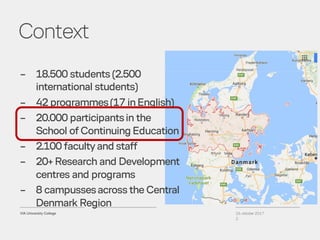
– 18.500 students (2.500
international students)
– 42 programmes(17 inEnglish)
– 20.000 participantsin the
School of Continuing Education
– 2.100 faculty and staff
– 20+ Research and Development
centres and programs
– 8 campussesacross the Central
Denmark Region
Researchcontext
26. oktober 2017
3
– Projects developingdigital learning designs 
designs for short learning programs
– Learningdesign workshops
– approx.60 teachershave been participating
– Participantsin the learningdesign processes:
– Learningdesigner (pedagogicaland technological)
– Learning technologist(producer oflearning material
– learningobjects)
– Teachersand teaching-coordinators
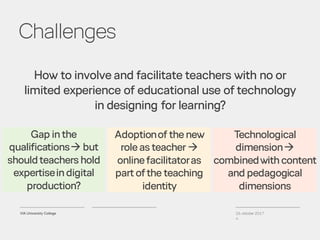
Challenges
26. oktober 2017
4
How to involve and facilitate teachers with no or
limited experience of educational use of technology
in designing for learning?
Gap inthe
qualifications but
shouldteachers hold
expertiseindigital
production?
Adoptionof thenew
roleas teacher
onlinefacilitatoras
partofthe teaching
identity
Technological
dimension
combinedwithcontent
and pedagogical
dimensions
26. oktober 2017
5
[Source:Buus,2015]
26. oktober 2017
6
Developed a workshop methodology
inspired by the Collaborative
E-learning Design method (CoED)
[Source:Georgsen &Nyvang,2007]
Workshopmethodology
Phase 1
• Idea and development of the learning design
• What should be designed for?
Phase 2
• Describing learning activities
• Who (roles), How (study methods), Where (arena), and What (learning
objectives), and Why (learning goals)
Phase 3
• Production and design
• Produce digital materials and design the learning environment
Phase 4
• Implementation of design
• Testing, evaluating and adjusting
26. oktober 2017
7
[Source:Georgsen,internalreport]
Vision
26. oktober 2017
8
Organisational
didatic
framework
Establishinga professionalframeworkaround
the designwork allowingall participantsto
contributewiththeir particularexpertise
[Source:Christensenetal.,2014]
26. oktober 2017
9
Describethe resourcesneeded to beprioritisedinorderto
realisea strategywithinblendedand onlinelearning
Clarifythelink betweenthe prioritiesinthe organisation
Describethe frameworkthat the organisationand its
management need to makefordevelopmenttakeplace
[Source:Christensenetal.,2014]
26. oktober 2017
10
Howmustthe didactic
designlookliketo achieve
the strategicgoals?
Whatarethe prerequisites
to provideblendedand
onlinelearning?
Why do weneed blendedand onlinelearning?
Whatkindof educationalchallengesis itthe answerto?
Whatis theneed fora changedpedagogicalconcept?
[Source:Christensenetal.,2014]
26. oktober 2017
11
Establishingprofessional
learningcommunities(PLCs)
Learningdesignworkshops
Establishmentofa unit
forLearning Design
Still inthe processof
decidingon new
educationalconcepts
[Source:Christensenetal.,2014]
Ourconclusion
26. oktober 2017
12
Concept of professional learningcommunities (PLC)s or
communities of practice(COPs) can be a way to facilitate
teachersdesign for learningand ways to developan
organisationalframeworkfor design work and collaborative
experiments
Cultural change
[Source:Christensenetal.,2014]
26. oktober 2017
13
Contacts:
MarianneGeorgsen–mage@via.dk
HeadofResearchCentreonLearningandDigitalTechnologies,VIAUniversityCollege,
Denmark
LillianBuus–libu@via.dk
LearningdesigneratSchoolofContinuingEducation,VIAUniversityCollege,Denmark
Thankyou for your attention
Any questions?
References
26. oktober 2017
14
– Buus, Lillian (2015)“The Learning Potentialsand Challenges When
Integrating Web2.0 in aProblem-Based Learning Approach.” Aalborg
University.
http://vbn.aau.dk/ws/files/229504270/PHD_Lillian_Buus_E_pdf.pdf
– Christensen, Ove,Rene B. Christiansen, KarstenGynther,Niels Henrik Helms,
and DitteSchlüntz (2014):“Kan vi lære af de andre? - udenlandske erfaringer
med e-læringog blended learning i erhvervsuddannelser og
læreruddannelser for erhvervsskolelærere.”
http://ucsj.dk/fileadmin/user_upload/FU/Publikationer/Kan_vi_laere_af_de_
andre.pdf
– Georgsen, Marianne (not submitted): “Udvikling af onlinelæring ogblended
learning i EVU.”Internalreport,VIA UniversityCollege.
– Georgsen, Marianne, and Tom Nyvang (2007):“Collaborative E-Learning
Design Method(CoED).”E-Learning Lab Publication Series.E-Learning Lab,
Aalborg University.

A learning design methodology (OOFHEC2017)

  • 1.
    Bringideastolife VIAUniversityCollege A learningdesign methodology for deliveringshortlearningprogrammesin furtherandcontinuingeducation 26. oktober 2017LillianBuus (libu@via.dk) andMarianne Georgsen(mage@via.dk) 1
  • 2.
    Context 26. oktober 2017 2 –18.500 students (2.500 international students) – 42 programmes(17 inEnglish) – 20.000 participantsin the School of Continuing Education – 2.100 faculty and staff – 20+ Research and Development centres and programs – 8 campussesacross the Central Denmark Region
  • 3.
    Researchcontext 26. oktober 2017 3 –Projects developingdigital learning designs  designs for short learning programs – Learningdesign workshops – approx.60 teachershave been participating – Participantsin the learningdesign processes: – Learningdesigner (pedagogicaland technological) – Learning technologist(producer oflearning material – learningobjects) – Teachersand teaching-coordinators
  • 4.
    Challenges 26. oktober 2017 4 Howto involve and facilitate teachers with no or limited experience of educational use of technology in designing for learning? Gap inthe qualifications but shouldteachers hold expertiseindigital production? Adoptionof thenew roleas teacher onlinefacilitatoras partofthe teaching identity Technological dimension combinedwithcontent and pedagogical dimensions
  • 5.
  • 6.
    26. oktober 2017 6 Developeda workshop methodology inspired by the Collaborative E-learning Design method (CoED) [Source:Georgsen &Nyvang,2007]
  • 7.
    Workshopmethodology Phase 1 • Ideaand development of the learning design • What should be designed for? Phase 2 • Describing learning activities • Who (roles), How (study methods), Where (arena), and What (learning objectives), and Why (learning goals) Phase 3 • Production and design • Produce digital materials and design the learning environment Phase 4 • Implementation of design • Testing, evaluating and adjusting 26. oktober 2017 7 [Source:Georgsen,internalreport]
  • 8.
    Vision 26. oktober 2017 8 Organisational didatic framework Establishingaprofessionalframeworkaround the designwork allowingall participantsto contributewiththeir particularexpertise [Source:Christensenetal.,2014]
  • 9.
    26. oktober 2017 9 Describetheresourcesneeded to beprioritisedinorderto realisea strategywithinblendedand onlinelearning Clarifythelink betweenthe prioritiesinthe organisation Describethe frameworkthat the organisationand its management need to makefordevelopmenttakeplace [Source:Christensenetal.,2014]
  • 10.
    26. oktober 2017 10 Howmustthedidactic designlookliketo achieve the strategicgoals? Whatarethe prerequisites to provideblendedand onlinelearning? Why do weneed blendedand onlinelearning? Whatkindof educationalchallengesis itthe answerto? Whatis theneed fora changedpedagogicalconcept? [Source:Christensenetal.,2014]
  • 11.
    26. oktober 2017 11 Establishingprofessional learningcommunities(PLCs) Learningdesignworkshops Establishmentofaunit forLearning Design Still inthe processof decidingon new educationalconcepts [Source:Christensenetal.,2014]
  • 12.
    Ourconclusion 26. oktober 2017 12 Conceptof professional learningcommunities (PLC)s or communities of practice(COPs) can be a way to facilitate teachersdesign for learningand ways to developan organisationalframeworkfor design work and collaborative experiments Cultural change [Source:Christensenetal.,2014]
  • 13.
  • 14.
    References 26. oktober 2017 14 –Buus, Lillian (2015)“The Learning Potentialsand Challenges When Integrating Web2.0 in aProblem-Based Learning Approach.” Aalborg University. http://vbn.aau.dk/ws/files/229504270/PHD_Lillian_Buus_E_pdf.pdf – Christensen, Ove,Rene B. Christiansen, KarstenGynther,Niels Henrik Helms, and DitteSchlüntz (2014):“Kan vi lære af de andre? - udenlandske erfaringer med e-læringog blended learning i erhvervsuddannelser og læreruddannelser for erhvervsskolelærere.” http://ucsj.dk/fileadmin/user_upload/FU/Publikationer/Kan_vi_laere_af_de_ andre.pdf – Georgsen, Marianne (not submitted): “Udvikling af onlinelæring ogblended learning i EVU.”Internalreport,VIA UniversityCollege. – Georgsen, Marianne, and Tom Nyvang (2007):“Collaborative E-Learning Design Method(CoED).”E-Learning Lab Publication Series.E-Learning Lab, Aalborg University.