Data Analytics
A L E A D E R ’ S G U I D E T O
A working knowledge of data
science can help you lead with
confidence.
B a s e d o n i n s i g h t s f r o m
F l o r i a n Z e t t e l m e y e r
Analysis by Shloka
Present Scenario
In recent years, data
science has become an
essential business tool.
With access to incredible
amounts of data,
companies are now able
to measure every aspect
of their operations in
granular detail. 
The Beginner's Hesistance
Many business leaders,
overwhelmed by this
constant blizzard of
metrics, are hesitant to
get involved in what
they see as a technical
process.
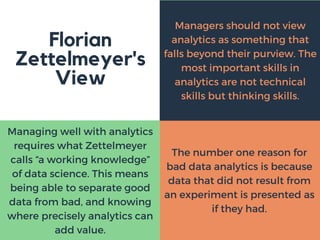
Florian
Zettelmeyer's
View
Managers should not view
analytics as something that
falls beyond their purview. The
most important skills in
analytics are not technical
skills but thinking skills.
Managing well with analytics
requires what Zettelmeyer
calls “a working knowledge”
of data science. This means
being able to separate good
data from bad, and knowing
where precisely analytics can
add value.
The number one reason for
bad data analytics is because
data that did not result from
an experiment is presented as
if they had.
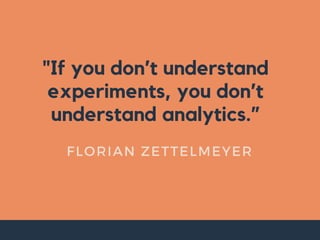
"If you don’t understand
experiments, you don’t
understand analytics.”
FLORIAN ZETTELMEYER
Steps to be followed for
better understanding!
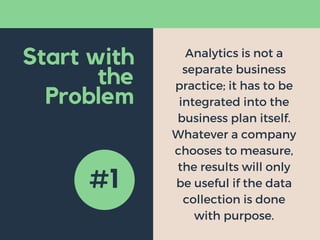
Start with
the
Problem
Analytics is not a
separate business
practice; it has to be
integrated into the
business plan itself.
Whatever a company
chooses to measure,
the results will only
be useful if the data
collection is done
with purpose.
#1
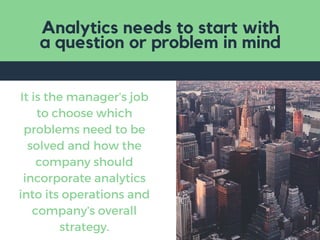
Analytics needs to start with
a question or problem in mind
It is the manager’s job
to choose which
problems need to be
solved and how the
company should
incorporate analytics
into its operations and
company’s overall
strategy.
Understand
the Data-
Generation
Process
There is a real danger in
managers assuming that the
analysis was done in a
reasonable way. To make
informed decisions, it helps
to take a step back and
establish some
fundamentals.
Because analytics often boils
down to making comparisons
between groups, it is
important to know how those
groups are selected. 
#2
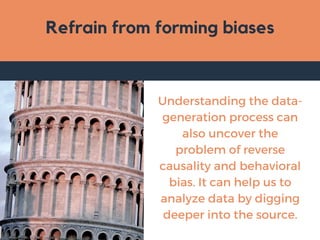
Refrain from forming biases
Understanding the data-
generation process can
also uncover the
problem of reverse
causality and behavioral
bias. It can help us to
analyze data by digging
deeper into the source.
Be the link
Use Domain Knowledge
Managers should use their
knowledge of the business
to account for strange
results.
Analytics is not simply a
matter of crunching
numbers in a vacuum. Data
scientists do not have all the
domain expertise managers
have, and analytics is no
substitute for understanding
#3
Know It - Do Not Just
Think It
#4
C
Managers with a working
knowledge of data
science will have an edge
Beyond being the
gatekeepers of their own
analytics, leaders should
ensure that this knowledge
is shared across their
organization—a disciplined,
data-literate company is
one that is likely to learn
fast and add more value
across the board.
STEP 1
C
Thinking <--> Knowing
If we want big data and
analytics to succeed,
everyone needs to feel
that they have a right to
question established
wisdom. There has to be
a culture where you can’t
get away with thinking as
opposed to knowing.
STEP 2
C
Developing appropriate
sharing culture
Developing such a
culture is a big challenge
for leaders. Organizations
are rarely willing to admit
the need for change, and
few managers feel
confident enough to lead
with analytics. This, he
says, will have to change.
STEP 3
Thank You
A N A L Y S I S B Y S H L O K A

"A Leader’s Guide to Data Analytics"

  • 1.
    Data Analytics A LE A D E R ’ S G U I D E T O
  • 2.
    A working knowledgeof data science can help you lead with confidence. B a s e d o n i n s i g h t s f r o m F l o r i a n Z e t t e l m e y e r Analysis by Shloka
  • 3.
    Present Scenario In recentyears, data science has become an essential business tool. With access to incredible amounts of data, companies are now able to measure every aspect of their operations in granular detail. 
  • 4.
    The Beginner's Hesistance Manybusiness leaders, overwhelmed by this constant blizzard of metrics, are hesitant to get involved in what they see as a technical process.
  • 5.
    Florian Zettelmeyer's View Managers should notview analytics as something that falls beyond their purview. The most important skills in analytics are not technical skills but thinking skills. Managing well with analytics requires what Zettelmeyer calls “a working knowledge” of data science. This means being able to separate good data from bad, and knowing where precisely analytics can add value. The number one reason for bad data analytics is because data that did not result from an experiment is presented as if they had.
  • 6.
    "If you don’tunderstand experiments, you don’t understand analytics.” FLORIAN ZETTELMEYER
  • 7.
    Steps to befollowed for better understanding!
  • 8.
    Start with the Problem Analytics isnot a separate business practice; it has to be integrated into the business plan itself. Whatever a company chooses to measure, the results will only be useful if the data collection is done with purpose. #1
  • 9.
    Analytics needs tostart with a question or problem in mind It is the manager’s job to choose which problems need to be solved and how the company should incorporate analytics into its operations and company’s overall strategy.
  • 10.
    Understand the Data- Generation Process There isa real danger in managers assuming that the analysis was done in a reasonable way. To make informed decisions, it helps to take a step back and establish some fundamentals. Because analytics often boils down to making comparisons between groups, it is important to know how those groups are selected.  #2
  • 11.
    Refrain from formingbiases Understanding the data- generation process can also uncover the problem of reverse causality and behavioral bias. It can help us to analyze data by digging deeper into the source.
  • 12.
    Be the link UseDomain Knowledge Managers should use their knowledge of the business to account for strange results. Analytics is not simply a matter of crunching numbers in a vacuum. Data scientists do not have all the domain expertise managers have, and analytics is no substitute for understanding #3
  • 13.
    Know It -Do Not Just Think It #4
  • 14.
    C Managers with aworking knowledge of data science will have an edge Beyond being the gatekeepers of their own analytics, leaders should ensure that this knowledge is shared across their organization—a disciplined, data-literate company is one that is likely to learn fast and add more value across the board. STEP 1
  • 15.
    C Thinking <--> Knowing Ifwe want big data and analytics to succeed, everyone needs to feel that they have a right to question established wisdom. There has to be a culture where you can’t get away with thinking as opposed to knowing. STEP 2
  • 16.
    C Developing appropriate sharing culture Developingsuch a culture is a big challenge for leaders. Organizations are rarely willing to admit the need for change, and few managers feel confident enough to lead with analytics. This, he says, will have to change. STEP 3
  • 17.
    Thank You A NA L Y S I S B Y S H L O K A