


A Guide To
Content Seeding
             By Rebecca Hesilrige

           becky.hesilrige@gmail.com
                @beckyhesilrige
        linkedin.com/in/rebeccahesilrige
Contents
Content Seeding Plan
        1. Plan
       2. Create
        3. Seed
  What is Seeding?
      The Big 3
   Also Consider..
 Social Bookmarking
  Blogs & Journalists
     4. Measure
      5. Manage
 The Ongoing Cycle
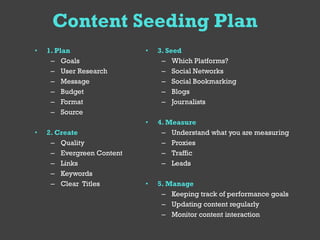
Content Seeding Plan
•   1. Plan                •   3. Seed
     – Goals                    – Which Platforms?
     – User Research            – Social Networks
     – Message                  – Social Bookmarking
     – Budget                   – Blogs
     – Format                   – Journalists
     – Source
                           •   4. Measure
•   2. Create                   – Understand what you are measuring
     – Quality                  – Proxies
     – Evergreen Content        – Traffic
     – Links                    – Leads
     – Keywords
     – Clear Titles        •   5. Manage
                                – Keeping track of performance goals
                                – Updating content regularly
                                – Monitor content interaction
1. Plan
Goals – What do you want to achieve with this content? Traffic? Buzz? Sales?
Reviews?

User Research – Know your users. Age? Gender? Location? Interests? Tailor
your content around this demographic.

Message – Your content needs to include a clear message, whether it be ‘buy
 me’ or ‘share me’, make sure the user has a call to action.

Budget – How much do you want to invest in your content? This will decide
what type of format you use.

Format – Articles? Blogs? Posts? Videos?

Source – Who will create your content? In house? Outsourced?
2. Create
Quality - Great content has to engage the reader, make that it is interesting, unique
and well written.

Evergreen Content - "Evergreen" content means that the information will not be
outdated a month from now, try to include this as often as possible

Links - Include links to point the user to your website or to other relevant content and
pages within your site

Keywords – Include key words which you are trying to rank for in search engines. Help
them to stand out to readers by putting them in different colours, fonts, or formats.

Clear titles – Make it clear what you are going to talk about, this will not only make
your content more noticeable, but it will also help search engines to monitor your
content.

Meta Data - Include meta data to help search engines learn what your content is
about, and to categorise it effectively
3. Seed
Depending on your goals, you will have to decide which platforms to seed your
content

Social Networks – Facebook, Twitter, YouTube, LinkedIn and many more niche
sites

Social Bookmarking – There are hundreds of social bookmarking sites available,
however Reddit, Digg, Stumbleupon and Delicious will help you get the best results

Blogs – You can either set up your own blog to update regularly, or form
relationships with bloggers who will blog about your services.

Journalists – Journalists are always looking for new and interesting news. Form
bonds with relevant journalists so that they can publish press releases and articles
based around your services.
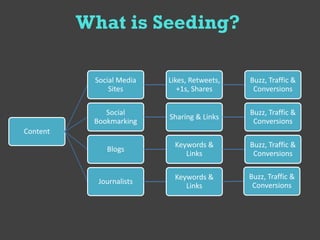
What is Seeding?

           Social Media   Likes, Retweets,   Buzz, Traffic &
               Sites         +1s, Shares      Conversions

              Social                         Buzz, Traffic &
                          Sharing & Links
           Bookmarking                        Conversions
Content
                            Keywords &       Buzz, Traffic &
              Blogs
                               Links          Conversions

                            Keywords &       Buzz, Traffic &
            Journalists                       Conversions
                               Links
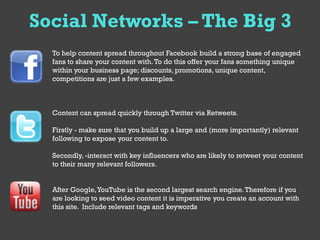
Social Networks – The Big 3
  To help content spread throughout Facebook build a strong base of engaged
  fans to share your content with. To do this offer your fans something unique
  within your business page; discounts, promotions, unique content,
  competitions are just a few examples.


  Content can spread quickly through Twitter via Retweets.

  Firstly - make sure that you build up a large and (more importantly) relevant
  following to expose your content to.

  Secondly, -interact with key influencers who are likely to retweet your content
  to their many relevant followers.


  After Google, YouTube is the second largest search engine. Therefore if you
  are looking to seed video content it is imperative you create an account with
  this site. Include relevant tags and keywords
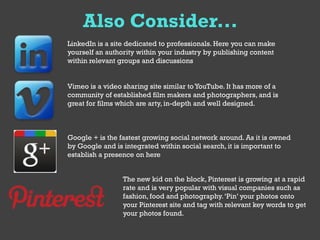
Also Consider...
LinkedIn is a site dedicated to professionals. Here you can make
yourself an authority within your industry by publishing content
within relevant groups and discussions


Vimeo is a video sharing site similar to YouTube. It has more of a
community of established film makers and photographers, and is
great for films which are arty, in-depth and well designed.


Google + is the fastest growing social network around. As it is owned
by Google and is integrated within social search, it is important to
establish a presence on here


                 The new kid on the block, Pinterest is growing at a rapid
                 rate and is very popular with visual companies such as
                 fashion, food and photography. ‘Pin’ your photos onto
                 your Pinterest site and tag with relevant key words to get
                 your photos found.
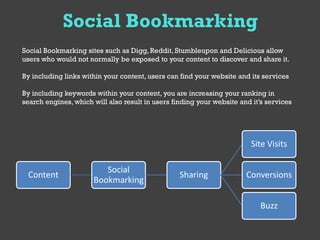
Social Bookmarking
Social Bookmarking sites such as Digg, Reddit, Stumbleupon and Delicious allow
users who would not normally be exposed to your content to discover and share it.

By including links within your content, users can find your website and its services

By including keywords within your content, you are increasing your ranking in
search engines, which will also result in users finding your website and it’s services


                                                                         Site Visits

                         Social
 Content                                          Sharing              Conversions
                      Bookmarking

                                                                            Buzz
Blogs & Journalists
Blogs – By producing a blog you can receive a variety of benefits, such as:
                   Including Key words
                   Linking back to your site
                   Interacting with customers
                   Keeping customers up to date with news/promotions etc
                   Maintaining branding and reputation

Alternatively you can contact established bloggers and ask them to either
write a blog post about your brand, or to publish a post you have already written. This
can help your content to reach an relevant audience which has already been built up

Journalists – Contact established journalists in your industry with articles and
stories about your brand. Journalists are often on the look out for interesting industry
news, and if yours is relevant you may find it on one of your top industry websites.
4. Measure
Understand what you are measuring – Firstly decide on what you want to
measure, whether that be social buzz, traffic or conversions. Each of these have
very different ways of being measured

Proxies – Proxies are a great indicator of social buzz and brand sentiment. A few
examples of useful proxies are:

                    Facebook Likes
                    Retweets
                    Shares
                    Reblogs
                    Comments
                    Followers
                    @mentions

Traffic – Google Analytics is a fantastic tool to help you track traffic to your
website. Here you can search Traffic sources to find out exactly which social
platform your traffic is coming through, and whether there has been a general
increase in traffic since you began content seeding.

Leads – Also by using Google Analytics you can track any increase in conversions,
and from which platform they came.
5. Manage
It is important to continuously manage your content based around the results
you are receiving to receive the best possible result.

Do this by:
Keeping track of performance goals – Keep in mind what your
Performance goals are and whether your content is reaching this ideal. If
not, re-evaluate your strategy and change your content accordingly

Updating content regularly – Content which is out of date not only reflects
badly but can be misleading for potential customers, as well as potentially
affecting your SEO ranking.

Monitor content interaction – Never forget that your reputation is involved
In your content - reply to any questions or comments as quickly as possible
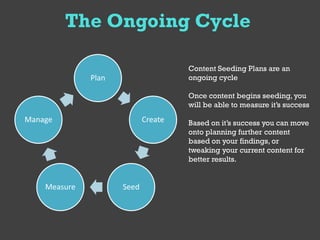
The Ongoing Cycle

                                     Content Seeding Plans are an
              Plan                   ongoing cycle

                                     Once content begins seeding, you
                                     will be able to measure it’s success
Manage                      Create   Based on it’s success you can move
                                     onto planning further content
                                     based on your findings, or
                                     tweaking your current content for
                                     better results.


    Measure          Seed
Get In Touch!

Feel free to get in touch if you have any questions or need any advice


                    becky.hesilrige@gmail.com

                          @beckyhesilrige

                 linkedin.com/in/rebeccahesilrige

A Guide to Content Seeding

  • 1.
    A Guide To ContentSeeding By Rebecca Hesilrige becky.hesilrige@gmail.com @beckyhesilrige linkedin.com/in/rebeccahesilrige
  • 2.
    Contents Content Seeding Plan 1. Plan 2. Create 3. Seed What is Seeding? The Big 3 Also Consider.. Social Bookmarking Blogs & Journalists 4. Measure 5. Manage The Ongoing Cycle
  • 3.
    Content Seeding Plan • 1. Plan • 3. Seed – Goals – Which Platforms? – User Research – Social Networks – Message – Social Bookmarking – Budget – Blogs – Format – Journalists – Source • 4. Measure • 2. Create – Understand what you are measuring – Quality – Proxies – Evergreen Content – Traffic – Links – Leads – Keywords – Clear Titles • 5. Manage – Keeping track of performance goals – Updating content regularly – Monitor content interaction
  • 4.
    1. Plan Goals –What do you want to achieve with this content? Traffic? Buzz? Sales? Reviews? User Research – Know your users. Age? Gender? Location? Interests? Tailor your content around this demographic. Message – Your content needs to include a clear message, whether it be ‘buy me’ or ‘share me’, make sure the user has a call to action. Budget – How much do you want to invest in your content? This will decide what type of format you use. Format – Articles? Blogs? Posts? Videos? Source – Who will create your content? In house? Outsourced?
  • 5.
    2. Create Quality -Great content has to engage the reader, make that it is interesting, unique and well written. Evergreen Content - "Evergreen" content means that the information will not be outdated a month from now, try to include this as often as possible Links - Include links to point the user to your website or to other relevant content and pages within your site Keywords – Include key words which you are trying to rank for in search engines. Help them to stand out to readers by putting them in different colours, fonts, or formats. Clear titles – Make it clear what you are going to talk about, this will not only make your content more noticeable, but it will also help search engines to monitor your content. Meta Data - Include meta data to help search engines learn what your content is about, and to categorise it effectively
  • 6.
    3. Seed Depending onyour goals, you will have to decide which platforms to seed your content Social Networks – Facebook, Twitter, YouTube, LinkedIn and many more niche sites Social Bookmarking – There are hundreds of social bookmarking sites available, however Reddit, Digg, Stumbleupon and Delicious will help you get the best results Blogs – You can either set up your own blog to update regularly, or form relationships with bloggers who will blog about your services. Journalists – Journalists are always looking for new and interesting news. Form bonds with relevant journalists so that they can publish press releases and articles based around your services.
  • 7.
    What is Seeding? Social Media Likes, Retweets, Buzz, Traffic & Sites +1s, Shares Conversions Social Buzz, Traffic & Sharing & Links Bookmarking Conversions Content Keywords & Buzz, Traffic & Blogs Links Conversions Keywords & Buzz, Traffic & Journalists Conversions Links
  • 8.
    Social Networks –The Big 3 To help content spread throughout Facebook build a strong base of engaged fans to share your content with. To do this offer your fans something unique within your business page; discounts, promotions, unique content, competitions are just a few examples. Content can spread quickly through Twitter via Retweets. Firstly - make sure that you build up a large and (more importantly) relevant following to expose your content to. Secondly, -interact with key influencers who are likely to retweet your content to their many relevant followers. After Google, YouTube is the second largest search engine. Therefore if you are looking to seed video content it is imperative you create an account with this site. Include relevant tags and keywords
  • 9.
    Also Consider... LinkedIn isa site dedicated to professionals. Here you can make yourself an authority within your industry by publishing content within relevant groups and discussions Vimeo is a video sharing site similar to YouTube. It has more of a community of established film makers and photographers, and is great for films which are arty, in-depth and well designed. Google + is the fastest growing social network around. As it is owned by Google and is integrated within social search, it is important to establish a presence on here The new kid on the block, Pinterest is growing at a rapid rate and is very popular with visual companies such as fashion, food and photography. ‘Pin’ your photos onto your Pinterest site and tag with relevant key words to get your photos found.
  • 10.
    Social Bookmarking Social Bookmarkingsites such as Digg, Reddit, Stumbleupon and Delicious allow users who would not normally be exposed to your content to discover and share it. By including links within your content, users can find your website and its services By including keywords within your content, you are increasing your ranking in search engines, which will also result in users finding your website and it’s services Site Visits Social Content Sharing Conversions Bookmarking Buzz
  • 11.
    Blogs & Journalists Blogs– By producing a blog you can receive a variety of benefits, such as: Including Key words Linking back to your site Interacting with customers Keeping customers up to date with news/promotions etc Maintaining branding and reputation Alternatively you can contact established bloggers and ask them to either write a blog post about your brand, or to publish a post you have already written. This can help your content to reach an relevant audience which has already been built up Journalists – Contact established journalists in your industry with articles and stories about your brand. Journalists are often on the look out for interesting industry news, and if yours is relevant you may find it on one of your top industry websites.
  • 12.
    4. Measure Understand whatyou are measuring – Firstly decide on what you want to measure, whether that be social buzz, traffic or conversions. Each of these have very different ways of being measured Proxies – Proxies are a great indicator of social buzz and brand sentiment. A few examples of useful proxies are: Facebook Likes Retweets Shares Reblogs Comments Followers @mentions Traffic – Google Analytics is a fantastic tool to help you track traffic to your website. Here you can search Traffic sources to find out exactly which social platform your traffic is coming through, and whether there has been a general increase in traffic since you began content seeding. Leads – Also by using Google Analytics you can track any increase in conversions, and from which platform they came.
  • 13.
    5. Manage It isimportant to continuously manage your content based around the results you are receiving to receive the best possible result. Do this by: Keeping track of performance goals – Keep in mind what your Performance goals are and whether your content is reaching this ideal. If not, re-evaluate your strategy and change your content accordingly Updating content regularly – Content which is out of date not only reflects badly but can be misleading for potential customers, as well as potentially affecting your SEO ranking. Monitor content interaction – Never forget that your reputation is involved In your content - reply to any questions or comments as quickly as possible
  • 14.
    The Ongoing Cycle Content Seeding Plans are an Plan ongoing cycle Once content begins seeding, you will be able to measure it’s success Manage Create Based on it’s success you can move onto planning further content based on your findings, or tweaking your current content for better results. Measure Seed
  • 15.
    Get In Touch! Feelfree to get in touch if you have any questions or need any advice becky.hesilrige@gmail.com @beckyhesilrige linkedin.com/in/rebeccahesilrige