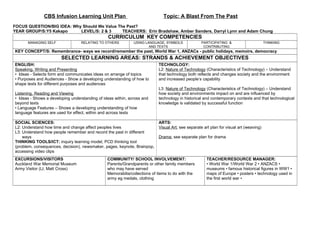
CBS Infusion Learning Unit Plan Topic: A Blast From The Past
FOCUS QUESTION/BIG IDEA: Why Should We Value The Past?
YEAR GROUP/S:Y5 Kakapo LEVEL/S: 2 & 3 TEACHERS: Erin Bradshaw, Amber Sanders, Darryl Lynn and Adam Chung
CURRICULUM KEY COMPETENCIES
MANAGING SELF RELATING TO OTHERS USING LANGUAGE, SYMBOLS
AND TEXTS
PARTICIPATING &
CONTRIBUTING
THINKING
KEY CONCEPT/S: Remembrance- ways we record/remember the past, World War 1, ANZACs - public holidays, memoirs, democracy
SELECTED LEARNING AREAS: STRANDS & ACHIEVEMENT OBJECTIVES
ENGLISH:
Speaking, Writing and Presenting
• Ideas - Selects form and communicates ideas on arrange of topics
• Purposes and Audiences - Show a developing understanding of how to
shape texts for different purposes and audiences
Listening, Reading and Viewing
• Ideas - Shows a developing understanding of ideas within, across and
beyond texts
• Language Features – Shows a developing understanding of how
language features are used for effect, within and across texts
TECHNOLOGY:
L2: Nature of Technology (Characteristics of Technology) – Understand
that technology both reflects and changes society and the environment
and increased people’s capability
L3: Nature of Technology (Characteristics of Technology) – Understand
how society and environments impact on and are influenced by
technology in historical and contemporary contexts and that technological
knowledge is validated by successful function
SOCIAL SCIENCES:
L2: Understand how time and change affect peoples lives
L3: Understand how people remember and record the past in different
ways
THINKING TOOLS/ICT: inquiry learning model, PCD thinking tool
(problem, consequences, decision), newsmaker, pages, keynote, Brainpop,
accessing video clips
ARTS:
Visual Art: see separate art plan for visual art (weaving)
Drama: see separate plan for drama
EXCURSIONS/VISITORS
Auckland War Memorial Museum
Army Visitor (Lt. Matt Cross)
COMMUNITY/ SCHOOL INVOLVEMENT:
Parents/Grandparents or other family members
who may have served
Memorabilia/collections of items to do with the
army eg medals, clothing
TEACHER/RESOURCE MANAGER:
• World War 1/World War 2 • ANZACS •
museums • famous historical figures in WW1 •
maps of Europe • posters • technology used in
the first world war •
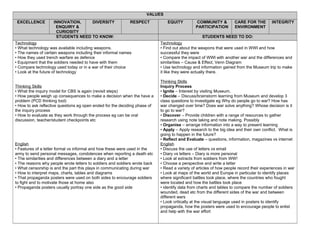
VALUES
EXCELLENCE INNOVATION,
ENQUIRY &
CURIOSITY
DIVERSITY RESPECT EQUITY COMMUNITY &
PARTICIPATION
CARE FOR THE
ENVIRONMENT
INTEGRITY
STUDENTS NEED TO KNOW: STUDENTS NEED TO DO:
Technology
• What technology was available including weapons.
• The names of certain weapons including their informal names
• How they used trench warfare as defence
• Equipment that the soldiers needed to have with them
• Compare technology used today or in a war of their choice
• Look at the future of technology
Thinking Skills
• What the inquiry model for CBS is again (revisit steps)
• How people weigh up consequences to make a decision when the have a
problem (PCD thinking tool)
• How to ask reflective questions eg open ended for the deciding phase of
the inquiry process
• How to evaluate as they work through the process eg can be oral
discussion, teacher/student checkpoints etc
English
• Features of a letter formal vs informal and how these were used in the
army to send personal messages, condolences when reporting a death etc
• The similarities and differences between a diary and a letter
• The reasons why people wrote letters to soldiers and soldiers wrote back
• What censorship is and the part this plays in communicating during war
• How to interpret maps, charts, tables and diagrams
• That propaganda posters were used on both sides to encourage soldiers
to fight and to motivate those at home also
• Propaganda posters usually portray one side as the good side
Technology
• Find out about the weapons that were used in WWI and how
successful they were
• Compare the impact of WWI with another war and the differences and
similarities – Cause & Effect, Venn Diagram
• Use technology and information gained from the Museum trip to make
it like they were actually there.
Thinking Skills
Inquiry Process
• Ignite – Interest by visiting Museum,
• Decide – Discuss/brainstorm learning from Museum and develop 3
class questions to investigate eg Why do people go to war? How has
war changed over time? Does war solve anything? Whose decision is it
to go to war?
• Discover – Provide children with a range of resources to gather
research using note taking and note making. Possibly
• Organise – arrange information into a way to present learning
• Apply – Apply research to the big idea and their own conflict. What is
going to happen in the future?
• Reflect and Evaluate – questions, information, magazines vs internet
English
• Discuss the use of letters vs email
• Diary vs letters – Diary is more personal
• Look at extracts from soldiers from WW!
• Choose a perspective and write a letter
• Read a variety of articles of how people record their experiences in war
• Look at maps of the world and Europe in particular to identify places
where significant battles took place, where the countries who fought
were located and how the battles took place
• identify data from charts and tables to compare the number of soldiers
wounded, dead etc from the different sides of the war and between
different wars
• Look critically at the visual language used in posters to identify
propaganda, how the posters were used to encourage people to enlist
and help with the war effort
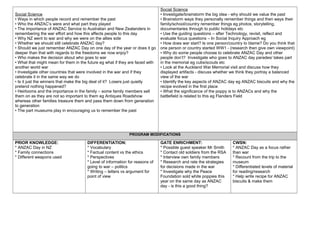
Social Science
• Ways in which people record and remember the past
• Who the ANZAC’s were and what part they played
• The importance of ANZAC Service to Australian and New Zealanders in
remembering the war effort and how this affects people to this day
• Why NZ went to war and why we were on the allies side
• Whether we should still celebrate ANZAC day?
• Should we just remember ANZAC Day on one day of the year or does it go
deeper than that with regards to the freedoms we now enjoy?
• Who makes the decision about who goes to war
• What that might mean for them in the future eg what if they are faced with
another world war
• Investigate other countries that were involved in the war and if they
celebrate it in the same way we do
• Is it just the winners that make the big deal of it? Losers just quietly
pretend nothing happened?
• Heirlooms and the importance in the family – some family members sell
them on as they are not so important to them eg Antiques Roadshow
whereas other families treasure them and pass them down from generation
to generation
• The part museums play in encouraging us to remember the past
Social Science
• Investigate/brainstorm the big idea - why should we value the past
• Brainstorm ways they personally remember things and then ways their
family/school/country remember things eg photos, storytelling,
documentaries through to public holidays etc
• Use the guiding questions – after Technology, revisit, reflect and
evaluate focus questions – In Social Inquiry Approach eg
• How does war start? Is one person/country to blame? Do you think that
one person or country started WW1 - (research then give own viewpoint)
• Why do some people choose to celebrate ANZAC Day and other
people don’t? Investigate who goes to ANZAC day parades/ takes part
in the memorial eg cubs/scouts etc
• Look at the Auckland War Memorial visit and discuss how they
displayed artifacts - discuss whether we think they portray a balanced
view of the war
• Identify the key aspects of ANZAC day eg ANZAC biscuits and why the
recipe evolved in the first place
• What the significance of the poppy is to ANZACs and why the
battlefield is related to this eg Flanders Field
PROGRAM MODIFICATIONS
PRIOR KNOWLEDGE:
* ANZAC Day in NZ
* Family connections
* Different weapons used
DIFFERENTIATION:
* Vocabulary
* Factual content vs the ethics
* Perspectives
* Level of information for reasons of
going to war – politics
* Writing – letters vs argument for
point of view
GATE ENRICHMENT:
* Possible guest speaker Mr Smith
* Contact old soldiers from the RSA
* Interview own family members
* Research and rate the strategies
for decisions made in the war
* Investigate why the Peace
Foundation sold white poppies this
year on the same day as ANZAC
day - is this a good thing?
CWSN:
* ANZAC Day as a focus rather
than war
* Recount from the trip to the
museum
* Differentiated levels of material
for reading/research
* Help write recipe for ANZAC
biscuits & make them
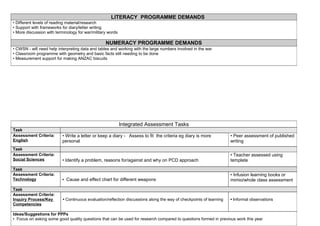
LITERACY PROGRAMME DEMANDS
• Different levels of reading material/research
• Support with frameworks for diary/letter writing
• More discussion with terminology for war/military words
NUMERACY PROGRAMME DEMANDS
• CWSN - will need help interpreting data and tables and working with the large numbers involved in the war
• Classroom programme with geometry and basic facts still needing to be done
• Measurement support for making ANZAC biscuits
Integrated Assessment Tasks
Task
Assessment Criteria:
English
• Write a letter or keep a diary - Assess to fit the criteria eg diary is more
personal
• Peer assessment of published
writing
Task
Assessment Criteria:
Social Sciences • Identify a problem, reasons for/against and why on PCD approach
• Teacher assessed using
template
Task
Assessment Criteria:
Technology • Cause and effect chart for different weapons
• Infusion learning books or
mimio/whole class assessment
Task
Assessment Criteria:
Inquiry Process/Key
Competencies
• Continuous evaluation/reflection discussions along the way of checkpoints of learning • Informal observations
Ideas/Suggestions for PPPs
• Focus on asking some good quality questions that can be used for research compared to questions formed in previous work this year
RESOURCES:
English
SJ Pt 4 No 3 2008 – Boy Soldiers SJ Pt 4 No 2 1997 – Who wants to remember it? & The Last Post SJ Pt 4 No 1 1996 – Love Story
SJ Pt 4 No 3 1993 – The Mail Run SJ Pt 2 No 2 1992 – The Anzac Biscuit SJ Pt 3 No 2 1998 – War Games
Fairfax Newspapers in Education - The Home Front (1 x copy per student) World Book Encyclopaedia on laptops
Books from National Library, CBS library
Infusion
• Photo Packs • Maps/Charts/Data eg tables of information about WW1/WW2 incl number of deaths etc
Websites
First World War: Trench Warfare Classroom ideas - Anzac Day | NZHistory.net.nz, New Zealand history online
Classroom activities about Anzac Day and Gallipoli
ANZAC Day in New Zealand ANZAC Day in New Zealand Anzac Day - a guide for New Zealanders ANZAC Biscuits Anzac Day Websites
Lists of Anzac Day websites for classroom use, including links to Gallipoli history, photographs, worksheets and other lesson activities.
Gallipoli: The First Day - 3D Interactive Site An ABC 3D documentary site about the WW1 ANZAC landing at Gallipoli, on 25 April 1915.
Gallipoli WebQuest (Y4-8) War and Indentity - Education (Tchr Site)
Anzacs and Us / English Units for Years 4-6 / Archived English Online units / Units and sequences / What do you need to know and do? / English Online /
English - ESOL - Literacy Online website - English - ESOL - Literacy Online
Anzac Commemorative site - Ministry for Culture and Heritage
Tomb of the Unknown Warrior - National War Memorial Poppy Day — National Library of New Zealand
April is the month for the New Zealand Returned Soldiers' Association's annual Poppy Day Appeal.
Significance of Anzac Day - Anzac Day Guide First World War.com - Prose & Poetry
First World War.com - A multimedia history of world war one
Anzac Day - Holidays - Christchurch City Libraries
Links to books, web sites and other resources about ANZAC day and related material.
The Christmas Truce (World War I, Holiday Stories)
An original story by Aaron Shepard, based on the historic holiday truce of World War I.
Trench patterns Letters from an ANZAC
An History of the Great War of 1914 to 1918 presented in internet format. Contains various articles and features from authors around the world. Please
be aware this is a hi-bandwidth site.
World War I casualties - Wikipedia, the free encyclopedia
RESOURCES:
English
SJ Pt 4 No 3 2008 – Boy Soldiers SJ Pt 4 No 2 1997 – Who wants to remember it? & The Last Post SJ Pt 4 No 1 1996 – Love Story
SJ Pt 4 No 3 1993 – The Mail Run SJ Pt 2 No 2 1992 – The Anzac Biscuit SJ Pt 3 No 2 1998 – War Games
Fairfax Newspapers in Education - The Home Front (1 x copy per student) World Book Encyclopaedia on laptops
Books from National Library, CBS library
Infusion
• Photo Packs • Maps/Charts/Data eg tables of information about WW1/WW2 incl number of deaths etc
Websites
First World War: Trench Warfare Classroom ideas - Anzac Day | NZHistory.net.nz, New Zealand history online
Classroom activities about Anzac Day and Gallipoli
ANZAC Day in New Zealand ANZAC Day in New Zealand Anzac Day - a guide for New Zealanders ANZAC Biscuits Anzac Day Websites
Lists of Anzac Day websites for classroom use, including links to Gallipoli history, photographs, worksheets and other lesson activities.
Gallipoli: The First Day - 3D Interactive Site An ABC 3D documentary site about the WW1 ANZAC landing at Gallipoli, on 25 April 1915.
Gallipoli WebQuest (Y4-8) War and Indentity - Education (Tchr Site)
Anzacs and Us / English Units for Years 4-6 / Archived English Online units / Units and sequences / What do you need to know and do? / English Online /
English - ESOL - Literacy Online website - English - ESOL - Literacy Online
Anzac Commemorative site - Ministry for Culture and Heritage
Tomb of the Unknown Warrior - National War Memorial Poppy Day — National Library of New Zealand
April is the month for the New Zealand Returned Soldiers' Association's annual Poppy Day Appeal.
Significance of Anzac Day - Anzac Day Guide First World War.com - Prose & Poetry
First World War.com - A multimedia history of world war one
Anzac Day - Holidays - Christchurch City Libraries
Links to books, web sites and other resources about ANZAC day and related material.
The Christmas Truce (World War I, Holiday Stories)
An original story by Aaron Shepard, based on the historic holiday truce of World War I.
Trench patterns Letters from an ANZAC
An History of the Great War of 1914 to 1918 presented in internet format. Contains various articles and features from authors around the world. Please
be aware this is a hi-bandwidth site.
World War I casualties - Wikipedia, the free encyclopedia

A blast from the past planning example

  • 1.
    CBS Infusion LearningUnit Plan Topic: A Blast From The Past FOCUS QUESTION/BIG IDEA: Why Should We Value The Past? YEAR GROUP/S:Y5 Kakapo LEVEL/S: 2 & 3 TEACHERS: Erin Bradshaw, Amber Sanders, Darryl Lynn and Adam Chung CURRICULUM KEY COMPETENCIES MANAGING SELF RELATING TO OTHERS USING LANGUAGE, SYMBOLS AND TEXTS PARTICIPATING & CONTRIBUTING THINKING KEY CONCEPT/S: Remembrance- ways we record/remember the past, World War 1, ANZACs - public holidays, memoirs, democracy SELECTED LEARNING AREAS: STRANDS & ACHIEVEMENT OBJECTIVES ENGLISH: Speaking, Writing and Presenting • Ideas - Selects form and communicates ideas on arrange of topics • Purposes and Audiences - Show a developing understanding of how to shape texts for different purposes and audiences Listening, Reading and Viewing • Ideas - Shows a developing understanding of ideas within, across and beyond texts • Language Features – Shows a developing understanding of how language features are used for effect, within and across texts TECHNOLOGY: L2: Nature of Technology (Characteristics of Technology) – Understand that technology both reflects and changes society and the environment and increased people’s capability L3: Nature of Technology (Characteristics of Technology) – Understand how society and environments impact on and are influenced by technology in historical and contemporary contexts and that technological knowledge is validated by successful function SOCIAL SCIENCES: L2: Understand how time and change affect peoples lives L3: Understand how people remember and record the past in different ways THINKING TOOLS/ICT: inquiry learning model, PCD thinking tool (problem, consequences, decision), newsmaker, pages, keynote, Brainpop, accessing video clips ARTS: Visual Art: see separate art plan for visual art (weaving) Drama: see separate plan for drama EXCURSIONS/VISITORS Auckland War Memorial Museum Army Visitor (Lt. Matt Cross) COMMUNITY/ SCHOOL INVOLVEMENT: Parents/Grandparents or other family members who may have served Memorabilia/collections of items to do with the army eg medals, clothing TEACHER/RESOURCE MANAGER: • World War 1/World War 2 • ANZACS • museums • famous historical figures in WW1 • maps of Europe • posters • technology used in the first world war •
  • 2.
    VALUES EXCELLENCE INNOVATION, ENQUIRY & CURIOSITY DIVERSITYRESPECT EQUITY COMMUNITY & PARTICIPATION CARE FOR THE ENVIRONMENT INTEGRITY STUDENTS NEED TO KNOW: STUDENTS NEED TO DO: Technology • What technology was available including weapons. • The names of certain weapons including their informal names • How they used trench warfare as defence • Equipment that the soldiers needed to have with them • Compare technology used today or in a war of their choice • Look at the future of technology Thinking Skills • What the inquiry model for CBS is again (revisit steps) • How people weigh up consequences to make a decision when the have a problem (PCD thinking tool) • How to ask reflective questions eg open ended for the deciding phase of the inquiry process • How to evaluate as they work through the process eg can be oral discussion, teacher/student checkpoints etc English • Features of a letter formal vs informal and how these were used in the army to send personal messages, condolences when reporting a death etc • The similarities and differences between a diary and a letter • The reasons why people wrote letters to soldiers and soldiers wrote back • What censorship is and the part this plays in communicating during war • How to interpret maps, charts, tables and diagrams • That propaganda posters were used on both sides to encourage soldiers to fight and to motivate those at home also • Propaganda posters usually portray one side as the good side Technology • Find out about the weapons that were used in WWI and how successful they were • Compare the impact of WWI with another war and the differences and similarities – Cause & Effect, Venn Diagram • Use technology and information gained from the Museum trip to make it like they were actually there. Thinking Skills Inquiry Process • Ignite – Interest by visiting Museum, • Decide – Discuss/brainstorm learning from Museum and develop 3 class questions to investigate eg Why do people go to war? How has war changed over time? Does war solve anything? Whose decision is it to go to war? • Discover – Provide children with a range of resources to gather research using note taking and note making. Possibly • Organise – arrange information into a way to present learning • Apply – Apply research to the big idea and their own conflict. What is going to happen in the future? • Reflect and Evaluate – questions, information, magazines vs internet English • Discuss the use of letters vs email • Diary vs letters – Diary is more personal • Look at extracts from soldiers from WW! • Choose a perspective and write a letter • Read a variety of articles of how people record their experiences in war • Look at maps of the world and Europe in particular to identify places where significant battles took place, where the countries who fought were located and how the battles took place • identify data from charts and tables to compare the number of soldiers wounded, dead etc from the different sides of the war and between different wars • Look critically at the visual language used in posters to identify propaganda, how the posters were used to encourage people to enlist and help with the war effort
  • 3.
    Social Science • Waysin which people record and remember the past • Who the ANZAC’s were and what part they played • The importance of ANZAC Service to Australian and New Zealanders in remembering the war effort and how this affects people to this day • Why NZ went to war and why we were on the allies side • Whether we should still celebrate ANZAC day? • Should we just remember ANZAC Day on one day of the year or does it go deeper than that with regards to the freedoms we now enjoy? • Who makes the decision about who goes to war • What that might mean for them in the future eg what if they are faced with another world war • Investigate other countries that were involved in the war and if they celebrate it in the same way we do • Is it just the winners that make the big deal of it? Losers just quietly pretend nothing happened? • Heirlooms and the importance in the family – some family members sell them on as they are not so important to them eg Antiques Roadshow whereas other families treasure them and pass them down from generation to generation • The part museums play in encouraging us to remember the past Social Science • Investigate/brainstorm the big idea - why should we value the past • Brainstorm ways they personally remember things and then ways their family/school/country remember things eg photos, storytelling, documentaries through to public holidays etc • Use the guiding questions – after Technology, revisit, reflect and evaluate focus questions – In Social Inquiry Approach eg • How does war start? Is one person/country to blame? Do you think that one person or country started WW1 - (research then give own viewpoint) • Why do some people choose to celebrate ANZAC Day and other people don’t? Investigate who goes to ANZAC day parades/ takes part in the memorial eg cubs/scouts etc • Look at the Auckland War Memorial visit and discuss how they displayed artifacts - discuss whether we think they portray a balanced view of the war • Identify the key aspects of ANZAC day eg ANZAC biscuits and why the recipe evolved in the first place • What the significance of the poppy is to ANZACs and why the battlefield is related to this eg Flanders Field PROGRAM MODIFICATIONS PRIOR KNOWLEDGE: * ANZAC Day in NZ * Family connections * Different weapons used DIFFERENTIATION: * Vocabulary * Factual content vs the ethics * Perspectives * Level of information for reasons of going to war – politics * Writing – letters vs argument for point of view GATE ENRICHMENT: * Possible guest speaker Mr Smith * Contact old soldiers from the RSA * Interview own family members * Research and rate the strategies for decisions made in the war * Investigate why the Peace Foundation sold white poppies this year on the same day as ANZAC day - is this a good thing? CWSN: * ANZAC Day as a focus rather than war * Recount from the trip to the museum * Differentiated levels of material for reading/research * Help write recipe for ANZAC biscuits & make them
  • 4.
    LITERACY PROGRAMME DEMANDS •Different levels of reading material/research • Support with frameworks for diary/letter writing • More discussion with terminology for war/military words NUMERACY PROGRAMME DEMANDS • CWSN - will need help interpreting data and tables and working with the large numbers involved in the war • Classroom programme with geometry and basic facts still needing to be done • Measurement support for making ANZAC biscuits Integrated Assessment Tasks Task Assessment Criteria: English • Write a letter or keep a diary - Assess to fit the criteria eg diary is more personal • Peer assessment of published writing Task Assessment Criteria: Social Sciences • Identify a problem, reasons for/against and why on PCD approach • Teacher assessed using template Task Assessment Criteria: Technology • Cause and effect chart for different weapons • Infusion learning books or mimio/whole class assessment Task Assessment Criteria: Inquiry Process/Key Competencies • Continuous evaluation/reflection discussions along the way of checkpoints of learning • Informal observations Ideas/Suggestions for PPPs • Focus on asking some good quality questions that can be used for research compared to questions formed in previous work this year
  • 5.
    RESOURCES: English SJ Pt 4No 3 2008 – Boy Soldiers SJ Pt 4 No 2 1997 – Who wants to remember it? & The Last Post SJ Pt 4 No 1 1996 – Love Story SJ Pt 4 No 3 1993 – The Mail Run SJ Pt 2 No 2 1992 – The Anzac Biscuit SJ Pt 3 No 2 1998 – War Games Fairfax Newspapers in Education - The Home Front (1 x copy per student) World Book Encyclopaedia on laptops Books from National Library, CBS library Infusion • Photo Packs • Maps/Charts/Data eg tables of information about WW1/WW2 incl number of deaths etc Websites First World War: Trench Warfare Classroom ideas - Anzac Day | NZHistory.net.nz, New Zealand history online Classroom activities about Anzac Day and Gallipoli ANZAC Day in New Zealand ANZAC Day in New Zealand Anzac Day - a guide for New Zealanders ANZAC Biscuits Anzac Day Websites Lists of Anzac Day websites for classroom use, including links to Gallipoli history, photographs, worksheets and other lesson activities. Gallipoli: The First Day - 3D Interactive Site An ABC 3D documentary site about the WW1 ANZAC landing at Gallipoli, on 25 April 1915. Gallipoli WebQuest (Y4-8) War and Indentity - Education (Tchr Site) Anzacs and Us / English Units for Years 4-6 / Archived English Online units / Units and sequences / What do you need to know and do? / English Online / English - ESOL - Literacy Online website - English - ESOL - Literacy Online Anzac Commemorative site - Ministry for Culture and Heritage Tomb of the Unknown Warrior - National War Memorial Poppy Day — National Library of New Zealand April is the month for the New Zealand Returned Soldiers' Association's annual Poppy Day Appeal. Significance of Anzac Day - Anzac Day Guide First World War.com - Prose & Poetry First World War.com - A multimedia history of world war one Anzac Day - Holidays - Christchurch City Libraries Links to books, web sites and other resources about ANZAC day and related material. The Christmas Truce (World War I, Holiday Stories) An original story by Aaron Shepard, based on the historic holiday truce of World War I. Trench patterns Letters from an ANZAC An History of the Great War of 1914 to 1918 presented in internet format. Contains various articles and features from authors around the world. Please be aware this is a hi-bandwidth site. World War I casualties - Wikipedia, the free encyclopedia
  • 6.
    RESOURCES: English SJ Pt 4No 3 2008 – Boy Soldiers SJ Pt 4 No 2 1997 – Who wants to remember it? & The Last Post SJ Pt 4 No 1 1996 – Love Story SJ Pt 4 No 3 1993 – The Mail Run SJ Pt 2 No 2 1992 – The Anzac Biscuit SJ Pt 3 No 2 1998 – War Games Fairfax Newspapers in Education - The Home Front (1 x copy per student) World Book Encyclopaedia on laptops Books from National Library, CBS library Infusion • Photo Packs • Maps/Charts/Data eg tables of information about WW1/WW2 incl number of deaths etc Websites First World War: Trench Warfare Classroom ideas - Anzac Day | NZHistory.net.nz, New Zealand history online Classroom activities about Anzac Day and Gallipoli ANZAC Day in New Zealand ANZAC Day in New Zealand Anzac Day - a guide for New Zealanders ANZAC Biscuits Anzac Day Websites Lists of Anzac Day websites for classroom use, including links to Gallipoli history, photographs, worksheets and other lesson activities. Gallipoli: The First Day - 3D Interactive Site An ABC 3D documentary site about the WW1 ANZAC landing at Gallipoli, on 25 April 1915. Gallipoli WebQuest (Y4-8) War and Indentity - Education (Tchr Site) Anzacs and Us / English Units for Years 4-6 / Archived English Online units / Units and sequences / What do you need to know and do? / English Online / English - ESOL - Literacy Online website - English - ESOL - Literacy Online Anzac Commemorative site - Ministry for Culture and Heritage Tomb of the Unknown Warrior - National War Memorial Poppy Day — National Library of New Zealand April is the month for the New Zealand Returned Soldiers' Association's annual Poppy Day Appeal. Significance of Anzac Day - Anzac Day Guide First World War.com - Prose & Poetry First World War.com - A multimedia history of world war one Anzac Day - Holidays - Christchurch City Libraries Links to books, web sites and other resources about ANZAC day and related material. The Christmas Truce (World War I, Holiday Stories) An original story by Aaron Shepard, based on the historic holiday truce of World War I. Trench patterns Letters from an ANZAC An History of the Great War of 1914 to 1918 presented in internet format. Contains various articles and features from authors around the world. Please be aware this is a hi-bandwidth site. World War I casualties - Wikipedia, the free encyclopedia