5G Network Architecture
Lecturer: Rebwar Karimi
Nov 2019
Agenda
• Mobile Towers
• Remote Access Networks (D-RAN,C-RAN-V-RAN)
• Fronthaul Interfaces
• TSN
• Mobile Backhaul
• MEC
5G Network Architecture
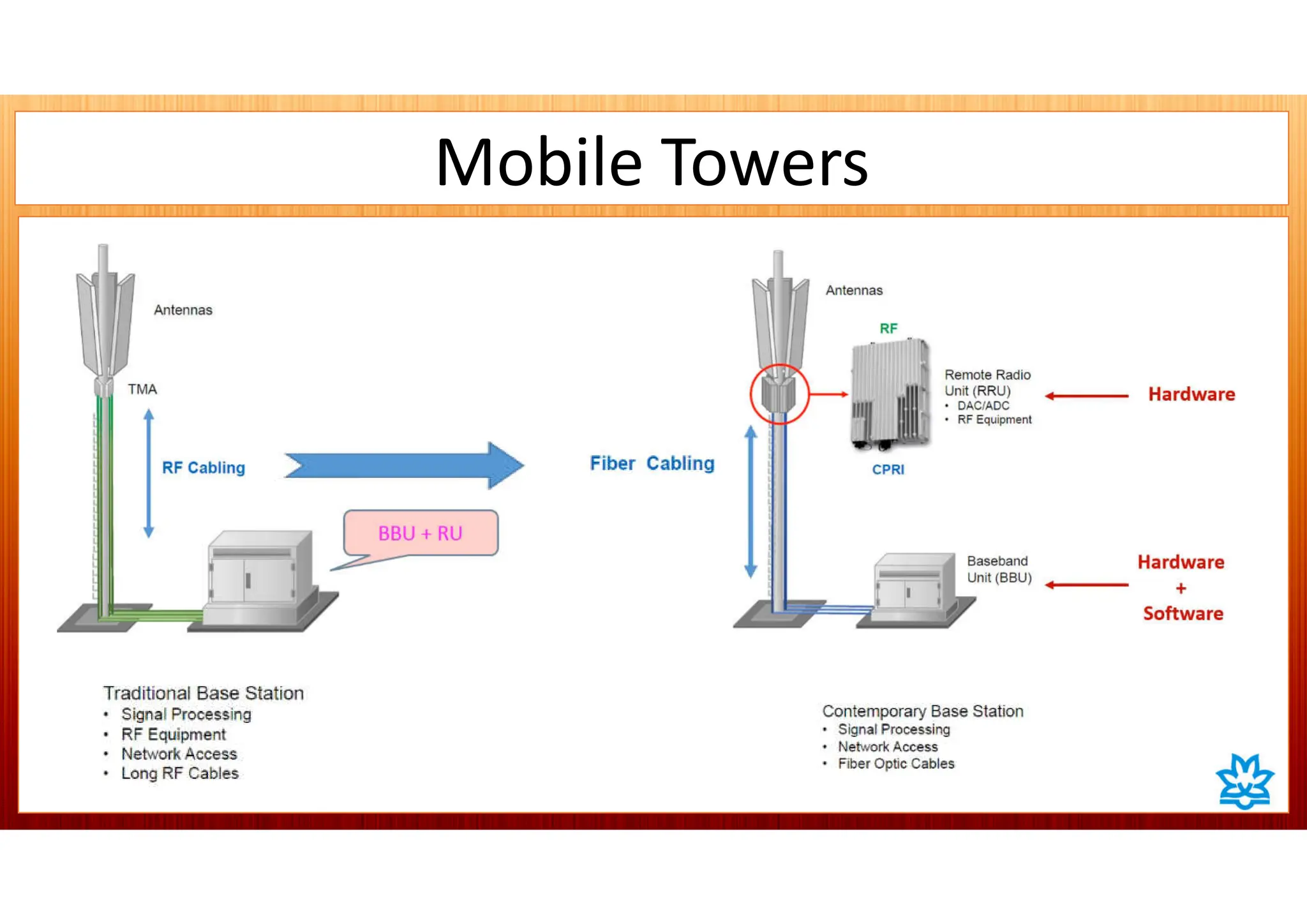
Mobile Towers
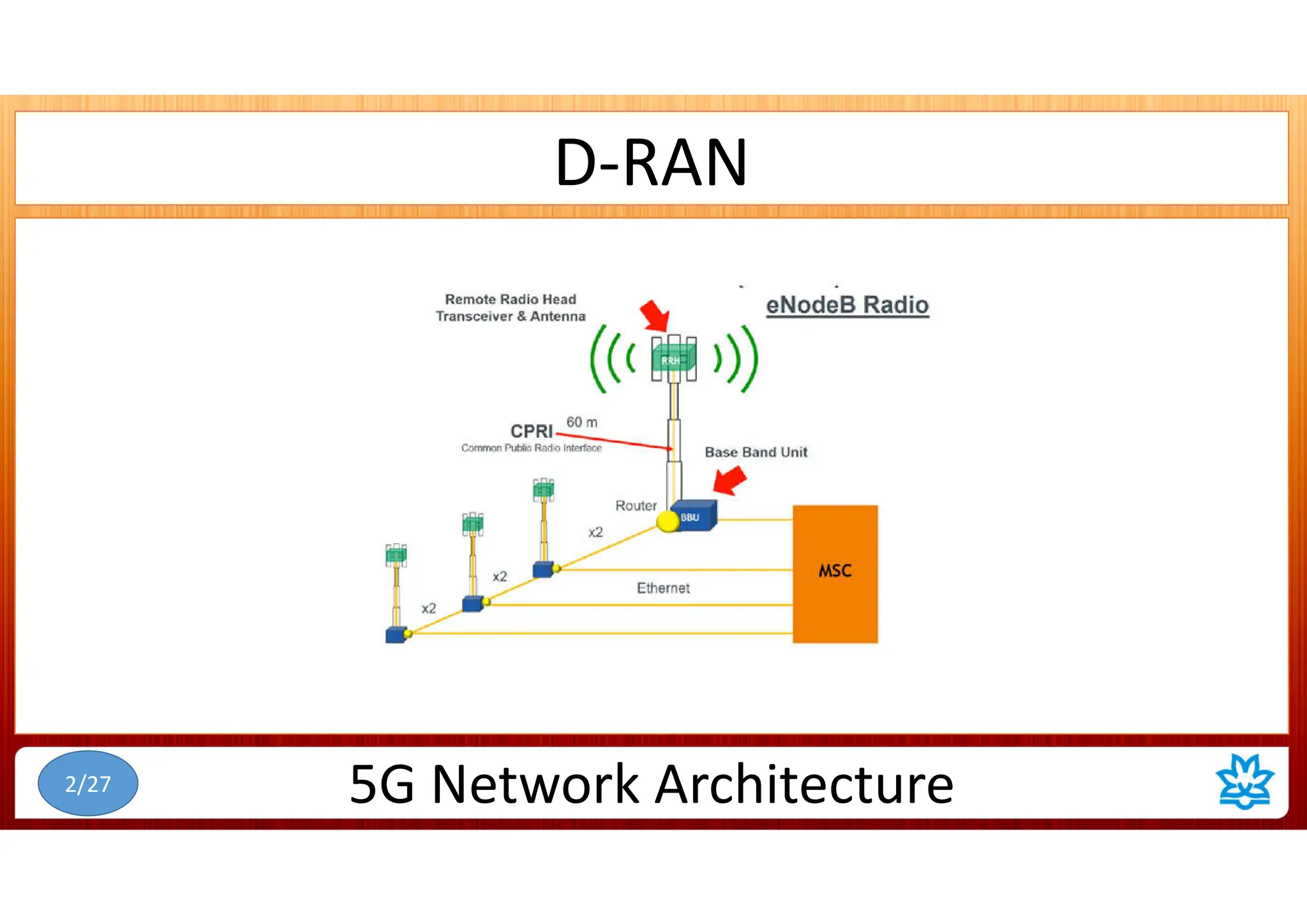
D-RAN
5G Network Architecture
2/27
Why We Need C-RAN?
5G Network Architecture
3/27
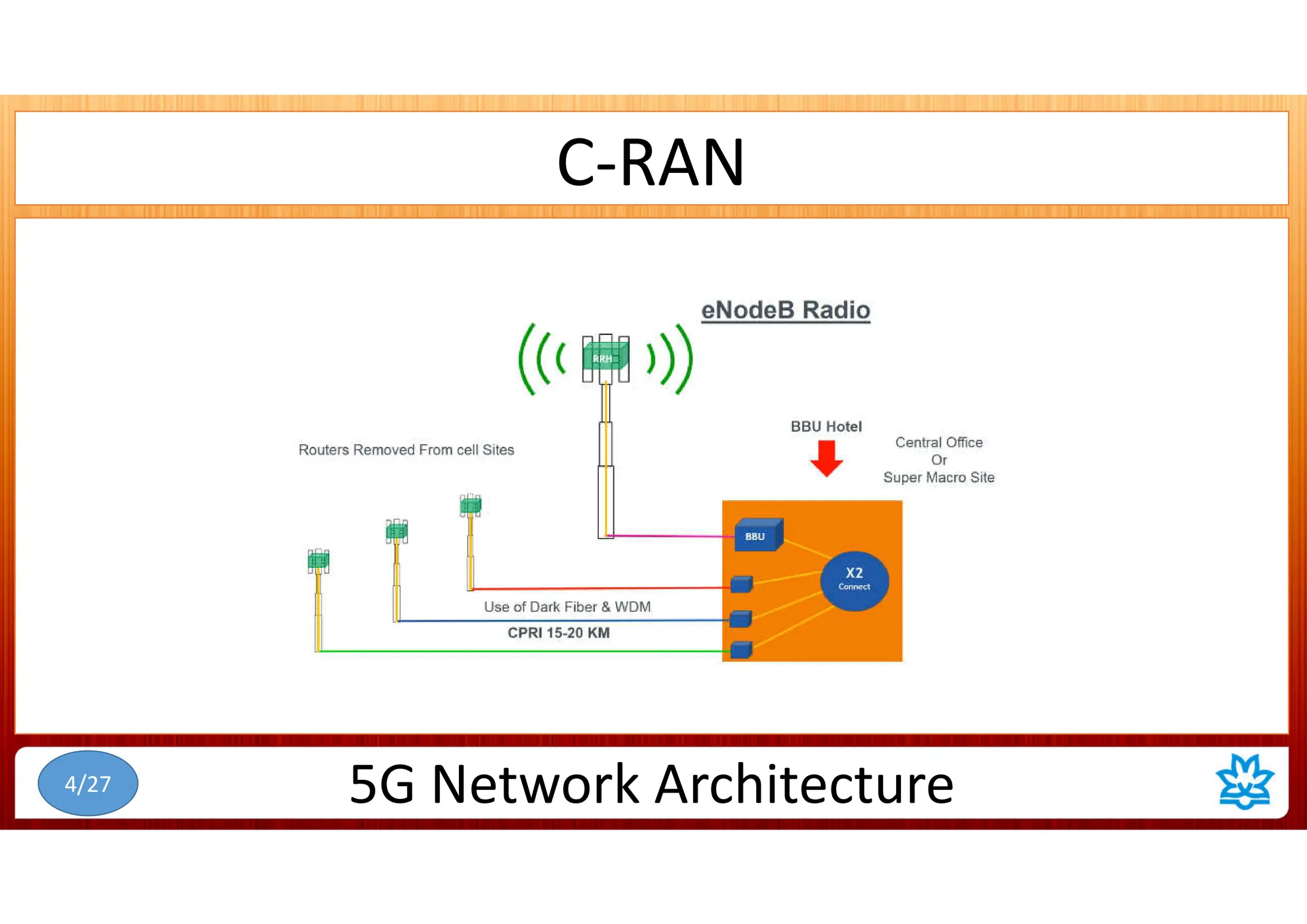
C-RAN
5G Network Architecture
4/27
V-RAN
5G Network Architecture
5/27
V-RAN
5G Network Architecture
6/27
Fronthul Interface (BBU <-> RRH)
• CPRI
• OBSAI
• ORI
5G Network Architecture
7/27
CPRI
• it has introduced in 2003.
• The Parties cooperating to define the CPRI Specification and are now encompassing
Ericsson, Huawei, NEC and Nokia.
• Its latest version is CPRI version 7.0 and has released in 2015.
• It specifies a digitized serial interface between a base station referred to as REC in CPRI
terminology and an RRH or RE.
• REC (on BBU side) and RE (on RRH side) exchange:
• User Data
• CPRI Control & Management data
• CPRI frame synchronization information
• The specification supports both electrical and optical interfaces as well as point-to-
point, star, ring, daisy-chain topologies.
5G Network Architecture
8/27
CPRI
• An antenna-carrier (AxC): IQ data of either Rx or Tx of
one carrier at one antenna element.
• CPRI transports I/Q data of particular antenna and
particular carrier. This "unit" is called an AxC unit or
Antenna-Carrier unit.
• Example:
In LTE system, if I=16 bits and Q=16 bits
then one AxC is of length 32 bits.
CPRI
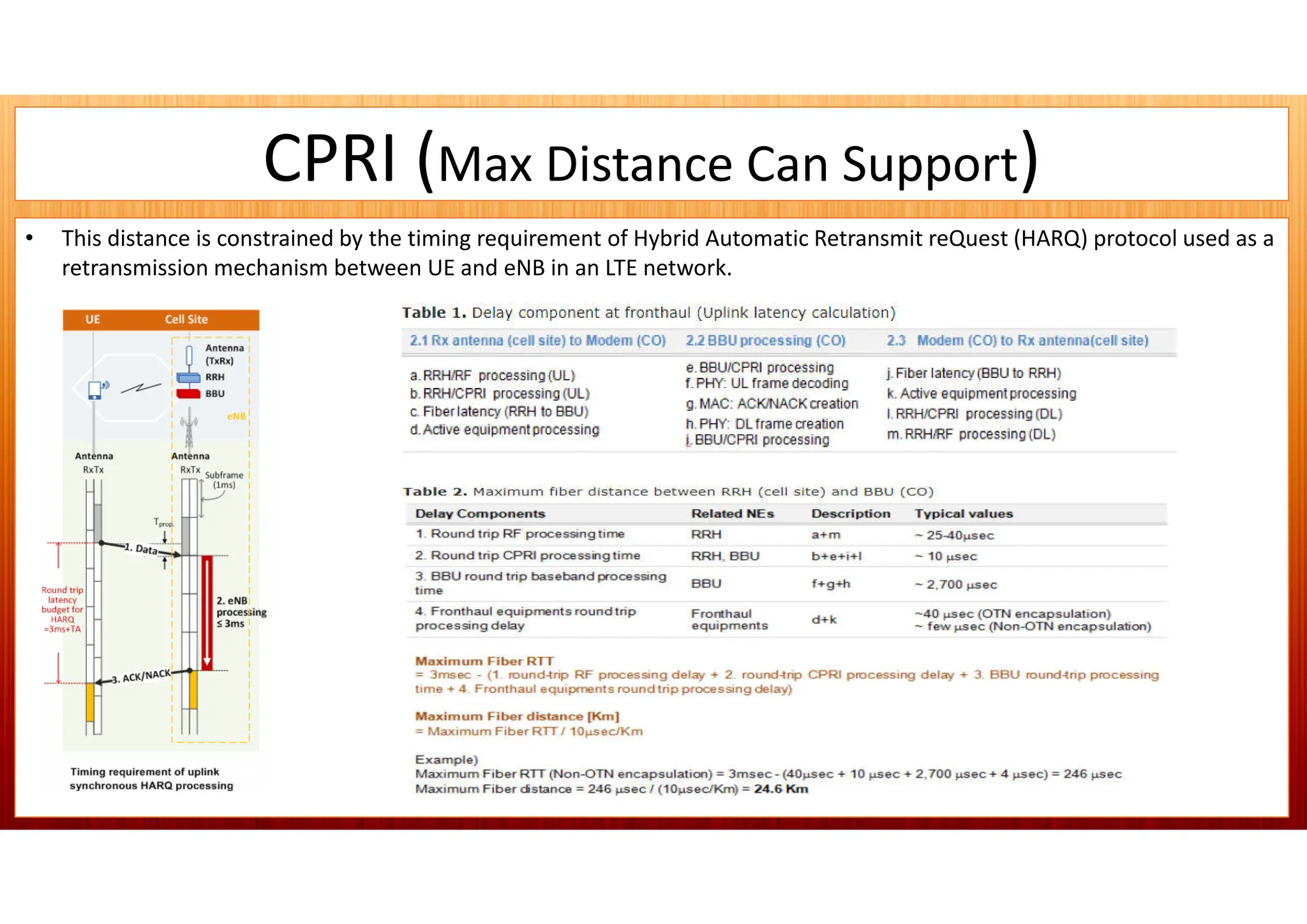
CPRI (Max Distance Can Support)
• This distance is constrained by the timing requirement of Hybrid Automatic Retransmit reQuest (HARQ) protocol used as a
retransmission mechanism between UE and eNB in an LTE network.
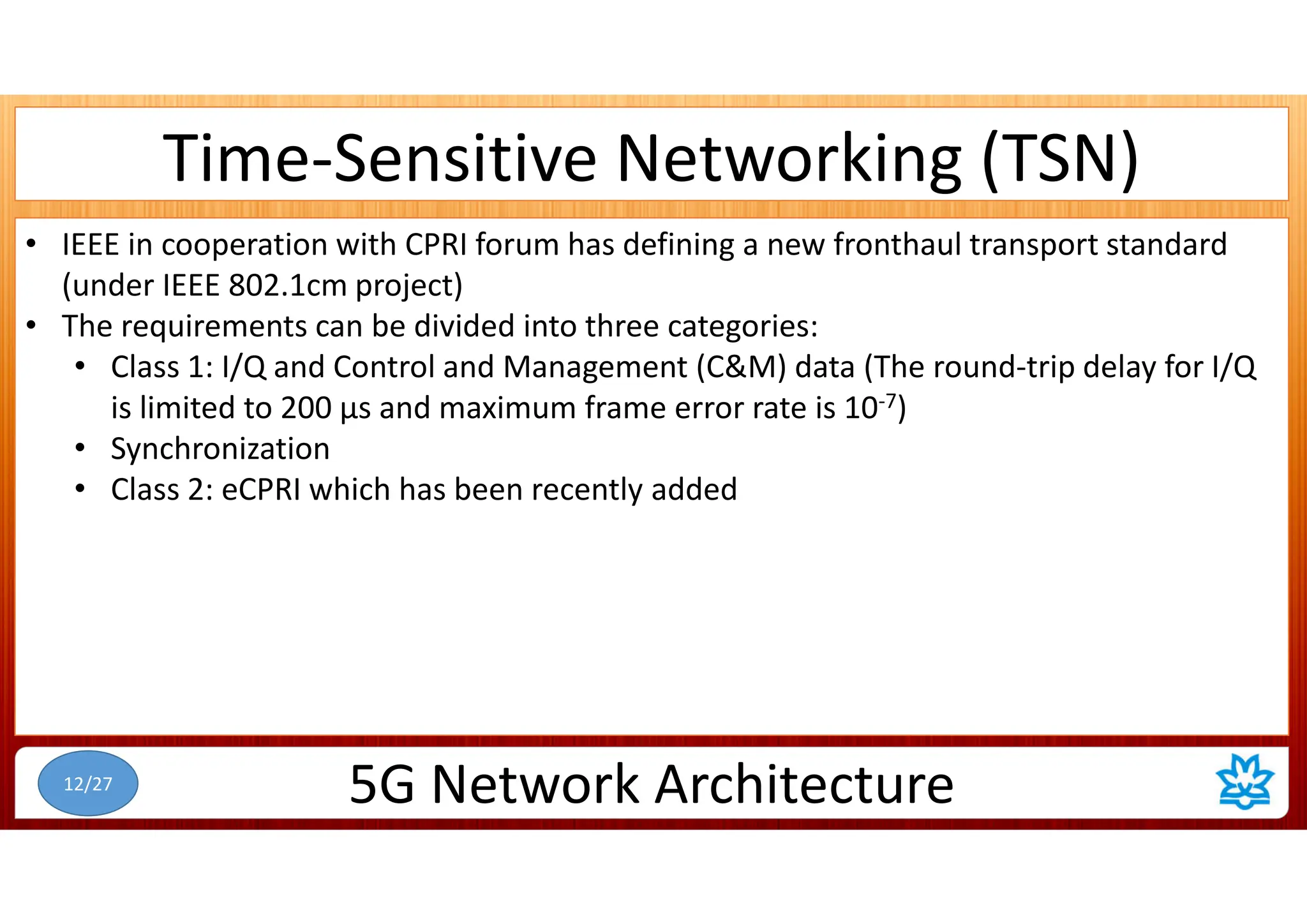
Time-Sensitive Networking (TSN)
• IEEE in cooperation with CPRI forum has defining a new fronthaul transport standard
(under IEEE 802.1cm project)
• The requirements can be divided into three categories:
• Class 1: I/Q and Control and Management (C&M) data (The round-trip delay for I/Q
is limited to 200 µs and maximum frame error rate is 10-7)
• Synchronization
• Class 2: eCPRI which has been recently added
5G Network Architecture
12/27
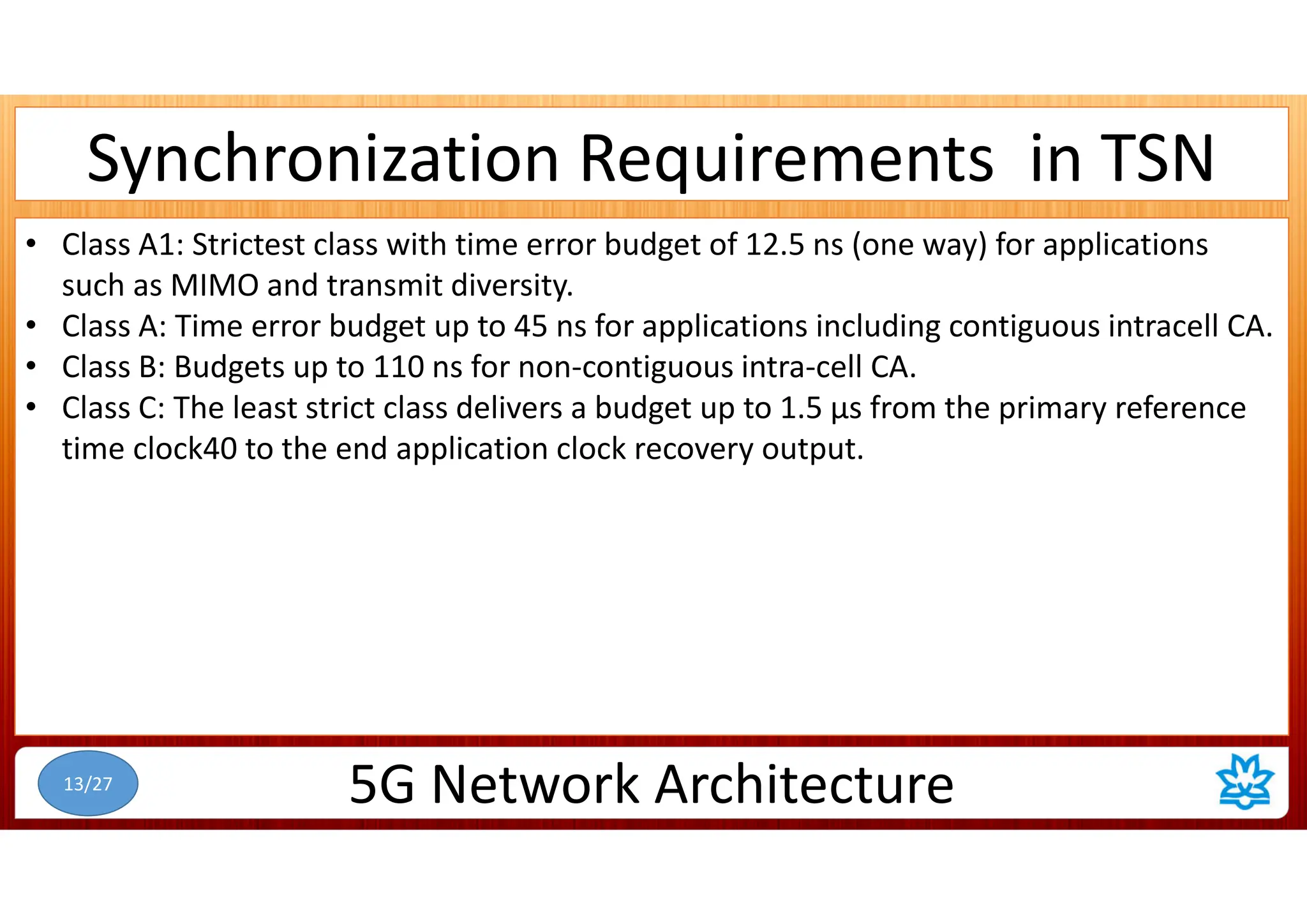
Synchronization Requirements in TSN
• Class A1: Strictest class with time error budget of 12.5 ns (one way) for applications
such as MIMO and transmit diversity.
• Class A: Time error budget up to 45 ns for applications including contiguous intracell CA.
• Class B: Budgets up to 110 ns for non-contiguous intra-cell CA.
• Class C: The least strict class delivers a budget up to 1.5 µs from the primary reference
time clock40 to the end application clock recovery output.
5G Network Architecture
13/27
CPRI Problem in 5G
5G Network Architecture
14/27
Solutions
• Function Splitting Options in eCPRI
• IEEE 1914.1 (NGFI)?
5G Network Architecture
15/27
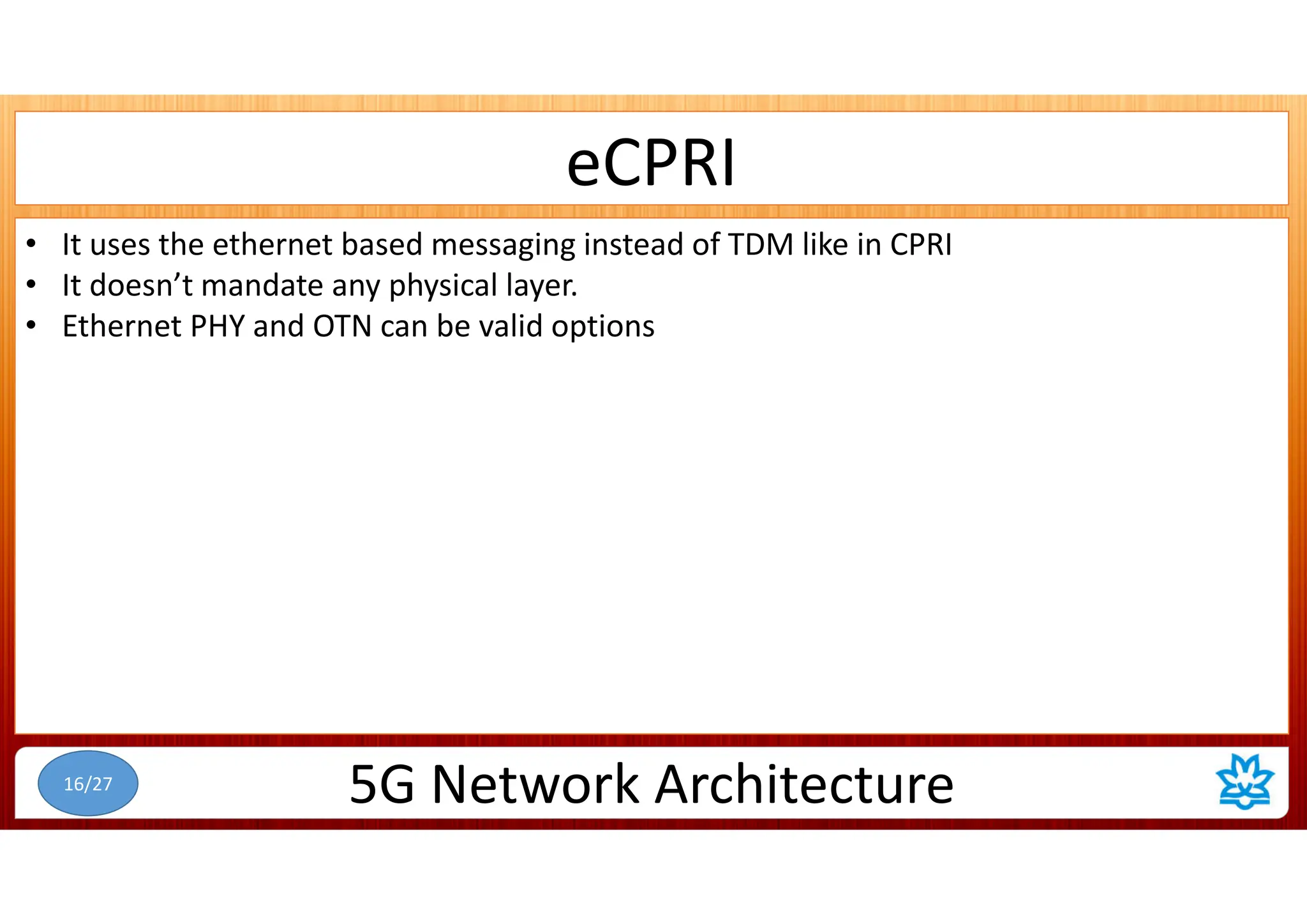
eCPRI
• It uses the ethernet based messaging instead of TDM like in CPRI
• It doesn’t mandate any physical layer.
• Ethernet PHY and OTN can be valid options
5G Network Architecture
16/27
Function Splitting
• various functional splits offer options for different use cases
• option 1: CPRI, extremely bandwidth and latency demanding.
• high order options: much lower bandwidth and latency requirements (like option 2)
• Lower order options: provide joint coordination/scheduling for advanced mobility
application (for example option 7 or 8)
5G Network Architecture
17/27
Function Splitting
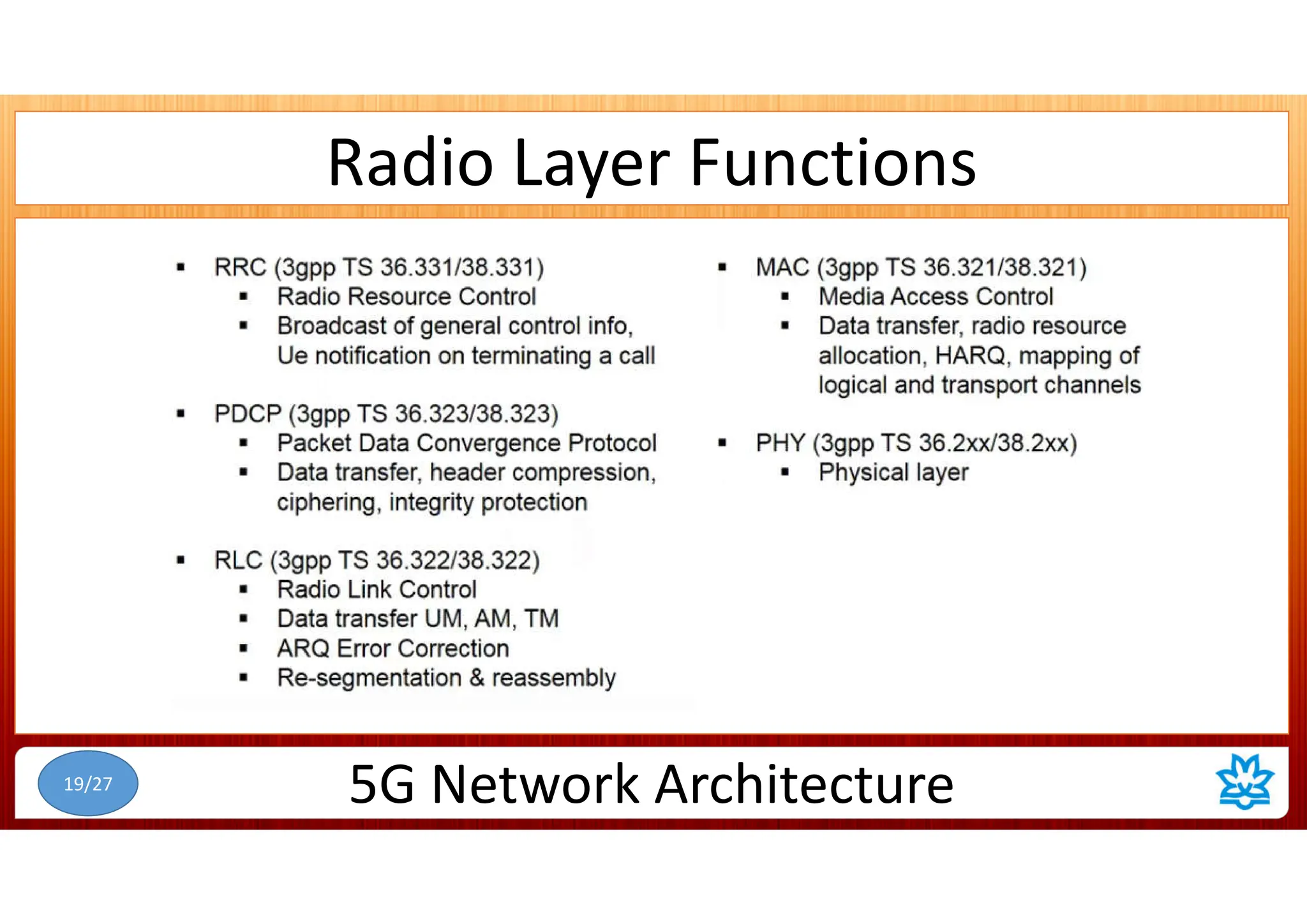
Radio Layer Functions
5G Network Architecture
19/27
IEEE 1914.1 Packet-Based Fronthaul Transport Network
• Architecture for the transport of mobile fronthaul traffic
• Analyzes different functional splits
• Purpose:
• enable critical 5G use cases such as mMIMO,CoMP,C-RAN
• simplifies network design, lowers costs by leveraging mature Ethernet-based
solution
• Fronthaul architecture: unified management & control common networking
protocol and network elements
• improves bandwidth efficiency, network scalability, sync performance and supports
cooperative radio modes.
5G Network Architecture
20/27
Single and Double Split Network Models
• NGFI I: interfacing low layers of base station processing chain
• NGFI II: interfacing mid/high layers of base station processing chain
5G Network Architecture
21/27
Backhaul
5G Network Architecture
22/27
Backhaul
MEC
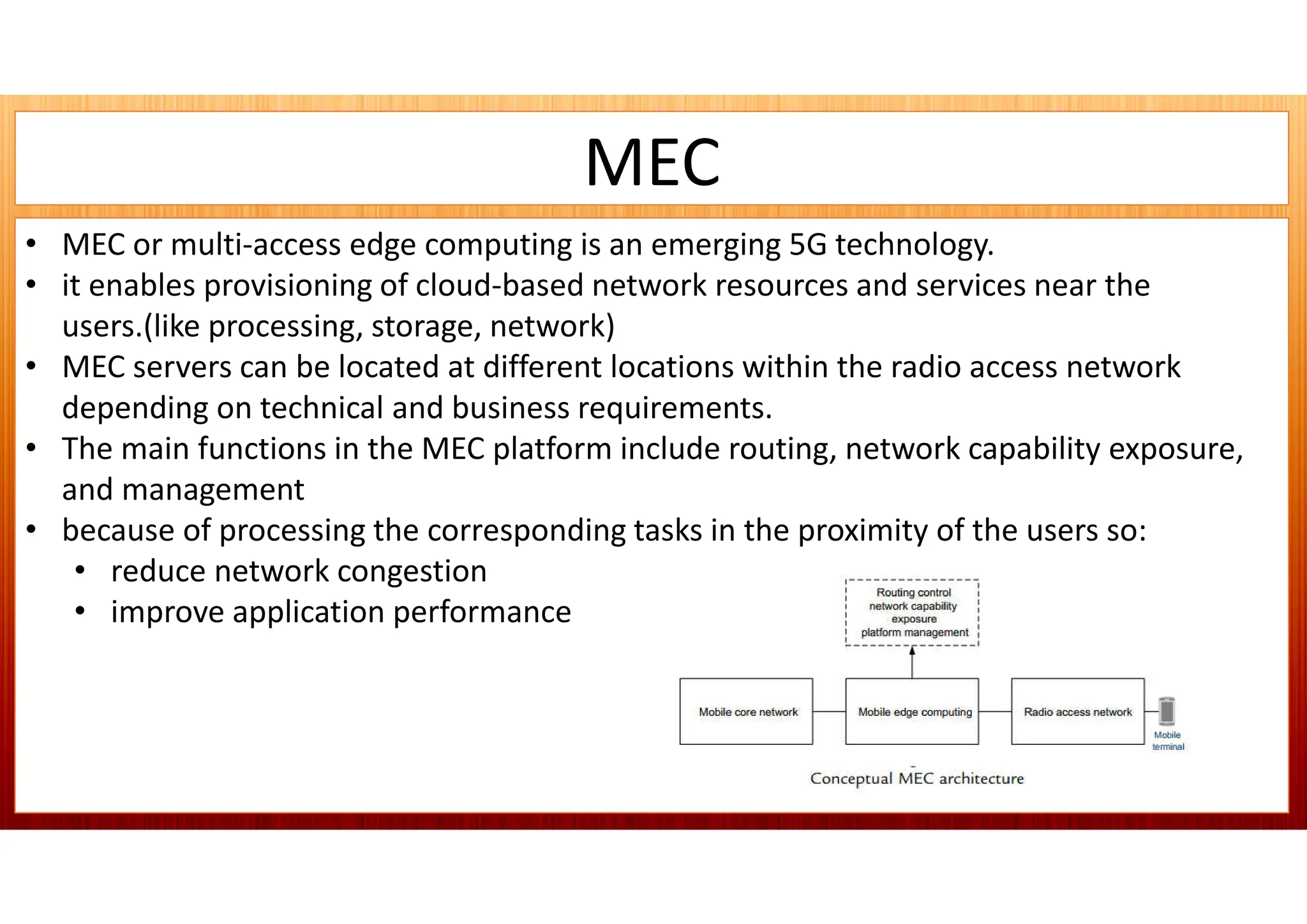
• MEC or multi-access edge computing is an emerging 5G technology.
• it enables provisioning of cloud-based network resources and services near the
users.(like processing, storage, network)
• MEC servers can be located at different locations within the radio access network
depending on technical and business requirements.
• The main functions in the MEC platform include routing, network capability exposure,
and management
• because of processing the corresponding tasks in the proximity of the users so:
• reduce network congestion
• improve application performance
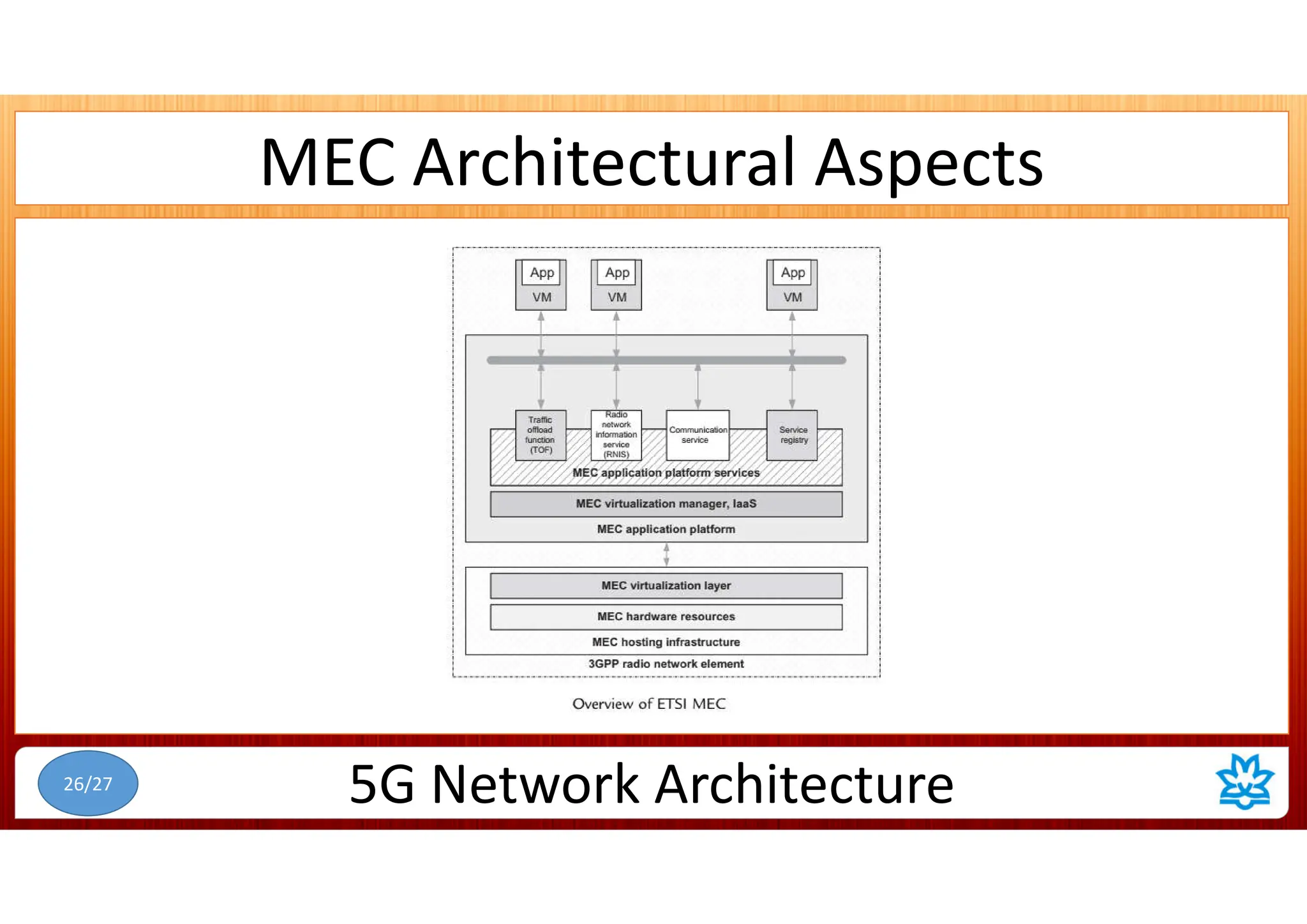
MEC Architectural Aspects
• high-level functional entities in the MEC framework:
• host-level
• MEC host
• MEC platform
• applications
• virtualization infrastructure
• the corresponding MEC host-level management entity
• network-level
• 3GPP radio access networks
• the local networks
• the external networks
• system-level
• MEC hosts
• MEC management necessary to run MEC applications within an operator network
5G Network Architecture
25/27
MEC Architectural Aspects
5G Network Architecture
26/27
MEC General Framework
5G Network Architecture
27/27
References
• https://www.netmanias.com/en/?m=view&id=blog&no=10670
• https://www.netmanias.com/en/?m=view&id=blog&no=6314
• https://www.netmanias.com/en/?m=view&id=oneshot&no=6259
• https://www.netmanias.com/en/?m=view&id=blog&no=6276
• https://www.netmanias.com/en/?m=view&id=blog&no=6220
• https://www.rfwireless-world.com/Terminology/CPRI-Line-Rates-and-Transport-Capacity.html
• https://www.ericsson.com/en/mobility-report/reports/june-2019/mobile-data-traffic-outlook
• https://www.statista.com/statistics/271405/global-mobile-data-traffic-forecast/
• https://www.youtube.com/watch?v=EBXZHIAmmms&t=409s
• https://www.youtube.com/watch?v=ne06ssVc3X0
• https://www.youtube.com/watch?v=UPucJcDAfSk&t=4s
• https://www.netmanias.com/en/?m=view&id=blog&no=10388&xtag=5g-c-ran-fronthaul-kt-korea-sdn-nfv-sk-
telecom&xref=mobile-network-architecture-for-5g-era-new-c-ran-architecture-and-distributed-5g-core
• https://www.youtube.com/watch?v=oaPRRbiaMyc
• https://www.netmanias.com/en/?m=view&id=blog&no=10388&xtag=5g-c-ran-fronthaul-kt-korea-sdn-nfv-sk-
telecom&xref=mobile-network-architecture-for-5g-era-new-c-ran-architecture-and-distributed-5g-cores
5G Network Architecture
Thank You
?

A 5g-arch-ran-info-2019 architecture book

  • 1.
    5G Network Architecture Lecturer:Rebwar Karimi Nov 2019
  • 2.
    Agenda • Mobile Towers •Remote Access Networks (D-RAN,C-RAN-V-RAN) • Fronthaul Interfaces • TSN • Mobile Backhaul • MEC 5G Network Architecture
  • 3.
  • 4.
  • 5.
    Why We NeedC-RAN? 5G Network Architecture 3/27
  • 6.
  • 7.
  • 8.
  • 9.
    Fronthul Interface (BBU<-> RRH) • CPRI • OBSAI • ORI 5G Network Architecture 7/27
  • 10.
    CPRI • it hasintroduced in 2003. • The Parties cooperating to define the CPRI Specification and are now encompassing Ericsson, Huawei, NEC and Nokia. • Its latest version is CPRI version 7.0 and has released in 2015. • It specifies a digitized serial interface between a base station referred to as REC in CPRI terminology and an RRH or RE. • REC (on BBU side) and RE (on RRH side) exchange: • User Data • CPRI Control & Management data • CPRI frame synchronization information • The specification supports both electrical and optical interfaces as well as point-to- point, star, ring, daisy-chain topologies. 5G Network Architecture 8/27
  • 11.
    CPRI • An antenna-carrier(AxC): IQ data of either Rx or Tx of one carrier at one antenna element. • CPRI transports I/Q data of particular antenna and particular carrier. This "unit" is called an AxC unit or Antenna-Carrier unit. • Example: In LTE system, if I=16 bits and Q=16 bits then one AxC is of length 32 bits.
  • 12.
  • 13.
    CPRI (Max DistanceCan Support) • This distance is constrained by the timing requirement of Hybrid Automatic Retransmit reQuest (HARQ) protocol used as a retransmission mechanism between UE and eNB in an LTE network.
  • 14.
    Time-Sensitive Networking (TSN) •IEEE in cooperation with CPRI forum has defining a new fronthaul transport standard (under IEEE 802.1cm project) • The requirements can be divided into three categories: • Class 1: I/Q and Control and Management (C&M) data (The round-trip delay for I/Q is limited to 200 µs and maximum frame error rate is 10-7) • Synchronization • Class 2: eCPRI which has been recently added 5G Network Architecture 12/27
  • 15.
    Synchronization Requirements inTSN • Class A1: Strictest class with time error budget of 12.5 ns (one way) for applications such as MIMO and transmit diversity. • Class A: Time error budget up to 45 ns for applications including contiguous intracell CA. • Class B: Budgets up to 110 ns for non-contiguous intra-cell CA. • Class C: The least strict class delivers a budget up to 1.5 µs from the primary reference time clock40 to the end application clock recovery output. 5G Network Architecture 13/27
  • 16.
    CPRI Problem in5G 5G Network Architecture 14/27
  • 17.
    Solutions • Function SplittingOptions in eCPRI • IEEE 1914.1 (NGFI)? 5G Network Architecture 15/27
  • 18.
    eCPRI • It usesthe ethernet based messaging instead of TDM like in CPRI • It doesn’t mandate any physical layer. • Ethernet PHY and OTN can be valid options 5G Network Architecture 16/27
  • 19.
    Function Splitting • variousfunctional splits offer options for different use cases • option 1: CPRI, extremely bandwidth and latency demanding. • high order options: much lower bandwidth and latency requirements (like option 2) • Lower order options: provide joint coordination/scheduling for advanced mobility application (for example option 7 or 8) 5G Network Architecture 17/27
  • 20.
  • 21.
    Radio Layer Functions 5GNetwork Architecture 19/27
  • 22.
    IEEE 1914.1 Packet-BasedFronthaul Transport Network • Architecture for the transport of mobile fronthaul traffic • Analyzes different functional splits • Purpose: • enable critical 5G use cases such as mMIMO,CoMP,C-RAN • simplifies network design, lowers costs by leveraging mature Ethernet-based solution • Fronthaul architecture: unified management & control common networking protocol and network elements • improves bandwidth efficiency, network scalability, sync performance and supports cooperative radio modes. 5G Network Architecture 20/27
  • 23.
    Single and DoubleSplit Network Models • NGFI I: interfacing low layers of base station processing chain • NGFI II: interfacing mid/high layers of base station processing chain 5G Network Architecture 21/27
  • 24.
  • 25.
  • 26.
    MEC • MEC ormulti-access edge computing is an emerging 5G technology. • it enables provisioning of cloud-based network resources and services near the users.(like processing, storage, network) • MEC servers can be located at different locations within the radio access network depending on technical and business requirements. • The main functions in the MEC platform include routing, network capability exposure, and management • because of processing the corresponding tasks in the proximity of the users so: • reduce network congestion • improve application performance
  • 27.
    MEC Architectural Aspects •high-level functional entities in the MEC framework: • host-level • MEC host • MEC platform • applications • virtualization infrastructure • the corresponding MEC host-level management entity • network-level • 3GPP radio access networks • the local networks • the external networks • system-level • MEC hosts • MEC management necessary to run MEC applications within an operator network 5G Network Architecture 25/27
  • 28.
    MEC Architectural Aspects 5GNetwork Architecture 26/27
  • 29.
    MEC General Framework 5GNetwork Architecture 27/27
  • 30.
    References • https://www.netmanias.com/en/?m=view&id=blog&no=10670 • https://www.netmanias.com/en/?m=view&id=blog&no=6314 •https://www.netmanias.com/en/?m=view&id=oneshot&no=6259 • https://www.netmanias.com/en/?m=view&id=blog&no=6276 • https://www.netmanias.com/en/?m=view&id=blog&no=6220 • https://www.rfwireless-world.com/Terminology/CPRI-Line-Rates-and-Transport-Capacity.html • https://www.ericsson.com/en/mobility-report/reports/june-2019/mobile-data-traffic-outlook • https://www.statista.com/statistics/271405/global-mobile-data-traffic-forecast/ • https://www.youtube.com/watch?v=EBXZHIAmmms&t=409s • https://www.youtube.com/watch?v=ne06ssVc3X0 • https://www.youtube.com/watch?v=UPucJcDAfSk&t=4s • https://www.netmanias.com/en/?m=view&id=blog&no=10388&xtag=5g-c-ran-fronthaul-kt-korea-sdn-nfv-sk- telecom&xref=mobile-network-architecture-for-5g-era-new-c-ran-architecture-and-distributed-5g-core • https://www.youtube.com/watch?v=oaPRRbiaMyc • https://www.netmanias.com/en/?m=view&id=blog&no=10388&xtag=5g-c-ran-fronthaul-kt-korea-sdn-nfv-sk- telecom&xref=mobile-network-architecture-for-5g-era-new-c-ran-architecture-and-distributed-5g-cores 5G Network Architecture
  • 31.