Business Strategy and Communications Two Cases SMART & NBC Towers Perrin & Workforce 2000
Purpose: demonstrate strategic use of stakeholder-based communications Agenda Communications in business strategy Defending a threat: TV and radio alcohol advertising Exploiting an opportunity: Workforce 2000 and Towers Perrin
Communications role in strategy is managing stakeholder relations Business strategy Well-reasoned plan to succeed (make money!) Management decisions that define firm’s direction and purpose identify and thwart threats exploit opportunities Communications role Manage relationships with critical publics to advance firm’s strategic interests counsel line and other staff collaborate with line  to manage market relations product capital human resource manage relations with non-market publics media community activists
“ Publics” -- or stakeholders -- are groups affected by or who affect the organization Organizations create their stakeholders/publics Sometimes deliberately Sometimes inadvertently Defined by specific issues and behaviors Can range from latent, to aware to active Depends on: issue recognition issue involvement sense of constraint (See Grunig,  Managing  and  Excellence)
Stakeholders are a strategic concern because they constrain success
Stakeholders can be categorized by degree of threat or cooperative potential Focus is on future possibilities Cooperative Potential (CP) potential to help the organization in future often greatest from stakeholders that are hurting organization at present opponents can potentially  help us most Competitive Threat (CT) potential to harm organization often greatest from stakeholders that are helping organization at present friends can potentially hurt us most
There are four general stakeholder categories on this basis
Goal: implement appropriate strategies to manage stakeholder relationships
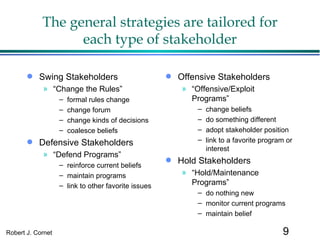
The general strategies are tailored for each type of stakeholder Swing Stakeholders “ Change the Rules” formal rules change change forum change kinds of decisions coalesce beliefs Defensive Stakeholders “ Defend Programs” reinforce current beliefs maintain programs link to other favorite issues Offensive Stakeholders “ Offensive/Exploit Programs” change beliefs do something different adopt stakeholder position link to a favorite program or interest Hold Stakeholders “ Hold/Maintenance Programs” do nothing new monitor current programs maintain belief
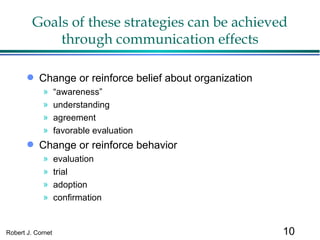
Goals of these strategies can be achieved through communication effects Change or reinforce belief about organization “ awareness” understanding agreement favorable evaluation Change or reinforce behavior evaluation trial adoption confirmation
Two cases that follow illustrate these principles in practice Broadcasting and the ad ban issue Repositioning Towers Perrin through Workforce 2000 issues campaign
Defending a Threat: The Ad Ban Issue
In the mid-1980s broadcasters faced a stakeholder threat to their business Strategic business issue: Retain an already eroding advertiser base Strategic threat: Movement led by Center for Science in Public Interest to ban beer and wine advertising 5% of network TV advertising 5.5% of spot advertising 12.5% of all radio Movement gathered coalition of parent, church, public interest and drug abuse organizations Ban viewed as a realistic possibility
Broadcasters, led by NBC, developed a stakeholder-based strategic response Identified three broad stakeholder groups Defensive members of industry and related organizations with same economic interests Offensive special interest groups who were already part of CSPI coalition or shared its interests and goals Swing special interests and government organizations not yet committed to either position
Broadcasters redefined issue and their usual position Redefined issue From “ban the ads” to... “ Stop abuse among young people” Redefined own position From “defend right to advertise” to... “ Make industry part of solution not part of problem”
Broadcasters created strategic programs appropriate to each kind of stakeholder Defensive Encouraged “responsible” programming and community activity Created credible resource issue guide for the industry Offensive Used power of television for “good” as this group defined “good” Revised broadcast standards Admitted errors Swing Changed forum and decisions by creating National Partnership to Prevent Abuse Among Youth Under aegis of Juvenile Justice Department Included all stakeholders CSPI PTA Brewers Wine Institute NCA Used collaborative process
Strategy was successful Ban movement died  Members too involved in work  with  the broadcasters and their associates Industry praised by President and Congress for its responsibility Improved relationships with special interest group stakeholders
Exploiting an Opportunity:  Workforce 2000 and Towers Perrin
In early 1990s Towers Perrin needed to change its positioning in minds of clients Saw competitive advantage in being viewed as “value adding,” comprehensive management consulting firm Had been known as “darn good and utterly reliable” actuarial and benefits consulting firm Wanted to be seen as bringing new understanding to critical human resource business issues
Saw opportunity to take this position through exploiting Workforce 2000 issue Basic strategy was “offensive” Change beliefs by changing own actions Do something different Success would mean... Towers Perrin “owning” the issue then identified with Hudson Institute Towers Perrin being the consulting company the nation had to listen to
Strategy was executed with an integrated communications program Survey of corporate “best practices” to deal with workforce change defined “change” in WF2000 terms National seminars at Georgetown and Vanderbilt business schools on WF2000 as a policy issue Concentrated media relations campaign USA Today NY Times Washington Post Network news
Capstone was Towers Perrin “doing something different” Collaborating with Senate Taskforce on Workplace Readiness for special hearing “ We are here today to listen to Towers Perrin” -- Senator Mikulski Testimony by Towers Perrin CEO included policy “call to action”
Strategy achieved its objectives Owned issue 29% unaided association of Towers Perrin with WF2000 next leading association <1% (for Hudson Institute) Client spontaneous feedback “ You the only firm who can deal with this kind of big issue” New business $1 MM+ engagement with IBM a direct result
Conclusion Communications can make strategic contribution to the business Enabled by stakeholder communications framework Who are stakeholders? What threat or cooperative potential do they represent? What kind of communication and relationship programs will minimize threat and maximize cooperation?

Strategic Pr

  • 1.
    Business Strategy andCommunications Two Cases SMART & NBC Towers Perrin & Workforce 2000
  • 2.
    Purpose: demonstrate strategicuse of stakeholder-based communications Agenda Communications in business strategy Defending a threat: TV and radio alcohol advertising Exploiting an opportunity: Workforce 2000 and Towers Perrin
  • 3.
    Communications role instrategy is managing stakeholder relations Business strategy Well-reasoned plan to succeed (make money!) Management decisions that define firm’s direction and purpose identify and thwart threats exploit opportunities Communications role Manage relationships with critical publics to advance firm’s strategic interests counsel line and other staff collaborate with line to manage market relations product capital human resource manage relations with non-market publics media community activists
  • 4.
    “ Publics” --or stakeholders -- are groups affected by or who affect the organization Organizations create their stakeholders/publics Sometimes deliberately Sometimes inadvertently Defined by specific issues and behaviors Can range from latent, to aware to active Depends on: issue recognition issue involvement sense of constraint (See Grunig, Managing and Excellence)
  • 5.
    Stakeholders are astrategic concern because they constrain success
  • 6.
    Stakeholders can becategorized by degree of threat or cooperative potential Focus is on future possibilities Cooperative Potential (CP) potential to help the organization in future often greatest from stakeholders that are hurting organization at present opponents can potentially help us most Competitive Threat (CT) potential to harm organization often greatest from stakeholders that are helping organization at present friends can potentially hurt us most
  • 7.
    There are fourgeneral stakeholder categories on this basis
  • 8.
    Goal: implement appropriatestrategies to manage stakeholder relationships
  • 9.
    The general strategiesare tailored for each type of stakeholder Swing Stakeholders “ Change the Rules” formal rules change change forum change kinds of decisions coalesce beliefs Defensive Stakeholders “ Defend Programs” reinforce current beliefs maintain programs link to other favorite issues Offensive Stakeholders “ Offensive/Exploit Programs” change beliefs do something different adopt stakeholder position link to a favorite program or interest Hold Stakeholders “ Hold/Maintenance Programs” do nothing new monitor current programs maintain belief
  • 10.
    Goals of thesestrategies can be achieved through communication effects Change or reinforce belief about organization “ awareness” understanding agreement favorable evaluation Change or reinforce behavior evaluation trial adoption confirmation
  • 11.
    Two cases thatfollow illustrate these principles in practice Broadcasting and the ad ban issue Repositioning Towers Perrin through Workforce 2000 issues campaign
  • 12.
    Defending a Threat:The Ad Ban Issue
  • 13.
    In the mid-1980sbroadcasters faced a stakeholder threat to their business Strategic business issue: Retain an already eroding advertiser base Strategic threat: Movement led by Center for Science in Public Interest to ban beer and wine advertising 5% of network TV advertising 5.5% of spot advertising 12.5% of all radio Movement gathered coalition of parent, church, public interest and drug abuse organizations Ban viewed as a realistic possibility
  • 14.
    Broadcasters, led byNBC, developed a stakeholder-based strategic response Identified three broad stakeholder groups Defensive members of industry and related organizations with same economic interests Offensive special interest groups who were already part of CSPI coalition or shared its interests and goals Swing special interests and government organizations not yet committed to either position
  • 15.
    Broadcasters redefined issueand their usual position Redefined issue From “ban the ads” to... “ Stop abuse among young people” Redefined own position From “defend right to advertise” to... “ Make industry part of solution not part of problem”
  • 16.
    Broadcasters created strategicprograms appropriate to each kind of stakeholder Defensive Encouraged “responsible” programming and community activity Created credible resource issue guide for the industry Offensive Used power of television for “good” as this group defined “good” Revised broadcast standards Admitted errors Swing Changed forum and decisions by creating National Partnership to Prevent Abuse Among Youth Under aegis of Juvenile Justice Department Included all stakeholders CSPI PTA Brewers Wine Institute NCA Used collaborative process
  • 17.
    Strategy was successfulBan movement died Members too involved in work with the broadcasters and their associates Industry praised by President and Congress for its responsibility Improved relationships with special interest group stakeholders
  • 18.
    Exploiting an Opportunity: Workforce 2000 and Towers Perrin
  • 19.
    In early 1990sTowers Perrin needed to change its positioning in minds of clients Saw competitive advantage in being viewed as “value adding,” comprehensive management consulting firm Had been known as “darn good and utterly reliable” actuarial and benefits consulting firm Wanted to be seen as bringing new understanding to critical human resource business issues
  • 20.
    Saw opportunity totake this position through exploiting Workforce 2000 issue Basic strategy was “offensive” Change beliefs by changing own actions Do something different Success would mean... Towers Perrin “owning” the issue then identified with Hudson Institute Towers Perrin being the consulting company the nation had to listen to
  • 21.
    Strategy was executedwith an integrated communications program Survey of corporate “best practices” to deal with workforce change defined “change” in WF2000 terms National seminars at Georgetown and Vanderbilt business schools on WF2000 as a policy issue Concentrated media relations campaign USA Today NY Times Washington Post Network news
  • 22.
    Capstone was TowersPerrin “doing something different” Collaborating with Senate Taskforce on Workplace Readiness for special hearing “ We are here today to listen to Towers Perrin” -- Senator Mikulski Testimony by Towers Perrin CEO included policy “call to action”
  • 23.
    Strategy achieved itsobjectives Owned issue 29% unaided association of Towers Perrin with WF2000 next leading association <1% (for Hudson Institute) Client spontaneous feedback “ You the only firm who can deal with this kind of big issue” New business $1 MM+ engagement with IBM a direct result
  • 24.
    Conclusion Communications canmake strategic contribution to the business Enabled by stakeholder communications framework Who are stakeholders? What threat or cooperative potential do they represent? What kind of communication and relationship programs will minimize threat and maximize cooperation?