Social problem solving skills following childhood traumatic brain injury and its association with self-regulation and social and behavioral functioning   Kalaichelvi Ganesalingam, Keith Owen Yeates, Ann Sanson, and Vicki Anderson Presented by: Edward Harris, Jordan McNeely, & Keith Pelstring
Introduction Childhood Traumatic Brain Injury (TBI) Results in a variety of adverse outcomes Magnitude closely related to severity of injury (Yeates, 2000) Moderate to severe TBI results in significant deficits in NP functioning Poor regulatory skills, e.g. hyperactivity, inattention (Max, et al. 2004) Poor adaptive behaviors, interpersonal relations (Yeates, et al. 2004) Lower social competency, higher levels of loneliness (Andrews, Rose & Johnson, 1998)
Introduction cont. Research pays little attention to underlying factors Previous studies propose various NP deficits as predictors (e.g. McGann, Werven & Douglas, 1997) Scores on traditional tests rarely strongly predictive among children with TBI  (Papero, et al. 1993) Studies need to examine contribution of social cognitive skills, NP factors, and interpersonal thinking skills to social behavioral functioning.
Introduction cont. Available studies suggest children with TBI demonstrate poorer social problem solving skills. Generate fewer solutions to hypothetical situations Solutions provided are indirect, less positive, less assertive (Warschausky, et al. 1997) Children with severe TBI often respond with immature strategies to solve social problems Use less advanced reasoning to evaluate the effectiveness of chosen strategies (Janusz, et al. 2002)
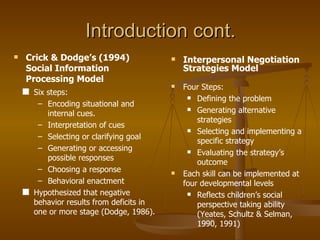
Introduction cont. Crick & Dodge’s (1994) Social Information Processing Model Six steps: Encoding situational and internal cues. Interpretation of cues Selecting or clarifying goal Generating or accessing possible responses Choosing a response Behavioral enactment Hypothesized that negative behavior results from deficits in one or more stage (Dodge, 1986). Interpersonal Negotiation Strategies Model Four Steps: Defining the problem Generating alternative strategies Selecting and implementing a specific strategy Evaluating the strategy’s outcome Each skill can be implemented at four developmental levels Reflects children’s social perspective taking ability (Yeates, Schultz & Selman, 1990, 1991)
Introduction cont. Current study uses newly developed, semi-structured task Similar to SIP and INS models, but attends specifically to step 5 of SIP and step 3 of INS Less time consuming to administer and easier to score Overall Goal: “…to examine the impact of childhood TBI on social problem solving skills… and to determine whether social problem solving is predicted by measures of self regulation.”
Hypothesis Children with moderate to severe TBI would display poorer social problem solving skills. Regardless of group, self regulation would account for significant variance in social problem solving. Social problem solving would account for significant variance in social and behavioral functioning.
Method Subjects Experimental Group 60 children with TBI’s were recruited from 3 hospitals around Australia 5 more children with TBI’s were recruited form primary schools in New Zealand Control group 5 children from Australia and 60 children from New Zealand without TBI’s were recruited the control subject matched the experimental group for age and gender
Method cont. Subjects cont. All subjects were ages 6-11 All subjects were attending a mainstream primary school 95% of subjects were Caucasian  Remaining 5% were of Asian, Polynesian, or Middle-Eastern decent All subjects wrote and spoke English as their first language All subjects with severe TBI’s (n=32) had intracranial abnormalities on CT and/or MRI scans  Of the subjects with moderate TBI’s (n=33) 73% had intracranial abnormalities on CT and/or MRI scans Socio-economic status varied widely based on maternal education and occupation
Method cont. Subjects cont. Diagnosis criteria  TBI’s had to be documented and accidental It had been 2-5 years from TBI incident  Severe TBI was defined as a score of 8 or less on the Glasgow Coma Scale (GCS) Moderate TBI was defined as a GCS score of 9-12 Also, a TBI with a GCS score of 13-15 was defined as moderate if it was accompanied by: Skull fracture Intracranial lesion diffuse cerebral swelling on routine clinical imaging Post-traumatic neurological abnormality  Loss of consciousness for longer that 15 minutes
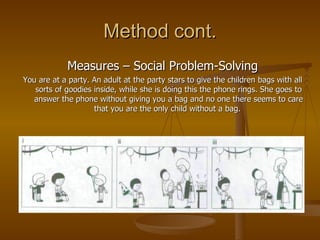
Method cont. Measures – Social Problem-Solving  This was assessed by presenting 8 hypothetical situations involving social problems  The interviewer read the situation from a script while the child followed along with a three picture cartoon depicting the situation After the interviewer had finished telling the story they would ask the child “What would you do in this situation.”  Response were coded as assertive, aggressive, avoidant, or irrelevant/no response  Assertive responses were the ones that were considered relevant and pro-social All interviews were audio taped and transcribed  To insure reliability 30% of subjects responses were coded by an independent rater
Method cont. Measures – Social Problem-Solving You are at a party. An adult at the party stars to give the children bags with all sorts of goodies inside, while she is doing this the phone rings. She goes to answer the phone without giving you a bag and no one there seems to care that you are the only child without a bag.
Method cont. Measures – Self-regulating tasks The Matching Familiar Figures Test (MFFT; Kagan, 1966)  This was used to assess cognitive impulsivity Children are presented with a figure and asked to find identical matches to this figure in and array of similar distracters Response errors and response latency were recorded On this test high scores indicate poor self-regulation 10 Minute Delay of Gratification Task (DGT; Mischel & Ebbesen, 1970) This was used to assess behavioral self-regulation Child was put in a room with a bell on a table, one piece of candy was placed in front of the bell and two pieces of candy were placed behind the bell. The experimenter prepared to leave and the child was told that if they waited for the experimenter to return they would receive 2 pieces of candy but if they rang the bell to summon the experimenter back into the room they would only receive one piece of candy. Children were videotaped  Distraction strategies and time until gratification were recorded
Method cont. Measures – Self-regulating tasks Test of Everyday Attention for Children (TEA-Ch; Manly, Robertson, Anderson, & Nimmo-Smith, 1999)  Three of the TEA-Ch subscales were employed in this study to look at various aspects of cognitive self-regulation. These are sky search, score, and opposite worlds.
Method cont. Measures – Self-regulating tasks TEA-Ch Sky Search assessed focused attention Children asked to circle spaceships on a paper with and without distracters Non-distracter task time was subtracted from distracter task time to control for motor speed Score test assessed unassisted sustained attention Children were asked to count the number of laser beam sounds in a set  There were 10 sets that lasted 30-40 seconds each and there were 10-20 sounds per set Opposite Worlds assessed control and suppression of automatic verbal response Child was asked to follow a path on a page that periodically had the numerals 1 and 2 On the “same world” trial the child was ask to say “one” upon seeing 1 and “two” upon seeing 2 On the “opposite world” trail the child was ask to say “two” upon seeing 1 and “one” upon seeing 2 Only the “opposite world” trail data was used in this study
Method cont. Measures – Social and behavioral functioning  Eyberg Child Behavior Inventory (ECBI; Eyberg & Robinson, 1983) This assesses the intensity of a variety of behavior problem children may display at home This measure was parent rated High scores reflect poor functioning Sutter-Eyberg Student Behavior Inventory – Revised (SESBI-R; Funderburk & Eyberg, 1989) This assesses the intensity of a variety of behavior problem children may display at school This measure was teacher rated  High scores reflect poor functioning Social Skills Rating System (SSRS; Gresham & Elliot, 1990) This assesses behaviors that allow children to interact effectively This measure was rated by parents and teachers High scores reflect better functioning
Method cont. Measures – Social and behavioral functioning Emotion Regulation Checklist (ERC; Shields & Cicchetti, 1998) Emotion regulation  Assesses empathy and emotional awareness High scores reflect better functioning Lability/negativity  Assesses emotional flexibility and negative affect High scores reflect poor functioning Both of these subscales were parent rated
Data Analysis  An analysis of covariance (ANCOVA) was ran between group membership and response to social problem solving task Many correlations were ran between responses, measures of self-regulation, and parent and teacher rated social and behavioral functioning Also hierarchal regression analyses were conducted to determine self-regulation’s significance as determinants for social problem solving and social and behavioral outcomes
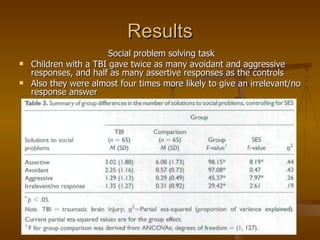
Results Social problem solving task Children with a TBI gave twice as many avoidant and aggressive responses, and half as many assertive responses as the controls Also they were almost four times more likely to give an irrelevant/no response answer
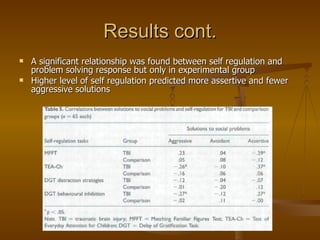
Results cont. A significant relationship was found between self regulation and problem solving response but only in experimental group Higher level of self regulation predicted more assertive and fewer aggressive solutions
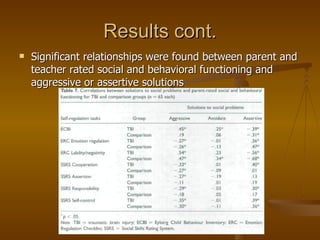
Results cont. Significant relationships were found between parent and teacher rated social and behavioral functioning and aggressive or assertive solutions
Discussion Results supported the hypothesis that children with TBI displayed poorer social problem solving skills than uninjured children. More avoidant, aggressive Consistent with previous research
Self Regulation Taken collectively, better performance on self regulation measurements predicted more pro-social solutions. No individual measure showed significant variance Measures used were intercorrelated Partly consistent with previous research that failed to find significant relationships between neuropsychological tests and social behavior
Social Problem-Solving Measured skills accounted for significant variance in behavioral functioning Aggressive solutions -- poorer functioning Assertive solutions  -- better functioning *Avoidant solutions were not predictive of behavioral functioning* -Measures in this study were more focused on externalized behaviors rather than internalized ones
Confounds and Shortcomings Children without TBI did not have the stressful experience of a hospital stay.  Children with non-cranial orthopedic injuries would have made better controls. Most children from the TBI sample were from Australia, while the non-TBI sample were predominantly from New Zealand.
Confounds and Shortcomings Linguistic abilities were not assessed Some differences between the samples may have been attributable to ability to articulate. Authors feel that controlling for language deficits should be addressed in future research.

Problem Solving

  • 1.
    Social problem solvingskills following childhood traumatic brain injury and its association with self-regulation and social and behavioral functioning Kalaichelvi Ganesalingam, Keith Owen Yeates, Ann Sanson, and Vicki Anderson Presented by: Edward Harris, Jordan McNeely, & Keith Pelstring
  • 2.
    Introduction Childhood TraumaticBrain Injury (TBI) Results in a variety of adverse outcomes Magnitude closely related to severity of injury (Yeates, 2000) Moderate to severe TBI results in significant deficits in NP functioning Poor regulatory skills, e.g. hyperactivity, inattention (Max, et al. 2004) Poor adaptive behaviors, interpersonal relations (Yeates, et al. 2004) Lower social competency, higher levels of loneliness (Andrews, Rose & Johnson, 1998)
  • 3.
    Introduction cont. Researchpays little attention to underlying factors Previous studies propose various NP deficits as predictors (e.g. McGann, Werven & Douglas, 1997) Scores on traditional tests rarely strongly predictive among children with TBI (Papero, et al. 1993) Studies need to examine contribution of social cognitive skills, NP factors, and interpersonal thinking skills to social behavioral functioning.
  • 4.
    Introduction cont. Availablestudies suggest children with TBI demonstrate poorer social problem solving skills. Generate fewer solutions to hypothetical situations Solutions provided are indirect, less positive, less assertive (Warschausky, et al. 1997) Children with severe TBI often respond with immature strategies to solve social problems Use less advanced reasoning to evaluate the effectiveness of chosen strategies (Janusz, et al. 2002)
  • 5.
    Introduction cont. Crick& Dodge’s (1994) Social Information Processing Model Six steps: Encoding situational and internal cues. Interpretation of cues Selecting or clarifying goal Generating or accessing possible responses Choosing a response Behavioral enactment Hypothesized that negative behavior results from deficits in one or more stage (Dodge, 1986). Interpersonal Negotiation Strategies Model Four Steps: Defining the problem Generating alternative strategies Selecting and implementing a specific strategy Evaluating the strategy’s outcome Each skill can be implemented at four developmental levels Reflects children’s social perspective taking ability (Yeates, Schultz & Selman, 1990, 1991)
  • 6.
    Introduction cont. Currentstudy uses newly developed, semi-structured task Similar to SIP and INS models, but attends specifically to step 5 of SIP and step 3 of INS Less time consuming to administer and easier to score Overall Goal: “…to examine the impact of childhood TBI on social problem solving skills… and to determine whether social problem solving is predicted by measures of self regulation.”
  • 7.
    Hypothesis Children withmoderate to severe TBI would display poorer social problem solving skills. Regardless of group, self regulation would account for significant variance in social problem solving. Social problem solving would account for significant variance in social and behavioral functioning.
  • 8.
    Method Subjects ExperimentalGroup 60 children with TBI’s were recruited from 3 hospitals around Australia 5 more children with TBI’s were recruited form primary schools in New Zealand Control group 5 children from Australia and 60 children from New Zealand without TBI’s were recruited the control subject matched the experimental group for age and gender
  • 9.
    Method cont. Subjectscont. All subjects were ages 6-11 All subjects were attending a mainstream primary school 95% of subjects were Caucasian Remaining 5% were of Asian, Polynesian, or Middle-Eastern decent All subjects wrote and spoke English as their first language All subjects with severe TBI’s (n=32) had intracranial abnormalities on CT and/or MRI scans Of the subjects with moderate TBI’s (n=33) 73% had intracranial abnormalities on CT and/or MRI scans Socio-economic status varied widely based on maternal education and occupation
  • 10.
    Method cont. Subjectscont. Diagnosis criteria TBI’s had to be documented and accidental It had been 2-5 years from TBI incident Severe TBI was defined as a score of 8 or less on the Glasgow Coma Scale (GCS) Moderate TBI was defined as a GCS score of 9-12 Also, a TBI with a GCS score of 13-15 was defined as moderate if it was accompanied by: Skull fracture Intracranial lesion diffuse cerebral swelling on routine clinical imaging Post-traumatic neurological abnormality Loss of consciousness for longer that 15 minutes
  • 11.
    Method cont. Measures– Social Problem-Solving This was assessed by presenting 8 hypothetical situations involving social problems The interviewer read the situation from a script while the child followed along with a three picture cartoon depicting the situation After the interviewer had finished telling the story they would ask the child “What would you do in this situation.” Response were coded as assertive, aggressive, avoidant, or irrelevant/no response Assertive responses were the ones that were considered relevant and pro-social All interviews were audio taped and transcribed To insure reliability 30% of subjects responses were coded by an independent rater
  • 12.
    Method cont. Measures– Social Problem-Solving You are at a party. An adult at the party stars to give the children bags with all sorts of goodies inside, while she is doing this the phone rings. She goes to answer the phone without giving you a bag and no one there seems to care that you are the only child without a bag.
  • 13.
    Method cont. Measures– Self-regulating tasks The Matching Familiar Figures Test (MFFT; Kagan, 1966) This was used to assess cognitive impulsivity Children are presented with a figure and asked to find identical matches to this figure in and array of similar distracters Response errors and response latency were recorded On this test high scores indicate poor self-regulation 10 Minute Delay of Gratification Task (DGT; Mischel & Ebbesen, 1970) This was used to assess behavioral self-regulation Child was put in a room with a bell on a table, one piece of candy was placed in front of the bell and two pieces of candy were placed behind the bell. The experimenter prepared to leave and the child was told that if they waited for the experimenter to return they would receive 2 pieces of candy but if they rang the bell to summon the experimenter back into the room they would only receive one piece of candy. Children were videotaped Distraction strategies and time until gratification were recorded
  • 14.
    Method cont. Measures– Self-regulating tasks Test of Everyday Attention for Children (TEA-Ch; Manly, Robertson, Anderson, & Nimmo-Smith, 1999) Three of the TEA-Ch subscales were employed in this study to look at various aspects of cognitive self-regulation. These are sky search, score, and opposite worlds.
  • 15.
    Method cont. Measures– Self-regulating tasks TEA-Ch Sky Search assessed focused attention Children asked to circle spaceships on a paper with and without distracters Non-distracter task time was subtracted from distracter task time to control for motor speed Score test assessed unassisted sustained attention Children were asked to count the number of laser beam sounds in a set There were 10 sets that lasted 30-40 seconds each and there were 10-20 sounds per set Opposite Worlds assessed control and suppression of automatic verbal response Child was asked to follow a path on a page that periodically had the numerals 1 and 2 On the “same world” trial the child was ask to say “one” upon seeing 1 and “two” upon seeing 2 On the “opposite world” trail the child was ask to say “two” upon seeing 1 and “one” upon seeing 2 Only the “opposite world” trail data was used in this study
  • 16.
    Method cont. Measures– Social and behavioral functioning Eyberg Child Behavior Inventory (ECBI; Eyberg & Robinson, 1983) This assesses the intensity of a variety of behavior problem children may display at home This measure was parent rated High scores reflect poor functioning Sutter-Eyberg Student Behavior Inventory – Revised (SESBI-R; Funderburk & Eyberg, 1989) This assesses the intensity of a variety of behavior problem children may display at school This measure was teacher rated High scores reflect poor functioning Social Skills Rating System (SSRS; Gresham & Elliot, 1990) This assesses behaviors that allow children to interact effectively This measure was rated by parents and teachers High scores reflect better functioning
  • 17.
    Method cont. Measures– Social and behavioral functioning Emotion Regulation Checklist (ERC; Shields & Cicchetti, 1998) Emotion regulation Assesses empathy and emotional awareness High scores reflect better functioning Lability/negativity Assesses emotional flexibility and negative affect High scores reflect poor functioning Both of these subscales were parent rated
  • 18.
    Data Analysis An analysis of covariance (ANCOVA) was ran between group membership and response to social problem solving task Many correlations were ran between responses, measures of self-regulation, and parent and teacher rated social and behavioral functioning Also hierarchal regression analyses were conducted to determine self-regulation’s significance as determinants for social problem solving and social and behavioral outcomes
  • 19.
    Results Social problemsolving task Children with a TBI gave twice as many avoidant and aggressive responses, and half as many assertive responses as the controls Also they were almost four times more likely to give an irrelevant/no response answer
  • 20.
    Results cont. Asignificant relationship was found between self regulation and problem solving response but only in experimental group Higher level of self regulation predicted more assertive and fewer aggressive solutions
  • 21.
    Results cont. Significantrelationships were found between parent and teacher rated social and behavioral functioning and aggressive or assertive solutions
  • 22.
    Discussion Results supportedthe hypothesis that children with TBI displayed poorer social problem solving skills than uninjured children. More avoidant, aggressive Consistent with previous research
  • 23.
    Self Regulation Takencollectively, better performance on self regulation measurements predicted more pro-social solutions. No individual measure showed significant variance Measures used were intercorrelated Partly consistent with previous research that failed to find significant relationships between neuropsychological tests and social behavior
  • 24.
    Social Problem-Solving Measuredskills accounted for significant variance in behavioral functioning Aggressive solutions -- poorer functioning Assertive solutions -- better functioning *Avoidant solutions were not predictive of behavioral functioning* -Measures in this study were more focused on externalized behaviors rather than internalized ones
  • 25.
    Confounds and ShortcomingsChildren without TBI did not have the stressful experience of a hospital stay. Children with non-cranial orthopedic injuries would have made better controls. Most children from the TBI sample were from Australia, while the non-TBI sample were predominantly from New Zealand.
  • 26.
    Confounds and ShortcomingsLinguistic abilities were not assessed Some differences between the samples may have been attributable to ability to articulate. Authors feel that controlling for language deficits should be addressed in future research.