Attorney AdvertisingMedicaid Planning& Medicare Benefitsin Rockland County, New YorkDaniel Timins and Michael LaMagna.Timins & LaMagna, LLP399 Knollwood Road, Suite 300White Plains, New York 10603
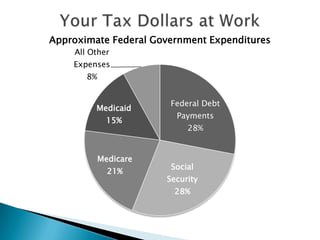
Your Tax Dollars at Work
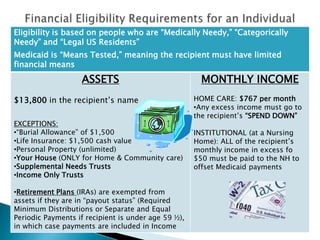
Financial Eligibility Requirements for an Individual
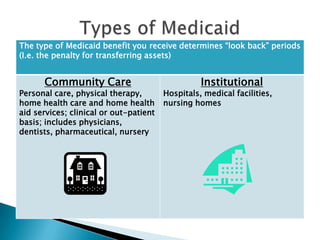
Types of Medicaid
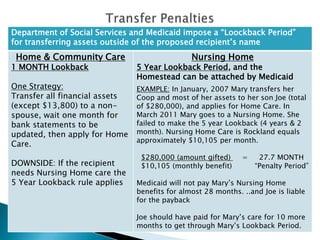
Transfer Penalties
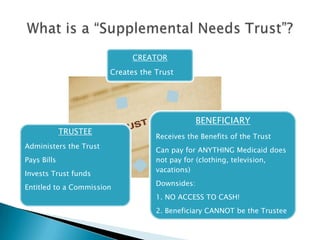
What is a “Supplemental Needs Trust”?
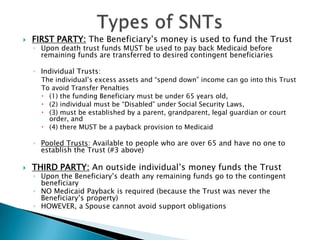
Types of SNTsFIRST PARTY:The Beneficiary’s money is used to fund the TrustUpon death trust funds MUST be used to pay back Medicaid before remaining funds are transferred to desired contingent beneficiariesIndividual Trusts:The individual’s excess assets and “spend down” income can go into this TrustTo avoid Transfer Penalties (1) the funding Beneficiary must be under 65 years old, (2) individual must be “Disabled” under Social Security Laws, (3) must be established by a parent, grandparent, legal guardian or court order, and (4) there MUST be a payback provision to MedicaidPooled Trusts: Available to people who are over 65 and have no one to establish the Trust (#3 above) THIRD PARTY:An outside individual’s money funds the TrustUpon the Beneficiary’s death any remaining funds go to the contingent beneficiaryNO Medicaid Payback is required (because the Trust was never the Beneficiary’s property)HOWEVER, a Spouse cannot avoid support obligations
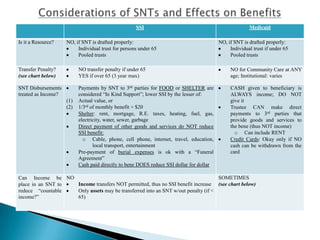
Considerations of SNTs and Effects on Benefits
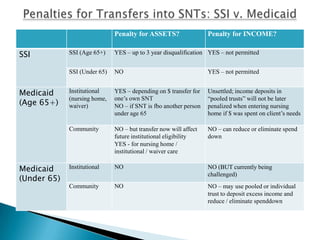
Penalties for Transfers into SNTs: SSI v. Medicaid
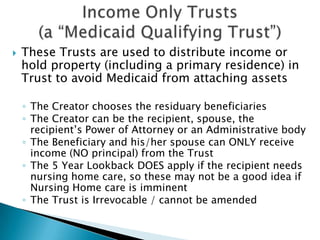
Income Only Trusts (a “Medicaid Qualifying Trust”)These Trusts are used to distribute income or hold property (including a primary residence) in Trust to avoid Medicaid from attaching assetsThe Creator chooses the residuary beneficiariesThe Creator can be the recipient, spouse, the recipient’s Power of Attorney or an Administrative bodyThe Beneficiary and his/her spouse can ONLY receive income (NO principal) from the TrustThe 5 Year Lookback DOES apply if the recipient needs nursing home care, so these may not be a good idea if Nursing Home care is imminentThe Trust is Irrevocable / cannot be amended
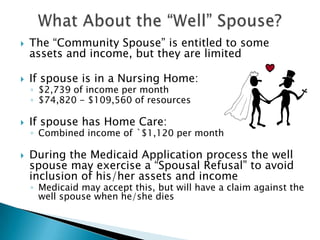
What About the “Well” Spouse?         The “Community Spouse” is entitled to some assets and income, but they are limitedIf spouse is in a Nursing Home:$2,739 of income per month$74,820 - $109,560 of resourcesIf spouse has Home Care:Combined income of `$1,120 per month During the Medicaid Application process the well spouse may exercise a “Spousal Refusal” to avoid inclusion of his/her assets and incomeMedicaid may accept this, but will have a claim against the well spouse when he/she dies
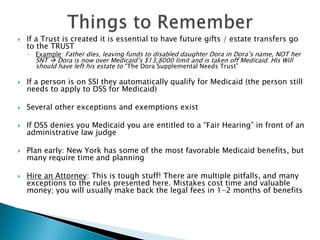
Things to RememberIf a Trust is created it is essential to have future gifts / estate transfers go to the TRUSTExample: Father dies, leaving funds to disabled daughter Dora in Dora’s name, NOT her SNT  Dora is now over Medicaid’s $13,8000 limit and is taken off Medicaid. His Will should have left his estate to “The Dora Supplemental Needs Trust”If a person is on SSI they automatically qualify for Medicaid (the person still needs to apply to DSS for Medicaid)Several other exceptions and exemptions existIf DSS denies you Medicaid you are entitled to a “Fair Hearing” in front of an administrative law judgePlan early: New York has some of the most favorable Medicaid benefits, but many require time and planningHire an Attorney: This is tough stuff! There are multiple pitfalls, and many exceptions to the rules presented here. Mistakes cost time and valuable money; you will usually make back the legal fees in 1-2 months of benefits
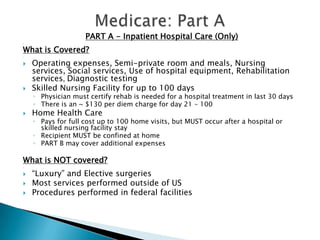
Medicare: Part APART A - Inpatient Hospital Care (Only) What is Covered? Operating expenses, Semi-private room and meals, Nursing services, Social services, Use of hospital equipment, Rehabilitation services, Diagnostic testingSkilled Nursing Facility for up to 100 daysPhysician must certify rehab is needed for a hospital treatment in last 30 daysThere is an ~ $130 per diem charge for day 21 – 100Home Health CarePays for full cost up to 100 home visits, but MUST occur after a hospital or skilled nursing facility stayRecipient MUST be confined at homePART B may cover additional expensesWhat is NOT covered? “Luxury” and Elective surgeriesMost services performed outside of USProcedures performed in federal facilities
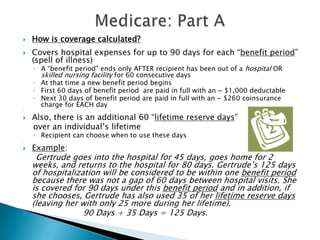
Medicare: Part AHow is coverage calculated? Covers hospital expenses for up to 90 days for each “benefit period” (spell of illness)A “benefit period” ends only AFTER recipient has been out of a hospital OR skilled nursing facility for 60 consecutive daysAt that time a new benefit period beginsFirst 60 days of benefit period  are paid in full with an ~ $1,000 deductableNext 30 days of benefit period are paid in full with an ~ $260 coinsurance charge for EACH day Also, there is an additional 60 “lifetime reserve days”    over an individual’s lifetimeRecipient can choose when to use these days Example:     Gertrude goes into the hospital for 45 days, goes home for 2 weeks, and returns to the hospital for 80 days. Gertrude’s 125 days of hospitalization will be considered to be within one benefit period because there was not a gap of 60 days between hospital visits. She is covered for 90 days under this benefit period and in addition, if she chooses, Gertrude has also used 35 of her lifetime reserve days (leaving her with only 25 more during her lifetime).                                                         90 Days + 35 Days = 125 Days.
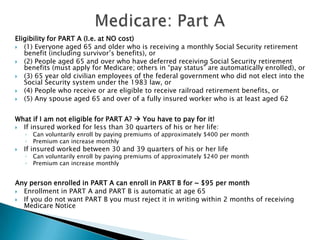
Medicare: Part AEligibility for PART A (I.e. at NO cost)(1) Everyone aged 65 and older who is receiving a monthly Social Security retirement benefit (including survivor’s benefits), or(2) People aged 65 and over who have deferred receiving Social Security retirement benefits (must apply for Medicare; others in “pay status” are automatically enrolled), or(3) 65 year old civilian employees of the federal government who did not elect into the Social Security system under the 1983 law, or(4) People who receive or are eligible to receive railroad retirement benefits, or(5) Any spouse aged 65 and over of a fully insured worker who is at least aged 62What if I am not eligible for PART A?  You have to pay for it!If insured worked for less than 30 quarters of his or her life:Can voluntarily enroll by paying premiums of approximately $400 per monthPremium can increase monthlyIf insured worked between 30 and 39 quarters of his or her lifeCan voluntarily enroll by paying premiums of approximately $240 per monthPremium can increase monthlyAny person enrolled in PART A can enroll in PART B for ~ $95 per monthEnrollment in PART A and PART B is automatic at age 65If you do not want PART B you must reject it in writing within 2 months of receiving Medicare Notice
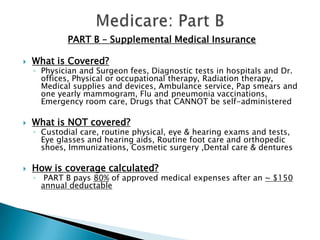
Medicare: Part BPART B – Supplemental Medical InsuranceWhat is Covered?Physician and Surgeon fees, Diagnostic tests in hospitals and Dr. offices, Physical or occupational therapy, Radiation therapy, Medical supplies and devices, Ambulance service, Pap smears and one yearly mammogram, Flu and pneumonia vaccinations, Emergency room care, Drugs that CANNOT be self-administered What is NOT covered? Custodial care, routine physical, eye & hearing exams and tests, Eye glasses and hearing aids, Routine foot care and orthopedic shoes, Immunizations, Cosmetic surgery ,Dental care & denturesHow is coverage calculated? PART B pays 80% of approved medical expenses after an ~ $150 annual deductable
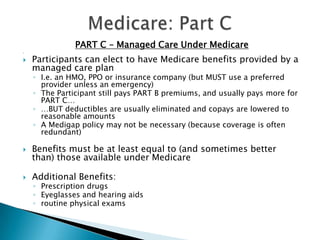
Medicare: Part CPART C – Managed Care Under Medicare Participants can elect to have Medicare benefits provided by a managed care planI.e. an HMO, PPO or insurance company (but MUST use a preferred provider unless an emergency)The Participant still pays PART B premiums, and usually pays more for PART C……BUT deductibles are usually eliminated and copays are lowered to reasonable amountsA Medigap policy may not be necessary (because coverage is often redundant)Benefits must be at least equal to (and sometimes better than) those available under MedicareAdditional Benefits:Prescription drugsEyeglasses and hearing aids routine physical exams
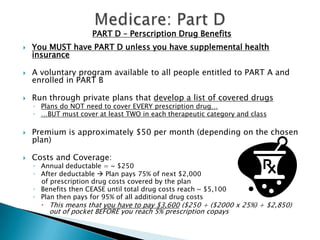
Medicare: Part DPART D – Perscription Drug Benefits You MUST have PART D unless you have supplemental health insuranceA voluntary program available to all people entitled to PART A and enrolled in PART BRun through private plans that develop a list of covered drugsPlans do NOT need to cover EVERY prescription drug……BUT must cover at least TWO in each therapeutic category and classPremium is approximately $50 per month (depending on the chosen plan)Costs and Coverage:Annual deductable = ~ $250After deductable  Plan pays 75% of next $2,000     of prescription drug costs covered by the planBenefits then CEASE until total drug costs reach ~ $5,100Plan then pays for 95% of all additional drug costsThis means that you have to pay $3,600 ($250 + ($2000 x 25%) + $2,850) out of pocket BEFORE you reach 5% prescription copays
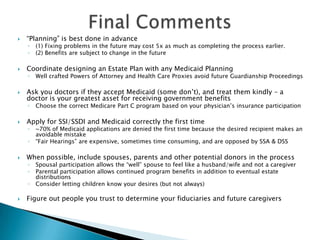
Final Comments“Planning” is best done in advance(1) Fixing problems in the future may cost 5x as much as completing the process earlier.(2) Benefits are subject to change in the futureCoordinate designing an Estate Plan with any Medicaid PlanningWell crafted Powers of Attorney and Health Care Proxies avoid future Guardianship ProceedingsAsk you doctors if they accept Medicaid (some don’t), and treat them kindly – a doctor is your greatest asset for receiving government benefitsChoose the correct Medicare Part C program based on your physician’s insurance participationApply for SSI/SSDI and Medicaid correctly the first time~70% of Medicaid applications are denied the first time because the desired recipient makes an avoidable mistake“Fair Hearings” are expensive, sometimes time consuming, and are opposed by SSA & DSSWhen possible, include spouses, parents and other potential donors in the processSpousal participation allows the “well” spouse to feel like a husband/wife and not a caregiverParental participation allows continued program benefits in addition to eventual estate distributions Consider letting children know your desires (but not always)Figure out people you trust to determine your fiduciaries and future caregivers

Medicaid planning

  • 1.
    Attorney AdvertisingMedicaid Planning&Medicare Benefitsin Rockland County, New YorkDaniel Timins and Michael LaMagna.Timins & LaMagna, LLP399 Knollwood Road, Suite 300White Plains, New York 10603
  • 2.
  • 3.
  • 4.
  • 5.
  • 6.
    What is a“Supplemental Needs Trust”?
  • 7.
    Types of SNTsFIRSTPARTY:The Beneficiary’s money is used to fund the TrustUpon death trust funds MUST be used to pay back Medicaid before remaining funds are transferred to desired contingent beneficiariesIndividual Trusts:The individual’s excess assets and “spend down” income can go into this TrustTo avoid Transfer Penalties (1) the funding Beneficiary must be under 65 years old, (2) individual must be “Disabled” under Social Security Laws, (3) must be established by a parent, grandparent, legal guardian or court order, and (4) there MUST be a payback provision to MedicaidPooled Trusts: Available to people who are over 65 and have no one to establish the Trust (#3 above) THIRD PARTY:An outside individual’s money funds the TrustUpon the Beneficiary’s death any remaining funds go to the contingent beneficiaryNO Medicaid Payback is required (because the Trust was never the Beneficiary’s property)HOWEVER, a Spouse cannot avoid support obligations
  • 8.
    Considerations of SNTsand Effects on Benefits
  • 9.
    Penalties for Transfersinto SNTs: SSI v. Medicaid
  • 10.
    Income Only Trusts(a “Medicaid Qualifying Trust”)These Trusts are used to distribute income or hold property (including a primary residence) in Trust to avoid Medicaid from attaching assetsThe Creator chooses the residuary beneficiariesThe Creator can be the recipient, spouse, the recipient’s Power of Attorney or an Administrative bodyThe Beneficiary and his/her spouse can ONLY receive income (NO principal) from the TrustThe 5 Year Lookback DOES apply if the recipient needs nursing home care, so these may not be a good idea if Nursing Home care is imminentThe Trust is Irrevocable / cannot be amended
  • 11.
    What About the“Well” Spouse? The “Community Spouse” is entitled to some assets and income, but they are limitedIf spouse is in a Nursing Home:$2,739 of income per month$74,820 - $109,560 of resourcesIf spouse has Home Care:Combined income of `$1,120 per month During the Medicaid Application process the well spouse may exercise a “Spousal Refusal” to avoid inclusion of his/her assets and incomeMedicaid may accept this, but will have a claim against the well spouse when he/she dies
  • 12.
    Things to RememberIfa Trust is created it is essential to have future gifts / estate transfers go to the TRUSTExample: Father dies, leaving funds to disabled daughter Dora in Dora’s name, NOT her SNT  Dora is now over Medicaid’s $13,8000 limit and is taken off Medicaid. His Will should have left his estate to “The Dora Supplemental Needs Trust”If a person is on SSI they automatically qualify for Medicaid (the person still needs to apply to DSS for Medicaid)Several other exceptions and exemptions existIf DSS denies you Medicaid you are entitled to a “Fair Hearing” in front of an administrative law judgePlan early: New York has some of the most favorable Medicaid benefits, but many require time and planningHire an Attorney: This is tough stuff! There are multiple pitfalls, and many exceptions to the rules presented here. Mistakes cost time and valuable money; you will usually make back the legal fees in 1-2 months of benefits
  • 13.
    Medicare: Part APARTA - Inpatient Hospital Care (Only) What is Covered? Operating expenses, Semi-private room and meals, Nursing services, Social services, Use of hospital equipment, Rehabilitation services, Diagnostic testingSkilled Nursing Facility for up to 100 daysPhysician must certify rehab is needed for a hospital treatment in last 30 daysThere is an ~ $130 per diem charge for day 21 – 100Home Health CarePays for full cost up to 100 home visits, but MUST occur after a hospital or skilled nursing facility stayRecipient MUST be confined at homePART B may cover additional expensesWhat is NOT covered? “Luxury” and Elective surgeriesMost services performed outside of USProcedures performed in federal facilities
  • 14.
    Medicare: Part AHowis coverage calculated? Covers hospital expenses for up to 90 days for each “benefit period” (spell of illness)A “benefit period” ends only AFTER recipient has been out of a hospital OR skilled nursing facility for 60 consecutive daysAt that time a new benefit period beginsFirst 60 days of benefit period are paid in full with an ~ $1,000 deductableNext 30 days of benefit period are paid in full with an ~ $260 coinsurance charge for EACH day Also, there is an additional 60 “lifetime reserve days” over an individual’s lifetimeRecipient can choose when to use these days Example: Gertrude goes into the hospital for 45 days, goes home for 2 weeks, and returns to the hospital for 80 days. Gertrude’s 125 days of hospitalization will be considered to be within one benefit period because there was not a gap of 60 days between hospital visits. She is covered for 90 days under this benefit period and in addition, if she chooses, Gertrude has also used 35 of her lifetime reserve days (leaving her with only 25 more during her lifetime). 90 Days + 35 Days = 125 Days.
  • 15.
    Medicare: Part AEligibilityfor PART A (I.e. at NO cost)(1) Everyone aged 65 and older who is receiving a monthly Social Security retirement benefit (including survivor’s benefits), or(2) People aged 65 and over who have deferred receiving Social Security retirement benefits (must apply for Medicare; others in “pay status” are automatically enrolled), or(3) 65 year old civilian employees of the federal government who did not elect into the Social Security system under the 1983 law, or(4) People who receive or are eligible to receive railroad retirement benefits, or(5) Any spouse aged 65 and over of a fully insured worker who is at least aged 62What if I am not eligible for PART A?  You have to pay for it!If insured worked for less than 30 quarters of his or her life:Can voluntarily enroll by paying premiums of approximately $400 per monthPremium can increase monthlyIf insured worked between 30 and 39 quarters of his or her lifeCan voluntarily enroll by paying premiums of approximately $240 per monthPremium can increase monthlyAny person enrolled in PART A can enroll in PART B for ~ $95 per monthEnrollment in PART A and PART B is automatic at age 65If you do not want PART B you must reject it in writing within 2 months of receiving Medicare Notice
  • 16.
    Medicare: Part BPARTB – Supplemental Medical InsuranceWhat is Covered?Physician and Surgeon fees, Diagnostic tests in hospitals and Dr. offices, Physical or occupational therapy, Radiation therapy, Medical supplies and devices, Ambulance service, Pap smears and one yearly mammogram, Flu and pneumonia vaccinations, Emergency room care, Drugs that CANNOT be self-administered What is NOT covered? Custodial care, routine physical, eye & hearing exams and tests, Eye glasses and hearing aids, Routine foot care and orthopedic shoes, Immunizations, Cosmetic surgery ,Dental care & denturesHow is coverage calculated? PART B pays 80% of approved medical expenses after an ~ $150 annual deductable
  • 17.
    Medicare: Part CPARTC – Managed Care Under Medicare Participants can elect to have Medicare benefits provided by a managed care planI.e. an HMO, PPO or insurance company (but MUST use a preferred provider unless an emergency)The Participant still pays PART B premiums, and usually pays more for PART C……BUT deductibles are usually eliminated and copays are lowered to reasonable amountsA Medigap policy may not be necessary (because coverage is often redundant)Benefits must be at least equal to (and sometimes better than) those available under MedicareAdditional Benefits:Prescription drugsEyeglasses and hearing aids routine physical exams
  • 18.
    Medicare: Part DPARTD – Perscription Drug Benefits You MUST have PART D unless you have supplemental health insuranceA voluntary program available to all people entitled to PART A and enrolled in PART BRun through private plans that develop a list of covered drugsPlans do NOT need to cover EVERY prescription drug……BUT must cover at least TWO in each therapeutic category and classPremium is approximately $50 per month (depending on the chosen plan)Costs and Coverage:Annual deductable = ~ $250After deductable  Plan pays 75% of next $2,000 of prescription drug costs covered by the planBenefits then CEASE until total drug costs reach ~ $5,100Plan then pays for 95% of all additional drug costsThis means that you have to pay $3,600 ($250 + ($2000 x 25%) + $2,850) out of pocket BEFORE you reach 5% prescription copays
  • 19.
    Final Comments“Planning” isbest done in advance(1) Fixing problems in the future may cost 5x as much as completing the process earlier.(2) Benefits are subject to change in the futureCoordinate designing an Estate Plan with any Medicaid PlanningWell crafted Powers of Attorney and Health Care Proxies avoid future Guardianship ProceedingsAsk you doctors if they accept Medicaid (some don’t), and treat them kindly – a doctor is your greatest asset for receiving government benefitsChoose the correct Medicare Part C program based on your physician’s insurance participationApply for SSI/SSDI and Medicaid correctly the first time~70% of Medicaid applications are denied the first time because the desired recipient makes an avoidable mistake“Fair Hearings” are expensive, sometimes time consuming, and are opposed by SSA & DSSWhen possible, include spouses, parents and other potential donors in the processSpousal participation allows the “well” spouse to feel like a husband/wife and not a caregiverParental participation allows continued program benefits in addition to eventual estate distributions Consider letting children know your desires (but not always)Figure out people you trust to determine your fiduciaries and future caregivers