Imagine your doctor
operating on your
local hospital from
his computer in
Australia.
Or giving aspeech
while information
is streamed to
your eyeglasses in
real time
Or cooking a
food in your
home while you
are at work
Or amirror that
selects your outfit
for today…
Watch your
day in 2020
CURRENT and FUTURE
TRENDS of Media and
Information
Let’s havea
debate.
Who is
smarter,
human or
robots?
HAPTICS TECHNOLOGY
What is Haptics?
-is the science of
applying touch (tactile)
sensation and control to
interaction with
computer applications
HAPTICS TECHNOLOGY
•is afeedback technology
(using computer applications)
that takes advantage of the
user’s sense of touch by
applying force, vibrations
and/or motions to the user
Examples:
• Smartphones
• Tablets
• etc.
CONTEXTUAL AWARENESS
What i s a Context?
-background,
environment, situation
CONTEXTUAL AWARENESS
-by combining ‘hard sensor’
information such aswhereyou
are and the conditionsaround
you, combined with ‘soft sensors’
such asyour calendar, your social
network and past preferences -
future devices will constantly
learn about who you are and how
you live, workand play
Example:
Imagine your PCadvising
you to leave home 15
minutes early or take a
different route to avoid a
traffic jam on your way
to work.
Example:
Consider a“context aware”
remote control that
instantly determines who is
holding it and automatically
selects the Smart TV
preferences for thatperson
VOICE AND
TONE
RECOGNITION
VOICE AND TONE RECOGNITION
-Not only can voice and tone
recognition be used toconfirm
aperson’s identity but tone
recognition can be used to
detect aperson’s health or
emotional state.
I n t e l l i g e n t Routing
Devices
I n t e l l i g e n t Routing Devices
-This future technology willbe
useful to, for example, local
councils. While on the move,
staff will be able to provide the
precise description and
location ofastreet-based issue
using Smartphones
Mobile devices thatcan take
photos and have GPS
(global positioning system)
support. Intelligent routing will
then alert the responsible team
to action.
A r t i f i c i a l
Intelligence (AI)
A r t i f i c i a l Intelligence
-the power of amachineto
copy intelligent human
behavior
Is Artificial
Intelligence
born or made?
Eye Tracking
Technology
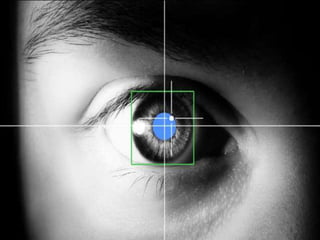
Eye Tracking Technology
-measures eye positions
and movements which are
analyzed through computer
applications
Eye Tracking Technology
Could have many possibleapplication
including:
-Law enforcement (liedetection)
-Airport Security
-Retail
-Safety
-Health Care
-Human-Computer Interaction
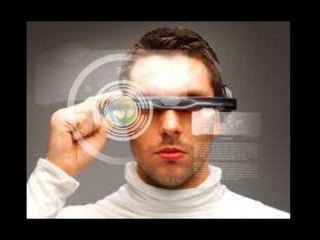
Internet Glasses
Internet Glasses
-Technology that can display
images directly onto our retinas
while not blocking our sight is
being developed. This
technology can be used in
eyeglasses and have uses
ranging from e-Gaming to
military defense
Examples:
•Receiving turn by turn directions
asyou walk toward your destination
•Viewing virtual recipes while
cooking without losing your rhythm
•Walking down the street, seeing
one of your friends show up "on
screen" 2blocks and 1cafeaway
Examples:
•Seeing building schematicsand
locations of others (especially
useful for security or fire
fighters)
•Giving aspeech while
information is streamed toyour
eyeglasses in realtime
Wearable Technology
Wearable Technology
-are smart electronic devices
(electronic device with
microcontrollers) that can be
worn on the body asimplant or
accessories
Wearable Technology
- Google Glass
- Smart Watch
- Smart Ring
-Bluetooth Headset
- etc.
3D Environment
3D Environment
-are often referred to asvirtual
reality or interactive 3Dand
have afigurative appearance
Examples:
-3DPrinter
-Holograms
-3DFilm
-etc.
Ubiquitous Learning
Ubiquitous Learning
-is often simply defined as
learning anywhere, anytime
and is therefore closely
associated with mobile
technologies
Key Character i s t ics of
Ubiquitous Learning:
(Chen et a l . , 2002;
Curtis et a l . ,
2002)
1.Permanency -Learning
materials are always
available unlesspurposely
deleted.
2.Accessibility -Accessfrom
everywhere aspersonally
required.
3.Immediacy -Wherever a
student is, he/she can
immediately accesslearning
materials.
4.Interactivity -Online
collaboration with teachers
and / or peers (chat / blogs /
forums)
5.Situated instructional
Activities -Learning in
context (on-site).
6. Adaptability -Getting
the right informationat
the right place for the
right student.

9-current-andfuture-trendsofmediaandinformation-170830071432-converted.pptx